 ManualGo.com
DSX A400BT.EUR - Bluetooth Car Stereo SONY - Free user manual and instructions
Find the device manual for free DSX A400BT.EUR SONY in PDF.



Download the instructions for your Bluetooth Car Stereo in PDF format for free! Find your manual DSX A400BT.EUR - SONY and take your electronic device back in hand. On this page are published all the documents necessary for the use of your device. DSX A400BT.EUR by SONY.
USER MANUAL DSX A400BT.EUR SONY
For safety, be sure to install this unit in the dashboard of the car as the rear side of the unit becomes hot during use. For details, see “Connection/Installation” (page 27). Made in Thailand The nameplate indicating operating voltage, etc., is located on the bottom of the chassis. Hereby, Sony Corporation declares that this equipment is in compliance with Directive 2014/53/ EU. The full text of the EU declaration of conformity is available at the following internet address: http://www.compliance.sony.de/ Notice for customers: the following information is only applicable to equipment sold in countries applying EU Directives Manufacturer: Sony Corporation, 1-7-1 Konan Minato-ku Tokyo, 108-0075 Japan For EU product compliance: Sony Belgium, bijkantoor van Sony Europe Limited, Da Vincilaan 7-D1, 1935 Zaventem, Belgium Disposal of waste batteries and electrical and electronic equipment (applicable in the European Union and other European countries with separate collection systems) This symbol on the product, the battery or on the packaging indicates that the product and the battery shall not be treated as household waste. On certain batteries this symbol might be used in combination with a chemical symbol. The chemical symbols for mercury (Hg) or lead (Pb) are added if the battery contains more than 0.0005% mercury or 0.004% lead. By ensuring these products and batteries are disposed of correctly, you will help prevent potentially negative consequences for the environment and human health which could otherwise be caused by inappropriate waste 2GB handling. The recycling of the materials will help to conserve natural resources. In case of products that for safety, performance or data integrity reasons require a permanent connection with an incorporated battery, this battery should be replaced by qualified service staff only. To ensure that the battery and the electrical and electronic equipment will be treated properly, hand over these products at end-of-life to the applicable collection point for the recycling of electrical and electronic equipment. For all other batteries, please view the section on how to remove the battery from the product safely. Hand the battery over to the applicable collection point for the recycling of waste batteries. For more detailed information about recycling of this product or battery, please contact your local Civic Office, your household waste disposal service or the shop where you purchased the product or battery. Warning if your car’s ignition has no ACC position Be sure to set the AUTO OFF function (page 18). The unit will shut off completely and automatically in the set time after the unit is turned off, which prevents battery drain. If you do not set the AUTO OFF function, press and hold OFF until the display disappears each time you turn the ignition off. Disclaimer regarding services offered by third parties Services offered by third parties may be changed, suspended, or terminated without prior notice. Sony does not bear any responsibility in these sorts of situations. Important notice Caution IN NO EVENT SHALL SONY BE LIABLE FOR ANY
INCIDENTAL, INDIRECT OR CONSEQUENTIAL
DAMAGES OR OTHER DAMAGES INCLUDING, WITHOUT LIMITATION, LOSS OF PROFITS, LOSS OF REVENUE, LOSS OF DATA, LOSS OF USE OF THE PRODUCT OR ANY ASSOCIATED EQUIPMENT, DOWNTIME, AND PURCHASER’S TIME RELATED TO OR ARISING OUT OF THE USE OF THIS PRODUCT, ITS HARDWARE AND/OR ITS SOFTWARE. We do not take any responsibility for the leakage of information during BLUETOOTH communication. If you have any questions or problems concerning your unit that are not covered in this manual, consult your nearest Sony dealer. Dear customer, this product includes a radio transmitter. According to UNECE Regulation no. 10, a vehicle manufacturers may impose specific conditions for installation of radio transmitters into vehicles. Please check your vehicle operation manual or contact the manufacturer of your vehicle or your vehicle dealer, before you install this product into your vehicle. Emergency calls This BLUETOOTH car handsfree and the electronic device connected to the handsfree operate using radio signals, cellular, and landline networks as well as user-programmed function, which cannot guarantee connection under all conditions. Therefore do not rely solely upon any electronic device for essential communications (such as medical emergencies). On BLUETOOTH communication Microwaves emitting from a BLUETOOTH device may affect the operation of electronic medical devices. Turn off this unit and other BLUETOOTH devices in the following locations, as it may cause an accident. where inflammable gas is present, in a hospital, train, airplane, or petrol station near automatic doors or a fire alarm This unit supports security capabilities that comply with the BLUETOOTH standard to provide a secure connection when the BLUETOOTH wireless technology is used, but security may not be enough depending on the setting. Be careful when communicating using BLUETOOTH wireless technology. 3GB Additional Information Table of Contents Guide to Parts and Controls ... 5 Getting Started Detaching the Front Panel ... Setting the Clock ... Preparing a BLUETOOTH Device... Connecting a USB Device ... Connecting Other Portable Audio Device ...
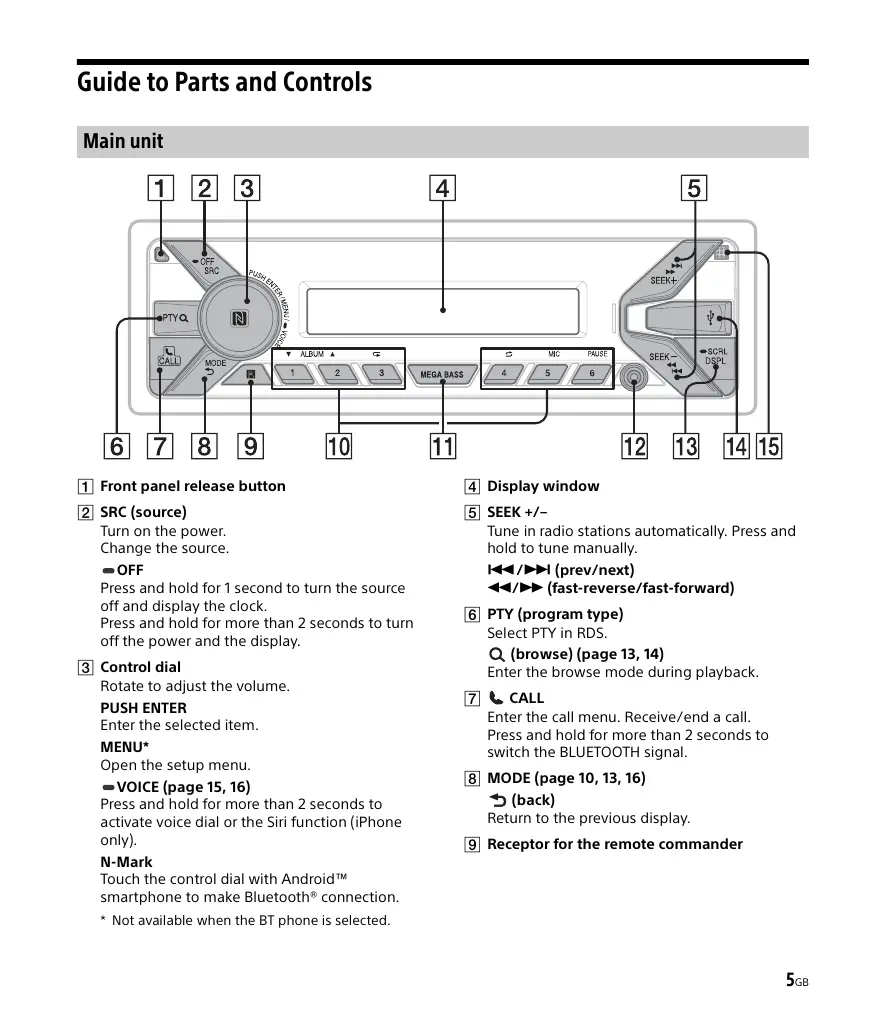
Guide to Parts and Controls Main unit Front panel release button Display window SRC (source) Turn on the power. Change the source. SEEK +/– Tune in radio stations automatically. Press and hold to tune manually. OFF Press and hold for 1 second to turn the source off and display the clock. Press and hold for more than 2 seconds to turn off the power and the display. Control dial Rotate to adjust the volume. PUSH ENTER Enter the selected item. MENU* Open the setup menu. VOICE (page 15, 16) Press and hold for more than 2 seconds to activate voice dial or the Siri function (iPhone only). / (prev/next) / (fast-reverse/fast-forward) PTY (program type) Select PTY in RDS. (browse) (page 13, 14) Enter the browse mode during playback.
CALL Enter the call menu. Receive/end a call. Press and hold for more than 2 seconds to switch the BLUETOOTH signal. MODE (page 10, 13, 16) (back) Return to the previous display. Receptor for the remote commander N-Mark Touch the control dial with Android™ smartphone to make Bluetooth® connection.
- Not available when the BT phone is selected. 5GB Number buttons (1 to 6) Receive stored radio stations. Press and hold to store stations. Call a stored phone number. Press and hold to store a phone number. ALBUM / Skip an album for audio device. Press and hold to skip albums continuously. (repeat) (shuffle) MIC (page 16) PAUSE MEGA BASS Reinforces bass sound in synchronization with the volume level. Press to change the MEGA BASS setting: [1], [2], [OFF]. Getting Started Detaching the Front Panel You can detach the front panel of this unit to prevent theft.
Press and hold OFF until the unit turns off, press the front panel release button , then pull the panel towards you to remove. AUX input jack DSPL (display) Press to change display items. SCRL (scroll) Press and hold to scroll a display item. USB port Microphone (inner panel) In order for the handsfree function to work properly, do not cover the microphone with tape, etc. Caution alarm If you turn the ignition switch to the OFF position without detaching the front panel, the caution alarm will sound for a few seconds. The alarm will only sound if the built-in amplifier is used. Serial numbers Make sure the serial numbers on the bottom of the unit and the back of the front panel are matched correctly. Otherwise you cannot make BLUETOOTH pairing, connection and disconnection by NFC. Attaching the front panel 6GB Setting the Clock
Press MENU, rotate the control dial to select [SET GENERAL], then press it.
Rotate the control dial to select [SET CLOCK-ADJ], then press it. The hour indication flashes.
Rotate the control dial to set the hour and minute. For a smartphone with Android OS 4.0 or lower installed, downloading the app “NFC Easy Connect” available at Google Play™ is required. The app may not be downloadable in some countries/regions.
Activate the NFC function on the smartphone. For details, refer to the operating instructions supplied with the smartphone.
Touch the N-Mark part of the unit with the N-Mark part of the smartphone. To move the digital indication, press SEEK +/–.
After setting the minute, press MENU. The setup is complete and the clock starts. To display the clock Press DSPL. Preparing a BLUETOOTH Device You can enjoy music, or perform handsfree calling depending on the BLUETOOTH compatible device such as a smartphone, cellular phone and audio device (hereafter “BLUETOOTH device” if not otherwise specified). For details on connecting, refer to the operating instructions supplied with the device. Before connecting the device, turn down the volume of this unit; otherwise, loud sound may result. Connecting with a Smartphone by One touch (NFC) By touching the control dial on the unit with an NFC* compatible smartphone, the unit is paired and connected with the smartphone automatically.
- NFC (Near Field Communication) is a technology enabling short-range wireless communication between various devices, such as mobile phones and IC tags. Thanks to the NFC function, data communication can be achieved easily just by touching the relevant symbol or designated location on NFC compatible devices. Make sure that unit. lights up on the display of the To disconnect by One touch Touch the N-Mark part of the unit with the N-Mark part of the smartphone again. Notes When making the connection, handle the smartphone carefully to prevent scratches. One touch connection is not possible when the unit is already connected to another NFC compatible device. In this case, disconnect the other device, and make connection with the smartphone again. Pairing and connecting with a BLUETOOTH device When connecting a BLUETOOTH device for the first time, mutual registration (called “pairing”) is required. Pairing enables this unit and other devices to recognize each other.
Place the BLUETOOTH device within 1 m (3 ft) of this unit. 7GB
Press CALL, rotate the control dial to select [SET PAIRING], then press it. flashes while the unit is in pairing standby mode.
Perform pairing on the BLUETOOTH device so it detects this unit.
Select [DSX-XXXX] (your model name) shown in the display of the BLUETOOTH device. To cancel pairing Perform step 2 to cancel the pairing mode after this unit and the BLUETOOTH device are paired. Connecting with a paired BLUETOOTH device To use a paired device, connection with this unit is required. Some paired devices will connect automatically. If your model name does not appear, repeat from step 2.
Press CALL, rotate the control dial to select [SET BT SIGNL], then press it. Make sure that
- Passkey may be called “Passcode,” “PIN code,” “PIN number” or “Password,” etc., depending on the device. lights up.
Operate the BLUETOOTH device to connect to this unit.
lights up. Icons in the display: Input passkey [0000] When pairing is made,
stays lit. Select this unit on the BLUETOOTH device to establish the BLUETOOTH connection.
lights up when the connection is made. Note While connecting to a BLUETOOTH device, this unit cannot be detected from another device. To enable detection, enter the pairing mode and search for this unit from another device. To start playback For details, see “Playing a BLUETOOTH Device” (page 13). 8GB Lights up when handsfree calling is available by enabling the HFP (Handsfree Profile). Lights up when the audio device is playable by enabling the A2DP (Advanced Audio Distribution Profile). To connect the last-connected device from this unit Activate the BLUETOOTH function on the BLUETOOTH device. Press SRC to select [BT PHONE] or [BT AUDIO]. Press ENTER to connect with the cellular phone, or PAUSE to connect with the audio device. Note While streaming BLUETOOTH audio, you cannot connect from this unit to the cellular phone. Connect from the cellular phone to this unit instead. Tip With BLUETOOTH signal on: when the ignition is turned to on, this unit reconnects automatically to the lastconnected cellular phone. Connecting with an iPhone/iPod (BLUETOOTH Auto Pairing) Connecting a USB Device
Turn down the volume on the unit. Connect the USB device to the unit. To connect an iPod/iPhone, use the USB connection cable for iPod (not supplied). When an iPhone/iPod with iOS5 or later installed is connected to the USB port, the unit is paired and connected with the iPhone/iPod automatically. To enable BLUETOOTH Auto Pairing, make sure [AUTOPAIR] in [BT] is set to [ON] (page 19).
Connect an iPhone/iPod to the USB port. Connecting Other Portable Audio Device Make sure that unit. lights up on the display of the
Notes BLUETOOTH Auto Pairing is not possible if the unit is already connected to another BLUETOOTH device. In this case, disconnect the other device, then connect the iPhone/iPod again. If BLUETOOTH Auto Pairing is not established, see “Preparing a BLUETOOTH Device” for details (page 7). Turn off the portable audio device. Turn down the volume on the unit. Connect the portable audio device to the AUX input jack (stereo mini jack) on the unit with a connecting cord (not supplied)*.
- Be sure to use a straight type plug.
Press SRC to select [AUX]. 9GB To match the volume level of the connected device to other sources Start playback of the portable audio device at a moderate volume, and set your usual listening volume on the unit. Press MENU, then select [SET SOUND] [SET AUX VOL] (page 18). Listening to the Radio Listening to the Radio To listen to the radio, press SRC to select [TUNER]. Storing automatically (BTM)
Press MODE to change the band (FM1, FM2, FM3, MW or LW).
Press MENU, rotate the control dial to select [SET GENERAL], then press it.
Rotate the control dial to select [SET BTM], then press it. The unit stores stations in order of frequency on the number buttons. Tuning
Press MODE to change the band (FM1, FM2, FM3, MW or LW).
Perform tuning. To tune manually Press and hold SEEK +/– to locate the approximate frequency, then press SEEK +/– repeatedly to fine adjust to the desired frequency. To tune automatically Press SEEK +/–. Scanning stops when the unit receives a station. Storing manually
10GB While receiving the station that you want to store, press and hold a number button (1 to 6) until [MEM] appears. Receiving the stored stations
Select the band, then press a number button (1 to 6). Using Radio Data System (RDS) Setting alternative frequencies (AF) and traffic announcement (TA) AF continuously retunes the station to the strongest signal in a network, and TA provides current traffic information or traffic programs (TP) if received.
Press MENU, rotate the control dial to select [SET GENERAL], then press it.
Rotate the control dial to select [SET AF/ TA], then press it.
Rotate the control dial to select [SET AFON], [SET TA-ON], [SET AF/TA-ON] or [SET AF/TA-OFF], then press it. To store RDS stations with the AF and TA setting You can preset RDS stations along with an AF/TA setting. Set AF/TA, then store the station with BTM or manually. If you preset manually, you can also preset non-RDS stations. To receive emergency announcements With AF or TA on, emergency announcements will automatically interrupt the currently selected source. To adjust the volume level during a traffic announcement Level will be stored into memory for subsequent traffic announcements, independently from the regular volume level. To stay with one regional program (REGIONAL) When the AF and REGIONAL functions are on, you will not be switched to another regional station with a stronger frequency. If you leave this regional program’s reception area, set [SET REG-OFF] in [SET GENERAL] during FM reception (page 18). This function does not work in the UK and some other areas. Local Link function (UK only) This function enables you to select other local stations in the area, even if they are not stored on your number buttons. During FM reception, press a number button (1 to 6) on which a local station is stored. Within 5 seconds, press again a number button of the local station. Repeat this procedure until the local station is received. Selecting program types (PTY)
Press PTY during FM reception. Rotate the control dial until the desired program type appears, then press it. The unit starts to search for a station broadcasting the selected program type. Type of programs NEWS (News), AFFAIRS (Current Affairs), INFO (Information), SPORT (Sports), EDUCATE (Education), DRAMA (Drama), CULTURE (Culture), SCIENCE (Science), VARIED (Varied), POP M (Pop Music), ROCK M (Rock Music), EASY M (M.O.R. Music), LIGHT M (Light classical), CLASSICS (Serious classical), OTHER M (Other Music), WEATHER (Weather), FINANCE (Finance), CHILDREN (Children’s program), SOCIAL A (Social Affairs), RELIGION (Religion), PHONE IN (Phone In), TRAVEL (Travel), LEISURE (Leisure), JAZZ (Jazz Music), COUNTRY (Country Music), NATION M (National Music), OLDIES (Oldies Music), FOLK M (Folk Music), DOCUMENT (Documentary) 11GB Setting clock time (CT) The CT data from the RDS transmission sets the clock.
Set [SET CT-ON] in [SET GENERAL] (page 18). Playback Playing a USB Device In these Operating Instructions, “iPod” is used as a general reference for the iPod functions on an iPod and iPhone, unless otherwise specified by the text or illustrations. For details on the compatibility of your iPod, see “About iPod” (page 20) or visit the support site on the back cover. MSC (Mass Storage Class) and MTP (Media Transfer Protocol) type USB devices (such as a USB flash drive, digital media player, Android smartphone) compliant with the USB standard can be used. Depending on the digital media player or Android smartphone, setting the USB connection mode to MTP is required. Notes For details on the compatibility of your USB device, visit the support site on the back cover. Playback of the following files is not supported. MP3/WMA/FLAC: copyright-protected files DRM (Digital Rights Management) files Multi-channel audio files MP3/WMA: lossless compression files
Connect a USB device to the USB port (page 9). Playback starts. If a device is already connected, to start playback, press SRC to select [USB] ([IPD] appears in the display when the iPod is recognized).
Adjust the volume on this unit. To stop playback Press and hold OFF for 1 second. To remove the device Stop playback, then remove the device. 12GB Caution for iPhone When you connect an iPhone via USB, phone call volume is controlled by the iPhone, not the unit. Do not inadvertently increase the volume on the unit during a call, as a sudden loud sound may result when the call ends. Operating an iPod directly (Passenger control)
During playback, press and hold MODE until [MODE IPOD] appears. Operations of the iPod become available. Note that the volume can be adjusted only by the unit. To match the volume level of the BLUETOOTH device to other sources Start playback of the BLUETOOTH audio device at a moderate volume, and set your usual listening volume on the unit. Press MENU, then select [SET SOUND] [SET BTA VOL] (page 19). Searching and Playing Tracks Repeat play and shuffle play
To exit passenger control Press and hold MODE until [MODE AUDIO] appears. Playing a BLUETOOTH Device You can play contents on a connected device that supports BLUETOOTH A2DP (Advanced Audio Distribution Profile). Playback in the selected play mode may take time to start. Available play modes differ depending on the selected sound source. Searching a track by name (QuickBrowZer™)
Press SRC to select [BT AUDIO].
Adjust the volume on this unit. Operate the audio device to start playback. Notes Depending on the audio device, information such as title, track number/time and playback status may not be displayed on this unit. Even if the source is changed on this unit, playback of the audio device does not stop. During USB playback, press (browse)* to display the list of search categories. When the track list appears, press (back) repeatedly to display the desired search category. Make BLUETOOTH connection with the audio device (page 7).
During playback, press (repeat) or (shuffle) repeatedly to select the desired play mode.
- During USB playback, press (browse) for more than 2 seconds to directly return to the beginning of the category list.
Rotate the control dial to select the desired search category, then press it to confirm.
Repeat step 2 to search the desired track. Playback starts. To exit the Quick-BrowZer mode Press (browse). 13GB Searching by skipping items (Jump mode)
Press (browse). Press SEEK +. Rotate the control dial to select the item. The list is jumped in steps of 10% of the total number of items.
Handsfree Calling (via BLUETOOTH only) To use a cellular phone, connect it with this unit. For details, see “Preparing a BLUETOOTH Device” (page 7). Press ENTER to return to the QuickBrowZer mode. The selected item appears.
Rotate the control dial to select the desired item, then press it. Playback starts. Receiving a Call
Press CALL when a call is received with a ringtone. The phone call starts. Note The ringtone and talker’s voice are output only from the front speakers. To reject the call Press and hold OFF for 1 second. To end the call Press CALL again. Making a Call You can make a call from the phonebook or call history when a cellular phone supporting PBAP (Phone Book Access Profile) is connected. From the phonebook 14GB
Press CALL, rotate the control dial to select [PHONE BOOK], then press it.
Rotate the control dial to select an initial from the initial list, then press it.
Rotate the control dial to select a name from the name list, then press it.
Rotate the control dial to select a number from the number list, then press it. The phone call starts. From the call history
Presetting phone numbers You can store up to 6 contacts in the preset dial.
Press CALL, rotate the control dial to select [RECENT CALL], then press it. Select a phone number that you want to store in the preset dial, from the phonebook, call history or by inputting the phone number directly. The phone number appears in the display of this unit. Press and hold a number button (1 to 6) until [MEM] appears. The contact is stored in the selected preset number. A list of the call history appears.
Rotate the control dial to select a name or phone number from the call history, then press it. The phone call starts. By voice tags You can make a call by saying the voice tag stored in a connected cellular phone that has a voice dialing function.
Press CALL, rotate the control dial to select [DIAL NUMBER], then press it.
Rotate the control dial to enter the phone number, and lastly select [ ] (space), then press ENTER*. The phone call starts.
- To move the digital indication, press SEEK +/–. Press CALL, rotate the control dial to select [VOICE DIAL], then press it. Alternatively, press and hold VOICE for more than 2 seconds.
Say the voice tag stored on the cellular phone. Your voice is recognized, and the call is made. To cancel voice dialing Press VOICE. Note [_] appears instead of [#] on the display. By redial
Press CALL, rotate the control dial to select [REDIAL], then press it. The phone call starts. By preset number
Press SRC to select [BT PHONE].
Press ENTER. Press a number button (1 to 6) to select the contact you want to call. The phone call starts. 15GB Available Operations during Call To adjust the ringtone volume Rotate the control dial while receiving a call. To adjust the talker’s voice volume Rotate the control dial during a call. To adjust the volume for the other party (Mic gain adjustment) Press MIC. Adjustable volume levels: [MIC-LOW], [MIC-MID], [MIC-HI]. To reduce echo and noise (Echo Canceler/ Noise Canceler Mode) Useful Functions Using Siri Eyes Free Siri Eyes Free allows you to use an iPhone handsfree by simply speaking into the microphone. This function requires you to connect an iPhone to the unit via BLUETOOTH. Availability is limited iPhone 4s or later. Make sure that your iPhone is running the latest iOS version. You must complete BLUETOOTH registration and connection configurations for the iPhone with the unit in advance. For details, see “Preparing a BLUETOOTH Device” (page 7).
For details, refer to the operating instructions supplied with the iPhone. Press and hold MIC. Settable mode: [EC/NC-1], [EC/NC-2]. To switch between handsfree mode and handheld mode During a call, press MODE to switch the phone call audio between the unit and cellular phone. Note Depending on the cellular phone, this operation may not be available. Activate the Siri function on the iPhone.
Press and hold VOICE for more than 2 seconds. The voice command display appears.
After the iPhone beeps, speak into the microphone. The iPhone beeps again, then Siri starts responding. To deactivate Siri Eyes Free Press VOICE. Notes The iPhone may not recognize your voice depending on usage conditions. (For example, if you are in a moving car.) Siri Eyes Free may not function properly, or the response time may lag in locations where iPhone signals are difficult to receive. Depending on the iPhone’s operating condition, Siri Eyes Free may not function properly, or may quit. If you play a track with an iPhone using the BLUETOOTH audio connection, when the track starts playback via BLUETOOTH, Siri Eyes Free automatically quits and the unit switches to the BLUETOOTH audio source. When Siri Eyes Free is activated during audio playback, the unit may switch to the BLUETOOTH audio source even if you do not specify a track to play. When connecting the iPhone to the USB port, Siri Eyes Free may not function properly, or may quit. 16GB When connecting the iPhone to the unit via USB, do not activate Siri with the iPhone. Siri Eyes Free may not function properly, or may quit. There is no audio sound while Siri Eyes Free is activated. Settings Canceling the DEMO Mode You can cancel the demonstration display which appears when the source is off and the clock is displayed.
Press MENU, rotate the control dial to select [SET GENERAL], then press it.
Rotate the control dial to select [SET DEMO], then press it.
Rotate the control dial to select [SET DEMO-OFF], then press it. The setting is complete.
Press (back) twice. The display returns to normal reception/play mode. Basic Setting Operation You can set items in the following setup categories: General setup (GENERAL), Sound setup (SOUND), Display setup (DISPLAY), BLUETOOTH setup (BT) (Not available when the BT phone is selected.)
Press MENU. Rotate the control dial to select the setup category, then press it. The items that can be set differ depending on the source and settings.
Rotate the control dial to select the options, then press it. To return to the previous display Press (back). 17GB General Setup (GENERAL) DEMO (demonstration) Activates the demonstration: [ON], [OFF]. CLOCK-ADJ (clock adjust) (page 7) CAUT ALM (caution alarm) Activates the caution alarm: [ON], [OFF] (page 6). (Available only while the source is off and the clock is displayed.) BEEP Activates the beep sound: [ON], [OFF]. AUTO OFF Shuts off automatically after a desired time when the unit is turned off: [NO], [30S] (30 seconds), [30M] (30 minutes), [60M] (60 minutes). CT (clock time) Activates the CT function: [ON], [OFF]. AF/TA (alternative frequencies/traffic announcement) Selects the alternative frequencies (AF) and traffic announcement (TA) setting: [AF-ON], [TAON], [AF/TA-ON], [AF/TA-OFF]. REGIONAL Restricts reception to a specific region: [ON], [OFF]. (Available only when FM is received.) BTM (best tuning memory) (page 10) (Available only when the tuner is selected.) Sound Setup (SOUND) This setup menu is available when any source except for the BT phone is selected. EQ5 PRESET Selects an equalizer curve from 10 equalizer curves or off: [OFF], [R&B], [ROCK], [POP], [DANCE], [HIP-HOP], [ELECTRONICA], [JAZZ], [SOUL], [COUNTRY], [CUSTOM]. The equalizer curve setting can be memorized for each source. EQ5 SETTING Sets [CUSTOM] of EQ5. BASE Selects a preset equalizer curve as a basis for further customizing: [BAND1] (low frequency), [BAND2] (mid-low frequency), [BAND3] (mid frequency), [BAND4] (mid-high frequency), [BAND5] (high frequency). The volume level is adjustable in 1 dB steps, from -10 dB to +10 dB. BALANCE Adjusts the sound balance: [RIGHT-15] – [CENTER] – [LEFT-15]. FADER Adjusts the relative level: [FRONT-15] – [CENTER] – [REAR-15]. S.WOOFER (subwoofer) SW LEVEL (subwoofer level) Adjusts the subwoofer volume level: [+6 dB] – [0 dB] – [-6 dB], [ATT]. ([ATT] is displayed at the lowest setting.) SW PHASE (subwoofer phase) Selects the subwoofer phase: [NORM], [REV]. LPF FREQ (low pass filter frequency) Selects the subwoofer cut-off frequency: [80Hz], [100Hz], [120Hz]. AUX VOL (AUX volume level) Adjusts the volume level for each connected auxiliary device: [+18 dB] – [0 dB] – [-8 dB]. This setting negates the need to adjust the volume level between sources. 18GB BTA VOL (BLUETOOTH audio volume level) Adjusts the volume level for each connected BLUETOOTH device: [+6 dB] – [0 dB] – [-6 dB]. This setting negates the need to adjust the volume level between sources. BLUETOOTH Setup (BT) PAIRING (page 7) PHONE BOOK (page 14) REDIAL (page 15) Display Setup (DISPLAY) DIMMER Changes the display brightness: [ON], [OFF]. SND SYNC (sound synchronization) Activates the synchronization of the illumination with the sound: [ON], [OFF]. AUTO SCR (auto scroll) Scrolls long items automatically: [ON], [OFF]. (Not available when the AUX or tuner is selected.) RECENT CALL (page 15) VOICE DIAL (page 15) DIAL NUMBER (page 15) RINGTONE Selects whether this unit or the connected cellular phone outputs the ringtone: [1] (this unit), [2] (cellular phone). AUTO ANS (auto answer) Sets this unit to answer an incoming call automatically: [OFF], [1] (about 3 seconds), [2] (about 10 seconds). AUTOPAIR (auto pairing) Start BLUETOOTH pairing automatically when iOS device version 5.0 or later is connected via USB: [ON], [OFF]. BT SIGNL (BLUETOOTH signal) (page 8) Activates/deactivates the BLUETOOTH function. BT INIT (BLUETOOTH initialize) Initializes all the BLUETOOTH related settings (pairing information, preset number, device information, etc.): [YES], [NO]. When disposing the unit, initialize all the settings. (Available only while the source is off and the clock is displayed.) 19GB Compatible Model USB iPhone 5
Cool off the unit beforehand if your car has been parked in direct sunlight. Do not leave the front panel or audio devices brought in inside the car, or it may cause malfunction due to high temperature in direct sunlight. Power antenna (aerial) extends automatically. iPhone 3GS
iPod touch (5th generation)
iPod touch (4th generation)
iPod touch (3rd generation)
iPod nano (7th generation)
To maintain high sound quality iPod nano (6th generation)
iPod nano (5th generation)
Additional Information Do not splash liquid onto the unit. “Made for iPod,” and “Made for iPhone,” mean that an electronic accessory has been designed to connect specifically to iPod or iPhone, respectively, and has been certified by the developer to meet Apple performance standards. Apple is not responsible for the operation of this device or its compliance with safety and regulatory standards. Please note that the use of this accessory with iPod or iPhone may affect wireless performance. Playback order of audio files Folder (album) Audio file (track) If you have any questions or problems concerning your unit that are not covered in this manual, consult your nearest Sony dealer. About iPod You can connect to the following iPod models. Update your iPod devices to the latest software before use. Compatible iPhone/iPod models Compatible Model USB iPhone 6 Plus
20GB Maintenance Specifications Cleaning the connectors Tuner section The unit may not function properly if the connectors between the unit and the front panel are not clean. In order to prevent this, detach the front panel (page 6) and clean the connectors with a cotton swab. Do not apply too much force. Otherwise, the connectors may be damaged. Notes For safety, turn off the ignition before cleaning the connectors, and remove the key from the ignition switch. Never touch the connectors directly with your fingers or with any metal device.
Tuning range: 87.5 – 108.0 MHz Antenna (aerial) terminal: External antenna (aerial) connector Intermediate frequency: FM CCIR: -1,956.5 to -487.3 kHz and +500.0 to +2,095.4 kHz Usable sensitivity: 7 dBf Selectivity: 75 dB at 400 kHz Signal-to-noise ratio: 73 dB Separation: 50 dB at 1 kHz Frequency response: 20 – 15,000 Hz MW/LW Tuning range: MW: 531 – 1,602 kHz LW: 153 – 279 kHz Antenna (aerial) terminal: External antenna (aerial) connector Sensitivity: MW: 26 μV, LW: 50 μV USB Player section Interface: USB (Full-speed) Maximum current: 1 A The maximum number of recognizable tracks: folders (albums): 256 files (tracks) per folder: 256 Corresponding codec: MP3 (.mp3) Bit rate: 8 – 320 kbps (Supports VBR (Variable Bit Rate)) Sampling rate: 16 – 48 kHz WMA (.wma) Bit rate: 32 – 192 kbps (Supports VBR (Variable Bit Rate)) Sampling rate: 32 kHz, 44.1 kHz, 48 kHz FLAC (.flac) Bit depth: 16 bit, 24 bit Sampling rate: 44.1 kHz, 48 kHz Wireless Communication Communication System: BLUETOOTH Standard version 3.0 21GB Output: BLUETOOTH Standard Power Class 2 (Max. +4 dBm) Maximum communication range: Line of sight approx. 10 m (33 ft)*1 Frequency band:
2.4 GHz band (2.4000 – 2.4835 GHz)
Modulation method: FHSS Compatible BLUETOOTH Profiles*2: A2DP (Advanced Audio Distribution Profile) 1.3 AVRCP (Audio Video Remote Control Profile) 1.3 HFP (Handsfree Profile) 1.6 PBAP (Phone Book Access Profile) Corresponding codec: SBC (.sbc) *1 The actual range will vary depending on factors such as obstacles between devices, magnetic fields around a microwave oven, static electricity, reception sensitivity, antenna (aerial)’s performance, operating system, software application, etc. *2 BLUETOOTH standard profiles indicate the purpose of BLUETOOTH communication between devices. NFC Communication Frequency band and maximum power spec NFC: 13.56 MHz < 60 dBμA/m at 10 m Power amplifier section Output: Speaker outputs Speaker impedance: 4 – 8 ohms Maximum power output: 55 W × 4 (at 4 ohms) General Outputs: Audio outputs terminal (rear, sub) Power antenna (aerial)/Power amplifier control terminal (REM OUT) Inputs: Remote controller input terminal Antenna (aerial) input terminal AUX input jack (stereo mini jack) USB port Power requirements: 12 V DC car battery (negative ground (earth)) Rated current consumption: 10 A Dimensions: Approx. 178 mm × 50 mm × 120 mm (7 1/8 in × 2 in × 4 3/4 in) (w/h/d) 22GB Mounting dimensions: Approx. 182 mm × 53 mm × 102 mm (7 1/4 in × 2 1/8 in × 4 1/8 in) (w/h/d) Mass: Approx. 0.7 kg (1 lb 9 oz) Package contents: Main unit (1) Parts for installation and connections (1 set) Your dealer may not handle some of the above listed accessories. Please ask the dealer for detailed information. Design and specifications are subject to change without notice. Copyrights The Bluetooth® word mark and logos are registered trademarks owned by Bluetooth SIG, Inc. and any use of such marks by Sony Corporation is under license. Other trademarks and trade names are those of their respective owners. The N-Mark is a trademark or registered trademark of NFC Forum, Inc. in the United States and in other countries. Windows Media is either a registered trademark or trademark of Microsoft Corporation in the United States and/or other countries. This product is protected by certain intellectual property rights of Microsoft Corporation. Use or distribution of such technology outside of this product is prohibited without a license from Microsoft or an authorized Microsoft subsidiary. iPhone, iPod, iPod classic, iPod nano, iPod touch, and Siri are trademarks of Apple Inc., registered in the U.S. and other countries. MPEG Layer-3 audio coding technology and patents licensed from Fraunhofer IIS and Thomson. Google, Google Play and Android are trademarks of Google Inc. libFLAC Copyright (C) 2000-2009 Josh Coalson Copyright (C) 2011-2013 Xiph.Org Foundation Redistribution and use in source and binary forms, with or without modification, are permitted provided that the following conditions are met: Redistributions of source code must retain the above copyright notice, this list of conditions and the following disclaimer. Redistributions in binary form must reproduce the above copyright notice, this list of conditions and the following disclaimer in the documentation and/or other materials provided with the distribution. Neither the name of the Xiph.org Foundation nor the names of its contributors may be used to endorse or promote products derived from this software without specific prior written permission. THIS SOFTWARE IS PROVIDED BY THE COPYRIGHT HOLDERS AND CONTRIBUTORS “AS IS” AND ANY EXPRESS OR IMPLIED WARRANTIES, INCLUDING, BUT NOT LIMITED TO, THE IMPLIED WARRANTIES OF
DAMAGES (INCLUDING, BUT NOT LIMITED TO,
ON ANY THEORY OF LIABILITY, WHETHER IN
CONTRACT, STRICT LIABILITY, OR TORT (INCLUDING
NEGLIGENCE OR OTHERWISE) ARISING IN ANY WAY OUT OF THE USE OF THIS SOFTWARE, EVEN IF ADVISED OF THE POSSIBILITY OF SUCH DAMAGE. Troubleshooting The following checklist will help you remedy problems you may encounter with your unit. Before going through the checklist below, check the connection and operating procedures. For details on using the fuse and removing the unit from the dashboard, see “Connection/Installation” (page 27). If the problem is not solved, visit the support site on the back cover. General No sound or the sound is very low. The position of the fader control [FADER] is not set for a 2-speaker system. The volume of the unit and/or connected device is very low. Increase the volume of the unit and connected device. No beep sound. An optional power amplifier is connected and you are not using the built-in amplifier. The contents of the memory have been erased. The power supply lead or battery has been disconnected or not connected properly. Stored stations and correct time are erased. The fuse has blown. Makes a noise when the position of the ignition is switched. The leads are not matched correctly with the car’s accessory power connector. During playback or reception, the demonstration mode starts. If no operation is performed for 5 minutes with [DEMO-ON] set, the demonstration mode starts. Set [DEMO-OFF] (page 18). The display disappears from/does not appear in the display window. The dimmer is set to [DIM-ON] (page 19). The display disappears if you press and hold OFF. Press OFF on the unit until the display appears. The connectors are dirty (page 21). 23GB The display/illumination flashes. The power supply is not sufficient. Check that the car battery supplies enough power to the unit. (The power requirement is 12 V DC.) The operation buttons do not function. The connection is not correct. Check the connection of the unit. If the situation does not improve, press DSPL and (back)/MODE for more than 2 seconds to reset the unit. The contents stored in memory are erased. For your safety, do not reset the unit while you are driving. Radio reception Stations cannot be received. The sound is hampered by noises. The connection is not correct. Check the connection of the car antenna (aerial). If the auto antenna (aerial) will not extend, check the connection of the power antenna (aerial) control lead. Preset tuning is not possible. The broadcast signal is too weak. Program service name flashes. There is no alternative frequency for the current station. Press SEEK +/– while the program service name is flashing. [PI SEEK] appears and the unit starts searching for another frequency with the same PI (program identification) data. USB device playback You cannot play items via a USB hub. This unit cannot recognize USB devices via a USB hub. A USB device takes longer to play. The USB device contains files with a complicated tree structure. The sound is intermittent. The sound may be intermittent at a high-bit-rate. DRM (Digital Rights Management) files may not be playable in some cases. Audio file cannot be played. USB device formatted with file systems other than FAT16 or FAT32 are unsupported.*
- This unit supports FAT16 and FAT32, but some USB device may not support all of these FAT. For details, refer to the operating instruction of each USB device or contact the manufacturer. RDS The SEEK starts after a few seconds of listening. The station is non-TP or has weak signal. Deactivate TA (page 11). No traffic announcements. Activate TA (page 11). The station does not broadcast any traffic announcements despite being TP. Tune in another station. PTY displays [- - - - - - - -]. The current station is not an RDS station. RDS data has not been received. The station does not specify the program type. 24GB NFC function One touch connection (NFC) is not possible. If the smartphone does not respond to the touching. Check that the NFC function of the smartphone is turned on. Move the N-Mark part of the smartphone closer to the N-Mark part on this unit. If the smartphone is in a case, remove it. NFC receiving sensitivity depends on the device. If One touch connection with the smartphone fails several times, make BLUETOOTH connection manually. BLUETOOTH function The connecting device cannot detect this unit. Before the pairing is made, set this unit to pairing standby mode. While connected to a BLUETOOTH device, this unit cannot be detected from another device. Disconnect the current connection and search for this unit from another device. When the device pairing is made, set the BLUETOOTH signal output to on (page 8). Connection is not possible. The connection is controlled from one side (this unit or BLUETOOTH device), but not both. Connect to this unit from a BLUETOOTH device or vice versa. The name of the detected device does not appear. Depending on the status of the other device, it may not be possible to obtain the name. No ringtone. Adjust the volume by rotating the control dial while receiving a call. Depending on the connecting device, the ringtone may not be sent properly. Set [RINGTONE] to [1] (page 19). The front speakers are not connected to the unit. Connect the front speakers to the unit. The ringtone is output only from the front speakers. The talker’s voice cannot be heard. The front speakers are not connected to the unit. Connect the front speakers to the unit. The talker’s voice is output only from the front speakers. A call partner says that the volume is too low or high. Adjust the volume accordingly using mic gain adjustment (page 16). Echo or noise occurs in phone call conversations. Lower the volume. Set EC/NC Mode to [EC/NC-1] or [EC/NC-2] (page 16). If the ambient noise other than the phone call sound is loud, try reducing this noise. E.g.: If a window is open and road noise, etc., is loud, shut the window. If an air conditioner is loud, lower the air conditioner. The phone is not connected. When BLUETOOTH audio is played, the phone is not connected even if you press CALL. Connect from the phone. The phone sound quality is poor. Phone sound quality depends on reception conditions of cellular phone. Move your car to a place where you can enhance the cellular phone’s signal if the reception is poor. The volume of the connected audio device is low (high). Volume level will differ depending on the audio device. Adjust the volume of the connected audio device or this unit. The sound skips during playback of a BLUETOOTH audio device. Reduce the distance between the unit and the BLUETOOTH audio device. If the BLUETOOTH audio device is stored in a case which interrupts the signal, remove the audio device from the case during use. Several BLUETOOTH devices or other devices which emit radio waves are in use nearby. Turn off the other devices. Increase the distance from the other devices. The playback sound stops momentarily when the connection between this unit and the cellular phone is being made. This is not a malfunction. The connected BLUETOOTH audio device cannot be controlled. Check that the connected BLUETOOTH audio device supports AVRCP. 25GB Some functions do not work. Check if the connecting device supports the functions in question. A call is answered unintentionally. The connecting phone is set to answer a call automatically. Pairing failed due to a timeout. Depending on the connecting device, the time limit for pairing may be short. Try completing the pairing within the time. BLUETOOTH function cannot operate. Turn off the unit by pressing OFF for more than 2 seconds, then turn the unit on again. No sound is output from the car speakers during handsfree call. If the sound is output from the cellular phone, set the cellular phone to output the sound from the car speakers. Siri Eyes Free is not activated. Perform the handsfree registration for an iPhone that supports Siri Eyes Free. Set the Siri function on the iPhone to on. Cancel the BLUETOOTH connection with the iPhone and the unit, and reconnect. Error displays/Messages HUB NO SUPRT: USB hubs are not supported. IPD STOP: iPod playback has finished. Operate your iPod/iPhone to start playback. NO AF: No alternative frequencies. Press SEEK +/– while the program service name is flashing. The unit starts searching for another frequency with the same PI (program identification) data ([PI SEEK] appears). NO TP: No traffic programs. The unit will continue searching for available TP stations. OVERLOAD: The USB device is overloaded. Disconnect the USB device, then press SRC to select another source. The USB device has a fault, or an unsupported device is connected. READ: Now reading information. Wait until reading is complete and playback starts automatically. This may take some time depending on the file organization. USB ERROR: The USB device cannot be played. Connect the USB device again. USB NO DEV: A USB device is not connected or recognized. Make sure the USB device or USB cable is securely connected. USB NO MUSIC: There is no playable file. Connect a USB device containing playable files (page 21). USB NO SUPRT: The USB device is not supported. For details on the compatibility of your USB device, visit the support site on the back cover. For BLUETOOTH function: ERROR: The selected operation could not be performed. Wait for a while, then try again. NO DEV: The BLUETOOTH device is not connected or recognized. Make sure the BLUETOOTH device is securely connected, or the BLUETOOTH connection is established with the BLUETOOTH device. P EMPTY: No phone numbers are stored. UNKNOWN: A name or phone number cannot be displayed. WITHHELD: The phone number is hidden by the caller. If these solutions do not help improve the situation, consult your nearest Sony dealer. 26GB Connection/Installation Parts List for Installation
Cautions Run all ground (earth) leads to a common ground (earth) point. Do not get the leads trapped under a screw, or caught in moving parts (e.g., seat railing). Before making connections, turn the car ignition off to avoid short circuits. Connect the power supply lead to the unit and speakers before connecting it to the auxiliary power connector. Be sure to insulate any loose unconnected leads with electrical tape for safety. Precautions Choose the installation location carefully so that the unit will not interfere with normal driving operations. Avoid installing the unit in areas subject to dust, dirt, excessive vibration, or high temperature, such as in direct sunlight or near heater ducts. Use only the supplied mounting hardware for a safe and secure installation.
This parts list does not include all the package contents. The bracket and the protection collar are attached to the unit before shipping. Before mounting the unit, use the release keys to remove the bracket from the unit. For details, see “Removing the protection collar and the bracket” (page 31). Keep the release keys for future use as they are also necessary if you remove the unit from your car. Note on the power supply lead (yellow) When connecting this unit in combination with other stereo components, the amperage rating of the car circuit to which the unit is connected must be higher than the sum of each component’s fuse amperage rating. Mounting angle adjustment Adjust the mounting angle to less than 45°. 27GB Connection Subwoofer*1
For details, see “Making connections” (page 29). See “Power connection diagram” (page 30) for details. from a wired remote control (not supplied)*4 from a car antenna (aerial)*5 *1 Not supplied *2 Speaker impedance: 4 – 8 Ω × 4 *3 RCA pin cord (not supplied) 28GB *4 Depending on the type of car, use an adaptor for a wired remote control (not supplied). *5 Depending on the type of car, use an adaptor (not supplied) if the antenna connector does not fit. Subwoofer Easy Connection Making connections If you have a power antenna (aerial) without a relay box, connecting this unit with the supplied power supply lead may damage the antenna (aerial). You can use a subwoofer without a power amplifier when it is connected to a rear speaker cord. Front speaker To the car’s speaker connector Subwoofer
Rear speaker (right) Front speaker (right) Front speaker (left) Rear speaker (left) Notes Preparation of the rear speaker cords is required. Use a subwoofer with an impedance of 4 to 8 ohms, and with adequate power handling capacities to avoid damage.
White/black striped When the yellow power supply lead is connected, power will always be supplied to the memory circuit even when the ignition switch is turned off.
Green/black striped To the car’s power connector
continuous power supply
power antenna (aerial) / power amplifier control Blue/white striped (REM OUT) Speaker connection Before connecting the speakers, turn the unit off. Use speakers with an impedance of 4 to 8 ohms, and with adequate power handling capacities to avoid damage. Yellow
switched power supply Red
ground (earth) Black 29GB Power connection diagram When the car without ACC position Red Red Yellow Yellow Make sure your car’s auxiliary power connector, and match the connections of cords correctly depending on the car. Auxiliary power connector After matching the connections and switching power supply leads correctly, connect the unit to the car’s power supply. If you have any questions and problems connecting your unit that are not covered in this manual, consult the car dealer. Common connection Red Red Yellow Yellow
continuous power supply Yellow
switched power supply Red When the positions of the red and yellow leads are inverted Red Red Yellow Yellow
switched power supply Yellow
continuous power supply Red 30GB Mounting the unit in the dashboard Installation Removing the protection collar and the bracket Before installing, make sure the catches on both sides of the bracket are bent inwards 2 mm (3/32 in).
Before installing the unit, remove the protection collar and the bracket from the unit.
Position the bracket inside the dashboard, then bend the claws outward for a tight fit. Pinch both edges of the protection collar , then pull it out. 182 mm (7 1/4 in) 53 mm (2 1/8 in)
Insert both release keys until they click, and pull down the bracket , then pull up the unit to separate.