 EasyManual
58 IRS LIMITED EDITION - Internal combustion engine MVVS - Free user manual and instructions
Find the device manual for free 58 IRS LIMITED EDITION MVVS in PDF.


User questions about 58 IRS LIMITED EDITION MVVS
0 question about this device. Answer the ones you know or ask your own.
Ask a new question about this device
Download the instructions for your Internal combustion engine in PDF format for free! Find your manual 58 IRS LIMITED EDITION - MVVS and take your electronic device back in hand. On this page are published all the documents necessary for the use of your device. 58 IRS LIMITED EDITION by MVVS.
USER MANUAL 58 IRS LIMITED EDITION MVVS
Operating instructions
MVVS 58 IRS No: 3001L MVVS 58 IRS Prosport No: 3001P MVVS 58 IRS Limited Edition No: 3001LE

model engines
Version 1.7
Before using the engine, please read these instructions carefully.
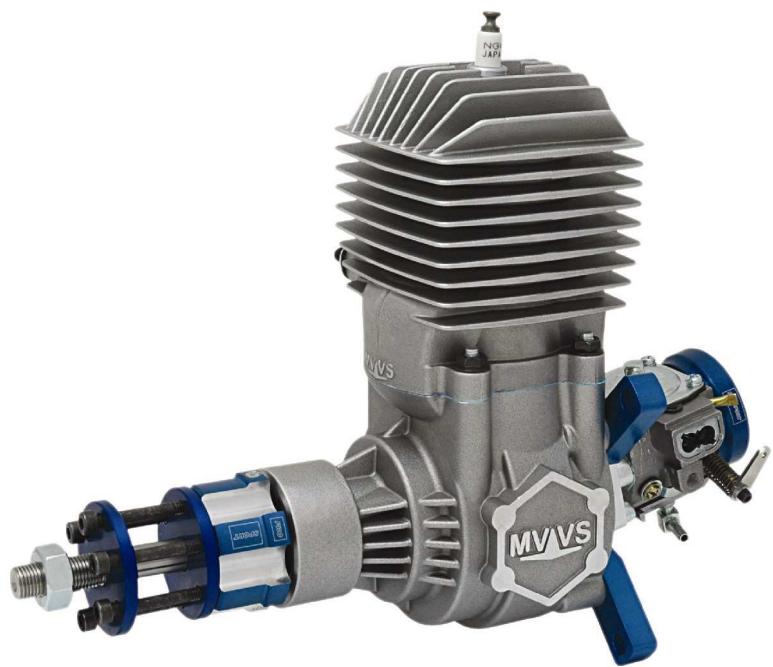
Congratulations on choosing the gas engine MVVS 58.
MVVS 58 has been designed and manufactured for propeller-powered radio-controlled model planes. It is able to meet all of your expectations of an acrobatic racing engine.
Technical specifications
| Bore | 42 mm | Maximum power output ** | 8.5 HP / 6950 RpM |
| Stroke | 42 mm | Maximum torque ** | 8.8 N/m / 6600 RpM |
| Weight of complete engine without ignition* | 1820 g | Fuel | Unleaded 95-octane fuel |
| Weight of ignition unit | 165 g | Lubrication | Oil with petrol in mixture 1:40 |
| RpM range | 1000 – 7500 RpM |
- Some manufacturers state the weight of incomplete engines. The value in the table above stands for the weight of a completely assembled engine, including the spark plug, carburetor, drive washer and prop screws.
** Power output varies with the exhaust used. The value given in the table stands for the maximum available power output.
Safety precautions
1) Never use the engine for any manned vehicles.
2) When operating model planes, always follow the rules and laws in effect in your country.
3) The manufacturer declines all responsibility for all damages arising from the operation of models and other appliances drove by MVVS 58 engine.
4) Always use original spare parts.
5) Never tamper with the engine construction.
6) Before each flight check that all the propeller screws are tightened up and in good condition. If you use a spinner, check that it is tightened up, too. When mounting the spinner always follow the assembly instructions.
7) Periodically check that the engine is firmly fixed to the engine mounts. Never start a loose engine!
8) Always use a balanced propeller! Always replace the propeller when damaged!
9) Make sure that no part of your body intersects the plane of the spinning propeller.
10) Always wear close-fitting, well-fastened clothes when starting or operating the running engine. Never wear loosely hanging clothes (ties, scarf, etc.).
11) Never try to stop the engine by any part of your body.
12) Always stop the engine either by turning off the ignition switch or by completely closing the carburetor throttle valve.
13) Before starting the engine always make sure that the model is safely fixed in place and cannot start moving.
14) Fuel is combustible and therefore must be kept in an enclosed container at a safe distance from the engine when it is running.
15) When preparing fuel carefully follow the manufacturer's or dealer's instructions.
16) Small objects must be kept at a safe distance from the engine when it is running. Never throw any objects towards the spinning propeller.
17) Be careful in choosing the location where you wish to start the engine. Avoid dusty or sandy areas.
18) Start the engine in well-ventilated areas only. Never start the engine indoors.
19) When starting the engine make sure that bystanders, especially children, are at a safe distance of at least 10m .
20) The engine power output makes it possible to fly big models. Mal-operation of such models may cause serious damage. Start using the MVVS 58 in model planes only after you have mastered operating smaller models.
Selecting a suitable propeller
It is usually the case that propellers of the same dimensions coming from different manufacturers are not the same. Oftentimes not even propellers of the same dimensions produced by a same manufacturer are not the same. The engine power is best utilized when the propeller dynamics curve and engine power curve (revolutions/power output) intersect in the area of the engine top power output. Unfortunately, no propeller manufacturer provides this information. Engine power output is also a variable quality. It depends above all on the silencer used and can considerably vary. The situation is further complicated by environmental parameters (temperature and atmospheric pressure in particular): low temperature and high pressure increase propellers' input requirements by 20% in comparison with input in a hot weather.
| Suggested propeller dimensions: | two-blade: | 22x10, 22x12, 22x14 |
| 24x8, 24x9, 24x10, 24x12 | ||
| 25x7, 25x8, 25x9, 25x10, 25x12 | ||
| 26x7, 26x8, 26x9, 26x10 | ||
| three-blade | 22x10, 22x12, 24x9, 24x10, 24x12 |
These values are only approximate and may vary with the factors described in the previous section, as well as with the type of the exhaust system used.
MVVS 58 has been designed to generate maximum power at 6800 - 7100RPM , according to the type of exhaust used. If you wish to utilize the maximum power output, choose a propeller, which allows the engine to reach these revolutions, or slightly lower revolutions (given the unloading of the propeller depending on the speed of flight) on the ground.
We do not recommend using propellers with which the engine reaches more than 7500 Rpm on the ground.
Fuel
Always use unleaded 95-octane petrol mixed in the proportion 40 volume units of petrol to 1 unit of Mobil Racing 2T oil. If necessary, quality brand-name synthetic oil intended for racing two-stroke engines can be used too.
Running the engine in, use MVVS Racing 2T oil, which comes with the engine. Mix it in the proportion 30:1.
Never use inexpensive oil developed for garden appliances or synthetic oils intended for the operation of methanol model engines. The manufacturer declines all responsibility for all engine damages arising from the use of low-quality fuel.
Store fuel in containers designed for this purpose. Do not use mixed fuel older than 90 days.
Assembly
The engine is fastened in place with four holders built in the rear cover. The rear cover is adjustable by 90^ which ensure easy access to the carburetor's operating elements. The engine can be mounted directly to the firewall or an assembly kit can be used (special accessories). Use M6 screws or screws M5 with a reduction kit (special accessories). If you decide to fasten the engine using flexible motor mounts, always choose parts with enough solidity and strength. Make sure to secure the screws against loosening and regularly check that they are tightened up and in good condition.
Since air is used to cool the engine, sufficient air circulation under the cowl must be ensured. Never forget about a hot air outlet - which must be bigger than the intake. Gas engines heat up to a much greater degree than methanol ones!
Do not forget that the engine needs oxygen from the air to be able to operate. Therefore ensure access of air to the engine intake as well. Caution: intake of warm air from beneath the cowl may cut the engine power output.
Note: Attach a hose to the airpressure inlet on the carburetor and terminate it outside the cowl.
Caution! When mounting the engine in the model use seals to protect all openings and prevent the pollution of the engine's inside with sawdust, residual abrasives etc. Make sure that the inside of the fuselage is clean and that all parts are tighten in place and cannot be sucked inside the engine.
Exhaust
Use only factory-made exhausts pipes designed for this type of engine, preferably brand-name MVVS engines with which you also get the power output guaranteed.
The manufacturer declines all responsibility for all engine damages arising from the use of improper exhaust systems.
When mounting the exhaust follow the manufacturer's instructions. Make sure to secure sufficient cooling of the exhaust.
Carburetor adjustment
Basic setting: (The values are derived from the position of clock-hands)
- adjusting needle (L) for low revolutions range 1 turn and 45min
- adjusting needle (H) for high revolutions range 1 turn and 10 min
The new engine comes adjusted to the basic setting. This setting should be kept during running the engine in!
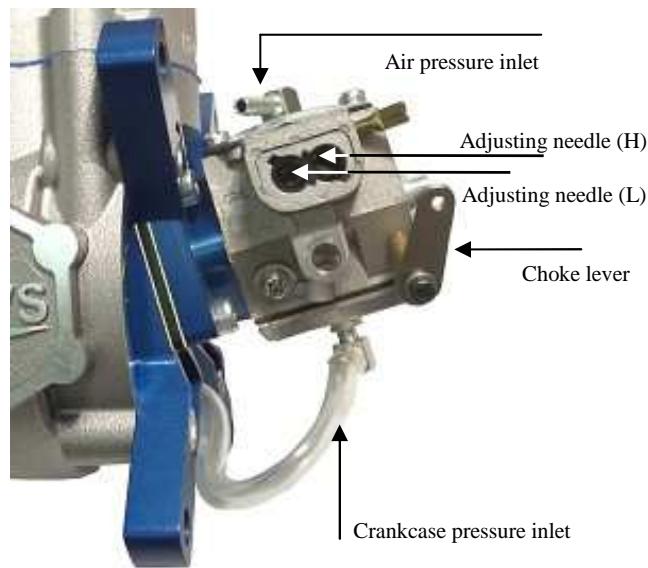
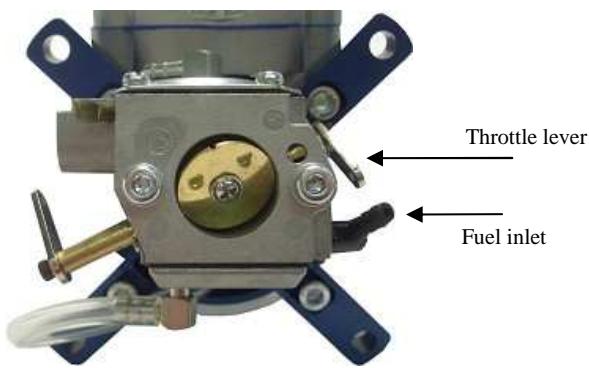
Caution! Never tighten the adjusting needles with too much strength. This may cause damage of the needles. If the needles are damaged this way it is no longer possible to adjust the carburetor and it is necessary to exchange it for a new one.
After the engine has been run in, adjust it following the instructions below:
- start the engine and warm it up
- let the engine run at idle speed for approx. 5 seconds
If the engine starts to run backwards do not open the throttle - stop the engine immediately! Otherwise the engine can be damaged!
Step I
Accelerate to 2/3 of the throttle range within approx. 1 sec (faster acceleration). Repeat three times - if the engine accelerates quickly and without a hiccup go to Step III. If acceleration is not smooth go to Step II.
Step II
Faulty acceleration with hiccups and a tendency to cut out is usually attributable to a poor fuel mixture in the medium-revolutions range. Stop the engine and recheck the fuel feed (the hose-pipe must not be pinched or broken; if fitted, check also the fuel filter permeability). Restart the engine and test acceleration again. If problems persist adjust the carburetor. Open the adjusting needle L by 5 min and retest acceleration. If acceleration is smooth, open the needle by another 3-5 min - this should be done because the needle was previously set at a boundary value; if atmospheric conditions changed during flight, the problems might recur.
If the engine still has bad acceleration, open the needle by 10 min (60 degree). If the engine's operation does not improve afterwards, stop it and check the basic setting. Set the adjusting needle L at 1 turn and 50 min and the adjusting needle H at 1 turn and 10 min. Restart the engine again and test acceleration. If the engine runs correctly go to Step III. If engine does not accelerate properly, open the needle by another 10 min. If it does not accelerate, the defect supposed to be elsewhere than in incorrect adjustment. In this case go to the section on problem solving.
Step III
If the engine accelerates correctly, according to the above test, set it at idle speed and accelerate to full speed. Repeat twice more. If the engine functions correctly, go to Step IV. If it cuts out, open the L needle by 5-10 min more.
If the engine does not respond to acceleration fast enough keep closing the L needle until the engine starts to cut out in response to gas. At that point reopen the L nozzle by 5-10 min.
Step IV
If the engine reacts correctly set it at full speed. If revolutions do not drop, the engine has been adjusted successfully. If revolutions seem to drop, open the adjusting needle H by approx. 5-10 min.
Caution!!!
The engine must be stopped while you adjust the carburetor in order to prevent injury by the propeller. Never close the choke valve completely when the engine is operating!
The choke valve is set to allow minimum air flow only when fully closed, which could cause damage to the intake reed valve.
Depending on the throttle control used there is a possibility to use throttle stop-screw.
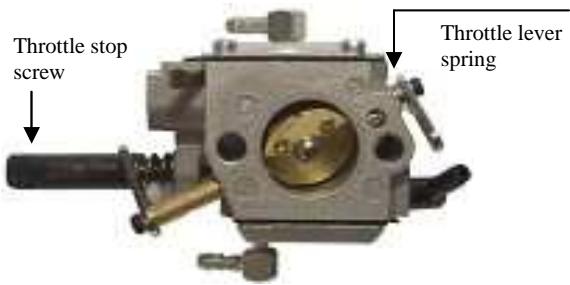
If the throttle pull rod is not equipped with flexible element it is recommended NOT to put off the throttle valve spring. Otherwise the vibrations of the engine can cause excessive wear of the throttle valve shafting and with this deteriorate the carburetor function.
Adjusting carburetor position
You can turn the rear cover by 90^ which makes it possible to adjust the carburetor's position (especially its adjusting needles) when fixing it in the model.
How to dismantle the rear cover:
Unscrew two M4 screws that hold the carburetor in place, remove the pressure hose from the carburetor (mind the gasket under the carburetor), remove the carburetor and loosen four M5 screws along the crankcase (Caution! Do not loosen the M4 screws that fix the reed-valve to the rear cover).
Remove the rear cover by pulling it out of the crankcase – never use a hammer or any other similar tool. The rear cover is sealed in the crankcase with two sealing rings – therefore more strength is needed, however, it must always be pull only!
Make sure you disassemble the engine in a clean environment!
Position the rear cover as desired, carefully insert it in the crankcase and tighten the screws. Do not forget insert the gasket when reassembling the carburetor.
Starting and running in a new engine
Before you first start the engine, screw the plug in and tighten it up. Follow the instructions on the box of the spark plug. Make sure that the plug socket is fitted in place and fastened down properly; pull the wire ring over the hexagon.
Fix the ignition sensor in proper position above the magnet with screws enclosed.
Unless the spark plug is not inserted in plug socket, never turn the engine with ignition turned on. This could lead to ignition damage!
1) Make sure that the ignition is switched off, the choke valve is closed and the throttle valve is about half opened. Then give the engine 3-4 turns, provided that carburetor is not overflowing. If it is overflowing, only give the engine 1-2 turns.
2) Switch the ignition on, open the choke valve, set the throttle at slightly higher idle speed and give the engine a few quickly turns. If even after the fourth turn, with the choke valve closed, you do not hear a suggestion of the engine starting, give the engine 2 turns following the instructions in paragraph 1 above. Then proceed according to instructions given in paragraph 2.
3) If the engine does not start even after another set of turns open the throttle to maximum and give the engine approx. 4 turns. Switch the ignition off and on again and restart the engine with throttle turned slightly down and the choke valve set open.
4) If the engine still would not start, unscrew the plug and check its contacts. Clean any possible petrol moisture (i.e. an indication of engine overflow) and screw it in again. Further starting should only be done with the throttle turned down. If the plug is dry then probably not enough fuel has been drawn into the carburetor. If that is the case, check the fuel feed and then return to the instructions given in paragraph 1.
If the engine starts to run backwards do not open the throttle - stop the engine immediately! Otherwise the engine can be damaged!
Having started the engine, leave it running for approx. 2 min at a higher idle speed. Then run it in for approx. 20 min, while changing revolutions from idle to 1/2-3/4 of the range and shortly holding each position - gradually prolong the holding periods. After 10 min of operation start opening the throttle at maximum for short periods of time. Stop the engine and let it cool down. Then restart it and check the adjustment. If everything is all right, you can first take off. During first few flights do not overload the engine and do not let it run at high revolutions for long periods of time (very important at hot weather). Use up all fuel that was produced as a mixture with the oil that is included in the package. From now on, fuel and oil should be mixed in the proportion 40:1.
DO NOT PROCESS THE RUNNING-IN AT IDLE SPEED!
- A COLD ENGINE SHOUL BE WARMED UP BY SHORT ACCELERATIONS (1-2 SECONDS)
Problem guide
The engine would not start:
- check and possibly replace the spark plug (check the spark by inserting the plug into the plug socket and turning the engine. The correct electrode spacing is 0,6mm .)
- check the fuel feed
- turn the engine to check its mechanical condition
- check whether the carburetor needles are adjusted correctly
- take the carburetor off and visually examine the condition of the carbon-fiber reed valve
- unscrew the carburetor cover on the side of the pressure inlet, check the fuel screen possibly give the carburetor a blow with a current of air; when reassembling, make sure you arrange the membrane and gasket in a correct order
- recheck the pressure hose attached to the carburetor
Replacing the reed valve:
- unscrew and remove the carburetor (mind the gasket)
- unscrew four M4 screws on the flange, remove the flange and take off the reed valve (mind the gasket)
- unscrew four M2 screws and remove the old valves, replace them with new ones, screw the screws back in and tighten them gently
- when reassembling, make sure you fix the gasket correctly
Mechanical faults of the engine must always be commit to a professional service department!
Service information
After each 20 hours of running or 1 year change the spark plug.
After each 50 hours of operation time preventively check up the con-rod and the reed valve.
After 300 hours of operation time commit the engine to the professional service department for check-up.
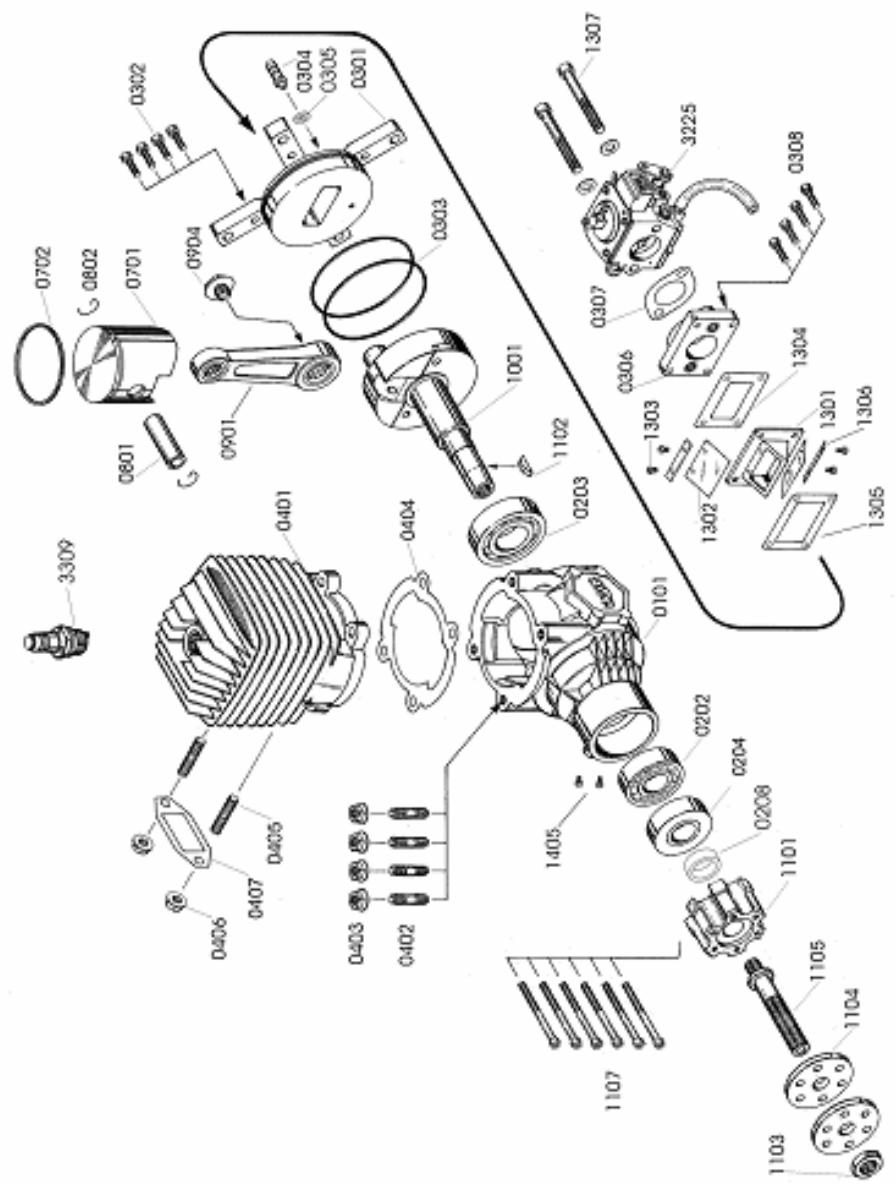
Spare Parts List
| Nr. | Description | Nr. | Description |
| 0101 | Crankcase | 0901 | Connecting rod |
| 0202 | Front bearing | 0904 | Connecting rod washer |
| 0203 | Rear bearing | 1001 | Crankshaft |
| 0204 | Packing | 1101 | Drive washer |
| 0208 | Packing-ring | 1102 | Drive washer key |
| 0301 | Rear cover | 1103 | Propeller nut |
| 0302 | Rear cover screws-set | 1104 | Propeller washer |
| 0303 | Rear cover „O“- ring | 1105 | Propeller screw |
| 0304 | Pressure nipple | 1107 | Propeller screws - set |
| 0305 | Pressure nipple gasket | ||
| 0306 | Carburetor flange | 1301 | Reed valve case |
| 0307 | Carb. flange gasket | 1302 | Reed valve |
| 0308 | Carb. flange screws - set | 1303 | Reed valve screws |
| 0401 | Cylinder | 1304 | Reed valve gasket-upper |
| 0402 | Cylinder screws - set | 1305 | Reed valve gasket-bottom |
| 0403 | Cylinder nut | 1306 | Reed valve strap |
| 0404 | Cylinder gasket | 1307 | Carburetor screws |
| 0405 | Exhaust screws - set | 1300(set) | = 1301 + 1302 + 1303 + 1305 + 1306 |
| 0406 | Exhaust nut | ||
| 0407 | Exhaust flange gasket | 3314L | Electronic ignition unit |
| 0701 | Piston | 3314S | Electronic ignition unit ProSport, LE |
| 0702 | Piston ring | 3309 | Spark plug |
| 0801 | Piston pin | 1405 | Ignition sensor fixing screws |
| 0802 | Piston pin retainer | 3227 | Carburetor |
Warranty
The MVVS gas engines come with a three-year guarantee against defects in workmanship and materials. Only original buyers of the engines are eligible warranty claimants. The warranty cannot be transferred with a change in ownership.
This guarantee does not cover:
- any normal wear that might occur
damage arising from accidents - damage arising from the use of an unbalanced or damaged propeller
- damage arising from the use of a too small or a too big propeller
- damage arising from the use of low-quality fuel
- damage arising from the use of other than original spare parts and accessories
damage arising from sucking a foreign object into the engine
damage arising from any improper use
For further questions, please contact:
MVVS, spol. s r.o., tr. Kpt. Jarose 35, 602 00 Brno, Czech Republic
Tel. +420 545 211 683, fax: +420 545 211 418
E-mail: mvvs@mvvs.cz
Web: www.mvvs.cz
Certificate of Warranty
| Date: | Serial number: | Dealer: |
| Buyer's name and address: | ||