
AV121 - To scan AVISION - Free user manual and instructions
Find the device manual for free AV121 AVISION in PDF.


User questions about AV121 AVISION
0 question about this device. Answer the ones you know or ask your own.
Ask a new question about this device
Download the instructions for your To scan in PDF format for free! Find your manual AV121 - AVISION and take your electronic device back in hand. On this page are published all the documents necessary for the use of your device. AV121 by AVISION.
USER MANUAL AV121 AVISION
Regulatory model: FF-0506
Trademarks
Microsoft is a U.S. registered trademark of Microsoft Corporation. Windows and MS-DOS are trademarks of Microsoft Corporation. IBM, PC, AT, XT are registered trademarks of International Business Machines Corp. Other brands and product names herein are trademarks or registered trademarks of their respective holders.
Copyright
All rights reserved. No part of this publication may be reproduced, transmitted, transcribed, stored in a retrieval system, or translated into any language or computer language, in any form or by any means, electronic, mechanical, magnetic, optical, chemical, manual, or otherwise, without the prior written permission of Avision Inc.
Material scanned by this product may be protected by governmental laws and other regulations, such as copyright laws, the customer is solely responsible for complying with all such laws and regulations.
Warranty
The information contained in this document is subject to change without notice.
Avision makes no warranty of any kind with regard to this material, including, but not limited to, the implied warranties of fitness for a particular purpose.
Avision shall not be liable for errors contained herein or for incidental or consequential damages in connection with the furnishing, performance, or use of this material.
FCC Radio Frequency Interference Statement
This equipment has been tested and found to comply with the limits for a class B digital device, pursuant to Part 15 of the FCC rules. These limits are designed to provide reasonable protection against harmful interference in a residential installation. This equipment generates, uses, and can radiate radio frequency energy and, if not installed and used in accordance with the instruction manual, may cause harmful interference to radio communication. However, there is no guarantee that interference will not occur in a particular installation. If this equipment does cause harmful interference to radio or television reception, which can be determined by turning the equipment off and on, the user is encouraged to try to correct the interference by one or more of the following measures:
Reorient or relocate the receiving antenna.
- Increase the separation between the equipment and receiver.
- Connect the equipment into an outlet on a circuit different from that to which the receiver is connected.
- Consult the dealer or an experienced radio/TV technician for help.
CAUTION: Any changes or modifications not expressly approved by the manufacture of this device could void the user's authority to operate the equipment.
System Requirements
Windows
IBM compatible PC 586, Pentium or higher
Microsoft Windows 98 / 98SE / Me / 2000 / XP
USB port 2.0 (compatible with USB 1.1)
At least 100 MB of free hard disk space
At least 128 MB of system memory
A CD-ROM drive
Table of Contents
1. Introduction 1-1
2. Scanner Installation 2-1
2.1 Installing the ADF Paper Tray Unit 2-2
2.2 Installing the Output Paper Tray 2-6
2.3 Connecting the Cables 2-7
2.3.1 Connecting to Power 2-7
2.3.2 Turning on the Power.. 2-7
2.4 Installing the Software 2-8
2.5 Connecting to Computer 2-8
3. Completing Your First Scan 3-1
3.1 Loading Your Paper 3-1
3.1.1 Notice on Using the ADF 3-1
3.1.2 Placing Your Document in the ADF Paper Tray 3-2
3.2 Scanning with Image Editing Software 3-3
3.2.1 A Glance of the Scanner Properties Dialog Box 3-5
4. Using the Scanner Properties Dialog Box....4-1
4.1 Buttons on the Scanner Properties Dialog Box .. 4-2
4.2 The Image Tab 4-4
4.2.1 The Image Selection Box 4-5
4.2.2 Other Image Options 4-7
4.2.3 Scanning color images.. 4-12
4.2.4 Scanning grayscale images 4-12
4.2.5 Scanning B&W images 4-13
4.3 The Compression Tab 4-14
4.4 The Color Dropout Tab 4-16
4.4.1 Color Dropout Selection 4-16
4.4.2 Other Color Dropout Options.... 4-17
4.5 The Paper Tab 4-19
4.5.1 Cropping 4-20
4.5.2 Other Paper Selection 4-23
4.6 The Options Tab. 4-27
4.7 The Setting Tab 4-33
4.8 The Information Tab 4-35
5. Using the Buttons 5-1
6. Maintenance 6-1
6.1 Cleaning the ADF 6-1
6.2 Cleaning the Calibration Area 6-3
6.3 Replacing the ADF Snap-in Pad 6-4
6.4 Replacing the ADF Roller 6-5
7. Troubleshooting 7-1
7.1 Clearing a Paper Jam. 7-1
7.2 Questions and Answers 7-2
7.3 Technical Service 7-4
8. Specifications 8-1
Index a
1. Introduction
Congratulations on your purchase of the color sheet-fed image scanner. Avision is one of the leading companies in the world to develop high performance sheet-fed scanners.
Before you install and operate the new scanner, please take a few minutes to read through this manual. It provides proper instructions for you to unpack, install, operate and maintain the scanner.
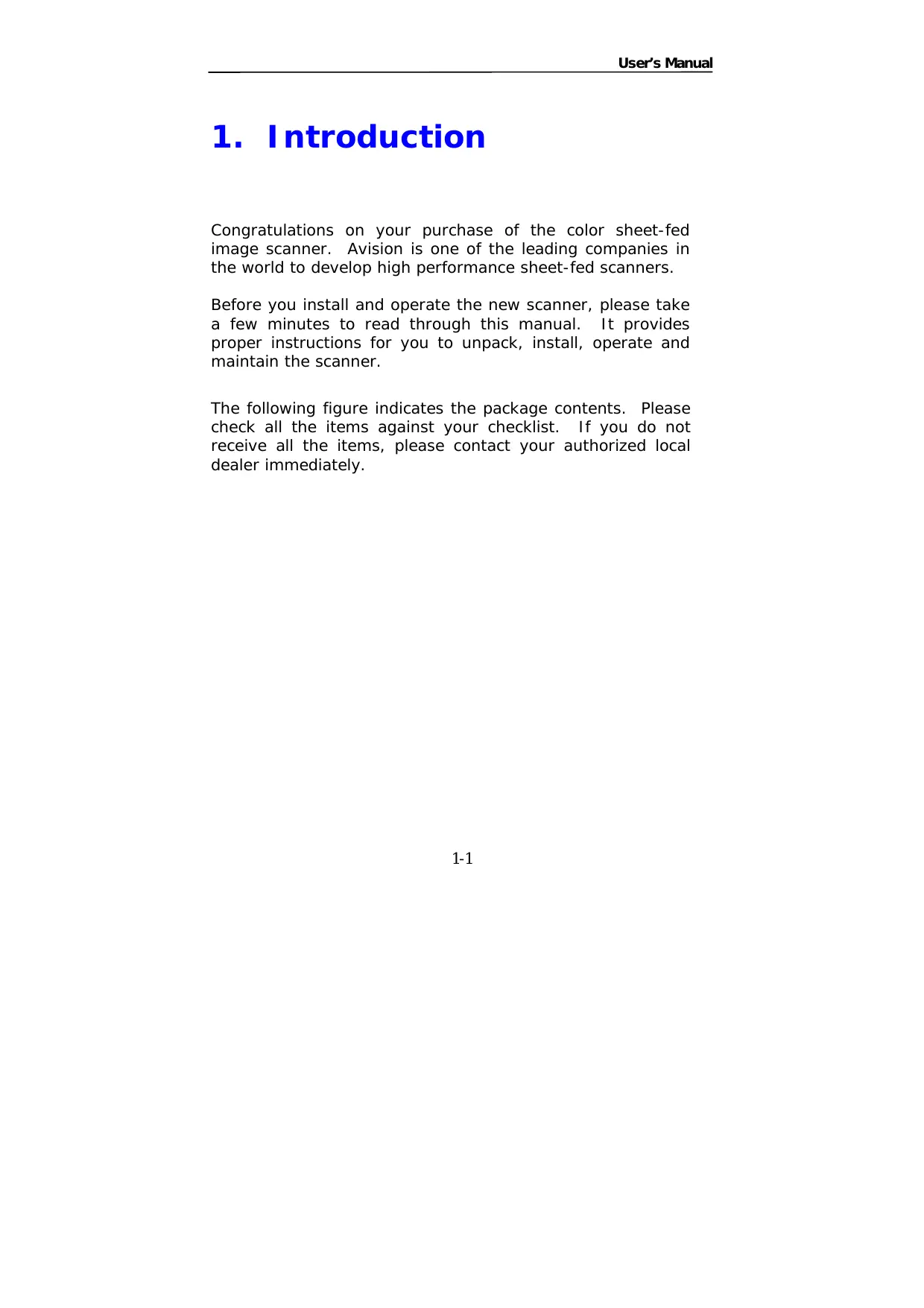
The following figure indicates the package contents. Please check all the items against your checklist. If you do not receive all the items, please contact your authorized local dealer immediately.
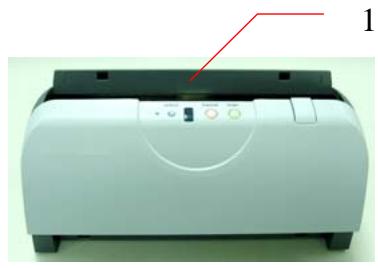
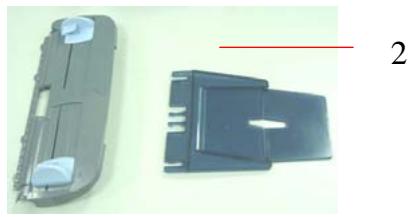
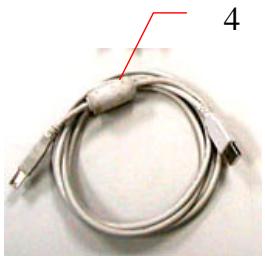
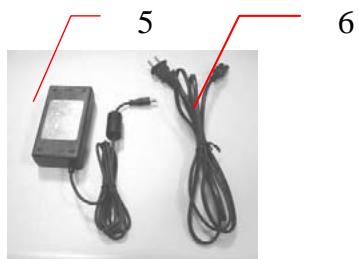
- Scanner Main Unit
- ADF (Auto Document Feeder) Paper Tray
- Output Paper Tray
- USB Cable
- Power Adapter
- Power Cord
Note:
- Only use the AC adapter (SAL124A-2410U-6 by SINO-AMERICA) included in the machine. Using other AC adapters may damage the machine and void the warranty.
- Please unpack the packing carefully, and check the contents against the checklist. If any items are missing or damaged, please contact your dealer immediately.
2. Scanner Installation
Precautions
- Keep the scanner out of direct sunlight. Direct exposure to the sun or excessive heat may cause damage to the unit.
- Do not install the scanner in a humid or dusty place.
- Be sure to use the proper AC power source.
- Place the scanner securely on an even, flat surface. Tilted or uneven surfaces may cause mechanical or paper-feeding problems.
- Retain the scanner box and packing materials for shipping purposes.
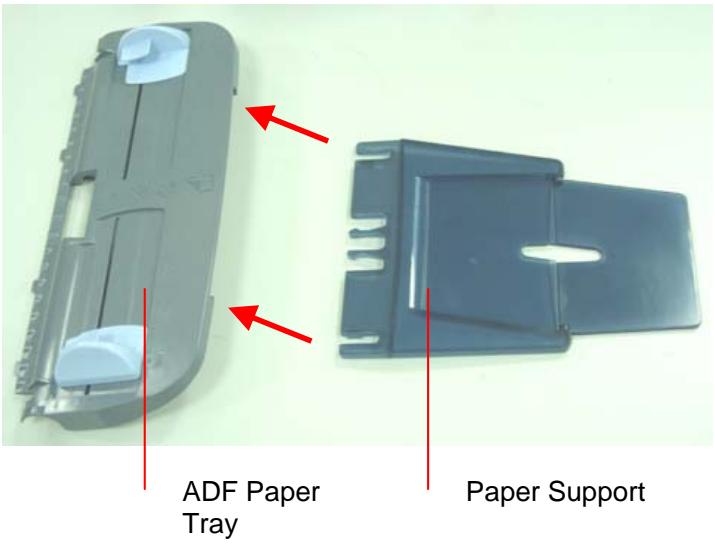
2.1 Installing the ADF Paper Tray Unit
Attach the Paper Support to the ADF (Auto Document Feeder) Paper Tray.
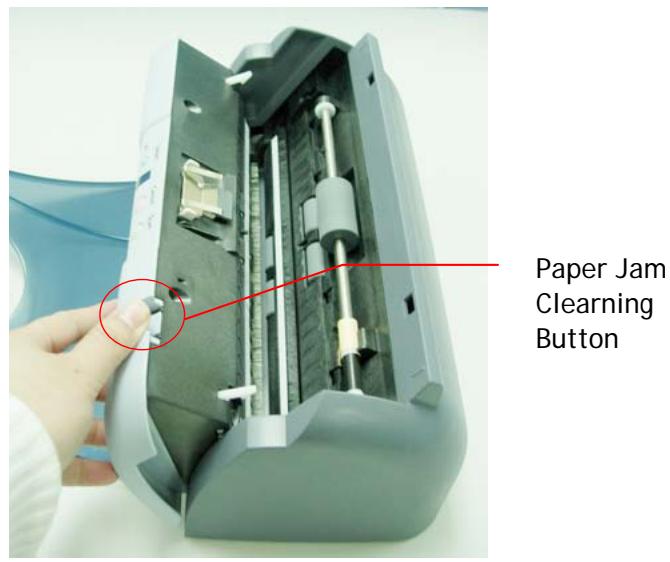
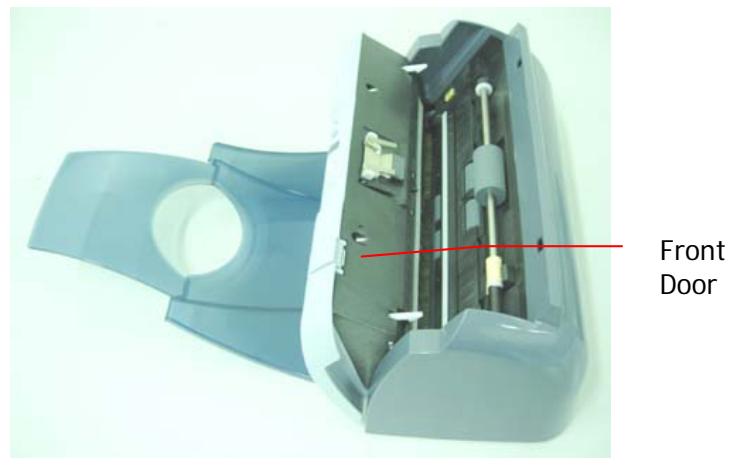
- Pull out the Paper Jam Clearing Button to open the front door to the left.
- Insert four protrusions on the bottom of the ADF Paper Tray into the holes on the front of the scanner.
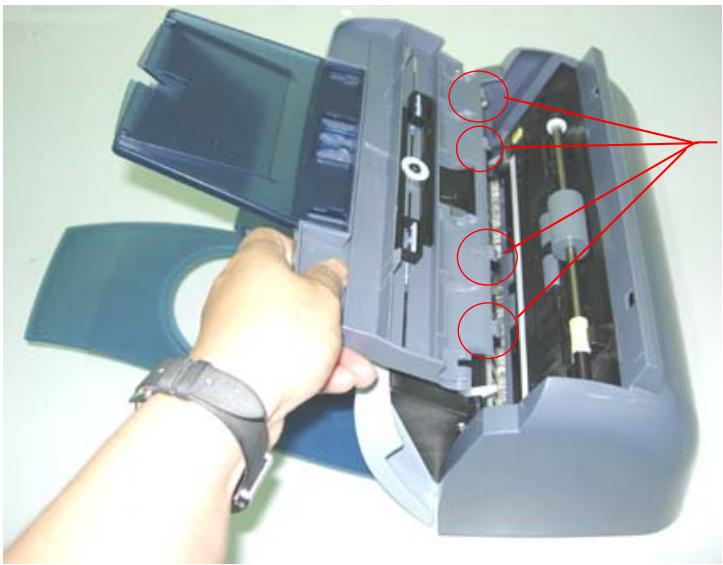
Protrusions
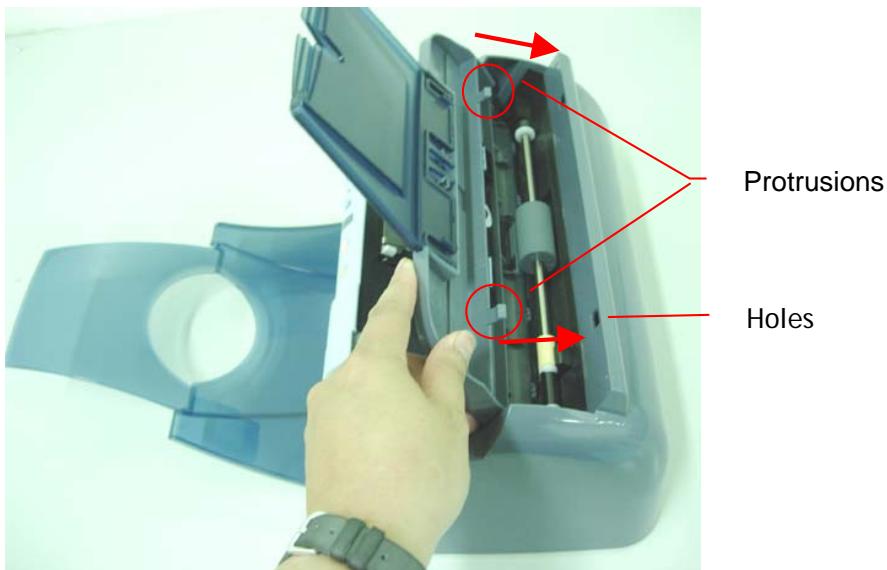
- Insert two protrusions in the middle of the ADF Paper Tray into the holes on the top of the scanner.
2.2 Installing the Output Paper Tray
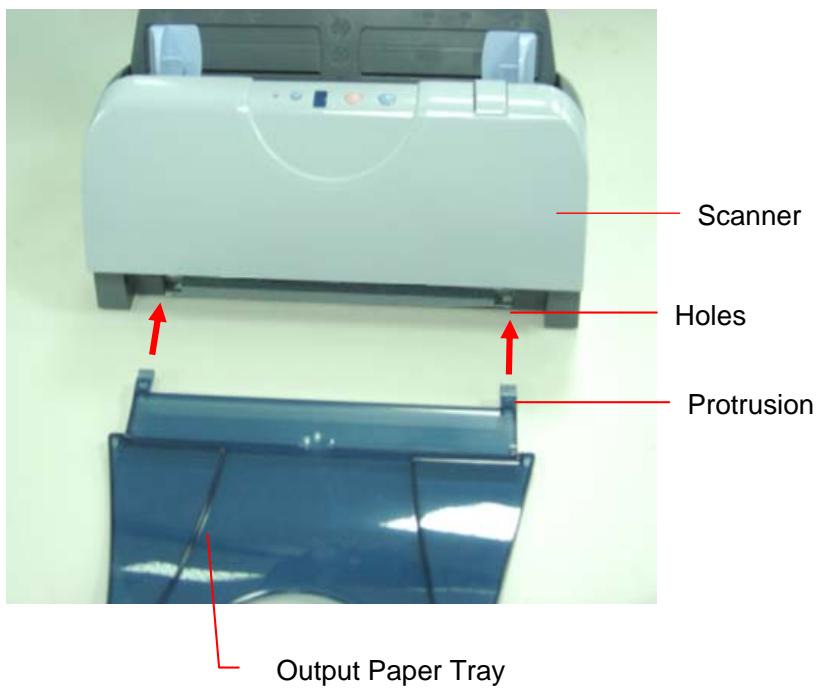
Insert the right and left protrusion of the Output Paper Tray into the holes on the front of the scanner.
2.3 Connecting the Cables
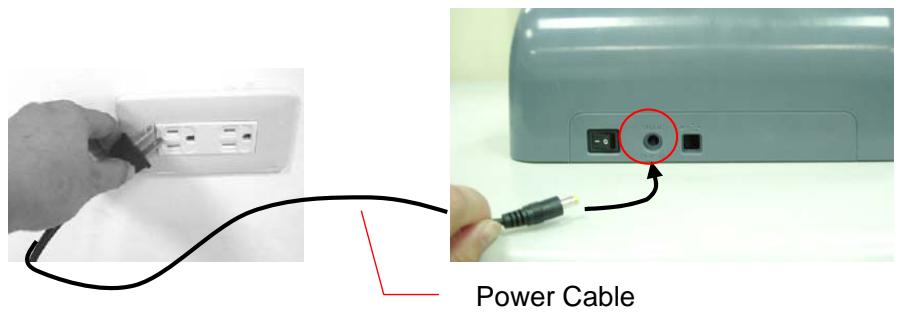
Make sure the power of scanner is off.
2.3.1 Connecting to Power
Plug the small end of the power adaptor into the power jack of your scanner. Insert the other end to an appropriate power outlet.
2.3.2 Turning on the Power
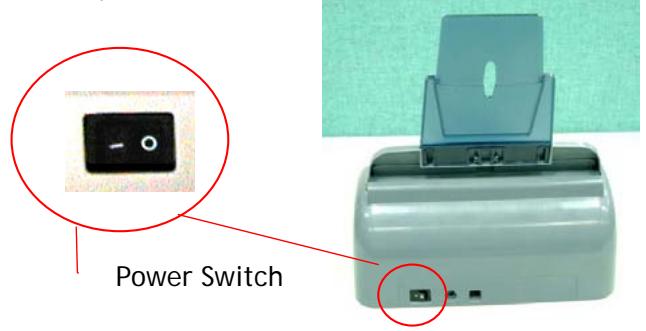
After the power cable and the USB cable have all connected, press the power switch to the "I" position to turn on the scanner. To turn off the scanner, please press the power switch to the "O" position.
2.4 Installing the Software
NOTE:
1). The Windows system CD may be required when installing on some PC's.
2). To ensure your computer can identify the USB scanner, please install scanner driver first before connecting the scanner to your computer.
- Place the supplied CD-ROM onto your CD-ROM drive.
- The software installation graphic appears. If not, run "cdsetup.exe".
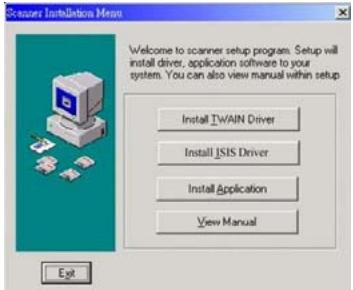
- Choose Install TWAIN Driver to install the scanner driver.
2.5 Connecting to Computer
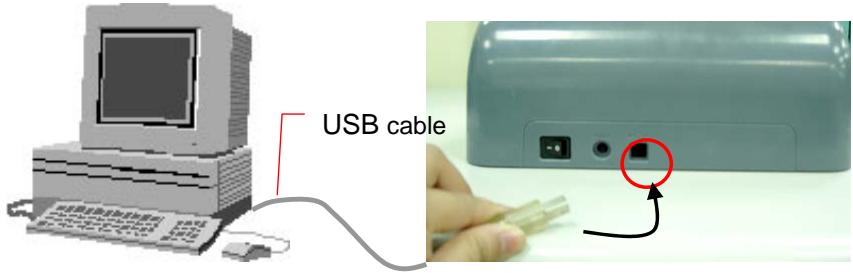
- Connect the square end of the USB cable to the USB port of your scanner. Connect the rectangle end to the USB port of your computer.
- The computer should detect a new USB device and prompt a "New Hardware Found" message.
New Hardware Found

USB Scanner
Windows has found new hardware and is locating the software for it.
(Windows 9X/Windows ME)
- In Windows 9X or Windows ME, confirm that the "Search for a better driver." is selected and click the "Next" button.
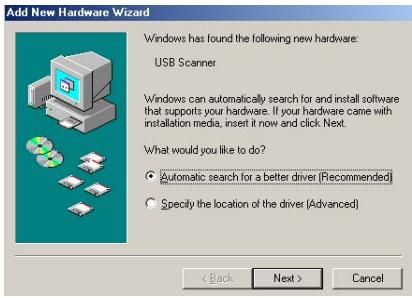
In Windows XP, click the Next button to continue. When the XP certification screen appears, click Continue Anyway to complete the installation.
- When the Finish dialog is prompted, click the Finish button.
- Click "View Manual" to view or print the detailed user manual for the scanner and bundled applications respectively.
Note:
To uninstall the scanner driver in Windows XP, be sure to keep your scanner connecting to your computer.
3. Completing Your First Scan
3.1 Loading Your Paper
3.1.1 Notice on Using the ADF
Before using the ADF, please make sure that your paper meets the following specifications:
- Document(s) can range in size from 3.5 by 2 inches to 8.5 by 14 inches (Legal).
- Document(s) can range in weight from 16 to 28 lbs
- Document(s) should be square or rectangular and in good condition (not fragile or worn).
- Document(s) should be free of curl, wrinkle, tears, wet ink, or punch holes.
- Document(s) should be free of staples, paper clips, paper sticky notes.
3.1.2 Placing Your Document in the ADF Paper Tray
Fanning Your Document
Standard paper size should feed easily through the scanner. To avoid occasional paper jam when automatically feeding multiple documents, loosen the paper before loading.
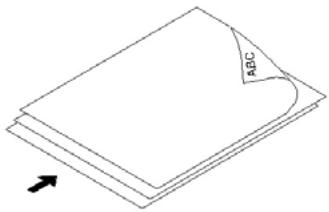
Document feeding
Place your document with the text face down on the ADF Paper Tray. Align the two sides of the document with the slide guides. Please note that the ADF Paper Tray can hold up to 50-page document at a time.
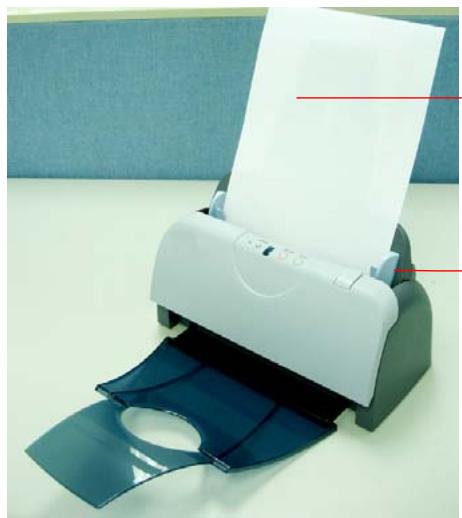
Your
Document
(Face Down)
Paper Slider
3.2 Scanning with Image Editing Software
The scanner driver is not a stand-alone program, it has to be started from within a TWAIN-compliant or plug-in software application and then the scanner driver is able to scan and load the image to your computer. The command to start the scanner driver may vary due to different software applications.
- Start a TWAIN compliant software application such as Roxio PhotoSuite which is bundled in the CD.
- Click Get>Scanner (TWAIN).
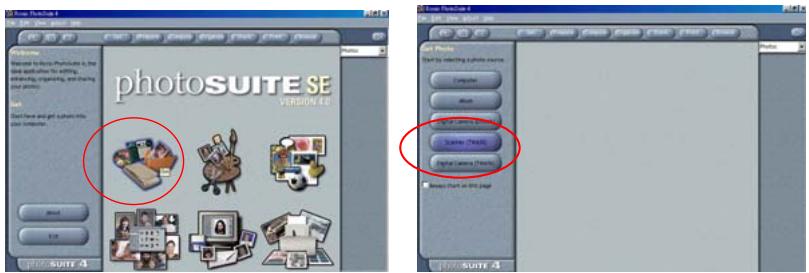
- Choose the scanner model as your scanning source. (You only need to do this once.)
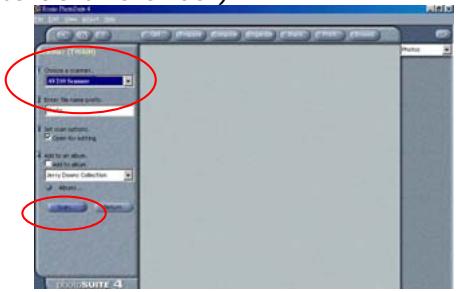
- Place the document FACE DOWN on the document glass.
- Click the Scan button to prompt the Scanner Properties Dialog Box.
-
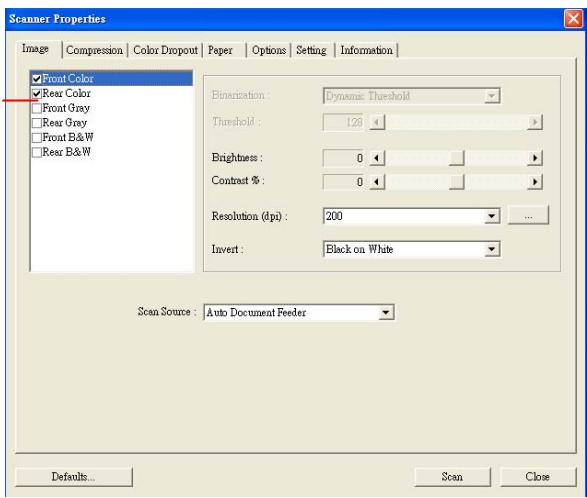
Choose your image type and the side of document you wish to scan from the Image Selection box. Click the Scan button to scan the document.
-
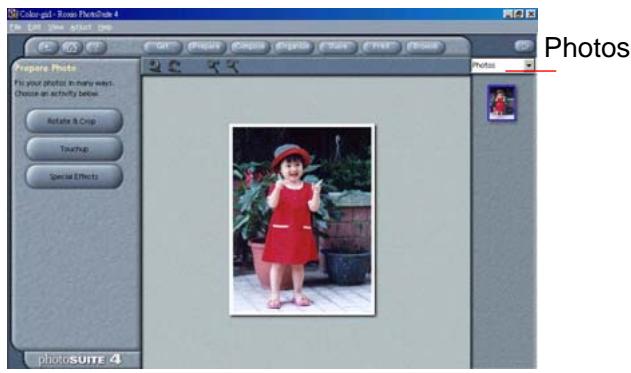
Click Exit to return to the main screen and click Open Library and Photos at the upper-right corner to open your scanned image.
Image Selection Box
3.2.1 A Glance of the Scanner Properties Dialog Box
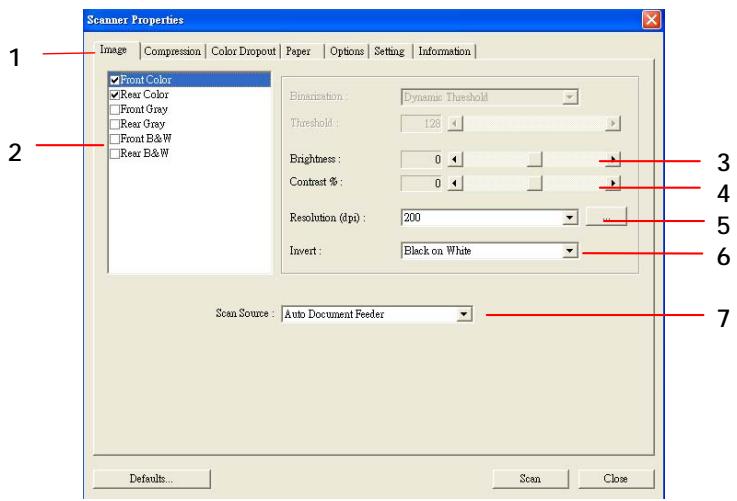
| 1. Tab Options | Choice: Image, Compression, Color Dropout, Paper, Options, Settings, Information. |
| 2. Image Selection Box | Choose your image type and the side of document you wish to scan. Options vary based on type of scanner. |
| 3. Brightness: | Adjust the brightness level from -100 to +100. |
| 4. Contrast | Adjust the contrast level from -100 to +100. |
| 5. Resolution | Determine the quality of the scanned image. The industry standard is 200 dpi. |
| 6. Invert | Reverse the color of your scanned image. |
| 7. Scan Source | Choice: Auto Document Feeder, Flatbed, Flatbed (Book), Automatic (This option varies based on type of scanner.) |
| 8. Defaults | Reset all values on the tabs to the factory default settings. |
4. Using the Scanner Properties Dialog Box
The Scanner Properties dialog box allows you to configure the scanner's settings. It consists of several tabbed windows each of which will be described in this chapter.
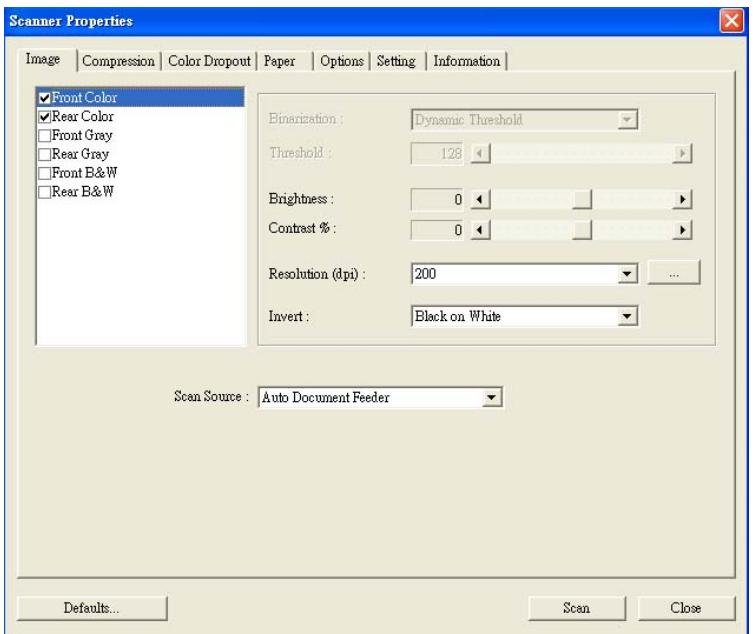
The Scanner Properties dialog box
4.1 Buttons on the Scanner Properties Dialog Box
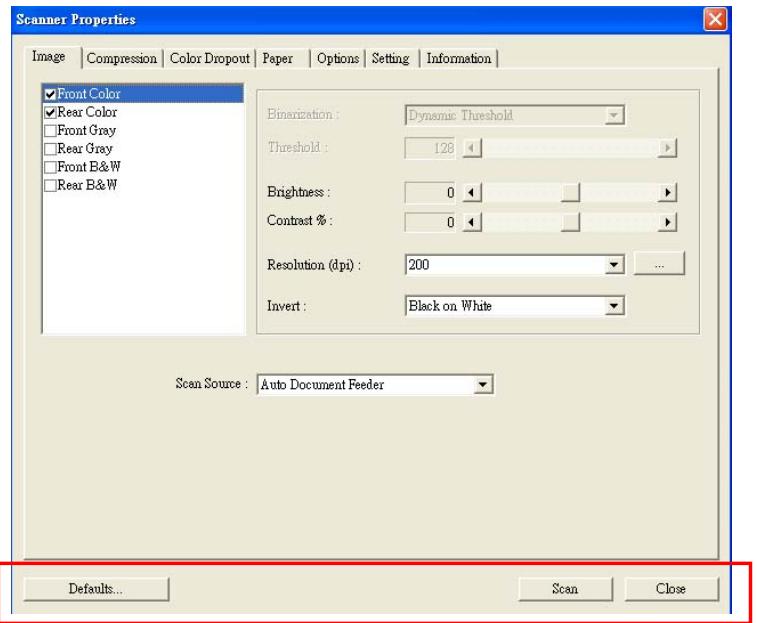
The buttons on the Scanner Properties dialog box
| Buttons | Description |
| Defaults | Click the Defaults button, the factory default settings will be shown on each tab. |
| Scan | After all the scan settings are satisfactory, click the Scan button to start scanning your document. |
| Close | Click the Close button to leave the Scanner Properties dialog box. |
The following table shows the default settings :
| Tab name | Default settings |
| Image | Image: Front B&W Binarization: Dynamic Threshold Resolution: 200 dpi Invert: Blank on White Scan Source: Auto Document Feeder Threshold: None Brightness: None Contrast: None |
| Compression | None |
| Color Dropout | None |
| Paper | Cropping: Automatic Deskew: Yes Orientation: Portrait OverScan: 0.00 Multifeed Detection: None Unit: Inch |
| Options | Flip Side Rotation: Book Rotation Degrees: None Blank Page Removal: None Edge Fill: White, 0 mm Image Control Option: None |
| Setting | Enable Energy Saver: Enable, 15 minutes after last scan action Show Scanning Progress: Yes Show Warning Message: Yes Save Settings after Closing: Yes |
4.2 The Image Tab
The Image tab allows you to choose the front side and (or) the rear side of your document, the type of image, and to set several basic scan settings. Note that except for the resolution, you can set individual scan settings for the front side and the rear side. For example, all settings in the Image tab,
Compression tab, Color Dropout tab can be set individually for the front and the rear side. However, the settings in the Paper tab, the Option tab, and the Setting tab have to be set the same for the front and rear side.

The Image tab dialog box
4.2.1 The Image Selection Box
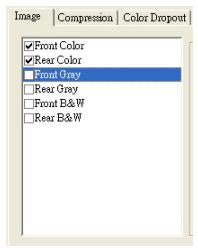
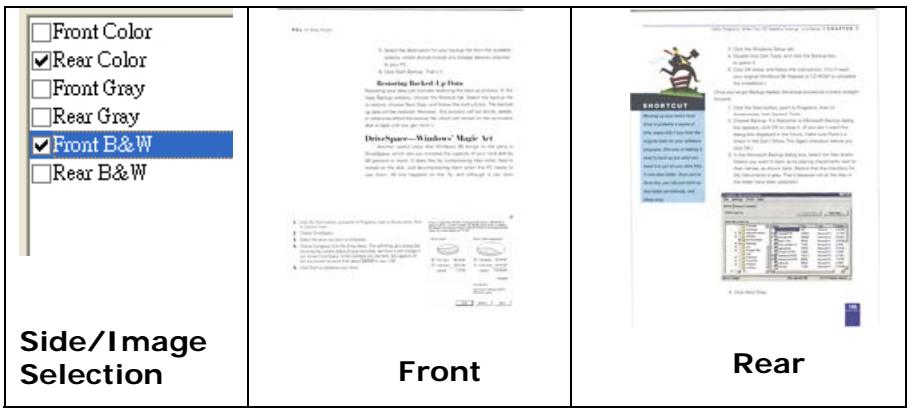
The Image Selection box includes the image type and document side option. If you wish to scan both the front side and the rear side of your color document, you can check both Front Color and Rear Color at the same time. Note the options vary based on type of scanner.
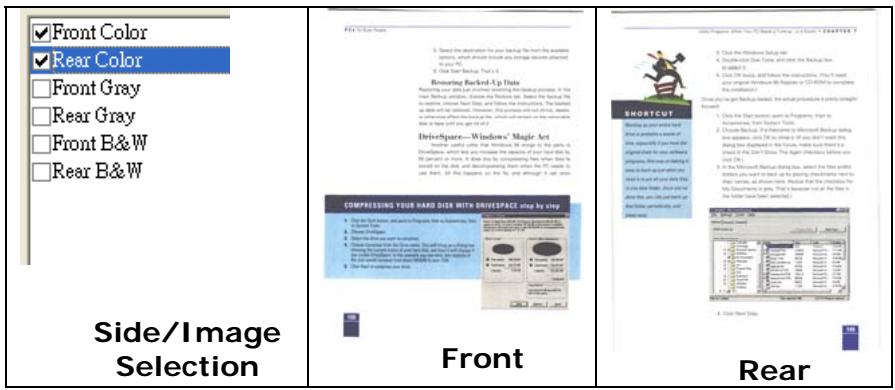
Example 1: Scanning a two-sided color document, both sides in color
Example 2: Scanning a two-sided color document, one in B&W(Drop Blue Color : Threshold : 10, Background : 79), the other in color
| Image Type | Description |
| Color | Choose Color if you wish to scan a color image for your original in color. |
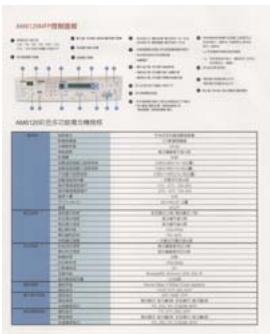
| Gray | Choose Gray image if your original contains actual shades of gray. |
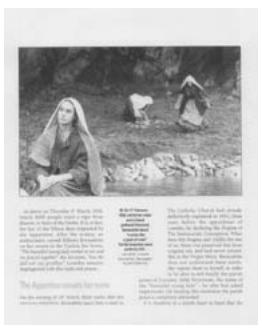
| B&W | Choose B&W if your original contains only text, pencil or ink sketch. |
| Sensibility - It is 0.5 times better to be the only person of the family (1978), when there isn't always a better choice. But it is 2 times better. - A car is a lot of trouble. - Recognize that for a patient's life, he/she needs to be protected. - How much of the time the patient has been in hospital is spent in bed, sitting in bed, or even watching and listening to music. |
| Sensation - Being sensitive to a certain type of event or situation. - Being aware of the events or situations that can cause them. - Being able to deal with these situations by controlling their own feelings, dealing with fear or anger, or by making a plan to cope with them. - The ability to manage one's emotions is important to be able to cope with the negative emotions that are triggered by the event or situation. |
| Sensation - For example, the patient's pain might have been caused by a serious accident, or even by a bad taste in his clothes. |
| Sensation - The ability to sense the pain or discomfort is important to be able to cope with the negative emotions that are triggered by the event or situation. |
| Sensation - An ability to sense the pain or discomfort is important to be able to cope with the negative emotions that are triggered by the event or situation. |
| Sensation - The ability to sense the pain or discomfort is important to be able to cope with the negative emotions that are triggered by the event or situation. |
| Sensation - The ability to sense the pain or discomfort is important to be able to cope with the negative emotions that are triggered by the event or situation. |
| Sensation - The ability to sense the pain or discomfort is important to be able to cope with the negative emotions that are triggered by the event or situation. |
| Sensation - The ability to sense the pain or discomfort is important to be able to cope with the negative emotions that are triggered by the event or situation. |
| Sensation - The ability to sense the pain or discomfort is important to be able to cope with the negative emotions that are triggered by the event or situation. |
| Sensation - The ability to sense the pain or discomfort is important to be able to cope with the negative emotions that are triggered by the event or situation. |
B&W
Gray
Color
4.2.2 Other Image Options
Binarization
This is the process of converting a grayscale or color image to a bi-tonal image. There are several different methods of performing this conversion. Two of the options are Dynamic Threshold and Fixed Processing.
Dynamic Threshold: Selecting Dynamic Threshold allows the scanner to dynamically evaluate each document to determine the optimal threshold value to produce the highest quality image. This is used to scan mixed document containing faint text, shaded background, or color background with a single setting. If Dynamic Threshold is selected, Threshold, Brightness, and Contrast are not available.
Fixed Processing: Used for black-andwhite and other high contrast documents. A single level is set to determine the black-and-white transition. The threshold is programmable over the entire density range. Fixed Processing sets Contrast to 0. If Fixed Processing is selected, Contrast is not available.
Threshold
Used to convert a grayscale image to a bi-tonal image. The value ranges from 0 to 255. A low threshold value produces a lighter image, and can be used to subdue backgrounds and subtle, unneeded information. A high threshold value produces a darker image, and can be used to help pick up faint images. Adjust the threshold setting by dragging the Threshold sliding bar to the left or right to achieve the desired threshold setting.
200 dpi, Threshold:80, Brightness: 0
200 dpi, Threshold:170, Brightness: 0
Brightness
Adjusts the lightness or darkness of an image. The higher the value, the brighter the image. Drag the slider to the right or left to increase or decrease the brightness. The range is from -100 to +100 .
Contrast
Adjusts the range between the darkest and the lightest shades in the image. The higher the contrast, the bigger the different grayscale. Drag the slider to the right or left to increase or decrease the contrast. The range is from -100 to +100.
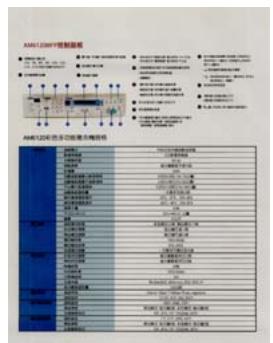
Brightness: -50

Brightness: 0 (Normal)

Brightness: +50
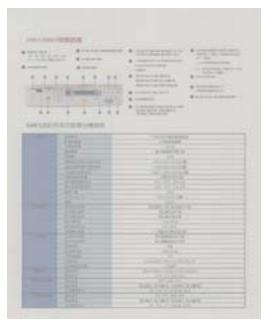
Contrast: -50
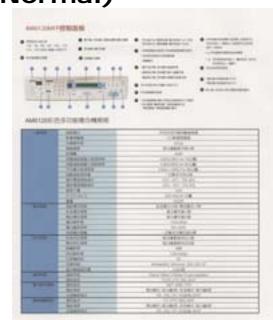
Contrast: 0 (Normal)
Contrast: +50
Resolution
A good control of the resolution results a good detail of an image that scans. The resolution is measured by dots per inch (dpi). Normally, the greater the dpi number, the higher the resolution and the image file size. Be aware that greater resolution takes more time to scan, and more disk space for the scanning image. For your information, an A4 size color image scanned at 300 dpi at True Color mode consumes approximately 25 MB of disk space. A higher resolution (usually means over 600 dpi) is only recommended when you need to scan a small area at True Color mode.
Choose a resolution value from the drop down list. The default value is 200 dpi. Available resolutions are 75, 100, 150, 200, 300, 400 and 600. Or you may choose your desired value by clicking the box in the right side of the drop down list and press the arrow key to select your desired value and then click the Add button to include it in the drop down list.
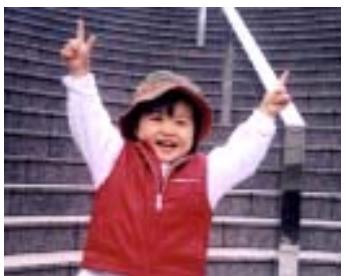
Resolution: 75 dpi
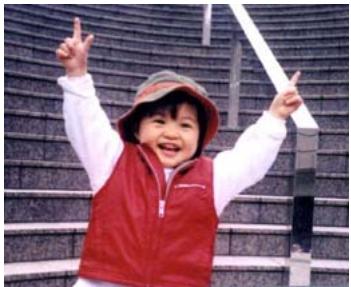
Resolution: 150 dpi
Invert
Reverses the brightness and the colors in the image. The default setting is Black on a White background. Reverse mode is White on a Black background. For color images, each pixel will be changed into its complementary color at the command of Invert.
"I am not worthy to have you enter my
that is God, I beg all my brothers - those we who work manually, clerics and lay brothers. ards being humble in all things; not to glorify r to become Interiorly proud because of good w sometimes says or does in them or through tord: Do not rejoice... in the fact that the de : 10:20) Let us be firmly convinced of the fact
Black on White
"I am not worthy to have you enter my
that is God, I beg all my brothers - those who are who work manually, clerics and lay brothers. Birds being humble in all things; not to glorify it to become Interiorly proud because of good w. sometimes says or does in them or through the word; "Do not rejoice... in the fact that the deo (10:20) Let us be firmly convinced of the fact
White on Black
Scan Choice:
Source
- Auto Document Feeder: Used to scan multiple pages.
- Flatbed: Used to scan a single page. For example, pages from newspaper clipping, paper with wrinkles or curls.
- Flatbed (book): Used to scan several inside pages from book.
Automatic: Allow the scanner automatically set its scan source. If Automatic is selected and there is document in both the auto document feeder (ADF) and the flatbed, then the scan source will be automatically set to ADF. If Automatic is selected and there is document only in flatbed, then the scan source will be set to flatbed.
Note the options vary based on type of scanner.
4.2.3 Scanning color images
The following options are available for scanning color images.
Brightness
- Contrast
Resolution
Invert
4.2.4 Scanning grayscale images
The following options are available for scanning gray images.
Brightness
- Contrast
Resolution
Invert
4.2.5 Scanning B&W images
The following options are available for scanning B&W images.
- Binarization (Dynamic Threshold)
Resolution
Invert
Or
- Binarization (Fix Processing)
Threshold
Brightness
Resolution
Invert
4.3 The Compression Tab
The Compression tab allows you to compress your scanned image and choose the level of compression. Bi-tonal images are normally compressed using CCITT standard called Group 4 (G4). Color and grayscale images are often compressed using JPEG technology. Move the JPEG Quality slider to the right or left to increase or decrease the level of compression. Note the greater the compression level, the lower image quality. Default is 50% .
Note that the compression depends on your image editing application. If your image editing application does not support the type of compression format, then either a warning message will appear or the image quality of the compressed file will not be acceptable.
JPEG (Joint Photographic Editor Group). This group developed and lent their name to a file compression standard for color and grayscale images that is widely used by scanners, and software applications. On Microsoft Windows-based systems, a file with the extension .jpg has normally been compressed using this standard.
For scanning color or gray images, the following compressions are available:
None
JPEG
For scanning B&W images, the following compressions are available:
None
G4
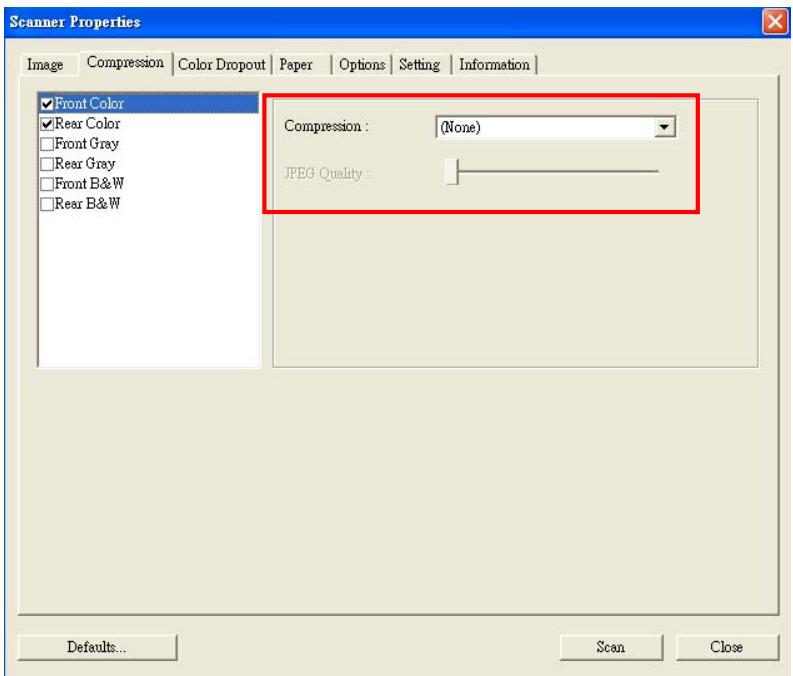
The Compression tab dialog box
4.4 The Color Dropout Tab
4.4.1 Color Dropout Selection
Color Dropout tab allows you to drop either of the red, blue, or green color in your scanned image. If your image contains red color watermark or background, choose the R (Red) channel then any red watermark or background will be removed. This feature is used to sharpen your text when using OCR (Optical Character Recognition) software.
Note that this function supports only black & white and gray images. Therefore, be sure to choose any black & white or gray image type while applying this function.
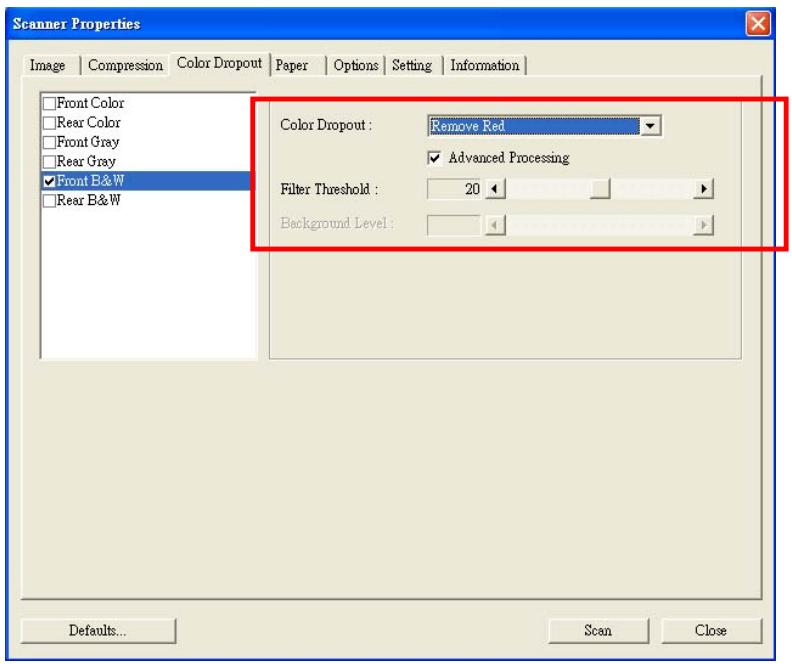
The Color Dropout dialog box
4.4.2 Other Color Dropout Options
Advanced Processing provides two options that can adjust your scanned image in the best optimal result.
Filter Threshold
This value is used to determine the color which will be dropped out. A lower value will drop more of the selected color out, while a higher value will leave more of the selected color in.
Background Level
The pixel which is higher than the background value will be adjusted to the lightest point. Adjust the value for both the Filter Threshold and Background Level to produce the best optimal result.
Example, slightly adjusting the background value makes your text more clear.
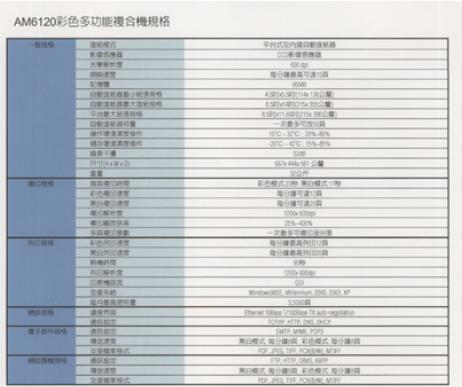
Original
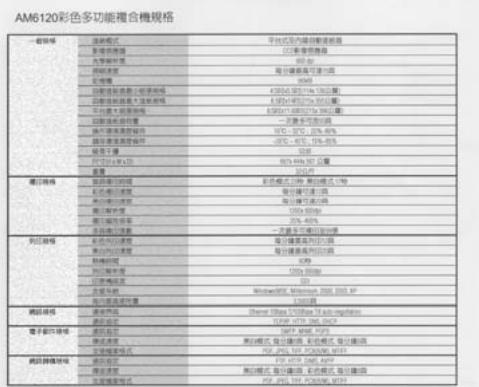
Remove Blue, Threshold: 20, Background: 255
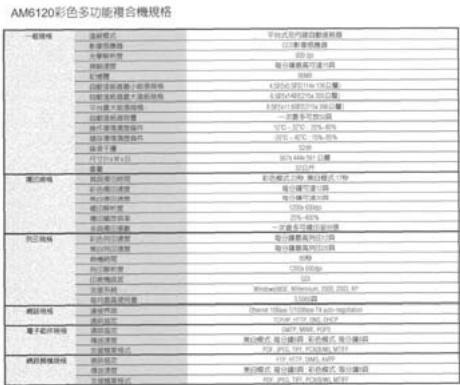
Remove Blue, Threshold: 20, Background Level: 210
4.5 The Paper Tab
The Paper tab allows you to define values relating to image output (i.e., Auto Crop or not, Scan Area, OverScan, Multi-Feed Detection).
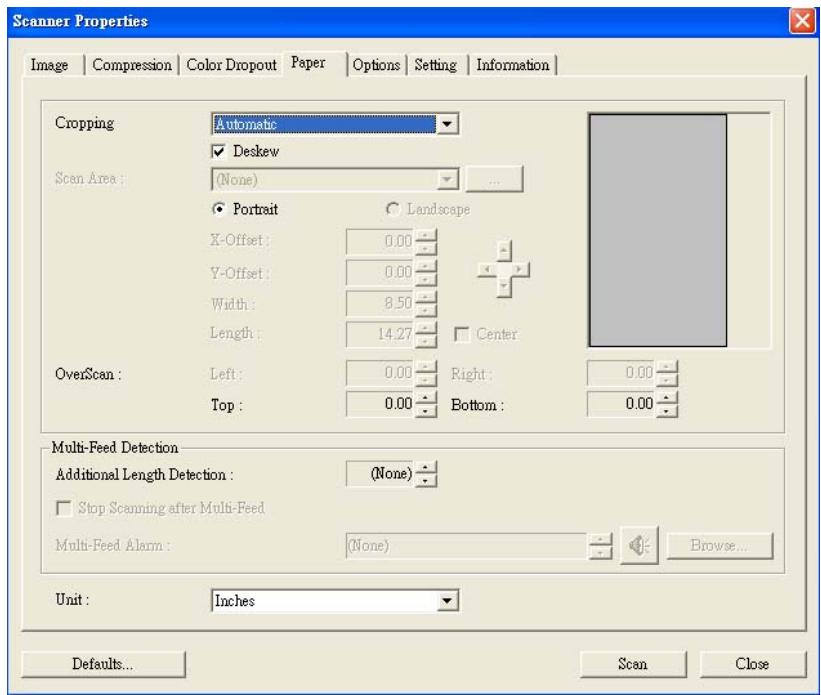
The Paper tab dialog box
4.5.1 Cropping
Cropping allows you to capture a portion of the document being scanned. Choice: Automatic, Fixed to Transport, EOP (End of Page) Detection.
| Options | Description |
| Automatic | Automatic adjusts the cropping window according to different document sizes. Use this option for batches of mixed-sized documents. |
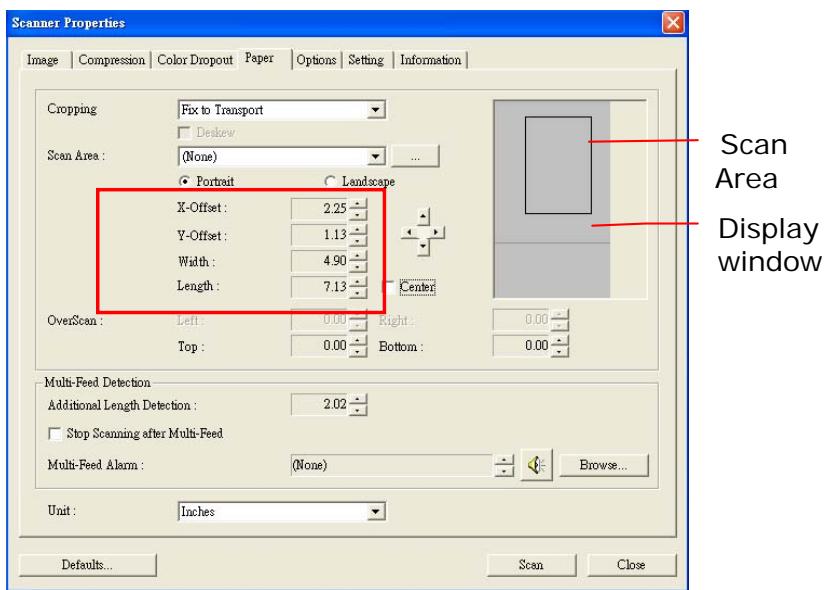
| Fixed to Transport | This feature allows you to define the area or zone to be imaged. Use for batches of same-sized documents. If you select this option, you can use the arrow keys to define the x and y offset values, width and length to redefine your scanned area. The Display window will show image placement as you change the values. |
| EOP (End of Page) Detection | This feature allows you to define the area or zone to be imaged. Use for batches of same-width but different length documents. If you select this option, you can use the arrow keys to define the x and y offset values, width and length to redefine your scanned area. The Display window will show image placement as you change the values. |
The following options are only available when Fixed to Transport is selected.
X-Offset — the distance from the left end of the scanner to the left edge of the scanning area.
- Y-Offset — the position from the top end of the document to the top end of the scanning area.
- Width — the width of the scanning area.
Length - the length of the scanning area.
- Center: automatically calculates the x-offset for center-fed feeding based upon document size selected.
- relocate the scan area by click the arrow key on the cross sign while retain the scan size. View the result from the Display window.
Example: Redefine your scan area ( x-offset: 2.25 inches ; y-offset:1.13 inches)
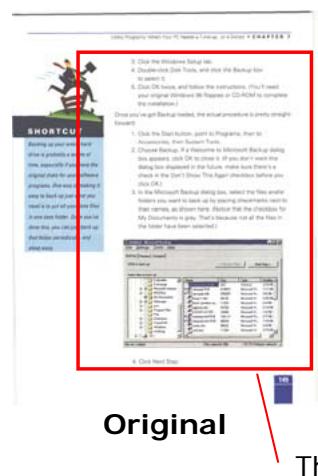
After Fixed to Transport
The Redefined Scan Area
4.5.2 Other Paper Selection
Deskew
Use this option to automatically deskew a document.
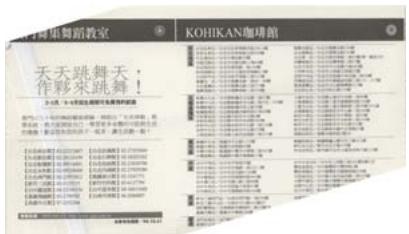
Note: If the skew angle is too great, some of the image may be cut off.
Scan Area
Choose your desired paper size with the drop-down list box. Or you may select a custom paper size by clicking the Scan Area box and then click Add to include in the choice.
Choice: None, US Letter- 8.5'' x 11", US Lega - 8.5'' x 14", ISO A4 - 21 x 29.7 cm, ISO A5 - 14.8 x 21 cm, ISO A6 - 10.5 x 14.8cm, ISO A7 - 7.4 x 10/5 cm, ISO B5 - 17.6 x 25 cm, ISO B6 - 12.5 x 17.6 cm, ISO B7 - 8.8 x 12.5 cm, JIS B5 - 18.2 x 25.7 cm, JIS B6 - 12.8 x 18.2 cm, JIS B7 - 9.1 x 12.8 cm, Scanner Maximum.
OverScan
Overscan allows you to add a specific margin at top and bottom or right and left (Options vary based on the type of scanner) of the edge of the image. This is used to reduce possible corner clipping on the skewed images and often applied to a batch of skewed document to be scanned in the auto document feeder. Select a value between 0 and +5 mm. Note the overscan result will not be shown in the Display window and that the availability of the function varies based on type of scanner.
Multi-Feed Detection
Multi-Feed Detection allows you to detect overlapped document that go through the auto document feeder. Multi-Feed usually occurs due to stapled documents, adhesives on documents, or electro-statically charged document. Note : The availability of the function varies based on type of scanner.
Additional Length Detection
Additional Length Detection allows you to define the length of document being multi-fed. This value indicates the additional length exceeding your scan area. The Display window will show the size of the document as you change the value. A value of 0 indicates no additional length detection. The Additional Length Detection is best used when scanning same-size documents in the auto document feeder.
Example : Additional Length Detection : Set Additional Length to be 2.02 inches
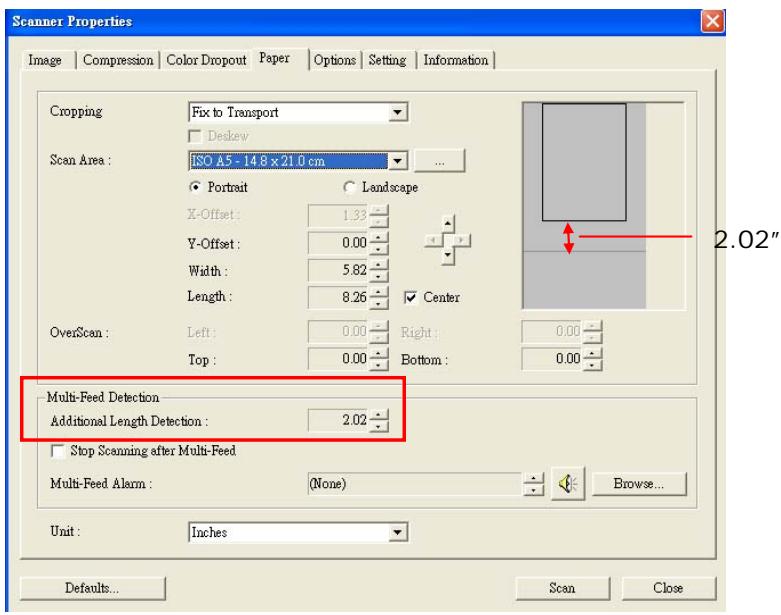
There are three options available if Multi-Feed is detected.
- Stop Scanning after Multi-Feed
If this is selected, the scanner will stop the feeder if multi-feed is detected.
Multi-Feed Alarm:
If this is selected and a wave file is added, the scanner will produce a sound alarm if multi-feed is detected.
How to add the sound alarm :
- Click the Browse button on the right side of the speaker icon. The Open dialog box appears.
- Choose your wave file.
- Click the Open button. The wave file is added.
Units
Defines the primary measurement system. Inches, Millimeters, and Pixels are available.
4.6 The Options Tab
The Options tab allows you to set following additional image processing settings.
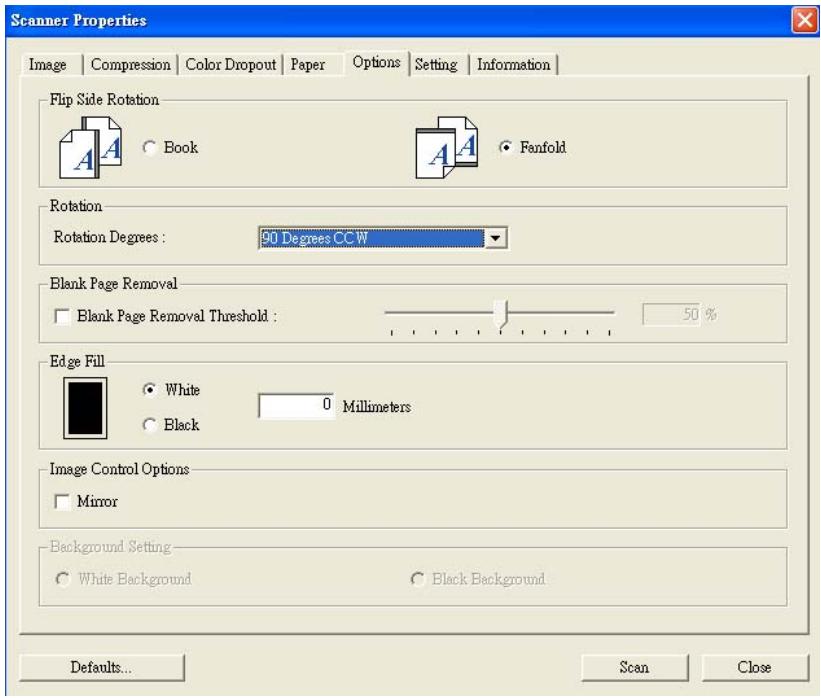
The Option tab dialog box
Flip Side Rotation
This option allows you to select the orientation of the double-sided documents been fed and if "fanfold" is selected, the image of the reverse side will be rotated to 180 degrees.
This is applied to double-sided documents which are viewed in portrait (height is greater than width) but are sometime fed into the scanner in landscape (width is greater than height) or vice versa. In this case, the image of the reverse side has to be rotated additional 180 degrees.
Choice: Book, Fanfold.
If "Book" is selected, the image of the reverse side will not be rotated.
The following illustration shows the orientation of the document which should be viewed in portrait but is fed into the scanner in landscape
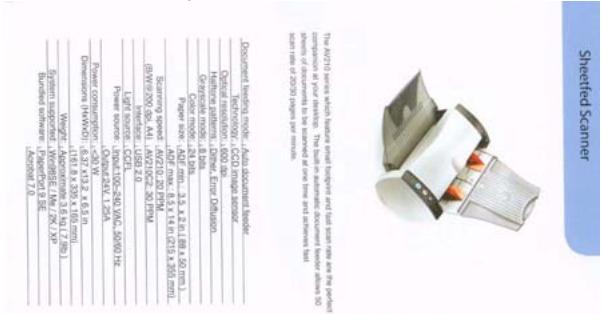
Rotate Image
Choose the rotation angle from the drop down list if you wish to rotate your scanned image.
Choice: None, 90^ CW(clockwise), 90^ CCW(counter clockwise), 180^ .
123

Original

Rotate 90^

Rotate 90^ CCW

Rotate 180^
Blank Page Removal
Check if you wish to remove the blank page and move the slider to the left or right to your desired threshold.
Edge Fill
Check White or Black if you wish to add white or black edge on the border of your scanned image. Enter the value from 0 to 5mm . Default value is 0.
x
If heist itowry from the lacunae of the artif, ather thao had ao hse
Letting a way of the
Fees hove a strong sense of their own value
r 1
A
n
Incorporation by reference to Exhibit 10.2.
In relation to the written and orally written, if you know this knowledge, please that you understand local language for your purposes as well.
WYYS
A
the burreses that sell for it . The prehose things that people want to buy hens
mpeaae aee
Methylation status by
The short and short, who would have spent the morning sthosing and waking, of he go to mite.
n 1
Somethnrs on my very bad boy conh, I step in a goody hicher with cie and nect (
A
Loo 1
Check the Mirror box if you wish to reverse the right and left side of your image.
Original

The Mirror Effect
Background Setting
This option allows you to set your scan background.
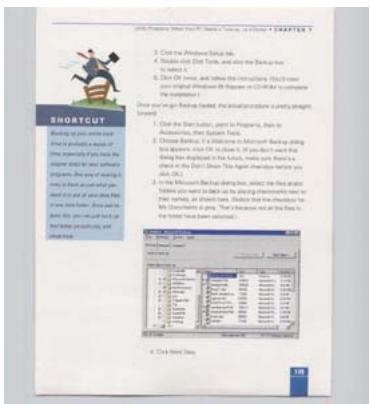
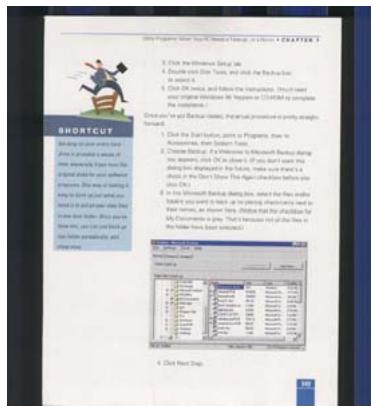
Choice: White Background, Black Background.
*This option varies based on type of scanner and is available for the front page in the ADF (auto document feeder) only. For the rear page, only the white background is available.
White Background
4.7 The Setting Tab
The Setting tab allows you to set the following settings:
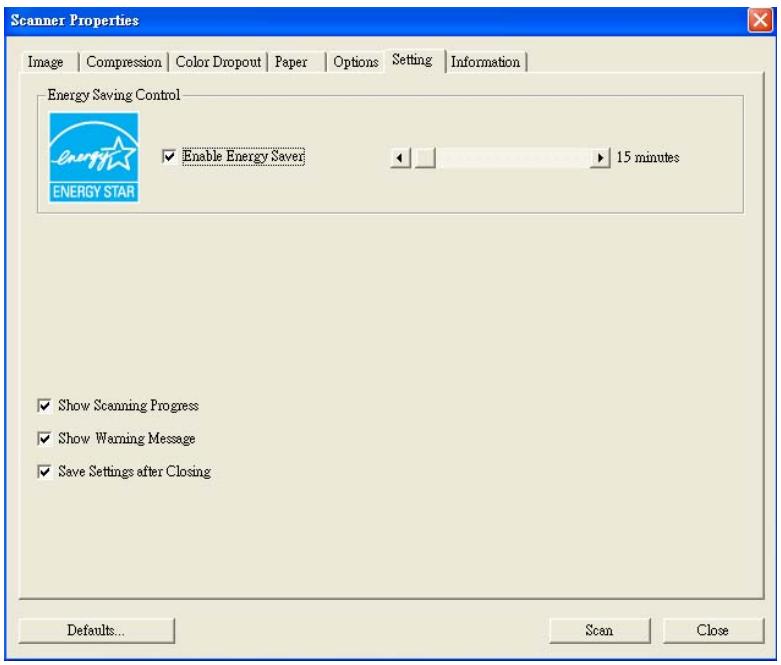
The Setting tab dialog box
| Energy Saving Control | Check the Enable Energy Saver box and move the slider to the right to set the amount of time to start the energy saver after your last action. The range is from 1 to 720 minutes. The default is 15 minutes. |
| Show Scanning Progress | Check and the scanning progress bar will be shown during scanning. |
| Show Warning Message | Check to show the warning messages such as “ADF pad count exceeds 50,000 scans (the number varies based on type of scanner). Please replace the ADF pad and reset the pad count.” |
| Save Settings after Closing | Check to save your scanner properties settings after leaving the dialog box. Next time when you open the Scanner Properties dialog box, the previously saved settings will be shown. |
4.8 The Information Tab
The Information tab displays the following system and scanner information.
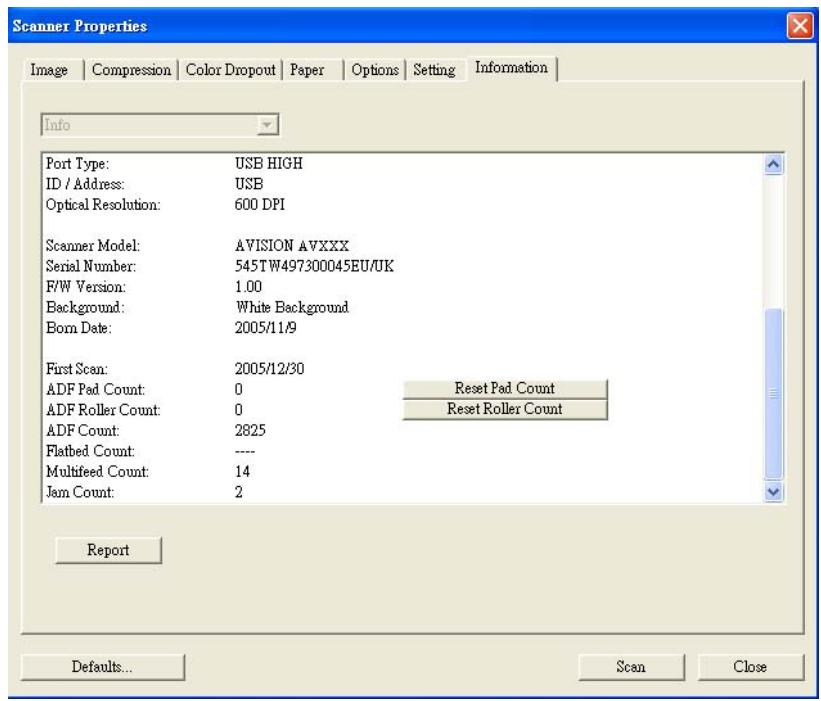
The Information tab dialog box
The "Report" button:
If you encounter any error message while using the scanner, click the Report button. A report.txt file (C:\AVxxx) will be generated. Please send this file to the nearest service center for trouble shooting.
The "Reset Pad Count" button:
After scanning approximately 50,000 pages (the number varies based on type of scanner) through the Auto Document Feeder (ADF), the ADF pad may be worn out and you may experience problems with document feeding. In this case, it is highly recommended to replace the ADF pad with a new one. (Please refer to the manual for proper replacing procedure.) For ordering the ADF pad, please consult your nearest dealer. After replacing the ADF pad, click the "Reset Pad Count" button to reset the pad count.
The "Reset Roller Count" button
After scanning approximately 200,000 pages through the ADF, the ADF roller may be worn out and you may experience problems with document feeding. In this case, it is highly recommended to replace the ADF roller with a new one. After replacing the ADF roller, click the "Reset Roller Count" button to reset the roller count.
Note :
The lifetime and the replacing procedure vary based on type of scanner. Please consult your nearest dealer for more details.
5. Using the Buttons
The following picture shows the 3 buttons and 1 function screen on the scanner.
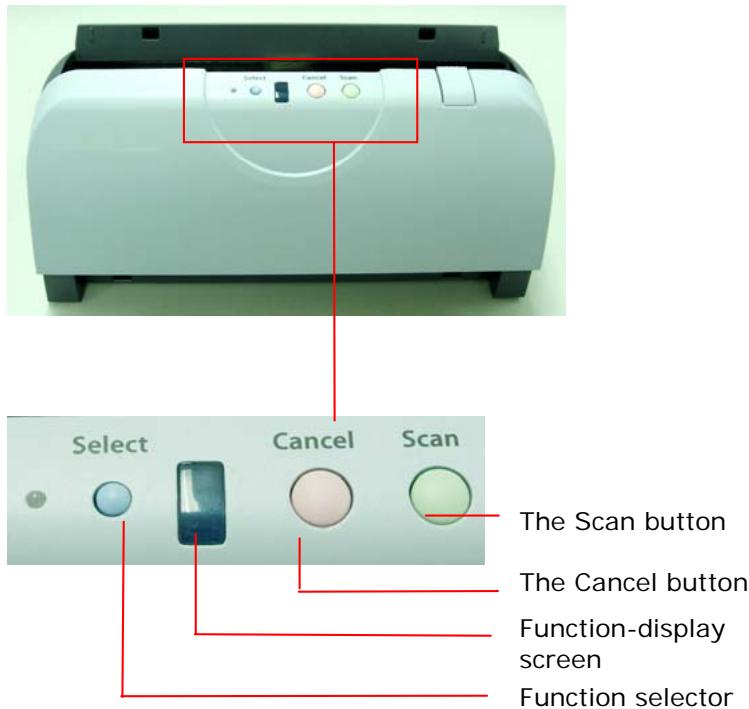
To Start Button Capture,
After the scanner driver is successfully installed, the Button Capture program should be also installed to your computer. The Button capture is a very useful program which you can customize the button's function. On your Windows system screen, click Start>Programs>Scanner AVXXX (your scanner model) >Preferences to display the Button Capture dialog box as shown below.
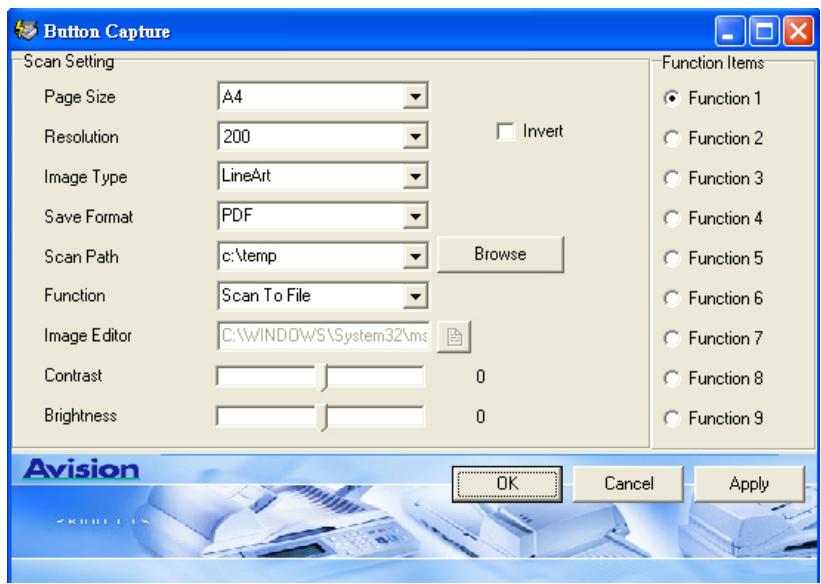
The Button Capture dialog box consists of a scan setting area at the left, a function items area at the right, and a series of action buttons at the bottom.
The default settings of Function 1 to 5:
| Function Number | Default Settings |
| Function 1 | A4, 200 dpi, Gray, JPEG, C:\temp, Scan to File |
| Function 2 | A4, 200 dpi, True Color, PDF, C:\temp, Scan to File |
| Function 3 | A4, 200 dpi, True Color, JPEG, C:\temp, Scan to File |
| Function 4 | A4, 200 dpi, LineArt, TIFF, C:\temp, Scan to Printer |
| Function 5 | A4, 200 dpi, LineArt, PDF, C:\temp, Scan to E-mail |
Description on the Button Capture dialog box:
The above scan settings are quite intuitive. You can set up your desired scan properties in this area. The Scan Path setting is where your scanned image resides.
The Function setting lets you link your scanned image to an application, such as Scan to File (save your scanned image to a designated path), Scan to Email (send your scanned image to Microsoft Outlook as an attachment), Scan to Printer (send your scanned image to your printer), or Scan to Application (enable the Image Editor setting and to send your scanned image to the application). When the Image Editor setting is enabled, it allows you to select your desired image editing application.
There are 9 arbitrary item names in the Function Items area, in which all of the 9 item names are changeable. From top to bottom, these arbitrary item names correspond to the 1 9 digits displayed on the Function Screen. In other words, you can pre-define up to 9 different functions for the Scan button, and then select one of them from the Function Screen on the scanner.
The following steps show how to define or rename the function button:
- Right-click on any of the 9 item names in the Function Items area and then select Rename.
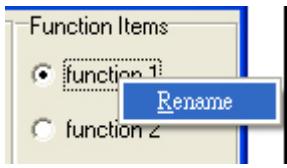
- Replace the current item name with your preferred name in the Rename dialog box, and then click OK.
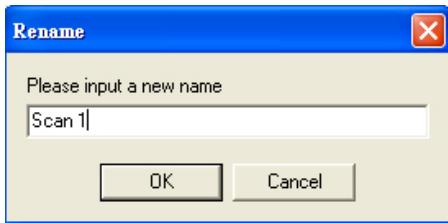
- Set up all preferred settings in the Scan Setting area.
- Click the Apply button, and then the OK button to finish defining your first function item.
Now, repeat the above steps to subsequently define the rest buttons in the Function Items area if necessary.
The following steps show how to use the one touch button on the scanner:
-
By pressing the Function-Select button ( ) on the scanner, select one of the digit numbers in the Function Display screen, which corresponds to its pre-defined function name.
-
Press the Scan button on the scanner ( ).
-
The scanner starts scanning with all the settings defined on this selected function name.
6. Maintenance
6.1 Cleaning the ADF
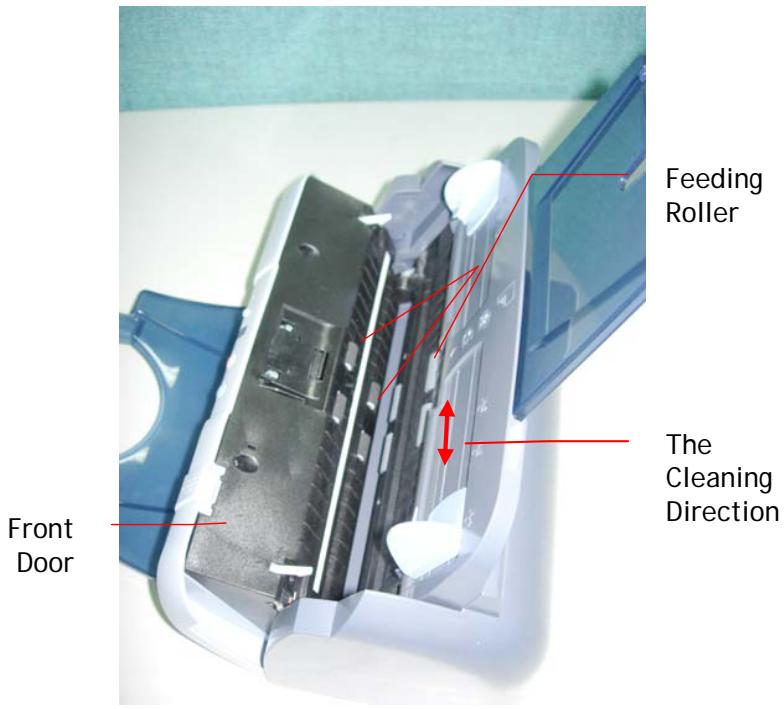
From time to time the ADF pad and feeding rollers may become contaminated with ink, toner particles or paper dust. In this case the scanner may not feed documents smoothly. If this occurs please follow the cleaning procedures to return your machine to its original state.
The Cleaning Procedures
- Soak a cotton swab with some isopropyl alcohol. (95%).
- Press the push button on the upper-left. Open the front door slightly to the left. Wipe the upper feeding roller by moving the swab from side to side. Rotate the roller forward with your finger and repeat the cleaning steps above until the entire roller is cleaned.
- Wipe the pad in one direction from top to bottom or the other way around. Be careful not to damage the pick springs.
- Close the scanner front door. Your scanner is now ready for use.
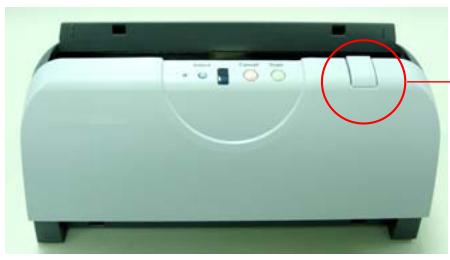
Paper Jam
Release
Button
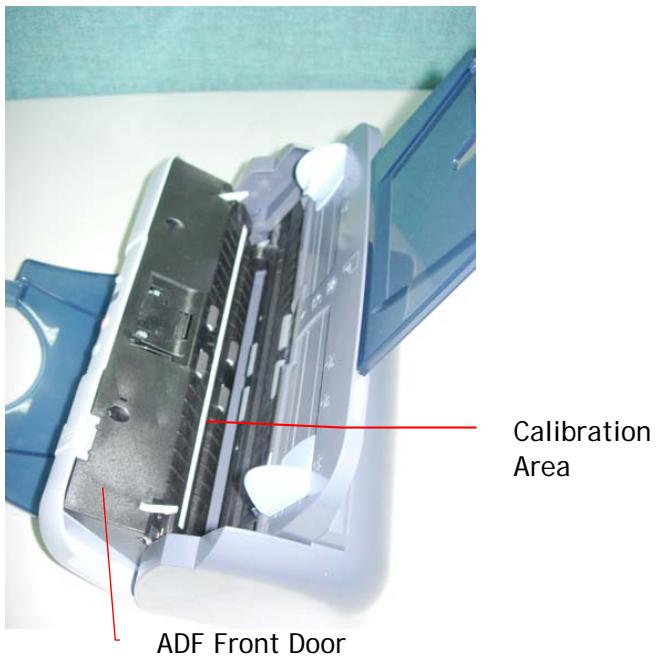
6.2 Cleaning the Calibration Area
As shown below, clean the calibration area (white glass) with an air-blower or a small brush to rid the board of dust or dirt. Please handle with care and dexterity.
6.3 Replacing the ADF Snap-in Pad
After scanning approximately 20,000 pages through the ADF, the pad may be worn out and you may experience problems with document feeding. In this case, it is highly recommended to replace the pad module with a new one. For ordering the pad module, please consult your nearest dealer and follow the procedure below to replace it.
Disassembling Procedure
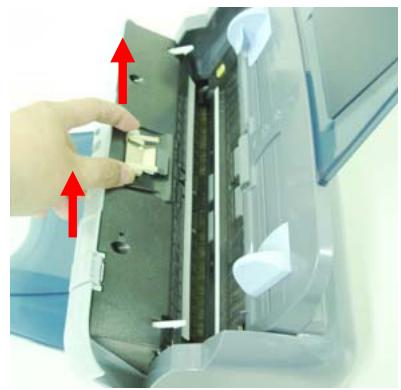
- Press the Paper jam clearing button on the upper-left corner.
- Gently open the ADF Front cover to the left.
- Press both arms of the ADF snap-in pad module inwardly with your fingers to pull out the ADF snap-in pad module.
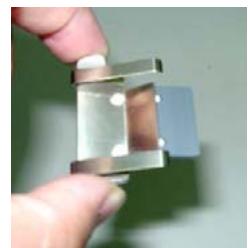
Assembling Procedure
- Take out the ADF pad module from the box.
- Press both arms of the ADF snap-in pad module inwardly with your two fingers.
- Place it into the holes until it snaps into place.
6.4 Replacing the ADF Roller
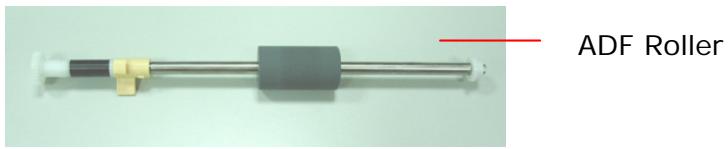
Please follow the procedure below to replace the ADF roller. For ordering the ADF roller, please consult your nearest dealer. After replacing the ADF roller, be sure to click the "Reset Roller Count" button in the Scanner Properties dialog box to reset the roller count.
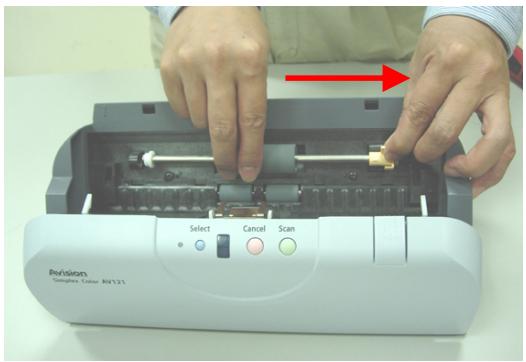
The Disassembling Procedure
- Move the end of the yellow clipper face up with a flat screw driver as indicated.
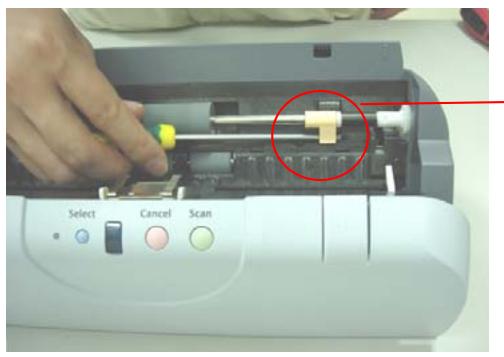
The Yellow Clipper
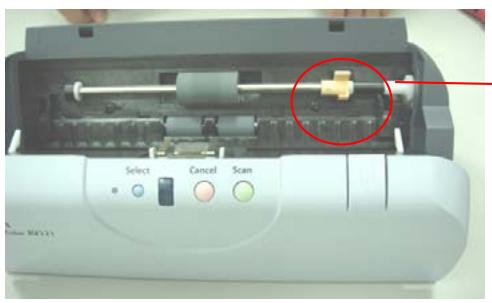
Move the end face up
- Hold and press the roller in the arrow direction as indicated to remove the roller.
Note:
To install a new ADF roller, please follow the reverse order of the disassembling procedure.
7. Troubleshooting
7.1 Clearing a Paper Jam
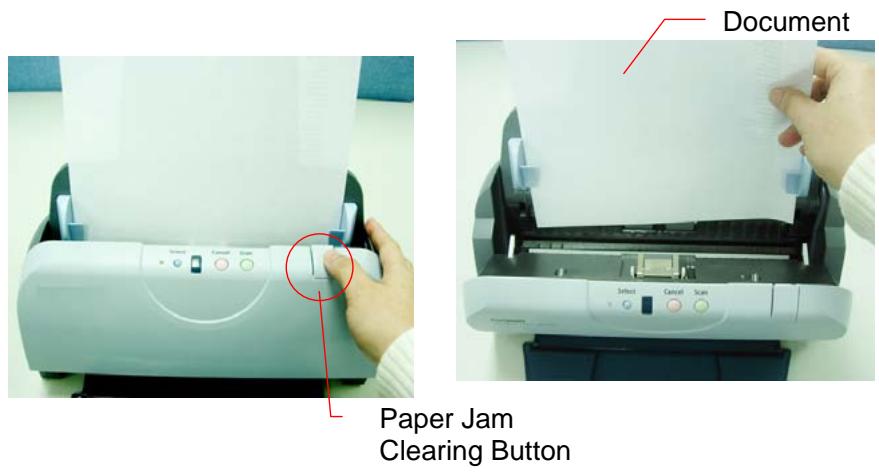
In the event of a paper jam, follow the procedures below to remove the paper:
- Press the ADF Release Button on the left side. Gently open the Scanner Front Door to the left.
- Carefully pull the paper out of the ADF unit.
- Close the scanner front door. Your Scanner is now ready to use.
7.2 Questions and Answers
Question: Paper becomes jammed during scanning.
Answer: 1) Open the scanner front door.
2) Pull out the jammed paper carefully.
3) Close the scanner front door.
Question: More than one sheet of paper are fed into the scanner.
Answer: 1) Open the scanner front door.
2) Remove the multi-fed sheets of paper.
3) Close the scanner front door.
4) Flatten the corners and edges. Loosen the paper before putting it into the paper guide again.
5) Check the feeding roller condition. If necessary, follow the cleaning directions in section 5.1 and perform the cleaning.
Question: Paper becomes skewed in the scanner.
Answer: 1) Use the slide guide to keep the paper path straight.
2) Check the condition of the feeding roller. If necessary, follow the cleaning directions in Section 5.1 and perform the cleaning.
Question: Why is it my scanned image always comes out too dark?
Answer: 1) Modify the Gamma setting to 1.8 for your monitor and, when printing, set Gamma to 2.2 for your printer.
2) Use the Brightness setting of the TWAIN user interface to get a brighter image.
Question: Sometimes it seems the scanner does not detect paper?
Answer: The scanner paper sensor is located at the center of the paper guide. Please place the document you need to scan on the paper guide and use the slide guides to keep the paper path straight.
7.3 Technical Service
Before contact Avision, please prepare the following information:
- Scanner serial & revision number (located on the bottom of the scanner):
- Hardware configuration (e.g., your host CPU type, RAM size, free disk space, display card, interface card):
The name and version of your scanning software application;
The version of your scanner driver.
Please call us at:
Headquarter
Avision Inc.
No. 20, Creation Road I, Science-Based Industrial Park, Hsinchu 300, Taiwan, ROC
TEL: +886 (3) 578-2388
FAX: +886 (3) 577-7017
E-MAIL: service@avision.com.tw
Web Site: http://www.avision.com.tw
US and Canada Area
Avision Labs, Inc.
6815 Mowry Ave., Newark CA 94560, USA
TEL: +1 (510) 739-2369
FAX: +1 (510) 739-6060
E-MAIL: support@avision-labs.com
Web Site: http://www.avision.com
8. Specifications
All specifications are subject to change without notice.
Model Number: FF-0506
Scanner Type: Desktop sheet-fed
Optical Resolution: 600 dpi * 1200 dpi
Scanning Modes: Black & White
Gray scale
Color
ADF Capacity: Up to 50 pages
Document Size: Letter, legal, A4, B5, A5, business card
Max. Document Size: 8.5"x14" (ADF)
Min. Document Size: 3.5'' × 2'' (ADF)
Paper Weight: 16 lbs. to 24 lbs.
Interface: Hi-speed USB 2.0
Power Source: 100~240Vac, 50/60 Hz (input)
24V, 1.0A (output)
Power Consumption: <30W (operation)
< 6W (standby)
Dimensions: (WxHxD) 156 mm x 308 mm x 145 mm
Weight: 2.2 kgs
Index
A
Additional Length Detection, 3-24
B
B&W, 3-6
Background Level, 3-17
Binarization
Dynamic Threshold, Fixed Processing, 3-7
Blank Page Removal, 3-28
Brightness, 3-9
C
Color, 3-6
Color Dropout
Remove Red, Remove Green, Remove Blue, 3-16
Contrast, 3-9
Cropping
Automatic, Fix to Transport, EOP Detection, 3-20
D
default settings, 3-3
Deskew, 3-23
E
Edge Fill, 3-29
Energy Saving, 3-30
F
Filter Threshold, 3-17
G
G4,3-14
Gray, 3-6
I
Invert, 3-11
J
JPEG, 3-14
M
Mirror, 3-29
Multi-Feed Detection, 3-24
0
OverScan, 3-23
R
Reset Pad Count, 3-33
Reset Roller Count, 3-33
Resolution, 3-10
Rotate Image, 3-28
S
Scan Area, 3-23