
AA4000 - Air conditioner UFESA - Free user manual and instructions
Find the device manual for free AA4000 UFESA in PDF.



| Product type | Monoblock mobile air conditioner |
| Brand | UFESA |
| Model | AA4000 |
| Maximum cooling capacity (ASHRAE 128) | 2 300 W |
| Power consumption in cooling mode | 955 W |
| Dehumidification capacity | 26.4 L/24h |
| Recommended fuse | 10 A (slow-blow) |
| Noise level (min/max) | 45 / 48 dB(A) |
| Refrigerant | R-407C |
| Airflow in cooling mode | 215 m³/h |
| Airflow in fan mode | 275 m³/h |
| Operating temperature range (cooling) | 20 °C to 35 °C |
| Operating temperature range (dehumidification) | 18 °C to 35 °C |
| Dimensions (H × W × D) | 86.5 × 43.8 × 43.5 cm |
| Weight | 32 kg |
| Power supply | 220-240 V, 50 Hz |
| Power cord length | 210 cm |
| Maximum hot air exhaust hose length | 140 cm |
| Functions | Air conditioning (max and silent), dehumidification, air purification |
| Filters | Washable basic filter + double active purifying filter (annual replacement, ref. RKZ09013) |
| Maintenance | Regular cleaning of the basic filter with running water; annual replacement of the purifying filters |
| Full water tank indicator | Yes, indicator light |
| Included accessories | Diffuser hose, hot air exhaust hose, suction cup, sliding window accessory, drain plugs |
Frequently Asked Questions - AA4000 UFESA
User questions about AA4000 UFESA
0 question about this device. Answer the ones you know or ask your own.
Ask a new question about this device
Download the instructions for your Air conditioner in PDF format for free! Find your manual AA4000 - UFESA and take your electronic device back in hand. On this page are published all the documents necessary for the use of your device. AA4000 by UFESA.
USER MANUAL AA4000 UFESA
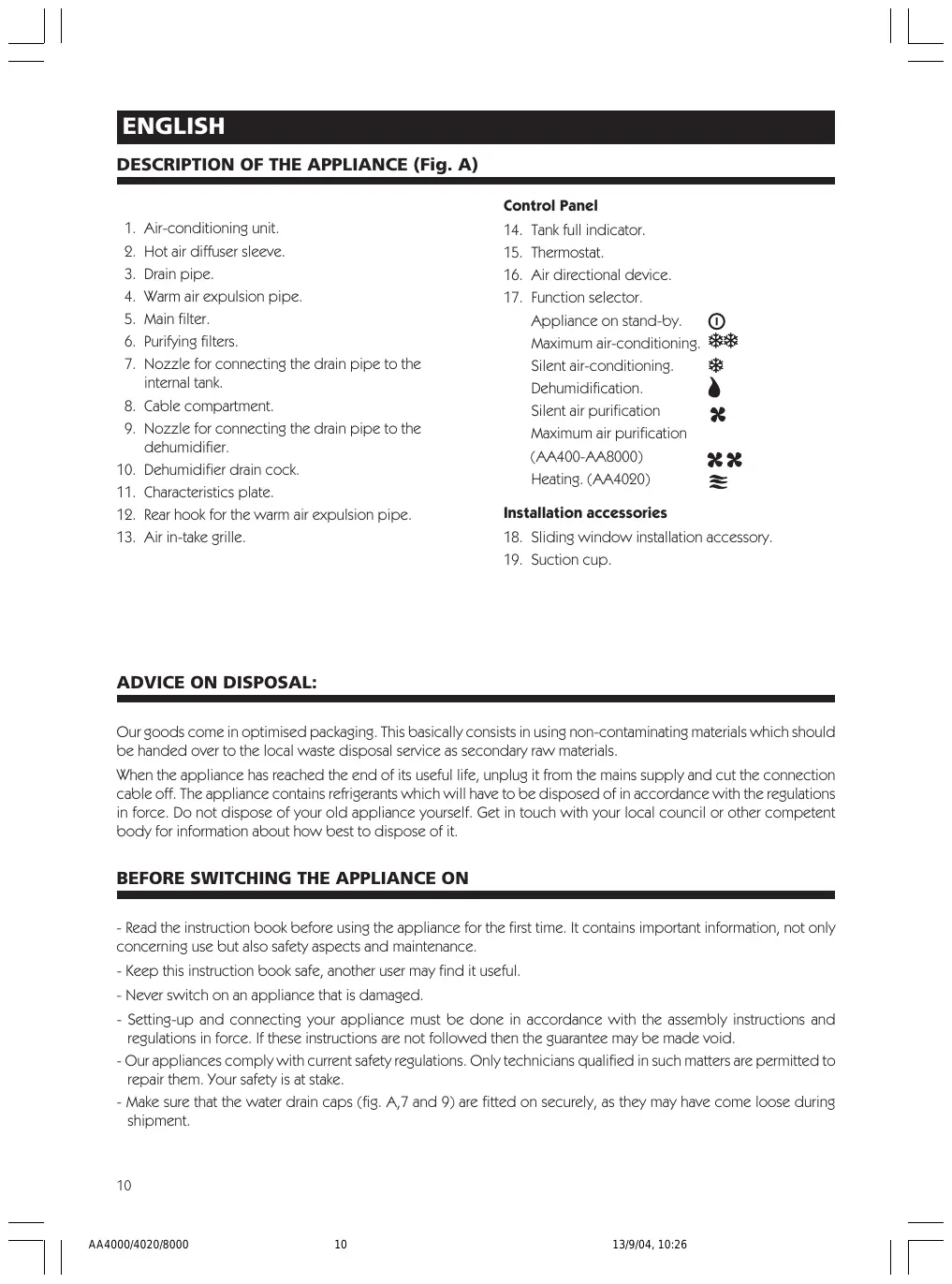
- Air-conditioning unit.
- Hot air diffuser sleeve.
- Drain pipe.
- Warm air expulsion pipe.
- Main filter.
- Purifying filters.
- Nozzle for connecting the drain pipe to the internal tank.
- Cable compartment.
- Nozzle for connecting the drain pipe to the dehumidifier.
- Dehumidifier drain cock.
- Characteristics plate.
- Rear hook for the warm air expulsion pipe.
- Air in-take grille.
Control Panel
- Tank full indicator.
- Thermostat.
- Air directional device.
- Function selector.
Appliance on stand-by.
Maximum air-conditioning.
Silent air-conditioning.
Dehumidification.
Silent air purification
Maximum air purification
(AA400-AA8000)
Heating. (AA4020)
Installation accessories
- Sliding window installation accessory.
- Suction cup.
ADVICE ON DISPOSAL:
Our goods come in optimised packaging. This basically consists in using non-contaminating materials which should be handed over to the local waste disposal service as secondary raw materials.
When the appliance has reached the end of its useful life, unplug it from the mains supply and cut the connection cable off. The appliance contains refrigerants which will have to be disposed of in accordance with the regulations in force. Do not dispose of your old appliance yourself. Get in touch with your local council or other competent body for information about how best to dispose of it.
BEFORE SWITCHING THE APPLIANCE ON
- Read the instruction book before using the appliance for the first time. It contains important information, not only concerning use but also safety aspects and maintenance.
- Keep this instruction book safe, another user may find it useful.
- Never switch on an appliance that is damaged.
- Setting-up and connecting your appliance must be done in accordance with the assembly instructions and regulations in force. If these instructions are not followed then the guarantee may be made void.
- Our appliances comply with current safety regulations. Only technicians qualified in such matters are permitted to repair them. Your safety is at stake.
- Make sure that the water drain caps (fig. A,7 and 9) are fitted on securely, as they may have come loose during shipment.
CONDITIONS FOR USE
- This electrical domestic appliance must be connected to a mains supply of 220 / 240 ~V, 50 ~Hz , through a socket with an earth connection.
- Protected with a slow acting 10 A fuse.
- Should it be necessary to use an extension lead, this will have to a minimum wire gauge of 1.5mm^2 per terminal, be provided with an earth wire, and be no longer than 25m .
- There is a compartment at the rear of the appliance used for storing the mains cable.
- Do not let water get inside the appliance.
- Do not cover the air intakes or outlets on your appliance.
- If the mains cable is damaged it must be replaced. To do this, get in touch with the manufacturer, after-sales service dept. or someone similarly qualified.
Attention!
This appliance is not suitable for dehumidification at ambient temperatures of below 18^ .
After turning your appliance off, wait at least 3 minutes before turning it back on again. The cold circuit needs this amount of time in order to reset.
MOBILITY
The appliance is fitted with wheels which allow it to be moved about. Should it be necessary to tilt the appliance when moving it, the internal water tank will have to be emptied beforehand with the help of the drain pipe (fig.A,3) placed onto the drain cock (fig.A,7) at the bottom of the appliance, as shown in (fig K). Once the appliance has been put back into the upright position leave it to stand for a few minutes before switching it back on.
Attention!
Take special care when moving this appliance. The base is fitted with a drain outlet pipe that may break off if knocked.
INSTRUCTIONS FOR USE
INSTALLATION
A) Hinge or sash windows (fig. L)
- Connect the diffuser sleeve to the warm air expulsion pipe.
- Open the window slightly and place the sleeve between the jamb and the frame.
- Close the window as far as possible and hold it with the suction cup supplied.
B) Sliding windows (fig. M)
- Connect the diffuser sleeve to the warm air expulsion pipe.
- Fit the sliding window installation accessory using the side of the window frame to support it and then adjust it to the right height.
- Close the window as far as possible and insert the diffuser sleeve through the outlet hole.
C) Fixed installation
- Use the optional window/wall sleaving accessory which can be purchased from your usual supplier of electrical appliances. (Ref.: B1RKZ06009)
- It will be necessary to make a hole in the wall to accommodate the hot air pipe sleeve (Fig. 1).
-
Take the diffuser sleeve off and connect the warm air expulsion pipe to the accessory.
-
When the installation goes through a window, you only need to use the transparent end piece of the accessory. Under these circumstances it will be necessary to cut a hole in the glass, 10.5cm diameter (Fig. J)
Notes:
- Try not overstretch the outlet pipe (maximum length 140cm ) nor bend it too sharply. This will impede the passage of the warm air and reduce the cooling efficiency.
- There must be a distance of at least 70~cm between the floor and the end of the duct.
- Adequate ventilation will have to be provided for small rooms, e.g. leaving the door ajar, in order to avoid creating a low pressure which will reduce the cooling efficiency.
Attention!
Do not cover the appliance's air intakes or outlets.
AIR-CONDITIONING
- Plug the appliance in.
- Run the warm air expulsion pipe to the outside (figs. L,M,J)
- Select either the maximum () or silent() air-conditioning function.
- Turn the drain cock to the refrigeration position (fig. F).
- Set the thermostat (fig. B,D) to the desired temperature. Should the thermostat setting cause the appliance to switch itself off automatically, you will have to wait until the room temperature rises by 2 - 3^ before it switches itself back on again.
The appliance cools and dehumidifies the air within the room at the same time in order to create a pleasant climate.
The water produced during this process by condensation is led outside and released from the condenser by evaporation.
Under extremely humid conditions the appliance will store up the condensed water in an internal tank. When this reaches a set level the safety lamp (fig.A,14) will light up, indicating that the said tank will have to be emptied, which is done as follows:
- Turn the thermostat to the ① position and wait 10 minutes to allow the safety systems to reset themselves. (fig. C,E).
- Turn the drain cock (fig.A,10) 90^ to the left (fig. G).
- Take the cap off the cock (9) and inset the drain pipe (fig.A,3) (fig. H- steps A and B).
- Place a container by the outlet of the drain pipe in order to catch the condensed water, (fig. H-step C).
- Select the air-conditioning or dehumidification function.
Attention!
When switching the appliance back to the refrigeration function do not forget to put the cap back onto the drain cock and turn it 90^ to the right. Otherwise water will escape from the appliance when it is switched on. With this done you will have removed the excess water from the system and the appliance can be switched back on for normal operation.
DEHUMIDIFICATION
Set the function control knob to the "Dehumidification" symbol (▲). At this setting, the appliance will only reduce the humidity present in the atmosphere, without affecting the temperature.
- Turn the drain cock (fig.A,10) 90^ to the left (fig. G).
-
Take the cap off the cock (fig.A,9) and inset the drain pipe (fig.A,3) (fig. H- steps A and B).
-
Place a container by the outlet of the drain pipe in order to catch the condensed water, (fig. H-step C).
- Put the warm air expulsion pipe in the parking position (fig. N).
- Select the dehumidification function ( ).
- As much as 31,2 litres of water can be taken out of the air every 24 hours, depending on the ambient conditions.
Attention!
This appliance is not suitable for dehumidification at ambient temperatures of below 18^ .
When you change back to the «Cooling» function, put the plug back into the drainage nozzle on the outdoor unit.
Should you fail to do so, the appliance will shed water produced by condensation during the cooling process.
AIR PURIFICATION
- On this setting the air inside the room is recirculated through purifying filters.
- The appliance includes a basic filter with a double active purifying filter for: smoke, dust, pollen and bacteria.
- Put the warm air expulsion pipe in the parking position (fig. N).
- Select the ventilation speed: Maximum (★★★) or silent (★★★).
- We recommend leaving the filters installed, independently of the setting chosen (refrigeration, dehumidification or air purification) This will provide you with a more efficient purifying action.
HEATING (AA4020)
In the (≈) position the appliance will heat the air in the room while it filters it.
- Put the warm air expulsion pipe in the parking position (fig. N).
- Select the heating function (≈) .
- Set the thermostat to the desired temperature. Once the room reaches the said temperature the appliance will switch itself off automatically and come back on when it drops by 2 - 3^ .
Attention!
Do not cover the appliance's air intakes or outlets.
CLEANING & MAINTENANCE
Cleaning and replacing the purification filters
- The inside unit is fitted with a basic air filter (fig A,5), which will require cleaning from time to time. To do this it should be washed under running water, dried and put back.
- The set of purifying filters (fig A,6) will have to be replaced each year. Replacement filters can be obtained from your local supplier. Always use original Ufesa replacement parts. Replacement filters: RKZ09013
- Fit the new filters as shown in (figures O,P).
- Only place one set of filters over the base filter in order to maintain the cooling effect.
Cleaning the appliance
- The appliance can be cleaned down with a cloth or sponge, warm water and a mild detergent.
- Never use hot water (more than 40^ ), benzene, gasoline, acids or brushes, and try to prevent water from getting inside the appliance. Do not clean the appliance down with a hose.
- Clean the outdoor unit before it is put away. To do this, spray a little water on to the heat exchanger.
Before use at the beginning of the season
- Clean the air filter.
- Then clean the cover and grilles, should they need cleaning.
Before storing it away
If you think that the appliance is not going to be used over a long period then it is advisable to empty the internal water tank with the help of the drain pipe (fig A,3) placed onto the drain cock (fig A,7) at the bottom of the appliance, as shown in figure (fig K).
CHECKS THAT WILL SAVE YOU CALLING THE TECHNICAL SERVICES.
The operations described below will help you to solve minor problems and save you calling the Technical Service Centre. If, after having carried out these checks, the problem persists or reoccurs, then get in touch with our specialist technicians.
What to do if ...
...the appliance does not work
- Make sure that it is plugged in.
- Check that the function selector is not in the off ( ① ) position.
- Check to see that there is power on the mains supply or if a fuse has tripped.
- Set the thermostat to a lower cooling temperature or a higher heating temperature.
...the appliance does not operate in heating mode
- Check that nothing is obstructing the appliance's air intakes or outlets.
- The safety system designed to prevent overheating may have cut in. If, after a few minutes, the appliance fails to come back on automatically, unplug it, wait a few minutes and plug it back in.
... the appliance does not work and the safety light is on.
- Place the appliance on a flat surface. If the lamp stays lit, empty the appliance's internal water tank. (Refer to air-conditioning instructions).
... the safety lamps lights up frequently
- Make sure that the drain cock is in the correct position.
... the appliance does not cool the air sufficiently.
- Make sure that the joints around the warm air expulsion pipe (fig.A,4) are okay.
- Make sure that the expulsion pipe's path is not too curved and that its length does not exceed 140~cm .
- Check that the drain cock (figA,10) is in the air-conditioning position.
- Place the suction cup in such as way that the window is opened as little as possible.
- Close the blinds to minimise the heat from the sun.
... the appliance makes a lot of noise
- Make sure that the warm air expulsion pipe is attached to the appliance correctly.
- Check that the air inlet and outlet on the appliance are free from obstruction.
- If your can hear water running then this is due to the pump operating, which is recirculating the water in order to improve the appliance's performance.
Any other fault or repair must be dealt with by a specialist technician. Consult an Authorised Technical Service Centre.
CHARACTERISTICS TABLE
| Modelos | AA4000 | AA4020 | AA8000 | |
| Performance | ||||
| Maximum cooling capacity (*) | W | 2.300 | 2.100 | 2.600 |
| Maximum consumption: cooling | W | 955 | 955 | 1.180 |
| Maximum consumption: heatingn | W | - | 2.000 | - |
| capacity | ltr/24h | 26,4 | 26,4 | 31,2 |
| Fuse | A | 10 | 10 | 10 |
| Sound level (min/max) | dB(A) | 45/48 | 46/49 | 45/48 |
| Refrigerant | R-407C | R-407C | R-410A | |
| Maximum air flows | ||||
| Cooling | m³/h | 215 | 180 | 215 |
| Ventilation | m³/h | 275 | 220 | 275 |
| Heating | m³/h | - | 220 | - |
| Operation range | ||||
| Cool ling (min/max) | °C | 20/35 | 20/35 | 20/35 |
| dehumidification (min/max) | °C | 18/35 | 18/35 | 18/35 |
| Heating (nim/max) | °C | - | sin limite/30 | - |
| Size | ||||
| Height of the unit | cm | 86,5 | 86,5 | 86,5 |
| Width of the unit | cm | 43,8 | 43,8 | 43,8 |
| Depth of the unit | cm | 43,5 | 43,5 | 43,5 |
| Weight of the unit | kg | 32 | 32 | 32 |
| Length of cable | cm | 210 | 210 | 210 |
| Length of drainage pipe | cm | 140 | 140 | 140 |
| Accessories | ||||
| Window accessory RKZ1000 | ||||
| Balcony accessory RKZ2000 | ||||
| Wall // Window Tube B1RKZ 06009 | ||||
| Set of active filters RKZ09013 | X | X | X | |
| (*) ASHRAE 128 | ||||
FRANÇAIS
DESCRIPTION DE L'APPAREIL (Fig. A)
- Control Panel
- Installation accessories
- ADVICE ON DISPOSAL:
- BEFORE SWITCHING THE APPLIANCE ON
- CONDITIONS FOR USE
- Attention!
- MOBILITY
- INSTRUCTIONS FOR USE
- INSTALLATION
- A) Hinge or sash windows (fig. L)
- B) Sliding windows (fig. M)
- C) Fixed installation
- Notes:
- AIR-CONDITIONING
- DEHUMIDIFICATION
- AIR PURIFICATION
- HEATING (AA4020)
- CLEANING & MAINTENANCE
- Cleaning and replacing the purification filters
- Cleaning the appliance
- Before use at the beginning of the season
- Before storing it away
- CHECKS THAT WILL SAVE YOU CALLING THE TECHNICAL SERVICES.
- What to do if ...
- ...the appliance does not work
- ...the appliance does not operate in heating mode
- ... the appliance does not work and the safety light is on.
- ... the safety lamps lights up frequently
- ... the appliance does not cool the air sufficiently.
- ... the appliance makes a lot of noise
- FRANÇAIS
- DESCRIPTION DE L'APPAREIL (Fig. A)
Brand : UFESA
Model : AA4000
Category : Air conditioner