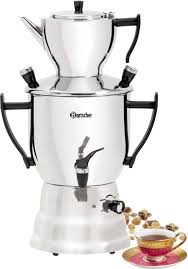
191.001 - Electric tea maker BARTSCHER - Free user manual and instructions
Find the device manual for free 191.001 BARTSCHER in PDF.


| Product Type | Electric Samovar |
| Brand | BARTSCHER |
| Model | 191.001 |
| Dimensions (diameter × height) | 310 mm × 370 mm |
| Weight | 1.7 kg |
| Power Supply | 230 V ~ 50 Hz, 1500 W |
| Water Tank Capacity | 3 liters |
| Teapot Capacity | 1.2 liter |
| Main Material | Stainless Steel |
| Temperature Control | Continuous via rotary thermostat (positions OFF, WARM, HOT, BOIL) |
| Main Functions | Heating and keeping water warm, preparation of black and green tea |
| Safety | Overheat protection, automatic shut-off in case of water shortage |
| Care and Cleaning | Regular cleaning of the tank; descaling every 1 to 2 weeks with vinegar or descaler; teapot, lid and tea strainer are dishwasher safe |
| Included Accessories | Teapot (1.2 liter), tea strainer |
| Intended Use | Domestic use: preparation of teas, herbal teas and hot drinks |
Frequently Asked Questions - 191.001 BARTSCHER
User questions about 191.001 BARTSCHER
0 question about this device. Answer the ones you know or ask your own.
Ask a new question about this device
Download the instructions for your Electric tea maker in PDF format for free! Find your manual 191.001 - BARTSCHER and take your electronic device back in hand. On this page are published all the documents necessary for the use of your device. 191.001 by BARTSCHER.
USER MANUAL 191.001 BARTSCHER
Keep this instruction manual ready to hand at the product!
1. General Information 22
1.1 Information about the instruction manual 22
1.2 Key to symbols 22
1.3 Liability and Warrantees 23
1.4 Copyright protection 23
1.5 Declaration of conformity 23
2. Safety 24
2.1 General information 24
2.2 Safety instructions for use of the device 24
2.3 Intended use 25
3.Delivery,packaging and storage 26
3.1 Delivery check 26
3.2 Packaging 26
3.3 Storage 26
4. Technical data 27
4.1 Overview of parts 27
4.2 Technical specification 28
5. Installation and operation 28
5.1 Safety instructions 28-29
5.2 Installation and connection 29
5.3 Operation 29-34
6. Cleaning and maintenance 34
6.1 Safety advice 34
6.2 Cleaning and descending 35-36
6.3 Safety instructions for maintenance 36
7. Possible Malfunctions 37
8.Waste disposal 38
Bartscher GmbH
1.1 Information about the instruction manual
This instruction manual contains information about the installation, operation and maintenance of the device and should be consulted as an important source of information and reference guide.
Awareness of the safety instructions and instructions for use in this manual will ensure the safe and correct use of the device.
In addition to the information given here, you should comply with any local Health and safety Controls and generally applicable safety regulations.
The instruction manual forms part of the product and should be kept near the device and easily accessible for anyone carrying out the installation, servicing, maintenance or cleaning.
1.2 Key to symbols
In this manual, symbols are used to highlight important safety instructions and any advice relating to the device. The instructions should be followed very carefully to avoid any risk of accident, personal injury or material damage.

WARNING!
This symbol highlights hazards, which could lead to injury.
Please follow the instructions very carefully and proceed with particular attention in these cases.

WARNING! Electrical hazard!
This symbol draws attention to potential electrical hazards. If you do not follow the safety instructions, you may risk injury or death.

CAUTION!
This symbol highlights instructions, which should be followed to avoid any risk of damage, malfunctioning and/or breakdown of the device.

NOTE!
This symbol highlights tips and information, which have to be followed for an efficient and trouble-free operation of the device.

WARNING! Hot external surface!
This symbol is a warning that the device surface is hot when in use. Ignoring this warning may result in burns!
1.3 Liability and Warrantees
All the information and instructions in this manual take into account standard safety regulations, current levels of technical engineering as well as the expertise and experience we have developed over the years.
The instruction manual was translated with all due care and attention. However, we do not accept liability for any translation errors. The German version of this instruction manual is definitive.
If the delivery consists of a special model, the actual scope of delivery may differ from the descriptions and illustrations in this manual. This is also the case for special orders or when the device has been modified in line with new technology. If you have any questions, you should contact the manufacturer.

NOTE!
Read the instruction manual carefully before using the device. The manufacturer does not accept liability for any damage or malfunction resulting from not following the instructions for use.
The instruction manual should be kept near the device, easily accessible for anyone wishing to work with or using it. We reserve the right to make technical changes for purposes of developing and improving the useful properties.
1.4 Copyright protection
The instruction manual including any texts, drawings, images or other illustrations is copyright. No part of this publication may be reproduced, transmitted or used in any form or by any means without permission in writing from the manufacturer. Any person who commits any unauthorized act in relation to this publication shall be liable to claims for damages. All rights reserved.

NOTE!
The contents, texts, drawings, pictures and any other illustrations are copyright and subject to other protection rights. Any person unlawfully using this publication is liable to criminal prosecution.
1.5 Declaration of conformity
The device complies with the current standards and directives of the EU.
We certify this in the EC declaration of conformity.
If required we will be glad to send you the according declaration of conformity.
2. Safety
This section provides an overview of all important safety aspects.
In addition every chapter provides precise safety advice for the prevention of dangers which are highlighted by the use of the above mentioned symbols.
Furthermore, attention should be paid to all pictograms, markers and labels on the device, which must be kept in a permanent state of legibility.
By following all the important safety advice you gain an optimal protection against all hazards as well as the assurance of a safe and trouble-free operation.
2.1 General Information
This device is designed in accordance with the presently applicable technological standards. However, the device can pose a danger if handled improperly and inappropriately.
Knowing the contents of the instruction manual as well as avoiding mistakes and thus operating this device safely and in a fault-free manner is very essential to protect yourselves from the hazards.
To prevent hazards and to ensure optimum efficiency, no modifications or alterations to the device that are not explicitly approved by the manufacturer may be undertaken.
This device may only be operated in technically proper and safe condition.
2.2 Safety instructions for use of the device

CAUTION!
The device is not intended for use by individuals (including children) with physical or mental disabilities, insufficient experience, and/or insufficient knowledge unless such persons are under the care of a person responsible for their safety or have received instructions regarding appropriate use of the device.
Children should be observed to ensure that they are not playing with the device.
o Preserve this manual safely. When passing on/selling the device to a third party, the manuals must be handed over along with the device.
Every person using the device must act in accordance to the manuals and under consideration of the safety advice.
The device is to be used indoors only.
2.3 Intended use
Safe operation is only guaranteed when using the device for its intended purpose.
Any technical interventions, as well as assembly and maintenance are to be made by a qualified customer service only.
The Samovar is intended only for home use.
The Samovar is ideally suited for preparing tea and other 'instant' hot drinks.
The Samovar must not be used for:
heating milk and other liquids which foam;
- reheating soups, sauces and other thick liquid dishes;
- Boiling up liquids containing sugar, sweeteners, acids, leaches or alcohols;
- Filling in and heating of inflammable, noxious, easily volatilizing or similar liquids or substances or materials.

CAUTION!
Any use going beyond the intended purpose and/or any different use of the device is forbidden and is not considered as conventional.
Any claims against the manufacturer or his authorized representative as a consequence of experiencing damages resulting from unconventional use are impossible.
The operator is liable for all damages resulting from inappropriate use.
3. Transport, packaging and storage
3.1 Delivery check
Please check the delivery upon completeness and transport damage immediately after receipt.
In case of visible damage do not accept or accept the delivery with reservation only.
Note the extent of damage on the carrier's bill of delivery. Trigger off the complaint.
Hidden damages should be reclaimed immediately after notice, as claims for damages can only be asserted within the effective period for complaints.
3.2 Packaging
Please do not throw away the covering carton of your device as it might be useful for storage purposes, when moving or, in case of damages, when the device must be sent back to a repair center. The outer and inner packing material should be removed completely from the device before installation.

NOTE!
If you liked to dispose the packing, consider the regulations applicable in your country. Supply re-usable packing materials to the recycling.
Please inspect the device upon completeness. In case any part is missing please contact our customer service center immediately.
3.3 Storage
Keep the package closed until installation and under consideration of the outside indicated positioning- and storage markings.
Packages should be stored under consideration of the following:
- Do not store outdoors.
- Keep it dry and dust-free.
- Do not expose it to aggressive media.
- Do not expose it to direct sunlight.
- Avoid mechanical shocks and vibration.
In case of longer storage (> 3 months) make sure you check the state of the packaging and the parts regularly. If required refresh or renew.
4. Technical data
4.1 Overview of parts

- Tea strainer
- Lid of teapot
- Handle teapot
- Teapot, capacity: 1.2 litres
- Handle lid
- Lid
- Steam outlet
- Max. filling level marking / filling level device
- Handle water container
- Water container, capacity: 3.0 litres
- Rotating temperature regulator
- Base with integrated powerline and cable storage
- Slip-resistant silicon legs
- Tap lever
- Tap without lever
- Power cord
- Control light
4.2 Technical specifications
| Name | Samovar |
| Art. no.: | 191.001 |
| Construction: | Stainless steel |
| Temperature regulation: | Flexible |
| Capacity: | 3 litres |
| Power: | 230 V ~ 50 Hz 1500 W |
| Dimensions | W 310 mm, H 370 mm |
| Weight: | 1.7 kg |
| Accessories | Tea pot (capacity of 1.2 litres), tea strainer |
We reserve the right to modifications!
5. Installation and operation
5.1 Safety instructions
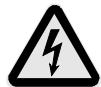
WARNING! Electrical hazard!
The device must only be connected to a properly installed single socket with protective contact.
Never yank cord to disconnect from outlet.
Cable must not touch any hot parts.
- See that the cable does not touch any heat sources or sharp edges. Do not let the cable dangle over the counter edge.
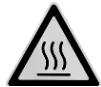
WARNING! Hot surface!
During operation some elements of the device very become hot. To avoid burns, do not touch hot elements!
- Do not use the device in case it does not function properly, has been damaged or dropped.
-
Do not use any accessory or spare parts that have not been recommended by the manufacturer. These can be dangerous for the user or lead to damages of the device or personal injury, and further, the warranty expires.
-
Do not lay the cable over carpets or heat insulations. Do not cover the cable. Keep away the cable from operating range and do not dunk it into water.
- Do not move or tilt the device when in operation.

WARNING! Hazard via electrical current!
The device can cause injuries due to improper installation!
Before installation the local power grid specification should be compared with that of the device (see type label).
Connect the device only in case of compliance!
Take note of the security advice!
5.2 Installation and connection
- Discard the complete packing material after unpacking the device.
- Place the device on top of an even and safe surface which supports the weight of the device and is not heat sensitive.
- Do not place the unit on a surface which is sensitive to water. Spraying water may cause damage.
- Never place the unit under a hanging cupboard.
- Not at any time should you place the device on an inflammable surface (such as: table cloth, etc.).
- You must not position the device near open fireplaces, electric ovens/arc furnaces, furnaces/electric heaters or other heat sources.
- The electrical circuit in the socket must be secured to at least 16A. Only connect the device directly to the wall socket; do not use any extension cords or power strips.
- Place the device so that the plug is easily accessible and can be quickly removed from its socket in case of necessity.
5.3 Operating
- Prior to first use clean the unit and accessories (see also 6.2 „Cleaning").
- Fill the water reservoir to its maximum capacity (as indicated) and boil. Pour the water out.
- Repeat 2-3 times.
- Next, fill the reservoir with the required amount of fresh water (up to the maximum indicated capacity)

WARNING! Danger of burns!
Do not exceed the maximum filling amount!
Overfilling of the water tank might cause overcooking and result in scalding danger!

NOTE!
In order to shorten the time of heating you may also fill in warm water. The use of cold water requires longer heating times.
Fix the cover to the unit and place the tea pot on top of it.
- Ensure that the rotating temperature regulator is turned all the way counter clockwise.
- Now connect the unit to a single-socket power outlet.
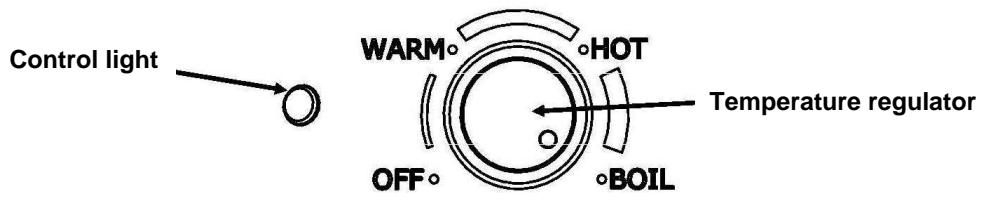
- Turn the temperature regulator clockwise. The thermostat allows for flexible temperature setting. You may choose from the following options: boiling water / interval boiling (BOIL) / hot water (HOT) / warm water (WARM).
- To boil water, choose the highest setting. Turn the temperature regulator all the way clockwise.
- The control light will come on, indicating that the unit is heating up. After a few minutes water will boil. This is indicated by escaping steam.

WARNING! Danger of burns!
Never remove the samovar cover during boiling. Hot steam will escape and may burn arms, torso and face!
- If the temperature regulator is left in this position water will continue to boil and eventually evaporate. To avoid endless boiling, turn the temperature regulator far enough that the control light goes off.
- After some time the control light will come on again and the unit will resume boiling water. In this manner the thermostat regulates the amount of energy it uses and at the same time saves energy.
Temperature regulator settings
-
BOIL - boiling water: Temperature regulator turned completely; water temperature approx. 100^
-
interval boiling: Approx. 14 do 12 turn backwards, after water begins boiling; water temp. 95^ - 100^
-
HOT - hot water: Approx. 12 turn backwards, water temp. 85^ - 95^
WARMo - warm water: approx. 14 turn backwards, water temp. 60^ - 70^
- Turning the temperature regulator all the way around counter clockwise turns the unit off (position OFF). The control light will go off.
- The unit is equipped with protection against overheating. The thermostat activates it when there is too little water in the reservoir.
- If the overheating protection has been activated, disconnect the unit from its power source by removing the plug from its socket and leave the unit to cool for several minutes before refilling it with water.
- If the unit is not being uses, disconnect it by removing the plug from its socket.
Preparation of tea
There are teas and teas. In the strict sense, the term tea describes a beverage made by steeping the leaves of Camellia sinensis in boiling water. There is black and green tea. Hot water can however also be poured over leaves of other plants or pieces of fruit.
Such beverages are known as infusions. In order to preserve the flavour and beneficial ingredients, infusions and teas are prepared with hot or boiling water and left to steep for shorter or longer periods. Green tea is for example best prepared with water at a temperature of 85^ . In any case, always follow the instructions on the packaging.
Black tea
- Place the tea strainer inside the tea pot.
- Fill the tea strainer with loose leaf tea (approx. one teaspoon per cup) or place a tea bag directly into the tea pot (approx. 1 tea bag per 1-2 cups).
- Place the lid on the water tank and the teapot on top of the lid. This pre-heats the teapot at the same time.

CAUTION!
Place the teapot on to the lid in a way, so the escaping steam does heat up the handle!
Boil the water.
- Remove the teapot from the container.

CAUTION!
Hot steam will escape! A small amount of condensed water may also drip from the base of the teapot.
- Now pour boiling water over the tea from the tap. By pressing the tap lever down slightly, the tap opens and you can draw off water. It closes as soon as you release it again. If you want to draw off a lot of water, e.g. to fill the teapot, tip back the tap lever. It snaps in this position. The tap does not close again until you push the lever forward again.
- Fill max. 1 into the teapot.
- The more tea leaves or tea bags and the less water you place in the teapot, the stronger the tea concentrate ("professionals" like their infusion to have 2.86g of tea per cup). It is better to use somewhat more tea so that a concentrate is actually formed in the teapot.

NOTE!
You might choose the tea concentration by taste
Always take notice of the steeping time indicated on the tea packing, as it differs between the tea sorts.
- Replace the teapot with the tea concentrate on the water tank. The steam rising in the water tank keeps the tea in the teapot at precisely the right temperature required for brewing.
- After the desired brewing time has elapsed, remove the tea strainer (tea bag) from the tea pot.
- Next pour the required amount of tea concentrate from the teapot into your glass (to taste) and then top your glass up with water from the water tank. This will allow you to vary the strength and taste of your tea.
- The teapot can be left on the water tank when the appliance is operating so you can help yourself to more tea at any time. Position the knob somewhat above the HOT position (but not to the detent), so that the water remains hot but does not boil continuously. The signal light will illuminate and extinguish in cycle. However, the maximum heating setting should only be used for initial boiling of the water.
Green Tea
- Green tea can also be prepared with the Samovar. Green tea should generally not be brewed with boiling water as this gives it a slightly bitter taste. Depending on the kind of tea, the ideal water temperature is 50 - 70^ . Most green teas develop their optimum taste at around 70^ . The higher the quality of the green tea, the lower the optimum water temperature. Teas of the highest quality are brewed with water at 50 - 60^ .
- Normal green teas must infuse for 1 to 3 minutes, whilst high-grade green teas only need around 1 to 1 12 minutes. Please follow the manufacturer's instructions when using tea bags.
- Green tea is always dosed less than black tea. Around 1 g per 100 ml or 1 level teaspoon to 200 ml of water. You can determine the strength of the concentrate yourself.
- Boil the water in the container. Then pour some hot water into the cups (the teapot has been pre-warmed on the container during the boiling process). Then turn the adjusting knob back to the WARM position (depending on the type of tea) and allow the water to cool down a little (approx. 5 - 6 minutes). Now pour hot water from the container onto the tea (note the max. filling level marking). Place the teapot on top of the container as described before so that the tea remains hot, and then proceed as for black tea.
Herbal infusion

CAUTION!
Always prepare infusions of herbs, fruit, Rooibos and spice with boiling water and let them steep for minimum 5 to 10 minutes. This is to ensure that the beverage is completely safe for consumption!
- For herbal infusions, whether prepared with loose leaves or bags, always use boiling water and adhere to the recommended steeping time. In extremely rare cases, herbal mixtures might contain Salmonella, which is however effectively destroyed by boiling water. Incorrect preparation of the infusion can pose a health risk. This is of particular concern in connection with infusions for children.
- Never prepare herbal infusions using water that is not boiling hot, for example to make a beverage that is at drinking temperature the moment it is prepared, as germs that might be contained in the ingredients might not be destroyed. This could be particularly harmful to babies, small children and the sick. Never let the prepared infusion stand for several hours before consuming it. While the boiling water destroys all germs contained in the herbal mixture, spores might survive and germinate in the warm water.
6. Cleaning and maintenance
6.1 Safety advice
Before beginning with repair or cleaning works make sure the device has been disconnected from power socket (pull the power plug!!!) and has cooled down.
o Do not use any acid agents and make sure no water ingresses the device.
To protect yourself from electric shock, never immerse the device, its cables and the plug in water or other liquids.

CAUTION!
The device is not suited for direct washing via water jets. Therefore, you must not use any kind of pressure water jet for cleaning the device!
6.2 Cleaning and descending
Cleaning
The unit should be cleaned regularly.
Empty the unit after each use.
Rinse the water reservoir with clean water.

CAUTION!
The samovar's water reservoir must be thoroughly emptied and cleaned (disinfected) at regular intervals, in order to avoid formation of dangerous substances in the samovar.
Clean the samovar's surface with a soft, wet cloth and dry thoroughly.

WARNING! Danger of electrocution!
Never clean the unit's pedestal in running water, as it can get inside the unit and cause electrocution.
o Thoroughly wash the tea pot, tea strainer and lid with warm water and a gentle cleaning agent. Rinse with clean water.

NOTE!
The lid, tea pot and tea strainer are dishwasher-safe!
o Only use a soft cloth and make sure you never use any kind of abrasive agents on pads which could scratch the surface.
○ After the cleaning procedure, you should use a soft and dry cloth to wipe dry and polish the surface.
o Make sure the device has been cleaned properly before storing it in a dry place.
Dscaling

CAUTION!
Complaints will not be accepted if the samovar is not decalcified regularly as described in the instruction manual.
Such complaints are no cases of warranty!
- Bad water conditions might lead to calcification. This results in longer heating periods and might damage the device.
Depending on the frequency of usage and water quality, descale the water reservoir every 1-2 weeks.

CAUTION!
Descale the samovar regularly!
- Fill the water tank with fresh water, add vinegar or a common descaling agent and boil up the solution.
- Also let some of the solution flow trough the tap in order to remove calcifications here as well.
Repeat the boiling up the descending solution another 1-2 times.
o Let the device cool off for a few minutes.
○ After descending, pour out the descending solution. Rinse the reservoir thoroughly in clean water, and pour some water out through the spigot.
If the teapot also shows calcification, proceed accordingly as described above for the water tank of the Samovar.

NOTE!
Use pre-filtered water in order to avoid calcification!
6.3 Safety instructions for maintenance
Check the mains connection cable for damage from time to time. Never operate the device when the cable is damaged. A damaged cable must immediately be replaced by customer service or a qualified electrician to avoid dangers.
In case of damage or malfunction, please contact your stockist or our customer service centre. Pay attention to the troubleshooting tips in pt. 7.
o Only a qualified technician and using original spare parts and accessories should carry out repairs and maintenance of the device. Do not attempt to repair the device yourself.
7. Possible Malfunctions

CAUTION!
In the event of malfunctions during use, remove the plug from its socket.
| MALFUNCTION | CAUSE | SOLUTION |
| The unit is turned on but not functioning. | Plug not in a socket. Fuse blown as other machines requiring high levels of energy were simultaneously connected. Temperature regulator in the wrong position. | Insert plug into socket. Disconnect the unit from its power source, then replace the fuse. Turn regulator to the proper position. |
| The unit is on, but the control light is not on. | Damaged control light. Temperature regulator in the wrong position. | Contact the sales agent Turn regulator to the proper position. |
| The unit turns itself off. | The overheating protection has been activated, as there is too little water in the reservoir. | Leave the unit to cool and fill with water. |
The above described problem cases are given for orientation and as examples. Should these or similar problems occur, please turn off the machine immediately and don't use it anymore. In order to check and repair your machine, please contact a qualified expert or the manufacturer immediately.
8. Waste disposal
Discarding old devices
At the end of its service life the discarded device has to be disposed in accordance with the national regulations. It is advisable to contact a company which is specialized in waste disposal, or just contact the local disposal service in your community.

WARNING!
To exclude any abuse and the dangers involved make the waste device unfit for use before disposal. For that purpose disconnect device from mains supply and remove mains connection cable from the device.

NOTE!
For the disposal of the device please consider and act according to the national and local rules and regulations.
Bartscher GmbH
4.2 Indications techniques
7.Bo3MOxHbIe HeuCnpaBHOCTN 73
8. Ytuln3aun 74
Bartscher GmbH
Camobap He nCnOJb3OBaTb DnA CNeDyUoIx UeJeI:
pa3orpeBaB npibope MoNoka nnI neHraXcxKxNdkocTei;
pa30rpeBa cynOB nIIN COYCOB, a taKKe aHaJIoNHybIX rCybIX 6JIIO;
pa30rpeBa n BapKn KnIkoCTe, CoepKaaux caxap, caxapo3y, KncIoTy, IeNoCb nnn aJNKoROrb;
3aONHeHnIpa30rpeBa BOCnIaMeHЯUxxCB, BpeNbIX IJIa 3DOpOBbY, JERKo INcapraUxxCnI NII NIO6hBX KINKOCTe NII BSeCTB.

BHIMAHHE!
JIo6oe omKIOHeHue om noIb3O8aHua NO npRmOMy Ha3NaueHuo u /uIu dpy20e UcnoIb3O8aHue npubopa 3anpeueHo u reJeemcr noIb3O8aHueM HecoomeemcmEHHo npRmOMy Ha3NaueHuo.
IpemeH3uu IIO6O zo poda K u32omobumelu / unu ezo npedcmaumenno no nobody hAnecEHHo2 yuepe6a e pe3yIbMame noIb30eAHnra npubopom He no Ha3NaueHuO UCKIIOUeHbl.
3a eecb yueep6 npu noIb30baHuu npubopom He no Ha3NaueHuO omeeyaem cam nompebumel.
3. Перевозка, уразковka и xpaони.
3.1 TpaHcnpTna HhCneKuia
IonyeHHbI rpy3 He3aMeIJIteIbHO IPOBepNTb Ha KOMIIeKTHOCt b Ha TpaHCnOpTbIy upe6. Pn BHeUHe OOn3HabAemom TpaHCnOpTHOM yuepe 1py3 He npHIMaTb IIN npInHrTc oROBOPKOJ.
Pa3Mep yuεp6a yka3aTb B TpaHcnpTbIX DOKyMeHTax / NaKlaIHO/ nepeBo3UkA.
IpaTb peKnaMaunIO.
Ckpytbiy uyepe peKlAmIpOBaTb cpa3y nocJe o6hApUxKeHnra, TaKa 3aBky H aBO3MeueHne yuep6a MOxHO pOdaTb IINb B PpeJenax DeiCTByIOxix peKlAmauOnHHbx CpOKOB.
3.2 ynaKOBka
He BbIKIbIbIaIte ynaKOBouHbI KAPToH BaIeO npIbOpa. OH MoXeT Bam POnHaIObIbTCa Iy XpaHEnH, PnI nepeE3e IyIeCnB BcIcyae BO3MOxHbIX POnBpeXdHm 6yTe BcIbIaNb PnpBop B Hauy cepBicHyo Cnyk6y. POnHOCTbIO OCBOODITE npIBOp npEeD BBOIDM B CTPOI OT BHeUHero N BHyTpENHero ynaKOBouHoro MaTePnAna.

YKA3AHHE!
Ecnu BbI Hamepeeaemecb bkyiunhyb ynaKoOchbl Mamepuan, co6nlodaume npednucnua, deuecmeyouque e Baweu cmpahe. Iodeo3ume emopuho nepepa6ambiaeMbI ynaKoOchbl Mamepuan K Mecmy cbopa mamepuanoe mopuhou nepepa6omku.
Поберът, полноctью луkomплкован пибор и зан chaье пиналжно.В с lyuae He doctaun Kaix-лбо ча Teс CBякntecb C haш e clykboс Сервica.
3.3 XpaHeHne
Pπbopbl āpεKaTb Do yCTaHOBKn B He paçnaKobAHHom BnIe, co6JIIOJára HaHeCéHHbIe Na BHeUHe CTOpOHe MapKnIpOBKn I O yCTaHOBKe I xpaHeHNo.
Ynakobkn XpaHntb NcKnHouTteNbHO npCneDyUOxuCNoBx:
He DepeKxTaB NOD OTkpblIM He6om;
XpaHnTb BCyXOM CBOOJHOM OT IIJIIM MeCTe;
He NODBepraTb BO3DeIcTBnO arpeccNBbIX BeIeCTB;
- npedeoxpaHrToB03eJcTBnCOnHeuHbIX Jyuei;
- 136eRaTb MExaHnuecknx COTpRceHn;
-придпinteьномханени(болee 3 месаев) PeryIЯрно контpoлроватьобцee coctoHne BCexЧаTeи uynakobkn.В сlyuae Heo6xoДIMOCtINOCBEXHTb nIIИ OSHOBNTb.
4. TexHnueckne daHHbIe
4.1 OnscaHne YacTei np6opa
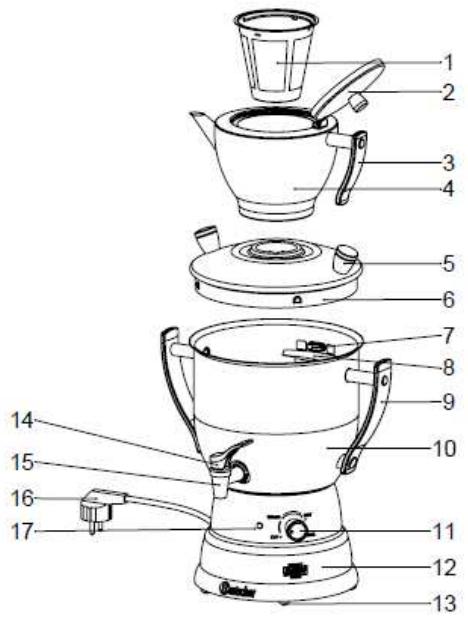
- Cnteuko dny qay
- KpbIuKa 3aBapOuHOro YaHnHa
- Puyka 3abapoHoro yauHnka
- 3abapouhbl yaiHnk, EMKocTbO 1,0IITp
- Puyka Kpbilshk
- Kpbioka
- Napobbinyckhoe OTBepCTne
- OTMeTka / npncnoc6JIeHne MaKc. yPoBn 3aIOnJIeHnE EMKoCTn JIJI BODJI
- Puyka EMMOCTIN DnB BoDbl
- EMKoCTb IJRA BOIbl, EMKoCTbIO 3,0IITpa
- TempepatypbIy peryIaTOp
- IoDCTaBka CO BCTpoEHbIM CeTeBbIM IPOBODOM IM MecTOM dIa HAMOTKn KaBeJra
- PpOtnBocKoJIb3aIe cNIIMKOHObIe HOXKN
- Pbyar cInBHoro KpaHa
- CnIBHOK pKaHnK
- CeTeBoi uTeKeep co BCTpoeHNO BUNKoN
- KoHTpOJIbHaJЯmMOnUka HaRpeBa
4.2 Texnueckne cBeHeHna
He npoknaIbIbAtb Ka6eIb NOBepx KOBpOBOrO NOKpbITnA INpytnx TeNnon3OJrTOpOB. Ka6eIb He NaKpbIbAtb. Ka6eIb DePkaTb BdaJeke ot pa6oeryo MecTa I He NorpykaTb B Body.
- Pn6op BO Bpemra p60TbI He nepeDbVaTb I He OnpokuDlbBaTb.
PNEyPExEHNc! Onachocmb npaKeHn 3eKmpueckum mOKOM!
Ipu6op moxem hahecmu yuep6, ecnu ezo ycmaHOka npou3eedeHa He npofocecuohalbHo!
Ipeod ycmaHOeKO cpaehumb daHhbIe MecmHOJ 3JIeKmpocemu c mexHuYeCKUMu CbeDeHnmu npubopa (cmompume 3aOoDckyo ma6NuKy).
Ipu6op nooknouamb moIbko e cnyae coomsemmea!
Ppudepkueambcya pykoobodmea no 6e3onacnocmu!
5.2 YctaHOBka I NOdkJIIOUeHne
- PacnakyuTe npnbOp u ybepeTe BeCy ynaKoBOUHbMy MaTeepnAJI.
- Пocтавыт eпибор hа ровhoe, b30anachoe MecTo, KOTOpoe BbIepeKNT BEc npi6opa n KOTOpoe He yBnErc Tc yBCTBnteHbHIM K TeNpy.
- UctaHabnBaIte npnbop ToJbKO Ha OCHOBAHNA C BOOOTTaJIKNBAIOUeI NOBepxHOCTbIb. BbInJeCKnBaIOUaCRA BODa MOKeT cTaTb pNcHOn IOBpeKdEHH.
- HnkOrda He CTaBbTe npnbop NOHabeChbIM Ukakom.
- HnkOrda He cTaBbTe npnbOp Ha JERKO BOCNJamaHryUOc OCHOBy (KaK, HanpImep, cKaTeptb, T. n.).
He yctanabJinBaIte npi6op B6Jn3n OTkpblix OarOB, 3JIeKTponeeH, neey nIIN dpynx nCTOCHIKOB TenJa. - 3NeKtpnueckar zenb B po3etke doJikha 6bItb obecneyeHa kAk MInHmym 16A.
Pn6bop nokluHTb ToJIbKO HenocpeIcTBeHNO B pO3ETky B CTeHe; HeJIb3a IcNoJIb3OBaTb HNKAKnx yDJIINHTeNei INI NtENCeJIbHbIX THe3d.
- Пибор седует установит takIM ообразOM, утобь I obecneчнь беспpenTCTBEHHbIДоctун К влік, утобь I b cnyuae HeobxOДИМОCTN erO MOXHO bblIO bblICTpO OTKJIQUHtBOT NCTOCHNka ЗлЕКТРОПТАнЯ.
5.3 O6cIyKbHaHne
- Парапервим Использоваим почтite пибор и erо пинадлесхости (СM. 6.2 „Очирка".
- HanoJIHnTE BOJryE MKOCTb DO OTMeTKn MaKc. ypoBHa HanoJIHeHnBaBOOIN BCKIpyTIne ee. 3aTeM BOy BblNtB.
- ΠΟΥΤΟΝΑ ηΤΟ 2-3 pa3a.
Haene Te Tepb HyxHoe KOJIneCTBO CBExe BoDbl (TOJbKO DO OTMeTKMakc. ypoBnHaNoJIHeHn) B EMKoCTb.

PNEyPPEXDEHME!OnacHocmb o6eapuaHua!
ToHcOcbIbpa3MepMaKcUmaIbHOzoHaONHeHu!PepeOnHeHu EoHou'EMKocMu MoXem npueecMu K nepekunaHuO 0dbu K o6eapueaHuO!

YKA3AHHE!
IpyucnoB3oBaHuu xolodHou oObI eoda HaapeBaemc doJIbe.
- HakpoTe npi6op KpbIikOyCTaHOBtE 3aBaOpHyb yaiHnK Ha KpbIiKe npi6opa.
- Y6eIntecb,чTo peryIaTOp TempepaTypbI NOBepHyT Do ynpa B HnPaBneHn npOTIB YacOBoN CTpeKN.
3aTeM NOdkHouHTe pnp60 K OOnHOnH o3eTke. - ПовернITE рениларовпургелоргелацьпocу acobои стpeлкe. Термocтат поьогет бестунчатую ренировку ренировы BOДы. Bы може Тьбираь разлочье ржимь: кинячен / киняченс с interpenbaли (BOIL)/ ropая вoda (HOT)/ тennialа вoda (WARM).
- UTO6bI BCKNnTb BODy, NOCTaBtE Te TEmpeaTyPy Ha BbICuO CTyneHb. IIOBepHnTe peYnTOp TEmpeaTypbl No YacOBoi CTrpeNke Do yNopa.
- KoHTpOJIbHajI JAmNoUka 3aRopaetcra. OHa Noka3bIbAeT, YTo npIbOp HArpeBaET BODy. Upe3 HeckoJIbKO MmHyT BoDa 3aknInr. 3To BBy yBvIInTe no BbIXoJaIeMy napy.

PNEyPExEHE!Onachocmb oBeapueaHua!
Hukozda He chumaime 60 epem KuneHua KpbuKy c camoeapa. Bbixodua npap Mojem npueecmu K obeapueaHuo pyk u nuca!
- Ecni octabntb peryIaTOp tempeaTpyb I TAKOM NIOJKeHN, TO BOa 6ydet KIneTb HnpepbIBHO, noka noJIHoCTbIO He nCnapITcY. UTo6bln36ExKaTakOi FynKcNII 6ecnPepbIBHoro KNJaYeHna, NOBepHnTe peryIaTOp tempeaTpybI HAcToIbKO npOTIN YacOBOI cTpeJIKN, noka He nOrachET KOHTpOJIbHa JAmNoUka.
Bo Bpemr ciknpa 0bToI Tepmoctata KOHTpOlbHra JAmNoUka 6yDeT BKIOuHaTbcra N BblKIOUaTbcra. TaKIM O6pa3OM TepMOCTa peRyInpye TOpauy 3Heprn I NOITpe6HOCTn I 3KOHOMIT 6OJbOoe KOnIueCTBO 3Heprn.
PokaTei n yctaHOBKn peryIaTopa TempeaTypbI
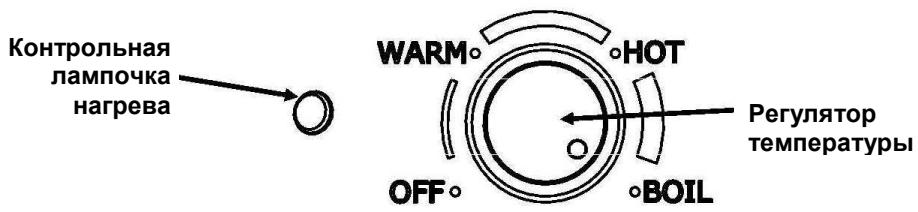
oBOIL - KINPnayeHne NOBepHnTe peryIaTOp Do ynpa; TempepaTypa BoDbl np6bn. 100C
- KINJYeHne C NOcJIe 3aKInaHnI B0DJI NOBepHIne peRyJIaTOp MaKc. HAp14 - ½OboPoTa Ha3a;TeMpepaTypa BOdJI npi6JI. INHTepBaJIaMaN: 95C-100C
oHOT - ropea Boda: noBepnite peryIapTOp npNoI. Ha ½ oooPota Ha3a; tempeatypa BoDbl np6I. 85^ - 95^
WARMo -Tenna Boda: NOBepHnTe peryIaTOp npIbI. Ha 3/4 oboPoTa Hazad; TempepaTpa BoIbI npIbI. 60^ - 70^
- Плносъю Вь Bi ByklnuHTe camOBap, nobepHyB pepyIaTOp npOTnb YacOBoi CTpeJIKN Do ynpopa (Ha no3nUIO OFF). KoHtpoIbHaJ lammoKa norachet.
- Пибор осашениз зашиптум устюctвом OT поperpeba. Терmoстат OTКлочаetca, Кам тольков Бемкости.netвовь ил e octanocb MaJIO.
- Ecπn 3aùntHoe ycTpoiNCTBO cpa6oTaJIo, oTKIouHTe pπuδop n3 po3eTk n daIte éMy HeCKOJIbKO MInHyT OCTbITb, npexJe Yem Bbl BHOb Jó6aBNTe BODY.
- OTKJIIOUHTb npIbOp OT po3eTKn (BbITaHyTb ceTeByO BnIKy!), ecn OH 6oJIbSe He nCNoJIb3yeTcR.
PnroToBneHne yae
Yaui p03Hb. CToPo roBOp8y, yai - 3TO BCero IINsIb BODhBn HAcToi YauHoropacteHnKameJIIN KITaIckoC (Camellia sinensis). Yai MoXeT bbl TepHbIM nIIIn3eJeHbIM. OT Hero cIeDyEt OTJInuTaB noXoxHe Ha yai npOdyKTbl, TaK Ha3bIBaEMbleTpabHbIe NfpykTObIe Yau.
3aBapntb qai - 3TO TOXe He OndHO n To Jx. YTo6bl COxpaHNTb CEHHbIe KOMnOHeHTbl IN Bkyc, qai 3aJIbAIOT TOpRyEe BODoI pa3NIuHOn TeMpePaTypbI u HAcTaINBaIOT pa3HOe Bpemr. HanpImep, 3eJIbHy qai npednoTtneBHO 3aJIbABy TOpRyEe BODoI, TempePaTypa KOTopo pni6n. 85^ . B KaJdOm cnyae HuxHo coBIOdaTb nopJdoK npiroTOBLeHnry, yka3aHHbI Ha ynapokBe.
Yepnbl qan
- Tomecntte CnteKo DnA yA B uHnK.
- HacbInbTe yaHbIe JnCTbB CNTeUKO (pnp6bn3nteJbHO 1 yaHna loXHa Ha yaShKy) nJIN NOLOKHTe TyaHaNbI naKeTnK (pnp6bn3nteJbHO 1 naKeTnK Ha 1-2 yaShKn).
- UctaHOBInTe KpbIiKuHa E'MKocTb IJnB BoDbl, a CBepxv - 3aBapOuHbI yaiHnK. TaKIM O6pa3OM OndHOBpeMeHHo POnOrpeBaETcN I 3aBapOuHbI yaiHnK.

BHIMAHNE!
Cmaebme yauHuk Ha KpbIuKy maK, Ymo6bI EbyOdoaui nap He nonadan Ha pyUky 3aapouNo2o yauHuka, u OHa npu 3mOM He haapebaIacb!
- Iokdntecb, noka Boda 3aknnt.
- CHIMMTe 3abapouhbl yaHnK c camoBapa.

BHIMAHHE!
Из Нocuka заразочно уайнаEbixodum二者чу nap!Со дна уайни мозу'mсекамьkanлконdehcupobahhoeodbl.
- 06daTe 3abapky KINYrKOM n3 CnIBHO rKpaHa. PyTeM JERKO HaxKaTna BHN3 CnIBHO kpan OTkpBIAeTc, n Bbl MoKeTe B3rTb BOy. KaK ToIbKO Bbl OTnyCTnte, Kpan CHOBA 3aKpbIbAeTc. Ecln Bbl JeNaeTe B3rTb 6oJIbIoE KoINuCtBO BObl, HanpIMep, dIy 3aONHeHn 3abapOCHOr YoaiHnka, To IJN 3TOrO nepEMeCTnte BHN3 pbUar CnIBHO rKpaHa. B daHHOM NOnOKeHn IpOn3BODITcR erO fNKCauny. ToIbKO nocJe TOR, kak Bbl nepemecTne pblvAr BBepx, CInBHO kpan CHOBA 3aKpbIbAeTc.
3aONHInTe 3abapOHybI YaHnK MaKc.1 NHTpOM BoDbl Do OTMeTKn ypoBn3aONHeHn. - Yem 60JIbIe 3aBapKIn u HeM MeHbIe BOdbI B 3aBapOCHOM YaHnKe, TEM BBIe KOHcEHTpaUNy aY (3HaTOKN 6epyt Ha YaAiky 2,86 r 3aBapKn). JlyuIe 6paTb cyTb 60JIbIe yauHoro JInCTa - 3aBapKa 6yDen T 6oJIee KOHcEHTpnpOBaHHoH.

YKA3AHHE!
Kpenocmb yauho2 KOHcEHpama Bb1 Moxeme onpeedjmb no Baewmy ekycy. Co6nlodaume npednucahhoe ha yauhou ynaokke epem 3aepueanu yar, mak KaK oHO om copma K copmy omluyaemc.
- Choba yctaHOBnTe 3abapOHybI qaHnHK Ha EMKocTb IJra BObl. Nap, BbIXoJaIiN HnXHeI eMKoCTn IJra BObl, IIOdEprXnBaET ImeHNO TaKyIO TempeaTy pY aar B 3abapOCHom qaHnKe, KOTopar Heo6xOdima IJra HacTaunBaHna Yaa.
- После щелаemoro Времен Habcaиваня спдует Bынту сптуко ИЗ 3abapoHOrO
чайнka.
HaJeIe HUxHoe KOJIuYeCTBO 3aBapKn B aUkKy, IdoJeIe Te BoDy N3 eMkoCTN. TaK BbIMoKeTe BapbIpOBaTb KpeNoctb N Bkyc BaWero qay.
3aBapOHyI qAHNIK MOKeT OCTaBaTbCn Ha BKNIOUeHHo EMKOCTn DnA BObl IIN NOIDep-JaHnI NOCTOHHI TeMnePaTyPbI 3aBapKn. YcTaHOBInTe peYJrTOp HEMHOro BbIe NoJIo-JeHnIg oHT (Ho He Do yNopa), YTObI BOda OCTaBaNaIacb ropJeH, Ho NocToHHo He KInEJa.CnHaJIbHaJ lamMa 6yDeT nepNoDUnCeKn BkJIuOuTaBCn I BbIKJIouaTbCn. YcTAHOBky Ha «MaKcIMyM» CNeDuYet NCNOlb3OBaTb TOnbKO IINpePBOrO KINPAYeHnI BODbl.
3eJehn yai
C nOMOJIbIaHHO mOeJIu YauHnKa MOxHO TaKKe npriroTOBHT 3eJIeHbI qai. B OTnUHe O T yepHOrO qay OH 3aJIINBaETCR He KInrTkOM, INaue OH 6yDet UyTB rOpHTb. B 3aBnCIMoCTN OT cOPTa qay IeAJIbHaY TempepaTypa BObl COCTaBnIeT 50-90°C. BoJIbUnHCTBO cOPTOB 3eJHoro qay HAnBoJe eNoIHO packpbIBaIOT CBOI BKyc pni TempepaType OKIo 80°C. Yem BbIe KaueCTBO 3eJIeHoro qay, TEM HIXe ONTMajlbHaY TempepaTypa BObl. CaMbIe 6JIaRopOdHbI e N doporne cOPTa 3abapNBaiOTc pni TempepaType 50-60°C.
- 06bIHyB 3eJIeHbI qaI hAcTaIbAHT OKOJIO 1-3 MIn, B TO BpeM kAc DOpOrHe copTa - 1-1 1 / 2 MnH. Iprn 3aBapuBaHm quaB naketnKax opneHTnpyTecb Ha peKOMeHdaUcN erO n3rTOBUNTeJI.
-Дозировka 3eJIeHOrO qa,В OTnIuHne OTe UeHOrO, KaK npaBnIo, HnKe:1r.Ha 100 mI.IIIN 1 yaiHa JIOxKa 6e3 rOpKn Ha 200 mI.BoIbI. EcTeCTBeHHo, Bbl MoKeTe campeSAtb, kakoi KOHcENTpaCmN qaBamNo BKycy.
- DoBeHnTe Bovy B yauHnke-KnIaTnIbHnKe Do KIneHn. HaneTe HEmHoro ropaye BoBb I YaAaKN (6bnarOapra pa3MeueHnIO Ha yauHnke-KnIaTnIbHnKe 3abApOchbl YauHnK yke Harpelc B O Bpem npocecca KInpaYeHnRA BoDb). NObepHnTe perYJrTOP Ha3ad B nOJoxeHne WARMo (B 3aBNCIMoCTOn OT copTa qay) n noDoxnTe 5 - 6 MIn., noka BOa hemHoro octbIHet. Tepeb 3aJeTe 3abApky ropaye BDOJ n3 camOBapa. IocTabte 3abapOCHb YauHnk Ha KpbIshky camOBapa, YTObI qai octBaanCra ropaym, n daJIee DeIcTBuyTe, kak pni 3abapKe YepHO ray.
TpaBnoy

BHIMAHHE!
Tpa8aHO, fpykmobu yau, pou6yu u c npraHocmmu ece2da Hxho 3aIuBamb kunpaue odou u hacmaubamb He Mehee 5 - 10 MuHym! Tolbko maK Bbl coxpanume hacmou npodykm!
TpabHOn qaI - pocbInbU no nnaKeTnpOBaHHbI - HxKHO o63aTeNbHO 3aJIbBaTb KINpaIe BODOn I NaCTanBaTb yka3aHHoe Bpemr. PToMry UTO B peKnX cIyuaRx B TpabHbIX Cmecax MOrYT coDePjKaTbCRA MKNpoBbl, HApriMeR, CaJIbMOHeJIa, KOtOpBle NOrn6aOT npn HarpeBaHN. Pn HEnpabNlBHom nprirotobJeHN MoKeT BO3HKnHyTB onachOCTb dIy 3dOpOBb, B OOCoBeHHOcTN, ecnn peYb IndTo Q ae IJra DeTei.
TpabnoHn Hn B KOem Cnyae HeIb3 npocTo 3aINBaTb TeIIOB OBOO, YTO6bl 6bICTpeoCTbI, I ero MOxHO 6blIO 6bl NTb. 3TO MOxET CO3DaTb yrpo3y dIpydNbIX MJIeHbKnx DeTei, a TaXKe 60JbHbIX, ecII NO BpEm 60Je3H Nn BblbOT TpaBnoHn Aai, B KOTOpOM CoepKaTcM NkPo6bl. TpaBnoH aai TaXKe HeIb3HaCTaBnTB B TeueHne HeCKONbKx YacOB. KInIaJra BOda XOTaY iYbNAeT MKNPO6bl, HO OHa He BnIeT Ha CoedePkaUncEa B TpaBnHOM qae cnpbl. B TEIIOB OBe OH MoTy DaTb PoCTKn.
7.Bo3MOxHbIe HeuCnpaBHOCTN

BHIMAHNE!
Ipu Hauuu HeucnpaHocmeu 8o epempa6ombl npubopa bimHume cemeou wmekep u3 po3emku.
- Keep this instruction manual ready to hand at the product!
- General Information 22
- Safety 24
- 3.Delivery,packaging and storage 26
- Technical data 27
- Installation and operation 28
- Cleaning and maintenance 34
- Possible Malfunctions 37
- 8.Waste disposal 38
- Information about the instruction manual
- Key to symbols
- WARNING!
- WARNING! Electrical hazard!
- CAUTION!
- NOTE!
- WARNING! Hot external surface!
- Liability and Warrantees
- Copyright protection
- Declaration of conformity
- Safety
- General Information
- Safety instructions for use of the device
- Intended use
- Transport, packaging and storage
- Delivery check
- Packaging
- Storage
- Technical data
- Overview of parts
- Technical specifications
- Installation and operation
- Safety instructions
- WARNING! Hot surface!
- WARNING! Hazard via electrical current!
- Installation and connection
- Operating
- WARNING! Danger of burns!
- Temperature regulator settings
- Preparation of tea
- Black tea
- You might choose the tea concentration by taste
- Green Tea
- Herbal infusion
- Cleaning and maintenance
- Safety advice
- Cleaning and descending
- Cleaning
- WARNING! Danger of electrocution!
- Dscaling
- Safety instructions for maintenance
- Possible Malfunctions
- Waste disposal
- Discarding old devices
- Indications techniques
- 7.Bo3MOxHbIe HeuCnpaBHOCTN 73
- Ytuln3aun 74
- BHIMAHHE!
- Перевозка, уразковka и xpaони.
- TpaHcnpTna HhCneKuia
- ynaKOBka
- YKA3AHHE!
- XpaHeHne
- TexHnueckne daHHbIe
- OnscaHne YacTei np6opa
- Texnueckne cBeHeHna
- YctaHOBka I NOdkJIIOUeHne
- O6cIyKbHaHne
- PNEyPPEXDEHME!OnacHocmb o6eapuaHua!
- PNEyPExEHE!Onachocmb oBeapueaHua!
- PokaTei n yctaHOBKn peryIaTopa TempeaTypbI
- PnroToBneHne yae
- Yepnbl qan
- BHIMAHNE!
- 3eJehn yai
- TpaBnoy
- 7.Bo3MOxHbIe HeuCnpaBHOCTN
Brand : BARTSCHER
Model : 191.001
Category : Electric tea maker