
BAHIA - Speakers CABASSE - Free user manual and instructions
Find the device manual for free BAHIA CABASSE in PDF.


User questions about BAHIA CABASSE
0 question about this device. Answer the ones you know or ask your own.
Ask a new question about this device
Download the instructions for your Speakers in PDF format for free! Find your manual BAHIA - CABASSE and take your electronic device back in hand. On this page are published all the documents necessary for the use of your device. BAHIA by CABASSE.
USER MANUAL BAHIA CABASSE
| SUBWOOFER | ONLY |
| SUBWOOFER STEREO | YES |
Thank you very much for choosing Cabasse speakers.
Please read carefully these instructions before setting up your speakers.
UNPACKING①
After opening the top carton flaps, remove the grille. Then fold the carton flaps right back and invert the carton contents. Lift the carton clear of the contents and remove the inner packaging from the speakers. We suggest you to retain the packing for future use.
POSITIONING
Speakers positioning
Our speakers have been designed to function in a vertical position. Under these conditions, the polar response is most uniform .
The majority of our models are delivered with a set of decoupling spikes or cones③, these accessories are to be screwed in the inserts under the cabinets. These accessories ensure the stability of the speaker while limiting resonance coming from certain types of grounds like wood floors.
Speakers are delivered with a front grille to protect drivers. It is possible to use them without this front grille, but we recommend this protection to be kept on to prevent accidental damage to the drivers④.
Powerful drivers generate magnetic fields that can extend beyond the boundaries of the speaker cabinet. We recommend you keep magnetically sensitive articles (TV, computer screen, computer discs, audio and video tapes, swipe cards...) at least 1.5 ft (50 cm) away from the speaker. Cabasse centre speakers or the ones marked «TV» are not concerned with this, being magnetically shielded.
Positioning speakers in a room
In addition to vertical position of the speakers themselves, their location in the listening room, as well as the acoustical characteristics of the room, are also very important. As it is impossible to indicate a typical location of speaker systems without a few tests, we suggest several general rules that are important to apply in order to obtain the best listening results.
Optimal positioning for a 2.0 or stereo system
For the ideal positioning of your speakers follows diagram. If d is the distance between the two speakers, this distance must be higher than 5 ft (1.5 m) and the two speakers must be at equal distance from the listening area which forms with them an equilateral triangle.
The drivers must be directed towards the listening area.
The speakers should be located so that their diffusion follows the longest dimension of the room.
Generally speaking it is better to avoid putting the speakers in the corners of a room as this amplifies the low frequencies and tends to enhance the room resonances. If possible it is better to place the speakers at least 8 inches (20 cm) from the walls.
Moreover, in order to obtain a more accurate frequency response, it is recommended to raise a compact speaker from 12 to 16 inches (30 to 40~cm ) above the floor by placing them on stands. The tweeters of the speakers must be roughly at the same height of the listener's ear when the listener is in sitting position.
- No solid object or piece of furniture should be placed between the speakers and the listener. An effect of mask, even partial disturbs completely the sound reproduction as it attenuates the high frequencies and also, in most cases, the midrange frequencies.
- Placing the speakers in niches is not recommended. Unless designed for this application, bookshelf placement will alter the frequency response of the speaker, especially in the low frequencies. If a bookshelf location cannot be avoid, the speaker should be set up to minimize various resonance, and the visible part of the grille must be outside the niche.
Optimal positioning for a 2.1 or stereo with a subwoofer system
For a stereo listening with 2 speakers or 2 satellites and 1 subwoofer, we recommend you to place the subwoofer in the front listening area. The placement of the subwoofer against a wall reinforces the low frequencies and limit the reflections from 80 to 200Hz . However to obtain the best results, it is always necessary to carry out tests according to the acoustic of the room.
Optimal positioning for a 5.1 or home theatre system⑦
Setting up a multi-channel Audio-Video system requires great care when positioning the specific AV speakers.
The centre speaker should be placed as close as possible to the screen and where it sounds best from your listening spot while offering the optimal picture/dialogues cohesion. Theoretically, the screen should be located within a virtual triangle formed by the acoustical centres of the main speakers and the centre speaker. Practically speaking, this means that the principal speaker should be placed above the screen if the main speakers are below it, and below the screen if the main spea
kers are above. The centre speaker should also, if possible, be set slightly back from the others, so that it is located at the same distance from the listener as the main speakers.
The rear speakers or surround should be placed against the side walls, at listening height. They should not be positioned far behind the listening zone.
The subwoofer should be placed in the front listening area, its position against a wall reinforces the extreme low register and limits the reflections between 80 and 200Hz . However to obtain the best result, it is always necessary to carry out tests according to the acoustics of the room.
Your AV processor enables the adjustment in level and delay of each of the 5/6/7 channels of your system. Fine-tuning is necessary to obtain a perfect sound stage.
Turn off all the amplifiers before interconnecting them to the loudspeakers. In order to connect loudspeakers properly, it is most important to keep in mind the following two factors: cable section and phase.
CONNECTION 51
Cable section
To get the full sonic potential of Cabasse loudspeakers and avoid power losses, the cables connecting the speakers to the power amplifier must have the lowest possible electrical resistance. To help you in choosing the correct cable gauge, follow diagram.
| Lenght between amplifier and loudspeakers | recommended section |
| 4.5 m | 1.5 mm² |
| 6 m | 2 mm² |
| 7.5 m | 2.5 mm² |
| 9 m | 3 mm² |
| 12 m | 4 mm² |
Phase
In order to maintain the phase relationship and frequency balance of the loudspeaker system, both loudspeakers must be properly connected to the power amplifier. When properly connected, the cones of the drivers of both loudspeakers will move in the same direction when driven by identical speakers will move in the same signals. If the cones move in opposite directions, the resulting out of phase signals will create a perceptible power loss, particularly in the low frequencies. The stereophonic message will also be degraded. Amplifier and speaker manufacturers typically indicate connection polarity in one of two ways: red and black or plus and minus. In either case, always connect red or plus to red or plus and black or minus to black or minus. Connections should be identical for both channels. To check that the speakers are in correct pha
se, switch the system to mono while music is being played. if the amplifier does not have a phase inversion switch, it will be necessary to change over the connections on one only of the loudspeakers. If in correct phase, the image should be distinctly located between the loudspeakers with a slight loss of bass and low midrange level. If the image is confused and not centrally located and there is a drastic loss of bass and low midrange level, recheck your connections.
HOME THEATER CONNECTIONS WITH AN ACTIVE SUBWOOFER
Subwoofer positioning
With a crossover point below or around 150Hz , the installation position of subwoofoers is not limited as human ears and brains are not able to identify the emitting point of such low frequencies. To get the best result, it is recommended to try different positions and choose the one giving the best response in the low frequencies, taking into account the room acoustics.
Hooking up the subwoofer
2 possibilities are offered to connect the subwoofer with your system:
the low level one requiring the use of the Cinch RCA LINE IN ⑧ and LINE OUT ⑨ terminals and shielded coaxial connectors,
- the high level one requiring the use of the HIGH LEVEL INPUT⑩ and HIGH LEVEL OUTPUT⑪ terminals and standard loudspeaker cables.
The inputs are stereo ones, the mix of the L (left) and R (right) low frequencies being done by the amplifier of the subwoofer. If the input signal is already mono, only one input L (left) or R (right) should be used.

Attention,
before operating the unit, be sure that the operating voltage of your unit is identical with that of your local power voltage.
Interconnections with the Cinch RCA LINE IN ⑧ and LINE OUT ⑨ connectors
Connections to the LINE IN 8
If your preamplifier or your integrated amplifier is fitted with a stereo low-level output, then connect its L (left) and R (right) outputs to the L (left) and R (right) LINE IN⑩ inputs of the subwoofer. If your amplifier offers a one mono output, connect it to either the L (left) or the R (right) subwoofer LINE IN⑩ inputs.
Connections from the LINE OUT
The signal from the L (left) and R (right) LINE OUT⑧ connectors is the one being brought in by the L (left) and R (right) LINE IN⑧ connectors filtered at 40 Hz. These outputs can thus be used to bring the signal to the amplifier powering the main loudspeaker.
Interconnections with the speaker terminals
Connections to HIGH LEVEL INPUT 10 plugs
If the preamp section of your Hi Fi or audio-video system is not fitted with a low level output, you should then connect the subwoofer by using its loudspeaker terminals. When connecting the L (left) and R (right) speaker outputs of your amplifier to the HIGH LEVEL INPUT⑩ plugs of the subwoofer, be careful not to cross (-) and (+) cord of either L (left) or R (right) channel. Such a phase inversion might damage your main amplifier.
Connections HIGH LEVEL OUTPUT⑪ plugs
These outputs can be used to bring the signal to the main loudspeaker systems.
The signal from the L (left) and R (right) HIGH LEVEL OUTPUT⑪ plugs is the one being brought in by the HIGH LEVEL INPUT⑩ connectors. These outputs can thus be used to bring the signal to the main loudspeaker systems.
Power supply
The AC in (12) cord must be connected to the mains to supply the subwoofer. The selection of the right voltage 115 ~V - 230 ~V is done with 115 ~V - 230 ~V . Switch POWER (14) , on STAND BY or ON. With the switch on the STAND BY position, the unit will mute after a few minutes without input signal. The system turns on automatically when signal comes back.
Adjustments
LEVEL15
For a first volume adjustment, position the CROSSOVER FREQUENCY ⑱ at around 120 Hz, and turn slowly the LEVEL ⑤ clockwise from minimum level up to a position where you feel that the subwoofer sound level is appropriate. A check of the level adjustment will be necessary after following steps.
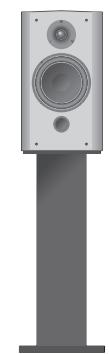
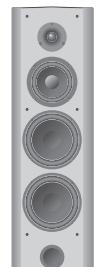
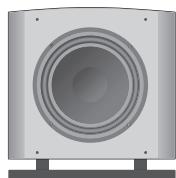
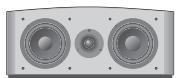
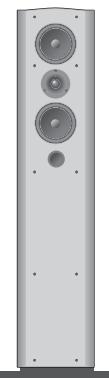

| Position | Ways | Drivers complement | |
| Altura RIVA main speaker / surround | bookshelf /stand | 2 | DOM50-17M18LB2 |
| Altura BAHIA main speaker | floorstanding | 3 | DOM50 - 13M15M2 2 x 17M18LB2 |
| Altura LARGO active subwoofer | floorstanding | 1 | 30M40 |
| Altura SENA center | on / under TV | 2 | DOM50 2 x 13M15M2TV |
| Altura LINEA floorstanding | floorstanding | 2.5 | DOM50 2 x 13MTR5 |
| Altura LINEA on base | bookshelf / on wall | 2.5 | DOM50 2 x 13MTR5TV |
This potentiometer adjusts the cut-off frequency which determines the working bandwidth of the subwoofer. This adjustment should be done according to the specifications of the main speakers and the room acoustics. Choose the best frequency after various listening tests.
PHASE17
For a better sound integration of the subwoofer in the main system, the PHASE⑰ of the subwoofer might have to be inverted (180° position), depending on the distance between the subwoofer and the main speakers. You have to check the PHASE⑰ each time you move your speakers and each time you adjust the CROSSOVER FREQUENCY⑱.
Attention, if you use 2 subwoofoers, both phase switches must be on the same position.
Our web site www.cabasse.com will give you the specific adjustments we recommend for the use of our active subwoofer.
MAINTENANCE
The Altura cabinets are made of medium density fiber panels, veneered with natural wood and protected by 4 coats of varnish. This hi-tech veneer does not require any specific care. Use a wet cotton waste for cleaning, or any cleaning device for wood or plastic.
ACTIVE SUBWOOFER ALTURA LARGO
| Pulsed sound pressure | 121dB |
| Phase switch | 0° normal 180° reverse |
| In put | 2 low level - 2 hight level |
| Voltage | 115 / 230V AC-50 / 60 Hz |
| Maximum power consumption | 165W |
SPECIFICATIONS & TECHNICAL DATA
| Sensitivity 1W/1m (dB) | Cross-over points (Hz) | Frequency response (Hz) | Nominal impedance (ohms) | Minimum impedance (ohms) | Power handling (Watts) | Peak power (Watts) | Standard finish | Dimensions h×w×d | Weight |
| 92 | 2,500 | 60-25,000 | 8 | 4.2 | 100 | 700 | wild cherry santos | 44×32×23 cm 17.3"×12.6"×9" | 11 kg 24 lbs |
| 94 | 700-2,500 | 50-25,000 | 8 | 3.2 | 120 | 840 | wild cherry santos | 115×38×26 cm 45.3"×15"×10.2" | 27 kg 59 lbs |
| Active | adjustable | 30-200 | Active | Active | 250 | 750 | wild cherry santos | 51×55×35 cm 20.1"×21.7"×13.8" | 29 kg 64 lbs |
| 92.5 | 2,700 | 60-25,000 | 8 | 3.5 | 100 | 700 | wild cherry santos | 23×55×34 cm 9.1"×21.7"×13.4" | 15 kg 33 lbs |
| 93 | 500-2,500 | 80-25,000 | 8 | 3.7 | 100 | 700 | wild cherry santos | 114×24×11.8 cm 44.9"×9.4"×4.6" | 16 kg 35 lbs |
| 93 | 500-2,500 | 80-25,000 | 8 | 3.7 | 100 | 700 | wild cherry santos | 46×24×11.8 cm 18.1"×9.4"×4.6" | 10.5 kg 23 lbs |
LINEA operating instructions
INSTALLATION
The components of your system:
- 2, 3, 5 (with eventually other ALTURA speakers), 6 or 7 LINEA
- 1 or 2 LARGO Cabasse active subwoofer
- 1 Max Cabasse module if the processor of your audio video amplifier doesn't include a 2.1 set-up (subwoofer for stereo reproduction)
LINEA speaker on base plinth version
The wall mountable version of the LINEA requires 2 brackets to be positioned on a wall, either in a vertical position (A) or a horizontal position (B). The two pins -silent block- allows the LINEA speaker to be positioned horizontally on/below a TV or on a furniture such as bookshelf (C).
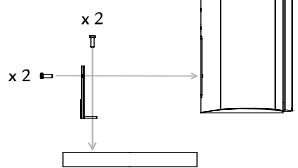
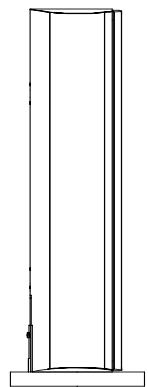
For vertical positioning on a bookshelf, use the supplied base (D)
Floorstanding LINEA
The stand version is supplied with adjustable spikes for a perfect stability even if the floor is not horizontal.
Positioning of LINEA SYSTEM
Positioning of the speakers: if possible, try to match with the 52 drawing, with the LARGO subwoofer in the front area facing the listening spot. Its position against a wall reinforces the extreme low register and limits the reflections between 80 and 200Hz . However to obtain the best result, it is always necessary to carry out tests according to the acoustics of the room.
Attention, on some sensitive TV-sets, the magnetic shielding of the LINEA TV speaker might not be effective enough because of the radiations throughout the diaphragm of the tweeter. You should then place the LINEA TV speaker 10cm away from the top of the TV.
CONNECTIONS 51
It is imperative to respect the correct phasing when connecting: +to ^+ red and -to - black.
Configuration 2.1 (s3)
2 LINEA speakers + 1 LARGO subwoofer
Connect with speaker cables the amplifier outputs to the terminals HIGH LEVEL INPUT L (left) and HIGH LEVEL INPUT R (right) of the LARGO subwoofer and connect the outputs HIGH LEVEL OUTPUT L (left) and HIGH LEVEL OUTPUT R (right) of the LARGO subwoofer to the LINEA speakers inputs.
Configuration 5.1
5 LINEA speakers + 1 LARGO Subwoofer or 2 main speakers + 3 LINEA speakers + 1 LARGO subwoofer
When the processor of your audio video amplifier includes a 2.1 set-up (subwoofer for stereo reproduction), connect each speaker output of the 5.1 amplifier directly to the matching LINEA speaker (front right, front left, centre, surround...). Connect the subwoofer CINCH RCA output of the amplifier to one of the CINCH-RCA LINE IN terminals of the LARGO subwoofer.
Then adjusts the set-up menu of your audio video amplifier:
| 5 LINEA speakers + 1 LARGO subwoofer | |
| FRONT | SMALL |
| CENTER | SMALL |
| SURROUND | SMALL |
| SUBWOOFER / LFE | YES |
| 2 main speakers + 3 LINEA speakers + 1 LARGO subwoofer | |
| FRONT | SMALL or LARGE * |
| CENTER | SMALL |
| SURROUND | SMALL |
| SUBWOOFER / LFE | YES |
- Adjustment in SMALL or LARGE, according to their ability in reproducing deep low frequencies.
Some audio video amplifiers require these information:
| SUBWOOFER | ONLY |
| SUBWOOFER STEREO | YES |
If your audio video has an adjustable crossover frequency, the adjustment will be 80Hz
Configuration 5.1
with the Max Cabasse module
The processor of some audio video amplifiers doesn't include a 2.1 setup (subwoofer for stereo reproduction), in this case you will need a Max Cabasse module (available separately). Connect 2 sets of inputs of the Max Cabasse module to the speaker outputs L/left and R/right of the audio video amplifier, in parallel with the speaker cables connected to the LINEA speakers. The 2 inputs can be connected to any main speaker outputs of the audio video amplifier, but be very careful in not mixing polarities: always connect + to + (or red to red and
black to black). Connect the CINCH RCA output of the Max Cabasse module to one of the CINCH RCA LINEIN post of the LARGO subwoofer with a shielded interconnect cable. Connect the subwoofer CINCH-RCA output of the audio video amplifier to the second CINCH RCA LINE IN post of the LARGO subwoofer.
Then adjusts the set-up menu of your audio video amplifier:
| 5 LINEA speakers + 1 LARGO subwoofer + 1 Max module | |
| FRONT | LARGE |
| CENTER | SMALL |
| SURROUND | SMALL |
| SUBWOOFER / LFE | YES |
| 2 main speakers + 3 LINEA speakers + 1 LARGO subwoofer + 1 Max module | |
| FRONT | LARGE |
| CENTER | SMALL |
| SURROUND | SMALL |
| SUBWOOFER / LFE | YES |
ADJUSTMENTS OF THE LARGO SUBWOOFER
Crossover frequence
In any cases configuration 2.1 or configuration 5.1, the adjustment of frequencies CROSSOVER FREQUENCY is positioned as follows:
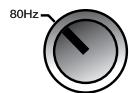
CROSSOVER FREQUENCY
Level
The adjustment of the LEVEL will depend upon room positioning, type of amplifier, etc. With the LARGO subwoofer, the average position of the LEVEL control is as follows:

LEVEL
For an optimum adjustment of this level, we advise you to carry it out starting from a stereo source (CD).
To adjust the level of the low frequency effect channel, (LFE) do not modify the sound level of the LARGO subwoofer but go into the set-up menu of your audio video amplifier 5.1 and adjust the SUBWOOFER / LFE channel.
ASSEMBLING THE LINEA ON BASE ACCESSORIES
(C) Pins for horizontal use on shelf
Brackets for on wall vertical and horizontal positioning
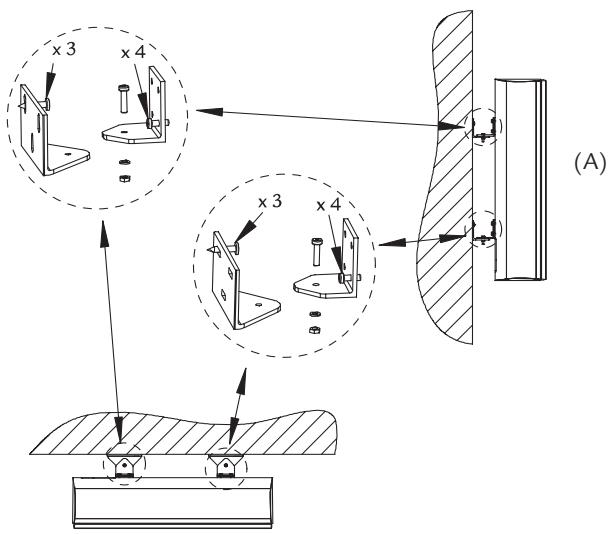
(B)
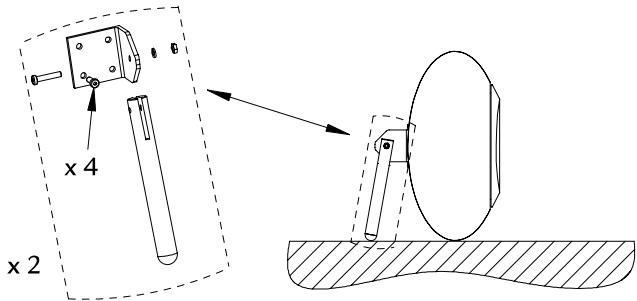
(D) Base for vertical use on shelf
BAHIA · RIVA · SENA · LARGO
| SUBWOOFER | ONLY |
| SUBWOOFER STEREO | YES |