
G312 - Digital Camera GENIUS - Free user manual and instructions
Find the device manual for free G312 GENIUS in PDF.


| Product Type | Digital Camera |
| Brand | GENIUS |
| Model | G312 |
| Dimensions (L × H × D) | 95.8 × 56.6 × 37.9 mm (without protruding parts) |
| Weight | Approx. 120 g (batteries not included) |
| Power Supply | 2 AA alkaline batteries or CRV-3 battery |
| Sensor | 1/2 inch CMOS, 2.0 megapixels |
| Photo Resolutions | 2048×1536, 1600×1200, 1024×768, 800×600 |
| Image Format | JPEG |
| Video Format | AVI (320×240, CIF) |
| Digital Zoom | 4x |
| Internal Memory | 16 MB |
| External Storage | SD/MMC card up to 512 MB |
| Flash Modes | Auto, Red-eye reduction, Forced, Off |
| Macro Mode | 12 to 15 cm |
| Self-timer | 10 seconds |
| Connectivity | USB 1.1, TV-out (NTSC/PAL) |
| Required Operating System | Windows 98/Me/2000/XP |
| Cleaning | Use a soft, dry cloth. Do not use solvents. |
| Safety | Do not disassemble. Avoid moisture, shocks, and extreme temperatures. |
| Repairability | Contact GENIUS customer service for any repairs. |
Frequently Asked Questions - G312 GENIUS
User questions about G312 GENIUS
0 question about this device. Answer the ones you know or ask your own.
Ask a new question about this device
Download the instructions for your Digital Camera in PDF format for free! Find your manual G312 - GENIUS and take your electronic device back in hand. On this page are published all the documents necessary for the use of your device. G312 by GENIUS.
USER MANUAL G312 GENIUS
1-1 Attention 2
1-2 Before Using Your Camera 2
1-3 Caution When Using the Camera 3
1-4 Package Contents. 3
Chapter 2 Getting to Know Your
Camera
2-1 Names of Parts 4-5
2-2 LED indicators 6
2-3 LCD Monitor Display 6
2-4 Power Supply 7
2-5 Mode Dial 8
2-6 Specifications. 8-9
2-7 System Requirements. 9-10
Chapter 3 Getting Started
3-1 Attaching the Strap. 10-11
3-2 Loading Batteries. 11-12
3-3 Loading and Removing the Memory Card. 12-13
3-4 Shutter Button 13
3-5 Setting Up the OSD Language. 14
3-6 Date/Time 14
Chapter 4 Basic Operation
4-1 Recording a Still Image. 14
4-2 Recording a Video Clip.14
4-3 Imaging Tips. 15
4-4 Viewing Still Image /Video Clip. 15-16
4-5 Displaying Thumbnail Images 16-17
4-6 MENU/ENTER Button.17
4-7 删除Still Image /VideoClip.17
4-8 Flash Button. 17-18
4-9 Digital Zoom. 18-19
4-10 Mode Display Button 19
4-11 Macro Button. 19
4-12 Portrait and Landscape Button 20
Chapter 5 Camera Menus
5-1 Record Mode 20-23
5-2 Play Mode 23-26
5-3 Setup Mode 26-28
5-4 Movie Mode 28-29
5-5 PC Mode 29-32
Chapter 6 Driver Installation
6-1 Installing the Camera Driver for PC. 32-33
6-2 Installing the Applications for PC 33-35
6-3 Downloading photos/video from camera. 35-36
6-4 Transferring Recorded Images to Your Computer. 36-37
Chapter 1 Attention
Please read through this manual carefully before using the camera and follow the instructions to avoid any damages that may be caused by improper operation.
1-1 Attention
The software CD-ROM packaged with the camera is designed for PC only. To play this CD-ROM on a stereo or CD player may cause damage to it.
This camera is a precision electronic device. Do not attempt to service this camera yourself, as opening or removing covers may expose you to dangerous voltage points or other risks. Do not expose this camera under direct sunlight to avoid causing a fire.
1-2 Before Using Your Camera
Try to take some pictures before you perform the formal recording. Before taking pictures with this camera of any important occasion (such as a wedding ceremony or on vacation), do test the camera beforehand to ensure that it functions well. Any additional loss caused by the malfunction of this product (such as costs of photography or any loss of benefit generated by the photography) is not the responsibility of our company and no compensation will be given for it.
Copyright information
Unless agreed by the right owner, all the pictures taken with this digital camera cannot be used in violation of copyright law. Moreover, when "No Photography" restriction is placed on site, you cannot record any live performance, improvisation or exhibits even for personal purpose. Any transfer of pictures or memory card with data must be conducted under the constraints of copyright law.
Notes on the LCD (Liquid Crystal Display) monitor
- If the liquid contacts the skin: Please wipe dry the skin with a cloth and wash with large amounts of water.
- If the liquid gets in the eye: Please immediately rinse with fresh water for at least 15 minutes and then consult with a physician to receive treatment as soon as possible.
- If anyone accidentally swallows the liquid: Please rinse the mouth with water, drink large amounts of water and contact a physician to receive treatment as soon as possible.
1-3 Caution When Using the Camera
This product consists of intricate electrical parts. To ensure the camera photographs normally, do not drop or hit the camera when taking pictures.
-
Avoid using or placing the camera in the following locations:
-
Damp and dusty places.
- Sealed vehicles or places exposed to direct sunlight or places subject to extremely high temperatures or heat.
- Violent turbulent environment.
- Locations full of steam, smoke, or oil fumes.
- Locations subject to strong magnetic field.
-
In a rain or snow environment.
-
Do not open the battery cover when the power is on.
- If water has entered the camera, immediately turn the power OFF and remove the batteries.
-
How to maintain your camera:
-
If the lens, LCD monitor or viewfinder surface is dirty, please use a lens brush or soft cloth to wipe the surface clean instead of touching the lens with your fingers.
- Do not use any solid object to hit the camera to avoid scratching the lens, LCD monitor or viewfinder surface.
- Do not use any detergent or volatile solution, which will subject the camera case and paint to dissolve or distort. Use a soft cloth only.
1-4 Package Contents
Please check if the following items are in the package when purchasing this product.
CD-ROM (incl. Camera Driver)
Pouch
Wrist Strap
2 x AA Alkaline Batteries
USB Cable
TV-OUT Cable
User's Manual
Quick Guide
Chapter 2 Getting to Know Your Camera
2-1 Names of Parts
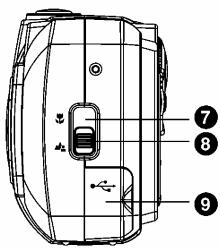
Front & Side View
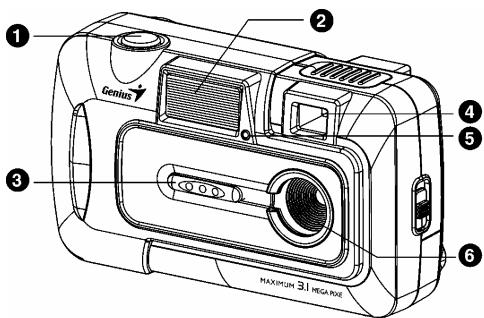
(1) Shutter Button
(2) Flash
(3) Lens Cover/Power Button
(4) Viewfinder window
(5) Self-timer LED
(6) Lens
(7) Macro mode
(8) Portrait and Landscape mode
(9) Terminal Cover
Rear View
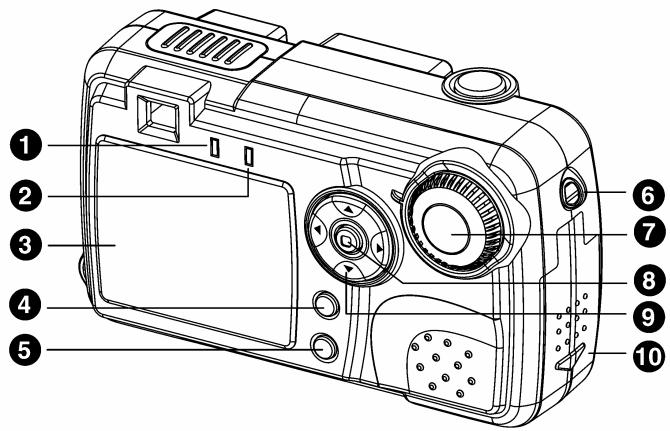
(1) Power LED
(2) Flash LED
(3) LCD Monitor
(4) Flash Button
(5) Mode Display /Power Button
(6) Strap Holder
(7) Mode Dial
(8) MENU/ENTER Button
(9) Multi-Select Button
(10) Battery Cover
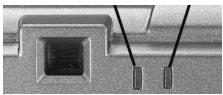
2-2 LED Indicators
This is what the LED indicators located on the top of LCD monitor mean:
Power Mode (Green LED)
Flash Mode (Red LED)
2-3 LCD Monitor Display
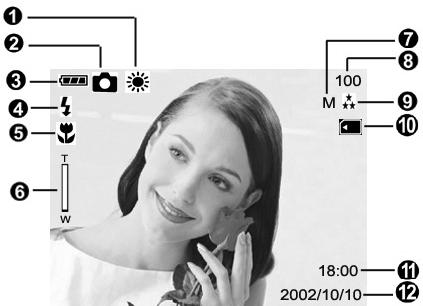
(1) White balance display
(2) Current working mode (Single, Self-timer photography, Multi Shot)
(3) Remaining battery power
(4) Flash status
(5) Macro, Portrait and Landscape mode
(6) Zoom lever
(7) Image resolution
(8) Possible number of shots
(9) Image quality
(10) Memory card loaded symbol
(11) Time display
(12) Date display
2-4 Power Supply
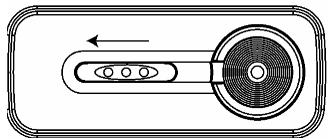
- Slide the lens cover toward the left gently, the camera will turn on after you hear two beeps.
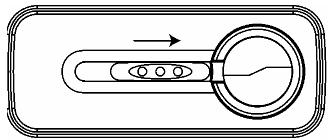
- Slide the lens cover toward the right gently to turn off the camera.
- Use the lens cover located on the front of the camera to turn on/off camera. After you turn on the camera, the red LED will be blinking, and then the last image recorded appears on the LCD monitor.

NOTE
- If no operation is carried out for a fixed amount of time (default: about 1 minute), the power is turned OFF to prevent battery wear. This is called "Auto Power OFF". You can press the "Mode Display Button" to restart the camera.
- The following features will automatically save the configuration before you turn off the camera unless you selected "Reset Default" to restore the camera to its factory settings.
2-5 Mode Dial
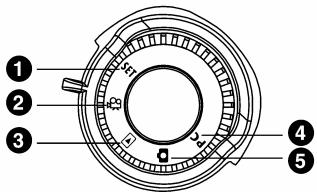
You can select the working mode by using this Mode Dial:
| Mode | Description | |
| 1. SET | Setup mode | Use this mode to adjust camera settings. |
| 2. | Movie mode | Use this mode to record video (movie) clips. |
| 3. | Playback mode | Use this mode to view images / video clips, delete images / video clips, view a slide show, or view thumbnail displays. |
| 4. | Record Mode | Use this mode to capture still images. |
| 5. PC | PC Mode | Choose this mode to use mass storage or PC Camera. |
2-6 Specifications
Lens: 7.04mm
Image Sensor: 1 / 2'' CMOS with 2.0 mega pixels
Focus: F = 2.8
Sensitivity: ISO 100
- White Balance: Auto, Sunny, Cloud, Tungsten, and Fluorescent.
- Shutter: Electrical
- Shutter Speed: 1/15 sec. ~ 1/2000 sec.
Storage Media: 16MB Internal Flash Memory SD Card (MMC compatible) Slot (supports 4/8/16/32/64/128/512MB)
- Image File Format: Still Image for JPEG
Movie:AVI
- Image Resolution:
H: 2048x1536 (Firmware Interpolation Technology)
M: 1600 x 1200
N: 1024 x 768
L: 800 x 600
Digital Zoom: 4X Digital Zoom
Focal Range Standard: 60cm Infinity
Focal Range Macro: 12~15cm
Self-timer: 10 sec. delay
PC-CAM Mode: CIF (320 x 240) 12~15 fps
- Flash Mode: Auto, Red-eye reduction, Off
TV-OUT: NTSC / PAL system selectable
PC Connector: USB (Ver. 1.1)
- Movie File: Recording 100 sec. continuous movie file with CIF (320 x 240) format (16MB internal memory)
- The table below shows the approximate number of shots that you can take at each setting based on 16MB internal memory.
| 16MB | Quality/Resolution | 800 x 600 | 1024 x 768 | 1600X1200 | 2048X1536 |
| * Super Fine | 187 | 78 | 29 | 21 | |
| * Fine | 327 | 157 | 58 | 43 | |
| * Normal | 654 | 314 | 116 | 87 |
- The above data shows the standard testing results. The actual capacity varies according to the shooting conditions and settings.
Power Supply: 2 x AA Alkaline batteries or supports CRV-3
Dimensions: 95.8 × 56.6 × 37.9 ~mm (WxHxD) (without protruding parts)
Weight: About 120g (batteries excluded)
2-7 System Requirements
Please refer to the minimum system requirements for the digital camera. We recommend that you use a computer system that exceeds the minimum requirements in order to utilize the camera at its optimum efficiency. The minimum system requirement for the digital camera is as follows:
| System requirements (Windows) | |
| CPU | Pentium 166 MHz processor or higher |
| OS | Windows 98/98SE/Me/2000/XP |
| Memory | 32MB RAM (64MB recommended) |
| Free Space on Hard Disk | 128MB hard disk space |
| Required Devices | A CD-ROM drive, An available USB port |
| Color Monitor | Color monitor (800x600, 24-bit or higher recommended) |
Chapter 3 Getting Started
3-1 Attaching the Strap
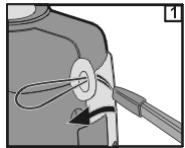
- Insert the thin end of strap into the strap holder.
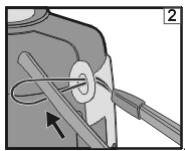
Pass the other end of strap through the loop.
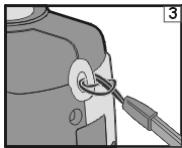
- Stretch the strap tightly.
3-2 Loading Batteries
- Turn off the power of camera.
Insert 2 x AA alkaline batteries or a rechargeable battery. Please make sure the batteries are full of power. If the batteries are low, please change new batteries as soon as possible to keep the camera operating normally.
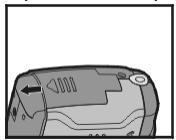
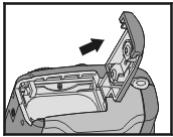
- Slide the switch on the battery cover in the direction indicated by the arrow.
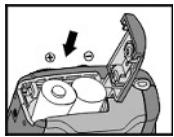
- Insert the batteries as indicated on the inner side of the cover.
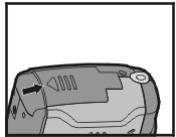
- Close and lock the battery cover.

NOTE
Do not open the cover roughly to avoid damaging the battery compartment cover.
If the battery power indicator shows only one black block that means that power is available, and you can continue to use the flash.
When the battery indicator turns red, you cannot take still pictures or movies any more.
Any pre-setting date/time value will be retained in the camera's memory for about 3 minutes when replacing the batteries. We still suggest you to double check the date/time setting after changing new batteries.
3-3 Loading and Removing the Memory Card
1. Loading the memory card.
Make sure to turn off the camera.
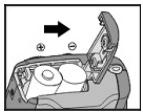
- Slide the switch on the battery cover in the direction indicated by the arrow.
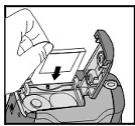
- Insert the memory card in the direction of the arrow.
2. Removing the memory card
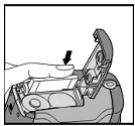
Press the memory card down gently.
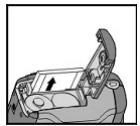
The memory card will bounce upward.
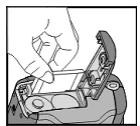
- Pull the memory card out with your fingers in the correct direction.

NOTE
There is 16MB internal memory built-in to the camera to save your data:
If there is a memory card inserted, it will be the top priority for saving data.
If you want to store data in the internal memory, please remove the memory card first.
The specification of a memory card applicable to this camera is SD or MMC
(4/8/16/32/64/128/512MB).
- If inserting the memory card in the wrong direction, it will not fit. Do not insert the card
roughly to avoid damage.
- If the camera detects no memory card, please gently wipe the metal interface of the
card with a soft cloth and reload the card again.
3-4 Shutter Button
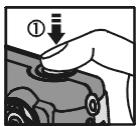
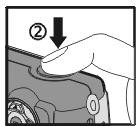
Press the Shutter button down fully and the camera beeps; then release the Shutter button to take a picture.
3-5 Setting Up the OSD Language
Before using the camera, please turn the Mode Dial to Setup Mode SET and then select "Language" to set the OSD language.
3-6 Date/Time
Before using the camera, please turn the Mode Dial to Setup Mode SET and then select "Date/Time" to set the date and time.
Chapter 4 Basic Operation
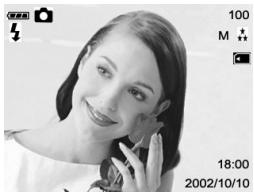
4-1 Recording a Still Image
To record a still image, perform the following:
- Click the Power button to turn on the camera.
- Toggle the MODE button to select the mode.
- Look at the image on the image LCD display or viewfinder to compose your shot.
- Press the shutter button.
4-2 Recording a Video Clip
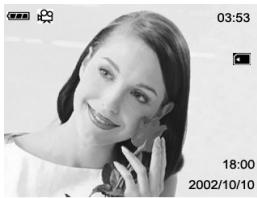
To record a video clip:
- Click the Power button to turn on the camera.
- Toggle the MODE button to select the mode.
- Start recording a video clip by pressing the shutter button.
The elapsed time is displayed on the image LCD display.
To stop recording, press the shutter button.
4-3 Imaging Tips
For a successful image, please follow these suggestions.
- Hold the camera level with both hands and brace your elbows lightly against your body.
Take care to keep your fingers, hair and the camera strap away from the camera lens. - Use the viewfinder or image LCD display to frame your shot.
- When using the viewfinder, brace the camera against your forehead to stabilize your shot.
4-4 Viewing Still Image/Video Clip
In the mode, you can view still images/video clips stored in the camera's internal or card memory on the image LCD display. You can also connect the camera to a TV monitor in this mode to playback the still images/video clips.
On the Image LCD Display
Still Image
To view a recorded still image, follow these steps:
- Click on the Power button to turn on the camera
- Toggle the MODE button to select the mode.
The latest captured image (or the starting scene if
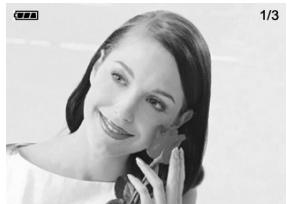
the latest captured video clip will be displayed) on the image LCD display.
- Select the image that you want to view by using
the or button. To view the previous
image,press the button.
To view the next image, press the button.
Video Clip
To view a recorded still image:
- Click the Power button to turn on the camera.
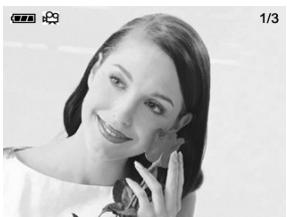
- Toggle the MODE button to select the mode.
-
Select the video clip you wish to view by using the button.
-
To stop playback, press the button.
On a TV Monitor
Television monitors can be used to playback still images or video clips.
- Set the appropriate video output mode (NTSC/PAL) corresponding to your TV standard.
- From the SETUP, select VIDEO MODE.
- Connect one end of the video cable to the video output connector of your camera.
- Connect the other end of the video cable to the video port of your television.
- Turn on the camera and TV.
- Toggle the MODE button to select the mode.
- Playback the recorded images the same way as you would playback them on the image LCD display.

NOTE
The VIDEO OUT function is highly power consumptive. So the batteries may need to be replaced sooner than normal.
4-5 Displaying Thumbnail Images
This function allows you to view nine thumbnail images on the image LCD display simultaneously so you may search for a particular image.
- Click on the Power button to turn on the camera, and toggle the MODE button to select the mode.
- Press the button until thumbnail screen appears on the display screen.
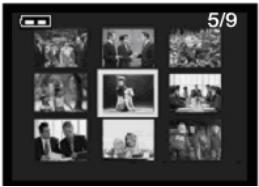
Nine thumbnail images appear (assuming there are nine or more images in memory).
To view a full-size image, selecting it by using the , , or button, and then press the 3 button.
4-6 MENU/ENTER Button

You can perform different operations in the different mode by using the MENU/ENTER button, e.g. select, confirm, go forward and backward.
4-7 Deleting Still Image /Video Clip
There are two ways to erase images:
Delete One and Delete All
- Recorded images in the memory card cannot be deleted when it is write-protected.
- To delete the pictures recorded in the memory card, make sure to insert the card before deletion.
- To delete the pictures recorded in the camera (internal memory), do not insert any memory card or the camera will not be able to read the internal data with an external memory card attached.
- External memory (memory card) always has priority over internal memory – whenever a memory card is inserted into the camera, the camera will use the memory card for both capture and playback.
4-8 Flash Button
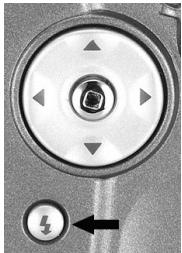
The flash is designed to function automatically when lighting conditions warrant the use of
flash. You can take an image using a flash mode suitable to your circumstances. If you change the flash mode, the camera will retain that setting even if the camera is turned off.
-
Open the lens cover; turn the mode dial to mode, and power on the camera.
-
Press the button located on the rear side of the camera repeatedly until your desired flash mode appears on the LCD
monitor.
- Compose the picture and press the shutter button.
This button is only working in the Record Mode. The camera has four flash modes:
Automatic Flash, Red-Eye Reduction, Fill Flash (on), and Flash Off (default). The modes
appear cyclically when you press the button on the rear side of the camera. The table below will help choose the appropriate flash mode:
| Flash Mode | Description |
| (A) Auto Flash | The flash fires automatically according to the ambient conditions. Select this mode for general photography. |
| (R) Red-eye Reduction | The flash emits a precursor-flash before the main flash fires. This causes the pupil in the human eye to constrict, reducing the red-eye. Select this mode when taking pictures of people and animals in low-light conditions. |
| (F) Fill Flash on | The flash will always fire regardless of the surrounding brightness. Select this mode for recording images with high contrast (backlighting) and deep shadows. Also known as forced flash. |
| (O) Flash off | The flash will not fire. Select this mode when taking images in a place where flash photography is prohibited, or when the distance to the subject is beyond the effective range of the flash. |
4-9 Digital Zoom
Using digital zoom, images appear closer. Whereas digital zoom is a compelling feature, the more an image is enlarged (zoomed), the more pixilated (grainier) the image will appear.
- Click the Power button to turn on the camera.
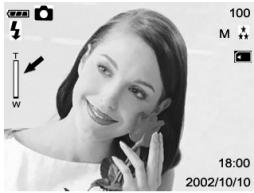
- Toggle the MODE button to select the mode.
- Press the or button to activate 4X digital zoom function.
- Press the shutter button to capture a "zoomed" image.
4-10 Mode Display Button

- This button is only working in the Record Mode. Press this button and you can change the LCD monitor to several displays.
Full Display Standard LCD Monitor Off Full Display
- Press the "Mode Display Button" to enter the "Play Mode" to view the images when the camera is powered off.
- In the Record Mode, the camera will be auto power off because of the power saving function. You can press the "Mode Display Button" to turn on the camera again.
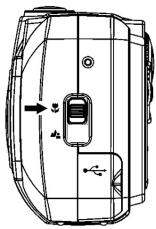
4-11 Macro Button
Use the macro mode to shoot a close-up of the subject, such as flowers or insects. The effective range is between
12cm and 15cm.
- Open the lens cover, turn the mode dial to mode, and power on the camera.
- Move the focus switch located on the front side of the camera to the position.

The icon appears on the LCD monitor.
- Compose the picture.
- Press the shutter button.
To disable macro photography, slide the focus switch back to portrait mode or landscape mode.
4-12 Portrait and Landscape Button
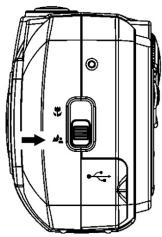
- Open the lens cover, then the mode dial to mode, and power on the camera.
- Move the focus switch located on the front side of the
camera to the position.
- Compose the picture.
- Press the shutter button.
Chapter 5 Camera Menus
5-1 Record Mode
Single
To record a still image, please refer to section 4-1.
Self-Timer
This feature allows you to get into the scene when taking group images.
- Secure the camera to a tripod or place it on a stable surface.
- Click the Power button on the camera, and toggle
the MODE button to select the mode.
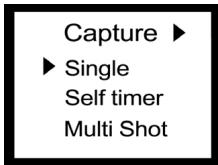
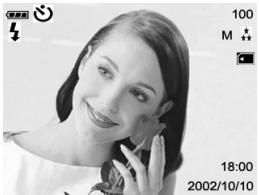
3. Press the MENU/ENTER

button. The icon appears on the image LCD
display.
- Compose the scene.
-
Press the shutter button. The self-timer function is activated.
-
After ten seconds, the camera takes an image. In the first 7 seconds, the self-timer indicator blinks at a relatively slow rate and then blinks rapidly for the last 3 seconds.
Multi-Shot
This function allows you to capture the continuous moving images. After photography is finished, check the images and select the most satisfied image from your computer.
The approximate number of burst photography varies according to the quality conditions and settings.
H:2048x1536
approx. 1
M: 1600x1200
approx. 2
N:1024x768
approx. 2
L:640x480
approx. 2
The remaining capacity of internal memory also affects photography in this mode.
Image Resolution
The image resolution (size) determines the size of your image and how many images can be stored in the internal memory or on the memory card. The higher resolution (larger size) produces a large size image but takes up more space in memory. Lower resolution (smaller size) takes up less memory space, suitable for sharing images via email or the Internet.
- Select image resolution by using the

or

button, then press the MENU/ENTER

button.
- Press the MENU/ENTER

button to confirm the
selection.
Resolution
H:2048x1536
M:1600x1200
N:1024x768
L:640x480
Image Quality
The image quality determines the compression ratio of your
Quality
Super Fine
★Fine
Normal
image and how many images can be stored in the internal memory or on the memory card. The higher quality produces a less compressed image but takes up more memory space. Lower quality takes up less memory space, suitable for sharing images via email or the Internet.
- Use the or button again to select the desired image quality.
- Press the MENU/ENTER button to confirm the selection.
WHITE BALANCE
Automatic white balance is recommended for most cases. For particular circumstances, you may manually select another white balance preset according to the ambient lighting conditions.
- Highlight WHITE BALANCE by using the or button, and press the MENU/ENTER button
- Use the or button again to select the desired white balance.
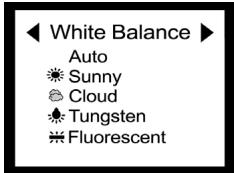
- Press the MENU/ENTER button to confirm the selection.
Exposure Value
The camera will automatically adjust the camera shutter speed for the proper exposure of each scene. Occasionally, it is desirable to manually override the automatic exposure value (EV) to accommodate special scene circumstances.
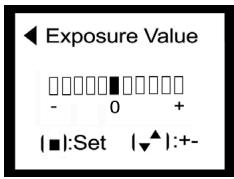
- Highlight Exposure Value by using the or button, and press the
MENU/ENTER

button.
- Use the or button again to specify the desired EV.
The EV range is from -1.5 to +1.5 in steps of 0.3 EV.
- Press the MENU/ENTER button to confirm the selection.
5-2 Play Mode
In Play Mode, users can review the recorded still and movie pictures. To review the pictures, perform the following:
- Turn the Mode Dial

to Play Mode
- Use the lens cover located on the front of the camera to turn on the camera. After you turn on the camera, the last image recorded appears on the LCD monitor.
Auto Play
The auto play function enables you to playback your images back automatically in sequential order as a slide show. This is a very useful and entertaining feature for reviewing recorded images and for presentations.
- Click the Power button to turn on the camera, and toggle the MODE button to select the mode.
- Press the MENU/ENTER button and move to
Auto Play, and then press the MENU/ENTER

button.
- Set the playback interval by using the or button again, and then press the MENU/ENTER


Auto Play Delete One Delete All Format DPOF
1:00 2:00 3:00 4:00 5:00
The slideshow starts, displaying your images on the image LCD display, one by one, at the set interval.
To stop the slideshow display, press the MENU/ENTER button.
Delete One
- Click on the Power button to turn on the camera, and toggle the MODE button to select the mode.
-
Select the image/video clip you wish to delete by using the or button.
-
Press the MENU/ENTER button.
- Select Delete One by using the or button, and then press the MENU/ENTER button.
Auto Play
Delete One
Delete All
Format
DPOF
Delete One Yes No
- Use the or button to select Yes.
- Press the MENU/ENTER button to delete this image/video clip.
The next image/video clip appears.
Delete All
- Click on the Power button to turn on the camera, and toggle the MODE button to select the mode.
- Select Delete All by using the or button, and then press the MENU/ENTER button. The
Auto Play Delete One Delete All Format DPOF
Delete All Yes No
Delete All menu appears.
3.Use the or button to select Yes.
4. To confirm deletion press the MENU/ENTER button.
FORMAT
Formats the memory card and erases all data from the card.
1.Use the or button to highlight FORMAT,and then press the MENU/ENTER button.
2. Use the or button again to select YES/ NO.
3. Press the MENU/ENTER button to confirm the
Auto Play Delete One Delete All Format DPOF
selection.

NOTE
A memory card cannot be formatted if it is write-protected.
DPOF (Digital Print Order Format)
DPOF allows you to embed printing information on your memory card. Using DPOF you can select an image to be printed and then specify how many prints you would like. You connect your memory card to a DPOF enabled printer that accepts SD memory cards. The DPOF/card-compatible printer will read
the embedded information on the memory card and print your images as specified.
- Highlight DPOF by using the or button, then press the MENU/ENTER
Auto Play Delete One Delete All Format DPOF

button.
- Use the or button again to select YES/ NO.
- Press the MENU/ENTER button to confirm the selection.

NOTE
The DPOF function can only be operated with the memory card inserted.
5-3 Setup Mode
By using the Setup Mode, you can adjust the basic camera functions, including: OSD Language, Date/Time, Auto Power off, TV-Out, Frequency and Default Setting items. To setup these items, perform the following:

- Turn the Mode Dial to Setup Mode SET
- Use the lens cover located on the front of the camera to turn on/off camera. After you turn on the camera, the red LED will be blinking, and the Setup screen will be shown on the LCD monitor.
LANGUAGE
Sets the OSD menu language.
- Use the or button to highlight LANGUAGE
- Press the MENU/ENTER button to confirm the selection.
DATE/TIME
Sets the date and time.
-
Use the or button to highlight DATE/TIME.
-
Press the MENU/ENTER button to set DATE/TIME.
- Use the or button to adjust DATE/TIME.
- Press the MENU/ENTER button to confirm the selection.
AUTO POWER OFF
You may specify a power-off time.
- Use the or button to highlight AUTO POWER OFF.
- Use the or button to select the desired setting.
- Press the MENU/ENTER button to confirm the selection.
TV-Out Operation
Using the TV-Out function offered by the camera, you can transfer images to other display devices, e.g. a TV or computer. To transfer the images, follow this method:
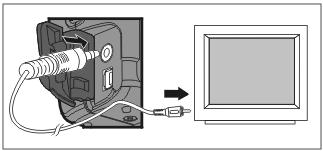
- Please select the correct video type for the connected device before transferring images.

Turn the Mode Dial to Setup Mode SET and select the correct video output type for your selection: NTSC or PAL.
- When you use this function; please use the video cable provided with the camera to connect the camera and output device.
- You can turn on the camera. There will no images shown on the LCD Monitor. All the
images and information will be shown on the output device's display via the video output cable.

NOTE
The camera will perform normally when you enable the TV-Out function. The only difference is the location to show the images, and the image information will be from the LCD Monitor to the video output device's display.
While using the camera, after you connect the video cable to the camera, the images will be no longer shown on the LCD Monitor. If you want to restore the display status on the LCD Monitor, please disconnect the video cable from the camera.
Frequency
The camera supports different lighting frequencies: 50Hz and 60Hz. When photography under fluorescent lighting, select the correct frequency setting depending on your local area's voltage. However, under other lighting situation, select "disable" for this setting.
- Use the or button to highlight Frequency.
- Use the or button to select the desired setting.
- Press the MENU/ENTER button to confirm the selection.
Default Setting
- Use the or button to highlight Default Setting.
-
Use the or button to select the desired setting.
-
Press the MENU/ENTER button to confirm the selection.
5-4 Movie Mode
You can use Movie Mode to record movie pictures (not including audio). To record movie pictures, just do this:
- Turn the Mode Dial

to Movie Mode

- Use the lens cover located on the front of the camera to turn on the camera. After you turn on the camera, the last image recorded appears on the LCD monitor.
- Press the Shutter button to start recording. Press the Shutter button again to stop recording.
- The LCD Monitor will show the recorded time (seconds) while you are recording your movie pictures.

NOTE
To record the movie pictures, the maximum recording time depends on the free space of the memory card.
5-5 PC Mode
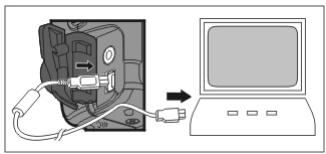
- To select the PC Camera or Mass Storage items in the PC Connection menu, perform the following:
Using This Camera as a PC Camera
This camera can act as a PC camera, allowing you to hold a videoconference and talk to business associates over the Internet or corporate Intranet, or conduct real-time conversation with friends or family.
To use this camera as a PC camera, follow the steps below:
Step 1: Installing the PC camera driver
Step 2: Connecting the camera to your computer
Step 3: Running software application (for example: ArcSoft Videolpression)
System Requirements for Videoconferencing
To use this camera for videoconferencing, your computer must contain the following components:
Microphone
Sound card
■ Speakers or headphones
Network connection
Step 1: Installing the PC Camera Driver
The PC camera driver on the supplied CD-ROM is exclusively for Windows. The PC camera function provided on this camera is not supported by the Macintosh platform.
Step 2: Connecting the Camera to Your Computer
- Click the Power button to turn on the camera.
- Connect one end of the USB cable to an available USB port on your computer.
- Connect the other end of the USB cable to the USB connector on the camera.
-
The USB CONFIG menu appears on the image LCD display.
-
Select PC CAMERA by using the or button, then press the MENU/ENTER
Button button.
PC CAMERA is displayed on the image LCD display.
- Position the camera steadily on top of your computer monitor.
Turn your PC on if it isn't already on. Click the Start button in the Windows Taskbar, and select Programs > ArcSoft Videolpression > Videolpression. The following Videolpression main screen will appear.
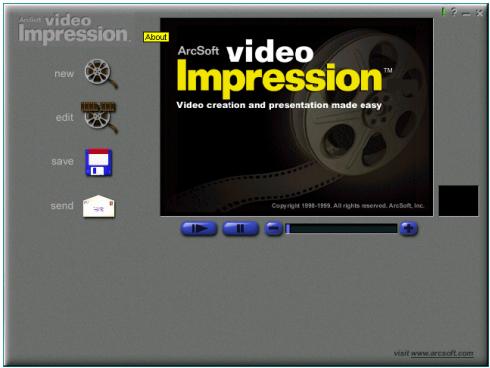
Click the New button
and the following Album screen will appear.
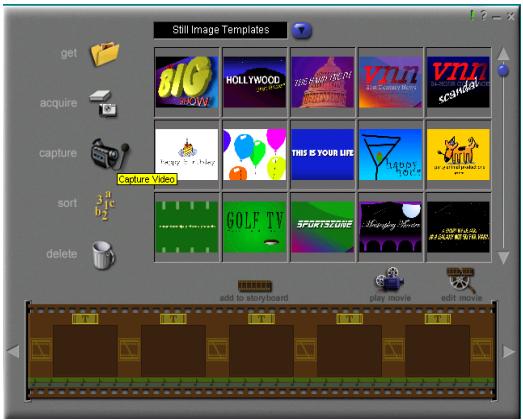
Click on Capture
and the Capture screen will appear.
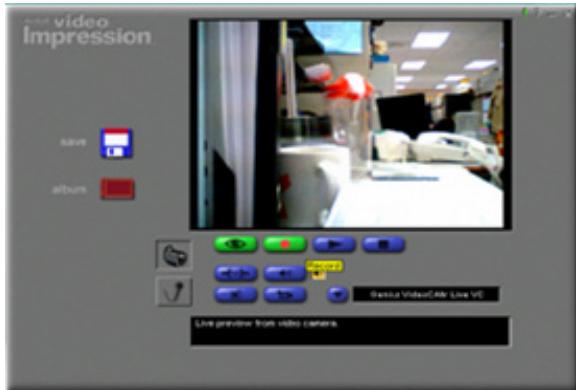
Then click on Record and you can capture the video.
If you want to stop capturing, press ESC or click on Pause

Chapter 6 Driver Installation
6-1 Installing the Camera Driver to the PC
You can use the PC Camera and Mass Storage functions of the camera via PC. To install the proper camera driver, just follow this:
- Insert the software CD-ROM supplied with the package into the CD-ROM drive.
- The Auto-run program will be executed and the welcome screen appears: (If your CD-ROM drive doesn't support the auto-run function, then double click on the "My Computer" icon on the desktop. Double click on the CD-ROM drive icon and click the Setup.exe file in the root directory.
- Click the Install driver to install the driver, and this screen will appear:
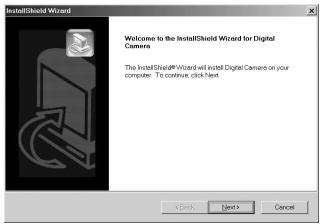
- Click on Next to continue the setup program. After you installed the camera driver successfully, this message appears on the screen:
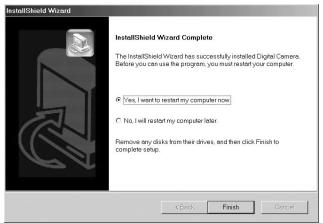
- Click Finish to restart the computer and finish the camera driver installation.
6-2 Installing the Software Applications to the PC
Install Arcsoft Software (take Photolpression Installation for example)
- Insert the software CD-ROM supplied with the package into the CD-ROM drive.
- The Auto-run program will be executed and the welcome screen appears. If your CD-ROM drive doesn't support the auto-run function, double click on the "My Computer" icon on the desktop. Then double click on the CD-ROM drive icon and click the Setup.exe file in the root directory.
- Click on Arcsoft Photolpression to install, and this screen will appear:
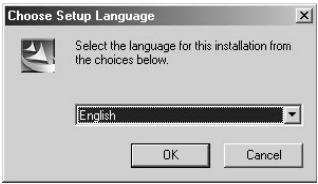
- Select the language for installation. Click OK to confirm your selection.
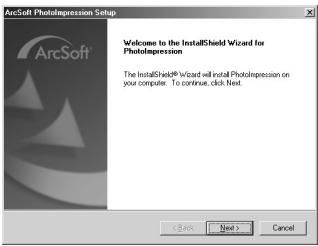
- You will see the Welcome screen. Click Next to continue.
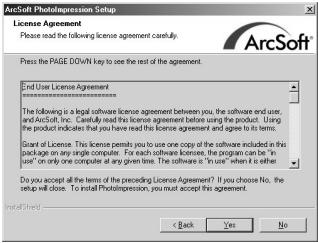
- Enter Software License Agreement window. Please click Yes to continue the installation.
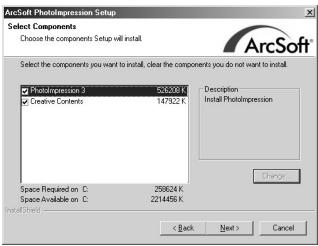
- Please follow the instructions of the installation Wizard to select a destination folder and the components you need.
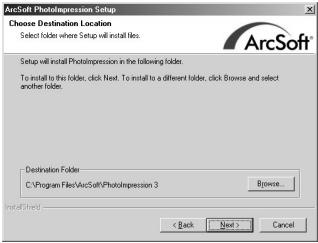
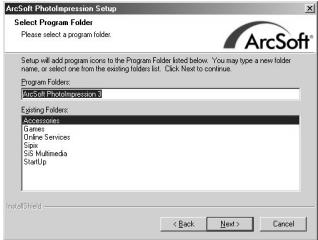
- Please select the program folder you want to install
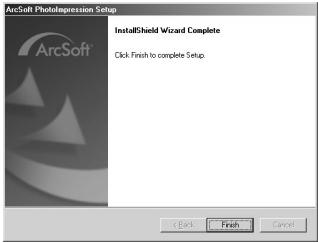
- When the installation is completed, the window below will appear. Click Finish to end the installation.
6-3 Downloading photos/video from camera

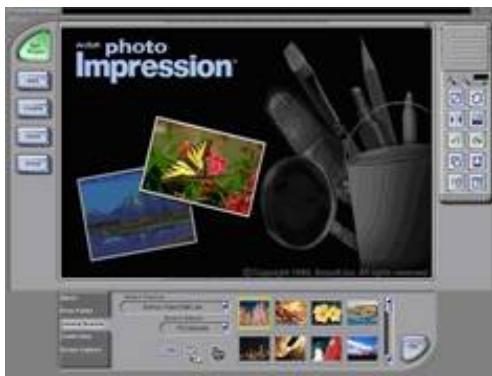
Turn on your PC if it isn't on already. Click on the Photolmpression icon in the Windows Desktop, or choose Start > Program Files > ArcSoft Photolmpression >
Photolmpression. The following Photolmpression main screen will appear. Note: Make sure the ArcSoft Photolmpression software is installed. If not, please install it first. (Refer to the section "Installing the Digital Camera Software")
Click the Camera/Scanner button, then click on the Acquire button. Interface window will appear.

The Twain
6-4 Transferring Recorded Images to Your Computer
You can share recorded images/video clips with your family or friends via e-mail or post them on the Web. Before doing those things, you need to connect the camera to your computer by using the USB cable and then transfer the images/video clips. To transfer images/video clips from the camera to your computer, follow these steps:
Step 1: Installing the USB driver
Step 2: Connecting the camera to your computer
Step 3: Downloading images/video clips
Step 1: Installing the USB Driver
The USB driver on the supplied CD-ROM is for Windows XP/Me/2000/98SE.
- Insert the CD-ROM packaged with the camera into the CD-ROM drive.
-
Follow the on-screen instructions to complete the installation.
-
Restart your computer.
Step 2: Connecting the Camera to Your Computer
- Click the Power button to turn on the camera.
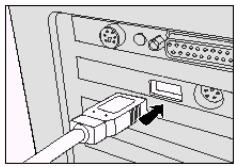
- Connect one end of the USB cable to an available USB port on your computer.
- Connect the other end of the USB cable to the USB connector on the camera.
- The USB CONFIG menu appears on the image LCD display.
- Select DISK DRIVE by using the or
button, and then press the MENU/ENTER Button

button. DISK DRIVE is
displayed on the image LCD display.
- Look for a new "removable disk" appearing in the "My Computer" window.
- Your recorded images/video clips will be in a folder on this "removable disk".
Step 3: Downloading Images/Video Clips
When the camera is turned on and connected to your computer, it is considered to be one disk drive. You can download images/video clips by copying them from the "removable disk" to your hard drive or other storage disk.
For computers running Windows
Open the "removable disk" by double clicking on it. Double click on the folder. Your images are inside the folder(s). Select the images that you want, and then choose Copy from the Edit menu. Open the destination location and choose Paste from the Edit menu. You may also drag and drop image files from the camera to a desired location.