BURNING ROM 9 - Burning software NERO - Free user manual and instructions
Find the device manual for free BURNING ROM 9 NERO in PDF.


User questions about BURNING ROM 9 NERO
0 question about this device. Answer the ones you know or ask your own.
Ask a new question about this device
Download the instructions for your Burning software in PDF format for free! Find your manual BURNING ROM 9 - NERO and take your electronic device back in hand. On this page are published all the documents necessary for the use of your device. BURNING ROM 9 by NERO.
USER MANUAL BURNING ROM 9 NERO
Copyright and Trademark Information
This document, like the software described therein, is provided as a license and may only be used or reproduced in accordance with the licensing agreement. The contents of this document, as well as the associated software, is subject to change without prior notice. Nero AG rejects any responsibility for the correctness of the contents of this document and rejects any claims that transcend the clauses of the guarantee agreement.
This document and all of its contents are protected by copyright and are the property of Nero AG. All rights reserved. In addition, this document contains material that is protected by internationally valid copyright. This document may not be reproduced, transmitted, or transcribed in whole or in part without the express written permission of Nero AG.
Please keep in mind that existing graphics, pictures, videos, music titles or other materials that you may wish to insert or transcribe into projects may be protected by copyright. The unauthorized use of this type of material in your projects may violate the rights of the owner of the copyright. Make sure that you obtain all necessary authorizations from the owner of the copyright.
Unless you own the copyright, have permission from the copyright owner or your actions fall under the "fair use" provisions of copyright law, you may be violating national or international copyright laws. The transcribing, re-formation, modification or publication of copyright-protected material may lead to claims for damages and the enforcement of other legal measures against you. If you are unsure of your rights, you should contact your legal advisor.
Some Nero Suite applications require technologies developed by third-party manufacturers, some of which are contained in the Nero Suite as demo versions. These applications can be activated online free of charge or by sending an activation fax to have unlimited use of the version. Nero will only transmit the data necessary for activation of the technology licensed from third parties. For unlimited use of Nero Suite, it is therefore necessary to have an Internet connection or a fax machine.
Copyright © 2006-2009 Nero AG and its licensors. All rights reserved.
Nero, Nero Digital, Nero BackItUp, Nero Essentials, Nero Express, Nero ImageDrive, Nero LiquidTV, Nero MediaHome, Nero Recode, Nero RescueAgent, Nero ShowTime, Nero Simply Enjoy, Nero StartSmart, Nero Vision, InCD, Move it, PhotoSnap, the SecurDisc logo, Burn-At-Once, DNC Dynamic Noise Control, LayerMagic, Nero DMA Manager, SmartDetect, SmoothPlay, Superresolution, Nero Surround, Nero LiquidMedia, Nero MediaStreaming, and UltraBuffer are trademarks or registered trademarks of Nero AG.

gracenote.
Gracenote® is either a registered trademark or a trademark of Gracenote, Inc. in the United States and/or other countries. The Gracenote logo and logotype, and the "Powered by Gracenote" logo are trademarks of Gracenote.
Adobe, Acrobat, Acrobat Reader and Premiere are trademarks or registered trademarks of Adobe Systems, Incorporated. AMD Athlon, AMD Opteron, AMD Sempron, AMD Turion, ATI Catalyst and ATI Radeon are trademarks or registered trademarks of Advanced Micro Devices, Inc. ATSC is a trademark of the Advanced Television Committee. ICQ is a registered trademark of AOL, LLC. Apple, iPhoto, iPod, iTunes, iPhone, FireWire, and Mac are trademarks or registered trademarks of Apple, Inc. ARM is a registered trademark of ARM, Ltd. AudibleReady is a registered trademark of Audible, Inc. BenQ is a trademark of the BenQ Corporation. Blu-ray Disc is a trademark of Blu-ray Disc Association. Check Point and Check Point Endpoint Security are trademarks or registered trademarks of Check Point Software Technologies Ltd. CyberLink is a registered trademark of CyberLink Corp. DLNA is a registered trademark of Digital Living Network Alliance. DivX and DivX Certified are registered trademarks of DivX, Inc. Dolby, Pro Logic and the double-D symbol are trademarks or registered trademarks of Dolby Laboratories, Inc. DTS and DTS Digital Surround are registered trademarks of DTS, Inc. DVB is a registered trademark of the DVB Project. Freescale is a trademark of Freescale Semiconductor, Inc. Google and YouTube are trademarks of Google, Inc. WinTV is a registered trademark of Hauppauge Computer Works, Inc. Intel, Intel XScale, Pentium and Core are trademarks or registered trademarks of Intel Corporation. Linux is a registered trademark of Linus Torvalds. Memorex is a registered trademark of Memorex Products, Inc. ActiveX, ActiveSync, DirectX, DirectXShow, Internet Explorer, Microsoft, HDI, MSN, Outlook, Windows, Windows Mobile, Windows NT, Windows Server, Windows Vista, Windows Media, Xbox, Xbox 360, the Windows Vista start button and the Windows logo are trademarks or registered trademarks of Microsoft Corporation. My Space is a trademark of MySpace, Inc. NVIDIA, GeForce and ForceWare are trademarks or registered trademarks of NVIDIA Corporation. Nokia is a registered trademark of Nokia Corporation. CompactFlash is a registered trademark of SanDisk Corporation. Sony, Memory Stick, PlayStation, PLAYSTATION and PSP are trademarks or registered trademarks of Sony Corporation. HDV is a trademark of Sony Corporation and Victor Company of Japan, Limited (JVC). UPnP is a registered trademark of the UPnP Implementers Corporation. Labell flash is a registered trademark of Yamaha Corporation.
The trademarks mentioned here are named for information purposes only. All trade names and trademarks are the property of their respective owners.
Nero AG, Im Stoeckmaedle 13-15, D-76307 Karlsbad, Germany
Table of contents
1.1 About the Manual 6
1.2 About Nero Burning ROM 6
1.3 Working With The Program 7
1 Start Successfully 6
2 Starting The Program 8
3 Main Screen 9
4 Compilation Screen 12
4.1 New Compilation Window 12
4.2 Selection Screen 16
5 Data Disc 18
5.1 Compiling Data CDs/DVDs 18
5.2 Enabling SecurDisc Settings 20
5.3 Defining Options 23
5.3.1 Multisession Settings 23
5.3.2 ISO Settings 25
5.3.3 UDF Settings 26
5.4 Saving Data Track 26
5.5 Check Point Media Encryption CD/DVD 28
6 Audio CD And Audio Files 29
6.1 Compiling Audio CDs 29
6.1.1 Customizing Properties of The Audio File 30
6.1.2 Defining Options 34
6.2 Mixed Mode CD And CD EXTRA 36
6.2.1 CD-Extra Settings 37
6.3 Compiling an Audio Book CD 37
6.4 Automatic Music Recognition 38
6.4.1 Identifying Audio Files 38
6.5 Copy Audio CDs to Hard Drive 39
6.5.1 Save Audio Tracks to Hard Drive Window 42
6.6 Convert Audio File Format 45
6.6.1 Encode Files Window 45
7 Video And Slide Show 53
7.1 Compiling Video CDs/Super-Video CDs 53
7.1.1 Defining Options 54
7.2 Compiling DVD-Video or miniDVDs 56
8 Bootable Disc 58
8.1 Requirements For Booting From a Disc 58
8.2 Bootable Disc Template 58
8.3 Creating And Burning a Bootable Disc 59
9 Loading Image File 60
10 LightScribe 61
10.1 CD Label Editor Window 61
10.2 Printing LightScribe Label 62
11 Labelflash 64
11.1 Burn Label Screen 64
11.2 Printing Labelflash Labels And DiskT@2 65
12 Burn Compilation 68
12.1 Choose Recorder Window 68
12.2 Burn Settings 69
12.3 Starting The Burn Process - Burning Discs With The Drive 71
12.4 Burning With Image Recorder - Creating an Image File 71
13 Copying CDs/DVDs 73
13.1 Methods of Copying 73
13.1.1 On-the-fly Copying 73
13.1.2 Copy Over Image 73
13.2 Copying Disc 74
13.3 Copy Settings 75
13.3.1 Image Settings 76
13.3.2 Copy Options 76
13.3.3 Read Options 77
14 Erase Rewritable Disc Window 79
15 Updating The Virus Scanner 81
16 Configuration Options 82
16.1 Compilation Settings 83
16.2 Cache Settings 84
16.3 Expert Features 84
16.4 Ultrabuffer Settings 85
16.5 LightScribe Settings 85
17 Technical Information 86
17.1 System Requirements 86
17.2 Disc Types 86
17.3 Disc Formats 86
17.4 Audio Formats And Codec 87
17.5 Metadata 87
17.6 Video Formats And Codecse 88
17.7 Image Formats 88
17.8 Formats For Playlists 88
18 Glossary 89
Table of contents
19 Index 93
20 Contact 95
1 Start Successfully
1.1 About the Manual
This manual is intended for all users who want to learn how to use Nero Burning ROM. It is process-based and explains how to achieve a specific objective on a step-by-step basis.
To make best use of this documentation, please note the following conventions:
| ○ | Indicates warnings, preconditions or instructions that have to be precisely followed. |
| ○ | Indicates additional information or advice. |
| 1. Start ... | The number at the beginning of a line indicates a prompt for action. Carry out these actions in the order specified. |
| → | Indicates an intermediate result. |
| → | Indicates a result. |
| OK | Indicates text passages or buttons that appear in the program interface. They are shown in boldface. |
| (see...) | Indicates references to other chapters. They are executed as links and are shown in red and underlined. |
| [...] | Indicates keyboard shortcuts for entering commands. |
1.2 About Nero Burning ROM
The powerful burning software Nero Burning ROM allows you to burn your data, music and videos to disc. Nero Burning ROM gives you full, customized control of your burning projects. You can – among other things – define the file system, the length of the file name and the character set; you can also change the disc label. And of course, you can also customize the Nero Burning ROM toolbar and change the keyboard shortcuts.
It is just as easy to create Nero Burning ROM discs with SecurDisc and a SecurDisc supported drive. SecurDisc is a new hardware and software technology developed by Nero and HLDS with which you can create discs with special protection properties, such as data integrity, reconstructability, encryption and duplication protection. Such discs can be created with SecurDisc supported drives (e.g. from HLDS/LG and Nero Burning ROM) and read from any drive with InCD or InCD Reader.
Despite its wide range of features, Nero Burning ROM has remained an easy-to-use burning program that creates discs in just a few steps. You select the disc type to be burned (CD/DVD/Blu-ray), define the project type, add the required data and then start burning.
Using Nero Burning ROM you can save audio files from an Audio CD on the hard drive. In the process, the files are encoded, i.e. converted into a format that the computer can read.
The Audio CD can be automatically identified with Gracenote. So called metadata such as title, genre, and track title are accessed by the Gracenote Media Database and associated to the tracks. That way you have audio files that are accurately and fully named after the encoding process.

Music recognition technology and related data are provided by Gracenote®. Gracenote is the industry standard in music recognition technology and related content delivery. For more information, please visit www.gracenote.com.
1.3 Working With The Program
The main function of Nero Burning ROM is to select files and folders and to burn them to a disc. This is done in three basic steps:
In the New Compilation window, select a disc type and the disc format and set the options on the tabs.
In the selection screen, select files that you want to burn.
Start the burn process.
See also:
Main Screen 9
Compiling Data CDs/DVDs 18
Compiling Audio CDs→ 29
Mixed Mode CD And CD EXTRA 36
Compiling an Audio Book CD→ 37
Compiling Video CDs/Super-Video CDs 53
Compiling DVD-Videoos or miniDVDs 56
2 Starting The Program
To start Nero Burning ROM via Nero StartSmart, proceed as follows:
- Click the StartSmart icon.
The Nero StartSmart window opens.

Click the

The list of Nero applications appears.
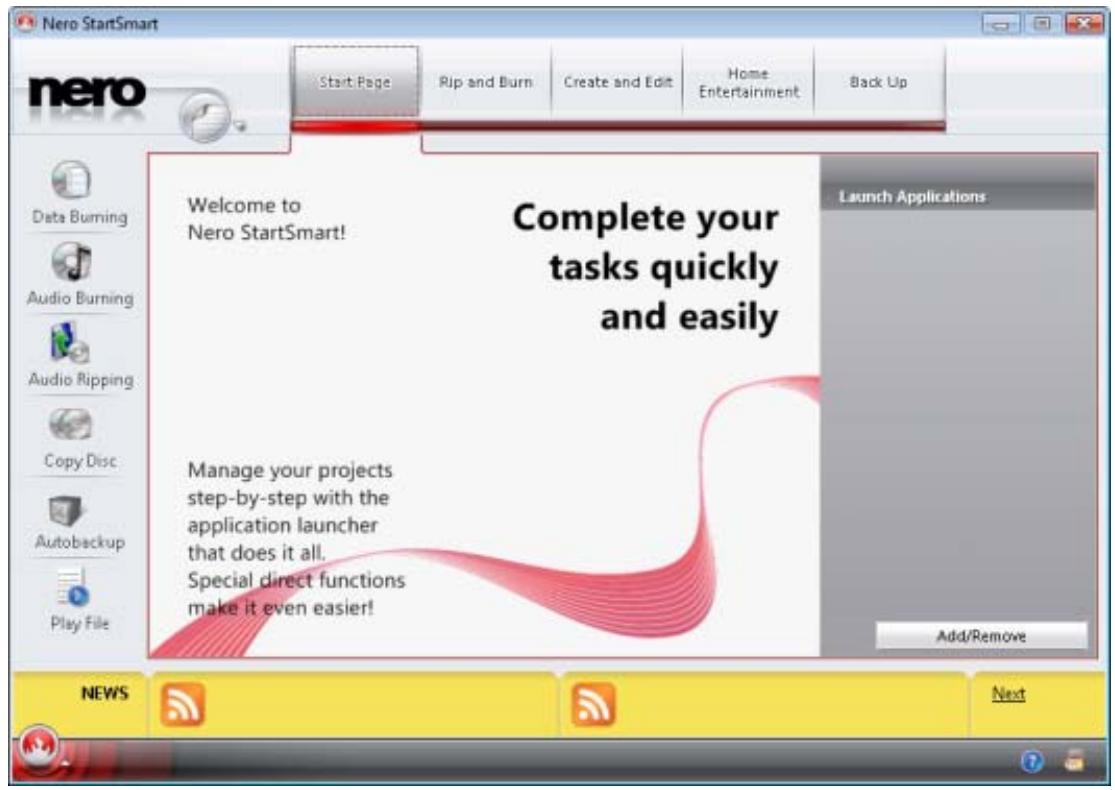
Nero StartSmart window
- Select the Nero Burning ROM entry in the selection list.
The Nero Burning ROM window opens.
You have launched Nero Burning ROM via Nero StartSmart.
3 Main Screen
The main screen of Nero Burning ROM is the starting point for all actions. It consists of a menu bar and a toolbar with buttons and a drop-down menu.
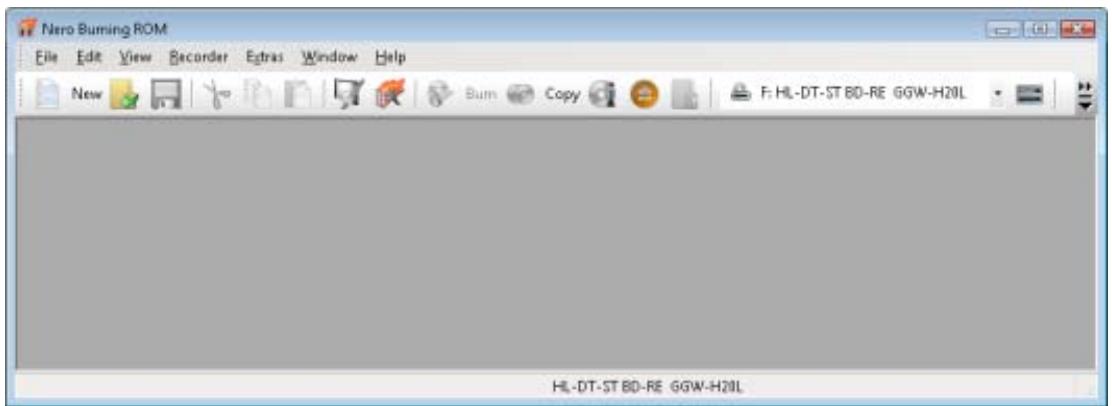
Main window with menu and toolbar
The following menus are available:
| File | Provides program facilities such as opening, saving, printing, and closing. You can also open the setting options for the compilation, update the compi- lation, and define configuration options. |
| Edit | Provides editing facilities for the files in the selection screen such as cutting, copying, and deleting. You can also display the properties of a selected file and search directly for files within a compilation. |
| View | Provides the option to customize the toolbar and the browser area and to re- fresh the file browser. |
| Recorder | Provides recorder facilities. You can select the recorder her, start the burn process, and erase a rewritable disc. You can also eject a disc and display disc information. |
| Extras | Provides the option to convert audio files into other formats and to save the songs of an Audio CD on the hard drive. You can also save a data track on the hard drive. |
| Window | Provides the option to alter the position of the compilation area and browser area. |
| Help | Provides help facilities such as opening the help, and showing information about the application. |
The following configuration options are available in the tool bar of the main screen.

Opens the New Compilation window where you can set options for a burn or copy process.
| Opens an existing compilation. | |
| Saves the active compilation. | |
| Cuts selected elements in the compilation (selection). | |
| Copies selected elements of the compilation (selection). | |
| Pastes a selection that was cut or copied beforehand. | |
| Starts Nero CoverDesigner, which you can use to create labels and covers. Information about a current compilation such as title, number, and names of the files is incorporated into the document data. You will find further information in the Nero CoverDesigner manual. | |
| Starts Nero Express. Nero Express is a wizard-driven application based on Nero Burning ROM. You will find further information in the Nero Express manual. | |
| Starts the burn process by opening the Burn Compilation window containing the Burn tab. | |
| Starts the copy process by opening the New Compilation window containing the Burn tab. | |
| Displays information on the disc inserted, such as contents (if any) and capacity for instance. | |
| Opens the selected drive. | |
| Shows or hides the file browser. | |
| Recorder selection menu | Displays available recorders. |
| Opens the Choose recorder window where you select an available recorder for the burn process from a list. | |
| Opens the Burn Label window where you can create or load a label to print on the label or data side of a Labelflash DVD. This button is only available if a recorder that supports Labelflash is connected. | |
| Launches Nero CoverDesigner to create or load a label to be printed on the label side of a LightScribe disc. This button is only available if a recorder that supports LightScribe is connected. | |
| Displays information on the program and version number. |
See also:
New Compilation Window 12
Bootable Disc 58
LightScribe 61
Labelflash 64
Loading Image File 60
Erase Rewritable Disc Window 79
Configuration Options 82
4 Compilation Screen
4.1 New Compilation Window
In the New Compilation window you can select the disc type and configure the options for the disc format on the tabs. The window basically looks the same for all disc types. The only difference is the tabs that are available. When you start Nero Burning ROM, the New Compilation window opens automatically. If the window is not open, click the New button. The window consists of a drop-down menu, a selection list, various tabs, and buttons.

New Compilation window, CD-ROM disc type
Only those disc types supported by the recorder are displayed in the drop-down menu. If the recorder can only burn CDs, the drop-down menu is grayed out.

Using Nero Burning ROM you can create image files for disc types that the installed recorder cannot burn. You can enable this function via the File > Options > Expert Features menu, Enable all supported recorder formats for image recorder check box. The drop-down menu in the Compilation window then makes available all supported disc types.
The following entries are available in the selection list:
| Entry CD/DVD-ROM (ISO) | Creates a data CD/DVD, each file type can be burned. The burned data complies with the ISO standard. |
| Entry Audio CD | Creates a standard Audio CD that can be played on all (audio) CD players at least. |
| Entry Mixed Mode CD | Creates a CD with data and audio files in a single session. Usually a data file is followed by one or more audio files for instance (e.g. soundtrack for PC games). Older Audio CD players are often not capable of recognizing the data file as such and attempt to play it. |
| Entry CD EXTRA | Creates a multisession CD with audio and data files that are stored in two sessions. The first session contains the audio files and the second session the data. Common CD players play the first session as Audio CDs. The second session can only be used by PCs with a CD-ROM drive, it cannot be 'seen' by a normal CD player. |
| Entry Copying CDs/DVDs | Copies a source disc to a CD/DVD disc. |
| Entry Video CD | Creates a CD that can play video and/or picture files on almost all VCD and DVD players. When burning the Video CD (VCD), Nero Burning ROM automatically converts the files into the MPEG-1 format required by the Video CD. |
| Entry Super Video CD | Creates a CD that can play video and/or picture files on almost all SVCD and DVD players. The resolution is higher than with the VCD, and so the quality of the picture is usually better. When burning the Super Video CD (SVCD), Nero Burning ROM automatically converts the files to the MPEG-2 format required by the Super Video CD. |
| Entry miniDVD | Creates a CD that uses the specifications of a DVD. The miniDVD has the same technical options and qualities as a DVD. It can easily be played on a PC, whereas there is no guarantee that it can be played in all DVD players. You can use Nero Burning ROM to burn a miniDVD if the DVD video title, i.e. a complete DVD folder structure, is already available. |
| Entry CD/DVD-ROM (Boot) | Creates a bootable CD. |
| Entry CD/DVD-ROM (UDF) | Creates a data disc; all file types can be burned. The burned data complies with the UDF standard. |
| Entry CD/DVD-ROM (UDF/ISO) | Creates a data disc; all file types can be burned. The burned data complies with the ISO and UDF standards. |
| Entry Audiobook CD | Creates an audiobook CD. The file format of the original audiobook has to be in AA (Audible Audio) format. The burned audiobook CD can be read and played by CD play- ers. Since audiobooks can play for several hours, Nero Burning ROM saves the audiobook to multiple audio CDs. |
| Entry DVD-Video | Creates a DVD that delivers high-quality playback of video and/or picture files on DVD players. You can use Nero Burning ROM to burn a DVD if the DVD video title, i.e. a complete DVD folder structure, is already available. |

The Nero Vision program works best for creating Video CDs and Super Video CDs. Nero Vision is an application of Nero Suite and is installed automatically together with its suite. You will find further information in the Nero Vision manual.

The actual entries that are available, and the actual disc types (e.g. DVD) that can be written to depend on the recorder used.

You can find more information on Blu-ray support at www.nero.com/link.php?topic_id=416.
The following buttons are available:
| Button Nero Express | Starts Nero Express. Nero Express is a wizard-driven application based on Nero Burning ROM. You will find further information in the Nero Express manual. |
| Button Open | Opens a file browser where you can find and open a saved compilation. |
| Button New | Opens the selection screen where you can select the files for burning. |
| Button Cancel | Closes the New Compilation window. |
You can set the options for the respective disc format on the tabs in the New Compilation window.

Which tabs are available depends on the disc type that is selected.
The following tabs are available:
| Tab Info | Shows statistical information on the compilation. |
| Tab Multisession | Contains options for configuring multisession discs. This tab is only available if a burner is installed. |
| Tab ISO | Contains options for configuring the ISO file system. |
| Tab UDF | Contains options for configuring the UDF file system. |
| Tab Label | Defines the label of the CD. |
| Tab Date | Allows you to define the date of the compilation and of the associated files. You can also specify a validity period for the disc. You can access the data regardless of the validity period specified. |
| Tab Misc | Defines whether and which files are stored in the buffer memory. If you possess a Lightscribe recorder you can create the label here or select what is to be printed. For the CD-ROM (ISO) disc type, you can convert the code for an AVI video here to make it compatible with Xvid/MPEG-4 or DivX. We recommend that you only convert the code if you have experience with FourCC codes and AVI videos. |
| Tab Audio CD | Contains options for configuring audio files. You can also enter additional information about the CD. |
| Tab CDA Options | Defines the strategy used by Nero Burning ROM for handling CD-DA files from a source audio CD. |
| Tab CD EXTRA | Contains options for configuring albums. |
| Tab Video CD | Contains general options for Video/Super Video CD. |
| Tab Menu | Allows you to configure the appearance and content of the menu for the Video/Super Video CD. |
| Tab Audiobook CD | Displays statistical information on the audiobook CD, such as the number of CDs required. |
| Tab Boot | Contains options for configuring a bootable disc. |
| Tab Writing | Contains options for configuring burning. |
See also:
Compiling Data CDs/DVDs 18
Compiling Audio CDs→ 29
Mixed Mode CD And CD EXTRA→ 36
Compiling an Audio Book CD→ 37
Compiling Video CDs/Super-Video CDs 53
Compiling DVD-Videoos or miniDVDs 56
4.2 Selection Screen
The selection screen is the starting point for work that you want to do on compilations. The selection screen is displayed in the main screen after you select the disc type and format and click the New button. The selection screen consists of the compilation area, the browser area and a capacity scale.
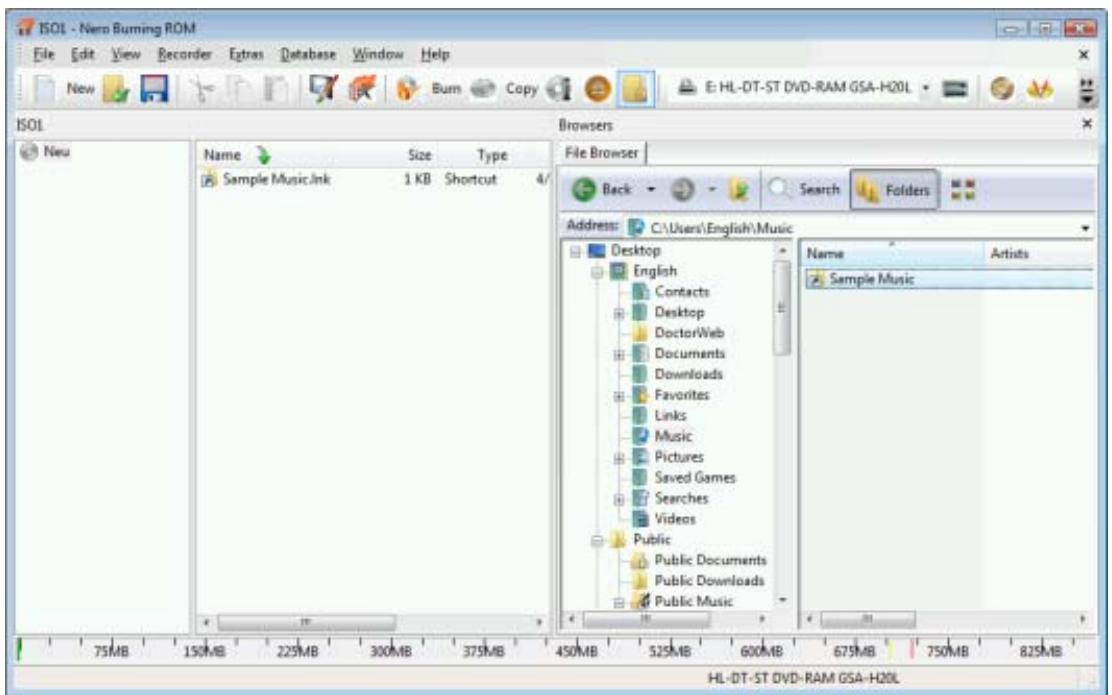
Selection Screen
The Compilation Area is named after the relevant compilation. Files and folders are compiled here for burning. In the browser area (Browser), you can find the elements that you want to burn. The File Browser is similar to other file browsers and provides a toolbar and address bar with typical functionality.
The bottom margin of the screen contains a capacity scale in MB for data discs or minutes (min) for Audio CDs. The exact size of the scale will depend on which disc type you have selected.

If the Browser Area is hidden, you can show it again using the button.
When you are compiling files, a capacity bar indicates how much space the files need on the disc. The color of the capacity bar indicates whether the data will fit on the disc or not:
| Green capacity bar | The data will fit on the disc. |
| Yellow capacity bar (from the yellow mark on the scale) | The data might fit on the disc. The size of the disc that has been inserted will determine whether the data will fit or not. |
| Red capacity bar (from the red mark on the scale) | The data will not fit on the disc. (Unless you have inserted an oversize disc.) |
The yellow and red marks are set by default for discs that are commercially available. The disc type you have selected will determine the exact scale value.

Capacity of the CD recordable disc
For example, blank CDs are available with a capacity of 650 MB or 700 MB. Therefore the yellow mark is set for CDs at 650 MB and the red at 700 MB.

Display the Capacity Bar
If the capacity scale is hidden, you can show it again by clicking the File > Options > Compilation menu and by selecting the check box Show compilation size in the Nero status bar.
5 Data Disc
5.1 Compiling Data CDs/DVDs
With Nero Burning ROM you can compile and burn all types of files and folders. If a DVD recorder is installed on your computer, you can burn both data CDs, and data DVDs. If you have a CD recorder, you can only burn data CDs and the option for burning a DVD is already grayed out in the start screen. The procedure for both compilation methods is identical.

SecurDisc recorder
If a SecurDisc recorder is installed on your computer, you can select it to display the relevant entry in order to burn a SecurDisc CD or DVD. The procedures for both adding data and burning a SecurDisc data CD/DVD are the same as the compilation method for a standard data CD/DVD.

The Image Recorder is also suitable for creating an image of a disc type not supported by the connected recorder. You can therefore create a DVD image, for instance, without having installed a DVD recorder. You can write the image to a disc at any time.

Nero Burning ROM supports virtual search folders in the Windows Vista operating system. The search is selected by dragging it into the compilation area. If you want to select the files of the search folder, you must open the search folder and drag the files into the compilation.

Blu-ray recorder
If a Blu-ray recorder is installed on your computer, you can select it to display the relevant entry in order to burn a Blu-ray disc. The procedures for both compiling and burning a Blu-ray data disc are the same as the compilation method for a data CD/DVD.
To create a data CD/DVD, proceed as follows:
- Select the desired CD format (CD, DVD) from the drop-down menu in the New Compilation window. (In the case that the New Compilation window is not opened, it can be opened by clicking the New button on the main screen.)
The selection list shows the compilation types that can be burned.
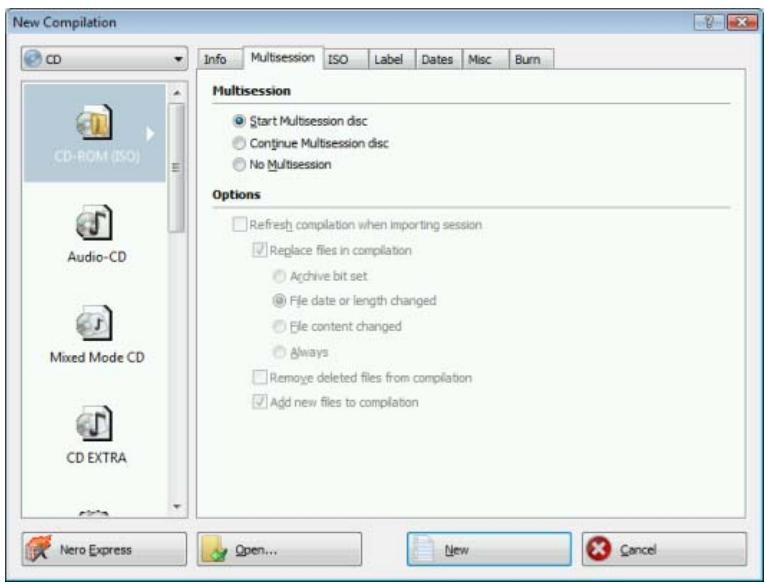
New Compilation Window
- Select the desired compilation type for a data disc from the selection list (CD/DVD-ROM (ISO), CD/DVD-ROM (UDF), or CD/DVD-ROM (UDF/ISO).
The tabs with the configuration options that are valid for this compilation type are displayed. - Click the New button.
The New Compilation window is closed and the selection screen is displayed.
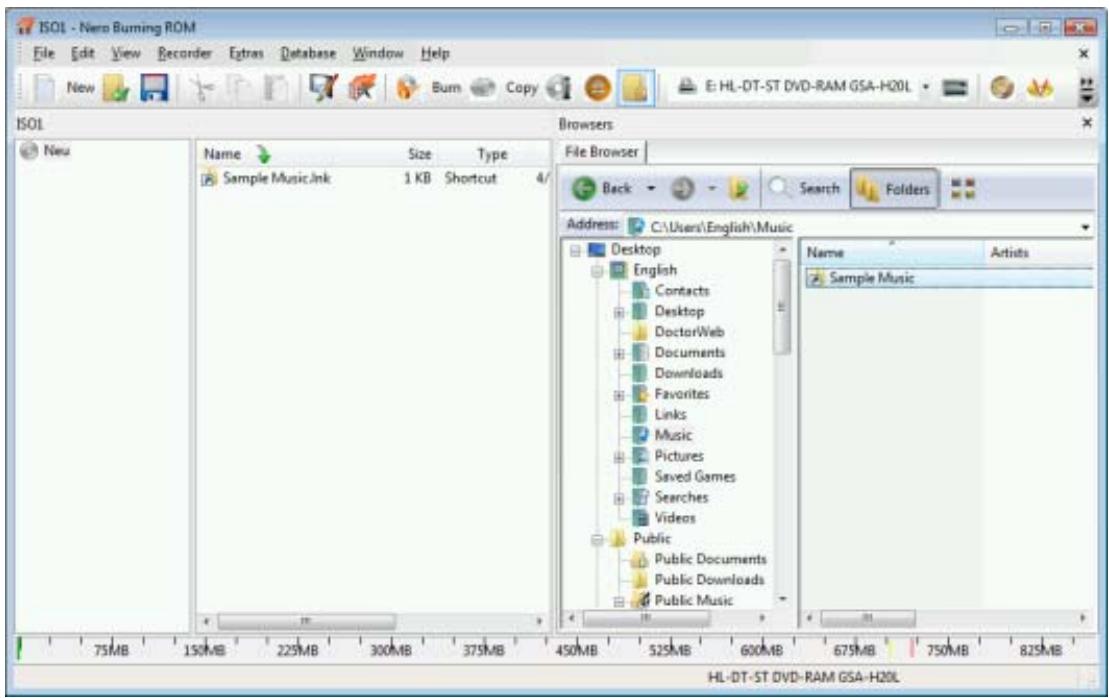
- Select the files/folders that you want to burn from the browser area.
- Drag the required files/folders into the compilation area on the left side.
The files are added to the compilation and displayed in the compilation screen. The capacity bar indicates how much space is required on the disc.

In Nero Burning ROM, there is the option of defining filters for individual files or folders by dragging files or folders into the compilation areas with the depressed right mouse button. For instance, it is possible to filter for a particular type of file (.doc, .xls, *.txt) or select which type of file is not to be taken up in the compilation area.

It is very easy to hide files in data CD/DVD compilations for additional protection or for security reasons so that they do not appear on the normal display. The files behave in the same way as other hidden system files that are hidden by default, but can easily be displayed. To hide files, right-click the required file, select the Properties option and then select the Hide check box.
- Repeat the previous step for all files that you want to add.
- Click the Burn button.
The Burn Compilation window is opened.
- Set the options you require in the tabs.
You have successfully compiled a data CD/DVD and can now burn this compilation.
See also:
Selection Screen 16
5.2 Enabling SecurDisc Settings
SecurDisc is a hardware and software technology with which you can create discs with special protection properties, such as data integrity, reconstructability, encryption and duplication protection. Such discs can be created with SecurDisc supported drives and Nero Burning ROM and read from any drive with InCD or InCD Reader.

The Copy protection feature is only available for SecurDisc Data DVD.
To be able to view copy-protected files, you will need a special application called SecurDisc Viewer, which can be downloaded free of charge at www.securdisc.net.
To enable SecurDisc settings, proceed as follows:
-
If you want to enable the password protection for all files:
-
Enable the Password protection check box on the SecurDisc tab.
The SecurDisc - Protect Data window is opened.
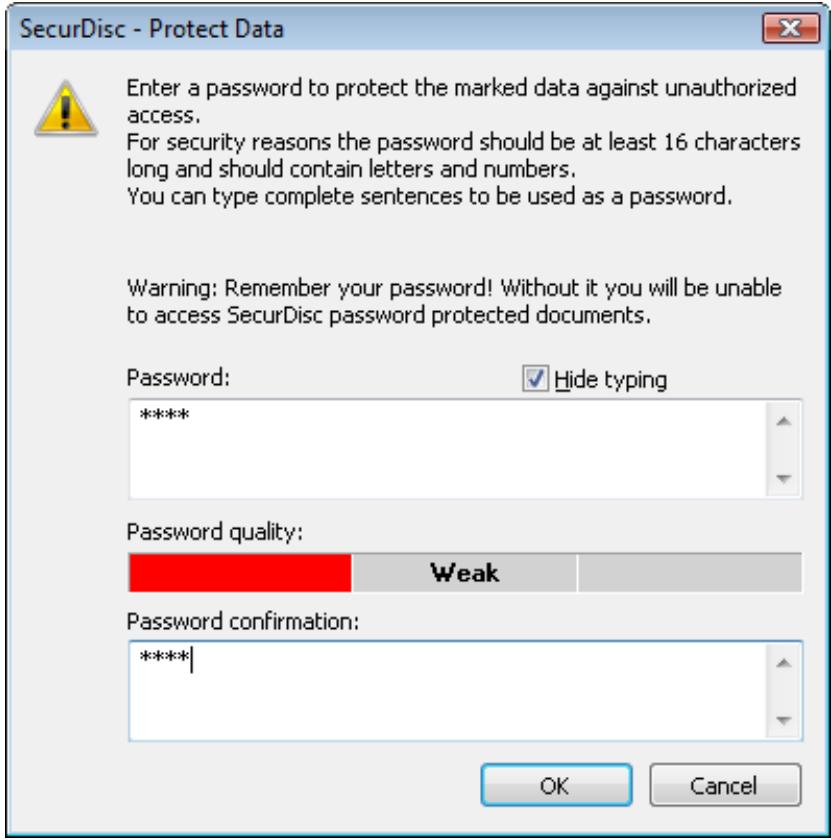
- Enter the desired password in the Password input area and then click the OK button.

When appropriate, a wizard offers suggestions in an additional Tips dialog box when entering and selecting the password. The wizard estimates the security level, i.e. the quality of the password, during entry.

You can selectively enable the password protection for individual files by marking the desired file in the compilation screen and clicking the Protect button.
-
If you want to sign the disc with a digital signature:
-
Select the Digital signature check box on the SecurDisc tab.
The SecurDisc - Digital Signature window is opened.
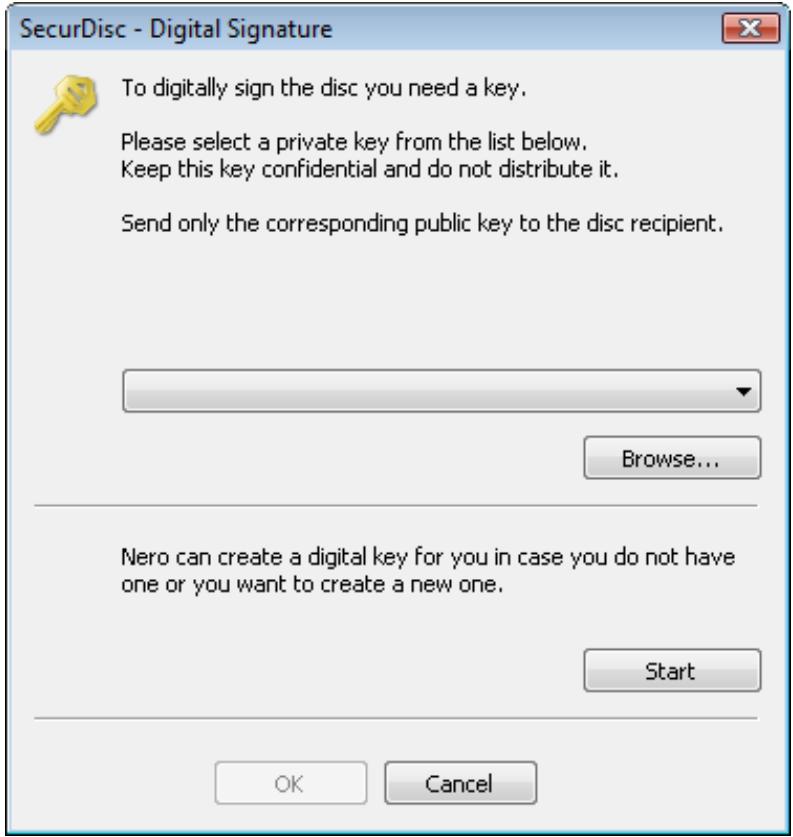
- If you have already created a digital key, click the Browse button and select the key.
- If you want to create a digital key, click the Start button.
The SecurDisc - Create Digital Key window is opened. - Read the instructions and click the Next button.
The SecurDisc Key Creation Process window is opened. - Move your mouse at random until the creation process is complete.
You can monitor the status of the creation process using the progress bar. The Next button is enabled as soon as the process is complete. - Click the Next button.
The SecurDisc - Key Creation Completed window is opened. - Enter a file name for the key you have created and click the Finish button.
The SecurDisc - Digital Signature window is opened again and the selected key appears in the drop-down menu. - Click the OK button.
The corresponding window is opened to inform you that the disc is being digitally signed with the selected key. - Click the OK button.

You can pass on the relevant public key to recipients to enable them to verify the signature.
- If you want to copy-protect PDF files, select the Copy protection check box on the SecurDisc tab.
All PDF files are copy-protected. The check box Disable copy protection by password is displayed.
-
If you want to permit duplication of the copy-protected data after entering a password:
-
Select the Disable copy protection by password check box.
The SecurDisc - Allow Duplication by Password window is opened.
-
Enter the desired password in the Password input area and then click the OK button.
-
If you want to enhance the burning speed by limiting the data redundancy or to configure the data redundancy:
-
Select the Limit data redundancy check box on the SecurDisc tab.
The Number of redundancies field is enabled.
- Select the desired redundancy level.

If the Limit data redundancy check box is disabled, the disc will be filled completely with copies of the chosen data and checksums. A display panel in the compilation screen indicates the current redundancy level.

A redundancy level of 1,3 means no redundancy and a redundancy level of 9 means excellent redundancy.
We recommend a redundancy level of at least 2,5.
You have enabled SecurDisc settings according to your requirements and can now burn the CD/DVD.
5.3 Defining Options
5.3.1 Multisession Settings
The Multisession tab provides the option to create multisession discs for data discs. Multisession discs can be burned in multiple sessions until you have reached the maximum disc capacity. A session is a self-contained data area that is burned using a single process, and consists of a lead-in (with the table of contents), one or more tracks, and a lead-out. Discs without the multisession option, e.g. Audio CDs, are burned in a single session.
If a new multisession disc is being started, Nero Burning ROM also saves (if possible) the point of origin for the files. This information is used when continuing the multisession disc. If a multisession disc is being continued, Nero Burning ROM automatically sets a cross reference to the imported session, i.e. the table of contents for the imported session is copied to the table of contents for the current session. You must define which session is being imported at the start of the burn process. The files in the previous sessions are retained and continue to take up space.
In this case Nero Burning ROM automatically verifies whether the correct multisession disc has been inserted for continuation. If not, the disc is ejected.

If you disable the Finalize disc check box on the Burn tab, you can always burn additional sessions on the disc, but then only the last session will be visible and you will only be able to access data from the final session.

Multisession disc
Multisession discs are particularly suitable for backing up important files burned on a regular basis.
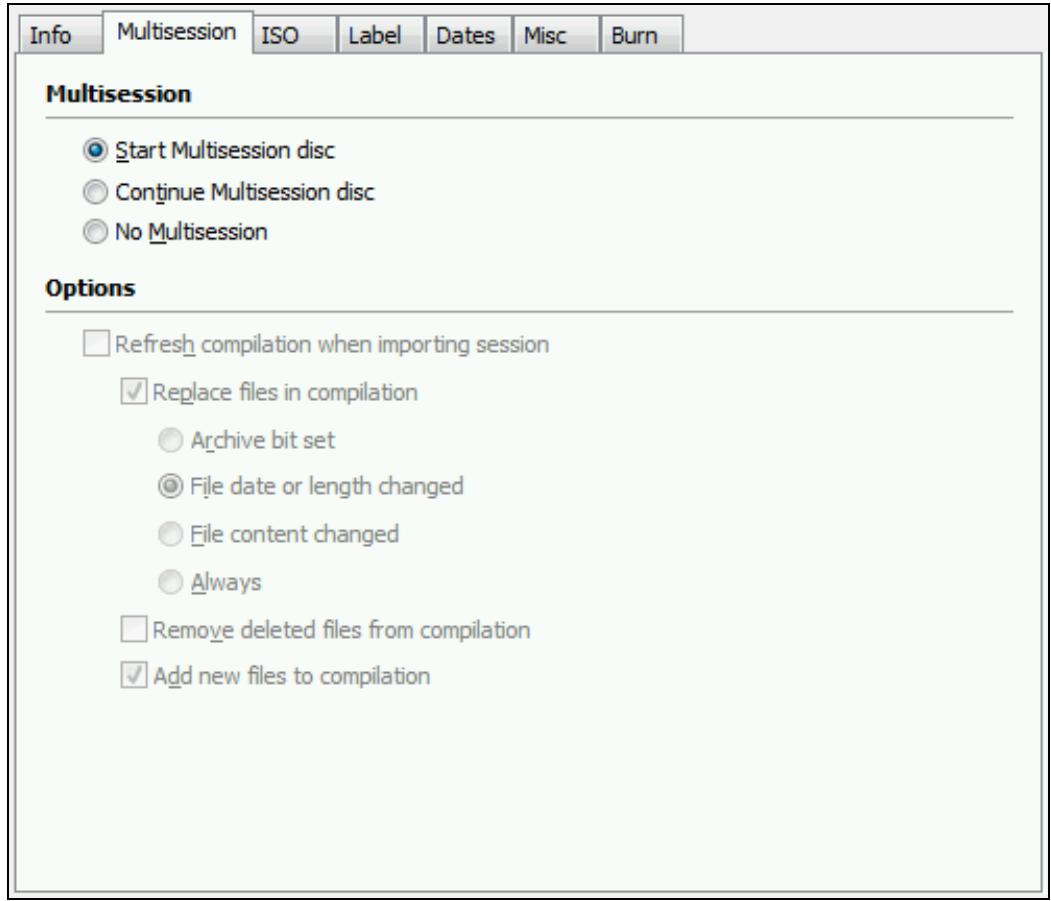
Multisession Tab
The following configuration options are available on the Multisession tab in the Multisession area:
| Option button Start Multisession disc | Burns the selected compilation in one session to the disc. If the disc already contains sessions, you can also select this option. Sessions are then not imported and cross references are not set. |
| Option button Continue Multisession disc | Continues a multisession disc by burning an additional session to a disc with at least one session. Cross references to the imported session are set in the process. |
| Option button No Multisession | Creates a disc without a multisession. |
5.3.2 ISO Settings
The ISO tab provides options for configuring the ISO file system.
ISO 9660 is a system-independent standard. It can be read on all operating systems. The following features apply:
Permits eight characters (Level 1) or 31 characters (Level 2) for the file name.
Permits eight characters for the folder name.
- Restricts the maximum directory depth to eight levels (including root folder).
The characters A-Z, 0-9 and the underscore (_ are permitted.
In the ISO tab, in the area Relax Restriction, the restrictions imposed by the selected file system can be relaxed. For example, you can allow a higher path level or more than 64 characters for the Joliet name.

If it is to be possible to read the disc on all operating systems, select ISO 9660 as the file system and uncheck all boxes in the Relax restrictions area.
An advisory message appears in the ISO tab in the Information area if the disc cannot be read on all operating systems.

If the disc is to be used mainly on Windows computers and you want to use lowercase letters and foreign language characters for the file names, select ISO 9660 + Joliet as the file system.
The following setting options are available on the ISO tab in the Data and File areas:
| Drop-down menu Data mode | Selects the mode for the data. Mode 1 and Mode 2/XA are available. Newer drives can easily read Mode 1 and Mode 2/XA CDs. However, some older drives cannot read Mode 1 discs correctly. In the case that the disc is to be able to be read in any case on older drives, select the Mode 2/XA format. |
| Drop-down menu File system | Selects the file system that is used for the data. ISO 9660 only and ISO 9660 + Joliet are available. ISO 9660 only: ISO format alone is used. ISO 9660 + Joliet: ISO format is used and is enhanced by the Joliet standard. |
| Drop-down menu Length of file name | Defines the possible length of the file name. Level 1 and Level 2 are available. In level 1 the file name can be eight characters long and the file name extension (e.g. *.doc) three characters. In level 2 the file name can be 31 characters long. |
| Drop-down menu Character set | Defines the font used. |
5.3.3 UDF Settings
The UDF tab provides options for configuring the UDF file system. The UDF standard was developed by Osta (Optical Storage Technology Association) in response to the requirements of DVDs. The standard works on all platforms.
The following setting options are available in the Options drop-down menu:
| Entry Automatic Settings | Sets options automatically for the UDF file system. We recommend that you select this entry. |
| Entry Manual Settings | Enables you to manually define the UDF partition type and the file system version. |
| Entry Enable Xbox compatibility mode | Creates a disc that is compatible with Xbox. This entry is available if the No Multisession option button is selected on the Multisession tab. |

A disc that is compatible with Xbox cannot be created as a multisession disc.
5.4 Saving Data Track
With Nero Burning ROM you can save a data disc as an image file. The image file can later be burned to a recordable disc. The result is a copy of the original data disc.
To save the data disc as an image file, proceed as follows:
- Insert the data disc in a drive.
- Click the Extras > Save data tracks menu.
The Select Track window is opened. The tracklist shows you the sessions and data tracks that are found on the disc. Due to the technical reasons, only the first data track of the first session can be saved.

Select Track
- Select the first data track.
- Click the Save Track button.
The Save As window is opened.
- Select a file name and a storage location.
- In the Save As drop-down menu, select the desired output format (ISO or NRG) for the image file.
- Click the Start button.
The Progress window is opened and displays the progress made while saving. When the save process is complete, the window is closed automatically.
You have successfully created an image file starting from a data disc. Now you can burn the image file to a disc.
5.5 Check Point Media Encryption CD/DVD
With Nero Burning ROM and Check Point Media Encryption you can create discs with special encryption security protection.

This feature is only available if all of the following requirements are fulfilled:
(1) Check Point Endpoint Security Media Encryption, version R73 or later, is installed on your computer.
(2) You are allowed to create Check Point Media Encryption CD/DVDs.
(3) You have a special serial number.
The procedure for compiling and burning a Check Point Media Encryption disc is basically the same as the procedure for compiling and burning data discs. Be sure to select the CD/DVD-ROM (Check Point) entry in the New Compilation window.
When starting the burn process, a window, which originates from Check Point Media Encryption, will be opened. After entering security information, e.g. a password for encryption as defined in your Check Point Media Encryption settings, Check Point Media Encryption then encrypts the data. When the encryption is finished, the window is closed and Nero Burning ROM continues the burn process. Depending on your Check Point Media Encryption settings, a decryption tool is burned on the disc, allowing another user, who does not have Check Point Media Encryption, to access to the data by entering the password.

The encryption of the data does not take place in Nero Burning ROM. Nero AG is not responsible for the data encryption and the decryption tool. These features are provided by Check Point Software Technologies.
6 Audio CD And Audio Files
6.1 Compiling Audio CDs
Using Nero Burning ROM you can create an Audio CD that contains music files. It can be played using all standard CD players. To compile an Audio CD, source files with different audio formats (e.g. MP4, MP3 or WMA) are automatically converted into Audio CD format before being burned.

Some CD players cannot play CD-RWs. Use CD-R discs to burn Audio CDs.
To create an Audio CD, proceed as follows:
- Select the CD entry from the drop-down menu in the New Compilation window. (In the case that the New Compilation window is not opened, it can be opened by clicking the New button on the main screen.)
- Select the Audio CD compilation type from the selection list.
The tabs with the configuration options that are valid for this compilation type are displayed.
- Click the New button.
The New Compilation window is closed and the selection screen is displayed. - Select the audio files that you want to burn from the browser area on the right side. The audio file can come from the hard drive or from an Audio CD. You can also choose an M3U playlist as a source.
- Drag the desired audio files into the compilation area on the left side.
The files are added to the compilation and displayed in the compilation screen. The capacity bar indicates how much space is required on the disc.
- Repeat the previous step for all audio files that you want to add.
- Customize the properties of the audio file to suit your requirements.
- Click the Burn button.
The Burn Compilation window is opened.
- Set the desired options in the Audio CD and CD-DA Options tabs.
You have successfully compiled an Audio CD and can now burn this compilation or change the audio file properties first.
See also:
Selection Screen 16
6.1.1 Customizing Properties of The Audio File
You can display and/or make changes to the audio file properties on the Track Properties, Indexes, Limits, Splits and Filters tabs of the Audio Track Properties window. To open the window, mark an audio file in the compilation screen for Audio CDs and click the Edit > Properties menu.
6.1.1.1 Track Properties Tab
On the Track Properties tab you will find basic information on the selected file in the Source information area.
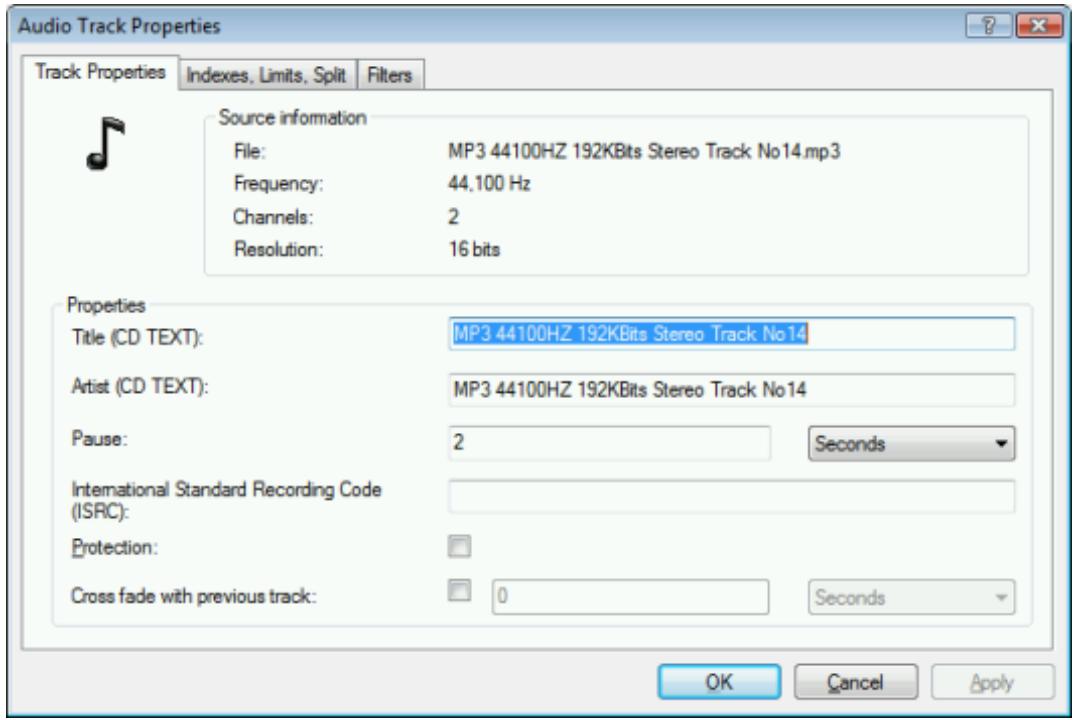
Track Properties Tab
The following input areas are available in the Properties area:
| Input field Title (CD TEXT) | Defines a title which is saved as CD text. CD players that support CD Text show the title name entered here. |
| Input field Artist (CD TEXT) | Defines the artist which is saved as CD Text. CD players that support CD Text show the artist's name entered here. |
| Input field Pause | Defines the length of the pause in seconds or frames between the selected audio file and the next one. |
| Input field International Standard Re- cording Code (ISRC) | Identifies the CD title using a 12-character digital code. The ISRC is entered in the subcode and included silently. If you do not know the ISRC, you should leave this input field blank. |
| Check box Copy protection | Enables copy protection. |
| Check box Cross fade with previous track | Defines a crossfade between this and the previous audio file. You can specify the length of the crossfade in seconds or in sectors. |
6.1.1.2 Indexes, Limits, Split Tab
On the Indexes, Limits, Split tab you can set and delete indexes and split audio files to create two or more shorter ones. The tab consists of the Oscilloscope and Positions areas.
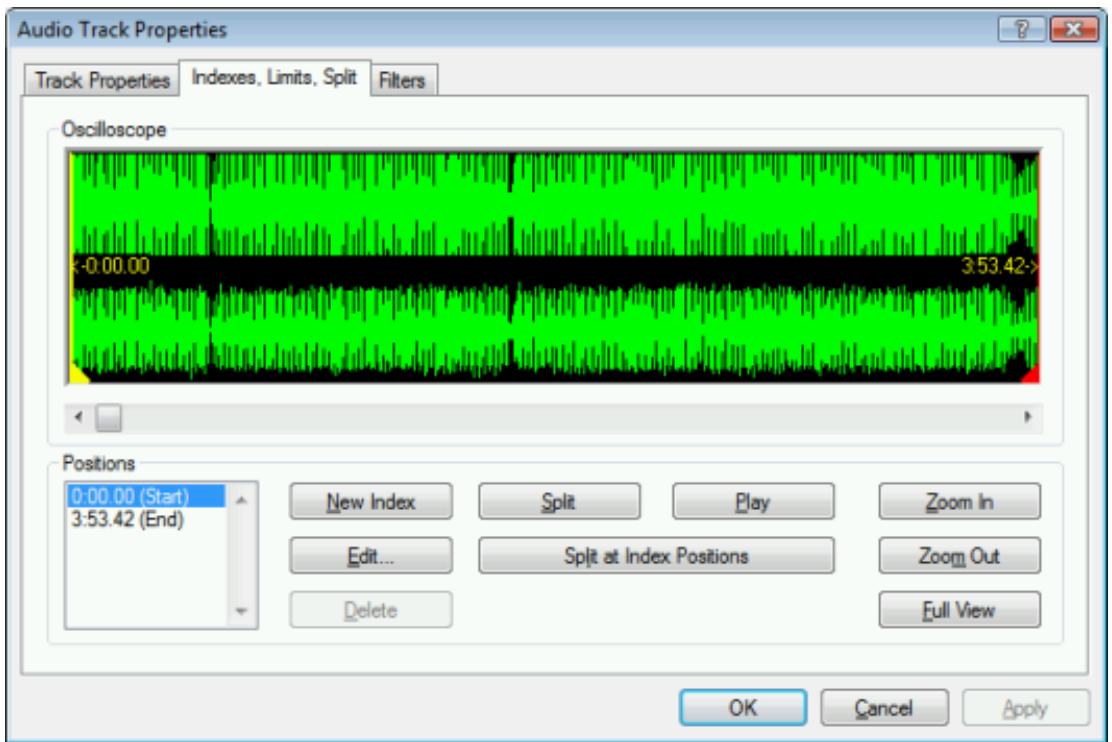
Indexes, Limits, Split Tab
Audio files are displayed graphically in the Oscilloscope area. The following configuration options are available in the Positions area:
| Selection lists Start/End | Shows the positions for the beginning and end of the audio file on the CD. |
| Button New Index | Sets a new index position at the selected position. For the CD play- er this is the position from which a new song starts, and the player can also jump to it directly. However, not all CD players support this feature. |
| Button Edit | Opens the Set Track End dialog box. You can enter the exact position of a split. |
| Button Delete | Deletes a selected index. |
| Button Split | Splits the audio file at the marked position. |
| Button Play | Plays the audio file from the marked position. During playback, the Stop playing button is displayed. |
| Button Stop playing | Stops playback of the audio file. If playback is stopped, the Play button is displayed again. |
| Button Split at Index Posi- tions | Splits the audio file at the set index positions. |
| Button Zoom In | Enlarges the graphical representation of the audio file. |
| Button Zoom Out | Reduces the graphical representation of the audio file. |
| Button Full View | Displays a graphical representation of the entire audio file. |
6.1.1.3 Filters Tab
The Filters tab includes filters that improve or change the quality of the music. The so-called non-destructive procedure is used for processing, i.e. the actual recording is not changed, but flags are simply set that can be canceled at any time. No additional audio data is created. The audio files are not actually changed until they are written.
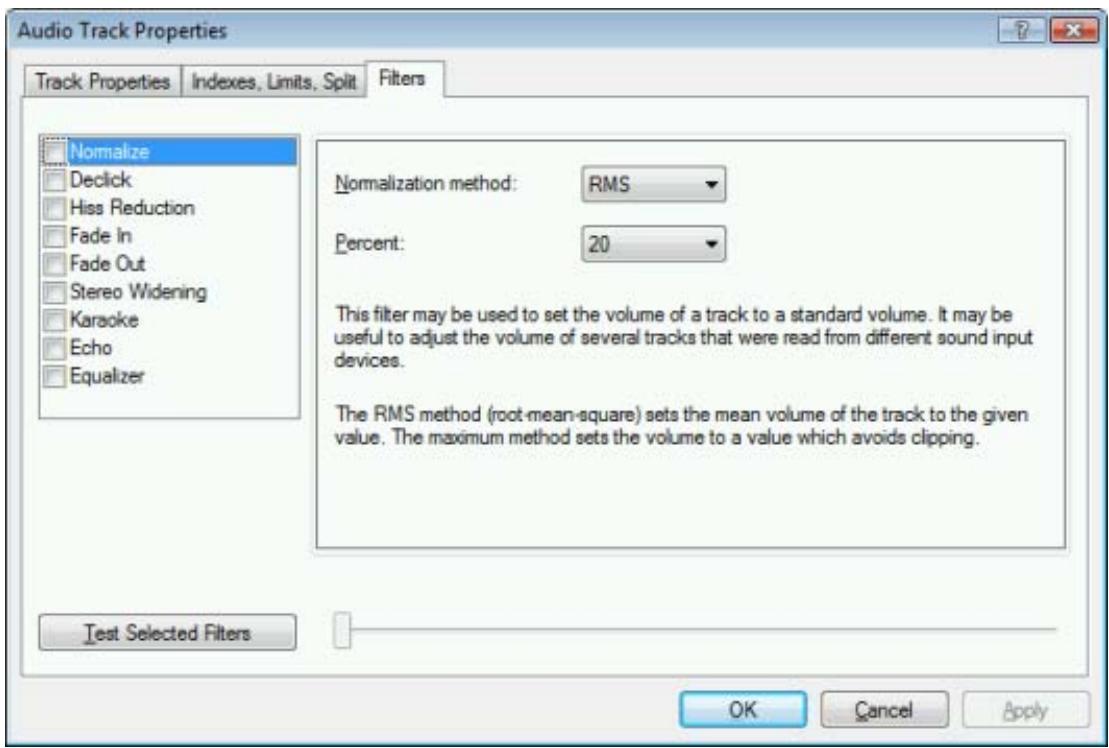
Audio Track Properties window, Filters tab
The following configuration options are available in the Audio Track Properties window:
| Check box Normalize | Sets the volume of an audio file to a preset value. This filter can be useful to bring the volume of files originating from different sources into line with one another. |
| Check box Declick | Removes clicking and scratching noises, such as those on old LPs for example. |
| Check box Hiss Reduction | Reduces or removes the hiss on an audio file. All frequencies below a certain threshold (hiss level) are removed. |
| Check box Fade In | Fades in the volume of an audio file from zero to full volume. This filter can be useful for shortening files. |
| Check box Fade Out | Fades out the volume of an audio file from full volume to silence. This filter can be useful for shortening files. |
| Check box Stereo Widening | Increases/reduces the stereo effect of an audio file. This filter only works if the original file was recorded in stereo. |
| Check box Karaoke | Fades out the vocals on an audio file. This is done by fading out the parts of a song that are the same in both stereo channels. |
| Check box Echo | Adds an echo to the audio file. |
| Check box Equalizer | Opens an equalizer so you can change the volume, bass, and pitch in different frequency ranges. |
| Button Test Selected Filters | Plays the audio file and applies the activated filters. During play-back, the configuration options for the filters can be changed, allowing the effect to be controlled. |
6.1.2 Defining Options
6.1.2.1 Audio CD Settings
The Audio CD tab provides options for setting the Audio CD.
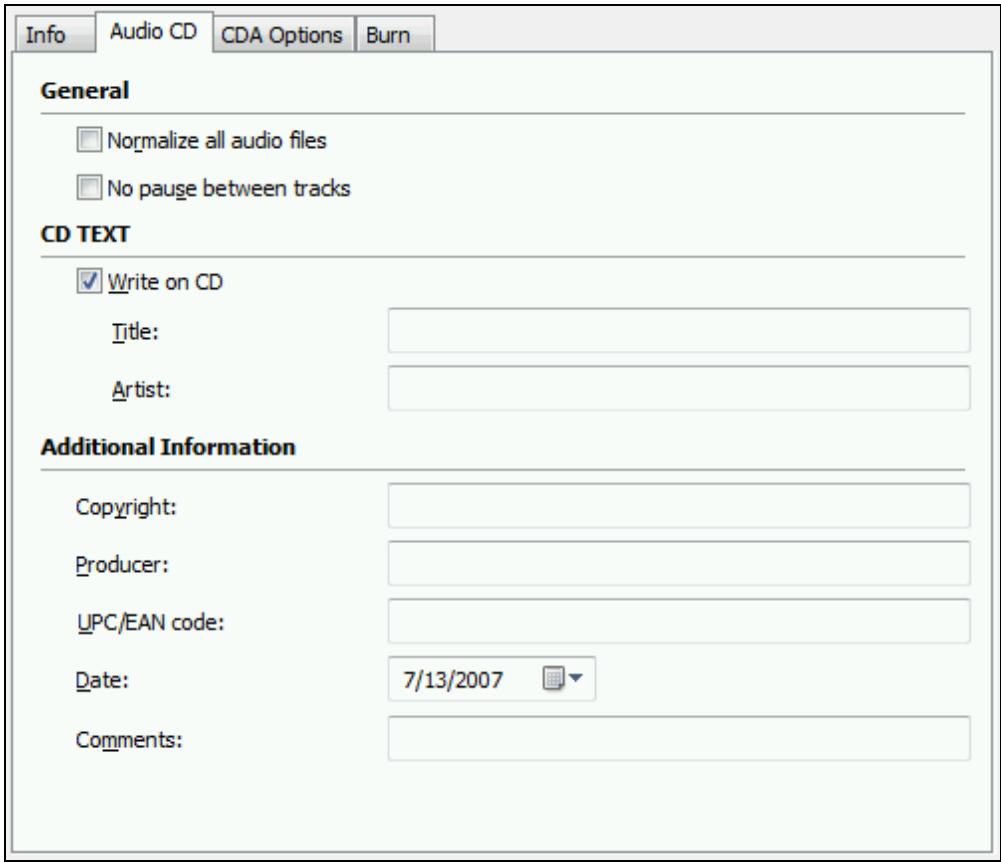
Audio CD Tab
The following configuration options are available on the Audio CD tab in the General area:
| Check box Normalize all audio fi-les | Enables a filter that brings the volume of the audio files to be burned into line with one another. This is particularly recommended if the audio files originate from different sources. |
| Check box No pause between tracks | Allows the audio files to merge into one another on the audio CD without a pause (just like in live recordings). If the check box is cleared, there are pauses of two seconds between the audio files. |
The following configuration options are available on the audio CD tab in the CD Text area:
| Check box Write on CD | Enables the option for writing CD text. With CD players that support CD text, the title of the CD, the name of the audio file as well as the name of the artist appear in the display. |
| Input field Title | Defines the label of the audio CD. |
| Input field Artist | Defines the artist. |
In the Additional Information tab you can enter additional information about the Audio CD such as the producer or comments.
6.1.2.2 CDA Settings
The CDA Options tab provides options for configuring CD-DA files on the Audio CD. The CDA file strategy area allows you to select the strategy that Nero Burning ROM should use for handling selected audio files from a source audio CD. In general there are two methods:
- Read the audio file and store it in the cache temporarily. The Audio CD can be burned in disc-at-once mode, which supports CD Text.
Create a reference to the audio file and read it shortly before burning (track reference). The audio CD can only be burned in track-at-once mode.
The following setting options are available on the CDA Options tab in the CDA File Strategy area:
| Drop down menu entry Diskspace strategy | Saves the audio files temporarily to the Nero Burning ROM cache. If there is no space available, a reference is created to the audio file and is not read until shortly before burning. This entry is selected by default. |
| Drop-down menu entry Tempfile strategy | Saves the audio files temporarily to the Nero Burning ROM cache. If there is no space available, an error message appears. |
| Drop-down menu entry Reference strategy | Creates a reference to the audio file and reads it shortly before burning. The source medium can only be a CD/DVD drive, not a recorder. The disc can only be burned in track-at-once mode. |
| Drop-down menu entry Device dependent strategy | Creates a reference to the audio file if a CD/DVD drive is avail- able. Otherwise the tmpfile strategy is used. |
| Button Info | Displays more detailed information on the CDA file strategy. |
The following setting options are available on the CDA Options tab in the Drive area:
| Selection list Drive | Lists recognized drives and burners. |
| Drop-down menu Read speed | Selects the speed at which the CD is read. |
| Check box Cache track on hard drive before burning | Saves the audio file in the cache before burning. |
The following setting options are available on the CDA Options tab in the Advanced area:
| Check box Remove pause at the end of audio tracks | Removes silence at the end of individual audio files, i.e. music tracks transition smoothly from one to the next. |
6.2 Mixed Mode CD And CD EXTRA
With Nero Burning ROM you can compile CDs that include both audio and data files.
The following compilation methods are available:
Mixed Mode CD
CD EXTRA
A Mixed Mode CD includes the data and the audio files in one session. CD EXTRA includes the audio files in the first session and the data files in the second session.
The procedure for compiling the audio and data files is basically the same as the procedure for compiling data or music CDs. Please be sure to select the corresponding entry in the
New Compilation window. The selection screen includes a compilation area for audio files and one for data files.
See also:
Selection Screen 16
Compiling Audio CDs→ 29
Compiling Data CDs/DVDs 18
6.2.1 CD-Extra Settings
The CD EXTRA tab provides configuration options for albums.
The following information is available in the Info area:
| Display panels | Displays information on the compilation. |
The following configuration options are available in the Album area:
| Input field Album identification | Defines a name for the album. This is particularly useful when the album is to comprise several CDs. |
| Input field Number of volumes in album | Defines the number of discs that the compilation should contain. |
| Input field Album sequence number | Defines the album number of the current disc. |
| Button Pictures | Opens the CD EXTRA Pictures window where you can select the pictures for the front and flipside of the CD and define the picture format. |
The following configuration options are available in the Localization area:
| Display panel Languages | Displays available languages. When you select a language, you can add the title for the album in the Album title text box. Each language can contain a different title. |
| Button Add | Opens the New Language window where you can select a new language from a country list. |
| Button Delete | Deletes the selected language. |
| Input field Album Title | Adds an album title to the language highlighted in the Lan- guages selection list. |
6.3 Compiling an Audio Book CD
With Nero Burning ROM you can compile audio book files and burn them as an audio book CD, i.e. in the form of an Audio CD. You can then play it on any standard CD player. Since audiobooks can play for several hours, Nero Burning ROM saves the audiobook to multiple Audio CDs. During the burn process, you are prompted to insert new blank discs.
The procedure for compiling audio book CDs is basically the same as the procedure for creating an Audio CD.
6.4 Automatic Music Recognition
With Gracenote MusicID Nero Burning ROM can identify music files. So called metadata such as artist, title, and genre are accessed from the Gracenote Media Database and displayed in Nero Burning ROM. The identified metadata is written to the music file and is then available.
Identification is possible for single audio files as well as complete original Audio CDs.
If the metadata of the Audio CD is not yet included in the database then you can enter it and make it available. The metadata is sent to Gracenote and added into the database.
With Gracenote you can have audio files identified out of any sort of compilation. This is particularly useful when audio files are not named or are only partially named. The metadata that is made available by Gracenote is used for the compilation and is written into the audio files. In this way your music collection is correctly tagged with all information.
During the following actions, original Audio CDs can be automatically identified in Nero Burning ROM with Gracenote MusicID.
- Copying Audio CD
Saving Tracks from the Audio CD to Hard Drive

Music recognition technology and related data are provided by Gracenote®. Gracenote is the industry standard in music recognition technology and related content delivery. For more information, please visit www.gracenote.com.
6.4.1 Identifying Audio Files
You can have the added audio files in the music compilations identified with Gracenote and access metadata such as artist and title from the Gracenote Media Database.
To do this, proceed as follows:
- Select the type of compilation to burn a music CD.
The compilation screen is displayed. - Add audio files from the hard drive to the music compilation.
- Select one or more audio files in the compilation.
- Right-click to open the context menu.
- Select the Get Metadata entry.
The audio files are analyzed and the required information is sent to Gracenote. The Edit Metadata window is opened. The metadata received by Gracenote is displayed in the New Info area.
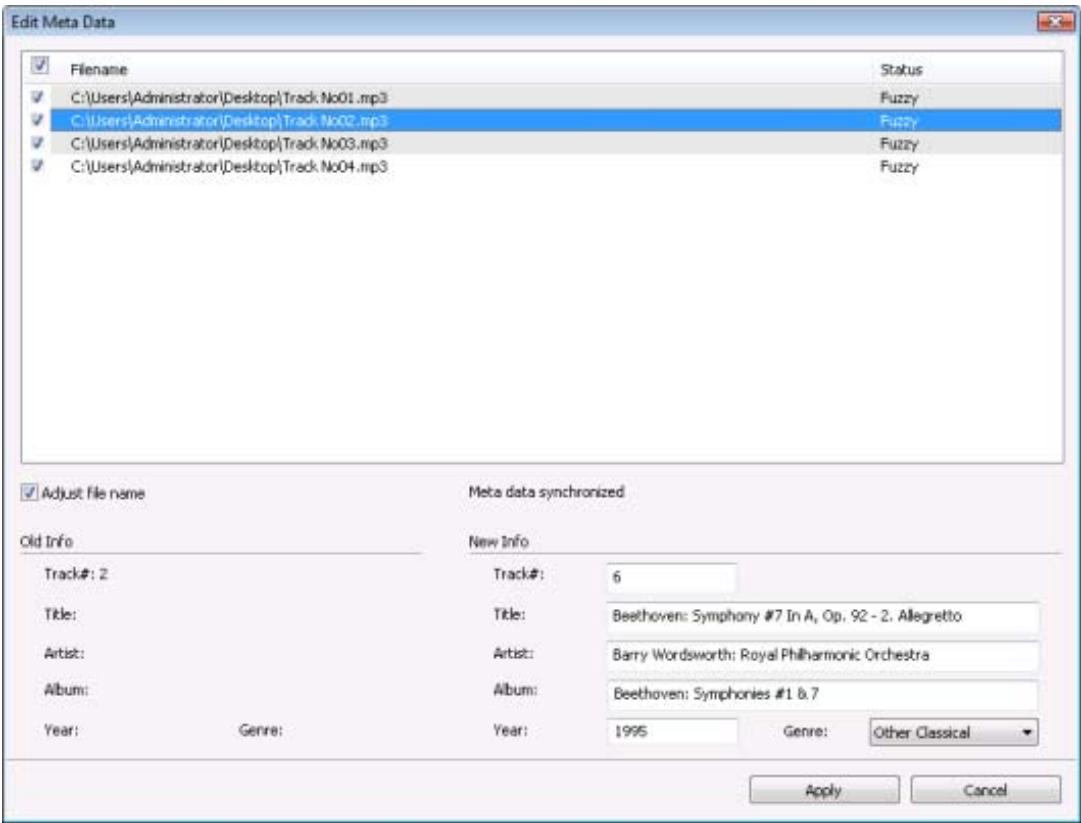
Edit Metadata window
-
If necessary, edit the metadata, e.g. track number, title, artist, album title, year, and genre.
-
Click the Apply button.
The Edit Metadata window is closed.
The metadata is written into the audio file and accordingly shown in Nero Burning ROM.
6.5 Copy Audio CDs to Hard Drive
Using Nero Burning ROM you can save audio files from an Audio CD on the hard drive. In the process, the files are encoded, i.e. converted into a format that the computer can read. The audio file is usually also compressed.
The Audio CD can be automatically identified with Gracenote. So called metadata such as title, genre, and track title are accessed by the Gracenote Media Database and associated to the tracks. That way you have audio files that are accurately and fully named after the encoding process.

Music recognition technology and related data are provided by Gracenote®. Gracenote is the industry standard in music recognition technology and related content delivery. For more information, please visit www.gracenote.com.

Audio files from copy-protected Audio CDs cannot be saved.
To save audio files, proceed as follows:
- Click the Extras > Save Audio Tracks menu.
The Save Audio Tracks to Hard Drive window is opened.
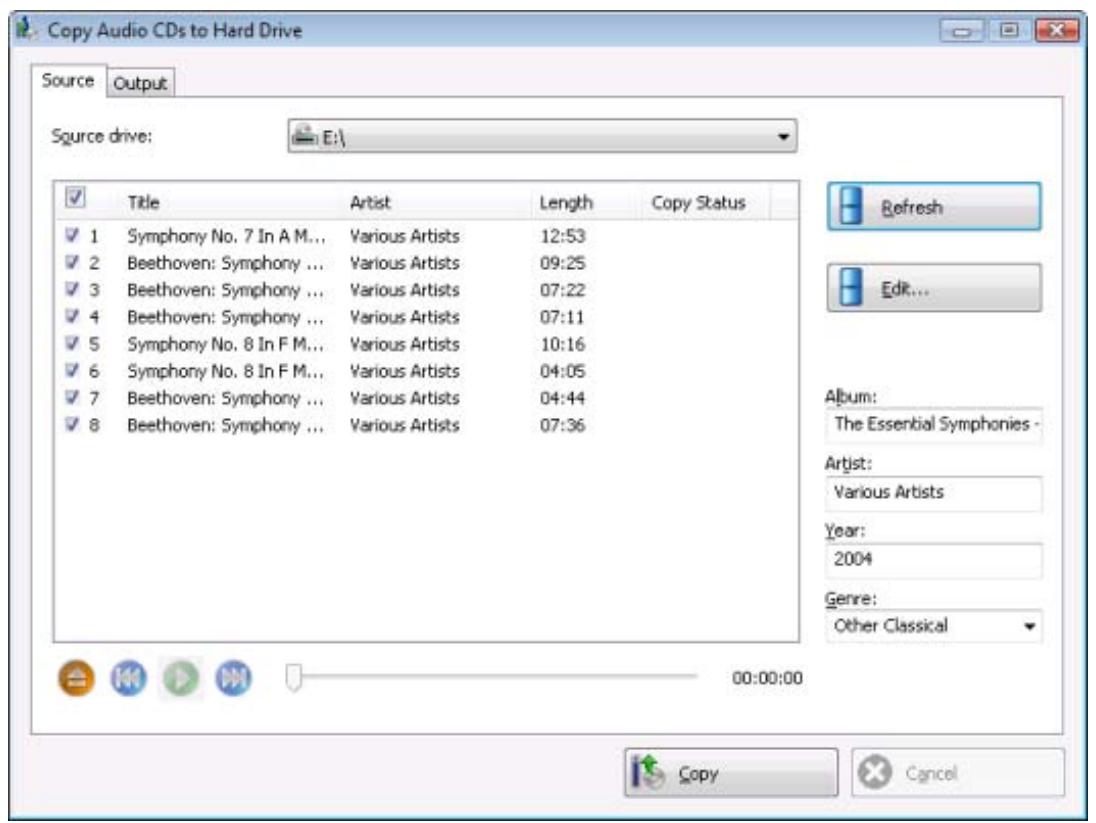
Copy Audio CDs to Hard Drive
- Insert your Audio CD into a drive.
The disc is being analyzed and the required information is sent to Gracenote. If an exact matching entry is found in the Gracenote Media Database then that metadata will be used and displayed.
If several entries are found then the Matches window opens and the metadata-records in question are displayed.
-
Select the metadata-record that matches your Audio CD.
-
Click the Send New Data button if none of the metadata records match your Audio CD.
The Edit Metadata window is opened.
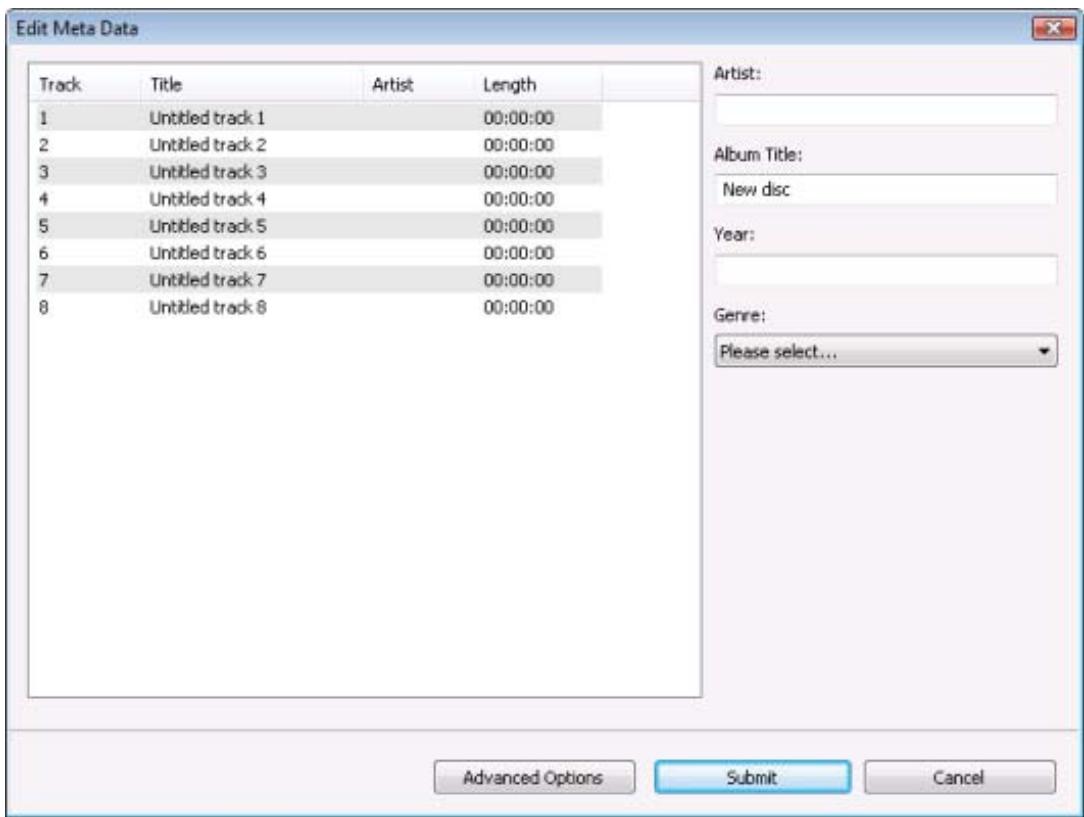
Edit Metadata

The Edit Metadata window also opens if no matching entry is found in the database but you want to enter the metadata and make it available.
- If necessary, edit the metadata such as title, artist, album title, year, or genre.
- Click the Advanced Options button if you want to add additional information.
The Gracenote MusicID Information window, which originates from Gracenote, opens. After entering the additional information you have to close this window so that the Edit Metadata window is displayed again.
- Click the Submit Data button.
If you have changed the Audio CD's metadata or filled them in for the first time then the changes are sent to Gracenote and entered into the Gracenote Media Database after having been checked.
The Edit Metadata window is closed and the information is passed on to the Save Audio Tracks to Hard Drive window.
- Select the tracks that you want to save on the hard drive.
-
Click the Output tab.
The Output tab is opened. -
In the File Format drop-down menu, select the target file's audio format.
-
Choose a method for creating the file name in the Mode for Creating File Names dropdown menu.
- Define other settings according to your preferences.
- Click the Copy button.
Conversion starts. A folder with the album name is created in the desired directory. The audio files are saved in this folder and named according to the method you chose. Metadata that is identified with Gracenote is written into the audio file.
The Progress window indicates the saving progress. When the save process is complete, this window is closed automatically.
- Click the Close button.
The Save Audio Tracks to Hard Drive window is closed. You have saved audio files.
6.5.1 Save Audio Tracks to Hard Drive Window
Define the settings for audio files to be saved to the hard drive in the Save Audio Tracks to Hard Drive window. The window is opened by clicking the Extras > Save Audio Tracks menu.
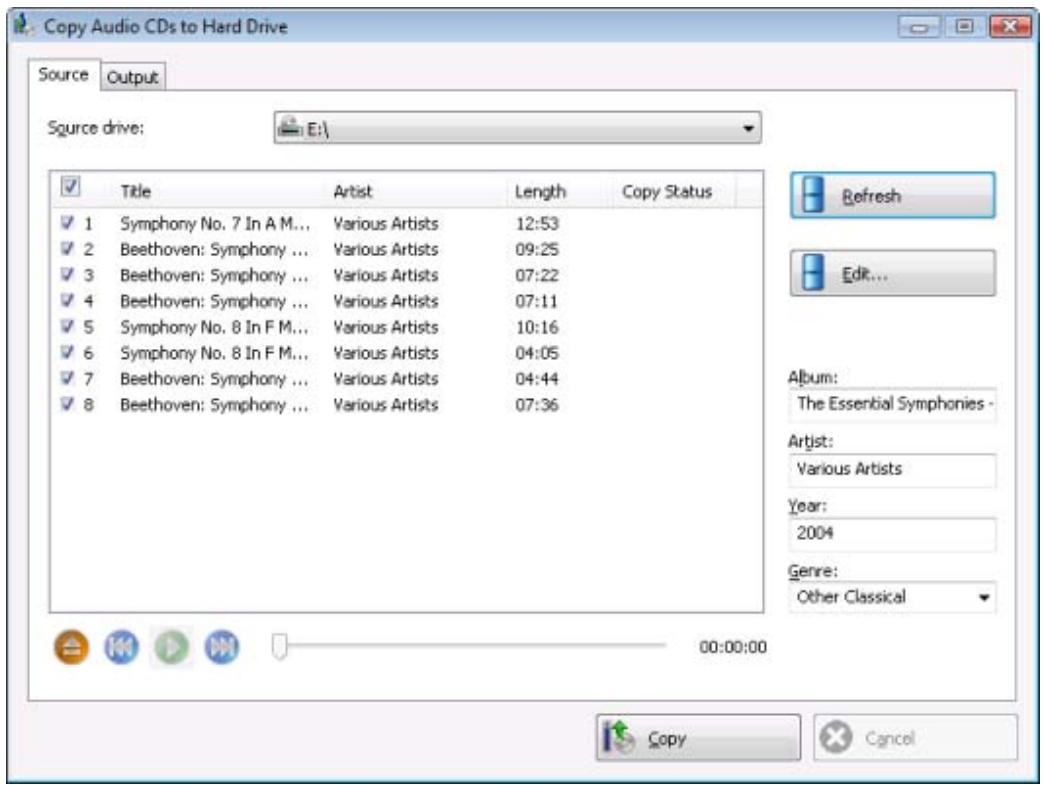
Save Audio Tracks to Hard Drive - Source
The following setting options are available:
| Tab Source | Specifies settings for the source of the audio files. |
| Tab Output | Sets output files configuration options. |
| Button Copy | Starts the copy or save process. |
6.5.1.1 Source Tab
The Source tab displays the audio files on the Audio CD. The functions of the control buttons correspond to the familiar control buttons on CD players.
The following setting options are available:
| Drop-down menu Source drive | Selects the drive where the Audio CD is inserted. |
| Title Selection List | Displays the tracks on the Audio CD. You can select individual tracks to copy by selecting the respective check box. |
| ButtonRefresh | Sends a new query to the Gracenote Media Database and completes the Audio CD's metadata including artist, title name, and genre if a matching entry exists in the database. |
| ButtonEdit | Opens the Edit Meta Data window. Here, you can edit the Audio CD metadata sent by Gracenote. You can enter the metadata if no entry for your Audio CD exists in the Gracenote Media Database. This metadata is sent to Gracenote, and added to the Gracenote Media Database. |
| Input fields Album/Artist/Year | Displays or specifies metadata for the album, artist and year. |
| Selection list Genre | Displays or specifies the genre. |
6.5.1.2 Output Tab
You can define the properties of the audio files to be created on the Output tab.
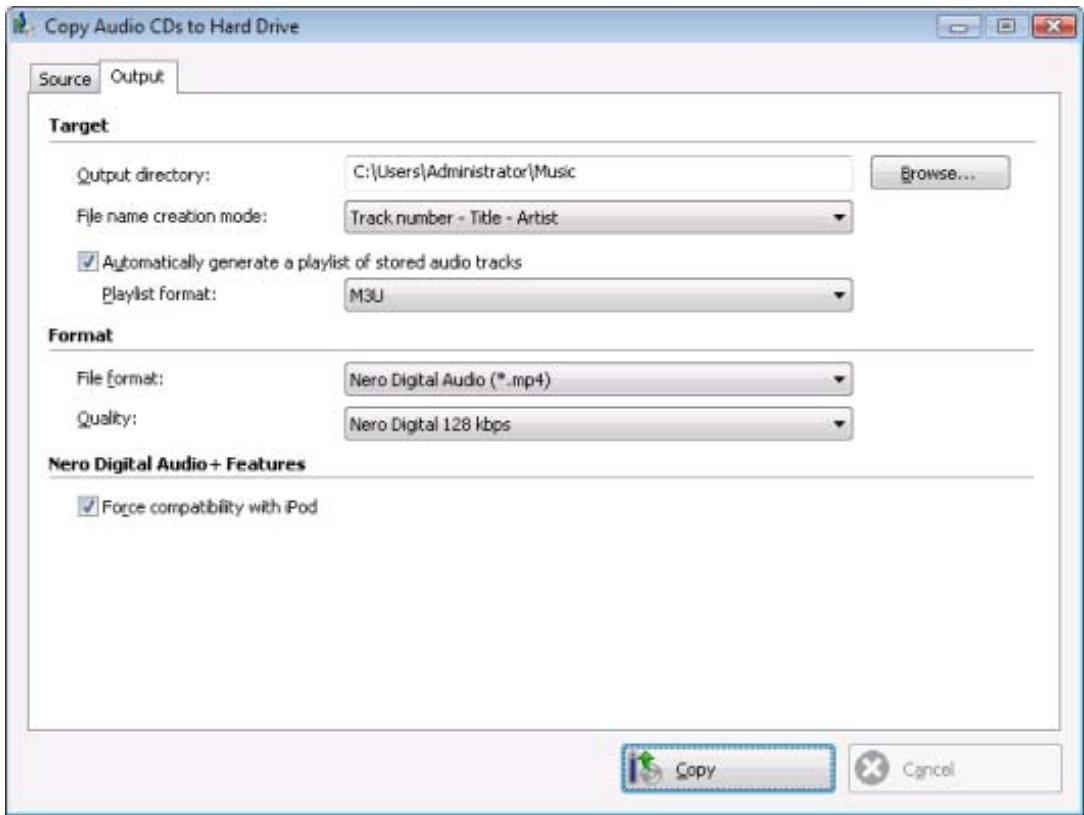
Copy Audio CDs to Hard Drive - Output
The following setting options are available:
| Input window Output directory | Selects the storage location for the output file. |
| Button Browse | Opens a browser window where you can select a storage location. |
| Drop-down menu Mode for creating file name | Selects the method to be used for creating the name of the output file. |
| Check box Automatically ge- nerate a playlist of stored audio tracks | Creates a playlist of the saved audio files. |
| Drop-down menu Playlist format | Selects a format for the playlist. |
| Drop-down menu File format | Selects the output audio format for the selected audio file. The se- lected file format is available as the first entry the next time it is cal- led up. You can choose between Nero Digital Audio, MP3 Audio or WAVE. |
| Drop-down menu Quality | Selects the bitrate for the selected audio file format. If the bit rate is small, less data is transferred. The file is then small, but quality is lower. If the bit rate is high, more data is transferred. The file size is then large, but the quality is high. A value of 128 for MP3 files is near CD quality. For the MP3 Audio file format you can also select if you want to create an MP3 file or an mp3PRO file. Only available if you selected the Nero Digital Audio or MP3 Au- dio file format. |
| Check box Force compatibil- ity with iPod | Makes Nero Digital Audio+ available for an iPod. Is only available if you selected the Nero Digital Audio + output format. |
6.6 Convert Audio File Format
With Nero Burning ROM you can convert an audio file into another format, i.e. transcode the audio file (e.g. from WAV to MP3).
The following formats are usually available (available formats may depend on the source format):
AC3: You can specify the bit rate for this audio format
AIFF: See Encoding Options AIFF 47
FLAC: It is not necessary to specify any settings for this lossless audio format
MP3 (Lame Encoder): See Encoding Options MP3→ 47
MP3/mp3PRO: See Encoding Options MP3/mp3PRO→ 48
Nero Digital Audio: See Encoding Options Nero Digital Audio 50
- OGG: See Encoding Options OGG 52
WAV: See Encoding Options WAV→ 47
WMA: You can set different profiles for this audio format
6.6.1 Encode Files Window
In the Encode Files window, the audio files that are to be encoded are selected and the properties for the output defined. You can open the window via the Extras > Encode Files menu. The window consists of a selection area and the Properties area.
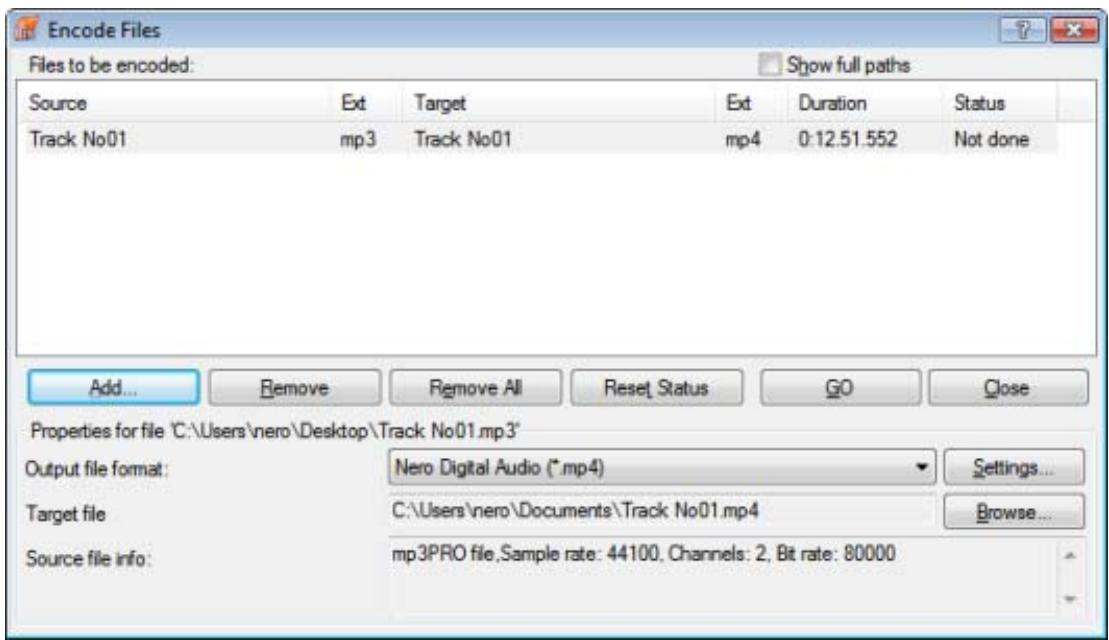
Encode Files Window
The following configuration options are available in the selection area:
| List Files to be encoded | Displays the selected files. |
| Check box Show full paths | Displays the full source and destination paths for the files in the Files to be encoded list. |
| Button Add | Opens the browser window where you can select a file to add it to the list of files to be encoded. |
| Button Delete | Removes the selected file. |
| Button Remove All | Removes all files from the list of Files to be encoded. |
| Button Reset Status | Reset the status of the selected file to do. |
| Button Start | Starts the encode process. |
| Button Close | Closes the window. |
The following configuration options are available in the Properties area:
| Output file drop-down menu | Selects the output audio format for the selected audio file. |
| Button Settings | Opens a window where you can define options such as bit rate and frequency for the output audio file. |
| Display panel Target file/Target directory | Displays the storage location of the output file or output files. |
| Button Browse | Opens a browser window where you can select a storage location. |
| Display panel Source file info | Displays information on the selected audio file. |
6.6.1.1 AIF And WAV Encoding Options
Nero Burning ROM can encode audio files of an Audio CD in AllF or WAV formats. Set options in the AIFF/Wave window that you can open in the Encode Files window via the Settings button. Ensure that you have selected AIFF or Wave as the Output file format.
The following setting options are available in the AIFF or Wave window:
| Drop-down menu Frequency | Specifies the scan rate per second and thus determines the frequency of scanning. The higher the frequency, the more frequently scanned. |
| Drop-down menu Bits | Specifies the scan accuracy and thus determines the quality of the individual scanner. The higher the bit sign, the more accurate. |
| Drop-down menu Channels | Specifies which channels are recorded. |
6.6.1.2 MP3 Lame Encoding Options
With Nero Burning ROM you can encode audio files of an Audio CD in MP3 formats using the Lame Codec. Set these options in the MP3 Settings window that you can open in the Encode files window via the Settings button. Ensure that you have selected Lame MP3 Encoder as the Output file format.
The following encoding options are available in the Settings area:
| Drop-down menu Constant Bit Rate | Selects a constant bit rate, i.e. the data flow per unit of time and the quality of the saved data are the same over the entire audio file. If the bit rate is small, less data is transferred. The file is then small, but quality is lower. If the bit rate is high, more data is transferred. The file size is then large, but the quality is high. The default value of 128 for MP3 files is near CD quality. |
| Drop-down menu Variable Bit Rate | Selects variable bit rate, i.e. the data flow per unit of time - and thus the quantity of the saved data - adapts to the dynamics of the audio file. The bit rate, for example, can be lowered at quieter points in the track. Select your desired quality level in the drop-down menu. |
The following encoding options are available in the Expert settings area:
| Drop-down menu Encoding quality | Specifies the encoder quality. These settings specify whether you place more value on fast encoding (lowest/fastest) or more value on a superior psychoacoustic encoder model for the very best results (highest/slowest). |
| Check box Original bit | Sets the original bit in the music file, which differentiates between the copy and the original. Check box selected: Original bit = 1, i.e. original. Check box cleared: Original bit = 0, i.e. copy. |
| Check box Private bit | Sets the private bit in the music file. It is reserved for the user and is only used for informational purposes. |
| Check box Copyright bit | Sets the copyright bit in the music file, which identifies protected content. Check box selected: Copyright bit = 1, i.e. protected. Check box cleared: Copyright bit = 0, i.e. unprotected. |
| Check box Write CRC | Also sets a checksum in the music file to ensure that transfer errors are detected. |
6.6.1.3 MP3 And MP3PRO Encoding Options
With Nero Burning ROM you can encode audio files of an Audio CD in MP3 and MP3PRO formats. Set these options in the MP3PRO window that you can open in the Encode files window via the Settings button. Ensure that you have selected MP3/MP3PRO as the Output file format.
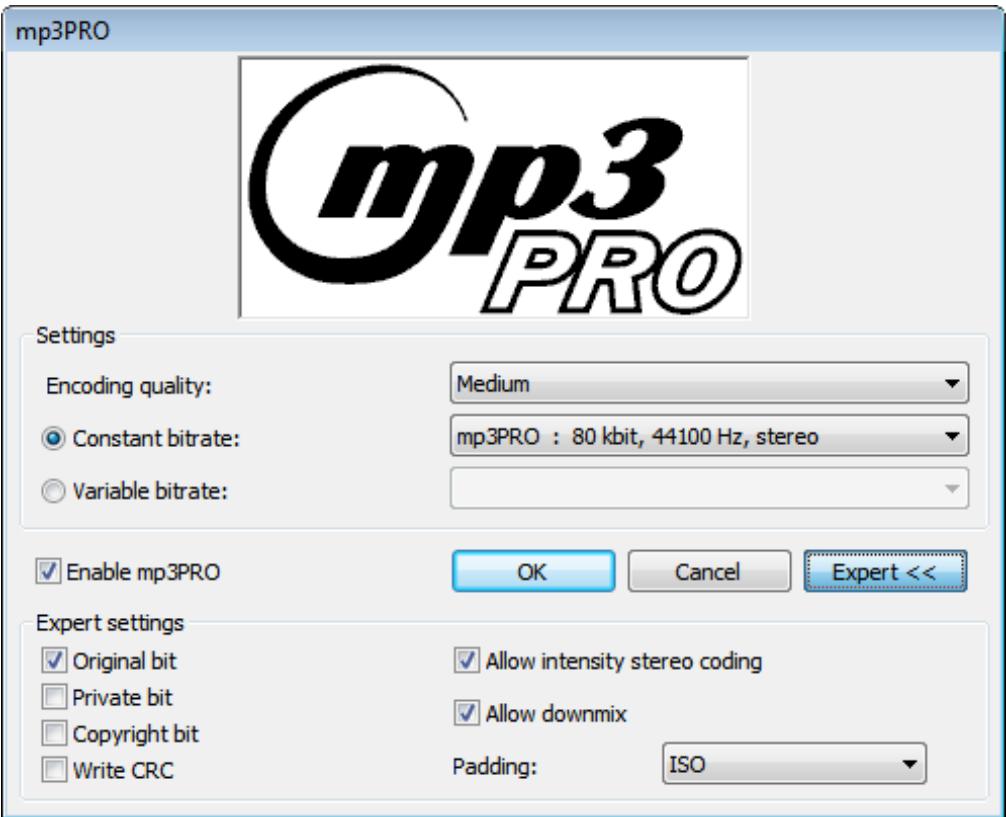
MP3PRO window
The following encoding options are available in the Settings area:
| Drop-down menuEncoder quality | Specifies the encoder quality. Fast, Medium and Highest are available. These settings specify whether you place more value on fast encoding (Fast) or more value on a superior psycho-acoustic encoder model for the very best results (Highest). |
| Check boxConstant Bit Rate | Selects a constant bit rate, i.e. the data flow per unit of time and the quality of the saved data are the same over the entire audio file. If the bit rate is small, less data is transferred. The file is then small, but quality is lower. If the bit rate is high, more data is transferred. The file size is then large, but the quality is high. The default value of 128 for MP3 files is near CD quality.In the drop-down menu, select the Options that affect the bit rate: scan rate per second in kBit, scan frequency per second in Hertz and the channels. |
| Check boxVariable Bit Rate | Selects variable bit rate, i.e. the data flow per unit of time - and thus the quantity of the saved data - adapts to the dynamics of the audio file. The bit rate, for example, can be lowered at quieter points in the track.Select your desired quality level in the drop-down menu. |
The following encoding options are available:
| Check box Enable MP3PRO | Specifies the encoder method used. If you select the check box, an MP3PRO file is created (.mp3 file extension).If you clear the check box, an MP3 file is created (also *.mp3 file extension). |
| Button Expert | Opens the advanced area where you can configure Expert Fea-tures. |
The following encoding options are available in the Expert Features area:
| Check box Original bit | Sets the original bit in the music file, which differentiates between the copy and the original. Check box selected: Original bit = 1, i.e. original. Check box cleared: Original bit = 0, i.e. copy. |
| Check box Private bit | Sets the private bit in the music file. It is reserved for the user and is only used for informational purposes. |
| Check box Copyright bit | Sets the copyright bit in the music file, which identifies protected content. Check box selected: Copyright bit = 1, i.e. protected. Check box cleared: Copyright bit = 0, i.e. unprotected. |
| Check box Write CRC | Also sets a checksum in the music file to ensure that transfer errors are detected. |
| Check box Allow intensity stereo coding | Uses a special codec at high frequencies that only saves the directional information and volume. |
| Check box Allow downmix | Mixes two stereo channels down to one mono signal. This option is useful when the output data is of such poor quality that a poor stereo signal is to be expected. An increase in quality is expected when downmixing to mono. |
| Drop-down menu Padding | Selects a padding type for MP3 blocks. We recommend padding type ISO that pads MP3 blocks according to the ISO specification. |
6.6.1.4 Nero Digital Encoding Options
Nero Burning ROM can encode audio files of an Audio CD in the Nero Digital Audio format. Set options in the Nero AAC Encoder Settings window that you can open in the Encode Files window via the Settings button. Ensure that you have selected Nero Digital Audio as the Output file format.
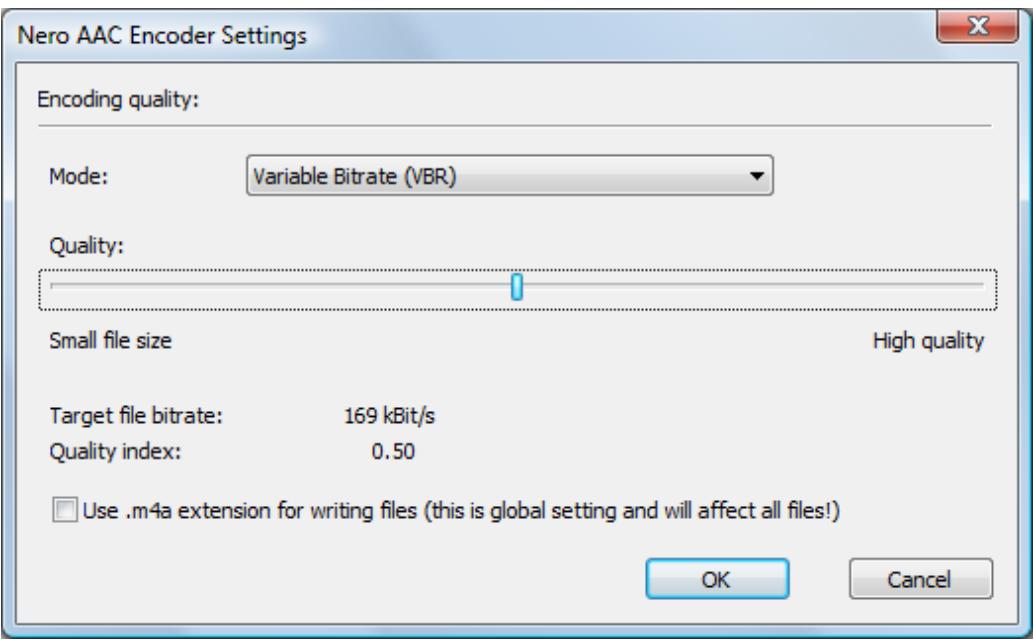
Nero AAC Encoder Settings
The following setting options are available in the Nero AAC Encoder Settings window:
| Drop-down menu entry Variable Bitrate | Specifies a variable bit rate, i.e. the data flow per unit of time and thus the quantity of the saved data adapts to the dynamics of the audio file. The bit rate, for example, can be lowered at quieter points in the track. You can set the variable bit rate between 0 and 100. 0 means the lowest, 100 the highest quality. |
| Drop-down menu entry Average Bitrate | Specifies an average bit rate, i.e. the data flow per unit of time and thus the quantity of the saved data adapts to the dynamics of the audio file but the average bit rate tends to the defined value. In principle is it a variable bit rate with a limited bit band width and thus combining the advantages of the variable and the constant bitrate. |
| Drop-down menu entry Constant Bitrate | Specifies a constant bit rate, i.e. the data flow per unit of time and thus the quantity of the saved data is the same over the entire audio file. |
| Slider Quality | Specifies the bit rate, i.e. the data flow per unit of time and thus the quantity of the saved data. If the bit rate is small, less data is transferred. The file is then small, but quality is lower. If the bit rate is high, more data is transferred. The file size is then large, but the quality is high. The default value of 128 is near CD quality. |
Check box Use .m4a extension for writing files
Encodes the audio files in the M4A audio file format; which was defined by Apple.
6.6.1.5 OGG Vorbis Encoding Options
Nero Burning ROM can encode audio files of an Audio CD in the OGG Vorbis format. Set options in the OGG Vorbis Settings window that you can open in the Encode Files window via the Settings button. Ensure that you have selected OGG Vorbis as the Output file format.
The following setting options are available in the OGG Vorbis Settings window:
| Check box Constant Bit Rate | Specifies a constant bit rate, i.e. the data flow per unit of time and thus the quantity of the saved data is the same over the entire audio file. If the bit rate is small, less data is transferred. The file is then small, but quality is lower. If the bit rate is high, more data is transferred. The file size is then large, but the quality is high. The default value of 128 is near CD quality. |
| Check box Variable Bit Rate | Specifies a variable bit rate, i.e. the data flow per unit of time and thus the quantity of the saved data adapts to the dynamics of the audio file. The bit rate, for example, can be lowered at quieter points in the track. You can set the variable bit rate between 0 and 100. 0 means the lowest, 100 the highest quality. |
7 Video And Slide Show
7.1 Compiling Video CDs/Super-Video CDs
Using Nero Burning ROM you can compile Video CDs (MPEG-1 format) and/or Super Video CDs (MPEG-2 format) from your video and/or picture files, which can be played on almost all VCD or SVCD and DVD players as videos or slide shows. Source files are automatically converted to the correct format during the burn process. The procedure for both compilation methods is identical.

When creating a slide show as a VCD/SVCD, the picture files involved are stored in a DAT file. This kind of file can no longer be modified or viewed using an image processing program. If you would like to save the original formats on your CD as well, select the Store source pictures in check box.
To create a (Super) Video CD, proceed as follows:
- Select the CD entry from the drop-down menu in the New Compilation window. (In the case that the New Compilation is not opened, it can be opened by clicking the New button of the main screen.)
- Choose the Video CD or Super Video CD compilation type from the selection list.
The tabs with the configuration options that are valid for this compilation type are displayed.
- Click the New button.
The New Compilation window is closed and the selection screen is opened. It includes a compilation area for video and image files and an area for data.

Do not change the folder structure in the Data area in any way and do not drag any files into the preset folder. The folder structure is required as preset in order to create a functional VCD/SVCD.
-
Select the video or image file that you want to burn from the browser area on the right side.
-
Drag the desired file into the compilation area on the left side.
The file is added to the compilation and displayed in the compilation screen. The capacity bar shows how much disc space is required.

If an MPEG file does not have the appropriate features of a VCD or SVCD, Nero Burning ROM recognizes the wrong format and you have three options:
Turn Off Standard Compliance and Continue: Burns the file without changes to the CD. We recommend that you only select this option if you are experienced in creating VCD/SVCDs.
Re-Encode the Video File: Decodes the existing file, converts it to the correct resolution and frame rate, and encodes it again. Re-encoding is done before burning. This process requires both time and temporary memory space.
Cancel: Interrupts the addition of the video file, i.e. it is not added to the compilation.
- Repeat the previous step for all files that you want to add.
- Click the Burn button.
The Burn Compilation window is opened.
- Set the desired options in the Video CD and Menu tabs.
You have successfully compiled a (Super) Video CD and can now burn this compilation.
See also:
Selection Screen 16
7.1.1 Defining Options
7.1.1.1 Video CD Settings
The Video CD tab provides configuration options for Video CD (VCD) and Super-Video CD (SVCD).
The following configuration options are available in the Generating area:
| Check boxCreate standard com- plant CD | Generates a VCD/SVCD which can be played in a DVD player. |
| Check boxStore source pictures in | Generates an extra directory in the VCD/SVCD folder structure where the source formats of the pictures are stored automat- cally. You can assign a separate name for the extra directory. |
| Option buttonsEncoding resolution | Defines the color format to which the video files will be con- verted; the option buttons PAL and NTSC are available. |
The following configuration options are available in the Advanced disc format Video CD area:
| Check box Use CD-I application | Creates a VCD that can be played in a CD-i player. The respective program code is in the Configuration text box. |
The following configuration options are available in Advanced - disc format Super-Video CD area:
| Button Compatibility | Opens the Super Video CD Compatibility Options window where you can set non-standard parameters for the SVCD. We recommend that you only use this option if you are familiar with standard formats and the creation of SVCDs. |
| Option button Try to fit to disc size | Automatically adjusts the bit rate to the disc size entered. |
| Option button User-defined | Selects a bit rate. |

When creating a slide show as a VCD/SVCD, the picture files involved are stored in a DAT file. This kind of file can no longer be modified or viewed using an image processing program. If you would like to save the original formats on your CD as well, select the Store source pictures in check box.
7.1.1.2 Video CD Menu Settings
The Menu tab provides various configuration options for Video CD (VCD) and Super Video CD (SVCD):
| Check box Enable Menu | Enables the menu for the VCD/SVCD and the grayed-out Menu and Text areas. |
The following configuration options are available in the Menu area:
| Drop-down menu Layout | Selects the menu layout. |
| Check box Header / Footer | Adds a default header or footer. Note that you must enter the content of the header and footer in the respective text boxes in the Text area. |
| Drop-down menu Background mode | Defines how the wallpaper is inserted, for example whether it should be maximized or minimized. |
| Drop-down menu Background image | Selects the wallpaper. You can also select none or load your own image. You can also define the color of the wallpaper. |
The following configuration options are available in the Text area:
| Input options Header / Footer | Specifies the header/Footer text, font options and shadow. |
| Input options Elements / References | Specifies text, font options and shadow for elements (lines and miniature view label) and references for elements. |
| Check box Display first page | Opens the Menu Preview window which displays a preview of the menu. |
| Button Set as Default | Saves the current menu settings as default values. |
7.2 Compiling DVD-Videos or miniDVDs
Using Nero Burning ROM you can burn DVDs made up of DVD-Video files from your hard drive. You can show your burned DVDs on almost all DVD players.
The miniDVD is burned to CD. It uses the specification of a DVD and therefore has the same technical options and qualities as a DVD. However, playback is not guaranteed on all DVD players.
You can use Nero Burning ROM to burn a DVD Video and miniDVD if the DVD video title, i.e. a complete DVD folder structure, is already available.

In Nero Burning ROM it is not possible to create a DVD-Video from video files. You can convert video files to DVD-Videos in Nero Vision for example. More information is available in the separate Nero Vision manual.
To compile a DVD-Video or miniDVD, proceed as follows:
- Select the DVD or CD entry from the drop-down menu in the New Compilation window. (In case that the New Compilation window is not opened, it can be opened by clicking the New button on the main screen.)
- Choose the DVD Video or miniDVD compilation type from the selection list.
The tabs with the configuration options that are valid for this compilation type are displayed.
- Click the New button.
The New Compilation window is closed and the selection screen is opened. It includes a compilation area for video and image files and an area for data. - Select the video file that you want to burn from the browser area on the right side.
-
Drag the existing DVD folder structure of the video title (Video TS) into the video compilation area on the left side.
The file is added to the compilation and displayed in the compilation screen. The capacity bar indicates how much space is required on the disc. -
Click the Burn button.
The Burn Compilation window is opened.
- Set the options you require in the tabs.
You have successfully compiled a DVD-Video or miniDVD and can now burn this compilation.
See also:
Selection Screen 16
8 Bootable Disc
Using Nero Burning ROM you can create a bootable disc with which the computer can be started without having to access the hard drive. For this reason a bootable disc is often used as an "emergency disc" to start the computer if it is not possible to access the hard drive. Bootable discs are created in accordance with the "El Torito" standard, an extension to the ISO-9660 standard, which defines the structure of data discs. The disc contains a boot image and an ISO part. The boot image contains all files that are required to load the operating system and to start the computer. The ISO part can contain any number of data files that you can back up using this method.
8.1 Requirements For Booting From a Disc
To ensure that a computer can boot from disc, the start sequence must be set in the BIOS of the computer in such a way that the drive is addressed first as the boot drive (start sequence CD-ROM, C, A for instance). In the case of an SCSI CD-ROM drive, this drive must be connected to an SCSI adapter with a separate BIOS in which settings can be modified accordingly. (This will only work if there are no IDE hard drives present, as these come before the SCSI adapter in the boot sequence.)
When booting from a disc, you can only start an operating system that does not write to the medium, such as "MS DOS" or "Linux". During booting Microsoft Windows 2000 and Microsoft Windows XP write to the medium from which they are being booted. This is not possible with a disc and so the process is canceled and the PC cannot be started.
8.2 Bootable Disc Template
For Nero Burning ROM, the template for creating a bootable disc can be either a logical drive (e.g. the C: drive) or a drive image file which contains the contents of a drive as a file sector for sector. If the template for the bootable disc is a logical drive, the bootable disc will emulate this when the system is booting. There are three emulation types:
- Floppy emulation: This requires a bootable floppy disc for creating the bootable disc. At startup the bootable disc emulates a floppy disk in drive A.: In the process, the drive letters increment, so that Drive A: corresponds to the bootable disc. The volume of the start data is limited by the capacity of the floppy disk (e.g 1 MB).
- Hard drive emulation: A bootable hard drive is required to create the bootable disc. At startup the disc emulates Drive C. All drive letters from Drive C increment by one. The volume of the start data is limited by the capacity of the CD (e.g. 700 MB) or DVD (8.5 GB). If, for instance, you have a 200 GB hard drive with only one (200 GB) partition, you cannot create a bootable disc from it without repartitioning your hard drive accordingly beforehand.
- No emulation: In this process the drive names are not changed. This type is used for bootable installation CDs. This setting is intended for users who do not require a floppy or hard drive emulation and who want to install their own device driver.
8.3 Creating And Burning a Bootable Disc
To create a bootable disc, proceed as follows:
- Click the New button in the main Nero Burning ROM screen.
The New Compilation window is opened.
- If you want to create a bootable CD, select the entry CD from the combo box and the entry CD-ROM (Boot) from the selection list.
If you want to create a bootable DVD, select the entry DVD from the combo box and the entry DVD-ROM (Boot) from the selection list.
The tabs for the bootable disc are displayed; the Boot tab is in front.
-
If the template data for the bootable disc should originate from a logical drive:
-
Select the Bootable logical drive option button in the Source of boot image data area.
-
Select the entry you want from the drop-down menu.

If the logical drive you want does not appear in the drop-down menu, the reason for this is that the drive is bigger than the space available on the disc. Please note that for operating systems such as Microsoft Windows 2000 you need to have administrator rights in order to be able to access drives directly, which you will need to do if you are to create bootable discs.
-
If the template data for the bootable disc should originate from an image file:
-
Select the Image file option button in the Source of boot image data area.
- Click the Browse button and select the desired image file.
- Select the language that should appear while the system is booting from the Boot locale drop-down menu.
-
Select the Enable expert features check box and select the emulation type for the image file from the Emulation type drop-down menu.
-
Select any other options required on the tabs.
-
Click the New button.
The selection screen is displayed.
- Select the files/folders that should be written to the ISO part of the bootable disc and drag them into the compilation area.
The files/folders are displayed in the compilation area and the capacity bar indicates how much storage space is required on the disc. You have now created the bootable disc and can start the burn process.
9 Loading Image File
You can use Nero Burning ROM to burn a disc from a disk image that you have previously saved on the hard drive.
To load a saved image file, proceed as follows:
- Select a recorder from the drop-down menu.
- Click the button in the main screen.
The Open window is opened.
- Select the desired image file and click the Open button.
The Burn Compilation window is opened. - Set the desired options.
You have successfully loaded the image file and can now burn it.
10 LightScribe
Using Nero Burning ROM and a LightScribe recorder you can create or load labels that you can burn onto the label side of CDs/DVDs in the LightScribe recorder. The function is available as a separate Print LightScribe Label option in the start screen or can be integrated as an intermediate step into the creation and burn process of a project.

This function is only available in recorders that support LightScribe technology.
10.1 CD Label Editor Window
In the CD Label Editor window, you can create or load a label. The window is opened when you click the Create button in the LightScribe area on the Misc tab for the current compilation.

The interface in the CD Label Editor window works on the same principle as Nero CoverDesigner. Basically, it is irrelevant whether you print the label on paper or directly onto an appropriate disc. Please see the separate Nero CoverDesigner user manual for full instructions on how to make professional looking covers and labels.
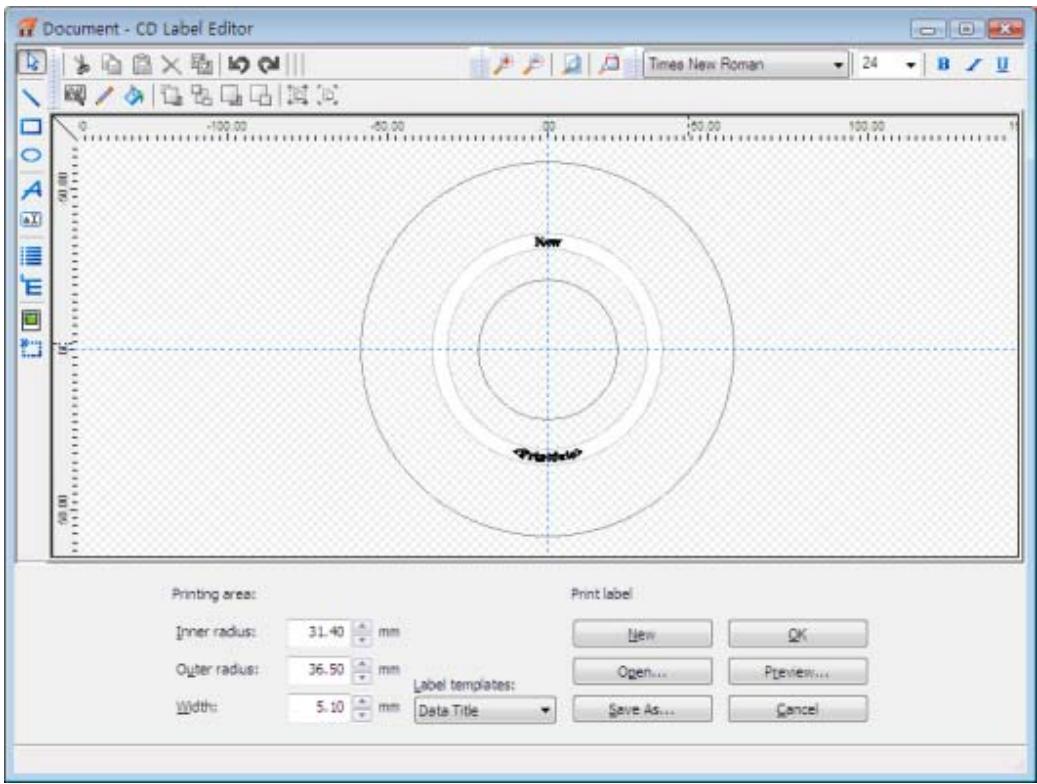
Document - CD Label Editor Window
The following configuration options are available:
| Inner radius | Defines the distance between the label and the inner edge. |
| Outer Radius | Defines the distance between the label and the outer edge. |
| Width | Defines the width of the print area. |
| Label templates | Contains a selection of different templates for designing the label. You can continue to edit and customize a selected template. |
| New | Generates a new label document. |
| Open | Opens an existing label which was created using Nero CoverD-designer. |
| Save As | Saves the label you have created. |
| OK | Adds the label you created to the compilation and closes the window. |
| Preview | Opens the Print Preview window that shows how the label should appear on the LightScribe disc. |
| Cancel | Cancels the procedure and closes the window. |
10.2 Printing LightScribe Label
The process for printing the label is integrated into the burn process. First, the compilation is burned. You then flip the disc over, and the label is being burned.
To print a label, proceed as follows:
- Create a compilation and select the files to burn.
- Select a LightScribe recorder from the drop-down menu in the toolbar.
-
If you want to set the print options for LightScribe:
-
Click the File > Options menu.
The Options window is opened.
- Click the LightScribe tab.
The configuration options for LightScribe are displayed.
- Select the desired printing quality from the Print contrast area. The better the quality, the longer the recorder takes to print the label.
- Set the other options you require.
-
Click the OK button.
The changes are saved and the window is closed. -
Click the Burn button.
The Burn Compilation window is opened.
5. Click the Misc tab.
6. Select the Print Label check box in the LightScribe area.
-
If you want to use an existing label:
-
Select the entry Use Nero CoverDesigner files from the drop-down menu in the Light-Scribe area.
The Open browser window is opened.
-
Select a Nero CoverDesigner file and click the Open button.
The window is closed and the selected file accepted for this compilation. -
If you want to create a label for this compilation:
-
Select the entry Use label from compilation from the LightScribe area.
The CD Label Editor window is opened.
-
Create a label.
-
If you want to change the label you have created, click the Edit button.

The interface in the CD Label Editor window and the procedure for creating labels work on the same principle as Nero CoverDesigner. Please see the Nero CoverDesigner user manual for full instructions on how to make professional looking covers and labels.
-
Set the options you require in the tabs.
-
Insert a blank LightScribe CD with the data side facing down and click the Burn button.
The burn process starts and the compilation is burned. A progress bar indicates the progress being made by the burn process. When the burn process is complete the disc is ejected. A window is opened with the message "Please insert a LightScribe disc into the drive with the label side facing down".
- Insert the blank LightScribe disc into the recorder with the label side facing down and click OK.
The LightScribe Print Properties window is opened and the print process starts. In the LightScribe Print Properties window a progress bar indicates the progress being made. When the print process has finished, a window is opened with the message "Burn process completed successfully".
- Click the OK button.
The disc is ejected. You have printed a LightScribe label.
See also:
LightScribe Settings 85
11 Labelflash
If you have a Labelflash recorder, you can print a label on the label and/or data side of the Labelflash DVD. A Labelflash DVD has a special layer between the top and bottom layers; this layer can be heated by the laser in the recorder so that images and text can be printed on the DVD.

The interface in the Burn Label screen works on the same principle as Nero CoverDesigner. Basically, it is irrelevant whether you print the label on paper or directly onto an appropriate disc.
Please see the separate Nero CoverDesigner user manual for full instructions on how to make professional looking covers and labels.

This feature is only available in recorders that support Labelflash technology.
11.1 Burn Label Screen
In the Burn Label window you can create or load a label and write it on a Labelflash DVD. Information on the selected printing quality and rotation speed is displayed on the right-hand side of the screen. Under Disc type you can see whether the blank disc has been inserted with the label or data side. Either the Labelflash or the DiscT@2 logo is displayed in the Burn Label window depending on which side is inserted.
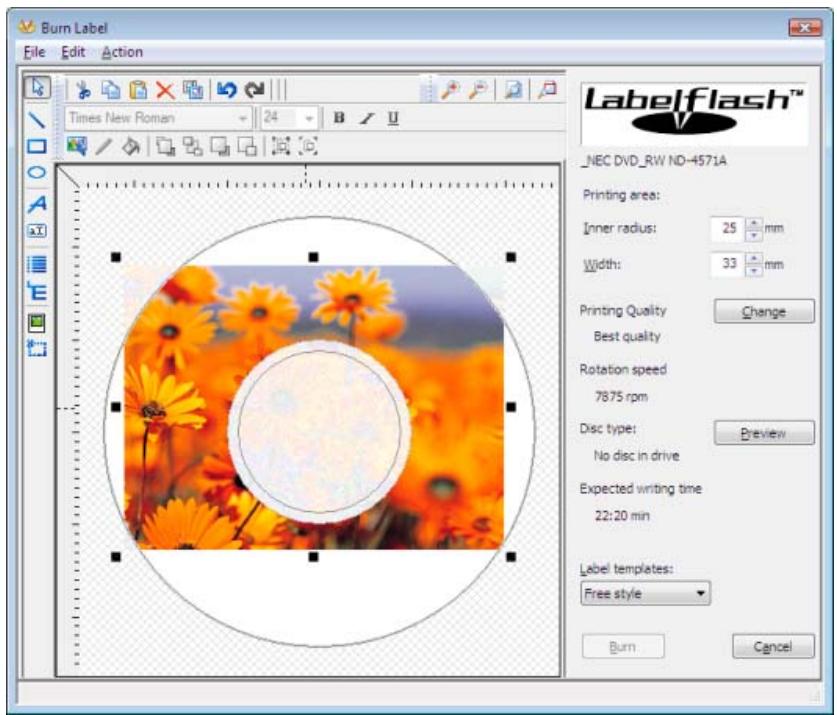
Burn Label Window
The following configuration options are available in the Burn Label window:
| Input field Inner Radius | Defines the distance between the label and the inner edge. |
| Input field Width | Defines the width of the print area. |
| Button Edit | Opens the Labelflash Print Properties window. This is where you can change the printing quality and the contrast level and display the changes made directly in the print preview. |
| Button Preview | Opens the Print Preview window that shows how the label should appear on the Labelflash disc. |
| Selection list Label templates | Contains a selection of different templates for designing the label. You can continue to edit and customize a selected template. |
| Button Writing | Starts the burn process. |
| Button Cancel | Cancels the procedure and closes the window. |

If you are creating a DiscT@2, Nero Burning ROM displays only the available print area for creating the label by default, i.e. the area on the data side of your DVD that is not already taken up by data. You cannot increase the radius of the print area.
11.2 Printing Labelflash Labels And DiskT@2
Basically, it is irrelevant whether you print on the label or the data side when creating labels. The label is actually printed outside the normal burn process.

You can print on the label side of the DVD at any time.
We recommend that you print on the data side first when you have burned the compilation. It is not possible to burn data on a printed data side. When you insert a DVD on which data has already been burned, Nero Burning ROM automatically identifies the space that is still available on the data side and on which you can print.
To print a Labelflash label on the label side or a DiskT@2 on the data side of your DVD, proceed as follows:
- If you want to print a Labelflash label on the label side, insert a blank Labelflash disc into the recorder with the label side facing down.
The Burn Label window is opened with the Labelflash logo.
- If you want to print a DiskT@2 on the data side, insert a blank Labelflash disc with the data side facing down in the recorder.
The Burn Label window is opened with the DiskT@2 logo.
- Create a label according to your requirements or open a label that you have already created with Nero CoverDesigner.

The interface in the Burn Label window and creation of a label work on the same principle as Nero CoverDesigner. See the separate Nero CoverDesigner manual for full instructions on how to create professional looking covers and labels.
- If you want to change the area in which the label is printed, change the print area accordingly using the input fields Inner Radius and Width.
-
If you want to view or change the print properties:
-
Click the Change button.
The Labelflash Print Properties window is opened.
- If you want to change the printing quality, select a quality level from the Print quality profile drop-down menu.
- If you select the User defined entry from the Print quality profile drop-down menu, you can change the contrast level and the rotation speed.
- Click the OK button.
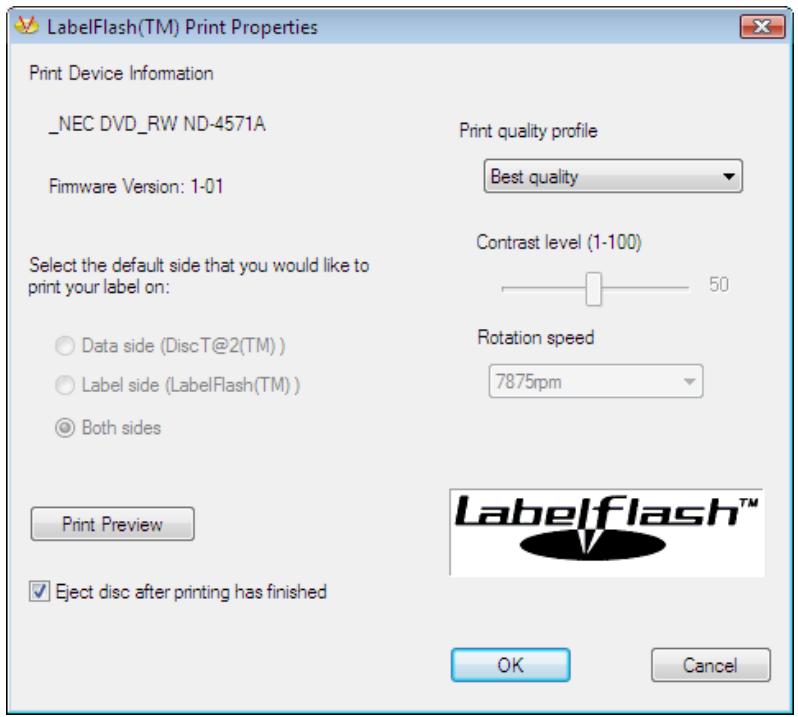
Labelflash Print Properties
The Labelflash Print Properties window is closed and the changes are accepted.
- Click the Burn button.
The labeling procedure starts and the Labelflash - printing or DiscT@2 - printing window is opened. The window shows the estimated printing time and the print progress. When printing is complete, a message window is opened informing about the successful print process. - Click the OK button.
- The message window is closed and the disc ejected.
You have successfully printed a label.
12 Burn Compilation
12.1 Choose Recorder Window
In the Choose Recorder window you can select a recorder for burning. You can open the window via the icon. The window shows useful information about the recorder (e.g. supported disc types). In the advanced area you can set expert options. The available options depend on the chosen recorder.
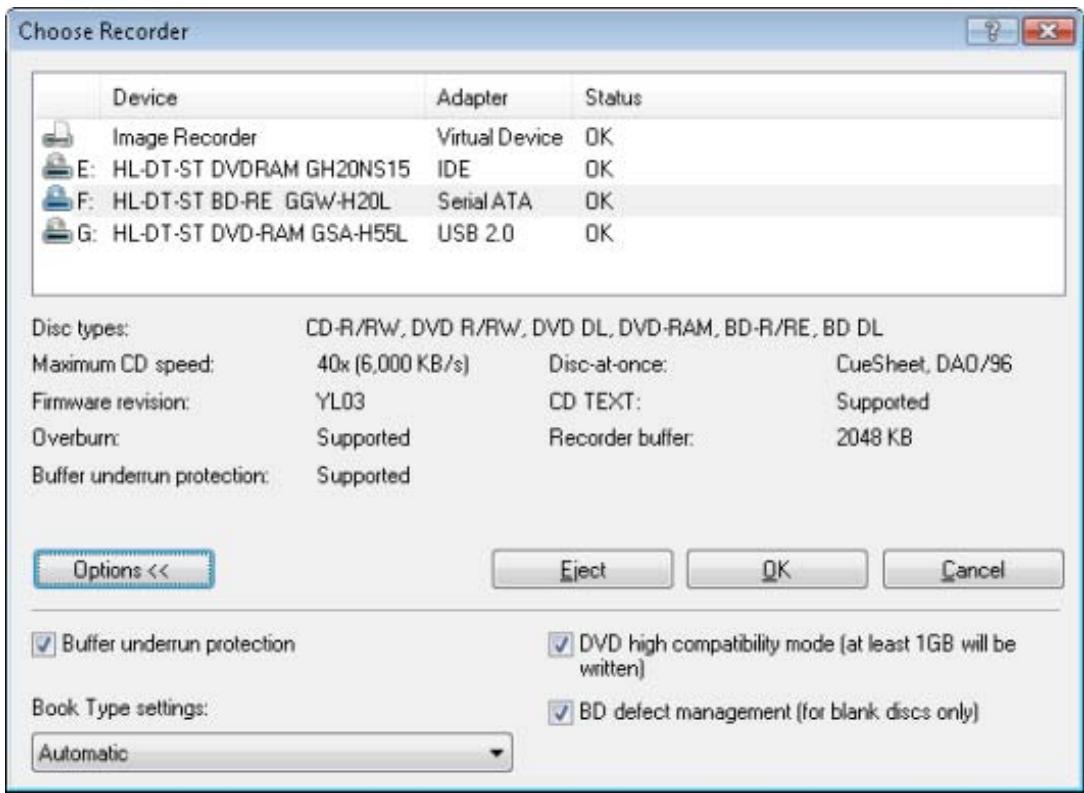
Choose Recorder
The following setting options are available in the advanced area:
| Check box Buffer underrun protection | Provides buffer underrun protection. This feature is particularly useful for burning CDs. |
| Check box DVD high compatibility mode | Burns the DVD up to a radius of at least 30 mm (approx. 1 GB), even when the compilation contains less data. In doing so the DVD is forced to meet the DVD-Video specification which reduces possi-bility of read errors. This feature is particularly useful for burning DVD-Videos. |
| Check box BD defect man-agement | Burns the Blu-ray Disc in defect management mode. In doing so the burner allocates part of the disc so that it is able to burn the data that has been damaged in a write error again. BD defect manage-ment reduces the write speed but increases data security. This feature is particularly useful for burning data Blu-ray Discs or for burning backups to Blu-ray Discs. |
| Drop-down menu Book Type Set-tings | Defines the book type setting for a DVD. This feature is particularly useful for burning to blank DVD. |

Four book type settings are available:
Automatic: Automatically selects the most suitable book type for this DVD.
DVD-ROM: Sets the book type to DVD-ROM. Select this setting if the DVD is to be played on several DVD players or your DVD player has difficulties with self-burned DVDs or of the DVD, DVD+ or DVD-RW specification.
Physical disc type: Selects the book type which is specified on the DVD.
Current recorder setting: Leaves the book type setting to the recorder.
12.2 Burn Settings
The Burn tab on the Burn Compilation window provides options for the burn process.
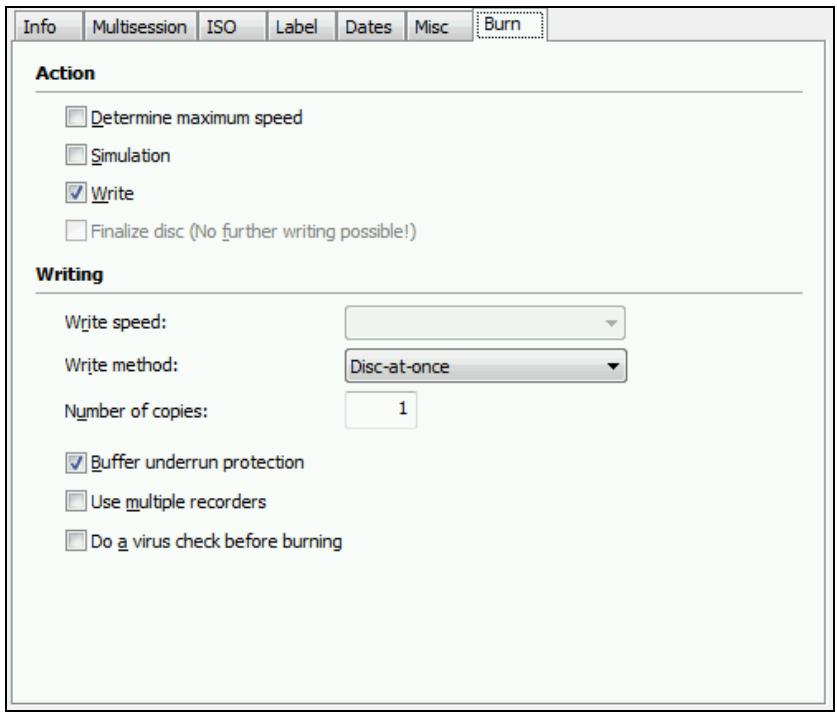
Burn Tab
The following check boxes are available in the Action area:
| Check box Determine maximum speed | Determines how quickly the compiled files can be accessed. |
| Check box Simulation | Simulates burning. In the process the simulation performs all steps that are also carried out during burning with the exception of setting the laser beam. A test determines whether there is a constant flow of data. |
| Check box Writing | Enables the Burn button. |
| Check box Finalizing a Disc | Closes the disc so that you cannot write to this disc anymore. Depending on the disc format, finalizing may be necessary. Nero Burning ROM automatically checks the box for the relevant disc formats. |
The following configuration options are available in the Writing area:
| Drop-down menu Write speed | Selects the write speed at which the disc is burned. |
| Drop-down menu Write method | Selects the method used to burn the disc. Disc-at-once and Track-at-once are available. Disc-at-once: Burns the entire disc in one go without having to switch off the laser between individual audio files. Track-at-once: Burns each audio file (track) separately onto the disc, i.e. the laser is switched off and switched on again after each audio file. |
| Input field Number of copies | Defines the number of discs that are to be burned. The default is set to one disc. |
| Check box Buffer overrun protection | Provides buffer overrun protection. This check box is only available if the selected burner supports a method which offers buffer overrun protection. |
| Check box Using several recorders | When you click the Burn button, a window is opened in which you can select the desired recorders. The burn process is then carried out simultaneously on the selected recorders. This check box is not available for the disc type Audiobook CD. |
| Check box Do a virus check before burning | Checks the files in the compilation for possible viruses before burning. This check box is not available for the disc types Audio CD, VCD, SVCD, and Audiobook CD. |

The speed test and simulation are not required for recorders that have a function for protecting against buffer underruns.

Audio, Video and Super Video CDs should always be burned using the disc- at- once method. This entry is selected by default for these disc formats.
12.3 Starting The Burn Process - Burning Discs With The Drive

Many CD players cannot read rewritable CDs (CD-RW). You should therefore use normal CD-ROMs for burning Audio CDs.
To start the burn process, proceed as follows:
- Click the Burn button in the main screen.
The Burn Compilation window is opened; the Burn tab is in front. - Check or select the options on the individual tabs.
- Insert an appropriate blank disc and click the Burn button.
The burn process is started. On the screen a progress bar indicates the progress being made by the burn process.
- If you want to shut down the PC when done (as long as this is technically feasible), select the Shut Down PC after Completion of Burn check box.
- If you want to check the written data after burning, select the Verify written data check box.
When the burn process has finished, a message window is opened.
- If you want to display the extended area with the event log, click the Details button.
- If you want to start another burn process with the same compilation, click the Burn Again button.
- Click the OK button.
The burning process is complete. You can now remove the burned disc from the recorder.
12.4 Burning With Image Recorder - Creating an Image File
To create an image file, proceed as follows:
- Click the New button.
- Create a new compilation of your choice.

Using Nero Burning ROM you can create image files for disc types that the installed recorder cannot burn. You can enable this function via the File > Options > Expert Features menu, Enable all supported recorder formats for image recorder check box. The drop-down menu in the Compilation window then makes available all supported disc types.
- Select the files that you want to burn.
- If you have installed multiple recorders, select Nero Image Recorder from the drop-down menu.
- Click the Burn button.
The Burn Compilation window is opened; the Burn tab is in front.
- Click the Burn button.
The Save Image File window is opened.
- Specify a file name and a storage location for the image file and click the Save button.
The image file is created and saved in the selected storage location. On the screen, a progress bar indicates the progress made while the file is being created. Once the creation process is over, a message window is opened. - Click the OK button.
The message window is closed and you have successfully created the image file.
See also:
Expert Features 84
13 Copying CDs/DVDs
13.1 Methods of Copying
Nero Burning ROM can be used for copying discs. There are two methods for this:
On-the-fly
Copy Over Image
Each method has advantages and disadvantages which will depend on your requirements.
13.1.1 On-the-fly Copying
When using the on-the-fly method, insert the original disc into a drive and a recordable disc into the drive. The original disc in the drive is copied immediately without any time delay to the blank disc in the recorder. The on-the-fly method allows you to copy discs very quickly, and does not require any additional space on the disc.
In order to be able to use the on-the-fly method, you will need at least two drives: one for reading the disc and a disc burner for writing. The following requirements apply to the read drive and disc burner:
The disc burner must feature buffer underrun protection, or the drive must be capable of delivering the data sufficiently quickly. The read speed should be at least twice as fast as the write speed.
The read drive must be capable of delivering information on the number and type of sessions, otherwise Nero Burning ROM may not be able to produce an exact copy.
If you want to copy Audio CDs, we recommend the copy image method because the quality of the read audio files can suffer depending on the drive.
13.1.2 Copy Over Image
With the copy over image method, an image of the original disc is saved to a file first. The image file is then burned to a blank disc. Copying using copy over image takes longer, but it often produces better results.
You must have sufficient storage space to use the copy over image method.
The copy over image method is particularly suitable in the following situations:
Only one drive is available.
You would like to make several copies of the same disc.
- You think it likely that read errors may have occurred on the source CD (for example because it is scratched).
- You attach importance to the best possible reproduction (particularly in relation to index positions and the quality of Audio CDs).
13.2 Copying Disc
To copy a disc, proceed as follows:

If you are not in possession of the copyright for the relevant CD/DVD and do not have authorization from the owner of the copyright, unauthorized copying of CDs violates national and international legislation.

Copy-protected Audio CDs cannot be copied using Nero Burning ROM.

Some CDs/DVDs are copy-protected and cannot be copied. If you are not sure whether your CD/DVD can be copied, activate simulation before commencing the actual physical burn process.
- Click the Copy button in the main screen.
The New Compilation window is opened. - Select the disc type you want from the drop-down menu.
- Carry out the desired settings in the tabs.
-
If you want to copy discs using the Image Copy method:
-
Clear the On the fly check box on the Copy Options tab.
-
Insert the disc that you want to copy into the recorder.
-
If you want to copy discs using the on-the-fly method:
-
Select the On-the-fly check box on the Copy Options tab.
- Select the drive that contains the disc to be copied from the Drive drop-down menu.
- Insert the disc that you want to copy into the selected drive.
-
Insert a blank disc.
-
Click the Copy button.
If you are copying via the drive, the copy process starts. If you are using Nero Image Recorder, the Save Image File message window is opened.
7. Enter a name for your image file in the File Name text box.
8. Select the relevant storage location in the Save to directory tree and click the Save button.
The copy and/or save process starts. You can follow the process status in the status bar. If you are using a single drive for copying, you will be prompted to remove the source disc and to insert a suitable blank disc after the image file has been written.
9. Click the Next button.
You have successfully copied a disc.
13.3 Copy Settings
In the New Compilation window, define the options for copying at the beginning of the copy procedure. You can use the Copy button in the main screen to open the window. The New Compilation window consists of a drop-down menu, various buttons, and tabs.
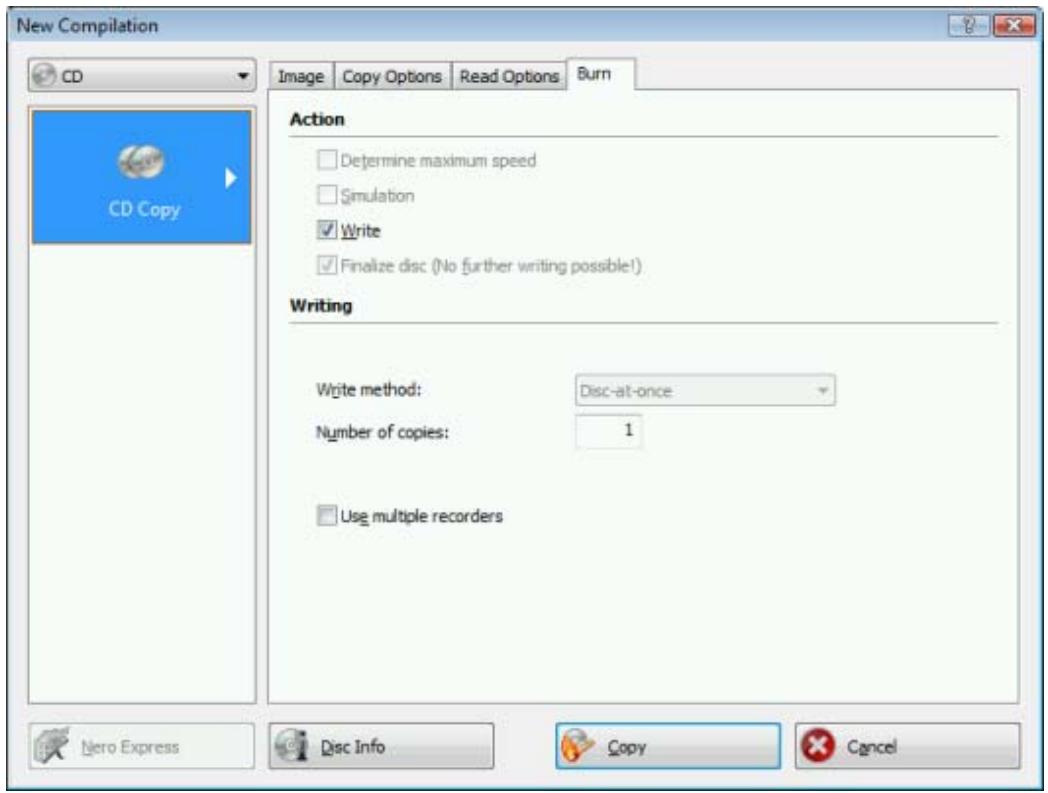
Copy settings
Only those disc types supported by the recorder are displayed in the drop-down menu. If the recorder can only burn CDs, the drop-down menu is grayed out.

Using Nero Burning ROM you can create image files for disc types that the installed recorder cannot burn. You can enable this function via the File > Options > Expert Features menu, Enable all supported recorder formats for image recorder check box. The drop-down menu in the Compilation window then makes available all supported disc types.
The following configuration options are available:
| Button Disc Info | Displays information on the disc inserted, such as contents (if any) or available capacity for instance. |
| Button Copy | Starts the copy process. |
| Button Cancel | Closes the New Compilation window. |
The following tabs are available:
| Image | Gives the path to the temporary image file and provides information on the speed of the hard drive. |
| Copy Options | Contains options for configuring copying. |
| Read Options | Contains options for configuring reading of the original disc. |
| Writing | Contains options for configuring the burn process. |
13.3.1 Image Settings
The Image tab provides the two areas Image file and Hard drive speed info. The Image file area is only enabled if the On-the-fly check box is cleared on the Copy Options tab.
The Image tab provides the following configuration options in the Image File area.
| Input field Path | Displays the path of the temporary image file. |
| Check box Delete image file after disc copy | Deletes the temporary image file when the copy process is finished. |
| Button Browse | Opens the Save As window where you can specify a file name and a directory where the temporary image file should be stored. |
The following configuration options are available in the Image tab in the Info on Hard Drive Speed area:
| Drive List | Lists the available drives and hard drives. |
| Button | Tests the speeds of the available drives and adds the speed found to the list. |
| Test Speeds |
13.3.2 Copy Options
In the Copy Options tag the following configuration options are available in the General Area.
| Check box On-the-fly copying | Creates the copy using the on-the-fly method. If this box is unchecked, the copy is created using the copy-over-image method. |
The following configuration options are available in the Copy Options tab in the source area:
| Drop-down menu Drive | Selects the drive for reading the disc. If a copy over image is created, we recommend that you select the recorder for reading in. |
| Drop-down menu Read speed | Defines the speed at which the disc is read in. |
13.3.3 Read Options
The Read Option tab consists of several areas. In these areas it is possible to set options for reading an original disc.
The following configuration options are available in the Profile area:
| Drop-down menu Profile selection | Selects predefined copy settings or a user-defined setting. In the case of predefined copy settings, Nero Burning ROM sets the configuration options automatically. You can select the configuration options yourself with a user-defined setting. |
The following configuration options are available in the Database area for the CD disc type:
| Check box Ignore read errors | Ignores read errors on the original disc and continues the read process. If this check box is cleared, Nero Burning ROM may interrupt the burn process depending on the type of error. |
| Check box Write defect sectors | Still passes on corrupt sectors (that have caused read errors) for burning. If this box is unchecked, corrupt sectors are not passed on and remain blank. |
| Check box Read sectors in raw mode | Reads PQ subchannel data. |
| Check box Read all subchannel data | Reads all subchannel data. |
The following configuration options are available in the audio Track for the CD area:
| Check box Ignore read errors | Ignores read errors on the original disc and continues the read process. If this check box is cleared, Nero Burning ROM may interrupt the burn process depending on the type of error. |
| Check box Read indexes of audio data | Reads the audio file indexes. |
| Check box Read all subchannel data | Reads all subchannel data. |
The following configuration options are available in the Advanced for the CD area:
| Check box Read Media Catalog Number and ISRC | Reads the media catalog number, a globally unique number for compilations, and the ISRC (International Standard Recording Code), a globally unique number for audio recordings. |
| Check box Use jitter correction | Jitter corrector removes scratches from audio and video files. |
The following configuration options are available in the Error Correction for the DVD type disc:
| Option button Read with error correction | Performs error correction while reading. In the process, the checksum of a corrupt sector is adjusted so that the sector in it-self is consistent. |
| Input field Read retry count | Establishes the number of attempts that are made to correct errors. |
| Option button Fast reading without error correction | Performs fast reading without error correction. |
The following configuration options are available in the Dealing with Non-Correctable Reading Errors for the DVD disc type:
| Check box Ignore read errors | Ignores read errors on the original disc. If this check box is cleared, Nero Burning ROM may interrupt the burn process depending on the type of error. |

With certain disc formats such as video CD and audio CD, read errors often have little or no impact because they are not perceptible when the CD is played.
14 Erase Rewritable Disc Window
Nero Burning ROM can be used to erase rewritable discs, i.e. discs with the RW specification, as long as your recorder supports this feature. Two erase methods are available for this purpose:
Quick erasing does not remove the data physically from the disc, but instead only makes it inaccessible by erasing the references to existing content. The data can be restored!
Full erasing removes the data from the disc by overwriting it with zeroes. The contents cannot be restored with conventional methods. Repeated full erasing increases the probability that third parties will not be able to reconstruct the contents.
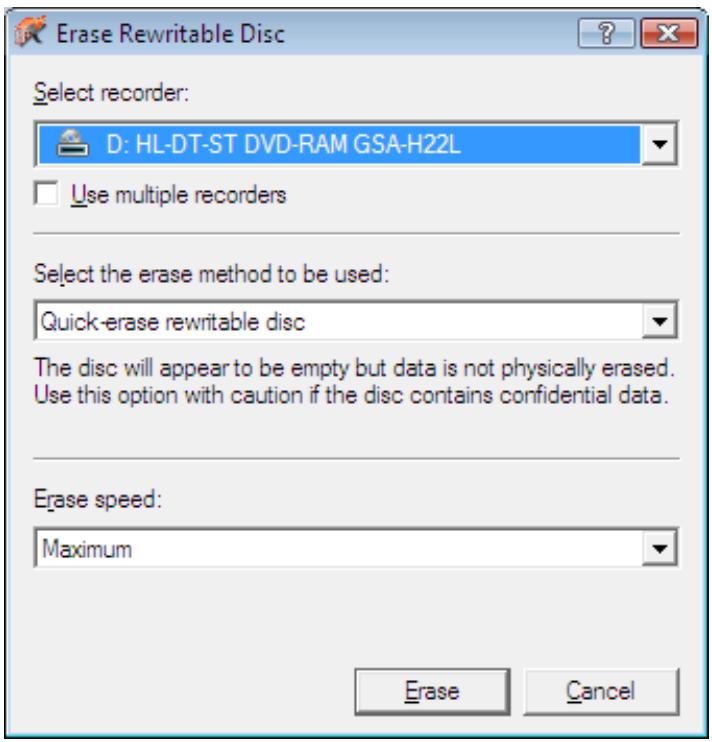
Erase Rewritable Disc window
The following configuration options are available in the Erase Rewritable Disc window:
| Selection list Select recorder | Defines the desired recorder. |
| Check box Use multiple record- ers | Simultaneously erases CDs/DVDs in multiple recorders. |
| Selection list Select the erase method to be used | Defines the erase method. Two options are available: The Quick-erase rewritable disc method does not physically erase all data from the disc, but only the references to the contents. The disc will appear to be empty even though the data is still physically available. Erasing a disc using this method takes between one and two minutes. The Full-erase rewritable disc method physically erases all data from the disc. The contents cannot be restored with conventional methods. Repeated full erasing increases the probability that third parties will not be able to reconstruct the contents. Erasing the disc using this method takes longer than the other method, depending on the type of disc involved. |
| Selection list Erase speed | Defines the erase speed. |
| Button Erase | Starts the erase process. |
| Button Cancel | Cancels the action and closes the window. |
15 Updating The Virus Scanner
A virus scanner that checks the data to be burned is integrated in Nero Burning ROM. This ensures that infected data will not be burned. We recommend that you update the virus scanners regularly. The database is updated via an Internet connection.
The following requirement must be fulfilled:
- You must have an active Internet connection.
To update the virus scanner, proceed as follows:
- Click the Help > Update Antivirus Scanner menu.
A message window is opened reminding you to connect to the Internet. - Click the OK button.
Nero Burning ROM is connected to the FTP server av.nero.com and the antivirus files are downloaded. The Downloading File window is opened; a progress bar indicates the progress being made by the update process. When the database has been updated, a message window is opened indicating that the database is now updated. - Click the OK button.
You have updated the virus scanner database.
16 Configuration Options
You can define options for working with Nero Burning ROM in the Options window.
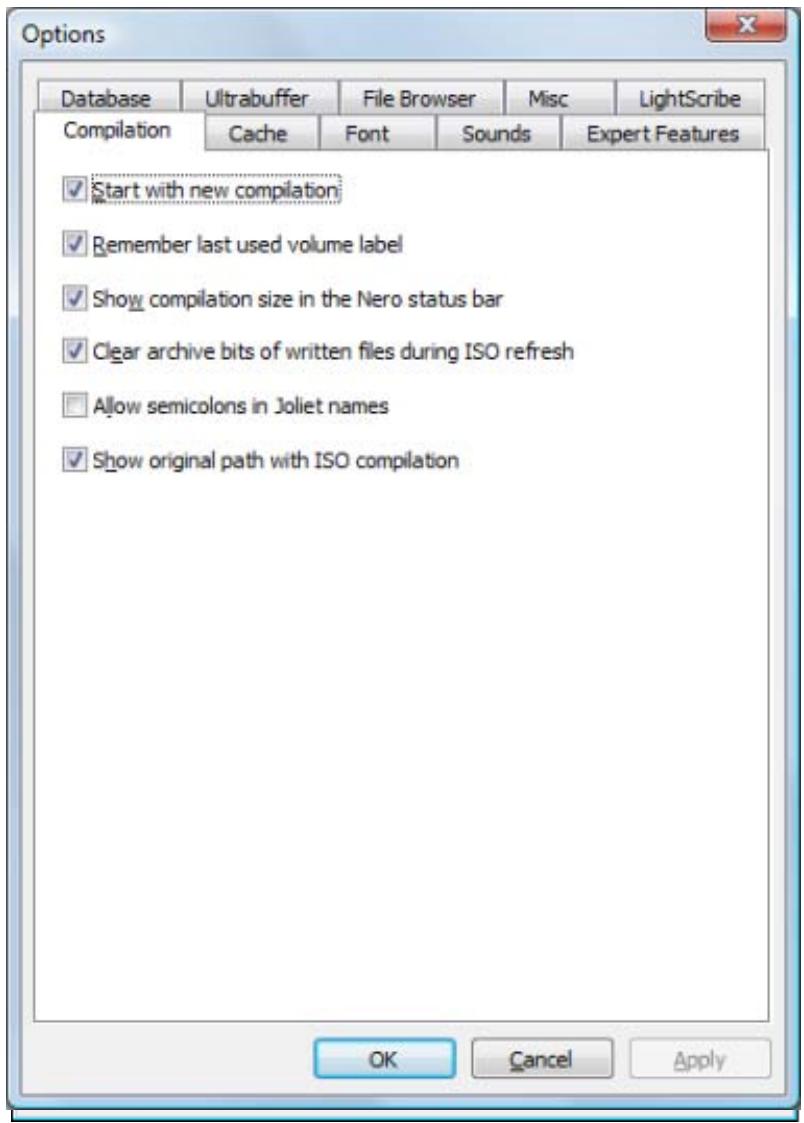
Options Window
The following tabs are available:
| Compilation | Contains options for the compilation and the selection screen. |
| Cache | Contains options for the cache. |
| Font | Contains selection options for the font. |
| Sounds | Contains selection options for sounds in connection with burn tasks. |
| Expert Features | Contains options for configuring overburning and burning. We recommend that you retain the default settings. |
| Database | Selects the default naming method for audio files to be saved from an Audio CD to the hard drive. |
| Ultrabuffer | Defines the size of the RAM buffer. |
| File Browser | Contains options for configuring the file browser. |
| Misc. | Contains options for configuring compilations, burning, the data-base, the user interface as well as advanced settings. |
| LightScribe | Contains options for configuring LightScribe recorders such as the print contrast (quality), default drive, and default template. This tab is only available if a LightScribe recorder has been installed. |
16.1 Compilation Settings
The following configuration options are available on the Compilation tab:
| Check box Start with new compilation | Starts when opening a new compilation from Nero Burning ROM. |
| Check box Remember last used volume label | Makes available the title for the next disc. |
| Check box Show compilation size in the Nero status bar | Displays the storage volume of your files in a status bar. |
| Check box Clear archive bits of written files during ISO refresh | Deletes the archive bits of saved files. |
| Check box Allow semicolons in Joliet names | Allows the use of semicolons in addition to standard uppercase and lowercase letters and Unicode characters (and German umlauts) in file names in the Joliet file system. |
| Check box Show original path with ISO compilation | Lists the full path of the added files in the compilation screen in the Source column. |
16.2 Cache Settings
The following configuration options are available on the Cache tab:
| Input field Path for cache | Displays the path of the Cache memory. You can enter the path manually or select the path in the browser window. |
| Button Browse | Opens a browser window. You can select a folder in which data is buffered before and during the burn process. |
| Input field Minimun space on hard drive, which Nero should not use | Defines a storage volume that is not used by Nero Burning ROM. |
| Check box Drag and drop from CD-ROM drive | Saves files that have been copied from a CD-ROM drive in the clipboard. |
16.3 Expert Features
The following configuration options are available on the Expert Settings tab:
| Check box Enable Disc-at-once CD over-burning | Enables additional options and defines settings for the entire burn process. |
| Option button Relative maximum/minimum overburning size | Defines how much a disc can be overburned. |
| Check box Enable DVD overburning | Enables the option that DVDs can be overburned. |
| Check box Enable generation of short lead-out | Enables the option to write additional data to your CD. This feature is only available if the Enable Disc-at-once CD overburning option is enabled. |
| Check box Do not eject disc after burning | Enables the option that your disc remains in the recorder and is not ejected when the burn process is finished. |
| Check box Enable all supported recorder formats for image recorder | Enables the option that all supported recorder formats for the Image Recorder are available. |
16.4 Ultrabuffer Settings
The following configuration options are available on the Ultrabuffer tab:
| Selection list Method | Defines the memory capacity that Nero Burning ROM uses as a RAM buffer. The ultrabuffer is a second memory that enhances the physical buffer in the recorder. |
| Input field Data buffer size | Defines the memory capacity that can be manually entered. The input field is only enabled when Manual Configu-ration is selected in the selection list. |
16.5 LightScribe Settings
The following configuration options are available on the LightScribe tab:
| Area Print contrast | Adjusts the desired print quality. |
| Selection list Default LightScribe drive | Selects the drive with the LightScribe recorder. |
| Selection list Genre | Specifies the genre. |
| Selection list Current template | Defines a template for labels. |
| Selection list Default print resolution (DPI) | Adjusts the desired print resolution. |
| Check box Printing LightScribe labels | Enables the option to automatically burn a LightScribe label. This tab is only available if a LightScribe recorder has been installed. |
17 Technical Information
17.1 System Requirements
Nero Burning ROM is installed along with its suite. Its system requirements are the same. You can find more detailed information on the system requirements under www.nero.com.
In addition, the following requirements apply:

Using LightScribe Direct Disc Labeling
Your computer requires the latest LightScribe system software when using a CD or DVD recorder with LightScribe support.
If you have downloaded and installed an updated Nero version from the Nero website, install the LightScribe system software separately. You can find the latest version at www.nero.com/link.php?topic_id=114&gen_id=8.
- Optional: LightScribe capable burner (LightScribe host software must be installed) and LightScribe capable disc
- Optional: Labelflash capable recorder and Labelflash disc
- Optional: Blu-ray capable recorder and Blu-ray disc
17.2 Disc Types
CD
DVD
Blu-ray - burning only

You can find more information on Blu-ray support at www.nero.com/link.php?topic id=416.

The actual entries that are available, and the actual disc types (e.g. DVD) that can be written to depend on the recorder used.
17.3 Disc Formats
Audio CD
Mixed mode CDs
CD EXTRA
Video CD (VCD)
Super Video CD (SVCD)
miniDVD
Audiobook CD
DVD-Video
17.4 Audio Formats And Codec
Advanced Audio Coding (AAC, M4A, MP4)
Audible Audiobook (AA)
Audio Interchange File Format (AIFF, AIF)
- Compact Disc Digital Audio (CDA)
Musical Instrumental Digital Interface (MIDI, MID)
MP3 / mp3PRO
- Moving Picture Experts Group-1 Audio Layer 3 (MP3)
Moving Picture Experts Group-1 Audio Layer 2 (MP2)
- Moving Picture Experts Group-4 (MP4)
Nero Digital (MP4)
OGG Vorbis (OGG, OGM)
Recourse Interchange File Format WAVE (WAV, WAVE)
Windows Media Audio (WMA)
17.5 Metadata
Advanced Streaming Format (ASF)
Audio Video Interleave (AVI)
Moving Picture Experts Group-1 Audio Layer 3 (MP3)
Nero Digital (MP4)
OGG Vorbis (OGG, OGM)
Recource Interchange File Format WAVE (WAV, WAVE)
Windows Media Audio (WMA)
Windows Media Video (WMV)
ID3 Tags (v1.1/v2)
Joint Photographic Expert Group (JPEG, JPG,JPE)
Portable Network Graphics (PNG)
- Bitmap (BMP)
- Graphics Interchange Format (GIF)
Tagged Image File Format (TIFF, TIF)
- Moving Picture Experts Group-1 Audio Layer 3 (MP3)
17.6 Video Formats And Codecse
Advanced Streaming Format (ASF)
Audio Video Interleave (AVI)
Digital Video (DV)
- Moving Picture Experts Group-2 (MPG, MPEG, DAT, M2T)
- Moving Picture Experts Group-4 (MP4)
Nero Digital (MP4)
QuickTime Movie (MOV)
Video Object (VOB)
Packet Video Audio (PVA)
Television Input/Video Output (TIVO)
17.7 Image Formats
- Bitmap (BMP)
Device Independent Bitmaps (DIB) - Graphics Interchange Format (GIF)
Icon Image File (ICO)
JPEG File Interchange Format (JFIF)
Joint Photographic Expert Group (JPEG, JPG, JPE)
Picture Exchange (PCX)
Portable Network Graphics (PNG)
Portable Pixel Map (PPM)
Targa Image File (TGA)
Tagged Image File Format (TIFF, TIF)
Windows Media File (WMF)
17.8 Formats For Playlists
- Moving Picture Experts Group Audio Layer 3 Uniform Resource Locator/MP3 URL (M3U)
18 Glossary
AIFF
The Audio Interchange File Format is an uncompressed audio file format from Apple® and represents a sort of counterpart to the WAV format from Microsoft. Files are larger than when using a compressed format, but the quality is higher. AIFF compressed is the compressed variation.
Archive Bit
Archive bits are used to identify files that have been edited. A file is only resaved during the next backup process if it was edited (and an archive bit is thus reset).
Blu-ray
Blu-ray technology refers to burning on special data carriers. In comparison to DVD's, which use a red laser in order to read and write data, Blu-ray discs are written with a blue laser. The shorter wavelength (405 nm) of this blue laser makes it possible to position the laser with greater accuracy. Data can be written in a more compact manner and takes up less space on the disc. A Blu-ray disc can store up to 25 GB on a single layer disc and up to 50 GB on a dual layer disc.
Book Type
The book type defines the specification (e.g. DVD-, DVD+, DVD-ROM) of a DVD. In order to ensure correct playback, the DVD specifications are defined in books so that all media can be read correctly. The specifications are defined in the so-called Rainbow Books, which are distinguished by means of their color (e.g. Yellow Book).
Bootable CD
Booting refers to loading the operating system when a computer is started. This is normally done from the hard drive. However, if you do not want to boot or cannot boot your computer from your hard drive for whatever reason, you can load an operating environment from the drive with a boot CD.
Buffer
A buffer refers to temporary memory that records and delivers data that cannot be processed immediately as required. The buffer also allows for continuous data flow.
Buffer Underrun
A buffer underrun is an interruption in the data flow in the internal memory (e.g. of the recorder). A buffer underrun results from an interruption in the data flow to the internal buffer. The buffer continues to deliver data until it is finally empty. When recording, data is fed continuously to the recorder's buffer in order to keep a steady flow of data. If the steady flow of data is interrupted, the media becomes unusable. Most modern recorders have a protective mechanism against buffer underruns.
Cache
Cache is a faster buffer that is used in various areas of a computer to access larger data volumes faster. Cache ensures a continuous flow of data.
CD-R
Compact Disc-Recordable is a technology for write-once media. The Orange Book standard defines the storage of audio data and other computer-readable data.
Codec
The compressor/decompressor encodes the data for recording or saving digitally and then decodes it for playback. Various software codecs are available such as Cinapak, Indeo, Quicktime, Video for Windows, etc. Hardware codecs include MPEG, H.261, Motion JPEG, etc.
Disc-At-Once
Disc-At-Once refers to a method in which the laser in your recorder burns straight through in one session without turning off and on between each track. This method is best when recording Audio CDs you would like to play on your home or car stereo.
Frame
With an Audio CD, 75 sectors provide one second of played music. One sector consists of up to 98 frames; one frame contains 24 data bytes and 9 control bytes. Similarly, "frame" describes a full screen in television and video technology. Two successive half images result in a full screen within a second due to interlacing.
Image
An image refers to a single file on the hard drive that contains the image for a complete disc. A disk image can be used to create exact copies on media at a later point in time if problems occur during the write process or if no recorder is connected to your PC. The image requires as much free space on the hard drive as the contents of the original disc.
Jitter
Jitter refers to an abrupt and undesired change in the signal characteristics. Small gaps occur in the data stream as a result. Audio correction synchronizes the data by overlapping the sectors. This way, the gaps are not audible.
Joliet
Joliet refers to an extension of the ISO-9660 standard for file names. Joliet was designed by Microsoft in order to represent more characters. The file name can be up to 64 characters long and contain the letters A-Z, a-z, umlauts and the .
Label
A label refers to a label on a disc. Some drives, e.g. drives that use LightScribe or Labelflash technology, can transfer labels directly to special media.
Labelflash
Labelflash is a technology with which pictures and texts can be burned on the label or data side of a disc with a laser.
LightScribe
LightScribe is a technology with which pictures or texts can be burned on the label side of discs with a laser.
MP3
The MPEG-1 Audio Layer 3 audio format is used to reduce the size of audio files to a fraction of their original size (factor 1:10) with little loss of quality. You can estimate about 1 MB per minute as opposed to 10 MB for the original files. This value and the quality can vary depending on the complexity of the audio signal. The bit rate used can be used as a measure of quality. The higher the bit rate, the better the quality, but also the more memory required.
mp3PRO
mp3PRO is an MP3 codec that compresses audio files even more but in lower bit rates and better quality. 64 kBit/s in mp3PRO is the equivalent to 128 kBit/s in MP3.
MPEG-1
The Moving Picture Experts Group defined this industry standard for video and audio codecs. MPEG-1 is part of the MPEG compression family and has the highest compression rate. MPEG-1 is the format for video CDs.
MPEG-2
The Moving Picture Experts Group defined this industry standard for video and audio codecs. There is little difference between MPEG-1 and MPEG-2: MPEG-2 is a broadcast standard and better for televisions that are interlaced. MPEG-2 is used as a video format for DVDs.
Multisession
A multisession refers to completing a disc in multiple cycles. After a first session has been written to the disc, information can then be added in another record because the disc has not been finalized.
Nero Digital
Various MPEG-4 video and audio codecs are collated in Nero Digital and are fully compatible with the standard MPEG-4. Nero AG is continuing to develop these. In this way a substantially higher quality of the multi-media data is achieved. Further, additional features such as subtitles have been implemented.
NTSC
The National Television System Committee Standard is a standard for video and TV in the USA and Japan. NTSC has more individual frames (29.97 frames per second) than PAL, but has fewer horizontal lines (525 lines).
PAL
The Phase Alternation Line procedure is the TV standard applicable for Europe. PAL possesses 625 lines per screen and the film transmission speed is 25 pictures per second. These are transmitted in the so-called line-jump procedure where a picture with all the odd lines and then a picture with all the even lines are created. This corresponds to a half-picture frequency of 50Hz .
SecurDisc
SecurDisc refers to a security technology that protects data carriers from unauthorized access and duplication. SecurDisc can only be burned and password protected with a SecurDisc drive. Access with other drives is only possible to a limited extent. The following disc formats are supported, although without the copy protection feature: DVD+R(W), DVD+-R DL, DVD-RAM and CD-R(W).
Subchannel data
Subchannel data on a disc contains additional information, such as CD Text or information on positions.
Track-At-Once
Track-At-Once refers to a write method in which each track is written to the disc individually. The writing process is interrupted briefly after each track, i.e. the laser starts again for each track. With this write method, it is only possible to continue writing to a DVD sometimes and at a later stage. There is a pause of at least 27ms between tracks, which can be disruptive for Audio CDs.
VCD
The Video Compact Disc saves movies and audio/video data in MPEG-1 format. In doing so, the video quality from a VCD is similar to a VHS video. VCDs can store up to 74 minutes of video material including stereo sound on a 650 MB disc. Most optical PC drives and DVD players can play VCDs.
WAV
The WAV audio format, also called WAVE or Waveform audio format, is an audio format from Microsoft and uses no data compression. WAV is the counterpart to the AIF format from Apple.
19 Index
A
Album 37
Audio book 37
Audio CD 29
Burn in disc-at-onc mode. 35
Burn in track-at-onc mode 35
Configuration options. 34
Convert 42
Copy 73
Identify with Gracenote 38
Obtain metadata 38
Save to Computer 42
Audio file
Convert into another format 45
Cross fade with previous track 31
Declick 33
Fill titles. 43
Filter 32
Identify with Gracenote 38
Indexes 31
Normalize 33, 34
Obtain metadata 38
Read index 78
Remove pause at the end 36
Save 39
Save to hard drive 43
Track properties 30
B
Backup 24
Book type setting 69
Bootable disc
Burn 59
Emulation type 58
Requirements 58
Burn
Enable image recorder 84
Overburning 84
Burn options 69
Buffer Underrun. 70
Disc-at-Once. 70
Finalize disc. 70
Simulation 70
Track-at-Once 70
Virus check. 70
Write method 70
C
CD EXTRA 36, 37
CD Text 35
Check Point 28
Compilation
Choose disc type 12
Conventions, manual 6
Copy 74
Copy over image 73
On-the-fly 73
Set options 75
Copy image 73
Cross fade 31
D
Data disc 18
Copy over image 26
Define character set. 26
Multisession 23
Select data mode 25
Select file system 25
Data track 26
Disc type
Audio CD. 13
Audiobook CD 14
Bootable Disc. 13
CD EXTRA 13
Data disc 12
DVD-Video 14
Mixed Mode CD 13
Super Video CD. 13
Video CD. 13
DiskT@2 64
DVD-Video 56
E
El Torito 58
Encoding options
AIF 47
MP3. 47, 48
Nero Digital Audio 50
OGG. 52
WAV. 47
G
Gracenote 7,38,39
H
Hide file 20
1
ID3. 43
Image file
Burn 60
Create 71
Create from data disc 27
Image Recorder 18, 84
Internet database 43
iPod 45
ISO 25
ISR 31
J
Jitter Correction 78
Joliet 25
L
Labelflash 64
Burn label 65
Create label 64
LightScribe 61
Burn label 62
Create label 61
Set options. 85
M
Main screen. 9
Menu bar 9
Toolbar 9
Manual, conventions 6
miniDVD 56
Mixed Mode CD 36
Multisession 23
Continue multisession disc 25
Start a disc 24
N
Nero CoverDesigner 61, 64
0
On-the-fly 73
Options
Configure 82
Set 82
P
Program
Launching the Program. 8
Startup 8
R
Read error
Ignoring 77
Read speed 77
Rewritable disc. 71
Erase. 79
Erase method 80
S
SecurDisc 6
Copy protection 23
Digital signature 21
Explanation 20
Limit data redundancy. 23
Password protection 20
Selection screen. 16
Capacity bar. 17
Compilation area 16
Web browser area. 16
Startup
Program 8
Super Video CD 53
System requirements 86
U
UDF 26
User interface 9
V
Video CD. 53
Virus scanner 81
W
Work overview
Burning. 7
Explanation 6
X
Xbox
Create compatible disc 26
20 Contact
Nero Burning ROM is a Nero AG product.
Nero AG
Glendale, CA 91203-2335
USA
Internet: www.nero.com
Help: http://support.nero.com
Fax: (818) 956 7094
E-mail: US-CustomerSupport@nero.com
Nero KK
Rover Center-kita 8F-B, 1-2-2
Nakagawa-chouou Tsuzuki-ku
Yokohama, Kanagawa
Japan 224-0003
Internet: www.nero.com
Help: http://support.nero.com
Copyright © 2009 Nero AG and its licensors. All rights reserved.