
DF810 - Digital photo frame COMPAQ - Free user manual and instructions
Find the device manual for free DF810 COMPAQ in PDF.



| Product type | Digital photo frame |
| Brand | COMPAQ |
| Model | DF810 |
| Screen size | 8 inches (diagonal) |
| Screen format | 4:3 |
| Screen resolution | 800 x 600 pixels |
| Internal memory | 128 MB |
| Supported image formats | JPEG (baseline) |
| Supported audio formats | MP3 |
| Supported video formats | MPEG-1, MP4, Motion JPEG |
| External storage media | SD/MMC card, MS Pro, XD, CF, USB flash drive (USB 2.0 Host) |
| PC connectivity | Mini USB 2.0 (device) |
| Speakers | 2 x 1.0 W |
| Remote control | Yes, CR2025 battery included |
| Power supply | External AC adapter 9V, 2.0 A (100-240 V) |
| Main features | Slideshow with music, video playback, calendar/clock with alarm, auto-rotation, zoom up to 5x, photo copy/delete, image settings (brightness, contrast, hue, color) |
| OSD languages | 7 languages including French, English, German, Spanish, Italian, Portuguese, Dutch |
| Care and cleaning | Turn off before cleaning. Use a soft, lint-free cloth. Do not use ammonia, alcohol, or abrasive detergents. Clean the screen with an LCD-approved cleaner. |
| Safety | Do not press hard on the screen. Do not spray liquid directly. Unplug before cleaning. |
| Spare parts and repairability | Remote control and AC adapter available as replacements (see HP support website). Warranty repair through retailer or HP authorized center. |
| General information | Manual available for free download. Support by email (francais@hpodd.com) and phone (France: +33 171230454). |
Frequently Asked Questions - DF810 COMPAQ
>Note: Windows 98/Me not supported.
User questions about DF810 COMPAQ
0 question about this device. Answer the ones you know or ask your own.
Ask a new question about this device
Download the instructions for your Digital photo frame in PDF format for free! Find your manual DF810 - COMPAQ and take your electronic device back in hand. On this page are published all the documents necessary for the use of your device. DF810 by COMPAQ.
USER MANUAL DF810 COMPAQ
HP df710, df760, df810 Series
HP df710, df760, df810 Série
HP df710, df760, df810 Series
Digital Picture Frame Cadre Photo Numérique Marco de Fotos Digital
User Manual
FCC Compliance Statement
Note: This equipment has been tested and found to comply with the limits for a Class B digital device, pursuant to Part 15 of the FCC Rules. These limits are designed to provide reasonable protection against harmful interference in a residential installation. This equipment generates, uses, and can radiate radio frequency energy and, if not installed and used in accordance with the instructions, may cause harmful interference to radio communications. However, there is no guarantee that interference will not occur in a particular installation. If this equipment does cause harmful interference to radio or television reception, which can be determined by turning the equipment off and on, the user is encouraged to try to correct the interference by one of the following measures:
- Reorient or relocate the receiving antenna.
- Increase the separation between the equipment and receiver.
- Connect the equipment into an outlet on a circuit different from that to which the receiver is connected.
- Consult the dealer or an experienced radio/TV technician for help.
FCC Caution: To assure continued compliance, only use shielded interface cables when connecting to computer or peripheral devices. Any changes or modifications not expressly approved by the party responsible for compliance could void the user's authority to operate this equipment.
This device complies with Part 15 of the FCC Rules. Operation is subject to the following two conditions: (1) this device may not cause harmful interference, and (2) this device must accept any interference received, including interference that may cause undesired operation.
Table of Contents
FCC Compliance Statement
What's in the Box? 3
Getting Started 4
Remote Control 6
Initial Setup 7
Setup Menu 9
Key Features 10
Selecting a Memory Source 11
Picture Options 12
MusicPlayback 18
VideoPlayback 19
Clock & Calendar Display 21
Specifications 25
Frequently Asked Questions 28
Cleaning and Care Tips 30
Getting Help 31
| Qty | Item | Image |
| 1 | Digital Picture Frame | |
| 1 | Remote Control Replacement Battery = CR2025 | |
| 1 | Universal Power Adapter (9V, 2.0A, 100/240 switching) | |
| 1 | USB 2.0 Cable | |
| 1 | User Manual | |
| 1 | Quick Start Guide | |
| 1 | Warranty Document | |
| 1 | Declaration of Conformity | |
| Certain models may have inter-changeable Mattes |
Getting Started
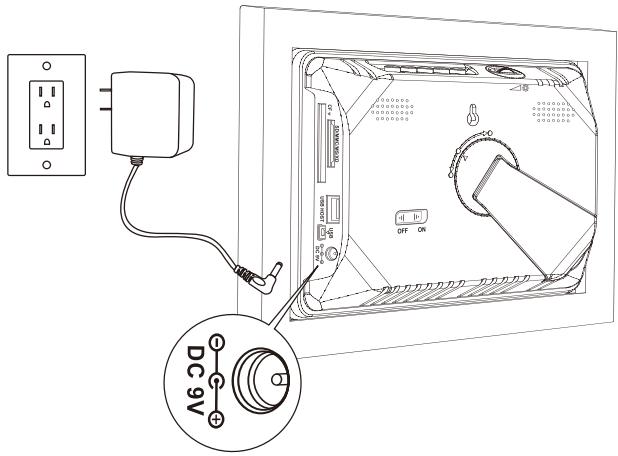
- Connect the power cord into the DC input of the digital picture frame and plug the adapter into a power outlet as illustrated below.
- The HP Digital Picture Frame is preloaded with pictures that illustrate the basic features of this product. If you want to view these pictures, turn the frame on as illustrated in step 4. The slideshow will begin in a few seconds. However, if you wish to immediately view your own pictures, go to the next step (step 3).
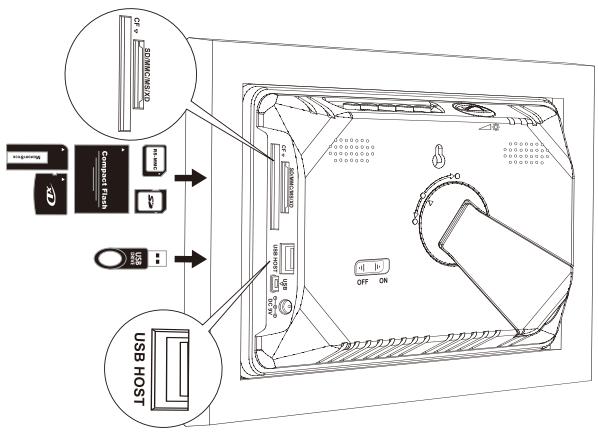
- Insert a memory card or USB storage device (external memory) containing desired pictures, music, and/or video into the appropriate card slot or USB port as illustrated below. Note: Memory cards and USB storage devices must be orientated correctly.
- Unfold the attached stand to its extended position and rotate it to a locked position. Move the POWER switch to the "ON" position.
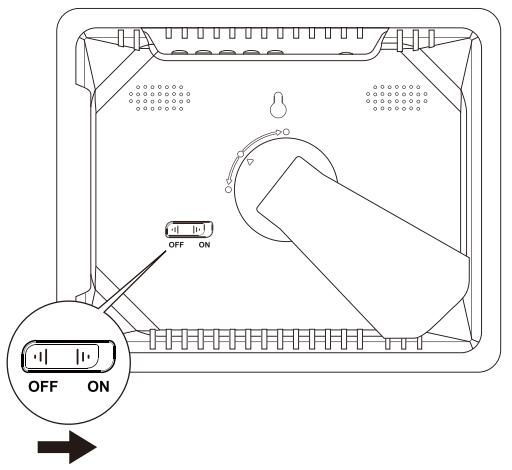
A slideshow of your pictures will begin automatically in a few seconds. If music tracks are available on the same external memory device, the slideshow will be displayed with background music unless disabled in the SETUP MENU. Enjoy it and have fun!
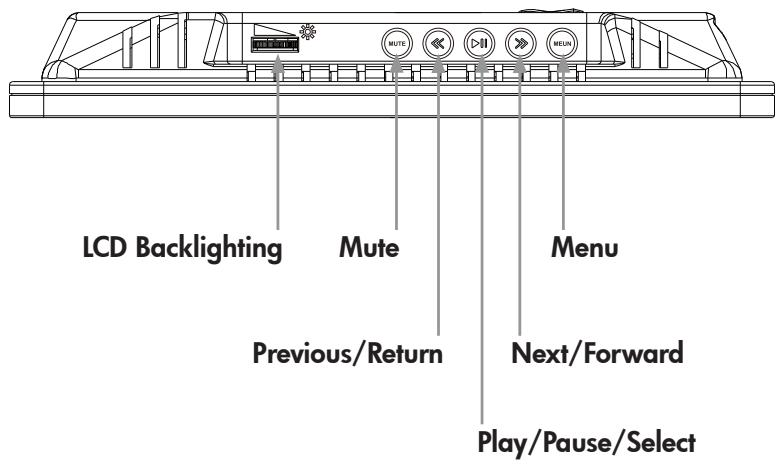
- In addition to the remote control, the digital photo frame has basic control buttons and LCD backlighting controls on the top of the frame as illustrated below.
Remote Control
| MENU | MENU: Press to access main menu mode or card selection mode |
| TIME SET | TIME SET: Press this button at time mode to set up the date and time |
| SLIDESHOW: Press this button to begin a picture slideshow. | |
| VIDEO PLAYBACK: Press this button to playback video files. | |
| UP: Press to move up in thumbnail mode or when setting options. | |
| NEXT or FORWARD: Press to move right in browse, thumbnail or menu mode. | |
| PLAY/PAUSE or SELECT: Press to change display mode (slide show, browse, or thumbnail). Press to play or pause music or video files. Press to make selections in menu or settings mode. | |
| PREV or RETURN: Press to move left in browse, thumbnail or menu mode, or return to previous screen in slide show mode. | |
| DOWN: Press to move down in thumbnail mode or when setting options. | |
| COPY DEL | COPY/DEL: Press this button in Photo Browse mode or MUSIC mode to initiate the copy or delete process. |
| ROTATE: Press to rotate the picture. | |
| Q | ZOOM: Press to enlarge picture in photo browse mode. |
| + | VOL + / - : Press the + button to increase and the - button to decrease audible playback volume. |
| BRIGHTNESS/CONTRAST/TINT/COLOR: Press this button during picture browse mode to adjust basic appearance controls. |
Initial Setup
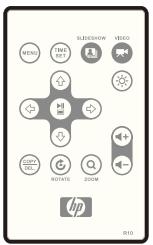
- Pull tab from remote control to activate.
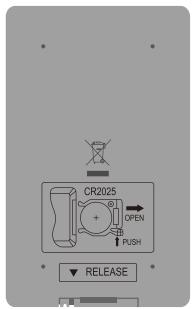
Should your remote control require a new battery, please purchase a 3 volt lithium CR2025 model for replacement. The remote control has battery replacement instructions stamped into the back side as illustrated below.
- Power on the picture frame and allow the picture slideshow to begin.
Press button once to view the MAIN MENU as illustrated below.
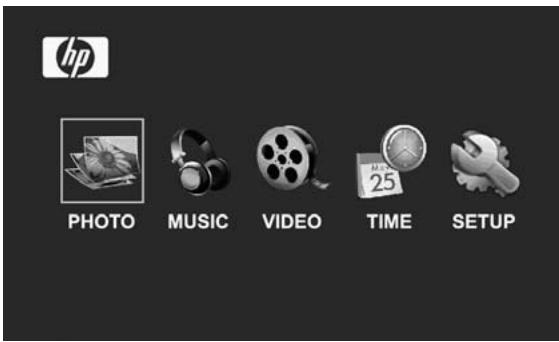
- Press

or

to highlight the

SETUP
icon. Press the

to
open the SETUP MENU as illustrated below
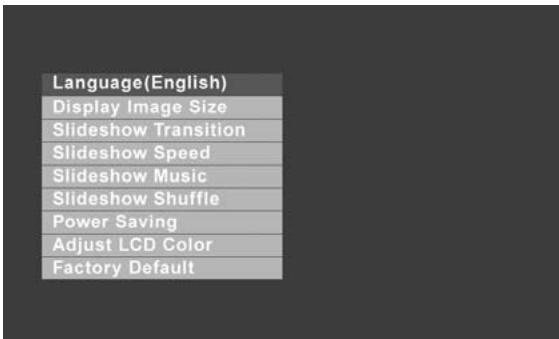
- LANGUAGE setting will be highlighted in blue. Press the button to display additional language selections. Note: If desired language is already selected, go to step 6.
5.Use


to highlight the desired On-Screen-Display
language (OSD) and press to return to the setup menu.

to select the language. Press

- Press

or

to highlight other options and press to

or to highlight and to select
select. Continue to use or to highlight and to see the desired settings. Read the next section titled SETUP MENU for details of these options.
| Option | Description |
| Language | Choose from 7 On Screen Display languages. Options are: English, German, French, Spanish, Portuguese, Italian, and Dutch. The factory default is "English". |
| Display Image Size | Select "ORIGINAL" to display pictures with their original properties. Display picture in full height in normal aspect ratios. Many pictures may not fill the screen, and leave space on both sides. Select "OPTIMAL" to allow the frame to display pictures with optimized properties. Picture(s) will enlarge to fit the full width of the screen. The factory default option is "ORIGINAL". |
| Slideshow Transition | Choose from 6 options and select the preferred transition. Options are: Normal, Random, Fade, Curtain, Open_Door, and Cross_Comb. The default option is set to "RANDOM". |
| Slideshow Speed | Select the desired picture display length. Options are: 5, 10, 30, 60 Seconds, 1 Hour, and 24 Hours. The default option is "5" Seconds. |
| Slideshow Music | Select ON to allow playback of mp3 music during the picture slideshow. Note: you must have mp3 file(s) on the memory source. The factory default is set to "ON". |
| Slideshow Shuffle | Select ON to display pictures in a random order. Pictures will not repeat until all have been displayed. Select OFF to display pictures in sequential order. The factory default is set to "OFF". |
| Power Saving | This feature will automatically turn off the LCD to save valuable energy. You can choose from 4 settings. Options are: 2, 4, 8 hours or No Power Saving. If you want to turn the LCD back on, press any button on the photo frame or remote control. The factory default is set to "No Power Saving". |
| Factory Default | If you wish to restore ALL the settings to the factory default, use or to highlight YES and then press the button. |
Key Features
| Features |
| Automatic picture rotation to match frame orientation. |
| Picture slideshow with or without music. • 6 different picture transition options • Shuffle mode option |
| Multiple picture viewing options. • View individual pictures in Browse mode (see later section) • View Pictures in thumbnail mode • Zoom and rotate individual pictures |
| Playback music/audio tracks • Music tracks must be in an mp3 file format |
| Playback video clips • Video clips must be in an MPEG-1, MP4, & Motion JPEG (AVI and MOV) file formats |
| Clock and calendar • Includes alarm clock functionality. • View a small slideshow window. Note: Pictures (from internal memory only) will transition in a 60 second interval in this mode. |
| Brightness, contrast, tint, and color adjustments in photo browse mode. |
| PC connection allows for adding pictures (as well as music and video files) to internal or external memory. (see section titled Picture Options for details) |
| Add or delete pictures from external memory devices and internal memory |
| 7 on screen display languages • English, French, Spanish, Italian, German, Dutch, & Portuguese |
Selecting a Memory Source
The HP Digital Picture Frame can play back content from internal and external memory devices such as USB flash drives and memory cards typically used with digital cameras. More than one external memory device can be inserted at any given time. However, content from only one memory source can be selected for playback.
To select the desired picture source, there are many methods to get to the memory source selection menu.
- In slideshow or browse mode: Press

button twice.
- In MAIN MENU mode: Press

button Once.
This will display the memory source screen as illustrated below. Note: The screen may differ depending on type and number of external memory devices that are inserted.
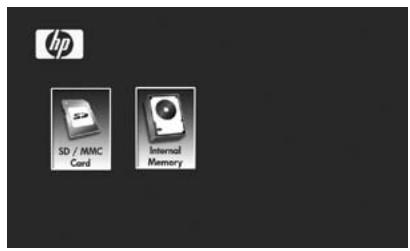
SD/MMC Card only
or
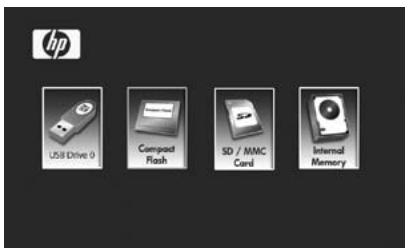
SD/MMC card, Compact Flash, and USB Flash Drive inserted.
- Use


to highlight the desired memory source
icon. Press to select. This will bring up the MAIN MENU for the memory source just selected.
Picture Options
Slideshow modes
Slideshow mode will begin automatically a few seconds after the frame is powered on or when an external memory card/USB Flash drive is inserted. There are two slideshow modes, one with background music and the other without. Review the Initial Setup and Setup Menu sections of this document for details on how to change desired settings.
Browse mode
To exit slideshow mode, press once. "Browse mode" will be displayed on the lower right of the screen for a few seconds. This allows forward and previous picture viewing.

Thamburger mode
To view pictures in a thumbnail mode, press TWICE when in slideshow or ONCE when in browse mode as illustrated below.
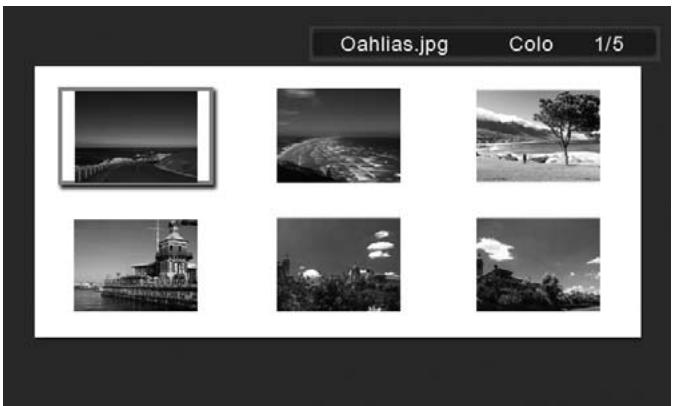
Use the arrow buttons to navigate to a picture. Press selected picture.

to view the
Picture Rotate and Zoom
Picture Rotation
Pictures will be automatically rotated based on the frame orientation.
Pictures can be manually rotated by pressing the button in slideshow or browse mode. Note: if a picture is rotated while in slideshow mode, the frame will automatically enter into photo browse mode. Each press of this button will rotate the picture by 90 degrees to the right.

Press to resume slideshow mode
Picture Zoom
Pictures can be zoomed to 5X by pressing the button in slideshow or browse mode. Each press of this button will increase the zoom by 1X until 5X. At 5X, press this button ONCE to return to the original view. Note: if a picture is zoomed while in slideshow mode, the frame will automatically enter into photo browse mode.
Once in zoom mode, use the arrow buttons to position the picture for desired viewing.
Press to resume slideshow mode.
Copying and Deleting Pictures
Copying pictures onto frame internal memory
From an external memory device: With the picture frame powered off, insert an external memory device with the preferred pictures into the appropriate connector. Turn the picture frame power ON and a slideshow from the external memory will automatically

begin in a few seconds. At the desired picture, press the button to display the copy/delete menu as shown below.
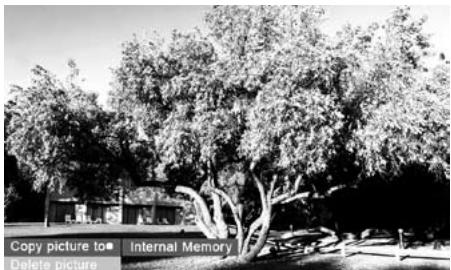
'Copy picture to' will be highlighted in blue. Press
display Internal Memory. Press again to copy the desired picture onto the frame's internal memory. A Finished text box will be displayed indicating the picture is now in the internal memory as illustrated below.
Finished
COPY DEL. to return to photo browse mode. Use or to select another picture and repeat above step to copy to internal memory.
Press

to resume slideshow.
Copying pictures onto frame internal memory
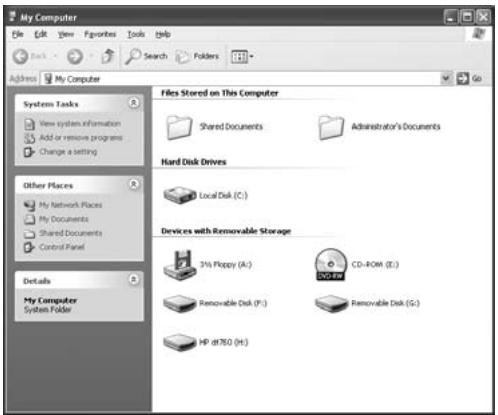
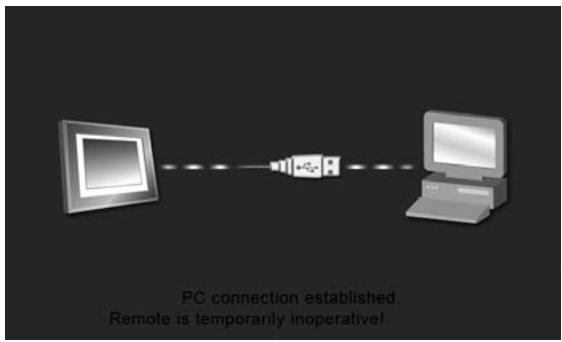
From a PC/laptop: For the first connection, it is recommended to remove all external memory sources. Power on the HP Digital Picture Frame and connect the HP Digital Picture Frame to your Windows™ 2000 (with service pack 4 or greater), Windows™ XP (with Service Pack 2 or greater), or Windows™ Vista PC/ notebook by using the USB cable provided with the product. 3 new drive letters should appear in Windows Explorer. These new drive letters represent the Digital Picture Frame's internal memory, memory card slot 1, and memory card slot 2. (see illustration below):
The digital picture frame will display the graphic below:
1 of the 3 new drive letters is the HP Digital Picture Frame's internal memory and labeled HP df710, df760, or df810 (depending on your photo frame model). Drive letter assignment MAY vary from PC to PC.
Use standard WindowsTM explorer file copy and paste procedures to move content onto the frame's internal memory.
To check the picture frame's available memory, right click on the HP df710, df760, or df810 drive letter and select Properties. A properties menu will appear displaying the available/free space (in Mega Bytes [MB]).
When finished copying pictures, disconnect the PC/laptop by

double-clicking on the Safely Remove Hardware icon in the lower right on the screen of the PC/Laptop. This will display the menu as illustrated below.
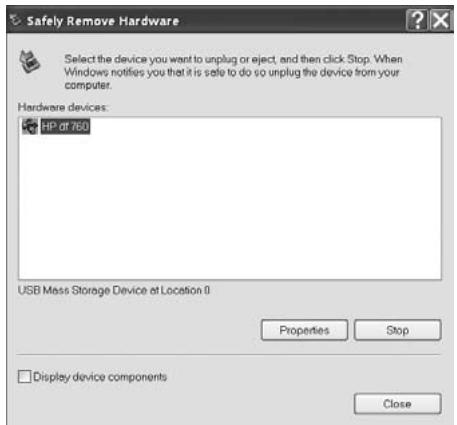
Highlight the HP df710, df760, or df810 drive and then click on the Stop button. After notification, unplug the USB 2.0 cable from both the PC/Laptop and the picture frame.
Deleting pictures from internal or external memory
Pictures can be deleted from internal and external memory sources in the same manner as it was added. Before deleting a picture or pictures, it is important to select the desired memory source (see Selecting a Memory Source section for details).
Select the desired picture to be deleted and press the COPY DEL.
button to display the copy/delete menu. Press to highlight 'Delete picture' text. Press to display the YES and NO text.
Use to highlight the desired action. If YES is highlighted,
press to delete the desired picture from memory. The picture will disappear and the next picture (if additional pictures are available) will be displayed.
Press twice to delete this image or press COPY DEL. to return to photo browse mode.
If the frame is connected to a PC or laptop as previously described in Copying pictures - From a PC/laptop section, pictures can be deleted using standard Windows™ explorer file delete procedures.
Music Playback
Go to the MAIN MENU (see Initial Setup section). Note: make sure the desired memory source is selected (see Selecting a Memory Source section for details).

The frame will display a list of music/ audio files found on the selected memory source as illustrated below.
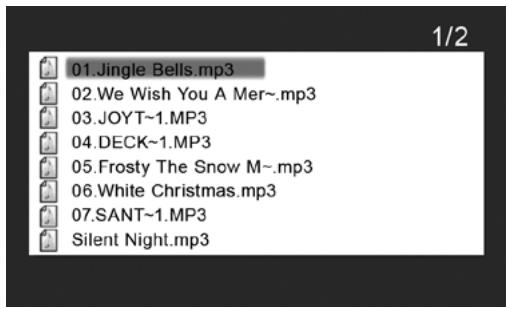
The first music track in the list will be highlighted. Press to begin playback.
-
The default playback mode is to play from first to last track then repeat from the first track.
-
Press to adjust volume.
-
Press or to playback other tracks (if available).
Copying and Deleting Music
The process for copying or deleting music onto or from the frame internal and external memory sources is the same as described in the previous section titled Copying and Deleting Pictures. Please refer to this section for details
Supported audio format: .mp3
Video Playback
There are two methods to playback video files on a memory source. Note: make sure the desired memory source is selected (see Selecting a Memory Source section for details).
- Go to the MAIN MENU (see Initial Setup section) and press the

button. If compatible video files are available, playback first (if more than one file) will begin.
- The default playback mode is to play from first to last clip then repeat until stopped.

- Press to adjust volume.
Press or available).

to playback other clips (if
-
Press to pause playback.
-
Press
to return to the MAIN MENU screen.
- Go to the MAIN MENU (see Initial Setup section).
Use the or to highlight the video icon then press
The frame will display a list of supported video clips/files found on the selected memory source as illustrated below.
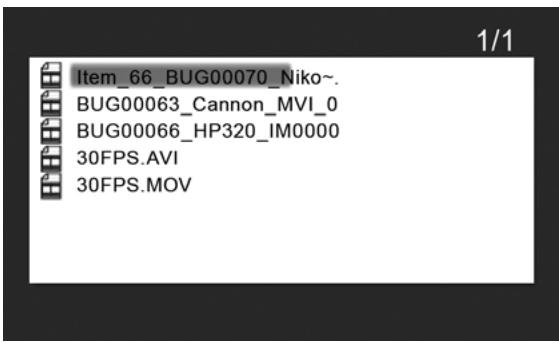
Use the or to highlight a desired video clip. Press to start playback.
- The default playback mode is to play from first to last clip then repeat until stopped.

- Press to adjust volume.

or to playback other clips (if
- Press or to playback other clips (if available).

to pause playback.
- Press to return to the list of video files.

Copying and Deleting Videos
Video clips CANNOT be copied or deleted using the COPY DEL. feature.
However, if connected to a PC or Laptop, video clips can be managed using the same procedures as described in the Copying pictures – From a PC/laptop section.
Supported Video format: MPEG-1, MP4, and Motion JPEG
Calendar & Clock Display
Go to the MAIN MENU (see Initial Setup section).

The frame will display the calendar and clock screen similar to the illustration below.
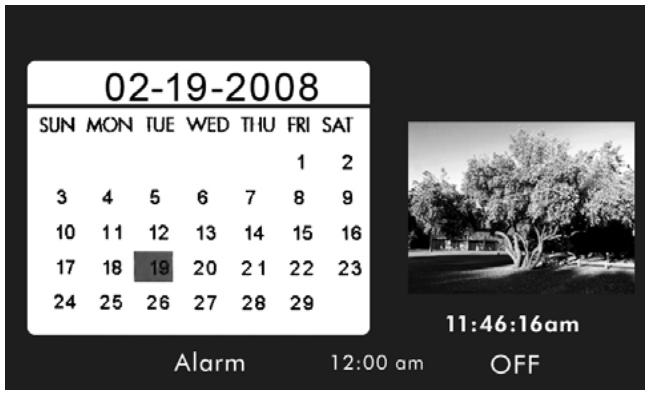
Initially, the calendar and clock will display an incorrect date and time until they are properly set up. To adjust the date and time, press the

button to display the TIME SET menu as shown below.
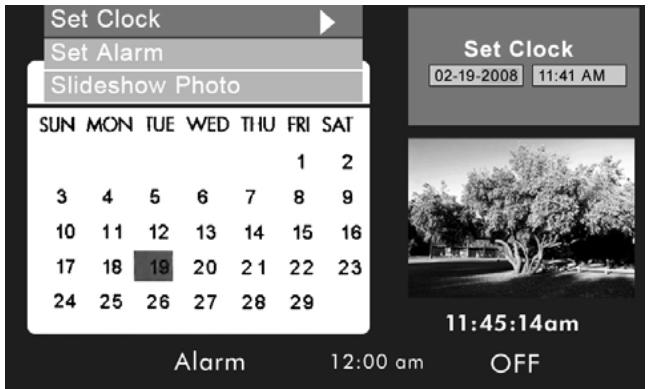
Setting the Calendar and Clock:


- The Set Clock option will be highlighted. Press the button to open the Set Clock screen as shown below.
or
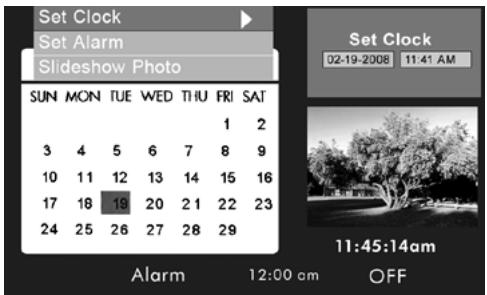
Use the & buttons to move between the calendar and clock values.
Use the & buttons to change the date and time values.
- Press when desired date and time are selected. This will return to the TIME SET menu.
Use & to highlight the Set Alarm or Slideshow Photo options. Press to select the desired option.
Setting the Alarm:
-
Highlight the Set Alarm option. Press the or button to open the Set Alarm screen.
Use the & buttons to move between the calendar, clock, audible sound type, and On/OFF values.
Use the & buttons to change these values. -
Press when desired settings are selected. This will return to the TIME SET menu.
Use & to highlight the Set Clock or Slideshow Photo options. Press to select the desired option.
Setting the Slideshow Photo feature:
- Highlight the Slideshow Photo option. Press the button to open the Slideshow Photo screen.


or

&

-
- buttons to highlight Internal Memory or option.
-
Internal Memory will display pictures from the frame's internal memory in a slideshow mode while in Calendar mode as shown below:
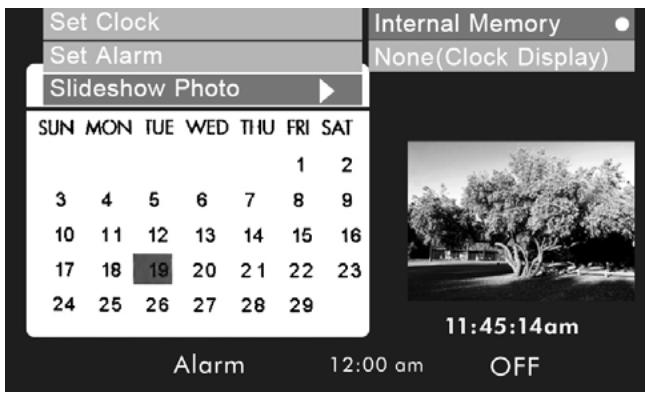
- Note: ONLY pictures from the internal memory will be displayed.
- The transition timing will be about 60 seconds and CANNOT be changed.
Press

to select desired option. This will return to the TIME SET to display the selected feature.
Press the

button to remove the TIME SET menu. Press

again to display the MAIN MENU screen.
NOTE: If the Digital Picture Frame is unplugged from power source, all clock settings will need to be setup again.
| Panel Specification | |
| Size | 7" |
| Aspect ratio | 16:9 |
| Resolution | 480 x 234 pixels |
| Power | |
| External AC Power Adapter | +9V, 2.0A |
| Audio | |
| Internal speakers | 1.0 W x2 |
| Connectivity | |
| USB Ports | 1 – USB 2.0 (Host, for thumb drive) 1 – Mini USB 2.0 (Device, for link to PC for manage internal memory) |
| Storage/Media | |
| Internal memory | 128MB |
| Supported Memory cards | |
| Memory cards slot 1 | Memory Stick Pro (MS Pro), Secure Digital (SD 2.0), XD Picture Card, & Multi Media Card (MMC) |
| Memory cards slot 2 | Compact Flash (CF) |
| Media Files Supported: | |
| Video file formats | MPEG-1, MP4, & Motion JPEG |
| Picture file formats | JPEG - (Base line only) |
| Audio file formats | MP3 |
| Supported Languages | |
| On-Screen Display | English, French, Spanish, Italian, German, Dutch, & Portuguese |
Specifications - df760
| Panel Specification | |
| Size | 7" |
| Aspect ratio | 16:9 |
| Resolution | 800 x 480 pixels |
| Power | |
| External AC Power Adapter | +9V, 2.0A |
| Audio | |
| Internal speakers | 1.0 W x2 |
| Connectivity | |
| USB Ports | 1 – USB 2.0 (Host, for thumb drive) 1 – Mini USB 2.0 (Device, for link to PC for manage internal memory) |
| Storage/Media | |
| Internal memory | 128MB |
| Supported Memory cards | |
| Memory cards slot 1 | Memory Stick Pro (MS Pro), Secure Digital (SD 2.0), XD Picture Card, & Multi Media Card (MMC) |
| Memory cards slot 2 | Compact Flash (CF) |
| Media Files Supported: | |
| Video file formats | MPEG-1, MP4, & Motion JPEG |
| Picture file formats | JPEG - (Base line only) |
| Audio file formats | MP3 |
| Supported Languages | |
| On-Screen Display | English, French, Spanish, Italian, German, Dutch, & Portuguese |
| Size | 8" |
| Aspect ratio | 4:3 |
| Resolution | 800 x 600 pixels |
| Power | |
| External AC Power Adapter | +9V, 2.0A |
| Audio | |
| Internal speakers | 1.0 W x2 |
| Connectivity | |
| USB Ports | 1 – USB 2.0 (Host, for thumb drive) 1 – Mini USB 2.0 (Device, for link to PC for manage internal memory) |
| Storage/Media | |
| Internal memory | 128MB |
| Supported Memory cards | |
| Memory cards slot 1 | Memory Stick Pro (MS Pro), Secure Digital (SD 2.0), XD Picture Card, & Multi Media Card (MMC) |
| Memory cards slot 2 | Compact Flash (CF) |
| Media Files Supported: | |
| Video file formats | MPEG-1, MP4, & Motion JPEG |
| Picture file formats | JPEG - (Base line only) |
| Audio file formats | MP3 |
| Supported Languages | |
| On-Screen Display | English, French, Spanish, Italian, German, Dutch, & Portuguese |
Frequently Asked Questions
| Question | Answer |
| How far away can I use the remote control? | Up to 15ft (5m) |
| My remote control doesn’t work? | You may need to change the battery. Please use a lithium 3V-model number CR2025 only. |
| Why can’t I display some of my Pictures? | Some picture/image file formats are not supported. Please refer to the specifications. |
| Why can’t I play some of my music tracks? | Some music file formats are not supported. Please refer to the specifications. |
| Why can’t I play some of my video clips? | Some video file formats are not supported. Please refer to the specifications. |
| Can I delete pictures from external memory cards or flash drives? | Yes, refer to the Picture Options section of this document. |
| Can I delete pictures from internal memory? | Yes, refer to the Picture Options section of this document. |
| How can I switch to the internal memory? | Remove all external memory sources.Or press the MENU button until the memory source selection screen is displayed.Use & to highlight internal memory icon and press . |
| Why can’t I use my WindowsTM 98 or Me system to copy content onto the frame? | The appropriate USB drivers are not supplied for this product and are NOT native to these operating systems |
| Why can’t I use my AppleTM system to copy content onto the frame? | Connecting the frame will only allow access to the memory card slot 1 and no other source. If desired, content from the AppleTM can be copied onto a slot 1 memory card. Following procedures documented in Picture Options section of this document, content could be copied onto the frame’s internal memory. Note: This is NOT a supported process. |
| I have lost or damaged my remote and/or power adapter. Can I order replacements? | Yes. Visit www.hp.com/support for more details. |
| How can I find the latest information/FAQs about my HP Digital Picture Frame? | Visit www.hp.com/support for more details and the latest information. |
Cleaning and Care Tips
V Please power off the HP Digital Picture Frame before cleaning.
DO NOT push on the screen too firmly.
V DO NOT spray or pour liquid cleaning agents directly on the screen or frame.
V DO NOT use ammonia, alcohol, or abrasive detergent cleaning agents.
Cleaning the Screen:
- Wipe screen with a clean, soft, lint-free cloth to remove dust and loose particles.
- If further cleaning is required, apply an appropriate cleaning agent (approved for LCD displays) to a clean, soft, lint-free cloth and wipe the screen.
NOTE: do not apply too much pressure on the screen to avoid damaging it.
Cleaning the Frame and Backing:
- Use a clean, soft, lint-free cloth to remove dust and loose particles.
- If desired, apply an appropriate cleaning agent to a clean, soft, lint-free cloth and wipe the appropriate surfaces.
Getting Help
Should you have a technical support question or your HP Digital Picture frame requires service within the warranty period, please contact the original point of purchase or an authorized HP reseller in your country. If service is not available at those locations, please contact an HP Branded Product warranty agent from the support contact list provided below. A service agent will work with you to troubleshoot your issue and if necessary, issue a Return Material Authorization (RMA) number in order to replace your HP Branded Product. For warranty claims, you will be required to provide a copy of your original dated sales receipt as proof of purchase and the issued RMA number. You will be responsible for shipping charges when shipping the product to the service center. The service agent will provide you with an address and you will also be responsible for any shipping charges to the warranty service center. Once your product is received by this service center, a replacement unit will be shipped back to you typically within 5 business days.
| Email Support: | |
| Language | Email Address |
| Dutch | hollands@hpodd.com |
| Chinese | simp.chinese@hpodd.com |
| trad.chinese@hpodd.com | |
| English | english@hpodd.com |
| François | français@hpodd.com |
| Deutsch | deutsch@hpodd.com |
| Italiano | italiano@hpodd.com |
| Japanese | nippon@hpodd.com |
| Korean | korean@hpodd.com |
| Portuguese | portugues@hpodd.com |
| Espanol | espanol@hpodd.com |
| Svenska | svensk@hpodd.com |
| Contact/Phone Support: | ||
| Country | Language | Number |
| Europe Region (EMEA) | ||
| België | Dutch and German | + 32 2700 1724 |
| FRANCE | French | + 33 171230454 |
| DEUTSCHLAND | German | + 49 6950073896 |
| IRELAND | English | + 353 1850882016 |
| ITALIA | Italian | + 39 269682189 |
| NETHERLANDS | Dutch | + 31 202015093 |
| ESPANÁ | Spanish | + 34 914533458 |
| SWITZERLAND | German/French/Italian | + 41 18009686 |
| UK | English | + 44 2073652400 |
| North America | ||
| United States | English | 1.866.694.7633 |
| Canada | English & French | 1.866.694.7633 |
Table des matieres
- Digital Picture Frame Cadre Photo Numérique Marco de Fotos Digital
- FCC Compliance Statement
- Table of Contents
- Getting Started
- Remote Control
- Initial Setup
- Key Features
- Selecting a Memory Source
- Picture Options
- Slideshow modes
- Browse mode
- Thamburger mode
- Picture Rotate and Zoom
- Picture Rotation
- Picture Zoom
- Copying and Deleting Pictures
- Copying pictures onto frame internal memory
- Finished
- Deleting pictures from internal or external memory
- Music Playback
- Copying and Deleting Music
- Supported audio format: .mp3
- Video Playback
- Copying and Deleting Videos
- Calendar & Clock Display
- Setting the Calendar and Clock:
- Setting the Alarm:
- Setting the Slideshow Photo feature:
- Specifications - df760
- Frequently Asked Questions
- Cleaning and Care Tips
- Cleaning the Screen:
- Cleaning the Frame and Backing:
- Getting Help
- Table des matieres
Brand : COMPAQ
Model : DF810
Category : Digital photo frame