
DR-2D - Portable audio recorder TASCAM - Free user manual and instructions
Find the device manual for free DR-2D TASCAM in PDF.

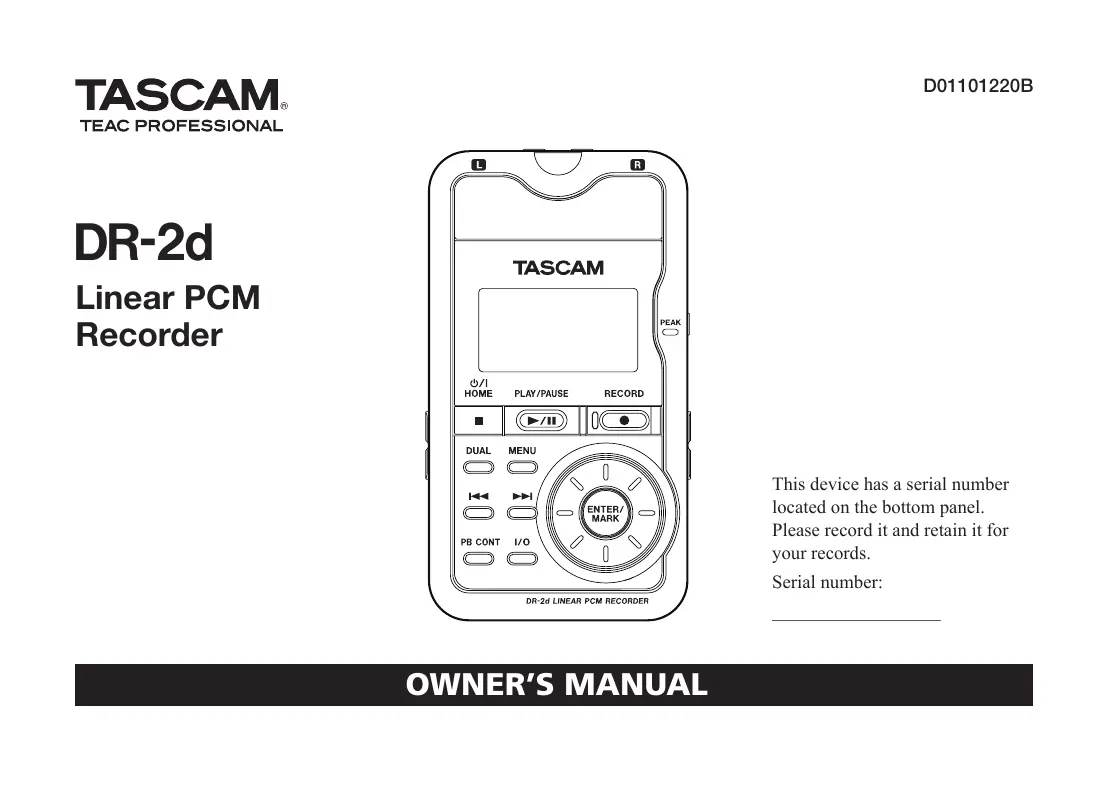

| Product Type | Portable Audio Recorder |
| Brand | TASCAM |
| Model | DR-2D |
| Dimensions (W x D x H) | 143 x 72 x 32 mm |
| Weight (without batteries) | 210 g |
| Power Supply | 2 AA batteries (LR6) or AC adapter (USB) |
| Battery Life (alkaline batteries) | Approximately 10 hours (WAV recording 44.1 kHz/16-bit) |
| Recording Media | SD/SDHC card (up to 32 GB) |
| Recording Formats | WAV (44.1/48/96 kHz, 16/24-bit); MP3 (32-320 kbps) |
| Built-in Microphone | Unidirectional stereo (configurable |
| Line/Microphone Input | 3.5 mm stereo mini-jack (switchable) |
| Headphone Output | 3.5 mm stereo mini-jack |
| Main Functions | Recording, playback, automatic gain control (AGC), limiter, noise reduction, pre-listening, markers, file splitting |
| Maintenance and Cleaning | Clean with a soft dry cloth. Avoid moisture and solvents. |
| Safety | Do not expose to rain or moisture; do not open; use recommended batteries. |
| Spare Parts and Repairability | Contact TASCAM customer service or an authorized center; some parts (battery, SD card) are user-replaceable. |
| General Information | 2-year warranty; made in China; compatible with Windows/Mac |
Frequently Asked Questions - DR-2D TASCAM
User questions about DR-2D TASCAM
0 question about this device. Answer the ones you know or ask your own.
Ask a new question about this device
Download the instructions for your Portable audio recorder in PDF format for free! Find your manual DR-2D - TASCAM and take your electronic device back in hand. On this page are published all the documents necessary for the use of your device. DR-2D by TASCAM.
USER MANUAL DR-2D TASCAM
This device has a serial number located on the bottom panel. Please record it and retain it for your records.
Serial number:
IMPORTANT SAFETY INSTRUCTIONS

CAUTION
RISK OF ELECTRIC SHOCK DO NOT OPEN

CAUTION: TO REDUCE THE RISK OF ELECTRIC SHOCK, DO NOT REMOVE COVER (OR BACK). NO USER-SERVICEABLE PARTS INSIDE. REFER SERVICING TO QUALIFIED SERVICE PERSONNEL.

The lightning flash with arrowhead symbol, within equilateral triangle, is intended to alert the user to the presence of uninsulated "dangerous voltage" within the product's enclosure that may be of sufficient magnitude to constitute a risk of electric shock to persons.

The exclamation point within an equilateral triangle is intended to alert the user to the presence of important operating and maintenance (servicing) instructions in the literature accompanying the appliance.
Declaration of Conformity
Model Number: DR-2d
Trade Name: TASCAM
Responsible party: TEAC AMERICA, INC.
Address: 7733 Telegraph Road, Montebello, California, U.S. A.
Telephone number: 1-323-726-0303
This device complies with Part 15 of the FCC Rules. Operation is subject to the following two conditions: (1) this device may not cause harmful interference, and (2) this device must accept any interference recieved, including interference that may cause undesired operation.
WARNING: TO PREVENT FIRE OR SHOCK HAZARD, DO NOT EXPOSE THIS APPLIANCE TO RAIN OR MOISTURE.
FOR U.S.A.
TO THE USER
This equipment has been tested and found to comply with the limits for a Class B digital device, pursuant to Part 15 of the FCC Rules. These limits are designed to provide reasonable protection against harmful interference in a residential installation. This equipment generates, uses, and can radiate radio frequency energy and, if not installed and used in accordance with the instruction manual, may cause harmful interference to radio communications. However, there is no guarantee that interference will not occur in a particular installation. If this equipment does cause harmful interference to radio or television reception, which can be determined by turning the equipment off and on, the user is encouraged to try to correct the interference by one or more of the following measures.
a) Reorient or relocate the receiving antenna.
b) Increase the separation between the equipment and receiver.
c) Connect the equipment into an outlet on a circuit different from that to which the receiver is connected.
d) Consult the dealer or an experienced radio/TV technician for help.
CAUTION
Changes or modifications to this equipment not expressly approved by TEAC CORPORATION for compliance could void the user's authority to operate this equipment.
IMPORTANT SAFETY INSTRUCTIONS
1 Read these instructions.
2 Keep these instructions.
3 Heed all warnings.
4 Follow all instructions.
5 Do not use this apparatus near water.
6 Clean only with dry cloth.
7 Do not block any ventilation openings. Install in accordance with the manufacturer's instructions.
8 Do not install near any heat sources such as radiators, heat registers, stoves, or other apparatus (including amplifiers) that produce heat.
9 Do not defeat the safety purpose of the polarized or grounding-type plug. A polarized plug has two blades with one wider than the other. A grounding type plug has two blades and a third grounding prong. The wide blade or the third prong are provided for your safety. If the provided plug does not fit into your outlet, consult an electrician for replacement of the obsolete outlet.
10 Protect the power cord from being walked on or pinched particularly at plugs, convenience receptacles, and the point where they exit from the apparatus.
11 Only use attachments/accessories specified by the manufacturer.
12 Use only with the cart, stand, tripod, bracket, or table specified by the manufacturer, or sold with the apparatus. When a cart is used, use caution when moving the cart/apparatus combination to avoid injury from tip-over.

13 Unplug this apparatus during lightning storms or when unused for long periods of time.
14 Refer all servicing to qualified service personnel. Servicing is required when the apparatus has been damaged in any way, such as power-
supply cord or plug is damaged, liquid has been spilled or objects have fallen into the apparatus, the apparatus has been exposed to rain or moisture, does not operate normally, or has been dropped.
- Do not expose this apparatus to drips or splashes.
- Do not place any objects filled with liquids, such as vases, on the apparatus.
- Do not install this apparatus in a confined space such as a book case or similar unit.
- The apparatus draws nominal non-operating power from the AC outlet with its POWER or STANDBY/ON switch not in the ON position.
- The apparatus should be located close enough to the AC outlet so that you can easily grasp the power cord plug at any time.
- The mains plug is used as the disconnect device, the disconnect device shall remain readily operable.
- If the product uses batteries (including a battery pack or installed batteries), they should not be exposed to sunshine, fire or excessive heat.
- CAUTION for products that use replaceable lithium batteries: there is danger of explosion if a battery is replaced with an incorrect type of battery. Replace only with the same or equivalent type.
- Caution should be taken when using earphones or headphones with the product because excessive sound pressure (volume) from earphones or headphones can cause hearing loss.
- If you are experiencing problems with this product, contact TEAC for a service referral. Do not use the product until it has been repaired.
IMPORTANT SAFETY INSTRUCTIONS
Cautions about Batteries
This product uses batteries. Misuse of batteries could cause a leak, rupture or other trouble. Always abide by the following precautions when using batteries.
- Never recharge non-rechargeable batteries. The batteries could rupture or leak, causing fire or injury.
- When installing batteries, pay attention to the polarity indications (plus/minus (+/-) orientation), and install them correctly in the battery compartment as indicated. Putting them in backward could make the batteries rupture or leak, causing fire, injury or stains around them.
- When throwing used batteries away, follow the disposal instructions indicated on the batteries and the local disposal laws. When you store or dispose of batteries, isolate their terminals with insulation tape or something like that to prevent them from contacting other batteries or metallic objects.
- Do not use batteries other than those specified. Do not mix and use new and old batteries or different types of batteries together. The batteries could rupture or leak, causing fire, injury or stains around them.
- Do not carry or store batteries together with small metal objects. The batteries could short, causing leak, rupture or other trouble.
- Do not heat or disassemble batteries. Do not put them in fire or water. Batteries could rupture or leak, causing fire, injury or stains around them.
- If the battery fluid leaks, wipe away any fluid on the battery case before inserting new batteries. If the battery fluid gets in an eye, it could cause loss of eyesight. If fluid does enter an eye, wash it out thoroughly with clean water without rubbing the eye and then consult a doctor immediately. If the fluid gets on a person's body or clothing, it could cause skin injuries or burns. If this should happen, wash it off
with clean water and then consult a doctor immediately.
- The unit power should be off when you install and replace batteries.
- Remove the batteries if you do not plan to use the unit for a long time. Batteries could rupture or leak, causing fire, injury or stains around them. If the battery fluid leaks, wipe away any fluid on the battery compartment before inserting new batteries.
产品有毒有害物质或元素的名称及含量
Features 9
Items included with the product. 10
Conventions used in this manual 10
Intellectual property rights 11
About SD cards 12
Beware of condensation 12
Cleaning the unit. 12
2-Names and Functions of Parts 13
Top panel 13
Rear Panel 15
Right side panel 16
Left side panel. 16
Bottom panel 17
Remote control (RC-DR2) 18
Home screen 19
Recording Screen 21
Menu item list 22
Using menus 23
Basic operation 24
3-Preparation 25
Powering the unit 25
Using AA batteries. 25
Using an AC adaptor (sold separately) 25
Preparing the remote control 26
Changing the coin-shaped battery 26
When to change the battery 26
Cautions about the use of the battery. 26
Using the remote control 27
Precautions for use of the remote control. 28
Start-up & shutdown 28
Inserting and removing SD cards 29
Inserting the SD card 29
Removing the card 29
Preparing an SD card for use 30
Card write protection. 30
Setting the date and time 31
Using the built-in speaker 32
Connecting monitors and headphones 32
4-Recording 33
Selecting file format/sampling frequency, and maximum file size 33
Available recording time display 34
Set where to save the file 35
Setting the input functions 35
Placing the unit and making connections 36
Recording with the built-in mics 36
Recording with external mics (MIC IN) 37
Recording an external device (LINE IN) 37
Adjusting the input level 38
Recording 39
Recording playback and input sounds together (overdubbing) 40
Setting the file type to WAV. 40
Monitor the input signal (MONITOR) 41
Recording an overdub 42
Recording two files with different levels at the same time
(DUALREC) 43
Making settings for dual recording 43
Starting dual recording 44
Dual recording file names 45
Playback of files created using dual recording 45
Automatic recording and pausing (AUTO REC) 45
Creating new files (track incrementing) 46
Creating new files manually while recording 46
Creating new files automatically while recording (maximum file size) 47
Mark function 48
Adding marks manually to a recording 48
Moving to a mark position 48
Recording the moment before pushing RECORD (PRE REC).48
Delaying the start of recording (REC DELAY) 49
Dividing a file manually (DIVIDE) 50
Recording duration 51
5-Working with Files and Folders (BROWSE
screen) 52
Screen navigation 52
Icons on the BROWSE screen 52
File operations 53
Folder operations 54
6-Playback 56
Adjusting playback volume 56
Setting the playback area (AREA). 56
Selecting a folder for the playback area (1) 57
Selecting a folder for the playback area (2) 58
Adding tracks to the playlist. 59
Editing the playlist 59
Selecting files for playback (skip) 61
Playback (PLAY) 61
Stopping 61
Pausing (PAUSE) 62
Rewinding and fast-forwarding (search) 62
Using the wheel to change the playback position 62
Repeat playback (REPEAT) 62
Loop playback 63
Setting the loop point manually 64
Making fine adjustments to the loop playback IN and OUT points 64
Turning loop playback ON/OFF 65
SpecialPlayback Control Functions 65
Setting the playback control functions 65
Changing the speed 65
Change speed without changing pitch 66
Changing the pitch without changing the speed 66
Reducing vocal and solo instrument sounds 66
7-Using the Effects 68
Setting the effect 68
Table of Contents
Effects Preset List 69
8-Using the Metronome 70
Setting the metronome 70
Starting and stopping the metronome 70
9-Connecting with a Computer 71
Transferring files to a computer 71
Transferring files from a computer 72
Disconnecting from a computer 72
10-Settings and Information 73
Viewing File Information 73
File information page 73
Card information page 74
System information page 74
System Settings and Formatting 75
Setting the search speed 75
Turning the unit power OFF automatically 75
Backlight Auto OFF setting 75
Adjust the display contrast 75
Adjust the backlight brightness. 75
Remote control setting. 76
Setting the type of AA batteries. 76
Restoring the factory settings 76
Using QUICK FORMAT 76
Using FULL FORMAT 77
Setting the format of file names 77
File name format 78
Setting the WORD item. 78
11-Messages 79
12-Troubleshooting 83
13-Specifications 85
Ratings 85
Input/output ratings 85
Analog audio input/output ratings. 85
Control input/output ratings 86
Audio performance 86
Computer compatibility 86
Other specifications 87
Dimensional drawings. 87
Thank you very much for purchasing the TASCAM DR-2d Linear PCM Recorder. Please read this Owner's Manual carefully in order to maximize your use of all the unit's features. We hope that you will enjoy using this recorder for many years to come.
After you have finished reading this manual, please keep it in a safe place for future reference.
You can also download the Owner's Manual from the TASCAM web site (http://www.tascam.com).
Features
- Compact audio recorder that uses SD/SDHC cards as recording media
- Directional microphones allow high-quality stereo recording
44.1/48/96 kHz, 16/24-bit, linear PCM (WAV format) recording possible
32-320 kbps MP3 format recording possible (compatible with ID3 tag v2.4) - Dual recording function allows two stereo files to be recorded with different levels simultaneously using either the built-in stereo microphone or an external stereo mic
Overdebbing allows playback and input signals to be mixed and recorded together as a new file
Built-in 0.6-W monaural output speaker
Built-in effect (reverb) can be used during recording and playback
- Auto-record function starts recording automatically when a set sound input level is detected
- Can start recording a new file automatically when a maximum file size set in advance is reached without interrupting recording
- Track incrementing function allows a recording to be split by creating a new file when desired
- Pre-recording (PRE REC) function allows the unit to record the 2 seconds of sound before recording is activated
- Auto gain control function automatically make the input level as even as possible
- Limiter function automatically reduces the level suitably when the input level is too high
- Low cut filter conveniently reduces low-frequency noise
VSA function allows playback speed to be altered in a range from half-speed to double-speed without changing pitch
- Key control function allows changing the pitch in semitones (b6 - #6) without changing the speed.
- Part cancel function allows reducing the selected part of the sound.
- Metronome function
- REC DELAY function can be used to avoid recording the sound of pushing the RECORD key
1-Introduction
- Repeat playback and IN-OUT loop playback functions
- Playlist function
- DIVIDE function allows files to be split where desired
MARK function convenient for moving to specific locations - File name format can be set to use a user-defined word or the date
1/8" external stereo microphone input jack (provides plug-in power)
1/8" external stereo line input jack
1/8” line/headphones output jack
128 x 64 pixel LCD with backlight - Mini-B type USB 2.0 port
- Operates on 2 AA batteries or an AC adaptor (sold separately: TASCAM PS-P520)
- Tripod attachment screw-hole built into unit
Items included with the product
The DR-2d package contains the following items.
Take care when opening the package not to damage the items. Keep the package materials for transportation in the future.
Please contact the store where you purchased this unit if any of these items are missing or have been damaged during transportation.
Main unit 1
Soft case 1
SD card (in the unit) 1
AA alkaline batteries. 2
- Wireless remote control (RC-DR2) 1
USB cable (1.5m) 1
Warranty card. 1
Owner's Manual (this document) 1
Conventions used in this manual
The following conventions are used in this manual.
- "SD memory card" is sometimes abbreviated as "SD card."
- When we refer to a key or connector or control on the DR-2d, the typeface looks like this: MENU.
- When we show messages, for example, that appear on the screen, the typeface looks like this: SONG LOAD.
Additional information is introduced in the styles below when needed:
TIP
We give hints and tips on using the DR-2d when you see this icon.
NOTE
A note provides additional explanations for special situations.
CAUTION
A caution shows that you may lose data (recordings) if you do not follow the instructions.
Intellectual property rights
TASCAM is a registered trademark of TEAC Corporation.
- SDHC Logo is a trademark of SD-3C, LLC.

- Microsoft, Windows, Windows XP, Windows Vista, and Windows 7 are either registered trademarks or trademarks of Microsoft Corporation in the United States and/or other countries.
- Apple, Macintosh, iMac, Mac OS and Mac OS X are trademarks of Apple Inc.
- MPEG Layer-3 audio coding technology licensed from Fraunhofer IIS and Thomson.
Supply of this product does not convey a license nor imply any right to distribute MPEG Layer-3 compliant content created with this product in revenue-generating broadcast systems (terrestrial, satellite, cable and/or other distribution channels), streaming applications (via Internet, intranets and/or other networks), other content distribution systems (pay-audio or audio-on-demand applications and the like) or on physical media (compact discs, digital versatile discs, semiconductor chips, hard drives, memory cards and the like). An independent license for such use is required. For details, please visit http://mp3licensing.com.
- Other company names, product names and logos in this document are the trademarks or registered trademarks of their respective owners.
Any data, including, but not limited to information, described herein are intended only as illustrations of such data and/or information and not as the specifications for such data and/or information. TEAC Corporation disclaims any warranty that any use of such data and/or information shall be free from infringement of any third party's intellectual property rights or other proprietary rights, and further, assumes no liability of whatsoever nature in the event of any such infringement, or arising from or connected with or related to the use of such data and/or information.
1-Introduction
This product is designed to help you record and reproduce sound works to which you own the copyright, or where you have obtained permission from the copyright holder or the rightful licensor. Unless you own the copyright, or have obtained the appropriate permission from the copyright holder or the rightful licensor, your unauthorized recording, reproduction or distribution thereof may result in severe criminal penalties under copyright laws and international copyright treaties. If you are uncertain about your rights, contact your legal advisor. Under no circumstances will TEAC Corporation be responsible for the consequences of any illegal copying performed using the recorder.
About SD cards
This unit uses SD cards for recording and playback. SD cards that are 64 MB - 2 GB and SDHC cards that are 4 GB - 32 GB in size can be used. A list of SD cards that have been tested with this unit can be found on the TASCAM web site (www.tascam.com).
Precautions for use
SD cards are delicate media. In order to avoid damaging a card or the card slot, please take the following precautions when handling them.
- Do not leave them in extremely hot or cold places.
- Do not leave them in extremely humid places.
- Do not let them get wet.
- Do not put things on top of them or twist them.
- Do not hit them.
Beware of condensation
If the unit is moved from a cold to a warm place, or used after a sudden temperature change, there is a danger of condensation; vapor in the air could condense on the internal mechanism, making correct operation impossible. To prevent this, or if this occurs, let the unit sit for one or two hours at the new room temperature before using.
Cleaning the unit
Use a dry soft cloth to wipe the unit clean. Do not clean the unit with a chemically treated cloth or substances such as benzene, thinner and alcohol because they might cause damage to the surface of the unit.
Top panel
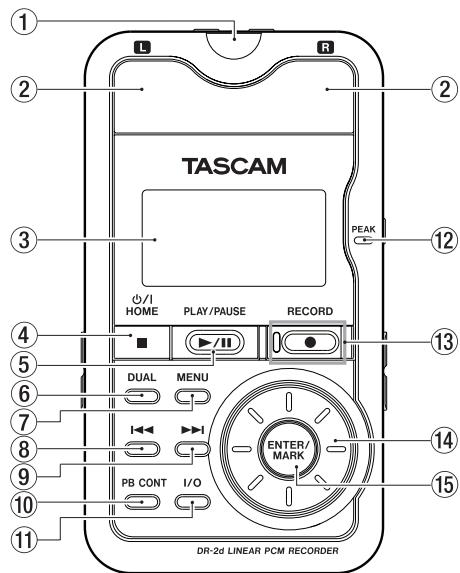
① Remote control receiver
Receives signals from the included remote control (RC-DR2). When using the remote point it here. (See "Using the remote control" on page 27.)
② Built-in stereo microphone
To use this stereo electret condenser microphone as the input source, select MIC on the input setting screen. If you connect an external microphone to the MIC IN jack on the rear panel, the built-in microphone becomes inactive.
③ Display
Shows a variety of information.
④ 念 / I/ HOME [■] key
Press this key to stop recording and playback or to end recording standby.
When a setting screen is open, press to return to the Home Screen.
On a setting screen, use this key to respond "NO" to a confirmation message.
Press and hold to turn the unit's power ON or put the unit in standby.
⑤ PLAY/PAUSE [▶/■] key
When the Home Screen is displayed and playback is stopped, press this key to start playback. During playback, press this key to stop playback at the current position.
When the Metronome Screen is open, use this key to start and stop the metronome.
2-Names and Functions of Parts
⑥ DUAL key
Press and hold to open the DUAL REC setting screen.
If the currently selected file was recorded using dual recording, the other file becomes active each time you press this key.
During dual recording, press to alternate display of the recording levels of the two files being recorded.
⑦ MENU key
When the Home Screen is displayed, press this key to open the MENU Screen.
Press this key to return to the MENU Screen from the various setting screens.
When the MENU Screen is displayed, press this key to return to the Home Screen.
⑧ key
Press this key to return to the beginning of a track that is playing or stopped in the middle.
If you press this key when a track is stopped at its beginning, the unit will skip to the beginning of the previous track.
Press and hold this key to search backwards.
On the setting screens, use this key to move the cursor left. On the Browse Screen, press this key to move up a level.
9 key
Press this key during playback or when playback is stopped to skip to beginning of the next track.
Press and hold this key to search forward.
On the setting screens, use this key to move the cursor right.
On the Browse Screen, press this key to move down a level.
Press the this key during recording to create a new file with the number at the end of the file name incremented (increased) and continue recording in this file from its beginning.
PB CONT key
Press and hold this key to open the Playback Control (PB CONTROL) Screen. When the Playback Control Screen is open, press and hold this key to return to the Home Screen. Briefly press this key to turn the speed control that is set on the Playback Control Screen (VSA and/or SPEED) ON and OFF. When ON, the SPEED icon appears at the top of the Home Screen as light letters on a dark background.
1 I/O key
Use this key to set the IN (start) and OUT (end) points of the interval that you want to set for loop playback. When the IN and OUT points are already set, press this key to cancel loop playback.
Press and hold this key to open a pop-up window that allows you to manually set IN and OUT points.
12 PEAK indicator
Lights when the input volume is too high.
13 RECORD [●] key and indicator
When playback is stopped, press this key to put the unit into recording standby. When in standby, the indicator flashes. If the MONITOR Screen INPUT item is ON, the Overdubbing ON/OFF pop-up appears. When in recording standby, press this key to start recording. The indicator lights while recording. When recording, press this key to pause recording.
14 Wheel
When a setting screen is open, use the Wheel to change the setting of the selected item.
When the Home Screen is open, use the wheel to adjust the file playback position.
15 ENTER/MARK key
When a setting screen is open, use this to confirm selections.
When recording, use it to add markers manually.
Rear Panel
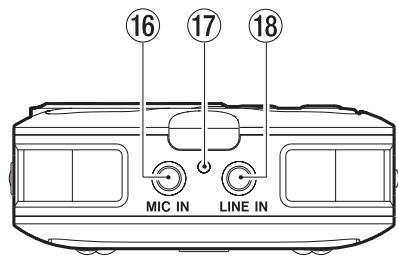
MIC IN jack
Use this input jack to connect a stereo mini-jack microphone. This jack provides plug-in power when set to do so on the Input Setting Screen.
⑰ REC indicator
This has the same function as the indicator to the left of the RECORD [●] key on the top panel. It blinks when in recording standby and lights when recording.
18 LINE IN jack
Use this stereo mini-jack for line input.
NOTE
We call this the Rear Panel because this is the end that faces away from the operator of the unit when placed on a table with the built-in mic (this end) facing the sound source.
2-Names and Functions of Parts
Right side panel
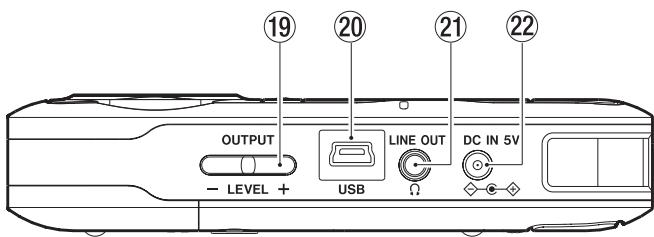
19 OUTPUT LEVEL (+, -) keys
Use these keys to adjust the signal level output from the LINE OUT/Ω jack. The volume level appears on the display during adjustment.
20 USB port
Use the included USB cable to connect with a computer. USB port.
LINE OUT/Ω jack
Use this to connect with headphones or the line input jack of an amp or other equipment.
22 DC IN 5V jack
Connect a TASCAM PS-P520 AC adaptor (purchased separately) to this jack.
Left side panel
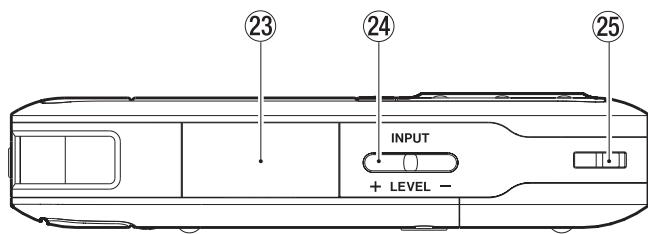
23 SD card slot and cover
Insert an SD card into this slot.
24 INPUT LEVEL (+, -) keys
Use these keys to adjust the input volume. The volume level appears on the display during adjustment.
25 Strap attachment
Use this to attach a strap.
2-Names and Functions of Parts
Bottom panel
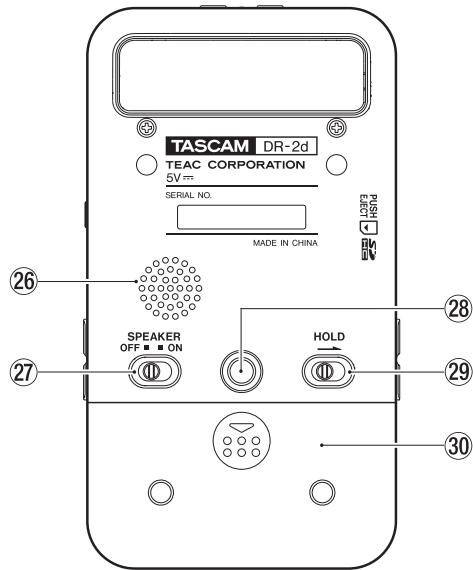
26 Mono speaker
Use this built-in speaker to listen to recordings. Sound is not output during recording, when the unit is in recording standby, when headphones are connected, or input monitor is activated.
2 SPEAKER switch
Set this to ON to output sound from the built-in speaker.
NOTE
Even when ON, no sound is output during recording, in recording standby, when headphones are connected, or input monitor is activated.
28 Tripod attachment screw-hole (1/4-inch)
Use this to attach the unit to a tripod or mic stand.
CAUTION
- Tighten the unit securely to the tripod or mic stand to prevent it from falling off.
- Place the tripod or mic stand on a level surface when using it with this unit.
- Some tripods use different types of screws, so it might not be possible to attach the unit directly. In such a case, purchase and use a suitable adapter.
29 HOLD switch
Shift in the direction of the arrow to engage the hold function, which prevents unintentional operation.
All keys are inoperative when hold is ON.
30 Battery compartment cover
2-Names and Functions of Parts
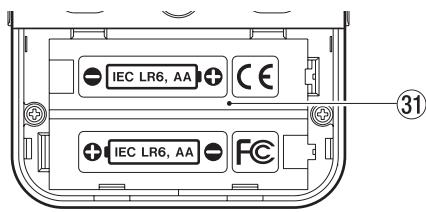
③ Battery compartment
Remote control (RC-DR2)
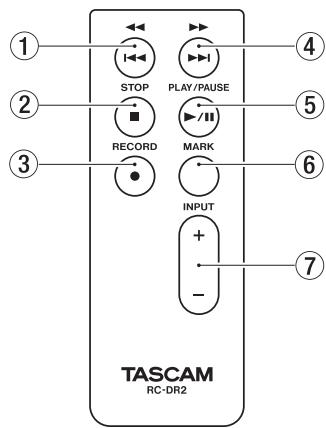
① [ ] key
Press this key briefly to return to the start of a file. If the playback position is already near the start of a track, it will skip to the start of the previous file.
Press and hold this to search a track in reverse.
② STOP [■] key
Press to stop playback and recording.
③ RECORD [●] key
Press to start and pause recording.
④ [▶-i] key
Press this key briefly to move to the start of the next file.
Press and hold this to search a track forward.
⑤ PLAY/PAUSE [▶/■] key
Press to start and pause playback.
⑥ MARK key
When recording, use it to add markers manually.
⑦ INPUT LEVEL [+ / - ] key
Use these keys to adjust the input volume.
Home screen
This screen appears when the unit's power is turned on. Press the 口 / 口 /HOME [ ] key at any time to open this screen.
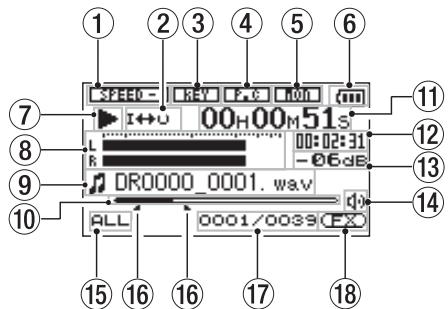
① Playback speed setting status
| OFF | ON | Playback speed |
| SPEED- | SPEED- | x1.0 |
| SPEED+ | SPEED+ | x1.1 - x2.0 |
| SPEED- | SPEED- | x0.5 - x0.9 |
② Loop/repeat playback status
SINGLE
Single playback

Single track repeat playback

All track repeat playback
I+0
Loop playback
③ Key control status

: Key control off

: Key control on.
Part cancel status

: Part cancel off

: Part cancel on.
⑤ Input monitor status

: Input monitor off

: Input monitor on.
⑥ Power supply status
When a battery is being used, a battery icon shows the amount of power remaining in bars (□, □, □). The battery is almost dead and the power will soon turn off if the icon has no bars. When using the PS-P520 AC adaptor (sold separately) □ appears.
NOTE
Sometimes a "Battery Low" warning appears when recording or conducting other demanding operations even when battery power remains.
2-Names and Functions of Parts
⑦ Recorder operation status
Stopped
1 Paused
Playing back
Fast-forwarding
Fast-rewinding
Skipping forward
一 Skipping backward
⑧ Level meters
When input monitor is OFF, the level of the playback sound is shown.
When input monitor is ON, the level of the combined input and playback sounds is shown.
9 File information
The file name or tag information of the file currently being played back is shown.
ID3 tag information is shown when available for an MP3 file being played.
NOTE
ID3 tag information includes the titles and artists names that can be saved in MP3 files.
⑩ Playback position display
The current playback position is shown by a bar. As playback progresses, the bar extends to the right.
11 Elapsed time
Shows the elapsed time (hours: minutes: seconds) of the currently playing track.
12 Remaining time
- Shows the remaining playback time of the current track (hours: minutes: seconds).
13 Peak value in decibels (dB)
The maximum level that occurs in a fixed period of time is displayed digitally.
14 Monitoring output
Headphones
Speakers
⑤ Playback area
All files in the MUSIC folder
FOLDER All files in the selected folder
P.LIST All files added to the playlist
16 Loop playback IN (starting) and OUT (ending) points The set starting and ending points of the loop are shown.
The icon appears at the playback position when the starting point is set.
The icon appears at the playback position when the ending point is set.
⑰ Playback file number/total number of files
The total number of files in the playback area and the number of the current file are shown.
18 Effect status
Shows whether the effect function is ON or OFF.
EX:Effect off
FX:Effect on
Recording Screen
This screen opens when you press the RECORD key to start recording standby mode and stays open when you press the RECORD key again to start recording.
This status of the power and the effect use appears the same as on the Home Screen. This screen also shows the following.
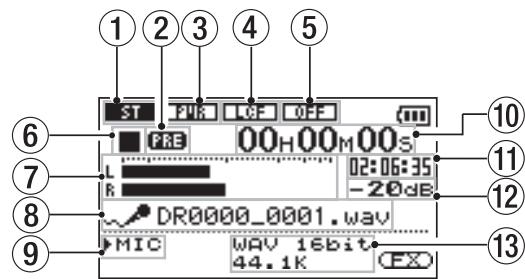
① Recording mode status
sT : Stereo recording
31: Monaural recording
(2) Prerecording function status
PRE appears when the prerecording function is ON.
③ Plug-in power status
PFE off
PUR on
Low cut filter status
Lowcutfilteroff
LCF : Low cut filter on (when set to 40Hz 80Hz or 120Hz )
⑤ Level control function status
OFF: Level control function off
2-Names and Functions of Parts
Auto : Auto gain control on
LHT : Limiter on
⑥ Recorder operation status
Stopped
1 Paused
Recording
⑦ Recording level meters
When overdubbing is off, the input signal level is shown.
When over dubbing is on, the combined input and playback signals are shown.
⑧ File name
The file name that will automatically be given to recorded files is shown.
⑨ Input selection
Shows the input source.
10 Elapsed recording time
The elapsed recording time of the track appears as hours: minutes: seconds.
During recording standby, the maximum remaining recording time appears.
Remaining recording time
The remaining recording time appears in hours: minutes: seconds.
12 Peak value in decibels (dB)
Peak recording level values are shown digitally.
13 Recording mode/sampling frequency
Shows the recording file format and sampling frequency.
Menu item list
This list provides an overview of the various menu items.
| Menu item | Function | Pages |
| INFORMATION | Information about the file, SD card, and system | 73 |
| BROWSE | SD card file and folder operations | 52 |
| PLAYLIST | Playlist editing | 59 |
| PLAY MODE | Play area select and repeat setting | 62 |
| INPUT SETTING | Input source select and input settings | 35 |
| REC SETTING | Recording mode settings | 33 |
| AUTO REC | Auto recording settings | 45 |
| MONITOR | Input monitor settings | 41 |
| METRONOME | Metronome settings | 70 |
| DIVIDE | Divide a file | 50 |
| EFFECTOR | Effects settings | 68 |
| FILE NAME | File name settings | 77 |
| SETUP | System settings and format an SD card | 75 |
| DATE/TIME | Date and time settings | 31 |
When in recording standby, only the following menu items are shown.
INPUT SETTING
AUTOREC
MONITOR
EFFECTOR
Using menus
Use the MENU screen to make various settings.
1 Press the MENU key to open the MENU screen.
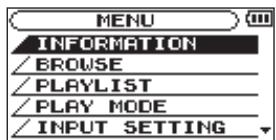
2 Use the wheel to select a menu (selected items are highlighted and appear as light letters on a dark background), and press the ENTER/MARK key to open a setting screen.
Example:REC SETTING screen
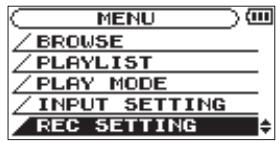
3 Use the wheel to select (highlight) a setting item.
Example: setting the sampling frequency
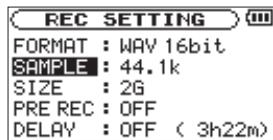
4 Press the key (or the ENTER/MARK key) to select the value of the setting.
Example: setting the sampling frequency
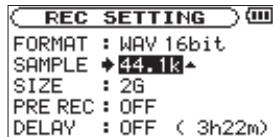
5 Use the wheel to change the setting.
6 To set a different item in the same menu, press the key to select the item you want to set.
7 Repeat step 3 to 6 as necessary to set each item.
2-Names and Functions of Parts
8 To open the MENU screen, press the MENU key.
To return to the Home Screen, press the HOME key.
Basic operation
Use the following keys to operate the various screens.
MENU key: Opens the MENU screen.
PB CONT key: Opens the PB CONTROL screen.
口 /口/ HOME [■] key: When any other screen is open, press this to return to the Home Screen. Use this to answer "H0" to a confirmation message.
ENTER/MARK key: Use this to confirm the selection of a setting item or to answer "YES" to a confirmation message.
key: Use this to move the cursor (the highlighted area) to the right on the screen, and to open folders on the BROWSE screen.
key: Use this to move the cursor (the highlighted area) to the left on the screen, and to close folders on the BROWSE screen.
Wheel: Use this to select items and to change values.
Powering the unit
The DR-2d can be operated using two AA batteries or an optional AC adapter (PS-P520). This unit can use alkaline or Ni-MH batteries.
Using AA batteries
Open the battery compartment cover on the back of the unit, install the batteries with the correct + / - orientation and close the battery compartment cover.
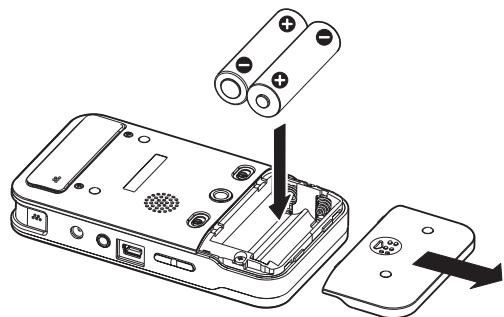
When using AA batteries, set the type of battery in order to accurately show the amount of power remaining and allow the unit to accurately determine whether power is available for proper operation. (See "Setting the type of batteries" on page 76.)
NOTE
- Manganese dry cell batteries (R6) cannot be used with this unit.
- This unit cannot recharge Ni-MH batteries. Use a commercially available charger.
- The included alkaline batteries are for confirming operation of the unit and might not last very long.
Using an AC adaptor (sold separately)
Connect to the PS-P520 AC adaptor (sold separately) to the DC IN 5V connector as shown in the illustration.
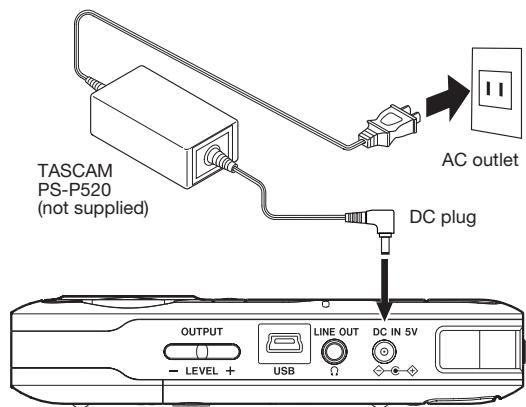
3-Preparation
CAUTION
Never use any adaptor other than the designated PS-P520 AC adaptor. Use of a different adaptor could cause malfunction, fire or electric shock.
NOTE
When both batteries are installed and the AC adaptor is connected, power will be supplied from the AC adaptor.
Preparing the remote control
NOTE
The remote control is shipped with a coin-shaped battery already installed. Please remove the isolation sheet from the battery when you want to use the remote control.
Changing the coin-shaped battery
1 Remove the battery holder.
Push ① while pulling toward ②.
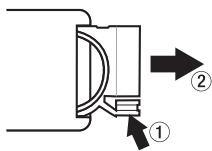
2 Install the coin-shaped lithium ion battery (CR2025) into the holder with the correct +/- orientation.
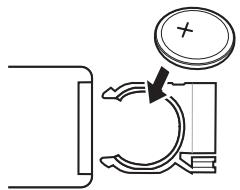
3 Reinsert the battery holder into the remote control.
When to change the battery
Replace the battery with a new one when the range of the remote control becomes short or if the function keys become unresponsive.
Use a coin-shaped lithium ion battery (CR2025).
Cautions about the use of the battery
Accidental swallowing of batteries by small children is extremely dangerous. Keep batteries and remote controls out of reach of small children. Consult a physician immediately if a child should swallow a battery.
Misuse of a battery could cause it to leak, rupture or otherwise be damaged. Please read and abide by the following precautions when using batteries.
Install the battery with the correct orientation.
- Do not recharge the battery.
- Do not heat or disassemble the battery or put it into fire or water.
- Do not carry or store the battery with small metal objects. Doing so could short the battery and cause leakage or rupture, for example.
- When storing or disposing of the battery, cover the contacts with tape to prevent them from touching other batteries or metal objects.
- Follow the disposal instructions written on the battery or provided by the local government when you are done using it.
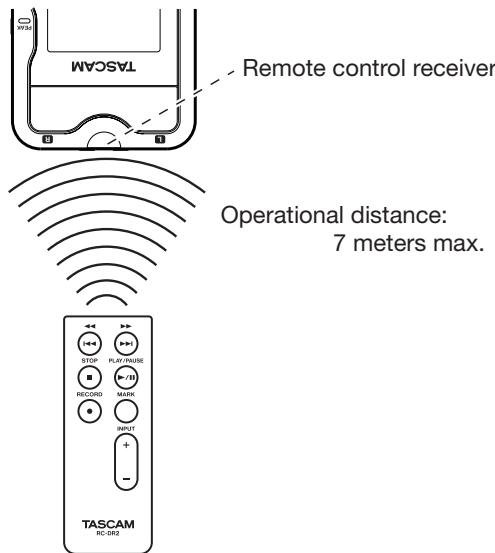
Using the remote control
Point the remote control at the remote control receiver on the unit.
When you want to use the remote control, confirm on the SETUP screen that the REMOTE item is ON. (See "Remote control setting" on page 76.)
3-Preparation
NOTE
Operation distance varies according to the orientation of the remote control relative to the sensor.
If anything is between the remote control and the receiver, operation might not work.
Precautions for use of the remote control
- Remove the battery when you are not using the remote control for a long time (one month or more).
- If the battery should leak, thoroughly clean any residue from inside the battery compartment and install a new battery.
- When using other devices controlled by infrared rays, use of this remote control might operate these devices by mistake.
Start-up & shutdown
Starting up the unit
Press and hold the /1 / HOME [ ] key on the left side panel until TASCAM DR-2d appears on the display.
The Home Screen appears when the unit starts up.
TASCAM
DR-2d
Start -Up Screen
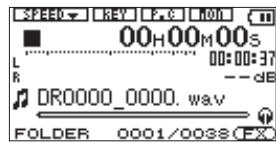
Home Screen
Shutting down
Press and hold the 6 / 1 /HOME [■] key until LINEAR PCM REORDER appears on the display.
LINEAR PCM REORDER
The power turns off after the unit completes its shutdown process.
CAUTION
Always use the 念 / I/HOME [■] key to shutdown the unit.
Do not remove the batteries or disconnect the power cable accidently while the unit is operating. If you do so, the unit cannot shut down properly and all recordings, settings and other data will be lost. Lost data cannot be restored. We recommend that you also save the data manually often.
Inserting and removing SD cards
Inserting the SD card
1 Open the SD slot cover on the left side panel.
2 Insert the SD Card into the slot as shown in the following illustration until it clicks into place.
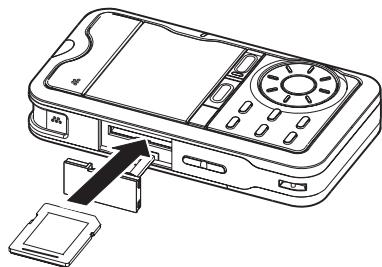
NOTE
An SD card is already installed when the unit is shipped from the factory. If you want to use this card to record and play tracks, there is no need to reinstall it.
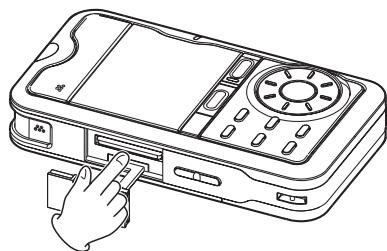
Removing the card
1 Open the SD slot cover on the left side panel.
2 Push the SD card in gently and it should eject.
CAUTION
- Do not remove the SD card from the unit when it is connected to a computer by USB.
- SD cards that meet SD or SDHC standards can be used with this unit.
- A list of SD cards that have been confirmed to work with this unit can be found on our website (http://www.tascam.com).
Preparing an SD card for use
In order to use an SD card in this unit, you must format it first.
1 Confirm that an SD card is installed and turn the power ON.
2 The following message appears when a new card or a card formatted for use with another device is installed in the unit.
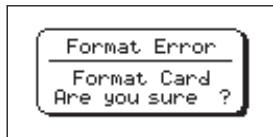
3 Press the ENTER/MARK key to start formatting.
4 When formatting ends, the Home Screen opens.
You can also reformat the card in this unit at any time. (See "System Settings and Formatting" on page 75.)
CAUTION
- Please use a PS-P520 AC adapter (sold separately) or make certain that there is sufficient remaining battery power when formatting a card.
- Formatting a card erases all the data on it.
Card write protection
SD cards have protect switches that prevent writing new data to them.
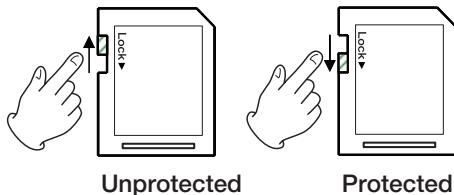
If you slide the protect switch to the "LOCK" position, file recording and editing is not possible. Move the switch to the unlocked position in order to record, erase and otherwise edit data on the card.
Setting the date and time
Using its internal clock, this unit remembers the date and time when a file is recorded.
1 Press the MENU key to open the MENU screen.
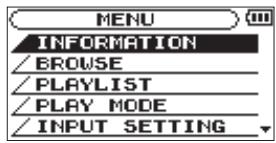
2 Use the wheel to select DATE/TIME, and press the ENTER/MARK key.
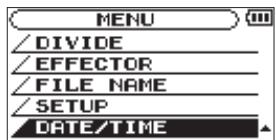
DATE/TIME screen appears.
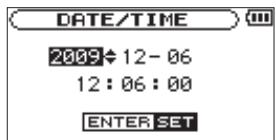
3 Use the 1 / keys to move the cursor, and use the wheel to change values.
4 Press the ENTER/MARK key to confirm the change and return to the MENU screen.
NOTE
You can set the unit to automatically add the date and time to file names. (See "Setting the format of file names" on page 77.)
CAUTION
The date and time setting can only be maintained for a few minutes when the unit is not powered by batteries or an AC adaptor. When using batteries, we recommend that you replace or recharge them before they completely lose power.
Using the built-in speaker
Set the SPEAKER switch to ON on the bottom panel to listen to a playing track through the built-in speaker.
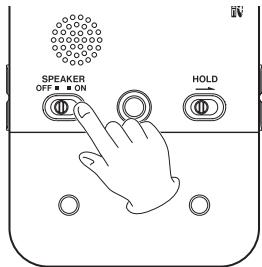
NOTE
Even when ON, no sound is output during recording, in recording standby, when headphones are connected, or input monitor is activated.
Connecting monitors and headphones
To listen with headphones, connect them to the LINE OUT/Ω connector.
To listen with an external monitoring system to the LINE OUT/ connector.
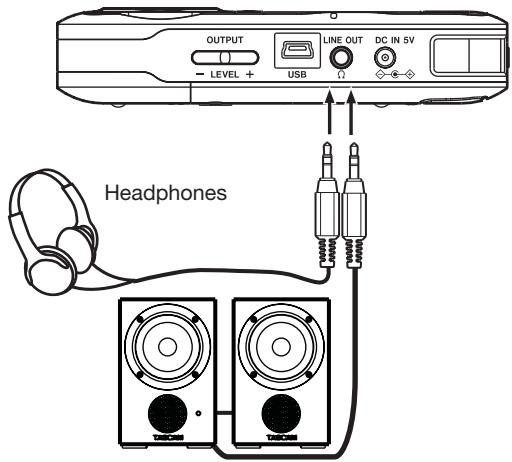
Powered monitor speakers or amplifier and speakers
In addition to using the built-in microphone, you can record using an external microphone or record the output signal from a mixer or other audio source. You can select among MP3 (44.1/48 kHz, 32-320 kbps) and WAV (44.1/48/96 kHz, 16/24-bit) audio recording formats. With this unit, you can mix and record a sound input through the built-in mic or one of the input jacks with an audio file that is played back using the overdubbing function.
You can also record two files with different recording levels at the same time (dual recording).
Selecting file format/sampling frequency, and maximum file size
Select the audio file type that you want to record before you start recording.
1 Press the MENU key to open the Menu Screen.
2 Use the wheel to select REC SETTING, and press the ENTER/MARK key.
REC SETTING screen appears.
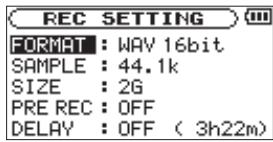
3 Use the wheel to select FORMAT, and press the key or ENTER/MARK key.
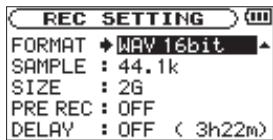
Set the file format from one of the following choices.
WAV: 16bit (default), WAV 24bit
MP3: 32kbps, 64kbps, 96kbps, 128kbps, 192kbps, 256kbps, 320kbps
NOTE
Higher values provide better recording quality.
- WAV files are higher quality than MP3 files, but they take up more space, so MP3 formats allow for longer recordings.
4 Press the key to select the other item.
4-Recording
5 Use the wheel to select SAMPLE, and press the key or ENTER/MARK key.
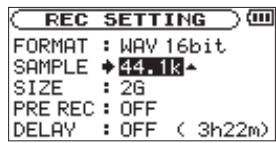
Set the sampling frequency to one of the following options.
44,1k(default),48k,96k
6 Press the key to select the other item.
7 Use the wheel to select SIZE, and press the key or ENTER/MARK key.
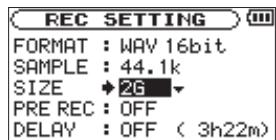
Set the maximum file size to one of the following options.
64M, 128M, 256M, 512M, 1G, 2G (default)
NOTE
- If the maximum set file size is exceeded during recording, the unit will automatically continue recording in a new file.
Depending on the file format, the amount of recording time will differ for the same file size. - Recording automatically stops if recording time exceeds 24 hours.
8 Press the / / HOME[] key to return to the Home Screen.
Available recording time display
The amount of time available for recording depends on the capacity of the SD card as well as the recording mode and sampling frequency settings. (See "Recording duration" on page 51.)
You can check the potential recording time determined by the SD card and various settings on the REC SETTING screen.
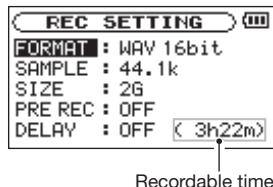
Set where to save the file
Set the folder where recorded files are saved. If no setting is made, new recording files are placed in the MUSIC folder. (See "Folder operations" on page 54.)
Setting the input functions
1 Press the MENU key to open the Menu Screen.
2 Use the wheel to select INPUT SETTING, and press the ENTER/MARK key.
INPUT SETTING screen appears.
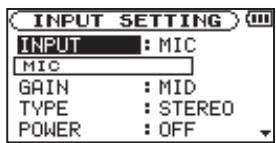
This screen has the following setting items.
Use the and keys and the wheel to set each item.
INPUT:
Set the input source to microphone (MIC) or line (LINE). The default setting is MIC.
When MIC is selected, sets the input source as the built-in
microphone when no microphone cable is connected to the MIC IN jack (stereo mini-jack). When a microphone cable is connected to the MIC IN jack, the input microphone signal becomes the input source.
When LINE is selected, sets the source as the line level signal input to the left side panel LINE IN jack (stereo mini-jack).
GAIN:
Set the mic input sensitivity as HIGH, MID, or LOW.
The factory default setting is MID. Change it to HIGH if the input level is too low and to LOW if the input level is too high.
TYPE:
Select STEREO or MHO according to the type of connected microphone. The factory setting is STEREO.
If you select MNO, the left and right channels are combined into the same signal.
POWER:
When connecting a microphone that requires plug-in power set this to ON. The factory default is OFF.
LOW CUT:
The factory default setting of the low cut filter is OFF, but you can also select 40Hz, 80Hz or 120Hz as the cut-off frequency for a low cut filter.
4-Recording
LEVEL CTRL:
Use this to set the level control function.
Set it to HUTO to have the DR-2d automatically adjust the input gain according to the input level. Loud sounds and quiet sounds are both adjusted to the same level.
Set it to LMT to have the DR-2d automatically limit the input gain so that input level of loud sounds are reduced to prevent distortion.
The factory default setting is OFF.
3 Press the / / HOME [■] key to return to the Home Screen.
CAUTION
- Set the POWER item to OFF when using the built-in mic or connecting a dynamic microphone or microphone with a built-in battery. If set to ON, the plug-in power may damage such microphones.
- Use headphones to monitor when you are recording with a microphone. If you use speakers to monitor, the sound output from the speakers may also be recorded, causing a poor recording and even feedback.
NOTE
-
Try using one of the low cut filter settings when recording outdoors or another place where the unwanted sound of wind is being recorded.
-
When recording live performances and in other situations where unexpected loud sounds might occur, set this function to LMT to prevent input clipping and allow recording without distortion.
TIP
Use the DR-2d's built-in effects as necessary on the input source. (See "Using the Effects" on page 68.)
Placing the unit and making connections
Recording with the built-in mics
Point the mics at the sound source and place the unit in a stable location where there is little vibration.
If noise is caused by wind, attach an optional windscreen.
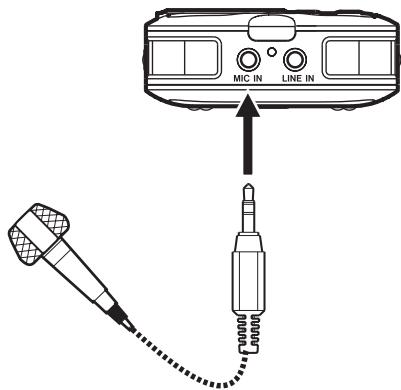
Recording with external mics (MIC IN)
Connect an external mic to the MIC IN connector.
Point the mics at the sound source and place the unit in a stable location where there is little vibration.
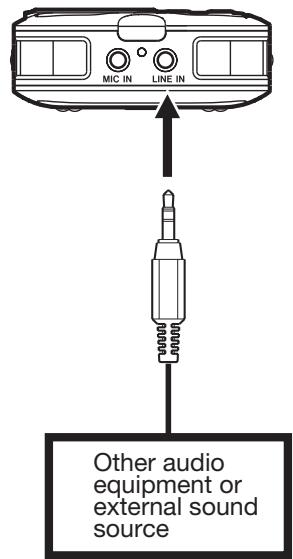
Recording an external device (LINE IN)
Use a stereo miniplug cable to connect to the output of an external audio device.
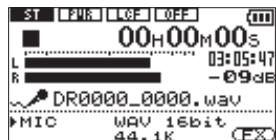
Adjusting the input level
The following procedures explain how to use the Record Screen to set the levels.
1 Press the RECORD key to begin recording standby.
The record indicator flashes red and the Record Screen appears.
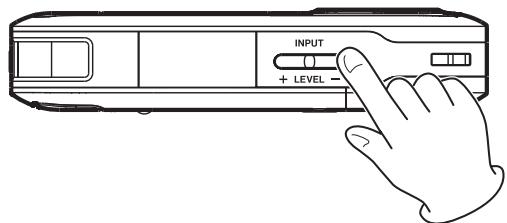
2 Use the INPUT LEVEL (+, -) keys on the left side of the unit to adjust the input level.
The L/R meter shows the input level.
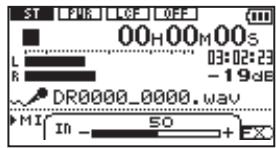
If the input is too high, the PEAK indicator to the right of the dispaly lights and line remains at the right end of the indicator bar.
Set the level as high as possible without causing the PEAK indicator to light red when the loudest sounds occur.
When you have selected MIC as the input source and are using the built-in microphone or MIC IN jack, if you find the level to be too low even when the INPUT volume is at maximum, use the Input Setting Screen to set the GAIN item to MID or HIGH. (See "Setting the input functions" on page 35.)
CAUTION
When using a microphone to record, be aware of the following.
If you set the GAIN item on the INPUT SETTING screen to MID or HIGH, distorted sounds might be recorded even when the PEAK indicator does not light.
When adjusting the input level, first set the GAIN item on the INPUT SETTING screen to LOW, and then use the INPUT LEVEL (+/-) keys to adjust it.
If the input level is still not sufficient even when maximized with the INPUT LEVEL + key, then set the GAIN item to MID. If the input level is still not sufficient, then set the GAIN item to HIGH.
NOTE
- Press the / / HOME [ ] key to exit recording standby.
- If the INPUT switch is set to LINE, the MIC GAIN setting has no effect.
- When in recording standby or during recording, the speaker does not output sound even if the SPEAKER switch is ON. Connect headphones to the LINE OUT/Ω connector if you want to adjust the level or record while monitoring the input. Use the OUTPUT LEVEL (+, -) keys to adjust the monitoring volume. This does not affect the sound of the recording.
TIP
- In addition to adjusting the INPUT volume, try changing the distance and angle between the microphone and the sound source. The angle and distance of the microphone can also change the character of the recorded sound.
- Use the auto gain control and limiter functions to prevent loud sound sources from distorting when recording. (See "Setting the input functions" on page 35.)
Recording
Before starting the following operation procedures, input selection and level adjustment should be completed, and the Home Screen should be open.
1 Press RECORD key to begin recording standby.
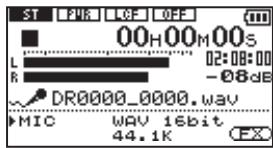
The screen shows the recording file name, the input source, the recording audio file type and sampling frequency. Please confirm that these are as desired before starting recording.
NOTE
If you have set the MONITOR Screen's INPUT item to ON so that you can always monitor the input, a pop-up appears that allows you to turn overdubbing ON or OFF.
For ordinary recording, select OFF and continue to step 2.
4-Recording
2 To start recording, press the RECORD key again.
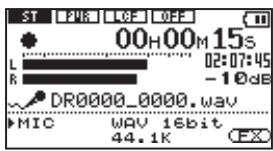
When recording starts, the record indicator lights continuously, and the display shows the elapsed recording time and the remaining recording time.
3 Press the / / HOME[] key to end recording and create the audio file.
To pause recording, press the RECORD key. Press the RECORD key again to restart recording in the same track. If you press the 念 / 丨/ HOME [■] key after pausing a recorded audio file up to the moment that you paused recording is created.
Recording playback and input sounds together (over dubbing)
By overdubbing, you can play an instrument or sing as you play back a saved track and mix and record both sounds in a new file.
NOTE
- You cannot overdub if input monitoring is OFF or the PRE REC function is ON.
- When overdub recording, you cannot use the AUTO REC function or start new files manually.
- You cannot pause during overdub recording.
- The sampling frequency of the playback file is preserved regardless of the sampling frequency setting for overdub recording.
Over dubbing and dual recording cannot be conducted at the same time.
Setting the file type to WAV
1 Press MENU to open the Menu Screen.
2 Use the wheel to select REC SETTING (highlighted in inverse) and press the ENTER/MARK key.
REC SETTING screen appears.
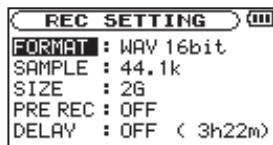
3 Use the wheel to select FORMAT and press the key or ENTER/MARK key.
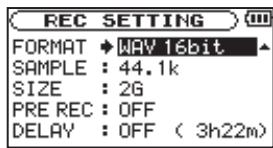
4 Use the wheel to select WAV 16-bit or WAV 24-bit.
5 Press the / / HOME[] key to return to the Home Screen.
Monitor the input signal (MONITOR)
1 Press MENU to open the Menu Screen.
2 Use the wheel to select MONITOR (highlighted in inverse) and press the ENTER/MARK key.
MONITOR screen appears.
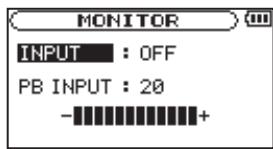
3 Use the wheel to select INPUT and press the key or ENTER/MARK key.
4 Use the wheel to select ON.
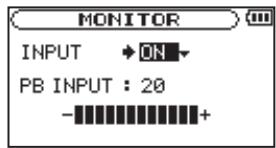
Input monitoring is now enabled.
5 Press the key to highlight INPUT.
6 Use the wheel to select PB INPUT and press the key or ENTER/MARK key.
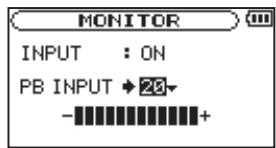
7 Use the wheel to adjust the playback volume level in a range from 0 to 20.
8 Press the / / HOME[] key to return to the Home Screen.
TIP
By making the above settings, in addition to overdubbing, you can use a recorded (or copied) audio track for instrument practice or karaoke.
NOTE
You cannot change the input monitoring setting during recording or when in recording standby.
Recording an overdub
1 Use the and keys and the BROWSE screen to select that files that you want to overdub.
2 Press the PLAY/PAUSE [▶/II] key to start playback, and check the volume balance between the playback and the input sounds.
3 Use the INPUT LEVEL (+, -) keys to adjust the input volume level, and use the PB INPUT item on the MONITOR screen to adjust the playback volume level.
NOTE
When input monitoring is ON (and during overdub recording) the PEAK indicator shows the maximum level of the combined input and playback signals.
4 Press the RECORD () key to set the unit to record standby.
The screen overdubbing ON/OFF pop-up appears.
The recording file name, input source, recording audio file type and sampling frequency also appear so that you can confirm them before you start recording.
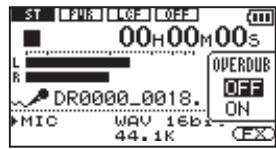
5 Use the wheel to select ON from the overdubbing ON/OFF pop-up.
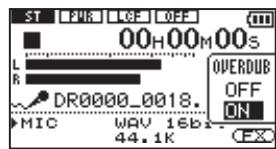
6 Press the RECORD () key to start over dubbing.
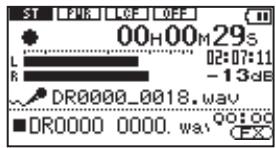
When recording starts, the record indicator lights and the display shows the elapsed and remaining recording times.
The lower part of the screen shows the name of the playing file that is being mixed in the overdub.
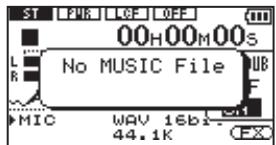
The following error message appears if the selected file cannot be played back.
7 To stop recording, press the 山 / 山/ HOME [■] key.
Recording two files with different levels at the same time (DUAL REC)
In addition to ordinary recording, this unit can simultaneously make a second recording with a different level. For example, when recording with microphones, you can use this feature to make one recording with the highest possible level and a second recording with a slightly low level as a backup at the same time.
NOTE
- Input must be set to MIC to enable dual recording. (See "Setting the input functions" on page 35.) If input is set to LINE, the following screen appears when you enable dual recording.
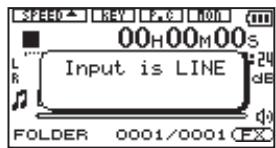
- Set the recording level for the first recording in the normal way.
- Dual recording and overdubbing cannot be used at the same time.
- An effect cannot be applied to a second file recorded with a different level.
Making settings for dual recording
Press and hold the DUAL key to opened the DUAL REC screen (dual recording setting screen).
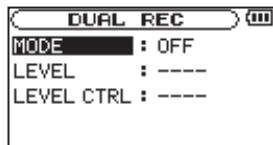
The following settings can be made on this screen.
Use the | and 1 keys and the wheel to set each item.
MODE: Set the dual recording mode. The options are OFF (default), DUAL, MIX and LINE.
: No dual recording is enabled. (Only one file is recorded.)
DUAL: Dual recording is enabled using microphones. (Two files are recorded.)
MI: The microphone and line inputs are mixed when recorded. (Only one file is recorded.)
LINE: Microphones and LINE IN jack inputs are recorded simultaneously in separate files. (Two files are recorded.)
LEVEL: Set the recording level of the second file in dual recording. If MODE is set to DUAL, the options are -6dB to -12dB in 1 dB increments. If MODE is set to LINE or MIX, the setting range is 1-100.
LEVEL CTRL: Set the level control function for the second file in dual recording. The options are OFF (default setting), AUTO and LMT.
OFF: Level control is disabled.
FUTO: The input gain of the unit is changed according to the input level, adjusting loud and quiet sounds to the same volume level.
LMT: The input gain of the unit is adjusted according to
the input level, so that distortion is avoided even if loud sounds are input.
Starting dual recording
Press the RECORD [●] key to begin recording standby. To start recording, press the RECORD [●] key again.
The following screen appears during dual recording.
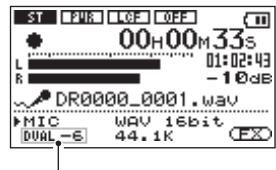
Dual recording indication
The current input source is shown at the bottom left of the screen. Depending on the MODE setting on the DUAL REC screen, the display will show the following.
Set to DUAL: "MIC" and the dual recording level setting are shown.
Set to MIX: "MIIX" is shown.
Set to LINE: "MIC" and "LINE" are shown along with the LINE input level setting.
During recording, each time you press the DUAL key, the recording levels of the two files are displayed alternately.
Dual recording file names
During dual recording, two files are created at the same time. The second file created by dual recording is given a file name based on the file recorded in the usual manner. A suffix is added to the second file's name according to the dual recording settings.
For example, when in DUAL mode and set to -12dB , dual recording creates two files with file names in the following formats:
DR0000_0001.wav
DR0000_0001_-12dB.wav
When dual recording is conducted in LINE mode:
DR0000_0002.wav
DR0000_0002_LINE.wav
Moreover, when LEVEL CTRL is set to AUTO, the file name is given as follows:
DR0000_0000_AUTO.wav
Playback of files created using dual recording
See Chapter 6 for details about file playback.
Press the DUAL key during playback of a file created using dual
recording to switch to playback of the other file recorded at the same time.
NOTE
When using the DUAL key to switch between files, the unit uses the first 11 characters of the file names for identification. If a file name has been changed, the unit might not be able to switch files.
Automatic recording and pausing (AUTO REC)
This function allows the unit to respond to input sound levels and start and pause recording.
1 Press MENU to open the Menu Screen.
2 Use the wheel to select AUTO REC (highlighted in inverse), and press the ENTER/MARK key.
AUTO REC screen appears.

4-Recording
3 Use the wheel to select the MODE and press the key or ENTER/MARK key.
4 Use the wheel to select ON.
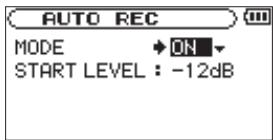
5 Press the key to select the other item
6 Use the wheel to select START LEVEL and press the key or ENTER/MARK key.
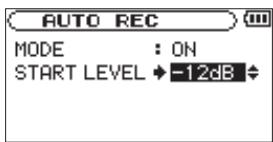
7 Use the wheel to select the level that signal is judged to have been input when it exceeds this level.
Set the value to one of the following selection.
-6dB/-12dB (default)/-24dB/-48dB
8 Press the / / HOME[] key to return to the Home Screen.
9 Press the RECORD (●) key to put the unit into recording standby.
Recording starts automatically when the input signal exceeds the START LEVEL.
If the input volume drops below the set level for 5 or more seconds, recording pauses automatically.
10 Press the /| HOME [■] key to stop automatic recording.
CAUTION
Overdub recording is not possible when using the AUTO REC function.
Creating new files (track incrementing)
You can manually or automatically split a recording by creating a new file.
Creating new files manually while recording
You can manually split a recording by creating a new file.
Press the key while recording.
NOTE
When new files are created, incremental numbers are added to the end of each file name.
CAUTION
- A new file cannot be created if the total number of files and folders would exceed 5000.
- Files shorter than two seconds cannot be created.
- If the name of a newly created file would be the same as that of an existing file, the number will be incremented until the new file has a unique name.
- Track incrementing is not possible when overdub recording.
Creating new files automatically while recording (maximum file size)
Without pausing recording, a new file can be created automatically during recording when a file size set in advance is exceeded.
1 Press the MENU key to open the Menu Screen.
2 Use the wheel to select REC SETTING, (highlighted in reverse) and press the ENTER/MARK key.
REC SETTING screen appears.
3 Use the wheel to select SIZE and press the key or ENTER/MARK key.
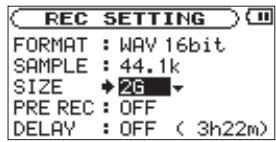
4 Use the wheel to select the maximum file size to one of the following selection.
64M/128M (default)/256M/512 M/1G/2G
5 Press the / / HOME[] key to return to the Home Screen.
CAUTION
A new file cannot be created if the total number of files and folders would exceed 5000.
NOTE
For the same file size, the possible recording time differs depending on the file type selected. Furthermore, if the recording time is 24 hours or more, this will be displayed as 23:59:59.
Mark function
Adding marks manually to a recording
You can manually add marks to a recording where you want them.
Press the ENTER/MARK key while recording to add a mark.
Mark number pop-up appears.
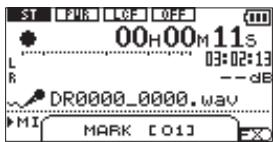
NOTE
- A mark is automatically added when you restart recording after temporarily pausing.
- Mark information is stored in the file with numbers between 01-99. The maximum number of marks in a file is 99.
Moving to a mark position
You can move to marks in the currently selected file when paused and during playback.
You can use this function to identify points to create shortcuts to the beginning of songs, for example.
Press the / keys while pressing and holding the ENTER/MARK key during playback or when stopped.
NOTE
You cannot move to a mark in a different file.
Recording the moment before pushing RECORD (PRE REC)
By using prerecording, when the unit is in recording standby you can record up to two seconds of the signal input before the RECORD () button is pushed to start recording.
1 Press the MENU key to open the MENU screen.
2 Use the wheel to select REC SETTING, and press the ENTER/MARK key.
3 Use the wheel to select PRE REC and press the key or ENTER/MARK key.
4 Use the wheel to select ON.
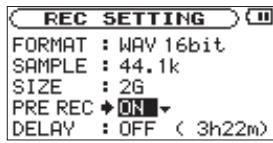
5 Press the / / HOME[] key to return to the Home Screen.
TIP
By using this in combination with the AUTO REC function, you can record events without losing the beginnings of sounds.
NOTE
If the amount of time in record standby is less than two seconds, the sound for that amount of time is recorded.
- You cannot use the PRE REC function with overdub recording. When overdubbing please set the PRE REC item OFF.
Delaying the start of recording (REC DELAY)
This function allows you to delay the start of recording by 0.3 seconds (fixed interval) after the RECORD () key is pressed.
This is useful when you want to avoid recording the sound of pressing the RECORD (●) key.
1 Press the MENU key to open the MENU screen.
2 Use the wheel to select REC SETTING, and press the ENTER/MARK key.
REC SETTING screen appears.
3 Use the wheel to select DELAY and press the key or ENTER/MARK key.
4 Use the wheel to select ON.
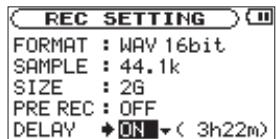
5 Press the / / HOME[] key to return to the Home Screen.
NOTE
Set PRE REC to OFF when you set REC DELAY to ON.
Dividing a file manually (DIVIDE)
You can split a recorded file into two files at any position you like. This is convenient for splitting a continuous recording into multiple files.
1 Use the and keys or BROWSE screen to select the file you want to divide.
2 Press the MENU key to open the MENU screen.
3 Use the wheel to select DIVIDE and press the ENTER/ MARK key.
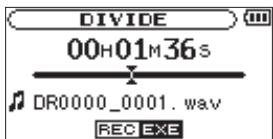
4 Use the wheel to determine where the file will be divided, and press the ENTER/MARK key.
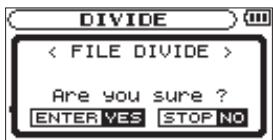
5 Press the ENTER/MARK key to divide the file, or press
the /1 / HOME [■] key to cancel the operation and return to the DIVIDE screen.
NOTE
- When the DIVIDE screen is open, you can press the PLAY/ PAUSE (▶/III) key and to set the divide position while playing the track.
- After dividing a file, two new files with "_a" and "_b" added to the end of the original file name are created. For example if the original filename is "DR-2d_0000.wav" then the new files will be named "DR-2d_0000_a.wav" (the recording before the division point) and "DR-2d_0000_b.wav" (the recording after the division point).
- MP3 files cannot be divided.
- If the SD card has insufficient open space, division might not be possible.
- Division is not possible if the file name would become more than 200 characters long.
- Division is not possible if a file that already exists has the same name as the name that would be given to a new file created by division.
TIP
Add marks during recording at positions where you want to divide a file.
Recording duration
The table below shows the amount of recording time possible on SD/SDHC cards of various capacities for each available recording format.
| File format (recording setting) | SD/SDHC card capacity (hours:minutes) | |||||
| 1 GB | 2 GB | 4 GB | 8 GB | |||
| WAV | 16 bit | 44.1 kHz | 1:41 | 3:22 | 6:44 | 13:28 |
| 48 kHz | 1:33 | 3:06 | 6:12 | 12:24 | ||
| 96 kHz | 0:46 | 1:33 | 3:06 | 6:12 | ||
| 24 bit | 44.1 kHz | 1:07 | 2:15 | 4:30 | 9:00 | |
| 48 kHz | 1:02 | 2:04 | 4:08 | 8:16 | ||
| 96 kHz | 0:31 | 1:02 | 2:04 | 4:08 | ||
| MP3 | 32 kbps | 44.1 kHz/48 kHz | 74:32 | 149:04 | 298:08 | 596:16 |
| 64 kbps | 44.1 kHz/48 kHz | 37:16 | 72:32 | 149:04 | 298:08 | |
| 96 kbps | 44.1 kHz/48 kHz | 24:50 | 49:40 | 99:20 | 198:40 | |
| 128 kbps | 44.1 kHz/48 kHz | 18:38 | 37:16 | 74:32 | 149:04 | |
| 192 kbps | 44.1 kHz/48 kHz | 12:25 | 24:50 | 49:40 | 99:20 | |
| 256 kbps | 44.1 kHz/48 kHz | 9:19 | 18:37 | 37:16 | 74:32 | |
| 320 kbps | 44.1 kHz/48 kHz | 7:27 | 14:54 | 29:48 | 59:36 | |
- The recording times shown above are estimates. They might differ depending on the SD/SDHC card in use.
The recording times shown above are not continuous recording times, but rather they are the total possible recording times for the SD/SDHC card.
5-Working with Files and Folders (BROWSE screen)
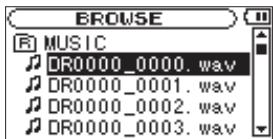
On the Browse Screen, you can view the contents of the Music Folder, which contains the audio files on the SD card that you can use with the DR-2d. On this screen, you can also play and erase selected audio files, create folders, add tracks to the playlist and so on. (See " Playlist" on page 59.)
To open the Browse Screen, press the MENU key to open the Menu Screen. Select BROWSE and press the ENTER/MARK key.
The contents of the folder that contains the file that was selected on the Home Screen before the Browse Screen was opened appears on the display.
TIP
If you connect the DR-2d with a computer by USB, or mount the SD card on a computer using a card reader or other input, you can change the folder structure within the Music Folder and erase files from the computer as you would the contents of a hard drive. Furthermore, you can change file names from the computer.
Screen navigation
On the Browse Screen, folders and music files appear in a hierarchical structure much like they would appear on a computer. On the DR-2d, folders can only be used to two levels.
- Use the wheel to select files and folders.
- When a folder is selected, press the key to show the contents of that folder.
- When a file or folder is selected, press the key to exit the currently open folder and go to a higher level in the folder structure.
- When a file or folder is selected, press the ENTER/MARK key to open the pop-up window.
Icons on the BROWSE screen
The meanings of icons that appear on the Browse Screen are as follows.
Root Music Folder
The Music Folder is the highest (root) level folder in the hierarchy shown on the Browse Screen.
Audio file
This icon appears before the names of music files.
Plus folder
This icon shows folders that contain sub folders.
Plain folder
This icon shows folders that do not contain sub folders.
Open folder
The contents of the folder marked with this icon currently appear on this screen.
File operations
Select the desired audio file on the Browse Screen and press the ENTER/MARK key to open the pop-up window that is shown below.
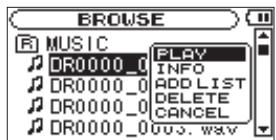
Use the wheel to select the item you want from the following list and press ENTER/MARK to execute it.
PLAY
Plays the file. The display returns to the Home Screen. If the playback area is set to FOLDER, the playback area becomes the
folder that contains the playing file.
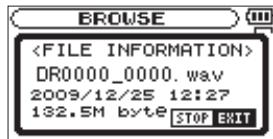
INFO
Information (date/time, size) about the selected file appears. Press the ENTER/MARK key again or press the / / [ ] key to return to the BROWSE screen.
ADD LIST
Adds the selected file to the playlist. (See " Playlist" on page 59.)
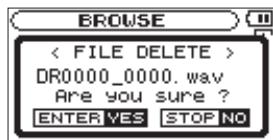
DELETE
A message appears to confirm that you want to delete the file. Press the ENTER/MARK key to erase the file and the / 1/ HOME [■] key to cancel the deletion operation.
5-Working with Files and Folders
CANCEL
No operation is conducted and the selected file is left as is.
Folder operations
Select the desired folder on the Browse Screen and press the ENTER/MARK key to open the pop-up window that is shown below.
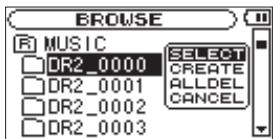
Use the wheel to select the item you want from the following list and press ENTER/MARK to execute it.
SELECT
Returns to the Home Screen and selects the first file in the folder. This folder becomes the new playback area regardless of the previous playback area setting. When recording, files are created in this folder.
CREATE
A pop-up appears to confirm that you want to create a new folder.
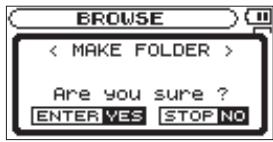
Press the ENTER/MARK key to create a new folder, or press the / I / HOME [■] key to cancel the operation.
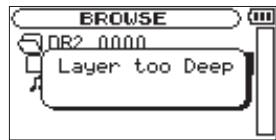
However, if you try to create a new folder inside a second level subfolder the message, "Layer too deep" appears and the folder is not made.
ALL DELETE
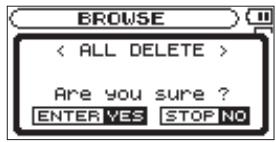
A pop-up message appears to confirm that you want to delete all the files in the selected folder at once.
Press the ENTER/MARK key to erase the files or press the 念 /丨/ HOME [■] key to cancel.
NOTE
You cannot erase read-only files and files that are not recognized by this unit.
CANCEL
No operation is conducted and the selected folder is left as is.
6-Playback
On the Home Screen, you can use the and keys to select the playback track. The files that you can select are determined by the playback area setting.
Limiting the playback area makes track selection easier when you have numerous recorded and copied tracks on the SD card. On the Play Mode Screen, you can select all files, the current folder or the playlist as the playback area. You can also use the Browse Screen to set a folder as the playback area.
TIP
On the Browse Screen, regardless of the playback area setting, you can select any file on the card that you want.
Adjusting playback volume
The volume output from the built-in speaker or the connector can be adjusted by using the OUTPUT LEVEL (+, -) keys.
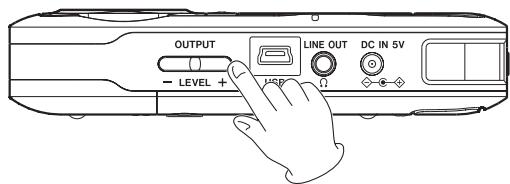
The output volume level pop-up appears.
Setting the playback area (AREA)
Set the playback area for repeat and ordinary playback on the PLAY MODE screen.
1 Press the MENU key to open the Menu Screen.
2 Use the wheel to select PLAY MODE and press the ENTER/ MARK key.
PLAY MODE screen appears.
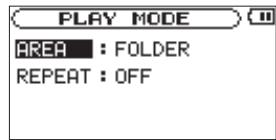
3 Use the wheel to select AREA and press the key or ENTER/MARK key.
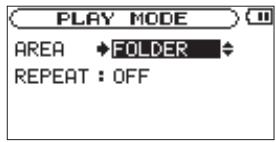
4 Set the playback area to one of the following options.
ALL FILES
Set the playback area as all files in the Music Folder on the SD card.
FOLDER (default)
Set the playback area as all the files in the currently selected folder.
PLAYLIST
Set the playback area as the tracks in the playlist. (See " Playlist" on page 59.)
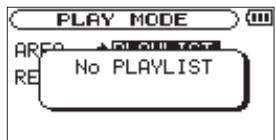
If there is no playlist defined, a No PLAYLIST pop-up appears.
5 Press the / / HOME[] key to return to the Home Screen.
NOTE
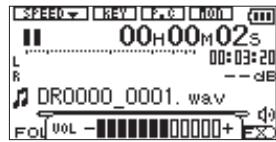
The current playback area setting appears in the lower left of the Home Screen.
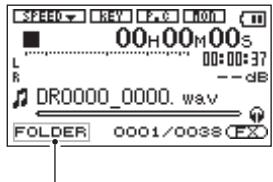
Playback area indication
Selecting a folder for the playback area (1)
Regardless of the current playback area, if you select a folder on the Browse Screen, the playback area changes to the selected folder.
1 Press the MENU key to open the Menu Screen.
2 Use the wheel to select BROWSE, and press the ENTER/ MARK key.
BROWSE screen appears.
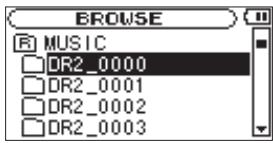
3 Use the wheel to select the desired folder.
For an explanation of how to use the Browse Screen, see "Screen navigation" on page 52.
4 Press the ENTER/MARK key to open the following pop-up window.
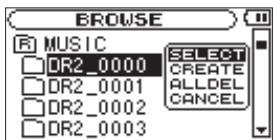
5 Select the SELECT item and press ENTER/MARK.
The display returns to the Home Screen, and the first file in the folder is selected. This folder becomes the playback area regardless of the previous playback area setting.
Selecting a folder for the playback area (2)
When the playback area is set to FOLDER, if you select a file on the Browse Screen, the folder that contains the selected file becomes the playback area.
1 Press the MENU key to open the Menu Screen.
2 Use the wheel to select BROWSE, and press the ENTER/ MARK key.
BROWSE screen appears.
3 Use the wheel to select the folder that contains the file you want to play.
For an explanation of how to use the Browse Screen, see "Screen navigation" on page 52.
4 Press the key.
5 Use the wheel to select the desired file.
6 Press the ENTER/MARK key to open the following pop-up window.
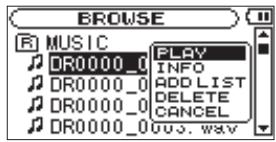
7 Select the PLAY item and press ENTER/MARK.
The display returns to the Home Screen, and the selected track starts playing. In addition, the folder that contains this track becomes the playback area regardless of the playback area folder set previously.
Playlist
You can make a list of tracks for playback (playlist). On the Play Mode Screen if you select FLAVYLIST for the AREA item, you can set playback to just the tracks in your playlist.
Adding tracks to the playlist
1 Press the MENU key to open the Menu Screen.
2 Use the wheel to select BROWSE, and press the ENTER/ MARK key.
BROWSE screen appears.
NOTE
For an explanation of how to use the Browse Screen, see "Screen navigation" on page 52.
3 Use the wheel to select the file that you want to add to the playlist and press the ENTER/MARK key.
A pop-up window appears.
4 Use the wheel to select ADD LIST.
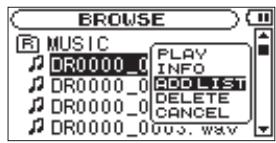
5 Press the ENTER/MARK key.
The track is added to the playlist and the popup window closes.
6 Repeat steps 3, 4, and 5 as necessary to add more tracks to the playlist. The tracks are numbered in the order that they are added.
Editing the playlist
You can view and edit the playlist you have made on the Playlist Screen.
6-Playback
You can also use this screen to play tracks and to edit the playlist.
1 Press the MENU key to open the Menu Screen.
2 Use the wheel to select PLAYLIST, and press the ENTER/MARK key.
PLAYLIST screen appears.
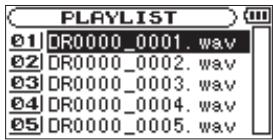
3 Use the wheel to select the file that you want to edit and press the ENTER/MARK key
A pop-up window appears.
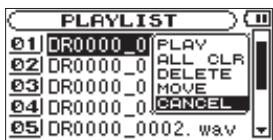
4 Use the wheel to select the item you want and press the ENTER/MARK key. Their functions are shown following.
PLAY
Play the file and return to the Home Screen.
ALL CLR
A confirmation message appears to confirm that you want to remove all the files from the playlist. Press the ENTER/MARK key to remove all the files or the 口 /口/ HOME [■] key to cancel this operation.
For this operation, it does not matter which track you select in step 3. All the files are removed from the playlist, but they are not erased from the SD card.
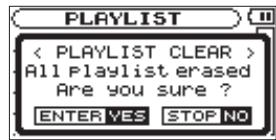
DELETE
Remove the selected track from the playlist.
The file is removed from the playlist, but it is not erased from the SD card.
MOVE
Select this to change the order of tracks in the playlist.
In addition to the file name, the track number also appears highlighted in inverse.
- Use the wheel to move the track to a different position in the playlist.
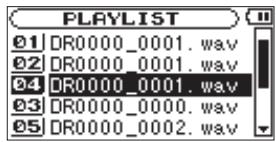
- Press ENTER/MARK key. The display returns to the PLAYLIST screen.
In the above example, the 4th track has been moved to the 3rd track position.
CANCEL
No operation is conducted and the PLAYLIST is left as is.
Selecting files for playback (skip)
When the Home Screen is open, press the and keys to select the file for playback.
If you press the key when the playback position is located at the middle of a file, it will return to the beginning of that file. If you press the key when located at the beginning of a file, the playback position will skip to the beginning of the previous file.
If you press the 1 key when located at the beginning of or
middle of a file, the playback position will skip to the beginning of the next file.
NOTE
- Only files in the playback area that is currently set can be selected for playback.
- The track name, file number and other file information for the currently playing track appear on the display.
- The icon appears on the display when playback is stopped at the beginning a track, and the icon appears when playback is stopped in the middle of a track (paused).
Playback (PLAY)
When the Home Screen is open and playback is stopped, press the PLAY/PAUSE (▶/II) key to start playback.
NOTE
- Files in the playback area can be played.
- You can also choose files for playback by name on the BROWSE screen.
Stopping
When the Home Screen is open and a track is playing back, press the / 1 / HOME[] key to stop playback at the current position.
6-Playback
Press the /1 /HOME [■] key again to return to the beginning of the file.
Pausing (PAUSE)
When the Home Screen is open and a track is playing back, press the PLAY/PAUSE (▶/II) key to pause playback at the current position.
Press the PLAY/PAUSE (▶/II) key again to restart playback from that position.
Rewinding and fast-forwarding (search)
When the Home Screen is open and a track is playing back or stopped, press and hold the or keys to rewind or fast-forward and search the playback track.
NOTE
You can set the search speed. (See "Setting the search speed" on page 75.)
Using the wheel to change the playback position
When the Home Screen is open and a track is playing back or stopped, you can use the wheel to change the playback position.
NOTE
- The faster you turn the wheel, the more rapidly the position changes.
- No sound is output while the wheel is being turned.
- If you turn the wheel during playback, playback resumes from the position where you stop turning.
Repeat playback (REPEAT)
You can repeatedly playback one file or multiple files within a designated area.
1 Press the MENU key to open the MENU screen.
2 Use the wheel to select PLAY MODE and press the ENTER/ MARK key.
PLAY MODE screen appears.
3 Use the wheel to select REPEAT and press the key or ENTER/MARK key.
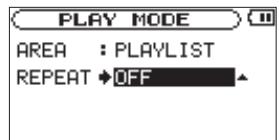
4 Set the REPEAT item to one of the following selections.
OFF(default):
All tracks in the playback area are played in sequence one time. (This setting is the ordinary playback mode.)
SINGLE:
The selected track is played once without repeating. The SINGLE icon appears on the Home Screen.
1 REPEAT:
The current track is played repeatedly. The 1 icon appears on the Home Screen.
ALL REPEAT:
All tracks in the selected playback area are played back repeatedly. The ALL icon appears on the Home Screen.
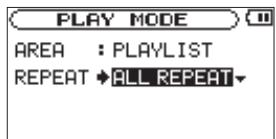
NOTE
If you start loop playback, the REPEAT item automatically switches to OFF if it is in a different mode.
5 Press the / |/HOME[] key to return to the Home Screen.
Loop playback
With this function, you can continuously repeat (loop) the playback of a selection that you make.
1 Press the I/O key during playback to set the point when you want to start loop playback. The current position is set as the IN point.
2 Press the I/O key at the point when you want loop playback to stop. The current position is set as the OUT point, and loop playback begins between the IN and OUT points.
The current positions of the IN and OUT points are shown by the and icons that appear below the playback position display bar in the lower part of the Home Screen. During loop playback the + indicator also appears.
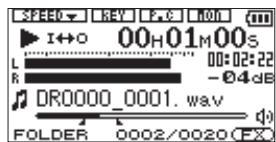
- To stop loop playback, press the I/O key.
- If you set one of the repeat mode, loop playback is canceled.
NOTE
- You cannot set the IN and OUT points in different files.
- IN and OUT point settings are lost when you select a different file.
- Accurate assignment of IN and OUT points is not always possible for variable bit rate (VBR) MP3 files.
Setting the loop point manually
1 Press and hold the I/O key to open a pop-up window that allows you to set loop points manually.
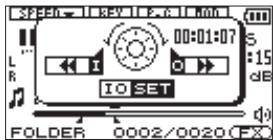
2 Use the wheel to set the time.
3 Press the key to set that time as the IN point.
4 Press the key to set that time as the OUT point.
5 When the setting is complete, press the I/O key to start the loop playback.
Making fine adjustments to the loop playback IN and OUT points
1 Press and hold the I/O key to open the pop-up window that allows you to set loop points manually.
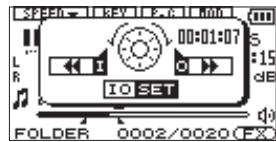
2 Press and hold the key to show the IN point time.
3 Use the wheel to make fine adjustments to the IN point.
4 Press the key to set the IN point.
5 In the same manner, press and hold the key to show the OUT point time.
6 Use the wheel to make fine adjustments to the OUT point.
7 Press the key to set the OUT point.
8 When the fine adjustments are complete, press I/O key to start the loop playback.
Turning loop playback ON/OFF
If you press the I/O key when a loop interval has been set, loop playback is turned OFF. The loop IN and OUT points are not displayed, but they are still retained in memory.
If you want to enable loop playback again, use the following procedures.
1 Press and hold the I/O key to open the pop-up window that allows you to set loop points manually.
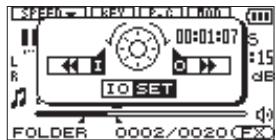
2 Press the I/O key. Loop playback starts automatically.
SpecialPlaybackControlFunctions
Not only can you use the DR-2d to change the tempo of track playback, you can even do this without changing the pitch. You can also change the playback pitch of a track without changing the tempo.
Furthermore, you can also reduce the sound of a voice or solo instrument on a track. You can use these playback control functions effectively to practice and learn parts.
Setting the playback control functions
Use the Playback Control Screen to set the playback control functions. When the Home Screen is displayed, press and hold the PB CONT key to open the Playback Control Screen.
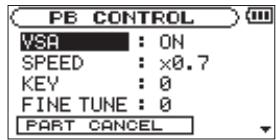
After you finish making settings on this screen, press the / / HOME [■] key (or press and hold the PB CONT key) to return to the Home Screen.
In the upper part of the Home Screen, the icons for the playback control functions that are currently active appear highlighted in inverse.
NOTE
VSA, playback speed adjustment (SPEED), and key control (KEY and FINE TUNE) functions cannot be used with 96kHz files. The "SPEED" icon appears at the top of the home screen to show this.
Changing the speed
Use the SPEED item to set the speed of playback. However, setting the speed does not automatically make the speed control
6-Playback
function active. After setting it, briefly press the PB CONT key to turn the speed control ON, making it active. When ON, the icon appears as light letters on a dark background in the upper part of the Home Screen. You can turn the speed control ON and OFF by briefly pressing the PB CONT key, so you can easily switch between the set speed and the normal speed.
Since the speed adjustment range is x0.5 to x2.0 (x0.1 steps), the slowest speed setting is half the original speed (the factory setting is x0.7 ).
NOTE
Briefly pressing the PB CONT key to turn the speed setting function ON and OFF is unique to this function. For all other playback control functions, changing the setting on the Playback Control Screen from anything other than the factory default results in the function being turned ON all the time.
Change speed without changing pitch
Turn the Variable Speed Audition (VSA) function ON to keep the pitch the same when changing the tempo. Use the VSA item to turn the VSA function ON and OFF (the factory setting is ON).
Changing the pitch without changing the speed
Use the KEY item to change the pitch in semitones without
changing the tempo.
Use the KEY item to adjust the pitch up or down by 1-6 semitones (b6 - #6) (the factory setting is 0).
If you change the key to any value besides 0, the key change function turns ON and the KE' icon appears on the Home Screen as light letters on a dark background.
Use the FINE TUNE item to adjust the pitch up or down in cents (100 cents = 1 semitone).
NOTE
Even if you use the FINE TUNE item to adjust the key, as long as the KEY item setting is 0, the icon will not appear as light letters on a dark background on the Home Screen.
Reducing vocal and solo instrument sounds
You can use the part cancel function to reduce the sound levels of vocals and solo instruments.
Use the PART CANCEL item to set this function. Use the wheel to select the PART CANCEL item and open the Part Cancel Screen, which has three items.
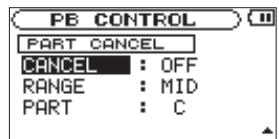
CANCEL:
Set the CANCEL item to ON to turn the part cancel function ON (the factory setting is OFF). The icon appears as light letters on a dark background on the Home Screen.
Depending on the music, the vocal cancel function may not reduce the recorded vocal or solo instrument sound sufficiently. If this is the case, changing the PART and RANGE settings might make the reduction more effective. Listen to the music as you adjust the settings to achieve the best effect.
RANGE:
Select MID or ALL for the frequency range of sound reduction. The default setting is MID.
PART:
Adjust this setting to match the stereo position of the sound that you want to reduce between L 10 and R 10. The initial default setting is CENTER.
7-Using the Effects
The DR-2d has built-in effects that can be applied to the input signal during recording and practice. They can also be applied to the output signal during playback.
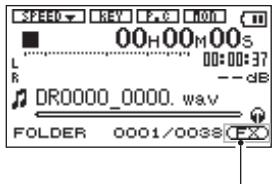
Effects OFF indication
NOTE
During dual recording, effects can only be applied to the recording of the first file.
Setting the effect
1 Press the MENU key to open the MENU screen.
2 Use the wheel to select EFFECTOR and press the ENTER/ MARK key.
EFFECT screen appears.
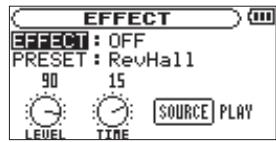
Although it appears different from other setting screens, operation is the same.
3 Use the wheel to select the desired item and press the key or ENTER/MARK key to access that item's settings.
4 Use the wheel to set the desired value.
5 Press the key when you are done making the setting to return to item selection status.
EFFECT:
Use this to turn the effect on or off.
PRESET:
See the Effects Preset List on page 69 for details about the preset effects.
LEVEL knob:
Use this to change the output level of the preset effect selected in the PRESET item. Select the LEVEL knob icon and press the ENTER/MARK key to select the numerical value in the upper
part of the icon. The level can be set to values between 0 and 100.
TIME knob:
This adjusts the character of the selected preset. Select the TIME knob icon and press the ENTER/MARK key to select the numerical value in the upper part of the icon. Use the wheel to set the value.
SOURCE:
Use this to set whether the effect is applied to the input signal (INPUT) or the playback signal (PLAY). Select the SOURCE icon, press the ENTER/MARK key, and use the wheel to select the effect source. The default setting is PLAY.
6 Press the / / HOME [■] key to return to the Home Screen.
Effects Preset List
| Preset name | Effects |
| RevHall 1 | This is a bright reverb modeled after a large hall-like space. |
| RevHall 2 | This is a warm reverb modeled after a large hall-like space. |
| RevRoom | This reverb is modeled on a small indoor space. |
| RevStudio | This reverb is modeled on a studio-like space |
| RevPlate 1 | This is a bright plate reverb. |
| RevPlate 2 | This is a warm plate reverb. |
8-Using the Metronome
The DR-2d has a built-in metronome that outputs its sound from the LINE OUT/Ω jack.
Setting the metronome
To use the metronome, press the MENU key to open the Menu Screen. Select the METRONOME item and press the ENTER/ MARK key.
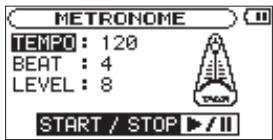
Use the 1 1 , 2 1 , and wheel to set the following items.
TEMPO
Set the speed to a value between 20 and 250 beats per minute (BPM). (Default: 120)
BEAT
Set the accent frequency between 0 and 9. There is no accent when set to 0. For example, set this to 4 if you want 4/4 time. (Default: 4)
LEVEL
Set the metronome volume between 0 and 10. (Default: 8)
Starting and stopping the metronome
When the Metronome screen is open, press the PLAY/PAUSE (▶/II) key to start and stop the metronome.
NOTE
When using the metronome, you cannot return to the Home Screen.
To return to the Home Screen, press the PLAY/PAUSE [▶/■] key or the 念/丨/ HOME [■] key to stop the metronome and then press the 念/丨/ HOME [■] key.
9-Connecting with a Computer
By connecting this unit with a computer using the USB cable, you can transfer audio files on the SD card in the unit to a computer, as well as transfer audio files on the computer to the SD card in the unit.
This unit can handle audio files of the following formats (only stereo files).
MP3: 32k-320kbps, 44.1k/48kHz
WAV: 44.1k/48k/96kHz, 16/24 bit
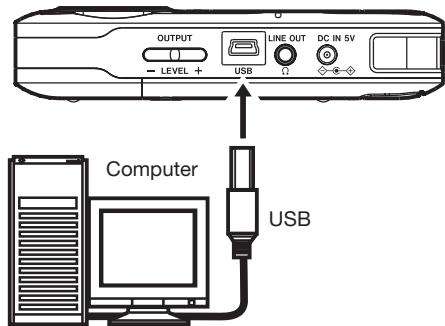
NOTE
Instead of using USB to connect the DR-2d and a computer, you can also conduct the same operations by removing the SD card from the DR-2d and connecting it directly to a computer that has a built-in SD card slot or by using a card reader.
CAUTION
- You cannot use this unit's other functions when it is connected to a computer by USB.
- Connect this unit to the computer directly. Proper operation cannot be guaranteed when using a USB hub.
When connected, "USB connected" appears on the screen of the recorder.
If an SD card is not properly inserted before making the USB connection, "Can't Save Data" appears on the screen.
This unit appears on the computer screen as external volume named "DR-2d."
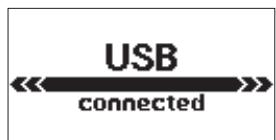
Transferring files to a computer
1 Click the "DR-2d" drive on the computer screen to show the "MUSIC" and "UTILITY" folders.
2 Open the "MUSIC" folder and drag and drop the files that you want to transfer to the computer to destinations of your choice.
9-Connecting with a Computer
Transferring files from a computer
1 Click the "DR-2d" drive on the computer screen to show the "MUSIC" and "UTILITY" folders.
2 Drag and drop files on the computer that you want to transfer to the unit to the "MUSIC" folder.
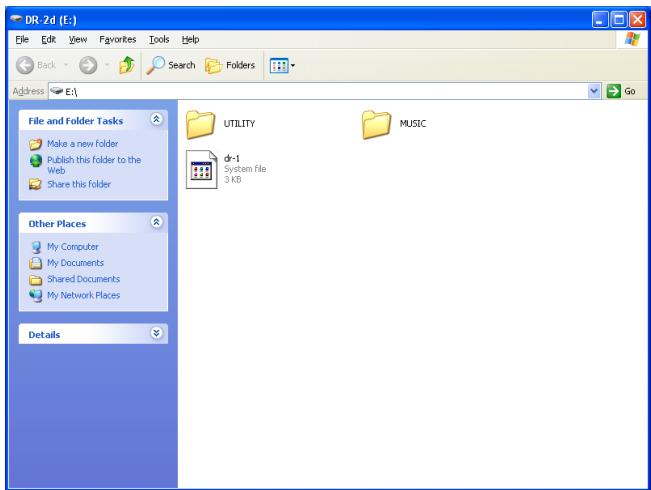
TIP
- You can manage the MUSIC folder from the computer.
- You can create sub folders in the MUSIC folder up to the second level for use with this unit. The DR-2d cannot recognize sub folders and audio files on the third level or below.
- Since you can set the DR-2d to only play the contents of a specific folder, you can organize tracks into genres, artists or other categories as you like.
- If you name the sub folders and music tracks, these names will appear on the screen of this unit.
Disconnecting from a computer
Before disconnecting the USB cable, use the proper procedures for your computer to unmount the "DR-2d" (as an external drive). The power turns off after the unit completes its shutdown process.
See the computer's operation manual for instructions about how to unmount an external drive.
10-Settings and Information
Viewing File Information
Use the Information Screen to view various types of information about your DR-2d.
To open the Information Screen, first press the MENU key to open the Menu Screen. Select INFORMATION and press the ENTER/MARK key.
Use the wheel to switch between the following three information pages.
File information page (FILE)
Shows information about the currently playing file.
Card information page (CARD)
Shows the use status of the currently inserted SD card
System information page (SYSTEM)
Shows the unit's system setting information and firmware version
File information page
The FILE page shows information about the currently selected file.
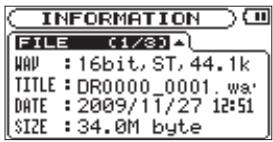
WAV or MP3
Shows the audio file type.
For WAV files, bit length, stereo/mono, and sampling frequency (Hz) also appear.
For MP3 files, the bit rate (kbps), CBR (constant bit rate) or VBR (variable bit rate) type, and sampling frequency (Hz) also appear.
TITLE
Shows the file name. If an MP3 file has ID3 tag title information that information appears.
DATE
Date of file creation
SIZE
File size
10-Settings and Information
Card information page
The CARD page shows the status of the currently inserted SD card.
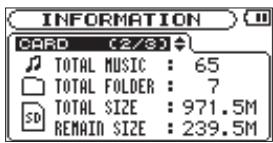
TOTAL MUSIC
Shows the number of playable files contained by the Music Folder.
TOTAL FOLDER
Shows the total number of folders in the Music Folder.
TOTAL SIZE
Shows the total SD card capacity.
REMAIN SIZE/USED SIZE
Shows the amount of unused/used capacity on the SD card.
Press the or key to switch between REMAIN SIZE and USED SIZE.
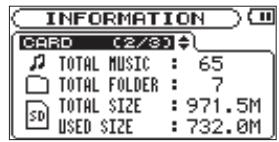
System information page
The SYSTEM page shows information about the DR-2d's system settings and firmware version.
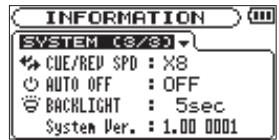
CUE/REV SPD
Shows the speed of forward and backward searching.
AUTO OFF
Shows the automatic power OFF setting.
BACKLIGHT
Shows the automatic backlight OFF setting.
System Ver.
Shows the system firmware version.
System Settings and Formatting
From the Setup Screen, you can change various settings to optimize the device for your use environment and other requirements. You can also initialize the unit and format the SD card.
To open the Setup Screen, press the MENU key. Select SETUP from the Menu Screen and press the ENTER/MARK key.
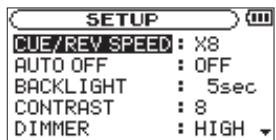
The following settings can be made for the items on the Setup Screen.
Use the 1 1 and 1 keys and the wheel to set each item.
Setting the search speed
Use the CUE/REV SPEED item to set the speed of forward and backward searching when pressing and holding the and keys.
Options: × 2, × 4, × 8 (factory setting), × 10
Turning the unit power OFF automatically
Use the AUTO OFF item to set the time before the unit power automatically turns OFF after the last activity or use when powered by the battery.
Options: OFF (factory setting—the unit does not automatically turn OFF), 3 min, 5 min, 10 min, 30 min
Backlight Auto OFF setting
Use BACKLIGHT to set the time until the backlight automatically turns OFF after the last operation when powered by the internal battery.
Options: OFF (backlight always on), 5 sec (factory setting), 10 sec, 15 sec, 30 sec
Adjust the display contrast
Use CONTRAST to adjust the display contrast.
Options: 1-2 (factory setting: 8)
Adjust the backlight brightness
Use DIMMER to adjust the backlight brightness.
Options: HIGH (factory setting), LOW, OFF (no backlight)
10-Settings and Information
Remote control setting
Use the REMOTE item to set whether or not the unit can receive commands from a wireless remote control (RC-DR2).
Values: OFF (default) or OH
Setting the type of AA batteries
Use BATTERY TYPE to set the type of the AA batteries that you are using. This setting is used to show the amount of remaining battery charge and determine if the unit has enough power for normal operation.
Values: ALKAL (default), Ni-MH
Restoring the factory settings
Use the INITIALIZE item to restore the various settings of this unit to their factory settings.
1 Select INITIALIZE and press the ENTER/MARK key to highlight "Exec."
2 Press the ENTER/MARK key again to open a confirmation pop-up window.
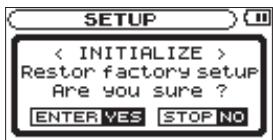
3 Press the ENTER/MARK key to initialize the unit. Press / / HOME[] to cancel initialization.
Using QUICK FORMAT
Using QUICK FORMAT erases all music files on the card and automatically creates new "MUSIC" and "UTILITY" folders as well as the "dr-1.sys" file that is necessary to use the SD card with the DR-2d.
1 Select the QUICK FORMAT item and press the ENTER/ MARK key to highlight "Exec."
2 Press ENTER/MARK to open a pop-up confirmation window.
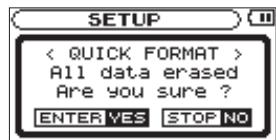
3 Press the ENTER/MARK key to execute the quick formatting, or press the /1 / HOME[ ] key to cancel formatting.
Using FULL FORMAT
Use the FULL FORMAT item to completely format the SD card. Full formatting checks the memory for errors while formatting so it takes more time than quick formatting.
Using FULL FORMAT erases all music files on the card and automatically creates new "MUSIC" and "UTILITY" folders as well as the "dr-1.sys" file that is necessary to use the SD card with the DR-2d.
1 Select the FULL FORMAT item and press the ENTER/ MARK key to highlight "Exec."
2 Press ENTER/MARK to open a pop-up confirmation window.
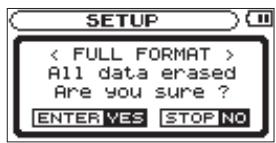
3 Press the ENTER/MARK key to execute the full formatting, or press the / | HOME [■] key to cancel formatting.
CAUTION
- When using FULL FORMAT, use the AC adapter (sold separately) or confirm that the battery is sufficiently
charged. If the power fails during formatting, the formatting may not occur correctly.
- Depending on the size of the SD card, FULL FORMAT could take an hour or more. Please be patient and do not disconnect the power during formatting.
Setting the format of file names
You can select the format of names given to files recorded by this unit.
1 Press the MENU key to open the MENU screen.
2 Use the wheel to select the FILE NAME menu item, and press the ENTER/MARK key to open the FILE NAME screen.
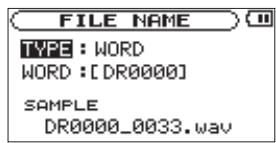
Use the 1 and 1 keys and the wheel to set each item. On this screen you can make the following settings for each item.
File name format
The TYPE item can be set to either WORD (default setting) or DATE.
WORD: When set to wORD, a 6-character file name is used as the beginning of each file name.
Example: DR0000_0000.wav
DATE: The date is used as the file name (in yymmdd format).
Example: 090101_0000.wav
NOTE
The date is set using the unit's internal clock. (See "Setting the date and time" on page 31.)
Setting the WORD item
To set the WORD item, use the and keys to move the cursor, and use the wheel to select the character.
In addition to the alphabet and numbers, the following characters can be used:
!# % & ( ) + , - , = [ ] ^ { }
The following is a list of the popup messages that might appear on the DR-2d under certain conditions. Refer to this list if one of these popup messages appears and you want to check the meaning or determine a proper response.
| Message | Meaning and response |
| File Name ERR | The DIVIDE function would cause the file name to exceed 200 characters. The DIVIDE function adds “_a” or “_b” to the end of the file name. Before choosing the DIVIDE function, connect the unit to a computer and edit the file name to less than 198 characters. |
| Dup File Name | The DIVIDE function would cause the file name to be the same as that of an existing file. The DIVIDE function adds “_a” or “_b” to the end of the file name. Before choosing the DIVIDE function, connect the unit to a computer and edit the file name. |
| File Not Found | The file added to the playlist cannot be found or a file could be damaged. Please check the file in question. |
| Non-Supported | The audio file is not a supported format. Please see "9-Connecting with a Computer" for file formats that this unit can use. |
| Battery Empty | The battery is almost out of power. Replace the AA batteries. |
| I/O Too Short | The IN and OUT points are too close together. Reset the IN and OUT points with at least 1 second between them. |
| File Not Found PLAYLIST | The file in the Playlist cannot be found. Please confirm that the file is still in the Music Folder. |
| No PLAYLIST | No files have been added to the Playlist. Add a file to the Playlist or change the play mode to something besides PLAYLIST. |
| PLAYLIST Full | The playlist is full. You cannot add more than 99 tracks to the Playlist. |
| MBR Error Init CARD | The card is not formatted properly or the formatting is broken. Change the card or press the ENTER/MARK key when this message appears to format the card in FAT format. CAUTION: Execution of FAT formatting erases all data currently on the card. |
11-Messages
| Message | Meaning and response |
| Format Error Format CARD | The FAT formatting of the card is abnormal or broken. This message also appears if you FAT formatted the card using a computer connected by USB and if a new card is inserted in the unit. Always use the DR-2d to conduct FAT formatting of cards to be used with it. Change the card or press the ENTER/ MARK key when this message appears to format the card in FAT format. CAUTION: Execution of FAT formatting erases all data currently on the card. |
| File Not Found Make Sus File | The system file is missing. This unit requires a system file for operation. When this message appears, press ENTER/MARK to automatically create a system file. |
| Invalid SusFile Make Sus File | The system file required to operate this unit is invalid. When this message appears, press ENTER/ MARK to automatically create a system file. |
| Invalid Card Change Card | Something might be wrong with the card. Change the card. |
| Protected Card Change Card | This appears when the card is protected and lacks the necessary Music Folder and other folders and files. Unlock the write protect switch, restart the power and format the card. |
| Write Timeout | Writing to the card timed out. Backup files on the card to your computer, and format the card. |
| Card Full | The card has no remaining capacity. Erase unnecessary files or move them to your computer to make open space. |
| Layer too Deep | Folders can be created down to two layers. You cannot create a new folder inside the current folder. |
| Can’t Divide | The position selected for divide is not suitable (too close to the beginning or end of a track). |
| Max File Size | The file is larger than the designated size or the recording time exceeded 24 hours. |
| File Full | The total number of folders and files exceeds 5000. Erase unnecessary files or move them to your computer. |
| Card Error | The card could not be handled properly. Replace the card. |
| Current File MP3 | MP3 files cannot be divided. |
| File Protected | The file is read only and cannot be erased. |
| No Card | No card is in the unit, so recording is not possible. |
| No PB File | There is no file that can be played back. The file might be damaged. |
| No MUSIC File | There is no playback file, so DIVIDE and OVERDUB cannot be executed. |
| Input is LINE | Input is set to LINE. Dual recording can only be used when input is set to MIC. |
| Not Continued | If any of these errors occur, turn the unit power OFF and restart it. If the power cannot be turned OFF, remove the batteries and disconnect the AC adaptor (if connected). If the error message continues to appear, please contact a TEAC Repair Center. |
| File Error | |
| Can't Save Data | |
| Player Error | |
| Device Error | |
| Writing Failed | |
| Sss Rom Err | |
| Remote Cmd | |
| Remote Rx | |
| System Err 50 | |
| System Error 1 | |
| System Error 2 | |
| System Error 3 | |
| System Error 4 |
11-Messages
| Message | Meaning and response |
| System Error 5 | If any of these errors occur, turn the unit power OFF and restart it. If the power cannot be turned OFF, remove the batteries and disconnect the AC adaptor (if connected). If the error message continues to appear, please contact a TEAC Repair Center. |
| System Error 6 | |
| System Error 7 | |
| System Error 8 | |
| System Error 9 |
If you are having trouble with the operation of this unit, please try the following before seeking repair. If these measures do not solve the problem, please contact the store where you bought the unit or a TASCAM Service Center.
Power will not turn ON.
- Confirm that the batteries are not dead.
- Confirm that the batteries are installed with the correct +/- orientation.
- Confirm that the power plug of the AC adaptor (TASCAM PS-P520: sold separately) is securely inserted.
The remote control does not function.
- Confirm that a battery is installed in the remote control and that it is not dead.
The unit does not function.
- Confirm that the HOLD switch is not set in the direction of the arrow.
The SD card is not recognized.
- Confirm that the SD card is inserted completely.
■Playback does not work.
- If you are trying to play a WAV file, confirm that the sampling frequency is supported by this unit.
If you are trying to play an MP3 file, confirm that the bit rate
is supported by this unit.
No sound is output.
- Are headphones connected?
Is the SPEAKER switch OFF? - Check the connections with the monitoring system.
- Is the volume of the monitoring system minimized?
- Is the OUTPUT LEVEL setting of the unit minimized?
Recording does not work.
If you are using an external device, check the connection again.
- Check the input settings again.
- Confirm that the recording level is not too low.
- Confirm that the SD card is not full.
- Confirm that the number of files has not reached the maximum that the unit can handle.
The recording level is low.
- Confirm that the input level setting is not too low.
- Confirm that the GAIN setting is not too low.
- Confirm that the output level of a connected external device is not too low.
12-Troubleshooting
The sound I am trying to record sounds distorted.
-
Is the INPUT LEVEL setting low and the input gain setting high?
The playback sounds unnatural. -
Confirm that the part cancel function is not on.
- Confirm that the playback pitch is not being adjusted.
- Confirm that the playback speed is not being adjusted.
I cannot erase a file.
Is the SD card write-protect switch engaged?
This unit's files do not appear on the computer.
- Confirm that the unit is connected to the computer using its USB port.
- Confirm that the unit is not recording or in recording standby mode.
Ratings
Recording media
SD card (64 MB - 2 GB)
SDHC card (4 GB - 32 GB)
Recording/playback format
WAV: 44.1/48/96 kHz, 16/24-bit
MP3: 44.1/48 kHz, 32/64/96/128/192/256/320 kbps
Number of channels
2 channels (stereo)
Input/output ratings
Analog audio input/output ratings
MIC IN jacks (supporting plug-in power)
Connector: 1/8 (3.5 mm) stereo mini
Input impedance: 25k
Nominal input level:
GAIN LOW: -32 dBV
GAIN MID: -48 dBV
GAIN HIGH: -64 dBV
Maximum input level:
GAIN LOW: -16 dBV
GAIN MID: -32 dBV
GAIN HIGH: -48 dBV
LINE IN jacks
Connector: 1/8 (3.5 mm) stereo mini
Input impedance: 22k
Nominal input level: -10dBV (0.32 V)
Minimum input level: -22dBV (0.08 V)
Maximum input level: +6 dBV (2.0V)
LINE OUT/Ω
Connector: 1/8 (3.5 mm) stereo mini
Output impedance: 12
Nominal output level: -14dBV (10 kΩ load)
Maximum output level: +2 dBV (10 kΩ load)
Maximum output: 15mW + 15mW (32Ω load)
Built-in speaker
0.6 W (monaural)
Control input/output ratings
USB jack
Connector: Mini-B type
Format: USB 2.0 mass storage class
Audio performance
Frequency response
20 - 20 kHz +1/-3 dB
(44.1 kH, LINE IN to LINE OUT, Input Level = Nominal)
20-22 kHz +1/-3 dB
(48 kHz, LINE IN to LINE OUT, Input Level = Nominal)
20-42kHz+1/-3dB
(96 kHz, LINE IN to LINE OUT, Input Level = Nominal)
Total harmonic distortion
0.02% (AES-17, LINE IN to LINE OUT)
S/N ratio
90 dB (A-Weight, LINE IN to LINE OUT)
Computer compatibility
Widnows
Pentium 300 MHz or faster
128 MB or more memory
USB port (USB 2.0 recommended)
Macintosh
Power PC, iMac, G3, G4 266 MHz or faster
64 MB or more memory
USB port (USB 2.0 recommended)
Recommended USB host controller
Intel chipset
Supported OS
Windows XP, Windows Vista, Windows 7
Macintosh Mac OS X 10.2 or later
Other specifications
Power
Two AA batteries (Alkaline or Ni-MH)
AC adaptor (TASCAM PS-P520, not supplied)
Power consumption
0.9 W
Battery operation time (continuous operation)
Alkaline type battery
About 6 hours (JEITA playback time)
About 6 hours (JEITA recording time)
Ni-MH type battery
About 6 hours (JEITA playback time)
About 6 hours (JEITA recording time)
Dimensions (W× H× D)
2.559 × 4.646 × 0.945 in.
Weight
140g / 4.518oz (not including batteries)
Operating temperature range
0-40°C/32°F - 104°F
Dimensional drawings
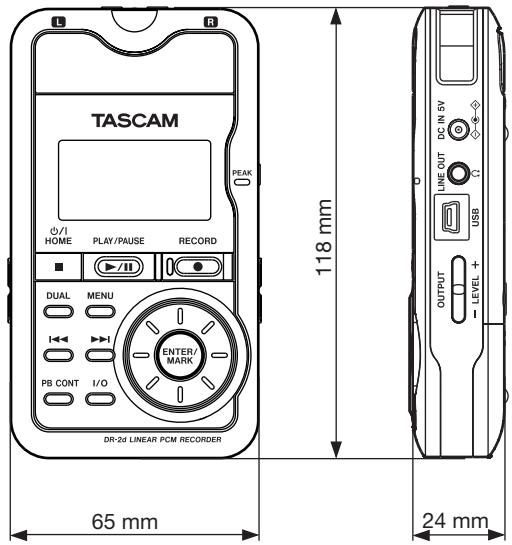
- Illustrations and other depictions may differ in part from the actual product.
- Specifications and external appearance may be changed without notification to improve the product.
TASCAM.
TEAC PROFESSIONAL
DR-2d
TEAC CORPORATION
Phone: +81-42-356-9143
1-47 Ochiai, Tama-shi, Tokyo 206-8530 Japan
www.tascam.jp
TEAC AMERICA, INC.
Phone: +1-323-726-0303
7733 Telegraph Road, Montebello, California 90640 USA
www.tascam.com
TEAC CANADA LTD.
Phone: +1905-890-8008 Facsimile: +1905-890-9888
5939 Wallace Street, Mississauga, Ontario L4Z 1Z8, Canada
www.tascam.com
TEAC MEXICO, S.A. de C.V.
Phone: +52-55-5010-6000
Suites 19 & 20, Building 6, Croxley Green Business Park, Hatters Lane, Watford, Hertfordshire. WD18 8TE, U.K.
www.tascam.co.uk
TEAC EUROPE GmbH
Phone: +49-611-71580
- IMPORTANT SAFETY INSTRUCTIONS
- Declaration of Conformity
- CAUTION
- Cautions about Batteries
- 2-Names and Functions of Parts 13
- 3-Preparation 25
- 4-Recording 33
- 5-Working with Files and Folders (BROWSE
- screen) 52
- 6-Playback 56
- 7-Using the Effects 68
- Table of Contents
- 8-Using the Metronome 70
- 9-Connecting with a Computer 71
- 10-Settings and Information 73
- Features
- 1-Introduction
- Items included with the product
- Conventions used in this manual
- TIP
- NOTE
- Intellectual property rights
- About SD cards
- Precautions for use
- Beware of condensation
- Cleaning the unit
- Top panel
- ① Remote control receiver
- ② Built-in stereo microphone
- ③ Display
- ④ 念 / I/ HOME [■] key
- ⑤ PLAY/PAUSE [▶/■] key
- 2-Names and Functions of Parts
- ⑥ DUAL key
- ⑦ MENU key
- ⑧ key
- key
- PB CONT key
- I/O key
- Rear Panel
- Right side panel
- Left side panel
- Bottom panel
- Mono speaker
- SPEAKER switch
- Tripod attachment screw-hole (1/4-inch)
- HOLD switch
- Battery compartment cover
- Remote control (RC-DR2)
- Home screen
- ⑦ Recorder operation status
- ⑧ Level meters
- File information
- ⑩ Playback position display
- Elapsed time
- Remaining time
- Peak value in decibels (dB)
- Monitoring output
- ⑤ Playback area
- Recording Screen
- Menu item list
- Using menus
- Basic operation
- Powering the unit
- Using AA batteries
- Using an AC adaptor (sold separately)
- 3-Preparation
- Preparing the remote control
- Changing the coin-shaped battery
- When to change the battery
- Cautions about the use of the battery
- Using the remote control
- Precautions for use of the remote control
- Start-up & shutdown
- Starting up the unit
- Shutting down
- Inserting and removing SD cards
- Inserting the SD card
- Removing the card
- Preparing an SD card for use
- Card write protection
- Setting the date and time
- Using the built-in speaker
- Connecting monitors and headphones
- Selecting file format/sampling frequency, and maximum file size
- 4-Recording
- Available recording time display
- Set where to save the file
- Setting the input functions
- INPUT:
- GAIN:
- TYPE:
- POWER:
- LOW CUT:
- LEVEL CTRL:
- Placing the unit and making connections
- Recording with the built-in mics
- Recording with external mics (MIC IN)
- Recording an external device (LINE IN)
- Adjusting the input level
- Recording
- Recording playback and input sounds together (over dubbing)
- Setting the file type to WAV
- Monitor the input signal (MONITOR)
- Recording an overdub
- Recording two files with different levels at the same time (DUAL REC)
- Making settings for dual recording
- Starting dual recording
- Dual recording file names
- Playback of files created using dual recording
- Automatic recording and pausing (AUTO REC)
- Creating new files (track incrementing)
- Creating new files manually while recording
- Creating new files automatically while recording (maximum file size)
- Mark function
- Adding marks manually to a recording
- Moving to a mark position
- Recording the moment before pushing RECORD (PRE REC)
- Delaying the start of recording (REC DELAY)
- Dividing a file manually (DIVIDE)
- Recording duration
- 5-Working with Files and Folders (BROWSE screen)
- Screen navigation
- Icons on the BROWSE screen
- Root Music Folder
- Audio file
- Plus folder
- Plain folder
- Open folder
- File operations
- PLAY
- INFO
- ADD LIST
- DELETE
- 5-Working with Files and Folders
- CANCEL
- Folder operations
- SELECT
- CREATE
- ALL DELETE
- 6-Playback
- Adjusting playback volume
- Setting the playback area (AREA)
- ALL FILES
- FOLDER (default)
- PLAYLIST
- Selecting a folder for the playback area (1)
- Selecting a folder for the playback area (2)
- Select the PLAY item and press ENTER/MARK.
- Adding tracks to the playlist
- Editing the playlist
- ALL CLR
- MOVE
- Selecting files for playback (skip)
- Playback (PLAY)
- Stopping
- Pausing (PAUSE)
- Rewinding and fast-forwarding (search)
- Using the wheel to change the playback position
- Repeat playback (REPEAT)
- Loop playback
- Setting the loop point manually
- Making fine adjustments to the loop playback IN and OUT points
- Turning loop playback ON/OFF
- SpecialPlaybackControlFunctions
- Setting the playback control functions
- Changing the speed
- Change speed without changing pitch
- Changing the pitch without changing the speed
- Reducing vocal and solo instrument sounds
- CANCEL:
- RANGE:
- PART:
- 7-Using the Effects
- Setting the effect
- EFFECT:
- PRESET:
- LEVEL knob:
- TIME knob:
- SOURCE:
- 8-Using the Metronome
- Setting the metronome
- TEMPO
- BEAT
- LEVEL
- Starting and stopping the metronome
- 9-Connecting with a Computer
- Transferring files to a computer
- Transferring files from a computer
- Disconnecting from a computer
- 10-Settings and Information
- Viewing File Information
- File information page (FILE)
- Card information page (CARD)
- System information page (SYSTEM)
- File information page
- WAV or MP3
- TITLE
- DATE
- SIZE
- Card information page
- TOTAL MUSIC
- TOTAL FOLDER
- TOTAL SIZE
- REMAIN SIZE/USED SIZE
- System information page
- CUE/REV SPD
- AUTO OFF
- BACKLIGHT
- System Ver.
- System Settings and Formatting
- Setting the search speed
- Turning the unit power OFF automatically
- Backlight Auto OFF setting
- Adjust the display contrast
- Adjust the backlight brightness
- Remote control setting
- Setting the type of AA batteries
- Restoring the factory settings
- Using QUICK FORMAT
- Using FULL FORMAT
- Setting the format of file names
- File name format
- Setting the WORD item
- 11-Messages
- Power will not turn ON.
- The remote control does not function.
- The unit does not function.
- The SD card is not recognized.
- ■Playback does not work.
- No sound is output.
- Recording does not work.
- The recording level is low.
- 12-Troubleshooting
- Ratings
- Recording media
- Recording/playback format
- Number of channels
- Input/output ratings
- Analog audio input/output ratings
- MIC IN jacks (supporting plug-in power)
- LINE IN jacks
- LINE OUT/Ω
- Built-in speaker
- Control input/output ratings
- Audio performance
- Frequency response
- Total harmonic distortion
- S/N ratio
- Computer compatibility
- Widnows
- Macintosh
- Recommended USB host controller
- Supported OS
- Other specifications
- Power
- Power consumption
- Battery operation time (continuous operation)
- Dimensions (W× H× D)
- Weight
- Operating temperature range
- Dimensional drawings
- TASCAM.
- TEAC PROFESSIONAL
- DR-2d
Brand : TASCAM
Model : DR-2D
Category : Portable audio recorder