
DIE-CAST PROGRAMMABLE ESPRESSO MACHINE - Espresso machine BREVILLE - Free user manual and instructions
Find the device manual for free DIE-CAST PROGRAMMABLE ESPRESSO MACHINE BREVILLE in PDF.

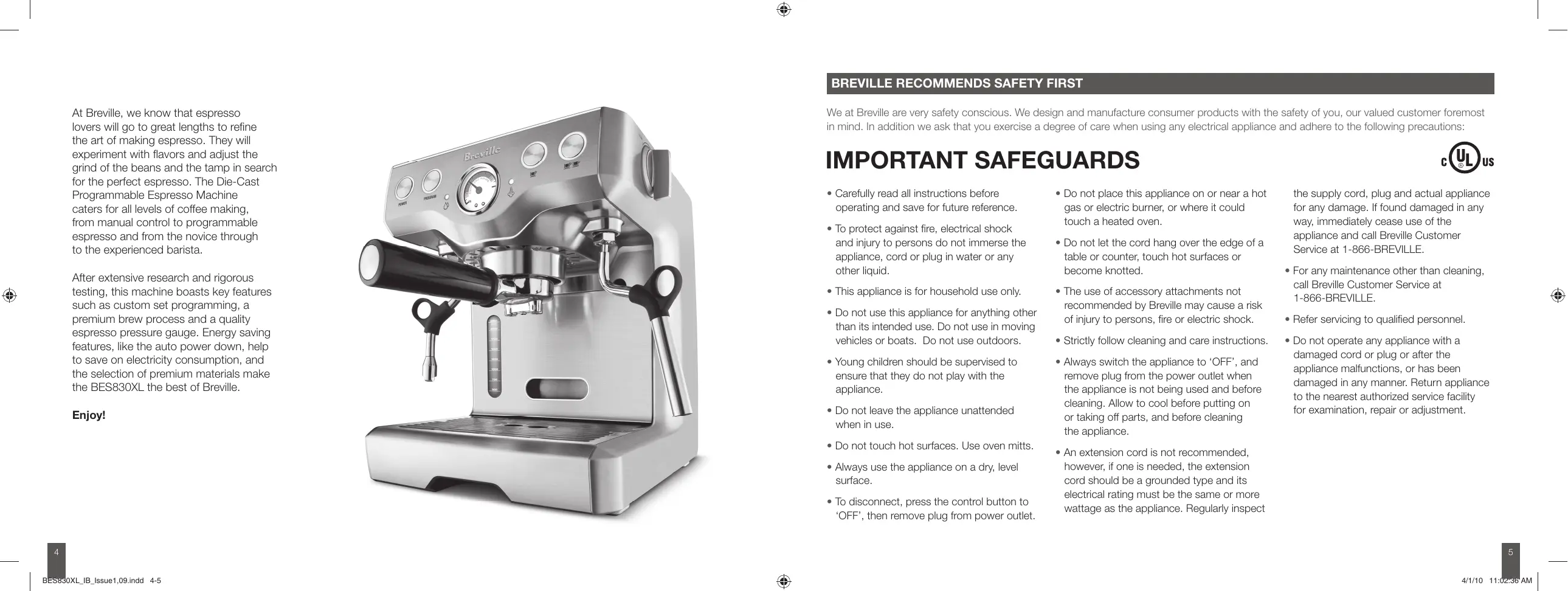

| Brand | BREVILLE |
| Model | BES830XL / DIE-CAST PROGRAMMABLE ESPRESSO MACHINE |
| Category | Espresso machine |
| Construction type | Die-cast metal |
| Pump | 15 bar |
| Heating system | Thermoblock with electronic temperature control |
| Main functions | Programmable (1 and 2 cups), manual, pre-infusion, steam, hot water |
| Filters provided | 2 dual-wall filters (pressurized) and 2 single-wall filters (non-pressurized) for 1 and 2 cups |
| Pressure gauge | Yes, with recommended espresso zone |
| Steam wand | Commercial style, articulated, with stainless steel frothing attachment |
| Hot water outlet | Yes, independent |
| Water tank | Removable, with level indicator and MAX mark |
| Drip tray | Removable, with "Empty me!" indicator |
| Cup warmer tray | Built-in, heats up with the machine |
| Energy saving | Economy mode after 1 hour, auto shut-off after 3 hours |
| Automatic shut-off | Yes, after 3 hours of inactivity |
| Pre-infusion | Yes, pause of a few seconds before extraction |
| Safety | Safety shut-off in case of overheating, short cord with Assist Plug |
| Maintenance | Clean after each use, descale every 2-3 months with white vinegar |
| Included accessories | Tamper spoon, cleaning tool (with pin and key), milk jug |
| Warranty | 1 year limited |
Frequently Asked Questions - DIE-CAST PROGRAMMABLE ESPRESSO MACHINE BREVILLE
User questions about DIE-CAST PROGRAMMABLE ESPRESSO MACHINE BREVILLE
0 question about this device. Answer the ones you know or ask your own.
Ask a new question about this device
Download the instructions for your Espresso machine in PDF format for free! Find your manual DIE-CAST PROGRAMMABLE ESPRESSO MACHINE - BREVILLE and take your electronic device back in hand. On this page are published all the documents necessary for the use of your device. DIE-CAST PROGRAMMABLE ESPRESSO MACHINE by BREVILLE.
USER MANUAL DIE-CAST PROGRAMMABLE ESPRESSO MACHINE BREVILLE
5 Breville Recommends Safety First
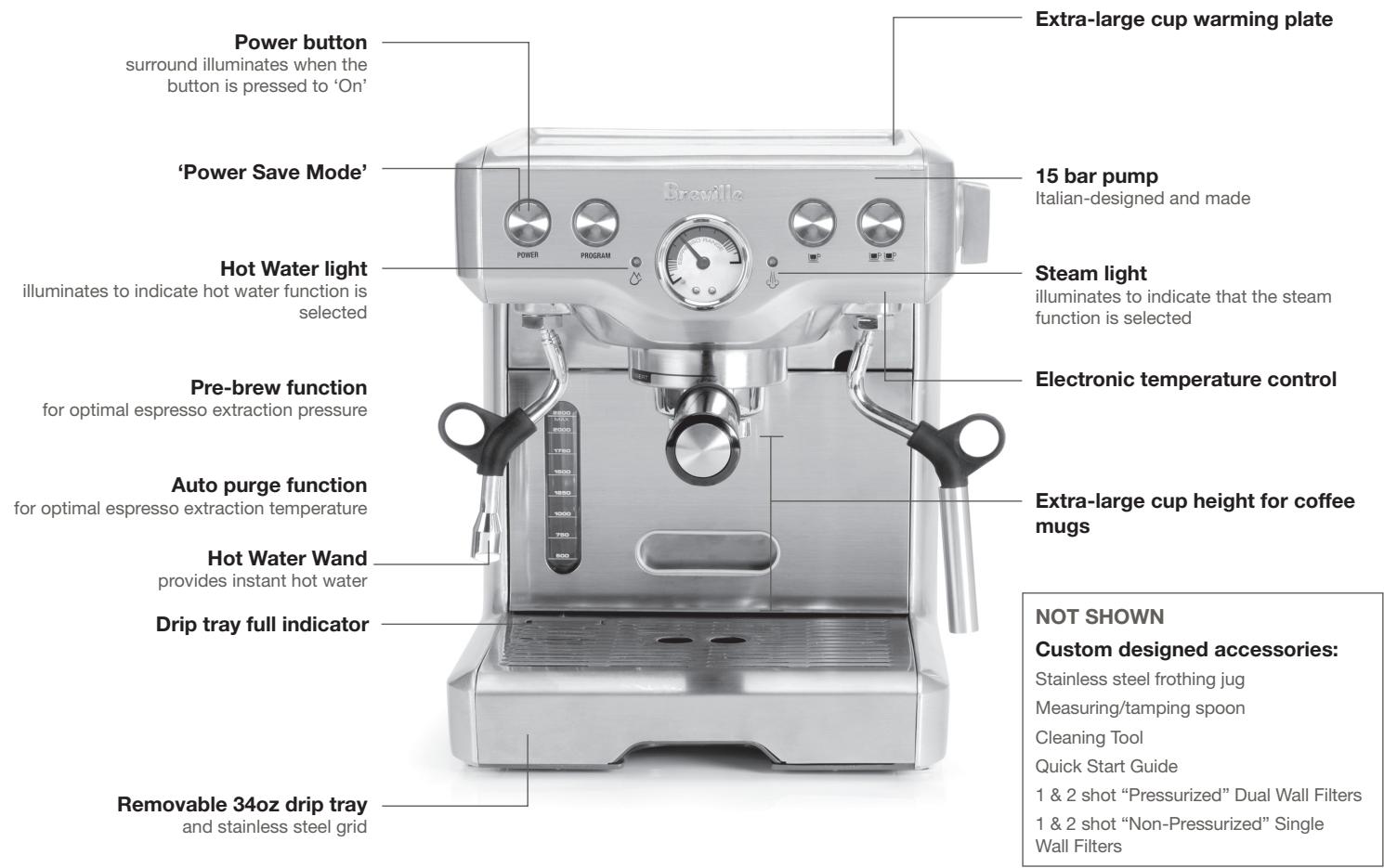
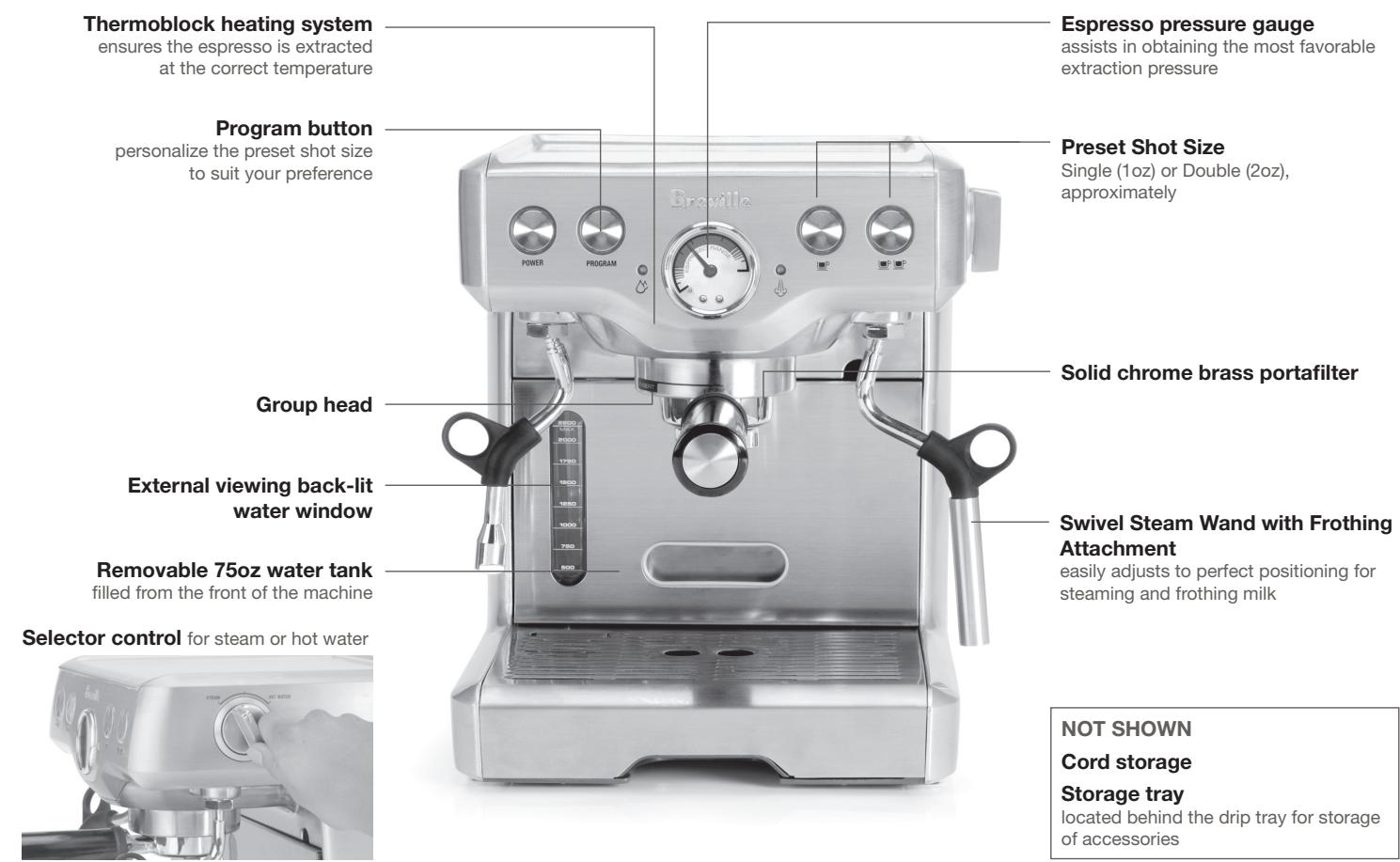
7 Features Of Your Breville Die-Cast Programmable Espresso Machine
9 Know Your Breville Die-Cast Programmable Espresso Machine
11 Before First Use
12 Assembling Your Breville Die-Cast Programmable Espresso Machine
13 Operating Your Breville Die-Cast Programmable Espresso Machine
14 - A MINUTE TO LEARN "Pressurized" Dual Wall Filters for Beginners Eliminates the guesswork for fast and easy to make espresso
19 - PERFECTING YOUR SKILLS "Non-Pressurized" Single Wall Filters for Aspiring Baristas Experiment with grind size, grind amount and tamp
23 Programming Your Breville Die-Cast Programmable.
Espresso Machine
25 The Art of Texturing Milk
27 Using The Hot Water Function
28 Espresso Making Tips
32 Care And Cleaning
36 Trouble Shooting Guide
39 Espresso Variations
42 Recipe Inspirations
45 One year limited warranty
At Breville, we know that espresso lovers will go to great lengths to refine the art of making espresso. They will experiment with flavors and adjust the grind of the beans and the tamp in search for the perfect espresso. The Die-Cast Programmable Espresso Machine caters for all levels of coffee making, from manual control to programmable espresso and from the novice through to the experienced barista.
After extensive research and rigorous testing, this machine boasts key features such as custom set programming, a premium brew process and a quality espresso pressure gauge. Energy saving features, like the auto power down, help to save on electricity consumption, and the selection of premium materials make the BES830XL the best of Breville.
Enjoy!
BREVILLE RECOMMENDS SAFETY FIRST
We at Breville are very safety conscious. We design and manufacture consumer products with the safety of you, our valued customer foremost in mind. In addition we ask that you exercise a degree of care when using any electrical appliance and adhere to the following precautions:
IMPORTANT SAFEGUARDS

- Carefully read all instructions before operating and save for future reference.
- To protect against fire, electrical shock and injury to persons do not immerse the appliance, cord or plug in water or any other liquid.
- This appliance is for household use only.
- Do not use this appliance for anything other than its intended use. Do not use in moving vehicles or boats. Do not use outdoors.
- Young children should be supervised to ensure that they do not play with the appliance.
- Do not leave the appliance unattended when in use.
- Do not touch hot surfaces. Use oven mitts.
- Always use the appliance on a dry, level surface.
-
To disconnect, press the control button to 'OFF', then remove plug from power outlet.
-
Do not place this appliance on or near a hot gas or electric burner, or where it could touch a heated oven.
- Do not let the cord hang over the edge of a table or counter, touch hot surfaces or become knotted.
- The use of accessory attachments not recommended by Breville may cause a risk of injury to persons, fire or electric shock.
- Strictly follow cleaning and care instructions.
- Always switch the appliance to 'OFF', and remove plug from the power outlet when the appliance is not being used and before cleaning. Allow to cool before putting on or taking off parts, and before cleaning the appliance.
- An extension cord is not recommended, however, if one is needed, the extension cord should be a grounded type and its electrical rating must be the same or more wattage as the appliance. Regularly inspect
the supply cord, plug and actual appliance for any damage. If found damaged in any way, immediately cease use of the appliance and call Breville Customer Service at 1-866-BREVILLE.
- For any maintenance other than cleaning, call Breville Customer Service at 1-866-BREVILLE.
Refer servicing to qualified personnel. - Do not operate any appliance with a damaged cord or plug or after the appliance malfunctions, or has been damaged in any manner. Return appliance to the nearest authorized service facility for examination, repair or adjustment.
BREVILLE RECOMMENDS SAFETY FIRST (continued)
SAVE THESE INSTRUCTIONS FOR HOUSEHOLD USE ONLY
SPECIAL SAFETY INSTRUCTIONS
- Only use cold water in the water tank.
Do not use any other liquid. - Never use the machine without water in it.
- Ensure the portafilter is firmly secured when using the machine.
- Never remove the portafilter during the brewing operation as the machine is under pressure.
ELECTRIC CORD STATEMENT
Your Die-Cast Programmable Espresso Machine has a short cord as a safety precaution to prevent personal injury or property damage resulting from pulling, tripping or becoming entangled with the cord.
Do not allow children to be near or use this appliance without close adult supervision. If you must use a longer cord or an extension cord when using the appliance, the cord must be arranged so it will not drape or hang over the edge of a countertop, tabletop or surface area where it can be pulled on by young children or tripped over.
To prevent electric shock, personal injury or fire, the electrical rating of the extension cord if you must use one must be the same or more than the wattage of the appliance (wattage is marked on the underside of the appliance).
NOTE:
Your Breville appliance comes with the unique Assist Plug™, conveniently designed with a finger hole in the power plug, for easy and safe removal from the outlet. For safety reasons it is recommended you plug your Breville appliance directly into the power outlet. Use in conjunction with a power strip or extension cord is not recommended.
CALIFORNIA PROPOSITION 65:
This product contains chemicals known to the State of California to cause cancer and birth defects or other reproductive harm.
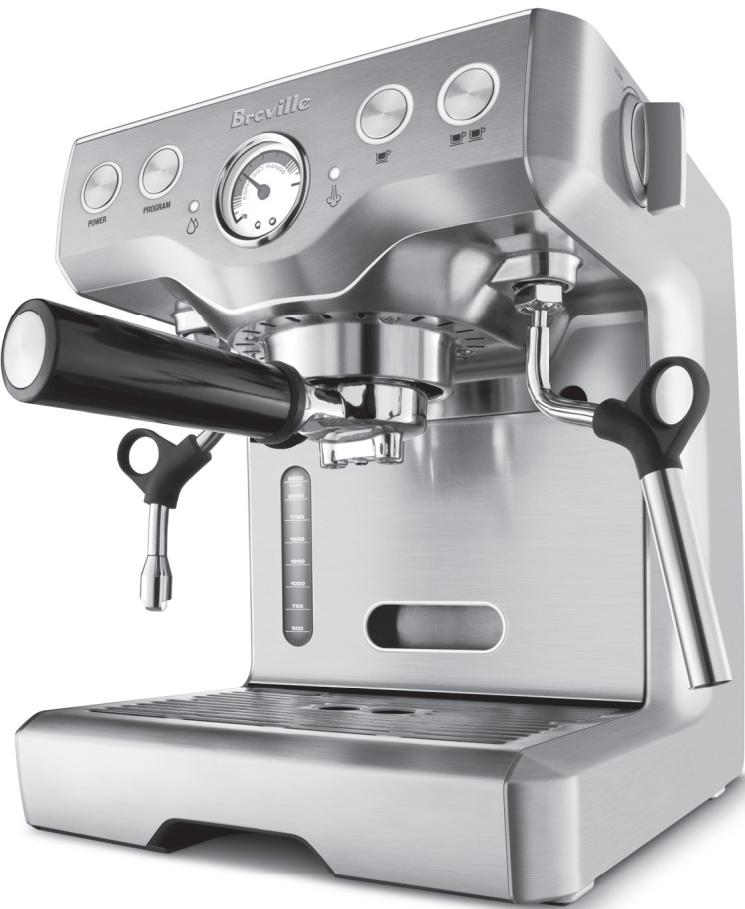
FEATURES OF YOUR BREVILLE DIE-CAST PROGRAMMABLE ESPRESSO MACHINE
PROGRAMMABLE FUNCTION
The Die-Cast Programmable Espresso Machine offers a convenient choice between preset shot sizes (1oz or 2oz), manual function (over-rides preset shot size for one time only) or a programmable function that reprograms the preset shot sizes with the user's preferred shot size.
ESPRESSO PRESSUREGAUGE
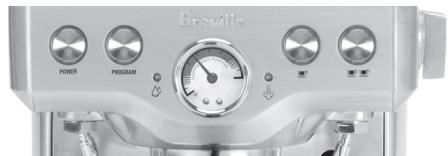
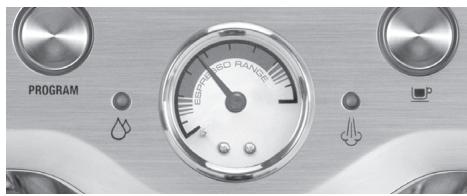
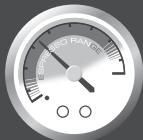
The espresso pressure gauge assists in obtaining the most favorable extraction pressure, guiding the user to create their ideal espresso. This is achieved by measuring the pressure at which the water is being forced through the ground espresso in the portafilter. The ideal position of the gauge needle is anywhere within the ESPRESSO RANGE. Refer to the Extraction Guide (page 30) for tips on how to achieve the most favorable extraction.
HOT WATER WAND
The dedicated hot water wand is ideal for making your favorite hot drinks. For convenient use the wand has a commercial style 360^ ball joint.
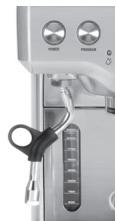
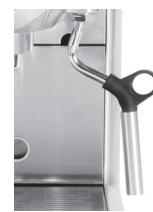
The swivel-action steam wand, with stainless steel frothing attachment, easily adjusts to the perfect position for texturing milk. The wand has a commercial style 360^ ball joint.
FEATURES OF YOUR BREVILLE DIE-CAST PROGRAMMABLE ESPRESSO MACHINE (continued)
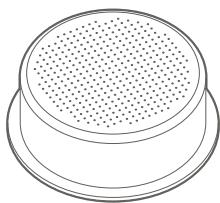
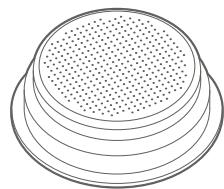
"PRESSURIZED" DUAL WALL FILTERS FOR BEGINNERS
Eliminates the guesswork for fast and easy to make espresso.
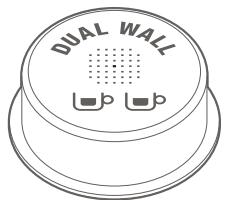
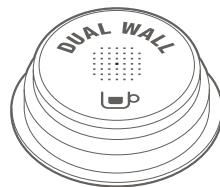
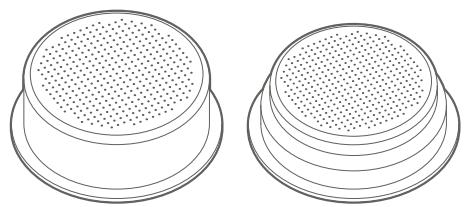
The Die-Cast Programmable Espresso Machine is supplied with two "Pressurized" Dual Wall Filters - 1 x single shot and 1 x double shot. These filters are designed to intentionally slow the water flow rate during extraction, resulting in an espresso that has been extracted at the correct pressure, leading to a rich, golden crema. These filters are suited to both pre-ground vacuum packed espresso as well as fresh ground beans.
"NON-PRESSURIZED" SINGLE WALL FILTERS FOR ASPIRING BARISTAS
Experiment with grind size, grind amount and tamp.
The Die-Cast Programmable Espresso Machine is supplied with two "Non-Pressurized" Single Wall Filters - 1 x single shot and 1 x double shot. These filters provide no additional slowing of the water flow rate, hence experimentation with the grind size, grind amount and tamp force is required to achieve favorable results.
These filters are suited to both pre-ground vacuum packed espresso as well as fresh ground beans. A great espresso is a balance of main flavor elements: acidity, aroma, bitterness, body, nuttiness, and sharpness. By using the Single Wall Filters you are free to explore the world of espresso by experimenting with grind size, grind amount and tamp pressure to extract a rich variety of flavors.
ELECTRONIC TEMPERATURE CONTROL
The electronic temperature control system accurately maintains the optimal brewing temperature of the water. This helps ensure the user gets the best possible extraction each time an espresso is made.
ENERGY SAVING FEATURES
The Breville Die-Cast Programmable
Espresso Machine will enter the 'Power
Save Mode' if not used for one hour, and
will automatically switch off if not used for
a further three hours. The 'Power Save
Mode' uses 45 % less power than when
the machine is in "Stand By" Mode.
During 'Power Save Mode' only the
POWER button surround will be
illuminated. All other button and light
surrounds will not be illuminated.
To re-activate the machine during 'Power Save Mode', simply press the program or one-cup or two-cup buttons. The POWER button surround will then illuminate and flash while the machine quickly reheats to operational temperature. When the correct temperature has been reached, all the button surrounds on the control panel will illuminate.
To switch off the espresso machine whilst it is in 'Power Save Mode', simply press the POWER button once.
KNOW YOUR BREVILLE DIE-CAST PROGRAMMABLE ESPRESSO MACHINE
KNOW YOUR BREVILLE DIE-CAST PROGRAMMABLE ESPRESSO MACHINE (continued)
BEFORE FIRST USE
Your Breville Die-Cast Programmable
Espresso Machine will have the drip tray,
water tank and storage tray in place when
you unpack it from the box.
The drip tray is located in the base of the machine towards the front of the machine.
The water tank is located in the center of the machine towards the back wall.
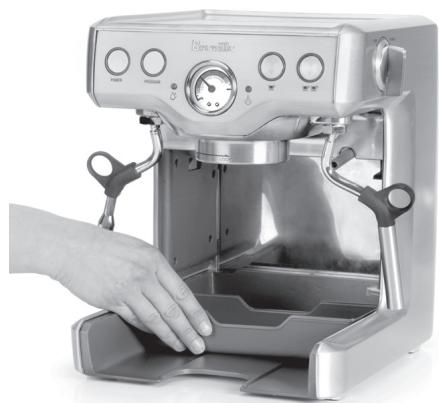
The storage tray is located at the base of the machine behind the drip tray and under the water tank. The drip tray, water tank and storage tray slide in and out for easy access.
Ensure you have removed all parts and accessories before discarding the packaging.
Remove the drip tray, water tank and storage tray. Disassemble the drip tray by removing the stainless steel grid and 'Empty Me!' full indicator. Wash all parts and accessories in warm, soapy water using a non-abrasive washing liquid. Rinse and dry thoroughly.
Wipe the outer housing with a soft damp cloth and dry thoroughly. Do not immerse the outer housing, power cord or plug in water or any other liquid.
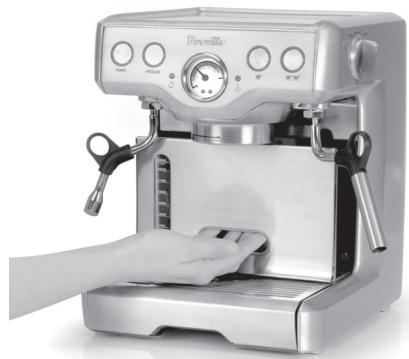
NOTE:
Do not clean any of the parts or accessories in the dishwasher.
ASSEMBLING YOUR BREVILLE DIE-CAST PROGRAMMABLE ESPRESSO MACHINE
STEP1
STEP 2
STEP3
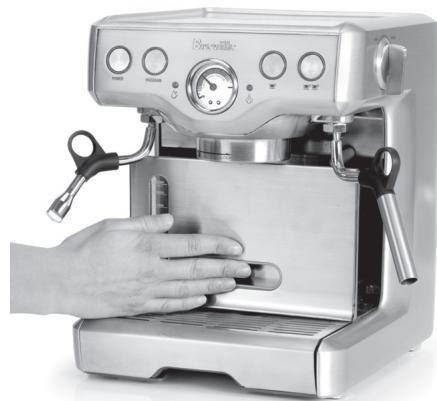
Insert the storage tray into the base of the machine and slide towards the back wall. The storage tray conveniently stores the cleaning tool, stainless steel filters and measuring/tamping spoon when not in use, so they are not misplaced.
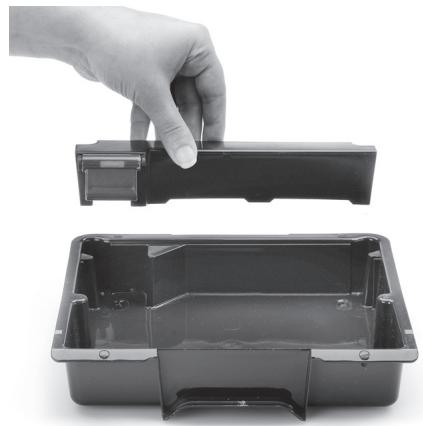
Insert the 'Empty Me!' full indicator into position in the drip tray and place the stainless steel grid on top. Slide the drip tray into position in the base of the machine in front of the storage tray.
Slide the water tank over the drip tray and into the front opening of the machine and into position above the storage tray. Ensure the water tank aligns flush with the sides of the machine.
NOTE:
Before each use it is recommended to complete a water flushing operation, without ground coffee, to ensure that all internal piping has been preheated. Refer to Steps 1 to 6 in 'One-Time Priming', page 14
A MINUTE TO LEARN - "PRESSURIZED" DUAL WALL FILTERS
"PRESSURIZED" DUAL WALL FILTERS FOR BEGINNERS
Eliminates the guesswork for fast and easy to make espresso
The Die-Cast Programmable Espresso Machine is supplied with two "Pressurized" Dual Wall Filters - 1 x single shot and 1 x double shot. These filters are designed to intentionally slow the water flow rate during brewing, resulting in an espresso that has been extracted at the correct pressure, leading to a rich, golden crema. These filters are suited to both pre-ground vacuum packed espresso as well as fresh ground beans.
One-Time Priming
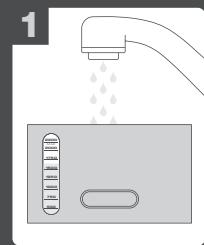
Fill & replace Water Tank
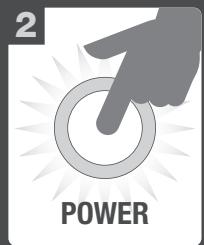
Power on
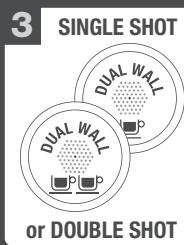
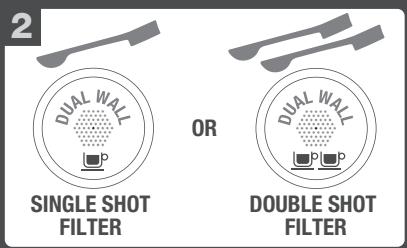
Choose Filter size
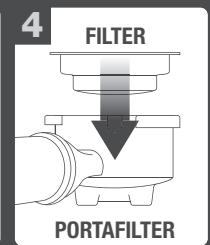
Place into Portafilter
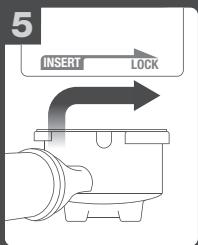
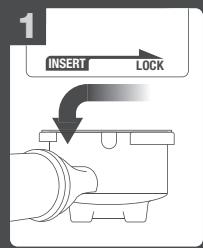
Insert Portafilter
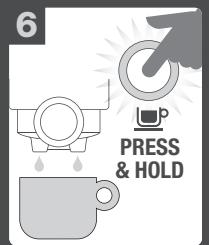
Press & hold for 10sec, then discard water
A MINUTE TO LEARN - "PRESSURIZED" DUAL WALL FILTERS
Making Espresso
Remove & dry Portafilter
Use Coffee Scoop (provided) to fill Filter with ground coffee
- Single Shot Filter 1 flat scoop
- Double Shot Filter 2 flat scoop
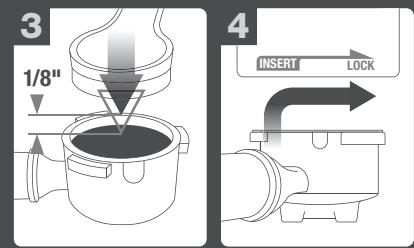
Tamp 1 / 8'' below rim Insert Portafilter
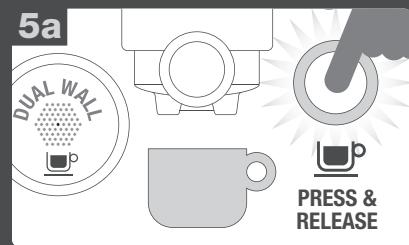
Place 1 cup under group head to extract 1 shot of espresso
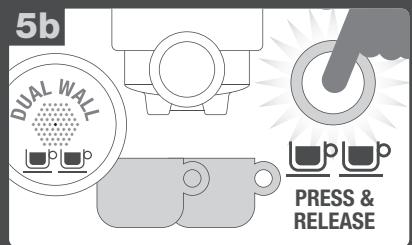
Or place 2 cups to extract 2 shots of espresso
For info on Manual and Custom Shot extraction, reference page 23.
A MINUTE TO LEARN - "PRESSURIZED" DUAL WALL FILTERS
Frothing Milk
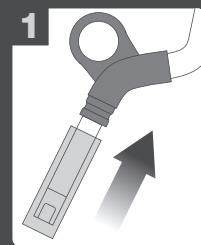
Install Frothing Attachment
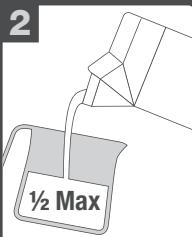
Fill Jug 12 way Max
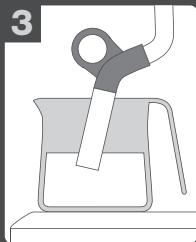
Set Jug onto drip tray
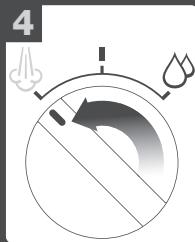
Switch steam on
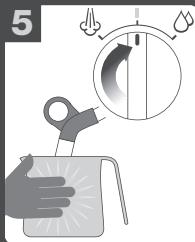
Switch steam off when hot
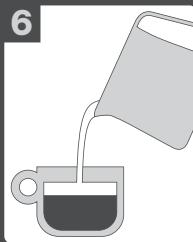
Pour carefully
After Extraction Maintenance

Knock grinds out
It is normal that grinds are wet. Knock gently.
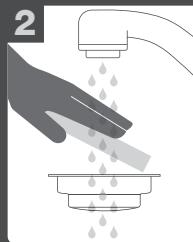
Clean Filter
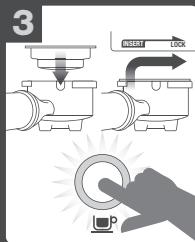
Flush Filter with water
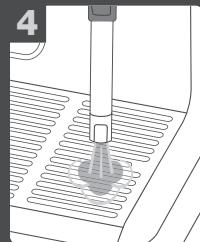
Run steam to clear wand
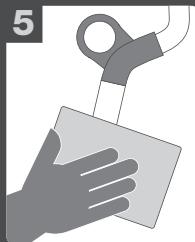
Wipe clean
A MINUTE TO LEARN - "PRESSURIZED" DUAL WALL FILTERS
No Espresso Flow?
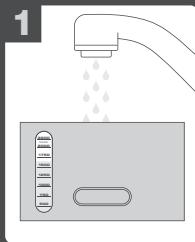
Fill Water Tank, then re-try
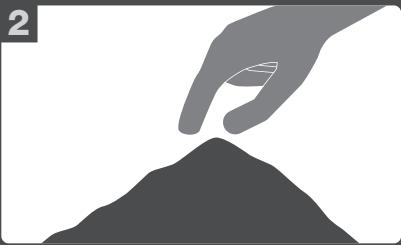
Check the grind size, then re-try
- JUST RIGHT
Feels like table salt
TOO FINE
Feels like flour
TOO COARSE
Feels like sugar
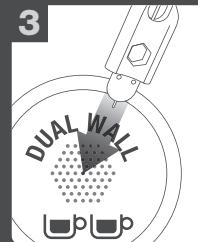
Clean with Cleaning Tool
Repeat Steps 2-3, After Extraction
Maintenance, pg 16
Espresso Too Weak?
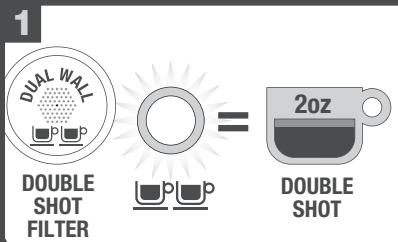
Extract 2oz into 1 cup for a double shot
Not Hot Enough?
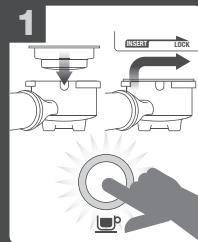
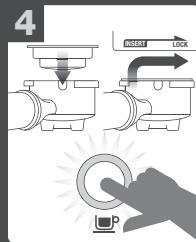
Perform Steps 4-6, One-Time Priming, pg 14
This will preheat the Portafilter and Cup.
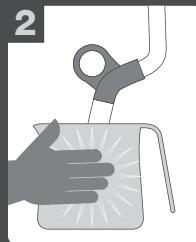
Heat milk longer
A MINUTE TO LEARN - "PRESSURIZED" DUAL WALL FILTERS
No Steam?
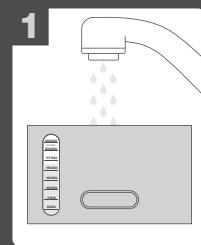
Fill Water Tank, then re-try
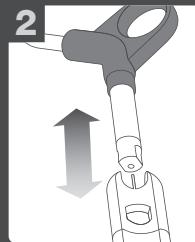
Clean hole with pin
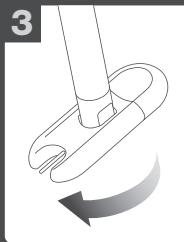
Remove tip
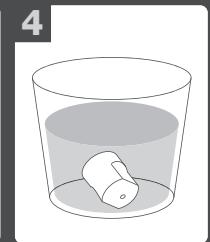
Soak tip in hot water
Any Questions?

Or refer to the Instruction Book
PERFECTING YOUR SKILLS - "NON-PRESSURIZED" SINGLE WALL FILTERS
"NON-PRESSURIZED" SINGLE WALL FILTERS FOR ASPIRING BARISTAS
Experiment with grind size, grind amount and tamp.
The Die-Cast Programmable Espresso Machine is supplied with two "Non-Pressurized" Single Wall Filters - 1 x single shot and 1 x double shot. These filters provide no additional slowing of the water flow rate, hence experimentation with the grind size, grind amount and tamp force is required to achieve favorable results.
These filters are suited to both pre-ground vacuum packed espresso as well as freshly ground beans. A great espresso is a balance of main flavor elements: acidity, aroma, bitterness, body, nuttiness, and sharpness. By using the Single Wall Filters you are free to explore the world of espresso by adjusting grind, grind amount and tamp to extract a rich variety of flavors.
STEP 1 - FILLING THE WATER TANK
- Ensure the Power is off and the Selector Control, on the side of the machine, is set to the "Stand By" position.
- Unplug the power cord from the power outlet.
- Remove the portafilter if locked into the group head and move the steam wand to the side of the machine.
- Remove the water tank by sliding out using the handle insert in the front of the water tank.
and slide the water tank carefully back into position in the machine.
- Ensure the Selector Control is in the "Stand By" position and plug the power cord into a 110/120V power outlet.
- Press the POWER button to 'On', the POWER button surround will flash while the machine is heating. When the correct temperature has been reached, all the button surrounds on the control panel will illuminate.
NOTE:
Check the water level before use and replace the water daily. The water tank should be refilled with fresh, cold tap water before each use. Do not use mineral or distilled water or any other liquid.
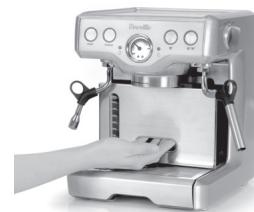
- As the water tank is removed, a black tube slides and extends out from the water tank storage area. Do not touch or try to remove this tube, it will automatically slide back into position when the water tank is re inserted.
- Fill the water tank with cold, tap water to the maximum mark on the water window
STEP 2 - PRE-WARMING THE CUPS
This will help maintain the espresso's optimal temperature when brewed into the cups. The Cup Warming Plate will start to warm as the machine heats.
Run hot water from the group head without the portafilter inserted by holding down the single shot button on the front, right hand side of the machine, then place the cups on the warming tray.
PERFECTING YOUR SKILLS - "NON-PRESSURIZED" SINGLE WALL FILTERS
STEP 3 - PREPARED THE SINGLE WALL FILTER
- Place the single or double shot Single Wall Filter into the portafilter. When brewing into a larger mug, always use the double shot filter and only extract 2oz. If you require a larger serving, add the hot water first and then extract the espresso.
- Preheat the portafilter by placing underneath the group head. Rinse with hot water from the group head by holding down the double shot button on the front, right hand side of the machine. Dry the portafilter thoroughly before use.
Unlike the Dual Wall Filters, the Single Wall Filters have no markings on the underside of the filter (refer to page 8).
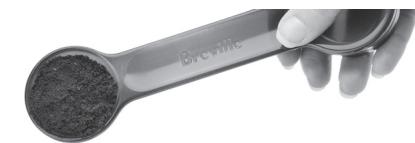
- Use 1 level measure of ground espresso coffee for the 1 shot filter and 2 level measures for the 2 shot filter.
Refer to 'Espresso Making Tips', page 31.
STEP 4 - GRIND SIZE & AMOUNT
When selecting the grind size it should be fine but not too fine or powdery. The grind will effect the rate at which the water flows through the ground espresso in the filter and therefore the taste of the espresso.
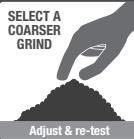
If the grind is too fine (looks like powder and feels like flour when rubbed between fingers), the water will not flow through the ground espresso even when under pressure. The resulting espresso will be over extracted, too dark and bitter, with a mottled and uneven crema on top.
If the grind is too coarse the water will flow through the ground espresso too quickly. This will result in an under-extracted espresso lacking in flavor and without the thick crema on the top.
When grinding for a Single Wall Filter using a finer espresso grind, you will need to increase the grind amount to ensure the filter is correctly filled.
PERFECTING YOUR SKILLS - "NON-PRESSURIZED" SINGLE WALL FILTERS
STEP 5 - TAMPING THE GROUND ESPRESSO
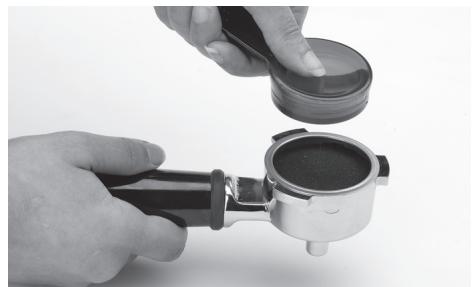
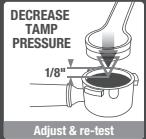
- Distribute the ground espresso coffee evenly in the filter and press down lightly with the tamping end of the measuring spoon.
Refer to 'Espresso Making Tips', page 31 - Clean any excess ground espresso coffee from the rim of the portafilter to ensure a proper fit into the group head.
STEP 6 - PRIMING THE GROUP HEAD
- Before placing the portafilter into position, it is recommended to run a short flow of water through the group head.
- Place a container or empty cup under the group head.
- With the portafilter removed, prime the group head by pressing and holding down the single or double cup button for approximately 5 seconds.
Refer to 'Manual Espresso', page 24.
A pumping noise will be heard during this operation, and water will run through the group head.
STEP 7 - INSERTING THE PORTAFILTER
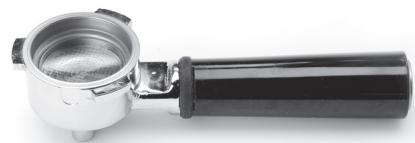
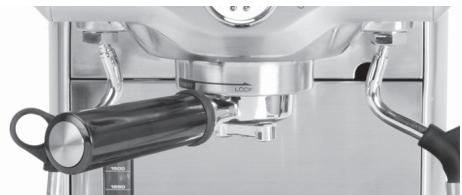
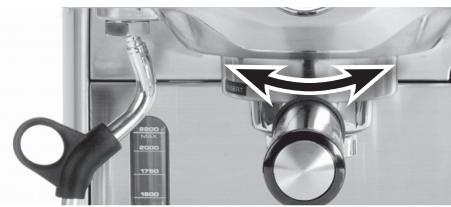
Place the portafilter underneath the group head so that the handle is aligned with the insert graphic. Insert the portafilter holder up into the group head and rotate the handle to the right until resistance is felt, this will be at an approximate 90^ angle to the machine.
PERFECTING YOUR SKILLS - "NON-PRESSURIZED" SINGLE WALL FILTERS
STEP 8 - PREPARED FOR EXTRACTION
- Ensure all the button surrounds on the control panel are illuminated, indicating the machine has reached the correct temperature for extraction, and is ready for use.
- Ensure the drip tray and portafilter are in place.
- Place one or two pre-warmed cups beneath the portafilter outlet.
PRESET SHOT SIZE - ONE SHOT
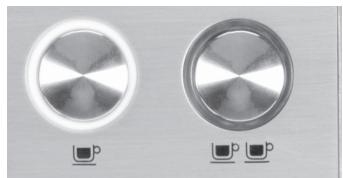
Press the one cup button once. A preset extraction of approximately 1 oz of espresso will be delivered. A pumping noise will be heard in this operation. The machine will automatically stop once the preset pour has been delivered.
NOTE:
When using a single shot filter, for optimal flavor, you should only extract approximately 1 oz. When using a double shot filter, for optimal flavor, you should only extract approximately 2 oz.
NOTE:
The amount of espresso extracted in the cup will vary depending on the coarseness of your grind and grind amount.
PROGRAMMING YOUR BREVILLE DIE-CAST PROGRAMMABLE ESPRESSO MACHINE
PRESET SHOT SIZE - DOUBLE SHOT
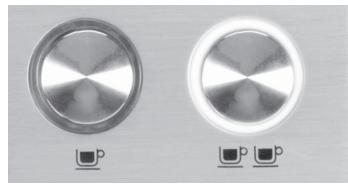
Press the two cup button once. A preset extraction of approximately 2oz of espresso will be delivered. A pumping noise will be heard in this operation. The machine will automatically stop once the preset pour has been delivered.
NOTE:
The minimum pour for one cup and two cups is set at 1/2 oz (15ml).
NOTE:
Pressing the one cup or two cup buttons during a programmedpresso will immediately stop the pour.
PROGRAMMING SINGLE ESPRESSO
Programming over-rides the preset shot sizes (1oz or 2oz), re-programming the button to pour your preferred shot size.
1.Prepare to make a single cup of
espresso by following steps 1 to 7 in
'PERFECTING YOUR SKILLS - Single Wall Filters', pages 20-22.
2. Place your cup underneath the group head.
3. To begin programming, press the 'PROGRAM' button once. The machine will beep once and the program button will begin to flash. This indicates the machine is in programming mode.
4. Press the one cup button once. The machine will commence normal pour function, and the one cup button surround will begin to flash.
5. When the desired amount of espresso has poured into the cup, press the one cup button to stop the pour. The machine will beep twice, indicating it has saved your preferred pour quantity and exited programming mode.
PROGRAMMING DOUBLE ESPRESSO
Programming over-rides the preset shot sizes (1oz or 2oz), re-programming the button to pour your preferred shot size.
- Prepare to make a double cup of espresso by following steps 1 to 7 in 'PERFECTING YOUR SKILLS - Single Wall Filters', pages 20-22.
- Place your cup underneath the group head.
- To begin programming, press the 'PROGRAM' button once. The machine will beep once and the program button will begin to flash. This indicates the machine is in programming mode.
- Press the two cup ^P button once. The machine will commence normal pour function, and the two cup button surround will begin to flash.
- When the desired amount of espresso has poured into the cup, press the two cup button to stop the pour. The machine will beep twice, indicating it has saved and exited programming mode.
PROGRAMMING YOUR BREVILLE DIE-CAST PROGRAMMABLE ESPRESSO MACHINE
RESETTING DEFAULT VOLUMES
To reset the machine to the default one and two cup pour quantities, press and hold the 'PROGRAM' button, until the machine beeps three times. Release button. This indicates the machine has returned to its original default settings.
NOTE:
Default settings: one cup pour is approximately 1 oz. Two cups
is approximately 2 oz.
MANUAL ESPRESSO
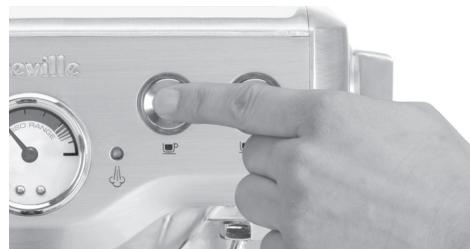
The Manual function over-rides the preset shot size for one time only. It does not save the shot size like in programming mode.
Press and hold the single or
two cup button. Release the button once sufficient espresso has flowed into the cup.
STEP 9 - EMPTYING THE PORTAFILTER
Remove the portafilter from the group head by rotating the portafilter to the left until it releases.
To empty the used grounds, turn the portafilter upside down in a bin and gently knock out the grounds. Used grounds should be thrown away with domestic waste. Discarding of used grounds in a sink can cause drains to become blocked.
With the filter still in place, hold the portafilter underneath the group head, press and hold down the one cup button to release hot water. Rinse the portafilter until water runs clear.
Insert the portafilter back into the group head to dry out and keep warm.
NOTE:
PRE-BREW FUNCTION
When a single or double coffee is selected, the machine will pump water momentarily, followed by a pause then continues to pump the water through to the ground coffee in the portafilter. The ground coffee is moistened by a small amount of water before full extraction then expands resulting in greater pressure build-up to extract all the oils and full flavor from the ground coffee.
NOTE:
You may notice that the espresso coffee in the filter holder is still wet after extraction. Due to the high water pressure created by the dual-wall filter, a small amount of water will remain with the grounds after extraction.
This is normal, this is how we get the perfect créma.
WARNING: THE METAL PARTS OF THE PORTAFILTER MAY STILL BE VERY HOT.
THE ART OF TEXTURING MILK
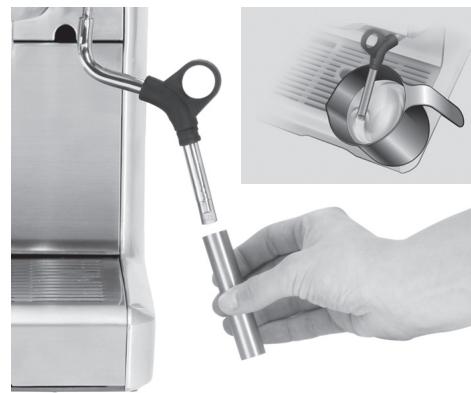
The Die-Cast Programmable Espresso Machine comes complete with a Commercial Style Swivel Steam Wand and Stainless Steel Frothing Attachment. When using the frothing attachment on the steam wand a large amount of froth is easily created.
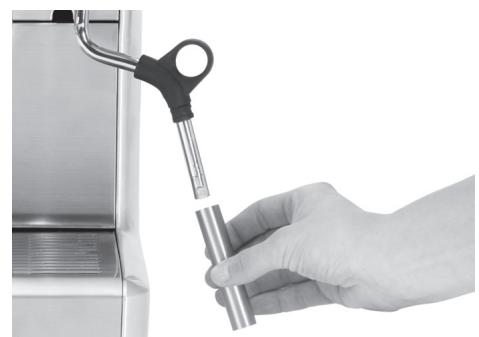
If less froth is required, remove the frothing attachment from the steam wand and steam the milk using the steam wand. To remove the frothing attachment, ensure it is cool then simply pull down and remove. The frothing attachment can be stored in the storage tray inside the machine if not used regularly.
To refit the frothing attachment ensure it is securely attached to the steam wand by inserting it, from either opening, onto the steam wand and pushing firmly upwards onto the rubber surround.
- Fill the stainless steel frothing jug maximum 1 / 2 full with cold, fresh milk.
- Turn the Steam selector dial to the 'Steam' position. The red steam light will start to flash indicating that the machine is heating to create steam.
- When the steam light stops flashing it is ready to use.
- Before inserting the wand into the milk, pause the steam by returning the dial back to the 'STAND BY' position. This will avoid splashing the milk out of the jug (this pause function lasts for 6 seconds before exiting steam mode).
-
Insert the wand into the milk and return the Steam dial back to 'Steam'.
-
To stop, return the steam dial to the 'STAND BY' position and remove the jug.
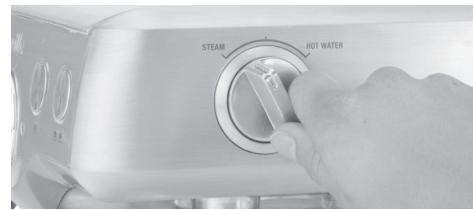
NOTE:
When the espresso machine creates steam, a pumping noise can be heard. This is the normal operation of the 15 Bar pump.
NOTE:
If steam starts coming from the steam wand before it is immersed in the milk, pause the steam by turning the Selector Control back to the 'Standby' position. This will avoid the steam pressure blowing milk out of the jug.
WARNING: MILK SHOULD NOT BE ALLOWED TO RUN OVER THE TOP OF THE FROTHING
ATTACHMENT, OTHERWISE IT WILL NOT FUNCTION PROPERLY. TO AVOID SPLATTERING OF HOT MILK, DO NOT LIFT THE END OF THE FROTHING ATTACHMENT ABOVE THE SURFACE OF THE MILK WHILE FROTHING. ENSURE THE STEAM DIAL IS IN THE 'STAND BY' POSITION BEFORE REMOVALING THE FROTHING JUG.
THE ART OF TEXTURING MILK
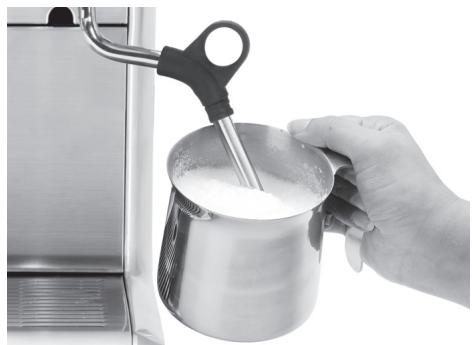
There are two phases to texture milk: Stretching the milk to aerate it and swirling the milk to make it silky smooth and the right temperature.
In practice these two operations should blend into one.
NOTE: The espresso machine features a swivel steam wand assembly so the position of the steam wand can be changed to a comfortable angle.
STEP 1 - STRETCHING THE MILK
Hold the jug so the tip of the steam wand is just below the surface of the milk and with your free hand engage the steam. Every so often lower the jug so the steam wand just breaks the surface of the milk and makes a 'hissing' sound.
Stretching the milk will increase the volume, so lower the jug as the milk rises to ensure the tip remains just above the surface of the milk.
STEP 2 - SWIRLING THE MILK
After a short while you will have aerated sufficiently. At this point, adjust the jug so the steam wand is off-center and create a spinning motion in the milk. Compensate for the angle of the steam wand by slightly tilting the jug away from you, or to one side and at the same time lower the nozzle further into the body of the milk.
Continue swirling until milk is at desired temperature (between 130^ - 150^ ). Without a thermometer you'll know the milk is ready when the jug base is 'just too hot' to touch.
When you get the balance right the milk should end up forming a 'meringue-like' consistency that has a glassy sheen to it. Remove any excess air bubbles by gently knocking the jug against a hard flat surface and pour the milk down the inside of your chosen cup or glass to make your desired espresso variation.
Lastly, run the Steam function briefly to remove any residual milk in the steam wand tip. Then give the steam wand a good wipe with a damp cloth.
NOTE:
After 5 minutes of continuous steaming, the machine will automatically disable the steam function. The steam and hot water lights will flash. When this occurs return the selector control to the 'Standby' position.
NOTE:
Always ensure that the frothing attachment has been firmly pushed onto the steam wand and connects with the rubber surround. For best results use cold fresh milk (low fat milk will froth easier). Always clean the steam wand and frothing attachment after every use. Refer to 'Care and Cleaning', page 33.
USING THE HOT WATER FUNCTION
NOTE:
For extracting more espresso immediately after using the steam function, this machine features an auto-purge function. This ensures that ground espresso will not be burnt by the initial water flow from the thermoblock being too hot. Instead this water is automatically released internally into the drip tray ensuring that the internal thermostat is at optimal temperature for extracting espresso. Your espresso will always be extracted at this optimal temperature ensuring only the best flavored espresso is achieved.
The machine is not designed to make large pots of coffee and tea. The more hot water used at the one time, the cooler it becomes.
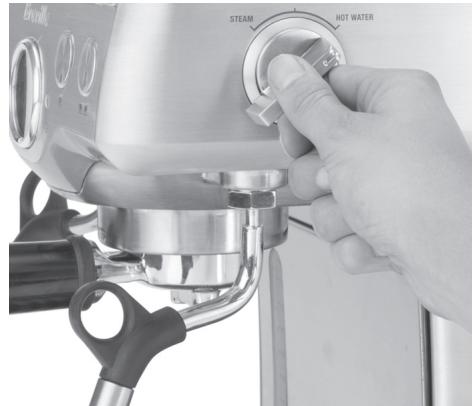
NOTE:
After 2 minutes of continued hot water use, the machine will automatically disable the hot water function. The steam and hot water lights will flash. When this occurs return the selector to the 'Standby' position.
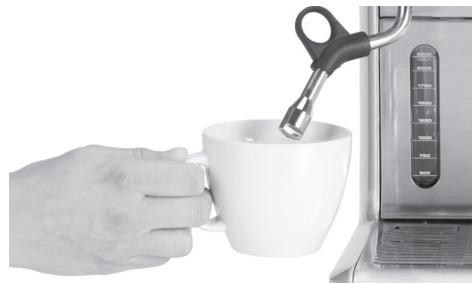
The espresso machine features a separate hot water function that can be used for making tea, hot chocolate and other warm drinks. The hot water is dispensed from the dedicated Hot Water Wand.
Place a jug or cup underneath the Hot Water Wand to collect the hot water.
To use the hot water function, turn the Selector Control to HOT WATER. The hot water light will illuminate when selected.
To turn the hot water off, turn the Selector Control to the 'Standby' position.
Limit the extraction of hot water to 67 oz (2 liters) each use.
ESPRESSOMAKINGTIPS
RECOMMENDATIONS

Fresh Roasted Beans
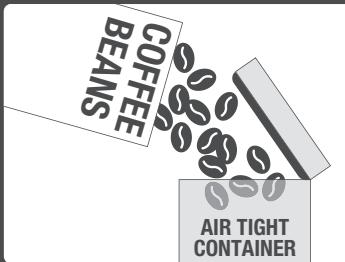
Freshly ground, fresh roasted beans are key to making espresso with more flavor and body. Stale beans and preground coffee significantly affect the taste andcrema of your finished espresso.
Store Carefully
Store in a dark, cool and dry place. Do not store in the fridge or freezer. Vacuum seal if possible.
Buy in small batches to reduce the storage time.
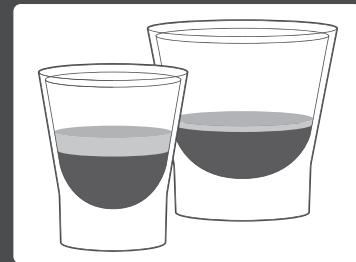
Crema
Crema is the caramel colored layer that is on top of the espresso following extraction.
Cup size will affect crema depth. The smaller the cup diameter, the thicker the crema.
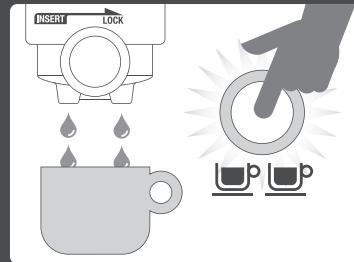
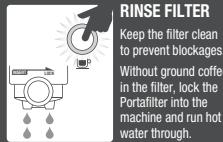
Pre-Heat & Rinse
Pre-heating the cups and filter before extraction ensures a hot espresso.
Without ground espresso coffee in the filter, lock the Portafilter into the machine and run hot water through.
ESPRESSOMAKINGTIPS
EXTRACTION TYPES
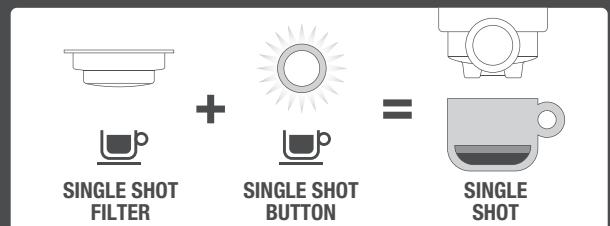
1 x Single Espresso
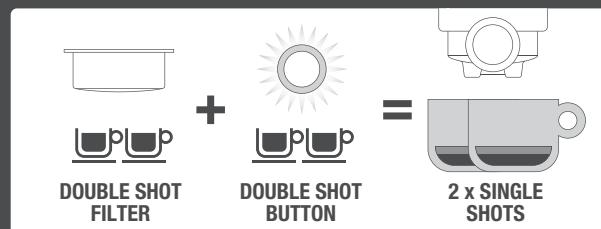
2 x Single Espressos
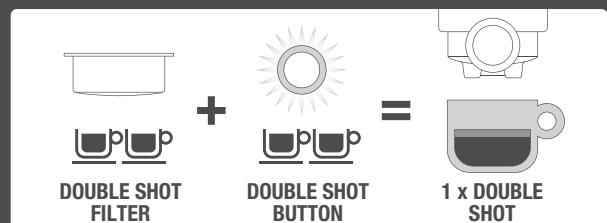
1 x Double Espresso (Strong)
ESPRESSO MAKING TIPS
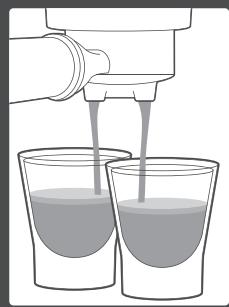
CORRECT EXTRACTION
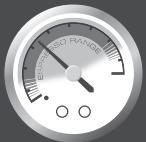

Within ESPaCe Range
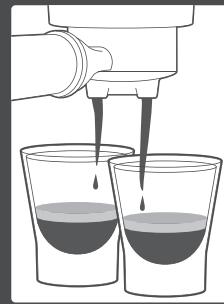
- Crema* is golden with a fine mousse texture
-
Espresso is dark brown
-
Crème is the caramel colored layer that floats on top of the espresso.
AFTER EXTRACTION 2
AFTER EXTRACTION 1
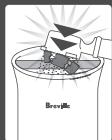
REMOVE USED GRINDS Knock grinds out gently. It is normal that grinds are wet.
WARMING YOUR CUP OR GLASS
A warm cup will help maintain the
espresso's optimal temperature. Preheat
your cup by storing on the cup warming
tray or rinsing with hot water from the hot
water wand.
UNDER EXTRACTION

Under
Espresso
Range
- Crema is thin and pale
- Espresso is pale brown
- Tastes bitter or weak/watery
DY 2 REMEDY 3
OVER EXTRACTION

Over
Espresso
Range
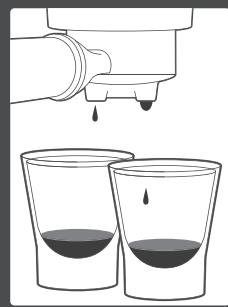
- Flow drips or not at all
- Crema is dark and spotty
- Espresso is very dark brown
- Tastes bitter and burnt
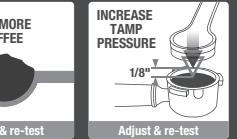
REMEDY 1
REMEDY 2
REMEDY 3
USE LESS COFFEE Adjust & re-test
A warm cup will help maintain the
espresso's optimal temperature. Preheat
your cup by storing on the cup warming
tray or rinsing with hot water from the hot
water wand.
WARMING THE PORTAFILTER
A cold portafilter can drop the extraction temperature enough to significantly affect the quality of your espresso. Always ensure the portafilter is preheated by running hot water through it before preparing the espresso.
NOTE:
Always wipe the filter and portafilter dry before tamping with ground espresso as moisture can encourage 'drilling' - this is when water bypasses the ground espresso coffee during extraction.

ESPRESSOMAKINGTIPS
USING PRE-GROUND ESPRESSO
If using a pre-ground espresso, ensure an espresso grind suitable for espresso/cappuccino machines is purchased.
If grinding coffee beans, the grind should be fine but not too fine or powdery. The grind will effect the rate at which the water flows through the espresso coffee in the filter and therefore the taste of the espresso.
If the grind is too fine (looks like powder and feels like flour when rubbed between fingers), the water will not flow through the coffee even when under pressure. The resulting coffee will be over extracted, too dark and bitter, with a mottled and uneven créma on top.
If the grind is too coarse the water will flow through the ground espresso too quickly. This will result in an under-extracted espresso lacking in flavor and without the thick crème on the top of the espresso.
THE RIGHT MEASUREMENT
A single espresso is made with 14 ounce or 7g of ground espresso. A level measure of the tamp/spoon is the correct amount of ground espresso for a single espresso and 2 level measures for a double espresso.
When grinding for a Single Wall Filter using a finer espresso grind, you will need to increase the grind amount to ensure the filter is correctly filled.
TAMPING CORRECTLY
Level the desired amount of coffee by gently tapping the side of the portafilter before pressing down firmly with the tamping end of the measuring spoon. When packing for a double espresso it is important only to tamp after the second measure. Tamping between measures will create a layer in the coffee that can impede full extraction.
PURGE THE GROUP HEAD
Before inserting the portafilter, run some water through the group head. It will ensure that your machine has a last minute 'clean through' and stabilizes the temperature prior to extracting.
NOTE:
Make sure to wipe off any excess coffee from the rim of the filter to ensure a proper seal is achieved under the group head.
EXTRACTING YOUR ESPRESSO
The most common mistake in extracting is to over extract from your ground espresso. This results in a bitter beverage with visibly bleached créma. Créma is the caramel colored layer that floats on top of the espresso following extraction.
NOTE:
The taste of your espresso will, of course, depend on personal preference and on many other factors such as the type of coffee bean used, the coarseness or fineness of the grind and the tamping pressure (pressed down). We recommend experimenting by varying these factors to achieve the espresso taste of your preference.
NOTE:
Always properly clean your machine after each use.

Care and Cleaning
CARE AND CLEANING
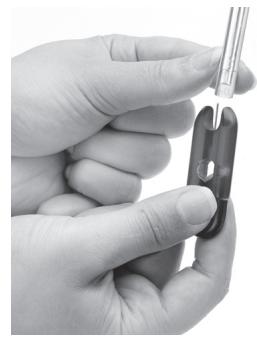
CLEANING THE STEAM WAND AND FROTHING ATTACHMENT
- The steam wand and frothing attachment should always be cleaned after frothing milk
- Remove the frothing attachment and rinse in warm tap water. Ensure the two fine steam holes on either end of the frothing attachment are clear. Use the pin on the cleaning tool to unblock these holes.
-
Wipe the steam wand with a damp cloth, and then with the steam wand directed back into the drip tray, briefly set the Selector Control to the 'Steam' position. This will clear any remaining milk from inside the steam wand.
-
Ensure the Selector Control is in the 'Standby' position. Press the POWER button, unplug from the power outlet and allow the machine to cool.
- If the Steam Wand remains blocked, use the pin on the cleaning tool to clear the opening.
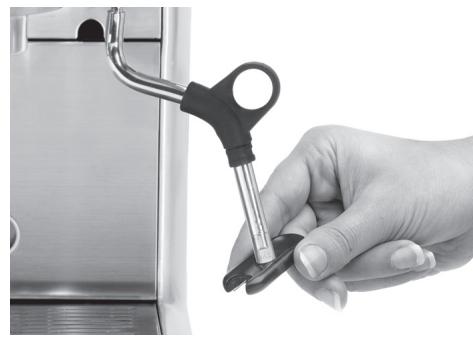
- If the steam wand continues to be blocked, the tip of the steam wand can be removed by using the spanner in the middle of the cleaning tool.
- Soak the tip in hot water before using the pin on the cleaning tool to unblock. Replace the tip back onto the steam wand and secure with the cleaning tool.
CLEANING THE FILTERS, PORTAFILTER AND GROUP HEAD
- The stainless steel filters and portafilter should be rinsed under water directly after use to remove all coffee particles. Should the fine holes in the filters become blocked, the fine pin on the cleaning tool can be used to clear the holes.
- The group head interior should be wiped with a damp cloth to remove any ground espresso coffee particles.
- Periodically run water through the machine with the portafilter in place, but without any ground espresso coffee, to rinse out any residual espresso coffee particles.
CARE AND CLEANING
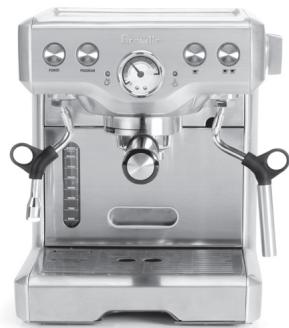
CLEANING THE OUTER HOUSING / CUP WARMING PLATE
- The outer housing and cup warming plate can be cleaned with a soft, damp cloth. Then polish with a soft, dry cloth. Do not use abrasive cleansers, pads or cloths which can scratch the surface.
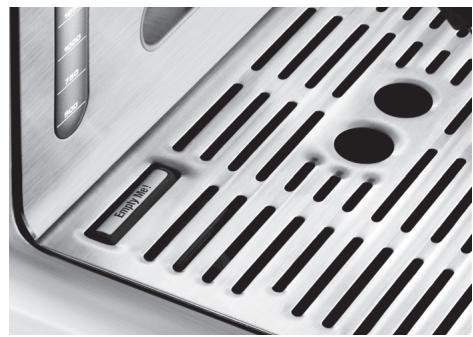
CLEANING THE DRIP TRAY
- The drip tray should be removed, emptied and cleaned at regular intervals, particularly when the drip tray full indicator is showing 'Empty Me!'.
- Remove the stainless steel grid and 'Empty Me!' indicator from the drip tray, wash with warm soapy water, using a non-abrasive washing liquid, rinse and dry thoroughly. The 'Empty Me!' indicator can be removed from the drip tray by inserting fingers into two holes in the corners and pulling upwards to release the side latches.
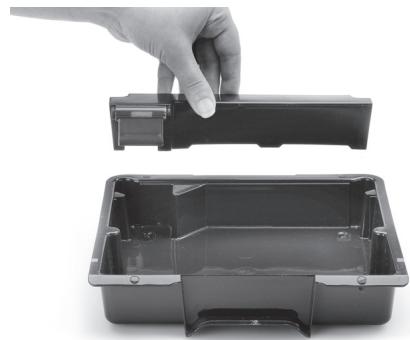
CLEANING THE STORAGE TRAY
- The storage tray can be removed after the drip tray is removed then cleaned with a soft, damp cloth (do not use abrasive cleansers, pads or cloths which can scratch the surface).
NOTE:
Do not clean any of the parts or accessories in the dishwasher.
CARE AND CLEANING (continued)
DECALCIFYING
- After regular use, hard water can cause mineral build up in and on many of the inner functioning components, reducing the brewing flow, power of the machine, and affecting the quality of the espresso.
- We advise decalcifying the machine on a regular basis (every 2-3 months) using a mixture of white vinegar and water. Follow the instructions provided, or use the following as a guide:
Diluted solution (for softer water)
- 1 part white vinegar
- 2 parts cold tap water
Concentrated solution (for harder water)
- 1 part white vinegar
- 1 part cold tap water
DECALCIFYING THE MACHINE
- Ensure the Selector Control is in the 'Standby' position, the power is off and unplug the machine from the power outlet.
- Remove the portafilter and frothing attachment. Pour the mixture of white vinegar and water into the water tank.
- Plug the machine into the power outlet and switch on.
- Press the POWER button and turn the Selector Control to the 'Standby' position.
- Place a large container under the group head, steam wand and hot water wand.
-
When the brewing temperature has been reached all the button surrounds on the Control Panel will illuminate. Press and hold the single or double cup button to commence manual pour.
-
Release the button once half the mixture of white vinegar and water has run through the group head.
- Set the Selector Control to the 'STEAM' position and allow steam to run through the Steam Wand for approximately 2 minutes. Return the Selector Control back to the 'Standby' position.
- Set the Selector Control to the 'HOT WATER' position and allow the remaining liquid to run through the hot water wand. When the liquid stops flowing, set the Selector Control back to 'Standby' position.
- After decalcifying, remove the water tank and rinse thoroughly then re-fill with fresh cold water. To rinse the machine, repeat previous steps.
WARNING: DO NOT IMMERSE CORD, PLUG OR APPLIANCE IN WATER OR ANY OTHER LIQUID. THE WATER TANK SHOULD NEVER BE REMOVED OR COMPLETELY EMPTIED DURING DECALCIFYING.
TROUBLE SHOOTING GUIDE
| PROBLEM | POSSIBLE CAUSES | WHAT TO DO |
| When the machine is switched on, the steam and hot water lights are flashing. | Selector Control is not in ‘Standby’ position | Turn the Selector Control to ‘Standby’ position. Machine will commence normal heat up procedure. |
| Espresso does not run through | Machine is not turned on or plugged in | Ensure the machine is plugged in and the POWER button is pressed to ‘on’. |
| Water tank is empty | Refer to ‘Filling The Water Tank’, page 19. | |
| Espresso grind is too fine | Ensure you use a suitable espresso grind. Refer to ‘Using pre-ground espresso’ on page 31. | |
| Too much ground espresso in the filter | Refer to ‘Preparing the Single Wall Filter’, page 20. | |
| Espresso grind tamped too firmly | Refer to ‘Preparing the Single Wall Filter’, page 20. | |
| The filter is blocked | Use the fine pin on the cleaning tool to clear the holes. Refer to ‘Cleaning The Filters’, page 33. | |
| Espresso runs out too quickly | The espresso grind is too coarse | Ensure you use a suitable espresso grind. Refer to ‘Grind Size and Amount, page 20’. |
| Not enough ground espresso in the filter | Refer to ‘Preparing the Single Wall Filter’, page 20. | |
| Ground espresso not tamped firmly enough | Refer to ‘Preparing the Single Wall Filter’, page 20. | |
| Espresso is too cold | Cups not preheated | The cup warming plate starts to warm up as the machine warms up. Refer to “Pre-warming the cups”, page 19. |
| Milk not heated enough (if making a cappuccino or latté) | When the base of the jug becomes too hot to touch this is when the milk is heated at the correct temperature. Refer to ‘Art of Texturing Milk’ page 25. |
TROUBLE SHOOTING GUIDE
| PROBLEM | POSSIBLE CAUSES | WHAT TO DO |
| No créma | Espresso is not tamped firmly enough | Refer to ‘Tamping The Ground Espresso’, page 21. |
| Espresso grind is too coarse | Ensure you use a suitable espresso grind. Refer to ‘Grind Size and Amount, page 20’. | |
| Ground espresso is not fresh | Change old beans with fresh roasted or pre-ground. Ground espresso should not be kept for longer than a week. Refer to ‘Using pre-ground espresso’ on page 31. | |
| Filter holes are blocked | Use the fine pin on the cleaning tool to clear the holes. Refer to ‘Cleaning The Filters’, page 33. | |
| Machine is making pulsing/pumping sound while extracting espresso or steaming milk | The machine is carrying out the normal operation of the 15 bar pump | No action require as this is the normal operation of the machine. |
| Espresso runs out around the edge of the portafilter | Portafilter is not inserted in the group head properly | Refer to ‘Inserting The Portafilter’, page 21. |
| There are espresso grounds around the filter rim | Clean any excess ground espresso coffee from the rim of the portafilter to ensure a proper fit into the group head. | |
| Too much ground espresso in the filter | Refer to ‘Preparing the Single Wall Filter’, page 20. | |
| Ground espresso has been tamped too firmly | Refer to ‘Tamping The Ground Espresso’, page 20. | |
| Incorrect filter for amount of ground espresso used | Ensure you use the small filter for 1 cup of coffee and the larger filter for 2 cups of coffee. | |
| Espresso extracts as drops from the portafilter | The water tank is empty or low | Refer to step 1 – ‘Filling The Water Tank’, page 19. |
| Espresso grind is too fine | Ensure you use a suitable espresso grind. Refer to ‘Grind Size and Amount, page 20’. | |
| Machine is blocked by mineral deposits | Decalcify the machine. Refer to ‘Decalcifying’, page 35. |
TROUBLE SHOOTING GUIDE
| PROBLEM | POSSIBLE CAUSES | WHAT TO DO |
| Machine is making a loud and continuous pumping noise | Water tank is empty | Refer to step 1 - ‘Filling The Water Tank’, page 19. |
| Water tank is not securely in place | Refer to step 1 - ‘Filling The Water Tank’, page 19. | |
| Espresso is too weak or watery | Espresso grind is not fine enough | Ensure you use a suitable espresso grind. Use a dark roast coffee generally labelled ‘Espresso Blend’. ‘Grind Size and Amount, page 20’. |
| No steam/hot water is generated | Machine is not turned on | Ensure the machine is plugged in and the power is on. |
| Water tank is empty | Refer to step 1 - ‘Filling The Water Tank’, page 19. | |
| Selector Control is not in ‘Steam’ or ‘Hot Water’ position | Turn the selector control to the ‘Steam’ or ‘Hot Water’ position. | |
| Steam Wand is blocked | Use the pin on the cleaning tool to clear the opening. If the steam wand continues to be blocked remove the tip of the steam wand using the spanner in the middle of the cleaning tool. Refer to ‘Care and Cleaning’, page 33. | |
| Milk is not foamy after texturing | Not enough steam | Steam wand may be blocked. Refer to “Care and Cleaning”, page 33. |
| Milk is not fresh and cold | Use cold fresh milk. Refer to ‘The Art of Texturing Milk’, page 25. | |
| Machine is not working | The unit appears to be ‘on’ but the machine ceases to operate | The safety thermal-cut may have activated due to the pump overheating. Turn the machine off and allow it to cool for about 30-60 minutes. |
ESPRESSO VARIATIONS
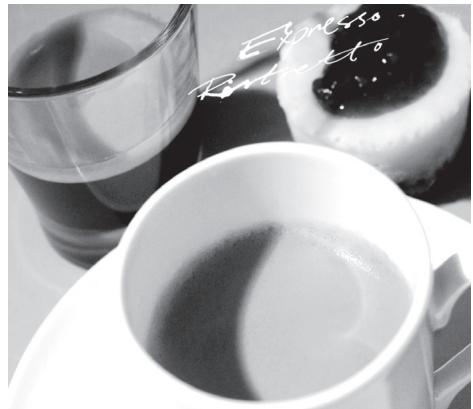
ESPRESSO
Intense and aromatic, an espresso or short black as it's also known uses about 14 oz (7g) of ground espresso coffee. It is served in a small cup or glass to a level of approximately 2 oz (30 ml).
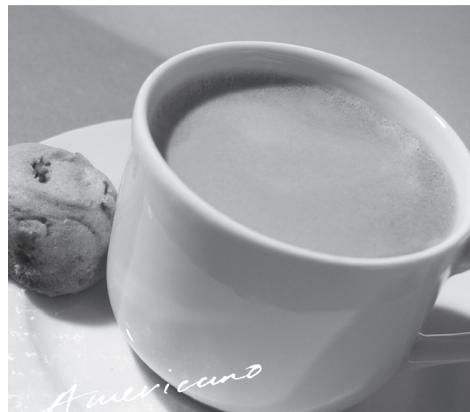
LONGBLACK
A long black is generally served as a standard espresso with hot water added to taste.
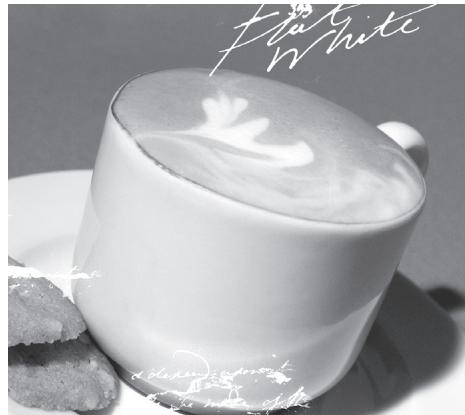
FLAT WHITE
A single dose of espresso in a cup topped with steamed milk, 13 coffee and 13 milk.
ESPRESSO VARIATIONS (continued)
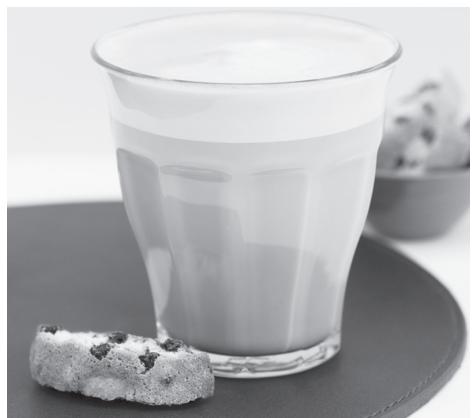
CLASSIC CAFE LATTÉ
Traditionally the morning coffee of Italy and France, taken with pain au chocolate or sweet biscotti. This blend of 13 espresso to 12 milk is made with a single shot of espresso. Top with steamed milk, poured down the inside rim of the glass to give a creamy consistency and perfect layer of froth.
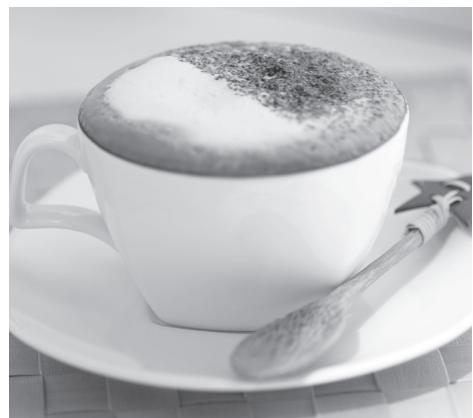
CAPPUCCINO
The real thing is served very light and luke warm with 13 espresso to 13 steamed milk and a generous final third of creamy froth. For added finesse, hold a piece of card over one half of the cappuccino before dusting with chocolate.
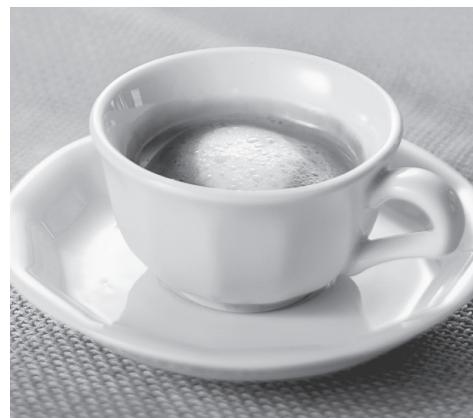
MACCHIATO
A shot of espresso served short in a 2 12 oz (70 ml) demitasse and stained with a dash of finely frothed milk.
ESPRESSO VARIATIONS (continued)
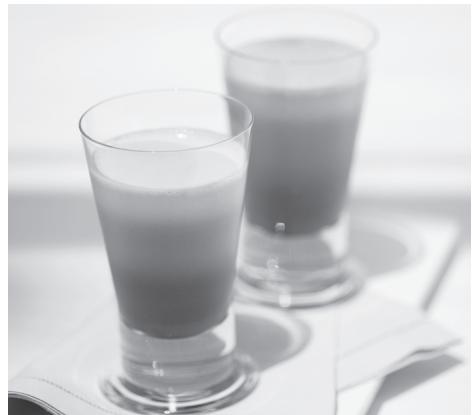
MOCHA FRAPPE (SERVES TWO)
Ready in minutes this impressive refresher will delight chocolate and coffee drinkers alike. Melt two heaped teaspoons of quality chocolate bits into a double shot of espresso. Add 12 cup cold milk and 9 ice cubes and process in blender on a low speed to a smooth, velvety consistency. Pour evenly into two glasses and serve immediately.
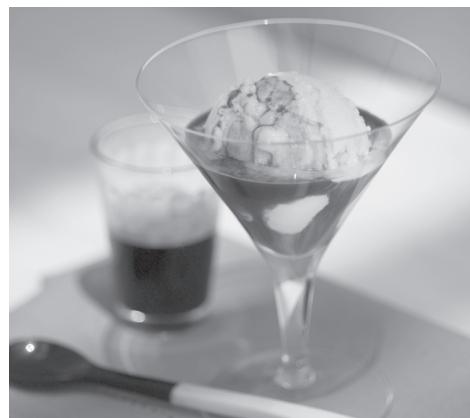
ESPRESSO AFFOGATO
Totally irresistible, this sweet temptation is simply a single scoop of premium vanilla bean ice cream, drenched in espresso and if desired, your favorite liqueur. To create a sense of occasion, serve ice cream in a martini glass with shots on the side.
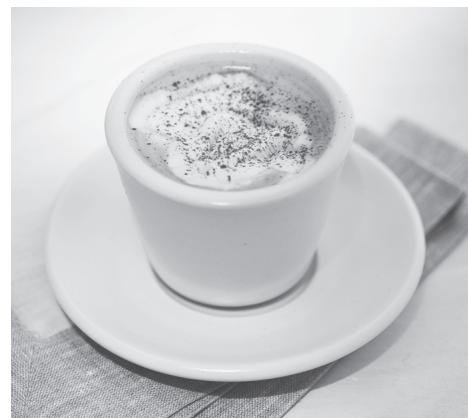
CON PANNA
Meaning 'with cream' this heart warmer is a chic variation on old-fashioned Vienna Coffee. In a 2-4 oz (90-120ml) cup, dress a double shot of espresso with a dollop of fresh cream, whipped until glossy. Dust with cinnamon and serve immediately.
Recipes
DESSERTS
BAKED CUSTARDS WITH FRESH RASPBERRY AND COFFEE FLOAT
Serves 6
25 fld oz (750ml) cream
3/4 cup finely granulated sugar
2 vanilla beans, cut lengthways
1 tablespoon gelatine
1 punnet fresh raspberries
1 tablespoon finely granulated sugar, extra
34 cup strong espresso coffee, cooled
1. Combine the cream, finely granulated sugar and vanilla beans in a saucepan. Stir over medium heat until just boiling. Remove the vanilla beans.
2. Add the gelatine and stir constantly with a wooden spoon until dissolved. Remove from heat. Allow the custard to cool.
3. Pour custard evenly into 6 × 50z (6 x 150ml) glasses. Refrigerate for minimum 3 hours or until set.
4. Place the raspberries into a medium sized bowl, sprinkle with sugar and crush lightly with a fork.
5. Fold the cooled espresso through the crushed raspberries. Cover and chill in the refrigerator.
6. To serve, top the custards, when set, with the raspberries and espresso mixture.
7. Serve immediately with freshly extracted espresso.
TIRAMISU
Makes 4
1 12 cups mascarapone
1 14 cups cream
212 tablespoons confectionery sugar
1/2 cup strong espresso coffee, cooled
Cocoa powder, for dusting
- Combine mascarpone, cream and confectionery sugar in a large bowl. Whisk lightly until soft peaks form. Set aside.
- Combine coffee and liqueur in bowl. Dip the sponge fingers into the coffee mixture a few at a time. Ensure all the coffee mixture is absorbed evenly by the sponge fingers.
- Layer half the sponge fingers evenly into the base of 4 dessert bowls or glasses. Spread the layered sponge fingers with half of the cream mixture. Repeat the layers with remaining sponge fingers and cream mixture.
- Dust evenly with cocoa powder and refrigerate until required.
- Serve with fresh fruits and freshly extracted espresso.
DESSERTS (continued)
ESPRESSO, CINNAMON AND WALNUT MUFFINS
Makes 12
212 cups/375g plain flour
2 teaspoons baking powder
1 teaspoon ground cinnamon
3 / 4 cup finely granulated sugar
1 cup sour cream
2x2ozeggs
1 teaspoon finely grated lemon rind
13 cup olive oil
34 cup strong espresso coffee, cooled
1 cup roughly chopped walnuts
1. Sift flour, baking powder and cinnamon into a large bowl and stir in sugar.
2. Place sour cream, eggs, lemon rind, oil and espresso into a medium bowl, stir until well combined.
3. Fold creamed mixture and walnuts into the sifted ingredients, do not over mix.
4. Spoon the mixture evenly into 12 lightly greased and base lined muffin pans until two-thirds full.
5. Place into a preheated oven 355^ (180^) for 12-15 minutes or until cooked when tested.
8. Serve warm, or cooled and spread with Rich Espresso Icing. Delicious with a Cappuccino or Café Latté.
RICH ESPRESSO ICING
2 cups confectionery sugar, sifted
1 tablespoon butter, softened
1 / 4 cup strong espresso, warm
1. Combine confectionery sugar, butter and half the espresso in a bowl, stir well and gradually add remaining coffee until a spreadable consistency is achieved.
ONE YEAR LIMITED WARRANTY
Breville®* warrants this Breville® appliance against defects that are due to faulty material or workmanship for a period of one (1) year from the date of original consumer purchase. This warranty does not cover damage from abuse, neglect, use for commercial purposes, or any other use not found in the printed "Instructions for use" booklet. There is no warranty for glass parts, glass containers, filter basket, blades and agitators. HWI Breville® expressly claim all responsibility for consequential damages for incidental losses caused by use of this appliance. Some states or provinces do not allow this exclusion or limitation for incidental or consequential losses, so the foregoing disclaimer may not apply to you.
This warranty gives you specific legal rights and you may also have other legal rights which vary from state to state or province to province.
If the appliance should become defective within the warranty period, do not return the appliance to the store. Please contact our Customer Service Center.
Toll free phone number:
1-866-BREVILLE (1-866-273-8455)
Internet email:
AskUs@BrevilleUSA.com
AskUs@Breville.ca (in Canada)
ANY WARRANTY OF MERCHANTABILITY OR FITNESS WITH RESPECT TO THIS PRODUCT IS ALSO LIMITED TO THE ONE YEAR LIMITED WARRANTY PERIOD.
Some states or provinces do not allow disclaimer of the implied warranty with respect to consumer goods, so the foregoing disclaimer may not apply to you.
*HWI Breville® products are distributed in Canada by Anglo Canadian Housewares, L.P. and in USA by Metro/Thebe Inc.
Breville®
CENTRES DE SERVICE À LA CLIENTÉLE BREVILLE

PRINTED ON YCYLED PAPER
1presso double (fort)
TRUCS SUR LA PREPARATION DE L'ESPRESSO
BONNE EXTRACTION

CAfé AU LAIT CLASSIQUE
Breville Customer Service Center
US Customers
Mail: 19400 S.Western Ave Torrance CA 90501-1119
Canada Customers
Mail: Anglo Canadian 2555, Avenue de l'Aviation Pointe-Claire (Montreal) Quebec H9P 2Z2
Phone: Customer Service 1 (866) BREVILLE
Email: Customer Service askus@brevilleusa.com
Phone: Customer Service: 1 (866) BREVILLE
Email: Customer Service askus@breville.ca

PRINTED ON RECYCLED PAPER
Breville is a registered trademark of Breville Pty Ltd. A.B.N. 98000092928 19400 S.Western Ave, Torrance, CA90501-1119
Tel: 1 866 BREVILLE
2555, Avenue de l'Aviation, Pointe-Claire (Montreal) Quebec, H9P2Z2 CANADA
Tel: 1 866 BREVILLE
Copyright Breville Pty Ltd 2008. Due to continued product improvement, the products illustrated/photographed in this brochure may vary slightly from the actual product.
Model BES830XL Issue NA-4/08
www.breville.com