
2200 - Navigation GPS NAVIGON - Free user manual and instructions
Find the device manual for free 2200 NAVIGON in PDF.


User questions about 2200 NAVIGON
0 question about this device. Answer the ones you know or ask your own.
Ask a new question about this device
Download the instructions for your Navigation GPS in PDF format for free! Find your manual 2200 - NAVIGON and take your electronic device back in hand. On this page are published all the documents necessary for the use of your device. 2200 by NAVIGON.
USER MANUAL 2200 NAVIGON
English (United Kingdom)

The crossed-out wheeled bin means that within the European Union the product must be taken to separate collection at the product end-of-life. This applies to your device but also to any enhancements marked with this symbol. Do not dispose of these products as unsorted municipal waste.
Imprint
NAVIGON AG
The information contained herein may be changed at any time without prior notification. Neither this manual nor any parts thereof may be reproduced for any purpose whatsoever without the express written consent of NAVIGON AG, nor may they be transmitted in any form either electronically or mechanically, including photocopying and recording. All technical specifications, drawings etc are subject to copyright law.
© 2008, NAVIGON AG
All rights reserved.
Table of contents
1 Introduction. 5
1.1 About this manual 5
1.1.1 Conventions 5
1.1.2 Symbols 5
1.2 Legal notice 5
1.2.1 Liability. 5
1.2.2 Trademarks 5
1.3 Questions about the product 6
2 Before you begin 6
2.1 Scope of Delivery 6
2.2 Description of the NAVIGON 12xx | 22xx
2.3 Important safety information 7
2.3.1 Navigation safety information 7
2.3.2 Safety information for the navigation device 8
2.3.3 Safety guidelines when installing the device in your car 9
2.4 Preparing the NAVIGON 12xx | 22xx for use
2.4.1 Installing the navigation system in the vehicle 9
2.4.2 TMC antenna 11
2.4.3 Memory card 12
2.4.4 Connecting the navigation device to a PC 12
2.5 Navigating with GPS 16
3 Switching on the NAVIGON 12xx | 22xx. 16
3.1 Options 17
4 Operating the NAVIGON 12xx | 22xx 18
4.1 Information 18
4.2 Software keyboard 19
4.2.1 Special keys 20
4.2.2 Entering data 21
4.3 Options 21
4.4 Menus 21
5 Navigation 21
5.1 Starting the navigation application 22
5.2 Specifying a destination 23
5.2.1 Specifying the country in which the destination is situated... 23
5.2.2 Entering a destination address 24
5.2.3 Points of interest 25
5.2.4 Information about the destination 28
5.2.5 Last Destinations 29
5.2.6 Favourites 29
5.2.7 Navigating home 29
5.2.8 Selecting destinations on the map 30
5.2.9 Starting navigation 30
5.3 Managing destinations 32
5.3.1 Saving destinations 32
5.3.2 Defining a destination as home address 32
5.4 Multi-leg routes 32
5.4.1 Entering the starting point 33
5.4.2 Entering route points 33
5.4.3 Editing route points 34
5.4.4 Managing routes 34
5.4.5 Calculating and displaying routes 35
5.4.6 Simulating routes 35
5.4.7 Starting navigation 36
5.5 Options 36
5.6 Working with the map 38
5.6.1 Selecting the navigation map 38
5.6.2 Map in Preview mode 38
5.6.3 Map in Navigation mode 40
5.6.4 Reality View 43
5.6.5 Map in Destination search mode 44
5.7 Useful functions 46
5.7.1 Direct Help 46
5.7.2 GPS Status, saving the current location 46
5.7.3 Block 47
5.7.4 Turn-by-Turn List 47
5.7.5 TMC (Traffic Information (only NAVIGON 22xx) 48
6 Configuring the NAVIGON 12xx | 22xx..51
7 Appendix 53
7.1 Technical data 53
7.2 Declaration of conformity 54
8 Troubleshooting. 54
9 Index 56
1 Introduction
1.1 About this manual
1.1.1 Conventions
For better legibility and clarification, the following styles are used in this manual:
Bold and italics: Product names.
SMALLCAPITALS: Window and dialogue box titles.
Bold: Highlighting of important parts in the text.
Underlined: Names of buttons, input boxes and other elements on the user interface.
Underlined and italics: Names of control elements on the navigation device.
1.1.2 Symbols
The following symbols refer to specific passages of text:

Instructions and tips for operating the software

More detailed information and explanations

Warnings
1.2 Legal notice
1.2.1 Liability
The software and manual are subject to change without notice.
NAVIGON AG is not liable for the accuracy of the information contained in this manual or for damages resulting from the use of this manual.
Suggestions for improvements and information regarding errors are always welcome so that we can supply you with even better products in the future.
1.2.2 Trademarks
All brand and trade marks mentioned in this document and registered by third parties are subject without reservation to copyright law and the
proprietary rights of their respective owners. All trade marks, tradenames and company names used in this document are or may be trademarks or registered trademarks of their respective owners. All rights reserved except those explicitly granted.
If the registered trademarks used in this manual are not explicitly identified as such, this does not imply that the name is not subject to the rights of a third party.
Microsoft, Outlook, Excel and Windows are registered trade marks of the Microsoft Corporation.
NAVIGON is a registered trade mark of NAVIGON AG.
1.3 Questions about the product
You have a question concerning your product? Then visit our website www.navigon.com and click on "Support". There you will find an area with frequently asked questions (FAQ Center) along with details of how to contact us by phone or e-mail.
2 Before you begin
2.1 Scope of Delivery
Please check that the contents are complete. If anything is missing, get in touch immediately with the dealer who sold you the product.
The purchased product includes the following:
NAVIGON 12xx | 22xx navigation device
Car cradle (in parts, refer to "Assembling the cradle" on page 10)
Car charger cable (10-24V: adapter for the vehicle's cigarette lighter). (NAVIGON 22xx: with integrated TMC antenna)
USB cable
Leaflet with illustrated installation instructions
2.2 Description of the NAVIGON 12xx | 22xx
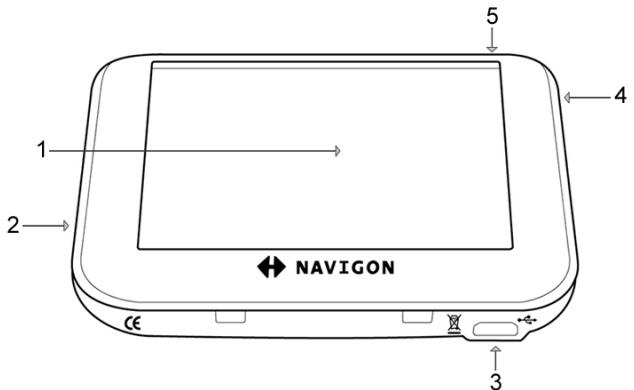
1 Touch-screen (refer also to "Safety information for the navigation device" on page 8)
2 microSD Slot for MicroSD memory card
3 Mini USB socket for USB cable / car charger cable
4 RESET Reset (refer also to "Troubleshooting" on page 54)
5 On/Off
2.3 Important safety information
In your own interest, please read the following safety information and warnings carefully before starting up your navigation system.
2.3.1 Navigation safety information
Use the navigation system at your own risk.

Caution! To prevent accidents, do not operate the navigation system while driving.

Caution! Do not look at the display unless it is absolutely safe to do so!

Caution! Traffic regulations have priority over any instructions from the navigation system.

Caution! Follow the instructions of the navigation system only when the circumstances and the road traffic regulations allow you to do so! The navigation system will still guide you to your destination even if you deviate from the calculated route.

Caution! Check that the cradle is secured and adjusted properly before each journey.

Note: If you have not understood the spoken instructions or are unsure about what to do next, you can refer briefly to the map or schematic view of your navigation system.
2.3.2 Safety information for the navigation device

Caution! Protect the device from moisture. The device is neither waterproof nor protected against splash water.

Caution! Do not open the case of the navigation device under any circumstances.

Caution! Do not expose the navigation device to extreme heat or cold. This may damage the device or impair its function. (Refer to "Technical data" on page 53.)

Caution! Do not operate the touchscreen with sharp-edged or pointed objects. Use only your finger to operate the touchscreen.

Note: Do not kink the cable. Make sure that the cable cannot be damaged by sharp-edged objects.

Note: Clean the navigation device only with a damp cloth.

Note: Do not unplug by pulling the cable. Doing so could damage the cable!

Note: Create a backup of the data in the internal memory of your navigation device. This is very easy to do with the NAVIGON Fresh software which you can download free of charge from our www.navigon.com.
| 2.3.3 | Safety guidelines when installing the device in your car |
| ! | Caution! Fasten the cradle so that the navigation device is easy to see and operate by the driver. Make sure that the driver's view of the traffic is not impeded. |
| ! | Caution! Do not attach the cradle within the working zone of any airbags. |
| ! | Caution! Do not fasten the cradle too close to the steering wheel or other controls. The driver must not be obstructed in operating any car functions. |
| ! | Caution! When installing the cradle, make sure that it will not pose a risk in the event of an accident. |
| ! | Caution! Do not run cables directly next to safety-relevant devices and power supplies. |
| ! | Caution! Check that the cradle is secured and adjusted properly before each journey. The suction cup may become loose after a while. |
| ! | Caution! After installation, check all safety-relevant equipment in the car. |
| ! | Caution! Connect the car charger cable only to cigarette lighters with an operating voltage of 10-24V. |
| ! | Caution! Disconnect the car charger cable from the cigarette lighter whenever you park the car. The integrated mains adapter always consumes a small amount of energy and could drain the car battery. |
| 2.4 | Preparing the NAVIGON 12xx | 22xx for use |
| 2.4.1 | Installing the navigation system in the vehicle |
| ! | Caution! Be sure to refer to all the safety information in chapter "Important safety information" on page 7. |
Assembling the cradle
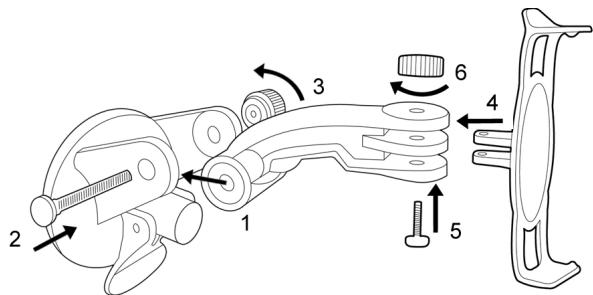
- Assemble the cradle as shown in the illustration. No tools are needed for this.
Securing the cradle
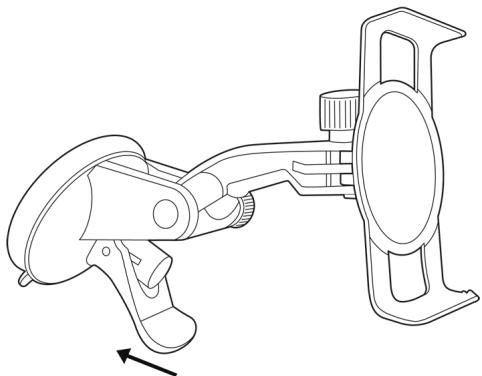
- Clean that part of the windscreen to which you want to secure the cradle. The windscreen must be dry and free of dirt and grease.
- Open the lever on the suction cup as far as possible.
- Place the cradle suction cup against the windscreen.
- Press the lever towards the windscreen.
Inserting the navigation device into the cradle
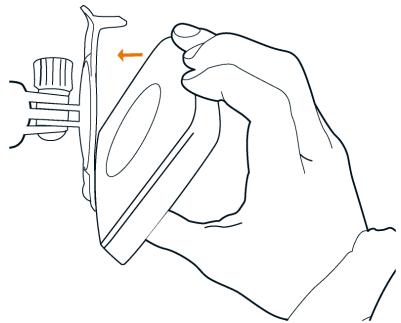
- Insert the navigation device into the lower lugs of the bracket. (See illustration)
- Then press the device towards the cradle until you hear the upper clip latch in place.
Supplying power to the navigation device
Included in delivery of the NAVIGON 12xx | 22xx is a car charger cable with which power can be supplied to the navigation device via the vehicle's cigarette lighter.
- Connect the car charger cable to the vehicle's cigarette lighter and to the mini USB socket of the navigation device.

Note: Plug the USB connector into the navigation device swiftly as far it will go! (Refer to "Troubleshooting" on page 54.)

Caution! Connect the car charger cable only to cigarette lighters with an operating voltage of 10-24V.

Note: It takes approx. 2-3 hours to charge the device when the battery is flat.
A fully charged battery enables 1 hours of use.
Removing the navigation device from the cradle
- Press the upper clip of the cradle towards the windscreen.
- Tilt the navigation device slightly towards yourself.
- Remove the device from of the cradle.
2.4.2 TMC antenna
The NAVIGON 22xx has an integrated TMC receiver. The TMC antenna is integrated in the car charger cable. Once the car charger
cable is connected, the device can receive current traffic messages. If required, it can change your route dynamically, e.g. in order to avoid a traffic jam.
2.4.3 Memory card
A memory card is not required to operate the NAVIGON 12xx | 22xx because all the data are stored in the internal memory of the device.
When you connect the NAVIGON 12xx | 22xx to your computer using a USB cable, the internal memory is detected as the 'NAVIGON' drive. The slot for the memory card is detected as a removable disc. (Refer also to "Connecting the navigation device to a PC" on page 12)
Data backups, software updates and navigation map updates can be carried out quickly and conveniently with NAVIGON Fresh, which you can download free of charge from the website www~-navigon.com.
If you purchase additional navigation maps but no longer have enough space for them in the internal memory of your navigation device, it is also possible for you to save these maps on a memory card. The NAVIGON 12xx | 22xx can use navigation cards from both memories.
The following memory media can be used in the NAVIGON 12xx | 22xx:
- MicroSD cards (available from the NAVIGON Online-Shop at www~-navigon.com or from authorised dealers)
2.4.4 Connecting the navigation device to a PC
When you connect the NAVIGON 12xx | 22xx to your computer for the first time, the operating system will try to install a driver for the device. You must stop this happening. Make all settings as shown in the following illustrations. The NAVIGON 12xx | 22xx will then be detected as drive 'NAVIGON'.
Windows XP
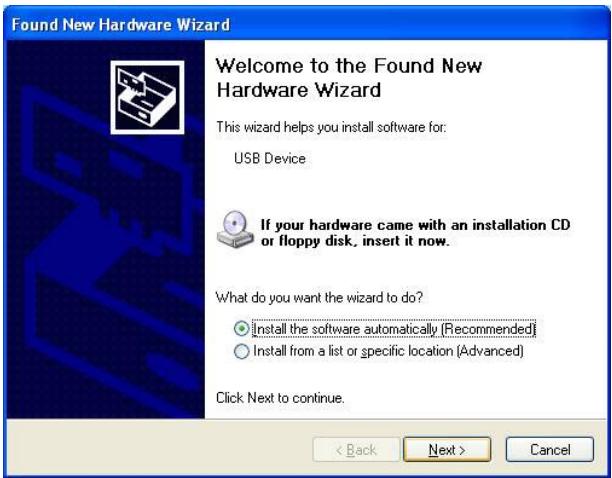
1. Tap on Next >.
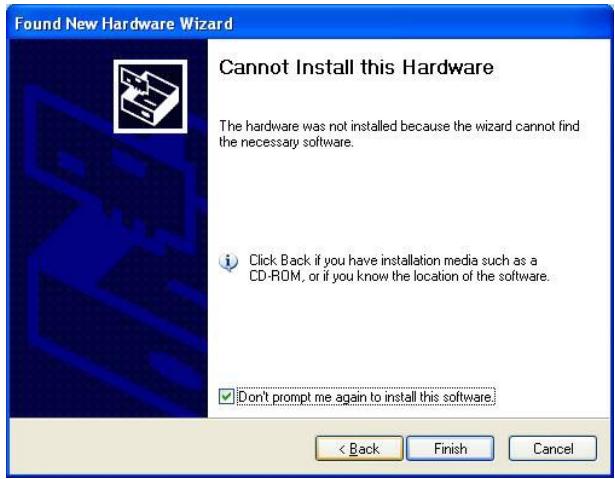
2. Tap on Finish.
Windows Vista
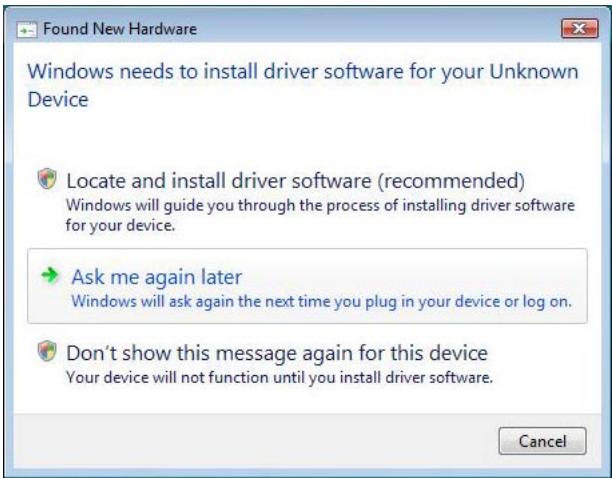
Tap on Cancel.
Windows 2000
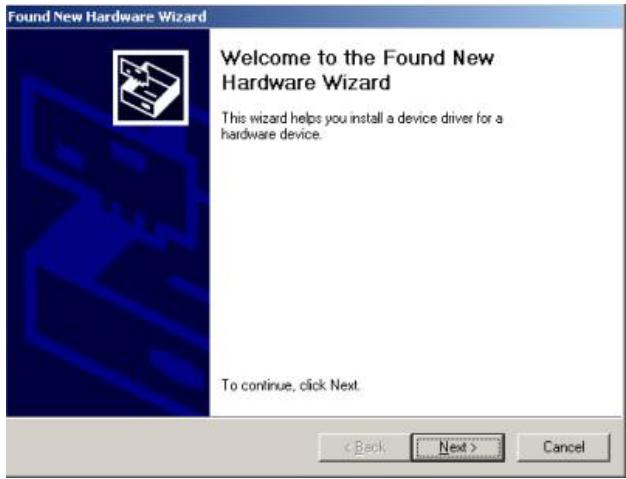
- Tap on Next >.
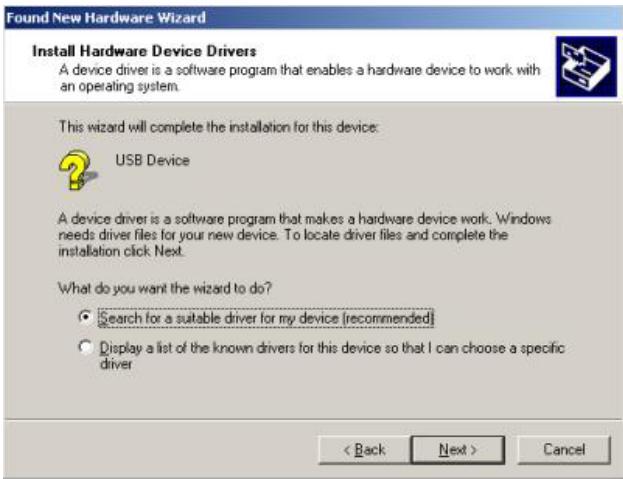
2. Tap on Next ≥
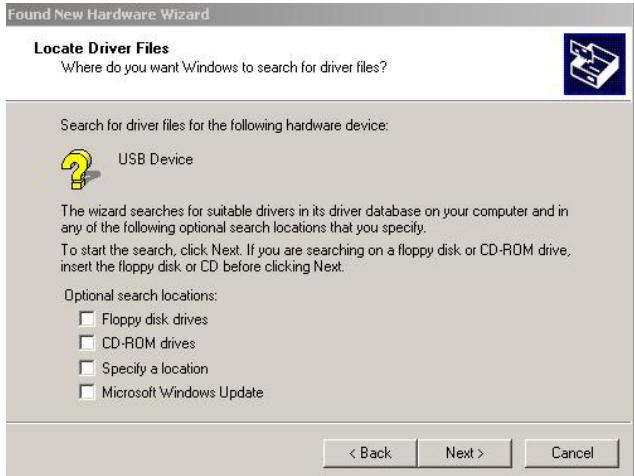
3. Tap on Next ≥
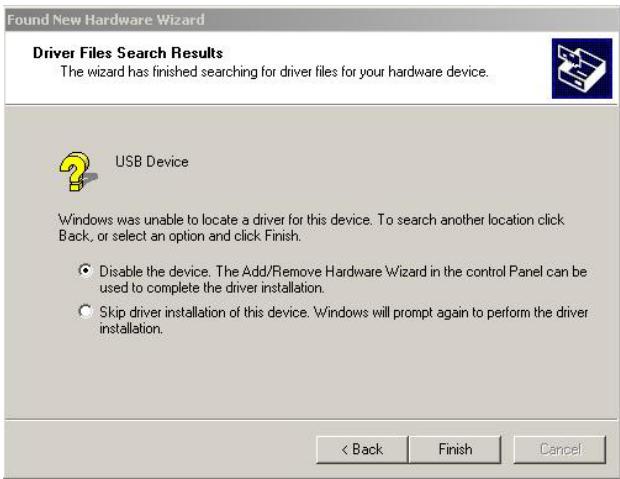
4. Tap on Finish.
2.5 Navigating with GPS
GPS is based on a total of at least 24 satellites orbiting the Earth and continuously transmitting signals of their position and time. The GPS receiver receives this data and calculates its own geographical position on the basis of the information transmitted by the various satellites.
Data from at least three satellites is required for positioning with an acceptable degree of accuracy. With data from four or more satellites it is possible in addition to determine the position's altitude above sea level. Positioning is accurate to within three metres.
Once the navigation device has determined your position, this position can be used as a starting point for calculating a route.
The map data on your navigation device includes the geographical coordinates of all digitally recorded points of interest, streets and places. This enables the device to calculate a route between a starting point and a destination.
Calculation of the current position and its representation on the map takes place once every second. In other words, your current position is always shown on the map.
3 Switching on the NAVIGON 12xx | 22xx
Press the ( / ) key for approx. 2 seconds.
The NAVIGATION window opens.

Caution! Do not press the (0 / 0) key for longer than 2 seconds! If you press the key for longer than 10 seconds, a hardware reset will be carried out.
After a hardware reset you must re-calibrate the touchscreen. The GPS receiver will also be re-initialised, which can take up to 20 minutes. (Refer also to "Initialising the GPS receiver" on page 22)

Note: When you switch on the NAVIGON 12xx | 22xx for the first time, you will be asked to make the following settings:
your preferred language for using for the software
the unit of length for distances
the time format
Switching the navigation device to standby mode
When you switch the navigation device to standby mode, the next time it is switched on it will open with the window which was active when switched off. In standby mode the device still consumes a small amount of energy however.
Press briefly (max. 2 seconds) on the (/) key. -or-
Tap in the NAVIGATION window of the navigation software on the button.
Switching off the navigation device
When you switch off the navigation device, the next time it is switched on it will carry out a restart of the navigation software. Your settings and your saved destinations and routes will be retained.
Press for at least 6 seconds on the ^I (On/Off) key.
3.1 Options
Some windows offer options that lead to more functions.

A description of all available options can be found in the chapter "Options" on page 36.
4 Operating the NAVIGON 12xx | 22xx
4.1 Information
Various information symbols are located at the top of many windows.
GPS
The GPS symbol can indicate the following GPS reception states:
No GPS (No symbol): The built-in GPS receiver is not operational. Contact customer service if the problem persists.

No Signal: Data is being received from less than three satellites. Position cannot be calculated.

GPS Ready: Data is being received from at least three satellites. Position can be calculated.

For details of the GPS status refer to chapter "GPS Status, saving the current location" on page 46.
Compass
The Compass symbol indicates in which direction you are currently heading. It can indicate the following points of the compass: N, NE, E, SE, S, SW, W, NW.
TMC (Traffic Information)
The NAVIGON 22xx has an integrated TMC receiver which provides the navigation system with traffic information updates. If necessary it can change your route dynamically, for example in order to avoid a traffic jam.

Note: This function is only available if TMC traffic messages are being transmitted in the country in which you are travelling. This is not the case in all countries.
The TMC symbol can display the following TMC reception status:

Tuning: The TMC receiver is operational but cannot find a station that is transmitting TMC signals. There are no active traffic messages.

Tuning: The TMC receiver is operational but cannot find a station that is transmitting TMC signals. Traffic messages are active however. This can be the case, for example, when travelling through a tunnel.

TMC on Standby: Traffic messages can be received.

Note: The TMC antenna is integrated in the car charger cable. The Tuning symbol may still appear therefore when the car charger cable is not connected to the NAVIGON 22xx.

For details of the TMC function refer to chapter "TMC (Traffic Information)" on page 48.
Energy
The Energy symbol can indicate the following states of the integrated battery:

The device is being supplied by an external power source. The battery is fully charged.

The device is being supplied by an external power source. The battery is being charged.

The device is being supplied by its internal battery. The battery charge is sufficient.

The device is being supplied by its internal battery. The battery charge is low.
Muting
The Muting icon is visible only in the navigation application. It can indicate the following states:
No symbol: The navigation application is not muted.

Muting: The navigation application is muted. If the device is navigating at the moment, you will not hear any driving instructions.
4.2 Software keyboard
A software keyboard appears on the screen when text entries are necessary.
All entries can be made on the software keyboard using your fingertips. Only capital letters can be entered.
When entering town or street names you need not enter any special characters or umlauts. The navigation system fills in these characters for you automatically. For example, if you are looking for the town of "Bärnau", then simply type in the word "BARNAU". Special characters may be helpful however when naming saved destinations and routes.
4.2.1 Special keys

inserts a space.

deletes the character in front of the cursor.

opens the keyboard with numerals.
Latin, Cyrillic and Greek alphabet
ABC
opens the keyboard with the Latin alphabet.
A5B
opens the keyboard with the Cyrillic alphabet.
ABF
opens the keyboard with the Greek alphabet..
When you want to enter addresses, names or POIs, the keyboard with the alphabet for the country in question will open automatically.
When you want to save a destination to Favourites or when you enter a POI category or a country, the keyboard with the alphabet of the user interface will open automatically.
You can also switch from the Cyrillic or Greek keyboard to the Latin keyboard. Many addresses can then also be entered as transliterations or in the language of the user interface.
Example: The language of the user interface is English. You want to navigate to Moscow. You have the following options:
"MockBa" (Cyrillic)
"Moskva" (transliterated)
"Moscow"(English).

Note: Street names and place names can be entered only in the language of the user interface if that is how they exist in the map's database.
Umlauts, accents and other letters
Another keyboard with special characters is available for each alphabet.

opens the keyboard with Latin special characters.

opens the keyboard with Cyrillic special characters.

opens the keyboard with Greek special characters.
As soon as you have entered a special character the letter keyboard reappears.
4.2.2 Entering data
Often you can select an entry from a list. This is the case, for example, when you enter a location.
As soon as you enter the first letter, the largest city in the given country that begins with this letter appears.
Enter more letters and after each entry the first city which begins with these letters will appear.
When the correct location appears, tap on OK) in order to complete the entry.
You can open at any time a list containing all the locations which begin with the letters or include the text already entered.
Tap on (Open List) to call up this list.
You can use the (Up) button and the (Down) button to move through the list.
- Tap on an entry in the list to select it and transfer it to the input box. The list closes once an entry has been selected.
- Tap on (Close List) in order to close the list without selecting an entry.

Note: The list opens automatically as soon as it contains only 5 or less entries.
4.3 Options
Some windows offer options that lead to more functions.

A description of all available options can be found in the chapter "Options" on page 36.
4.4 Menus
Some buttons have menus which open when activated.
- Tap on a menu point to execute its function.
If you would like to quit the options list without selecting a function, tap on the button you used to open the menu.
5 Navigation
Use the navigation system at your own risk.

Caution! Be sure to refer to all the safety information in chapter "Important safety information" on page 7.
Impaired GPS reception
As soon as GPS reception is restored, the navigation system calculates any change of position which has occurred in the meantime. You can then simply continue navigating.
Arriving at your destination
When you have reached your selected destination, a message to this effect will be displayed.
Only your current position (orange arrow) will now be shown on the map.
5.1 Starting the navigation application
You have switched on the navigation device.
The following message appears:
"The navigation software on this device is designed to provide route suggestions and does not replace the need for driver attentiveness or the requirement to adhere to road traffic regulations, good driving practice and legally posted directions. For safety, posted road signs and directions should always take precedence over the directions of this unit. Do not operate this unit while driving. After you have read and fully understood the message, tap on OK.
If you do not accept the content of the message, tap on Cancel in order to switch the navigation device off again.
The NAVIGATION window is opened. From here you can access all the functions of the navigation application.
Initialising the GPS receiver
As soon as the navigation device has been switched on, initialisation of the GPS receiver will begin.
The integrated GPS receiver is not initialised for the first time until the navigation application is started for the first time. It can take up to 20 minutes to initialise the GPS receiver for the first time.

Note: If the GPS symbol indicates GPS Ready after far less than 20 minutes, it is advisable to leave the navigation device switched on for at least another 15 minutes in order to ensure reliable operation of the receiver.
Each time you switch on the navigation device after this, GPS reception will start within a short time.
If the navigation device has not been switched on for more than a week, it can take up to 10 minutes to re-initialise the receiver.
In the top right hand corner of the display, you will see the GPS symbol. As soon as data from at least three satellites is received, the icon will
change to (GPS Ready).

Note: Initialisation takes the least time if you do not start driving until the initialisation has finished.

For more details about the GPS symbol refer to chapter "GPS" on page 18.
Returning to the Navigation window
The NAVIGATION window opens when the navigation application is started.
If another window of the navigation application is open, tap on

(Back). This will return you to the window you came from.
opened.
(Back) repeatedly until the NAVIGATION window is
5.2 Specifying a destination
Under New Destination you can enter destinations to which you have not yet navigated or which you have not saved.
You can enter an address here, select a POI, or select a destination from the quick search function.

Note: The first time that you want to enter a new destination you will be asked to select the country in which your destination is situated.
Under My Destinations the NAVIGON 12xx | 22xx provides the following lists of destinations and addresses for you to select from:
LAST DESTINATIONS: Destinations to which you have navigated on a previous occasion.
FAVOURITES: All destinations that you have entered in the NAVIGON 12xx | 22xx and then saved.
5.2.1 Specifying the country in which the destination is situated
At top left in the ADDRESS, POI IN A CITY and POI NATIONWIDE windows you will find the Country button. It bears the flag of the country in which you can currently select destinations for the navigation application.
If your destination is in a different country, then proceed as follows:
-
Tap on the Country button.
-
Enter the first letter of the country in which your destination is situated.
The COVERED COUNTRIES list opens. It shows all the countries which begin with this letter and for which a map is available.
- Tap on the country in which your destination lies.
The COVERED COUNTRIES list closes.
The button bears the flag of the destination country.

Note: The selection list contains only those countries whose maps are available to the navigation device.
5.2.2 Entering a destination address
- In the NAVIGATION window, tap on New Destination > Enter an Address.
The ADDRESS window opens.
- Enter the name or the postal code of the destination town.
- Enter the name of the destination street.
- Enter the house number. If you do not know the house number, then leave this box empty.
If you don't know the house number but know the name of a nearby side street, then tap on the Cross Street box and enter the name of this street. The navigation system will calculate a route to the intersection of the streets you have entered.

Note: It is not necessary to enter all the address details.
If you specify the town only, the navigation system will calculate a route to the town centre.
If you specify only the town and street without specifying a house number or cross street, the navigation system will calculate the best route to this street.
- Tap on Start Navigation.
Sometimes the destination cannot be found exactly because, for example, the entered combination of place and street name exists several times.
In this case a window will open with a list of all the addresses matching your entry plus additional information.
Tap on the address to which you want to navigate.
If the entered house number is not included on the map, the window will show an address with the house number closest to the one entered.
- Tap on OK in order to navigate to this address.
The map opens in Preview mode. The destination is indicated on the map.

For detailed information on how to start navigation, please refer to chapter "Starting navigation" on page 30. Please read on there.
5.2.3 Points of interest
Points of Interest, also called POI (Points Of Interest) for short, are useful addresses that are catalogued according to particular criteria.
POIs include ports, airports, restaurants, hotels, petrol stations, public buildings, doctor's surgeries, hospitals, shopping centres, etc.
Points of interest can be displayed on the map by means of a symbol. In the NAVIGATION window tap on Options > Settings > Map Display > Categories Shown in order to select the categories you want to appear on the map.
POI nearby
POIs nearby are POIs located within a certain radius of your current location. This means you can always find the nearest petrol station for example, no matter where you are.

Note: GPS reception must be good enough for determining your
position. Check the (GPS Ready) symbol to see whether GPS reception is good enough.
For more details refer to chapter "Initialising the GPS receiver" on page 22.

Note: The Direct Access section offers 3 categories of POI from the current vicinity which can be searched for quickly and without additional entry.
For more details refer to chapter "Direct access to POI" on page 28.
- Tap in the NAVIGATION window on New Destination > Search for POI > Nearby.
The POI NEARBY window opens.
- Select a category from which you would like to find a POI. Categories in which no destinations are available nearby cannot be selected.
If sub-categories exist for the category you have selected, the Sub Category list opens.
- Select the sub-category from which you would like to select a POI.
The Destination list opens. It contains the nearest POI in the specified category, sorted by distance.
- Tap on the name of the destination.
Instead of the keyboard you are shown information about this POI from the database. (Refer to "Information about the destination" on page 28)
- Tap on Start Navigation.
The map opens in Preview mode. The destination is indicated on the map.

For detailed information on how to start navigation, please refer to chapter "Starting navigation" on page 30. Please read on there.
POI of nationwide significance
POIs of nationwide significance are airports, sights, national monuments, large ports etc. This way you can find well-known places of interest even if you don't know the name of their location.
- In the NAVIGATION window, tap on New Destination > Search for POI > Nationwide.
The POI NATIONWIDE window opens. - Select a category from which you would like to find a POI.
The Destination list opens. It contains the POI from the selected category, sorted alphabetically. - If the list is very long:
Tap on (Close List)
The keyboard appears.
Enter a number of letters from the destination.
Tap on (Open List)
The list now contains only those destinations which begin with or contain the letters entered.
- Tap on the name of the destination.
Instead of the keyboard you are shown information about this POI from the database. (Refer to "Information about the destination" on page 28)
- Tap on Start Navigation.
The map opens in Preview mode. The destination is indicated on the map.

For detailed information on how to start navigation, please refer to chapter "Starting navigation" on page 30. Please read on there.
POI in a particular location
POIs in a particular location can be useful when navigating in an unfamiliar town.
- In the NAVIGATION window, tap on New Destination > Search for POI > in a City.
The POIN A CITY window opens.
-
Enter the name or the postal code of the destination town.
-
Select a category from which you would like to find a POI. Categories in which no destinations are available in the selected town cannot be entered.
If sub-categories exist for the category you have selected, the Sub Category list opens.
- Select the sub-category from which you would like to select a POI.
The Destination list opens. It contains POI from the specified category, sorted alphabetically.
- If the list is very long:
Tap on (Close List)
The keyboard appears.
Enter a number of letters from the destination.
Tap on (Open List)
The list now contains only those destinations which begin with or contain the letters entered.
- Tap on the name of the destination.
Instead of the keyboard you are shown information about this POI from the database. (Refer to "Information about the destination" on page 28)
- Tap on Start Navigation.
Sometimes the destination cannot be found exactly because, for example, several restaurants with the same name exist in the town in question.
In this case a window opens with all the destinations matching your entry plus additional information.
Tap on the destination to which you would like to navigate.
The map opens in Preview mode. The destination is indicated on the map.

For detailed information on how to start navigation, please refer to chapter "Starting navigation" on page 30. Please read on there.
Direct access to POI
The direct access area contains categories of POI. Destinations in your vicinity that correspond to one of these categories can be viewed here quickly and without further entry.
- Tap in the NAVIGATION window on Options > Settings > General in order to select the categories for direct access.

Note: The categories for the Direct Access function are the same as those available for the POI on Your Route function. (Refer to "Functions of the map in Navigation mode" on page 42)

Note: GPS reception must be good enough for determining your position. Check the (GPS Ready) symbol to see whether GPS reception is good enough.
For more details refer to chapter "Initialising the GPS receiver" on page 22.
- In the New Destination window, tap on NAVIGATION.
The NEW DESTINATION menu opens.
In the Direct Access area you are shown the symbols of those POI categories that are available by direct access.
- Tap on the category from which you would like to select a POI.
The Destination list opens. It contains the nearest POI in the specified category, sorted by distance.
- Tap on the name of the destination.
The map opens in Preview mode. The destination is indicated on the map.

For detailed information on how to start navigation, please refer to chapter "Starting navigation" on page 30. Please read on there.
5.2.4 Information about the destination
For many destinations that you specify, there will be further information available, stored in the navigation system's database.
There is, for example, a telephone number available for many restaurants. You can then call the restaurant to reserve a table, for example.
One of the destination entry windows described above is open.
Tap on Options > Info.
The DESTINATION INFO window opens. It contains all the information about the specified destination that is stored in the navigation system's database.
- Tap on Cancel in order to close the DESTINATION INFO window again.
Tap on (Map) in order to see the destination on the map.
5.2.5 Last Destinations
NAVIGON 12xx | 22xx saves the last 12 destinations to which you have navigated in the LAST DESTINATIONS list.
- In the NAVIGATION window, tap on My Destinations > Last Destinations.
- Tap on the destination to which you would like to navigate.
- Tap on Start Navigation.
The map opens in Preview mode. The destination is indicated on the map.

For detailed information on how to start navigation, please refer to chapter "Starting navigation" on page 30. Please read on there.
5.2.6 Favourites
Destinations to which you want to travel often can be saved in the FAVOURITES list.
In the FAVOURITES list you can save up to 500 destinations.

Information on how to save a destination can be found in chapter "Saving destinations" on page 32.
- In the NAVIGATION window, tap on My Destinations > Favourites.
- Tap on the destination to which you would like to navigate.
- Tap on Start Navigation.
The map opens in Preview mode. The destination is indicated on the map.

For detailed information on how to start navigation, please refer to chapter "Starting navigation" on page 30. Please read on there.

Note: Favourites are indicated on the map by a small flag with their name. At Options > Settings > Map Display > Categories Shown you can switch on and off the display function for favourites.
5.2.7 Navigating home
In NAVIGON 12xx | 22xx you can save an address as your home address. You can navigate to your home address at any time by pressing a single button.

Further information about entering your home address can be found in chapter "Defining a destination as home address" on page 32.
In the Take Me Home window, tap on NAVIGATION.
If you have not yet entered your home address, a dialog box will notify you of this.
Navigation starts. The route profile used for the previous navigation will be applied.
5.2.8 Selecting destinations on the map
You may select a destination directly on the map. This is a quick way to select towns, streets and POI.
- In the Show Map window, tap on NAVIGATION.
- Tap on (Destination search)
The map opens in Destination search mode.
- Tap on the point to which you want to navigate.

Note: For details of how to change the map view so that your destination is easily seen refer to the chapter "Map in Destination search mode" on page 44.
The destination that you have selected appears under the cross hairs.
The geographical coordinates of the destination and the corresponding address are shown in the bottom third of the screen.
- Tap on (OK)
The DESTINATION ON MAP window opens. The detailed address data of the selected destination is displayed in the upper left-hand corner.
- Tap Take Me There.
The map opens in Preview mode. The destination is indicated on the map.

For detailed information on how to start navigation, please refer to chapter "Starting navigation" on page 30. Please read on there.
5.2.9 Starting navigation
The map is open in Preview mode.
The navigation destination is depicted by a small flag. The route and the estimated time of arrival are indicated.
- Tap on the arrival time if you want to see the estimated driving time instead.
Route Profile
The route is calculated on the basis of a route profile.
If you want to view or change the route profile, tap Route Profile.

Note: If you change the route profile, the changes will also apply to future navigations.
Information about individual route profile settings can be obtained by tapping the related i (Help) button.
Turn-by-Turn List
If you want to see detailed directions for the route, tap on Options > Turn-by-Turn List.

For details of the functions in the TURNS-TURN LIST window refer to chapter "Turn-by-Turn List" on page 47.
Start Navigation
- Tap on Start Navigation or simply start driving.
No GPS reception
If GPS signal reception is not good enough, the following message will appear: "Waiting for GPS-Signal..."
You have the following options:
- Wait. As soon as GPS reception is good enough for determining your position, the route will be recalculated and navigation will begin.
- Tap Cancel. The window in which you entered your destination will open again. Your destination is saved in the LAST DESTINATIONS list.
- Tap Demo. The route will be calculated using the centre of the destination location as starting point. Navigation will then be simulated on this route.
Tap on (Back) in order to terminate the demonstration.

Note: If you selected the destination on the map, then the Demo button is not available.
5.3 Managing destinations
Every destination you enter and destinations from the LAST DESTINATIONS list can be saved in the FAVOURITES list. This makes sense if you frequently navigate to a particular destination.

Note: Favourites are indicated on the map by a small flag with their name. At Options > Settings > Map Display > Categories Shown you can switch on and off the display function for favourites.
5.3.1 Saving destinations
- Enter a destination. (Refer to "Entering a destination address" on page 24 or "Points of interest" on page 25). Do not tap on the Start Navigation button!
- Tap on Options > Save Destination.
-OR-
- Select a destination from the LAST DESTINATIONS list (Refer to "Last Destinations" on page 29.). Do not tap on the Start Navigation button!
- Tap on Options > Save as Favourite.
- Enter a name for the destination.
- Tap on Save.
5.3.2 Defining a destination as home address
One destination from the FAVOURITES list can be defined as your home address.
You can then always start navigation to this destination very quickly by tapping in the NAVIGATION window on Take Me Home.
- Select the destination which you want to define as your home address from the FAVOURITES list. (Refer to "Favours" on page 29.)
- Tap on Options > Home Address.
The selected destination has now been saved as your home address. Your home address now appears in the FAVOURITES list marked by a house symbol.
5.4 Multi-leg routes
It is possible to plan routes without GPS reception, for example in the comfort of your home. Planned routes can be saved for later use. This allows you to plan as many routes as you like, for example for your holidays.
- In the Options window, tap on NAVIGATION.
The options list opens.
- Tap on the Route Planning option.
The ROUTE PLANNING window opens.
5.4.1 Entering the starting point
The starting point of a route is the point at which you want to begin your trip. This is not necessarily the current location. If you are planning a route for your holidays at home, you could, for example, enter your hotel as the starting point.
The starting point is only important if you want to see a planned route on the map but currently have no GPS reception, or if you are not currently at the planned starting point. This is why your selected starting point has the flow number "0".
As soon as you start navigation, your current location will be used as the starting point for the route calculation.
The first leg of the route is therefore the journey to the route point with flow number "1".
- Tap on the Specify Starting Point box.
The STARTING POINT menu opens.
If you want to enter your current location as the starting point:
- Tap on the Current Position menu item.
If you want to enter a different starting point:
- Tap on the corresponding button.
- Enter the starting point. (Refer to the corresponding section of the chapter "Specifying a destination" on page 23 ff.)
- Tap on Set Starting Point.
The selected starting point will now be displayed next to the 0 button (Starting Point).
Changing the starting point
- Tap on the starting point (button 0).
The STARTING POINT menu opens. You can now enter a different starting point. Proceed as described above.
5.4.2 Entering route points
The route points of a route are the destinations that you want to navigate to.
The flow number for each route point is indicated on a button in front of it.
- Tap on the Add Route Point box.
The ROUTE POINT menu opens.
- Tap on the button for how you want to enter the destination.
- Enter the route point. (Refer to the corresponding section of chapter "Specifying a destination" on page 23 ff.)
- Tap on Add.
The selected route point is now shown next to its flow number.
Repeat these steps for each destination that you want to add to your route.
5.4.3 Editing route points
Route points can be deleted from a route. The order of the route points can be changed as you wish.

Note: The starting point (flow number "0") can be neither moved nor deleted. However you can make another route point into the starting point.
- Tap on the route point that you want to edit.
The context menu contains the following buttons:
Route Point Up: Moves the selected route point further to the front.
(Example: route point 2 becomes route point 1)
Route Point Down: Moves the selected route point further to the
back. (Example: route point 2 becomes route point 3).
Delete: deletes the selected route point. A dialog window prompts
you to confirm deletion.
5.4.4 Managing routes
You can save each planned route under a particular name.

Note: Only the start point and route points will be saved, not the calculated route. When you load a saved route, it must be recalculated before navigation can start.
You can load, rename or delete stored routes.
Saving routes
The ROUTE PLANNING window is open. You have entered the starting point and at least one route point.
- Tap on Options > Save Route.
- Enter a name for the route.
3. Tap on Save.
The destination is now saved to the SAVED ROUTES list. The dialog window closes.
Loading routes
- Tap on Options > Saved Routes.
- Tap on the route that you want to load.
- Tap on Load Route.
The ROUTE PLANNING window opens. The starting point and the route points of the loaded route have been entered.
5.4.5 Calculating and displaying routes
It is possible to calculate and display a planned route on the map even without GPS reception in order to get an impression of the journey.
The ROUTE PLANNING window is open. The starting point and at least one route point have been entered.
- Tap on Show Route.
The map opens in Preview mode.
The starting point and the route points are marked by flags. The distance and the estimated trip time is given for each leg of the route. The route and the estimated time of arrival are displayed for the complete route. - Tap on the arrival time if you want to see the estimated driving time instead.
5.4.6 Simulating routes
It is also possible simply to simulate navigation on a planned route.

Note: GPS reception is not necessary for simulation.
If you have planned a multi-leg route, only the first leg will be simulated.
You have calculated and displayed a route.
Tap on Options > Simulation.
The route will be recalculated for simulation purposes. Simulation starts when calculation has finished.
Stopping simulation
You can stop simulation at any time.
Tap on

(Back)
The ROUTE PLANNING window opens.
5.4.7 Starting navigation
You have calculated and displayed a route.
Route Profile
The route is calculated on the basis of a route profile. If you want to view or change the route profile, tap on Route Profile.

Note: If you change the route profile, the changes will also apply to future navigations.
Information about individual route profile settings can be obtained by tapping on the related i (Help) button.

Note: When you load routes which originate from a different provider than NAVIGON, the Route Profile button may be inactive. You cannot change the route profile of this route.
Turn-by-Turn List
If you want to see detailed directions for the route, tap on Options > Turn-by-Turn List.

For details of the functions in the TURNS-TURN LIST window refer to chapter "Turn-by-Turn List" on page 47.
Start Navigation
Tap on Start Navigation.
No GPS reception
If GPS signal reception is not good enough, the following message will appear: "Waiting for GPS-Signal..."
You have the following options:
- Wait. As soon as GPS reception is good enough for determining your position, the route will be recalculated and navigation will begin.
- Tap on Cancel. The map opens in Preview mode.
5.5 Options
Some windows offer options that lead to more functions.
- Tap on Options to open the options list.
Tap on the option you would like to use.
If you would like to quit the options list without selecting an option, tap on the Options button again.
Add to Route: Opens the route planning. The selected address will be entered as the starting point of a new route. (Refer to "Multi-leg routes" on page 32.)
Delete All: Deletes all destinations in the list (LAST DESTINATIONS list or FAVOURITES list, depending on where you opened the options). The list is then empty. A dialog window prompts you to confirm deletion.
Delete: Deletes the selected destination from the LAST DESTINATIONS or FAVOURITES list or the selected route from the SAVED ROUTES list. A dialog window prompts you to confirm deletion.
Direct Help: Opens a window in which you can find in quick and uncomplicated manner the addresses and phone numbers of offices in your direct vicinity that can be useful in emergencies. (Refer to "Direct Help" on page 46)
Factory Settings: Resets all settings to the as-delivered state. Routes and saved destinations are deleted. The software is re-started and behaves as if started for the first time after being purchased. (Refer to "Switching on the NAVIGON 12xx | 22xx" on page 16.)
GPS Status: Opens the GPS STATUS window. Here you can see details regarding GPS reception. You can also save the data of your current location. (Refer to "GPS Status, saving the current location" on page 46.)
Home Address: Saves the selected destination as your home address. You can then always start navigation to this destination very quickly by tapping in the NAVIGATION window on Take Me Home.
Map: Shows the selected address on the map.
New Route: Deletes the starting point and all route points from the ROUTE PLANNING window so that you can plan a new route. If necessary, save the previously planned route!
Product Information: Here you are shown the version numbers and copyright details of the hardware and software.
Rename: Opens a window in which you can change the name for the selected destination or route.
Route Planning: Opens the ROUTE PLANNING window. Here you can plan routes, manage planned routes and start navigation on a planned route. (Refer to "Multi-leg routes" on page 32.)
Route Profile: Opens the ROUTE PROFILE window. Here you can view the options for route planning and, if necessary, change them.
Save as Favourite: Saves the selected destination to the FAVOURITES list. (Refer to "Saving destinations" on page 32.)
Save Destination: Saves the selected address in the FAVOURITES list. (Refer to "Saving destinations" on page 32.)
Save Route: Opens a window in which you can save the planned route under a specific name. (Refer to "Saving routes" on page 34.)
Saved Routes: Opens a dialog window into which you can load a saved route.
Settings: Opens the SETTINGS window. Here you can configure the navigation system. (Refer to "Configuring the NAVIGON 12xx | 22xx" on page 51
Simulation: Simulates a navigation on the route indicated. This simulation can be performed without GPS reception. On multi-leg routes, only the first leg is simulated.
Touchscreen Calibration: The touchscreen can be re-calibrated if it responds poorly to touch. Follow the instructions on the screen.
Traffic: (Only NAVIGON 22xx) Opens the TRAFFIC INFORMATION window in which pending reports are listed. (Refer to "TMC (Traffic Information" on page 48.)
Turn-by-Turn List: Shows detailed directions for the route, including all points at which you must turn. (Refer to "Turn-by-Turn List" on page 47.)
5.6 Working with the map
5.6.1 Selecting the navigation map
Each country has its own navigation map. However, seamless navigation over several maps on one continent is possible if a continuous route can be planned on the maps saved.
Even if maps from several continents are saved on the memory card in your navigation device, the NAVIGON 12xx | 22xx can only ever work with maps from one continent.
Tap in the NAVIGATION window on Options > Settings > Map Display > Countries in to see which maps are currently in use. Here you can also select a different continent if the navigation device contains any maps of countries on other continents.
5.6.2 Map in Preview mode
You have entered a destination and tapped on Start Navigation.
-OR-
You have planned or loaded a route and tapped on Show Route. The map opens in Preview mode. The entire route is visible.
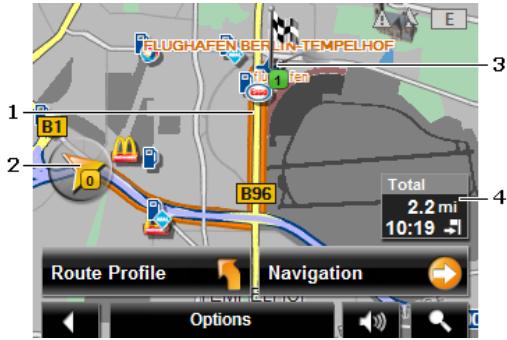
1 The route is marked in orange.
2 Your current position is indicated ( ).
If you display a planned or loaded route and the specified starting point is not your current location, then it is possible that your current position will not be shown on the preview.
3 The destination is marked with a little flag.
If you display a planned or loaded route, the starting point and each route point will be marked with a little flag.
4 In a small info box you can see the complete route and the estimated time of arrival.
- Tap on the arrival time if you want to see the estimated driving time instead.
- Tap once again on the info box if you want to see the estimated time of arrival.
The display for this information can be configured via Options > Settings > Navigation.
If you display a multi-leg route, the route and the estimated driving time for each leg will be displayed. The information for the various legs cannot be configured.
- Tap on Route Profile in order to view and, if required, change the settings which form the basis for the route planning.
- Tap on Start Navigation to start the trip.
If you display a planned or loaded route, the route may be recalculated. The starting point for the calculation will now be your current location. You will first be guided to the first route point entered.
- Tap on Options > Turn-by-Turn List to view detailed directions for the route. (Refer to "Turn-by-Turn List" on page 47)
Tap on (Destination search) in order to view the map in Destination search mode. (Refer to "Map in Destination search mode" page 44)
5.6.3 Map in Navigation mode
After the route was shown in Preview mode, navigation was started. The map opens in Navigation mode.
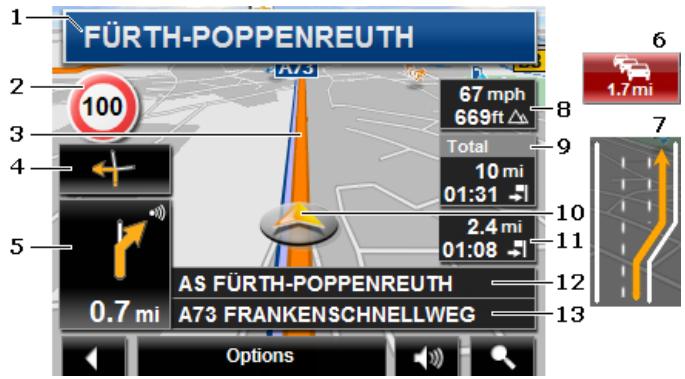
1 Here is shown what signposts should be followed.
2 Possible speed limits may be shown here.
3 The route is highlighted in orange.
4 When two manoeuvres need to be executed in quick succession, the small arrow box indicates the second manoeuvre to be executed.
5 The large arrow box shows a diagram of the next junction which you should turn on to. The distance remaining to this junction is indicated underneath.
As you get closer to the junction you will see a spot diagram in addition to the distance:
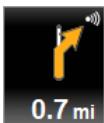
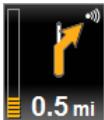
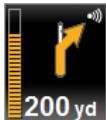
The nearer you get to the junction, the more yellow spots are displayed. If you don't have to change direction for a long time, you will see only a straight arrow. The distance you must continue straight on is indicated underneath the arrow.
- Tap on the large arrow box to hear current route instructions.
(Only NAVIGON 22xx) The Traffic Information box opens if a reported traffic obstruction affects your route.
If a distance is indicated in the Traffic Information box, no detour route was calculated yet for the traffic obstruction in question.
- Tap on the Traffic Information box in order to see the complete message. You can then decide whether a detour route is to be calculated (Detour) or not (Ignore).
If no distance is indicated, all the obstructions which are reported for your route and would lead to a loss of time will be avoided.
- Tap on the Traffic Information box in order to view all the traffic obstructions reported for your route. (Refer to "TMC (Traffic Information" on page 48)

Note: The calculation of detour routes to avoid reported traffic obstructions can be performed automatically. (Refer to "TMC Settings" on page 50)
7 Ahead of many junctions the information from points 8, 9, and 11 is hidden. Instead you are shown which lanes lead to your destination.
- Tap on the box in order to hide the lane information.
8 The height above sea level and the current speed are shown here.
9 In the Total box you can see the distance remaining to the destination, the estimated duration of the trip and the estimated time of arrival.
- Tap on the arrival time if you want to see the estimated driving time instead.
Tap once again on the info box if you want to see the estimated time of arrival.
10 Your current position is indicated on the map (orange arrow). The section of the map displayed changes continually so that your current position is always in view on the map.
11 If you are navigating a multi-leg route, you will see the remaining distance to the next interim destination and the estimated time of arrival in the Next box.
- Tap on the arrival time if you want to see the estimated driving time instead.
Tap once again on the info box if you want to see the estimated time of arrival.
12 The name of the route section that you need to drive onto next is shown in the upper road box.
13 The name of the section you are currently driving on is shown in the lower road box.

Note: The displays of many of the above mentioned areas can be configured in Options > Settings > Navigation. Some displays will only function if the required information is available on the map.

Note: If you tap on the large arrow box, the current route instruction will be repeated.
- Tap on Options > Turn-by-Turn List to view detailed directions for the route. (Refer to "Turn-by-Turn List" on page 47.)
Tap on (Destination search) in order to view the map in Destination search mode. (Refer to "Map in Destination search mode" on page 44.)
Volume
The volume of the spoken driving instructions can be adjusted during navigation.
- Tap on (Volume).
The volume bar opens. It contains three buttons for adjusting the volume.
(Louder), (Quieter), (Volume on/off).
- Tap on (Volume) again or wait a few seconds.
The volume bar closes.
Quitting navigation
Tap on (Back) in order to quit navigation. A dialog box will prompt you to confirm.
Functions of the map in Navigation mode
When the map is open in Navigation mode, tap any point on the map. Buttons with various functions will be displayed.
2D/3D: Changes between 2D and 3D mode. The symbol indicates the current mode.
Day/Night: Changes between "Day" and "Night" display modes. The symbol indicates the current mode.
Interim Destination: Opens the menu for entering an interim destination.
The navigation system will first guide you to this interim destination. Afterwards you can continue your original navigation.
Skip Route Point: Tap this button to omit the next route point. This button is active only when at least 2 route points still lie ahead of you. (Refer to "Multi-leg routes" on page 32)
Block: Tap on this button in order to block a section of the route that lies in front of you, i.e. to recalculate the route in order to avoid this section, e.g. if you have heard on the radio of a traffic jam affecting this section. (Refer to "Block" on page 47.)
Tap on this button again to remove the block.
POI on Your Route: Tap on this button to display POIs on your route. This way you can quickly find out, for example, how far it is to the nearest services. A destination shown here can be added as an interim
destination by tapping the (Interim Destination) button to the right of its entry in the list.

Note: The categories for the POI on Your Route function are the same as those available for the Direct Access function. You can configure which categories they are. (Refer to "Direct access to POI" on page 28)
5.6.4 Reality View
The map switches to Reality View mode when you approach one of the following points while driving on the motorway:
NAVIGON 22xx (Reality View PRO):
a motorway junction
a three-leg motorway junction
the exit you must take to leave the motorway
NAVIGON 12xx (Reality View light):
the exit you must take to leave the motorway
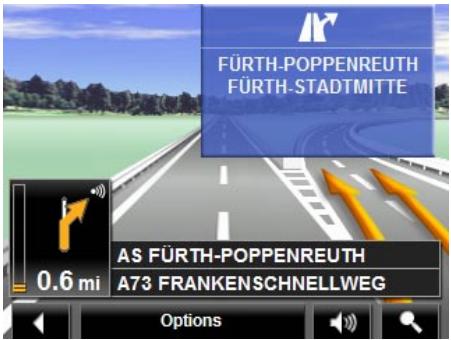
The Reality View mode shows with greater clarity the signposting and lanes you must follow.
This display does not change until you have passed the spot indicated. The map will then change back to Navigation mode.
If you want to change to Navigation mode before then, just tap on any point on the map.

Note: The Reality View mode is not available for all motorway junctions and three-leg motorway junctions. Availability depends on the map material used.
5.6.5 Map in Destination search mode
The map is always in Destination search mode, when a pair of cross hairs are to be seen. Indicated in the address box are the coordinates and, where applicable, the name of the street under the cross hairs.
When you are driving, the map does not change. It is always orientated with north at the top.
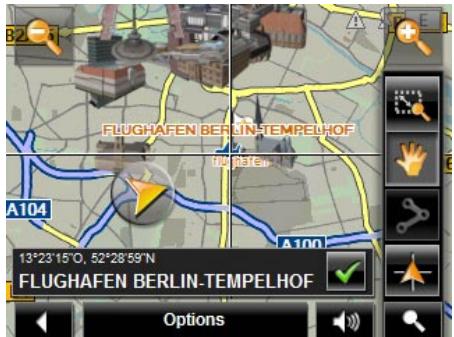

Zoom Out: The map section shown becomes larger, but you will see fewer details.

Zoom In: The map section becomes smaller, but you will see more details.

Zoom Mode: When this button is active you can mark out a section of the map with the stylus or your finger.
Mark out the section from upper left to bottom right to zoom in until the section fills the screen.
Mark out the map section from bottom right to top left to zoom out.

Pan Mode: When this button is active you can change the section of map displayed with the stylus or your finger. Simply drag the map in the desired direction.

Entire Route: Zooms the map so that the entire route is visible.

Current Position: Selects the section of map displayed so that the current location is at the centre.
Operating in Destination search mode
- Tap on the point to which you want to navigate.
The destination that you have selected appears under the cross hairs.
The geographical coordinates of the destination and the corresponding address are shown in the bottom third of the screen.
- Tap on (OK)
Buttons with various functions will be displayed.
Take Me There: Starts navigation to the selected point. If you are currently navigating, this route navigation will be cancelled.
Interim Destination: Sets the selected point as interim destination. The navigation system will first guide you to this interim destination. Afterwards you can continue your original navigation.
This function is only active during navigation.
Set as Destination: Adds the selected point to the route planning as the last point. Navigation will then continue to this point after you have reached the original destination or the other route points. The function is available only during navigation.
Save: Opens the SAVE DESTINATION AS... window. You can enter a name under which the selected point will be saved in the FAVOURITES list. (Refer to "Saving destinations" on page 32.)
Search Nearby: Opens the POI NEARBY window. Here you can search for destinations near the selected point. (Refer to "POI nearby" page 25)
-
Tap on (Destination search) in order to quit Destination search mode. You will be returned to the window from which you started this mode.
-
Tap on (Back) in order to return to the NAVIGATION window. If you are currently navigating, you will be prompted to confirm your decision to quit navigation.
5.7 Useful functions
5.7.1 Direct Help
If you arrive at the scene of an accident or have an accident yourself, it may be necessary to call for emergency aid and to give the answering office your current location.
- Tap on Options > Direct Help.
The DIRECT HELP window opens.
If GPS reception is good enough, the address and the geographic coordinates of your current location will be indicated.
Tap on (Map) if you want to view your current location on the map.
In the bottom half of the window you will find the buttons for 4 categories: Petrol Station, Police Station, Hospital, Pharmacy.
- Tap on the corresponding button.
The nearest help point in the selected category will be indicated. You are shown the name, address, phone number (if known), distance and direction of the help point from your current location.
You have the following options:
- Tap on (Map) in order to see your location and the help point on the map. This gives you an overview of the route to the help point.
- Tap on Start Navigation. You will then be guided directly to the displayed help point.
You can use the (Up) and (Down) buttons to select other help points in the selected category.
The help points are sorted by distance from your current position.
Use the (Back) button to return to the DIRECT HELP window.

Note: Only those help points are displayed which are situated no further than than 30 mi from your position.
5.7.2 GPS Status, saving the current location
In the GPS STATUS window you will find an overview of the data the navigation system calculates from the GPS signals it receives.
The GPS status can be accessed from the options button in many windows.
Tap on Options > GPS Status.
The current location can be saved in the FAVOURITES list.
- Tap Save Position.
The SAVE DESTINATION AS... dialog box opens. - Enter a name for the destination.
- Tap on Save.
5.7.3 Block
You can block a leg of the route at any time during a navigation, i.e. to re-calculate the route in order to avoid the leg, e.g. if you have heard on the radio of a traffic jam affecting this section.

Note: The block is valid only for the current navigation. It no longer exists on a new navigation.
You are currently in a navigation. The map is open in Navigation mode.
- Tap on any position on the map.
Buttons with various functions will be displayed. - Tap on Block.
The BLOCK menu opens. - Enter how many miles (from your current position on) you want to block.
The system re-calculates the route. The blocked route section will be avoided. It is marked on the map in red.
Unblocking a route section
- Tap on any position on the map.
- Tap Unblock.
The block will be lifted. The system recalculates the route. The unblocked route section can now be integrated into the calculation.
5.7.4 Turn-by-Turn List
You can display detailed directions of the calculated route before starting navigation or at any time during navigation. This list displays all of the driving instructions in table form.
The map is open in Preview mode, Navigation mode or Reality View mode.
Tap on Options > Turn-by-Turn List.
The TURN-BY-TURN LIST window opens.
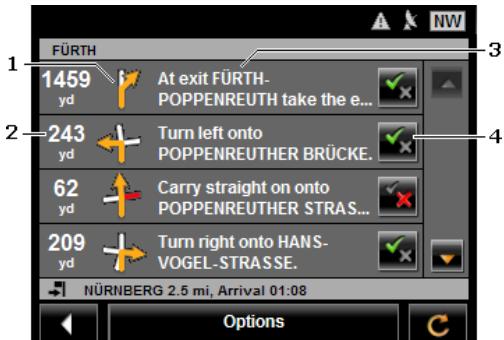
1 Schematic depiction of the next junction where you must make a turn.
2 Distance to this junction.
3 Route instruction and if available the name of the street into which you must turn.
4 Indicates whether you want to drive on the route section in question or not.

(Allow): The section in question is allowed on the route.

(Forbid): The section in question is not allowed on the route.
Blocking route sections
-
Tap on the route sections that you do not want to travel on so that the (Forbid) symbol appears next to them.
-
Tap on

(Modify Route)
The navigation system calculates an alternative route avoiding the route sections selected. The new driving instructions are displayed in the TURN-BY-TURN LIST window.
- Tap on window again.
(Back) in order to close the TURN-BY-TURN LIST
Removing blocks and using original routes
Section blocks can be removed at any time.
In the TURN-BY-TURN LIST window, tap on Options > Calculate Original Route.
5.7.5 TMC (Traffic Information (only NAVIGON 22xx)
The integrated TMC receiver enables the navigation system to make use of current traffic messaging. If necessary it can change your route dynamically, for example in order to avoid a traffic jam.

Note: TMC is available free of charge in many European countries. PremiumTMC, promising a faster and more up-to-date service, is offered (exclusively or in addition) in some countries at a charge.
You can subscribe to PremiumTMC services on our website www.navigon.com.
Displaying traffic information
Current traffic information is available via the options button in many windows.
- Tap on Options > Traffic.
The TRAFFIC INFORMATION window opens.
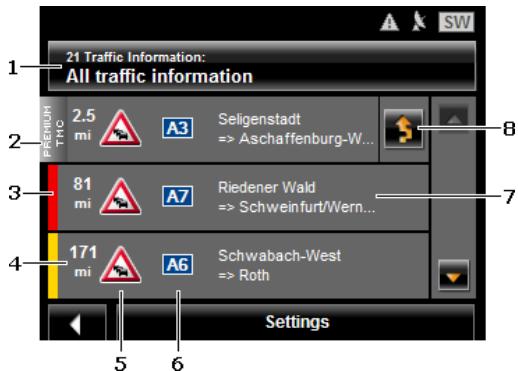
1 The Traffic Information button shows the type of traffic messaging listed and how many messages of this type are in the list.
- Tap on Traffic Information in order to select the messages you want displayed.
2 This mark indicates that the message in question comes from a PremiumTMC provider.
3 Here you can see how serious the obstruction is:
Red: The section is blocked by the obstruction. This can be the case for example with very long traffic jams or road blocks.
Yellow: The section is not blocked by the obstruction but there is a threat of considerable delays. This can be the case for example with traffic jams or when one of several lanes is blocked off.
No colour: The obstruction is not classified as serious. This can be the case for example when slow-moving traffic is reported on a very short section, when SOS telephones are not working or when parking areas are blocked off.
4 Here you can see how far you are from this obstruction. If the obstruction does not lie on your route or if a detour route was already
calculated for this obstruction, then the position of the message in the list is indicated.
Here the reported obstruction is displayed as a traffic sign.
Here the affected road is indicated.
7 Here you can see on which section of the road the obstruction lies.
The navigation system can Detour ( ) or Ignore ( ) congestion on the route. The button shows the active status.
- Tap on the button to select the alternative setting.
You can use the (Up) and (Down) buttons to scroll in the list of messages.
Tap on a message to display this information in detail.
Tap on (Back) in order to close the TRAFFIC INFORMATION window again.

Note: Most radio stations report only traffic obstructions in their own state. You should therefore always tune into a station from the state in which you currently find yourself. (Refer to "Tuning Mode" on page 50)
TMC Settings
In the Settings window, tap on TRAFFIC INFORMATION.
In the TMC SETTINGS window you can set the TMC traffic station and configure whether the reception of a traffic message concerning your route should affect your route planning and if so how.
Tuning Mode
Tap on Tuning Mode and select a method for selecting the TMC radio station.
Automatic: You can use the arrow keys in the station area to select another station. The system will search for another station if reception becomes poor.
- Hold station: You can use the arrow keys in the station area to select another station. The system will search for the same station on a different frequency if the signal becomes poor.
- Hold frequency: You can use the arrow keys in the station area to select another frequency. The system will not search for another station if reception becomes poor.
Recalculate Route
Tap on Recalculate Route and select how new traffic messages concerning your route are to be used.
- Automatically: An alternative route will be calculated automatically. The system will inform you on the recalculation.
- On Request: An announcement from the navigation device tells you that a traffic message concerns your route. On the screen the Traffic Information box indicates the distance to the reported traffic obstruction.
Tap on the Traffic Information box. You can then decide whether an alternative route is to be calculated or not.
6 Configuring the NAVIGON 12xx | 22xx
The SETTINGS window is the starting point for customising the NAVIGON 12xx | 22xx to match your personal preferences.
Settings can be accessed via the options in many windows of the navigation application.
- Tap on Options > Settings.
The SETTINGS window of the navigation application has several buttons: Navigation, Route Profile, Map Display and General. - Tap on a button to open the corresponding settings window.
The settings of the individual windows are distributed over several
screen pages. You can toggle between them with the (To the Left) and (To the Right) buttons.
Some settings can have only one of two values. These settings can be recognised by the (Toggle) button. All possible values are visible. The currently valid value is highlighted in white.
Tap on (Toggle) in order to switch between the possible values.
Some settings can accept several different values. These settings can be recognised by the (List) button. The currently valid value is visible.
- Tap on (List)
A list with all possible values opens. The currently valid value is marked.
- Tap on the value you want. It is now marked.
- Tap on OK.
The list closes. The new value is indicated.
For each setting there is a i (Help) button. When you tap on it you will see an exact definition of the setting in question.
You can close the settings windows in two ways:
Tap OK.
Any changes you have made will be adopted.
Tap Cancel.
Any changes you have made will not be adopted.
7 Appendix
7.1 Technical data
| Dimensions | 95.8 x 72.3 x 17.6 mm | |
| Weight | approx. 120 g | |
| Operating conditions | Operating temperature | -10°C to 60°C (14°F to 140°F) |
| Storage temperature | -30°C to 70°C (-22°F to 158°F) | |
| Humidity | 0% to 90%, non-precipitating | |
| CPU | Centrality Atlas III AT642D-XAC, 375MHz | |
| Operating system | Microsoft Windows CE | |
| Display | 3.5" LCD colour display with resistive touch-panel 320 x 240 pixel (QVGA) Landscape, transmissive | |
| Memory | Flash | NAVIGON 1200 | 2200: 512 MB NAVIGON 1210 | 2210: 2 GB |
| RAM | 64 MB | |
| GPS | Yes (SiRF GRF3i+, Baseband Atlas III)) Built-in antenna | |
| TMC | Yes (only NAVIGON 22xx) | |
| Device keys | 1 (On/Off) | |
| I/O | Keyboard | Software keyboard |
| Loudspeaker | Yes | |
| Memory card | MicroSD-Slot | |
| USB | USB 1.1 | |
| Power supply | Via USB socket | |
| Rechargeable battery | Type | Li-Ion, 740 mAh |
| Running time | Up to 1 hour | |
| Charging | Electronic | Integrated |
| Duration | approx. 2-3 hours | |
| Power pack (accessories) | Input | 100-240V ~ (alternating current, AC) |
| Output | 1.2A 5V = (direct current, DC) | |
| Car charger cable | Input | 10-24V = (direct current, DC) |
| Output | 1.2A 5V = (direct current, DC) | |
7.2 Declaration of conformity
The NAVIGON 12xx | 22xx described in this manual bears the CE label among others.
Products with the CE marking comply with Radio & Telecommunication Terminal Equipment Directive (R&TTE) (1999/5/ECC), the
Electromagnetic Compatibility Directive (89/336/ECC) and the Low Voltage Directive (73/23/ECC) – as amended by Directive 93/68/ECC – issued by the European Community Commission.
Compliance with these directives implies conformity with the following European Standards:
EN 300328 V 1.71, EN 301489-1 V 1.6.1, EN 301489-3 V 1.4.1, EN 301489-17 V 1.2.1, EN 55022, EN 55024, EN 60950-1: 2001,
EN 50371: 2002, EN 50332: 2003, EN 61000-3-2, EN 61000-3-3,
EN 61000-4-2, EN 61000-4-3, EN 61000-4-4, EN 61000-4-5,
EN 61000-4-6, EN 61000-4-8, EN 61000-4-11
The manufacturer is not liable for modifications made by the user which may alter the device's conformity with the CE label, nor for the consequences thereof.
8 Troubleshooting
In this chapter you will find solutions to problems which may arise during use of the NAVIGON 12xx | 22xx.
This list does not claim to be complete. Answers to many other questions can be found on the NAVIGON AG website. (Refer to "Questions about the product" on page 6.)
I have connected a charger to the NAVIGON 12xx | 22xx. A connection to a computer is shown on the display.
or
I have connected the NAVIGON 12xx | 22xx to a computer but it is not detected as a removable disc.
The USB connector of the charger is not fully inserted in the case.
- Unplug the connector.
The navigation device will carry out a new start. Wait for the navigation software to be reloaded.
- Without delay, insert the USB connector from the charger into the corresponding socket of the NAVIGON 12xx | 22xx as far as it will go. (Refer to "Description of the NAVIGON 12xx | 22xx" on page 7.)
The USB connector is not connected correctly. See above.
My NAVIGON 12xx | 22xx makes no response any longer, the screen is frozen.
Perform a reset. This can be done in two ways:
- Use a thin object to press the Reset key. (Refer to "Description of the NAVIGON 12xx | 22xx" on page 7)
The device is now deactivated.
- Press the (On/Off) key for at least 10 seconds.
-OR- - Press the ()_(On/Off) key for at least 6 seconds.
The device is now deactivated. - Press the (On/Off) switch for at least 10 seconds.
The software will be restarted. Your settings and your saved destinations and routes will be retained.
I can't change the "Advise of Traffic Controls" setting. The box is deactivated.
First tap on the (Help) button for this setting.
A window containing information opens. Read the information.
Tap on OK.
The information window is closed. You can now activate the Advise of Traffic Controls function.

Note: Use only accessories which are recommended by NAVIGON expressly for the NAVIGON 12xx | 22xx. NAVIGON AG accepts no liability for errors or damages resulting from the use of other accessories.
For suitable accessories go to www.navigon.com or to your authorised dealer.
9 Index
A
Address 24
Advise of Traffic Controls 55
B
Block. 43, 47, 48
C
Compass 18
Configuration 51
Conventions followed in this manual. 5
Current Position Save 47
D
Data entry 21
Destination
Address 24
Direct Access 28
Favourites 29
From Map 30
Home Address 29,32
Last Destinations 29
My Destinations 23
New Destination. 23
POI 25
in a City 27
Nationwide. 26
Nearby. 25
Save 32
Start Navigation 30
Take Me Home 29,32
Turn-by-Turn List 31
Direct Help. 46
E
Energy 11, 19
Entering data 21
F
Favourites 29,32
G
GPS Faulty reception 22
Initialise 22
Signals 16
Symbols 18
GPS Status 46
H
Home Address 29,32
Hotline 6
1
Interim Destination 42
K
Keyboard 19
L
Last Destinations 29,32
M
Manual Conventions. 5
Symbols 5
Map Destination search 44
Navigation 40
Preview 38
Reality View. 43
Memory card 12
Menu 21
Muting 19
My Destinations. 23
N
Navigation
Block 43, 47, 48
Interim Destination 42
No GPS. 31, 36
POI 43
POI on Your Route 43
Route Profile 31, 36
Skip Route Point 42
Start 30, 36
Turn-by-Turn List 31, 36
Unblock 47
Navigation Application
Start 22
NAVIGON 12xx | 22xx
Description 7
Energy 11
Installation 9
Memory card 12
Scope of Delivery 6
Start 16
NAVIGON 22xx
TMC 11
New Destination 23
0
Options 17,21,36
P
POI
Direct Access 28
in a City 27
Nationwide 26
Nearby 25
On route 43
R
Reality View 43
Recalculate Route 50
Route Planning 32
Route points
Add 33
Delete 34
Order 34
Starting Point 33
Route Profile 31, 36
Routes
Manage 34
Planning. 32
Route points 33
Route Profile 36
Save 34
Show 35
Simulation 35
Start Navigation 36
Starting Point 33
Turn-by-Turn List 36
s
Safety information 7
Scope of Delivery 6
Service 6
Settings
Advise of Traffic Controls 55
Configuration 51
Volume 42
Simulation
Exit. 35
Start 35
Skip Route Point 42
Software keyboard 19
Support. 6
Symbols used in this manual 5
T
Take Me Home 29,32
TMC
Recalculate Route 50
Show 49
Symbols 18
Tuning Mode. 50
TMC Settings
Recalculate Route 50
TMC 50
Traffic Information 50
Tuning Mode 50
Trade marks 5
Traffic Information
Recalculate Route 50
Show 49
Tuning Mode 50
Troubleshooting 54
Tuning Mode 50
Turn-by-Turn List
Block 48
Show. 31, 36, 47
U
Unblock 47
V
Volume 42
W
Warranty. 5