
M-302 - Wireless Network Card ZYXEL - Free user manual and instructions
Find the device manual for free M-302 ZYXEL in PDF.


| Product type | Wireless network adapter |
| Wireless standard | 802.11b/g |
| Maximum data rate | 54 Mbps |
| Interface | PCMCIA Type II |
| Frequency band | 2.4 GHz |
| Security | WEP 64/128-bit, WPA |
| Dimensions | 115 x 54 x 10 mm |
| Weight | 45 g |
| Power supply | Via the computer's PCMCIA port |
| Power consumption | 2 W max |
| Supported operating systems | Windows 98/ME/2000/XP |
| Operating temperature | 0 °C to 40 °C |
| Operating humidity | 10% to 90% RH (non-condensing) |
| Antenna | Integrated |
| Certifications | NMB-003 Canada, FCC Part 15 |
| Warranty | 1 year |
| Package contents | Network adapter, installation CD, quick start guide |
| Care and cleaning | Clean with a soft, dry cloth. Do not use chemicals. |
| General information | Class B digital device compliant with Canadian NMB-003. |
Frequently Asked Questions - M-302 ZYXEL
User questions about M-302 ZYXEL
0 question about this device. Answer the ones you know or ask your own.
Ask a new question about this device
Download the instructions for your Wireless Network Card in PDF format for free! Find your manual M-302 - ZYXEL and take your electronic device back in hand. On this page are published all the documents necessary for the use of your device. M-302 by ZYXEL.
USER MANUAL M-302 ZYXEL
802.11g Wireless MIMO PCI card
User's Guide
Version 2.00
Edition 1
4/2006
ZyXEL
Copyright
Copyright © 2006 by ZyXEL Communications Corporation.
The contents of this publication may not be reproduced in any part or as a whole, transcribed, stored in a retrieval system, translated into any language, or transmitted in any form or by any means, electronic, mechanical, magnetic, optical, chemical, photocopying, manual, or otherwise, without the prior written permission of ZyXEL Communications Corporation.
Published by ZyXEL Communications Corporation. All rights reserved.
Disclaimer
ZyXEL does not assume any liability arising out of the application or use of any products, or software described herein. Neither does it convey any license under its patent rights nor the patent rights of others. ZyXEL further reserves the right to make changes in any products described herein without notice. This publication is subject to change without notice.
Trademarks
ZyNOS (ZyXEL Network Operating System) is a registered trademark of ZyXEL Communications, Inc. Other trademarks mentioned in this publication are used for identification purposes only and may be properties of their respective owners.
Certifications
Federal Communications Commission (FCC) Interference Statement
This device complies with Part 15 of FCC rules. Operation is subject to the following two conditions:
• This device may not cause harmful interference.
- This device must accept any interference received, including interference that may cause undesired operations.
This equipment has been tested and found to comply with the limits for a Class B digital device pursuant to Part 15 of the FCC Rules. These limits are designed to provide reasonable protection against harmful interference in a commercial environment. This equipment generates, uses, and can radiate radio frequency energy, and if not installed and used in accordance with the instructions, may cause harmful interference to radio communications.
If this equipment does cause harmful interference to radio/television reception, which can be determined by turning the equipment off and on, the user is encouraged to try to correct the interference by one or more of the following measures:
- Reorient or relocate the receiving antenna.
- Increase the separation between the equipment and the receiver.
- Connect the equipment into an outlet on a circuit different from that to which the receiver is connected.
- Consult the dealer or an experienced radio/TV technician for help.
Notice 1
Changes or modifications not expressly approved by the party responsible for compliance could void the user's authority to operate the equipment.
This Class B digital apparatus complies with Canadian ICES-003.
Viewing Certifications
1 Go to http://www.zyxel.com.
2 Select your product from the drop-down list box on the ZyXEL home page to go to that product's page.
3 Select the certification you wish to view from this page.

natural_image
Symbol of a trash bin crossed with no text or numbers, representing environmental restriction (no text present)Safety Warnings
For your safety, be sure to read and follow all warning notices and instructions.
- Do NOT open the device or unit. Opening or removing covers can expose you to dangerous high voltage points or other risks. ONLY qualified service personnel can service the device. Please contact your vendor for further information.
- Connect the power cord to the right supply voltage (110V AC in North America or 230V AC in Europe).
- Place connecting cables carefully so that no one will step on them or stumble over them. Do NOT allow anything to rest on the power cord and do NOT locate the product where anyone can walk on the power cord.
- If you wall mount your device, make sure that no electrical, gas or water pipes will be damaged.
- Do NOT install nor use your device during a thunderstorm. There may be a remote risk of electric shock from lightning.
- Do NOT expose your device to dampness, dust or corrosive liquids.
- Do NOT use this product near water, for example, in a wet basement or near a swimming pool.
- Make sure to connect the cables to the correct ports.
- Do NOT obstruct the device ventilation slots, as insufficient airflow may harm your device.
- Do NOT store things on the device.
- Connect ONLY suitable accessories to the device.
ZyXEL Limited Warranty
ZyXEL warrants to the original end user (purchaser) that this product is free from any defects in materials or workmanship for a period of up to two years from the date of purchase. During the warranty period, and upon proof of purchase, should the product have indications of failure due to faulty workmanship and/or materials, ZyXEL will, at its discretion, repair or replace the defective products or components without charge for either parts or labor, and to whatever extent it shall deem necessary to restore the product or components to proper operating condition. Any replacement will consist of a new or re-manufactured functionally equivalent product of equal value, and will be solely at the discretion of ZyXEL. This warranty shall not apply if the product is modified, misused, tampered with, damaged by an act of God, or subjected to abnormal working conditions.
Note
Repair or replacement, as provided under this warranty, is the exclusive remedy of the purchaser. This warranty is in lieu of all other warranties, express or implied, including any implied warranty of merchantability or fitness for a particular use or purpose. ZyXEL shall in no event be held liable for indirect or consequential damages of any kind of character to the purchaser.
To obtain the services of this warranty, contact ZyXEL's Service Center for your Return Material Authorization number (RMA). Products must be returned Postage Prepaid. It is recommended that the unit be insured when shipped. Any returned products without proof of purchase or those with an out-dated warranty will be repaired or replaced (at the discretion of ZyXEL) and the customer will be billed for parts and labor. All repaired or replaced products will be shipped by ZyXEL to the corresponding return address, Postage Paid. This warranty gives you specific legal rights, and you may also have other rights that vary from country to country.
Customer Support
Please have the following information ready when you contact customer support.
• Product model and serial number.
- Warranty Information.
- Date that you received your device.
- Brief description of the problem and the steps you took to solve it.
a. “+” is the (prefix) number you enter to make an international telephone call.
| METHODLOCATION | SUPPORT E-MAIL | TELEPHONE ^A | WEB SITE | REGULAR MAIL |
| SALES E-MAIL | FAX | FTP SITE | ||
| CORPORATEHEADQUARTERS(WORLDWIDE) | support@zyxel.com.tw | +886-3-578-3942 | www.zyxel.comwww.europe.zyxel.com | ZyXEL Communications Corp.6 Innovation Road IIScience ParkHsinchu 300Taiwan |
| sales@zyxel.com.tw | +886-3-578-2439 | ftp.zyxel.comftp.europe.zyxel.com | ||
| CZECH REPUBLIC | info@cz.zyxel.com | +420-241-091-350 | www.zyxel.cz | ZyXEL CommunicationsCzech s.r.o.Modranská 621143 01 Praha 4 - ModranyCeská Republika |
| info@cz.zyxel.com | +420-241-091-359 | |||
| DENMARK | support@zyxel.dk | +45-39-55-07-00 | www.zyxel.dk | ZyXEL Communications A/SColumbusvej2860 SoeborgDenmark |
| sales@zyxel.dk | +45-39-55-07-07 | |||
| FINLAND | support@zyxel.fi | +358-9-4780-8411 | www.zyxel.fi | ZyXEL Communications OyMalminkaari 1000700 HelsinkiFinland |
| sales@zyxel.fi | +358-9-4780 8448 | |||
| FRANCE | info@zyxel.fr | +33-4-72-52-97-97 | www.zyxel.fr | ZyXEL France1 rue des VergersBat. 1 / C69760 LimonestFrance |
| +33-4-72-52-19-20 | ||||
| GERMANY | support@zyxel.de | +49-2405-6909-0 | www.zyxel.de | ZyXEL Deutschland GmbH.Adenauerstr. 20/A2 D-52146WuerselenGermany |
| sales@zyxel.de | +49-2405-6909-99 | |||
| HUNGARY | support@zyxel.hu | +36-1-3361649 | www.zyxel.hu | ZyXEL Hungary48, Zoldlomb Str.H-1025, BudapestHungary |
| info@zyxel.hu | +36-1-3259100 | |||
| KAZAKHSTAN | http://zyxel.kz/support | +7-3272-590-698 | www.zyxel.kz | ZyXEL Kazakhstan43, Dostyk ave.,Office 414Dostyk Business Centre050010, AlmatyRepublic of Kazakhstan |
| sales@zyxel.kz | +7-3272-590-689 | |||
| NORTH AMERICA | support@zyxel.com | 1-800-255-4101+1-714-632-0882 | www.us.zyxel.com | ZyXEL Communications Inc.1130 N. Miller St.AnaheimCA 92806-2001U.S.A. |
| sales@zyxel.com | +1-714-632-0858 | ftp.us.zyxel.com | ||
| NORWAY | support@zyxel.no | +47-22-80-61-80 | www.zyxel.no | ZyXEL Communications A/SNils Hansens vei 130667 OsloNorway |
| sales@zyxel.no | +47-22-80-61-81 | |||
| POLAND | info@pl.zyxel.com | +48 (22) 333 8250 | www.pl.zyxel.com | ZyXEL Communications ul. Okrzei 1A 03-715 Warszawa Poland |
| +48 (22) 333 8251 | ||||
| RUSSIA | http://zyxel.ru/support | +7-095-542-89-29 | www.zyxel.ru | ZyXEL Russia Ostrovityanova 37a Str. Moscow, 117279 Russia |
| sales@zyxel.ru | +7-095-542-89-25 | |||
| SPAIN | support@zyxel.es | +34-902-195-420 | www.zyxel.es | ZyXEL Communications Arte, 21 5° planta 28033 Madrid Spain |
| sales@zyxel.es | +34-913-005-345 | |||
| SWEDEN | support@zyxel.se | +46-31-744-7700 | www.zyxel.se | ZyXEL Communications A/S Sjöporten 4, 41764 Göteborg Sweden |
| sales@zyxel.se | +46-31-744-7701 | |||
| UKRAINE | support@ua.zyxel.com | +380-44-247-69-78 | www.ua.zyxel.com | ZyXEL Ukraine 13, Pimonenko Str. Kiev, 04050 Ukraine |
| sales@ua.zyxel.com | +380-44-494-49-32 | |||
| UNITED KINGDOM | support@zyxel.co.uk | +44-1344 303044 08707 555779 (UK only) | www.zyxel.co.uk | ZyXEL Communications UK Ltd.,11 The Courtyard, Eastern Road, Bracknell, Berkshire, RG12 2XB, United Kingdom (UK) |
| sales@zyxel.co.uk | +44-1344 303034 | ftp.zyxel.co.uk |
Table of Contents
Copyright 3
Certifications 4
Safety Warnings 6
ZyXEL Limited Warranty 7
Customer Support......8
Table of Contents 11
List of Figures 13
List of Tables 15
Preface 17
Chapter 1 Getting Started .... 19
1.1 About Your M-302 19
1.1.1 Application Overview ......20
1.1.1.1 Infrastructure ....20
1.1.1.2 Ad-Hoc 21
1.2 M-302 Hardware and Utility Installation 22
1.3 ZyXEL Utility Icon 22
1.4 Configuration Methods ......22
1.5 Enabling WZC 23
1.5.1 Accessing the ZyXEL Utility 23
Chapter 2 Tutorial ...... 25
2.1 Connecting to a Wireless LAN 25
2.2 Creating and Using a Profile ....27
Chapter 3 Wireless LAN Network.... 31
3.1 Wireless LAN Overview 31
3.2 Wireless LAN Security 32
3.2.1 User Authentication and Encryption 32
3.2.1.1 WEP 32
3.2.1.2 IEEE 802.1x ....33
3.2.1.3 WPA 33
Chapter 4
ZyXEL Utility Configuration 35
4.1 ZyXEL Utility Screen 35
4.2 The Link Info Screen ....35
4.2.1 Trend Chart ....37
4.3 The Site Survey Screen ....37
4.3.1 Security Settings ....39
4.3.1.1 WEP Encryption 39
4.3.1.2 WPA 40
4.3.1.3 WPA-PSK 41
4.3.1.4 IEEE 802.1x 42
4.3.2 Confirm Save Screen 43
4.4 The Profile Screen 44
4.4.1 Adding a New Profile ....45
4.5 The Adapter Screen ....49
Chapter 5
Maintenance 53
5.1 The About Screen ....53
5.2 Uninstalling the ZyXEL Utility ....53
5.3 Upgrading the ZyXEL Utility ....54
Chapter 6
Troubleshooting 55
6.1 Problems Starting the ZyXEL Utility ....55
6.2 Problem with the Link Quality ....55
6.3 Problems Communicating With Other Computers ....56
Appendix A
Product Specifications 57
Appendix B
Management with Wireless Zero Configuration....59
Appendix C
Wireless Security 73
Index....79
List of Figures
Figure 1 The M-302 .... 19
Figure 2 Application: Infrastructure 21
Figure 3 Application: Ad-Hoc 21
Figure 4 ZyXEL utility: System Tray Icon 22
Figure 5 Enable WZC 23
Figure 6 Enable ZyXEL Utility 23
Figure 7 ZyXEL Utility: Site Survey 26
Figure 8 ZyXEL Utility: Security Settings 26
Figure 9 ZyXEL Utility: Confirm Save 27
Figure 10 ZyXEL Utility: Link Info 27
Figure 11 ZyXEL Utility: Profile 28
Figure 12 ZyXEL Utility: Add New Profile 28
Figure 13 ZyXEL Utility: Profile Security 28
Figure 14 ZyXEL Utility: Profile Encryption 29
Figure 15 ZyXEL Utility: Wireless Protocol Settings. 29
Figure 16 ZyXEL Utility: Save Profile 29
Figure 17 ZyXEL Utility: Profile Success 30
Figure 18 Example of a Wireless Network ...... 31
Figure 19 ZyXEL Utility: Menu Screen 35
Figure 20 Link Info 36
Figure 21 Link Info: Trend Chart 37
Figure 22 Site Survey ...... 38
Figure 23 Security Settings: WEP 39
Figure 24 Security Settings: WPA 40
Figure 25 Security Settings: WPA-PSK 41
Figure 26 Security Settings: 802.1x 42
Figure 27 Confirm Save Screen 43
Figure 28 Profile Screen 44
Figure 29 Profile: Add New Profile 46
Figure 30 Profile: Wireless Setting: Select a Channel 47
Figure 31 Profile: Security Setting: Encryption Type 48
Figure 32 Profile: Security Setting 48
Figure 33 Profile: Wireless Protocol 48
Figure 34 Profile: Confirm New Settings 49
Figure 35 Profile: Activate the Profile 49
Figure 36 Adapter Screen 50
Figure 37 About Screen .... 53
Figure 38 Uninstall: Confirm 54
Figure 39 Uninstall: Finish .... 54
Figure 40 Windows XP SP2: Wireless Network Connection Status .... 60
Figure 41 Windows XP SP2: Wireless Network Connection Properties ...... 60
Figure 42 Windows XP SP2: WZC Not Available 61
Figure 43 Windows XP SP2: System Tray Icon 61
Figure 44 Windows XP SP2: Wireless Network Connection Status .... 62
Figure 45 Windows XP SP1: Wireless Network Connection Status ...... 62
Figure 46 Windows XP SP2: Wireless Network Connection ...... 63
Figure 47 Windows XP SP1: Wireless Network Connection Properties ...... 64
Figure 48 Windows XP SP2: Wireless Network Connection: WEP or WPA-PSK .. 65
Figure 49 Windows XP SP2: Wireless Network Connection: No Security ...... 65
Figure 50 Windows XP: Wireless (network) properties: Association 66
Figure 51 Windows XP: Wireless (network) properties: Authentication ...... 67
Figure 52 Windows XP: Protected EAP Properties 68
Figure 53 Windows XP: Smart Card or other Certificate Properties ...... 69
Figure 54 Windows XP SP2: Wireless Networks: Preferred Networks .... 70
Figure 55 Windows XP SP1: Wireless Networks: Preferred Networks .... 71
Figure 56 WPA-PSK Authentication 77
Figure 57 WPA with RADIUS Application Example .... 77
List of Tables
Table 1 External View ...... 20
Table 2 Light Description ...... 20
Table 3 ZyXEL Utility: System Tray Icon 22
Table 4 ZyXEL Utility: Menu Screen 35
Table 5 Link Info 36
Table 6 Link Info: Trend Chart 37
Table 7 Site Survey 38
Table 8 Security Settings: WEP 39
Table 9 Security Settings: WPA 41
Table 10 Security Settings: WPA-PSK 42
Table 11 Security Settings: 802.1x 42
Table 12 Confirm Save Screen 43
Table 13 Profile Screen 44
Table 14 Profile: Add New Profile 46
Table 15 Profile: Wireless Setting: Select a Channel 47
Table 16 Adapter Screen .... 50
Table 17 About Screen 53
Table 18 Troubleshooting Starting the ZyXEL Utility 55
Table 19 Troubleshooting Link Quality 55
Table 20 Troubleshooting Communication Problems .... 56
Table 21 Product Specifications .... 57
Table 22 Windows XP SP2: System Tray Icon 61
Table 23 Windows XP SP2: Wireless Network Connection 63
Table 24 Windows XP: Wireless Networks 65
Table 25 Windows XP: Wireless (network) properties: Association 66
Table 26 Windows XP: Wireless (network) properties: Authentication ...... 67
Table 27 Windows XP: Protected EAP Properties 68
Table 28 Windows XP: Smart Card or other Certificate Properties 69
Table 29 Comparison of EAP Authentication Types 75
Table 30 Wireless Security Relational Matrix 78
Preface
Congratulations on your purchase of the M-302 802.11g Wireless MIMO PCI card.
The M-302 uses Multiple-in, Multiple-Out (MIMO) twin antenna technology to provide superior wireless performance.
Your M-302 is easy to install and configure.
About This User's Guide
This manual is designed to guide you through the configuration of your M-302 for its various applications.
Related Documentation
- Supporting Disk
Refer to the included CD for support documents.
- Quick Start Guide
The Quick Start Guide is designed to help you get up and running right away. It contains hardware installation/connection information.
• ZyXEL Glossary and Web Site
Please refer to www.zyxel.com for an online glossary of networking terms and additional support documentation.
User Guide Feedback
Help us help you. E-mail all User Guide-related comments, questions or suggestions for improvement to techwriters@zyxel.com.tw or send regular mail to The Technical Writing Team, ZyXEL Communications Corp., 6 Innovation Road II, Science-Based Industrial Park, Hsinchu, 300, Taiwan. Thank you.
Syntax Conventions
- “Enter” means for you to type one or more characters. “Select” or “Choose” means for you to use one predefined choice.
- Mouse action sequences are denoted using a comma. For example, “In Windows, click Start, Settings and then Control Panel” means first click the Start button, then point your mouse pointer to Settings and then click Control Panel.
- “e.g.,” is a shorthand for “for instance”, and “i.e.,” means “that is” or “in other words”.
- The M-302 802.11g Wireless MIMO PCI card may be referred to as the M-302 in this user's guide.
Graphics Icons Key
Wireless Access Point | Computer | Notebook Computer |
Server | Modem | Wireless Signal |
Internet Cloud | Printer |
CHAPTER 1 Getting Started
This chapter introduces the M-302 and prepares you to use the ZyXEL utility. The ZyXEL utility is a tool that helps you configure your M-302. See the appendix for detailed product specifications.
1.1 About Your M-302
The M-302 is an IEEE 802.11b/g compliant wireless Local Area Network (LAN) adapter. Fitting directly into an open PCI slot in your desktop computer's motherboard, the M-302 allows you to access wireless networks at speeds of up to 108Mbps (with the Super G function enabled). You can either set the network type to Infrastructure and connect to an access point (AP) or use Ad-Hoc mode and connect to a peer computer (another wireless device in Ad-Hoc mode).
The following lists the main features of your M-302. See the product specifications in the appendix for detailed features.
- Multiple-In, Multiple-Out (MIMO) wireless technology.
• Automatic data rate selection. - Security: WEP (Wired Equivalent Privacy), IEEE 802.1x, WPA-PSK and WPA (Wi-Fi Protected Access)
- A fixed antenna.
- Driver and utility support for Windows 2000 and Windows XP.
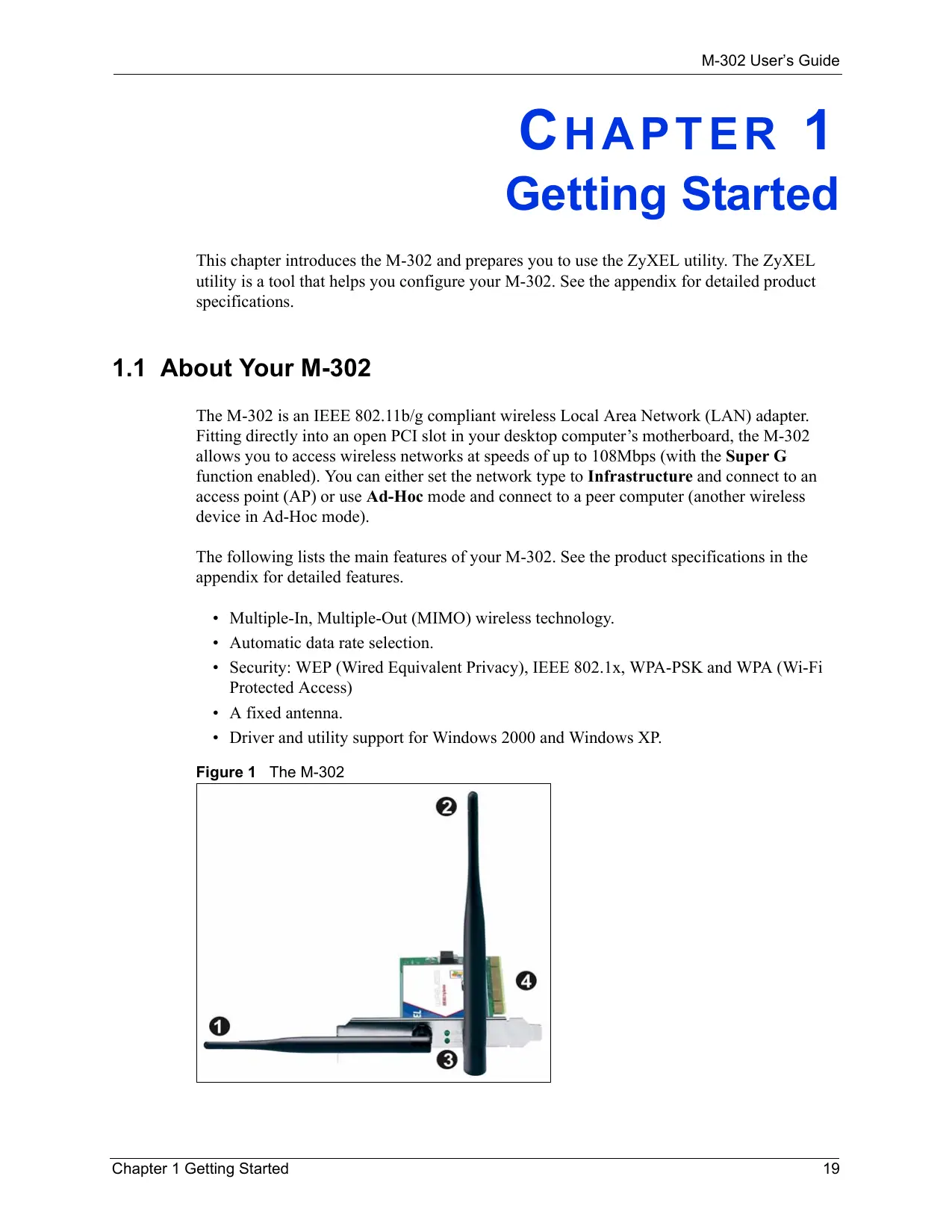
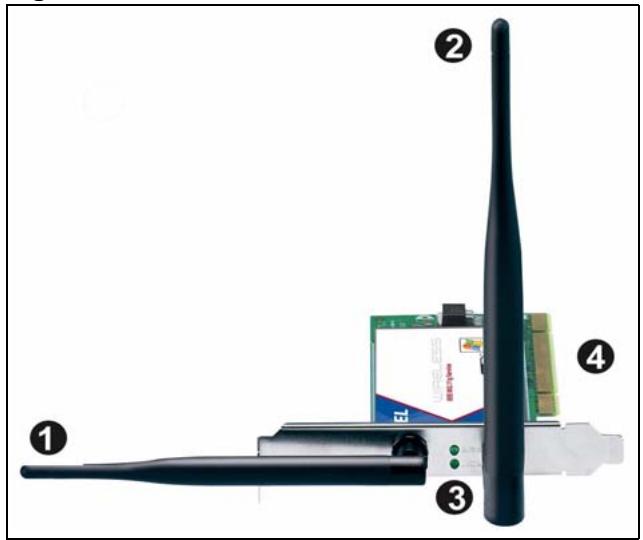
Figure 1 The M-302
text_image
Diagram of a wireless router with labeled components including a network card and two speakers, marked with numbers 1, 2, and 3.The following table describes the M-302.
Table 1 External View
| LABEL | DESCRIPTION |
| 1 | Removable antenna (5dBi, R-SMA connector) |
| 2 | Fixed antenna |
| 3 | Power (PWR) and Link (LNK) lights |
| 4 | PCI contacts |
The following table describes the operation of the Power (PWR) and Link (LNK) lights on the rear of the device.
Table 2 Light Description
| STATUS | PWR LIGHT | LNK LIGHT |
| Power off | The light is off. | The light is off. |
| Power on | The light blinks slowly. | The light is off. |
| Power on, device disabled | The light is on. | The light is off. |
| Searching for wireless network | Both lights blink in series | |
| Connected to wireless network (no traffic) | Both lights blink together slowly | |
| Connected to wireless network (traffic) | Both lights blink together rapidly | |
1.1.1 Application Overview
This section describes some network applications for the M-302.
To connect to a network via an Access Point (AP), set the M-302 network type to
Infrastructure. Through the AP, you can access the Internet or the wired network behind the AP.
Note: For more information on switching between Infrastructure and Ad-Hoc modes, refer to Section 4.4 on page 44.
Figure 2 Application: Infrastructure
flowchart
graph TD
    A["Internet"] --> B["Router"]
    B --> C["Computer 1"]
    B --> D["Computer 2"]
    B --> E["Computer 3"]
    B --> F["Computer 4"]
1.1.1.2 Ad-Hoc
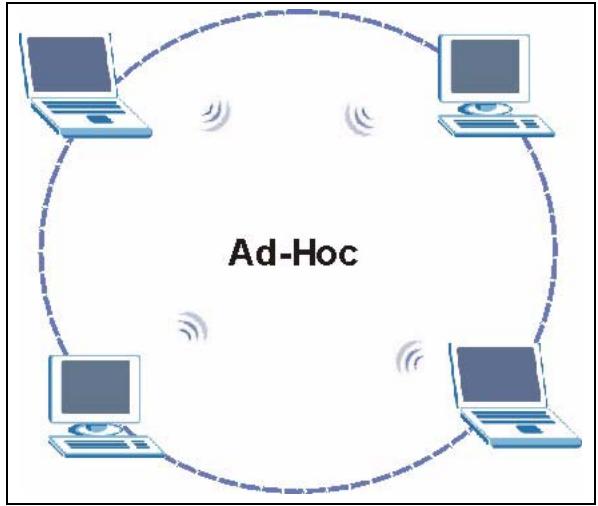
If you want to set up a small independent wireless workgroup without an AP, use Ad-Hoc mode.
Ad-Hoc mode does not require an AP or a wired network. Two or more wireless clients communicate directly with each other.
Figure 3 Application: Ad-Hoc
flowchart
graph TD
    A["Computer 1"] --> B["Computer 2"]
    C["Computer 3"] --> D["Computer 4"]
    E["Computer 5"] --> F["Computer 6"]
    G["Computer 7"] --> H["Computer 8"]
    I["Computer 9"] --> J["Computer 10"]
    K["Computer 11"] --> L["Computer 12"]
    M["Computer 13"] --> N["Computer 14"]
    O["Computer 15"] --> P["Computer 16"]
    Q["Computer 17"] --> R["Computer 18"]
    S["Computer 19"] --> T["Computer 20"]
    U["Computer 21"] --> V["Computer 22"]
    W["Computer 23"] --> X["Computer 24"]
    Y["Computer 25"] --> Z["Computer 26"]
    AA["Computer 27"] --> AB["Computer 28"]
    AC["Computer 29"] --> AD["Computer 30"]
    AE["Computer 31"] --> AF["Computer 32"]
    AG["Computer 33"] --> AH["Computer 34"]
    AI["Computer 35"] --> AJ["Computer 36"]
    AK["Computer 37"] --> AL["Computer 38"]
    AM["Computer 39"] --> AN["Computer 40"]
    AO["Computer 41"] --> AP["Computer 42"]
    AQ["Computer 43"] --> AR["Computer 44"]
    AS["Computer 45"] --> AT["Computer 46"]
    AU["Computer 47"] --> AV["Computer 48"]
    AW["Computer 49"] --> AX["Computer 50"]
1.2 M-302 Hardware and Utility Installation
Follow the instructions in the Quick Start Guide to install the ZyXEL utility and make hardware connections.
1.3 ZyXEL Utility Icon
After you install and start the ZyXEL utility, an icon for the ZyXEL utility appears in the system tray.
Figure 4 ZyXEL utility: System Tray Icon

Note: The ZyXEL utility system tray icon displays only when the M-302 is installed properly.
When you use the ZyXEL utility, it automatically disables the Windows XP wireless configuration tool.
The color of the ZyXEL utility system tray icon indicates the status of the M-302. Refer to the following table for details.
Table 3 ZyXEL Utility: System Tray Icon
| COLOR | DESCRIPTION |
| Red | The M-302 is not connected to a wireless network or is searching for an available wireless network. |
| Green | The M-302 is connected to a wireless network. |
1.4 Configuration Methods
To configure your M-302, use one of the following applications:
- Wireless Zero Configuration (WZC) (the Windows XP wireless configuration tool)
- ZyXEL Utility (This guide shows you how to configure the M-302 using the ZyXEL utility)
• Odyssey Client Manager (not supplied)
Refer to the Odyssey Client Manager documentation for more information.
Note: Do NOT use WZC or the Odyssey Client Manager at the same time you use the ZyXEL utility.
1.5 Enabling WZC
Note: When you use the ZyXEL utility, it automatically disables WZC.
If you want to use WZC to configure the M-302, you need to disable the ZyXEL utility by right-clicking the utility icon (Z) in the system tray and selecting Use Windows to configure my wireless network settings.
Figure 5 Enable WZC
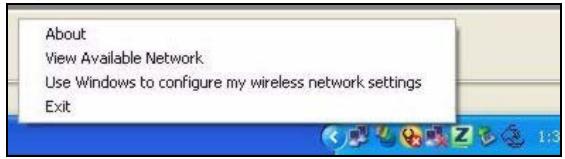
text_image
About View Available Network Use Windows to configure my wireless network settings ExitTo reactivate the ZyXEL utility, double-click the Z icon and click OK.
Figure 6 Enable ZyXEL Utility
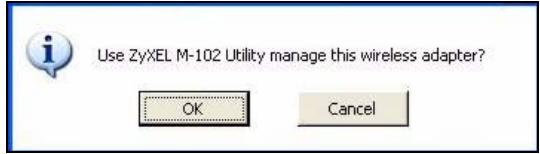
text_image
Use ZyXEL M-102 Utility manage this wireless adapter? OK CancelRefer to the appendices on how to use WZC to manage the M-302.
1.5.1 Accessing the ZyXEL Utility
Double-click on the ZyXEL Wireless LAN utility icon in the system tray to open the ZyXEL utility. The ZyXEL utility screens are similar in all Microsoft Windows versions. Screens for Windows XP are shown in this User's Guide.
Note: Click the icon (located in the top right corner) to display the online help window.
CHAPTER 2 Tutorial
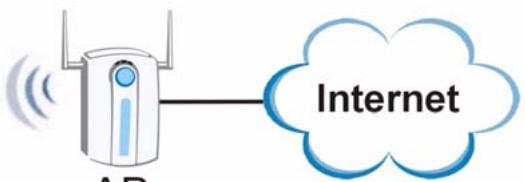
The following sections show you how to join a wireless network using the ZyXEL utility, as in the following diagram. The wireless client is labeled C and the access point is labeled AP.
C
text_image
InternetAP
There are three ways to connect the wireless client to a network.
- Configure nothing and leave the wireless client to automatically scan for and connect to any available network that has no wireless security configured.
- Manually connect to a network.
- Configure a profile to have the wireless client automatically connect to a specific network or peer computer.
This tutorial shows you how to manually connect to a network, and how to configure a profile.
2.1 Connecting to a Wireless LAN
This example illustrates how to manually connect your wireless client to an access point (AP) configured for WPA-PSK security. Before you connect to the access point, you must know its Service Set IDentity (SSID) and WPA-PSK pre-shared key. In this example, the AP's SSID is "SSID_Example3" and its pre-shared key is "ThisismyWPA-PSKpre-sharedkey".
After you install the ZyXEL utility and then insert the wireless client, follow the steps below to connect to a network using the Site Survey screen.
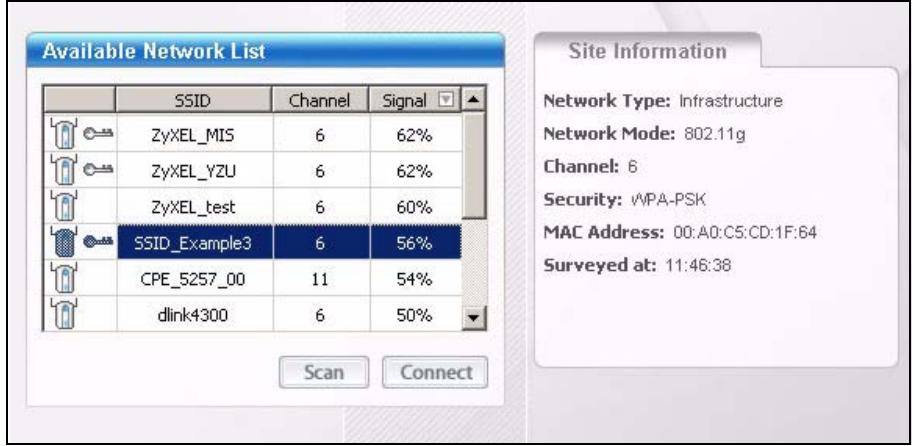
1 Open the ZyXEL utility and click the Site Survey tab to open the screen shown next.
Figure 7 ZyXEL Utility: Site Survey
text_image
Available Network List SSID Channel Signal ZyXEL_MIS 6 62% ZyXEL_YZU 6 62% ZyXEL_test 6 60% SSID_Example3 6 56% CPE_5257_00 11 54% dlink4300 6 50% Scan Connect Site Information Network Type: Infrastructure Network Mode: 802.11g Channel: 6 Security: WPA-PSK MAC Address: 00:A0:C5:CD:1F:64 Surveyed at: 11:46:382 The wireless client automatically searches for available wireless networks. Click Scan if you want to search again. If no entry displays in the Available Network List, that means there is no wireless network available within range. Make sure the AP or peer computer is turned on, or move the wireless client closer to the AP or peer computer.
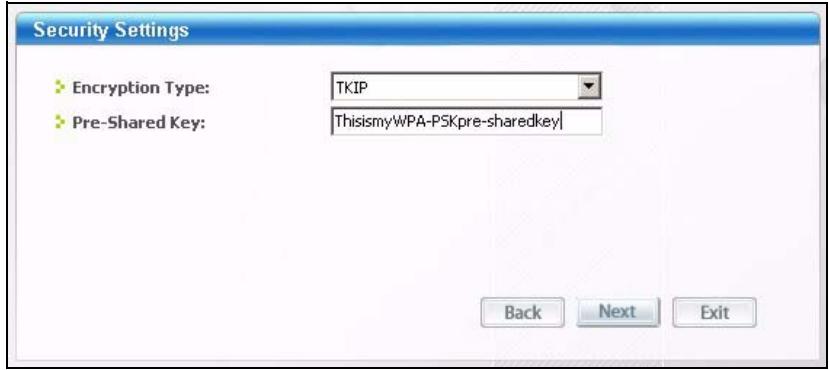
3 When you try to connect to an AP with security configured, a window will pop up prompting you to specify the security settings. Enter the pre-shared key and leave the encryption type at the default setting.
Use the Next button to move on to the next screen. You can use the Back button at any time to return to the previous screen, or the Exit button to return to the Site Survey screen.
Figure 8 ZyXEL Utility: Security Settings
text_image
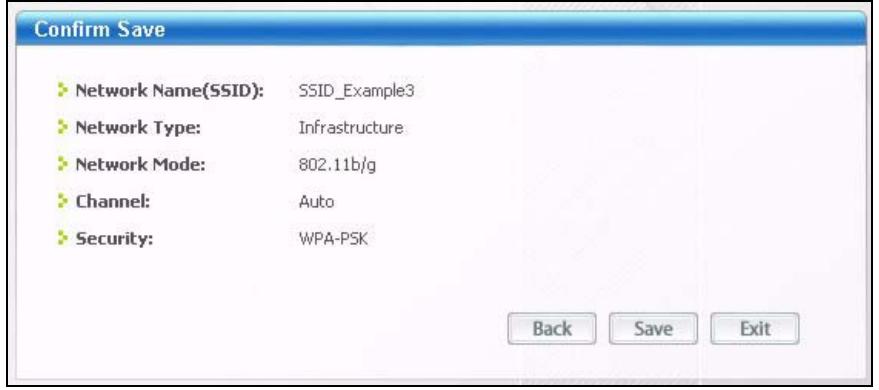
Security Settings Encryption Type: TKIP Pre-Shared Key: ThisismyWPA-PSKpre-sharedkey Back Next Exit4 The Confirm Save window appears. Check your settings and click Save to continue.
Figure 9 ZyXEL Utility: Confirm Save
text_image
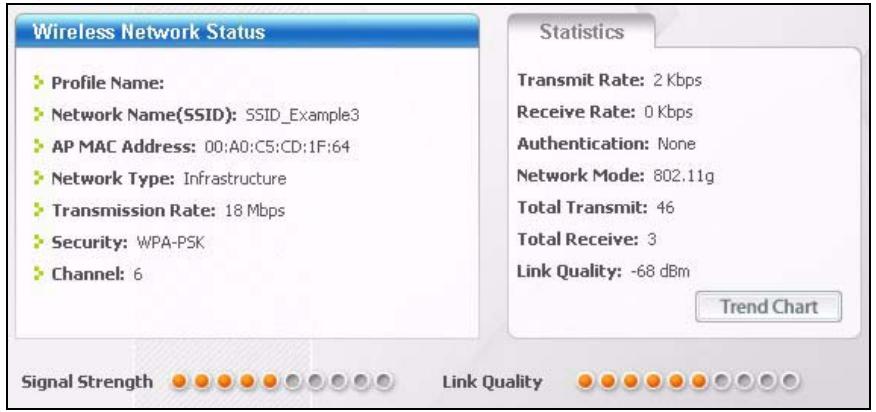
Confirm Save Network Name(SSID): SSID_Example3 Network Type: Infrastructure Network Mode: 802.11b/g Channel: Auto Security: WPA-PSK Back Save Exit5 The ZyXEL Utility returns to the Link Info screen while it connects to the wireless network using your settings. When the wireless link is established, the ZyXEL Utility icon in the system tray turns green and the Link Info screen displays details of the active connection. Check the network information in the Link Info screen to verify that you have successfully connected to the selected network. If the wireless client is not connected to a network, the fields in this screen remain blank.
Figure 10 ZyXEL Utility: Link Info
text_image
Wireless Network Status Profile Name: Network Name(SSID): SSID_Example3 AP MAC Address: 00:A0:C5:CD:1F:64 Network Type: Infrastructure Transmission Rate: 18 Mbps Security: WPA-PSK Channel: 6 Statistics Transmit Rate: 2 Kbps Receive Rate: 0 Kbps Authentication: None Network Mode: 802.11g Total Transmit: 46 Total Receive: 3 Link Quality: -68 dBm Trend Chart Signal Strength Link Quality6 Open your Internet browser and enter http://www.zyxel.com or the URL of any other Web site in the address bar. If you are able to access the Web site, your wireless connection is successfully configured.
If you cannot access the Web site, check the Troubleshooting section of this User's Guide or contact your network administrator.
2.2 Creating and Using a Profile
A profile lets your wireless client connect to the same wireless network every time you use the ZyXEL Utility. You can also configure different profiles for different networks, for example if you connect a notebook computer to wireless networks at home and at work.
This example illustrates how to set up a profile and connect the wireless client to an access point configured for WPA-PSK security. In this example, the AP's SSID is “SSID_Example3” and its pre-shared key is “ThisismyWPA-PSKpre-sharedkey”. You have chosen the Profile Name “PN_Example3”
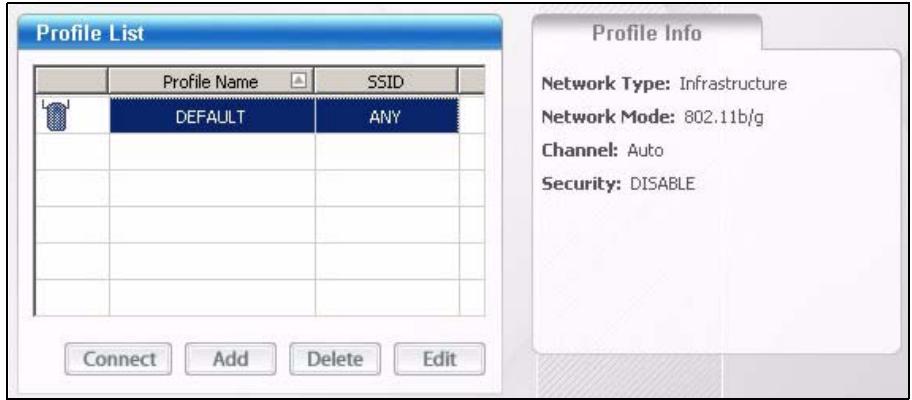
1 Open the ZyXEL utility and click the Profile tab to open the screen shown next. Click Add to configure a new profile.
Figure 11 ZyXEL Utility: Profile
text_image
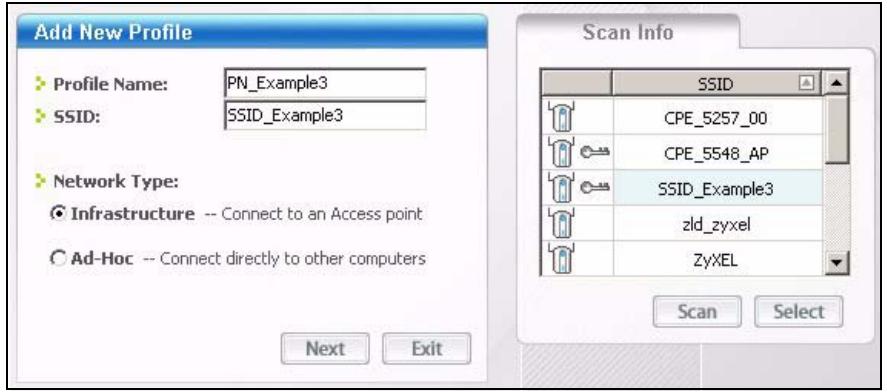
Profile List Profile Name SSID DEFAULT ANY Connect Add Delete Edit Profile Info Network Type: Infrastructure Network Mode: 802.11b/g Channel: Auto Security: DISABLE2 The Add New Profile screen appears. The wireless client automatically searches for available wireless networks, which are displayed in the Scan Info box. You can also configure your profile for a wireless network that is not in the list.
Figure 12 ZyXEL Utility: Add New Profile
text_image
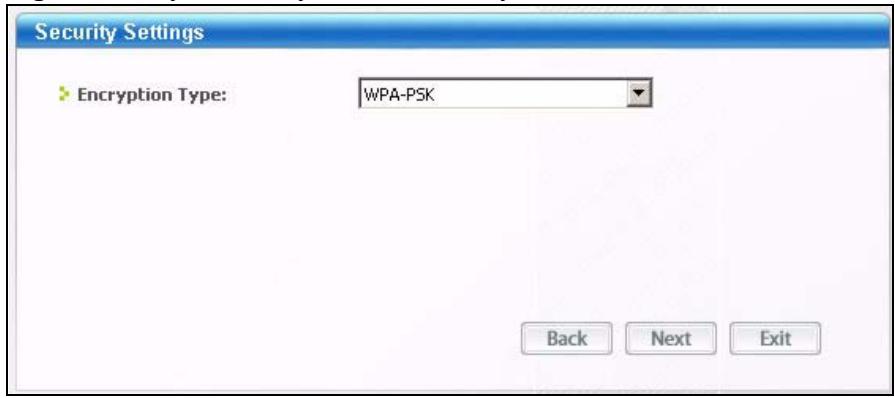
Add New Profile Profile Name: PN_Example3 SSID: SSID_Example3 Network Type: Infrastructure -- Connect to an Access point Ad-Hoc -- Connect directly to other computers Next Exit Scan Info SSID CPE_5257_00 CPE_5548_AP SSID_Example3 zld_zyxel ZyXEL Scan Select3 Give the profile a descriptive name (of up to 32 printable ASCII characters). Select the Infrastructure button and either manually enter or select the AP's SSID in the Scan Info table and click Select.
4 Choose the same encryption method as the AP to which you want to connect (In this example, WPA-PSK).
Figure 13 ZyXEL Utility: Profile Security
text_image
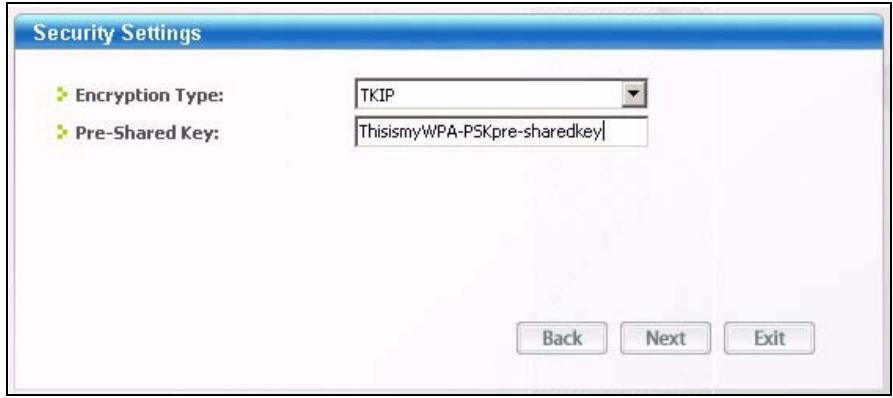
Security Settings Encryption Type: WPA-PSK Back Next Exit5 This screen varies depending on the encryption method you selected in the previous screen. In this example, enter the pre-shared key and leave the encryption type at the default setting.
Figure 14 ZyXEL Utility: Profile Encryption
text_image
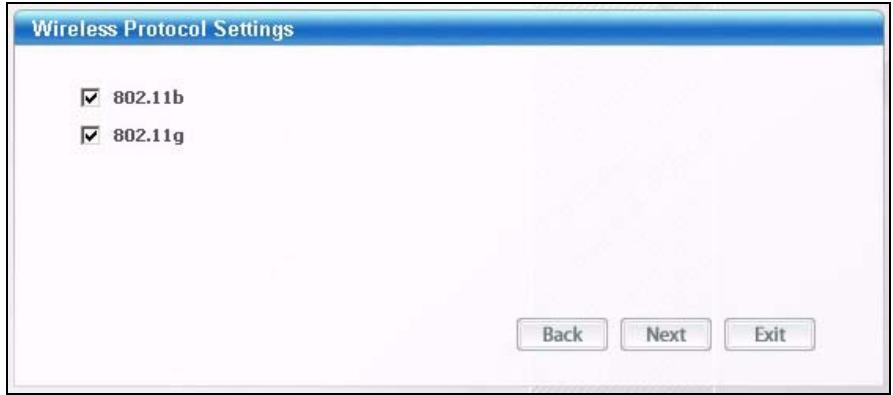
Security Settings Encryption Type: TKIP Pre-Shared Key: ThisismyWPA-PSKpre-sharedkey Back Next Exit6 In the next screen, leave both boxes checked.
Figure 15 ZyXEL Utility: Wireless Protocol Settings.
text_image
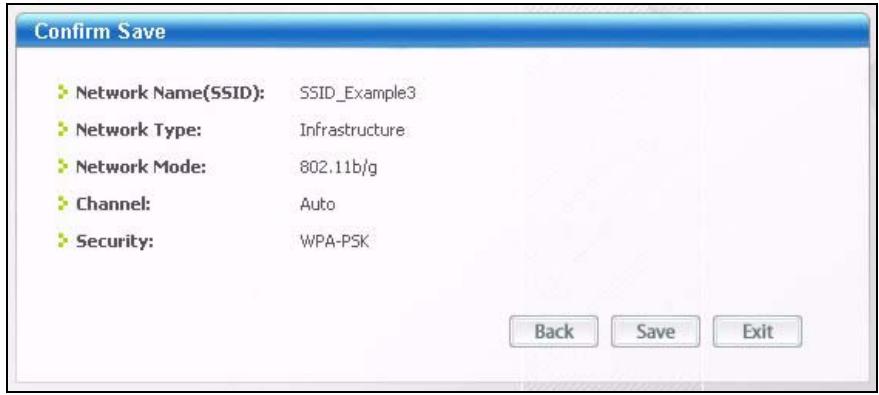
Wireless Protocol Settings ✓ 802.11b ✓ 802.11g Back Next Exit7 Verify the profile settings in the read-only screen. Click Save to save and go to the next screen.
Figure 16 ZyXEL Utility: Save Profile
text_image
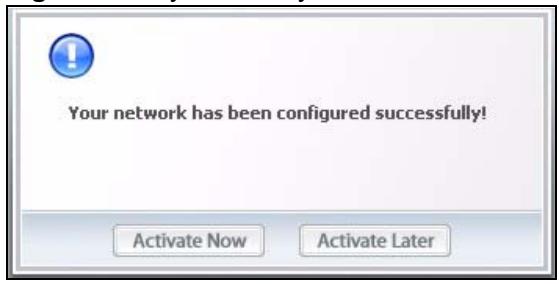
Confirm Save Network Name(SSID): SSID_Example3 Network Type: Infrastructure Network Mode: 802.11b/g Channel: Auto Security: WPA-PSK Back Save Exit8 Click Activate Now to use the new profile immediately. Otherwise, click the Activate Later button to go back to the Profile List screen.
If you clicked Activate Later you can select the profile from the list in the Profile screen and click Connect to activate it.
Note: Only one profile can be activated and used at any given time.
Figure 17 ZyXEL Utility: Profile Success
text_image
Your network has been configured successfully! Activate Now Activate Later9 When you activate the new profile, the ZyXEL Utility goes to the Link Info screen while it connects to the AP using your settings. When the wireless link is established, the ZyXEL Utility icon in the system tray turns green and the Link Info screen displays details of the active connection.
10Open your Internet browser, enter http://www.zyxel.com or the URL of any other Web site in the address bar and press ENTER. If you are able to access the Web site, your new profile is successfully configured.
If you cannot access the Internet, go back to the Profile screen. Select the profile you are using and click Edit. Check the details you entered previously. Also, refer to the Troubleshooting section of this User's Guide or contact your network administrator if necessary.
CHAPTER 3
Wireless LAN Network
This chapter provides background information on wireless LAN networks.
3.1 Wireless LAN Overview
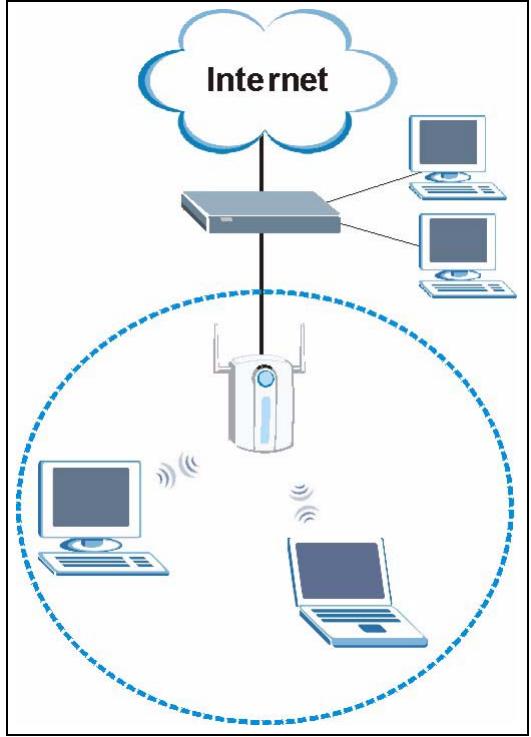
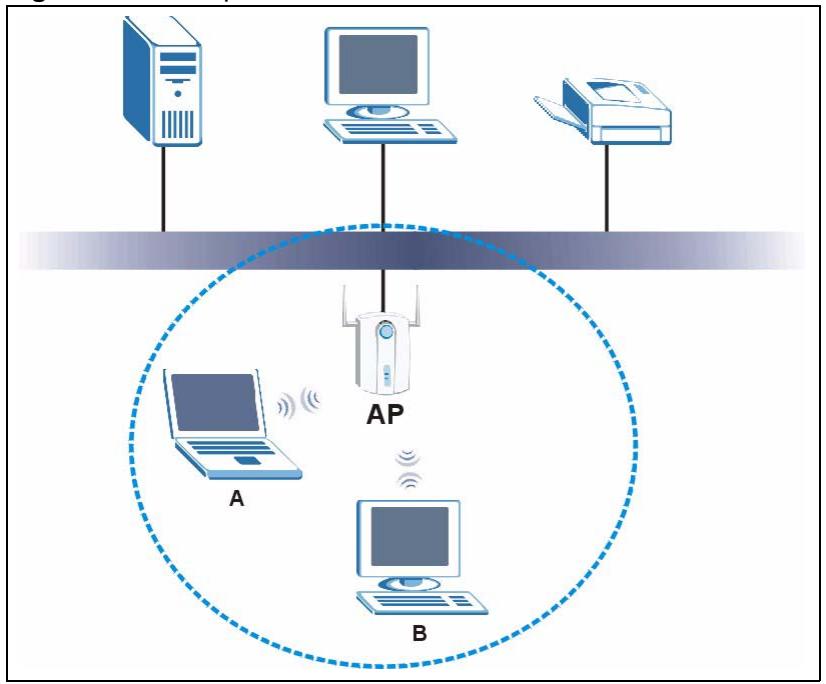
The following figure provides an example of a wireless network with an AP. See Figure 3 on page 21 for an Ad Hoc network example.
Figure 18 Example of a Wireless Network
flowchart
graph TD
    A["Computer 1"] -->|Wireless| AP["AP"]
    B["Computer 2"] -->|Wireless| AP
    C["Computer 3"] -->|Wireless| AP
    AP -->|Wireless| D["Desktop"]
    style AP stroke-dasharray: 5 5
    note right of AP
        A
        B
    end
The wireless network is the part in the blue circle. In this wireless network, devices A and B are called wireless clients. The wireless clients use the access point (AP) to interact with other devices (such as the printer) or with the Internet
Every wireless network must follow these basic guidelines.
- Every device in the same wireless network must use the same SSID.
The SSID is the name of the wireless network. It stands for Service Set IDentity.
- If two wireless networks overlap, they should use a different channel.
Like radio stations or television channels, each wireless network uses a specific channel, or frequency, to send and receive information.
- Every device in the same wireless network must use security compatible with the AP or peer computer.
Security stops unauthorized devices from using the wireless network. It can also protect the information that is sent in the wireless network.
3.2 Wireless LAN Security
Wireless LAN security is vital to your network to protect wireless communications.
Configure the wireless LAN security using the Profile Security Settings screen. If you do not enable any wireless security on your M-302, the M-302's wireless communications are accessible to any wireless networking device that is in the coverage area. See the appendices for more detailed information about wireless security.
3.2.1 User Authentication and Encryption
User authentication is when every user must log in to the wireless network before they can use it. However, every wireless client in the wireless network has to support IEEE 802.1x to do this.
Wireless networks can use encryption to protect the information that is sent in the wireless network. Encryption is like a secret code. If you do not know the secret code, you cannot understand the message.
3.2.1.1 WEP
3.2.1.1.1 Data Encryption
WEP (Wired Equivalent Privacy) encryption scrambles all data packets transmitted between the M-302 and the AP or other wireless stations to keep network communications private. Both the wireless stations and the access points must use the same WEP key for data encryption and decryption.
There are two ways to create WEP keys in your M-302.
- Automatic WEP key generation based on a “password phrase” called a passphrase. The passphrase is case sensitive. You must use the same passphrase for all WLAN adapters with this feature in the same WLAN.
For WLAN adapters without the passphrase feature, you can still take advantage of this feature by writing down the four automatically generated WEP keys from the Security Settings screen of the ZyXEL utility and entering them manually as the WEP keys in the other WLAN adapter(s).
- Enter the WEP keys manually.
Your M-302 allows you to configure up to four 64-bit, 128-bit or 256-bit WEP keys and only one key is used as the default key at any one time.
3.2.1.1.2 Authentication Type
The IEEE 802.11b/g standard describes a simple authentication method between the wireless stations and AP. Three authentication types are defined: Auto, Open System and Shared Key.
- Open System mode is implemented for ease-of-use and when security is not an issue. The wireless station and the AP or peer computer do not share a secret key (WEP key). Thus the wireless stations can associate with any AP or peer computer and listen to any transmitted data that is not encrypted.
- Shared Key mode involves a shared secret key (WEP key) to authenticate the wireless station to the AP or peer computer. This requires you to enable the wireless LAN security and use same settings on both the wireless station and the AP or peer computer.
- Auto authentication mode allows the M-302 to switch between the open system and shared key modes automatically. Use the auto mode if you do not know the authentication mode of the other wireless stations.
3.2.1.2 IEEE 802.1x
The IEEE 802.1x standard outlines enhanced security methods for both the authentication of wireless stations and encryption key management. Authentication can be done using an external RADIUS server.
3.2.1.2.1 EAP Authentication
EAP (Extensible Authentication Protocol) is an authentication protocol that runs on top of the IEEE 802.1x transport mechanism in order to support multiple types of user authentication. By using EAP to interact with an EAP-compatible RADIUS server, an access point helps a wireless station and a RADIUS server perform authentication.
The type of authentication you use depends on the RADIUS server and an intermediary AP(s) that supports IEEE 802.1x. The M-302 supports EAP-TLS, EAP-TTLS and EAP-PEAP. Refer to the appendix on wireless security for more details.
For EAP-TLS authentication type, you must first have a wired connection to the network and obtain the certificate(s) from a certificate authority (CA). A certificate (also called a digital ID) can be used to authenticate users, and a CA issues certificates and guarantees the identity of each certificate owner.
3.2.1.3 WPA
Wi-Fi Protected Access (WPA) is a subset of the IEEE 802.11i standard.
WPA improves data encryption by using Temporal Key Integrity Protocol (TKIP), Message Integrity Check (MIC) and IEEE 802.1x. WPA uses Advanced Encryption Standard (AES) in the Counter mode with Cipher block chaining Message authentication code Protocol (CCMP) to offer stronger encryption than TKIP. Refer to the appendix on wireless security for more details.
Select WEP only when the AP and/or wireless clients do not support WPA. WEP is less secure than WPA.
CHAPTER 4
ZyXEL Utility Configuration
This chapter shows you how to configure your M-302.
4.1 ZyXEL Utility Screen
This section describes the ZyXEL utility screens.
Figure 19 ZyXEL Utility: Menu Screen

text_image
ZyXEL Link Info Site Survey Profile AdapterThe following table describes the menus.
Table 4 ZyXEL Utility: Menu Screen
| TAB | DESCRIPTION |
| Link Info | Use this screen to see your current connection status, configuration and data rate statistics. |
| Site Survey | Use this screen to• scan for a wireless network• configure wireless security (if activated on the selected network).• connect to a wireless network. |
| Profile | Use this screen to add, delete, edit or activate a profile with a set of wireless and security settings. |
| Adapter | Use this screen to configure a transfer rate and enable power saving. |
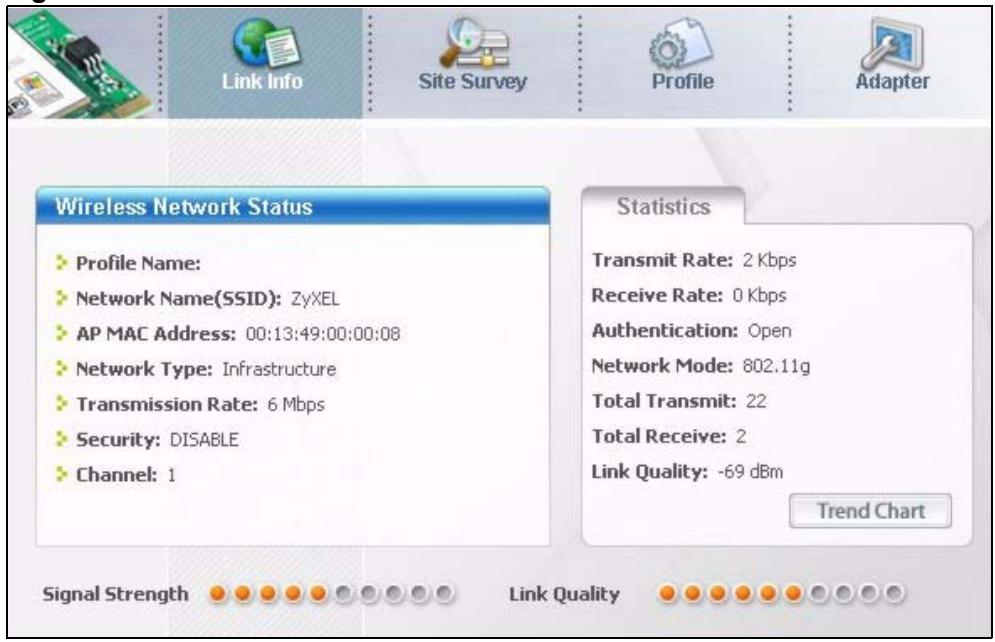
4.2 The Link Info Screen
When the ZyXEL utility starts, the Link Info screen displays, showing the current configuration and connection status of your M-302.
Figure 20 Link Info
text_image
Link Info Site Survey Profile Adapter Wireless Network Status Profile Name: Network Name(SSID): ZyXEL AP MAC Address: 00:13:49:00:00:08 Network Type: Infrastructure Transmission Rate: 6 Mbps Security: DISABLE Channel: 1 Statistics Transmit Rate: 2 Kbps Receive Rate: 0 Kbps Authentication: Open Network Mode: 802.11g Total Transmit: 22 Total Receive: 2 Link Quality: -69 dBm Trend Chart Signal Strength Link QualityThe following table describes the labels in this screen.
Table 5 Link Info
| LABEL | DESCRIPTION |
| Wireless Network Status | |
| Profile Name | This is the name of the profile you are currently using. |
| Network Name (SSID) | The SSID identifies the wireless network to which a wireless station is associated. This field displays the name of the wireless device to which the M-302 is associated. |
| AP MAC Address | This field displays the MAC address of the AP or peer computer to which the M-302 is associated. |
| Network Type | This field displays the network type (Infrastructure or Ad-Hoc) of the wireless network. |
| Transmission Rate | This field displays the current transmission rate of the M-302 in megabits per second (Mbps). |
| Security | This field displays whether data encryption is activated (WEP (WEP or 802.1x), TKIP (WPA/WPA-PSK), AES (WPA/WPA-PSK)) or inactive (Disable). |
| Channel | This field displays the radio channel the M-302 is currently using. |
| Statistics | |
| Transmit Rate | This field displays the current data transmission rate in kilobits per second (Kbps). |
| Receive Rate | This field displays the current data receiving rate in kilobits per second (Kbps). |
| Authentication | This field displays the authentication method of the M-302. |
| Network Mode | This field displays the network standard (802.11b or 802.11g) of the AP or peer computer. |
| Total Transmit | This field displays the total number of data frames transmitted. |
| Total Receive | This field displays the total number of data frames received. |
| Link Quality | This field displays the quality of the signal of the M-302. |
| Trend Chart | Click this button to display the real-time statistics of the data rate in kilobits per second (Kbps). |
| Signal Strength | The status bar shows the strength of the signal. The signal strength depends mainly on the antenna output power and the distance between the M-302 and the AP or peer computer. |
| Link Quality | The status bar shows the quality of the wireless connection. This refers to the percentage of packets delivered successfully. If there are too many wireless stations in a wireless network, collisions may occur which could result in a loss of messages even though you have high signal strength. |
4.2.1 Trend Chart
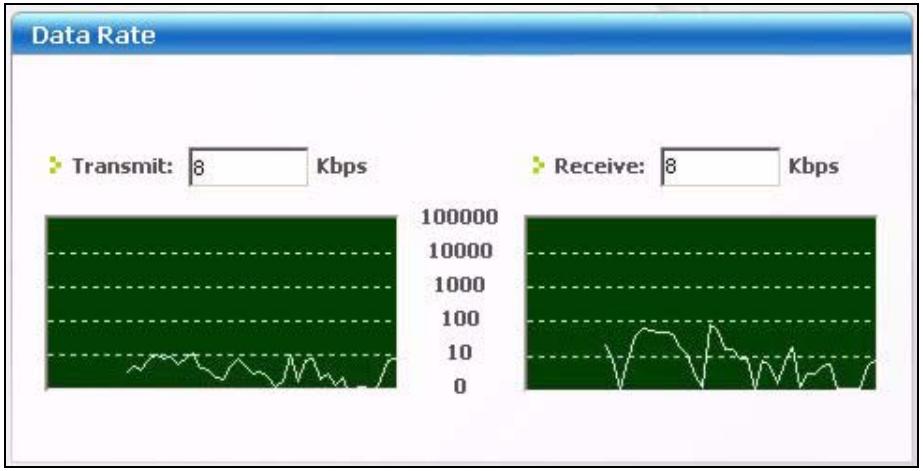
Click Trend Chart in the Link Info screen to display a screen as shown below. Use this screen to view real-time data traffic statistics.
Figure 21 Link Info: Trend Chart
line
| Data Rate | Transmit: 8 Kbps | Receive: 8 Kbps | | --------- | ---------------- | --------------- | | Value | 8 | 8 |The following table describes the labels in this screen.
Table 6 Link Info: Trend Chart
| LABEL | DESCRIPTION |
| Transmit | This field displays the current data transmission rate in kilobits per second (Kbps). |
| Receive | This field displays the current data receiving rate in kilobits per second (Kbps). |
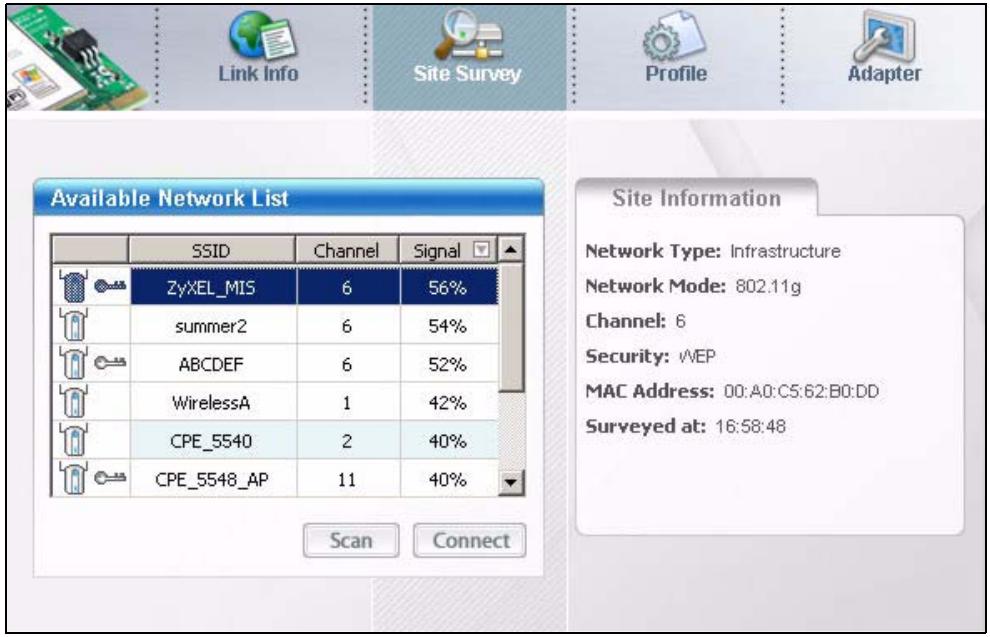
4.3 The Site Survey Screen
Use the Site Survey screen to scan for and connect to a wireless network automatically.
Figure 22 Site Survey
text_image
Available Network List SSID Channel Signal ZyXEL_MIS 6 56% summer2 6 54% ABCDEF 6 52% WirelessA 1 42% CPE_5540 2 40% CPE_5548_AP 11 40% Scan Connect Site Information Network Type: Infrastructure Network Mode: 802.11g Channel: 6 Security: /WEP MAC Address: 00:A0:C5:62:B0:DD Surveyed at: 16:58:48The following table describes the labels in this screen.
Table 7 Site Survey
| LABEL | DESCRIPTION |
| Available Network List | Click a column heading to sort the entries. |
| [YG CZ] denotes that the wireless device is in infrastructure mode and the wireless security is activated. | |
| [0860] denotes that the wireless device is in infrastructure mode but the wireless security is deactivated. | |
 denotes that the wireless device is in Ad-Hoc mode and the wireless security is activated. denotes that the wireless device is in Ad-Hoc mode and the wireless security is activated. | |
 denotes that the wireless device is in Ad-Hoc mode but the wireless security is deactivated. denotes that the wireless device is in Ad-Hoc mode but the wireless security is deactivated. | |
| SSID | This field displays the SSID (Service Set IDentifier) of each wireless device. |
| Channel | This field displays the channel number used by each wireless device. |
| Signal | This field displays the signal strength of each wireless device. |
| Scan | Click Scan to search for available wireless devices within transmission range. |
| Connect | Click Connect to associate to the selected wireless device. |
| Site Information | Click an entry in the Available Network List table to display the information of the selected wireless device. |
| Network Type | This field displays the network type (Infrastructure or Ad-Hoc) of the wireless device. |
| Network Mode | This fields displays the network standard (802.11g or 802.11b) of the wireless device. |
| Channel | This field displays the channel number used by each wireless device. |
Table 7 Site Survey
| LABEL | DESCRIPTION |
| Security | This field shows whether data encryption is activated. If WPA is activated, WPA displays. If WPA-PSK is activated, WPA-PSK displays. If WEP or 802.11x is activated, WEP displays. If security is inactive, Disable displays. |
| MAC Address | This field displays the MAC address of the wireless device. |
| Surveyed at | This field displays the time when the wireless device is scanned. |
4.3.1 Security Settings
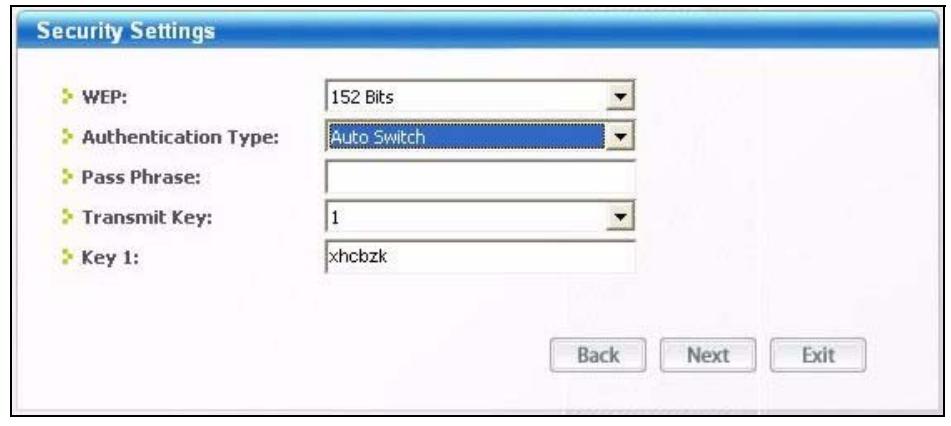
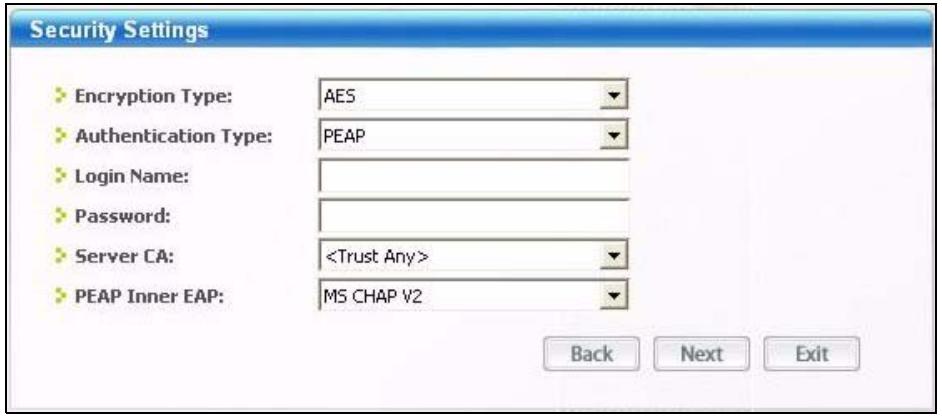
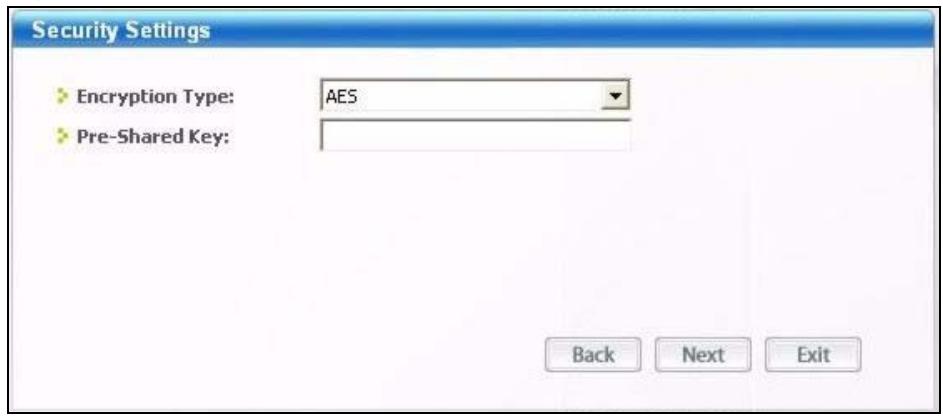
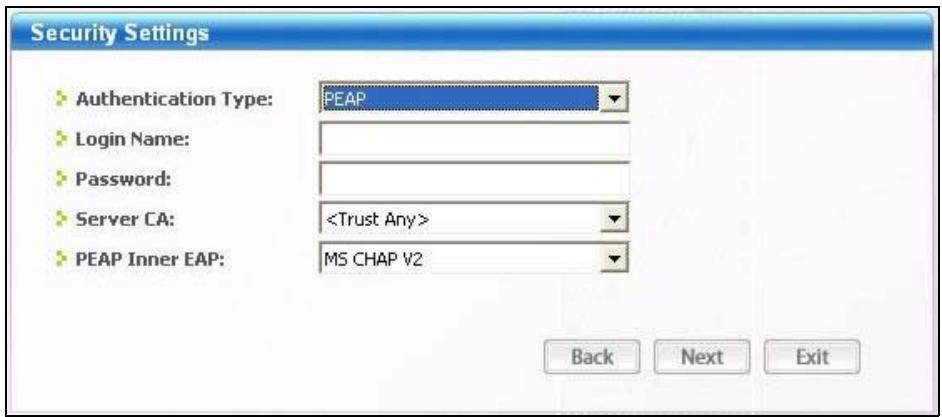
When you configure the M-302 to connect to a network with wireless security activated and the security settings are disabled on the M-302, the screen varies according to the encryption method used by the selected network.
Figure 23 Security Settings: WEP
text_image
Security Settings WEP: 152 Bits Authentication Type: Auto Switch Pass Phrase: Transmit Key: 1 Key 1: xhcbzk Back Next ExitThe following table describes the labels in this screen.
Table 8 Security Settings: WEP
| LABEL | DESCRIPTION |
| WEP | Select 64 Bits, 128 Bits or 152 Bits to activate WEP encryption and then fill in the related fields. |
| Authentication Type | Select authentication type. Choices are Auto Switch, Open and Shared. Refer to Section 3.2.1.1.2 on page 33 for more information. |
| Pass Phrase | Enter a passphrase of up to 63 case-sensitive printable characters. As you enter the passphrase, the M-302 automatically generates four different WEP keys and displays it in the key field below. Refer to Section 3.2.1 on page 32 for more information.At the time of writing, you cannot use passphrase to generate 152-bit WEP keys. |
| Transmit Key | Select a default WEP key to use for data encryption. The key displays in the field below. |
| Key x (where x is a number between 1 and 4) | Select this option if you want to manually enter the WEP keys. Enter the WEP key in the field provided.If you select64 Bitsin the WEPfield.Enter either 10 hexadecimal digits in the range of “A-F”, “a-f” and “0-9” (for example, 11AA22BB33) for HEX key type.orEnter 5 ASCII characters (case sensitive) ranging from “a-z”, “A-Z” and “0-9” (for example, MyKey) for ASCII key type.If you select128 Bitsin the WEPfield,Enter either 26 hexadecimal digits in the range of “A-F”, “a-f” and “0-9” (for example, 00112233445566778899AABBCC) for HEX key typeorEnter 13 ASCII characters (case sensitive) ranging from “a-z”, “A-Z” and “0-9” (for example, MyKey12345678) for ASCII key type.If you select152 Bitsin the WEPfield,Enter either 32 hexadecimal digits in the range of "A-F", "a-f" and "0-9” (for example, 00112233445566778899AABBCCDDEEFF) for HEX key typeorEnter 16 ASCII characters (case sensitive) ranging from “a-z”, “A-Z” and “0-9” (for example, MyKey12345678901) for ASCII key type.Note:The values for the WEP keys must be set up exactly the same on all wireless devices in the same wireless LAN.ASCII WEP keys are case sensitive. |
| Back | ClickBackto go to theSite Surveyscreen to select and connect to other network. |
| Next | ClickNextto confirm your selections and advance to theConfirm Savescreen. |
| Exit | ClickExitto return to theSite Surveyscreen without saving. |
4.3.1.2 WPA
Figure 24 Security Settings: WPA
text_image
Security Settings Encryption Type: AES Authentication Type: PEAP Login Name: Password: Server CA:The following table describes the labels in this screen.
Table 9 Security Settings: WPA
| LABEL | DESCRIPTION |
| Encryption Type | The encryption mechanisms used for WPA and WPA-PSK are the same. The only difference between the two is that WPA-PSK uses a simple common password, instead of user-specific credentials.Select the encryption type (TKIP or AES) for data encryption.Refer to Section 3.2.1.3 on page 33 for more information. |
| Authentication Type | Select an authentication method from the drop down list. Options are TLS, TTLS and PEAP. |
| Login Name | Enter a user name.This is the user name that you or an administrator set up on a RADIUS server. |
| Password | This field is not available when you select TLS in the Authentication Type field.Enter the password associated with the user name above. |
| Certificate | This field is only available when you select TLS in the Authentication Type field.Select a certificate used by the authentication server to authenticate the M-302.Note: You must first have a wired connection to a network and obtain the certificate(s) from a certificate authority (CA). |
| Server CA | Select a certificate authority (CA) that you trust and accept any certificates signed by that CA.Otherwise, select Trust Any to accept certificates from any CA. |
| PEAP Inner EAP | This field is only available when you select PEAP in the Authentication Type field.Select a PEAP protocol. Options are GTC and MS CHAP v2. |
| Back | Click Back to go to the Site Survey screen to select and connect to other network. |
| Next | Click Next to confirm your selections and advance to the Confirm Save screen. |
| Exit | Click Exit to return to the Site Survey screen without saving. |
4.3.1.3 WPA-PSK
Figure 25 Security Settings: WPA-PSK
text_image
Security Settings Encryption Type: AES Pre-Shared Key: Back Next ExitThe following table describes the labels in this screen.
Table 10 Security Settings: WPA-PSK
| LABEL | DESCRIPTION |
| Encryption Type | The encryption mechanisms used for WPA and WPA-PSK are the same. The only difference between the two is that WPA-PSK uses a simple common password, instead of user-specific credentials.Select the encryption type (TKIP or AES) for data encryption.Refer to Section 3.2.1.3 on page 33 for more information. |
| Pre-Shared Key | Type a pre-shared key (same as the AP or peer device) of between 8 and 63 case-sensitive ASCII characters (including spaces and symbols). |
| Back | Click Back to go to the Site Survey screen to select and connect to other network. |
| Next | Click Next to confirm your selections and advance to the Confirm Save screen. |
| Exit | Click Exit to return to the Site Survey screen without saving. |
4.3.1.4 IEEE 802.1x
Figure 26 Security Settings: 802.1x
text_image
Security Settings Authentication Type: PEAP Login Name: Password: Server CA:The following table describes the labels in this screen.
Table 11 Security Settings: 802.1x
| LABEL | DESCRIPTION |
| Authentication Type | The type of authentication you use depends on the authentication server or AP. Select an authentication method from the drop down list. Options are TLS, TTLS and PEAP. |
| Login Name | Enter a user name.This is the user name that you or an administrator set up on a RADIUS server. |
| Password | This field is not available when you select TLS in the Authentication Type field.Enter the password associated with the user name above. |
| Certificate | This field is only available when you select TLS in the Authentication Type field. Select a certificate used by the authentication server to authenticate the M-302.Note: You must first have a wired connection to a network and obtain the certificate(s) from a certificate authority (CA). |
Table 11 Security Settings: 802.1x
| LABEL | DESCRIPTION |
| Server CA | Select a certificate authority (CA) that you trust and accept any certificates signed by that CA.Otherwise, selectTrust Anyto accept certificates from any CA. |
| PEAP Inner EAP | This field is only available when you select PEAPin theAuthentication Typefield.Select a PEAP protocol. Options areGTCandMS CHAP v2. |
| Back | ClickBackto go to theSite Surveyscreen to select and connect to other network. |
| Next | ClickNextto confirm your selections and advance to theConfirm Savescreen. |
| Exit | ClickExitto return to theSite Surveyscreen without saving. |
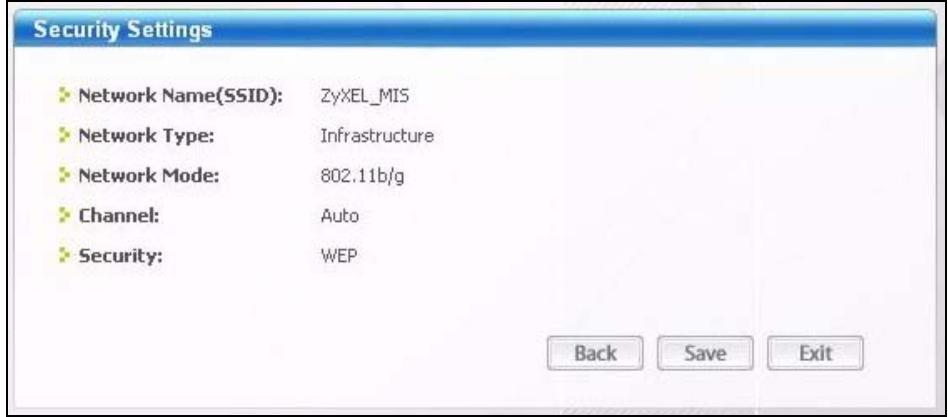
4.3.2 Confirm Save Screen
Use this screen to confirm and save the security settings.
Figure 27 Confirm Save Screen
text_image
Security Settings Network Name(SSID): ZyXEL_MIS Network Type: Infrastructure Network Mode: 802.11b/g Channel: Auto Security: WEP Back Save ExitThe following table describes the labels in this screen.
Table 12 Confirm Save Screen
| LABEL | DESCRIPTION |
| Network Name (SSID) | This field displays the SSID previously entered. |
| Network Type | This field displays the network type (Infrastructure or Ad-Hoc) of the wireless device. |
| Network Mode | This fields displays the network standard (802.11g, 802.11b or 802.11b/g) of the wireless device. |
| Channel | This field displays the channel number used by the profile. |
| Security | This field shows whether data encryption is activated (WEP, 802.1x, WPA or WPA-PSK) or inactive (DISABLE). |
| Back | Click Back to return to the previous screen. |
| Save | Click Save to save the changes back to the M-302 and display the Link Info screen. |
| Exit | Click Exit to discard changes and return to the Site Survey screen. |
4.4 The Profile Screen
A profile is a set of wireless parameters that you need to connect to a wireless network. With a profile activated, each time you start the M-302 it automatically scans for the specific SSID and joins that network with the pre-defined wireless security settings. If the specified network is not available, the M-302 will remain disconnected.
If you do not configure and activate a profile, each time you start the M-302 it uses the default profile to connect to any available network with security disabled.
The default profile allows you to connect to any wireless network without security.
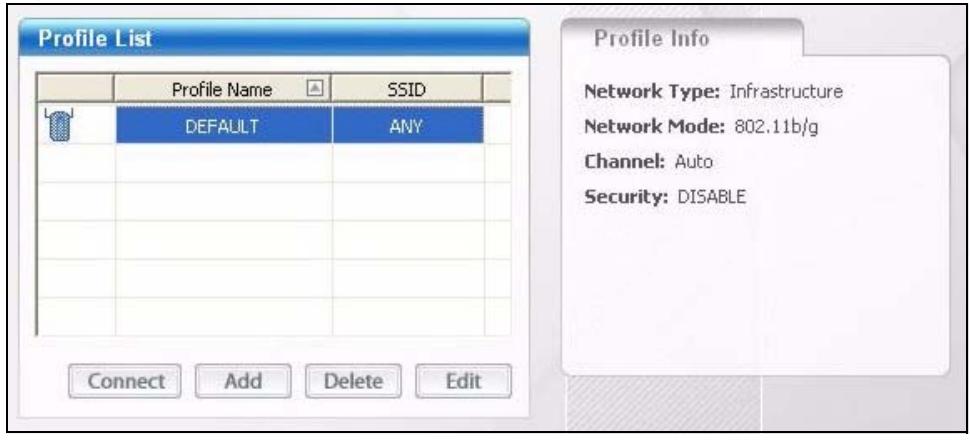
Click the Profile tab in the ZyXEL utility program to display the Profile screen as shown next.
The profile function allows you to save the wireless network settings in this screen, or use one of the pre-configured network profiles.
Figure 28 Profile Screen
text_image
Profile List Profile Name SSID DEFAULT ANY Connect Add Delete Edit Profile Info Network Type: Infrastructure Network Mode: 802.11b/g Channel: Auto Security: DISABLEThe following table describes the labels in this screen.
Table 13 Profile Screen
| LABEL | DESCRIPTION |
| Profile List | Click a column heading to sort the entries. |
 denotes that the wireless device is in infrastructure mode and the wireless security is activated. denotes that the wireless device is in infrastructure mode and the wireless security is activated. | |
 denotes that the wireless device is in infrastructure mode but the wireless security is deactivated. denotes that the wireless device is in infrastructure mode but the wireless security is deactivated. | |
 denotes that the wireless device is in Ad-Hoc mode and the wireless security is activated. denotes that the wireless device is in Ad-Hoc mode and the wireless security is activated. | |
| [0Y3H] denotes that the wireless device is in Ad-Hoc mode but the wireless security is deactivated. | |
| Profile Name | This is the name of the pre-configured profile. |
| SSID | This is the SSID of the wireless network to which the selected profile associates. |
| Connect | To use and activate a previously saved network profile, select a pre-configured profile name in the table and click Connect. |
| Add | To add a new profile into the table, click Add. |
| Delete | To delete an existing wireless network configuration, select a profile in the table and click Delete. |
| Edit | To edit an existing wireless network configuration, select a profile in the table and click Edit. |
| Profile Info | The following fields display detail information of the selected profile in the Profile List table. |
| Network Type | This field displays the network type (Infrastructure or Ad-Hoc) of the profile. |
| Network Mode | This fields displays the network standard (802.11g, 802.11b or 802.11b/g) of the wireless device. |
| Channel | This field displays the channel number used by the profile. |
| Security | This field shows whether data encryption is activated (WEP, 802.1x, WPA-PSK, WPA) or inactive (Disable). |
4.4.1 Adding a New Profile
Follow the steps below to add a new profile.
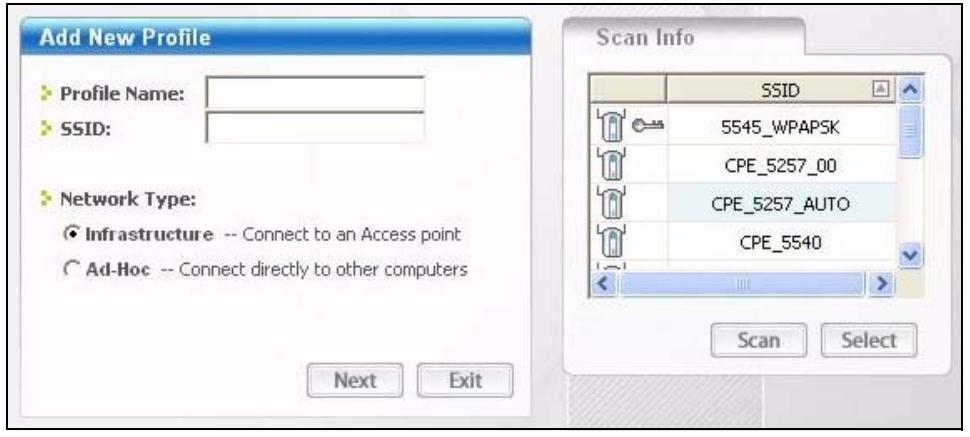
1 Click Add in the Profile screen. An Add New Profile screen displays as shown next. Click Next to continue.
Figure 29 Profile: Add New Profile
text_image
Add New Profile Profile Name: SSID: Network Type: Infrastructure -- Connect to an Access point Ad-Hoc -- Connect directly to other computers Next Exit Scan Info SSID 5545_WPAPSK CPE_5257_00 CPE_5257_AUTO CPE_5540 Scan SelectThe following table describes the labels in this screen.
Table 14 Profile: Add New Profile
| LABEL | DESCRIPTION |
| Add New Profile | |
| Profile Name | Enter a descriptive name in this field. |
| SSID | Select an available wireless device in the Scan Info table and click Select, or enter the SSID of the wireless device to which you want to associate in this field manually. Otherwise, enter Any to have the M-302 associate to or roam between any infrastructure wireless networks. |
| Network Type | Select Infrastructure to associate to an AP. Select Ad-Hoc to associate to a peer computer |
| Next | Click Next to go to the next screen. |
| Exit | Click Exit to go back to the previous screen without saving. |
| Scan Info | This table displays the information of the available wireless networks within the transmission range. |
 denotes that the wireless device is in infrastructure mode and the wireless security is activated. denotes that the wireless device is in infrastructure mode and the wireless security is activated. | |
| [25KC] denotes that the wireless device is in infrastructure mode but the wireless security is deactivated. | |
 denotes that the wireless device is in Ad-Hoc mode and the wireless security is activated. denotes that the wireless device is in Ad-Hoc mode and the wireless security is activated. | |
| [12HT] denotes that the wireless device is in Ad-Hoc mode but the wireless security is deactivated. | |
| SSID | This field displays the SSID (Service Set IDentifier) of each AP or peer device. |
| Scan | Click Scan to search for available wireless devices within transmission range. |
| Select | Select an available wireless device in the table and click Select to add it to this profile.Whenever you activate this profile, the M-302 associates to the selected wireless network only. |
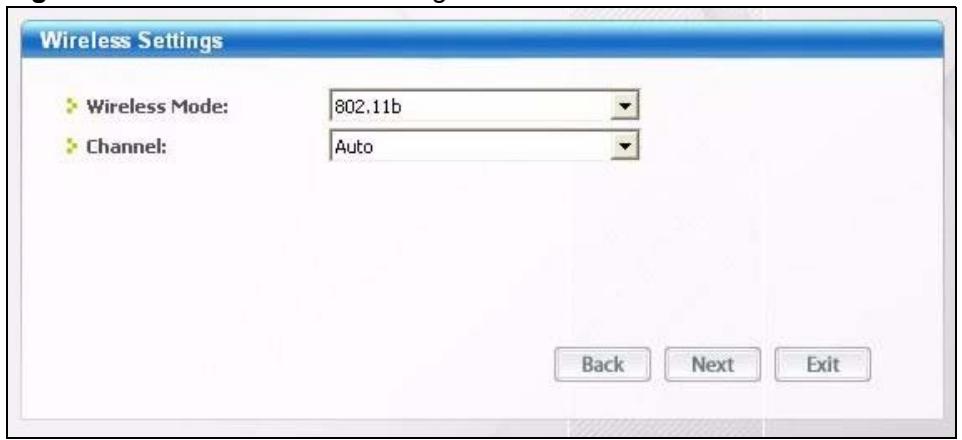
2 If you selected the Infrastructure network type in the previous screen, skip to step 3. If you selected the Ad-Hoc network type in the previous screen, a screen displays as follows. Select a channel number and click Next to continue.
Figure 30 Profile: Wireless Setting: Select a Channel
text_image
Wireless Settings Wireless Mode: 802.11b Channel: Auto Back Next ExitThe following table describes the labels in this screen.
Table 15 Profile: Wireless Setting: Select a Channel
| LABEL | DESCRIPTION |
| Wireless Settings | |
| Wireless Mode | When configuring for an Ad-Hoc network 802.11b mode is used. |
| Channel | Select a channel number from the drop-down list box. To associate to an Ad-Hoc network, you must use the same channel as the peer computer. |
| Back | Click Back to return to the Add New Profile screen. |
| Next | Click Next to confirm your selection and advance to the Encryption Type screen. |
| Exit | Click Exit to discard changes and return to the Add New Profile screen. |
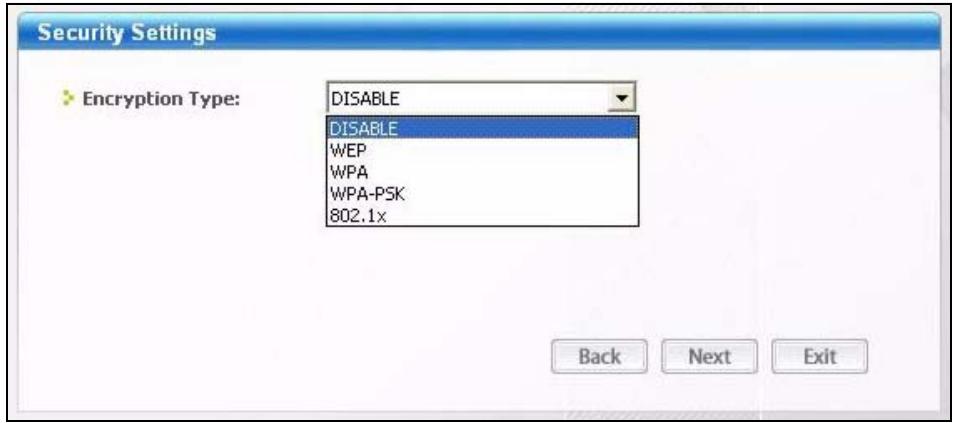
3 If you selected Infrastructure network type in the first screen, select WEP, WPA, WPA-PSK or 802.1x from the drop-down list box to enable data encryption. If you selected Ad-Hoc network type in the first screen, you can only use WEP encryption method. Otherwise, select DISABLE to allow the M-302 to communicate with the access points or other peer wireless computers without any data encryption and skip to step 5.
Figure 31 Profile: Security Setting: Encryption Type
text_image
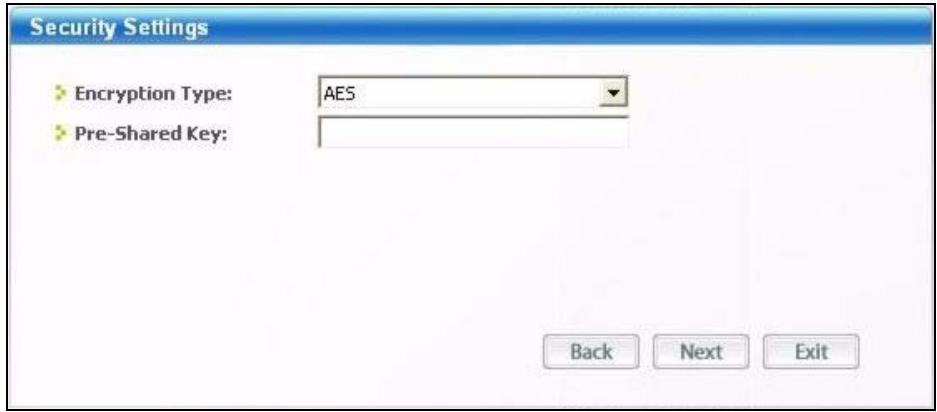
Security Settings Encryption Type: DISABLE DISABLE WEP WPA WPA-PSK 802.1x Back Next Exit4 The screen varies depending on the encryption method you select in the previous screen. The settings must be exactly the same on the APs or other peer wireless computers as they are on the M-302.
Figure 32 Profile: Security Setting
text_image
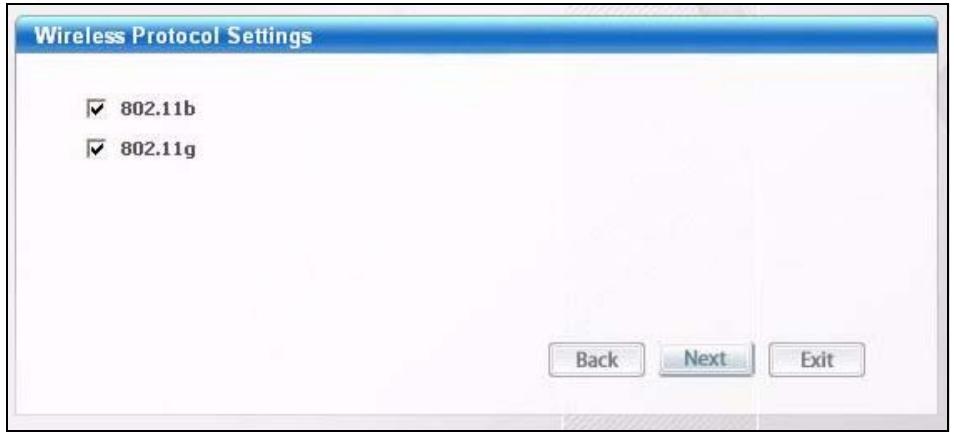
Security Settings Encryption Type: AES Pre-Shared Key: Back Next Exit5 If you selected Ad-Hoc network type in the first screen, skip to the next step. If you selected Infrastructure network type, specify a wireless protocol. Select 802.11b to have the M-302 connect to an IEEE 802.11b wireless device. Select 802.11g to have the M-302 connect to an IEEE 802.11g wireless device. Select both to have the M-302 connect to either an IEEE 802.11g or IEEE 802.11b wireless device.
Figure 33 Profile: Wireless Protocol
text_image
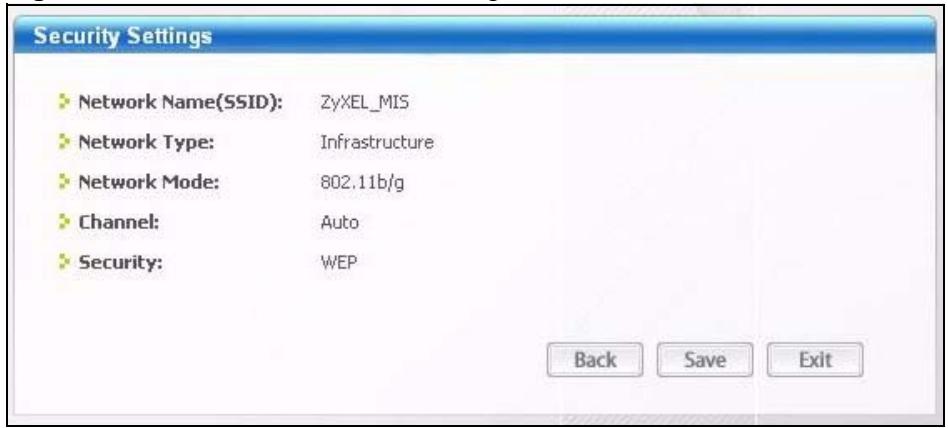
Wireless Protocol Settings ✓ 802.11b ✓ 802.11g Back Next Exit6 This read-only screen shows a summary of the new profile settings. Verify that the settings are correct. Click Save to save and go to the next screen. Click Back to return to the previous screen. Otherwise, click Exit to go back to the Profile screen without saving.
Figure 34 Profile: Confirm New Settings
text_image
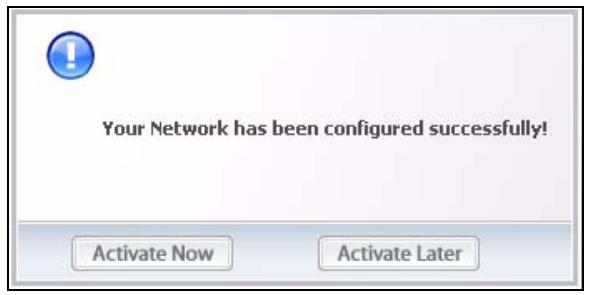
Security Settings Network Name(SSID): ZyXEL_MIS Network Type: Infrastructure Network Mode: 802.11b/g Channel: Auto Security: WEP Back Save Exit7 To use this network profile, click the Activate Now button. Otherwise, click the Activate Later button.
Note: Once you activate a profile, the ZyXEL utility will use that profile the next time it is started.
You can activate only one profile at a time.
Figure 35 Profile: Activate the Profile
text_image
Your Network has been configured successfully! Activate Now Activate Later4.5 The Adapter Screen
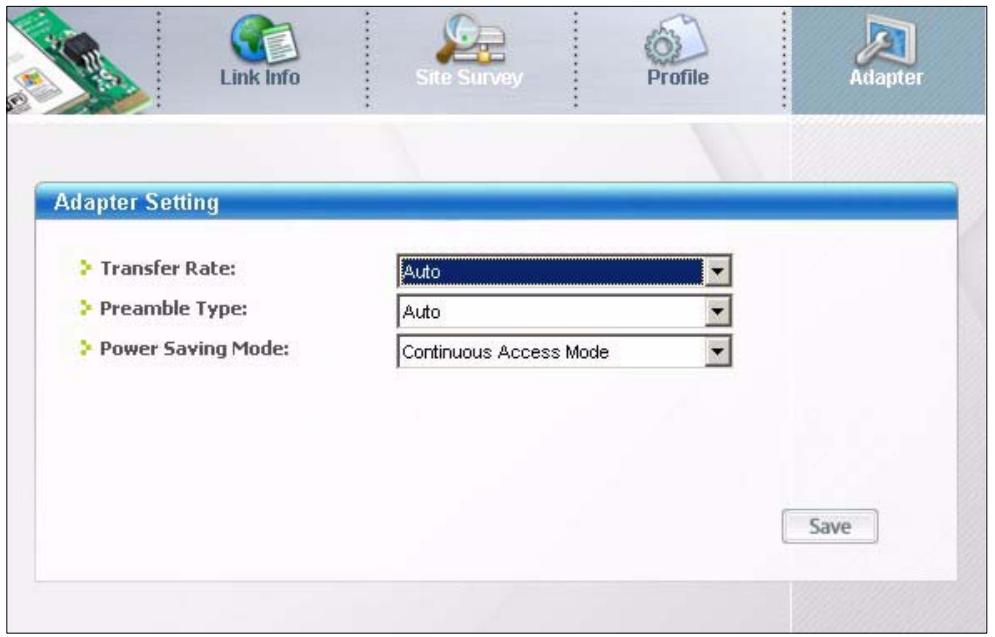
To set the advanced features on the M-302, click the Adapter tab.
Figure 36 Adapter Screen
text_image
Link Info Site Survey Profile Adapter Adapter Setting Transfer Rate: Auto Preamble Type: Auto Power Saving Mode: Continuous Access Mode SaveThe following table describes the labels in this screen.
Table 16 Adapter Screen
| LABEL | DESCRIPTION |
| Adapter Setting | |
| Transfer Rate | In most networking scenarios, the factory default Fully Auto setting is the most efficient and allows your M-302 to operate at the highest possible transfer (data) rate.If you want to select a specific transfer rate, select one that the AP or peer wireless device supports.Note: Super GThe Super G technology works with IEEE 802.11 a/b/g products. It doubles IEEE 802.11g performance by bonding two 54Mbps channels and allowing larger frames to be sent.Your M-302 can transmit at up to 108 Mbps when connected to an AP or wireless router with the Super G feature enabled. |
| Preamble Type | Preamble is used to signal that data is coming to the receiver. Select the preamble type that the AP uses.Short Preamble increases performance as less time sending preamble means more time for sending data. All IEEE 802.11b/g compliant wireless adapters support Long Preamble, but not all support short preamble.Select Auto to have the M-302 automatically use short preamble when all access point or wireless stations support it; otherwise the M-302 uses long preamble.Note: The M-302 and the access point or wireless stations MUST use the same preamble mode in order to communicate. |
| Power Saving Mode | Select Maximum Power Saving or Fast Power Saving to save power (especially for notebook computers). This forces the M-302 to go to sleep mode when it is not transmitting data.When you select Continuous Access Mode, the M-302 will never go to sleep mode. |
| Save | Click Save to save the changes back to the M-302. |
CHAPTER 5 Maintenance
This chapter describes how to uninstall or upgrade the ZyXEL utility.
5.1 The About Screen
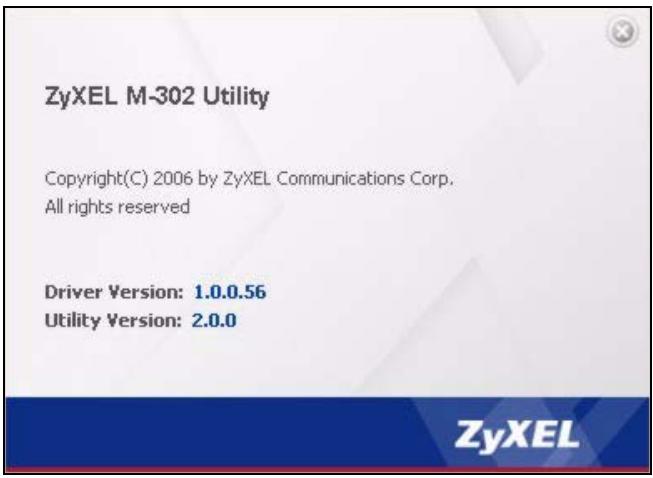
The About screen displays driver and utility version numbers of the M-302. To display the screen as shown below, click the about ( ) button.
Figure 37 About Screen
text_image
ZyXEL M-302 Utility Copyright(C) 2006 by ZyXEL Communications Corp. All rights reserved Driver Version: 1.0.0.56 Utility Version: 2.0.0 ZyXELThe following table describes the read-only fields in this screen.
Table 17 About Screen
| LABEL | DESCRIPTION |
| Driver Version | This field displays the version number of the M-302 driver. |
| Utility Version | This field displays the version number of the ZyXEL utility. |
5.2 Uninstalling the ZyXEL Utility
Follow the steps below to remove (or uninstall) the ZyXEL utility from your computer.
1 Click Start, (All) Programs, M-302 Utility, Uninstall M-302 Utility.
2 When prompted, click OK or Yes to remove the driver and the utility software.
Figure 38 Uninstall: Confirm

text_image
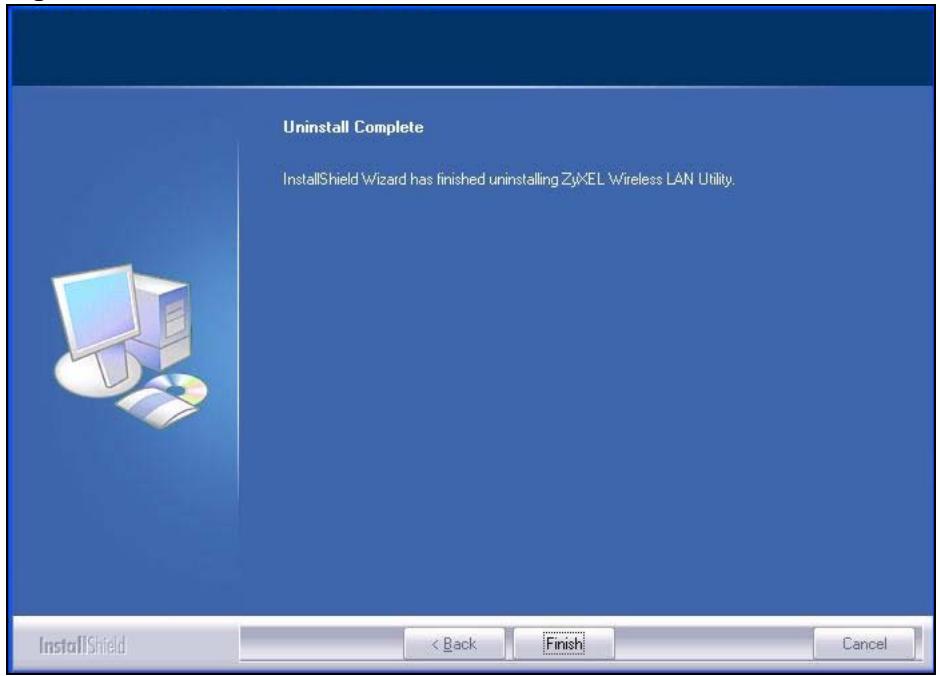
Do you want to completely remove the selected application and all of its features? Yes No3 Click Finish to complete uninstalling the software and restart the computer when prompted.
Figure 39 Uninstall: Finish
text_image
Uninstall Complete InstallShield Wizard has finished uninstalling ZyXEL Wireless LAN Utility. InstallShield < Back Finish Cancel5.3 Upgrading the ZyXEL Utility
Note: Before you uninstall the ZyXEL utility, take note of your current wireless configurations.
To perform the upgrade, follow the steps below.
1 Download the latest version of the utility from the ZyXEL web site and save the file on your computer.
2 Remove the current ZyXEL utility from your computer (see Section 5.2 on page 53).
3 Restart your computer when prompted.
4 Disconnect the M-302 from your computer.
5 Double-click on the setup program for the new utility to start the ZyXEL utility installation.
6 Insert the M-302 and check the version numbers in the About screen to make sure the new utility is installed properly.
CHAPTER 6
Troubleshooting
This chapter covers potential problems and the possible remedies. After each problem description, some instructions are provided to help you to diagnose and solve the problem.
6.1 Problems Starting the ZyXEL Utility
Table 18 Troubleshooting Starting the ZyXEL Utility
| PROBLEM | CORRECTIVE ACTION |
| Cannot start the ZyXEL Wireless LAN utility | Make sure the M-302 is properly inserted and the LED is on.Use theDevice Managerto check for possible hardware conflicts. ClickStart, Settings, Control Panel, System, HardwareandDevice Manager. Verify the status of the M-302 underNetwork Adapter.(Steps may vary depending on the version of Windows).Install the M-302 in another computer.If the error persists, you may have a hardware problem. In this case, you should contact your local vendor. |
| The ZyXEL utility icon does not display. | If you install the Funk Odyssey Client software on the computer, uninstall (remove) both the Funk Odyssey Client software and ZyXEL utility, and then install the ZyXEL utility again after restarting the computer. |
6.2 Problem with the Link Quality
Table 19 Troubleshooting Link Quality
| PROBLEM | CORRECTIVE ACTION |
| The link quality and/or signal strength is poor all the time. | Search and connect to another AP with a better link quality using the Site Survey screen.Move your computer closer to the AP or the peer computer(s) within the transmission range.There may be too much radio interference (for example microwave or another AP using the same channel) around your wireless network. Relocate or reduce the radio interference.Make sure there are not too many wireless stations connected to a wireless network. |
6.3 Problems Communicating With Other Computers
Table 20 Troubleshooting Communication Problems
| PROBLEM | CORRECTIVE ACTION |
| The computer with the M-302 installed cannot communicate with the other computer(s). | In Infrastructure ModeMake sure that the AP and the associated computers are turned on and working properly.Make sure the M-302 computer and the associated AP use the same SSID.Change the AP and the associated wireless clients to use another radio channel if interference is high.Make sure that the computer and the AP share the same security option and key. Verify the settings in theProfile Security Settingsscreen.If you are using WPA(2) or WPA(2)-PSK security, try changing your encryption type from TKIP to AES or vice versa.In Ad-Hoc ModeVerify that the peer computer(s) is turned on.Make sure the M-302 computer and the peer computer(s) are using the same SSID and channel.Make sure that the computer and the peer computer(s) share the same security settings.If you are using WPA(2) or WPA(2)-PSK security, try changing your encryption type from TKIP to AES or vice versa.Change the wireless clients to use another radio channel if interference is high. |
APPENDIX A
Product Specifications
Table 21 Product Specifications
| PHYSICAL AND ENVIRONMENTAL | |
| Product Name | M-302 802.11g Wireless MIMO PCI card |
| Interface | 3.3V 32-bit CardBus card |
| Standards | IEEE 802.11bIEEE 802.11g (Infrastructure mode only) |
| Network Architectures | InfrastructureAd-Hoc |
| Security | 64/128/152-bit WEP EncryptionWPA/WPA-PSKIEEE 802.1x |
| Operating Temperature | 0 ~ 50 degrees Centigrade |
| Storage Temperature | -25 ~ 70 degrees Centigrade |
| Operating Humidity | 0 ~ 70% (non-condensing) |
| Storage Humidity | 10 ~ 90% (non-condensing) |
| Power Consumption | TX: 620mA RX: 600mA |
| Voltage | 3.3V |
| Weight | 0.09 lbs / 40g |
| Dimensions | 134mm X 119mm X 22mm (without antenna)158mm X 205mm X22mm (with antenna) |
| RADIO SPECIFICATIONS | |
| Media Access Protocol | IEEE 802.11 |
| Frequency | USA (FCC) & Canada 11 Channels: 2.412GHz~2.462GHzEurope (ETSI) 13 Channels: 2.412GHz~2.472GHzJapan (TELEC) 13 Channels: 2.412GHz~2.483GHz |
| Data Rate | IEEE 802.11g: Orthogonal Frequency Division Multiplexing (OFDM): 108 (Super G mode only), 54, 48, 36, 24, 18, 12, 9, 6 MbpsIEEE 802.11b: 11, 5.5, 2, 1 Mbps |
| Modulation | 11g: OFDM (64QAM, 16QAM, QPSK, BPSK)11b: PBCC, Direct Sequence Spread Spectrum (DSSS), (CCK, DQPSK, DBPSK) |
| Output Power | 11g: At 54Mbps 16dBm +/-1dBm (typical)11b: At 11Mbps 18dBm +/-1dBm (typical) |
| RX Sensitivity | 11g: At 54Mbps -74dBm +/- 1dBm (typical)11b: At 11Mbps -84dBm +/- 1dBm (typical) |
| SOFTWARE SPECIFICATIONS | |
| Device Drivers | Windows 2000, Windows XP |
| Roaming | IEEE 802.11b/g compliant |
| WEP | 64/128/152-bit WEP encryption |
APPENDIX B
Management with Wireless Zero Configuration
This appendix shows you how to manage your ZyXEL wireless LAN adapter using the Windows XP wireless zero configuration tool.
Be sure you have the Windows XP service pack 2 installed on your computer. Otherwise, you should at least have the Windows XP service pack 1 already on your computer and download the support patch for WPA from the Microsoft web site.
Windows XP SP2 screen shots are shown unless otherwise specified. Click the help icon ( ? ) in most screens, move the cursor to the item that you want the information about and click to view the help.
Activating Wireless Zero Configuration
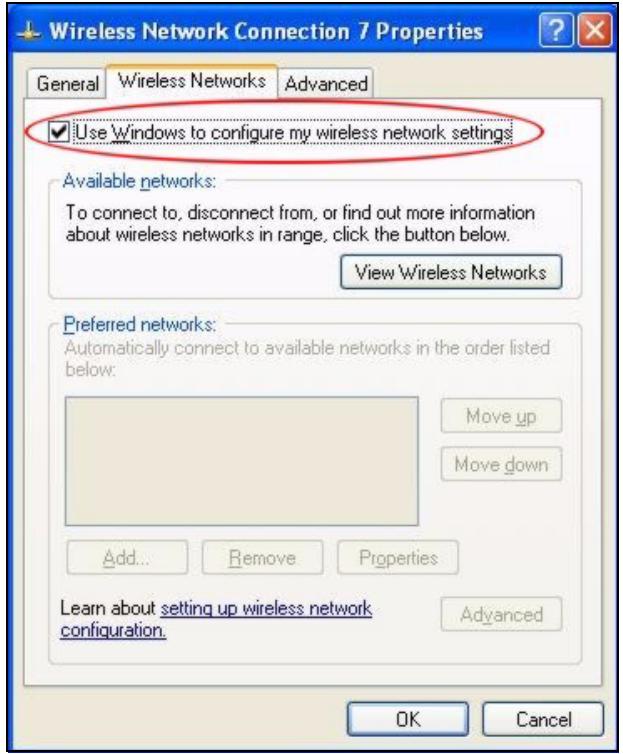
Make sure the Use Windows to configure my wireless network settings check box is selected in the Wireless Network Connection Properties screen.
1 click Start, Control Panel and double-click Network Connections.
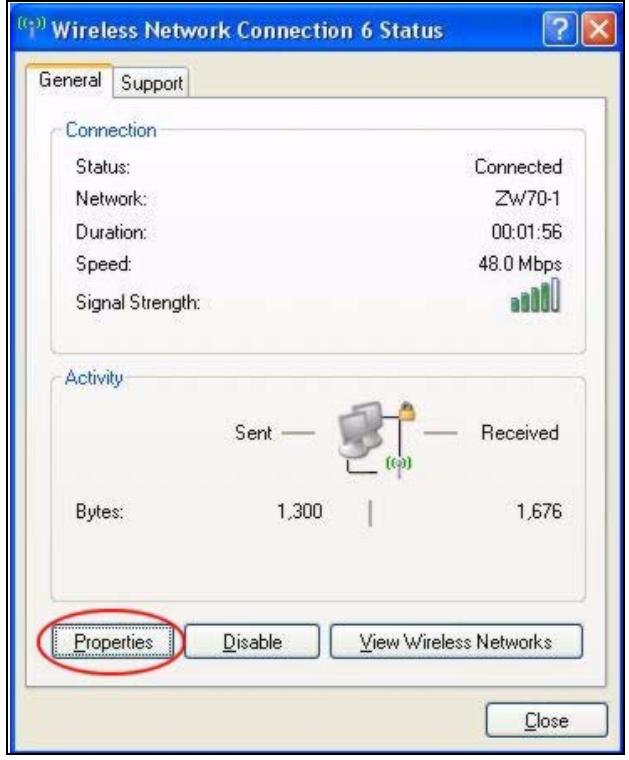
2 Double-click on the icon for wireless network connection to display a status window as shown below.
3 Click Properties and click the Wireless Networks tab.
Figure 40 Windows XP SP2: Wireless Network Connection Status
text_image
(1) Wireless Network Connection 6 Status General Support Connection Status: Connected Network: Zw70-1 Duration: 00:01:56 Speed: 48.0 Mbps Signal Strength: Activity Sent — Received Bytes: 1,300 | 1,676 Properties Disable View Wireless Networks Close4 In the Wireless Network Connection Properties window, make sure the Use Windows to configure my wireless network settings check box is selected. Click OK.
Figure 41 Windows XP SP2: Wireless Network Connection Properties
text_image
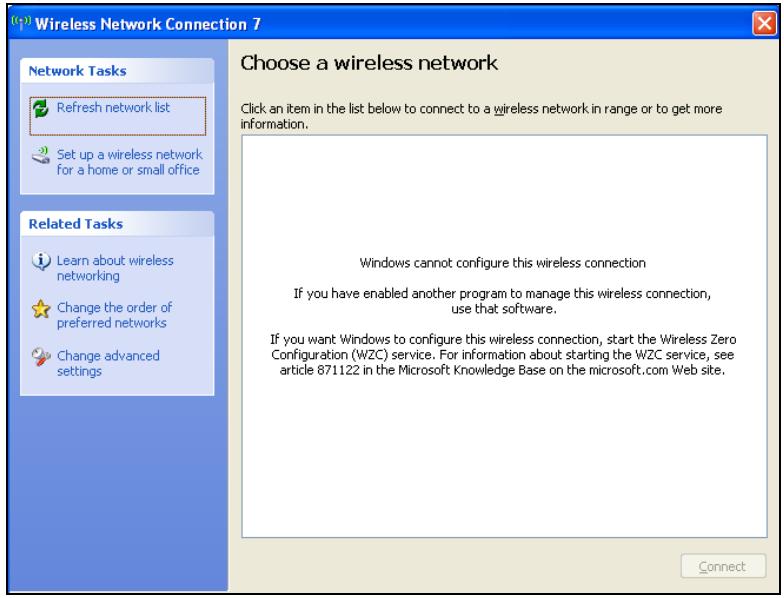
Wireless Network Connection 7 Properties General Wireless Networks Advanced ✓ Use Windows to configure my wireless network settings Available networks: To connect to, disconnect from, or find out more information about wireless networks in range, click the button below. View Wireless Networks Preferred networks: Automatically connect to available networks in the order listed below: Move up Move down Add... Remove Properties Learn about setting up wireless network configuration. Advanced OK CancelIf you see the following screen, refer to article 871122 on the Microsoft web site for information on starting WZC.
Figure 42 Windows XP SP2: WZC Not Available
text_image
Wireless Network Connection 7 Network Tasks Refresh network list Set up a wireless network for a home or small office Related Tasks Learn about wireless networking Change the order of preferred networks Change advanced settings Choose a wireless network Click an item in the list below to connect to a wireless network in range or to get more information. Windows cannot configure this wireless connection If you have enabled another program to manage this wireless connection, use that software. If you want Windows to configure this wireless connection, start the Wireless Zero Configuration (WZC) service. For information about starting the WZC service, see article 871122 in the Microsoft Knowledge Base on the microsoft.com Web site. ConnectConnecting to a Wireless Network
1 Double-click the network icon for wireless connections in the system tray to open the Wireless Network Connection Status screen.
Figure 43 Windows XP SP2: System Tray Icon
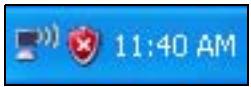
The type of the wireless network icon in Windows XP SP2 indicates the status of the ZyXEL wireless LAN adapter. Refer to the following table for details.
Table 22 Windows XP SP2: System Tray Icon
| ICON | DESCRIPTION |
 | The ZyXEL wireless LAN adapter is connected to a wireless network. |
 | The ZyXEL wireless LAN adapter is in the process of connecting to a wireless network. |
 | The connection to a wireless network is limited because the network did not assign a network address to the computer. |
 | The ZyXEL wireless LAN adapter is not connected to a wireless network. |
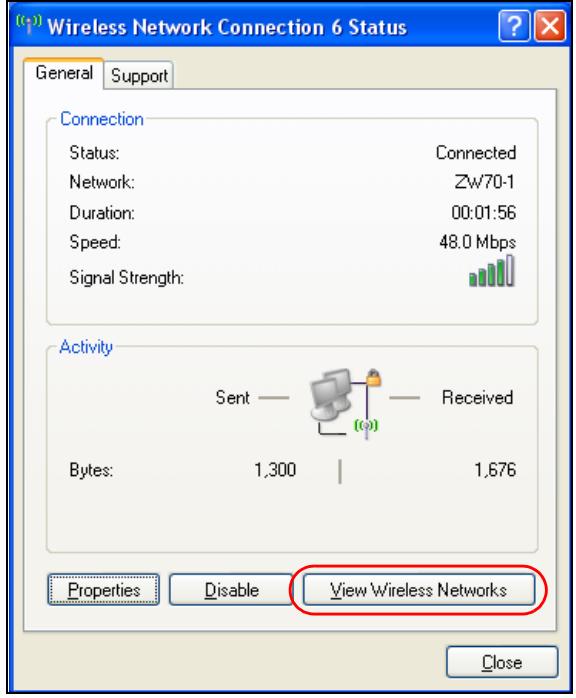
2 Windows XP SP2: In the Wireless Network Connection Status screen, click View Wireless Networks to open the Wireless Network Connection screen.
Figure 44 Windows XP SP2: Wireless Network Connection Status
text_image
Wireless Network Connection 6 Status General Support Connection Status: Connected Network: Zw70-1 Duration: 00:01:56 Speed: 48.0 Mbps Signal Strength: Activity Sent — Received Bytes: 1,300 | 1,676 Properties Disable View Wireless Networks CloseWindows XP SP1: In the Wireless Network Connection Status screen, click Properties and the Wireless Networks tab to open the Wireless Network Connection Properties screen.
Figure 45 Windows XP SP1: Wireless Network Connection Status
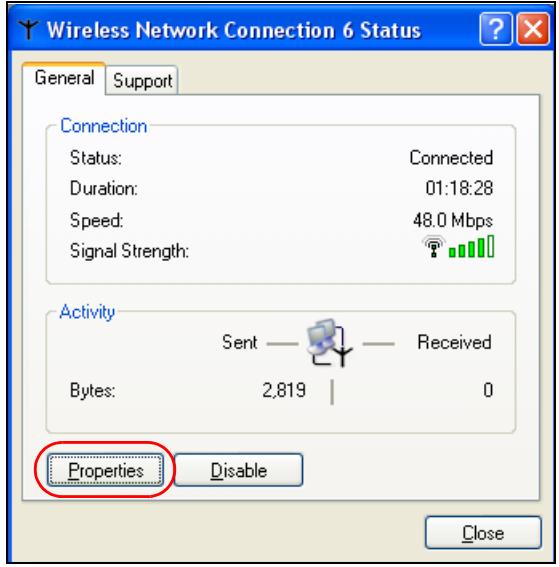
text_image
Wireless Network Connection 6 Status General Support Connection Status: Connected Duration: 01:18:28 Speed: 48.0 Mbps Signal Strength: Activity Sent — Received Bytes: 2,819 0 Properties Disable Close3 Windows XP SP2: Click Refresh network list to reload and search for available wireless devices within transmission range. Select a wireless network in the list and click Connect to join the selected wireless network.
Figure 46 Windows XP SP2: Wireless Network Connection
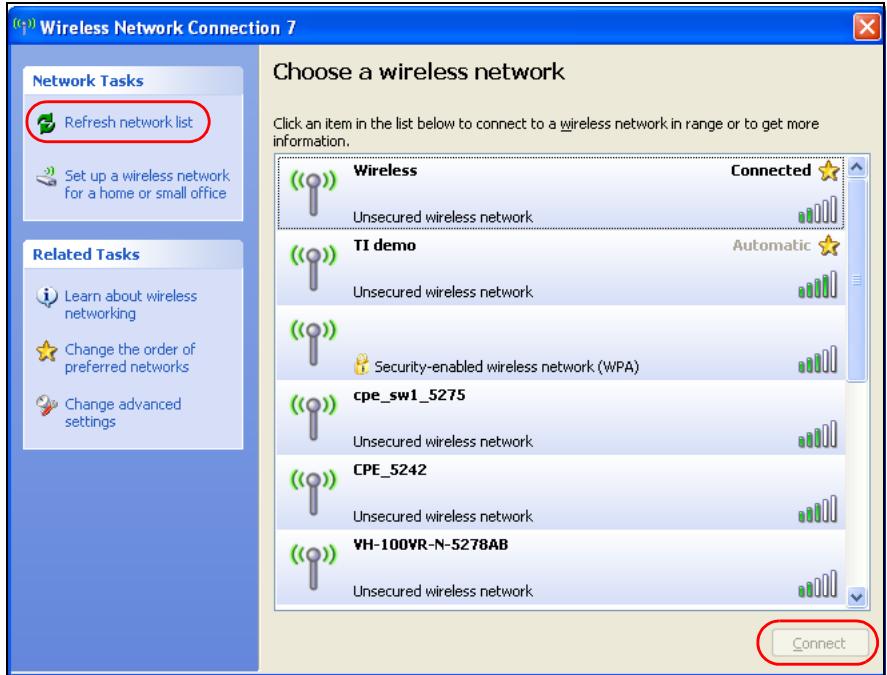
text_image
Wireless Network Connection 7 Network Tasks Refresh network list Set up a wireless network for a home or small office Related Tasks Learn about wireless networking Change the order of preferred networks Change advanced settings Choose a wireless network Click an item in the list below to connect to a wireless network in range or to get more information. Wireless Connected Unsecured wireless network TI demo Automatic Unsecured wireless network Security-enabled wireless network (WPA) cpe_sw1_5275 Unsecured wireless network CPE_5242 Unsecured wireless network YH-100VR-N-5278AB Unsecured wireless network ConnectThe following table describes the icons in the wireless network list.
Table 23 Windows XP SP2: Wireless Network Connection
| ICON | DESCRIPTION |
| [5K/57] | This denotes that wireless security is activated for the wireless network. |
 | This denotes that this wireless network is your preferred network. Ordering your preferred networks is important because the ZyXEL wireless LAN adapter tries to associate to the preferred network first in the order that you specify. Refer to the section on ordering the preferred networks for detailed information. |
 | This denotes the signal strength of the wireless network.Move your cursor to the icon to see details on the signal strength. |
Windows XP SP1: Click Refresh to reload and search for available wireless devices within transmission range. Select a wireless network in the Available networks list, click Configure and set the related fields to the same security settings as the associated AP to add the selected network into the Preferred networks table. Click OK to join the selected wireless network. Refer to the section on security settings (discussed later) for more information.
Figure 47 Windows XP SP1: Wireless Network Connection Properties
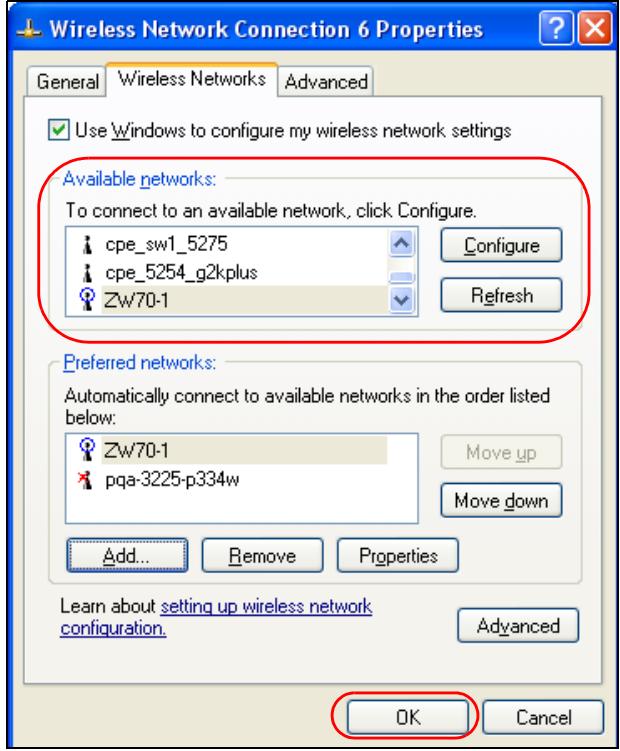
text_image
Wireless Network Connection 6 Properties General Wireless Networks Advanced Use Windows to configure my wireless network settings Available networks: To connect to an available network, click Configure. cpe_sw1_5275 cpe_5254_g2kplus Zw70-1 Configure Refresh Preferred networks: Automatically connect to available networks in the order listed below: Zw70-1 pqa-3225-p334w Move up Move down Add... Remove Properties Learn about setting up wireless network configuration. Advanced OK Cancel- Windows XP SP2: If the wireless security is activated for the selected wireless network, the Wireless Network Connection screen displays. You must set the related fields in the Wireless Network Connection screen to the same security settings as the associated AP and click Connect. Refer to the section about security settings for more information. Otherwise click Cancel and connect to another wireless network without data encryption. If there is no security activated for the selected wireless network, a warning screen appears. Click Connect Anyway if wireless security is not your concern.
Figure 48 Windows XP SP2: Wireless Network Connection: WEP or WPA-PSK
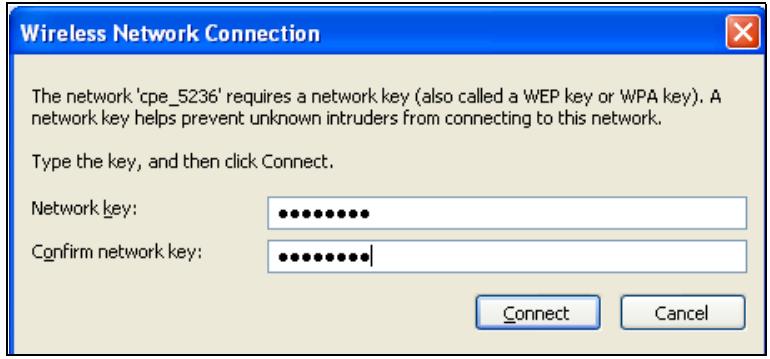
text_image
Wireless Network Connection The network 'cpe_5236' requires a network key (also called a WEP key or WPA key). A network key helps prevent unknown intruders from connecting to this network. Type the key, and then click Connect. Network key: ••••••••••• Confirm network key: ••••••••••• Connect CancelFigure 49 Windows XP SP2: Wireless Network Connection: No Security
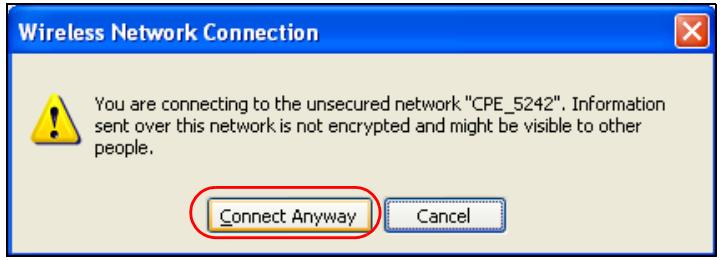
text_image
Wireless Network Connection You are connecting to the unsecured network "CPE_5242". Information sent over this network is not encrypted and might be visible to other people. Connect Anyway Cancel5 Verify that you have successfully connected to the selected network and check the connection status in the wireless network list or the connection icon in the Preferred networks or Available networks list.
The following table describes the connection icons.
Table 24 Windows XP: Wireless Networks
| ICON | DESCRIPTION |
| This denotes the wireless network is an available wireless network. | |
| This denotes the ZyXEL wireless LAN adapter is associated to the wireless network. | |
| This denotes the wireless network is not available. |
Security Settings
When you configure the ZyXEL wireless LAN adapter to connect to a secure network but the security settings are not yet enabled on the ZyXEL wireless LAN adapter, you will see different screens according to the authentication and encryption methods used by the selected network.
Association
Select a network in the Preferred networks list and click Properties to view or configure security.
Figure 50 Windows XP: Wireless (network) properties: Association
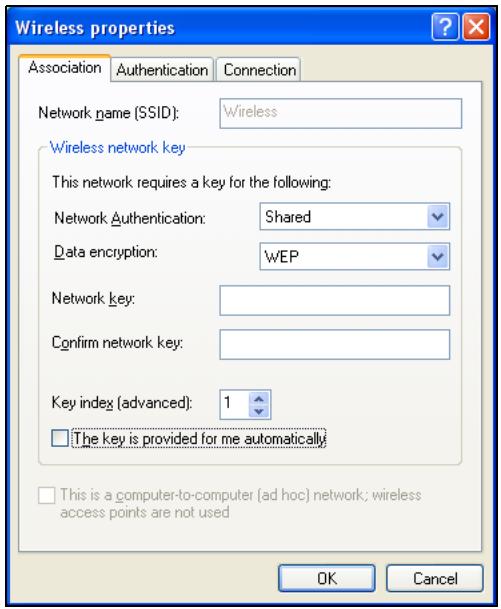
text_image
Wireless properties Association Authentication Connection Network name (SSID): Wireless Wireless network key This network requires a key for the following: Network Authentication: Shared Data encryption: WEP Network key: Confirm network key: Key index (advanced): 1 The key is provided for me automatically This is a computer-to-computer (ad hoc) network; wireless access points are not used OK Cancel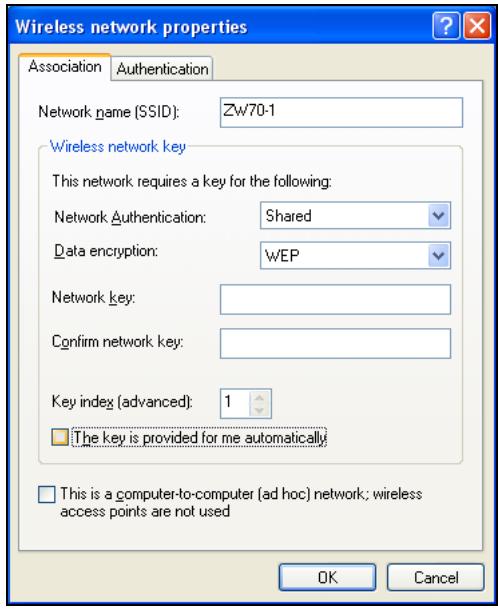
text_image
Wireless network properties Association Authentication Network name (SSID): ZW70-1 Wireless network key This network requires a key for the following: Network Authentication: Shared Data encryption: WEP Network key: Confirm network key: Key index (advanced): 1 The key is provided for me automatically This is a computer-to-computer (ad hoc) network; wireless access points are not used OK CancelThe following table describes the labels in this screen.
Table 25 Windows XP: Wireless (network) properties: Association
| LABEL | DESCRIPTION |
| Network name (SSID) | This field displays the SSID (Service Set IDentifier) of each wireless network. |
| Network Authentication | This field automatically shows the authentication method (Share, Open, WPA or WPA-PSK) used by the selected network. |
| Data Encryption | This field automatically shows the encryption type (TKIP, WEP or Disable) used by the selected network. |
| Network Key | Enter the pre-shared key or WEP key.The values for the keys must be set up exactly the same on all wireless devices in the same wireless LAN. |
| Confirm network key | Enter the key again for confirmation. |
| Key index (advanced) | Select a default WEP key to use for data encryption.This field is available only when the network use WEP encryption method and the The key is provided for me automatically check box is not selected. |
| The key is provided for me automatically | If this check box is selected, the wireless AP assigns the ZyXEL wireless LAN adapter a key. |
| This is a computer-to-computer (ad hoc) network; wireless access points are not used | If this check box is selected, you are connecting to another computer directly. |
| OK | Click OK to save your changes. |
| Cancel | Click Cancel to leave this screen without saving any changes you may have made. |
Authentication
Click the Authentication tab in the Wireless (network) properties screen to display the screen shown next. The fields on this screen are grayed out when the network is in Ad-Hoc mode or data encryption is disabled.
Figure 51 Windows XP: Wireless (network) properties: Authentication
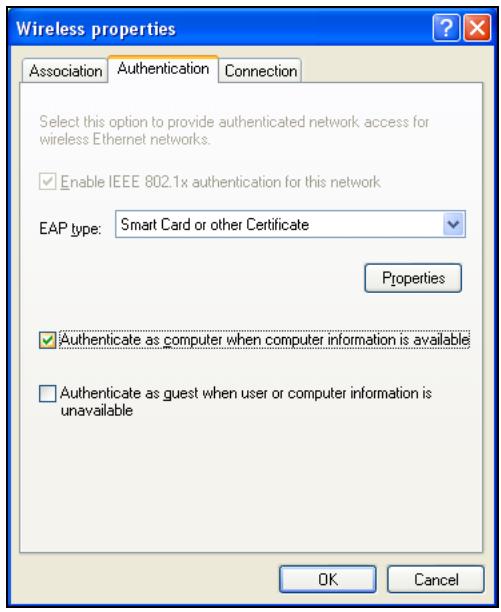
text_image
Wireless properties Association Authentication Connection Select this option to provide authenticated network access for wireless Ethernet networks. Enable IEEE 802.1x authentication for this network EAP type: Smart Card or other Certificate Properties Authenticate as computer when computer information is available Authenticate as guest when user or computer information is unavailable OK Cancel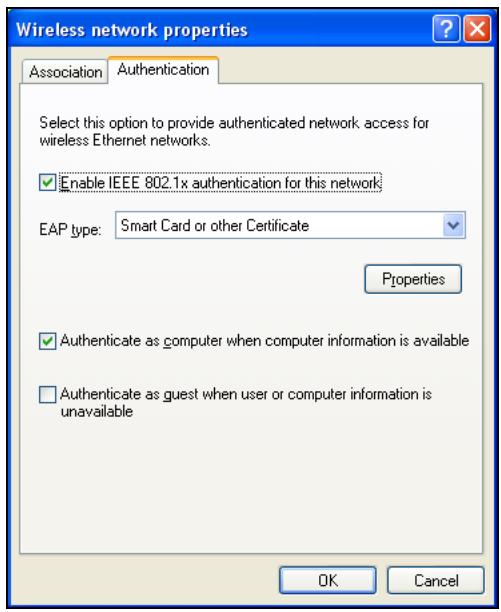
text_image
Wireless network properties Association Authentication Select this option to provide authenticated network access for wireless Ethernet networks. Enable IEEE 802.1x authentication for this network. EAP type: Smart Card or other Certificate Properties Authenticate as computer when computer information is available Authenticate as guest when user or computer information is unavailable OK CancelThe following table describes the labels in this screen.
Table 26 Windows XP: Wireless (network) properties: Authentication
| LABEL | DESCRIPTION |
| Enable IEEE 802.1x authentication for this network | This field displays whether the IEEE 802.1x authentication is active.If the network authentication is set toOpenin the previous screen, you can choose to disable or enable this feature. |
| EAP Type | Select the type of EAP authentication. Options areProtected EAP (PEAP) andSmart Card or other Certificate. |
| Properties | Click this button to open the properties screen and configure certificates. The screen varies depending on what you select in theEAP typefield. |
| Authenticate as computer when computer information is available | Select this check box to have the computer send its information to the network for authentication when a user is not logged on. |
| Authenticate as guest when user or computer information is unavailable | Select this check box to have the computer access to the network as a guest when a user is not logged on or computer information is not available. |
| OK | ClickOKto save your changes. |
| Cancel | ClickCancelto leave this screen without saving any changes you may have made. |
Authentication Properties
Select an EAP authentication type in the Wireless (network) properties: Authentication screen and click the Properties button to display the following screen.
Protected EAP Properties
Figure 52 Windows XP: Protected EAP Properties
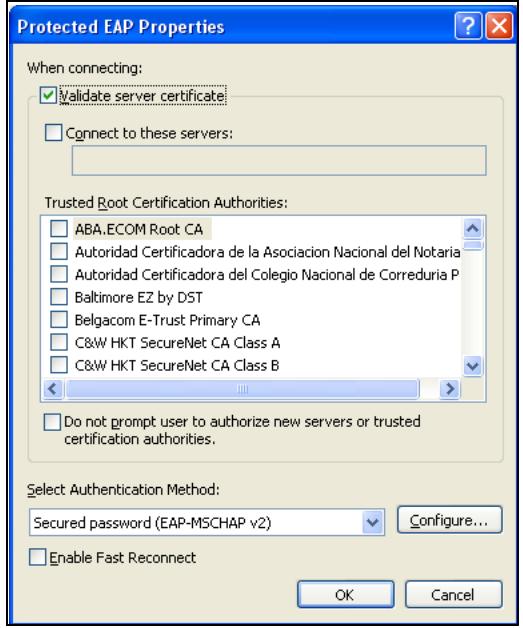
text_image
Protected EAP Properties When connecting: ✓ Validate server certificate ☐ Connect to these servers: Trusted Root Certification Authorities: ☐ ABA.ECOM Root CA ☐ Autoridad Certificadora de la Asociacion Nacional del Notaria ☐ Autoridad Certificadora del Colegio Nacional de Correduria P ☐ Baltimore EZ by DST ☐ Belgacom E-Trust Primary CA ☐ C&W HKT SecureNet CA Class A ☐ C&W HKT SecureNet CA Class B ☐ Do not prompt user to authorize new servers or trusted certification authorities. Select Authentication Method: Secured password (EAP-MSCHAP v2) Configure... ☐ Enable Fast Reconnect OK CancelThe following table describes the labels in this screen.
Table 27 Windows XP: Protected EAP Properties
| LABEL | DESCRIPTION |
| Validate server certificate | Select the check box to verify the certificate of the authentication server. |
| Connect to these servers | Select the check box and specify a domain in the field below to have your computer connect to a server which resides only within this domain. |
| Trusted Root Certification Authorities: | Select a trusted certification authority from the list below.Note: You must first have a wired connection to a network and obtain the certificate(s) from a certificate authority (CA).Consult your network administrator for more information. |
| Do not prompt user to authorize new server or trusted certification authorities. | Select this check box to verify a new authentication server or trusted CA without prompting.This field is available only if you installed the Windows XP server pack 2. |
| Select Authentication Method: | Select an authentication method from the drop-down list box and click Configure to do settings. |
Table 27 Windows XP: Protected EAP Properties
| LABEL | DESCRIPTION |
| Enable Fast Reconnect | Select the check box to automatically reconnect to the network (without re-authentication) if the wireless connection goes down. |
| OK | Click OK to save your changes. |
| Cancel | Click Cancel to leave this screen without saving any changes you may have made. |
Smart Card or other Certificate Properties
Figure 53 Windows XP: Smart Card or other Certificate Properties
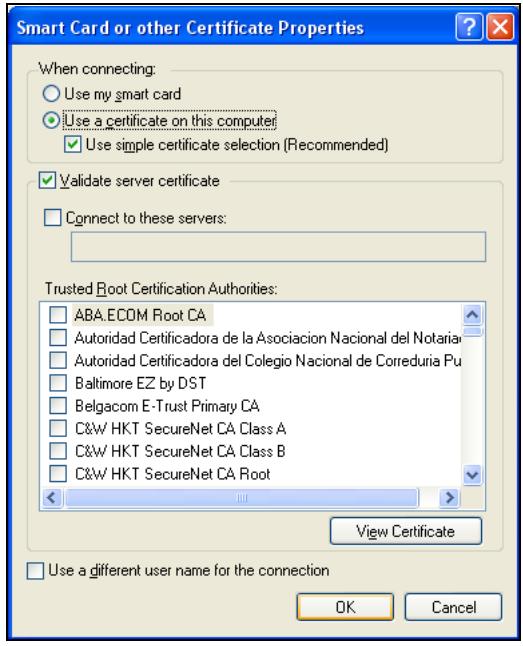
text_image
Smart Card or other Certificate Properties When connecting: Use my smart card Use a certificate on this computer Use simple certificate selection (Recommended) Validate server certificate Connect to these servers: Trusted Root Certification Authorities: ABA.ECOM Root CA Autoridad Certificadora de la Asociacion Nacional del Notaria Autoridad Certificadora del Colegio Nacional de Correduria Pu Baltimore EZ by DST Belgacom E-Trust Primary CA C&W HKT SecureNet CA Class A C&W HKT SecureNet CA Class B C&W HKT SecureNet CA Root View Certificate Use a different user name for the connection OK CancelThe following table describes the labels in this screen.
Table 28 Windows XP: Smart Card or other Certificate Properties
| LABEL | DESCRIPTION |
| Use my smart card | Select this check box to use the smart card for authentication. |
| Use a certificate on this computer | Select this check box to use a certificate on your computer for authentication. |
| Validate server certificate | Select the check box to check the certificate of the authentication server. |
| Connect to these servers | Select the check box and specify a domain in the field below to have your computer connect to a server which resides only within this domain. |
| Trusted Root Certification Authorities: | Select a trusted certification authority from the list below.Note: You must first have a wired connection to a network and obtain the certificate(s) from a certificate authority (CA).Consult your network administrator for more information. |
| View Certificate | Click this button if you want to verify the selected certificate. |
Table 28 Windows XP: Smart Card or other Certificate Properties
| LABEL | DESCRIPTION |
| Use a different user name for the connection: | Select the check box to use a different user name when the user name in the smart card or certificate is not the same as the user name in the domain that you are logged on to. |
| OK | Click OK to save your changes. |
| Cancel | Click Cancel to leave this screen without saving any changes you may have made. |
Ordering the Preferred Networks
Follow the steps below to manage your preferred networks.
1 Windows XP SP2: Click Change the order of preferred networks in the Wireless Network Connection screen (see Figure 46 on page 63). The screen displays as shown.
Figure 54 Windows XP SP2: Wireless Networks: Preferred Networks
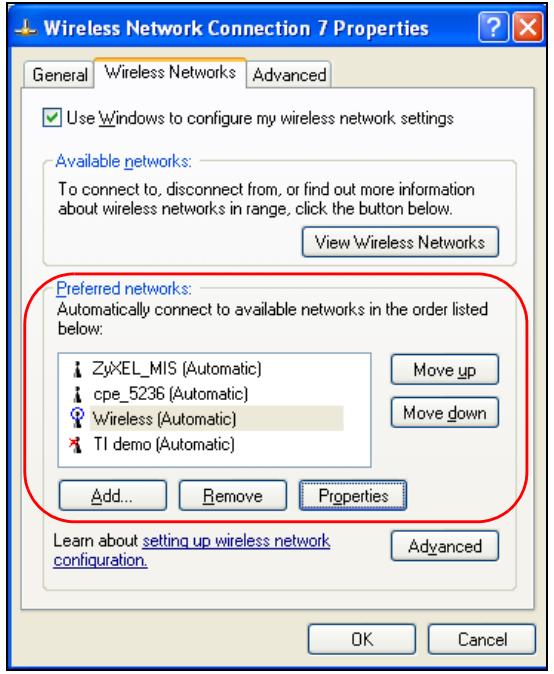
text_image
Wireless Network Connection 7 Properties General Wireless Networks Advanced Use Windows to configure my wireless network settings Available networks: To connect to, disconnect from, or find out more information about wireless networks in range, click the button below. View Wireless Networks Preferred networks: Automatically connect to available networks in the order listed below: ZyXEL_MIS (Automatic) cpe_5236 (Automatic) Wireless (Automatic) TI demo (Automatic) Move up Move down Add... Remove Properties Learn about setting up wireless network configuration. Advanced OK CancelWindows XP SP1: In the Wireless Network Connection Status screen, click Properties and the Wireless Networks tab to open the screen as shown.
Figure 55 Windows XP SP1: Wireless Networks: Preferred Networks
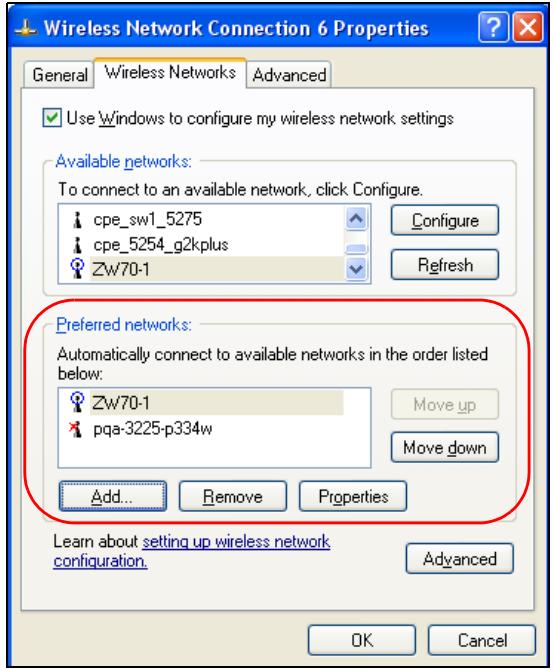
text_image
Wireless Network Connection 6 Properties General Wireless Networks Advanced Use Windows to configure my wireless network settings Available networks: To connect to an available network, click Configure. cpe_sw1_5275 Configure cpe_5254_g2kplus Refresh Zw70-1 Preferred networks: Automatically connect to available networks in the order listed below: Zw70-1 Move up pqa-3225-p334w Move down Add... Remove Properties Learn about setting up wireless network configuration. Advanced OK Cancel2 Whenever the ZyXEL wireless LAN adapter tries to connect to a new network, the new network is added in the Preferred networks table automatically. Select a network and click Move up or Move down to change it's order, click Remove to delete it or click Properties to view the security, authentication or connection information of the selected network. Click Add to add a preferred network into the list manually.
APPENDIX C Wireless Security
Types of EAP Authentication
This section discusses some popular authentication types: EAP-MD5, EAP-TLS, EAP-TTLS, PEAP and LEAP. Your wireless LAN device may not support all authentication types.
EAP (Extensible Authentication Protocol) is an authentication protocol that runs on top of the IEEE 802.1x transport mechanism in order to support multiple types of user authentication. By using EAP to interact with an EAP-compatible RADIUS server, an access point helps a wireless station and a RADIUS server perform authentication.
The type of authentication you use depends on the RADIUS server and an intermediary AP(s) that supports IEEE 802.1x.
For EAP-TLS authentication type, you must first have a wired connection to the network and obtain the certificate(s) from a certificate authority (CA). A certificate (also called a digital ID) can be used to authenticate users, and a CA issues certificates and guarantees the identity of each certificate owner.
EAP-MD5 (Message-Digest Algorithm 5)
MD5 authentication is the simplest one-way authentication method. The authentication server sends a challenge to the wireless station. The wireless station ‘proves’ that it knows the password by encrypting the password with the challenge and sends back the information. Password is not sent in plain text.
However, MD5 authentication has some weaknesses. Since the authentication server needs to get the plaintext passwords, the passwords must be stored. Thus someone other than the authentication server may access the password file. In addition, it is possible to impersonate an authentication server as MD5 authentication method does not perform mutual authentication. Finally, MD5 authentication method does not support data encryption with dynamic session key. You must configure WEP encryption keys for data encryption.
EAP-TLS (Transport Layer Security)
With EAP-TLS, digital certifications are needed by both the server and the wireless stations for mutual authentication. The server presents a certificate to the client. After validating the identity of the server, the client sends a different certificate to the server. The exchange of certificates is done in the open before a secured tunnel is created. This makes user identity vulnerable to passive attacks. A digital certificate is an electronic ID card that authenticates the sender's identity. However, to implement EAP-TLS, you need a Certificate Authority (CA) to handle certificates, which imposes a management overhead.
EAP-TTLS (Tunneled Transport Layer Service)
EAP-TTLS is an extension of the EAP-TLS authentication that uses certificates for only the server-side authentications to establish a secure connection. Client authentication is then done by sending username and password through the secure connection, thus client identity is protected. For client authentication, EAP-TTLS supports EAP methods and legacy authentication methods such as PAP, CHAP, MS-CHAP and MS-CHAP v2.
PEAP (Protected EAP)
Like EAP-TTLS, server-side certificate authentication is used to establish a secure connection, then use simple username and password methods through the secured connection to authenticate the clients, thus hiding client identity. However, PEAP only supports EAP methods, such as EAP-MD5, EAP-MSCHAPv2 and EAP-GTC (EAP-Generic Token Card), for client authentication. EAP-GTC is implemented only by Cisco.
LEAP
LEAP (Lightweight Extensible Authentication Protocol) is a Cisco implementation of IEEE 802.1x.
Dynamic WEP Key Exchange
The AP maps a unique key that is generated with the RADIUS server. This key expires when the wireless connection times out, disconnects or reauthentication times out. A new WEP key is generated each time reauthentication is performed.
If this feature is enabled, it is not necessary to configure a default encryption key in the Wireless screen. You may still configure and store keys here, but they will not be used while Dynamic WEP is enabled.
Note: EAP-MD5 cannot be used with Dynamic WEP Key Exchange
For added security, certificate-based authentications (EAP-TLS, EAP-TTLS and PEAP) use dynamic keys for data encryption. They are often deployed in corporate environments, but for public deployment, a simple user name and password pair is more practical. The following table is a comparison of the features of authentication types.
Table 29 Comparison of EAP Authentication Types
| EAP-MD5 | EAP-TLS | EAP-TTLS | PEAP | LEAP | |
| Mutual Authentication | No | Yes | Yes | Yes | Yes |
| Certificate – Client | No | Yes | Optional | Optional | No |
| Certificate – Server | No | Yes | Yes | Yes | No |
| Dynamic Key Exchange | No | Yes | Yes | Yes | Yes |
| Credential Integrity | None | Strong | Strong | Strong | Moderate |
| Deployment Difficulty | Easy | Hard | Moderate | Moderate | Moderate |
| Client Identity Protection | No | No | Yes | Yes | No |
WPA
Wi-Fi Protected Access (WPA) is a subset of the IEEE 802.11i standard.
Key differences between WPA and WEP are improved data encryption and user authentication.
Select WEP only when the AP and/or wireless clients do not support WPA. WEP is less secure than WPA.
Encryption
WPA improves data encryption by using Temporal Key Integrity Protocol (TKIP), Message Integrity Check (MIC) and IEEE 802.1x. WPA uses Advanced Encryption Standard (AES) in the Counter mode with Cipher block chaining Message authentication code Protocol (CCMP) to offer stronger encryption than TKIP.
TKIP uses 128-bit keys that are dynamically generated and distributed by the authentication server. AES (Advanced Encryption Standard) is a block cipher that uses a 256-bit mathematical algorithm called Rijndael. They both include a per-packet key mixing function, a Message Integrity Check (MIC) named Michael, an extended initialization vector (IV) with sequencing rules, and a re-keying mechanism.
WPA regularly changes and rotate the encryption keys so that the same encryption key is never used twice.
The RADIUS server distributes a Pairwise Master Key (PMK) key to the AP that then sets up a key hierarchy and management system, using the PMK to dynamically generate unique data encryption keys to encrypt every data packet that is wirelessly communicated between the AP and the wireless stations. This all happens in the background automatically.
The Message Integrity Check (MIC) is designed to prevent an attacker from capturing data packets, altering them and resending them. The MIC provides a strong mathematical function in which the receiver and the transmitter each compute and then compare the MIC. If they do not match, it is assumed that the data has been tampered with and the packet is dropped.
By generating unique data encryption keys for every data packet and by creating an integrity checking mechanism (MIC), with TKIP and AES it is more difficult to decrypt data on a Wi-Fi network than WEP and difficult for an intruder to break into the network.
The encryption mechanisms used for WPA and WPA-PSK are the same. The only difference between the two is that WPA-PSK uses a simple common password, instead of user-specific credentials. The common-password approach makes WPA-PSK susceptible to brute-force password-guessing attacks but it's still an improvement over WEP as it employs a consistent, single, alphanumeric password to derive a PMK which is used to generate unique temporal encryption keys. This prevent all wireless devices sharing the same encryption keys. (a weakness of WEP)
User Authentication
WPA applies IEEE 802.1x and Extensible Authentication Protocol (EAP) to authenticate wireless stations using an external RADIUS database.
WPA-PSK Application Example
A WPA-PSK application looks as follows.
1 First enter identical passwords into the AP and all wireless clients. The Pre-Shared Key (PSK) must consist of between 8 and 63 ASCII characters or 64 hexadecimal characters (including spaces and symbols).
2 The AP checks each client's password and (only) allows it to join the network if it matches its password.
3 The AP and wireless clients use the pre-shared key to generate a common PMK.
4 The AP and wireless clients use the TKIP or AES encryption process to encrypt data exchanged between them.
Figure 56 WPA-PSK Authentication
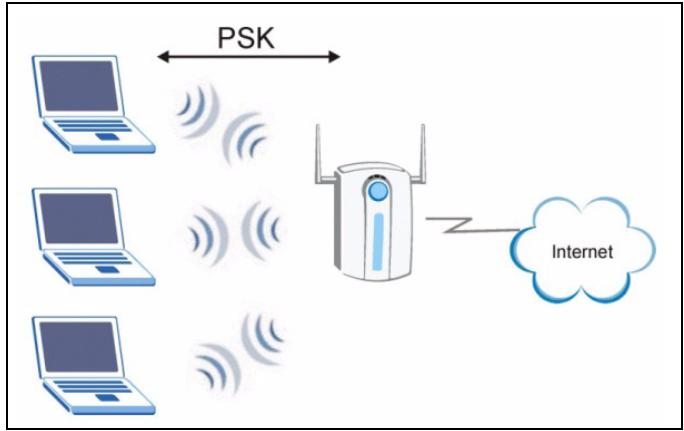
flowchart
graph TD
    A["Laptop"] <-->|PSK| B["Wi-Fi Device"]
    C["Laptop"] <-->|PSK| B
    D["Laptop"] <-->|PSK| B
    E["Laptop"] <-->|PSK| B
    B --> F["Internet"]
WPA with RADIUS Application Example
You need the IP address of the RADIUS server, its port number (default is 1812), and the RADIUS shared secret. A WPA application example with an external RADIUS server looks as follows. "A" is the RADIUS server. "DS" is the distribution system.
1 The AP passes the wireless client's authentication request to the RADIUS server.
2 The RADIUS server then checks the user's identification against its database and grants or denies network access accordingly.
3 The RADIUS server distributes a Pairwise Master Key (PMK) key to the AP that then sets up a key hierarchy and management system, using the pair-wise key to dynamically generate unique data encryption keys to encrypt every data packet that is wirelessly communicated between the AP and the wireless clients.
Figure 57 WPA with RADIUS Application Example
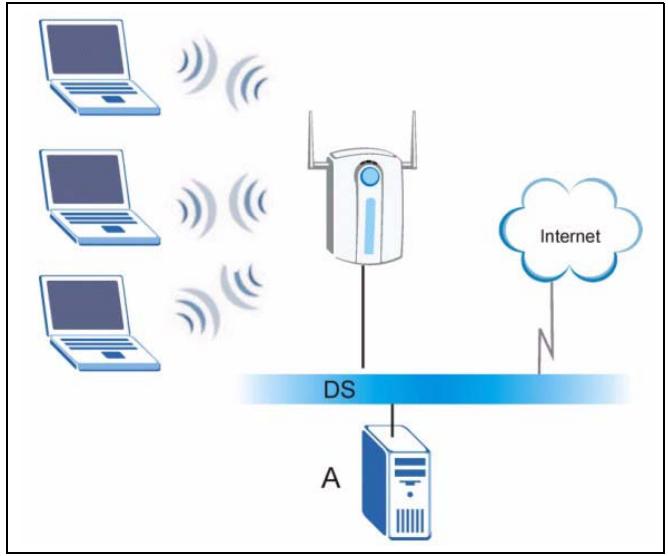
flowchart
graph TD
    A["Laptop"] -->|Wireless Signal| B["Router"]
    C["Laptop"] -->|Wireless Signal| B
    D["Laptop"] -->|Wireless Signal| B
    E["Internet"] --> F["Cloud"]
    B --> G["DS"]
    G --> H["A"]
Security Parameters Summary
Refer to this table to see what other security parameters you should configure for each Authentication Method/ key management protocol type. MAC address filters are not dependent on how you configure these security features.
Table 30 Wireless Security Relational Matrix
| AUTHENTICATION METHOD/ KEYMANAGEMENT PROTOCOL | ENCRYPTIONMETHOD | ENTERMANUAL KEY | IEEE 802.1X |
| Open | None | No | Disable |
| Enable without Dynamic WEP Key | |||
| Open | WEP | No | Enable with Dynamic WEP Key |
| Yes | Enable without Dynamic WEP Key | ||
| Yes | Disable | ||
| Shared | WEP | No | Enable with Dynamic WEP Key |
| Yes | Enable without Dynamic WEP Key | ||
| Yes | Disable | ||
| WPA | TKIP/AES | No | Enable |
| WPA-PSK | TKIP/AES | Yes | Disable |
Index
Numerics
802.1x 42
A
About 53
access point 31
access point. See also AP.
activating a profile 49
Adapter 49
Ad-Hoc 47
Advanced Encryption Standard 33, 75
advanced settings 49
antenna 19
antenna power output 57
AP 31
AP. See also access point.
authentication 39
authentication method auto 33
open system 33
shared key 33
auto authentication 33
C
CA 74
Certificate Authority 74
Certifications 4
Notice 1 4
viewing 4
channel 36, 38, 47
configuration method
important note 22
Odyssey Client Manager 22
Wireless Zero Configuration (WZC) 22
ZyXEL Utility 22
Contact Information 8
Copyright 3
creating a new profile 45
current configuration 35
current connection status 35
Customer Support 8
D
Disclaimer 3
driver version 53
Dynamic WEP Key Exchange 74
E
EAP Authentication 33
Encryption 75
Encryption Type 33
F
FCC Interference Statement 4
G
getting started 19
graphics icons key 18
H
hardware connections 22
|
IEEE 802.1x 33
initialization vector (IV) 75
installation
utility 19
L
link information 35
M
Message Integrity Check (MIC) 33, 75
MIMO 17, 19
N
network type 36
O
Odyssey Client Manager 22
open system authentication 33
P
Pairwise Master Key (PMK) 75
passphrase 32, 39
password phrase 32
Power Saving Mode 51
product specifications 57
profile 36, 45
activation 49
add new 45
delete 45
edit 45
information 45
Q
Quick Start Guide 17, 22
R
radio interference 55
real-time data traffic statistics 37
Related Documentation 17
s
Safety Warnings 6
save power 51
Scan Info 46
security 32, 57
data encryption 32
Security Parameters 78
shared key authentication 33
signal strength 38
site survey 37
scan 38
security settings 39
sleep mode 51
SSID 36, 38
statistics 36
Super G 50
support CD 17
syntax conventions 17
T
Temporal Key Integrity Protocol (TKIP) 33, 75
Trademarks 3
transmission rate 36
transmit key 39
Trend Chart 37
troubleshooting 55
link status 55
network communication 56
starting ZyXEL Utility 55
U
uninstalling ZyXEL Utility 53
upgrading ZyXEL Utility 54
important step 54
User Authentication 76
user authentication 32
V
voltage 57
W
Warranty
Note 7
WEP 32, 39
manual setup 32, 40
passphrase 32, 39
WEP (Wired Equivalent Privacy) 32
Wi-Fi Protected Access 33, 75
Windows XP 23
wireless client 31
wireless LAN
introduction 31
security 32
Wireless LAN (WLAN) 31
wireless network 31
wireless standard 57
WLAN
Security parameters 78
WPA 33, 40, 75
WPA-PSK 41
WZC (Wireless Zero Configuration) 22
Z
ZyXEL Utility 22
accessing 22
help 23
opening 23
system tray icon 22
upgrade 54
version 53