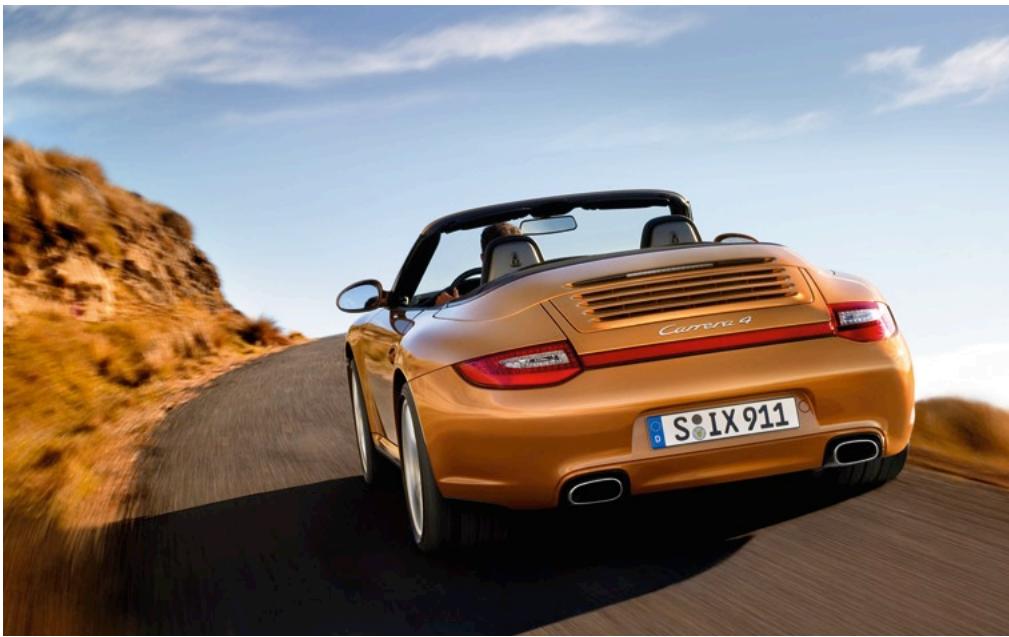
911 TURBO CABRIOLET - Convertible sports car PORSCHE - Free user manual and instructions
Find the device manual for free 911 TURBO CABRIOLET PORSCHE in PDF.

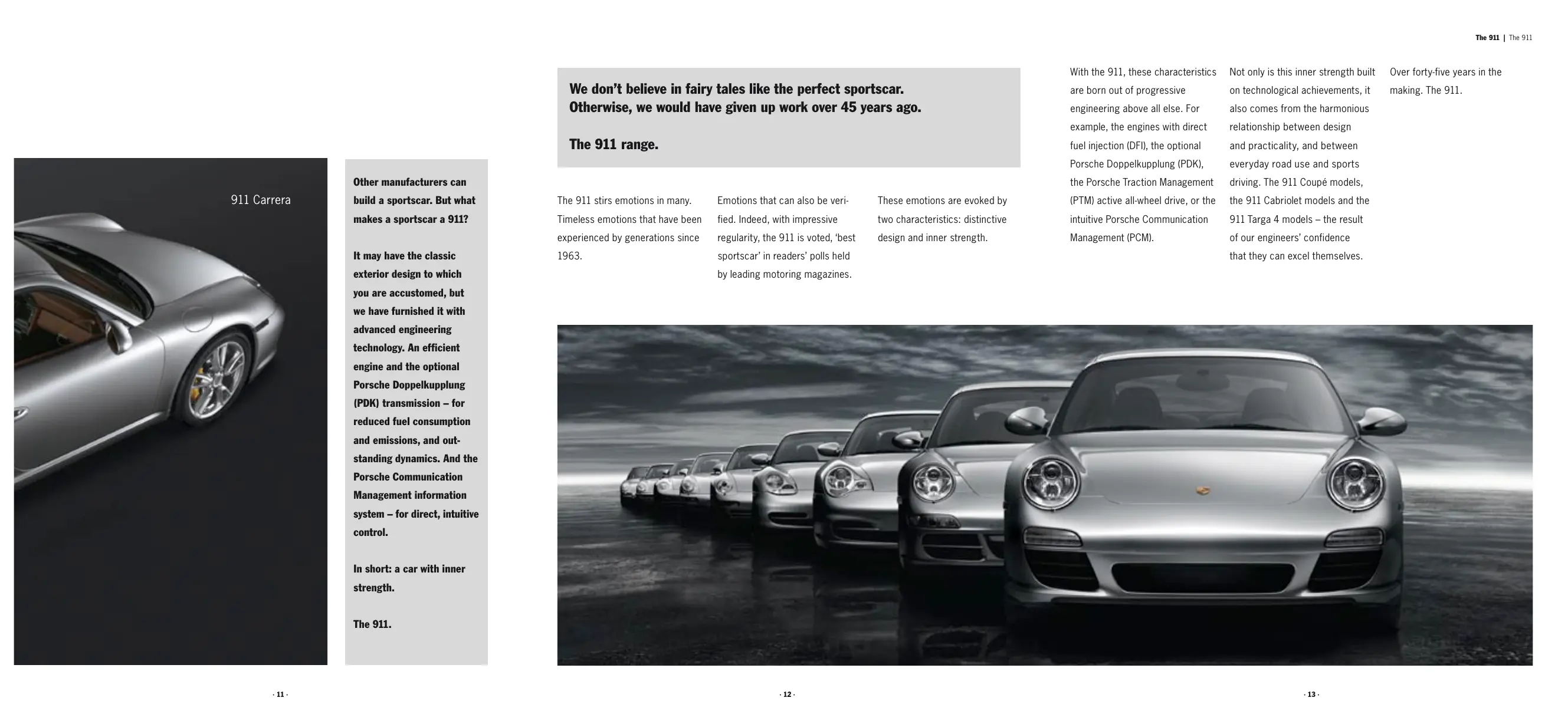

| Product type | Convertible sports car |
| Brand | Porsche |
| Model | 911 Turbo Cabriolet (based on 911 Carrera S Cabriolet) |
| Engine | 3.8 L flat-6, direct fuel injection (DFI), VarioCam Plus |
| Power | 283 kW (385 hp) at 6,500 rpm |
| Maximum torque | 420 Nm at 4,400 rpm |
| Transmission | 6-speed manual or optional 7-speed Porsche Doppelkupplung (PDK) |
| Drive type | Rear-wheel drive or optional all-wheel drive (PTM) |
| Dimensions (L x W x H) | 4,435 mm x 1,808 mm x 1,300 mm |
| Wheelbase | 2,350 mm |
| Curb weight (EU) | 1,585 kg (manual transmission) |
| Trunk | 135 liters |
| Fuel tank | 64 liters |
| Performance | 0-100 km/h in 4.9 s (manual) or 4.7 s (PDK), top speed 302 km/h |
| Combined fuel consumption | 10.3 L/100 km (manual and PDK) |
| CO2 emissions | 242 g/km |
| Suspension | McPherson front, multi-link LSA rear, optional PASM (adaptive damping) |
| Brakes | 4-piston aluminum monobloc, ventilated and drilled discs, optional ceramic PCCB |
| Active safety | PSM (Porsche Stability Management) with ABS 8.0, Bi-Xenon headlights |
| Passive safety | Front and side airbags (POSIP), roll-over protection (Cabriolet) |
| Roof | Electric soft top, heated rear window, removable wind deflector |
| Main equipment | PCM (Porsche Communication Management), 6.5-inch touch screen, air conditioning, partial leather seats |
| Maintenance | Engine oil change, brakes, tires; long intervals (2-year unlimited mileage warranty) |
| Spare parts | Available at Porsche Centre; brakes, tires, filters, etc. |
| Repairability | Porsche dealer network, technical assistance |
Frequently Asked Questions - 911 TURBO CABRIOLET PORSCHE
User questions about 911 TURBO CABRIOLET PORSCHE
0 question about this device. Answer the ones you know or ask your own.
Ask a new question about this device
Download the instructions for your Convertible sports car in PDF format for free! Find your manual 911 TURBO CABRIOLET - PORSCHE and take your electronic device back in hand. On this page are published all the documents necessary for the use of your device. 911 TURBO CABRIOLET by PORSCHE.
USER MANUAL 911 TURBO CABRIOLET PORSCHE
Other manufacturers can build a sportscar. But what makes a sportscar a 911?
It may have the classic exterior design to which you are accustomed, but we have furnished it with advanced engineering technology. An efficient engine and the optional Porsche Doppelkupplung (PDK) transmission – for reduced fuel consumption and emissions, and outstanding dynamics. And the Porsche Communication Management information system – for direct, intuitive control.
In short: a car with inner strength.
The 911.
We don't believe in fairy tales like the perfect sportscar. Otherwise, we would have given up work over 45 years ago.
The 911 range.
The 911 stirs emotions in many.
Timeless emotions that have been
experienced by generations since
1963.
Emotions that can also be verified. Indeed, with impressive regularity, the 911 is voted, 'best sportscar' in readers' polls held by leading motoring magazines.
These emotions are evoked by two characteristics: distinctive design and inner strength.
With the 911, these characteristics are born out of progressive engineering above all else. For example, the engines with direct fuel injection (DFI), the optional Porsche Doppelkupplung (PDK), the Porsche Traction Management (PTM) active all-wheel drive, or the intuitive Porsche Communication Management (PCM).
Not only is this inner strength built on technological achievements, it also comes from the harmonious relationship between design and practicality, and between everyday road use and sports driving. The 911 Coupé models, the 911 Cabriolet models and the 911 Targa 4 models – the result of our engineers' confidence that they can excel themselves.
Over forty-five years in the making. The 911.
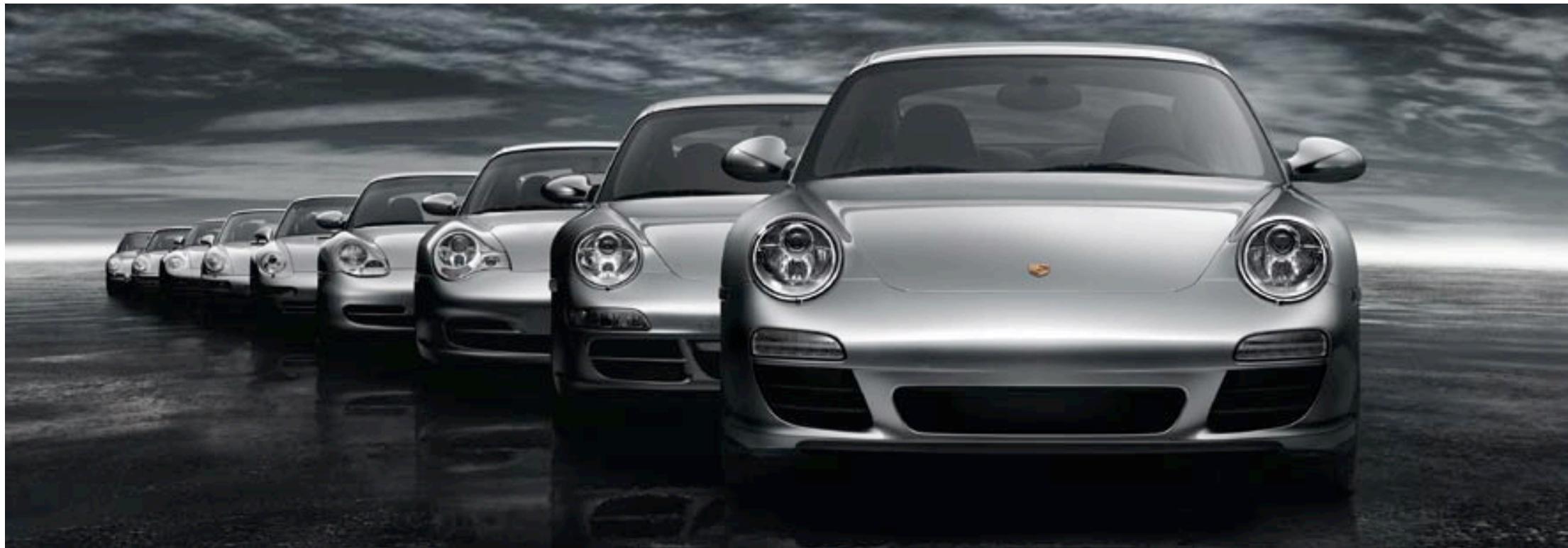
Design icons. Engineering icons. Yes, it sends shivers down our spine, too.
The engineering of the 911.
Two engines with direct fuel injection and power outputs of 345 hp and 385 hp. The optional Porsche Doppelkupplung (PDK). Porsche Communication Management with touchscreen and, on request, a voice control system. All progressive technologies. It would be so easy just to sum up the meaning of inner strength. We, however, prefer to get to the root of it.
All of the 911 Carrera and 911 Targa 4 models have direct fuel injection (DFI, p. 40). So how does this compare with standard fuel injection? The fuel/air mixture is prepared entirely in the combustion chamber after having been metered and injected directly, with millisecond precision.
From a technical perspective, this means an accurate fuel/air mixture and therefore optimum
combustion. For the driver, it means a distinct rise in power and torque, and a distinct fall in fuel consumption and emissions. It has been possible to reduce CO_2 emissions by up to 17% compared with the previous model.
Porsche Doppelkupplung (PDK, p. 55), available as an option, is based on a development that helped Porsche racing cars in the 1980s to cause a sensation on racetracks around the world.
PDK, with both a manual gearshift and an automatic mode, has seven gears at its disposal. It is like having two gearboxes in one and, as the name suggests, two clutches. Whenever a particular gear is engaged, the next gear is always preselected. Gearshifts therefore take place within hundredths of a second, without
any interruption in the flow of power. In comparison with conventional manual transmission, PDK achieves a considerably faster rate of acceleration for the same rate of fuel consumption. When compared with the previous automatic transmission, it provides significantly more driving pleasure thanks to improved responsiveness and thus greater agility – with the same degree of comfort at a reduced rate of fuel consumption.
In combination with the Sport Chrono Package Plus (p. 74), PDK has a choice of two additional functions: 'Launch Control' for optimum acceleration from a standing start, and a 'motorsport-derived gearshift strategy' bringing gearshift characteristics straight from the racetrack.
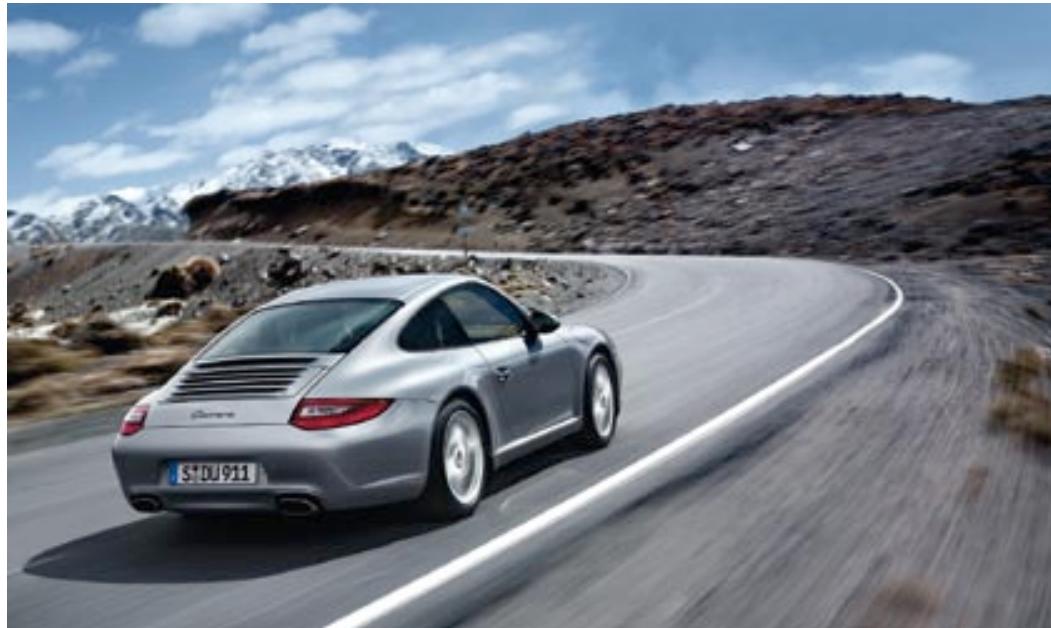
911 Carrera
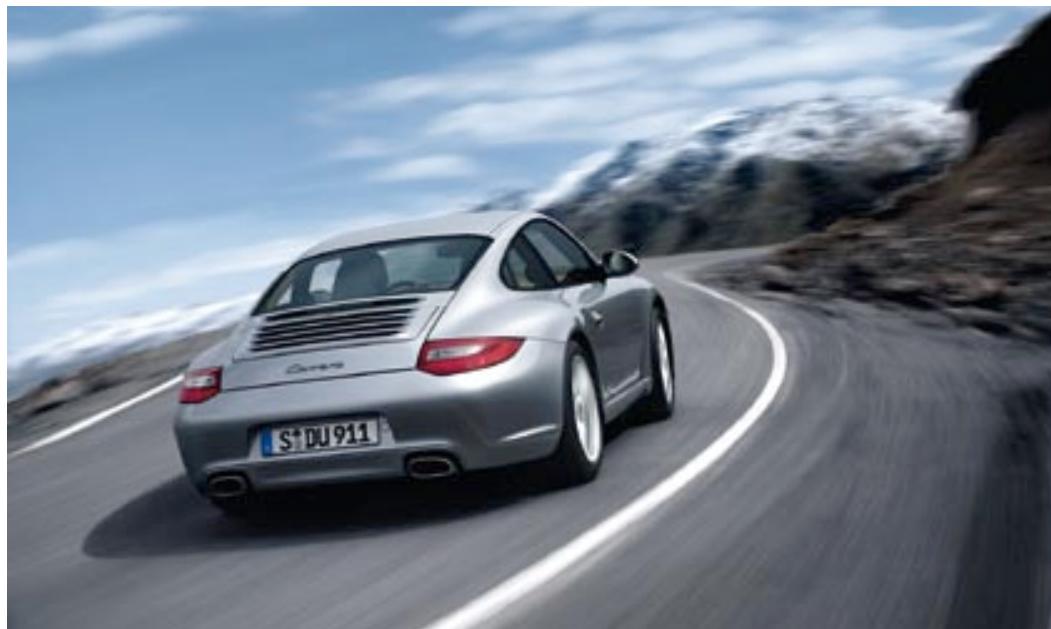
911 Carrera
The 911 Carrera 4 models and the 911 Targa 4 models have Porsche Traction Management (PTM, p. 62) where an electronically controlled multi-plate clutch regulates the distribution of drive force to the front axle according to the driving conditions.
The new standard steering wheels with sporty three-spoke design feel comfortable and provide excellent grip, even through high-speed turns.
The standard Porsche Communication Management (PCM, p. 100) with touchscreen and MP3-compatible CD/DVD drive is also extremely ergonomic. Featuring an optional universal audio interface enabling you to connect and easily control an iPod®, for example, it is intuitive to operate. An enhanced voice control system with word-by-word input is also available as an option.
For all its advanced technologies, one thing cannot be denied: The inner strength of the 911 is what makes this 911 the best 911 of all time.
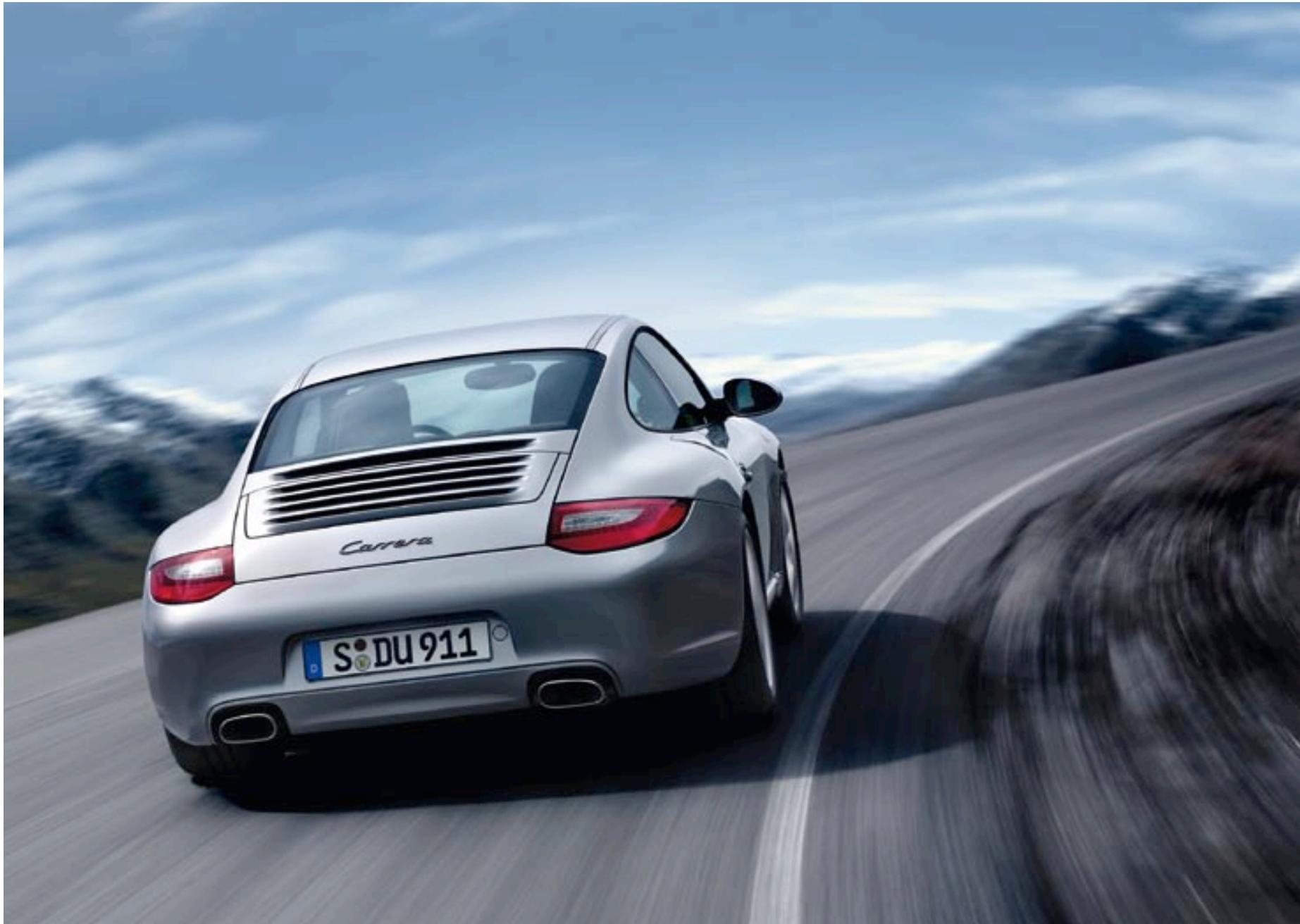
911 Carrera
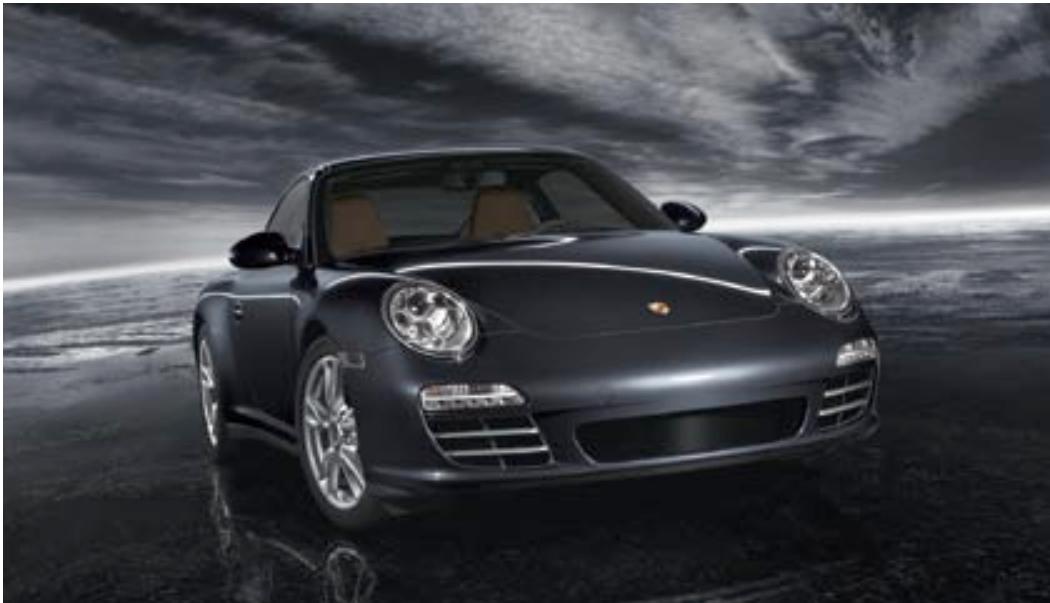
911 Carrera 4
Character traits cannot be changed. But they can be reinforced.
The design of the 911.
Every element fulfils a function.
From this principle, the 911 draws its inner strength. The logical consequence of this is the 911 Carrera's very low drag coefficient of 0.29.
The large air intakes on the front end provide highly effective
cooling power and give the 911 a sporty and dynamic appearance.
Bi-Xenon headlights are fitted as standard on all 911 models. The indicators and LED daytime running lights, and position lights are harmoniously integrated into the separate front light units
above the outer air intakes for an imposing look. The optional dynamic cornering lights have a swivelling module for the dipped beams – visible engineering for improved visibility.
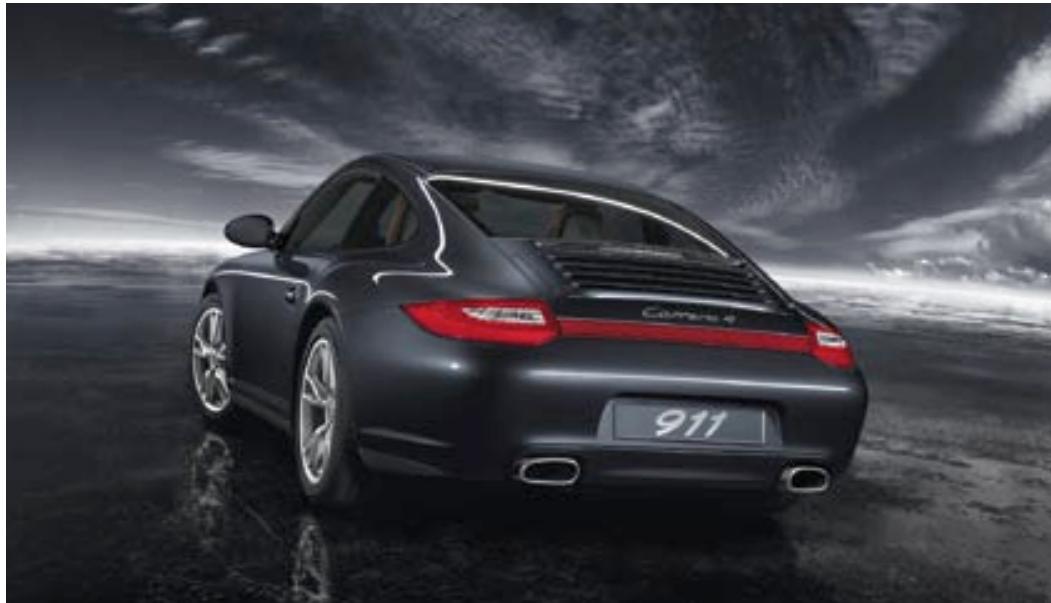
911 Carrera 4
As with the modified exterior mirrors which provide an even better rearward view.
18-inch wheels and S models with the 3.8-litre engine have 19-inch wheels.
The rear end follows the design cues of the front. The imposing LED tailights are drawn right into the wing and taper off to the outside. Unmistakable – especially at night. The stainless steel tailpipes, designed as twin tailpipes on the S model range, are integrated seamlessly. Another important aesthetic contribution is the wheel design. Models with the 3.6-litre engine are fitted as standard with
Specific to the all-wheel drive variants is the 44 mm wider stance at the rear and the taillight strip, which, as a striking design feature, lends even more impact to the rear end.
In every respect, the design is unmistakably 911 – because its form follows function. And all the while it maintains its unique appeal.
Model range
Porsche, Weissach
911 Carrera 4S Cabriolet,
911 Carrera,
911 Targa 4S
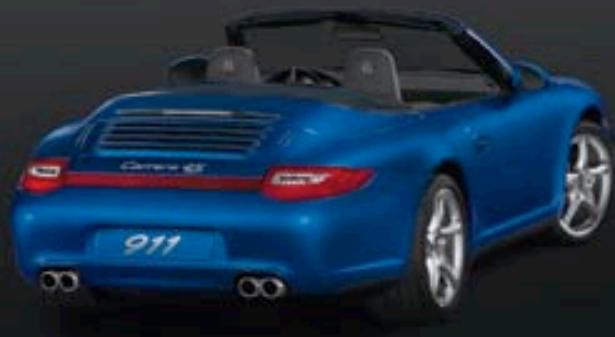

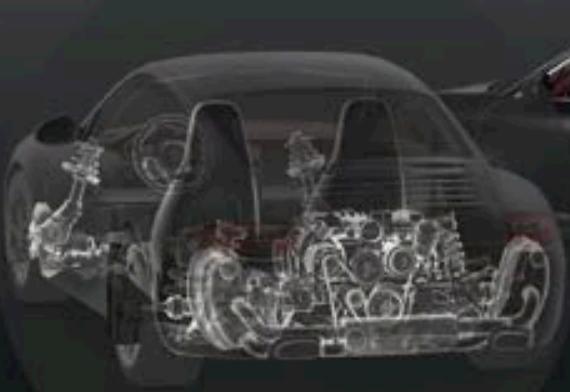
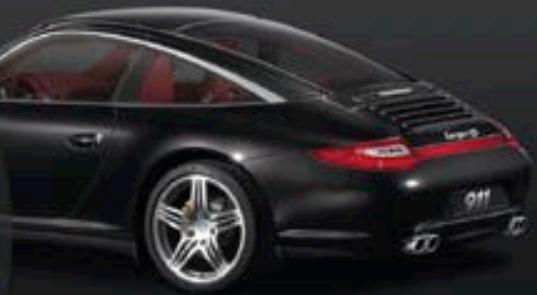


Image 000002
Model range
What's the effect of inner strength? It makes it possible to constantly seek innovations without having to change the car's unique character.
This inner strength has distinguished the 911 concept since it began. The evidence? A history of success spanning more than 45 years, and the 10 models in the current range. Each one has its own character, its own personality.
But they all share the same heritage.
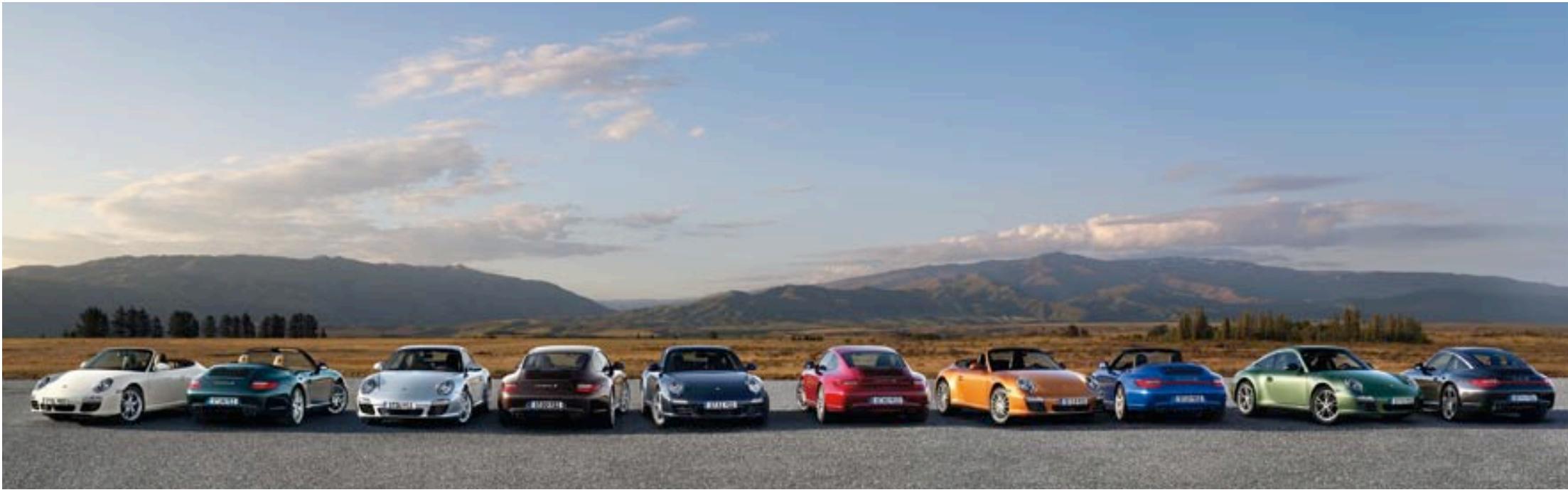
The 911 has always had character. Which one is up to you.
The 911 models.
The 911 Carrera.
The 911 Carrera S.
The 911 Carrera 4.
The 911 Carrera 4S.
The 911 Carrera Cabriolet.
The 911 Carrera S Cabriolet.
The 911 Carrera 4 Cabriolet.
The 911 Carrera 4S Cabriolet.
The 911 Targa 4.
The 911 Targa 4S.
Inner strength defines character and manifests itself in various ways.
Just like the 911 model range. The models all exemplify our ideal of a sportscar – the marriage of contrasts: sportiness and comfort; functionality and design; tradition and innovation.
These are the foundation pillars of the 911. Each model stands for
itself. And for a driver's individual requirements of a sportscar.
For one driver, it's about purity of design and lightweight construction - traditional sportscar characteristics. For another, performance is paramount. Others like nothing better than open-top driving - in classic sportscar style with a 911 Cabriolet, or in a supremely individual way in a 911 Targa 4.
These are all very different requirements, and, as we said before, highly individual.
It is our pledge to meet them.
And has been for over 45 years.
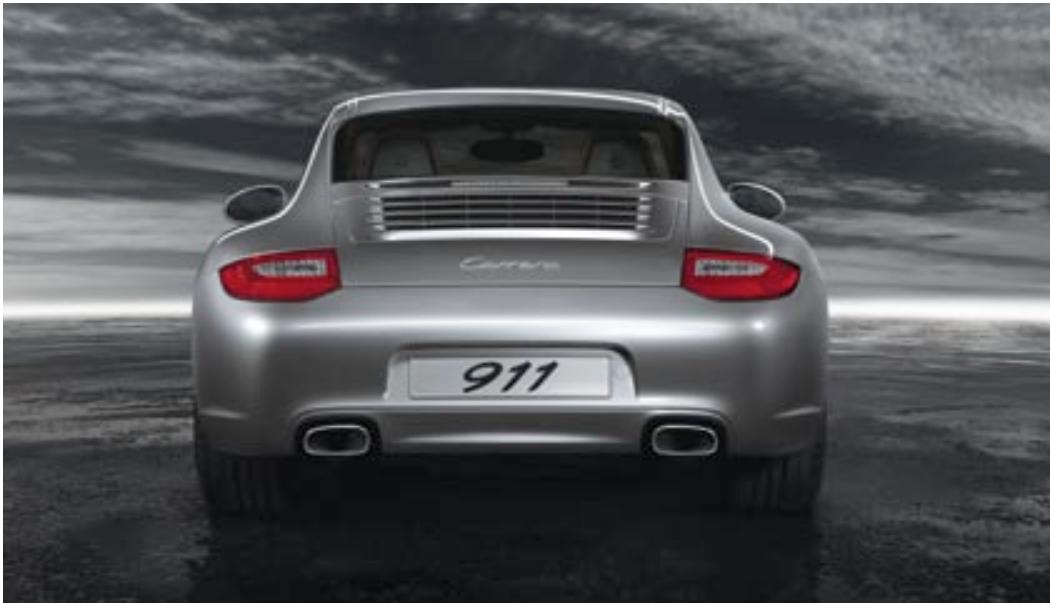
911 Carrera
How often in life have you wanted to change something about yourself intrinsically and yet also stay the same?
The 911 Carrera.
Efficiency, power and sportiness. These virtues are the basis of the traditional sportscar, and are the essence of the 911 Carrera.
In terms of efficiency, its engine has direct fuel injection (DFI, p. 40).
The power is provided by a
3.6-litre 6-cylinder boxer engine, positioned low down in the rear of the chassis. As usual.
With this power unit, the
911 Carrera is now able to deliver254 kW (345 hp) at 6,500 rpmand a maximum torque of 390 Nm
at 4,400 rpm. All this with a 15 % reduction in CO_2 emissions and a 13 % reduction in fuel consumption in conjunction with the manual gearbox. Compelling figures.
Just like these: 0 to 100 km/h (62 mph) in 4.9 seconds and a top speed of 289 km/h (180 mph).
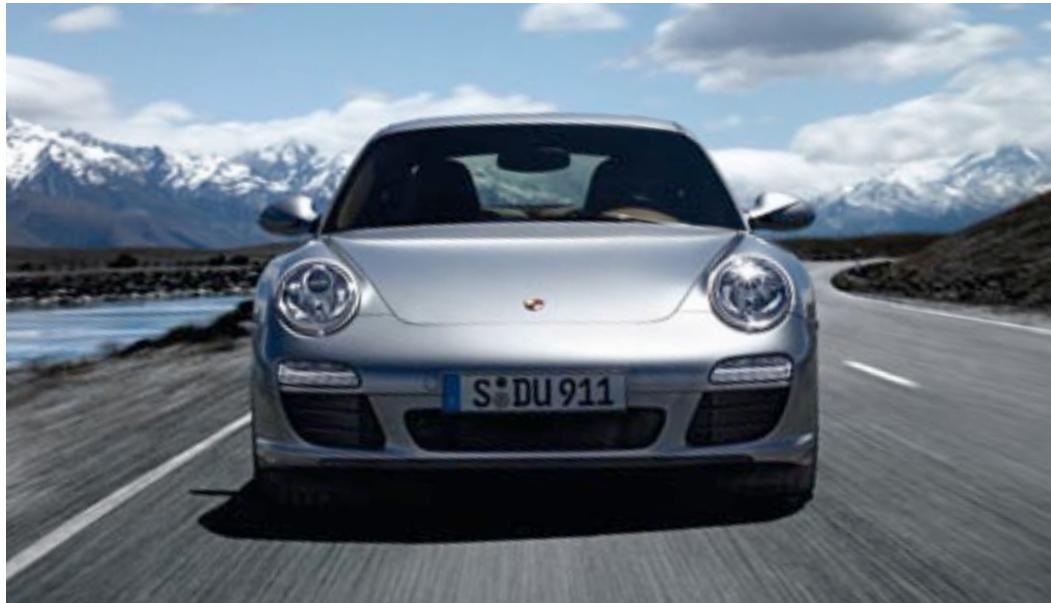
911 Carrera
The six-speed manual sport transmission with self-adjusting clutch, fitted as standard, ensures that the correct ratio is always at hand.
closed-type design. The front and rear brake discs have a diameter of 330mm for impressive braking performance.
Sporty and imposing describes the two single tailpipes. Just like the typical Porsche sound.
Other safety features include enhanced Porsche Stability Management (PSM, p. 70) and Bi-Xenon headlights.
18-inch Carrera IV wheels are fitted as standard. The black, four-piston aluminium monobloc calipers of the brake system are extremely rigid thanks to their
Efficiency, power, sportiness. Three virtues that distinguish the 911 Carrera. Intrinsically.
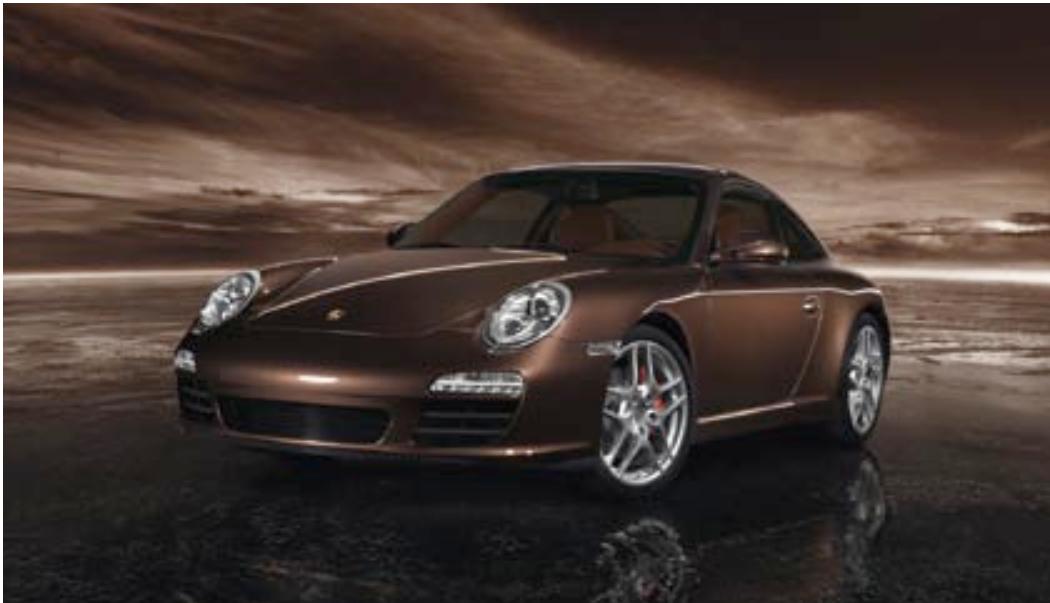
911 Carrera S
It's not only heritage that defines character. Values do, too.
The 911 Carrera S.
As far as the 911 Carrera S is concerned, the driver can take this quite literally. This is where performance is paramount. The car's performance values are a testament to its inner strength: a 3.8-litre engine with direct fuel injection (DFI, p. 40). Power output: 283 kW (385 hp) at
6,500 rpm. Maximum torque: 420 Nm at 4,400 rpm.
Values that are impressive in themselves: 0 to 100 km/h (62 mph) in 4.7 seconds. Top speed isn't reached until 302 km/h (187 mph). Also available as an option is the Porsche Doppelkupplung (PDK,
p. 55), which improves acceleration values further still: 0 to 100km / h (62 mph) in 4.5 seconds.
And if you combine PDK with the optional Sport Chrono Package Plus (p. 74), the sprint from 0 to 100km/h (62 mph) takes just 4.3 seconds.
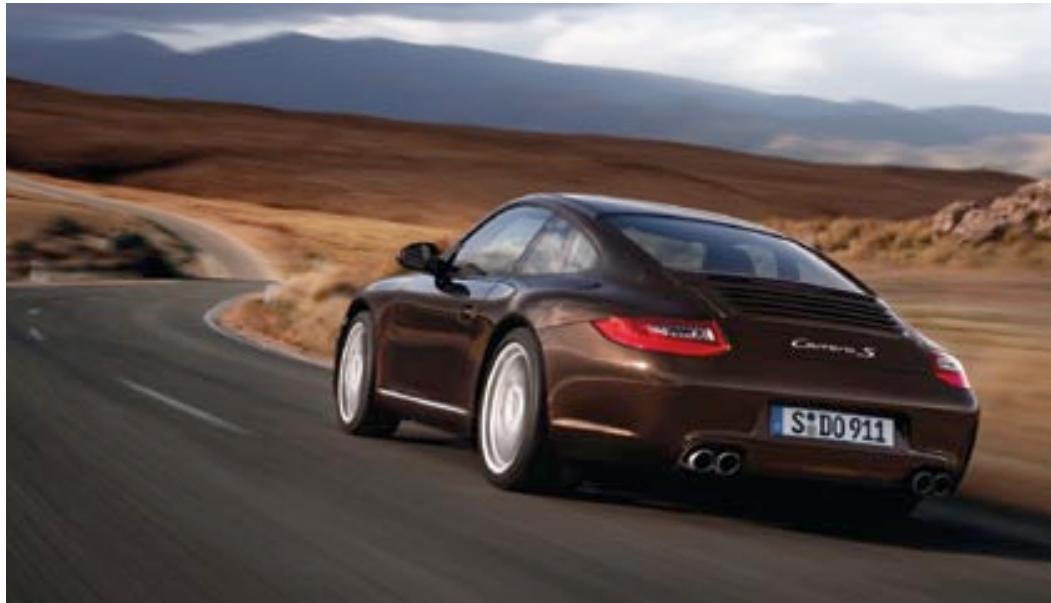
911 Carrera S
Additionally, the sound produced by the two stainless steel twin tailpipes is characteristic. Characteristically Porsche.
The four-piston aluminium monobloc calipers have a striking redpainted finish and the generouslydimensioned brake discs make foroutstanding deceleration. Thesecomplement the 19-inch Carrera SII wheels with their sporty design.
The Porsche Ceramic Composite Brake (PCCB, p. 88) is also offered as an option.
Perfect road holding is assured by the Porsche Active Suspension Management (PASM, p. 72) and the 10-mm lowered suspension.
For those who appreciate more uncompromising qualities, the PASM sports suspension with a 20-mm reduction in ride height and a mechanically locking rear differential is available as an option whichever gearbox you choose.
However, along with all these sporting features, this remains a practical everyday sportscar. As evidenced by the Porsche Communication Management (PCM, p. 100) and the optional dynamic cornering lights.
To sum it up, the inner strength of the 911 Carrera S does not only manifest itself in pure performance values. Not only, indeed, but also.
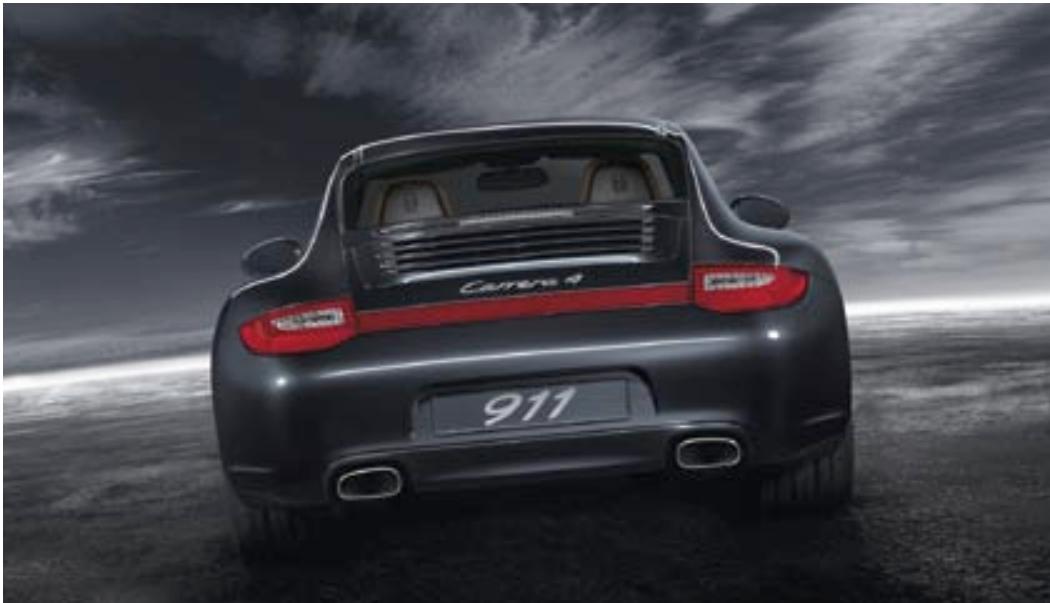
911 Carrera 4
How do you combine safety and dynamics? With inner strength, for instance.
The 911 Carrera 4 models.
Outstanding driving dynamics and traction are what the all-wheel drive variants of the 911 have to offer above all else. And they're instantly recognisable. By their wider body – an extra 44 mm at the rear wings.
By the wider rear track – 32 mm more in 911 Carrera 4S models – and the wider rear tyres. Also, by their titanium-coloured front air intake grilles and slats, and seamless taillight strip. Painted in black for contrast, the trims
on the lower rear panel and the side skirts provide improved protection against stone impact.
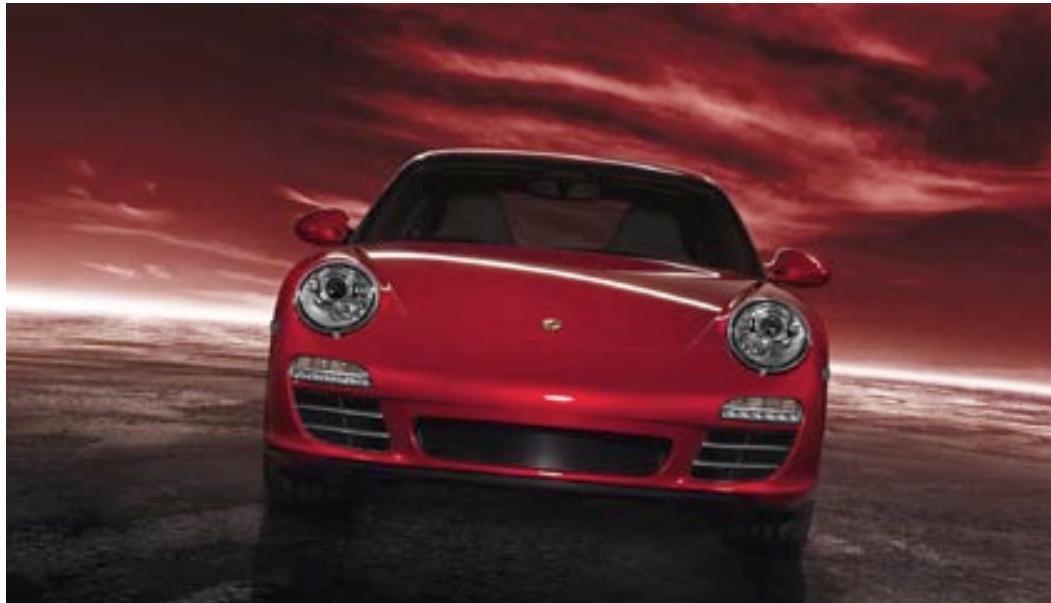
911 Carrera 4S
In terms of measurable values:
The performance of the 911 Carrera 4 with the 3.6-litre engine is 0 to 100km / h (62 mph) in 5.0 seconds with a top speed of 284km / h (177 mph).
The 911 Carrera 4S completes the 0 to 100km / h (62 mph) sprint in just 4.7 seconds and reaches a maximum speed of 297~km / h (185 mph).
On to the internal values:
Both models are equipped with
Porsche Traction Management
(PTM, p. 62) active all-wheel drive. PTM has been optimised for outstanding driving dynamics, which are also underpinned by the mechanically locking rear differential. In addition, the traction offered by PTM represents a significant safety feature – especially in wet and snowy conditions.
The 911 Carrera 4 models therefore deliver improvements in both safety and dynamics. However, this is no surprise to their drivers, who see them as an indication of their inner strength.
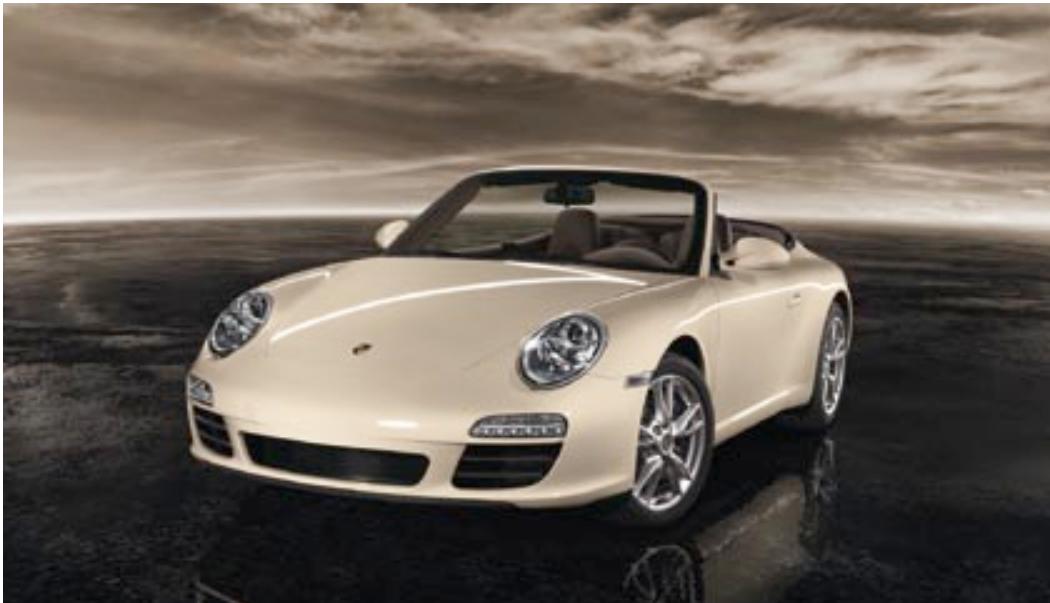
911 Carrera Cabriolet
It's what we give every 911 Cabriolet: openness to enthusiasm.
The 911 Carrera Cabriolet models.
Irresistible appeal. This has always been a driving force in the development of the 911. There is nowhere better to experience it than during an involving Sunday drive in an open-top 911. This is why every 911 Carrera model is also offered in Cabriolet form.
Technically, these models emulate the performance of their closed-top counterparts. With a 3.6-litre or 3.8-litre power unit and two or four-wheel drive, including Porsche Traction Management (PTM, p. 62).
Offering uncompromising sports performance to 911 standards, no less.
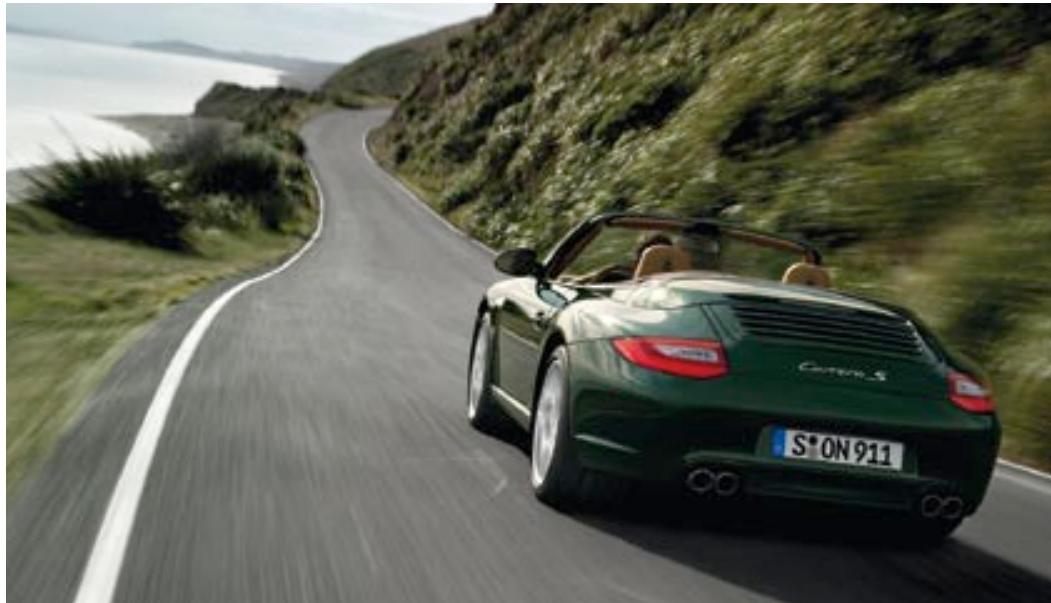
911 Carrera S Cabriolet
The same applies where safety is concerned (p. 80). All 911 models are equipped as standard with full-size driver's and passenger's airbags and the Porsche Side Impact Protection System (POSIP, p. 93). On Cabriolet models, these are complemented by an effective roll-over protection system (p. 93).
The optional seat ventilation provides added comfort for open-top driving on those particularly hot days.
Incidentally, the 911 Cabriolet models are Cabriolets in the traditional sense: they have a fabric hood. This saves on weight in just the right place – for that low centre of gravity typical of a sportscar, and for reduced fuel consumption. Further refinements to provide that irresistible appeal, even in bad weather.
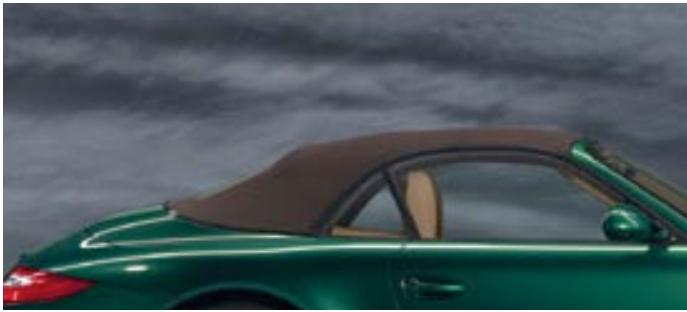
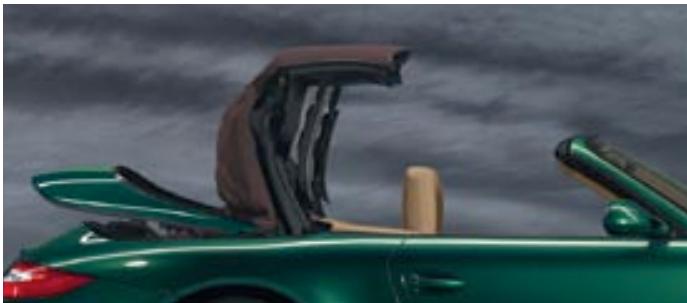
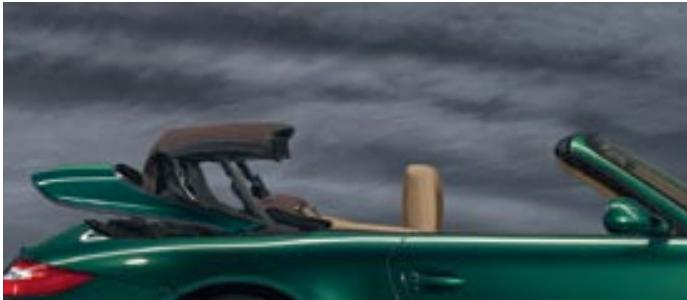
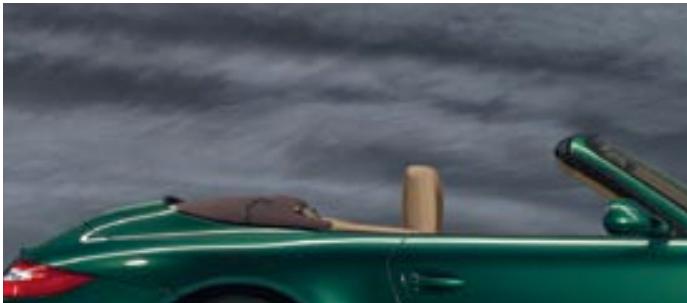
Hood.
Here's one consolation for anyone forced to close their hood on a rainy day: you're still driving a 911.
The hood system of the
911 Cabriolet models is both lightweight and robust. The roof frame also has a lightweight structure.
The glass rear window is scratch resistant and electrically heated – for excellent rearward visibility.
An integral rain channel along the edge of the hood remove standing water to prevent dri when the doors are opened.
Operation of the hood is fully electric, using a button on the centre console or via the key remote.
The hood has a concertina folding action, ensuring optimum protection for the interior surface of the lining. It opens and closes in approximately 20 seconds from start to finish and can be operated when the vehicle is travelling at speeds of up to 50km / h (30 mph).
The interior hoodlining is made from a heat-insulating and soundproofing fabric. Noise levels are therefore almost as low as in the Coupé models, even at high speeds. So, you hardly hear anything at all - apart from the distinctive Porsche sound, of course.
Wind deflector.
The detachable wind deflector is fitted as standard. It was specially developed in the wind tunnel for practically draught-free driving and minimal wind noise. When folded, it can be stowed in the luggage compartment with room to spare.
Hardtop.
Optional equipment includes a tough and lightweight aluminium hardtop, which is also easy to fit. The inside is lined with a soundproofing fabric which is matched to the interior of the vehicle.
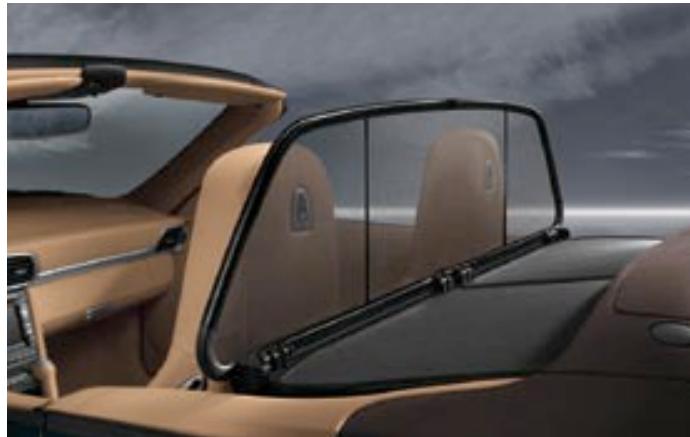
Wind deflector
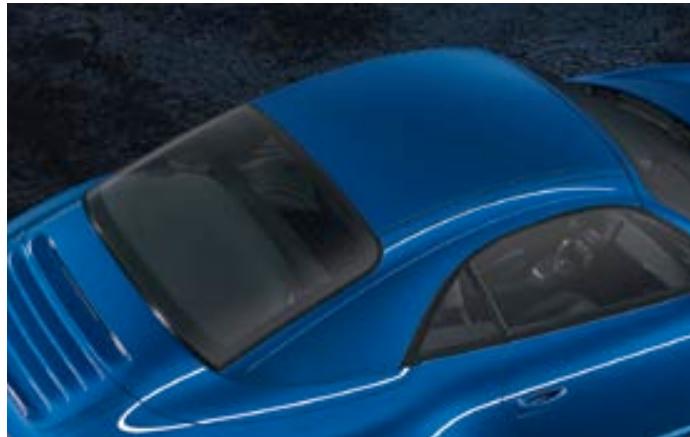
Hardtop
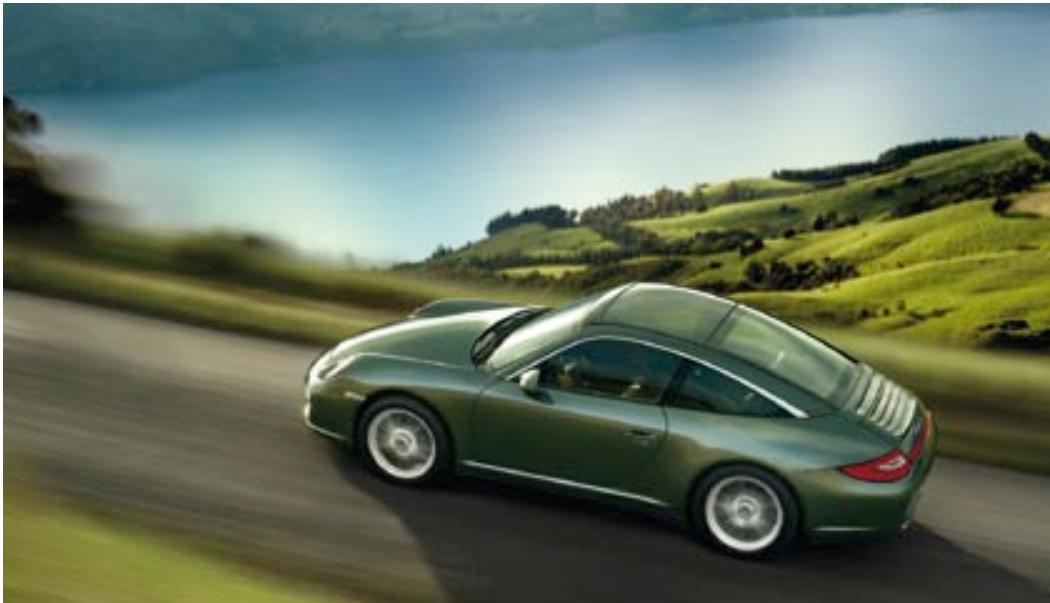
911 Targa 4
Remember what your mother told you. You should see something of the world. And keep out of draughts.
The 911 Targa 4 models.
Coupé or Cabriolet? We answered this question back in 1965: both. The result: the 911 Targa. Since then we've refined it continuously. And it's become even more comfortable and even more dynamic.
For example, take the drive: the 3.6-litre engine of the 911 Targa 4 delivers 254 kW (345 hp) at
6,500 rpm and a maximum torque of 390 Nm at 4,400 rpm. The engine of the 911 Targa 4S, with 3.8 litres, delivers 283 kW (385 hp) at 6,500 rpm. The maximum torque of 420 Nm is available even at 4,400 rpm.
More traction and more fun – in any weather – from the Porsche
Traction Management (PTM, p. 62) four-wheel drive system fitted as standard. Like the 911 Carrera 4 models, the body is 44mm wider at the back. For an even more sporting appearance and better driving dynamics. The wider rear track and wider tyres allow even better transverse acceleration in corners.
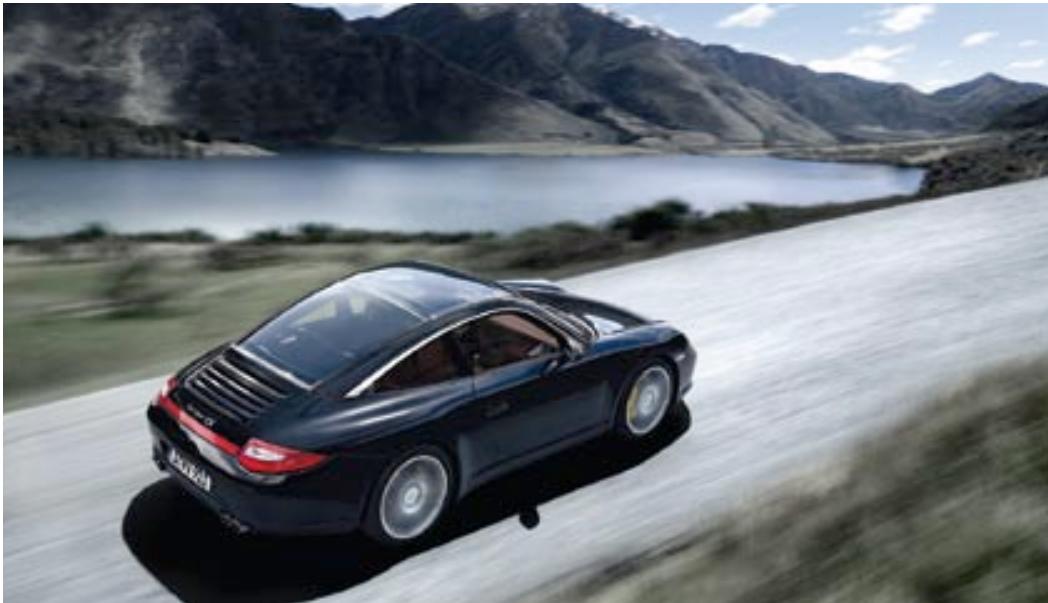
911 Targa 4S
The electrically operated glass roof is fully integrated into the body and gives a sensation of infinite width – open or closed. Despite the large glass areas, body rigidity is extremely high and loading comfort is increased thanks to the opening glass rear screen.
For an unmistakable silhouette.
The rear section is accentuated by the striking taillight strip.
So the 911 Targa 4 models combine design and comfort with unsurpassed performance. For a unique driving experience – as they have since 1965.
A complete decor strip of anodized and polished aluminium emphasises the elegant lines of the roof. It describes a tight arc from the A-pillar back to the rear quarter windows with their characteristic pointed style.
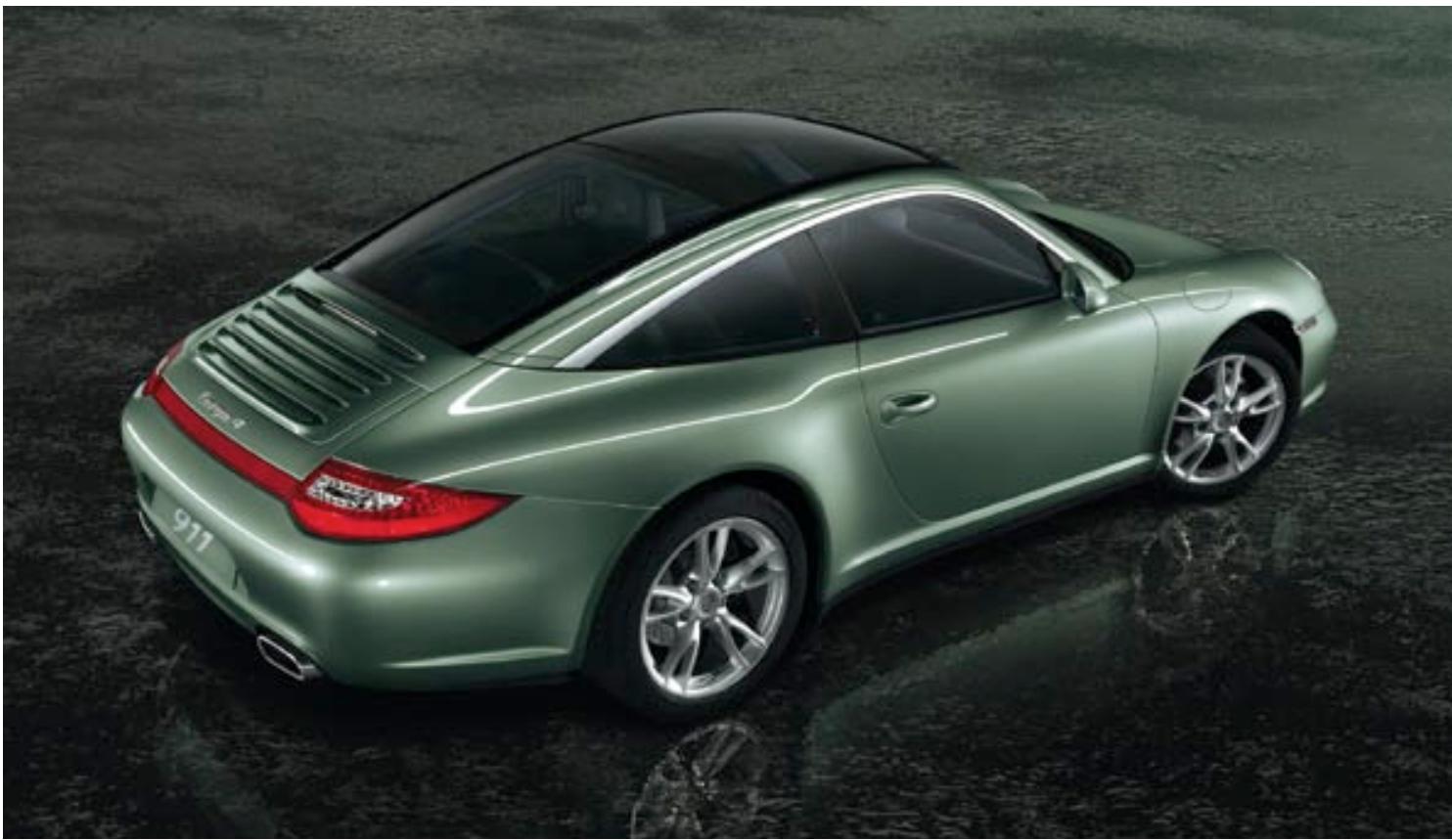
911 Targa 4
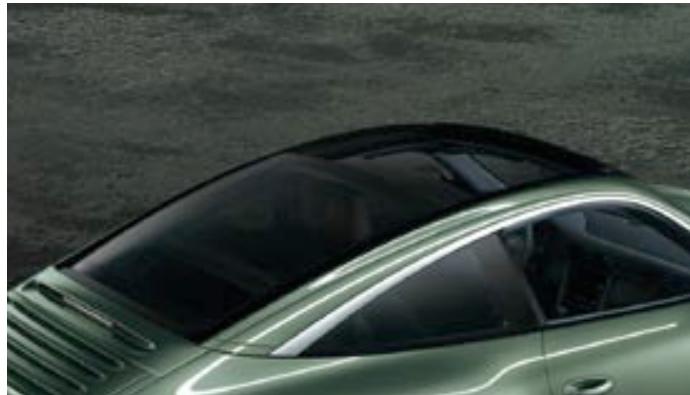
Glass roof open
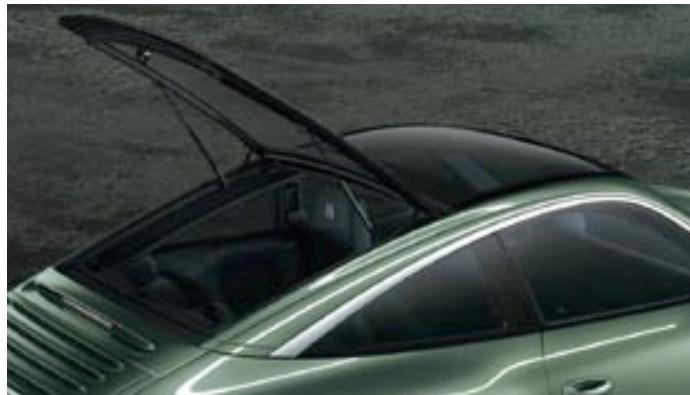
Tailgate open
Roof concept.
Even with the roof closed: the view upwards is unlimited. Just like the possibilities offered by the glass roof on the 911 Targa 4 models. Because you decide how open you want to drive. At any speed.
Simply press the switch in the centre console. The glass roof lowers. Now it can be moved back into any position you want. The automatically extending wind deflector reduces air turbulence and wind noise. So you can enjoy open-top driving even in damp or
cold weather and on long journeys.
The glass roof is made of tinted laminated safety glass. Combined with the electrically extending extra sunblind, it offers good protection against strong sunlight
or heat loss at low external temperatures.
The glass rear screen can be opened for easier loading of luggage into the rear. It is opened either from the inside or by remote control from the vehicle
key. An electric closing aid ensures comfortable closing.
driving dynamics with function and design so superbly.
In brief: the 911 Targa 4 models have a special place thanks to the combination of a unique roof concept and active all-wheel drive. Almost no other vehicle combines
Engine
Porsche, Weissach
911 Carrera
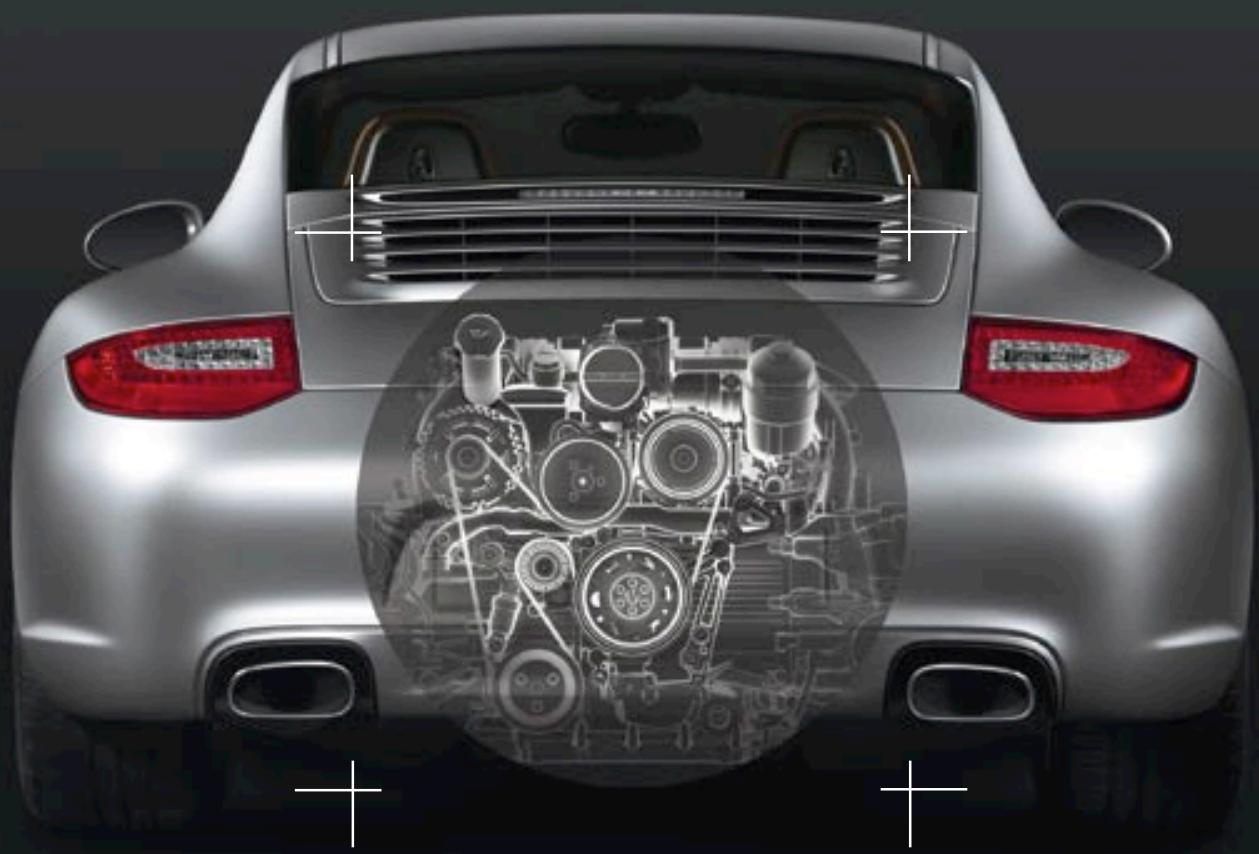
First, the good news: the engine is at the rear. It has six cylinders, and, naturally, it's a boxer engine available with a 3.6-litre or 3.8-litre capacity and VarioCam Plus.
Now for the even better news: the 911 features direct fuel injection (DFI). For increased output, increased torque and increased fuel economy.
Inner strength means that even the best have scope for a little improvement.
Image 000003
Engine
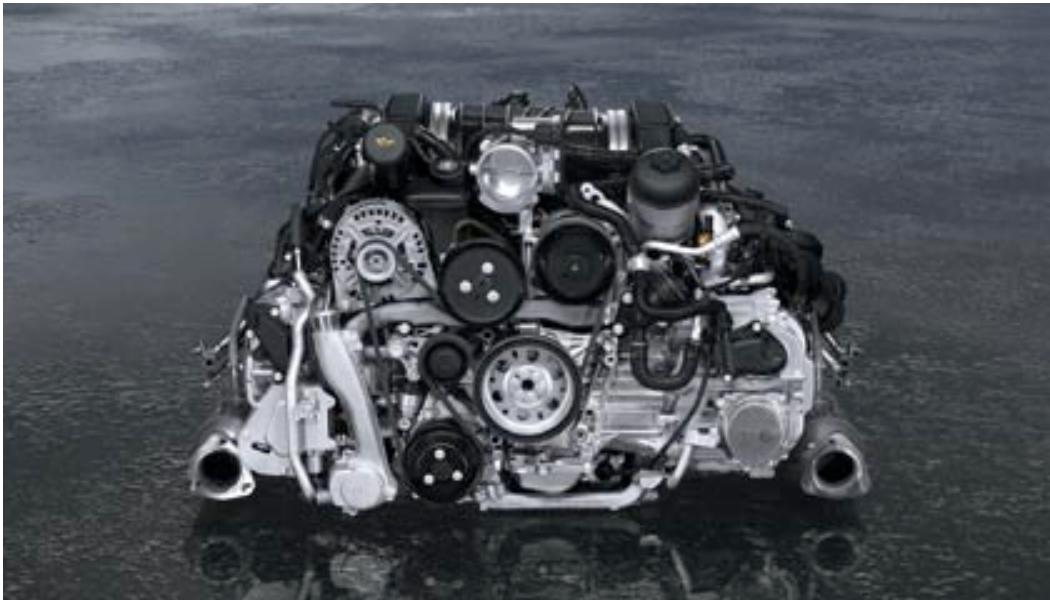
3.8-litre boxer engine
Why it always pays to take the direct route.
The engine of the 911.
All 911 models feature direct fuel injection (DFI). The 3.6-litre horizontally-opposed engine generates 254 kW (345 hp), and the 3.8-litre version has an output of 283 kW (385 hp). The results
are outstanding performance and surprisingly low fuel consumption and emission values. All made possible thanks to DFI, VarioCam Plus, a lightweight construction, low friction and a number of detailed technical solutions.
Direct fuel injection (DFI).
With millisecond precision, DFI injects fuel at up to 120 bar directly into the combustion chamber by means of electromagnetically actuated injection valves.
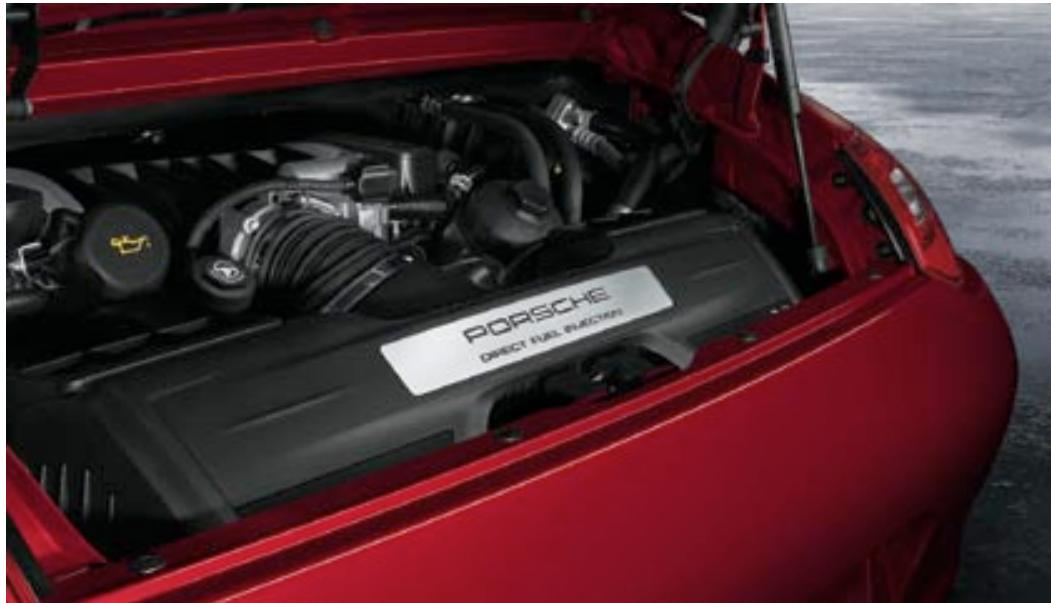
The spray and cone angles have been optimised for torque, power output, fuel consumption and emissions by enabling a homogeneous distribution of the air/fuel mixture, and, therefore, effective combustion. With direct injection, the EMS SDI 3.1 engine control regulates injection timing individually for each cylinder as well as the injection rate for each cylinder bank. This optimises the combustion process and fuel economy. A hot-film air mass meter takes care of the airflow, so that the combustion chambers contain exactly the right mixture at all times.
At up to 3,200 rpm, the engine operates with dual injection; at up to 2,500 rpm, it even works with triple injection. The required volume of fuel is distributed between two or three sequential injections, respectively – for faster heating of the catalytic converters after a cold start and for greater torque in the upper load range.
DFI improves the internal cooling of the combustion chamber by having the mixture prepared directly in the cylinder. This allows for a higher compression ratio (12.5:1) which helps to deliver
more output along with enhanced engine efficiency. It has been possible to reduce CO_2 emissions by up to 17% compared with the previous model.
Injection is regulated by the electronic engine management system. The exhaust gas cleaning system ensures that emissions remain well below even the strict limits of the Euro 5 emission standard, thus helping to protect the environment.
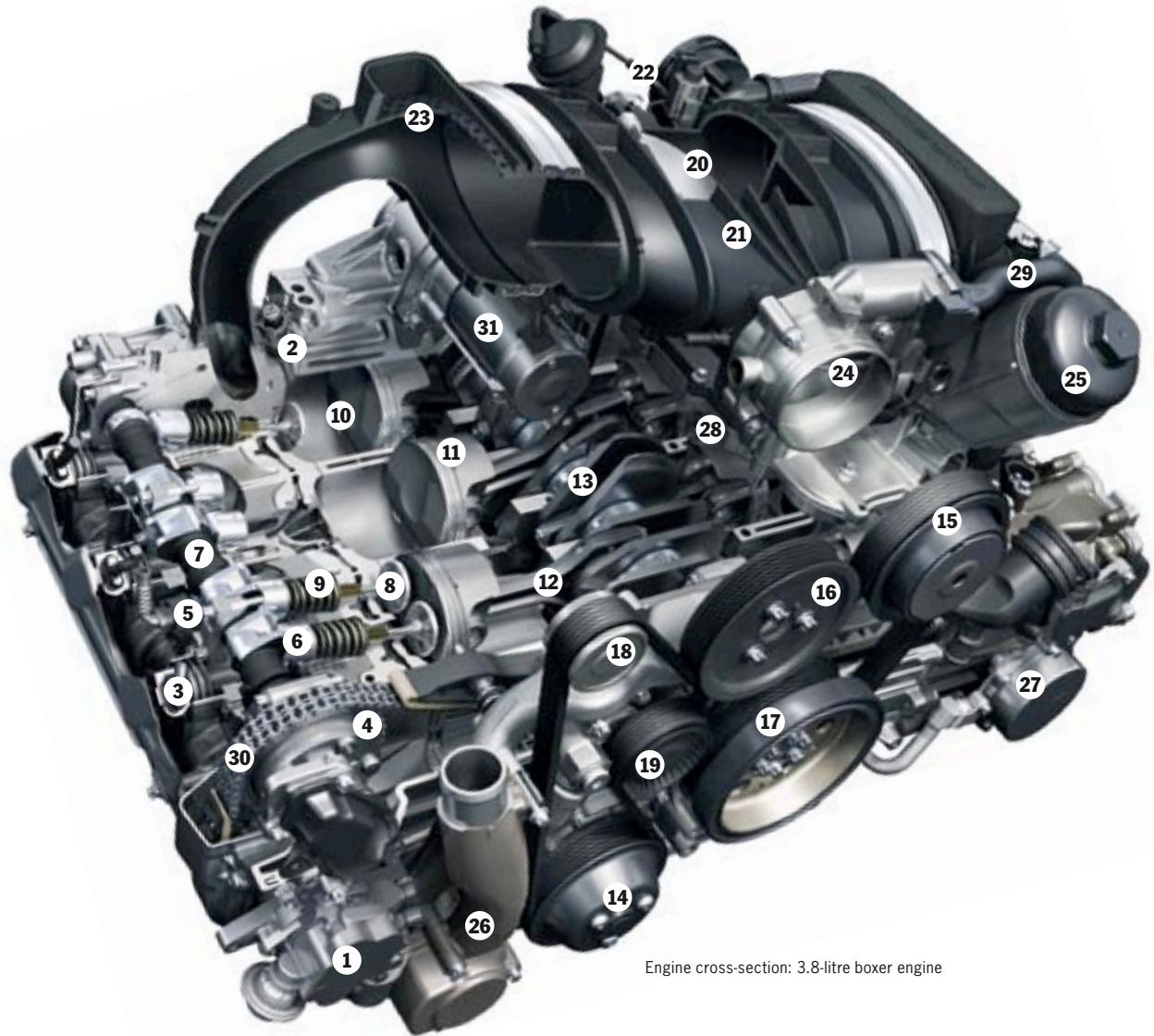
- High-pressure pump
- High-pressure injector
- Ignition rod module
- Camshaft controller
-
Valve lift adjustment switch valve
-
Switch tappet with
integrated valve
clearance compensation - Intake camshaft
- Intake valves
-
Valve spring
-
Combustion chamber with
Alusil cylinder liner surface - Forged aluminium piston
- Forged connecting rod
- Crankshaft
- Water pump
-
Air-conditioning compressor
-
Power steering pump
- Vibration damper
- Alternator pulley
- Hydraulic belt tensioner
- Resonance valve
- Distribution pipe
- Selective resonator
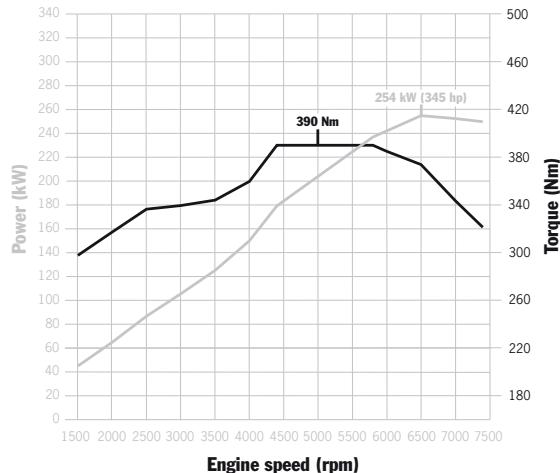
911 Carrera/911 Targa 4: 390 Nm at 4,400 rpm, 254 kW (345 hp) at 6,500 rpm
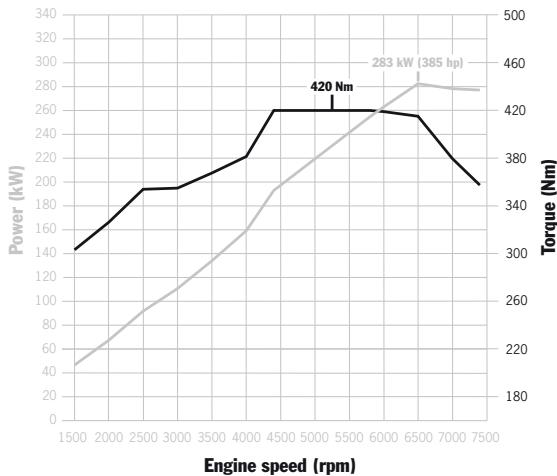
911 Carrera S/911 Targa 4S: 420 Nm at 4,400 rpm, 283 kW (385 hp) at 6,500 rpm
- Intake manifold with
integrated sound chamber - Electronically controlled
throttle valve - Oil filter
- Thermostat
-
Evacuating pump
-
Coolant jacket
- Crankcase breather
- Timing chain
- Starter
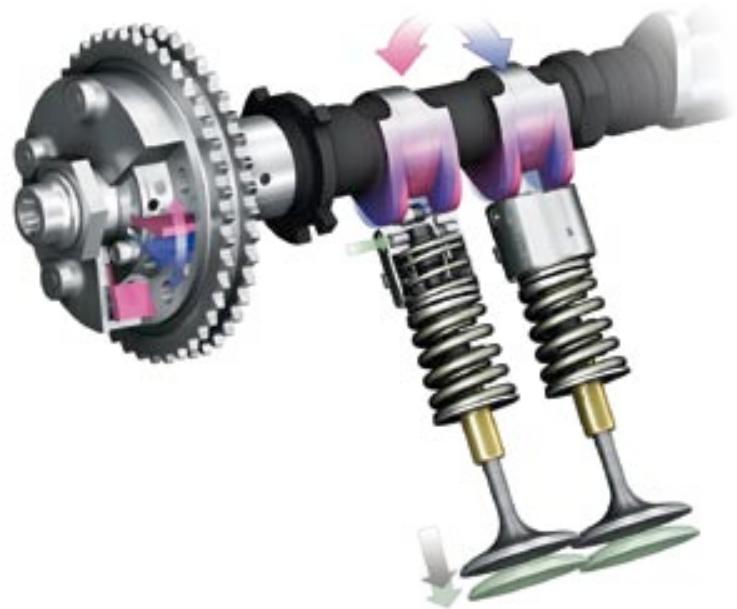
VarioCam Plus System.
VarioCam Plus combines variable valve timing with two-stage lift on the inlet side. This results in smoother running, better fuel economy and lower exhaust emissions. As well as greater top-end power and low-end torque.
This two-in-one engine concept seamlessly adapts in response to driver input. The result: instant acceleration and extremely smooth running.
The variation in intake timing is steplessly controlled by means of an electro-hydraulic rotary vane adjuster at the head of the corresponding camshaft.
To improve throttle response during the warm-up phase, VarioCam Plus selects high valve lifts with retarded valve timing. In the middle and low load ranges, low valve lifts with advanced timing reduce fuel consumption and exhaust emissions. High valve lifts generate high torques and maximum output.
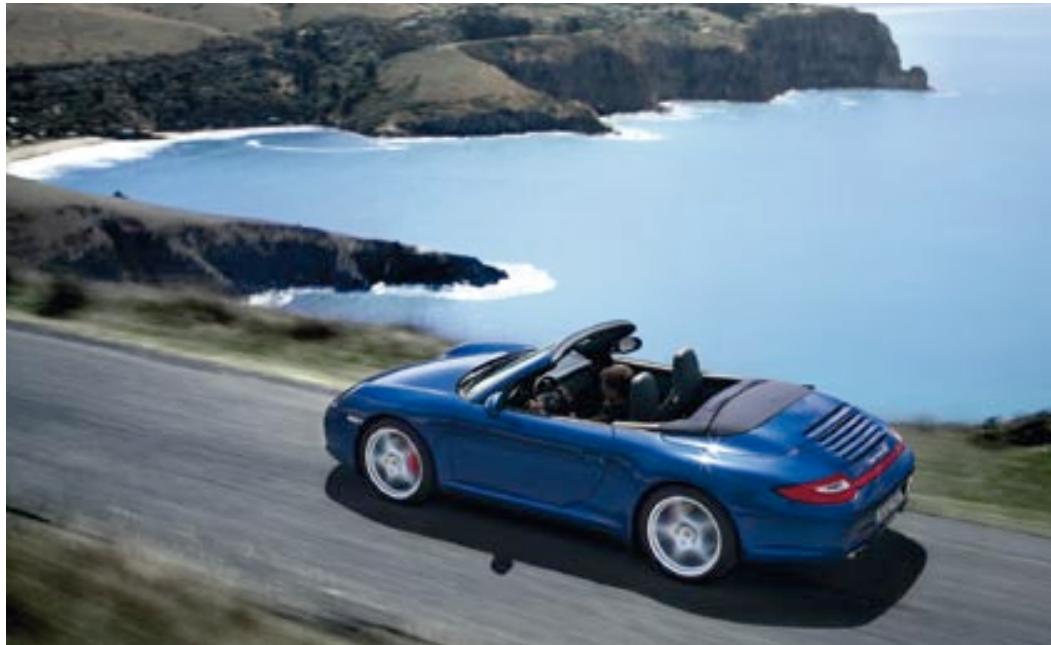
911 Carrera 4S Cabriolet
Lightweight construction.
The advantages of an alloy engine are its low weight and reduced fuel consumption.
The intelligent engine design saves even more weight, for example, by
fully integrating the camshaft bearings into the cylinder heads.
Fuel economy has been furtherimproved by the effectivelydesigned oil supply system and
the low mechanical friction of the engine.
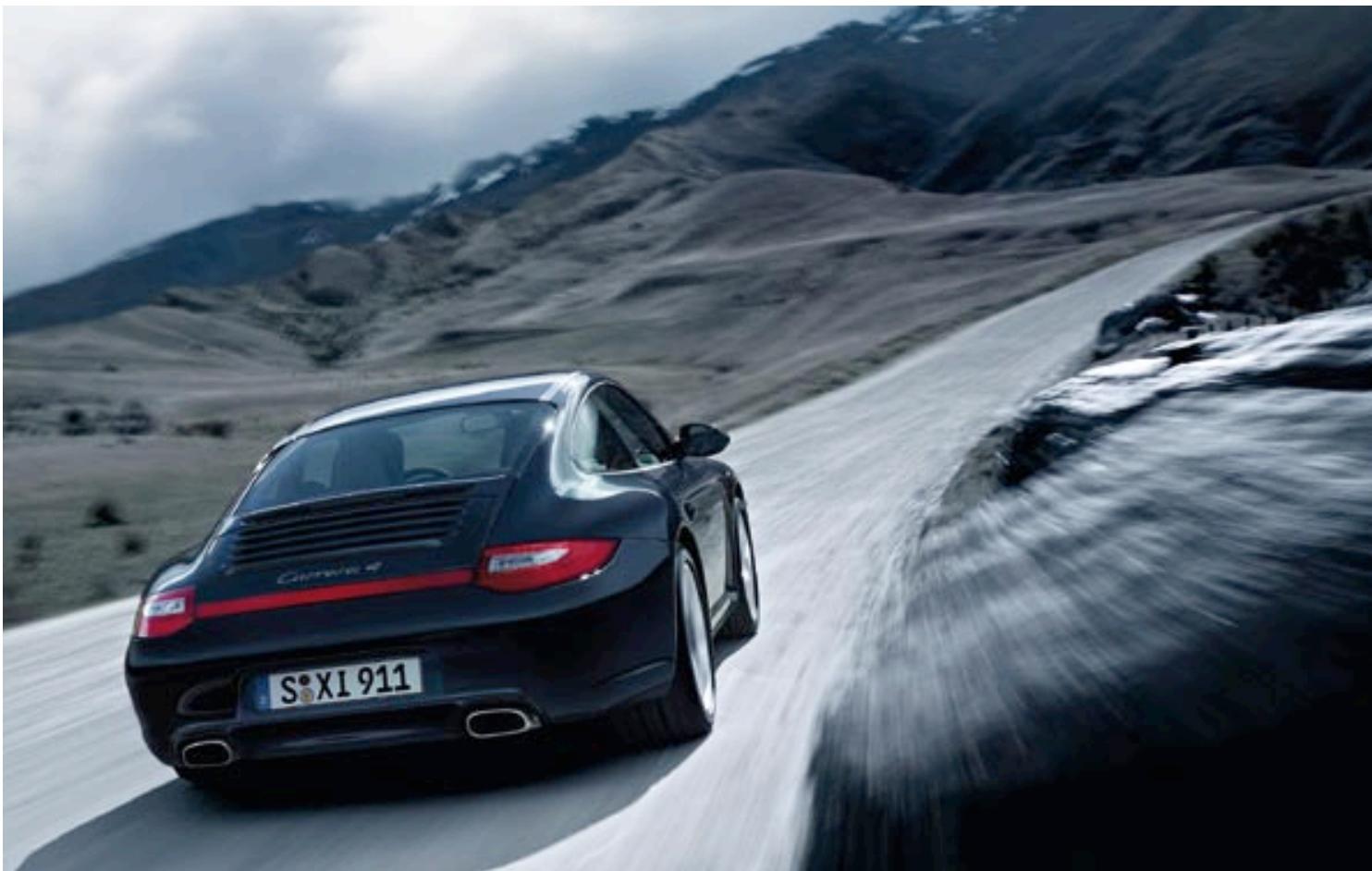
911 Carrera 4
lubricating points inside theengine as and when required.
This means that the oil pump does not work so hard when there is less demand for lubrication. The main benefit of an on-demand oil supply system is optimum efficiency, which ensures low fuel consumption and reduced exhaust emissions.
Single-jet spray nozzles cool the piston crowns with oil from the main lubrication circuit – another detailed solution that helps to reduce the thermal load on the engine.
For the engine, all of these detailed solutions mean a consistent supply of oil regardless of gravitational loads, even in the most demanding track conditions.
efficient cross-flow cooling system, as used in motorsport, where each engine cylinder is uniformly supplied with coolant.
In the 3.8-litre engine, the higher output demands a corresponding increase in cooling. The solution is a more powerful coolant pump and a more efficient oil/coolant heat exchanger expanded by two additional fins.
Ignition.
The ignition system is designed for static high-voltage distribution. Individual ignition coils on each of the spark plugs ensure perfect ignition every time.
Integrated dry-sump lubrication.
The purpose of integrated dry-sump lubrication is to guarantee a reliable oil supply while reducing engine temperatures, even in sportily driven cars.
The oil reservoir is located inside the engine, making an external tank unnecessary. Four oil pumps remove the oil from the cylinder heads directly into the oil sump. A fifth pump in the oil sump directly supplies the lubricating points in the engine.
To prevent foaming, the oil is channelled through cylinders known as swirlpots. In this way, optimum lubrication is guaranteed at all times and the oil pressure is always maintained at the necessary level in order to ensure, for example, that hydraulic valve
clearance compensation remains fully functional – a condition that is crucial to the power and emission characteristics of the engine.
To reduce power losses and increase efficiency, an electronically controlled oil pump supplies the
Engine cooling system.
DFI and VarioCam Plus enable a tremendous amount of power to be produced with reduced emissions, fuel consumption and noise. The same applies to our
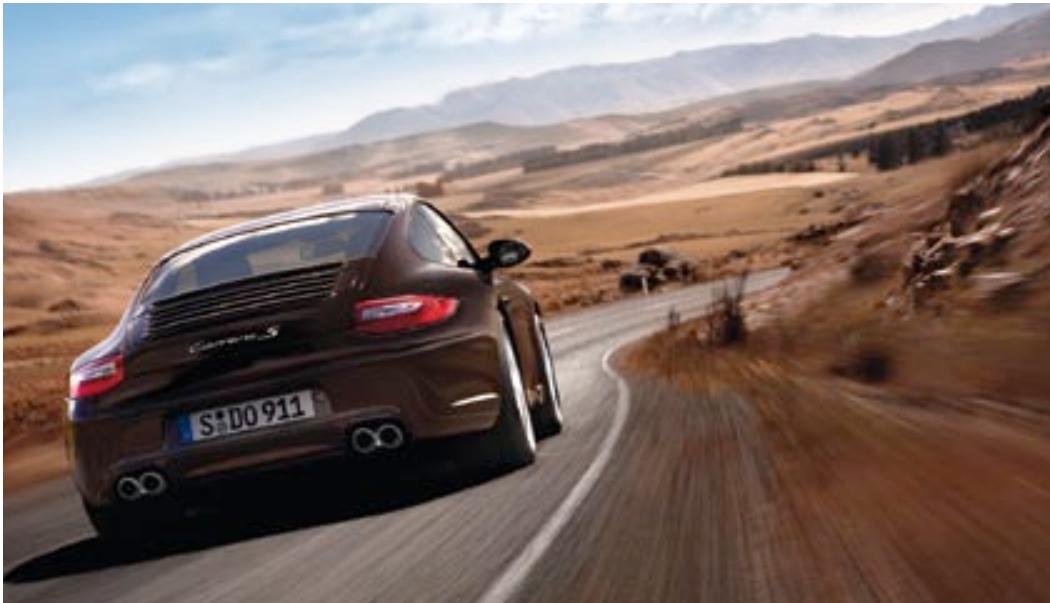
911 Carrera S with sports exhaust
Air intake system.
All models have a two-stage resonance intake system, which uses the vibration of the air as it passes through the intake manifold to increase the intake volume. The system can adjust to engine speed.
Benefits of this include higher torque at low engine speeds and a flatter torque curve.
The entire intake system is made from lightweight plastic. The air-filter housing of the 3.8-litre engine has a variable geometry that brings added character to the engine sound which becomes much more aggressive at higher rpm.
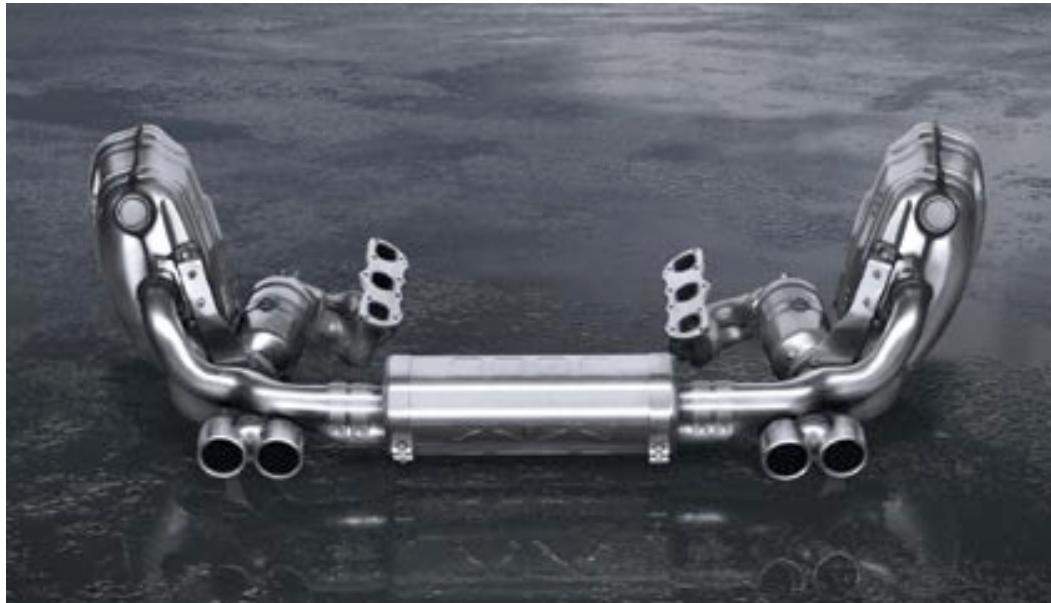
911 Carrera S exhaust system
Exhaust system.
The stainless steel exhaust system comprises two independent and separate exhaust tracts. Its catalytic converters are highly temperature-resistant and heat up rapidly for effective emissions reduction.
Thanks to advances in emissions technology, they are able to meet strict emission standards, such as Euro 5 in Europe and LEV II in the USA.
Using stereo lambda control, two sensors continuously monitor the exhaust gas composition for each exhaust tract. A further sensor monitors the efficiency of the catalytic converters.
In addition, a sports exhaust system is available as an option (p. 48, 150). This can be activated as desired using a button on the centre console.
Input data
Regulation/control of
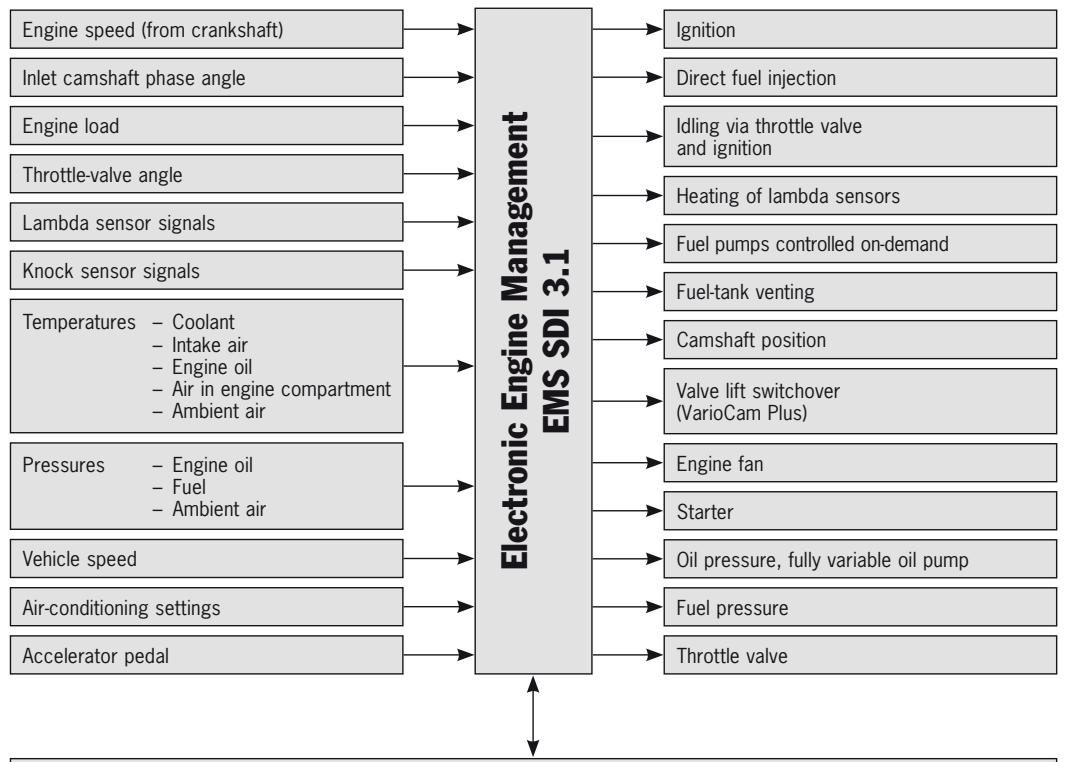
CAN interface with driving dynamics control, transmission control, immobiliser, instrument cluster, climate control, Sport button, Sport Plus button, sports exhaust system button, diagnostics, etc.
Engine management system.
The EMS SDI 3.1 engine management system ensures optimum engine performance at all times.
In particular, it controls the position of the electronic throttle valve (ETV) – a prerequisite for compatibility with the Porsche
Stability Management (PSM), which comes as standard. Moreover, it regulates all engine-related functions and assemblies (see diagram). The results: optimum fuel economy, emissions, and performance in all driving situations.
Another important function of the system is cylinder-specific knock control. Since the six cylinders never all work under exactly the same conditions, they are monitored individually by the knock control. The ignition point is shifted individually, as and when necessary to prevent damage to the cylinders and pistons at
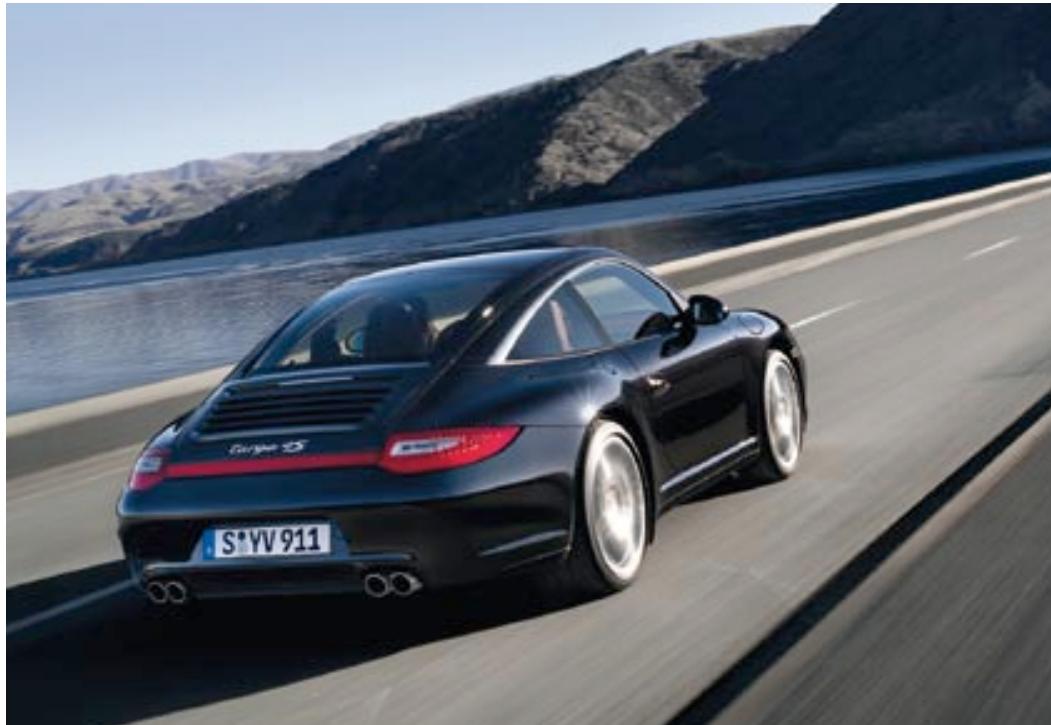
911 Targa 4S
high engine speeds and loads. The on-board diagnostics, which are compliant with European standards, ensure timely detection of any faults and defects that may occur in the exhaust and fuel systems and notify the driver immediately. This also prevents increased pollutant emissions and unnecessary fuel consumption.
Servicing.
Every Porsche is designed with longevity in mind and the 911 is no different. The alternator, power-steering pump and the air-conditioning compressor are all driven by a single self-adjusting belt. Hydraulic valve clearance
compensation makes valve clearance adjustment unnecessary. The drive chains on the camshafts do not require servicing. With the sole exception of the spark plugs, the ignition system is also maintenance-free. This all adds up to long maintenance intervals which are guaranteed by warranty: two years, unlimited mileage.
Transmission
Porsche, Weissach
911 Carrera
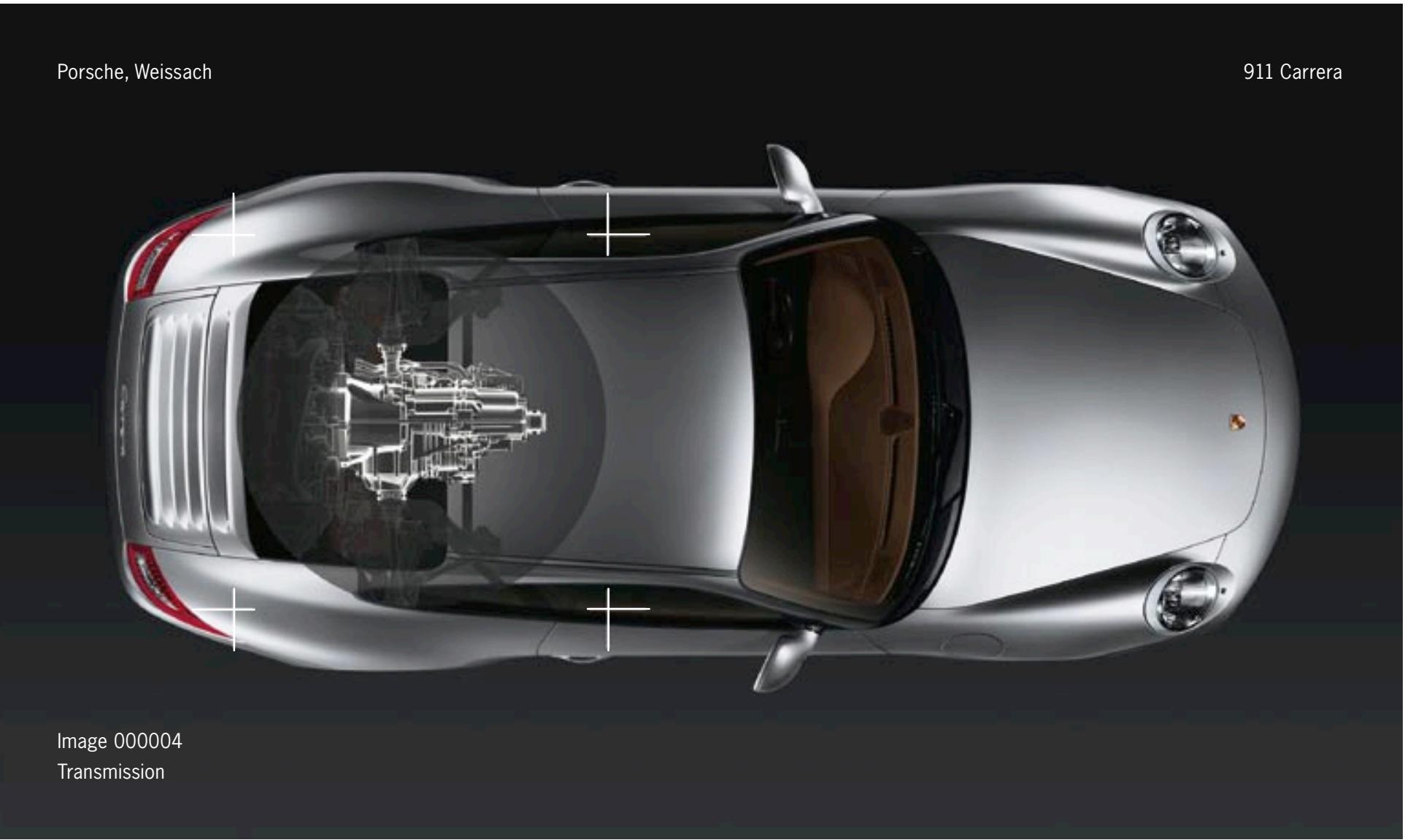
Cause and effect. And what happens in between? Lots. Not that you would notice. At least not in the 911.
For instance, when you shift gear with Porsche Doppelkupplung (PDK). The gear is changed. In milliseconds. Without any interruption in the flow of power.
The same goes for Porsche Traction Management (PTM). It reacts to the driving situation at lightning speed.
The cause: advanced engineering. The effect: unsurpassed.
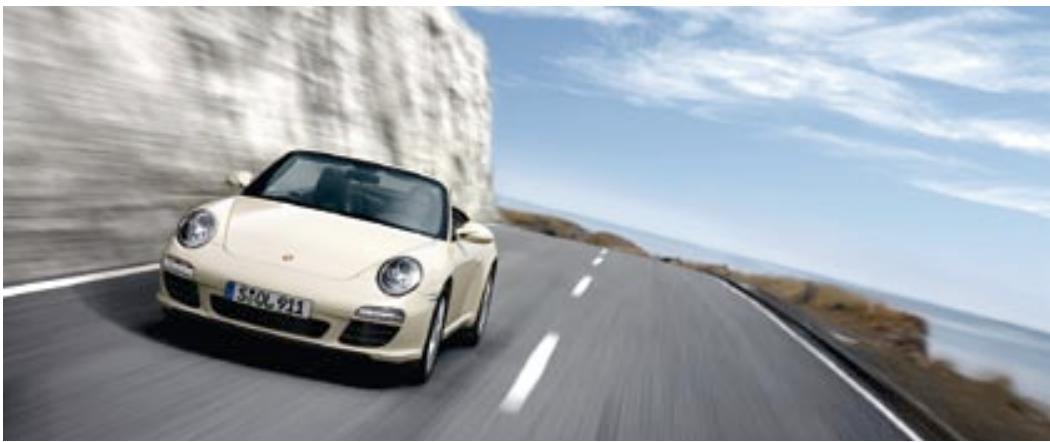
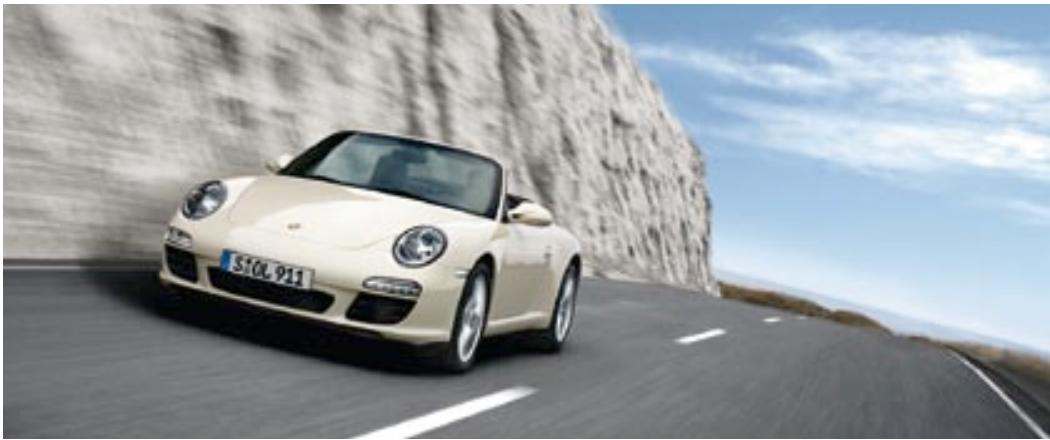
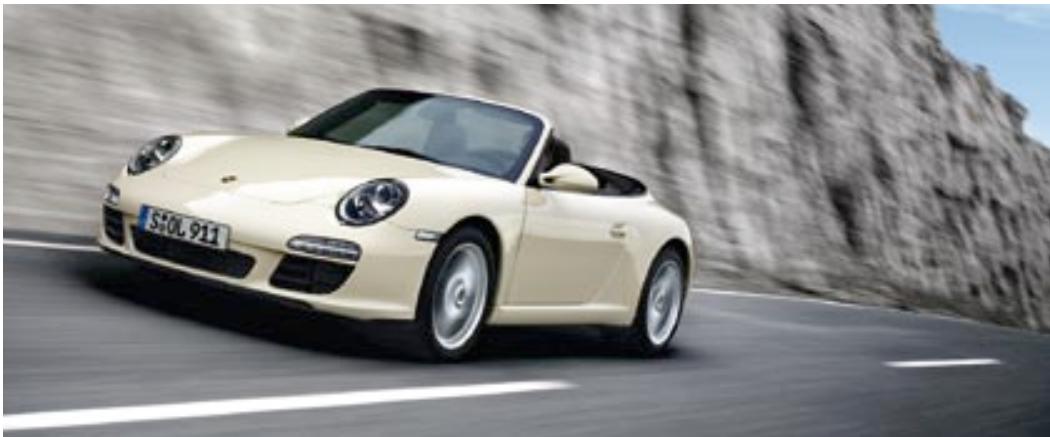
911 Carrera Cabriolet
As if one clutch didn't deliver enough performance already.
Porsche Doppelkupplung (PDK).
The optional Porsche Doppelkupplung (PDK), with both manual gearshift and an automatic mode, enables smooth gear changes with no interruption in the flow of power. This results in significantly faster acceleration and lower fuel consumption, without having to sacrifice the ease of automatic transmission.
In total, PDK has seven gears at its disposal. Gears 1 to 6 have a sports ratio and top speed is reached in 6^th gear. The 7^th gear has a long ratio and reduces fuel consumption even further.
PDK is like having two gearboxes in one and thus requires two clutches – designed as a double wet clutch transmission.
This double clutch provides an alternating, non-positive connection between the gearbox and the engine by means of two separate input shafts (input shaft 1 is nested inside the hollowed-out input shaft 2).
The flow of power from the engine is only ever transmitted through one clutch at a time, while the next gear is preselected by the
second clutch. During a gear change, a conventional shift no longer takes place. Instead, one clutch simply opens and the other closes at the same time. Gear changes therefore take place within a few hundredths of a second.
Clutch 1 controls the odd gears (1, 3, 5, 7) and reverse. Clutch 2 controls the even gears (2, 4, 6).
The crankshaft transmits engine torque to the dual-mass flywheel which is then channelled through the clutch housing and onto the multi-plate clutches, or to be more precise, the outer disc carrier.
Under oil pressure, clutch 1 closes and forms a frictional connection with input shaft 1.
The torque is now transmitted through the differential to the rear axle or, in the all-wheel drive variants of the 911, the front and rear axles.
At this stage, PDK has already preselected the next gear. Engine torque is already acting on the other outer disc carrier and, in response to a gear change signal, the overlap shift is initiated, i.e. as clutch 1 opens, clutch 2 closes. The non-positive connection with input shaft 2 is established, and
power is transmitted to the wheels.
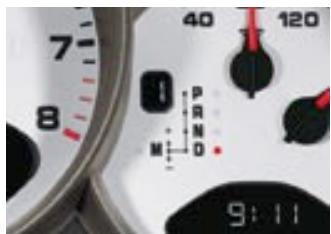
The gear which is engaged is displayed on the instrument cluster. PDK has distinct benefits. The very rapid gearshifts, with no interruption in the flow of power, produce faster acceleration.
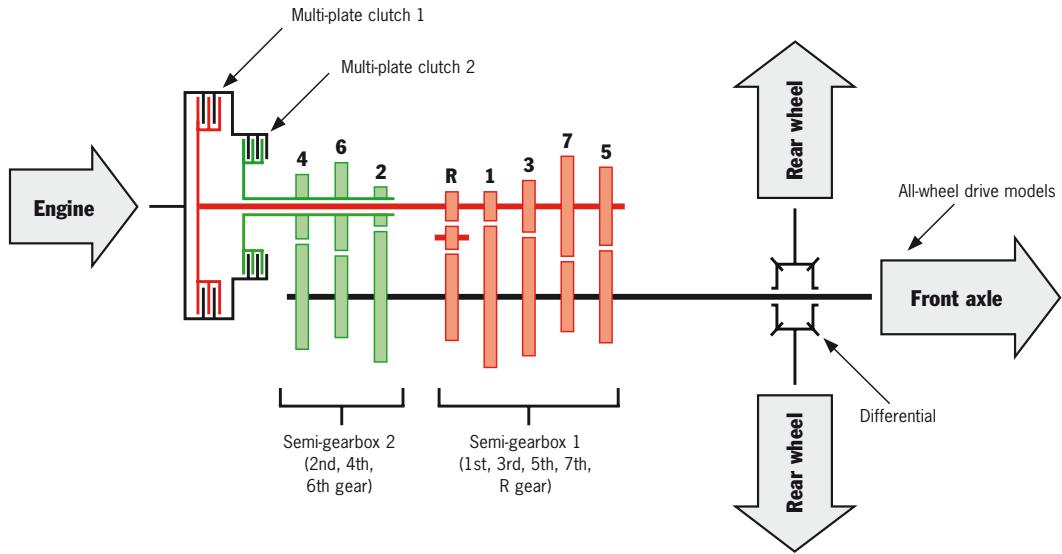
PDK function diagram
Driving feels even sportier and more dynamic, and agility is increased. Depending on the gearshift programme, the gear change is optimised for comfort or for sporty handling.
The compact dimensions of the gearbox reduce rotational masses which means a more direct engine response, and the system is more lightweight.
This, along with the long-ratioed 7^th gear, helps to achieve reduced fuel consumption and emission figures comparable with those of a manual gearbox. In conjunction with the engines featuring direct fuel injection (DFI), it has been possible to reduce fuel consumption by up to 14% and CO_2 emissions by up to 17% (compared with the previous model).
With the optional Sport Chrono Package Plus, PDK is enhanced by the 'Launch Control' and 'motorsport-derived gearshift strategy' functions (p. 74). In essence, PDK combines sportiness with efficiency and comfort.
What could be more appropriate to a Porsche 911?
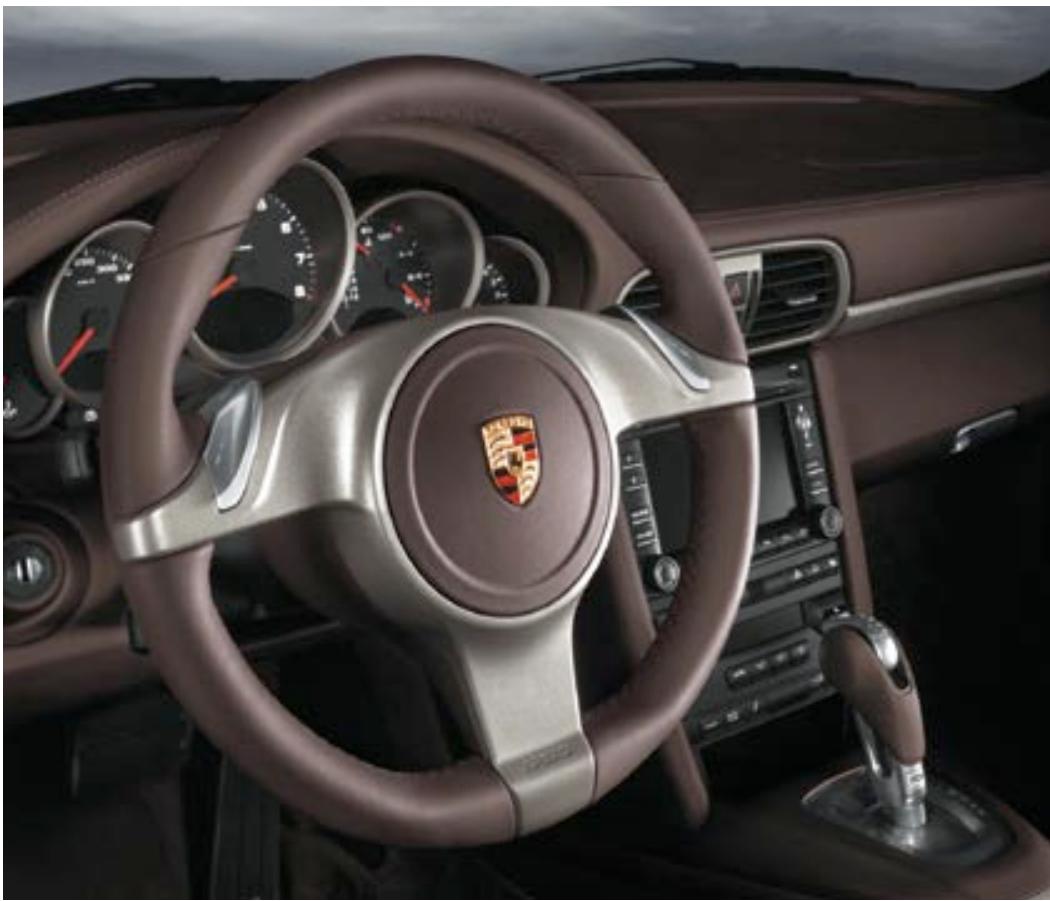
Three-spoke sports steering wheel with gearshift switches.
In conjunction with the optional
Porsche Doppelkupplung (PDK),
the standard three-spoke
sports steering wheel features
two ergonomic switches.
One press with the thumb and PDK shifts up. One pull with the index finger and PDK shifts down. Either the right or left hand can be used.
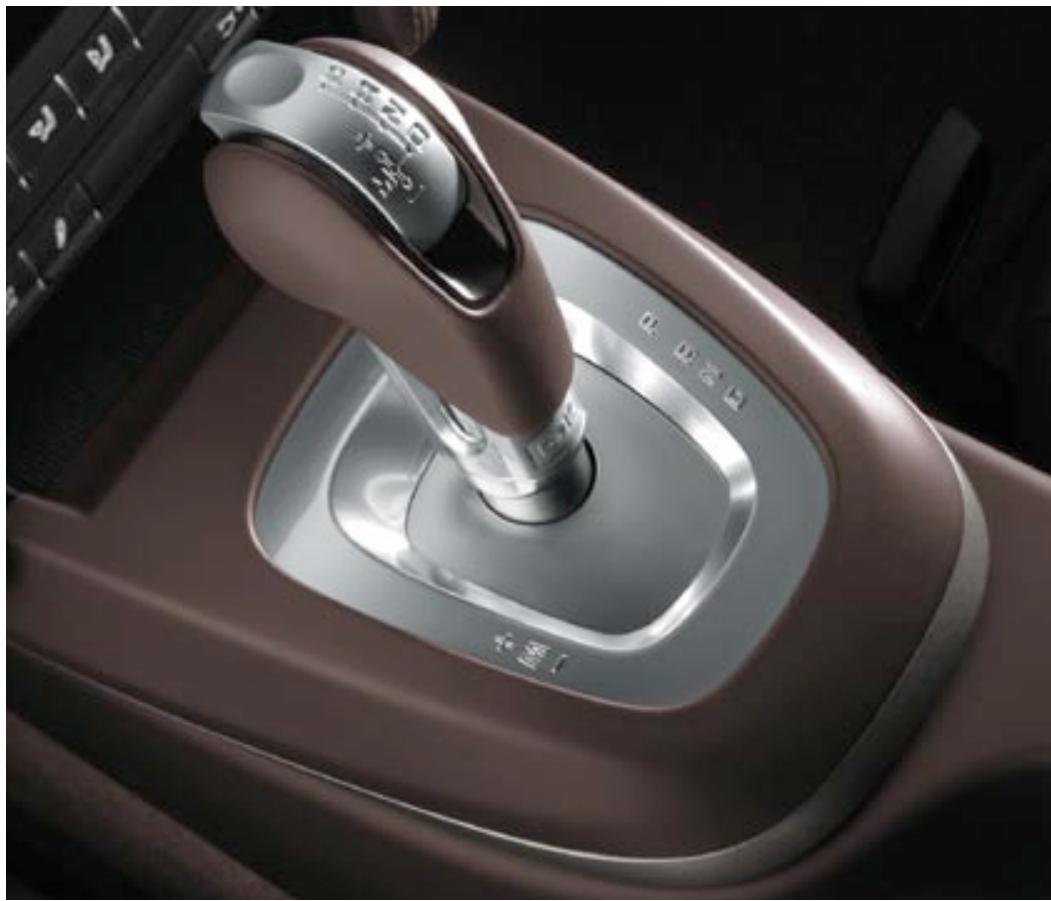
Gear selector for Porsche Doppelkupplung (PDK).
The gear selector for PDK is ergonomic and designed for high functionality, enabling you to change gear manually. The control concept mirrors the logic of the
puddles on the three-spoke sports steering wheel - press forwards to shift up, pull backwards to shift down.
Even if the gear selector is set to automatic mode, you can still
change gear manually using the paddles on the steering wheel.
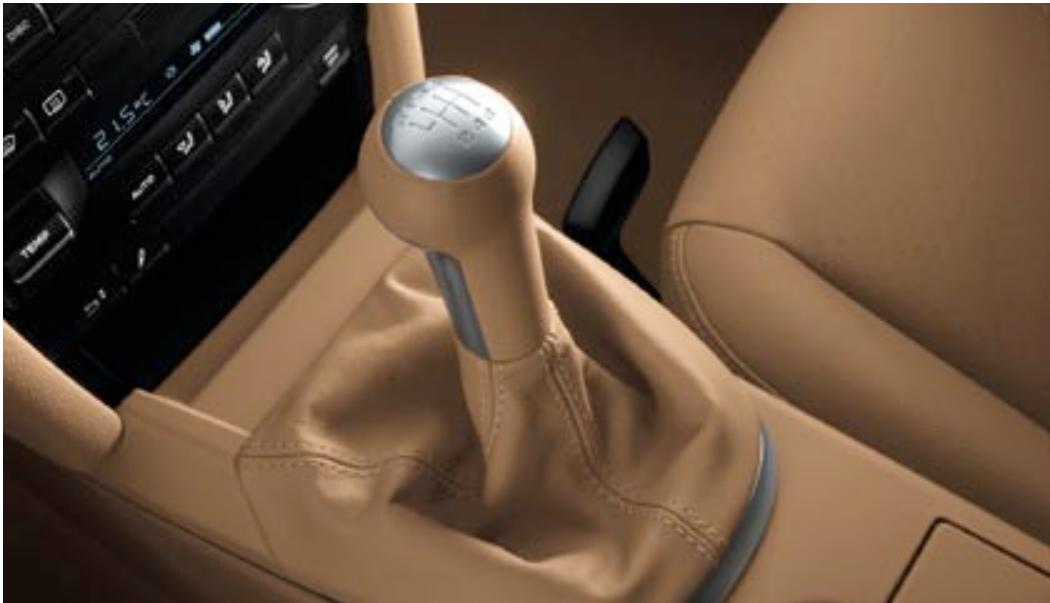
Inner strength alone is not enough. It somehow needs to be put to use.
Six-speed manual gearbox.
Accurate and involving: the six-speed manual gearbox is the link to each and every gear. The cable-operated gearshift unit is designed for optimum progression through the gears and the gear lever is insulated from the engine and gearbox.
The gear lever throw is short and precise, enabling a rapid gearshift action and positive response. An optional short shifter is available from Porsche Exclusive.
In addition, all 911 models have a self-adjusting clutch. In comparison with conventional clutches, this reduces by up to 50% the added release loads that normally occur as the clutch begins to wear.
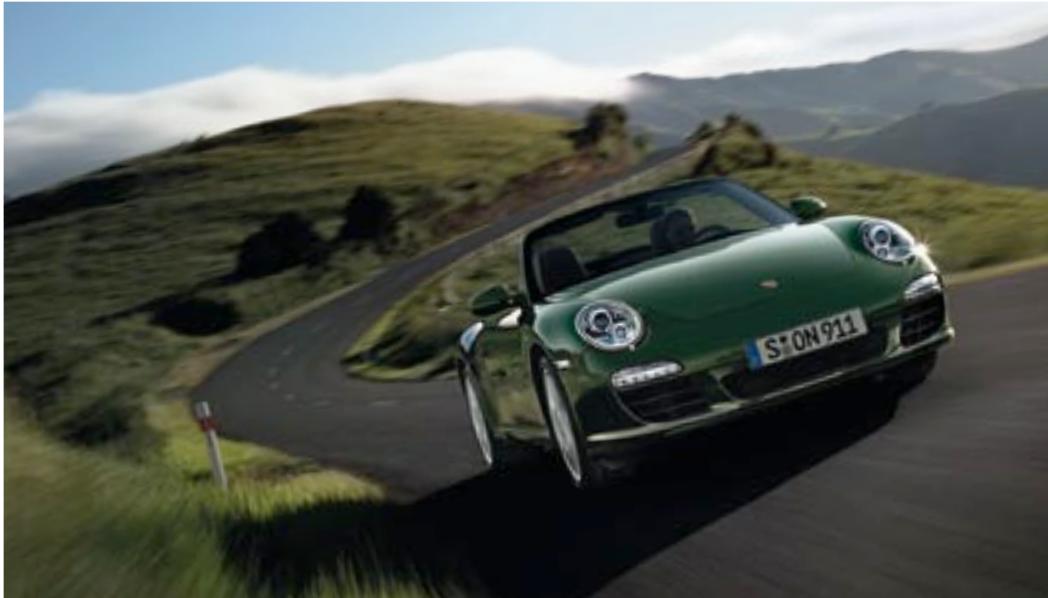
911 Carrera S Cabriolet
Hill-start assist.
Hill-start assist comes as standard for manual and Porsche Doppelkupplung (PDK) transmissions. It assists the driver in making a comfortable, smooth and roll-free start on an incline.
The system automatically detects that the vehicle has been braked to a halt on an incline. Provided a gear is engaged, the brake pressure is maintained at all four wheels for approximately 2 seconds once the footbrake is released. The vehicle is therefore temporarily prevented from rolling
backwards. This brake pressure is reduced once sufficient revs have been generated by the driver depressing the accelerator pedal (or, in the case of manual transmission, the accelerator pedal is depressed and the clutch is released).
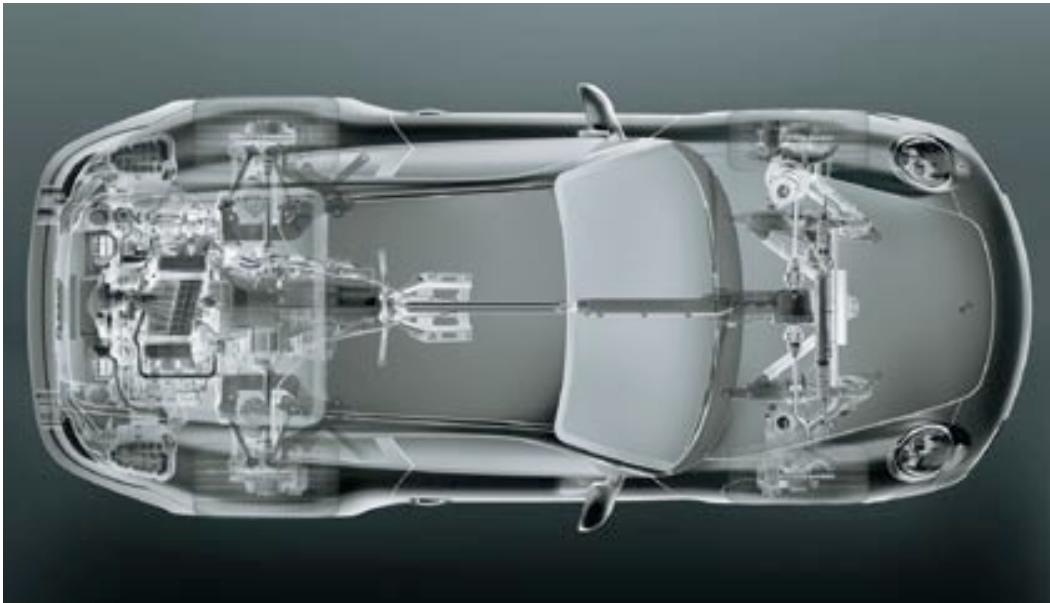
At one time, bends would bow before the landscape. Now they bow before engineering.
Porsche Traction Management (PTM).
In a 911, engine power is not the only priority. There is always the question of how this power can be effectively and consistently delivered to the road. One solution to this is all-wheel drive. An even better one is active Porsche
Traction Management (PTM), comprising permanent all-wheel drive with an electronically controlled multi-plate clutch, an automatic brake differential (ABD) and anti-slip regulation (ASR).
Featured as standard in 911 Carrera 4 and 911 Targa 4 models with all-wheel drive, the force between the front and rear axle is distributed actively by an electronically controlled multi-plate clutch.
In comparison with a viscous multi-plate clutch, where clutch regulation is not initiated until there is a difference in speed between the front and rear axles, the electronically controlled multi-plate clutch responds much more rapidly. Through continuous monitoring of the driving conditions, the electronics are able to respond to a variety of situations. Sensors check, among other variables, the rotation speeds of all four wheels, the longitudinal and lateral acceleration of the vehicle, and the steering angle. By evaluating the sensor data, the system can quickly adjust the distribution of drive force to the front axle in order to achieve optimum balance. If the rear wheels threaten to spin under acceleration, a greater proportion of drive force is sent forwards by a more powerful engagement of the multi-plate clutch. At the same time, ASR prevents the rear wheels from spinning. When cornering, the front wheels only
ever receive as much drive force as is necessary to prevent lateral instability. On uneven surfaces, the rear differential fitted as standard to all-wheel drive models, in combination with ABD, also improves traction.
In this way, PTM, in conjunction with Porsche Stability Management (PSM, p. 70), ensures that the perfect distribution of drive is achieved every time.
PTM really comes into its own in the wet or in ice and snow. In these conditions, the car's acceleration capability is simply breathtaking.
The result: a high level of safety and outstanding performance. Put to use in the most intelligent way.
Mechanically locking rear differential.
A mechanically locking rear differential is standard in the 911 all-wheel drive variants and is available as an option for all other 911 models in conjunction with 19-inch wheels.
It further enhances traction at the driven rear axle on uneven roads and when accelerating out of tight bends. This is accomplished by the damping of load-change reactions during fast cornering.
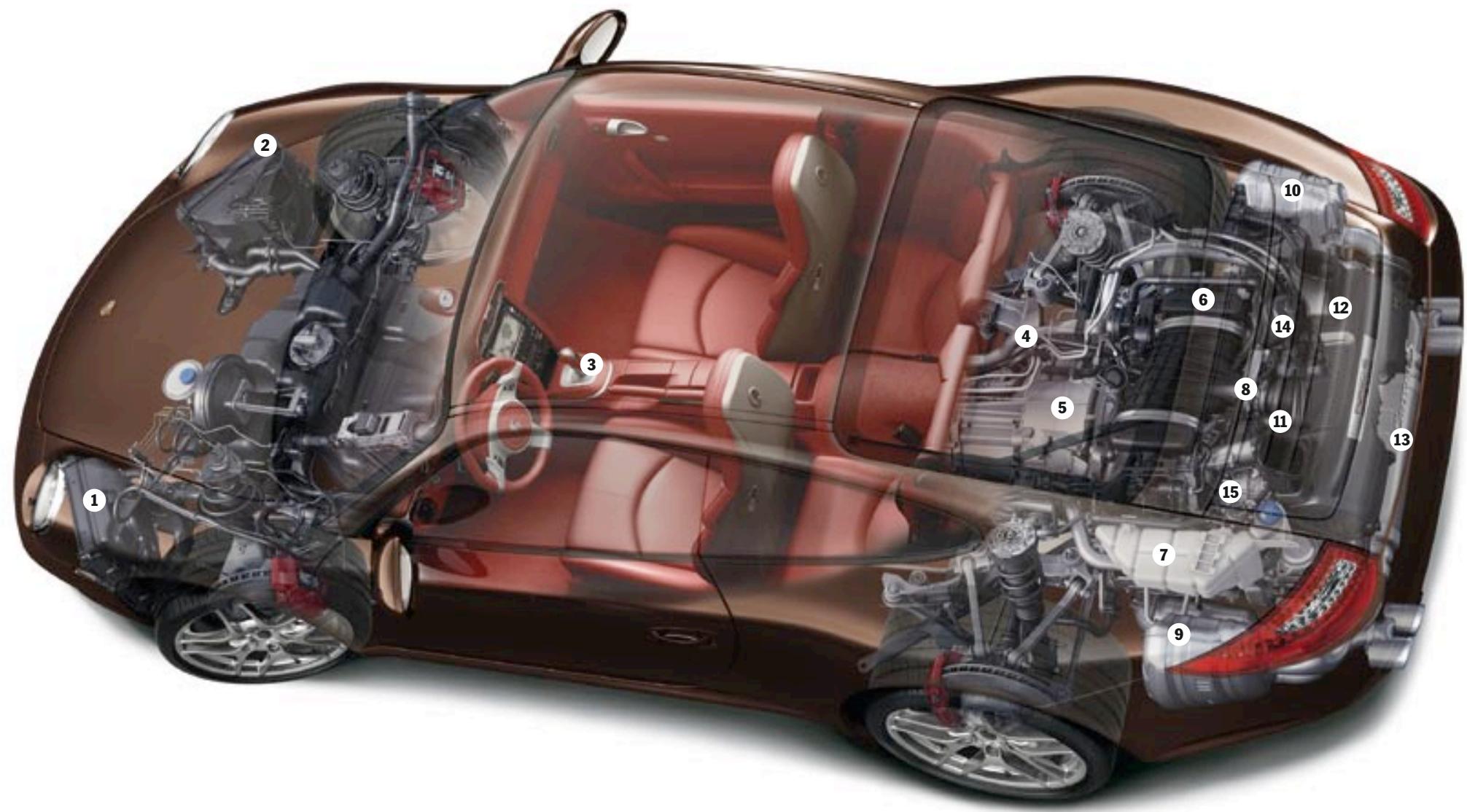
- Radiator module, left
- Radiator module, right
- Gear selector
- Coolant line
-
7-speed Porsche Doppelkupplung (PDK)
-
Intake manifold
- Coolant expansion tank
- Electronically controlled throttle valve
- Rear silencer, left
-
Rear silencer, right
-
Oil filler pipe
- Air filter
- Front silencer/ centre silencer
- Oil filter
- Alternator
Chassis
Porsche, Weissach
911 Carrera
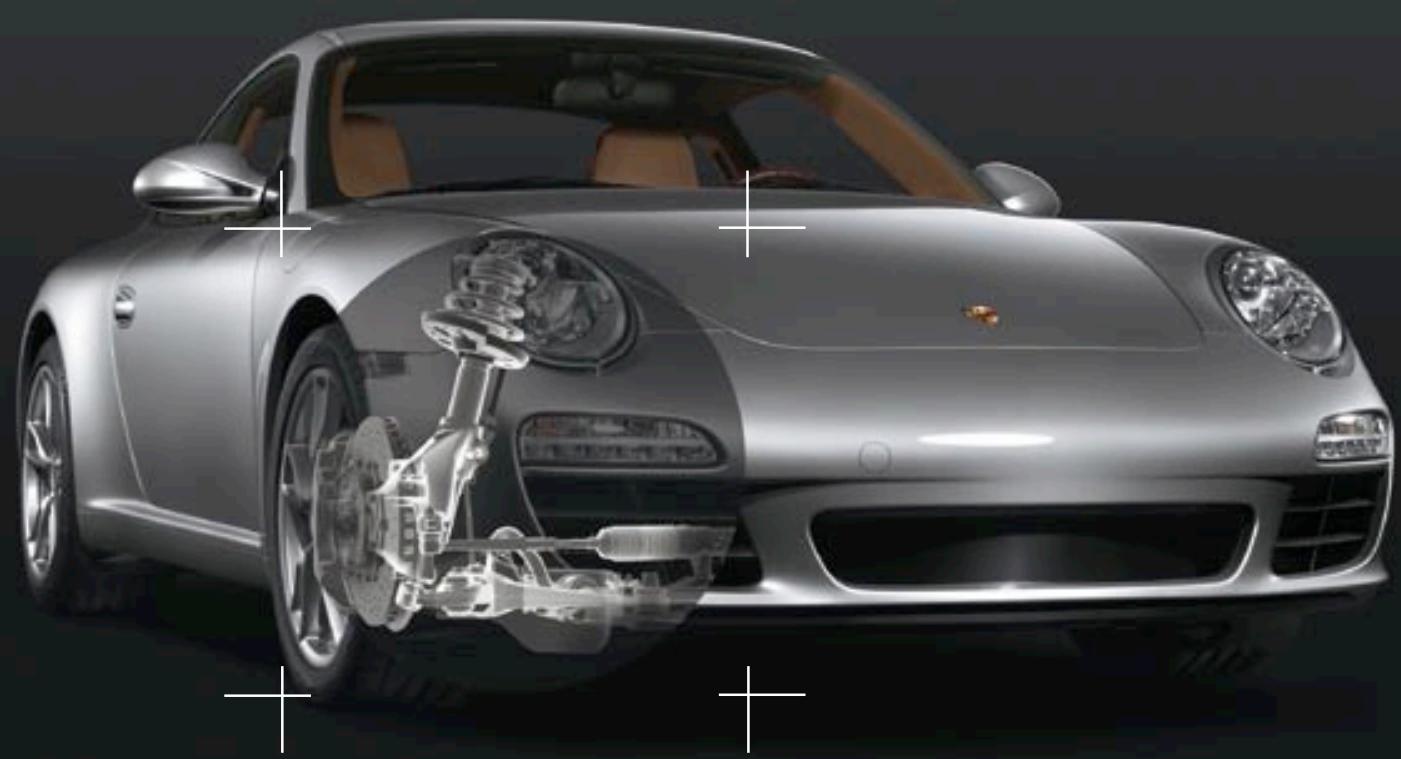
Inner strength means nothing if it's kept hidden. It has to be shown if it is to achieve its full effect.
In the case of the 911, this means that the power of the engine has to be unleashed onto the road. Effectively, directly and dynamically.
For this reason, chassis engineering is the logical continuation of drive engineering.
Image 000005
Chassis
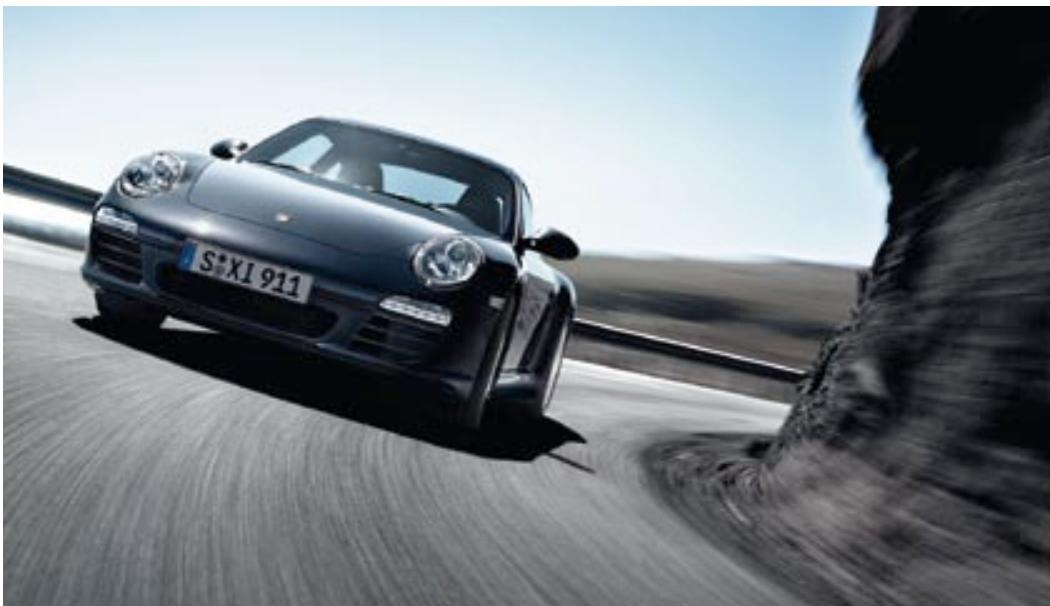
911 Carrera 4
To steer a true course, you sometimes have to be able to take the rough with the smooth.
The axles.
Standard suspension.
The front axle is equipped with McPherson strut suspension and the wheels are located using a high-precision arrangement of longitudinal and transverse links and reinforced wheel bearings.
The benefits on the road are precision wheel guidance, excellent straight-line stability and superior handling characteristics.
The rear axle has a race-derived multi-link suspension, following the LSA concept (Lightweight,
Stable, Agile) for exceptional driving dynamics. The axle kinematics significantly reduce the compression of the vehicle's suspension under acceleration. Lightweight spring struts with aluminium dampers on the rear axle help to maximise handling agility.
This lightweight construction keeps the vehicle gross weight and the weight of the unsprung masses low. The chassis allows for safe manoeuvring, even at high speeds. The pitching of the body when pulling away and braking is minimal, as is body roll in corners. Rolling noises and vibrations are also kept to a minimum.
Steering.
The power steering is sensitive and precise, providing excellent contact with the road and minimal steering effort by sportscar standards. It offers steering precision comparable with a racecar – even on those relaxing drives.
A special feature is the variable steering ratio. Around the straight ahead position, such as during motorway driving, the ratio is less direct. The risk of losing control
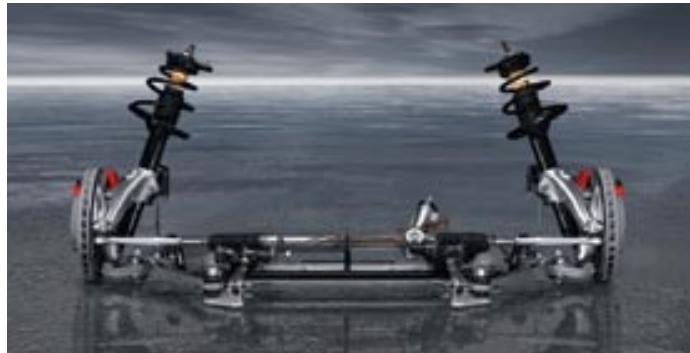
911 Carrera S front axle
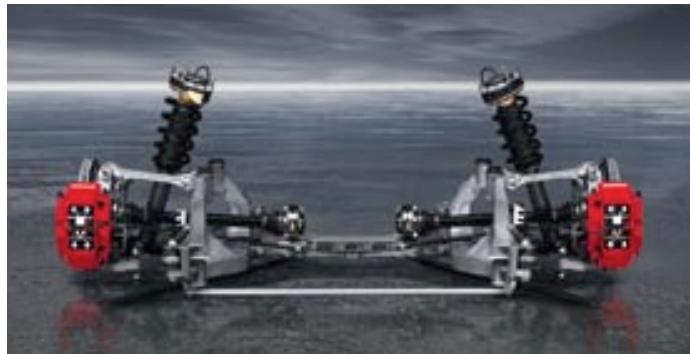
911 Carrera S rear axle
of the wheel at high speed is reduced, with no loss of agility or feedback.
When the steering wheel is turned harder, the ratio becomes more direct, allowing for easier cornering and parking. The car has a turning circle of just 10.9 m.
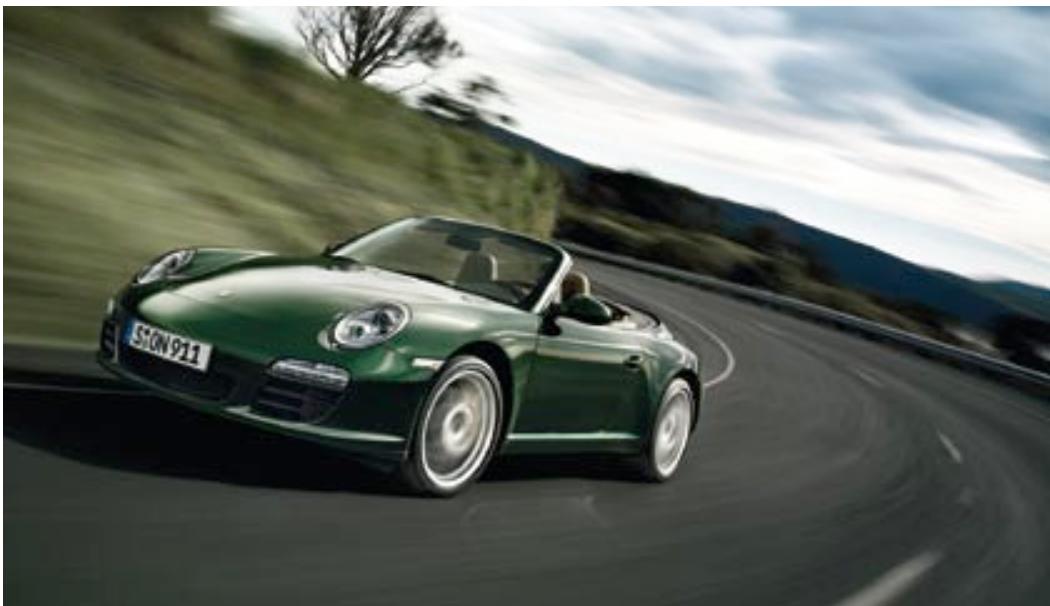
911 Carrera S Cabriolet
A strong character knows when to take a back seat.
Porsche Stability Management (PSM).
PSM is an automatic control system for providing stability at the limits of dynamic driving performance, and is a standard feature of every 911. Sensors work continuously to monitor the driving direction, speed, yaw velocity and lateral acceleration of the car. Using this information, PSM computes the actual
direction of motion. If this direction deviates from the desired course, PSM initiates braking interventions targeted at individual wheels – recognisable by the flashing indicator light in the cockpit – in order to stabilise the vehicle.
Under acceleration on wet or low-grip road surfaces, PSM improves traction using the ABD (automatic brake differential) and ASR (anti-slip regulation) functions. The control interventions are smooth and precise, giving an agile response. When 'Sport' mode is selected on the optional Sport Chrono Package Plus (p. 74),
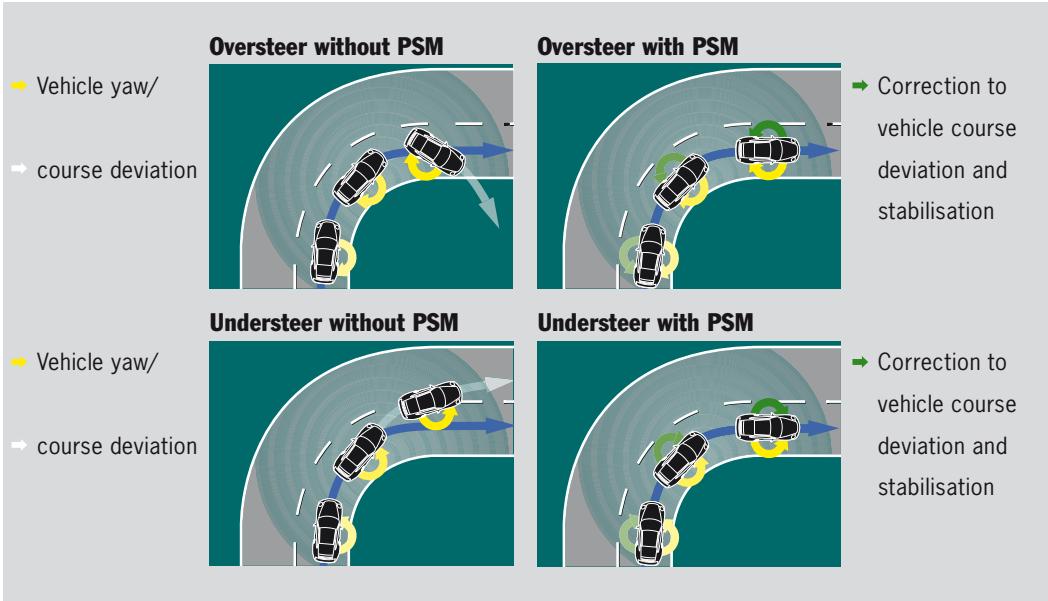
the PSM intervention threshold is raised to enable greater driver involvement – particularly at speeds of up to approximately 70 km/h (45 mph).
The integrated ABS shortens the braking distance even further and the braking inputs are smooth and precise, thereby enhancing comfort.
An enhanced PSM system is characterised by two additional functions: the precharging of the brake system, and brake assist.
If the driver suddenly releases the accelerator pedal, PSM automatically readies the braking system. With the braking system having been precharged, the brake pads are already in light contact with the brake discs. Maximum braking power is therefore achieved much sooner.
When sudden braking is detected – i.e. if the pressure on the brake pedal exceeds a predefined level – the brake assist function uses the PSM hydraulics to apply maximum brake pressure to all four wheels.
If you want a purely active driving experience, you always have the option to deactivate PSM. It is automatically reactivated, for your safety, if either of the front wheels (in sport mode, both of the front wheels) requires ABS assistance. The ABD function, however, remains active at all times.
In conclusion, PSM offers a high level of driving stability and safety – and typical Porsche agility at the same time.
Two different modes.
One driving feel: 911.
Porsche Active Suspension Management (PASM).
The electronic adjustment of the suspension system actively and continuously regulates the damping force for each wheel according to the road conditions and driving style. In addition, the suspension is 10 mm lower. PASM is fitted as standard in the S models and is optional for models with the 3.6-litre engine.
At the push of a button, the driver can select between two different modes: ‘Normal’ which is a blend of performance and comfort, and ‘Sport’ where the setup is much firmer. The two setup modes overlap slightly and so the balance between comfortable and uncompromisingly sporty is struck more effectively than with a
conventional chassis. Depending on the mode selected, therefore, PASM is sportier or more comfortable than the standard chassis of models with the 3.6-litre engine. The PASM control unit evaluates the driving conditions and modifies the damping force on each of the wheels in accordance with the selected mode.
Sensors monitor the movement of the vehicle body, for example, under heavy acceleration and braking or on uneven roads. The control unit tunes the dampers to the optimum hardness for the selected mode to reduce roll and pitch, and increase contact between each individual wheel and the road.
In 'Sport' mode, the suspension is set to a harder damper rating. On uneven roads, PASM immediately switches to a softer rating within the 'Sport' setup range, thereby improving contact between the wheels and the road. When the road surface improves, PASM automatically reverts to the original, harder rating.
If 'Normal' mode is selected and the driver's style becomes more assertive, PASM automatically switches to a harder rating within the 'Normal' setup range. Damping becomes harder, and driving stability and road safety are increased.
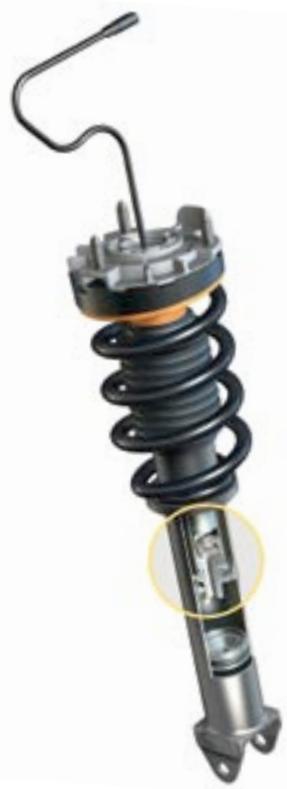
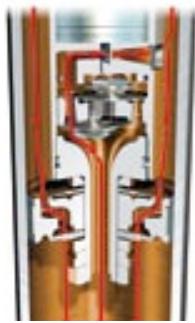
Rebound in 'Normal' mode – working piston and bypass, sporty-comfortable tuning
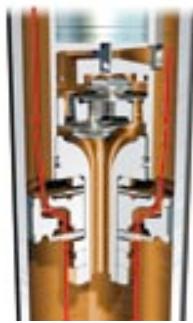
Rebound in 'Sport' mode – working piston only, sporty-hard tuning
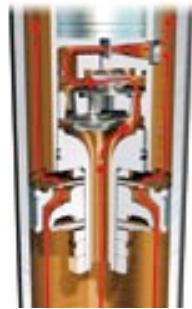
Compression in 'Normal' mode – working piston and bypass, sporty-comfortable tuning
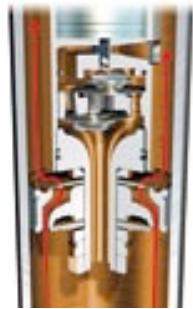
Compression in 'Sport' mode - working piston only, sporty-hard tuning
PASM sports chassis with mechanically locking rear differential.
The PASM sports chassis is available as an option for Coupé models and only in conjunction with 19-inch wheels.
The body is 20mm lower than the standard suspension of the
3.6-litre engine models, and 10 mm lower than the PASM suspension of the S models. The springs are harder and shorter, and the lateral stabilisers on the front and rear axle are stiffer. In combination with PASM, it offers greater comfort than that of a conventional sports suspension.
The mechanically locking rear differential further enhances the traction of the driven rear wheels on uneven roads and, for example, when accelerating out of tight bends. Road holding at the limits of performance is even more predictable. The car holds its course better and so PSM intervenes less often.
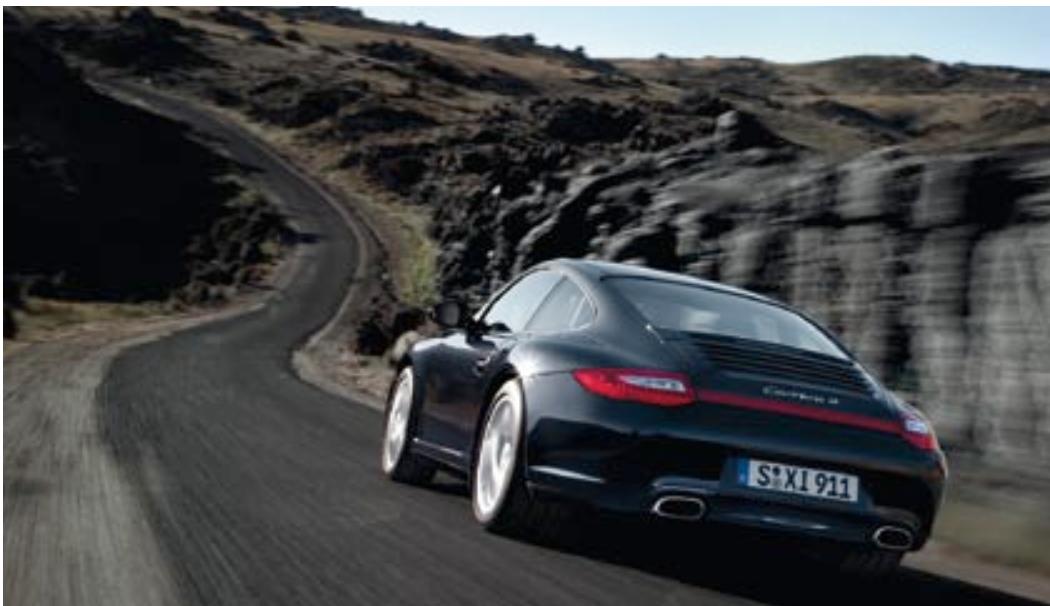
911 Carrera 4
Euphoria.
At the push of a button.
Sport Chrono Package Plus.
All 911 models can also be fitted with the optional Sport Chrono Package Plus. It offers even sportier tuning of the engine and chassis, and delivers even greater driving pleasure as a result.
Included in the package are a digital and analogue timer, a 'Sport' select button, a performance display and a personal memory function in Porsche Communication Management (PCM). Also - when fitted in combination with Porsche
Doppelkupplung (PDK) - the 'Sport Plus' button.
When the ‘Sport’ button on the centre console is selected, the EMS SDI 3.1 engine management system enhances the engine response. A modified throttle
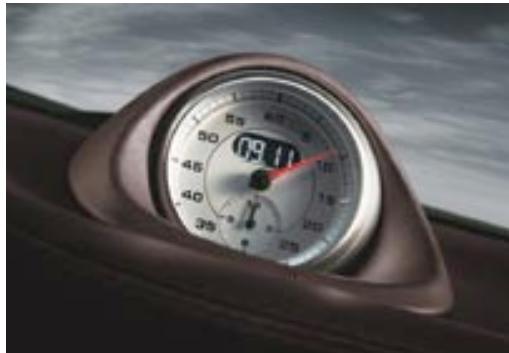
Sport Chrono stop timer
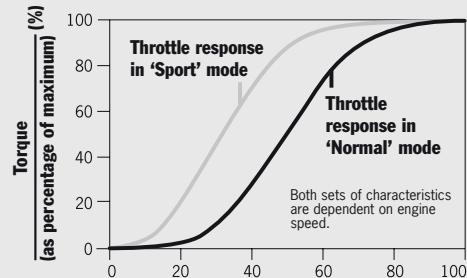
Pedal travel (%)
Comparison of the ETV characteristic curve in 'Normal' mode and 'Sport' mode
map relates the pedal angle in the footwell to a much wider angle of opening on the throttle valve. Throttle response is significantly more immediate, and in the higher gears, a hard rev-limiter helps protect the engine under acceleration.
The optional Porsche Active Suspension Management (PASM) also switches to 'Sport' mode for harder damping and more direct steering, and, therefore, better road holding.
A hard rev-limiter is also applied in the automatic mode of the optional PDK, while gearshift points are delayed until the upper
rev range. The shift times are shorter, the gear changes sportier. At low rates of deceleration – even with high engine speeds – the system initiates a swifter brake-induced downshift. In manual mode, gear changes are faster and more dynamic.
In 'Sport' mode, the trigger threshold for PSM is raised for increased longitudinal and lateral dynamics. Agility is enhanced under braking for corners with PSM enabling greater manoeuvrability under braking and exit acceleration, especially at low speeds.
For maximum dexterity, PSM can be set to standby while the car is still in 'Sport' mode. For safety, it is set to intervene automatically only when ABS assistance is required on both the front wheels.
In combination with PDK, the Sport Chrono Package Plus has two additional functions that are activated by pressing the Sport Plus button, to take driving to an even sportier level.
'Launch Control' is used, for example, on the track to achieve the best standing start possible - a racing start.
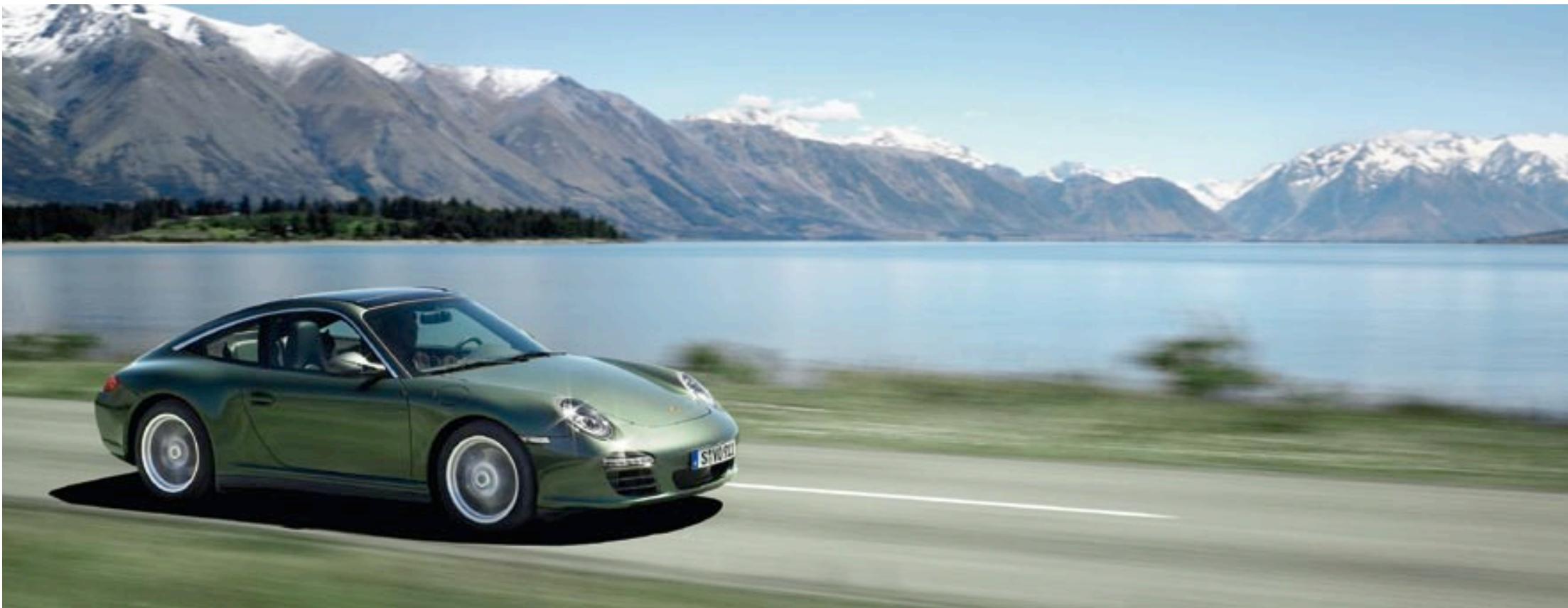
911 Targa 4
Launch Control is operated via the 'Sport Plus' button with the 'D' or 'M' drive position selected. Whilst the driver depresses the brake pedal with the left foot, the right foot depresses the accelerator pedal to the floor. With the accelerator in the kickdown position, the system detects the driver's
request for Launch Mode and revs the engine to an optimum speed of approximately 6,500 rpm. Engine torque increases and the clutch closes slightly. The message 'Launch Control active' appears on the instrument cluster display. The driver now quickly
releases the brake - and prepares for maximum acceleration.
The second function is the 'motor-sport-derived gearshift strategy'. Using this, Porsche Doppel-kupplung (PDK) is geared up for the shortest possible shift times and optimum shift points for
maximum acceleration - ideal for the racetrack.
A key component of Sport Chrono Package Plus is the timer mounted on the dashboard. Porsche Communication Management (PCM, p. 100) has a special performance display to
view, store and evaluate lap times or other driving times. It shows the total driving time, lap distance, lap number and the lap times recorded so far. You can view the current fastest lap and the remaining range until empty. Travelled distances can be recorded and benchmark times defined.
The personal memory function of the Sport Chrono Package Plus can also be used to store personalised settings for a range of systems, including the orientation lighting or air conditioning.
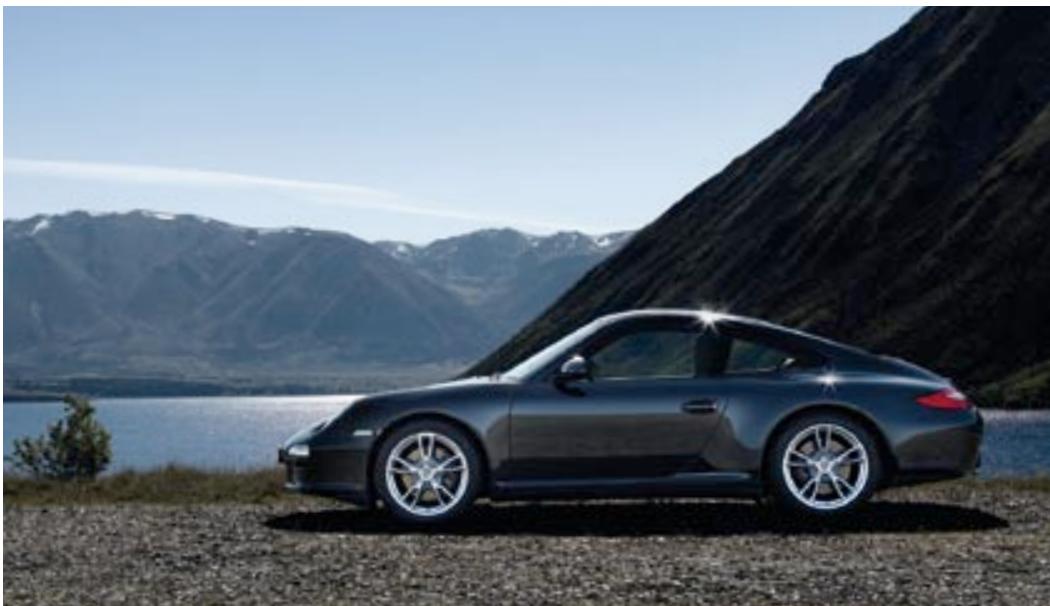
911 Carrera 4 with 18-inch Carrera IV wheels
Another sign of inner strength:
having one's feet firmly on the ground.
Wheels.
The 911 Carrera models and the 911 Targa 4 are fitted with 18-inch Carrera IV wheels as standard. These wheels feature a classic sporty design.
The S models are equipped with 19-inch Carrera S II wheels as standard. The visual effect? Sporty and dynamic.
Both sets of wheels are designed to display the four-piston aluminium monobloc calipers and promote efficient ventilation of the brake system.
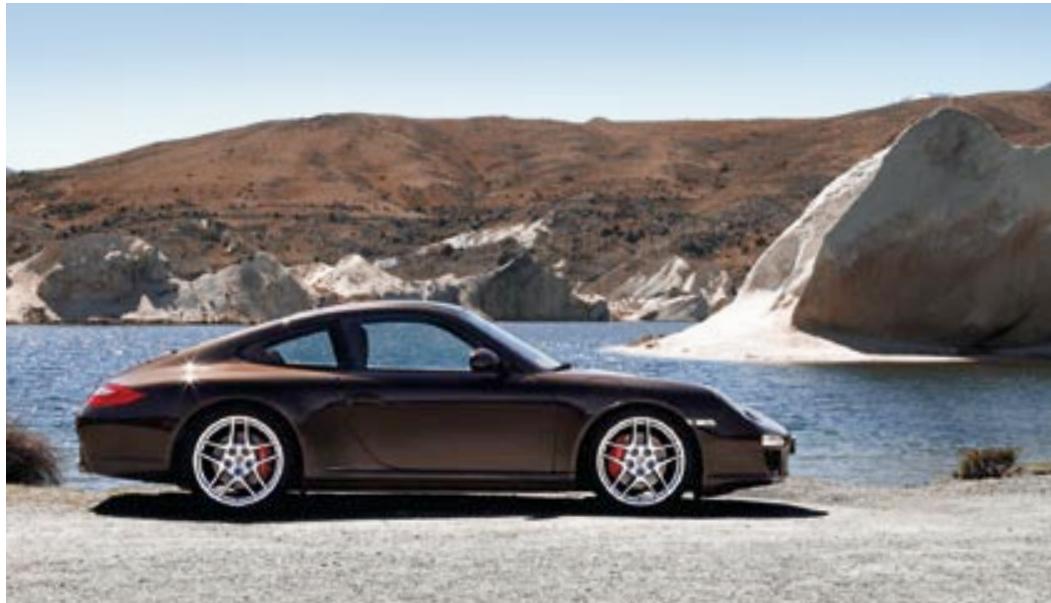
911 Carrera S with 19-inch Carrera S II wheels
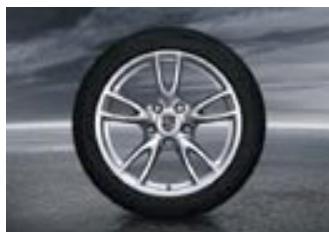
18-inch Carrera IV wheel
Tyre Pressure Monitoring (TPM) system.
The optional Tyre Pressure Monitoring (TPM) system sends warnings to the on-board computer's display screen in the event of low tyre pressure as well as in the event of a creeping or a sudden loss of pressure.
The driver can check the pressure in all four tyres from the instrument cluster. Each time the tyres are re-inflated, or whenever a wheel has been changed, the updated tyre pressures are displayed with minimum delay – for increased comfort and safety.
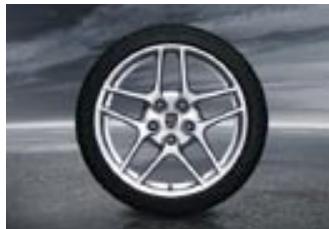
19-inch Carrera S II wheel
Safety
Porsche, Weissach
911 Carrera
Inner strength has to be built up. Over years, or sometimes decades.
So that it's there at that crucial second.
It is in anticipation of this crucial second that Porsche implements sophisticated technologies designed specifically to protect the most important thing about a 911: its occupants.
Actively and passively.
911 Carrera S
Safety to us is not merely an obligation.
It's part of our history.
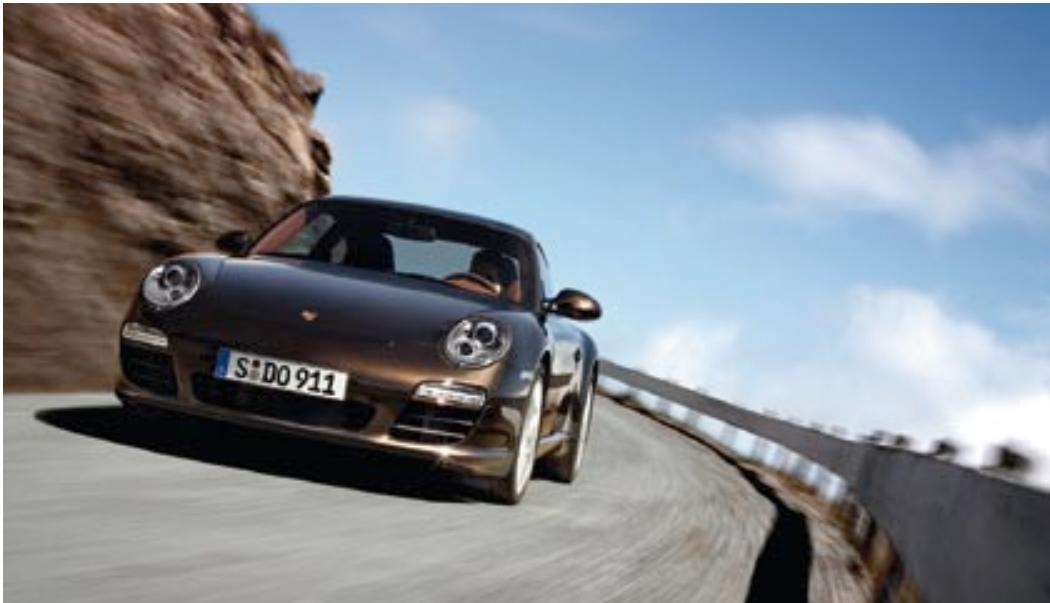
Safety has always been given top priority at Porsche, since the very beginning. As far back as 1966, the 911 S was equipped with internally vented disc brakes. In 1972, the 911 RS 2.7 was the first production car in the world to have both front and rear spoilers for increased downward force.
In 1973, the 911 RS 3.0 was fitted with cross-drilled four-piston aluminium brake calipers. We were also the first manufacturer to equip our sportscars with full-size airbags for the driver and passenger as standard.
No wonder, then, that the 911 is among the safest sportscars in the world.
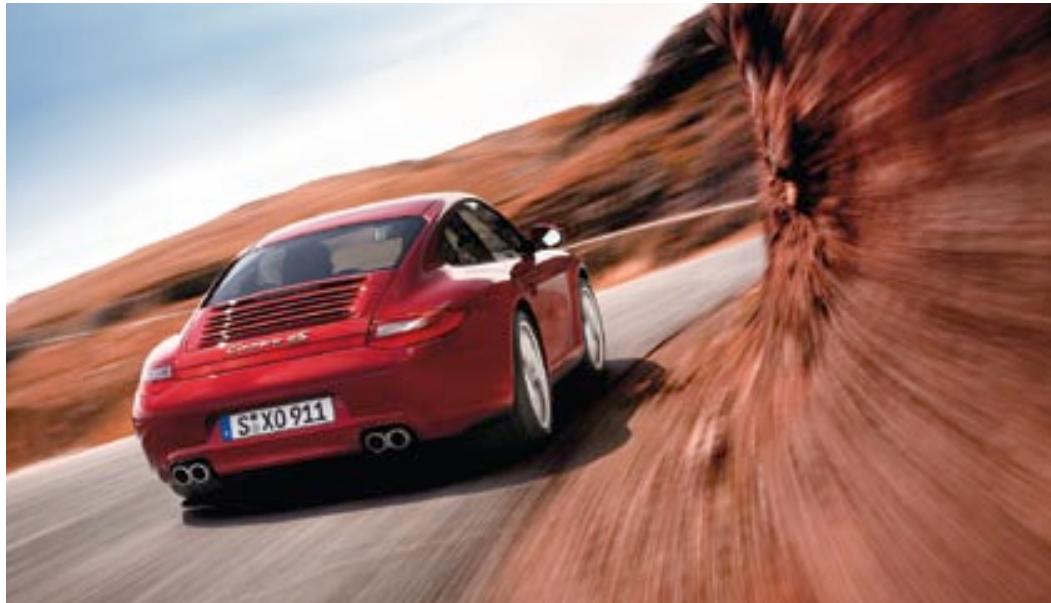
Its effective aerodynamics increase downward force to provide excellent traction and ensure that the car remains stable on the road.
911 Carrera 4S
The chassis offers a uniquely balanced ride with generous safety reserves. Porsche Stability Management (PSM, p. 70) stabilises the chassis at the limits of dynamic driving performance. The powerful torque of the engine permits easier overtaking and evasive manoeuvres.
The braking power of the 911 model range is simply out-standing. The high-performance Porsche Ceramic Composite Brake (PCCB, p. 88) is offered as an option for the entire model range.
All of the 911 models are equipped as standard with full-size driver's and passenger's airbags and Porsche Side Impact Protection System (POSIP, p. 93).
Headlights with Bi-Xenon technology are fitted as standard. Dynamic cornering lights are available on request. The taillight units are fitted with LED lights as standard (p. 85).
The Tyre Pressure Monitoring (TPM) System is fast and reliable.
Safety. An area to which we devote even more attention than we do to performance values. By tradition.
Dynamic cornering lights
Active safety: headlights.
Lots of light. No shade.
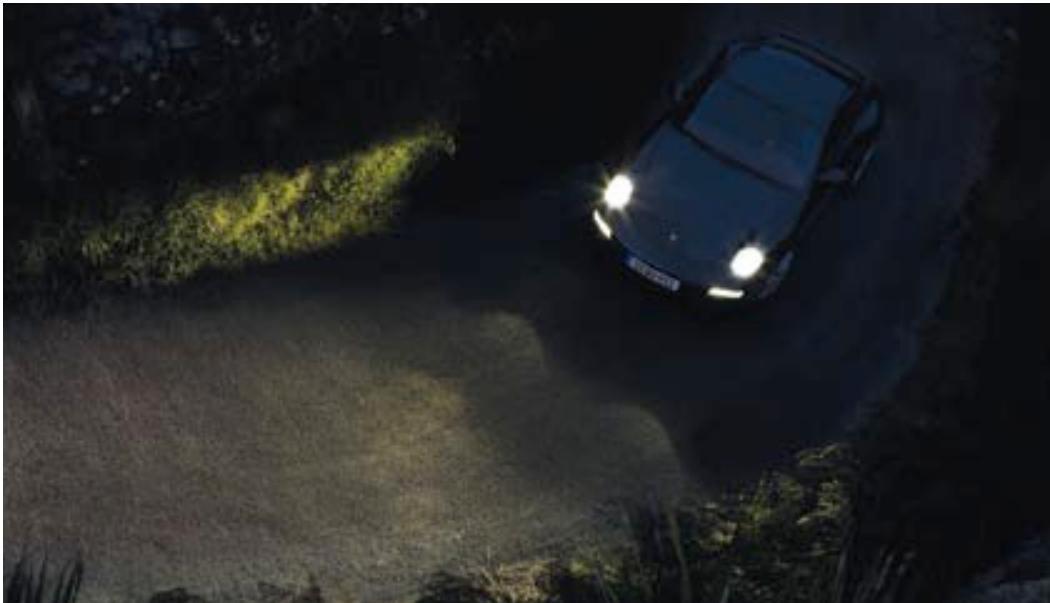
All 911 models come equipped as standard with Bi-Xenon headlights with dynamic range control. The resulting brightness is around twice that of conventional halogen lamps. With dipped or main beam,
the lights are stronger and more uniform, helping to minimise driver fatigue. A headlight cleaning system (SRA) is built-in.
Also available as an option are the dynamic cornering lights, offering particularly effective illumination of the road.
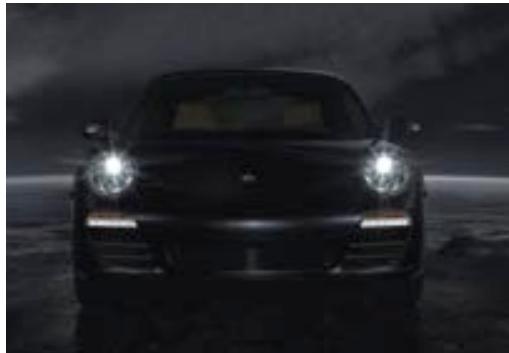
Sensors continuously monitor the speed, lateral acceleration and steering lock and, from these variables, calculate the course of the bend. This determines the angle of the dynamic cornering lights, with dipped beams able to swivel towards the inside of the bend up to a limit of 15 degrees. The road ahead is therefore illuminated much more effectively.
Lighting concept.
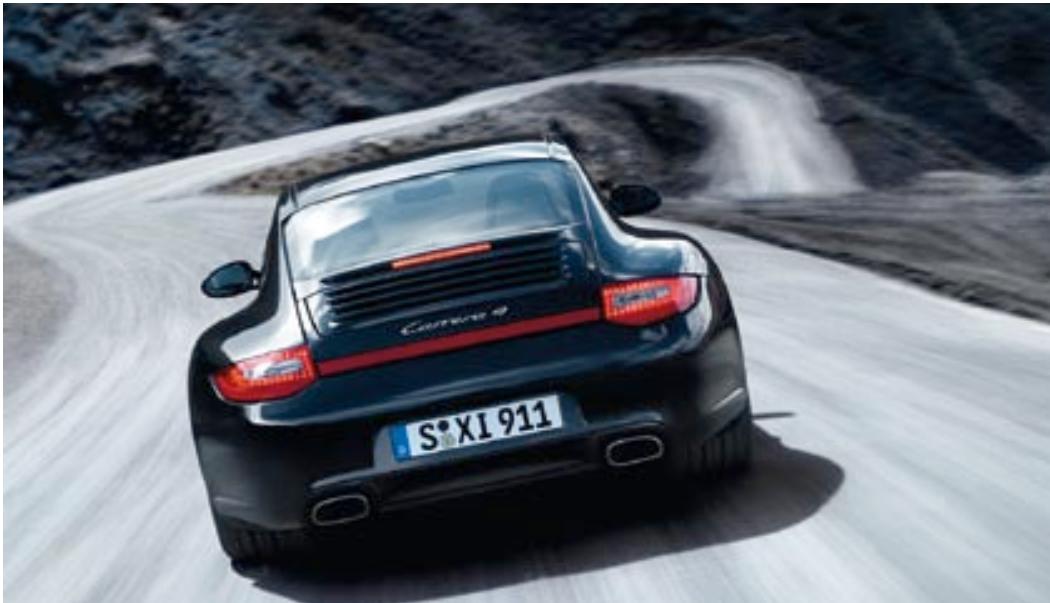
The front light units incorporate the direction indicators, the LED daytime running lights and position lights, which provide outstanding visibility and create an imposing look.
LEDs are also used for the direction indicators, the taillights and brake lights, the additional brake light in the rear spoiler, and the rear fog light. These provide better illumination and respond
more quickly to driver input, so that following traffic is alerted earlier. They are energy efficient, eco-friendly and have a longer service life than conventional bulbs – as well as an unmistakable design, day or night.
To guide you in and out of the car, reflector lamps and entry lamps are located on the inside of the doors.
911 Carrera 4
Active safety: standard braking system.
Positive feature: negative acceleration.
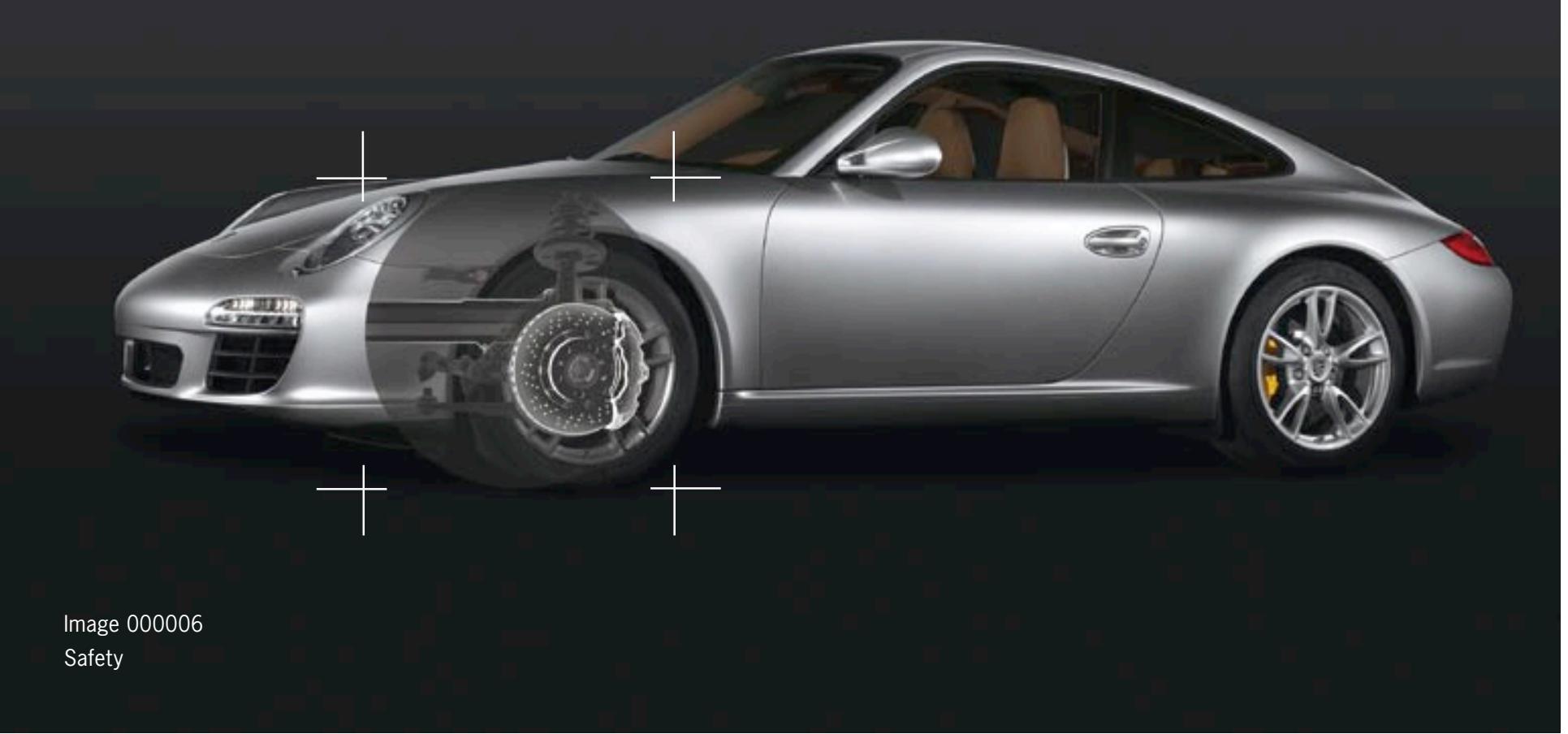
Porsche brakes are renowned for their stopping power, setting the standards for deceleration and stability. They are designed to cope with extreme forces such as those experienced during hard braking. Perfect for the 911.
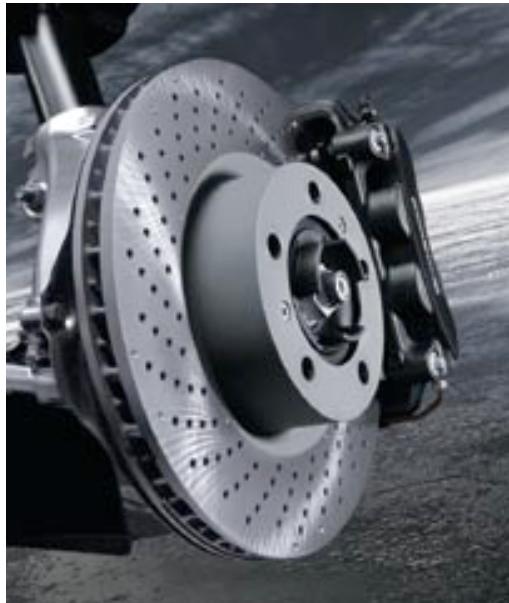
The brake calipers have a monobloc aluminium construction. This makes them tough but light and enables a rapid response and release of the brake. The pedal travel is short and easy to modulate.
In models with the 3.6-litre engine, black anodised four-piston aluminium monobloc fixed calipers are used on the front and rear axles. The closed-type design of these brake calipers makes them particularly stiff. The front and
Standard brake system 911 Carrera/911 Targa 4
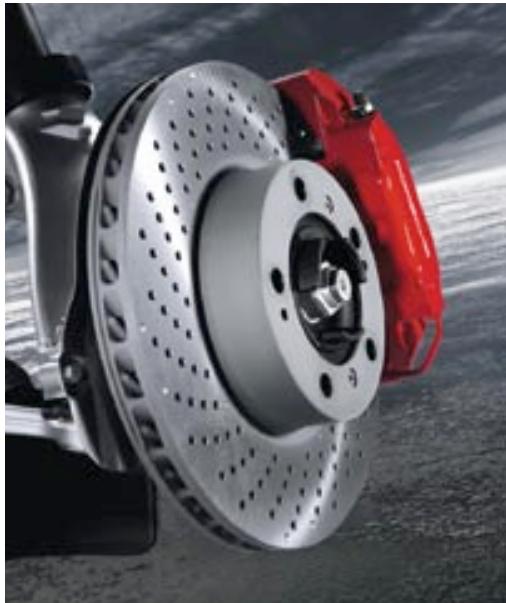
Standard brake system 911 Carrera S/911 Targa 4S
rear brake discs have a diameter of 330mm for outstanding braking performance.
are internally vented for rapid heat dispersal.
The S models have four-piston aluminium monobloc calipers that are larger, reinforced and have a striking red painted finish. The front axle has larger brake pads and thicker brake discs.
Other features include a powerful 10-inch brake booster for reducing pedal effort in the rear-drive models and integral air spoilers for enhanced air flow in the brake cooling ducts.
All models have cross-drilled brake discs ensuring optimum braking in the wet. The discs
For even better braking performance with braking force support, a 9-inch tandem brake force amplifier is used on the all-wheel drive models.
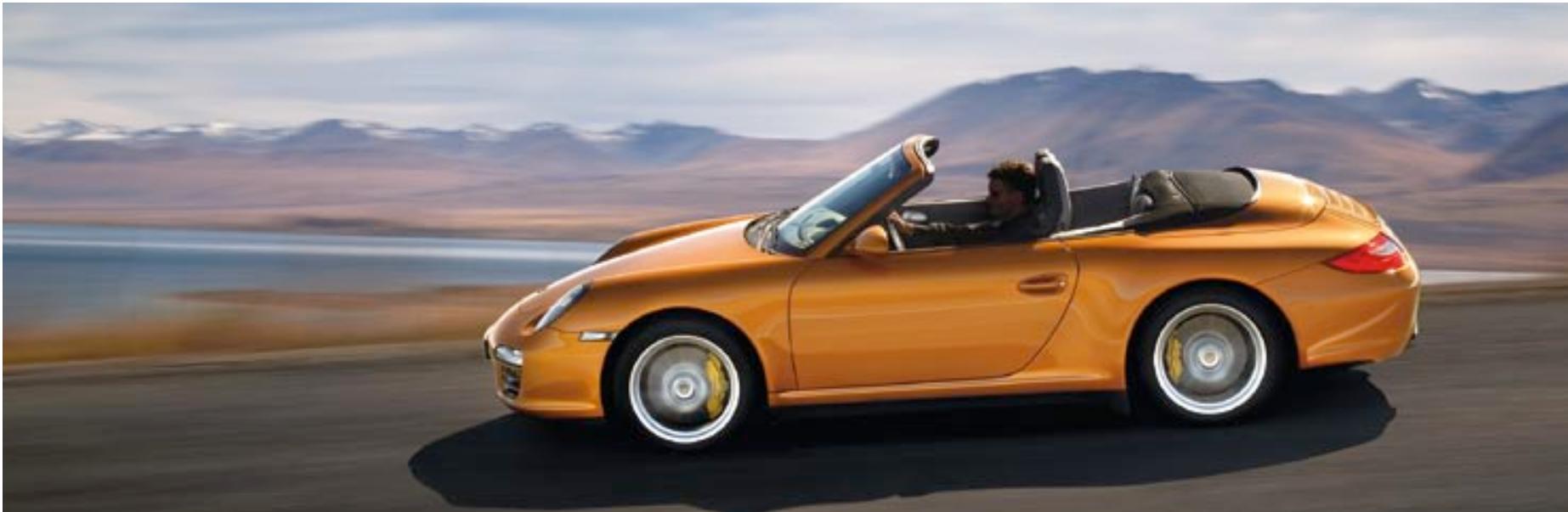
Please note that circuit racing, trackday use and other forms of performance driving can significantly reduce the service life of even the most durable brake pads and discs. As with conventional high-performance braking systems, we recommend that all brake components be professionally inspected and replaced where necessary after every track event.
911 Carrera 4 Cabriolet
Day-to-day practicality. Straight from the racetrack.
Porsche Ceramic Composite Brake (PCCB).
On request, we can provide you with a brake system that has already had to cope with the harshest requirements of motor racing – a brake system fitted in the cars competing in the Porsche Mobil 1 Supercup: the Porsche Ceramic Composite Brake (PCCB).
The PCCB ceramic brake discs for the 911 have a diameter of 350~mm front and rear – for formidable braking performance. The brake discs are formed from a specially treated carbon-fibre compound that is silicated in a high-vacuum process at approximately 1,700^ . Not only are the resulting braking discs much
harder than standard discs, they are more resistant to heat.
PCCB is characterised by its low thermal expansion, which prevents deformation under heavy braking. Furthermore, the ceramic brake discs are totally resistant to corrosion and offer more favourable noise-damping properties.
The use of six-piston aluminium monobloc brake calipers on the front axle and four-piston units at the rear ensures extremely high brake forces which, crucially, are exceptionally consistent. The pedal response is fast and precise with only moderate input required.
All the necessary ingredients are there for a short braking distance, even in the toughest conditions. Moreover, safety under braking at high speeds is increased thanks to the excellent fade resistance of PCCB.
The key advantage of PCCB is the extremely low weight of the brake disc, which is approximately 50% lighter than standard discs of similar design and size. As well as enhancing performance and fuel economy, this represents a major reduction in unsprung and rotating masses. The consequence of this is better road holding and increased comfort, particularly on uneven roads, as well as greater agility and improved handling.
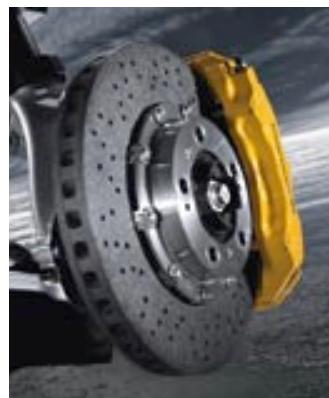
Porsche Ceramic Composite Brake (PCCB)
Passive safety: engineered design.
A crucial quality of any boxer: the ability to take a punch.
The 911 complies with all statutory requirements worldwide in respect of occupant safety, well in excess of the legal limits in terms of front, offset, side and rear impact protection.
The reinforced bodyshell structure contains a highly resilient passenger cell which offers high levels of protection in the event of an impact. A patented system of longitudinal and transverse members (1) is used at the front.
In the event of an accident, three separate load paths absorb
energy, disperse the force of impact and minimise deformation of the passenger cell.
In addition, the front benefits from an extremely rigid bulkhead cross member (2) made of ultra highstrength steel. This is designed to absorb impact forces from the longitudinal members to reduce deformation of the footwell and provide improved protection for the feet and legs. In a minor collision, a system of easily replaceable impact absorbers (3) prevents costly damage to the underlying bodyshell.
Also contributing to the overall rigidity of the car are the reinforced doors (4). The forces exerted in a frontal collision are additionally transmitted along a higher load path (5). For the protection of its occupants, it has therefore been possible to improve the deformation characteristics of the passenger cell even further.
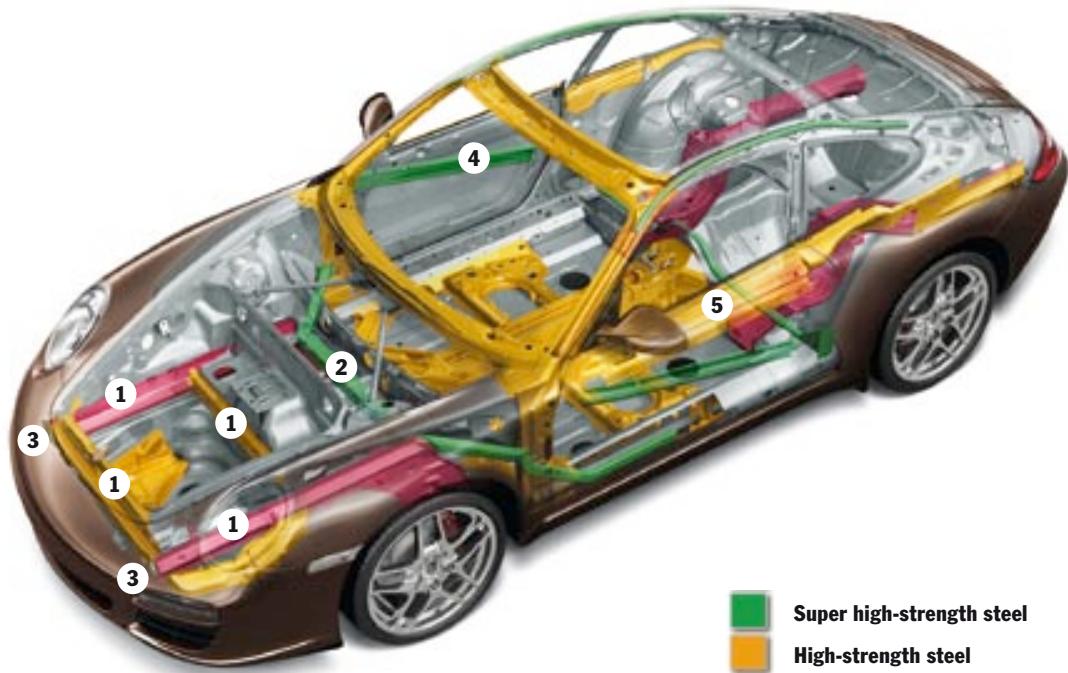

Super high-strength steel
High-strength steel
Sheet steel
Tailored blanks
Since 1985, all Porsche doors have had a ‘crash barrier’ made of ultra high-strength steel built into them – otherwise known as side impact protection. The 911 models also have additional
reinforcement with super high-tensile boron steel integrated into the doors.
Porsche was the first manufacturer in the world to use a
hot-dip galvanised steel shell. Today, too, high-quality surface protection ensures a consistently high level of crash protection, even after many years on the road.
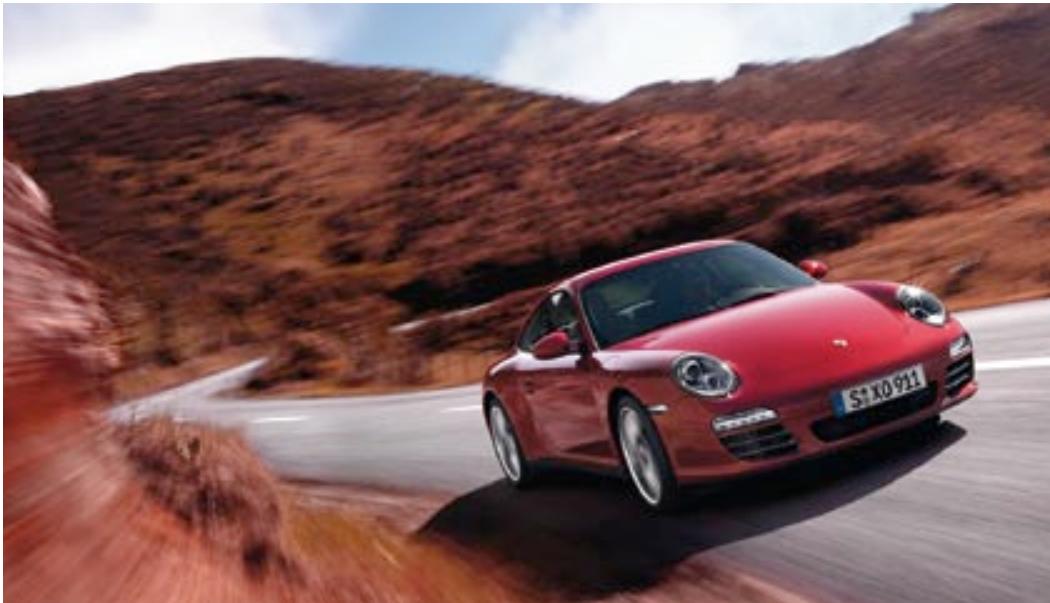
911 Carrera 4S
Passive safety: airbags.
What all sports enthusiasts take for granted: reliable protection of sensitive areas.
We have been innovators not only in production installation, but also in airbag technology. Porsche set the benchmark by introducing a non-azide gas generant based on an organic propellant. This makes the driver airbag lighter and more compact, and also makes it easier
to recycle. The 911 models benefit from the latest airbag technology in the form of full-size airbags for driver and passenger which are inflated in two stages depending on the severity and type of accident (e.g. frontal or offset frontal). In less serious accidents,
the airbag is only partially inflated, thereby minimising discomfort to the occupants.
In addition to the central airbag control unit on the transmission tunnel, a pair of impact sensors are located near the headlights.
This allows a crash to be detected and evaluated far sooner and with considerably greater accuracy.
All 911 models are equipped withPorsche Side Impact Protection(POSIP) as standard. It comprisestwo airbags on each side insteadof the usual one. An integralthorax airbag is located in theseat backrests, while the doorpanels each contain a headairbag. With each having a volume
of approximately 8 litres, the thorax and head airbags offer excellent protection in the event of a side impact. Naturally, their design protects the occupants of the 911 Carrera Cabriolet models and the 911 Targa 4 models, even with the roof open.
The head restraints are integrated into the backrests. Also standard are the safety steering column, three-point seat belts, belt height
adjustment (not on 911 CarreraCabriolet models), front seat-beltpretensioners and force limiters,energy-absorbing elements in thedashboard and flame-retardantmaterials throughout the interior.
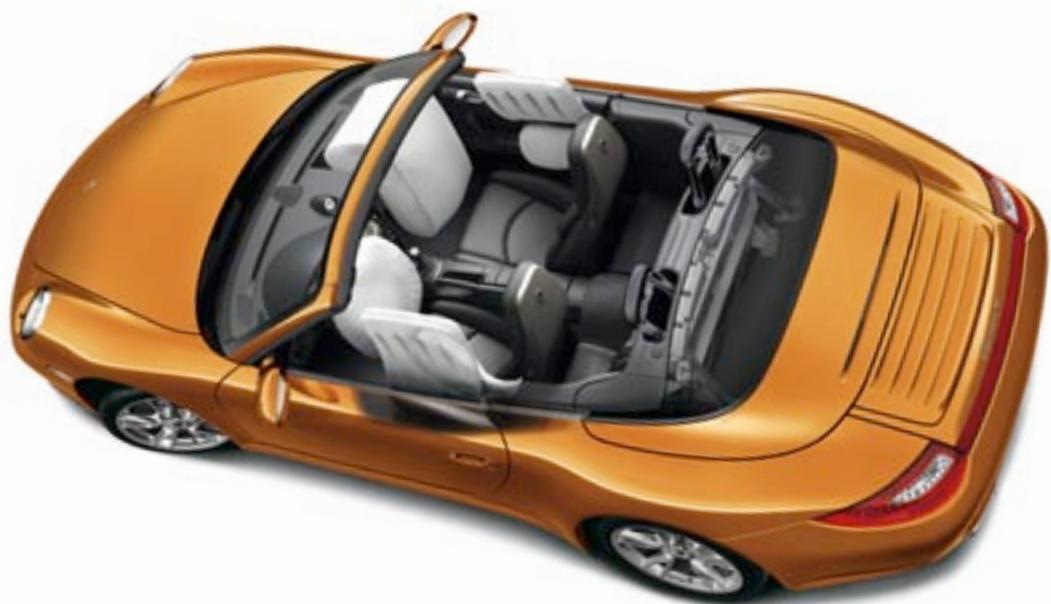
Porsche Side Impact Protection (POSIP)
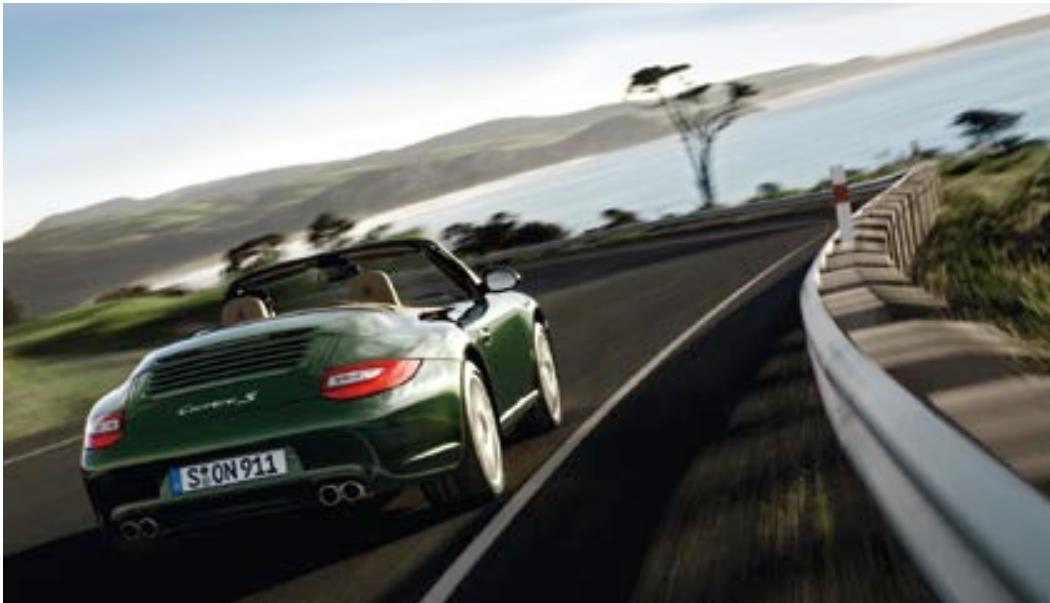
911 Carrera S Cabriolet
Passive safety in the 911 Carrera Cabriolet and 911 Targa 4 models.
No need to lose your cool here, either.
Despite their modest weight, the torsional rigidity and flexural strength of the 911 Carrera Cabriolets are exemplary. Body flexing is minimal, even on uneven roads. Additional brace members
at each of the rear wheel arches provide additional reinforcement of the bodyshell.
Increased protection if the car overturns is provided by an
automatically deploying roll-over protection system (Fig. p. 93). Two spring-loaded roll-over bars are located behind the rear seats The roll-over sensor continuously monitors changes in body tilt,
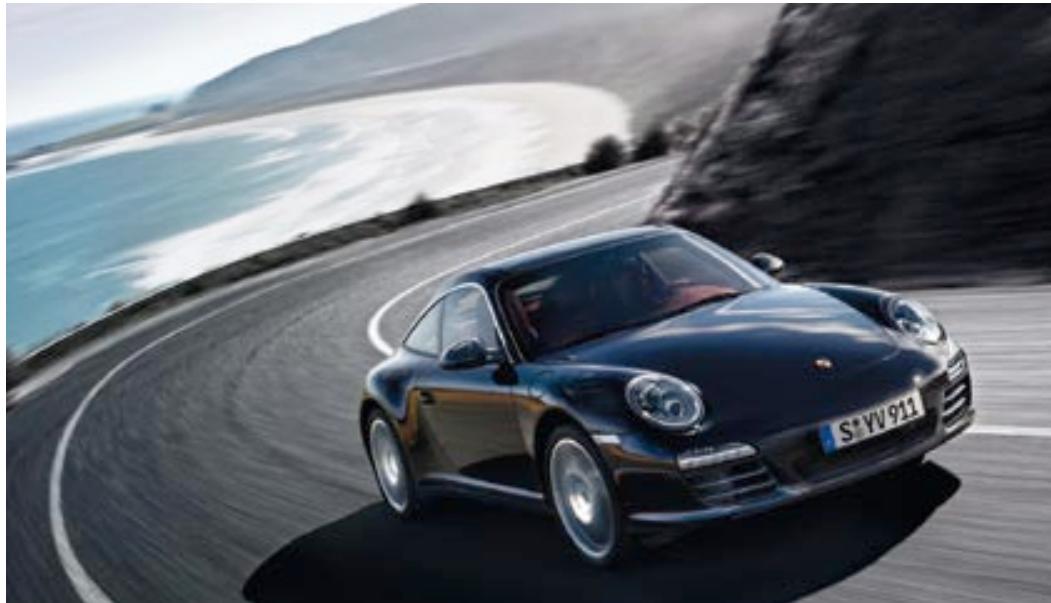
911 Targa 4S
longitudinal and lateral acceleration and contact with the road surface. In an emergency, it deploys the roll-over bars within a fraction of a second.
by a cross-member integrated between the glass roof and the rear screen. The glass roof is made of laminated safety glass, the opening rear window of single pane safety glass.
For open-top sports driving, even in changeable weather conditions, nothing stands in the way of relaxed driving pleasure. Another distinct advantage of passive safety.
The 911 Targa 4 models offer excellent body rigidity – despite the large glass area. The roof bars, with optimised structure and strength, limit torsion to a minimum on uneven road surfaces. Additional stability is provided
Naturally, all 911 Carrera Cabriolet models and 911 Targa 4 models are fitted with Porsche Side Impact Protection (POSIP) as standard.
Comfort
Porsche, Weissach
911 Carrera
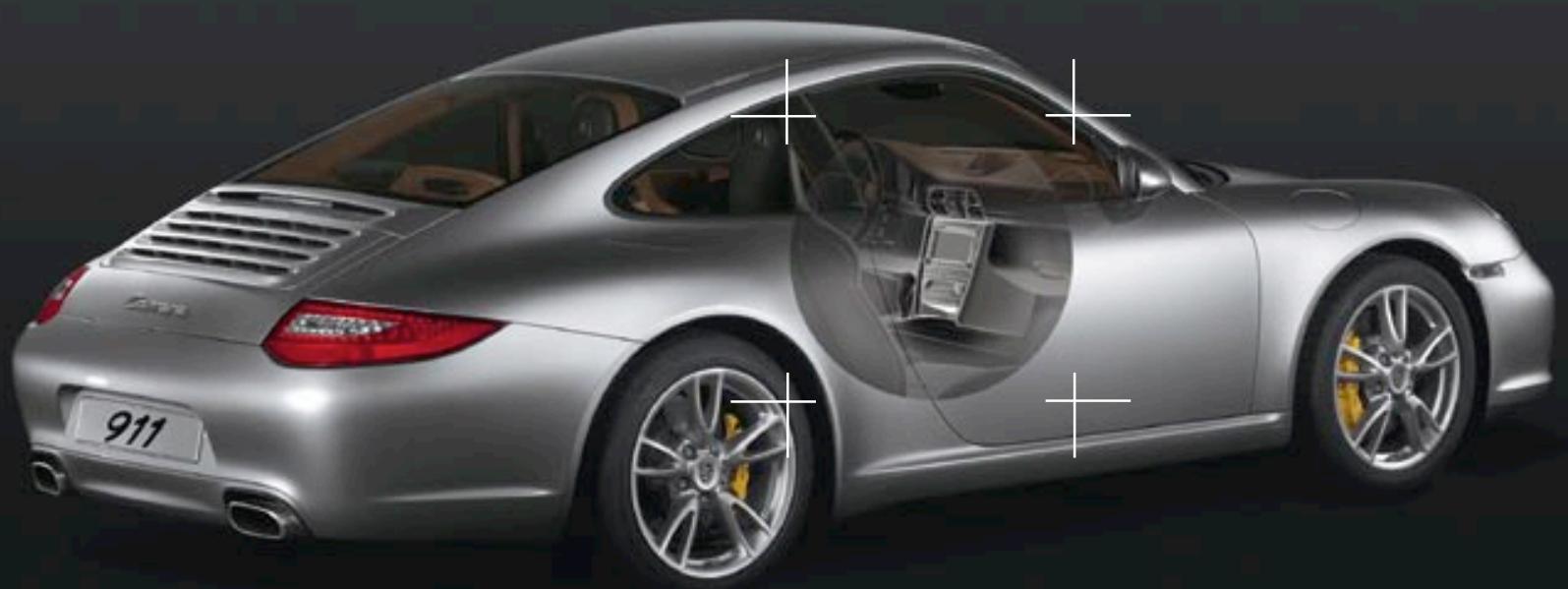
Inner strength works below the surface.
In the 911, in the form of efficient engines and Porsche Doppelkupplung (PDK).
And, of course, in the form of Porsche Communication Management.
To find out exactly what else inner strength means, you'd be better off discovering it for yourself.
By getting in.
Image 000007
Comfort
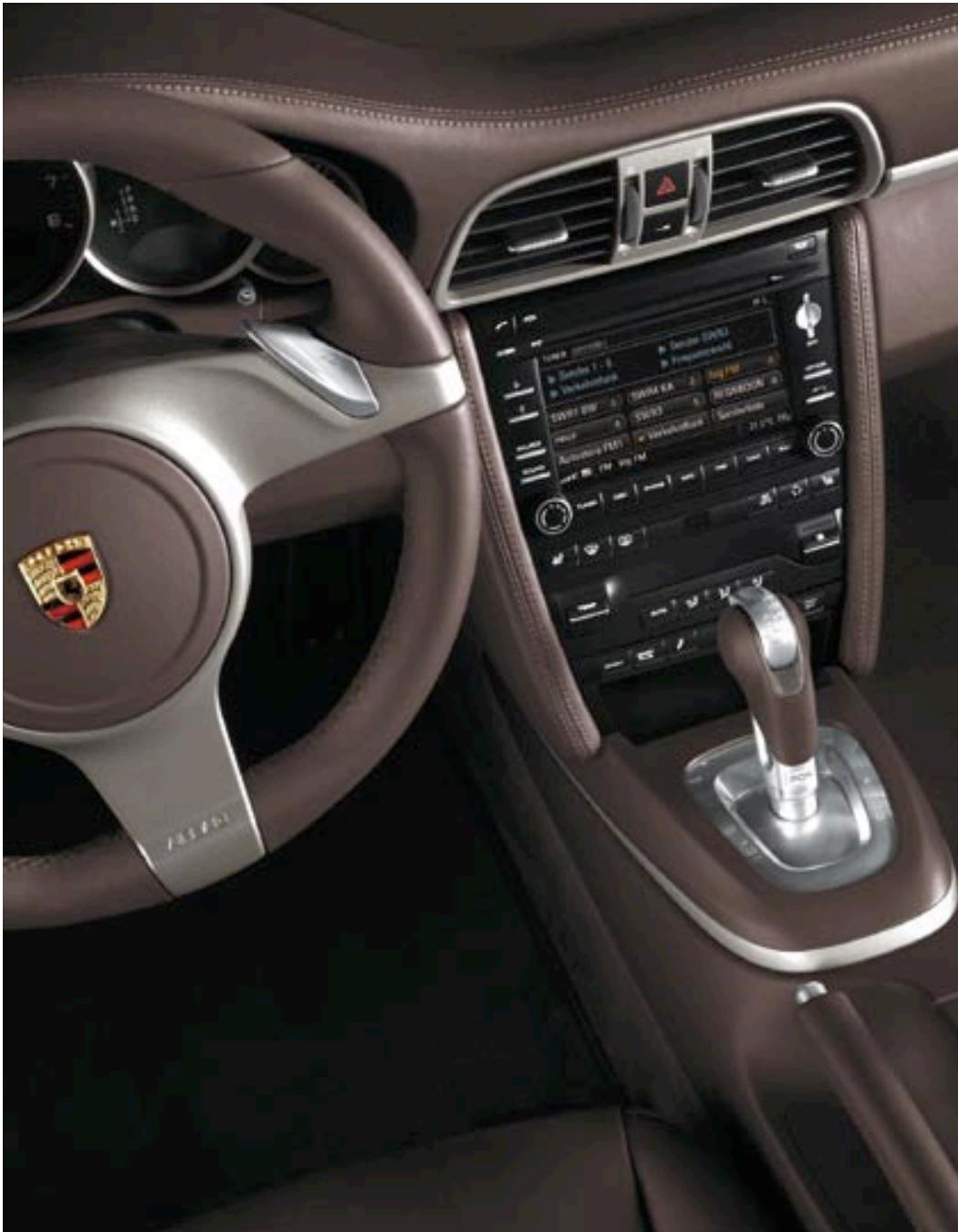
The 911 is powerful, fast and efficient.
These aren't the only reasons why you can sit back and relax.
Comfort is something that can't be measured. Rather, it's a subjective matter. Nevertheless, it pays to develop a universal benchmark in terms of material selection, operating logic and ergonomics.
This is no simple task when faced with an uncompromising sportscar – but it is possible. And this is where ergonomics are a fundamental prerequisite.
The result is an ingenious interior that puts the driver first, with the perfect blend of day-to-day practicality and a high degree of comfort.
The front centre console is finished predominantly in traditional black. It contains Porsche Communication Management (PCM, p. 100) fitted as standard,
the climate control panel, the switch panel and a storage compartment.
For clarity, the number of buttons has been deliberately kept to a minimum and the one-touch switches with clearly defined pressure points are particularly easy and convenient to use. An even more convenient feature, made possible by the optional voice control system, is the ability to control PCM without having to take your hands off the wheel.
If you opt for Porsche Doppelkupplung (PDK), the ergonomically designed three-spoke sports steering wheel (p. 58) is equipped with additional switches. A gear selector specifically for PDK is also included.
For maximum driving comfort, even when the weather is very hot, you can select the optional seat ventilation (p. 117).
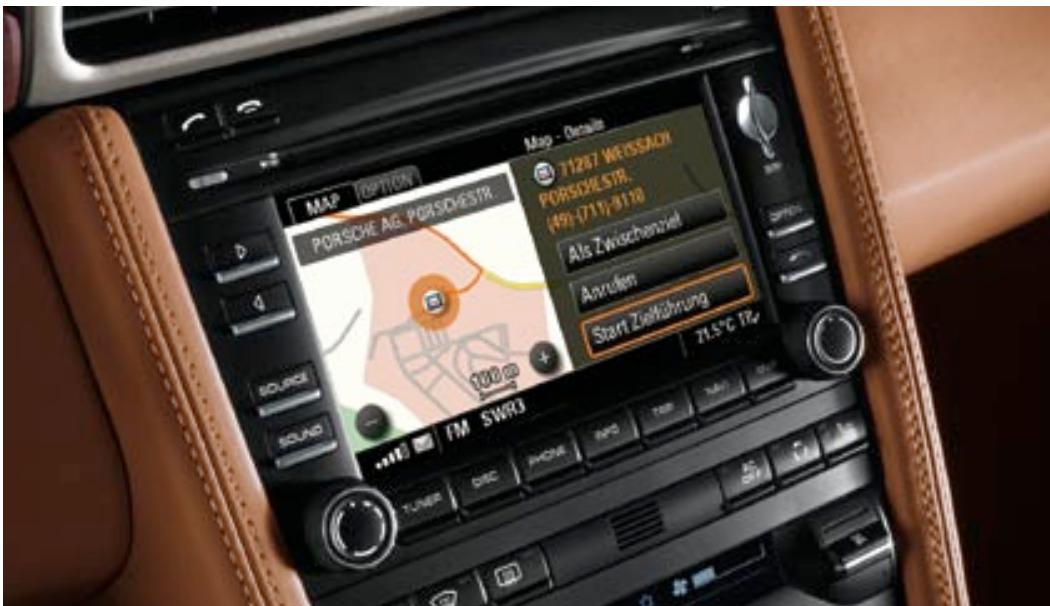
Porsche Communication Management (PCM)
Nowadays, there's management for everything. Some even works.
Porsche Communication Management (PCM).
The 911 comes equipped with PCM as standard. As the central control unit for audio, navigation and communications, it is powerful and multifunctional, and yet easy to operate.
The main feature is the 6.5-inch touchscreen for intuitive control. Naturally, you can also choose to operate PCM using the button controls. With a maximum of five list items per page, the screen display is very clearly presented.
A useful help function is displayed at the foot of the screen.
Radio functions include up to 42 memory resets and an FM two-tuner frequency diversity with RDS, which continuously
scans for the best signal for the selected station by simultaneously switching to any number of the four radio aerials.
The integrated single CD/DVD drive is – in combination with the optional BOSE® Surround Sound System – able to play back music from audio and video DVDs in the 5.1 digital format. A six-disc CD/DVD autochanger integrated in PCM is available as an option.
A TV tuner, available as an option, receives both analogue and digital free-to-air television.
Navigation module.
The optional GPS navigation system has a hard drive containing map data for most European countries, allowing for fast route calculations with a choice of three alternative routes.
A touchscreen enables rapid destination input and instant viewing of traffic information and points of interest (POIs) by simply allowing you to touch the symbols on the map. Route diversions can therefore be incorporated quickly and easily into the current route guidance.
When viewing a map, it is possible to select between a 3D perspective and a 2D display. At motorway exits, graphical turn indications are displayed for better orientation. In splitscreen
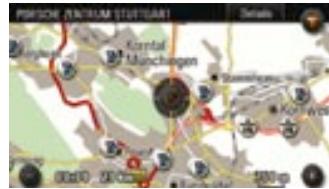
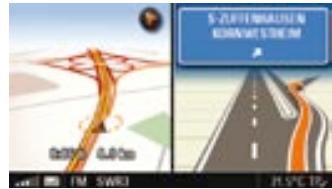
mode, you can choose to display not only the current map overview, but also a list of icons that represent dynamic route guidance.
Electronic logbook.
The optional electronic logbook enables automatic recording of mileage, route distance, time and date, starting point and destination as part of every journey. Once you have downloaded the logbooks from PCM via Bluetooth® or the optional USB interface, you can evaluate the data on your home PC using the software supplied. The software complies with all statutory requirements for automatic logbooks as specified by the German revenue authorities.
TVtuner.
The TV tuner, available on request, is capable of receiving analogue and digital free-to-air television broadcasts (DVB-T) to provide entertainment between journeys. For your safety, the TV picture is switched off while the car is in motion.
Voice control system.
Almost all of the functions ofPCM can be controlled using theoptional voice control system. Themenu item is read aloud exactly
as it is displayed on the screen and the voice control system recognises commands or sequences of numbers, whoever the speaker. It then gives an audible acknowledgement and carries out the functions you request. Without needing to 'train' the system, it is possible to view phone book entries, tune into radio stations and enter navigation destinations directly by speaking whole words, rather than by dictating just one letter at a time.
Telephone module.
Available as an option, the GSM telephone module offers convenience and excellent reception. By inserting a SIM card directly into the PCM's integral SIM card reader, calls can be made using either the hands-free facility or the optionally available cordless handset. For even more convenience, the Bluetooth® capability of a mobile phone can be used to make calls through the SIM Access Profile (SAP)*. Once
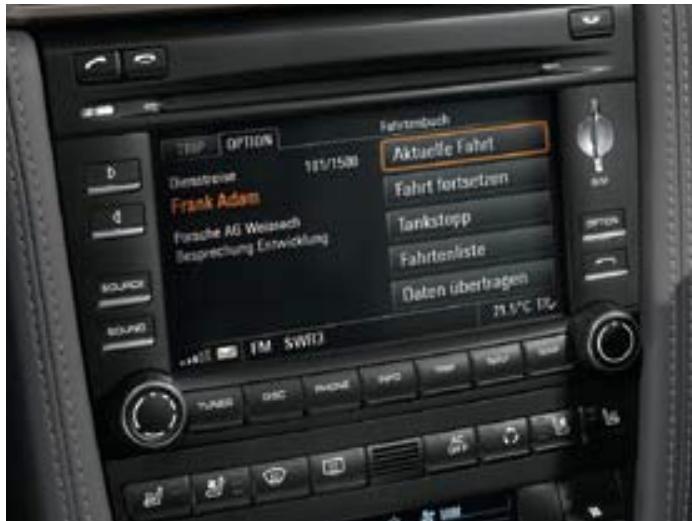
Electronic logbook
automatic pairing is complete, the mobile phone's aerial is switched off to conserve battery charge and the phone operates via the car aerial. Depending on the type of mobile phone, this gives access not only to the numbers on the SIM card, but also to the phone's internal memory. Also, depending on the phone, it can be controlled using PCM, the multifunction steering wheel or the voice control system, without it ever leaving your pocket.
Mobile phone preparation.
To enable Bluetooth® connection for those mobile phones that only support the Handsfree Profile (HFP), an optional mobile phone preparation (with and without bracket) is available. With HFP, PCM acts merely as a hands-free system. Here, too, the mobile phone can remain tucked away. PCM can be used to control only the basic functions of the phone. The GSM connection is established through the aerial of the mobile phone.*
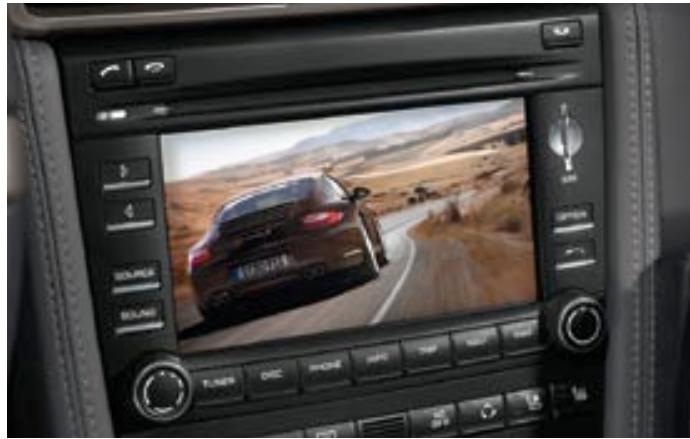
TVtuner
Universal audio interface.
With this optional feature, the storage compartment in the centre console will contain three connections: one for your iPod®, one for a USB stick/MP3 player and one as an AUX interface for any compatible audio source of your choice. The iPod® or USB stick can be controlled conveniently and safely using PCM, the multifunction steering wheel or the voice control system. Through the USB socket, it is also possible to download data from the Performance display of the Sport Chrono Package Plus, as well as data from the electronic logbook.
Sound Package Plus.
This high-quality sound system is fitted as standard on all 911 models. A separate amplifier with a total output of 235 watts and nine loudspeakers create the perfect interior sound experience.
BOSE® Surround Sound System.
The optional BOSE® Surround Sound System was specially developed for the 911 and is therefore perfectly tuned to the car's specific interior acoustics. A total of 13 loudspeakers (12 in the Cabriolet and 911 Targa 4 models), including an active subwoofer and central speaker, and a seven-channel digital amplifier with a rated output of 385 watts combine to produce a truly memorable sound experience.
During audio playback from audio or video DVDs, the system is able to make full use of the impressive sound spectrum of 5.1 digital recordings. With music in the 5.1 format, the sound has already been recorded in a multi-channel format and is faithfully reproduced exactly as the original.
Five dedicated audio channels (front left, front right, centre, surround left, surround right) deliver a sound that is as authentic as it is natural. The digital 5.1 surround sound is balanced,
lifelike and crystal clear. A 360-degree sound experience that is as close to a live performance as you could imagine.
Of course, you can still play traditional music sources such as CDs, either in stereo or in one of the surround modes generated by the patented BOSE® Centerpoint® system. The algorithm of Centerpoint® II extracts a precise and realistic sound from the stereo signal.
The SurroundStage® signal processing circuitry developed by BOSE® assigns each individual audio channel, whether sourced from a DVD or generated by Centerpoint®, to a selected combination of loudspeakers and is therefore able to deliver an optimally balanced surround sound experience to all seat positions.
To complement these features, the BOSE® Surround Sound System offers a comprehensive selection of equaliser presets for customised sound. The dynamic loudness function increases bass
levels as you decrease the volume, thereby compensating for the decreasing sensitivity of the human ear at these frequencies. Moreover, the AudioPilot® Noise Compensation Technology uses a microphone to continuously measure the ambient noise inside the vehicle and adapts music playback automatically so that a consistent sound is maintained in all driving conditions.
In short, welcome to your very own concert hall – one of the fastest around.
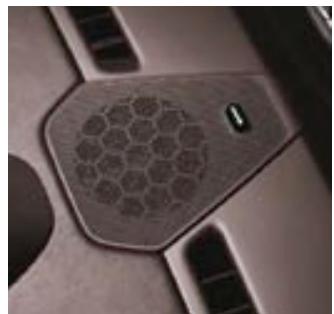
7.0 cm centre speaker
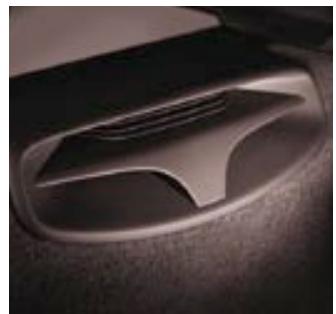
Subwoofer 10.2cm× 15.3cm in a 6-litre bass reflex housing
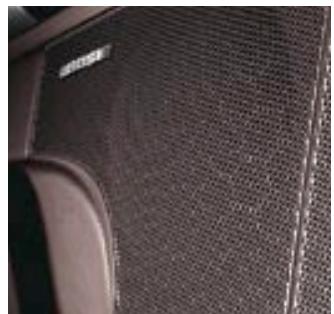
8.0 cm neodymium midrange speaker and 20.0 cm Nd® bass speaker*
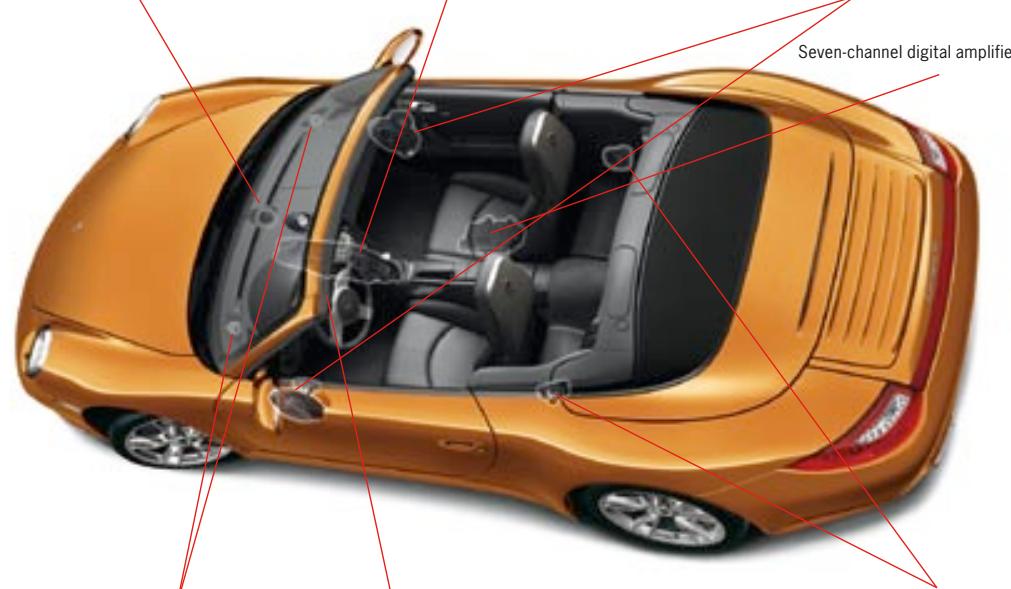
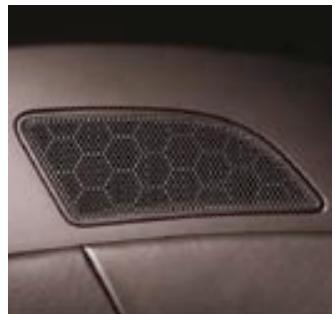
2.5 cm neodymium tweeter
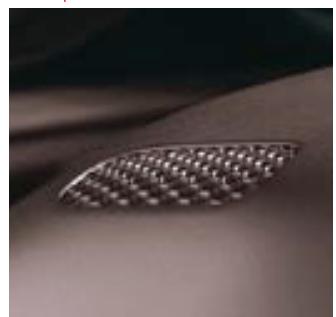
Microphone for AudioPilot®
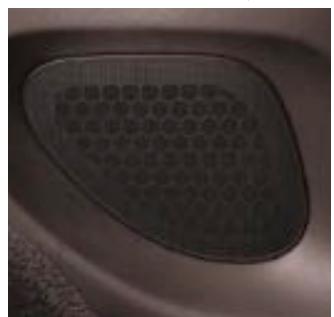
2.5 cm neodymium tweeter 8.0 cm neodymium midrange speaker
- Neodymium subwoofer with BOSE® patented technology for an extremely slim design and superior bass performance.
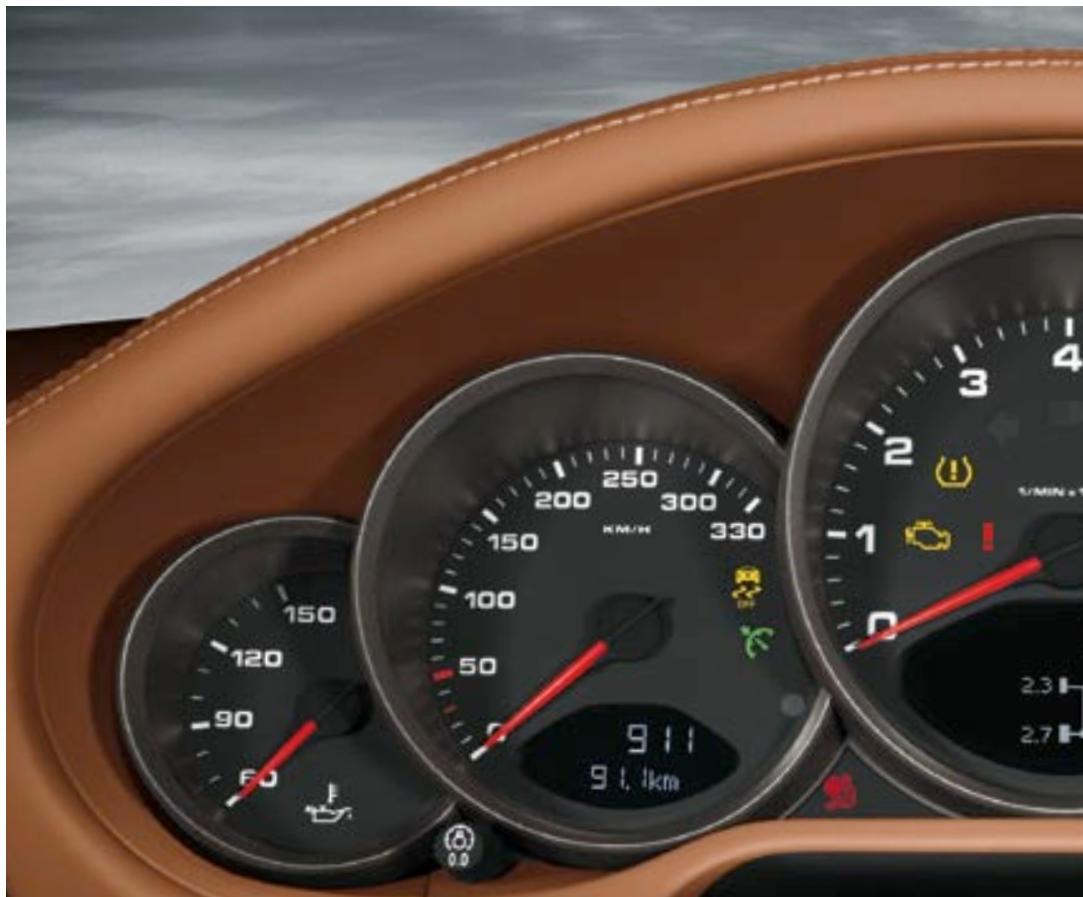
911 Carrera/911 Targa 4 instrument cluster
How does the exchange of information with your 911 work? Sportingly fast, of course.
Instruments.
Each circular dial in the instrument cluster – aluminium-coloured in the S models – provides important
information at a glance. The digital display in the centre-left
dial contains the main and trip
odometers. In the central dial, the customisable display of the
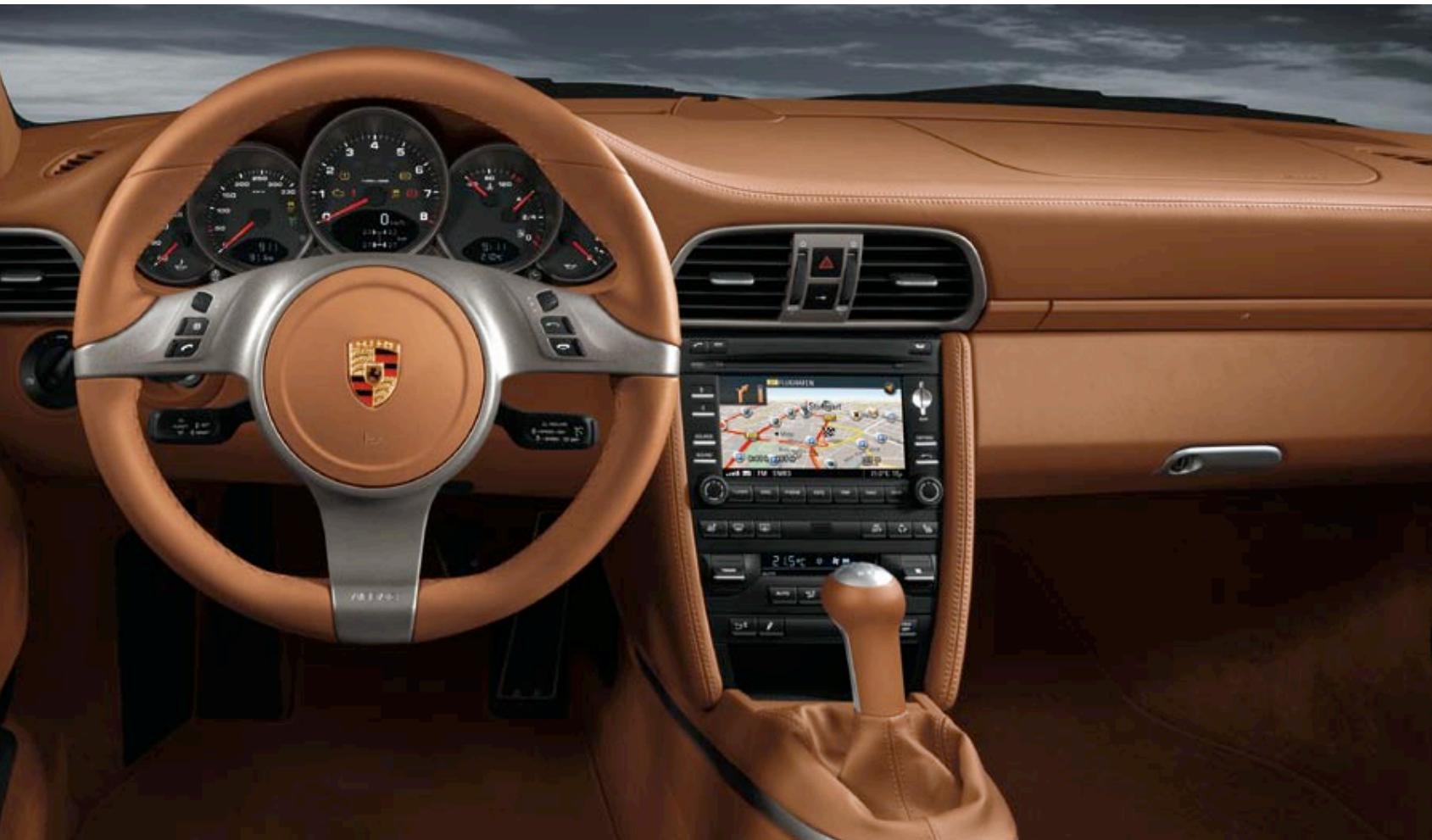
911 Carrera/ 911 Targa 4 dashboard with various options, including natural leather interior, cruise control, navigation module and Tyre Pressure Monitoring (TPM)
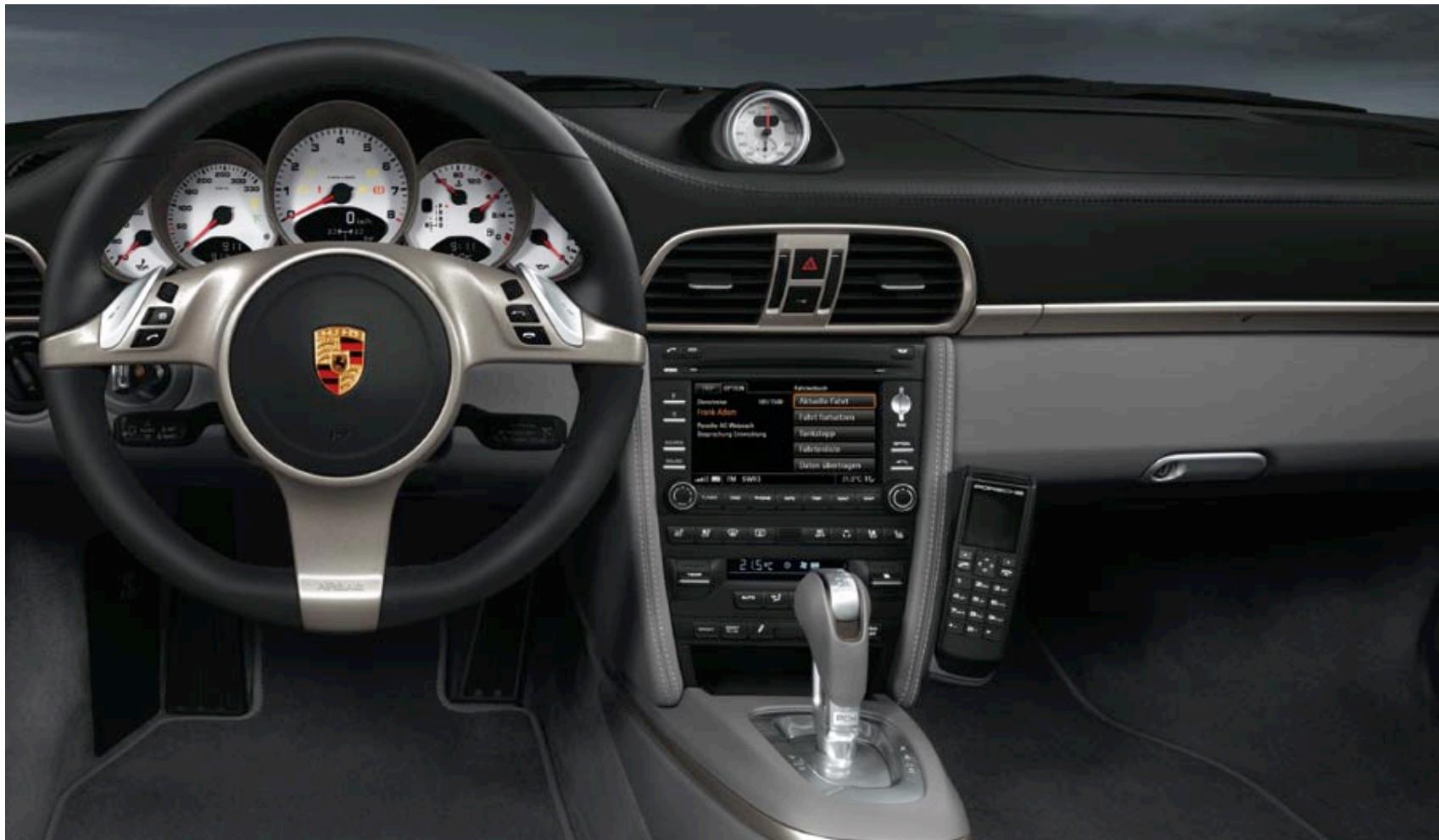
911 Carrera S/911 Targa 4S dashboard with various options, including bi-colour leather interior, PDK, Sport Chrono Package Plus, cruise control, navigation module, cordless handset for telephone module and Tyre Pressure Monitoring (TPM)
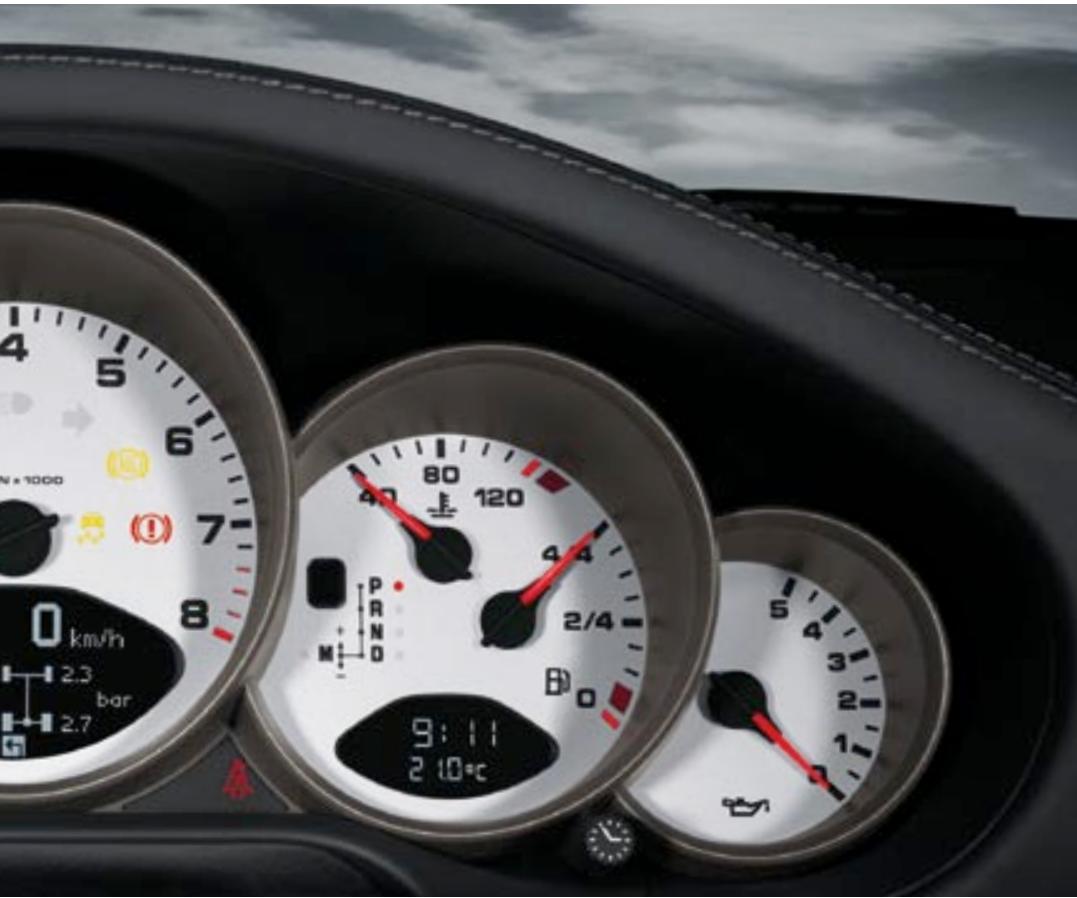
911 Carrera S/911 Targa 4S instrument cluster
standard on-board computer is integrated into the rev counter.
The centre-right dial displays the outside temperature and shift pattern of the optional Porsche Doppelkupplung (PDK), as well as the selected gear.
Text and symbols are displayed clearly by the high-resolution dot matrix. Design and legibility are also enhanced by the white backlight illumination.
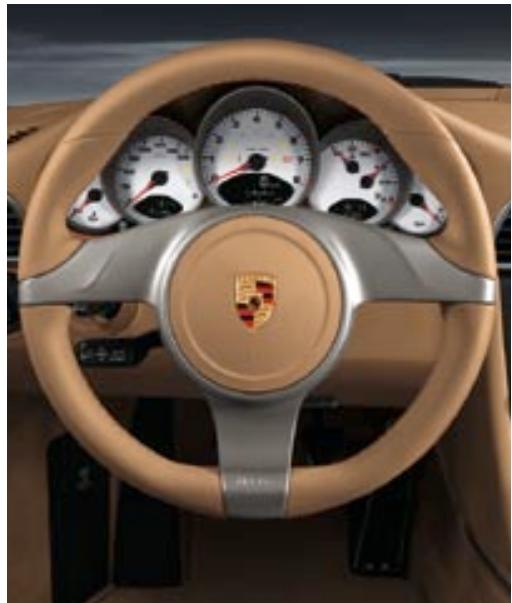
Three-spoke sports steering wheel
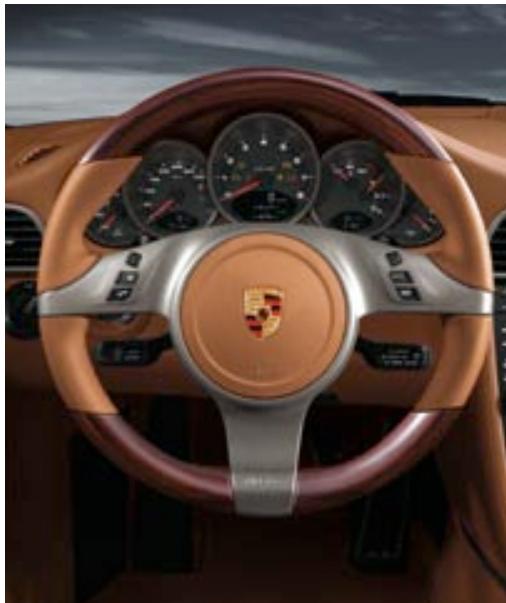
Three-spoke multifunction steering wheel in macassar
Whatever you intend to do with your 911: you've got it in hand.
Steering wheels.
As standard, all steering wheels have an integral full-size airbag, a high-grip rim in smooth-finish leather and an ergonomic design.
The three-spoke sports steering wheel adjusts up to 40 mm for both height and reach.
It has a diameter of just 370 mm. Thanks to its grip mouldings, it's in safe hands – even on the sportiest of drives.
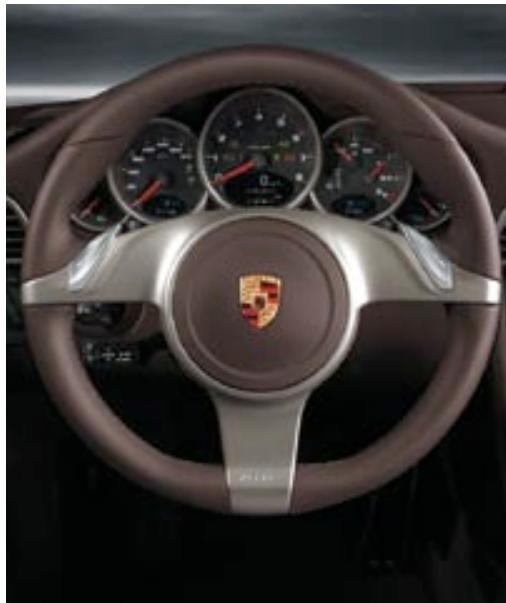
Three-spoke sports steering wheel for PDK
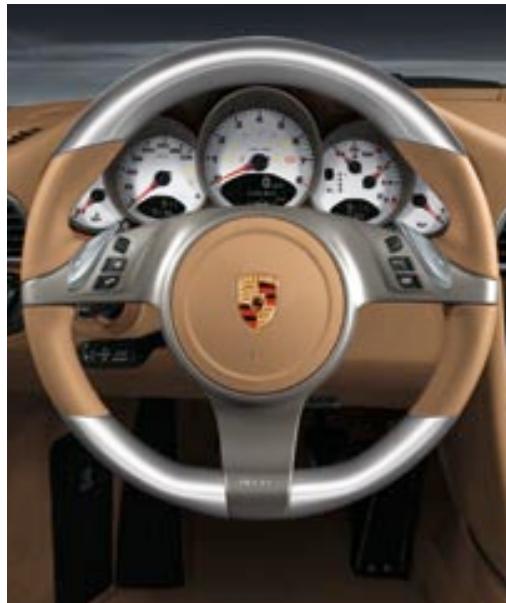
Three-spoke multifunction steering wheel for PDK in Aluminium Look
An optional three-spoke multifunction steering wheel offers direct access to the main audio, telephone and navigation functions. It is available in smooth-finish leather, Aluminium Look, carbon or macassar on request.
Heated steering wheel.
Available as an option for all steering wheels is a heating function (only in conjunction with seat heating) for increased comfort on those cold days.
In conjunction with Porsche Doppelkupplung (PDK), the steering wheels are equipped with two ergonomic switches, which make it possible to change gear directly from the steering wheel (p. 58).
The heating is operated by a button on the rear of the lower steering wheel spoke.
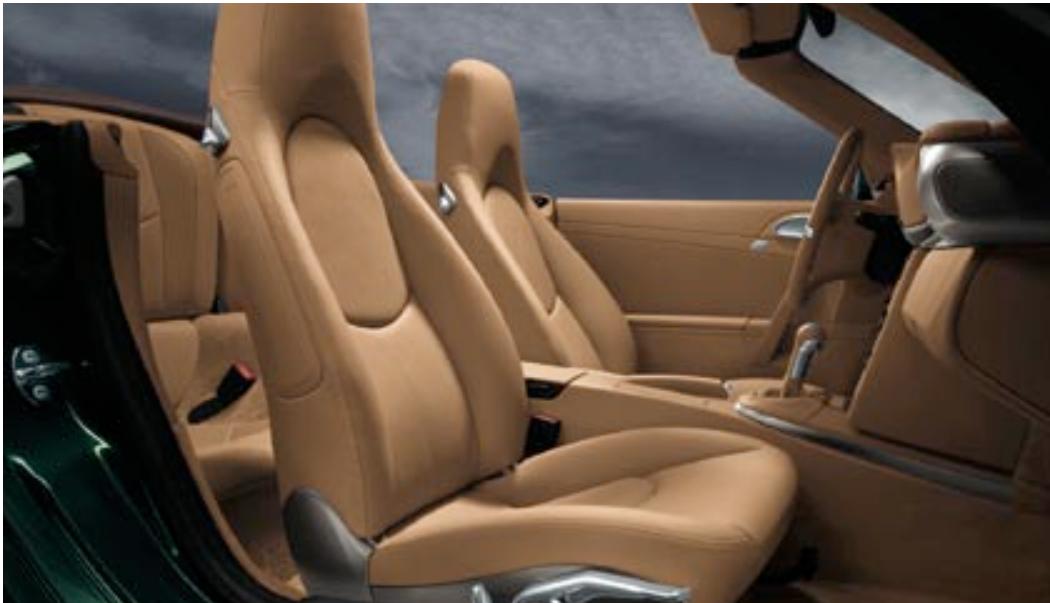
Standard seats
Just how intimate your relationship is with your 911 becomes clear the moment you first get in.
Seating.
Standard seats.
The part-leather standard seats offer a high degree of comfort with good lateral support and optimised under-seat suspension.
Through bends, your seat gives you a feeling of security without restriction.
The seats are equipped as standard with manual height and fore/
aft adjustment and an electric backrest adjustment, enabling virtually every driver to find the ideal seat position, regardless of physical build.
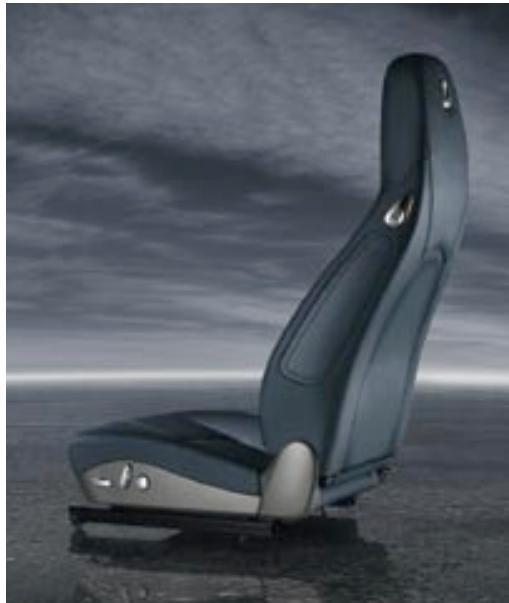
Comfort seat with driver memory
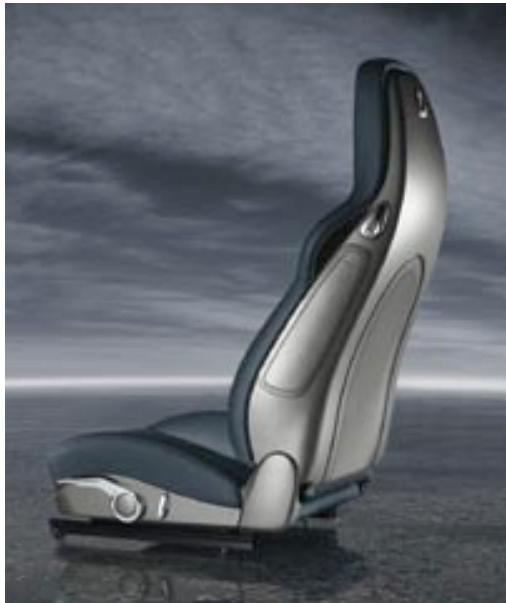
Sports seat
Comfort seats with driver memory.
Comfort seats with electric fore/ aft, height, backrest and lumbar support adjustment are available as an option. The tilt angle of the seat squab is also electrically adjustable. The memory function supports both exterior mirrors and all seat positions on the driver's side.
Using the control switches in the door panel, it is possible to restore one of two personalised settings. Additionally, you can store a further seat position in each of the ignition keys.
As soon as you unlock the door using the key remote, the seat and exterior mirrors resume their stored position.
Sports seats.
The sports seats have firmer upholstery than the standard design. Higher side bolsters on the seat squab and backrest provide additional lateral support. The seat height and fore/aft position is adjusted manually, the backrest electrically.
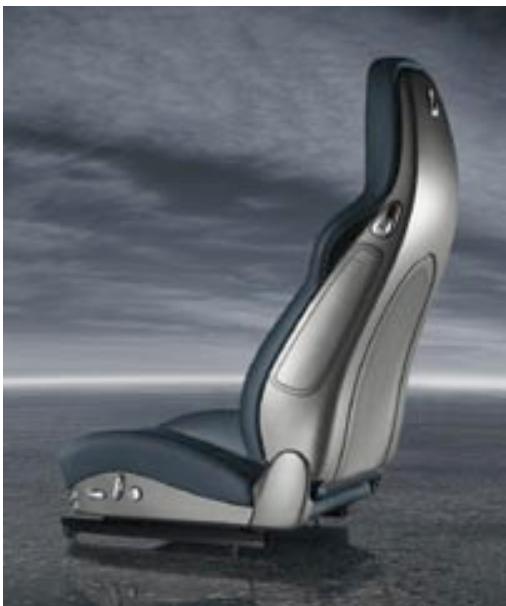
Adaptive sports seat with driver memory
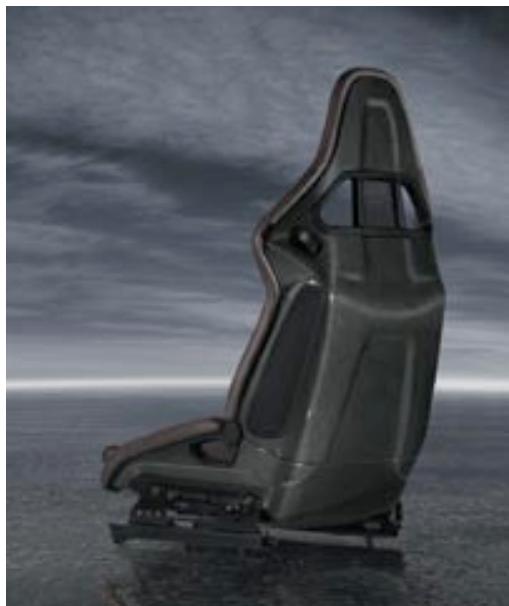
Sports bucket seat
Adaptive sports seats with driver memory.
The optional adaptive sportsseats offer high comfort withexcellent sports performance
Along with all the adjustment features of the comfort seats, the side bolsters on the seat surface and backrest are individually electrically adjustable, for increased comfort on long journeys and tailor-made lateral support through bends or on the racetrack. The
memory function supports both exterior mirrors and all seat positions on the driver's side, apart from the side bolsters.
Sports bucket seats:*
For the ultimate sports experience, you could opt for sports bucket seats with a folding backrest, integral thorax airbag and manual fore/aft adjustment. The backrest shell is made from glass/
carbon-fibre-reinforced plastic and has a stylish carbon-weave finish. The backrest pivots are positioned high in the side bolsters to provide lateral support to the pelvic region characteristic of a race seat. In contrast to conventional bucket seats, the folding backrest enables easy access to the rear luggage area. The seat upholstery is offered in all available leather types and colours.
Seat ventilation.
For standard seats and comfort seats, optional seat ventilation is available (only in conjunction with heated seats). The active ventilation from the perforated centre seat section and backrest, and passive ventilation at the side bolsters, generate an air flow which evaporates perspiration moisture and therefore makes for a comfortable seating environment, even in hot weather. Ventilation intensity can be set to any of three levels and simultaneous ventilation and heating is possible.
Seat heating.
As an option, all compatible seats – apart from sports bucket seats – can be equipped with two-level seat heating. Seats are heated in the seat squab, backrest and side bolsters.
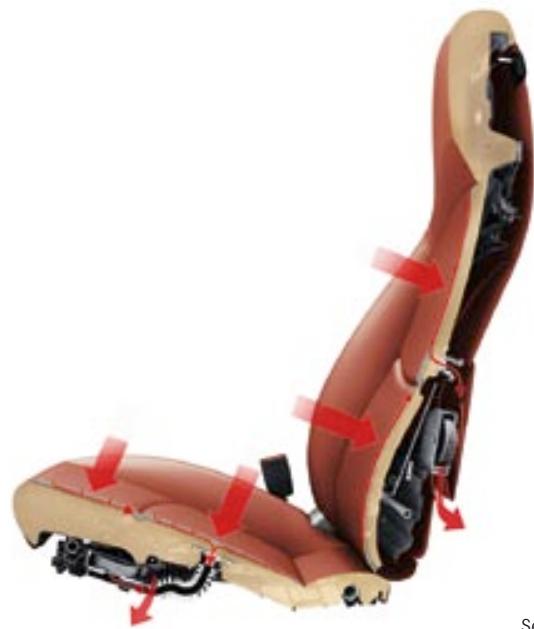
Seat ventilation
Rear seats.
The rear seats of the 911 models are surprisingly comfortable for a sportscar. Fold the backrests down, and there is plenty of luggage space available: 205 litres in the 911 Coupé models, 155 litres in the 911 Cabriolet models and 230 litres in the 911 Targa 4 models.
Child seats.\*
Child seats with ISOFIX mountings can be fitted to the front passenger seat. Through Porsche Equipment you can order fittings, a deactivation function for the front passenger airbag and a full range of child seats.
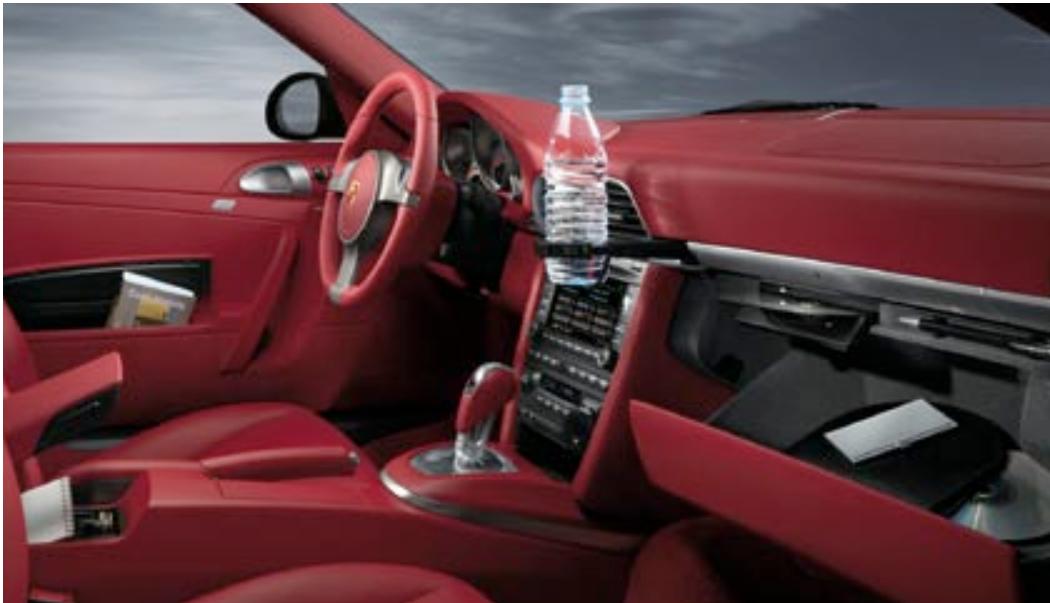
Inner strength is also evident throughout the interior.
Spatial design.
Storage.
Like everything else in the 911, the storage solutions have been ingeniously and ergonomically designed from the driver's perspective.
Compartments in the centre console and door panels provide storage space for personal belongings. Twin cup holders are neatly concealed behind the dashboard trim and below these is a lockable glove compartment with handy CD storage.
Two 12-volt sockets (including the cigarette lighter) enable you to connect your personal accessories.
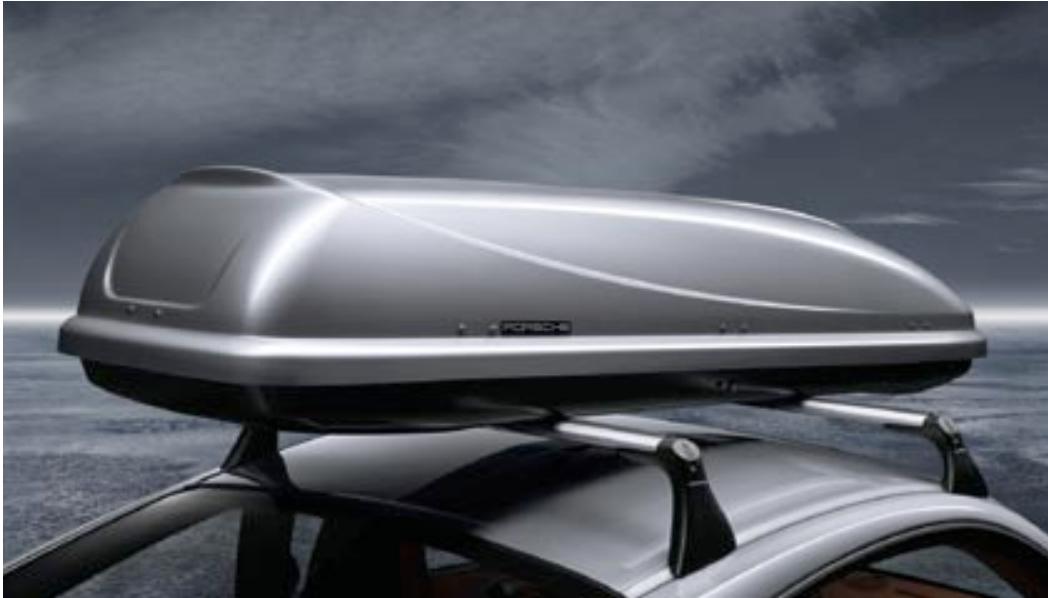
Roof transport system with roof box
Luggage compartment.
The volume of the fully trimmed luggage compartment in the rear-drive 911 models is 135 litres, and 105 litres in the all-wheel drive variants.
Roof transport system.
The aluminium roof transport system (optional for the Coupé models only) is aerodynamically efficient, very lightweight and easy to fit. A range of attachments are available, such as a roof box, a bike carrier or a ski/snowboard carrier. Maximum load-bearing capacity: 75 kg.
Luggage compartment with PTS Aluminium trolley case M from Porsche Design Driver's Selection
'Welcome Home' lighting.
When the vehicle is opened or closed using the key remote, the automatic locator lighting automatically switches on the LED daytime running lights. This is particularly convenient at night. In conjunction with the optional Sport Chrono Package Plus, you can programme the delayed lighting switch-off period via PCM.
HomeLink®.
The optional, freely programmable garage door opener is integrated into the roof console and remotely controls up to three different garage doors, gates, home lighting and/or alarm systems.
Automatically dimming mirrors.
An auto-dimming function for the rear-view mirror and exterior mirrors, with an integrated rain sensor for the windscreen wiper, is available as an option.
Cruise control.
An automatic speed controller for the 30 - 240km / h (20-149 mph) speed range is available as an option. It is activated using a separate control stalk on the steering column and can be used even in first gear.
Anti-theft protection.
All 911 models are equipped as standard with an immobiliser with in-key transponder and an alarm system with contact-sensitive exterior protection and radar-based interior surveillance.
Vehicle tracking system.
This preparation enables installation of a vehicle tracking system available from Porsche Equipment. The system makes it possible to locate a stolen vehicle across most of the countries of Europe. The preparation includes a special wiring loom and a higher-capacity battery. A tilt sensor for the alarm system is also fitted as part of the equipment.
Slide/tilt sunroof.
This electrically and steplessly adjustable sunroof is available as an option for the Coupé models. The tilt position offers comfortable ventilation of the interior, even when travelling at high speeds.
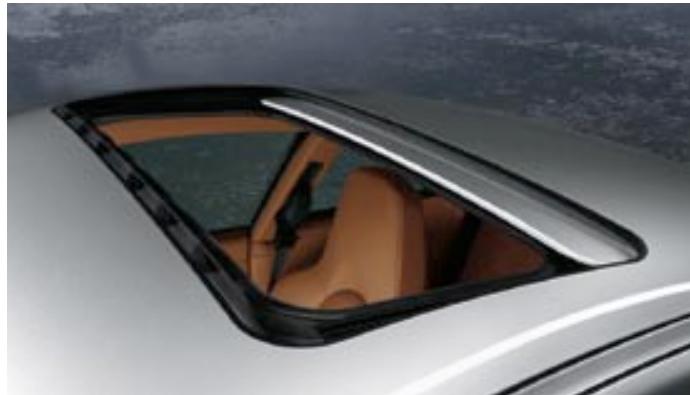
Tilt and slide roof
ParkAssist.
Whenever reverse gear is engaged, ParkAssist is automatically enabled. If you move too close to an obstacle, a warning signal begins to sound, becoming faster until the car stops. The sensors of the optional ParkAssist are neatly concealed in the rear bumper.
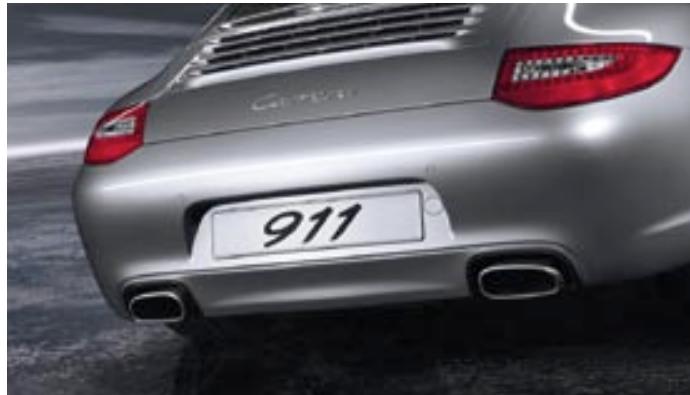
ParkAssist
Rear wiper.
This optional rear wiper with a flat, streamlined wiper blade blends seamlessly with the exterior of the car.
Rear screen wiper
Motorsport
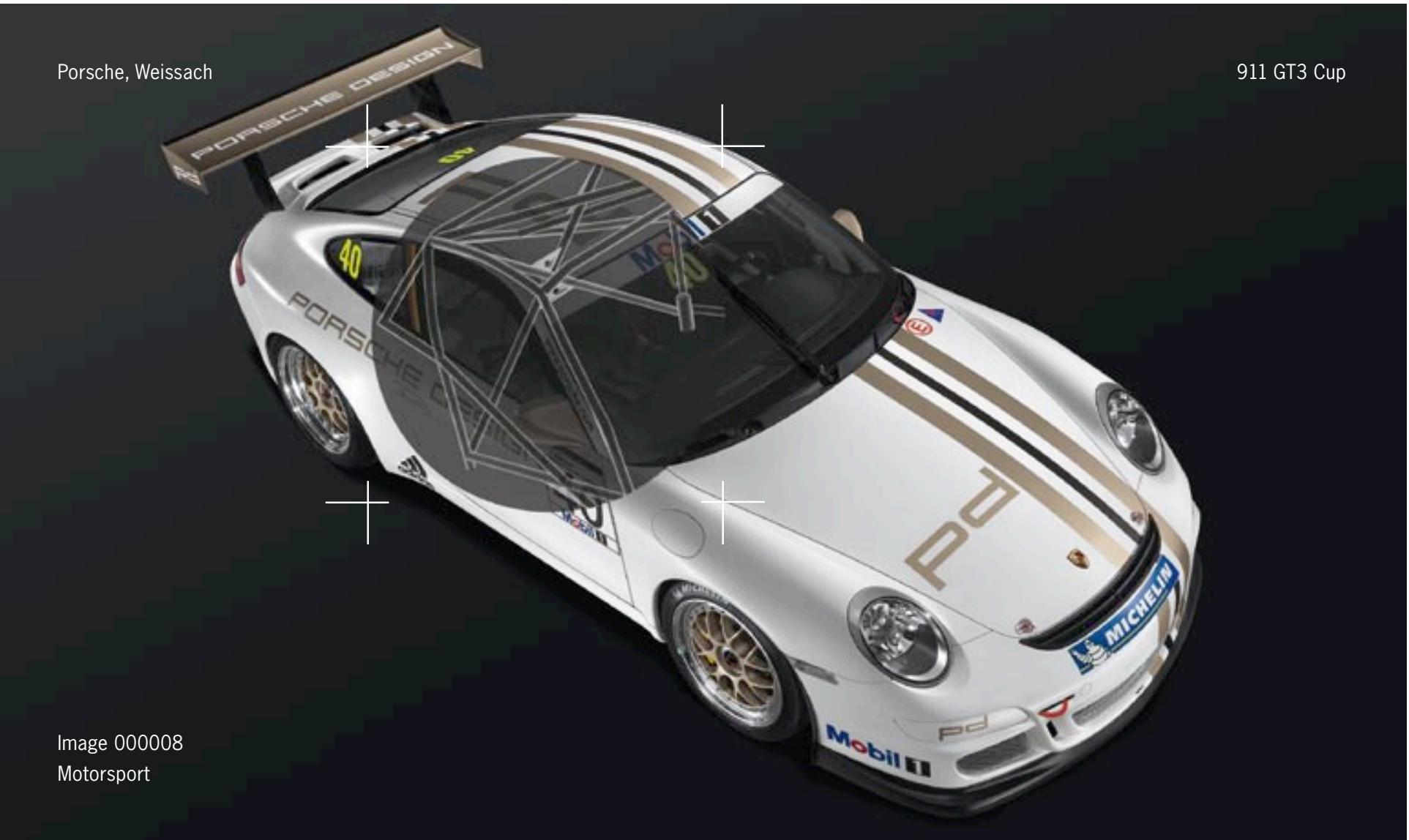
The inner strength of the 911 has its origin in motor- sport.
Indeed, at Porsche the transfer of engineering technology from racetrack to road is a traditional principle and a winning formula. From the Porsche Sport Driving School to the Porsche one-make championships to prototype racing with the RS Spyder.
The 911 has always occupied a special position. Today, just as it did over 45 years ago. For factory teams and customer teams. And, as ever, for the personal success of its driver.
Porsche RS Spyder
For the 911, over 45 years of experience count. And so does every tenth of a second.
Motorsport.
Prototypes are pure-bred racing cars not based on a road-registered production sportscar. One example is the RS Spyder, which was built for the LMP2 (Le Mans Prototype 2) class. In 2008, its 3.4-litre V8 racing engine with direct fuel injection (DFI) generated 503 hp. The entire vehicle concept is founded on a low
centre of gravity, good traction and high agility. The result is an impressive success story. Out of the 40 races in which it had competed by the end of 2008, the RS Spyder mastered a total of 30 classes and even secured 11 overall victories. This success helped the prototype to win manufacturers', team and drivers'
championships in the American Le Mans Series (ALMS) and Le Mans Series (LMS). Also, overall victory in the 12 Hours of Sebring plus a class victory in the 24 Hours of Le Mans.
GT-Sport
GT racing.
GT (Gran Turismo) vehicles are also pure-bred race cars. However, these must be based on a road-legal sportscar, only parts of which may be modified.
In 2009, Porsche is taking its place on the starting grid in the refined 911 GT3 RSR. Following another air restrictor reduction, its 4.0-litre boxer engine generates approximately 450 hp and a maximum torque of 430 Nm.
Porsche builds the race-ready vehicles and supports customer teams through development and technical service and by supplying works drivers.
With success in the 2008 season including an overall win in the 24 Hours of Nürburgring and the class win in the 12 Hours of Sebring, the 911 GT3 RSR was able to add to the numerous successes of the past.
In summary, whether it's at the Le Mans 24 Hours, in the ALMS/ LMS, at the FIA-GT or at international GT championships, Porsche customer teams lining up in the 911 GT3 RSR regularly race to victory and win championship after championship.
More information can be found at www.porsche.com/motorsport.
Porsche Mobil 1 Supercup
Porsche Cups.
There are eight Porsche Carrera Cup championships throughout the world - with races in 15 countries, from Australia to France - and internationally the fastest one- make championship, the Porsche Mobil 1 Supercup.
The philosophy behind these races is that all competitors have an equal chance, so all the vehicles are technically identical. 911 GT3 Cup vehicles, direct descendants of the 911 GT3, producing 420 hp and 285 km/h (177 mph), take part in sprint races in leading international race events. The result is hard-fought, exciting international competitions at the highest level.
For all Porsche Cups, Porsche supplies the customer teams with ready-to-use racing cars, organises the race series and looks after the drivers, teams and sponsors at the events.
The Porsche Mobil 1 Supercup is the world's fastest international one-make championship. It is held exclusively as part of the FIA Formula 1 World Championship in Bahrain and in Turkey, as well as at the European Grand Prix races. A total of 11 races are held, each with an average of 120,000 spectators.
For more information visit www.porsche.com/motorsport.
Porsche Carrera Cup.
The Porsche Carrera Cup premiered in 1990 and has developed into one of the fastest national one-making championships in the world.
It is an established part of the German Touring Car Masters (DTM) calendar. This series of races inspires not only the highest sporting performance, but also an extremely attractive programme of events.
Porsche Sport Driving School
Porsche Sport Driving School.
Training is given by experienced
Porsche instructors on a range
of courses, from beginner to
advanced, including final pre
paration for a racing licence.
Customers can use their own
car or a loan vehicle supplied by
Porsche. Courses take place
on and off-road and are held at
national and international racecircuits, as well as Porsche'sown track in Leipzig, so that thefoundation is laid for the nextstage – the Porsche Sports Cup.
For more information visit www.porsche.com/ sportdrivingschool.
Porsche Sports Cup.
Five racetracks, six events, one experience: the Porsche Sports Cup. Including races for both road-licensed and race-modified Porsche vehicles, these events are held on tracks such as the Nürburgring or Spa-Francorchamps.
From 2009, Porsche Sports Cup events will be even more exciting with the introduction of a new
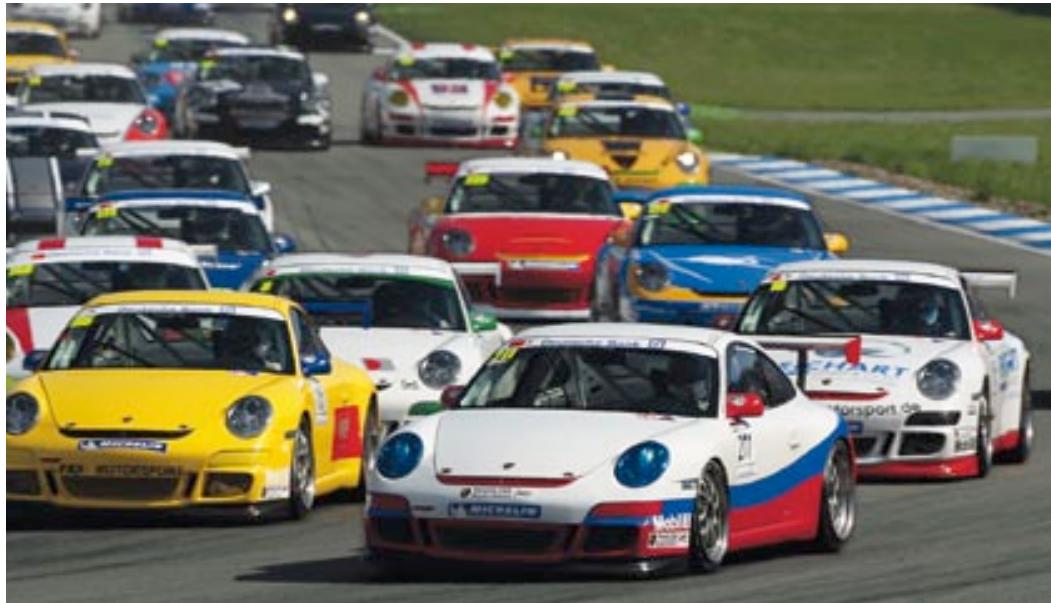
Porsche Sports Cup
series: the GT3 Cup Challenge. This will provide a link to the Porsche Carrera Cup and will be the first championship of its kind in Europe.
For more information visit www.porschesportscup.com
Porsche Club Sport.
The privately run Porsche Club network organises individual competitions and series in which drivers compete in different classes. The first Porsche Club was founded by a small group of enthusiasts back in 1952. Today there are more than 600 clubs in over 60 countries worldwide with about 120,000 members
- and the trend is growing. The Porsche Club organisation is therefore one of the largest and longest-established automotive bodies in the world.
For more information visit www.porsche.com.
Environment
Porsche, Weissach
911 Carrera
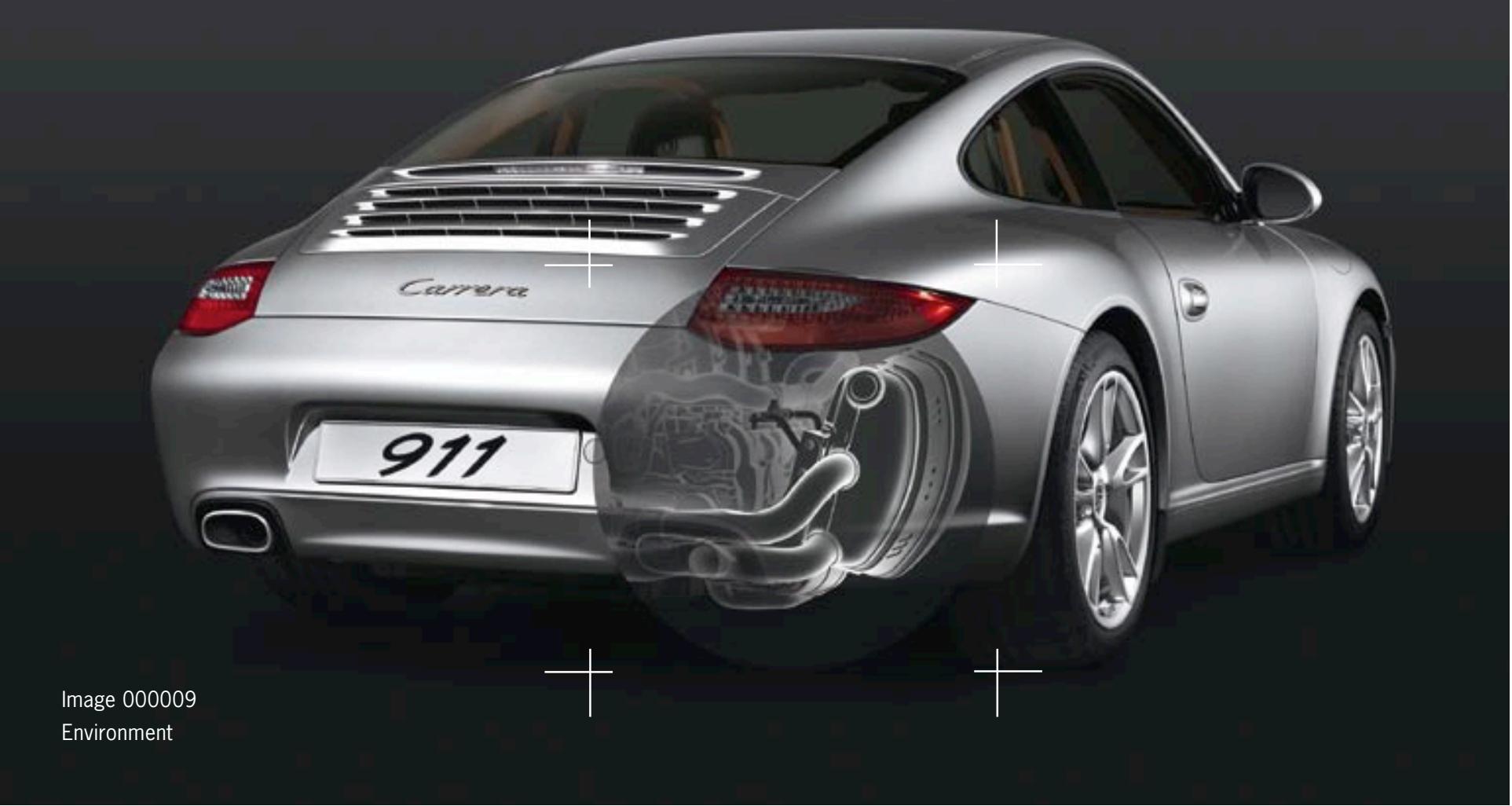
For us, developing a 911 will forever be an obligation. To our roots. To individuality. And, naturally, to sportiness.
Nevertheless, our efforts in development do not concern themselves solely with the hunt for the highest horse power, but with the search for efficiency.
In fact, the 911 gives much and takes little.
Another sign of inner strength.
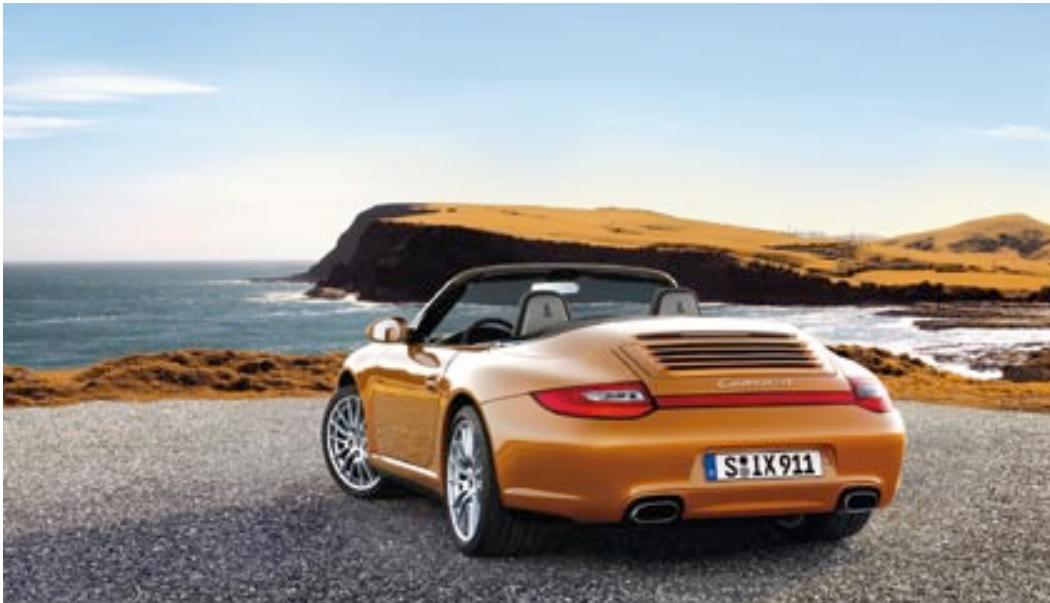
911 Carrera 4 Cabriolet
In the concept behind the 911, the source of its appeal is the achievement of harmony.
Harmony with the environment as well.
In an era of intensifying debate about CO_2 emissions, every automotive manufacturer is being asked the question, 'What is your answer to the issue of fuel consumption?' Our answer has long been the same: maximum efficiency.
Porsche has been reducing the CO2 emissions of its vehicles annually by an average of 1.7% . As far as engine output is concerned, we are already among those manufacturers achieving the lowest CO2 emissions. This has been achieved through the efficient drive concept (DFI), lightweight construction, optimum
aerodynamics and low rolling resistance.
This high level of environmental responsibility is clearly demonstrated by our approach to environmental management at the Porsche development centre in Weissach. Here, all technological developments are carried out with
environmental protection in mind. The goal? Pure performance – but not at the expense of the environment. The result? The 911. You will find more information in our separate brochure, 'Porsche and the Environment', or at www.porsche.com.
through. The stereo lambda control circuitry controls and monitors each cylinder bank separately, while another lambda sensor on each cylinder bank monitors pollutant conversion in the respective catalytic converter (p. 49).
selected. We use only innovative and environmentally friendly components. All lightweight materials are easily recyclable and each material is labelled to facilitate its separation for recycling. The reduction in the number of plastic variants helps to ensure more efficient recycling. Recycled plastics are used where they meet our exacting technical requirements.
Exhaust emission control.
Both 911 engines comply with stringent emission standards, including Euro 5 in Europe and LEV II in the USA. Vehicles manufactured by Porsche demonstrate that even high-performance sportscars can achieve moderate emission values in their respective category. Indeed, not only is the 911 one of the most exciting cars around, it is also one of the cleanest.
This is achieved through the use of a two-stage cascade-type catalytic converter which comprises two monolith substrates on each of the twin exhaust tracts. These specially coated substrates contain ultra-fine honeycomb channels in which pollutants are converted as exhaust gas passes
Fuel economy and recycling.
At Porsche, a fundamental aspect of design is intelligent lightweight construction. For both economical and ecological reasons. This forms the basis for low fuel consumption values in conjunction with outstanding performance.
It is economical thanks to the high proportion of aluminium cast alloys, magnesium, plastics and super high-strength sheet steel used. This is substantially more stable and lighter than conventional steel. In the 911 models approximately 20% of components are made from lightweight alloys.
It is also ecological because all materials used are meticulously
In all, the current 911 is approximately 85% recyclable.
In addition, Porsche primarily uses environmentally friendly water-based paints. The 911 is absolutely free of asbestos, CFCs and components manufactured using CFCs. This is because, here at Porsche, environmental protection does not begin at the end of a vehicle's life. It starts at the planning and development stage.
Fuel.
The 911 is already designed to operate on fuels with an ethanol content of up to 10% . Ethanol has a positive impact on the CO2 balance since the plants grown for the production of this biofuel also absorb CO2 from the atmosphere.
The release of hydrocarbons from the fuel system is minimal. This is achieved through an active carbon filter and a special coating on the fuel tank. The high-pressure section of the fuel system is made of stainless steel, while vapour-carrying lines are made from multi-layered plastic.
Noise.
The 911 complies with all appli- cable noise regulations without any form of engine encapsulation. To achieve this, noises are elim- nated at source. Engine parts are stiff, moving parts are lightweight and tolerances are kept to a minimum. Large-volume silencers and resonators in the air intake system minimise noise further. For the entire service life of the vehicle.
Servicing.
Long service intervals offer clear advantages. For you: lower costs and saved time. For the environment: the use of fewer consumables and replacement parts. For full details of service intervals, please refer to the separate price list.
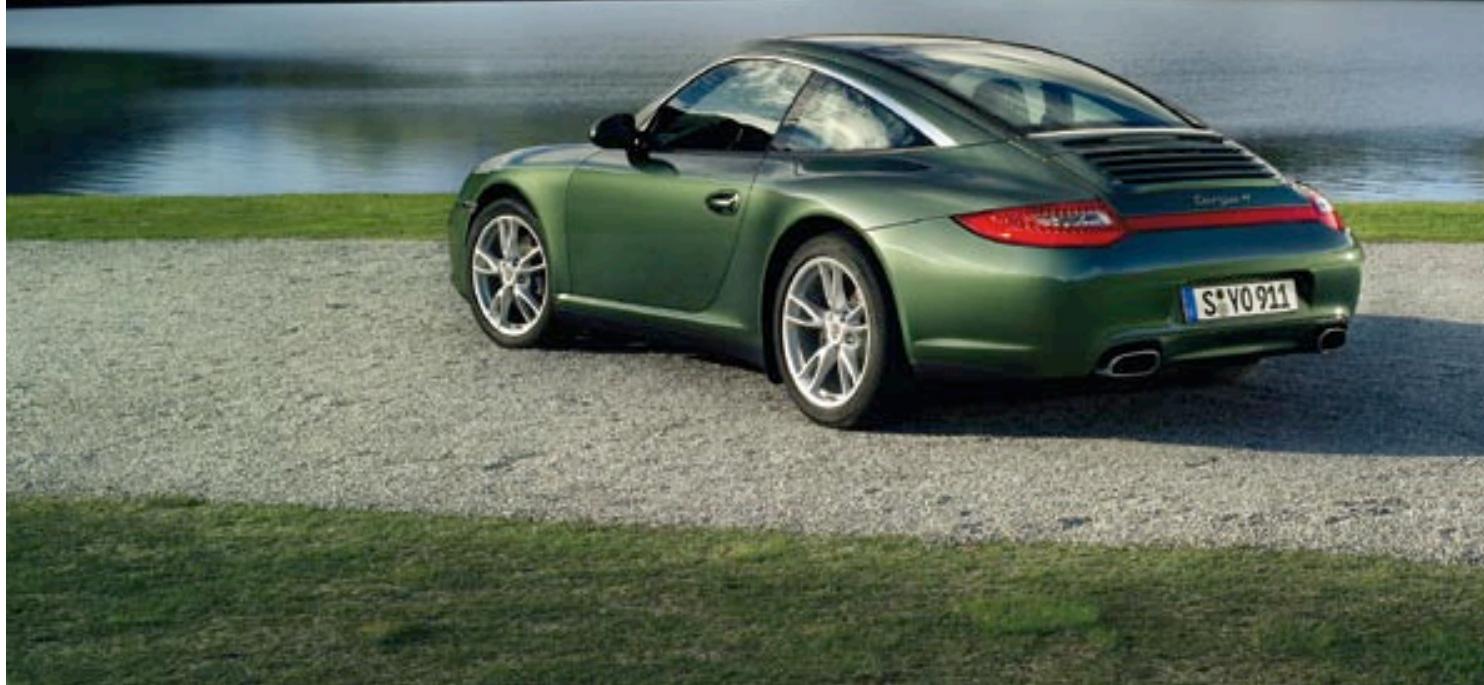
911 Targa 4
Personalisation
Porsche, Weissach
911 Carrera
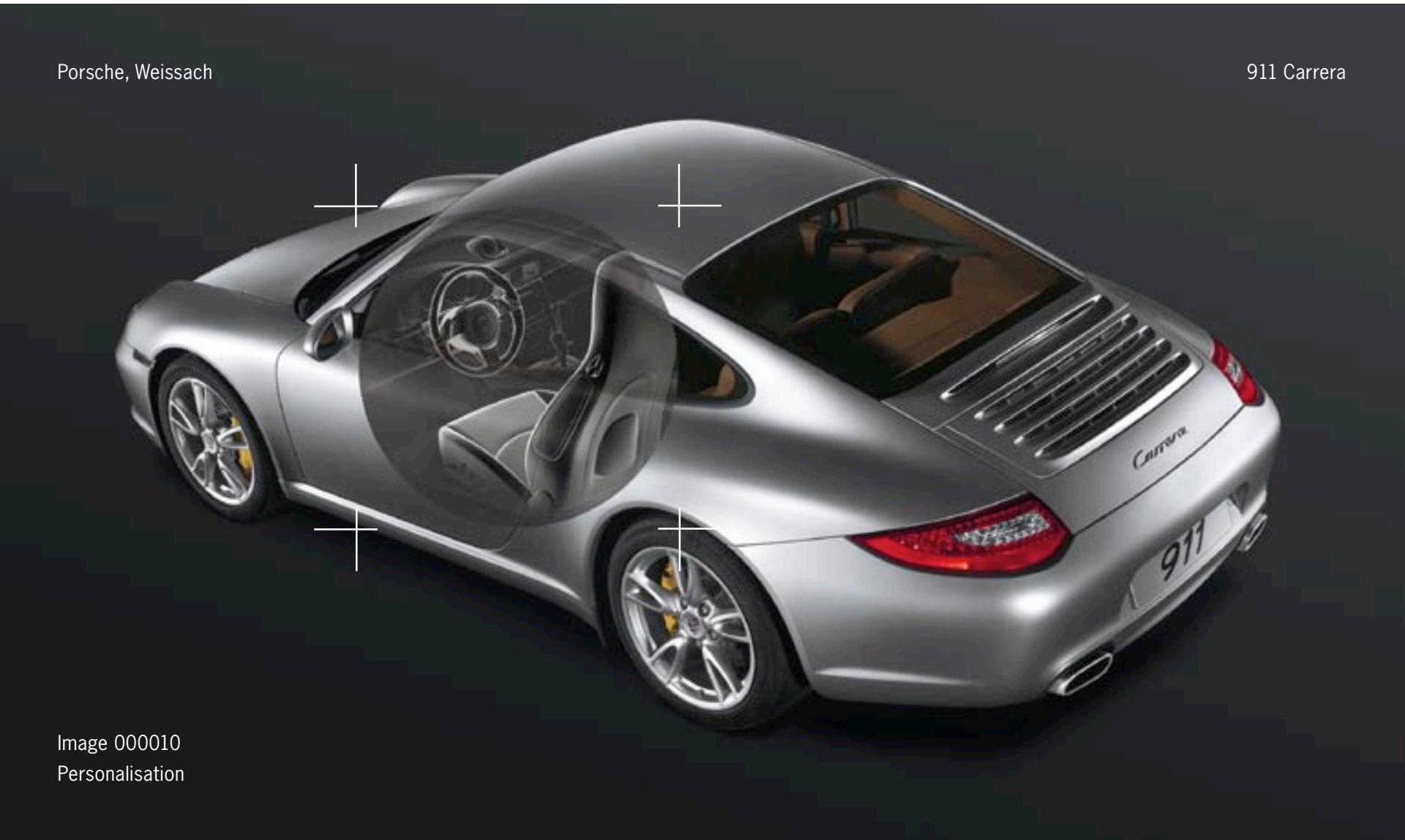
Two engines.
Five body designs.
Ten different models.
The 911 is an expression of individuality.
To enable you to make
your own personal mark, we
offer you a wide selection
of personalisation options.
After all, isn't freedom of
choice the most important
thing about individuality?
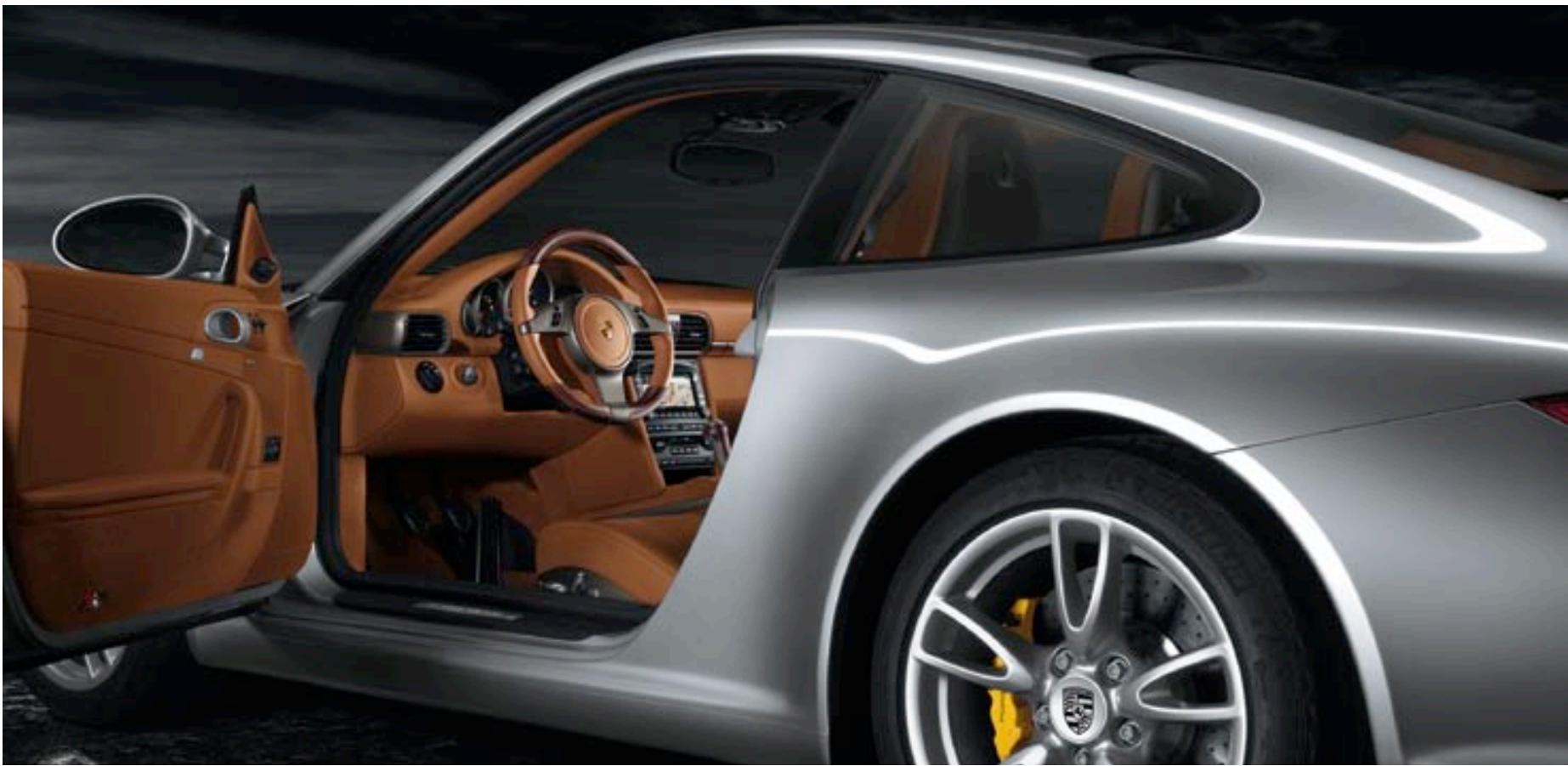
The uniqueness of a 911 goes further than you may think.
Personalisation for your 911.
The standard specification of the 911 may already be second to none, but Porsche still gives you
the opportunity to personaliseyour car to your own taste.There is a comprehensive rang
of individual items and equipment packages to choose from. For both the exterior and interior.
You will find more detailed information on the following pages and in the separate price list.
These are not the only ways to style your 911 to your personal preference.
How about personalisation of your car at the factory through Porsche Exclusive, or why not consider our range of after-market accessories available through Porsche Equipment? You will find plenty of inspiring examples in all the relevant catalogues. Your Porsche Centre will be happy to advise you.
Colours.
One of the most important considerations in your expression of individuality and character is, of course, your choice of colour.
In total, there are four solid, eight metallic, five special and four hood colours to choose from. Then there are nine interior colours and three two-tone equipment finishes.
On request, you can order your 911 in virtually any other colour of your choice. For further information, please refer to the Porsche Exclusive 911 catalogue.
Using the Porsche Car Configurator at www.porsche. com, you can see how the available colours would look on your car.
Solid exterior colours.
Metallic exterior colours.

Black

Basalt Black Metallic

Macadamia Metallic

Guards Red

Arctic Silver Metallic

Meteor Grey Metallic

Carrara White

Dark Blue Metallic*

Aqua Blue Metallic

Speed Yellow

Ruby Red Metallic

Porsche Racing Green Metallic
Special exterior colours.

Cream White

Nordic Gold Metallic
Hood colours.
Black

GT Silver Metallic
Stone Grey

Atlas Grey Metallic
Metropole Blue

Malachite Green Metallic
Cocoa
Standard interior colours.
Leatherette/leather/
soft-touch paint.1)
Carpet.
Rooflining.2)

Black

Black

Black

Stone Grey

Stone Grey

Stone Grey

Sand Beige

Sand Beige

Sand Beige

Ocean Blue

Ocean Blue

Ocean Blue
Special/two-tone interior colours.3)
Leather/soft-touch paint.
Carpet.

Terracotta4)

Terracotta
Rooflining.2]
![PORSCHE 911 TURBO CABRIOLET - Rooflining.2] - 1](/content/2025/01/163658/images/e320d5286fbbb4cdf076327eb2fab77771f9257c0a43789fc150df0e76c24da8.jpg)
Black
![PORSCHE 911 TURBO CABRIOLET - Rooflining.2] - 2](/content/2025/01/163658/images/a00c991b913d96bd763586e2b8386b37da7a172fc67738d36258d96e501f6610.jpg)
Cocoa4
![PORSCHE 911 TURBO CABRIOLET - Rooflining.2] - 3](/content/2025/01/163658/images/2b0068b1e358603c150e6b05d5a2345bf70f31b9e550f5b13730dc32d4d4ba4b.jpg)
Cocoa
![PORSCHE 911 TURBO CABRIOLET - Rooflining.2] - 4](/content/2025/01/163658/images/2faa1fa36ca63ecf6b32759ddfd6f1e7a7971f9719edffb2cb9f7c7595675382.jpg)
Black
![PORSCHE 911 TURBO CABRIOLET - Rooflining.2] - 5](/content/2025/01/163658/images/67db01ed18352f1e2797f4a3cfc9064ed4e258ea019f6f2ae7515acf3663e3e8.jpg)
Black and Terracotta5)
![PORSCHE 911 TURBO CABRIOLET - Rooflining.2] - 6](/content/2025/01/163658/images/b50e5013057b9f66a1a06fddb64e89c4638c5cc793d3ae70742ed8c93c74cb7e.jpg)
Terracotta
![PORSCHE 911 TURBO CABRIOLET - Rooflining.2] - 7](/content/2025/01/163658/images/4599e389034004a8cd27eb7b6398f99b0d343df0018264d376e4b655346f9942.jpg)
Black
![PORSCHE 911 TURBO CABRIOLET - Rooflining.2] - 8](/content/2025/01/163658/images/4f551912835ea2984db091761c2be28450e74df5563a7b92fdc4bf20d7c4c50b.jpg)
Black and Stone Grey
![PORSCHE 911 TURBO CABRIOLET - Rooflining.2] - 9](/content/2025/01/163658/images/6dcb3bae67f0c8bad38a24cf59b15b0d277b15e94f1b7fd6025777fd8be9b6fc.jpg)
Stone Grey
![PORSCHE 911 TURBO CABRIOLET - Rooflining.2] - 10](/content/2025/01/163658/images/b48ea29b156ec6d6d6ae780a11b6ad6828487188e631205f4383ceef209a9378.jpg)
Black
![PORSCHE 911 TURBO CABRIOLET - Rooflining.2] - 11](/content/2025/01/163658/images/c248aab2734e163dfedf03a7bcf2a2045c6466daf086ace2a2f1eddac146e769.jpg)
Black and Sand Beige6)
![PORSCHE 911 TURBO CABRIOLET - Rooflining.2] - 12](/content/2025/01/163658/images/a2ff0f3dee6ffb086efac82d28aa356a1e0f9e5ef341e1b16b8b2d4c56328e3a.jpg)
Sand Beige
![PORSCHE 911 TURBO CABRIOLET - Rooflining.2] - 13](/content/2025/01/163658/images/705a8e332c020c4f9d816db4f572f7e39475f43cadb9b32ec80c16e9b4817b0b.jpg)
Black
Natural leather interior.
Leather/soft-touch paint.

Dark Grey7
Carpet.

Dark Grey
Rooflining.2)

Black

Natural Brown4)

Natural Brown

Black

Carrera Red4)

Carrera Red

Black
See separate price list for recommended colour combinations.
1) Soft-touch paint in interior colour; sun visors and inner door-sill guards with film finish in interior colour.
2) Rooflining in Alcantara (Coupé models) or black fabric (Cabriolet models).
3) Black leather finish on dashboard upper section including instrument shroud, dashboard forward section including front passenger airbag cover, steering wheel rim and airbag module, door upper panels, rear side panel upper sections, A-pillar/windscreen top trim, B/C-pillar trim (Coupé models). All other surfaces in chosen combination colour.
4) Soft-touch paint in interior colour; sun visors and inner door-sill guards with black film finish.
5) Soft-touch paint in interior colour or black; sun visors and inner door-sill guards with black film finish.
6) Soft-touch paint in interior colour or black; sun visors with black film finish, and inner door-sill guards with film finish in interior colour.
7) Soft-touch paint in black; sun visors and inner door-sill guards with black film finish.
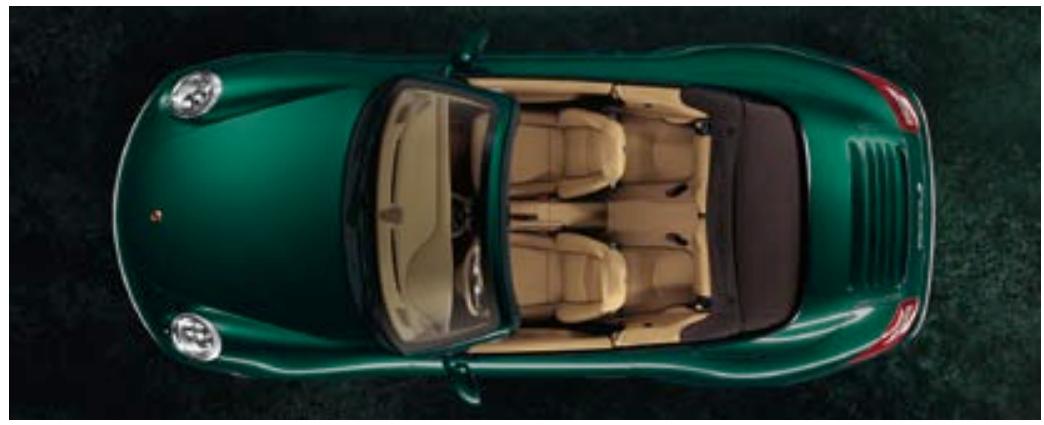
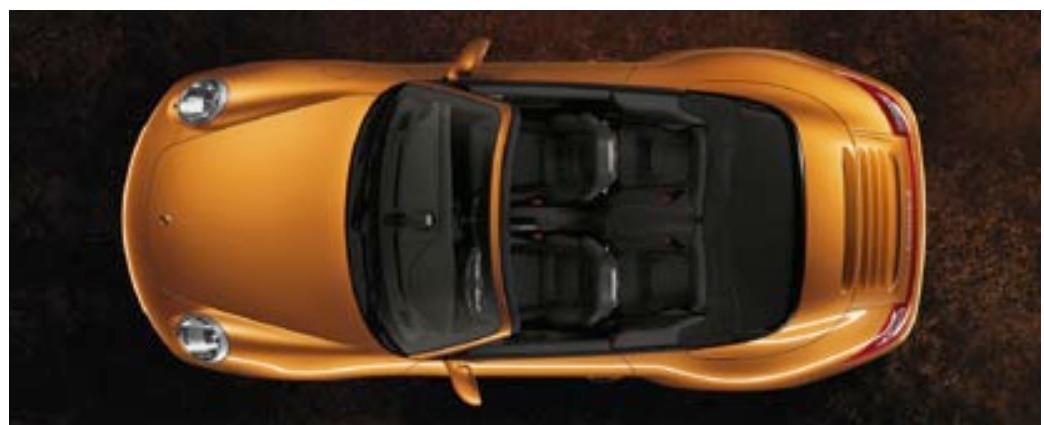
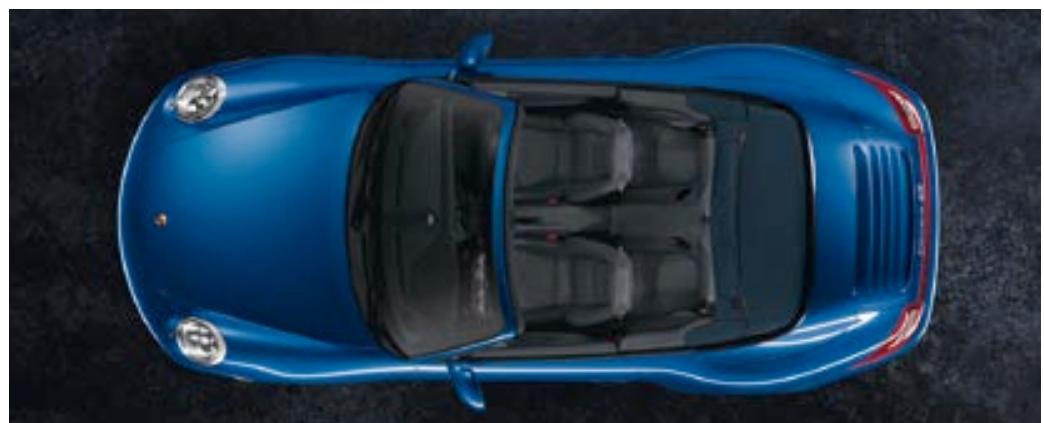
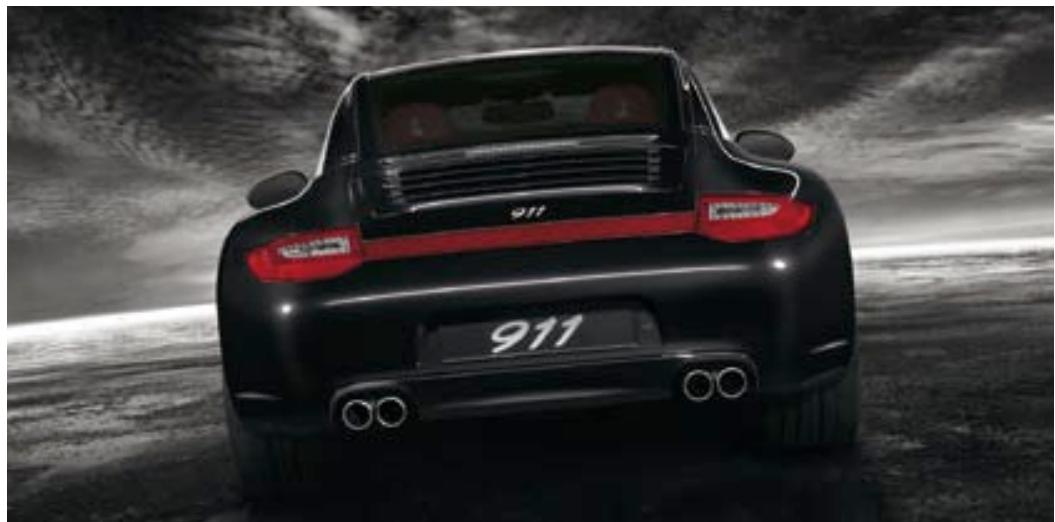
Metallic paint, '911' logo
| Exterior. | ||||||||||||
| Option | 911 Carrera | 911 Carrera S | 911 Carrera 4 | 911 Carrera 4S | 911 Carrera Cabriolet | 911 Carrera S Cabriolet | 911 Carrera 4 Cabriolet | 911 Carrera 4S Cabriolet | 911 Targa 4 | 911 Targa 4S | I no. | Page |
| • Metallic paint | ○ | ○ | ○ | ○ | ○ | ○ | ○ | ○ | ○ | ○ | Code | 140, 146 |
| • Special colours | ○ | ○ | ○ | ○ | ○ | ○ | ○ | ○ | ○ | ○ | Code | 141 |
| • Colour to sample | ○ | ○ | ○ | ○ | ○ | ○ | ○ | ○ | ○ | ○ | Code | |
| • Dynamic cornering lights | ○ | ○ | ○ | ○ | ○ | ○ | ○ | ○ | ○ | ○ | 603 | 84 |
| • Deletion of model designation | w | w | w | w | w | w | w | w | w | w | 498 | 147 |
| • '911' logo | ○ | ○ | ○ | ○ | ○ | ○ | ○ | ○ | ○ | ○ | 911 | 146 |
The vehicles illustrated in the chapter on personalisation may include additional options not featured in this catalogue.
For information on these options, please consult your Porsche Centre
For more information on the options featured in this catalogue, please refer to the separate price list.
- not available - extra-cost option standard equipment W available at no extra cost
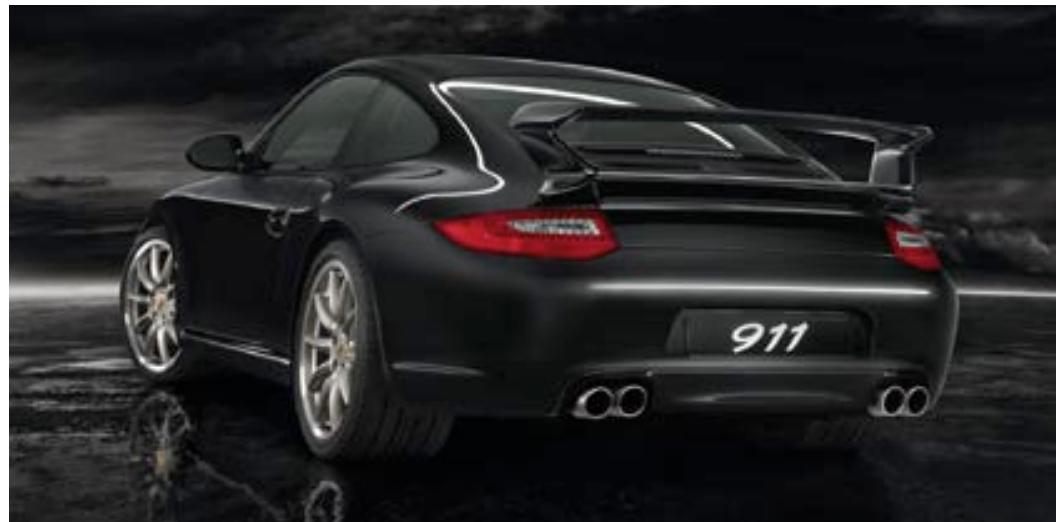
Aerokit Cup without model designation
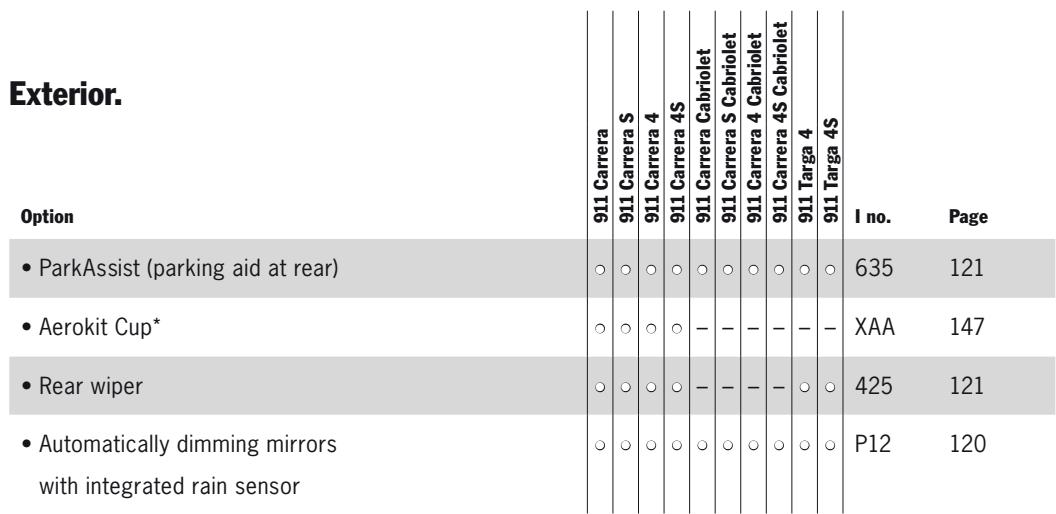
- Available from 11/2009.
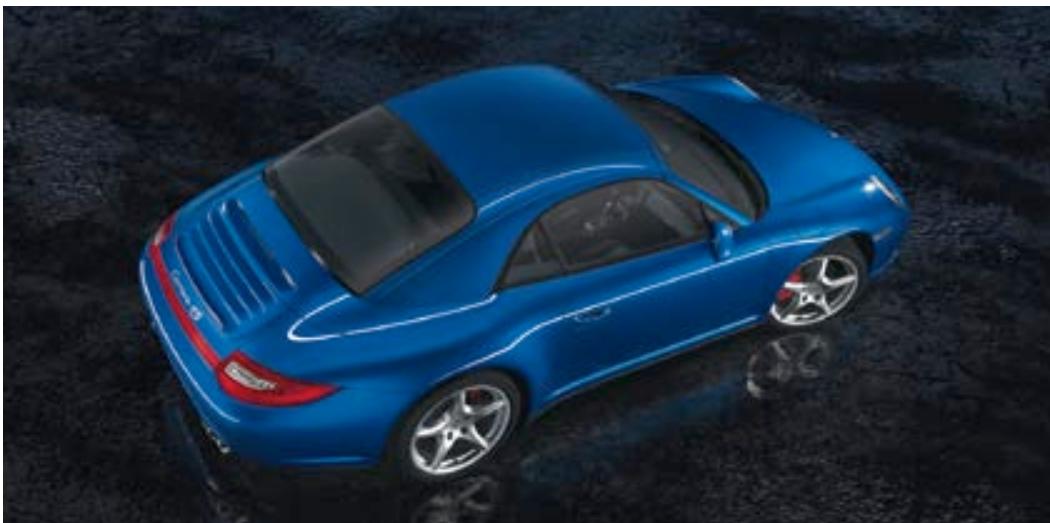
Hardtop
| Exterior. | ||||||||||||
| Option | 911 Carrera | 911 Carrera S | 911 Carrera 4 | 911 Carrera 4S | 911 Carrera Cabriolet | 911 Carrera S Cabriolet | 911 Carrera 4 Cabriolet | 911 Carrera 4S Cabriolet | 911 Targa 4 | 911 Targa 4S | I no. | Page |
| · Electric slide/tilt sunroof | ○ | ○ | ○ | ○ | - | - | - | - | - | - | 650 | 121 |
| · Hardtop | - | - | - | - | ○ | ○ | ○ | ○ | - | - | 550 | 33, 148 |
| · Roof transport system | ○ | ○ | ○ | ○ | - | - | - | - | - | - | 549 | 119 |
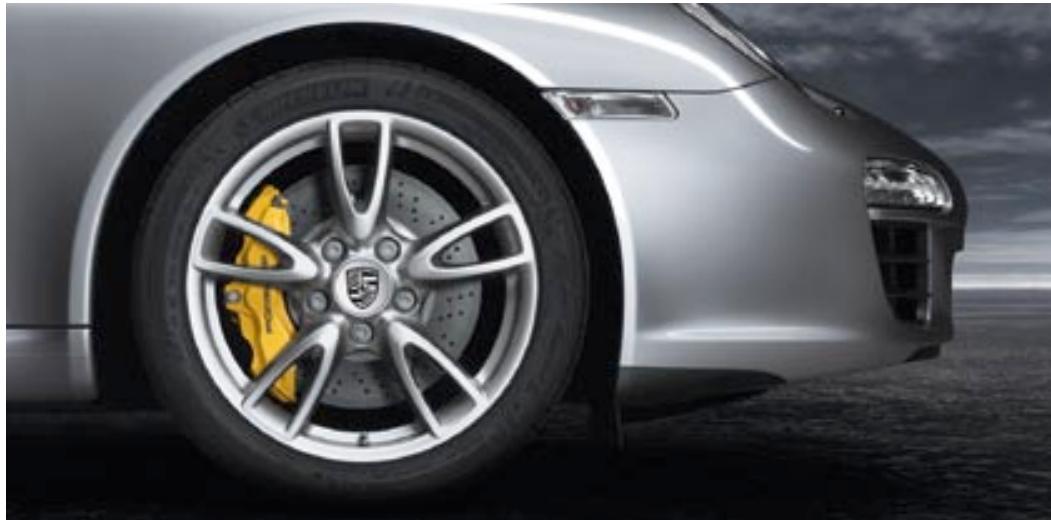
Porsche Ceramic Composite Brake (PCCB)
| Engine, transmission and chassis. | ||||||||||||
| Option | 911 Carrera | 911 Carrera S | 911 Carrera 4 | 911 Carrera 4S | 911 Carrera Cabriolet | 911 Carrera S Cabriolet | 911 Carrera 4 Cabriolet | 911 Carrera 4S Cabriolet | 911 Targa 4 | 911 Targa 4S | I no. | Page |
| ·Porsche Doppelkupplung (PDK, 7-speed) | ○ | ○ | ○ | ○ | ○ | ○ | ○ | ○ | ○ | 250 | 55 | |
| ·Porsche Ceramic Composite Brake (PCCB) | ○ | ○ | ○ | ○ | ○ | ○ | ○ | ○ | ○ | 450 | 88, 149 | |
| ·Porsche Active Suspension Management (PASM) with ride height lowered by 10 mm | ○ | ● | ○ | ● | ○ | ● | ○ | ● | ○ | 475 | 72 | |
| ·PASM sports suspension package (20 mm lower) with mechanically locking rear differential | - | - | ○ | w | - | - | - | - | - | 030 | 73 | |
| ○ | ○ | - | - | - | - | - | - | - | P17 | |||
| ·Mechanically locking rear differential | ○ | ○ | ● | ● | ○ | ○ | ● | ● | ● | 220 | 63, 73 | |
The vehicles illustrated in the chapter on personalisation may include additional options not featured in this catalogue.
For information on these options, please consult your Porsche Centre.
For more information on the options featured in this catalogue, please refer to the separate price list.
- not available - extra-cost option standard equipment W available at no extra cost
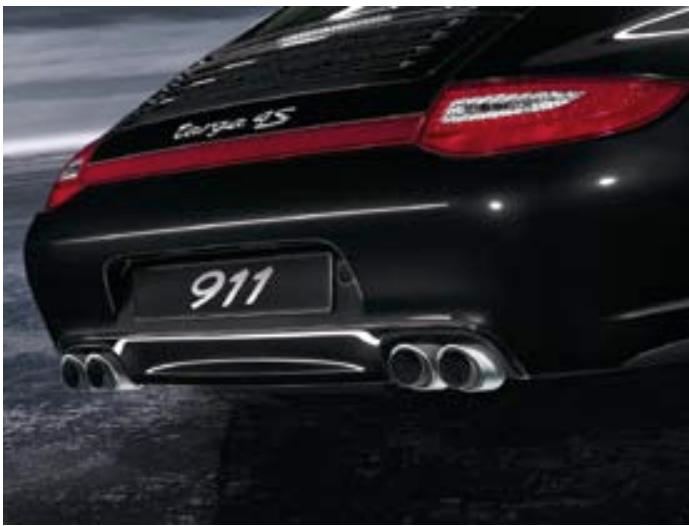
Sports exhaust system
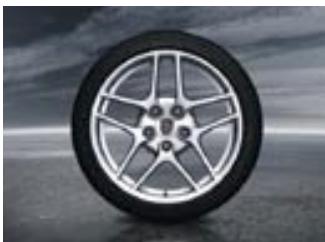
19-inch Carrera S II wheel
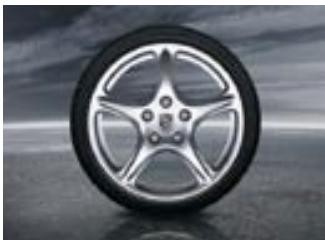
19-inch Carrera Classic wheel
Engine, transmission and chassis.
| Engine, transmission and chassis. | ||||||||||||
| Option | 911 Carrera | 911 Carrera S | 911 Carrera 4 | 911 Carrera 4S | 911 Carrera Cabriolet | 911 Carrera S Cabriolet | 911 Carrera 4 Cabriolet | 911 Carrera 4S Cabriolet | 911 Targa 4 | 911 Targa 4S | I no. | Page |
| · Sport Chrono Package Plus | ○ | ○ | ○ | ○ | ○ | ○ | ○ | ○ | ○ | ○ | 640 | 74 |
| · Sports exhaust system with four-tube sports tailpipes | ○ | ○ | ○ | ○ | ○ | ○ | ○ | ○ | ○ | ○ | 176 | 48, 150 |
| · Powerkit Carrera S 300 kW (408 hp) including sports exhaust system (176) with four-tube sports tailpipes | - | ○ | - | ○ | - | ○ | - | ○ | - | ○ | X51 | |
The vehicles illustrated in the chapter on personalisation may include additional options not featured in this catalogue.
For information on these options, please consult your Porsche Centre.
For more information on the options featured in this catalogue, please refer to the separate price list.
- not available - extra-cost option standard equipment W available at no extra cost
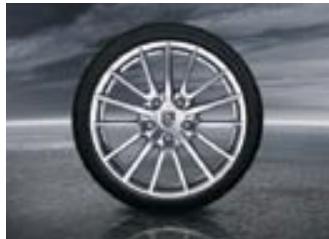
19-inch SportDesign whee
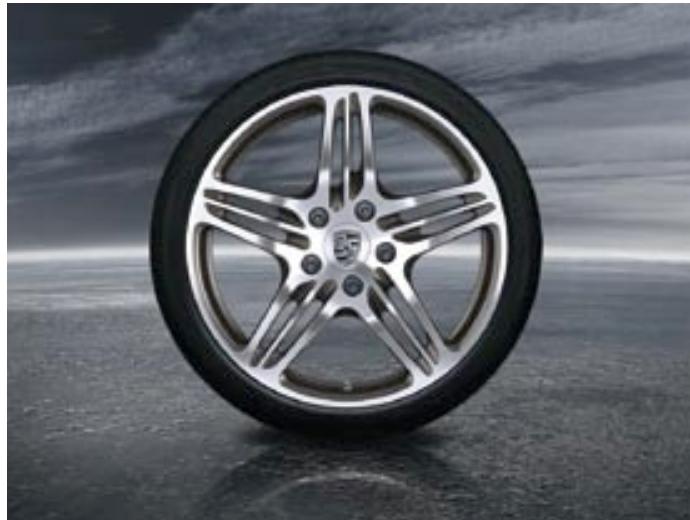
19-inch Turbo wheel
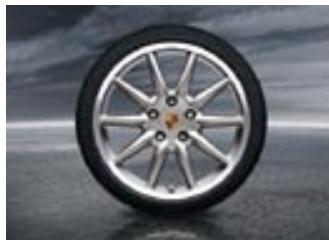
19-inch Carrera Sport wheel
| Wheels. | |||||||||||
| Option | 911 Carrera | 911 Carrera S | 911 Carrera 4S | 911 Carrera Cabriolet | 911 Carrera S Cabriolet | 911 Carrera 4 Cabriolet | 911 Carrera 4S Cabriolet | 911 Targa 4 | 911 Targa 4S | I no. | Page |
| · 19-inch Carrera S II wheels | ○ | ● | ○ | ● | ○ | ● | ○ | ● | ○ | 419 | 79, 150 |
| · 19-inch Carrera Classic wheels | ○ | ○ | ○ | ○ | ○ | ○ | ○ | ○ | ○ | 405 | 150 |
| · 19-inch SportDesign wheels | ○ | ○ | ○ | ○ | ○ | ○ | ○ | ○ | ○ | 407 | 151 |
| · 19-inch Turbo wheels | ○ | ○ | ○ | ○ | ○ | ○ | ○ | ○ | ○ | 404 | 151 |
| · 19-inch Carrera Sport wheels, including wheel centres with full-colour Porsche Crest | ○ | ○ | ○ | ○ | ○ | ○ | ○ | ○ | ○ | XRR | 151 |
| · Wheel centres with full-colour Porsche Crest | ○ | ○ | ○ | ○ | ○ | ○ | ○ | ○ | ○ | 446 | 151 |
| · Tyre Pressure Monitoring (TPM) | ○ | ○ | ○ | ○ | ○ | ○ | ○ | ○ | ○ | 482 | 79 |
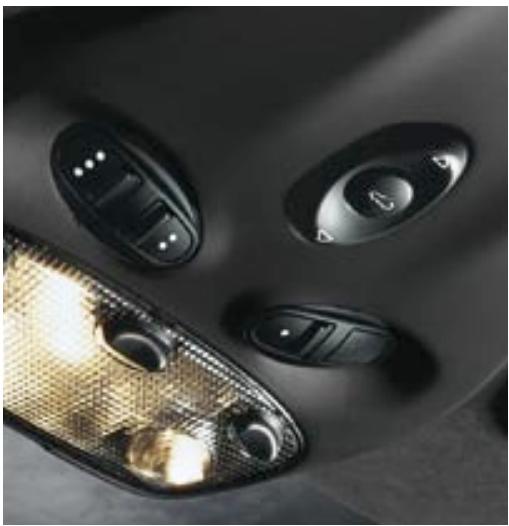
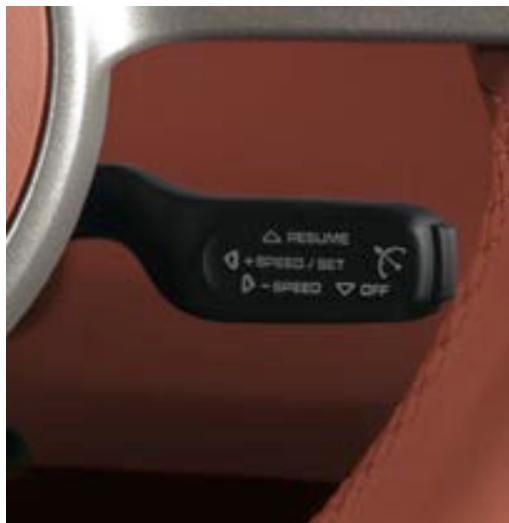
HomeLink
Cruise control
Interior.
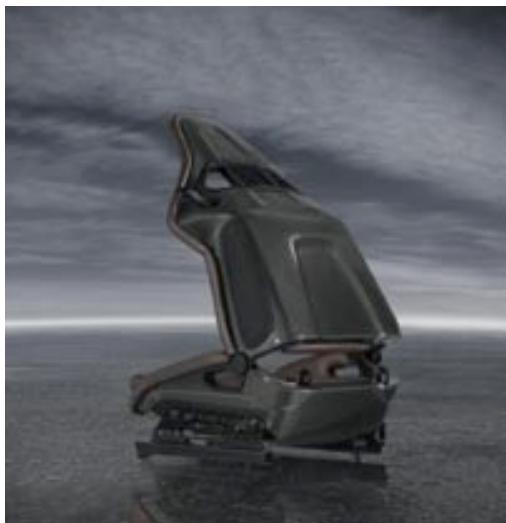
Sports bucket seat folded down
Interior.
The vehicles illustrated in the chapter on personalisation may include additional options not featured in this catalogue. For information on these options, please consult your Porsche Centre. For more information on the options featured in this catalogue, please refer to the separate price list. - not available O extra-cost option standard equipment W available at no extra cost
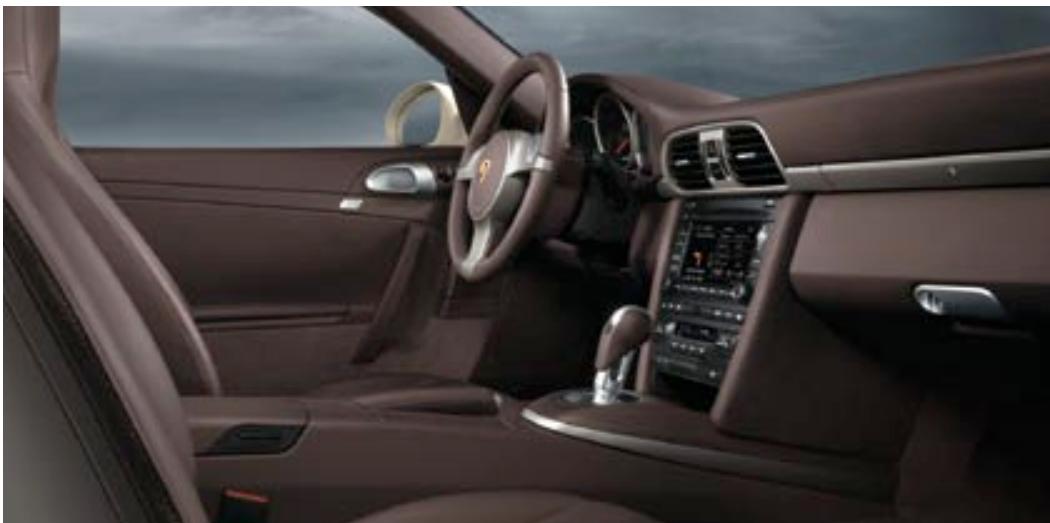
Leather interior in special colour (Cocoa) with other optional equipment
| Interior: leather. | ||||||||||||
| Option | 911 Carrera | 911 Carrera S | 911 Carrera 4 | 911 Carrera 4S | 911 Carrera Cabriolet | 911 Carrera S Cabriolet | 911 Carrera 4 Cabriolet | 911 Carrera 4S Cabriolet | 911 Targa 4 | 911 Targa 4S | I no. | Page |
| • Leather interior package (includes seats, dashboard upper/lower sections, door panels and rear side panels in smooth-finish leather) | ||||||||||||
| - in special colour | ○ | ○ | ○ | ○ | ○ | ○ | ○ | ○ | ○ | ○ | Code | 154 |
| - in two-tone combination | ○ | ○ | ○ | ○ | ○ | ○ | ○ | ○ | ○ | ○ | 970 | 155 |
| - in natural leather | ○ | ○ | ○ | ○ | ○ | ○ | ○ | ○ | ○ | ○ | 998 | 107 |
| - in colour to sample | ○ | ○ | ○ | ○ | ○ | ○ | ○ | ○ | ○ | ○ | Code | |
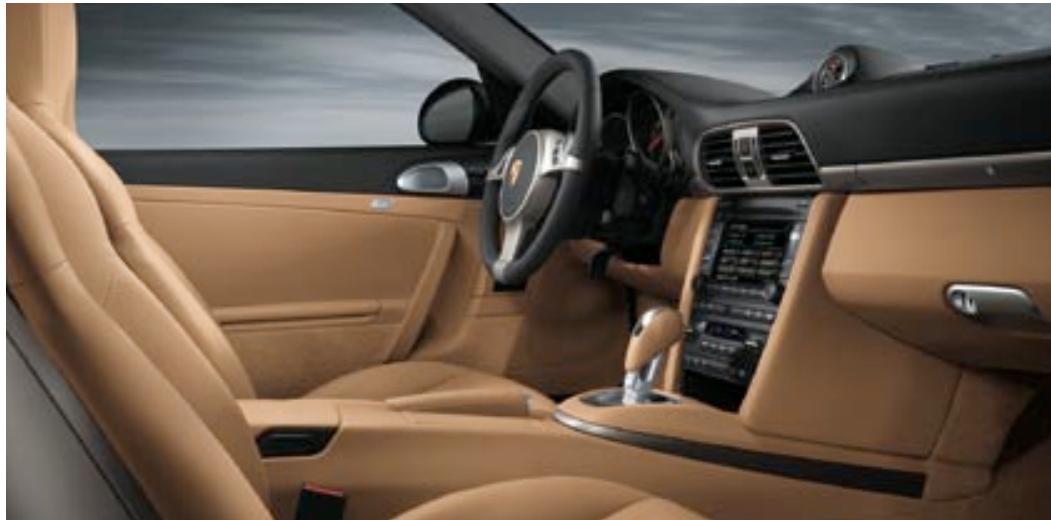
Leather interior in two-tone combination (Black/Sand Beige) with other optional equipment
| Interior: leather. | ||||||||||||
| Option | 911 Carrera | 911 Carrera S | 911 Carrera 4 | 911 Carrera 4S | 911 Carrera Cabriolet | 911 Carrera S Cabriolet | 911 Carrera 4 Cabriolet | 911 Carrera 4S Cabriolet | 911 Targa 4 | 911 Targa 4S | I no. | Page |
| · Soft ruffled leather on seats | ○ | ○ | ○ | ○ | ○ | ○ | ○ | ○ | ○ | ○ | 982 | |
| · 3-spoke multifunction steering wheel in smooth-finish leather | ○ | ○ | ○ | ○ | ○ | ○ | ○ | ○ | ○ | ○ | 844 | 113 |
The vehicles illustrated in the chapter on personalisation may include additional options not featured in this catalogue.
For information on these options, please consult your Porsche Centre.
For more information on the options featured in this catalogue, please refer to the separate price list.
- not available - extra-cost option standard equipment W available at no extra cost
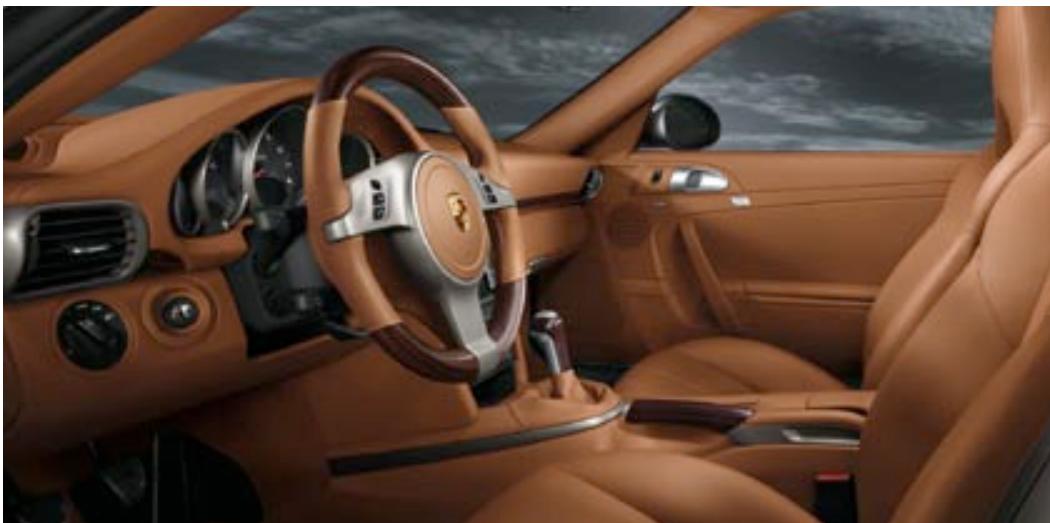
Macassar interior package, three-spoke multifunction steering wheel in macassar, other optional equipment
Interior: macassar
(dark wood with satin finish).*
Option
- Macassar interior package
- 3-spoke multifunction steering wheel in macassar
| 911 Carrera | ||||||||
| 911 Carrera S | ||||||||
| 911 Carrera 4 | ||||||||
| 911 Carrera 4S | ||||||||
| 911 Carrera Cabriolet | ||||||||
| 911 Carrera S Cabriolet | ||||||||
| 911 Carrera 4 Cabriolet | ||||||||
| 911 Carrera 4S Cabriolet | ||||||||
| 911 Targa 4 | ||||||||
| 911 Targa 4S | ||||||||
| I no. | Page | |||||||
| 801 | 156 | |||||||
| 847 | 156 | |||||||
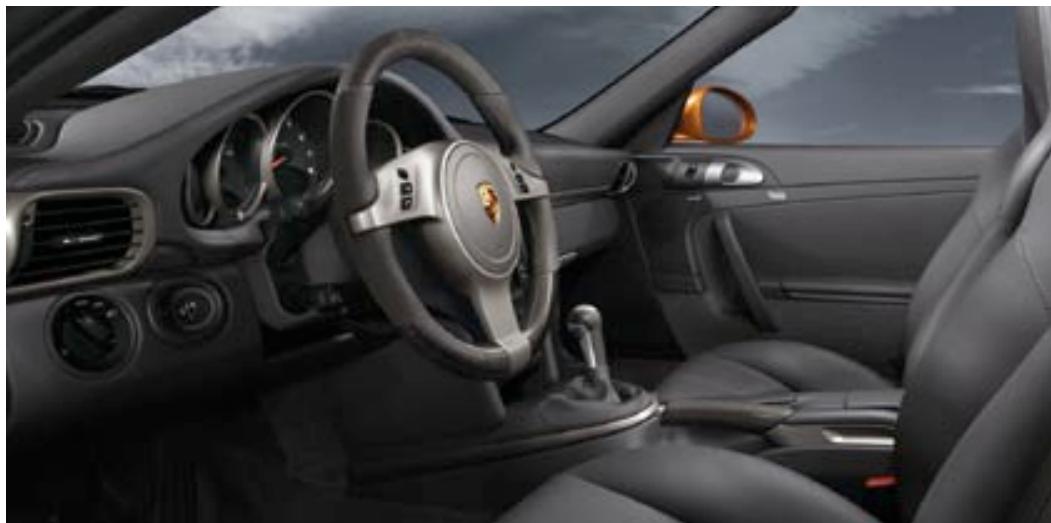
Carbon interior package, three-spoke multifunction steering wheel in carbon, other optional equipment
| Interior: carbon. | ||||||||||||
| Option | 911 Carrera | 911 Carrera S | 911 Carrera 4 | 911 Carrera 4S | 911 Carrera Cabriolet | 911 Carrera S Cabriolet | 911 Carrera 4 Cabriolet | 911 Carrera 4S Cabriolet | 911 Targa 4 | 911 Targa 4S | I no. | Page |
| · Carbon interior package | ○ | ○ | ○ | ○ | ○ | ○ | ○ | ○ | ○ | ○ | 803 | 157 |
| · 3-spoke multifunction steering wheel in carbon | ○ | ○ | ○ | ○ | ○ | ○ | ○ | ○ | ○ | ○ | 845 | 157 |
The vehicles illustrated in the chapter on personalisation may include additional options not featured in this catalogue.
For information on these options, please consult your Porsche Centre.
For more information on the options featured in this catalogue, please refer to the separate price list.
- not available - extra-cost option standard equipment W available at no extra cost
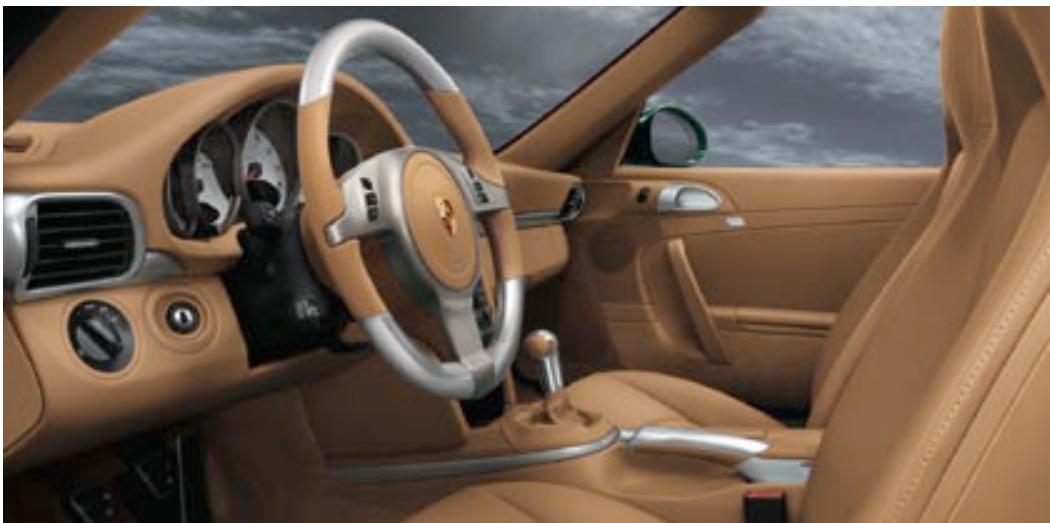
Three-spoke multifunction steering wheel in Aluminium Look and other equipment
| Interior: aluminium. | ||||||||||||
| Option | 911 Carrera | 911 Carrera S | 911 Carrera 4 | 911 Carrera 4S | 911 Carrera Cabriolet | 911 Carrera S Cabriolet | 911 Carrera 4 Cabriolet | 911 Carrera 4S Cabriolet | 911 Targa 4 | 911 Targa 4S | I no. | Page |
| • Three-spoke multifunction steering wheel in Aluminium Look | ○ | ○ | ○ | ○ | ○ | ○ | ○ | ○ | ○ | XPU | 158 | |
| • Gear/handbrake levers in aluminium I | ○ | ○ | ○ | ○ | ○ | ○ | ○ | ○ | ○ | ECA | 158 | |
| • PDK selector/handbrake lever in aluminium | ○ | ○ | ○ | ○ | ○ | ○ | ○ | ○ | ○ | ECB | ||
The vehicles illustrated in the chapter on personalisation may include additional options not featured in this catalogue. For information on these options, please consult your Porsche Centre.
For more information on the options featured in this catalogue, please refer to the separate price list. - not available 0 extra-cost option standard equipment W available at no extra cost
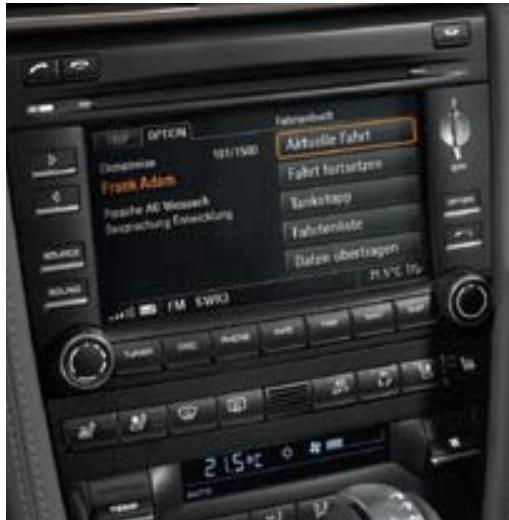
Electronic logbook
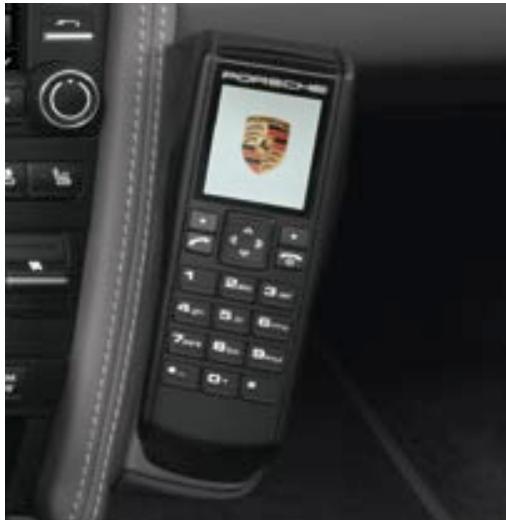
Cordless handset for telephone module
*For information on compatible mobile phones, please contact your Porsche Centre or visit www.porsche.com.
**Mobile phone preparation: The use of a mobile phone inside a car may cause an increase in the interior electromagnetic field strength and, accordingly, in the electromagnetic radiation to which passengers are exposed. If cradle is used to mount the mobile phone, the field strength in the passenger compartment can be reduced because the phone can be connected up to the external aerial (this feature depends on how specific mobile phones connect to the cradle). For information about the availability of a cradle for your mobile phone, please contact your Porsche Centre. The use of the telephone module for PCM prevents exposure to electromagnetic radiation as only the car's external aerial is ever used.
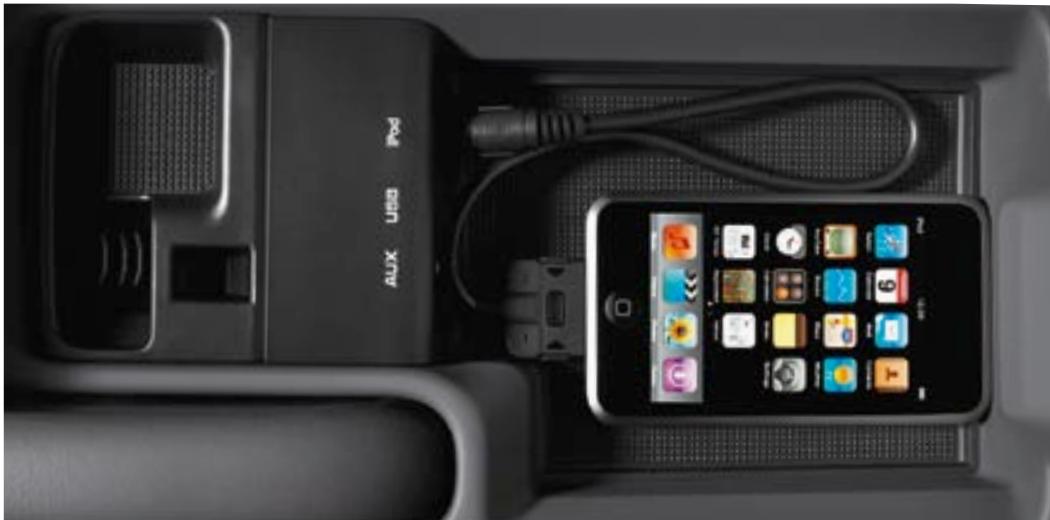
Universal audio interface
Audio and communication.
Option
Voice control system
TVtuner
- BOSE® Surround Sound System
- Six-disc CD/DVD autochanger*
Universal audio interface (iPod®, USB, AUX)
- External aerial
| 911 Carrera | |||||||||||
| 911 Carrera S | |||||||||||
| 911 Carrera 4 | |||||||||||
| 911 Carrera 4S Cabriolet | |||||||||||
| 911 Carrera 4 Cabriolet | |||||||||||
| 911 Carrera 4S Cabriolet | |||||||||||
| 911 Targa 4 | |||||||||||
| 911 Targa 4S | |||||||||||
| I no. | Page | ||||||||||
| 671 | 102 | ||||||||||
| 676 | 102 | ||||||||||
| 680 | 104 | ||||||||||
| 693 | |||||||||||
| 870 | 103, 160 | ||||||||||
| 461 | |||||||||||
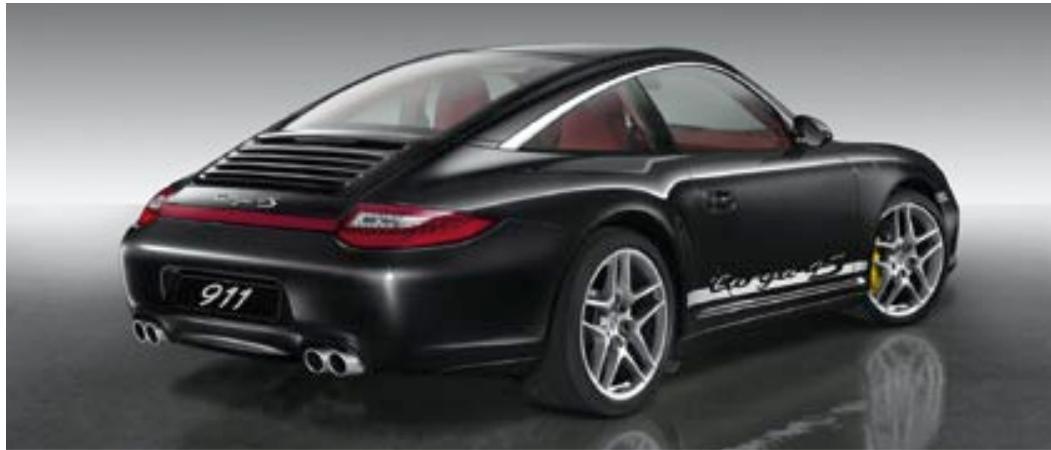
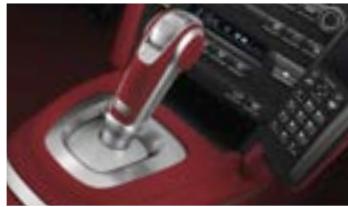
Porsche Exclusive
State-of-the-art.
And to your specification.
With the Porsche Exclusive range, you can make your Porsche even more special. Direct from the factory.
Individually and exclusively tailored to your wishes. Aesthetically and technically, inside and outside, using fine materials and with customary Porsche quality. You will find a wide range of design options in the separate Porsche Exclusive 911 catalogue.
Either your Porsche Centre or the customer centre in Zuffenhausen (tel. +49 (0)711 911-25332) will be happy to answer any questions you may have. Please note that delivery times may be extended for certain Porsche Exclusive equipment.
Factory collection
You won't be able to sleep the night before.
The night after, you won't want to.
Many of our customers dream of collecting their new Porsche in person. They want to be there when the car of their dreams leaves the factory. This way, they can be the first to take their Porsche to its rightful place: on the road.
Today, all Porsche engines are constructed here in our main factory in Zuffenhausen, where the legendary 356 was built. You can collect your Boxster, Cayman or 911 from here.
If you've chosen a Cayenne or Panamera, this will be waiting for you at their place of manufacture – in Leipzig.
Where better to experience the passion of Porsche than in the place where it all began? A place characterised by a unique blend of past and future. To take advantage of this fascinating opportunity, please inform your Porsche Centre that you would like to collect your vehicle in Zuffenhausen. We will then make all the necessary arrangements to have your Porsche ready by the agreed collection date.
Finding the factory is straightforward. The easiest way to travel from outside Germany is to fly to Stuttgart, Frankfurt am Main, or Leipzig, and then continue by train, taxi or hire car (which we can return on your behalf).
Please note that there are a number of formalities that must be completed when you take delivery of your new Porsche. For full details, please consult your Porsche Centre, who will also be happy to assist when it comes to planning your trip.
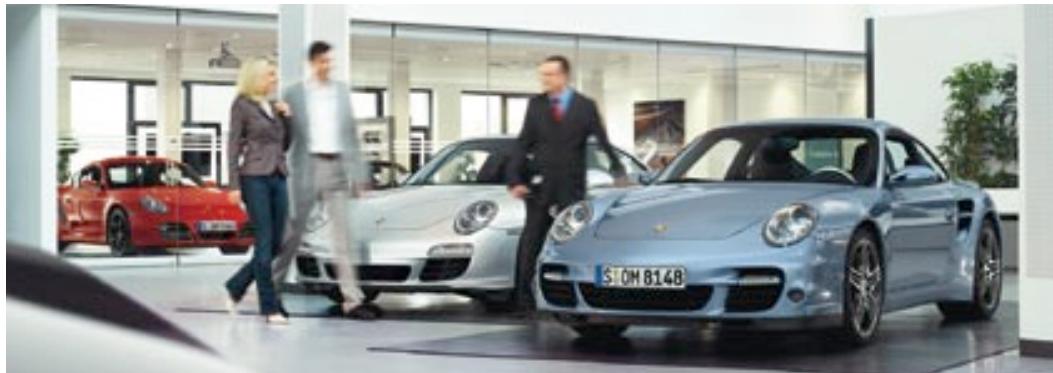
Vehicle handover in Zuffenhausen
Everything about a Porsche is more intense.
Especially the anticipation.
There's no need to rush just yet. Take your time and make the factory tour one of the highlights of your visit. See Porsche production processes in action for yourself, from engine assembly and the preparation of upholstery to final installation. Experience one of the key moments in the construction of any car: the 'marriage' of engine/ chassis and body. The factory tour is one of our oldest traditions and is always conducted by a Porsche enthusiast with extensive knowledge of the marque.
If Zuffenhausen is the destination for your factory collection, then why not also visit the new Porsche Museum? Here, you'll find an impressive range of exhibits, including legendary Porsche models that have made key contributions to the Porsche success story.
Awaiting you in Leipzig are an impressive car exhibition and an exciting film presentation about the fascinating world of Porsche.
How does a Porsche experience of the culinary kind sound? As part of your factory collection visit, we will be delighted to offer you a three-course meal from our gourmet menu. If there's still time, you can enjoy some additional refresh-
ments in the customer loungeor simply browse in the PorscheDesign Driver's Selection Shop.
The moment you've been waiting for.
The highlight of your visit will undoubtedly be the delivery of your Porsche – handed over by specialists who know it inside and out. They will take their time to explain everything you need to know about your new car and all its technical features.
Then you'll finally experience what it means to own a Porsche.
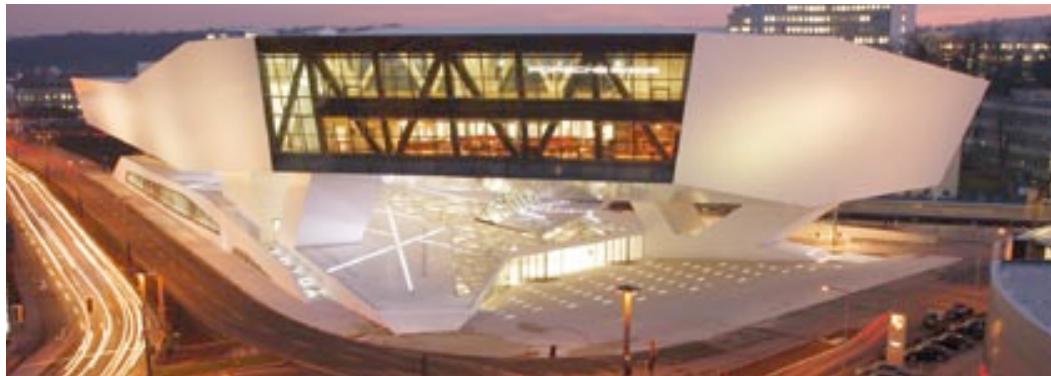
Porsche Museum
Porsche Centres
Your Porsche Centre can assist you with every aspect of purchasing and owning your Porsche. You will also find a wide range of products and services, including genuine Porsche parts and accessories.
Porsche Assistance
Enjoy peace of mind with our exclusive breakdown and accident recovery service. Membership is free when you buy a new Porsche.
Porsche Financial Services
Our innovative suite of financial services is specially tailored to the needs of Porsche owners. Products range from attractive finance and leasing options to vehicle insurance and the Porsche Card.
Service
Porsche Used Car Programme
Porsche Approved is the simple way to find the perfect pre-owned Porsche, anywhere in the world. Every car is rigorously tested and comes with a comprehensive vehicle warranty.
Porsche Classic
Your specialist source for genuine Porsche parts and technical documentation as well as servicing, repair and restoration for all types of classic Porsche. Find out more at www.porsche.com/classic.
Christophorus
Our bi-monthly magazine for
Porsche owners has news,
interviews and a wide variety
of features from throughout
the world of Porsche.
Porsche Exclusive
Realise your vision of the perfect Porsche with our factory customisation programme. From styling enhancements to performance upgrades, all modifications are uniquely handcrafted for your Porsche.
Porsche Tequipment
Personalise your Porsche at any time after purchase with the Tequipment range of approved accessories. Designed exclusively for your car, every product is fully guaranteed.
Porsche Design
Driver's Selection
With products ranging from fashion and accessories to tailored luggage, this unique collection combines quality and style with everyday practicality.
Porsche Online
For all the latest news and information from Porsche, go to www.porsche.com.
Porsche Clubs
Since the first Porsche Club was founded in 1952, their number has grown to 607 with a total of 120,000 members worldwide. To find out more, call +49 (0)711 911-78307 or go to www.porsche.com.
Porsche Driving Experience
1. Porsche Travel Club.
Exclusive driving holidays and
incentive ideas combining
luxury and adventure, worldwide.
To find out more, call
+49 (0)711 911-78155.
E-mail: travel.club@porsche.de
2. Porsche Sport Driving School.
Develop your skill and explore your
Porsche with the Porsche Sport
Driving School. To learn about
events at some of the world’s most
famous racing venues, call
+49 (0)711 911-78683.
E-mail: sportdrivingschool@porsche.de
Ask your Porsche Centre for the latest brochures from Porsche Exclusive, Porsche Tequipment, Porsche Design Driver's Selection and the Porsche Driving Experience.
Summary
Porsche, Weissach
911 Carrera 4S Cabriolet,
911 Carrera,
911 Targa 4S
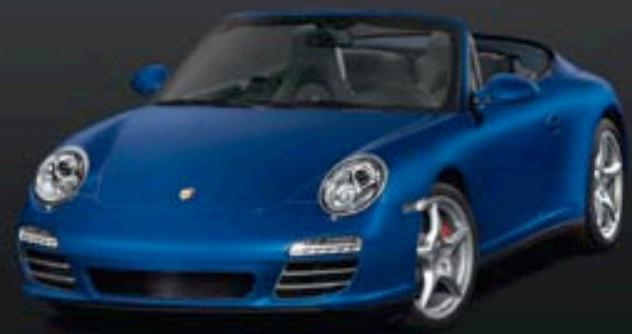
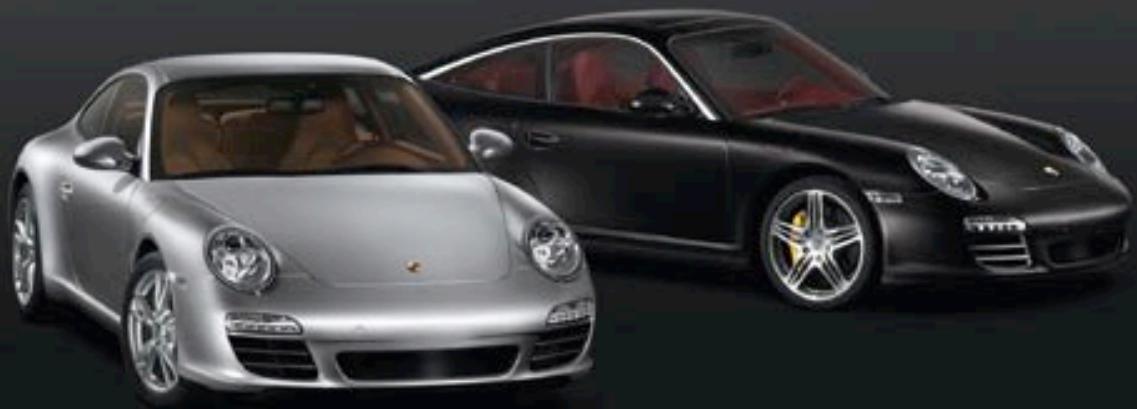
The 911. Its strength lies
within.
In its engines. For maximum
efficiency.
In its groundbreaking
transmission concept.
For maximum dynamics.
In its intuitively controlled
driving information system.
For maximum convenience.
In short: over 45 years of
- Perhaps we've never
been closer to the heart
and soul of the concept.
Image 000011
Summary
Technical data
| Engine | 911 Carrera | 911 Carrera S |
| Cylinders | 6 | 6 |
| Displacement | 3,614 cm³ | 3,800 cm³ |
| Max. power (DIN) | 254 kW (345 hp) | 283 kW (385 hp) |
| at rpm | 6,500 | 6,500 |
| Max. torque | 390 Nm | 420 Nm |
| at rpm | 4,400 | 4,400 |
| Compression ratio | 12.5:1 | 12.5:1 |
| Transmission | ||
| Layout | Rear-wheel drive | Rear-wheel drive |
| Manual gearbox | 6-speed | 6-speed |
| PDK* (optional) | 7-speed | 7-speed |
| * Porsche Doppelkupplung Chassis | ||
| Front axle | McPherson strut suspension | McPherson strut suspension |
| Rear axle | LSA multi-link suspension | LSA multi-link suspension |
| Steering | Power-assisted (hydraulic), with variable steering ratio | Power-assisted (hydraulic), with variable steering ratio |
| Turning circle | 10.9 m | 10.9 m |
| Brakes | Four-piston aluminium monobloc fixed calipers front and rear, internally vented and cross-drilled discs | Four-piston aluminium monobloc fixed calipers front and rear, internally vented and cross-drilled discs |
| Vehicle stability system | Enhanced PSM (with ABS 8.0) | Enhanced PSM (with ABS 8.0) |
| Anti-lock braking system | ABS 8.0 | ABS 8.0 |
| Wheels | Front: 8 J x 18 ET 57 Rear: 10.5 J x 18 ET 60 | Front: 8 J x 19 ET 57 Rear: 11 J x 19 ET 67 |
| Tyres | Front: 235/40 ZR 18 Rear: 265/40 ZR 18 | Front: 235/35 ZR 19 Rear: 295/30 ZR 19 |
| Weights | 911 Carrera Manual / PDK | 911 Carrera S Manual / PDK |
| Unladen weight (DIN) | 1,415 kg / 1,445 kg | 1,425 kg / 1,455 kg |
| Unladen weight (EC)* | 1,490 kg / 1,520 kg | 1,500 kg / 1,530 kg |
| Permissible gross weight | 1,820 kg / 1,850 kg | 1,830 kg / 1,860 kg |
| Performance | Manual / PDK | Manual / PDK |
| Top speed | 289 km/h (180 mph) / 287 km/h (178 mph) | 302 km/h (188 mph) / 300 km/h (186 mph) |
| 0-100 km/h (0-62 mph) | 4.9 secs / 4.7 secs | 4.7 secs / 4.5 secs |
| Sport Chrono Package Plus (with PDK) | ||
| 0-100 km/h (0-62 mph) | - / 4.5 secs | - / 4.3 secs |
| 0-160 km/h (0-99 mph) | 10.7 secs / 10.4 secs | 9.9 secs / 9.6 secs |
| Sport Chrono Package Plus (with PDK) | ||
| 0-160 km/h (0-99 mph) | - / 10.1 secs | - / 9.3 secs |
| Flexibility 80-120 km/h (50-75 mph) in 5th gear | 6.3 secs / 6.7 secs | 5.9 secs / 6.4 secs |
| Fuel consumption/emissions** | Manual / PDK | Manual / PDK |
| Urban in l/100 km (mpg) | 13.9 (20.3) / 14.4 (19.6) | 15.3 (18.5) / 15.3 (18.5) |
| Extra urban in l/100 km (mpg) | 7.2 (39.2) / 7.0 (40.4) | 7.4 (38.2) / 7.2 (39.2) |
| Combined in l/100 km (mpg) | 9.6 (29.4) / 9.6 (29.4) | 10.3 (27.4) / 10.2 (27.7) |
| CO2 emissions in g/km | 225 / 225 | 242 / 240 |
| Dimensions/aerodynamics | ||
| Length | 4,435 mm | 4,435 mm |
| Width | 1,808 mm | 1,808 mm |
| Height | 1,310 mm | 1,300 mm |
| Wheelbase | 2,350 mm | 2,350 mm |
| Luggage compartment volume | 135 litres | 135 litres |
| Tank capacity (refill volume) | 64 litres | 64 litres |
| Drag coefficient | cw = 0.29 | cw = 0.29 |
Weight is calculated in accordance with the relevant EC Directives and is valid for vehicles with standard specification only.
Optional equipment increases this figure. The figure given includes 68kg for the driver and 7kg for luggage.
*Data determined for standard specification and in the NEDC (New European Driving Cycle) in accordance with the Euro 5 (715/2007/EG and 692/2008/EG) measurement method. The figures do not refer to an individual vehicle nor do they constitute part of the offer. They are intended solely as a means of comparing different types of vehicle. You can obtain further information about individual vehicles from your Porsche Centre.
| Engine | 911 Carrera 4 | 911 Carrera 4S |
| Cylinders | 6 | 6 |
| Displacement | 3,614 cm³ | 3,800 cm³ |
| Max. power (DIN) | 254 kW (345 hp) | 283 kW (385 hp) |
| at rpm | 6,500 | 6,500 |
| Max. torque | 390 Nm | 420 Nm |
| at rpm | 4,400 | 4,400 |
| Compression ratio | 12.5:1 | 12.5:1 |
| Transmission | ||
| Layout | All-wheel drive | All-wheel drive |
| Manual gearbox | 6-speed | 6-speed |
| PDK* (optional) | 7-speed | 7-speed |
| * Porsche Doppelkupplung Chassis | ||
| Front axle | McPherson strut suspension | McPherson strut suspension |
| Rear axle | LSA multi-link suspension | LSA multi-link suspension |
| Steering | Power-assisted (hydraulic), with variable steering ratio | Power-assisted (hydraulic), with variable steering ratio |
| Turning circle | 10.9 m | 10.9 m |
| Brakes | Four-piston aluminium monobloc fixed calipers front and rear, internally vented and cross-drilled discs | Four-piston aluminium monobloc fixed calipers front and rear, internally vented and cross-drilled discs |
| Vehicle stability system | Enhanced PSM (with ABS 8.0) | Enhanced PSM (with ABS 8.0) |
| Anti-lock braking system | ABS 8.0 | ABS 8.0 |
| Wheels | Front: 8 J x 18 ET 57 Rear: 11 J x 18 ET 51 | Front: 8 J x 19 ET 57 Rear: 11 J x 19 ET 51 |
| Tyres | Front: 235/40 ZR 18 Rear: 295/35 ZR 18 | Front: 235/35 ZR 19 Rear: 305/30 ZR 19 |
| Weights | 911 Carrera 4 Manual / PDK | 911 Carrera 4S Manual / PDK |
| Unladen weight (DIN) | 1,470 kg / 1,500 kg | 1,480 kg / 1,510 kg |
| Unladen weight (EC)* | 1,545 kg / 1,575 kg | 1,555 kg / 1,585 kg |
| Permissible gross weight | 1,870 kg / 1,900 kg | 1,880 kg / 1,910 kg |
| Performance | Manual / PDK | Manual / PDK |
| Top speed | 284 km/h (176 mph) / 282 km/h (175 mph) | 297 km/h (185 mph) / 295 km/h (183 mph) |
| 0-100 km/h (0-62 mph) | 5.0 secs / 4.8 secs | 4.7 secs / 4.5 secs |
| Sport Chrono Package Plus (with PDK) | ||
| 0-100 km/h (0-62 mph) | - / 4.6 secs | - / 4.3 secs |
| 0-160 km/h (0-99 mph) | 10.9 secs / 10.6 secs | 10.0 secs / 9.7 secs |
| Sport Chrono Package Plus (with PDK) | ||
| 0-160 km/h (0-99 mph) | - / 10.3 secs | - / 9.4 secs |
| Flexibility 80-120 km/h (50-75 mph) in 5th gear | 6.4 secs / 6.8 secs | 6.0 secs / 6.5 secs |
| Fuel consumption/emissions** | Manual / PDK | Manual / PDK |
| Urban in I/100 km (mpg) | 14.6 (19.3) / 15.2 (18.6) | 15.7 (18.0) / 15.8 (17.9) |
| Extra urban in I/100 km (mpg) | 7.6 (37.2) / 7.2 (39.2) | 7.6 (37.2) / 7.5 (37.7) |
| Combined in I/100 km (mpg) | 10.1 (28.0) / 10.1 (28.0) | 10.5 (26.9) / 10.5 (26.9) |
| CO2 emissions in g/km | 237 / 237 | 247 / 247 |
| Dimensions/aerodynamics | ||
| Length | 4,435 mm | 4,435 mm |
| Width | 1,852 mm | 1,852 mm |
| Height | 1,310 mm | 1,300 mm |
| Wheelbase | 2,350 mm | 2,350 mm |
| Luggage compartment volume | 105 litres | 105 litres |
| Tank capacity (refill volume) | 67 litres | 67 litres |
| Drag coefficient | cw = 0.30 | cw = 0.29 |
Weight is calculated in accordance with the relevant EC Directives and is valid for vehicles with standard specification only. Optional equipment increases this figure. The figure given includes 68kg for the driver and 7kg for luggage.
*Data determined for standard specification and in the NEDC (New European Driving Cycle) in accordance with the Euro 5 (715/2007/EG and 692/2008/EG) measurement method. The figures do not refer to an individual vehicle nor do they constitute part of the offer. They are intended solely as a means of comparing different types of vehicle. You can obtain further information about individual vehicles from your Porsche Centre.
| Engine | 911 Carrera Cabriolet | 911 Carrera S Cabriolet |
| Cylinders | 6 | 6 |
| Displacement | 3,614 cm³ | 3,800 cm³ |
| Max. power (DIN) | 254 kW (345 hp) | 283 kW (385 hp) |
| at rpm | 6,500 | 6,500 |
| Max. torque | 390 Nm | 420 Nm |
| at rpm | 4,400 | 4,400 |
| Compression ratio | 12.5:1 | 12.5:1 |
| Transmission | ||
| Layout | Rear-wheel drive | Rear-wheel drive |
| Manual gearbox | 6-speed | 6-speed |
| PDK* (optional) | 7-speed | 7-speed |
| * Porsche Doppelkupplung Chassis | ||
| Front axle | McPherson strut suspension | McPherson strut suspension |
| Rear axle | LSA multi-link suspension | LSA multi-link suspension |
| Steering | Power-assisted (hydraulic), with variable steering ratio | Power-assisted (hydraulic), with variable steering ratio |
| Turning circle | 10.9 m | 10.9 m |
| Brakes | Four-piston aluminium monobloc fixed calipers front and rear, internally vented and cross-drilled discs | Four-piston aluminium monobloc fixed calipers front and rear, internally vented and cross-drilled discs |
| Vehicle stability system | Enhanced PSM (with ABS 8.0) | Enhanced PSM (with ABS 8.0) |
| Anti-lock braking system | ABS 8.0 | ABS 8.0 |
| Wheels | Front: 8 J x 18 ET 57 Rear: 10.5 J x 18 ET 60 | Front: 8 J x 19 ET 57 Rear: 11 J x 19 ET 67 |
| Tyres | Front: 235/40 ZR 18 Rear: 265/40 ZR 18 | Front: 235/35 ZR 19 Rear: 295/30 ZR 19 |
| Weights | 911 Carrera Cabriolet Manual / PDK | 911 Carrera S Cabriolet Manual / PDK |
| Unladen weight (DIN) | 1,500 kg / 1,530 kg | 1,510 kg / 1,540 kg |
| Unladen weight (EC)* | 1,575 kg / 1,605 kg | 1,585 kg / 1,615 kg |
| Permissible gross weight | 1,880 kg / 1,910 kg | 1,890 kg / 1,920 kg |
| Performance | Manual / PDK | Manual / PDK |
| Top speed | 289 km/h (180 mph) / 287 km/h (178 mph) | 302 km/h (188 mph) / 300 km/h (186 mph) |
| 0-100 km/h (0-62 mph) | 51 secs / 49 secs | 4.9 secs / 4.7 secs |
| Sport Chrono Package Plus (with PDK) | ||
| 0-100 km/h (0-62 mph) | - / 4.7 secs | - / 4.5 secs |
| 0-160 km/h (0-99 mph) | 11.1 secs / 10.8 secs | 10.3 secs / 10.0 secs |
| Sport Chrono Package Plus (with PDK) | ||
| 0-160 km/h (0-99 mph) | - / 10.5 secs | - / 9.7 secs |
| Flexibility 80-120 km/h (50-75 mph) in 5th gear | 6.6 secs / 7.0 secs | 6.2 secs / 6.7 secs |
| Fuel consumption/emissions** | Manual / PDK | Manual / PDK |
| Urban in l/100 km (mpg) | 14.9 (19.0) / 14.9 (19.0) | 15.3 (18.5) / 15.5 (18.2) |
| Extra urban in l/100 km (mpg) | 7.2 (39.2) / 7.0 (40.4) | 7.5 (37.7) / 7.3 (38.7) |
| Combined in l/100 km (mpg) | 9.9 (28.5) / 9.9 (28.5) | 10.3 (27.4) / 10.3 (27.4) |
| CO2 emissions in g/km | 233 / 233 | 242 / 242 |
| Dimensions/aerodynamics | ||
| Length | 4,435 mm | 4,435 mm |
| Width | 1,808 mm | 1,808 mm |
| Height | 1,310 mm | 1,300 mm |
| Wheelbase | 2,350 mm | 2,350 mm |
| Luggage compartment volume | 135 litres | 135 litres |
| Tank capacity (refill volume) | 64 litres | 64 litres |
| Drag coefficient | cw = 0.30 | cw = 0.30 |
Weight is calculated in accordance with the relevant EC Directives and is valid for vehicles with standard specification only. Optional equipment increases this figure. The figure given includes 68kg for the driver and 7kg for luggage.
*Data determined for standard specification and in the NEDC (New European Driving Cycle) in accordance with the Euro 5 (715/2007/EG and 692/2008/EG) measurement method. The figures do not refer to an individual vehicle nor do they constitute part of the offer. They are intended solely as a means of comparing different types of vehicle. You can obtain further information about individual vehicles from your Porsche Centre.
| Engine | 911 Carrera 4 Cabriolet | 911 Carrera 4S Cabriolet |
| Cylinders | 6 | 6 |
| Displacement | 3,614 cm³ | 3,800 cm³ |
| Max. power (DIN) | 254 kW (345 hp) | 283 kW (385 hp) |
| at rpm | 6,500 | 6,500 |
| Max. torque | 390 Nm | 420 Nm |
| at rpm | 4,400 | 4,400 |
| Compression ratio | 12.5:1 | 12.5:1 |
| Transmission | ||
| Layout | All-wheel drive | All-wheel drive |
| Manual gearbox | 6-speed | 6-speed |
| PDK* (optional) | 7-speed | 7-speed |
| * Porsche Doppelkupplung Chassis | ||
| Front axle | McPherson strut suspension | McPherson strut suspension |
| Rear axle | LSA multi-link suspension | LSA multi-link suspension |
| Steering | Power-assisted (hydraulic), with variable steering ratio | Power-assisted (hydraulic), with variable steering ratio |
| Turning circle | 10.9 m | 10.9 m |
| Brakes | Four-piston aluminium monobloc fixed calipers front and rear, internally vented and cross-drilled discs | Four-piston aluminium monobloc fixed calipers front and rear, internally vented and cross-drilled discs |
| Vehicle stability system | Enhanced PSM (with ABS 8.0) | Enhanced PSM (with ABS 8.0) |
| Anti-lock braking system | ABS 8.0 | ABS 8.0 |
| Wheels | Front: 8 J x 18 ET 57 Rear: 11 J x 18 ET 51 | Front: 8 J x 19 ET 57 Rear: 11 J x 19 ET 51 |
| Tyres | Front: 235/40 ZR 18 Rear: 295/35 ZR 18 | Front: 235/35 ZR 19 Rear: 305/30 ZR 19 |
| Weights | 911 Carrera 4 Cabriolet Manual / PDK | 911 Carrera 4S Cabriolet Manual / PDK |
| Unladen weight (DIN) | 1,555 kg / 1,585 kg | 1,565 kg / 1,595 kg |
| Unladen weight (EC)* | 1,630 kg / 1,660 kg | 1,640 kg / 1,670 kg |
| Permissible gross weight | 1,930 kg / 1,960 kg | 1,940 kg / 1,970 kg |
| Performance | Manual / PDK | Manual / PDK |
| Top speed | 284 km/h (176 mph) / 282 km/h (175 mph) | 297 km/h (185 mph) / 295 km/h (183 mph) |
| 0-100 km/h (0-62 mph) | 5.2 secs / 5.0 secs | 4.9 secs / 4.7 secs |
| Sport Chrono Package Plus (with PDK) | ||
| 0-100 km/h (0-62 mph) | - / 4.8 secs | - / 4.5 secs |
| 0-160 km/h (0-99 mph) | 11.3 secs / 11.0 secs | 10.4 secs / 10.1 secs |
| Sport Chrono Package Plus (with PDK) | ||
| 0-160 km/h (0-99 mph) | - / 10.7 secs | - / 9.8 secs |
| Flexibility 80-120 km/h (50-75 mph) in 5th gear | 6.7 secs / 7.1 secs | 6.3 secs / 6.8 secs |
| Fuel consumption/emissions** | Manual / PDK | Manual / PDK |
| Urban in I/100 km (mpg) | 14.8 (19.1) / 15.5 (18.2) | 15.8 (17.9) / 16.1 (17.5) |
| Extra urban in I/100 km (mpg) | 7.8 (36.2) / 7.4 (38.2) | 7.8 (36.2) / 7.7 (36.7) |
| Combined in I/100 km (mpg) | 10.3 (27.4) / 10.3 (27.4) | 10.7 (26.4) / 10.7 (26.4) |
| CO2 emissions in g/km | 242 / 242 | 251 / 251 |
| Dimensions/aerodynamics | ||
| Length | 4,435 mm | 4,435 mm |
| Width | 1,852 mm | 1,852 mm |
| Height | 1,310 mm | 1,300 mm |
| Wheelbase | 2,350 mm | 2,350 mm |
| Luggage compartment volume | 105 litres | 105 litres |
| Tank capacity (refill volume) | 67 litres | 67 litres |
| Drag coefficient | cw=0.30 | cw=0.30 |
Weight is calculated in accordance with the relevant EC Directives and is valid for vehicles with standard specification only. Optional equipment increases this figure. The figure given includes 68kg for the driver and 7kg for luggage.
*Data determined for standard specification and in the NEDC (New European Driving Cycle) in accordance with the Euro 5 (715/2007/EG and 692/2008/EG) measurement method. The figures do not refer to an individual vehicle nor do they constitute part of the offer. They are intended solely as a means of comparing different types of vehicle. You can obtain further information about individual vehicles from your Porsche Centre.
| Engine | 911 Targa 4 | 911 Targa 4S |
| Cylinders | 6 | 6 |
| Displacement | 3,614 cm³ | 3,800 cm³ |
| Max. power (DIN) | 254 kW (345 hp) | 283 kW (385 hp) |
| at rpm | 6,500 | 6,500 |
| Max. torque | 390 Nm | 420 Nm |
| at rpm | 4,400 | 4,400 |
| Compression ratio | 12.5:1 | 12.5:1 |
| Transmission | ||
| Layout | All-wheel drive | All-wheel drive |
| Manual gearbox | 6-speed | 6-speed |
| PDK* (optional) | 7-speed | 7-speed |
| * Porsche Doppelkupplung Chassis | ||
| Front axle | McPherson strut suspension | McPherson strut suspension |
| Rear axle | LSA multi-link suspension | LSA multi-link suspension |
| Steering | Power-assisted (hydraulic), with variable steering ratio | Power-assisted (hydraulic), with variable steering ratio |
| Turning circle | 10.9 m | 10.9 m |
| Brakes | Four-piston aluminium monobloc fixed calipers front and rear, internally vented and cross-drilled discs | Four-piston aluminium monobloc fixed calipers front and rear, internally vented and cross-drilled discs |
| Vehicle stability system | Enhanced PSM (with ABS 8.0) | Enhanced PSM (with ABS 8.0) |
| Anti-lock braking system | ABS 8.0 | ABS 8.0 |
| Wheels | Front: 8 J x 18 ET 57 Rear: 11 J x 18 ET 51 | Front: 8 J x 19 ET 57 Rear: 11 J x 19 ET 51 |
| Tyres | Front: 235/40 ZR 18 Rear: 295/35 ZR 18 | Front: 235/35 ZR 19 Rear: 305/30 ZR 19 |
| Weights | 911 Targa 4 Manual / PDK | 911 Targa 4S Manual / PDK |
| Unladen weight (DIN) | 1,530 kg / 1,560 kg | 1,540 kg / 1,570 kg |
| Unladen weight (EC)* | 1,605 kg / 1,635 kg | 1,615 kg / 1,645 kg |
| Permissible gross weight | 1,910 kg / 1,940 kg | 1,920 kg / 1,950 kg |
| Performance | Manual / PDK | Manual / PDK |
| Top speed | 284 km/h (176 mph) / 282 km/h (175 mph) | 297 km/h (185 mph) / 295 km/h (183 mph) |
| 0-100 km/h (0-62 mph) | 5.2 secs / 5.0 secs | 4.9 secs / 4.7 secs |
| Sport Chrono Package Plus (with PDK) | ||
| 0-100 km/h (0-62 mph) | - / 4.8 secs | - / 4.5 secs |
| 0-160 km/h (0-99 mph) | 11.3 secs / 11.0 secs | 10.4 secs / 10.1 secs |
| Sport Chrono Package Plus (with PDK) | ||
| 0-160 km/h (0-99 mph) | - / 10.7 secs | - / 9.8 secs |
| Flexibility 80-120 km/h (50-75 mph) in 5th gear | 6.7 secs / 7.1 secs | 6.3 secs / 6.8 secs |
| Fuel consumption/emissions** | Manual / PDK | Manual / PDK |
| Urban in I/100 km (mpg) | 14.6 (19.3) / 15.5 (18.2) | 15.7 (18.0) / 15.8 (17.9) |
| Extra urban in I/100 km (mpg) | 7.6 (37.2) / 7.4 (38.2) | 7.6 (37.2) / 7.7 (36.7) |
| Combined in I/100 km (mpg) | 10.1 (28.0) / 10.3 (27.4) | 10.5 (26.9) / 10.7 (26.4) |
| CO2 emissions in g/km | 237 / 242 | 247 / 251 |
| Dimensions/aerodynamics | ||
| Length | 4,435 mm | 4,435 mm |
| Width | 1,852 mm | 1,852 mm |
| Height | 1,310 mm | 1,300 mm |
| Wheelbase | 2,350 mm | 2,350 mm |
| Luggage compartment volume | 105 litres | 105 litres |
| Tank capacity (refill volume) | 67 litres | 67 litres |
| Drag coefficient | cw=0.30 | cw=0.30 |
Weight is calculated in accordance with the relevant EC Directives and is valid for vehicles with standard specification only. Optional equipment increases this figure. The figure given includes 68kg for the driver and 7kg for luggage.
*Data determined for standard specification and in the NEDC (New European Driving Cycle) in accordance with the Euro 5 (715/2007/EG and 692/2008/EG) measurement method. The figures do not refer to an individual vehicle nor do they constitute part of the offer. They are intended solely as a means of comparing different types of vehicle. You can obtain further information about individual vehicles from your Porsche Centre.
Index
| ‘911’ logo | 146 | Chassis | 66 | G | |
| Colours | 139 | Gear selector for PDK | 59 | ||
| A | Exterior | 140 | Glass rear window | 36 | |
| Aerokit Cup | 147 | Hood | 141 | ||
| Airbags | 92 | Interior | 142 | H | |
| All-wheel drive | 62 | Communication | 100, 159 | Hardtop | 33, 148 |
| Aluminium Look | 158 | Cross-flow cooling | 47 | Heated seats | 117 |
| Anti-theft protection | 120 | Cruise control | 120 | Heated steering wheel | 113 |
| Audio interface, universal | 103 | Hill-start assist | 61 | ||
| Audio system | 100 | D | HomeLink® | 120 | |
| AudioPilot® | 104 | Direct fuel injection (DFI) | 40 | Hood | 32 |
| Dry-sump lubrication, | |||||
| B | integrated | 46 | I | ||
| Bi-Xenon headlights | 84 | I numbers | 146 | ||
| Body | 90 | E | Ignition | 47 | |
| Bodyshell structure | 90 | Engine cooling | 47 | Instruments | 106 |
| BOSE® Surround Sound | Engine management | 50 | Intake manifold | 48 | |
| System | 104 | Engineered design | 90 | ||
| Boxer engine | 40 | Environment | 130 | K | |
| Brake system | 86 | Exhaust emission control | 133 | Knock control, cylinder-specific | 50 |
| Exhaust system | 49 | ||||
| C | Exterior mirrors | 120 | L | ||
| Cabriolets | 30, 94 | Leather | 142, 154 | ||
| Camshaft control | 44 | F | Light-alloy engine | 40 | |
| Carbon | 157 | Factory collection | 162 | Lighting concept | 85 |
| Catalytic converter | 49, 133 | Friction, internal | 46 | Lightweight construction | 45 |
| CD/DVD autochanger | 101 | Front axle | 68 | Liquid cooling | 47 |
| Ceramic brake system | 88 | Fuel | 134 | Logbook, electronic | 102 |
| Fuel system | 134 |
Loudspeakers 103, 105Porsche Side Impact Sport Chrono Package Plus 74
Luggage compartment 119 Protection (POSIP) 93 Sports chassis 73
M Management (PSM) 70 Steering 69
Macassar 156Porsche Traction Steering wheels 112
Manual gearbox 60 Management (PTM) 62 Multifunction 112
Materials 133 Powerkit Carrera S 150 Sport 58, 112
Memory, personal 74 Stereo lambda
Mobile phone preparation 103 R control circuits 49, 133
Models 20 Rear axle 68 Storage 118
Motorsport 122 Rear differential,
mechanically locking 63,73 T
N Rear wiper 121, 147 Tandem brake booster 87
Navigation module 101 Recycling 133 Technical data 168
Noise 134 Roll-over protection 93 Telephone module 102
Roof concept 32 Transmission 52
0 Roof transport system 119 TVtuner 102
Oil pump 46 Tyre Pressure
On-board computer 111 S Monitoring (TPM) 79
On-board diagnostics 51 Safety 80
Seat ventilation 117 V
P Seats 114 VarioCam Plus 44
ParkAssist 121 Child seats 117 Vehicle tracking system 120
Performance display 74, 77 Comfort seats 115 Voice control system 102
Personalisation 136 Rear seats 117
Porsche Active Suspension Sports bucket seats 116 W
Management (PASM) 72 Sports seats 115 'Welcome Home' lighting 120
Porsche Ceramic Composite Sports seats, adaptive 116 Wheels 78, 151
Brake (PCCB) 88 Service 164 Wind deflector 33
Porsche Communication Servicing 51, 134
Management (PCM) 100 Slide/tilt sunroof 121
Porsche Doppelkupplung (PDK) 55 Sound Package Plus 103
The models featured in this publication are approved for road use in Germany. Some items of equipment are available as extra-cost options only. The availability of models and options may vary from market to market due to local restrictions and regulations. For information on standard and optional equipment, please consult your Porsche Centre.
All information regarding construction, features, design, performance, dimensions, weight, fuel consumption and running costs is correct at the time of going to print. Porsche reserves the right to alter specifications and other product information without prior notice. Colours may differ from those illustrated. Errors and omissions excepted.
© Dr. Ing. h.c. F. Porsche AG, 2009
All text, illustrations and other information in this publication are subject to the copyright of Dr. Ing. h.c. F. Porsche AG.
Any reproduction, duplication or other use is prohibited without the prior written consent of Dr. Ing. h.c. F. Porsche AG.
Porsche, the Porsche Crest, 911, Carrera, Targa, Tequipment, PCCB, PCM, PDK and PSM are registered trademarks of Dr. Ing. h.c. F. Porsche AG.
Dr. Ing. h.c. F. Porsche AG supports the use of paper from sustainable forestry. This catalogue is printed on paper made from 100 % PEFC- certified pulp (Programme for the Endorsement of Forest Certification).
Dr. Ing, h.c. F. Porsche AG
Porscheplatz 1
70435 Stuttgart
Germany
www.porsche.com
Edition: 03/09 Printed in Germany WSLC1001000125 GB/UK