Powergyro 4000 Flash - Washing machine CECOTEC - Free user manual and instructions
Find the device manual for free Powergyro 4000 Flash CECOTEC in PDF.


| Product type | Front-load washing machine |
| Brand | Cecotec |
| Model | Powergyro 4000 Flash |
| Washing capacity | 8 kg |
| Maximum spin speed | 1400 rpm |
| Energy class | D |
| Dimensions (W × H × D) | 59.7 × 85 × 53.4 cm |
| Net weight | 72 kg |
| Supply voltage | 220-240 V ~ 50 Hz |
| Rated power | 2200 W |
| Motor type | Brushless induction motor |
| Drum | PowerGyro drum with variable geometry |
| Wash programs | 15 programs |
| Specific programs | Flash, Cotton, Synthetics, Delicates, Wool, Steam |
| Options | Delayed start, Child lock, Button lock |
| Display | LED display with time indication |
| Maintenance and cleaning | Filter cleaning, emptying detergent drawer, drum cleaning program |
| Safety | Leak protection, automatic shut-off, load balancing |
| Spare parts and repairability | Availability of spare parts for 10 years, porthole door, seals, pump |
| General information | Water pressure: 0.1-1 MPa, noise level washing: 59 dB(A), spinning: 76 dB(A) |
Frequently Asked Questions - Powergyro 4000 Flash CECOTEC
User questions about Powergyro 4000 Flash CECOTEC
0 question about this device. Answer the ones you know or ask your own.
Ask a new question about this device
Download the instructions for your Washing machine in PDF format for free! Find your manual Powergyro 4000 Flash - CECOTEC and take your electronic device back in hand. On this page are published all the documents necessary for the use of your device. Powergyro 4000 Flash by CECOTEC.
USER MANUAL Powergyro 4000 Flash CECOTEC
General safety instructions for power tools 13
-
Parts and components 112
-
Before use 112
-
Operation 113
-
Cleaning and maintenance 116
-
Technical specifications 116
-
Disposal of old electrical and electronic appliances 117
-
Technical support and warranty 118
-
Copyright 118
-
Declaration of conformity 118
SOMMAIRE
Read these instructions thoroughly before using the appliance. Keep this instruction manual for future reference or new users.
- WARNING: read all safety warnings, instructions, figures and specifications supplied with this power tool. Failure to follow all instructions listed below may result in electric shock, fire and/or serious injury.
- ⚠ WARNING: read all safety warnings and instructions marked with the symbol ⚠.
- Keep all safety warnings and instructions for future reference.
1) Work area safety
a) Keep the work area clean and well illuminated.
b) Do not operate power tools in explosive environments, such as in the presence of flammable liquids, gases or dust. Power tools create sparks that can light dust or fumes.
c) Keep children and bystanders away while operating a power tool. Distractions can make you lose control of the tool.
2) Electric safety
a) The power tools plugs must match the socket. Never modify the plug. Do not use adapter plugs with earthed power tools. The unmodified plugs and the suitable sockets reduce the risk of electric shock.
b) Avoid body contact with earthed surfaces, like pipes, radiators, stoves and refrigerators. There is a higher risk of electric shock if your body is in touch with the ground.
c) Do not expose power tools to rain or wet conditions. The water inlet in a power tool increases the risk of electric shock.
3) Personal safety
a) Stay alert and use common sense when using a power tool. Do not use power tools if you are tired or under the influence of drugs, alcohol or medication. A lack of attention while operating power tools can result in serious personal injury.
b) Use personal protective equipment. Always wear eye protection. Protective gear, like dust mask, non-slip safety footwear, helmet or hearing protection, used under the appropriate conditions, will reduce the risk of injuries.
c) Avoid unintentional start-up. Make sure the switch is in Off position before connecting the tool to a power source and/or battery, or before picking it up or transporting it. Carrying power tools with your finger on the switch or plugging in power tools with the switch in the On position will result in injuries.
d) Remove any spanners or wrenches before switching on the power tool. Leaving a spanner or wrench in a rotary piece of the tool may cause injuries.
e) Do not exert too much force when using the tool. Keep your feet firmly on the ground and maintain your balance at all times. This will provide better control of the electric tool in unexpected situations.
f) Wear appropriate clothes. Do not wear loose clothing or jewellery. Keep hair and clothing away from moving parts. Loose clothing, jewellery or long hair can get caught in moving parts.
g) If adapters are provided for the connection of dust extraction and collection, ensure that they are connected and used correctly. Dust vacuuming can reduce dust-related risks.
h) The confidence gained from frequent use of tools should not be a reason for ignoring general security principles. A careless action can cause serious injury in a fraction of a second.
4) Use and care of electric tools
a) Do not force the power tool. Use the appropriate power tool for the project. The proper electric tool will make your work better and safer using the speed for which it was designed.
b) Do not use the power tool if the switch does not switch it on and off. Any electric tool that cannot be controlled with a switch is dangerous and must be repaired.
c) Disconnect the plug from the power source and/or remove the battery pack, if detachable, from the power tool before making any adjustments, changing accessories or storing it. These preventive safety
measures reduce the risk of the power tool starting up accidentally.
d) Store idle electric tools out of the reach of children and do not allow people unfamiliar with the power tool or these instructions to operate the power tool. Power tools are dangerous in the hands of inexperienced users.
e) Maintenance of power tools and accessories. Check if the moving parts are misaligned or stuck, if there are broken pieces or any other condition that may affect operating of the electric tool. If damaged, have the power tool repaired before use. Many accidents are caused by poorly maintained power tools.
f) Keep cutting tools sharp and clean. Cutting tools properly maintained and with sharp cutting edges are less likely to jam and are easier to handle.
g) Use the electric tool, accessories and drill bits, etc. according to these instructions, taking into account work conditions and the work to be carried out. Use of the power tool for operations other than those intended could result in a hazardous situation.
h) Keep handles and gripping surfaces dry, clean and free of oil and grease. Slippery gripping surfaces do not allow safe handling and control of the tool in unexpected situations.
5) Use and care of the batteries
a) Only recharge with the charger specified by the manufacturer. A charger suitable for one type of battery may create a fire hazard if used with another type of battery.
b) Use the power tool only with specifically designated battery packs. Use of any other type of battery may create a risk of injury and fire.
c) When the battery is not in use, keep it away from other metal objects, such as paper clips, coins, keys, nails, screws or other small metal objects, which can establish a connection from one terminal to another. A short circuit between the battery terminals can cause burns or fire.
d) Under harsh conditions, liquid may leak from the battery; avoid touching it. In case of accidental contact, rinse the affected part with water. If the liquid comes into contact with eyes, seek medical assistance immediately. Liquid leaking from the battery can cause skin irritation and burns.
e) Do not use a damaged or modified battery or tool. Damaged or modified batteries can show unpredictable behaviours leading to fire, explosion or risk of injury.
f) Do not expose a battery or tool to fire or excessive temperatures. Exposition to fire and high temperatures over 130\ °C could cause an explosion.
g) Follow all charging instructions and do not charge the battery or the tool outside the temperature range specified in the instructions. Improper charging or charging at temperatures outside the specified range may damage the battery and increase the risk of fire.
6) Service
a) Have your power tool serviced by a qualified technician using only identical replacement parts. This ensures that the power tool remains safe.
b) Never repair damaged batteries. Battery maintenance must only be carried out by the manufacturer or authorised technician.
7) Charging safety
- Children aged from 8 years and above and people with reduced physical, sensory or mental capabilities or lack of experience and knowledge can use the charger if they have been given supervision or instruction concerning use of the power tool in a safe way and understand the hazards involved.
- Children must not play with the power tool or the power cable.
- Cleaning and maintenance tasks must not be carried out by unsupervised children.
- The power cable of this charger is not replaceable. Discard the charger if the power cable is damaged.
8) Use and handling of the charger
- Connect the charger only if the voltage of the socket matches the information on the rating plate.
- Connect the charger only to an easily accessible socket so that you can quickly disconnect it from the mains in the event of a malfunction.
- Always allow sufficient ventilation when charging the battery; gases may be released.
- Do not charge non-rechargeable batteries.
- Keep the charger away from humidity.
- Never use the charger in environments where explosive or flammable materials are present. There is a risk of fire and explosion.
- Do not place objects on top of the charger and do not cover it.
- Keep the charger away from heat sources.
- Regularly check the charger for damage.
-
Repair damaged chargers properly before reusing them.
-
The charger must not be disassembled. Repairs should only be carried out by an authorised technician.
- Do not use the charger if it has been subjected to shocks or falls.
- Always unplug the charger from the power supply after use.
- Unplug the charger from the power supply before cleaning, servicing, storing and transporting, and allow it to cool completely.
9) General precautions
- Hold the electric tool by the insulated gripping surfaces when performing an operation in which the tool may come into contact with exposed wiring. The tool must not come into contact with live wires. This may result in electric shock.
- Keep the power tool and its accessories away from hot surfaces.
- Do not allow untrained people use the power tool and its accessories.
- People with physical or mental disabilities must not use power tools or accessories without supervision.
- Children must not play with, clean or try to repair the power tool and its accessories.
- Allow the tool to cool down completely after use before touching it.
- Always wait until all moving parts have stopped after working with the tool.
| Symbol | Meaning |
 | Warning |
 | Warning, flammable material |
 | Information |
 | For indoor use only |
 | Class II tool |
 | Polarity of output terminals |
 | DC voltage |
 | Refer to the instruction manual/brochure |
 | Wear protective gloves |
 | Wear eye protection |
ÇONSIGNES GÉNÉRALES DE SÉCURITÉ POUR LES OUTILS ÉLECTRIQUES
- Power trigger
- Forward/reverse button
- Worklight
- Chuck
- Setting mark
- Torque control ring
- Magnetic part
- Handle release button
- Battery charge indicator light
- Light
- Light on/off
- Charging socket
- Charger
NOTE:
The graphics in this manual are schematic representations and may not exactly match the device.
2. BEFORE USE
- This appliance is packaged in a way as to protect it during transport. Take the appliance out of its box and remove all packaging materials. You can keep the original box and other packaging elements in a safe place to prevent damage to the device if you need to transport it in the future. In case the original packaging is disposed of, make sure all packaging materials are recycled accordingly.
- Make sure all parts and components are included and in good conditions. If there is any piece missing or in bad conditions, contact the official Cecotec Technical Support Service immediately.
Box content
- Screwdriver
- 34 screwdriver bits
- Extension bar
- Socket adapter
-
5 sockets
-
Charger
- Carrying case
- Instruction manual
- Do not remove the serial number of the appliance in order to keep a correct traceability of it in case of assistance.
Risk of harm!
If you open the packaging with a sharp knife or other pointed objects, careless handling can damage the power tool. Therefore, be very careful when opening the packaging.
- Remove the power tool from the packaging.
- Check the contents of the box.
- Inspect the power tool and individual parts for damage. Do not operate a damaged power tool; contact the official Cecotec Technical Support Service instead.
Cleaning of the power tool and accessories
- Remove the packaging and all protective films.
- Clean the tool and accessories included before using them for the first time.

A damaged power tool or damaged accessories can cause injury.
Check the power tool and its accessories.

The tool tip heats up during operation.
Do not touch the tip of the tool until it has cooled down again.
3. OPERATION
Charging the battery
Fig. 2

Risk of electric shock!
Faulty electrical installation, excessive line voltage or incorrect operation can cause an electric shock.
- Only connect the battery charger to an easily accessible mains socket so that it can be disconnected from the mains quickly in the event of a problem.
Risk of damage!
Incorrect charging of the battery can damage the battery, the charger and the power tool.
- Charge the battery at a room temperature between 0 °C and 45 °C. The optimum temperature for charging the battery is around 23 °C.
- Charge the battery when the battery charge indicator light shows weak battery performance (red indicator light).
- Plug the charger connector (13) into the charging socket (12).
The battery charge indicator light (9) will flash while the tool is charging and indicate the charging status.
Once the battery is fully charged, all the battery charge indicator lights will be permanently lit.
You cannot start the tool while it is charging.
The battery and the charger heat up during charge. This is normal, it is not a problem.
- When the tool has finished charging, disconnect the charger from the mains socket and the plug from the charging socket.
Checking the state of charge
Press and hold the trigger (1). The screwdriver will start to rotate, and the battery charge indicator light (9) will show the current charge status:
- Red: discharged battery. The tool needs to be recharged.
- Red/yellow: battery partially charged.
- Red/yellow/green: battery fully charged.
If you release the trigger (1), the screwdriver will stop rotating and the indicator lights will switch off.
Inserting the screwdriver bits
Fig. 3
- Grasp the chuck (4) with your thumb and forefinger and pull it out.
- Insert the bit holder into the chuck.
- Once the bit holder is inserted, release the chuck.
- Insert the desired bit into the bit holder.
Switching the tool on and off
Fig. 4
The power tool has a worklight (3). It will light up when the trigger (1) is pressed.
- Press the trigger to switch the tool on.
- When you release it, the tool will switch off.
Forward/reverse button
Fig. 5
The direction of rotation of the appliance can be adjusted with the forward/reverse button (2).
- If you press the rotation button on the left side, the tool will rotate clockwise.
- If you press the rotation button on the right side, the tool will rotate counterclockwise.
- If no side of the button is pressed, the trigger will be locked, and you will not be able to use the tool.
Adjusting the torque
Fig. 6.
The tightening torque can be adapted according to the work to be carried out. To do this, use the torque control ring (6). Number 1 is the lowest setting and 6 the highest.
To determine which torque value best suits your needs, test on another surface before working on the final material.
- Turn the setting mark (5) to the desired torque value.
Folding the screwdriver
Fig. 7
This tool has a foldable handle. Therefore, you can turn it into a straight screwdriver. This is particularly suitable for working in hard-to-reach spaces.
- Press and hold the handle release button (8).
- Pull the handle upwards as shown in figure 7.
- Release the handle release button.
- To reverse this operation, proceed in reverse order.
Tips
The following information will help you get the best possible results when using this tool:
- For screwing threaded screws into softwoods without pre-drilling. For other woods, we recommend pre-drilling the hole, especially in the case of large-diameter screws.
- Countersink the holes if countersunk screws are to be used.
- When using non-threaded screws, pre-drill approximately half of the screw length.
Operation
- Insert the desired bit into the screwdriver as described above.
- Adjust the torque control ring (6) as described above. Start with a slow speed and increase it as needed.
-
The direction of rotation of the appliance can be adjusted with the forward/reverse button (2).
-
Insert the bit directly into the groove and/or screw slots.
- Press the trigger to switch the tool on.
- To stop screwing, release the trigger.
- When you have finished using the tool, allow it and its accessories to cool before storing.
- Remove the bit.
Using the light
- Turn the light on/off selector (11) to switch it on.
- Repeat the procedure to switch it off.
Risk of damage!
Do not attempt to open the light, as this may damage the appliance.
The light does not require any maintenance, so do not attempt to open it.
4. CLEANING AND MAINTENANCE
- Allow the appliance to cool down completely.
- Wipe the outer surface of the tool with a clean, slightly damp cloth.
- Clean the charger with a clean, dry cloth.
-
Dry the tool thoroughly before using it again.
-
TECHNICAL SPECIFICATIONS
| Product reference | EU01_111713 |
| Appliance | PowerGyro 4000 Flash |
| Battery specifications | 3.7 V / 1.5 Ah lithium-ion battery |
| Rotational speed | 230 rpm |
| Screwdriver bits | 6.35 mm (1/4") hex |
| Charger | |
| Input voltage | 100 - 240 V ~, 50 / 60 Hz, 0.4 A |
| Charging voltage | 5.0 V / 1.7 A |
| Sound pressure level LpA | 65 dB (A) |
| Sound power level LwA | 73 dB (A) |
| K uncertainty | 3 dB (A) |
| Vibration | 0.39 m/s 2 |
| K uncertainty | 1.5 m/s 2 |
Noise/vibration information
The specified total vibration value and the specified noise emission values have been measured according to a standardised test method (EN62841-1/EN62841-2-2) and can be used to compare one power tool with another. They can also be used for a preliminary exposure assessment. Measured according to DIN EN 62841-2-2. The noise level of 85 dB(A) is not exceeded. However, protective measures are recommended for the user (wear appropriate hearing protection). Please also take into account possible deviations from national regulations regarding permissible values at the workplace.
Warning
Vibration and noise emissions may deviate from the stated values during actual use of the power tool. This depends on how the power tool is actually used and especially on the type of workpiece. It is necessary to establish safety measures to protect the user based on an estimation of exposure during actual conditions of use (taking into account all parts of the operating cycle, such as periods when the power tool is switched off and periods when it is switched on but operating without load).
Keep exposure to vibration and noise as low as possible. Examples of measures to reduce exposure:
- wear anti-vibration gloves when using the tool
- limit the working time
- use accessories in good condition
- regular maintenance and cleaning of the device
- switch off the appliance when not in use
- avoid overloading the appliance.
Technical specifications may change without prior notification to improve product quality. Made in China | Designed in Spain
6. DISPOSAL OF OLD ELECTRICAL AND ELECTRONIC APPLIANCES

This symbol indicates that, according to the applicable regulations, the product and/or batteries must be disposed of separately from household waste. When this product reaches the end of its shelf life, you should dispose of the cells/batteries/accumulators and take them to a collection point designated by the local authorities.
Consumers must contact their local authorities or retailer for information
concerning the correct disposal of old appliances and/or their batteries. Compliance with the above guidelines will help protecting the environment.
7. TECHNICAL SUPPORT AND WARRANTY
Cecotec shall be liable to the end user or consumer for any lack of conformity that exists at the time of delivery of the product under the terms, conditions, and deadlines established by the applicable regulations.
It is recommended that repairs be carried out by qualified personnel.
If at any moment you detect any problem with your product or have any doubt, do not hesitate to contact the official Cecotec Technical Support Service at +34 96 321 07 28.
8. COPYRIGHT
The intellectual property rights over the texts in this manual belong to CECOTEC
INNOVACIONES, S.L. All rights reserved. The contents of this publication may not, in whole or in part, be reproduced, stored in a retrieval system, transmitted, or distributed by any means (electronic, mechanical, photocopying, recording or similar) without the prior authorization of CECOTEC INNOVACIONES, S.L.
9. DECLARATION OF CONFORMITY
MANUFACTURER: CECOTEC INNOVACIONES S.L
ADDRESS: Av. Reyes Católicos, 60, 46910, Alfafar, Valencia (Spain)
DESCRIPTION: Power screwdriver
PRODUCT IDENTIFICATION: EU01_111713
FUNCTION: Battery-powered drill/driver
MODEL: EU01_111713 PowerGyro 4000 Flash
It certifies the appliance described has been designed, manufactured and tested and complies with all applicable provisions.
EU DIRECTIVES IMPLEMENTED:
- Directive 2006/42/CE on machinery.
- Directive 2014/30/EU on the harmonisation of the laws of the Member States relating to electromagnetic compatibility.
- Directive 2011/65/EU and delegated directive (EU) 2015/863 on the restriction of the use of certain hazardous substances in electrical and electronic equipment.
APPLICABLE HARMONISED NORMS:
- EN 62841-1:2015 +A11:2022
- EN 62841-2-2:2014
- EN ISO 12100:2010
- EN IEC 55014-1:2021
- EN IEC 55014-2:2021
- EN IEC 55015:2019 +A11:2020
- EN 61547:2009
- EN IEC 61000-3-2:2019 +A1:2021
- EN 61000-3-3:2013 +A1:2019 +A2:2021
1. PIÈCES ET COMPOSANTS
Img. 1
Fig./Img./Abb./Afb./Rys./Obr. 2

Fig./Img./Abb./Afb./Rys./Obr. 3

Fig./Img./Abb./Afb./Rys./Obr. 4

Fig./Img./Abb./Afb./Rys./Obr. 5
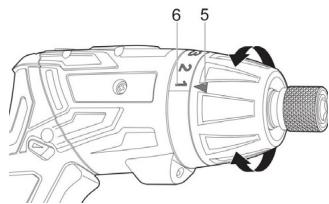
Fig./Img./Abb./Afb./Rys./Obr. 6
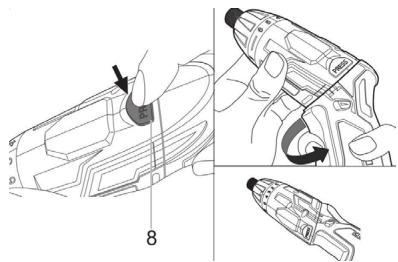
Fig./Img./Abb./Afb./Rys./Obr. 7
www.cecotec.es
- SOMMAIRE
- WORK AREA SAFETY
- ELECTRIC SAFETY
- PERSONAL SAFETY
- USE AND CARE OF ELECTRIC TOOLS
- USE AND CARE OF THE BATTERIES
- SERVICE
- CHARGING SAFETY
- USE AND HANDLING OF THE CHARGER
- GENERAL PRECAUTIONS
- ÇONSIGNES GÉNÉRALES DE SÉCURITÉ POUR LES OUTILS ÉLECTRIQUES
- NOTE
- BEFORE USE
- BOX CONTENT
- RISK OF HARM
- CLEANING OF THE POWER TOOL AND ACCESSORIES
- OPERATION
- CHARGING THE BATTERY
- RISK OF DAMAGE
- CHECKING THE STATE OF CHARGE
- INSERTING THE SCREWDRIVER BITS
- SWITCHING THE TOOL ON AND OFF
- FORWARD/REVERSE BUTTON
- ADJUSTING THE TORQUE
- FOLDING THE SCREWDRIVER
- TIPS
- USING THE LIGHT
- CLEANING AND MAINTENANCE
- DISPOSAL OF OLD ELECTRICAL AND ELECTRONIC APPLIANCES
- TECHNICAL SUPPORT AND WARRANTY
- COPYRIGHT
- DECLARATION OF CONFORMITY
- EU DIRECTIVES IMPLEMENTED
- APPLICABLE HARMONISED NORMS
- PIÈCES ET COMPOSANTS
- IMG. 1
Brand : CECOTEC
Model : Powergyro 4000 Flash
Category : Washing machine