NEPTUNE 5 - Pressure washer NILFISK - Free user manual and instructions
Find the device manual for free NEPTUNE 5 NILFISK in PDF.


User questions about NEPTUNE 5 NILFISK
0 question about this device. Answer the ones you know or ask your own.
Ask a new question about this device
Download the instructions for your Pressure washer in PDF format for free! Find your manual NEPTUNE 5 - NILFISK and take your electronic device back in hand. On this page are published all the documents necessary for the use of your device. NEPTUNE 5 by NILFISK.
USER MANUAL NEPTUNE 5 NILFISK
English Operating Instructions 1-18
Symbols used to mark instructions
2
1 Important safety instructions
2
2 Description
2.1 Purpose 4
2.2 Operating elements 5
3 Before starting the cleaner
3.1 Transport and assembly 5
3.2 Set the brake 5
3.3 Install Crank handle for high pressure hose reel/cord reel...6
3.4 Fill up detergent tanks 6
3.5 Fill up tank for Nilfisk-Alto AntiStone (Anti-Scale) 6
3.6 Adjusting the Nilfisk-Alto AntiStone (Anti-Scale) device....6
3.7 Fill up fuel tank 7
3.8 Connecting the high pressure hose.. 7
3.9 Connecting the water supply 7
3.10 Electrical connection 8
3.11 Antifreeze - before first use 8
4 Control / Operation
4.1 Connections 8
4.2 Switching on the cleaner 9
4.3 Pressure regulation (Tornado Lance) 9
4.4 Pressure regulation (VarioPress Gun) ^1) 10
4.5 Using cleaning agents 10
5 Applications and methods
5.1 Techniques 10
5.2 Some typical cleaning tasks 11
6 After using the cleaner
6.1 Switching off the cleaner 13
6.2 Disconnecting supply lines 13
6.3 Rolling up the electrical lead and storing accessories ....13
6.4 Storing the cleaner (below 0^ ( 32^ / Freezing). 13
7 Maintenance
7.1 Maintenance Schedule 14
7.2 Maintenance work 14
8 Troubleshooting
8.1 Indications on Display 16
8.2 Indication lights on control panel 17
8.3 Other Faults 17
9 Further information
9.1 Recycling the cleaner 17
9.2 Warranty 18
9.3 Technical data 18
9.4 EU Declaration of Conformity 18
english
Symbols used to mark instructions

Safety instructions
in these operatinginstructions which
must be observed to prevent risks
to persons are marked with this danger symbol.

and tion.
This indicates tips
and instructions to simplify work
to ensure safe opera

Before using the high-pressure cleaner, be sure to also read the enclosed operating instructions
and keep them within reach at all times.

This symbol is used to mark safety instrc-tions that must be observed to prevent damage to the machine and its performance.

Operationsmarked with thissymbol shouldonly be carriedout by Nilfisk-Alto – Service
Technicians.
1 Important safety instructions

For your own safety
The high-pressure cleaner should only be used by authorized persons who have been instructed in its use.
Although extremely easy to operate, children should not be allowed to use the cleaner.
General
Use of the high-pressure cleaner is subject to the applicable local regulations.
Besides the operating instructions and the binding accident prevention regulations valid in the country of use, observe recognized regulations for safety and proper use.
- Do not use any unsafe work techniques.
Transport
Transport of the high-pressure cleaner is easy on its large wheels.
For safe transport in and on vehicles we recommend preventing the equipment from sliding and tilting. Secure it with tie-downs and apply the parking brake on the castor wheel.
For transport at temperatures around or below freezing 0^ (32^) , anti-freeze should be drawn into the pump beforehand (see chapter 6).
Before starting the cleaner
If your 3-phase cleaner was supplied without a plug, have it fitted with a suitable 3-phase plug with ground, by a qualified electrician.
Before use, check that the high-pressure cleaner is safe and in proper condition.
Regularly check whether the power cord is damaged or shows signs of ageing.
Use the high-pressure cleaner only when the power cord is in a safe condition. (risk of electric shock using damaged cord!).
Check the rated voltage of the high-pressure cleaner before connecting it to the mains power supply. Ensure that the voltage shown on the rating plate corresponds to the voltage of the power supply.
We strongly recommend that the power supply to the high pressure cleaner be connected via a residual current circuit breaker. This device stops the supply of electricity if the leakage current to the ground exceeds 30mA for 30 ms or it has an ground tester circuit.
Please observe the regulations and provisions applicable in your area. Before putting the high-pressure cleaner into service, carry out a visual check of all the major components.
CAUTION!
High-pressure water jets can be dangerous if misused. The jet must not be directed at persons, animals, live electrical equipment or the cleaner itself.
Wear appropriate protective clothing and eye protection.
Do not direct the jet towards yourself or towards other persons in order to clean clothes or footwear.
During operation of the cleaner, recoil forces are produced at the gunvalve and spray lance and, when the spray lance is held at an angle, a torque is also created. The gunvalve and spray lance must therefore be held firmly in both hands.
Do not use the cleaner when other people without protective clothing are in the working area.
Check that cleaning will not result in dangerous substances (e.g. asbestos, oil) being washed off the object to be cleaned and harming the environment.
Do not clean delicate parts made of rubber, fabric, etc. with the 0^ jet. Keep some distance between high pressure nozzle and surface in order to prevent the surface from damage.
Do not use the high-pressure hose for lifting loads.
NOTE!
The maximum permissible working pressure and temperature are printed on the high-pressure hose.
Do not use the cleaner if the power cord or high-pressure hose is damaged.
Ensure adequate air circulation. Do not cover the cleaner or operate it in inadequately ventilated rooms!

Store the cleaner where it will not be exposed to frost!
Never operate the cleaner without water. Even brief shortages of water result in severe damage to the pump seals.
Operation
Keep cabinet and service door closed during operation.
CAUTION!
Unsuitable extension cords can represent a source of danger. Always unwind cord from the reels completely to prevent the power cord overheating.
Connectors and couplings of extension cords must be watertight.
Extension cords are not recommended, however if necessary refer to the following recommendations:
| Cord length m | Cross section | |
| up to16 A | up to 25 A | |
| up to 20 m (US: 30 ft) | ø1.5mm² | ø2.5mm² |
| (US: 50 ft) | 14 gauge | 12 gauge |
| (US: 75 ft) | 12 gauge | 10 gauge |
| 10 gauge | not recommended | |
| 20 to 50 m | ø2.5mm² | ø4.0mm² |
Do not damage the power cord (e.g. by driving over it, pulling or crushing it).
Disconnect the power cord by grasping the plug only (do not pull or tug the power cord).
CAUTION!
Unsuitable fuels (e.g. gasoline) must not be used as they can explode and catch fire.
Use clean fuel only, free of moisture and contamination. Contact your dealer for fuel source and type recommendations.
This machine can be used with Bio-Diesel (DIN 51606). However, our experience has shown that the fuel quality is often outside
the recognized standards. An organic product like Bio-Diesel can be affected by long-term storage (e.g. over the winter), extreme temperatures, or improper transportation. When the condition of the fuel is outside the standards, trouble may occur which cannot be covered by the Warranty.
english
If the machine is to be operated at fuel stations or in other potentially hazardous areas, the machine may only be employed outside the hazard areas defined in the German „Technical Guidelines for Inflammable Fluids“ applicable at the point of use due to the potential explosion hazard posed by the burner.
If the machine is to be operated indoors, the local building regulations must be observed for the discharge of the exhaust fumes into the atmosphere. Ensure an adequate supply of fresh air.
If the machine is to be connected to a flue gas stack, then local building regulations must be observed. We will be glad to provide tips for connection systems, on request.
CAUTION!
Do not touch or cover the exhaust. Risk of burns and fire.

Electrical equipment
CAUTION!
Never spray electrical equipment with water: risk of electrical shock and short-circuit.
The cleaner may only be connected to a correctly installed plug socket.
Switching on the cleaner may cause voltage fluctuations.
Voltage fluctuations should not occur if the impedance at the transfer point is less than 0.15 . If in doubt ask your local electricity supplier.
english Maintenance and repair
CAUTION!
Always remove the plug from the power supply before cleaning or carrying out maintenance work on the cleaner.
Carry out only the maintenance operations described in the operating instructions. Use only original Nilfisk-Alto spare parts. Do not make any technical modifications to the high-pressure cleaner.
Ensure that the machine is regularly serviced by authorized Nilfisk-Alto dealers in accordance with the maintenance plan. Failure to do so will void the warranty.
CAUTION!
High-pressure hoses, fittings and couplings are important for the safety of the cleaner. Use only high-pressure parts approved by the manufacturer!
The power cord must not differ from the version specified by the manufacturer and may only be
changed by an electrician.
Please contact your local authorized Nilfisk-Alto equipment distributor for all other maintenance or repair needs!
Testing
The cleaner conforms to the German,Guidelines for Liquid Spray Jet Devices". The high-pressure cleaner must be subjected to a safety examination in accordance with the,Accident Prevention Regulations for Working with Liquid Spray Jet Devices" as required, but at least every 12 months, by an authorised inspector.
After all repairs or modifications to electrical equipment, the protective conductor resistance, the insulation resistance and the leakage current must be measured. Furthermore, a visual inspection of the mains power lead, a voltage and current measurement and a function test must be carried out. Our after-sales service technicians are at your disposal as authorised inspectors.
The complete „Accident Prevention Regulations for Working with Liquid Spray Jet Devices“ are available from the Carl Heymanns Verlag KG, Luxemburger Strasse 449, 50939 Cologne or from the appropriate association of employers' liability insurances.
The pressure-bearing parts of this high-pressure cleaner have been manufactured in accordance with § 9 of the German Pressure Vessels Ordinance and successfully subjected to a pressure test.
Unloader valve
Pump pressure is reduced by means of an "unloader valve" which returns water to the inlet side of the pump at a minimum pressure. The point at which this occurs is set and sealed at the factory and must not be adjusted.
2 Description
2.1 Purpose
This high-pressure cleaner has been designed for professional use in
Agriculture
Industry
Transport industry
- Automotive
Municipal Facilities
- Janitorial
Construction
Food Industry etc.
Chapter 5 describes the use of the high-pressure cleaner for various cleaning jobs.
Always use the cleaner as described in these operating instructions. Any other use may damage the cleaner or the surface to be cleaned or may result in severe injury to persons.
2.2 Operating elements

See fold-out page at front of these operating instructions.
1 Spray lance
2 Spray lance storage
3 Control panel
4 Crank handle for High pressure hose reel (Neptune .X)1 Cord reel (Neptune ..X2)1
5 Fuel level gauge
6 Tank filler for fuel
7 Receptacle for service crane and lifting ring1)
8 Top cover release
9 Service door release
10 Crank handle for High pressure hose reel (Neptune .X2)
11 High pressure hose connection for machines without hose reel
12 Main switch ON/OFF - cold water/hot water
13 Display (Temperature or Codes)
14 Temperature control
15 Low fuel indicator
16 Low Nilfisk-Alto AntiStone (Anti-Scale) indicator
17 Service interval due/expired
18 Pump oil low
19 Detergent metering knob
20 Pressure gauge
21 Power ON
22 Castor with parking brake
23 Water supply connection
24 Tank filler for anti-freeze
25 Tank filler for Nilfisk-Alto Anti-Scale
26 Canister for detergent B^1)
27 High pressure hose reel (Neptune ..X)1)
28 Power cord reel (Neptune ..X2)1
29 Tank filler for detergent A
30 Grip for top cover
3 Before starting the cleaner
3.1 Transport and assembly
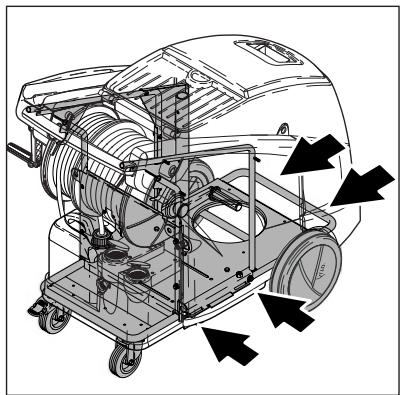
- The safest way to lift the machine is to use a fork-lift truck. The arrows in the illustration indicate the best places to position the fork.
- It is also possible to lift the ma
3.2 Set the brake
chine by hand from the pallet. Due to the weight this work should be done by at least three persons.
CAUTION!
Do not hold the plastic tank to lift the machine as it could become detached from the frame.
The best places to hold the machine are
on the handle
on the frame between the front wheels and the guide rollers.
Every fuel-burning appliance, such as pressure washers, depends upon a proper mix of fuel and air (by weight) for proper combustion.
Therefore some adjustment of the
air supply to the burner may be necessary to take account of altitude and the resulting air pressure. This is true whether your fuel is 'Natural gas', Propane or Diesel.
Your Nilfisk-Alto hot water pressure washer was thoroughly tested and adjusted for optimum performance before it left our factory. The factory is located at approximately 200m (650 ft) above sea level, and the combustion settings are optimal for that elevation.
If your location is higher than 1200m (3900 ft) above sea level, your burner may require re-adjustment for proper performance and best fuel economy. Contact your Dealer or Nilfisk-Alto for assistance.
- Before using the cleaner for the first time, check it carefully for any faults or damage.
- Run the machine only when it is in perfect working condition.
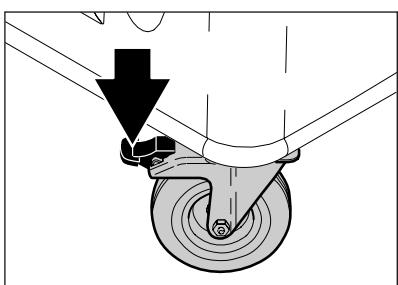
- Set the brake.
3.3 Install Crank handle for high pressure hose reel/cord reel
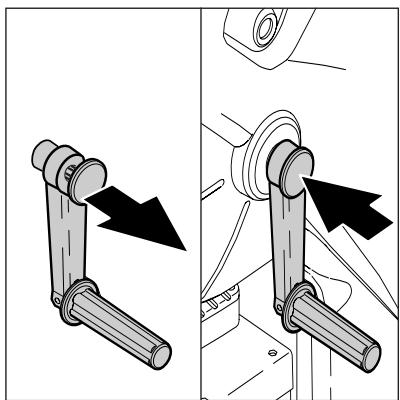
- Pull cap of crank in arrow direction.
- Align tabs on crank with slot in axle.
- Put crank on axle of high pressure hose reel/cord reel.
- Fix crank by pushing the cap.
3.4 Fill up detergent tanks
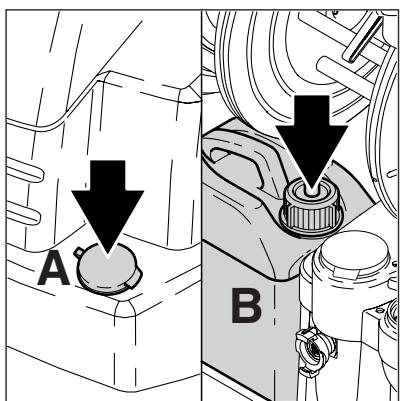
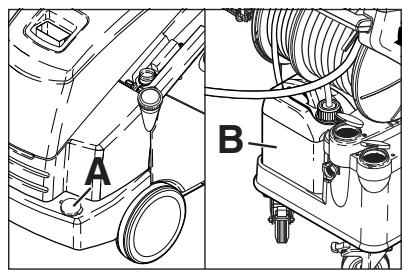
- Fill up detergent tanks (A) and (B) with prediluted detergent. Capacity see chapter 9.3 Technical Data
3.5 Fill up tank for Nilfisk-Alto AntiStone (Anti-Scale) indicator
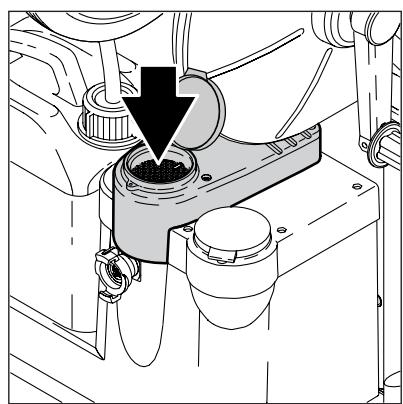
- Fill up Nilfisk-Alto Anti-Stone (Anti-Scale)/water softener reservoir with the sample bottle provided. Nilfisk-Alto AntiStone (Anti-Scale) prevents any deposits of scale and acts at the same time as a corrosion inhibitor.
For compatibility reasons, use only the tested Nilfisk-Alto AntiStone (Anti-Scale) which is available as a six-pack of 1 liter bottles by ordering part number 8466.
3.6 Adjusting the Nilfisk-Alto AntiStone (Anti-Scale) device
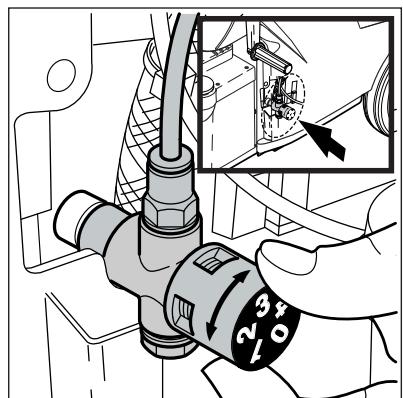
The Nilfisk-Alto AntiStone device is set at the factory to a water hardness of class 2. Adjustment:
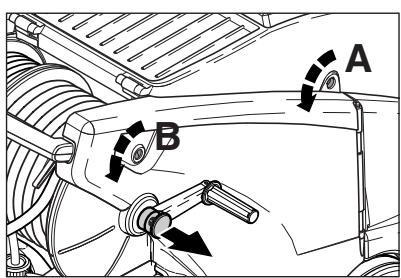
- Open cabinet (A) and service door (B).
- Only on .X2 models: remove crank.
- Measure the water hardness or ask your water supply company.
- Set the adjusting knob to required position.
| mg/l | Grains | °dH | °e | °f | ppm Ca | Description | Setting | |
| NEPTUNE 5 | NEPTUNE 7/8 | |||||||
| 0-17 | 0-1 | 0-7 | 0-8,8 | 0-12,5 | 0-50 | Soft | 0 | 0 |
| 17-60 | 1,1-3,5 | Slightly Hard | 1 | 1-2 | ||||
| 60-128 | 3,6-7,5 | 7-14 | 8,8-17,5 | 12,5-25,1 | 51-150 | Moderately Hard | 2 | 2-3 |
| 128-180 | 7,6-10,5 | 14-21 | 17,5-26,3 | 25,1-37,6 | 151-300 | Hard | 3 | 3-4 |
| >180 | >10,5 | >21 | >26,3 | >37,6 | >300 | Very Hard | 4 | 4 |
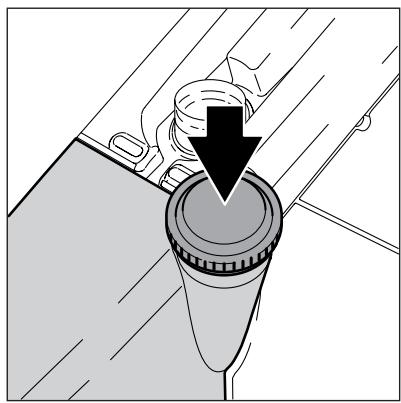
3.7 Fill up fuel tank

Bio-Diesel can be used, see notes in chapter 1.
The fuel must be free from contamination.
Tank capacity see chapter 9.3 Technical data.
NOTE!
At temperatures below 8^ (46^) , the fuel oil begins to solidify (paraffin precipitation). This can lead to difficulties in starting the burner. Before the winter
With the machine cold, turned off and disconnected from power supply:
english
- Fill fuel tank from a clean container with a fresh fuel (fuel oil EL, or Diesel oil DIN 51 603), or fuel type recommended by your distributor.
months it is recommended that a fuel conditioner/stabilizer be added (available from the fuel oil trade).
3.8 Connecting the high pressure hose
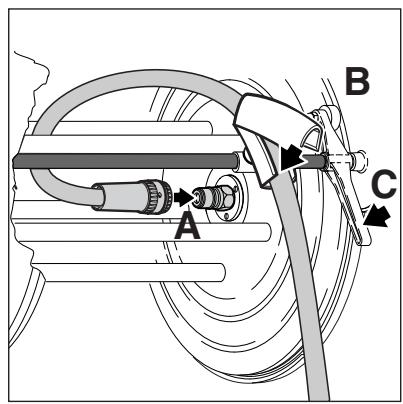
3.8.1 Machines with high pressure hose reel
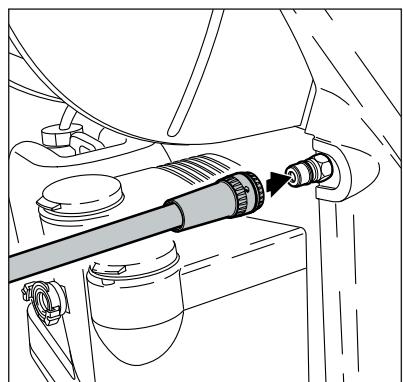
3.8.2 Machines without high pressure hose reel
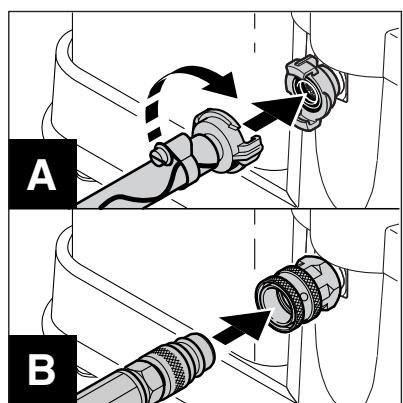
3.9 Connecting the water supply
- Connect the high pressure hose quick connector to the high pressure nipple (A) located at the hose reel axle.
- Place the high pressure hose into the hose guide (B) and ritain it with the clip.
- Release the brake (C) on the hose reel and wind up the high pressure hose.
-
Connect the high pressure hose quick connector to the high pressure nipple located at right rear of machine above chemical tank.
-
Attach quick connect adapter found with Owners Manual to the water supply hose.
- Rinse the water supply hose briefly in order to prevent sand an other dirt particles entering into the machine.
- Attach water supply hose with adapter to inlet quick connector.
- Open water supply faucet.
english

NOTE!
See chapter 9.3 Technical Data for required quantity of water and water pressure.
In the case of poor water quality (sand, etc.), it is recommended that an inlet water filter be installed.
Water supply hose should be a reinforced hose and have a minimum inside diameter of 3/4'' (19 mm).
3.10 Electrical connection
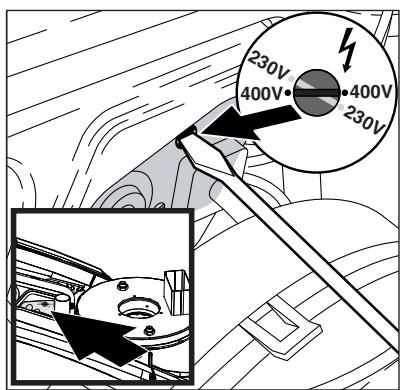
CAUTION!
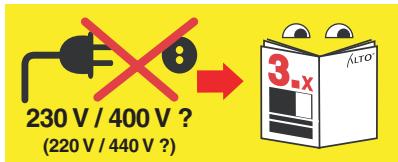
Some models have tha ability to be used on either 230 Volt or a 440 Volt power supply. On these models confirm that the voltage selector switch is in the proper position to match the power supply. Otherwise damage to machines electrical components may occur.
CAUTION!
When using a cord reel:
- Release brake of the cord reel.
- Unwind the cord completely.
CAUTION!
The cleaner should only be connected to a correctly installed electrical supply.
- Observe safety instructions in chapter 1.
- Insert the plug into the electrical socket.
3.11 Antifreeze - before first use
The machine is flushed with antifreeze at the factory to protect it against freezin; this mixture (ap
prox. 5 l) may be captured in a suitable container for reuse.
4 Control / Operation
4.1 Connections
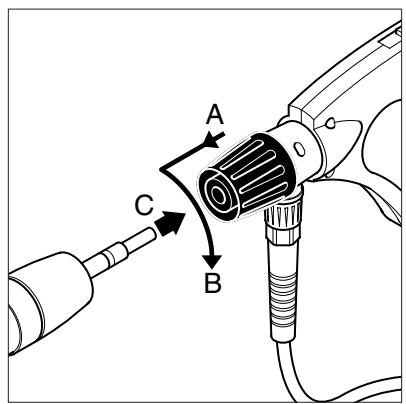
4.1.1 Connecting the spray lance to the spray gun

NOTE!
Always remove any dirt from the nipple before connecting the spray lance to the spray gun.
- Pull the blue quick-release grip (A) of the spray gun forwards and lock it by turning it to the left.
- Insert the nipple of the spray lance (C) into the quick-release connection and turn the blue quick-release grip to the right (B).
- Pull the spray lance (or other accessory) forwards to check that it is securely attached to the spray gun.
4.2 Switching on the cleaner
4.2.1 Cold water operation / Hot water operation (up to 100^ )
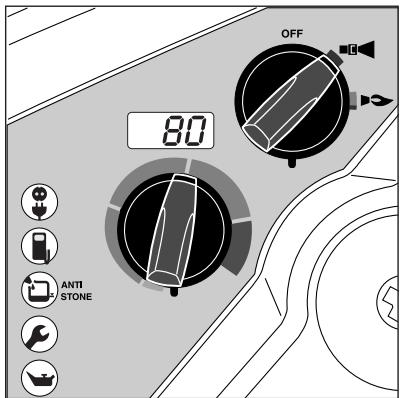
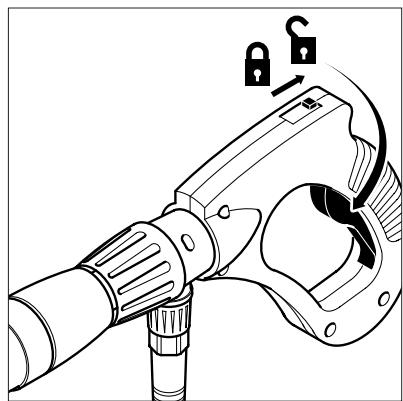

4.2.2 Steam operation (over 100^ (212^)
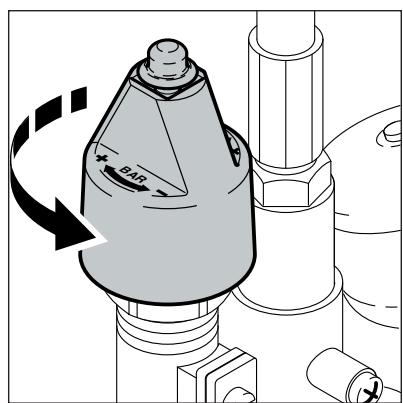
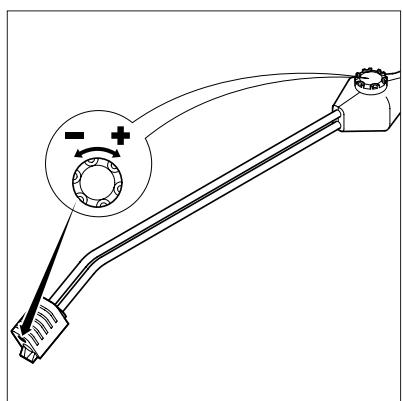
4.3 Pressure regulation (Tornado Lance)
- Turn the main switch to position (cold water).
english
Control electronics accomplishes a self check.
The Display shows for approx. 1 second ,---".
The motor starts.

is ON.
- Turn the main switch to position (hot water).
- Select temperature.
- Unlock the spray gun and squeeze trigger.
- The oil burner will light.
- Release trigger and lock the spray gun when not in use.
NOTE!
The cleaner switches off automatically twenty seconds after the spray gun has been closed. To start the cleaner again, squeeze the trigger and the machine will start automatically.
- Open cabinet (and service door if desired - see chapter 3.6, Step 1+2).
- Turn the twist grip on the safety control block all the way to the left (counter-clockwise-direction).
- Turn the main switch to position
- Select temperature (over 100^ (212^) ).
For special applications: replace the standard nozzle with the steam spray nozzle (accessory).
- Turn the twist grip on the spray unit:
High pressure = clockwise (+) for high pressure - Low pressure = counter-clockwise (-) for low pressure.
english 4.4 Pressure regulation (VarioPress Gun) ^1)
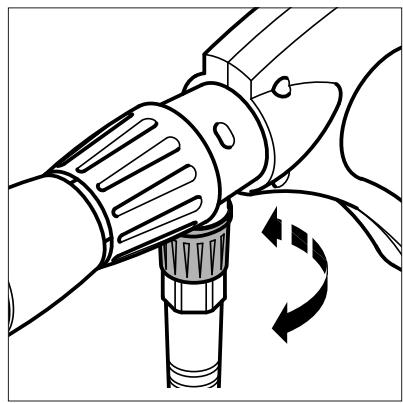
- Turn the twist grip on the spray unit:
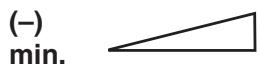
Water volume

4.5 Using cleaning agents
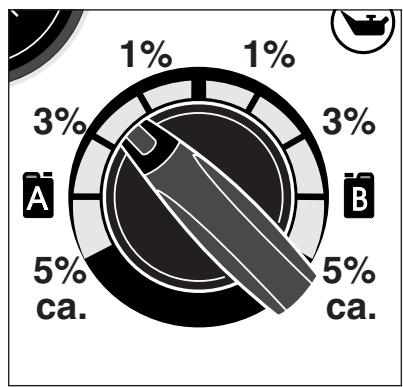
- Select desired detergent (A) or (B) and amount by turning the knob to desired percentage.
- Spray the object to be cleaned.
- Allow the cleaning agent to work, depending on the degree of soiling. Then rinse off with high pressure.

The percentage shown in the illustration are only approximate data.
For special applications such as disinfection, the exact detergent concentration has to be determined by using a graduated measuring container. For water outlet volume of the machine see chapter 9.3 technical data.
CAUTION!
Never allow cleaning agent to dry on the surface to be cleaned. The surface may be damaged.
5 Applications and methods
5.1 Techniques
Efficient high pressure cleaning is achieved by following a few guidelines, combined with your own personal experience of specific cleaning tasks. Accessories and detergents, when correctly chosen, can increase the efficiency of your pressure washer. Here is some basic information about cleaning.
5.1.1 Soaking
Encrusted or thick layers of dirt can be loosened or softened up by a period of soaking. This is for example an ideal method within agriculture – for example, within pig sties. The ideal soaking method can be achieved by using foam or simple alkaline detergent. Let the product lie on the dirty surfaces for about 30 minutes before pressure washing. The result will be a much quicker high pressure cleaning process.
5.1.2 Detergent and Foam
Foam or detergent should be applied onto dry surfaces so that the chemical product is in direct contact with the dirt. Detergents are applied from bottom to top, for example on a automobile bodywork, in order to avoid "super clean" areas, where the detergent may collect in higher concentrations and streams downwards. Let the detergent work for several minutes before rinsing before rinsing and never let it dry on the surface being cleaned.
english
5.1.3 Temperature
Detergents are more effective at higher temperatures. Greases, oils and fats can be broken down more effectively at higher temperatures also. Proteins can be cleaned at temperatures of around 60^ (140^) . Oils and traffic film around 70^ (158^) , and grease can be cleaned at 80^ - 90^ (176 - 194^) .
5.1.4 Mechanical Effect
In order to break down tough layers of dirt, additional mechanical effect may be required. Special lances and rotary or wash brushes offer this supplementary effect that cuts through dirt.
5.1.5 High Water Flow or High Pressure
High pressure is not always the best solution and may also damage surfaces. The cleaning effect also depends upon water flow. Pressure levels of around 100 bar (1450 psi) may be sufficient for vehicle cleaning (in association with hot water) and higher flow levels give the ability to rinse and flush away large amounts of dirt easily.
5.2 Some typical cleaning tasks
5.2.1 Agriculture
| Task | Accessories | Method |
| Stables Pig Pens, Sties Cleaning of walls, floors and equipment Disinfectant | Chemical Foam Injectors Foam lance Powerspeed lance Floor Cleaner Detergents Universal Alkafoam Disinfectant DES 3000 | 1. Soaking – apply foam to all surfaces (bottom to top) and wait for approx. 30 minutes. 2. Remove the dirt from surfaces with the high pressure lance or chosen accessory. Again, clean from bottom to top on vertical surfaces. 3. To flush away large quantities of dirt, change to low pressure mode and use the higher flow to push away the dirt. 4. Use recommended disinfectant products and methods to ensure hygiene. Apply DES 3000 disinfectant once the surfaces are perfectly clean. |
| Machinery Tractors ploughs etc. | Detergent injection Powerspeed lances Curved lances and under chassis washers Brushes | 1. Apply detergent to vehicle or equipment surfaces in order to soften up dirt and grime. Apply from bottom to top. 2. Proceed with cleaning using the high pressure lance. Clean again from bottom to top. Use accessories to clean in difficult to reach places. 3. Clean fragile areas such as motors, rubber at lower pressure levels to avoid damage. |
| Vehicle bodywork | Standard lance Detergent injection Curved lances and underchassis washers brushes Detergents Aktive Shampoo Aktive Foam Sapphire Super Plus Aktive Wax Allosil RimTop | 1. Apply detergent to vehicle or equipment surfaces in order to soften up dirt and grime. Apply from bottom to top. In cases of particularly dirty vehicles, pre-spray with a product such as Allosil in order to remove traces of insects etc, then rinse at low pressure and apply normal car cleaning detergent. Let detergents settle for 5 minutes before cleaning off. Metallic surfaces can be cleaned using RimTop. 2. Proceed with cleaning using the high pressure lance. Clean again from bottom to top. Use accessories to clean in difficult to reach places. Use brushes in order to add a mechanical cleaning effect. Short lances can help for cleaning of motors and wheel arches. Curved lances or undercarriage washers can be valuable for the cleaning of car underchassis and wheel arches. 3. Clean fragile areas such as motors, rubber at lower pressure levels to avoid damage. 4. Apply a liquid wax using the pressure washer in order to protect the bodywork from pollution. |
5.2.3 Buildings and Equipment
| Task | Accessories | Method |
| General surfaces | Foam injectors Standard lance | 1. Apply thick foam over the surfaces to be cleaned. Apply on dry surfaces. Apply from top to bottom on vertical surfaces. Let the foam act for up to 30 minutes for the optimal effect. |
| Metallic equipment | Curved lances | 2. Proceed with cleaning using the high pressure lance. Use applicable accessories. Use high pressure to dislodge large amounts of incrusted dirt or grime. |
| Tank cleaning head | Use lower pressure and high water volume in order to rapidly flush away loose dirt and rinse surfaces. | |
| Detergents | 3. Apply DES 3000 disinfectant once the surfaces are perfectly clean. | |
| Intensive | Areas covered by amounts of loose dirt, such as animal remains in slaughterhouses, can be removed by using high water flow to flush away the dirt to evacuation pits or drains. | |
| J25 Multi | Tank cleaning heads can be used to clean barrels, vats, mixing tanks etc. Cleaning heads may be hydraulically or electrically powered and give the possibility for automatic cleaning without a constant user. | |
| Combi Aktive | ||
| Alkafoam | ||
| Disinfectant | ||
| DES 3000 | ||
| Rusted or damages surfaces prior to treatment | Wet Sandblasting equipment | 1. Connect the sandblasting lance to the pressure washer and place the suction tube in the sand. |
| 2. Always wear protective equipment during sandblasting. | ||
| 3. Spray the surfaces to be treated with the mix of water and sand. Rust, paint etc will be stripped off. |
These are merely several examples of cleaning tasks that can be solved by a pressure washer in association with accessories and detergents. Each cleaning task is different. Please consult your local dealer or Nilfisk-Alto representative in order to discuss the best solution for your own cleaning tasks.
6 After using the cleaner
english
6.1 Switching off the cleaner
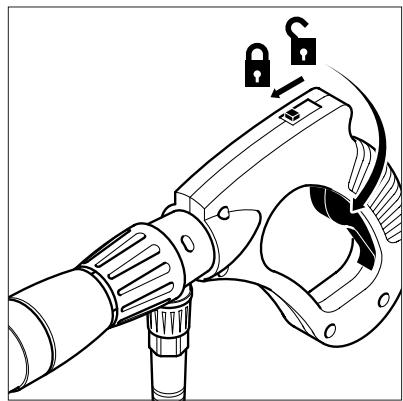
6.2 Disconnecting supply lines
- Turn the main switch to position "OFF".
- Turn off water supply at faucet.
-
Squeeze the spray gun trigger until the pressure has bled off.
-
Turn the main switch to position "OFF".
- Turn off water supply at faucet.
- Squeeze the spray gun trigger until the pressure has bled off.
-
Slide trigger lock to the locked position.
-
Slide trigger lock to the locked position.
- Remove the water supply hose from the cleaner.
- Remove power cord plug from the electrical supply.
6.3 Rolling up the electrical lead and storing accessories
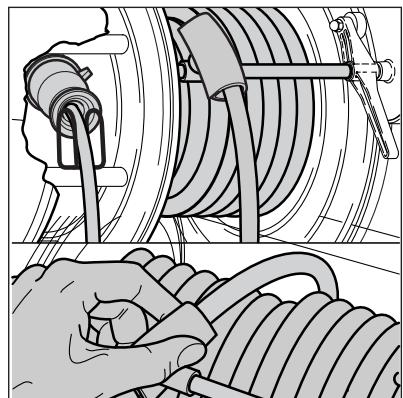
Risk of tripping!
To prevent accidents, always carefully roll up the power cord.
Machines with hose and/or cord reel:
- Wind up the power cord as illustrated with the plug located in the center of the cord reel.
- Wind up the high pressure hose as illustrated.
- Place the spray lance into the spray lance storage.
6.4 Storing the cleaner (below 0^ ( 32^ ))
Store the cleaner in a dry heated location to protect against freezing or protect per below instructions:
squeeze and release the trigger two or three times.
- The machine is protected against freezing when antifreeze mixture emerges from the spray gun.
- Lock the safety catch on the spray gun.
- Switch off the cleaner.
- To avoid any possible damage, store the cleaner temporarily in a heated room before using it again.
- When the machine is put into service again, the antifreeze solution can be collected and stored for future use.
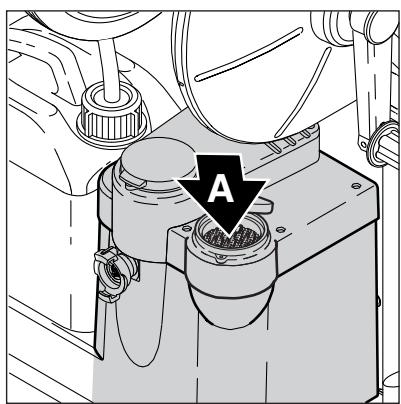
- Remove the water supply hose from the cleaner.
- Remove the spray lance.
- Switch on the cleaner with the main switch in position
- Squeeze trigger of the spray gun.
- Gradually pour antifreeze (approx. 5 litres) into the water tank (A).
- While the pump is pulling the mixture from the water tank,
english
7 Maintenance
7.1 Maintenance Schedule
| Weekly | NEPTUNE 5/8 only: After the first 50 operating hours | Every six months or 500 operating hours | As required | |
| 7.2.1 Water filters | ● | |||
| 7.2.2 Oil filter | ● | |||
| 7.2.3 Checking the pump oil quality | ● | |||
| 7.2.4 Changing the pump oil | ● | ● | ||
| 7.2.5 Emptying the fuel oil tank | ● | |||
| 7.2.6 Flame Sensor | ● |
7.2 Maintenance work
7.2.1 Water filters
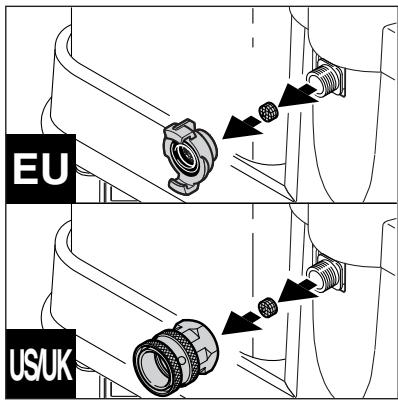
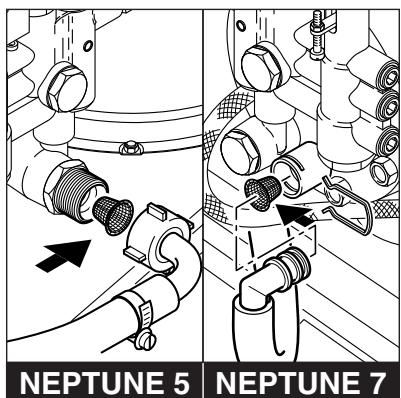
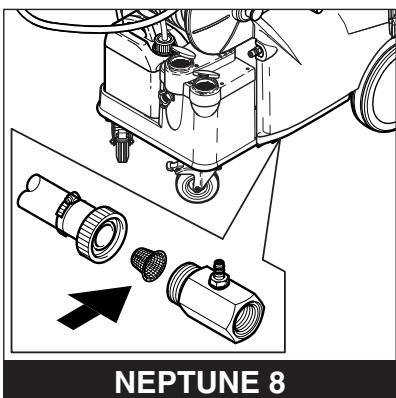
Water filters are fitted at the water and pump inlets to prevent large particles of dirt from entering into the system.
- Unscrew quick coupling.
- Remove filter with tool and clean it.
7.2.2 Oil filter
-
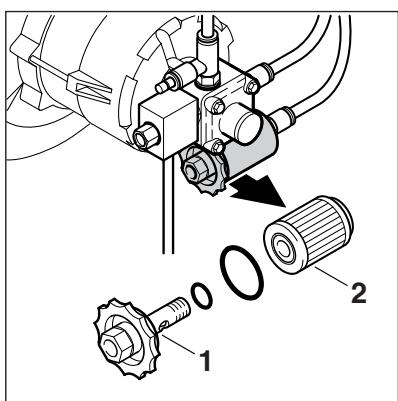
Also clean filter at pump inlet.
-
Clean filter: Unscrew Filter cap (1)
- Clean/replace oil filter.
- Properly dispose of filter and any solvents.
7.2.3 Checking the pump oil quality
english
-
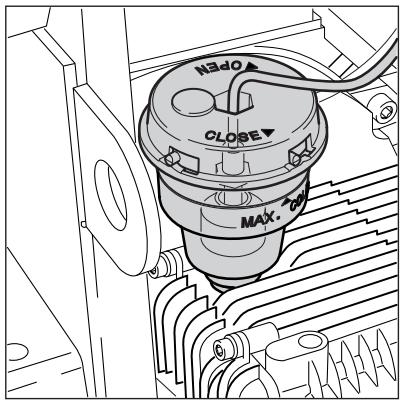
Check color of pump oil. If the oil has a grey or white shade, change the oil (see chapter 7.2.4)
-
Top off oil level with fresh oil if necessary. Oil type see chapter 9.3 Technical Data.
7.2.4 Changing the pump oil
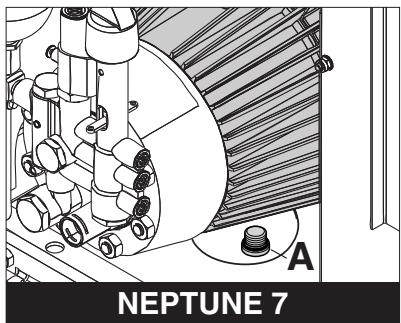
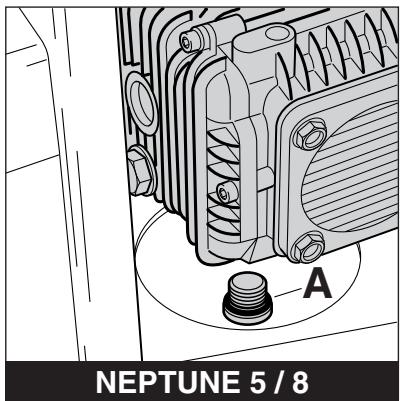
-
Unscrew the oil drain plug (A) and drain oil into a suitable container.
-
Check that the drain plug gasket is in place and reinstall drain plug.
-
Fill pump with proper grade and amount of oil. Oil grade and capacity see chapter '9.3 Technical Data'.
7.2.5 Emptying the fuel oil tank
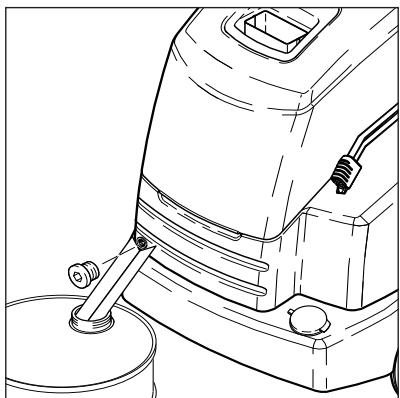
-
Prepare a container which is capable of containing the amount of fuel remaining in the tank.
-
Place drain channel beneath the drain plug.
-
Remove the drain plug and drain the fuel into the prepared container carefully not to spill fuel oil.
-
Check that the drain plug gasket is in place and reinstall drain plug.
-
Check tank and plug for leaks.
7.2.6 Flame sensor
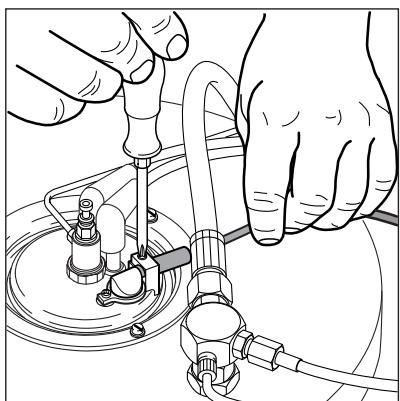
-
Remove the sensor and clean with a soft cloth.
-
Confirm that the sensor is correctly seated when reinstalling.
8 Troubleshooting
8.1 Indications on Display
| Indication on Display | Cause | Remedy |
| FLF | > Flow sensor fault | Contact Nilfisk-Alto ServiceCold water operation possible |
| FLO | > Water supply turned off or inadequate supply to machineDetergent tank empty | Required volume flow and pressure see chapter 9.3 Technical DataFill detergent tank or set detergent me-tering to „OFF“Turn the twist grip on safety control block or VarioPress-lance1) set to low water volumeMachine scaled |
| FUE | > Fuel shortage | Fill fuel tankCold water operation possible |
| HOP | > Motor overheated | Turn main switch in position „OFF“, let machine cool downRemove extension cord, if being used.Possible phase failure; have electrical connections checked |
| HOS | > Machine overheated | Contact Nilfisk-Alto Service |
| LERA | > Leakage or inadmissible operating condition by short-time operationSpray gun leakingHigh pressure hose, coupling or line system leakingDetergent tank emptyWater inlet filter dirtyHigh-pressure pump drawing in air | After three times of short-time operation the machine switches off. To reset: Turn main switch to position “OFF“, then start again. Keep trigger squeezed for longer than 3 seconds. If a leak occurs in the hose and gun and causes the machine to start and stop briefly 3 times, then the machine will switch off.Repair Spray gunReplace high-pressure hose, retighten screw fittingsFill detergent tank or set detergent me-tering to „OFF“Clean filter (see chapter 7.2.1)Repair leaks |
| LHE | > Flame sensor sootedIgnition or fuel system failure | Clean flame sensor (see chapter 7.2.6).Contact Nilfisk-Alto ServiceCold water operation possible |
| LHL | > Burner failure | Contact Nilfisk-Alto ServiceCold water operation possible |
| POL | > Pump oil low | Fill to proper level (see chapter 7.2.3) |
| SEC | > Temperature sensor damaged | Contact Nilfisk-Alto ServiceCold water operation possible |
| SEO | > Temperature sensor damaged | Contact Nilfisk-Alto ServiceCold water operation possible |
| UPC | > Microprocessor failure | Contact Nilfisk-Alto Service |
english
8.2 Indication lights on control panel
| Indication light | Cause | Remedy |
| flashing | > see FLO | • see FLO |
| ON | > Low fuel level | • Fill fuel tank Cold water operation possible |
| ANTI STONE | > Low Nilfisk-Alto AntiStone (Anti- Scale) level | • Fill Nilfisk-Alto AntiStone (Anti-Scale) tank |
| flashing | > Service interval: Service due in 20 hours | • Contact Nilfisk-Alto Service |
| ON | > Service interval expired | • Contact Nilfisk-Alto Service |
| ON | > Pump oil low | • Fill to proper level |
8.3 Other Faults
| Fault | Cause | Remedy |
| not ON | > Power cord not properly connected to power supply | Check power cord conconnectionCheck fuse (see chapter 9.3 Technical Data) |
| Pressure too low | > High pressure nozzle worn outPressure regulation set to low pressure or VarioPress-lance set to low water volume. | Replace nozzleTurn the twist grip on safety control block clockwise (+) or set VarioPress-lance to higher water volume (see chapter 4.4) |
| Machine is running with pulsating pressure and makes knocking noise | > Pump has drawn in air due to detergent tank being empty | Close detergent valve. Remove lance from gun. Operate spray gun and let machine run until air in pump is gone and the machine is running normally/calm again. |
| No detergents drawn in | > Detergent tank empty> Dirt in detergent tank> Suction valve at cleaning agent inlet soiled | Fill detergent tankClean detergent tankRemove suction valve and clean or replace |
| Burner soots | > fuel contamination> Burner sooted or adjustment incorrect | Contact Nilfisk-Alto Service |
9 Further information
9.1 Recycling the cleaner
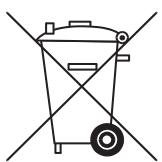
Make the old cleaner unusable immediately.
- Unplug the cleaner and cut the power cord.
Do not discard of electrical appliances with household waste.
As specified in European Direc
tive 2002/96/EC on old electrical and electronic appliances, used electrical goods must be collected separately and recycled ecologically.
Contact your local authorities or your nearest dealer for further information.
9.2 Guarantee
Our general conditions of business are applicable with regard to the guarantee. Subject to change as a result of technical advances.
The guarantee is invalidated if the machine is not operated in accordance with these instructions or otherwise abused. The guarantee is invalidated if the machine is not serviced as described.
english US only:
This warranty is in effect from the first day of purchase by the end user.
Each machine will have one (1) year coverage, from date of purchase by the end user, covering parts found defective due to faulty components, materials and/or bad workmanship. Not included in this warranty coverage are parts found defective due to:
-
Normal wear and tear (such as seals, valves, pistons, bearings, etc.)
Machine working under abnormal conditions. -
Machines being misused.
- Machines being repaired or tampered with by unauthorized person(s).
- The use of parts other than Nilfisk-Alto Cleaning Systems, Inc. original spare parts and/or accessories.
The burner coil on all Nilfisk-Alto Cleaning Systems, Inc. hot water/steam cleaners is under warranty for five (5) years against defects, and the high pressure hose is covered for an initial 30 days, under the same conditions described above.
Nilfisk-Alto Cleaning Systems, Inc. will cover labor by an authorized Nilfisk-Alto CSI Dealer for a 12-month period after the date of purchase of the machine by the end user.
No other costs, other than laid out in this warranty program, will be covered by the warranty.
Dated, End-User proof of purchase must be submitted with any claim for Warranty Service.
9.3 Technical data
| NEPTUNE | |||||||||||||
| 5-27 | 5-285-28X2 | 5-42 | 5-45 | 5-495-49X | 5-54 | 5-575-57X | 7-257-25X2 | 7-587-58X | 7-637-63X2 | 7-66 | 8-103 | ||
| Voltage 110 V /1~/ 50Hz | (GB) | ||||||||||||
| Voltage 200 V / 3~/ 50Hz | (JP) | (JP) | |||||||||||
| Voltage 200 V / 3~/ 60Hz | (JP) | (JP) | |||||||||||
| Voltage 220 V / 1~/ 60Hz | (US) | (US) | |||||||||||
| Voltage 220-440 V/ 3~/ 60Hz | (US) | (KR) | (KR) | (US) | |||||||||
| Voltage 230 V /1~/ 50Hz | (EU) | (GB) | (GB) | ||||||||||
| Voltage 230-400 V/ 3~/ 50Hz | (NO,BE,IT) | (NO,BE,IT) | (NO,BE,IT) | (NO,BE,IT) | |||||||||
| Voltage 400 V / 3~/ 50Hz | (EU) | (EU) | (EU) | (EU) | (EU) | ||||||||
| Fuse (slow) | A | 16 | 32 (110V)13 (230V) | 16 (EU)25/16 NO,BE,IT)25 (JP) | 30 | 16 (EU)25/16 NO,BE,IT) | 30 | 16 (EU)32 (NO,BE,IT)25 (KR) | 13 | 30 | 16 (EU)25/16 (NO,BE,IT)30 (JP), 25 (KR) | 30 | 25 |
| Power rating | kW | 3,3 | 3,0 | 5,6 | 6.6 | 6,9 | 6.6 | 7,9 | 3,0 | 6.6 | 8,3 | 9.1 | 13 |
| Working pressure | bar/MPa | 110/11 | 90/9 (110V)95/9.5 (230V) | 170 / 17 (EU,NO,BE,IT)165 / 16,5 (JP) | 150/15 | 180 / 18 | 172/17 | 200 / 20 | 90/9 | 159/16 | 175 / 17,5 | 214/21 | 180/18 |
| Permissible pressure | bar/MPa | 200/20 | 250/25 | 200/20 | 250/25 | ||||||||
| Volume flow (max) | l/h | 720 | 720 (110V)770 (230V) | 860 (EU,NO,BE,IT)910 (JP, 50Hz)860 (JP, 60Hz) | 970 | 1080 | 720 | 1260 | 2000 | ||||
| Volume flow \(Q_{IEC}\) | l/h | 630 | 660 (110V)730 (230V) | 800 (EU,NO,BE,IT)830 (JP) | 908 | 900 | 1020 | 1000 | 660 | 1135 | 1170 | 1135 | 1950 |
| Permissible temperature | °C | 80-140 | 80-150 | 80-140 | 80-150 | 80-140 | 100-140 | 90-150 | 100-140 | 90-150 | 70-140 | ||
| Max. water inlet temperature | °C | 40 | 30 | 40 | 30 | 40 | 30 | 40 | 30 | 40 | |||
| Max. water inlet pressure | bar/MPa | 10 / 1 | |||||||||||
| Dimensions I x w x h | mm | 1190 x 702 x 987 | 1190 x 702 x 1020 | ||||||||||
| Weight | kg | 175, 182(X2) | 180 | 184, 189(X) | 217, 222(X), 224(X2) | 228 | |||||||
| Noise level at a distance of 1m EN 60704-1 | dB(A) | 71,8 | 73,8 | 75.8 | 74,1 | 72,5 | 76.6 | 80,2 | |||||
| Sound power level \(LW_A\) | dB(A) | 86,9 | 88,8 | 90.2 | 89,1 | 87,6 | 91.7 | 95,3 | |||||
| Recoil forces | N | 26 | 25/28 | 42 | 44 | 47 | 53 | 55 | 25 | 52 | 61 | 65 | 103 |
| Fuel tank | I | 35 | |||||||||||
| Detergent tank A / B | I | 15 / 10 | |||||||||||
| Oil quantity | I | 1,0 | 2,15 | ||||||||||
| Oil type | SAE 15W-40 | Castrol AlphaSyn-T ISO 150 | SAE15W-40 | ||||||||||
9.4 EU Declaration of Conformity
Product: High Pressure Cleaner,
Type: NEPTUNE, Description: 400 V 3~, 50 Hz, IP X5
The design of the unit corresponds to the following pertinent regulations: EC Machine Directive 98/37/EG, EC Low-voltage Directive 73/23/EG, EC EMV Directive 89/336/EG. Applied harmonised standards: EN 12100-1, EN 12100-2, EN 60335-2-79, EN 55014-1, EN 55014-2, EN 61000-3-2.
Applied national standards and technical specifications: DIN EN 60335-2-79.
Dipl. Ing. Wolfgang Nieuwkamp
Tests and approvals
Bellenberg, 10.01.2005
HEADQUARTER
Nilfisk-Advance Group
Sognevej 25
2605 Brøndby
Denmark
Tel.: +45 4323 8100
AUSTRALIA
Nilfisk-ALTO
48 Egerton St.
Silverwater NSW 2128
Tel.: +61 2 8748 5966
Fax: +61 2 8748 5960
AUSTRIA
24 Constellation Road
Rexdale
Ontario M9W 1K1
Tel.: +1 416 6 75 58 30
Fax: +1 416 6 75 69 89
CROATIA
Wap ALTO Strojevi za ciscenje, d.o.o.
Siget 18a
10020 Zagreb
Tel.: +385 1 65 54 144
Fax: +38516554112
E-mail: admin.wap@wap-sistemi.hr
CZECH REPUBLIC
ALTO Ceska Republika s.r.o.
Zateckych 9
14000 Praha 4
Tel.: +420 2 41 40 84 19
Fax: +420 2 41 40 84 39
E-mail:wap_p@mbox.vol.cz
Web: www.wap-alto.cz
DENMARK
ALTO Danmark A/S
Industrivej 1
9560 Hadsund
Gilwilly Industrial Estate
UK-Penrith, Cumbria CA 11 9BQ
Tel.: +44 1768 86 89 95
Fax: +44 1768 86 47 13
E-mail: sales@nilfisk-alto.co.uk
Web: www.nilfisk-alto.co.uk
MALAYSIA
ALTO DEN-SIN Malaysia Sdn Bhd
SD 14, Jalan KIP 11, Taman
Perindustrian KIP, SRI Damansara
52200 Kuala Lumpur
Malaysia
Tel.: +603 627 4 6 913
Fax: +603 627 4 6 318
E-mail: densin@tm.net.my
NETHERLANDS
ALTO Nederland BV
Houtschelf 7
NL-3371 KB Hardinxveld-Giessendam
Tel.: +31 184 677 200
Fax: +31 184 677 201
E-mail: info@nilfisk-alto.nl
Web: www.nilfisk-alto.nl
NEW ZEALAND
ALTO Overseas Inc.
5A Tarndale Grove
Albany Auckland
Tel.: +64 9 414 4520
Fax: +64 9 414 4521
E-mail: altonz@ihug.co.nz
NORWAY
ALTO Norge A/S
Bjørnerudveien 24
1266 Oslo
Tel.: +47 22 75 17 70
Fax: +47 22 75 17 71
Division of Nilfisk-ALTO S.A.
Torre D'Ara
Paseo del Ringle, 5 PI.10
E-08302 Mataró Barcelona
ALTO Cleaning Systems, Inc.
Part of the Nilfisk-Advance Group
12249 Nations Ford Road
28134 Pineville
Tel.: +1 704 971 1240