
AVR 7500 - AV receiver HARMAN KARDON - Free user manual and instructions
Find the device manual for free AVR 7500 HARMAN KARDON in PDF.


| Product Type | Audio-Video Receiver |
| Brand | HARMAN KARDON |
| Model | AVR 7500 |
| Dimensions (W x H x D) | 440 mm x 193 mm x 519 mm |
| Weight | 22.3 kg |
| Power Supply | AC 220-240 V / 50 Hz |
| Power Consumption | 125 W (standby) / 1100 W (max) |
| Output Power (stereo) | 2 x 110 W into 8 ohms (20 Hz-20 kHz, < 0.07% THD) |
| Output Power (5 channels) | 5 x 100 W into 8 ohms (20 Hz-20 kHz, < 0.07% THD) |
| Surround Modes | Dolby Digital, Dolby Pro Logic II, DTS, DTS-ES 6.1, DTS Neo:6, Logic 7, VMAx, HDCD, MP3 |
| Video Inputs | 6 composite/S-Video inputs, 2 component inputs |
| Digital Audio Inputs | 6 (3 optical, 3 coaxial) |
| Digital Audio Outputs | 3 (1 optical, 2 coaxial) |
| Multiroom Functions | Zone II with separate remote control and IR link |
| Auto Calibration | EzSet with microphone built into remote |
| Remote Control | Backlit, programmable, with learning |
| Cleaning | Soft dry cloth; do not use solvents |
| Safety Instructions | Do not open the cover; unplug before cleaning; do not expose to humidity |
| Repairability | Contact a Harman Kardon authorized service center |
| Spare Parts | Contact an authorized service center |
Frequently Asked Questions - AVR 7500 HARMAN KARDON
User questions about AVR 7500 HARMAN KARDON
0 question about this device. Answer the ones you know or ask your own.
Ask a new question about this device
Download the instructions for your AV receiver in PDF format for free! Find your manual AVR 7500 - HARMAN KARDON and take your electronic device back in hand. On this page are published all the documents necessary for the use of your device. AVR 7500 by HARMAN KARDON.
USER MANUAL AVR 7500 HARMAN KARDON
AVR 7500 Audio/Video Receiver
OWNER'S MANUAL
harman/kardon
Power for the Digital Revolution™
3 Introduction
4 Safety Information
4 Unpacking
5 Front Panel Controls
7 Front Panel Information Display
9 Rear Panel Connections
11 Main Remote Control Functions
14 Zone II Remote Control Functions
15 Installation and Connections
15 Audio Connections
15 Video Connections
16 SCART A/V Connections
18 System and Power Connections
19 Speaker Selection
19 Speaker Placement
20 System Configuration
20 First Turn On
20 Using the On-Screen Display
20 Settings to be Made Individually
for Each Input In Use
21 Input Setup
21 Speaker Setup
23 Surround Setup
24 Adjustments for Other Inputs
24 Settings Keeping Independent
from the Input Selected
24 Delay Settings
25 Night Mode Settings
26 Output Level Adjustment
26 Using EzSet
27 Manual Output Level Adjustment
29 Operation
29 Surround Mode Chart
31 Basic Operation
31 Source Selection
31 Controls and Use of Headphones
32 Surround Mode Selection
32 Digital Audio Playback
32 Dolby Digital
33 DTS
33 PCM Audio Playback
33 HDCD
33 MP3 Audio Playback
33 Selecting a Digital Source
34 Digital Status Indicators
35 Night Mode
35 Tape Recording
35 Front Panel Input/Output Connections
35 Output Level Adjustment
With Source Signals
36 6/8-Channel Direct Input
36 Memory backup
37 Advanced Features
37 Display Brightness
37 Turn-On Volume Level
38 Semi-OSD Settings
38 Full-OSD Time Out Adjustment
39 Multiroom Operation
40 Tuner Operation
40 Basic Tuner Operation
40 Station Selection
40 Preset Tuning
41 RDS Operation
41 RDS Tuning
41 RDS Display Options
41 Program Search
42 Programming the Remote
42 Programming the Remote with Codes
42 Direct Code Entry
42 Auto Search Method
43 Code Readout
43 Learning Codes
43 Erasing Learned Codes
44 Macro Programming
45 Programmed Device Functions
45 Volume Punch-Through
46 Channel Control Punch-Through
46 Transport Control Punch-Thr
46 Reassigning Device Control Selectors
47 Resetting the Remote Memory
48 Function List
50 Troubleshooting Guide
50 Processor Reset
51 Technical Specifications
Declaration of Conformity
CE
We, Harman Consumer International
2, route de Tours
72500 Château-du-Loir,
FRANCE
declare in own responsibility, that the product described in this owner's manual is in compliance with technical standards:
EN 55013/6.1990
EN 55020/12.1994
EN 60065:1993
EN 61000-3-2/4.1995

Daniel Moyano
Harman Kardon Europe A/S
11/01
Typographical Conventions
In order to help you use this manual with the remote control, front-panel controls and rear-panel connections, certain conventions have been used.
EXAMPLE - (bold type) indicates a specific remote control or front-panel button, or rear-panel connection jack
EXAMPLE - (OCR type) indicates a message that is visible on the front-panel information display
1 - (number in a square) indicates a specific front-panel control
1 - (number in a circle) indicates a rear-panel connection
1 - (number in an oval) indicates a button or indicator on the remote
A - (letter in a square) indicates an indicator in the front-panel display
A - (letter in an oval) indicates a button on the Zone II remote
Thank you for choosing Harman Kardon! With the purchase of a Harman Kardon AVR 7500 you are about to begin many years of listening enjoyment. Designed to provide all the excitement and detail of movie soundtracks and every nuance of musical selections, the AVR 7500 is truly a multichannel receiver for the new millennium. In addition to the traditional 5.1 digital decoding modes such as Dolby Digit and DTS, it offers the latest advancements in surround technology such as Dolby Pro Logic II, the full suite of DTS-ES 6.1 modes, DTS Neo:6 and the latest 7.1 channel versions of Harman's own Logic 7 technology.
The AVR 7500 has been engineered so that it is easy to take advantage of all the power of its digital technology. On-screen menus, fully color coded connection jacks and terminals and our exclusive EzSet™ remote make installation fast and simple. However, to obtain the maximum enjoyment from your new receiver, we urge you to read this manual. A few minutes spent learning the functions of the various controls will enable you to take advantage of all the power the AVR 7500 is able to deliver.
If you have any questions about this product, its installation or its operation, please contact your retailer or custom installer. They are your best local sources of information.
Description and Features
The AVR 7500 is among the most versatile and multifeatured A/V receivers available, incorporating a wide range of listening options. In addition to Dolby Digital and DTS decoding for digital sources, a broad choice of surround modes for Matrix surround-encoded or Stereo recordings are available for use with sources such as CD, VCR, TV broadcasts and the AVR 7500's own FM/AM tuner. Along with Dolby Pro Logic II, DTS Neo:6, Dolby 3 Stereo, 5 Channel or 7 Channel Stereo and Hall and Theater modes, the AVR 7500 offers Harman International's exclusive Logic 7 process in both 5.1 and 7.1 versions to create a wider, more enveloping field environment and more defined fly-overs and pans. Another Harman Kardon exclusive is VMAx, which uses proprietary processing to create an open, spacious sound field even when only two front speakers are available. Finally, the AVR 7500 is among the very few A/V receivers that offer decoding of MP3 data, so that you may listen to the latest music selections directly from compatible computers or playback devices with the power and fidelity you expect from Harman Kardon.
The AVR 7500 is also featuring HDCD® decoding to provide the most realistic playback of CDs when a digital connection is used, even with a normal non-HDCD-compatible CD or DVD player.
In addition to providing a wide range of listening options, the AVR 7500 is easy to configure so that it provides the best results with your speakers and specific listening-room environment. On-screen menus make it simple to enter settings for speaker configurations and bass management, and the EzSet remote measures a system's sound levels and automatically calibrates them for perfectly balanced sound field presentation.
For the ultimate in flexibility, the AVR 7500 features connections for six video devices, all with both composite and S-Video inputs. Two additional audio inputs are available, and a total of six digital inputs and three outputs make the AVR 7500 capable of handling all the latest digital audio sources.
For compatibility with the latest HDTV video sources and progressive scan DVD players, the AVR 7500 also features wide-bandwidth, low-crosstalk component video switching.
Coax and optical digital outputs are available for direct connection to digital recorders, and both the front panel analog audio/video and coaxial digital jacks may be switched to outputs for use with portable recorders - a Harman Kardon exclusive. Two video recording outputs, preampout and main amp-in jacks, and a color-coded eight-channel input make the AVR 7500 virtually future-proof, with everything needed to accommodate tomorrow's new formats right on board.
The AVR 7500's flexibility and power extend beyond your main home theater or listening room. The AVR 7500 includes a sophisticated multizone control system that allows you to select one source for use in the main room and a different one (Audio only) in a second room. Complete control over volume is possible with a separate infrared control link. To make it easy to operate the AVR 7500 from a remote room, a separate "Zone II" remote is included.
The AVR 7500's powerful amplifier uses traditional Harman Kardon high-current design technologies to meet the wide dynamic range of any program selection.
Harman Kardon invented the high-fidelity receiver more than forty-seven years ago. With state-of-the-art circuitry and time-honored circuit designs, the AVR 7500 is the perfect combination of the latest in digital audio technology, a quiet yet powerful analog amplifier in an elegant, easy-to-use package.
Dolby Digital and Dolby Pro Logic II Decoding, and the full suite of DTS® modes, including DTS-ES® 6.1 Discrete & Matrix and Neo:6® using the latest 24-bit, twin-core Crystal® DSP engine
Harman Kardon's exclusive Logic 7^® processing, available for the first time with both 7.1 and 5.1 processing in a variety of modes and two modes of VMAX
MP3 decoding for use with compatible computers and digital audio players
■ I111EzSet remote automatically sets output levels for optimum performance
High-bandwidth, HDTV-compatible component video switching
■ Front panel analog A/V inputs, switchable to outputs
■ Front panel digital inputs with coax digital output capability for easy connection to portable digital devices and the latest video game consoles
Multiple digital inputs and outputs
On-screen menu and display system
Complete multizone system with separate "Zone II" remote included
6-Channel/8-Channel Direct Input and Preamp Outputs and Main Amp Inputs for Easy Expansion and Use with Future Audio Formats
Main Backlit Remote with Internal Codes and Learning Capability
HDCD Decoding for Superb CD Playback
Important Safety Information
Verify Line Voltage Before Use
Your AVR 7500 has been designed for use with 220-240-Volt AC current. Connection to a line voltage other than that for which it is intended can create a safety and fire hazard and may damage the unit.
If you have any questions about the voltage requirements for your specific model, or about the line voltage in your area, contact your dealer before plugging the unit into a wall outlet.
Do Not Use Extension Cords
To avoid safety hazards, use only the power cord attached to your unit. We do not recommend that extension cords be used with this product. As with all electrical devices, do not run power cords under rugs or carpets or place heavy objects on them. Damaged power cords should be replaced immediately by an authorized service depot with a cord meeting factory specifications.
Handle the AC Power Cord Gently
When disconnecting the power cord from an AC outlet, always pull the plug, never pull the cord. If you do not intend to use the unit for any considerable length of time, disconnect the plug from the AC outlet.
Do Not Open the Cabinet
There are no user-serviceable components inside this product. Opening the cabinet may present a shock hazard, and any modification to the product will void your guarantee. If water or any metal object such as a paper clip, wire or a staple accidentally falls inside the unit, disconnect it from the AC power source immediately, and consult an authorized service station.
Installation Location
To assure proper operation and to avoid the potential for safety hazards, place the unit on a firm and level surface. When placing the unit on a shelf, be certain that the shelf and any mounting hardware can support the weight of the product.
Make certain that proper space is provided both above and below the unit for ventilation. If this product will be installed in a cabinet or other enclosed area, make certain that there is sufficient air movement within the cabinet. Under some circumstances a fan may be required.
- Do not place the unit directly on a carpeted surface.
Avoid installation in extremely hot or cold locations, or an area that is exposed to direct sunlight or heating equipment.
Avoid moist or humid locations.
- Do not obstruct the ventilation slots on the top of the unit, or place objects directly over them.
Cleaning
When the unit gets dirty, wipe it with a clean, soft, dry cloth. If necessary, wipe it with a soft cloth dampened with mild soapy water, then a fresh cloth with clean water. Wipe dry immediately with a dry cloth. NEVER use benzene, aerosol cleaners, thinner, alcohol or any other volatile cleaning agent. Do not use abrasive cleaners, as they may damage the finish of metal parts. Avoid spraying insecticide near the unit.
Moving the Unit
Before moving the unit, be certain to disconnect any interconnection cords with other components, and make certain that you disconnect the unit from the AC outlet.
Unpacking
The carton and shipping materials used to protect your new receiver during shipment were specially designed to cushion it from shock and vibration. We suggest that you save the carton and packing materials for use in shipping if you move, or should the unit ever need repair.
To minimize the size of the carton in storage, you may wish to flatten it. This is done by carefully slitting the tape seams on the bottom and collapsing the carton. Other cardboard inserts may be stored in the same manner. Packing materials that cannot be collapsed should be saved along with the carton in a plastic bag.
If you do not wish to save the packaging materials, please note that the carton and other sections of the shipping protection are recyclable. Please respect the environment and discard those materials at a local recycling center.
CAUTION
RISK OF ELECTRIC SHOCK DO NOT OPEN

CAUTION: TO REDUCE THE RISK OF ELECTRIC SHOCK, DO NOT REMOVE COVER (OR BACK). NO USER-SERVICEABLE PARTS INSIDE. REFER SERVICING TO QUALIFIED SERVICE PERSONNEL.

The lightning flash with arrowhead symbol, within an equilateral triangle, is intended to alert the user to the presence of uninsulated "dangerous voltage" within the product's enclosure that may be of sufficient magnitude to constitute a risk of electric shock to persons.

The exclamation point within an equilateral triangle is intended to alert the user to the presence of important operating and maintenance (servicing) instructions in the literature accompanying the appliance.
WARNING: TO REDUCE THE RISK OF FIRE OR ELECTRIC SHOCK, DO NOT EXPOSE THIS APPLIANCE TO RAIN OR MOISTURE.
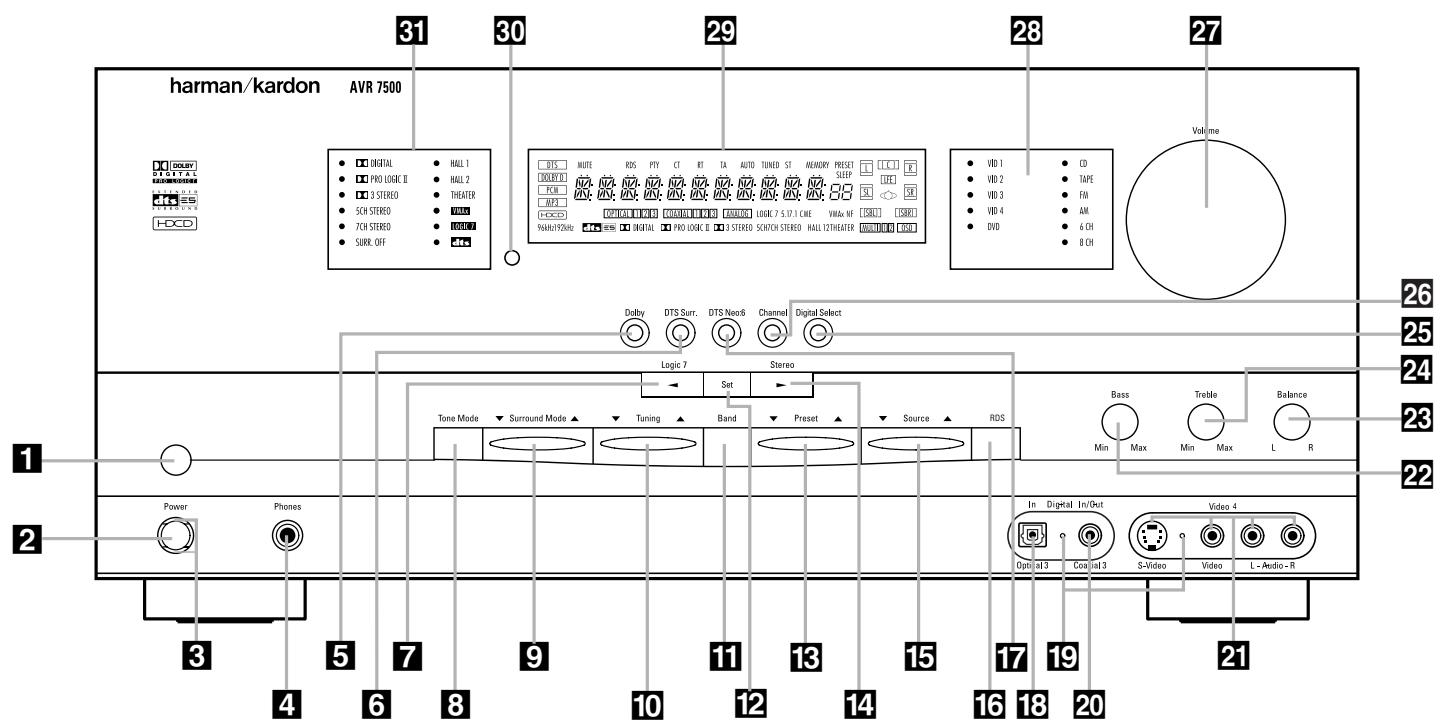
1 Main Power Switch
2 System Power Control
3 Power Indicator
4 Headphone Jack
5 Dolby Mode Selector
DTS Surround Mode Selector
7 Logic 7 Mode Selector / Button
8 Tone Mode
9 Surround Mode Selector
10 Tuning Selector
Tuner Band Selector
12 Set Button
13 Preset Station Selector
14 Stereo Mode Selector /▶ Button
15 Input Source Selector
16 RDS Selector
DTS Neo:6 Mode Selector
18 Digital Optical 3 Input
19 Input/Output Status Indicators
20 Digital Coax 3 Jack
21 Video 4 Input/Output Jacks
22 Bass Control
Balance Control
24 Treble Control
25 Digital Select Button
26 Channel Select Button
Volume Control
28 Input Indicators
29 Main Information Display
30 Remote Sensor Window
31 Surround Mode Indicators
1 Main Power Switch: Press this button to apply power to the AVR 7500. When the switch is pressed in, the unit is placed in a Standby mode, as indicated by the orange LED 3 surrounding the System Power Control 2. This button MUST be pressed in to operate the unit. To turn the unit off completely and prevent the use of the remote control, this switch should be pressed until it pops out from the front panel so that the word "OFF" may be read at the top of the switch.
NOTE: This switch is normally left in the "ON" position.
2 System Power Control: When the Main Power Switch 1 is "ON," press this button to turn on the AVR 7500; press it again to turn the unit off (to Standby). Note that the Power Indicator surrounding the switch 3 will turn green when the unit is on.
3 Power Indicator: This LED will be illuminated in orange when the unit is in the Standby mode to signal that the unit is ready to be turned on. When the unit is in operation, the indicator will turn green.
4 Headphone Jack: This jack may be used to listen to the AVR 7500's output through a pair of headphones. Be certain that the headphones have a standard 6.3mm stereo phone plug. Note that the main room speakers and all Preamp Outputs will automatically be turned off when the headphone jack is in use.
5 Dolby Mode Selector: Pressing this selector button cycles the AVR through the various Dolby surround modes. The first press of the button switches the surround mode to the last Dolby surround mode that was in use.
Each subsequent press selects the next mode in the following order:
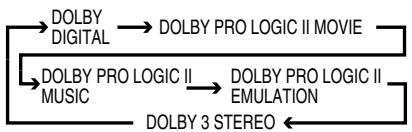
Note that DOLBY DIGITAL mode is available only with digital input selected and the other modes only when a Dolby Digital source is not playing.
6 DTS Surround Mode Selector: When a DTS source is in use the AVR 7500 will select the appropriate mode automatically and no other mode will be available. In that case, pressing that button will display the mode currently selected by the AVR's decoder. Depending on the surround material played and the speaker setting, one of the following modes will be selected by the unit:
- DTS-ES 6.1 DISCRETE
- DTS-ES 6.1 MATRIX
- DTS + NEO:6
- DTS 5.1
Both DTS ES 6.1 Modes and DTS+NEO:6 will be selected only when surround back speakers have been configured with your system: DISCRETE with appropriate source material, MATRIX with 6.1 Matrix recordings and DTS+NEO:6 with normal DTS 5.1 channel recordings. The DTS 5.1 mode will be selected with any DTS source, when no surround back speakers are configured (see also pages 24 and 32-35).
7 Logic 7 Mode Selector /按钮: This button has two functions: In normal use, press it to select one of the Logic 7 modes. When an adjustment is being made using the Channel Select 26 or Digital Select 25 buttons, this button may be pressed to scroll through the available options.
8 Tone Mode: Pressing this button enables or disables the Balance, Bass and Treble tone controls. When the button is pressed so that the words T ONE I N appear in the Main Information Display 29, the settings of the Bass 22 and Treble 24 controls and of the Balance control 23 will affect the output signals. When the button is pressed so that the words T ONE O U T appear in the Main Information Display 29, the output signal will be "flat," without any balance, bass or treble alteration, no matter how the actual Controls 222324 are adjusted.
9 Surround Mode Selector: Press this button to select any of the HALL, THEATER or VMAX surround modes. Note that depending on the type of input, some modes are not always available. (See page 32 for more information about surround modes.)
10 Tuning Selector: Press the left side of the button to tune lower frequency stations and the right side of the button to tune higher frequency stations. When a station with a strong signal is reached, the TUNED indicator W will illuminate in the Main Information Display 29 (see page 40 for more information on tuning stations).
1 Tuner Band Selector: Pressing this button will automatically switch the AVR 7500 to the Tuner mode. Pressing it again will switch between the AM and FM frequency bands. Holding it pressed for 3 seconds will switch between stereo or mono receiving and automatic or manual tuning mode. When the button is pressed so that the AUTO Indicator X lights, the tuner will search for the next station with an acceptable signal when the Tuning Selector 1021E is pressed. When the button is pressed so that the AUTO Indicator X is not lit, each press of the Tuning Selector 1021E will increase the frequency. (See page 40 for more information on using the tuner.)
12 Set Button: When making choices during the setup and configuration process, press this button to enter the desired setting as shown in the Main Information Display 29 into the AVR 7500's memory.
Preset Stations Selector: Press this button to scroll up or down through the list of stations that have been entered into the preset memory. (See page 40 for more information on tuner programming.)
14 Stereo Mode Selector /▶ Button: This button has two functions: In normal use, pressing this selector button cycles through the stereo modes, and it is also used to turn off all surround processing and place the unit in a traditional two-channel Stereo mode. The first press selects 5-Channel Stereo or 7-Channel Stereo, depending on the selection (5.1 or 6.1/7.1) made in the surround mode setting, see page 23, and the second selects "SURROUND OFF," which is true Stereo. When an adjustment is being made using the Channel Select 26 or Digital Select 25 buttons, this button may be pressed to scroll through the available options.
15 Input Source Selector: Press this button to change the input by scrolling through the list of input sources.
16 RDS Select Button: Press this button to display the various messages that are part of the RDS data system of the AVR 7500's tuner. (See page 30 for more information on RDS).
17 DTS Neo:6 Mode Selector: Pressing this selector button cycles the AVR through the various DTS Neo:6 modes, which extract a five- or seven-channel surround field from two-channel program material (from PCM source or analog input signal). The first press selects the last DTS Neo:6 surround mode that was in use, and each subsequent press selects the next mode in the following order:
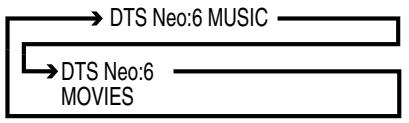
Digital Optical 3 Input: Connect the optical digital audio output of an audio or video product to this jack. When the Input is not in use, be certain to keep the plastic cap installed to avoid dust contamination that might degrade future performance.
Input/Output Status Indicators: These LED indicators will normally light green to show that the front panel Video 4 A/V 21 jacks or the Coaxial 3 digital 20 jack is operating as an input. When either of these jacks has been configured for use as an output, the indicator will turn red to show that the jack may be used for recording. (See page 21 for more information on configuring the front panel jacks as outputs, rather than inputs.)
20 Digital Coax 3 Jack: This jack is normally used for connection to the output of portable audio devices, video game consoles or other products that have a coax digital jack. It may also be configured as an output jack, to feed a digital signal to a CD-R, MiniDisc or other digital recording device. (See page 21 for information on configuring the Digital Coax 3 Jack to an output.)
21 Video 4 Input/Output Jacks: These audio/video jacks may be used for temporary connection to video games or portable audio/video products such as camcorders and portable audio players. They may also be configured as output jacks (also S-Video) to feed a signal to any recording Audio or Video device (see page 35 for more information).
22 Bass Control: Turn this control to modify the low frequency output of the left/right channels by as much as ± 10dB . Set this control to a suitable position for your taste or room acoustics.
23 Balance Control: Turn this control to change the relative volume for the front left/right channels.
NOTE: For proper operation of the surround modes this control should be at the midpoint or "12 o'clock" position.
24 Treble Control: Turn this control to modify the high frequency output of the left/right channels by as much as ± 10dB . Set this control to a suitable position for your taste or room acoustics.
25 Digital Select Button: When playing a source that has a digital output, press this button to select between the Optical 18 and Coaxial 20 Digital inputs (See page 33 for more information).
26 Channel Select Button: Press this button to begin the process of trimming the channel output levels using an external audio source. (For more information on output level trim adjustment, see page 35).
27 Volume Control: Turn this knob clockwise to increase the volume, counterclockwise to decrease the volume. If the AVR is muted, adjusting volume control will automatically release the unit from the silenced condition.
28 Input indicators: A green LED will light in front of the input that is currently being used as the source for the AVR 7500.
29 Main Information Display: This display delivers messages and status indications to help you operate the receiver. (See pages 7-8 for a complete explanation of the Information Display.)
30 Remote Sensor Window: The sensor behind this window receives infrared signals from the remote control. Aim the remote at this area and do not block or cover it unless an external remote sensor is installed.
31 Surround Mode Indicators: A green LED will light in front of the surround mode that is currently in use.
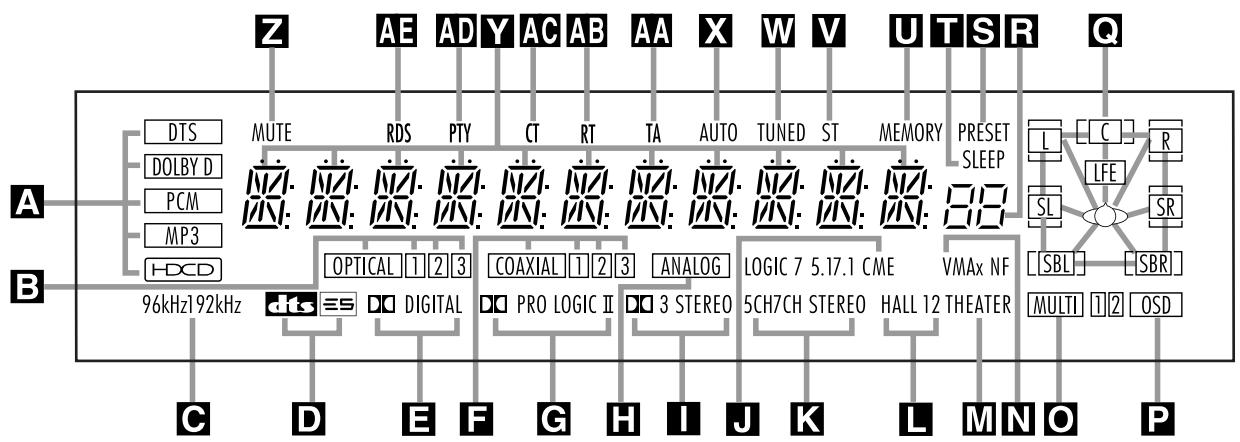
A Bitstream Indicators
Optical Source Indicators
C Sample Rate Indicators
D DTS Mode Indicator
E Dolby Digital Indicator
F Coaxial Source Indicators
G Dolby Pro Logic II Indicator
H Analog Input Indicator
1 Dolby 3 Stereo Indicator
Logic 7 Mode Indicators
K 5 Channel/7 Channel Stereo Indicators
L Hall Mode Indicator
M Theater Mode Indicator
N VMAx Mode Indicator
Multiroom Indicator
P OSD Indicator
Speaker/Channel Input Indicators
Preset Number/Sleep Timer
S Preset Indicator
Sleep Indicator
Memory Indicator
V Stereo Indicator
A BitstreamTM Indicators: When the input is a digital source, one of these indicators will light to display the specific type of signal in use.
B Optical Source Indicators: These indicators light to show when a Optical Digital Input has been selected.
Sample Rate Indicators: One of these indicators will light when 96kHz or 192kHz source material is in use.
D DTS Mode Indicator: This indicator illuminates when the DTS mode is selected
Dolby Digital Indicator: This indicator illuminates when the Dolby Digital mode is selected.
Coaxial Source Indicators: These indicators light to show when a Coaxial Digital Input has been selected.
Dolby Pro Logic II Indicator: This indicator lights when any Dolby Pro Logic II mode has been selected.
NOTE: It is possible to see the Dolby Pro Logic II indicator lit simultaneously with the Dolby Digital indicator, even though the Dolby Digital surround mode has been selected. This is due to the specifications for Dolby Digital processing, which require that the Dolby Pro Logic II mode be applied when a 2-channel Dolby Digital signal (2.0 recording) with Pro Logic information (Pro
Logic flag on) is detected. For more information see page 34. If you desire 5.1-channel audio, check the audio settings in the menus for your DVD disc to make sure that a 5.1-channel Dolby Digital soundtrack has been selected.
H Analog Input Indicator: This indicator lights when an analog input source has been selected.
1 Dolby 3 Stereo Indicator: This indicator lights when the Dolby 3 Stereo Mode has been selected.
Logic 7 Mode Indicators: These indicators light to indicate that one of the Logic 7 modes is in use. Along with the main Logic 7 indicator, either 5.1 or 7.1 will light to indicate the selected speaker configuration. One of the three letters to the far right of this segment will light to show which version of Logic 7 processing is in use: C for the Cinema mode, M for the Music mode and E for the Enhanced mode used with two-channel sources. (See page 29 for a description of the Logic 7 modes.)
K 5-Channel/7-Channel Stereo Indicators:
These indicators light to show if the 5-Channel or 7-Channel Stereo mode has been selected. Only the indicator STEREO will light when "Surround Off" has been selected. Then all Surround Modes are turned off and the unit will play in pure stereo mode.
W Tuned Indicator
X Auto Indicator
Y Main Information Display
Mute Indicator
AA Traffic Indicator
AB Radiotext Indicator
AC Clock Time Indicator
AD Program Type Indicator
AE RDS Indicator
L Hall Mode Indicators: These indicators light when one of the Hall modes has been selected.
M Theater Mode Indicator: This indicator illuminates to show that the Theater mode is in use.
VMAX Mode Indicators: One of these indicators lights when the VMAX mode is in use. VMA × F appears when the Far Field VMAX mode is selected; VMA × N appears when the Near Field VMAX mode is selected. (See page 29 for a description of the VMAX modes.)
Multiroom Indicator: This indicator lights when the multiroom system is active. Note that it will remain lit when the multiroom system is in use even though the main room system is in the Standby mode and all other indicators are dark. (See page 39 for more information on the Multiroom system.)
P OSD Indicator: When the OSD system is in use, this indicator lights to remind you that the other indicators in this display do not function when the On Screen Display is being used.
Speaker/Channel Input Indicators: These indicators are multipurpose, indicating either the speaker type selected for each channel or the incoming data-signal configuration. The left, center, right, right surround, left surround, right back surround and left back surround speaker indicators are composed of three boxes, while the subwoofer is a single box. The center box lights when a "Small" speaker is selected, and the two outer boxes light when "Large" speakers are selected. When none of the boxes are lit for the center, surround or subwoofer channels, no speaker has been selected for that position. (See page 21 for more information on configuring speakers.) The letters inside each of the center boxes display active input channels. For standard analog inputs, only the L and R will light, indicating a stereo input. When a digital source is playing, the indicators will light to display the channels begin received at the digital input. When the letters flash, the digital input has been interrupted. (See pages 23 and 34 for more information on the Channel Indicators).
Preset Number/Sleep Timer: When the timer is in use, these numbers indicate the specific preset memory location in use. (See page 40 for more information on preset stations.) When the Sleep function is in use, these numbers show how many minutes remain before the unit goes into the Standby mode.
S Preset Indicator: This indicator lights when the tuner is in use to show that the Preset Number/Sleep Timer R is showing the station's preset memory number. (See page 40 for more information on tuner presets.)
Sleep Indicator: This indicator lights when the Sleep function is in use. The numbers in the Preset Number/Sleep Timer R indicators will show the minutes remaining before the AVR 7500 goes into the Standby mode. (See page 31 for more information on the Sleep function.)
Memory Indicator: This indicator flashes when entering presets and other information into the tuner's memory.
V Stereo Indicator: This indicator illuminates when an FM station is being tuned in stereo.
Tuned Indicator: This indicator illuminates when a station is being received with sufficient signal strength to provide acceptable listening quality.
X Auto Indicator: This indicator illuminates when the tuner's Auto mode is in use.
Y Main Information Display: This display shows messages relating to the status, input source, surround mode, tuner, volume level or other aspects of the AVR 7500's operation.
Mute Indicator: This indicator illuminates to remind you that the AVR 7500's output has been silenced by pressing the Mute button
43. Press the Mute button again to return to the previously selected output level.
AA TA Traffic Announcement Indicator: This indicator illuminates if the RDS station tuned sometimes transmits traffic information (see page 41 for more information on RDS).
AB RT Text Indicator: This indicator illuminates when the RDS station tuned is transmitting radiotext (RT) data.
AC Clock Time Indicator: This indicator illuminates when the RDS station tuned is transmitting the CT (clock time) code, indicating the current time of day.
AD PTY Indicator: This indicator illuminates when the RDS station tuned is transmitting program type data, or during a PTY search.
AE RDS Indicator: This indicator illuminates when the station tuned is transmitting RDS data.
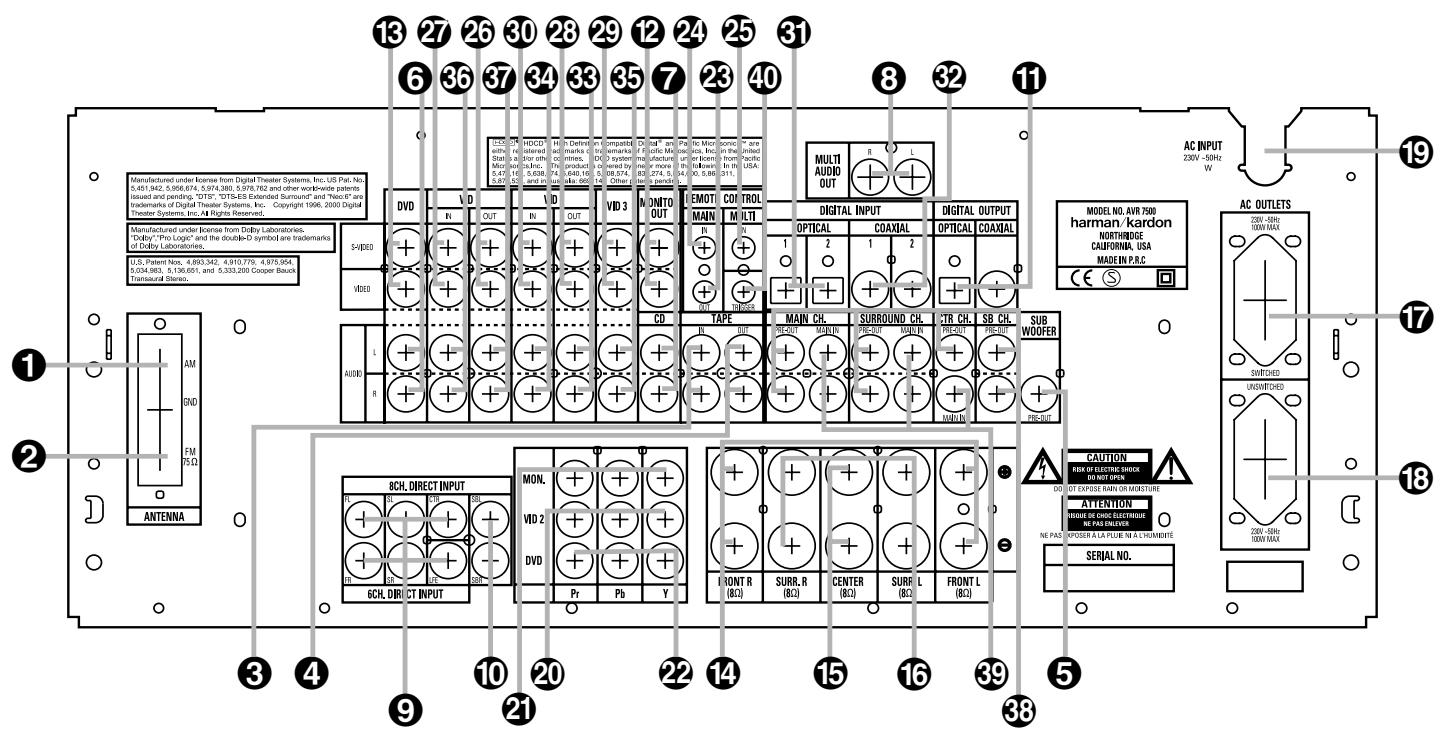
1 AM Antenna
FM Antenna
3 Tape Inputs
4 Tape Outputs
Subwoofer Output
DVD Audio Inputs
CD Inputs
Multiroom Outputs
9 6-Channel Direct Inputs
10 8-Channel Direct Inputs
Digital Audio Outputs
Video Monitor Outputs
DVD Video Inputs
14 Front Speaker Outputs
NOTE: To assist in making the correct connections for multichannel input/output and speaker connections, all connection jacks and terminals have been color coded in conformance with the latest CEA standards as follows:
Front Left: White
Front Right: Red
Center: Green
Surround Left: Blue
Surround Right: Gray
Surround Back Left: Brown
Surround Back Right: Tan
Subwoofer (LFE): Purple
Digital Audio: Orange
Composite Video: Yellow
Component Video "Y": Green
Component Video "Pr": Red
Component Video "Pb": Blue
1 AM Antenna: Connect the AM loop antenna supplied with the receiver to these terminals. If an external AM antenna is used, make connections to the AM and GND terminals in accordance with the instructions supplied with the antenna.
15 Center Speaker Outputs
16 Surround Speaker Outputs
Switched AC Accessory Outlet
18 Unswitched AC Accessory Outlet
19 AC Power Cord
20 Video 2 Component Video Inputs
Component Video Outputs
DVD Component Video Inputs
Remote IR Output
Remote IR Input
Multiroom IR Input
26 Video 1 Video Outputs
Video 1 Video Inputs
Video 2 Video Outputs
FM Antenna: Connect the supplied indoor or an optional external FM antenna to this terminal.
3 Tape Inputs: Connect these jacks to the PLAY/OUT jacks of an audio recorder.
4 Tape Outputs: Connect these jacks to the RECORD/INPUT jacks of an audio recorder.
Subwoofer Output: Connect this jack to the line-level input of a powered subwoofer. If an external subwoofer amplifier is used, connect this jack to the subwoofer amplifier input.
DVD Audio Inputs: Connect these jacks to the analog audio jacks on a DVD or other audio or video source.
CD Inputs: Connect these jacks to the analog output of a compact disc player or CD changer or any other audio source.
Multiroom Outputs: Connect these jacks to an optional audio power amplifier to listen to the source selected by the multiroom system in a remote room.
Video 3 Video Inputs
30 Video 2 Video Inputs
3 Optical Digital Inputs
Coaxial Digital Inputs
Video 2 Audio Outputs
34 Video 2 Audio Inputs
Video 3 Audio Inputs
36 Video 1 Audio Inputs
Video 1 Audio Outputs
Preamp Outputs
39 Main Amplifier Inputs
40 Amplifier Trigger Jack
6-Channel Direct Inputs: If an external digital audio decoder is used, connect the outputs of that decoder to these jacks.
10 8-Channel Direct Inputs: When an optional, external processor or playback device with 6.1 or 7.1 audio capability is in use, connect the Surround Back Left and Surround Back Right channel outputs of the player to these input jacks and all other 6.1/7.1 outputs to the appropriate
6-Channel Direct Inputs ⑨.
Digital Audio Outputs: Connect these jacks to the matching digital input connector on a digital recorder such as a CD-R or MiniDisc recorder.
12 Video Monitor Outputs: Connect this jack to the composite and/or S-Video input of a TV monitor or video projector to view the on-screen menus and the output of any standard Video or S-Video source selected by the receiver's video switcher.
DVD Video Inputs: Connect these jacks to the composite or S-Video output jacks on a DVD player or other video source.
14 Front Speaker Outputs: Connect these outputs to the matching + or - terminals on your left and right speakers. In conformance with the new CEA color code specification, the White terminal is the positive, or "+" terminal that should be connected to the red (+) terminal on Front Left speaker with the older color coding, while the Red terminal is the positive, or "+" terminal that should be connected to the red (+) terminal on Front Right speaker. Connect the black (-) terminals on the AVR 7500 to the black (-) terminals on the speakers. See page 15 for more information on speaker polarity.
15 Center Speaker Outputs: Connect these outputs to the matching + and - terminals on your center channel speaker. In conformance with the new CEA color code specification, the Green Terminal is the positive, or "+" terminal that should be connected to the red (+) terminal on speakers with the older color coding. Connect the black (-) terminal on the AVR to the black negative (-) terminal on your speaker. (See page 15 for more information on speaker polarity.)
16 Surround Speaker Outputs: Connect these outputs to the matching + and - terminals on your surround channel speakers. In conformance with the new CEA color code specification, the Blue terminal is the positive, or "+" terminal that should be connected to the red (+) terminal on the Surround Left speaker with older color coding, while the Gray terminal should be connected to the red (+) terminal on the Surround Right speaker with the older color coding. Connect the black (-) terminal on the AVR to the matching black negative (-) terminals for each surround speaker. (See page 15 for more information on speaker polarity.)
Switched AC Accessory Outlet: This outlet may be used to power any device that you wish to have turn on when the AVR 7500 is turned on with the System Power Control switch 2.
Unswitched AC Accessory Outlet: This outlet may be used to power any AC device. The power will remain on at this outlet regardless of whether the AVR 7500 is on or off (in Standby), provided that the Main Power switch 1 is on.
Note: The total power consumption of all devices connected to the accessory outlets should not exceed 100 watts from the Unswitched Outlet 13 and 50 W from the Switched Outlet 17.
19 AC Power Cord: Connect the AC plug to an unswitched AC wall output.
20 Video 2 Component Video Inputs: Connect the Y/Pr/Pb component video outputs of an HDTV Set-top converter, satellite receiver, or other video source device with component video outputs to these jacks.
Monitor Component Video Outputs: Connect these outputs to the component video inputs of a video projector or monitor. When a source connected to one of the two Component Video Inputs is selected the signal will be sent to these jacks.
DVD Component Video Inputs: Connect the Y/Pr/Pb component video outputs of a DVD player to these jacks.
Note: All component inputs/outputs can be used for RGB signals too, in the same way as described for the Y/Pr/Pb signals, then connected to the jacks with the corresponding color. RGB connection is not possible if the source outputs a separate sync signal (see page 16).
Remote IR Output: This connection permits the IR sensor in the receiver to serve other remote controlled devices. Connect this jack to the "IR IN" jack on Harman Kardon or other compatible equipment.
Remote IR Input: If the AVR 7500's front-panel IR sensor is blocked due to cabinet doors or other obstructions, an external IR sensor may be used. Connect the output of the sensor to this jack.
Multiroom IR Input: Connect the output of an IR sensor in a remote room to this jack to operate the AVR 7500's multiroom control system.
Video 1 Video Outputs: Connect these jacks to the RECORD/INPUT composite or S-Video jack on a VCR.
Video 1 Video Inputs: Connect these jacks to the PLAY/OUT composite or S-Video jacks on a VCR or other video source.
Video 2 Video Outputs: Connect these jacks to the RECORD/INPUT composite or S-Video jacks on a second VCR.
29 Video 3 Video Inputs: Connect these jacks to the PLAY/OUT composite or S-Video jacks on any video source.
Video 2 Video Inputs: Connect these jacks to the PLAY/OUT composite or S-Video jacks on a second VCR or other video source.
3 Optical Digital Inputs: Connect the optical digital output from a DVD player, HDTV receiver, the S/PDIF output of a compatible computer sound card playing MP3 files or streams, LD player, MD player or CD player to these jacks. The signal may be either a Dolby Digital signal, a DTS signal, a 2 channel MPEG 1 signal, an MP3 or HDCD data stream or a standard PCM digital source.
Coaxial Digital Inputs: Connect the coax digital output from a DVD player, HDTV receiver, the S/PDIF output of a compatible computer sound card playing MP3 files or streams, LD player, MD player or CD player to these jacks. The signal may be either a Dolby Digital signal, DTS signal, a 2 channel MPEG 1 signal, an MP3 or HDCD data stream or a standard PCM digital source. Do not connect the RF digital output of an LD player to these jacks.
Video 2 Audio Outputs: Connect these jacks to the RECORD/INPUT audio jacks on a VCR or any Audio recorder.
Video 2 Audio Inputs: Connect these jacks to the PLAY/OUT audio jacks on a second VCR or other audio or video source.
Video 3 Audio Inputs: Connect these jacks to the PLAY/OUT audio jacks on any audio or video source.
Video 1 Audio Inputs: Connect these jacks to the PLAY/OUT audio jacks on a VCR or other audio or video source.
Video 1 Audio Outputs: Connect these jacks to the RECORD/INPUT audio jacks on a VCR or any other Audio recorder.
Preamp Outputs: When the jumper pins that link the Main Amplifier Inputs with these outputs are removed, these jacks may be connected to an external power amplifier.
39 Main Amplifier Inputs: When the jumper pins that link the Preamp Outputs 38 with these inputs are removed, these jacks may be used to connect an external source or the AVR 7500's multiroom system to the internal amplifiers.
Note: Either the Video or S-Video output of any S-Video source must be connected to the AVR 7500, not both in parallel, otherwise the video may be disturbed or its performance be adversely effected.
40 Amplifier Trigger Jack: Connect this jack to the compatible input trigger jack on a power amplifier or other relay controlled device. The connected product will turn on when the AVR is turned on.
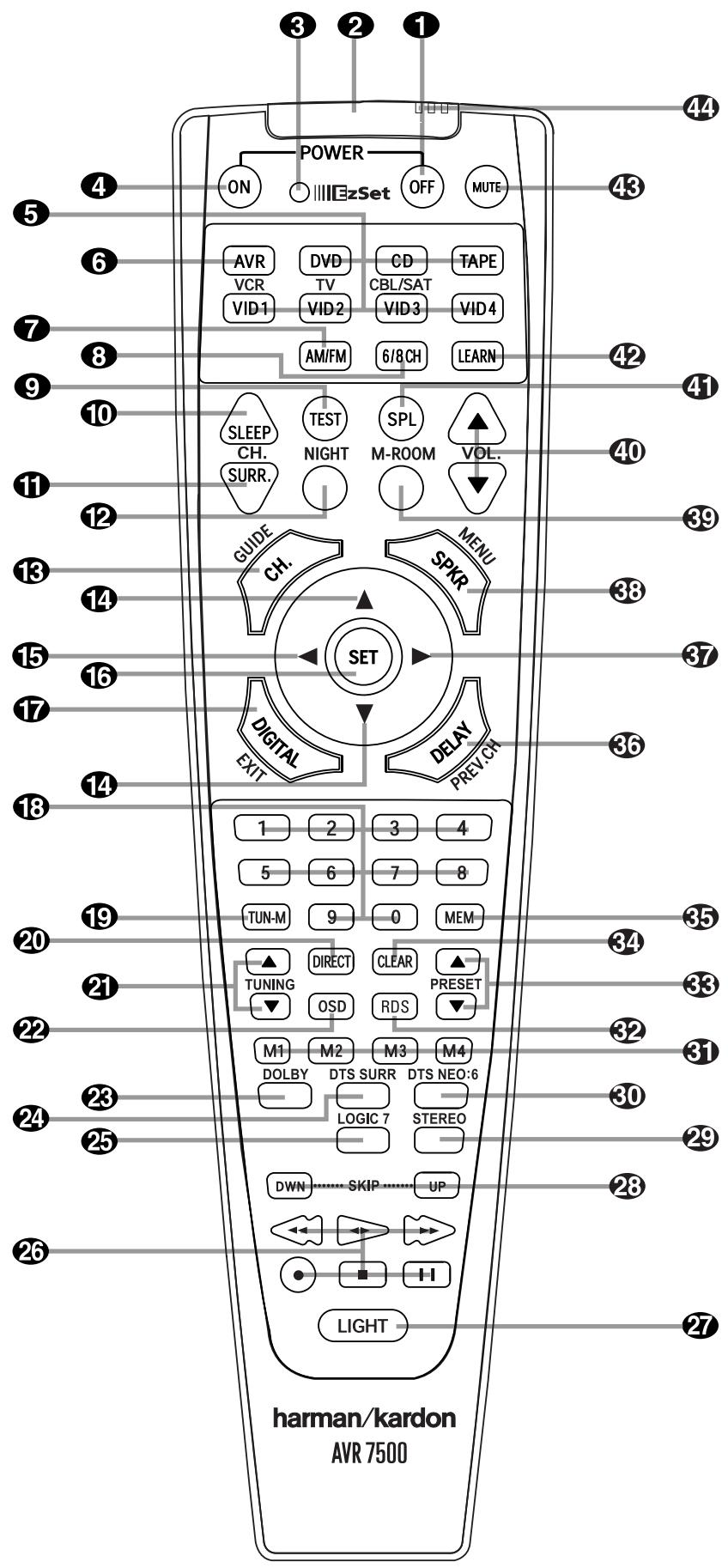
Power Off Button
IR Transmitter Window
Program/SPL Indicator
4 Power On Button
5 Input Selectors
AVR Selector
AM/FM Tuner Select
6-Channel/8-Channel Direct Input
Test Button
10 Sleep Button
Surround Mode Selector
Night Mode
13 Channel Select Button
14 ▲/▼ Buttons
15 2 Button
16 Set Button
17 Digital Select
18 Numeric Keys
19 Tuner Mode
20 Direct Button
21 Tuning Up/Down
22 OSD Button
23 Dolby Mode Select Button
DTS Digital Mode Selector
Logic 7 Mode Select Button
26 Transport Controls
27 Light Button
28 Skip Up/Down Buttons
29 Stereo Mode Select Button
DTS Neo:6 Mode Select
31 Macro Buttons
32 RDS Selector Button
3 Preset Up/Down
34 Clear Button
35 Memory Button
36 Delay/Prev.Ch.
37▶Button
38 Speaker Select
39 Multiroom
40 Volume Up/Down
41 SPL Indicator Select
42 Learn Button
43 Mute
44 EzSet Sensor Microphone
NOTE: The function names shown here are each button's feature when used with the AVR 7500. Most buttons have additional functions when used with other devices. See page 48-49 for a list of these functions.
IMPORTANT NOTE: The AVR 7500's remote may be programmed to control up to seven devices, including the AVR 7500. Before using the remote, it is important to remember to press the Input Selector button that corresponds to the unit you wish to operate. In addition, the AVR 7500's remote is shipped from the factory to operate the AVR 7500 and most Harman Kardon CD or DVD players and cassette decks. The remote is also capable of operating a wide variety of other products using the control codes that are part of the remote or by learning commands from other remotes. Before using the remote with other products, follow the instructions on pages 42-45 to program the proper codes for the products in your system.
It is also important to remember that many of the buttons on the remote take on different functions, depending on the product selected using the Input Selector Button 5. The descriptions shown here primarily detail the functions of the remote when it is used to operate the AVR 7500. (See page 45 for information about alternate functions for the remote's buttons.)
Power Off Button: Press this button to place the AVR 7500 or a selected device unit in the Standby mode. Note that when the AVR 7500 is switched off this will turn off the main room functions, but if the Multiroom system is activated, it will continue to function.
IR Transmitter Window: Point this window towards the AVR 7500 when pressing buttons on the remote to make certain that infrared commands are properly received.
3 Program/SPL Indicator: This three-color indicator is used to guide you through the process of programming the remote or learning commands from a remote into the AVR 7500's remote code memory and it is also used as a level indicator when using the remote's EzSet capabilities. (See page 26 for more information on setting output levels, and see page 42 for information on programming the remote.)
4 Power On Button: Press this button to turn on the power to a device selected by pressing one of the Input Selectors (except Tape).
Input Selectors: Pressing one of these buttons will perform three actions at the same time. First, if the AVR is not turned on, this will power up the unit. Next, it will select the source shown on the button as the input to the AVR. Finally, it will change the remote control so that it controls the device selected. After pressing one of these buttons you must press the
AVR Selector button 6 again to operate the AVR's functions with the remote.
AVR Selector: Pressing this button will switch the remote so that it will operate the AVR's functions. If the AVR is in the Standby mode, it will also turn the AVR on.
AM/FM Tuner Select: Press this button to select the AVR's tuner as the listening choice. Pressing this button when the tuner is in use will select between the AM and FM bands.
6-Channel/8 Channel Direct Input: Press this button to select the device connected to the 6-Channel Direct Inputs or the 8-Channel Direct Inputs (the input available will depend on the selection 5.1 or 6.1/7.1 made in the surround mode setting, see page 23 for more information).
Test Tone: Press this button to begin the sequence used to calibrate the AVR 7500's output levels. (See page 26 for more information on calibrating the AVR 7500.)
Sleep Button: Press this button to place the unit in the Sleep mode. After the time shown in the display, the AVR 7500 will automatically go into the Standby mode. Each press of the button changes the time until turn-off in the following order:
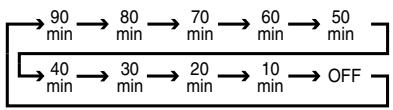
Hold the button pressed for two seconds to turn off the Sleep mode setting. Note that this button is also used to change channels on your TV, VCR and Sat receiver when the appropriate source is selected, using the device Input Selectors ⑤.
11 Surround Mode Selector: Press this button to select any of the HALL, THEATER or VMAX surround modes. Note that depending on the type of input, some modes are not always available. (See page 29 for more information about surround modes.) Note that this button is also used to tune channels on your TV, VCR and Sat receiver when the appropriate source is selected using the device Input Selector 5.
Night Mode: Press this button to activate the Night mode. This mode is available only with Dolby Digital encoded sources, and it preserves dialog (center channel) intelligibility at low volume levels (See page 25 for more information).
13 Channel Select Button: This button is used to start the process of setting the AVR 7500's output levels with an external source. Once this button is pressed, use the / buttons 14 to select the channel being adjusted, then press the Set button 16, followed by the / buttons 14 again, to change the level setting. (See page 35 for more information.)
14 / Buttons: These multipurpose buttons are used to change or scroll through items in the on-screen menus or on the front panel or to make configuration settings such as digital inputs or delay timing. When changing a setting, first press the button for the function or setting to be changed (e.g., press the Digital Select Button
to change a digital input) and then press one of these buttons to scroll through the list of options or to increase or decrease a setting. The sections in this manual describing the individual features and functions contain specific information on using these buttons for each application.
When the AVR 7500 remote is being programmed for the codes of another device, these buttons are also used in the "Auto Search" process (See page 42 for more information on programming the remote.)
15 Button: This button is used to change the menu selection or setting during some of the setup procedures for the AVR 7500.
16 Set Button: This button is used to enter settings into the AVR 7500's memory. It is also used in the setup procedures for delay time, speaker configuration and channel output level adjustment.
17 Digital Select: Press this button to assign one of the digital inputs 31321820 to a source. (See page 33 for more information on using digital inputs.)
18 Numeric Keys: These buttons serve as a ten-button numeric keypad to enter tuner preset positions. They are also used to select channel numbers when TV, VCR or Sat receiver has been selected on the remote, or to select track numbers on a CD, DVD or LD player, depending on how the remote has been programmed.
Tuner Mode: Press this button when the timer is in use to select between automatic tuning and manual tuning. When the button is pressed so that the AUTO indicator x goes out, pressing the Tuning buttons 2110E will move the frequency up or down in single-step increments. When the FM band is in use and the AUTO indicator x is on, pressing this button will change to monaural reception making even weak stations audible or improving the audio performance with noisy stereo stations. (See page 40 for more information.)
20 Direct Button: Press this button when the timer is in use to start the sequence for direct entry of a station's frequency. After pressing the button simply press the proper Numeric Keys
13 to select a station (See page 40 for more information on the tuner).
21 Tuning Up/Down: When the tuner is in use, these buttons will tune up or down through the selected frequency band. If the Tuner Mode button 19 has been pressed or the Band button
12 on the front panel was held pressed so that the AUTO indicator X is illuminated, pressing either of the buttons will cause the tuner to seek the next station with acceptable signal strength for quality reception. When the AUTO indicator
X is NOT illuminated, pressing these buttons will tune stations in single-step increments. (See page 40 for more information.)
OSD Button: Press this button to activate the On Screen Display (OSD) system used to set up or adjust the AVR 7500's parameters.
Dolby Mode Selector: This button is used to select one of the available Dolby Surround processing modes. Each press of this button will select one of the Dolby Pro Logic II modes, Dolby 3 Stereo or Dolby Digital. Note that the Dolby Digital mode is only available with a digital input selected and the other modes only as long as a Dolby Digital source is not playing (except Pro Logic II with Dolby Digital 2.0 recordings, see Note on page 7). See page 29 for the available Dolby surround mode options.
DTS Digital Mode Selector: When a DTS source is in use the AVR 7500 will select the appropriate mode automatically and no other mode will be available. Pressing this button will display the mode currently selected by the AVR's decoder, depending on the surround material played and the speaker setting (see item 6, page 5). When a DTS source is not in use, this button has no function. (See page 24, 29 for the available DTS options.)
25 Logic 7 Selector: Press this button to select one of the available Logic 7 surround modes. (See page 29 for the available Logic 7 options.)
26 Transport Control Buttons: These buttons do not have any functions for the AVR 7500, but they may be programmed for the forward/reverse play operation of a wide variety of CD or DVD players, and audio or video- cassette recorders. (See page 42 for more information on programming the remote.)
Light Button: Press this button to activate the remote's built-in backlight for better legibility of the buttons in a darkened room.
Skip Up/Down Buttons: These buttons do not have a direct function with the AVR 7500, but when used with a compatibly programmed CD or DVD player/changer they will change the tracks on the disc currently being played.
9 Stereo Mode Select Button: Pressing this selector button cycles through the stereo modes, and it is also used to turn off all surround processing and place the unit in a traditional two-channel Stereo mode. The first press selects 5-Channel Stereo or 7-Channel Stereo, depending on the selection (5.1 or 6.1/7.1) made in the surround mode setting, see page 23, and the second selects "SURROUND OFF," which is true Stereo.
0 DTS Neo:6 Mode Selector: Pressing this selector button cycles the AVR through the various DTS Neo:6 modes, which extract a five- or seven-channel surround field from two-channel program material (from PCM source or analog input signal). The first press selects the last DTS Neo:6 surround mode that was in use, and each subsequent press selects the next mode in the following order:
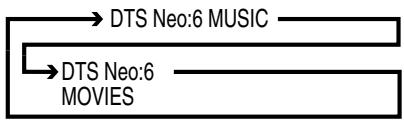
31 Macro Buttons: Press these buttons to store or recall a "Macro", which is a pre-programmed sequence of commands stored in the remote. (See page 44 for more information on storing and recalling macros.)
RDS Select Button: Press this button to display the various messages that are part of the RDS data system of the AVR 7500's tuner. (See page 41 for more information on RDS).
Preset Up/Down: When the tuner is in use, press these buttons to scroll through the stations programmed into the AVR 7500's memory. When CD or DVD is selected using the Input Selector button ⑤, these buttons may function as Slow Fwd/Rev (DVD) or " +10 " (CD, CDR).
34 Clear Button: Press this button to clear incorrect entries when using the remote to directly enter a radio station's frequency.
35 Memory Button: Press this button to enter a radio station into the AVR 7500's preset memory. After pressing the button the MEMORY indicator U will flash; you then have five seconds to enter a preset memory location using the Numeric Keys 18. (See page 40 for more information.)
35 Delay/Prev Ch.: Press this button to begin the process for setting the delay times used by the AVR 7500 when processing surround sound. After pressing this button, the delay times are entered by pressing the Set button 16 and then using the / buttons 14 to change the setting. Press the Set button again to complete the process. (See page 25 for more information.)
37 Button: Press this button to change a setting or selection when configuring many of the AVR's settings.
38 Speaker Select: Press this button to begin the process of configuring the AVR 7500's Bass Management System for use with the type of speakers used in your system. Once the button has been pressed, use the / buttons 14 to select the channel you wish to set up. Press the Set Button 16 and then select the speaker type (Large, Small or None) appropriate with the speaker in use. (See page 21 for more information.)
39 Multi-Room: Press this button to activate the Multiroom system or to begin the process of changing the input or volume level for the second zone. (See page 39 for more information on the Multiroom system.)
40 Volume Up/Down: Press these buttons to raise or lower the system volume.
41 SPL Indicator Select: This button activates the AVR 7500's EzSet function to quickly and accurately calibrate the AVR 7500's output levels. During this sequence, EzSet will automatically adjust the output levels for all channels until they are equal, as shown by the Program Indicator
3 lighting green for each channel. (See page 26 for more information on EzSet.)
42 Learn Button: Press this button to begin the process of "learning" the codes from another product's remote into the AVR 7500's remote. (See page 43 for more information on using the remote's learning function.)
43 Mute: Press this button to momentarily silence the AVR 7500 or TV set being controlled, depending on which device has been selected. When the AVR 7500 remote is being programmed to operate another device, this button is pressed with the Input Selector button 5 to begin the programming process. (See page 42 for more information on programming the remote.)
44 EzSet Sensor Microphone: The sensor microphone for the EzSet microphone is behind these slots. When using the remote to calibrate speaker output levels using EzSet, be sure that you do not hold the remote in a way that covers these slots. (See page 26 for more information on using EzSet).
NOTE: With the press of any remote button the Input Selector button 5 6 associated with the bottom pressed will briefly flash red to confirm the transmission of the command, as long as there is a function for that button with the device selected (see function list on pages 48, 49).
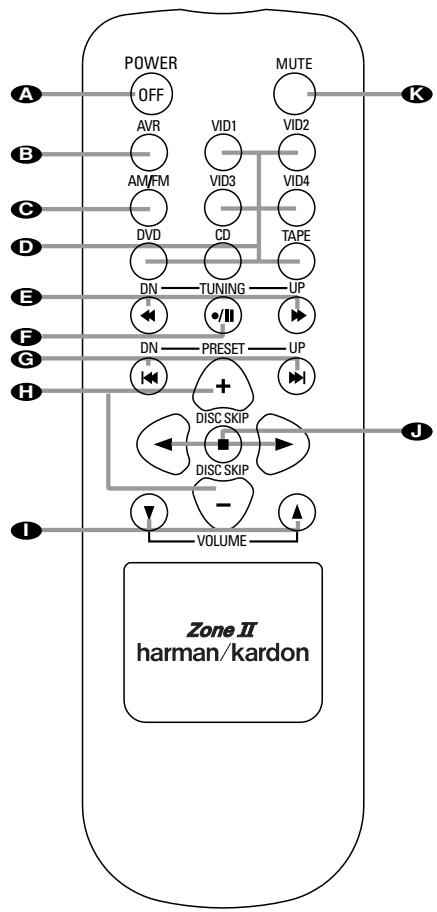
The Zone II remote may be used in either the same room where the AVR 7500 is located, or it may be used in a separate room with an optional infrared sensor that is connected to the AVR 7500's Multi IR input jack.
Power Off: When used in the room where the AVR 7500 is located, press this button to place the unit in Standby. When it is used in a remote room with a sensor that is connected to the Multi IR jack, this button turns the Multi-Room system off.
3 AVR Selector: Press this button to turn on the AVR. The input in use when the unit was last on will be selected.
AM/FM Tuner Select: Press this button to select the Tuner as the input to the Multiroom system. Press it again to change between the AM and FM bands.
Input Selectors: When the AVR is off, press one of these buttons to turn the unit on and to select a specific input. When the unit is already in use, pressing one of these buttons will change the input.
Tuning Up/Down - Fast Play: These buttons may be used to change the frequency of the tuner. These buttons may also control the Fast Play or Fast Reverse functions of compatible Harman Kardon CD, DVD or cassette decks in the same room, or from a remote room when an IR link is connected to the AVR 7500.
Record/Pause: Press this button to activate the Record or Pause function on compatible Harman Kardon CD, DVD or Cassette Deck products.
Preset Up/Down - Track Skip: When the AVR's tuner is selected as the input source, these buttons will move up or down through the list of stations that have been stored in the preset memory. When a CD or DVD player is selected, these buttons activate the forward or reverse track or chapter skip functions.
Disc Skip: Press this button to change discs on compatible Harman Kardon CD or DVD changers.
Volume Up/Down: When used in the room where the AVR 7500 is located, press this button to raise or lower the volume in that room. When it is used in a remote room with a sensor that is connected to the Multi IR Jack, this button will raise or lower the volume in the remote room.
Play Forward/Reverse/Stop: Press these buttons to control compatible Harman Kardon CD, DVD or cassette players.
Mute: When used in the room where the AVR 7500 is located, press this button to temporarily silence the unit. When it is used in a remote room with a sensor that is connected to the Multi IR Jack, this button will temporarily silence the feed to the remote room only. Press the button again to return to the previous volume level.
Important Note: No matter in which room the Zone II remote is used, as with the main remote it is important to remember to press the Input Selector button D that corresponds to the unit you wish to operate before you change the device to be controlled.
A Power Off
AVR Selector
AM/FM Tuner Select
Input Selectors
Tuning Up/Down - Fast Play
F Record/Pause
Preset/Track Skip
Disc Skip
Volume Up/Down
Play Forward/Reverse/Stop
Mute
NOTE: The Zone II remote may be used in either the same room where the AVR 7500 is located, or it may be used in a separate room with an optional infrared sensor that is connected to the AVR 7500's Multi IR input jack ①. When it is used in the same room as the AVR 7500, it will control the functions of the AVR 7500 or any compatible Harman Kardon products in that room. When it is used in a separate room via a sensor connected to the Multi IR Jack ②, the buttons for power, input source, volume and
mute will control the source and volume for the second zone, as connected to the Multi Out Jacks 10. (See page 39 for complete information on using the Multiroom system.)
After unpacking the unit, and placing it on a solid surface capable of supporting its weight, you will need to make the connections to your audio and video equipment.
Audio Equipment Connections
We recommend that you use high-quality interconnect cables when making connections to source equipment and recorders to preserve the integrity of the signals.
When making connections to audio source equipment or speakers it is always a good practice to unplug the unit from the AC wall outlet. This prevents any possibility of accidentally sending audio or transient signals to the speakers that may damage them.
- Connect the analog output of a CD player to the CD inputs ⑦.
NOTE: When the CD player has both fixed and variable audio outputs it is best to use the fixed output unless you find that the input to the receiver is so low that the sound is noisy, or so high that the signal is distorted. - Connect the analog Play/Out jacks of a cassette deck, MD, CD-R or other audio recorder to the Tape Input jacks ③. Connect the analog Record/In jacks on the recorder to the Tape Output jacks ④ on the AVR 7500.
- Connect the digital output of any digital sources such as a CD or DVD changer or player, advanced video game, a digital satellite receiver, HDTV tuner or digital cable set-top box or the output of a compatible computer sound card to the Optical and Coaxial Digital Inputs 31 32 18 20.
- Connect the Coaxial or Optical Digital Outputs 1 on the rear panel of the AVR to the matching digital input connections on a CD-R or MiniDisc recorder.
- Assemble the AM Loop Antenna supplied with the unit as shown below. Connect it to the AM and GND screw terminals 1
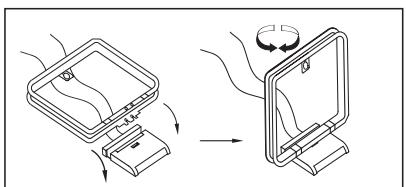
-
Connect the supplied FM antenna to the FM (75 ohm) connection ②. The FM antenna may be an external roof antenna, an inside powered or wire lead antenna or a connection from a cable system. Note that if the antenna or connection uses 300-ohm twin-lead cable, you should use a 300-ohm-to-75-ohm adapter to make the connection.
-
Connect the front, center and surround speaker outputs 14 15 16 to the respective speakers.
To assure that all the audio signals are carried to your speakers without loss of clarity or resolution, we suggest that you use high-quality speaker cable. Many brands of cable are available and the choice of cable may be influenced by the distance between your speakers and the receiver, the type of speakers you use, personal preferences and other factors. Your dealer or installer is a valuable resource to consult in selecting the proper cable.
Regardless of the brand of cable selected, we recommend that you use a cable constructed of fine, multistrand copper with an area greater than 2 mm².
Cable with an area of 1.5mm^2 may be used for short runs of less than 4m . We do not recommend that you use cables with an area less than 1mm^2 due to the power loss and degradation in performance that will occur.
Cables that are run inside walls should have the appropriate markings to indicate listing with any appropriate testing agency standards. Questions about running cables inside walls should be referred to your installer or a licensed electrician who is familiar with the applicable local building codes in your area.
When connecting wires to the speakers, be certain to observe proper polarity. Note that the positive (+) terminal of each speaker connection now carries a specific color code as noted on page 9. However, most speakers will still use a red terminal for the positive (+) connection. Connect the "negative" or "black" wire to the same terminal on both the receiver and the speaker.
NOTE: While most speaker manufacturers adhere to an industry convention of using black terminals for negative and red ones for positive, some manufacturers may vary from this configuration. To assure proper phase and optimal performance, consult the identification plate on your speaker or the speaker's manual to verify polarity. If you do not know the polarity of your speaker, ask your dealer for advice before proceeding, or consult the speaker's manufacturer.
We also recommend that the length of cable used to connect speaker pairs be identical. For example, use the same length piece of cable to connect the front-left and front-right or surround-left and surround-right speakers, even if the speakers are a different distance from the AVR 7500.
- Connections to a subwoofer are normally made via a line level audio connection from the Subwoofer Output ⑤ to the line-level input of a subwoofer with a built-in amplifier. When a
passive subwoofer is used, the connection first goes to a power amplifier, which will be connected to one or more subwoofer speakers. If you are using a powered subwoofer that does not have line-level input connections, follow the instructions furnished with the speaker for connection information.
9. If an external multi-channel audio source with 5.1 outputs such as an external digital processor/decoder, DVD-Audio or SACD player is used, connect the outputs of that device to the 6-Channel Direct Inputs ⑨.
10. If an external multi-channel audio source with 7.1 outputs such as an external digital processor/decoder, DVD-Audio or SACD player is used, first connect the outputs of that device to the 6 Channel Direct Inputs as noted above, and then connect the Surround Back Left and Surround Back Right output channels of the source device to the 8-Channel Direct Inputs 10.
11. If a 7.1 channel source device is connected as noted in the item above, you must use an optional audio power stereo amplifier for the Surround Back channels. Connect the SBL and SBR Preamp Outputs to the inputs of the amplifier feeding those channels' speakers.
Video Equipment Connections
Video equipment is connected in the same manner as audio components. Again, the use of high-quality interconnect cables is recommended to preserve signal quality. To ensure best video performance S-Video sources should be connected to the AVR 7500 only with their S-Video In/ Outputs, not with their composite video connectors too.
- Connect a VCR's audio and video Play/Out
jacks to the Video 1 or Video 2 In
jacks
2730436 on the rear panel. The Audio and
Video Record/In
jacks on the VCR should be con
nected to the Video 1 or Video 2 Out
jacks
2628337 on the AVR 7500. - Connect the analog audio and video outputs of a satellite receiver, cable TV converter or television set or any other video source to the Video 3 29 35 jacks.
- Connect the analog audio and video outputs of a DVD or laser disc player to the DVD jacks 6 13.
-
Connect the digital audio outputs of a CD, MD or DVD player, satellite receiver, cable box or HDTV converter to the appropriate Optical or Coaxial Digital Inputs 31321820.
-
Connect the Composite and S-Video (if S-Video device is in use) Monitor Output ② jacks on the receiver to the composite and S-Video input of your television monitor or video projector.
- If your DVD player and monitor both have component video connections, connect the component outputs of the DVD player to the DVD Component Video Inputs 2. Note that even when component video connections are used the audio connections must still be made to either the analog DVD Audio Inputs 6 or any of the Coaxial or Optical Digital Input jacks 3132.
- If another component video device is available, connect it to the Video 2 Component Video Input jacks ② The audio connections for this device should be made to either the Video 2 Input jacks ④ or any of the Coaxial or Optical Digital Input jacks ③ ②
- If the component video inputs are used, connect the Component Video Output 2 to the component video inputs of your TV, projector or display device.
- If you have a camcorder, video game or other audio/video device that is connected to the AVR on a temporary, rather than permanent basis, connect the audio, video and digital audio outputs of that device to the Front Panel Inputs 182021. A device connected to the Video 4 jacks 21 is selected as the Video 4 input, and connected to the digital jacks 1820 it is selected as "Optical 3" or "Coaxial 3" input. (See page 21 for more information on input configuration.)
Video Connection Notes:
- Y/Pr/Pb Component, RGB (see page 17), S-Video or Composite video signals may only be viewed in their native formats and will not be converted to the other formats. But the OSD can be viewed on the TV screen in any case, with Video or S-Video input selected on the TV.
- When the component video jacks are used, the on-screen menus will not be visible. You must switch to the standard composite or S-Video input on your TV to view those menus.
- All component inputs/outputs can be used for RGB signals too, in the same way as described for the Y/Pr/Pb signals, then connected to the jacks with the corresponding color. But this is only correct as long as only the three RGB video signals are output by the video source, with a sync signal in the "G" signal only, without any sync signal output separately by the source.
Amplifier Trigger Connections
If an optional, external audio power amplifier is used, this jack will provide the connection needed to automate the amplifier's turn-on.
Connect this jack to the Trigger Input on a compatible amplifier. When this connection is made, the amplifier or any other trigger controlled device such as a projection screen or automatic blinds will be tuned on when the AVR is on, and off when the AVR is off.
NOTE: When connecting any device to this jack, make certain that proper connection polarity is maintained and that the total current draw of any device connected does not exceed 500 milliamps. If you are not familiar with this type of connection, we recommend that you consult your dealer or installer for more information.
SCART A/V Connections
For the connections described above your video device needs RCA (cinch) connectors or/and S-Video connectors for all Audio and Video signals: Any normal video device (Not SVHS or High 8) for only playback needs 3 RCA jacks, VCRs for record and playback even 6 RCA jacks. Any S-Video device (SVHS, High 8) needs 2 RCA (Audio) and 1 S-Video jack (Video), if it's a playback unit, or 4 RCA (Audio In/Out) and 2 S-Video (Video In/Out) jacks, if it's a recording VCR.
Many european video devices are equipped with RCA (Cinch) or S-Video jacks only partially, not for all audio and video in/outputs needed as described above, but with a so called Scart or Euro-AV connector (almost rectangular jack with 21 pins, see drawings on next page).
In that case the following Scart to Cinch adapters or cables are needed:
- Units for playback, such as satellite receivers, camcorders, DVD or LD players, need an adapter from Scart to 3 RCA plugs, see fig. 1 (normal video devices) or from Scart to 2 RCA+1 S-Video plugs, see fig. 4 (S-Video devices).
HiFi VCRs need an adapter from Scart to 6 RCA plugs, see fig. 2 (normal video), or from Scart to 4 Audio+2S-Video jacks, see fig. 5 (S-Video VCR). Read carefully the instruction attached to the adapter to find which of the six plugs is used for the record signal to the VCR (connect with the AVR's Out jacks) and for the playback signal from the VCR (connect with the AVR's In jacks). Do not disconnect Audio and Video signals. Don't hesitate to consult your dealer, if you are uncertain.
- If you use only normal video devices the TV monitor needs an adapter from 3 RCA plugs to Scart (fig. 3) only. If also S-Video devices are used an adapter from 2 RCA+1S-Video plugs to Scart is needed additionally (fig. 6), connected to the SCART input on your TV that is provided for S-Video.
Note that only the video plugs (the "yellow" cinch plug in fig. 3 and the S-Video plug in fig. 6) must be connected to the TV Monitor Output 2, and the volume on the TV must be reduced to minimum.
Important Note for Adapter Cables: If the cinch connectors of the adapter you'll use are labeled, connect the Audio and Video "In" plugs with the corresponding Audio and Video "In" jacks on the AVR 7500 (and with a VCR connect the "Out" plugs to the "Out" jacks on the AVR). Note that with some adapter types it may be just turned around: If no signal is audible/visible when the VCR is playing connect the "Out" plugs to the "In" jacks on the AVR and turned around. If the adapter plugs are not labeled in that way, pay attention to the signal flow directions as shown in the diagrams above and in the instruction attached to the adapter. If uncertain, don't hesitate to consult your dealer.
Important Notes for S-Video connections: 1. Only the S-Video In/Out of S-Video devices must be connected to the AVR, NOT both, normal video and S-Video In/Outputs (except the TV see item below). When both connections are made, only the S-Video signal will be viewed on the screen.
- Like most common AV units the AVR 7500 does not convert the Video signal to S-Video or vice versa. Thus both connections must be made from the AVR 7500 to the TV if both, Video and S-Video sources, are used, and the appropriate input on the TV must be selected.
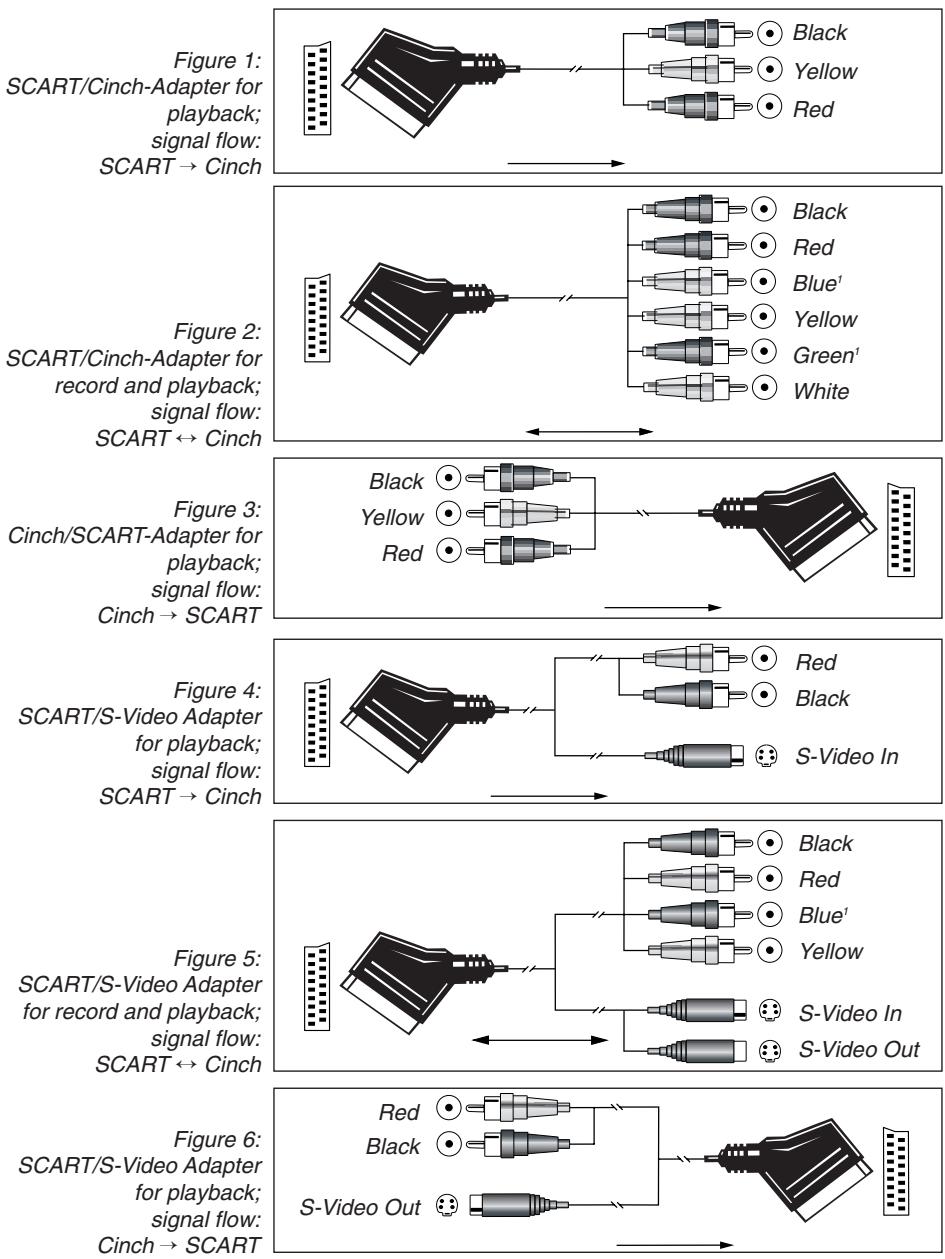
1 Also other colours possible, e.g. brown and grey.
Important Note for the Use of SCART-Cinch Adapters:
When video sources are connected to the TV directly with a SCART cable, specific control signals apart from Audio/Video signals will be fed to the TV. These specific signals are: With all video sources, the signal for automatic input selection that switches the TV automatically to the appropriate input as soon as the video source is started. And with DVD players, the signals automatically turning the TV to 4:3/16:9 format (with 16:9 TVs or with 4:3 TVs with selectable 16:9 format) and turning the RGB video decoder of the TV on or off, depending on the DVD player's setting. With any adapter cable, these control signals will be lost and the appropriate setting of the TV must be made manually.
Note for RGB signal with SCART:
If you use a unit providing RGB signals on a SCART output (as e.g. most DVD players do) and you want to use that RGB signal, this SCART output must be connected directly to your TV. Although the AVR 7500 RDS can switch three-way video signals (like component signals Y/Pb/Pr), most TVs need separate sync signals for RGB (also with SCART) that cannot be switched and provided by the AVR 7500. RGB signals can be pathed through the AVR 7500 only when no separate sync signal is needed (see last "Video Connection Note" on page 16).
System and Power Connections
The AVR 7500 is designed for flexible use with multiroom systems, external control components and power amplifiers.
Main Room Remote Control Extension
If the receiver is placed behind a solid or smoked glass cabinet door, the obstruction may prevent the remote sensor from receiving commands. In this event, the remote sensor of any Harman Kardon or other compatible device, not covered by the door, or an optional remote sensor may be used. Connect the Remote IR Output of that device or the output of the remote sensor to the Remote IR Input jack 24.
If other components are also prevented from receiving remote commands, only one sensor is needed. Simply use this unit's sensor or a remote eye by running a connection from the Remote IR Output jack to the Remote IR Input jack on Harman Kardon or other compatible equipment.
Multiroom IR Link
The key to remote room operation is to link the remote room to the AVR 7500's location with wire for an infrared receiver and speakers or an amplifier. The remote room IR receiver (this can be an optional IR receiver or any other remotable Harman Kardon device in the remote room with IR sensor integrated) should be connected to the AVR 7500 via standard coaxial cable. Connect the Remote IR Output of the device or of the optional sensor with the Multiroom IR Input jack on the AVR 7500's rear panel.
If other Harman Kardon compatible source equipment is part of the main room installation, the Remote IR Output jack on the rear panel should be connected to the IR IN jack on that source device. This will enable the remote room location to control source equipment functions.
NOTE: All remotely controlled components must be linked together in a "daisy chain". Connect the IR OUT jack of one unit to the IR IN of the next to establish this chain.
Multiroom Audio Connections
Depending on the distance from the AVR 7500 to the remote room, two options are available for audio connection:
Option 1: Use high-quality, shielded audio interconnect phono cable from the AVR 7500's location to the remote room. In the remote room, connect the interconnect cable to a stereo power amplifier. The amplifier will be connected to the room's speakers. At the AVR 7500, plug the audio interconnect cables into the
Multiroom Output Jacks 3 on the AVR 7500's rear panel.
Option 2: Place the amplifier that will provide power to the remote location speakers in the same room as the AVR 7500, and connect the Multiroom Output jacks ③ on the rear panel of the AVR to the audio input of the remote room amplifier. Use the appropriate speaker wire to connect the optional power amplifier to the remote speakers. High-quality wire of at least 2.5 ~mm^2 is recommended for long multiroom connections.
NOTE: In both options, you may connect an optional IR sensor in the remote room to the AVR 7500 via an appropriate cable. Connect the sensor's cable to the Multiroom IR Input on the AVR 7500 and use the Zone II remote to control the room volume. Alternatively, you may install an optional volume control between the output of the amplifiers and the speakers.
External Audio Power Amplifier Connections
If desired, the AVR 7500 may be connected to optional, external audio power amplifiers or used with equalizers or speaker systems that require connection between the preamp and amplifier sections of a receiver.
To make these connections, remove the jumpers that connect the Preamp Out jacks 39 and Amplifier In jacks 49 for the channels to be used with external devices. Store the jumpers in a safe place so that the AVR may be used in its normal mode at a future date, if desired.
When an external amplifier is used, connect the Preamp Out jacks to the inputs on the amplifier. When an equalizer or speaker processor is used, connect the Preamp Out jacks to the inputs of the processor, and connect the outputs of the processor back to the Amplifier In jacks on the AVR. Note that when external amplifiers or devices are used, volume is still controlled by the AVR, although additional volume controls on the external device may affect volume and output levels from the AVR.
AC Power Connections
This unit is equipped with two accessory AC outlets. They may be used to power accessory devices, but they should not be used with high-current draw equipment such as power amplifiers. The total power draw to the Unswitched Outlet 13 must not exceed 100 watts, that to the Switched Outlet 17 50 watts.
The Switched 17 outlet will receive power only when the unit is on completely. This is recommended for devices that have no power switch or a mechanical power switch that may be left in the "ON" position.
NOTE: Many audio and video products go into a Standby mode when they are used with switched outlets, and cannot be fully turned on using the outlet alone without a remote control command.
The Unswitched 13 outlet will receive power as long as the unit is plugged into a powered AC outlet and the Main Power Switch 1 is on.
Finally, when all connections are complete, plug the power cord into a nonswitched 220-240-volt AC wall outlet. You're almost ready to enjoy the AVR 7500!
Speaker Selection
No matter which type or brand of speakers is used, the same model or brand of speaker should be used for the front-left, center and front-right speakers. This creates a seamless front soundstage and eliminates the possibility of distracting sonic disturbances that occur when a sound moves across mismatched front-channel speakers.
Speaker Placement
The placement of speakers in a multichannel home-theater system can have a noticeable impact on the quality of sound reproduced.
Depending on the type of center-channel speaker in use and your viewing device, place the center speaker either directly above or below your TV, or in the center behind a perforated front-projection screen.
Once the center-channel speaker is installed, position the left-front and right-front speakers so that they are as far away from one another as the center-channel speaker is from the preferred listening position. Ideally, the front-channel speakers should be placed so that their tweeters are no more than 60cm above or below the tweeter in the center-channel speaker.
They should also be at least 0.5 meter from your TV set unless the speakers are magnetically shielded to avoid colourings on the TV screen. Note that most speakers are not shielded, even with complete surround sets only the Center speaker may be.
Depending on the specifics of your room acoustics and the type of speakers in use, you may find that imaging is improved by moving the front-left and front-right speakers slightly forward of the center-channel speaker. If possible, adjust all front loudspeakers so that they are aimed at ear height when you are seated in the listening position.
Using these guidelines, you'll find that it takes some experimentation to find the correct location for the front speakers in your particular installation. Don't be afraid to move things around until the system sounds correct. Optimize your speakers so that audio transitions across the front of the room sound smooth.
When the AVR 7500 is used in 5.1-channel operation, the preferred location for surround speakers is on the side walls of the room, at or slightly behind the listening position. In a 7.1-channel system, both side surround and back surround speakers are required. The center of the speaker should face you (see below).
Rear surround speakers are required when a full 7.1-channel system is installed, and they may also be used in 5.1 channel mode as an alternative mounting position when it is not practical to place the main surround speakers at the sides of the room. Speakers may be placed on a rear wall, behind the listening position. As with the side speakers, the center of the rear surrounds should face you. The speakers should be no more than 2 meters behind the rear of the seating area.
Subwoofoers produce largely nondirectional sound, so they may be placed almost anywhere in a room. Actual placement should be based on room size and shape and the type of subwoofer used. One method of finding the optimal location for a subwoofer is to begin by placing it in the front of the room, about 15cm from a wall, or near the front corner of the room. Another method is to temporarily place the subwoofer in the spot where you will normally sit, and then walk around the room until you find a spot where the subwoofer sounds best. Place the subwoofer in that spot. You should also follow the instructions of the subwoofer's manufacturer, or you may wish to experiment with the best location for a subwoofer in your listening room.
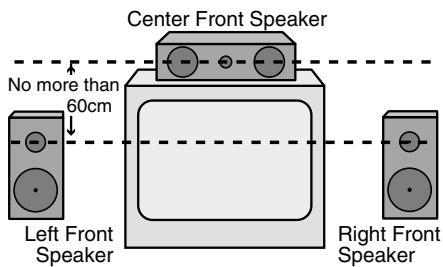
A) Front Channel Speaker Installation with Direct-View TV Sets or Rear-Screen Projectors
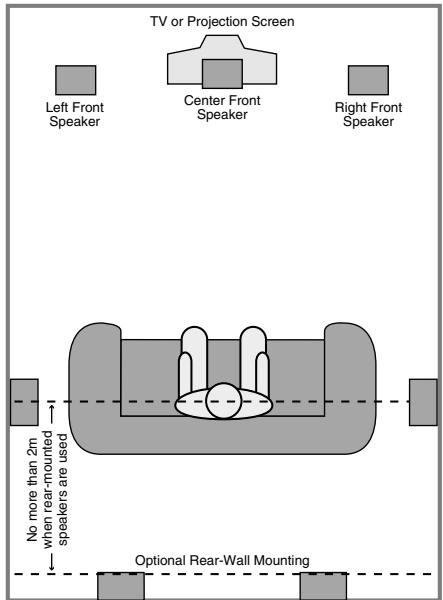
B) The distance between the left and right speakers should be equal to the distance from the seating position to the viewing screen. You may also experiment with placing the left and right speakers slightly forward of the center speaker. Rear speaker mounting is an alternate location for 5.1 systems. It is required for 7.1 operation.
Once the speakers have been placed in the room and connected, the remaining steps are to program the system configuration memories. With the AVR 7500 two kind of memories are used, those associated individually with the input selected, e.g. surround modes, and others working independently from any input selected like speaker output levels, crossover frequencies or delay times used by the surround sound processor.
First Turn On
You are now ready to power up the AVR 7500 to begin these final adjustments.
- Plug the Power Cable 19 into an unswitched AC outlet.
- Press the Main Power Switch 1 in until it latches and the word "OFF" on the top of the switch disappears inside the front panel. Note that the Power Indicator 3 will turn orange, indicating that the unit is in the Standby mode.
- Remove the protective plastic film from the main front-panel lens. If left in place, the film may affect the performance of your remote control.
- Install the three supplied AAA batteries in the remote as shown. Be certain to follow the (+) and (-) polarity indicators that are on the top of the battery compartment.
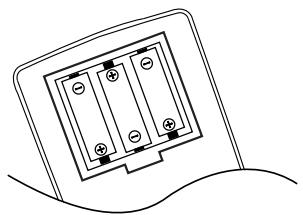
Figure 1
- Turn the AVR 7500 on either by pressing the System Power Control 2 or the Input Source Selector 15 on the front panel, or via the remote by pressing the Power On Button 4, AVR Selector 6 or any of the Input Selectors 5 7 on the remote. The Power Indicator 3 will turn green to confirm that the unit is on, and the Main Information Display 29 will also light up.
NOTE: After pressing one of the Input Selector buttons to turn the unit on, press the AVR Selector to have the remote control the AVR functions.
Using the On-Screen Display
When making the following adjustments, you may find them easier to make via the unit's on-screen display system. These easy-to-read displays give you a clear picture of the current status of the unit and facilitate speaker, delay, input or digital selection you are making.
To view the on-screen displays, make certain you have made a connection from the Video
Monitor Out jack 12 on the rear panel to the composite or S-Video input of your TV or projector. In order to view the AVR's displays, the correct video input must be selected on your video display. Note that the on-screen menus are not available when a component video display is in use.
IMPORTANT NOTE: When viewing the on-screen menus using a CRT-based projector, plasma display or any direct-view CRT monitor or television, it is important that they not be left on the screen for an extended period of time. As with any video display, but particularly with projectors, constant display of a static image such as these menus or video game images may cause the image to be permanently "burned into" the CRT. This type of damage is not covered by the AVR 7500 warranty and may not be covered by the projector TV set's warranty.
The AVR 7500 has two on-screen display modes, "Semi-OSD" and "Full-OSD." When making configuration adjustments, it is recommended that the Full-OSD mode be used. This will place a complete status report or option listing on the screen, making it easier to view the available options and make the settings on the screen. The Semi-OSD mode uses one-line displays only.
Note that when the full OSD system is in use, the menu selections are not shown in the Information Display Y. When the full OSD menu system is used, OSD ON will appear in the Main Information Display Y and the OSD Indicator P will illuminate to remind you that a video display must be used.
When the semi-OSD system is used in conjunction with the discrete configuration buttons, the on screen display will show a single line of text with the current menu selection. That selection will also be shown in the Main Information Display Y.
The full OSD system is always available by pressing the OSD button. When this button is pressed the MASTER Menu (Figure 1) will appear, and adjustments are made from the individual menus. Note that the menus will remain on the screen for 20 seconds after the latest action was made on the screen menu, then they will "time-out" and disappear from the screen.
The time-out may be increased to as much as 50 seconds by going to the ADVANCED SELECT menu, and changing the item titled FULL LOSTIMEOUT.
The semi-OSD system is also available as a system default, although it may be turned off by using the ADVANCED SELECT menu. (See page 37). With the semi-OSD system, you may make adjustments directly, by pressing the buttons on the front panel or remote control for the specific parameter to be adjusted. For example, to change the digital input for any of the sources, press the Digital Select Button 2517 and then any of the Selector buttons 714 or 14 on the front panel or remote.
- MASTER MENU *
Settings to be Made Individually for Each Input in Use
The AVR 7500 features an advanced memory system that enables you to establish different setting for the speaker configuration, digital input and surround mode for each input source. This flexibility enables you to custom tailor the way in which you listen to each source and have the AVR 7500 memorize them. This means, for example, that you may associate different surround modes and analog or digital inputs with different sources, or set different speaker configurations with the resultant changes to the bass management system or the use of the center speaker and/or the Subwoofer. Once these settings are made, they will automatically be recalled whenever you select that input.
The factory default settings for the AVR 7500 have all inputs configured for an analog audio input except for the DVD input, where the Coaxial Digital Input is the default. Once the DSP processing system is used for the first time for any input, the speaker settings will automatically default to "Small" at all positions with the subwoofer set to "LFE." The default setting for the surround modes is "Surround Off," or two-channel stereo, although Dolby Digital or DTS will automatically be selected as appropriate when a source with digital encoding is in use.
Before using the unit, you will probably want to change the settings for most inputs so that they are properly configured to reflect the use of digital or analog inputs, the type of speakers installed and the surround mode associated with the input. Remember that since the AVR 7500 memorizes the settings for each input individually, you will need to make these adjustments for each input used. However, once they are made, further adjustment is only required when system components are changed.
To make this process as quick and as easy as possible, we suggest that you use the full-OSD system with the on-screen menus, and step through each input. Once you have completed the settings for the first input, many settings may be duplicated for the remaining inputs.
The items that follow will describe the individual settings required for each input. Remember that once the settings are made for one input, they must be made for all other input sources in your system.
Input Setup
The first step in configuring the AVR 7500 is to select an input, i.e. to associate an analog or digital input with each input source in use, e.g. CD or DVD. This may be done by pressing the front panel Input Source Selector 15 until the desired input's name appears momentarily in the Main Information Display Y, and the green LED lights next to the input's name in the front panel Input Indicators 23. The input may also be selected by pressing the appropriate Input Selector on the remote control 5 7
When using the full-OSD system to make the setup adjustments, press the OSD button 22 once so that the MASTER MENU (Figure 1) appears. Note that the cursor will be next to the IN/OUT SETUP line. Press the Set button 16 to enter the menu and the IN/OUT SETUP menu (Figure 2) will appear on the screen. Press the buttons 1537 until the desired input name appears in the highlighted video, as well as being indicated in the front panel Input Indicators 28 by the green LED next to the desired input name. If the input will use the standard left/right analog inputs, no further adjustment is needed (except with DVD).
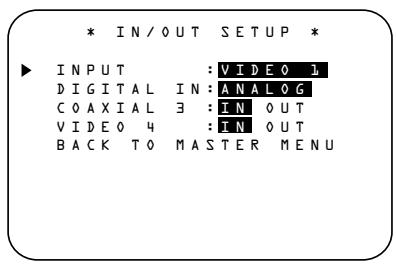
Figure 2
If you wish to associate one of the digital inputs with the selected input source, press the Button 14 on the remote while the IN/OUT SETUP menu (Figure 2) is on the screen, and note that the on-screen cursor will drop down to the DIGITALIN line. Press the Buttons 1537 until the name of the desired digital input appears. To return to the Analog input, press the buttons until the word ANALOG appears. When the correct input source appears, press the button 14 until the cursor appears next to BACKTOMASTERMENU, and press the Set Button 16.
To associate an analog or digital input with the input source currently selected at any time using the discrete function buttons, press the Digital Input Select Button 2417 on the front panel or the remote while the full-OSD is not in use. Within five seconds, make your input selection using the Selector buttons on the front panel 714 or the / 14 Buttons on the remote until the desired digital or analog input is shown in the Main Information Display Y and in the lower third of the video display connected to the AVR 7500. Press the Set Button 16 to enter the new input assignment.
An exclusive Harman Kardon feature is the ability to switch front panel jacks from their normal use as inputs to output connections so that portable recording devices may easily be connected. The front panel analog Video 4 Jacks 21 are normally set as an input for use with camcorders, video games and other portable audio/video products, but they may be switched to an output for connection to portable audio/video recorders. To temporarily switch them to outputs, select the IN / OUT SETUP menu. Press the button until the on-screen cursor is pointing to the Video 4 line. Press the button so that the word OUT is highlighted. Note that the Input/Output Status Indicator 19 between the S and Composite video jacks will turn red, indicating that the analog Video 4 jacks 21 are now record outputs.
On the AVR 7500, the Coaxial 3 Digital Jack 20 is normally an input, but it may also be switched to a digital output for use with CD-R/RW decks, MD recorders or other digital audio recorders. To change the jack to an output, press the / buttons 14 while the IN/OUT SETUP menu is on the screen so that the cursor is next to COAXIAL 3. Then press the / buttons 15/37 so that the word OUT is highlighted. Note that the Digital Coax 3 Status Indicator 19 will turn red, indicating that the jack is now a record output.
Note: A signal will be sent to this jack only when the input selected for use by the AVR 7500 is digital. Digital signals will be passed through regardless of their format, and which digital input (optical or coax) they are fed from. However, analog signals are not converted to digital, and the format of the signal (e.g., PCM, Dolby Digital or DTS) may not be changed.
Selection of the jacks as an output will remain effective as long as the AVR 7500 is on. However, once the unit is turned off, the jack will revert to its normal use as an input when the unit is turned on again.
Speaker Setup
This menu tells the AVR 7500 which type of speakers are in use. This is important as it adjusts the settings that determine which speakers receive low-frequency (bass) information. For each of these settings use the LARGE setting if the speakers for a particular position are traditional full-range loudspeakers that are capable of reproducing sounds below 100Hz . Use the SMALL setting for smaller, frequency-limited satellite speakers that do not reproduce sounds below 100Hz . Note that when "small" speakers are used, a subwoofer is required to reproduce low-frequency sounds. Remember that the "large" and "small" descriptions do not refer to the actual physical size of the speakers, but to their ability to reproduce low-frequency sounds. If you are in doubt as to which category describes your speakers, consult the specifications in the speakers' owner's manual, or ask your dealer.
Notes:
- As the speaker settings need to be made for each input individually, you can determine which speaker should be used depending on the input source selected. So it's possible e.g. to turn off the Center and/or the Sub with any music source selected and to use them with any movie input source.
- With the currently selected input all speaker settings will be copied to all other surround modes (as far as speakers are used with them) and need not be repeated when another surround mode is selected with that input.
To start with the speaker setting, first select any of the DTS Neo:6 modes as with them all speakers and all speaker modes are available. It is easiest to select these modes directly, without the on-screen display, so press the OSD button 22 to turn the on-screen display off if it is still visible. Then press the DTS Neo:6 button 17 on the front panel or 30 on the remote.
- It is easiest to enter the proper settings for the speaker setup through the SPEAKER SETUP menu (Figure 3). So press the OSD Button 22 to bring up the MASTER MENU (Figure 1), and then press the Button 14 twice so that the cursor is on the SPEAKER SETUP line. At this point, press the Set Button 16 to bring up the SPEAKER SETUP menu (Figure 3).
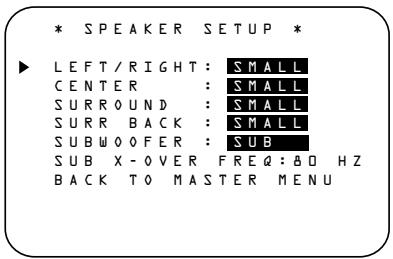
Figure 3
- When the SPEAKER SETUP menu first appears, the on-screen cursor will be at the top of the list of speaker positions, pointing toward the LEFT/RIGHT line, which sets the configuration for the front left and right speakers. Note that this front speaker setting is not available when an analog input with stereo mode is selected to ensure purest analog sound performance by bypassing the DSPs and also all their crossover networks. If you wish to make a change to the front speakers' configuration, press the Buttons 1537 so that either LARGE or SMALL appears, matching the appropriate description from the definitions shown above.
When SMALL is selected, low-frequency front channel sounds will be sent only to the subwoofer output. If you choose this option and there is no subwoofer connected, you will not hear any low-frequency sounds with front channel signals.
When LARGE is selected, a full-range output will be sent to the front left and front right outputs. Depending on the choice made in the SUBWO OFER line in this menu (see below), the front left and right bass information may also be directed to the subwoofer.
Important Note: When a speaker set with a subwoofer and two front satellites connected to the Sub's speaker outputs is used, the Sub's inputs must be connected to the Front speaker outputs 4 and LARGE must be selected for the front speakers.
-
When you have completed your selection for the front channel, press the Button 14 on the remote to move the cursor to CENTER.
-
Press the Buttons 1537 on the remote to select the option that best describes your center speaker, based on the speaker definitions shown below.
When SMALL is selected, low-frequency center channel sounds will be sent to the Fronts, if they are set to LARGE and Sub is turned off (see below). When Sub is on, low frequency center channel sounds will be sent to the subwoofer only.
When LARGE is selected, a full-range output will be sent to the center speaker output, and NO center channel signal will be sent to the subwoofer output (except when the Pro Logic II Music mode is in use).
NOTE: If you choose Logic 7 as the surround mode for the particular input source for which you are configuring your speakers, the AVR 7500 will not make the LARGE option available for the center speaker. This is due to the requirements of Logic 7 processing, and does not indicate a problem with your receiver.
When NONE is selected, no signals will be sent to the center-channel output. The receiver will operate in a "phantom" center channel mode. Center-channel information will be sent to the left and right front channel outputs and the center channel bass will be sent to the subwoofer output when SUBL/R+LFE is selected in the SUBWOOFER line in this menu (see below). This mode is needed if no Center speaker is used. Note that when the Logic 7 Cinema or Enhanced surround modes are selected a Center speaker must be used, the Logic 7 Music mode works well without a Center too.
-
When you have completed your selection for the center channel, press the Button 14 on the remote to move the cursor to SURROUND.
-
Press the Buttons 1537 on the remote to select the option that best describes the surround speakers in your system based on the speaker definitions shown on page 21.
When SMALL is selected, with all digital surround modes low-frequency surround channel sounds will be sent to the Fronts when Sub is turned off or to the subwoofer output when Sub is on. With any analog surround mode the rear bass feed depends on the mode selected and the setting of the Sub and front speakers.
When LARGE is selected, a full-range output will be sent to the surround channel outputs (with all analog and digital surround modes), and, except with Hall and Theater modes, NO surround channel bass will be sent to the subwoofer output.
When NONE is selected, surround-sound information will be split between the front left and front right outputs. For optimal performance when no surround speakers are in use, the Dolby 3 Stereo mode should be used.
When you are using surround back speakers with your system, press the Button 14 on the remote to move the cursor to SURR BACK and set the speaker type for the speakers connected to the Surround Back Preamp
Outputs through an optional, external power amplifier. The choices and procedure for configuring these speakers are identical to those shown above for the main surround speakers.
Note: As the surround back speaker selection is a basic configuration for your system it will be effective with all inputs and need not be repeated with each other input in use.
-
When you have completed your selection for the surround channels, press the Button 14 on the remote to move the cursor to SUBWO OFER.
-
Press the Buttons 15 37 on the remote to select the option that best describes your system.
The choices available for the subwoofer position will depend on the settings for the other speakers, particularly the front left/right positions.
If the front left/right speakers are set to SMALL, the subwoofer will automatically be set to SUB, which is the "on" position.
If the front left/right speakers are set to LARGE, three options are available:
-
If no subwoofer is connected to the AVR 7500, press the Buttons 1537 on the remote so that NONE appears in the on-screen menu. When this option is selected, all bass information will be routed to the front left/right "main" speakers.
-
If a subwoofer is connected to the AVR 7500, you have the option to have the front left/right "main" speakers reproduce bass frequencies at all times, and have the subwoofer operate only when the AVR 7500 is being used with a digital source that contains a dedicated Low Frequency Effects, or LFE soundtrack. This allows you to use both your main and subwoofer speakers to take advantage of the special bass created for certain movies. To select that option press the Buttons 15 on the remote so that SUB (LFE) appears in the on-screen menu.
-
If a subwoofer is connected and you wish to use it for bass reproduction in conjunction with the main front left/right speakers, regardless of the type of program source or Surround mode you are listening to, press the Buttons
1537 on the remote so that SUB L/R+LFE appears in the on-screen menu. When this option is selected, a full-range signal will be sent to the front left/right "main" speakers, and also to the LFE sound-track. The subwoofer will receive the front left and right bass frequencies under the crossover frequency selected in the next option setting on this menu, as described below.
- When you have completed your selection for the subwoofer, press the Button 14 on the remote to change the cursor to SUBX- OVERFREQ. The subwoofer crossover setting may only be adjusted using the on-screen display system.
At this line, you will select the frequency under which bass information is directed to the Subwoofer Output ⑤ and above which the remaining signal is directed to all speakers that are set to SMALL. The choices available will depend on the setting made previously for the front left/right speakers. When making these selections, choose the crossover frequency that is closest to the lower frequency limit of your front left/right speakers. This figure is normally printed in the owner's manual or data sheet for the speakers; or consult the speaker's manufacturer.
- When the front speakers have been set to LARGE, the crossover choices are 40 Hz or 60 Hz to match the typical crossover points of full range speakers. When you use large full range front speakers, able to reproduce bass below 40Hz with sufficient power, choose 40 Hz, otherwise select 60 Hz.
-
When the front speakers have been set to SMALL, the crossover choices are 00 Hz or 100 Hz to match the typical crossover points of the smaller speakers used in satellite speaker systems. Choose the option that is closest to your speakers' design.
-
When all speaker selections have been made, press the Button 14 and then the Set Button 16 to return to the Main menu.
-
The Speaker Configuration may also be changed at any time without using the full-OSD on-screen menu system by pressing the Speaker Select button on the remote 33. Once the button is pressed, FNT SPEAKER will appear in both the lower third of the video display and the Main Information Display V.
Within five seconds, either press / buttons 14 on the remote to select a different speaker position, or press the Set Button 12 to begin the adjustment process for the front left and right speakers.
When the Set button 12 16 has been pressed and the system is ready for a change to the front speaker setting, the on-screen display and Main Information Display Y will read FNT LARGE or FNT SMALL depending on the current setting. Press the / buttons 14 on the remote until the desired setting is shown, using the instructions for "large" or "small" shown earlier, then press the Set button 12 16.
If another speaker position needs to be changed, press the / buttons 14 on the remote to select a different speaker position, press the Set button 12 16 and then the / buttons 14 on the remote until the correct speaker setting is shown and press the Set button 12 16 again to confirm the selection.
To assist in making these settings, the icons in the Speaker/Channel Input Indicators will change as the speaker type is selected at each position. When only the inner icon box is lit, the speaker is set for "small." When the inner box and the two outer boxes with circles inside them are lit, the speaker is set for "large." When no indicator appears at a speaker location, that position is set for "none" or "no" speaker.
Note: These icons are available only when making setup changes without the use of the full OSD mode.
As an example, in the Figure below, all speakers are set for "large," and a subwoofer is set.
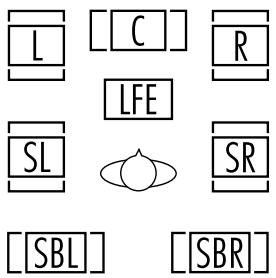
Surround Setup
Once the speaker setup has been completed, the next step for that input is to set the surround mode you wish to use with that input. Since surround modes are a matter of personal taste, feel free to select any mode you wish - you may change it later. The Surround Mode chart on page 28 may help you select the mode best suited to the input source selected. For example you may select Dolby Pro Logic II or Logic 7 for most ana
log inputs and Dolby Digital for inputs connected to digital sources. In the case of inputs such as a CD Player, Tape Deck or Tuner, you may wish to set the mode to Stereo, if that is your preferred listening mode for standard stereo sources, where it is unlikely that surround encoded material will be used. Alternatively, the 5 Channel Stereo or Logic 7 Music mode may also be a good choice for stereo-only source material.
It is easiest to complete the surround setup using the full-OSD on-screen menus. From the MAS-TER menu (Figure 1), press the / buttons until the cursor is next to the SURROUND SELECT menu. Press the Set Button so that the SURROUND SELECT menu (Figure 4) is on the screen.
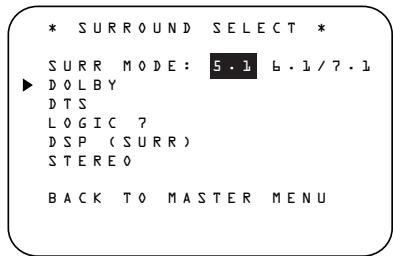
Figure 4
The first line on the SURROUND SELECT menu allows you to configure the AVR for either standard 5.1 or advanced 6.1/7.1 operation. With the on-screen cursor at the SURRENDE line, press the Set Button 16 and then press the or Buttons 15 so that 5.1 is highlighted if you have no surround back speakers installed, or b.1/7.1 if you have one or two speakers connected to the Surround Back Preamp Outputs through optional, external power amplifiers.
Making this selection will set the surround mode options for the AVR so that only the correct modes for the number of speakers in your specific system will be available. Should you change your system and add additional speakers at a later date, it is important to change this setting so that advanced surround modes such as 7 Channel Stereo, Logic 7/7.1, DTS-ES 6.1 Discrete and Matrix, DTS+NEO:6, and DTS NEO:6 will be available.
Important Note: As this 5.1 or 6.1/7.1 selection is a basic configuration for your system it will be effective with all inputs and need not be repeated with all other inputs in use. Moreover this setting is linked with the Surround Back Speaker selection outlined on page 22, both settings will turn on ("6.1/7.1") or off ("5.1") these speakers in the same manner.
When the desired selection is made, press the Set Button to continue with the setup and configuration.
Once the setting is made for 5.1 or 6.1/7.1 operation, the default surround mode for an input should be set. Each of the remaining five lines on the menu (Figure 4) contains the various surround mode categories, and within those menus you may choose one of the sub-modes. Note that the list of specific sub-modes in some categories will vary according to whether 5.1 or 6.1/7.1 operation is chosen and Dolby Digital will appear only when a digital input is selected. In addition, the DTS modes (except NEO:6) available in the AVR 7500 will not appear unless a digital source is selected and playing the correct bitstream.
Note: When a Dolby Digital or DTS source is selected and playing, the AVR 7500 will select the appropriate surround mode automatically, no matter which surround mode was selected for that input as default. Then no other surround modes will be available, except VMAX with Dolby Digital recordings and all Pro Logic II modes with Dolby Digital 2 channel (2.0) recordings (see page 34).
To select the mode that will be used as the initial default for an input, first press the / buttons 14 until the on-screen cursor is next to the desired mode's master category name. Next, press the Set Button 16 to view the submenu. Press the Buttons 15-37 to scroll through the available choices, and then press the Button 14 so that the cursor is next to BACK TO MASTER MENU to continue the setup process.
On the Dolby menu (Figure 5), the selection choices include Dolby Digital, Dolby Pro Logic II Music, Dolby Pro Logic II Cinema, Dolby Pro Logic II Emulation and Dolby 3 Stereo. A complete explanation of these modes is found on Page 29. Note that when the Dolby Digital mode is selected there are additional settings available for the Night mode that are associated with the surround mode only, not with the input. That's why these settings must be made only once, not with each input in use. They are described later in the next main chapter (see below).
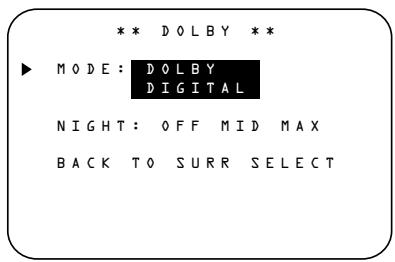
Figure 5
On the DTS menu, the selection choices made with the Buttons 1537 on the remote are determined by a combination of the type of DTS program material in use and whether the 5.1 or 6.1/7.1 speaker output configuration is in use. When either of the speaker configurations is in use, you may select either the Neo:6 Music or Neo:6 Cinema mode when an analog source is playing to deliver an enhanced 5.1-channel or even 7.1 channel sound field.
When the 5.1 configuration is in use the AVR will automatically select the 5.1 version of DTS processing when a DTS data stream is received. When the 6.1/7.1 mode is selected, the DTS-ES Discrete mode will automatically be activated when a DTS source with the ES Discrete "flag" is in use. In these cases the DTS-ES Mode Indicator will light. When a non-ES DTS disc is in use, when the 6.1/7.1 mode is chosen the unit automatically will select the DTS + NEO:6 mode to create a full eight-speaker surround mode. See page 29, 33 for a complete explanation of the DTS modes.
On the Logic 7 menu, the selection choices made with the Buttons 1537 on the remote are determined by whether the 5.1 or 6.1/7.1 speaker output configuration is in use. In either case, the selection of a Logic 7 mode enables Harman Kardon's exclusive Logic 7 processing to create fully enveloping, multichannel surround from either two-channel Stereo or Matrix-encoded programming such as VHS cassettes, laserdiscs or television broadcasts produced with Dolby surround.
In the 5.1 configuration you may select the Logic 7/5.1 Music, Cinema or Enhanced modes. They work best with two-channel music, surround-encoded programs or standard two-channel programming of any type, respectively. When the 6.1/7.1 mode is selected, the Logic 7/7.1 Music or Cinema modes are available, but the output will be in a full eight-channel sound field. Note that the Logic 7 modes are not available when either Dolby Digital or DTS Digital soundtracks are in use.
On the DSP (SURR) menu, the selection choices made with the Buttons 1537 on the remote select one of the DSP surround modes that are designed for use with two-channel stereo programs to create a variety of sound field presentations. The choices available are Hall 1, Hall 2, Theater, VMAx Near and VMAx Far. The Hall and Theater modes are designed for multichannel installations, while the two VMAx modes are optimized for use in delivering a full surround field when only the front left and front right speakers are installed. See pages 29 and 30 for a complete explanation of the DSP surround modes. Note that the Hall and Theater modes are not available when a Dolby Digital or DTS soundtrack is played.
On the STEREO menu, the selection choices made with the Buttons 1537 on the remote may either turn the surround processing off for a traditional two-channel stereo presentation, or select 5 Stereo or 7 Stereo depending on whether the 5.1 or 6.1/7.1 output is in use. The latter modes feed the stereophonic input signal to both front speakers, to the rear speakers and to both surround back speakers (if in use), while the monophonic signal parts are spread over all speakers, also the Center. See page 30 for a complete explanation of the 5 Stereo and 7 Stereo modes.
After the selections are made in the Dolby, DTS, Logic 7, DSP (Surround) or Stereo menus, press the / buttons so that the cursor moves to the BACK TO SURR SELECT line and presses the Set Button.
Adjustments for Other Inputs
After one input has been adjusted for analog or digital input, speaker type and surround mode, return to the INPUT SETUP line on the MASTER menu and enter the settings for each input that you will use. In most cases, only the digital input and surround mode may be different from one input to the next, while the speaker type will usually be the same and may easily be entered by copying the speaker settings from the first input adjusted. But if preferred you can also select different speaker types or turn speakers on or off individually for each input in use.
Settings Keeping Independent from the Input Selected
After the settings described above have been made for all input sources in your system, the following settings, made with any input, will remain in effect independent of the input selected. In order to set delay time for Dolby Digital and Dolby Pro Logic II surround modes, the OSD menu system must be used.
Delay Settings
Only for the Dolby Digital or Dolby Pro Logic modes, you will need to adjust the delay time setting. Note that the delay time is not adjustable for any other modes.
Important Note: Once the delay time is set with any input it will be effective with all other inputs too. Moreover the surround delay time setting must be made only for the Dolby Digital mode. The other setting will be set automatically.
Due the different distances between the listening position for the front channel speakers and the surround speakers, the amount of time it takes for sound to reach your ears from the front or surround speakers is different. You may compensate for this difference through the use of the delay settings to adjust the timing for the specific speaker placement and acoustic conditions in your listening room or home theater.
The factory setting is appropriate for most rooms, but some installations create an uncommon distance between the front and surround speakers that may cause the arrival of front channel sounds to become disconnected from surround channel sounds.
To resynchronize the front and surround channels, follow these steps:
- Measure the distance from the listening/ viewing position to the front speakers in meters.
- Measure the distance from the listening/ viewing position to the surround speakers.
- Subtract the distance to the surround speakers from the distance to the front speakers and multiply the result by 3.
The optimal delay time is the result of that subtraction. For example, if the front speakers are 3 m away and the surround speakers are 1 m away, the optimal delay time is figured as (3 - 1)× 3 = 6 . Thus, in this example, the delay time for Dolby Digital should be set at six milliseconds.
NOTE: The DTS, Logic 7, 5/7CH Stereo, Hall and Theater modes use a fixed, nonadjustable delay time.
The Dolby Digital Mode also includes a separate setting for the center channel delay mode, since the discrete nature of these signals makes the location of the center channel speaker more critical. To calculate the delay for the center channel, measure the distance from the preferred listening position in the center of the room to both the center channel speaker and either the left or right speaker.
If the distances are equal, no further adjustment is required and the center delay should be set to zero. If the distance to the front speakers is greater than the distance to the center speaker, you may wish to reposition the speakers by moving the front left and front right speakers closer to the listening position or the center speaker further away from the listening position.
If repositioning of the speakers is not possible, adjust the center delay time, adding one milli-second of center channel delay for every 30~cm closer to the listening position the center speaker is than the front speakers. For example, if the front left and front right speakers are each 3m from the listening position and the center channel speaker is 2.4m away, the delay is figured as 300cm - 240cm = 60cm , suggesting an optimal center delay of 2 milliseconds.
To set the delay time, continue within the MASTER MENU (Figure 1). If the system is not already at that point, press the OSD button to bring up the master menu. To make the delay settings for the Dolby Digital mode (this will include the Center delay setting, and the surround delay for the Pro Logic mode will be set automatically), press the Set 16 button and select any input now that is associated with a digital input and the Dolby Digital surround mode (the surround mode associated with each input selected will be indicated by the Surround Mode Indicators 31 in the front panel), then return to the master menu. Press the Button 14 three times or until the on-screen cursor is pointing at the DELAYADJUST line. Press the Set Button 16 to call up the menu.
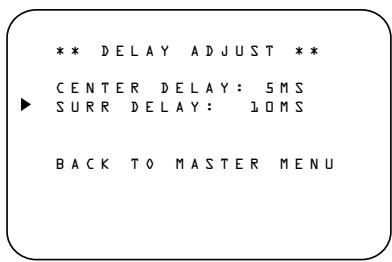
Figure 6
As the Dolby Digital mode is selected, the CENTER DELAY line is where the first adjustment is made. Now press the Buttons 1537 until the number calculated using the formula shown above for the center speaker appears in the display. When the CENTER DELAY is entered, press the Button 14 once to move to the next line.
Now the cursor will be at the S U R R DEL A Y line so that the delay for the surround speakers may be set. Press the Buttons 1537 until the number calculated using the formula for the surround speakers shown above appears in the display. When the delay settings are complete, press the Button 14 once so that the cursor is next to the BACK TO MASTER MENU line and press the Set Button 16 to return to the MASTER menu.
Note that the delay settings may also be adjusted at any time when the Dolby Digital or Dolby Pro Logic II modes are in use by pressing the Delay button on the remote 36. Then press the / 14 buttons on the remote to select the Center or Rear channels for adjustment, followed by a press of the Set button 16. Next, press the / buttons 14 on the remote until the desired figure appears in the Main Information Display N and press the Set button 16 twice to confirm the setting and return to the normal display.
Night Mode Settings
The Night mode is a feature of Dolby Digital that uses special processing to preserve the dynamic range and full intelligibility of a movie sound track while reducing the peak level. This prevents abruptly loud transitions from disturbing others, without reducing the sonic impact of a digital source. Note that the Night mode is only available when the Dolby Digital surround mode is selected.
To adjust the Night mode setting from the menu press the OSD Button 22 so that the MASTER menu appears. Then press the button 14 once and press Set 16 to select the SURROUND SETUP menu. Again press the button 14 once and press Set 16 to select the DOLBY menu (see fig.7).
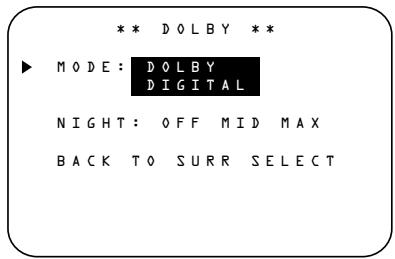
Figure 7
To adjust the Night mode setting, make certain that the cursor is on the NIGHT line of the DOLBY menu. Next, press Buttons 1537 to choose between the following settings.
OF: When OFF is highlighted, the Night mode will not function.
MID: When MID is in the highlighted video, a mild compression will be applied.
MAX: When MAX is in the highlighted video, a more severe compression algorithm will be applied.
When you want to use the Night mode feature, we recommend that you select the MID setting as a starting point and change to the MAX setting later, if desired.
When the setting has been made, press the / buttons 14 so that the cursor is next to BACK TO SURR SELECT, and press the Set button 16 to return to the SURROUND SELECT menu.
Note that the Night mode may be adjusted directly any time that Dolby Digital surround mode is selected by pressing the Night button 12. When the button is pressed, the words D-RANGE followed by the current setting (MID, MAX, OFF) will appear in the lower third of the video screen and in the Main Information Display Y. Press the / buttons 14 within five seconds to select the desired setting, then press Set 16 to confirm the setting.
Output Level Adjustment
Output level adjustment is a key part of the configuration of any surround-sound product. It is particularly important for a digital receiver such as the AVR 7500, as correct outputs ensure that you hear sound tracks with the proper directionality and intensity.
NOTE: Listeners are often confused about the operation of the surround channels. While some assume that sound should always be coming from each speaker, most of the time there will be little or no sound in the surround channels. This is because they are only used when a movie director or sound mixer specifically places sound there to create ambience, a special effect or to continue action from the front of the room to the rear. When the output levels are properly set, it is normal for surround speakers to operate only occasionally. Artificially increasing the volume to the rear speakers may destroy the illusion of an enveloping sound field that duplicates the way you hear sound in a movie theater or concert hall.
IMPORTANT NOTE: The output level can be adjusted for each digital and analog surround mode individually. This allows you to compensate for level differences between speakers, that may also vary with the surround mode selected, or to increase or decrease the level of certain speakers intentionally, depending on the surround mode selected. Note that adjustments made for any surround mode are effective with all inputs associated with the same surround mode.
Before beginning the output level adjustment process, make certain that all speaker connections have been properly made. The system volume should be turned down at first. Finally, make certain that the Balance Control 28 is set to the center "12 o'clock" position.
Using EzSet
Harman Kardon's exclusive EzSet remote makes it possible to quickly and accurately set the AVR 7500's output levels without the use of a sound pressure meter, although manual adjustment is also available. However, for the easiest set-up, follow these steps while seated in the listening position that will be used most often:
- Make certain that all speaker positions have been properly configured for their "large" or "small" settings (as outlined above) and turn off the OSD system if it is in use.
- Adjust the volume so that it is at -1, 5, as shown in the on-screen display or Main Information Display Y.
- Select any input associated with the surround mode for which you want to adjust the output levels. Remember that the same adjustments must be made with all other surround modes you've in use.
- Hold the remote in front of you, being sure not to cover the EzSet Sensor Microphone 44 at the top of the remote and aim it at the AVR 7500, don't hold it vertically (like a microphone).
-
Press and hold the SPL Indicator Select Button 4 for three seconds. Release it when the Program/SPL Indicator 3 stops flashing and remains lit. Press the 5 Button 13 on the remote if your system is configured for 5.1 operation with standard speakers or when it is configured for 7.1 operation but the surround back speakers are not in use with the surround mode currently selected. Press the 7 Button 13 on the remote only if your system is configured for 6.1/7.1 operation with a full speaker complement including rear surround speakers and the surround back speakers are in use with the surround mode selected. Note that all speakers currently in use always are indicated by the Speaker/Channel Indicators 4 in the front panel display. Once the correct channel configuration button has been pressed the test noise will be heard from the front left speaker.
-
At this point, EzSet will take over, adjusting the output level of each channel so that when the process is complete all levels will be equal and at the set reference point. This process may take a few minutes, depending on the extent of adjustment required.
- During the adjustment, you will see the location of the channel position being adjusted appear in the on-screen display (if connected) and in the Main Information Display Y, alternating with a readout of the output setting, relative to the reference volume level. As the adjustment proceeds, a few things will happen simultaneously:
- The channel position being adjusted will flash in the Speaker/Channel Input Indicators . If the test noise is heard from a channel other than the one shown in the Indicator, the on-screen display or the front panel display, there is an error in the speaker connections. If this is the case, press the Test Button TWICE to stop the adjustment. Then, turn the unit off and verify that all speakers are connected to the proper Outputs 1415 and that any connections made to rear surround speakers powered by optional amplifiers through the Preamp Outputs 38 are correct. Afterwards start the adjusting process again from the beginning.
- As the individual channels are set, the channel name and the adjustment offset will appear in the on-screen display (if connected) and the Main Information Display Y. While the level is changing, the Program/SPL Indicator 3 will change colors to reflect the output level in relation to the reference. A red indication shows that the level is too high, while an orange indication shows that the level is too low. When the indicator is green, the level is correct, and the test noise will move to the next channel.
-
While adjustments are being made, the red LED under the AVR Selector ⑥ will flash. This is normal, and indicates that EzSet is operating.
-
After the test noise has circulated once through each channel, it will send the tone to each channel once again, to verify the settings.
- After two complete circulations of the tone, the levels are set. The Program/SPL Indicator ③ will remain green at each channel. Upon completion of the second circulation, the Program/SPL Indicator ③ will flash green twice and then go out. The tone will stop and the AVR 7500 will return to normal operation.
If you find that the output levels chosen by EzSet are either much lower or much higher than the "0dB" reference setting or even at the limits of the +/-10dB variation range for the output levels, depending on the sensitivity of the speakers in use and your specific room layout, you may repeat the procedure. Return to Step 2 and adjust the master volume either higher or lower appropriately to the output levels set previously (e.g. when levels were set to about "-7dB" reduce the master volume for 7dB), to accommodate your particular room layout and your speakers. You may repeat this procedure as many times as necessary to achieve a desired result. In order to prevent possible damage to your hearing or your equipment, we emphasize that you should avoid setting the master volume above 0dB.
Manual Output Level Adjustment
Output levels may also be adjusted manually, either to set them to a specific level with an SPL meter, or to make fine tuning adjustments to the levels obtained using the EzSet remote.
Manual output level adjustment is most easily done through the CHANNEL ADJUST menu (Figure 8). If you are already at the main menu, press the Button 14 until the on-screen cursor is next to the CHANNEL ADJUST line. If you are not at the main menu, press the OSD Button 22 to bring up the MASTER MENU (Figure 1), and then press the Button 14 four times so that the on-screen cursor is next to the CHANNEL ADJUST line. Press the Set Button 16 to bring the CHANNEL ADJUST menu (Figure 8) to the screen.
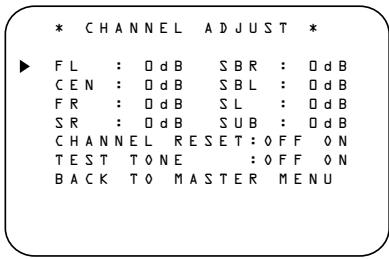
Figure 8
Once the menu appears on your video screen, first use the Button 14 to move the on-screen cursor so that it is next to the TEST TONE line. Press the / Buttons 1537 so that ON is highlighted.
You will hear a test noise circulate from speaker to speaker in a clockwise direction around the room. The test noise will play for two seconds in each speaker before circulating, and a blinking on-screen cursor will appear next to the name of each speaker location when the sound is at that speaker. Now turn up the volume until you can hear the noise clearly.
IMPORTANT NOTE: Because this test noise will have a much lower level than normal music, the volume must be lowered after the adjustment for all channels is made, but BEFORE you return to the main menu and the test tone turns off.
NOTE: Remember to verify that the speakers have been properly connected. As the test noise circulates, listen to make certain that the sound comes from the speaker position shown in the Main Information Display Y. If the sound comes from a speaker location that does NOT match the position indicated in the display, turn the AVR 7500 off using the Main Power Switch 1 and check the speaker wiring or connections to external power amplifiers to make certain that each speaker is connected to the correct output terminal.
After checking for speaker placement, let the test noise circulate again, and listen to see which channels sound louder than the others. Using the front left speaker as a reference, press the Buttons 15 37 on the remote to bring all speakers to the same volume level. When one of the 4 buttons is pushed, the test noise circulation will pause on the channel being adjusted to give you time to make the adjustment. When you release the button, the circulation will resume after five seconds. The on-screen cursor and the test noise can also be moved directly to the speaker to be adjusted by pressing the / buttons 14 on the remote.
Continue to adjust the individual channels until the volume level sounds the same from each speaker. Note that adjustments should be made with the Buttons 1537 on the remote only, NOT the main volume controls.
If you are using a sound-pressure level (SPL) meter for precise level adjustment with the test tone, open the main Volume Control 40 to -15dB and set the individual output level for each channel so that the meter reads 75dB, C-Weighted Slow. After all settings are made turn the main volume down.
You may also adjust the output levels manually while using the level indication feature of the EzSet remote. To activate the sensor and indicator, simply press and release the SPL Indicator Select Button 41 on the remote while the test tone is circulating and set the main Volume Control 40 to -15dB (respectively higher or lower, if needed, as outlined above). The Program/SPL Indicator 3 will change color to indicate the level. Adjust the level using the Buttons 1537 on the remote until the LED lights green for all channels. When it is red, the level is too high; when it is orange, the level is too low. Press the SPL Indicator Select 41 button when you are finished to turn the sensor and Indicator off.
NOTE: The subwoofer output level is not adjustable using the test tone. To change the subwoofer level, follow the steps for Output Level Trim Adjustment on page 35.
When all channels have an equal volume level, the adjustment is complete. Now turn the Volume 40 down to about -40dB, otherwise the listening level may be too high as soon as the source's music starts to play. To exit this menu, press the / buttons until the on-screen cursor is next to the BACK TO MASTER MENU line, and then press the Set Button 16 to return to the MASTER MENU.
The output levels may also be adjusted at any time using the remote control and semi-OSD system. To adjust the output levels in this fashion, press the Test Button 9. As soon as the button is pressed, the test tone will begin to circulate as indicated earlier. The correct channel from which the test noise should be heard will be shown in the lower third of the video screen and in the Main Information Display Y. While the test noise is circulating, the proper channel position will also be indicated in the Speaker/Channel Input Indicators by a blinking letter within the correct channel. Turn up the Volume 40 until you can hear the test noise clearly.
To adjust the output level, press the / buttons until the desired level is shown in the display or on screen. Once the buttons are released, the test noise will begin to circulate again in five seconds.
When all channels have the same output level, turn the Volume 40 down to about -40dB, otherwise the listening level may be too high as soon as the source's music starts to play. Afterwards press the Test Tone Selector 9 button again to turn the test tone off and complete the process.
IMPORTANT NOTE: The Output level adjustment made will be effective for all inputs, but only for the actual surround mode selected. To be effective for any other mode select that mode (with any input) and repeat the level adjustment described above. This will also allow you to compensate level differences between speakers, that may be different with each surround mode, or to increase or decrease the level of certain speakers intentionally, depending on the surround mode selected.
Note: Output level adjustment is not available for the VMAx or Surround Off mode, as no surround speakers are used (so level differences between the speakers in the room cannot occur). But to compensate level differences between stereo, VMAx and other surround modes (independently from the input selected) the outputs can be adjusted with the Level Trim Adjustment procedure, see page 35, also for the Surround Off (Stereo) and VMAx modes.
Once the settings outlined on the previous pages have been made, the AVR 7500 is ready for operation. While there are some additional settings to be made, these are best done after you have had an opportunity to listen to a variety of sources and different kinds of program material. These advanced settings are described on pages 37 to 38 of this manual. In addition, any of the settings made in the initial configuration of the unit may be changed at any time. As you add new or different sources or speakers, or if you wish to change a setting to better reflect your listening taste, simply follow the instructions for changing the settings for that parameter as shown in this section.
Note that any settings changed at any time, also when the discrete buttons are used only, will be stored in memory in the AVR 7500, also if it's turned off completely, unless it will be reset (see page 68). The settings will either depend on the input (Speaker configuration, analog/digital input selection, surround mode) or on the surround mode selected (speaker output level) or be independent from any input or surround mode (crossover, only depending on the front speaker configuration), as described on previous pages.
Having completed the setup and configuration process for your AVR 7500, you are about to experience the finest in music and theater listening. Enjoy!
Surround Mode Chart
| MODE | FEATURES | DELAY TIME RANGE |
| DOLBY DIGITAL | Available only with digital input sources encoded with Dolby Digital data. It provides up to five separate main audio channels and a special dedicated Low Frequency Effects channel. | Center: 0 ms - 5 ms Initial Setting - 0 ms Surround: 0 ms - 15 ms Initial Setting - 0 ms |
| DTS 5.1 | When the speaker configuration is set for 5.1-channel operation, the DTS 5.1 mode is available when DVD, audio-only music or laserdiscs encoded with DTS data are played. DTS 5.1 provides up to five separate main audio channels and a special dedicated low-frequency channel. | Delay time not adjustable |
| DTS-ES 6.1 Matrix DTS-ES 6.1 Discrete | When the speaker configuration is set for 6.1/7.1 operation, playback of a DTS-encoded program source will automatically trigger the selection of one of the two DTS-ES modes. Newer discs with special DTS-ES discrete encoding will be decoded to provide six discrete, full-bandwidth channels plus a separate low-frequency channel. All other DTS discs will be decoded using the DTS-ES Matrix mode, which creates a 6.1-channel sound field from the original 5.1-channel soundtrack. | Delay time not adjustable |
| DOLBY PRO LOGIC II MOVEMENTMUSICEMULATION | Dolby Pro Logic II is the latest version of Dolby Laboratory's benchmark surround technology that decodes full-range, discrete left, center right, right surround and left surround channels from matrix surround encoded programs and conventional stereo sources when an analog input or a digital input with PCM or Dolby Digital 2.0 recordings is in use. The Dolby Pro Logic II Movie mode is optimized for movie soundtracks that are recorded with matrix surround, by creating separate center, rear left and rear right signals. While the Pro Logic II Music mode should be used with musical selections that are recorded with matrix surround or even with normal stereo mode, creating separate rear left and rear right signals in any case. The Pro Logic II Emulation mode creates compelling five-channel surround sound from conventional stereo recordings. | Movie and Emulation: 10 ms - 25 ms, Initial Setting - 10 ms, Music: 0 ms - 15 ms, Initial Setting - 0 ms |
| Logic 7 CinemaLogic 7 MusicLogic 7 Enhance | Exclusive to Harman Kardon for AV receivers, Logic 7 is an advanced mode that extracts the maximum surround information from either surround-encoded programs or conventional stereo material. Depending on the number of speakers in use and the selection made in the SURROUND SELECT menu, the "5.1" versions of Logic 7 modes are available when the 5.1 option is chosen, while the "7.1" versions of Logic 7 produce a full sound field presentation, including back surround speakers when the "6.1/7.1" option is chosen. The Logic 7 C (or Cinema) mode should be used with any source that contains Dolby Surround or similar matrix encoding. Logic 7 C delivers increased center-channel intelligibility, and more accurate placement of sounds with fades and pans that are much smoother and more realistic than with former decoding techniques. The Logic 7 M or Music mode should be used with analog or PCM stereo sources. Logic 7 M enhances the listening experience by presenting a wider front soundstage and greater rear ambience. Both Logic 7 modes also direct low-frequency information to the subwoofer (if installed and configured) to deliver maximum bass impact. The Logic 7 E (or Enhance) mode is an extension of the Logic 7 modes that is primarily used with musical programs and is available with the 5.1 surround mode option selected only. Logic 7 E adds additional bass enhancement that circulates low frequencies in the 40Hz to 120Hz range to the front and surround speakers to deliver a less localized soundstage that appears broader and wider than when the subwoofer is the sole source of bass energy. | Delay time not adjustable |
| DTS Neo:6 CinemaDTS Neo:6 Music | These two modes are available when any analog source is playing to create a six-channel surround presentation from conventional Matrix-encoded and traditional Stereo sources. Select the Cinema version of Neo:6 when a program with any type of analog Matrix surround encoding is present. Select the Music version of Neo:6 for optimal processing when a nonencoded, two-channel stereo program is being played. | Delay time not adjustable |
| DOLBY 3 STEREO | Uses the information contained in a surround-encoded or two-channel stereo program to create center-channel information. In addition, the information that is normally sent to the rear-channel surround speakers is carefully mixed in with the front-left and front-right channels for increased realism. Use this mode when you have a center-channel speaker but no surround speakers. | No surround channels |
| THEATER | The THEATER mode creates a sound field that resembles the acoustic feeling of a standard live performance theater, with stereo and even pure mono sources. | Delay time not adjustable |
Surround Mode Chart
| MODE | FEATURES | DELAY TIME RANGE |
| HALL 1 | The two Hall modes create sound fields that resemble a small (HALL1) or medium sized (HALL 2) concert hall, with stereo and even pure mono sources. | Delay time not adjustable |
| HALL 2 | ||
| VMAx Near | When only the two front-channel loudspeakers are used, Harman's patented VMAx mode delivers a three-dimensional sound space with the illusion of “phantom speakers” at the center and surround positions. The VMAx N, or “Near Field” mode should be selected when your listening position is less than 1,5 m from the speakers. The VMAx F, or “Far Field” mode may be selected when your listening position is greater than 1,5 m from the speakers. | No surround channels |
| VMAx Far | ||
| The VMAx modes are also available using the Headphones Output 4. When headphones are being used, the Far Field mode will push the sound field away from your ears, reducing the “inside the head” sensation often experienced when using headphones. | ||
| 5-Channel Stereo | This mode takes advantage of multiple speakers to place a stereo signal at both the front and back of a room. Depending on whether the AVR has been configured for either 5.1 or 6.1/7.1 operation, one of these modes, but not both, is available at any time. Ideal for playing music in situations such as a party, this mode places the same signal at the front-left and surround-left, and at the front-right and surround-right speakers. The center channel is fed a summed mono mix of the in-phase material of the left and right channels. | No delay available in these modes |
| 7-Channel Stereo | ||
| SURROUND | This mode turns off all surround processing and presents the pure left- and right-channel presentation of two-channel stereo programs. | No surround channels |
| OFF (STEREO) |
Basic Operation
Once you have completed the setup and configuration of the AVR 7500, it is simple to operate and enjoy. The following instructions should be followed for you to maximize your enjoyment of your new receiver:
Turning the AVR 7500 On or Off
- When using the AVR 7500 for the first time, you must press the Main Power Switch 1 on the front panel to turn the unit on. This places the unit in a Standby mode, as indicated by the amber color of the Power Indicator 3. Once the unit is in Standby, you may begin a listening session by pressing the System Power Control 2 or the Source button 11 on the front panel or the AVR Selector 6 B. Note that the Power Indicator 3 will turn green. This will turn the unit on and return it to the input source that was last used. The unit may also be turned on from Standby by pressing any of the Source Selector buttons on the remote 5 6 7 8 B C D or the Source button 15 on the front panel.
NOTE: After pressing one of the Input Selector buttons (except VID4) to turn the unit on, press the AVR Selector to have the remote control the AVR functions.
To turn the unit off at the end of a listening session, simply press the System Power Control 2 on the front panel or the Power Off Button 4 A on the remote. Power will be shut off to any equipment plugged into the rear panel Switched AC Outlets 16 and the Power Indicator 3 will turn orange.
When the remote is used to turn the unit "off" it is actually placing the system in a Standby mode, as indicated by the orange color of the Power Indicator 3.
When you will be away from home for an extended period of time it is always a good idea to completely turn the unit off with the front panel Main Power Switch 1.
NOTE: All preset memories may be lost if the unit is left turned off with the Main Power Switch 1 for more than two weeks.
Using the Sleep Timer
- To program the AVR 7500 for automatic turnoff, press the Sleep Button on the remote. Each press of the button will increase the time before shut down in the following sequence:
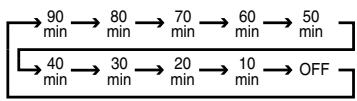
The sleep time will be displayed in the Preset Number/Sleep Timer Indicator R and it will count down until the time has elapsed.
When the programmed sleep time has elapsed, the unit will automatically turn off (to Standby mode). Note that the front panel display will dim to one half brightness when the Sleep function is programmed. To cancel the Sleep function, press and hold the Sleep Button 10 until the information display returns to normal brightness and the Sleep indicator numbers disappear and the words SLEEP OFF appear in the Main Information Display Y.
Source Selection
To select a source, press any of the Source Selector buttons on the remote 5 7 C D.
NOTE: After pressing one of the Input Selector buttons ⑤ D to turn the unit on, press the AVR Selector ⑥ B to have the remote control the AVR functions.
- The input source may also be changed by pressing the front-panel Input Source Selector button 15. Each press of the button will move the input selection through the list of available inputs.
- As the input is changed, the AVR 7500 will automatically switch to the digital input (if selected), surround mode and speaker configuration that were entered during the configuration process for that source.
- The front-panel Video 4 Inputs 21 may be used to connect a device such as a video game or camcorder to your home entertainment system on a temporary basis.
When they are configured as outputs (see page 35) you can also connect an audio or video recorder (composite or S-Video) for recording the source selected.
- As the input source is changed, the new input name will appear momentarily as an on-screen display in the lower third of the video display. The input name will also appear in the Main Information Display Y and a green LED will light next to the selected input's name in the front-panel Input Indicators 28.
- When a pure audio input (CD, Tuner, Tape, 6/8 Channel Input) is selected, the last video input used remains routed to the Video Outputs
2628 (except from its own Video 1/ source) and Video Monitor Output
12. This permits simultaneous viewing and listening to different sources.
- When a Video source is selected, its audio signal will be fed to the speakers and the video signal for that input will be routed to the appropriate Monitor Output Jack ② and will be viewable on a TV monitor connected to the AVR 7500. If a component video source is connected to the DVD ② or Video 2 ② Component Inputs, it will be routed to the Component Video Outputs ②.
Make certain that your TV is set to the proper input to view the appropriate video signal (composite, S-Video or component video, see Notes for S-Video on page 16).
Controls and Use of Headphones
- Adjust the volume to a comfortable level using the front panel Volume Control 27 or remote Volume Up/Down 40 1 buttons.
- To temporarily silence all speaker outputs press the Mute button 43. This will interrupt the output to all speakers and the headphone jack, but it will not affect any recording or dubbing that may be in progress. When the system is muted, the MUTE indicator 2 will light and the word MUTE will blink in the Main Information Display 29. Press the Mute button 38 again to return to normal operation.
- During a listening session you may wish to adjust the Bass Control 22 and Treble Control 24 to suit your listening tastes or room acoustics. Note that these controls (and Balance) will not function when the 6/8 channel direct input is in use.
- To set the output of the AVR 7500 so that the output is "flat," with the tone and balance controls de-activated, press the Tone Mode button once or twice so that the words Tone out appear momentarily in the Main Information Display Y. To return the tone controls to an active condition, press the Tone Mode button once or twice so that the words Tone In momentarily appear in the Main Information Display Y.
- For private listening, plug the 6.3 mm stereo phone plug from a pair of stereo headphones into the front panel Headphone Jack 4. Note that when the headphone's plug is connected, the word HEADPHONE will scroll once across the Main Information Display Y and all speakers will be silenced. When the headphone plug is removed, the audio feed to the speakers will be restored.
Surround Mode Selection
One of the most important features of the AVR 7500 is its ability to reproduce a full multi-channel surround sound field from digital sources, analog matrix surround encoded programs and standard stereo or even mono programs. In all, a total of 22 listening modes are available on the AVR 7500.
Selection of a surround mode is based on personal taste, as well as the type of program source material being used. For example, CDs, motion pictures or TV programs bearing the logo of one of the major surround-encoding processes, such as Dolby Surround should be played in either the Dolby Pro Logic II Movie (with movies) or Music (with music) surround mode, with any DTS NEO:6 mode or with Harman Kardon's exclusive Logic 7 Movie Mode, to create a full range 5.1 channel or (with Logic 7 and DTS NEO:6) even 7.1 channel surround signal from surround encoded programs, with a stereophonic left and right rear signal, just as it was recorded (e.g. sound being recorded from left rear side will be heard from that side only, for more details see chart on page 29).
When no rear speakers are in use, the Dolby 3 Stereo mode should be selected with all surround recordings.
Note that when Dolby Digital 2.0 signals (e.g. "D.D. 2.0" tracks from DVD), that are encoded with Dolby Pro Logic information, are received via any digital input, the Dolby Pro Logic II Movie mode will be selected automatically (in addition to the Dolby Digital mode) and will decode a full range 5.1 channel surround sound even from those recordings (see also "Dolby Digital" on page 34).
To create wide, enveloping sound field environments and defined pans and flyovers with all analog stereo recordings select the Dolby Pro Logic II Music or Emulation mode or Harman Kardon's exclusive Logic 7 Music mode for a dramatic improvement in comparison to the Dolby Pro Logic (I) mode of former times.
NOTE: Once a program has been encoded with matrix surround information, it retains the surround information as long as the program is broadcast in stereo. Thus, movies with surround sound may be decoded via any of the analog surround modes such as Pro Logic II Cinema, Logic 7 Cinema or DTS Neo:6 Cinema, when they are broadcast via conventional TV stations, cable, pay-TV and satellite transmission. In addition, a growing number of made-for-television programs, sports broadcasts, radio dramas and music CDs are also recorded in surround sound. You may view a list of these programs at the Dolby Laboratories Web site at www.dolby.com.
Even when a program is not listed as carrying intentional surround information, you may find that the Dolby Pro Logic II Music, DTS NEO:6 Music or Logic 7 Music or Enhanced modes often deliver enveloping surround presentations through the use of the natural surround information present in all stereo recordings.
However, for stereo programs without any surround information the Theater, Hall and 5/7CH Stereo modes should be tried (effective particularly with old "extreme" stereo recordings) and for mono programs, we suggest that you try the Theater or Hall modes. And when you use only two front channel speakers you should select Harman's patented VMAx mode, delivering a virtually three dimensional sound space with two speakers only.
Surround modes are selected using either the front panel controls or the remote. First determine which of the surround mode categories you wish to choose from and press the button corresponding to that category: Dolby modes 523 or DTS Surround 624 from digital sources, DTS Neo:6 1723 from analog sources, Logic 7 725, DSP 911 modes or Stereo 1429.
As you press any of the Mode Select Buttons (except the Surround Mode Selector 911 as noted below) the surround mode name will scroll across the Main Information Display Y. Let the mode scroll so that you read the mode's name, but if you wish to select another mode in that category, press the button again before the mode name scrolls off to the left of the Main Information Display Y or on-screen display.
To select from the DSP modes (Hall 1, Hall 2, Theater, VMAx Near or VMAx Far) press the Surround Mode Selector ⑨ 1 repeatedly to scroll through the list of available modes.
An individual mode indicator will also light up DEG1JKLMN. As the surround modes change, a green LED will light next to the current mode in the Surround Mode Indicators 31 list on the front panel.
Note that the Dolby Digital or DTS modes may only be selected when a digital input is in use. In addition, when a digital source is present, the AVR 7500 will automatically select and switch to the correct mode (Dolby Digital or DTS), regardless of the mode that has been previously selected. For more information on selecting digital sources, see the following section of this manual.
To listen to a program in traditional two-channel stereo, using the front left and front right speakers only (plus the subwoofer, if installed and configured), press the Stereo Button 1429 until S U R R O F F appears in the Main Information Display V.
Digital Audio Playback
Digital audio is a major advancement over older analog surround processing systems such as Dolby Pro Logic. It delivers five or six discrete channels: left front, center, right front, left surround and right surround and with DTS ES (see below) even surround back (with identical signals for left and right). Each channel reproduces full frequency range (20Hz to 20kHz) and offers dramatically improved dynamic range and significant improvements to signal-to-noise ratios. In addition, digital systems have the capability to deliver an additional channel that is specifically devoted to low-frequency information. This is the ".1" channel referred to when you see these systems described as "5.1," "6.1" or "7.1". The bass channel is separate from the other channels, but since it is intentionally bandwidth-limited, sound designers have given it that unique designation.
Dolby Digital
Dolby Digital (originally known as AC-3®) is a standard part of DVD, and is available on specially encoded LD discs and satellite broadcasts and it is a part of the new high-definition television (HDTV) system.
Note that an optional, external RF demodulator is required to use the AVR 7500 to listen to the Dolby Digital sound tracks available on laser discs. Connect the RF output of the LD player to the demodulator and then connect the digital output of the demodulator to the Optical or Coaxial inputs 3121320 of the AVR 7500. No demodulator is required for use with DVD players or DTS-encoded laser discs.
DTS
DTS is another digital audio system that is capable of delivering 5.1, 6.1 or 7.1 audio. Although both DTS and Dolby Digital are digital, they use different methods of encoding the signals, and thus they require different decoding circuits to convert the digital signals back to analog.
DTS-encoded sound tracks are available on select DVD and LD discs, as well as on special audio-only DTS CDs. You may use any LD, DVD or CD player equipped with a digital output to play DTS-encoded special audio-only CDs with the AVR 7500, but DTS-LDs can be played on LD players and DTS-DVDs on DVD players only. All that is required is to connect the player's digital output to either the Optical or Coaxial input on the rear panel or front panel 1820.
In order to listen to DVDs encoded with DTS sound tracks, the DVD player must be compatible with the DTS signal as indicated by a DTS logo on the player's front panel. Note that early DVD players may not be able to play DTS-encoded DVDs. This does not indicate a problem with the AVR 7500, as some players cannot pass the DTS signal through to the digital outputs. If you are in doubt as to the capability of your DVD player to handle DTS DVDs, consult the player's owner's manual.
Please note that some DVD players are shipped with their output set for Dolby Digital only. To insure that DTS data is being sent to the AVR, please check the setup menu system on your DVD player to make certain that DTS data output is enabled.
PCM Audio Playback
PCM (Pulse Code Modulation) is the non- compressed digital audio system used for compact discs, Non-Dolby Digital/DTS Laserdiscs and some special PCM encoded DVDs. The digital circuits in the AVR 7500 are capable of high quality digitalto-analog decoding, and they may be connected directly to the digital audio output of your CD/DVD or LD player (LD only for PCM or DTS programs, for Dolby Digital laser discs an RF adapter is needed, see "Dolby Digital" above).
Connections may be made to either the Optical or Coaxial inputs 31 on the rear panel or the front panel Digital Inputs 1820.
To listen to a PCM digital source, first select the input for the desired source (e.g., CD) to feed its video signal (if any) to the TV monitor and to provide its analog audio signal for recording. Next press the Digital Select button 25 17 and then use the / buttons 14 on the remote, or the Selector buttons 714 on the front panel, until the desired choice appears in the
Main Information Display Y, then press the Set button 12 16 to confirm the choice.
When a PCM source is playing, the PCM indicator A will light. During PCM playback you may select any surround mode except Dolby Digital or DTS. When an HDCD encoded disc is being played (see below) and the CD player is connected to the AVR 7500 via a digital connection, select Surround Off as the Surround mode to enjoy the benefits of the HDCD process.
HDCD
HDCD, which stands for High Definition Compatible Digital, is a sophisticated process that enables the AVR 7500 to deliver outstanding digital-to-analog decoding of PCM signals from any DVD or CD player, connected to a digital input on the AVR 7500 even when normal, non-HDCD-compatible players are used (only a digital output is needed).
When a CD with the HDCD recording is played, the AVR 7500 is able to take advantage of the special recording process that is used in the creation of HDCD disc. The special circuitry enables audio with extraordinary fidelity, stunning resolution and the highest possible overall quality.
As long as a digital input and the pure Stereo mode (Surround Off) are selected, the AVR 7500 will automatically sense that it is an HDCD recording and the HDCD indicator A will illuminate on the front panel to remind you that an HDCD disc is playing.
It is important to note that the HDCD process is completely compatible with standard recordings. Indeed, the high-quality digital-to-analog circuitry that is part of HDCD and the HDCD decoder chip, replacing the monolithic digital filters used in conventional DACs, will enable enhanced performance also with normal, non-HDCD encoded program material.
MP3 Audio Playback
The AVR 7500 is one of the few A/V receivers to provide on-board decoding for the MP3 audio format used on specific computer audio files and by portable MP3 players/recorders. In addition, some new CD and DVD players are capable of playing back optical discs that are recorded with MP3, rather than standard CD audio information. By offering MP3 decoding, the AVR 7500 is able to deliver more precise conversion of the digital signals to an analog output, along with the benefits of listening to MP3 audio through the AVR 7500's high current amplifier and the speakers from your surround system, rather than the smaller speakers and low powered amplifiers typically used with computers.
To take advantage of the AVR 7500's MP3 capabilities, simply connect the digital (SPDIF) output of a computer sound card able to feed the MP3 format to its digital output, or the digital (SPDIF) output of MP3 compatible CD or DVD players or of a portable MP3 player with a digital output to either the rear panel Digital Inputs ① ② or the front panel Digital Inputs 1820 . When the digital MP3 signal is received, the MP3
Bitstream Indicator A will light, and the audio will begin playing.
NOTES:
- The AVR 7500 is only capable of playing signals in the MP3 (MPEG 1/Layer 3) format. It is not compatible with other computer audio CODECs.
- The MP 3 DSP mode found in the new AVR 7500 requires an MP3 SPDIF stream. Presently, only a few units provide this but in the coming generations of motherboards and operating system updates this will follow, since SPDIF is the standard for audio & video hardware.
- The digital audio input signal may be either optical or coaxial, but the signal must be in the MP3 SPDIF format. Direct connection of USB or serial data outputs is not possible, even though the signals are in the MP3 format. If you have any questions about the data output format from your computer or a sound card, check with the device's Owner's Manual or contact the manufacturer's technical support area.
- If your computer or sound card's digital output is not capable of direct connection to the AVR or if the output is not capable of delivering MP3 data stream, you may use an optional, external transcoder, such as those available from Harman Kardon to convert the USB output of a computer to a format compatible with the AVR. Contact your Harman Kardon dealer for additional details.
Selecting a Digital Source
To utilize either digital mode you must have properly connected a digital source to the AVR 7500. Connect the digital outputs from DVD players, HDTV receivers, satellite systems or CD players to the Optical or Coaxial inputs on the rear or front panel ① 621820. In order to provide a backup signal and a source for analog stereo recording, the analog outputs provided on digital source equipment should also be connected to their appropriate inputs on the AVR 7500 rear panel (e.g., connect the analog stereo audio output from a DVD to the DVD Audio inputs ⑥ on the rear panel when you connect the source's digital outputs).
HDCD, HDCD, High Definition Compatible Digital and Pacific Microsonics are either registered trademarks or trademarks of Pacific Microsonics, Inc., in the United States and/or other countries. HDCD System manufactured under license from Pacific Microsonics, Inc.
To select a digital source such as DVD, first select its input using the remote or front panel Input Selector 515 as outlined in this manual in order to feed its video signal (if any) to the TV monitor and to provide its analog audio signal for recording. When the digital input associated with the input selected (e.g. "DVD") is not selected automatically (due to the input settings made earlier during the system configuration, see page 21), select the digital source by pressing the Digital Input Selector button 17 24 and then using the / buttons 14 on the remote or the Selector buttons 714 on the front panel to choose any of the OPTICAL or COAXIAL inputs, as they appear in the Main Information Display Y, Source Indicator BF or on-screen display.
When the digital source is playing, the AVR 7500 will automatically detect whether it is a multi-channel Dolby Digital or DTS source or a HDCD, MP3 or conventional PCM signal, which is the standard output from CD players. A Bitstream Indicator A will light in the Main Information Display 29 to confirm that the digital signal is Dolby Digital, DTS, MP3, PCM or HDCD.
Note that a digital input (e.g. coaxial) remains associated with any analog input (e.g. DVD) as soon as it is selected, thus the digital input need not be re-selected each time the appropriate input choice (e.g. DVD) is made.
Digital Status Indicators
When a digital source is playing, the AVR 7500 senses the type of bitstream data that is present. Using this information, the correct surround mode will automatically be selected. For example, DTS bitstreams will cause the unit to switch to DTS decoding, and Dolby Digital bitstreams will enable Dolby Digital decoding. When the unit senses PCM data, from CDs and LDs and some music DVDs or certain tracks on normal DVDs, it will allow the appropriate surround mode to be selected manually. Since the range of available surround modes depends on the type of digital data that is present, the AVR 7500 uses a variety of indicators to let you know what type of signal is present. This will help you to understand the choice of modes and the input channels recorded on the disc.
When a digital source is playing, a Bitstream Indicator A will light to show which type of signal is playing:
DOLBY D: When the DOLBY D indicator lights, a Dolby Digital bitstream is being received. Depending on the audio track selected on the source player and number of channels on the disc, different surround modes are possible. Note that only one channel without subwoofer, called "1.0" audio, or all five channels with subwoofer ("5.1" audio) or all steps between can be recorded on digitally surround encoded audio tracks
(see NOTE below). With all those tracks, except "2.0" audio, only the Dolby Digital and VMAx modes are available. When the Dolby Digital signal is only two channels ("2.0") these two channels (I and r) often contain Pro Logic surround informations.
With those tracks the AVR 7500 automatically switches to the Dolby Pro Logic II Movie mode (in addition to the Dolby Digital mode), but you may also select the Vmax mode. When the D.D. 2.0 signal contains no Pro Logic information, the pure Dolby Digital mode will be selected automatically, but you may also select any Pro Logic II mode (only Music or Emulation should be used then) or any Vmax mode.
DTS: When the DTS indicator lights, a DTS bitstream is being received. When the unit senses this type of data, only the DTS mode may be used.
PCM: When the PCM indicator lights, a standard Pulse Code Modulation, or PCM, signal is being received. This is the type of digital audio used by conventional compact disc and laser disc recordings. When a PCM bitstream is present, all modes except Dolby Digital and DTS are available.
HDCD: When this indicator lights the CD that is playing is encoded using the special High Definition Compatible Digital process. HDCD discs use 20-bit encoding and other proprietary processing to provide the ultimate in CD listening. Note that HDCD processing is only available in the Stereo (Surround Off) mode.
MP3: When the MP3 indicator lights, a compatible MPEG 1/Layer 3 digital signal is being received. This is the popular audio format used by many computer programs for recording compressed audio files. When an MP3 bitstream is present, the sound will automatically be played in the stereo (Surround Off) mode. The surround modes are not available during MP3 playback.
In addition to the Bitstream Indicators A, the AVR 7500 features a set of unique channel-input indicators that tell you how many channels of digital information are being received and/or whether the digital signal is interrupted. (See Figure 9.)
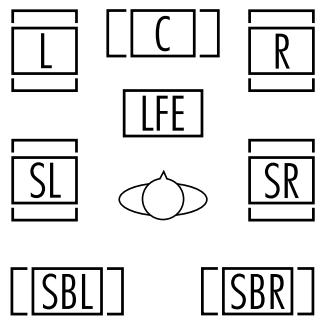
Figure 9
These indicators are the L/C/R/LFE/SL/SR/SBL/SBR letters that are inside the center boxes of the Speaker/Channel Input Indicators in the front panel Main Information Display 29. When a standard analog stereo or matrix surround signal is in use, only the "L" and "R" indicators will light, as analog signals have only left and right channels.
Dolby Digital signals, however, may have one, two, five, six or seven separate channels, depending on the program material, the method of transmission and the way in which it was encoded. When a digital signal is playing, the letters in these indicators will light in response to the specific signal being received. It is important to note that although Dolby Digital, for example, is referred to as a "5.1" system, not all Dolby Digital DVDs or audio tracks selected on DVD or other Dolby Digital programs are encoded for 5.1. Thus, it is sometimes normal for a DVD with a Dolby Digital soundtrack to trigger only the "L" and "R" indicators.
NOTE: Many DVD discs are recorded with both "5.1" and "2.0" versions of the same soundtrack. When playing a DVD, always be certain to check the type of material on the disc. Most discs show this information in the form of a listing or icon on the back of the disc jacket. When a disc does offer multiple soundtrack choices, you may have to make some adjustments to your DVD player (usually with the "Audio Select" button or in a menu screen on the disc) to send a full 5.1 feed to the AVR 7500 or to select the appropriate audio track and thus language. It is also possible for the type of signal feed to change during the course of a DVD playback. In some cases the previews of special material will only be recorded in 2.0 audio, while the main feature is available in 5.1 audio. As long as your DVD player is set for 6-channel output, the AVR 7500 will automatically sense changes to the bitstream and channel count and reflect them in these indicators.
Important Note: When a digital surround source (Dolby Digital, DTS) is played, the letters SBL/SBR for the Surround Back channels will appear only when a DTS ES DISCRETE 6.1 source is played. Then this surround mode will be indicated in the front display and on-screen display after the DTS Surr. button 624 has been pressed. With all other recordings the icons for the surround back speakers may light (when those speakers have been configured) to indicate that a signal will be fed to them (Matrix decoded with NEO:6, LOGIC 7 or 7 CH Stereo), but no letters inside will light as the unit will not receive an input signal for the surround back channels.
The letters used by the Speaker/Channel Input Indicators also flash to indicate when a bitstream has been interrupted. This will happen when a digital input source is selected before the playback starts, or when a digital source such as
a DVD is put into a Pause mode. The flashing indicators remind you that the playback has stopped due to the absence of a digital signal and not through any fault of the AVR 7500. This is normal, and the digital playback will resume once the playback is started again.
Night Mode
A special feature of Dolby Digital is the Night mode, which enables Dolby Digital input sources to be played back with full digital intelligibility while reducing the maximum peak level and lifting the low levels by 1/4 to 1/3. This prevents abruptly loud transitions from disturbing others without reducing the impact of the digital source. The Night mode is available only when the Dolby Digital mode is selected.
The Night mode may be engaged when a Dolby Digital DVD is playing by pressing the Night Button 12 on the remote. Next, press the / buttons 14 to select either the middle range or full compression versions of the Night mode. To turn the Night mode off, press the / buttons 14 until the message in the lower third of the video display and the Main Information Display Y reads D-RANGE OFF.
The Night mode may also be selected to always be on as soon as the Dolby Digital mode is activated at either level of compression using the options in the Surround Select menu. See page 25 for information on using the menus to set this option.
IMPORTANT NOTES ON DIGITAL PLAYBACK:
- When the digital playback source is stopped, or in a pause, fast forward or chapter search mode, the digital audio data will momentarily stop, and the channel position letters inside the
Speaker/Channel Indicators will flash. This is normal and does not indicate a problem with either the AVR 7500 or the source machine. The AVR 7500 will return to digital playback as soon as the data is available and when the machine is in a standard play mode. - Although the AVR 7500 will decode virtually all DVD movies, CDs and HDTV sources, it is possible that some future digital sources may not be compatible with the AVR 7500.
- Note that not all digitally encoded programs and not all audio tracks on a DVD contain full 5.1-channel audio. Consult the program guide that accompanies the DVD or laser disc to determine which type of audio has been recorded on the disc. The AVR 7500 will automatically sense the type of digital surround encoding used, indicate it in the Bitstream Indicators A and Channel Input Indicators Q and adjust to accommodate it.
- When a Dolby Digital or DTS source is playing, you normally may not be able to select some of
the analog surround modes such as Dolby Pro Logic II, Dolby 3 Stereo, Hall, Theater, 5CH/7CH Stereo or Logic 7, except with specific Dolby Digital 2.0 recordings that can be played with the Pro Logic II modes too (see page 34).
- When a digital source is playing, it is not possible to make an analog recording using the Tape 4 or Video 1 or Video 2 or record outputs, if the source is connected to any digital input of the AVR 7500 only. But the analog two channel signal of that source, the "Downmix" to Stereo or Dolby Surround, can be recorded by connecting its analog audio outputs to the appropriate analog inputs (e.g. DVD) of the AVR 7500, even if the digital input of the AVR 7500 remains selected. Additionally, the digital signals will be passed through to the Digital Audio Outputs 1.
Tape Recording
In normal operation, the audio or video source selected for listening through the AVR 7500 is sent to the record outputs. This means that any program you are watching or listening to may be recorded simply by placing machines connected to the outputs for Tape Outputs 4 or Video 1 or 2 Outputs 26283857 in the record mode.
When a digital audio recorder is connected to any of the Digital Audio Outputs 1, you are able to record the digital signal using a CD-R, MiniDisc or other digital recording system. Note that all digital signals will be passed through to both, coaxial and optical, digital outputs simultaneously, no matter which kind of digital input was selected.
Front Panel In/Outputs
In addition to the rear panel digital outputs, the AVR 7500 offers Harman Kardon's exclusive configurable front panel output jack feature. For easy connection of portable devices, you may switch the front panel Digital Coax 3 jack 20 or the Video 4 jack 21 from an input to an output by following these steps:
- Press the OSD button 22 to view the MASTER menu (Figure 1).
- Press the Set button 16 to enter the IN/OUT SETUP menu (Figure 2).
- Press the button 14 so that the on-screen cursor is next to VIDEO4 or COAXI-AL3 depending on which input you wish to change to an output. Either input, or both may be changed at any time.
- Press either of the / buttons 15/37 so that the word U T is highlighted.
- Press the OSD button 22 to exit the menus and return to normal operation.
Note that once the setting is made, the appropriate Input/Output Status Indicator 19 will turn red, indicating that the selected analog or digital jacks are now an output, instead of in the default setting as an input. Once changed to an output, the setting will remain as long as the AVR 7500 is turned on, unless the setting is changed in the OSD menu system, as described above. Note, however, that once the AVR 7500 is turned off, the setting is cancelled. When the unit is turned on again, the front panel jacks will return to their normal default setting as an input. If you wish to use the jacks as an output at a future time, the setting must be changed again using the OSD menu system, as described above.
NOTES:
- The digital outputs are active only when a digital signal is present, and they do not convert an analog input to a digital signal, or change the format of the digital signal (e.g. Dolby Digital to PCM or vice versa, but coaxial digital signals are converted to optical signals and vice versa). In addition, the digital recorder must be compatible with the output signal. For example, the PCM digital output from a CD player may be recorded on a CD-R or MiniDisc, but Dolby Digital or DTS signals may not.
- To make an analog recording from any digital source is not possible, if the source is connected to a digital input of the AVR 7500 only. But the analog two channel signal of that source can be recorded (see "Important Notes on Digital Playback" above).
Output Level Adjustment With Source Signals
Normal output level adjustment for the AVR 7500 is established using the test tone, as outlined on page 26. In some cases, however, it may be desirable to adjust the output levels using program material such as a test disc, or a selection you are familiar with. Additionally, the output level for the subwoofer and those for the Stereo and VMAX modes can only be adjusted using this procedure. Note that all adjustments made with any input will be effective with all inputs selected, just as it is the case with the adjustment using the test tone.
To adjust the output levels using program material, first select the surround mode for which you want to trim the speakers (see NOTE below), start your program material source and set the reference volume for the front left and front right channels using the Volume Control 40.
Once the reference level has been set, press the Channel Select button 1326 and note that FRONT L LEV will appear in the Main Information Display Y. To change the level, first press the Set button 16 12, and then use
the Selector buttons 714 or the / buttons 14 to raise or lower the level. DO NOT use the volume control, as this will alter the reference setting.
Once the change has been made, press the Set button 16 12 and then press the Selector buttons 714 or the / buttons 14 to select the next output channel location that you wish to adjust. To adjust the subwoofer level, press the Selector buttons 714 or the / buttons until wo OFER LEV appears in the Main Information Display Y or on-screen display (only available if the subwoofer is turned on).
Press the Set button 16 12 when the name of the desired channel appears in the Main Information Display Y and on-screen display, and follow the instructions shown above to adjust the level.
Repeat the procedure as needed until all channels requiring adjustment have been set. When all adjustments have been made and no further adjustments are made for five seconds, the AVR 7500 will return to normal operation.
If you are using a disc with noise test signals or an external signal generator as the source from which to trim the output levels, you may use the EzSet feature of the remote to guide you to the correct SPL level. To use the remote for this purpose, start the test tone from the source and press and quickly release the SPL Indicator Select 41 to activate the sensor.
While the test tone is played, the Program/SPL Indicator 3 will change color to indicate the level. When it is red, the level is too high; when it is orange, the level is too low. To set the reference level, open the Volume Control 40 until the SPL Indicator's LED lights green when the test signal is fed to the left front speaker. Then adjust the level of all other speakers, while they are receiving the test signal, until the LED lights green for all channels. After the output levels for all channels are aligned, press the SPL
Indicator Select 3 to turn the sensor and indicator off.
The channel output may also be adjusted using the full-OSD on-screen menu system. First, set the volume to a comfortable listening level using the Volume Control 26401. Then, press the OSD button 22 to bring up the MAS-TER MENU (Figure 1). Press the Button 14 four times until the on-screen cursor is next to the CHANNEL ADJUST line. Press the Set Button 16 to activate the CHANNEL ADJUST menu (Figure 10).
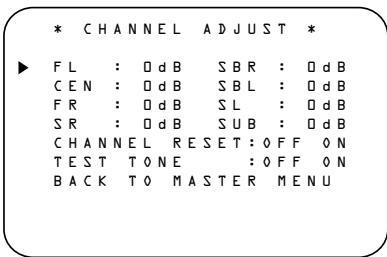
Figure 10
When the menu appears, the internal test tone will be turned off. This will allow you to use your external test disc or other source material as the test signal. Then, use the / Buttons 14 to select the channels to be adjusted. At each channel position use the / Buttons 15 37 to change the output level.
Remember, when you are using a disc with test signal (e.g. pink noise) or an external signal generator as the source, the goal is to have the output level at each channel be equal when heard at the listening position, with any surround mode selected. When your test source is a normal disc with music signals, you may adjust the level for each channel and surround mode as you prefer, e.g. you may lower the center channel level when you find it to be too high or increase the level of the rears when you find it to be too low with specific surround modes.
If you wish to reset all the levels to their original factory default of 0dB offset, press the / Buttons 14 so that the on-screen cursor is next to the CHANNEL RESET line and press the / Buttons 15 so that the word ON is highlighted. After the levels are reset, resume the procedure outlined above to reset the levels to the desired settings. When all adjustments are done, press the / Buttons 14 to move the on-screen cursor so that it is next to BACK TOMASTERMENU and then press the Set Button 16 if you wish to go back to the main menu to make other adjustments. If you have no other adjustments to make, press the OSD Button 22 to exit the menu system.
NOTE: The output levels may be separately trimmed for each digital and analog surround mode. If you wish to have different trim levels for a specific mode, select that mode and then follow the instructions in the steps shown above.
With Stereo and Vmax modes the adjustment procedure described above is the only way to trim the output level, e.g. to match the Stereo or Vmax level with other modes.
6-Channel/8-Channel Direct Input
The AVR 7500 is equipped for future expansion through the use of optional, external adapters for formats that the AVR 7500 may not be capable of processing or to allow connection to the output of high-resolution optical audio playback systems such as DVD-Audio or SACD. When a device with six-channel outputs (5.1 audio) is used, connect the source device to the 6-Channel Direct Inputs ⑨. When a device with eight-channel outputs (7.1) audio is used, connect the additional Surround Back Left (SBL) and Surround Back Right (SBR) outputs to the 8-Channel Direct Inputs ⑩ on the AVR. To select these inputs, press the 6-Channel/8-Channel Direct Button ③ on the remote or the Input Source Selector ⑤ on the front panel until the desired input configuration appears in the Main Information Display Y.
Note that when the 6-Channel or 8-Channel Direct Input is in use, you may not select a surround mode, as the external decoder determines the processing in use. In addition, there is no signal at the record outputs or bass management when the 6-Channel or 8-Channel Direct Input is in use and the tone or balance controls will not function.
Memory Backup
This product is equipped with a memory backup system that preserves tunes presets and system configuration information if the unit is turned off completely, accidentally unplugged or subjected to a power outage. This memory will last for approximately two weeks, after which time all information must be reentered.
The AVR 7500 is equipped with a number of advanced features that add extra flexibility to the unit's operation. While it is not necessary to use these features to operate the unit, they provide additional options that you may wish to use.
Display Brightness
The AVR 7500's front panel Main Information Display is set at a default brightness level that is sufficient for viewing in a normally lit room. However, in some home theater installations, you may wish to occasionally lower the brightness of the display, or turn it off completely.
To change the display brightness setting for a specific listening session, you will need to make an adjustment in the ADVANCED menu. To start the adjustment, press the OSD button 22 to bring the MASTER MENU to the screen. Press the Button 14 twice, until the on-screen cursor is next to the ADVANCED line. Press the Set Button 16 to enter the ADVANCED menu (Figure 11).
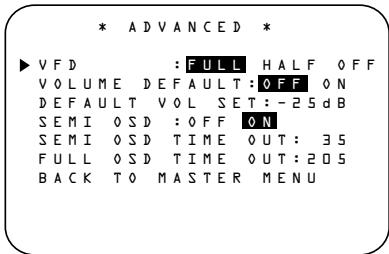
Figure 11
To change the brightness setting, at the ADVANCED menu, make certain that the on-screen cursor is next to the VFD line, and press the Button 37 until the desired brightness level is highlighted in the video display. When FULL is highlighted, the display is at its normal brightness. When HALF is highlighted, the display is at half the normal brightness level. When OFF is highlighted, all of the indicators in the Main Information Display 29 will go dark. Note, however, that the green LEDs for the Input Indicators 28 and the Surround Mode Indicators 31, as well as for the Power Indicator 3, will always remain lit to remind you that the unit is turned on.
If you wish to make other adjustments in the menu, press the / Buttons 14 until the onscreen cursor is next to the desired setting or the BACK TOMASTERMENULine and press the Set button 16. If you have no other adjustments to make, press the OSD Button 22 to exit the menu system.
The display brightness may also be changed by pressing and holding the Set button 12 on the front for three seconds until the message in the Main Information Display Y reads V F D F U L L. Within five seconds, press the front panel Selector buttons 714 until the desired brightness display level is shown. At that point, press the Set button 12 again to enter the setting.
Once the desired brightness level is selected, it will remain in effect until it is changed again or until the unit is turned off.
Turn On Volume Level
As is the case with most audio/video receivers, when the AVR 7500 is turned on, it will always return to the volume setting in effect when the unit was turned off. However, you may prefer to always have the AVR 7500 turn on at a specific setting, regardless of what was last in use when the unit was turned off. To change the default condition so that the same volume level is always used at turn-on, you will need to make an adjustment in the ADVANCED menu. To start the adjustment, press the OSD button to bring the MASTER MENU (Figure 1) to the screen. Press the button twice, until the on-screen cursor is next to the
ADVANCED line. Press the Set button 16 to enter the ADVANCED menu (Figure 11).
At the ADVANCED menu make certain that the on-screen cursor is next to the VOLUME DEFAULT line by pressing the / buttons 14 as needed. Next, press the button 37 so that the word ON is highlighted in the video display. Next, press the button 14 once so that the on-screen cursor is next to the DEFAULT VOL SET line. To set the desired turn-on volume, press the / buttons 15 or hold them pressed until the desired volume level is shown on the DEFAULT VOL SET line. Note that this setting may NOT be made with the regular volume controls.
NOTE: Since the setting for the turn-on volume cannot be heard while the setting is being made, you may wish to determine the setting before making the adjustment. To do this, listen to any source and adjust the volume to the desired level using the regular volume controls 401 When the desired volume level to be used at turn-on is reached, make a note of the setting as it appears in the lower third of the video screen or in the Main Information Display Y.A typical volume level will appear as a negative number such as -25dB. When making the adjustment, use the buttons 1537 to enter this setting.
Unlike some of the other adjustments in this menu, the turn-on volume default will remain in effect even when the unit is turned off completely, unless it is changed or turned off in this menu.
If you wish to make other adjustments in the menu, press the / Buttons 14 until the onscreen cursor is next to the desired setting or the BACK TOMASTERMENULine and press the Set button 16. If you have no other adjustments to make, press the OSD Button 22 to exit the menu system.
Semi-OSD Settings
The semi-OSD system places one line messages at the lower third of the video display screen whenever the Volume, Input Source, Surround mode or tuner frequency of any of the configuration settings are changed. The semi-OSD system is helpful in that enables you to have feedback on any control changes or remote commands using the video display when it is difficult to view the front-panel displays. However, you may occasionally prefer to turn these displays off for a particular listening session. You may also want to adjust the length of time the displays remain on the screen. Both of those options are possible with the AVR 7500.
To turn off the semi-OSD system, you will need to make an adjustment in the ADVANCED menu (Figure 11). To start the adjustment, press the OSD button 22 to bring the MASTER MENU to the screen. Press the ▲ Button 14 twice, until the on-screen cursor is next to the ADVANCED line. Press the Set Button 16 to enter the ADVANCED menu.
At the ADVANCED menu make certain that the on-screen cursor is next to the SEMI OSD line by pressing the / buttons 14 as needed. Next, press the button 37 so that the word OFF is highlighted in the video display.
Note that this setting is temporary and will remain active only until it is changed or until the AVR 7500 is turned off. Once the unit is turned off, the semi-OSD displays will remain activated, even if they were switched off for the previous listening session.
To change the length of time that the semi-OSD displays remain on the screen, go to the ADVANCED Menu as outlined earlier, and press the / buttons 14 as needed, until the on-screen cursor is next to the SEMI-OSD TIMEOUT line. Next, press the Buttons 1537 until the desired time in seconds is displayed. Note that unlike most of the other options in this menu, this is a permanent setting change, and the time-out entry will remain in effect until it is changed, even when the unit is turned off.
If you wish to make other adjustments in the menu, press the / Buttons 14 until the onscreen cursor is next to the desired setting or the BACK TOMASTERMENU line and press the Set button 16. If you have no other adjustments to make, press the OSD Button 22 to exit the menu system.
Full-OSD Time Out Adjustment
The FULLOSD menu system is used to simplify the setup and adjustment of the AVR 7500 using a series of on-screen menus. The factory default setting for these menus leaves them on the screen for 20 seconds after a period of inactivity before they disappear from the screen or Time Out. This Time Out is a safety measure to prevent the menu text from burning into the CRTs in your monitor or projector, which might happen if they were left on indefinitely. However, some viewers may prefer a slightly longer or shorter period before the Time Out display.
To change the Full-OSD Time Out, you will need to make an adjustment in the ADVANCED Menu (Figure 1). To start the adjustment, press the OSD button 22 to bring the MASTER MENU to the screen. Press the button 14 twice, until the on-screen cursor is next to the ADVANCED line. Press the Set Button 16 to enter the ADVANCED Menu (Figure 11).
At the ADVANCED menu make certain that the on-screen cursor is next to the FULL OSD TIME OUT line by pressing the / Buttons 14 as needed. Next, press the / buttons 1537 until the desired time is displayed in seconds. Note that unlike most of the other options in this menu, this is a permanent setting change, and the time-out entry will remain in effect until it is changed, even when the unit is turned off.
If you wish to make other adjustments in the menu, press the / Buttons 14 until the onscreen cursor is next to the desired setting or the BACK TOMASTERMENU line and press the Set button 16. If you have no other adjustments to make, press the OSD Button 22 to exit the menu system.
The AVR 7500 is fully equipped to operate as the control center for a multiroom system with optional external remote Infrared (IR) sensors, speakers and power amplifiers. Although some multi-room installations will require the services of a specially trained installer, it is possible for the average do-it-yourself hobbyist to install a simple remote room system.
Installation
The key to remote room operation is to link the remote room to the AVR 7500's location with wire for an infrared receiver and speakers or an amplifier. For complete installation instructions for Multiroom use, see page 18.
Multiroom Setup
Once the audio and IR link connections have been made, the AVR 7500 needs to be configured for multiroom operation using the steps below. Press the OSD button 22 to bring the MASTER MENU (Figure 1) to the screen. Press the button 14 twice, until the on-screen cursor is next to the MULTI-ROOM line. Press the Set button 16 to enter the MULTI-ROOM menu (Figure 12).
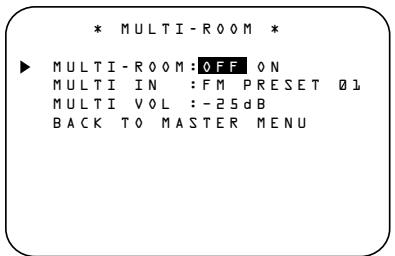
Figure 12
When the MULTI-ROOM menu appears, the on-screen cursor will be at the MULTI-ROOM line. Since this line is used to turn the system on and off, do not make an adjustment here unless you wish to turn the system on at this time. To turn the system on, press the button 37 so that ON is highlighted. If you do not wish to turn the system on at this time or to proceed to the next step, press the Button 14 once so that the on-screen cursor is next to the MULTI IN line.
At the MULTI IN line, press the buttons 1537 until the desired Audio/Video input to the multi-room system appears in the highlighted video. When the selection has been made, press the button 14 once so that the on-screen cursor is next to the MULTI VOL line.
At the MULTIVOL line, press the buttons 15 or hold them pressed until the desired volume level for the multi-room system is entered. DO NOT use the regular volume control knobs for this setting. When all settings for the multiroom setup have been made, press the buttons 14 once so that the on-screen cursor is next to the BACK TOMASTER MENU line and press the Set button 16. If you have no other adjustments to make, press the OSD button 22 to exit the menu system.
Multiroom Operation
When operating the AVR 7500 from a remote room location where an IR sensor link has been connected to the AVR 7500's rear panel
Multiroom IR Input 25, you may use either the Main remote control or the Zone II remote. To turn on the multiroom feed, press any of the Input Selector buttons on the Zone II remote 3C D or the Main remote 56 7. Press the AVR Selector 6 3 to turn the unit on to the last source, or any of the other Selector buttons to turn on to a specific source.
As long as an IR feed to the AVR 7500 has been established from the remote room, using any of the buttons on either remote will control the remote location volume 40 ① , change the tuner frequency 21 ② , change the tuner preset 33 ③ or mute the output 43 ④ .
If the Remote IR Output jack 28 on the AVR 7500 is connected to an IR Input jack on compatible Harman Kardon audio components such as CD, DVD or cassette players, the transport functions of those machines may also be controlled using the Transport Controls 2628EFGHJ on either remote control.
To turn the system off from the remote room, press the Power-Off button A. Remember that the AVR 7500 may be turned on or off from the remote room regardless of the system's operation or status in the main room.
NOTE: When the tuner is selected as the source for the remote zone, any change to the frequency or preset will also change the station being listened to in the main room, if the tuner is in use there. Similarly, if someone in the main room changes the station, the change will also impact the remote room.
To activate the feed to the remote room, press the Multiroom button on the remote. Next, press the Set button 16. Press the / buttons 14 to turn the multiroom feed on or off. When the multiroom system is on, the Multi indicator o will light in the Main Information Display 29, and the Main Information Display Y or OSD will display MULTI ON. Press the Set button 16 twice to enter the setting.
When the multiroom system is turned on, the input selected using the Multiroom Menu will be fed to the Multiroom Output jacks ⑧ on the rear panel. The volume will be as set in the same menu, although it may also be adjusted using an optional IR sensor and the Zone II remote in the remote location or on the optional audio power amplifier connected to the Multiroom Output jacks ③.
Once the multiroom system is turned on, it will remain on even if the AVR 7500 is placed in the Standby mode in the main room by pressing the Power Off Button 1 or the System Power Control 2 on the front panel. To turn off the multiroom system from the main listening room, when the AVR is on press the Multiroom button 39 and then the Set button 16. Press the I / buttons 14 so that the Multi indicator 0 in the Main Information Display 29 goes out, and the Main Information Display Y or OSD will display MULTI OF F.
Even when the AVR is turned off (to Standby mode) and the multiroom system is turned off too, the multiroom system may be turned on at any time by pressing the Multiroom button 39, or any of the Selector buttons BCD in the remote room.
Basic Tuner Operation
The AVR 7500's tuner is capable of tuning AM, FM and FM Stereo broadcast stations and receiving RDS data. Stations may be tuned manually, or they may be stored as favorite station presets and recalled from a 30 position memory.
Station Selection
- Press the AM/FM Tuner Select button 7 on the remote to select the tuner as an input. The tuner may be selected from the front panel by either pressing the Input Source Selector 15 until the tuner is active or by pressing the Tuner Band Selector 11 at any time.
- Press the AM/FM Tuner Select button 7 or Tuner Band Selector 11 again to switch between AM and FM so that the desired frequency band is selected.
- Press the Tuner Mode button 19 on the remote or hold the Band Selector 11 on the front panel pressed for 3 seconds to select manual or automatic tuning.
When the AUTO indicator X is illuminated in the Main Information Display 29 the tuner will only stop at those stations that have a strong enough signal to be received with acceptable quality.
When the AUTO indicator x is not illuminated, the tuner is in a manual mode and will stop at each frequency increment in the selected band.
4. To select stations press any Tuning button 10 21. When the AUTO indicator x is illuminated, press the button to cause the tuner to search for the next highest or lowest frequency station that has an acceptable signal or hold the button pressed to tune fastly and release it to start the auto search. In the Auto mode the tuner will play each station in stereo or mono mode, just as the program is transmitted. If the AUTO indicator x is not illuminated, tap the Tuning button 10 21 to advance one frequency increment at a time, or press and hold it to locate a specific station. When the TUNED indicator W illuminates, the station is properly tuned and should be heard with clarity.
- Stations may also be tuned directly by pressing the Direct button 20, and then pressing the Numeric Keys 18 that correspond to the station's frequency. Note that for entering numbers higher than 100 you need to enter only the "1" rather than "10", the first "0" will be added automatically. The desired station will automatically be tuned after the latest number is entered. If you press an incorrect button while entering a direct frequency, press the Clear button 34 to start over.
NOTE: When the FM reception of a stereo station is weak, audio quality will be increased by switching to Mono mode by pressing the Tuner Mode button 19 on the remote or holding the Band Selector 11 on the front panel pressed for 3 seconds until the STEREO V and AUTO X indicators go out.
Preset Tuning
Using the remote, up to 30 stations may be stored in the AVR 7500's memory for easy recall using the front panel controls or the remote.
To enter a station into the memory, first tune the station using the steps outlined above. Then:
- Press the Memory button 35 on the remote. Note that MEMOY indicator U will illuminate and flash in the Main Information Display 29.
- Within five seconds, press the Numeric Keys corresponding to the location where you wish to store this station's frequency. Once entered, the preset number will appear in the Preset Number/Sleep Time Display R.
- Repeat the process after tuning any additional stations to be preset.
Recalling Preset Stations
- To manually select a station previously entered in the preset memory, press the Numeric Keys 13 that correspond to the desired station's memory location.
- To manually tune through the list of stored preset stations one by one, press the Preset Stations Selector buttons 13 33 on the front panel or remote.
RDS Operation
The AVR 7500 is equipped with RDS (Radio Data System), which brings a wide range of information to FM radio. Now in use in many countries, RDS is a system for transmitting station call signs or network information, a description of station program type, text messages about the station or specifics of a musical selection, and the correct time.
As more FM stations become equipped with RDS capabilities, the AVR 7500 will serve as an easy-to-use center for both information and entertainment. This section will help you take maximum advantage of the RDS system.
RDS Tuning
When an FM station is tuned in and it contains RDS data, the RDS Indicator AE will illuminate, after some time also the indicators for all other RDS services received (see below), and the AVR 7500 will automatically display the station's call sign or other program service in the Main Information Display Y.
RDS Display Options
The RDS system is capable of transmitting a wide variety of information in addition to the initial station call sign that appears when a station is first tuned. In normal RDS operation the display will indicate the station name, broadcast network or call letters. Pressing the RDS button
1632 enables you to cycle through the various data types in the following sequence:
- The station's call letters (with some private stations other information too).
- The station's frequency.
- The Program Type (PTY) as shown in the list below. The PTY Indicator AD will illuminate when this data is being received.
NOTE: Many stations do not transmit a specific PTY. The display will show NONE, when such a station is selected and PTY is active.
- A "text" message (Radiotext, RT) containing special information from the broadcast station. Note that this message may scroll across the display to permit messages longer than the eight positions in the display. Depending on signal quality, it may take up to 30 seconds for the text message to appear; in that time, the word TEXT will flash in the Information Display when RT is selected. The RT Indicator AB will illuminate when text data is being received and ready to be displayed.
- The current time of day (CT). Note that it may take up to two minutes for the time to appear, in that time the word TIME will flash in the information display when CT is selected. The CT Indicator AC will illuminate when time data is being received. Please note that the
accuracy of the time data is dependent on the radio station, not the AVR 7500.
Some RDS stations may not include some of these additional features. If the data required for the selected mode is not being transmitted, the Main Information Display will show a NO TYPE, NO TEXT or NO TIME message after the individual time out.
In any FM mode the RDS function requires a strong enough signal for proper operation. If you receive a partial message, or any of the RDS, PTY, CT or RT Indicators AE AD AC AB going on and off, try slowly adjusting the antenna or tune to another stronger RDS station.
Program Search (PTY)
An important feature of RDS is its capability of encoding broadcasts with Program Type (PTY) codes that indicate the type of material being broadcast. The following list shows the abbreviations used to indicate each PTY, along with an explanation of the PTY:
- (RDS ONLY)
- (TRAFFIC)
NEWS: News - AFFAIRS: Current Affairs
- INFO: Infomation
SPORT:Sports
EDUCATE: Educational - DRAMA: Drama
CULTURE:Culture
SCIENCE:Sciencek
VARIED:Varied Speech Programs - P0PM: Popular Music
- ROCKM: Rock Music
M·O·R·M·: Middle-of-the-Road Music - LIGHTM: Classical Music
- CLASSICS: Serious Classical Music
OTHERM: Other Music
WEATHER: Weather Information
FINANCE: Financial Programs - CHILDREN: Children's Programs
SOCIAL A: Social Affairs Programs -
RELIGION: Religious Broadcasts
-
PHONE IN: Phone-In Programs
- TRAVEL: Travel and Touring
- LEISURE: Leisure and Hobby
JAZZ: Jazz Music
COUNTRY: Country Music
NATIONAL: National Music - OLDIES: Oldies Music
FOLK M: Folk Music - DOCUMENT: Documentary Programs
- TEST: Emergency Test
- ALARM: Emergency Broadcast Information
You may search for a specific Program Type (PTY) by following these steps:
- Press the RDS button 1632 until the current PTY is shown in the Main Information Display Y.
- While the PTY is shown, press the Preset Up/Down button or hold them pressed to scroll through the list of available PTY types, as shown above starting with the PTY currently received. To simply search for the next station transmitting any RDS data, use the Preset Up/Down button until RDS ONLY appears in the display.
- Press any of the Tuning Up/Down buttons 102, the tuner begins to scan the FM band upwards or downwards for the first station that has RDS data that matches the desired selection, and acceptable signal strength for quality reception.
- While the PTY Indicator AD flashes in the display, the tuner will make up to one complete scan of the entire FM band for the next station that matches the desired PTY type and has acceptable reception quality. If no such station is found, the display will read NONE for some seconds and the tuner will return to the last FM station in use before the search.
NOTE: Some stations transmit constant traffic information. To identify as traffic station, they transmit a specific traffic code constantly, which causes the TA Indicator AA to light in the display. These stations can be found by selecting TRAFFIC, the option in front of NEWS in the list. The AVR 7500 RDS will find the next appropriate station, even if it is not broadcasting traffic information when the search is made.
The AVR 7500 is equipped with a powerful remote control that will control not only the receiver's functions, but also most popular brands of audio and video equipment, including CD players, TV sets, cable boxes, VCRs, satellite receivers and other home-theater equipment. Once the AVR 7500's remote is programmed with the codes for the products you own, it is possible to eliminate most other remotes and replace them with the convenience of a single backlit universal remote control.
Programming the Remote with Codes
As shipped from the factory, the remote is fully programmed for all AVR 7500 functions, as well as those of most Harman Kardon CD changers, DVD players, CD players and cassette decks. In addition, by following one of the methods below, you may program the remote to operate a wide range of devices from other manufacturers.
Direct Code Entry
This method is the easiest way to program your remote to work with different products.
- Use the tables in the booklet to determine the three-digit code or codes that match both the product type (e.g., VCR, TV), and the specific brand name. If there is more than one number for a brand, make note of the different choices.
- Turn on the unit you wish to program into the AVR 7500 remote.
- Press and hold both the Input Selector ⑤ for the type of product to be entered (e.g., VCR, TV) and the Mute ④ button ⑤ at the same time. When the Program/SPL Indicator ③ turns amber and begins flashing, release the buttons. It is important that you begin the next step within 20 seconds.
- If the unit you wish to program into the AVR 7500 remote has a remotable Power on/off function, follow these steps:
a. Point the AVR 7500's remote towards the unit to be programmed, and enter the first three-digit code number using the Numeric buttons 18.If the unit being programmed turns off, the correct code has been entered. Press the Input Selector 5 again, and note that the red light under the Input Selector will flash three times before going dark to confirm the entry.
b. If the product to be programmed does NOT turn off, continue to enter the three-digit code numbers until the equipment turns off. At this point, the correct code has been entered. Press the Input Selector 5 again and note that the red light under the Input Selector will flash three times before going dark to confirm the entry.
5. If the Power function of the unit to be programmed cannot be remoted, follow these steps (max. 20 seconds after step 3 above, or else step 3 must be repeated first):
a. Enter the first three-digit code number using the Numeric buttons 18 and press the Input Selector 5 again. Press the remote button of any transport function remotable with the unit, e.g. Pause or Play 26. If the unit being programmed starts that function, the correct code has been entered.
b. If the unit does not start the function whose button was pressed, repeat steps 3 and 5a above with the next three-digit code number listed in the setup code table for that brand and product type, until the unit reacts properly on the transport function transmitted.
6. Try all of the functions on the remote to make certain that the product operates properly. Keep in mind that many manufacturers use a number of different combinations of codes, so it is a good idea to make certain that not only does the Power control work, but that the volume, channel and transport controls work as they should. If functions do not work properly, you may need to use a different remote code.
7. If the unit does not react to any code entered, if the code for your product does not appear in the tables in the booklet, or if not all functions operate properly, try programming the remote with the Auto Search Method.
Note on Using the AVR 7500 remote with a Harman Kardon CD Recorder.
As shipped from the factory, the remote is programmed for controlling Harman Kardon CD players. It can also control most functions of the Harman Kardon CD-Recorders (see function list on page 48) too after the code "002" is entered on the CD Selector button as described above. For returning to the CD player control commands the code "001" must be entered.
Auto-Search Method
If the unit you wish to include in the AVR 7500's remote is not listed in the code tables in the booklet or if the code does not seem to operate properly, you may wish to program the correct code using the Auto Search method that follows. Note that the Auto Search method works only
with units whose Power functions can be remoted:
- Turn on the product that you wish to include in the AVR 7500 remote.
- Press and hold both the Input Selector 5 for the type of product to be entered (e.g., VCR, TV) and the Mute × button 45 at the same time. When the Program/SPL Indicator 3 turns amber and begins flashing, release the buttons. It is important that you begin the next step within 20 seconds.
- To find out if the code for your unit is pre-programmed, point the AVR 7500 remote towards the unit to be programmed, and press and hold the button 14. This will send out a series of codes from the remote's built-in data base, with each flash of the red light under the Input Selector 5 indicating that a code has been sent. When the device to be programmed turns off, immediately release the button 14. Note that it may take one minute or more until the right code is found and the unit turns off.
- When the button was not released in time after the unit turned off, the proper code will be "overrun". That's why a function test should be made: Turn the unit on again and, while the Input Selector 5 still lights red, press the button 14 once, than the button 14 once too. When the unit turns off, the right code was found, when not, the code was "overrun". To find the correct, while the Input Selector 5 still lights red, press (not hold pressed) the button 14 repeatedly to step backwards through the codes available and observe the reaction of the unit at each press. As soon as the unit turns off the correct code is found.
- Press the Input Selector ⑤ again, and note that the red light will flash three times before going dark to confirm the entry.
- Try all of the functions on the remote to make certain that the product operates. Keep in mind that many manufacturers use a number of different combinations of codes, and it is a good idea to make certain that not only the Power control works, but the volume, channel and transport controls, as appropriate. If all functions do not work properly, you may need to Auto-Search for a different code, or enter a code via the Direct Code Entry method.
Code Readout
When the code has been entered using the Auto Search method, it is always a good idea to find out the exact code so that it may be easily reentered if necessary. You may also read the codes to verify which device has been programmed to a specific Control Selector button.
-
Press and hold both the Input Selector 5 for the device you wish to find the code for and the Mute button 43 at the same time. Note that the Program/SPL Indicator 3 will initially turn amber and begin flashing. Release the buttons and begin the next step within 20 seconds.
-
Press the Set button 16 . The Program/SPL Indicator 3 will then blink green in a sequence that corresponds to the three-digit code, with a one-second pause between each digit. Count the number of blinks between each pause to determine the digit of the code. One blink is the number 1, two blinks is the number 2, and so forth. Note that a rapid sequence of three blinks is used to indicate a "0."
Example: One blink, followed by a one-second pause, followed by six blinks, followed by a one-second pause, followed by four blinks indicates that the code has been set to 164.
For future reference enter the Setup Codes for the equipment in your system here:
DVD CD
VID1/VCR VID2/TV
VID3/CBL/SAT
VID4
TAPE
Learning Codes from a Remote
In addition to using codes from the remote's internal code library, the AVR 7500's remote is able to "learn" codes from remotes that may not be in the code library. In addition, you may use this function to "learn over" the codes from a preprogrammed device to add functions not included in the preprogrammed codes. To learn or transfer codes from an IR remote to the AVR 7500's remote, follow these steps:
- Place the front of the original remote with the code being sent so that it is facing the IR Transmitter Window 2 on the AVR 7500 remote "head-to-head." The remotes should be between 2 and 4cm apart.
- Select the button on the remote that you wish to use as the device selector for the codes about to be entered. This must be any of the Input Selectors 5 or the AVR Selector 6 . Note that when new codes are learned with the AVR 6 Selector, they may no longer control the AVR 7500.
- Press the Input Selector ⑤ ⑥ button chosen and the Learn Button ④ at the same time. Hold these buttons until the Program/SPL Indicator ③ flashes amber and the light under the device selector button turns red. Release the buttons. It is important that you begin the next step within 20 seconds.
- Press the button on the AVR 7500 remote that you wish to program. Note that the Program/ SPL Indicator 3 will stop flashing.
Important Note: Codes cannot be taught to all buttons on the remote. The buttons with the following numbers are not learnable (for numbers, see drawing on page 11): ⑤ , ⑧ ,
9,12,19,25,27,29,35,39,41
-
In these cases the Program/SPL Indicator 3 keeps flashing after the button was released.
-
As long as the Program/SPL Indicator 3 is on steadily (for five seconds), press and hold the button on the original remote that you wish to "teach" into the AVR 7500 remote. If you pressed the button too late or no command was received within five seconds, the Program/SPL Indicator 3 will flash red three times and then amber, then simply repeat step four. When the Program/SPL Indicator 3 turns green, release the button on the original remote. Note that the Program Indicator will then begin to flash amber again.
NOTE: If the Program/SPL Indicator ③ turns red steadily during Step 5, the programming was not successful. Repeat the steps to see if the code will "take." If the indicator keeps flashing red in step 5, this code cannot be taught.
- Repeat steps 4 though 5 for each button on
the source remote that you wish to transfer to the AVR 7500 remote.
- Once all codes have been transferred from the original source remote to the AVR 7500 remote, press the Learn button 42. This will turn off all LEDs and turn off the learning mode.
- Repeat Steps 1 through 7 for any additional remotes you wish to "teach" into the AVR 7500 Remote.
Erasing Learned Codes
The AVR 7500's remote allows you to remove or erase the code learned into a single button for a single device, to remove or erase all the codes that have been learned for a single device, or to erase all commands that have been learned to all devices.
To erase a single learned code from within a single device's settings, follow these steps:
- Press and hold both the Input Selector 5 6 within which the individual button to be erased has been programmed and the Learn button 42
- When the red LED under the Input Selector turns red and the Program/SPL Indicator ③ flashes amber, release the buttons.
- Press and release the Input Selector 5 6 again for the device within which the individual button to be erased has been programmed.
- Press the 7 button 13 three times.
- Press and release the individual button for which the code is to be erased. The Program/SPL Indicator 3 will blink green two times and then return to amber.
- To erase other buttons within the same device, press them as noted in Step 5.
- When all buttons to be erased have been pressed, press the Learn button 42 to complete the process.
To erase all codes within a single device, follow these steps:
- Press and hold both the Input Selector 5 6 for which you wish to erase the codes and the Learn button 42.
- When the red LED under the Input Selector turns red and the Program/SPL Indicator ③ flashes amber, release the buttons.
- Press and release the same Input Selector 5 6 again for the device whose codes you wish to erase.
- Press the 8 button 13 three times.
- The Program/SPL Indicator ③ will turn off, the red light under the Input Selector will flash on and off once and the Program/SPL
Indicator 3 will flash green three times to indicate that the codes have been erased.
To erase all codes that have been programmed to all devices in the remote, follow these steps:
- Press any Input Selector 5 6 and also the Learn button 43.
- When the red LED under the Input Selector turns red and the Program/SPL Indicator ③ flashes amber, release the buttons.
- Press and release the same Input Selector 5 6 again.
- Press the 9 button 13 three times.
- The Program/SPL Indicator ③ will turn off, the red light under the Input Selector will flash on and off once and the Program/SPL
Indicator 3 will flash green three times after some seconds to indicate that the codes have been erased.
Macro Programming
Macros enable you to easily repeat frequently used combinations of commands with the press of a single button on the AVR 7500's remote control. Once programmed, a macro will send out up to 19 different remote codes in a pre-determined sequential order enabling you to automate the process of turning on your system, changing devices, or other common tasks. The AVR's remote can store up to five separate macro command sequences, one that is associated with the Power On button 1, and four more that are accessed by pressing the Macro buttons 31.
- To start programming a macro, press the Mute button 43 and the Macro button 31 to be programmed or the Power-On button 1 at the same time. Note that the latest selected Input Selector will light red, and the Program/SPL Indicator 3 will flash amber.
- Enter the steps for the macro sequence by pressing the button for the actual command step. Although the macro may contain up to 19 steps, each button press, including those used to change devices, counts as a step. The Program/SPL Indicator will flash green twice to confirm each button press as you enter commands.
NOTE: While entering commands for Power On of any device during a macro sequence, press the Mute button 43. DO NOT press the Power ON button 4.
- Remember to press the appropriate Input Selector button ⑤ before functions are changed to another device. This is also needed for the AVR Selector button ⑥ itself, as long as it's not lit red and AVR functions shall be programmed.
- When all the steps have been entered, press the Sleep button to enter the commands. The red light under the Input Selector will blink and then turn off and the Program/SPL Indicator will flash green twice to confirm the macro to be programmed.
Example: To program the Macro 1 31 button so that it turns on the AVR 7500, TV and a Sat-Receiver, follow these steps:
- Press the Macro 1 button 31 and Mute 43 buttons at the same time and then release them.
- Note that the Program/SPL Indicator will flash amber.
- Press the AVR Selector 6
- Press the Mute 43 button to store the AVR's power on command.
- Press the VID 2 Input Selector button to indicate the next command is for "TV".
-
Press the Mute 43 button to store the TV Power On Command.
-
Press the VID 3 Input Selector button ⑤ to indicate the next command is for "Sat-Receiver".
- Press the Mute 43 button to store the Sat-Receiver Power On command.
- Press the Sleep/Channel Up button to complete the process and store the macro sequence.
After following these steps, each time you press the Macro 1 button 31, the remote will send all Power On commands.
Erasing Macro Commands
To remove the commands that have been programmed into one of the Macro buttons, follow these steps:
- Press the Mute button 43 and the Macro button 31 that contains the commands you wish to erase.
- Note that the Program/SPL Indicator 3 will flash amber, and the red LED under the Input Selector 5 6 last used will turn on.
- Within ten seconds, press the Surround Mode Selector/Channel Down button 11.
- The red LED under the Selector will go out, and the Program/SPL Indicator ③ will turn green and flash three times before it goes out.
- When the Program/SPL Indicator 3 goes out, the Macro has been erased.
Programmed Device Functions
Once the AVR 7500's remote has been programmed for the codes of other devices, press the appropriate Input Selector ⑤ to change the remote from control over the AVR 7500 to the additional product. When you press any of these buttons, it will briefly flash in red to indicate that you have changed the device being controlled.
When operating a device other than the AVR 7500, the controls may not correspond exactly to the function printed on the remote or button. Some commands, such as the volume control, are the same as they are with the AVR 7500. Other buttons will change their function so that they correspond to a secondary label on the remote. For example, the Sleep and Surround mode selector buttons also function as the Channel Up and Channel Down buttons when operating most TV sets, VCRs or Sat-Receivers.
For some products, however, the function of a particular button does not follow the command printed on the remote. In order to see which function a button controls, consult the Function List tables printed on page 48. To use those tables, first check the type of device being controlled (e.g., TV, VCR). Next, look at the remote control diagram on page 48. Note that each button has a number on it.
To find out what function a particular button has for a specific device, find the button number on the Function List and then look in the column for the device you are controlling. For example, button number 45 is the "Direct" button for the AVR 7500, but it is the "Favorite" button for many cable television boxes and satellite receivers. Button number 31 is the Delay button for the AVR 7500, but the Open/Close button for CD players.
Note that the numbers used to describe the button functions above and on page 48 for the purposes of describing how a button operates are a different set of numbers than those used in the rest of this manual to describe the button functions for the AVR 7500.
Notes on Using the AVR 7500 Remote With Other Devices.
- Manufacturers may use different code sets for the same product category. For that reason, it is important that you check to see if the code set you have entered operates as many controls as possible. If it appears that only a few functions operate, check to see if another code set will work with more buttons.
- Depending on the brand and product type used the functions listed in the Function List tables may not correspond with the function the unit reacts on the command. In these cases it's a good idea to edit the reaction of the unit into the corresponding line of the table or to set up a separate list.
- When a button is pressed on the AVR 7500 remote, the red light under the Input Selector for the product being operated should flash briefly. If the Device Control Selector flashes for some but not all buttons for a particular product, it does NOT indicate a problem with the remote, but rather that no function is programmed for the button being pushed.
- The remote was pre-programmed with codes for units of the latest generation, but some codes may differ from those needed for earlier units. When your device doesn't react as listed in the function list (page 48/49), let the AVR 7500 remote learn the appropriate codes from the original remote (learning codes see page 43).
Volume Punch-Through
The AVR 7500's remote may be programmed to operate the Volume Control 40 and the Mute 43 from either the TV or the AVR in conjunction with any of the devices controlled by the remote. For example, since the AVR 7500 will likely be used as the sound system for TV viewing, you may wish to have the AVR's volume activated although the remote is set to run the TV. Either the AVR 7500 or TV volume control may be associated with any of the remote's devices.
To program the remote for Volume PunchThrough, follow these steps:
- Press the Input Selector ⑤ for the unit you wish to have associated with the volume control and the Mute button ④ at the same time until the red light illuminates under the Input Selector ⑤ and note that the Program/SPL Indicator ③ will flash amber.
- Press the Volume Up button 40 and note that the Program/SPL Indicator 3 will stop flashing and stay amber.
- Press either the AVR Selector 6 or the Input Selector 5, depending on which system's volume control you wish to have attached for the punch-through mode. The Program/SPL Indicator 3 will blink green three times and then go out to confirm the data entry.
Example: To have the AVR's volume control activated even though the remote is set to control the TV, first press the Video/TV Input Selector 5 and the Mute button 43 at the same time. Next, press the Volume Up button 40, followed by the AVR Input Selector 6.
NOTE: Should you wish to return the remote to the original configuration after entering a Volume Punch-Through, you will need to repeat the steps shown above. However, press the same Input Selector in steps one and three.
Channel Control Punch-Through
The AVR 7500's remote may be programmed to operate so that the channel control function, performed with the Sleep 10 and Surround 11 buttons, for either the TV, cable or satellite receiver used in your system may be used in conjunction with one of the other devices controlled by the remote. For example, while using and controlling the VCR, you may wish to change channels on a cable box or satellite receiver without having to change the device selected by the AVR 7500 or the remote. To program the remote for Channel Control Punch-Through, follow these steps:
- Press the Input Selector button ⑤ for the device you wish to have the channel control associated with and the Mute button ④ at the same time until the red light illuminates under the Input Selector ⑤ and the Program/SPL Indicator ③ flashes amber.
- Press the Volume Down button 40 . The Program/SPL Indicator 3 will stop flashing and stay amber.
- Press and release the AVR 6 or Input Selector button 5 for the device that will be used to change the channels. The Program/SPL Indicator 3 will blink green three times and then go out to confirm the data entry.
Example: To control the channels using your TV while the remote is set to control the VCR, first press the VID 1/VCR Input Selector button ⑤ and the Mute button 43 at the same time. Next, release them and press the Volume Down button 40 , followed by the same Input Selector button 5 .
NOTE: To remove the Channel Control Punch-Through and return the remote to its original configuration, repeat the steps shown in the example above. However, press the same Input Selector in Steps 1 and 3.
Transport Control Punch-Through
The AVR 7500's remote may be programmed to operate so that the Transport Control Functions (Play, Stop, Fast Forward, Rewind, Pause and Record) for a VCR, DVD or CD will operate in conjunction with one of the other devices controlled by the remote. For example, while using and controlling the TV, you may wish to start or stop your VCR or DVD without having to change the device selected by the AVR 7500 or the remote. To program the remote for Transport Control Punch-Through, follow these steps:
- Press the Input Selector 5 for the device you wish to have the channel control associated with and the Mute button 43 at the same time until the red light illuminates, under the Input Selector 5 and the Program/ SPL Indicator 3 flashes amber.
- Press the Play button 26.The Program/SPL Indicator 3 will stop flashing and stay amber.
- Press and release the AVR 6 or Input Selector button 5 for the device that will be used to change the channels. The Program/SPL Indicator 3 will blink green three times and then go out to confirm the data entry.
Example: To control the transport of a CD player while the remote is set to control the TV, press the VID 2/TV Input Selector button 5 and the Mute button 43 at the same time. Next, release them and press the Play button 26, followed by the CD Input Selector button 5.
NOTE: To remove the Channel Control Punch-Through and return the remote to its original configuration, repeat the steps shown in the example above. However, press the same Input Selector in Steps 1 and 3.
NOTE: Before programming the remote for Volume, Channel or Transport Punch-Through, make certain that any programming needed for the specific TV, CD, DVD, Cable or Satellite Receivers has been completed.
Reassigning Device-Control Selectors
Although any of the Input Selectors 5 is normally assigned to the category of product shown on the remote, it is possible to reassign one of these buttons to operate a second device of another type. For example, if you have two VCRs but no tape, you may program the TAPE 5 button to operate a second VCR. Before you can start you must find out the three-digit code number for your second device (your second VCR) to operate, as outlined on page 42. Then reassign the TAPE 5 button with the following steps:
- Press the Input Selector ⑤ you wish to reassign and the Mute button ④ at the same time until the red light illuminates under the Input Selector ⑤ and the Program/SPL Indicator ③ flashes amber.
- Press the Input Selector 5 for the device, whose function you wish to program into the reassigned button.
- Enter the three-digit code for the specific model you wish the reassigned button to operate.
- Press the same Input Selector ⑤ pressed in Step 1 once again to store the selection. The red LED under the re-assigned Input Selector will flash three times and then go out.
Example: To use the TAPE 5 button to operate a second VCR, first press the TAPE Input Selector 5 and the Mute button 43 at the same time until the red light glows under the TAPE 5 button. Press the VCR 5 button, followed by the three-digit code for the specific model you wish to control. Finally, press the TAPE 5 button again.
Important Note: Only those Input Selector buttons ⑤ can be reassigned that replace other buttons for devices of the same kind. So the bottoms for DVD, CD, TAPE and VCR (devices with transport functions) can replace one another as the Selectors for TV, CBL/SAT, and VID 4.
To remove the Reassign function and return the remote to its original configuration, repeat steps 1, 3 and 4 above (not 2), however, press the same Input Selector button 5 in steps 1 and 4 (i.e. re-program the button with its original code).
Resetting the Remote Memory
As you add components to your home-theater system, occasionally you may wish to totally reprogram the remote control without the confusion of any commands, macros or "Punch-Through" programming that you may have done. To do this, it is possible to reset the remote to the original factory defaults and command codes by following these steps. Note, however, that once the remote is reset, all commands or codes that you have entered will be erased and will need to be re-entered:
- Press any of the Input Selector buttons 5 and the "O" button 13 at the same time until the Program/SPL Indicator 3 begins to flash amber.
- Press the "3" button 18 three times.
- The red LED under the Input Selector 5 will go out and the Program/SPL Indicator 3 will stop flashing and turn green.
- The Program/SPL Indicator ③ will remain green until the remote is reset. Note that this may take a while, depending on how many commands are in the memory and need to be erased.
- When the Program/SPL Indicator 3 goes out, the remote has been reset to the factory settings.
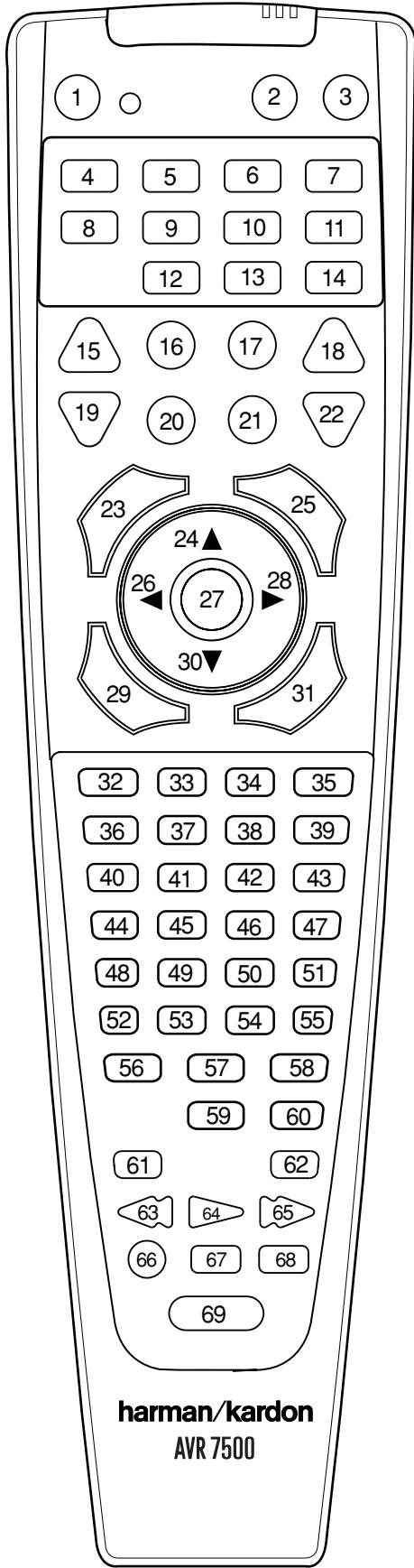
| No. | Button Name | AVR Function | DVD | CD/CDR |
| 1 | Power On | Power On | Power On | Power On |
| 2 | Power Off | Power Off | Power Off | Power Off |
| 3 | Mute | Mute | ||
| 4 | AVR | AVR Select | ||
| 5 | DVD | DVD Input Select | DVD Select | |
| 6 | CD | CD Input Select | CD Select | |
| 7 | Tape | Tape Input Select | ||
| 8 | VID 1 | Video 1 Select | ||
| 9 | VID 2 | Video 2 Select | ||
| 10 | VID 3 | Video 3 Select | ||
| 11 | VID 4 | Video 4 Select | ||
| 12 | AM/FM | Tuner Select | ||
| 13 | 6/8 Ch. Select | 6/8 Ch Input Select | ||
| 14 | Learn | |||
| 15 | Sleep | Sleep | ||
| 16 | Test | Test Tone | -/Input Select | |
| 17 | SPL | SPL | ||
| 18 | Volume Up | Volume Up | ||
| 19 | Surround Select | Surround Mode Select | -/CDR Select | |
| 20 | Night | Night Mode Select | Subtitle on/off | -/CDP Select |
| 21 | Multi Room | Multi-Room Select | ||
| 22 | Volume Down | Volume Down | ||
| 23 | Channel/Guide | Channel Trim | Title | |
| 24 | ▲ | Move/Adjust Up | Up | |
| 25 | Speaker/Menu | Speaker Adjust | Menu | Intro/- |
| 26 | ← | Move/Adjust Left | Left | |
| 27 | Set | Set | Enter | |
| 28 | ▶ | Move/Adjust Right | Right | |
| 29 | Digital/Exit | Digital Input Select | Open/Close | |
| 30 | ▼ | Move/Adjust Down | Down | |
| 31 | Delay/Prev. Ch. | Delay Adjust | Return | Open/Close |
| 32 | 1 | 1 | 1 | 1 |
| 33 | 2 | 2 | 2 | 2 |
| 34 | 3 | 3 | 3 | 3 |
| 35 | 4 | 4 | 4 | 4 |
| 36 | 5 | 5 | 5 | 5 |
| 37 | 6 | 6 | 6 | 6 |
| 38 | 7 | 7 | 7 | 7 |
| 39 | 8 | 8 | 8 | 8 |
| 40 | Tun-M | Tuner Mode | Chapter | Repeat |
| 41 | 9 | 9 | 9 | 9 |
| 42 | 0 | 0 | 0 | 0 |
| 43 | Memory | Memory | Audio | Time/CDR Display |
| 44 | Tune Up | Tune Up | Next Chapter | |
| 45 | Direct | Direct Tuner Entry | Angle | Random |
| 46 | Clear | Clear | Clear | Clear |
| 47 | Preset Up | Preset Tune Up | Slow Forward | +10/- |
| 48 | Tune Down | Tune Down | Prev Chapter | -/Track Increment |
| 49 | OSD | OSD | Program | |
| 50 | RDS | RDS | Disc Skip | Disc Skip |
| 51 | Preset Down | Preset Tune Down | Slow Rev | |
| 52 | M1 | |||
| 53 | M2 | |||
| 54 | M3 | |||
| 55 | M4 | |||
| 56 | Dolby | Dolby Modes | ||
| 57 | DTS SURR | DTS Digital Modes | ||
| 58 | DTS Neo:6 | DTS Neo:6 Select | ||
| 59 | Logic 7 | Logic 7 Select | ||
| 60 | Stereo | Stereo Mode Select | ||
| 61 | Skip Down | Skip - | Skip - | |
| 62 | Skip Up | Skip + | Skip + | |
| 63 | Rewind | R. Search | R. Search | |
| 64 | Play | Play | Play | |
| 65 | Fast Forward | F. Search | F. Search | |
| 66 | Record | -/Record | ||
| 67 | Stop | Stop | Stop | |
| 68 | Pause | Pause | Pause |
Function List
| No. | Button Name | Tape | VCR (VID 1) | TV (VID 2) | CBL (VID 3) | SAT(VID 3) |
| 1 | Power On | Power On | Power On | Power On | Power On | Power On |
| 2 | Power Off | Power Off | Power Off | Power Off | Power Off | Power Off |
| 3 | Mute | Mute | ||||
| 4 | AVR | |||||
| 5 | DVD | |||||
| 6 | CD | |||||
| 7 | Tape | Tape Select | ||||
| 8 | VID 1 | VCR Select | ||||
| 9 | VID 2 | TV Select | ||||
| 10 | VID 3 | VID 3 Select | VID 3 Select | |||
| 11 | VID 4 | |||||
| 12 | AM/FM | |||||
| 13 | 6/8 Ch. Select | |||||
| 14 | Learn | |||||
| 15 | Sleep | Channel + | Channel + | Channel + | Channel + | |
| 16 | Test | |||||
| 17 | SPL | |||||
| 18 | Volume Up | Volume Up | ||||
| 19 | Surround Select | Channel - | Channel - | Channel - | Channel - | |
| 20 | Night | |||||
| 21 | Multi Room | |||||
| 22 | Volume Down | Volume Down | ||||
| 23 | Channel/Guide | Info/Guide | Info/Guide | |||
| 24 | ▲ | Up | Up | Up | Up | |
| 25 | Speaker/Menu | Menu | Menu | Menu | Menu | |
| 26 | ▼ | Left | Left | Left | Left | |
| 27 | Set | Enter | Enter | Enter | Enter | |
| 28 | ▶ | Right | Right | Right | Right | |
| 29 | Digital/Exit | Exit | Exit | Exit | Exit | |
| 30 | ▼ | Down | Down | Down | Down | |
| 31 | Delay/Prev. Ch. | Prev Channel | Prev Channel | Prev Channel | ||
| 32 | 1 | 1 | 1 | 1 | 1 | |
| 33 | 2 | 2 | 2 | 2 | 2 | |
| 34 | 3 | 3 | 3 | 3 | 3 | |
| 35 | 4 | 4 | 4 | 4 | 4 | |
| 36 | 5 | 5 | 5 | 5 | 5 | |
| 37 | 6 | 6 | 6 | 6 | 6 | |
| 38 | 7 | 7 | 7 | 7 | 7 | |
| 39 | 8 | 8 | 8 | 8 | 8 | |
| 40 | Tun-M | |||||
| 41 | 9 | 9 | 9 | 9 | 9 | |
| 42 | 0 | 0 | 0 | 0 | 0 | |
| 43 | Memory | |||||
| 44 | Tune Up | Sleep | ||||
| 45 | Direct | FAV | FAV | |||
| 46 | Clear | Clear | Clear | Bypass | Next | |
| 47 | Preset Up | Music | Alt | |||
| 48 | Tune Down | |||||
| 49 | OSD | OSD | OSD | OSD | OSD | |
| 50 | RDS | |||||
| 51 | Preset Down | |||||
| 52 | M1 | |||||
| 53 | M2 | |||||
| 54 | M3 | |||||
| 55 | M4 | |||||
| 56 | Dolby | |||||
| 57 | DTS SURR | |||||
| 58 | DTS Neo:6 | |||||
| 59 | Logic 7 | |||||
| 60 | Stereo | |||||
| 61 | Skip Down | Scan - | ||||
| 62 | Skip Up | Scan + | ||||
| 63 | Rewind | Rewind | Rewind | |||
| 64 | Play | Play | Play | |||
| 65 | Fast Forward | Fast Fwd | Fast Fwd | Day + | Day + | |
| 66 | Record | Record/Rec.Pause | Record | |||
| 67 | Stop | Stop | Stop | |||
| 68 | Pause | Pause |
| SYMPTOM | CAUSE | SOLUTION |
| Unit does not function when Main Power Switch 1 is pushed | • No AC Power | • Make certain AC power cord is plugged into a live outlet • Check to see if outlet is switch controlled |
| Display lights, but no sound or picture | • Intermittent input connections • Mute is on • Volume control is down | • Make certain that all input and speaker connections are secure • Press Mute button 43 • Turn up volume control |
| Units turns on, but Front-Panel Display does not light | • Display brightness is turned off | • Follow the instructions in the Display Brightness section on page 37 so that the display is set to VFD FULL |
| No sound from any speaker; light around Power switch 2 is red | • Amplifier is in protection mode due to possible short • Amplifier is in protection mode due to internal problems | • Check speaker-wire connections for shorts at receiver and speaker ends • Contact your local Harman Kardon service depot |
| No sound from surround or center speakers | • Incorrect surround mode • Input is mono • Incorrect configuration • Stereo or Mono program material | • Select a mode other than Stereo • There is no surround information from mono sources (except with Theater and Hall surround modes) • Check speaker mode configuration • Some surround modes may not create rear-channel information from nonencoded programs |
| Unit does not respond to remote commands | • Weak batteries in remote • Wrong device selected • Remote sensor 30 is obscured | • Change remote batteries • Press the AVR Selector 6 • Make certain front-panel sensor is visible to remote or connect remote sensor |
| Intermittent buzzing in tuner | • Local interference | • Move unit or antenna away from computers, fluorescent lights, motors or other electrical appliances |
| Letters flash in the Channel Indicator Display 9 and Digital Audio stops | • Digital audio feed paused | • Resume play for DVD • Check that Digital Signal is fed to the Digital Input selected |
| HDCD encoded disc does not trigger HDCD indicator | • Surround mode in use • Analog feed in use | • Select “Surround Off” mode • Connect and select digital connection to CD player |
Processor Reset
In the rare case where the unit's operation or the displays seem abnormal, the cause may involve the erratic operation of the system's memory or microprocessor.
To correct this problem, first unplug the unit from the AC wall outlet and wait at least three minutes. After the pause, reconnect the AC power cord and check the unit's operation. If the system still malfunctions, a system reset may clear the problem.
To clear the AVR 7500's entire system memory including tuner presets, output level settings, delay times and speaker configuration data, first put the unit in Standby by pressing the System Power Control button 2. Next, press the Tone Mode 3 and the RDS 16 buttons simultaneously.
The unit will turn on automatically and display the RESET message in the Main Information Display. Note that once you have cleared the memory in this manner, it is necessary to re-establish all system configuration settings and tuner presets.
NOTE: Resetting the processor will erase any configuration settings you have made for speakers, output levels, surround modes, digital input assignments as well as the tuner presets. After a reset the unit will be returned to the factory presets, and all settings for these items must be reentered.
If the system is still operating incorrectly, there may have been an electronic discharge or severe AC line interference that has corrupted the memory or microprocessor.
If these steps do not solve the problem, consult an authorized Harman Kardon service depot.
Audio Section
Stereo Mode
Continuous Average Power (FTC)
110 Watts per channel, 20Hz-20kHz
@ < 0.07% THD, both channels driven into 8 ohms
Five-Channel Surround Modes
Power Per Individual Channel
Front L&R channels:
100 Watts per channel,
@ < 0.07% THD, 20Hz-20kHz into 8 ohms
Center channel:
100 Watts, @ < 0.07% THD, 20Hz-20kHz into 8 ohms
Surround channels:
100 Watts per channel,
@ < 0.07% THD, 20Hz-20kHz into 8 ohms
Input Sensitivity/Impedance
Linear (High Level) 200mV/47kohms
Signal-to-Noise Ratio (IHF-A) 95dB
Surround System Adjacent Channel Separation
Analog Decoding 40dB
(Pro Logic, etc.)
Dolby Digital (AC-3) 55dB
DTS 55dB
Frequency Response
@ 1W (+0dB, -3dB) 10Hz-100kHz
High Instantaneous
Current Capability (HCC) ±75 Amps
Transient Intermodulation
Distortion (TIM) Unmeasurable
Rise Time 16 μsec
Slew Rate 40V/μsec**
FM Tuner Section
Frequency Range 87.5-108MHz
Useable Sensitivity IHF 1.3 V / 13.2dBf
Signal-to-Noise Ratio Mono/Stereo: 70/65dB (DIN)
Distortion Mono/Stereo: 0.15 / 0.3%
Stereo Separation 35dB @ 1kHz
Selectivity ±300kHz: 65dB
Image Rejection 80dB
IF Rejection 90dB
AM Tuner Section
Frequency Range 522-1611kHz
Signal-to-Noise Ratio 45dB
Usable Sensitivity Loop: 500 V
Distortion 1kHz, 50% Mod: 0.8%
Selectivity ±9kHz: 30dB
Video Section
Video Format PAL/NTSC
Input Level/Impedance 1Vp-p/75 ohms
Output Level/Impedance 1Vp-p/75 ohms
Video Frequency Response
(Composite and S-Video) 10Hz-8MHz (-3dB)
Video Frequency
Response (Component) 10Hz-35MHz (-3dB)
General
Power Requirement AC 220-240V/50Hz
Power Consumption 125W idle, 1100W maximum
Dimensions (Max)
Width 440mm
Height 193mm
Depth 519mm
Weight 22.3 kg
Depth measurement includes knobs, buttons and terminal connections.
Height measurement includes feet and chassis.
All features and specifications are subject to change without notice.
Harman Kardon is a registered trademark, and Power for the digital revolution is a trademark, of Harman International Industries, Inc.
I111EzSet is a trademark of Harman International Industries, Inc. (Patent No. 5,386,478).
*Manufactured under license from Dolby Laboratories.
"Dolby," "Pro Logic," "Pro Logic II" and the Double-D symbol are trademarks of Dolby Laboratories. Confidential Unpublished
Works. ©1992-1999 Dolby Laboratories, Inc. All rights reserved.
DTS and DTS Surround, DTS-ES and DTS Neo:6 are trademarks of Digital Theater Systems, Inc.
UltraStereo is a trademark of UltraStereo Corp.
VMAx is a trademark of Harman International Industries, Inc., and is an implementation of Cooper Bauck Transaural Stereo under patent license.
Logic 7 is a registered trademark of Lexicon, Inc.
Crystal is a registered trademark of Cirrus Logic Corp.
HDCD is a registered trademark of Pacific Microsonics, Inc.
**Without input anti slewing and output isolation networks.