 ManualGo.com
PSS 250 A1 - Electric sander PARKSIDE - Free user manual and instructions
Find the device manual for free PSS 250 A1 PARKSIDE in PDF.



Download the instructions for your Electric sander in PDF format for free! Find your manual PSS 250 A1 - PARKSIDE and take your electronic device back in hand. On this page are published all the documents necessary for the use of your device. PSS 250 A1 by PARKSIDE.
USER MANUAL PSS 250 A1 PARKSIDE
Before reading, unfold the page containing the illustrations and familiarise yourself with all functions of the device.
Table of contents Introduction Intended use Page 6 Features … Page 6 Delivery contents Page 6 Technical Data Page 7 General safety advice for electrical power tools
1. Workplace safety . Page 7
2. Electrical safety Page 7
3. Personal safety. Page 8
4. Careful handling and use of electrical power tools . Page 8
Appliance-specific safety Instructions. Page 9 Original ancillaries / and accessories. …Page 10 Operation Switching On and OF. Setting the oscillation speed. Page 10 Page 10 Attaching a sanding pad .Page 10 Vacuuming dust…. Page 10 Instructions, tips and tricks … …Page 11 Maintenance and Cleaning Page 11 Service centre … Page 12 Warranty. Page 12 Disposal... Page 12 Declaration of Conformity / Manufacturer.…. Page 13
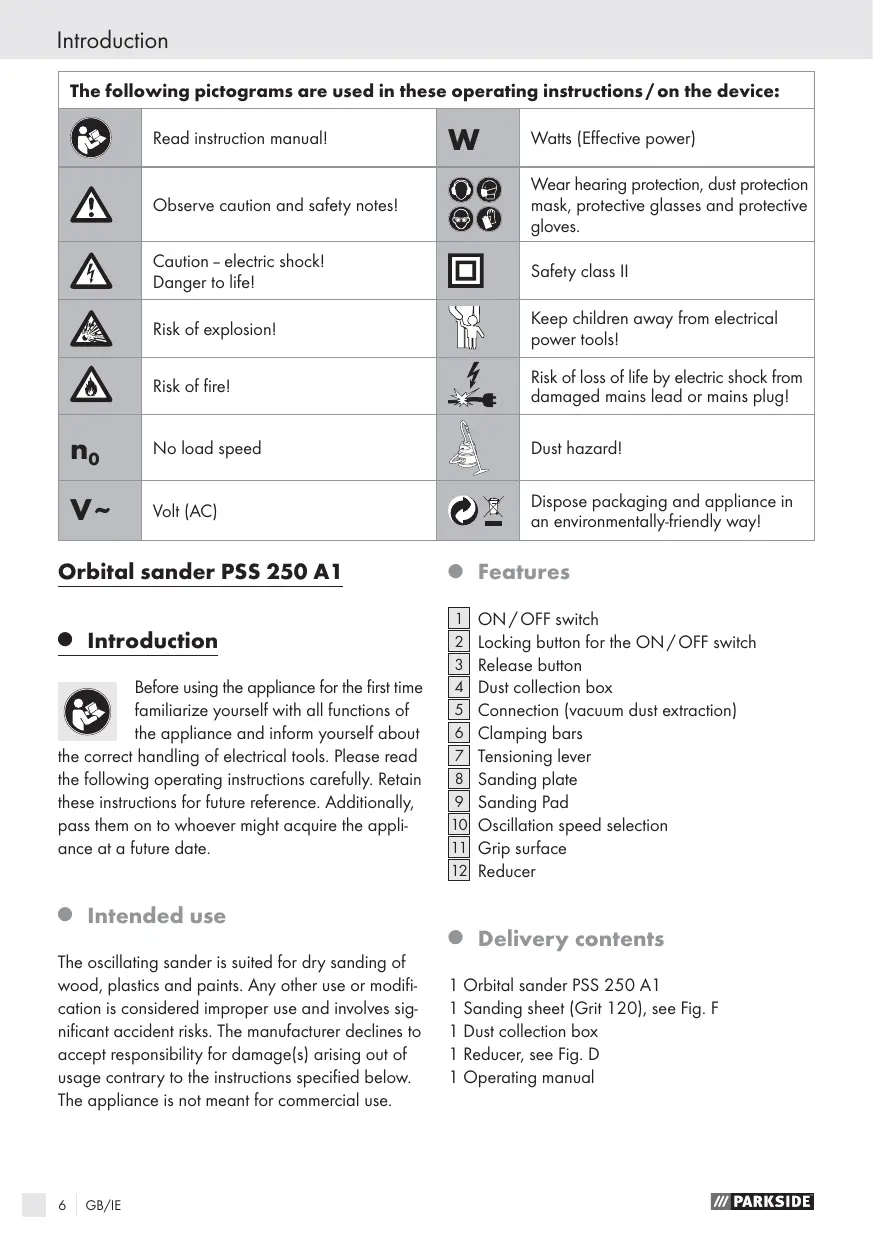
Introduction The following pictograms are used in these operating instructions / on the device: Read instruction manuall
Watts (Effective power] Observe caution and safety notes Wear hearing protection, dust protection mask, protective glasses and protective gloves. [01e]
Caution - electric shockl Danger to lifel Safety class Il Risk of explosion! Keep children away from electrical power tools! Risk of firel Risk of loss of fe by electric shock from damaged mains lead or mains plugl No load speed Dust hazardl
Volt (AC) Dispose packaging and appliance in an environmentallÿ-friendly way! Orbital sander PSS 250 A1 © Introduction
the correct handling of electrical tools. Please read Before using the appliance for the first time familiarize yourself with all functions of the appliance and inform yourself about the following operating instructions carefully. Retain these instructions for future reference. Additionally, pass them on to whoever might acquire the appli- ance at a future date. © Intended use The oscillating sander is suited for dry sanding of wood, plasties and paints. Any other use or modifi- cation is considered improper use and involves sig- nificant accident risks. The manufacturer declines to accept responsibility for damage(s) arising out of usage contrary to the instructions specified below. The appliance is not meant for commercial use. 6 G8/E © Features ON/OFF switch Locking button for the ON / OFF switch Release button Dust collection box Connection (vacuum dust extraction) [6] Clamping bars Tensioning lever Sanding plate [9] Sanding Pad Oscillation speed selection Grip surface Reducer © Delivery contents 1 Orbital sander PSS 250 A1 1 Sanding sheet (Grit 120], see Fig. F 1 Dust collection box 1 Reducer, see Fig. D 1 Operating manual MA PARKSIDE
Introduction / General safety advice for electrical power tools © Technical Data 230V- 50Hz 250W no 7000- 12000 rpm no 14000-24000 rpm Hook and loop fastening 93x185mm Clamp fastening 93x230mm 1/8 Nominal voltage: Nominal power: Idle speed, Idle oscillation speed: Sanding sheet dimensions: Protection class: Noise and vibration data: Measured values for noise are determined in accor- dance with EN 60745. The A-weighted noise level of the electrical power tool are typically: Sound pressure level: 79 dB(A) Sound power level 90 dB(A) Uncertainty K: 3d8 © Wear ear protection! Evaluated acceleration, typical: Hand / arm vibration a, = 10,2m/s? Uncertainty K = 1,5m/s? FN CAR he vibration level given in these instructions has been measured in accordance with a standardised measurement procedure specified in EN 60745 and can be used to compare devices. Different uses of the device give rise to different vibration levels and in many cases they may exceed the values given in these instructions. lt is easy to underestimate the vibration load if the electrical power tool is used regularly in particular circumstances. Note: If you wish to make an accurate assessment of he vibration loads experienced during a particular period of working, you should also take into account the intervening periods of time when the device is switched off or is running but is not actually in use. This can result in a much lower vibration load over the whole of the period of working. MA PARKSIDE General safety advice for electrical power tools
FN LAINE] Read all the safety advice and instructions! Failure to observe the safety advice and instructions may result in electric shock, fire and/or serious injury. Keep all the safety advice and instructions in a safe place for future referencel The term “electrical tool” used in the safety advice refers to electrical tools powered by mains electrici- ty (by means of a mains lead) and electrical tools powered by rechargeable batteries (without a mains lead).
a) Keep your working area clean and well lit. Untidy or poorly lit working areas can lead to accidents. b) Do not work with the device in potentially explosive envi- ronments in which there are inflammable liquids, gases or dusts. Electrical power tools create sparks, which can ignite dusts or fumes. c) (el Keep children and other people away while you are operating the electrical tool. Distractions can cause you to lose control of the device.
The mains plug on the device must match the mains socket. The plug must not be modified in any way. Do not use an adapter plug with devices fitted with a protective earth. Unmodified plugs and matching sockets reduce the risk of electric shock Avoid touching earthed surfaces such as pipes, radiators, ovens and refri erators with any part of your body.
General safety advice for electrical power tools
There is an increased risk of electric shock if your body is earthed. Keep the device away from rain or moisture. Waïer entering an electrical device increases the risk of electric shock. 4 Do not use the mains lead for any purpose for which it was ie not intended, e.g. to carry the device, to hang up the device or to pull the mains plug out of the mains socket. Keep the mains lead away from heat, oil, sharp edges or moving parts ofthe device. Damaged or tangled mains leads increase the risk of electric shock. When working outdoors with an electrical power tool always use ex- tension cables that are also approved for use outdoors. The use of an extension cable suitable for outdoor use reduces the risk of electric shock. Use a residual current device (RCD) for protection if operating the electri- cal power tool in a moist environment is unavoidable. The use of an RCD reduces the risk of electric shock. Personal safety Remain alert at all times, watch what you are doing and always proceed with caution. Do not use the device if you are tired or under the influence of drugs, alcohol or medication. One moment of carelessness when using the device can lead Lo serious injury. © Wear personal protective equipment and always wear OO :cfety glasses. The wearing of personal protective equipment such as dust masks, non-slip safety shoes, safety helmets or ear protectors, appropriate to the type of elec- frical power tool used and work undertaken, reduces the risk of injury. Avoid unintentional operation of the device. Check that the electrical power tool is switched off before you connect it to the mains, pick it up or carry it. GB/IE
Accidents can happen if you carry the device with your finger on the ON/OFF switch or with the device switched on. Remove any setting tools or spanners before you switch the device on. A tool or spanner left attached to a rotating part of a device can lead to injury. Avoid placing your body in an unnat- ural position. Keep proper footing and balance at all times. By doing this you will be in a better position to control the device in unforeseen circumstances. Wear suitable clothing. Do not wear loose clothing or jewellery. Keep your hair, clothing and gloves clear of mov- ing parts. Loose clothing, jewellery or long hair can become trapped in moving parts. If vacuum dust extraction and collection devices are fitted do not forget to check that they are properly connected and correctly used. The use of these devices reduces the hazard presented by dust. Careful handling and use of electrical power tools Do not overload the device. Always use an electrical power tool that is intended for the task you are under- taking. By using the right electrical power tool for the job you will work more safely and achieve a better result. Do not use an electrical power tool if its switch is defective. An electrical power tool that can no longer be switched on and off is dangerous and must be repaire. Pull the mains plug from the socket before you make any adjustments to the device, change accessories or when the device is put away. This precaution is intended to prevent you from unintentionally starting the device When not in use always ensure that electrical power tools are kept out of reach of children. Do not let anyone use the device if he or she is not familiar with it or has not read the instructions MA PARKSIDE
General safety advice for electrical power tools and advice. Electrical power tools are dan- gerous when they are used by inexperienced people e] Look after the device carefully. Check that moving parts are working prop- erly and move freely. Check for any parts that are broken or damaged enough to detrimentally affect the functioning of the device. Have dam- aged parts repaired before you use the device. Many accidents have their origins in poorly maintained electrical power tools: f) Keep cutting tools clean and sharp. Carefully maintained cutting tools with sharp cutting edges are less likely to jam and are easier to control Use the electrical power tool, accesso- ries, inserted tools etc. in accordance with these instructions and advice, and
into account the working condi and the task in hand. The use of electrical power tools for purposes other than those in- tended can lead to dangerous situations. \ Appliance-specific safety Instructions To avoid the risk of injury or fire as well as health risks: = When working outdoors, connect the appliance via a residual current cir- cuit-breaker with a maximum break- ing current of 30 mA. = Only use an extension cord ce for use outdoors. = Secure the workpiece firmly. Use clamps/ vices to firmly hold the workpiece. lt is thus better secured than just with your hand. = In case of danger, immediately pull the power plug from the socket. = Always run the power cord away from the appliance to the rear.
L] DANGER OF FIRE FROM FLYING
SPARKS! Abrading metal creates flying sparks. For his reason, always MA PARKSIDE
make sure that nobody is placed in any danger and that there are no inflammable materials near the working area. FN LAINE NOXIOUS FUMES! Any harmful/noxious dusts generated from sanding represent a risk to the health of the person operating the device and to anyone near the work area. $ EN CZ ousT HAZARD! | When sanding wood and in particular when working on materials that give rise to dusts that are hazardous to health, the sander must be connected to a suitable external dust extraction device. ©® Wear protective glasses and a dust mask! Ensure sufficient ventilation when work- ing on plastics, paints, lacquers, etc. Do not soak materials or surfaces to be worked with liquids containing solvents. Avoid sanding of lead-based paints or other materials that are hazardous to health. Material containing asbestos may not be worked on. Asbestos is considered a carcinogen. The appliance is designed for dry sur- face sanding of wood, plastic, metal and smoothing compounds as well as painted surfaces. Never work on moistened materials or wet surfaces. Water entering an electri- cal device increases the risk of electric shock. Always hold the appliance firmly with two hands while working (see also Fig. D, E). Never support your hands next to or in front of the device or on the surface being worked as there is a risk of in- jury in the event of slipping. Always switch off the appliance and allow the sanding pad [9]to come to a stop before setting down the oscil- lating sander. Always pull the power plug out of the socket for all work pauses, before any work on the appliance (e.g. changing the sanding paper) and when not in use. GB/E 9
General safety advice for electrical power tools / Operation = The appliance must always be kept clean, dry and free of oil or lubricat- ing greases. © Original ancillaries / and accessories = Only use accessories and tools that are specified in the operating instruc- tions. The use of tools and accessories other than those recommended in the operating in- structions could lead to an increased risk of personal injury for you. © Operation © Switching On and Off Switching on intermittent function: Press the ON / OFF switcl Switching off intermittent function: Release the ON/OFF switch [1] Switching on continuous Press the ON/ OFF switc and press the locking button Switching off continuous operation: Press the ON/ OFF switc again. © Setting the oscillation speed You can set the desired oscillation speed as need- ed with the oscillation speed selector The required oscillation speed depends on the ma- terial being worked and can be determined through practical tests. © Attaching a sanding pad FN LAINE] Before performing work on the appliance, always disconnect the power. 10 G8/E NOTE: Before attaching a new sanding pad [9] remove dust and dirt from the sanding plate [8] Sanding sheets with hook and loop fas- tening: Fix one side of the sanding sheet [2] flush with one side of the backing plate [8]. Then attach the sanding sheet [9 ]to the back. ing plate [8] and press it firmly into place. Sanding sheets without hook and loop fastening: Open the two clamping levers Push one end of the sanding sheet [el under the open clamping bar [6] and clamp the sheet firmly in place by locking the clamping back in place. Repeat this procedure at the other end. Various materials require different grit values. You can read which grit value is best suited for which work in our recommendations under “Instructions, tips and tricks”. © Vacuuming dust FN CZRIN FIRE HAZARD! A risk of fire exists when working with electrical appliances that have a dust collection bo: r can be aïtached to a vacuum cleaner via an external suction adapter! Under cer- tain conditions the sanding dust in the dust box (or in the vacuum's dust bag) may selfignite, e.g. as a result of flying sparks generated when abrading metals or metal objects left in wood. This can hap- pen especially if the wood dust has paint particles on it or is mixed with other chemical substances and the sanded material is hot after extensive work- ing. You should therefore avoid overheating of products being sanded as well as the appliance and always empty the dust collection box [4] or the dust bag of the vacuum cleaner before work pauses. (e)] Wear a dust mask! MA PARKSIDE
Vacuuming dust with the dust collection box Attach the dust collection box: Push the dust collection box [4] on to the device. Remove the dust collection box: and pull the dust f the device. collection bo: NOTE: Always empty the dust collection bo: in due time and shake any remaining dust out; this will ensure optimal vacuum performance. Dust extraction using an external vacuum extraction device Connecting: For vacuum dust removal using a vacuum cleaner, push the suction hose of a vacuum cleaner approved for use as a dust extraction device [e.g. a workshop vacuum cleaner) into - see Fig. D. NOTE: If it is necessary to use the reducer sh the reducer piece into the con- the connection Pull the hose of the dust extraction device off the connection [5 | or off the reducer piece if one is used. © Instructions, tips and tricks Move the oscillating sander parallel, in flat circles or alternating between lengthwise and side-to-side motions. Do not press down with the oscillating sander. The sanding pads become clogged, which re- duces the sanding performance. Clean the sanding pad [9] occasionally with the vacuum cleaner. The removal performance and therefore the re- sult of your work are determined by the correct selection of the speed and sanding pad [9] grit. Never sand different materials with the same sanding pad [2] (e.g. wood then metal). MA PARKSIDE Operation / Maintenance and cleaning The following table offers some values, which are for information only and may simplify the selection of a sanding pad [2]. Sanding ofwood 40-240 Presanding, e.g. of 40,60 rough, unplaned beams and boards 80, 100, 120 180, 240 Surface sanding Fine sanding of hard woods Sanding of paint/ 40-320 lacquer coats or base coats such as filler and smoothing com- pound 40, 60 80, 100, 120 Sanding off paint Sanding off primer coats Final sanding of base 180, 240, 320 coaïs before painting © Maintenance and Cleaning FN ZUNE] DANGER OF INJURY! Before performing any work on the appliance, disconnect the power plug. Clean the appliance regular}, preferably always immediately after use. Do not use any sharp objects for cleaning the appliance. Never permit fluids to permeate in- side the appliance. Use a cloth to clean the casing. Never use petrol, solvents or cleansers that damage plastics. À vacuum cleaner is required for thorough cleaning of the appliance. Ventilation openings must never be obstructed. Remove adhering sanding dust with a brush. GB/IE 11
Service centre / Warranty / Disposal © Service centre = FN DAMINEI Have your device repaired only by qualified specialist personnel using original manufacturer parts only. This will ensure that your device remains safe to use. - AN OINA ff the plug or mains lead needs to be replaced, always have the replacement carried out by the manufacturer or its service centre. This will ensure hat your device remains safe to use. © Warranty The warranty for this appliance is for 3 years from the date of purchase. The ap- pliance has been manufactured with care and meticulously examined before deliv- ery. Please retain your receipt as proof of purchase. In the event of a warranty claim, please make contact by telephone with our Service Department. Only in this Way can a post-free despatch for your goods be assured. The warranty covers only claims for material and maufacturing defects, but not for transport damage, for wearing paris or for damage to fragile compo- nents, e.g. buttons or batteries. This product is for private use only and is not intended for commercial use. The warranty is void in the case of abusive and im- proper handling, use of force and internal tamper- ing not carried out by our authorized service branch Your statutory rights are not restricted in any way by this warranty. The warranty period will not be extended by repairs made unter warranty. This applies also to replaced and repaired paris. Any damage and defecis extant on purchase must be reported immediately after unpacking the appliance, at the latest, two days after the purchase date. Repairs made after the expiration of the warranty period are subject to payment. 12 G8/E
The packaging is made from environ. mentally-friendly material and can be disposed off at your local recycling plant. Do not dispose of electrical appliances in normal household refuse! According to European Directive 2002 / 96 / EC for used electrical and electronic appliances and its adoption into national laws, worn-out electrical tools must be collected separately and subjected to an environmentally friendly recycling procedure. Your local communal or municipal authoriies can provide information on how to dispose of the worn- out appliance. MA PARKSIDE
© Declaration of Conformity / Manufacturer C€ We, KompernaB GmbH, the person responsible for documents: Mr Felix Becker, Burgstr. 21, D-44867 Bochum, Germany, hereby declare that this product complies with the following standards, normative documents and EU directives: Machinery Directive (2006/42/EC) EU Low Voltage Directive (2006/95 /EC) Electromagnetic Compatibility (2004 /108/EC) Applicable harmonized standards EN 60745-1:2009 EN 60745. 2009 EN 62233:2008 EN 55014-1:2006 EN 55014-2/A2:2008 IEC 60745-1:2006
IEC 60745-2-4/A1:2008
Type/Machine designation: Orbital sander PSS 250 A1 Date of manufacture (DOM): 07-2010 Serial number: IAN 54381 Bochum, 31.07.2010 Voyss Hans KompernaB - Managing Director - We reserve the right to make technical modifications in the course of product development. MA PARKSIDE Declaration of Conformity / Manufacturer GB/IE 13