ManualGo.com
BEM800XL - Coffee machine BREVILLE - Free user manual and instructions
Find the device manual for free BEM800XL BREVILLE in PDF.


Download the instructions for your Coffee machine in PDF format for free! Find your manual BEM800XL - BREVILLE and take your electronic device back in hand. On this page are published all the documents necessary for the use of your device. BEM800XL by BREVILLE.
USER MANUAL BEM800XL BREVILLE
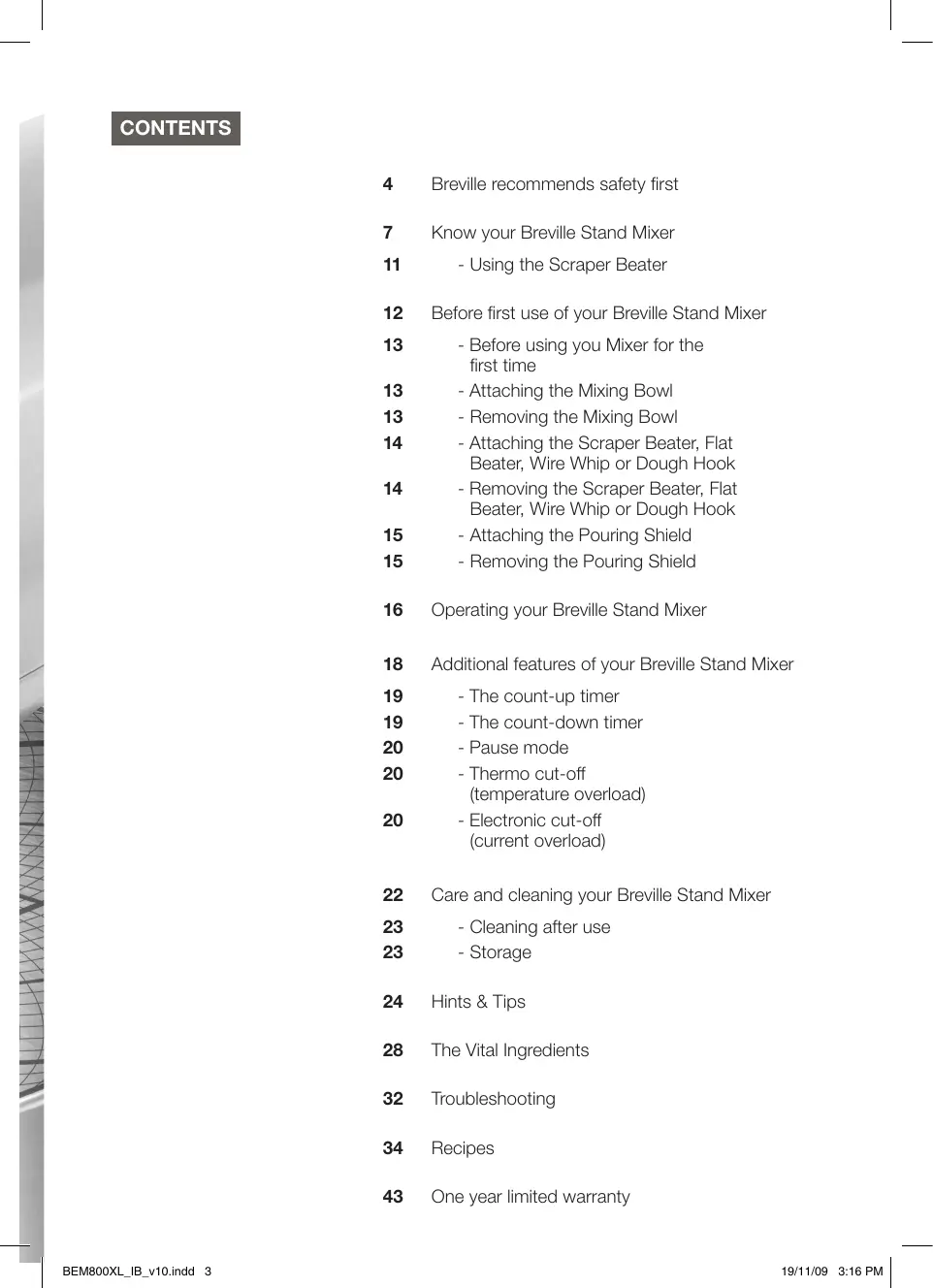
Breville recommends safety first
13 - Before using you Mixer for the
13 - Attaching the Mixing Bowl
13 - Removing the Mixing Bowl
14 - Attaching the Scraper Beater, Flat
Beater, Wire Whip or Dough Hook
14 - Removing the Scraper Beater, Flat
Beater, Wire Whip or Dough Hook
15 - Attaching the Pouring Shield
15 - Removing the Pouring Shield
Additional features of your Breville Stand Mixer
19 - The count-up timer
19 - The count-down timer
20 - Electronic cut-off
Care and cleaning your Breville Stand Mixer
One year limited warranty 19/11/09 3:16 PM
BREVILLE RECOMMENDS SAFETY FIRST
At Breville we are very safety conscious. We design and manufacture consumer products with the safety of you, our valued customer, foremost in mind. Important safeguards When using electrical appliances, basic safety precautions should always be followed including: Read all instructions
- Carefully read all instructions before operating the appliance for the first time and save for future reference.
- Remove and safely discard any packaging material and promotional labels before using the appliance for the first time.
- To eliminate a choking hazard for young children, remove and safely discard the protective cover fitted to the power plug of this appliance.
- Do not place the appliance near the edge of a bench or table during operation. Ensure the surface is level, clean and free of water and other substances. Vibration during operation may cause the appliance to move.
- Do not use the appliance on a sink drain board.
- Do not place the appliance on or near a hot gas or electric burner, or where it could touch a heated oven.
- Always ensure the appliance is completely assembled before operating. Follow the instructions provided in this book. to the 'OFF' position before unplugging the power plug from the wall outlet.
- Always ensure the Speed Control Dial is in the 'OFF' position and remove the power plug from the wall outlet before attaching the scraper beater, flat beater, wire whip or dough hook.
- Do not use attachments other than those recommended by Breville or provided with the appliance. The use of any accessory attachments not recommended by Breville may cause injuries.
- The scraper beater is not intended for mixing heavy batters, doughs, whisking egg whites or whipping potatoes.
- Avoid contact with moving parts. Keep hands, hair, clothing, as well as spatulas and other utensils away from the moving scraper beater, flat beater, wire whip or dough hook during operation to reduce the risk of injury to persons, and/or damage to the Mixer.
- Always ensure the Speed Control Dial is in the 'OFF' position and remove the power plug from the wall outlet before placing hands inside the mixing bowl or before removing fallen objects such as a spoon or spatula.
- Care should be taken when removing food from the mixing bowl by ensuring the motor and the scraper beater, flat
- Always ensure the Speed Control Dial is in the 'OFF' position before plugging the power plug into the wall outlet. To disconnect, turn the Speed Control Dial
BREVILLE RECOMMENDS SAFETY FIRST
beater, wire whip or dough hook have completely stopped. Ensure the Speed Control Dial is in the 'OFF' position and remove the power plug from the wall outlet before unlocking the mixer head and moving into the open (vertical) position. The scraper beater, flat beater, wire whip or dough hook should be released from the mixer head before removing food from the mixing bowl.
- Always ensure the Speed Control Dial is in the 'OFF' position and remove the power plug from the wall outlet before attempting to move the appliance, before assembling or disassembling, when not in use and before cleaning or storing.
- Ensure the mixer head is locked into the closed (horizontal) position when not in use and before storing.
- Always remove the scraper beater, flat beater, wire whip or dough hook from the appliance before cleaning.
- Do not place any part of the appliance in the dishwasher other than the mixing bowl, pouring shield, spatula, scraper beater, flat beater, wire whip or dough hook.
- Do not place any part of the appliance in the microwave oven.
- Do not move the appliance whilst in operation.
- Do not leave the appliance unattended when in use.
- This appliance is for household use only. described in this booklet. Do not use outdoors. Do not use in moving vehicles or boats.
- Fully unwind the power cord before use.
- Do not let the power cord hang over the edge of a bench or table, touch hot surfaces or become knotted.
- To protect against electric shock, do not immerse the power cord, power plug or appliance in water or any other liquid.
- The appliance is not intended for use by persons (including children) with reduced physical, sensory or mental capabilities, or lack of experience and knowledge, unless they have been given supervision or instruction concerning use of the appliance by a person responsible for their safety.
- Supervision is necessary when any appliance is used by or near children.
- For any maintenance other than cleaning, call Breville Customer Service at 1-866-BREVILLE.
- Regularly inspect the power cord, plug and actual appliance for any damage. Do not operate if damaged in any way or after the appliance malfunctions. Immediately cease use of the appliance and call Breville Customer Service at 1-866-BREVILLE for examination, repair or adjustment.
- This appliance is equipped with a power cord having a grounding wire with a grounding plug. The appliance must be grounded using a 3-hole properly grounded outlet. In the event of an electrical short circuit, grounding reduces the risk of electrical shock.
- Do not use the appliance for anything other than its intended purpose as
BREVILLE RECOMMENDS SAFETY FIRST
- If the power outlet is a standard 2-prong wall outlet, it is your personal responsibility and obligation to have it replaced with a properly grounded 3-prong wall outlet.
- Do not, under any circumstances, cut or remove the third (ground) prong from the power cord or use an adapter.
- Consult a qualified electrician if the grounding instructions are not completely understood, or if doubt exists as to whether the appliance is properly grounded.
- The installation of a residual current device (safety switch) is recommended to provide additional safety protection when using electrical appliances. It is advisable that a safety switch with a rated residual operation current not exceeding 30mA be installed in the electrical circuit supplying the appliance. Consult a qualified electrician for professional advice.
WHIP OR DOUGH HOOK. Breville Assist™ PLug Your Breville appliance comes with a unique Assist™ Plug, conveniently designed with a finger hole in the power plug for easy and safe removal from the wall outlet. For safety reasons it is recommended you plug your Breville appliance directly into its own electrical outlet on a dedicated circuit separate from other appliances. If the electric circuit is overloaded with other appliances, your appliance may not function properly. short cord instructions Your Breville appliance is fitted with a short power cord as a safety precaution to prevent personal injury or property damage resulting from pulling, tripping or becoming entangled with a longer cord. Use in conjunction with a power strip or extension cord is not recommended, however they are available and may be used if care is exercised. If an extension cord is used, (1) the marked electrical rating of the cord set or extension cord should be at least as great as the electrical rating of the appliance, (2) the cord should be arranged so that it will not drape over the countertop or tabletop where it can be pulled on by children or tripped over unintentionally and (3) the extension cord must include a 3-prong grounding plug.
SAVE THESE INSTRUCTIONS
A 'Tilt-Release' Button: Releases the mixer head into the open 'Tilt-Back' position for easy removal and addition of ingredients, attachments and mixing bowl. B Internal Cord Storage: Located in the rear of the mixer. Cord pushes into the mixer base for convenient and tidy storage. C Lift Assist Handles: Handles on the mixer head and base allow for easy handling and maneuvering. D Attachment Shaft: Attaches the scraper beater, flat beater, wire whip and dough hook. E LED Speed Indicator: LEDs illuminate to display the selected speed/mixing task. F 12 Speed Control Dial: 'Pause' function temporarily stops the mixer and pauses the timer. G LCD screen with 10 Minute Timer: Set the timer to count-up to record mixing time, or count-down according to a specified recipe time before automatically switching off. H 2-Piece Pouring Shield: Minimizes spattering when mixing and adding ingredients.
5 Quart Stainless Steel Bowl. J Bowl Locking Recess: Securely locks the bowl in place for safety and stability when the mixer is in operation. K Spatula (not shown)
BEM800XL_IB_v10.indd 8 19/11/09 3:16 PM know your breville stand mixer Scraper Beater for creaming butter & sugar, mixing sticky ingredients or folding whipped egg whites into mixtures: - Frosting, icing, gum paste - Cheesecakes - Compound butters - Pie fillings - Creaming mascarpone cheese, cream cheese, sour cream NOTE: Do not use the Scraper Beater for mixing heavy batters, doughs, whisking egg whites or whipping potatoes. - Sticky cake & cookie batters Flat Beater for normal to heavy mixtures: - Pie pastry - Mashed potatoes - Biscuits - Meat loaf - Quick breads - Heavy cake & cookie batters Wire Whip for incorporating air into mixtures: - Eggs - Angel food cakes - Egg whites - Chiffon cakes - Heavy cream - Meringues - Certain candies - Sauces and dressings Dough Hook for mixing and kneading yeast doughs: - Breads - Pasta - Rolls - Focaccia - Pizza - Yeast-raised coffee cakes
BEM800XL_IB_v10.indd 9 19/11/09 3:16 PM know your breville stand mixer Scrapes the Bowl So you don’t have to Under-mixed batters produce poorly baked results, including collapsing, unevenness of crumb, holes, low rising, streaking and coarse textures. The flexible edge of the Scraper Beater continuously folds and scrapes the sides & bottom of the bowl, including the dimple at the bottom, for exceptionally thorough mixing. It virtually eliminates the need for hand scraping with a spatula, cutting mixing time by up to 60%*.
- Tested creaming butter and sugar against BEM800XL flat beater.
BEM800XL_IB_v10.indd 10 19/11/09 3:16 PM know your breville stand mixer Using the Scraper Beater The Scraper Beater can be used for a variety of mixing tasks. Due to the efficient mixing action of the Scraper Beater, the mixing time of many recipes will be reduced. Refer to the chart below for approximate mixing times. These are a guide only. Longer mixing times may be required for larger or double quantities. Mixture Mixing Task Approx. Mixing Time Butter & Sugar Creaming 3-4 minutes (or until mixture is light and creamy) Crumble (topping) Combining/rubbing butter and dry ingredients 50-60 seconds (or until ingredients resemble coarse breadcrumbs) Cake, cookie & muffin batters Incorporating wet and dry ingredients 30-40 seconds (or until all ingredients are combined) Thin/light batters (ie. Pancakes) Incorporating wet and dry ingredients 40-50 seconds (or until batter is smooth) Icing Incorporating wet and dry ingredients 30-40 seconds (or until all icing is smooth) Frosting Creaming butter 1-2 minutes (or until butter is smooth and creamy) Combining icing sugar, butter & liquid ingredients 50-60 seconds (or until mixture is light and fluffy) NOTE: Do not use the Scraper Beater for mixing heavy batters, doughs, whisking egg whites or whipping potatoes. TIP:
- When adding flour to the mixing bowl, always use the pouring shield and ensure the mixer is on the Fold/Knead setting. This will prevent flour from escaping the mixing bowl.
- The Scraper Beater can also be used as a spatula when removing mixtures from the mixing bowl.
Before using your Mixer for the first time
1. Place the Mixer on a level, dry surface
such as a bench top.
2. Ensure the power cord is unplugged
and the Speed Control Dial is in the 'OFF' position.
3. Remove any packaging material and
2. Press the ‘Tilt-Release’ button and
simultaneously use the Lift Assist Handle to raise the mixer head until it locks into the open position.
3. Turn the mixing bowl counter-clockwise
to release from the Bowl Locking Recess. 'TILT-RELEASE' BUTTON
4. Remove the mixing bowl, pouring
shield, spatula, scraper beater, flat beater, wire whip and dough hook.
5. Wash in warm soapy water with a
soft cloth. Rinse and dry thoroughly. Alternatively, the mixing bowl, pouring shield, spatula and attachments may be washed in the dishwasher (spatula and attachments, top shelf only). NOTE: When using the Mixer for the first time you may notice an odor coming from the motor. This is normal and will dissipate with use. OPEN POSITION Attaching the Mixing Bowl
1. Ensure the power cord is unplugged
and the Speed Control Dial is in the 'OFF' position.
2. Press the ‘Tilt-Release’ button and
simultaneously use the Lift Assist Handle to raise the mixer head until it locks into the open position.
3. Insert the mixing bowl into the Bowl
Locking Recess and turn clockwise until the mixing bowl locks securely into place. Removing the Mixing Bowl
1. Ensure the power cord is unplugged
and the Speed Control Dial is in the 'OFF' position. ATTACH REMOVE NOTE: To remove or insert the mixing bowl, the mixer head must be raised and locked into the open position.
Attaching the Scraper Beater, Flat Beater, Wire Whip or Dough Hook Removing the Scraper Beater, Flat Beater, Wire Whip or Dough Hook
1. Ensure the power cord is unplugged
and the Speed Control Dial is in the 'OFF' position.
1. Ensure the power cord is unplugged
and the Speed Control Dial is in the 'OFF' position.
2. Press the 'Tilt-Release' button and
simultaneously use the Lift Assist Handle to raise the mixer head until it locks into the open position.
2. Press the 'Tilt-Release' button and
simultaneously use the Lift Assist Handle to raise the mixer head until it locks into the open position.
3. Locate the groove at the top of the
3. Push the attachment upwards as far
as possible and turn clockwise until the attachment releases from the pin on the Attachment Shaft.
4. Align the groove with the pin on the
5. Push upwards as far as possible
and turn counter-clockwise until the attachment securely locks onto the pin.
4. Pull attachment from Attachment Shaft.
6. Press the 'Tilt-Release' button and
simultaneously use the Lift Assist Handle to lower the mixer head until it locks into the closed position.
Attaching the Pouring Shield
1. Ensure the power cord is unplugged
and the Speed Control Dial is in the 'OFF' position.
2. Attach the mixing bowl and either the
scraper beater, flat beater, wire whip or dough hook.
3. Press the 'Tilt-Release' button and
simultaneously use the Lift Assist Handle to lower the mixer head until it locks into the closed position.
4. Slide the main ring into position on
top of the mixing bowl then attach the pour spout. Removing the Pouring Shield
1. Ensure the power cord is unplugged
and the Speed Control Dial is in the 'OFF' position.
2. Detach the pour spout then slide the
main ring from the mixing bowl.
3. Press the 'Tilt-Release' button and
simultaneously use the Lift Assist Handle to raise the mixer head until it locks into the open position.
4. Remove the attachment from the
Attachment Shaft then remove the mixing bowl from the Bowl Locking Recess.
BEM800XL_IB_v10.indd 15 19/11/09 3:16 PM OPERATING Your Breville Stand Mixer
BEM800XL_IB_v10.indd 16 19/11/09 3:16 PM Operating the Mixer The Breville Stand Mixer features Planetary Mixing Action, a similar mixing action used by commercial mixers in bakeries and patisseries for 360 degree beater-to-bowl coverage. This is achieved by the counter-clockwise motion of the mixer head combined with the clockwise sweep of the beater. The result is thoroughly mixed ingredients without the need for a rotating bowl.
1. Ensure the power cord is unplugged
and the Speed Control Dial is in the 'OFF' position.
5. Rotate the Speed Control Dial
clockwise. Always begin mixing on the lowest speed then gradually increase to the desired higher speed to prevent ingredients spattering. The LED Speed Indicator is conveniently labeled with suggested mixing tasks for each speed setting. Use this in combination with the attachment guide, printed on the inner body of the Mixer (visible once the mixing bowl is removed). Mixing Task (on LED) Use For (see p.9 & 11) Aerate
simultaneously use the Lift Assist Handle to lower the mixer head until it locks into the closed position. Attach the pouring shield, if desired. Cream
4. Unwind the power cord completely
and insert the power plug into a grounded wall outlet. The LED’s on the speed indicator will illuminate one-by-one all the way to the top, then turn off one-by-one. The LCD screen will display '0:00'. Fold
- Use 'Fold' to start all mixing procedures
2. Assemble the Mixer with the desired
attachment and the mixing bowl (containing ingredients as directed in the recipe). NOTE: If the Mixer has not been used for 3 minutes it will automatically enter power-saving standby mode. When in standby mode, the LCD screen will cease to illuminate. To re-activate the Mixer out of standby mode and begin mixing, turn the Speed Control Dial or press one of the 'Count Up/Down' timer arrows. ATTACHMENT Light Mix Knead
Dial to the 'OFF' position and scrape the mixing bowl with a spatula. To recommence mixing, rotate the Speed Control Dial clockwise. NOTE: Under heavy load with extended mixing time, the mixer head may become warm. This is normal.
BEM800XL_IB_v10.indd 17 19/11/09 3:16 PM Lorem ipsum dolor sit amet consectetuer elit. ADDITIONAL FEATURES Of your Breville Stand Mixer
BEM800XL_IB_v10.indd 18 19/11/09 3:16 PM ADDITIONAL FEATURES The count-up timer The count-up timer is especially useful to gauge mixing time or when a recipe does not specify the mixing time. You can monitor the time it takes to thoroughly mix the ingredients, so that the next time you mix the same ingredients you can set the count-down timer to a specific time. To set the count-down timer, press the up or down arrows until the desired mixing time is displayed on the LCD screen. Rotate the Speed Control Dial clockwise to select the desired speed and to begin mixing. Once the Mixer automatically turns off, the Speed Control Dial must be rotated back to the 'OFF' position to reset the count-down timer and continue mixing. The count-up timer will automatically begin counting up as soon as the Speed Control Dial is rotated from the 'OFF' position to one of the mixing speeds. When the Speed Control Dial is rotated back to the 'OFF' position, the LCD screen will display '0:00'. NOTE: The maximum count-up time is 9:59 (nine minutes, fifty-nine seconds). The Mixer will automatically switch off at 9 minutes 59 seconds. The Speed Control Dial must be rotated back to the 'OFF' position to reset the count-up timer and continue mixing. The count-down timer The count-down timer is especially useful for any recipe that specifies the length of time ingredients should be mixed. For example, if a recipe reads, "beat for 3 minutes", you can set the count-down timer to 3 minutes by pressing the up/ down arrows. After 3 minutes of mixing, the LCD screen will display 'OFF', an alert will sound and the Mixer will automatically turn off. The Speed Control Dial must be rotated back to the 'OFF' position to reset the timer and continue mixing. NOTE: Press and hold down the arrows to reach the desired time more quickly. NOTE: The maximum time the count-down timer can be set is 9:59 (nine minutes, fifty-nine seconds).
BEM800XL_IB_v10.indd 19 19/11/09 3:16 PM ADDITIONAL FEATURES Pause mode At any stage during mixing, whether you are using the count-up or count-down timer, you can rotate the Speed Control Dial to the 'PAUSE' position. This will turn the Mixer off and pause the timer. This enables you to assess the mixing progress or add additional ingredients without affecting the timer. For example, if you are mixing using the count-up timer, you can rotate the Speed Control Dial from one of the mixing speeds to the 'PAUSE' position. The Mixer will turn off and pause the timer so you can add ingredients. Once ready, rotate the Speed Control Dial back to one of the mixing speeds and the timer will continue to count-up from the exact time it was paused. Alternatively, you can reset the timer to '0:00' by turning the Speed Control Dial to the 'OFF' position. If this error occurs, turn the Speed Control Dial to the 'OFF' position and remove the power plug from the wall outlet. Wait at least 15 minutes before restarting the Mixer. Electronic cut-off (current overload) The Mixer is equipped with an electronic protection cut-off which will activate if the motor is stalled or overloaded. This is normally a result of excessive ingredients being processed at one time. Should the Mixer go into this mode, the LCD screen will display 'E1', the LED Speed Indicator will flash and an alert will sound 3 times. Thermo cut-off (temperature overload) The Mixer is equipped with a self-resetting safety device which safeguards against overheating of the motor with excessive loads. If overheating occurs, the Mixer will automatically activate the overheating protection device and the motor will switch itself off. Should the Mixer go into this mode, the LCD screen will display 'E2', the LED Speed Indicator will flash and an alert will sound 3 times. If this error occurs, turn the Speed Control Dial to the ‘OFF’ position and remove the power plug from the wall outlet. Remove some of the ingredients from the mixing bowl before restarting the Mixer.
BEM800XL_IB_v10.indd 22 19/11/09 3:16 PM CAre & cleaning Cleaning after use
1. Ensure the power cord is unplugged
and the Speed Control Dial is in the 'OFF' position.
2. If the pouring shield is assembled,
detach the pour spout then slide the main ring from the mixing bowl.
3. Press the 'Tilt-Release' button and
simultaneously use the Lift Assist Handle to raise the mixer head until it locks into the open position.
4. Remove the attachment from the
Attachment Shaft then remove the mixing bowl from the Bowl Locking Recess (see page 13, 14 and 15 for detailed instructions). NOTE: Do not wash or immerse the mixer head and mixer base in water or any other liquid. Clean with a soft, damp cloth and dry thoroughly. Do not allow water or any liquid to enter the gear system as damage may result. Storage
1. The Mixer should be kept in a
convenient position on your kitchen bench top or in an accessible cupboard.
2. Ensure the power cord is unplugged
and the Speed Control Dial is in the 'OFF' position.
5. Wash the mixing bowl, pouring shield,
spatula, scraper beater, flat beater, wire whip and dough hook in warm soapy water with a soft cloth. Rinse and dry thoroughly. Alternatively, the mixing bowl, pouring shield, spatula and attachments may be washed in the dishwasher (spatula and attachments, top shelf only).
3. Insert the mixing bowl into the Bowl
Locking Recess and securely lock into place. NOTE: Do not use abrasive scouring pads or commercial cleaners when cleaning the mixing bowl, pouring shield, spatula, scraper beater, flat beater, wire whip or dough hook as these may scratch the surface. Also ensure that the attachments are not soaked in water for extended periods of time, for example several hours or overnight, as this may damage their finish.
6. Slide the main ring of the pouring shield
into position on top of the mixing bowl then attach the pour spout.
4. Place the attachments inside the
5. Press the 'Tilt-Release' button and
simultaneously use the Lift Assist Handle to lower the mixer head until it locks into the closed position.
7. The mixer head cannot be taken off the
mixer base for any purpose.
6. Wipe the mixer head, Attachment Shaft
and mixer base with a soft, damp cloth then dry thoroughly. Wipe any excess food particles from the power cord. BEM800XL_IB_v10.indd 23 19/11/09 3:16 PM HINTS & TIPS
BEM800XL_IB_v10.indd 24 19/11/09 3:16 PM HINTS & TIPS
FOR BETTER BREAD MAKING
- Do check the ingredients and read the recipe before starting to bake.
- Do measure ingredients accurately — weighed measurements are more accurate than volume measurements.
- If using measuring cups, it is important to spoon dry ingredients loosely into the cup. Do not tap the cup on the bench or pack the ingredients into the cup unless otherwise directed. Level the top of the cup with a straight edged knife or spatula. If measuring liquids, place the cup on a flat surface and check for accuracy at eye level.
- Do use bread flour unless recipe states otherwise.
- Do check 'best before' dates on ingredients.
- Do store opened ingredients in airtight containers.
- Do use ingredients at room temperature.
- Don’t use flour that contains a protein level of less than 11%.
- Don’t use tableware cups, jugs or spoons for measuring.
- Don’t use hot water or liquids.
- Don’t use self-raising flour to make yeasted bread unless recipe states otherwise.
- If you live in a high altitude area above 3,000ft (900m) you will probably need to alter the yeast quantity in the bread recipe.
- The higher the altitude, the lower the air pressure and the faster the dough will rise. Try reducing the yeast by ¼ teaspoon.
- If the weather is hot and humid, reduce the yeast by ¼ teaspoon to avoid over rising of the dough.
- Flour properties can alter on a seasonal or storage basis, so it may be necessary to adjust the water and flour ratio. If the dough is too sticky, add extra flour 1 tablespoon at a time. If the dough is too dry add extra water 1 teaspoon at a time. A few minutes is needed for these extra ingredients to be absorbed. Dough with the correct amount of flour and water should form into a smooth, round ball that is damp to the touch but not sticky.
- When hand-shaping dough for rolls, weigh each piece of dough for more evenly sized rolls. Sponging yeast
- Instant active dried yeast and active dried yeast are used in the recipes in this book however fresh or compressed yeast can be substituted, if required, for specific flavor or religious dietary requirements.
- Fresh or compressed yeast needs to be 'sponged' (fermentation started) before adding to the other ingredients.
- To substitute, use three times the amount of fresh or compressed yeast for the amount of dry yeast in a recipe.
- To sponge the yeast: Place the quantity of fresh compressed yeast in the quantity of (warmed) water from the recipe together with 1 teaspoon sugar and 1 teaspoon flour into a clean glass bowl, stir to dissolve and cover with plastic wrap. Allow to stand in a warm area (85ºF/30ºC) for about 30 minutes or until the mixture starts to bubble and froth. This mixture should be used without delay.
BEM800XL_IB_v10.indd 25 19/11/09 3:16 PM HINTS & TIPS Warm area for rising
- Yeast, either when sponging or in the dough, requires warmth to rise.
- To create a 'warm area' for dough to rise, place baking tray over a bowl of fairly warm water, place prepared dough item on baking tray, cover loosely with lightly greased thicker-style plastic wrap or a tea towel. Ensure kitchen is warm and free of drafts. Allow the dough to rise until doubled in size.
- Alternatively, place the dough into a greased bowl, cover with plastic wrap and place in an oven. Fill a medium/large bowl with hot water and place next to the dough. Close the oven door and allow to rise. The heat and moisture creates and ideal environment to proof the dough.
- Check the ingredients and read the recipe before starting to bake.
- Weigh and measure ingredients correctly.
- Variations may occur in raw ingredients used so adjust other ingredients and baking times if required.
- Preheat oven before starting recipe preparation, this will ensure the correct temperature is achieved before baking starts.
- Temperatures and cooking times may vary with some ovens so adjust accordingly. If using a fan forced oven (convection oven) reduce the temperatures in the recipes by 20°F (10°C).
- When mixing, start the mixer at a lower speed then gradually increase to the recommended speed in the recipe especially when adding dry ingredients.
- Ensure wire whip and mixing bowl are clean and free of fats when whipping egg whites as these will impede aeration.
- Instead of greasing baking pans or trays, line with baking paper or parchment paper where appropriate. However, a little light greasing in pans will keep the paper in place.
- Pre-warm a measuring spoon in hot water for easy measuring of golden syrup or honey.
- Butter should be softened at room temperature to make creaming butter and sugar easier.
- Keep surfaces and ingredients chilled when making, handling or rolling out pastry. Butter for pastry making should be kept refrigerated.
- Avoid stretching pastry when rolling out as it will shrink when baking. Use light, even strokes in one direction and avoid pressing down hard on the rolling pin. Where possible, rest pastry in the refrigerator before baking.
- Eggs should be at room temperature to give better volume when whipping. Break eggs individually into another container before adding to other ingredients to avoid potential spoilage.
- Separate egg whites carefully to avoid inclusion of egg yolks. Egg yolks contain fat and will prevent successful whipping of egg whites.
BEM800XL_IB_v10.indd 26 19/11/09 3:16 PM HINTS & TIPS
- Rinse beaten egg residue from wire whip and mixing bowl or other utensils with cold water immediately after use. Using hot water will set the egg and make removal difficult.
- Test if cakes are cooked at the end of baking time by touching the top lightly, the cake will spring back if cooked. A fine skewer or toothpick can also be inserted carefully into the center of the cake, if it comes out clean the cake is cooked.
- For crisper results when baking cookies, remove the baking trays from the oven and place directly onto wire racks. Move the cookies slightly away from their baked position on the trays and cool completely before removing.
For bread making Flour is the most important ingredient used for bread making. It provides food for the yeast and gives structure to the loaf. When mixed with liquid, the protein in the flour starts to form gluten. Gluten is a network of elastic strands that interlock to trap the gases produced by yeast. This process increases as the dough continues kneading and provides the structure required to produce the weight and shape of the baked bread. White wheat flour (known as baker's or bread flour) or plain flour may be used. Plain flour is most readily available, however, best results are obtained from flour with at least 11% protein content. For this reason, the recipes in this book requiring bread flour have been made with flour with 11% protein content. This is normally indicated on the packaging. Do not sift the flour or use self-raising flour for bread making unless indicated in the recipe. NOTE: When using a low-protein, plain, stone ground or wholemeal flour the quality of the bread can be improved by adding gluten flour. Baker’s or Bread Flour There are several brands of baker's or bread flour available nationally. It is a high protein, white bread flour, with 11% protein. Wholemeal wheat flour contains the bran, germ and flour of the wheat grain. Although breads baked with this type of flour will be higher in fiber, the loaf may be heavier in texture. Lighter textured bread can be achieved by replacing 1 cup of wholemeal flour with white bread flour. Rye flour, popular for bread making, is low in protein so it is essential to combine rye flour with bread flour to make the bread rise successfully. Rye flour is traditionally used to make the heavy, dense Pumpernickel and Black Breads. Gluten flour is made by extracting the gluten portion from the wheat grain. Adding gluten flour can improve the structure and quality of bread when using low-protein, plain, stone ground and whole meal flour. Bread improvers are available in speciality stores. The ingredients in a bread improver are usually a food acid such as ascorbic acid (Vitamin C) and other enzymes (amylases) extracted from wheat flours. Adding a bread improver will help strengthen the dough resulting in a loaf that is higher in volume, softer in texture, more stable and has improved keeping qualities. A simple bread improver can be a crushed unflavored vitamin C tablet added to the dry ingredients. Sugar provides sweetness and flavor, browns the crust and produces food for the yeast. White sugar, brown sugar, honey and golden syrup are all suitable to use. When using honey or golden syrup it must be counted as additional liquid. We have successfully tested granular 'Splenda' brand low calorie sweetener as a sugar substitute. Powdered milk and milk products enhance the flavor and increase the nutritional value of bread. Powdered milk is convenient and easy to use (store in an airtight container in the refrigerator). Low fat or skim milk powder can be used with good results. Soy milk powder can also be used but produces a denser loaf. Fresh milk should not be substituted unless stated in the recipe.
Salt is an important ingredient in bread making. In the dough, salt increases water absorption, improves kneading, strengthens the gluten development and controls fermentation of the yeast which results in improved loaf shape, crumb structure, crust color, flavor and keeping qualities. As salt inhibits the rising of bread, be accurate when measuring. Fat adds flavor and retains the moisture. Vegetable oils such as safflower, sunflower, canola, etc., can be used. Butter or margarine can be substituted for oil in recipes but may give a yellow colored crumb. Yeast is used as the raising agent for breads and requires liquid, sugar and warmth to grow and rise. Dried yeast has been used in the recipes in this instruction book where appropriate. Before using dried yeast always check 'best before' dates, as stale yeast will prevent the bread from rising. Water is used in most bread recipes. If using water in cold climates or from the refrigerator, allow water to come to room temperature. Extremes of hot or cold water will prevent the yeast activating. Eggs can be used in some bread recipes and provide liquid, aid rising and increase the nutritional value of the bread. They add flavor and softness to the crumb and are usually used in sweeter types of bread. Other ingredients such as fruit, nuts, chocolate chips, etc., required to remain whole in the baked bread, should be suspended in the dough. These ingredients should be gradually added during kneading and before the dough rises for the first time. For cake and pastry making Flour, such as plain, self raising and wholemeal, used for cake and pastry making should be lower in protein (gluten) than flour used for bread making. Plain flour has a lower protein (gluten) content and gives baked products, such as cakes, muffins, pastries, scones and pancakes, a softer texture. Self–raising flour is a blend of plain flour and raising agents such as baking powder. Self raising flour can be used in recipes to replace plain flour and baking powder. To make 1 cup self-raising flour sift together 1 cup plain flour and 2 teaspoons baking powder. Wholemeal flour contains more parts of the whole wheat grain — flour, bran and wheat germ — and can be used in muffins, breads and pie cases but will have a denser texture. Corn flour is made from maize (corn) and is used in some baked products to give a finer texture and can also be used as a starch to thicken sauces and desserts. Rice flour is derived from rice and is used to give a finer texture in baked products such as shortbread biscuits. Baking powder is a mixture of cream of tartar and bicarbonate of soda and is used as a raising agent in baking. Bicarbonate of soda also known as baking soda is an ingredient in baking powder and can be used as an additional raising agent or to darken some baked products.
Butter will give particular flavor and soft texture to baked products. Margarine can replace butter to give a similar result. Oil can be used in some baking to replace butter but will give texture and flavor differences — use only ¾ of the amount of butter. Eggs should be at room temperature to give better volume when making cakes and sponges. Milk should be full cream unless specified. Light, low fat or skim milk can be used but will give texture and flavor differences. Sugar (white crystal sugar) is used to give flavor, texture and color to baked products. Caster sugar or ultra-fine bakers sugar is often used in baking as it is easier to dissolve when creaming butter and sugar. Brown sugar is also easy to dissolve and can be used to give a different flavor and texture. The large crystals of raw sugar are slower to dissolve and can be suitable for baked products such as muffins.
BEM800XL_IB_v10.indd 31 19/11/09 3:17 PM TROUBLESHOOTING POSSIBLE PROBLEM Mixer will not work EASY SOLUTION
- Check that the power plug is securely inserted into the wall outlet.
- Insert the power plug into an independent outlet.
- Insert the power plug into a different outlet.
- Reset the circuit breaker if necessary.
- For additional safety, the Mixer is fitted with a Thermo Cut-Off. In the event of severe overheating, the Mixer will automatically shut down to prevent damage to the motor. Allow more time for the motor to cool before restarting the Mixer. Cannot set the time on the count-down timer.
- Ensure the Speed Control Dial is in the 'OFF' position before trying to set the count-down timer. Mixer suddenly switches off and 'E1' error message is flashing on the LCD screen
- The Mixer is equipped with an electronic protection cut-off which will activate if the motor is stalled or overloaded. This is normally a result of excessive ingredients being processed at one time. Should the Mixer go into this mode, the LCD screen will display 'E1', the LED Speed Indicator will flash and an alert will sound 3 times.
- Turn the Speed Control Dial to the 'OFF' position and remove the power plug from the wall outlet. Remove some of the ingredients from the mixing bowl before restarting the Mixer. Mixer suddenly switches off and 'E2' error message is flashing on the LCD screen
- The Mixer is equipped with a self-resetting safety device which safeguards against overheating of the motor with excessive loads. If overheating occurs, the Mixer will automatically activate the overheating protection device and the motor will switch itself off. Should the Mixer go into this mode, the LCD screen will display 'E2', the LED Speed Indicator will flash and an alert will sound 3 times.
- Turn the Speed Control Dial to the 'OFF' position and remove the power plug from the wall outlet. Wait at least 15 minutes before restarting the Mixer.
BEM800XL_IB_v10.indd 34 19/11/09 3:17 PM RECIPES - breads, doughs and butterS OUTBACK DAMPER FOCACCIA Damper is a traditional Australian bread, originally baked in the coals of a campfire by stockmen and drovers in the Australian outback. The bread is called damper because the fire is damped to allow the bread to be cooked over the ash covered hot coals. Today, it is a popular dish for recreational campers and has become available in bakeries. Top this delicious bread with butter, golden syrup or your favorite jam. Serves 2-4 3 cups (1lb/450g) bread flour 1 teaspoon salt 2 teaspoons sugar 2 teaspoons dry yeast 2 tablespoons olive oil 1 cup (8.5oz/250ml) water 2 tablespoons olive oil 1 tablespoon sea salt 2 tablespoons black olives, sliced 4 cups (21oz/600g) bread flour
1. Assemble Mixer with dough hook
2 tablespoons milk powder
2. Place flour, salt, sugar and yeast into
the mixing bowl. 1 teaspoon salt 1 tablespoon sugar
3. Using Fold/Knead setting, slowly
add the oil then the water to the dry ingredients. Mix for 1 minute or until a dough ball starts to form. 1½ tablespoons baking powder 2 tablespoons oil 1½ cups (9oz/375ml) water Extra bread flour, for kneading
1. Assemble Mixer with dough hook
2. Sift flour, milk powder, salt, sugar and
baking powder and place into mixing bowl.
3. Using Fold/Knead setting, slowly
add the oil then the water to the dry ingredients. Mix for 1 minute until a dough ball starts to form.
4. Turn the dough out onto a lightly floured
surface and knead for 1 minute by hand to a smooth ball shape.
5. Place the dough into a lightly greased
and base lined baking sheet or tray and cook in a preheated oven at 350ºF (180ºC) for 45-50 minutes or until cooked when tested.
6. Remove from pan & cool on wire rack.
4. Turn the dough out onto a lightly floured
surface and knead by hand until the dough is soft and pliable.
5. Place the dough ball into a large bowl,
loosely cover with plastic wrap and leave to stand in a warm area for 30-40 minutes or until doubled in size.
6. Remove the risen dough from the bowl
and knead on a lightly floured surface.
7. Press the dough into a lightly greased
8" x 12" (20cm x 30cm) pan.
8. Cover loosely with lightly greased
plastic wrap and leave to stand in a warm area for 20-30 minutes or until doubled in size.
9. Remove plastic wrap, brush dough with
olive oil, sprinkle with rock salt & olives.
10. Bake in a preheated oven at 400ºF
(200ºC) for 30-35 minutes or until cooked and golden brown.
11. Remove from pan & cool on wire rack.
BEM800XL_IB_v10.indd 35 19/11/09 3:17 PM RECIPES - breads, doughs and butterS Calzone
8. Spread half of each dough circle with
some of the selected fillings, leaving a ½" (1.5cm) rim around the edge. Serves 2-4 2 cups (10oz/300g) bread flour 1 cup (5oz/150g) wholemeal plain flour 1 teaspoon salt 2 teaspoons dry yeast
10. Place onto lightly greased baking trays.
Use a sharp knife to make a slit in the top of each calzone. 2 tablespoons olive oil 1 cup (8.5oz/250ml) water Suggested Fillings:
Sun-dried tomato pesto, roasted red, yellow and green peppers, marinated eggplant or sliced mushrooms.
Anchovy fillets, prawns, sliced salami, ham, bacon, cooked turkey or cooked chicken.
1. Assemble Mixer with dough hook
9. Brush edges with water, then fold the
uncovered half over the filling and seal the edges.
11. Bake in a preheated oven at 400ºF
(200ºC) for 15-20 minutes or until cooked and golden brown.
12. Remove from trays & cool on wire rack.
Make pizzas from above recipe by spreading fillings over each dough circle and bake at 400ºF (200ºC) for 12-15 minutes or until base is cooked and topping heated through.
2. Place flours, salt and yeast into the
3. Using Fold/Knead setting, slowly add the
oil then the water to the dry ingredients. Mix for 1 minute or until a dough ball starts to form.
4. Turn the dough out onto a lightly floured
surface and knead by hand until the dough is soft and pliable. Do not over knead.
5. Place the dough ball into a large bowl,
loosely cover with plastic wrap and leave to stand in a warm area for 30-40 minutes or until doubled in size.
6. Remove the risen dough from the bowl
and knead again on a lightly floured surface.
7. Divide the dough into 8 equal pieces.
Roll each piece into a 6" (15cm) circle.
BEM800XL_IB_v10.indd 36 19/11/09 3:17 PM RECIPES - breads, doughs and butters COMPOUND BUTTER Lemon Butter Ideal to top fish or seafood Garlic Butter Spread on French bread before baking, or top fish or steak ½ pound butter, softened ½ pound butter, softened 1 tablespoon lemon juice ½ teaspoon lemon zest 1 tablespoon freshly chopped basil 1 garlic clove, smashed 1 tablespoon freshly chopped parsley Herb Butter Spread on bread, or top fish or steak Sweet Orange butter Spread on warm scones, toast, pancakes or waffles ½ pound butter, softened ½ pound butter, softened 2 tablespoons liquid honey 1 tablespoon fresh chopped French tarragon 1 tablespoon orange zest 2 tablespoons crumbled blue cheese
1. Assemble Mixer with scraper beater
2. Place softened butter into mixing bowl.
Mâitre d’Hôtel Butter ½ pound butter, softened 2 tablespoons chopped parsley pinch white pepper 2 teaspoons lemon juice Blue Cheese Butter
3. Using Cream/Beat setting, blend in
remaining ingredients.
4. Scrape mixture onto a sheet of
parchment, wax paper, or plastic wrap and roll into a cylinder about 1 inch (2.5cm) thick.
5. Chill until firm. Slice off portions as
needed. Excellent to top filet mignon ½ pound butter, softened 2 tablespoons blue cheese 1 tablespoon chopped chives 1 teaspoon minced garlic Truffle Butter Great for risottos ½ pound butter, softened ¼ cup freshly grated Parmesan cheese ½ teaspoon truffle oil
PAVLOVA Pavlova is an iconic Australian meringue-based dessert, believed to have been created in honor of the Russian ballet dancer, Ánna Pávlova, during one of her tours to Australia and New Zealand in the 1920’s. Pavlova has a crisp crunchy shell, while the interior remains soft and moist with a marshmallowy texture. Serves 4-6
FLOURLESS CHOCOLATE CAKE
6 large eggs, separated 1 cup unsalted butter, softened ¹⁄³ cup sugar 8 ounces dark chocolate, melted on top of a double boiler and cooled for 5mins 1 teaspoon pure vanilla extract 1¼ cups ground almonds
1. Assemble Mixer with wire whip
whites until soft peaks form. Pinch of cream of tartar 1½ cups ultra-fine sugar Whipped cream, for serving Fresh tropical fruit (passionfruit, kiwifruit,
3. Transfer egg whites into a bowl and
return the mixing bowl to the Mixer. strawberries), for serving
4. Assemble Mixer with scraper beater
1. Assemble Mixer with wire whip
2. Using Aerate/Whip setting, beat egg
whites and cream of tartar until stiff peaks form.
3. Gradually add sugar, beating well after
each addition. Continue beating until meringue is smooth, thick and glossy.
4. Draw a 10" (25cm) circle onto baking
paper and place onto baking tray.
5. Spread the pavlova mixture onto circle,
keeping the shape round and even. Smooth the top and sides.
6. Bake in preheated 250ºF (120ºC) oven
for 1-1½ hours, turn the oven off, open oven door slightly and allow the pavlova to cool in the oven.
5. Using Cream/Beat setting, cream
butter and sugar until light and pale. Add egg yolks one at a time, mixing well between each addition, then add chocolate and vanilla.
6. Using the Fold/Knead setting, fold in
ground almonds until combined, then fold in egg whites.
7. Pour batter into a lightly greased and
base lined 8" (20cm) spring form pan.
8. Bake in a preheated 400ºF (200ºC) oven
for 30 minutes or until toothpick comes out clean.
7. When cool, carefully slide the pavlova
from the baking paper onto a serving plate. Decorate with whipped cream and fresh tropical fruit.
9. Pour mixture into the cooled cookie
10. Bake in preheated 350ºF (175ºC)
oven for 50-60 minutes or until the cheesecake is set, but still wobbly in the center. 1¼ cups dry vanilla cookie crumbs or graham wafer crumbs 3 tablespoons melted butter 3 eggs, separated
11. Remove the cheesecake from the
oven and allow to completely cool on a wire rack before refrigerating for at least 6 hours. 24 ounces (750g) cream cheese, room temperature ½ cup granulated sugar 2 tablespoons lemon zest For a simple topping, combine 1 cup each of strawberries, blueberries and raspberries, 3 tablespoons sugar and 1 tablespoon lemon juice in a small bowl. Toss to coat and let sit for 10 minutes. Slice the cheesecake and mound with the berry mixture. 2 tablespoons lemon juice 1 cup sour cream
1. Grease the bottom and sides of an
8" (20cm) round spring form pan. Combine cookie crumbs and melted butter and press onto the bottom and a third up the sides of the pan.
2. Bake in preheated 350ºF (175ºC) oven
for 7-10 minutes, or until lightly golden. Allow to completely cool.
3. Assemble Mixer with wire whip
4. Using Aerate/Whip setting, beat egg
whites until stiff peaks form.
5. Transfer egg whites into a bowl and
return the mixing bowl to the Mixer.
6. Assemble Mixer with scraper beater
7. Using Cream/Beat setting, cream the
cream cheese first, and then add the sugar. Add egg yolks one at a time, mixing well between each addition, then add lemon zest and lemon juice until combined.
8. Using the Fold/Knead setting, add sour
cream then one third of the egg whites to lighten the mixture. Add remaining egg whites and fold.
11. Spread remaining mascarpone cream
mixture. 1½ cups espresso coffee, cooled
12. Dust the top with unsweetened cocoa
powder. ¼ cup rum or Amaretto 5 eggs, separated For optimum results, refrigerate at least 12 to 24 hours. ¹⁄³ cup sugar 1 container (16oz/500ml) mascarpone cheese 1 package Italian ladyfingers - savoiardi (contains 48 cookies) PROFITEROLES 2 teaspoons unsweetened cocoa powder, for dusting Makes 20 1 quantity Choux pastry
1. Brew the espresso, add rum or
Amaretto, and allow to cool.
2. Assemble the Mixer with wire whip
1 quantity Chocolate Praline Cream 1 quantity Creamy Chocolate glaze
1. Split choux pastry puffs almost in half,
whites until stiff peaks form.
2. Fill empty puff centers with chocolate
praline cream and press to close.
4. Transfer egg whites into a bowl and
return the mixing bowl to the Mixer.
5. Assemble Mixer wth scraper beater
6. Using Cream/Beat setting, combine
egg yolks and sugar until lemon in color.
3. Place puffs onto a wire rack and drizzle
with creamy chocolate glaze. Allow glaze to set before serving.
7. Using the Fold/Knead setting, add
mascarpone cheese until combined, then fold in egg whites.
8. Quickly submerge one lady finger at a
time in the espresso. Do not soak the lady fingers as this will result in a very soggy cake. Line the bottom of a 13" x 9" x 3" (33cm x 23cm x 8cm) glass dish horizontally.
9. Spread half the mascarpone cream
mixture evenly over the cookies.
10. Repeat with another layer of espresso
dipped cookies, and line them vertically.
2oz (60g) butter, chopped 20oz (600ml) thickened cream ¼ teaspoon salt 2 x 1oz (35g) chocolate peanut confectionary bars 1½ cups water 1 cup (5oz/150g) plain flour
1. Assemble Mixer with wire whp
3 x 60g eggs, lightly beaten
1. In a medium saucepan, melt butter, stir
in salt and water and bring to the boil.
2. Stir in flour all at once, stir continuously
over a low heat until a soft dough forms and leaves the side of the saucepan.
3. Remove from heat and place dough
into mixing bowl. Spread the dough around the sides of the bowl to cool slightly.
4. Assemble Mixer with flat beater
5. Using Light Mix setting, gradually add
eggs, mixing until all ingredients are well combined.
6. Using Cream/Beat setting continue
beating until mixture is shiny and glossy.
7. Lightly grease oven trays and lightly
sprinkle with water.
8. Place teaspoons of the mixture onto
the trays, allow 1" (3cm) spaces between for spreading.
9. Bake in a preheated 475ºF (250ºC)
oven for 15 minutes then reduce heat to 350ºF (180ºC) and cook until puffs are dry and crispy.
2. Using Cream/Beat setting, beat cream
3. Place the confectionary bars in a plastic
bag and crush with a rolling pin or chop with a knife.
4. Using Fold/Knead setting, gradually
add the crushed mixture to the whipped cream, do not overbeat. CREAMY CHOCOLATE GLAzE 7oz (200g) dark chocolate, chopped ¾ cup thickened cream
1. Combine chocolate and cream in a
small heat proof bowl, place over a small saucepan of simmering water, and stir until smooth. Allow to cool until thick enough to spread.
2. Spread cake, top and sides, with a
thin layer of glaze, then quickly pour remaining glaze evenly over top of cake. Allow glaze to set at room temperature before serving.
ANZAC BISCUITS ANZAC Biscuits are a sweet cookie popular in Australia and New Zealand. They are associated with the Australian and New Zealand Army Corps (ANZAC) as they were often sent to loved ones abroad because the ingredients kept well during naval transportation. One notable omission from any ANZAC biscuit recipe is that of eggs, mostly because of the scarcity of eggs during the First World War. Today, ANZAC Biscuits are manufactured commercially for retail sale. Makes approx 12 2 cups (10.5oz/300g) plain flour 1 tablespoon baking powder 2 tablespoons ultra-fine sugar 3oz (90g) butter, cubed ½ cup white choc bits ½ - ¾ cup milk 1 cup frozen blueberries Extra milk for glazing
1. Assemble mixer with flat beater
2. Using Fold/Knead setting, mix flour,
baking powder and sugar together until well combined, about 30 seconds. ½ cup plain flour ¼ cup brown sugar ¾ cup desiccated coconut
3. Add cubed butter, mix until mixture
forms breadcrumb like texture. ¾ cup rolled oats 1.75oz (50g) butter, chopped
4. Add choc bits and milk, mix until a soft
dough forms, do not overmix. 1 tablespoon golden syrup ½ teaspoon bicarbonate of soda 2 tablespoons boiling water
1. Assemble Mixer with flat beater
2. Using Fold/Knead setting, mix together
flour, sugar, coconut and rolled oats.
3. Melt butter and golden syrup in a small
saucepan over gentle heat.
4. Dissolve soda in boiling water and add
to the butter mixture.
5. Using Light Mix setting, stir butter
mixture into the dry ingredients until just combined.
5. Remove bowl from mixer and gently
mix through berries.
6. Press dough out on a lightly floured
board. Cut into 1.5" (4cm) rounds with a scone cutter and place together on a baking sheet that has been lined with baking paper. Brush the top of scones lightly with extra milk.
7. Bake at 400ºF (210ºC) for 12 to 15
minutes or until golden brown and well risen.
6. Place tablespoonfuls of mixture onto
lightly greased baking trays. Allow 1" (3cm) for spreading.
7. Bake in a preheated 350ºF (180ºC) oven
for 15-20 minutes or until golden brown. Allow to cool slightly on trays, then cool on a wire rack. BEM800XL_IB_v10.indd 42 19/11/09 3:17 PM
ONE YEAR LIMITED WARRANTY
Breville ®* warrants this Breville ® appliance against defects that are due to faulty material or workmanship for a period of one (1) year from the date of original consumer purchase. This warranty does not cover damage from abuse, neglect, use for commercial purposes, or any other use not found in the printed “Instructions for use” booklet. There is no warranty for glass parts, glass containers, filter basket, blades and agitators. HWI Breville ® expressly disclaim all responsibility for consequential damages for incidental losses caused by use of this appliance. Some states or provinces do not allow this exclusion or limitation for incidental or consequential losses, so the foregoing disclaimer may not apply to you. This warranty gives you specific legal rights and you may also have other legal rights which vary from state to state or province to province.
ANY WARRANTY OF MERCHANTABILITY
OR FITNESS WITH RESPECT TO THIS
PRODUCT IS ALSO LIMITED TO THE ONE YEAR LIMITED WARRANTY PERIOD. Canadian Customers Mail: Breville Canada 2555, Avenue de l’aviation Pointe-Claire (Montreal) Quebec H9P 2Z2 Phone: Customer Service: 1(866) BREVILLE Email: Customer Service: askus@breville.ca Some states or provinces do not allow disclaimer of the implied warranty with respect to consumer goods, so the foregoing disclaimer may not apply to you. If the appliance should become defective within the warranty period, do not return the appliance to the store. Please contact our Customer Service Center. US Customers Mail: Breville USA 19400 S. Western Ave Torrance CA 90501-1119 Phone: Customer Service: 1(866) BREVILLE Email: Customer Service: askus@brevilleusa.com