
AX10A - Guitar effect pedals KORG - Free user manual and instructions
Find the device manual for free AX10A KORG in PDF.


| Product Type | Multi-effects pedal for guitar |
| Brand | KORG |
| Model | AX10A |
| Modeling technology | REMS (Resonant Structure and Electronic circuit Modeling System) |
| Number of programs | 80 (40 presets + 40 user) |
| Pre-effects | 3 types: Compressor, Limiter, Exciter |
| Tone | 3 bands (Bass, Mid, Treble) + level |
| Microphone/body modeling | 11 types (C-MIC, M-LARGE, M-SMALL, G-LARGE, G-SMALL, T-LARGE, DRY, LIGHT, NYLON, STEEL, RESO) |
| Ambience effects | 11 types (Slap, Echo1/2/3, PP DLY, Multi, Air, Room, Hall, Plate, Spring) |
| Chorus | Stereo, adjustable |
| Notch filter | To eliminate feedback, adjustable |
| Noise reduction | Built-in, adjustable (NR) |
| Expression pedal | Built-in, controls volume, ambience, chorus, or notch |
| Chromatic tuner | Range A0-E6, calibration 438-445 Hz |
| Input | 1/4" mono jack |
| Output | 1/4" stereo jack (dual line/headphone) |
| Power supply | 4 AA alkaline batteries (approx. 18 h) or optional 9V DC adapter |
| Weight | 1.1 kg (without batteries) |
| Included accessories | User manual |
| Maintenance | Wipe with a dry cloth; do not use solvents |
| Safety | Avoid exposure to sunlight, heat, moisture, dust, vibrations |
Frequently Asked Questions - AX10A KORG
User questions about AX10A KORG
0 question about this device. Answer the ones you know or ask your own.
Ask a new question about this device
Download the instructions for your Guitar effect pedals in PDF format for free! Find your manual AX10A - KORG and take your electronic device back in hand. On this page are published all the documents necessary for the use of your device. AX10A by KORG.
USER MANUAL AX10A KORG
Thank you for purchasing the AX10A — Tone Works modeling signal processor. To ensure trouble-free enjoyment, please read this manual carefully and use the product as described. When you have finished reading the manual, keep it for future reference.
Korg's "REMS" modeling technology is used to provide numerous sophisticated effects including 3 types of pre-effects, tone, 11 types of mic & body modeling, 11 types of ambience effects, and 1 type of chorus effect are built-in.
The controls for mic & body modeling and effects are located on the AX10A's panel in the order of the signal flow from the electric acoustic guitar input through the output. This intuitive design makes it easy for you to create a wide variety of your own sounds.
| AX10A signal routing | |||||
| INPUT← | PRE FX3 TYPES | TONE | NOTCH | MIC&BODY11 TYPES | AMBIENCE/CHORUS11 AMBI TYPES+CHORUS |
The mic & body models simulate the resonances of various famous acoustic guitars with different miking techniques. Compression, reverb, and chorus (all tuned for acoustic guitar sounds) are also provided.
- 40 presets that take full advantage of the AX10A's potential are provided for immediate use, and you can store your own settings in another 40 user programs.
The built-in expression pedal gives you realtime control of volume or delay/reverb/chorus depth. There's also a pedal notch mode that lets you use the pedal to control the cutoff frequency of a notch filter. By using the pedal to control the notch, you can suppress acoustic feedback while you continue to play your instrument.
The built-in Auto Chromatic Tuner lets you tune silently which is ideal for live situations.
Table of contents
Introduction 3
Precautions 4
Quick Start 5
Parts and what they do 6
Front panel 6
Rear panel 7
Setup. 8
Turning the power on/off 8
Connections 8
Playing the AX10A. 9
Selecting programs 9
Bypass and Mute 9
Tuner 9
Using the expression pedal 10
Creating sounds 10
Creating sounds on the AX10A 10
PRE FX 11
TONE 11
NOTCH 11
MIC&BODY 11
AMB&CHORUS 11
Expression pedal 12
NR (Noise Reduction) 12
Storing a program 12
Other functions 13
Calibrating (adjusting) the expression pedal .. 13
Restoring programs to the factory settings..... 13
Troubleshooting 13
Main specifications 14
AX10A Program Chart 39
Precautions
Location
Using the unit in the following locations can result in a malfunction.
- In direct sunlight
- Locations of extreme temperature or humidity
- Excessively dusty or dirty locations
- Locations of excessive vibration
- Close to magnetic fields
Power supply
Please connect the designated AC adapter to an AC outlet of the correct voltage. Do not connect it to an AC outlet of voltage other than that for which your unit is intended.
Interference with other electrical devices
Radios and televisions placed nearby may experience reception interference. Operate this unit at a suitable distance from radios and televisions.
Handling
To avoid breakage, do not apply excessive force to the switches or controls.
Care
If the exterior becomes dirty, wipe it with a clean, dry cloth. Do not use liquid cleaners such as benzene or thinner, or cleaning compounds or flammable polishes.
Keep this manual
After reading this manual, please keep it for later reference.
Keeping foreign matter out of your equipment
Never set any container with liquid in it near this equipment. If liquid gets into the equipment, it could cause a breakdown, fire, or electrical shock.
Be careful not to let metal objects get into the equipment. If something does slip into the equipment, unplug the AC adapter from the wall outlet. Then contact your nearest Korg dealer or the store where the equipment was purchased.
THE FCC REGULATION WARNING (for U.S.A.)
This equipment has been tested and found to comply with the limits for a Class B digital device, pursuant to Part 15 of the FCC Rules. These limits are designed to provide reasonable protection against harmful interference in a residential installation. This equipment generates, uses, and can radiate radio frequency energy and, if not installed and used in accordance with the instructions, may cause harmful interference to radio communications. However, there is no guarantee that interference will not occur in a particular installation. If this equipment does cause harmful interference to radio or television reception, which can be determined by turning the equipment off and on, the user is encouraged to try to correct the interference by one or more of the following measures:
- Reorient or relocate the receiving antenna.
- Increase the separation between the equipment and receiver.
- Connect the equipment into an outlet on a circuit different from that to which the receiver is connected.
- Consult the dealer or an experienced radio/TV technician for help.
Unauthorized changes or modification to this system can void the user's authority to operate this equipment.
CE mark for European Harmonized Standards
CE mark which is attached to our company's products of AC mains operated apparatus until December 31, 1996 means it conforms to EMC Directive (89/336/EEC) and CE mark Directive (93/68/EEC).
And, CE mark which is attached after January 1, 1997 means it conforms to EMC Directive (89/336/EEC), CE mark Directive (93/68/EEC) and Low Voltage Directive (73/23/EEC).
Also, CE mark which is attached to our company's products of Battery operated apparatus means it conforms to EMC Directive (89/336/EEC) and CE mark Directive (93/68/EEC).
IMPORTANT NOTICE TO CONSUMERS
This product has been manufactured according to strict specifications and voltage requirements that are applicable in the country in which it is intended that this product should be used. If you have purchased this product via the internet, through mail order, and/or via a telephone sale, you must verify that this product is intended to be used in the country in which you reside.
WARNING: Use of this product in any country other than that for which it is intended could be dangerous and could invalidate the manufacturer's or distributor's warranty.
Please also retain your receipt as proof of purchase otherwise your product may be disqualified from the manufacturer's or distributor's warranty.
What is REIMS?
REMS (Resonant structure and Electronic circuit Modeling System) is KORG's proprietary sound modeling technology which precisely reproduces the complex character and nature of both acoustic and electric instruments as well as electronic circuits in real world environments. REMS emulates a wide variety of sound generation characteristics including instrument bodies, speakers & cabinets, acoustic fields, microphones, vacuum tubes, transistors, etc.
Quick Start
Before you make connections with any external devices, turn all volumes to the minimum position and turn off the power.
1. If you will be powering the AX10A with batteries, open the battery compartment located on the bottom panel, and install four AA alkaline batteries (sold separately). If you will be powering the AX10A with the separately sold AC adaptor, connect the AC adaptor to the rear panel DC9V connector (the power will turn on).
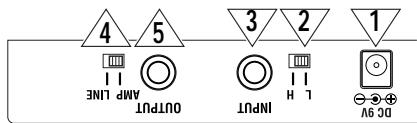
2. Set the INPUT L/H switch to the appropriate position for the output of your guitar. Use the "H" position if your guitar has a high output pickup, or the "L" position if your guitar has a low output pickup.
3. Connect your guitar to the AX10A's INPUT jack. If you are using batteries, the power of the AX10A will turn on at this point.
4. If you're connecting the AX10A to a PA system or guitar amp, set the AMP/LINE switch to "AMP". If you're connecting it to headphones, mixer or a recorder, set this switch to "LINE".
5. Connect the AX10A's OUTPUT jack to the INPUT of your guitar amp or recorder. If you want to use headphones, connect them to the OUTPUT jack.
6. Turn on the power of the connected equipment, and raise the volume to an appropriate level. You can also use the AX10A's MASTER buttons to adjust the volume.
7. Press the program select switches to change programs.
TIPS The AX10A has 40 preset programs (01-94) and 40 user programs (0.1-9.4). With the factory settings, the user programs contain the same contents as the preset programs.
- You can control the pedal effect by using the expression pedal. The pedal is active when the PEDAL LED at the upper left of the pedal is lit. If this LED is dark, advance the pedal all the way forward to make the LED light. Now the pedal will be active.
Editing a Sound
- Turn the MIC & BODY selector to select your desired sound, and use the DEPTH buttons to adjust the depth. Use the tone control knobs to adjust the tone and volume. If acoustic feedback occurs, you can turn the NOTCH selector to suppress the frequency at which feedback tends to occur.
Editing and Effect
- Adjust the chorus or ambience effect as desired. Use the AMB (CHORUS) buttons to adjust the depth of the ambience effect. By holding down the FUNCTION button while pressing the AMB (CHORUS) buttons you can adjust the depth of the chorus effect. With a setting of "00" there will be no effect. The delay/reverb time of the ambience effect can be adjusted by pressing the TAP button at the desired timing interval.
- To adjust the pre-effect located in front of Mic & Body, press the PRE FX button to select an effect, and use the VALUE buttons to adjust it. This concludes our brief introduction to the AX10A. This manual contains much more information about the AX10A, so please read it to ensure that you are taking full advantage of all its capabilities.
Parts and what they do
Front panel
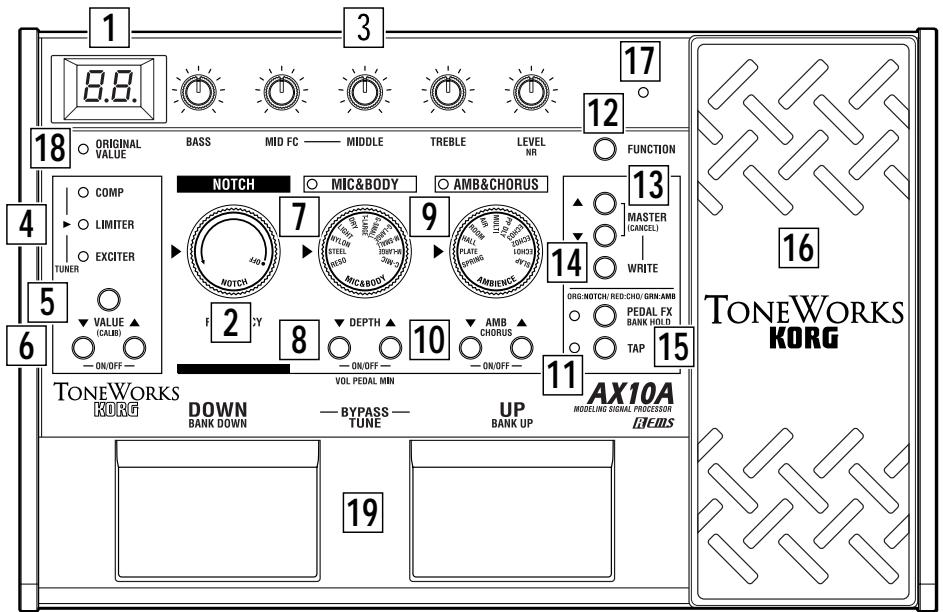
1 Display
Indicates the program number. When you operate a knob, selector or button, or move the pedal when the pedal FX is set to Notch, the parameter value will briefly appear in the display.
- This will light when the power is on.
- The dot in the lower right of the display will light when you edit a parameter value.
- If the AX10A is running on batteries, _0 will blink when the batteries run low.
2 NOTCH selector
Adjusts the frequency of the notch filter. You can suppress acoustic feedback by using the notch filter to cut the frequency region at which feedback is occurring.
3 Tone control knobs
These knobs adjust the overall tone and volume of the AX10A.
By turning the LEVEL/NR knob while you hold down the FUNCTION button, you can adjust the amount of noise reduction (NR).
Some settings may cause distortion in your sound. If this occurs, adjust the tone control LEVEL/NR knob (or the MASTER buttons).
4 PRE FX (TUNER) LED
These indicate the selected pre-effect. The LEDs will not light if the pre-effect is off. When the tuner is operating, these LEDs indicate the difference from the correct pitch. (p.9)
5 PRE FX button
Each time you press this button, the pre-effect type will change in the order of COMP LIMITER EXCITER COMP etc.
6 VALUE (CALIB) buttons -ON/OFF-
These buttons adjust the value of the pre-effect. You can switch PRE FX on/off by pressing the VALUE and buttons simultaneously. When the tuner is operating, you can use these buttons to adjust the calibration (CALIB).
MIC & BODY selector
Selects one of eleven types of mic or body modeling.
8 DEPTH (VOL PEDAL MIN) buttons -ON/OFF-
These buttons adjust the depth of the mic or body modeling effect (DEPTH).
If you've assigned the expression pedal to control Volume, you can set the minimum volume when the pedal is fully returned (i.e., toward yourself) by holding down the FUNCTION button and pressing or (VOL PEDAL MIN).
You can switch the MIC & BODY effect on/off by pressing the DEPTH and buttons together. When off, the MIC & BODY LED will not be lit.
9 AMBIENCE selector
This selects one of 11 ambience effects.
10 AMB/CHORUS buttons -ON/OFF-
These buttons adjust the depth of the ambience effect. You can adjust the depth of the chorus by holding down the FUNCTION button and pressing these buttons.
You can simultaneously switch the ambience effect and chorus effect on/off by pressing the AMB and buttons together.
TIPS If you want to turn off either the ambience effect or the chorus effect, use the AMB (CHORUS) button to set its value to "00".
TAP button
You can set the delay or reverb time of the ambience effect by tapping this button at the desired interval. The LED located at the left will blink to indicate the tempo.
12 FUNCTION button
By holding down this button and operating a knob or button that has a function printed in green on the front panel, you can edit the parameter printed in green.
13 MASTER(CANCEL)buttons
These buttons adjust the overall volume of the AX10A (MASTER).
When the AX10A is ready to write (store), pressing either of these buttons will cancel the Write operation (CANCEL).
14 WRITE button
Use this button to write (store) a program.
When you press this button, the AX10A will enter "write-ready" mode; if you press this button again, the program will be written (stored). (p.12)
15 PEDAL FX/BANK HOLD button
This button selects the effect that will be controlled by the expression pedal (Pedal Effect).
Each time you press the button, the LED will change color to indicate the pedal effect that will be controlled.
Rear panel
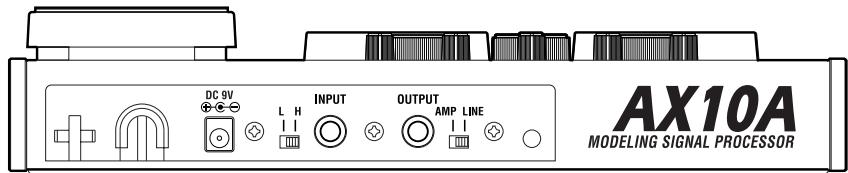
20 INPUT L/H select switch
Set this switch according to the pickup output of your guitar.
H:Suitable for guitars with a high output pickup
L:Suitable for guitars with a low output pickup
21 INPUT jack
Connect your guitar to this jack. Use a 1/4" mono plug. If the AX10A is running on batteries, the power will come on when you plug into this jack.
If the AX10A is running on batteries, the power will not come on if a 1/4" stereo plug is inserted.
22 OUTPUT jack
Connect this jack to your guitar amp, recorder, or headphones.
ORG: NOTCH (orange): Notch filter frequency
RED:CHO(red):Chorus effect
GRN: AMB (green): Effect selected by AMBIENCE
OFF : VOLUME (dark): Volume pedal
By holding down the FUNCTION button and pressing this button, you can select "bank hold" mode as the way in which programs will be selected (BANK HOLD). Refer to "Selecting programs: b" (p.9).
16 Expression pedal
You can use this expression pedal to control effects or volume. By advancing the pedal all the way forward you can switch the selected pedal effect on/off.
VOLUME and NOTCH cannot be switched on/off by advancing the pedal.
17 PEDAL LED
This LED will light if the expression pedal is active.
18 ORIGINAL VALUE LED
This LED will light if the edited value is identical to the saved (original) value.
19 Program select switches DOWN/BANK DOWN,UP/ BANK UP-BYPASS,TUNE-
Use these switches to select programs. You can select programs in one of three ways. Refer to "Selecting programs" (p.9).
If you press the UP and DOWN switches simultaneously, the effects will be bypassed and the tuner will operate (BYPASS) (p.9).
23 AMP/LINE select switch
Set this to "AMP" if you're plugging in to a PA system or guitar amp for use at high volume. Set this to "LINE" if you're plugging in to a recorder or headphones etc.
24 DC9V
The separately sold AC adapter can be connected here (p.8). When this is connected, the power will be turned on automatically.
You must only use the specified AC adaptor (p.14).
25 Cable hook
If the separately sold AC adapter is used, connect the cable of the AC adapter around this hook (p.8).

Setup
Turning the power on/off
Before you turn the power on or off, you must turn down the volume of any connected devices.
When using batteries:
- To open the battery compartment, lightly press the tab located by the arrow and lift the cover up. Install four AA alkaline batteries (sold separately) observing the correct polarity and close the cover.
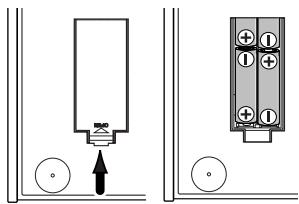
- When using batteries, the power will turn on when a mono cable is plugged into the INPUT jack. The display will light while the power is on. The power will turn off when you remove the cable from the INPUT jack.
2 Be sure to remove the cable from the INPUT jack when you are not using the AX10A to preserve battery life.
If you connect a stereo cable, the power will not be turned on.
When the batteries run down, an indication of will blink in the display. Please replace the batteries as soon as possible. If dead batteries are left in the unit, they may leak or cause other malfunctions. You should also remove the batteries if you will not be using the AX10A for an extended period.
When using the AC adaptor:
- Connect the separately sold AC adaptor to the DC 9V jack, and plug the AC adaptor into an AC outlet. The POWER LED will light, and the power will turn on.
Use only the specified external AC adaptor. (p.14)
A Be sure to disconnect the AC adaptor from the AC outlet when you are not using the AX10A. Do not apply excessive force to the cable.
Wrap the AC adaptor cable around the hook as shown in the diagram.
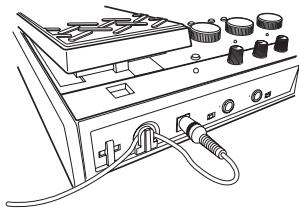
Connections
- Turn off the power of the equipment you want to connect, and lower each volume control.
- Set the INPUT L/H switch according to the output of your pickups.
The "H" position is suitable for guitars with a high output pickup. The "L" position is suitable for guitars with a low output pickup.
- Connect your guitar to the INPUT jack.
- Set the AMP/LINE select switch to the appropriate position.
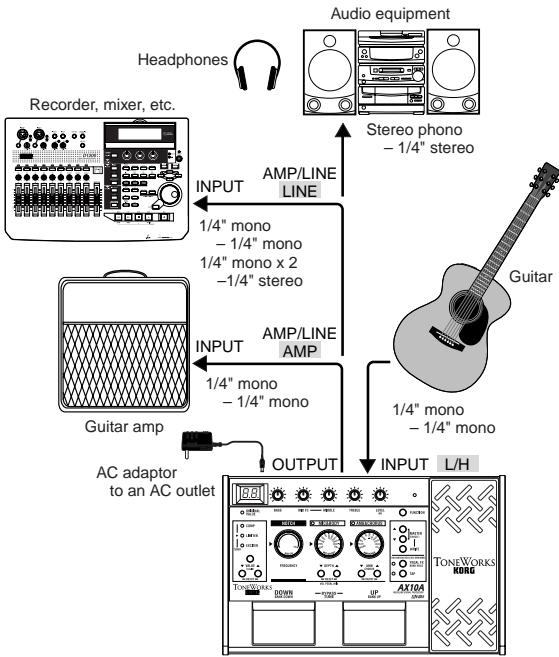
Select the "AMP" position if you're connecting the output of the AX10A to a PA system or guitar amp for use at high volume, or the "LINE" position if you're connecting the output to a recorder, audio device, or headphones.
- Connect the OUTPUT jack to your amp or recorder, etc.
The OUTPUT jack is stereo (TRS), so if you use a mono cable to connect it to your guitar amp etc., only the sound of the L (left) channel will be heard.
If you are listening through headphones, connect them to this jack.
If you are running into two channels of a mixer or using two amplifiers in stereo, use a stereo to dual mono cable.
- When you have finished making connections, turn on the power of your guitar amp, recorder, or other equipment, and adjust the volume.
Use the MASTER buttons to adjust the overall volume (master level) of the AX10A. (p.7 [13])
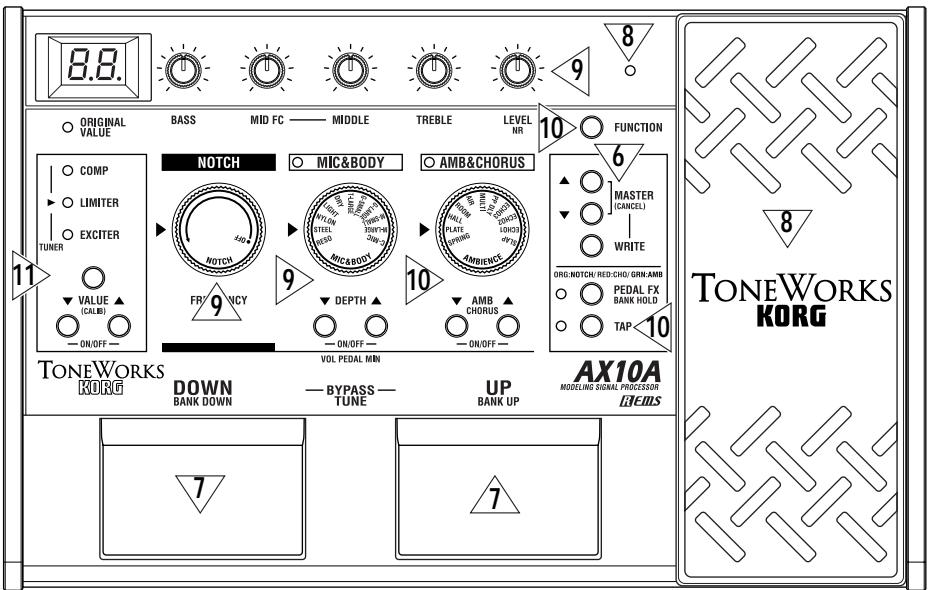
TIPS If the sound is distorted when the AX10A is bypassed, set the INPUT L/H switch to the "H" position. If the sound is still distorted, lower the volume of your guitar.
Playing the AX10A
Selecting programs
When you've finished setting up, you can select programs and try them out.
The AX10A has 40 preset programs and 40 user programs. There are ten preset banks (0-9) and ten user banks (0.-9.), with four programs in each bank.
User programs

Bank: 0.~9. Program: 1~4
Preset programs

Bank: 0~9 Program: 1~4
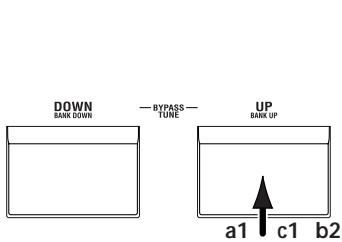
You can select programs in any of the following three ways.
a: Step through the programs of all banks
- Press the program select UP or DOWN switch. 9.4 ÷ 01 ÷ 02 ÷ 03 ÷ 04 ÷ 11 ÷ ÷ 93 ÷ 94 ÷ 0.1
b: Step through the programs in a bank
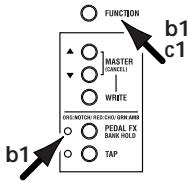
- Hold down the FUNCTION button and press the PEDAL FX (BANK HOLD) button to select "bank hold" mode. The bank will appear as "H" in the display.
- Press the program select UP or DOWN switch. Only the program will change; the bank will remain the same. ...H4÷ H1÷ H2÷ H3÷ H4÷ H1÷ H2...
- To defeat "bank hold" mode, hold down the FUNCTION button and press the PEDAL FX (BANK HOLD) button.
c: Step through the banks (leaving the program fixed)
- Hold down the FUNCTION button and press the program select UP (BANK UP) or DOWN (BANK DOWN) switch. The bank will change. You can also use this method while Bank Hold mode is selected. (The following example is when program 1 is selected)
$$ \dots 1 1 \div 2 1 \div 3 1 \div 4 1 \div \dots \div 9 1 \div 0. 1 \div \dots \div 9. 1 \dots $$
Bypass and Mute
If you bypass the AX10A, your sound will be direct (dry) without any effects (wet).
If you mute the AX10A, there will be no sound.
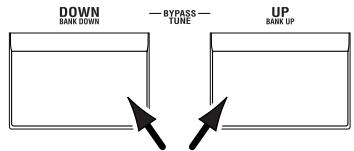
- Simultaneously press the UP and DOWN program select switches.
Bypass: Simultaneously press UP and DOWN and release them immediately.
Mute: Simultaneously press UP and DOWN and hold them for about one second; then release them.
When you press UP and DOWN simultaneously, the display [---] will blink slowly, and after approximately one second will blink more rapidly. To bypass, release the buttons while the display is blinking slowly. To mute, release the buttons when the display is blinking rapidly.
- To cancel Bypass or Mute, press either the UP or DOWN program select switch.
Tuner
You can use the AX10A's built-in auto chromatic tuner to tune your guitar. To activate the tuner, simultaneously press the UP and DOWN program select switches.
TIPS You can activate the tuner by selecting either Bypass or Mute. If you select Mute, you will be able to tune silently.
Tuning procedure
- To activate the tuner, simultaneously press the UP and DOWN program select switches to either Bypass or Mute the AX10A. For the procedure, refer to "Bypass and Mute" (above).
- Pluck the string that you want to tune, and the closest note name will appear in the display. A decimal point "." at the right of the note name indicates a sharp (#).
Do not play two or more strings simultaneously when tuning.
3. Tune the string approximately so that the correct note name is shown in the display.
4. Fine-tune the string so that only the middle LED of the PRE FX (TUNER) section is lit.
When the note name is A# Too low
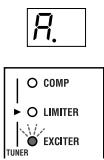
Too high
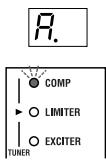
Correct tuning
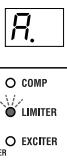
- When you have finished tuning, press the UP or DOWN program select switch to return to normal operation.
Adjusting the tuning calibration
When you turn on the power, middle A is set to a reference frequency of 440Hz . If desired, you can adjust (calibrate) this reference pitch.
- While the tuner is activated, use the VALUE (CALIB) buttons to adjust the calibration. The range is 438 - 445Hz . When you adjust the value, the display will show the lower two digits of the calibration frequency (e.g., "41" for 441Hz ).
The AX10A does not remember the tuner calibration setting when powered-off.
Using the expression pedal
You can use the expression pedal to control the volume, ambience level, chorus depth, or notch filter frequency.
The effect controlled by the pedal can be one of the eleven AMBIENCE effects, CHORUS, NOTCH, or volume. You can use the pedal to control one of these.
Using the expression pedal
- Select a program for which the PEDAL LED (located at the upper left of the expression pedal) is lit.
If you have selected a program for which the PEDAL LED is lit, you can use the expression pedal to control a pedal effect.
Even for programs for which the PEDAL LED is not lit, you can advance the pedal all the way to switch it on (the PEDAL LED will light).
If the pedal is assigned to volume or NOTCH, you can't switch the effect on/off by advancing the pedal.
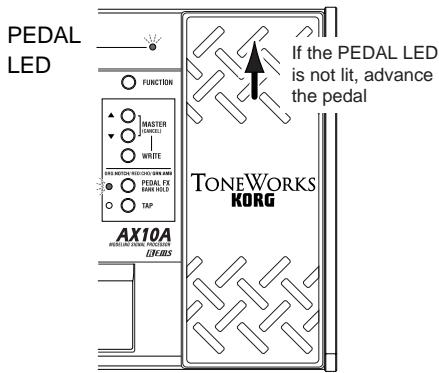
- Operate the expression pedal while you play. The output sound will change as you move the pedal up and down. If you've assigned PEDAL FX to NOTCH, you'll be able to suppress acoustic feedback by operating the pedal when it occurs; move the pedal to the point at which the feedback disappears. If you are not experiencing acoustic feedback, we recommend that you set the pedal to the minimum position to turn off the effect.
Do not apply excessive force to the expression pedal. Before you begin using the expression pedal, you should determine the amount of force that is needed to make the PEDAL LED light or to control the effect, and use only the necessary amount of force.
TIPS You can press the PEDAL FX button to change the effect or volume being controlled by the expression pedal. The color of the LED located at the left of the pedal indicates the assignment (p.12). Page 12 also explains how you can save a sound you created by operating the pedal.
Creating sounds
Creating sounds on the AX10A
You can create sounds in one of two ways; you can edit an existing preset program or user program, or you can create a sound "from scratch."
If you want to create a sound that's based on an existing program, select the program that's closest to what you have in mind, and make the desired changes. Adjust the BASS, MID FC, MIDDLE, and TREBLE tone control knobs, and use the VALUE, DEPTH, and TAP buttons to adjust the depth of each effect.
If you want to create a sound from scratch, one method is to start by choosing a MIC & BODY TYPE.
When doing so, leaving the PRE FX and AMB & CHORUS effects turned off will make it easier for you to hear the differences between the various mic or body models. Simultaneously press both VALUE or DEPTH and buttons to turn the corresponding effect on/off.
When you've decided on a mic & body type, adjust the tone control knobs BASS, MID FC, MIDDLE, TREBLE, and LEVEL as desired.
When you've finished making the mic & body settings, you can add effects. AMB & CHORUS is located after the mic & body section. Simultaneously press both DEPTH and buttons to turn on the effect, and turn the AMB & CHORUS selector to choose the effect you want to use. Then use the DEPTH buttons to adjust the depth of the effect. For the chorus effect, you can hold down the FUNCTION button and use the DEPTH buttons to adjust the effect depth. You can adjust the delay/reverb time of the ambience effect by pressing the TAP button at the desired timing interval.
Next you can adjust the PRE FX, which is located in front of the mic & body section. Turn the effect on, and then press the PRE FX button to select an effect. Use the PRE FX VALUE buttons to adjust the amount of effect. You may want to turn AMB & CHORUS temporarily off while adjusting the PRE FX.
Finally, use the PEDAL FX button to specify what the expression pedal will control. The pedal assignment (effect or volume) will change each time you press the button.
If you hear unwanted noise, you can adjust the noise reduction (p.12). Hold down the FUNCTION button and turn the tone control NR knob (the knob at the far right) to adjust the amount of reduction.
Finally, when you have come up with a sound you like, you should write (store) it into memory. If you switch to a different program or turn off the power without writing your new program, it will be lost.
Some effect settings may produce unwanted distortion. If this happens, lower the VOLUME knob.
PRE FX
Use the PRE FX button to select the pre effect type, and use the VALUE buttons to adjust the amount of effect.
| TYPE | Explanation | VALUE |
| COMP | Compressor that makes picking volume more consistent. | Adjusts sensitivity: 0...30 |
| LIMITER | Limiter that suppresses excessive levels. | Limiting amount: 0...30 |
| EXCITER (*1) | Exciter that adds sparkle to the high-frequency range. | Effect depth: 0...30 |
TONE (^*1)
This is a three-band tone control. You can adjust the noise reduction by holding down the FUNCTION button and turning the LEVEL (NR) knob.
| BASS | Low-frequency adjustment (00...30). |
| MID FC | Adjusts the mid peak frequency in a range of 170 Hz...3 kHz (1...10). |
| MIDDLE | Mid-frequency adjustment (00...30). |
| TREBLE | High-frequency adjustment (00...30). |
| LEVEL | Volume adjustment (00...30). |
| NR | Amount of noise reduction. |
NOTCH
You can eliminate acoustic feedback by turning this selector to set the frequency of the notch filter. Turning the knob all the way to the left will turn the notch filter off. Turn the knob toward the right to raise the notch filter frequency, and find the point at which acoustic feedback is occurring. If acoustic feedback is not occurring, we recommend that you leave the notch filter turned off. If you've assigned PEDAL FX to NOTCH, you can use the expression pedal to set the notch filter frequency.
| FREQUENCY | Notch filter frequency (low-high). Far left is OFF. |
MIC&BODY (^*1)
Use the MIC & BODY selector to select a mic & body type, and use the DEPTH buttons to adjust the DEPTH parameter.
| TYPE | Explanation | DEPTH |
| C-MIC | Condenser mic simulation. | Mic distance 0 (distant)...30 (close) |
| M-LARGE | A large old body suitable for a variety of situations. | Effect depth 0...30 |
| M-SMALL | A small old body suitable for delicate arpeggios, etc. | |
| G-LARGE | A large old body with a tough sound, suitable for strumming chords. | |
| G-SMALL | A small body with a distinctive mid-range, favored by country and blues performers. | |
| T-LARGE | A large body distinguished by a sophisticated sound suitable for pop. The sound of one of the newer American manufacturers. | |
| DRY | Large body with a distinctive dry sound. | |
| LIGHT | Light sounding body suitable for a band or ensemble. | |
| NYLON | Simulates a nylon-string sound. | |
| STEEL | Body with distinctively metallic highs, suitable for rock. | |
| RESO | Resonator guitar body, suitable for slide playing. |
AMB&CHORUS
Use the AMBIENCE selector to select the ambience effect type, and use the AMB buttons to adjust the AMB parameter. By pressing the TAP button twice at the desired interval you can set the delay time or reverb time. To adjust the chorus effect depth, hold down the FUNCTION button and use the AMB buttons. AMBIENCE and CHORUS can be used simultaneously. If you want to turn either AMBIENCE or CHORUS off separately, set the corresponding parameter to a value of "0". If you assign PEDAL FX to AMB or CHO, the expression pedal will control that effect.
| TYPE | Explanation | TAP | Normal | PEDAL FX:AMB | |
| AMB | PEDAL | AMB | |||
| SLAP | The delay time will be set to 1/4th of the interval at which you press TAP. | Delay time: up to 250 [ms] | Effect level: 0...30 | Controls the effect depth | Specifies the effect depth at maximum pedal position |
| ECHO1 | Tape echo simulation with a warm tone (feedback low). | ||||
| ECHO2 | Tape echo simulation with a warm tone (feedback medium). | Delay time: up to 1.0 [s] | |||
| ECHO3 | Tape echo simulation with a warm tone (feedback high). | ||||
| PP DLY | Ping-pong delay that bounces from left to right. | ||||
| MULTI | Multi-tap delay. | ||||
| AIR | Reverb with an airy feel. | N/A (*2) | |||
| ROOM | Room reverb. | Reverb time: up to 4.0 [s] | |||
| HALL | Hall reverb (*3). | Reverb time: up to 8.0 [s] | |||
| PLATE | Plate reverb (*3). | ||||
| SPRING | Spring reverb (*3). | ||||
(^1) Some settings may produce distortion. If this occurs, reduce the parameter value. (^2) The button will not change the value. (^*3) The reverb time is set to double the interval at which you press TAP.
| TYPE | Explanation | Normal | PEDAL FX:CHO | |
| CHORUS | PEDAL | CHORUS | ||
| CHORUS | Stereo chorus for electric-acoustic. | Effect depth: 0...30 | Effect depth | Does nothing |
Expression pedal
Selecting the effect that will be controlled by the pedal
Press the PEDAL FX button to select the effect that will be controlled by the pedal. The LED located at the left indicates the effect (or volume) that will be controlled.
ORG: NOTCH (orange): Notch filter frequency
RED:CHO(red):Chorus effect
GRN:IOB (green): Effect selected by AMBIENCE
OFF : VOLUME (not lit): Volume pedal
Using the pedal to switch the effect on/off
By advancing the pedal all the way forward you can switch the effect assigned to PEDAL FX on/off. When on, the LED at the left of the pedal will light. If you've assigned PEDAL FX to VOLUME or NOTCH, the LED cannot be turned off.
Setting the minimum value of the volume pedal
If PEDAL FX is assigned to VOLUME, you can hold down the FUNCTION switch and use the MIC & BODY DEPTH buttons to set the minimum volume that will be controlled by the pedal (VOL PEDAL MIN).
Saving the sound of a specific pedal position
If the PEDAL FX is assigned to AMB, CHO, or VOLUME, there is no way for you to save the sound produced by operating the pedal. The effect will always sound according to the current position of the pedal. However if PEDAL FX is assigned to NOTCH, you can save the notch filter frequency point specified by operating the pedal.
NR (Noise Reduction)
To adjust the amount of noise reduction, hold down the FUNCTION button and turn the tone control LEVEL (NR) knob.
Depending on the connected device, excessively high NR settings may cause notes to be cut off. If this happens, lower the level.
Storing a program
When you have created a sound you want to keep, you can write (store) it into one of the 40 user programs (0.1-9.4).
If you switch programs or turn off the power before writing your edited program, the changes you made will be lost.
The program that had been in the writing destination will be overwritten.
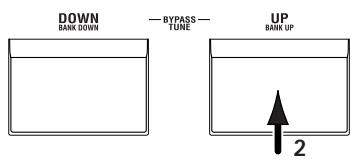
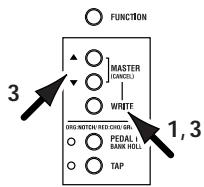
1. Press the WRITE button. The program number will blink in the display, and the AX10A will be in "write-ready" mode.
2. Use the program select switches to select where you would like to store the program.
You cannot write to a preset program (01-94).
3. Press the WRITE button to write the program into the selected program number.
If you decide not to write, press either of the MASTER (CANCEL) buttons to exit write-ready mode (display blinking). You will return to normal operation.

Other functions
Calibrating (adjusting) the expression pedal
If the expression pedal is not working properly, please perform the procedure described below.
When calibrating the pedal, use your hand because accurate adjustments may not be possible if you use your foot to operate the pedal.
- While simultaneously holding down the FUNC-TION button and the PEDAL FX button, turn on the power.
The display will indicate for approximately one second, and then indicate --- .
- Slowly move the pedal back. When it stops, take your hand off the pedal and press the PEDAL FX button.
The display will change from to .
If you press the MASTER (CANCEL) during the calibration operation, calibration will be halted and the program number will appear.
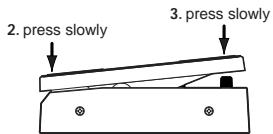
- Slowly move the pedal forward. When it stops, take your hand off the pedal and press the PEDAL FX button.
When the adjustment has been completed, the display will blink , and then the program number will appear. Check the pedal to make sure the settings are correct.
TIPS For example if you assign PEDAL FX to VOLUME and set VOL PEDAL MIN to "0", it will be easy to verify the MIN level when the pedal is fully returned.
If the calibration operation fails, the display will indicate _r , and you will return to the display before calibration ( --- ). If repeated attempts are unsuccessful, it is possible that the AX10A has malfunctioned. Contact your dealer.
Restoring programs to the factory settings
- While holding down the WRITE button, turn on the power.
The display will indicate Ld.
If you decide to start up normally without loading the factory settings, press either of the MASTER (CANCEL) buttons. - While the display indicates _d , press the WRITE button. The factory programs will be loaded into the user area (0.1-9.4). When loading is completed, the display will blink 00 , and then the program number will appear.
Never turn off the power while this operation is in progress.
Be aware that if you reload the preset programs, all previously written programs will be overwritten.
Troubleshooting
If the AX10A does not operate as you expect, please check the following points first. If this does not resolve the problem, contact your dealer.
Power does not turn on.
- Are batteries installed? Alternatively, is the AC adapter connected to an AC outlet? (p.8)
Is a mono phone plug cable connected to the INPUT jack? (p.8)
No sound
Are your guitar, amp and/or headphones connected to the correct jacks? (p.8)
Is your amp turned on and set correctly?
Are any cables broken?
Is the master level of the AX10A set to "0" or to a low level? (p.7)
Is the program volume of the AX10A set to "0" or to a low level? (p.11)
Is the volume of your instrument turned down?
Is the AX10A muted?
No effect is heard
□ Is the AX10A bypassed? (p.9)
Are the effects used in the program turned on?
Pedal does not work
Have you selected a program which uses an expression pedal effect? (p.10,12)
Is the pedal indicator lit?
Cannot write(Display indicates "Er")
Did you turn the power off while the preset programs were being loaded?
Reload the preset programs. (p.13)
Main specifications
Number of mic & body models: 11
Effects: Pre effect types: 3
Tone:1
Ambience types: 11
Chorus: 1
Notch: 1
Noise Reduction: 1
Number of programs: Preset Programs: 40 (10 banks x 4 programs)
User Programs: 40 (10 banks x 4 programs)
Input: Guitar Input (mono 1/4" jack)
Line/Headphone dual-purpose output (stereo 1/4" jack)
Tuner: Tuning Range: 27.5Hz-1,318.5Hz (A0-E6)
Tuner calibration: A = 438Hz - 445Hz
Power supply: Four AA alkaline batteries (not included allows approximately 18 hours of
continuous use) or separately sold AC adaptor (DC9V C-Θ)
Dimensions (W x D x H): 287 mm x 182 mm x 60 mm
1.1 kg (not including batteries)
Weight:
Owner's manual
Included items:
AC adaptor
Appearance and specifications are subject to change without notice for improvement.
TONEWORKS KORG
8 Touches DEPTH (VOL PEDAL MIN) -ON/OFF-
15 Touche PEDAL FX/BANK HOLD
8 DEPTH (VOL PEDAL MIN)-Tasten -ON/OFF-
...H4÷ H1÷ H2÷ H3÷ H4÷ H1÷ H2...
- Table of contents
- Precautions
- Location
- Power supply
- Interference with other electrical devices
- Handling
- Care
- Keep this manual
- Keeping foreign matter out of your equipment
- THE FCC REGULATION WARNING (for U.S.A.)
- CE mark for European Harmonized Standards
- IMPORTANT NOTICE TO CONSUMERS
- What is REIMS?
- Quick Start
- Editing a Sound
- Editing and Effect
- Parts and what they do
- Front panel
- Display
- NOTCH selector
- Tone control knobs
- PRE FX (TUNER) LED
- PRE FX button
- VALUE (CALIB) buttons -ON/OFF-
- MIC & BODY selector
- DEPTH (VOL PEDAL MIN) buttons -ON/OFF-
- AMBIENCE selector
- AMB/CHORUS buttons -ON/OFF-
- Rear panel
- Setup
- Turning the power on/off
- When using batteries:
- When using the AC adaptor:
- Connections
- Playing the AX10A
- Selecting programs
- a: Step through the programs of all banks
- b: Step through the programs in a bank
- c: Step through the banks (leaving the program fixed)
- Bypass and Mute
- Tuner
- Tuning procedure
- Adjusting the tuning calibration
- Using the expression pedal
- Creating sounds
- Creating sounds on the AX10A
- PRE FX
- TONE (*1)
- NOTCH
- MIC&BODY (*1)
- AMB&CHORUS
- Expression pedal
- NR (Noise Reduction)
- Storing a program
- Other functions
- Calibrating (adjusting) the expression pedal
- Restoring programs to the factory settings
- Troubleshooting
- Power does not turn on.
- No sound
- No effect is heard
- Pedal does not work
- Cannot write(Display indicates "Er")
- Main specifications
- TONEWORKS KORG
- Touches DEPTH (VOL PEDAL MIN) -ON/OFF-
- DEPTH (VOL PEDAL MIN)-Tasten -ON/OFF-
Brand : KORG
Model : AX10A
Category : Guitar effect pedals