
C2125S - Remote control HITACHI - Free user manual and instructions
Find the device manual for free C2125S HITACHI in PDF.


| Product Type | Universal Remote Control |
| Brand | HITACHI |
| Model | C2125S |
| Dimensions (L x W x H) | 20 x 5 x 2 cm |
| Weight with batteries | 100 g |
| Power source | 2 AAA batteries (1.5 V) |
| Infrared range | Up to 10 meters |
| Operating angle | ±30° |
| Main functions | TV control: volume, channels, tuning modes (B/G, D/K, I, L, K1, U.K. I) |
| Numeric keys | 0-9, favorite programs |
| Sleep function | Yes |
| Backlight | No |
| Care and cleaning | Clean with a soft, dry cloth. Do not use abrasive products. |
| Safety | Do not expose to moisture or excessive heat. Remove batteries during prolonged non-use. |
| Spare parts | Standard AAA batteries |
| Repairability | Contact cleaning if malfunction. No internal repair planned. |
| General information | Original HITACHI remote control, compatible with HITACHI televisions. Support: france.consumateur@hitachi-eu.com |
Frequently Asked Questions - C2125S HITACHI
User questions about C2125S HITACHI
0 question about this device. Answer the ones you know or ask your own.
Ask a new question about this device
Download the instructions for your Remote control in PDF format for free! Find your manual C2125S - HITACHI and take your electronic device back in hand. On this page are published all the documents necessary for the use of your device. C2125S by HITACHI.
USER MANUAL C2125S HITACHI
Connect Peripheral Equipment 4
Via the SCART connector 5
Via Ant Input 5
Decoder 5
Connecting a decoder with an aerial socket to the TV 5
Connecting a decoder without an aerial socket to the TV 5
TV and Video Recorder 5
Playback NTSC 5
Camera and Camcorder 5
To connect to Front-AV input 5
Connect the decoder to the video recorder .... 5
Connecting Headphones 5
Preparation 6
Features 6
Safety Precautions 6
Before Switching on your TV 9
Power connection 9
Aerial Connections 9
How to connect other devices 9
Inserting batteries in the remote control handset 9
Switching the TV ON/OFF 9
To switch the TV on 9
To switch the TV off 9
Operating the TV 9
APS (Automatic Programming System) 9
Operating with the onset buttons 10
Volume Setting 10
Programme Selecting 10
Operating with Remote Control 10
Volume Setting 10
Programme Selecting (Previous or next programme) 10
Programme Selecting (direct access): ... 10
Menu System 11
Information Menu 11
Sound Menu 11
To change sound settings 11
Setting Volume: 11
To Store the Settings: 11
Picture Menu 12
To change picture settings: 12
Setting Brightness: 12
Setting Colour: 12
Setting Contrast: 12
Setting Sharpness: 12
SettingHue: 12
Picture Mode Menu: 13
To Store the Settings: 13
Feature Menu 13
Sleep Timer: 13
Child Lock: 13
Installation Menu 13
Tuning Menu 13
Automatic Search 14
To name a Programme 14
To change Standard 14
Fine Tuning 14
Program (Programming) Menu 14
To delete a channel from a programme number: 15
To insert a channel into a programme number: 15
APS (Automatic Programming System):15
TV Setup Menu 15
Selecting Menu Language 15
Selecting Country. 16
Other Features 16
Sound Mute 16
Information on Screen 16
Teletext 16
To operate Teletext 16
To select a page of Teletext 16
To Select Index Page 16
To Reveal "concealed" Information 16
To Stop Automatic Page Change 17
To Select a Subpage Page 17
To exit Teletext 17
To Display the Time 17
Tips 17
Specifications 18
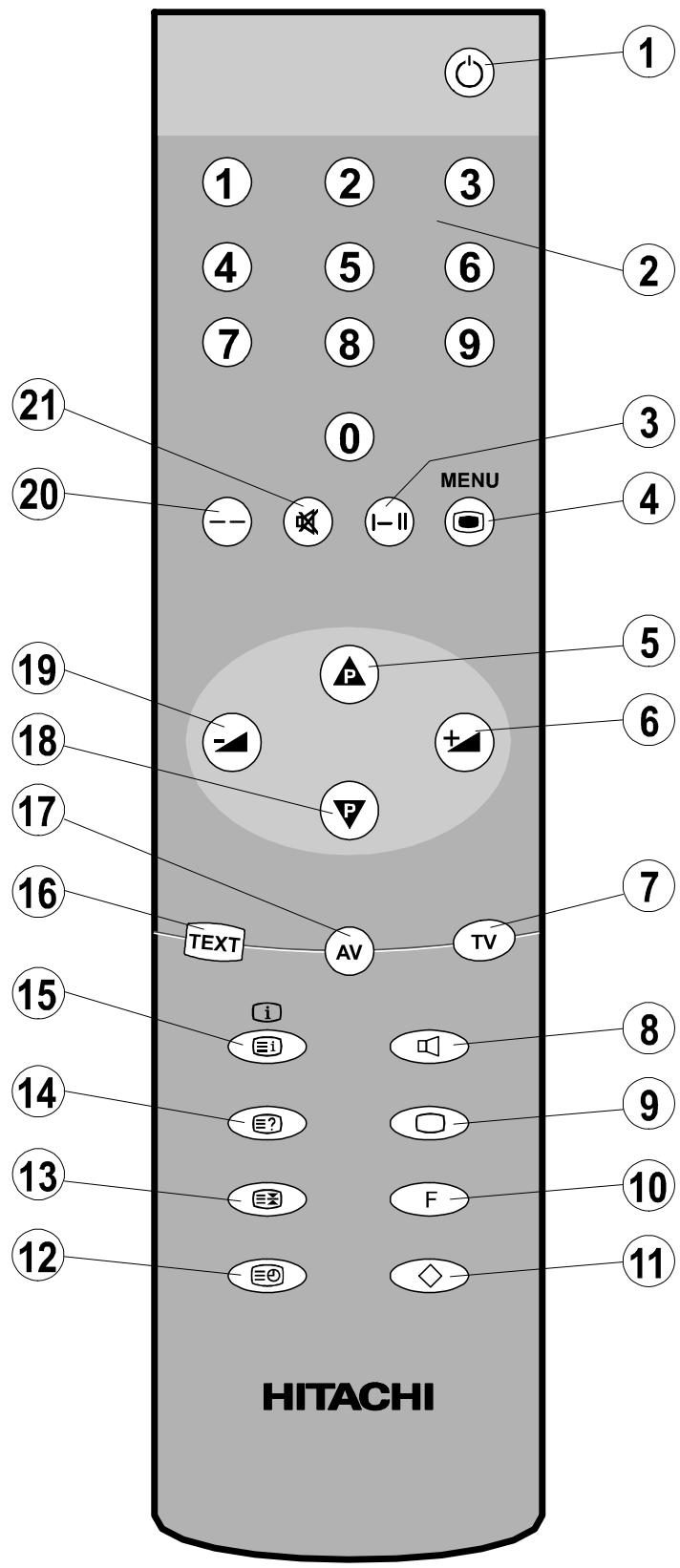
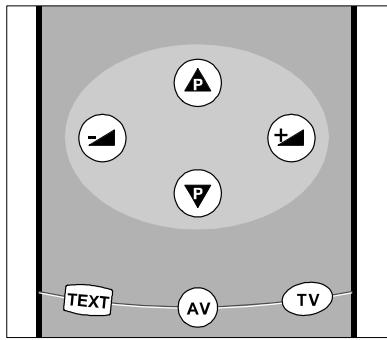
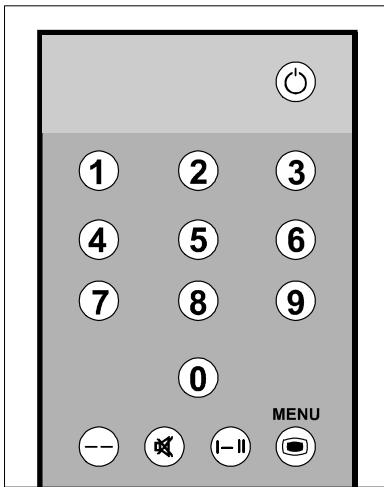
① O = Stand By
② 0 - 9 = Direct Program
③ I-II = No Function
④ MENU = MENU
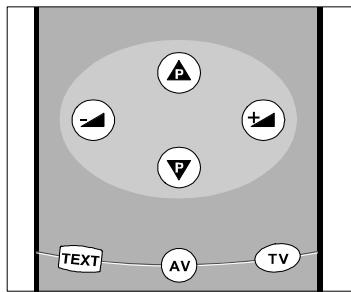
⑤ A = Programme Up (Cursor Up)
⑥ + = Cursor Right / Volume +
① TV = TV / Quit Menu
⑧ (Red) = Sound Menu
⑨ (Green)=PictureMenu
10 F (Yellow) = Feature Menu
⑪ (Blue) = Installation Menu
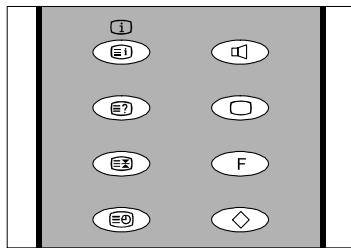
Teletext Buttons
⑫ = Time
⑬ = Hold
14E? = Reveal
15 1 = Index Page
16 Text = Teletext
(17) A V = External Source (AV1, AV3)
18 P = Programme Down (Cursor Down)
19 = Cursor Left / Volume -
20 --= Two Digit Program Number Entry
② 品 = Mute
Control Panel Buttons
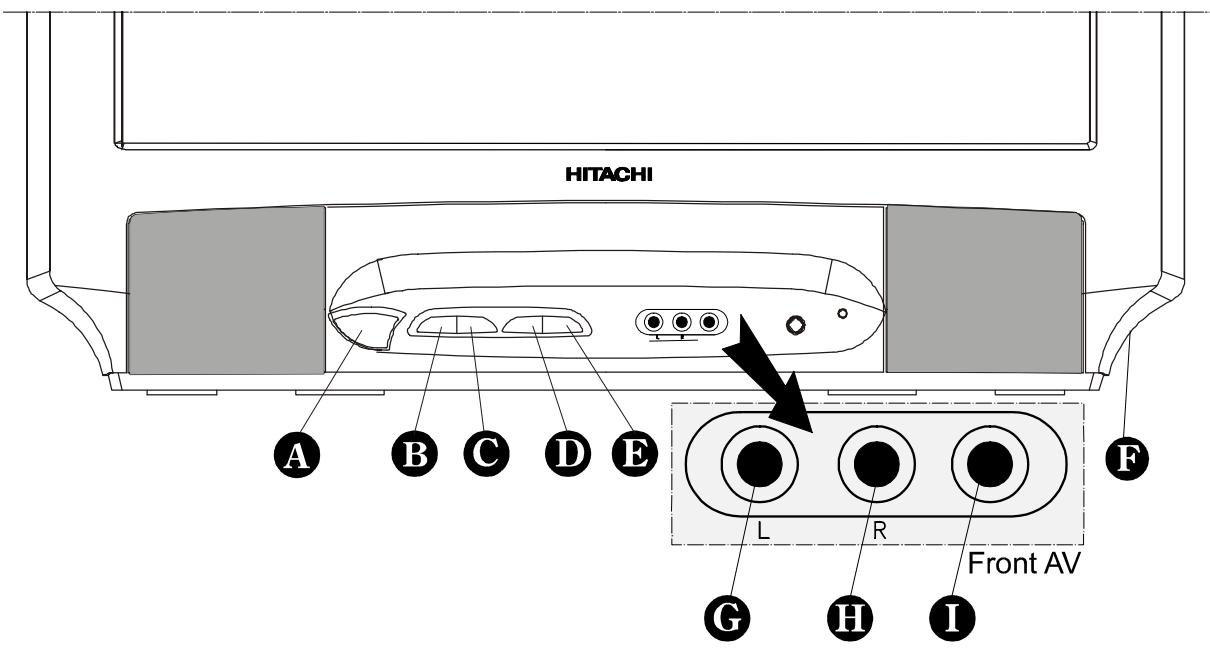
A POWER = Power On / Off
B -VOLUME = Volume -
C VOLUME+ = Volume +
D - PROG = Program -
PROG ^+ = Program +
H-PHONE = Headphone 3,6 mm Ø
Front AV input
AUDIO L = Audio left (white)
AUDIO R = Audio right (red)
VIDEO = VCR (yellow)
Connect Peripheral Equipment
There is a wide range of audio and video equipment that can be connected to your TV.
The following connection diagrams show you where the different equipment should be connected at the back or the front side of the TV.
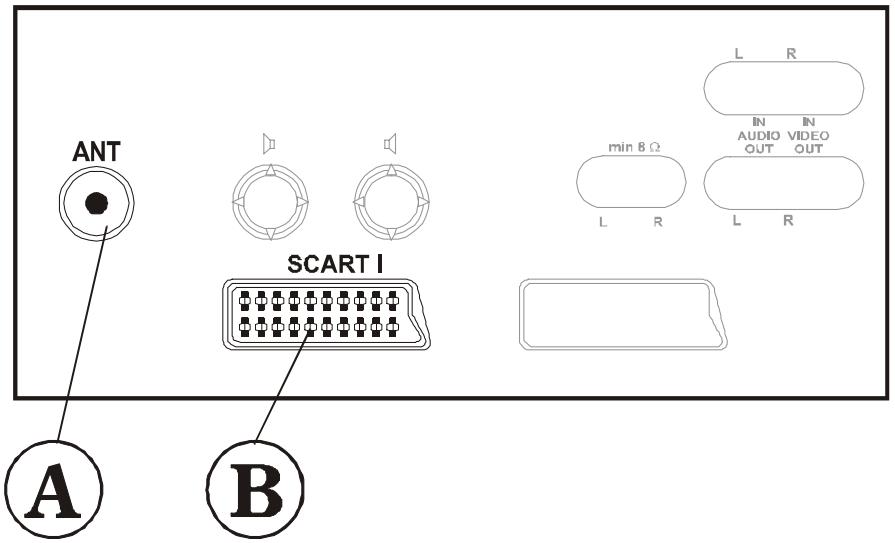
21" REAR PANEL
A ANTENNA
B External 1
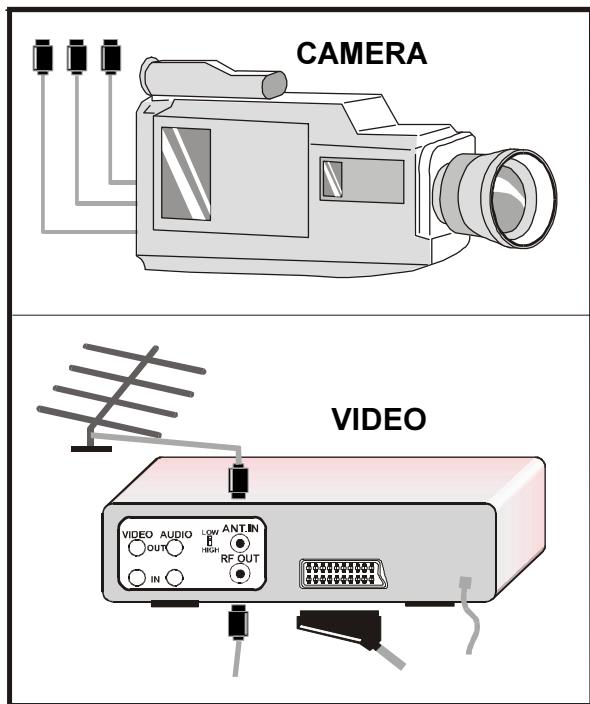
Via the SCART connector
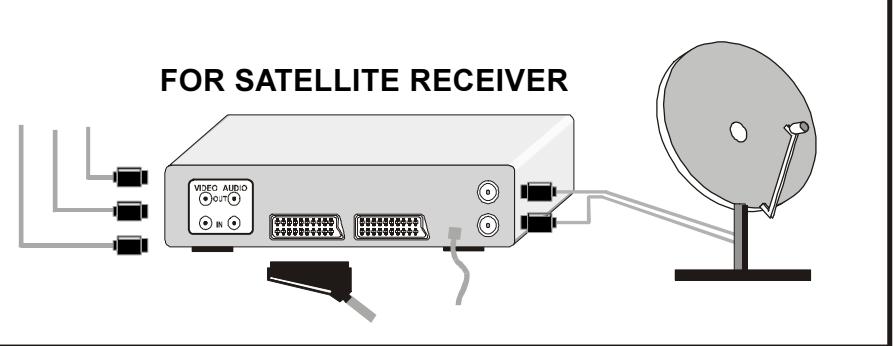
Your TV set has one SCART connector sockets. If you want to connect peripherals (e.g. video, decoder, etc.) which have SCART connectors, to your TV, use EXT1 inputs.
Via Ant Input
If you want to connect to your TV, peripherals like videorecorders or decoders, but the device you want to connect does not have SCART connector you should connect it to the ANT input of your TV set.
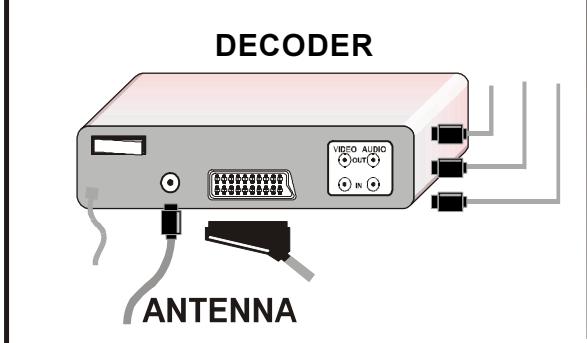
Decoder
Cable TV offers you a wide choice of programs. Most of them are free, others are to be paid for by the viewer. This means that you will need to subscribe to the broadcasting organisation whose programmes you wish to receive. This organisation will supply you with a corresponding decoder unit to allow the programmes to be unscrambled.
For further information ask your dealer. See also the booklet supplied with your decoder.
Connecting a decoder with an aerial socket to the TV
- Connect the aerial cable.
Connecting a decoder without an aerial socket to the TV
- Connect the decoder to your TV with a SCART lead to EXTERNAL1. When your decoder has a SCART connector you can obtain better picture quality if you connect a SCART lead to EXTERNAL.
- Then select the appropriate AV mode by pressing the "AV" button.
TV and Video Recorder
- Connect the aerial cables.
Better picture quality can be obtained if you also connect a SCART lead to EXTERNAL1.
Playback NTSC
Connect NTSC VCR player to Euroconnector at the back of the TV or RCA JACK at the front of the TV.
Then, press "AV" button to select AV-1 or AV3.
NTSC 4.43 system can be watched at this mode automatically.
Search for and store the test signal of the video recorder
- Unplug the aerial cable from the aerial socket "ANT" of your video recorder.
- Switch on your TV and put the video recorder on the test signal. (See the handbook for your video recorder.)
-
Enter the Tuning menu via the Installation menu.
-
Search for the test signal of your video recorder in the same way as you searched for and stored the TV signals. See Tuning, Search and Store TV channels. Store the test signal either under programme number 0 or between 55 and 99.
- Replace the aerial cable in the aerial socket "ANT" of your video recorder once you have stored the test signal.
Camera and Camcorder
To connect to Front-AV input
Connect your camcorder to the front of your TV.
- Connect your equipment to the TV via VIDEO (yellow), AUDIO R (red) and AUDIO L (white) inputs. You should connect the jacks to the input of the same colour.
Connect the decoder to the video recorder
Some video recorders have a special SCART connector for decoder.
- Connect a SCART lead to the SCART connector of your decoder and to the special SCART connector of your video recorder. See also the handbook of your video recorder.
- To connect your video recorder to the TV, see TV and Video Recorder section.
If you want to connect more equipment to your TV, consult your dealer.
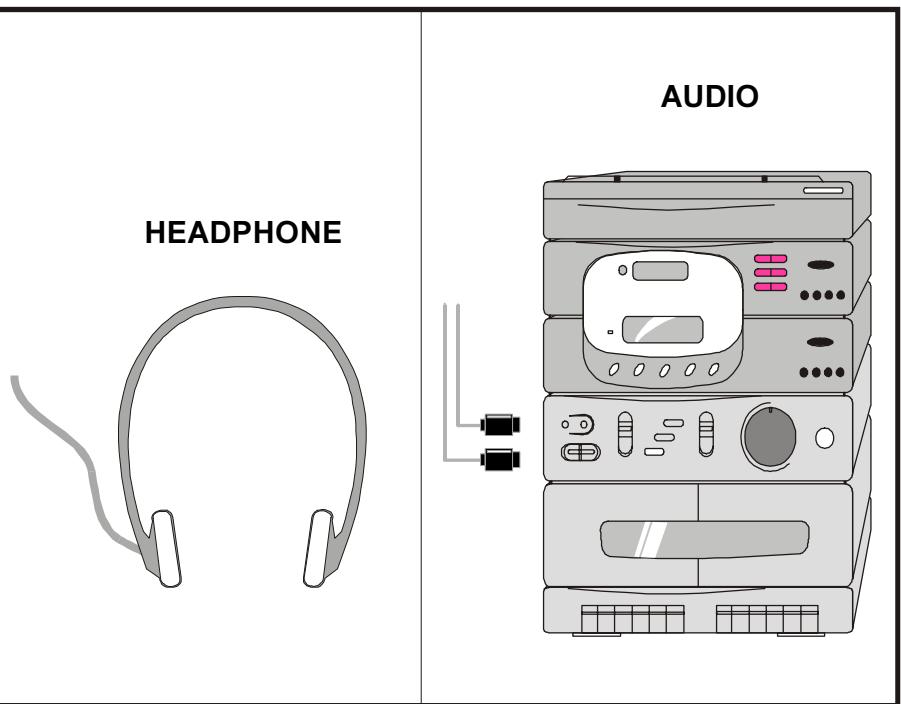
Connecting Headphones
Use the stereo headphone socket (HP) to connect headphones. This socket is located on the right hand side of the television.
Preparation
Place TV on a solid surface.
For ventilation, leave a space of at least 10cm free all around the set. To prevent any fault and unsafe situations, please do not place any objects on top of the set.
Features
It is a remote controlled colour television.
- 100 programmes from VHF, UHF bands or cable channels can be preset.
- It can tune cable channels.
- Controlling the TV is very easy by its menu driven system.
- It has SCART connector socket for external devices (video, video games, audio set, etc.)
Full function Teletext.
- It is possible to connect headphone.
- APS (Automatic Programming System).
- All programmes can be named.
- Forward or backward automatic tuning.
- Sleep timer.
- Automatic sound mute when no transmission.
- 5 minutes after the broadcasting (closedown), the TV switches itself automatically to stand-by mode.
Safety Precautions
IMPORTANT SAFETY INFORMATION ON OPERATING YOUR TV
Do's and Don'ts
DO's
This Television has been designed and manufactured to meet international safety standards, but like any electrical equipment, care must be taken if you are to obtain the best results and safety is to be assured.
DO read the operating instructions before you attempt to use the equipment.
DO consult your dealer if you are in any doubt about installation, operation or safety of your equipment.
DO be careful with glass panels or doors on equipment.
This TV is supplied with a fitted mains plug. This plug must not be cut off as it may contain a special radio interference filter, the removal of which could lead to impaired performance. If you wish to extend the lead, obtain an appropriate safety approved extension lead or consult your dealer.
Observe the manufacturers instructions when connecting extension leads to the TV. Check the fuse rating on the new plug, this should be fitted with a 5 Amp fuse which conforms to either ASTA or BSI (BS1 362) approvals, these are easily identifiable by either the or symbols. If you are in any doubt about the installation of an extension lead, please consult a competent electrician.
DON'Ts
DON'T continue to operate the equipment if you are in any doubt about it working normally, or if it is damaged in any way switch off, withdraw the mains plug and consult your dealer.
DON'T place water filled vessels on top of T.V. cabinets.
DON'T remove any fixed cover as this may expose dangerous voltages.
DON'T leave equipment switched on when it is unattended unless it is specifically stated that it is designed for unattended operation or has a stand-by mode. Switch off using the switch on the equipment and make sure your family know how to do this. Special arrangements may need to be made for infirm or handicapped people.
DON'T use equipment such as personal stereos or radios so that you are distracted from the requirements of traffic safety. It is illegal to watch television whilst driving.
DONT obstruct the ventilation of the equipment, for example with curtains or soft furnishings. Overheating will cause damage and shorten the life of the equipment.
DONT use makeshift stands and NEVER fix legs or stands to the TV with any screws other than those provided - to ensure complete safety always use the manufacturers approved stand with the fixings provided.
DON'T allow electrical equipment to be exposed to rain or moisture.
ABOVEALL
- NEVER let anyone, especially children push anything into holes, slots or any other opening in the case - this could result in a fatal electric shock.
• NEVER guess or take chances with electrical equipment of any kind - it is better to be safe than sorry!
1. Power Source
The receiver should be operated only from a 220-240V AC, 50 Hz. outlet. Ensure you select the correct voltage setting
2. Power Cord
The power supply cord should be placed so that they are not likely to be walked on or pinched by items placed upon them or against them. Pay particular attention to cord where they enter the plug, power outlet, and the point where they exit from the receiver.
3. Moisture and Water
Do not use this equipment in a humid and damp place (avoid the bathroom, the sink in the kitchen, and near the washing machine). Do not expose this equipment to rain or water, as this may be dangerous.
4. Cleaning
Before cleaning, unplug the receiver from the main supply, outlet. Do not use liquid or aerosol cleaners. Use with soft and dry cloth.
5. Ventilation
The slots and openings on the receiver are intended for ventilation and to ensure reliable operation. To prevent overheating, these openings must not be blocked or covered in anyway.
6. Lightning
In case of storm and lightning or when going on holiday, disconnect the power cord from the wall outlet and also remove aerial socket.
7. Replacement Part
When replacement parts are required, be sure the service technician has used replacement parts which are specified by the manufacturer or have the same specifications as the original one. Unauthorized substitutions may result in fire, electrical shock, or other hazards.
8. Servicing
Please refer all servicing to qualified personnel. Do not remove cover as this may result in electric shock.
9. X-rays
The x-rays generated in this television are shielded sufficiently. Beam potential is max. 30kV
Waming!
Any intervention contrary to regulations, in particular, any modification of high voltage or a replacement of the picture tube may lead to an increased concentration of x-rays. Any television modified in this way no longer complies with license and must not be operated.
Instructions for waste disposal:
Packaging and packaging aids are recyclable and should principally be recycled. Packaging materials, such as foil bag, must be kept away from children.

CAUTION
RISK OF ELECTRIC SHOCK


The lightning flash with arrowhead symbol, within an equilateral triangle, is intended to alert the user to the presence of uninsulated "dangerous voltage" within the product's enclosure that may be of sufficient magnitude to constitute a risk of electric shock of persons.

The exclamation point within an equilateral triangle is intended to alert the user to the presence of important operating and maintenance (servicing) instructions in the literature accompanying the appliance.
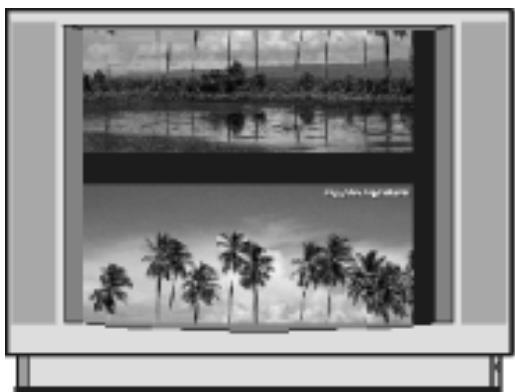
If you are watching a Digital TV broadcast and you wish to change to a normal TV broadcast, press the TV button* on your Set Top Box handset to revert to normal TV operation. If you do not, you may experience a "rolling" of the picture on your TV. (An example is shown in the illustration opposite)
* PLEASE NOTE :
The TV button on your Set Top Box handset will be labelled "TV, TV/SAT or TV/DTV", whichever is appropriate to your type of Set Top Box.
Before Switching on your TV
Power connection
IMPORTANT: The TV set is designed to operate on 220-240V AC, 50 Hz.
- After unpacking, allow the TV set to reach the ambient room temperature before you connect the set to the mains.
Aerial Connections
- Connect the aerial plug to the aerial input socket located at the back of the TV.
How to connect other devices
IMPORTANT: Switch off the TV before connecting any external device.
Sockets for external connections are on the back of the TV.
For connection of other devices via SCART connector (or RCA Jack) refer to the manuals of the related devices.
Inserting batteries in the remote control handset
- Remove the battery cover located on the back of the handset by gently pulling upwards from the indicated part.
- Insert two MN2400 AAA or equivalent type batteries inside.
- Replace the battery cover.
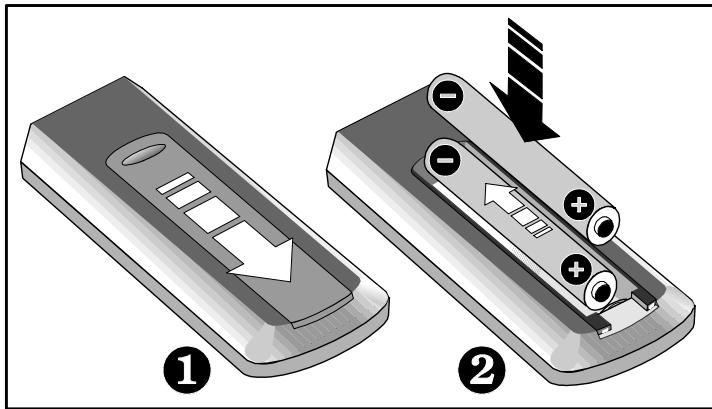
NOTE: Remove batteries from remote control handset when it is not to be used for a long period. Otherwise it can be damaged due to any leakage of batteries.
Switching the TV ON/OFF
You can operate your TV either using the remote control handset or directly using the TV onset buttons.
To switch the TV on
Your TV will switch on in two steps:
1- Press the power button located on the front of the TV. Then the TV switches itself to standby mode and the RED LED located below the TV turns on.
2- To switch on the TV from stand-by mode either:
Press a digit button on the remote control so that a programme number is selected, or,
Press Programme Up and Down buttons on the front of the TV or on the remote control respectively, so the TV will switch on and the RED Led will turn GREEN.
To switch the TV off
- Press the stand-by button on the remote control, so the TV will switch to stand-by mode and the GREEN LED will become RED, or,
- Press the power button located on the front of the TV.
Operating the TV
You can operate your TV both using the remote control handset and onset buttons.
APS (Automatic Programming System)
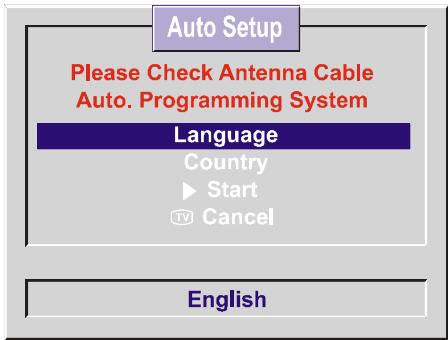
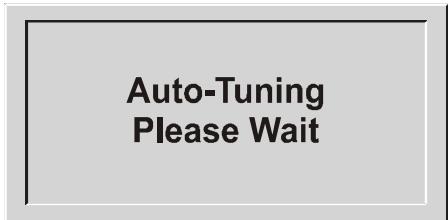
When you turn on your TV for the first time, "Auto Setup" menu will be displayed. Auto programming system automatically programmes your TV according to the transmission of programme systems in your area. In this menu if the language setting is incorrect, use "P" or "P" buttons to highlight "Language" and select the available one using the " - " or " + " buttons. Then use the " - " or " + " buttons to highlight "Country". If country setting is in correct, use " - " or " + " buttons to highlight "Country", and select using the " - " or " + " buttons. Finally use " P" or " P" buttons to highlight "Start" and use " - " or " + " buttons to begin "Auto-Programming". You can use "TV" button to cancel Auto-Programming system.
After APS is finalised, a rank list will appear on the screen. In the rank list you will see the programme numbers and names assigned to the programmes. At the first programme with programme number 1 will be displayed and the programme number 1 will be selected. Using “ ” or “ ” or “ - ” or “ + ” key you can move the flashing number and then display the
programme corresponding to the flashing number pressing RED button.
If you do not accept the correspondence between programme numbers and names and want to change them, press "MENU" button and then BLUE button, so that you enter the Installation menu. In the Installation menu select TUNING menu and enter it. To use tuning menu, refer to the Tuning submenu in the Installation Menu section of this manual.
Operating with the onset buttons
Volume setting and programme selection can be made using the buttons on the front panel.
Volume Setting
- Press “-Volume” button to decrease volume or “Volume+” button to increase volume, so a volume level scale will be displayed on the screen.
Programme Selecting
- Press Programme Up button to select next programme or Programme Down button to select the previous programme.
Operating with Remote Control
The remote control handset of your TV is designed to control all the functions of the model you selected. The functions will be described in accordance with the menu system of your TV.
Functions which you can use out of menu system are described below.
Volume Setting
Press “+” button to increase volume.
Press " " button to decrease volume.
Programme Selecting (Previous or next programme)
- Press “ ” button to select the next programme.
- Press "P" button to select the previous programme.
Programme Selecting (direct access):
Press digit buttons on the remote control handset to select programmes between 0 and 9.
Press “- - ” button to select programmes between 10 and 99. “- - ” will be displayed on the screen. Then press the programme number. (e.g. for programme 27, press 2 and 7)
Press directly the programme number to reselect single digit programmes.
Menu System
Your TV has been designed with a menu system, to provide an easy manipulation of a multifunction system. The TV is controlled by choosing the commands displayed on the screen.
Below is described the use of the menu system.
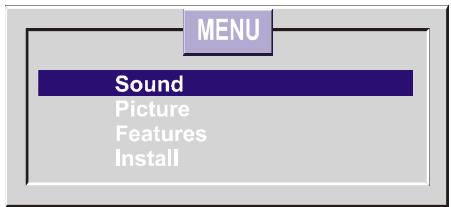
- Press Menu "MENU" button. Main menu will be displayed on the screen.
On the remote control each option is identified with a different colour. To select an option, press the button with the corresponding colour, on the remote control handset. For example for sound settings, press RED button, for picture settings, press GREEN button etc.
Information Menu
When you press the information button “i” in any menu an explanation is given of how to:
- Select and go to a submenu
- Select and change items
- go to the previous menu
- exit that menu
is given.

To Move Up/Down
To Go To Submenu
To Exit Menu
If the “i” button is pressed when none of the menus activated, the TV status including “Program number, name and Sound Mode” will be displayed.
In all the menus, pressing “ ” or “ ” button one of the items can be selected, pressing “ - ” or “ ± ” button item can be changed or you can go to submenu, pressing the “ MENU” button you can go to the previous menu and by pressing the “ TV ” button you will exit the menu.
Sound Menu
To change sound settings
- Enter the Sound Menu directly, pressing the Red button "口" or,
- Press "MENU" button, now you are in main menu. In the main menu, select SOUND using "P" or "P" button, then enter the sound menu pressing "▶" or "▶" button.
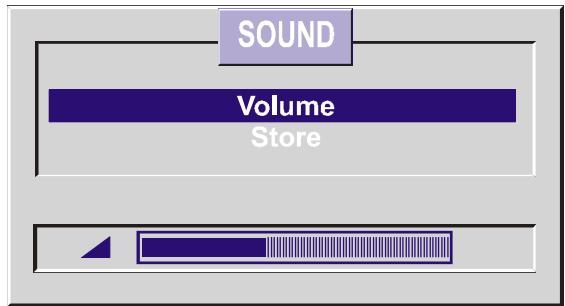
Setting Volume:
As you enter the sound menu, Volume will be the first selected option.
- Press “+” button to increase volume.
- Press “-” button to decrease volume.
Or you can directly change the volume settings using “+” (to increase) or “-” (to decrease) button.
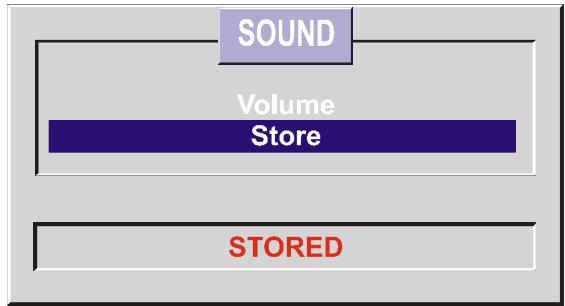
To Store the Settings:
- Using “ ” or “ ” button select Store. Press “ ” or “+” button to store current sound settings. The stored values will be valid for all the programmes.
Picture Menu
To change picture settings:
- Enter the Picture Menu directly, pressing the GREEN button “ ” or,
- Press "MENU" button, now you are in main menu. In the main menu, select PICTURE using "F" or "F" button, then enter the picture menu pressing "F" or "+F" button.
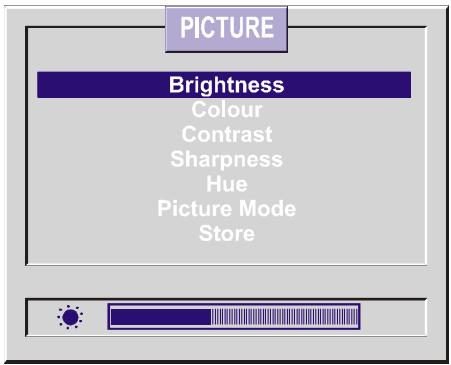
Setting Brightness:
- As you enter the picture menu, Brightness will be the first selected option.
- Press “+” button to increase brightness.
- Press “ ” button to decrease brightness.
Setting Colour:
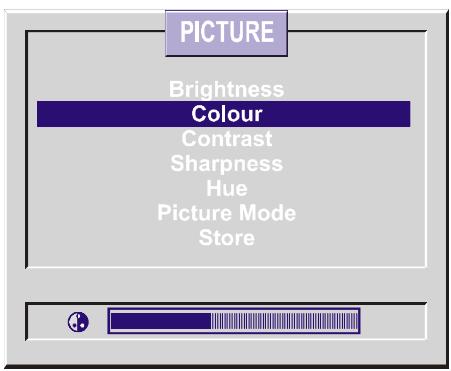
- Using “P” or “P” button select Colour.
- Press “+” button to increase colour level.
- Press “ ” button to decrease colour level.
Setting Contrast:
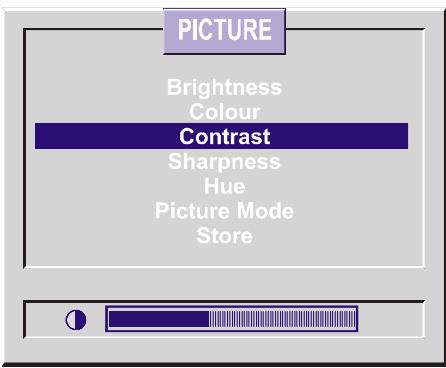
- Using “ ” or “ ” button select Contrast.
- Press “+” button to increase contrast level.
- Press " - " button to decrease contrast level.
Setting Sharpness:
- Using “ ” or “ ^ ” button select sharpness.
- Press “+” button to increase sharpness level.
- Press " " button to decrease sharpness level.
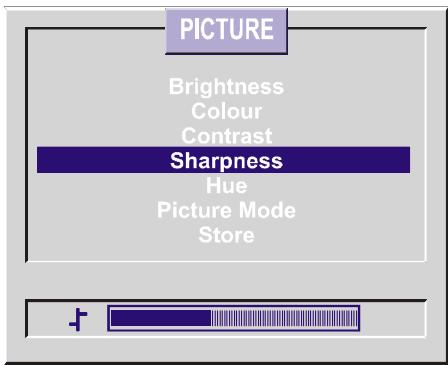
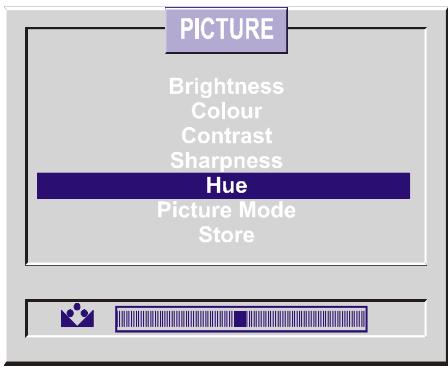
Setting Hue:
(If your TV set has aPlayback NTSC system, this will appear) (In AV mode only):
- Using “ ” or “ ” button select Hue.
- Press “+” button to increase hue level.
- Press “ ” button to decrease hue level.
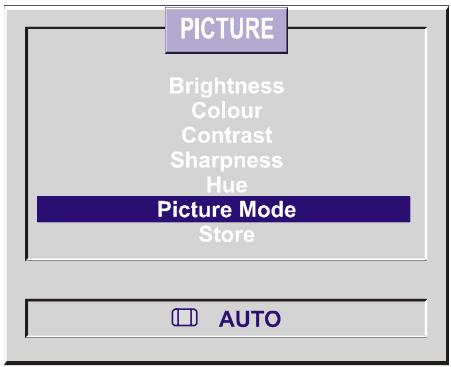
Picture Mode Menu:
This menu is used to change the picture size according to the coming transmission.
- If auto function is selected, then the picture size will be automatically changed according to the transmission.
- Selecting 4 : 3 mode forces picture ratio size to 4 : 3.
- Selecting 16:9 mode forces picture ratio size to 16:9.
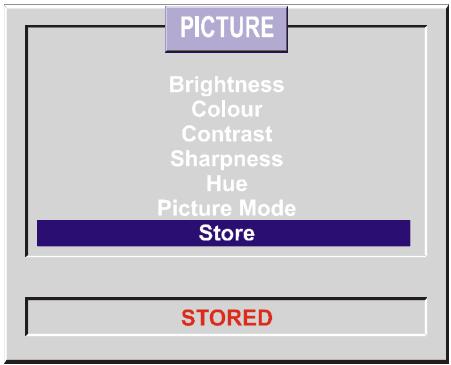
To Store the Settings:
- Using “ ” or “ ” button select Store. Press “ ” or “ ” button to store current picture settings. The stored values will be valid for all the programmes. Picture Mode setting is stored for each program individually.
Feature Menu
- Enter the Feature Menu directly, pressing the YELLOW button "F" or,
- Press "MENU" button, now you are in main menu. In the main menu, select FEATURE, using "P" or "F" button. Then enter the feature menu pressing "--" or "+--" button.
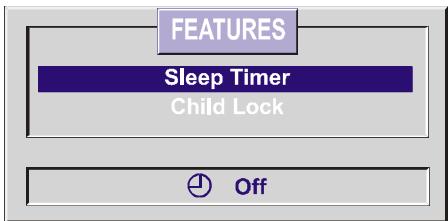
Sleep Timer:
- As you enter the feature menu, Sleep Timer will be the first selected option.
- Use “ ” or “ ” button to change the value of the sleep timer between Off, 0:15, 0:30, 0:45, 1:00, 1:15, 1:30, 1:45, 2:00 hours. Your TV will get into standby mode when the period you selected passes after you make the selection.
Child Lock:
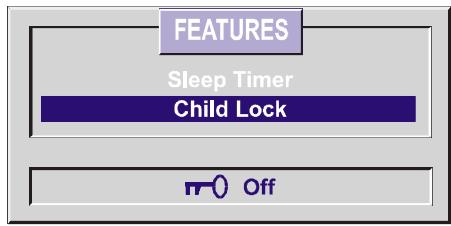
You can use this feature to prevent display of any programme you do not want to be watched.
- The Child Lock feature may be set to either On or Off. When Off is selected, there will be no difference in the operation of your TV. When On is selected, the TV can only be controlled by the remote control handset. In this case, the front panel buttons (except the Switch On/Off button) will not work.
Installation Menu
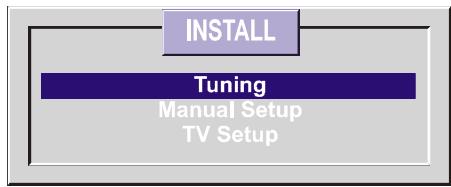
This menu consists of Tuning, Program. (Programming) and TV Configuration submenus.
Tuning Menu
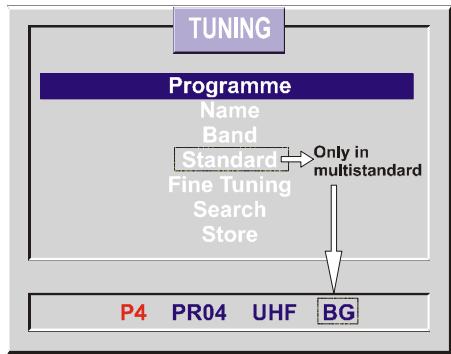
- Press "MENU" button so that you enter the main menu. In the main menu select Installation using "P" or "P" button and open the installation menu pressing "F" or "F" button. (To open the Installation Menu directly, do not enter the main menu, but only press the BLUE button). In the installation menu select TUNING. Pressing "F" or "F" button, enter the TUNING menu.
Automatic Search
- Programme will be the first selected item as you enter the TUNING menu. Pressing “ ” or “ ” button select the programme where you want the tuned station to be stored. (You may also type the programme number using the digit buttons.)
- Press "P" or "F" button to select Band. Using "--" or "+" button, select the band in which search is to be made.
- With the “ ” or “ ” button, select Search. Search can be made either forward, pressing “ ” button or backwards, pressing “ ” button.
- If the tuned station is not the desired one, you can continue searching pressing “-” or “+” button again.
- When the desired station is tuned, select STORE using “P” or “F” button and store it to the programme number you selected pressing “-” or “+” button.
- To stop searching before a channel is found, press the reverse direction button (for example when searching is made in forward direction, press backwards direction button to stop searching).
To name a Programme
First select the programme number you want to name. Then select name option using “ ” or “ ” button. After that press “-” or “+” button to select the position of the letter to be changed and press “ ” or “ ” button to change that letter. After that select and change the other letters as well in order to name the programme correctly. Finally to store the name, select store option using “ ” or “ ” button and store it pressing “-” or “+” button.
To change Standard
(You can change this menu only between standards which your TV set supports.)
Pressing “ ” or “ ” button selects the Broadcast Standard required. Then select the standard you want pressing “ - ” or “ + ” button. When changing the standard this way, if the previous channel is not defined for the new selected standard, then also the channel will be changed to the first defined channel of that standard (For example: When changing BG to K1 and the previous channel is C12, after changing the standard, the channel will be C4, because the first defined channel of standard K1 is C4). After that, if it is returned to the previous standard back, the channel will not be changed to the previous one anymore (That means, in the example above, when it is returned from K1 to BG again, the channel will not change to C12 anymore and keep C4). Defined channels for different standards are given as following:
**IRELANDI (VHF, UHF)
Fine Tuning
Picture or sound quality can be poor in areas where the receptions is weak. In such cases, picture and sound quality can be improved by fine tuning. To make fine tuning:
- In the tuning menu, press "P" or "F" button to select the Fine Tuning item. Pressing the "+” button continuously will cause the fine tuning be made forward while pressing the " - ” button continuously will cause the fine-tuning to be made backwards. When you are satisfied with the reception of transmission, store it. To store the fine tuning setting select the STORE option using either the “ P ” or “ F ” button and store it to the selected programme number by pressing either of the “ - ” or “ + ” buttons.
Program (Programming) Menu
Program. (Programming) menu is used to display the programme names and numbers. You can use this menu to delete a channel, to insert a channel and to autostore the programmes. You can access this menu directly via “i” INFO button in no menu condition.
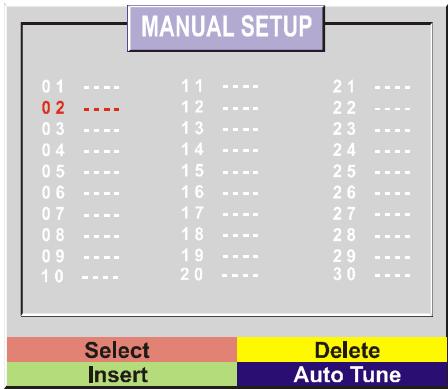
Select the PROGRAM Menu pressing the “P” or “F” button and open it by pressing “-” or “+” buttons. When you enter the programme menu, all the programme numbers and names will be displayed on the screen. The programme name and number of the tuned channel will be displayed in red. All the other channel numbers will be black and at first the programme number 1 will be flashing. You can move the flashing number using the “P” or “F” buttons. As you pass through the programme numbers this way, to reach the programme number you want, the channels corresponding to the programme numbers you pass through will not be tuned.
Pressing the RED button will tune the channel on the flashing programme number. Now the colour of the flashing programme number will be red. Again you can use the “P” or “P” or “-” or “+” buttons.
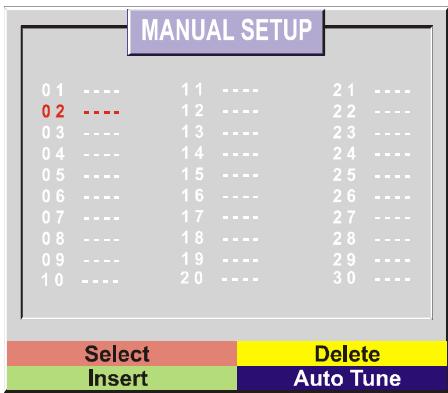
To delete a channel from a programme number:
- Move the flashing onto the channel you want to delete.
- Press the YELLOW button. Now the corresponding channel will be deleted and all the other channels below this programme number will be moved one programme number up.
To insert a channel into a programme number:
- Move the flashing onto the selected channel.
- Press the RED button, so that channel will be displayed on the screen.
- Move the flashing onto the selected programme number. Now pressing the GREEN button will insert the channel on screen displayed into that programme number. If a channel is moved to a lower programme number, channels between the previous and current position of the selected channel will be moved one programme number up and if a channel is moved to a upper programme number, channels between the previous and current position of the selected channel will be moved one programme number down.
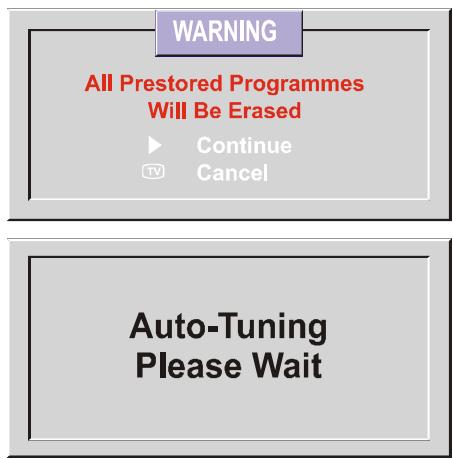
APS (Automatic Programming System):
The APS menu will appear when you first switch on your TV for the first time. APS automatically programmes your TV, according to the transmission of programme systems in your area.
If you want to run APS at any other time:
- Press BLUE button. Now you are in the Auto Tune menu.
- Select Program menu using “P” or “F” button.
- Press either the “ ” or “ ” button to enter the Program menu.
- In the program menu enter the Auto Tune menu by pressing the BLUE button, APS is starting. To stop APS press the "TV" button.
After APS is finalised, a rank list will appear on the screen. In the rank list you will see the programme numbers and names, assigned to the programmes. First the programme with programme number 1 will be displayed and it will be flashing. Using the “ ” or “ ” or “ - ” or “ ± ” buttons you can move the flashing number and then display the programme corresponding
to that flashing number by pressing the RED button. If you do not accept the line up between the programme numbers and names and want to change them, press the “ MENU” button and then the BLUE button, so entering the Installation menu. In the Installation menu select the TUNING menu and enter it. To use the TUNING menu, refer to the Tuning submenu in the Installation Menu section of this manual.
TV Setup Menu
This menu is used to select the Menu Language.
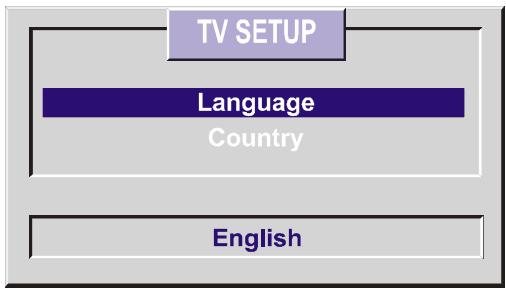
Selecting Menu Language
To select menu language:
- Press "MENU" button so that you enter the main menu.
- In the main menu select Installation using “P” or “F” button.
- Open the installation menu pressing the “ ” or “ ” button. (To open the Installation Menu directly, do not enter the main menu but only press the BLUE button).
- In the installation menu select TV Setup using “F” or “F” button.
- Open the TV Setup menu using “ ” or “ ” button.
- In the TV Setup menu select Language and you can change the language to the one you require, using the “ ” or “ ” buttons. As soon as you change the language, the menu items will be displayed in the selected language.
Selecting Country
- Press "MENU" button so that you enter the main menu.
- In the main menu select Installation using “P” or “F” button.
- Open the installation menu pressing the “ ” or “ ” button. (To open the Installation Menu directly, do not enter the main menu but only press the BLUE button).
- In the installation menu select TV Setup using “P” or “P” button.
- Open the TV Setup menu using “ 一 一 ” or “+” button.
- In the TV Setup menu select Country using “P” or “P” button. Change the country pressing “-” or “+” button.
Other Features
Sound Mute
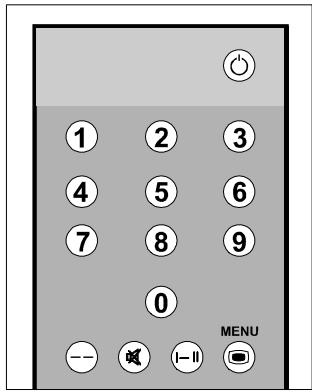
To cut off the sound of the TV press "” button. The sound will be muted. To cancel mute, press "” or "” or "+” buttons. The volume level will return to the level it was before the sound was muted.
Information on Screen
After the selection of a TV programme from peripheral equipment, e.g. VCR, DVD player, satellite receiver or decoder, the following information will appear on your screen:
- The programme number and name of the selected TV channel.
- The currently selected mode (not with a programme coming from a peripheral or through a decoder).
Also "X" sound muted sign will be displayed when the sound is temporarily interrupted.
Teletext
Teletext is an information system that displays text on your TV screen. Using the Teletext information system you can view a page of information on a subject that is available in the list of contents (index).
No on screen display will be available in text mode.
No contrast, brightness or colour control, but volume control is available in text mode.
To operate Teletext
- Select a TV station on which Teletext is being transmitted.
- Press (TELETEXT) "TEXT" button. Usually the list of contents (index) is displayed on the screen.
To select a page of Teletext
- Press the appropriate digit buttons for the required Teletext page number.
The selected page number is displayed at the top left corner of the screen. The Teletext page counter searches until the selected page number is located, so that the desired page is displayed on the screen.
- Press "P" button to move the Teletext screen forward one page at a time.
- Press "P" button to move the Teletext screen backward one page at a time.
To Select Index Page
To select the page number of the index (generally page 100), press "三;" button.
To Reveal "concealed" Information
- Pressing “ ?” button once will reveal answers on a quiz or games page.
- Pressing “ ?” button again will conceal the revealed answers.
To Stop Automatic Page Change
The teletext page you have selected may contain more information than what is on the screen; the rest of the information will be displayed after a period of time.
- Press "回" button to stop the automatic page change.
- Press "三元" button again to allow the next page to be displayed.
To Select a Subpage Page
Subpage pages are subsections of long Teletext pages that can only be displayed on the screen one section at a time.
- Select the required Teletext page.
- Press “ 三 ” button.
- Select the required Subpage page number by pressing four digit buttons (e.g. 0001).
- Teletext page number will be displayed on the upper left corner of the screen when the selected page is found.
To exit Teletext
- Press "TV" button. The screen will switch to TV mode.
To Display the Time
- While watching a TV programme with Teletext transmission press “ ” button. The current time information, captured from Teletext will be displayed at the upper right corner of the screen.
- If the programme being watched does not have Teletext transmission, only a blue box will be displayed at the same location.
- The time information will disappear after pressing " button again.
When time information is displayed on screen, entering another menu will remove it, but after leaving that menu time information will appear again.
Tips
Care of the Screen
Clean the screen with a slightly damp, soft cloth. Do not use abrasive solvents as they may damage the TV screen coating layer.
Poor Picture
Have you selected the correct TV system? Is your TV set or house aerial located too close to the loudspeakers, non-earthy audio equipment or neon lights, etc. ?
Mountains or high buildings can cause double pictures or ghost images. Sometimes you can improve the picture quality by changing the direction of the aerial.
The picture quality may degrade when two peripherals are connected to the TV at the same time. In such a case, disconnect one of the peripherals.
No Picture:
Is the aerial connected properly? Are the plugs connected tightly to the aerial socket? Is the aerial cable damaged? Are suitable plugs used to connect the aerial? If you are in doubt, consult your dealer.
No Picture means that your TV is not receiving any transmission. Have you pressed the correct keys on the remote control? Try once more.
Remote Control:
Your TV no longer responds to the remote control. Press the "TV" button on the remote control once more. Perhaps the batteries are exhausted. If so you can still use the local keys at the front of your TV.
Have you selected the wrong menu? Press "TV" key to return to TV mode or press "MENU" to return to the previous menu.
No solution:
Switch your TV set off and on. If this does not work, call the service personnel; never attempt to repair it yourself.
Specifications
TV BROADCAST STANDARAPAL B/G (CP2125T)
PAL SECAM B/G L/L' (CL 2125 T)
RECEIVING CHANNELS VHF (BAND I/III)
UHF (BAND U)
HYPERBAND
CABLE TV (S1-S20/ S21-S41)
NUMBER OF PRESET CHANNELS 100
CHANNEL INDICATOR. .On Screen Display
RFAERIAL INPUT 75 Ohm (unbalanced)
International Sales Division
THE HITACHI ATAGO BUILDING,
No. 15-12 Nishi Shinbashi, 2-Chome,
Minato - Ku, Tokyo 105-8430, Japan.
Tel: 03 35022111
HITACHI EUROPE LTD,
Whitebrook Park
Lower Cookham Road
Maidenhead
Berkshire
SL6 8YA
UNITED KINGDOM
Tel: 01628 643000
Fax: 01628 643400
Email: consumer-service@hitachi-eu.com
HITACHI EUROPE S.A.
364 Kifissias Ave. & 1, Delfon Str.
152 33 Chalandri
Athens
GREECE
Tel: 1-6837200
Fax: 1-6835964
Email: service.hellas@hitachi-eu.com
HITACHI EUROPE GmbH
Munich Office
Dornacher Strasse 3
Email: HSE-DUS.service@hitachi-eu.com
HITACHI EUROPE S.A.
Gran Via Carlos III, 101-1
08028 Barcelona
SPAIN
Tel: 934092550
Fax: 934913513
Email: atencion.cliente@hitachi-eu.com
HITACHI EUROPE srl
Via Tommaso Gulli N.39, 20147
Milano, Italia
ITALY
Tel: +39 02 487861
Tel: +39 02 38073415 Servizio Clienti
Fax: +39 02 48786381/2
Email: customerservice.italy@hitachi-eu.com
HITACHI Europe AB
Box 77 S-164 94 Kista
SWEDEN
Tel: +46 (0) 856271100
Fax: +46 (0) 8562711 13
Email: csgswe@hitachi-eu.com
HITACHI EUROPE S.A.S
Lyon Office
B.P. 45, 69671 BRON CEDEX
FRANCE
Tel: 04 72 14 29 70
Fax: 04 72 14 29 99
HITACHI EUROPE LTD (Norway) AB
STRANDVEIEN 18
1366 Lysaker
NORWAY
Tel: 67 5190 30
Fax:67519032
Email: csgnor@hitachi-eu.com
HITACHI EUROPE AB
Egebaekgård
Egebækvej 98
DK-2850 Nærum
DENMARK
Tel: +45 43 43 6050
Fax: +45 43 60 51
Email: csgnor@hitachi-eu.com
HITACHI EUROPE AB
Neopoli / Niemenkatu 73
FIN-15140 Lahti
FINLAND
Tel: +358 3 8858 271
Fax: +358 3 8858 272
Email: csgnor@hitachi-eu.com
Hitachi Europe Ltd
Bergensesteenweg 421
1600 Sint-Pieters-Leeuw
BELGIUM
Tel: +32 2 363 99 01
Fax: +32 2 363 99 00
Email: sofie.van.bom@hitachi-eu.com
HITACHI EUROPE LTD
Na Sychrove 975/8
101 27 Praha 10 - Bohdalec
CZECH REPUBLIC
Tel: +420 267 212 383
Fax: +420 267 212 385
Email: csgnor@hitachi-eu.com