
AFICIO SP 3300DN - Laser printer RICOH - Free user manual and instructions
Find the device manual for free AFICIO SP 3300DN RICOH in PDF.


| Product type | Monochrome laser printer |
| Brand | RICOH |
| Model | AFICIO SP 3300DN |
| Dimensions (W x D x H) | 370 x 392 x 260 mm |
| Weight | 11.5 kg |
| Power supply | 220-240 V, 50/60 Hz |
| Power consumption (average) | 550 W printing, 10 W standby |
| Print resolution | 1200 x 1200 dpi |
| Print speed | 33 pages per minute (A4) |
| Paper capacity (standard tray) | 250 sheets |
| Automatic duplex printing | Yes |
| Connectivity | USB 2.0, Ethernet 10/100/1000 Base-TX |
| Supported paper sizes | A4, A5, A6, B5, Letter, Legal |
| Toner type | Ricoh SP 3110 toner cartridge (standard capacity) |
| Monthly duty cycle | Up to 50,000 pages |
| Maintenance and cleaning | Clean the exterior with a soft, dry cloth; use a cleaning kit for the interior |
| Security | Control panel lock, secure printing (PIN code) |
| Spare parts and repairability | Toner cartridge, fuser unit, drum, maintenance kit available |
| Manual languages | French, English, and others (translation available upon request) |
Frequently Asked Questions - AFICIO SP 3300DN RICOH
User questions about AFICIO SP 3300DN RICOH
0 question about this device. Answer the ones you know or ask your own.
Ask a new question about this device
Download the instructions for your Laser printer in PDF format for free! Find your manual AFICIO SP 3300DN - RICOH and take your electronic device back in hand. On this page are published all the documents necessary for the use of your device. AFICIO SP 3300DN by RICOH.
USER MANUAL AFICIO SP 3300DN RICOH
Contents of this manual are subject to change without prior notice. In no event will the company be liable for direct, indirect, incidental or consequential damages as a result of handling or operating the machine.
Copyright © 2008
- PCL and PCL 6 are trademarks of Hewlett-Packard company.
- Microsoft, Windows and Windows Vista are either registered trademarks or trademarks of Microsoft Corporation.
PostScript 3 is a trademark of Adobe System, Inc. - UFST® and MicroType™ are registered trademarks of Monotype Imaging Inc.
- TrueType, LaserWriter, and Macintosh are trademarks of Apple Computer, Inc.
- All other brand or product names are trademarks of their respective companies or organizations.
Contents
1. Introduction
Special features 1.1
Printer overview 1.2
Front view 1.2
Rear view 1.3
Control panel overview 1.3
Understanding the LEDs 1.3
Finding more information 1.4
Setting up the hardware 1.4
Altitude adjustment 1.5
Changing the font setting 1.6
2. Basic setup
Printing a demo page 2.1
Using toner save mode 2.1
3. Software overview
Supplied software 3.1
Printer driver features 3.1
System requirements 3.2
4. Network setup (SP 3300DN only)
Introduction 4.1
Supported operating systems 4.1
Using SetIP program 4.1
5. Loading print media
Selecting print media 5.1
Supported sizes of paper 5.2
Print media for duplex printing 5.2
Guidelines for selecting and storing print media 5.3
Loading paper 5.4
Using the tray 1 or the optional tray 2 5.5
Changing the size of the paper in the tray 1 5.5
Using manual feeder 5.6
Knowing an output location 5.7
6. Basic printing
Printing a document 6.1
Canceling a print job 6.1
7. Supplies and accessories
Toner cartridge 7.1
Accessory 7.1
8. Maintenance
Cleaning the printer 8.1
Cleaning the outside of the printer 8.1
Cleaning the inside of the printer 8.1
Maintaining the toner cartridge 8.2
Redistributing toner cartridge 8.3
Replacing the toner cartridge 8.4
Printing a configuration page 8.5
Maintenance parts 8.5
9. Troubleshooting
Clearing paper jams 9.1
In the paper feed area 9.1
Around the toner cartridge 9.2
In the paper exit area 9.3
In the duplex unit area 9.3
Tips for avoiding paper jams 9.4
Troubleshooting checklist 9.5
Solving general printing problems 9.5
Solving print quality problems 9.7
Common Windows problems 9.9
Common PostScript problems 9.10
Common Macintosh problems 9.10
10. Installing accessories
Precautions to take when installing accessories 10.1
Installing a memory module 10.1
Activating the added memory in the PS printer properties 10.2
11. Specifications
Printer specifications 11.1
Safety Information
When using this machine, the following safety precautions should always be followed.
Safety During Operation
In this manual, the following important symbols are used:

WARNING:
Indicates a potentially hazardous situation which, if instructions are not followed, could result in death or serious injury.

CAUTION:
Indicates a potentially hazardous situation which, if instructions are not followed, may result in minor or moderate injury or damage to property.

WARNING:
- Disconnect the power plug (by pulling the plug, not the cable) if the power cable or plug becomes frayed or otherwise damaged.
- To avoid hazardous electric shock or laser radiation exposure, do not remove any covers or screws other than those specified in this manual.
-
Turn off the power and disconnect the power plug (by pulling the plug, not the cable) if any of the following occurs:
-
You spill something into the machine.
- You suspect that your machine needs service or repair.
-
The external housing of your machine has been damaged.
-
Do not incinerate used toner or toner containers. Toner dust might ignite when exposed to an open flame.
- Do not store toner, used toner, or toner containers in a place with an open flame. The toner might ignite and cause burns of a fire.
- Disposal can take place at our authorized dealer.
- Dispose of used toner containers in accordance with local regulations.
- Keep the machine away from flammable liquids, gases, and aerosols. A fire or an electric shock might occur.
- Connect the machine to the power source specified on the inside front cover of this manual and do not use any other power sources. Connect the power cord directly to a wall outlet and do not use an extension cord. Power sources not specified on the inside front cover of this manual and extension cords are electric shock or fire hazards.
- Do not make modifications or replacements other than those mentioned in this manual.
- Power cords that are damaged, broken, modified, trapped under heavy objects, pulled hard, or bent severely are electric shock and fire hazards.
- If the power cord is damaged (exposure of the core, disconnection, etc.), contact your service representative to change a new one. Operating the machine with a damaged power cord may cause an electric shock or fire.

CAUTION:
- Protect the machine from dampness or wet weather, such as rain and snow.
- Unplug the power cord from the wall outlet before you move the machine. While moving the machine, you should take care that the power cord will not be damaged under the machine.
- When you disconnect the power plug from the wall outlet, always pull the plug (not the cable).
- To disconnect the power cord, pull it out by plug. Do not drag the cord itself. Doing so may result in damage to the cord, leading to fire or electric shock.
- For safety reason, unplug the power cord from the wall outlet if the machine will not be used for an extended period of time such as holidays.
- Do not allow paper clips, staples, or other small metallic objects to fall inside the machine.
- Keep toner (used or unused) and toner cartridge out of reach of children.
- Be careful not to cut yourself on any sharp edges when you reach inside the machine to remove misfed sheets of paper or masters.
- For environmental reasons, do not dispose of the machine or expended supply waste at household waste collection points. Disposal can take place at an authorized dealer.
- The inside of the machine could be very hot. Do not touch the parts with a label indicating the "hot surface". Otherwise, an injury might occur.
- The fusing section of this machine might be very hot. Caution should be taken when removing misfed paper.
- Keep the machine away from humidity and dust. Otherwise a fire or an electric shock might occur.
- Do not place the machine on an unstable or tilted surface. If it topples over, an injury might occur.
- Do not use aluminum foil, carbon paper, or similar conductive paper to avoid a fire or a machine failure.
- Make sure the room where you are using the machine is well ventilated and spacious. Good ventilation is especially important when the machine is used heavily.
- Do not open toner containers forcefully. Toner can spill, dirtying your clothes or hands, and possibly resulting in accidental ingestion.
- If toner or used toner is inhaled, gargle with plenty of water and move into a fresh air environment. Consult a doctor if necessary.
- If toner or used toner gets into your eyes, flush thoroughly with eyewash or water. Consult a doctor if necessary.
- If toner or used toner is swallowed, dilute by drinking a large amount of water. Consult a doctor if necessary.
- Avoid getting toner on your clothes or skin when removing a paper jam or replacing toner. If your skin comes into contact with toner, wash the affected area thoroughly with soap and water.
- If toner gets on your clothing, wash with cold water. Hot water will set the toner into the fabric and may make removing the stain impossible.
- Do not look into the lamp - it can damage your eyes.
-
When loading paper, take care not to trap or injure your fingers.
-
During operation, rollers for transporting the paper revolve. A safety device is being installed so that the machine can be operated safely. But take care not to touch the rollers during operation. An injury might occur.
- Fire and breakdown can result from heavy accumulation of dust inside this machine. Consult your service representative for details about and charges for cleaning the machine's interior.
- If you have to move the machine when the optional paper tray unit is attached, do not push on the main unit's top section. Doing so can cause the optional paper tray unit to detach, possibly resulting in injury.
- Before moving the machine, be sure to pull all four handles fully out. If not, an injury might occur. After moving the machine, return the four handles to their original positions.
- After you move the machine, use the caster fixture to fix it in place. Otherwise the machine might move or come down to cause an injury.
Notes for Users
If you continuously print multiple pages, moist or vapor may appear from the paper exit area. However this will not have any impact on the performance of your printer. Be cautious not to touch the surface, or wait until cooled down, and keep children away from the surface.
Power Supply
The socket-outlet shall be in stalled near the product and shall be easily accessible.
Positions of Labels and Hallmarks for WARNING and CAUTION Labels
This machine has labels for WARNING and CAUTION at the positions shown below. For safety, please follow the instructions and handle the machine as indicated.
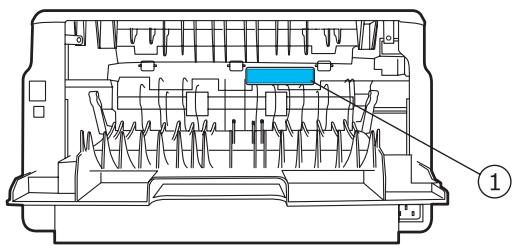
1
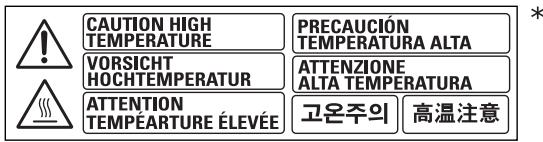
*This label is stuck to hot surfaces. Be careful not to touch these areas.
In accordance with IEC 60417, this machine uses the following symbols for the main power switch:
means POWER ON.
means POWER OFF.
Power Saver
This printer contains advanced energy conservation technology that reduces power consumption when it is not in active use.
When the printer does not receive data for an extended period of time, power consumption is automatically lowered.
ENERGY STAR® Program

The ENERGY STAR® Program encourages energy conservation by promoting energy efficient computers and other office equipment.
The program backs the development and dissemination of products that feature energy saving functions.
It is an open program in which manufacturers participate voluntarily.
Targeted products are computers, monitors, printers, facsimiles, copiers, scanners, and multifunction devices. Energy Star standards and logos are internationally uniform.
Recycling

Please recycle or dispose of packaging materials for this product in an environmentally responsible manner.
User Information on Electrical & Electronic Equipment
Users in the EU, Switzerland and Norway
Our Products contain high quality components and are designed to facilitate recycling. Our products or product packaging are marked with the symbol below.

The symbol indicates that the product must not be treated as municipal waste. It must be disposed of separately via the appropriate return and collection systems available. By following these instructions you ensure that this product is treated correctly and help to reduce potential impacts on the environment and human health, which could otherwise result from inappropriate handling. Recycling of products helps to conserve natural resources and protect the environment. For more detailed information on collection and recycling systems for this product, please contact the shop where you purchased it, your local dealer or sales/service representatives.
All Other Users
If you wish to discard this product, please contact your local authorities, the shop where you bought this product, your local dealer or sales/service representatives.
Laser Safety:
Caution:
Use of controls or adjustment or performance of procedures other than those specified in this manual might result in hazardous radiation exposure.
For Users in Europe
This machine is considered class 1 laser device, safe for office/ EDP use. The machine contains 1 AlGaAs laser diode, 10 milliwatt, 770 - 795 nanometer wavelength for each emitter.
Direct (or indirect reflected) eye contact with the laser beam might cause serious eye damage. Safety precautions and interlock mechanisms have been designed to prevent any possible laser beam exposure to the operator.
The following label is attached on rear side of the printer.
CLASS 1 LASER PRODUCT
For Users in the United States of America
CDRH Regulations
This equipment complies with requirements of 21 CRF subchapter J for class 1 laser products. This equipment contains 1 AlGaAs laser diode, 10 milliwatt, 770 - 795 nanometer wavelength for each emitter. This equipment does not emit hazardous light, since the beam is totally enclosed during all customer modes of operation and maintenance.
Note to users in the United States of America
Note:
This equipment has been tested and found to comply with the limits for a Class B digital device, pursuant to Part 15 of the FCC Rules. These limits are designed to provide reasonable protection against harmful interference in a residential installation. This equipment generates, uses and can radiate radio frequency energy and, if not installed and used in accordance with the instructions, may cause harmful interference to radio communications. However, there is no guarantee that interference will not occur in a particular installation. If this equipment does cause harmful interference to radio or television reception, which can be determined by turning the equipment off and on, the user is encouraged to try to correct the interference by one more of the following measures:
- Reorient or relocate the receiving antenna.
- Increase the separation between the equipment and receiver.
- Connect the equipment into an outlet on a circuit different from that to which the receiver is connected.
- Consult the dealer or an experienced radio /TV technician for help.
Caution
Changes or modifications not expressly approved by the party responsible for compliance could void the user's authority to operate the equipment.
Declaration of Conformity
This device complies with Part 15 of the FCC Rules.
Operation is subject to the following two conditions:
- This device may not cause harmful interference, and
- this device must accept any interference received, including interference that may cause undesired operation.
Responsible party: Ricoh Americas Corporation
Address: 5 Dedrick Place, West Caldwell, NJ 07006
Telephone number: 973-882-2000
Product Name: Laser Printer
Model Number: SP 3300DN/SP 3300D
Notes for Users
LAMP(S) INSIDE THIS PRODUCT CONTAIN MERCURY AND MUST BE RECYCLED OR DISPOSED OF ACCORDING TO LOCAL, STATE OR FEDERAL LAWS.
Note to users in Canada
Note:
This Class B digital apparatus complies with Canadian ICES- 003.
Congratulations on the purchase of your printer!
This chapter includes:
- Special features
- Printer overview
Control panel overview
Understanding the LEDs
Finding more information - Setting up the hardware
Altitude adjustment
Changing the font setting
Special features
Your new printer is equipped with several special features that improve the print quality. You can:
Print with excellent quality and high speed

- You can print up to 1200 x 1200 dpi effective output. See the Software Section.
- Your printer prints A4-sized paper at up to 28~ppm^a and letter-sized paper at up to 30 ppm. For duplex printing, your printer prints A4-sized paper at up to 14~ipmb and letter-sized paper at up to 14.5 ipm.
Handle paper flexibly
- Manual tray supports one sheet of envelopes, labels, transparencies, custom-sized materials, postcards and heavy paper.
- Standard 250-sheet tray supports plain paper.
150-sheet output tray supports convenient access.
Create professional documents

- Print Watermarks. You can customize your documents with words, such as "Confidential". See the Software Section.
- Print Booklets. This feature enables you to easily print a document to create a book. Once printed, all you have to do is fold and staple the pages. See the Software Section.
- Print Posters. The text and pictures of each page of your document are magnified and printed across the sheet of paper and can then be taped together to form a poster. See the Software Section.
Save time and money
- Your printer allows you to use toner save mode to save toner. See the Software Section.
- You can print on both sides of the paper to save paper. See the Software Section.
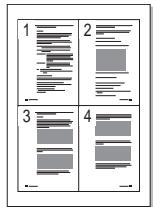
- You can print multiple pages on a single sheet of paper to save paper. See the Software Section.
- You can use preprinted forms and letterhead with plain paper. See the Software Section.
- Your printer automatically conserves electricity by substantially reducing power consumption when not in use.
Expand the printer capacity
- Your printer has 32 MB of memory which can be expanded to 160 MB. See page 10.1.
-
You can add a 250-sheet optional tray 2 to your printer. This tray lets you add paper to the printer less often.
-
Zoran IPS Emulation compatible with PostScript 3

Copyright 1995-2005, Zoran Corporation. All rights reserved. Zoran, the Zoran logo, IPS/PS3 and Onelmage are trademarks of Zoran Corporation.
- 136 PS3 fonts
- Contains UFST and MicroType from Monotype Imaging Inc.
Print in various environments
- You can print in Windows 2000/XP/Vista and Windows Server 2003.
- Your printer is compatible with Macintosh.
- Your printer comes with USB interfaces.
a. pages per minute
b. images per minute
Machine features
The table below shows a general overview of features supported by your printer.
(I: Installed, NA: Not Available)
| Features | SP 3300D | SP 3300DN |
| USB 2.0 (USB 2.0: Hi-Speed USB 2.0) | I | I |
| Network Interface (Ethernet 10/100 Base TX) | NA | I |
| PCL Emulation | I | I |
| PostScript Emulation | I | I |
| Duplex printinga | I | I |
a. Printing on both sides of paper.
Printer overview
Front view
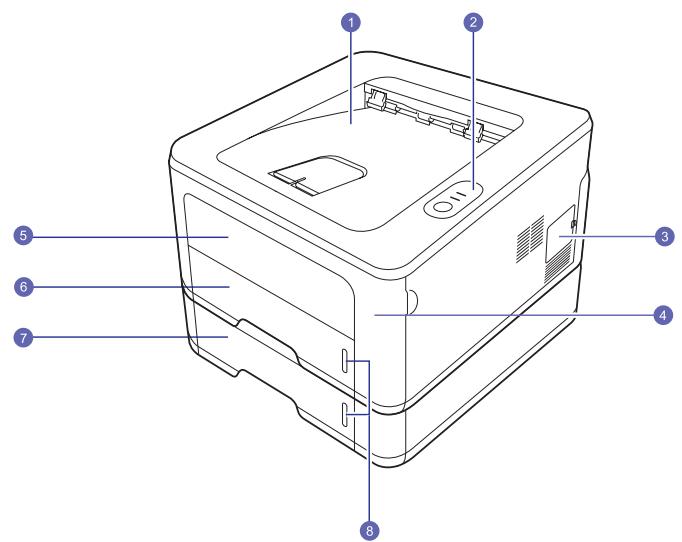
* SP 3300DN is shown in the above figure.
| 1 | output tray | 6 | tray 1 |
| 2 | control panel | 7 | optional tray 2 |
| 3 | control board cover | 8 | paper level indicator |
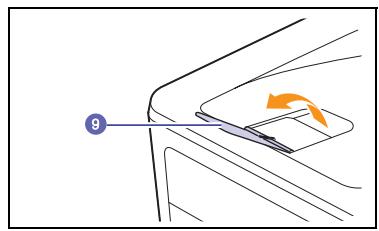
| 4 | front cover | 9 | output support |
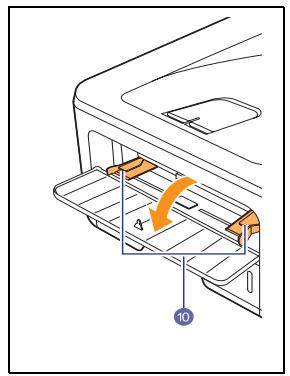
| 5 | manual tray | 10 | manual tray paper width guides |
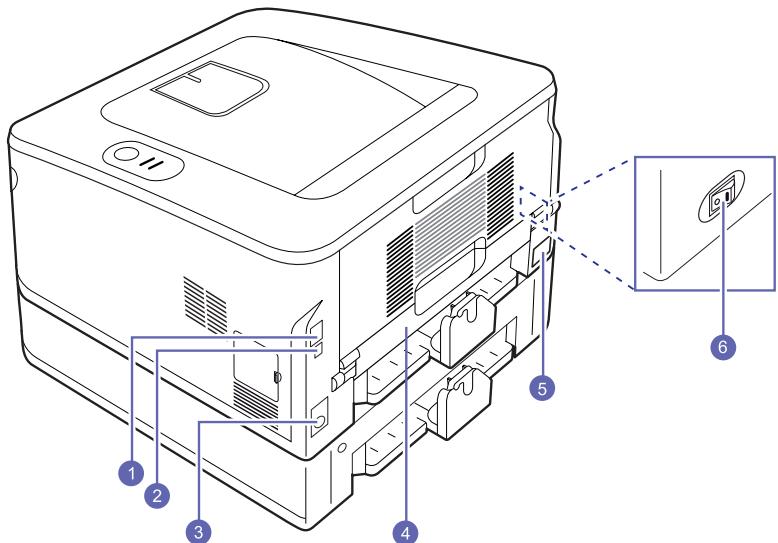
* SP 3300DN is shown in the above figure.
| 1 | network porta | 4 | duplex unit |
| 2 | USB port | 5 | power receptacle |
| 3 | optional tray 2 cable connector | 6 | power switch |
a. SP 3300DN only.
Control panel overview
Alert
DEFehler
DK FejI
FR Alarme
NO alarm
IT Avviso
FI Halytys
ES Alerta
HU Riaszt.
PT Alerta
PL Bldg
NL Waarsch
CZ Vystr.
SE FeI
RU BHHMaH.
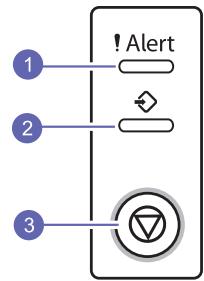
| 1 | Alert: Indicates the status of your printer. See page 9.5. |
| 2 | Online: Indicates the status of your printer. See page 9.5. |
| 3 | Cancel: Prints a demo page or configuration page. Cancels the print job. Makes the printer pick up the print media. |
Understanding the LEDs
| LED | Status | Description | |
| Alert | Red | On | ·The cover is open. Close the cover. ·There is no paper in the tray. Load paper in the tray. ·The printer has stopped printing due to a major error. ·The toner cartridge is not installed. Install the toner cartridge. ·Your system has some problems. If this problem occurs, contact your service representative. ·The toner cartridge is totally exhausted. Remove the old toner cartridge and install a new one. See page 8.4. |
| Blinking | ·A minor error is occurring and the printer is waiting for the error to be cleared. When the problem is cleared, the printer resumes printing. ·The toner cartridge is low or empty. Order a new toner cartridge. You can temporarily improve print quality by redistributing the toner. See page 8.3. To check the remaining toner, see "Web Image Monitor" or print "Configuration page". See page 2.2 in the Network Printer User's Guide or page 8.5 in the User's Guide, respectively. | ||
| Orange | On | ·A paper jam has occurred. To solve the problem, see page 9.1. | |
| Online | Green | On | ·The printer is in power save mode. ·The printer is on-line and can receive data from the computer. |
| Blinking | ·Blinks slowly indicates that the printer is receiving data from the computer. ·Blinks quickly indicates that the printer is printing data. | ||
Finding more information
You can find information for setting up and using your printer from the following resources, either printed or onscreen.
Quick Install Guide
Provides information on setting up your printer, therefore, be sure to follow the instructions in the guide to get the printer ready.
Online User's Guide
Provides you with step-by-step instructions for using your printer's full features, and contains information for maintaining your printer, troubleshooting, and installing accessories.
This user's guide also contains a Software Section providing you with information on how to print documents with your printer on various operating systems, and how to use the supplied software utilities.

Note
You can access the user's guides in other languages from the Manual folder on the supplied CD-ROM.
Printer Driver Help
Provides you with help information on printer driver properties and instructions for setting up the properties for printing. To access a printer driver help screen, click Help from the printer properties dialog box.
Setting up the hardware
This section shows the steps to set up the hardware which is explained in the Quick Install Guide. Make sure you read Quick Install Guide and complete following steps.
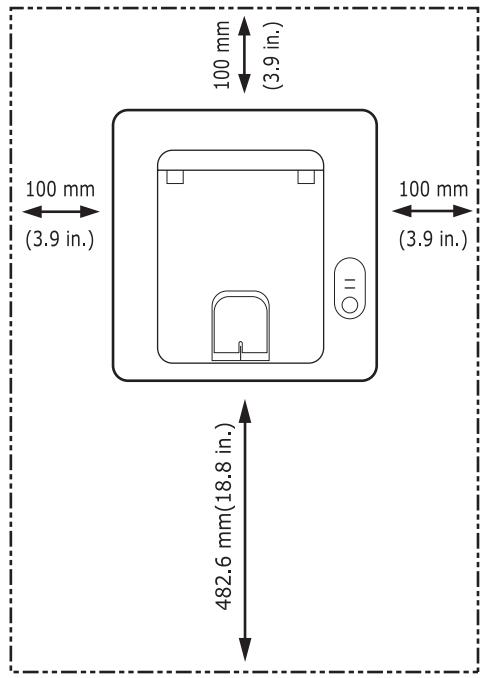
1 Select a stable location.
Select a level, stable place with adequate space for air circulation. Allow extra space to open covers and trays.
The area should be well-ventilated and away from direct sunlight or sources of heat, cold, and humidity. Do not set the machine close to the edge of your desk or table.
Printing is suitable for altitudes under 1,000 m (3,281 ft). Refer to the altitude setting to optimize your printing. See page 1.5 for more information.
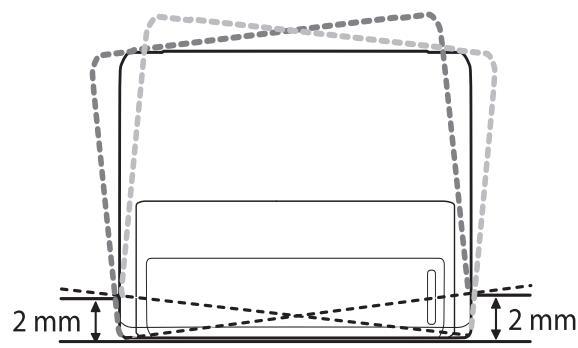
Place the machine on a flat and stable surface for not letting it tilt more than 2mm (0.08 inches). Otherwise, it may affect the printing quality.
2 Unpack the machine and check all the enclosed items.
3 Remove the tape holding the machine tightly.
4 Install the toner cartridge.
5 Load paper. (See "Loading paper" on page 5.4.)
6 Make sure that all the cables are connected to the machine.
7 Turn the machine on.

Notes
- When you move the machine, do not tilt or turn it upside down. Otherwise, the inside of the machine may be contaminated by toner, which can cause damage to the machine or bad printing quality.
- When the printer driver is in the installation process, the driver detects the locale information of your operating system, and sets the paper size for your machine. If you use the different Windows locale, you must change the paper size of your machine for matching your commonly used paper size. Open the printer properties to change the paper size.
Altitude adjustment
The print quality is affected by atmospheric pressure, which is determined by the height of the machine above sea level. The following information will guide you on how to set your machine to the best print quality.
Before you set the altitude value, find the altitude where you are using the machine.
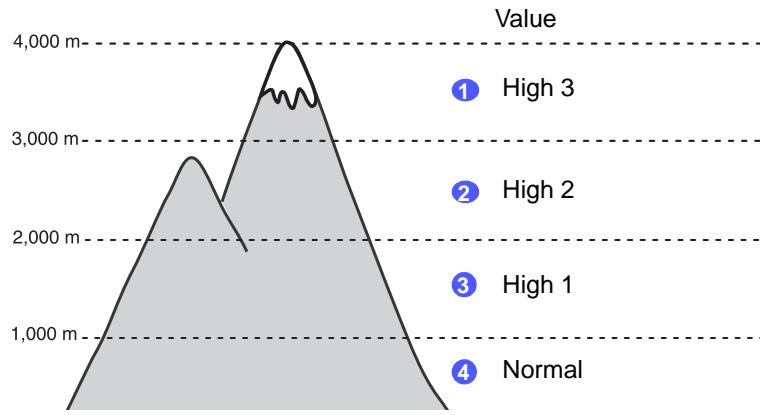
1 Ensure that you have installed the printer driver with the provided supplied CD-ROM.
2 For Windows, from the Start menu, select Programs or All Programs > SP 3300 Series > Printer Settings Utility.
For MAC OS X, open the Applications folder > RNP > SP 3300 Series > Printer Settings Utility.
3 Click Setting > Altitude Adjustment. Select the appropriate value from the dropdown list, and then click Apply.

Note
If your machine is connected to a network, Web Image Monitor SP 3300 Series screen appears automatically. Click Machine Settings > Setup (or Machine Setup) > Altitude Adj. Select the appropriate altitude value, and then click Apply.
Changing the font setting
Your machine has preset the font for your region or country.
If you want to change the font or set the font for special conditions such as DOS environment, you can change the font setting as follows:
1 Ensure that you have installed the printer driver from the provided supplied CD-ROM.
2 For Windows, from the Start menu, select Programs or All Programs > SP 3300 Series > Printer Settings Utility.
For MAC OS X, open the Applications folder > RNP > SP 3300 Series > Printer Settings Utility.
3 Click Emulation.
4 Confirm if PCL is selected in Emulation Setting.
5 Click Setting.
6 Select your preferred font in the Symbol set list.
7 Click Apply.

Note
Following information shows the proper font list for corresponding languages.
Russian: CP866, ISO 8859/5 Latin Cyrillic
- Hebrew: Hebrew 15Q, Hebrew-8, Hebrew-7 (Israel only)
Greek: ISO 8859/7 Latin Greek, PC-8 Latin/Greek
- Arabic & Farsi: HP Arabic-8, Windows Arabic, Code Page 864, Farsi, ISO 8859/6 Latin Arabic
OCR:OCR-A,OCR-B
2 Basic setup
This chapter includes:
- Printing a demo page
Using toner save mode
Printing a demo page
After setting up your printer, print a demo page to make sure that the printer is operating correctly.
Press and hold the Cancel button for about 2 seconds.
A demo page prints out.
Using toner save mode
Toner save mode allows the printer to use less toner on each page. Activating this mode extends the life of your toner cartridge and reduces your cost per page beyond what one would experience in the normal mode, but it reduces print quality.
You can set the toner save mode from the printer properties window on your printer driver. See the Software Section.
3 Software overview
This chapter gives you an overview of the software that comes with your printer. Further details about installing and using the software are explained in the Software Section.
This chapter includes:
- Supplied software
- Printer driver features
- System requirements
Supplied software
You must install the printer software using the supplied CD-ROM after you have set up your printer and connected it to your computer.
The CD provides you with the following software:
| Contents | |
| Windows | ·Printer driver: Use this driver to take full advantage of your printer's features. ·Status Monitor: This program allows you to monitor the printer's status and alerts you when an error occurs during printing. ·Printer Settings Utility: This program is automatically installed when you install the Status Monitor. ·PCL6 driver: Use this driver to print documents in the PCL6, PCL5e language. ·PostScript Printer Description (PPD) file: Use the PostScript driver to print documents with complex fonts and graphics in the PostScript language. ·Set IP: Use this program to set your printer's TCP/IP addresses. ·User's Guide in PDF |
| Macintosh | ·Printer driver: Use this driver to run your printer from a Macintosh computer and print documents. ·Printer Settings Utility: This program allows you to configure various printer settings. ·Set IP: Use this program to set your printer's TCP/IP addresses. |
Printer driver features
Your printer drivers support the following standard features:
- Paper source selection
- Paper size, orientation and type
Number of copies
In addition, you can use various special printing features. The following table shows a general overview of features supported by your printer drivers:
| Feature | PCL 6 | PostScript | |
| Windows | Windows | Macintosh | |
| Toner save | O | O | O |
| Print quality option | O | O | O |
| Poster printing | O | X | X |
| Multiple pages per sheet (N-up) | O | O | O |
| Fit to page printing | O | O | O |
| Scale printing | O | O | O |
| Watermark | O | X | X |
| Overlay | O | X | X |
System requirements
Before you begin, ensure that your system meets the following requirements:
Windows
| Item | Requirements | Recommended | |
| Operating system | Windows 2000/XP/Vista and Windows Server 2003 | ||
| CPU | Windows 2000 | Pentium II 400 MHz or higher | Pentium III 933 MHz |
| Windows XP/Vista and Windows Server 2003 | Pentium III 933 MHz or higher | Pentium IV 1 GHz | |
| RAM | Windows 2000 | 64 MB or more | 128 MB |
| Windows XP and Windows Server 2003 | 128 MB or more | 256 MB | |
| Windows Vista | 512 MB or more | 1 GB | |
| Free disk space | Windows 2000 | 600 MB or more | 1 GB |
| Windows XP and Windows Server 2003 | 1 GB or more | 5 GB | |
| Windows Vista | 15 GB | 15 GB or more | |
| Internet Explorer | Windows 2000/XP and Windows Server 2003 | 5.0 or higher | |
| Windows Vista | 7.0 or higher | ||

Note
- For Windows 2000/XP/Vista and Windows Server 2003, users who have an administrator right can install the software.
Macintosh
| Operating system | Requirement (Recommended) | ||
| CUP | RAM | Free HDD space | |
| Mac OS X 10.4 or lower | • PowerPC G4/G5 • Intel processors | • 128 MB for a PowerPC based MAC (512 MB) • 512 MB for an Intel based MAC (1 GB) | 1 GB |
| Mac OS X 10.5 | • 867 MHz or faster PowerPC G4/G5 • Intel processors | 512 MB (1 GB) | 1 GB |
4 Network setup (SP 3300DN only)
This chapter gives you basic information for setting up your printer for network connections.
This chapter includes:
Introduction
Supported operating systems
Using SetIP program
Introduction
Once you have connected your printer to a network with an RJ-45 Ethernet cable, you can share the printer with other network users.
You need to set up the network protocols on the printer to use it as your network printer. Protocols can be set up by the following programs:
- Web Image Monitor SP 3300 Series: A web server embedded to your network print server, which allows you to configure the network parameters necessary for the printer to connect to various network environments.
- SetIP: A utility program allowing you to select a network interface and manually configure the addresses for use with the TCP/IP protocol. This program is on the supplied CD-ROM that comes with your printer.
Supported operating systems
The following table shows the network environments supported by the printer:
| Item | Requirements |
| Network interface | • 10/100 Base-TX |
| Network operating system | • Windows 2000/XP (32/64 bit)/Vista and Windows Server 2003 • Mac OS 8.6~9.2, 10.1~10.5 |
| Network protocols | • TCP/IP • EtherTalk • HTTP 1.1 • SNMP • Bonjour |
| Dynamic addressing server | • DHCP, BOOTP |
- TCP/IP: Transmission Control Protocol/Internet Protocol
- DHCP: Dynamic Host Configuration Protocol
- BOOTP: Bootstrap Protocol
Using SetIP program
This program is for the network IP setting using the MAC address which is the hardware serial number of the network printer card or interface. Especially, it is for the network administrator to set several network IPs at the same time.

Note
If you want to setup DHCP network protocol, go to the http:// developer.apple.com/networking/bonjour/download/, select the program Bonjour for Windows due to your computer operating system, and install the program. This program will allow you to fix the network parameter automatically. Follow the instruction in the installation window.
1 Insert the supplied CD-ROM provided along with your machine.
2 Start Windows Explorer and open the X drive. (X represents your CD-ROM drive.)
3 Double click Application > SetIP.
4 Open the language folder you want to use.
5 Double click Setup.exe to install this program.
6 From the Windows Start menu, select Programs > SP 3300 Series > Set IP.
7 Select the name of your printer and click "

Note
If you cannot find your printer name click "O" to refresh the list.
8 Enter the network card's MAC address, IP address, subnet mask, default gateway, and then click Apply.

Note
If you do not know the network card's MAC address, print the machine's network information report.
9 Click OK to confirm the settings.
10 Click Exit to close the SetIP program.
5 Loading print media
This chapter will help you understand the types of paper you can use with your printer and how to properly load paper in the different paper trays for the best print quality.
This chapter includes:
- Selecting print media
- Loading paper
- Knowing an output location
Selecting print media
You can print on a variety of print media, such as plain paper, envelopes, labels, and transparencies. Always use print media that meet the guidelines for use with your printer. Print media that does not meet the guidelines outlined in this user's guide may cause the following problems:
Poor print quality
- Increased paper jams
- Premature wear on the machine.
Properties, such as weight, composition, grain, and moisture content, are important factors that affect the machine's performance and the output quality. When you choose print materials, consider the following:
- The type, size and weight of the print media for your machine are described later in this section.
- Desired outcome: The print media you choose should be appropriate for your project.
- Brightness: Some print media are whiter than others and produce sharper, more vibrant images.
- Surface smoothness: The smoothness of the print media affects how crisp the printing looks on the paper.

Notes
- Using print media that does not meet these specifications may cause problems, requiring repairs. Such repairs are not covered by the warranty or service agreements.
- Some print media may meet all of the guidelines in this section and still not produce satisfactory results. This may be the result of improper handling, unacceptable temperature and humidity levels, or other variables over which manufacturer has no control.
- Before purchasing large quantities of print media, ensure that it meets the requirements specified in this user's guide.
Supported sizes of paper
| Type | Size | Dimensions | Weighta | Capacityb |
| Plain paper | Letter | 216 x 279 mm (8.5 x 11 inches) | 60 to 105 g/m2(16 to 24 lb bond) for the tray 60 to 163 g/m2(16 to 43 lb bond) for the manual feed | 250 sheets of 75 g/m2(20 lb bond) paper for the tray 1 sheet in the manual tray |
| Legal | 216 x 356 mm (8.5 x 14 inches) | |||
| Folio | 216 x 330.2 mm (8.5 x 13 inches) | |||
| Oficio | 216 x 343 mm (8.5 x 13.5 inches) | |||
| A4 | 210 x 297 mm (8.26 x 11.69 inches) | |||
| JIS B5 | 182 x 257 mm (7.18 x 10.12 inches) | |||
| ISO B5 | 176 x 250 mm (6.93 x 9.84 inches) | |||
| Executive | 184 x 267 mm (7.25 x 10.5 inches) | |||
| A5 | 148 x 210 mm (5.82 x 8.26 inches) | |||
| A6 | 105 x 148 mm (4.13 x 5.82 inches) | |||
| Envelope | Envelope B5 | 176 x 250 mm (6.93 x 9.84 inches) | 75 to 90 g/m2(20 to 24 lb) | 1 sheet in the manual tray |
| Envelope Monarch | 98.4 x 190.5 mm (3.88 x 7.5 inches) | |||
| Envelope COM-10 | 105 x 241 mm (4.12 x 9.5 inches) | |||
| Envelope DL | 110 x 220 mm (4.33 x 8.66 inches) | |||
| Envelope C5 | 162 x 229 mm (6.38 x 9.02 inches) | |||
| Envelope C6 | 114 x 162 mm (4.49 x 6.38 inches) | |||
| Transparency | Letter, A4 | Refer to the Plain paper section | 138 to 146 g/m2(37 to 39 lb) | 1 sheet in the manual tray |
| Labels | Letter, Legal, Folio, Oficio, A4, JIS B5, ISO B5, Executive, A5, A6 | Refer to the Plain paper section | 120 to 150 g/m2(32 to 40 lb) | 1 sheet in the manual tray |
| Card stock | Letter, Legal, Folio, Oficio, A4, JIS B5, ISO B5, Executive, A5, A6 | Refer to the Plain paper section | 60 to 163 g/m2(16 to 43 lb) | 1 sheet in the manual tray |
| Minimum size (custom) | 76 x 127 mm (3.86 x 5.83 inches) | 60 to 163 g/m2(16 to 43 lb bond) | 1 sheet in the manual tray | |
| Maximum size (custom) | 215.9 x 356 mm (8.5 x 14 inches) | |||
a. If media weight is over 24 lb (90g / m^2) , use the manual feed.
b. Maximum capacity may differ depending on media weight, thickness, and environmental conditions.
Print media for duplex printing
| Type | Size | Weight |
| Plain paper, Recycled paper | A4, Letter, Oficio, Legal, and Folio | 75 ~ 90 g/m² (20 to 24 lb) |
Guidelines for selecting and storing print media
When selecting or loading paper, envelopes, or other print media, keep these guidelines in mind:
- Always use print media that conform with the specifications listed on the next column.
- Attempting to print on damp, curled, wrinkled, or torn paper can cause paper jams and poor print quality.
- For the best print quality, use only high quality copier grade paper specifically recommended for use in laser printers.
-
Avoid using the following print media types:
-
Paper with embossed lettering, perforations, or a texture that is too smooth or too rough
- Erasable bond paper
- Multi-paged paper
- Synthetic paper and thermally reactive paper
-
Carbonless paper and Tracing paper.
-
Use of these types of paper could result in paper jams, chemical smells, and damage to your printer.
- Store print media in its ream wrapper until you are ready to use it. Place cartons on pallets or shelves, not on the floor. Do not place heavy objects on top of the paper, whether it is packaged or unpackaged. Keep it away from moisture or other conditions that can cause it to wrinkle or curl.
- Store unused print media at temperatures between 15 and 30^ (59 to 86^ ). The relative humidity should be between 10 and 70% .
- Store unused print media in a moisture-proof wrap, such as a plastic container or bag, to prevent dust and moisture from contaminating your paper.
- Load special print media types one sheet at a time through the manual tray to avoid paper jams.
- To prevent print media, such as transparencies and label sheets, from sticking together, remove them as they print out.

Note
- If you print 20 envelopes in succession, the surface of the top cover may become hot. Please exercise caution.
Guidelines for special print media
| Type | Guidelines |
| Envelopes | ·Successful printing on envelopes depends upon the quality of the envelopes. When selecting envelopes, consider the following factors: ·Weight: The weight of the envelope paper should not exceed 90 g/m2(24 lb) or jamming may occur. ·Construction: Prior to printing, envelopes should lie flat with less than 6 mm (0.25 inches) curl, and should not contain air. ·Condition: Envelopes should not be wrinkled, nicked, or otherwise damaged. ·Temperature: You should use envelopes that are compatible with the heat and pressure of the printer during operation. ·Use only well-constructed envelopes with sharp and well creased folds. ·Do not use stamped envelopes. ·Do not use envelopes with clasps, snaps, windows, coated lining, self-adhesive seals, or other synthetic materials. ·Do not use damaged or poorly made envelopes. ·Be sure the seam at both ends of the envelope extends all the way to the corner of the envelope. Acceptable Unacceptable ·Envelopes with a peel-off adhesive strip or with more than one flap that folds over to seal must use adhesives compatible with the printer's fusing temperature for 0.1 second. Check your machine's specification to view the fusing temperature, see page 11.1. The extra flaps and strips might cause wrinkling, creasing, or jams, and may even damage the fuser. ·For the best print quality, position margins no closer than 15 mm (0.6 inches) from the edges of the envelope. ·Avoid printing over the area where the envelope's seams meet. |
| Transparencies | ·To avoid damaging the printer, use only transparencies designed for use in laser printers. ·Transparencies used in the printer must be able to withstand the machine's fusing temperature. Check your machine's specification to view the fusing temperature, see page 11.1. ·Place them on a flat surface after removing them from the printer. ·Do not leave them in the paper tray for long periods of time. Dust and dirt may accumulate on them, resulting in spotty printing. ·To avoid smudging caused by fingerprints, handle them carefully. ·To avoid fading, do not expose printed transparencies to prolonged sunlight. ·Ensure that transparencies are not wrinkled, curled, or have any torn edges. |
| Labels | ·To avoid damaging the printer, use only labels designed for use in laser printers. ·When selecting labels, consider the following factors: - Adhesives: The adhesive material should be stable at 180°C (356°F), the printer's fusing temperature. - Arrangement: Only use labels with no exposed backing between them. Labels can peel off sheets that have spaces between the labels, causing serious jams. - Curl: Prior to printing, labels must lie flat with no more than 13 mm (5 inches) of curl in any direction. - Condition: Do not use labels with wrinkles, bubbles, or other indications of separation. ·Make sure that there is no exposed adhesive material between labels. Exposed areas can cause labels to peel off during printing, which can cause paper jams. Exposed adhesive can also cause damage to printer components. ·Do not run a sheet of labels through the printer more than once. The adhesive backing is designed for only a single pass through the printer. ·Do not use labels that are separating from the backing sheet or are wrinkled, bubbled, or otherwise damaged. |
| Card stock or custom-sized materials | ·Do not print on print media smaller than 76 mm (3 inches) wide or 127 mm (5 inches) long. ·In the software application, set margins at least 6.4 mm (0.25 inches) away from the edges of the material. |
| Type | Guidelines |
| Preprinted paper | ·Letterhead must be printed with heat-resistant ink that will not melt, vaporize, or release hazardous emissions when subjected to the printer's fusing temperature for 0.1 second. Check your machine's specification to view the fusing temperature, see page 11.1. ·Letterhead ink must be non-flammable and should not adversely affect printer rollers. ·Forms and letterhead should be sealed in a moisture-proof wrapping to prevent changes during storage. ·Before you load preprinted paper, such as forms and letterhead, verify that the ink on the paper is dry. During the fusing process, wet ink can come off preprinted paper, reducing print quality. |
Loading paper
Load the print media you use for the majority of your print jobs in the tray 1. The tray 1 can hold a maximum of 250 sheets of 75g / m^2 (20 lb) plain paper.
You can purchase an optional tray (tray 2) and attach it below the standard tray to load an additional 250 sheets of paper.
The paper level indicator on the front of the tray 1 and the optional tray 2 shows the amount of paper currently left in the tray. When the tray is empty, the indicator of the bar is completely lowered.
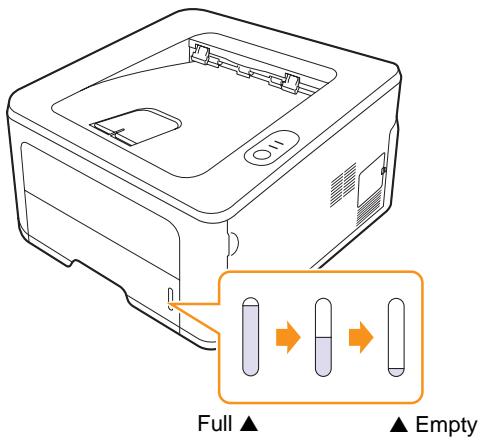
Using the tray 1 or the optional tray 2
Use the print material you use for the majority of your print jobs in the tray 1. The tray 1 can hold a maximum of 250 sheets of 75g / m^2 (20 lb) paper.
You can purchase an optional tray 2 and attach it below the tray 1 to load an additional 250 sheets of paper.
To load paper, pull open the tray and load paper with the side to be printed on face down.
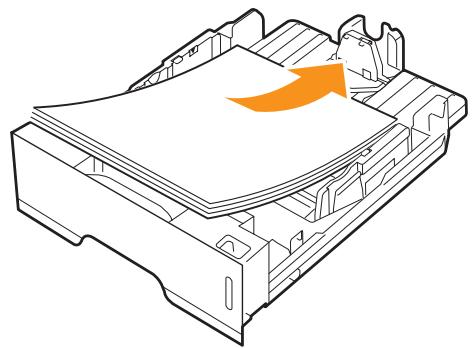
You can load letterhead paper with the design side face down. The top edge of the sheet with the logo should be placed at the front of the tray.

Notes
- If you experience problems with paper feed, place one sheet at a time in the manual feed.
- You can load previously printed paper. The printed side should be facing up with an uncurled edge at the front. If you experience problems with paper feed, turn the paper around. Note that the print quality is not guaranteed.
Changing the size of the paper in the tray 1
To load longer sizes of paper, such as Legal-sized paper, you need to adjust the paper guides to extend the paper tray.
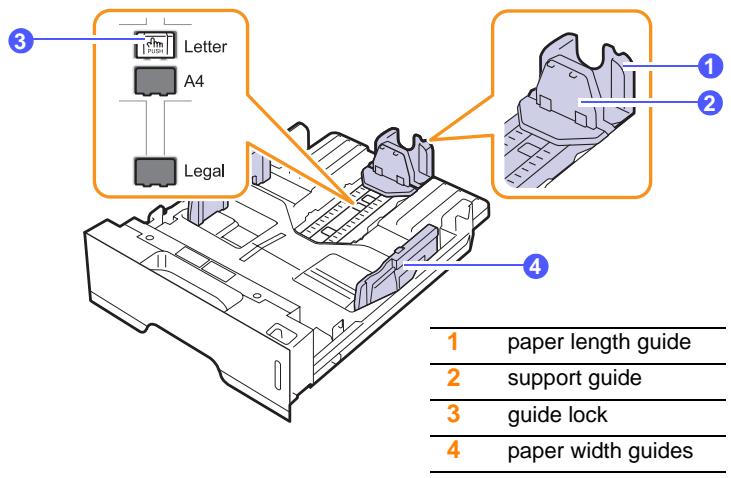
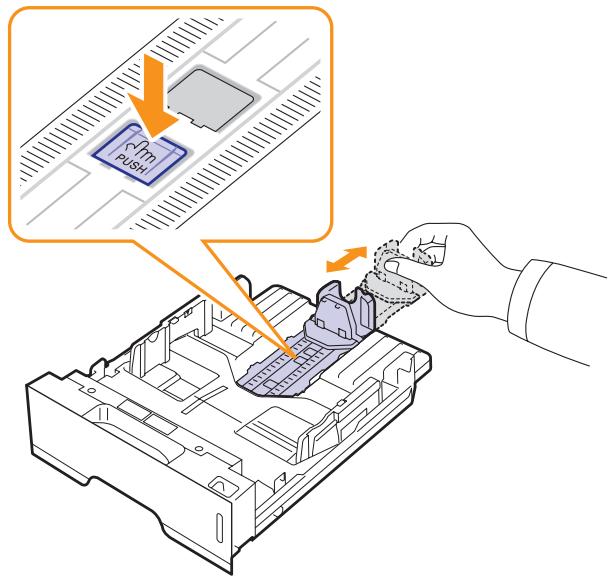
1 Press and hold the guide lock, and slide the paper length guide to locate it in the correct paper size slot.
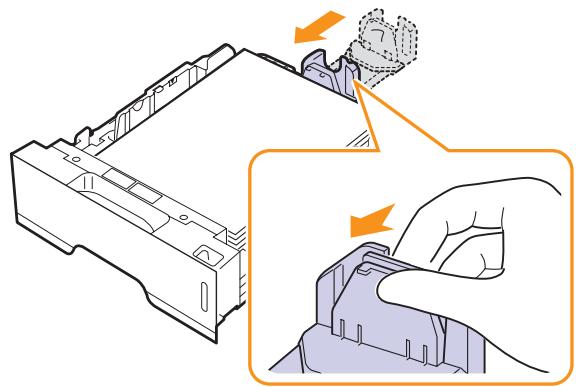
2 After inserting paper into the tray, adjust the support guide so that it lightly touches the paper stack.
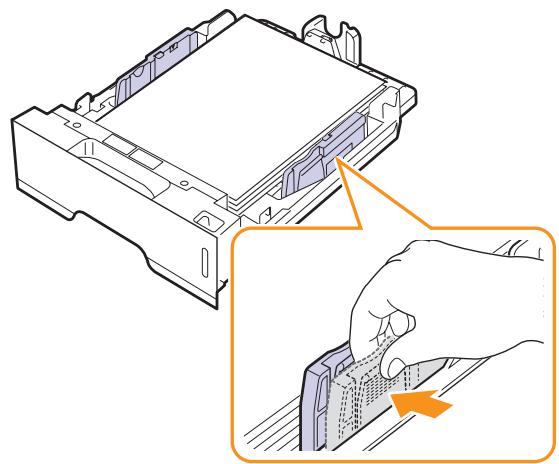
3 Squeeze the paper width guides, as shown and slide them to the stack of paper until it lightly touches the side of the stack.

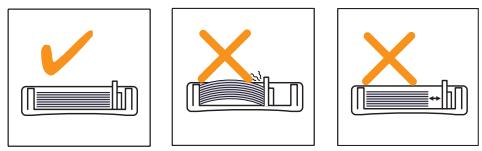
Notes
- Do not push the paper width guide far enough to cause the material to warp.
- If you do not adjust the paper width guide, it may cause paper jams.
Using manual feeder
You can manually load a sheet of print media in the manual tray if you select Manual Feeder in the Source option from the Paper tab when you change print settings to print a document. See the Software Section. Manually loading paper can be helpful when you want to check the print quality after each page is printed.
Load paper sheet-by-sheet in the manual tray, send print data to print the first page, and press the Cancel button on the control panel to print each following page.
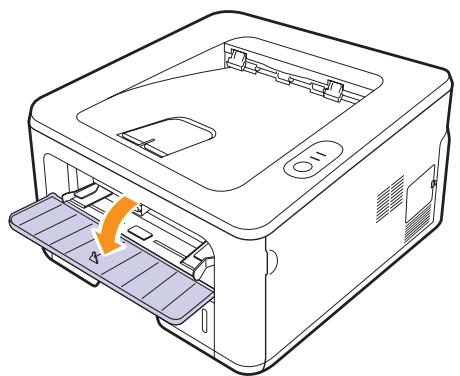
1 Open the manual feed.
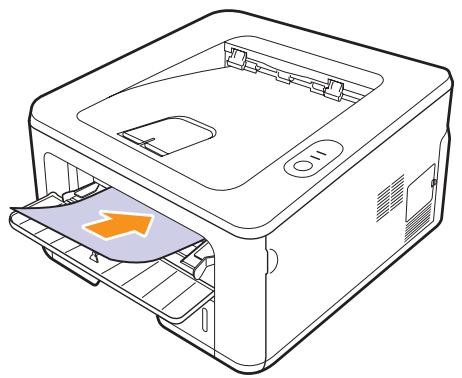
2 Load the paper with the side to be printed on facing up.
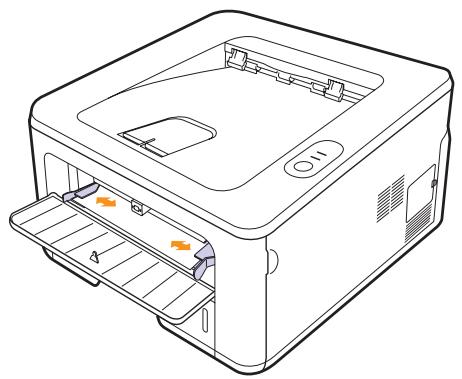
3 Adjust the manual tray paper width guides to the width of the paper. Do not force too much, or the paper will bend, which could result in a paper jam or skew.
4 When you print a document, set the paper source to Manual Feeder and select the appropriate paper size and type in the software application. See the Software Section.
5 Print a document.
6 Press the Cancel button.
The printer picks up the print media and prints.

Note
- If you do not press the Cancel button, after a pause the printer will automatically pick the print media.
7 Insert the next sheet into the manual tray and press the Cancel button.
Repeat this step for every page to be printed.

Note
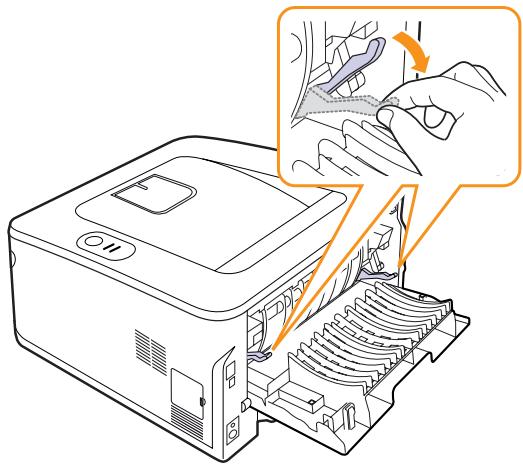
- If envelopes or thick papers(163g/m2) are printed out with wrinkles, crease or black bold lines, open the rear cover and pull the guide of both sides down. Keep the rear cover opened during printing.
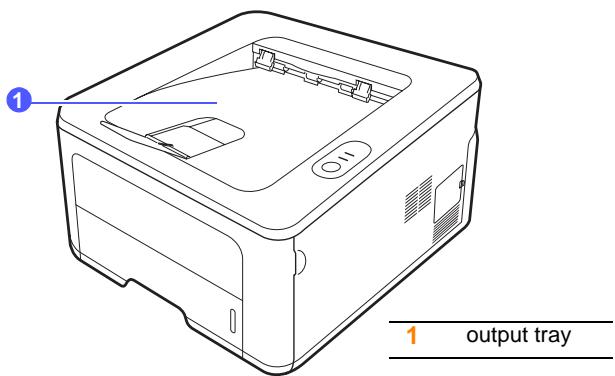
The output tray collects paper face down, in the order in which the sheets were printed.

Notes
- If you continuously print many pages, the surface of the output tray may become hot. Be careful not to touch the surface, and especially keep children away from the surface.
- The output tray can hold up to 150 sheets of 75g / m^2 (20 lb) plain paper. Remove the pages so that the tray is not overloaded.
- If the printed paper is not stacked properly, turn over the stack of paper in the tray.
6 Basic printing
This chapter explains common printing tasks.
This chapter includes:
- Printing a document
- Canceling a print job
Printing a document
This printer allows you to print from various Windows and Macintosh applications. The exact steps for printing a document may vary depending on the application you use.
For details about printing, see the Software Section.
Canceling a print job
If the print job is waiting in a print queue or print spooler, such as the printer group in Windows, delete the job as follows:
1 Click the Windows Start button.
2 For Windows 2000, select Settings and then Printers.
For Windows XP (32/64 bit) and Windows Server 2003, select Printers and Faxes.
For Windows Vista, select Control Panel > Hardware and Sound > Printers.
3 Double-click the SP 3300 Series icon.
4 From the Document menu, select Cancel.

Note
- You can access this window simply by double-clicking the printer icon at the bottom right corner of the Windows desktop.
You can also cancel the current job by pressing the Cancel button on the control panel of your printer.
7 Supplies and accessories
This chapter provides information on the toner cartridge and accessory that are available for your printer.
This chapter includes:
- Toner cartridge
- Accessory
Toner cartridge
When the toner runs out, you can order the following type of toner cartridge for your printer:
Toner yield: Approx. 5,000 pages1.
Accessory
You can purchase and install the following accessory to your printer:
| Accessory | Description |
| Optional Tray | If you are experiencing frequent paper supply problems, you can attach additional 250 sheet tray. You can print documents on various sizes and types of print media. |
| Memory DIMM | The memory board is installed on the main controller board inside the machine. When you add the optional memory board, it increases print performance. The machine has 32 MB of standard memory and a slot for optional additional memory. The memory can be expanded by installing an optional memory (128 MB). |
8 Maintenance
This chapter provides information for maintaining your printer and the toner cartridge.
This chapter includes:
- Cleaning the printer
- Maintaining the toner cartridge
- Printing a configuration page
- Maintenance parts
Cleaning the printer
During the printing process, paper, toner, and dust particles can accumulate inside the printer. This buildup can cause print quality problems, such as toner specks or smearing.

Notes
- Cleaning the cabinet of the printer with cleaning materials containing large amounts of alcohol, solvents, or other strong substances can discolor or crack the cabinet.
- If your machine or its around is contaminated with toner, we recommend you to use cloth or tissue dampened with water to clean it. If you use a vacuum cleaner, toner blows in the air and might be harmful for you.
Cleaning the outside of the printer
Clean the cabinet of the printer with a soft, lint-free cloth. You can dampen the cloth slightly with water, but be careful not to let any water drip onto or into the printer.
Cleaning the inside of the printer
1 Turn the printer off and unplug the power cord. Wait for the printer to cool down.
2 Open the front cover and pull the toner cartridge out. Set it on a clean flat surface.
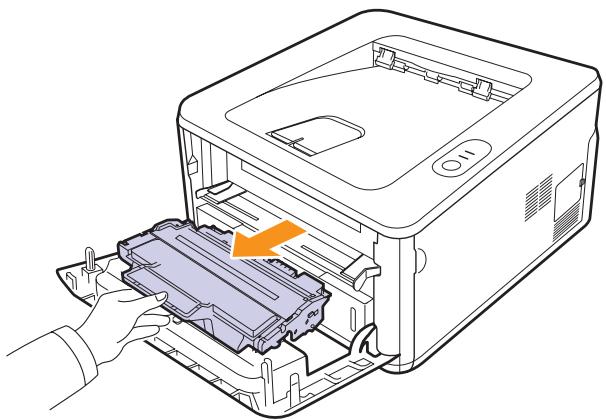

Notes
- To prevent damage to the toner cartridge, do not expose it to light for more than a few minutes. Cover it with a piece of paper, if necessary.
- Do not touch the green surface underside of the toner cartridge. Use the handle on the cartridge to avoid touching this area.
3 With a dry lint-free cloth, wipe away any dust and spilled toner from the toner cartridge area and the toner cartridge cavity.
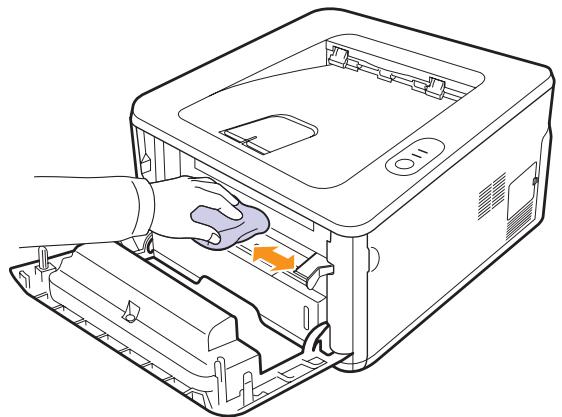

Note
- While cleaning the inside of the printer, be careful not to reach too far into the printer. The fuser area may be hot.
4 Gently swab the long strip of glass (LSU) inside the top of the cartridge and check for dirt or dust.
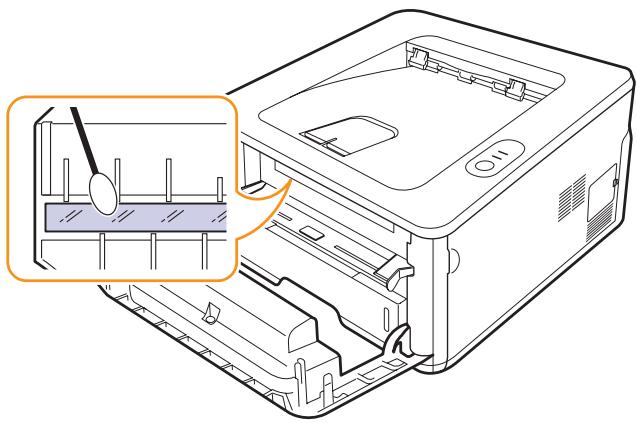

Note
- The long strip of glass is hard to locate.
5 Hold the toner cartridge by the handle and slowly insert the cartridge into the opening in the printer.
Tabs on the sides of the cartridge and corresponding grooves within the printer will guide the cartridge into the correct position until it locks into place completely.
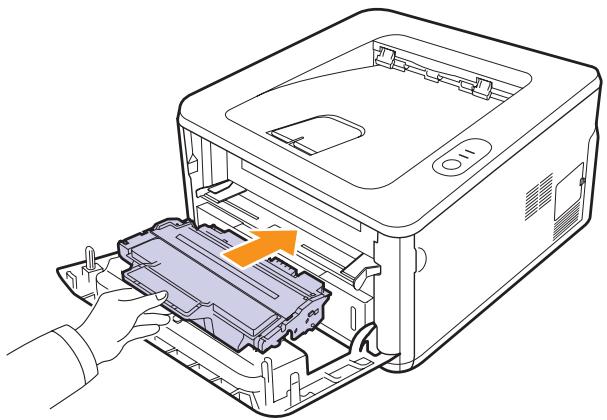
6 Close the front cover. Make sure that the cover is securely closed.
7 Plug in the power cord and turn the printer on.
Maintaining the toner cartridge

Warning
- Do not incinerate used toner or toner containers. Toner dust might ignite when exposed to an open flame.
- Disposal can take place at our authorized dealer.
- Dispose of used toner containers in accordance with local regulations.
- Do not store toner, used toner, or toner containers in a place with an open flame. The toner might ignite and cause burns of a fire.

Caution
- Keep toner (used or unused) and toner cartridge out of reach of children.
- If toner or used toner is inhaled, gargle with plenty of water and move into a fresh air environment. Consult a doctor if necessary.
- If toner or used toner gets into your eyes, flush thoroughly with eyewash or water. Consult a doctor if necessary.
- If toner or used toner is swallowed, dilute by drinking a large amount of water. Consult a doctor if necessary.
- Avoid getting toner on your clothes or skin when removing a paper jam or replacing toner. If your skin comes into contact with toner, wash the affected area thoroughly with soap and water.
- If toner gets on your clothing, wash with cold water. Hot water will set the toner into the fabric and may make removing the stain impossible.
Toner cartridge storage
To get the most from the toner cartridge, keep the following guidelines in mind:
- Do not remove the toner cartridge from its package until ready for use.
- Do not refill the toner cartridge. The printer warranty does not cover damage caused by using a refilled cartridge.
- Store toner cartridge in the same environment as the printer.
- To prevent damage to the toner cartridge, do not expose it to light for more than a few minutes.
Expected cartridge life
The life of the toner cartridge depends on the amount of toner that print jobs require. The actual number may also be different depending on the print density of the pages you print on, and the number of pages may be affected by operating environment, printing interval, media type, and media size. If you print a lot of graphics, you may need to change the cartridge more often.
Redistributing toner cartridge
When the toner cartridge is near the end of its life span:
- White streaks and light printing occur.
- The Status Monitor program window appears on the computer.
The Alert LED blinks red.
If this happens, you can temporarily reestablish print quality by redistributing the remaining toner in the cartridge. In some cases, white streaks or light printing will still occur even after you have redistributed the toner.
1 Open the front cover.
2 Pull the toner cartridge out.
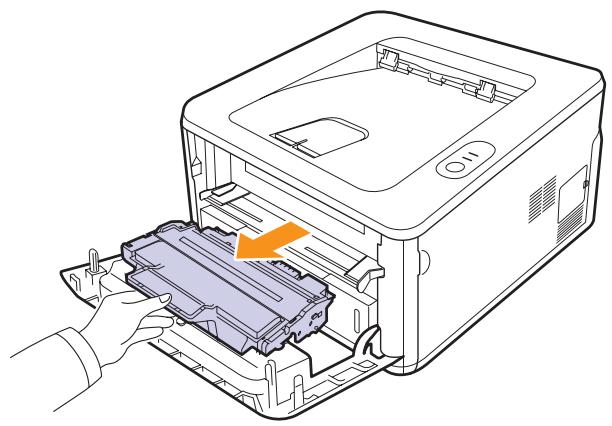

Notes
- Avoid reaching too far into the printer. The fuser area may be hot.
- To prevent damage to the toner cartridge, do not expose it to light for more than a few minutes. Cover it with a piece of paper, if necessary.
- Do not touch the green surface underside of the toner cartridge. Use the handle on the cartridge to avoid touching this area.
3 Thoroughly shake the cartridge 5 or 6 times to distribute the toner evenly inside the cartridge.
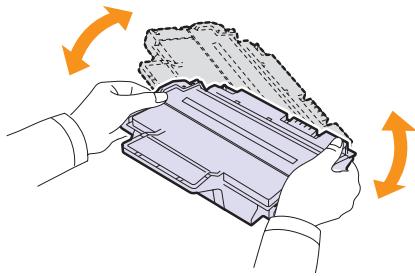

Note
- If toner gets on your clothing, wipe it off with a dry cloth and wash clothing in cold water. Hot water sets toner into fabric.
4 Hold the toner cartridge by the handle and slowly insert the cartridge into the opening in the printer.
Tabs on the sides of the cartridge and corresponding grooves within the printer will guide the cartridge into the correct position until it locks into place completely.
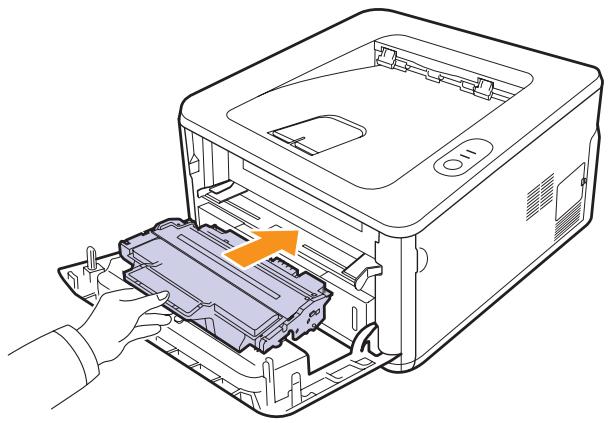
5 Close the front cover. Make sure that the cover is securely closed.

Note
- At this stage, if you need to replace the toner cartridge, see page 8.4.
Replacing the toner cartridge

Warning
- Do not incinerate used toner or toner containers. Toner dust might ignite when exposed to an open flame.
- Disposal can take place at our authorized dealer.
- Dispose of used toner containers in accordance with local regulations.

Caution
- Keep toner (used or unused) and toner cartridge out of reach of children.
When the toner is completely empty or the toner cartridge reached the end of its life span:
- The printer stops printing.
- The Status Monitor program window appears on the computer.
The Alert LED blinks red.
At this stage, the toner cartridge needs to be replaced.
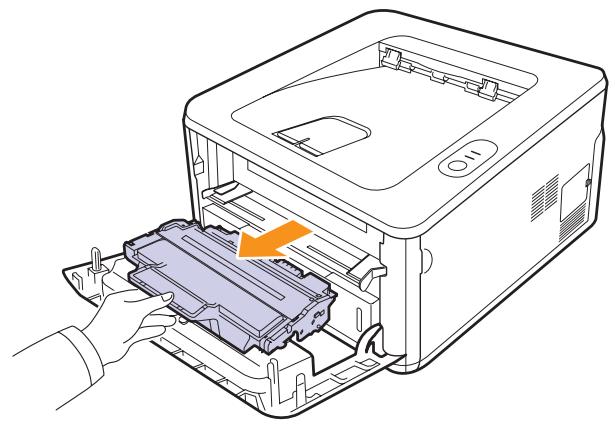
1 Open the front cover.
2 Pull the old toner cartridge out.
3 Remove the new toner cartridge from its bag.
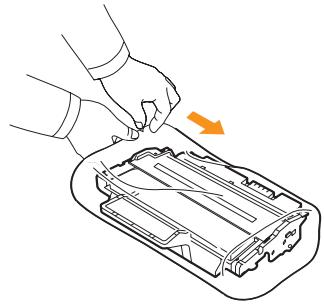

Note
- Do not use sharp objects, such as a knife or scissors, to open the toner cartridge package. They might scratch the drum of the cartridge.
4 Thoroughly shake the cartridge 5 or 6 times to distribute the toner evenly inside the cartridge.
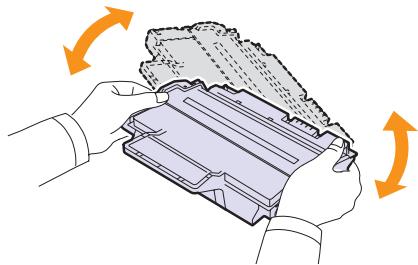
Thoroughly shake the cartridge to assure maximum copies per cartridge.
5 Remove the paper protecting the toner cartridge by pulling the packing tape.
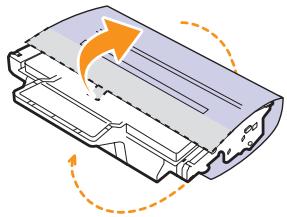

Note
Refer to the helpful pictures on the cartridge wrapping paper.
- If toner gets on your clothing, wipe it off with a dry cloth and wash clothing in cold water. Hot water sets toner into fabric.
- To prevent damage to the toner cartridge, do not expose it to light for more than a few minutes. Cover it with a piece of paper, if necessary.
- Do not touch the green surface underside of the toner cartridge. Use the handle on the cartridge to avoid touching this area.
6 Hold the toner cartridge by the handle and slowly insert the cartridge into the opening in the printer.
Tabs on the sides of the cartridge and corresponding grooves within the printer will guide the cartridge into the correct position until it locks into place completely.
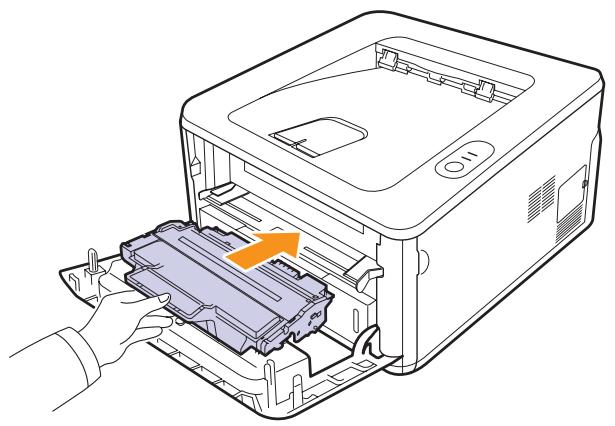
7 Close the front cover. Make sure that the cover is securely closed.
Printing a configuration page
You can print a configuration page to view current printer settings, or to help troubleshoot printer problems.
Press and hold the Cancel button for about 5 seconds.
A configuration page prints out.
Maintenance parts
To avoid print quality and paper feed problems resulting from worn parts and to maintain your machine in top working condition the following items will need to be replaced at the specified number of pages or when the life span of each item has expired.
| Items | Yield (Average) |
| Transfer roller | Approx. 50,000 pages |
| Fuser unit | Approx. 50,000 pages |
| Pick-up roller | Approx. 50,000 pages |
We highly recommends that an authorized service provider, dealer or the retailer where you bought printer performs this maintenance activity. The warranty does not cover the replacement of the maintenance parts after their lifespan.
The warranty does not cover the replacement of the maintenance parts after their lifespan.
9 Troubleshooting
This chapter provides helpful information for what to do if you encounter an error while using your printer.
This chapter includes:
Clearing paper jams
Troubleshooting checklist
- Solving general printing problems
- Solving print quality problems
Common Windows problems
Common PostScript problems
Common Macintosh problems
Clearing paper jams

Note
- When removing paper that is jammed in the printer, if possible always pull the paper in the direction that it normally moves so as not to damage internal components. Always pull firmly and evenly; do not jerk the paper. If the paper tears, ensure that all fragments of paper are removed; otherwise a jam will occur again.
When a paper jam occurs, the Alert LED lights orange. Open and close the front cover. The jammed paper automatically exits the printer.
In the paper feed area
In the tray 1
1 Pull the tray 1 open.
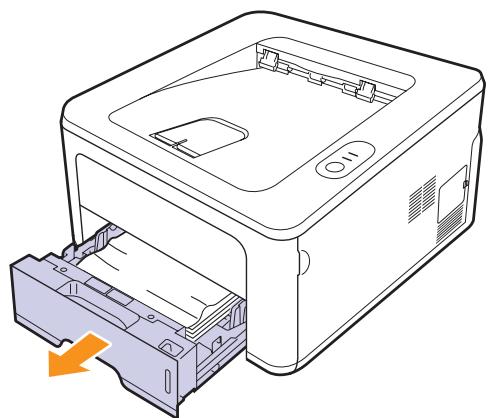
2 Remove the jammed paper by gently pulling it straight out. Make sure that all of the paper is properly aligned in the tray 1.
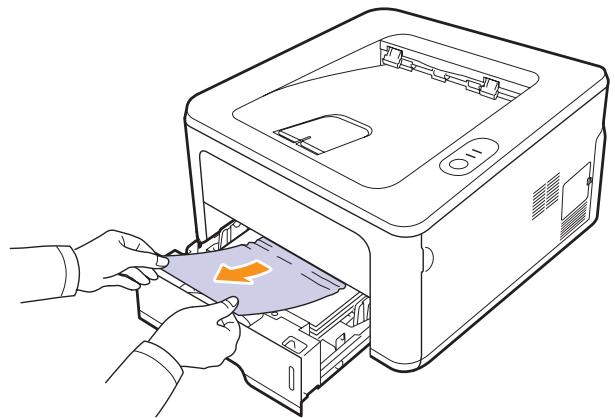
If the paper does not move when you pull, or if you do not see the paper in this area, check the fuser area around the toner cartridge. See page 9.2.
3 Insert the tray 1 into the printer until it snaps into place. Printing automatically resumes.
In the optional tray 2
1 Pull the optional tray 2 open.
2 Remove the jammed paper from the printer.
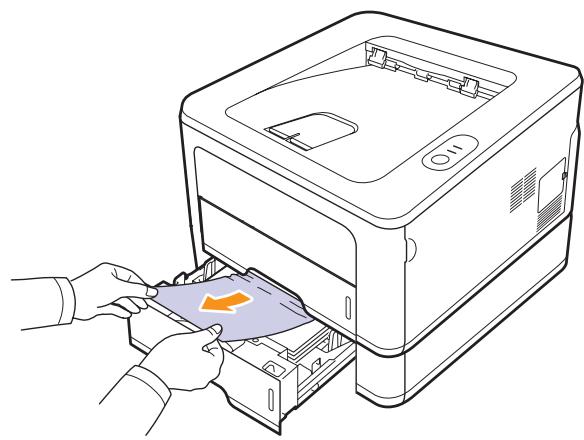
If the paper does not move when you pull, or if you do not see the paper in this area, stop and go to step 3.
3 Pull the tray 1 half.
4 Pull the paper straight up and out.
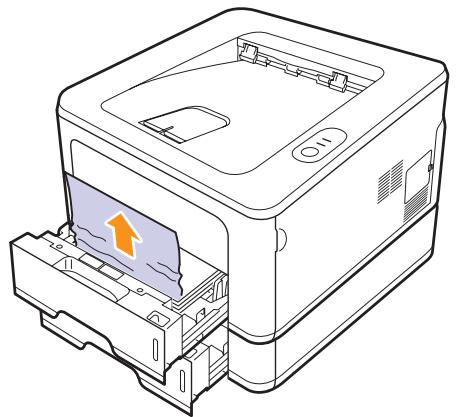
5 Insert the trays back into the printer. Printing automatically resumes.
In the manual tray
1 Remove the jammed paper from the printer.
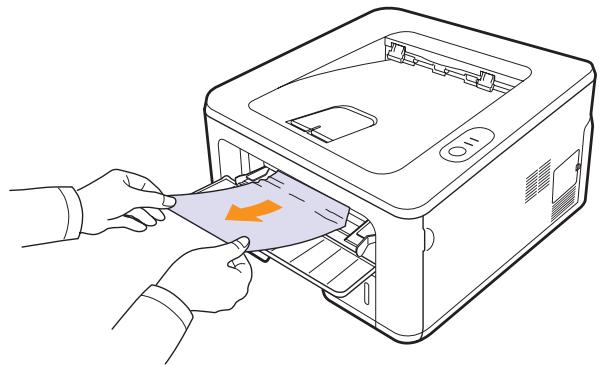
2 Open and close the front cover.
3 Load a paper into the manual feeder, then the printer resumes.
Around the toner cartridge

Note
The fuser area is hot. Take care when removing paper from the printer.
1 Open the front cover and pull the toner cartridge out.
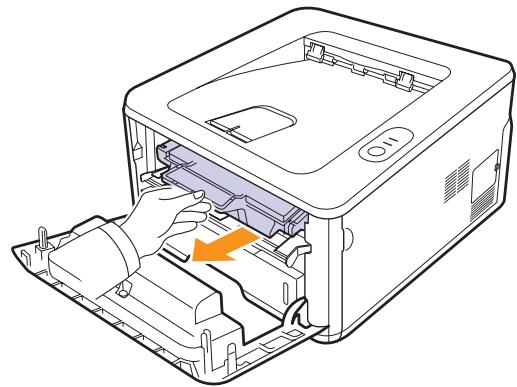

Notes
- To prevent damage to the toner cartridge, do not expose it to light for more than a few minutes. Cover it with a piece of paper, if necessary.
- Do not touch the green surface underside of the toner cartridge. Use the handle on the cartridge to avoid touching this area.
2 Remove the jammed paper by gently pulling it straight out.
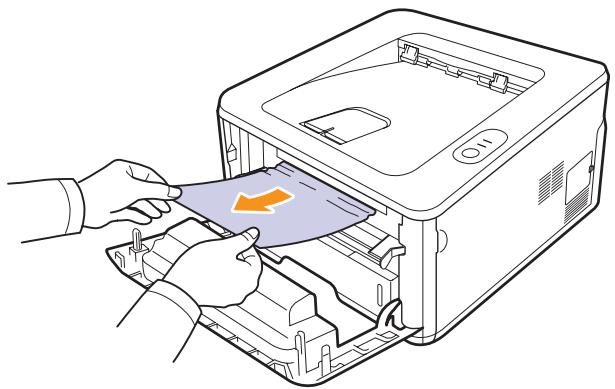
3 Replace the toner cartridge and close the front cover. Printing automatically resumes.
In the paper exit area

Caution
- The inside of the machine could be very hot. Do not touch the parts with a label indicating "hot surface". Otherwise an injury might occur.
1 Open and close the front cover. The jammed paper is automatically ejected from the printer.
2 Gently pull the paper out of the output tray.
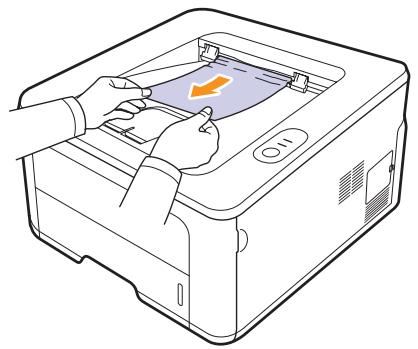
If you do not see the jammed paper or if there is any resistance when you pull, stop and go to the next step.
3 Open the rear cover.
4 Pull the guide rear on each side down and remove the paper. Return the guide rear to its original position.
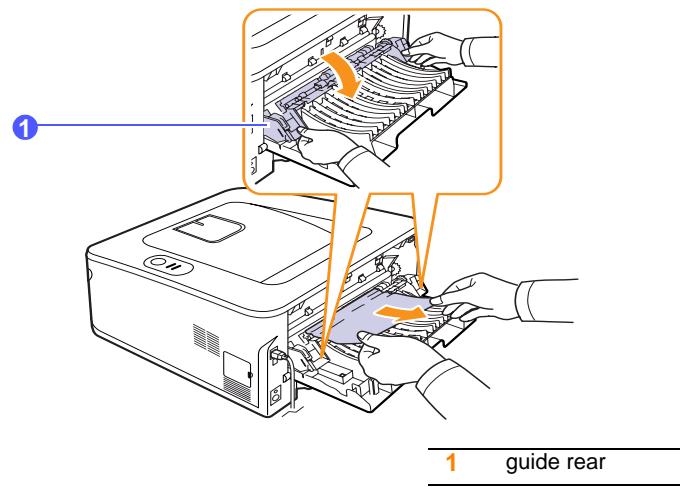
5 Close the rear cover. Printing automatically resumes.
In the duplex unit area
If the duplex unit is not inserted correctly, paper jam may occur. Make sure that the duplex unit is inserted correctly.
Duplex jam 0
1 Pull the duplex unit out of the printer.
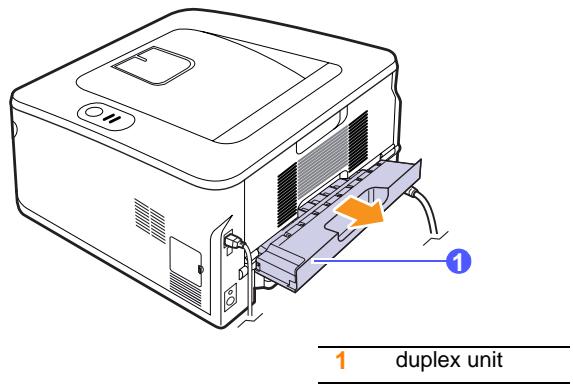
2 Remove the jammed paper from the duplex unit.
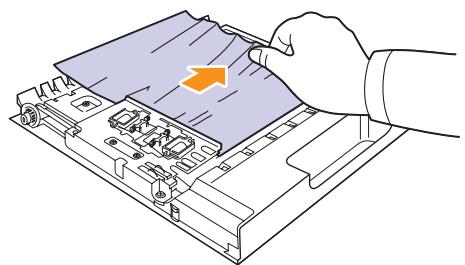
If the paper does not come out with the duplex unit, remove the paper from the bottom of the printer.
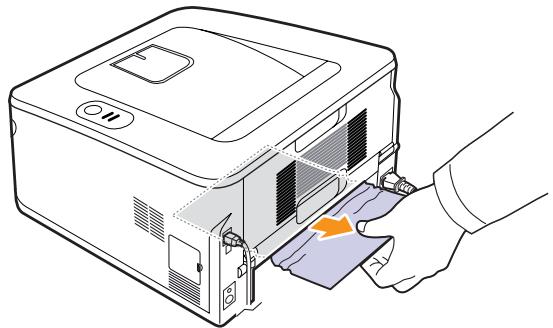
Duplex jam 1
1 Open the rear cover.
2 Pull the guide rear on each side down and remove the paper. Return the guide rear to its original position.
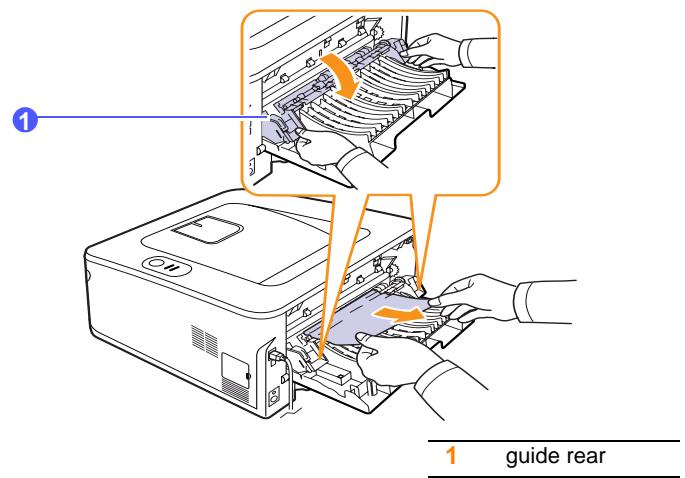
3 Close the rear cover. Printing automatically resumes.
Tips for avoiding paper jams
By selecting the correct media types, most paper jams can be avoided. When a paper jam occurs, follow the steps outlined on 9.1.
- Follow the procedures on 5.5. Ensure that the adjustable guides are positioned correctly.
- Do not overload the tray. Ensure that the paper level is below the paper capacity mark on the inside wall of the tray.
- Do not remove paper from the tray while your printer is printing.
- Flex, fan, and straighten paper before loading.
- Do not use creased, damp, or highly curled paper.
- Do not mix paper types in a tray.
- Use only recommended print media. See 5.1.
- Ensure that the recommended print side of print media is facing down in the tray, or facing up in the manual tray.
- If paper jams occur frequently when you print on A5-sized paper:
Load the paper into the tray with the long edge facing the front of the tray.
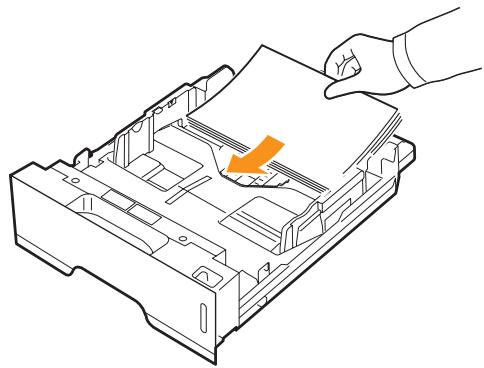
In the printer properties window, set the page orientation to be rotated 90 degrees. See the Software Section.
Troubleshooting checklist
If the printer is not working properly, consult the following checklist. If the printer does not pass a step, follow the corresponding suggested solutions.
| Condition | Suggested solutions |
| Make sure that the Online LED on the control panel lights green. | ·If the Online LED is off, check the power cord connection. Check the power switch. Check the power source by plugging the power cord into another outlet. |
| Print a demo page to verify that the printer is feeding paper correctly. See page 2.1. | ·If a demo page does not print, check the paper supply in the tray. ·If the paper jams in the printer, see page 9.1. |
| Check the demo page to see if it printed correctly. | If there is a print quality problem, see page 9.7. |
| Print a short document from a software application to verify that the computer and printer are connected and are communicating correctly. | ·If the page does not print, check the cable connection between the printer and the computer. ·Check the print queue or print spooler to see if the printer has been paused. ·Check the software application to ensure that you are using the proper printer driver and communication port. If the page is interrupted during printing, see page 9.5. |
| If completing the checklist does not resolve the printer problem, check the following troubleshooting sections. | ·“Understanding the LEDs” on page 1.3. ·“Solving general printing problems” on page 9.5. ·“Common Windows problems” on page 9.9. ·“Common PostScript problems” on page 9.10. ·“Common Macintosh problems” on page 9.10. |
Solving general printing problems
For problems with the operation of your printer, refer to the table for suggested solutions.
| Condition | Possible cause | Suggested solutions |
| The printer does not print. | The printer is not receiving power. | Check the power cord connections. Check the power switch and the power source. |
| The printer is not selected as the default printer. | Select SP 3300 Series or SP 3300 Series PS as your default printer. | |
| The printer cover is not closed. | Close the printer cover. | |
| Paper is jammed. | Clear the paper jam. See page 9.1. | |
| No paper is loaded. | Load paper. See page 5.4. | |
| The toner cartridge is not installed. | Install the toner cartridge. | |
| The printer may be in manual feed mode and out of paper. | Add paper to the manual tray, and press the Cancel button on the control panel. | |
| The connection cable between the computer and the printer is not connected properly. | Disconnect the printer cable and reconnect it. | |
| The connection cable between the computer and the printer is defective. | If possible, attach the cable to another computer that is working properly and try to print a document. You can also try using a different printer cable. | |
| The port setting is incorrect. | Check the Windows printer setting to make sure that the print job is sent to the correct port. If the computer has more than one port, make sure that the printer is attached to the correct one. | |
| The printer does not print.(Continued) | The printer may be configured incorrectly. | Check the printer properties to ensure that all of the print settings are correct. |
| The printer driver may be incorrectly installed. | Reinstall the printer driver; See the Software Section. Try printing a test page. | |
| The printer is malfunctioning. | Check the LEDs on the control panel to determine if the printer is indicating a system error. | |
| Printer selects print media from the wrong paper source. | The paper source selection in the printer properties may be incorrect. | For many software applications, the paper source selection is found under the Paper tab within the printer properties. Select the correct paper source. See the Software Section. |
| Paper does not feed into the printer. | Paper has not been loaded correctly. | Remove paper from the tray and reload it correctly. Check that the adjustable guides are set correctly. |
| There is too much paper in the tray. | Remove excess paper from the tray. | |
| The paper is too thick. | Use only paper that meets printer specifications. | |
| Print job is extremely slow. | The job may be very complex. | Reduce the complexity of the page(s) or try adjusting the print quality settings. To adjust the print quality settings, reduce the resolution. If you have set the resolution to 1200 dpi (Best), change it to 600 dpi (Normal). See the Software Section. Change the port setting to the USB or network port to improve print speed. Your printer prints A4-sized paper at 28 ppm and letter-sized paper at 30 ppm. |
| The computer may have insufficient random-access memory (RAM). | Simplify the page layout and remove any unnecessary graphics from the document. |
| Condition | Possible cause | Suggested solutions |
| Half the page is blank. | The page layout is too complex. | Simplify the page layout and remove any unnecessary graphics from the document. |
| The page orientation setting may be incorrect. | Change the page orientation in your application. See the Software Section. | |
| The paper size and the paper size settings do not match. | Ensure that the paper size in the printer driver settings matches the paper in the tray. Or, ensure that the paper size in the printer driver settings matches the paper selection in the software application settings you use. | |
| The paper keeps jamming. | There is too much paper in the tray. | Remove excess paper from the tray. If printing on special print media, use the manual tray. |
| An incorrect type of paper is being used. | Use only paper that meets printer specifications. If printing on special print media, use the manual tray. | |
| There may be debris inside the printer. | Open the front cover and remove the debris. | |
| The printer prints, but the text is wrong, garbled, or incomplete. | The printer cable is loose or defective. | Disconnect and reconnect the printer cable. Try a print job that you have already printed successfully. If possible, attach the cable and printer to another computer and try a print job that you know works. Finally, try a new printer cable. |
| The wrong printer driver was selected. | Check the application's printer selection menu to ensure that your printer is selected. | |
| The software application is malfunctioning. | Try printing a job from another application. | |
| If you are under the DOS environment, the font setting for your machine may be set incorrectly. | Change the font setting. See page 1.6. | |
| Pages print, but are blank. | The toner cartridge is defective or out of toner. | Redistribute the toner cartridge. See page 8.3. If necessary, replace the toner cartridge. See page 8.4. |
| The file may have blank pages. | Check the file to ensure that it does not contain blank pages. | |
| Some parts, such as the controller or the board, may be defective. | Contact a service representative. | |
| The illustrations print incorrectly in Adobe Illustrator. | The setting in the software application is wrong. | Select Download as Bitmap in the Advanced Options window of the graphic properties. Print the document again. |
| The printer does not print PDF file correctly. Some parts of graphics, text, or illustrations are missing. | Incompatibility between the PDF file and the Acrobat products. | Printing the PDF file as an image may solve this problem. Turn on Print As Image from the Acrobat printing options. Note: It will take longer to print when you print a PDF file as an image. |
Solving print quality problems
Dirt inside of the printer or improper paper loading may reduce print quality. See the table below to troubleshoot problems.
| Condition | Suggested solutions |
| Light or faded print AaBbCc AaBbCc AaBbCc AaBbCc AaBbCc | If a vertical white streak or faded area appears on the page: ·The toner supply is low. You may be able to temporarily extend the toner cartridge life. See page 8.3. If this does not improve print quality, install a new toner cartridge. ·The paper may not meet paper specifications (for example, the paper is too moist or too rough). See page 5.3. ·If the entire page is light, the print resolution setting is too light or toner save mode is on. Adjust the print resolution and toner save mode in the printer properties. See the Software Section. ·A combination of faded or smeared defects may indicate that the printer needs cleaning. See page 8.1. ·The surface of LSU may be dirty. Clean the LSU. See page 8.2. |
| Toner spots AaBbCc AaBbCc AaBbCc AaBbCc AaBbCc AaBbCc | ·The paper may not meet specifications (for example, the paper is too moist or too rough). See page 5.3. ·The transfer roller or paper path may be dirty. See page 8.1. |
| Dropouts AaBbCc AaBbCc AaBbCc AaBbCc AaBbCc | If generally rounded, faded areas occur randomly on the page: ·A single sheet of paper may be defective. Try reprinting the job. ·The moisture content of the paper is uneven or the paper has moist spots on its surface. Try a different brand of paper. See page 5.3. ·The paper lot is bad. The manufacturing processes can cause some areas to reject toner. Try a different kind or brand of paper. ·The toner cartridge may be defective. See “Vertical repetitive defects” on the next column. ·If these steps do not correct the problems, contact a service representative. |
| Vertical lines AaBbCc AaBbCc AaBbCc AaBbCc AaBbCc | If black vertical streaks appear on the page: · The drum inside the toner cartridge has probably been scratched. Install a new toner cartridge. See page 8.4. If white vertical streaks appear on the page: · The surface of the LSU part inside the printer may be dirty. Clean the LSU. See page 8.2. |
| Gray background AaBbCc AaBbCc AaBbCc AaBbCc AaBbCc | If the amount of background shading becomes unacceptable, the procedures below may fix the problem. · Change to lighter weight pages. See page 5.3. · Check the printer's environment; low humidity (lower than 20% RH) or high humidity (higher than 80% RH) conditions can increase the amount of background shading. · Remove the old toner cartridge and install a new one. See page 8.4. |
| Toner smear AaBbCc AaBbCc AaBbCc AaBbCc AaBbCc | · Clean the inside of the printer. See page 8.1. · Check the paper type and quality. See page 5.2. · Remove the toner cartridge and install a new one. See page 8.4. |
| Vertical repetitive defects AaBbCc AaBbCc AaBbCc AaBbCc AaBbCc | If marks repeatedly appear on the printed side of the page at even intervals: · The toner cartridge may be damaged. If a repetitive mark occurs on the page, install a new toner cartridge. See page 8.4. · Parts of the printer may have toner on them. If the defects occur on the back of the page, the problem will likely correct itself after a few more pages. · The fusing assembly may be damaged. Contact a service representative. |
| Condition | Suggested solutions |
| Background scatter | Background scatter results from bits of toner distributed on the printed page. ·The paper may be too damp. Try printing with a different batch of paper. Do not open packages of paper until necessary so that the paper does not absorb too much moisture. ·If background scatter occurs on an envelope, change the printing layout to avoid printing over areas that have overlapping seams on the reverse side. Printing on seams can cause problems. ·If background scatter covers the entire surface area of a printed page, adjust the print resolution through your software application or via the printer properties window. |
| Misformed characters | ·If characters are improperly formed and producing hollowed images, the paper stock may be too slick. Try a different paper. See page 5.3. |
| Page skew | ·Ensure that the paper is loaded properly. ·Check the paper type and quality. See page 5.2. ·Ensure that the paper is loaded correctly and the adjustable guides are not too tight or too loose against the paper stack. |
| Curl or wave | ·Ensure that the paper is loaded properly. ·Check the paper type and quality. Both high temperature and humidity can cause paper curl. See page 5.2. ·Turn over the stack of paper in the tray. Also try rotating the paper 180° in the tray. |
| Wrinkles or creases AaBbCc AaBbCc AaBbCc AaBbCc AaBbCc | ·Ensure that the paper is loaded properly. ·Check the paper type and quality. See page 5.2. ·Turn over the stack of paper in the tray. Also try rotating the paper 180° in the tray. |
| Back of printouts are dirty AaBbCc AaBbCc AaBbCc AaBbCc AaBbCc | ·The transfer roller may be dirty. See page 8.1. ·Check for leaking toner. Clean the inside of the printer. |
| Solid black pages | ·The toner cartridge may not be installed properly. Remove the cartridge and reinsert. ·The toner cartridge may be defective and need replacing. Install a new toner cartridge. ·The printer may require repair. Contact a service representative. |
| Loose toner AaBbCc AaBbCc AaBbCc AaBbCc AaBbCc | ·Clean the inside of the printer. ·Check the paper type and quality. See page 5.2. ·Install a new toner cartridge. See page 8.4. ·If the problem persists, the printer may require repair. Contact a service representative. |
| Character voids | Character voids are white areas within characters that should be solid black: ·If you are using transparencies, try another type of transparency. Because of the composition of the transparency, some character voids may be normal. ·You may be printing on the wrong surface on the paper. Turn over the paper in the tray. ·The paper may not meet paper specifications. See page 5.3. |
| Condition | Suggested solutions |
| Horizontal stripes AaBbCc AaBbCc AaBbCc AaBbCc AaBbCc | If horizontally aligned black streaks or smears appear: · The toner cartridge may be installed improperly. Remove the cartridge and reinsert. · The toner cartridge may be defective. Install a new toner cartridge. See page 8.4. · If the problem persists, the printer may require repair. Contact a service representative. |
| Curl AaBbCc AaBbCc AaBbCc AaBbCc | If the printed paper is curled or paper does not feed into the printer: · Turn over the stack of paper in the tray. Also try rotating the paper 180° in the tray. |
| An unknown image repetitively appears on a next few sheets or loose toner, light print or contamination occurs. | Your printer is probably being used at an altitude of 1,000 m (3,281 ft) or above. The high altitude may affect the print quality such as loose toner or light imaging. You can set this option through Printer Settings Utility or Printer tab in printer driver's properties. See page 1.5. |
Common Windows problems
| Condition | Suggested solutions |
| “File in Use”message appears during installation. | Exit all software applications. Remove all software from the StartUp Group, then restart Windows. Reinstall the printer driver. |
| “General Protection Fault”, “Exception OE”, “Spool32”, or “Illegal Operation” messages appear. | Close all other applications, reboot Windows, and try printing again. |
| “Fail To Print”, “A printer timeout error occurred,” messages appear. | These messages may appear during printing. Just keep waiting until the printer finishes printing. If the message appears in standby mode or after printing has been completed, check the connection and/or whether an error has occurred. |

Note
- Refer to Microsoft Windows 2000/XP/Vista and Windows Server 2003 User's Guide that came with your PC for further information on Windows error messages.
Common PostScript problems
The following situations are PostScript language specific and may occur when several printer languages are being used.

Note
- To receive a printed or screen displayed message when PostScript errors occur, open the Print Options window and click the desired selection next to the PostScript errors section.
| Condition | Possible cause | Suggested solutions |
| PostScript file can not be printed. | The PostScript driver may not be installed correctly. | ·Print a configuration page and verify that the PostScript version is available for printing. ·Install the PostScript driver; to installing the PS printer driver, see the Software Section. ·If problem consists, contact a service representative. |
| “Limit Check Error” message appears. | The print job was too complex. | You might need to reduce the complexity of the page. |
| A PostScript error page prints. | Print job may not be PostScript. | Make sure that the print job is a PostScript job. Check to see whether the software application expected a setup or PostScript header file to be sent to the printer. |
| When print a document in Macintosh with Acrobat Reader 6.0 or higher, colors print incorrectly. | The resolution setting in the printer driver may not be matched with that in Acrobat Reader. | Make sure that the resolution setting in your printer driver matches that in Acrobat Reader. |
Common Macintosh problems
| Condition | Suggested solutions |
| The printer does not print PDF file correctly. Some parts of graphics, text, or illustrations are missing. | Incompatibility between the PDF file and the Acrobat products: Printing the PDF file as an image may solve this problem. Turn on Print As Image from the Acrobat printing options. Note: It will take longer to print when you print a PDF file as an image. |
| The document has printed, but the print job has not disappeared from the spooler in Mac OS 10.3.2. | Update your Mac OS to OS 10.3.3 or higher. |
| Some letters are not displayed normally during the cover sheet printing. | This problem is caused because Mac OS cannot find the font during the cover page printing. Alphanumeric characters, in the Billing Info field, are only allowed for printing on the cover page. Other characters will be broken on the printout. |
10 Installing accessories
Your machine is a full-featured model that has been optimized to meet most of your printing needs. Recognizing that each user may have different requirements, however, manufacturer makes several accessories available to enhance your machine's capabilities.
This chapter includes:
- Precautions to take when installing accessories
- Installing a memory module
Precautions to take when installing accessories
Disconnect the power cord
Never remove the control board cover while the power is turned on.
To avoid the possibility of an electrical shock, always disconnect the power cord when installing or removing ANY internal or external accessories.
Discharge static electricity
The control board and internal accessories (network interface card or memory module) are sensitive to static electricity. Before installing or removing any internal accessories, discharge static electricity from your body by touching something metal, such as the metal back plate on any device plugged into a grounded power source. If you walk around before finishing the installation, repeat this procedure to discharge any static electricity again.
Installing a memory module
Your machine has a dual in-line memory module (DIMM). Use this memory module slot to install additional memory.
When you are expanding the memory capacity, you can add a memory module to the vacant memory slot. Your machine has 32 MB memory, and you can add a 128 MB memory module.
1 Turn the machine off and unplug all cables from the machine.
2 Open the control board cover.
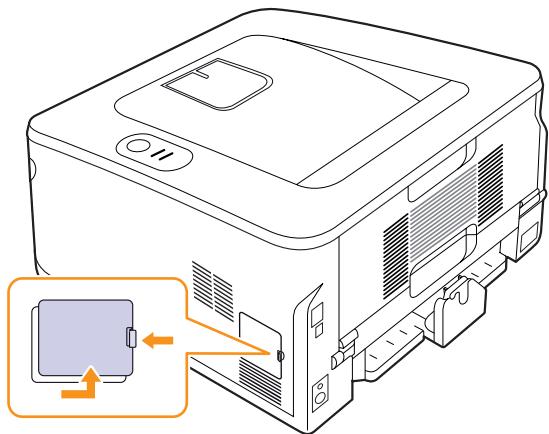
3 Take out a new memory module from the plastic bag.
4 Holding the memory module by the edges, align the memory module on the slot at about a 30-degree tilt. Make sure that the notches of the module and the grooves on the slot fit each other.
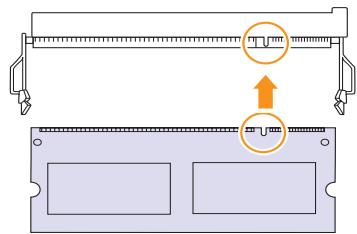

Note
The notches and grooves illustrated above may not match those on an actual memory module and its slot.
5 Press the memory module into the slot with care until you hear a "click".
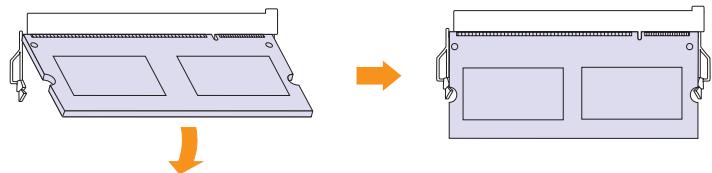

Note
Do not press the memory module strongly or the module may be damaged. If the module does not seem to fit into the slot properly, carefully try the previous procedure again.
6 Replace the control board cover.
7 Reconnect the power cord and printer cable, and turn the machine on.

Note
To release the memory module, pull the two tabs on the sides of the slot outwards, then the module springs out.
Activating the added memory in the PS printer properties
After installing the memory module, you need to select it in the printer properties of the PostScript printer driver in order to use it.
1 Make sure that the PostScript printer driver is installed on your computer. For details about installing the PS printer driver, see Software section.
2 Click the Windows Start menu.
3 For Windows 2000, select Settings and then Printers.
For Windows XP and Windows Server 2003, select Printers and Faxes.
For Windows Vista, select Control Panel > Hardware and Sound > Printers.
4 Select the SP 3300 Series PS printer.
5 Click the right mouse button on the printer icon and select Properties.
6 For Windows 2000/XP/0Vista and Windows Server 2003, select Device Settings.
7 Select the amount of memory you installed from Printer Memory in the Installable Options section.
8 Click OK.
11 Specifications
Printer specifications
| Item | Specifications and description |
| Printing speeda | Up to 28 ppm in A4 (30 ppm in Letter)Duplex: 14 ipm in A4 (14.5 ipm in Letter) |
| Resolution | Up to 1200 x 1200 dpi effective output |
| Warm-up time | Less than 15 seconds (From sleep mode) |
| First print out time | 8.5 seconds (From Ready)Sleep mode: 25 seconds |
| Power rating | AC 110-127 V or AC 220-240 VSee the Rating label on the machine for the correct voltage, frequency (hertz) and type of current for your machine. |
| Power consumption | Average: 500 WPower save mode: Less than 11 W |
| Noise levelb | Standby mode: Less than 26 dBAPrinting mode: Less than 50 dBA |
| Toner cartridge lifec | Average cartridge yield 5,000 standard pagesd.(Ships with 2,000 pages Starter/Standard Toner Cartridge) |
| Duty cycle | Monthly: Up to 50,000 pages |
| Weight | 11.9 Kg (including consumables) |
| Package weight | Paper: 2.4 Kg, Plastic: 0.3 Kg |
| Memory | 32 MB (Max. 160 MB) |
| 128 MB optional memory available | |
| External dimensions(W x D x H) | 364 x 369 x 210 mm (14.3 x 14.5 x 8.3 inches) |
| Operating environment | Temperature: 10 to 32°C (50 to 90°F)Humidity: 20 to 80% RH |
| Printer language | PCL6e, PostScript 3 |
| Fonts | 1 bitmap, 45 scalable, 136 PostScript 3 fonts |
| Item | Specifications and description |
| Interface | • USB Interface Standard - USB 2.0: Hi-Speed USB 2.0 • Network Interface Standard (SP 3300DN only) - Ethernet 10/100 Base TX wired LAN |
| OS compatibility | • Windows 2000/XP (32/64 bit)/Vista and Windows Server 2003 • Mac OS 8.6~9.2, 10.1~10.5 |
| Printer drivers | • PCL6 driver: Windows 2000/XP (32/64 bit)/Vista and Windows Server 2003 • PostScript driver: Windows 2000/XP (32/64 bit)/Vista and Windows Server 2003, Mac OS 8.6~9.2, 10.1~10.5 |
| Options | 250-sheet tray, DIMM |
| Fusing temperature | 180°C (356°F) |
a. Print speed will be affected by operating system used, computing performance, application software, connection method, print media type, print media size, and job complexity.
b. Sound pressure Level, ISO7779.
c. The number of pages may be affected by operating environment, printing interval, print media type, and print media size.
d. Declared yield value in accordance with ISO/IEC 19752.
e. Compatible with PCL6 version 2.1.
Index
C
cleaning
inside 8.1
outside 8.1
component location 1.2
configuration page, print 8.5
control panel
LED 9.5
overview 1.3
D
demo page, print 2.1
J
jam, clear 9.1
L
LED, meaning 1.3
loading paper
tray 1/optional tray 2 5.5
M
Macintosh problems 9.10
maintenance parts 8.5
manual feed mode, use 5.6
memory module
installing 10.1
N
network operating systems 4.1
0
output location 5.7
P
paper guidelines 5.3
paper jam, clear
around the toner cartridge 9.2
duplex area 9.3
multi-purpose tray 9.2
optional tray 2 9.1
paper exit area 9.3
tray 1 9.1
paper level indicator 5.4
paper load
tray 1/optional tray 2 5.5
paper size
specifications 5.2
paper type
specifications 5.2
PostScript problems 9.10
print quality problems, solve 9.7
printing
configuration page 8.5
demo page 2.1
problems 9.5
problem, solve
checklist 9.5
Macintosh 9.10
paper jams 9.1
printing 9.5
printing quality 9.7
PS errors 9.10
Windows 9.9
Q
quality problems 9.7
R
redistributing, toner cartridge 8.3
replacing, toner cartridge 8.4
S
special print media, guidelines 5.3
specification, printer 11.1
supplies, order information 7.1
system requirements
Windows 3.2
T
toner cartridge
maintaining 8.2
redistributing 8.3
replacing 8.4
toner save mode, use 2.1
troubleshooting 9.1
W
Windows problems 9.9

Software section
Software section
Contents
1. Installing Printer Software in Windows
Installing Printer Software 3
Installing Software for Local Printing 3
Installing Software for Network Printing 6
Reinstalling Printer Software 9
Removing Printer Software 10
2. Basic Printing
Printing a Document 11
Printing to a file (PRN) 12
Printer Settings 12
Layout Tab 13
Paper Tab 13
Graphics Tab 14
Extras Tab 15
About Tab 16
Printer Tab 16
Using a Favorite Setting 16
Using Help 16
3. Advanced Printing
Printing Multiple Pages on One Sheet of Paper (N-Up Printing) 17
Printing Posters 18
Printing Booklets 18
Printing on Both Sides of Paper 19
Printing a Reduced or Enlarged Document 19
Fitting Your Document to a Selected Paper Size 19
Using Watermarks 20
Using an Existing Watermark 20
Creating a Watermark 20
Editing a Watermark 20
Deleting a Watermark 20
Using Overlays 21
What is an Overlay? 21
Creating a New Page Overlay 21
Using a Page Overlay 21
Deleting a Page Overlay 21
4. Using Windows PostScript Driver
Printer Settings 22
Advanced 22
Using Help 22
5. Sharing the Printer Locally
Setting Up a Host Computer 23
Setting Up a Client Computer 23
6. Using Utility Applications
Using Printer Settings Utility 24
Using Onscreen Help 24
Opening the Troubleshooting Guide 24
Changing the Status Monitor Program Settings 24
7. Using Your Printer with a Macintosh
Installing Software 25
Printer driver 25
Setting Up the Printer 26
For a Network-connected 26
For a USB-connected 26
Printing 27
Printing a Document 27
Changing Printer Settings 27
Printing Multiple Pages on One Sheet of Paper (N-Up Printing) 28
Duplex Printing 29
1 Installing Printer Software in Windows
This chapter includes:
- Installing Printer Software
Reinstalling Printer Software - Removing Printer Software
NOTE: The following procedure is based on Windows XP, for other operating systems, refer to the corresponding Windows user's guide or online help.
Installing Printer Software
You can install the printer software for local printing or network printing. To install the printer software on the computer, perform the appropriate installation procedure depending on the printer in use.
A printer driver is software that lets your computer communicate with your printer. The procedure to install drivers may differ depending on the operating system you are using.
All applications should be closed on your PC before beginning installation.
Installing Software for Local Printing
A local printer is a printer directly attached to your computer using the printer cable supplied with your printer, such as a USB or parallel cable. If your printer is attached to a network, skip this step and go to "Installing Software for Network Printing" on page 6.
You can install the printer software using the typical or custom method.
NOTE: If the "New Hardware Wizard" window appears during the installation procedure, click × in the upper right corner of the box to close the window, or click Cancel.
Typical Installation
This is recommended for most users. All components necessary for printer operations will be installed.
1 Make sure that the printer is connected to your computer and powered on.
2 Insert the supplied CD-ROM into your CD-ROM drive.
The CD-ROM should automatically run, and an installation window appears.
If the installation window does not appear, click Start and then Run. Type X:\Setup.exe, replacing "X" with the letter which represents your drive and click OK.
If you use Windows Vista, click Start All programs Accessories Run, and type X:\Setup.exe.
If the AutoPlay window appears in Windows Vista, click Run Setup.exe in Install or run program field, and click Continue in the User Account Control window.
3 Click Next.
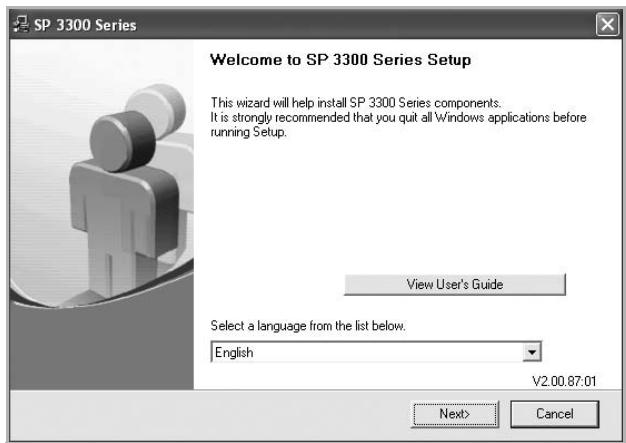
- If necessary, select a language from the drop-down list.
- View User's Guide: Allows you to view the User's Guide. If your computer doesn't have Adobe Acrobat, click on this option and it will automatically install Adobe Acrobat Reader for you.
4 Select Typical installation for a local printer. Click Next.
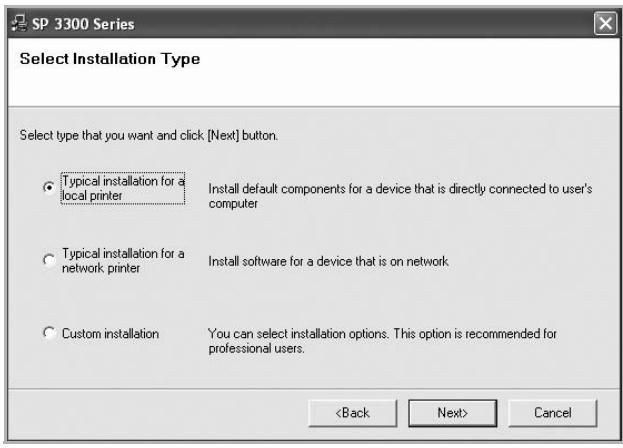
NOTE: If your printer is not already connected to the computer, the following window will appear.
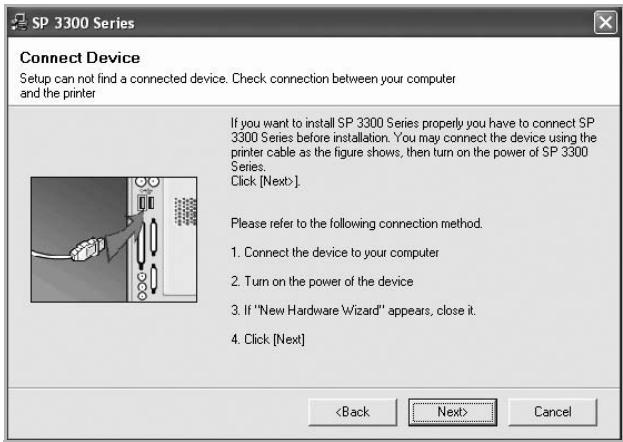
After connecting the printer, click Next.
- If you don't want to connect the printer at this time, click Next, and No on the following screen. Then the installation will start and a test page will not be printed at the end of the installation.
- The installation window that appears in this User's Guide may differ depending on the interface in use.
5 After the installation is finished, a window asking you to print a test page appears. If you choose to print a test page, select the checkbox and click Next.
Otherwise, just click Next and skip to step 7.
6 If the test page prints out correctly, click Yes.
If not, click No to reprint it.
7 Click Finish.
NOTE: After setup is complete, if your printer driver doesn't work properly, reinstall the printer driver. See "Reinstalling Printer Software" on page 9.
Custom Installation
You can choose individual components to install.
1 Make sure that the printer is connected to your computer and powered on.
2 Insert the supplied CD-ROM into your CD-ROM drive.
The CD-ROM should automatically run, and an installation window appears.
If the installation window does not appear, click Start and then Run. Type X:\Setup.exe, replacing "X" with the letter which represents your drive and click OK.
If you use Windows Vista, click Start All programs Accessories Run, and type X:\Setup.exe.
If the AutoPlay window appears in Windows Vista, click Run Setup.exe in Install or run program field, and click Continue in the User Account Control window.
3 Click Next.
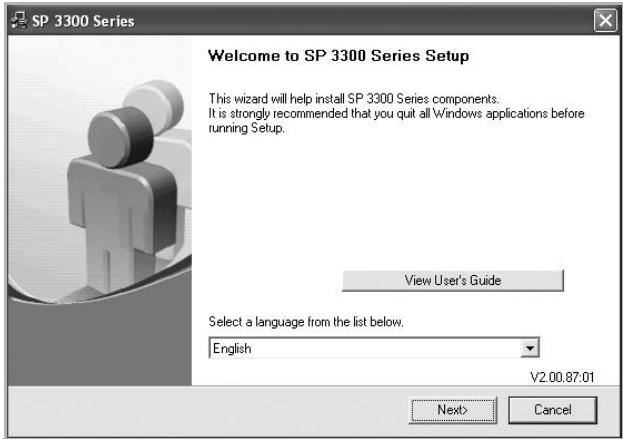
- If necessary, select a language from the drop-down list.
- View User's Guide: Allows you to view the User's Guide. If your computer doesn't have Adobe Acrobat, click on this option and it will automatically install Adobe Acrobat Reader for you.
4 Select Custom installation. Click Next.
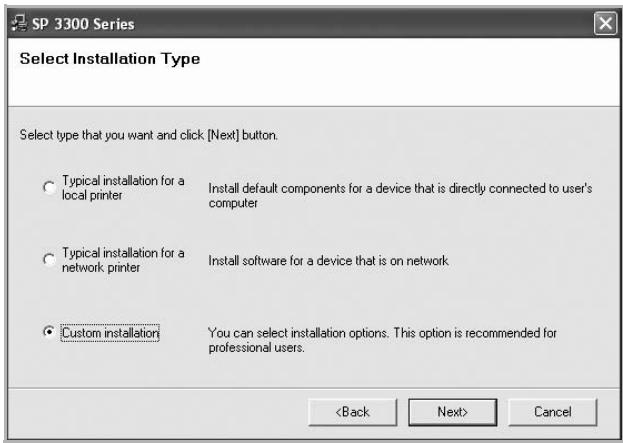
5 Select your printer and click Next.
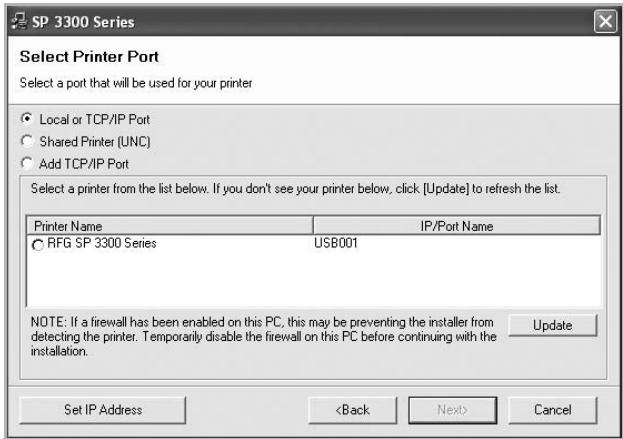
NOTE: If your printer is not already connected to the computer, the following window will appear.
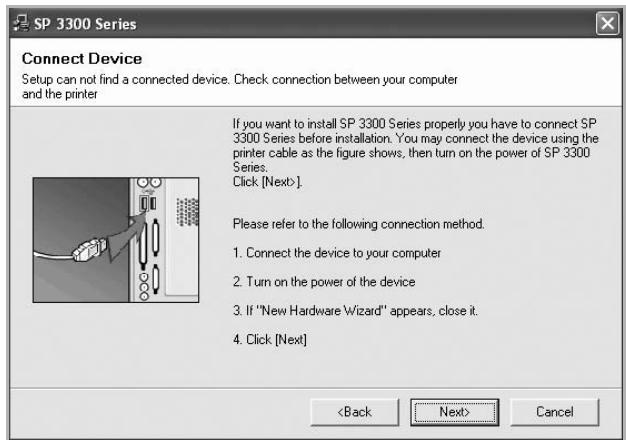
After connecting the printer, click Next.
- If you don't want to connect the printer at this time, click Next, and No on the following screen. Then the installation will start and a test page will not be printed at the end of the installation.
- The installation window that appears in this User's Guide may differ depending on the interface in use.
6 Select the components to be installed and click Next.
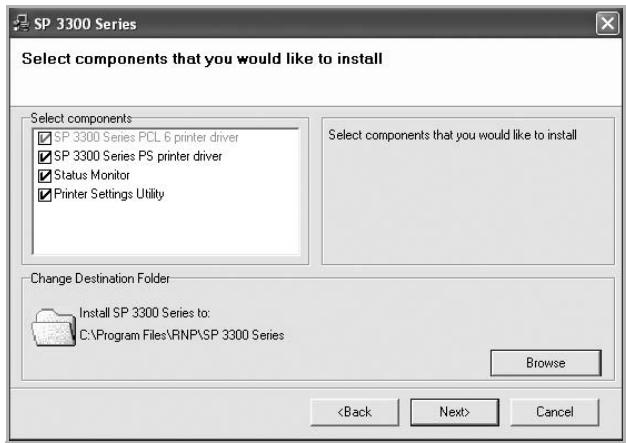
NOTE: You can change the desired installation folder by clicking [Browse].
7 After the installation is finished, a window asking you to print a test page appears. If you choose to print a test page, select the checkbox and click Next.
Otherwise, just click Next and skip to step 9.
8 If the test page prints out correctly, click Yes.
If not, click No to reprint it.
9 Click Finish.
Installing Software for Network Printing
When you connect your printer to a network, you must first configure the TCP/IP settings for the printer. After you have assigned and verified the TCP/IP settings, you are ready to install the software on each computer on the network.
You can install the printer software using the typical or custom method.
Typical Installation
This is recommended for most users. All components necessary for printer operations will be installed.
1 Make sure that the printer is connected to your network and powered on. For details about connecting to the network, see the supplied printer's User's Guide.
2 Insert the supplied CD-ROM into your CD-ROM drive.
The CD-ROM should automatically run, and an installation window appears.
If the installation window does not appear, click Start and then Run. Type X:\Setup.exe, replacing "X" with the letter which represents your drive and click OK.
If you use Windows Vista, click Start All programs Accessories Run, and type X:\Setup.exe.
If the AutoPlay window appears in Windows Vista, click Run Setup.exe in Install or run program field, and click Continue in the User Account Control window.
3 Click Next.
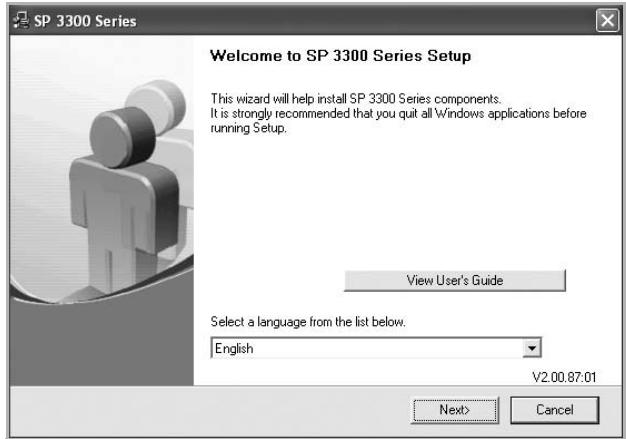
- If necessary, select a language from the drop-down list.
- View User's Guide: Allows you to view the User's Guide. If your computer doesn't have Adobe Acrobat, click on this option and it will automatically install Adobe Acrobat Reader for you.
4 Select Typical installation for a network printer. Click Next.
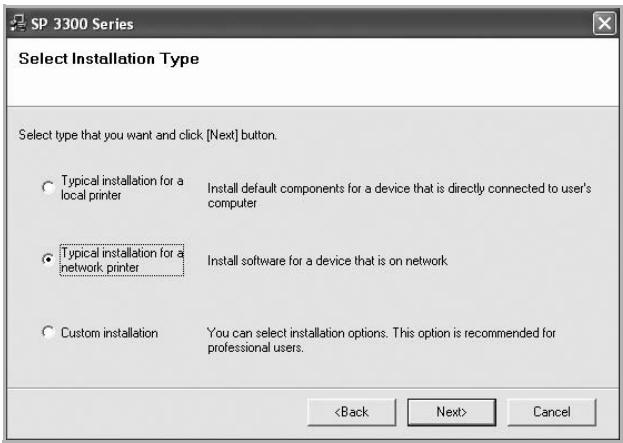
5 The list of printers available on the network appears. Select the printer you want to install from the list and then click Next.
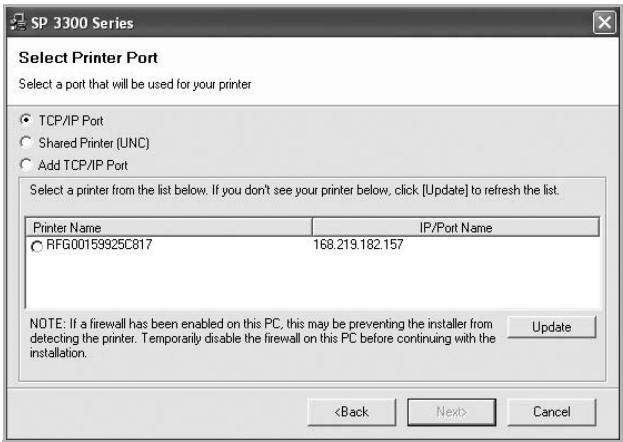
- If you do not see your printer on the list, click Update to refresh the list, or select Add TCP/IP Port to add your printer to the network. To add the printer to the network, enter the port name and the IP address for the printer.
To verify your printer's IP address or the MAC address, print a Network Configuration page.
- To find a shared network printer (UNC Path), select Shared Printer [UNC] and enter the shared name manually or find a shared printer by clicking the Browse button.
NOTE: If you cannot find your machine in network, please turn off the firewall and click Update. For Windows operating system, click Start Control Panel and start windows firewall,and set this option unactivated.For other operating system, refer to its on-line guide.
6 After the installation is finished, a window appears asking you to print a test page. If you so desire, select the corresponding checkbox and click Finish. Otherwise, just click Finish.
NOTE: After setup is complete, if your printer driver doesn't work properly, reinstall the printer driver. See "Reinstalling Printer Software" on page 9.
Custom Installation
You can choose individual components to install and set a specific IP address.
1 Make sure that the printer is connected to your network and powered on. For details about connecting to the network, see the supplied printer's User's Guide.
2 Insert the supplied CD-ROM into your CD-ROM drive. The CD-ROM should automatically run, and an installation window appears.
If the installation window does not appear, click Start and then Run. Type X:\Setup.exe, replacing "X" with the letter which represents your drive and click OK.
If you use Windows Vista, click Start All programs Accessories Run, and type X:\Setup.exe.
If the AutoPlay window appears in Windows Vista, click Run Setup.exe in Install or run program field, and click Continue in the User Account Control window.
3 Click Next.
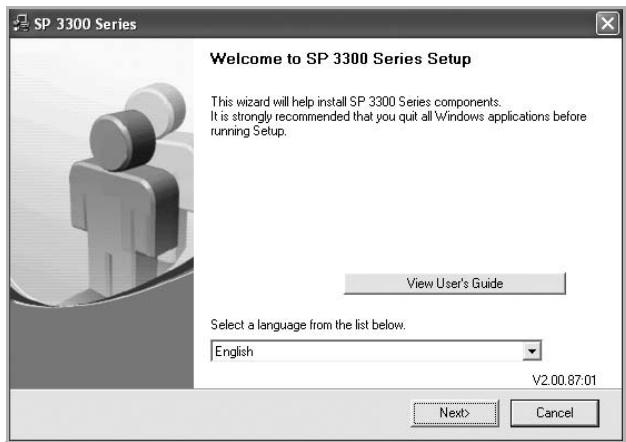
- If necessary, select a language from the drop-down list.
- View User's Guide: Allows you to view the User's Guide. If your computer doesn't have Adobe Acrobat, click on this option and it will automatically install Adobe Acrobat Reader for you.
4 Select Custom installation. Click Next.
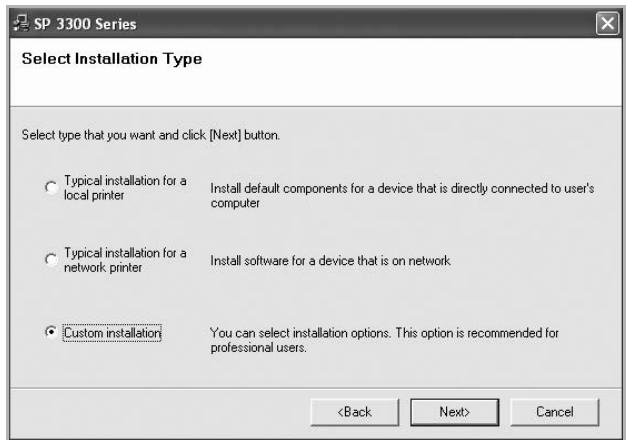
5 The list of printers available on the network appears. Select the printer you want to install from the list and then click Next.
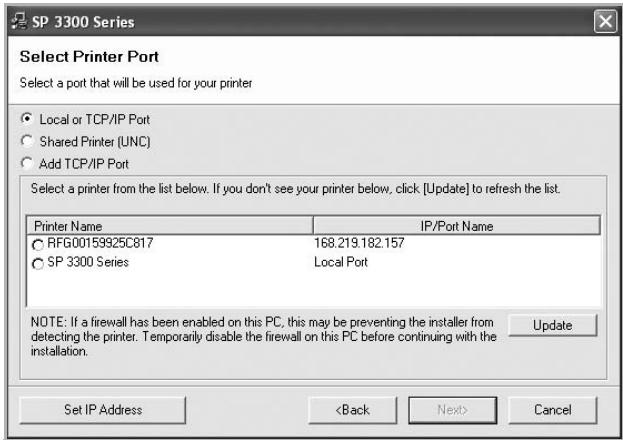
- If you do not see your printer on the list, click Update to refresh the list, or select Add TCP/IP Port to add your printer to the network. To add the printer to the network, enter the port name and the IP address for the printer.
To verify your printer's IP address or the MAC address, print a Network Configuration page. - To find a shared network printer (UNC Path), select Shared Printer [UNC] and enter the shared name manually or find a shared printer by clicking the Browse button.
NOTE: If you cannot find your machine in network, please turn off the firewall and click Update. For Windows operating system, click Start Control Panel and start windows firewall, and set this option unactivated. For other operating system, refer to its on-line guide.
Tip: If you want to set a specific IP address on a specific network printer, click the Set IP Address button. The Set IP Address window appears. Do as follows:
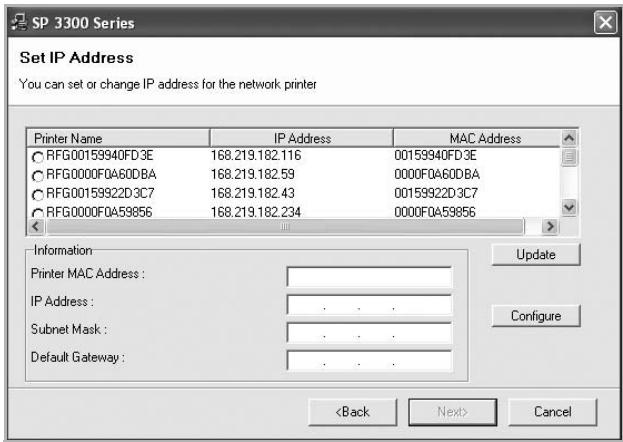
a. Select a printer to be set with a specific IP address from the list.
b. Configure an IP address, subnet mask, and gateway for the printer manually and click Configure to set the specific IP address for the network printer.
c. Click Next.
6 Select the components to be installed and click Next.
NOTE: You can change the desired installation folder by clicking [Browse].
7 Select the components to be installed. After selecting the components, the following window appears. You can also change the printer name, set the printer to be shared on the network, set the printer as the default printer, and change the port name of each printer. Click Next.
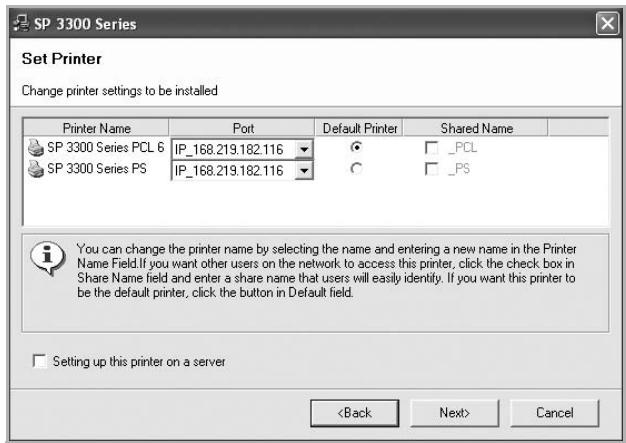
To install this software on a server, select the Setting up this printer on a server checkbox.
8 After the installation is finished, a window appears asking you to print a test page. If you so desire, select the corresponding checkbox and click Finish.
Otherwise, just click Finish.
NOTE: After setup is complete, if your printer driver doesn't work properly, reinstall the printer driver. See "Reinstalling Printer Software" on page 9.
Reinstalling Printer Software
You can reinstall the software if installation fails.
1 Start Windows.
2 From the Start menu select Programs or All Programs SP 3300 Series Maintenance.
3 Select Repair and click Next.
4 The list of printers available on the network appears. Select the printer you want to install from the list and then click Next.
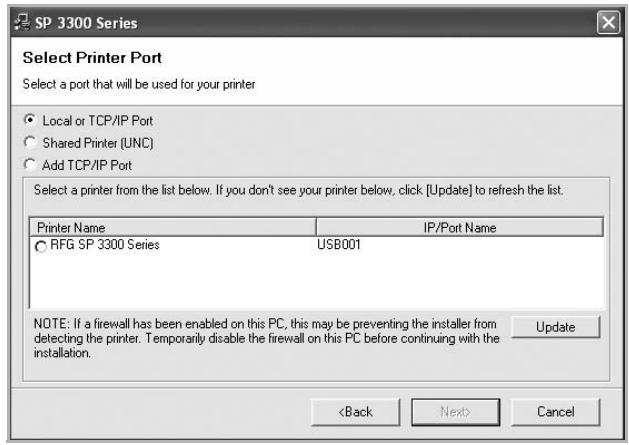
- If you do not see your printer on the list, click Update to refresh the list, or select Add TCP/IP Port to add your printer to the network. To add the printer to the network, enter the port name and the IP address for the printer.
- To find a shared network printer (UNC Path), select Shared Printer [UNC] and enter the shared name manually or find a shared printer by clicking the Browse button.
You will see a component list so that you can reinstall any item individually.
NOTE: If your printer is not already connected to the computer, the following window will appear.
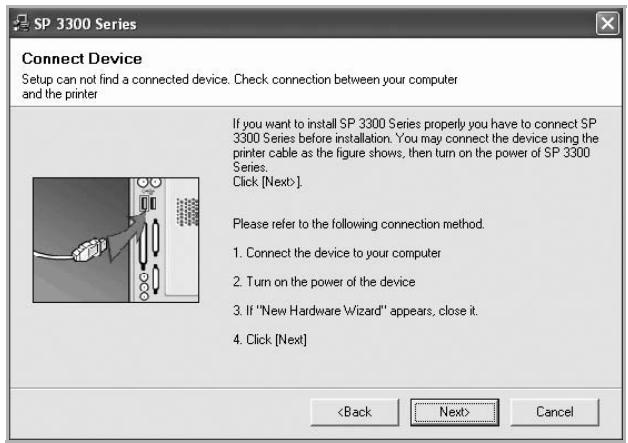
After connecting the printer, click Next.
- If you don't want to connect the printer at this time, click Next, and No on the following screen. Then the installation will start and a test page will not be printed at the end of the installation.
- The reinstallation window that appears in this User's Guide may differ depending on the interface in use.
5 Select the components you want to reinstall and click Next. If you installed the printer software for local printing and you select SP 3300 Series, the window asking you to print a test page appears. Do as follows:
a. To print a test page, select the check box and click Next.
b. If the test page prints out correctly, click Yes.
If it doesn't, click No to reprint it.
6 When the reinstallation is done, click Finish.
Removing Printer Software
1 Start Windows.
2 From the Start menu select Programs or All Programs SP 3300 Series Maintenance.
3 Select Remove and click Next.
You will see a component list so that you can remove any item individually.
4 Select the components you want to remove and then click Next.
5 When your computer asks you to confirm your selection, click Yes.
The selected driver and all of its components are removed from your computer.
6 After the software is removed, click Finish.
2 Basic Printing
This chapter explains the printing options and common printing tasks in Windows.
This chapter includes:
- Printing a Document
- Printing to a file (PRN)
-
Printer Settings
-
Layout Tab
- Paper Tab
- Graphics Tab
-ExtrasTab - About Tab
- Printer Tab
- Using a Favorite Setting
-UsingHelp
Printing a Document
NOTES:
- Your printer driver Properties window that appears in this User's Guide may differ depending on the printer in use. However the composition of the printer properties window is similar.
- Check the Operating System(s) that are compatible with your printer. Please refer to the OS Compatibility section of Printer Specifications in your Printer User's Guide.
- If you need to know the exact name of your printer, you can check the supplied CD-ROM.
The following procedure describes the general steps required for printing from various Windows applications. The exact steps for printing a document may vary depending on the application program you are using. Refer to the User's Guide of your software application for the exact printing procedure.
1 Open the document you want to print.
2 Select Print from the File menu. The Print window is displayed. It may look slightly different depending on your application.
The basic print settings are selected within the Print window. These settings include the number of copies and print range.
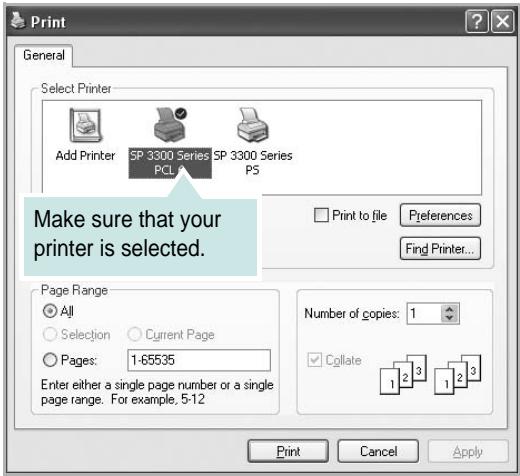
3 Select your printer driver from the Name drop-down list.
To take advantage of the printer features provided by your printer driver, click Properties or Preferences in the application's Print window. For details, see "Printer Settings" on page 12.
If you see Setup, Printer, or Options in your Print window, click it instead. Then click Properties on the next screen.
Click OK to close the printer properties window.
4 To start the print job, click OK or Print in the Print window.
Printing to a file (PRN)
You will sometimes need to save the print data as a file for your purpose. To create a file:
1 Check the Print to file box at the Print window.
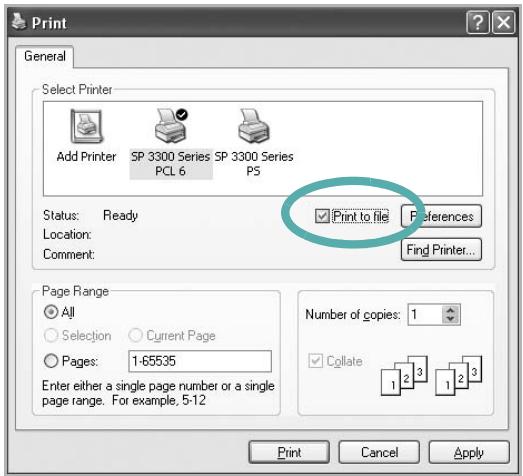
2 Select the folder and assign a name of the file and then click OK.
Printer Settings
You can use the printer properties window, which allows you to access all of the printer options you need when using your printer. When the printer properties are displayed, you can review and change the settings needed for your print job.
Your printer properties window may differ, depending on your operating system. This Software User's Guide shows the Properties window for Windows XP.
Your printer driver Properties window that appears in this User's Guide may differ depending on the printer in use.
If you access printer properties through the Printers folder, you can view additional Windows-based tabs (refer to your Windows User's Guide) and the Printer tab (see "Printer Tab" on page 16).
NOTES:
- Most Windows applications will override settings you specify in the printer driver. Change all print settings available in the software application first, and change any remaining settings using the printer driver.
- The settings you change remain in effect only while you are using the current program. To make your changes permanent, make them in the Printers folder.
-
The following procedure is for Windows XP. For other Windows OS, refer to the corresponding Windows User's Guide or online help.
-
Click the Windows Start button.
- Select Printers and Faxes.
- Select your printer driver icon.
- Right-click on the printer driver icon and select Printing Preferences.
- Change the settings on each tab, click OK.
Layout Tab
The Layout tab provides options to adjust how the document appears on the printed page. The Layout Options includes Multiple Pages per Side, Poster Printing and Booklet Printing. See "Printing a Document" on page 11 for more information on accessing printer properties.
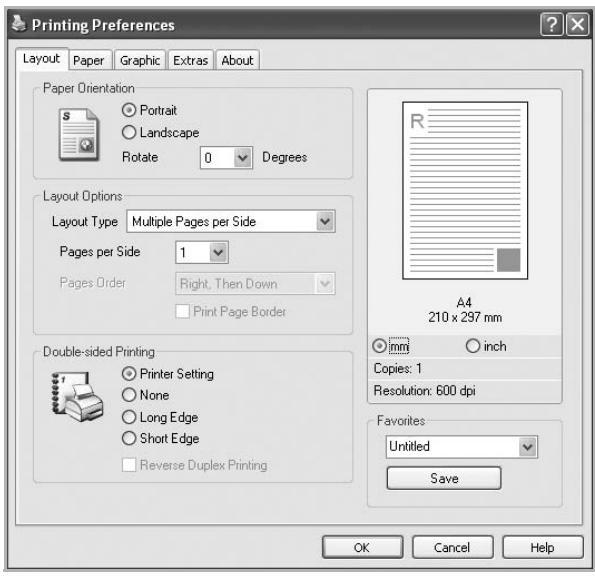
Paper Orientation
Paper Orientation allows you to select the direction in which information is printed on a page.
- Portrait prints across the width of the page, letter style.
- Landscape prints across the length of the page, spreadsheet style.
- Rotate allows you to rotate the page the selected degrees.


Portrait
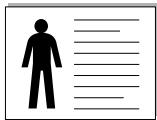

Landscape
Layout Options
Layout Options allows you to select advanced printing options. You can choose Multiple Pages per Side and Poster Printing.
- For details, see "Printing Multiple Pages on One Sheet of Paper (N-Up Printing)" on page 17.
- For details, see "Printing Posters" on page 18
- For details, see "Printing Booklets" on page 18
Double-sided Printing
Double-sided Printing allows you to print on both sides of paper.
- For details, see "Printing on Both Sides of Paper" on page 19.
Paper Tab
Use the following options to set the basic paper handling specifications when you access the printer properties. See "Printing a Document" on page 11 for more information on accessing printer properties.
Click the Paper tab to access various paper properties.
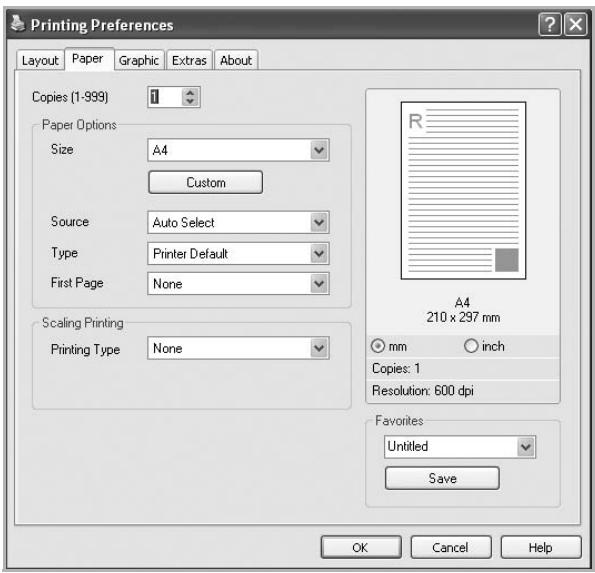
Copies
Copies allows you to choose the number of copies to be printed. You can select 1 to 999 copies.
Paper Options
Size
Size allows you to set the size of paper you loaded in the tray. If the required size is not listed in the Size box, click Custom. When the Custom Paper Setting window appears, set the paper size and click OK. The setting appears in the list so that you can select it.
Source
Make sure that Source is set to the corresponding paper tray. Use Manual Feeder when printing on special materials like envelopes and transparencies. You have to load one sheet at a time into the Manual Feeder.
If the paper source is set to Auto Select, the printer automatically picks up print material in the following tray order: Manual Feeder, Tray 1, optional Tray 2.
Type
Set Type to correspond to the paper loaded in the tray from which you want to print. This will let you get the best quality printout. If not, print quality may not be achieved as you want.
Cotton: 20 lb to 24 lb (75~90 g/m²) cotton paper such as Gilbert 25% and Gilbert 100%.
Plain: Normal plain paper. Select this type if your printer is monochrome and printing on the 16 lb (60 g/m²) cotton paper.
Recycled: 20 lb to 24 lb (75~90 g/m²) recycled paper.
Color: 20 lb to 24 lb (75~90 g/m²) color-background paper. Archive: If you need to keep print-out for a long period time such as archives, select this option.
First Page
This property allows you to print the first page using a different paper type from the rest of the document. You can select the paper source for the first page.
For example, load thick stock for the first page into the Manual Feeder, and plain paper into Tray 1. Then, select Tray1 in the Source option and Manual Feeder in the First Page option.
Scaling Printing
Scaling Printing allows you to automatically or manually scale your print job on a page. You can choose from None, Reduce/Enlarge, and Fit to Page.
- For details, see "Printing a Reduced or Enlarged Document" on page 19.
- For details, see "Fitting Your Document to a Selected Paper Size" on page 19.
Graphics Tab
Use the following Graphic options to adjust the print quality for your specific printing needs. See "Printing a Document" on page 11 for more information on accessing printer properties.
Click the Graphic tab to display the properties shown below.
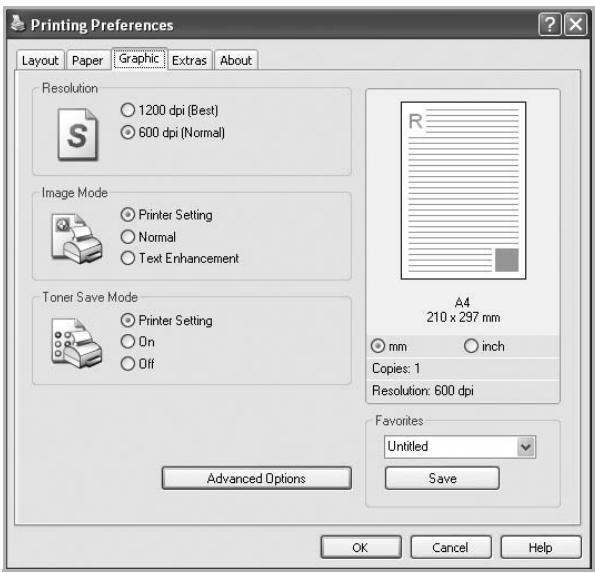
Resolution
The higher the setting, the sharper the clarity of printed characters and graphics. The higher setting also may increase the time it takes to print a document.
Image Mode
The available options are Normal and Text Enhancement.
- Printer Setting: If you select this option, this feature is determined by the setting you've made on the control panel of the printer.
- Normal: This setting is for normal documents.
- Text Enhancement: Image Mode allows the user to enhance printouts.
Toner Save Mode
Selecting this option extends the life of your toner cartridge and reduces your cost per page without a significant reduction in print quality.
- Printer Setting: If you select this option, this feature is determined by the setting you've made on the control panel of the printer.
- On: Select this option to allow the printer to use less toner on each page.
- Off: If you don't need to save toner when printing a document, select this option.
Advanced Options
You can set advanced settings by clicking the Advanced Options button.
- TrueType Options: This option determines what the driver tells the printer about how to image the text in your document. Select the appropriate setting according to the status of your document.
- Download as Outline: When this option is selected, the driver will download any TrueType fonts that are used in your document not already stored (resident) on your printer. If, after printing a document, you find that the fonts did not print correctly, choose Download as bit image and resubmit your print job. The Download as bit image setting is often useful when printing Adobe.
- Download as Bitmap: When this option is selected, the driver will download the font data as bitmap images. Documents with complicated fonts, such as Korean or Chinese, or various other fonts, will print faster in this setting.
- Print as Graphics: When this option is selected, the driver will download any fonts as graphics. When printing documents with high graphic content and relatively few TrueType fonts, printing performance (speed) may be enhanced in this setting.
- Print All Text To Black: When the Print All Text To Black option is checked, all text in your document prints solid black, regardless of the color it appears on the screen.
Extras Tab
You can select output options for your document. See "Printing a Document" on page 11 for more information about accessing the printer properties.
Click the Extras tab to access the following feature:

Watermark
You can create a background text image to be printed on each page of your document. For details, see "Using Watermarks" on page 20.
Overlay
Overlays are often used to take the place of preprinted forms and letterhead paper. For details, see "Using Overlays" on page 21.
Output Options
- Print Subset: You can set the sequence in which the pages print. Select the print order from the drop-down list.
- Normal (1,2,3): Your printer prints all pages from the first page to the last page.
- Reverse All Pages (3,2,1): Your printer prints all pages from the last page to the first page.
- Print Odd Pages: Your printer prints only the odd numbered pages of the document.
- Print Even Pages: Your printer prints only the even numbered pages of the document.
- Use Printer Fonts: When Use Printer Fonts is checked, the printer uses the fonts that are stored in its memory (resident fonts) to print your document, rather than downloading the fonts used in your document. Because downloading fonts takes time, selecting this option can speed up your printing time. When using Printer fonts, the printer will try to match the fonts used in your document to those stored in its memory. If, however, you use fonts in your document that are very different from those resident in the printer, your printed output will appear very different from what it looks like on the screen.
About Tab
Use the About tab to display the copyright notice and the version number of the driver. See "Printing a Document" on page 11 for more information about accessing printer properties.
Printer Tab
If you access printer properties through the Printers folder, you can view the Printer tab. You can set the printer configuration.
The following procedure is for Windows XP. For other Windows OS, refer to the corresponding Windows User's Guide or online help.
1 Click the Windows Start menu.
2 Select Printers and Faxes.
3 Select your printer driver icon.
4 Right-click on the printer driver icon and select Properties.
5 Click the Printer tab and set the options.
Using a Favorite Setting
The Favorites option, which is visible on each properties tab, allows you to save the current properties settings for future use.
To save a Favorites item:
1 Change the settings as needed on each tab.
2 Enter a name for the item in the Favorites input box.
3 Click Save.
When you save Favorites, all current driver settings are saved.
To use a saved setting, select the item from the Favorites drop down list. The printer is now set to print according to the Favorites setting you selected.
To delete a Favorites item, select it from the list and click Delete.
You can also restore the printer driver's default settings by selecting Printer Default from the list.
Using Help
Your printer has a help screen that can be activated by clicking the Help button in the printer properties window. These help screens give detailed information about the printer features provided by the printer driver.
You can also click from the upper right corner of the window, and then click on any setting.
3
Advanced Printing
This chapter explains printing options and advanced printing tasks.
NOTE:
- Your printer driver Properties window that appears in this User's Guide may differ depending on the printer in use. However the composition of the printer properties window is similar.
- If you need to know the exact name of your printer, you can check the supplied CD-ROM.
This chapter includes:
- Printing Multiple Pages on One Sheet of Paper (N-Up Printing)
- Printing Posters
- Printing Booklets
- Printing on Both Sides of Paper
- Printing a Reduced or Enlarged Document
Fitting Your Document to a Selected Paper Size
Using Watermarks
Using Overlays
Printing Multiple Pages on One Sheet of Paper (N-Up Printing)
You can select the number of pages to print on a single sheet of paper. To print more than one page per sheet, the pages will be reduced in size and arranged in the order you specify. You can print up to 16 pages on one sheet.
1 To change the print settings from your software application, access printer properties. See "Printing a Document" on page 11.
2 From the Layout tab, choose Multiple Pages per Side in the Layout Type drop-down list.
3 Select the number of pages you want to print per sheet (1, 2, 4, 6, 9, or 16) in the Pages per Side drop-down list.
4 Select the page order from the Page Order drop-down list, if necessary.
Check Print Page Border to print a border around each page on the sheet.
5 Click the Paper tab, select the paper source, size, and type.
6 Click OK and print the document.
Printing Posters

This feature allows you to print a single-page document onto 4, 9, or 16 sheets of paper, for the purpose of pasting the sheets together to form one poster-size document.
NOTE: The poster printing option is available when 600 dpi is selected in the resolution option on the Graphic tab.
1 To change the print settings from your software application, access printer properties. See "Printing a Document" on page 11.
2 Click the Layout tab, select Poster Printing in the Layout Type drop-down list.
3 Configure the poster option: You can select the page layout from Poster < 2x2> , Poster < 3x3> , Poster < 4x4> or Custom. If you select Poster < 2x2> , the output will be automatically stretched to cover 4 physical pages. If the option is set to Custom, you can enlarge the original from 150% to 400% . Depending on the level of the enlargement, the page layout is automatically adjusted to Poster < 2x2> , Poster < 3x3> , Poster < 4x4> .
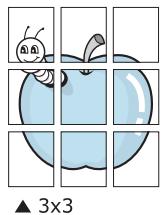
Specify an overlap in millimeters or inches to make it easier to pasting the sheets together.
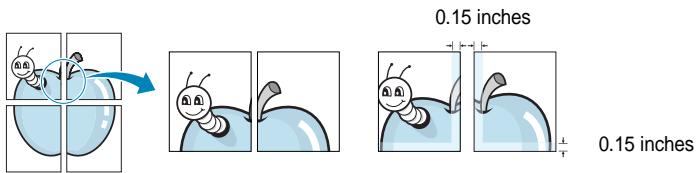
4 Click the Paper tab, select the paper source, size, and type.
5 Click OK and print the document. You can complete the poster by pasting the sheets together.
Printing Booklets
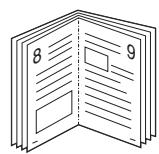
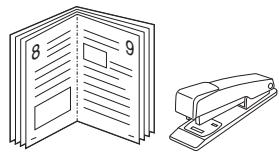
This printer feature allows you to print your document on both sides of the paper and arranges the pages so that the paper can be folded in half after printing to produce a booklet.
1 To change the print settings from your software application, access the printer properties. See "Printing a Document" on page 11.
2 From the Layout tab, choose Booklet Printing from the Layout Type drop-down list.
NOTE: The Booklet Printing option is not available for all paper sizes. In order to find out the available paper size for this feature, select the paper size in the Size option on the Paper tab, then check if the Booklet Printing in a Layout Type drop-down list on the Layout tab is activated.
3 Click the Paper tab, and select the paper source, size, and type.
4 Click OK and print the document.
5 After printing, fold and staple the pages.
Printing on Both Sides of Paper
You can print on both sides of a sheet of paper. Before printing, decide how you want your document oriented.
The options are:
- Printer Setting, if you select this option, this feature is determined by the setting you've made on the control panel of the printer.
None - Long Edge, which is the conventional layout used in book binding.
- Short Edge, which is the type often used with calendars.
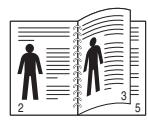
Long Edge
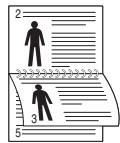
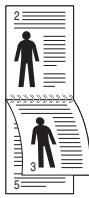
Short Edge
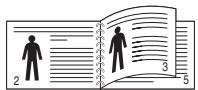
- Reverse Duplex Printing, allows you to select general print order compare to duplex print order.
NOTE: Do not print on both sides of labels, transparencies, envelopes, or thick paper. Paper jamming and damage to the printer may result.
1 To change the print settings from your software application, access printer properties. "Printing a Document" on page 11.
2 From the Layout tab, select the paper orientation.
3 From the Double-sided Printing section, select the binding option you want.
4 Click the Paper tab and select the paper source, size, and type.
5 Click OK and print the document.
Printing a Reduced or Enlarged Document
You can change the size of a page's content to appear larger or smaller on the printed page.
1 To change the print settings from your software application, access printer properties. See "Printing a Document" on page 11.
2 From the Paper tab, select Reduce/Enlarge in the Printing Type drop-down list.
3 Enter the scaling rate in the Percentage input box. You can also click the or button.
4 Select the paper source, size, and type in Paper Options.
5 Click OK and print the document.
Fitting Your Document to a Selected Paper Size
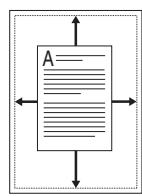
This printer feature allows you to scale your print job to any selected paper size regardless of the digital document size. This can be useful when you want to check fine details on a small document.
1 To change the print settings from your software application, access printer properties. See "Printing a Document" on page 11.
2 From the Paper tab, select Fit to Page in the Printing Type drop-down list.
3 Select the correct size from the Output size drop-down list.
4 Select the paper source, size, and type in Paper Options.
5 Click OK and print the document.
Using Watermarks
The Watermark option allows you to print text over an existing document. For example, you may want to have large gray letters reading "DRAFT" or "CONFIDENTIAL" printed diagonally across the first page or all pages of a document.
There are several predefined watermarks that come with the printer, and they can be modified, or you can add new ones to the list.
Using an Existing Watermark
1 To change the print settings from your software application, access printer properties. See "Printing a Document" on page 11.
2 Click the Extras tab, and select the desired watermark from the Watermark drop-down list. You will see the selected watermark in the preview image.
3 Click OK and start printing.
NOTE: The preview image shows how the page will look when it is printed.
Creating a Watermark
1 To change the print settings from your software application, access printer properties. See "Printing a Document" on page 11.
2 Click the Extras tab, and click the Edit button in the Watermark section. The Edit Watermark window appears.
3 Enter a text message in the Watermark Message box. You can enter up to 40 characters. The message displays in the preview window.
When the First Page Only box is checked, the watermark prints on the first page only.
4 Select watermark options.
You can select the font name, style, size, or grayscale level from the Font Attributes section and set the angle of the watermark from the Message Angle section.
5 Click Add to add a new watermark to the list.
6 When you have finished editing, click OK and start printing.
To stop printing the watermark, select (No Watermark) from the Watermark drop-down list.
Editing a Watermark
1 To change the print settings from your software application, access printer properties. See "Printing a Document" on page 11.
2 Click the Extras tab and click the Edit button in the Watermark section. The Edit Watermark window appears.
3 Select the watermark you want to edit from the Current Watermarks list and change the watermark message and options.
4 Click Update to save the changes.
5 Click OK until you exit the Print window.
Deleting a Watermark
1 To change the print settings from your software application, access printer properties. See "Printing a Document" on page 11.
2 From the Extras tab, click the Edit button in the Watermark section. The Edit Watermark window appears.
3 Select the watermark you want to delete from the Current Watermarks list and click Delete.
4 Click OK until you exit the Print window.
Using Overlays
What is an Overlay?
An overlay is text and/or images stored in the computer hard disk drive (HDD) as a special file format that can be printed on any document. Overlays are often used to take the place of preprinted forms and letterhead paper. Rather than using preprinted letterhead, you can create an overlay containing the exact same information that is currently on your letterhead. To print a letter with your company's letterhead, you do not need to load preprinted letterhead paper in the printer. You need only tell the printer to print the letterhead overlay on your document.
Creating a New Page Overlay
To use a page overlay, you must create a new page overlay containing your logo or image.
1 Create or open a document containing text or an image for use in a new page overlay. Position the items exactly as you wish them to appear when printed as an overlay.
2 To save the document as an overlay, access printer properties. See "Printing a Document" on page 11.
3 Click the Extras tab, and click Edit button in the Overlay section.
4 In the Edit Overlay window, click Create Overlay.
5 In the Create Overlay window, type a name of up to eight characters in the File name box. Select the destination path, if necessary. (The default is C:\Formover).
6 Click Save. The name appears on the Overlay List box.
7 Click OK or Yes to finish creating. The file is not printed. Instead it is stored on your computer hard disk drive.
NOTE: The overlay document size must be the same as the documents you print with the overlay. Do not create an overlay with a watermark.
Using a Page Overlay
After an overlay has been created, it is ready to be printed with your document. To print an overlay with a document:
1 Create or open the document you want to print.
2 To change the print settings from your software application, access printer properties. See "Printing a Document" on page 11.
3 Click the Extras tab.
4 Select the desired overlay from the Overlay drop-down list box.
5 If the overlay file you want does not appear in the Overlay list, click Edit button and Load Overlay, and select the overlay file. If you have stored the overlay file you want to use in an external source, you can also load the file when you access the Load Overlay window.
After you select the file, click Open. The file appears in the Overlay List box and is available for printing. Select the overlay from the Overlay List box.
6 If necessary, click Confirm Page Overlay When Printing. If this box is checked, a message window appears each time you submit a document for printing, asking you to confirm your wish to print an overlay on your document.
If this box is not checked and an overlay has been selected, the overlay automatically prints with your document.
7 Click OK or Yes until printing begins.
The selected overlay downloads with your print job and prints on your document.
NOTE: The resolution of the overlay document must be the same as that of the document you will print with the overlay.
Deleting a Page Overlay
You can delete page overlays that you no longer use.
1 In the printer properties window, click the Extras tab.
2 Click the Edit button in the Overlay section.
3 Select the overlay you want to delete from the Overlay List box.
4 Click Delete Overlay.
5 When a confirming message window appears, click Yes.
6 Click OK until you exit the Print window.


4 Using Windows PostScript Driver
If you want to use the PostScript driver provided with the supplied CD-ROM to print a document.
PPDs, in combination with the PostScript driver, access printer features and allow the computer to communicate with the printer. An installation program for the PPDs is provided on the supplied CD-ROM.
Printer Settings
You can use the printer properties window, which allows you to access all of the printer options you need when using your printer. When the printer properties are displayed, you can review and change the settings needed for your print job.
Your printer properties window may differ, depending on your operating system. This Software User's Guide shows the Properties window for Windows XP.
Your printer driver Properties window that appears in this User's Guide may differ depending on the printer in use.
NOTES:
- Most Windows applications will override settings you specify in the printer driver. Change all print settings available in the software application first, and change any remaining settings using the printer driver.
- The settings you change remain in effect only while you are using the current program. To make your changes permanent, make them in the Printers folder.
-
The following procedure is for Windows XP. For other Windows OS, refer to the corresponding Windows User's Guide or online help.
-
Click the Windows Start button.
- Select Printers and Faxes.
- Select your printer driver icon.
- Right-click on the printer driver icon and select Printing Preferences.
- Change the settings on each tab, click OK.
Advanced
You can use advanced settings by clicking the Advanced button.
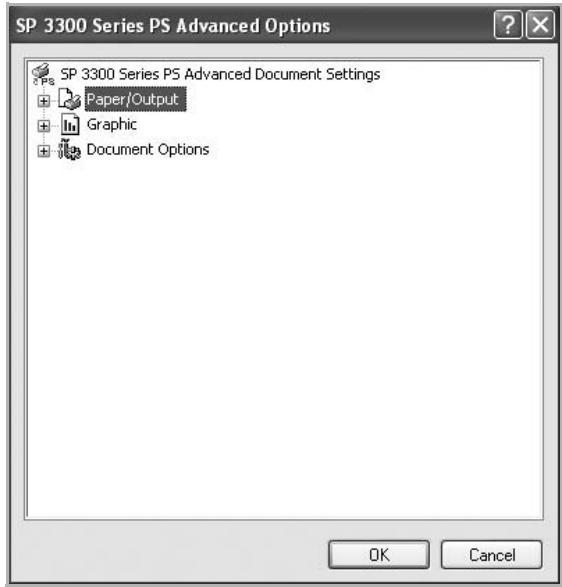
- Paper/Output this option allows you to select the size of the paper loaded in the tray.
- Graphic this option allows you to adjust the print quality for your specific printing needs.
- Document Options this options allow you to set the PostScript options or printer features.
Using Help
You can click from the upper right corner of the window, and then click on any setting.
5 Sharing the Printer Locally
You can connect the printer directly to a selected computer, which is called "host computer," on the network.
The following procedure is for Windows XP. For other Windows OS, refer to the corresponding Windows User's Guide or online help.
NOTES:
- Check the Operating System(s) that are compatible with your printer. Please refer to the OS Compatibility section of Printer Specifications in your Printer User Guide.
- If you need to know the exact name of your printer, you can check the supplied CD-ROM.
Setting Up a Host Computer
1 Start Windows.
2 From the Start menu select Printers and Faxes.
3 Double-click your printer driver icon.
4 From the Printer menu, select Sharing.
5 Check the Share this printer box.
6 Fill in the Shared Name field, and then click OK.
Setting Up a Client Computer
1 Right-click the Windows Start button and select Explore.
2 Select My Network Places and then right-click Search for Computers.
3 Fill in the IP address of host computer in Computer name field, and click Search. (In case host computer requires User name and Password, fill in User ID and password of host computer account.)
4 Double-click Printers and Faxes.
5 Right-click printer driver icon, select Connect.
6 Click Yes, if the installation confirm message appears.
Using Utility Applications
If an error occurs while printing, the Status Monitor window appears, showing the error.
NOTES:
- To use this program, you need:
- To check for Operating System(s) that are compatible with your printer, refer to Printer Specifications in your Printer User Guide.
- MAC OS X 10.3 or higher
- Internet Explorer version 5.0 or higher for flash animation in HTML Help.
- If you need to know the exact name of your printer, you can check the supplied CD-ROM.
Using Printer Settings Utility
Using the Printer Settings Utility, you can configure and check print settings.
1 For Windows, from the Start menu, select Programs or All Programs SP 3300 Series Printer Settings Utility. For MAC OS X, open the Applications folder RNP SP 3300 Series Printer Settings Utility.
2 Change the settings.
3 To send the changes to the printer, click the Apply button.
NOTE: If you connect your printer to a network, the Web Image Monitor SP 3300 Series window appears instead of the Printer Settings Utility window.
Using Onscreen Help
For more information about Printer Settings Utility, click
Opening the Troubleshooting Guide
Using the troubleshooting guide, you can view solutions for error status problems.
Double click the Status Monitor icon on the Windows task bar.
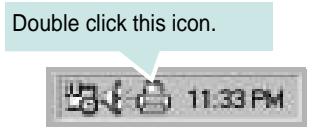
Or, from the Start menu, select Programs or All Programs → SP 3300 Series → Troubleshooting Guide.
Changing the Status Monitor Program Settings
Select the Status Monitor icon on the Windows task bar and right-click the Status Monitor icon. Select Options.
The following window opens.
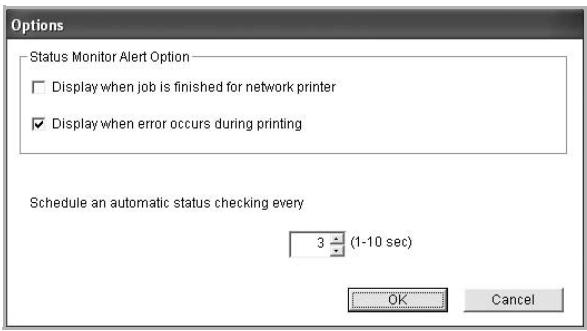
- Display when job is finished for network printer shows the Status Monitor balloon when your job is complete.
- Display when error occurs during printing shows the Status Monitor balloon when an error occurs during printing.
- Schedule an automatic status checking every allows the computer to update the printer status regularly. Setting the value close to 1 second causes the computer to check the printer status more frequently, thereby allowing a faster response to any printer error.
7
Using Your Printer with a Macintosh
Your machine supports Macintosh systems with a built-in USB interface or a 10/100 Base-TX network interface card. When you print a file from a Macintosh computer, you can use the PostScript driver by installing the PPD file.
This chapter includes:
- Installing Software
- Setting Up the Printer
- Printing
Installing Software
The supplied CD-ROM that came with your machine provides you with the PPD file to use the PS driver, Apple LaserWriter driver, for printing on a Macintosh computer.
Printer driver
Installing the printer driver
1 Connect your machine to the computer using the USB cable or the Ethernet cable.
2 Turn on your computer and the machine.
3 Insert the supplied CD-ROM which came with your machine into the CD-ROM drive.
4 Double-click the SP 3300 Series on your Macintosh desktop.
5 Double-click the MAC Installer folder.
6 Double-click the MACPrinter folder.
7 For Mac OS 8.6~9.2, double-click the SP 3300 Series Installer Classic icon.
For Mac OS 10.1 or higher, double-click the SP 3300 Series Installer OSX icon.
8 Click Continue.
9 Click Install.
10 After the installation is finished, click Quit.
Uninstalling the printer driver
1 Insert the supplied CD-ROM which came with your machine into the CD-ROM drive.
2 Double-click the SP 3300 Series on your Macintosh desktop.
3 Double-click the MAC Installer folder.
4 Double-click the MACPrinter folder.
5 For Mac OS 8.6~9.2, double-click the SP 3300 Series Installer Classic icon.
For Mac OS 10.1 or higher, double-click the SP 3300 Series Installer OSX icon.
6 Select Uninstall and then click Uninstall.
7 Click Continue.
8 When the uninstallation is done, click Quit.
Setting Up the Printer
Set up for your printer will be different depending on which cable you use to connect the printer to your computer—the network cable or the USB cable.
For a Network-connected
Mac OS 8.6 ~ 9.2
1 Follow the instructions on "Installing Software" on page 25 to install the PPD file on your computer.
2 From the Apple menu, select Chooser.
3 Click LaserWriter 8 (the PostScript driver provided with your Macintosh).
The name of your machine appears on the list.
4 Select RFG000xxxxxxxxxx from the printer box (where the xxxxxxxxx varies depending on each of the machines) and Click Select.
If Auto Setup does not work properly, click Select PPD, choose your printer name, and click OK.
5 When the setup is complete, you see your machine icon created as a desktop printer.
6 Close the Chooser.
7 When a message window appears telling you that you have changed your current machine, click OK.
Mac OS 10.1 or higher
1 Follow the instructions on "Installing Software" on page 25 to install the PPD file on your computer.
2 Open the Applications folder Utilities, and Print Setup Utility.
- For MAC OS 10.5, open System Preferences from the Applications folder, and click Printer & Fax.
3 Click Add on the Printer List.
- For MAC OS 10.5, press the "+" icon then a display window will pop up.
4 For MAC OS 10.3, select the Rendezvous tab.
- For MAC OS 10.4, click Default Browser and find the Bonjour.
- For MAC OS 10.5, click Default and find the Bonjour.
The name of your machine appears on the list. Select RFG000xxxxxxxxxx from the printer box, where thexxxxxxxxxx varies depending on your machine.
5 For MAC OS 10.3, if Auto Select does not work properly, select SP 3300 Series in Printer Model and your printer name in Model Name.
- For MAC OS 10.4, if Auto Select does not work properly, select SP 3300 Series in Print Using and your printer name in Model.
- For MAC OS 10.5, if Auto Select does not work properly, select Select a driver to use... and your printer name in Print Using.
Your machine appears on the Printer List and is set as the default printer.
6 Click Add.
For a USB-connected
Mac OS 10.1 or higher
1 Follow the instructions on "Installing Software" on page 25 to install the PPD file on your computer.
2 Open the Applications folder Utilities, and Print Setup Utility.
- For MAC OS 10.5, open System Preferences from the Applications folder, and click Printer & Fax.
3 Click Add on the Printer List.
- For MAC OS 10.5, press the "+" icon then a display window will pop up.
4 For MAC OS 10.3, select the USB tab.
- For MAC OS 10.4, click Default Browser and find the USB connection.
- For MAC OS 10.5, click Default and find the USB connection.
5 Select your printer name.
6 For MAC OS 10.3, if Auto Select does not work properly, select SP 3300 Series in Printer Model and your printer name in Model Name.
- For MAC OS 10.4, if Auto Select does not work properly, select SP 3300 Series in Print Using and your printer name in Model.
- For MAC OS 10.5, if Auto Select does not work properly, select Select a driver to use... and your printer name in Print Using.
Your machine appears on the Printer List and is set as the default printer.
7 Click Add.
Printing
NOTES:
- The Macintosh printer's properties window that appears in this User's Guide may differ depending on the printer in use. However, the composition of the printer properties window is similar.
- You can check your printer name in the supplied CD-ROM.
Printing a Document
When you print with a Macintosh, you need to check the printer software setting in each application you use. Follow these steps to print from a Macintosh.
1 Open a Macintosh application and select the file you want to print.
2 Open the File menu and click Page Setup (Document Setup in some applications).
3 Choose your paper size, orientation, scaling, and other options and click OK.
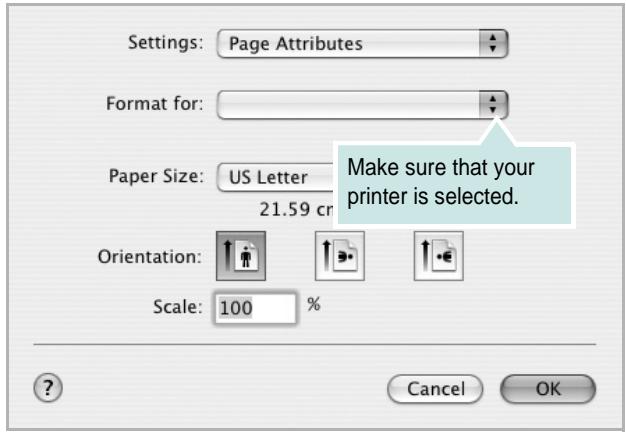
Mac OS 10.3
4 Open the File menu and click Print.
5 Choose the number of copies you want and indicate which pages you want to print.
6 Click Print when you finish setting the options.
Changing Printer Settings
You can use advanced printing features when using your printer.
From your Macintosh application, select Print from the File menu.
NOTE: The setting options may differ depending on Macintosh OS version.
Layout
The Layout tab provides options to adjust how the document appears on the printed page. You can print multiple pages on one sheet of paper. Select Layout from the Presets drop-down list to access the following features.
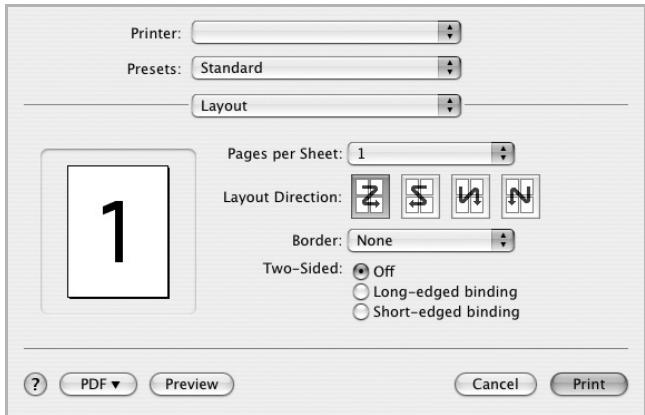
Mac OS 10.4
Pages per Sheet: This feature determines how many pages printed on one page. For details, see "Printing Multiple Pages on One Sheet of Paper (N-Up Printing)" on the next column.
- Layout Direction: You can select the printing direction on a page as like the examples on UI.
Printer Features
This tab provides options for selecting the paper type and adjusting print quality. Select Printer Features from the Presets' drop-down list to access the following features:
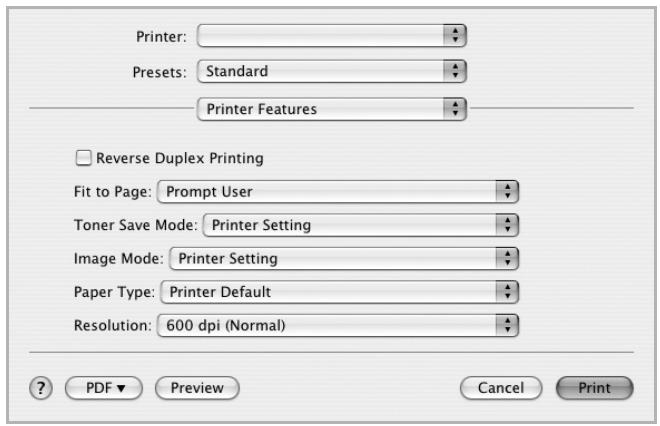
Mac OS 10.4
- Reverse Duplex Printing: Allows you to select general print order compare to duplex print order.
- Fit to Page: This setting allows you to scale your print job to any selected paper size regardless of the digital document size. This can be useful when you want to check fine details on a small document.
- Toner Save Mode: Selecting this option extends the life of your toner cartridge and reduces your cost per page without a significant reduction in print quality.
- Image Mode: Image Mode allows the user to enhance printouts. The available options are Normal and Text Enhance.
- Paper Type: Set Paper Type to correspond to the paper loaded in the tray from which you want to print. This will let you get the best quality printout. If you load a different type of print material, select the corresponding paper type.
- Resolution: You can select the printing resolution. The higher the setting, the sharper the clarity of printed characters and graphics. The higher setting also may increase the time it takes to print a document.
Printing Multiple Pages on One Sheet of Paper (N-Up Printing)
You can print more than one page on a single sheet of paper. This feature provides a cost-effective way to print draft pages.
1 From your Macintosh application, select Print from the File menu.
2 Select Layout.
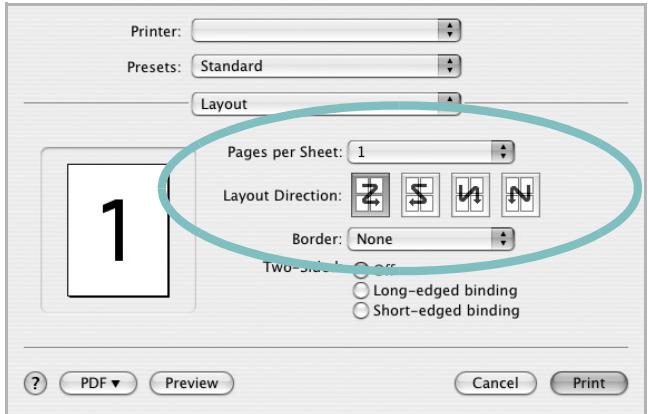
Mac OS 10.4
3 Select the number of pages you want to print on one sheet of paper on the Pages per Sheet drop-down list.
4 Select the page order from the Layout Direction option. To print a border around each page on the sheet, select the option you want from the Border drop-down list.
5 Click Print, and the printer prints the selected number of pages on one side of each page.
Duplex Printing
You can print on both sides of the paper. Before printing in the duplex mode, decide on which edge you will be binding your finished document. The binding options are:
Long-edge binding: Which is the conventional layout used in book binding.
Short-edge binding: Which is the type often used with calendars.
1 From your Macintosh application, select Print from the File menu.
2 Select the Layout.
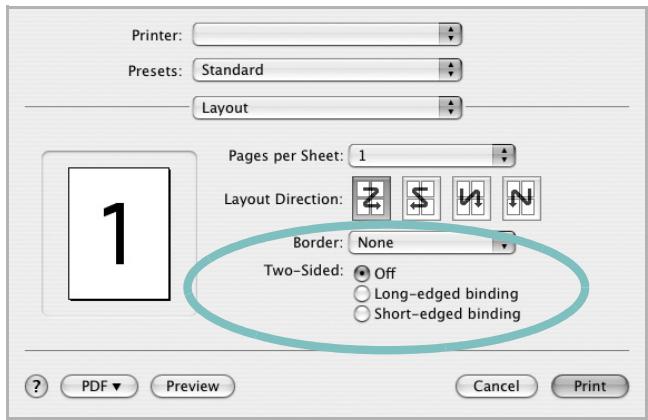
Mac OS 10.3
3 Select a binding orientation from Two-Sided option.
4 Click Print and the printer prints on both sides of the paper.
NOTE: If you have selected duplex printing and then try to print multiple copies of a document, the printer may not print the document in the way you want. In case of "Collated copy", if your document has odd pages, the last page of the first copy and the first page of the next copy will be printed on the front and back of one sheet. In case of "Uncollated copy", the same page will be printed on the front and back of one sheet. Therefore, if you need multiple copies of a document and you want those copies on both sides of the paper, you must print them one at a time, as separate print jobs.
Software section
Index
A
advanced printing, use 17
B
booklet printing 18
D
document, print
Macintosh 27
Windows 11
double-sided printing 19
E
Extras properties, set 15
F
favourites settings, use 16
G
Graphics properties, set 14
H
help,use16,22
1
image mode, set 14
install
printer driver
Macintosh 25
Windows 3
L
Layout properties, set
Windows 13
M
Macintosh
driver
install 25
printing 27
setting up the printer 26
N
n-up printing
Macintosh 28
Windows 17
0
orientation, print
Windows 13
overlay
create 21
delete 21
print 21
P
Paper properties, set 13
paper size, set 13
paper source
Windows 13
paper type, set
Macintosh 28
poster, print 18
PostScript driver
installing 22
document 11
fit to page 19
from Macintosh 27
from Windows 11
N-up
Macintosh 28
Windows 17
overlay 21
poster 20
PRN 12
scaling 19
watermark 20
prinert properties, set
Macintosh 27
Windows 12, 22
printer resolution, set
Windows 14
prinser software
install
Macintosh 25
Windows 3
uninstall
Windows 10
printing
booklets 18
double-sided 19
S
setting
darkness 14
favorites 16
image mode 14
resolution
Windows 14
toner save 14
true-type option 14
software
install
Macintosh 25
Windows 3
reinstall
Windows 9
system requirements
Macintosh 25
uninstall
Windows 10
status monitor 24
T
toner save, set 14
U
uninstall, software
Windows 10
W
watermark
create 20
delete 20
edit 20
print 20
Network Printer User's Guide (SP 3300DN only)
OpenSSL License
Copyright (c) 1998-2001 The OpenSSL Project. All rights reserved.
Redistribution and use in source and binary forms, with or without modification, are permitted provided that the following conditions are met:
- Redistributions of source code must retain the above copyright notice, this list of conditions and the following disclaimer.
- Redistributions in binary form must reproduce the above copyright notice, this list of conditions and the following disclaimer in the documentation and/or other materials provided with the distribution.
- All advertising materials mentioning features or use of this software must display the following acknowledgment: "This product includes software developed by the OpenSSL Project for use in the OpenSSL Toolkit. (http://www.openss.org/"
- The names "OpenSSL Toolkit" and "OpenSSL Project" must not be used to endorse or promote products derived from this software without prior written permission. For written permission, please contact openssl-core@openssl.org.
- Products derived from this software may not be called "OpenSSL" nor may "OpenSSL" appear in their names without prior written permission of the OpenSSL Project.
- Redistributions of any form whatsoever must retain the following acknowledgment: "This product includes software developed by the OpenSSL Project for use in the OpenSSL Toolkit (http:// www.openss1.org/)
THIS SOFTWARE IS PROVIDED BY THE OpensSL PROJECT `AS IS" AND ANY EXPRESSED OR IMPLIED WARRANTYES, INCLUDING, BUT NOT LIMITED TO, THE IMPLIED WARRANTYES OF MERCHANTABILITY AND FITNESS FOR A PARTICULAR PURPOSE ARE DISCLAIMED. IN NO EVENT SHALL THE OpensSL PROJECT OR ITS CONTRIButors BE LIABLE FOR ANY DIRECT, INDIRECT, INCIDENTAL, SPECIAL, EXEMPLARY, OR CONSEQUENTIAL DAMAGES (INCLUDING, BUT NOT LIMITED TO, PROCEDURE OF SUBSTITUTE GOODS OR SERVICES; LOSS OF USE, DATA, OR PROFITS; OR BUSINESS INTERRUPTION) HOWEVER CAUSED AND ON ANY THEORY OF LIABILITY, WHETHER IN CONTRACT, STRICT LIABILITY, OR TORT (INCLUDING NEGLIGENCE OR OTHERWISE) ASING IN ANY WAY OUT OF THE USE OF THIS SOFTWARE, EVEN IF ADVISED OF THE POSSIBILITY OF SUCH DAMAGE.
This product includes cryptographic software written by Eric Young(eay@cryptsoft.com). This product includes software written by Tim Hudson (tjh@cryptsoft.com).
Original SSLeay License
Copyright (C) 1995-1998 Eric Young (eay@cryptsoft.com) All rights reserved.
This package is an SSL implementation written by Eric Young (eay@cryptsoft.com). The implementation was written so as to conform with Netscapes SSL.
This library is free for commercial and non-commercial use as long as the following conditions are ahead to. The following conditions apply to all code found in this distribution, be it the RC4, RSA, Ihash, DES, etc.,
code; not just the SSL code. The SSL documentation included with this distribution is covered by the same copyright terms except that the holder is Tim Hudson (tjh@cryptsoft.com). Copyright remains Eric Young's, and as such any Copyright notices in the code are not to be removed. If this package is used in a product, Eric Young should be given attribution as the author of the parts of the library used. This can be in the form of a textual message at program startup or in documentation (online or textual) provided with the package.
Redistribution and use in source and binary forms, with or without modification, are permitted provided that the following conditions are met:
- Redistributions of source code must retain the copyright notice, this list of conditions and the following disclaimer.
- Redistributions in binary form must reproduce the above copyright notice, this list of conditions and the following disclaimer in the documentation and/or other materials provided with the distribution.
- All advertising materials mentioning features or use of this software must display the following acknowledgement: "This product includes cryptographic software written by Eric Young (eay@cryptsoft.com)" The word 'cryptographic' can be left out if the routines from the library being used are not cryptographic related:-).
- If you include any Windows specific code (or a derivative thereof) from the apps directory (application code) you must include an acknowledgement: "This product includes software written by Tim Hudson (tjh@cryptsoft.com)"
THIS SOFTWARE IS PROVIDED BY ERIC YOUNG "AS IS" AND ANY EXPRESS OR IMPLIED WARRANTYES, INCLUDING, BUT NOT LIMITED TO, THE IMPLIED WARRANTYES OF MERCHANTABILITY AND FITNESS FOR A PARTICULAR PURPOSE ARE DISCLAIMED. IN NO EVENT SHALL THE AUTHOR OR COLNTRIBUTORS BE LIABLE FOR ANY DIRECT, INDIRECT, INCIDENTAL, SPECIAL, EXEMPLARY, OR CONSEQUENTIAL DAMAGES (INCLUDING, BUT NOT LIMITED TO, PROCEDURE OF SUBSTITUTE GOODS OR SERVICES; LOSS OF USE, DATA, OR PROFITS; OR BUSINESS INTERRUsION) HOWEVER CAUSED AND ON ANY THEORY OF LIABILITY, WHETHER IN CONTRACT, STRICT LIABILITY, OR TORT (INCLUDING NEGLIGENCE OR OTHERWISE) ARISING IN ANY WAY OUT OF THE USE OF THIS SOFTWARE, EVEN IF ADVISED OF THE POSSIBILITY OF SUCH DAMAGE.
The licence and distribution terms for any publicly available version or derivative of this code cannot be changed. i.e. this code cannot simply be copied and put under another distribution licence [including the GNU Public Licence.]
Contents of this manual are subject to change without prior notice. In no event will the company be liable for direct, indirect, incidental or consequential damages as a result of handling or operating the machine.
Copyright© 2008
Microsoft, Windows, Windows 2000, Windows XP, Windows Vista, and Windows Server 2003 are registered trademarks of Microsoft Corporation.
- Macintosh, AppleTalk, and EtherTalk are registered trademarks of Apple Computer, Inc.
- All other brand or product names are trademarks of their respective companies or organizations.
Contents
1. Getting started
Introduction 1.1
Supported network environments 1.1
Network Printer Card 1.1
System requirements 1.1
Connecting your Network Printer Card 1.1
2. Programs supplied on the CD
System requirements 2.1
Installing software 2.1
Uninstalling software 2.1
IP address setup 2.2
3. Print Driver Installation for Networked Printers
Workstation Setup 3.1
Windows Vista (TCP/IP) 3.1
Windows XP (TCP/IP) 3.1
Windows 2000 (TCP/IP) 3.2
Test Print 3.3
4. TCP/IP environment
Management protocols 4.1
DHCP/BOOTP 4.1
HTTP 4.1
SNMP 4.1
SLP 4.2
Dynamic DNS (DDNS) 4.2
WINS 4.2
Bonjour 4.3
UPnP 4.3
Printing protocols 4.4
Standard TCP/IP port 4.4
LPR port 4.4
Printer Port 4.4
IPP port 4.5
Additional functions 4.6
5. EtherTalk environment
EtherTalk printing 5.1
Configuring EtherTalk 5.1
Configuring the printer 5.1
TCP/IP printing 5.2
Bonjour printer 5.2
6. Administration Tools
Maintenance using Internet Services 6.1
Enabling Internet Services 6.1
Checking Printer Status 6.1
Printing Reports 6.1
Making and Changing Network Admin Password 6.1
Upgrading Firmware 6.1
7. Appendix
Specifications 7.1
OpenSSL Statements 7.1
OpenSSL License 7.1
Introduction
The Network Printer Card allows you to connect your printer directly to a network to share the printer among multiple users. The printer functions as a network print server supporting various network environments, such as Windows 2000/XP/Vista, Windows Server 2003, and Macintosh 8.6 or higher.
This guide explains how to connect the Network Printer Card and set up your printer as a print sever over the network.
This guide assumes that you have:
- A good working knowledge of your network utilities
- A supported network operating system
- A fully operational computer system
- Access to the supervisor account as a network administrator, or access to an account that has supervisor and print server operator privileges
Supported network environments
Administrators and users can configure, and use printers on the following supported network operating systems:
| Operating system | Network environment | Printing protocol | Action |
| Windows | 2000, XP, Vista, Server 2003 | TCP/IP, EtherTalk, SNMP, HTTP 1.1 | See Chapter 3, “Print Driver Installation for Networked Printers.” |
| Macintosh | Macintosh 8.6 ~ 9.2, 10.1 ~ 10.5, or higher | TCP/IP, EtherTalk, SNMP, HTTP 1.1, Bonjour | See Chapter 5, “EtherTalk environment.” |
Note: Your printer may not support all of the listed computing environments (operating systems). Therefore, check the network environment your printer supports in the user's guide that came with the printer.
Network Printer Card
System requirements
The following hardware is required to configure your printer for network applications.
| Computer | Requirements |
| IBM - compatible PC | • 80486 CPU or higher • Minimum of 16 MB of RAM • 2 MB of free disk space |
| Macintosh | • PowerPC 68020 or higher • Minimum of 8 MB of RAM • 2 MB of free disk space |
Connecting your Network Printer Card
1 Use a twisted pair cable with an RJ-45 connector to connect the printer to your network.
Once a connection is established between the wired network printer card and your network, the link LEDs on the card light.
Link LED: Lights when the printer card is connected to the network.
Activity LED: Blinks when data packets are being transferred.
2 Set up your printer's IP address. See "IP address setup" on page 2.2.
2
Programs supplied on the CD
The CD-ROM supplied with your printer card provides you with:
- Set IP: A utility program allowing you to select a network printer card and manually configure the addresses for use with the TCP/IP protocol.
System requirements
To install SetIP, one of the following operating systems is required:
- Operating system: Windows 2000/XP/Vista/Windows Server 2003, MAC OS 10.3~10.5
Installing software
1 Insert the supplied CD-ROM into your CD-ROM drive.
The CD-ROM should automatically run, and an installation window appears.
If the installation window does not appear, click Start > Run. Type X:\Setup.exe, replacing "X" with the letter which represents your drive and click OK.
If you use Windows Vista, click Start > All Programs > Accessories > Run, and type X:\Setup.exe.
If the AutoPlay window appears in Windows Vista, click Run Setup.exe in Install or run program field, and click Continue in the User Account Control window.
2 Click Next.
3 Select the language you want.
4 Click Typical installation for a network printer.
5 Follow the onscreen instructions to complete installation.
6 Click Finish when installation is done.
Uninstalling software
You should remove the Network utilities if you are upgrading the software or if the installation fails.
Note: Close all programs before uninstalling software.
1 Click Start > Programs > SP 3300 Series > Set IP > Set IP.
2 Click OK to confirm uninstallation.
3 Click Finish when uninstallation is done.
IP address setup
Before using your network print server in your network, you must set TCP/IP addresses for the print server. You will need your printer card's MAC address, IP address, subnet mask, and gateway address. First, check with your network administrator for the TCP/IP addresses.
Note: The MAC address is the hardware serial number of the network printer card. You can check the address by printing the Network Printer Configuration Page. For printing the page, refer to your printer user's guide.
You can set your print server's IP address via the following methods:
- Set IP program: Go to the Using SetIP.
- Web Image Monitor SP 3300 Series: Once you have set an IP address for your network print server, you can use the embedded web server in the network printer card to change the address. Go to next column.
- DHCP: You can use Dynamic Host Configuration Protocol (DHCP) to get an IP address automatically assigned by your network administrator, if your network system supports this protocol.s
- BOOTP: A network-based server using the BootStrap protocol (BOOTP) can notify the network printer card of its assigned IP address each time the printer turns on, if your network system supports this protocol.
Note: To get an IP address from the DHCP or BOOTP server, the IP assignment method must be set to DHCP or BOOTP.
Using SetIP
Windows
1 From the Start menu, select Programs or All Programs > SP 3300 Series > Set IP.
The program automatically detects and displays new and configured print servers on your network.
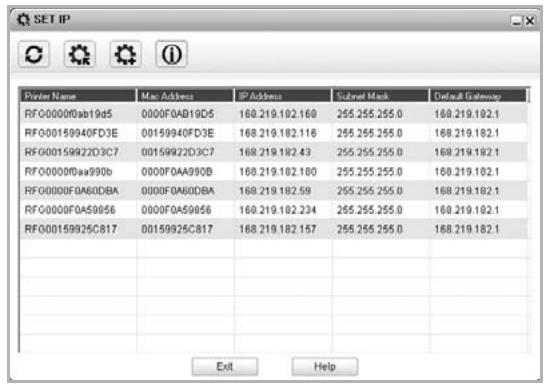
2 Select the name of your printer and click . If you cannot find your printer name, click to refresh the list.
Even with this step, if you cannot find your printer name, then contact Network Administrator.
3 Enter your network printer card's MAC address (hardware address), IP address, subnet mask, default gateway, and then click Apply.
4 Click OK to confirm the settings.
5 Click Exit to close the SetIP program.
MAC OS X
If you want to change your network printer IP setting, follow the below instruction.
1 Printer the machine's network information report which includes your machine's MAC address.
2 Open the Library folder > Printers > RFG > your printer model name > Set IP.
3 Double click the SetlPApplet.html file.
Using Web Image Monitor SP 3300 Series
1 Run your web browser.
2 Enter your print server's IP address in the URL field and click Go.
3 Click Network Settings > TCP/IP.
4 Select Static from IP Address Assignment Method.
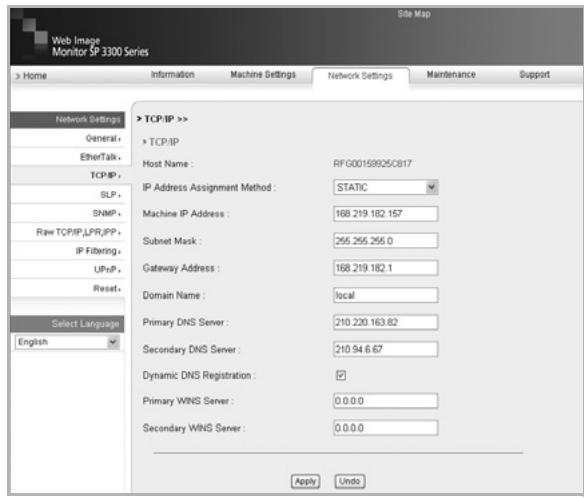
5 Enter your print server's TCP/IP addresses and click Apply.
3
Print Driver Installation for Networked Printers
This chapter explains how to install the print drivers for networked printers.
Workstation Setup
This section includes the setup procedures for the various Windows workstation environments.
Windows Vista (TCP/IP)
Note: Windows Vista supports printing via TCP/IP as standard when TCP/IP is installed on a Windows Vista Workstation.
Use the AutoPlay to add the printer to the network.
1 Select Start, select Control Panel > Hardware and Sound > Printers.
Double-click on the Add a printer icon to display the Add Printer Wizard.
2 Select Add a printer, uncheck the box labelled Automatically detect and install my Plug and Play printer. and then select Next to display the dialog box listing available ports.
3 Select Create a new port to display the Printer Ports dialog box.
Select Standard TCP/IP Port and select Next to display the Add Standard TCP/IP Port dialog box.
Enter the IP Address of the printer in the Printer Name or IP Address field (you can optionally enter a friendly name for the printer port you are creating or use the default name created). Then select Next to continue.If the network printer settings are not automatically detected, click on the Custom button to setup the network printer port settings.
It is recommended that you select Raw as the Print Protocol.
If you prefer to use LPR:
Select LPR as the Print Protocol.
Enter Ip (in lower case) in the Queue Name field.
Uncheck the box labelled LPR Byte Counting Enabled.
Check the box labelled SNMP Status Enabled.
The Community Name should normally be set to "public" (unless you have configured the device to have a custom SNMP community name) and the SNMP Device Index should be set to 1.
Select OK.
4 The Add Printer Wizard will then request that you select the driver to be used for this printer.
Insert the supplied CD-ROM into the workstation and select Have Disk.
Browse to the required Windows Vista driver on the CD-ROM and select OK.
Note: The driver will be found in the Printer folder on the CD in the appropriate PCL folder. The driver is identified by the file extension.inf.
Select Next, and select Next again and the printer driver will be loaded onto the workstation.
Enter the Printer Name and select Next.
5 If you wish to share the printer over the network Select Share name. You may also wish to install printer drivers for other operating systems that will access the printer.
A dialog box will be displayed with a message regarding the printing of a test page.
Select Finish to accept the Yes choice.
6 Continue with Test Print.
Windows XP (TCP/IP)
Note: Windows XP supports printing via TCP/IP as standard when TCP/IP is installed on a Windows XP Workstation.
Use the Add Printer Wizard to add the printer to the network.
1 Select Start, select Printers and Faxes.
Double-click on the Add a printer icon to display the Add Printer Wizard.
2 Select Add a printer, uncheck the box labelled Automatically detect and install my Plug and Play printer. and then select Next to display the dialog box listing available ports.
3 Select Create a new port to display the Printer Ports dialog box.
Select Standard TCP/IP Port and select Next to display the Add Standard TCP/IP Port dialog box.
Enter the IP Address of the printer in the Printer Name or IP Address field (you can optionally enter a friendly name for the printer port you are creating or use the default name created). Then select Next to continue. If the network printer settings are not automatically detected, click on the Custom button to setup the network printer port settings.
It is recommended that you select Raw as the Print Protocol.
If you prefer to use LPR:
Select LPR as the Print Protocol.
Enter Ip (in lower case) in the Queue Name field.
Uncheck the box labelled LPR Byte Counting Enabled.
Check the box labelled SNMP Status Enabled.
The Community Name should normally be set to "public" (unless you have configured the device to have a custom SNMP community name) and the SNMP Device Index should be set to 1.
Select OK.
4 The Add Printer Wizard will then request that you select the driver to be used for this printer.
Insert the supplied CD-ROM into the workstation and select Have Disk.
Browse to the required Windows XP driver on the CD-ROM and select OK.
Note: The driver will be found in the Printer folder on the CD in the appropriate PCL folder. The driver is identified by the file extension.inf.
Select Next, and select Next again and the printer driver will be loaded onto the workstation.
Enter the Printer Name and select Next.
5 If you wish to share the printer over the network Select Share name. You may also wish to install printer drivers for other operating systems that will access the printer.
A dialog box will be displayed with a message regarding the printing of a test page.
Select Finish to accept the Yes choice.
6 Continue with Test Print.
Windows 2000 (TCP/IP)
Note: Windows 2000 supports printing via TCP/IP as standard when TCP/IP is installed on a Windows 2000 Workstation.
Use the Add Printer Wizard to add the printer to the network.
1 Select Start, select Settings, and then select Printers.
Double-click on the Add printer icon to display the Add Printer Wizard.
2 Select Local printer, uncheck the box labelled Automatically detect and install my Plug and Play printer. and then select [Next] to display the dialog box listing available ports.
3 Select Create a new port to display the Printer Ports dialog box.
Select Standard TCP/IP Port and select Next to display the Add Standard TCP/IP Port dialog box.
Enter the IP Address of the printer in the Printer Name or IP Address field (you can optionally enter a friendly name for the printer port you are creating or use the default name created). Then select Next to continue.
If the network printer settings are not automatically detected, click on the Custom button to setup the network printer port settings.
It is recommended that you select Raw as the Print Protocol. If you prefer to use LPR:
Select LPR as the Print Protocol.
Enter Ip (in lower case) in the Queue Name field.
Uncheck the box labelled LPR Byte Counting Enabled.
Check the box labelled SNMP Status Enabled.
The Community Name should normally be set to "public" (unless you have configured the device to have a custom SNMP community name) and the SNMP Device Index should be set to 1.
Select OK.
4 The Add Printer Wizard will then request that you select the driver to be used for this printer.
Insert the supplied CD-ROM into the workstation and select Have Disk.
Browse to the required Windows 2000 driver on the CD-ROM and select OK.
Note: The driver will be found in the Printer folder on the CD in the appropriate PCL folder. The driver is identified by the file extension.inf.
Select Next, and select Next again and the printer driver will be loaded onto the workstation.
Enter the Printer Name and select Next.
5 If you wish to share the printer over the network Select Share name. You may also wish to install printer drivers for other operating systems that will access the printer.
6 If you wish to share the printer over the network Select Share as. You may also wish to install printer drivers for other operating systems that will access the printer.
A dialog box will be displayed with a message regarding the printing of a test page.
Select Finish to accept the Yes choice.
7 Continue with Test Print.
Test Print
To ensure the printer has been installed on the network correctly a test print should be submitted from a client workstation. Perform the following steps:
1 Open a document on a client workstation.
2 Select the SP 3300 Series as the printer for sending documents to.
3 Print the document on the device and verify that it prints correctly.
4 Ensure the print driver is installed on every workstation that will be sending jobs to the device.
5 Repeat the test for all workstations that will be sending jobs to the device.
4 TCP/IP environment
A TCP/IP network provides you with various protocols for using printing devices and managing various types of networked devices.
In this chapter, you will learn which management protocols are available in TCP/IP network environments, and how to print via your network print server using TCP/IP protocol.
Management protocols
Before beginning to print documents via your network printer, you need to check or configure some parameters using management protocols.
DHCP/BOOTP
Dynamic Host Configuration Protocol (DHCP) is a communication protocol enabling network administrators to centrally manage and to automate the assignment of IP addresses in a network. In an IP network, each device needs a unique IP address. DHCP lets a network administrator supervise and distribute IP addresses from a central point and automatically sends a new IP address when a device is plugged into a different place in the network.
Bootstrap Protocol (BOOTP) is UDP/IP-based protocol which allows a booting host to configure itself dynamically and without user supervision. BOOTP provides means to notify a host of its assigned IP address, the IP address of a boot server host, and other configuration information, such as the local subnet mask, the local time offset, and the addresses of default routers. Addresses of various Internet servers can also be transferred to a host using BOOTP.
DHCP is active by factory default on your network print server. After boot up, the network print server will get an IP address automatically from the DHCP server, if one exists. To set an IP address manually, see page 2.2.
Configuring DHCP/BOOTP
To enable or disable DHCP/BOOTP, use one of the following methods:
- Web Image Monitor SP 3300 Series: Select Network Settings > TCP/IP and select DHCP or BOOTP from the IP Address Assignment Method list.
HTTP
Hypertext Transfer Protocol (HTTP) is an application layer protocol for distributed, collaborative, hypermedia information systems. It is a generic, stateless protocol which can be used for many tasks beyond its use for hypertext, such as with name servers and distributed object management systems. You are using HTTP when you connect your network printer via a web browser.
The Network Printer Card has a built-in web server, Web Image Monitor SP 3300 Series. You can configure and manage your network print server through Web Image Monitor SP 3300 Series using HTTP over TCP/IP.
SNMP
Simple Network Management Protocol (SNMP), which is part of the TCP/IP protocol suite, is an application layer protocol that facilitates the exchange of management information between network devices. It enables network administrators to remotely monitor and configure network devices, find and solve network problems, and plan for network growth.
Network devices are monitored and controlled using four basic SNMP commands:
- read: is used by a Network Management server to monitor network devices. The server examines different variables that are maintained by the devices.
- write: is used by a Network Management server to control managed devices. The server changes the values of variables stored within the devices.
- trap: is used by network devices to asynchronously report events to a Network Management server. When certain types of events occur, a device sends a trap to the specified server.
- Traversal operations: are used by a Network Management server to determine which variables a network device supports and to sequentially gather information in variable tables, such as a routing table.
Configuring SNMP
To access your network print server using SNMP, Community Name/ Access Permission pair must be properly specified. There are two access permission: read and write.
Assign the IP addresses of trap hosts and community names (IP addresses) of network devices in Web Image Monitor SP 3300 Series; select Network Settings > SNMP.
Using SNMP
Web Image Monitor SP 3300 Series accesses, configures, and manages network devices using SNMP. You can use other MIB (Management Information Base) browser software, which allows you to access management information gathered from network devices.
SLP
Service Location Protocol (SLP) is an Internet standard network protocol that provides a framework to allow networking applications to discover the existence, location, and configuration of networked services in enterprise networks, such as printers, Web servers, fax machines, video cameras, file systems, backup devices (tape drives), databases, directories, mail servers, and calendars.
In order to locate services on the network, users of network applications are required to supply the host name or network address of the device that supplies a desired service. However, SLP eliminates the need for a user to know the name of a network host supporting a service. Rather, the user only needs to supply the desired type of service and set of attributes or keywords, which describe the service.
Based on that description, SLP also resolves the network address of the service of the user. Administrators do not need to help clients find new services or to remove services when they are no longer available. SLP uses multicasting and can work over subnet boundaries.
Configuring SLP
You can configure SLP protocol settings through Web Image Monitor SP 3300 Series. Select Network Settings > SLP.
- SLP Protocol: You can enable or disable SLP.
- Port Number: The port number is fixed to 427.
- Scope 1 ~ 3: A scope is a set of services and a string used to group resources by location, network, or administrative category. Each scope should not be more than 32 characters.
- Message Type: You can select the outgoing SLP message type sent to network devices. The default value is Multicast.
- Multicast Radius: You can specify the maximum number of subnets that SLP multicasts can travel across. This value is also called the "hop count" or "time-to-live" (TTL). The default value is 255.
- Registration Lifetime: You can define the time in seconds before the Server Agents registration expires.
- Multicast Address: The Multicast Address value is fixed to 239.255.255.253, 224.0.1.127.
Using SLP
Once Enabled is checked, the network print server works as a Service Agent and the User Agent.
Dynamic DNS (DDNS)
DNS (Domain Name System) is used for registration of domain names and provides Host names to an IP address resolution service. For printer devices, DNS may be utilised for printer domain name registration, so that print server clients may refer to the printer by its host name rather than by its IP address. Even though a printer's IP address is changed, all clients can operate this printer without reconfiguration. Addressing to a printer device by IP address is not convenient and may often go stale if an IP address to a device is assigned dynamically via a DHCP server. If
the DHCP server can provide information about a printer's changing IP address to the DNS server automatically, user convenience is increased. The printer's name will be used as its DNS name.
Configuring DDNS
1 Let the DHCP server provide updated information to the DNS server.
2 Configure the same DDNS domain through Web Image Monitor SP 3300 Series as entered in the DNS server.
If you connect your network printer via a web browser, you can enable this by selecting Network Settings > TCP/IP > Dynamic DNS Registration.
3 Set the IP assignment method of your network print server to DHCP and reboot the printer.
The DNS server will update its database and users can use the printer's name instead of its IP address.
WINS
Before Dynamic DNS was defined, DNS could only be updated manually when DHCP servers automatically provided (or removed) IP addresses. As a result, DNS servers often contained obsolete listings. In response, Microsoft developed Windows Internet Name Service (WINS) to solve this problem for NetBIOS names.
Microsoft now recommends moving to Dynamic DNS and away from WINS. However, many customers including Microsoft maintain WINS systems and need devices to interoperate with WINS. So devices must, at least for now, support WINS interoperability to allow for dynamic NetBIOS name to IP address registration and resolution.
WINS provides a distributed database for registering and querying dynamic NetBIOS names to IP address mapping in a routed network environment. This is the best choice for NetBIOS name resolution in such a routed network because it is designed to solve the problems that occur with name resolution in complex Internet networks.
Configuring WINS
Access Web Image Monitor SP 3300 Series and select Network Settings > TCP/IP. You will configure two WINS server addresses, the Primary WINS Server or the Secondary WINS Server. The default value is 0.0.0.0.
In a DHCP server
A DHCP server can support the NBNS (NetBIOS Name Server) option. An administrator has to set the WINS server IP address in the NBNS option.
1 Set the IP assignment method of your network print server to DHCP.
2 Reboot the print server.
The WINS server will update the printer's NetBIOS name in its database. Users can use the printer name instead of its IP address.
In the network print server
1 Configure the WINS server address through Web Image Monitor SP 3300 Series.
2 Reboot the print server.
The WINS server will update the printer's NetBIOS name in its database. Users can use the printer name instead of its IP address.
Bonjour
Bonjour allows for a network system to be easily discovered and its capabilities to be revealed by any Bonjour-compliant client software, such as Print Center Utility built in to Mac OS X. For details, see page 5.2.
UPnP
UPnP is an architecture for pervasive peer-to-peer network connectivity of intelligent appliances, wireless devices, and PCs of all form factors. It is designed to bring easy-to-use, flexible, standards-based connectivity to ad-hoc or unmanaged networks whether in the home, in a small business, public spaces, or attached to the Internet.
UPnP is a distributed, open networking architecture that leverages TCP/IP and Web technologies to enable seamless proximity networking in addition to control and data transfer among networked devices in the home, office, and public spaces.
UPnP is more than just a simple extension of the plug and play peripheral model. It is designed to support zero-configuration, "invisible" networking, and automatic discovery for a wide breadth of device categories from a wide range of vendors. This means a device can dynamically join a network, obtain an IP address, convey its capabilities, and learn about the presence and capabilities of other devices. DHCP and DNS servers are optional and are used only if available on the network, while a device can leave a network smoothly and automatically without leaving any unwanted state issues behind.
UPnP supports 6 protocol stacks for addressing, discovery, description, control, eventing, and presentation, but the Network Printer Card supports only Simple Service Discovery Protocol (SSDP) which allows addressing, description, and discovery.
Configuring UPnP
-
Web Image Monitor SP 3300 Series: Select Network Settings > UPnP.
-
Auto IP Enabled: You can enable or disable Auto IP. When this option is selected, the network print server cannot find the control point and receive an IP address from the control point. The network print server will create an IP address of "169.254.XXX.XXX."
- Multicast DNS Enabled: SSDP can use Multicast DNS.
- SSDP Enabled: You can enable or disable SSDP.
- SSDP TTL: You can specify the maximum number of subnets that SSPD multicasts can travel across.
Using UPnP
If SSDP (Simple Service Discovery Protocol) is enabled, your network print server is checked by a control point. This control point is an application which supports finding UPnP devices. Information on searching and control functions or your network print server's device information is displayed in an XML page (http://xxx.xxx.xxx:5200/ printer.xml).
Printing protocols
Before setting the network printing ports, you must install the printer driver with the local port (LPT) on the system. Refer to your printer user's guide.
Standard TCP/IP port
You can print your documents to your network printer by creating a Standard TCP/IP port.
Configuring Standard TCP/IP in Windows 2000/XP/Vista/Windows Server 2003
You can enable or disable the Standard TCP/IP Printing port through Web Image Monitor SP 3300 Series. Select Network Settings > Raw TCP/IP,LPR,IPP.
You can also change the port number of the Standard TCP/IP port. The default port number is 9100.
Creating a Standard TCP/IP port
1 In Windows XP, click Start > Printers and Faxes.
In Windows 2000/Windows Server 2003, click Start > Settings > Printers.
In Windows Vista, click Control Panel > Hardware and Sound > Printers.
2 Click Add a printer or double-click Add printer, and then Next.
3 Click Local printer attached to this computer and then Next. Make sure that Automatically detect and install my Plug and Play printer. is not selected.
4 Click Create a new port, select Standard TCP/IP Port from the Type of port list, and click Next.
5 Click Next.
6 Enter the IP address or DNS name of your network printer and click Next.
For the port name, a default name will be entered by Windows. You can change it to a more user-friendly name.
7 Follow the instructions on the screen to complete installation.
Now, you can select your printer from the Print Setup dialogue box.
LPR port
LPD, Line Printer Daemon, is the protocol associated with line-printer spooling services. Users can use the printing service from LPD running on a network print server through the LPR port. Most operating systems, such as Microsoft Windows 2000/XP/Vista/Windows Server 2003, support LPR port printing.
Configuring an LPR port
You can enable or disable the LPR Printing port through Web Image Monitor SP 3300 Series. Select Network Settings > Raw TCP/IP, LPR, IPP. You can also change the port number of LPR/LPD. The default port number is 515.
In Windows 2000/XP/Vista/Windows Server 2003
To add an LPR port to Windows 2000/XP/Vista/Windows Server 2003, users must install a Standard TCP/IP port by default, then change the printing protocol in the printer properties. For installing the Standard TCP/IP port, see page 4.4.
1 In Windows XP, click Start > Printers and Faxes.
In Windows 2000/Windows Server 2003, click Start > Settings > Printers.
In Windows Vista, click Control Panel > Hardware and Sound > Printers.
2 Right-click the printer you want and select Properties.
3 Click Ports.
4 Make sure that the appropriate Standard TCP/IP port is selected and click Configure Port.
5 Select LPR from the Protocol section.
6 Enter the print queue name and click OK.
7 Click OK to close the properties window.
Printer Port
A Network Printer port is used to send print jobs from network computers running Windows OS that do not support the Standard TCP/IP port or LPR port. Adding a Network Printer port
1 From the Windows Start menu, select Settings > Printers.
2 Right-click the printer you want and select Properties.
3 Open the Details tab and click Add Port.
4 Select Network Printer Port from the Other list and click OK.
5 Select the print server you want to use and click OK.
If you cannot find the print server, click Add New Print Server to list, specify information for the print server, such as print server name, IP address, or MAC address, and click OK.
6 When the port name displays in the Print to the following port list, click OK or Close.
IPP port
Internet Printing Protocol (IPP) allows printing across the Internet, meaning that you can send a print job to your printer from a remote place if you are an Internet user, no matter what operating system you use or where you are.
Configuring IPP in the print server
The network administrator must specify information required for IPP, such as the URI (Uniform Resource Identifier).
1 Run your web browser and access Web Image Monitor SP 3300 Series.
2 Click Network Settings > Raw TCP/IP,LPR,IPP.
3 Configure the IPP parameters:
- Printer Name: Enter the network printer's name to be used with IPP printing.
- Printer URI: Enter the URL of the printer using the following format: ipp://the IP address of the printer or http://the IP address of the printer:631 (Ex:ipp://168.10.17.82 or http:// 168.10.17.82:631) 631 is the IPP port number.
- Printer Information: Enter additional information about the printer.
- More Printer Information: Enter more additional information about the printer.
- Printer Location: Enter the name of the location where the printer is physically located.
- Multiple Operation Timeout: Enter the time to elapse before the printer ends a print job. When there is no incoming data after the specified number of seconds, the printer ends reception.
- Time to Keep Jobs in History: Set the length of time the IPP printer keeps job information.
Operator Message: Enter printer information for printer users. - Job Count: shows the number of print jobs.
- Driver Installer: shows the URL where you can get the driver installer.
- Manufacturer: shows the URL where you can get manufacturer information.
4 Click Apply.
Configuring a Windows client
After the network administrator has configured the network print server, each printer user must install the printer driver and set the print port to IPP 1.1 Port Monitor.
Note: Before following the steps below, each printer user should install the printer driver. If the printer driver is not already installed on the computer, install the printer driver that came with the printer. Select the local port (LPT) when you install the driver.
1 In Windows XP, click Start > Printers and Faxes.
In Windows 2000/Windows Server 2003, click Start > Settings > Printers.
In Windows Vista, click Control Panel > Hardware and Sound > Printers.
2 Right-click the printer you want and select Properties.
3 In Windows 2000/XP/Vista//Windows Server 2003, click Ports.
4 Click Add Port.
5 Select IPP Port from the Other list and click OK.
6 Enter the printer URL and port name and click OK.
7 When the port name displays on the print port list, click OK.
Now you can select the network print server from the Print Setup dialogue box to send a job.
Setting IPP security
Web Image Monitor SP 3300 Series allows administrators to choose an authentication method and to create or modify user accounts.
1 Run your web browser and access Web Image Monitor SP 3300 Series.
2 Click Network Settings > Raw TCP/IP,LPR,IPP.
- Authentication Type: You can set a user name and password encryption method (refer to http digest authentication in RFC).
- User: You can set a user name and password for IPP printing. You can set up the user database for up to 10 items.
3 Click Apply.
Note: A user name should be unique for all slots and should not include symbols. The length of the user name and the password should each be less than 7 characters.
Additional functions
The following are additional functions you can use through Web Image Monitor SP 3300 Series.
Printer properties settings
You can check and modify printer and document properties for an installed printer. For properties that are not supported by the printer driver, an error message indicating that the property is not supported is displayed. These settings are used only for printing from this system to the printer. However, these settings do not affect the printer properties of the network printer.
Firmware upgrade (HTTP)
You can upgrade your printer's firmware using the HTTP protocol. First, you need to download firmware from the website.
Note: Before upgrading the firmware, make sure that TCP/IP parameters are entered in the print server.
1 Run your web browser and access Web Image Monitor SP 3300 Series.
2 Click Maintenance > Firmware Upgrade.
3 Insert the CD or download the upgrade from the internet.
4 Click Browse, and then select the downloaded new firmware.
5 Click Upgrade.
Note: It takes a few minutes to upgrading the firmware. After completely upgrade, the printer will be reset.
Default setting (HTTP/SNMP)
You can reset all of your network parameter settings to their default status.
Note: All default parameters will be applied after the print server restarts.
IP filtering
This security feature (IP Filtering) provides the ability to prevent unauthorised network access to the network print server based on IP addresses set by a network administrator using Web Image Monitor SP 3300 Series.
1 Run your web browser and access Web Image Monitor SP 3300 Series.
2 Select Network Settings > IP Filtering.
3 Configure an IP filter.
- IP Filtering: You can enable or disable IP filtering.
- IP Address 1 ~ IP Address 10: You can enter filtered IP addresses. Users having the IP addresses set here are able to access the network print server.
4 Click Apply.
Only system administrators or authorised users can set, via Web Image Monitor SP 3300 Series, IP addresses that can access the device. Up to 10 addresses or ranges of address choices can be made and set. Authorised users are able to change the action (Apply/ Undo) and to print to the network print server.
Note: Ranges of addresses shouldn't contain "null" or "0.0.0.0" values.
Reset
1 Run your web browser and access Web Image Monitor SP 3300 Series.
2 Click Network Settings > Reset.
You can reboot the network print server, if your network settings are not applied correctly or the network card is disconnected from your network.
Ethernet speed
You can set the communication speed for Ethernet connections.
1 Run your web browser and access Web Image Monitor SP 3300 Series.
2 Click Network Settings > General.
- Speed Rate: Automatic, 10 Mbps (Harf Duplex),
10 Mbps (Full Duplex), 100 Mbps (Harf Duplex),
100 Mbps (Full Duplex). select a Ethernet speed from the dropdown list.
Click Apply.
5
EtherTalk environment
Ethernet is AppleTalk used in an Ethernet network. This protocol is widely used in Macintosh network environments. Microsoft Windows system also supports this protocol. Like TCP/IP, EtherTalk also provides packet transmission and routing functionality.
The network printer card works on EtherTalk networks, if the host printer supports PostScript. The description in this chapter applies to network printing from a Macintosh computer.
EtherTalk printing
Printing in an EtherTalk network is possible with several different hardware and software configurations. When you issue a command to print a document, the application begins a series of EtherTalk calls attempting to establish a connection to the printer. The calls first initiate the NBP (Name Binding Protocol) name-lookup process to find the currently selected printer and its EtherTalk address. Then the Printer Access Protocol (PAP) is used to open a connection with the printer.
Once the connection has been established, the workstation and printer interact over a PAP connection. PAP uses lower-level protocols, such as ATP and DDP, to provide a data-stream service for sending print data to the printer.
Configuring EtherTalk
You can configure EtherTalk using the following method:
Web Image Monitor SP 3300 Series
1 Run your web browser.
2 Enter the printer's IP address in the URL field and click Go.
3 Select Network Settings > EtherTalk.
- EtherTalk Protocol: allows you to enable or disable the EtherTalk protocol.
- Printer Name: allows you to set the printer name for EtherTalk protocol. The default name is RNP+MAC address. This name is automatically displayed on Chooser.
- Printer Type: shows the printer type.
- Last Error Occurred: shows the last error.
-
RTMP (timer value for aging A-Router entity): allows you to set the time in seconds after which the routing table entry maintained by the RTMP protocol times out.
-
PAP (wait time before transmitting a tickle packet): enables you to define the time interval in seconds after which the PAP protocol should resend a tickle packet to verify the status of the PAP connection between the printer and your Macintosh.
- ZIP (current zone): shows the AppleTalk Zone name. If there is no configured zone, * (asterisk) should be displayed.
4 Click Apply.
Configuring the printer
Note: The following instructions are for Mac OS 10.3, but similar for other versions.
The following steps must be taken to configure the network printer for use on a Macintosh system. If the network printer you want to use is not listed in the printer pop-up menu when you try to print a document, you should add it to your list of available printers.
1 Open the Applications folder > Utilities, and Print Setup Utility.
- For MAC OS 10.5, open System Preferences from the Applications folder, and click Printer & Fax.
2 Click Printing > Set Up Printers.
3 If the printer already appears in the printer list, select the In Menu check box to add it to your list of available printers. You will see the printer in the Printer pop-up menu the next time you print.
4 Click Add on the Printer List.
- For MAC OS 10.5, press the "+" icon then a display window will pop up.
5 For MAC OS 10.3, select the Rendezvous tab.
For MAC OS 10.4, click Default Browser and find the Bonjour.
- For MAC OS 10.5, click Default and find the Bonjour.
6 If necessary, choose an AppleTalk zone from the pop-up menu that appears directly below it. Any AppleTalk printers in the zone you have chosen appear in the Printer List.
7 Select the printer in the Printer List.
8 To use printer-specific features, choose the item appropriate for your printer from the Printer Model pop-up menu, then select your printer in the Model Name list.
9 Click Add.
The printer appears in the Printer List as the default printer (in boldface). It also appears in the Printer pop-up menu when you print a document.
TCP/IP printing
Apple added TCP/IP printing to all versions including and after OS 8.6.
Note: Ensure that the Macintosh has version 8.6 or later. Earlier versions do not support TCP/IP printing as standard.
An IP printer is a network printer that uses TCP/IP protocols (such as LPD/LPR, IPP, or Socket or Jet Direct) to make itself accessible to your computer. If the IP printer you want to use is not listed when you want to print, you can add it to your list of available printers. To add an IP printer, you need to know its IP address or DNS name.
1 Open the Applications folder > Utilities, and Print Setup Utility.
- For MAC OS 10.5, open System Preferences from the Applications folder, and click Printer & Fax.
2 Click Printing > Set Up Printers.
3 If the printer already appears on the Printer List, select the In Menu check box to add it to your list of available printers. You will see the printer in the Printer pop-up menu the next time you print.
4 Click Add on the Printer List.
- For MAC OS 10.5, press the "+" icon then a display window will pop up.
5 For MAC OS 10.3, select the IP Printing tab.
- For MAC OS 10.4, click IP Printer.
For MAC OS 10.5, click IP.
6 Select the appropriate printing protocol from the Printer Type pop-up menu.
7 Enter the IP address or DNS name for the printer in the Printer Address field.
8 If your printer requires it, type the queue name for your printer in the Queue Name field.
9 To use printer-specific features, choose the item appropriate for your printer from the Printer Model pop-up menu, then select your printer in the Model Name list.
10 Click Add.
The printer appears on the Printer List as the default printer (in boldface). It also appears in the Printer pop-up menu when you print a document.
Bonjour printer
Usually used in Macintosh networks to search for network devices, Bonjour consists of IPv4 Link-Local Addressing, Multicast DNS, and DNS Service Discovery. Known as zero configuration networking, Bonjour uses industry standard IP protocols to allow devices to automatically find each other without the need to enter IP addresses or configure DNS servers.
In order to provide a true zero configuration experience, meaning that you do not need to configure network parameters, the printer MUST have Bonjour enabled by default. It is NOT possible to disable any part of Bonjour.
After boot up, check the Bonjour printer name of this printer network card in Mac OS X.
1 Open the Applications folder > Utilities, and Print Setup Utility.
- For MAC OS 10.5, open System Preferences from the Applications folder, and click Printer & Fax.
2 Click Printing > Set Up Printers.
3 If the printer already appears on the Printer List, select the In Menu check box to add it to your list of available printers. You will see the printer in the Printer pop-up menu the next time you print.
4 Click Add on the Printer List.
- For MAC OS 10.5, press the "+" icon then a display window will pop up.
5 For MAC OS 10.3, select the Rendezvous tab.
- For MAC OS 10.4, click Default Browser and find the Bonjour.
- For MAC OS 10.5, click Default and find the Bonjour.
Any Bonjour-enabled printers on your local network or subnetwork appear on the Printer List.
6 Select your printer from the Printer List.
7 To use printer-specific features, choose the item appropriate for your printer from the Printer Model pop-up menu, then select your printer in the Model Name list.
8 Click Add.
The printer appears on the Printer List as the default printer (in boldface). It also appears in the Printer pop-up menu when you print a document.
Maintenance using Internet Services
Enabling Internet Services
1 At a client workstation on the network, launch the Internet Browser.
2 In the URL field, enter http:// followed by the IP Address of the SP 3300 Series. Then select the [Enter] key.
Example: If the IP Address is 192.168.100.100, enter the following in the URL field:
http://192.168.100.100
Checking Printer Status
Use these instructions to check the status of SP 3300 Series, the paper trays and consumables.
To check the status, perform these steps:
1 Enable SP 3300 Series (see "Enabling Internet Services" on page 6.1).
2 At SP 3300 Series Home Page for SP 3300 Series, select the Information tab.
3 Click Print Information in the left frame.
Printing Reports
Use these instructions to print the printer's reports or to send a test print file to SP 3300 Series.
To print reports, perform these steps:
1 Enable SP 3300 Series (see "Enabling Internet Services" on page 6.1).
2 At SP 3300 Series Home Page for SP 3300 Series, select the Information tab.
3 Click Print Information menu in the left frame. Then click the appropriate Print link to print:
Print Information
-
Print Printer Configuration Page
-
Print Demo Page
- Print Menu Map
- Print PCL Font List
- Print PS3 Font List
Network Information Page
- Print Network Configuration Page
Making and Changing Network Admin Password
Use these instructions to change the admin user's password.
To make admin user's password settings, perform these steps:
1 Enable SP 3300 Series (see "Enabling Internet Services" on page 6.1).
2 At SP 3300 Series Home Page for SP 3300 Series, select the Maintenance tab.
3 Click Security menu in the left frame.
4 Select the checkbox to Enable Security for using security.
5 To change the Admin User Password, in the change Admin User Name and Password area:
Enter the New Admin Name and Old Admin Name.
Enter the New Admin Password and Old Admin Password.
6 Click the Apply button to implement any changes.
Note: Click the Undo button to cancel any changes made and return to the previous values.
Upgrading Firmware
Firmware upgrades may supplied on a CD or as a download from the internet. Use these instructions to install firmware upgrades in SP 3300 Series.
To upgrade the firmware, perform these steps:
1 Enable SP 3300 Series (see "Enabling Internet Services" on page 6.1).
2 At SP 3300 Series Home Page for SP 3300 Series, select the Maintenance tab.
3 Click Firmware Upgrade in the left frame.
4 Insert the CD or download the upgrade from the internet.
5 Enter the file name and location or Browse to the location and select the file.
6 Click the Upgrade button.
Specifications
| Items | Specifications |
| Supported networks | ·Windows: 2000, XP, Vista, Windows Server 2003 ·Macintosh: MAC OS 8.6 ~ 9.2, 10.1 ~ 10.5 |
| Protocol | TCP/IP, EtherTalk, SNMP, HTTP 1.1, Bonjour |
| Configuration utilities | SetIP, Web Image Monitor SP 3300 Series |
| Hardware requirements | ·PC: - 80486 CPU or higher - Minimum of 16 MB of RAM - 2 MB of free disk space ·Macintosh: - PowerPC 68020 or higher - Minimum of 8 MB of RAM - 2 MB of free disk space |
| Wireless interface | IEEE 802.11a/b/g standard |
OpenSSL Statements
OpenSSL License
Copyright © 1998-2000 The OpensSL Project. All rights reserved.
Redistribution and use in source and binary forms, with or without modification, are permitted provided that the following conditions are met:
1 Redistributions of source code must retain the above copyright notice, this list of conditions and the following disclaimer.
2 Redistributions in binary form must reproduce the above copyright notice, this list of conditions and the following disclaimer in the documentation and/or other materials provided with the distribution.
3 All advertising materials mentioning features or use of this software must display the following acknowledgment:
4 "This product includes software developed by the OpenSSL Project for use in the OpenSSL Toolkit. (http://www.openssll.org/)
5 The names "OpenSSL Toolkit" and "OpenSSL Project" must not be used to endorse or promote products derived from this software without prior written permission.
6 For written permission, please contact opensll-core@opensll.org.
7 Products derived from this software may not be called "OpenSSL" nor may "OpenSSL" appear in their names without prior written permission of the OpenSSL Project.
8 Redistributions of any form whatsoever must retain the following acknowledgment:
"This product includes software developed by the OpenSSL Project for use in the OpenSSL Toolkit (http://www.openssll.org/)
THIS SOFTWARE IS PROVIDED BY THE OpensSL PROJECT "AS IS" AND ANY EXPRESSED OR IMPLIED WARRANTYES, INCLUDING, BUT NOT LIMITED TO, THE IMPLIED WARRANTYES OF MERCHANTABILITY AND FITNESS FOR A PARTICULAR PURPOSE ARE DISCLAIMED. IN NO EVENT SHALL THE OpensSL PROJECT OR ITS CONTRIButors BE LIABLE FOR ANY DIRECT, INDIRECT, INCIDENTAL, SPECIAL, EXEMPLARY, OR CONSEQUENTIAL DAMAGES (INCLUDING, BUT NOT LIMITED TO, PROCEDURE OF SUBSTITUTE GOODS OR SERVICES; LOSS OF USE, DATA, OR PROFITS; OR BUSINESS INTERRUPTION) HOWEVER CAUSED AND ON ANY THEORY OF LIABILITY, WHETHER IN CONTRACT, STRICT LIABILITY, OR TORT (INCLUDING NEGLIGENCE OR OTHERWISE) ARISING IN ANY WAY OUT OF THE USE OF THIS SOFTWARE, EVEN IF ADVISED OF THE POSSIBILITY OF SUCH DAMAGE.
This product includes cryptographic software written by Eric Young (eay@cryptsoft.com).
This product includes software written by Tim Hudson (tjh@cryptsoft.com).
Index
A
Administration Tools
Internet Services 6.1
B
Bonjour 5.2
BOOTP 4.1
D
DDNS 4.2
DHCP 4.1
E
EtherTalk
Bonjour 5.2
configuring EtherTalk 5.1
configuring the printer 5.1
TCP/IP printing 5.2
F
Firmware upgrade 4.6
H
HTTP 4.1
1
Installing software 2.1
Internet Services
Printer Status 6.1
Printing Reports 6.1
Upgrading Firmware 6.1
IP address setup
BOOTP 2.2
DHCP 2.2
SetIP 2.2
Web Image Monitor SP 3300 Series 2.2
IP filtering 4.6
IPP port 4.5
L
LEDs 1.1
LPR port 4.4
N
Network administration software, install 2.1
Network environments, supported 1.1
Network Printer Card 1.1
Network Printer Card, connecting 1.1
Networked Printers 3.1
Test Print 3.3
Workstation Setup 3.1
P
Printer Port 4.4
Printer Status 6.1
Printing Reports 6.1
s
SetIP 2.1
Macintosh 2.2
Windows 2.2
SLP 4.2
SNMP 4.1
Specifications 7.1
Standard TCP/IP port 4.4
T
TCP/IP
in Macintosh 5.2
management protocol
BOOTP 4.1
DDNS 4.2
DHCP 4.1
HTTP 4.1
SLP 4.2
SNMP 4.1
UPnP 4.3
WINS 4.2
printing protocol
IPP port 4.5
LPR port 4.4
Printer Port 4.4
Standard TCP/IP port 4.4
U
Uninstalling software 2.1
Upgrading Firmware Using Internet Services 6.1
UPnP 4.3
W
WINS 4.2
Workstation Setup
Windows 2000 (TCP/IP) 3.2
Windows Vista (TCP/IP) 3.1
Windows XP (TCP/IP) 3.1
- Copyright © 2008
- Contents
- Introduction
- Basic setup
- Software overview
- Network setup (SP 3300DN only)
- Loading print media
- Basic printing
- Supplies and accessories
- Maintenance
- Troubleshooting
- Installing accessories
- Specifications
- Safety Information
- Safety During Operation
- WARNING:
- CAUTION:
- Notes for Users
- Power Supply
- Positions of Labels and Hallmarks for WARNING and CAUTION Labels
- Power Saver
- ENERGY STAR® Program
- Recycling
- User Information on Electrical & Electronic Equipment
- Users in the EU, Switzerland and Norway
- All Other Users
- Laser Safety:
- For Users in Europe
- For Users in the United States of America
- CDRH Regulations
- Note to users in the United States of America
- Note:
- Caution
- Declaration of Conformity
- Note to users in Canada
- Special features
- Print with excellent quality and high speed
- Handle paper flexibly
- Create professional documents
- Save time and money
- Expand the printer capacity
- Print in various environments
- Machine features
- Printer overview
- Front view
- Control panel overview
- Alert
- Understanding the LEDs
- Finding more information
- Note
- Setting up the hardware
- Notes
- Altitude adjustment
- Changing the font setting
- Basic setup
- Printing a demo page
- Using toner save mode
- Software overview
- Supplied software
- Printer driver features
- System requirements
- Network setup (SP 3300DN only)
- Introduction
- Supported operating systems
- Using SetIP program
- Loading print media
- Selecting print media
- Guidelines for selecting and storing print media
- Guidelines for special print media
- Loading paper
- Using the tray 1 or the optional tray 2
- Changing the size of the paper in the tray 1
- Using manual feeder
- Basic printing
- Printing a document
- Canceling a print job
- Supplies and accessories
- Toner cartridge
- Accessory
- Maintenance
- Cleaning the printer
- Cleaning the outside of the printer
- Cleaning the inside of the printer
- Maintaining the toner cartridge
- Warning
- Toner cartridge storage
- Expected cartridge life
- Redistributing toner cartridge
- Replacing the toner cartridge
- Printing a configuration page
- Maintenance parts
- Troubleshooting
- Clearing paper jams
- In the paper feed area
- In the tray 1
- In the optional tray 2
- In the manual tray
- Around the toner cartridge
- In the paper exit area
- In the duplex unit area
- Duplex jam 0
- Duplex jam 1
- Tips for avoiding paper jams
- Troubleshooting checklist
- Solving general printing problems
- Solving print quality problems
- Common PostScript problems
- Common Macintosh problems
- Installing accessories
- Precautions to take when installing accessories
- Disconnect the power cord
- Discharge static electricity
- Installing a memory module
- Activating the added memory in the PS printer properties
- Specifications
- Index
- C
- D
- J
- L
- M
- N
- 0
- P
- Q
- R
- S
- T
- W
- Software section
- Installing Printer Software in Windows
- Basic Printing
- Advanced Printing
- Using Windows PostScript Driver
- Sharing the Printer Locally
- Using Utility Applications
- Using Your Printer with a Macintosh
- Installing Printer Software in Windows
- Installing Printer Software
- Installing Software for Local Printing
- Typical Installation
- Click Next.
- Select Typical installation for a local printer. Click Next.
- Click Finish.
- Custom Installation
- Select Custom installation. Click Next.
- Select your printer and click Next.
- Select the components to be installed and click Next.
- Click Finish.
- Installing Software for Network Printing
- Select Typical installation for a network printer. Click Next.
- The list of printers available on the network appears. Select the printer you want to install from the list and then click Next.
- Reinstalling Printer Software
- Removing Printer Software
- Basic Printing
- NOTES:
- Printing to a file (PRN)
- Printer Settings
- Layout Tab
- Paper Orientation
- Layout Options
- Double-sided Printing
- Paper Tab
- Copies
- Paper Options
- Size
- Source
- Type
- First Page
- Scaling Printing
- Graphics Tab
- Resolution
- Image Mode
- Toner Save Mode
- Advanced Options
- Extras Tab
- Watermark
- Overlay
- Output Options
- About Tab
- Printer Tab
- Using a Favorite Setting
- Click Save.
- Using Help
- 3
- Advanced Printing
- Printing Multiple Pages on One Sheet of Paper (N-Up Printing)
- Printing Posters
- Printing Booklets
- Printing on Both Sides of Paper
- Printing a Reduced or Enlarged Document
- Fitting Your Document to a Selected Paper Size
- Using Watermarks
- Using an Existing Watermark
- Creating a Watermark
- Editing a Watermark
- Deleting a Watermark
- Using Overlays
- What is an Overlay?
- Creating a New Page Overlay
- Using a Page Overlay
- Deleting a Page Overlay
- Using Windows PostScript Driver
- Advanced
- Sharing the Printer Locally
- Setting Up a Host Computer
- Setting Up a Client Computer
- Using Utility Applications
- Using Printer Settings Utility
- Using Onscreen Help
- Opening the Troubleshooting Guide
- Changing the Status Monitor Program Settings
- 7
- Using Your Printer with a Macintosh
- Installing Software
- Printer driver
- Installing the printer driver
- Uninstalling the printer driver
- Setting Up the Printer
- For a Network-connected
- Mac OS 8.6 ~ 9.2
- Mac OS 10.1 or higher
- For a USB-connected
- Printing
- Changing Printer Settings
- Layout
- Printer Features
- Duplex Printing
- A
- B
- E
- F
- G
- H
- 1
- Network Printer User's Guide (SP 3300DN only)
- OpenSSL License
- Copyright (c) 1998-2001 The OpenSSL Project. All rights reserved.
- Original SSLeay License
- Copyright (C) 1995-1998 Eric Young (eay@cryptsoft.com) All rights reserved.
- Copyright© 2008
- Getting started
- Programs supplied on the CD
- Print Driver Installation for Networked Printers
- TCP/IP environment
- EtherTalk environment
- Administration Tools
- Appendix
- Supported network environments
- Network Printer Card
- Connecting your Network Printer Card
- 2
- Programs supplied on the CD
- Uninstalling software
- IP address setup
- Using SetIP
- Windows
- MAC OS X
- Using Web Image Monitor SP 3300 Series
- Print Driver Installation for Networked Printers
- Workstation Setup
- Windows Vista (TCP/IP)
- Windows XP (TCP/IP)
- Windows 2000 (TCP/IP)
- Test Print
- TCP/IP environment
- Management protocols
- DHCP/BOOTP
- Configuring DHCP/BOOTP
- HTTP
- SNMP
- Configuring SNMP
- Using SNMP
- SLP
- Configuring SLP
- Using SLP
- Dynamic DNS (DDNS)
- Configuring DDNS
- WINS
- Configuring WINS
- In a DHCP server
- In the network print server
- Bonjour
- UPnP
- Configuring UPnP
- Using UPnP
- Printing protocols
- Standard TCP/IP port
- Configuring Standard TCP/IP in Windows 2000/XP/Vista/Windows Server 2003
- Creating a Standard TCP/IP port
- LPR port
- Configuring an LPR port
- In Windows 2000/XP/Vista/Windows Server 2003
- Printer Port
- IPP port
- Configuring IPP in the print server
- Configuring a Windows client
- Setting IPP security
- Additional functions
- Printer properties settings
- Firmware upgrade (HTTP)
- Default setting (HTTP/SNMP)
- IP filtering
- Click Apply.
- Reset
- Ethernet speed
- 5
- EtherTalk environment
- EtherTalk printing
- Configuring EtherTalk
- Web Image Monitor SP 3300 Series
- Configuring the printer
- TCP/IP printing
- Bonjour printer
- Maintenance using Internet Services
- Enabling Internet Services
- Checking Printer Status
- Printing Reports
- Making and Changing Network Admin Password
- Upgrading Firmware
- Specifications
- OpenSSL Statements
- U
Brand : RICOH
Model : AFICIO SP 3300DN
Category : Laser printer