
TRAVELPILOT 200 - Gps BLAUPUNKT - Free user manual and instructions
Find the device manual for free TRAVELPILOT 200 BLAUPUNKT in PDF.

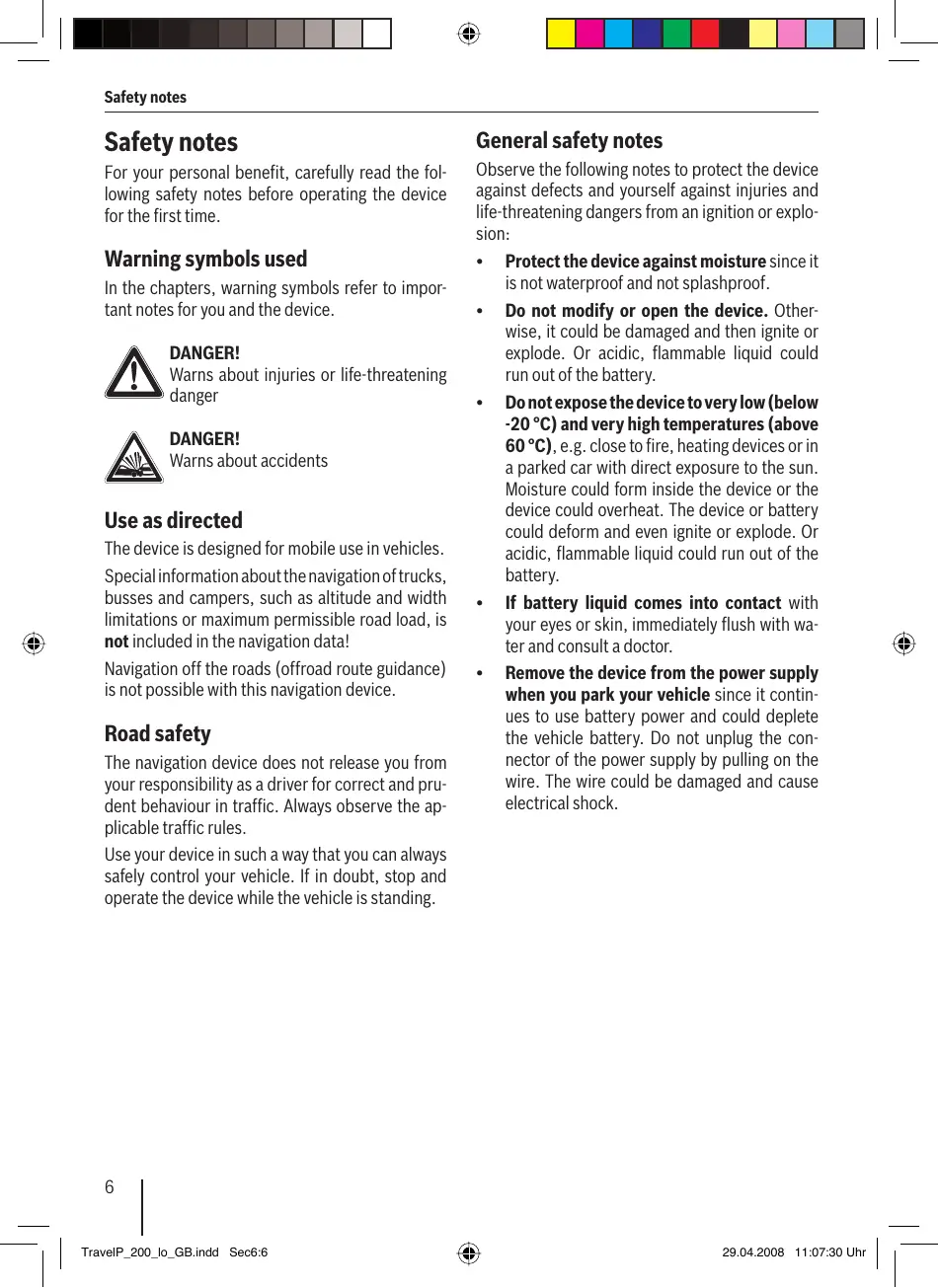

| Product type | Car navigation GPS |
| Dimensions (L x H x D) | 99 x 99 x 16.9 mm |
| Weight | Approx. 180 g |
| Power supply | Lithium-ion battery 3.7 V / 1150 mAh, mains charger 100-240 V, 12 V cigarette lighter cable |
| Battery life | Up to 3 hours in navigation |
| Charging time | 5 to 6 hours |
| Display | 3.5-inch TFT LCD touchscreen, 320 x 240 pixels, 4:3 format |
| Processor | Dual Core Centrality Atlas III clocked at 400 MHz |
| Internal memory | 64 MB SDRAM, 1 GB NAND Flash |
| Memory card slot | SD, MMC and SDHC cards up to 4 GB |
| GPS receiver | Built-in, 32 channels, QuickFind technology |
| TMC antenna | Built-in + external antenna connector |
| Main functions | Navigation with voice guidance, points of interest (POI), route planning, TMC function (traffic info), demo mode, route blocking |
| Connectivity | USB 2.0, external GPS antenna connector and external TMC antenna connector |
| Included accessories | Suction cup mount, cigarette lighter cable, wired TMC antenna, backup DVD, user manual |
| Security | Anti-theft protection with PIN and PUK codes |
| Maintenance and cleaning | Clean the screen with a soft, dry cloth; do not use solvents. Avoid humidity and extreme temperatures. |
| Spare parts and repairability | Accessories available on the Blaupunkt website. Reinstallation software via TPAssist. Reset possible. |
| Warranty | Manufacturer warranty for purchases within the European Union; conditions at www.blaupunkt.com |
| Brand and model | Blaupunkt TravelPilot 200 |
Frequently Asked Questions - TRAVELPILOT 200 BLAUPUNKT
User questions about TRAVELPILOT 200 BLAUPUNKT
0 question about this device. Answer the ones you know or ask your own.
Ask a new question about this device
Download the instructions for your Gps in PDF format for free! Find your manual TRAVELPILOT 200 - BLAUPUNKT and take your electronic device back in hand. On this page are published all the documents necessary for the use of your device. TRAVELPILOT 200 by BLAUPUNKT.
USER MANUAL TRAVELPILOT 200 BLAUPUNKT
Operating and installation instructions
(Long version)
Device overview
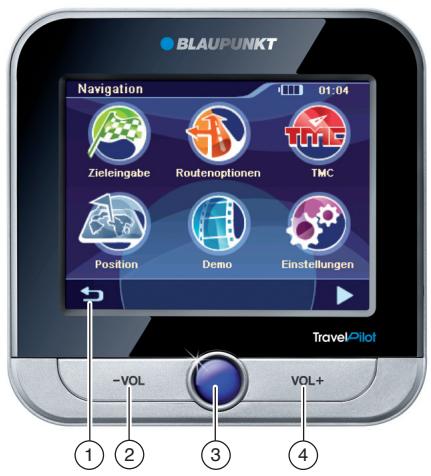
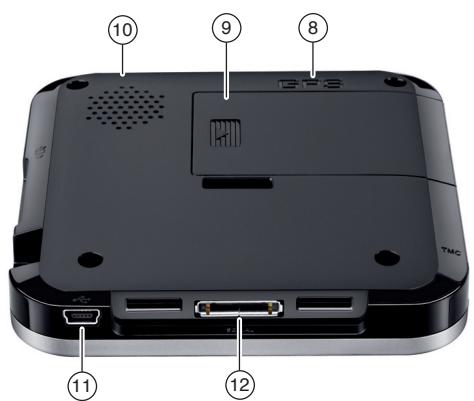
① Display (touchscreen): Simple and intuitive operation by touching the buttons on the display.
② VOL: Decreases the volume
③ On/Off switch:
- Long press (longer than 3 seconds):
Switches the device on or off. - Short press: Opens the main menu.
④ VOL+: Increases the volume
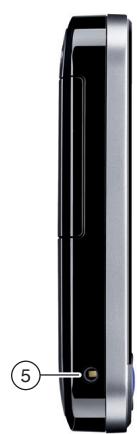
⑤ Socket for additional external TMC antenna (internal TMC antenna is present)
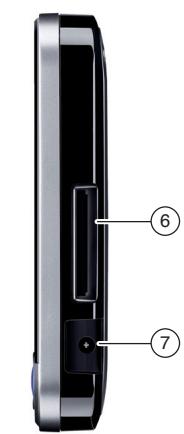
⑥ Memory card slot
⑦ Socket for power supply (battery charger or charger cable for the cigarette lighter)
⑧ Socket for additional external GPS antenna (internal GPS antenna is present)
9 Battery compartment cover
Light sensor for automatic switching of day and night display (top side)
11 USB port for data transfer
12 Serial port (for future expansions)
Device overview 2
Safety notes 6
Warning symbols used 6
Use as directed 6
Road safety 6
General safety notes 6
Notes about handling the CD/DVD .7
Cleaning notes 7
Disposal notes 7
First use. 7
Scope of delivery 7
Protective screen film 7
Charging the battery. 7
Switching on the device. 8
Setting the language 8
Installation in the vehicle 8
Attaching the suction cup holder .8
Attaching the mounting cup .8
Inserting the device in the mounting cup...9
Removing the device. 9
Removing the suction cup holder .9
Switching on/off. 9
Switch-on 9
Switch-off 9
Reset. 9
Operating the menus 10
Main menu 10
Buttons. 10
Keyboard 10
Intelligent auto-completion function....10
Error-tolerant entry 10
Lists 10
Information about GPS. 11
GPS mode of operation 11
Displaying GPS info 11
Performing basic settings 12
Setting the time zone 12
Entering the home address 12
Activating the PIN query 12
Configuring the PIN query. 13
Locking/unlocking the device. 13
Changing the PIN 13
Navigation 14
Starting the navigation 14
Destination entry. 14
Entering an address 14
Using the home address as destination...15
Copying a destination from the favourites. 15
Copying one of the last destinations.....15
Entering coordinates. 15
Copying a destination from the map.....15
Points of interest 16
User-POIs. 16
Selecting a point of interest at a specific location. 16
Selecting a point of interest nearby, in the destination area or at home 16
Selecting a point of interest on the map ..16
Selecting a supraregional point of interest 17
Tour planning 17
Entering the tour 17
Editing a tour 17
Loading a tour from the favourites.....18
Starting route guidance from here.18
Calculating the route from here. 18
Additional functions after the tour planning. 18
Exiting the tour planning. 18
Additional functions after the destination entry 19
Demo 19
Starting the demo 19
Demo settings. 19
Storing the position 20
Managing destinations. 20
Saving destinations 20
Storing a destination entered 20
Saving one of the last destinations.....20
Renaming a destination (favourites only)...21
Deleting a destination 21
Delete all destinations. 21
Calculating a route. 22
Starting the route calculation 22
Additional functions
after the route calculation. 22
Specifying route options 22
Route guidance. 23
Start route guidance 23
Reaching the place of destination 24
Quitting the route guidance. 24
Offroad route guidance 24
Disturbed GPS reception. 24
Working with the map 25
Showing a Map 25
Moving and scaling the map 25
Touching the map 25
Buttons. 25
Performing map settings 25
Voice output during route guidance.....26
Map display during destination guidance. 27
Navigation tools 27
Route information 27
Speed limit. 27
Additional functions during the route guidance 28
Entering a blocking 28
Cancelling route guidance. 28
Skipping the next destination. 28
Display information
about the destination. 28
Display route list 29
TMC function. 29
Establishing TMC reception 29
Connecting the TMC antenna 29
Searching for TMC stations 29
Showing traffic reports 29
Switch on automatic traffic jam detours..30
Traffic obstructions on the map display...30
Data transfer 30
Copying data to the memory card 30
Using road maps from memory card.....31
Settings 31
Performing settings for the navigation ....31
Home address 31
Continuing the tour automatically. 32
Selecting a dataset 32
POI note 32
Voice instructions. 32
Units 32
Performing device settings 32
Display 32
Button sound 33
Language 33
Time. 33
Product information 33
Theft protection. 33
Factory settings 33
Calibrating the touchscreen 33
Software 34
Reinstalling navigation software 34
Updating the navigation software. 34
Service 34
Warranty. 34
Technical data 34
Troubleshooting table 35
FCC Information (USA) 37
Safety notes
For your personal benefit, carefully read the following safety notes before operating the device for the first time.
Warning symbols used
In the chapters, warning symbols refer to important notes for you and the device.

DANGER!
Warns about injuries or life-threatening danger

DANGER!
Warns about accidents
Use as directed
The device is designed for mobile use in vehicles.
Special information about the navigation of trucks, busses and campers, such as altitude and width limitations or maximum permissible road load, is not included in the navigation data!
Navigation off the roads (offroad route guidance) is not possible with this navigation device.
Road safety
The navigation device does not release you from your responsibility as a driver for correct and prudent behaviour in traffic. Always observe the applicable traffic rules.
Use your device in such a way that you can always safely control your vehicle. If in doubt, stop and operate the device while the vehicle is standing.
General safety notes
Observe the following notes to protect the device against defects and yourself against injuries and life-threatening dangers from an ignition or explosion:
- Protect the device against moisture since it is not waterproof and not splashproof.
- Do not modify or open the device. Otherwise, it could be damaged and then ignite or explode. Or acidic, flammable liquid could run out of the battery.
- Do not expose the device to very low (below -20^ ) and very high temperatures (above 60^ ), e.g. close to fire, heating devices or in a parked car with direct exposure to the sun. Moisture could form inside the device or the device could overheat. The device or battery could deform and even ignite or explode. Or acidic, flammable liquid could run out of the battery.
If battery liquid comes into contact with your eyes or skin, immediately flush with water and consult a doctor. - Remove the device from the power supply when you park your vehicle since it continues to use battery power and could deplete the vehicle battery. Do not unplug the connector of the power supply by pulling on the wire. The wire could be damaged and cause electrical shock.
Notes about handling the CD/DVD
The device is supplied with a CD/DVD that contains navigation software and map material. To protect the CD/DVD against dirt and damage, observe the following notes:

Store the CD/DVD in its case. Hold the CD/DVD only at the edge.

Do not expose the CD/DVD and the case to direct sunlight.

Use only a clean CD/DVD. If necessary, clean the CD/DVD with a soft, lint-free cloth from inside to outside.
Never clean the CD/DVD in a circular motion.

Do not use any solvents, including on the printed side of the CD/DVD.
Cleaning notes

Clean the display with a dry, soft cloth. Water and other liquids could damage the display.

Do not use strong detergents for cleaning the housing. Use only a moistened, lint-free cloth.
Disposal notes

Use the return and collection systems available to dispose of the old device.

Do not discard any batteries in the household trash; instead, return them to the corresponding collection sites.
First use
Scope of delivery
The scope of delivery contains the following components:
- Navigation device
- Suction cup bracket
- Charger cable for cigarette lighter
TMC line antenna - Operating instructions (short version)
- Backup DVD
Note:
We recommend the use of original Blaupunkt accessories (www.blaupunkt.com).
Protective screen film
Prior to the initial use, carefully remove the protective film from the display.
Charging the battery
Upon purchasing the navigation device, the battery could be discharged. Please charge the battery before using the device.
CAUTION!
Unapproved chargers could damage batteries
Use only the original chargers from Blaupunkt for operating and charging to correctly charge the battery and protect it against overvoltage.
Depending on the type of use, you can operate the device up to 3 hours with the built-in battery. The charging time is 5 to 6 hours. The charge state indicator is located on the top display bar:
The device is supplied by an external power source.
The device is supplied by its internal battery. The charge state of the battery is sufficient.
The device is supplied by its internal battery. The charge state of the battery is low.
If the charge state of the battery becomes weak, the navigation device warns you about it.
Connect the battery charger or the charger cable for the cigarette lighter to the charging socket.
Note:
The battery is equipped with a protection against overheating from excessive current flow. The protection prevents charging the battery starting at an ambient temperature above 45^ .
Switching on the device
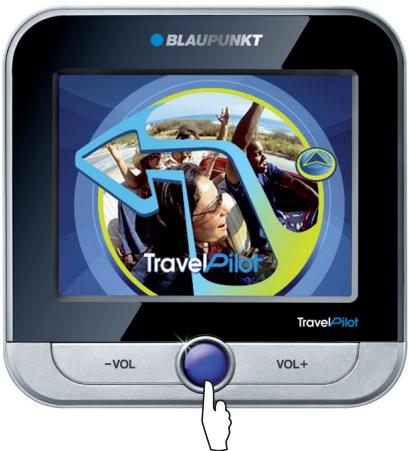
Press and hold the On/Off switch for longer than 3 seconds.
Setting the language
The device uses English as the standard language for the menus and voice output. When you switch on the device for the first time, a dialogue menu appears in which you can select another language:
- Select your preferred language in the dialogue menu.
Please follow the instructions.
The language is loaded and the main menu is displayed.
Installation in the vehicle
For temporary installation in a vehicle, the navigation device features a holder to attach it to the windshield.

DANGER!
The installation at an unsuitable location can cause accidents
Install the navigation device so that it does not block your view and does not distract from the traffic.
Do not install the device in the airbag deployment area.
Ensure that the device does not pose a threat to passengers in the vehicle in case of emergency braking.
Attaching the suction cup holder
Locate a suitable place inside the vehicle for the installation.
To ensure a perfect hold, the glass must be free of dust and oil. If necessary, clean the glass using a lens cleaning tissue.
Press the suction cup of the holder against the windshield.
Push the lever on the support towards the glass.
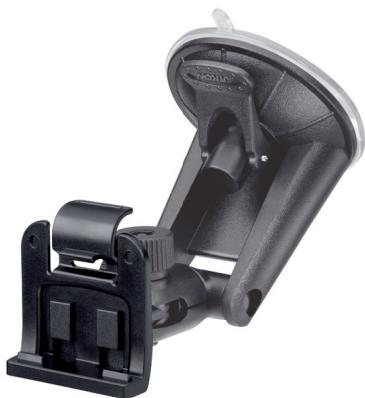
Attaching the mounting cup
The suction cup holder features two mounts for the mounting cup.
Push the mounting cup onto the mount until it engages.
Inserting the device in the mounting cup
The device features 2 recesses on the underside and one recess on the rear side for the mounting cup.
Place the device onto mounting cup with the underside first and push it to the back.
The clamping holder of the mounting cup must engage in the rear side of the housing with a click.
Align the bracket.
Removing the device
Push the clamping holder down.
The device disengages from the bracket.
Remove the device.
Removing the suction cup holder
If you change vehicles, you can simply remove the support.
Push the lever on the support away from the glass.
Carefully loosen the suction cup at the edge from the glass so that air can enter between suction cup and glass.
Carefully pull the suction cup off of the glass.
Switching on/off
The On/Off switch is used to switch the device on and off and to open the main menu.
Switch-on
Press and hold the On/Off switch for longer than 3 seconds.
Switch-off
Press and hold the On/Off switch for longer than 3 seconds.
The device is first placed in idle state and remains ready for operation. All functions will be completely switched off after 20 minutes.
Note:
The device continues to use a small amount of energy even if it is switched off. If you use the device again after an extended period of time, it may be necessary to recharge the battery.
Reset
If the device does not work properly, a simple reset may help.
Press and hold the On/Off switch for longer than 14 seconds.
The device is switched off and restarted.
Operating the menus
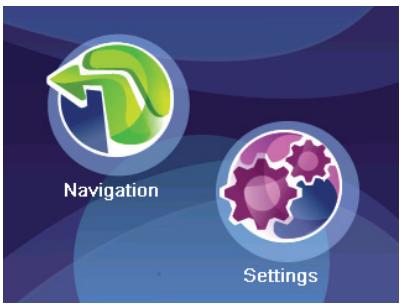
Main menu
The main menu provides access to the navigation and the settings.
Briefly press the On/Off switch to reach the main menu from any other menu.
Buttons
- Touch this button to return to the previous menu.
- Touch this button to change to the next page in the menu.
- Touch this button to obtain access to additional functions.
- OK: Touch this button to confirm an entry or a setting.
Keyboard
If text entries are required (e.g. for the destination entry), a virtual keyboard appears on the display. You can perform all entries using your finger. Only capital letters can be entered.
These buttons are located on the keyboard:

Delete last character

Entering blank spaces
AE Call up alternate character keyboard (incl. special characters, umlauts)
123 Call up numeric keypad, e.g. to enter the house number
ABC Call up character keyboard
? Call up error-tolerant entry
Intelligent auto-completion function
During the entry, the device auto-completes characters as far as possible and offers only those characters on the keyboard that are logically possible.
Error-tolerant entry
The error-tolerant entry helps if you do not know the exact spelling of a city. After your entry, a list with city names spelled in a similar way appears.
Touch the symbol in the text entry. The error-tolerant entry is displayed.
Enter a city name and touch OK.
A list with alternate city names is displayed.
Lists
You can frequently display lists form which you can select an entry (e.g. a destination). For example, if you do not enter the complete name of a location, a list with possible results is displayed.
To display a list with additional matching entries, touch the List button. Longer lists require a longer loading time.
Touch one of the buttons to scroll through the list.
Touch an entry directly to accept it.
Touch the Expand button to display abbreviated entries in their entirety.
Information about GPS
The GPS (Global Positioning System) allows worldwide navigation and locating via satellites to determine a position.
GPS mode of operation
The navigation device measures the current position of your vehicle via GPS and compares these coordinates with its map material. The map material contains the geographic coordinates of points of interest, streets and cities that you can view on the display of the navigation device. The device uses this information to calculate the route to the destination you entered.
Displaying GPS info
Information about the GPS reception of the device, your current position and your speed can be found in the GPS Info menu.

Touch the symbol in the main menu.
The map is displayed.

Touch the symbol.
The Navigation menu is displayed.

Touch the button.
The display shows the second page of the menu.

Touch the symbol.
The GPS Info menu is displayed.
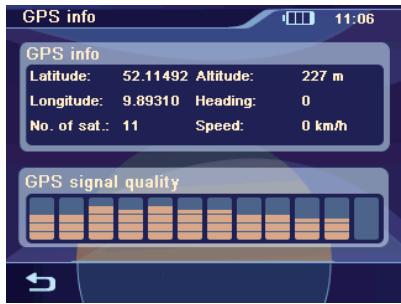
This menu contains this information:
Latitude/Longitude: Current position in longitude and latitude
Altitude: Current height above mean sea level
- Speed: Indicates the current speed of the vehicle
Heading: Driving direction (reliable information after approx. 5km / h
- Satellites: Number of GPS satellites received
GPS Signal Quality: Signal strength of the visible GPS satellites. The navigation requires signals from at least 3 satellites.
Note:
External influences can interfere with the view to the sky and, therefore, the GPS reception of the navigation device. For this purpose, please read the chapter "Route guidance", "Disturbed GPS reception".
Performing basic settings
Before starting a route guidance, perform these basic settings:
- Set the time zone of your position so that the correct arrival times are displayed during the navigation.
- You should enter your home address to quickly navigate home from any location.
- Activate the PIN query to lock out unauthorised persons from using the device.
Setting the time zone
Touch the symbol in the main menu. The Settings menu is displayed.
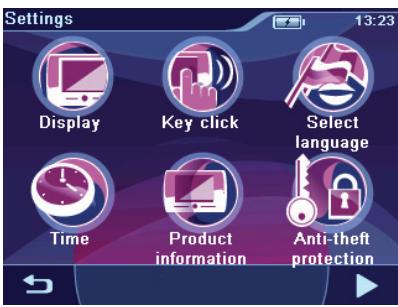
Touch the symbol. The Time menu is displayed.
Touch the symbol. A list with available time zones is displayed.
Touch the time zone in the list that applies to your location.
Note:
The selection is facilitated by the display of the capitals in the respective time zone. "GMT" stands for Greenwich Mean Time, the mean solar time at the Greenwich meridian without considering daylight savings time.
Touch the OK button.
Touch the symbol to toggle between 24-hour and 12-hour display.
Touch the symbol to activate (check mark) or deactivate (no check mark) daylight savings time.
Note:
If the time is changed at your position or if you drive into a different time zone, you must adjust the settings.
Touch the button to exit the menu again.
Entering the home address
Touch the symbol in the main menu. The map is displayed.
Touch the symbol. The Navigation menu is displayed.
Touch the symbol. The Navigation Settings menu is displayed.
Touch the symbol. The Destination Input menu is displayed.
Enter the address as described in the chapter "Destination entry", "Entering an address".
Touch the OK button. The home address is saved.
Activating the PIN query
The PIN query allows you to lock out unauthorised persons from using the device. Hence, every time you switch on the device, the PIN (Personal Identity Code) you configured for yourself is requested. The PIN can be changed at any time. If you should forget the PIN, you can unblock the device again with the PUK (Personal Unblocking Key) which you define yourself. The PUK cannot be changed.
Note:
During the PIN entry, you have only 3 attempts to enter the correct PIN or subsequently 3 attempts to enter the correct PUK. If you enter an incorrect PUK for the 3rd time, your device is permanently blocked and the device must be returned via the Blaupunkt service.
Configuring the PIN query

Touch the symbol in the main menu.
The Settings menu is displayed.

Touch the symbol.
The Anti Theft Protection menu is displayed.
Touch the Protection Setup button.
Touch the OK button.
The PIN query is displayed.
Follow the instructions and enter a self-selected PIN.
Touch the OK button.
The initial configuration of the PIN is followed by a request to enter a PUK. The PUK is used to unlock the device if you should forget the PIN.
Follow the instructions and enter a self-selected PUK.
Touch the OK button.
To secure your PUK:
Register under http://puk.blaupunkt.com and follow the instructions.
Locking/unlocking the device
Prerequisite:
You configured the PIN query.
In the Anti Theft Protection menu, touch the Protection Setup button to lock the device (check mark) or to unlock it (no check mark). The PIN query is displayed.
Enter your PIN.
Touch the OK button.
Changing the PIN
In the Anti Theft Protection menu, touch the Change PIN Code button. The PIN query is displayed.
Follow the instructions and enter a new self-selected PIN.
Touch the OK button.
Navigation
The navigation device does not release you from your responsibility as a driver for correct and prudent behaviour in traffic.

DANGER!
Distraction from the traffic can cause accidents
Do not operate the device while driving.
View the display only during safe traffic situations.
Notes:
- Routes are best planned before starting your trip.
- Perform the basic settings first.
Starting the navigation

Touch the symbol in the main menu.
The map is displayed.
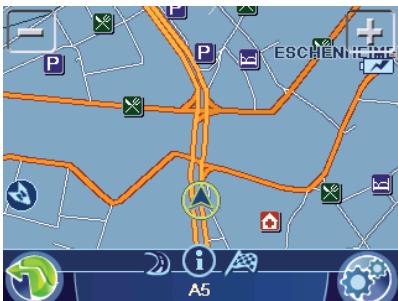
From the map, you can directly change to the navigation menu or to the map settings (Ch. "Working with the map").
Destination entry
In the destination entry, you can enter an address, select a destination from memory, or select a point of interest.

Touch the symbol.
The Navigation menu is displayed.
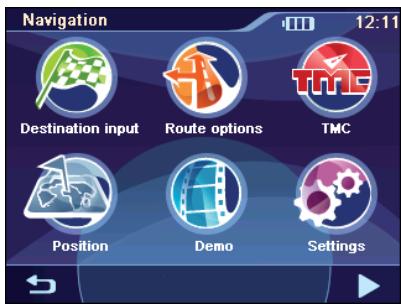

Touch the symbol in the Navigation menu.
The Destination Input menu is displayed.
Note:
You can only select places of destination (countries, cities, streets, house numbers, points of interest) that are contained in the map material.
Entering an address

Touch the symbol.
For the initial destination entry, a list with countries is displayed.
Select your destination country.
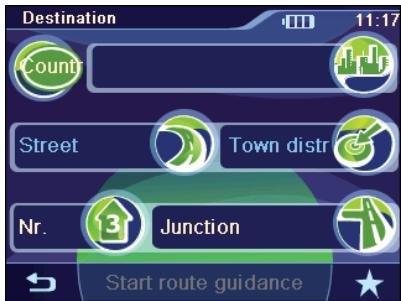
The Destination menu is displayed.
Note:
You do not have to repeat entering the country, city and street information every time. Only if your destination is at a different location than the previous one will you have to re-enter the destination address.

Touch the symbol to select a different country.

Touch the symbol and enter the city or postal code.

Touch the symbol and enter the part of town.
Touch the symbol and enter the street.

Touch the symbol and enter the house number.
Touch the symbol and enter the street that intersects the previously entered street.
Touch the Start Route Guidance button to start the route guidance.
The route is calculated and the route guidance started.
Note:
After the destination entry, you can start the route guidance or store the destination. For further details, read the chapter "Additional functions after the destination entry".
Using the home address as destination
If your home address is saved, you can quickly navigate home from any location. The stored address can be viewed in the settings and changed, if necessary (Ch. "Settings").

Touch the symbol in the Navigation menu.
Copying a destination from the favourites

Touch the symbol.
The Favourites menu is displayed.
Touch the desired destination.
The address of the destination is displayed.
Touch the Start Route Guidance button.
Copying one of the last destinations

Touch the symbol.
The Last destinations menu is displayed.
Touch the desired destination.
The address of the destination is displayed.
Touch the Start Route Guidance button.
Entering coordinates

Touch the button.
The display shows the second page of the menu.

Touch the symbol.
The Destination Coordinates menu displays.

Touch the symbol and enter the latitude.

Touch the symbol and enter the longitude.
Always select the cardinal point first and then enter the values with the corresponding units.
Touch the OK button.
Touch the Start Route Guidance button.
Copying a destination from the map

Touch the button.
The display shows the second page of the menu.

Touch the symbol.
The map is displayed.
Move and scale the map as described in the chapter "Working with the map".
Touch a location of your choice.

The city is selected and its name appears in the lower display bar.
Touch the OK button.
The coordinates to the selected location are displayed.
Touch the Start Route Guidance button.
Points of interest
Points of interest (POI) are specific locations, such as parking facilities and petrol stations, that are stored in the map material.

Touch the symbol in the Destination Input menu.
The Points of Interest menu is displayed.
User-POIs
Besides petrol stations & companies, the points of interest also provide the User-POIs category. This allows you to expand the navigation using individual points of interest, e.g. to add the addresses of friends or your favourite restaurant.
The enclosed CD/DVD contains an installation programme with instructions to create your own POI lists at computer or to load existing POI lists.
Selecting a point of interest at a specific location


In the Points Of Interest menu, touch the symbol.
The Points Of Interest In Town menu is displayed.


Touch the symbol to select a different country.


Touch the symbol to enter a different city.
Touch the OK button.
The Town District menu is displayed.
For large cities, enter the part of the city.
Touch one of the symbols to select a point of interest category.
The keyboard is displayed.
Enter the name of the point of interest.
-or-
Touch the List button.
A result list is displayed.
Touch an entry of your choice.
The address of the destination is displayed.
Touch the Start Route Guidance button.
Selecting a point of interest nearby, in the destination area or at home


In the Points Of Interest menu, touch the symbol to select a point of interest nearby.
-or-


In the Points Of Interest menu, touch the symbol to select a point of interest in the destination area.
Note:
The destination to which you started a route guidance last is taken as the destination area.
-or-


In the Points Of Interest menu, touch the symbol to select a point of interest at the home address.
Select the point of interest category.
Select the point of interest.
Touch the Start Route Guidance button.
Selecting a point of interest on the map


In the Points Of Interest menu, touch the symbol.
The map is displayed.
Move and scale the map as described in the chapter "Working with the map".
Touch a location of your choice.

The city is selected and its name appears in the lower display bar.
Touch the OK button.
Select the point of interest category.
Select the point of interest.
Touch the Start Route Guidance button.
Selecting a supraregional point of interest
If a point of interest cannot be precisely assigned to a location, e.g. an airport, a motorways exit and a mountain pass, you can enter it as a supraregional point of interest.

In the Points Of Interest menu, touch the symbol.
The Supra-Regional menu is displayed.
Touch the Select Country button to select a different country.
Touch one of the symbols offered to select a point of interest category. The keyboard is displayed.
Enter the name of the point of interest. - or -
Touch the List button. A result list is displayed.
Touch an entry of your choice. The address of the destination is displayed.
Touch the Start Route Guidance button.
Tour planning
The tour planning allows you to enter a tour with several interim destinations and to store it, for example, for the demo (Ch. "Demo"). The start position is always the current position.

Touch the symbol in the Destination Input menu.
The Tour Planning menu is displayed.
Entering the tour
In the Tour Planning menu, touch the Add Destination button.
Enter a destination as described in the chapter "Destination entry".
Note:
You can load already stored tours from Last destinations or Favourites and add additional destinations.
Touch the OK button.
Repeat the steps to enter additional destinations.
Note:
You can enter a tour with up to 10 destinations.
Editing a tour
Touch a destination in the tour list.
The address is displayed.
Touch the button to call up the add-on menu.
Touch the symbol to move the destination.
The Move Destination menu displays.

Touch the buttons to move the destination up or down in the tour list.
Touch the OK button.
Touch the symbol to delete the destination.
Loading a tour from the favourites
From the favourites, you can copy a destination for the tour planning or load a stored tour and then edit it.
Prerequisite:
- You opened the Favourites menu as described in the chapter "Destination entry", "Copying a destination from the favourites".
In the Favourites menu, select a stored tour or a destination.
Touch the button to call up the add-on menu.
Touch the symbol. The tour list with the destinations is displayed. - Touch the Add Destination button to enter additional destinations.
Starting route guidance from here
Destinations in the tour list can be skipped for the route guidance. Example: You want to interrupt the tour and continue it at a later time:
Touch a destination in the tour list. The address is displayed.
Touch the button to call up the add-on menu.
Start Touch the symbol. The route is calculated starting with the current position and the route guidance starts to the next interim destination.
Calculating the route from here
If you want to calculate the route to a specific interim destination in order to learn about distance and travel time:
Touch a destination in the tour list. The address is displayed.
Touch the button to call up the add-on menu.
Touch the symbol. The route is calculated starting with the current position.
Additional functions after the tour planning
Prerequisite:
You opened the tour list.
Touch the button to call up the add-on menu.
You have now the following options:
Starting the route guidance (Ch. "Route guidance")
Calculating a route (Ch. "Calculating a route")
- Storing the tour in the favourites (Ch. "Managing destinations")
- Delete a tour
Displaying a tour on the map (Ch. "Working with the map")
Exiting the tour planning
Touch this button to exit the menu.
Store the tour in the favourites or delete it.
Additional functions after the destination entry
Prerequisite:
- You entered a destination as described in the chapter "Destination entry".
-or- - You entered a point of interest as described in the chapter "Points of interest".
-or- - You planned a tour as described in the chapter "Tour planning".
Touch the button to call up the add-on menu.
You have now the following options:
Defining route options (Ch. "Specifying route options")
Calculating a route (Ch. "Calculating a route")
Saving a destination as favourite (Ch. "Managing destinations")
Displaying a destination on the map (Ch. "Working with the map")
- Favourites only: Deleting a destination (Ch. "Managing destinations")
Favourites only: Renaming a destination (Ch. "Managing destinations")
Favourites only: Planning a tour with the selected destination (Ch. "Tour planning")
Note:
The range of functions varies depending on whether you entered a destination or selected one from memory.
Demo
Conveniently plan your vacation trip at home and gain an overview of the route and travel time - even without GPS reception.
Starting the demo
Entering the demo consists of the start position, which may be different from your current position, and the destination. If you want to use the demo to travel a tour with interim destinations, specify the start position and select a stored tour as the destination (Ch. "Tour planning").
Touch the symbol in the Navigation menu.
The Demo menu is displayed.
Touch the upper field and enter the start position.
Touch the lower field and enter the destination.
Enter the start position and the destination for the demo as it is done in the destination entry.
Touch the Start Demo button to travel the route.
You have access to the same functions as during a route guidance. (Ch. "Additional functions during the route guidance")
Demo settings
You can specify whether the route should be travelled once or endlessly during the demo.
Touch the button to call up the add-on menu.
Touch the symbol to change between single demo and endless demo.
The endless loop in the symbol indicates that the endless demo is activated.
Storing the position
You can store your current position and later use it as a destination.


Touch the symbol in the Navigation menu.
The Position Information menu is displayed.
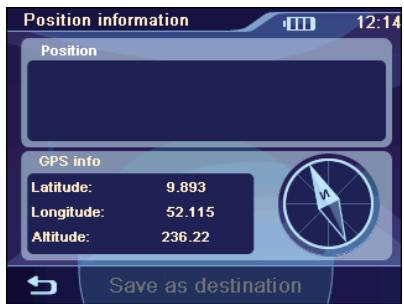
This menu contains this information:
- The address of the current location, if it is contained in the map material
Latitude/Longitude: Current position in longitude and latitude
Altitude: Current height above mean sea level
The compass: Driving direction (reliable information after approx. 5km / h
Touch the Save As Destination button.
The keyboard is displayed.
Enter a name for the destination and confirm with OK.
The destination is stored under the name entered in the Favourites menu.
Managing destinations
Two lists are available in which individual destinations are saved:
In the Favourites
In the Last Destinations list
Destinations from the Favourites can be renamed.
You can delete individual destinations from both lists.
Saving destinations
All destinations to which you start a route calculation (Ch. "Calculating a route") are automatically stored in the Last destinations. The last 100 destinations are stored.
Every destination entered and the destinations of the Last destinations list can by permanently stored in the Favourites. This is particularly useful if you want to approach this destination repeatedly.
Storing a destination entered
Prerequisite:
- You entered a destination as described in the chapter "Destination entry".

In the Destination menu, touch the button to call up the add-on menu.

Touch the symbol.
The keyboard is displayed.
Enter a name for the destination and touch OK.
The destination is stored in the Favourites under the name entered.
Saving one of the last destinations
Prerequisite:
- You opened the Last destinations list as described in the chapter "Destination entry", "Copying one of the last destinations".
- Select the destination to be saved in the Last destinations list.
Touch the button to call up the add-on menu.
Touch the symbol. The keyboard is displayed.
Enter a name for the destination and touch OK.
The destination is stored in the Favourites under the name entered.
Renaming a destination (favourites only)
You can rename a stored destination in the Favourites:
Prerequisite:
- You opened the Favourites menu as described in the chapter "Destination entry", "Copying a destination from the favourites".
In the Favourites menu, select the destination to be renamed.
Touch the button to call up the add-on menu.
Touch the symbol. The keyboard is displayed.
Enter a new name for the destination and touch OK.
The destination is stored in the Favourites under the name entered.
Deleting a destination
You can delete a destination stored in the favour- ites or a last destination:
Prerequisite:
- You opened the Last destinations list as described in the chapter "Destination entry", "Copying one of the last destinations". - or -
- You opened the Favourites menu as described in the chapter "Destination entry", "Copying a destination from the favourites".
Select the destination to be deleted.
Touch the button to call up the add-on menu.
Touch the symbol. A confirmation is displayed.
Touch Yes to delete the destination. - or -
Touch No in order to not delete the destination.
Delete all destinations
You can delete all the last destinations or all destinations in the Favourites:
Touch the symbol in the Navigation menu. The Destination Input menu is displayed.
Touch the symbol in the Navigation menu. The Favourites menu is displayed.
-or-
Touch the symbol. The Last destinations menu is displayed.
Touch the button to call up the add-on menu.
Touch the symbol. A confirmation is displayed.
Touch Yes to delete the destination. -or-
Touch No in order to not delete the destination.
Calculating a route
Calculate the route to a destination entered to learn about distance and travel time: Afterwards, you have the option to start the route guidance or to continue optimising the route options.
All destinations, for which a route is calculated, are stored in the Last destinations.
Starting the route calculation
Prerequisite:
- You entered a destination as described in the chapter "Destination entry". - or -
- You entered a point of interest as described in the chapter "Points of interest". - or -
- You planned a tour as described in the chapter "Tour planning".
Touch the button to call up the add-on menu.
Touch the symbol. The route is being calculated.
Note:
If no GPS reception is available, the last known position is taken as the starting point of the route.
Additional functions after the route calculation
After the route calculation, you have the option to start the route guidance or to display the route on the map.
Touch the Start Route Guidance button.
The route is calculated and the route guidance started.
-or-
Touch the symbol. The route is shown on the map.
Specifying route options
The route options can be defined at any time. If you change the route options during a route guidance, the route may be recalculated.
Touch the symbol in the map view. The Navigation menu is displayed.
Touch the symbol.
The Route Options menu is displayed.
Touch the symbol to select the type of route calculation:
- Fast: The route with the fastest travel time is calculated.
- Short: The route with the shortest distance is calculated.
- Optimal: Combination of shortest and fastest route at a ratio of 40 to 60 percent. Distance and time are taken into consideration. This route type is adjustable and described below.
Ecological: The route with the lowest driving expenses (fuel efficient) is calculated. For this purpose, the shortest and fastest route are combined at a ratio of 75 to 25 percent.
Economic: Combination of fastest and ecological route. Time and costs are taken into consideration. For this purpose, the shortest and fastest route are combined at a ratio of 40 to 60 percent.
Touch the symbol to change between speed profiles offered.
Note:

You can call up an add-on menu for the profiles Fast or Slow: Select the
Adaptive option so that the profile can be adapted to your driving style. If necessary, it can be reset to the factory setting.


Touch the symbol to activate (check mark) or deactivate (no check mark) automatic traffic jam detours with TMC.


Touch the symbol to allow (check mark) or disallow (no check mark) motorways.


Touch the symbol to allow (check mark) or disallow (no check mark) toll roads.


Touch the symbol to allow (check mark) or disallow (no check mark) ferries.


Touch the button.
The display shows the second page of the menu.


Touch the symbol to allow (check mark) or disallow (no check mark) tunnels.


Touch the symbol to allow (check mark) or disallow (no check mark) seasonal roads.
Seasonal roads are roads that could be closed depending on the season, e.g. snowfall.


Touch the symbol to adjust the relationship of short and fast for the route type Optimal.


Touch this button to exit the menu.
Route guidance

DANGER!
Disregarding traffic rules can lead to accidents
Follow the turn-by-turn directions only if the street routing and traffic rules allow it. The navigation device will bring you to your destination even if you have to deviate from the planned route.
Notes:
- Repeat the voice output if you did not understand it. (Ch. "Voice output during the route guidance")
- You can always use the map or arrow display for orientation purposes.
Start route guidance

Touch the Start Route Guidance button.
The route is calculated and the route guidance started.
Notes:
- The route is calculated using the settings for the route calculation. (Ch. "Specifying route options")
- The destinations are automatically stored in the Last Destinations.
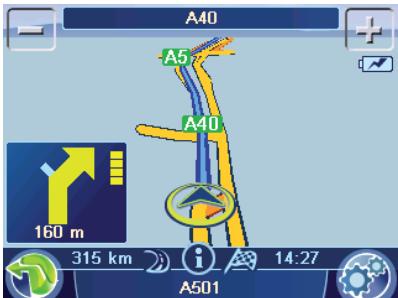

The so-called "cursor" represents your position.

Compass: Always points north (for orientation)
Note:
If you enter an additional destination during an active route guidance and start the route guidance, you have two options:
- You can insert the destination as interim destination. The route is recalculated and the interim destination is approached next.
- Or you start a new route guidance to the destination entered.
Reaching the place of destination
As soon as you have reached the destination point, the message "You have reached your destination" appears. The map now displays only your current position.
Quitting the route guidance
Touch any position on the map.
The Route Guidance Options add-on menu is displayed.

Touch the symbol to quit the route guidance.
A confirmation is displayed.
Touch Yes to quit the route guidance.
The map is displayed.
-or-
Touch No to continue the route guidance.
Offroad route guidance
If you are on a road that is not part of the map material ("off road"), a route cannot be calculated. The navigation device then supports the route guidance like a digital compass:
An arrow points to the direction of the destination.
The distance to the destination (straight line) is displayed.
- The coordinates of your current position and the destination are displayed.
A prerequisite in this case is sufficient GPS reception.
Disturbed GPS reception
On the map, the symbol indicates that no sufficient GPS signal is being received. If you start a route guidance at this point, the navigation device calculates the route based on the last known position.
If the GPS reception is disturbed during route guidance for an extended period of time, the route guidance is stopped. As soon as the reception is re-established, the device automatically recognises whether your position has changed and, if necessary, recalculates the route. At that time, you can simply continue your destination guidance.
Note:
External influences can interfere with the view to the sky and, therefore, the GPS reception of the navigation device. For further details, read the chapter "Troubleshooting table".
Working with the map
Showing a Map
Touch the symbol in the main menu.
To change to the map display from the Navigation menu:
Touch the button.
To reach the map view after the destination entry:
Touch the button to call up the add-on menu.
Touch the symbol.
Touch the button to close the map view and return to the destination entry.
Moving and scaling the map
To view the desired destination area on the map, you can move the map section and scale it (zoom in and zoom out).
Touch one of the symbols to zoom in or out of the map.
Touch the map and move the map in the desired direction.
Touch the button to return to your current position.
Touching the map
Touch a location (the street or the point of interest) in the map.
The city is selected and its name appears in the lower display bar.
Touch the OK button.
The coordinates to the selected location are displayed.
Touch the symbol to adopt the city as the destination.
The route guidance is being started.
-or-
Touch the symbol to store the location and use it as destination at a later time.
The keyboard is displayed.
Enter a name for the destination and touch OK.
The destination is stored in the Favourites under the name entered. (Ch. "Managing destinations")
Note:
If you touch any place in the map during the route guidance, an add-on menu with additional functions is displayed. For further details, read the chapter "Additional functions during the route guidance".
Buttons
In the map view, the following buttons are available:
Touch the symbol to reach the Navigation menu.
Touch the symbol to reach the Map Settings menu.
Performing map settings
Touch the symbol in the map view. The Map Settings menu is displayed.
Touch the symbol to toggle between day and night display or to activate the automatic function.
If you activate the automatic function, switching between day and night display occurs automatically. In the process, the display brightness is constantly adjusted to the light conditions. (For further details, read the chapter "Settings", "Performing device settings").
Touch the symbol to change between 2D and 3D view.
Touch the symbol to change the map orientation between driving direction and direction North.

Touch the symbol to show (check mark) or hide speed warnings (no check mark) on the map.
- Touch the symbol to switch the warning beep on (check mark) or off (no check mark).
- Touch the symbol to adjust a tolerance value for the speed warning. A warning occurs only if the tolerance value is exceeded.
Touch the symbol to show (check mark) or hide (no check mark) points of interest.
Touch the symbol to switch auto zoom on (check mark) or off (no check mark). Auto zoom means that the map scale is perfectly adjusted to the respective driving situation during route guidance. If you approach an action, the view is enlarged, e.g. so that you can clearly see the next intersection. If the next action is farther away, the view is reduced so that you can easily see the run of the road.
Touch the button.
The display shows the second page of the menu.
Touch the symbol to show (check mark) or hide altitude and speed (no check mark) on the map.
For route guidance with several interim destinations, the time and distance to the next interim destination is shown on the map. Touch the symbol to also show (check mark) or hide (no check mark) the time and distance to the last destination.
Touch the symbol to show (check mark) or hide (no check mark) distances to points of interest.
Note:
The distances are shown exclusively for points of interest along your route and only at motorways.
Touch the symbol to change between the display of arrival time and remaining driving time (travel time).
Voice output during route guidance
Your navigation device supports route guidance with voice-prompted turn-by-turn directions and announces turns in advance. In the process, it also announces the names of major roads and motorways. In the settings, you can activate and deactivate the voice instructions of the navigation (Ch. "Settings", "Settings for navigation").
Note:
The volume can be changed only if the voice output is currently active.
During the voice output, press the button VOL - or VOL + to change the volume for the voice output.
Touch the lower field on the display to repeat the last voice output.
Map display during destination guidance
During the route guidance, the map display shows you different navigation tools and route information.

DANGER!
Disregarding the street routing can lead to accidents
The information on the digital road maps may no longer be current due to short-term changes (construction, etc.).
Additional information, e.g. the speed limit, can be shown only if they are contained in the map material.
The signposts and local street routing always have priority over the information of the navigation device.
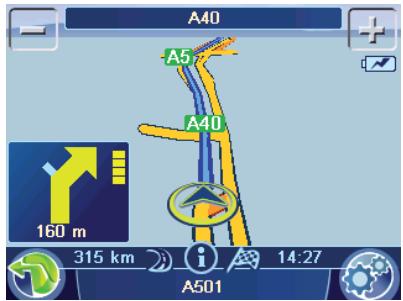
Navigation tools

The so-called "cursor" represents your position.

The compass always points north (for orientation).
Top field: Name of next street
Bottom field: Name of current street

The action arrow shows the next action and the distance to that action.
When you come closer to the location of the next action, a bar is shown on the right side: The fewer yellow segments are displayed, the closer you are to the location of the next action.

Voice output is activated.

Voice output is deactivated (muted). Touching the symbol reactivates the voice output.
Route information
The lower display bar shows the following route information by default:
Remaining distance to destination
Estimated time of arrival
Instead of the arrival time, you can also display the remaining driving time.
For route guidance with several interim destinations, the route information for the next interim destination is displayed. In addition, you can show the distance and time for the last destination.
For settings, please read the chapter "Working with the map", "Performing map settings".
Speed limit

The speed limit is shown in the left area of the map.
0
Note:
This information can be displayed only if it is activated in the navigation settings. (Ch. "Working with the map", "Performing map settings")
Additional functions during the route guidance
Prerequisite:
- Route guidance - or -
- Route simulation (demo)
Touch any position on the map to display additional functions.
The Route Guidance Options add-on menu is displayed.
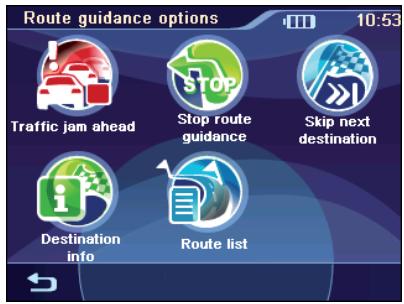
The following functions are now available:
- Entering a blocking
- Cancelling route guidance
- Skipping the next destination
Display information about the destination
Display route list
Entering a blocking
During the route guidance, you can block the route segment lying ahead of you. An alternate route is calculated and the blocked partial route is bypassed.

Touch the symbol in the add-on menu.
The Traffic Jam Ahead menu is displayed.
In this menu, you can select the length of the blocking, starting with your current position.


Touch the buttons to enter the length of the blocking.
Touch the OK button.
The route is recalculated and the blocked route segment is evaded.

The symbol identifies the blocking. The blocked segment is marked in red.
To cancel the blocking:


In the add-on menu, touch the symbol again (the check mark indicates that a blocking has been entered).
A confirmation is displayed.

Touch Yes to delete the blocking.
The route is being recalculated. -or-

Touch No in order to not delete the blocking.
Cancelling route guidance


Touch the symbol in the add-on menu.
A confirmation is displayed.

Touch Yes to quit the route guidance.
The map is displayed.
-or-

Touch No to continue the route guidance.
Skipping the next destination
Prerequisite:
- Tour with at least 1 interim destination (tour planning)


In the add-on menu, touch the symbol to skip the next interim destination.
The route is recalculated and the next destination is approached.
Display information about the destination


Touch the symbol in the add-on menu.
The destination address with information about distance and arrival or remaining driving time is displayed. For tours, all interim destinations are listed.
The destination can be displayed on the map:

Touch the Show In Map button.
Touch the symbol to exit the map view again.
Display route list
The route list can be displayed to gain an overview of the route.
Touch the symbol in the add-on menu.
The route list is displayed.
Touch the buttons to scroll through the route list.
Touch the symbol to exit the route list again.
TMC function
The Traffic Message Channel continuously broadcasts traffic announcements. The TMC function in your device allows you to receive and display the messages. Or you can use them for route guidance so that you can avoid traffic jams.
Establishing TMC reception
TMC is a service of the radio stations and is not offered in all countries. The troubleshooting table shows the countries in which TMC is available.
Connecting the TMC antenna
Your navigation device features a built-in TMC antenna. To improve the reception, you can connect an external TMC dipole antenna to the antenna input.
Searching for TMC stations
The device automatically sets the next receivable TMC station. If the reception quality deteriorates, it immediately searches for a new station. Or you tune in your preferred TMC station:
Touch the symbol in the Navigation menu.
The TMC Messages menu is displayed.
Touch the button to display the add-on menu.
Touch the symbol. The TMC station search starts.
Showing traffic reports
The device also reports traffic obstructions if you did not start a route guidance.
Touch the symbol in the Navigation menu.
The traffic reports are listed.
Touch the buttons to change between messages.
Touch the Show Message button to display a message in its entirety.
Switch on automatic traffic jam detours
During the route guidance, the automatic traffic jam detours guides you past reported traffic obstructions.


Touch the symbol in the Navigation menu.
The Routing options menu is displayed.


Touch the symbol to activate (check mark) or deactivate (no check mark) automatic traffic jam detours.
Traffic obstructions on the map display

On the map, the symbol identifies all received traffic obstructions.
The concerned segments are marked in red or in gray if they are outside your route.
In addition, a note calls your attention to immediate dangers, such as drivers going in the wrong direction, as soon as the TMC message is received.
Data transfer
Road maps can be copied onto a memory card and then used with the device.
CAUTION!
Editing data in the internal memory can damage the device
If you connect the navigation device via a USB cable with your computer, you have access to the internal memory of the Lucca and the memory card. If you change or delete the files in the internal memory, it may render the device inoperable.
Copy or delete files on your memory card only with the of a computer.
Copying data to the memory card
Use the navigation device as a card reader to copy the desired data onto the memory card. Please read the technical data to find out which USB cables and which memory cards are compatible with the device.
As an alternative, you can also transfer the data to the memory card using a card reader.
Insert your memory card with the contacts to the front in the card slot until the card engages.
Note:
Observe the marking at the slot.
Connect the device with a computer using a USB cable.
The computer recognises the navigation device as a card reader. The memory card is displayed as a drive.
Copy the desired data onto the memory card.
Note:
Use the installation programme on the CD/DVD to copy road maps to your memory card.
Using road maps from memory card
The road map of the country in which the navigation device was purchased is preinstalled in the memory of the navigation device. The enclosed CD/DVD offers additional road maps depending on the device variant as well as an installation program to copy these road maps to your memory card.
To use an additional road map:
Insert the memory card with the contacts to the front into the card slot.
Note:
Observe the marking at the slot.
Switch on the navigation device.
The road maps are automatically loaded from the memory card into the memory.

Touch the symbol in the main menu.
The map is displayed.

Touch the symbol.
The Navigation menu is displayed.

Touch the symbol.
The Settings menu is displayed.

Touch the symbol.
A list of the available road maps is displayed.
Touch the desired road map in the list to select it.
Settings
You can perform these settings:
Map settings (Ch. "Working with the map", "Performing map settings")
Setting for the navigation
Device settings
Performing settings for the navigation
Settings in the navigation menu:
Home address
Continuing the tour automatically
- Selecting a dataset
POI note
Voice instructions
Units

Touch the symbol in the main menu.
The map is displayed.

Touch the symbol.
The Navigation menu is displayed.

Touch the symbol.
The Settings menu is displayed.
If you performed changes to the settings:

Touch the button to exit the menu.
Home address

You should enter your home address to quickly navigate home from any location.
For further details, read the chapter "Performing basic settings", "Entering the home address".
Continuing the tour automatically
For tours with several interim destinations, you can specify that the next destination is automatically approached after reaching an interim destination.
If the function is deactivated, a confirmation is displayed upon reaching an interim destination whether the route guidance to the next interim destination should be continued.

Touch the symbol to activate (check mark) or deactivate (no check mark) the function.
Selecting a dataset

In the Choose Dataset menu, you can call up the list of available road maps and select the desired road map. For further details, read the chapter "Data transfer".
POI note
If you are using your own POIs (points of interest), the device can bring it to your attention in due time during a route guidance.
Note:
The enclosed CD/DVD contains an installation programme with instructions to create your own POIs.

Touch the symbol to activate (check mark) or deactivate (no check mark) notes on the map and the warning beep.
Voice instructions
You can mute (deactivate) the voice instructions of the navigation.

Touch the symbol to activate (check mark) or deactivate (no check mark) the voice instructions.
Units
You can define which units of measure should be used for distances.

Touch the symbol to change between kilometres and miles.
Performing device settings
Settings in the Settings menu:
Display
- Button sounds (sound of the buttons)
Language
Time
Product information
Theft protection
The second page of the menu also contains the following settings:
Factory settings
- Calibrating the touchscreen

Touch the symbol in the main menu.
The Settings menu is displayed.

Touch the button to scroll in this menu.
If you performed changes to the settings:

Touch the button to exit the menu.
Display
In the map settings, you can select between day and night display or activate automatic switching (Ch. "Working with the map", "Performing map settings").
In the Display menu, you can set the display brightness for day and night.
Furthermore, it is possible to adjust the switching threshold for automatic switching. It allows you to select when switching between day and night display occurs.

Touch the symbol.
The Display menu is displayed.
Touch the Brightness Day button to adjust the brightness for day mode.
Touch the Brightness Night button to adjust the brightness for night mode.
Touch the Switch Threshold button to adjust the automatic switching.
A lower value indicates, for example, that switching to night display already occurs at dusk. A higher value causes switching to wait until darkness.
Button sound
In the Key Clicks menu, you can adjust the volume of the key clicks or mute ("0") them. You can also select from different key clicks.

Touch the symbol.
The Key Clicks menu is displayed.
Touch the desired key click.
Touch the Volume button.
The Key Click Volume menu is displayed.


Touch one of the buttons to adjust the volume.
Language
In the Language menu, you can define the language in which the menus are displayed. The voice outputs also use the defined language, if available. If the selected language is not available for the voice output, it is output in English.

Touch the symbol.
A list with available languages is displayed.
Touch the language in the list that you want to use for menus and voice output.
Touch the OK button.
Time

In the Time menu, you can select the time zone for your current position, adjust the daylight savings time and switch between
12-hour and 24-hour display. The navigation can announce the correct arrival time only if you set the correct time zone.
For further details, read the chapter "Performing basic settings", "Setting the time zone".
Product information

Touch the symbol.
Product information about the device, such as the version of the map used and the navigation software, are displayed.
Theft protection

In the Anti-Theft Protection menu, you can assign a PIN and a PUK to your navigation device to protect it against unauuse. The PIN can be changed at any time. under http://puk.blaupunkt.com to seore your PUK.
For further details, read the chapter "Performing basic settings", "Activating the PIN query".
Factory settings
In the Factory settings menu, you can reset the navigation software to the factory settings.
Note:
If you reset the device to the factory settings, your personal settings and stored destinations are deleted.


Touch the symbol on the second page of the Settings menu.
The Factory Settings menu is displayed.


Touch the symbol to reset the settings for the navigation.

Touch Yes to reset the settings to the factory settings.
The map is displayed.
-or-

Touch No to cancel the procedure.
Calibrating the touchscreen
You can recalibrate (align) the touchscreen if it responds imprecisely to touches.


On the second page of the Settings menu, touch the symbol to start the calibration.

Follow the instructions on the display to calibrate the touchscreen.
Software
Reinstalling navigation software
For reinstallation purposes, the navigation software for your navigation device and instructions are located on the enclosed CD/DVD.
Updating the navigation software
To ensure that your navigation device is always state-of-the-art, Blaupunkt offers software updates at regular intervals. They can be downloaded from the Blaupunkt Internet site www.blaupunkt.com.
Service
In some countries Blaupunkt offers a specific repair service including a pick-up service.
In case your device has to be sent to Blaupunkt for service you can order a pick-up service for your device on the internet.
Refer to www.blaupunkt.com to check if this service is available in your country.
Warranty
We provide a manufacturer warranty for our products bought within the European Union. For devices purchased outside the European Union, the warranty terms issued by our respective responsible domestic agency are valid.
The warranty terms can be called up under www. blaupunkt.com or requested directly from:
Dimensions (W x H x D)
99 × 99 × 16.9 ~mm
Weight
approx. 180g
Operating temperature
-20°C ... 60°C
Storage temperature
-30°C ... 70°C
Power supply
Battery: Li-ion, 3.7 V/1150 mAh
Charger cable for cigarette lighter:
Input 12 V
Battery charger: Input 100 to 240V (50/60 Hz), output 12V / max . 1 A
Display
3.5" touchscreen TFT LCD color display 4:3,
320 × 240 pixel
Audio
Built-in loudspeaker, min. 1 W
GPS receiver
Integrated, QuickFind technology Centrality GPS, 32 channels
Platform
Dual Core Centrality Atlas III Processor (400 MHz)
Internal 64 MB SDRAM Memory
1 GB NAND Flash Memory
Memory card slot: SD cards, MMC and SDHC max. 4 GB
USB
USB 2.0
Operating system
Microsoft Windows CE 5.0
Subject to changes
Troubleshooting table
| Problem | Cause | Measure |
| The device does not work or does not work correctly. | The operating system is over-loaded. | Perform a reset (Ch. "Switching on/off") |
| Reset the factory settings (Ch. "Settings"). All personal settings will be deleted! | ||
| Reinstall the navigation software using the enclosed CD/DVD. | ||
| The display remains dark if I switch on the device. | The display may temporarily lose its contrast after long and heavy exposure to the sun and high temperatures. | Place the device in the shade for approximately 10 minutes and switch it on again. |
| At very high temperatures, the device switches off to protect against overheating. | ||
| The battery is not sufficiently charged. | Fully charge the battery. (Ch. "Charging the battery") | |
| The battery is empty, even though I did not use the device for some time. | The device continues to use a small amount of energy if it is switched off. Hence, the battery could be discharged after a few days. | To obtain battery operation of up to 3 hours in navigation mode, completely charge the battery. |
| During short driving times, the battery is not completely charged. | Always operate the device in the vehicle together with the charger cable via the cigarette lighter. | |
| The device does not respond when I touch the buttons. | The operating system is over-loaded. | Perform a reset (Ch. "Switching on/off") |
| The device does not output any turn-by-turn directions via voice output. | The voice instructions are deactivated. | Activate the voice output in the settings. |
| The volume of the voice instructions is too low. | Increase the volume during a voice output. | |
| The device has no or only a very poor GPS reception. | After switch-on, the device requires approx. 1 minute until it is ready for navigation. During the initial switch-on, it requires a longer time and a strong GPS signal. | Move to the outside and place the device on high ground. Your device is operational again after no more than 2 to 5 minutes. At that time, the navigation is also possible under less than perfect conditions. |
| The GPS reception is generally limited inside of buildings. | ||
| Heavily metal-evaporated wind-shields can interfere with the GPS reception. | You may attempt to install the device in a different location in the vehicle. | |
| Connect an external GPS antenna. | ||
| Reflection and separation, e.g. due to high-rises, tunnels, mountains or heavy foliage | The device must have a clear path to the sky. Wait until the GPS reception is available again. The route guidance is then continued automatically. | |
| Heavy snowfall and (thunder) storms | ||
| Transport of the vehicle by car-sleeper train or ferry | ||
| The device has no or only a very poor TMC reception. | The internal TMC antenna only receives a weak TMC. | Connect an external TMC antenna to the device. |
| No TMC station is receivable. | TMC is currently available in Austria, Belgium, Czech Republic, Denmark, Germany, England, Finland, France, Italy, Netherlands, Norway, Spain, Sweden, and Switzerland. | |
| The device does not recognise my memory card. | The memory card is not compatible with this device. | Use compatible memory cards. (Ch. "Technical data") |
| The memory card was formatted using the wrong file system. | Format the memory card with the file system FAT16 or FAT32. | |
| Due to continued technical developments, Blaupunkt cannot guarantee the correct functioning of memory cards from different manufacturers and different types of cards. Try a memory card from a different manufacturer or with a different capacity. | ||
FCC Information (USA)
This device complies with Part 15 of the FCC Results. Operation is subject to the following two conditions:
- This Device may not cause harmful interface, and
- This device must accept any interference received, including interference that may cause undesired operation.
Note: This equipment has been tested and found to comply with the limits for CLASS B digital device, pursuant to Part 15 of FCC Rules. These limits are designed to provide reasonable protection against harmful interference when the equipment is operated in a commercial environment. This equipment generates, uses and can radiate radio frequency energy and, if not installed and used in accordance with the instructions, may cause harmful interference to radio communications. However, there is no guarantee that interference will not occur in a particular installation. If this equipment does cause harmful interference to radio or television reception, which can be determined by turning the equipment off and on, the user is encouraged to try correct the interference by one or more of the following measures:
- Reorient or relocate the receiving antenna.
- Increase the separation between the equipment and receiver.
- Connect the equipment into an outlet on a circuit different from that to which receiver is connected.
- Consult the dealer or experienced radio/ TV technician for help.
WARNING
Changes or modifications not expressly approved by the manufacturer could void the user's authority to operate the equipment.
CAUTION
Exposure to Radio Frequency Radiation.
Antenna schall be mounted in such a manner to minimize the potential for human contact during normal operation. The antenna should not be contacted during operation to avoid the possibility of exceeding the FCC radio frequency exposure limit. The minimum separation distance of 20cm from the antenna to the body of user required.
| Country: | Phone: | Fax: | |
| Germany | (D) | 0180-5000225 | 05121-49 4002 |
| Austria | (A) | 01-610 39 0 | 01-610 39 391 |
| Belgium | (B) | 02-525 5444 | 02-525 5263 |
| Denmark | (DK) | 44-898 360 | 44-898 644 |
| Finland | (FIN) | 09-435 991 | 09-435 99236 |
| France | (F) | 01-4010 7007 | 01-4010 7320 |
| Great Britain | (GB) | 01-89583 8880 | 01-89583 8394 |
| Greece | (GR) | 210 94 27 337 | 210 94 12 711 |
| Ireland | (IRL) | 01-46 66 700 | 01-46 66 706 |
| Italy | (I) | 02-369 62331 | 02-369 62464 |
| Luxembourg | (L) | 40 4078 | 40 2085 |
| Netherlands | (NL) | 00 31 24 35 91 338 | 00 31 24 35 91 336 |
| Norway | (N) | +47 64 87 89 60 | +47 64 87 89 02 |
| Portugal | (P) | 2185 00144 | 2185 00165 |
| Spain | (E) | 902 52 77 70 | 91 410 4078 |
| Sweden | (S) | 08-7501850 | 08-7501810 |
| Switzerland | (CH) | 01-8471644 | 01-8471650 |
| CzeCh. Rep. | (CZ) | 02-6130 0446 | 02-6130 0514 |
| Hungary | (H) | 76 511 803 | 76 511 809 |
| Poland | (PL) | 0800-118922 | 022-8771260 |
| Turkey | (TR) | 0212-335 07 23 | 0212-346 00 40 |
http://www.blaupunkt.com
© 2008 All rights reserved by Blaupunkt. This material may be reproduced, copied or distributed for personal use only.
This product is protected by certain intellectual property rights of Microsoft. Use or distribution of such technology outside of this product is prohibited without a license from Microsoft.

Mobile Navigation
TPAssist
TravelPilot 100
TravelPilot 200
TravelPilot 300
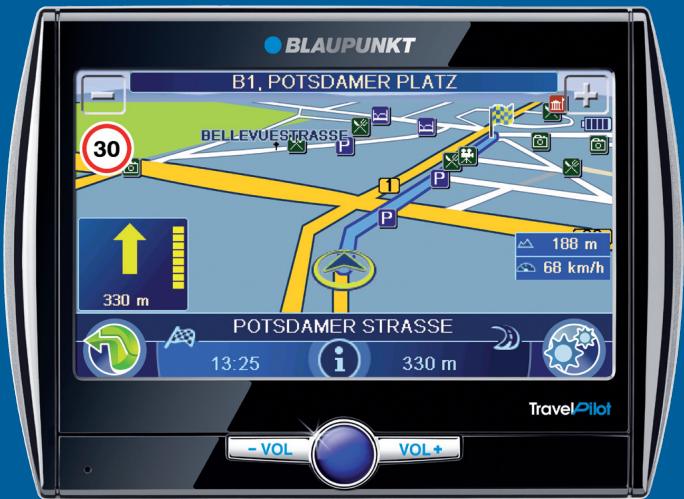
Operating instructions
BLAUPUNKT
TPAssist
The TPAssist PC tool can run on any PC using Windows or Linux and on any Mac using the Mac OS operating system.
To be able to use TPAssist, Java SE version 1.5 or later must be installed (download under: www.java.com).
Introduction
TPAssist provides support for adding you own POIs (Points Of Interest) to your device. In addition, you can restore the navigation software and road maps, if necessary.
Chapter overview
These operating instructions are intended to provide answers to your questions concerning TPAassist:
Chapter Start: How do I start TPAssist?
Chapter User POIs: How do I edit POIs and how do I use them with my device?
Chapter Recovery: How do I restore the navigation software and road maps in my device?
Chapter Memory cards: How do I use memory cards with the device?
Chapter Special topic - POI lists: How do I use POI lists without TPAssist?
Symbols used
These operating instructions use the following symbols:
Warnings contain information for safe operation.
Notes must be followed to reach the desired goal.
Tips or recommendations are intended to facilitate the use of TPAassist.
Links guide you to additional information about the topic.
End of a chapter.
What prerequisites does my computer have to have?
What can I do with TPAssist?
Start
Step 1
Insert the supplied backup DVD in the drive.
If TPAssist does not start automatically:
Open My Computer (PC) or the Desktop (Mac).
Open the backup DVD and double-click on the "TPAssist.jar" file.
TPAssist starts.
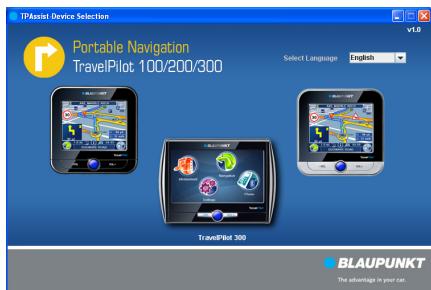
- Select your preferred language.
- The TPAssist main menu is displayed.
- Select your device.
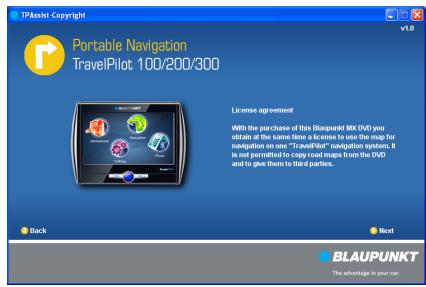
Here you can read the license agreement and change to the selection of options.
How do I start TPAssist?
Step 2
-
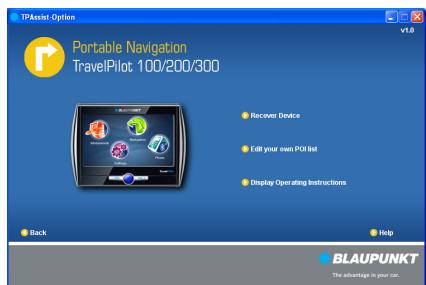
Click on Next and select one of the options:
-
Click on Edit your own POI list to load and manage your own POI list or to create new POI lists.
- Click on Recover device to subsequently reinstall the navigation software in your device.
- Click on Display operating instructions to call up the instructions for your device.
User POIs
TPAssist can also be used to create your own POIs and edit existing POI lists.
To use the POIs with the device:
- TravelPilot 100 and TravelPilot 200: The device uses the user POIs from the memory card. For this purpose, the POI lists must be copied to the memory card.
- TravelPilot 300: The device uses user POIs from its memory. For this purpose, the POI lists must be loaded directly into the memory.
Step 1 - Connecting the device
Connect the device with your computer using a USB cable.
Step 2 - Using the memory card (TravelPilot 100 and TravelPilot 200 only)
Insert the memory card into the device.
- Switch on the device with the On/Off switch. The computer recognises the device as a card reader.
Step 3 - Loading or creating a POI lists
If you selected the Edit your own POI list option in the main menu, the following options are available:
- Copy POI folder:
Copy a folder with existing POI lists directly to your device (TravelPilot 300) or to the memory card (TravelPilot 100 and TravelPilot 200).
-or-
Load:
Load an existing POI list from your computer to edit it. For this purpose, you are asked to select the POI list in the "Open" window.
-or-
New:
Create a new POI list with a name of your choice.
-or-
How do I edit POIs and how do I use them with my device?
Tip:
As an alternative, you can also transfer the data to the memory card using a card reader.
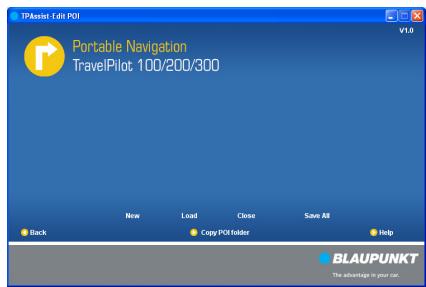
Tip:
POI lists can be obtained from external sources, e.g. on the Internet under www.poicon.com.
Save all:
To subsequently save the POI lists.
-or-
- Close:
To subsequently close the POI lists.
You can load several POI lists or create new ones and edit them subsequently.
- Click on one of the options to load a POI list or to create a new one.
The POI editor is displayed.
Step 4 - Displaying a POI list
The left column of the POI editor displays all the loaded or newly created POI lists.
- Click on a POI list to select it.
Step 5 - Selecting a POI icon for the POI list
In the main window, you can select the POI icon for the POI list:
In the POI icon field, click on the displayed POI icon to select a different image for the POI list.
The POI icon is displayed on the map for future devices if it has the same designation as the corresponding POI list (currently an optional entry field).
Step 6 - Activating POI hints
When you activate the POI hints, the device can point to the POIs in time during a route guidance:
- Click on the POI hint field to activate the POI hints (check mark) or to deactivate them (no check mark).
Note:
The device can use up to 128 POI lists.
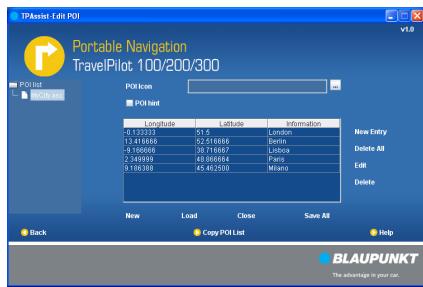
Note:
The POI hints must also be activated in the settings in the device. (long instructions "Settings", "Performing settings for navigation")
Step 7 - Editing a POI list
In the table, you can add, delete or rename individual POIs. The positions of the POIs are entered as coordinates:
New entry:
Adding a line for an additional POI. The empty line is attached to the end of the POI list.
-or-
Edit:
Editing a POI in the table.
-or-
- Delete:
Button for deleting individual POIs.
-or-
Delete All:
Deleting the entire POI list.
-
Click on one of the options to edit the POIs in a list.
Enter the coordinates (degree of latitude and longitude) for every POI in the table and a description (information): -
Longitude/Latitude: Enter the coordinates in decimal form (e.g. 51,50939 and -0,11832) or as Degrees, Minutes and Seconds (DMS, e.g. 51^30'33.8''N and 0^7'5.95''W ).
Information:
Rename the POIs as follows, if necessary: CountryCode_Category1_Category2, e.g. "GB_Lesisure_Golf.asc".
Ensure that country code and categories are separated in the file designation of POI lists. Use underscores for this purpose. Only then can the device subsequently sort the POIs by country code and categories.
| Longitude | Latitude | Information |
| 0133333 | 51.5 | London |
| 13.416666 | 52.516666 | B |
Tip:
You can obtain the coordinates of your favourite locations by using external Internet sources, e.g. http://maps.google.com or Google Earth.
Note:
The order and number of categories of POIs must always remain the same within a list:
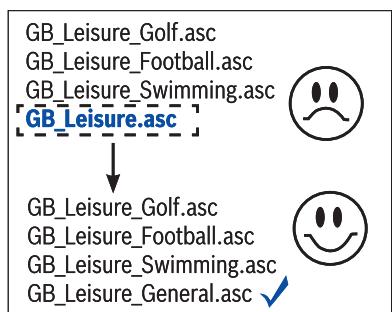
Additional prerequisites
Step 8 - Storing POI lists
- Click on Save All to save the changes and click on OK.
The POI lists are saved to the location from where they were opened (e.g. on the hard disk).
Step 9 - Copying POI lists (TravelPilot 100 and TravelPilot 200 only)
Click on Copy POI list.
A window opens in which you can select the target drive.
- Select the removable media drive and confirm with OK.
The POI lists are copied to the memory card.
You can now use your own POIs from the memory card with the device. (For further details, please read the long instructions, chapter "Navigation", "Entering a point of interest").
Step 9 - Copying POI lists (TravelPilot 300 only)
Click on Copy POI list and confirm with OK.
The POI lists are loaded into the memory.
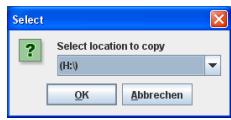
! Note:
If you remove the memory card from the device, the POIs are no longer available.
Recovery
If necessary, the navigation software and road maps - including the POIs that were preinstalled when the device was purchased - can be copied with TPAssist to a memory card and reinstalled in your device.
This requires:
TravelPilot 100 and TravelPilot 200: Memory card with a capacity of at least 1 GB
TravelPilot 300: Memory card with a capacity of at least 4 GB
How do I restore the navigation software and road maps in my device?
Caution
Every interruption of the installation may leads to errors in the device. For this reason:
- Only remove the memory card after completing the installation.
- Ensure that the power supply of the device is working (external power source or sufficiently charged battery).
Step 1 - Connecting the device
Connect the device with your computer using a USB cable.
Step 2 - Using the memory card
Insert the memory card into the device.
Switch on the device with the On/Off switch.
The computer recognises the device as a card reader.
Step 3 - Copying navigation software and road maps to the memory card
If you selected the Recover device option in the main menu, a window opens in which you can select the target drive.
- Select the removable media drive and confirm with OK.
The data are copied to the memory card.
Tip:
As an alternative, you can also transfer the data to the memory card using a card reader.
Note:
To ensure that the program copies the correct data for your device, connect the device with the computer using a USB cable. If the device cannot be recognised, you can also continue the process without checking the device.
Step 4 - Reinstalling the navigation software and road maps
If you use the device as a card reader, please remove the memory card and then disconnect the device from your computer. The device restarts. The reinstallation can now be started:
Insert the memory card into the device.
Press and hold the On/Off switch for longer than 14 seconds while pressing and holding the VOL - button until the first message appears on the display. The installation is being performed.
After completing the installation, remove the memory card.
Step 5 - After the installation
Perform the basic settings again. (For further details, please read the instructions, ch. "Performing basic settings")
Start the navigation.
Touch any point on the map. The message "No data record available" is displayed.
Touch the OK button. The list of available road maps is displayed.
Touch the desired road map in the list to select it.
Memory cards
You can use a memory card with the device for the following:
- Own POI lists
- Reinstalling the navigation software and road maps (recovery)
Step 1 - Preparing the memory card
The device accepts SD/SDHC and MMC cards. The maximum capacity of the memory cards is 4 GB.
Connect a commercially available card reader or the device to your computer and insert a memory card.
Ensure that the memory card was formatted using the file system FAT 16 or FAT 32:
- To do so, select My Computer (PC) or Finder (Mac).
- Right-click on the removable media drive or the drive that appears and select Format > FAT (PC).
or
- Click on Programs > Utilities > Hard Disk Utilities, select the memory card, and click on the Delete tab. Select the MS-DOS File System format, and clock on Delete (Mac).
Follow the instructions on the display.
Step 2 - Inserting the memory card in the device
Switch off the device with the On/Off switch.
Insert your memory card with the contacts to the front in the card slot until the card engages.
You can now switch the device on again and use it.
Step 3 - Removing the memory card from the device
Carefully push on the memory card in the slot until it disengages.
The memory card is ejected from the slot.
Remove the card.
How do I use memory cards with the device?
Note:
Always use an empty memory card for applications with TPAssist. For safety reasons, you cannot delete any files with TPAssist. If necessary, remove the files on your memory card using Explorer (PC) or Finder (Mac).
Tip:
Name the memory card, e.g. with "POI lists", to be able to keep track: For this purpose, you enter a description for the memory cards in the Format window (PC) or in the "Information" window (Mac: right-click on the removable media drive).
! Note:
Observe the marking on the card slot of the device.
Special topic - POI lists
You can also copy POI lists independent of TPAssist to a memory card, rename them and create POI icons, so that they can be used with the device.
POI lists are available from external sources, e.g. via the Internet from POICON (www.poicon.com). The device supports Garmin-compatible file formats for POI lists:
^* .csv (comma-separated values)
*.asc (ASCII text format)
Step 1 - Connecting the device
Connect the device with your computer using a USB cable.
Step 2 - Using the memory card (TravelPilot 100 and TravelPilot 200 only)
Insert the memory card into the device.
Switch on the device with the On/Off switch.
The computer recognises the device as a card reader.
Step 3 - Creating your own POIs
The device can only use POIs with the following format:
Rename the POIs as follows, if necessary:
CountryCode_Category1_Category2, e.g.
"GB Leisure Golf.asc".
Ensure that country code and categories are separated in the file designation of POI lists. Use underscores for this purpose. Only then can the device subsequently sort the POIs by country code and categories.
Enter the coordinates in decimal form (e.g. 51,50939 and -0,11832) or as Degrees, Minutes and Seconds (DMS, e.g. 51^30^33.8^ and 0^7^5.95^ ).
How do I use POI lists without TPAssist?
Tip:
As an alternative, you can also transfer the data to the memory card using a card reader.
Note:
The order and number of categories of POIs must always remain the same within a list:
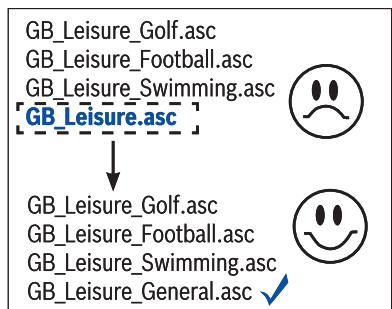
Step 4 - Copying POI lists to memory cards (TravelPilot 100 and TravelPilot 200 only)
Create a folder on the memory card and name it "ownPOIs". The device uses only POI lists stored in this folder.
Create a subfolder in the "ownPOIs" folder and name it "Hints". Copy the POI lists into this folder to which you want to be directed during the navigation.
Next, copy the desired POI lists (including POI icons) to the memory card and into the folder "ownPOIs" or "Hints".
Step 5 - Copying POI lists (TravelPilot 300 only)
The device must be connected with your computer using a USB cable.
Create a "ownPOIs" folder in the memory of the device. The device uses only POI lists stored in this folder.
Create a subfolder in the "ownPOIs" folder and name it "Hints". Copy the POI lists into this folder to which you want to be directed during the navigation.
Next, copy the desired POI lists (including POI icons) to the folder "ownPOIs" or "Hints".

ownPOIs
GB_Leisure_Golf.asc
GB_Leisure_Golf.bmp
GB_Leisure_GeoCaching.asc
GB_Leisure_GeoCaching.bmp
Hints
GB_ElectronicDealer_Blaupunkt.asc
GB_ElectronicDealer_Blaupunkt.bmp

ownPOIs
GB_Leisure_Golf.asc
GB_Leisure_Golf.bmp
GB_Leisure_GeoCaching.asc
GB_Leisure_GeoCaching.bmp
Hints
GB_ElectronicDealer_Blaupunkt.asc
GB_ElectronicDealer_Blaupunkt.bmp
| Country: | Phone: | Fax: | |
| Germany | (D) | 0180-5000225 | 05121-49 4002 |
| Austria | (A) | 01-610 39 0 | 01-610 39 391 |
| Belgium | (B) | 02-525 5444 | 02-525 5263 |
| Denmark | (DK) | 44-898 360 | 44-898 644 |
| Finland | (FIN) | 09-435 991 | 09-435 99236 |
| France | (F) | 01-4010 7007 | 01-4010 7320 |
| Great Britain | (GB) | 01-89583 8880 | 01-89583 8394 |
| Greece | (GR) | 210 94 27 337 | 210 94 12 711 |
| Ireland | (IRL) | 01-46 66 700 | 01-46 66 706 |
| Italy | (I) | 02-369 62331 | 02-369 62464 |
| Luxembourg | (L) | 40 4078 | 40 2085 |
| Netherlands | (NL) | 00 31 24 35 91 338 | 00 31 24 35 91 336 |
| Norway | (N) | +47 64 87 89 60 | +47 64 87 89 02 |
| Portugal | (P) | 2185 00144 | 2185 00165 |
| Spain | (E) | 902 52 77 70 | 91 410 4078 |
| Sweden | (S) | 08-7501850 | 08-7501810 |
| Switzerland | (CH) | 01-8471644 | 01-8471650 |
| Czech. Rep. | (CZ) | 02-6130 0446 | 02-6130 0514 |
| Hungary | (H) | 76 511 803 | 76 511 809 |
| Poland | (PL) | 0800-118922 | 022-8771260 |
| Turkey | (TR) | 0212-335 07 23 | 0212-346 00 40 |
http://www.blaupunkt.com
© 2008 All rights reserved by Blaupunkt. This material may be reproduced, copied or distributed for personal use only.
This product is protected by certain intellectual property rights of Microsoft. Use or distribution of such technology outside of this product is prohibited without a license from Microsoft.