
WTES 1753 VINIDOR - Wine cellar LIEBHERR - Free user manual and instructions
Find the device manual for free WTES 1753 VINIDOR LIEBHERR in PDF.


User questions about WTES 1753 VINIDOR LIEBHERR
0 question about this device. Answer the ones you know or ask your own.
Ask a new question about this device
Download the instructions for your Wine cellar in PDF format for free! Find your manual WTES 1753 VINIDOR - LIEBHERR and take your electronic device back in hand. On this page are published all the documents necessary for the use of your device. WTES 1753 VINIDOR by LIEBHERR.
USER MANUAL WTES 1753 VINIDOR LIEBHERR
Operating Instructions Wine cooler
Page 14
Many thanks for your trust.
Congratulations on your purchase of this wine cooler. In buying this product, which is distinguished by its perfect user-friendliness, impeccable reliability and high quality, you have chosen a top class appliance. We wish you a lot of pleasure with your new wine cooler – and a lot of enjoyment from your wines.
The fewer the grapes produced in an area, the better the wine.
Poor, well-drained soils are best for good wines. The properties of the soil influence the vitality of the vine, which in turn affects the quality of the grape. Climate is another factor that is important for wine. Because light and air humidity are important for the development of the flavour of the wine.
The right environment for your wines.
A vine is an extremely sensitive plant. From the time it is planted to its maturing period and the time the grapes are harvested and the wine is made, it is dependent on three factors: light, air humidity and ambient temperature. This sensitivity continues even once the wine is bottled. To allow the flavour of the wine to fully develop or to preserve the excellent aroma, the wine has to be stored perfectly – and your wine cooler offers the best conditions for this.
The wine cooler
Wines only develop their full flavour and aroma when they are at the right temperature for drinking. In your wine cooler, wines can be brought slowly and evenly to the ideal drinking temperature. Red wines and white wines can be stored at the same time at the optimal drinking temperature in two separately adjustable temperature zones.
Contents
Page
Setting up / Connecting to the mains
Dimensions / Changing over door hinges
Operating and control elements 16-17
Switching the appliance on and off
Setting the temperature
Fan button
Additional functions
Audible warning signal 18-19
Interior light / Equipment
Air exchange with activated carbon filter
Storage diagram 20-21
Defrosting / Cleaning
Malfunctions 22-23
Safety instructions and warnings
Shutting your appliance down
Environmental protection and disposal notes
General information 24-25
Range of appliance use
The appliance is suited only for storing wine. In the case of commercial food cooling, the pertinent statutory regulations have to be observed.
The appliance is not suited for storing and cooling pharmaceuticals, blood plasma, laboratory preparations or similar substances and products subject to the Medical Devices Directive 2007/47/EC.
Any misuse of the appliance may result in damage to or spoilage of the stored goods.
Furthermore, the appliance is unsuited for use in areas exposed to an explosion hazard.
Setting up
- Avoid locating the appliance it in direct sunlight or near heat sources such as an oven or a radiator.
- The floor should be level and even. You can compensate for an uneven floor by adjusting the adjustable feet.
- Standard EN 378 specifies that the room in which you install your appliance must have a volume of 1m^3 per 8g of R 600a refrigerant used in the appliance, so as to avoid the formation of inflammable gas/air mixtures in the room where the appliance is located in the event of a leak in the refrigerant circuit. The quantity of refrigerant used in your appliance is indicated on the type plate on the inside of the appliance.
- The appliance is set to operate within specific ambient temperature limits according to its climate rating. These temperature limits should not be exceeded. The correct climate rating for your appliance is indicated on the type plate.
$$ \mathrm {S N} = + 1 0 ^ {\circ} \mathrm {C t o} + 3 2 ^ {\circ} \mathrm {C} $$
$$ \mathrm {S N} - \mathrm {S T} = + 1 0 ^ {\circ} \mathrm {C t o} + 3 8 ^ {\circ} \mathrm {C} $$
Electrical requirement
Power supply (AC) and voltage at the operating point must comply with the details on the type plate. The type plate is located on the top left-hand side on the inside of the appliance. The socket must be fused with a 10 A fuse or higher, it must be away from the rear of the appliance and must be easily accessible.
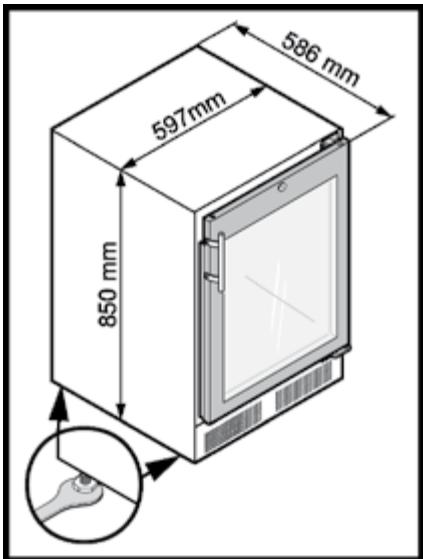
Dimensions
Saving energy
- Always ensure good ventilation. Do not cover ventilation openings or grille.
- Always keep fan louvres clear.
- Do not place appliance in areas of direct sunlight or next to a stove, heater or similar object.
- The energy consumption depends on the installation conditions, e.g. the ambient temperature.
- Keep the time the appliance is open to a minimum.
To compensate for any unevenness, adjust the height of the feet with the open-ended wrench supplied.
Changing over door hinges
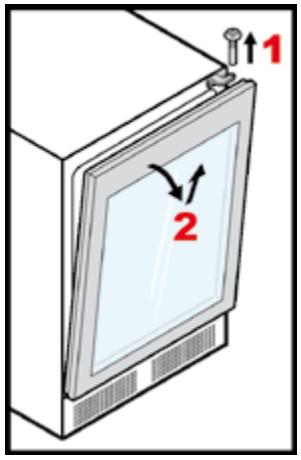
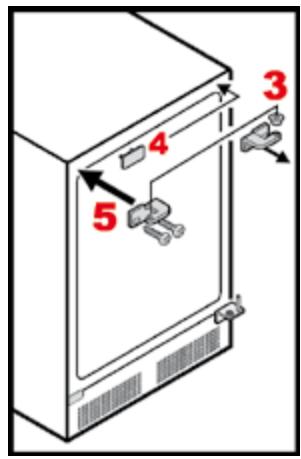
Step 5
The hinge bracket at top left is supplied with the appliance.
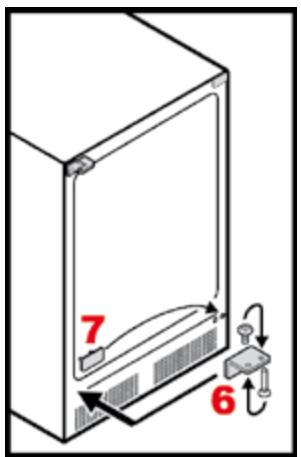
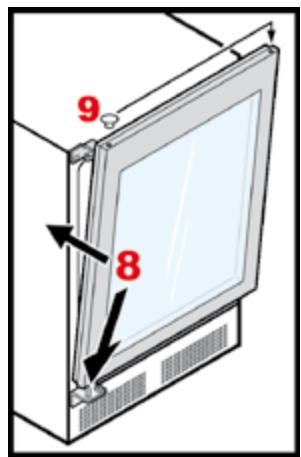

Operating and control elements
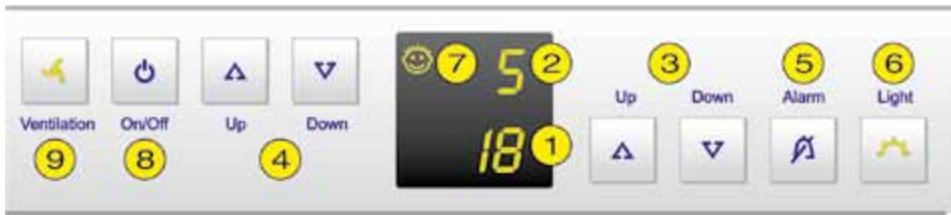
Lower compartment temperature display
Upper compartment temperature display
Lower compartment temperature setting buttons
Upper compartment temperature setting buttons
Audible warning on/off button
Interior light on/off button
Child-proof lock
On/off button
Fan button
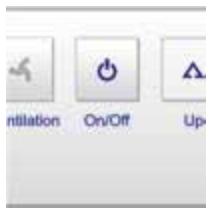
Switching the appliance on and off
You are recommended to clean the appliance before switching it on for the first time (see "Cleaning"). Connect the appliance to the mains - the appliance is switched on. The alarm will sound when the appliance is switched on for the first time and when the appliance is warm. Press the "Alarm" button to switch it off. The temperature display will also flash.
- To switch the appliance off: Keep the "ON / OFF" button pressed for 3 sec. so that the temperature display goes out.
- To switch the appliance on: Press the "ON / OFF" button until the Display lights up.
Setting the temperature
The temperature of both compartments can be set separately.
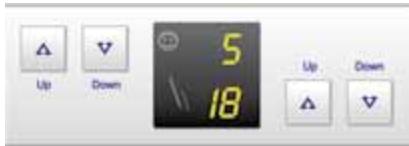
To reduce the temperature: Press the DOWN button;
- on the left for the upper compartment, on the right for the lower compartment.
To increase the temperature: Press the UP button.
- While you are entering the temperature, the set temperature will flash on the display.
- You can change the settings in increments of 1^ briefly pressing the button again.
- The electronic controls will switch over automatically about 5 seconds after the last time you pressed the button, and the actual temperature will be displayed.
If "F0" or "F1" appears in the display, the appliance has a fault. Consult your nearest customer service point, quoting the type of appliance, index and appliance number.
Fan button
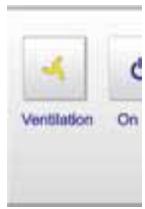
The interior fan ensures a constant and even interior temperature and a suitable climate for wine storage. When activating the Ventilation button, the humidity in the appliance is further increased, which has a particularly positive effect for long-term storage. The increased level of humidity prevents the corks from drying out.
Additional functions
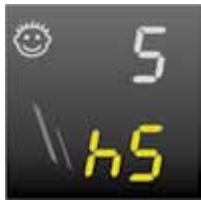
In set-up mode you can set the child-proof lock and adjust the brightness of the display. The child-proof lock is designed to protect the appliance from being switched off accidentally by children.
Activating set-up mode:
- Press fan button for approx. 5 secs - the fan button flashes - the display shows c for child-proof lock.
Note: the value to be altered flashes. - Select the required function by pressing the Up/Down button:
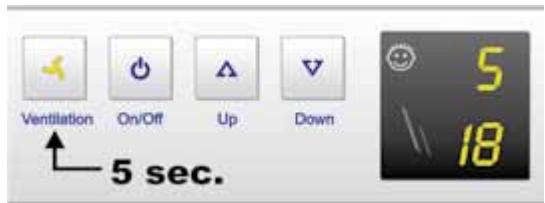
c = child-proof lock, h = brightness of the display
- Now select/acknowledge function by pressing fan button briefly:
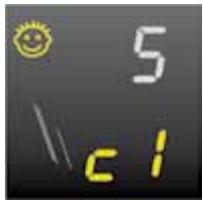
For c = child-proof lock, press the Up/Down button to select c1 = child-proof lock on or c0 = child-proof lock off and acknowledge with the fan button. When the symbol is lit, the child-proof lock is activated.
For h = brightness, press Up/Down button to select h1= minimum to h5 = maximum brightness and acknowledge with fan button.
Exit set-up mode:
- Exit the set-up mode by pressing the On/Off button; after 2 min. the electronic system switches over automatically. The normal operating mode is activated again.
Audible warning signal
The audible warning signal helps to protect your wines against excessive temperature fluctuations.
- It sounds when the door has been left open for longer than about 60 seconds. The audible warning device is switched off by pressing the "Alarm" button.
- It sounds when the interior gets too warm or too cold. The temperature display will also flash. The audible warning device is switched off by pressing the "Alarm" button. The temperature display will continue to flash until the cause of the alarm has been rectified.
Interior light
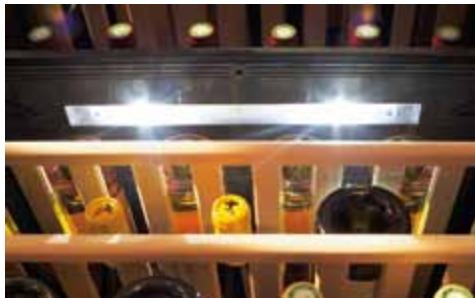
A lightbar is integrated into the upper and lower compartments.
The interior light can be switched on and off using the "Light" button.
Caution - class 1M laser radiation. When cover is removed, do not look directly at light through optical instruments.
The interior light may only be replaced by the customer service technician or by competent skilled personnel!
Furthermore, the brightness of the lighting can be adjusted.
-
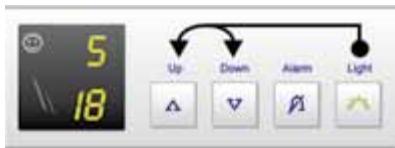
Press the "Light" button. The indicator lamp in the switch will light up.
-
Press and hold the "Light" button and at the same time press the temperature setting buttons for the lower compartment to increase or decrease the brightness. "Down" = darker, "UP" = brighter.
Equipment
Pull-out shelf
The pull-out shelf allows bottles of wine to be removed more easily.
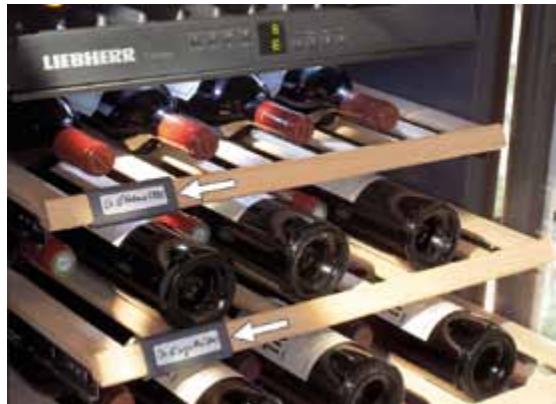
Labels
The appliance is supplied with a label holder with labels for each shelf. Use these to label the type of wine stored on each shelf. Use a soft pencil on the labels so that you can erase it again when necessary. Additional labels can be obtained from your dealer.
Fitting: Click the label holder into place and slide the label in from the side.
Air exchange with activated carbon filter
The way in which wines continue to mature depends on the ambient conditions. The quality of the air is therefore decisive for preserving the wine. For this reason, an
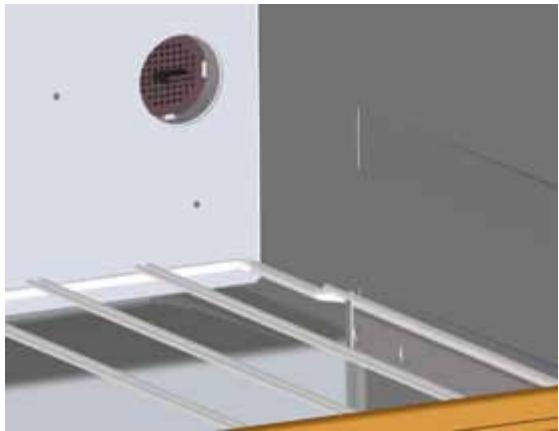
activated charcoal filter is fitted in the interior rear wall of both the upper and lower compartments.
We recommend that you replace the filter once a year. Filters can be obtained from your dealer.
Changing the filter: Take the filter by the handle. Turn it 90^ to the left or right and remove.
Inserting the filter: Insert with the handle in a vertical position. Turn it 90^ to the left or right until it clicks into place.
Storage diagram
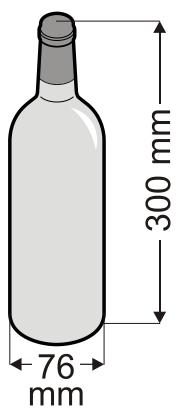
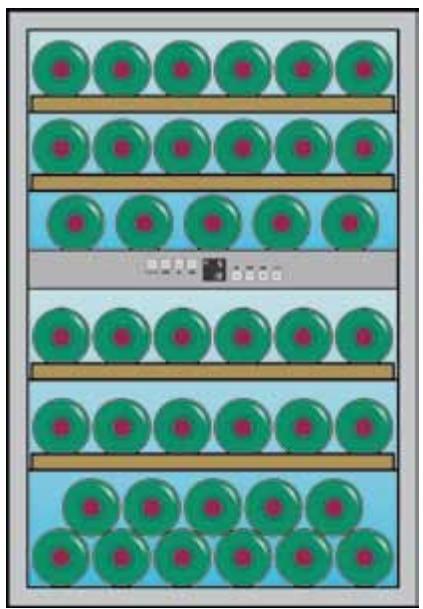
for 750ml Bordeaux bottles
Total: 40 bottles
Defrosting
The appliance defrosts automatically. The water that forms on the rear wall drains into a reservoir at the back of the appliance and evaporates automatically through the compressor heat.
Cleaning
Before cleaning always switch off the appliance. Pull out the mains plug or remove/ unscrew the fuse.
Do not use steam cleaners because of the risk of injury and damage.
- Do not use abrasive sponges or scourers, do not use concentrated cleaning agents and never use cleaning agents containing sand, chloride or acid or chemical solvents, as these would damage the surfaces and could cause corrosion.
- Use a glass cleaner to clean the glass surfaces and a commercially available stainless-steel cleaning agent for the stainless-steel surfaces.
- Clean the inside and equipment with lukewarm water and a little detergent, with the exception of the wooden trims on the grid shelves.
- Ensure that no cleaning water penetrates into the electrical components.
- Dry all parts well with a cloth.
- Do not remove the type plate from the inside of the appliance; it is important for after-sales servicing.
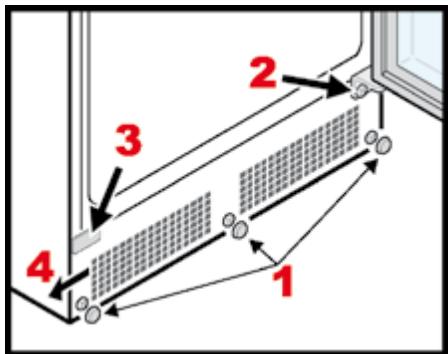
- If the motor compartment becomes dusty, it should be cleaned. To do this, remove the bottom ventilation plate as follows:
1 Remove the cover caps and screws.
2 Loosen (but do not remove) the left-hand screw on the hinge bracket.
3 Remove the cover panel.
4 Remove the ventilation plate to the left.
The motor compartment can then be cleaned with a vacuum cleaner.
After cleaning, replace the ventilation plate. Make sure you re-tighten the screw 2 on the hinge bracket properly.
Malfunctions
Your appliance is designed and manufactured for a lengthy, reliable operating life with no malfunctions. If a malfunction nonetheless occurs during operation, check whether it is due to an operating error. Please note that even during the warranty period the resultant servicing costs in this case will have to be borne by the owner.
You may be able to rectify the following faults by checking the possible causes yourself:
- Appliance does not function:
- Check that the appliance is properly connected to the mains.
- Is the socket fuse intact?
- Loud running noise: Check that the appliance is standing firmly on the ground. Please note that it is impossible to avoid flowing noises in the refrigeration circuit.
- The temperature inside your wine cooler is too warm: Check the setting in accordance with the section "Setting the temperature".
- Does the separately installed thermometer show the correct reading?
- Is the air extraction working properly?
- Is the wine cooler too close to a heat source?
- Please note that, as can happen with other forms of storage, slight mould may form depending on the type of adhesive on the labels. This can be rectified by carefully cleaning any adhesive residues off the bottles.
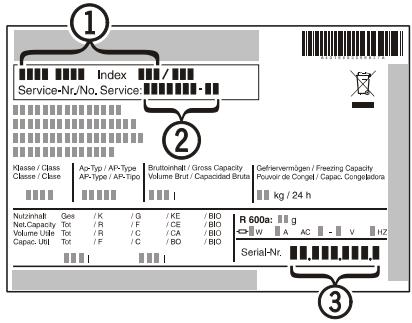
If none of the above causes apply and you cannot rectify the fault yourself, contact the nearest customer service department stating the type ① of appliance, servicenumber ② and appliance number ③ as indicated on the type plate. The type plate is located on the left-hand inside wall.
Safety instructions and warnings
- To prevent injury or damage to the unit, the appliance should be unpacked and set up by two people.
- In the event that the appliance is damaged on delivery, contact the supplier immediately before connecting to the mains.
- To guarantee safe operation, ensure that the appliance is set up and connected as described in these operating instructions.
- Disconnect the appliance from the mains if any fault occurs. Pull out the plug, switch off or remove the fuse.
- When disconnecting the appliance, pull on the plug, not on the cable.
- Any repairs and work on the appliance should only be carried out by the customer service department, as unauthorised work could prove highly dangerous for the user. The same applies to changing the mains power cable.
- Do not stand on the plinth, drawers or doors or use them to support anything else.
- This appliance is not intended for use by persons (including children) with reduced physical, sensory or mental capabilities or lack of experience and knowledge unless they have been given initial supervision or instruction concerning use of the appliance by a person responsible for their safety. Children should be supervised to ensure that they do not play with the appliance.
- Avoid prolonged skin contact with cold surfaces or chilled/frozen food. This could cause pain, numbness and frostbite. In the case of prolonged skin contact, protective measures should be taken, e.g. gloves should be worn.
- If you have a lockable appliance, do not keep the key near the appliance or within reach of children.
- Do not use electrical appliances inside the appliance.
- Do not damage the refrigerant circuit pipes.
- Do not allow naked flames or ignition sources to enter the appliance. When transporting and cleaning the appliance ensure that the refrigerant circuit is not damaged. In the event of damage, make sure that there are no ignition sources nearby and keep the room well ventilated.
Shutting your appliance down
If your appliance is to be shut down for any length of time, switch it off and disconnect the plug or remove the fuse. Clean the appliance and leave the door open in order to prevent unpleasant smells.
Disposal notes
The packaging is made of recyclable materials.
- Corrugated board/board
- EPS moulded parts
- Polythene sheets
-
Polypropylene straps
-
Keep packaging materials away from children - polythene sheets and bags can suffocate!
- Please return the packaging material to an official collection point.
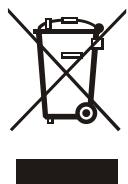
Your old appliance: This contains some reusable materials and should be disposed of properly - not simply with unsorted household refuse.
- Disable discarded appliances by removing the plug and cutting through the connection cable. Render the catch unusable so that children cannot become trapped inside.
- Ensure that the refrigerant circuit is not damaged when the appliance that is no longer needed is taken away for disposal.
- Details of the refrigerant used can be found on the type plate.
- Appliances which are no longer needed must be disposed of in a professional and appropriate way, in accordance with the current local regulations and laws.
General information
The appliance complies with the relevant safety regulations and EC directives 2004/108/EC and 2006/95/EC.
All types and models are subject to continuous improvement and the manufacturer therefore reserves the right to make modifications to the shape, equipment and technology.