ManualGo.com
KSV4220 - Fridge LIEBHERR - Free user manual and instructions
Find the device manual for free KSV4220 LIEBHERR in PDF.



Download the instructions for your Fridge in PDF format for free! Find your manual KSV4220 - LIEBHERR and take your electronic device back in hand. On this page are published all the documents necessary for the use of your device. KSV4220 by LIEBHERR.
USER MANUAL KSV4220 LIEBHERR
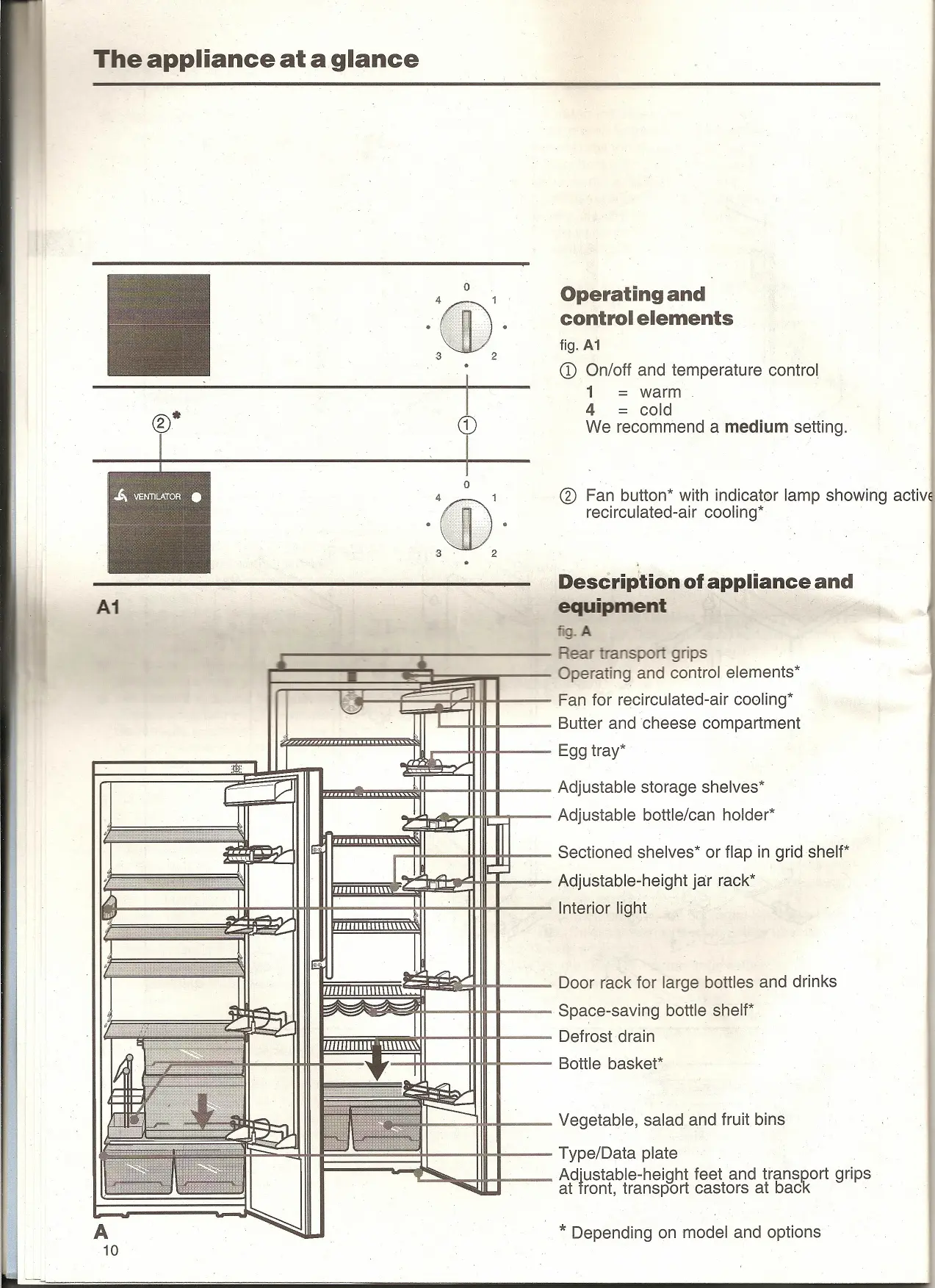
The appliance at a glance
Operating and control elements fig. A1
On/off and temperature control = warm = cold We recommend a medium setting.
Fan button* with indicator lamp showing active recirculated-air cooling*
Description of appliance and equipment
- Depending on model and options Congratulations on your purchase. ln choosing this appliance you have opted for ail the benefits of state-of-the-art refrigeration technology, guaranteeing you top quality, a long life span and excellent reliability. The features on your appliance ave been designed to ensure maximum convenience - day in, day out. This appliance has bee ufactured with recyclable mate rials using an environmentally friendly process, sa toge e are making an active contribution to the preservation of our environment. To get to s of your new appliance, please read the information contained in these operati
lE]) your new appliance. Keep oass e operating instructions apply to several models. Differences may therefore occur. c.netyy-oprti~.ÏS€;C ~ Energy-efficient ese operating instructions in a safe place and em on to the next owner, where applicable. insulation ~ Low energy consumption Contents ~. User-friendly thanks to clearly arranged controls
res, e.g. 2 bins for storing fruit and vegetables separately ~ Sectioned glass shelf* or flap in grid shelf* for tall containers ~ Practical door arrangement and space for tall bottles ~ Door handle with integrated opening mechanism* ~ Integrated transport grips ~ Transport castors at back ~ Adjustable-height feet at front Page Operating instructions The appliance at a glance Additional benefits, contents Safety instructions and warnings Disposai notes Se . 9 up 2 0 era 'on and control elements Sa ety regulations Co ecting to the mains Switching the appliance on and off Setting the temperature Fan switch Energy savings 3 Storage, shelf arrangement, interior light Arranging food in the refrigerator Changing shelf arrangement Interior light 4 Defrosting, cleaning 5 Troubleshooting Customer service and type plate
Instructions for installation and modification Dimensions Changing over door hinges 1 nsertion into row of kitchen units Notes on assembling decor panels
~ Easy to clean ~ Door hinges can be changed over ~ Decor frames available
instructions and warnings
The packaging is designed to protect the appliance and individual components during transport and is made of recyclable materials. Corrugated board/board Moulded polystyrene (foamed, CFC-free polystyrene) - Polythene bags and sheets - Polypropylene straps
- Keep packaging materials away from children polythene sheets and bags can suftocate!
- Please return the packaqlnq mate rial to your nearest officiai collection point so that the various materials can be reused or recycled as far as possible. Safety during use
Your old appliance: This contains some reusable mate rials and should not simply be disposed of with household or bulk refuse.
- Disable discarded appliances immediately by removing the plug and cutting thraugh the connection cable. Remove the spring-action or boit catch from the appliance or render it unusable so that cllildren cannot become trapped inside and suffocate.
- Ensure that the refrigerant circuit is not damaged before the appliance that is no longer needed is taken away for disposaI. ln this way the refrigerant or oil will not escapeinto the environment. - Exact details of the refrigerant used can be e ear i
To prevent injury or da mage to the unit, the appliance should only be transported wrapped and set up by two people. The refrigerant R 600a is enviranmentally friendly but flammable.
- Do not store explosives or sprays using combustible prapellants such as butane, propane, pentane, etc. in the appliance. Electrical components might cause leaking gas to ignite. You can identify such sprays by the printed contents or a flame symbol. J.....,
Do not consume food which has been stored for too long, as it could cause food poisoning. Settingup
- When setting up/fitting ensure that the refrigerant circuit pipes are not damaged.
- Standard EN 378 specifies that the raomin which you install your appliance must have a volume of 1 m3 per 8 9 of R 600a refrigerant used in the appliance, so as to avoid the formation of inflammable gas/air mixtures in the raom where the appIiance is located in the event of a leak in the re. eran circuit.. The quantity of retrigerant used in your appliance is indicated on the type plate on the inside of the appliance.
- Avoid positioning in direct sunlight or next to an oyen, radiator or similar, in damp locations or near
ill •Do not damage the refrigerant circuit pipes. Splashes of refrigerant can harm your eyes or ignite. If refrigerant escapes, remove ail naked flames or sources of ignition in the vicinity of the leak, disconnect the appliance from the mains and ventilate the area weil. ln the event that the appliance is damaged, contact the supplierimmediately before connecting to the mains. To guarantee safe operation, ensure that the appliance is set up and connected as described in these operating instructions. Disconnect the appliance from the mains if any fault occurs. Pull out the plug (not by pulling on the mains cable) or switch off or remove the fuse; Any repairs and work on the appliance should only be carried out by the customer service department, as unauthorised work could prove highly dangerous for the user. The sarne applies to changing the mains power cable. Only storehigh-percentage alcohol in tightly sealed, upright containers. Do not allow naked flames or ignition sources to enter the appliance. Do not use electrical appliances inside the appliance (e.g. steam cleaners, heaters, ice makers, etc.). Do not stand on the plinth, drawers or doors or use them to support anything else. Do not let children play with the appliance, e.g. do not allow them to sit in the drawers or swing on the door.
spraying water. Once in position, use the 10 spanner provided to adjust the feet so that the appliance is level and does not wobble. The ventilation grilles should not be obstructed. Always ensure that there is good ventilation and that the outward flowing air is able to escape. More information can be found in the installation and modification instructions. Do not place heat-emitting appliances, e.g. microwave oyen, toaster, etc., on top of the refrigerator or freezer. Wh en you open the door for the first time, the handle switches from the transport position to the operating position; you will hear a soft click. Remove ail transportation safety components: Remove sticky tape or spacers* fram shelves and insert shelves in the required position. Remove ail pratective film: fram the decorative trims, front walls and side walls*. 2 Safety regulations, operation and control elements Switching the appliance on and off You are advised to clean the appliance before switching it on for the first time (see "Cleaning").
- The appliance is intended for chilling food. It is designedas a household appliance. If used commercially, the relevant regulations on commercial use must be observed.
- The appliance is set to operate within specifie ambienttemperature limits according to its climate rating. These temperature limits should not be exceeded. The correct climate rating for your appliance is indicated on the type plate. This is explained as follows: Climate rating Se for ambient e peratures of
To switch on: Turn the temperature control to "2.5" with a coin, fig. A1.
- - The interior light will switch on. To switch off: Set the temperature control to '8'
- The interior light will go out. Setting the temperature
- Turn the temperature control using a coin. The slot positions mean, fig. A 1: . Setting "1" = highest temperature, lowest cooling setting Setting "4" = lowest temperature, highest coolinq setting
- We recommend a medium setting. Please note that the temperature inside your appliance will depend on where you have put it, the temperature in the room, how often you open the door, and what you put in it. If necessary, re-adjust the temperature control.
Fanswitch* mams for recirculated-air cooling, fig. A1/CV You can use the.tan switch as required to: chili large quantities of fresh food fast; - keep the tempe rature evenly distributed throughout the entire refrigerator compartment. The air will circulate more intensively, thus keeping ail the different areas in the appliance at the same temperature and ensuring that ail the food inside is chilied at the same temperature.
- You are recommended to always use the fan switch: when the ambient temperature ishigh (approx. 30°C or more) or the room is very humid, e.g. during the summer. To switch on: Press the fan button CV briefly so at the relevant indicator lamp lights up. To switch off: Press the fan button again so that the indicator lamp goes out.
ers at the operating poi st comply the details on the type plate, which is located inside the appliance on the left, fig. A.
- Connect the appliance with a properly earthed fused plug and socket only.
- The socket must be fused with a 10 A fuse or higher; it must be away from the rear of the appliance and must be easily accessible, co ec e appliance to the supply with e e ion cable - risk
ance with the folio . 9 cooe: 9 = earth, blue = neutral, brown = live. Warning! This appliance must be earthed. Non-rewireable plugs es 1363 If this machine or appliance is fitted with a nonrewireable plug, the following information applies: If the socket outlets are not suitable for the plug supplied with this product, it must be eut off and an appropriate plug fitted. The plug eut from the flexible cord should be disposed of and on no account be inserted into a 13 A socket elsewhere in the house (electric shock hazard). The fuse cover must be re-fitted when changing the fuse, and if the fuse cover is lost the plug must not be used until a suitable replacement is obtained. The colour of the correct replacement cover is that of the coloured insert in the base of the plug, or the colour that is embossed in words on the base of the plug (as applicable to the design of the plug fitted). The correct rating of the replacement fuses that are ASTA approved to BS 1362 should be fitted. Replacement fuse covers may be purchased from your local electrical suppliers, electricity showroom or approved service agent. NB: When the fan is switched on, energy consumption will increase and the .refrigerator will work '. harder; the temperature will drop and it will be colder. Notes on energy saving
Ensure that there is adequate space around the appliance for ventilation and air extraction. Avoid keeping the door open for too long. Store food logically. Do not exceed the storage period specified. Keep ail food properly packed and covered so as to avoid condensation. . Always allow hot food to cool to room temperature before placing in theappliance. Defrost frozen food in the refrigerator.
- Depending on model and options
3 Storage, shelf arrangement, interior light Arranging food in the refrigerator
butter, cheese, precooked meals 2 eggs 3 cans, drinks, bottles 5 preserves, baked goods 6 dairy products 7 meat and sausage products, fish 8 fruit, vegetables, salad The natural circulation of the air inside therefrigerator results in different parts of the refrigerator having different temperatures. This can have its advantages for different . types of food. The refrigerator IS coldest just above the vegetable bins and against the rear wall (suitable for sausage and meat products etc.); it is warmest at the front at the top and in the door (suitable for spreadable butter, cheese etc.). See fig. B for food storage suggestions. Notes on cooling - Store food so that air can circulate properly around it. Do not pack the refrigerator too full. - Food which gives off or absorbs odours and flavours, and liquids should always be stored covered or in closed containers. - Always store food which gives off or is sensitive to ethylene gases such as fruit, vegetables and salads separately or wrapped in order not to affect their storage life; e.g. do not store tomatoes together with kiwis or cabbage.
Changing shelf arrangement
- Vou can change the position of the jar rack* and remove ail door racks for cleaning, fig. C: Siide the door rack up, pull out towards you and replace in reverse order.
- By adjusting the bottle/can holder you can protect the bottles from falling over when the door is opened and closed. If your àppliance has the equipment illustrated in fig. C1, always hold by the plastic handle. - The holder can be removed for cleaning: - If Y appIiancehas the equipment iIIustrated in fig. C1: edge 0 e older up and lever out. e equipment iIIustrated in fig. C2: ont edge of the holder up and lever out.
- Shelves* (grids or glass shelves) can be adjusted in height for different height items, fig. D1: - Lift the shelf, slide forwards and remove. Always insert shelves with the raised edge at the back pointing upwards, otherwise food mayfreeze onto the rear wall. - The glass shelves* are fitted with stops to prevent them . being pulled out accidentally, fig. 02.
- If you require space for large bottles and containers, - lift the front hait of the split glass shelf* and carefully siide it under the back half until the stops* click into the recesses, fig. E1, or lift up the flap* in the grid shelf, fig. E2.
- Vou can use the bottle basket*, fig. E3, to chili drinks and carry several bottles at once.
If the interior light does not work, the bulb may be defective. Changing the bulb:
- Bulb data: max. 25 W, voltage and current should agree with the details on the type plate. Only use bulbs of the same size. Bulb fitting: E 14.
- Switch off the appliance. Pull out the plug or switch off/unscrew the fuse.
- Fig. F1: Press the light cover together at the sides (1), lift out and unclip at the back (2).
- Fig. F2: Replace the bulb. Apply slight pressure when turning the bulb to overcome the friction of the seal, When inserting the new bulb, make sure the seal is correctly positionedin the socket.
- Clip the back end of the coyer in and clip the sides into place.
Depending on model and options 4 Defrosting, cleaning Defrosting
The refrigerator compartment defrosts automatically. The defrost water is evaporated by the heat from the compressor; drops of water on the rear wall are perfectly normal. e Ensure that the defrost water can flow freely through the drain hole in the rear wall (arrow in fig. A). Cleaning e Before cleaning, always switch off the appliance. Disconnect trom the mains or unscrew or switch off the fuse. eClean the outer valls, inside and equipment by hand with luke ann a er and a little detergent. Because 0 e ris 0 injury and damage to the appliance, eam cleaning equipment should not be used. Never use
a r and keep it 0 of e sible. Wipe the appliance dry. - Do not damage or remove the type plate on the insideof the appliance. It is very important for servicing purposes. e The butter dish*can be washed in a dishwasher. The racks, shelves and other components should - ~ eaned y hand as they are not dishwasher- e Clean the drain hole on the rear wall frequently, fig. A, arrow. If necessary, clean with a thin object, e.g. a cotton swab or slmllar, e The dust should be removed i""I'=:::r-...,....,.,..".,-----, from the refrigeration unit and heat exchanger - metal grid at the pack of the appliance - once a year. Oust deposits increase energy consurnption. e Ensure that none of the wires or other components are dislodged, bent or damaged. e Then connectlswitch on the appliance. If the appliance is to be left switched off for any length of time, empty the appliance, disconnect from the mains, clean as described above and leave the door open so as to avoid odours. 5 Troubleshooting Your appliance is designed and manufactured for a long life span and reliable operation . If a malfunction nonetheless occurs during operation, check whether it is due to an operating error. Please note that even during the warrant y period the resultant servicing costs in this case will have to be borne by the owner. You may be able to rectify the following faults by checking the possible causes yourself: Malfunction Appliance does - Is the - Is the - Is the Possible cause and remedy not work appliance switched on properly? mains plug properly inserted in the socket? socket fuse intact? The interior light does not come on - Is the appliance switched on? - The bulb is defective. Change the bulb as described in "Interior light". Loud running noise Is the appliancestanding firmly on the floor, or does the compressor cause nearby items of fumiture or objects to vibrate? If necessary, move bottles and containers apart. Burbling noises are normal. These are caused by the refrigerant flowing round the refrigerant circuit. A short c1ickihg sound: This will be heard whenever the refrigeration unit (the motor) switches on or off automatically. Motor noise: This will be slightly louder for a brief period when the refrigeration unit switches on. The temperature is not cold enough - Is the temperature setting correct? If necessary, set a lower temperature. - Loose thermometer in appliance is showing a wrong reading. - Does the door close properly? - Is the appliance sufficiently weil ventilated? Clear ventilation grilles if necessary. - Is the ambient temperature too hot? (See "Safety regulations") Has the appliance been opened too often or left opentoolong? - If applicable, wait until the appliance reaches the required temperature itself. I-t. 1 Customer service and type -plate
If none of the above causes apply and Vou cannot rectify the fault yourself, please contact your nearest customer service department (see enclosed list for addresses). _State the: type designation CD, service number and appliance number G) as giv~n on the type plate so as to ensure rapid, accu rate servicinq. The type plate is located inside the appliance on the left-hand side.
Im!rtruc ions for installation and modification
imensions See fig. S and the table below for external dimensions. Gross capacity External dimensions [mm] of appliance [1] (see type plate)
Note: Do not install this appliance adjacent to refrigerators or freezers other than special "side-by-side" models, e.g. GSD, BGN. These models are designed for combination with a refrigerator. This is important to prevent condensation and consequential damage from it. More detailed information can be obtained from your dealer. Changing over door hinges Fiq.T: The door hinges can be changed from one side to the other ifrequired.
- With the door open, lever out plinth panel with a screwdriver and remove. - . Lever out coyer with a screwdriver. Close door. - Unscrew screw M5 @.
- Pull hinge compone nt @ with hinge pin @ out from e ea and re ove.
cg) Opj)()5;t.:,e e. ee span er provided. Using a screwdriver, remove the spacer (j) and replace on the other side. Re-attach the door: Remove plugs from the door mounting points and replace on the other side. Suspend door with spacer in hinge pin @, close door. Rotate hinge component @ by 180°, remove hinge pin @, turn by 180° and replace. Mount both parts in the hinge (2): slide the pin into the door mounting through the hinge, tilt in the hinge component, siide up and attach with screw @. Align the door flush with the body of the appliance using the slot on the hinge (2), then tighten screw @. Attach the plinth panel and click into place by pressing. With the door open, insert the coyer in the plinth panel at the front and click into place at the back. Transfer* door handle ® and plugs @. With the door open, carefully lift out the pressure plates* @ at the front and siide away; unscrew handle. Reassemble in reverse order: replace the pressure plates and click into position. Remove and re-attach the slimline handle* with the
2.5 mm hexagon key provided as illustrated in fig. Til.
If your refrigerator has a bottle basket*, fig. T1, put the vegetable bins on the other side (the bottle basket should always be on the same side as the door handle) to facilitate rernoval of the basket: - Remove the bottle basket. - Siide the vegetable bins to the hinge side of the appliance; move the top bin complete with its guide rails. - Replace the bottle basket on the handle side . Insertion into row of kitchen units Fig. U: 600 mm appliances canbe installed in a row of kitchen units. To adapt the height of the appliance to the surrounding furniture a top unit can be added.
A gap of at least 50 mm depth must be provided behind and along the entire width of this unit so as to ensure sufficient ventilation. The area of ventilation underneath the ceiling should be at least 300 ems, The greater the area the more economically the appliance will run.
- When installing with standard kitchen units (max. depth 580 mm) and decor panels of max. 2 mm thickness, the appliance can be set up right next to the kitchen unit. The door protrudes 34 mm from the side of the kitchen unit and 51 mm at the front. This enables it to be opened and closed without difficulty.
- When setting up the appliance next to a wall @, a minimum distance of 36 mm must be provided on the hinge side between the appliance and the wall (for the handle when thedoor is open).
- If vou wish to attach the appliance to adjacent units or to fit a spacer between the appliance and the wall, please e <oIkJlwirlg can 0 en and close properly. app iance to kitchen units with self-tapping screws (max. depth 10 mm). top unit @ kitchen unit side panel refrigerator/freezer @ wall
cg) Notes on assembling decor panels* 600 mm appliances can be colour-matched with other elements of a fitted kitchen by attaching a decor panel and frames. The panels are available from your kitchen furniture supplier. The frames can be fitted later and are available from your dealer. If Vou wish to fit the decor panels yourself, vou will need a drill or a rechargeable screwdriver to pre-drill the retaining holes. For further instructions and dimensions see the installation instructions included in the retrofit kit. cg) . Ali types and models are subject to continuous improve-· ment and-the manufacturer therefore reserves the right to make modifications in the shape, equipment and technology.
- Depending on model and options