
CBNESF 3733 - Combined refrigerator LIEBHERR - Free user manual and instructions
Find the device manual for free CBNESF 3733 LIEBHERR in PDF.


| Brand | LIEBHERR |
| Model | CBNESF 3733 |
| Product type | Combined fridge-freezer |
| Height | 2011 mm |
| Climate class | SN, N, ST, T (10 °C to 43 °C) |
| Refrigerant | R600a (flammable) |
| Voltage / Frequency | 220-240 V, 50 Hz |
| Refrigerator temperature (recommended) | 5 °C (adjustable from 3 °C to 9 °C) |
| Freezer temperature (recommended) | -18 °C (adjustable from -15 °C to -32 °C) |
| Freezing capacity | See rating plate (kg/24h) |
| Special functions | NoFrost, BioFresh (HydroSafe / DrySafe), SuperFrost |
| Alarms | Door alarm (after 60 s), Temperature alarm |
| Defrosting | Automatic (NoFrost) |
| Interior lighting | Incandescent bulb max 25 W (E14 base) |
| Door material | Stainless steel (high-quality coating) |
| Cleaning | Warm water and neutral detergent, do not use steam cleaner |
| Safety | Household use only, do not store explosives or flammable sprays |
| Customer service | Contact details on the rating plate (inside, left side) |
Frequently Asked Questions - CBNESF 3733 LIEBHERR
User questions about CBNESF 3733 LIEBHERR
0 question about this device. Answer the ones you know or ask your own.
Ask a new question about this device
Download the instructions for your Combined refrigerator in PDF format for free! Find your manual CBNESF 3733 - LIEBHERR and take your electronic device back in hand. On this page are published all the documents necessary for the use of your device. CBNESF 3733 by LIEBHERR.
USER MANUAL CBNESF 3733 LIEBHERR
1 Appliance at a glance. 2
1.1 Description of appliance and equipment 2
1.2 Range of appliance use 2
1.3 Conformity 3
1.4 External dimensions of the appliance 3
1.5 Saving energy 3
2 General safety information. 3
3 Controls and displays. 4
3.1 Operating and control elements 4
3.2 Temperature display 4
4 Putting into operation. 4
4.1 Transporting the appliance 4
4.2 Installing the appliance 4
4.3 Changing over the door hinges.. 5
4.4 Insertion into a row of kitchen units 7
4.5 Disposing of packaging.. 7
4.6 Connecting the appliance.. 7
4.7 Switching on the appliance 7
5 Control 7
5.1 Door alarm.. 7
5.2 Temperature alarm 8
5.3 Refrigerator compartment 8
5.4 BioFresh compartment 9
5.5 Freezer compartment.. 10
6 Maintenance 11
6.1 Defrosting with NoFrost 11
6.2 Cleaning the appliance 11
6.3 Changing the interior light with bulb 12
6.4 Customer service 12
7 Malfunction 12
8 Decommissioning. 13
8.1 Switching off the appliance 13
8.2 Taking the appliance out of service 13
9 Disposing of the appliance. 13
The manufacturer works constantly on the further development of all the types and models. Therefore please understand that we have to reserve the right to make design, equipment and technical modifications.
To get to know all the benefits of your new appliance, please read the information contained in these instructions carefully.
The instructions apply to several models. Differences may occur. Text relating only to specific appliances is marked with an asterisk () .
Instructions for action are marked with a , the results of action are marked with a .
1 Appliance at a glance
1.1 Description of appliance and equipment
Note
Place food inside the appliance as shown in the diagram. This allows the appliance to save energy during operation.
Shelves, drawers and baskets are arranged for optimum energy efficiency on delivery.
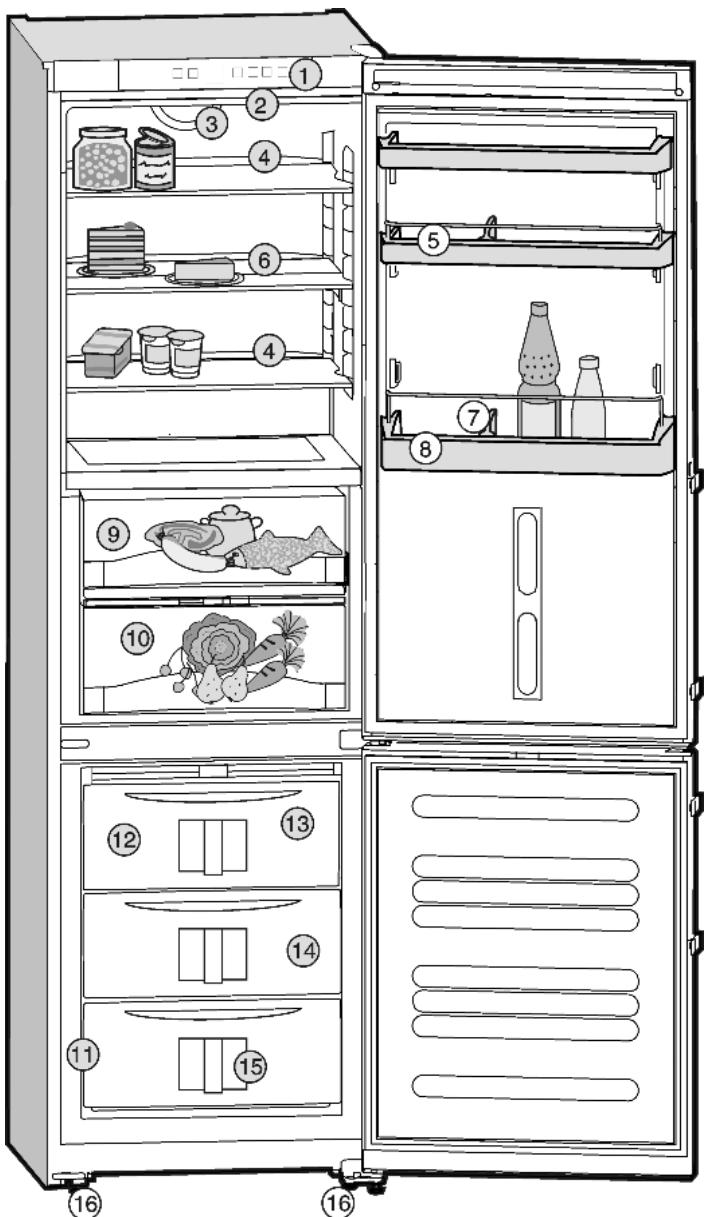
Fig. 1
(1) Operating and control elements
(2) Interior light
(3) Fan
(4) Glass shelf, relocatable
(5) Rack for tinned food, relocatable
(6) Sectioned glass shelf, relocatable
(7) Bottle holder
(8) Bottle rack, relocatable
(9) DrySafe
(10) HydroSafe
(11) Type plate
(12) Freezer compartment
(13) Cold storage accumulators
(14) VarioSpace
(15) Information system
(16) Adjustable feet, transport grips at front, transport castors at back
1.2 Range of appliance use
The appliance is suitable solely for cooling food in a domestic environment or similar. This includes use in, for example
- in staff kitchenettes, bed and breakfast establishments,
- by guests in country homes, hotels, motels and other forms of accommodation,
- in catering and similar services in the wholesale trade
Use the appliance solely as is customary within a domestic environment. All other types of use are inadmissible. The appliance is not suitable for storing and cooling medicines, blood plasma, laboratory preparations or similar substances and products covered by the 2007/47/EC Medical Devices Direc
tive. Misuse of the appliance can result in the stored products suffering harm or perishing. Furthermore, the appliance is not suitable for operation in potentially explosive atmospheres.
The appliance is set to operate within specific ambient temperature limits according to its climate rating. The correct climate rating for your appliance is indicated on the type plate.
Note
Compliance with the ambient temperatures indicated is required, otherwise the cooling performance is reduced.
| Climate rating | for ambient temperatures of |
| SN | 10 °C to 32 °C |
| N | 16 °C to 32 °C |
| ST | 16 °C to 38 °C |
| T | 16 °C to 43 °C |
1.3 Conformity
The refrigerant circuit has been tested for leaks. The appliance complies with current safety regulations and EC directives 2006/95/EC and 2004/108/EC.
1.4 External dimensions of the appliance
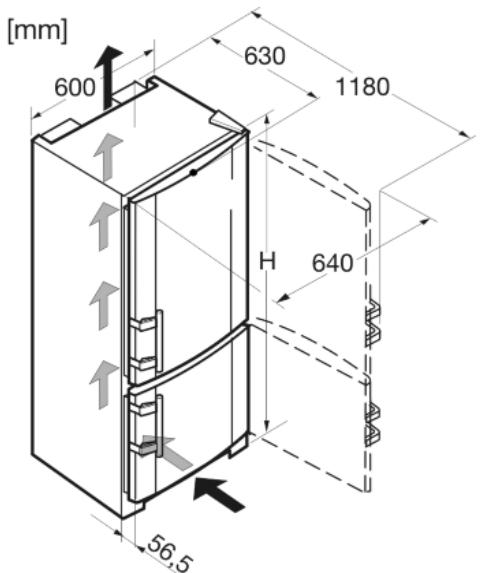
Fig. 2
| H (mm) | |
| CBN(esf) 37.. | 2011 |
| CBN(esf) 39.. | 2011 |
| CBNb 39.. | 2011 |
1.5 Saving energy
- Always ensure good ventilation. Do not cover ventilation openings or grille.
- Always keep fan louvres clear.
- Do not place appliance in areas of direct sunlight or next to a stove, heater or similar object.
- The energy consumption depends on the installation conditions, e.g. the ambient temperature (see 1.2).
- Keep the time the appliance is open to a minimum.
- The lower the temperature setting, the higher the power consumption.
-
Store food logically. (see Appliance at a glance).
-
Ensure that all food is well packed and covered for storage. This will prevent frost from forming.
- Remove food as needed in order that it does not warm too much.
- First cool warm food to room temperature before storing it .
- Defrost frozen food in the refrigerator.
- Empty and switch off refrigerating unit for longer vacation periods.
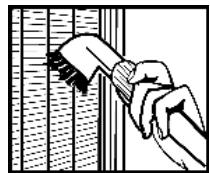
Accumulated dust increases the energy consumption:
- Once a year, dust the refrigerating unit together with the metal grille of the heat exchanger at the back of the appliance.
2 General safety information
Danger for the user:
- This appliance is not designed for persons (including children) with physical, sensory or mental impairment or persons not having sufficient experience and knowledge, unless they are instructed in the use of the appliance and are initially supervised by a person responsible for their safety. Keep children under supervision to ensure they do not play with the appliance.
- In case of a fault, pull out the mains plug (not by pulling the connecting cable) or switch off the fuse.
- Have any repairs to or intervention in the appliance, and any change of the mains power cable, carried out by the customer service only or by other specialised personnel trained for the purpose.
- When disconnecting the appliance from the supply, always take hold of the plug. Do not pull the cable.
Install and connect the appliance only as instructed. - Please keep these instructions in a safe place and pass them on to any subsequent owners.
- Special-purpose lamps (incandescent lamps, LEDs, fluorescent tubes) in the appliance serve to illuminate the appliance interior and are not suited for room illumination.
Fire hazard:
-
The refrigerant R 600a is environmentally friendly but flammable. Escaping refrigerant may ignite.
-
Do not damage the refrigerant circuit pipes.
- Do not allow naked flames or ignition sources to enter the appliance.
- Do not use any electrical appliances in the interior (e.g. steam cleaners, heaters, ice cream maker etc.).
-
If refrigerant escapes: eliminate naked flames or sources of ignition from the vicinity. Pull out the power plug. Ventilate the area well. Notify customer service.
-
Do not store explosives or sprays using combustible propellants such as butane, propane, pentane, etc. in the appliance. To identify these spray cans, look for the list of contents printed on the can, or a flame symbol. Gases possibly escaping may ignite due to electrical components.
- Keep burning candles, lamps and other items with naked flames away from the appliance so that they do not set the appliance on fire.
- Always store high-percentage alcohol in tightly sealed, upright containers. Alcohol possibly escaping may ignite due to electrical components.
Danger of tipping and falling:
- Do not misuse the plinth, drawers, doors etc. as a step or for support. This applies particularly to children.
Danger of food poisoning:
- Do not consume food which has been stored too long.
Danger of frostbite, numbness and pain:
- Avoid lasting skin contact with cold surfaces or refrigerated/ frozen food or take protective steps, e.g. wear gloves. Do not consume ice cream, water ice or ice cubes immediately and do not consume them too cold.
Please observe the specific information in the other sections:
| ! | DANGER | identifies a situation involving direct danger which, if not obviated, may result in death or severe bodily injury. |
| ! | WARNING | identifies a dangerous situation which, if not obviated, may result in death or severe bodily injury. |
| ! | CAUTION | identifies a dangerous situation which, if not obviated, may result in minor or medium bodily injury. |
| NOTICE | identifies a dangerous situation which, if not obviated, may result in damage to property. | |
| Note | identifies useful information and tips. |
3 Controls and displays
3.1 Operating and control elements
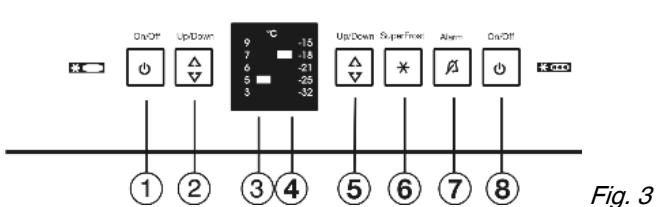
(1) On/Off button, refrigerator compartment
(2) Setting button, refrigerator compartment
(3) Refrigerator compartment temperature display
(4) Freezer compartment temperature display
(5) Setting button, freezer compartment
(6) SuperFrost button
(7) Alarm button
(8) On/Off button, freezer compartment
3.2 Temperature display
The following are displayed in normal operation:
- the set freezing temperature
- the set cooling temperature
The freezer compartment temperature display flashes:
- the temperature setting is being changed
- after switch-on the temperature is not yet cold enough
- the temperature has risen several degrees
4 Putting into operation
4.1 Transporting the appliance

CAUTION
Risk of injury and danger of damage as a result of incorrect transport!
Transport the appliance in a packed condition.
Transport the appliance upright.
Do not transport the appliance without assistance.
4.2 Installing the appliance
In the event that the appliance is damaged, contact the supplier immediately before connecting to the mains.
The floor at the site must be flat and level.
Do not install the appliance in a location where it is exposed to direct radiation of the sun, next to a cooker, heater and similar.
Always install the appliance with the back directly against the wall.
Do not install the appliance without assistance.
Standard EN 378 specifies that the room in which you install your appliance must have a volume of 1m^2 per 8g of R 600a refrigerant used in the appliance. If the room in which the appliance is installed is too small, a flammable gas-air mixture may form in the event of a leakage in the refrigeration circuit. The quantity of refrigerant used in your appliance is indicated on the type plate on the inside of the appliance.
The appliance may be moved only when it is empty.

WARNING
Fire hazard due to dampness!
If live parts or the mains lead become damp this may cause short circuits.
The appliance is designed for use in enclosed areas. Do not operate the appliance outdoors or in areas where it is exposed to splash water or damp conditions.

WARNING
Risk of fire due to short circuit!
If the mains cable/connector of the appliance or of another appliance touch the rear of the appliance, the mains cable/connector may be damaged by the appliance vibrations, leading to a short circuit.
- Stand the appliance so that it is not touched by connectors or main cables.
- Do not plug the appliance or any others into sockets located near the rear of the appliance.

WARNING
Fire hazard due to refrigerant!
The refrigerant R 600a is environmentally friendly but flammable. Escaping refrigerant may ignite.
Do not damage the piping of the refrigeration circuit.

WARNING
Fire hazard and danger of damage!
Do not place appliances emitting heat e.g. microwaves, toasters etc. on the appliance!

WARNING
Blocked ventilation openings pose a risk of fire and damage!
Always keep the ventilation openings clear. Always ensure that the appliance is properly ventilated!
Detach the connecting cable from the rear of the appliance, removing the cable holder at the same time because otherwise there will be vibratory noise!
Remove the protective film from the outside of the appliance.*
NOTICE
The stainless steel doors are provided with a high-quality surface coating and must not be treated using the accompanying care product.

Otherwise the surface coating will be affected.
Wipe the coated door surfaces using a soft, clean cloth only.
Apply a stainless steel cleaner only to the stainless steel side walls evenly, wiping with the grain. Subsequent cleaning becomes easier as a result.
Wipe side walls with a paint finish using a soft, clean cloth only.
Remove all transit supports.
Dispose of packaging material (see 4.5).
NOTICE
Risk of damage due to condensate!
- Do not install the appliance directly alongside a further refrigerator/freezer.
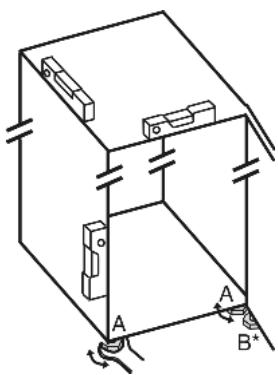
Align the appliance so that it stands firmly and on a level by applying the accompanying spanner to the adjustable-height feet (A) and using a spirit level.
Then support the door: Extend the adjustable foot at the turn hinge (B) until it rests on the floor and then make a further 90^ turn.
Note
Clean the appliance (see 6.2).
If the appliance is installed in a very damp environment, condensate may form on the outside of the appliance.
Always see to good ventilation at the installation site.
4.3 Changing over the door hinges
You can change over the door hinges if necessary.
Ensure that the following tools are to hand:
Torx® 25
Torx® 15
Screwdriver
Cordless screwdriver, if necessary
Second person for fitting work, if needed
Remove any food from the door racks before removing the door, so that no food falls out.
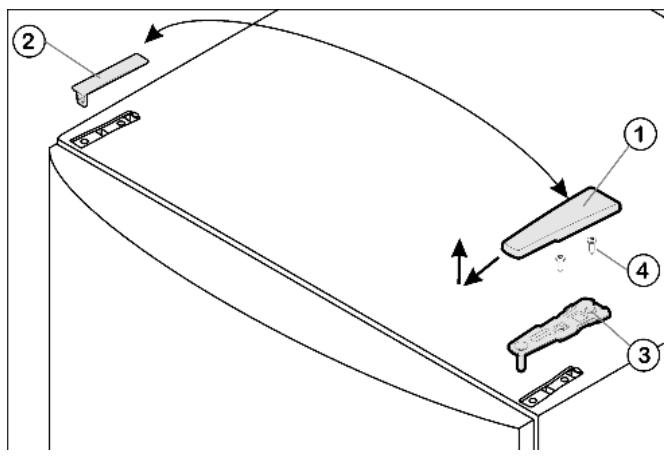
Fig. 4
Close the upper door.
Pull off the cover Fig. 4 (1) forwards and upwards.
Lift off the cover Fig. 4 (2).

CAUTION
Risk of injury if the door tips!
Take good hold of the door.
Set down the door carefully.
Unscrew the upper turn hinge Fig. 4 (3)(2x Torx® 25) Fig. 4 (4) and lift it off.
Lift up the upper door and set it aside.
Close the lower door.
Draw the middle bearing pin Fig. 5 (11) out of the turn hinge and lower door.
Remove the plastic cap Fig. 5 (10).

CAUTION
Risk of injury if the door tips!
Take good hold of the door.
Set down the door carefully.
Open the lower door.
Unscrew the middle turn hinge (2x Torx® 25). Fig. 5 (13)
Lift up the door and set it aside.
4.3.3 Transferring the middle bearing elements
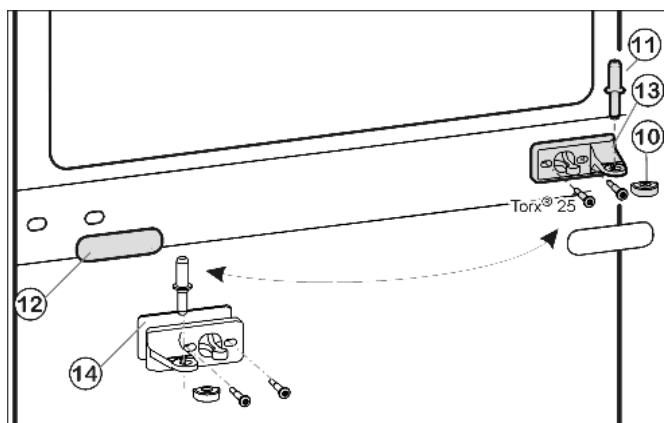
Fig. 5
Carefully detach the cover panel Fig. 5 (12).
Turn the middle turn hinge Fig. 5 (13) with the washer Fig. 5 (14) through 180^ and screw it firmly into place on the new hinge side (with 4 Nm).
Turn the cover panel Fig. 5 (12) through 180^ and snap it into place again on the new handle side.
4.3.4 Transferring the lower bearing elements
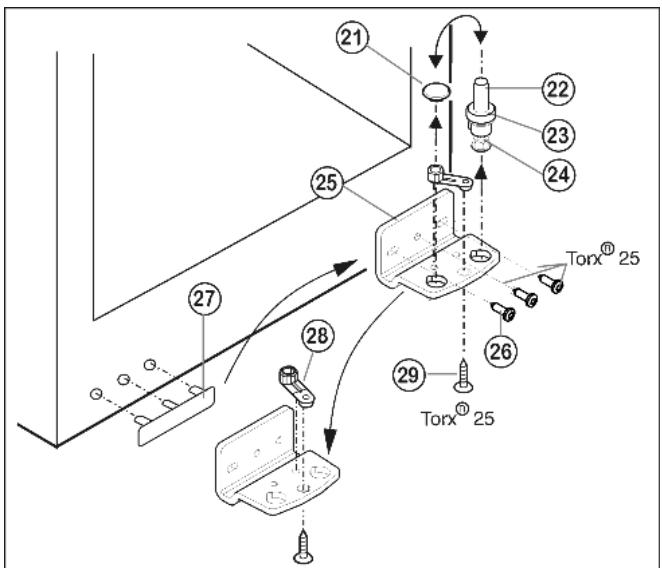
Fig. 6
Lift out the bearing pin Fig. 6 (22) together with washer Fig. 6 (23) and foot Fig. 6 (24).
Lift off the stopper Fig. 6 (21).
Unscrew Fig. 6 (26) the turn hinge Fig. 6 (25).
Unscrew Fig. 6 (29) the bearing element Fig. 6 (28), transfer it to the opposite location hole of the turn hinge and screw it firmly into place.
Carefully lift off the cover on the handle side Fig. 6 (27) and transfer it to the opposite side.
Screw the turn hinge Fig. 6 (25) firmly into place on the new hinge side, possibly using a cordless screwdriver (with 4 Nm).
Re-insert the stopper Fig. 6 (21) into the other hole.
Re-insert the bearing pin Fig. 6 (22) together with washer and foot. In so doing, pay attention that the locating lug points backwards
4.3.5 Transferring the handles
On both the upper and lower door:
Transfer the spring clamp Fig.7 (31):Depress the latch nose and pull the spring clamp off over it.
▶ Slide the spring clamp into place on the new hinge side until it clicks into place.
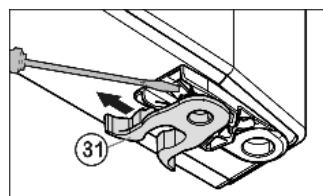
Fig. 7
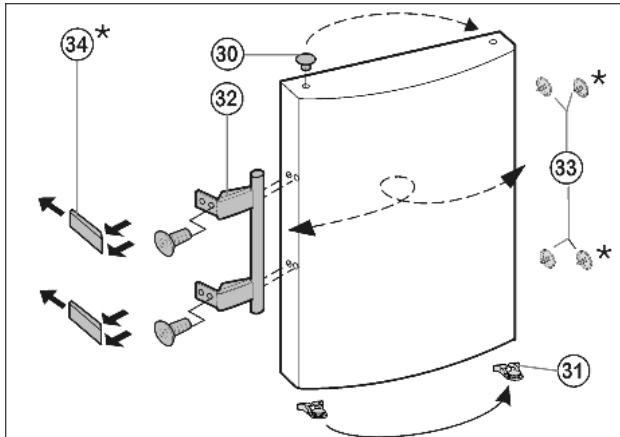
Fig. 8
Lift the stopper Fig. 8 (30) out of the door bearing bush and transfer it.
Detach door handle Fig. 8 (32), stopper Fig. 8 (33) and pressure plates Fig. 8 (34) and transfer to the opposite side.
- When fitting the pressure plates on the opposite side, make sure they snap properly into place*
4.3.6 Fitting the lower door
Place the lower door from above onto the lower bearing pin Fig.6 (22).
Close the door.
Place the plastic cap Fig. 5 (10) back onto the middle turn hinge Fig. 5 (13).
Place the middle bearing pin Fig. 5 (11) in the lower door, on the new hinge side, through the middle turn hinge Fig. 5 (13).
4.3.7 Fitting the upper door
Place the upper door on the middle bearing pin Fig. 5 (11).
Insert the upper turn hinge Fig. 4 (3) in the door on the new hinge side.
Screw the upper turn hinge firmly into place (with 4 Nm) (2x Torx® 25) Fig. 4 (4). Possibly make preliminary holes with a bradawl or use a cordless screwdriver.
Apply the cover Fig. 4 (1) and cover Fig. 4 (2) to the opposite side from the outside and snap them into place.
4.3.8 Aligning the doors
If necessary, align the doors to the appliance housing by way of the two oblong holes in the bottom turn hinge Fig. 6 (25) and middle turn hinge Fig. 5 (13). To do so, unscrew the middle screw in the bottom turn hinge Fig. 6 (25).

WARNING
Risk of injury due to the door dropping out!
If the bearing parts are not screwed into place firmly enough, the door may drop out. This may lead to severe injuries. What is more, the door may not close and therefore the appliance may fail to cool properly.
Screw the turn hinges firmly into place with 4 Nm.
Check all of the screws and retighten if necessary.
4.4 Insertion into a row of kitchen units

(1) Stack cabinet
(2) Appliance
(3) Kitchen cabinet
(4) Wall
The appliance can be inserted into a row of kitchen units. To match the appliance Fig. 9 (2) to the height of the row of units, a suitable stack cabinet Fig. 9 (1) can be fitted above the appliance.
When inserting the appliance into a row of kitchen units (max. depth 580~mm ), the appliance can be installed directly next to the kitchen unit Fig. 9 (3). The appliance door projects relative to the front of the kitchen unit by 34~mm at the side and by 50~mm in the middle of the appliance. It can be opened and closed perfectly as a result.
Important for the ventilation:
- At the back of the stack cabinet there has to be a ventilation duct of at least 50~mm depth throughout the width of the stack cabinet.
- The ventilation space under the ceiling has to be at least 300cm^2
If the appliance is installed with the hinges next to a wall Fig. 9 (4), the distance between appliance and wall has to be at least 40~mm . This corresponds to the projection of the handle when the door is open.
4.5 Disposing of packaging

WARNING
Danger of suffocation due to packing material and plastic film!
Do not allow children to play with packing material.
The packaging is made of recyclable materials:
- corrugated board/cardboard
- expanded polystyrene parts
polythene bags and sheets
polypropylene straps

- nailed wooden frame with polyethylene panel*
Take the packaging material to an official collecting point.
4.6 Connecting the appliance
NOTICE
Risk of damage to the electronic control system!
- Do not use stand-alone inverters (conversion of d.c. to a.c./ three-phase) or energy saving plugs.

WARNING
Fire and overheating hazard!
Do not use extension cables or multiple socket outlets.
The type of current (alternating current) and voltage at the installation site have to conform with the data on the type plate (see Appliance at a glance).
Connect the appliance only with a properly installed socket outlet with earthing contact. The socket outlet must be fused with 10 A or higher.
It must be easily accessible so that the appliance can be quickly disconnected from the supply in an emergency. It must be outside the area of the rear of the appliance.
Check the electrical connection.
Plug in the power plug.
4.7 Switching on the appliance
Note
To switch on the entire appliance it is necessary only to switch on the freezer compartment. In so doing, the refrigerator compartment is automatically switched on as well.
Put the appliance into operation about 2 hours before first loading food to be frozen.
4.7.1 Switching on the freezer compartment
PressOn/Off button, freezer compartment Fig. 3 (8).
The appliance is switched on. The refrigerator compartment temperature display indicates the set temperature. The freezer compartment temperature display and the alarm button flash until the temperature is sufficiently low.
4.7.2 Switching on the refrigerator compartment
Note
- When the refrigerator compartment is switched on, the freezer compartment is automatically switched on as well.
Press On/Off button, refrigerator compartment Fig. 3 (1).
The interior light is on when the door is open.
The temperature display shines. Refrigerator compartment and freezer compartment are switched on.
5 Control
5.1 Door alarm
If the door is open longer then 60 s, the audible alarm sounds.
The audible alarm is automatically silenced when the door is closed.
5.1.1 Muting the door alarm
The audible alarm can be muted when the door is open. The sound switch-off function is active as long as the door is left open.
Press alarm button Fig. 3 (7).
The door alarm is silenced.
5.2 Temperature alarm
The audible alarm sounds if the freezer temperature is not cold enough.
The alarm button flashes at the same time.
The cause of the temperature being too high may be:
warm fresh food was placed inside
- too much warm ambient air flowed in when rearranging and removing food
- power failure for some time
- the appliance is faulty
The audible alarm is automatically silenced, the alarm button Fig. 3 (7) goes out and the temperature display stops flashing when the temperature is sufficiently cold again.
If the alarm status persists: (see Malfunction).
Note
Food may be spoilt if the temperature is not cold enough.
Check the quality of the food. Do not consume spoiled food.
5.2.1 Muting the temperature alarm
The audible alarm can be muted. When the temperature is sufficiently cold again, the alarm function is active again.
Press alarm button Fig. 3 (7).
The audible alarm is silenced.
5.3 Refrigerator compartment
The natural circulation of air in the refrigerator compartment results in zones differing in temperature. It is coldest directly above the plate separating off the BioFresh zone and at the rear wall. It is warmest at the top front of the compartment and in the door.
5.3.1 Food refrigeration
Note
The energy consumption increases and the cooling performance decreases if the ventilation is inadequate.
Always keep the air slits of the fan free.
- Place butter and preserves in the upper area and in the door (see Appliance at a glance).
Use recyclable plastic, metal, aluminium and glass containers and cling film for wrapping. - Use the front area of the refrigerator compartment floor only for briefly putting down cooled products, e.g. when rearranging and sorting. However do not leave cooled products there otherwise they may be pushed back or tipped over when the door is closed.
Do not store food too close together to enable good air circulation.
To safeguard bottles from tipping over: move the bottle holder.
5.3.2 Setting the temperature
The temperature depends on the following factors:
- the door opening frequency
-
the room temperature at the site where the appliance is installed
-
the type, temperature and quantity of frozen food
Temperature setting to be recommended: 5^
The temperature can be changed continuously. Once the 3^ setting is reached, it starts again with 9^ .
To access temperature adjustment: press the setting button, refrigerator compartment Fig. 3 (2) once.
The LED of the current temperature flashes in the temperature display.
Press the setting button, refrigerator compartment Fig. 3 (2) the number of times needed until the required temperature shines in the LED display.
Note
Long pressing of the setting button sets a slightly colder value within a small temperature range (e.g.: between 5^ and 6^ ). The LED of the next lower temperature range then shines in the temperature display.
5.3.3 Relocating the shelves
The shelves have stops preventing them from being unintentionally pulled out.
Lift the shelf and draw it out forwards.
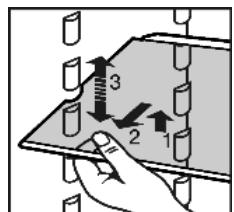
Insert shelf with the raised edge pointing upwards at the back.
The food does not freeze onto the rear wall.
5.3.4 Using the sectioned shelf

The glass shelf with stop face (2) has to be at the back.
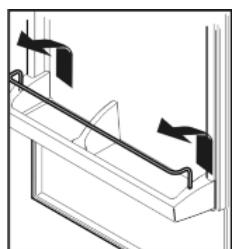
5.3.5 Moving the storage rack
Remove storage rack according to illustration.
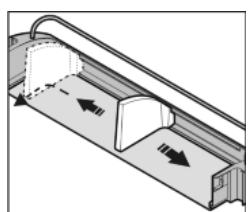
5.3.6 Removing the bottle holder
Remove the bottle holder according to the illustration.
5.4 BioFresh compartment
The BioFresh compartment allows some types of fresh food to be stored up to three times longer than in conventional refrigerators, without compromising quality.
For food with an indicated best before date, the date specified on the packaging always applies.
5.4.1 HydroSafe
The HydroSafe at the moist setting is suited for storing unwrapped salad, vegetables and fruit with high inherent moisture. When the drawer is well filled, a dewy climate with up to 90% humidity is established. The humidity in the compartment depends on the moisture content of the food stored and on the opening frequency. You can set the humidity yourself.
5.4.2 DrySafe
The DrySafe is suitable for storing dry or wrapped food (e.g. dairy products, meat, fish, sausages). A relatively dry storage climate is established here.
5.4.3 Storing food
Note
Vegetables sensitive to cold, such as cucumbers, aubergines, semi-ripe tomatoes, zucchini and all tropical fruits sensitive to cold, do not belong in the BioFresh compartment.
- To prevent food spoilage due to transfer of germs: Store unwrapped animal and vegetable products separate from one another in the drawers. This also applies to different sorts of meat.
- If food has to be stored together due to lack of space:
- wrap the food.
5.4.4 Storage times
| Standard values for storage time at low humidity | |||
| Butter | up to | 90 | days |
| Hard cheese | up to | 110 | days |
| Milk | up to | 12 | days |
| Sausage, cold meat | up to | 9 | days |
| Poultry | up to | 6 | days |
| Pork | up to | 7 | days |
| Beef | up to | 7 | days |
| Game | up to | 7 | days |
Note
Please note that protein-rich food deteriorates faster, i.e. shellfish and crustaceans deteriorate faster than fish, fish faster than meat.
| Standard values for storage time at high humidity | |||
| Vegetables, salad | |||
| Artichokes | up to | 14 | days |
| Celery | up to | 28 | days |
| Cauliflower | up to | 21 | days |
| Broccoli | up to | 13 | days |
| Chicory | up to | 27 | days |
| Lamb's lettuce | up to | 19 | days |
| Standard values for storage time at high humidity | |||
| Peas | up to | 14 | days |
| Kale | up to | 14 | days |
| Carrots | up to | 80 | days |
| Garlic | up to | 160 | days |
| Kohlrabi | up to | 55 | days |
| Lettuce | up to | 13 | days |
| Herbs | up to | 13 | days |
| Leek | up to | 29 | days |
| Mushrooms | up to | 7 | days |
| Radishes | up to | 10 | days |
| Brussels sprouts | up to | 20 | days |
| Asparagus | up to | 18 | days |
| Spinach | up to | 13 | days |
| Savoy cabbage | up to | 20 | days |
| Fruit | |||
| Apricots | up to | 13 | days |
| Apples | up to | 80 | days |
| Pears | up to | 55 | days |
| Blackberries | up to | 3 | days |
| Dates | up to | 180 | days |
| Strawberries | up to | 7 | days |
| Figs | up to | 7 | days |
| Blueberries | up to | 9 | days |
| Raspberries | up to | 3 | days |
| Currants | up to | 7 | days |
| Sweet cherries | up to | 14 | days |
| Kiwis | up to | 80 | days |
| Peaches | up to | 13 | days |
| Plums | up to | 20 | days |
| Cranberries | up to | 60 | days |
| Rhubarb | up to | 13 | days |
| Gooseberries | up to | 13 | days |
| Grapes | up to | 29 | days |
5.4.5 Adjusting the temperature in the BioFresh compartment
The temperature is regulated automatically. At a temperature of 5^ in the refrigerator compartment, the temperature in the BioFresh compartment is between 0^ and 3^ .
You can adjust the temperature slightly colder or warmer. The temperature is adjustable from 1 (coldest temperature) to 3 (warmest temperature). The preset value is 5. At 1 to 4, the temperature can drop below 0^ and therefore the food may freeze a little.
The temperature can be changed continuously. Once the value 9 is reached, the selection starts from the beginning again. A combination of LEDs that corresponds to the value shines in the temperature display.
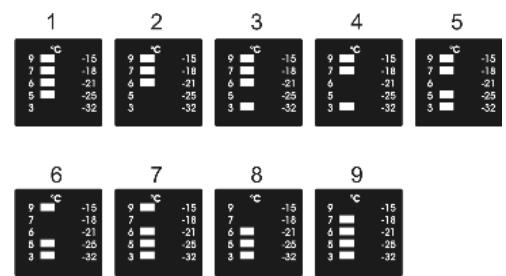
Fig. 11
To activate the setting mode: Press the SuperFrost button Fig. 3 (6) for at least 5 seconds.
The SuperFrost button Fig. 3 (6) flashes. The LED pattern of the set value shines in the temperature display.
Press the setting button, freezer compartment Fig. 3 (5) the number of times needed until the LED pattern of the value wanted shines.
To confirm: Press the SuperFrost button Fig. 3 (6).
The temperature is indicated again in the temperature display.
To deactivate the setting mode: press On/Off button, freezer compartment Fig. 3 (8).
-or- Wait for 5 minutes.
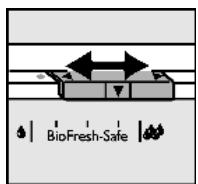
5.4.6 Setting the humidity in the HydroSafe
Low humidity: move the regulator to the left.
High humidity: move the regulator to the right.
5.4.7 Drawers
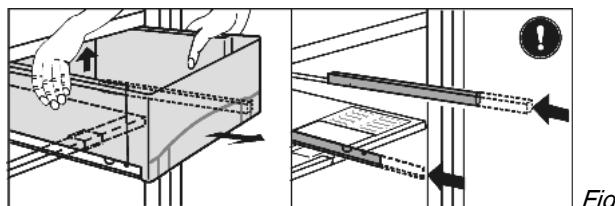
Fig. 12
Pull out the drawer, lift it at the back and draw it forwards for removal.
Push the rails in again!
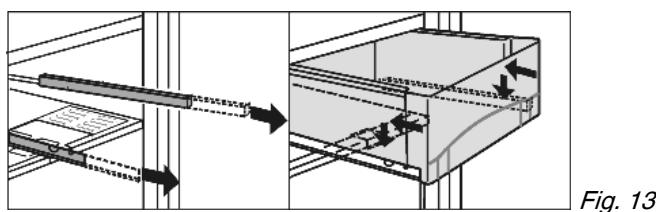
Pull out the rails.
Attach the drawer to the rails and push it in until it engages audibly at the back.
5.4.8 Humidity control plate
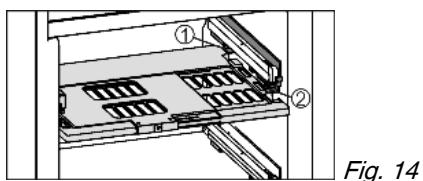
To remove the humidity control plate: Having removed the drawers, carefully draw the plate forwards and lower it for removal.
To insert the humidity control plate: Insert the cover mouldings of the plate into the rear holder Fig. 14 (1) from underneath and engage them in the holder Fig. 14 (2) at the front.
5.5 Freezer compartment
You can store frozen food, make ice cubes and freeze fresh food in the freezer compartment.
5.5.1 Freezing food
The rating plate indicates the maximum quantity of fresh food you can freeze within 24 hours (see Appliance at a glance) under "Freezing capacity ... kg/24h".
The maximum load of frozen food for the drawers is 25kg each and for the shelves 35kg each.

CAUTION
Risk of injury due to broken glass!
Bottles and cans containing drinks may burst when being frozen. This applies particularly to sparkling drinks.
Do not freeze bottles and cans containing drinks!
In order that the food is rapidly frozen through to the core, do not exceed the following quantities per pack:
- Fruit, vegetables up to 1 kg
- Meat up to 2.5kg
Pack the food in portions in freezer bags, reusable plastic, metal or aluminium containers.
5.5.2 Thawing food
- in the refrigerator compartment
- at room temperature
- in a microwave oven
- in a conventional or fan oven
▶ Food once thawed should be re-frozen only in exceptional cases.
5.5.3 Setting the temperature
Temperature setting to be recommended: -18 °C
The temperature can be changed continuously. Once the -32^ setting is reached, it starts again with -15^ .
To access temperature adjustment: press setting button, freezer compartment Fig. 3 (5) once.
The LED of the current temperature flashes in the temperature display of the freezer compartment.
Press the setting button, freezer compartment Fig. 3 (5) the number of times needed until the required temperature shines in the LED display.
Note
Long pressing of the setting button sets a slightly colder value within a small temperature range (e.g.: between -15^ and -18^ ). The LED of the next lower temperature range then shines in the temperature display.
5.5.4 SuperFrost
With this function you can freeze fresh food quickly through to the core. The appliance operates with maximum refrigeration. The noise of the refrigeration unit may be temporarily louder as a result.
The maximum amount of fresh food which can be frozen in 24 h is indicated on the type plate under "freezing capacity ... kg/24h". This amount varies according to the model and climate rating.
You have to activate SuperFrost in good time, depending on how much fresh food is to be frozen: about 6 hours before placing the food inside in case of small amounts and about 24 hours in advance in case of the maximum amount of food to be frozen.
You do not have to activate SuperFrost in the following cases:
-
when placing frozen food in the freezer
-
when freezing up to approx. 2kg fresh food daily
Freezing with SuperFrost
Briefly press the SuperFrost button Fig. 3 (6).
The SuperFrost button shines.
The freezer temperature drops, the appliance operates with the maximum refrigerating capacity.
In case of a small amount of food to be frozen:
wait about 6 h.
- Place the fresh food in the top drawers. In case of the maximum amount of food to be frozen (see type plate):
wait about 24 h.
Place food in the drawers.
SuperFrost is automatically deactivated after about 65h
The SuperFrost button is dark.
The appliance continues to operate in the energy-saving, normal mode.
5.5.5 Drawers
Note
The energy consumption increases and the cooling performance decreases if there is insufficient ventilation.
For appliances with NoFrost:
Leave the bottom drawer in the appliance!
Always keep the air slits of the fan free at the rear wall!
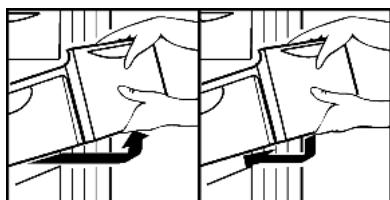
To store frozen food directly on the shelves: pull the drawer forwards and lift it out.
5.5.6 Shelves
To remove the shelf: lift up at the front and pull out.
To put the shelf back: simply push in as far as it will go.
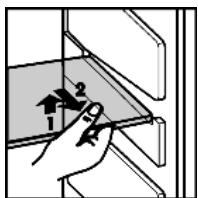
5.5.7 VarioSpace
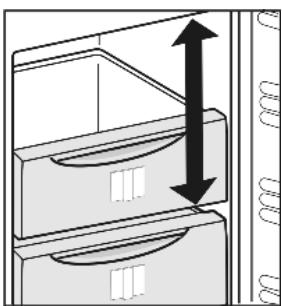
Apart from being able to remove the drawers, you can also remove the shelves, creating space for large items of frozen food. Poultry, meat, large pieces of game and high bakery products can be frozen in one piece and prepared.
The maximum load of frozen food for the drawers is 25kg each and for the shelves 35kg each.
5.5.8 Information system
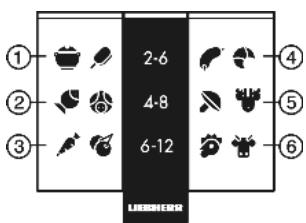
Fig. 15
(1) Ready-made meals, ice (4) Sausages, bread cream
(2) Pork, fish (5) Game, mushrooms (3) Fruit, vegetables (6) Poultry, beef/veal
The figures indicate the storage time in months for several types of frozen food in each case. Storage times given are guide times.
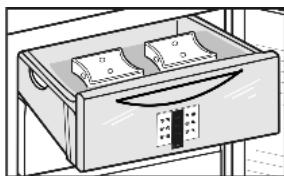
5.5.9 Cold storage accumulators*
The cold storage accumulators prevent the temperature from rising too fast in the event of power failure.
Using cold storage accumulators*
Place the cold storage accumulators in the top freezer compartment to save space.
Place the frozen cold storage accumulators on the frozen food in the upper front area of the freezer compartment.
6 Maintenance
6.1 Defrosting with NoFrost
The NoFrost system automatically defrosts the appliance.
Refrigerator compartment:
The defrost water evaporates due to the compressor heat.
Regularly clean the drain opening to allow the water to flow away (see 6.2).
Freezer compartment:
The moisture condenses on the evaporator, is periodically defrosted and evaporates.
The appliance does not have to be manually defrosted.
6.2 Cleaning the appliance

CAUTION
Risk of injury and damage as a result of hot steam! Hot steam may damage the surfaces and cause burns.
Do not use any steam cleaners!
NOTICE
Incorrect cleaning damages the appliance!
Do not use cleaning agents in concentrated form.
Do not use any scouring or abrasive sponges or steel wool.
Please do not use any aggressive, scouring, sand-, chloride-, chemical- or acid-based cleaning agents.
Do not use chemical solvents.
- Do not damage or remove the type plate on the inside of the appliance. It is important for the customer service.
Do not pull off, bend or damage cables or other components.
- Do not allow any cleaning water to enter the drain channel, ventilation grille or electrical parts.
Please use soft cleaning cloths and a universal pH-neutral cleaning agent.
Please use cleaning and care products suitable for contact with foodstuffs in the appliance interior.
Empty appliance.
Pull out the power plug.
Clean plastic outer and inner surfaces with lukewarm water and a little washing-up liquid.
Do not apply stainless steel cleaning agent to glass or plastic surfaces to prevent them from being scratched. Darker areas at the beginning and quite an intensive colour of the stainless steel surface are normal.*
NOTICE
The stainless steel doors are provided with a high-quality surface coating and must not be treated using the accompanying care product.

Otherwise the surface coating will be affected.
Wipe the coated door surfaces using a soft, clean cloth only. In case of stubborn dirt, use a little water or a neutral cleaning agent. A microfibre cloth can be optionally used.
- If the stainless steel side walls are dirty, clean them using a commercially available stainless steel cleaning agent. Then evenly apply the accompanying stainless steel care product, making strokes in the direction of the grain.
Wipe side walls with a paint finish using a soft, clean cloth only. In case of stubborn dirt, use a little water or a neutral cleaning agent. A microfibre cloth can be optionally used.
Clean drain hole: Remove deposits with a narrow instrument, e.g. a cotton bud.
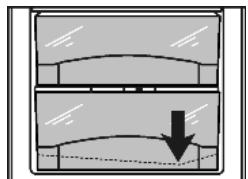
Clean items of equipment by hand with lukewarm water and a little washing-up liquid.
Remove the support rails for the half glass shelves for cleaning.
To dismantle the shelves: remove trims and side parts.
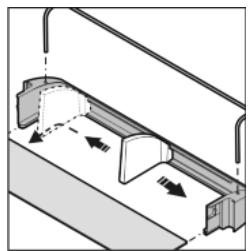
Dismantle door racks as illustrated.
After cleaning:
Wipe dry the appliance and items of equipment.
Connect the appliance and switch it on again.
Switch on SuperFrost (see 5.5.4). When the temperature is sufficiently cold:
Put the food back inside.
6.3 Changing the interior light with bulb
Bulldata
max. 25 W
Fitting: E14
Type of current and voltage must conform with the details on the type plate
Switch off the appliance.
Pull out the power plug or switch off the fuse.
Take holder of the cover Fig. 16 (1) at the front and unhook it at the back.
Change the bulb Fig.162
Put the cover Fig. 16 (1) back in place.
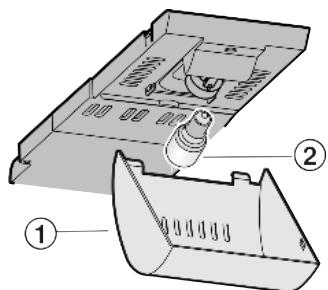
Fig. 16
6.4 Customer service
First check whether you can correct the fault yourself by reference to the list (see Malfunction). If this is not the case, please contact the customer service whose address is given in the enclosed customer service list.

WARNING
Risk of injury if repair work is not carried out professionally!
Have any repairs and action - not expressly specified - on the appliance and mains cable carried out by service personnel only. (see Maintenance)
Read the appliance designation
Fig. 17 (1), service No. Fig. 17 (2) and serial No. Fig. 17 (3) off the type plate located inside the appliance on the left-hand side.
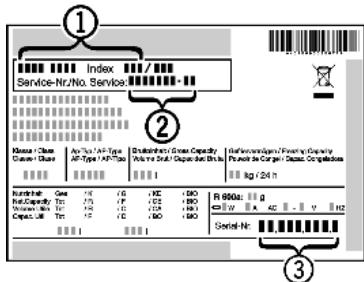
Fig. 17
- Notify the customer service, specifying the fault, appliance designation Fig. 17 (1), service No. Fig. 17 (2) and serial No. Fig. 17 (3).
This will help us to provide you with a faster and more accurate service. - Keep the appliance closed until the customer service arrives.
The food will stay cool longer.
Pull out the mains plug (not by pulling the connecting cable) or switch off the fuse.
7 Malfunction
Your appliance is designed and manufactured for a long life span and reliable operation. If a malfunction nonetheless occurs during operation, check whether it is due to a handling error. In this case you will have to be charged for the costs incurred, even during the warranty period. You may be able to rectify the following faults yourself:
Appliance does not work.
The appliance is not switched on.
Switch on the appliance.
The power plug is not properly inserted in the wall socket.
Check power plug.
The fuse of the wall socket is not in order.
Check fuse.
The compressor runs for a long time.
The compressor switches to a low speed when little cold is needed. Although the running time is increased as a result, energy is saved.
This is normal in energy-saving models.
SuperFrost is activated.
The compressor runs for longer in order to rapidly cool the food. This is normal.
The inverter regularly flashes every 15 seconds*.
The inverter is equipped with a diagnostic LED.
The flashing is normal.
Excessive noise.
Speed-controlled* compressors may produce varying running noise due to different speed steps.
The sound is normal.
A bubbling and gurgling noise.
This noise comes from the refrigerant flowing in the refrigeration circuit.
The sound is normal.
A quiet clicking noise.
The noise is produced whenever the refrigeration unit (motor) automatically switches on or off.
The sound is normal.
A hum. It is briefly a little louder when the refrigeration unit (the motor) switches on.
→ The refrigeration increases automatically when the SuperFrost, function is activated, fresh food has just been placed in the appliance or the door has been left open for a while.
The sound is normal.
The ambient temperature is too high.
Solution: (see 1.2)
A low hum.
The sound is produced by air flow noise of the fan.
The sound is normal.
Vibratory noise.
The appliance is not standing firmly on the floor. As a result, adjoining units or objects are set into vibration by the running refrigeration unit.
Move the appliance away a little and align it using the adjustable feet.
Move bottles and containers apart.
The SuperFrost button flashes together with the temperature display.
There is a fault.
Contact the customer service. (see Maintenance).
The outside surfaces of the appliance are warm.
The heat of the refrigeration circuit is used to prevent condensate from forming.
This is normal.
The temperature is not cold enough.
The door of the appliance is not properly closed.
Close the door of the appliance.
Insufficient ventilation.
Clear ventilation grilles.
The ambient temperature is too high.
Solution: (see 1.2).
The appliance was opened too frequently or for too long.
- Wait until the appliance reaches the required temperature itself. If not, contact the customer service. (see Maintenance).
Too much fresh food was placed inside without SuperFrost.
Solution: (see 5.5.4)
→ The appliance is too close to a heat source.
Solution: (see Putting into operation).
The interior light is not on.
→ The appliance is not switched on.
Switch on the appliance.
The door was open longer than 15 min.
The interior light automatically switches off if the door has been open for about 15 min.
If the interior light is not on but the temperature display is lit, the bulb is faulty.
Change the bulb. (see Maintenance).
8 Decommissioning
8.1 Switching off the appliance
Note
To switch on the entire appliance it is necessary only to switch off the freezer compartment. In so doing, the refrigerator compartment is automatically switched off as well.
8.1.1 Switching off the freezer compartment
Press ON/OFF button, freezer compartment Fig. 3 (8) for at least 3 seconds.
The temperature displays are dark. The entire appliance is switched off.
8.1.2 Switching off the refrigerator compartment
Press ON/OFF button, refrigerator compartment Fig. 3 (1) for at least 3 seconds.
The interior light is off.
The temperature display of the refrigerator compartment is dark.
Note
If only the refrigerator compartment is to be switched off, e.g. during holidays, then always pay attention: the freezer compartment temperature display has to shine.
8.2 Taking the appliance out of service
Empty the appliance.
Pull out the power plug.
Clean the appliance (see 6.2).
Leave the door open to prevent odour.
9 Disposing of the appliance
The appliance contains some reusable materials and should be disposed of properly - not simply with unsorted household refuse. Appliances which are no longer needed must be disposed of in a professional and appropriate way, in accordance with the current local regulations and laws.
When disposing of the appliance, ensure that the refrigeration circuit is not damaged to prevent uncontrolled escape of the refrigerant it contains (data on type plate) and oil.
Disable the appliance.
Pull out the plug.
Cut through the connecting cable.