
AVENT SCD281 - Baby products PHILIPS - Free user manual and instructions
Find the device manual for free AVENT SCD281 PHILIPS in PDF.


| Product Type | Digital Audio Baby Monitor |
| Model | AVENT SCD281 |
| Brand | Philips |
| Dimensions (Parent Unit) | Approx. 11.5 x 6.5 x 4.5 cm |
| Dimensions (Baby Unit) | Approx. 14.5 x 10.0 x 6.0 cm |
| Weight (Parent Unit) | Approx. 120 g (including battery) |
| Weight (Baby Unit) | Approx. 250 g (including power adapter) |
| Power Supply | Baby Unit: AC 100-240V; Parent Unit: Rechargeable Li-ion battery |
| Battery Life (Parent Unit) | Up to 10 hours |
| Range (Indoor) | Up to 50 meters |
| Range (Outdoor) | Up to 300 meters |
| Frequency | DECT (Digital Enhanced Cordless Telecommunications) |
| Main Functions | Sound activation, night light, lullabies, two-way talk, temperature sensor, volume control |
| Night Light | Soothing glow with multiple color options |
| Lullabies | Pre-installed melodies, adjustable volume |
| Temperature Sensor | Displays room temperature on parent unit |
| Two-Way Talk | Speak to baby from parent unit |
| Sound Activation | Adjustable sensitivity, ECO mode |
| Safety | DECT technology for secure, interference-free transmission |
| Cleaning & Maintenance | Wipe with a slightly damp cloth; do not use harsh chemicals |
| Spare Parts | Replacement power adapters, batteries, and charger available from Philips |
| Repairability | Designed for durability; battery replacement possible |
| Package Contents | Baby unit, parent unit, 2 power adapters, user manual |
| Warranty | 1 year limited warranty |
Frequently Asked Questions - AVENT SCD281 PHILIPS
User questions about AVENT SCD281 PHILIPS
0 question about this device. Answer the ones you know or ask your own.
Ask a new question about this device
Download the instructions for your Baby products in PDF format for free! Find your manual AVENT SCD281 - PHILIPS and take your electronic device back in hand. On this page are published all the documents necessary for the use of your device. AVENT SCD281 by PHILIPS.
USER MANUAL AVENT SCD281 PHILIPS
www.philips.com/AVENT
Philips AVENT, a business of Philips Electronics UK Ltd. Philips Centre, Guildford Business Park, Guildford, Surrey, GU2 BXH
Produced under the control of Philips Electronics UK Ltd. Guildford, Business Park, Guildford, Surrey GU2 BXH, United Kingdom Trademarks owned by the Philips Group. © Koninklijke Philips Electronics N.V. All Rights Reserved.
PHILIPS
AVENT
GB Manual breast pump PL Laktator Ręczny RU Ручной Молокоотсос HR Ručna izdajalica


- (1)-(7)




IMPORTANT: DO NOT LOSE THE WHITE VALVE. YOUR PUMP WILL NOT WORK WITHOUT IT OR IF IT IS FITTED INCORRECTLY. If lost, spare valves are available direct from Philips AVENT.

Please take five minutes to read through the WHOLE of this leaflet BEFORE you use your Philips AVENT manual breast pump for the first time.
Contents
- Introducing the manual breast pump
- Detailed parts guide
- Cleaning and sterilisation
- Keeping your breast pump sterile for travel
- Using the manual breast pump with the AVENT VIA storage system
- How to assemble the manual breast pump
- When to express milk
- Hints to help you succeed
- How to use the manual breast pump
- Storing your breast milk
- Feeding your baby your expressed breast milk 12 Choosing the right test for your baby
- Troubleshooting guide
Should you ever lose these instructions, they are available on our website: www.philips.com/AVENT
1. Introducing the manual breast pump
The manual breast pump is a breakthrough in breast pump design. Its silicone diaphragm provides 100% reliable vacuum, whilst the Let-down Massage Cushion naturally imitates your baby's suckling action to provide fast milk flow – silently, comfortably and gently. The pump is easy to assemble, discreet to use and all parts are dishwasher safe.
Doctors recommend that breast milk is the best nutrition for babies during the first year, combined with solid food after the first 6 months. Your milk is specially adapted to your baby's needs and contains antibodies which help protect your baby against infection and allergies.
Your manual breast pump will help you breastfeed longer. You can express and store your milk so that – whether you are out for a few hours, taking a well deserved rest, or back at work – your baby can still enjoy the benefits of your breast milk, even if you can’t be there to give it yourself. As the pump is so silent and discreet you can take it with you anywhere, allowing you to express milk at your own convenience and maintain your milk supply.
Since the Philips AVENT bottle and AVENT teat are specially designed to mimic breastfeeding, your baby will switch easily between breast and bottle. This allows mothers to continue providing breast milk to baby even when they return to work.
2. Detailed parts guide
MANUAL BREAST PUMP
a) Funnel cover (same as i) b) Let-down Massage Cushion c) Pump cover d) Silicone diaphragm and stem* e) Handle f) Pump body g) White valve*
BOTTLE
h) Philips AVENT feeding bottle (125ml/4oz)/VIA adaptor/VIA cup/adaptor ring i) Stand (same as a) / VIA lid/stand j) Dome cap k) Extra Soft teat, Newborn Flow (0m+) l) Screw ring m) Sealing base n) Sealing disc *spares included
3. Cleaning and sterilisation
Before you use your breast pump for the first time and every time before use:
Separate all parts, then wash in the dishwasher or in warm soapy water and rinse. Do not use antibacterial or abrasive cleaners/detergents.

Caution: Take care when cleaning the white valve. If it gets damaged, your breast pump will not function properly. To clean the white valve, rub it gently between your fingers in warm soapy water. Do not insert objects as this may cause damage.
Sterilise all parts in a Philips AVENT steam steriliser, or by boiling for 5 minutes. If using a Philips AVENT steam steriliser, the pump will remain sterile in the steriliser for a minimum of 6 hours, provided the lid is not removed.
4. Keeping your breast pump sterile for travel
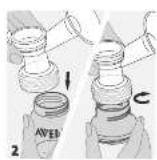
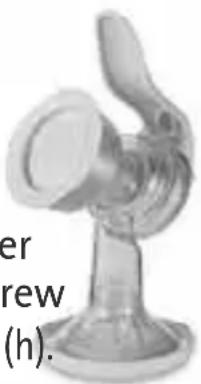
After sterilising all parts, insert the white valve (g) and fit the diaphragm with stem (d) onto the pump body (f). Clip the cover (a) over the funnel and Let-down Massage Cushion (b) and screw on the sealing base (m) in place of the Philips AVENT feeding bottle (h).
5. Using the manual breast pump with the AVENT VIA feeding system
Simply replace the Philips AVENT feeding bottle with a VIA cup and adaptor. To make the pump completely stable insert the VIA cup into the VIA lid/stand.
6. How to assemble the manual breast pump
Separate all parts and ensure pump has been cleaned and sterilised as in section 3:
1) Wash your hands thoroughly. Insert the white valve (g) into the pump body (f) from underneath. 2) Place the pump body (f) onto the AVENT feeding bottle (h).* 3) Twist gently clockwise until secure. DO NOT OVERTIGHTEN! 4) Place the silicone diaphragm and stem (d) into the pump body (f). Make sure it fits securely around the rim by pressing down with your fingers to ensure a perfect seal. (This is easier if assembled whilst wet). 5) Place the forked end of the handle (e) under the silicone diaphragm and stem (d) and push down gently on the handle until it clicks into place. 6) Carefully insert the Let-down Massage Cushion (b) into the pump funnel (f) making sure it is perfectly sealed all round the rim of the funnel. (This is easier if assembled whilst wet). 7) Click the pump cover (c) onto the pump body (f). To make the pump completely stable insert the bottle into the stand (i).
*ALWAYS insert the adaptor ring when using a polypropylene bottle
7. When to express milk
1) If possible, wait until your milk supply and breastfeeding schedule are well established, normally at least 2-4 weeks after birth, unless told otherwise by your health professional or breastfeeding advisor.

2) The exceptions to the above are:
a) If you are expressing milk for your baby to be given in hospital. b) If your breasts are engorged (painful or swollen), you can express a small amount of milk before or between feeds to ease the pain and to help your baby latch on more easily. c) If you have sore or cracked nipples, you may wish to express your milk until they are healed. d) If you are separated from your baby and wish to continue to breastfeed when you are reunited, you should express your milk regularly to stimulate your milk supply.
3) You will need to find the right times of the day for you to express your milk, e.g.
a) Early in the morning when your breasts are full, just before or after your baby's first feed. b) After a feed, if your baby has not emptied both breasts. c) Between feeds, or in a break if you have returned to work.
8. Hints to help you succeed
Using a breast pump takes practice – you may need to make several attempts before you succeed, but because the pump is so simple and natural to use, you will soon get used to expressing your milk.
1) Choose a time when you're not rushed and won't be interrupted. 2) Having your baby or a photograph of your baby nearby can help encourage ‘let-down’. 3) Placing a warm cloth on the breasts for a few minutes before you start pumping can encourage milk flow and soothe painful breasts. 4) Warmth and relaxation can encourage milk flow. Try expressing after a bath or shower. 5) Try expressing from one breast while your baby is feeding from the other, or continue expressing just after a feed.
6) Repositioning the pump on the breast from time to time can help stimulate your milk ducts.
Practice with your pump to find the best technique for you. However, if the process becomes very painful, stop and consult your breastfeeding advisor.
9. How to use the manual breast pump
1) Wash your hands thoroughly and make sure your breasts are clean. Gently squeeze a little milk from each nipple to ensure milk ducts are not blocked. 2) Make sure you have sterilised and carefully assembled your pump exactly as shown in sections 3 and 6. 3) Consult the ‘Hints to help you succeed’ section. 4) Relax in a comfortable chair, leaning slightly forward (use cushions to support your back). Make sure you have a glass of water nearby. 5) Press the funnel and Let-down Massage Cushion of the pump firmly against your breast, making sure that no air can escape – otherwise there will be no suction. 6) As you gently push down on the pump handle, you will feel the suction on your breast. You don't need to depress the handle fully to create a vacuum – only as much as is comfortable. Your milk will soon start flowing, even though you may not use all the suction the pump can generate. 7) Begin by pumping 5-6 times rapidly to initiate let-down. Then, hold the handle down for 2-3 seconds, and allow it to return to its resting place. These 2-3 second cycles imitate your baby's natural suckling pattern and allow the milk to flow between strokes. 8) Milk should begin to flow after the first few strokes. Don't worry if your milk does not flow immediately. Relax and continue pumping.
Do not continue pumping for more than 5 minutes at a time if NO result is achieved. Try expressing at another time during the day.
Please remember that, should the process become very painful or uncomfortable, you should stop using the pump and consult your health professional or breastfeeding advisor.
9) On average you will need to pump for 10 minutes to express 60-125ml or 2-4oz. However, this is just a guide and varies from woman to woman. If you find that you regularly express more than 125ml/4oz per session, please use a 260ml/9oz Philips AVENT bottle or 240ml/8oz VIA cup.
Do not overfill Philips AVENT feeding bottles or VIA cups and keep upright, otherwise milk may leak from below the pump body.
10. Storing your breast milk
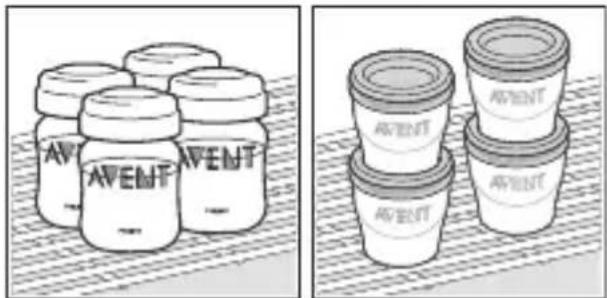
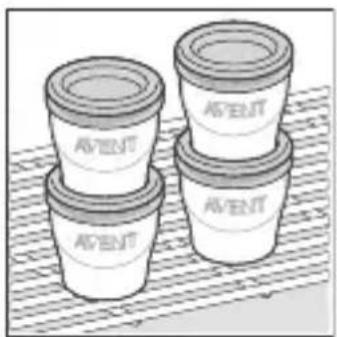
- Breast milk can be stored in the fridge or freezer in either sterile breast milk containers (125ml/4oz or 260ml/9oz bottles fitted with sealing discs) or in VIA cups with lids.
- Only milk collected with a sterile pump should be stored to be fed to your baby.
• Expressed milk should be refrigerated immediately.
- Expressed breast milk can be stored in the refrigerator for up to 48 hours (not in the door) or in the freezer for up to 3 months.
- If you are storing milk in the fridge to add to during the day, only add milk which has been expressed into a sterile container. Milk can only be kept like this for a maximum of 48 hours (from first expression) after which it must be used immediately or frozen for future use.
- For products other than breast milk make feeds up fresh when needed, following the manufacturer's instructions.
Storing your milk in the fridge
If your expressed breast milk will be fed to your baby within 48 hours, it can be stored in the fridge (not in the door) in an assembled Philips AVENT feeding bottle or VIA feeding system. Assemble a sterilised teat, screw ring and dome cap and attach onto the body of the Philips AVENT bottle or the VIA Adaptor and cup (see below).
Storing your milk in the freezer
To store in the freezer, use a sealing disc in place of the teat and dome cap or use a sterilised VIA lid to seal the VIA cup. The storage containers should be clearly labelled with the date and time of expression and older milk used up first.
NEVER refreeze breast milk. DO NOT add fresh breast milk to already frozen milk. ALWAYS discard any milk that is left over at the end of a feed.
11. Feeding your baby your expressed breast milk
If breast milk has been stored in an AVENT breast milk container, replace the sealing disc with a sterilised AVENT teat.
Alternatively replace the VIA lid with a sterilised VIA adaptor, screw ring, dome cap and AVENT teat.

Frozen breast milk should be defrosted overnight in the refrigerator. However, in an emergency, it can be defrosted in a jug of hot water. Once thawed use within 24 hours.
Breast milk can be heated in the same way as any other bottle feed. Stand the Philips AVENT bottle or VIA feeding system in a bowl of hot water, or alternatively, for a safe and fast way to warm feeds, use the Philips AVENT bottle and baby food warmer. IMPORTANT! Milk or food will heat faster in VIA cups than in standard feeding bottles/containers. Always check milk or food temperature before feeding.
Never heat milk in a microwave as this may destroy valuable nutrients and antibodies. In addition, the uneven heating may cause hot spots in the liquid which could cause burns to the throat.
Never immerse a frozen milk container or VIA cup in boiling water as this may cause it to crack/split.
Never put boiling water directly into a VIA cup, allow to cool for around 20 minutes before filling.
12. Choosing the right teat for your baby
AVENT teats can be used on both the Philips AVENT feeding bottle and VIA feeding system. AVENT teats are clearly numbered on the side to indicate flow rate.
| 0m+ |  1 hole 1 hole | NEWBORN FLOWEXTRA SOFT SILICONE TEATIdeal for newborns and breastfed babies of all ages. |
| 1m+ | 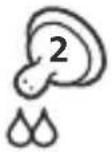 2 holes 2 holes | SLOW FLOWEXTRA SOFT SILICONE TEATIdeal for newborns and breastfed babies of all ages. |
| 3m+ |  3 holes 3 holes | MEDIUM FLOWSOFT SILICONE TEATFor bottle fed babies at 3 months of age and up. |
| 6m+ |  4 holes 4 holes | FAST FLOWSOFT SILICONE TEATOffers a faster flow for older babies. |
| 3m+ |  1 slot 1 slot | VARIABLE FLOWSOFT SILICONE TEAT – SLOT CUTProvides an extra fast flow and accommodates thicker liquids.Flow rate can be varied by turning the bottle to align the I, II or III markings on the teat with baby's nose. |
13. Troubleshooting guide
| Lack of suction | Check that all the pump components have been assembled correctly and that the white valve is the right way up. Ensure that the diaphragm and Let-down Massage Cushion are fitted securely to the pump body and a perfect seal is created. |
| No milk being expressed | Ensure suction is created and the pump is correctly assembled. Relax and try again, expression may improve after practice. Please refer to the ‘Hints to help you succeed’ section. |
| Pain in the breast area when expressing | You may be pumping too hard. You do not need to use all the suction the pump can generate. Try depressing the handle halfway and remember the 2-3 second pumping rhythm. Consult your health professional/ breastfeeding advisor. |
| Milk is drawn up the Let-down Massage Cushion | Remove and refit the Let-down Massage Cushion ensuring it is firmly attached and pushed far enough down the funnel. Try leaning slightly forward. |
| Cracking/discolouration of pump parts | Avoid contact with antibacterial or abrasive detergents/cleaners as these can damage the plastic. Combinations of detergents, cleaning products, sterilising solution, softened water and temperature fluctuations may, under certain circumstances, cause the plastic to crack. If this occurs, do not use. Contact Philips AVENT Customer Services for spare parts. The pump is dishwasher safe but food colourings may discolour components. Keep the product out of direct sunlight, as prolonged exposure may cause discolouration. |
| Lost or broken parts | Spare parts are available through Philips AVENT Customer Services (see back cover for contact details). |
If you are still experiencing problems, please contact Philips AVENT Customer Services. (See back cover for contact details). Alternatively, contact your health professional or breastfeeding advisor.

If it is damaged, the breast pump will not work properly. To clean the white valve, gently rub it between your fingers in warm water with washing-up liquid. Do not insert objects as this may cause damage.
Sterilize all parts in the Philips AVENT steam sterilizer or boil them for 5 minutes. If you use the Philips AVENT steam sterilizer, the pump will remain sterile for at least 6 hours, provided the lid is not removed.
5. Using the breast pump with the AVENT VIA storage system
Simply replace the AVENT feeding bottle with the VIA container and adapter. To keep the breast pump completely stable, insert the VIA container into the VIA lid.


- WWW.PHILIPS.COM/AVENT
- CONTENTS
- INTRODUCING THE MANUAL BREAST PUMP
- DETAILED PARTS GUIDE
- MANUAL BREAST PUMP
- BOTTLE
- CLEANING AND STERILISATION
- KEEPING YOUR BREAST PUMP STERILE FOR TRAVEL
- USING THE MANUAL BREAST PUMP WITH THE AVENT VIA FEEDING SYSTEM
- HOW TO ASSEMBLE THE MANUAL BREAST PUMP
- WHEN TO EXPRESS MILK
- HINTS TO HELP YOU SUCCEED
- HOW TO USE THE MANUAL BREAST PUMP
- STORING YOUR BREAST MILK
- STORING YOUR MILK IN THE FRIDGE
- STORING YOUR MILK IN THE FREEZER
- FEEDING YOUR BABY YOUR EXPRESSED BREAST MILK
- CHOOSING THE RIGHT TEAT FOR YOUR BABY
- TROUBLESHOOTING GUIDE
- USING THE BREAST PUMP WITH THE AVENT VIA STORAGE SYSTEM
Brand : PHILIPS
Model : AVENT SCD281
Category : Baby products