
DPC-2220 - Saw Defort - Free user manual and instructions
Find the device manual for free DPC-2220 Defort in PDF.


| Brand | Defort |
| Model | DPC-2220 |
| Product type | Portable circular saw |
| Nominal power | 2200 W |
| No-load speed | 5000 rpm |
| Blade diameter | 200 mm |
| Blade arbor | 30 mm |
| Cutting depth at 90° | 70 mm |
| Cutting depth at 45° | 50 mm |
| Cutting angle range | 0° - 45° |
| Power supply | 230 V ~ 50 Hz |
| Weight | 5.2 kg |
| Dimensions (L x W x H) | 400 x 250 x 280 mm |
| Main functions | Cross cutting and ripping, bevel cutting, integrated laser guide |
| Safety | Electric blade brake, anti-restart protection, protective guard |
| Maintenance and cleaning | Regularly clean ventilation slots, replace carbon brushes every 200 hours of use |
| Spare parts and repairability | Blade, motor carbon brushes, switch, glide shoe available from after-sales service |
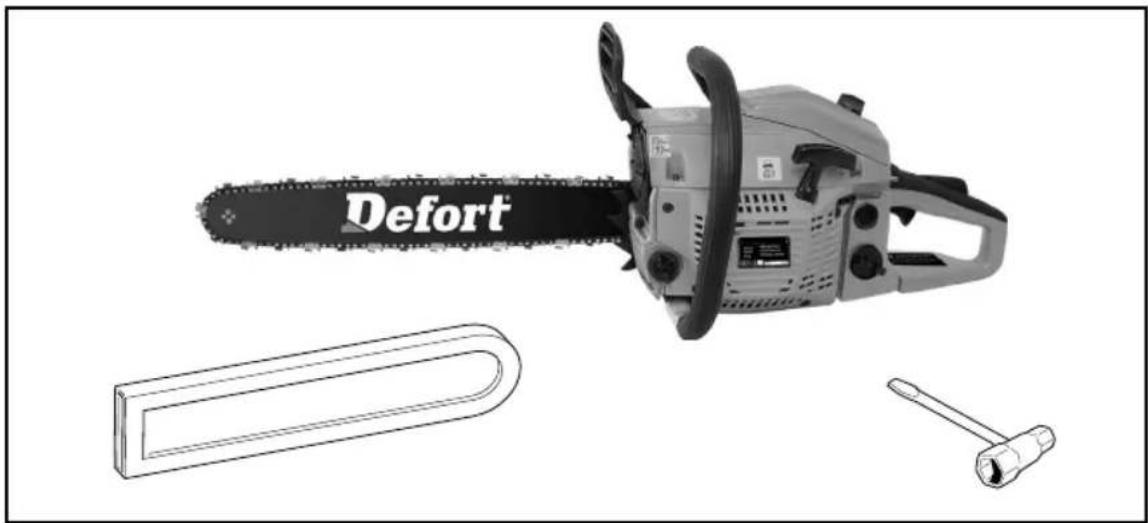
| Included accessories | Carbide blade, blade wrench, parallel guide, dust extraction adapter |
| Warranty | 2 years |
Frequently Asked Questions - DPC-2220 Defort
User questions about DPC-2220 Defort
0 question about this device. Answer the ones you know or ask your own.
Ask a new question about this device
Download the instructions for your Saw in PDF format for free! Find your manual DPC-2220 - Defort and take your electronic device back in hand. On this page are published all the documents necessary for the use of your device. DPC-2220 by Defort.
USER MANUAL DPC-2220 Defort
DPC-2220
98291902
DE Bedienungsanleitung ....4
GB User's Manual 12
FR Mode d'emploi .....20
RU Инструкция по эксплуатации .....28
SI Navodilo za uporabo ....37
HU Használati utasítás ....44
SR Uputstvo za korisnike ....52
HR BOS Upute za uporabu ....59

2200
W

2-stroke

8000 min -1

50.0 cm³

0.55 L

0.26 L

1,5 mm
0.325"
76 pcs

7.2 kg


Starting




Stopping

| PetrolBenzinБензин | Oil - Öl - Масло | |
| 4%-25 : 1 | ||
| 1 | 1 | (cm3) |
| 1 | 0,04 | (40) |
| 5 | 0,20 | (200) |
| 10 | 0,40 | (400) |
| 15 | 0,60 | (600) |
| 20 | 0,80 | (800) |
| 25 | 1,00 | (1000) |


DE Deutsch
Benzin Kettensäge
KETTENBREMSE MIT HANDSCHUTZ
GENERAL SAFETY PRECAUTIONS
Before using a new chain saw please read this manual carefully.

WARNING! Under no circumstances may the design of the machine be modified without the permission of the manufacturer. Always use genuine accessories. Non-authorized modifications and/or accessories can result in serious personal injury or the death of the operator or others.

WARNING! A chain saw is a dangerous tool if used carelessly or incorrectly and can cause serious, even fatal injuries. It is very important that you read and understand the contents of this operator's manual.

WARNING! Running an engine in a confined or badly ventilated area can result in death due to asphyxiation or carbon monoxide poi-
soning.
PERSONAL PROTECTIVE EQUIPMENT
• Approved protective helmet
• Hearing protection
- Protective goggles or a visor
• Gloves with saw protection
• Trousers with saw protection
• Boots with saw protection, steel toe-cap and non-slip sole
Generally clothes should be close-fi tting without restricting your freedom of movement.
MACHINE'S SAFETY EQUIPMENT
The life span of the machine can be reduced and the risk of accidents can increase if machine maintenance is not carried out correctly and if service and/or repairs are not carried out professionally. If you need further information please contact your nearest service workshop.

WARNING! Never use a machine with defective safety components. Safety equipment must be inspected and
maintained. See instructions under the heading Checking, maintaining and servicing chain saw safety equipment. If your machine does not pass all the checks, take the saw to a servicing dealer for repair.
CHAIN BRAKE AND FRONT HAND GUARD
Your chain saw is equipped with a chain brake that is designed to stop the chain if you get a kickback. The chain brake reduces the risk of accidents, but only you can prevent them.
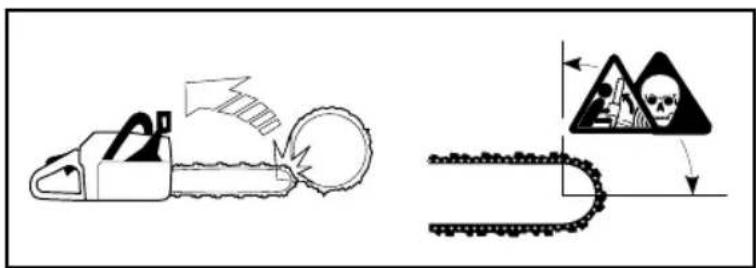
Take care when using your saw and make sure the kickback zone of the bar never touches any object.
- The chain brake can either be activated manually (by your left hand) or automatically by the inertia release mechanism.
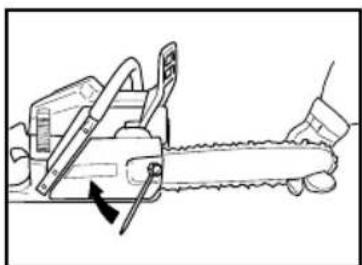
- The brake is applied when the front hand guard is pushed forwards.
- This movement activates a spring-loaded mechanism that tightens the brake band around the engine drive system (clutch drum).
- The front hand guard is not designed solely to activate the chain brake. Another important feature is that it reduces the risk of your left hand hitting the chain if you lose grip of the front handle.
- The chain brake must be engaged when the chain saw is started to prevent the saw chain from rotating.
- Use the chain brake as a "parking brake" when starting and when moving over short distances, to reduce the risk of moving chain accidentally hitting your leg or anyone or anything close by.
- To release the chain brake pull the front hand guard backwards, towards the front handle.
- Kickback can be very sudden and violent. Most kickbacks are minor and do not always activate the chain brake. If this happens you should hold the chain saw firmly and not let go.
- The way the chain brake is activated, either manually or automatically by the inertia release mechanism, depends on the force of the kickback and the position of the chain saw in relation to the object that the kickback zone of the bar strikes.
If you get a violent kickback while the kickback zone of the bar is farthest away from you the chain brake is designed to be activated by the inertia in the kickback direction.
VIBRATION DAMPING SYSTEM
Your machine is equipped with a vibration damping system that is designed to minimize vibration and make operation easier.
The machine's vibration damping system reduces the transfer of vibration between the engine unit/cutting equipment and the machine's handle unit. The body of the chain saw, including the cutting equipment, is insulated from the handles by vibration damping units.
Cutting hardwoods (most broadleaf trees) creates more vibration than cutting softwoods (most conifers). Cutting with cutting equipment that is blunt or faulty (wrong type or badly sharpened) will increase the vibration level.

WARNING! Overexposure to vibration can lead to circulatory damage or nerve damage in people who have impaired circulation.
Contact your doctor if you experience symptoms of overexposure to vibration. Such symptoms include numbness, loss of feeling, tingling, pricking, pain, loss of strength, changes in skin colour or condition. These symptoms normally appear in the fingers, hands or wrists. These symptoms may be increased in cold temperatures.
Stop switch
Use the stop switch to switch off the engine.
Muffler
The muffler is designed to reduce noise levels and to direct exhaust fumes away from the user.

WARNING! The exhaust fumes from the engine are hot and may contain sparks which can start a fire. Never start the machine indoors or near combustible material!

CAUTION! The muffler gets very hot during and after use. This also applies during idling. Be aware of the fire hazard, especially when working near fl ammable substances and/or vapours.

WARNING! Never use a saw without a muffler, or with a damaged muffler. A damaged muffler may substantially increase the noise level and the fire hazard. Keep fire fighting equipment handy. If a spark arrestor screen is required in your area, never use the saw without or with a broken spark arrestor screen.
CUTTING EQUIPMENT GENERAL RULES
- Only use cutting equipment recommended by us!
- Keep the chain's cutting teeth properly sharpened!
- Maintain the correct depth gauge setting! Follow our instructions and use the recommended depth gauge clearance. Too large a clearance increases the risk of kickback.
- Keep the chain properly tensioned! If the chain is slack it is more likely to jump off and lead to increased wear on the bar, chain and drive sprocket.
- Keep cutting equipment well lubricated and properly maintained! A poorly lubricated chain is more likely to break and lead to increased wear on the bar, chain and drive sprocket.
CUTTING EQUIPMENT DESIGNED TO REDUCE KICKBACK
The only way to avoid kickback is to make sure that the kickback zone of the bar never touches anything.
By using cutting equipment with "built-in" kickback reduction and keeping the chain sharp and wellmaintained you can reduce the effects of kickback.
Bar
The smaller the tip radius the lower the chance of kickback.
Chain
A chain is made up of a number of links, which are available in standard and low-kickback versions.

IMPORTANT! No saw chain design eliminates the danger of kickback.

WARNING! Any contact with a rotating saw chain can cause extremely serious injuries.
SHARPENING YOUR CHAIN AND ADJUSTING DEPTH GAUGE SETTING

WARNING! Always wear gloves, when working with the chain, in order to protect your hands from injury.
General information on sharpening cutting teeth
- Never use a blunt chain. When the chain is blunt you have to exert more pressure to force the bar through the wood and the chips will be very small. If the chain is very blunt it will produce wood powder and no chips or shavings.
- A sharp chain eats its way through the wood and produces long, thick chips or shavings.
- The cutting part of the chain is called the cutter and consists of a cutting tooth and the depth gauge.
The cutters cutting depth is determined by the difference in height between the two (depth gauge setting).
When you sharpen a cutting tooth there are four important factors to remember.
1 Filing angle
2 Cutting angle
3 File position
4 Round fi le diameter
It is very difficult to sharpen a chain correctly without the right equipment. We recommend that you use our file gauge. This will help you obtain the maximum kickback reduction and cutting performance from your chain.

WARNING! Departure from the sharpening instructions considerably increases the risk of kickback.
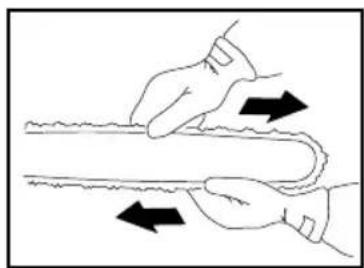
- Check that the chain is correctly tensioned. A slack chain will move sideways, making it more difficult to sharpen correctly.
- Always fi le cutting teeth from the inside face. Reduce the pressure on the return stroke. File all the teeth on one side fi rst, then turn the chain saw over and fi le the teeth on the other side.
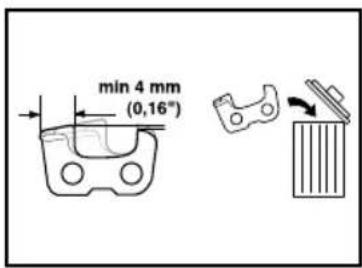
- File all the teeth to the same length. When the length of the cutting teeth is reduced to 4 mm (0.16") the chain is worn out and should be replaced.

WARNING! The risk of kickback is increased if the depth gauge setting is too large!
ADJUSTMENT OF DEPTH GAUGE SETTING
- The cutting teeth should be newly sharpened before adjusting the depth gauge setting. We recommend that you adjust the depth gauge setting every third time you sharpen the cutting teeth.
NOTE! This recommendation assumes that the length of the cutting teeth is not reduced excessively.
- You will need a flat file and a depth gauge tool. We recommend that you use our depth gauge tool to achieve the correct depth gauge setting and bevel for the depth gauge.
- Place the depth gauge tool over the chain. Detailed information regarding the use of the depth gauge tool, will be found on the package for the depth gauge tool. Use the flat file to file off the tip of the depth gauge that protrudes through the depth gauge tool. The depth gauge setting is correct when you no longer feel resistance as you draw the file along the depth gauge tool.
TENSIONING THE CHAIN

WARNING! A slack chain may jump off and cause serious or even fatal injury.

WARNING! Always wear approved protective gloves. Even a non-moving chain can cause serious cuts to yourself or persons you bump
into with an exposed chain.
The more you use a chain the longer it becomes. It is therefore important to adjust the chain regularly to take up the slack.
Check the chain tension every time you refuel.

NOTE! A new chain has a running-in period during which you should check the tension more frequently.
LUBRICATING CUTTING EQUIPMENT

WARNING! Poor lubrication of cutting equipment may cause the chain to snap, which could lead to serious, even fatal injuries.
Chain oil
Chain oil must demonstrate good adhesion to the chain and also maintain its flow characteristics regardless of whether it is warm summer or cold winter weather.
Filling with chain oil
- All our chain saws have an automatic chain lubrication system. On some models the oil flow is also adjustable.
- The saw chain oil tank and the fuel tank are designed so that the fuel runs out before the saw chain oil.
However, this safety feature requires that you use the right sort of chain oil (if the oil is too thin it will run out before the fuel), and that you adjust the carburetor as recommended (a lean mixture may mean that the fuel lasts longer than the oil) and that you also use the recommended cutting equipment (a bar that is too long will use more chain oil).
Checking chain lubrication
- Check the chain lubrication each time you refuel. See instructions under the heading Lubricating the bar tip sprocket.
Aim the tip of the bar at a light coloured surface about 20 cm (8 inches) away. After 1 minute running at 3/4 throttle you should see a distinct line of oil on the light surface.
If the chain lubrication is not working:
- Check that the oil channel in the bar is not obstructed.
Clean if necessary.
- Check that the groove in the edge of the bar is clean.
Clean if necessary.
- Check that the bar tip sprocket turns freely and that the lubricating hole in the tip sprocket is not blocked. Clean and lubricate if necessary.
If the chain lubrication system is still not working after carrying out the above checks and associated measures you should contact your service agent.
Chain drive sprocket
The clutch drum is fitted with a Spur sprocket (the chain sprocket is welded on the drum).
Regularly check the degree of wear on the drive sprocket.
Replace if wear is excessive. Replace the drive sprocket whenever you replace the chain.
Checking wear on cutting equipment
Check the chain daily for:
• Visible cracks in rivets and links.
• Whether the chain is stiff.
- Whether rivets and links are badly worn.
Replace the saw chain if it exhibits any of the points above.
We recommend you compare the existing chain with a new chain to decide how badly the existing chain is worn.
When the length of the cutting teeth has worn down to only 4 mm the chain must be replaced.
Bar
Check regularly:
- Whether there are burrs on the edges of the bar. Remove these with a file if necessary.
- Whether the groove in the bar has become badly worn.
Replace the bar if necessary.
ASSEMBLY
FITTING THE BAR AND CHAIN

WARNING! Switch off the engine before carrying out any checks or maintenance. The stop switch automatically returns to the start position. In order to prevent unintentional starting, the spark plug cap must be removed from the spark plug when assembling, checking and/or performing maintenance.
Always wear gloves, when working with the chain, in order to protect your hands from injury.
Check that the chain brake is in disengaged position by moving the front hand guard towards the front handle.
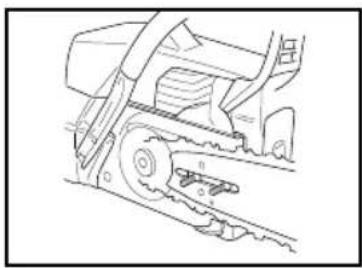
Remove the bar nuts and remove the clutch cover (chain brake). Take off the transportation ring.
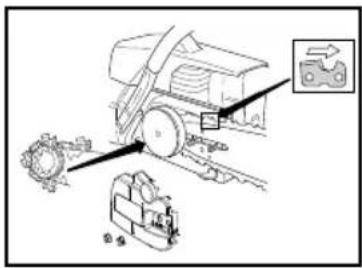
Fit the bar over the bar bolts. Place the bar in its rearmost position. Place the chain over the drive sprocket locate it in the groove on the bar. Begin on the top edge of the bar.
Make sure that the edges of the cutting links are facing forward on the top edge of the bar.
Fit the clutch cover (the chain brake) and locate the chain adjuster pin in the hole in the bar. Check that the drive links of the chain fit correctly over the drive sprocket and that the chain is correctly located in the groove in the bar. Tighten the bar nuts finger tight.
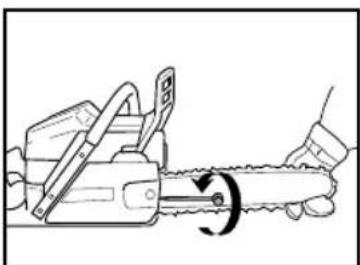
Tension the chain by turning the chain tensioning screw clockwise using the combination spanner. The chain should be tensioned until it does not sag from the underside of the bar.
The chain is correctly tensioned when it does not sag from the underside of the bar, but can still be turned easily by hand. Hold up the bar tip and tighten the bar nuts with the combination spanner.
When fi tting a new chain, the chain tension has to be checked frequently until the chain is run-in. Check the chain tension regularly. A correctly tensioned chain ensures good cutting performance and long life.
FUEL
Note! The machine is equipped with a two-stroke engine and must always be run using a mixture of petrol and twostroke oil. It is important to accurately measure the amount of oil to be mixed to ensure that the correct mixture is obtained. When mixing small amounts of fuel, even small inaccuracies can drastically affect the ratio of the mixture.

WARNING! Always ensure there is adequate ventilation when handling fuel.
Petrol
- Use good quality unleaded or leaded petrol.
- The lowest recommended octane grade is 92.
- When working with continuous high revs (e.g. limbing) a higher octane is recommended.
Running-in
Avoid running at a too high speed for extended periods during the first 10 hours.
TWO-STROKE OIL
- Never use two-stroke oil intended for water-cooled engines, sometimes referred to as outboard oil (rated TCW).
- Never use oil intended for four-stroke engines.
MIXING RATIO
| Petrol, litre Two-stroke oil, litre | ||
| 2% (1:50) 3% (1:33) | ||
| 5 0,10 0,15 | ||
| 10 0,20 0,30 | ||
| 15 0,30 0,45 | ||
| 20 0,40 0,60 | ||
MIXING
• Always mix the petrol and oil in a clean container intended for fuel.
- Always start by fi lling half the amount of the petrol to be used. Then add the entire amount of oil. Mix (shake) the fuel mixture. Add the remaining amount of petrol.
- Mix (shake) the fuel mixture thoroughly before filling the machine's fuel tank.
- Do not mix more than one month's supply of fuel at a time.
- If the machine is not used for some time the fuel tank should be emptied and cleaned.
Chain oil
- We recommend the use of special oil (chain oil) with good adhesion characteristics.
- Never use waste oil. This results in damage to the oil pump, the bar and the chain.
- It is important to use oil of the right grade (suitable viscosity range) to suit the air temperature.
- In temperatures below 0°C (32°F) some oils become too viscous. This can overload the oil pump and result in damage to the oil pump components.
- Contact your service agent when choosing chain oil.
FUELLING

WARNING! Taking the following precautions, will lessen the risk of fire: Do not smoke and do not place any hot objects in the vicinity of fuel. Always stop the engine and let it cool for a few minutes before refuelling. When refuelling, open the fuel cap slowly so that any excess pressure is released gently. Tighten the fuel cap carefully after refuelling.
Always move the machine away from the refuelling area before starting.
Clean the area around the fuel cap. Clean the fuel and chain oil tanks regularly. The fuel filter must be replaced at least once a year. Contamination in the tanks causes malfunction.
Make sure the fuel is well mixed by shaking the container before refuelling. The capacities of the chain oil tank and fuel tank are carefully matched. You should therefore always fill the chain oil tank and fuel tank at the same time.

WARNING! Fuel and fuel vapour are highly fl ammable. Take care when handling fuel and chain oil. Be aware of the risks of fi re, explo-
sion and those associated with inhalation.
FUEL SAFETY
- Never refuel the machine while the engine is running.
- Make sure there is plenty of ventilation when refuelling or mixing fuel (petrol and 2-stroke oil).
- Move the machine at least 3 m from the refuelling point before starting it.
- Never start the machine:
1 If you have spilt fuel or chain oil on the machine. Wipe off the spillage and allow remaining fuel to evaporate.
2 If you have spilt fuel on yourself or your clothes, change your clothes. Wash any part of your body that has come in contact with fuel. Use soap and water.
3 If the machine is leaking fuel. Check regularly for leaks from the fuel cap and fuel lines.

WARNING! Never use a machine with visible damage to the spark plug guard and ignition cable. A risk of sparking arises, which can
cause a fire.
TRANSPORT AND STORAGE
- Always store the chain saw and fuel so that there is no risk of leakages or fumes coming into contact with sparks or naked flames from electrical equipment, electric motors, relays/switches, boilers and the like.
- Always store fuel in an approved container designed for that purpose.
- For longer periods of storage or for transport of the chain saw, the fuel and chain oil tanks should be emptied. Ask where you can dispose of waste fuel and chain oil at your local petrol station.
- Ensure the machine is cleaned and that a complete service is carried out before long-term storage.
- The bar guard must always be fitted to the cutting attachment when the machine is being transported or in storage, in order to prevent accident contact with the sharp chain. Even a non-moving chain can cause serious cuts to yourself or persons you bump into with an exposed chain.
- Secure the machine during transport.
LONG-TERM STORAGE
Empty the fuel/oil tanks in a well ventilated area. Store the fuel in approved cans in a safe place. Fit the bar guard. Clean the machine.
STARTING AND STOPPING

WARNING! Note the following before starting: The chain brake must be engaged when the chain saw is started to reduce the chance
of contact with the moving chain during starting.
Never start a chain saw unless the bar, chain and all covers are fitted correctly. Otherwise the clutch can come loose and cause personal injuries. Place the machine on firm ground. Make sure you have a secure footing and that the chain cannot touch anything.
Keep people and animals well away from the working area.
COLD ENGINE
Starting: The chain brake must be engaged when the chain saw is started. Activate the brake by moving the front hand guard forwards.
- Air purge: Press the air purge repeatedly until fuel begins to fill the bulb. The bulb need not be completely filled.
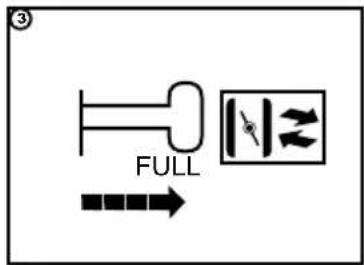
- Choke: Pull the blue choke/fast idle lever out to the full extent (to the FULL CHOKE position). When the choke/ fast idle lever is pulled out to the full extent, the correct throttle setting is set automatically.
Start throttle: The correct choke/start throttle setting is obtained by moving the control to the choke position.
Starting
Grip the front handle with your left hand. Hold the chain saw on the ground by placing your right foot through the rear handle.
- Pull the starter handle with your right hand and pull out the starter cord slowly until you feel a resistance (as the starter pawls engage) then pull firmly and rapidly. Never twist the starter cord around your hand.

CAUTION! Do not pull the starter cord all the way out and do not let go of the starter handle when the cord is fully extended. This can
damage the machine.
- Push in the choke control to the "1/2 choke" setting as soon as the engine fi res which can be heard through a "puff" sound.
- Keep on pulling the cord powerfully until the engine starts. Allow engine to warm for thirty seconds, then squeeze throttle trigger to set normal idle.
As the chain brake is still engaged the speed of the engine must be set to idling as soon as possible, this is achieved by quickly pressing the throttle trigger once. This prevents unnecessary wear to the clutch, clutch drum and brake band.
Warm engine
Use the same procedure as for starting a cold engine but without setting the choke control in the choke position. Set the throttle to the start position by pulling out the blue choke control to the choke position and then pushing it in again.

WARNING! Long term inhalation of the engine's exhaust fumes, chain oil mist and dust from sawdust can represent a health risk.
- Never start a chain saw unless the bar, chain and all covers are fitted correctly. See instructions under the heading Assembly. Without a bar and chain attached to the chain saw the clutch can come loose and cause serious injury.
- The chain brake should be activated when starting. See instructions under the heading Start and stop. Do not drop start. This method is very dangerous because you may lose control of the saw.
- Never start the machine indoors. Exhaust fumes can be dangerous if inhaled.
- Observe your surroundings and make sure that there is no risk of people or animals coming into contact with the cutting equipment.
- Always hold the saw with both hands. The right hand should be on the rear handle, and the left hand on the front handle. All people, whether right or left handed, should use this grip. Use a fi rm grip with thumbs and fingers encircling the chain saw handles.
Stopping
Stop the engine by pressing down the stop button.
WORKING TECHNIQUES
BEFORE USE:
1 Check that the chain brake works correctly and is not damaged.
2 Check that the rear right hand guard is not damaged.
3 Check that the throttle lockout works correctly and is not damaged.
4 Check that the stop switch works correctly and is not damaged.
5 Check that all handles are free from oil.
6 Check that the anti vibration system works and is not damaged.
7 Check that the muffler is securely attached and not damaged.
8 Check that all parts of the chain saw are tightened correctly and that they are not damaged or missing.
9 Check that the chain catcher is in place and not damaged.
10 Check the chain tension.
Basic safety rules
Look around you:
- To ensure that people, animals or other things cannot affect your control of the machine.
- To make sure that none of the above might come within reach of your saw or be injured by falling trees.

CAUTION! Follow the instructions above, but do not use a chain saw in a situation where you cannot call for help in case of an accident.
Do not use the machine in bad weather, such as dense fog, heavy rain, strong wind, intense cold, etc.
Working
in bad weather is tiring and often brings added risks, such as icy ground, unpredictable felling direction, etc.
3 Take great care when removing small branches and avoid cutting bushes (i.e. cutting many small branches at the same time). Small branches can be grabbed by the chain and thrown back at you, causing serious injury.
4 Take great care when cutting a tree that is in tension. A tree that is in tension may spring back to its normal position before or after being cut. If you position yourself incorrectly or make the cut in the wrong place the tree may hit you or the machine and cause you to lose control. Both situations can cause serious personal injury.
5 Before moving your chain saw switch off the engine and lock the chain using the chain brake. Carry the chain saw with the bar and chain pointing backwards. Fit a guard to the bar before transporting the chain saw or carrying it for any distance.
6 When you put the chain saw on the ground, lock the saw chain using the chain brake and ensure you have a constant view of the machine. Switch the engine off before leaving your chain saw for any length of time.

WARNING! Sometimes chips get stuck in the clutch cover causing the chain to jam. Always stop the engine before cleaning.
GENERAL RULES
1 If you understand what kickback is and how it happens then you can reduce or eliminate the element of surprise. By being prepared you reduce the risk. Kickback is usually quite mild, but it can sometimes be very sudden and violent.
2 Always hold the chain saw firmly with your right hand on the rear handle and your left hand on the front handle. Wrap your fingers and thumbs around the handles. You should use this grip whether you are right-handed or left-handed. This grip minimises the effect of kickback and lets you keep the chain saw under control. Do not let go of the handles!
3 Most kickback accidents happen during limbing. Make sure you are standing fi rmly and that there is nothing in the way that might make you trip or lose your balance.
Lack of concentration can lead to kickback if the kickback zone of the bar accidentally touches a branch, nearby tree or some other object.
Have control over the workpiece. If the pieces you intend to cut are small and light, they can jam in the saw chain and be thrown towards you. This is not necessarily dangerous in itself, but you may be surprised and lose control of the saw. Never saw stacked logs or branches without first separating them. Only saw one log or one piece at a time. Remove the cut pieces to keep your working area safe.
4 Never use the chain saw above shoulder height and try not to cut with the tip of the bar. Never use the chain saw one-handed!
5 You must have a steady stance in order to have full control over the chain saw. Never work standing on a ladder, in a tree or where you do not have firm ground to stand on.
6 Always use a fast cutting speed, i.e. full throttle.
7 Take great care when you cut with the top edge of the bar, i.e. when cutting from the underside of the object. This is known as cutting on the push stroke. The chain tries to push the chain saw back towards the user. If the saw chain is jamming, the saw may be pushed back at you.
8 Unless the user resists this pushing force there is a risk that the chain saw will move so far backwards that only the kickback zone of the bar is in contact with the tree, which will lead to a kickback.
Cutting with the bottom edge of the bar, i.e. from the top of the object downwards, is known as cutting on the pull stroke. In this case the chain saw pulls itself towards the tree and the front edge of the chain saw body rests naturally on the trunk when cutting. Cutting on the pull stroke gives the operator better control over the chain saw and the position of the kickback zone.
9 Follow the instructions on sharpening and maintaining your bar and chain. When you replace the bar and chain use only combinations that are recommended by us.
GENERAL
The user must only carry out the maintenance and service work described in this Operator's Manual. More extensive work must be carried out by an authorised service workshop.
CARBURETTOR ADJUSTMENT
Your DeFort product has been designed and manufactured to specifications that reduce harmful emissions.
FUNCTION
- The carburettor governs the engine's speed via the throttle control. Air and fuel are mixed in the carburettor. The air/fuel mixture is adjustable. Correct adjustment is essential to get the best performance from the machine.
- The T-screw regulates the throttle setting at idle speed. If the T-screw is turned clockwise this gives a higher idle speed; turning it anti-clockwise gives a lower idle speed.
Basic settings and running in
The basic carburettor settings are adjusted during testing at the factory. Fine adjustment should be carried out by a skilled technician.
Rec. idle speed: See the Technical data section.
Fine adjustment of the idle speed T
Adjust the idle speed with the T-screw. If it is necessary to re-adjust, turn the T-screw clockwise while the engine is running, until the chain starts to rotate. Then turn anticlockwise until the chain stops. When the idle speed is correctly adjusted the engine should run smoothly in every position and the engine speed should be safely below the speed at which the chain starts to rotate.

WARNING! Contact your servicing dealer, if the idle speed setting cannot be adjusted so that the chain stops. Do not use the chain
saw until it has been properly adjusted or repaired.
MAINTENANCE SCHEDULE
The following is a list of the maintenance that must be performed on the machine. Most of the items are described in the Maintenance section.
| Daily maintenance (Every 5-10 h) Weekly | maintenance (Every 10-25 h) Monthly maintenance (Every 25-40 h) | |
| Clean the outside of the machine. | Check the starter, the starter cord and the recoil spring. | Check the brake band on the chain brake for wear. Replace when less than 0.6 mm (0,024 inch) remains at the most worn point. |
| Check that the components of the throttle control work safely. (Throttle lockout and throttle control.) | Check that the vibration damping elements are not damaged. | Check the clutch centre, clutch drum and clutch spring for wear. |
| Clean the chain brake and check that it operates safely. Make sure that the chain catcher is undamaged, and replace it if necessary. | File off any burrs from the edges of the bar. | Clean the spark plug. Check that the electrode gap is 0.5 mm. |
| The bar should be turned daily for more even wear. Check the lubrication hole in the bar, to be sure it is not clogged. Clean the bar groove. If the bar has a sprocket tip, this should be lubricated. | Clean the carburettor compartment. Clean the outside of the carburettor. | |
| Check that the bar and chain are getting suffi cient oil. | Clean the air filter. Replace if necessary. | Check the fuel filter and the fuel hose. Replace if necessary. |
| Check the saw chain with regard to visible cracks in the rivets and links, whether the saw chain is stiff or whether the rivets and links are abnormally worn. Replace if necessary. | Empty the fuel tank and clean the inside. | |
| Sharpen the chain and check its tension and condition. Check the drive sprocket for excessive wear and replace if necessary. | Empty the oil tank and clean the inside. | |
| Clean the starter units air intake. Check all cables and connections. | ||
| Check that nuts and screws are tight. | ||
| Check that the stop switch works correctly. | ||
| Check that there are no fuel leaks from the engine, tank or fuel lines. | ||

Français
REŽA MED ELEKTRODAMI
Reža med elektrodami mora znašati 0,5 mm.
PREVERJANJE VŽIGALNE ISKRE
Exploded view DPC-2220

Spare parts list DPC-2220
No. Part Name
18 Reel ignition
64 Oil pump
71 Cluth drum
127 Crankshaft
130 Bearing
132 Piston
133 Piston Pin
134 O-ring
135 Gasket
136 Cylinder
146 Carburator
155 Gasket
182 Starter Starter assy (pos. 2,3,4,5,6,7,8,9,10,11,12,13)
183 Clutch (pos. 72,73,74,75)
DECLARATION OF CONFORMITYGBCE
We declare under our sole responsibility that this product is in conformity with the following standards or standardized documents: EN ISO 12100-1; EN ISO 12100-2:2003; EN ISO 11681-2:2006 in accordance with the regulations 2006/42/EEC, 2006/95/EEC, 2004/108/EEC.
NOISE/VIBRATION Measured in accordance with EN 60745 the sound pressure level of this tool is <98 dB(A) and the sound power level is <110 dB(A) (standard deviation: 3 dB), and the vibration is <9.0 m/s² (hand-arm method).
DÉCLARATION DE CONFORMITÉFR CE
Discarded electric appliances are recyclable and should not be discarded in the domestic waste! Please actively support us in conserving resources and protecting the environment by returning this appliance to the collection centres (if available).
FR INFORMATIONS SUR LA PROTECTION DE L'ENVIRONNEMENT
EN Subject to change


- DPC-2220
- DE DEUTSCH
- BENZIN KETTENSÄGE
- KETTENBREMSE MIT HANDSCHUTZ
- GENERAL SAFETY PRECAUTIONS
- PERSONAL PROTECTIVE EQUIPMENT
- MACHINE'S SAFETY EQUIPMENT
- CHAIN BRAKE AND FRONT HAND GUARD
- VIBRATION DAMPING SYSTEM
- STOP SWITCH
- MUFFLER
- CUTTING EQUIPMENT GENERAL RULES
- CUTTING EQUIPMENT DESIGNED TO REDUCE KICKBACK
- BAR
- CHAIN
- SHARPENING YOUR CHAIN AND ADJUSTING DEPTH GAUGE SETTING
- ADJUSTMENT OF DEPTH GAUGE SETTING
- TENSIONING THE CHAIN
- LUBRICATING CUTTING EQUIPMENT
- CHAIN OIL
- FILLING WITH CHAIN OIL
- CHECKING CHAIN LUBRICATION
- CHAIN DRIVE SPROCKET
- ASSEMBLY
- FITTING THE BAR AND CHAIN
- FUEL
- PETROL
- RUNNING-IN
- TWO-STROKE OIL
- MIXING
- FUELLING
- FUEL SAFETY
- TRANSPORT AND STORAGE
- LONG-TERM STORAGE
- STARTING AND STOPPING
- COLD ENGINE
- STARTING
- WARM ENGINE
- STOPPING
- WORKING TECHNIQUES
- BEFORE USE
- BASIC SAFETY RULES
- WORKING
- GENERAL RULES
- GENERAL
- CARBURETTOR ADJUSTMENT
- FUNCTION
- BASIC SETTINGS AND RUNNING IN
- MAINTENANCE SCHEDULE
- FRANÇAIS
- REŽA MED ELEKTRODAMI
- PREVERJANJE VŽIGALNE ISKRE
- SPARE PARTS LIST DPC-2220
- NO. PART NAME
- DECLARATION OF CONFORMITYGBCE
- DÉCLARATION DE CONFORMITÉFR CE
- FR INFORMATIONS SUR LA PROTECTION DE L'ENVIRONNEMENT
Brand : Defort
Model : DPC-2220
Category : Saw