
AT50 - Washing machine HOTPOINT - Free user manual and instructions
Find the device manual for free AT50 HOTPOINT in PDF.

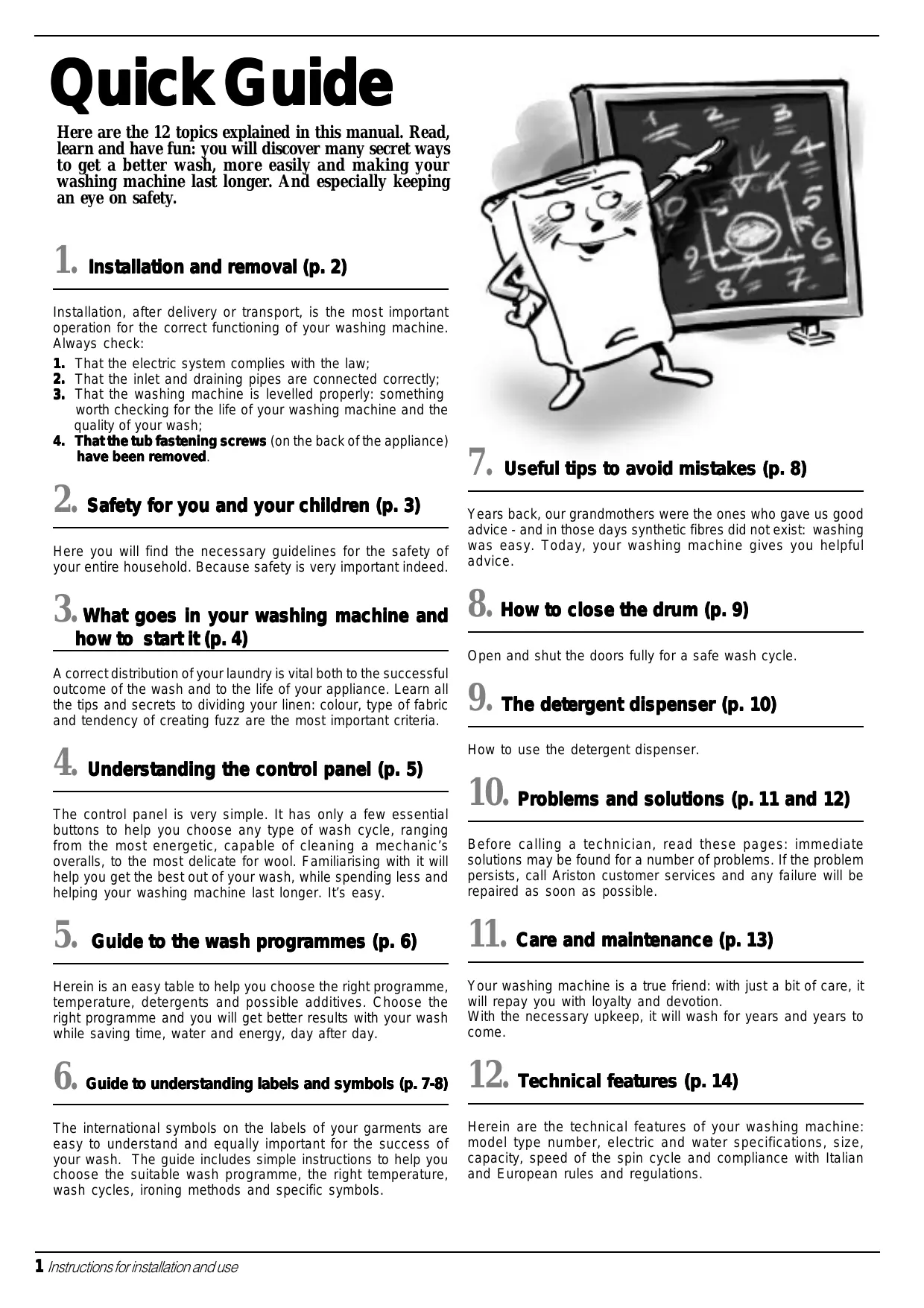


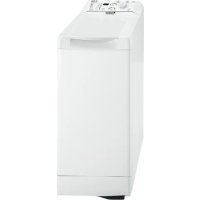
| Product type | Top loading washing machine |
| Brand | HOTPOINT |
| Model | AT50 |
| Dimensions (W x H x D) | 40 x 85 x 60 cm |
| Washing capacity | 1 to 5 kg |
| Power supply | 230 V, 50 Hz, 2100 W |
| Water pressure | 0.05 to 1 MPa (0.5 to 10 bar) |
| Drum capacity | 42 litres |
| Maximum spin speed | 500 rpm |
| Wash programs | Cotton (whites, colors), synthetics, delicates, wool, rinse, spin, rinse hold |
| Temperatures | Up to 90°C (depending on program) |
| Functions | Delayed start, half load, anti-crease, no spin |
| Detergent drawer | 4 compartments: prewash, main wash, fabric softener, bleach |
| Safety | Door locked, stop in case of failure, child lock |
| Installation | Leveling with adjustable feet, cold water connection 3/4", drainage between 60 and 100 cm |
| Maintenance | Drawer cleaning, accessible pump filter, annual hose check |
| Repairability | Original spare parts, approved after-sales service |
| Compliance | EC Directives 73/23/EEC and 89/336/EEC |
Frequently Asked Questions - AT50 HOTPOINT
User questions about AT50 HOTPOINT
0 question about this device. Answer the ones you know or ask your own.
Ask a new question about this device
Download the instructions for your Washing machine in PDF format for free! Find your manual AT50 - HOTPOINT and take your electronic device back in hand. On this page are published all the documents necessary for the use of your device. AT50 by HOTPOINT.
USER MANUAL AT50 HOTPOINT
Instructions for installation and use
How to get better results
Top loading washing machine safe
and easy to use
Quick Guide
Here are the 12 topics explained in this manual. Read, learn and have fun: you will discover many secret ways to get a better wash, more easily and making your washing machine last longer. And especially keeping an eye on safety.
1. Installation and removal (p. 2)
Installation, after delivery or transport, is the most important operation for the correct functioning of your washing machine. Always check:
- That the electric system complies with the law;
- That the inlet and draining pipes are connected correctly;
- That the washing machine is levelled properly: something worth checking for the life of your washing machine and the quality of your wash;
- That the tub fastening screws (on the back of the appliance) have been removed.
2. Safety for you and your children (p. 3)
Here you will find the necessary guidelines for the safety of your entire household. Because safety is very important indeed.
3. What goes in your washing machine and how to start it (p. 4)
A correct distribution of your laundry is vital both to the successful outcome of the wash and to the life of your appliance. Learn all the tips and secrets to dividing your linen: colour, type of fabric and tendency of creating fuzz are the most important criteria.
4. Understanding the control panel (p. 5)
The control panel is very simple. It has only a few essential buttons to help you choose any type of wash cycle, ranging from the most energetic, capable of cleaning a mechanic's overalls, to the most delicate for wool. Familiarising with it will help you get the best out of your wash, while spending less and helping your washing machine last longer. It's easy.
5. Guide to the wash programmes (p. 6)
Herein is an easy table to help you choose the right programme, temperature, detergents and possible additives. Choose the right programme and you will get better results with your wash while saving time, water and energy, day after day.
6. Guide to understanding labels and symbols (p. 7-8)
The international symbols on the labels of your garments are easy to understand and equally important for the success of your wash. The guide includes simple instructions to help you choose the suitable wash programme, the right temperature, wash cycles, ironing methods and specific symbols.
7. Useful tips to avoid mistakes (p. 8)
Years back, our grandmothers were the ones who gave us good advice - and in those days synthetic fibres did not exist: washing was easy. Today, your washing machine gives you helpful advice.
8. How to close the drum (p. 9)
Open and shut the doors fully for a safe wash cycle.
9. The detergent dispenser (p. 10)
How to use the detergent dispenser.
10. Problems and solutions (p. 11 and 12)
Before calling a technician, read these pages: immediate solutions may be found for a number of problems. If the problem persists, call Ariston customer services and any failure will be repaired as soon as possible.
11. Care and maintenance (p. 13)
Your washing machine is a true friend: with just a bit of care, it will repay you with loyalty and devotion.
With the necessary upkeep, it will wash for years and years to come.
12. Technical features (p. 14)
Herein are the technical features of your washing machine: model type number, electric and water specifications, size, capacity, speed of the spin cycle and compliance with Italian and European rules and regulations.
Installation and removal
When the appliance arrives
Whether new or just transported to a new house, installation is extremely important for the correct functioning of your washing machine.
After removing the appliance from its packaging, check that it is intact. If in doubt, contact a qualified technician immediately. The inside of the machine is blocked, for transportation, by four screws and rubber washers on the back panel.
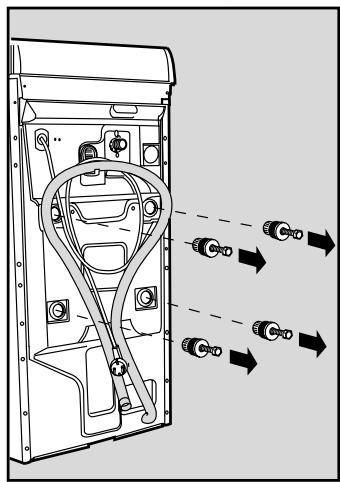
Unblocking: remove the 4 screws!
Before using the washing machine, remove the screws, remove the rubber washers with the relative spacer (keeping all the parts) and use the plastic tabs provided to fill in the holes.
Warning: should the screws be re-used, make sure you fasten the shorter at the top.
Levelling
The washing machine must be levelled appropriately in order to guarantee its correct functioning. To level the appliance, the feet must be adjusted; the angle of inclination, measured according to the worktop, must not exceed 2° . When placed on fitted carpet, make sure the ventilation is not obstructed within its surroundings.
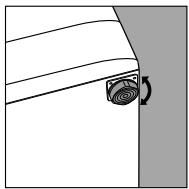
The feet are adjustable.
Do not throw the blocking screws and the spacers away. In the event of a removal, they can be used to block the components inside the appliance again and so protect it during transport.
Connection to the water mains
Water pressure must range within the values indicated on the data plate on the rear of your washing machine. Connect the inlet hose (situated unassembled inside the drum) to a cold water tap with a 3/4 gas threaded mouth. If the water pipes are new or left unused, run the water until it is clear and free of debris. Attach the hose to the appliance, in line with the appropriate water pipe inlet at the top right.
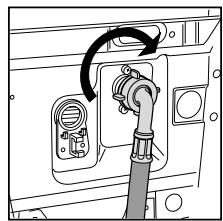
Water hose inlet to be fitted to the top right.
Connecting the drain hose
On the back of the appliance, towards the top, you will find a hook onto which you should fasten the drain hose if necessary. Insert the other end in a wall draining duct or place it on the edge of a sink or tub avoiding excessive kinks and bending. It should be placed at a height ranging from 60 to 100 cm.
In case it is necessary to fix the end of the hose at a height below 60 cm from the ground, it must be fixed in the appropriate hook placed on the back panel as mentioned above.
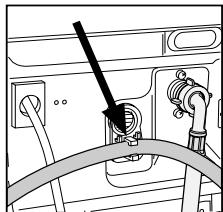
The hook to be used in case the drain hose ends at a height below 60 cm.
If the hose drains into a tub or sink, apply the plastic guide and tie it to the tap.
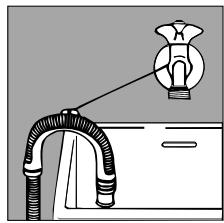
The guide for draining into tubs and sinks.
The hose must never remain immersed in water.
Extensions are inadvisable. In case of absolute need, the extension must have the same diameter as the original hose and must not exceed 150 cm in length. In case of wall draining pipes, their efficiency must be checked by a qualified technician. If the dwelling is on one of the upper floors of a building, there may be drain trap problems causing the washing machine to load and unload water continuously. In order to avoid such an inconvenience, special antidrain trap valves are available in shops.
Electric connection
Before connecting the appliance to the electric socket, be sure that:
1) the electric socket is able to sustain the appliance's maximum power load indicated on the data plate and in compliance with the law;
2) the supply voltage is included within the values indicated on the data plate;
3) the socket is compatible with the appliance's plug. If not, do not use adapters, but replace either the socket or the plug;
4) electric household appliances must be equipped with an "earthing" system,
5) that the machine is not placed on top of the power supply cable once the connection has been made.
Warning!
Any modifications made to the factory settings or an irregular electric connection, any electrical, mechanical or hydraulic modification whatsoever to the appliance shall render the guarantee invalid and shall relieve the manufacturer and retailer of any and all liability.
Plastic bags, polystyrene foam, screws and other packaging parts are not children's toys, and are potentially dangerous.
More and more important
Your safety and that of
your children
Your washing machine has been built in compliance with the strictest international safety regulations. To protect you and all your family.
Read these indications and all the information in this manual carefully: they are an important source, not only of numerous useful tips, but also of vital information on safety, use and maintenance
- In case of malfunctioning, first unplug the appliance from the wall socket and turn off the water tap; do not under any circumstances touch internal parts in order to attempt repairs. This will also render the guarantee invalid.
- The washing machine should not be installed in an outdoor environment, not even when a roof shelters the area, because it may be very dangerous to leave it exposed to rain and thunderstorms.
-
It must only be used by adults and exclusively for washing clothes following the instructions provided in this manual.
-
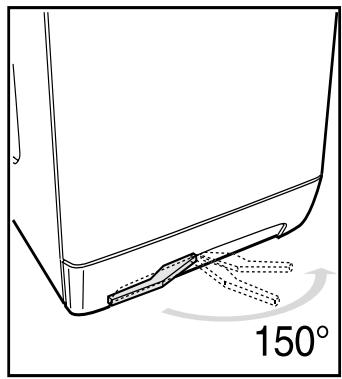
Should it have to be moved, pull the white lever, situated on the left beneath the base, and the retractable wheels will appear, thus allowing for easy movement.
- Before loading the washing machine, make sure the drum is empty.
- Never touch the washing machine when barefoot
or with wet or damp hands or feet.
- Never use extensions or multiple plugs, which are particularly dangerous in humid environments. The power supply cable must never be bent or dangerously compressed.
- Do not remove the filter while the appliance is on.
Do not use hand wash detergent because the abundance of foam could come out from the lid and cause damage.
- Never pull on the plug or the washing machine to disconnect it from the wall socket: it is extremely dangerous.
- While the appliance is functioning, do not touch the drain water as it could reach very high temperatures. Keep it out of children's reach. Never force the washing machine door because this could damage the safety block on the opening, which serves to protect from accidental openings.
- This appliance is intended for domestic use. Industrial use (in hotels, restaurants and laundries) compromises its original manufacturing characteristics and invalidates the guarantee.
How to change the power supply cable
The power supply cable is special and can be purchased exclusively from authorised Technical Service Centres.
To replace it, do as follows: 1. Make sure that the washing machine is switched off and unplugged.
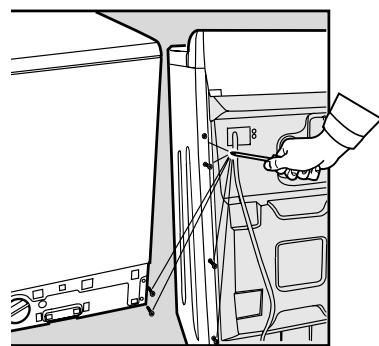
Fig.1
- Remove the appliance base and unscrew the 2 screws on the bottom right-hand side, then unscrew the 6 rear screws, on the left-hand side, and remove the side panel by tipping it slightly outwards and pulling it out. (fig. 1 and 2).
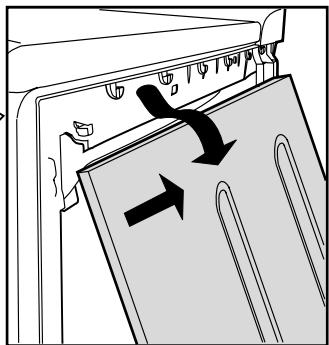
Fig.2
- Disconnect the electricity supply to the radio interference suppresser by removing the connector (fig. 3).
- Unscrew the 2 outer filter fastening screws and, with the help of a screwdriver (see fig. 4), release it from the back panel by pulling upwards.
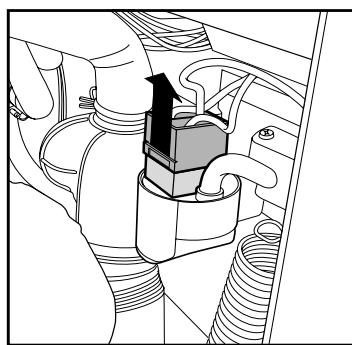
Fig.3
- Once you have positioned the new power supply cable, reconnect the connector, making sure the safety hook is securely in place.
You must contact a qualified professional to replace the power supply cable. The same must respect the applicable norms in force.
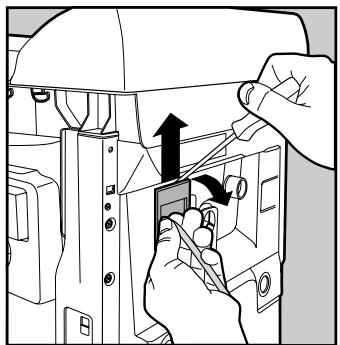
Fig. 4
What goes in your washing machine?
Before washing, you can do a great deal for better results. Divide your garments according to fabric and colour. Read the labels and follow their indications. Alternate small items with large ones.
Before washing.
Divide your washing according to the type of fabric and colour resistance: sturdy fabrics should be separated from delicate ones.
Light colours should be separated from dark ones.
Empty all pockets (coins, paper, money and small objects) and check the buttons. Mend immediately or remove loose buttons as they could fall off during the wash cycle.
The labels say it all.
Always look at the labels: they tell you everything about your garment and how to wash it in the best way possible.
The table on page 7 shows you all the secrets of the symbols found on labels. Their indications are a valuable guide to a better wash and to longer lasting clothes.
Alternate small items with large ones.
Unfold all your washing. Place it loose inside the drum and follow the indications as to the recommended load quantity for the different wash programmes. Your clothes will come out cleaner and with fewer creases.
Garments treated with petrol-based stain remover.
Do not place garments in your washing machine that have been treated with petrol, pure alcohol, trichlorethylene etc. until these products have evaporated completely.
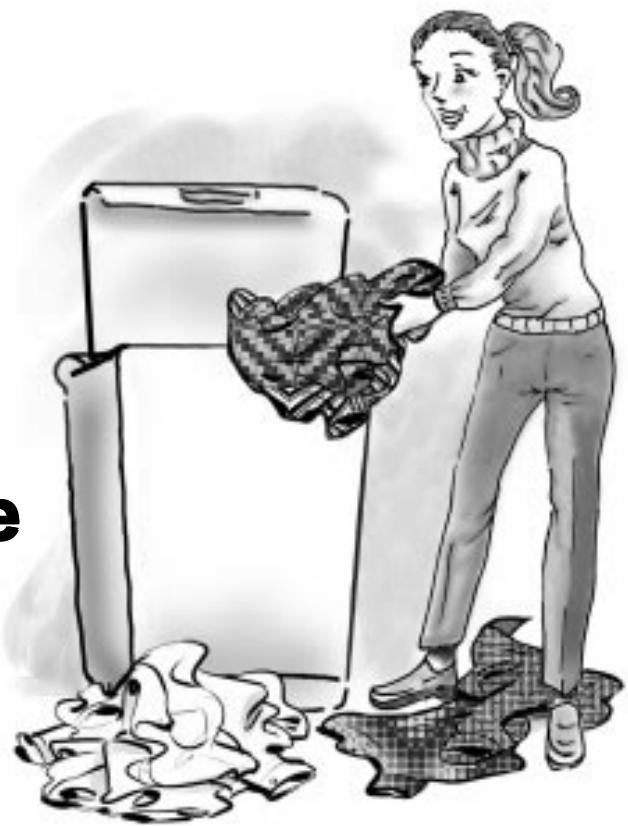
Dividing your garments according to fabric and colour is very important for good results.
How to start the appliance
Putting your appliance in place and moving it.
If your washing machine is equipped with a special set of retractable wheels you can easy move it. To lower the wheels and thus move the appliance effortlessly, just pull the lever, situated on the left-hand side beneath the base. Once the appliance is in the required position, put the lever back in place. The washing machine is now firmly in place. See figure, just for equipped models.
After installing your new washing machine, start a wash cycle (with the appliance empty) by setting programme "1" at 60 degrees C.
Starting the washing machine in the right way is important for the quality of your wash, for preventing problems and for lengthening the life of your appliance. After loading your washing and pouring in the
For delicate garments: protect underwear, tights and stockings, children's socks and delicate items by placing them in a canvas pouch
detergent together with any additives, always check that:
-
The appliance doors are firmly shut.
-
The plug is inserted in the socket.
-
The water tap is turned on.
-
button F is on the O position.
-
The set of retractable wheels is stored away (i.e. the wheels are not touching the floor).
Choose the desired programme
The programme is selected
according to the type of garments that need to be washed and how dirty these are.
To select the programme, consult the table on page 6. Turn knob A and set it to the number corresponding to the desired programme. Select the temperature using knob B and, if necessary, press the function buttons (C-D-E); finally press the ON-OFF button F (position I).
At the end of the wash cycle... wait for approximately two minutes.
Then turn the washing machine off by pressing ON-OFF button
F (O position). You can now open the washing machine doors safely. After having removed the freshly cleaned washing, leave the doors open or half-open so that the humidity left inside can evaporate.
Always turn the water tap off.
Remember that, in the event of a power failure, or should the washing machine switch itself off, the programme selected will start up again from where it was interrupted.
Understanding the control panel
Here I'm in command
Making the right choice is important. And it's easy.
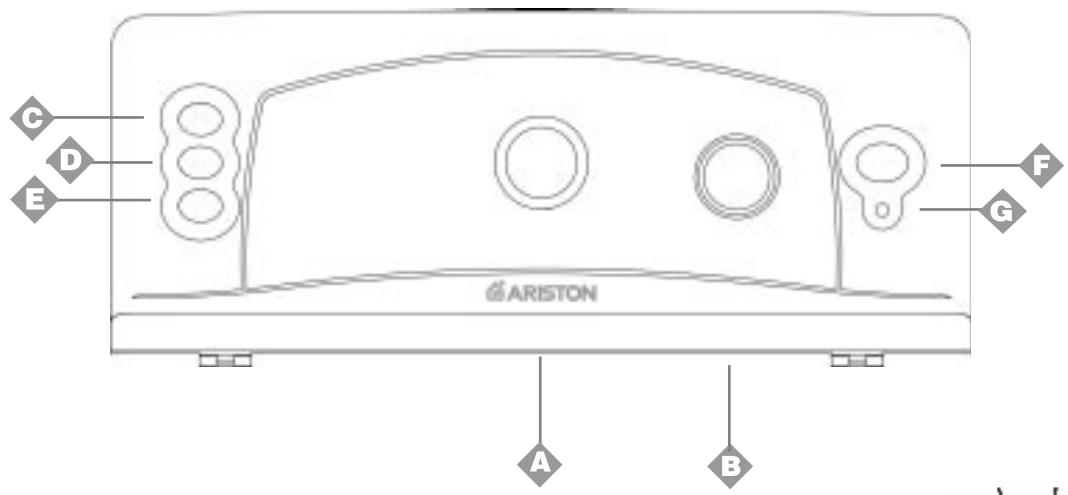

Programme selector knob
Use this dial to select one of the 16 wash programmes availabile for all your laundry requirements (see programme table on page 6).
N.B. This knob must be turned clockwise only and when the machine is off.


Temperature control knob
It is used to set the wash temperature indicated in the programme table. 6). It also allows you to reduce the temperature recommended for the selected programme, and even to set a cold wash cycle (snow symbol ).

Half load 1/2
This button reduces the quantity of water used during rinsing. We recommend the use of this button with programmes for Delicates and Synthetics only and when the drum does not contain a full load; the quantity of detergent should also be reduced.


No spin button
It is used to exclude spinning. Use it only for articles which are difficult to iron and only with the programmes for Synthetics and Delicates.

Anti-crease (Synthetics-delicates)
This button allows you to interrupt a programme (on positionsymbol) keeping the washing soaking in water before the spin cycle. It is a very useful button, because it prevents delicate and synthetic fabrics from creasing (for example, when you cannot take the washing out at the end of the wash cycle, but only after a few hours).
It can only be used in programmes for Synthetic fabrics of (Progr. 5-6-7).
WARNING! To conclude the wash cycle and drain the water, press button E again.
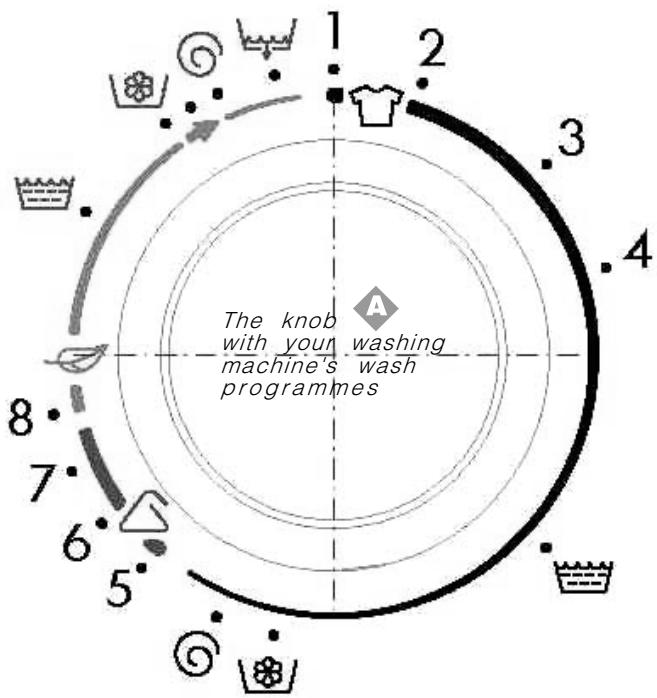

1 0
ON-OFF
When button F is pressed, the washing machine is switched on, when it is not the machine is switched off.
Turning the machine off does not cancel the selected programme.

ON-OFF lamp
Lamp G flashes when the appliance is switched on and awaiting a programme to be set. A steady light means the appliance has accepted the selected programme.
What are you washing today?
A programme for all seasons
| Type of fabric and degree of soil | Pro-gramme knob | Temper. Knob | Deter-gent for pre-wash | Deter-gent for wash | Fabric softener | Traditional or delicate bleach | Cycle length (minutes) | Description of wash cycle |
| COTTON | ||||||||
| Exceptionally soiled whites (sheets, tablecloths, etc.) | 1 | Max°C | ◆ | ◆ | ◆ | 155 | Pre-wash, Wash at high temperature, rinses, intermediate and final spin cycles | |
| Exceptionally soiled whites (sheets, tablecloths, etc.) | 2 | Max°C | ◆ | ◆ | Delicate/Tra-ditional | 145 | Heavy duty washes at high temperature, rinse cycles, intermediate and final spin cycles | |
| Heavily soiled whites and fast colours | 3 | 60°C | ◆ | ◆ | Delicate/Tra-ditional | 115 | Normal wash cycle at 60°C, rinse cycles, intermediate and final spin cycles | |
| Slightly soiled whites and delicate colours (shirts, jumpers, etc.) | 4 | 40°C | ◆ | ◆ | Delicate/Tra-ditional | 100 | Wash cycle at 40°C, rinse cycles, intermediate and final spin cycles | |
| Rinse cycles/Bleach | ◆ | Delicate/Tra-ditional | Rinse cycles, intermediate and final spin cycles | |||||
| Spin cycle | Draining and final spin cycle | |||||||
| Stop/Reset | Interrupts/Cancels selected programme | |||||||
| SYNTHETICS | ||||||||
| Heavily soiled fast colour synthetics (baby linen, etc.) | 5 | 60°C | ◆ | ◆ | Delicate | 90 | Heavy duty wash cycle at 60°C, rinse cycle, anti-crease or delicate spin cycle | |
| Delicate colour synthetics (all types of slightly soiled garments) | 6 | 50°C | ◆ | ◆ | Delicate | 80 | Normal wash cycle at 50°C, rinse cycles, anti-crease or delicate spin cycle | |
| Delicate colour synthetics (all types of slightly soiled garments) | 7 | 40°C | ◆ | ◆ | 70 | Delicate wash cycle at 40°C, rinse cycles and delicate spin cycle | ||
| Rinse cycles/Bleach | ◆ | Delicate | Rinse cycles, anti-crease or delicate spin cycle | |||||
| Fabric softener | ◆ | Rinse cycles with automatic introduction of softener, anti-crease or delicate spin cycle | ||||||
| Rinse hold | Rinse hold for especially delicate garments | |||||||
| Spin cycle | Draining and delicate spin cycle | |||||||
| Stop/Reset | Interrupts/Cancels selected programme | |||||||
| DELICATES | ||||||||
| Wool | 8 | 40°C | ◆ | ◆ | 60 | Wash cycle at 40°C, rinse cycles and delicate spin cycle | ||
| Rinse cycles | ◆ | Rinse cycles, anti-crease or draining | ||||||
| Fabric softener | ◆ | inse cycles with automatic introduction of softener, anti-crease or delicate spin cycle | ||||||
| Spin cycle | Draining and delicate spin cycle | |||||||
| Draining | Draining | |||||||
| Stop/Reset | Interrupts/Cancels selected programme | |||||||
The information contained in the table is purely indicative. It could in fact vary depending on the appliance model, the quantity and type of garments to wash, the hardness and temperature of the mains water supply, as well as the temperature of the environment.
Understanding labels…
Learn the meaning of these symbols and you will get better results, your garments will last longer and your machine will repay you by washing better.
All over Europe, garment labels contain messages expressed in small yet important symbols. Understanding them is very important if you want to get better results and treat your garments the way they deserve to be treated.
These symbols are divided in five different categories and
shapes: wash cycle
bleaching 7 ironing 3 dry cleaning O and drying
Useful tips
Turn shirts inside out to get better results and make them last longer.
Always empty pockets of their contents.
Look at the label: it will always give you useful advice.
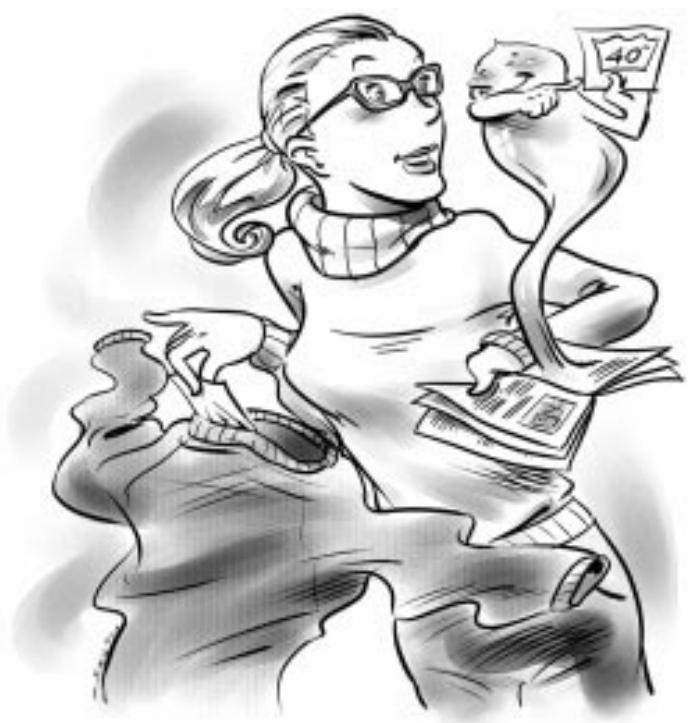
Make sure you select the right temperature...
Consult and learn the symbols in this table: they will help you obtain a better wash, treat your clothes properly, and get a better performance out of your washing machine.
| Wash cycle | Bleaching | Ironing | Dry cleaning | Drying |
| Strong Movement | Delicate Movement | High temp. | ||
| 95 Wash cycle 95°C | 95 Can be bleached in cold water | Hot iron max 200°C | Dry cleaning with all solvents | Can be tumble-dried |
| 60 Wash cycle 60°C | 60 Do not bleach | Warm iron max 150°C | Dry cleaning with perchloride, aviation gasoline, pure alcohol, R111 and R113 | Do not tumble dry |
| 40 Wash cycle 40°C | 40 Do not bleach | Cool iron max 110°C | Dry cleaning with aviation gasoline, pure alcohol and R113 | Lay flat to dry |
| 30 Wash cycle 30°C | 30 Do not iron | Do not iron | Dry cleaning | Hang to dry non-spin dried garments |
| Delicate hand wash | Delicate hand wash | Dry on hangers | ||
| Do not wash in water | Do not wash in water |
... and the symbols for the various Ariston models:
| ON OFF |
| Start-reset |
| Temperature setting |
| Pre-wash - Wash Max° |
| 90° Wash |
| 60° Wash |
| Delicate 40° Wash |
| 60° Synthetics |
| 50° Synthetics |
| 40° Synthetics |
| Rinse |
| Rinse level / Extra rinse |
| Fabric softener |
| Rinse hold - Anti-crease |
| Spin cycle |
| Spin cycle variation or no spin cycle |
| Water Draining |
| Wash cycle intensity |
| Wool |
| Hand wash |
| Delayed start |
| Daily wash at 30° in 30' |
| Easy iron |
| Stain removal |
| Half load |
| Silk and curtains |
Useful tips to avoid mistakes
General Rules:
- Cotton - Linen. Fill the drum but do not overload it.
- Synthetics. Do not fill more than half the drum.
Delicates and Wool. Do not fill the drum more than a third.
-Heavily soiled garments: reduce the quantity. - Persistent or special stains. Treat these before washing by rubbing the toughest stains with a special detergent, with detergent paste or specific stain removers (see the inset on treating special stains with stain removers on page 9)
Never use your washing machine to wash... torn, fraying or non-hemmed linen. If it is absolutely necessary, place it in a bag for protection. Brightly coloured linen with whites.
Watch the weight!
For best results, do not exceed the weight limits stated below (figures show weight when dry):
Sturdy fabrics: max 5 kg
Synthetic fabrics: max 2.5 kg
- Delicate fabrics: max 2 kg
- Pure virgin wool: max 1 kg
- Towelling max 2.3 kg
How much does it weigh?
1 sheet 400-500 gr.
1 pillow case 150-200 gr.
1 tablecloth 400-500 gr.
1 bathrobe 900-1,200 gr.
1 towel 150-500 gr.
Mix clothing of different sizes with towelling: bathrobes, towels, etc. This way no "ball" will form during the spin cycle and the garments will stay balanced.
Coloured T-shirts, printed ones and shirts last longer if turned inside out before washing.
Printed T-shirts and sweatshirts should always be ironed inside out.
Salopette alert.
Very popular "salopette" type overalls have straps with hooks that can damage the drum of your washing machine or other garments during the wash. By placing the hooks in the bib pocket and fastening them with safety pins, all risks are avoided.
Holidays: unplug the appliance.
When you go on holiday, we recommend that you unplug your washing machine, shutting off the water inlet tap and leaving the door opened or ajar. This way, both the drum and the gasket will remain nice and dry and unpleasant odours will not develop inside the washing machine.
How to wash almost anything
Curtains.
Curtains tend to crease a great deal. Here is a tip to reduce creasing: fold the curtains and place them in a pillow case or mesh bag. Do not load anything else, so that the overall weight does not exceed the half load.
■ Quilted coats and windcheaters.
You can wash quilted coats and wind-cheaters, too, if they are padded with goose or duck down. Do not load more than 2-3 kg and never load 5 kg. Repeat rinse once or twice using the gentle spin.
Trainers.
Once you have removed mud and dirt from trainers, you can wash them with jeans and other tough garments. Do not wash trainers with whites.
WOOLCYCLE
For best results, use a specific detergent, taking care not to exceed a load of 1kg
When detergents and water are not enough…
How to get rid of some special stains
- Red wine. Leave to soak with detergent, rinse and treat with acetic acid or citric acid, then rinse. Treat any residue with bleach.
- Blood. Fresh stains should be treated immediately with cold water. In the event of dry blood stains, leave to soak overnight with a special detergent and then rub with soapy water.
- Dry grease stains. Moisten with turpentine, dab the stains with your fingertips and a cotton cloth, after placing the garment on a soft surface.
- Rust. Oxysalt (can be found in a chemists) hot molten, or a cold anti-rust product. Old stains may have already damaged the fabric: risk of holes...
- Mould stains Treat with bleach, rinse thoroughly (only white and coloured garments resistant to chlorine).
- Oil paint. Moisten with detergent petrol, dab the stains after placing the garment on top of a soft cloth, then treat repeatedly with the detergent.
- Ink and biro. Dab with cotton soaked in methyl alcohol or alcohol at 90° .
- Tar. Dab with fresh butter, rub in turpentine then wash immediately.
- Wax. Scrape away, then run a hot iron between two sheets of absorbent paper. Then rub in cotton with turpentine or methyl alcohol.
- Chewing gum. Rub in nail polish remover and wipe with a clean rag.
- Mould. Cotton and white linen should be placed in a solution of 5 parts water, one bleach and a spoon of vinegar, then washed immediately. For other white fabrics, use hydrogen peroxide at 10 volumes and wash immediately.
- Lipstick. Dab with ether on wool or cotton. Use trichlorethylene for silk.
- Nail polish. Place a sheet of absorbent paper on the side of the stain, wet it with nail polish remover, shifting the garment as the sheet gradually changes colour.
- Grass. Dab with a wad of cotton soaked in methyl alcohol.
For a safe wash cycle
How to open and shut the drum
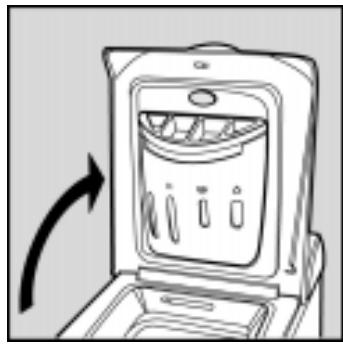
Fig.1
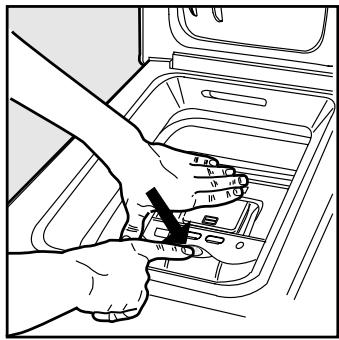
Fig. 2
A) OPENING (Fig. 1). Lift the external lid and open it completely.
B) Then open the drum using both hands as shown in Fig. 2:
- press the button indicated by the arrow in Fig. 2 lightly downwards, with one hand firmly resting on the doors to prevent them from suddenly opening and hurting your fingers;- therefore follow the appliance doors along as these unhook and open easily.
C) LOADINGTHEWASHING MACHINE.(Fig.3).
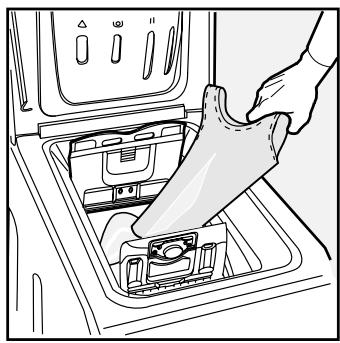
Fig. 3
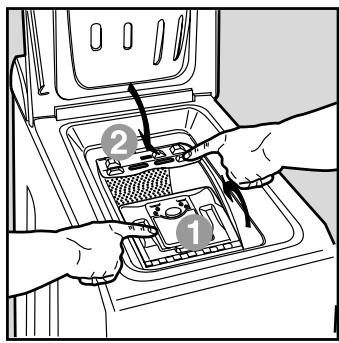
Fig. 4
D) SHUTTING.(Fig.4).
- close the drum fully by first shutting the front door followed by the rear one;
- then ensure the hooks on the front door are perfectly housed within the seat of the rear door;
- after the hooks have clicked into position, press both doors lightly downwards to make sure they do not come loose;
- finally shut the external lid.
It's important for a good wash
The secrets of the detergent dispenser
The first secret: the detergent dispenser is in a handy position underneath the appliance door.
You should add detergent and any additives following the dosage recommended by the manufacturers: generally, all the indications you need are on the box.
Doses vary according to wash load, the water hardness and how soiled the washing is. Do not exceed. More detergent does not necessarily mean greater wash efficiency, on the contrary...
Experience will help you select the right dosage almost automatically: it will become your secret.
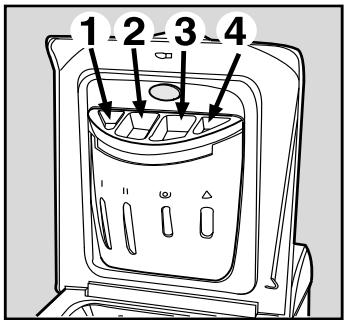
When pouring in the softener in compartment 3, avoid exceeding the "max" level indicated.
The washing machine automatically adds the softener to
the wash in each pro-gramme.
Liquid detergent is to be poured in just a few seconds before starting the wash cycle.
Remember that liquid detergent is particularly suitable for wash cycles of up to 60 degrees and those not requiring pre-washing.
Liquid or powder detergents are sold together with special containers that are to be placed directly inside the washing machine drum, according to the instructions found on the detergent box.
Never use hand wash detergent, because it may form too much foam, which could damage the washing machine. One last secret: when washing with cold water, always reduce the amount of detergent you use: it dissolves less easily in cold water than in hot water, so part of it would be wasted.
In compartment 1: Detergent for pre-wash (powder)
In compartment 2: Detergent for the wash cycle (powder and liquid)
In compartment 3: Fabric softener
In compartment 4: Bleach
Pre-wash, bleach and fabric softener
Should it be necessary to bleach, set the special programmes and pour the bleach into compartment 4 of the detergent dispenser. When you pour the bleach in, take care not to exceed the "max" level indicated.
The use of bleach excludes the possibility of running a pre-wash.
Traditional bleach can only be used on sturdy white fabrics, whereas delicate bleach can be used for coloured fabrics and synthetics. You cannot bleach with the "Silk" programme and with the
"Special Programmes" (see page 6).
N.B.:
1) Concentrated bleach must be diluted in all cases.
2) For concentrated detergents (in powder or liquid), use a programme without pre-washing.
3) For detergents contained in a ball or in tablets, do not run a pre-wash.

Fabric Softener Addition
Fabric softener makes your washing softer and decreases the electrostatic load of synthetic fibres.
Degrees of water hardness
Level -Feature German French
°dH - T.H
Soft 0-7 0-15
2 - Medium 8-14 16-25
3 - Hard 15-21 26-37
4 - Very hard more than 21 more than 37
Fabric softeners can be used for towelling fabrics, kn i t w e a r, curtains, etc.
Pour the fabric softener into compartment 3 of the dispenser following
Cutting costs efficiently
A guide to running your household appliances cheaply while respecting the environment.
FULL LOAD
The best way to save on energy, water, detergent and time is to use your washing machine, washing a full recommended load.
A full load instead of two half loads allows you to SAVE up to 50% of energy.
USE LESS DETERGENT IF: you are washing few garments, the washing is only soiled lightly, foam forms during washing or the water is not very hard, or soft even (please see small table above with the degrees of water hardness). To find out how hard the water in your area is, contact your local Water Works.
IS PRE-WASHING STRICTLY NECESSARY?
Only for extremely soiled garments.
Programming a wash WITHOUT pre-washing for lightly soiled or medium soiled garments allows you to SAVE on detergent, time, water and between 5 and 15% of energy.
IS WASHING WITH HOT WATER STRICTLY NECESSARY?
Treating stains with a stain remover or soaking garments with dry stains in water before washing can reduce the need to programme a wash using hot water.
Use a wash programme at 60° to SAVE up to 50% of energy.
BEFORE USING A DRYING CYCLE...
Select a high speed spin cycle, where the spin speed can be adjusted, if the washing should be dried in a tumble-dryer. A reduced water content in the washing allows you to SAVE both time and energy in the drying programme.
the manufacturer's instructions. The fabric softener is automatically inserted into the machine during the last rinse. At the end of the wash programme, some water will be left in compartment 3. This is used for the inlet of denser fabric softeners into the machine, i.e. to dilute the more concentrated softeners.
Should more than a normal amount of water remain in compartment 3, this means the emptying device is blocked, thus interrupting the suction effect of the device.
For cleaning instructions, see page 13. Never pour fabric softeners together with starch into the dispenser, as the overflow system could get clogged.

Troubleshooting
Before calling, read the following
Your washing machine could fail to work. In most cases, the problems arising can be easily solved without having to call for a technician. Before calling for assistance, always check these points.
The washing machine fails to start.
Is the plug correctly inserted in the socket? It could have been moved whilst cleaning.
■ Is there electricity in the house?
A circuit breaker could have gone off, perhaps because too many appliances are on at the same time. Or perhaps because of a general power failure in your entire area.
■ Is the appliance door shut properly?
For safety reasons, the
washing machine cannot work if the door is open or not shut properly.
■ Is the ON/OFF button pressed?
If it is, then a programmed start has been set.
■Is the programmed start knob, on those models concerned, in the correct position?
Is the water tap turned on? For safety reasons, if the washing machine does not load water, it cannot start a wash cycle.
RIGHT
WRONG
Turning off the water tap after each wash limits the use of the washing machine's hydraulic system and eliminate leakage risks when no-one is at home.
Try to only leave the appliance in use unattended if the place where it is located is equipped with a floor drain.
Always leave all appliance doors ajar.
This will avoid the formation of bad odours.
Clean the appliance's exteriors delicately.
To clean the exteriors and the rubber parts of the appliance, always use a cloth dipped in lukewarm soapy water.
Leave the washing machine plugged in while cleaning. Even during maintenance, the appliance should always be unplugged.
Use solvents and aggressive abrasives. Never use solvents or abrasives to clean the external and rubber part of the washing machine.
Neglect the detergent dispenser. It is removable and can easily be cleaned by leaving it under running water.
Go on holiday without thinking about it. Before leaving, always make sure that the washing machine is unplugged and that the water tap is turned off.


The washing machine fails to load water.
Is the tap correctly attached to the pipe?
■ Is there a water shortage?
There could be work in progress in your building or street.
Is there enough pressure? The autoclave may be malfunctioning.
Is the tap filter clean? If the water is very calcareous, or if work has recently been carried out on the water piping, the tap filter could be clogged with particles and debris.
Is the rubber hose bent? The tract of the rubber hose bringing water to the washing machine must be as straight as possible. Make sure it is not squashed or bent.
The washing machine continuously loads and unloads water.
Is the drain hose positioned too low? It must be installed at a height ranging from 60 to 100 cm.
Is the hose's mouth immersed in water?
Does the wall drainage system have a breather pipe? If the problem persists even after these checks, turn off the water tap, switch the appliance off and call for assistance.
If you live on an upper floor of your building, there may be a problem with your
The washing machine does not drain or spin.
Does the selected programme foresee water draining? Some wash cycles require enabling the draining manually.
Has the "Anti-crease" function - in those appliances where it is foreseen - been enabled? This function requires enabling the draining manually.
Is the drain pump clogged? To check it, turn off the tap, unplug the washing machine and follow the instructions on page 14, or call for technical assistance.
Always get assistance from authorised technicians and always insist on original spare parts
Is the rubber hose bent?
The tract of the drain hose must be as straight as possible. Make sure it is not squashed or bent.
Is the washing machine's drain duct clogged? Is there an extension on the drain hose? If so, is it positioned incorrectly, blocking the water flow?
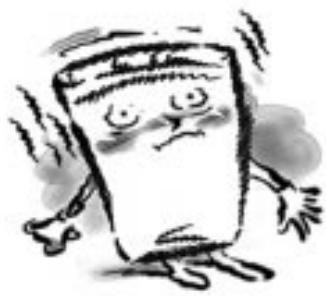
The washing machine vibrates too much during the spin cycle.
Has the internal floating unit been correctly unblocked during installation? See page 2 on installation procedures.
Has the washing machine been levelled correctly? The levelling of the appliance should be checked periodically. In time, the appliance could move imperceptibly. Adjust the feet and check them with a level.
Has it got enough room around it? The appliance should not be leaning against any sanitary fixtures and must have some free space around it. If it is placed on a fitted carpet floor, ensure that there is enough room for air to circulate between the appliance feet and the carpet.
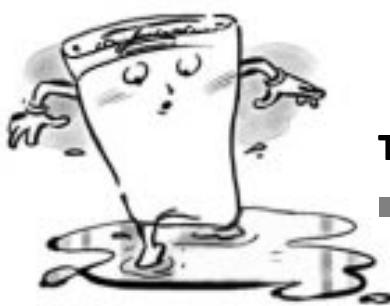
The washing machine leaks.
Is the metal ring of the inlet hose properly attached? Turn off the tap, unplug the appliance and try tightening its attachment without forcing it.
Is the detergent dispenser obstructed? Try extracting it and washing it under tap water.
Is the drain hose well attached? Turn off the tap, unplug the appliance and try tightening its attachment.
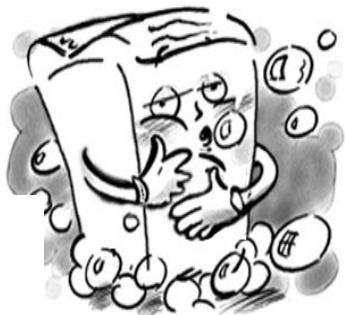
Too much foam.
■ Is the detergent suitable for washing-machine use? Make sure that it bears the definition "for washing-machines" or "hand and machine wash", or the like.
Is the correct amount being used? An excessive amount of detergent, besides producing too much foam, does not guarantee a more effective wash, and causes scaling in the internal parts of the appliance.
If, despite all checks, the washing machine fails to function and the problem persists, call your nearest authorised Customer Service Centre, providing the following information:
- the type of malfunctioning
- the model type no. (Model.....)
- the serial number (S/N ....)
These indications can be found on the data plate situated on the back of the washing machine front base. (fig. 1)
Easy Care and Maintenance
Treat it well and it'll be your
friend forever
Your washing machine is a reliable companion in life and on the job. It is just as important for you to keep it in shape.
Your washing machine is designed to last a lifetime without any problems. A few simple steps help keep it in shape and last longer.
Firstly, you must turn off the water tap after each wash: the constant pressure of water could warp a few of the component parts.
In addition, by doing so, you will avoid the risk of leaks when no-one is at home.
If the water in your area is too hard, use a deliming product (water is hard if it often leaves whitish stains around taps or drains, especially of bath tubs. For more accurate information as to the type of water in your system, call the local water works or a local plumber).
Pockets must always be emptied by removing even coins, pins, badges and any other hard object.
The washing machine exterior should be cleaned with a cloth dipped in lukewarm soapy water.
It is important to wash the detergent dispenser regularly. To prevent dried washing powder from accumulating, place the dispenser under running water for a few minutes.
Never exaggerate with detergent doses.
Normal detergents already contain deliming agents. Only if the water is particularly hard, that is, rich in lime content, do we recommend the use of a specific product at every wash. A periodical wash cycle with a dose of a deliming product, without detergents or washing, may prove useful.
Never use too much detergent or additives because this could cause an excess amount of foam, scaling and possible damage to the component parts of your washing machine.
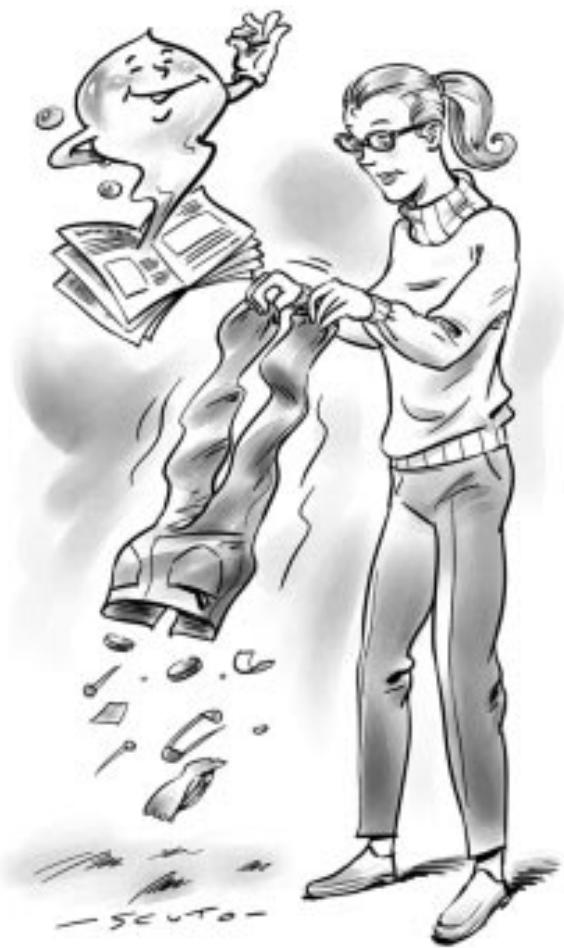
Do not forget to empty all pockets: small metallic objects can cause damage to your washing machine's drum during the spin cycle.
How to clean the detergent dispenser
Disassembly:
Press lightly on the large button on the front of the detergent dispenser and pull it upwards (fig. 1).
Cleaning:
Then clean the dispenser under a tap (fig. 3) using an old toothbrush and, once the pair of siphons inserted in the top of compartments 1 and 2 (fig. 4) have been pulled out, check whether the same are not clogged and then rinse them.
Reassembly:
Do not forget to reinsert the pair of siphons into the special housings and then to replace the dispenser into its seat, clicking it into place (fig. 4, 2 and 1).
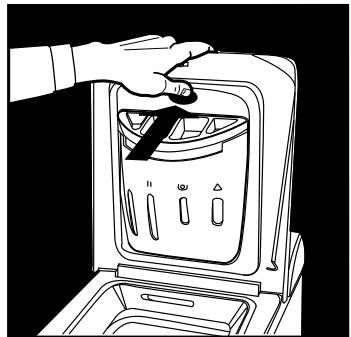
Fig.1
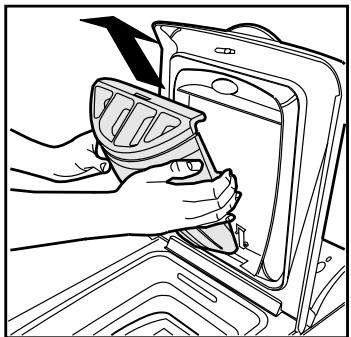
Fig. 2
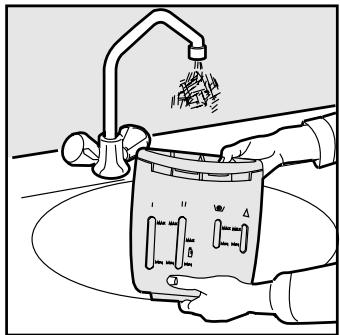
Fig. 3
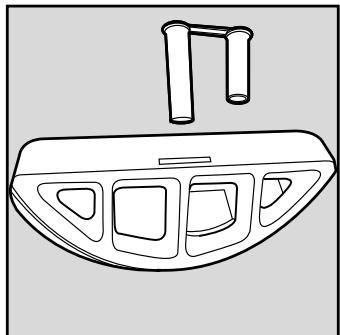
Fig. 4
When in need, check the pump and the rubber hose.
The washing machine comes equipped with a self-cleaning pump that does not require any cleaning or maintenance. Small objects may accidentally fall into the pump: coins, hair clips, loose buttons and other small items. To avoid possible damage, they are withheld in an accessible pre-chamber, situated at the lower end of the pump.
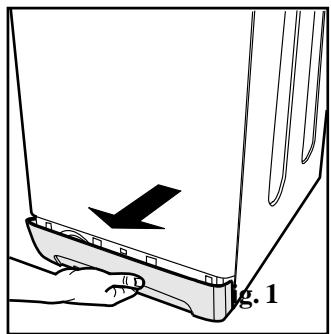
Fig.1
To access this pre-chamber, just remove the panel covering the bottom of the washing machine (fig. 1); then lift the cover rotating it anti-clockwise (fig. 2) and check its contents accurately.
The rubber hose
Check the rubber hose at least once a year. If you see any cracks, replace it immediately. When you use your washing machine, water pressure is very strong and a cracked hose could easily split open.
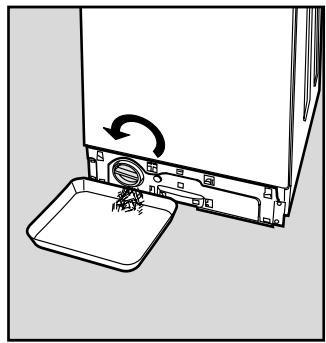
Fig. 2
Warning: make sure that the wash cycle has come to a full stop and unplug the appliance before removing the lid as well as before any type of maintenance procedure. It is normal to find that a little water comes out after removing the lid. When replacing the panel, make sure you insert the hooks situated at the bottom of the washing machine in the right slots before pushing it back against the appliance.
Technical features
| Model | AT 50 |
| Dimensions | width cm 40 |
| height cm 85 | |
| depth cm 60 | |
| Capacity | from 1 to 5 kg |
| Electric connections | voltage 230 Volts 50Hz maximum absorbed power 2100 W |
| Water connections | maximum pressure 1 Mpa (10 bar) minimum pressure 0.05 Mpa (0.5 bar) drum capacity 42 litres |
| Spin speed/min | up to 500 r.p.m. |
| Controlling programmes in accordance with IEC Norm 456 | run with a load of 5.0 kg, programme 2, 60°C |
| This appliance conforms with the following European Community Directives: -73/23/EEC of 19/02/73 (Low Voltage) and subsequent modifications -89/336/EEC of 03/05/89 (Electromagnetic Compatibility) and subsequent modifications |
The manufacturer reserves the right to make any modifications whatsoever, at any time and without notice, to the appliance or any of its accessories that may be deemed necessary for technical or commercial requirements.

ARISTON
Prélavage, Javel, assouplissant
- QUICK GUIDE
- INSTALLATION AND REMOVAL (P. 2)
- SAFETY FOR YOU AND YOUR CHILDREN (P. 3)
- WHAT GOES IN YOUR WASHING MACHINE AND HOW TO START IT (P. 4)
- UNDERSTANDING THE CONTROL PANEL (P. 5)
- GUIDE TO THE WASH PROGRAMMES (P. 6)
- GUIDE TO UNDERSTANDING LABELS AND SYMBOLS (P. 7-8)
- USEFUL TIPS TO AVOID MISTAKES (P. 8)
- HOW TO CLOSE THE DRUM (P. 9)
- THE DETERGENT DISPENSER (P. 10)
- PROBLEMS AND SOLUTIONS (P. 11 AND 12)
- CARE AND MAINTENANCE (P. 13)
- TECHNICAL FEATURES (P. 14)
- INSTALLATION AND REMOVAL
- WHEN THE APPLIANCE ARRIVES
- LEVELLING
- CONNECTION TO THE WATER MAINS
- CONNECTING THE DRAIN HOSE
- THE HOSE MUST NEVER REMAIN IMMERSED IN WATER
- ELECTRIC CONNECTION
- WARNING
- MORE AND MORE IMPORTANT
- YOUR SAFETY AND THAT OF
- YOUR CHILDREN
- HOW TO CHANGE THE POWER SUPPLY CABLE
- WHAT GOES IN YOUR WASHING MACHINE
- BEFORE WASHING
- THE LABELS SAY IT ALL
- ALTERNATE SMALL ITEMS WITH LARGE ONES
- GARMENTS TREATED WITH PETROL-BASED STAIN REMOVER
- HOW TO START THE APPLIANCE
- PUTTING YOUR APPLIANCE IN PLACE AND MOVING IT
- UNDERSTANDING THE CONTROL PANEL
- HERE I'M IN COMMAND
- PROGRAMME SELECTOR KNOB
- N.B. THIS KNOB MUST BE TURNED CLOCKWISE ONLY AND WHEN THE MACHINE IS OFF
- TEMPERATURE CONTROL KNOB
- HALF LOAD 1/2
- NO SPIN BUTTON
- ANTI-CREASE (SYNTHETICS-DELICATES)
- ON-OFF
- ON-OFF LAMP
- WHAT ARE YOU WASHING TODAY
- A PROGRAMME FOR ALL SEASONS
- UNDERSTANDING LABELS
- USEFUL TIPS
- AND THE SYMBOLS FOR THE VARIOUS ARISTON MODELS
- USEFUL TIPS TO AVOID MISTAKES
- GENERAL RULES
- WATCH THE WEIGHT
- HOW MUCH DOES IT WEIGH
- SALOPETTE ALERT
- HOLIDAYS: UNPLUG THE APPLIANCE
- HOW TO WASH ALMOST ANYTHING
- CURTAINS
- QUILTED COATS AND WINDCHEATERS
- TRAINERS
- WOOLCYCLE
- WHEN DETERGENTS AND WATER ARE NOT ENOUGH
- HOW TO GET RID OF SOME SPECIAL STAINS
- FOR A SAFE WASH CYCLE
- HOW TO OPEN AND SHUT THE DRUM
- THEN OPEN THE DRUM USING BOTH HANDS AS SHOWN IN FIG. 2
- LOADINGTHEWASHING MACHINE.(FIG.3)
- SHUTTING.(FIG.4)
- IT'S IMPORTANT FOR A GOOD WASH
- THE SECRETS OF THE DETERGENT DISPENSER
- PRE-WASH, BLEACH AND FABRIC SOFTENER
- N.B
- FABRIC SOFTENER ADDITION
- CUTTING COSTS EFFICIENTLY
- FULL LOAD
- IS PRE-WASHING STRICTLY NECESSARY
- IS WASHING WITH HOT WATER STRICTLY NECESSARY
- BEFORE USING A DRYING CYCLE
- TROUBLESHOOTING
- BEFORE CALLING, READ THE FOLLOWING
- THE WASHING MACHINE FAILS TO START
- RIGHT
- WRONG
- THE WASHING MACHINE FAILS TO LOAD WATER
- THE WASHING MACHINE CONTINUOUSLY LOADS AND UNLOADS WATER
- THE WASHING MACHINE DOES NOT DRAIN OR SPIN
- THE WASHING MACHINE VIBRATES TOO MUCH DURING THE SPIN CYCLE
- THE WASHING MACHINE LEAKS
- TOO MUCH FOAM
- EASY CARE AND MAINTENANCE
- TREAT IT WELL AND IT'LL BE YOUR
- FRIEND FOREVER
- NEVER EXAGGERATE WITH DETERGENT DOSES
- HOW TO CLEAN THE DETERGENT DISPENSER
- DISASSEMBLY
- CLEANING
- REASSEMBLY
- WHEN IN NEED, CHECK THE PUMP AND THE RUBBER HOSE
- THE RUBBER HOSE
- TECHNICAL FEATURES
- ARISTON
- PRÉLAVAGE, JAVEL, ASSOUPLISSANT
Brand : HOTPOINT
Model : AT50
Category : Washing machine