ManualGo.com
F400 - Gps NAVMAN - Free user manual and instructions
Find the device manual for free F400 NAVMAN in PDF.


Download the instructions for your Gps in PDF format for free! Find your manual F400 - NAVMAN and take your electronic device back in hand. On this page are published all the documents necessary for the use of your device. F400 by NAVMAN.
USER MANUAL F400 NAVMAN
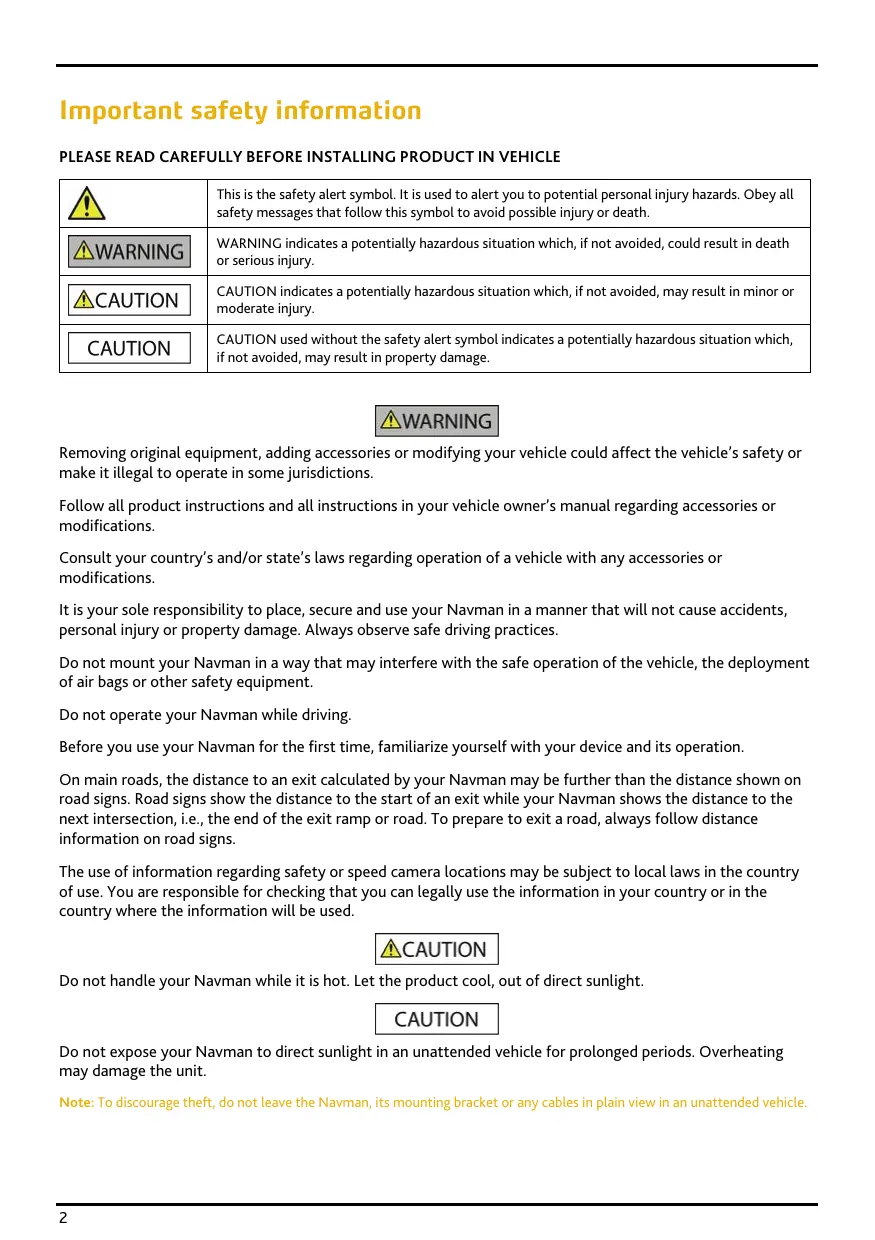
User Manual Important safety information PLEASE READ CAREFULLY BEFORE INSTALLING PRODUCT IN VEHICLE This is the safety alert symbol. It is used to alert you to potential personal injury hazards. Obey all safety messages that follow this symbol to avoid possible injury or death. WARNING indicates a potentially hazardous situation which, if not avoided, could result in death or serious injury. CAUTION indicates a potentially hazardous situation which, if not avoided, may result in minor or moderate injury. CAUTION used without the safety alert symbol indicates a potentially hazardous situation which, if not avoided, may result in property damage. Removing original equipment, adding accessories or modifying your vehicle could affect the vehicle’s safety or make it illegal to operate in some jurisdictions. Follow all product instructions and all instructions in your vehicle owner’s manual regarding accessories or modifications. Consult your country’s and/or state’s laws regarding operation of a vehicle with any accessories or modifications. It is your sole responsibility to place, secure and use your Navman in a manner that will not cause accidents, personal injury or property damage. Always observe safe driving practices. Do not mount your Navman in a way that may interfere with the safe operation of the vehicle, the deployment of air bags or other safety equipment. Do not operate your Navman while driving. Before you use your Navman for the first time, familiarize yourself with your device and its operation. On main roads, the distance to an exit calculated by your Navman may be further than the distance shown on road signs. Road signs show the distance to the start of an exit while your Navman shows the distance to the next intersection, i.e., the end of the exit ramp or road. To prepare to exit a road, always follow distance information on road signs. The use of information regarding safety or speed camera locations may be subject to local laws in the country of use. You are responsible for checking that you can legally use the information in your country or in the country where the information will be used. Do not handle your Navman while it is hot. Let the product cool, out of direct sunlight. Do not expose your Navman to direct sunlight in an unattended vehicle for prolonged periods. Overheating may damage the unit. Note: To discourage theft, do not leave the Navman, its mounting bracket or any cables in plain view in an unattended vehicle.
Home Charger-specific safety information To charge your Navman from the mains power, use the home charger supplied by Navman as an accessory (may be sold separately). Using other home chargers with your Navman could result in serious injury or property damage. Never use the charger if the plug or cord is damaged. Do not expose the charger to moisture or water. Do not use the charger in a high moisture environment. Exposure to water may cause electrical sparks or fires. Never touch the charger when your hands or feet are wet. Allow adequate ventilation around the charger when using it to operate your Navman or charge the Navman internal battery. Do not cover the charger with paper or other objects that will reduce ventilation. Do not use the charger while it is inside a carrying case or other container. Ensure that the charger is connected to a power source with the correct fitting and voltage requirements. The voltage requirements can be found on the home charger casing and/or packaging. Do not attempt to service the charger as this could result in personal injury. Replace the charger if it is damaged or exposed to excess moisture. Internal battery-specific safety information Your Navman contains a non-replaceable internal lithium-ion polymer battery. The battery may burst or explode if mishandled, releasing hazardous chemicals. To reduce the risk of fire or burns, do not disassemble, crush or puncture the battery. Recycle or dispose of the battery safely and properly according to local laws and regulations. Do not dispose of the battery in fire or water. Only use the correct home charger (sold separately) or in-car charger supplied by Navman to charge the internal battery. Only use the installed internal battery with the Navman unit. The battery will stop charging when the ambient temperature is less than 0ºC (32ºF) or more than 40ºC (104ºF). Failure to adhere to these warnings and cautions may lead to death, serious injury or property damage. Navman disclaims all liability for installation or use of the Navman that causes or contributes to death, injury or property damage or that violates any law. Warning Notice to Drivers in the United States State law may prohibit drivers in states such as Arizona, California and Minnesota from mounting objects on their windshields while driving. Please make sure you research and follow your most current State laws. An alternative mounting option is provided in the box with your product, also, stores offer additional mounting alternatives. Navman does not take any responsibility for any fines, penalties, or damages that may be incurred as a result of disregarding this notice.
Caring for your Navman Taking good care of your Navman will ensure trouble-free operation and reduce the risk of damage to your Navman.
Keep your Navman away from excessive moisture and extreme temperatures.
Avoid exposing your Navman to direct sunlight or strong ultraviolet light for extended periods of time.
Do not place anything on top of your Navman or drop objects on your Navman.
Do not drop your Navman or subject it to severe shock.
Welcome Thank you for purchasing this Navman. This manual has been prepared to guide you through the operation of your Navman from first set-up through to continuous use. Please read this manual carefully before using your Navman for the first time. Keep this manual in a safe place and use as your first point of reference. Important information for using the manual It is important to understand the terms and typographical conventions used in this manual. Formatting The following formatting in the text identifies special information: Convention Type of Information Bold Navman components or items displayed on screen, including buttons, headings, field names and options. Italics Indicates the name of a screen. Terms The following terms are used throughout this manual to describe user actions. Term Description Tap Press and release an item displayed on the touch screen. Tap and hold Tap and hold an item displayed on the touch screen for 2-3 seconds. Select Tap an item in a list or tap a command from a menu.
How do I install my Navman? CAUTION: Select an appropriate location for mounting the Navman in a vehicle. Never place the Navman where the driver’s field of vision is blocked. If the car’s windscreen is tinted with a reflective coating, it may be athermic and impact the GPS reception. In this instance, please mount your Navman where there is a “clear area.” To protect your Navman against sudden surges in current, connect the car charger only after the car engine has been started. F300 Installation
Receiving TMC information Note: Not available on all models. You can receive current traffic information on your Navman via an optional traffic accessory. To receive traffic information, you must connect your Navman to the in-car charger. TMC information is monitored by the navigation software. Once the information is received, you can view it on your device and traffic icons will appear in the map view. Certain roads with reported traffic will be highlighted and you can choose to avoid those roads and an alternate route will be automatically calculated. For more information, see “How does my Navman receive traffic information?” on page 62.
Getting to know your Navman F300
Socket for in-car charger, USB cable, home charger (sold separately) and TMC accessory kit (may be sold separately)
Socket for in-car charger, USB cable, home charger (sold separately) and TMC accessory kit (may be sold separately)
Turning on and off For normal operation, turn off your Navman by sliding the power switch to the OFF position. Your Navman enters a suspended state. To use it again, slide the power switch to the ON position. Your Navman will be back to where you left off. F300 F400 Shutdown and hardware reset Occasionally, you may need to perform a hardware reset if your Navman stops responding; or appears to be “frozen” or “locked-up.” You can perform a hardware reset by shutting down your Navman and then turning it back on. To shut down your Navman, slide the power switch to the RESET position. To turn on your Navman after shutting it down, slide the power switch to the ON position. NOTE: Switching to the Reset position turns the battery off. It is recommended you move the switch to this position if you are planning to store your Navman for any length of time. How do I monitor the battery status? Your Navman has an internal battery that when fully charged, should provide power for up to 3 hours. You can monitor battery power status on the Power screen. Note: The battery may not be fully charged when you use your Navman for the first time. To access the Power screen, tap
How do I charge the battery? The Battery Status bar displays External Power while the battery is charging; when the battery is fully charged, the Battery Status bar will display at 100%.
To charge your Navman in a vehicle, plug the in-vehicle charger to the bottom of your Navman and the other end into the vehicle power socket, as shown in the” How do I install my Navman?” section. To charge your Navman using your computer, see later section for details. To charge your Navman using a mains power socket, plug the mains power charger cable to the bottom of your Navman and the mains power charger pack into the mains power socket. Note: The mains power charger is not included with all models and may be purchased separately.
Charging the battery via the USB cable If you intend to charge your Navman in this way, turn off your Navman so that it takes less time to charge the battery.
Turn on the computer.
Connect the mini-USB end of the USB cable to the USB port on your computer. F300 bottom of your Navman and the other end to a F400 Note: If your Navman is on when connected to a computer, a screen appears to prevent you from using your Navman. Note: When the Navman is connected to a computer, it is recognized as an external mass storage device. Do not delete any files pre-installed in the Navman. Deleting files of which the function is unknown can cause programs or features to malfunction. CAUTION: For optimal performance of the lithium battery: Do not charge the battery where the temperature is high (e.g. in direct sunlight). There is no need to fully discharge the battery before charging. You can charge the battery before it is discharged. When storing the product for a long period of time, be sure to fully charge the battery at least once every two weeks. Over discharge of the battery can affect the charging performance. Switching the power to Reset will prolong the battery life if you don't plan to use your Navman for a long period of time.
Navigating on the screen To operate your Navman, touch the screen with your fingertip. You can perform the following actions: F300
F400 Tap Touch the screen once with your fingertip to open items or select onscreen buttons or options. Drag Hold your fingertip on the screen and drag up/down/left/right or across the screen. (This is not supported by all applications.) Tap and hold Tap and hold your fingertip until an action is complete, or a result or menu is shown. (This is not supported by all applications.) How do I adjust the volume? The volume on your Navman can be adjusted by the volume control on the Volume preference screen. To mute the volume from the map screens, tap you to shortcut directly to the volume screen. and then tap . Tap and hold a bit longer allows For more information on how to adjust the volume on your Navman, see “Volume” on page 78.
How do I get started? Note: The first time you use your Navman, it may take up several minutes to establish a GPS connection. For more information about GPS, refer to the GPS Frequently Asked Questions guide on the enclosed DVD. How do I turn my Navman on for the first time? To get started for the first time, complete the following steps:
Position your Navman Follow the instructions on page 10. Note: Ensure that your Navman does not obstruct the driver's view, or interfere with the operation of the vehicle airbags and safety devices.
Turn your Navman on Your Navman will turn on and display the Language screen.
Select your preferred language From the Select Language screen, tap your preferred language.
To prevent the Select Language screen from displaying on each start-up, clear the Show on start-up check box. You can change your preferred language while using your Navman, see “Language” on page 83. Read the warning message
The Safety Agreement screen will display after you have selected your preferred language. Read the Safety Agreement message.
To confirm that you have read and understood the message, tap Accept. The Tutorial will display. View the Tutorial When you have accepted the Safety Agreement, the first Tutorial screen will display.
To prevent the Tutorial from displaying again on start-up, clear the Show tutorial on start-up check box. To move forward through the Tutorial screens, tap To view the previous screen, tap
To view the Tutorial again while using your Navman, see “Tutorial” on page 93. Note: If you have maps installed from multiple continents, you may be prompted to select the maps you require. To use maps from a different continent at a later time, you can select a different map via the Select Map screen in the Select Map 3/3 preferences; refer to page 76.
When you have finished the Tutorial, the 3D Map screen will display. If you have a GPS fix, your current location will be displayed on the map.
What are the main screens I will use? Main Menu screen The Main Menu screen is your starting point for searching for a destination. The Main Menu screens also allow you to enter an address for your destination and customise preferences. The Main Menu can be accessed from the map screens by tapping bottom of any screen. or by tapping the status bar at the Note: The Main Menu screens may differ from those displayed above, depending on your Navman model. Map screens There are five map screens used to view the route to your destination:
Traffic Overview (Not available on all models)
Turn-by-Turn™ The Map screens can be accessed from the Main Menu screen by tapping You can cycle through the different map screens by tapping screen will display briefly as your cycle through).
on any map screen (the name of the map
For more information on the map screens, see “How do I view my route?” on page 39. For information on using the Map menu from the 3D Map and 2D Map screens, see “How do I use the Map Menu?” on page 49. How do I navigate with GPS? The Global Positioning System (GPS) is available at any time, free of charge, and is accurate to within 5m (15ft). GPS navigation is made possible by a network of satellites that orbit the Earth at around 20,200km (12,552mi). Each satellite transmits a range of signals which are utilised by GPS receivers, such as your Navman, to determine an exact location. Although a GPS receiver can detect signals from up to 12 satellites at any time, only four signals are required to provide a position or “GPS fix” (latitude and longitude), for vehicle navigation systems. How does my Navman receive GPS signals? Your Navman receives GPS signals via the internal GPS antenna. To guarantee the optimum GPS signal strength, ensure your Navman is outdoors, or in a vehicle outdoors, and has an unobstructed view of the sky. GPS reception is not usually affected by weather, however, very heavy rain or snow may have a negative effect on your reception. How do I view my GPS status? You can view your GPS status at any time from the map screens or the Viewfinder screen. displays green when a GPS fix is established and red when a GPS fix is unavailable. To indicate the reception strength of a GPS fix, displays between one and four green vertical bars.
To view your GPS status in more detail, see “GPS Status” on page 81.
To set your GPS mode, see “Setting your GPS mode” on page 82.
How do I go from A to B? Your Navman is equipped with maps that provide street-level detail for door-to-door navigation, including Points of Interest (POIs) such as accommodation, parking areas, petrol stations, railway stations and airports. When you ... Then ... know the address of your destination use the address-entry wizard to enter the address “How do I search for an address?” on page 23. want to make multiple stops use the Multi-stop Trip Planner screen to enter multiple waypoints “How do I create a trip with multiple stops?” on page 27. need to find a named site, feature, landmark or public venue search for a Point of Interest "How do I search for a Point of Interest (POI)?” on page 31. want to navigate to a NavpixTM location use the Go To NavpixTM screen to navigate to a preinstalled NavpixTM “How do I navigate to a NavpixTM?” on page 59.
WARNING: For your safety, enter destination information before you start a journey. Do not enter a destination while
driving. What if I miss a turn? Back-On-Track™ Automatic Rerouting You will be redirected if you make a wrong turn. A message informing you that your route is being re-calculated will display at the top of the screen. . A warning will display, asking you to confirm the cancellation. If To cancel a route re-calculation tap confirmed, both the re-calculation and your current route will be cancelled.
How do I search for an address? Enter a destination using the Destination Search, Keyboard and Preview screens, which used together form an address-entry wizard. This section provides a case study to help guide you through setting your destination. Note: In some countries, you can search for your destination by postcode or zip code. If you are in the United Kingdom, and you know the postcode of your destination, you can search for it from the Destination Search screen by tapping Postcode, then entering a postcode of up to eight characters. Quick Steps
Search for the city/area
Search for the street
Search for the house number
Case Study: How do I search for an address? This case study will show you how to enter an address and how to navigate to it. The address used in this example is 1 Cheyne Walk Street Horley Surrey AB1 2CD, United Kingdom. Note: The above address is fictitious and used as an example only. Tip: Before you enter your destination address, ensure that you have set your route preferences. For more information, see “Route Options” on page 69.
Open the Destination Search screen The Destination Search screen will display. Note: If this is the first time you are setting your destination and you have maps from more than one country installed, then the Select a map screen will display instead of the Destination Search screen. Go directly to step 2b. The next time you perform this procedure, the Destination Search screen will open as expected.
Select the country Note: If you only have the maps of one country installed and selected, that country is selected for your destination by default and cannot be changed. Go to step 3.
From the Destination Search screen, tap The Select a map screen will display.
Select United Kingdom from the list. The Destination Search screen will display. Search for the City/Area
From the Destination Search screen, tap City/Area. The Keyboard screen will display.
Use the Keyboard screen to search for Horley as the city or area of your destination, then tap the search result. The Destination Search screen will display. Search for the street name and house number
From the Destination Search screen, tap Street Address. The Keyboard screen will display. Using the Keyboard screen The Keyboard screen will display when you are required to enter text, such as when searching for a street name. Search results will be listed in matching order, with the closest matches appearing at the top of the list. A maximum of 99 results will display. The Keyboard screen can display with various layouts depending on the information you need to enter, including alphabet, number, alternate characters and combinations of these. You can also choose the type of keyboard you prefer from alphabetic, QWERTY and keypad. For more information, see “Keyboard” on page 88. As you select each character, the first two results will display. Tap , then scroll to see more search results.
To select a character or a search result, tap the character or search result.
To delete a character, tap
Using the Destination Search screen The Destination Search screen is used to select your destination by area, street, Points of Interest, intersection, city, area, state or country. As you specify each part of the address, it will display at the top of the screen. The available options will change to reflect the parts of the address still to be completed.
Use the Keyboard screen to enter Cheyne Walk as the street name of your destination, then tap the search result. Note: There may be multiple matches for a particular street name. Long streets that run through several neighbouring areas, and common street names will produce search results ordered by their city or area name.
Use the Keyboard screen to enter 1 as the house number of your destination, then tap the search result. The Preview screen will display. Note: If house numbers are available, but not the one that you require, you may have to choose the same street in a neighbouring area. Tap and select another search result. If house numbers are not available for your selected section of the street the Preview screen will display.
Complete the following: If you want to ... Then ... navigate to your selected destination tap view the position on the map screen tap the map to display the position on the 2D Map screen. view more information about your destination tap More.
Your route is calculated; the 3D Map screen will display. add the destination to a multi-stop trip The Destination Details screen will display. tap Add. The Multi-stop Trip Planner screen will display. The address is listed as a waypoint on the multi-stop trip. See “How do I create a trip with multiple stops?” on page
save the destination as My Home tap Save. The New Favourite screen will display. tap Save as My Home. save the destination as a favourite tap Save. The New Favourite screen will display. tap Save as Favourite.
How do I create a trip with multiple stops? You can use the Multi-stop Trip Planner screen to set multiple stops or waypoints for your trip. Your route will be calculated to go via each of these points in the specified order. Waypoints can be added via the Multi-stop Trip Planner screen or by selecting Location, then Add to Trip from the pop-up Map menu on the 2D Map or 3D Map screen. You can save up to 198 multi-stop trips, each with up to 14 waypoints. Note: Waypoints added, updated or deleted after a multi-stop trip has commenced will not affect the current route. Quick Steps
Start your Multi-stop trip
Search for the city/area
Search for the street and house number
Add additional waypoints
Case Study: How do I navigate to multiple addresses? This case study will show you how to set a multi-stop trip by entering multiple waypoints. The address used in this example is: 1 Cheyne Walk Street Horley Surrey AB1 2CD, United Kingdom. Note: The above address is used as an example only. Tip: Before you enter your destination address, ensure that you have set your route preferences. For more information, see “Route Options” on page 69.
Open your Multi-stop Trip screen The Multi-stop Trip Planner screen will display.
Tap Add. The Add to Trip Menu will display.
Tap Address. The Destination Search screen will open. Note: You can also add waypoints using favourites, recent destinations, POI locations and NavpixTM.
Select the country Note: If you only have the maps of one country installed and selected, that country is selected for your destination by default and cannot be changed. Go to step 3.
From the Destination Search screen, tap The Select a map screen will display.
Select United Kingdom from the list. The Destination Search screen will display.
Search for the City/Area
From the Destination Search screen, tap City/Area. The Keyboard screen will display.
Use the Keyboard screen to search for Horley as the city or area of your destination, then tap the search result. The Destination Search screen will display.
Search for the street name and house number
From the Destination Search screen, tap Street Address. The Keyboard screen will display.
Use the Keyboard screen to enter Navman Street as the street name of your destination, then tap the search result. Note: There may be multiple matches for a particular street name. Long streets that run through several neighbouring areas, and common street names will produce search results ordered by their city or area name.
Use the Keyboard screen to enter 1 as the house number of your destination. The Preview screen will display. Note: If house numbers are available, but not that you require, you may have to choose the same street in a neighbouring area. If house numbers are not available for your selected section of the street the Destination Preview screen will display.
Tap Add. The waypoint is automatically saved and the Multi-stop-Trip screen will display.
Complete the following: If you want to ... Then ... add another waypoint tap Add. The Add To Trip Menu will display. Note: Waypoints added after a multi-stop trip has commenced will not be included in the current route. navigate to your selected destination return to step 1a. tap The Preview screen will display. tap The 3D Map screen will display the calculated route. change the order of your waypoints tap a destination point to move. The Preview screen will display. tap Up or Down. The Multi-stop Trip Planner screen will redisplay. delete all waypoints tap Clear. delete one waypoint tap a destination point to delete. The Preview screen will display. tap Delete. The Multi-stop Trip Planner screen will redisplay. How do I skip a waypoint during a multi-stop trip? To skip a waypoint during a multi-stop trip, complete the following:
Tap Route, then Skip Waypoint. The next waypoint will be skipped and the route recalculated to the following waypoint.
How do I search for a Point of Interest (POI)? A POI is a named site, feature, landmark or public venue which can be displayed as an icon on the map. POIs are grouped by type, such as petrol stations, parking, beaches and museums. Select a POI using the Destination Search, Keyboard and Preview screens, which used together to form a POI-entry wizard. Tip: You can also quickly search for certain POIs based upon your current location via the Main Menu screen. This section provides a case study to help guide you through finding or setting your POI as a destination. Quick Steps
Search for the City/Area
Case Study: How do I search for a Point of Interest? This case study will show you how to enter an address and navigate to it. The address used in this example is: Waterloo Railway Station Road (A301), Waterloo London SE1 8UD United Kingdom. Note: The above address is fictitious and used as an example only.
Open the Destination Search screen The Destination Search screen will display. Note: If this is the first time you are setting your destination and you have maps from more than one country installed, then the Select a map screen will display instead of the Destination Search screen. Go directly to step 2b. The next time you perform this procedure, the Destination Search screen will open as expected.
Select the country Note: If you only have the maps of one country installed and selected, that country is selected for your destination by default and cannot be changed. Go to step 3.
From the Destination Search screen, tap The Select a map screen will display.
Select United Kingdom from the list. The Destination Search screen will display.
Search for the city/area
From the Destination Search screen, tap City/Area. The Keyboard screen will display.
Use the Keyboard screen to search for London as the city or area of your destination, then tap the search result. The Select POI Category screen will display. Tip: The list of categories is divided into Enabled Categories which are set to display an icon on the map screens, and Other POI Categories which will not display an icon.
Either tap Search by name to search in all POI categories, or select a category from the list. The Keyboard screen will display.
Use the Keyboard screen to search for Waterloo Railway Station as your destination, then tap the search result. The Preview screen will display.
Complete the following: If you want to ... navigate to your selected destination Then ... tap
Your route is calculated and displayed on the 3D Map screen. view your position on the map screen tap the map to display the position on the 2D Map screen. view more information about your destination tap More. The Destination Details screen will display. add the destination to a multi stop trip tap Add. The Multi-stop Trip Planner screen will display. The address is listed as a waypoint on the multi-stop trip. See “How do I create a trip with multiple stops?” on page 27. save the destination as My Home tap Save. The New Favourite screen will display. tap Save as My Home. save the destination as a favourite tap Save. The New Favourite screen will display. tap Save as Favourite.
How do I save Favourites and My Home? You can save up to 200 destinations as favourites, one of which can be saved as My Home. You can save a favourite from the Preview screen after searching for an address, or from the Map Menu on the 3D or 2D Map screens. For more information, see “How do I use the Map Menu?” on page 49. Can I save a NavPixTM to a Favourite? You can save a NavPixTM to any of your existing favourites. For more information, see “How do I save a NavPixTM to a favourite?” on page 60. How do I save a Favourite or My Home?
Search for an address until the Preview screen is displayed.
Tap Save. The New Favourite screen will display.
To change the name of the favourite, tap The Keyboard screen will display.
After you have entered a name for the favourite, tap The New Favourite screen will display.
Complete the following: If you want to ... save as a Favourite
Then ... tap Save as Favourite. The favourite is saved. The Favourite Preview screen will display. See “How do I navigate to a Favourite?” on page 35. save as My Home tap Save as My Home. The favourite is saved as My Home. The My Home Preview screen will display. See “How do I navigate to My Home?” on page 35.
How do I navigate to a Favourite?
Tap the Favourite destination you want to travel to. The Favourite Preview screen will display.
Tap Your Navman will calculate the route from your current location. The 3D Map screen will display. How do I navigate to My Home? If you have not set an address as My Home, the first time you try to navigate to My Home you will be prompted to search for an address using the address-entry wizard. Option 1 - Via the Main Menu Your Navman will calculate the route from your current location. The 3D Map screen will display. Option 2 - Via the Favourite Destinations screen
From the Favourite Destinations screen, select My Home. The My Home Preview screen will display.
Tap Your Navman will calculate the route from your current location. The 3D Map screen will display.
How do I edit the name of a Favourite?
From the Favourite Destinations screen, select a favourite to edit. The Favourite Preview screen will display.
To edit the name of the favourite, tap
After you have edited the favourite name, tap The Edit Name screen will display as shown in point 2.
Complete the following: If you want to ... rename the Favourite
Then ... tap Save. The favourite is saved. The Favourite Preview screen will display. save as My Home tap Save as My Home. The favourite is saved as My Home. The My Home Preview screen will display.
How do I delete a Favourite?
From the Favourite Destinations screen, select a favourite to delete. The Favourite Preview screen will display.
Tap Delete. When the Caution dialog-box opens, tap Yes to confirm. The favourite is deleted. The Favourite Destinations screen will display.
How do I navigate to a recent location? To make navigating to an address easier, your Navman will automatically save all your start locations and destinations in a list of recent locations.
Tap a recent location. The Recent Location screen will display.
Complete the following: If you want to ... Then ... calculate the route and open the 3D Map screen Tap
The 3D Map screen will display. view the full address details of the recent location tap More. The Recent Destination Details screen will display. save the recent location as My Home tap Save. The New Favourite screen will display. tap Save as My Home. save the recent location as a favourite tap Save. The New Favourite screen will display. tap Save as Favourite.
How do I view my route? When a route has been calculated, the 3D Map screen will display. You will be directed to your destination by spoken and visual instructions. The Map button cycles through the 3D Map, 2D Map, Traffic Overview (if available on your model), Route Overview and Turn-by-Turn™ screens. 3D Map screen The 3D Map screen displays your current position and follows your direction of travel.
Tap and drag the screen, to move across the map.
Tap the map to view the Map Menu (see “How do I use the Map Menu?” on page 49). Note: Depending on the country you are travelling in, the colour of the direction and distance buttons may differ from the above example. Item Description Next instruction The direction and name of the street to turn in to. Direction and distance of next turn The direction and distance to your next turn. Route Your current route is highlighted. Current position Your current position is marked with Speed indicator Displays when you exceed your set speed limit. For more information, see “Driver Alerts 4/5” on page 72. Status bar Displays one of the following: Note: To repeat the spoken prompt of your next turn, tap the turn arrow.
The name of the street you are located on
Active POIs. Tap to display the Main Menu screen. Note: The Status Bar is replaced by current Traffic events, when Traffic is enabled. For more information, see “Traffic” on page 84. Main Menu The Main Menu button allows you to enter an address for your destination and customise preferences.
Item Description Distance and Time Information Tap to expand and see the following options:
ETA (Estimated Time of Arrival). Tap to cycle through the options Cancel route Cancels your current route. Zoom To view zoom options, tap To zoom in, tap
Map The Map button allows you to cycle through different map screens. Mute/unmute volume, TMC*, battery and GPS information. Tap to expand and see the following options: Mute/unmute volume TMC traffic status indicator. For more information, see “How does my Navman receive traffic information?” on page 62. Battery charge indicator GPS status indicator The icon displays green when a GPS fix is established and red when a GPS fix is unavailable. To indicate the reception strength of a GPS fix between one and four green vertical bars are displayed.
- TMC feature is not available on all models.
2D Map screen The 2D Map screen shows your current position (if a GPS fix is active) and surrounding street names. If a route has been calculated, the route and turns are highlighted. The 2D Map screen follows your direction of travel unless the Map Display preference is set to North (see “Map Display” page 74).
Tap and drag the screen, to move across the map.
Tap the map, to view the Map Menu (see “How do I use the Map Menu?” on page 49). Note: Depending on the country you are travelling in, the colour of the direction and distance buttons may differ from the above example. Item Description Next instruction The direction and name of the street to turn in to. Direction and distance of next turn The direction and distance to your next turn. Route Your current route is highlighted. Current position Your current position is marked with Status bar Displays one of the following: Note: To repeat the spoken prompt of your next turn, tap the turn arrow.
The name of the street you are located on
Active POIs. Tap to display the Main Menu screen. Note: The Status Bar is replaced by current Traffic events, when Traffic is enabled. For more information, see “Traffic” on page 84. Main Menu The Main Menu button allows you to enter an address for your destination and customise preferences. Distance and Time Information Tap to expand and see the following options:
ETA (Estimated Time of Arrival). Tap to cycle through the options
Item Description Cancel route Cancels your current route. Zoom To view zoom options, tap To zoom in, tap
Map The Map button allows you to cycle through different map screens. Mute/unmute volume, TMC*, battery and GPS information. Tap to expand and see the following options: Mute/unmute volume TMC traffic status indicator. For more information, see “How does my Navman receive traffic information?” on page 62. Battery charge indicator GPS status indicator The icon displays green when a GPS fix is established and red when a GPS fix is unavailable. To indicate the reception strength of a GPS fix between one and four green vertical bars are displayed.
- TMC feature is not available on all models.
Traffic Overview screen (select models only) Note: Traffic information is only available on selected model and in selected countries. The Traffic Overview screen displays a general overview of the traffic situation on your route, including all events in the immediate vicinity.
Tap and drag the screen, to move across the map.
Tap the map, to view the Map Menu (see “How do I use the Map Menu?” on page 49) Item Description Your final destination Event icon Displays icon to indicate type of event Current position Your current position is marked with
Tap to display the Event List screen Status bar Displays one of the following:
The name of the street you are located on
Active POIs. Tap to display the Main Menu screen. Note: The Status Bar is replaced by current Traffic events, when Traffic is enabled. For more information, see “Traffic” on page 84. Tap to display the Traffic System Status screen. Cancel route Cancels your current route. Zoom To view zoom options, tap To zoom in, tap Map
The Map button allows you to cycle through different map screens.
Item Description Mute/unmute volume, TMC*, battery and GPS information. Tap to expand and see the following options: Mute/unmute volume TMC traffic status indicator. For more information, see “How does my Navman receive traffic information?” on page 62. Battery charge indicator GPS status indicator The icon displays green when a GPS fix is established and red when a GPS fix is unavailable. To indicate the reception strength of a GPS fix between one and four green vertical bars are displayed.
- TMC feature is not available on all models.
Route Overview screen The Route Overview screen gives you a bird’s eye view of your trip. Note: A route must first have been calculated for this screen to be available.
Tap and drag the screen, to move across the map.
Tap the map to view the Map Menu (see “How do I use the Map Menu?” on page 49). Note: Depending on the country you are travelling in, the colour of the direction and distance buttons may differ from the above example. Item Description Next instruction The direction and name of the street to turn in to. Direction and distance of next turn The direction and distance to your next turn. Note: To repeat the spoken prompt of your next turn, tap the turn arrow. Your final destination Route Your current route is highlighted. Current position Your current position is marked with Scale bar Displays map scale. Main Menu The Main Menu button allows you to enter an address for your destination and customise preferences. Status bar Displays one of the following: ; if visible.
The name of the street you are located on
Active POIs. Tap to display the Main Menu screen. Note: The Status Bar is replaced by current Traffic events, when Traffic is enabled. For more information, see “Traffic” on page 84.
Item Description Distance and Time Information Tap to expand and see the following options:
ETA (Estimated Time of Arrival). Tap to cycle through the options. Cancel route Cancels your current route. Zoom To view zoom options, tap To zoom in, tap
Map The Map button allows you to cycle through different map screens. Mute/unmute volume, TMC*, battery and GPS information. Tap to expand and see the following options: Mute/unmute volume TMC traffic status indicator. For more information, see “How does my Navman receive traffic information?” on page 62. Battery charge indicator GPS status indicator The icon displays green when a GPS fix is established and red when a GPS fix is unavailable. To indicate the reception strength of a GPS fix between one and four green vertical bars are displayed.
- TMC feature is not available on all models.
Turn-by-Turn screen The Turn-by-Turn screen displays the next four turns of your route, the turn direction, the street name and the distance to the turn. You can view all the turns in the list, using the up and down arrows. Note: A route must first have been calculated for this screen to be available. Note: Depending on the country you are travelling in, the colour of the direction and distance buttons may differ from the above example. Item Description Direction of turn The direction of the turn. Your next turn is highlighted. Note: To Repeat the spoken prompt of your next turn, tap the turn arrow. Distance to turn The distance to your next turn. Your next turn is highlighted. Instruction The direction and name of the street to turn in to. Your next turn is highlighted. Next turn Your next turn is at the top of the list. Upcoming turns The direction and distance of upcoming turns. Main Menu The Main Menu button allows you to enter an address for your destination and customise preferences. Status bar Displays one of the following:
The name of the street you are located on
Active POIs. Tap to display the Main Menu screen. Note: The Status Bar is replaced by current Traffic events, when Traffic is enabled. For more information, see “Traffic” on page 84.
Item Description Distance and Time Information Tap to expand and see the following options:
ETA (Estimated Time of Arrival). Tap to cycle through the options Scroll buttons Allow you to view each turn by moving up and down through the list. Map The Map button allows you to cycle through different map screens Mute/unmute volume, TMC*, battery and GPS information. Tap to expand and see the following options: Mute/unmute volume TMC traffic status indicator. For more information, see “How does my Navman receive traffic information?” on page 62. Battery charge indicator GPS status indicator The icon displays green when a GPS fix is established and red when a GPS fix is unavailable. To indicate the reception strength of a GPS fix between one and four green vertical bars are displayed.
- TMC feature is not available on all models.
How do I use the Map Menu? The Map Menu allows you to access navigational functions from the 3D Map and 2D Map screens. Displaying the Map Menu
Tap and drag to move around the map to your selected location.
Tap the map. The Map Menu will display. Map Menu options The following options are available via the Map Menu: Menu Option Description Navigate To Calculates a route from your current location, if your Navman has a GPS fix. Show Details Displays the Preview screen from where you can:
View details of the location
Add the location to your multi-stop trip
Saves the location as a favourite
Navigate to the location Nearest POI Displays the Select POI Category screen. Select the Category, then Search for a POI to navigate to. For further information, see “How do I search for a Point of Interest (POI)?” on page 31. Avoid Area Allows you to add an Avoid Area by tapping and dragging the map. For further information, see “How do I add an Avoid Area?” on page 50. Un-Avoid Area Deletes the selected Avoid Area. For further information, see “How do I delete an Avoid Area?” on page
Add to Trip Adds the location to your multi-stop trip. Route Displays the Route sub-menu from where you can: Set as Start. Sets the location as your departure point. Demonstrate. Starts the route demonstration, demonstrating navigation from your current position or departure point. Stop Demonstration. Stops the route demonstration. Skip Waypoint. Skips the next stop on your multi-stop trip. Show Summary. Displays a summary of your route, including your departure and destination addresses, total distance and total estimated time to your destination. Detour. Detours your route to avoid the next 1, 2, 5, 10 or 20 kilometres.
How do I avoid an area? Your Navman can calculate a route that avoids a specified area on the map. Avoid Areas are displayed as shaded areas. CAUTION: If no alternative route around an Avoid Area exists, the route calculation will fail. If your destination is in an Avoid Area, your Navman will navigate you into that Avoid Area. How do I add an Avoid Area?
Tap and drag to set the Avoid Area to the correct size and position. The Avoid Area is added. How do I delete an Avoid Area?
Find the Avoid Area that you want to delete.
Select Un-Avoid Area. The Avoid Area is deleted. How do I delete all Avoid Areas? The Saved Information screen will display.
Tap Delete Avoid Areas.
When the Caution dialog-box opens, tap Yes to confirm. All Avoid Areas are permanently deleted.
How do I preview a route? Route demonstration allows you to:
Plan and view a route without a GPS fix, such as when you are inside a building. The following steps will show you how to preview one route.
Select a departure point If you have a GPS fix, you do not need to select a departure point unless you want the demonstrated route to start elsewhere.
Tap the 3D Map or 2D Map screen at your desired departure point. The Map Menu will display.
Tap Route. The Route submenu will display.
Tap Set As Start. The Map Menu will close, and the selected point is set as your departure point. Select a destination point Set a destination either by using the address entry wizard or by using the Map Menu:
Locate your destination.
Tap Navigate To. The Map Menu will close and the map screen will display the calculated route. Demonstrate the route Once the route has been determined, you can demonstrate the route by completing the following:
Tap Route. The Route submenu will display.
Tap Demonstrate. The Map screen will display the calculated route in Route Demonstration mode.
How do I view my route statistics? Note: This feature is not available on all models. The Navman provides information on your:
stationary time. Trip information is presented in two different ways. These are:
information for the current trip
information for all trips to date, or since the tripmeter was last reset. How do I view statistics on my current route? The Tripmeter - Current Route screen is used to view statistical information for your current trip. Note: A long press on the top right button of the main map screen will also shortcut to this feature. The Tripmeter - Current Route screen will display. Complete the following: If you want to ... Then ... view statistics for your trips to date tap reset the tripmeter to display the Tripmeter - Global screen. tap Reset. tap Yes to reset. The Tripmeter - Current Route screen will display
How do I view statistics of my trips to date? The Tripmeter - Global screen is used to view statistical information for all of your trips to date, or since the trip meter was last reset. The Tripmeter - Global screen will display. Complete the following: If you want to ... Then ... view your trip logs tap view statistics for your current route tap reset the tripmeter to display the Trip Recorder screen. to display the Tripmeter - Current Route screen. tap Reset. A Warning dialog box will display. tap Yes to reset. The Tripmeter - Global screen will display.
How do I view my trip logs? Note: Trip Recorder is only available on some models. The Trip Recorder screen is used to record trip logs of your current trip. The Trip Recorder only records trip logs if you have chosen to record the logs. The Trip Recorder screen will display. Complete the following: If you want to ... Then ... view statistics for your current route tap stop recording your trip logs tap Stop Logging. delete your trip logs twice to display the Tripmeter - Current Route screen. tap Stop Logging. tap Delete Logs to remove the logs.
How do I use NavPixTM? Note: NavPixTM functionality is only available on some models. Pictures with a GPS fix are called NavPixTM and can be used to navigate to the photographed location. How do I manage my NavPix
Album management The albums contain all your NavPixTM and display them as thumbnails. You can store your NavPixTM in customizable albums on the Navman internal memory. Element Description Browse Displays the Select an Album screen, from where you can select another album. Delete Deletes selected NavPixTM from the displayed album. Displays the previous screen. Album title
To select multiple NavPixTM, tap and hold the first thumbnail, then drag across the other thumbnails. When a NavPixTM is selected it displays with a green border. Note: If the NavPixTM has been given a title it will display beneath the NavPixTM. If the NavPixTM has not been given a title, the file name of the NavPixTM will display. Scroll buttons Use the scroll buttons to scroll through the NavPixTM. Displays if the picture is a NavPixTM, with embedded GPS coordinates.
How do I delete NavPixTM from an Album? NavPixTM can be deleted from an Album on your Navman internal memory. Note: When a NavPixTM has been saved as a Favourite destination, you will not delete the Favourite if you subsequently remove the NavPixTM.
From the Album screen, tap Browse. The Select an Album screen will display.
Select the Album you want to view.
Tap and hold, then drag across the screen to select the NavPixTM you want to delete. As each NavPixTM is selected, a green border will appear around it.
To cancel a selection, tap and drag across the NavPixTM again.
When you have finished the selection, tap Delete.
A warning screen will display, asking you to confirm or cancel the procedure. If confirmed, the NavPixTM will be deleted. Tip: You can also delete a single NavPixTM via the Photo Details screen.
The NavPix Details screen displays information about your NavPixTM. Tap a NavPixTM to display the Photo Details screen. Element Description Thumbnail A thumbnail of the NavPixTM. Tap to display the NavPixTM in full-screen. NavpixTM Title The title of the NavPixTM; tap Edit to add a title or edit the existing title. Show on Map When selected, displays an icon on the map at the location the NavPixTM was taken. Note: Show on map is available only if this is a NavPixTM with embedded GPS coordinates. Tap to return to your album. Time / Date and Location Coordinates Displays the time and date the NavPixTM was taken. Displays the GPS coordinates if available. Tap the scroll buttons to scroll through your album. Assign Allows you to save a NavPixTM to an existing favourite or as a POI, if GPS coordinates are associated with the NavPixTM. Edit Allows you to edit the name of the NavPixTM using the Keyboard screen. Delete Deletes a NavPixTM from the album on your Navman. Your route will be calculated and displayed on the 3D Map screen. Note: This button is only available if this is a NavPixTM with embedded GPS coordinates.
How do I view a NavPix
From the NavPix Details screen, tap the thumbnail of the NavPixTM. The NavPixTM will appear in full-screen. Note: The icons disappear after a few seconds; tap the screen to have them reappear.
Complete the following: If you want to ... Then ...
zoom into the NavPix Tap
zoom out of the NavPix Tap
rotate the NavPix . The NavPixTM will rotate 90 degrees anticlockwise each time Tap tapped; the NavPixTM is saved at the new angle. view parts of the NavPixTM not displayed on-screen tap and hold the NavPixTM, then drag across the screen. return to the NavPixTM Details screen Tap scroll through your NavPixTM Tap
How do I add or edit a NavPixTM description? A descripton can be added to your NavPixTM or an existing descripton can be edited. The description can be a maximum of 34 characters.
From the NavPixTM Details screen, tap Edit. The Keyboard screen will display.
Tap each character as required. The description will appear at the top of the screen
When the description is completed, tap The NavPixTM Details screen will display, with a new description under the thumbnail. Note: A description can be added to your NavPixTM or an existing description can be edited only if you have saved the NavPixTM as a POI or as a favourite. For more information see “How do I save a NavPixTM to a favourite?” on page 55 or “How do I save a NavPixTM to a POI?” on page 61.
How do I navigate to a NavPix
Your Navman contains preinstalled NavPixTM that you can navigate to. If you have not yet navigated to a NavPixTM, three of the preinstalled NavPixTM will display on the Go To NavPixTM screen. Otherwise, three of your recently used NavPixTM are displayed. Note: To navigate to a NavPixTM location, either a GPS fix must have been available when the NavPixTM was taken. How do I navigate to a recent NavPixTM?
Tap the NavPixTM you want to navigate to. The Preview screen will display.
Tap Your Navman will calculate the route from your current location. The 3D Map screen will display. How do I navigate to a NavPixTM I have downloaded, or was preinstalled?
Tap Your Navman will calculate the route from your current location. The 3D Map screen will display.
to a favourite? Note: When a NavPixTM is saved to an existing favourite, only the image, and not the GPS coordinates, are associated with the favourite.
From the Album screen, select and tap a NavPixTM. The NavPixTM Details screen will display.
From the NavPixTM Details screen, tap Assign. The Save Photo screen will display.
Complete the following: If you want to ... Then ... edit the name of the favourite tap The Keyboard screen will display. Enter a name for your Favourite, then tap
save the NavPix as a Favourite (when GPS coordinates are associated with a picture) save a picture to an address
tap Save as Favourite and select A new favourite from the list. The NavPixTM is saved as a new Favourite and the Photo Details screen will display. Note: You cannot save a NavPixTM as a favourite if GPS coordinates are not available. tap Save as Favourite and select a favourite from the list. The NavPixTM is saved to a favourite and the Photo Details screen will display. How do I save a NavPix
to a POI? Note: Only a NavPixTM with embedded GPS coordinates can be saved as a POI.
From the Album screen, select and tap a NavPixTM. The NavPixTM Details screen will display.
From the NavPixTM Details screen, tap Assign. The Save Photo screen will display.
Tap Save as POI. The Select POI Categories screen will display.
Complete the following: If you want to ... Then ... edit the name of the POI tap The Keyboard screen will display. Enter a name for your POI, then tap
save the NavPix as a POI (when GPS coordinates are associated with a picture) tap Save as POI and select POI Category from the list, then tap Note: You cannot save a NavPixTM as a favourite if GPS coordinates are not available. create a new custom POI category and save a NavPixT as a POI tap New category to create a custom POI category. The Keyboard screen will display. Enter a name for your POI category, then tap The Select POI Categories screen will display the new POI category. select the POI Category from the list, then tap
How do I receive current traffic information? (Select models only) Note: Traffic information is only available on selected model and in selected countries. Your Navman can receive current traffic information for all main roads and motorways, enabling you to avoid potential delays on your route. Event messages and traffic icons will display as they occur. If an event message obscures your current location, the map will adjust to display both the message and your location. How does my Navman receive traffic information? You can receive current traffic information on your Navman via an optional traffic accessory. The TMC service is subscription-free. Note: To receive traffic information, you must connect your Navman to the in-car charger. The Traffic Message Channel (TMC) broadcasts real-time traffic and weather information via the FM Radio Data System (RDS). FM radio stations transmit TMC data on a cycle of several minutes, with hundreds of events able to be broadcast to TMC receivers, such as the Navman Traffic module. Traffic status Your current traffic status is indicated by the colour of the TMC icon. To view your current traffic status from the map screens, tap and then tap
The following table describes the three traffic status icons: Traffic Status Description The TMC status is grey if traffic is currently inactive due to one of the following conditions:
Your Navman or Traffic module is connecting to the TMC service.
Your Navman or Traffic module cannot receive TMC data. This may be due to poor radio coverage in the local vicinity.
You are in a country that is not supported by the Navman Traffic module. Tap to display the Traffic Overview screen. The TMC status is orange if one of the following conditions apply:
You have navigated into a country that is not supported by Navman Traffic, but there are still traffic events listed on the Event List screen.
You have separated your Navman from the Navman Traffic module, or the Navman Traffic module is not receiving power but there are still traffic events listed on the Event List screen. Tap to display the Traffic Overview screen. The TMC status is green if your Navman or Traffic module is active and receiving traffic events. Tap to display the Traffic Overview screen. Your traffic status is displayed in more detail on the Traffic System Status screen.
How will I know when a Traffic Event occurs? Incoming events are handled according to your Traffic preferences. For more information, see “Traffic” on page When travelling through an area in which you can receive traffic status, your Navman will decode these events and display them on-screen. An icon will display at the event location on the map screens, and an audible warning is given if an event is on your route. Where the extent of an event is a specific distance, the road will be highlighted and arrows will indicate the direction affected. A message will display at the bottom of the screen with the road name, the section of road affected and the type of event that has occurred. The message remains on screen for 8 seconds and is added to the Event List.
How do I view a list of all events on my route? Your Navman creates a list of events as they are received, which is displayed on the Event List screen. This screen can only be viewed if the TMC icon is green or orange. From the Traffic Overview screen, tap
Item Description Event description Displays details of the Event, including: Event icon
Name of road and direction in which Event is taking place.
Location of where Event begins and ends. > indicates an Event from a location, to a location. <> indicates an Event between locations.
Type of Event. Displays icon to indicate type of event. See page 128 to view list of icons. Tap to return to the previous screen. Tap to display the Select event sorting type screen, where you can sort events by distance, road name or age.
Position indicator Displays your position in the Event List screen Scroll buttons Allow you to view all events by moving up and down through the list. Event number Displays the number of events in current list. How do I view traffic details? There are several ways to view details of an event received by your Navman. Choose one of the following: Location Option From any of the screens used to view your route Tap the Event message when it appears on screen. The Event Details screen will display. From the Traffic Overview screen Tap The Event List screen will display. Select and tap the event you want to view. The Event Details screen will display. From the Map Menu Tap and hold the traffic icon, which displays at the location of the event. The Map View menu will display. Tap Show Details. The Event Details screen will display. Item Description Event description Displays details of the Event, including:
Name of road and direction in which Event is taking place.
Location of where Event begins and ends. > indicates an Event from a location, to a location. <> indicates an Event between locations.
Type of Event. Event icon Displays icon to indicate type of event. See page 128 to view list of icons. Detour information Displays details of detour recommendation, if any. For more information, see “How do I know if a detour is recommended?” on page 66. Tap to return to the previous screen. Event number Tap to view next Event in list. Tap to view previous Event in list. Displays the number of the event currently displayed and the total number of events in the list.
Item Description Tap to initiate a new route to avoid the event. Only available if a detour or re-route is available. Note: Un-avoid area is represented by been calculated. and is displayed when a re-route has How do I know if a detour is recommended? When a Traffic or Clearance event occurs on your route, a detour will always be recommended. The detour event message will display in the status bar on map screens. Note: Detours are only recommended for Traffic or Clearance Events on a calculated route. How do I avoid an event on my route? From the Traffic Overview screen, tap
From the Event List screen, tap the event. The Event Details screen will display.
If a detour has been calculated to avoid an event on your route, new route and avoid the event. The 3D Map screen will display. is available; tap to accept the How do I cancel a detour around an event on my route? If you have chosen to avoid an event and a new route has been calculated, you can cancel the detour around the event and return to your original route.
From the Event List screen, tap the Event you want to un-avoid. The Event Details screen will display.
Re-route information displays at the bottom of the screen.
If a re-route has been calculated, The 3D Map screen will display. is available; tap to accept the new route. How do I automatically avoid all traffic and clearance events on my route? To automatically avoid all traffic and clearance events see Traffic preferences on page 84.
Traffic Messages The Event Details screen displays detour status information. Detour Not Available messages If a detour is not available, one of the following messages will display: Message Description This Event is not locatable A specific location for the Event cannot be identified. This clearance is not locatable This Event does not affect your route This clearance does not affect your route The Event is not on the current leg of your journey, or is behind your current position. You are avoiding this Event The Event is not on the current leg of your journey. You have accepted this clearance You are too distant to re-route The Event is currently too distant to affect your journey. You are too distant to accept this clearance Detour not found A detour / re-route could not be calculated. Clearance route not found Detour recommended messages If a detour is recommended, one of the following messages will display: Message Description Finding detour… Your Navman is calculating a new route. During calculation, the % complete will display. Recalculating route… Note: Exiting this screen before the new route is calculated will cancel the operation. Detour distance… A detour has been calculated. The difference between the distance of your current route and the proposed route is displayed. Clearance change
What can I customise? There are various customisation options available to enhance your navigation experience. Note: The Preferences screens may differ from those displayed above, depending on your Navman model.
To move forward through the Preferences screens, tap
To revisit the previous screen, tap
Route Options You can enhance your navigation experience by modifying aspects of your route and route calculation. Route Calculation 1/5 Complete the following: If you want to ... Then ... change the route type move the Route Type slider towards Fastest time to give high priority to the fastest time when calculating a route. move the Route Type slider towards Shortest distance to give high priority to the shortest distance when calculating a route. Note: Selecting Shortest distance over Faster time can cause much longer journey time. change the preference for motorways move the Preference for Motorways slider towards Less often to use roads other than motorways where possible when calculating a route. Note: This option may not completely remove Motorways from a route. move the Preference for Motorways slider towards More often to use motorways where possible when calculating a route. Your preferences are automatically saved.
Road Types 2/5 Complete the following: If you want to ... Then... avoid toll roads select the Toll roads check box in the Avoid column. receive a warning if your route includes toll roads select the Toll roads check box in the Warn column. The warning will display at the start of every trip containing a toll road. avoid unsurfaced roads select the Unsurfaced roads check box in the Avoid column. receive a warning if your route includes unsurfaced roads select the Unsurfaced roads check box in the Warn column. The warning will display at the start of every trip containing unsurfaced roads. avoid ferry routes select the Ferry routes check box in the Avoid column. receive a warning if your route includes ferry routes Note: Avoiding ferry routes may prevent you from navigating between certain countries, even when a bridge or tunnel exists. select the Ferry routes check box in the Warn column. The warning will display at the start of every trip containing ferry routes. Your preferences are automatically saved.
Road Types 3/5 This special zone is the restricted area where you can set to avoid when calculating a route. For example, in Greece, you are not allowed to drive in the pollution zone when the air pollution is reached to certain level. Note: The actual use of this special zone varies from country to country. Complete the following: If you want to ... Then... avoid special zone select the Special zone check box in the Avoid column. receive a warning if your route includes a special zone select the Special zone in the Warn column. The warning will display at the start of every trip containing special zone. Your preferences are automatically saved.
Driver Alerts 4/5 Complete the following: If you want to ... Then... enable a visual warning if the Main Menu select the Warn me not to operate my Navman while driving check box. screen is accessed in a moving vehicle enable a warning chime when travelling at or above a designated speed select the Enable speed warning….. check box. select your preferred speed select your preferred speed from the Speed box. Your preferences are automatically saved.
Data Recording 5/5 Complete the following: If you want to ... Then... record a GPS log of your trips select the Enable GPS data logging check box. record mileage select the Enable trip recording check box. Note: This option is not available on all models.
Map Display You can change the look and behaviour of the Map screens by customizing the Map Display preferences. Map Display 1/3 Complete the following: If you want to ... Then... change the map colour scheme select your preferred scheme from the Map Colour Scheme box. set the screen contrast to automatically adjust select the Auto day/night option. improve screen contrast in light or dark conditions select either the Day or the Night option to manually adjust the contrast. Your preferences are automatically saved.
Map Display 2/3 Complete the following: If you want to ... Then... enable automatic zooming during navigation select the Auto-zoom on main map screens check box. If selected, the 3D Map screen will automatically zoom in or out, depending on your speed, to allow optimal viewing of your route. display North at the top of the 2D Map screen select the Keep North at top of 2D Map screen check box. display “no entry” icons on “no entry” roads on the 2D Map and 3D Map screens Note: If not selected, the direction you are travelling in will display at the top of the 2D Map screen. select the Show no-entry road signs check box. Your preferences are automatically saved.
Select Map 3/3 Complete the following: If you want to ... Then... use maps from a different continent select a different continent from the maps you are currently using. When selected, the maps for the new continent will load and the 3D Map screen will display. Your preferences are automatically saved.
Map POIs Points of Interest (POIs) are grouped into categories. You may choose to either display (or hide) icons of all POI categories on the map screens, or only display the icons from selected categories. For example, you may only be interested in entertainment venues and want to disable other categories such as schools. Complete the following: If you want to ... Then... display all POI icons (ie, icons from all categories) Tap Turn All On. display no POI icons Tap Turn All Off. select a specific POI category icon for display on the map screens select the required POI category checkbox; repeat until all required categories are selected. Your preferences are automatically saved.
Volume Complete the following: If you want to ... increase or decrease the volume Then... move the Volume slider towards High to increase the volume. move the Volume slider towards Low to decrease the volume. hear a tone when you tap the touch screen select the Audio check box. hear keyboard characters spoken to you select the Speak keyboard letters check box. Your preferences are automatically saved.
Screen Complete the following: If you want to ... Then... change the screen brightness move the Screen Brightness slider towards Bright to increase screen brightness. move the Screen Brightness slider towards Dim to decrease screen brightness.
Warning: Your Navman can heat up when the Brightness scale is set above 70% - i.e., when
more than seven rectangles are coloured - therefore, use lower brightness whenever acceptable. Your preferences are automatically saved.
POI Alerts The POI Alert preferences allow you to set a warning chime and/or visual warning to Point of Interest categories. You may also be able to set warnings to certain POI categories that were preinstalled on your Navman or available by subscription, such as Safety Cameras. If you have a route set, the warnings will occur when you are a certain distance (set by the Warning Distance preference) from the POI on your route. If you do not have a route set, the warnings will occur when you are in the vicinity of the POI.
Tap a custom POI category. The activation preferences for the selected category will display.
Complete the following: If you want to ... Then... display locations in this category on the map select the Display on the map check box. enable a warning chime when locations in this category are in close proximity select the With an audible alert check box. enable a visual warning when locations in this category are in close proximity select the With a visual alert check box. select the distance at which the warnings will activate move the Warning distance slider to select the distance at which the warnings will activate. Your preferences are automatically saved.
GPS GPS Status Signals are transmitted by Global Positioning System (GPS) satellites orbiting the Earth. The GPS Status screen provides a visual representation of the information being received. Latitude and longitude are displayed, along with ground speed and the heading in degrees. The strength of each satellite is displayed on a bar chart. The satellites available from your current position are shown as grey, red and green coloured bars: Bar colour Description Grey No signal. Red A valid signal, but not being used to fix your position. Green A valid signal being used to fix your position. Resetting your GPS fix Occasionally, the GPS fix may need to be reset. This may occur if the receiver has been transported a long distance since last being used; for example, to a different country, and is still trying to establish the previous position. Complete the following: If you want to ... Then... reset the GPS tap Reset GPS.
Setting your GPS mode Complete the following: If you want to ... Then... use GPS select the Normal option. use WAAS select the WAAS (only available in USA) option. use EGNOS select the EGNOS (only available in Europe) option. Note: WAAS - Wide Area Augmentation System is a navigation system developed for civil aviation by the Federal Aviation Administration (FAA), a division of the United States Department of Transportation (DOT). EGNOS - European Geostationary Navigation Overlay Service is a satellite based augmentation system (SBAS) under development by the European Space Agency, the European Commission and EUROCONTROL. Tip: You should only change the default setting if you are experiencing poor GPS performance. Your preferences are automatically saved.
Language Complete the following: If you want to ... Then... enable voice guidance select the Enable voice guidance check box. change the voice scheme select your preferred voice scheme from the Voice Guidance box. Note: Only voice schemes that are compatible with the chosen language are displayed. change the on-screen language select your preferred language from the Language box and tap Yes. Your language preference is saved and the map screen is displayed. Your preferences are automatically saved.
Traffic Note: Traffic information is only available on selected model and in selected countries. You can view your current traffic system status and change options by customizing the traffic preferences. Traffic System Status
From the Traffic Overview screen: The Tuner section displays the name and frequency of the radio station currently being used to receive traffic event information. A bar shows the strength of the traffic signal being received; the more green bars, the stronger the signal. Complete the following: If you want to ... Then... change your preferred radio station select your preferred radio station from the Preferred Station dropdown. Your preferences are automatically saved.
Traffic Event Notification
From the Traffic Overview screen: Complete the following: If you want to ... Then ... turn on/ off traffic event notification select the Notify me about nearby traffic events check box to receive traffic event notification. clear the Notify me about nearby traffic events check box to turn off traffic event notification. Note: Event icons will still display on the 3D and 2D Map screens. be notified about events that affect your current route select the Only notify me about events on my route check box. be notified only when a detour is recommended select the Only notify me if a detour is recommended check box automatically accept recommended detours and have a new route calculated select the Automatically accept recommended detours check box. Your preferences are automatically saved.
Select event sorting type From the Traffic Overview screen: Complete the following: If you want to ... Then ... sort events by distance select the Distance check box. sort events by road name select the Road name check box. sort events by age select the Age check box only see events that occur on your route select the Only show events on my route check box. Your preferences are automatically saved.
Power The Battery Status bar shows the percentage of power left in the Navman battery; the words External Power will display when the battery is charging from an external power source. To charge the battery, see “How do I charge the battery?” on page 14.
Keyboard Complete the following: If you want to ... Then... use an alphabetic keyboard for entering information select the Use alphabetic type (a, b, c...) option. use a QWERTY keyboard for entering information select the Use QWERTY type option. use a keypad-type keyboard (predictive text) when select the Use keypad type (abc, def...) for address searches check searching for an address box. Your preferences are automatically saved. How does predictive text (abc, def…) work? Predictive text allows addresses to be searched by a single key-press for each letter, as opposed to the multiple key- presses. As you enter a letter of an address, your Navman will compare all possible combinations against the maps you have installed and determine which address you intended to type. For example: To enter London, tap JKL MNO MNO DEF MNO MNO. Your Navman will compare all possible combinations and display London as a search result. You can add further letters to narrow the search.
Units You can change the units used by your Navman by customizing the measurements preferences. Units 1/2 Complete the following: If you want to ... Then... change the time format select either the 12 hour or 24 hour option. change the distance units select your preferred distance unit type from the Distance Units options. Your preferences are automatically saved.
Start-up Complete the following: If you want to ... Then... show the Tutorial when you turn on your Navman select the Show the Tutorial checkbox. show the Language Selection screen when you turn on your Navman select the Show the Language Selection screen checkbox. Your preferences are automatically saved.
Saved Info Complete the following: If you want to ... Then... delete recent locations tap Delete Recent Locations. delete favourites tap Delete Favourite Destinations. delete avoid areas tap Delete Avoid Areas. restore factory default settings tap Restore Factory Defaults. Note: The Restore Factory Defaults option does not delete recent locations or saved favourite destinations. clear all settings; for example, for use in a rental car complete all of the above. When the warning dialog box displays, tap Yes.
Tutorial The Tutorial displays when you turn your Navman on, unless you have cleared the Show tutorial on start-up check box. You can view the Tutorial at any other time:
To prevent the Tutorial from displaying again on startup, clear the Show tutorial on start-up check box to clear it.
To move forward through the Tutorial screens, tap
To revisit the previous screen, tap
About This preference contains copyright and trademark information. Shop Demo Complete the following: If you want to ... Then... enable a shop demonstration of SmartST to be played tap Shop Demo on the preference screen. After a short delay, a route will be demostrated.
What is NavDesk? NavDesk is a suite of tools you can use to access greater functionality and product information via your computer. NavDesk allows you to:
obtain software updates
manage safety camera subscriptions
browse the Navman website for special offers. Can I use NavDesk with my computer? Ensure your computer has the following minimum system requirements before installing NavDesk:
Internet connection for activation. Note: For Windows 2000 and XP users, Microsoft .NET 2.0 will be installed on your computer as part of the installation of Navdesk. For Windows Vista users, Microsoft .NET 3.5 will be installed. How do I install a map for the first time? The most common task performed using NavDesk is the installation of a new map to your Navman. Complete the following procedures: Step Action
Install Navdesk on your computer (see “How do I install NavDesk onto my computer?” on page 96).
Check for software updates for Navdesk on your Navman (see “How do I keep NavDesk up-to-date?” on page 97).
Install one or more maps on your Navman (see “How do I install maps onto my Navman?” on page 99).
How do I install NavDesk onto my computer? CAUTION: Before you begin, ensure that your computer meets the minimum system requirements for NavDesk, especially: Ensure that Internet Explorer 6 or higher is installed on your computer before you install NavDesk, even if it is not your default browser. Windows XP users, ensure that Windows XP Service Pack 2 or higher has been applied before you install NavDesk.
Close all programs on your computer.
Insert the NavDesk Application Installer DVD into your computer DVD drive. The NavDesk installer will start. If your computer does not automatically launch the DVD, start the installation manually: Start Æ Run. Type D:\Install.exe where “D” is the letter assigned to your DVD drive, then click OK.
Select your preferred language for NavDesk.
Follow the screen prompts to install NavDesk:
Review and accept the Licence Agreement for NavDesk when prompted.
Select a destination folder for NavDesk when prompted.
When the installation has finished, click Finish. NavDesk will open. If prompted to connect your Navman to your computer, complete the following:
Plug the large end of the USB cable directly into a USB port on your computer (not a USB hub) and bottom of your Navman. plug the small end into the USB Socket on the Tip: Where possible, plug the USB cable into a USB port at the back of your computer.
Push the Power switch to the ON position, to turn on your Navman. The following screen will display on your Navman. If prompted to update your Navman software, follow the on-screen prompts. You are now ready to use NavDesk to install maps to your Navman.
NavDesk features Note: Depending on your Navman model, certain NavDesk features may not be functional. Start Æ All Programs Æ Navman Æ NavDesk Element Description Menu bar Menus that provide access to basic Navdesk functionality. Navman online Displays the Navman website. My Maps Application used to install and manage maps. My Subscriptions Information on your current subscriptions, including safety camera subscription. Custom POIs Application that allows you to import custom POIs. Mileage Reporter Uses data recorder on your Navmanallowing you generate expense reports on the mileage/ estimated fuel usage of your trip. Voice Transfer Application that allows you to install or remove voice files from your Navman. Activation Application used to activate a product key when you purchase a subscription or maps. How do I keep Navdesk up-to-date? We recommend that you regularly use Navdesk to check the Navman server for Navdesk software updates. How do I update Navdesk? Start Æ All Programs Æ Navman Æ NavDesk Æ Tools Æ Options Æ General
Select Auto check for updates checkbox. When you select this option, every time you access Navdesk, the latest service packs and bug fixes if available are downloaded from the Navman server and applied to your Navman. Note: Updating software is different from upgrading software. To upgrade Navdesk, you must first purchase a new version of Navdesk from a retailer, then install it on your Navman. Navdesk Preferences Tools Æ Options Æ General Complete the following: If you want to ... Then ... upgrade from a previous version of Navdesk Follow the instructions in the Installation Guide or Upgrade Guide that came with your Navdesk upgrade. change the Navdesk measurement Select the Use metric units check box. to metric units change the Navdesk measurement Select the Use Decimal degrees check box. to decimals Navman Online Note: Make sure that your computer is connected to the Internet. Clicking the Navman Online button on the left side displays the company’s official website in the embedded browser window. You can also check the Navman e-shop for accessories or additional maps.
My Maps The My Map application allows you to install new maps, remove maps from your Navman and purchase new maps. Note: You can purchase new maps directly from the Navman e-shop. Simply click Navman Online Æ Navman store. Make sure that your computer is connected to the Internet. Start Æ All Programs Æ Navman Æ NavDesk Æ My Maps Element Description Zoom In Click to zoom in. Continent A drop down list of continents that have maps available for your Navdesk. Map Source A list of maps on the DVD or available for purchase via the Navman store website. My Navman A list of maps installed on your Navman. Zoom Out Click to zoom out. Globe A map of the world or a continent selected indicating the maps:
installed on your Navman, or
available from Navman. How do I install maps onto my Navman? Your Navman comes with one or more pre-activated maps. You can install maps from the enclosed DVDs to your Navman internal memory; however you may need to purchase a Map Product Key to activate the maps.
If you are not sure which map contains the town or city that you want to install, you can use the Find City window to identify the correct map. For more information, see “How do I know which map contains a particular city or town?” on page 102. How do I install maps from DVD?
Open NavDesk, if it is not already open: Start Æ All Programs Æ Navman Æ NavDesk
Click My Maps. The My Maps application will display.
Insert a Map DVD into your computer DVD drive.
The maps that are already installed on your Navman are green.
The maps that are unlocked and ready to be installed to your Navman are yellow.
The maps that require activation before being installed to your Navman are red.
The maps that are available for purchase from Navman are blue. Note: If your computer opens Windows Explorer when the DVD is inserted, close the Windows Explorer window.
Complete the following: If the map to be installed is ... Then ... yellow go to step 7. red the map needs to be activated via the Internet before it can be installed; continue to step 5.
If you connect to the Internet via a dial-up connection, connect to the Internet now.
Follow the prompts to activate your Map Product Key, including:
Your computer will connect to the Internet and activate your Map Product Key.
When activation has completed, the map will change colour to amber; continue to step 7.
Click the map you want to install to your Navman. The map will change colour to yellow to indicate it has been selected.
To deselect a map, click the map again. Note: You may need to install multiple maps to cover the required geographical area.
Complete the following: If you want to ... Then ... select an yellow map go back to step 7. select a red map the map needs to be activated via the Internet before it can be installed; go back to step
install the selected maps to your Navman continue to step 9. Select the destination media for the selected maps, then click Transfer Now. The selected maps will be installed and change colour to green.
10. To use your Navman, disconnect the USB cable.
WARNING: Do not disconnect the USB cable from the Navman USB Socket until the installed map or maps have changed
colour to green. How do I remove maps from my Navman?
Click My Maps. The My Maps application will display.
From the My Navman panel, select the check box next to the map you want to remove.
Click Remove Maps to remove the selected maps.
Confirm that you want to remove the selected map when prompted. The map is removed from your Navman.
How do I know which map contains a particular city or town? Use the Find City window to find the map that contains a particular city or town.
Click My Maps. The My Maps application will display.
On the Globe panel, right click and select Find City. The Search for City window will open.
Type the name of the city or town in the City Name field. The list of available cities will reduce to match your search.
Select the name of the city or town, then click Show on Map. The globe will rotate to centre on the selected city or town. How do I download maps to my computer?
Make sure that your computer is connected to the Internet.
Click Tools Æ Options Æ My Maps and click Change to assign a folder on your computer for the map data.
Click My Maps. The My Maps application will display.
From the Map Source panel, click Import Map Data. The Map Selection window will open.
Select the map you want to download and click OK. The map will be downloaded to the folder that you have assigned. Note: To disable the free map offer messages, click Tools Æ Options Æ My Maps and click Suppress Free Map Offer messages check box.
What is a Major Road Network map? Note: Navigation between particular countries is not available on all models. Continuous continental navigation Major Road Network maps allow you to seamlessly navigate between installed maps without installing maps of all regions along your route. Each Major Road Network map covers a large area, such as Western Europe, and contains main roads that connect cities and towns. You can select a road or Point of Interest on the Major Road Network map as your departure point or destination. All Major Road Network maps:
contain roads and ferry connections of high national and international importance.
use less memory than would be necessary to install all equivalent detailed maps.
exclude smaller roads and have a reduced level of geographical detail. How do I install or reinstall a Major Road Network map? Major Road Network maps can be installed or reinstalled to your Navman the same way detailed maps are installed. For more information, see “How do I install maps from DVD?” on page 100.
My Subscriptions Note: Safety camera information is only available for selected countries. Your Navman contains pre-loaded safety camera information. To subscribe to current Navman safety camera information, use the enclosed DVD to install Navdesk software on your computer. For the latest safety camera coverage, to subscribe to safety camera information and to see our latest offers, visit www.navman.com.au. Each country has a coloured circle indicating the status of your subscription. Alerts Safety Camera alerts can be set to enable a warning sound or visual warning when on your route. How do I install Safety Camera information? Complete the following steps to install safety camera information on your Navman.
Purchase a subscription.
Activate your subscription. How do I know which Safety Camera information is available? Start Æ All Programs Æ Navman Æ NavDesk Æ My Subscriptions
From the Available Subscription section, select the country for which you want to purchase the subscription.
Left click and select Activate my subscription. The Activation window will display. Note: Subscriptions are available only for those countries for which you have purchased maps.
Enter a product key and follow the prompts to activate your subscription. Purchase a Subscription
To purchase a subscription to safety camera information, on the Subscriptions menu, select the country for which you want to purchase the safety camera and then select Purchase an activation key from the Navman store. The Navman Store website will open.
Follow the prompts to purchase your subscription. A product key will be sent to you via email when you have subscribed. You will need to use this product key to activate your subscription. Note: If your product key is lost, you can click Tools Æ Recover keys to recover this product key.
From Available Subscriptions section, select the country for which you want to activate the safety camera.
Right click and select Activate my subscription. The Activation window will display.
Enter the subscription product key in the Product Key field.
Click Continue. Follow the prompts to update your subscription. Your software will update automatically. How do I update Safety Camera information on my Navman? Start Æ All Programs Æ Navman Æ NavDesk Æ My Subscriptions My Navman section will display a list of subscriptions already installed on your device. Icon Description red Expired subscriptions. right click to purchase a new subscription. Yellow Available subscriptions. right click to update and purchase new subscription. green Active subscriptions. Note: No updates are available for these subscriptions.
Custom POIs Note: Depending on your model Custom POIs features may not be available. The Custom POI application allows you to create or import your own POI files. These are called custom POIs. Unlike preinstalled POIs, custom POIs can be removed from your Navman and can have audio as well as visual alerts associated to them. How do I install custom Points of Interest? Start Æ All Programs Æ Navman Æ NavDesk Æ Custom POIs Note: Various POI files are available for download free or by subscription from third-party websites. Ensure that downloaded files are in .csv (Comma Separated Values) format. CAUTION: Navman is not responsible for the content or accuracy of the information or the reliability or availability of the third-party websites. The use of information regarding safety camera locations may be subject to local laws in the country of use. You are responsible for checking that you can use the information in your country or in the country where the information will be used.
In the Add new POIs section, click Browse to select a source file. The open dialog box will open.
Select the file from your local or network drive, then click Open.
From the POI Category section: If you want to ... Then ... use an existing custom POI category select the Existing Category option, then select a type from the drop down list. create a new custom POI category select the New Category option, then type a name for the POI category.
Complete the following: If you want to ... Then ... select an icon to display on the map screens for POIs of the category Click Browse to select the icon file from your local or network drive. When you have located the icon file, select it and click Open. The icon file must be a bitmap (.bmp) graphic with a minimum size of 6x6 pixels and a maximum size of 32x32 pixels. Note: If you do not select a custom icon, a default icon will display. enable a visual warning when a POI of this category is in close proximity select the Visual alert check box. enable a warning sound when a POI of select the Audio alert check box. this category is in close proximity select the distance from a POI of this category at which the visual warning should display or the warning chime should sound select the distance from the Distance box. select a custom sound alert file to play when a POI of this category is in close proximity Either select a sound file from the list, or Note: To change the units used to measure distance for this POI category, from the tools menu click on options and from the general option select Use metric units check box. Click Add to select a sound file (.WAV format) from your local or network drive. When you have located the file, select it and click Open. Note: If you do not select a custom sound file, a default sound alert will play.
Click on Add to device button to add the POI to your Navman Note: Each POI file corresponds to a POI category; for example, Hotels .csv will be listed in your Navman as the Hotels category. How do I delete a Custom POI File from my Navman
On the Installed POIs section click Delete next to the file name. The file is removed from the list, but is not yet deleted.
Accept the warning message. The selected file is deleted.
Mileage Reporter Note: Mileage Reporter is not available for all models Mileage Reporter is a NavDesk feature that allows you to create expense reports (.csv format) based on the mileage and estimated fuel usage recorded by your Navman. Start Æ All Programs Æ Navman Æ NavDesk Æ Mileage Reporter Element Timeframe Description specifies the time for which the mileage report will be created. Select Show All to include all recorded mileage. Report panel Fuel displays your trip logs. Select to include the amount of fuel (estimate) used for the mileage recorded. If selected, specify the number of miles travelled per gallon, or kilometres travelled per litre. Report data buttons click to input report data from your Navman or export to a report (.csv). How do I input my trip data?
Select Show All in the Timeframe section.
Select the Calculate fuel check box and enter the fuel consumption.
Click Load from My Navman on the Report data buttons section. The Transfer Log progress bar will display. All your trip logs can now be viewed in the Report panel section.
How do I export a mileage report?
Select a trip log from the report panel section.
Click Export report on the Report data buttons section. The open dialog box will open.
Select the file from your local or network drive, enter a name for your mileage report and then click Save. Note: Mileage report is saved in .csv format. You can view your mileage report by clicking on the file. How do I delete travel logs from my Navman?
Select a trip log from the report panel section.
Click Clear from My Navman on the Report data buttons section.
Click Yes to delete all travel logs. Mileage Reporter preferences Tools Æ Options Æ Mileage Reporter Complete the following: If you want to ... Then ... receive a warning when mileage logs are deleted from your device Select the Warn me when deleting all log files from my Navman checkbox. calculate fuel economy preference by Distance per volume select the Distance per volume option. calculate fuel economy preference by Volume per distance select the Volume per distance option.
Voice Transfer The Voice Transfer application is part of NavDesk and allows you to install or remove voice files. Voice files take up space on your Navman’s internal memory. If you do not use a voice file, you can remove it to free up space. You can later reinstall it to your Navman if required. Start Æ All Programs Æ Navman Æ NavDesk Æ Voice Transfer How do I install a voice file? In the Available voice files section, select the voice file you would like to install, then click Install selected voices. Note: When you update map software by selecting Map Application on the auto update prompt in NavDesk, the voice files will be removed from your Navman after the update. Same thing will happen when you recover map software by clicking Tools Æ Reinstall Software on your Navman. You will need to reinstall the voice files after the software update or recovery. How do I remove a voice file? In the Installed voice files section, select the voice file you would like to remove, then click Remove selected voices.
How do I backup my Navman? You can save backups of the following information, and later restore them to your Navman:
Favourites and My Home
Preferences, including Point of Interest
Multi-stop trips How do I Backup my Navman?
Click Create new backup. The Create new backup window will display.
Select the data you would like to backup, then enter a description for the backup in the Description field.
Click OK. The New Backup window will close and your backup will be saved to your computer. The backup will be listed on the Backup & Restore window. How do I Restore a Backup to my Navman?
Select the backup from the list, then click Restore, then click OK. The backup will be restored to your Navman. How do I Delete a Backup?
Select from the list the backup to delete.
Click Delete, then click OK. The backup is deleted.
Reference Troubleshooting Note: If you encounter a problem you cannot solve, contact an authorised service center for assistance. Problems Solutions Power does not turn on when using battery power. The remaining battery power may be too low to run your Navman. Charge the battery. Screen responds slowly. Make sure that your Navman is not running out of battery power. If the problem still persists, reset your Navman. Screen freezes. Reset your Navman. (See “Shutdown and hardware reset” for information.) Screen is hard to read. Make sure that the backlight of the display is set to a high-enough brightness. Cannot establish a connection with a computer. Make sure that your Navman and your computer are both turned on before trying to establish a connection. Make sure that the cable is securely plugged into the USB port on your computer and on the Navman. Connect the USB cable directly to your computer—do not run the cable through a USB hub. Reset your Navman before connecting the cable. Always disconnect your Navman before you restart your computer.
Point of Interest categories Icon Description Icon Description Airline Access Airport Amusement Park ATM Beach Camping Ground Car Dealer Car Repair Facility Casino Cemetery Cinema College/University Concert Hall Convention Centre Courthouse Cultural Centre Dentist Doctor Embassy Exhibition Centre Ferry Terminal Frontier Crossing General POI Golf course Government Office Hospital/Polyclinic Hotel or Motel Ice Skating Rink Important Tourist Attraction Leisure Centre Library Mountain Pass Mountain Peak Museum Music Centre Nightlife Open Parking Area Opera Park and Recreation Area Parking Garage Petrol Station Pharmacy Place of Worship Police Station Post Office Public Transport Stop Railway Station Rent-a Car Facility Rent-a Car Parking Rest Area Restaurant Restaurant Area Scenic / Panoramic View Shop
Icon Description Icon Description Shopping Centre Sports Centre Stadium Swimming Pool Tennis Court Theatre Toll Gate Tourist Information Office Veterinarian Water Sport Winery Yacht Basin Zoo Branded Points of Interest Branded Points of Interest are available on some maps. These include well-known restaurants, accommodation providers, tourist attractions, petrol stations, etc. The icon will usually display the company logo. Point of Interest categories by Navman Icon Description Favourite destination Multiple route trip My home NavPixTM Point of Interest categories by subscription Icon Description Safety Cameras Safety Camera - Average Safety Camera - Mobile Safety Camera - Red Light Traffic and other TMC Events Note: Traffic information is only available on selected model and in selected countries. Each TMC Event is sorted in to one of nine categories. When an Event is received, one of the following icons will display: Event
Avoided Event Message Type Event Description Danger There is a dangerous situation on the route; for example, people are on the road. Traffic Any event that will cause a delay on a route. Weather Weather conditions are adversely affecting a route; for example, there is ice on the road. Warnings Weather conditions are adversely affecting a route; for example, there is ice on the road it is not serious enough to be considered a dangerous situation; for example, a minor accident has taken place. Forecast An event is expected to occur on a route. Restrictions There is a restricted flow of traffic on a route; for example, a lane has been closed on a motorway. Clearance A Traffic Event that has now been cleared. Information All other events. Roadworks Roadworks are taking place on a route. If a Traffic or Clearance event has a recommended detour, the following icons will display: Event Avoided Event Message Type Event Description Traffic Detour A Traffic Event, for which a detour is recommended. Clearance Re-route A Clearance Event, for which a re-route is recommended. Note: Avoided Event icons will only display on the 2D Map and 3D Map, at the Event location.
Safety Camera POIs Navman products are designed to be used as an aid to safer driving. You can receive messages to alert you to locations of safety cameras, which will enable you to monitor your speed through these areas. Navman does not warrant that all types and locations of safety camera data are available, as cameras may be removed, relocated or new cameras installed. Navman does not condone speeding or any other failure to comply with your local traffic laws. It is your responsibility to drive within the posted speed limit at all times and to drive in a careful manner. Navman accepts NO liability whatsoever for you receiving any speeding fines or points on your license through using this device. Navman does not guarantee the accuracy of the data contained within this database either expressed or implied. In the event you receive a fine or any other penalty for speeding or contravention of any traffic law, or are involved in an accident, Navman is not responsible for any damages of any type. In some countries the data information regarding safety or speed cameras may conflict with local law and/or regulations. It is your responsibility to make sure that your use of the data is in compliance with local laws and/or regulations. Usage is at your own risk. Disclaimer Due to continued product development this information may change without notice. Navman does not warrant that this document is error-free. The screenshots and other presentations shown in this manual may differ from the actual screens and presentations generated by the actual product. All such differences are minor and the actual product will deliver the described functionality as presented in this User Manual in all material respects. Compliance Note: For regulatory identification purposes, F300 is assigned a model number of N254 and F400 is assigned a model name of N255. Products with the CE marking comply with Radio & Telecommunication Terminal Equipment Directive (R&TTE) (1999/5/EC), the Electromagnetic Compatibility Directive (2004/108/EC) and the Low Voltage Directive (2006/95/EC) - issued by the Commission of the European Community. Compliance with these directives implies conformity to the following European Standards: EN 301 489-1: Electronic compatibility and Radio spectrum Matters (ERM), ElectroMagnetic Compatibility (EMC) standard for radio equipment and services; Part 1: Common technical requirements EN 301 489-17: Electronic compatibility and Radio spectrum Matters (ERM), ElectroMagnetic Compatibility (EMC) standard for radio equipment and services; Part 17: Specific conditions for 2,4 GHz wideband transmission systems and 5 GHz high performance RLAN equipment EN 55022: Radio disturbance characteristics EN 55024: Immunity characteristics EN 61000-3-2: Limits for harmonic current emissions EN 61000-3-3: Limitation of voltage fluctuation and flicker in low-voltage supply system IEC 60950-1:2001: Product Safety The manufacturer cannot be held responsible for modifications made by the User and the consequences thereof, which may alter the conformity of the product with the CE Marking. Hereby, Navman Europe declares that this N254/N255 is in compliance with the essential requirements and other relevant provisions of Directive 1999/5/EC.
The software is based in part on the work of the Independent JPEG Group. The software application uses modified versions of the Minimal XML Library, Flickr Library and Python Library. The libraries and their use are covered by the GNU Lesser General Public License (www.gnu.org/licenses/lgpl.html). The modified source code is available from: www.navman.com/files/mxml.zip. Copyright © 2010 MiTAC International Corporation. Navman is either a registered trademark or trademark of MiTAC International Corporation and is used under licence by Navman Europe. All rights reserved. The software contains proprietary information of MiTAC International Corporation; it is provided under a licence agreement containing restrictions on use and disclosure and is also protected by copyright law. Reverse engineering of the software is prohibited. No part of this publication may be reproduced, stored in a retrieval system, or transmitted in any form or by any means, electronic, mechanical, photocopying, recording or otherwise, without the prior written permission of Navman. Back-On-Track, Drive-Away, NavDesk, SmartST, NavPixTM and Turn-by-Turn are either registered trademarks or trademarks of MiTAC International Corporation and are used under licence by Navman Europe. All rights reserved. Microsoft, Windows, Windows Vista and Internet Explorer are either registered trademarks or trademarks of Microsoft Corporation in the United States and/or other countries. All rights reserved. Location Identifiers © 2010 International Air Transport Association. POI Data © 2010 InfoUSA. RDS-TMC Traffic Information Services France © ViaMichelin 2010 All other trademarks and registrations are the property of their respective owners. Published in New Zealand.
For more information Online support For 24/7 help and support with Navman products, visit our Technical Support website at: www.navman.com.