T754C - Tumble drier ASKO - Free user manual and instructions
Find the device manual for free T754C ASKO in PDF.


User questions about T754C ASKO
0 question about this device. Answer the ones you know or ask your own.
Ask a new question about this device
Download the instructions for your Tumble drier in PDF format for free! Find your manual T754C - ASKO and take your electronic device back in hand. On this page are published all the documents necessary for the use of your device. T754C by ASKO.
USER MANUAL T754C ASKO
Thank you for choosing this quality product from ASKO. We hope it will meet your expectations and fulfill your needs for many years to come. Scandinavian design combines clean lines, everyday functionality, and high quality. These are key characteristics of all our products and the reason they are greatly appreciated throughout the world.
To ensure that you get the most out of your new machine, we recommend that you read the operating instructions before using the machine. The operating instructions also contain information on how to avoid damaging the environment.
natural_image
Black-and-white collage showing medical equipment: a pipette with tubes, a close-up of a bed, and a stack of pillows (no text or symbols visible)Operating Instructions
Tumble dryer
ASKO T754C
Contents
Before using your machine for the first time 3
Laundry labels 3
Safety instructions 4
Safety 4
Installation 4
Transport/Winter storage 4
Packing material 4
Recycling 4
Safety instructions 5
Child safety 6
General 6
Description of the tumble dryer 7
Advice and tips before you tumble-dry 8
Materials that can be tumble-dried 8
Materials that must not be tumble-dried 8
Static electricity 8
Tumble drying 9
Sort your fabrics 9
Press the main power switch until the display lights. 9
Open the door, load the items and then close the door 9
Select the program 10
Selecting Options 12
Press the Start button 12
Drying programme finished 13
Care and cleaning 14
Cleaning the lint filter 14
Emptying the condensed water container 15
Cleaning the condenser 16
Cleaning the outside of the machine 17
Troubleshooting 18
The machine will not start 18
The machine loses all power during a program 18
Drying takes too long 18
Error messages 18
Technical information 19
Technical data 19
Standard tests 19
Service 20
Before contacting the service division 20
Installation 21
Positioning the tumble dryer 21
Condensed water 23
Electrical installation 23
Door hanging 24
Follow these instructions: 25
Quick guide 28
Before using your machine for the first time
Laundry labels
Certain materials are not suitable for tumble-drying. Always check and follow the instructions on each item's laundry label. You can find more information in the Advice and tips before you tumble-dry chapter.
NOTE!
When starting the tumble dryer for the first time or after a long period without use, you may notice a slight thumping noise. This noise is completely normal and will disappear after a few loads.
Read the operating instructions and keep them in a safe place!

natural_image
Simple line drawing of an open book with no text or symbols visible- Electrical installation, if required, should be carried out by a qualified electrician.
- The machine should only be used for tumble-drying as described in these instructions.
• Repairs and maintenance must be carried out by a qualified professional. - Damaged mains cables must only be replaced by a qualified electrician.
- Sufficient ventilation is required to prevent smoke from open fires or fumes from equipment burning other fuels being sucked into the room when the tumble dryer is running.
- Do not dry dirty laundry in the tumble dryer.
- Items that are stained with e.g. cooking oil, acetone, alcohol, petrol, kerosene, stain remover, turpentine, wax and wax remover should be washed in hot water with extra detergent before they go in the tumbler dryer.
- Items such as foam rubber, latex, plastic, waterproof textiles, rubber-coated items and clothes and foam-rubber filled cushions must not be dried in the tumbler dryer.
- Fabric softener or similar products should be used as per the recommendations of the detergent manufacturer.
- The machine is not designed to be used by persons (even children) that are physically or mentally handicapped or lack experience and knowledge. Such persons must receive instruction in how to use the machine from the person responsible for their safety.
- Children must be watched to ensure they do not play with the machine.
Safety
- The machine must not be used for drying items that have been dry-cleaned at home or fabrics that may contain residues of flammable liquids.
- The tumble dryer is protected by an overheating cut-out. This shuts off the machine if the temperature gets too high.
- The appliance is not intended for use by young children or infirm persons without supervision.
- The machine automatically cuts off if the condenser water tank is full or outlet hose is blocked.
WARNING!

When the tumble dryer is operating, the back of the tumble dryer will get very hot. Leave the machine to cool completely before touching the back.
Installation
See the section Installation.
Transport/Winter storage
If you need to move your machine or store it over the winter in unheated premises, make sure that you drain the condensed water container beforehand.
Packing material
Sort waste materials in accordance with local guidelines.
Recycling
This machine is manufactured and labelled for recycling. In order to prevent personal injury, the machine must be made inoperable after deciding to take it out of service. Contact your local authority for information about where and how your machine should be correctly recycled.
To minimize the risk of fire in a tumble dryer, the following should be observed:
- Items that have been spotted or soaked with vegetable or cooking oil constitute a fire hazard and should not be placed in a tumble dryer. Oil-affected items can ignite spontaneously, especially when exposed to heat sources such as in a tumble dryer. The items become warm, causing an oxidation reaction in the oil. Oxidation creates heat. If the heat cannot escape, the items can become hot enough to catch fire. Piling, stacking or storing oil-affected items can prevent heat from escaping and so create a fire hazard. If it is unavoidable that fabrics that contain vegetable or cooking oil or have been contaminated by hair care products be placed in a tumble dryer they should first be washed in hot water with extra detergent - this will reduce, but not eliminate, the hazard. The 'cool down' cycle of tumble dryers should be used to reduce the temperature of the items. They should not be removed from the tumble dryer or piled or stacked while hot.
- Items that have been previously cleaned in, washed in, soaked in or spotted with petrol/gasoline, dry-cleaning solvents or other flammable or explosive substances should not be placed in a tumble dryer. Highly flammable substances commonly used in domestic environments include acetone, denatured alcohol, petrol/gasoline, kerosene, spot removers (some brands), turpentine, waxes and wax removers.
- Items containing foam rubber (also known as latex foam) or similarly textured rubberlike materials should not be dried in a tumble dryer on a heat setting. Foam rubber materials can, when heated, produce fire by spontaneous combustion.
- Fabric softeners or similar products should not be used in a tumble dryer to eliminate the effects of static electricity unless this practice is specifically recommended by
the manufacturer of the fabric softener or product.
- Undergarments that contain metal reinforcements should not be placed in a tumbledryer. Damage to the tumble dryer can result if metal reinforcements come loose during drying. When available a drying rack could be used for such items.
- Plastic articles such as shower caps or babies' waterproof napkin covers should not be placed in a tumble dryer. Rubber-backed articles, clothes fitted with foam rubber pads, pillows, galoshes and rubber-coated tennis shoes should not be placed in a tumble dryer.
Vented dryers
- There has to be adequate ventilation to avoid the back flow of gases into the room from appliances burning other fuels, including open fires, when operating the tumble dryer.
- The exhaust air must not be discharged into a flue which is used for exhausting fumes from appliances burning gas or other fuels.
CAUTION!
Air from the tumble dryer must not be fed through ducts used for equipment that burns gas or other fuels.
Child safety
General
WARNING!

Do not allow children to play with the tumble dryer.
- If the door is opened when a program is running the garments may be very hot, with a risk of burn injuries.
- The tumble dryer does not start automatically when the door is closed (if a child pulls the door shut from the inside, for example).
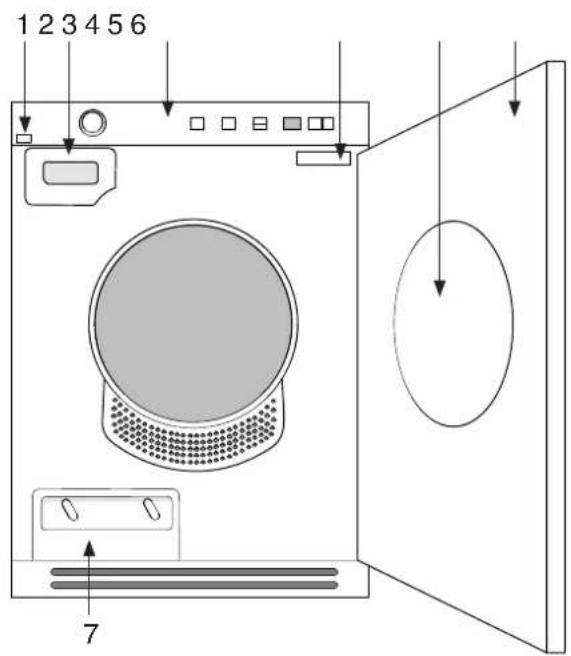
Description of the tumble dryer
text_image
1 2 3 4 5 6 7- Main power switch
- Condensed water container
- Panel
-
Serial Number
-
Lint filter
- Outer door
- Condenser
Advice and tips before you tumble-dry
Here are some tips that may help you before you begin tumble-drying.
Have the clothes been spun?
Items to be tumble-dried should be spun at 1000 rpm or faster. Higher spin speeds save energy and reduce drying time.
Materials that can be tumble-dried
☐ This symbol means that the material is suitable for tumble-drying. Fabrics best suited to tumble-drying are cotton fabrics, terry cloth and synthetic fibres. Garments will be softer and lighter when tumbled than when hung out to dry.
NOTE!
The tumble dryer does not cause any significant wear on fabrics. The lint that collects in the lint filter consists of dust and fibre residues formed when the items are used.
Materials that must not be tumble-dried
This symbol means that the material is not suitable for tumble-drying. Certain materials may melt or become a fire hazard if exposed to heat, and others can lose their shape or shrink.
And do not tumble-dry
- materials labelled "Do not dry near heat".
• garments that have been dry-cleaned at home. - plastic foam.
- fibreglass material.
- wool because of the risk of felting.
Static electricity
To reduce the risk of static electricity in the laundry after tumble drying you can:
- Use fabric softener when washing.
- Wait five minutes after the drying program ends before opening the door and removing the laundry from the dryer.
NOTE!
You can stop the tumble dryer by pressing the Stop button for three seconds or by opening the door. In both cases the program is stopped and starts from the beginning if restarted.
If you do not want to restart the program then immediately remove all laundry and spread it out to allow the heat to dissipate.
Tumble drying
Below are step-by-step instructions to help you achieve the best possible tumble-drying results.
Sort your fabrics
You will achieve the most uniform drying results if the items are made of the same
type of material. Do up zips and buttons, fasten belts, sort the items and adjust the load and temperature.
Do not overload the drum!
Overloading the dryer will result in poor drying results and wrinkling.
2 Press the main power switch until the display lights.
NOTE:
Power on
Press the on/off button for min. 1 sec and max. 5 sec.
Power off
Press the on/off button for min. 5 sec.
If the ON/OFF command is not correctly accepted by the machine, wait min. 8 sec before any further press.
3 Open the door, load the items and then close the door
Make sure that objects e.g. detergent dispensing balls, have been removed from the laundry. They could melt and cause damage to the dryer or the laundry.
To save energy, always observe the maximum load for each programme (see Program chart).
Tumble drying
4 Select the program

text_image
ASKO Programme selector Stop Start 0* Start BuyMain power switch Display windowOptions buttons
Select a programme by turning the programme selector. An LED lights next to the selected programme. Use the option buttons to select any options.
Guidelines as to what specific programs can be used for:
Auto extra dry
This programme is for items that are particularly difficult to dry, e.g. jeans with very thick seams.
NOTE!
Knitted fabrics in particular are prone to shrinkage. Use the Auto dry, Auto normal dry or Auto Iron dry programs for these items. Stretch clothes back into shape immediately after drying.
Auto dry and Auto normal dry
These programs end automatically when the load is dry. The Auto dry program gives slightly drier laundry than Auto normal dry.
Auto Iron dry
This program shuts off the heat once the load is just damp enough for ironing or pressing.
Timed dry
The most suitable program time depends on what you intend to do with the items after tumble-drying them. Use trial and error to find out what works best. When you use Timed dry
to tumble-dry a load of mixed fabrics, some of the garments may remain damp. Tumble-dry any damp garments for a further 30 minutes or so using the Timed dry program.
Select the desired time by pressing the Delayed Start button. A program time between 30 minutes and 3 hours can be selected and each button press changes the time by 15 minutes.
NOTE!
When using the Timed dry program with a program time that is too long, the garments can become "over-dry". This can cause items to shrink or crease and feel rough to the touch. Synthetic materials can also become charged with static electricity.
Revitalise
Use the Air fluff program when you just want to refresh, air or soften up items.
Select the desired time by pressing the Delayed Start button. A program time between 15 minutes and 3 hours can be selected and each button press changes the time by 15 minutes.
Tumble drying
Program chart
Here we present the energy and time consumption of a few different programs. The table shows the effect of using different spin speeds when washing the load. Consumption can vary depending on room temperature, humidity, load, variations in the power supply and selected options.
For the consumption values given below, the requirements are as follows
Temperature of intake air: 23 °C
Moisture content of intake air: 55 %
Drying temperature: Normal
Heater output: 1950W, 10A
| Program Material Load Spin speed (rpm) Energy consumption, | approx. (kWh) | Programme time, approx. (min) | |||
| Auto extra dry Cotton, | linen 1/1 800 rpm 4,2 | 2:15 | |||
| 1000 rpm | 3,9 | ||||
| 1400 rpm | 3,4 | ||||
| 1600 rpm | 3,3 | ||||
| Auto dry | Cotton, linen 1/1 800 rpm 4,0 | 2:05 | |||
| 1000 rpm | 3,6 | 1:55 | |||
| 1400 rpm | 3,2 | 1:45 | |||
| 1600 rpm | 3,0 | 1:40 | |||
| Crease-resistant, polyester/cotton | 1/2 1000 rpm | 1,9 | 1:05 | ||
| Auto normal dry | Cotton, linen 1/1 800 rpm 3,9 | 2:00 | |||
| 1000 rpm | 3,6 | 1:50 | |||
| 1400 rpm | 3,1 | 1:40 | |||
| 1600 rpm | 2,6 | 1:25 | |||
| Crease-resistant, polyester/cotton | 1/2 1000 rpm | 1,3 | 0:40 | ||
| Auto Iron dry | Cotton, linen 1/1 800 rpm 3,8 | 1:55 | |||
| 1000 rpm | 3,3 | 1:40 | |||
| 1400 rpm | 2,6 | 1:25 | |||
| 1600 rpm | 2,0 | 1:05 | |||
Tumble drying
Selecting Options
5 By selecting options, you can tailor a drying program to suit your requirements. The available options depend on the selected program. Once you have started the program, the options you selected are saved for the next time you use the same program. The exception is Delayed Start, which is not saved for the next time.
^ Energy Save
You can select Energy Save with all programs except Revitalise and Revitalise.
- Select Energy Save by pressing the button next to the symbol.
- The lamp next to the button lights when Energy Save is selected.
>> Time saver
You can select Time saver with all programs except Revitalise. The program is shortened by about 12 minutes.
- Press the button next to the symbol.
- The lamp next to the button lights when Time saver is selected.
Anti crease
This option means that the drum will rotate for three seconds per minute for two hours after the drying program has finished. The option prevents the fabrics from remaining in the same position and becoming creased, if you are unable to remove them immediately after tumble-drying has finished. Cannot be selected with the Air fluff program.
- Select Anti crease by pressing the button next to the symbol.
- The lamp next to the button lights when Anti crease is selected.
Delayed Start
Select a program and then press Delayed Start. Press the button to select a delayed start of 1 to 24 hours. The lamp next to the button lights when this option is activated. Next press Start and the machine counts down 1 hour at a time and starts after the selected delay. To cancel Delayed Start press and hold Stop for three seconds. Delayed Start cannot be selected with Timed dry or Revitalise.
6 Press the Start button Remaining drying time
An estimate of the remaining drying time will be shown on the display a few minutes after the drying program starts. 1:35 means that it will take approximately 1 hour and 35 minutes for the load to dry.
The actual remaining time may be longer than the estimated time shown on the display. The remaining time is then shown as 0:15 until the load is sufficiently dry. If you selected Time saver the display will show 0:05 instead.
You can stop the tumble dryer by pressing the Stop button or by opening the door. In both cases the program is stopped and starts from the beginning if restarted.
NOTE!
The program will not be affected if you change the program selector after the program has started.
Tumble drying
7 Drying programme finished
The text "End" is shown on the display for 2 minutes.
The machine then turns off.
Condensed water
The condensed water container must be emptied after each load. Remove the condensed water container, empty out the water and replace the container. If the condensed water container becomes full to overflowing, the program is interrupted. Empty the container and press the Start button to start a new program.
TIP!
The condensed water is decalcified and can be used in steam irons. Pour it through a coffee filter.
NOTE!
- Clean the lint filter in the outer door after each load. See the Care and cleaning chapter.
- Empty the condensed water container after each load.
WARNING!

If the lint filter becomes clogged, the machine's automatic overheating cut-out may be triggered. Clean the filter, wait until the machine has cooled then try starting it. If it still does not start: call the service division.
Once drying has finished
Remove the clothes and close the door to prevent small children from climbing into the machine.
Care and cleaning
Cleaning the lint filter
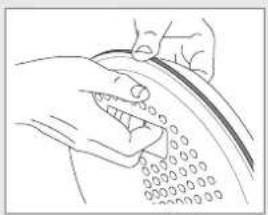
The lint filter must be cleaned after each load.
- Lift the filter from the holder in the door.
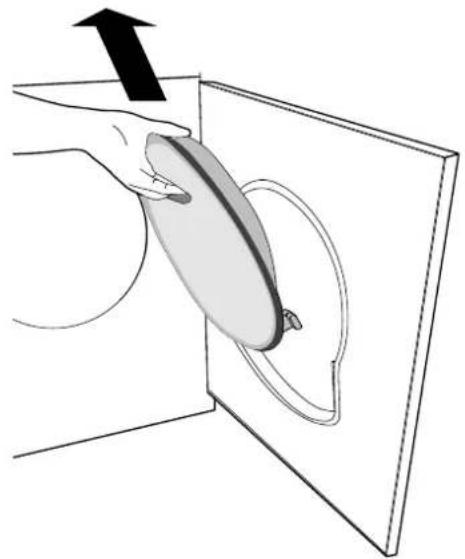
natural_image
Diagram showing a hand holding a circular object inside a transparent container, with an arrow indicating upward motion (no text or symbols present)- Open the lint filter. Use your thumb to press on the edge as illustrated and pull it out.
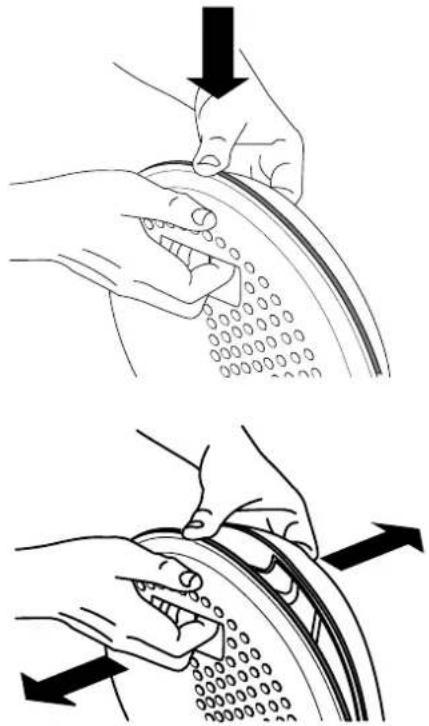
natural_image
Illustration showing two steps of a hand pressing down on a circular object, with arrows indicating direction (no text or symbols)- Use your hand or a soft cloth to remove the lint from all sides of the filter. If necessary, use a damp sponge and a small amount of washing-up liquid to remove any deposits. Dry the filter thoroughly with a towel.
NOTE!
Clean the surface of the lint (fluf) filter after each drying program.

natural_image
Illustration of hands holding a curved object with a looped handle (no text or symbols)- Close the lint filter and put it back in the door. Close the lint filter before closing the door.
Care and cleaning
Emptying the condensed water container

natural_image
Illustration showing a hand using a tool to adjust a circular component, with no text or symbols present.If you have not connected the machine to a separate drain the condensed water container must be emptied after each load. Remove the condensed water container, empty out the water and replace the container.
If the condensed water container becomes too full, the program is interrupted and F10 is shown in the display. Empty the container and press the Start button to restart the program.
For connection to a separate drain, see the installation instructions in the set of documents.
NOTE!
The dryer must not be used without the condenser unit in place.
Care and cleaning
Cleaning the condenser
The condenser should be cleaned at least three times a year. If you have pets, the condenser must be cleaned more frequently.
-
Turn off the tumble dryer with the main power switch and open the outer door.
-
Remove the plinth.
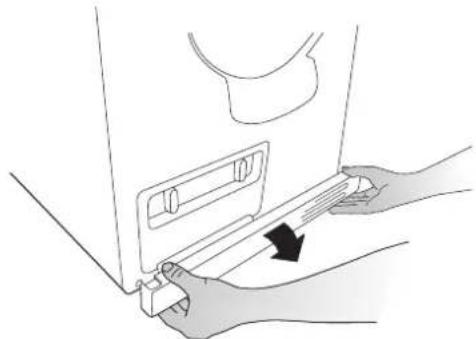
natural_image
Illustration of hands inserting a device into a container with an arrow indicating direction (no text or symbols)- Open the condenser panel by turning the two knobs.
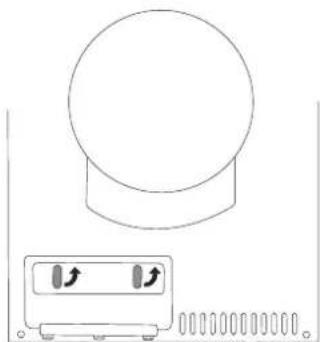
natural_image
Simple line drawing of a circular object above a rectangular device with directional arrows, no text or symbols present.- Remove the condenser and rinse the ribs clean, such as with a hand-held shower. Do not poke around in the rib gaps as you may damage the condenser. Do not use pointed metal objects when cleaning.
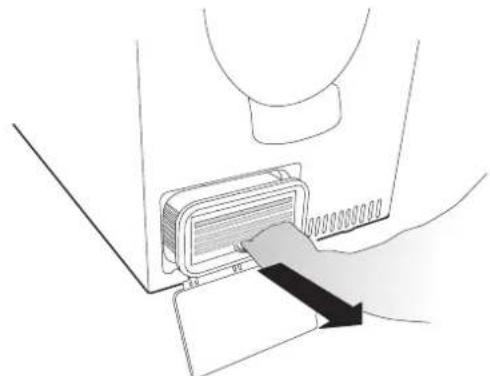
natural_image
Hand inserting a device into a device slot (no text or symbols visible)NOTE!
Do not clean the condenser in a dishwasher.
- Wipe any lint from the channel in front of the condenser and inside the condenser compartment. Use a cotton bud or similar item to remove any lint from the drain hole at the front edge of the compartment.

natural_image
Line drawing of a hand inserting a component into a device (no text or symbols)NOTE!
It is quite normal for water to collect in the channel in front of the condenser.
- Replace the condenser with the handle facing down as illustrated.
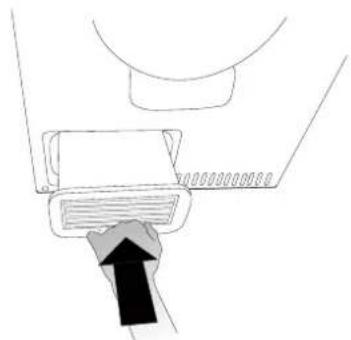
natural_image
Simple line drawing of a hand pressing down on a device component (no text or symbols)- Reattach the plinth.
NOTE!
Clean the filters after each drying.
Do not replace the filters if they are damp or wet. Damp or wet filters could cause operational faults.
Care and cleaning
NOTE!
The dryer should never be operated without the filters in place, or with damaged filters as excessive amount of accumulated fibres from the fabric could cause malfunction or failure of the dryer.
Cleaning the outside of the machine
Clean the outside of the machine and the program panel with a mild cleaner. Do not use solvents, as these can damage the machine. Do not hose down or spray the machine with water.
NOTE!
Do not allow dust to accumulate around the machine. Keep the area around the tumble dryer clean and cool; dust, heat and moisture prolong drying times.
Troubleshooting
The machine will not start
Check
• that the door is properly closed.
• that the main power switch is on.
- that the Delayed Start option has not been selected. To cancel Delayed Start, press the Stop button for three seconds.
• that the plug is connected.
• that the main fuses have not blown.
- that the overheating cut-out has not been triggered.
The machine loses all power during a program
The overheating cut-out shuts off the tumble dryer if the temperature is too high, e.g. because dust is clogging the lint filter.
- Clean the lint filter.
- Check also that the condensed water container is not full and, if necessary, clean the condenser. See the Care and cleaning chapter.
- Wait until the machine has cooled then try starting it. If it still does not start: Call the service division.
Drying takes too long
- Check that the lint filter is not blocked. See the Care and cleaning chapter.
- Empty the condensed water container and check that the condenser is not blocked. See the Care and cleaning chapter.
• Overly long drying times may also be due to the tumble dryer being located in a confined area or in a room that is too small, causing the air to become too hot. - Make sure that the tumble dryer has access to more cold air, open doors and/or windows, for example.
Error messages
If F10 flashes in the display, the condensed water container is full. Empty the container and restart the program.
If F30 is flashing on the display, the maximum permitted program time has been reached.
Empty the condensed water container and check that neither the lint filter nor the condenser are blocked. See the Care and cleaning chapter.
Technical information
Technical data
Height: 850 mm
Width: 595 mm
Depth: 585 mm
Weight (net): 44 kg
Cylinder volume: 112 l
Max. drying capacity: 6.5 kg
Speed: 50-55 rpm
Rated power: See type plate.
Drum material: Stainless steel
Outer casing material: Powder-coated and hot-galvanized sheet steel or stainless steel.
Setup Stacking or freestanding
Standard tests
For the standard test the machine's condensed water hose must be connected to a drain.
Australia:
Drying performance: AS/NZS 2442.1:1996.
Auto normal dry ,6.5 kg cotton, temperature Normal, Time saver.
Energy declaration: AS/NZS 2442.1:1996.
Auto normal dry, 6.5 kg cotton, temperature Normal, Time saver.
Test method for noise measurement:
IEC 60 704-2-6.
Service
Before contacting the service division
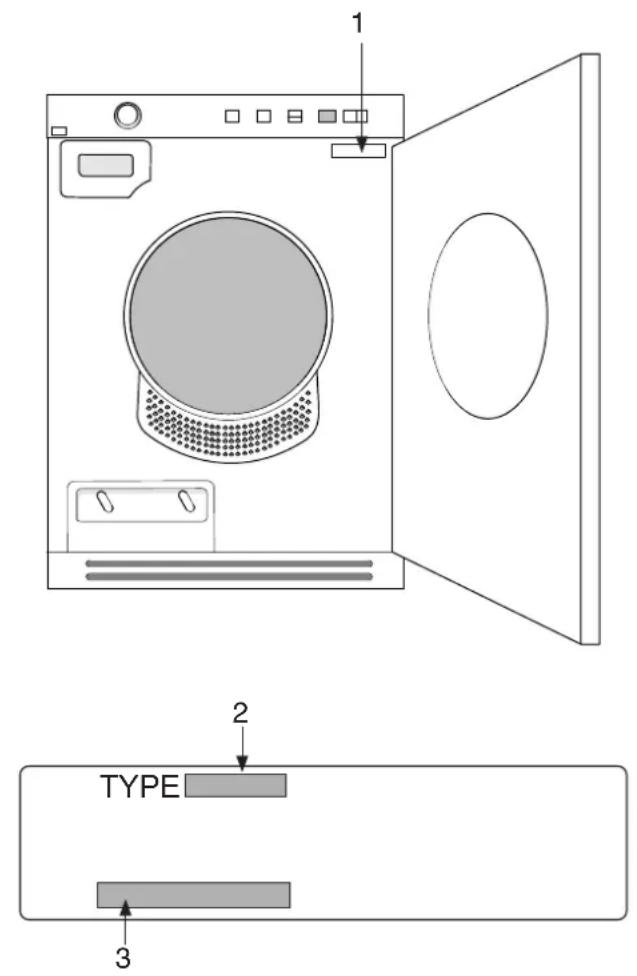
See the Troubleshooting and Care and cleaning chapters to see whether you can rectify the problem. If you need to contact the service division, make sure that you know the model designation, type designation and serial number.
The model designation (1) can be found on the first page of the operating instructions and on the machine panel. The type designation (2) and serial number (3) can be found on the type plate, which is found on the front of the tumble dryer inside the outer door.
NOTE!
Repair or any warranty claim resulting from incorrect connection or use of the dryer shall not be covered by the warranty. In such cases, the costs of repair shall be charged to the user.
text_image
1 2 TYPE 3Installation
Positioning the tumble dryer
The tumble dryer can be free-standing or in a stack. Remember that the tumble dryer produces heat and should therefore not be located in a room that is too small. If the room is very small, drying will take longer due to the limited quantity of air.
NOTE!
Do not install the machine in a room where there is a risk of frost occurring. At temperatures around freezing point the machine may not be able to operate properly.
The room in which the appliance is installed should be adequately ventilated, with temperature between 15°C and 25°C.
WARNING!

- Any electrical installation must be carried out by qualified professionals.
- The machine must not be installed behind a lockable door, a sliding door or a door with hinges on the opposite side to those of the tumble dryer.
- The tumble dryer's plinth ventilation must not be blocked by a rug or the like.
NOTE!
To improve ventilation, leave the door to the room where the tumble dryer is located open.
Freestanding
The tumble dryer can be positioned beside the washing machine.
Stacking
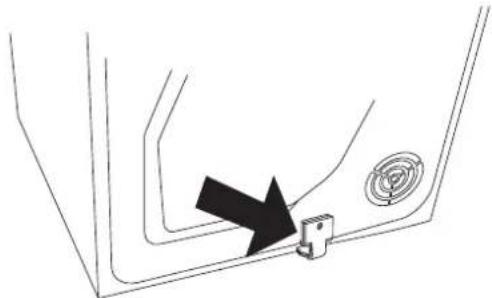
The tumble dryer can be placed on top of a ASKO washing machine. Use the two foot cups found in the document bag included with the machine and the two tip guards attached to the bottom left corner of the back of the machine.
How to assemble the stack:
- Remove the two tip guards from the back of the tumble dryer. Replace the screws that held the tip guards in place.
natural_image
Pure technical diagram showing a mechanical component with a black arrow pointing to a small bracket (no text or symbols)- Undo the two screws indicated on the back of the washing machine.

natural_image
Line drawing of a table with a flat top and side supports, showing directional arrows indicating movement or force (no text or symbols)- Secure the anti-tilt device using the screws as shown in the picture.

natural_image
Line drawing of a simple table with two clips attached (no text or symbols)- Attach the plastic cups for fixing the tumble dryer's front feet to the washing machine's top cover. This is essential, as only when the tumble dryer's feet are resting in the plastic cups can you be sure that the tumble dryer is correctly positioned on the washing machine. Break off tag A on the cup fitted on the right-
Installation
hand side and tag B on the cup fitted on the left-hand side. Then remove the paper from the self-adhesive surface under the plastic cups.
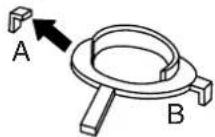
- Fit the plastic cups so that the "tags" marked with arrows are against the front edge or side edge of the cover and press them firmly onto the cover. Then break off the remaining tags.
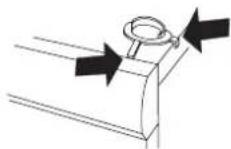
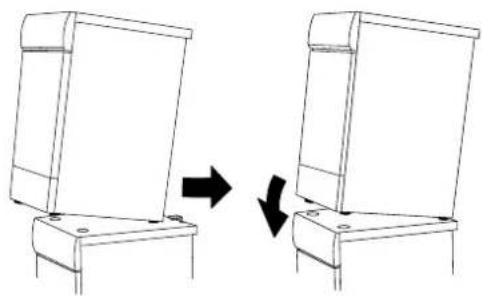
- Push the tumble dryer in under the metal brackets. At the same time keep the front edge raised by 10 mm to 20 mm.
natural_image
Diagram showing two mechanical components with arrows indicating transformation or movement (no text or symbols)- Lower the tumble dryer's front feet into the plastic cups and adjust the tumble dryer to ensure it is level.

natural_image
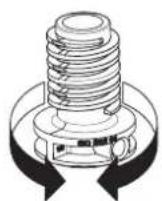
Pure mechanical diagram showing a lever and pivot with directional arrows (no text or symbols)Adjusting the feet
Screw the feet in or out so that the tumble dryer is both stable and level.
Installation
Condensed water
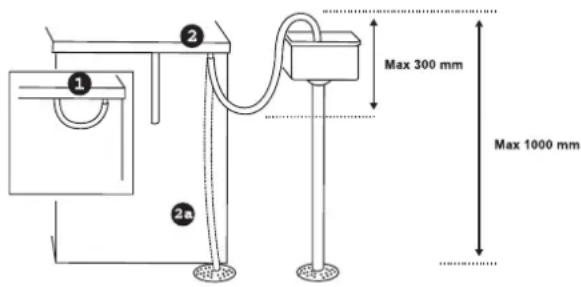
The machine is supplied as shown in Option 1 (inset). This means that the condensed water is pumped into the condensed water container, which must be removed and emptied by hand. Option 2 allows you to remove the small short hose from the nipple. Attach the rubber hose supplied to the same nipple. The water can then be pumped out into a sink or a floor drain (2a).
text_image
1 2 2a Max 300 mm Max 1000 mmNOTE!
- Do not pull on the drain hose and do not stretch it or allow it to become kinked as it could get damaged.
- Secure the hose carefully (e.g. by trying it to a tap to make sure it cannot slip during use). Otherwise there is a risk of overflowing water which could cause damage.
WARNING!
If the tumble dryer is to be connected to a drainage system already in use by another appliance it is essential to fit a non-return valve. The non-return valve will prevent the risk of back-flow into the dryer which could cause damage.
Electrical installation
Connect the machine by plugging it into an earthed wall socket. The electrical wall socket must be placed outside of the installation area to be easily accessible.
If this appliance is supplied from a cord extensions set or electrical portable outlet device, the cord extension ser or electrical portable outlet device must be positioned so that it is not subject to splashing or ingress of moisture.
Connection on delivery
• 230 V, 1-Phase, 10 A
- 50 Hz
• Heat output 1950 W, 10 A
- Use a type A residual current device.
NOTE!
Do not connect the machine to the mains electricity supply by an extension lead.
Door hanging
text_image
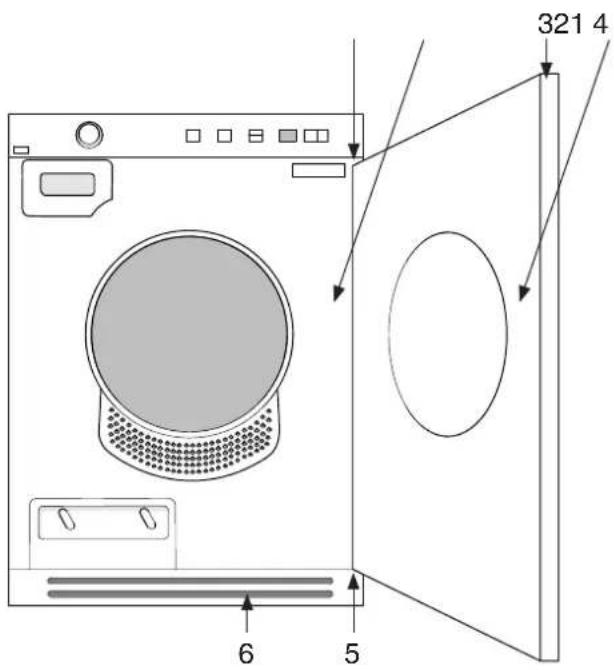
321 4 6 5-
Hinge pins (top and bottom)
-
Cover plate
-
Plastic plugs (on the upper and lower edges)
-
Locking hook
-
Hinges (left + right side)
-
Plinth
Door hanging
You can choose whether the door is hung on the right or the left.
Follow these instructions:
-
Remove the plinth.
-
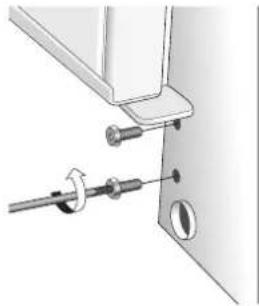
Remove the hinge, two screws
natural_image
Technical diagram of a mechanical assembly with bolts and a circular component (no text or symbols)-
Lift the door up and remove it. Support the door at the same time.
-
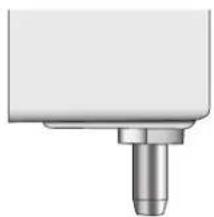
Remove both door pins (top and bottom). Fit them on the other side of the machine. Refit the hinge.
natural_image
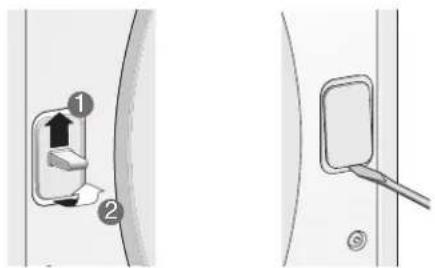
Close-up of a metallic mechanical component with a cylindrical shaft (no visible text or symbols)- Loosen and remove the catch (lift up and pull out) and the cover plate on the door and the machine. Switch the catch and the cover plate.
text_image
Diagram showing two steps of a door lock or latch mechanism, labeled with numbered instructions and a magnified view.-
Move the plastic plugs on the upper and lower edges of the door. Use a flat-bladed screwdriver to remove the plugs.
-
Refit the door by loosening the hinge screws slightly, affixing the door and closing it. Retighten the hinges. Replace the plinth.
Your notes
Your notes
QUICK GUIDE
natural_image
Close-up of a white computer control button with an 'Power' button (no text or symbols visible)1.
TURN ON THE MAIN POWER SWITCH
Load the garments. Close the door.
natural_image
Simple circular icon with a stylized 'a' in the center, no text or symbols present.2.
SELECT A PROGRAM AND ANY OPTIONS
Turn the program selector to the desired program.
text_image
Start3.
PRESS THE START BUTTON
natural_image
Line drawing of hands holding a circular object with dots, no text or symbols present4.
DRYING PROGRAM FINISHED
The text "End" is shown on the display for 2 minutes.
The machine then turns off.
Clean the lint filter after each load.
Close the door.
We reserve the right to make changes.
ASKO
Swedish quality since 1950
www.asko.com