B2000 - Receiver BOSE - Free user manual and instructions
Find the device manual for free B2000 BOSE in PDF.


User questions about B2000 BOSE
0 question about this device. Answer the ones you know or ask your own.
Ask a new question about this device
Download the instructions for your Receiver in PDF format for free! Find your manual B2000 - BOSE and take your electronic device back in hand. On this page are published all the documents necessary for the use of your device. B2000 by BOSE.
USER MANUAL B2000 BOSE
B1500 / B2000 Power Amplifiers
Owner's Guide
Designed for BOSE®

text_image
B1500 Professional Power Amplifier Designed for BOSE Power Channel A SG LM BRG Channel B SG LM Attenuation(R) ARP Attenuation(R) Channel A LM SG Power Channel B LM SG ARP ARP Channel A LM SG Power Channel B LM SG ARP ARP Channel A LM SG Power Channel B LM SG ARP ARP Channel A LM SG Power Channel B LM SG ARP ARP Channel A LM SG Power Channel B LM SG ARP ARP Channel A LM SG Power Channel B LM SG ARP ARP1. Safety Information
Safety Warning
This unit is fitted with a 3-wire power connector. For safety reasons, the earth lead should not be disconnected in any circumstance. If ground loops are encountered consult the section on input connections later in this manual.
Please pay special attention to the 'AC power considerations' part in chapter 4 and the 'Maintenance' part in chapter 6.
To reduce the risk of fire or electric shock, do not expose the unit to rain or moisture.
To avoid electrical shock disconnect from the mains supply before removing the cover. The installation of Bose® Equaliser cards or servicing should be carried out by qualified personnel only.
Please read this owner's guide
The Model B1500 and B2000 Professional Stereo Power Amplifiers are carefully engineered to provide excellent sonic performance. This guide will help you set up and operate your system correctly.
Record your serial number here:
Model B 1500 Professional Stereo Power Amplifier: ____ Model B2000 Professional Stereo Power Amplifier: ____ Date of purchase ____ Retailer's name ____
For ease in obtaining service, we recommend that you keep your purchase receipt, or a copy of the receipt, in this owner's guide.
Contents
-
Safety Information 2....
-
Before you begin
2.1. Unpacking the Amplifier ....4
-
The B1500 and B2000 Professional Power Amplifiers ....5....
-
Installation
4.1. Location and general precautions....6
4.2. Mechanical considerations .6....
4.3. Thermal considerations....6
4.4. AC power considerations...6....
4.5. Magnetic leakage and R.F interference considerations....7
4.6. Inputs .... 8
4.7. Linking amplifiers....10
4.8. Bridged mono operation....10
4.9. Outputs..1.1....
- Operation.
5.1. Switching on 12
5.2. Level controls ... 12....
5.3. Signal indicators .... 12
5.4. Limiters 12
5.5. Temperature control .... 12
5.6. Fault indicators .....12
5.7.Bridged LED 12
-
Faults / Fuses / Maintenance.... 13
-
Bose EQ Cards....14
7.1.B1500 EQ card fitting 14
7.2.B2000 EQ card fitting....15
7.3.EQ card fitting for bridged mono operation....16
-
Technical Specification ... 17....
-
Declaration of Conformity 18
2. Before You Begin
Congratulations on your purchase of a new BOSE ^® Professional Stereo Power Amplifier. The product has been designed to provide excellent sonic quality and has been engineered for reliability.
2.1 Unpacking the amplifier
Carefully unpack your amplifier. Keep the original carton and packing materials for possible future use. Check for any visible signs of damage. If the amplifier appears damaged, do not try to use it. Notify the Bose Product Support or your authorised Bose ProPartner.
The B 1500 or B2000 Amplifier is a no compromise, high quality, class AB power amplifier.
Fan speed is varied as required to keep the amplifier within its temperature limits. Signal limiters are included to protect speakers from clipped signals.
The amplifiers include full DC and short circuit protection on the outputs to ensure trouble-free service in ‘harsher’ environments.
The B1500 & B2000 amplifiers are a good power match for BOSE mid/hi gh and bass loudspeaker products, especially in foreground entertainment systems.
The B1500 amplifier is rated at 450 watts per channel 8 ohms and 715 watts per Channel into 4 ohms and 1025 watts per channel into 2 ohms. In bridged mono operation, it is rated at 1430 watts into 8 ohms and 2050 watts into 4 ohms.
The B2000 amplifier is rated at 560 watts per channel 8 ohms and 925 watts per Channel into 4 ohms and 1300 watts per channel into 2 ohms. In bridged mono operation, it is rated at 1850 watts into 8 ohms and 2600 watts into 4 ohms.
The inputs of each amplifier are high quality, electronically balanced and have high common-mode rejection for exceptional hum and noise rejection. In addition, both the B1500 and the B2000 amplifiers are equipped with internal connectors that enable the use of BOSE Equalisation cards (EQ cards) one for each channel. This allows for different equalisation for each channel if required (provided the correct equalisation cards are installed). Equalisation cards are available for the entire range of BOSE professional loudspeakers that require dedicated product equalisation.
A sample setup might involve one B 1500 power amplifier driving two channels of BOSE 802 ^® III loudspeakers in stereo mode. A second Model B 1500 power amplifier in bridged mono mode could be added to drive a BOSE 502 ^® B bass module. Alternatively, just one amplifier could be used to drive the BOSE 802 ^® III loudspeakers on one channel and the BOSE 502 ^® B module on the other channel. Many configurations are possible. This flexibility can be achieved by installing the EQ cards for the desired setup.
4. Installation
4.1 Location and general precautions
Locate the unit where it will not be exposed to rain or moisture. If fluid or a foreign object enters the unit, disconnect the power plug. Do not pull by the cord; grasp the plug firmly. Contact an authorised dealer or service centre.
Locate the unit where it will be protected from heat and allow adequate ventilation. Place it away from direct heat sources, such as heating vents and radiators. Make sure the ventilation holes are not covered and air can circulate freely behind, beside, and above the unit.
4.2 Mechanical considerations
When mounting the amplifier in a rack or enclosure ensure the rear of the unit is adequately supported. The brackets, which are supplied, fit standard 19-inch (483mm) rack mounting systems. THE FRONT PANEL IS NOT CAPABLE OF SUPPORTING THE UNIT ON ITS OWN.
4.3 Thermal considerations
When mounting the amplifier in a rack or enclosure ensure THERE IS ADEQUATE VENTILATION. The cooling fans suck cool air in through the front and blow hot air out at the rear of the unit through the ventilating grills IF THIS AIR IS NOT ALLOWED TO ESCAPE, OVERHEATING WILL OCCUR. Take care when mounting other equipment in the same rack.
4.4 AC power considerations
The B1500 and B2000 power amplifiers have been manufactured to comply with local power supply requirements. Both have been set at a mains voltage of 240Volts. Be sure to connect your power amplifier to a supply capable of supplying the correct voltage and adequate current to allow full-power operation of the power amplifier. The current demand of a power amplifier varies depending on the impedance of the load, the output level of the power amplifier and content of the program material. Before connecting the unit to the supply, ensure that the voltage (printed on the rear panel of the amplifier) is correct and that a mains fuse of the correct type and rating has been fitted in the fuse holder on the rear panel of the amplifier (The B2000 is fitted with a circuit breaker and hence does not have a mains fuse on the rear panel). Mains cabling to both the B 1500 and the B2000 should be protected by suitable over current device.
Note:
To convert the B 1500 and B2000 to 220V operation, one should proceed as follows (see also the following picture):
Locate the violet & brown wires from the mains transformer to the PCB spade connectors marked up as 'Live Tx' and Spare Tx". Connect the violet wire to Live
4. Installation
Tx' and the brown wire to Spare Tx 'for 220Volt operation (Connect brown to Live Tx' and violet to 'Spare Tx" for 240Volt operation).

text_image
Live Tx Spare Tx B1500 shown only LiveTX SpareTX Mains Live BR2 TX Neutral Mains Neutral4.5 Magnetic leakage & R.F Interference considerations
Like all high power amplifiers, B1500 & B2000 should be kept away from other equipment that is sensitive to magnetic fields. Also, this amplifier may suffer a substantial reduction in performance if it is subjected to, or mounted close to equipment that radiates high R.F. fields.
4. Installation
4.6 Inputs
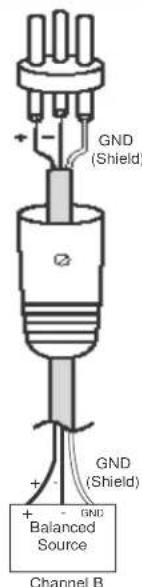
The inputs are made via 3-pin XLR connectors, which are electronically balanced and should be connected via a high grade twin core screened cable, as follows: -
Balanced operation
| Pin No. | Connection |
| 1 | Screen (ground) |
| 2 | Hot (signal +) |
| 3 | Cold (signal -) |
B1500 shown only

text_image
1 0 2 0 3 0 Pin 1 Pin 2 Pin 3 GND Sig +ve Sig -ve 2 0 1 0 3 0 Channel A Input Bridged Mono A (In) Stereo (Out) Channel B Link Input Link Input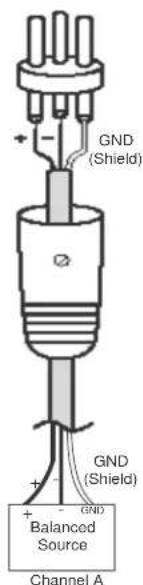
text_image
GND (Shield) GND (Shield) + - + - Balanced Source Channel APIN1 - Screen (see note) PIN2 - Hot (signal +) PIN3 - Cold (signal -)
text_image
GND (Shield) + - GND (Shield) + - GND Balanced Source Channel BNOTE: This amplifier is wired to the latest industry recommendations. PIN1 is connected directly to the chassis/mains earth. If ground loops (mains hum) are encountered, remove the screen connection from the other end of the cable and leave it open circuit. If problems persist, consult your dealer/supplier. DO NOT TAMPER WITH OR ALTER ANY GROUND (EARTH) CONNECTIONS INSIDE THE AMPLIFIER.
4. Installation
Unbalanced operation
The amplifier is designed to operate with fully balanced equipment and ground loops or loss of performance may be experienced if connected to unbalanced sources. If it is unavoidable however, the following wiring should be used. The cable should still be twin core plus screen.
| Pin No. | Connection |
| 1 | Screen (ground) Connect to ground at unbalanced equipment or float |
| 2 | Hot (signal +) |
| 3 | Cold (signal -) |
B1500 shown only

text_image
1 Link 2 O 3 O Pin 1 GND Pin 2 Sig +ve Pin 3 Sig -ve Input 1 0 3 O Channel A Bridged Mono A (In) Stereo (Out) Link Input Channel B Link Input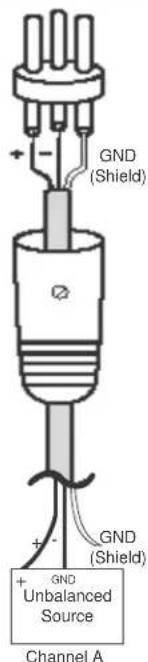
text_image
GND (Shield) GND (Shield) + - GND Unbalanced Source Channel APIN1 - Screen (see note)
PIN2 - Hot (signal +)
PIN3 - Cold (signal -)
Gnd/Shield
Either connect to source ground or leave floating (no connection)
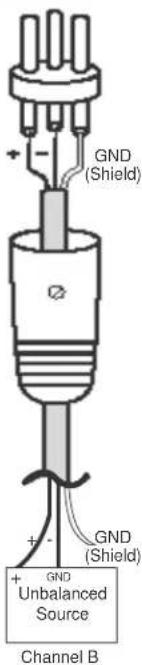
text_image
GND (Shield) GND (Shield) GND Unbalanced Source Channel B4. Installation
4.7 Linking amplifiers
Each amplifier channel is provided with a 3-pin XLR connector marked Link which allows the input signals to be linked to further amplifiers etc. The pin connections are the same as for the input.
4.8 Bridged mono operation
For bridged mono operation connection should be made to channel A input only. Set the rear panel bridge switch to the bridged mono position for bridged mono operation. The output should be taken from the bridged output Speakon connector
When using a B 1500 or B2000 in bridged mono with a BOSE ^® EQ card, only 1 card should be fitted into the channel A EQ connector socket located inside the amplifier. For further details see chapter 7: Bose ^® EQ cards.
4. Installation
4.9 Outputs
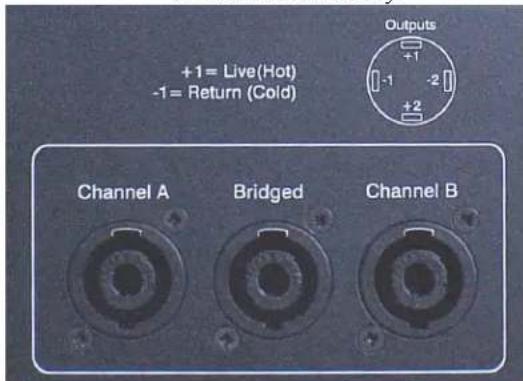
The speaker outputs are via Neutrik Speakon connectors. Only 2 of the 4 poles are used.
Stereo operation
B1500 Shown Only
text_image
+1= Live(Hot) -1= Return (Cold) Outputs +1 -1 -2 +2 Channel A Bridged Channel BTerminations are as follows: -
| Channel A Live (Hot) + | Pin +1 | Channel B Live (Hot) + | Pin +1 |
| Channel A Return(Cold) - | Pin -1 Channel B Return(Cold) - | Pin -1 | |
NOTE:
-
Although the "cold" output terminals are nominally at 0V, they should not be joined together; otherwise cross-talk may be introduced.
-
Because the currents involved are very high, the speaker cables should conform to the following minimum requirements, otherwise the losses will cause the cables to get hot and audio power will be reduced:
14A (B1500) or 16A (B2000) - into 4ohm speaker loads
Bridged mono operation
Use centre Speakon connector marked 'Bridged' and connect as follows:
| Bridged Live (Hot) + | Pin +1 | (Channel A in phase) |
| Bridged Return (Cold) - | Pin -1 | (Channel B out of phase) |
When operating in bridged mode, the minimum impedances are doubled. The minimum load in bridged mode is: 4 ohms (B1500 and B2000).
5. Operation
5.1 Switch on
At ‘Switch-on’ the protection circuit will initially activate whilst the circuits stabilise. Assuming no faults are detected after a few seconds only the POWER LED (and ‘SIGNAL’ indicators if signal is applied) will illuminate.
5.2 Level controls
These are analogue controls allowing precise level settings. Note that in BRIDGED mode only 'channel A' control is active.
5.3 Signal indicators (blue LED)
These are active from a minimum output level of approximately 1 Watt (B1500) or 10 watts (B2000) and are an indication only of signal presence.
5.4 Limiters (amber LED)
The B1500 & B2000 amplifiers incorporate signal limiters, which are preset to prevent clipping with high levels of drive. The amber LED's on the front panel illuminate to indicate operation of the limiters.
5.5 Fault indicator (Audio Protection – red LED)
If the outputs are shorted or if DC is present, the protection circuit will disengage the outputs and the Audio Protection (A/P) LED will illuminate. The amplifier will continue to be monitored and depending on the type of fault, will either reset after the fault has been cleared or by switching the mains switch off and then on again after a few seconds. (See also temperature control above)
Temperature related faults will reset once the unit has cooled sufficiently. Output short circuits will require manual reset after clearing the fault.
5.6 Bridged (green LED)
This indicates the position of the switch on the rear panel and is illuminated when bridged mode is selected with the switch pressed in.
5.7 Temperature control
The cooling fans respond to temperature sensors within the unit to maintain a safe operating temperature. In the event of excessive temperature, the protection circuit will disable the output. The red Audio-Protect (A/P) LED will indicate this condition (see fault indicator).
The B1500 has two fans connected permanently with variable speed. The B2000 has one fan per channel and has a jumper link to enable them from cold.
Normal dynamic signals will not cause the amplifier to overheat unless the ventilation is inadequate. (See installation section and maintenance section.)
6. Faults / Fuses / Maintenance
There are internal secondary (low voltage) fuses on some internal supply rails.
In the event of failure the unit MUST BE DISCONNECTED FROM THE MAINS SUPPLY BEFORE REMOVING THE UNIT COVER. The fuses should be replaced with the same type only. THIS SHOULD BE CARRIED OUT BY QUALIFIED PERSONS ONLY.
WARNING:
If the replaced fuse blows again then there is a serious fault within the unit. Refer to a service engineer or contact your dealer. NEVER INCREASE THE RATING OF THE FUSE.
ENSURE THAT ELECTRICAL POWER TO THE UNIT IS DISCONNECTED BEFORE CARRYING OUT ANY MAINTENANCE.
NOTE:
The filter between the air intake (frontplate) and the frontpanel of the B1500 & B2000 amplifiers should be cleaned or replaced periodically, e.g. 12-24 months. (Filters in amplifiers located in more 'dirty' atmospheres may require more frequent maintenance). No special tools are required to remove the filters. The filter should be 'dry' cleaned, using a vacuum cleaner preferably. Running the amplifier without a filter is not recommended. Replacement filter material is available.
No other regular maintenance is required.
If you have any doubt about carrying out this procedure, refer to a qualified service engineer or contact your Bose ProPartner.
7. BOSE® EQ Cards
The B1500 and B2000 power amplifiers are compatible with the entire range of BOSE Equalisation Cards.
When configuring a bi-amplified system jumper links allow you to select high pass filter functionality on certain EQ cards for mid/high loudspeakers. This rolls off the low frequency to the mid/high loudspeaker providing the low frequency crossover point to match BOSE bass loudspeakers. An example of this would be BOSE 502 ^ A Articulated Array on channel A with the HPF link in place and a BOSE 502 ^ B Bass Module on channel B with no HPF link. Note: When using the BOSE series II-S EQ cards the HPF selection is made on the EQ card and not on the amplifier board.
In order to fit the EQ Cards you must remove the unit s' cover (ENSURE THAT ELECTRICAL POWER TO THE UNIT IS DISCONNECTED BEFORE REMOVING THE LID AND FITTING THE EQ CARDS).
For Both B1500 & B2000
Using a TORX T10 screwdriver (not supplied) remove the 12 TORX T10 screws that retains the cover. Remove the cover.
7.1 B1500 EQ card fitting
Locate the EQ Card sockets. Insert the EQ Card into the socket, noting the orientation of the mating connector.
Remove the bypass jumper link for the channel, (A = J7 or B = J6)

text_image
PCBX05b Iss 2 Channel A 1 2 3 Link 2&3 for HPF CONNS 37 Channel B 1 2 3 Link 2&3 for HPF Conn4 When no EQ cards are fitted. fit links to J6 and J7 35If you want to activate the high-pass filter function of the EQ Card, you should fit the jumper that you previously removed from (J7 or J 6), to the HPF pins for the channel (A = J8 or B = J5) linking pins 2 and 3. Note: When using the BOSE series II-S EQ cards the HPF selection is made on the EQ card and not on the amplifier board.
7. BOSE® EQ Cards
7.2 B2000 EQ card fitting
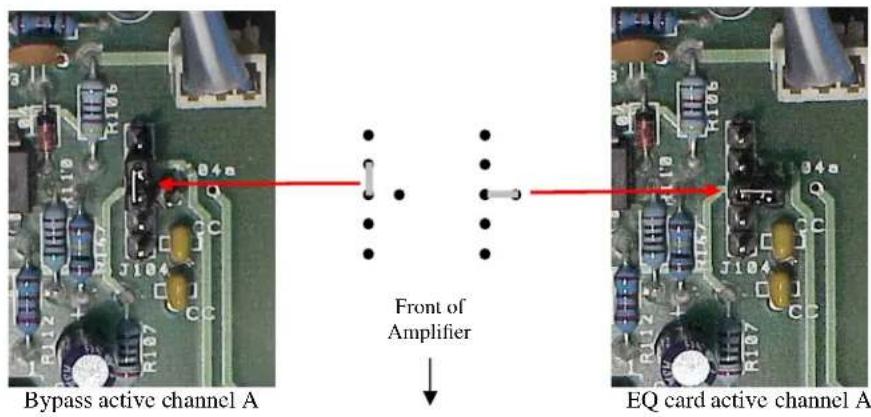
Locate the EQ Card sockets. Insert the EQ Card into the socket, observing the orientation of the mating connector. Remove the bypass jumper link for the channel (A = J104 or B = J204) and replace horizontally as shown below:
text_image
Bypass active channel A Front of Amplifier EQ card active channel A
text_image
Jumper location channel A Jumper location channel B Channel A Channel B PCB 6610 Front of AmplifierIf you want to activate the high-pass filter function of the EQ Card, you need to fit the jumper (that is supplied within the packaging that comes with the amplifier) to the link HPF pins for the channel. Note: When using the BOSE series II-S EQ cards the HPF selection is made on the EQ card and not on the amplifier board.
7. BOSE® EQ Cards
7.3 EQ card fitting for bridged mono operation
The Bose EQ card should be fitted into the channel A connector inside the amplifier and the input signal should be connected to input A. The bridge switch on the rear of the amplifier should be set to bridge mode. The output is then taken from the bridged output Speakon socket on the rear of the amplifier.
For Both B1500 & B2000
Re-fit the unit's cover (BEFORE CONNECTING THE ELECTRICAL POWER TO THE UNIT) using the 12 TORX T10 screws removed earlier.
For further information about BOSE equaliser cards or fitting the equaliser cards into the B1500 or B2000 power amplifiers please contact your Bose supplier.
8. Technical Specification
TECHNICAL SPECIFICATION B1500
| POWER OUTPUT:Continuous output power,both channels driven: | 2050 watts into 4Ωfrom 20Hz to 20kHz, with less than 0.03% THD | CMRR:>90dB |
| Frequency response:20Hz to 20 kHz (±0.5dB) | Fusing:10 Amp Slow-blow(230V/50Hz) | |
| Power values measured at 230Vac | ||
| 450 Watts per channel into 8Ωfrom20Hz to 20 kHz, with no more than0.03% THD | Input impedance:20k Ωbalanced | Hum & noise-105dB |
| Sensitivity:1.38V rms for rated power into4Ω(+5dBu) | Damping factor 1 kHz:>400 (at 8Ω) | |
| 715 Watts per channel into 4Ωfrom20Hz to 20 kHz, with no more than0.03% THD | Gain:32 dB | Size (H x W x D):88 mm x 482 mm x 428 mm |
| 1025 Watts per channel into 2Ωfrom20Hz to 20 kHz, with no more than0.03% THD | THD 4Ω1 kHz <0.008%20Hz to 20 kHz <0.03% | Net weight:20 kg |
| Bridged-mono operation:1430 watts into 8Ωfrom 20Hz to 20kHz, with less than 0.03% THD | Power requirements:230VAC/50-60Hz (Europe & UKAmplifier set at 240Vac ) |
TECHNICAL SPECIFICATION B2000
| POWER OUTPUT:Continuous output power, both channels driven: | 2600 watts into 4Ω from 20Hz to 20 kHz, with less than 0.03% THD | 230VAC/50-60Hz (Europe & UK Amplifier set at 240Vac) |
| Power values measured at 230Vac | Frequency response:20Hz to 20 kHz ( ± 0.5dB) | CMRR:>90dB |
| 560 watts per channel into 8Ω from 20Hz to 20 kHz, with no more than 0.03% THD | Input impedance:20k Ωbalanced | Fusing:15 Amp Trip(230V/50Hz) |
| 925 Watts per channel into 4Ω from 20Hz to 20 kHz, with no more than 0.03% THD | Sensitivity:1.75V rms for rated power into 4Ω(+7dBu) | Hum & noise-105dB |
| 1300 Watts per channel into 2Ω from 20Hz to 20 kHz, with no more than 0.03% THD | Gain:32 dB | Damping factor 1 kHz:>400 (at 8Ω) |
| Bridged-mono operation:1850 watts into 8Ω from 20Hz to 20 kHz, with less than 0.03% THD | THD 4Ω1 kHz <0.008%20Hz to 20 kHz <0.03% | Size (H x W x D):88 mm x 482 mm x 428 mm |
| Power requirements: | Net weight:25 kg |
9. Declaration of Conformity
CE
DECLARATION OF CONFORMITY
We, the offerer:
Bose Corporation, The Mountain, Framingham, MA 01701-9168 USA
acknowledge our responsibility, that the product:
Kind of equipment: Audio amplifier
Type designation: B1500 Professional Power Amplifier,
B2000 Professional Power Amplifier
in accordance with EMC Directive 89/336/EEC and Article 10(1) of the Directive, is in compliance with the following norm(s) or document(s):
Technical Regulations: EN 55103-1:1996, EN55103-2:1996
&
in accordance with the Low Voltage Directive 73/23/EEC, is in compliance with the following norm(s) or document(s):
Technical Regulations: EN/IEC60065:2002 7 ^th Edition
01/07/2006
Bose G.P.
Castleblaney Road Vice President Europe
Carrickmacross
Co Monaghan
Ireland
Nic Merks
Authorized EU representative
How to reach the sales offices in Europe
Austria
Professional Systems Division, Austria
Bose Ges.m.b.H., Business Park Vienna
Wienerbergstrasse 7, 10 O.G.
1100 Wien, Österreich
Telephone: 01-60404340
Fax: 01-604043423
Belgium
Professional Systems Division, Belgium
Bose N.V., Limesweg 2
3700 Tongeren, België
Telephone: 012-390800
Fax: 012-390840
Denmark
Professional Systems Division, Denmark
Bose Danmark A/S, Industrivej 7
PO Box 14, 2605 Brøndby, Danmark
Telephone: 43437777
Fax: 43437818
France
Professional Systems Division, France Bose S.A., 12 rue de Témara 78100 Saint Germain en Laye Telephone: 01-30616363 Fax: 01-30616388
Germany
Professional Systems Division, Germany
Bose GmbH, Max-Planck-Straße 36, 61381 Friedrichsdorf, Deutschland
Telephone: 06172-7104-0
Fax: 06172-7104-19
website: www.bose.de
Ireland
Professional Systems Division, Ireland
Bose GP, Castleblayney Road
Carrickmacross, County Monaghan
Republic Of Ireland
Telephone: 042-9661988, Fax: 042-9661998
Italy
Professional Systems Division, Italy
Bose SpA, Via della Magliana 876
00148 Roma, Italia
Telephone: 066-5670802, Fax: 066-5680177
e-mail: bose_italy@bose.com
The Netherlands
Professional Systems Division, The Netherlands
Bose B.V., Nijverheidstraat 8
1135 GE Edam, Nederland
Telephone: 0299-390139
Fax: 0299-390109
e-mail: infopro_nl@bose.com
Norway
Professional Systems Division, Norway Bose Filial till Bose A/S Danmark, Lerkev 58 2209 Kongsvinger, Norge Telephone: 062-821560 Fax: 062-821569
Poland
Bose Sp. z o.o. Galeria Mokotów ul. Wołoska 12 02-675 Warszawa Telephone: (22) 852 2928, Fax: (22) 852 2927 e-mail: warsaw_store@bose.com website: www.bose.pl
Switzerland
Professional Systems Division, Switzerland
Bose AG, Hauptstrasse 134
4450 Sissach, Sweiz
Telephone: 061-9757733
Fax: 061-9757744
Spain
Gaplasa S.A. Avda. Ingeniero Conde de Torroja 25 28022 Madrid, España Telephone: 91 748 29 60 Fax: 91 329 16 75 e-mail: bose@maygap.com
Sweden
Professional Systems Division, Sweden Bose, filial till Bose A/S Danmark Johannefredsgatan 4, 43153 Mölndal, Sverige Telephone: 031-878850 Fax: 031-274891
United Kingdom
Professional Systems Division, United Kingdom Bose Ltd., 1 Ambley Green Gillingham Business Park Gillingham, Kent ME8 0NJ, England Telephone: 0870-741-4500, Fax: 0870-741-4545 e-mail: uk_pro@bose.com website: www.bose.co.uk