Elise (2005) - Car Lotus - Free user manual and instructions
Find the device manual for free Elise (2005) Lotus in PDF.


User questions about Elise (2005) Lotus
0 question about this device. Answer the ones you know or ask your own.
Ask a new question about this device
Download the instructions for your Car in PDF format for free! Find your manual Elise (2005) - Lotus and take your electronic device back in hand. On this page are published all the documents necessary for the use of your device. Elise (2005) by Lotus.
USER MANUAL Elise (2005) Lotus
natural_image
Line drawing of a modern sports car with front wheel and grille (no text or symbols)Intro18f
Publication Part No.A121T0324
© Lotus Cars Limited 2004

text_image
LOTUSELISE
For North America

natural_image
Side profile line drawing of a convertible sports car (no text or symbols)intro18e
OWNER'S HANDBOOK
2005 model year onwards
Lotus Cars USA Inc.
2236 Northmont Parkway, Duluth, Georgia 30096.
Tel: 770 476 6540 Fax: 770 476 6541
www.LotusCars.com
CONTENTS
- INTRODUCTION ...... 6
- SAFETY INFORMATION ...... 7
- REPORTING SAFETY DEFECTS.... 10
- CAR IDENTIFICATION 15
- SEATING & SAFETY RESTRAINTS
Seats 17
Seat Belts 18
Seat Belt Precautions 19
Airbag Safety System 21
Airbag Tell Tale 23
Airbag Deployment 24
Child Restraints 26
- KEYS & CAR SECURITY ALARM
Keys 29
Car Security Alarm 30
Transmitter Fobs 30
Engine Immobiliser 31
Valet Mode 31
Arming the Alarm 32
Disarming the Alarm 33
Emergency Disarming/Mobilising 33
Intrusion Sensing 34
Manual Activation of Siren 34
Transmitter Fob Battery Replacement 35
Programming Additional Transmitter Fobs 36
Disconnecting Car Battery 36
- ENTRY & COMFORT
Central Door Locking 37
To Unlock From Outside 37
To Lock From Inside 37
To Unlock From Inside 38
To Lock From Outside 38
Lights On Buzzer 40
Interior Rear View Mirror 40
Door Mirrors 40
Interior Lamp 41
Sun Visors 41
Door Windows 42
Manual Windows 42
Electric Windows 42
8. INSTRUMENTS & SWITCHES
Ignition Switch/Steering Lock 44
Engine Start Button 45
Warning 'Tell Tale' Lamps 46
Bulb Check 46
Turn Tell Tale 46
Seat Belt Tell Tale 47
Brake Tell Tale 47
Oil Pressure Tell Tale 47
Low Fuel Level Tell Tale 48
ABS Tell Tale 48
High Beam Tell Tale 48
Airbag Tell Tale 48
Battery Charging Tell Tale 48
Engine Malfunction Indicator Lamp 49
Security/RPM Tell Tale 49
Instruments 51
Speedometer 51
Tachometer 51
LCD Display Panel 52
Fuel Level Display 52
Coolant Temperature Display 53
Odometer 53
Trip Recorder 53
Dashboard Switches 54
Parking Lamp Switch 54
Headlamp Switch 54
Lights-on Buzzer 55
Hazard Warning Lamps Switch 55
Instrument Illumination 56
Auxiliary Power Socket 57
Column Switches & Horn 58
Headlamp High/Low Beam/Flasher/Turn Indicators. 58
Windscreen Wiper/Washer 59
Horn 60
Audio Equipment 60
9. HEATING, VENTILATION & AIR CONDITIONING
Air Conditioning 61
Air Re-circulation 62
Heater Temperature 62
Fan Speed 62
Air Distribution 63
Engine Bay Ventilation 65
10. DRIVING CONTROLS
Foot Pedals 66
Footwell Carpets 66
Clutch Pedal 66
Footbrake 67
Anti-Lock Brake System 67
Parking Brake 70
Gear Lever 71
11. STARTING PROCEDURE & ENGINE BREAK-IN
Starting a Cold or Warm Engine 72
Idle Speed 73
Engine Break-In 73
Engine Special Features 74
12. EXTERNAL OPERATIONS
Fuel Requirement 75
Fuel Filling 76
Front Service Access Panels 78
Engine Cover/Trunk Lid 79
Child Entrapment 80
Removable Roof Concept 81
Soft Top Roof Fitting 82
Soft Top Roof Removal 84
Hard Top Roof Fitting 85
Hard Top Roof Removal 90
13. SERVICING & MAINTENANCE
Bodycare 93
B ody Features 93
Paint Care 94
Ventilation 94
Paintwork Polishing 95
Washing 95
Soft Top Roof 96
Windscreen Cleaning 96
Alloy Road Wheels 96
Upholstery Cleaning 97
Seat Belts Cleaning 97
Footwell Cleaning 97
Owner Maintenance 98
Engine Oil Level Check 99
Engine Oil Change 100
Oil Filter 102
Used Engine Oil 103
Transmission Oil 103
Cooling System 106
Anti-Freeze/Corrosion Inhibitor 107
Coolant Drain/Refill Procedure 108
Washer Reservoir 109
Wiper Blade 109
Brake Fluid Reservoir 110
Brake Pads 111
Brake Pipes and Hoses 112
Air Cleaner Element 113
Auxiliary Drive Belt 114
Sparking Plugs 114
14. TIRES & WHEELS
Tires 115
Glossary of Terms 115
T ire Safety 115
Tire Care 117
Replacement Tires 118
Tire Characteristics 119
Winter T ires 119
Tire Cha ins 120
Uniform T ire Quality Grading 120
Tire Placard /Label 121
Steps for Determining Correct Load Limit 122
Tire Ma rkings 123
Tire Inflator Aerosol 124
Wheels 126
Wheel Bolts 126
Wheel Alignment & Tire Balance 126
Wheel Replacement 127
15. ELECTRICAL
Battery 129
Battery Access 129
Disconnecting the Battery 129
Reconnecting the Battery 131
Battery Charging 131
'Jump' Starting 133
Electrical Accessories 134
Inertia Switch 135
Fuses 135
Engine Compartment Fuses 137
Footwell Sited Fuses 138
Headlamp Alignment 139
Bulb Replacement 142
Headlamp Bulb 142
Front Turn Indicator Lamp Bulb 143
Side Repeater Lamp Bulb 144
Rear Lamp Cluster Bulb 144
High Mounted Stoplamp Bulb 144
Licence Plate Lamp Bulb 144
Interior Lamp Bulb 145
Side Marker Lamp Bulb 145
16. LIFTING & TOWING
Towing Eye 146
Towing a Trailer 147
Car Tie-Down 147
Lifting Your Car 148
Fuel Tank Undershi eld 149
17. ACCESSORIES
Accessories & Modifications 150
Storing Your Elise 152
18. RECOMMENDED LUBRICANTS
Engine 153
Transmission 154
Brakes & Clutch 154
Engine Coolant Additive 154
-
TECHNICAL DATA 155
-
WARRANTY INDEX 161
-
ALPHABETICAL INDEX 188
INTRODUCTION
Congratulations on your purchase of a Lotus Elise. Welcome to the Lotus family. The Elise has been designed for the discerning driver, and aims to provide fun motoring from a lightweight, distinctively styled and efficient package.
This handbook has been written for the owner/driver and should be read before using the car, and then stored in the car for ready reference, remaining with the car throughout any subsequent changes of ownership. The content includes important safety information to protect you from injury, explanations and instructions for operating the driving controls, owner maintenance requirements, technical specifications, and an explanation of the warranty. It is not intended to provide all the technical information required for servicing, and should any adjustment become necessary, owners are urged to contact their Lotus dealer. It is a requirement of the warranty, and the responsibility of the owner/driver, to ensure that servicing of the car is carried out at the correct intervals.
An alphabetical index is provided at the back of this book to help you find information about any particular feature or topic.
The information and specifications included in this publication were correct at the time of approval for printing. Lotus has a policy of continuous product improvement, and reserves the right to discontinue or change specification, design or equipment at any time without notice and without incurring any obligation whatsoever. You are urged to keep in regular contact with your Lotus dealer to ensure that you may be kept informed of any technical developments which may improve the specification, performance or safety of your car.
This handbook covers all Elise models for the North American market, and may include descriptions of equipment and features which are not fitted on your particular car.
Your Lotus is intended to be used safely, in a manner appropriate to the driving conditions and whilst obeying local laws. Any alteration or misuse of the car, or ignoring the instructions in this handbook could result in an accident causing severe or fatal injury.
Safety Information
To help you make informed decisions about safety, important safety information is provided in forms including:
- Safety labels on the car
- Safety messages in this handbook are shown as follows:
WARNING:
The hazard and instructions to avoid the hazard are given. If you do not take these instructions you and/or others can be KILLED OR SERIOUSLY INJURED.
Messages prefaced by ‘NOTICE’ are intended to help you avoid damage to your car, other property or the environment.
Important Safety Precautions
You'll find many safety recommendations throughout this section, and throughout this manual. The recommendations on this page are the ones we consider to be the most important.
Always Wear Your Seat Belt
A seat belt is your best protection in accidents (including collisions). Airbags supplement seat belts, but airbags are designed to inflate only in a moderate to severe frontal collision. So even though your car is equipped with airbags, make sure you and your passenger always wear your seat belts, and wear them properly. (See page 18).
Your Car is Not Recommended for Child Passengers
Since all children are safest in the back seat of a car, and your car does not have a back seat, we strongly recommend that you do not carry a child passenger. Children should be carried in the Elise only if they are large enough to be able to use the standard seat belt (see page 26). You should never carry an infant in a rear-facing child seat in this car because the Elise has a passenger airbag which cannot be switched off or disabled (see page 26).
Be Aware of Airbag Hazards
While airbags can save lives, they can cause serious or fatal injuries to occupants who sit too close to them, or are not
properly restrained. Children, and short adults are at the greatest risk. Be sure to follow all instructions and warnings in the handbook (See page 21 to 27).
Don't Drink and Drive
Alcohol and driving don't mix. Even one drink can reduce your ability to respond to changing conditions, and your reaction time gets worse with every additional drink. So don't drink and drive, and don't let your friends drink and drive, either.
Control Your Speed
Excessive speed is a major factor in crash injuries and deaths. Generally, the higher the speed the greater the risk, but serious accidents can also occur at lower speeds. Never drive faster than is safe for current conditions, regardless of the maximum speed posted.
Keep Your Car in Safe Condition
Having a tire blowout or a mechanical failure can be extremely hazardous. To reduce the possibility of such problems, check your tire pressures and condition frequently, and perform all regularly scheduled maintenance (see separate Maintenance Record booklet).
Safety Features
Your car is equipped with many features that work together to protect you and your passenger during a crash. The Lotus Elise has been designed to comply with applicable safety regulations.
The Elise has passive safety features which include:
- A cockpit tub surrounded by substantial chassis side frames.
- Energy absorbing front composite 'crash structure'.
- Energy absorbing rear steel ‘crash structure’.
- Side sill foam pads.
- A seat belt mounting frame incorporating a roof hoop
• Extruded aluminium door beams.
• A collapsible steering column.
• Airbags for both driver and passenger.
Active safety features include: - Lap and diagonal inertia reel seat belts with impact sensing pre-tensioners.
• Powerful anti-lock four wheel disc brakes.
- High geared responsive steering requiring only small steering wheel movements to alter course
- Exceptional road holding with optimised handling characteristics
You and your passenger cannot take full advantage of these safety features unless you remain sitting in a proper position and always wear your seat belt properly. In fact, some safety features can contribute to injuries if they are not used properly. Drivers should be aware of their own limitations as well as those of the car, and ensure that all road driving is conducted well within both sets of capabilities, particularly on wet roads, or under adverse weather conditions.
Remember:
Driving a car requires:
- Care;
- Attention; and
- Sensible judgement.
Be aware that any motor car has the potential to cause death or injury both to its occupants and/or other persons, and must be used only in a responsible and cautious manner. This entire handbook is filled with important safety informationPlease read it carefully.
Remember:
• ALWAYS WEAR YOUR SEAT BELT.
- Never drive while under the influence of alcohol or drugs.
- Never drive when excessively tired.
- Never use mobile phones, map read or attempt other distracting activities whilst driving.
- Always obey all speed and traffic laws and regulations and never drive faster than the posted speed limit or than conditions allow.
- Be particularly careful driving on slippery or wet surfaces.
- Familiarise yourself with the car and always drive prudently, being aware of your own limitations and the limitations of the car. Failure to operate the car properly can result in an accident and serious injury.
- Follow the Maintenance Schedule and keep the car in good condition.
- Never leave young children unattended in the car.
- Read and take account of all ⚠️ WARNINGS in this handbook.
Owners should note that the only approved extras and modifications are those which are specified by Lotus and carried out by Lotus or by an authorised dealer. Lotus does not accept any liability whatsoever for defects which arise from extras or modifications which are not Lotus approved.
WARNING:
Inexpert or unapproved modifications or additions to the car could adversely affect the handling of the car and the operation of its safety equipment. Ensure only modifications specified by Lotus are undertaken by authorised dealers. Failure to comply with this may result in a crash in which you and others may be killed or seriously injured.
REPORTING SAFETY DEFECTS
If you believe that your car has a fault which could cause a crash, injury or death, you should immediately inform the National Highway Traffic Safety Administration (NHTSA) in addition to notifying Lotus Cars USA, Inc. 2236 Northmont Parkway, Duluth, Georgia 30096. Tel: 770 476 6540.
If NHTSA receives similar complaints, it may open an investigation, and if it finds that a safety problem exists in a group of cars, it may order a recall and remedy campaign. However, NHTSA cannot become involved in individual problems between you and your dealer, or Lotus Cars USA, Inc.
To contact NHTSA, you may either call the Auto Safety Hotline toll-free at 1 (888)-327-4236 (or 366-0123 in Washington, D.C. area) or write to: NHTSA, U.S. Department of Transportation, Washington, D.C. 20590. You can also obtain other information about motor car safety from the Hotline.
Pre-delivery Inspection
Lotus strives at all times to provide the highest level of customer satisfaction, and to this end, quality assessments are made at several stages of the delivery process from factory to customer. If necessary, repairs and replacements will be made
to mechanical components or body finish either at the factory or dealer premises in order to ensure that the customer receives the car in optimum condition.
Engine Exhaust
California Proposition 65 Warning
WARNING:
Engine exhaust, some of its constituents, and certain car components contain or emit chemicals known to the State of California to cause cancer and birth defects or other reproductive harm.
In addition, certain fluids contained in cars and certain products of component wear contain or emit chemicals known to the State of California to cause cancer and birth defects or other reproductive harm.
WARNING:
If you ever suspect exhaust gas is entering the cockpit, do not drive the car until the fault has been repaired.
In particular, running the engine in an enclosed space can let exhaust gas into the car, even more quickly if the interior fan is switched on.
NEVER park in a garage with the engine running.
WARNING:
Engine exhaust can kill. It contains the gas carbon monoxide (CO), which you can't see or smell. It can cause unconsciousness and death.
You might have exhaust gas entering the cockpit if:
- Your exhaust system sounds strange or different.
- Your car was damaged in a collision.
- Your car was damaged when driving over high points in the road or over road debris.
- Repairs weren't carried out correctly.
- Your car or exhaust system had been modified improperly.
Make sure your car is checked by an authorised dealer before driving it again.
NOTICE: The Elise is fitted with a ‘three way’ catalytic converter in the exhaust system in order to reduce the noxious content of the exhaust gases and comply with emission control regulations. It is essential that ONLY UNLEADED FUEL is used (see ‘Fuel Requirement’). The use of leaded fuel, or lead replacement
petrol (LRP), will cause irreversible contamination of the precious metal catalysts and of the exhaust gas sensor used by the computer controlled engine management system.
It is important that the Maintenance Schedule (see separate booklet) is followed at the specified time and distance intervals (this is a requirement of the warranty), and that the car is kept in proper operating condition. Failure to do so may result not only in a loss of fuel economy and emission control, but may cause damage to the catalytic converter.
WARNING:
- If the engine malfunctions in any way (e.g by a change in sound) have the fault diagnosed and repaired promptly. Continuing to drive the car with an engine misfire could cause the catalytic converter to overheat, with possible heat damage to other car components, and an engine bay fire. Operation of the ‘Malfunction Indicator Lamp’ (MIL) is fully described later in this handbook on page 49.
- DO NOT park or drive the car in areas where combustible material, such as dry grass or leaves, could come into contact with the hot exhaust system. Under certain wind and weather conditions a grass fire could be initiated.
- DO NOT tamper with any electrical components with the battery connected. You could receive an electric shock from the spark plug coils or initiate a car fire.
- DO NOT check or adjust any engine bay equipment with the engine running. Failure to comply with this may result in you or your clothing becoming trapped.
- DO NOT use the car if a fuel leak is suspected, as may be indicated by a persistent smell of fuel. Have the fault diagnosed and rectified without delay. A fuel leak may result in a fire or explosion.
- DO NOT touch or approach, any part of a hot exhaust system. Failure to comply with this may result in you receiving severe burns.
- DO NOT allow servicing or repairs to be carried out by unskilled persons as this may adversely affect the handling and safety features on your car. Lotus dealers have trained staff who are best qualified to maintain your car to the correct specification.
NOTICE: DO NOT push or tow start the car; or turn off the ignition at engine speeds above idle; or run the fuel tank dry: Any of these actions may damage the catalytic converter.
Before driving the car:
- Check tires for damage, wear and proper inflation. Under-inflation causes increased rolling resistance and uses more fuel. (Please refer to the section in this handbook on tires, page 115).
- Check all windows, mirrors and lights are clear and unobstructed and all lights are correctly working.
- Check that the engine cover and front body access panels are correctly latched;
- Adjust the seat and mirrors, and familiarise yourself with the controls.
- Check all instruments and warning lamps ('tell tales') are reading correctly.
- Ensure that both driver and passenger are properly restrained by their seat belts.
Care of the Environment
By virtue of its light weight, simple content, constructional process and fuel efficiency, the Elise has a low environmental impact compared with many road cars. All drivers should, however, be aware of the effect of motor car exhaust emissions on the environment and drive in a way which minimises pollution by:
- Anticipating traffic flow to avoid needless acceleration and braking.
• Using the highest suitable gear. - Switching off rather than idling for long periods.
- Driving off as soon as it is safe to do so; it is not necessary or beneficial to the engine to allow extended idling from cold.
- Having the car serviced regularly as a poorly maintained car will use more fuel; have any engine faults attended to immediately.
- Considering the need to use the car for very short journeys. The emissions produced by an engine are many times greater when cold than when warm.

text_image
ohs119a VIN LABEL ON DOOR JAMB VIN LABEL ohs149CAR IDENTIFICATION
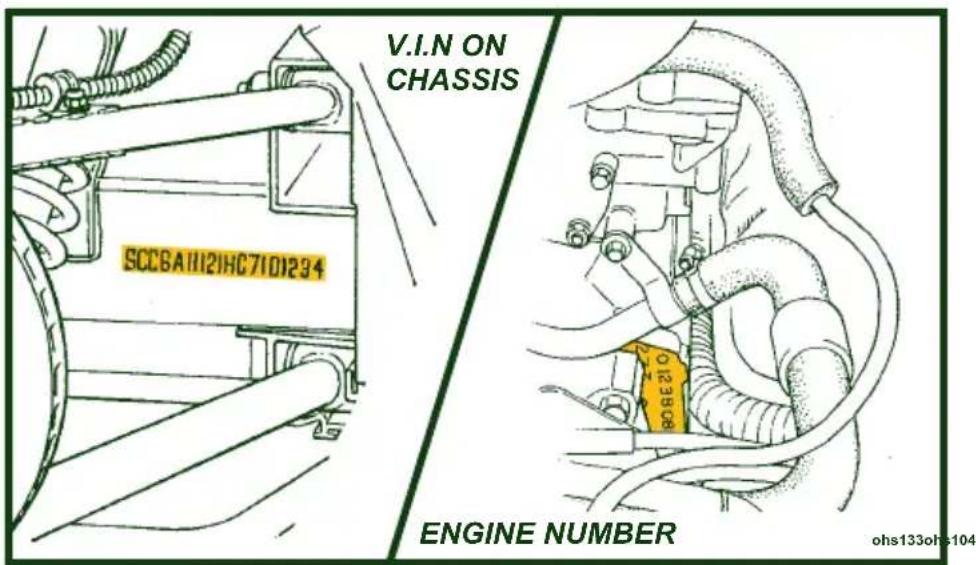
The Vehicle Identification Number (V.I.N.) is a unique 17-digit number used to identify the car for warranty, spares ordering and administrative purposes. For reference, the number may be viewed from outside the car at the left hand bottom corner of the windscreen. The number is also printed on a label stuck to the inside of the chassis sideframe alongside the driver's seat. It is repeated on the certification label on the driver's door jamb. This label contains tire pressure information. The chassis frame is stamped with the V.I.N. in the right hand front wheelarch area, viewable with the front wheels turned to right full lock.
It is essential that the complete V.I.N. is quoted in any correspondence concerning the car, or when ordering spare parts.
text_image
V.I.N ON CHASSIS SCC6AIII2IHC7IDI234 ENGINE NUMBER ohs133ohs104Engine Number
The engine number is stamped on the rear end of the cylinder block, exhaust side, and is followed by '2ZZ'.
text_image
SEAT ADJUSTMENTS A B ohs64aSEATING & SAFETY RESTRAINTS
Seats
On delivery of the car, first remove the protective plastic seat covers, if this has not already been done, and dispose of safely.
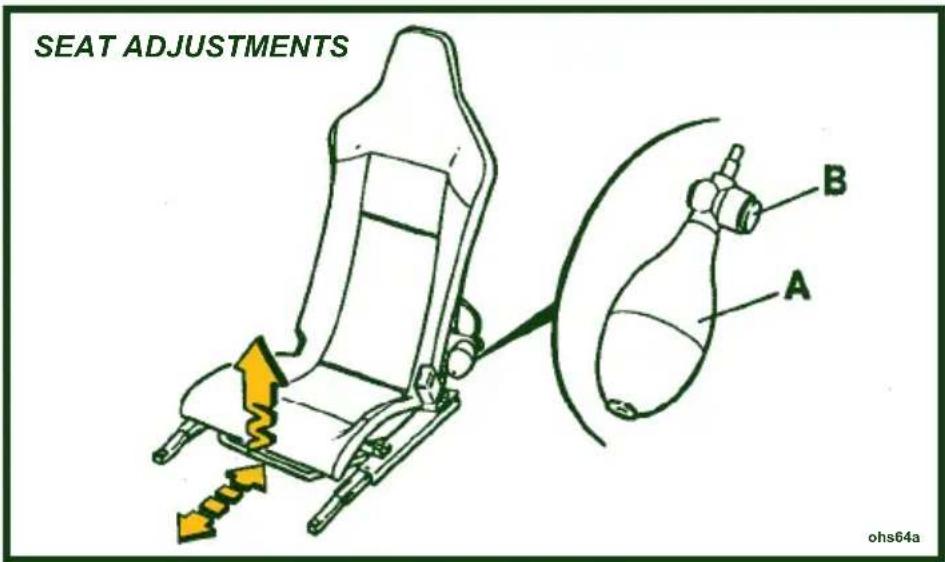
To adjust the fore/aft position of the driver's seat, raise the lift bar beneath the front of the seat, and slide to the position required. Ensure that the catch is fully engaged after adjustment by attempting to slide the seat without touching the lift bar. Note that the passenger seat position is fixed and cannot be adjusted, and that the backrest angle of both seats is fixed, and cannot be reclined.
WARNING:
- Sit as far back from the steering wheel as is comfortable, whilst ensuring that full control can be maintained. Sitting too close to an airbag can result in serious injury or death if the airbag inflates.
- Ensure that your chest is at least 10 inches (250mm) from the steering wheel.
- Do not attempt to adjust the seat position whilst driving as this could adversely affect your control of the car.
- Ensure that no persons or objects will be trapped when adjusting the seat.
Lumbar Support (if fitted): On seats equipped with adjustable lumbar support, an inflator 'bulb' (A) and air release button (B)
SEAT BELT POSITIONING
natural_image
Illustration of a person seated in a chair wearing a yellow safety harness (no text or symbols)ohs44
are located at the inboard rear of the seat. To increase lumbar support, squeeze the bulb repeatedly until sufficient support is obtained. To decrease support, press the small black button at the base of the inflator bulb.
Seat Belts
Seat belts provide important safety and comfort for both driver and passenger and have proven to be the single most effective safety device in reducing the risk of death or injury in a crash. The seat belts should be worn at all times, no matter how short the journey. This is required by law in most states and in all Canadian provinces. As a reminder, the seat belt tell tale in the instrument cluster will flash until the driver's seat belt is fastened, accompanied for the first eight seconds by an audible chime.
Inertia Reel Seat Belts
The standard fitment inertia reel seat belts allow the wearer freedom of movement under normal driving conditions. The belt reel will lock automatically whenever the car is subjected to braking, acceleration, or cornering forces, or on impact in a collision. Reel locking will also occur on steep hills or slopes, or if the car is tilted. In the event of a severe frontal impact sufficient to trigger the airbag system, a pre-tensioning device incorporated into each seat belt assembly will operate to tighten the belt for increased occupant protection.
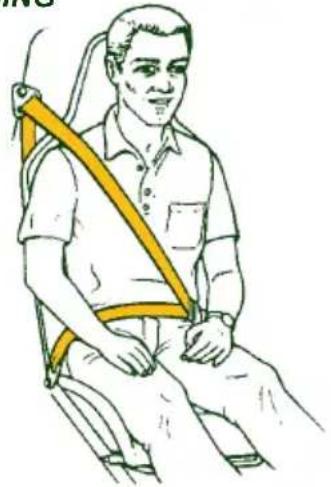
To use the belt, sit erect and fully back in the seat before taking the buckle tongue in the outer hand, and drawing the belt through the top slide, pass the belt across the body and push the tongue into the buckle lock at the inboard side of the seat, until a positive ‘click’ is heard. Pull on the belt to check for correct latching and ensure that the belt fits snugly against the body with all the slack taken up by the reel. The belt should be worn low across the front of the pelvis, and across the chest and shoulder.
The belts are released by pressing the red button on the buckle lock, and will retract automatically for tidy storage and to permit easy access to the passenger compartment.
Seat Belt Precautions
WARNING:
- Be sure you and your passenger always wear seat belts and wear them properly. Not wearing a seat belt correctly, increases the chance of serious injury or death in a crash, even with airbags.
- On fastening the seat belt, ensure that no part of the belt is twisted, or is entangled in the door or seat mechanism.
- Seat belts are designed to bear upon the bone structure of the body and should be worn low across the front of the pelvis, and across the chest and shoulder. Wearing the lap section of the belt across the abdominal area must be avoided.
- Improperly positioning the seat belts can cause serious injury or death in a crash. Ensure the seat belts are correctly positioned before driving.
- Pregnant women should always wear seat belts to protect both themselves and the unborn child. The lap belt portion of the belt should be kept as low as possible across the hips. Consult your doctor regularly to check if you should drive.
- The shoulder portion of the belt must never be worn beneath the arm, or behind the back.
• Each seat belt assembly is designed for use by one occupant of adult build, and should not be used by children unable to meet the requirements set forth herein.
WARNING:
- Lotus strongly recommends that you do not carry children as passengers in your Elise.
- Because the Elise is fitted with a non-switchable passenger airbag, a rear facing child seat must never be used.
- Never use one belt around two people, or allow a child to be carried on a driver's or passenger's lap.
• Refer to Child Restraints section of handbook.
WARNING:
- No modifications or additions should be made to the inertia reel assemblies or seat belts. Do not attempt to adjust the seat belt tension by altering the mechanism.
- The seat belt should be replaced if webbing becomes frayed, contaminated, or damaged. Inspect regularly.
- It is essential to replace the entire seat belt assembly if it has been used in a severe impact, even if damage to the assembly is not obvious. In situations where the airbags have been deployed, the belt tensioner systems must also be replaced. Seat belt anchorage points must also be rigorously checked.
- Not checking or maintaining seat belts can result in serious injury or death if the seat belts do not work properly when needed. Check the belts regularly and have any problem corrected immediately.
- No one should sit in a seat with an in-operative seat belt.
Care should be taken to avoid contamination of the webbing with polishes, oils or chemicals and particularly battery acid. Use only a mild detergent to clean the webbing, never use bleach or dye, and allow the belt to dry fully before using the car. Ensure that the buckle mechanism is kept free of dirt contamination as disassembly for cleaning is not possible.

text_image
AIRBAG INFLATED ON IMPACT w53bAirbag Safety System
Your car has airbags. One airbag for the driver, and another for the passenger.
The car is also equipped with shoulder and lap belts. Airbags are supplementary restraints to the seat belts.
In the event of a moderate to severe frontal collision, airbags provide occupant protection additional to that provided by the lap and diagonal seat belts. Both driver and passenger must wear the seat belts at all times, whether or not an air bag is provided, in order to minimise the risk of severe injury or death, no matter how short the journey. An occupant who is properly restrained by a seat belt, will be in the best position for full effectiveness of the airbag in the event of airbag deployment.
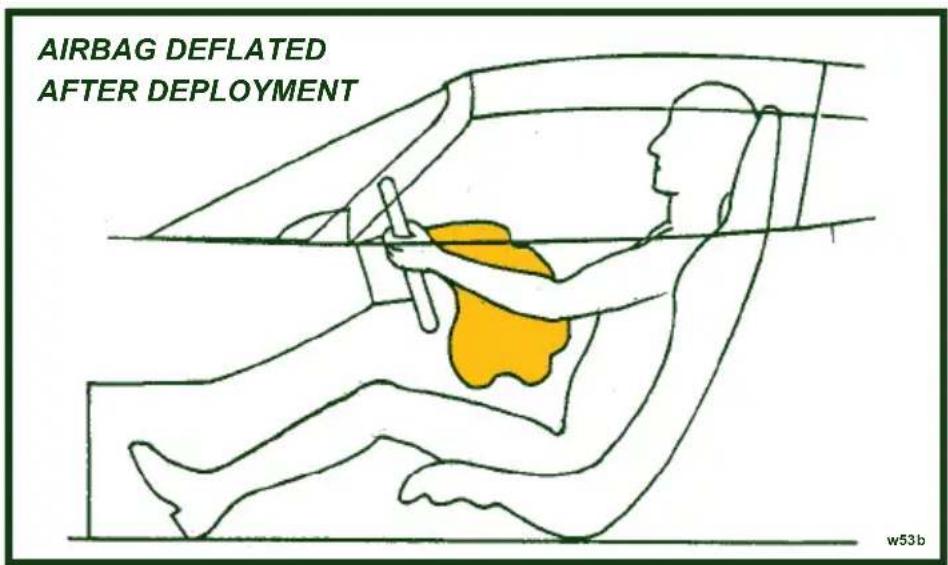
The airbag system is designed to inflate when the car is involved in a frontal, or near frontal collision, and the force of impact is sufficient to warrant additional occupant protection. The driver's airbag is housed in the centre of the steering wheel, and that for the passenger in the dashboard. When triggered by an electronic crash sensor, each air bag inflates in a fraction of a second to provide protection for the occupant's upper body, and then deflates very rapidly to minimise any obstruction to the driver.
Some parts of the system are designed to operate only once, and need replacing after air bag inflation with new components, before being ready for another deployment.
Remember that the seat belts, when correctly worn, provide
text_image
AIRBAG DEFLATED AFTER DEPLOYMENT w53bthe primary crash protection to the occupants, especially in collisions below the actuation threshold of the airbag system, and during types of accident which do not cause airbag deployment. Therefore, both driver and passenger must always wear seat belts (in most states, and all Canadian provinces, the law requires the use of seat belts). See the earlier pages on 'Seat Belts'.
WARNING:
- You can be killed or seriously injured in a crash if you aren't wearing your seat belt - even with airbags. Wearing your seat belt during a crash helps reduce your chance of hitting things inside the car or being ejected from it. Airbags are designed to work with seat belts, but don't replace them. Airbags are designed to deploy only in moderate to severe frontal and near frontal crashes. They aren't designed to inflate at all in rollover, rear or low-speed frontal crashes, or in many types of side impacts. Both driver and passenger should wear a seat belt properly to minimise the risk of severe injury or death in the event of a crash.
- Airbags inflate with great force, in a fraction of a second. If you're too close to an inflating airbag, as you would be if you were leaning forward, you could be killed or seriously injured. Seat belts help keep you in the correct position before and during a crash. Always wear your seat
belt, even with airbags. Sit as far back from the steering wheel as is comfortable, whilst ensuring that full control can be maintained.
- Airbags plus lap-shoulder seat belts offer the best protection for adults, but not for young children and infants. Neither the car's seat belt system nor its airbag system is designed for them. Young children and infants need the protection that a child restraint system can provide. See later section on ‘Child Restraints’.
- If an object is between a person and an airbag, the bag might not inflate properly or it might force the object into that person causing death or serious injury. The path of an inflating airbag must be kept clear. Don't put anything between an occupant and an airbag, and don't attach or put anything on the steering wheel hub or on or near any passenger dashboard air bag covering.
- Do not lean against the inside of the doors; always hold the steering wheel by the outer rim; never rest your hands on the airbag panel.
- Never transport heavy objects on or in front of the passenger seat.
- Give your passenger all of the information in this section.
- Do not attempt to de-activate the airbags, or make any other changes to the wiring or components of the airbag system. Do not undertake any wiring for electrical accessory equipment in the vicinity of the airbag wiring harnesses. Doing so may disable the airbag system, or cause its unintended deployment.
- Adjust the driver's seat to ensure that your chest is at least 10 inches (250mm) from the steering wheel.
- If the airbag trim cover on the passenger side of the dashboard is accidentally knocked off, the passenger airbag will not operate correctly. Improper protection could result in death or serious injury to a passenger in a crash. Do not attempt to refit or repair the trim cover, but have the fault rectified immediately by your dealer.
Airbag Tell Tale
There is an airbag warning light ('tell tale') on the instrument panel which shows the airbag symbol. The system checks the following airbag electrical circuits for malfunction:
- Drivers airbag circuit;
- Passenger airbag circuit;
- Seatbelts pre-tensioner circuit;
- Internal componentry of the sensor and diagnostic module.
As a bulb and circuit check, the tell tale will light briefly when the ignition is switched on, and then go out. If the lamp lights at any other time, a fault in the airbag system is indicated, which should be rectified without delay by your Lotus dealer.
WARNING:
If the airbag tell tale does not light up as the ignition is turned on, or remains lit for more than a few seconds, have the fault rectified immediately by your dealer. Ignoring the tell tale can result in serious injury or death if the airbags do not inflate when needed.
Airbag Deployment
If a crash or collision causes the airbags to inflate, you may see what looks like smoke, but is actually powder from the airbag surface used to aid smooth deployment. Although the powder is not harmful, people with respiratory problems may experience some temporary discomfort. If this occurs, get out of the car if possible as soon as it is safe to do so.
After airbag deployment, the airbags, seat belt tensioners and electronic control unit must be replaced by a Lotus dealer or other suitably qualified organisation.
Component parts of the airbag system are located in various sites around the car. Any technician working on the car should be advised that the car is fitted with airbags to allow suitable precautions to be taken.
WARNING:
- For up to 20 seconds after the ignition has been turned off and the battery disconnected, an airbag can still inflate if improper servicing occurs. You can be injured if you are close to an airbag when it inflates.
- Airbag system components should be serviced only by an authorised Lotus dealer. Do not work on the airbag system yourself.
- The disposal of used airbag units is subject to stringent
regulations, and should be handled only by your dealer.
- If you sell your Lotus, notify the purchaser that the car is equipped with airbags, and refer them to ‘Airbag Safety System’ in this handbook (safety and disposal rules).
• Further information on the airbag system can be found on stickers on the sun visors. - For important recommendations on the use of child restraints, please refer to ‘Child Restraints’ in this handbook. Never use a rear facing child seat in your Elise.
- A crash can damage the restraint systems in your car. A damaged restraint system may not properly protect the person using it, resulting in serious injury or even death in a crash. To help make sure your restraint systems are working properly after a crash, have them inspected and any necessary replacements made as soon as possible.
Child Restraints
WARNING:
Lotus strongly recommends that children are not carried in the Elise due to the risk of death or serious injury if the child is too close to the dashboard when the airbag inflates.
Accident statistics show that children are safer when properly restrained in the back seats of cars, an option unavailable on this model. In addition, your car is equipped with a passenger's airbag which poses serious risks to children - particularly infants and small children. If, nevertheless, a child is to be carried in the car, the following notes are provided for guidance:
When a child is of a physical size whereby the standard fitment lap and diagonal seat belt will fit satisfactorily, with the belt positioned over the collar bone and against the centre of the chest, the standard seat and seat belt should be used. If the belt touches or crosses the child's neck, the child should NOT be carried in the Elise.
WARNING:
• Children should not be carried in the Elise unless they are large enough to be able properly to use the standard seat belt without any child seat or booster seat.
- Child restraint systems (other than belt positioning booster seats) are designed to be secured in the car seat by the lap belt portion of the lap/shoulder belt. READ ALL INSTRUCTIONS THAT ACCOMPANY THE CHILD RESTRAINT OR BOOSTER SEAT.
- Infants who are unable to sit up by themselves, unsupported, should NOT be carried in the Elise.
- Never put a rear-facing child seat in the passenger seat of the Elise. If the airbag inflates, it can hit the child or the back of the child seat with enough force to kill or very seriously injure an infant.
- There is no provision on the Elise to switch off or disable the passenger airbag.
WARNING:
Children who are not properly restrained can be killed or seriously injured in an accident.
Behaviour: It is essential that the behaviour of any child travelling in the car is such that they remain correctly seated and belted, and it is the responsibility of the driver to ensure that this occurs.
The following wording has been included to comply with National Highway Traffic Safety Authority requirements, however;
WARNING:
Lotus strongly recommends that you do not fit any type of child seat into the Elise due to the risk of death or serious injury if the child is too close to the dashboard when the airbag inflates.
Procedure for Proper Fitment of Forward-Facing Child Seat
Automatic Locking Retractor: The safety belt for the passenger's seat is equipped with an automatic locking retractor that must be used for securing a forward-facing child restraint system. When activated, this retractor allows you to securely fasten the child restraint system.
Activating the Automatic Retractor:
- Pull the passenger seat safety belt completely out. At this point, the locking mechanism is activated.
- Place the forward-facing child seat in the passenger seat, using the safety belt to secure the child seat following the instructions that come with the child seat.
- Insert the safety tongue into the buckle and make sure that it is properly latched.
- Allow the safety belt to retract until it is tight on the child seat. You may further tighten the belt by pulling on it to allow more of it to retract. Check to make sure the child seat is secured, and that the belt is snug and will not pull out.
Releasing the safety belt and child seat:
- Unbuckle the safety belt.
- Remove the child seat.
- Make sure that the belt has fully retracted. At this point the automatic locking feature is disengaged.
Seating & Safety Restraints
text_image
MECHANICAL KEY Push button Keyhole light ohs149KEYS & CAR SECURITY ALARM
Keys
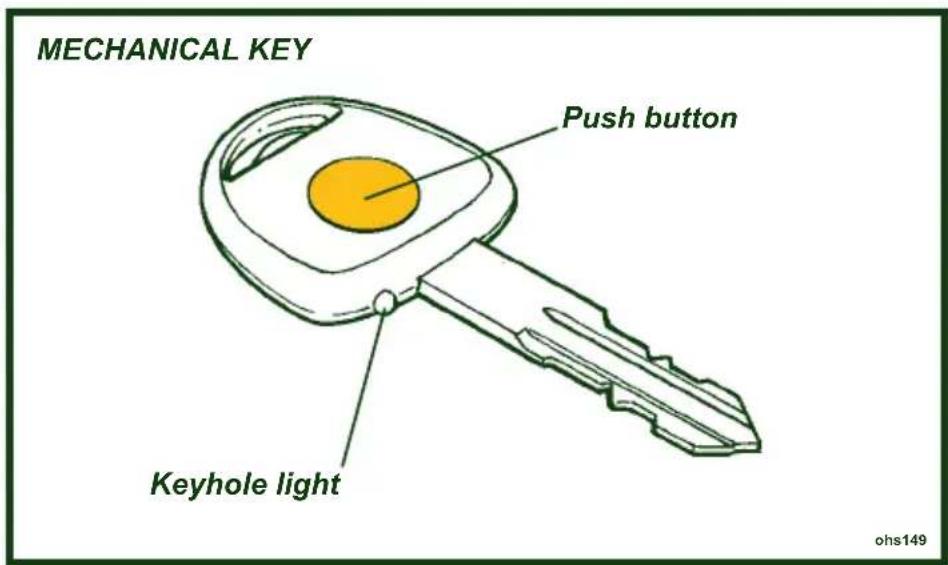
A single mechanical key operates the manual door locks (see also ‘Doors’ and ‘Central Door Locking’), combined ignition switch/steering lock, and engine cover. The head of the key incorporates a push button activated key hole light to facilitate operation in the dark.
A duplicate key is supplied with the new car and, on receipt, should be separated and kept in a safe place for use in an emergency. The mechanical key code is printed on a plastic tab which should be removed from the key ring and the number recorded safely with the car documents. This number will be required when ordering a replacement, or any additional keys from your dealer. Ensure that a spare key is available at all times to guard against becoming stranded.
WARNING:
Never leave the car unattended with the key in the ignition switch, especially if unsupervised children and/or animals are in the car. Dangers can arise from window operation and other electric controls. If the engine is running, operation of the car's controls could cause an accident and result in death or serious injury.
COBRA TRANSMITTER FOB & CODE NUMBERS
text_image
Push button Fob tell tale Small button S/N 99999999 PIN CODE =9999oh102
Car Security Alarm
The Lotus Elise is fitted with a Cobra 8186 immobiliser/alarm which includes the following features:
- 'Dynamic coding' of the transmitter fobs; Each time the transmitters are used, the operating frequency is random changed to guard against unauthorised code copying.
• Automatic (passive) engine immobilisation to prevent the engine from being started without the transmitter fob. - Sensing switches on doors, front body access panels and the engine cover, meaning the alarm sounds if someone tries to force entry.
- Personal protection by 'on demand' activation of the siren.
- Selectable cockpit intrusion sensing using a microwave sensor.
- Self powered siren to maintain protection if the car battery is disconnected.
Transmitter Fobs
Two transmitter fobs are provided with the car to operate the immobiliser/alarm system. The two transmitters should be kept separate, and a replacement obtained immediately after any loss to ensure that a spare is always available.
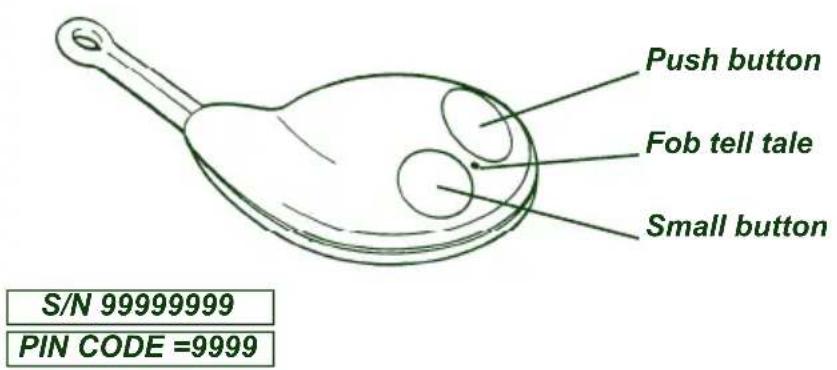
Each individual alarm system has a unique serial number and an owner's Personal Identification Number (PIN), both of which are printed on a code card supplied with the car. In order to allow replacement transmitters to be ordered, it is essential that these numbers are recorded and kept safely with the car documents. If the code card is not available on receipt of the

text_image
Tachometer Security/RPM tell tale 123.4 234567 200F ABS ohs127acar, enquire with the dealer immediately.
Engine Immobiliser
In order to provide a measure of car security, independent of any driver action, the system will ‘passively’ immobilise the engine’s cranking and running circuits after the first occurring of the following:
i) Four minutes after switching off the ignition;
ii) Two minutes after a mobilising command (see below); or
iii) One minute after switching off the ignition and opening the driver's door.
The immobilised state is indicated by the security tell tale in the tachometer upper face flashing continuously.
To mobilise the engine, press once, and for a full second, the larger of the two buttons on the transmitter fob. The security tell tale will be extinguished.
Valet Mode
If leaving the car for servicing or parking, the passive immobilisation feature may be switched off by switching on the ignition and pressing the transmitter small button. Two beeps will confirm 'valet' activation, repeated as a reminder when the ignition is switched off. The security tell tale will remain off.
At the next arming command, the valet mode will be switched off, and normal immobilisation resume.
Arming the Alarm
Remove the ignition key, close (and lock) both doors, and check that the engine cover and front body access panels are secure. The roof may be either closed or open. Press once, and for a full second, the larger of the two buttons on the transmitter fob (on cars with central door locking, this action will automatically lock both doors - see later). This command will be acknowledged by:
- 2 flashes of the hazard warning lamps;
- Continuous flashing of the security tell tale.
Check that these indications occur. If not, press the button a second time, as the first press may have only switched off the passive immobilisation (see above).
Note that if the system is armed when a door or engine cover/front access panel is not fully closed or if the interior lamp is in the 'off' position, a continuous buzz will be heard as warning.
If still open after expiry of the arming period, (see below) the alarm will be armed with that switch group (both doors, or front/rear access lids) excluded from the circuit.
After arming the system, the engine is immediately immobilised, but a period of approximately 45 seconds must elapse before all functions and sensors become fully active. After this time, the alarm will be triggered by any of the following actions:
- Interruption of the car battery power supply.
- Energising the ignition circuit ('hot wiring').
- Opening a door;
- Opening the engine cover or a front access panel.
- Movement detected within the cabin.
When the alarm is triggered, the hazard warning lamps will flash and the electronic wailing siren will sound for a period of approximately 30 seconds before closing down and resetting, ready for any further triggering input. If a trigger is continuously present, the alarm will repeat after a short delay, and continue in this sequence for about 10 cycles.
To silence the siren when triggered, press once, and for a full second, the larger button on the transmitter fob. This will not affect the status of the alarm which will remain armed.
Disarming the Alarm
To disarm the alarm, press once, and for a full second, the larger button on the transmitter fob. This command will be acknowledged by:
- 1 flash of the hazard warning lamps;
- Extinguishing of the security tell tale.
If the alarm had been triggered during the last armed period, the disarm command will be acknowledged by the hazard lamps flashing 4 times, and the buzzer sounding 4 times. The security tell tale will then flash a code to indicate the triggering source:
- 1 pulse flashing: door, engine cover/boot lid or body front access panel.
- 2 pulse flashing: movement detected in cabin by microwave sensor.
- 4 pulse flashing: tampering with ignition circuit.
- 6 pulse flashing: interruption of battery supply.
The coding will be deleted when the ignition is next turned on.
Emergency disarming/mobilising
If the transmitter fobs are lost or damaged, the alarm system owner's unique PIN may be used to disarm the alarm and/or mobilise the engine provided that access is available to the cabin. Follow the transmitter fob programming instructions (see page 18) from step 3.
text_image
Microwave sensor ohs120Intrusion Sensing
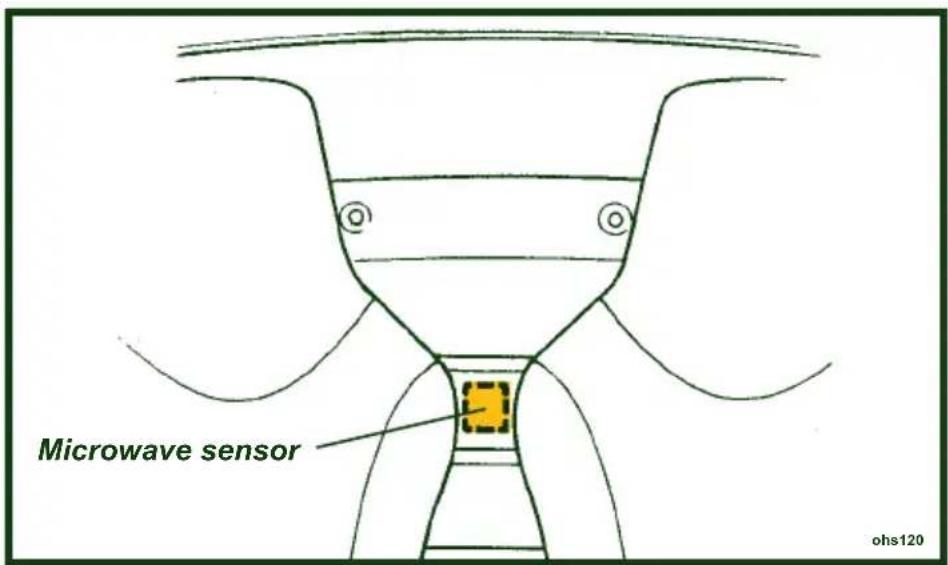
A microwave sensor is mounted behind the cabin rear bulkhead trim panel, and is able to detect substantial physical movement within the cockpit, and trigger the alarm. Microwave transmissions are blocked by metal objects, so it is important not to shield the signal by placing such items on the bulkhead ledge.
If desired, the alarm may be armed without the intrusion sensor or battery interruption circuits being active by arming the system in the usual way with the transmitter larger button, and within 20 seconds, pressing the smaller button twice.
Manual Activation of Siren
To enhance personal security, with the system in a fully armed state (after 45 second arming period), the siren may be manually triggered by pressing the transmitter smaller button. The siren will sound and the turn lamps flash for 15 seconds. To stop the siren, press either of the two transmitter buttons.
text_image
Transmitter casing Transmitter body Battery LITHIOUR BAN ohs102Transmitter Fob Battery Replacement
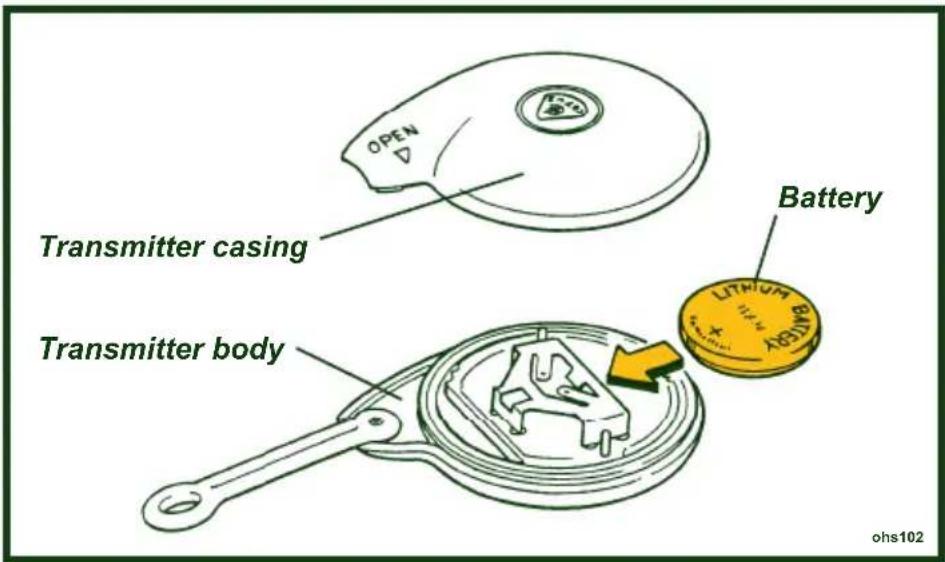
The transmitter fobs will normally operate within a range of 5 metres from the car, but this may be reduced by the presence of other radio signals in the vicinity. A small LED tell tale on the transmitter fob will flash whilst the button is held down to indicate correct operation, but if the lamp flashes irregularly or only once, transmitter battery replacement is required.
The transmitters are powered by a long life 3V Lithium battery, type CR2032, which with normal use should last for 3 years. To ensure continuity of operation, it is recommended to renew the batteries every 12 months:
- Using a small screwdriver, prise open the case in the areas marked 'open'.
- Remove the old battery and wait for 10 seconds before inserting the new battery with +ve sign uppermost, and holding the battery only by the periphery.
- Align the locating studs, and firmly press the case together.
- The transmitter should now operate normally, but may require re-synchronisation with the control unit.
Transmitter Re-synchronisation
If at any time the transmitter does not function, and the battery is known to be good, carry out the following re-synchronisation procedure:
- Stand close to the car and hold down both buttons on the transmitter until the LED on the fob is extinguished (approx. 10 seconds).
- Release both buttons; the fob tell tale should come on constantly.
- Press the larger button for one second (the fob tell tale will flash). Synchronisation is complete.
Programming Additional Transmitter Fobs
Two transmitter fobs are provided with the new car. If one transmitter is lost or damaged, a replacement should be obtained immediately from your dealer, and programmed to the car alarm controller using a functioning transmitter fob and the system owner's unique Personal Identification Number (PIN). Up to 4 transmitter fobs can be matched with the alarm system, but all fobs must collectively undergo the single programming operation:
- Press, simultaneously, both buttons on a transmitter fob until the fob tell tale stops flashing (approx. 10 seconds). On release of the buttons, the fob tell tale will light.
- Repeat operation (1) for ALL the transmitter fobs required to operate the system.
- Turn the ignition on and off 3 times within 7 seconds; the security tell tale in the tachometer will light for 3 seconds.
- Enter the PIN: Immediately the tell tale goes out, switch ON the ignition and count the number of security tell tale flashes until equal to the first number of the PIN, then turn the ignition OFF, then back ON again.
- Repeat operation (4) for the remaining 3 digits of the PIN, remembering to turn the ignition OFF and back ON after each code number.
Note: If at any time a mistake is made when entering the PIN, turn the ignition OFF for 10 seconds and re-commence entering the PIN.
- If the PIN is correct, the security tell tale will be lit. Test operation of each transmitter fob.
Disconnecting the Car Battery
If the battery is to be disconnected, refer to the 'Battery' section later in this handbook which includes the following precaution:
- Before disconnecting the battery, ensure that the alarm system is disarmed and mobilised.
ENTRY & COMFORT
WARNING:
- In very hot/cold territories, or under conditions of extreme solar heating, be aware of exposed metal surfaces in the cabin. Take suitable precautions to guard against burn injuries from hot or cold metal.
- Unlocked doors can be dangerous. Young children who get into unlocked cars may be unable to get out. Always lock your car whenever you leave it.
Central Door Locking (CDL)
The central door locking (CDL) operates on the driver's and passenger's doors in conjunction with the security alarm system. For full details of the alarm system, see page 30.
To unlock from outside:
To unlock the doors from outside, press once, for a full second, the larger button on the transmitter fob. The alarm will be dis - armed and both doors unlocked. Press the exterior lock button and pull open the door using the fingergrip below the button. If the door is swung fully open, a spring detent mechanism on the hinge will aid restraint of the door for convenience whilst entering or exiting the car, but the door should be manually held in windy conditions, or if the car is parked on a slope.
From inside the car, pull the door firmly shut using the recess provided at the top of the door trim panel.
WARNING:
Before closing a door take care to ensure that no persons or objects will be trapped to avoid injury or damage.
To lock from inside:
If it is desired to lock the doors from inside the car, for example to deter highjack attempts, press the right hand side of the CDL rocker switch on the front of the gear lever shroud to lock both doors with or without the ignition switched on. Alternatively, the doors can be locked individually by depressing the button at the rear end of each door sill.
WARNING:
Whether locked using the rocker switch or sill buttons,

text_image
Interior CDL switch Door sill button ohs122ohs140the doors will be ‘deadlocked’ meaning that the interior door release handles will not open the doors. In order to get out of the car in an emergency when the doors are locked see the section below ‘to unlock from inside’.
To unlock from inside:
To unlock both doors from inside, press the left hand side of the rocker switch on the front of the gear lever shroud, or raise the sill button on each door. Note that in the event of a car collision which causes the safety inertia switch to be tripped, the doors will automatically be unlocked.
Pull the release handle at the front of the door and push open. Shut the door from outside by using firm hand pressure towards the rear of the door.
WARNING:
Before closing a door take care to ensure that no persons or objects will be trapped to avoid injury or damage.
To lock from outside:
To lock the car from outside, remove the ignition key, close both doors and check that the engine cover and front body access panels are secure. Arm the security alarm by pressing once, for a full second, the larger of the two buttons on the transmitter fob. This action will both arm the alarm and electrically lock the driver's and passenger's doors.
text_image
ohs97b Lock Unlock Mechanical locking Interior release handle ohs103Notes:
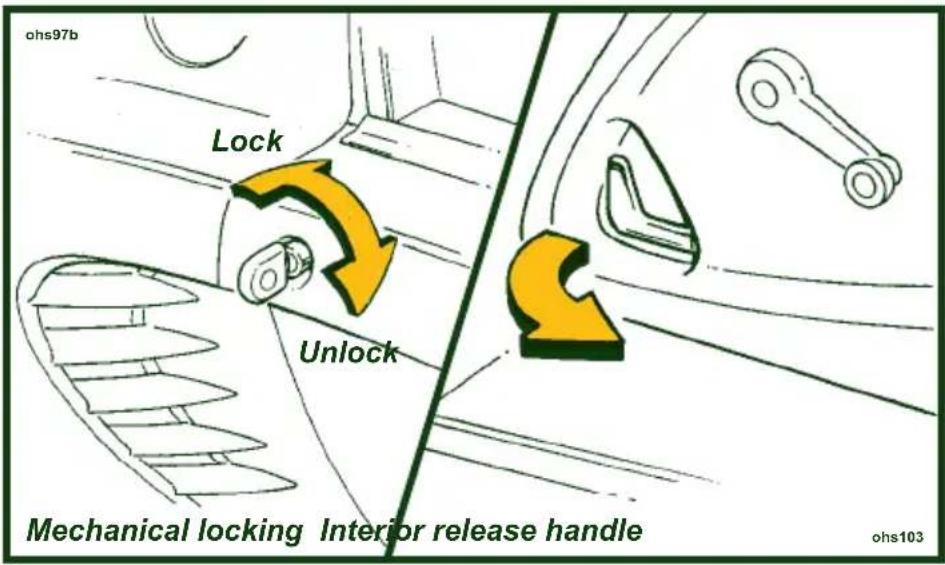
- In the event of a flat car battery, the CDL will not operate. The doors can be unlocked from outside only after opening the engine cover and restoring power to the battery by substitution, re-charging or 'jumping' to a second battery. The doors cannot be unlocked using the mechanical key if the CDL was used to lock the car.
- To lock the car with a flat or disconnected car battery, or if the transmitter fob is disabled, use the mechanical key in each exterior door lock button and turn anticlockwise to the vertical position to disconnect each release button from the latch. This technique does not 'deadlock' the interior release handles, but does allow continued key access to the car until restoration of battery power.
Note that a door locked with the mechanical key cannot be unlocked using only the transmitter fob. - To deadlock the car i.e. disable interior release handles, with a flat car battery, or without the use of the transmitter fob or mechanical key, close and lock one door using the sill but - ton, and for the second door, hold the exterior release button pressed in and depress the sill button before closing the door. Access is now available only by using the transmitter fob after restoration of car electrical power.

text_image
MIRROR DIMMER Night Day ohs149'Lights On' Buzzer
A 'lights on' reminder buzzer will sound if the lights are on, the ignition is switched off, and the driver's door is then opened.
Interior Rear View Mirror
The mirror can be dimmed to reduce headlamp glare from following cars by turning the lever on the underside of the mirror towards the left. Turn towards the right for daytime use.
Door Mirrors
Rear view mirrors are fitted on both driver's and passenger's doors, and may be adjusted manually by direct manipulation of the mirror housing. Note that the passenger side mirror glass is convex to provide a wider field of vision.
A spring detent mechanism allows the complete mirror to swing forwards or backwards on accidental contact to reduce possible damage.
WARNING:
The passenger side convex mirror makes objects seem smaller and farther away than when viewed through a flat mirror. Take care to judge distances and speeds correctly. If you move into a lane on your right when the car behind is too close, you could cause a collision and a crash. Check your interior mirror or glance over your shoulder before changing lanes.
text_image
INTERIOR LAMP SWITCHING 21-3 ohs99Interior Lamp
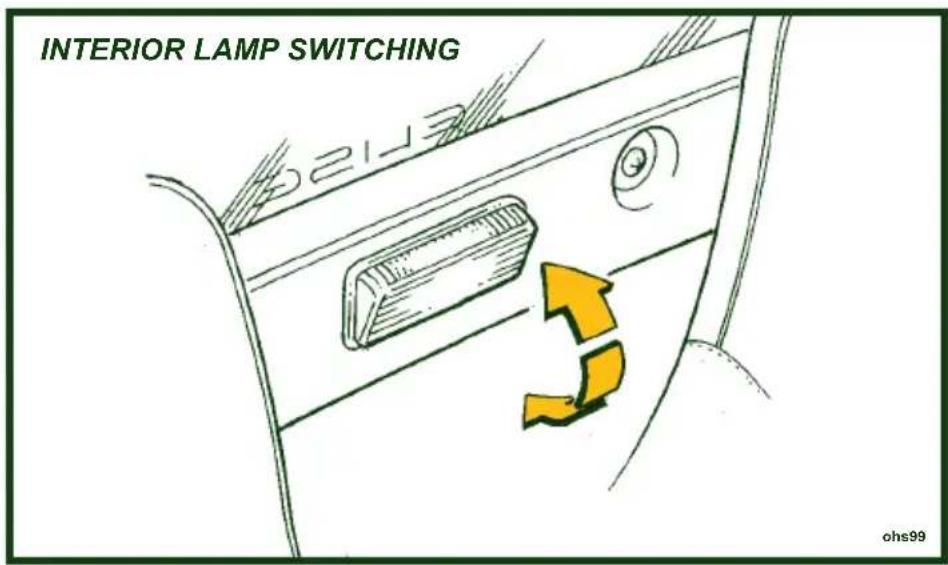
The interior lamp is located centrally in the rear bulkhead trim panel, and incorporates a three position rocking lens:
- Lens rocked upwards; lamp is switched off.
NOTICE: Use this position only temporarily as required. Arming the security alarm system with the lamp switched off may exclude the doors from activating the alarm. - Lens central; lamp is switched on with or without ignition.
NOTICE: To guard against flattening the battery, take care not to leave the lamp on when parking the car, or to switch it on accidentally when using the storage space behind the seats. - Lens rocked downwards; a courtesy mode applies, where the lamp is switched on whenever a door is opened, and goes out when both doors are closed. This is the normal position and should be used whenever leaving the car.
Sun Visors
To help reduce sun glare, pivoted visors are provided for both driver and passenger. Swing down the visor from the windscreen header rail as required.

text_image
Illuminated dot Window up Window down ohs124Door Windows
In frosty or icy weather conditions, the windows may become frozen to the weatherstrip seals. Use a windscreen de-icer spray to free the glass before operating the windows.
WARNING:
- Before closing a window, always check that no persons or objects will be trapped; incautious window operation could be dangerous, especially to children. Ensure that any passenger is also made aware of this danger.
- To guard against incautious electric window operation, do not leave small children unattended in the car with the ignition key in position.
- Do not leave children or animals in a parked car with the roof and windows closed, in hot weather conditions as they may suffocate and/or experience heat exhaustion.
Manual Winders:
Each door window may be raised or lowered by the winder handle near the front of the door.
Electric Windows:
On cars so equipped, switches for the electric window operation are mounted in the front of the door trim panels, and are operative only with the ignition switched on. To help locate the switches in the dark, an illuminated dot is provided in the 'up'
button which glows amber when the lights are switched on.
To lower a window, switch on the ignition and press the lower, domed end of the switch in the relevant door. Release the switch to stop window movement. To raise a window, press the upper, dished end of the switch.
text_image
Key insert/remove Column unlocked Ignition auxilliaries Position not used oh33eINSTRUMENTS & SWITCHES
Ignition Switch/Steering Lock
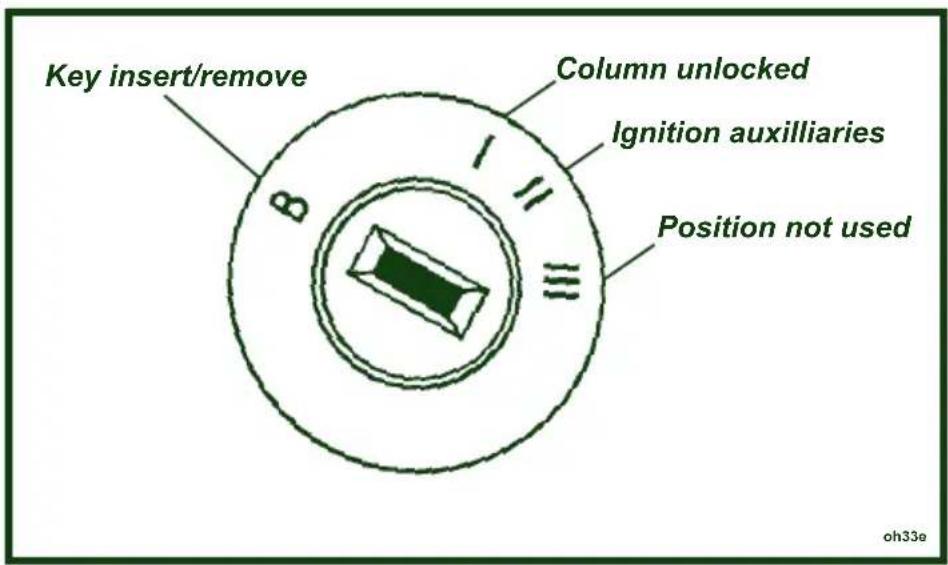
The switch/lock is located on the right hand side of the steering column.
I Insert the key into the slot, and turn clockwise to position 'I' to unlock the steering column. If the key is reluctant to turn, wiggle the steering wheel to ease the load on the steering lock.
II Turn to position 'II' to switch on the ignition and operate auxiliary equipment.
III This spring loaded position is not used on the Elise. The engine start function is controlled by a 'Start' button at the left hand end of the dashboard (see below).
B To remove the key, turn fully counterclockwise to 'B' and withdraw. The steering column lock will be activated when the key is withdrawn but may not engage until the steering is turned and the mechanism is aligned.
NOTICE: DO NOT leave the ignition switched on for long periods without the engine running. Although the engine ignition system itself draws no current when the engine is stopped, a battery drain will occur through other circuits even when auxiliary equipment is not being used.
For security reasons, and to guard against battery drain, always remove the key when leaving the car.

text_image
ENGINE START Engine start button ohs147WARNING:
- Do not push or tow the car unless the key is first used to unlock the column and is then left in the lock. With - drawing the key will cause the steering to lock.
- Never remove the key from the ignition switch or turn off the ignition while the car is moving. Withdrawing the key will cause the steering to lock and may cause an accident resulting in serious injury or death.
- To reduce the risk of theft, or danger to a child remaining in the car, always remove the key when leaving a parked car.
Engine Start Button
An engine start button is located at the left hand end of the dashboard, alongside the lighting switches, and is backlit when the ignition is turned on.
The button is operative only with the ignition on, and engages the engine starter motor for as long as the button is pressed. Release the button to stop engine cranking.
For the correct engine starting procedure, refer to later section 'Starting Procedure'.
NOTICE: Pressing the start button when the engine is running may damage the starter mecha
TELL TALE LAMPS







m252a
Passive Ilisation: The start button will operate only when the security tell tale in the tachometer face is out. If the tell tale is flashing, the engine is immobilised; Press once, and for a full second, the larger of the two buttons on the transmitter fob. The security tell tale will be extinguished. For further information see 'Car Security Alarm'.
WARNING 'TELL TALE' LAMPS
A block of tell tale lamps is incorporated into the instrument cluster to provide you with important information concerning the operation of your Elise.
Bulb Check
In order to check that the warning systems are operative, all the tell tale lamps (except the 'security' tell tale; see Car Security Alarm section) should light for about 6 seconds following ignition switch on. If any lamp should fail to light, it is possible that the bulb or warning circuit may be faulty; see your dealer without delay.
Turn Tell Tale

When the left hand or right hand turn indicators are operating, this green tell tale flashes in unison. A clicking sound may also be heard. If the tell tale fails to light, or flashes at an unusual or irregular rate, check the operation of the turn indicator lamps immediately.
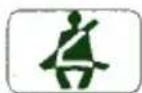
Seat Belt Tell Tale

The red seat belt tell tale is provided as a reminder that both driver and passenger should always wear the seat belts, no matter how short the journey. The lamp will flash until the driver's seat belt is fastened, accompanied for the first 8 seconds by a buzzer.
Brake Tell Tale BRAKE
This tell tale will glow red with the ignition switched on whenever the parking brake is applied. Driving the car with the brake not fully released will cause overheat damage to the rear brakes. Each time the parking brake is released, check that the tell tale is extinguished.
With the parking brake released, if the tell tale should light at any time after the six second check period, stop the car immediately, as the circuit has detected a dangerously low level of brake fluid in the master cylinder reservoir, possibly caused by a hydraulic leak in one of the separate front or rear brake circuits. In the event of a leak there is a danger that air may enter the hydraulic system and cause spongy operation and extended pedal travel. The divided brake circuit should ensure that emergency braking remains, but the car should not be driven until the fault has been identified and rectified.
WARNING:
If the tell tale remains lit when the parking brake has been released, the footbrake may not be working properly. Stop the car immediately it is safe to do so, and do not continue until the fault has been rectified. Continuing to drive could cause a crash and result in death or serious injury.
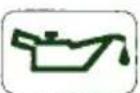
Oil Pressure Tell Tale

This red tell tale warns of low engine oil pressure. The lamp will be lit whenever the ignition is on and the engine is stopped, but should go out as soon as the engine is started. If the lamp fails to go out after engine start up, or comes on when the engine is running, stop the engine immediately and do not restart until the cause has been investigated and rectified.
WARNING:
Continuing to run the engine with the oil tell tale lit could cause major engine damage or seizure, resulting in loss of car control and a crash. You or others could be killed or seriously injured.
Low Fuel Level Tell Tale

When only a single segment of the fuel gauge bar graph remains, representing approximately 1.3 U.S. gall. (5 litres), this amber tell tale will flash. Refuel at the next opportunity.
ABS Tell Tale

This amber tell tale should light for about four seconds following ignition switch on, and then go out. If the lamp remains lit, or comes on whilst driving, a fault in the anti-lock brake system is indicated. The base brake system will continue to operate nor - mally, but without the anti-lock feature. The car can be driven but should be checked and repaired at the earliest opportunity.
High Beam Tell Tale

This lamp glows blue whenever the headlamp high beams are operating.
Airbag Tell Tale

The airbag safety system has a self-diagnostic feature which lights the red tell tale if a fault is detected. As a bulb and circuit check, the tell tale will light for about six seconds following ignition switch on, and then go out. If the lamp remains lit, or comes on at any other time, a fault in the airbag system is indicated, which should be rectified without delay.
WARNING:
If the airbag tell tale is lit, the airbags may not inflate correctly in a crash, or may inflate without warning. To help avoid injury to you or others, have the airbag system repaired as soon as possible.
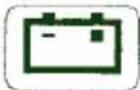
Battery Charging Tell Tale

This red tell tale will light whenever the ignition is on and the engine is stopped. If it lights any time that the engine is running, the battery is not being charged, which may be due to a broken auxiliary drive belt, or an electrical fault. A broken drive belt
will also disable the engine coolant pump and result in rapid overheating; stop the engine as soon as it is safe to do so, and summon assistance. If the drive belt is intact and the cooling system unaffected, it may be possible in favourable daylight conditions, to drive a short distance to a repair facility, but do not, under any circumstances, allow the battery to become completely discharged by continuing to drive.
Engine Malfunction Indicator Lamp

The engine Malfunction Indicator Lamp (MIL) is provided to warn the driver that the engine management system has detected a fault which may result in increased noxious emissions from the exhaust. In order to minimise emissions and potential engine damage, various operational limitations may automatically be applied.
i) If the MIL lights continuously whilst driving, immediately reduce speed and adopt a moderate driving style. Seek dealer advice without delay and avoid all unnecessary journeys.
ii) If the MIL flashes, an engine misfire has been detected which is likely to cause overheat damage to the catalytic converter. Slow down immediately and be prepared to stop.
- If the MIL then stops flashing, and is lit continuously, proceed with caution and seek dealer advice.
- If the MIL continues to flash, stop the car as soon as it is safe to do so, and switch off the engine. Seek dealer advice.
NOTICE: Continuing to drive the car with a flashing MIL may cause overheat damage to the catalytic converter, possible engine damage, increased emissions, and impaired fuel economy and driveability.
In order to comply with emissions regulations, data regarding activation of the MIL is recorded in the engine electronic controller, and may be downloaded by Lotus dealers.
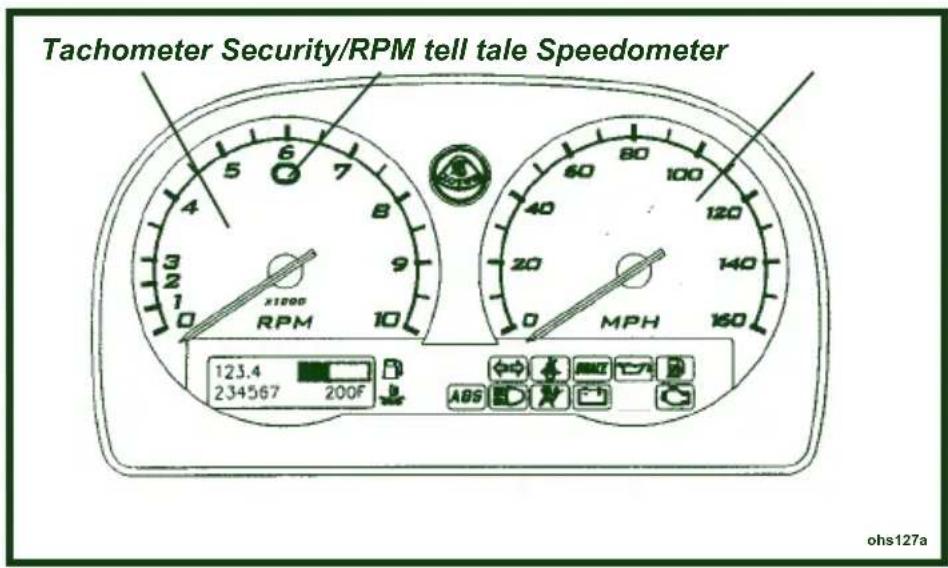
Security/RPM Tell Tale
The security tell tale is located at the top of the tachometer display, and indicates the status of the immobiliser and alarm.
- Tell tale out; engine is mobilised, and the alarm is off.
- Tell tale flashing; engine is immobilised, or alarm is armed and engine immobilised.
For full details of the car security system, refer to the earlier section ‘Car Security’.
Note that the tell tale also functions as a high engine speed (rpm) warning - see 'Tachometer'.
NOTICE: The car is not fitted with a low pressure tell tale. You should check the tire condition and pressure regularly. See section in the handbook on tires which specifies tire care and pressures.
text_image
Tachometer Security/RPM tell tale Speedometer 123.4 234567 200F ABS ohs127aINSTRUMENTS
Speedometer
This instrument displays road speed in MPH, with a second - ary scale in km/h.
Tachometer
The tachometer indicates engine speed in revolutions per minute. The engine management system limits the maximum continuous engine speed to 8000 rpm once normal running temperature has been reached. Very short bursts up to 8500 rpm are allowed during maximum acceleration through the lower gears.
A 6000 rpm limit is imposed on a cold engine in order to reduce possible damage from a harsh driving style.
NOTICE:
- The use of wide throttle openings and/or high rpm before normal running temperature has been reached will result in premature wear and should be avoided.
- Do not run the engine continuously at its maximum speed, or allow overspeeding to occur on the overrun by downshift - ing prematurely, as the high engine loads imposed could result in catastrophic failure.
A red tell tale lamp in the top of the tachometer face lights at high rpm (dependent on gear engaged) to warn that maximum
other
| Metric | Value | | :--- | :--- | | Trip distance | 123.4 | | Odometer Coolant temperature | 234567 | | Proportion of fuel remaining | 102C | | m253 | (no explicit label) |engine speed is being approached. When exploiting full acceleration, gearchange upshifts should be made immediately the tell tale comes on.
Note that this lamp also functions as a security system tell tale (see 'Car Security').
Recalibration of the speedo and tacho needle zero positions will occur during a 3 second period following ignition switch on, but if a needle becomes 'stranded' outside of the re-calibration range, the following procedure should be followed:
With the car stationary;
- Open driver's door;
- Press and hold trip reset button on steering column shroud;
- Turn on ignition.
LCD DISPLAY PANEL
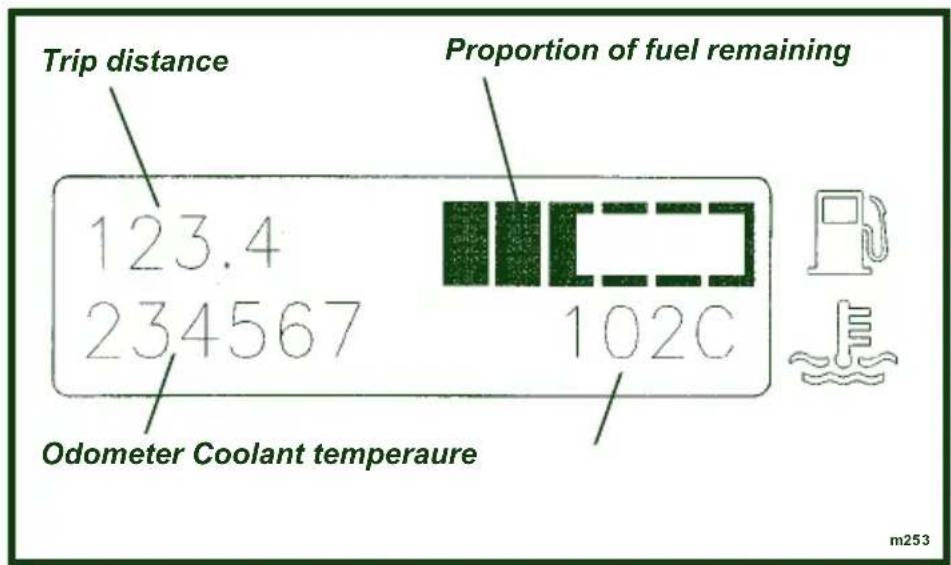
A liquid crystal display (LCD) panel is provided below the instruments in order to display fuel level, coolant temperature, total mileage and trip functions. The panel is blank until the ignition is switched on.
Fuel Level Display
An indication of the level of fuel in the tank is displayed in the form of a bar graph at the right hand top of the LCD panel in the instrument cluster. When completely full (approximately 10.6 U.S. gall. {40 litres}), the display will show 6 black segments. As the fuel level falls, a white band will extend from the right to represent the empty proportion.
When only a single segment remains, representing approximately 1.3 U.S. gall. (5 litres), the amber low fuel tell tale will flash. Refuel at the next opportunity.
NOTICE: Do not allow the tank to run completely dry, as this may damage the catalytic converter and fuel pump. This may affect the terms of your warranty.
Coolant Temperature Display
The engine coolant temperature will be displayed at the bot - tom right hand corner of the panel as soon as the temperature reaches 162°F. The running temperature will fluctuate a certain amount as the operating conditions change, and during periods of idling or in heavy traffic, the temperature may rise to over 212°F, with the cooling fans switching on at half speed at approximately 208°F and at full speed at approximately 217°F. The temperature display will flash at temperatures over 226°F to prompt closer monitoring by the driver of high temperatures. The pressurised cooling system has a boiling point of over 248°F. If the temperature approaches this level then the driver should be concerned. If this should occur, allow the engine to idle for a few minutes whilst monitoring the temperature, and if it continues to rise, switch off and seek qualified assistance.
NOTICE: After a heavy snowfall, ensure that the radiator cooling outlet grilles in the front body are cleared of snow before driving the car, or overheating may occur.
Odometer
An odometer (total distance recorder) reading is displayed at the bottom left hand corner of the panel.
Trip Recorder
A trip distance recorder is provided at the top left hand corner of the panel.
In order to zero the trip display, switch on the ignition, and press for a moment (less than 1 second), the small button on the steering column shroud ahead of the ignition switch. This dual function button also controls the panel illumination - see 'Instrument & Switch Illumination'.