Cameleon - Stroller Bugaboo - Free user manual and instructions
Find the device manual for free Cameleon Bugaboo in PDF.


User questions about Cameleon Bugaboo
0 question about this device. Answer the ones you know or ask your own.
Ask a new question about this device
Download the instructions for your Stroller in PDF format for free! Find your manual Cameleon - Bugaboo and take your electronic device back in hand. On this page are published all the documents necessary for the use of your device. Cameleon by Bugaboo.
USER MANUAL Cameleon Bugaboo
© Copyright 2007 Z54007 rv00 Bugaboo® International BV. The information contained herein is subject to change without notice. Bugaboo® International BV shall not be liable for technical errors or omissions contained herein.
The purchased product may differ from the product as described in this user guide. Our most recent user guides can be requested at our Service departments (see 'comments') or at www.bugaboo.com.



content
before starting 4
- basic steps 8
- assembling the carrycot 18
- assembling the seat 20
- various uses of carrycot and seat 22
- using the seat's safety belts 23
- fitting the underseat bag 25
- going outdoors with the bugaboo cameleon 26
- protection against weather and wind 29
- travelling and storage 34
- maintenance and accessories 36
- warranty 38
(
before starting
You have chosen the Bugaboo ^® Cameleon in your own personal colour combination. The Bugaboo Cameleon is functional, versatile and comfortable. You will increasingly discover how the Bugaboo Cameleon's innovative design provides everything you could wish for from a buggy. We wish you a great deal of pleasure with your Bugaboo Cameleon. Please remember to complete and return the warranty card as soon as possible, so that you can be certain of receiving the best service and warranty from Bugaboo. This can be done either by visiting our website or by returning the enclosed prepaid warranty card.
important
- Read these instructions carefully before you use the product and keep them for future reference. Your child's safety may be affected if you do not follow these instructions.
- This user guide is for the Bugaboo Cameleon, item code number 70100.
- You will find a sticker with the model number and serial number on the centre axle of the chassis.
- Pram, pushchair and buggy comply with standard EN 1888: 2003.
- The carrycot complies to the requirements of standard EN 1466: 2004
- For replacements, only use original parts that are supplied or approved by Bugaboo International BV.
- Use original Bugaboo accessories. The warranty does not cover damage to the Bugaboo Cameleon caused by overloading, incorrect folding or the use of non-original accessories. The warranty conditions are stated in section 11 and provide further information.
- The Bugaboo Cameleon is patented. The Bugaboo Cameleon model is protected.
- This vehicle is intend for children from 0 years up to a weight of 17 kg/37.5 lbs (around 4 years old).
- The Bugaboo Cameleon carrycot is suitable for a baby aged 0 to around 6 months, up to 9 kg/19.8 lbs in weight or 76 cm/30 inches in length.
- Only use products recommended by Bugaboo in combination with the Bugaboo Cameleon.
- Parts of the Bugaboo Cameleon may discolour in the sun.
- Avoid exposing the Bugaboo Cameleon to extreme temperatures.
- Regularly check the Bugaboo Cameleon's touch fasteners and fasteners. Avoid unsafe situations.
safety
- The Bugaboo Cameleon is not a car seat. Transport your child by car in an approved car seat. Ask your supplier for details.
- Approved child seats can be readily fitted to the Bugaboo Cameleon's chassis using Bugaboo adapters. See accessories (section 10).
- Do not allow children to play with the Bugaboo Cameleon. They may be injured.
- Use the 5-point harness when the child is seated in the Bugaboo Cameleon seat, both when the seat is detached and when it has been fastened to the chassis.
- Take your child out of the Bugaboo Cameleon when going up or down stairs, escalators or steep slopes.
- The Bugaboo Cameleon is only intended for carrying one child.
- Always use the wrist strap that is attached to the handle bar.
WARNING
- Do not stand on the axles between the wheels. This is unsafe and could damage the Bugaboo Cameleon.
- Keep the Bugaboo Cameleon away from open flames and other heat sources, such as electrical or gas heaters, etc.
- Do not use if any part is broken, torn or missing
- Every weight attached to the handlebar will have a negative impact on the stability of the pushchair.
• This product is not suitable for running or skating. - It may be dangerous to leave your child unattended.
- Ensure that all locking devices are engaged before use.
- Check that the pram body or seat unit attachment devices are correctly engaged before use.
• This seat is not suitable for children under 6 months. - Do not add a mattress thicker than 30 mm.
- Use only the frame of the Bugaboo Cameleon with frame number 70101 on the chassis with chassis number 70100, otherwise unsafe situations may occur. The frame number is on the sticker that is attached to the inside of the frame. The chassis number is on the sticker that is attached to the central bar.
- Do not change the position of the seat when the child is in the seat. Prevent the child from falling and being injured.
- Never pick up the Bugaboo Cameleon and chassis by the carry handle while your child is lying or sitting in the carrycot or seat.
- The wing nuts must be in the locked position when the handlebar is flipped to the reverse side to ensure the handlebar securely locks into place.
- Any adjustments made to the suspension of the swivel wheels must be identical on both wheels. Failure to make concurrent adjustments may lead to dangerous instability.
- Do not let other children play unattended near the carry cot
- The carry cot is only suitable for a child who cannot sit up unaided

check what you have received
You have received 2 boxes. Check the contents of the boxes against the list below. If anything is missing, please contact your supplier.
the box with the bugaboo cameleon:
1 chassis with handlebar, parking brake and wrist strap
2 swivel wheels (with adjustable suspension)
2 large wheels (with foam filled tires)
1 frame (base for seat and carrycot)
1 base underseat bag
1 carry handle
1 base carrycot fabric with base plate
1 base mattress (foam mattress with nylon cover, mattress cover, aerated inlay)
1 base seat fabric with safety belts
1 canopy frame and 2 clamps
1 rain cover
1 mosquito net
1 user guide
1 bugaboo demonstration DVD
1 warranty card
the box with thetailored fabric:
1 tailored seat fabric
1 tailored apron
1 tailored sun canopy
WARNING
- Infants and young children can suffocate and die if their faces are in or next to a plastic bag. Discard the plastic bags immediately. Keep the plastic bags away from children, infants, cribs, beds playpens or carriages.
step-by-step user guide
The Bugaboo Cameleon is easy to assemble. It is advisable to repeat actions a couple of times when indicated. The chassis is the main part of the Bugaboo Cameleon. The frame fits onto the chassis and is the base for the carrycot and seat.
Follow the step-by-step user guide to assemble the Bugaboo Cameleon.
See the following sections:
- basic steps
- assembling the carrycot
- assembling the seat
- various uses of carrycot and seat
- using the seat's safety belts
- fitting the underseat bag
- going outdoors with the bugaboo cameleon
- protection against weather and wind
- travelling and storage
- maintenance and accessories
- warranty
important
Always assemble the Bugaboo Cameleon:
- without the child in the seat or carrycot (unless indicated otherwise);
- with the parking brake on (unless indicated otherwise).
Advice All parts fit together properly, so no force is necessary. If you find something difficult, read the instructions again and try once more.
Advice Follow the instructions in this user guide to assemble the Bugaboo Cameleon. Assemble step-by-step so that you become familiar with all of the Bugaboo Cameleon's parts and possibilities.
1. basic steps
This section explains how to assemble the Bugaboo Cameleon. Each basic step in the Bugaboo Cameleon's assembly is explained separately in the text boxes. It is advisable to practice the basic steps.
chassis
The parts are attached to the chassis. The chassis comprises:
- axle for the large wheels;
- axle for the swivel wheels with holder;
- handlebar with frame bearers, parking brake and wrist strap.
You also need the following for the assembly:
- 2 swivel wheels;
- 2 large wheels.
Frame and carry handle complete the chassis for further assembly.
Advice Use the cardboard packaging as a mat during assembly.
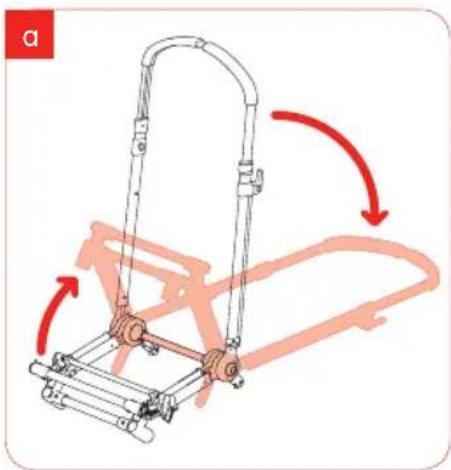
step 1 folding out the chassis and handlebar
a Place the chassis with the 4 points on the floor.
b. Stand with the handlebar in front of you.
c. Hold the handlebar lightly in your hands. Do not push.
d Press the 2 white buttons on the inside of the handlebar. The button on your left hand side has a secondary lock and therefore has to be slid forward a little before pushing.

natural_image
Technical line drawing of a mechanical linkage assembly (no text or symbols)
natural_image
Diagram of a cable with a connector and a red arrow indicating direction (no text or symbols)e Let go of the white buttons and then move the handlebar upwards and away from you. You will hear a 'click' when the handlebar is uptight.

text_image
e 'click' 'click'
swivel wheels
The swivel wheels provide optimum manoeuvrability.
step 2 placing the swivel wheels in the holders
a Without releasing it, move the handlebar to the floor. The wheel axles are now facing upwards. It is easy to install the wheels this way.
natural_image
Mechanical device with red arrows indicating motion or rotation, no visible text or symbolsb Move the white sliding buttons upwards. These are the swivel wheel locks.

natural_image
Diagram of a mechanical device with a hand operating a lever and a red arrow indicating motion (no text or symbols)C Stand with wheel axles in front of you. With the wheel facing upward and the wheel lock facing away from you, push the swivel wheel into the holder.

text_image
C 'click'd. You will hear a 'click' for each wheel. The swivel wheels are now attached.
Note Do not fit the swivel wheels on the wrong side of the holder.
other functions
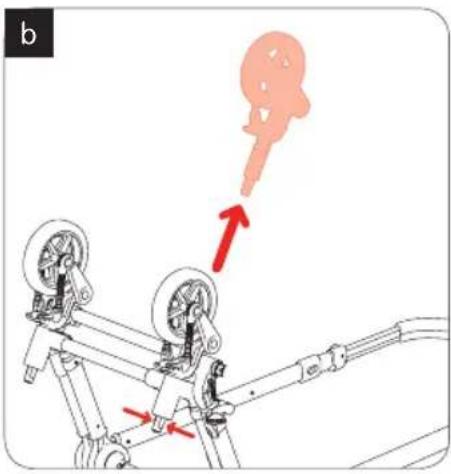
removing the swivel wheels from the holders
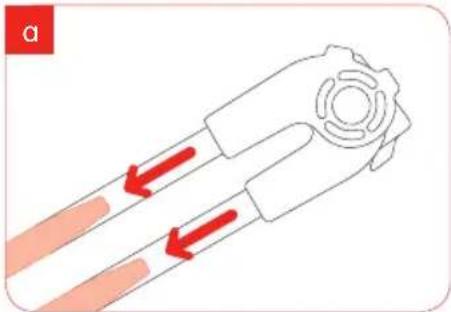
a. The swivel wheel has a round button, which protrudes through the holder. The button has 2 sprung lips.
b Squeeze the 2 lips together and remove the swivel wheel from the holder.
c. Do the same on the other side.
swivel wheels active
a. Push down the swivel locks.
b. The swivel wheels are active.
c. The Bugaboo Cameleon's manoeuvrability is highest with this setting.
swivel wheels not active
a. Push up the swivel locks.
b. The swivel wheels are non-active.
c. The Bugaboo Cameleon now moves in a straight line.
adjusting the swivel wheels
The suspension is usually adjusted to the lightest setting.
a. Set the swivel wheels to non-active.
b Pull down the white spring clamp.
text_image
b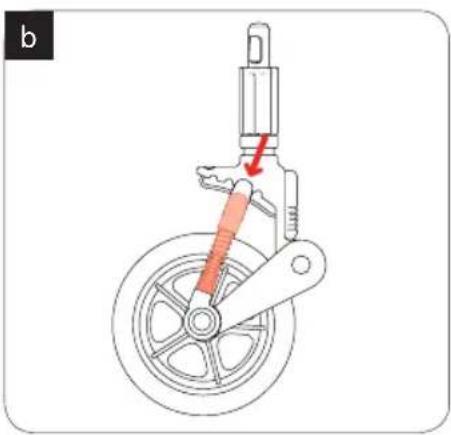
natural_image
Illustration of a mechanical device with a red arrow indicating force or movement, showing a wheel and lever mechanism (no text or symbols)c Slide the white spring clamp to one of the 4 positions.
d. Fasten the spring on both swivel wheels in the same position.
Advice The more upright the springs when the 4 wheels are on the floor, the more rigid the suspension.
Advice For ongoing optimum comfort, Bugaboo recommends adjusting the spring one notch for every 5kg of load (child + baggage in the underseat bag).

text_image
CWARNING
- ALWAYS put both swivel wheel springs in the same position. This prevents instability.
large wheels
The 2 large wheels now have tires filled with polyurethane foam. These provide enduring suspension on both sides without the risk of a puncture. This will therefore guarantee the driving comfort for you and your child.
step 3 fitting the large wheels to the axle
a Push the large wheels into the wheel holders at the ends of the long axle.
b. You will hear a 'click' for each wheel. The wheels are now attached.

text_image
a 'click'other functions
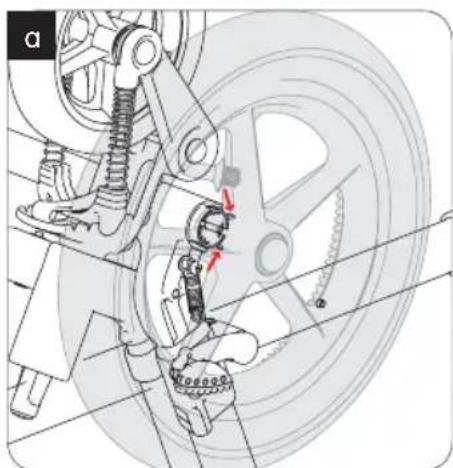
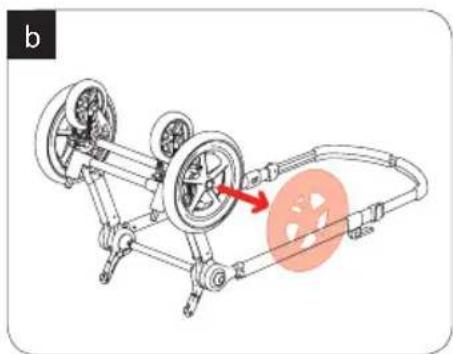
removing the large wheels from the axle
a Squeeze the clamp together that is located on the inside of a large wheel.
natural_image
Mechanical assembly diagram showing a car wheel and suspension components (no text or labels)b Remove the wheel from the axle. Also remove the large wheel on the other side.
Note The large wheels cannot be removed from the axle if the Bugaboo Cameleon's parking brake is on.
natural_image
Mechanical assembly diagram showing a motor with rotating wheels and a red arrow indicating motion direction (no text or symbols)
unfolding the chassis
In order to fold out the chassis, it first has to be collapsed completely. To do so, please pull the handlebar up. The large wheels are on the floor. Release the handlebar and click it in position between the large wheels. The chassis is now folded up.
5 12
step 4 unfolding the chassis
a. Stand with the handlebar and large wheels in front of you.
b Release the handlebar and pull it up and towards you (let go of the release catch), until it 'clicks' in the fastened position.
c Push your foot against the axle of the swivel wheels.
d. The swivel wheels are released. The chassis is now standing on 4 wheels.

natural_image
Diagram of a mechanical vehicle with red arrows indicating rotational motion (no text or symbols)
natural_image
Illustration of a two-wheeled stroller with exhaust flames and a red arrow indicating airflow (no text or symbols)parking brake
The parking brake is on the handlebar. It prevents the large wheels from turning. Always apply the Bugaboo Cameleon's parking brake when the buggy is stationary, so that it cannot roll away. When the handlebar is above the large wheels, the parking brake is on the right on the handlebar, with the release button on the inside.
step 5 applying the parking brake
a Push the parking brake's handle away from you and downwards.
b. When the handle will not move any further, the Bugaboo Cameleon's parking brake is on.
Note You will be able to feel when the parking brake is working properly. Do not force the parking brake.
natural_image
Mechanical diagram showing a lever mechanism with a red curved arrow indicating rotation (no text or symbols present)other functions
releasing the parking brake
a Grip the handle tightly with one hand. Press the white, round button on the handle with the other hand and move the handle towards the handlebar.
b. The parking brake is now off.
Note If you press the white, round button on the handle without holding the handle tightly, the parking brake will be released suddenly. To avoid injury, do not place your fingers between the handle and the handlebar.
Note Release the Bugaboo Cameleon's parking brake when removing the large wheels from the axle.

natural_image
Illustration of a hand holding a cable with a red arrow indicating rotation (no text or symbols)adjusting the parking brake
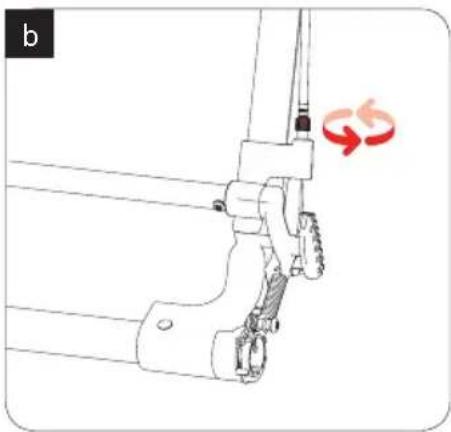
a. Place the handlebar above the large wheels.
b Screw the brake cable adjuster upwards. The brake cable is on the thin axle, next to the wheel on the right. This reduces the braking force.
c. Screw the brake cable adjuster down to increase the braking force.
WARNINGS
- Only apply the parking brake when the buggy is stationary.
natural_image
Mechanical assembly diagram showing a lever mechanism with red motion arrows indicating rotational motion (no text or symbols)13
en
adjusting the handlebar
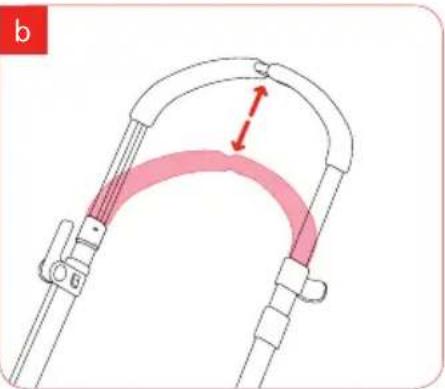
You can adjust the length of the handlebar.
step 6 adjusting the length of the handlebar
en
14
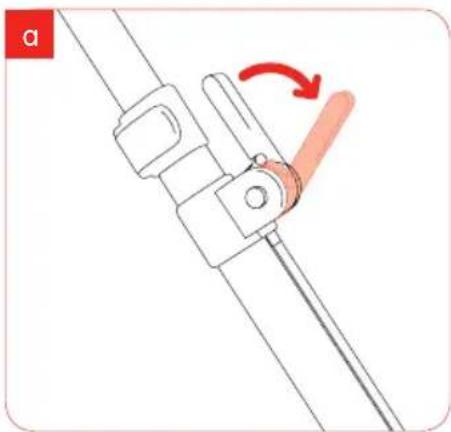
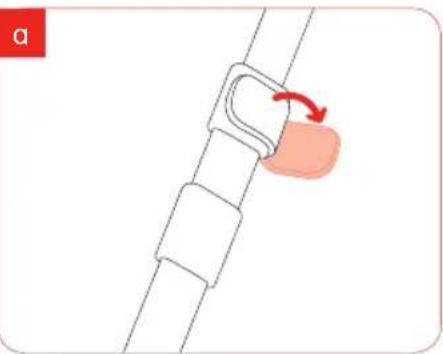
a Unfasten both white clips on the outside of the handlebar to open/ unlock.
natural_image
Diagram of a cable clamp mechanism with a red arrow indicating motion (no text or symbols)b This loosens the handlebar. Adjust it to the correct height.
c. Close both clips to secure the handlebar
natural_image
Diagram of a mechanical clamp or bracket with a red arrow indicating direction (no text or symbols present)WARNINGS
- Check that the handlebar is properly fastened.
- The wing nuts must be in the locked position when the handlebar is flipped to the reverse side to ensure the handlebar securely locks into place.
frame
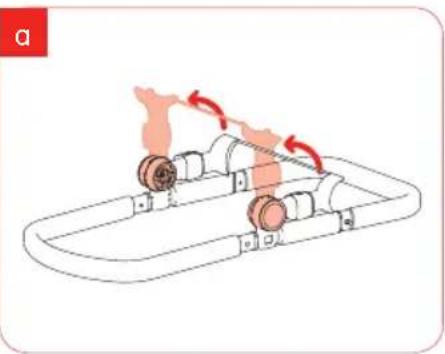
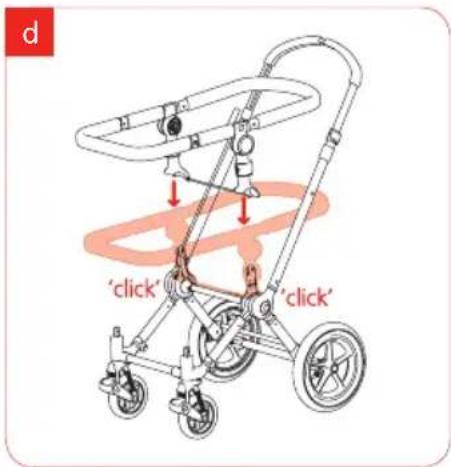
The frame is fastened to the chassis; the chassis is then secured. The carrycot or seatfabric is attached to the frame. The frame has 2 frame supports, which 'click' onto the 2 frame bearers. The round side of the frame is always the head end of the carrycot or seat.
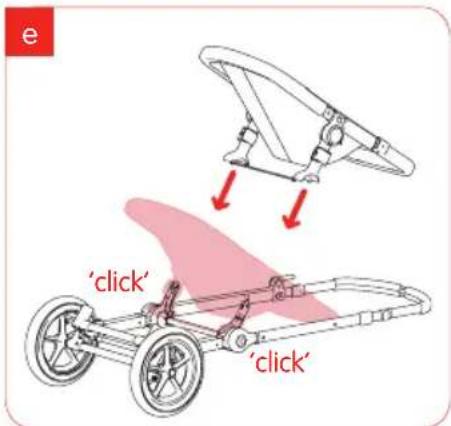
step 7 fitting the frame on the chassis
a Completely fold out the 2 frame supports.
b. Fit the frame supports on the frame bearers.
c. Hold the frame horizontal.
natural_image
Diagram of a mechanical device with rotating components and red motion arrows indicating motion (no text or symbols)d Press the frame downwards until you hear a 'click' on both sides. The frame is now attached to the chassis.
text_image
d 'click' 'click'
WARNINGS
- Check that the frame is attached to the chassis. Pick up the frame. If the frame releases one or both sides of the chassis, press the frame onto the chassis again until you hear a 'click' on both sides.
other functions
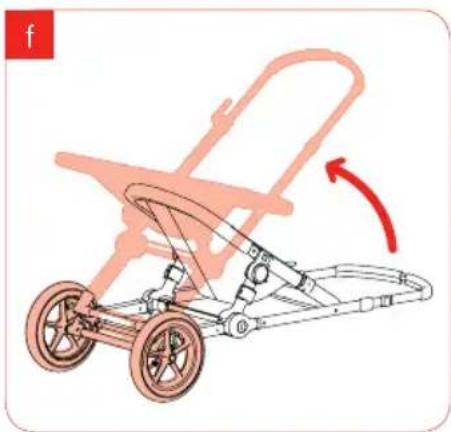
placing the frame in different positions
a. Place the frame on the chassis.
b Simultaneously press in the 2 round, white buttons at the top of the frame supports.
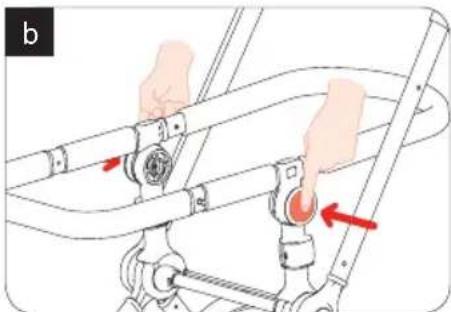
natural_image
Diagram of hands operating a mechanical device with red arrows indicating motion or force directions (no text or symbols present)c Tilt the frame by lifting the top part.
Note Just the seat can be put in 3 frame positions. The carrycot can only be used horizontally.
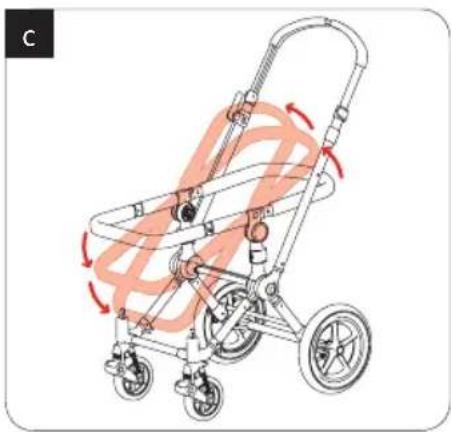
natural_image
Illustration of a baby stroller with motion arrows indicating movement (no text or symbols)removing the frame from the chassis
a. Place the frame in the horizontal position.
b Simultaneously press the 2 square, white buttons on the frame supports. This releases the frame.

natural_image
Mechanical assembly diagram showing a lever mechanism with red arrows indicating motion direction (no text or symbols present)€ Pick up the frame.
d. Place the frame on the floor, on the frame supports.
Note the 2 square, white buttons are always used to remove the frame, with the carrycot or the seat, and to place it on the floor.
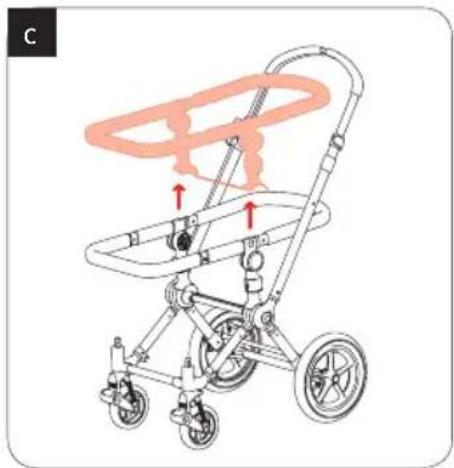
natural_image
Illustration of a baby stroller with red arrows indicating motion or airflow direction (no text or symbols)Turning the frame around
You can turn around the frame to change the seat and carrycot options.
a. Remove the frame from the chassis.
b While holding the frame in the horizontal position, turn it around.
c. Place it back on the chassis.

text_image
b 'click' 'click'
(
carry handle
The carry handle fits on the frame. You can easily pick up and turn around the carrycot or seat using the carry handle.
step 8 fitting the carry handle to the frame
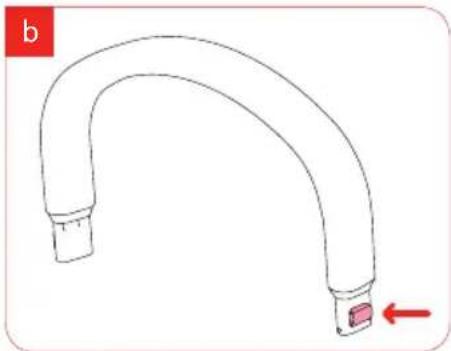
a. There is a small white button at each end of the carry handle.
b Press and hold both small white buttons.
c. Place the ends of the carry handle above the holes in the centre of the frame.
d Push it into the holes. You will hear a 'click'. The carry handle will then be securely fastened.
Advice Remove the carry handle by pressing both buttons at the same time and then pulling out the carry handle.
natural_image
Simple line drawing of a curved pipe with a small rectangular component and a red arrow indicating direction (no text or symbols)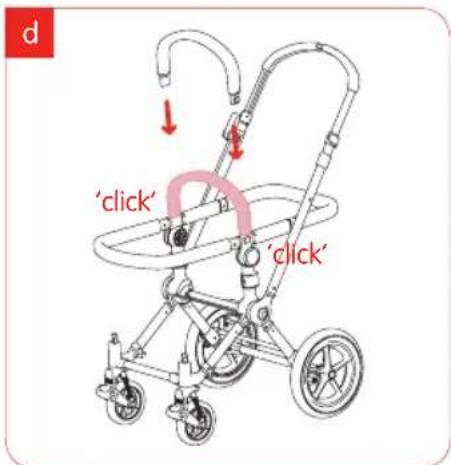
text_image
d 'click' 'click'practicing
Now you have assembled the chassis you can:
- fold out the chassis;
- release, move and adjust the height of the handlebar;
- fit and remove the swivel wheels;
- activate and de-activate the swiveling action of the swivel wheels;
- adjust the suspension of the swivel wheels;
- fit and remove the large wheels;
- use the parking brake;
- fit, remove and turn around the frame;
- place the seat in different positions;
- fit and remove the carry handle.
17
en
2. assembling the carrycot
The carrycot consists of the frame, the carrycot fabric, with base plate, mattress and the apron. Touch fasteners ensure the carrycot hangs stably in the frame.
step 1 attaching the carrycot fabric to the frame
The round side of the carrycot fabric fits in the round side of the frame.
a. Fit the frame (horizontally) onto the chassis.
b. Unfasten the touch fasteners.
c Fasten the 12 touch fasteners tight to the frame, in the order 1 to 6.
d Fasten the touch fasteners to the frame supports below the square, white buttons.
e Place the 2 waist belts in the pockets near the frame supports on the sides of the carrycot.
Note Make sure the plastic wires at the top and bottom stay in their bags.

text_image
C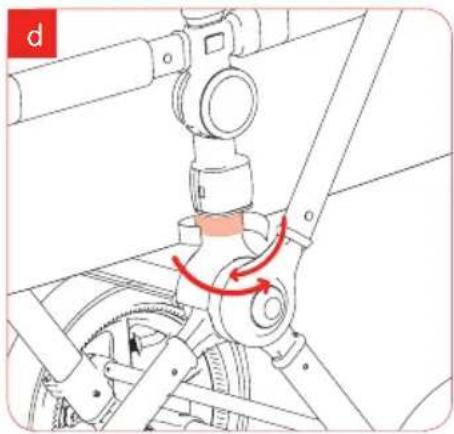
natural_image
Mechanical assembly diagram showing a rotating component with red motion arrows indicating rotational motion (no text or symbols)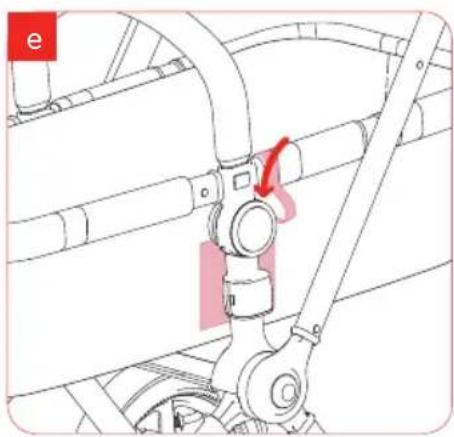
natural_image
Mechanical assembly diagram showing a lever mechanism with a red arrow indicating motion (no text or symbols present)step 2 fitting the mattress
a Place the round side of the mattress against the round side of the carrycot, with the cover opening pointing downwards.
natural_image
Line drawing of a baby stroller with wheels and a pink canopy cover, no text or symbols present
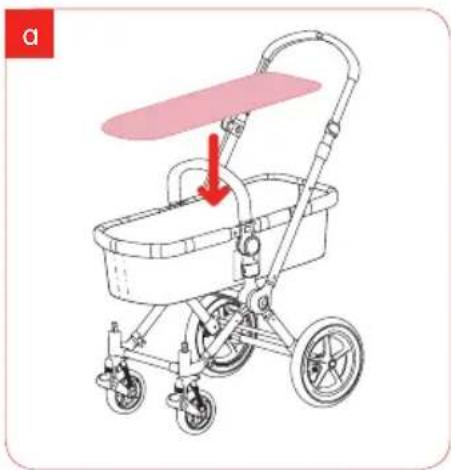
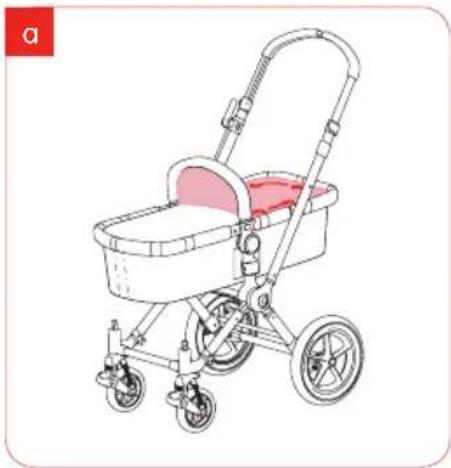
step 3 fitting the tailored apron
The apron protects the child against the cold and is fitted to the foot end of the carrycot.
a Zip the apron onto the carrycot. First make sure that the runners at the end on the left are next to each other.
b. If you use the sun canopy, pull the apron's small elastic bands over the buttons of the sun canopy's clamps.
Note See section 8 on fitting the sun canopy. You can leave the apron on the carrycot when fitting the sun canopy, rain cover and mosquito net.
natural_image
Illustration of a baby stroller with pink lid and wheels (no text or symbols)3. assembling the seat
The seat comprises the seat fabric, which is pulled over the frame. The seat fabric is fitted with back pad supports, foot support and seat pad. The seat has 2 shoulder belts, 1 crotch belt and 1 tensioning belt with metal O-rings. The seat fabric has cut-aways on the left and right for the waist belts. The frame has 2 waist belts. When fastened together, the waist belts should stay in place at the height of the side supports.
step 1 placing the seat fabric on the frame
a. Fold out the frame supports and place the frame on the floor.
b Slide the rounded upper side of the base seat fabric over the round side of the frame, with the Bugaboo logo facing forward. Pull on the seat fabric so that it fits tightly.

natural_image
Line drawing of a car seatbelt device with a red arrow indicating the motion direction (no text or symbols)c Place one O-ring of the tensioning belt over the protruding pin on the side of the frame.
d. Place the frame on that side to fasten the O-ring on the other side.
e. Lean on the frame and push it inwards a little. Take hold of the tensioning belt and pull the other metal O-ring over the protruding pin.

natural_image
Line drawing of a car seat assembly with a red-handled tool, no text or symbols presentf Attach the ends of the stretch belt underneath the seat. You should hear a click.
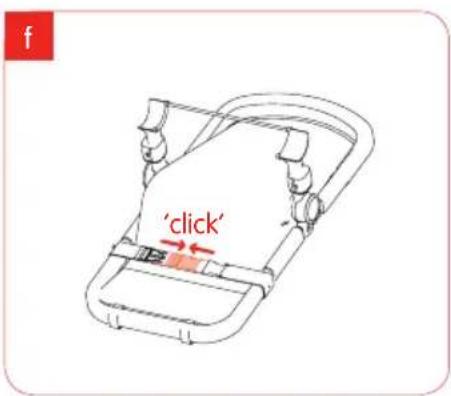
text_image
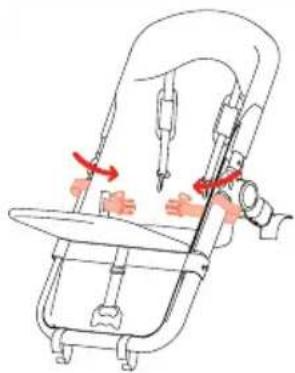
'click'9 Now pull the waist belts through the cut-aways in the side of the seat fabric. Put the tailored seat fabric over the base fabric. Pull the shoulder belts and the lap belts through the tailored seat fabric. Then attach the tailored seat fabric to the base fabric with the touch fasteners.
g
natural_image
Illustration of a baby seat with hands operating the seat, no text or symbols present21
en
Now give shape to the seat by folding the seat pad inwards.
h

natural_image
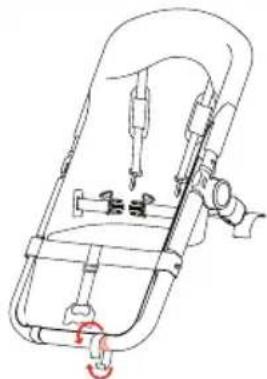
Diagram of a mechanical device with a tool and directional arrow indicating rotation (no text or symbols)i Attach the 2 touch fasteners at the foot end to the underneath of the frame.
Note Assemble the seat before fitting it onto the chassis. The seat cannot be placed on the frame before assembly. Ensure that the touch fasteners and tensioning belt are fastened properly.
i
natural_image
Technical line drawing of a mechanical device with no visible text or symbols(
4. various uses of carrycot and seat
You can use the carrycot from the child's birth until the child is aged around 6 months. It is only intended to be used for children who cannot sit or get up onto their hands and knees unaided. Do not use the carrycot for children who are longer than 76cm / 29.9 inches or heavier than 9kg / 19.8 lbs.
You can use the seat for children older than 6 months who do not weigh more than 17 kg/37.5 lbs.
carrycot
The child is able to lie down completely. This means the spine is not placed under any stress and the child can stretch his/her legs. For use as a pram, only place the carrycot horizontally on the chassis. The carrycot can be turned around easily. This enables you to see into the carrycot and the child can look at you. The carrycot can also be used without the chassis, provided it is placed on a horizontal, stable and dry surface.
WARNINGS
- Use the carrycot only if installed on the chassis or when placed on a horizontal, stable and dry surface.
- Only use the carrycot in the horizontal position. In any other position, the child may slide or fall out of the carrycot.
- Ensure that all the touch fasteners and fasteners are securely fastened before use.
- NEVER use the carrycot as a car bed. Avoid injurious or fatal accidents.
- NEVER use the carrycot fabric when it is not attached to the frame.
- Before picking up the carrycot by the carry handle, always check that the carry handle is properly secured.
- Use the carrycot only if installed on the chassis or when placed on a horizontal, stable and dry surface
- Use a harness as soon as your child can sit unaided.
seat
You can set the seat to one of three positions. This is only possible if the seat is on the chassis. The 3 positions are:
- sitting 2. reclining 3. lying
Note The child's posture (angle between the back support and seat pad) remains the same in the 3 positions.
The seat can be turned around easily. That is how you change the direction your child is facing. The seat can also be used separately from the chassis. You can use the seat as a free-standing seat on the ground, if you fold out the frame supports completely.
WARNING
- Before picking up the seat by the carry handle, always check that the carry handle is properly secured.
- Use safety belts when your child can sit up on its own.
5. using the seat safety belts
The Bugaboo Cameleon seat has a 5-point harness, which comprises: 2 shoulder belts, 1 crotch belt and 2 waist belts (fastened to the frame). Use the safety belts when the child is sitting in the seat. Prevent the child from falling out of the seat and being injured.
23
en
Note The Bugaboo Cameleon's carrycot and frame are fitted with extra fastening rings. If required, you can use them to attach an extra harness or extra belts. The fastening rings are attached to the base of the carrycot. The waist belts with extra fastening rings are attached to the frame.
step 1 using safety belts
a. Fit the seat to the chassis (with the brake applied) or on the floor.
b. Place the child in the seat.
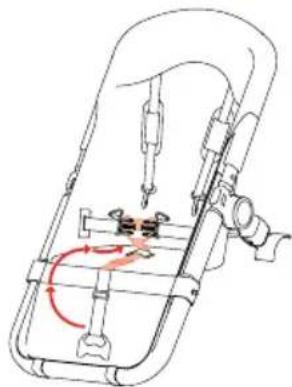
c Pull the crotch belt forwards between the child's legs. If the child slides down, first pass the crotch belt through the black loop on the seat pad.
C
natural_image
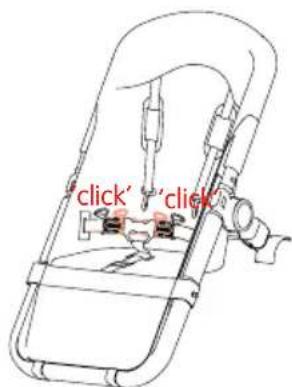
Technical line drawing of a mechanical device with no visible text or symbolsd Attach the waist belts over the child's waist to the crotch belt. Adjust the belts to the size of the child, by pulling them tight.
d
text_image
"click" "click"
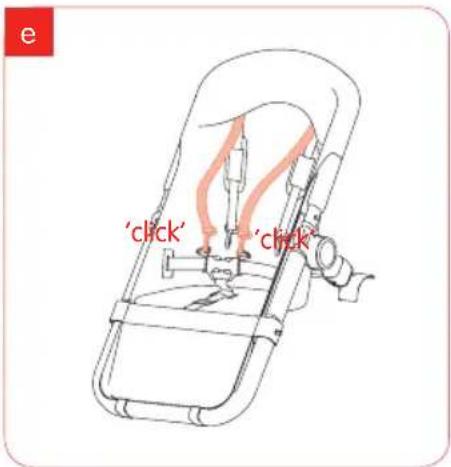
e Attach the shoulder belts over the child's shoulders to the crotch belt. Adjust the belts to the length of the child, by pulling them tight.
f. You should now have heard a 'click' 4 times. This means the child is sitting securely in the Bugaboo Cameleon seat.
text_image
e 'click' 'click'WARNINGS
- Ensure that all the touch fasteners and fasteners are securely fastened before use.
• Always use the crotch strap in combination with the hip belt. - Always secure the child in the seat belts. Avoid being caught off guard by the child making unexpected movements.
- The safety belts must be adjusted to fit the child and must be properly secured.
- If your child slides down, pass the crotch belt through the loop on the seat's seat pad before attaching it to the waist and shoulder belts.
6. fitting the underseat bag
The underseat bag hangs under the carrycot or seat.
step 1 fitting the underseat bag
The underseat bag is fastened between the wheels of the chassis.
a. Remove the frame from the chassis.
b Fit the underseat bag to the chassis in between the axles of the wheels with the Bugaboo logo facing the large wheels.
c Attach the 2 touch fasteners to the upper centre shaft.
d Attach the other 2 touch fasteners to the supports of the swivel wheels.
Note The underseat bag is made to carry a maximum weight of 4 kg/8.8 lbs. Before use, ensure that all the touch fasteners are properly attached.

natural_image
Line drawing of a baby stroller with two wheels and a curved handle (no text or symbols)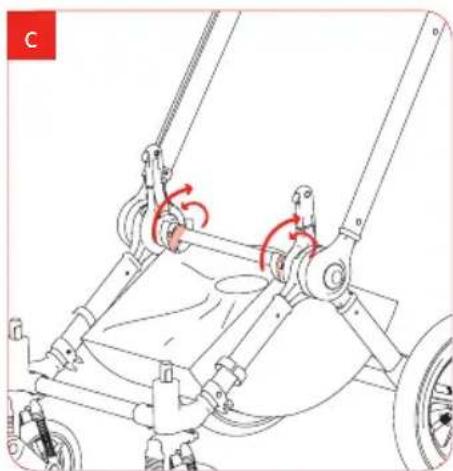
natural_image
Mechanical assembly diagram showing a vehicle chassis with rotating components and red motion arrows (no text or symbols)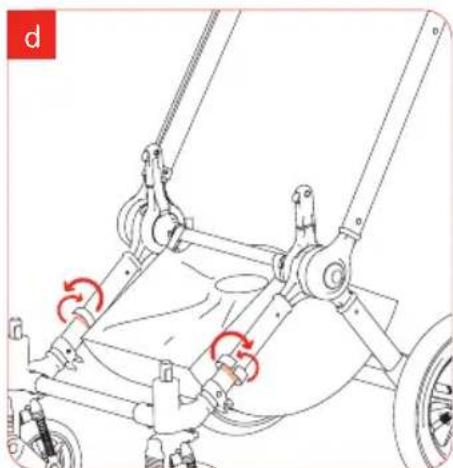
natural_image
Mechanical assembly diagram showing a frame with levers and wheels, no text or symbols present25
en
7. going outdoors with the bugaboo cameleon
The Bugaboo Cameleon is designed for use in the city, in rough terrain or in the 2-wheel position.

city position
a. Use the 4-wheel position.
b Place the handlebar above the large wheels.
c. Do not fix the position of the swivel wheels.
This is the Bugaboo Cameleon's most manoeuvrable setting.
natural_image
Illustration of a baby stroller with a curved handle and wheels, showing a red arrow indicating motion (no text or symbols)rough terrain position
a. Use the 4-wheel position.
b Place the handlebar above the swivel wheels.
c. Put the swivel wheels in the fixed position.
With the large wheels at the front, you can easily push the buggy over uneven ground.
natural_image
Illustration of a baby stroller with a red curved arrow indicating motion (no text or symbols)2-wheel position
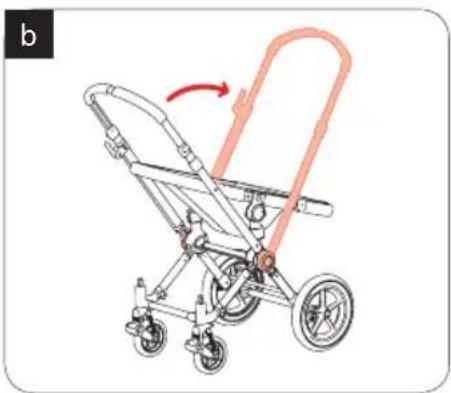
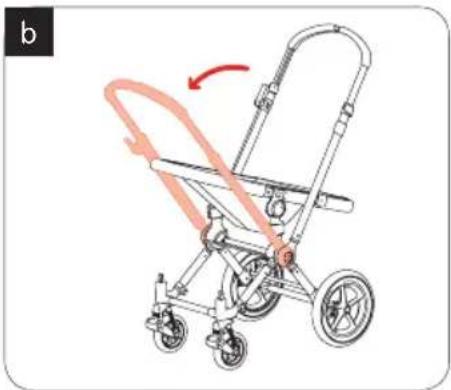
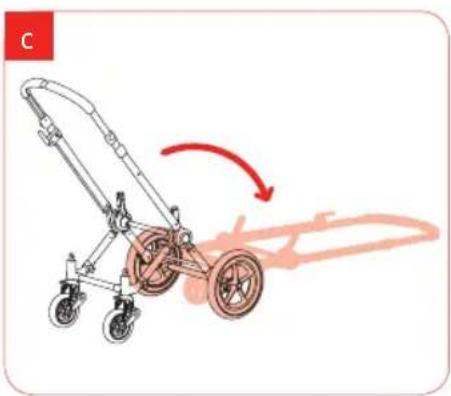
Use the Bugaboo Cameleon in the two wheel position on rough terrain.
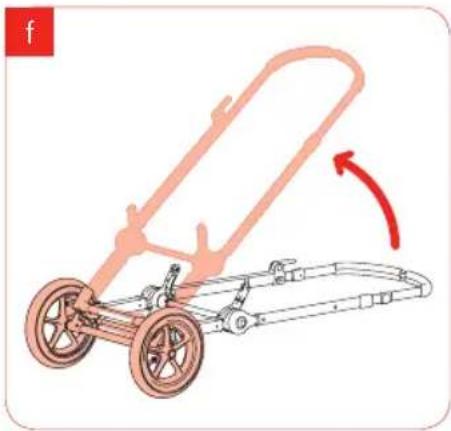
step 1 putting the chassis in the 2-wheel position
a. Remove the frame from the chassis.
b. Place the handlebar above the swivel wheels.
c WITHOUT releasing the handlebar, swivel it to the other side, until it is lying on the floor.
d. Attach the black clamps to the swivel wheel holder on the thin shaft in between the large wheels. You should hear a click.
e. Remove the swivel wheels. Check that the large wheels are properly attached.
natural_image
Illustration of a baby stroller with wheels and a red curved arrow indicating motion (no text or symbols)f Raise the handlebar. The chassis is now in the 2-wheel position.
Advice Put the swivel wheels in the underseat bag.
natural_image
Illustration of a toy car with wheels and a curved handle, showing a red rotation arrow (no text or symbols)
step 2 fitting the seat
a. Apply the parking brake.
b. Lay the chassis on the floor with the frame bearers facing upwards.
c. Completely fold out the seat's 2 frame supports.
d. Place the seat on the frame bearers.
e Push until you hear a 'click' on both sides. The seat is now attached to the chassis.
text_image
e 'click' 'click'f Push the handlebar up and move the seat to the desired position.
g. Allow the handlebar to go down. Now place the child in the seat.
h. Fasten the safety belts.
i. Place the wrist strap on your wrist.
natural_image
Illustration of a baby stroller with a red arrow indicating motion (no text or symbols)

text_image
Take the Bugaboo Cameleon off the parking brake. Note The 2-wheel position provides much less sideways stability than the 4-wheel position.
natural_image
Line drawing of a baby stroller with wheels and handle, no text or symbols presentsurface that is difficult to traverse, or snow
Use the Bugaboo Cameleon in the 2-wheel position if the ground is rough, covered with snow or covered in loose sand, for example. Choose the 4-wheel position if the ground is hard or compact sand. You will develop your own preferences for this.
wrist strap
Always use the wrist strap. Ensure that the handlebar does not slip out of your hands.
WARNINGS
- Never release the handlebar in the 2-wheel position. The seat may tip over and the child may fall out and be injured.
- Ensure that all the touch fasteners and fasteners are securely fastened before use.
- Don't forget that in the two wheel position the seat is not reversible.
- Never use the 2-wheel position in combination with the carrycot.
- Use the wrist strap in the 4-wheel position as well as the 2-wheel position.
- Prevent the Bugaboo Cameleon from falling over sideways in the 2-wheel position.
- Please remove the swivel wheels when using the two wheel position.
• The Bugaboo Cameleon is not resistant to saltwater. Do not push it in the sea.
8. protection against weather and wind
The standard version of the Bugaboo Cameleon comes with a sun canopy, rain cover and mosquito net, so you can protect the child against the sun, wind and rain, as well as insects. The necessary steps to make the Bugaboo Cameleon ready for use in good or bad weather are the same for the carrycot and the seat.
29
en
Note The sun canopy, the rain cover and the mosquito net can be used in combination with the seat up to a length of 53 ~cm / 20.9 inch of the upper body of the child
tailored sun canopy
The sun canopy comprises 2 canopy clamps, 2 removable frames and fabric
step 1 preparing the tailored sun canopy for use
a Pull the frames out of the canopy clamps.
b. Lay the sun canopy down with the logo facing downwards.
c. Push the frames through the slots in the sun canopy fabric.
d put the canopy clamps back on the frames.
Note The hooks on the canopy clamps always point to the back of the sun canopy. When putting the canopy clamps back on the frame, make sure the wire in the canopy is on top.
natural_image
Illustration of a tool with red arrows indicating motion or force direction (no text or symbols)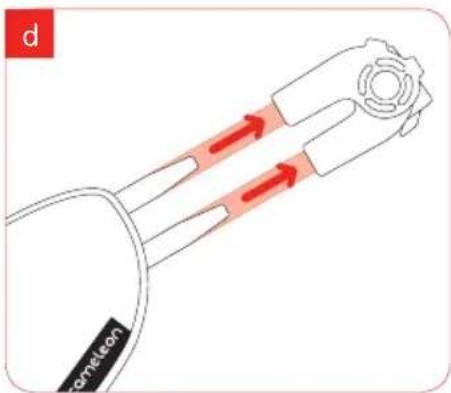
natural_image
Diagram of a pliers with red directional arrows indicating movement or force (no text or symbols)step 2 fitting the tailored sun canopy
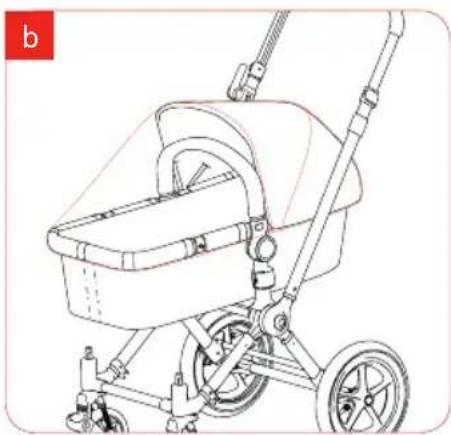
a. Fit the carrycot or seat onto the chassis.
b. Fit the sun canopy to the round side of the frame.
c. Pull the sun canopy over the head end of the frame.
text_image
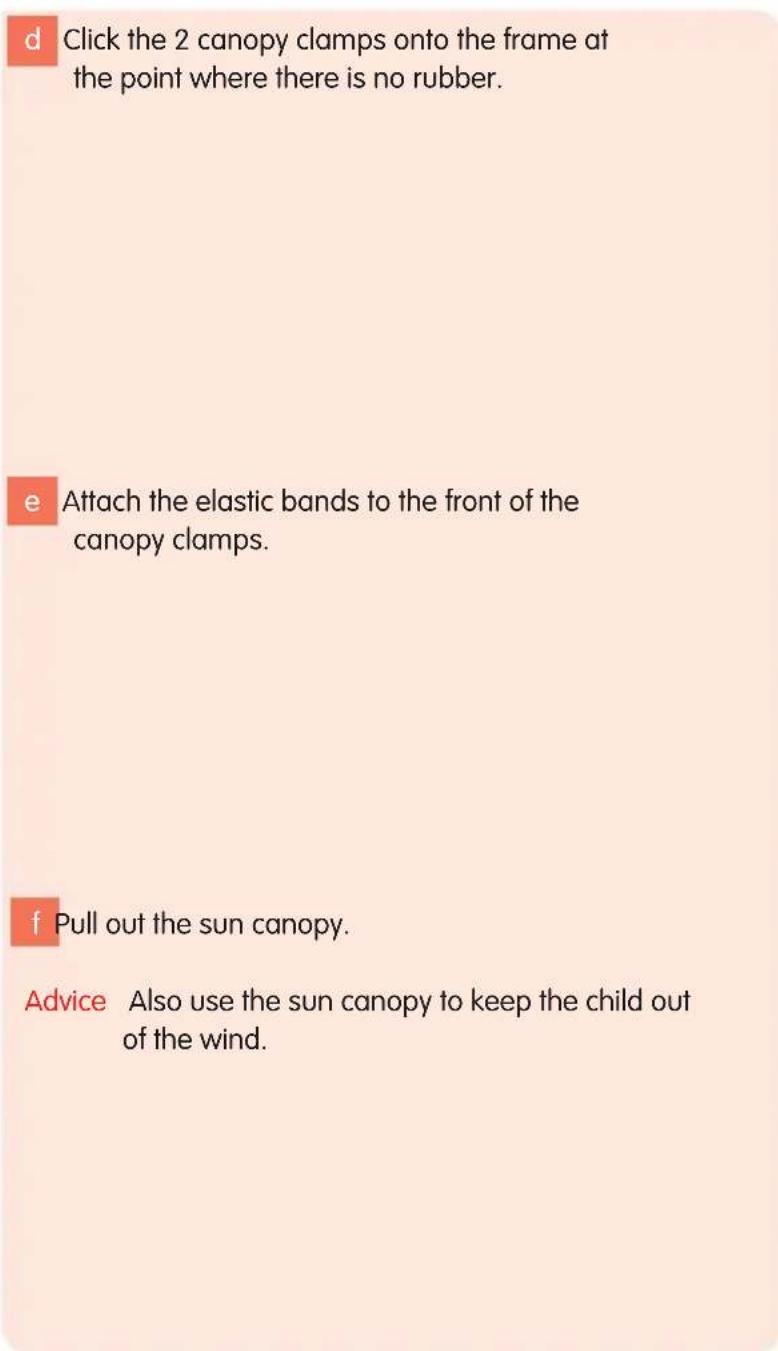
d Click the 2 canopy clamps onto the frame at the point where there is no rubber. e Attach the elastic bands to the front of the canopy clamps. f Pull out the sun canopy. Advice Also use the sun canopy to keep the child out of the wind.
text_image
d 'click' 'click' e fWARNINGS
- Babies have very sensitive skin. Never put a baby in the Bugaboo Cameleon in the sunlight without fitting the sun canopy.
rain cover
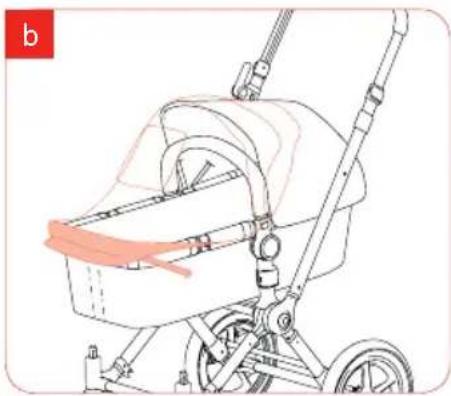
The rain cover is pulled over the sun canopy or over the sun canopy's frame. The large frame in the rain cover is attached to the foot end of the frame.
step 1 fitting the rain cover over the tailored sun canopy
a. Fit the sun canopy to the frame and fold it out.
b Lay the rain cover with the wide, black edge on the foot end.
c Pull the rain cover over the sun canopy first.
d. Ensure that the stitched seams of the rain cover are aligned with the sun canopy's frame.
e Slide the holes of the rain cover frame over the protruding pins on the side of the frame
f Finally, pull the wide, black edge over the foot end of the frame.
Note Ensure that the stitched seams of the rain cover are aligned with the sun canopy's frame.
natural_image
Line drawing of a baby stroller with handlebars and wheels (no text or symbols)
natural_image
Line drawing of a baby stroller with a red arrow indicating rotation (no text or symbols)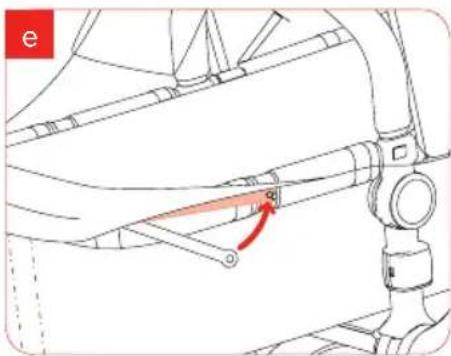
natural_image
Technical line drawing of a mechanical assembly with a red arrow indicating a specific component (no text or symbols present)
natural_image
Illustration of a baby stroller with a highlighted seat and motion arrow (no text or symbols)step 2 fitting the rain cover over the tailored sun canopy's frame
If you remove the fabric from the sun canopy and fit the rain cover over the frame, the child will have a full view of outside the buggy.
5 32
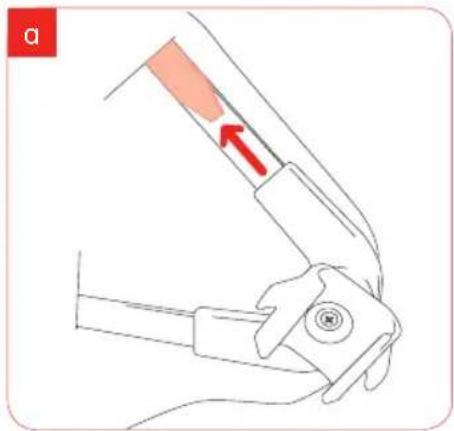
a Pull the sun canopy apart. Pull the frame out of the canopy clamps and out of the fabric.
b Place the clamps on the frame. Insert the frame back into the canopy clamps.
c Pull the frame apart.
d. Lay the rain cover with the wide, black edge on the foot end.
e. Pull the rain cover over the sun canopy's frame first.
f. Ensure that the stitched seams of the rain cover are aligned with the sun canopy's frame.
g. Slide the holes of the rain cover frame over the protruding pins on the side of the frame.
h. Finally, pull the wide, black edge over the foot end of the frame.
Note Ensure that the stitched seams of the rain cover are aligned with the sun canopy's frame.
natural_image
Illustration of a hand gripping a tool with a red arrow indicating force direction (no text or symbols)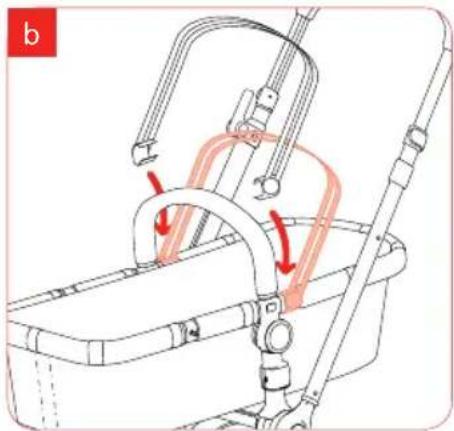
natural_image
Diagram of a mechanical device with tubing and a central component, showing red arrows indicating motion or force direction (no text or symbols present)
natural_image
Technical line drawing of a mechanical device with no visible text or symbolsusing the air vent in the rain cover
There is an air vent at the front of the rain cover to provide proper ventilation.
a. Press the window's touch fasteners together properly. The space created between the window and rain cover is the air opening.
Advice You can roll up the air vent and fasten it in place with the touch fastener.
33
en
WARNINGS
- To prevent the child from overheating, do not leave him/her under the rain cover if it is not raining.
- Ensure proper ventilation by pressing the touch fasteners of the air vent together properly.
mosquito net
The mosquito net keeps out insects.
step 1 fitting the mosquito net
a. Fit the sun canopy, with or without its fabric, to the carrycot or seat.
b With the washing instructions at the head end, pull the mosquito net over the sun canopy.
c. Ensure there is a tight fit between the sides of the net and the carrycot or seat.
natural_image
Line drawing of a baby stroller with wheels and a basket (no text or symbols)9. travelling and storage
You can easily store the Bugaboo Cameleon, or take it with you in the boot of your car, for example.
step 1 folding the seat or carrycot
Remove the seat or carrycot from the chassis. Remove the carry handle.
Move the handlebar to the lowest position.
folding the seat
a. Remove the seat pad from the seat.
b. Fold the frame supports against the frame.
c. Press the seat flat between the frame.
folding the carrycot
d. Remove the 2 plastic stiffners at the top and bottom from pockets in the carrycot fabric.
e. Fold out frame supports against the frame.
f. Press the carrycot down flat between the frame.
step 2 folding the chassis and wheels
a. Put the Bugaboo Cameleon chassis in the 4-wheel position.
b. Place the handlebar above the large wheels.
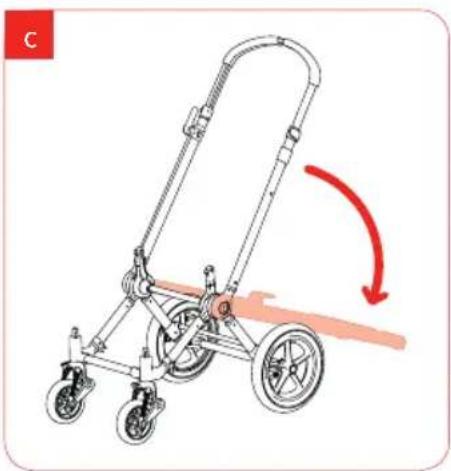
c Release the handlebar and, pulling it towards you, place it on the floor.
natural_image
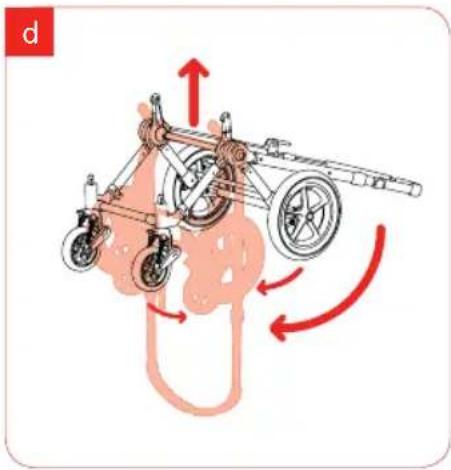
Illustration of a baby stroller with wheels and a curved handle, showing motion direction (no text or symbols)Take hold of the centre shaft on which the frame bearers are located and lift everything up. The chassis with the wheels and handlebar now fall against each other.
e. The Bugaboo Cameleon can now be put in storage or transported by car.
Advice You can also store the Bugaboo Cameleon without its wheels.
Advice You can also hang the folded Bugaboo Cameleon from the handlebar.
text_image
d
(
(
10. maintenance and accessories
safety
Check the safety of the Bugaboo Cameleon before use. Ensure that the touch fasteners, the brake and the safety belts are still working properly, the carry handle is attached properly and that the carrycot or seat is fitted correctly to the chassis. Check whether the Bugaboo Cameleon is damaged. You should ensure that any damaged or worn parts are repaired immediately.
parts
For replacements, only use parts that have been approved by Bugaboo International BV.
To prevent mould, do not fold the Bugaboo Cameleon and accessories when wet or store them in a damp place.
cleaning
Clean the Bugaboo Cameleon regularly. Use a moist cloth and mild cleaning agent.
The swivel wheels soon get dirty. Remove them from the holders and clean them with lukewarm water. Dry them well.
cleaning the fabric
The Bugaboo Cameleon's fabric is detachable and may be washed in a washing machine.
Wash carefully. Before washing, ALWAYS remove the frame, reinforcements and plastic foam parts.
Note When washing the fabric, remind the following:
- maximum temperature 30 °C
- do not use bleach
- do not tumble dry
- do not iron
- do not dry clean
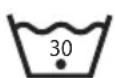


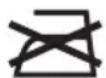
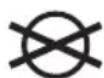
The aerated inlay can be washed at 60^ C. At this temperature, the inlay will become totally clean. The aerated inlay is placed on top of the thicker foam mattress and can be taken of by removing the mattress cover. After washing the fabrics, ensure that all parts are replaced in their original positions. The aerated inlay should be placed on top of the foam mattress. Do not use the mattress without the aerated inlay.
Tip For further maintenance tips, see the user guide of the Bugaboo maintenance kit.
accessories
New accessories are regularly produced for the Bugaboo Cameleon. Full details are provided on the website www.bugaboo.com or you can ask your supplier for details.
available bugaboo accessories are:
- Adapters for various car seats
- Breezy sun canopy
- Cup holder
- Diaper bag
- Foot muff
- Maintenance kit
- Parasol
- Snow wheels
- Sunshade
- Tailored fabric
- Transport bag
- Wheeled board
comment
We are always trying to improve our Bugaboo products, so we are interested in your feedback about such things as design, user friendliness, materials and instructions.
Write to us at the following addresses:
Bugaboo Service
Postbus 1299
1000 BG Amsterdam
The Netherlands
service@bugaboo.com
11. warranty
As the manufacturer, Bugaboo International BV, which has its principal place of business in Amsterdam (hereinafter: "Bugaboo") supplies the Bugaboo Cameleon (hereinafter: "product") under warranty, subject to the following conditions:
- The warranty period is 24 months, from the date of purchase. The warranty period shall never be extended, even in the event of repairs being made.
- This warranty is valid all over the world, except in the United States of America and Canada.
- The warranty provides a right to repair and specifically not to a product's exchange or return.
- Bugaboo shall bear the expense and risk of transport from and to the retailer (hereinafter: "the retailer") where you purchased the product, provided the repair is covered by warranty.
- The warranty may only be invoked if you provide Bugaboo with the following, along with the defective product:
- a copy of the dated receipt of purchase, and
-
a clear description of the complaints.
-
The warranty is not transferable and may therefore only be invoked by the first owner.
-
The warranty does not affect any statutory rights you may have, for example the right to hold the retailer accountable for defects.
no warranty will be provided in the following circumstances:
- If you have made or arranged for modifications or repairs to be made without written permission first having been received from Bugaboo or the retailer.
- Defects resulting from neglect or an accident and/or from any use or maintenance other than that indicated in the user guide.
- If the serial number has been damaged or removed.
- Damage to the product caused by normal wear.
important
The product is covered by a 24-month warranty from the date of purchase. In the event of a defect, you are requested to first contact your retailer. If the retailer is unable to repair the defect, you can contact Bugaboo. The warranty only applies if the warranty card has been completed properly and sent to Bugaboo International BV. Note the serial number of the Bugaboo Cameleon on your warranty card. The serial number is on the sticker attached to the centre shaft of the chassis. Keep the user guide and purchase receipt in a safe place.