
KB-7345 - Refrigerator TRISTAR - Free user manual and instructions
Find the device manual for free KB-7345 TRISTAR in PDF.


| Product Type | Portable Absorption Refrigerator |
| Model | KB-7345 |
| Gross Volume | 39 L |
| Climate Class | N |
| Insulation Class | I |
| Refrigerant | NH4 (80g), H2O, He |
| Foam Vesicant | H2O |
| Net Weight | 8.5 kg |
| Mains Voltage | AC 230V |
| Rated Current (Mains) | 0.33 A |
| Rated Power | 75 W |
| Energy Consumption (Mains) | 0.73 kWh/24h |
| Battery Voltage | DC 12V / 24V |
| Rated Current (Battery 12V) | 6.25 A |
| Rated Current (Battery 24V) | 3.12 A |
| Energy Consumption (Battery 12V) | 50 Ah/24h |
| Thermostat Control | Yes (mains operation) |
| Defrosting | Manual, regular |
| Operation Modes | Mains (230V) and Battery (12V/24V DC) |
| Installation Clearances | Rear ≥10 cm, Sides ≥5 cm |
| Maintenance | Clean with warm water; no abrasive products |
| Safety Fuse Requirement | Required for battery operation |
Frequently Asked Questions - KB-7345 TRISTAR
User questions about KB-7345 TRISTAR
0 question about this device. Answer the ones you know or ask your own.
Ask a new question about this device
Download the instructions for your Refrigerator in PDF format for free! Find your manual KB-7345 - TRISTAR and take your electronic device back in hand. On this page are published all the documents necessary for the use of your device. KB-7345 by TRISTAR.
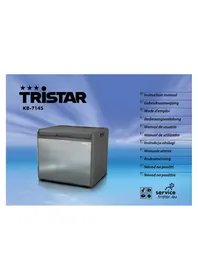
USER MANUAL KB-7345 TRISTAR
natural_image
Line drawing of a multi-tiered electronic device casing (no text or symbols)KB - 7345
230V - 12V
NL
DRAAGBARE ABSORPTIEKOELKAST
INSTALLATIE, BEDIENING EN ONDERHOUDSINSTRUCTIES
BELANGRIJK
Read the operating instructions carefully in order to get to know the equipment before putting it into operation.
Keep the instructions for future reference.
➢ Installation of the appliance
Install the appliance on a firm, horizontal surface. To level the appliance, use a spirit level or a vessel containing water, if necessary. If you want ice, place the tray filled with water on the cooling element.
Avoid installing the appliance in direct sunlight or near any source of heat.
The distance between the rear of the appliance and a wall shall not be less than 10 cm, and the minimum ventilating space from the sides of the appliance shall never be less than 5 cm.
In all cases, the location shall be protected from rain and splashing.
To guarantee a good level of air circulation, do not obstruct the ventilation grids of the upper, lower or rear surface of the appliance.
Complying with the above will ensure efficient an economical cooling.
Before the first use of the appliance, clean the inside and the cover of the appliance with warm water, adding detergent if necessary. Never use an abrasive product.
➢ Operation with the mains
Never use another source of energy at the same time (battery, liquefied petroleum gas). Check that the mains voltage corresponds to the operating voltage specified on the label (on the rear of the appliance).
If the electrical specifications are correct, push the safety electrical plug into an earthed wall socket which is wired according to the specifications.
Start-up
Turn the thermostat knob clockwise to the MAX position. The effects of the cooling
process (frost on the evaporator) only become visible after about an hour.
The thermostat enables the temperature of the refrigerator to be adjustable ("0" = cooling process stopped).
After a sufficient cooling period (approximately 5 hours), the thermostat can be set to an intermediate position. The selected temperature is regulated automatically by the thermostat.
Shut-down
Turn the thermostat knob anti-clockwise to the "0" position.
Remove the plug from the wall outlet.
➢ Operation with a battery (12V or 24V DC)
Do not use another source of energy at the same time (mains, liquefied petroleum gas). A safety fuse must be installed in the power supply line between the battery and the refrigerator.
For 12V, the maximum fuse rating is 6.25 amps. For 24V, the maximum fuse rating is 3.12 amps.
Max. cable length
| Cable cross-section | 12V DC | 24V DC |
| 2.5mm2 | 2.5m | 5m |
| 4.0mm2 | 4.0m | 8m |
| 6.0mm2 | 6.0m | 12m |
It is not necessary to check the polarity when starting up the appliance.
Check that the battery voltage corresponds to the operating voltage of the refrigerator, as marked on the corresponding the label. When the battery used is a car battery, only switch the refrigerator on while the car is traveling. If the refrigerator is left running when the car is stopped, this could discharge the battery and it may be impossible to restart the engine. When the appliance is running on the battery, there is no thermostat-controlled temperature regulation.
Recommendation
Pre-cool the refrigerator by running it on the mains, before starting the journey.
Start-up
Plug the connector supplied with the refrigerator into the cigar lighter socket of the vehicle.
Disconnection of the appliance
Unplug the connector from the cigar lighter socket.
Storing food
Liquids to be stored in the refrigerator shall always be placed in a closed vessel. The air circulation inside the appliance must not be obstructed.
Never place hot food or drink in the appliance.
Never keep flammable liquids and/or gases inside the refrigerator. Danger of
explosion.
> Defrosting – Measures to be taken if the appliance is to be left unused for a long period
The refrigerator must be defrosted regularly, in order to ensure that it operates correctly.
To defrost the refrigerator, disconnect it and remove all food outside. If necessary, use a cloth soaked with hot water. After de-icing, mop up the water with a dry clean cloth and clean the inside as described in paragraph =3.
If the appliance is to remain unused for a extensive period, disconnect it and remove all food outside. After de-icing, clean and dry the inside of the appliance.
In order to prevent unpleasant odor, leave the cover of the refrigerator slightly open.
➢ Measures to be taken after unused for a long period
If, after an extensive lay-up period, the refrigerator does not produce any cooling, disconnect the appliance and turn it upside down for a few minutes then turn it the right way up. After turn it over several times, reconnect it.
Maintenance
Clean the appliance regularly with warm water, containing a detergent if necessary. Never use an abrasive product. Dry the cleaned surfaces with a soft cloth. Use only clear water to clean the seal of the cover, and then coat the seal with talcum powder.
All repairs, particularly of the cooling unit or the gas burner system, must mandatorily be carried out by a qualified technician.
Service
If a problem occurs, carry out the following checks:
- Is the appliance installed in a horizontal position?
– Is there sufficient ventilation? - For 220V mains operation, check that the mains supply is correct. And is the thermostat set correctly?
- For battery operation, check the battery and the connection.
- Has too much food been placed inside the refrigerator all at once? Arrange the food so that the air is free to circulate inside the refrigerator.
Do not use pieces cardboard or plastic as separations. Keep vessels containing liquids closed.
If, despite the above checks, you still need to contact the service department, describe the failure and state the type of equipment and its serial number (these are marked on the lebel).
▶ Technical specifications
| Model | KB-7345 |
| Gross volume | 39L |
| Climate classification | N |
| Insulation class | I |
| Refrigerant | NH4(80g) , H2O , He |
| Foam vesicant | H2O |
| Net weight | =8.5kg |
| Mains voltage | AC230V |
| Rated current | 0.33A |
| Rated power | 75W |
| Consumption of energy | 0.73kWh/24h |
| Battery voltage | DC=2V |
| Rated current | 6.25A |
| Rated power | 75W |
| Consumption of energy | =50Ah/24h |
Guidelines for protection of the environment

This appliance should not be put into the domestic garbage at the end of its useful life, but must be disposed of at a central point for recycling of electric and electronic domestic appliances. This symbol on appliance, instruction manual and packaging puts your attention to this important issue. The materials used in this appliance can be recycled. By recycling used domestic appliances you contribute an important push to the protection of our environment. Ask your local authorities for information regarding the point of recollection.
IT
FRIGO PORTATILE TERMOELETTRICO KB - 7345

- DRAAGBARE ABSORPTIEKOELKAST
- INSTALLATIE, BEDIENING EN ONDERHOUDSINSTRUCTIES
- BELANGRIJK
- ➢ Installation of the appliance
- ➢ Operation with the mains
- Start-up
- Shut-down
- ➢ Operation with a battery (12V or 24V DC)
- Recommendation
- Disconnection of the appliance
- Storing food
- Never place hot food or drink in the appliance.
- explosion.
- > Defrosting – Measures to be taken if the appliance is to be left unused for a long period
- ➢ Measures to be taken after unused for a long period
- Maintenance
- Service
- ▶ Technical specifications
- FRIGO PORTATILE TERMOELETTRICO KB - 7345
Brand : TRISTAR
Model : KB-7345
Category : Refrigerator