HGK 20 B - Oven INDESIT - Free user manual and instructions
Find the device manual for free HGK 20 B INDESIT in PDF.


User questions about HGK 20 B INDESIT
0 question about this device. Answer the ones you know or ask your own.
Ask a new question about this device
Download the instructions for your Oven in PDF format for free! Find your manual HGK 20 B - INDESIT and take your electronic device back in hand. On this page are published all the documents necessary for the use of your device. HGK 20 B by INDESIT.
USER MANUAL HGK 20 B INDESIT
Built-in cooker Installation and use
Congratulations on choosing an Indesit appliance, which you will find is dependable and easy to use. We recommend that you read the instructions in this owner's manual carefully before use for the best performance and to extend the life of your appliance, as it will provide you with all the instructions you require to ensure its safe installation, use and maintenance. Always keep this owner's manual close to hand since you may need to refer to it in the future. Thank you.
Close-up view
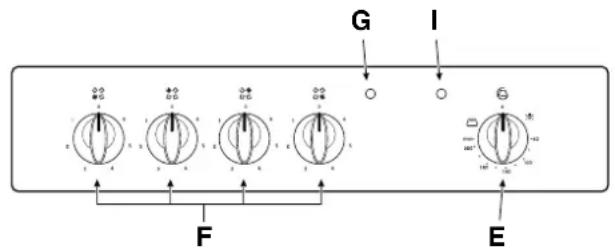
A. Control Panel
B. Dripping Pan or Baking Sheet
C. Oven Rack
D. Electric hotplate
E. Cooking mode selection knob
F.Electric hotplate knobs
G. Electric hotplate indicator light
H. Guides for sliding the racks or dripping pan in and out
1. Oven indicator light (only on certain models) - When lit, it indicates the oven is heating up to the temperature set.
text_image
G I F E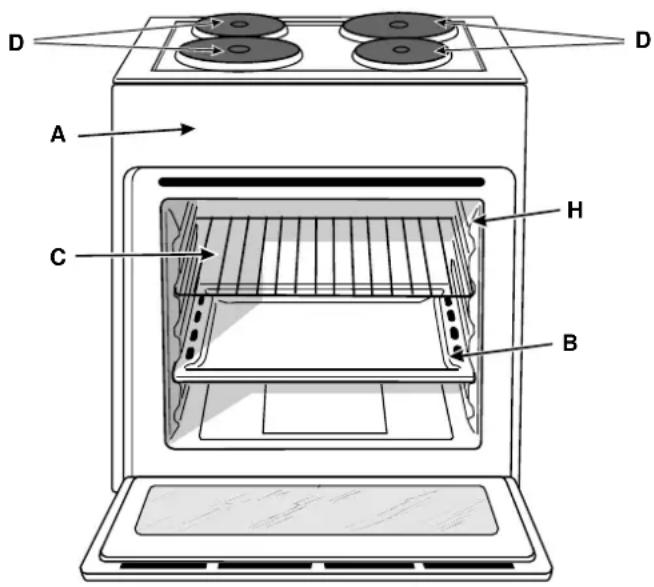
text_image
D A C H B DHow to use your oven
The various features of this oven are controlled via the knobs and buttons located on the control panel.
Notice: The first time you use your appliance, we recommend that you set the thermostat to the highest setting and leave the oven on for about half an hour with nothing in it, with the oven door shut. Then, open the oven door and let the room air. The odour that is often detected during this initial use is due to the evaporation of substances used to protect the oven during storage and until it is installed.
Notice: Place the dripping pan provided on the bottom shelf of the oven to prevent any sauce and/or grease from dripping onto the bottom of the oven only when grilling food or when using the rotisserie (only available on certain models). For all other types of cooking, never use the bottom shelf and never place anything on the bottom of the oven when it is in operation because this could damage the enamel. Always place your cookware (dishes, aluminium foil, etc. etc.) on the grid provided with the appliance inserted especially along the oven guides.
The oven knob (E)
This knob is used not only to select the different oven modes, but also to choose the right cooking temperature from among the temperatures shown on the knob itself (from 60°C to 240°C) for the food to be cooked in the oven. When the knob is turned clockwise, the oven light and the top and bottom heating elements will come on you can choose the most suitable temperature for cooking your food from the range of values below (Convection Mode). To select the temperature, match the desired temperature with the fixed reference mark on the control panel.
The oven will automatically reach the temperature set, and the thermostat, which is controlled by the knob, will keep it constant.
Top Heating Element Position
Set the knob to this position and the oven light and top heating element come on.
The oven light
Set knob "E" to the symbol to turn it on. It lights the oven and stays on when any of the electrical heating elements in the oven come on.
The control knobs for the hob electric hotplates (F)
The cookers can be equipped with standard, rapid and automatic electric hotplates in a variety of combinations (the rapid hotplates can be distinguished from the rest by
the red boss in the centre of the same, and the automatic hotplates by the smaller circular aluminium plate in their centre).
To avoid any heat loss and damage to the hotplates, we advise you to use pans with a flat bottom, whose diameter is no less than that of the hotplate itself.
The table contains the different settings indicated on the knobs and the use for which the hotplates are recommended.
| Setting N | Normal or Fast Plate |
| 0 | Off |
| 1 | Cooking vegetables, fish |
| 2 | Cooking potatoes (using steam) soups, chickpeas, beans. |
| 3 | Continuing the cooking of large quantities of food, minestrone |
| 4 | For roasting (average) |
| 5 | For roasting (above average) |
| 6 | For browning and reaching a boil in a short time. |
Before using the hot plates for the first time, you should heat them at maximum temperature for approximately 4 minutes, without any pans. During this initial stage, their protective coating hardens and reaches its maximum resistance.
Electric hotplate indicator light (G)
This light comes on when any of the electrical hotplates on the hob have been turned on.
Using the hob
To get the best from your hob, here are a few helpful tips to keep in mind during cooking or when preparing food.
• Use flat-bottomed pans to ensure the same adhere fully to the cooking zone.
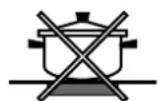
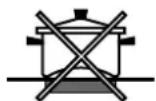

- Use pans whose diameter is sufficient to cover the hotplate fully, so as to guarantee the use of all the available heat.

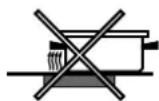
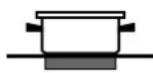
• Make sure the bottom of the pan is always clean and dry, to ensure correct contact and a long life for your hotplates and pans.
How to Keep Your Oven in Shape
Before cleaning your oven, or performing maintenance, disconnect it from the power supply.
To extend the life of your oven, it must be cleaned frequently, keeping in mind that:
- Do not use steam equipment to clean the appliance.
- the enamelled or stainless steel parts should be washed with lukewarm water without using any abrasive powders or corrosive substances which could ruin them; Stainless steel could get stained. If these stains are difficult to remove, use special products available on the market. After cleaning, it is advisable to rinse thoroughly and dry.
- the inside of the oven should preferably be cleaned immediately after use, when it is still warm, with hot water and soap; the soap should be rinsed away and the interior dried thoroughly. Avoid using abrasive detergents (for example cleaning powders, etc...) and abrasive sponges for dishes or acids (such as limescale-remover, etc...) as these could damage the enamel. If the grease spots and dirt are particularly tough to remove, use a special product for oven cleaning, following the instructions provided on the packet.
- if you use your oven for an extended period of time, condensation may form. Dry it using a soft cloth.
- there is a rubber seal surrounding the oven opening which guarantees its perfect functioning. Check the condition of this seal on a regular basis. If necessary, clean it and avoid using abrasive products or objects to do so. Should it become damaged, please contact your nearest After-sales Service Centre. We recommend you avoid using the oven until it has been repaired.
- never line the oven bottom with aluminium foil, as the consequent accumulation of heat could compromise the cooking and even damage the enamel.
- clean the glass door using non-abrasive products or sponges and dry it with a soft cloth.
How to remove the oven door
For a more thorough clean, you can remove the oven door. Proceed as follows:
- open the door fully;
- lift up and turn the small levers situated on the two hinges;
- grip the door on the two external sides, shut it slowly but not completely;
- pull the door towards you, pulling it out of its seat; Reassemble the door by following the above procedures backwards.

natural_image
Diagram of a kitchen oven with a downward arrow indicating airflow or removal (no text or symbols present)
natural_image
Mechanical assembly diagram showing a rotating component with arrows indicating motion (no text or symbols)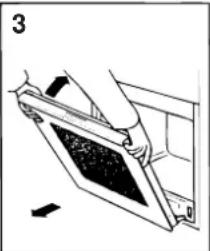
natural_image
Illustration of a hand holding a tablet device with a screen, no text or symbols visibleReplacing the Oven Lamp
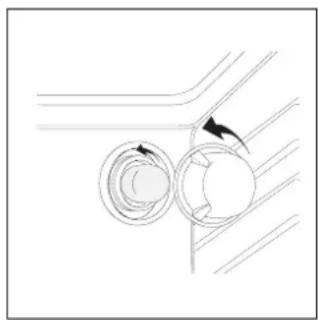
- Disconnect the oven from the power supply by means of the omnipolar switch used to connect the appliance to the electrical mains; or unplug the appliance if the plug is accessible;
- Remove the glass cover of the lamp-holder;
- Remove the lamp and replace with a lamp resistant to high temperatures (300°C) with the following characteristics:
- Voltage: 230/240 V
- Wattage 25W
- Type E14
- Replace the glass cover and reconnect the oven to the mains power supply.
natural_image
Pure diagram of mechanical components with no text, numbers, or symbolsPractical Cooking Advice
When cooking in the oven, use only one dripping pan or rack at a time. Select from among the top or bottom rack heights based on whether the dish needs more or less heat from the top.
Preheating
If the oven must be preheated (this is generally the case when cooking leavened foods), we recommend you use the “convection mode” to reach the desired temperature as quickly as possible. When preheating is over, which is indicated by the red light “I” going out, select the required cooking mode.
Cooking Fish and Meat
When cooking white meat, fowl and fish, use temperature settings from 180 °C to 200 °C.
For red meat that should be well done on the outside while tender and juicy in the inside, it is a good idea to start with a high temperature setting (200°C-220°C) for a short time, then turn the oven down afterwards.
In general, the larger the roast, the lower the temperature setting. Place the meat on the centre of the grid and place the dripping pan beneath it to catch the fat.
Make sure that the grid is inserted so that it is in the centre of the oven. If you would like to increase the amount of heat from below, use the low rack heights. For savoury roasts (especially duck and wild game), dress the meat with lard or bacon on the top.
Baking Cakes
When baking cakes, always preheat the oven and do not open the oven door during baking to prevent the cake from dropping. In general:
Pastry is too dry
Increase the temperature by 10^ C and reduce the cooking time.
Pastry dropped
Use less liquid or lower the temperature by 10^ C.
Pastry is too dark on top
Place it on a lower rack, lower the temperature, and increase the cooking time.
Cooked well on the inside but sticky on the outside
Use less liquid, lower the temperature, and increase the cooking time.
The pastry sticks to the pan
Grease the pan well and sprinkle it with a dusting of flour or use greaseproof paper.
Using the Grill
Use the “grill” mode, placing the food under the centre of the grill (situated on the 3rd or 4th rack form the bottom) because only the central part of the top heating element is turned on.
Use the bottom rack (1st from the bottom), placing the dripping pan provided to collect any sauce and/or grease and prevent the same from dripping onto the oven bottom.
When using this mode, we recommend you set the thermostat to the highest setting. However, this does not mean you cannot use lower temperatures, simply by adjusting the thermostat knob to the desired temperature.
Important: always use the grill with the oven door shut. This will allow you both to obtain excellent results and to save on energy (approximately 10%).
Therefore the best results when using the grill modes are obtained by placing the grid on the lower racks (see cooking table) then, to prevent fat and grease from dripping onto the bottom of the oven and smoke from forming, place a dripping-pan on the 1st oven rack from the bottom.
| Foods Wt. | (Kg) | Cooking position from bottom | Temperature (°C) | Pre-eating time (minutes) | Cooking time (minutes) |
| Paste | |||||
| Lasagne 2.5 3 210 - 75-80 | |||||
| Cannelloni 2.5 3 210 - 75-80 | |||||
| Oven-baked noodles 2.5 3 210 - 75-80 | |||||
| Meat | |||||
| Veal 1.7 3 220 - 85-90 | |||||
| Chicken 1.5 3 220 - 110-115 | |||||
| Turkey 3.0 3 220-Max | 95-100 | ||||
| Duck | 1.8 3 220 - 120-125 | ||||
| Rabbit | 2.0 3 220 - 105-110 | ||||
| Pork | 2.1 | 3 220 - 100-110 | |||
| Lamb | 1.8 3 220 - 90-95 | ||||
| Fish | |||||
| Mackerel | 1.1 3 | 210-230 | -55-60 | ||
| Dentex 1.5 3 | 210-230 | -60-65 | |||
| Trout baked in paper | 1.0 | 3 | 210-230 | - | 40-45 |
| Pizze | |||||
| Napolitan pizza 1.0 3 | Max | 15 30-35 | |||
| Tarts | |||||
| Biscuits | 0.5 3 | 180 15 30-35 | |||
| Meringues | 1.1 3 | 180 15 30-35 | |||
| Chocolate cake | 1.0 3 200 | 15 45-50 | |||
| Yeast cakes | 1.0 3 200 | 15 50-55 |
Note: cooking times are approximate and may vary according to personal taste.
Safety Is A Good Habit To Get Into
To maintain the efficiency and safety of this appliance, we recommend that you do the following:
- only call the Service Centres authorised by the manufacturer
• always use original spare parts
- When handling the appliance, we recommend you always use the purpose provided handles recessed into the sides of the oven to prevent harming people or damaging the appliance itself.
- This appliance is designed for non-professional, household use and its functions must not be changed.
• These instructions are only valid for the countries whose symbols appear on the manual and the serial number plate. - The electrical system of this appliance can only be used safely when it is correctly connected to an efficient earthing system in compliance with current safety standards.
- When the appliance is in use, the heating elements and some parts of the oven door become extremely hot. Make sure you don't touch them and keep children well away.
The following items are potentially dangerous, and therefore appropriate measures must be taken to prevent children and the disabled from coming into contact with them:
- Controls and the appliance in general;
- Packaging (bags, polystyrene, nails, etc.);
- The appliance itself, immediately after use of the oven or grill due to the heat generated;
- The appliance itself, when no longer in use (potentially dangerous parts must be made safe).
Avoid the following:
- Touching the appliance with wet parts of the body;
- Using the appliance when barefoot;
- Pulling on the appliance or the supply cable to unplug it from the electrical outlet;
- Improper or dangerous operations;
- Obstructing the ventilation or heat dissipation slots;
- Allowing power supply cables of small appliances to come into contact with the hot parts of the appliance;
- Exposing the appliance to atmospheric agents such as rain, or sunlight;
- Using the oven for storage purposes;
-
Using flammable liquids near the appliance;
-
Using adapters, multiple sockets and/or extension leads;
- Attempting to install or repair the appliance without the assistance of qualified personnel.
Qualified personnel must be contacted in the following cases:
- Installation (following the manufacturer's instructions);
- When in doubt about operating the appliance;
- Replacing the electrical socket when it is not compatible with the appliance plug.
Service Centres authorised by the manufacturer must be contacted in the following cases:
- If in doubt about the soundness of the appliance after removing it from its packaging;
- If the power supply cable has been damaged or needs to be replaced;
- If the appliance breaks down or functions poorly; ask for original spare parts.
It is a good idea to do the following:
- Only use the appliance to cook food and nothing else;
- Check the soundness of the appliance after it has been unpacked;
- Disconnect the appliance from the electrical mains if it is not functioning properly and before cleaning or performing maintenance;
- When left unused, unplug the appliance form the electricity mains and turn off the gas tap (if foreseen);
- Use oven gloves to place cookware in the oven or when removing it;
- Always grip the oven door handle in the centre as the extremities of the same may be hot due to any hot air leaks;
- Make sure the knobs are in the “•”/“o” position when the appliance is not in use.
- Cut the power supply cable after disconnecting it from the mains when you decide not to use the appliance any longer.
- The manufacturer may not be held responsible for any damage due to: incorrect installation, improper, incorrect and irrational use.
Instalation
The appliance must be installed only by a qualified person in compliance with the instructions provided.
The manufacturer declines all responsibility for improper installation which may harm persons and animals and damage property.
Important: The power supply to the appliance must be cut off before any adjustments or maintenance work is done on it.
Installation of Built-in Ovens
In order to ensure that the built-in appliance functions properly, the cabinet containing it must be appropriate. The figure below gives the dimensions of the cut-out for installation under the counter or in a wall cabinet unit.

text_image
500 580 39 15 555 480 +4 560 +4 -3 595 23 572 45 min 575-585 min 545 558 min 595N.B.: Installation in compliance with the consumption declaration
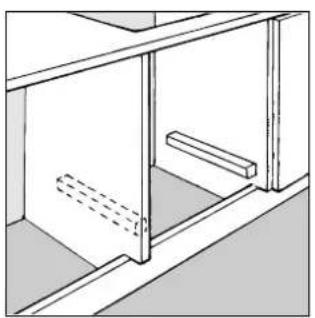
In order to ensure adequate ventilation, the back panel of the cabinet unit must be removed. Installing the oven so that it rests on two strips of wood is preferable. If the oven rests on a continuous, flat surface, there must be an aperture of at least 45 x 560 mm.
natural_image
Technical line drawing of a cabinet or shelf assembly with no visible text or symbols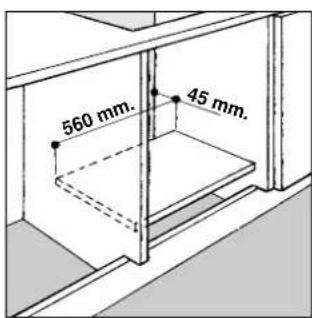
text_image
560 mm. 45 mm.The panels of the adjacent cabinets must be made of heat-resistant material. In particular, cabinets with a veneer exterior must be assembled with glues which can withstand temperatures of up to 100 °C.
In compliance with current safety standards, contact with the electrical parts of the oven must not be possible once it has been installed.
All parts which ensure the safe operation of the appliance must be removable only with the aid of a tool.
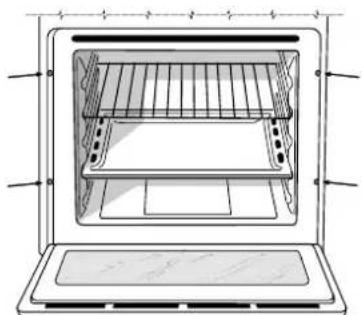
To fasten the oven to the cabinet, open the door of the oven and attach it by inserting the 4 wooden screws into the 4 holes located on the perimeter of the frame.
natural_image
Diagram of an oven with internal grating and door, showing no text or symbolsElectrical Connection
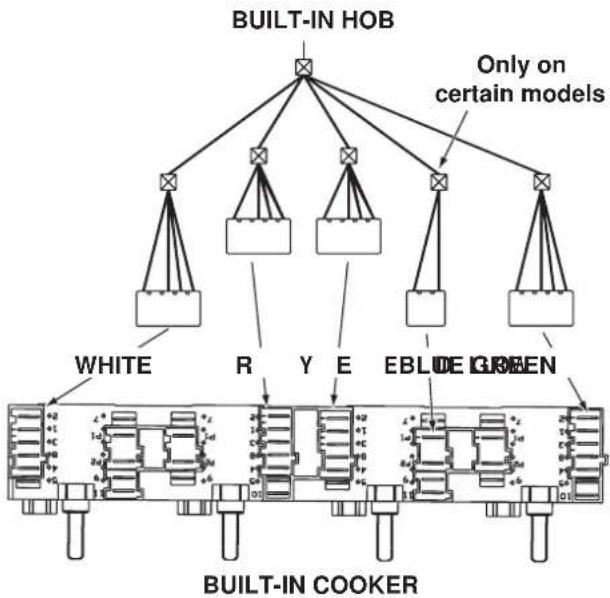
The cooker must be connected to the mains electricity supply. The hob is connected to the cooker using a special connector. The cookers are designed to operate on alternating current featuring the supply voltage and frequency indicated on the appliance data plate.
flowchart
graph TD
    A["BUILT-IN HOB"] --> B["White"]
    A --> C["R"]
    A --> D["Y"]
    A --> E["E"]
    A --> F["E"]
    A --> G["E"]
    A --> H["E"]
    A --> I["E"]
    A --> J["E"]
    A --> K["E"]
    A --> L["E"]
    A --> M["E"]
    A --> N["E"]
    A --> O["E"]
    A --> P["E"]
    A --> Q["E"]
    A --> R["E"]
    A --> S["E"]
    A --> T["E"]
    A --> U["E"]
    A --> V["E"]
    A --> W["E"]
    A --> X["E"]
    A --> Y["E"]
    A --> Z["E"]
    A --> AA["E"]
    A --> AB["E"]
    A --> AC["E"]
    A --> AD["E"]
    A --> AE["E"]
    A --> AF["E"]
    A --> AG["E"]
    A --> AH["E"]
    A --> AI["E"]
    A --> AJ["E"]
    A --> AK["E"]
    A --> AL["E"]
    A --> AM["E"]
    A --> AN["E"]
    A --> AO["E"]
    A --> AP["E"]
    A --> AQ["E"]
    A --> AR["E"]
    A --> AS["E"]
    A --> AT["E"]
    A --> AU["E"]
    A --> AV["E"]
    A --> AW["E"]
    A --> AX["E"]
    A --> AY["E"]
    A --> AZ["E"]
    A --> BA["E"]
    A --> BB["E"]
    A --> BC["E"]
    A --> BD["E"]
    A --> BE["E"]
    A --> BF["E"]
    A --> BG["E"]
    A --> BH["E"]
    A --> BI["E"]
    A --> BJ["E"]
    A --> BK["E"]
    A --> BL["E"]
    A --> BM["E"]
    A --> BN["E"]
    A --> BO["E"]
    A --> BP["E"]
    A --> BQ["E"]
    A --> BR["E"]
    A --> BS["E"]
    A --> BT["E"]
    A --> BU["E"]
    A --> BV["E"]
    A --> BW["E"]
    A --> BX["E"]
    A --> BY["E"]
    A --> BZ["E"]
    A --> CA["BUILT-IN COOKER"]
Fitting on a Power Supply Cable
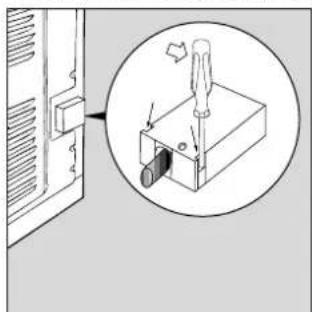
Opening the terminal board:
- Using a screwdriver, prise on the side tabs of the terminal board cover;
- Pull open the cover of the terminal board.
natural_image
Diagram showing a device with a screwdriver inserted into a box, with an inset magnified view of the component (no text or symbols present)To install the cable, proceed as follows:
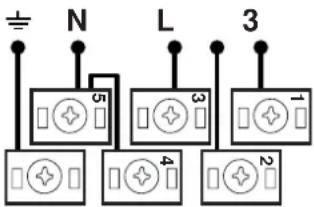
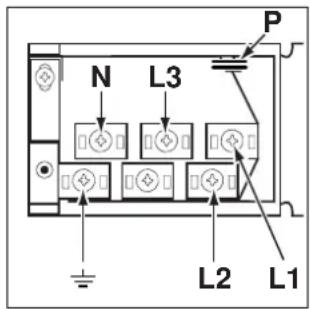
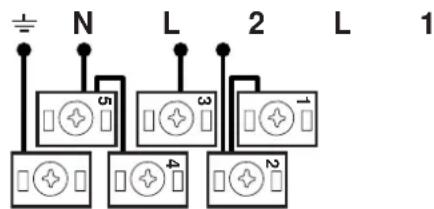
- unscrew the wire clamp screw and the contact screws Note: the jumpers are factory-set for a three-phase 400V connection (fig. D).
- to make the electrical connections illustrated in fig. F and fig. G, use the two jumpers housed in the box (fig. E - reference "P")
- fasten the supply cable in place with the clamp and close the cover of the terminal board.
400V 3N\~
H05RR-F 5x2.5 CEI-UNEL 35363
text_image
N L 3 5 3 1 4 2Fig. D
text_image
N L3 P L2 L1Fig. E
230V 1N\~
H07RN-F 3x4 CEI-UNEL 35364

text_image
N L 5 3 1 4 2Fig. F
400V 2N\~
H05RR-F 4x2.5 CEI-UNEL 35363

text_image
N L 2 5 3 1 4 2Fig. G
Connecting the supply cable to the mains
Install a standardised plug corresponding to the load indicated on the data plate. When connecting the cable directly to the mains, install an omnipolar circuit-breaker with a minimum contact opening of 3 mm between the appliance and the mains. The omnipolar circuit breaker should be sized according to the load and should comply with current regulations (the earth wire should not be interrupted by the circuit breaker).
The supply cable should be positioned so that it does not reach a temperature of more than 50^ C with respect to the room temperature, anywhere along its length.
Before making the connection, check that:
- The electrical safety of this appliance can only be guaranteed if the cooker is correctly and efficiently earthed, in compliance with regulations on electrical safety. Always ensure that the earthing is efficient; if you have any doubts call in a qualified technician to check the system. The manufacturer declines all responsibility for damage resulting from a system which has not been earthed.
- Before plugging the appliance into the mains, check that the specifications indicated on the date plate (on the appliance and/or packaging) correspond to those of the electrical mains system of your home.
- Check that the electrical capacity of the system and sockets will support the maximum power of the appliance, as indicated on the data plate. If you have any doubts, call in a qualified technician.
- If the socket and appliance plug are not compatible, have the socket replaced with a suitable model by a qualified technician. The latter, in particular, will also have to ensure that the cross section of the socket cables are suitable for the power absorbed by the appliance. The use of adapters, multiple sockets and/or extensions, is not recommended. If their use cannot be avoided, remember to use only single or multiple adapters and extensions which comply with current safety regulations. In these cases, never exceed the maximum current capacity indicated on the single adapter or extension and the maximum power indicated on the multiple adapter. The plug and socket must be easily accessible.
Technical Specifications
Inner dimensions of the oven:
Width 43.5 cm
Depth 43.5 cm
Height 32 cm
Inner Volume of the Oven:
60 litres
ENERGY LABEL
Directive 2002/40/EC on the label of electric ovens Norm EN 50304
Declared energy consumption for Natural convection Class heating mode: Convection
Voltage and Frequency of Power Supply:
230V/400V \~ 3N 50/60Hz 8200W
CE This appliance conforms with the following European Economic Community directives:
- 73/23/EEC of 19/02/73 (Low Voltage) and subsequent modifications;
- 89/336/EEC of 03/05/89 (Electromagnetic Compatibility) and subsequent modifications;
- 93/68/EEC of 22/07/93 and subsequent modifications.
natural_image
Three identical cooking pots with crossed x marks on a horizontal line, no text or symbols present.natural_image
Three schematic diagrams showing crossed-out electrical symbols: a switch, a battery, and a pot (no text or labels)text_image
Diagram illustrating three steps of a refrigerator interior: opening, lifting a seatbelt, and removing the seatbelt.natural_image
Diagram showing two circular components with curved arrows indicating motion or rotation, no text or symbols presenttext_image
560 mm. 45 mm.natural_image
Line drawing of an open oven with internal grating and ventilation slots (no text or symbols)natural_image
Diagram showing a screwdriver inserted into a device component, with an inset magnified view of the component (no text or symbols present)natural_image
Diagram of a microwave oven with a black arrow indicating airflow direction (no text or symbols)
natural_image
Mechanical assembly diagram showing a lever mechanism with an arrow indicating motion (no text or symbols present)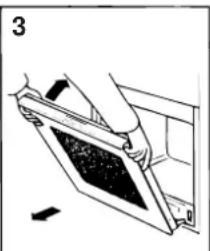
natural_image
Diagram of a hand holding a device with a screen, showing no text or symbolsnatural_image
Diagram showing two circular components with curved arrows indicating rotation or movement, surrounded by parallel lines (no text or symbols)Kooktips
natural_image
Technical line drawing of a cabinet or shelf assembly with structural beams and a door (no text or symbols)
text_image
560 mm. 45 mm.natural_image
Line drawing of an oven with internal grating and ventilation duct (no text or symbols)natural_image
Diagram showing a screwdriver inserted into a component, with an inset magnified view of the component (no text or symbols present)natural_image
Three identical line-drawn icons of cooking pots crossed out, no text or symbols presentnatural_image
Three schematic symbols showing crossed-out electrical contacts on a surface, no text or labels presentnatural_image
Diagram of a kitchen appliance with a downward arrow indicating a process (no text or symbols present)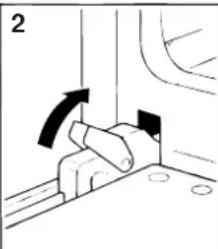
natural_image
Diagram of a mechanical assembly with an arrow indicating direction (no text or symbols present)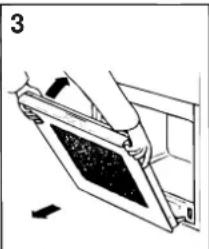
natural_image
Diagram of a door handle with a black plastic cover, showing no text or symbolsnatural_image
Diagram showing two circular components with curved arrows indicating rotation or movement, no text or symbols presenttext_image
560 mm. 45 mm.natural_image
Technical line drawing of an oven with internal grating and door, no text or symbols presentElektroanschluss
natural_image
Diagram showing a screwdriver inserted into a device with a magnified inset highlighting the component (no text or symbols present)natural_image
Diagram of a kitchen oven with a black arrow indicating a drop or removal (no text or symbols present)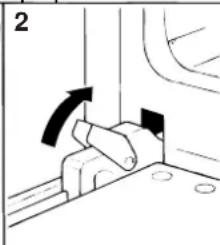
natural_image
Diagram of a mechanical assembly with an arrow indicating direction (no text or symbols present)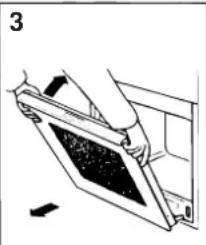
natural_image
Diagram of a hand holding a device with a screen, showing no text or symbolsnatural_image
Pure diagram of mechanical components with no text, numbers, or symbolsnatural_image
Technical line drawing of a cabinet or shelf assembly with no visible text or symbols
text_image
560 mm. 45 mm.natural_image
Diagram of an oven with internal grating and ventilation ducts (no text or labels)Ηλεκτρική σύνδεση
natural_image
Diagram showing a screwdriver inserted into a mechanical component, with an inset magnified view of the component (no text or symbols present)text_image
Eik' D N L3 P L2 L1Eik' E
230V 1N\~
H07RN-F 3x4 CEI-UNEL 35364

text_image
N L 5 3 1 4 2Eik' F
400V 2N\~
H05RR-F 4x2.5 CEI-UNEL 35363
text_image
N L 2 L 1 5 3 1 4 2Eik' G