Forum IRF-4655 - Système audio de salle de classe TeachLogic - Free user manual and instructions
Find the device manual for free Forum IRF-4655 TeachLogic in PDF.


User questions about Forum IRF-4655 TeachLogic
0 question about this device. Answer the ones you know or ask your own.
Ask a new question about this device
Download the instructions for your Système audio de salle de classe in PDF format for free! Find your manual Forum IRF-4655 - TeachLogic and take your electronic device back in hand. On this page are published all the documents necessary for the use of your device. Forum IRF-4655 by TeachLogic.
USER MANUAL Forum IRF-4655 TeachLogic
Classroom Audio System
Installation Manual

text_image
TeachLogic | Forum MIC CH A MIC CH B DVD COMPUTER AUX LINE INPUT OUTPUTWelcome
Congratulations on the purchase of your new TeachLogic® classroom audio system. You can be assured that this product fulfills all specifications and was produced to high quality control standards.
TeachLogic incorporates the latest state of the art technology, employs the most advanced manufacturing methodology and uses only premium quality components to assure many years of reliable performance. We appreciate your confidence by your selection of our product. It is TeachLogic's intent to uphold that confidence by providing factory assistance and reseller support. This manual will help you learn to use and gain the maximum benefit of the system.
We hope you will take the time to review this manual to familiarize yourself with the product operation and features.
TeachLogic, LLC
Longmont, Colorado USA
www.teachlogic.com
Safety Instructions
Read Instructions
All safety and operation instructions should be read before operating this TeachLogic product.
Retain Instructions
Safety and operating instructions should be kept for future reference.
Water & Moisture
This product should not be operated near water.
Heat Environment
Do not subject this product to excessive heat conditions.
Power Source
This product must be connected to an AC power source per the voltage input specified and marked on the power supply.
Do not insert any power cable not provided by the manufacturer into the product. Long prongs can penetrate inside electrical components or current charging conductors.
Certifications


TeachLogic systems are manufactured using lead-free processes and are free of materials harmful to the environment. They conform to European RoHS guidelines for consumer products.
Power Cord Caution
Power cable should be routed clear of foot traffic and supported clear of kinking or abrasion.
Object Protection
Locate the operating unit so it will not be subjected to falling objects or water entry. Do not drill hole in or screw objects into the product except as specified by manufacturer.
Internal Service
User should not attempt to service this product. All internal service must be accomplished by a qualified technician.
Electric Shock
Do not adapt or modify the AC power plug. Do not remove thus lifting the earth ground connection ( 3^rd prong) or use power supply without a connector to a 3-prong grounded outlet.
CAUTION
Recycle—Do not dispose rechargeable batteries in trash. It is unlawful to do so in numerous states. Go Green. Save our resources and do not contaminate.
Contact: Earth911.com 1-800-CLEANUP

CAUTION
RISK OF ELECTRIC SHOCK: DO NOT OPEN

Caution: To Reduce The Risk Of Electric Shock Do Not Remove Cover (Or Back) No User-serviceable Parts Inside Refer Servicing To Qualified Personne
System info
Date of Purchase
Model Number
Serial Number
Notes
Contact
If you should encounter an unresolved issue, please contact the TeachLogic customer service department for further assistance.
760-631-7800 | support@teachtogic.com | teachlogic.com
Limited warranty
For full warranty details refer to teachlogic.com/warranty.
Contents
System Overview....5
System Diagram 6
Installation....7
Installation Planning....7
Connection of Speakers....8-9
Installation of Ceiling Sensor 10
Integration 11
Computer Anti-Hum 11
Video Conferencing Connection 12
Configuration 13
Final Setup....13
Power Button Lights | Standby Function....14
Troubleshooting 15
System Specifications....16
Forum™
System Overview
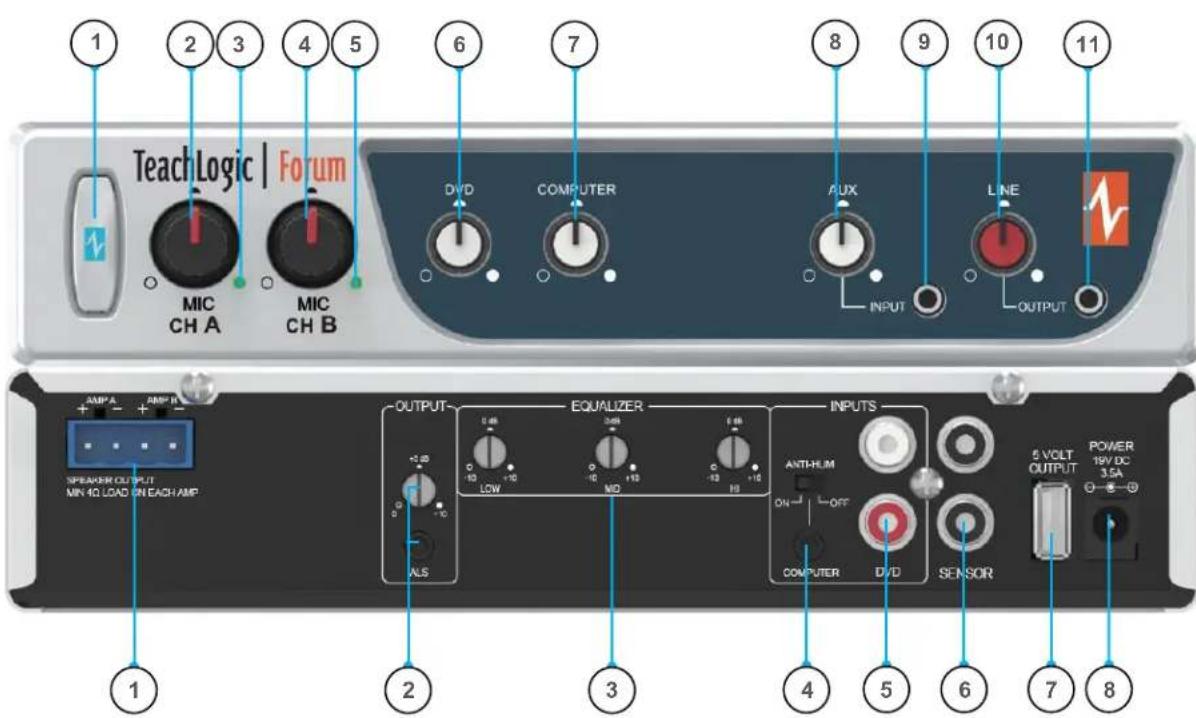
Front Panel
- Power Button/ Indicator LED
- Channel A Microphone Volume Control
- Channel A Connectivity Indicator LED
- Channel B Microphone Volume Control
- Channel B Connectivity Indicator LED
-
DVD Input Volume Control
-
Computer Input Volume Control
- Aux Input Volume Control
- Aux Input Port (3.5 mm)
- Line Output Volume Control
- Line Output Port (3.5 mm) (suitable for Lesson Capture)
text_image
TeachLogic | Forum MIC CH A MIC CH B DVD COMPUTER AUX LINE INPUT OUTPUT EQUALIZER INPUTS ALS ON/OFF COMPUTER DVD SENSOR POWER 19V DC 3.5A 1 2 3 4 5 6 7 8 9 10 11 1 2 3 4 5 6 7 8 SPEAKER OUTPUT MIN 10 LOAD ON EACH AMPBack Panel
- Speaker Output
- ALS Output (3.5 mm) & Gain Control
- Three Band Equalizer Controls
-
Computer Input Port (3.5 mm) / Computer Anti-Hum ON/OFF Switch
-
DVD Input Ports (Dual RCA, 0 dB)
- Powered IR Ceiling Sensor Inputs (RCA x 2)
- 5 Volt USB Output for chargers
- Power Input: 19 VDC, 6.5 A
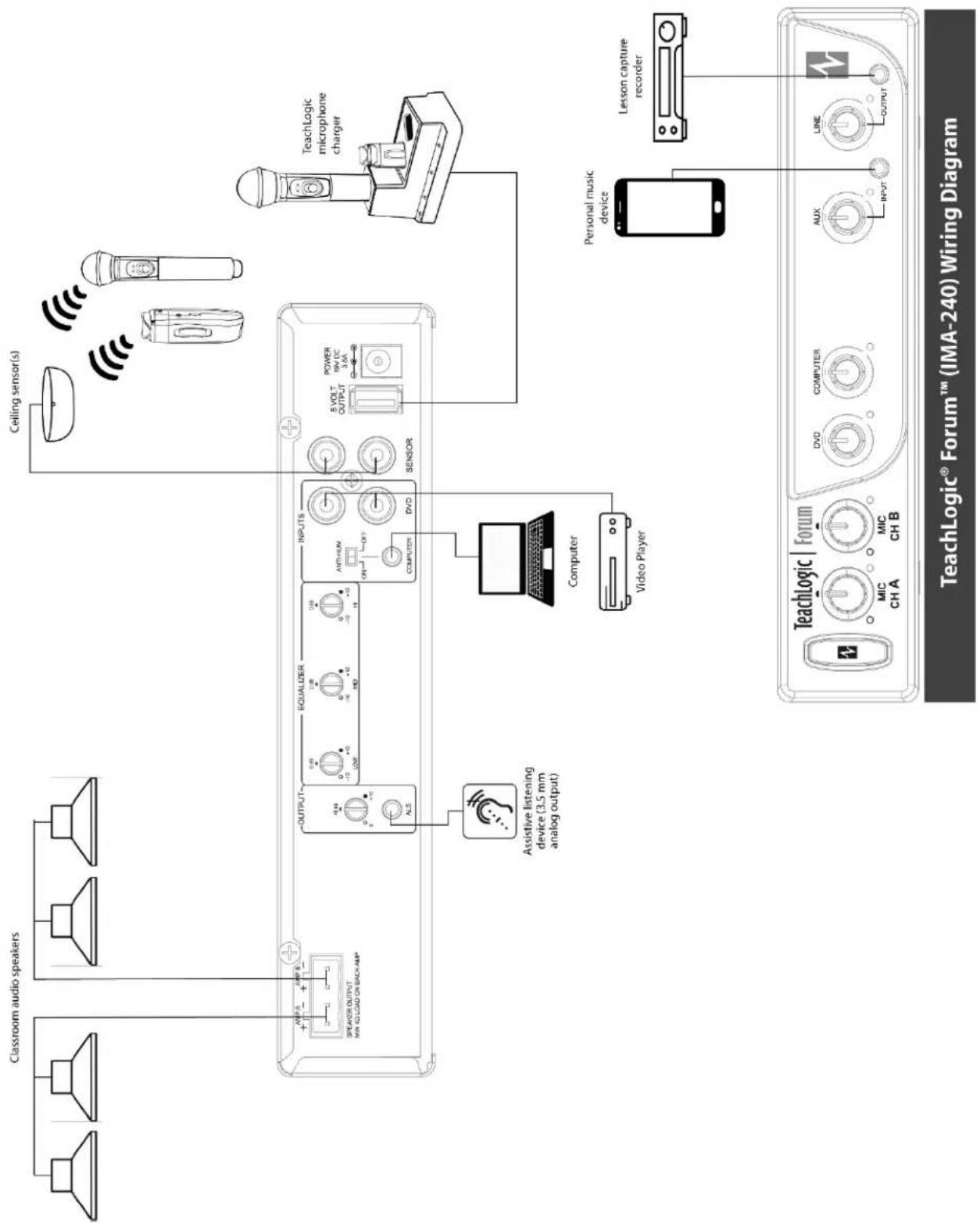
flowchart
graph TD
    A["Classroom audio speakers"] --> B["Speaker OUTPUT<br>MIN 10 LOAD ON BACK AMP"]
    C["Teaching sensor(s)"] --> D["TeachLogic microphone charger"]
    E["Assistant listening device (3.5 mm analog output)"] --> F["Computer"]
    G["Video Player"] --> H["Video Player"]
    I["Personal music device"] --> J["Lesson capture recorder"]
    K["Audio"] --> L["Line"]
    M["Line"] --> N["Output"]
    O["Speaker Output"] --> P["ASL"]
    Q["Speaker Output"] --> R["OUTPUT"]
    S["Speaker Output"] --> T["EQUALIZER"]
    U["Speaker Output"] --> V["INPUTS"]
    W["Speaker Output"] --> X["DVDA"]
    Y["Speaker Output"] --> Z["SENSOR"]
    AA["Speaker Output"] --> AB["Power 1kV DC 3.6A"]
    AC["Speaker Output"] --> AD["VOY OUTPUT"]
    AE["Speaker Output"] --> AF["VOY OUTPUT"]
    AG["Speaker Output"] --> AH["VOY OUTPUT"]
    AI["Speaker Output"] --> AJ["VOY OUTPUT"]
    AK["Speaker Output"] --> AL["VOY OUTPUT"]
    AM["Speaker Output"] --> AN["VOY OUTPUT"]
    AO["Speaker Output"] --> AP["VOY OUTPUT"]
The goal of a classroom audio system is to evenly distribute sound throughout the listening area.

text_image
Sound Field Area 65 dB 65 dB 65 dBComponent Placement
- Amplifier: Choose location that supports accessibility requirements and wiring constraints for power, speakers, ceiling sensor, and audio devices connecting to the amplifier.
- Ceiling Sensor: Locate in the center of the ceiling; maintain line of sight to teacher locations; keep away from direct sunlight and electrical interference.
- Speakers: The Forum™ can power 4 classroom speakers. Mark location for wall mount vs. ceiling mount and confirm wiring run to the amplifier. Ensure speakers evenly cover the listening area.
- Integrations/Connections: Confirm location of other systems you plan to connect to the amplifier such as audio devices, computer, TV, projector, etc., noting how the wiring needs to run.
- Charger: Confirm microphone charging location for daily use/charging.

natural_image
Top-down view of a room layout with furniture and objects, no visible text or symbolsSpeaker Location
Below are examples of room coverage for two and four speaker installations. For more than 4 speakers, space the next row(s) accordingly.
Ceiling Speakers: Locate and identify the center most tile in each quadrant.
Wall Speakers: First observe the shape of the room: ceiling height, door locations, windows, mounting surface, and seating area. Ordinary installation would be to locate the speakers on each side wall beginning at the front row of listeners, approximately 6–7 feet above the floor.

text_image
Front of Room Ceiling Sensor Ceiling Speakers Listening Area
text_image
Front of Room Receiver Amplifier Ceiling Sensor Wall Speakers
text_image
Front of Room Ceiling Sensor Ceiling Speakers Listening Area
flowchart
graph TD
    A["Wall Speakers"] --> B["Ceiling Sensor"]
    B --> C["Receiver Amplifier"]
    C --> D["Front of Room"]
    style A fill:#f9f,stroke:#333
    style B fill:#ccf,stroke:#333
    style C fill:#cfc,stroke:#333
    style D fill:#fcc,stroke:#333
Connection of speakers
The IMA-240 has two channels of amplified audio, rated for a minimum 4-ohm speaker load (two 8-ohm speakers each, connected in parallel provide 4 ohms impedance).
There is one blue phoenix style speaker connector on the back panel, providing two pairs of speaker terminals.

text_image
Wire in Parallel + - + - + + + - + AMP A + AMP B SPEAKER OUTPUT MIN 4Ω LOAD ON EACH AMP OUTPUT -5 dB 0 +10 ALS 0 dB -10 +10 EQUALIZER 0 dB -10 +10 MID -10 HIInstallation of Infrared (IR) Ceiling Sensor (ICS-55)
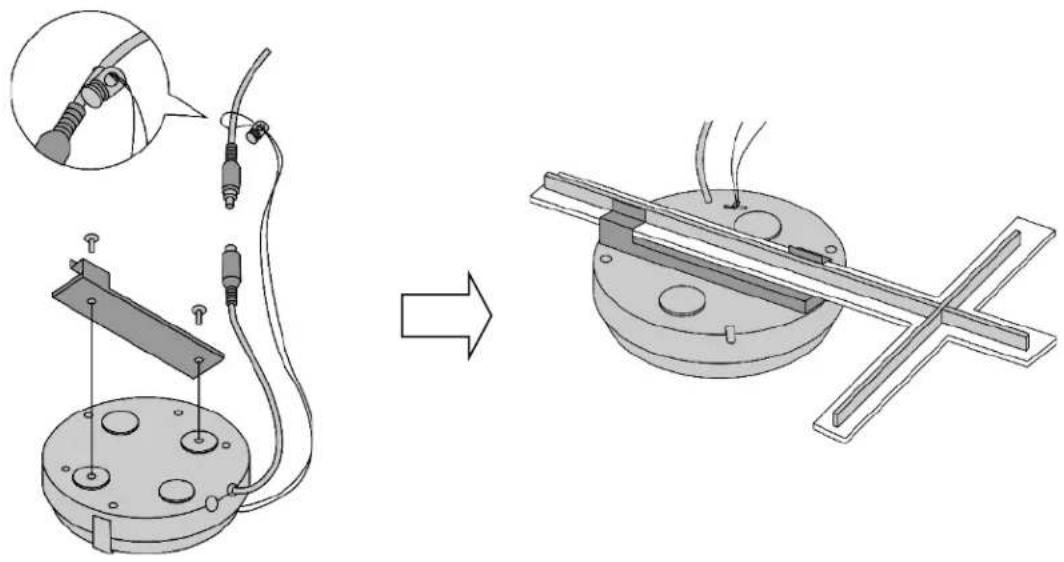
The ideal mounting location is in the center of the room's ceiling. The ideal installation is flush mounted on a white, reflective ceiling like suspended acoustic ceiling tiles. This will ensure 360^ coverage and will minimize the transmission distance for more reliable performance.
For additional coverage, or in large rooms, a second IR sensor may be placed on ceiling or a wall and connected to the second sensor input. As many as three sensors may be powered by the amplifier (use a wye adapter for two of them to connect to one input). The max cable length is 100 ft.
Installation 1 – Attach to T-bar rail
natural_image
Technical illustration showing a mechanical assembly before and after modification, with no visible text or symbols.Installation 2 – Concrete or Drywall Surface

text_image
Technical diagram showing cable installation and wire connection for a suspended lamp, with labeled components and zoomed-in detail views.Installation 3 – Wood Surface
FINAL STEP: Route sensor cable to amplifier and plug into one of the amplifier's two sensor inputs. An illuminated green LED will indicate that the sensor is receiving power from the amplifier.
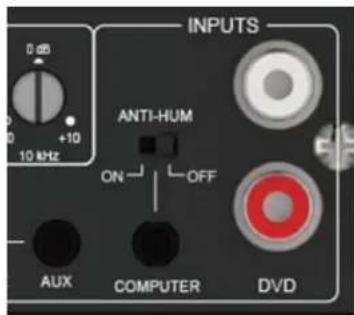
Anti-Hum Feature
The rear panel input port labeled "Computer" has a switchable feature to eliminate or reduce hum sounds often present when computers are connected to external amplifiers. The hum is known as a ground loop hum and may be present if the computer and amplifier have electrical grounding differences. The telltale characteristic is that it is 60 hertz (a somewhat low tone.) Inside the amplifier is a ground isolating balun that may reduce or eliminate the hum when switched ON. If not needed, it is getter the leave switched OFF as the sound quality for the connected device will be slightly better in this case.
text_image
0 dB +10 10 kHz INPUTS ANTI-HUM ON OFF AUX COMPUTER DVDVideo Conferencing Connection
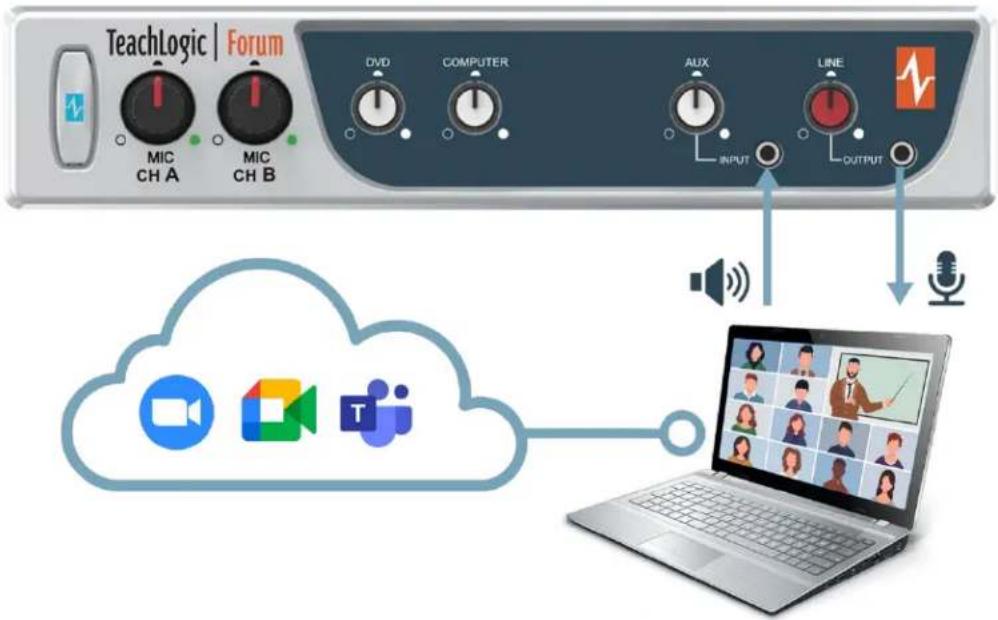
All media devices connected to the TeachLogic amplifier (including microphones) will be heard by online viewers. All audio—including devices connected directly to the computer—will play through the TeachLogic amplifier/receiver in the classroom.
- Amplifier Output > Computer Microphone Input: enables online leaners to hear classroom audio including wireless microphones
- Computer Speaker Output > Amplifier Input: enables classroom learners to hear computer & conference audio
- For more detailed instructions, visit https://teachlogic.com/distance-learning/.
flowchart
graph TD
    A["TeachLogic | Forum"] --> B["MIC CH A"]
    A --> C["MIC CH B"]
    B --> D["DVD"]
    C --> E["COMPUTER"]
    D --> F["AUX"]
    E --> F
    F --> G["INPUT"]
    G --> H["Laptop with video callouts and audio icons"]
    H --> I["OUTPUT"]
    I --> J["Speaker icon"]
    style A fill:#f9f,stroke:#333
    style J fill:#ccf,stroke:#333
Final Setup
Now that the system is installed and connected, turn the system "ON" and test its performance.
The testing will be done using an IR (infrared) microphone (Sapphire™ or Handheld) to confirm good connectivity.
AMPLIFIER
- Connect power supply to amplifier, then plug into outlet.
- Turn the amplifier ON by pushing the power button. The “TL” illuminates solid blue when the amplifier is powered ON.
- Confirm there is power to the IR ceiling sensor: A green LED on edge of sensor should be illuminated that indicates it is receiving power.
- Set all gain/volume dials to mid scale (12 o'clock position)
IRT-60 (SAPPHIRE) MICROPHONE SETUP
- Confirm "Ch A" volume dial is at mid scale (12 o'clock position)
- Slide gain/volume control switch on Sapphire to "Normal" setting.
- Press and hold power mic button until the LED light illuminates.
- Observe Sapphire power LED. Solid blue indicates power is on and mic is transmitting.
- Observe amplifier Ch A indicator LED. It should be green, indicating a connection between the microphone and ceiling sensor.
- If using two IRT-60 microphones in the same room, one must be changed to channel B to avoid interference. Watch the how-to video on teachlogic.com/resources.
Note: Next steps should be performed with a second person as the listener
- Stand under or in front of a speaker.
- Hold the microphone with the top at your collarbone and observe the speaker volume in the room by speaking in a natural voice.
- Raise the volume on Ch A until feedback begins, then reduce volume to an acceptable level and until indications of feedback have stopped.
- Walk around the room while talking into microphone to confirm good connectivity and sound levels and lack of feedback under/in front of each speaker.
IRH-35 HANDHELD MICROPHONE SETUP
- Confirm "Ch B" volume control is set to mid-scale (12 o'clock position)
• Power on microphone using ON/OFF switch. - Observe LED above mic switch. Solid green indicates power is on and ready to use.
- Observe amplifier Ch B indicator LED. It should be green, indicating a connection between the microphone and IR ceiling sensor.
- Hold the microphone about 3 inches from the mouth, above chin level and perform voice test.
- Raise the volume on "Ch B" until feedback begins, then reduce volume to eliminate all feedback.
- Walk around the room while talking into the microphone to confirm good connectivity and sound under/in front of each speaker without feedback.
Once complete, charge microphones so they are ready for use.
Power Button Operation
The main power button on the amplifier's front panel has multiple indications as shown in the table below.
| Red, solid | Off state; power is still supplied to USB port on back panel used to charge microphones |
| Blue, solid On | |
| Blue flashing | Page received and audio sources muted |
| Amber, solid | In Standby (or “Sleep”) mode. See below |
| Red, flashing | Muted by Fire Alarm Mute Input |
| Purple, flashing | System in Ducked mode with all line inputs lowered in volume to allow microphones to be better heard. The Sapphire mic on Channel A can trigger this “Teacher Priority” mode with a press of its priority button (toggles mode on and off) |
| Green/Red flashing | Indications of Security Alert pulse mode (see section above) |
| Green Flashing Security Alert activated |
System Standby Function
Standby Mode is a feature that reduces power consumption after the amplifier has not been used to amplify audio signal for a period of two hours. After entering the automatic standby mode, the amplifier displays an amber light at power button.
Normal ON mode may be resumed by
- speaking into a microphone that is on,
- sending an audio signal into one of the line inputs *such as a projector or flat panel audio signal), or
- pressing the power button once.
It may take a few seconds for the normal mode to resume after one of these actions is taken. A page signal can also “wake” the amplifier, but to hear the full first page of a morning, be sure to wake it first with one of the methods above since, or the initial several seconds may be missed if there are no other paging speakers provided to deliver the page audio.
Troubleshooting
| Problem | Solution |
| System will not power “ON” | Verify AC power; the power button will illuminate Blue when turned ONCheck if system has been unplugged; reconnect to power outlet or use another device to ascertain power available at outletCheck circuit breakerCall maintenance for assistance |
| System is turned “ON” but there is no soundorSystem is in standby and does not “wake up” | Turn “ON” microphone/ transmitter; the “TL” power button will illuminate to solid Blue when turned ONIf the power button is illuminated red, the battery is lowEnsure the mic is not muted (blinking light on mic indicates it is muted)Ensure gain/volume control knob on amplifier/receiver is turned up to mid-scale (12 o’clock position)On amplifier/receiver, ensure a green LED is illuminated just below Ch A or Ch B knob (depending on the microphone used).If no LED is illuminated:Check the green LED on the ceiling sensorIf sensor LED is not lit:Sensor has been disconnected (check cable plug ends), orPower output to sensor has failed (Sensor or amplifier may need to be replaced) |
| Voice is distorted and/or signal drop-out occurs | Verify that the sensor is not being coveredVerify there is no obstruction between microphone and sensorEnsure there is no direct sunlight on sensorEnsure no other IR mics in room are turned onIf sensor is mounted on a dark surface or without a flush ceiling surface, reception can be hampered. |
Forum™ (IMA-240)
| Amplifier Output Power | 50 W RMS, 2 x 25 W channels |
| Receiver Input | Infrared FM, 2 wireless mic channels |
| Modulation | Wide-band FM |
| Reception Frequencies | Ch. A: 2.08 MHz | Ch. B: 2.54 MHz |
| Deviation | 10 kHz Nominal, 25 kHz Maximum |
| De-emphasis | 50 μs |
| Tone Key | 32.768 kHz |
| Infrared Wavelength | 850 nm |
| External Sensor Input | 2, RCA, powered ports |
| Connectivity Coverage | 1,600 sq ft per sensor, up to 3 sensors supported |
| Total Harmonic Distortion | <1% @ 1 kHz |
| Frequency Response | 40 Hz -18 kHz, ± 3 dB |
| Line Level Inputs | Rear Panel: DVD input, dual RCA, 0dB Rear Panel: Computer input, 3.5mm, -10 dB Front panel: Auxiliary input, 3.5 mm, -10 dB |
| Anti-Hum Balun | Present on Computer input |
| Line Outputs | Front panel: 3.5mm w/ gain control Rear Panel: 3.5 mm w/ +10 dB gain control |
| Output Impedance | Rated Load: 4Ω minimum impedance |
| Equalization | 3-band, ±10 dB |
| S/N Ratio | 65 dB |
| Speaker Connection | 4-pin Phoenix Connectors |
| Charger Output | 5 VDC, USB |
| Power Supply | 19 VDC / 3.5 A CE, CSA and UL Listed |
| Dimensions | 8 1/2" W x 1 3/4" H x 7 1/2" D |
| Weight | 1.7 lb. |
Power Supply (AC-36)
| Type | Regulated Switching Power Supply, CE, CSA and UL listed |
| Input Voltage | 100-240 volts AV, 47-63 Hz |
| Output Voltage | 19 VDC, 3.43 A |
| Power Output | 65 watts max |
Sapphire (IRT-60) microphone/transmitter specs
| Transmission Carrier | Infrared |
| Transmission Frequencies | 2.08 MHz & 2.54 MHz |
| Channel Selection | Field Switchable |
| Transmitting Diodes | Six |
| Wavelength | 850 nm |
| Modulation | FM Wide-Band |
| Frequency Response | 100 Hz - 10 KHz |
| Pilotone Frequency | 32.768 KHz |
| Peak Deviation | ± 25 KHz |
| Dynamic Range | 95.5 dB @ 2.8% THD |
| Operating Range | 60 Ft. line of sight |
| Latency (mic to speakers) | 0.87 ms |
| Battery Used | Lithium-ion polymer (3.7V / 620mAh) |
| Battery Life | 8 hr/Charge |
| External Power Charger | 5V DC Micro USB Connector |
| Transmission Angle | 180° Conical |
| User Controls | |
| Power (On/Off) | Press & Hold |
| Mute Switch (On/Off) | Momentary Press (blinks when muted) |
| Addt'l Mic Gain Control | Normal, -3dB, -6dB |
| Audio Source Vol./Gain | Increase, Decrease |
| Channel Select | (A or B) in battery compartment |
| External Mic/Aux Input | 3.5 mm Line Level |
| Dimensions (H x W x D) | 3.5" x 1.25" x 0.75" |
| Weight | 1.4 oz including battery |
Handheld (IRT-35) microphone/transmitter specs
| Transmission Carrier | Infrared |
| Transmission Frequencies | 2.08 MHz & 2.54 MHz |
| Channel Selection | Field Switchable |
| Transmitting Diodes | Ten |
| Wavelength | 850 nm |
| Modulation | FM Wide-Band |
| Pilotone Frequency | 32.768 KHz |
| Peak Deviation | ± 25 KHz |
| Operating Range | 50 ft. line of sight |
| Power Switch (Slide) | On/Off |
| Battery Charge Level (LED) | Green: Full | Orange: Medium | Red: Low |
| Battery Life | Approx. 7 Hr./Charge |
| Dimensions | 2.125" dia. (Head), 1.4375" dia. (Body), 9.625" H |
| Weight | 10.3 oz. w/ Battery |

natural_image
Abstract white line drawing on gray background with no text or symbolsTeachLogic®
541 Main St. Longmont, Suite B, CO 80501
TeachLogic.com | Support@TeachLogic.com | 760-631-7800