DMA8413D - Audio Mixer PHONIC - Free user manual and instructions
Find the device manual for free DMA8413D PHONIC in PDF.


User questions about DMA8413D PHONIC
0 question about this device. Answer the ones you know or ask your own.
Ask a new question about this device
Download the instructions for your Audio Mixer in PDF format for free! Find your manual DMA8413D - PHONIC and take your electronic device back in hand. On this page are published all the documents necessary for the use of your device. DMA8413D by PHONIC.
USER MANUAL DMA8413D PHONIC
INSTALLATION AND SETUP 5
RACK MOUNTING....5
CONNECTION 5
DIGITAL I/O EXPANSION CARD 6
IMPORTANT SAFETY INSTRUCTIONS
The apparatus shall not be exposed to dripping or splashing and that no objects filled with liquids, such as vases, shall be placed on the apparatus. The MAINS plug is used as the disconnect device, the disconnect device shall remain readily operable.
Warning: the user shall not place this apparatus in the confined area during the operation so that the mains switch can be easily accessible.
-
Read these instructions before operating this apparatus.
-
Keep these instructions for future reference.
-
Heed all warnings to ensure safe operation.
-
Follow all instructions provided in this document.
-
Do not use this apparatus near water or in locations where condensation may occur.
-
Clean only with dry cloth. Do not use aerosol or liquid cleaners. Unplug this apparatus before cleaning.
-
Do not block any of the ventilation openings. Install in accordance with the manufacturer's instructions.
-
Do not install near any heat sources such as radiators, heat registers, stoves, or other apparatus (including amplifiers) that produce heat.
-
Do not defeat the safety purpose of the polarized or grounding-type plug. A polarized plug has two blades with one wider than the other. A grounding type plug has two blades and a third grounding prong. The wide blade or the third prong is provided for your safety. If the provided plug does not fill into your outlet, consult an electrician for replacement of the obsolete outlet.
-
Protect the power cord from being walked on or pinched particularly at plug, convenience receptacles, and the point where they exit from the apparatus.
-
Only use attachments/accessories specified by the manufacturer.
-
Use only with a cart, stand, tripod, bracket, or table specified by the manufacturer, or sold with the apparatus. When a cart is used, use caution
when moving the cart/apparatus combination to avoid injury from tip-over.
- Unplug this apparatus during lighting storms or when unused for long periods of time.

- Refer all servicing to seavified personnel. Servicing is required when the apparatus has been damaged in any way, such as power-supply cord or plug is damaged, liquid has been spilled or objects have fallen into the apparatus, the apparatus has been exposed to rain or moisture, does not operate normally, or has been dropped.

text_image
CAUTION RISK OF ELECTRIC SHOCK DO NOT OPENCAUTION: TO REDUCE THE RISK OF ELECTRIC SHOCK, DO NOT REMOVE COVER (OR BACK) NO USER SERVICEABLE PARTS INSIDE REFER SERVICING TO QUALIFIED PERSONNEL

The lightning flash with arrowhead symbol, within an equilateral triangle, is intended to alert the user to the presence of uninsulated "dangerous voltage" within the product's enclosure that may be of sufficient magnitude to constitute a risk of electric shock to persons.

The exclamation point within an equilateral triangle is intended to alert the user to the presence of important operating and maintenance (servicing) instructions in the literature accompanying the appliance.
WARNING: To reduce the risk of fire or electric shock, do not expose this apparatus to rain or moisture.
CAUTION: Use of controls or adjustments or performance of procedures other than those perceived result in hazardous radiation exposure.
1. INTRODUCTION
Congratulations on your purchase of a DMA series digital matrix amplifier. The DMA's flexible deisgn will provide you with up to eight channels of audio matrixing and processing. A single DMA amplifier offers eight-in, eight-out support (or eight-in, four-out), and the entire system can be controlled through standard potentiometers, remote controls or flexible remote software. Internal processing is accomplished through a high quality 40-bit floating point processor, with internal signal processors and matrix routing all handled with ease.
DMA digital matrix amplifiers offer easy, effective means for injecting signal processors directly into your input and output path, with clear, easy-to-use software both onboard and on your Windows computer. The software offers full performance monitoring for each processor, giving real-time information on the load placed upon DSPs.
2. FEATURES
- 8 input channels available via 3-pin Euroblock connections and stereo RCA inputs
• Full control possible through onboard software accessed with VGA display and USB mouse connected - Built-in multi-channel amplifier for low-impedance or line distribution application*
- For power output levels for individual models, please consult the Specifications on page 17
- 40-bit floating point processor with internal sampling selectable between 44.1 and 48 kHz
- Optional 4x4 or 8x8 networking capabilities through audio streaming LAN card
• Digital AES/EBU input and output connectors
• Auto shutdown mode for reduced power consumption - Ethernet connectivity for network and internet control application
• Automatic DHCP network IP configuration - Easy and intuitive control software from Asystems
• Event scheduling and user-accounts
• 4-band parametric EQs and 31-band graphic equalizers - Adjustable compressors and limiters built-in
• Feedback silencing technology seeks and destroys feedback - User-defined crossovers available on output channels
• Autoleveler (Loudness Control)
• Level ducking with trigger control
3. CONTROLS AND I/O
FRONT PANEL
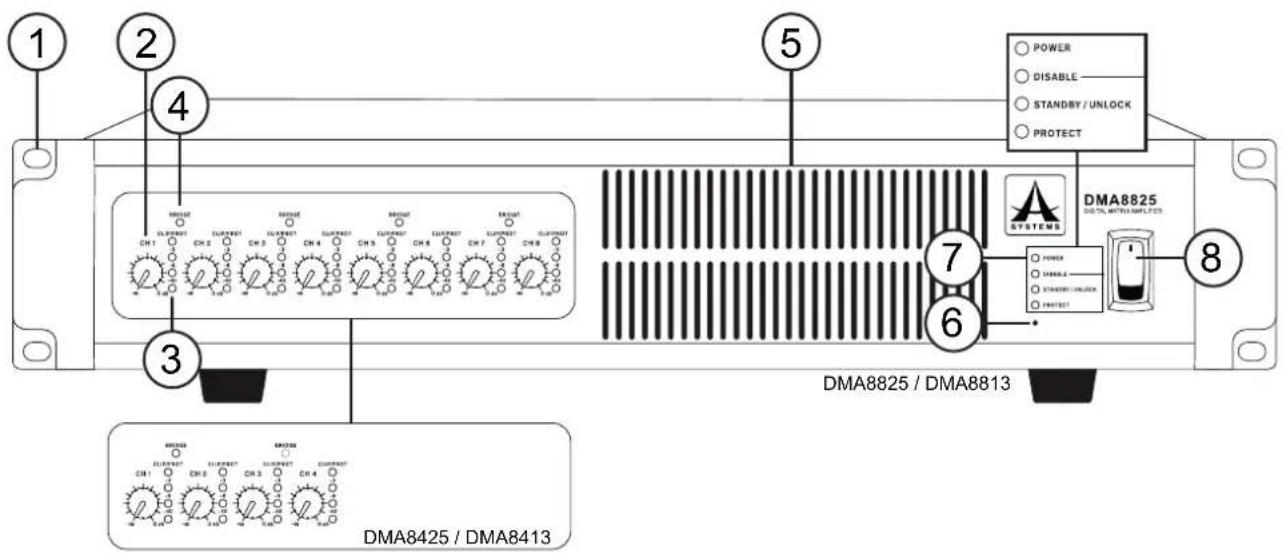
text_image
① ② ④ ⑤ POWER DISABLE STANDBY/UNLOCK PROTECT ③ ⑦ ⑥ DMA8825 / DMA8813 SYSTEMS POWER DOUBLE STANDARD/UNLOCK PROTECT ⑧ ② ① ② ③ ④ ⑤ ⑥ DMA8825 / DMA8813 ⑦ ⑧ ⑨ ⑩ ⑪ ⑫ ⑬ ⑭ ⑮ ⑯ ⑰ ⑱ ⑲ ⑳ ⑴ ⑵ ⑶1. Mounting Holes
These holes are for mounting the DMA device in a standard 19" rack.
2. Output Level Control Knobs
Every output channel is equipped with a rotary knob for adjusting the final output level. These controls can be deactivated within the DMA software.
3. OUT LED
Every output channel is equipped with a 4-segment IN LED level meter, including a CLIP/PROTECT indicator.
4. BRIDGE LED
This LED lights when the two corresponding channels are bridged with one another.
NOTE: Every input channel is equipped with one output level control knob, one IN LED and 1 level meter. Each channel pair features a BRIDGE LED.
5. Cooling Inlet Vents
Cool air is drawn in here. Please do not cover these vents for any reason as you risk overheating the DMA.
6. Reset Button
A pinhole button is included for resetting the DMA series matrix amplifier to the factory default settings.
7. Indicators
POWER: Lights when the device is on.
DISABLE: Lights when the power switch is disabled.
STANDBY/UNLOCK: Lights when DMA device is in the Standby mode.
PROTECT: Lights when the protect circuitry is active.
8. Power Switch
Flick this switch to turn the unit on and enter it into STANDBY mode. Please note that this switch can be disabled through the onboard software. If the power switch becomes unresponsive, check your power settings.
WARNING: The DMA requires up to 2 minutes to be fully discharged after the power is turned off. During this time the system cannot be powered on properly.
REAR PANEL
The Asystems DMA8825, DMA8813, DMA8425 and DMA8413 share the same basic I/O design and layout. The major difference is that the DMA8825 and DMA8813 have 8 speaker output connectors and 8 line-out connectors, while the DMA8425 and DMA8413 have 4 speaker output connectors and 4 line-out connectors (as shown below).
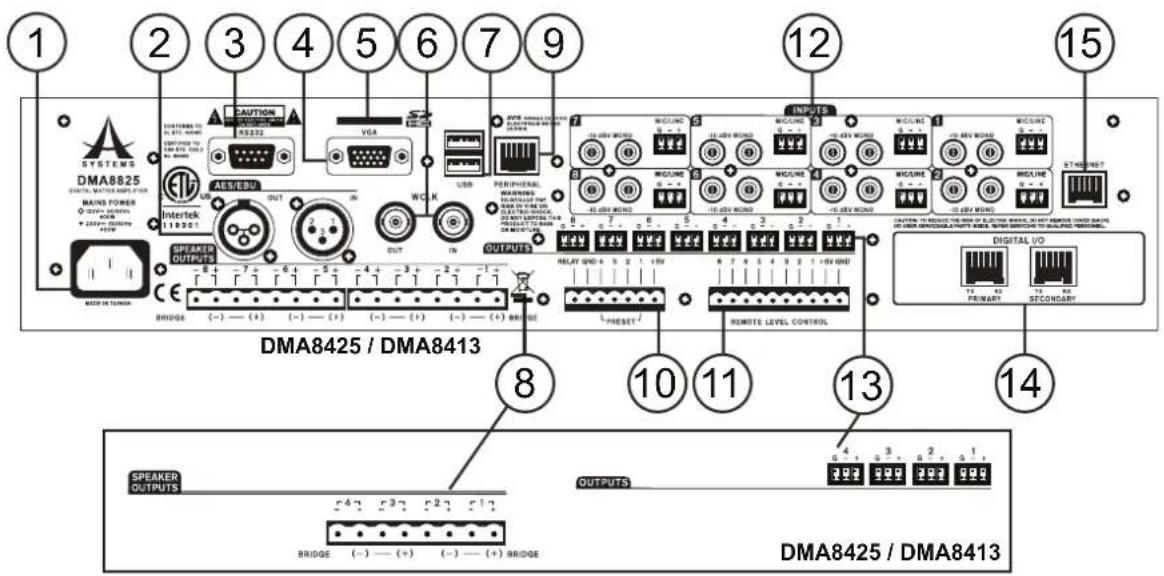
text_image
SYSTEMS DMA8425 DIGITAL METERING POWER MAINS POWER POWER + 20V AC/DC + 20V AC/DC INTERTEK 119301 SPEAKED OUTPUTS CE BRIDGE (-) — (+) (-) — (+) (-) — (+) BRIDGE CAUTION R5232 VGA USB PERIPHERAL MAXIMUM TOLERANCE FOR INJ. OF THE ELECTRIC ORDER. OUTPUTS RELAY SPED 4 5 2 1 + 5V PRESET INPUTS MCCLINE -10.6V BOUND MCCLINE -10.6V BOUND MCCLINE -10.6V BOUND MCCLINE -10.6V BOUND STANDARD DIGITAL I/O PRIMARY SECONDARY COUNTER TO REJECT THE NAME OF ELECTRIC ORDER, DO NOT REMOVE ORDER FROM NO OWNER PROCESSED IN PARTS, WHEN SWITCH TO QOLUPTER PERFORMAL. 8 10 11 13 14 SPEAKER OUTPUTS BRIDGE (-) — (+) (-) — (+) BRIDGE OUTPUTS 4 3 2 1 BRIDGE - (-) — (+) (-) — (+) BRIDGE DMA8425 / DMA84131. AC Power Connector
This power inlet is for connecting a standard IEC power cable. Under no circumstances should the user remove the grounding pin on the power cable.
2. AES/EBU Connector
For connecting AES/EBU-enabled devices.
3. RS-232 Connector
For remote control through non-Ethernet based hardware that utilizes a RS-232 control data protocol. This feature is only found on the DMA8825. A detailed protocol document can be found on the Asystems website.
4. VGA Connector
Connect this port to an appropriate video screen to view the DMA's internal software. This can be controlled by any connected wired or wireless mouse.
5. SD Card Slot
Insert an SD card here to play digital audio files.
6. WCLK Connector
This port is for connection of a master clock, enabling multiple digital audio devices to be perfectly synchronized.
7. USB Ports
These USB ports are for connection of a standard wired or wireless USB mouse for stand-alone control of the internal software. The second USB port can be used when performing firmware updates.
8. SPEAKER OUTPUTS (Amplified Output)
For connecting passive loudspeakers.
9. PERIPHERAL Connector
For connecting the Asystems RM-6E programmable remote control (sold separately).
10. PRESET RECALL Connector
For connecting Asystems' RM-4 series remote preset recall control (sold separately).
11. REMOTE LEVEL CONTROL Connector
For connecting Asystems' RM-2VR series remote level control (sold separately).
12. INPUT Connectors
Two types of input connectors are offered - Euroblock and unbalanced RCA.
13. OUTPUT Connectors
DMA matrix amplifiers adopt 3-pin Euroblock output connectors for line-level output. These can be used as balanced or unbalanced connections (see section "Audio Output" on page 6 for more).
14. DIGITAL I/O Expansion Card Slot
This slot is for installing Asystems' DT44 or DT88 Dante Networking card to enable the DMA as a networking portal to other Dante-enabled devices.
15. ETHERNET Connector
RJ-45 connector for connecting the DMA8825, DMA8813, DMA8425 or DMA8413 to a PC or local area network.
4. INSTALLATION AND SETUP
4.1 RACK MOUNTING
DMA8825, DMA8813, DMA8425 and DMA8413 are compatible with standard 19" audio equipment racks. Slide the DMA in to the rack and secure it with four Phillips screws and appropriate square nuts. The DMA matrix amplifiers all take up 2 standard units of rack space.

natural_image
Front view of a server rack with indicator lights and a warning symbol (no readable text or labels)4.2 CONNECTIONS
Connect all necessary input and output devices.

text_image
To Monitor Display USB Mouse Audio In To PC/Internet/ Intranet CAMERA SYSTEMS DMA8825 DIGITAL I/O POWER MAIN POWER DC Power DC Power DC Power DC Power DC Power DC Power DC Power DC Power DC Power DC Power DC Power DC Power DC Power DC Power DC Power DC Power DC Power DC Power DC Power DC Power DC Power DC Power DC Power DC Power DC Power DC Power DC Power DC Power DC Power DC Power DC Power DC Power DC Power DC PowerAUDIO INPUT
Input can be achieved through correctly wiring the Euroblock connectors and RCA connectors
Euroblock Connectors RCA Connectors

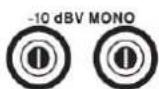
Balanced
PIN 1: Shield/Ground
PIN 2: Cold (-)
PIN 3: Hot (+)
Unbalanced
PIN 1: Shield/Ground
PIN 2: Link to PIN 1
PIN 3: Hot (+)
AUDIO OUTPUT
AMPLIFIED OUTPUTS
These euroblock outputs are used to connect speakers, either in low-impedance or distributed lines depending on your model. Amplified outputs are wired like so:
PIN 1: Cold (-)
PIN 2: Hot (+)
Each pair of amplified output channels can be bridged into one channel. This combines the output power of both channels creating a single channel with twice as much power.
To bridge channels, just wire the "+" pin of an odd-numbered channel to the "+" pin of the next even channel. When bridged, the "+" pin of the even channel becomes the "-" pin of the bridged new output.
When activating bridge mode, be sure to go into the Control Panel menu of the DMA software and click the corresponding "Bridged" button.
AUX OUTPUTS
Offering line-level signals, AUX OUTPUT connectors can be wired as either as balanced or unbalanced connections.
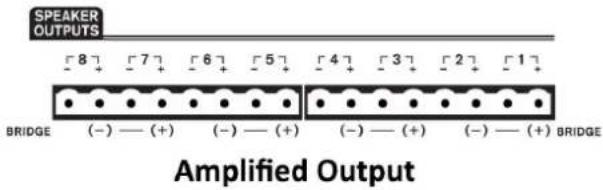
text_image
SPEAKER OUTPUTS BRIDGE (-) — (+) (-) — (+) (-) — (+) (-) — (+) BRIDGE Amplified Output
text_image
OUTPUTS G 8 + G 7 + G 6 + G 5 + G 4 + G 3 + G 2 + G 1 + AUX Output Euroblock Connectors G - +Balanced
PIN 1: Shield/Ground
PIN 2: Cold (-)
PIN 3: Hot (+)
Unbalanced
PIN 1: Shield/Ground
PIN 2: Link to PIN 1
PIN 3: Hot (+)
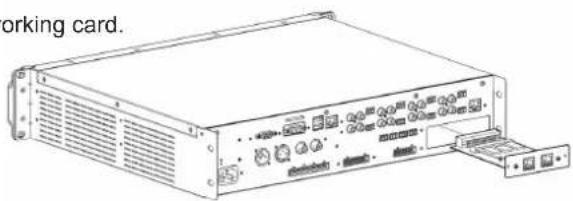
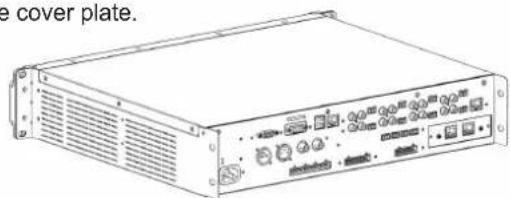
DIGITAL I/O EXPANSION CARD
- Loosen the two screws and remove the cover plate.

text_image
e cover plate.- Connect the DT44 or DT88 Dante Networking card.
text_image
working card.- Tighten the two screws back to secure the cover plate.
text_image
e cover plate.ONBOARD CONTROL
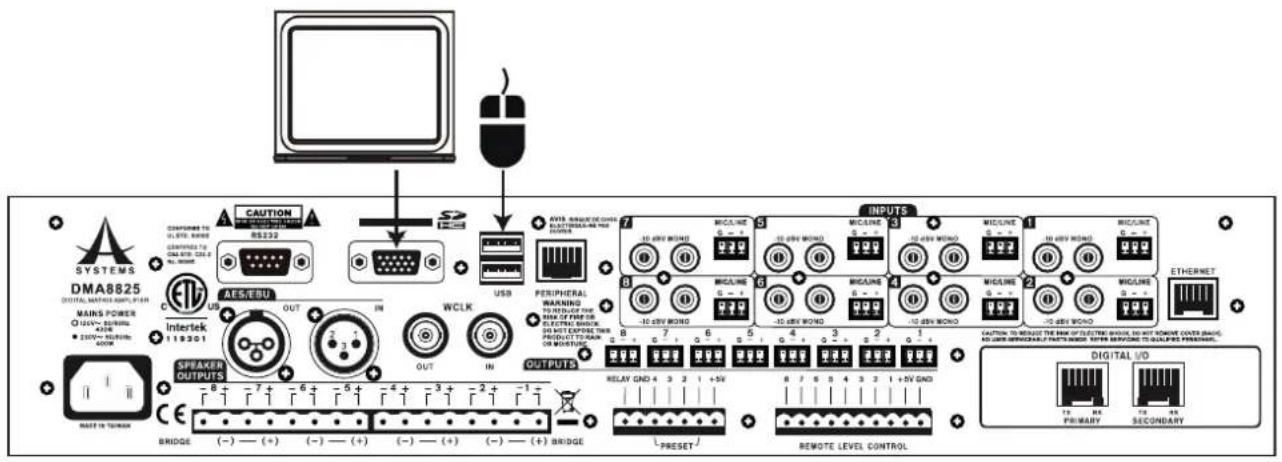
DMA8825, DMA8813, DMA8425 and DMA8413 include built-in control software. You can get full control over the DMA matrix amplifier via the control software by plugging in a standard VGA display and a USB mouse to the ports shown below.
text_image
SYSTEMS DMA8825 DIGITAL METER CONTROL MAINS POWER ○ 12V~ 600W ● 250V~ 400W AES/EBU Intertek 113301 SPEAKER OUTPUTS BRIDGE (-) — (+) (-) — (+) (-) — (+) (-) — (+) BRIDGE CAUTION RS323 USB WCLK IN OUT IN OUTPUTS L-PRESET / REMOATE LEVEL CONTROL INPUTS MICA/LINE (0 - 1) (0 - 1) (0 - 1) (0 - 1) (0 - 1) (0 - 1) (0 - 1) (0 - 1) (0 - 1) (0 - 1) (0 - 1) (0 - 1) (0 - 1) (0 - 1) (0 - 1) (0 - 1) (0 - 1) (0 -1) (0 - 1) (0 - 1) (0 - 1) (0 - 1) (0 - 1) (0 - 1) (0 - 1) (0 - 1) (0 - 1) (0 - 1) (0 - 1) (0 - 1) (0 - 1) (0 - 1) (0 - 1) (0 - 1) (5) MICA/LINE (0 - 1) MICA/LINE (0 - 1) MICA/LINE (0 - 1) MICA/LINE (0 - 1) MICA/LINE (0 - 1) MICA/LINE (0 - 1) MICA/LINE (0 - 1) MICA/LINE (0 - 1) MICA/LINE (0 - 1) MICA/LINE (0 - 1) — (0.5V) — (0.5V) — (0.5V) — (0.5V) — (0.5V) — (0.5V) — (0.5V) — (0.5V) — (0.5V) — (0.5V) — (0.5V) — (0.5V) — (0.5V) — (0.5V) — (0.5V) EITHERNET CAPTUS TO REJECT THE RANK OF ELECTRIC SERVICE, DO NOT REMOVE POINTS BACK. NO ORNIER/WHOLE/THY/SMROR, ETR SERVOME TO QUALIFERS PREADS. DIGITAL I/D 7 MICA/LINE (0 - 1) MICA/LINE (0 - 1) MICA/LINE (0 - 1) MICA/LINE (0 - 1) MICA/LINE (0 - 1) MICA/LINE (0 - 1) MICA/LINE (0 - 1) MICA/LINE (0 - 1) MICA/LINE (0 - 1)——— MICA/LINE (0 - 1)——— MICA/LINE (0 - 1)——— MICA/LINE (0 - 1)——— MICA/LINE (0 - 1)——— MICA/LINE (0 - 1)——— MICA/LINE (0 - 1)——— MICA/LINE (0 - 1)——— MICO/LINE (0 - 1)——— MICO/LINE (0 - 1)——— MICO/LINE (0 - 1)——— MICO/LINE (0 - 1)——— MICO/LINE (0 - 1)——— MICO/LINE (0 - 1)——— MICO/LINE (0 - 1)——— MICO/LINCE (0 - 1)——— MICO/LINE (0 - 1)——— MICO/LINE (0 - 1)——— MICO/LINE (0 - 1)——— MICO/LINE (0 - 1)——— MICO/LINE (0 - 1)——— MICO/LINE (0 - 1)——— MICO/LINE (MICLINE / RS-323) MICO/LINE / RS-323 MICO/LINE / RS-323 MICO/LINE / RS-323 MICO/LINE / RS-323 MICO/LINE / RS-323 MICO/LINE / RS-323REMOTE CONTROL
1. RM-2VR REMOTE LEVEL CONTROL
Please connect Asystems' RM-2VR Remote Control to the REMOTE LEVEL CONTROL connectors of the DMA matrix amplifier. The channels controlled by the VR is determined by the wiring of the control. Please note, the ground for channel 2 is internally wired to channel 1. Only one grounding pin needs to be connected to the DMA.
In the example found to the right, channels one and two can be remotely controlled using the RM-2VR.

text_image
A MIN MAX MIN MAX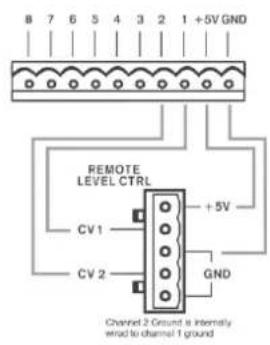
text_image
8 7 6 5 4 3 2 1 +5V GND REMOTE LEVEL CTRL +5V CV1 CV2 GND Channel 2 Ground is internally wind to channel 1 ground2. RM-4 REMOTE PRESET RECALL CONTROL
With Asystems' RM-4 Remote Preset Recall connected to the PRESET connector and some configurations within the control software, 4 presets can be accessed via pressing a button. See page 15 for more information on setting presets.

text_image
A □□ □□ □□ □□
text_image
RELAY GND 4 3 2 1 +5V -GND 4 3 2 1 -PF ESI T3. RM-6E PROGRAMMABLE REMOTE CONTROL
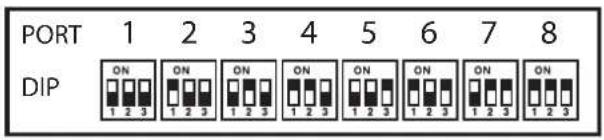
The Asystems RM-6E Programmable Remote Control can be connected to the PERIPHERAL connector on the rear of the DMA. The DIP switch on the RM-6E determines which communication port the remote will use (see configurations below). Up to 6 functions can be programmed to be controlled remotely using the RM-6E. See page 16 for more information.
text_image
PORT 1 2 3 4 5 6 7 8 DIP ON ON ON ON ON ON ON ON 1 2 3 1 2 3 1 2 3 1 2 3 1 2 3 1 2 3 1 2 3
text_image
A 28
4. WINDOWS-BASED PC
DMA8825, DMA8813, DMA8425 and DMA8413 can be controlled via a connected Windows-based PC.
- Connect the Ethernet port of the DMA to the Ethernet port of your computer with a CAT5 RJ-45 Ethernet cable.

text_image
Diagram showing network connection between a laptop and an external device with ports, cables, and connectors.- On your PC, right click your network icon and select "Open Network and Sharing Center".

text_image
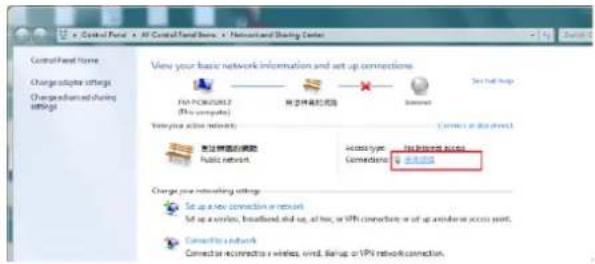
Troubleshoot problems Open Network and Sharing Center 2015/9/14- Double click your main connection located next to the "Connections".
text_image
Control Panel Home Change adapter settings Change adapter sharing Settings View your basic network information and set up connections FIA-PC02012 (No compute) Remove the network Remove the active network Connect to this project Active network configuration Access type Connected In Internet access Connected to a network Change pre networking settings Set up a new connection to network Set up a server, broadband, shell-up, all or, or VPN connected or set up another or access port. Connect to a network Connect to an email client via wireless, virtual, base or VPN network connection.- Click "Properties" Properties button.
text_image
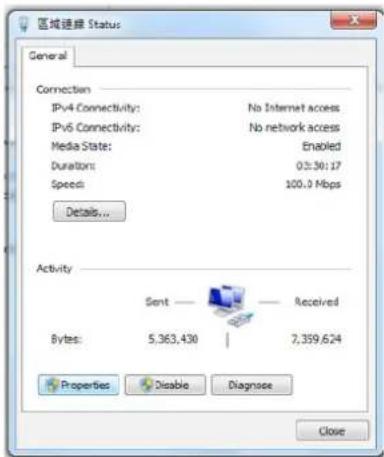
区域连接 Status General Connection IPv4 Connectivity: No Internet access IPv6 Connectivity: No network access Media State: Enabled Duration: 0:30:17 Speeds: 100.0 Mbps Details... Activity Sent —— Received Bytes: 5.363.430 | 7,359.624 Properties Disable Diagnose Close- Select "Internet Protocol Version 4 (TCP/IPv4)" and then click the "Properties" button.
text_image
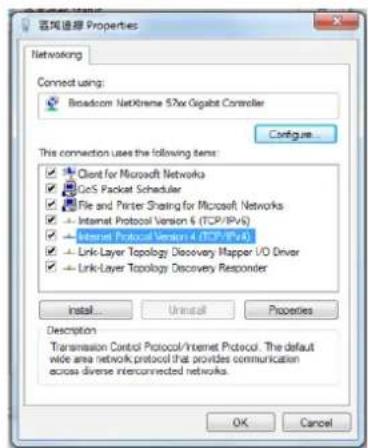
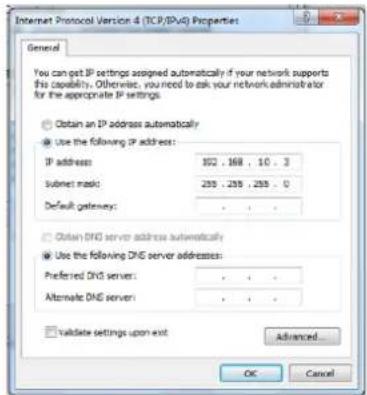
百风通信 Properties Networking Connect using: Broadcom NetXhome 57w Gigabit Controller Configure... This connection uses the following items: Client for Microsoft Networks GoS Packet Scheduler File and Printer Sharing for Microsoft Networks Internet Protocol Version 6 (TCP/IPV6) Internet Protocol Version 4 (TCP/IPV4) Link-Layer Topology Discovery Mapper I/O Driver Link-Layer Topology Discovery Responder Install... Uninstall... Properties Description Transmission Control Protocol/Internet Protocol. The default wide area network protocol that provides communication across diverse interconnected networks. OK Cancel- Change the field "IP address" to "192.168.10.3", and then click "OK".
text_image
Internet Protocol Version 4 (TCP/IPv6) Properties General You can get IP settings assigned automatically if your network supports the capability. Otherwise, you need to ask your network administrator for the appropriate IP settings. Obtain an IP address automatically Use the following IP address: IP address: 552 . 368 . 10 . 3 Submit mask: 255 . 255 . 255 . 0 Default gateways: Obtain DVD server address automatically Use the following DVD server addresses: Preferred DVD server: Alternate DVD server: Validate settings upon exit Advanced... OK Cancel- Within the Login box of the DMA software, enter the following:
IP Address: 192.168.10.200
User Name: USER 1
Password: ASYSTEMS

text_image
Login IP Address 192.168.10 200 User Name USER_1 Password ******** LoginHint: In the event you are unable to log in using any of the main user accounts, connect a monitor and mouse to the DMA digital matrix amplifier. This will allow you to view network settings while in stand-alone mode and reset all accounts.
-
Launch the control software by double clicking the executable file. The latest version of the DMA software can always be found on the Asystems website.
-
Click

5. CONTROL SOFTWARE
DSP
The DSP page will give you an overall profile of input and output mixes as well as assigned signal processors.
Name Cell: The white boxes at the left and right of each row will display the name of each input and output channel. Users can edit the name for each channel by double-clicking on the white box.
ON/OFF: This button will allow the user to switch the corresponding input channel on and off.
Signal Processor Cells: Every input/output channel has a row of four arrow shape cells. Assign any of the internal DSP functions by right-clicking any of these cells.
Channel In: Clicking the blue bar to the left of the screen will jump directly to the "Channel In Matrix" tab.

flowchart
graph TD
    A["Channel In"] --> B["Ch1"]
    A --> C["Ch2"]
    A --> D["Ch3"]
    A --> E["Ch4"]
    A --> F["Ch5"]
    A --> G["Ch6"]
    A --> H["Ch7"]
    A --> I["Ch8"]
    B --> J["Mix In"]
    C --> K["Mix Out"]
    D --> L["Mix In"]
    E --> M["Mix Out"]
    F --> N["Mix In"]
    G --> O["Mix Out"]
    H --> P["Mix In"]
    I --> Q["Mix Out"]
    J --> R["Channel Out"]
    K --> S["Channel Out"]
    L --> T["Channel Out"]
    M --> U["Channel Out"]
    N --> V["Channel Out"]
    O --> W["Channel Out"]
    P --> X["Channel Out"]
    Q --> Y["Channel Out"]
    R --> Z["DSP 1 USAGE 20%"]
    S --> AA["DSP 2 USAGE 26%"]
Mix In/Mix Out: Clicking this red bar allows the user to jump directly to the "Mix Matrix" tab.
Channel Out: Clicking this green bar allows the user direct access to the "Control Panel" tab.
Clear: Clicking this button resets all DSP configurations.
Channel In Matrix
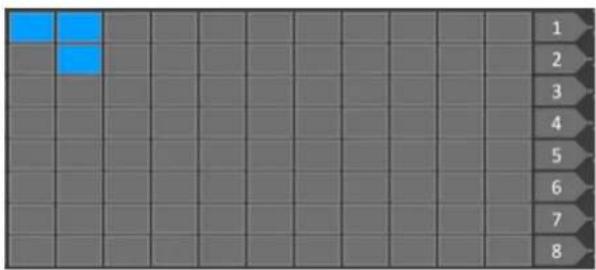
In this page, you can assign any input source to any input channel by clicking the corresponding cell in the cell matrix.
Example:
The image below shows how to assign input source 1 and 2 to Channel In 1, and Input source 2 to Channel In 2.
text_image
Grid interface with numbered rows and blue highlighted cells, likely a UI or data entry panel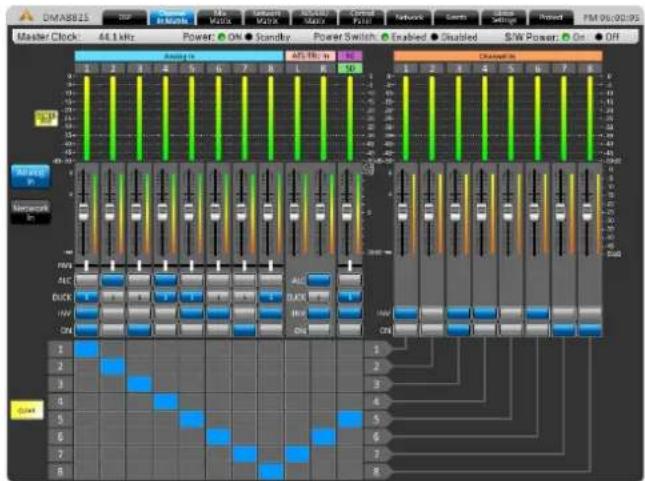
text_image
DMA825 Master Clock: 44.1 kHz Power: ON Sundry Power Switch: Enabled Disabled S/W Power: On OFF Power Shift: 10 Afs Rate: 10 Channel In: Power AUC BUCK ON ON ON ON ON ON ON ON ON ON ON ON ON ON ON ON ON ON ON ON ON ON ON ON ON ON ON ON ON ON ON ON ON ON ON ON ON ON ON ON ON ON ON ON ON ON ON ON ON ON OnMeter Pre/Meter Post: This buttons sets all input sources to pre/post, determining whether or not they are affected by on-screen faders or not.
Analog In and Network In: Use these two buttons to view analog input sources connected via rear panel, as well as digital input sources from the Dante card.
PAN: This sliding control is used to adjust the left/right mix of the input signals.
ALC: Select this button to enable Automatic Level Control on the corresponding channel.
DUCK: Select this button to enable the ducking function on the corresponding channel.
INV: Select this button to invert the phase of the corresponding channel.
ON: Select this button to turn the corresponding signal on and off.
CLEAR: Clicking this button erases all assigned input/output routing.
Mix Matrix
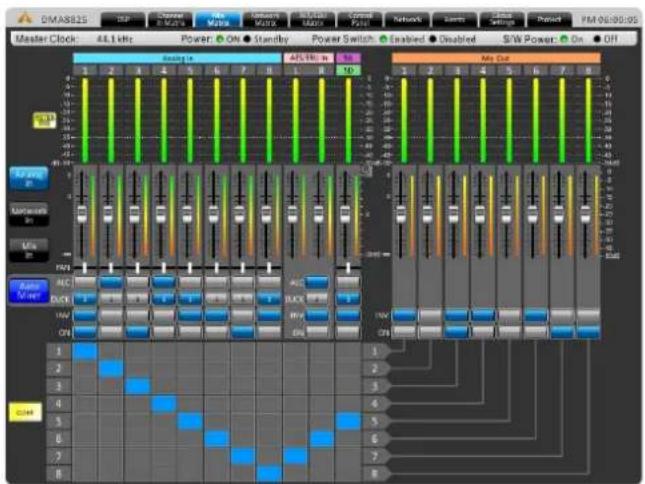
In this page, you can assign which input sources are sent to the main mix outputs. All controls within the Mix Matrix are as the same as those found under the Channel In Matrix tab (page 10), except:
Analog In, Network In and Mix In: Use these three buttons to view analog input sources connected via rear panel, digital input sources from the Dante card and input signal processed in the Channel In Matrix tab.
Auto Mixer: When this function is enabled, ALC and DUCK work simultaneously.
text_image
DMA825 Master Clock: ALL1 kHz Power On Standby Power Switch Enabled Disabled S/W Power On Off Power Shift Control Pairs Network Assets Software Settings Reset PM-06-09:05 AFL-Ru in 10 Mn Out Power Switch Control Pairs AFL-Ru in 10 Mn Out Power Switch Control Pairs AFL-Ru in 10 Mn Out Power Switch Control Pairs AFL-Ru in 10 Mn Out Power Switch Control Pairs AFL-Ru in 10 Mn Out Power Switch Control Pairs AFL-Ru in 10 Mn Out Power Switch Control Pirs AFL-Ru in 10 Mn Out Power Switch Control Pirs AFL-Ru in 10 Mn Out Power Switch Control Pirs AFL-Ru in 10 Mn Out Power Switch Control Pirs AFL-Ru in 10 Mn Out Power Switch Control Pirs AFL-Ru in 10 Mn Out Power Switch Control Pairs AFL-Ru in 10 Mn Out Power Switch Control Pirs AFL-Ru in 10 Mn Out Power Switch Control Pirs AFL-Ru in 10 Mn Out Power Switch Control Pirs AFL-Ru in 10 Mn Out Power Switch Control Pairs AFL-Ru in 10 Mn Out Power Switch Control Pairs AFL-Ru in 10 Mn Out Power Switch Control Pairs AFL-Ru in 10 Mn Out Power Switch Control Pairs AFL-Ru in 10 Mn Out Power SwitchNetwork Matrix
In this page, you can assign which kind of input source to be output via the connected Dante card. All controls are as same as controls under the Channel In Matrix tab (page 10), except:
Channel Out: To view output channel (the last output control in the signal path) effected by the Control Panel tab.
LIM: To enable/disable the built-in Limiter.

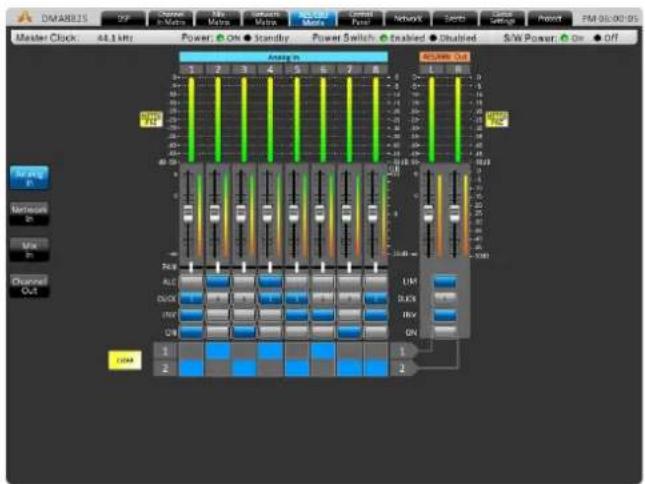
text_image
DMA8825 Master Clock: 44.1 kHz Power ON Standby Power Switch Enabled Disabled S/W Power On Off Power Vpp Ampg in Network Out Win ng Min Diaspns Out 1 2 3 4 5 6 7 8 9 10 11 12 13 14 15 16 17 18 ALC ALG UMP BUCK BUCK VPP VPP CA CA 1 2 3 4 5 6 7 8 9 10 11 12 13 14 15 16 17 18 3 4 5 6 7 8 9 10 11 12 13 14 15 16 17 5 6 7 8 9 10 11 12 13 14 15 16 17 7 8 BaseAES/EBU Matrix
Within the AES/EBU Matrix page, you can assign which input sources are sent to the AES/EBU output mix. All controls are as same as those under the Channel In Matrix tab (page 10) and Network Matrix tab (above).
AES/EBU signals can be synced using the WORD CLOCK input. For system clock settings, see page 15.
text_image
DANA815 2PF Channel Mats Air Matrix Ground Matrix DC Matrix Control Power Network Search Control Settings Project PM 05:00:05 Master Clock: 44.1 MHz Power On Standby Power Switch Enabled Disabled S/W Power On Off Audio In 1 2 3 4 5 6 7 8 100 MHz Out L R VCC 100 MHz 100 MHz 100 MHz 100 MHz 100 MHz 100 MHz 100 MHz 100 MHz 100 MHz 100 MHz 100 MHz 100 MHz 100 MHz 100 MHz 100 MHz 100 MHz 100 MHz 100 MHz 100 MHz 100 MHz 100MHz 100MHz 100MHz 100MHz 100MHz 100MHz 100MHz 100MHz 100MHz 100MHz 100MHz 100MHz 100MHz 100MHz 100MHz 100MHz 100MHz 100MHz 100MHz 100MHz 100kHz 1 2 2 2 2 2 2 2 2 2 2 2 2 2 2 2 2 2 2 2 2 2 2 2 2 2 2 2 2 2 2 2 2 2 2 2 2 2 2 2 2 2 2 2 2 2 2 2 2 2 2 3Control Panel
The control panel menu offers complete control of input channels. This menu includes level and gain controls, metering, and a host of other parameters that can be edited.
Channel Name: A pre-selected channel name can be viewed or edited in this screen.
Fader: The input level can be adjusted using this onscreen fader.
OUT: The input and output signal level of the channel can be viewed through these meters. They can be adjusted between pre- and post-fader meters.
GR: The gain reduction meter will provide a real-time indication of any reduction in gain applied by the internal DSP processes (including compressors-limiters, equalizers, etcetera).

text_image
DMAB825 Master Clock: Init 64.1 MHz Power: On Standby Power Switch: Enabled Disabled S/W Power: On Off Channel1 Channel2 Channel3 Channel4 Channel5 Channel6 Channel7 Channel8 Channel9 Channel10 CH1 CH2 CH3 CH4 CH5 CH6 CH7 CH8 Level Control Level Control Level Control Level Control Level Control Level Control Power, Numbers, Power, Numbers, Power, Numbers, Power, Numbers, Power, Numbers, Power, Numbers, Power, Numbers, Power, Numbers, Power, Numbers, Power, Numbers, Power, Numbers, Power, Numbers, Power, Numbers, Power, Numbers, Power, Numbers, Power, Numbers, Power, Numbers, Power, Numbers, Power, Numbers, Power, Numbers, Power, Numbers, Power, Numbers, Power, Numbers, Power, Numbers, Power, Numbers, Power, Numbers, PMA WU/00/05 0 dB 0 dB 0 dB 0 dB 0 dB 0 dB 0 dB 0 dB 0 dB 0 dB 0 dB 0 dB 0 dB 0 dB 0 dB 0 dB 0 dB 0 dB 0 dB 0 dB 0 dB 0 dB 0 dB 0 dB 0 dB 0 dB 0 dB 0 dB 0 dB 0 dB 0 dB 0 dB 0 dB 0 dB 5Limiter: This button will activate the internal limiter function for the corresponding channel.
Pre/Post: This button allows you to adjust the output meter between a pre-fader and post-fader meter.
Duck: Activate the 'ducking' feature by pushing this button. The duck function can be activated as ducker 1, ducker 2, or off, the settings of which are decided by their respective menus.
INV: This button will invert the phase of the corresponding signal.
ON/OFF: This button will turn the corresponding channel on and off.
Bridged: When the speaker outputs are wired for bridge mode, users must push this button to bridge the outputs of the two channels.
Network
There are two pages under this tab.
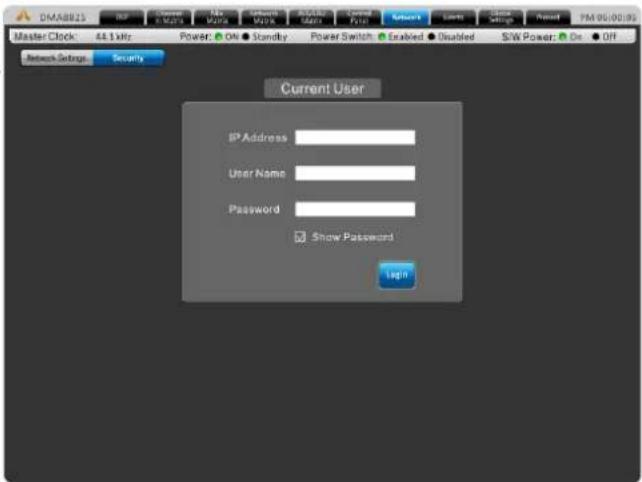
Security
The menus found under this page may vary depending on the method of control being used.
Onboard Control
User Account Profile
You can create user accounts within this tab. Once a User Name and Password are defined, click "SAVE" to store.

text_image
User Account Profile User Name Password USER_1 ******** USER_2 ******** USER_3 ******** USER_4 ******** USER_5 ******** USER_6 ******** USER_7 ******** USER_8 ******** Show PasswordRemote Control From PC
Enter necessary information to log in. Default values are:
IP Address: 192.168.10.200
User Name: USER 1
Password: ASYSTÉMS
text_image
DMA8825 Master Clock: 44.1 kHz Power: On Standby Power Switch: Enabled Disabled S/W Power: On Off Network Settings Security Current User IP Address User Name Password Show Password LoginEvents
In the Events menu you will be able to set up a number of events to occur at a particular time of day. Events can range from simply powering on and off the device to activating audio files at a particular time.
Current Time & Current Date: Here users can set the current date and time. Click the Save button to set these settings. The date and time will be maintained within the DMA amplifier provided power is supplied to the device, whether active or in standby mode.
Time Format: Set the time format to 12/24 Hour time.
Schedule: Any Events already set will be displayed here.
Number: Assign a number to the event you're currently setting.

text_image
DMA8825 Power: On Standbar Power Switch Enabled Disabled S/W Power: On Off Master Clock: 44.1 kHz Current Date: 2013-06-24 Current Time: 16:30:10 TIME Format AM/PM 24 Hour Schedule No Switch Location Tools Action Date Time Period Run Wash Jul 2013 S M T W T F S 1 2 3 4 5 8 9 10 11 12 15 16 17 18 19 22 23 24 25 26 29 30 31 1 2 Number: Subject: Date: Type: Power Change Period: Weekly SUN MON TUE WED THU FRI SATSubject: Provide a name or description to your event.
Location: Describe the location of where the event will occur.
Date: Set the date to begin your event.
Time: Set the time the event should occur, down to the very second.
Type: Select the type of event you are setting here. Available types include power change, channel mute, relay and SD card (typically for initiating audio playback).
Action: The action can be selected between on and standby.
Period: In the period section you will be able to set whether to set your event to occur once, weekly, daily, etc. You can also pick the days of the week for it to occur.
Global Settings
Analog In
Each of the analog inputs can have +48V of phantom power applied to it, ideal for condenser microphones. This menu also allows the user to trim the signal slightly if levels are too excessive.
A high-pass filter can also be added to each of the analog inputs to help remove stage rumble and other unwanted noise.

text_image
DMA8215 Master Clock: 44.1 kHz Power On Standby Power Switch Enabled Disabled S/W Power On Off Analog In: BON/OFF Duffer ALC LM/COMP System GPIO IM/Ctrl LNR Mic/Line In 1 +48V TRIM 0 dB 2 +28V TRIM 0 dB 3 +48V TRIM 0 dB 4 +48V TRIM 0 dB 5 +48V TRIM 0 dB 6 +48V TRIM 0 dB 7 +48V TRIM 0 dB 8 +48V TRIM 0 dB Analog In HPF 70 Hz HPF 70 Hz HPF 70 Hz HPF 70 Hz HPF 70 Hz HPF 70 Hz HPF 70 HzGlobal In On/Off
This menu provides each individual button input, including the analog inputs, network inputs, AES/EBU inputs and signal generator.

text_image
DMABEIS Stop Channel P-Matrix Max Matrix Network Matrix Matrix AC/DC Power Control Power Switch Enabled Disabled S/W Power On Off Master Clock: 44.1 kHz Power On Standby Power Switch Enabled Disabled S/W Power On Off Analog In ON/OFF Duxer ALC LM/COMP System GPIO RM/DNA UMHz Global ON/OFF Analog In 1 2 3 4 5 6 7 8 Network In 1 2 3 4 5 6 7 8 AES/EBU In L R SG ONDucker
The ducker allows a signal to temporarily attenuate below another signal when said signal activates the ducking feature. This is useful when making announcements and other such times when a signal needs to be heard clearly. The ducker can be activated on input and output channels by pushing the 'Duck' buttons found in the individual Matrix control pages. There are two of these 'duckers' total on the DMA.
Source: This is used to select the source of the duck function; i.e. the trigger signal. When the selected source's signal rises to a user-selected level, the currently selected 'duck' signals will attenuate at the selected level.
Threshold: This determines the level that the source signal needs to be before the ducking function will be activated.
Depth: This determines how much the selected 'duck' signals will be attenuated.

text_image
DUMAR25 Master Clock: 44.1 bits Power On Standley Power Switch Enabled Disabled S/W Power On Off Analog In ON/OFF Drop ALC LM/COMP Switch GPIO RM Control LRF DUCKER 1 SOURCE 1 OFF 3 OFF 2 OFF 4 OFF THRESHOLD DEPTH -40 dB -40 dB ATTACK RELEASE 1.69 1.69 DUCKER 2 SOURCE 1 OFF 3 OFF 2 OFF 4 OFF THRESHOLD DEPTH -40 dB -40 dB ATTACK RELEASE 1.69 1.69Attack: The attack time is the time it takes for the ducking feature to kick in after the source signal passes the selected threshold.
Release: The release time control will determine the time the 'duck' feature will remain active as the source signal drops back below the set threshold.
ALC – Auto Level Control
An autoleveler will allow users to dynamically change the level of an input or output signal to match a predefined level set by the user. The autolevel function can be activated for each individual mix in the matrix pages. The settings for these autolevelers can be found within this ALC menu.
In Target: The target level setting allows users to select the desired signal level for their autoleveler. All signals that are processed by the autoleveler will essentially aim for the target level.
Below Target: The below target threshold of the autoleveler is the point at which the autoleveler will kick in. Signals below the threshold will not be affected, but signals above will be have their gain increased.
Ratio: The ratio is the input level change in decibels to the output level change in decibels.

bar
OMARIS Master Clock 44.1 kHz Power On Standby Power Switch Enabled Disabled S/W Power On Off Analog In IN ON/OFF Docker ALC LIM/COMP System GPIO PMCycles LRF Analog In In Target 0.48 1.08 0.05 0.89 0.48 1.38 0.16 0.68 In Target Below Target -39.15 -28.48 -20.48 -31.05 -30.15 -20.45 -20.48 -21.05 Below Target Ratio 20.1 20.1 20.1 22.1 22.1 20.1 20.1 Ratio 20.1 Increase Gain 20 matts 50 matts 70 matts 71 matts 70 matts 71 matts Increase Gain Decrease Gain 120 matts 100 matts 130 matts 130 matts 100 matts 100 matts Decrease Gain Hold Time 5.5 5.5 5.5 5.5 5.5 5.5 Held Time Power Switch Enabled Disabled S/W Power On OffIncrease Gain: The increase gain determines the amount that the signal can be increased to meet the target level. This helps prevent sudden, alarming changes in audio level.
Decrease Gain: The decrease gain works the same as the decrease gain, but in reverse. It determines the amount a signal can be cut.
Hold Time: This determines the time the ALC will remain engaged after the signal falls back below the determined threshold.
LIM/COMP - Limiter/Compressor
This menu allows compressors and limiters to be applied to channel outputs, network outputs or AES/EBU outputs.
Limiter Threshold: This control determines the threshold for the limiter function. This means that no signal will surpass the selected threshold, being 'compressed' at a ratio of infinity:1.
Compressor Threshold: Use this control to set the threshold of the compressor function. Any signals that surpass the selected threshold will be compressed at the selected ratio.
Compressor Ratio: This control can be used to set the ratio for the compressor. The ratio is expressed as :

bar
Channel Out | Channel | 1 | 2 | 3 | 4 | 5 | 6 | 7 | 8 | | :--- | :--- | :--- | :--- | :--- | :--- | :--- | :--- | :--- | | Litter Threshold | 0.49 | 0.48 | 0.49 | 0.49 | 0.49 | 0.49 | 0.49 | 0.49 | | Compressor Threshold | 0.49 | 0.48 | 0.49 | 0.49 | 0.49 | 0.49 | 0.49 | 0.49 | | Compressor Ratio | 0.1 | 0.1 | 0.1 | 0.1 | 0.1 | 0.1 | 0.1 | 0.1 | | Attack | 1.0x | 1.0x | 1.0x | 1.0x | 1.0x | 1.0x | 1.0x | 1.0x | | Release | 832.0x | 832.0x | 832.0x | 832.0x | 832.0x | 832.0x | 832.0x | 832.0x | | Side Chain H.P.P. | OFF | OFF | OFF | OFF | OFF | OFF | OFF | OFF | The chart displays a vertical bar chart with color-coded bars representing different channels (e.g., Power Switch, Control Pkt, Network) and labels indicating channel names and their corresponding power outputs in MHz.Compressor Attack: This control adjusts the attack time of the compressor, essentially determining the time taken for the compressor to kick in after it passes the selected threshold.
Compressor Release: The release control determines the time the DMA will wait before disengaging the compressor when the signal bypasses the selected threshold.
Side Chain HPF: This allows users to set a high pass filter on these channels to essentially help rid these channels of low-frequency noise.
System
System Clock: This menu allows you to select a master clock source for digital devices. Selecting 44.1 or 48 kHz will set the DMA as the master clock source and determine the sampling rate. Selecting AES/EBU, Network, or Word Clock will set these as the master clock. Whenever a new clock source is selected, the ENTER button must be pushed to confirm.
Power Settings: There are three power settings on the DMA. The software power can be turned on and off, essentially enabling the DMA to be turned on and off via the software – including event scheduling. The hardware power can be selected on and off, essentially allowing the unit to be activated and deactivated using the hardwired switch on the front of the DMA.

text_image
DMA8825 Master Clock: 44.1kHz Power On Standby Power Switch Enabled Disabled S/W Power On Off Analog In B ON/OFF Duster ALC LSR/COMP System GPIO NM Control USB SystemClock Set 44.1 MHz Set 48 kHz AES/EBU Network Word Clock Sample Rate: 44.1kHz Locked ENTER DSP Usage DSP 1 DSP 2 Power Settings Power: • ON • Standby Power Switch: Enabled Disabled S/W Power: • ON OFFRelay (GPIO)
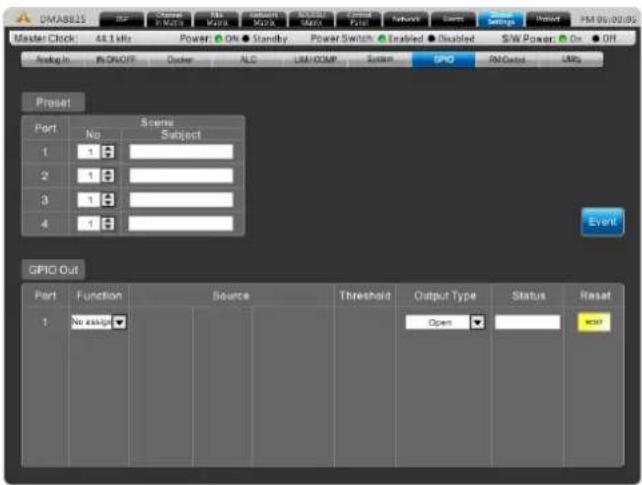
The GPI – or General Purpose Interface – output is used to remotely control the DMA digital matrix amplifier. The relay page itself is used to setup the GPIs, including any and all remote controls connected to the unit.
The Preset panel is for use with the RM-4 remote preset controllers. The numbers in the "Port" field correspond with the ports on the rear of the DMA amplifier. The "No" field is the "Scene" number found in the utility tab. Any of your pre-saved scenes can be assigned to the available ports.
text_image
DMAB25 Master Clock: 44.1 MHz Power OK Standby Power Switch Enabled Disabled S/W Power On Off Analog In In ON/OFF Docker ALC LIM/COMP System GPIO RM/Cuts LIMs Preset Port Scere No Subject 1 1 2 1 3 1 4 1 Event GPIO Out Port Function Source Threshold Output Type Status Reset 1 No assign Open exitRM Control
This page offers a number of assignment options for the Asystems RM remote controls, specifically the RM-6E (sold separately). Each of the "Keys" listed in this page will correspond with a button on the RM-6E. Beside each key users will be able to select the function. This may be gain control, input/output mute, matrix mixing, etc. The last field will allow users to select a 'source' related to their selected function. For example, if "Gain Control" is selected, users will be able to select which input channel's gain is adjusted when that key is selected on the remote.
Up to 8 RM-6E remotes can be used at any one time. Each should be set to a different port to help identify it. Individual remotes can be locked using the corresponding buttons within the RM Control menu. Port settings for the RM-6E can be found on page 8.

text_image
DMA8E25 Master Clock: 44.1 kHz Power OK Standby Power Switch Enabled Disabled S/W Power On Off Analog In In ON/OFF Docker ALD LIM-COMP System GPIO NM Control LNR Port 1 2 3 4 5 6 7 8 Lock 1 2 3 4 5 6 7 8 Key Function Source 1 Channel Mate CH 1 2 Channel Mate CH 1 3 Channel Mate CH 1 4 Channel Mate CH 1 5 Channel Mate CH 1 6 Channel Mate CH 1Utility
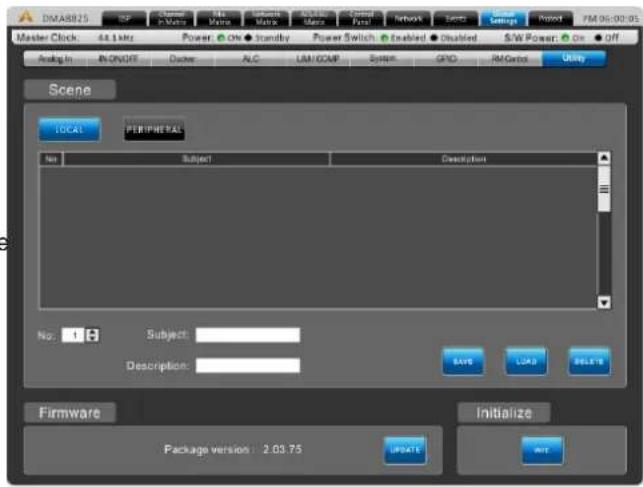
All of the DSP processes can have their settings saved for later use. While there are a number of factory presets available, users are always encouraged to find their own settings and save them for later use. The DMA has onboard storage for a number of settings to be saved, or users can connect USB flash drives to save settings.
Also available in the Utility menu is a firmware update button. When a new version of firmware is available it can be installed using the "Update" button. Place the firmware update file on a formatted USB flash drive and insert it into a USB port. The "Update" button should take care of the rest. After the firmware is updated, the initialize button can be selected to reset the device. Save any settings (or "scenes") before initializing the system.
text_image
DMA8825 Master Clock 44.1 MHz Power On Standby Power Switch Enabled Disabled S/W Power On Off Analog In IN ON/OFF Docker ALC LM/COMP Smart GPS RM Control Utility Scene LOCAL PERIPHERAL No Subject Description No: 1 Subject: Description: SIVE CARD SELECT Firmware Package version: 2.03.75 Initialize UPDATE InitProtect
The protect menu gives real-time updates on the system performance. Everything from the system temperature to the output wattage is represented on this page. If the Protect LED on the front of the DMA amplifier lights up, this menu can be viewed to better understand the issue.
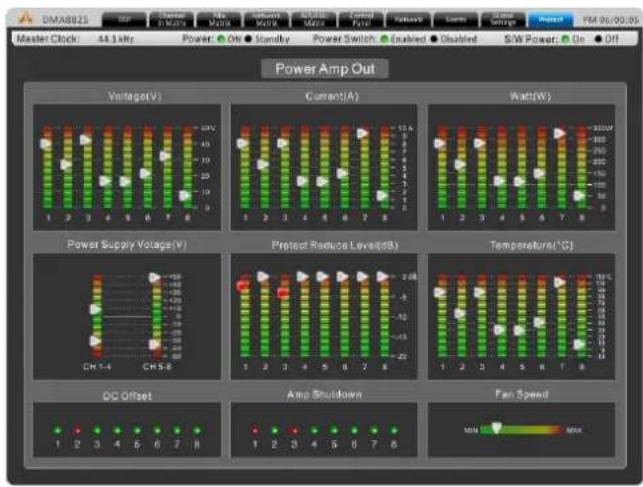
text_image
Power Amp Out Voltage(V) Current(A) Watt(W) Power Supply Voltage(V) Protect Reduce Level(D) Temperature(°C) DC Offset Amp Shutdown Fan Speed 1 2 3 4 5 6 7 8 1 2 3 4 5 6 7 8 10V 1.5V 2.0V 2.5V 3.0V 3.5V 4.0V 4.5V 5.0V 5.5V 6.0V 6.5V 7.0V 7.5V 8.0V 100V 100V 100V 100V 100V 100V 100V 100V 100V 100V 100V 100V 100V 100V 100V 100V 100V 100V 100V 100V 1.5V 2.0V 2.5V 3.0V 3.5V 4.0V 4.5V 5.0V 5.5V 6.0V 6.5V 7.0V 7.5V 8.0VSPECIFICATIONS
| DMA8413 DMA8425 DMA8813 DMA8825 | ||||
| Low Z, Stereo Mode, all channels driven | RMS Power Output Per Channel | |||
| 8Ω, 20Hz-20kHz 1% THD | 80W 150W 80W | 150W | ||
| 4Ω, 20Hz-20kHz 1% THD | 130W 250W 130W | 250W | ||
| Low Z, Bridge Mode, all channels driven | RMS Power Output | |||
| 8Ω, 20Hz-20kHz 1%THD | 260W 500W 260W | 500W | ||
| 70.7V, 100V distributed output RMS | Power Output Per Channel | |||
| 20Hz-20kHz 1%THD, per channel | 130W 250W 130W | 250W | ||
| Models Available | 4Ω and 8Ω70.7 / 100V Constant Voltage | 4Ω and 8Ω70.7 / 100V Constant Voltage | 4Ω and 8Ω70.7 / 100V Constant Voltage | 4Ω and 8Ω70.7 / 100V Constant Voltage |
| Line Current Draw(all channels driven) | ||||
| Line Current, Standby mode | 190mA 190mA | 190mA 190mA | ||
| Line Current, Idle (no signal) | 540mA 540mA | 540mA 540mA | ||
| Line Current, Typical(1/8 power pink noise) | 2.85A 2.85A | 2.85A 2.85A | ||
| Line Current, Maximum(1/3 power sine wave) | 6.00A 6.00A | 6.00A | ||
| Signal to Noise(20Hz-20KHz, unweighted) | >110dB >110dB | >110dB >110dB | ||
| Distortion (SMPTE, typical) - 8 ohm load, 10dB below rated power | <0.5% <0.5% <0.5% | <0.5% | ||
| Distortion (THD-N, typical) -8 ohm load, 10dB below rated power, 20Hz-20kHz | <0.5% <0.5% <0.5% | <0.5% | ||
| Frequency Response | 20Hz-20kHz, +/-1dB 20Hz-20kHz, +/-1dB 20Hz-20kHz, +/-1dB 20Hz-20kHz, +/-1dB | |||
| Damping Factor (8 ohm load,<1kHz) | >250 >250 >250 | >250 | ||
| Input Impedance | 20K Ohm, balanced 20K Ohm, balanced 20K Ohm, balanced 20K Ohm, balanced | |||
| Maximum Input Level | +24dB +24dB +24dB +24dB | |||
| Cooling | Temperature dependent speed-controlled axial fan | |||
| Control Network | Onboard, compatible with standard 100MB Ethernet hardware | |||
| Front Panel Indicators | 8 x Clip, -10dB, -20dB, Signal, Bridge (per pair) Power, Standby, Protect, Power Disable | |||
| Attenuators | 8 x front panel, software, and remote | |||
| Input Connections | Euroblock & Stereo RCA | Euroblock & Stereo RCA | Euroblock & Stereo RCA | Euroblock & Stereo RCA |
| Output Connections | Euroblock | Euroblock | Euroblock | Euroblock |
| Amplifier Protection | Inrush current limitation, temperature monitoring, output over-current protection, mains fuses | |||
| Power Supply (Region Dependent) | 120VAC, 230VAC, 50/60Hz,15A Edison cable | |||
| Dimensions (W x H x D) | 483 x 89 x 394 mm(19" x 3.5" x 15.5") | 483 x 89 x 394 mm(19" x 3.5" x 15.5") | 483 x 89 x 394 mm(19" x 3.5" x 15.5") | 483 x 89 x 394 mm(19" x 3.5" x 15.5") |
| Weight | 9.53 kg (21 lbs) | 9.53 kg (21 lbs) | 9.53 kg (21 lbs) | 9.53 kg (21 lbs) |
PARAMETERS
| Function Parameter Range | ||
| Compressor / Limiter | Compressor Threshold -50 dB to 0 dB | |
| Ratio 1:1 to 20:1 | ||
| Limiter Threshold -50 dB to 0 dB | ||
| Output Gain 0 dB to 18 dB | ||
| Attack / Release 1 ms to 8 seconds | ||
| Gate | Threshold -50 dB to 0 dB | |
| Range -90 dB to 0 dB | ||
| Attack / Hold / Release 1 ms to 8 seconds | ||
| Expander | Threshold -50 dB to 0 dB | |
| Ratio 1:1 to 20:1 | ||
| Attack / Release 1 ms to 8 seconds | ||
| Delay | Delay Time (mS) 0.0 to 680.0 ms | |
| Delay Time (meters) 0.0 to 245.5 | ||
| Delay Time (feet) 0.0 to 805.4 | ||
| Temperature (C) 0° to 50° | ||
| Temperature (F) 32° to 122° | ||
| 4-band Equalizer | Type | BPF, Notch, Peak, HPF, LPF, High Shelf, Low Shelf |
| Gain | -18 dB to +18 dB | |
| Frequency | 20 Hz to 20 kHz | |
| Q | 0.1 to 10 | |
| 31-band Graphic EQ | Frequencies | 20 Hz to 20 kHz |
| Range | -12dB to +12dB | |
| Q | 1.6 to 10 | |
| Filters | Type | HPF (6 dB, 12 dB, 18dB, 24dB), LPF (6 dB, 12 dB, 18dB, 24dB), High Shelf, Low Shelf, Peak, APF, BPF, Notch |
| Gain | -18 dB to +18 dB | |
| Frequency | 20 Hz to 20 kHz | |
| Q | 0.1 to 10 | |
| Feedback Silencer | Threshold -50 dB to 0 dB | |
| Release Time | 10 sec/dB to 300 sec/dB | |
| Gain | -20 dB to 0 dB | |
| Frequency | 20 Hz to 20 kHz | |
| Q | 4.5 to 10 | |
| VCA | Gain | -∞ to 6 dB |
| Automatic Level Control | In Target 0 dB to -50 dB | |
| Below Target -30 dB to 0 dB | ||
| Ratio | 1:5~20:1 | |
| Increase Gain | 40ms/dB to 1000ms/dB | |
| Decrease Gain | 1000ms/dB to 40ms/dB | |
| Hold Time | 0s to 10s | |
| Ducker | Source | Analog 1 to 8, Network 1 to 8, AES/EBU |
| Threshold -50 dB to 0 dB | ||
| Depth | -80 dB to 0 dB | |
| Attack / Release | 0.2s to 20s | |
| Crossover | HPF / LPF Type | Butterworth 12dB, 18dB, 24dB |
| HPF / LPF Frequency | 20 Hz to 20 kHz | |
| Signal Generator | Sine Wave Frequencies | 20Hz to 20KHz |
| Sweep Wave Start/End Frequencies | 20Hz / 20KHz | |
| Sweep Wave Hold Time | 50ms to 2000ms | |
| Signal Level Range -60dB to -10dB |
ÍNDICE
INTRODUCCIÓN....21
CARACTERÍSTICAS....21
natural_image
Front view of a server rack with indicator lights and a logo, mounted on two side rails (no text or symbols visible)4.2 CONEXIÓN
text_image
A MIN MAX MIN MAX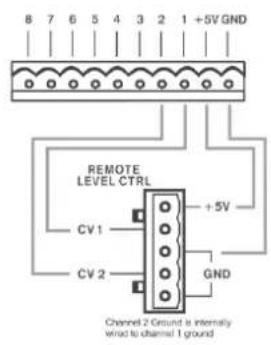
text_image
8 7 6 5 4 3 2 1 +5V GND REMOTE LEVEL CTRL +5V CV1 CV2 GND Channel 2 Ground is internally wind to channel 1 ground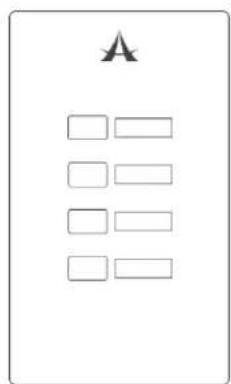
text_image
A □□ □□ □□ □□
text_image
RELAY GND 4 3 2 1 +5V -GND -PFESLT 1 2 3 4 GND3. CONTROL REMOTO PROGRAMABLE RM-6E
text_image
Diagram showing connections between a laptop, an audio equipment interface, and connected cables with USB cable to a device.text_image
Troubleshoot problems Open Network and Sharing Center 2015/9/14text_image
Control Panel Change adopt settings Change advanced sharing Settings View your basic network information and set up connections F51-PC02002 (No compute) New switch controls Internet View your active network: Active network configuration Nokia network Access type: No network ports Connected: 9.8.8.8.8 Change new networking settings: Set up a new connection to network Set up a wireless, broadband, split-up, all hot, or WiFi converting or off-bandband access port. Connect to network Connector in connection to wireless, virtual, banking or VPN network connection.text_image
区域连接 Status General Connection IPv4 Connectivity: No Internet access IPv6 Connectivity: No network access Media State: Enabled Duration: 0:30:17 Speed: 100.0 Mbps Details... Activity Sent —— Received Bytes: 5,363,430 | 7,359,624 Properties Disable Diagnose Closetext_image
网络连接 Properties Networking Connect using: Broadcom NetXhome 57xx Gigabit Controller Configure... This connection uses the following items: Client for Microsoft Networks GoS Packet Scheduler File and Printer Sharing for Microsoft Networks Internet Protocol Version 6 (TCP/IPv8) Internet Protocol Version 4 (TCP/IPv4) Link-Layer Topology Discovery Mapper I/O Driver Link-Layer Topology Discovery Reponder Install Uninstall Properties Description Transmission Control Protocol/Internet Protocol: The default wide area network protocol that provides communication across diverse interconnected networks. OK Canceltext_image
Internet Protocol Version 4 (TCP/IPoS) Properties General You can get IP settings assigned automatically if your network supports this capability. Otherwise, you need to ask your network administrator for the appropriate IP settings. Obtain an IP address automatically Use the following IP address: IP address: 302 . 368 . 10 . 3 Submit mask: 255 . 255 . 255 . 0 Default gateway: Obtain DNS server address automatically Use the following DNS server addresses: Preferred DNS server: Alternate DNS server: Validate settings upon exit Advanced... OK Cancelflowchart
graph TD
    A["Channel In"] --> B["Ch1"]
    A --> C["Ch2"]
    A --> D["Ch3"]
    A --> E["Ch4"]
    A --> F["Ch5"]
    A --> G["Ch6"]
    A --> H["Ch7"]
    A --> I["Ch8"]
    B --> J["Mix In Mix Out"]
    C --> J
    D --> J
    E --> J
    F --> J
    G --> J
    H --> J
    I --> J
    J --> K["Channel Out"]
    style J fill:#f9f,stroke:#333,stroke-width:2px
text_image
Grid-based diagram with numbered rows and blue highlighted cells, likely representing a logic or data visualization layout.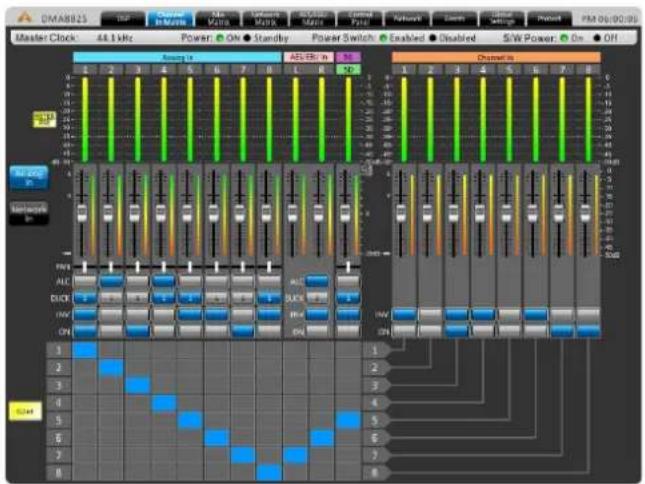
text_image
DMA8825 Master Clock: 44.1 kHz Power OK Standby Power Switch Enabled Disabled S/W Power On Off Audio in AUX/R/C in Channel in Power AUC BUCK DCG ON 1 2 3 4 5 6 7 8 9 10 11 12 13 14 15 16 17 18 19 20 21 22 23 24 25 26 27 28 29 30 31 32 33 34 35 36 37 38 39 40 41 42 43 44 45 46 47 48 49 50 51 52 53 54 55 56 57 58 59 60 61 62 63 64 65 66 67 68 69 70 71 72 73 74 75 76 77 78 79 80text_image
DAMA8125 Master Clock: Int 44.1 kHz Power: On Standby Power Switch: Enabled Disabled SVM Power: On Off Channel 1 Channel 2 Channel 3 Channel 4 Channel 5 Channel 6 Channel 7 Channel 8 CH1 CH2 CH3 CH4 CH5 CH6 CH7 CH8 0 ns 0 ns 0 ns 0 ns 0 ns 0 ns 0 ns 0 ns 0 ns 0 ns 0 ns 0 ns 0 ns 0 ns 0 ns 0 ns 0 ns 0 ns 0 ns 0 ns 0 ns 0 ns 0 ns 0 ns 0 ns 0 ns 0 ns 0 ns 0 ns 0 ns 0 ns 0 ns 0 ns 0 ns 1 Level Control Level Control Level Control Level Control Level Control Level Control Level Control Level Control Play Remote Front Remote Front Remote Front Remote Front Remote Front Remote Front Remote Front Remote Front Remote Front Remote Front Remote Front Remote Front Remote Front Remote Front Remote Front Remote Front Remote Front Remote Front Remote Front Remote Front Remote Front Remote Front Remote Front Remote Front Remote Front Remote Front Remote Front Remote Front Remote Front Remote Front Remote Front Remote Front Remote Front Remote Front Remote Front Remote Front Remote Front Remote Front Remote Front Remote Front Remote Front Remote Front Remote Front Remote Front Remote Front Remote Front Remote Front Remote Front Remote Front Remote Front Remote Field 0 dB 0 dB 0 dB 0 dB 0 dB 0 dB 0 dB 0 dB 0 dB 0 dB 0 dB 0 dB 0 dB 0 dB 0 dB 0 dB 0 dB 0 dB 0 dB 0 dB 0 dB 0 dB 0 dB 0 dB 0 dB 0 dB 0 dB 0 dB 0 dB 0 dB 0 dB 0 dB 0 dB 0 dB 1text_image
DMA8825 Master Clock: 44.1 kHz Power: On Standby Power Switch: Enabled Disabled S/W Power: On Off Network Settings Security Current User IP Address User Name Password Show Password RightEventos/Events
text_image
DMAB215 Master Clock: 48.1 MHz Power On Standby Power Switch Enabled Disabled S/W Power On OFF Current Date Current Time Time Format AM/PM 24 Hour Schedule No Subject Location Trip Action Data Time Period Run Week Number Subject Date Type: Power Change Location: Time: Action: ON Period Weekly SUN MON TUE WED THU FRI SATtext_image
DMABBJS Master Clock: 44.1 kHz Analog In Analog In Network In AES/EBU In SG ON Global ON/OFF Analog In 1 2 3 4 5 6 7 8 Network In 1 2 3 4 5 6 7 8 L R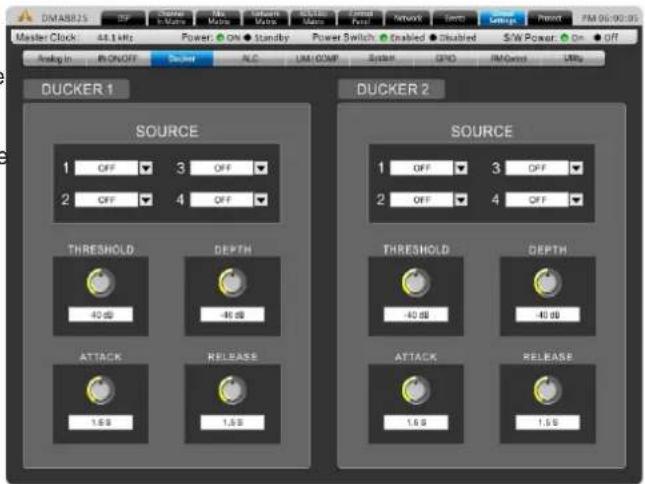
text_image
DUMBRJ5 Master Clock: 48.1 kHz Power ON Standby Power Switch Enabled Studible S/W Power On Off Analog in PN ON/OFF Locker ALC LM/COMF System GPO FM Open LWP DUCKER 1 SOURCE 1 OFF 3 OFF 2 OFF 4 OFF THRESHOLD DEPTH -40 dB -46 dB ATTACK RELEASE 1.68 1.58 DUCKER 2 SOURCE 1 OFF 3 OFF 2 OFF 4 OFF THRESHOLD DEPTH -40 dB -46 dB ATTACK RELEASE 1.68 1.58ALC – Auto Level Control
text_image
DMAB825 Power Channel Mates Max Matrix Channel Matrix Power Switch Control Port Network System Options Settings Project PM 05:00:05 Master Clock: 44.1 kHz Power On Standby Power Switch Enabled Disabled SW Power On Off Analog In ON/OFF Docker ALC LIM/COMP System GPIO NM Control MHz Port 1 2 3 4 5 6 7 8 Lock 1 2 3 4 5 6 7 8 Key Function Source 1 Channel Mate CH 1 2 Channel Mate CH 1 3 Channel Mate CH 1 4 Channel Mate CH 1 5 Channel Mate CH 1 6 Channel Mate CH 1Utility
bar
Power Amp Out | Measurement | Voltage(V) | Current(A) | Watt(W) | Power Supply Voltage(V) | Protect Reduce Level(dS) | Temperature(°C) | DC Offset | Amp Shutdown | Fan Speed | |---|---|---|---|---|---|---|---|---|---| | 1 | 50 | 45 | 40 | 100 | -20 | -15 | 1 | 2 | 3 | | 2 | 45 | 40 | 35 | 95 | -15 | -10 | 2 | 3 | 4 | | 3 | 40 | 35 | 30 | 90 | -10 | -5 | 3 | 4 | 5 | | 4 | 35 | 30 | 25 | 85 | -5 | 0 | 4 | 5 | 6 | | 5 | 30 | 25 | 20 | 80 | 0 | 5 | 5 | 6 | 7 | | 6 | 25 | 20 | 15 | 75 | 5 | 10 | 6 | 7 | 8 | | 7 | 20 | 15 | 10 | 70 | 10 | 15 | 7 | 8 | 9 | | 8 | 15 | 10 | 5 | 65 | 15 | 20 | 8 | 9 | 10 | Power Switch: On Standby Power Switch: Enabled Disabled SW Power: On Off Master Clock: 44.1 MHz Power: On Standby Power Switch: Enabled Disabled SW Power: On Off Master Clock: 06:00:00 PM Master Clock: Off Master Clock: Off Power: On Standby Power Switch: Enabled Disabled SW Power: On Off Master Clock: Off Power: On Standby Power Switch: Enabled Disabled SW Power: On Off Master Clock: Off Power: On Standby Power Switch: Enabled Disabled SW Power: On Off Master Clock: Off Power: On Standby Power Switch: Enabled Disabled SW Power: On Off Master Clock: Off Power: On Standby Power Switch: Enabled Disabled SW Power: On Off Master Clock: Off Power: On Standby Power Switch: Enabled Disabled SW Power: On Off Master Clock: OFF Power: On Standby Power Switch: Enabled Disabled SW Power: On Off Master Clock: Off Power: On Standby Power Switch: Enabled Disabled SW Power: On Off Master Clock: Off Power: On Standby Power Switch: Enabled Disabled SW Power: On Off Master Clock: Off Power: On Standby Power Switch: Enabled Disabled SW Power: On Off Master Clock: Off Power: On Standby Power Switch: Enabled Disabled SW Power: On Off Master Clock: Off Power: On Stand by Power Switch: Enabled Disabled SW Power: On Off Master Clock: Off Power: On Stand by Power Switch: Enabled Disabled SW Power: On Off Master Clock: Off Power: On Stand by Power Switch: Enabled Disabled SW Power: On Off Master Clock: Off Power: On Stand by Power Switch: Enabled Disabled SW Power: On Off Master Clock: Off Power: On Stand by Power Switch: Enabled Disabled SW Power: On Off Master Clock: Off Power: On Stand by Power Switch: Enabled Combined (DC) = -1.2V/div, DC Offset = -1.2V/div, Amp Shutdown = -1.2V/div, Fan Speed = -1.2V/div.ESPECIFICACIONES
natural_image
Abstract black geometric logo resembling the letter 'A' with a stylized triangular shape and curved extensions (no text or symbols)SYSTEMS
www.asystems-sys.com