Atmos - Speaker SPL - Free user manual and instructions
Find the device manual for free Atmos SPL in PDF.


User questions about Atmos SPL
0 question about this device. Answer the ones you know or ask your own.
Ask a new question about this device
Download the instructions for your Speaker in PDF format for free! Find your manual Atmos - SPL and take your electronic device back in hand. On this page are published all the documents necessary for the use of your device. Atmos by SPL.
USER MANUAL Atmos SPL
Atmos® Surround Miking System
text_image
S-CHANNEL PREAMPUMETER Model 2600 Made in Germany HP PAD L/R C sL/sR LFE HEADPHONE MONITOR PHONES Atmos® S-1 Surround Miking System spl L C R sL sR LFEManual

Version 1.0 E-12/2006
R&D: Wolfgang Neumann
This manual contains a description of the product. It in no way represents a guarantee of particular characteristics or results of use. The information in this document has been carefully compiled and verified and, unless otherwise stated or agreed upon, correctly describes the product at the time of packaging with this document.
Sound Performance Lab (SPL) continuously strives to improve its products and reserves the right to modify the product described in this manual at any time without prior notice. This document is the property of SPL and may not be copied or reproduced in any manner, in part or fully, without prior authorization by SPL.
Contact
Sound Performance Lab
Sohlweg 80, 41372 Niederkruechten, Germany
Fon +49 (0) 21 63-9 83 40
Fax +49 (0) 21 63-98 34 20
Mail: info@spl.info
Internet: www.spl.info

The construction of the Atmos, Model 2600, is in compliance with the standards and regulations of the European Community
© 2006 SPL electronics GmbH. All rights reserved. Technical specifications and appearance subject to change without notice.

Content
Atmos – the complete surround miking preamp 4
Installation 5
Control Elements 6
Specifications 7
Introduction
Dear customer,
thanks for using the Atmos system. We wish you have as much fun working with it as we had during the development of this extraordinary recording equipment.
The complete Atmos system includes the Atmos preamp, the external power supply and the power connection.
The Atmos system allows to record the original event and all of its authentic spatial content with highest precision. It demonstrates the significant difference between discrete surround recordings and artificial surround mixes with breathtaking results.
Due to its analog structure, the audio signals are compatible with any common surround format—DVD-A, DVD-V, SACD, AC3, DTS, MLP... you name it, Atmos can deliver it.
Together with a main microphone array this unique system offers an unparalleled combination of uncompromising audio quality and ultimate flexibility.
Most importantly, the Atmos system is a breeze to use and can be set up in minutes, arming you for the most convincing 5.1 recordings you've ever experienced.

The Atmos is a fully-featured stand-alone surround miking preamp for surround productions in any known format. The Atmos system operates fully analog to ensure independence from any storage or transmission format.
Atmos controller
The Atmos is equipped with five matched high precision microphone preamps featuring SPL's triple gain stages to capture the superb sound of Brauner's mic array microphone in the most transparent, noiseless and uncoloured way.
The microphone preamps also feature SPL's ServoDrive-Technology which detects voltage differences (DC-offset) between the positive and negative paths of the amplifying stages. Any offset increases noise and distortion and therefore compromises the signal quality. ServoDrive minimizes DC-offsets to values between omV and 2mV. The recorded signal contains less noise and distortion and improved tonal transparency.
Further features include Lundahl input transformers, pads, phase reverse, phantom power, low cut filters, a switchable insert and tape send/returns. All switches are illuminated. High quality switches and relays with gold plated contacts are used throughout.
5-layer gain control
An important feature of the Atmos is the high-precision five-layer gain control. While changing the preamplification the relative loudness relationships between all five microphones are maintained.
A Master Gain switch enables motorized control over all five microphones preamplifiers by just turning one control. This is especially important when re-adjustment of the preamplification becomes necessary during recording to avoid negative effects on the spatial coherence and phase stability.

The Atmos unit should not be installed near units which produce strong magnetic fields or extreme heat. Do not install the units directly above or below power amplifiers.
A main mic array has to be placed the way that the LCR heads of the microphone (those closer to the microphone center/90° angle) are facing the sound source. Be sure to place the microphone as high as necessary to avoid ground reflections and comb filtering effects. Usually the best position for the mic array is right on the crossing between the direct sound field and the diffuse sound field.
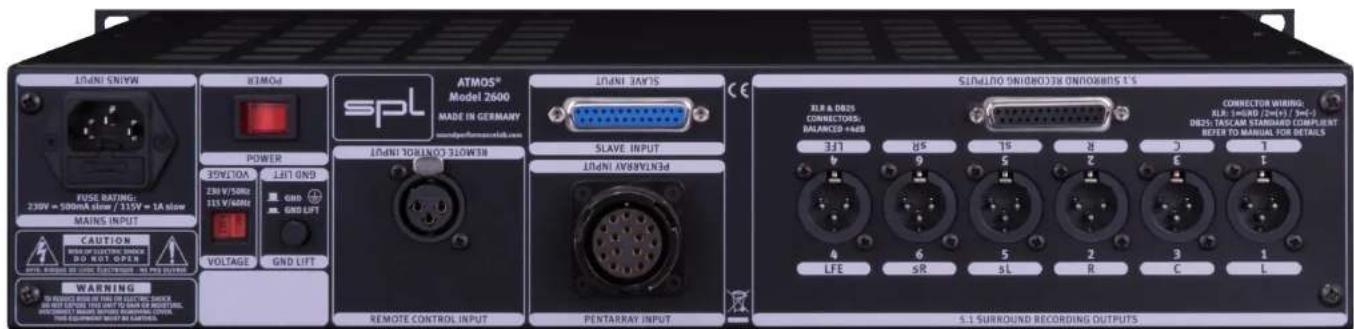
BEFORE switching on the preamp, you have to connect the mic array via the multicore lead to the Atmos unit. Pay attention to fit the bayonet joints properly. Check that the voltage details quoted on the back panel correspond to your local mains electricity supply. Use a minus (-) screwdriver to set the voltage selector to the required voltage. By the way ... the Atmos uses two 1,6 A slow fuses.
Now switch on the Atmos preamp. Set the mic gain control to the 12 o'clock position. Now the VU meters indicate modulation.
Chassis ground and AC ground can be disconnected with the Ground Lift switch (GND LIFT) on the back panel. This can help to eliminate hum.
An AC power cord is included to feed the IEC-spec, 3-prong connector.
Inputs: The microphone inputs are equipped with phantom power supply.
Control Elements
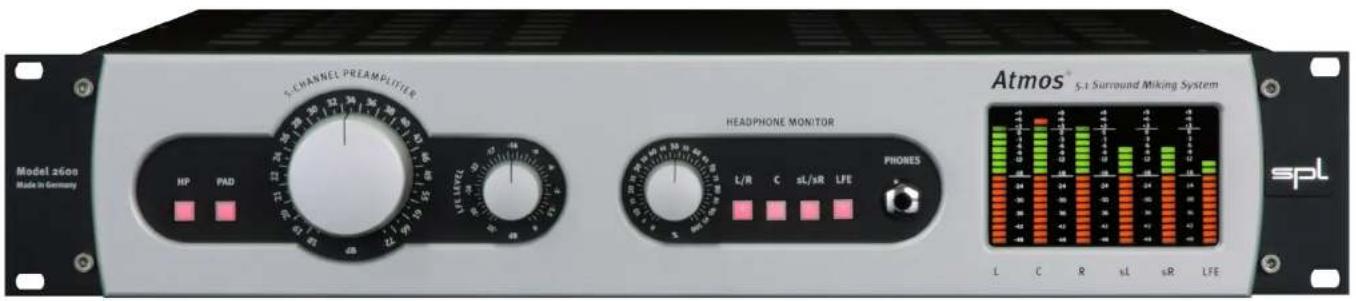
5-Channel Preamplifier Control
The central, 5-layer gain control allows for adjusting preamplification values between 18 and 72 dB. It controls all channels simultaneously.
Switches: HP and PAD
The PAD switch reduces input level by -25 dBu. The HP switch activates a high pass filter at 70 Hz, e.g. to eliminate subsonic frequencies.
Outputs
For recordings of the preamplified signals recording devices like a multitrack recorder can be connected either to the XLR or DB 25 outputs.
LFE Level control
The LFE signal is composed from all channels automatically. Frequency is fixed at 80 Hz, you can simply set the level with the LFE level control (-32 to 0 dB).
PPM Meters
The PPM meters display the levels at the output of each bus. Values range between -48 dBu und +9 dBu and are displayed in steps of 3 dB.
A short example: How to use the Atmos
One can describe the work with the Atmos very good with the example of an orchestral recording.
The main mic array is placed in a central position in front of the orchestra. We choose a position of 1 to 2 meters behind and at least 4 meters above the conductor.
As a starting point we recommend to adjust all mic heads in their o° position (if the mic capsules can be moved) and to select a hypercardioid polar pattern. Moving the mic capsules allows for fine adjustments, for example smaller L/R angles result in larger sound stages of small orchestras.
In general, the same rules apply as with standard miking techniques. So every user can and should develop his own working practice for individual optimization.

Specifications
Frequency range
Mic Out @ 18 dB Gain: 10 Hz-180 kHz (+/-3 dB, Phase -2°)
CMRR 100 Hz 1 kHz 10 kHz
18 dB Gain: -79 dB -79 dB -60 dB
34 dB Gain: -66 dB -66 dB -52 dB
60 dB Gain: -45 dB -45 dB -32 dB
w. Pad -16 dB @ 18 dB Gain: -90 dB -90 dB -79 dB
THD & N 1 kHz 10 kHz
60 dB Gain: 0,22% 0,24%
50 dB Gain: 0,07 % 0,07 %
40 dB Gain: 0,022% 0,023%
30 dB Gain: 0,007 % 0,007 %
18 dB Gain: 0,002% 0,0023%
S/N ratio (A-weighted)
150 Ohm generator, 22 Hz-22 kHz filter, 60 dB Gain@150 Ohm
Mic Out: -66,8 dB
50 dB Gain@all: -77.2 dB
40 dB Gain@all: -85,8 dB
30 dB Gain@all: -93,6 dB
18 dB Gain@all: -96,4 dB
w. PAD -16 dB @ 18 dB Gain: -97,5 dB
Overload resistance +22 dB
text_image
LSTM/ SNV/W RIMPO SPL ATMOS® Model 2600 MADE IN GERMANY SOMPER/MANISTRAEL LEMT SLAVE INPUT BELOWE CONTROL INPUT SLAVE INPUT PENTARARY INPUT REMOTE CONTROL INPUT PENTARRAY INPUT 5.1 SUBROUND/NO REC/(ON)INS OUTPUTS CONNECTOR WIRING: XLR: HAWK 2(4V / 3Hz) DB25: TASCAM STANDARD COMPLIANT REFER TO MANUAL FOR DETAILS 1 3 2 5 9 6 4 3 2 1 LFE L/S R C S 1 3 5 9 sR L C S.1 SURROUND RECORDING OUTPUTS
Contact
Sound Performance Lab
Sohlweg 80, 41372 Niederkruechten, Germany
Fon +49 (a) 21 63-9 83 40
Fax +49 (0) 21 63-98 34 20
Mail: info@spl.info
Internet: www.spl.info
