PU9220+ - Video projector BENQ - Free user manual and instructions
Find the device manual for free PU9220+ BENQ in PDF.


User questions about PU9220+ BENQ
0 question about this device. Answer the ones you know or ask your own.
Ask a new question about this device
Download the instructions for your Video projector in PDF format for free! Find your manual PU9220+ - BENQ and take your electronic device back in hand. On this page are published all the documents necessary for the use of your device. PU9220+ by BENQ.
USER MANUAL PU9220+ BENQ
Important safety instructions .... 3
Introduction...... 7
Projector features......7
Shipping contents......8
Projector exterior view......9
Controls and functions......II
Positioning your projector .... 16
Choosing a location....16
Installing or removing the optional lens ....17
Adjusting projected image position using lens shift....18
Obtaining a preferred projected image size....22
Connection 25
Connecting video source devices.....26
Playing sound through the projector..27
Operation 28
Starting up the projector ....28
Adjusting the projected image .....29
Using the menus....31
Securing the projector....32
Utilizing the password function .....32
Switching input signal 35
Magnifying and searching for details ...36
Selecting the aspect ratio ....36
Optimizing the image ....38
Setting the presentation timer......42
Remote paging operations ....43
Freezing the image....43
Hiding the image.... 43
Locking control keys...... 44
Operating in a high altitude environment.... 44
Adjusting the sound 45
Using the test pattern.... 46
Using the quick install.... 46
Shutting down the projector 47
Menu operation ......48
Maintenance ...... 61
Care of the projector.... 61
Lamp information 62
Cleaning the filter.... 66
Replacing the filter.... 66
Troubleshooting...... 70
Specifications...... 71
Projector specifications.... 71
Dimensions 72
Timing chart.... 73
RS232 command control 79
Warranty and Copyright information...... 81
Important safety instructions
Your projector is designed and tested to meet the latest standards for safety of information technology equipment. However, to ensure safe use of this product, it is important that you follow the instructions mentioned in this manual and marked on the product.
Safety Instructions
- Please read this manual before you operate your projector. Save it for future reference.
natural_image
Cartoon illustration of a projector with arms and legs, no text or symbols present- Do not look straight at the projector lens during operation. The intense light beam may damage your eyes.

natural_image
Cartoon illustration of a person reacting to a projector screen (no text or symbols present)- Refer servicing to qualified service personnel.
natural_image
Cartoon illustration of a projector with arms and legs giving thumbs up (no text or symbols)- Always open the lens shutter or remove the lens cap when the projector lamp is on.
natural_image
Cartoon illustration of a projector with large eyes and a flat body (no text or symbols)- In some countries, the line voltage is NOT stable. This projector is designed to operate safely within a mains voltage between 100 to 240 volts AC, but could fail if power cuts or surges of ±10 volts occur. In areas where the mains voltage may fluctuate or cut out, it is recommended that you connect your projector through a power stabilizer, surge protector or uninterruptible power supply (UPS).
natural_image
Cartoon illustration of a projector with a camera and cable, no text or symbols presentSafety Instructions
- Do not block the projection lens with any objects when the projector is under operation as this could cause the objects to become heated and deformed or even cause a fire. To temporarily turn off the lamp, press BLANK on the projector or remote control.
natural_image
Cartoon illustration of a printer with a smiling face and waving hands (no text or symbols)- The lamp becomes extremely hot during operation. Allow the projector to cool for approximately 45 minutes prior to removing the lamp assembly for replacement.
natural_image
Cartoon illustration of a projector with a fan and steam, no text or symbols present- Do not operate lamps beyond the rated lamp life. Excessive operation of lamps beyond the rated life could cause them to break on rare occasions.

natural_image
Cartoon illustration of a projector with eyes, lens, and clock hands (no text or symbols)- Never replace the lamp assembly or any electronic components unless the projector is unplugged.
natural_image
Cartoon illustration of a projector with arms and legs, waving (no text or symbols)- Do not place this product on an unstable cart, stand, or table. The product may fall, sustaining serious damage.
natural_image
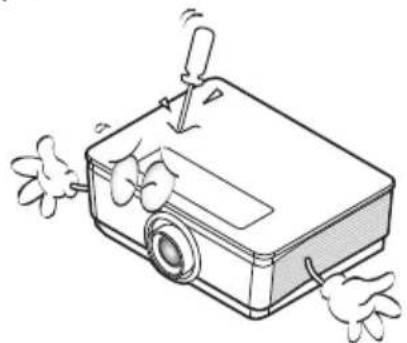
Cartoon illustration of a projector with motion lines and a cup on top (no text or symbols)- Do not attempt to disassemble this projector. There are dangerous high voltages inside which may cause death if you should come into contact with live parts. The only user serviceable part is the lamp which has its own removable cover.
Under no circumstances should you ever undo or remove any other covers. Refer servicing only to suitably qualified professional service personnel.
natural_image
Cartoon illustration of a projector with blades and motion lines, no text or symbols presentSafety Instructions (Continued)
-
When the projector is under operation, you may sense some heated air and odor from its ventilation grill. It is a normal phenomenon and not a product defect.
-
Do not place this projector in any of the following environments.
- Space that is poorly ventilated or confined. Allow at least 50 cm clearance from walls and free flow of air around the projector.
- Locations where temperatures may become excessively high, such as the inside of a car with all windows rolled up.
- Locations where excessive humidity, dust, or cigarette smoke may contaminate optical components, shortening the projector's life span and darkening the image.

natural_image
Illustration of a steaming kettle on an induction cooktop next to a portable projector (no text or symbols)- Locations near fire alarms
- Locations with an ambient temperature above 40^ C / 104^ F
- Locations where the altitudes are higher than 3000 m (10000 feet).
3000 m
(10000 feet)
0 m
(0 feet)

text_image
10°C 25°C-
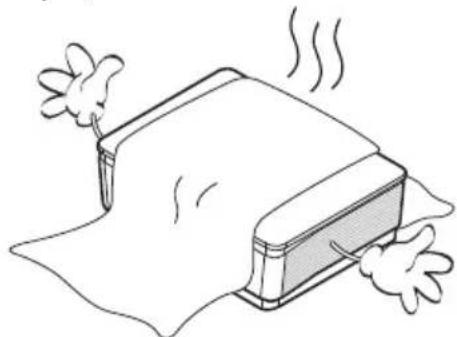
Do not block the ventilation holes.
-
Do not place this projector on a blanket, bedding or any other soft surface.
- Do not cover this projector with a cloth or any other item.
- Do not place inflammables near the projector.
natural_image
Simple line drawing of a steaming bed with steam rising from its side (no text or symbols)If the ventilation holes are seriously obstructed, overheating inside the projector may result in a fire.
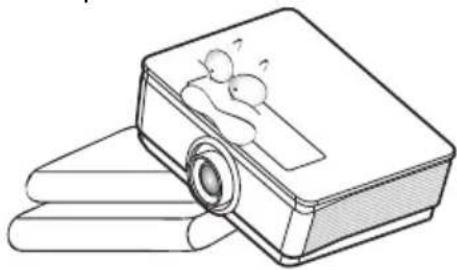
- Always place the projector on a level, horizontal surface during operation.
- Do not use if tilted at an angle of more than 10 degrees left to right, nor at angle of more than 15 degrees front to back. Using the projector when it is not fully horizontal may cause a malfunction of, or damage to, the lamp.
natural_image
Line drawing of a projector with a slide, no text or symbols presentSafety Instructions (Continued)
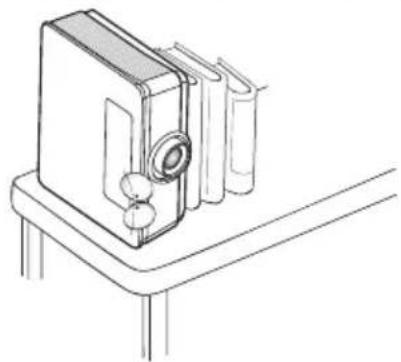
- Do not stand the projector on end vertically. Doing so may cause the projector to fall over, causing injury or resulting in damage to the projector.
natural_image
Line drawing of a vintage camera mounted on a stand, showing lens and case (no text or symbols)- Do not step on the projector or place any objects upon it. Besides probable physical damage to the projector, doing so may result in accidents and possible injury.
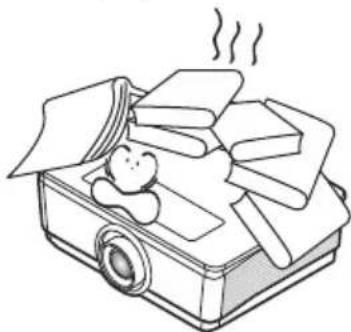
natural_image
Illustration of a steaming box with scattered papers and a small bear on its side (no text or symbols)- Do not place liquids near or on the projector. Liquids spilled into the projector may cause it to fail. If the projector does become wet, disconnect it from the power supply's wall socket and call BenQ to have the projector serviced.
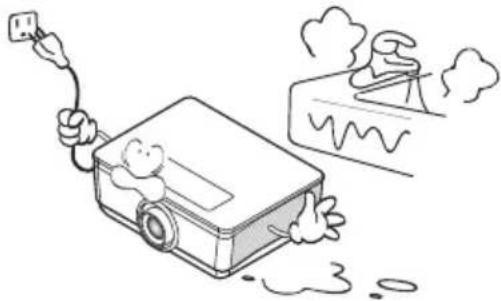
natural_image
Cartoon illustration of a person using a smartphone to interact with a factory chimney (no text or symbols)- This product is capable of displaying inverted images for ceiling mount installation.
Use only BenQ's Ceiling Mount Kit for mounting the projector and ensure it is securely installed.

natural_image
Illustration of a mechanical device with cartoon eyes and hands, no text or symbols presentCeiling mounting the projector
We want you to have a pleasant experience using your BenQ projector, so we need to bring this safety matter to your attention to prevent possible damage to person and property.
If you intend to mount your projector on the ceiling, we strongly recommend that you use a proper fitting BenQ projector ceiling mount kit and that you ensure it is securely and safely installed.
If you use a non-BenQ brand projector ceiling mount kit, there is a safety risk that the projector may fall from the ceiling due to an improper attachment through the use of the wrong gauge or length screws.
You can purchase a BenQ projector ceiling mount kit from the place you purchased your BenQ projector. BenQ recommends that you also purchase a separate Kensington lock compatible security cable and attach it securely to both the Kensington lock slot on the projector and the base of the ceiling mount bracket. This will perform the secondary role of restraining the projector should its attachment to the mounting bracket become loose.
Hg - Lamp contains mercury. Manage in accordance with local disposal laws. See www.lamprecycle.org.
Introduction
Projector features
The projector offers the following features
- BLANK saves lamp power
By pressing the BLANK button to hide the image and immediately lower lamp power at the same time.
- USB TYPE B jack to use the page up/down commands (like Microsoft PowerPoint) using the remote control when connected a PC.
- USB TYPE A jack to support 5V/I.5A output.
• Less than 0.5W in standby condition
Less than 0.5W power consumption under standby mode.
• Network Control
Integrated RJ45 connector for wired network control allowing management of projector status from a computer using a web browser.
- Crestron RoomView ^ , PJ Link and AMX supported
The projector supports Crestron eControl and RoomView, PJ Link and AMX allowing you to control and manage equipment from a remote computer via LAN connection.
• One-key auto-adjustment
Pressing AUTO on the keypad or remote control to show the best picture quality immediately.
• Built-in 5W speaker(s)
Built-in 5W speaker(s) providing stereo audio when an audio input is connected.
- Quick Cooling, Auto Power Off, Signal Power On, Direct Power On, Quick Cooling function speeds up the cooling process when turning off the projector. Auto Power Off function allows the projector to turn off automatically if no input signal is detected after a set period of time. Signal Power On function turns on your projector automatically once detecting COMPUTER-1 or COMPUTER-2 the signal input and Direct Power On boots up the projector automatically when the power is connected.
• 3D Function supported
Various 3D formats make the 3D function more flexible. By presenting the depth of the images, you can wear BenQ 3D glasses to enjoy the 3D movies, videos and sporting events in a more realistic way.

- The apparent brightness of the projected image will vary depending on the ambient lighting conditions, selected input signal contrast/brightness settings, and is directly proportional to projection distance.
- The lamp brightness will decline over time and may vary within the lamp manufacturers specifications. This is normal and expected behavior.
Shipping contents
Carefully unpack and verify that you have all of the items shown below. If any of these items are missing, please contact your place of purchase.
Standard accessories

The supplied accessories will be suitable for your region, and may differ from those illustrated.

natural_image
Illustration of a rectangular projector with a circular lens and ventilation slots (no text or symbols)
natural_image
Black remote control with a green and red button, alongside two cylindrical batteries (no text or symbols visible)Projector Remote control with battery

natural_image
Line drawing of a straight cord with two terminal plugs (no text or symbols)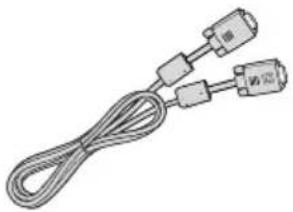
natural_image
Coiled electrical cable with two connectors (no text or symbols visible)Power cord VGA cable


Quick start guide User manual CD Warranty card*
Optional accessories
I. Spare lamp kit
-
3D glasses
-
Ceiling mount kit
*The warranty card is only supplied in some specific regions. Please consult your dealer for detailed information.
Projector exterior view
Front/upper side
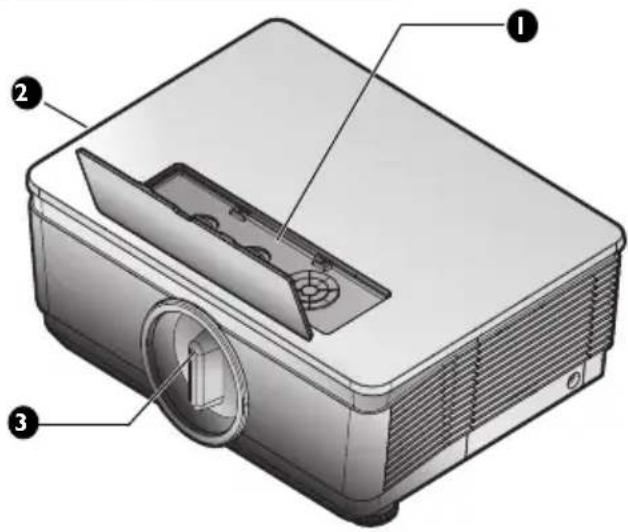
text_image
Diagram of a projector with labeled parts including front, top, and side viewsRear side
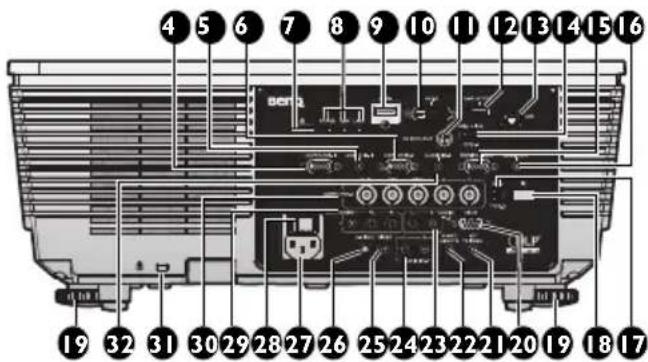
text_image
4 5 6 7 8 9 10 11 12 13 14 15 16 19 32 31 30 29 28 27 26 25 24 23 22 21 20 19 18 17- External control panel (See "Projector" on page 11 for details.)
- Vent (cool air intake)
- Anti-dust cap
- COMPUTER-I input jack
- AUDIO IN-I jack
- COMPUTER-2 input jack
- Power button
- Indicator light (POWER, TEMPerature, LAMP)
- HDMI input jack
- DVI input
II. 3D SYNC OUT jack - DISPLAY PORT
- RJ45 LAN input jack
- USB TYPE-A port
- MONITOT-OUT output jack
- AUDIO OUT jack
- USB TYPE-B port
- Rear IR remote sensor
- Front adjuster foots
- RS232 control port
- 12V TRIGGER
- WIRED REMOTE
- AUDIO IN-3 input jack
- AUDIO IN-4 input jack
- VIDEO input jack
- S-VIDEO input jack
- AC power cord inlet
- AC Power Switch
- COMPONENT Y/Pb/Pr input
- COMPUTER-3, RGBHV(H+V), Y/Pb(CB)/Pr(Cr) input
- Kensington anti-theft lock slot
- AUDIO IN-2 jack
Bottom side
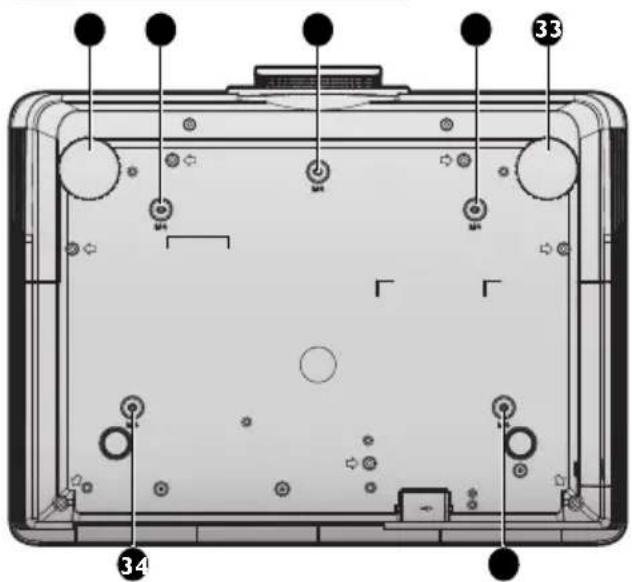
text_image
33 34- Front adjuster foots
- Ceiling mount holes
Controls and functions Projector

text_image
① ② ③ ④ ⑤ ⑥ WINDI/TEXT INPUT HODS OUTPUT CUTY RANK ⑦ ⑧ ⑨ ⑩ ⑪ ⑫ BenQI. MENU/EXIT
Turns on the On-Screen Display (OSD) menu. Goes back to previous OSD menu, exits and saves menu settings. See "Using the menus" on page 31 for details.
2. Keystone/Arrow keys (/▲Up)
Manually corrects distorted images resulting from an angled projection. See "Correcting Keystone" on page 30 for details.
3. INPUT
Displays the source selection bar. See "Switching input signal" on page 35 for details.
4. Left/ Decrease volume level
Decreases volume. See "Adjusting the sound level" on page 45 for details.
5. Keystone/Arrow keys (▲/▼ Down)
Manually corrects distorted images resulting from an angled projection. See "Correcting Keystone" on page 30 for details.
6. BLANK
Used to hide the screen picture. See "Hiding the image" on page 43 for details.
7. MODE/ENTER
Selects an available picture setup mode. See "Selecting a picture mode" on page 38 for details.
Enacts the selected On-Screen Display (OSD) menu item. See "Using the menus" on page 31 for details.
8. ▶ Right/ Increase volume level
Increases volume. See "Adjusting the sound level" on page 45 for details. When the On-Screen Display (OSD) menu is activated, the #2, #4, #5, and #8 keys are used as directional arrows to select the desired menu items and to make adjustments. See "Using the menus" on page 31 for details.
9. AUTO
Automatically determines the best picture timings for the displayed image. See "Auto-adjusting the image" on page 29 for details.
10. LENS SHIFT UP/DOWN
Rotate to move lens up or down.
II. LENS RELEASE button
Flip to release lens.
Rotate to move lens right or left.
Remote Control
text_image
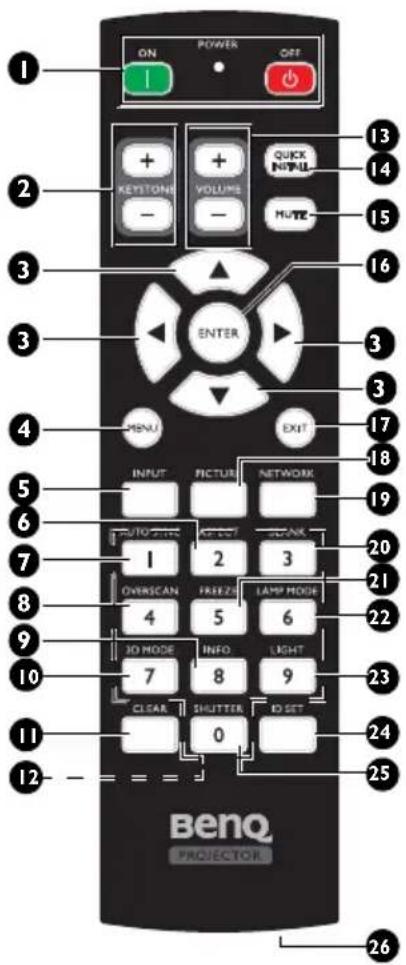
ON POWER OFF 1 2 3 4 5 6 7 8 9 10 11 12 13 14 15 16 17 18 19 20 21 22 23 24 25 26 NEXTION VOLUME MUTE ENTER INPUT PICTURE NETWORK AUTO ZONE LEFT SOAK OVERSCAN FREEZI LAMP MODE 3 4 5 6 JO MODE INFO. LIGHT 7 8 9 CLEAR SHUTTER IO SET 0 Benoq PROJECTORI. ON/ OFF

Toggles the projector between standby mode and on.
2. KEYSTONE+/KEYSTONE-
Manually corrects distorted images resulting from an angled projection.
3. Arrow keys (▲ Up, ▼ Down, ◀ Left, ▶ Right)
When the On-Screen Display (OSD) menu is activated, the #3 keys are used as directional arrows to select the desired menu items and to make adjustments. See "Using the menus" on page 31 for details.
4. MENU
Turns on the On-Screen Display (OSD) menu. Goes back to previous OSD menu, exits and saves menu settings.
5. INPUT
Selects an input source for display. See "Switching input signal" on page 35 for details.
6. ASPECT
Selects the display aspect ratio.
7. AUTO SYNC
Automatically determines the best picture timings for the displayed image.
8. OVERSCAN
Press to select overscan mode.
9. INFO.
Press to display INFORMATION menu.
10. 3D MODE
Press to display 3D setup menu.
II. CLEAR
Clear remote ID SET assigned to all projectors.
Press CLEAR and ID SET for five seconds. The LED blinks three times then the ID setting is cleared.
12. Numeric buttons
Enters numbers in network settings.

Numeric buttons 1, 2, 3, 4 cannot be pressed when asked to enter password.
13. VOLUME +/VOLUME -
Increases/decreases the projector volume.
14. QUICK INSTALL
Displays the Quick Install OSD menu.
15. MUTE
Toggles projector audio between on and off.
16. ENTER
Selects an available picture setup mode. Activates the selected On-Screen Display (OSD) menu item.
17. EXIT
Goes back to previous OSD menu, exits and saves menu settings.
18. PCITURE
Press to display Picture menu.
19. NETWORK
Selects Network Display as the input signal source.
20. BLANK
Used to hide the screen picture.
21. FREEZE
Freezes the projected image.
22. LAMP MODE
Press to display OSD menu to select desired lamp mode.
23. LIGHT
Press to open backlight of remote controller.
24. ID SET
Press to set remote ID.
Press ID SET for three seconds. The POWER indicator on the remote control blinks, then press 01\~99 to designate an ID.
Press CLEAR and ID SET for five seconds. The POWER indicator on the remote control blinks a single instance to signify a switch from control by projector only or control by projector to remote control.
25. SHUTTER
The function is not available on this projector.
26. WIRE REMOTE jack
Connect to projector for wire remote control.

The remote control number must match the projector number for accurate control.
Remote control effective range
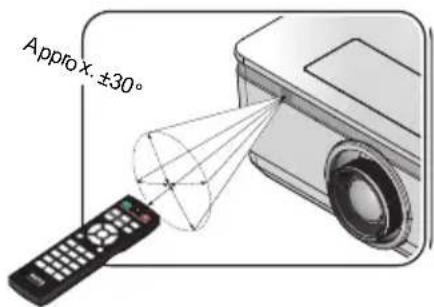
Infra-Red (IR) remote control sensor is located on the rear of the projector. The remote control must be held at an angle within 30 degrees perpendicular to the projector's IR remote control sensor to function correctly. The distance between the remote control and the sensor should not exceed 8 meters (\~ 26 feet).
Make sure that there are no obstacles between the remote control and the IR sensor on the projector that might obstruct the infra-red beam.
text_image
Approx. ±30°
text_image
Approx. ±30°Replacing the remote control battery
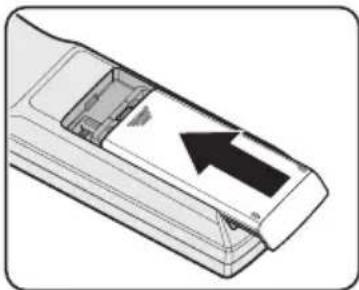
I. To open the battery cover, turn the remote control over to view its back, push on the finger grip on the cover and slide it up in the direction of the arrow as illustrated. The cover will slide off.

natural_image
Diagram of a remote control panel with an arrow indicating direction (no text or symbols present)- Remove any existing batteries (if necessary) and install two AA batteries observing the battery polarities as indicated in the base of the battery compartment. Positive (+) goes to positive and negative (-) goes to negative.

natural_image
Diagram of a remote control device with battery and circular arrows indicating rotation (no text or symbols)- Refit the cover by aligning it with the base and sliding it back down into position. Stop when it clicks into place.

- Avoid excessive heat and humidity.
- There may be battery damage if the battery is incorrectly replaced.
- Replace only with the same or equivalent type recommended by the battery manufacturer.
natural_image
Diagram of a remote control panel with an arrow indicating direction (no text or symbols present)- Dispose of the used battery according to the battery manufacturer's instructions.
- Never throw a battery into a fire. There may be danger of an explosion.
- If the battery is dead or if you will not be using the remote control for a long time, remove the battery to prevent damage to the remote control from possible battery leakage.
Positioning your projector
Choosing a location
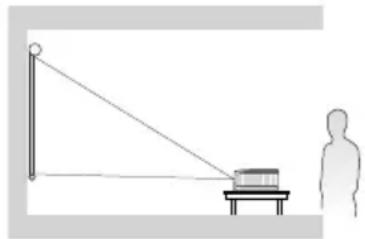
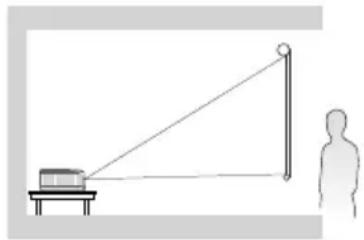
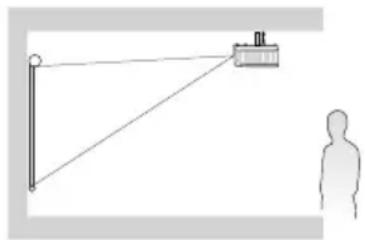
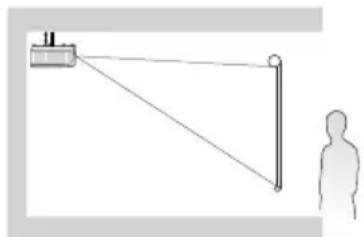
Your projector is designed to be installed in one of four possible installation locations:
I. Front Table
Select this location with the projector placed on a table in front of the screen. This is the most common way to position the projector for quick setup and portability.
natural_image
Simple line drawing of a person observing a small object on a table, with a vertical pole and projection lines (no text or symbols)2. Rear Table
Select this location with the projector placed on a table behind the screen.
Note that a special rear projection screen is required.
*Set Rear Table in the SYSTEM SETUP: Basic > Projector Installation menu after you turn the projector on.
natural_image
Simple line drawing of a person observing a projector mounted on a stand with a pointer, no text or symbols present.3. Front Ceiling
Select this location with the projector suspended upside-down from the ceiling in front of the screen.
Purchase the BenQ Projector Ceiling Mounting Kit from your dealer to mount your projector on the ceiling.
*Set Front Ceiling in the SYSTEM SETUP: Basic > Projector Installation menu after you turn the projector on.
natural_image
Simple line drawing of a person silhouette facing a vertical pole with a small object on top, no text or symbols present.4. Rear Ceiling
Select this location with the projector suspended upside-down from the ceiling behind the screen.
Note that a special rear projection screen and the BenQ Projector Ceiling Mounting Kit are required for this installation location.
*Set Rear Ceiling in the SYSTEM SETUP: Basic > Projector Installation menu after you turn the projector on.
natural_image
Simple line drawing of a person standing next to a vertical pole with a beam and a small object on the left (no text or symbols)Your room layout or personal preference will dictate which installation location you select. Take into consideration the size and position of your screen, the location of a suitable power outlet, as well as the location and distance between the projector and the rest of your equipment.
Installing or removing the optional lens

- Do not shake or place excessive pressure on the projector or the lens components as the projector and lens components contain precision parts.
- Before removing or installing the lens, be sure to turn off the projector, wait until the cooling fans stop, and turn off the main power switch.
- Do not touch the lens surface when removing or installing the lens.
- Keep fingerprints, dust or oil off the lens surface. Do not scratch the lens surface.
• Work on a level surface with a soft cloth under it to avoid scratching. - If you remove and store the lens, attach the lens cap to the projector to keep off dust and dirt.
Removing the existing lens from the projector
I. Flip up the top cover
2. Push the LENSE RELEASE button to the unlock position.
-
Grasp the lens.
-
Rotate the lens counterclockwise. The existing lens will be disengaged.
-
Pull out the existing lens slowly.

text_image
Diagram showing three steps of a projector with labeled control panel and camera mechanism, including rotation and adjustment instructions.Installing the new lens
Remove both end caps from the lens.

Removal of the plastic body cap before inserting a lens for the first time.
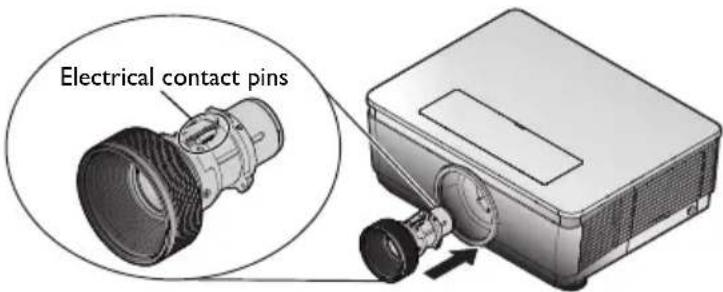
- Align the notches and correctly position the electrical contact pad as shown in the picture.

Electrical contact pins should be in the direction as shown in the picture.
text_image
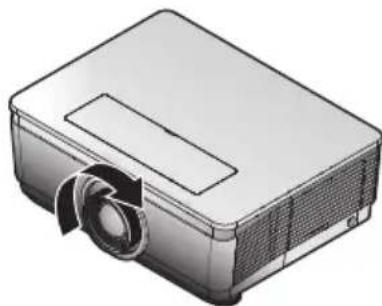
Electrical contact pins- Rotate the lens clockwise until you feel it click into place.
natural_image
Illustration of a projector with a circular lens and ventilation slots (no text or symbols)Adjusting projected image position using lens shift

text_image
Horizontal lens shift lever Vertical lens shift lever Screw for ensure the lens position
Suggest to loosen the screw before lens shift adjustment and tighten up after finished adjustment.
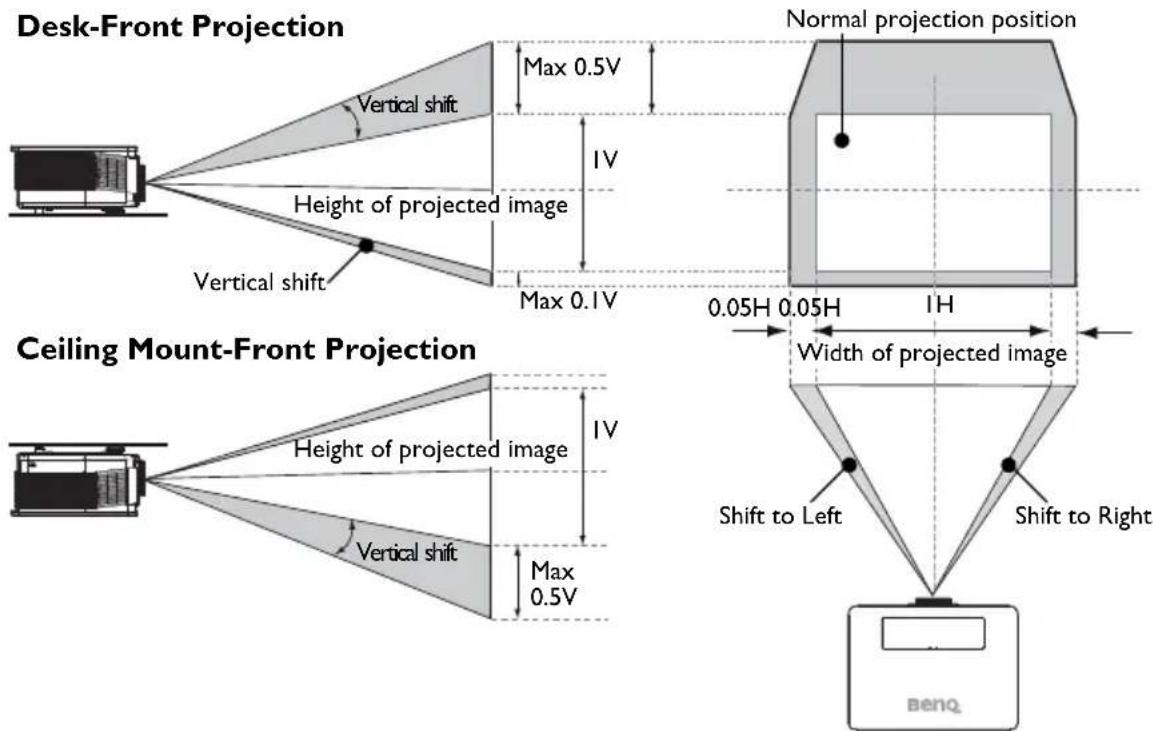
The Lens Shift function can be used to adjust the position of the projected image either horizontally or vertically within the range detailed below.
Adjusting the vertical image position
The vertical image height can be adjusted between 50% and -10% for XGA, 55% and -15% for WUXGA of offset position. Please consult the Lens Shift Range diagram below for further clarification.
Adjusting the horizontal image position
With the lens in the center position the horizontal image position can be adjusted to the left or right by up to a maximum of 5% of the image width. Please consult the Lens Shift Range diagram below for further clarification.
Lens shift range diagram
XGA
text_image
Desk-Front Projection Vertical shift Max 0.5V IV Height of projected image Vertical shift Max 0.1V Normal projection position 0.05H 0.05H IH Width of projected image Ceiling Mount-Front Projection Height of projected image IV Vertical shift Max 0.5V Shift to Left Shift to Right benqWUXGA

text_image
Desk-Front Projection Vertical shift Max 0.55V IV Height of projected image Vertical shift Max 0.15V Normal projection position 0.05H 0.05H IH Width of projected image Ceiling Mount-Front Projection Height of projected image IV Vertical shift Max 0.55V Shift to Left Shift to Right benqNotice (when edge blending)
- To avoid the image shaking or some pixels in the display may be misaligned, do not use the projector in the following location:
• In a building close to a construction site.
• In a room where an air conditioner unit is working and it vibrates.
- In a place where the temperature changes dramatically that may cause thermal contraction.
- Before making any adjustment, leave the projector lit for at least 45 minutes after its lamp is turned on. This allows he internal temperature of the projector to stabilize.
Adjusting the Zoom/Focus
You may turn the zoom ring to zoom in or out. To focus the image, rotate the focus ring until the image is clear. The projector will focus at distances. See page 22.
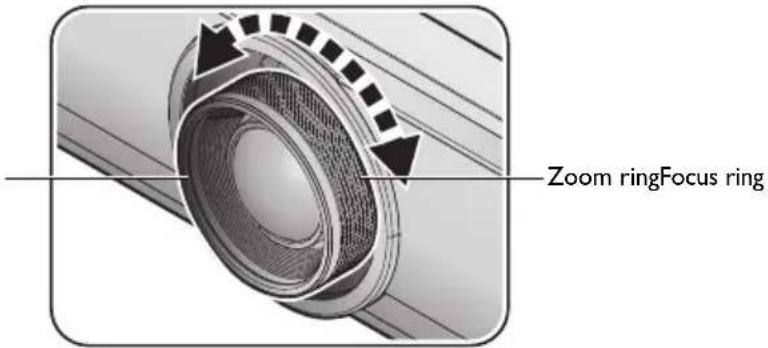
text_image
Zoom ringFocus ringUse the keystone buttons to correct image distortion. They can be found on the remote control and on the projector's control panel.
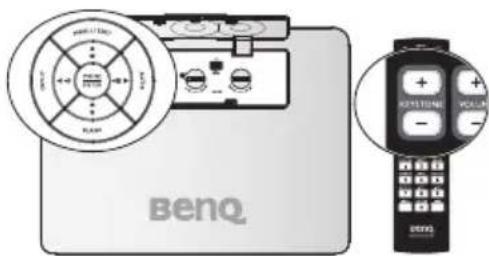
text_image
RHYTONE VOLTAGE BenQObtaining a preferred projected image size
The distance from the projector lens to the screen, the zoom setting (if available), and the video format each factors in the projected image size.
Projection dimensions
Refer to "Dimensions" on page 72 for the center of lens dimensions of this projector before calculating the appropriate position.
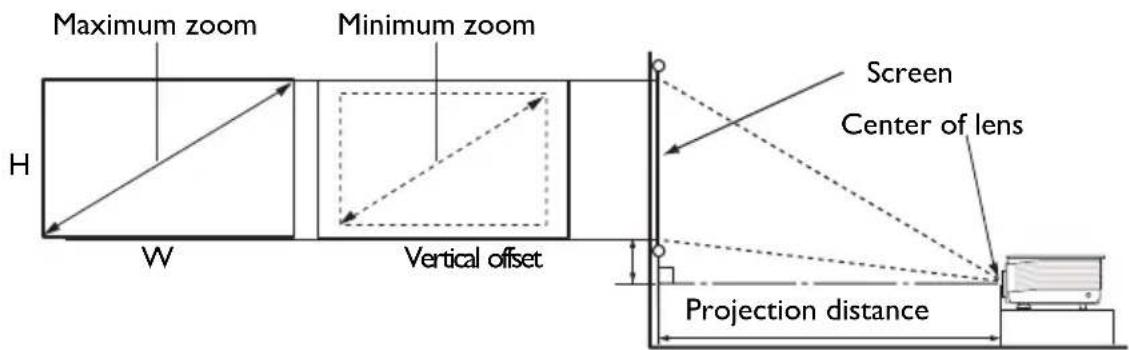
text_image
Maximum zoom Minimum zoom H W Vertical offset Screen Center of lens Projection distancePX9210
The screen aspect ratio is 4:3 and the projected picture is 4:3.
| Screen Size Wide Fix | Lens | Wide Zoom Lens | |||||||||
| Diagonal Width Height Distance | |||||||||||
| NA Wide Tele | |||||||||||
| Inch | m | Inch | m | Inch | m | Inch | m | Inch | m | Inch | m |
| 80 2.03 64 | 1.63 48 | 1.22 51 | 1.30 73 | 1.85 86 | 2.18 | ||||||
| 100 2.54 80 | 2.03 60 | 1.52 64 | 1.63 91 | 2.32 | 107 2.72 | ||||||
| 120 3.05 96 | 2.44 72 | 1.83 77 | 1.95 | 109 2.78 | 129 3.27 | ||||||
| 150 3.81 120 | 3.05 90 | 2.29 96 | 2.44 | 137 3.47 | 161 4.08 | ||||||
| 200 | 5.08 | 160 | 4.06 | 120 | 3.05 | - | - | 182 | 4.63 | 214 | 5.45 |
| 300 | 7.62 | 240 | 6.10 | 180 | 4.57 | - | - | 274 | 6.95 | 322 | 8.17 |
| 400 | 10.16 | 320 | 8.13 | 240 | 6.10 | - | - | - | - | - | - |
| 500 | 12.70 | 400 | 10.16 | 300 | 7.62 | - | - | - | - | - | - |
| Screen Size | STD Lens | Semi Long Zoom | |||||||||||
| Diagonal | Width | Height | Distance | Distance | |||||||||
| Wide | Tele | Wide | Tele | ||||||||||
| Inch | m | Inch | m | Inch | m | Inch | m | Inch | m | Inch | m | Inch | m |
| 80 2.03 64 | 1 | .63 48 | 1.22 102 | 2.60 | 128 3.25 | 128 3.25 | 192 | 4.88 | |||||
| 100 2.54 80 | 2 | .03 60 | 1.52 128 | 3.25 | 160 4.06 | 160 4.06 | 240 | 6.10 | |||||
| 120 3.05 96 | 2 | .44 72 | 1.83 154 | 3.90 | 192 4.88 | 192 4.88 | 288 | 7.32 | |||||
| 150 | 3.81 120 | 3.05 | 90 2.29 | 92 4.88 | 240 6. | 10 240 | 6.10 | 360 | 9.14 | ||||
| 200 | 5.08 160 | 4.06 | 120 3.05 | 256 6.50 | 320 8.13 | 320 | 8.13 | 480 | 12.19 | ||||
| 3 | 0 | 0 | 7 | . | 6 | 2 | 2 | 4 | 0 | 6 | . | 1 | 0 |
| 4 | 0 | 0 | 1 | 0 | . | 1 | 6 | 3 | 2 | 0 | 8 | . | 1 |
| 5 | 0 | 0 | 1 | 2 | . | 7 | 0 | 4 | 0 | 0 | 1 | 0 | . |
| Screen Size Long Zoom | |||||||||
| Diagonal Width Height Distance | |||||||||
| Wide | Tele | ||||||||
| Inch | m | Inch | m | Inch | m | Inch | m | Inch | m |
| 80 2.03 64 | 1.63 48 1.22 | 199 5.06 332 | 8.42 | ||||||
| 100 2.54 80 | 2.03 60 1.52 | 249 6.32 414 | 10.53 | ||||||
| 120 3.05 96 | 2.44 72 1.83 | 299 7.58 497 | 12.63 | ||||||
| 150 3.81 120 | 3.05 90 2.29 | 373 9.48 622 | 15.79 | ||||||
| 200 5.08 160 | 4.06 120 3.05 | 498 12.64 829 | 21.05 | ||||||
| 300 7.62 240 | 6.10 180 4.57 | 746 18.96 1243 | 31.58 | ||||||
| 4 | 0 | 0 | 1 | 0 | . | 1 | 6 | 3 | 2 |
| 5 | 0 | 0 | 1 | 2 | . | 7 | 0 | 4 | 0 |
0 8 . 1 3 0 1 0 . 1
PU9220/PU9220+
The screen aspect ratio is 16:10 and the projected picture is 16:10.
| Screen Size | Wide Fix Lens | Wide Zoom Lens | |||||||||
| Diagonal | Width | Height | Distance | ||||||||
| NA | Wide | Tele | |||||||||
| Inch | m | Inch | m | Inch | m | Inch | m | Inch | m | Inch | m |
| 80 | 2.03 | 68 | 1.72 | 42 | 1.08 | 52 | 1.33 | 75 | 1.90 | 88 | 2.24 |
| 100 | 2.54 85 | 2.15 53 | 1.35 | 65 | 1.66 | 93 | 2.37 | 110 | 2.80 | ||
| 120 | 3.05 102 | 2.58 64 | 1.62 | 78 | 1.99 | 112 | 2.84 | 132 | 3.36 | ||
| 150 | 3.81 127 | 3.23 79 | 2.02 | 98 | 2.49 | 140 | 3.55 | 165 | 4.20 | ||
| 200 | 5.08 | 170 | 4.31 | 106 | 2.69 | - | - | 187 | 4.74 | 220 | 5.60 |
| 300 | 7.62 | 254 | 6.46 | 159 | 4.04 | - | - | 280 | 7.11 | 331 | 8.40 |
| 4 | 0 | 0 | 1 | 0 | . | 1 | 6 | 3 | 3 | 9 | 8 |
| 5 | 0 | 0 | 1 | 2 | . | 7 | 0 | 4 | 2 | 4 | 1 |
| Screen Size STD Lens Semi Long Zoom | |||||||||||||
| Diagonal | Width | Height | Distance | Distance | |||||||||
| Wide Tele Wide Tele | |||||||||||||
| Inch | m | Inch | m | Inch | m | Inch | m | Inch | m | Inch | m | Inch | m |
| 80 | 2.03 | 68 | 1.72 | 42 | 1.08 | 104 | 2.65 | 131 | 3.33 | 131 | 3.33 | 197 | 5.00 |
| 100 | 2.54 | 85 | 2.15 | 53 | 1.35 | 131 | 3.32 | 164 | 4.16 | 164 | 4.16 | 246 | 6.25 |
| 120 | 3.05 | 102 | 2.58 | 64 | 1.62 | 157 | 3.98 | 196 | 4.99 | 196 | 4.99 | 295 | 7.50 |
| 150 | 3.81 | 127 | 3.23 | 79 | 2.02 | 196 | 4.98 | 245 | 6.24 | 245 | 6.24 | 369 | 9.37 |
| 200 | 5.08 | 170 | 4.31 | 106 | 2.69 | 261 | 6.63 | 3.27 | 8.31 | 327 | 8.31 | 492 | 12.49 |
| 300 | 7.62 | 254 | 6.46 | 159 | 4.04 | - | - | - | - | 491 | 12.47 | 738 | 18.74 |
| 400 | 10.16 | 339 | 8.62 | 212 | 5.38 | - | - | - | - | 655 | 16.63 | 984 | 24.99 |
| 500 | 12.70 | 424 | 10.77 | 265 | 6.73 | - | - | - | - | - | - | - | - |
| Screen Size | Long Zoom | ||||||||
| Diagonal Width Height Distance | |||||||||
| Wide Tele | |||||||||
| Inch | m | Inch | m | Inch | m | Inch | m | Inch | m |
| 80 | 2.03 | 68 | 1.72 | 42 | 1.08 | 204 | 5.17 | 339 | 8.62 |
| 100 | 2.54 | 85 | 2.15 | 53 | 1.35 | 254 | 6.46 | 424 | 10.77 |
| 120 | 3.05 | 102 | 2.58 | 64 | 1.62 | 305 | 7.75 | 509 | 12.92 |
| 150 | 3.81 | 127 | 3.23 | 79 | 2.02 | 382 | 9.69 | 636 | 16.15 |
| 200 | 5.08 | 170 | 4.31 | 106 | 2.69 | 509 | 12.92 | 848 | 21.54 |
| 300 | 7.62 | 254 | 6.46 | 159 | 4.04 | 763 | 19.39 | 12.72 | 32.31 |
| 400 | 10.16 | 339 | 8.62 | 212 | 5.38 | - | - | - | - |
| 500 | 12.70 | 424 | 10.77 | 265 | 6.73 | - | - | - | - |

There is 5% tolerance among these numbers due to optical component variations. BenQ recommends that if you intend to permanently install the projector, you should physically test the projection size and distance using the actual projector before you permanently install it, so as to make allowance for this projector's optical characteristics. This will help you determine the exact mounting position so that it best suits your installation location.
Connection
When connecting a signal source to the projector, be sure to:
I. Turn all equipment off before making any connections.
2. Use the correct signal cables for each source.
3. Ensure the cables are firmly inserted.
In the connections shown below, some cables may not be included with the projector (see "Shipping contents" on page 8). They are commercially available from electronics stores.
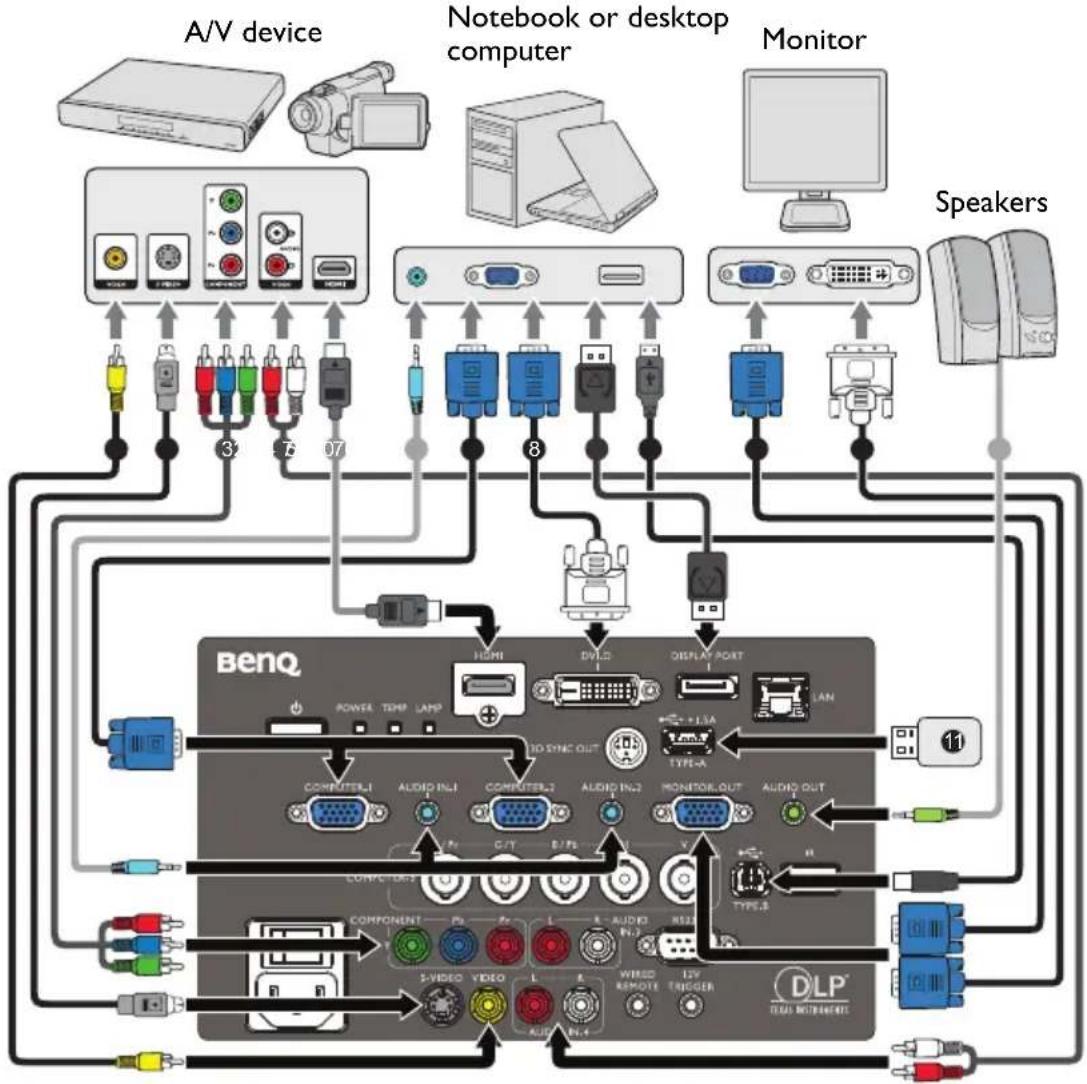
flowchart
graph TD
    subgraph A/V device
        A1["Monitor"] --> B1["Computer"]
        A2["Speaker"] --> B2["Speaker"]
        A3["A/V device"] --> B3["Computer"]
        A4["Notebook or desktop computer"] --> B4["Monitor"]
        B1 --> C1["Server"]
        B2 --> C2["Server"]
        B3 --> C3["Server"]
        B4 --> C4["Server"]
    end
    subgraph Speakers
        D1["Speaker"] --> E1["Monitor"]
        D2["Speaker"] --> E2["Speaker"]
        D3["Speaker"] --> E3["Speaker"]
    end
    subgraph BenQ
        F1["Power"] --> G1["AC/DC"]
        F2["Temp"] --> G1
        F3["Lamp"] --> G1
        G1 --> H1["HDMI"]
        G1 --> H2["DLLD"]
        G1 --> H3["DISPLAY PORT"]
        H1 --> I1["LAN"]
        H2 --> I2["TYPE-A"]
        H3 --> I3["TYPE-B"]
        I1 --> J1["COMPUTER L1"]
        I1 --> J2["COMPUTER L2"]
        I2 --> J3["COMPUTER L3"]
        I3 --> J4["COMPUTER L4"]
        I4 --> J5["COMPUTER L5"]
        I5 --> J6["COMPUTER L6"]
        I6 --> J7["COMPUTER L7"]
        I7 --> J8["COMPUTER L8"]
        I8 --> J9["COMPUTER L9"]
        I9 --> J10["COMPUTER L10"]
        I10 --> K1["COMPONENT"]
        I10 --> K2["COMPONENT"]
        K1 --> L1["I-VIDEO VIDEO L"]
        K1 --> L2["WIND REMOTE 1V THUGGER"]
        K2 --> L3["I-AUDER N.2"]
        K2 --> L4["N.3"]
        K3 --> L5["I-VI PROGUE 1V"]
        K3 --> L6["ALPHA N.4"]
    end
    style A/V device fill:#f9f,stroke:#333
    style Notebook or desktop computer fill:#ccf,stroke:#333
    style Monitor fill:#cfc,stroke:#333
    style Speakers fill:#fcc,stroke:#333
    style BenQ fill:#ffc,stroke:#333
I. Video cable
2. S-Video cable
3. Component video cable
4. Audio L/R cable
5. HDMI cable
6. Audio cable
- VGA cable
- VGA to DVI-A cable
- DISPLAYPORT cable
- USB cable
II. Type-A port power 1.5A

Many notebooks do not turn on their external video ports when connected to a projector. Usually a key combo like FN + F3 or CRT/LCD key turns the external display on/off. Locate a function key labeled CRT/LCD or a function key with a monitor symbol on the notebook. Press FN and the labeled function key simultaneously. Refer to your notebook's documentation to find your notebook's key combination.
Connecting video source devices
You need only connect the projector to a video source device using just one of the connecting methods, however each provides a different level of video quality. The method you choose will most likely depend upon the availability of matching terminals on both the projector and the video source device as described below:
| Terminal name | Terminal appearance | Picture quality |
| HDMI Best |  | |
| Component Video Better | 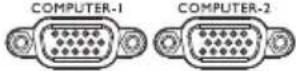 | |
| S-Video Good |  | |
| Video Normal |  |
Connecting audio
The projector has two built-in speaker which are designed to provide basic audio functionality accompanying data presentations for business purposes only. They are not designed for, nor intended for stereo audio reproduction use as might be expected in home theater or home cinema applications.
The built-in speaker will be muted when the AUDIO OUT jack is connected.

If the selected video image is not displayed after the projector is turned on and the correct video source has been selected, check that the video source device is turned on and operating correctly. Also check that the signal cables have been connected correctly.
Playing sound through the projector
You can make use of the projector speaker in your presentations, and also connect separate amplified speakers to the AUDIO OUT socket of the projector.
If you have a separate sound system, you will most likely want to connect the audio output of your Video source device to that sound system, instead of to the mono audio projector.
Once connected, the audio can be controlled by the projector On-Screen Display (OSD) menus.
The table below describes the connection methods for different devices, and where the sound is from.
| Device Audio input port | The projector can play the sound from... | Audio output port | |
| COMPUTER-1 AUDIO-1 AUDIO-1 AUDIO OUT | |||
| COMPUTER-2/ COMPUTER-3/ DVI-D | AUDIO IN-2 (mini jack) | AUDIO IN-2 (mini jack) | AUDIO OUT |
| COMPONENT AUDIO-3 (L/R) AUDIO-3 (L/R) AUDIO OUT | |||
| S-VIDEO/VIDEO AUDIO-4 AUDIO-4 AUDIO OUT | |||
| HDMI HDMI HDMI AUDIO OUT | |||
| DISPLAY PORT | DISPLAY PORT | DISPLAY PORT | AUDIO OUT |
| The selected input signal determines which sound will be played by the projector speaker, and which sound will be output from the projector when AUDIO OUT is connected. If you select the COMPUTER-2/COMPUTER-3/DVI-D signal, the projector can play the sound received from AUDIO IN-2 mini jack. If you select the COMPONENT signal, the projector can play the sound received from AUDIO IN-3 (L/R). | |||
Operation
Starting up the projector
I. Plug the power cord into the projector and into a wall socket. Turn on the wall socket switch (where fitted). Check that the POWER indicator light on the projector lights orange after power has been applied.

Please use the original accessories (e.g. power cable) only with the device to avoid possible dangers such as electric shock and fire.
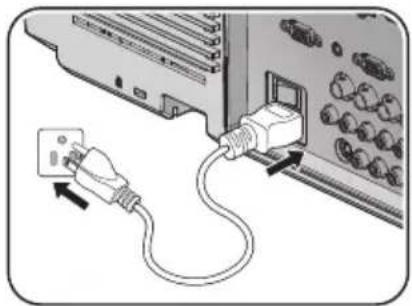
natural_image
Diagram showing a cable being inserted into a device with an outlet, no text or symbols present- Press ⏻ POWER on the projector or remote control 📄 to start the projector and a start up tone sounds. The POWER indicator light flashes green and stays green when the projector is on.
The start up procedure takes about 30 seconds. In the later stage of start up, a startup logo is projected.
(If necessary) Rotate the focus ring to adjust the image clearness.
To turn off the ring tone, see "Turning off the Power on/off ring tone" on page 45 for details.

If the projector is still hot from previous activity, it will run the cooling fan for approximately 90 seconds before energizing the lamp.
-
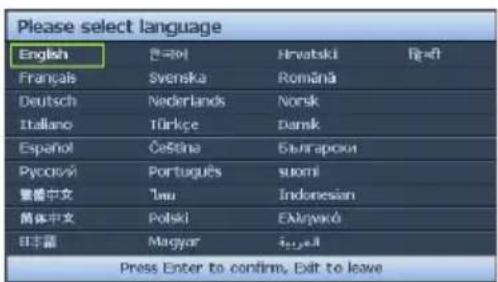
To use the OSD menus, please set them to your familiar language first.
-
If you are prompted for a password, press the arrow keys to enter a six digit password. See "Utilizing the password function" on page 32 for details.
-
Switch all of the connected equipment on.
-
The projector will start to search for input
text_image
Please select language English [1-20] Hrvatski [R'alt] Français Svenska România Deutsch Nederlands Norsk Italiano Türkçe Damsk Español Češčina Švárnapou Pyciová Português suomi 曼顿中文 Ānu Indonesian 简体中文 Polski ENkgvskó 日本語 Magyar šyujii Press Enter to confirm, Exit to leavesignals. The current input signal being scanned displays in the upper left corner of the screen. If the projector doesn't detect a valid signal, the message 'No Signal' will continue displaying until an input signal is found.
You can also press SOURCE on the projector or remote control to select your desired input signal. See "Switching input signal" on page 35 for details.

If the frequency/resolution of the input signal exceeds the projector's operating range, you will see the message 'Out of Range' displayed on a blank screen. Please change to an input signal which is compatible with the projector's resolution or set the input signal to a lower setting. See "Timing chart" on page 73 for details.

To maintain the lamp life, once you turn the projector on, wait at least 5 minutes before turning if off.
Adjusting the projected image
Adjusting the projection angle
The projector is equipped with two front adjuster foots. These adjusters change the image height and projection angle. To adjust the projector:
I. Screw the front adjuster foot. Once the image is positioned where you want it.
2. Screw the adjuster foot to fine tune the horizontal angle.
To retract the foot. Screw the adjuster foot in a reverse direction.

natural_image
Diagram of a mechanical device with two circular ports and a central hub, showing rotational arrows (no text or symbols)If the projector is not placed on a flat surface or the screen and the projector are not perpendicular to each other, the projected image becomes trapezoidal. To correct this situation, see "Correcting Keystone" on page 30 for details.

Do not look into the lens while the lamp is on. The strong light from the lamp may cause damage to your eyes.
Auto-adjusting the image
In some cases, you may need to optimize the picture quality. To do this, press AUTO on the projector or remote control. Within 3 seconds, the built-in Intelligent Auto Adjustment function will re-adjust the values of Frequency and Clock to provide the best picture quality.
The current source information will be displayed in the upper left corner of the screen for 3 seconds.

- The screen will be blank while AUTO is functioning.
- This function is only available when PC signal (analog RGB) is selected.
Fine-tuning the image size and clarity
I. Adjust the projected image to the size that you need using the ZOOM ring.
2. Sharpen the image by rotating the FOCUS ring.
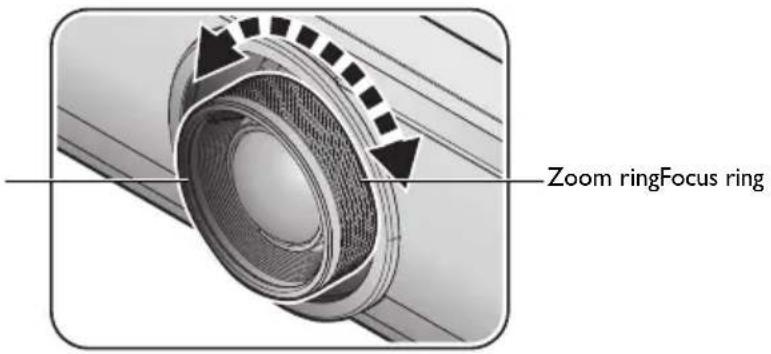
text_image
Zoom ringFocus ringCorrecting Keystone
Keystoning refers to the situation where the projected image is noticeably wider at either the top or bottom. It occurs when the projector is not perpendicular to the screen.
• Using the remote control
Press V on the projector or
KEYSTONE on the remote control to display the Keystone correction page. Press 📄 to correct keystoning at the top of the image.
Press ▼ to correct keystoning at the bottom of the image.

text_image
Press ▼/▲. Press ▲/▼.- Using the OSD menu
I. Press MENU and then press ◀/▶ until the Display menu is highlighted.
2. Press ▼ to highlight Keystone and press ENTER. The Keystone correction page displays.
3. Press ▼ to correct keystoning at the top of the image or press ▲ to correct keystoning at the bottom of the image.
Using the menus
The projector is equipped with On-Screen Display (OSD) menus for making various adjustments and settings.
Below is the overview of the OSD menu.

text_image
Main menu icon Main menu DISPLAY Wall Color Off Aspect Ratio Auto Keystone Position Phase 15 H. Size 0 Digital Zoom 3D 3D Overscan 0 Sub-menu Current input signal 8-VIDEO MENU Exit Press MENU to the previous page or to exit. StatusTo use the OSD menus, please set them to your familiar language first.
I. Press ENTER on the projector or remote control to turn the OSD menu on.
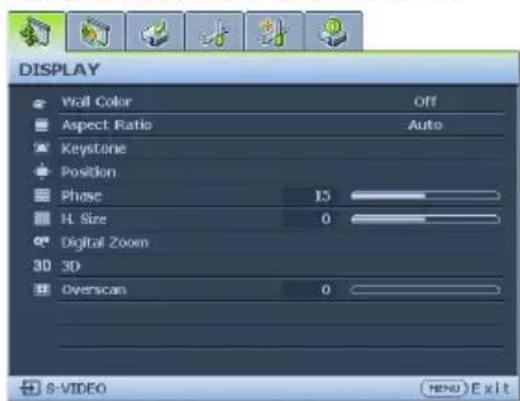
text_image
DISPLAY Wall Color Off Aspect Ratio Auto Keystone Position Phase 13 H. Size 0 Digital Zoom 3D 3D Overscan 0 S-VIDEO MENU Exit- Press ▼ to highlight Language and press ◀/▶ to select a preferred language.
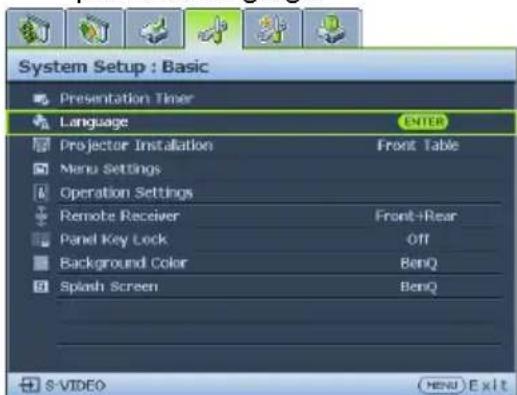
text_image
System Setup : Basic Presentation Timer Language ENTER Projector Installation Front Table Menu Settings Operation Settings Remote Receiver Front+Rear Panel Key Lock Off Background Color BenQ Splash Screen BenQ S-VIDEO MENU Exit- Use ◀/▶ to highlight the System Setup: Basic menu.

text_image
System Setup : Basic Presentation Timer Language Projector Installation Front Table Menu Settings Operation Settings Remote Receiver Front+Rear Panel Key Lock Off Background Color BenQ Splash Screen BenQ S-VIDEO MENU Exit- Press ENTER twice* on the projector or remote control to leave and save the settings.
*The first press leads you back to the main menu and the second press closes the OSD menu.
Securing the projector
Using a security cable lock
The projector has to be installed in a safe place to prevent theft. Otherwise, purchase a lock, such as a Kensington lock, to secure the projector. You can locate a Kensington lock slot on the left side of the projector. See "Kensington anti-theft lock slot" on page 9 for details.
A Kensington security cable lock is usually a combination of key(s) and a lock. Refer to the lock's documentation for finding out how to use it.
Utilizing the password function
For security purposes and to help prevent unauthorized use, the projector includes an option for setting up password security. The password can be set through the On-Screen Display (OSD) menu.

WARNING: You will be inconvenienced if you activate the power-on lock functionality and subsequently forget the password. Print out this manual (if necessary) and write the password you used in this manual, and keep the manual in a safe place for later recall.
Setting a password

Once a password has been set, the projector cannot be used unless the correct password is entered every time the projector is started.
- Highlight Change Security Settings and press ENTER.
- As pictured to the right, the four arrow keys (▲, ▼, ◀, ▶) respectively represent 4 digits (1, 2, 3, 4). According to the password you desire to set, press the arrow keys to enter six digits for the password.
I. Open the OSD menu and go to the System Setup: Advanced > Security Settings menu. Press ENTER. The Security Settings page displays.
- Confirm the new password by re-entering the new password. Once the password is set, the OSD menu returns to the Security Settings page.
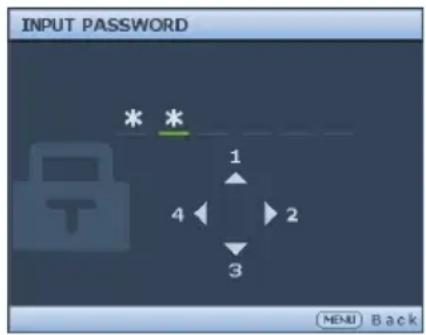
text_image
INPUT PASSWORD * * 1 4 2 3 MENU Back- To activate the Power on Lock function, press ▲/▼ to highlight Power on Lock and press ◀/▶ to select On.

The digits being input will display as asterisks on-screen. Write your selected password down here in this manual in advance or right after the password is entered so that it is available to you should you ever forget it.
Password: ____ ____ ____ ____
Keep this manual in a safe place.
- To leave the OSD menu, press MENU.
If you forget the password
If the password function is activated, you will be asked to enter the six-digit password every time you turn on the projector. If you enter the wrong password, the password error message as pictured to the right displays lasting for three seconds, and the message
'INPUT PASSWORD' follows. You can retry by entering another six-digit password, or if you did not
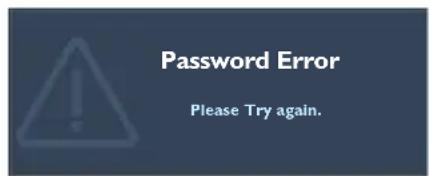
text_image
Password Error Please Try again.record the password in this manual, and you absolutely do not remember it, you can use the password recall procedure. See "Entering the password recall procedure" on page 33 for details.
If you enter an incorrect password 5 times in succession, the projector will automatically shut down in a short time.
Entering the password recall procedure
I. Press and hold AUTO on the projector or remote control for 3 seconds. The projector will display a coded number on the screen.
2. Write down the number and turn off your projector.
3. Seek help from the local BenQ service center to decode the number. You may be required to provide proof of purchase documentation to verify that you are an authorized user of the projector.

text_image
RECALL PASSWORD Please write down the recall code, and contact BenQ Customer Center. Recall code: 12345678Changing the password
-
Open the OSD menu and go to the System Setup: Advanced > Security Settings > Change password menu.
-
Press ENTER. The message 'INPUT CURRENT PASSWORD' displays.
-
Enter the old password.
-
If the password is correct, another message 'INPUT NEW PASSWORD' displays.
-
If the password is incorrect, the password error message displays lasting for three seconds, and the message 'INPUT CURRENT PASSWORD' displays for your retry. You can press MENU to cancel the change or try another password.
-
Enter a new password.

The digits being input will display as asterisks on-screen. Write your selected password down here in this manual in advance or right after the password is entered so that it is available to you should you ever forget it.
Password: ____
Keep this manual in a safe place.
-
Confirm the new password by re-entering the new password.
-
You have successfully assigned a new password to the projector. Remember to enter the new password next time the projector is started.
-
To leave the OSD menu, press MENU.
text_image
Password ChangedDisabling the password function
To disable password protection, go back to the System Setup: Advanced > Security Settings > Change Security Settings menu after opening the OSD menu system. Press ENTER. The message "INPUT PASSWORD" appears. Enter the current password.
i. If the password is correct, the OSD menu returns to the Security Settings. Press ▼ highlight Power On Lock and press ◀/▶ to select Off. You will not have to enter the password next time you turn on the projector.
ii. If the password is incorrect, the password error message displays lasting for three seconds, and the message 'INPUT PASSWORD' displays for your retry. You can press MENU to cancel the change or try another password.

Though the password function is disabled, you need to keep the old password in hand should you ever need to re-activate the password function by entering the old password.
Switching input signal
The projector can be connected to multiple devices at the same time. However, it can only display one full screen at a time.
Be sure the Quick Auto Search function in the Source menu is On (which is the default of this projector) if you want the projector to automatically search for the signals.
You can also manually cycle through the available input signals.
I. Press SOURCE on the projector or press input source directly from the remote control. A source selection bar displays.
2. Press ▲/▼ until your desired signal is selected and press ENTER.
Once detected, the selected source information will display on the screen for seconds. If there is multiple equipment connected to the projector, repeat steps 1-2 to search for another signal.

- The brightness level of the projected image will change accordingly when you switch between different input signals. Data (graphic) "PC" presentations using mostly static images are generally brighter than "Video" using mostly moving images (movies).
- For best display picture results, you should select and use an input signal which outputs at this resolution. Any other resolutions will be scaled by the projector depending upon the 'aspect ratio' setting, which may cause some image distortion or loss of picture clarity. See "Selecting the aspect ratio" on page 36 for details.
Changing Color Space
In the unlikely event that you connect the projector to a DVD player via the projector's HDMI input and the projected picture displays wrong colors, please change the color space.
To do this:
I. Press MENU and then press ◀/▶ until the SOURCE menu is highlighted.
2. Press ▼ to highlight Color Space Conversion and press ◀/▶ to select the setting.

This function is only available when the HDMI input socket is in use.
Magnifying and searching for details
If you need to find the details on the projected picture, magnify the picture. Use the direction arrow keys for navigating the picture.
I. Press MENU and then press ◀/▶ until the Display menu is highlighted.
2. Press ▼ to highlight Digital Zoom and press ENTER. The Zoom bar displays.
3. Press ▼ on the projector repeatedly to magnify the picture to a desired size.
4. To navigate the picture, press ENTER to switch to the paning mode and press the directional arrows (▲, ▼, ◀, ▶) to navigate the picture.
5. To reduce size of the picture, press ENTER to switch back to the zoom in/out functionality, and press AUTO to restore the picture to its original size. You can also press ▼ repeatedly until it is restored to the original size.

The picture can only be navigated after the picture is magnified. You can further magnify the picture while searching for details.
Selecting the aspect ratio
The 'aspect ratio' is the ratio of the image width to the image height. Most analog TV and computers are in 4:3 ratio, and digital TV and DVDs are usually in 16:9 ratio.
With the advent of digital signal processing, digital display devices like this projector can dynamically stretch and scale the image output to a different aspect than that of the image input signal.
To change the projected image ratio (no matter what aspect the source is):
• Using the remote control
I. Press Aspect to show the current setting.
2. Press Aspect repeatedly to select an aspect ratio to suit the format of the video signal and your display requirements.
- Using the OSD menu
I. Press MENU and then press ◀/▶ until the Display menu is highlighted.
-
Press ▼ to highlight Aspect Ratio.
-
Press ◀/▶ to select an aspect ratio to suit the format of the video signal and your display requirements.
About the aspect ratio

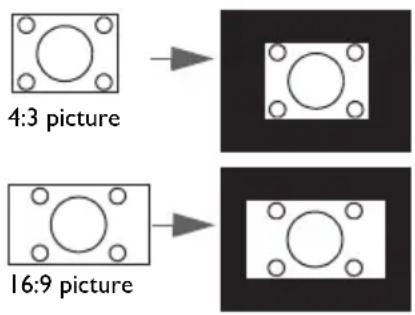
In the pictures below, the black portions are inactive areas and the white portions are active areas. OSD menus can be displayed on those unused black areas.
- Auto: Scales an image proportionally to fit the projector's native resolution in its horizontal width. This is suitable for the incoming image which is neither in 4:3 nor 16:9 and you want to make most use of the screen without altering the image's aspect ratio.

text_image
15:9 picture- Real: The image is projected as its original resolution, and resized to fit within the display area. For input signals with lower resolutions, the projected image will display smaller than if resized to full screen. You could adjust the zoom setting or move the projector away from the screen to increase the image size if necessary. You may also need to refocus the projector after making these adjustments.
text_image
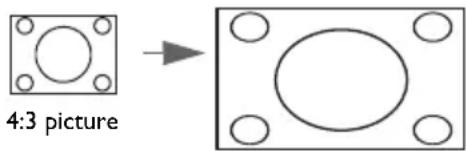
4:3 picture 16:9 picture- 4:3: Scales an image so that it is displayed in the center of the screen with a 4:3 aspect ratio. This is most suitable for 4:3 images like computer monitors, standard definition TV and 4:3 images aspect DVD movies, as it displays them without aspect alteration.
text_image
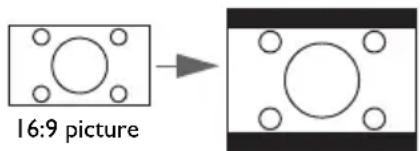
4:3 picture- 16:9: Scales an image so that it is displayed in the center of the screen with a 16:9 aspect ratio. This is most suitable for images which are already in a 16:9 aspect, like high definition TV, as it displays them without aspect alteration.
text_image
16:9 picture- 16:10: Scales an image so that it is displayed in the center of the screen with a 16:10 aspect ratio. This is most suitable for images which are already in a 16:10 aspect, as it displays them without aspect alteration.
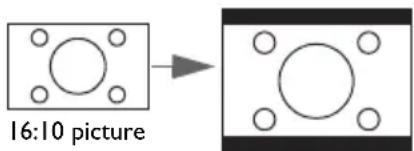
text_image
16:10 pictureOptimizing the image
Using Wall Color
In the situation where you are projecting onto a colored surface such as a painted wall which may not be white, the Wall Color feature can help correct the projected picture's color to prevent possible color difference between the source and projected pictures.
To use this function, go to the Display > Wall Color menu and press ◀/▶ to select a color which is the closest to the color of the projection surface. There are several precalibrated colors to choose from: Light Yellow, Pink, Light Green, Blue, and Blackboard.
Selecting a picture mode
The projector is preset with several predefined picture modes so that you can choose one to suit your operating environment and input signal picture type.
To select an operation mode that suits your need, you can follow one of the following steps.
- Press ENTER on the projector repeatedly until your desired mode is selected.
- Go to the Picture > Picture Mode menu and press ◀/▶ to select a desired mode.
I. Bright mode: Maximizes the brightness of the projected image. This mode is suitable for environments where extra-high brightness is required, such as using the projector in well lit rooms.
-
Presentation mode: Is designed for presentation. The brightness is emphasized in this mode to match PC and notebook coloring.
-
sRGB mode: Maximizes the purity of RGB colors to provide true-to-life images regardless of brightness setting. It is most suitable for viewing photos taken with an sRGB compatible and properly calibrated camera, and for viewing PC graphic and drawing applications such as AutoCAD.
-
Cinema mode: Is appropriate for playing colorful movies, video clips from digital cameras or DVs through the PC input for best viewing in a blackened (dimly lit) environment.
-
3D mode: Is appropriate for playing 3D images and 3D video clips.
-
User I/User 2 mode: Recalls the settings customized based on the current available picture modes. See "Setting the User I/User 2 mode" on page 39 for details.
Setting the User I/User 2 mode
There are two user-definable modes if the current available picture modes are not suitable for your need. You can use one of the picture modes (except the User I/User 2) as a starting point and customize the settings.
I. Press MENU to open the On-Screen Display (OSD) menu.
2. Go to the Picture > Picture Mode menu.
3. Press ◀/▶ to select User 1 to User 2.
4. Press ▼ to highlight Reference Mode.

This function is only available when User 1 or User 2 mode is selected up in the Picture Mode sub-menu item.
- Press ◀/▶ to select a picture mode that is closest to your need.
- Press ▼ to select a sub-menu item to be changed and adjust the value with ◀/▶. See "Fine-tuning the image quality in user modes" below for details.
Fine-tuning the image quality in user modes
According to the detected signal type, and selected picture mode, some of the functions listed below may not be available. Base on your need, you can make adjustments to these functions by highlighting them and press ◀/▶ on the projector or remote control.
Adjusting Brightness
The higher the value, the brighter the image. And lower the setting, darker the image. Adjust this control so the black areas of the image appear just as black and that detail in the dark areas is visible.
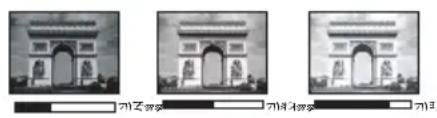
natural_image
Three identical black-and-white photos of the arches of a traditional Chinese architectural complex, each with no visible text or symbols.Adjusting Contrast
The higher the value, the greater the contrast. Use this to set the peak white level after you have previously adjusted the Brightness setting to suit your selected input and viewing environment.
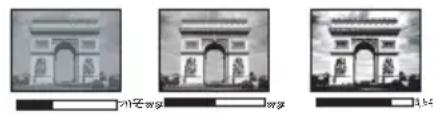
natural_image
Three black-and-white photos of the Grand Canal arches, showing architectural details and landscape features (no visible text or symbols)Adjusting Color
Lower setting produces less saturated colors. If the setting is too high, colors on the image will be overpowering, which makes the image unrealistic.
Adjusting Tint
The higher the value, the more reddish the picture becomes. The lower the value, the more greenish the picture becomes.
Adjusting Sharpness
The higher the value, the sharper the picture becomes. The lower the value, the softer the picture becomes.
Adjusting Brilliant Color
This feature utilizes a new color-processing algorithm and system level enhancements to enable higher brightness while providing truer, more vibrant colors in picture. It enables a greater than 50% brightness increase in mid-tone images, which are common in video and natural scenes, so the projector reproduces images in realistic and true colors. If you prefer images with that quality, select On. If you don't need it, select Off.
When Off is selected, the Color Temperature function is not available.
Selecting a Color Temperature
The options available for color temperature* settings vary according to the signal type selected.
I. Cooler: makes the image appear bluish white.
2. Normal: Maintains normal colorings for white.
3. Warm: Makes images appear reddish white.
\*About color temperatures:
There are many different shades that are considered to be "white" for various purposes. One of the common methods of representing white color is known as the "color temperature". A white color with a low color temperature appears to be reddish white. A white color with a high color temperature appears to have more blue in it.
Setting a preferred color temperature
To set a preferred color temperature:
I. Highlight Color Temperature and select Warm, Normal or Cool by pressing ◀/▶ on the projector or remote control.
2. Press ▼ to highlight Color Temperature Fine Tuning and press ENTER. The Color Temperature Fine Tuning page appears.
3. Press ▲/▼ to highlight the item you want to change and adjust the values by pressing ◀/►.
• R Gain/G Gain/B Gain: Adjusts the contrast levels of Red, Green, and Blue.
- R Offset/G Offset/B Offset: Adjusts the brightness levels of Red, Green, and Blue.
- Press MENU to exit and save the settings.
3D Color Management
In most installation situations, color management will not be necessary, such as in classroom, meeting room, or lounge room situations where lights remain on, or where building external windows allow daylight into the room.
Only in permanent installations with controlled lighting levels such as boardrooms, lecture theaters, or home theaters, should color management be considered. Color management provides fine color control adjustment to allow for more accurate color reproduction, should you require it.
Proper color management can only be achieved under controlled and reproducible viewing conditions. You will need to use a colorimeter (color light meter), and provide a set of suitable source images to measure color reproduction. These tools are not provided with the projector, however, your projector supplier should be able to provide you with suitable guidance, or even an experienced professional installer.
The Color Management provides six sets (RGBCMY) of colors to be adjusted. When you select each color, you can independently adjust its range and saturation according to your preference.
If you have purchased a test disc which contains various color test patterns and can be used to test the color presentation on monitors, TVs, projectors, etc. You can project any image from the disc on the screen and enter the 3D Color Management menu to make adjustments.
To adjust the settings:
I. Go to the Picture menu and highlight 3D Color Management.
2. Press ENTER and the 3D Color Management page displays.
3. Highlight Primary color and press ◀/▶ to select a color from among Red, Green, Blue, Cyan, Magenta and Yellow.
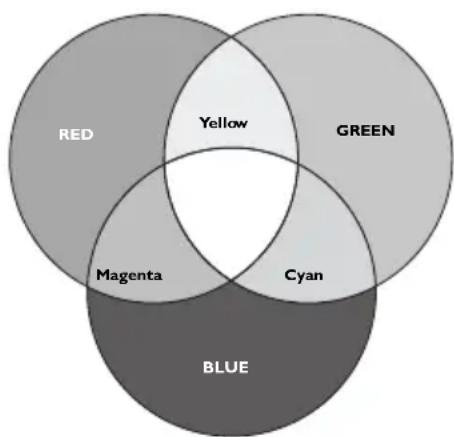
4. Press ▼ to highlight Hue and press ◀/▶ to select its range. Increase in the range will include colors consisted of more proportions of its two adjacent colors.
Please refer to the illustration to the right for how the colors relate to each other.
For example, if you select Red and set its range at 0, only pure red in the projected picture will be selected. Increasing its range will include red close to yellow and red close to magenta.
- Press ▼ to highlight Saturation and adjust its values to your preference by pressing ◀/▶. Every adjustment made will reflect to the image immediately.
For example, if you select Red and set its value at 0, only the saturation of pure red will be affected.
other
| Category | Count | | -------- | ----- | | RED | 1 | | GREEN | 1 | | MAGenta | 1 | | BLUE | 1 | | Yellow | 1 | | Cyan | 1 |
Saturation is the amount of that color in a video picture. Lower settings produce less saturated colors; a setting of “0” removes that color from the image entirely. If the saturation is too high, that color will be overpowering and unrealistic.
-
Press ▼ to highlight Gain and adjust its values to your preference by pressing ◀/▶. The contrast level of the primary color you select will be affected. Every adjustment made will reflect to the image immediately.
-
Repeat steps 3 to 6 for other color adjustments.
-
Make sure you have made all of the desired adjustments.
-
Press MENU to exit and save the settings.
Resetting current or all picture modes
I. Go to the Picture menu and highlight Reset Picture Settings.
- Press ENTER and press ▲/▼ to select Current or All.
• Current: returns current picture mode to the factory preset settings.
- All: returns all settings, except User I/User 2 in the Picture menu to the factory preset settings.
Setting the presentation timer
Presentation timer can indicate the presentation time on the screen to help you achieve better time management when giving presentations. Follow these steps to utilize this function:
I. Go to the System Setup: Basic > Presentation Timer menu and press ENTER to display the Presentation Timer page.
2. Highlight Timer Period and decide the time period by pressing ◀/▶. The length of time can be set from 1 to 5 minutes in 1-minute increments and 5 to 240 minutes in 5-minute increments.

If the timer is already on, the timer will restart whenever the Timer Period is reset.
- Press ▼ to highlight Timer Display and choose if you want the timer to show up on the screen by pressing ◀/▶.
Selection Description
Always Displays the timer on screen throughout the presentation time.
3 min/2 min/1 min Displays the timer on screen in the last 3/2/1 minute(s).
Never Hides the timer throughout the presentation time.
-
Press ▼ to highlight Timer Position and set the timer position by pressing ◀/▶.
-
Press ▼ to highlight Timer Counting Direction and select your desired counting direction by pressing ◀/▶.
Selection Description
Count Up Increases from 0 to the preset time.
Count Down Decreases from the preset time to 0.
- Press ▼ to highlight Sound Reminder and decide if you want to activate sound reminder by pressing ◀/▶. If you select On, a double beep sound will be heard at the last 30 seconds of counting down/up, and a triple beep sound will be produced when the timer is up.
- To activate the presentation timer, press ▼ and press ◀/▶ to highlight On and press ENTER.
- A confirmation message appears. Highlight Yes and press ENTER on the projector or remote control to confirm. You will see the message "Timer is On" appearing on the screen. The timer starts counting when the timer is on.
To cancel the timer, perform the following steps:
I. Go to the System Setup: Basic > Presentation Timer menu and highlight Off. Press ENTER. A confirmation message appears.
2. Highlight Yes and press ENTER to confirm. You will see the message "Timer is Off" appearing on the screen.
Remote paging operations
Connect the projector to your PC or notebook with a USB cable prior to using the paging function. See "Connection" on page 25 for details.
You can operate your display software program (on a connected PC) which responds to page up/down commands (like Microsoft PowerPoint) by pressing PAGE +/PAGE - on the remote control.
If remote paging function doesn't work, check if the USB connection is correctly made and the mouse driver on your computer is updated to the latest version.

The remote paging function cannot work with Microsoft ^® Windows ^® 98 operating system. Windows ^® XP or higher operating systems are recommended.
Freezing the image
Press FREEZE on the remote control to freeze the image. The word 'FREEZE' will appear on the screen. To release the function, press any key on the projector or remote control.

If your remote control has the following keys, please note that they cannot be pressed to release the function: LASER, #2, #5, PAGE +/PAGE -.
Even if an image is frozen on the screen, the pictures are running on the video or other device. If the connected devices have active audio output, you will still hear the audio even though the image is frozen on screen.
Hiding the image
In order to draw the audience's full attention to the presenter, you can use BLANK on the projector or BLANK on the remote control to hide the screen image. When the function is activated with an audio input connected, the audio can still heard.
You can set the blank time in the System Setup: Basic > Operating Settings > Blank Timer menu to let the projector return the image automatically after a period of time when there is no action taken on the blank screen. The length of time can be set from 5 to 30 minutes in 5-minute increments.
If the preset time spans are not suitable for your presentation, select Disable.
No matter Blank Timer is activated or disabled, you can press most of the keys on the projector or remote control to restore the picture.

Do not block the projection lens from projecting as this could cause the blocking object to become heated and deformed or even cause a fire.
Locking control keys
With the control keys on the projector locked, you can prevent your projector settings from being changed accidentally (by children, for example). When the Panel Key Lock is on, no control keys on the projector will operate except ⏻ POWER.
I. Go to the System Setup: Basic > Panel Key Lock menu, and select On by pressing ◀/▶ on the projector or remote control. A confirmation message appears.
2. Highlight Yes and press ENTER to confirm.
To release panel key lock, use the remote control to enter the System Setup: Basic > Panel Key Lock menu and press ◀/▶ to select Off.

- Keys on the remote control are still active when panel key lock is enabled.
- If you press POWER to turn off the projector without disabling panel key lock, the projector will still be in locked status the next time it is turned on.
Operating in a high altitude environment
We recommend you use the High Altitude Mode when your environment is between 1500 m – 3000 m above sea level, and temperature is between 0^ C – 30^ C.

Do not use the High Altitude Mode if your altitude is between 0 m and 1500 m and temperature is between 0°C and 35°C. The projector will be over cooled, if you turn the mode on under such a condition.
To activate the High Altitude Mode:
I. Press MENU and then press ◀/▶ until the System Setup: Advanced menu is highlighted.
2. Press ▼ to highlight High Altitude Mode and press ◀/▶ to select On. A confirmation message displays.
3. Highlight Yes and press ENTER.
Operation under "High Altitude Mode" may cause a higher decibel operating noise level because of increased fan speed necessary to improve overall system cooling and performance.
If you use this projector under other extreme conditions excluding the above, it may display auto shut-down symptoms, which is designed to protect your projector from overheating. In cases like this, you should switch to High Altitude mode to solve these symptoms. However, this is not to state that this projector can operate under any and all harsh or extreme conditions.
Adjusting the sound
The sound adjustments made as below will have an effect on the projector speakers. Be sure you have made a correct connection to the projector audio input. See "Connection" on page 25 for how the audio input is connected.
To temporarily turn off the sound,
• Using the remote control
Press MUTE to temporarily turn off the sound. While the sound is off, the screen will display in the upper right corner of the screen.
To restore the sound, press MUTE again.
• Using the OSD menu
I. Press MENU and then press ◀/▶ until the System Setup: Advanced menu is highlighted.
2. Press ▼ to highlight Audio Settings and press ENTER. The Audio Settings page displays.
3. Highlight Mute and press ◀/▶ to select On.
4. To restore the sound, repeat steps 1-3 and press ◀/▶ to select Off.
Adjusting the sound level
To adjust the sound level,
• Using the remote control
Press VOLUME+/VOLUME- to select a desired sound level.
- Using the OSD menu
I. Repeat steps 1-2 above.
- Press ▼ to highlight Volume and press ◀/▶ to select a desired sound level.
Turning off the Power on/off ring tone
I. Repeat steps 1-2 above.
2. Press ▼ to highlight Power on/off ring tone and press ◀/▶ to select Off.
The only way to change Power on/off ring tone is setting On or Off here. Setting the sound mute or changing the sound level will not affect the Power on/off ring tone.
Using the test pattern
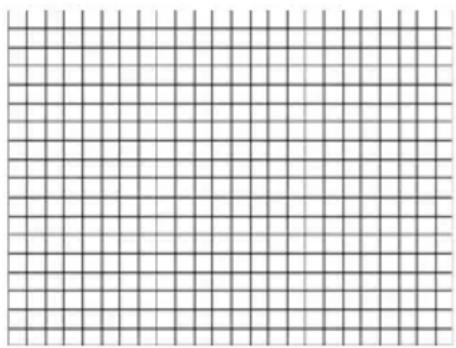
The projector is capable of displaying the grid test pattern. It can be used to assist you with the adjustment of image size and focus, ensuring that the projected image is free from distortion.
To display the test pattern, open the OSD menu and go to the System Setup: Advanced > Test Pattern and press ◀/▶ to select On.
natural_image
Blank grid paper with uniform square cells (no text or symbols)Using the quick install
The projector provides a hot key to set Projector Installation, Test Pattern, and Keystone quickly.
Press Quick Install on the remote control and press ▲/▼ to select:
- Projector Installation: See "Positioning your projector" on page 16.
- Test Pattern: See "Using the test pattern" on page 46.
- Keystone: See "Correcting Keystone" on page 30.
Shutting down the projector
I. Press ⏻ POWER or ⏻ OFF and a confirmation message will appear prompting you. If you don't respond in a few seconds, the message will disappear.
- Press ⏻ POWER or ⏻ OFF a second time. The POWER indicator light flashes orange, the projection lamp shuts down, and the fans will continue to run for approximately 90 seconds to cool down the projector.
To protect the lamp, the projector will not respond to any commands during the cooling process. To shorten the cooling time, you can also activate the Quick Cooling function. See "Quick Cooling" on page 56 for details.
- Once the cooling process finishes, a "Power Off Ring Tone" will be heard. The POWER indicator light is a steady orange and fans stop. Disconnect the power cord from the power outlet.

- To turn off the power ring tone, see "Turning off the Power on/off ring tone" on page 45 for details.
- If the projector is not properly shut down, to protect the lamp, when you attempt to re-start the projector, the fans will run for a few minutes to cool down. Press ⏻ POWER or 📋 ON again to start the projector after the fans stop and the POWER indicator light turns orange.
- Lamp life results will vary depending on environmental conditions and usage.

natural_image
Diagram showing a cable being inserted into a device with an attached plug, no text or symbols presentMenu operation
Menu system
Please note that the on-screen display (OSD) menus vary according to the signal type selected.
Main menu Sub-menu Options
| I. Display | Wall color | Off/Light Yellow/Pink/Light Green/Blue/Blackboard | |
| Aspect Ratio Auto/Real/4:3/16:9/16:10 | |||
| Keystone | |||
| Position | |||
| Phase | |||
| H.size | |||
| Digital zoom PC:1.0X~2.0X; Video: 1.0X~1.8X | |||
| Overscan | Composite/S-Video: 0-3; others: 0-3 | ||
| 3D | 3D mode | Auto/Off/Frame sequential/Frame packing/Top bottom/Side by side | |
| 3D Sync Invert Disable/Invert | |||
| Save 3D Setting | 3D Settings 1/3D Settings 2/3D Settings 3 | ||
| Apply 3D Setting | 3D Settings 1/3D Settings 2/3D Settings 3 | ||
Main menu Sub-menu Options
| Picture Mode | Bright/Presentation/sRGB/Cinema/3D/User 1/User 2 | ||
| Reference Mode | Bright/Presentation/sRGB/Cinema/3D | ||
| Brightness | |||
| Contrast | |||
| Color | |||
| Tint | |||
| Sharpness | |||
| Brilliant Color On/Off | |||
| ColorTemperature | Cool/Normal/Warm | ||
| ColorTemperature FineTuning | R Gain/G Gain/B Gain/R Offset/G Offset/B Offset | ||
| 3D ColorManagement | Primary Color R/G/B/C/M/Y | ||
| Hue | |||
| Saturation | |||
| Gain | |||
| Reset picturesettings | Current/All/Cancel | ||
| Quick Auto Search On/Off | |||
| Source | Color SpaceConversion | Auto/RGB/YUV | |
| Main menu | Sub-menu | Options | |
| 4. System Setup: Basic | Presentation Timer | Timer Period 1~15~240 min | |
| Timer Display Always/1 min/2 mins/3 mins/Never | |||
| Timer Position | Top-Left/Bottom-Left/ Top-Right/Bottom-Right | ||
| Timer Counting Direction | Count Down/Count up | ||
| Sound Reminder On/Off | |||
| On Yes/No | |||
| Off Yes/No | |||
| Language | English/Français/Deutsch/ Italiano/Espanol/Pyccski/繁體中文/简体中文/日本語/한국어/Svenska/Nederlands/Türkçe/Čeština/Português/###/Polski/Magyar/Hrvatski/Românä/Norsk/Dansk/Български/Suomi/Indonesian/Емнікá/العربية/हिन्दी | ||
| Projector Installation | Front/Rear/Rear Ceiling/Front Ceiling | ||
| Menu Setting | Menu Display Time 5 sec/10 sec/20 sec/30 sec/Always | ||
| Menu Position | Center/Top-Left/Top-Right/Bottom-Right/Bottom-Left | ||
| Reminder Message On/Off | |||
| Operation Setting | Direct Power On On/Off | ||
| Signal Power On On/Off | |||
| Auto Power Off | Disable/3 mins/10 mins/15 mins/20 mins/25 mins/30 mins | ||
| Quick Cooling On/Off | |||
| Blank Timer | Disable/5 mins/10 mins/15 mins/20 mins/25 mins/30 mins | ||
| Sleep Timer | Disable/30 mins/1 hr/2 hrs/3 hrs/4 hrs/8 hrs/12 hrs | ||
| Reset Filter Timer Reset/Cancel | |||
| Remote Receiver Front+Rear/Front/Rear | |||
| Panel Key Lock On/Off | |||
| Background Color | BenQ/Black/Blue/Purple | ||
| Splash Screen | BenQ/Black/Blue | ||
Main menu Sub-menu Options
| 5. System Setup: Advanced | High Altitude Mode | On/Off | |
| Audio Settings | Mute On/Off | ||
| Volume | |||
| Power on/off Ring On/Off | |||
| Lamp Settings | Lamp Mode Normal/Economic | ||
| Reset Lamp Timer Reset/Cancel | |||
| Lamp Information | |||
| Security Setting | Change Password | ||
| Change Security Settings | |||
| Power On Lock On/Off | |||
| Baud Rate | 2400/4800/9600/14400/19200/38400/57600/115200 | ||
| Test Pattern On/Off | |||
| Projector ID Setting | Off/01~99 | ||
| Closed Caption | Closed Caption Enable | On/Off | |
| Caption Version CCI / CC2 / CC3 / CC4 | |||
| Standby Settings | Network | Enable Network Standby Mode/Auto Disable Network Standby Mode | |
| Monitor Out On/Off | |||
| Audio Pass Through | Audio In 1/Audio In 2/Audio In 3/Audio L/R /HDMI/Off | ||
| Network settings | Wired LAN | Status | |
| DHCP | |||
| IP Address | |||
| Subnet Mask | |||
| Default Gateway | |||
| DNS Server | |||
| Apply | |||
| AMX Device Discovery | On/Off | ||
| Mac Address | |||
| Reset All Settings Reset/Cancel | |||
Main menu Sub-menu Options
| 6.Information | Current System Status | • Source• Picture Mode• Lamp Mode• Resolution• 3 D Format• Color System• Lamp Usage Time• Projector ID• Firmware Version |
Note that the menu items are available when the projector detects at least one valid signal. If there is no equipment connected to the projector or no signal detected, limited menu items are accessible.
Description of each menu
| FUNCTION DESCRIPTION | ||
| I. Display menu | Wall color | Corrects the projected picture's color when the projection surface is not white. See "Using Wall Color" on page 38 for details. |
| Aspect Ratio | There are several options to set the image's aspect ratio depending on your input signal source. See "Selecting the aspect ratio" on page 36 for details. | |
| Keystone | Adjusts the shape of the projected image to ensure straight lines on all four corners. See "Correcting Keystone" on page 30 for details. | |
| Position | Displays the position adjustment page. To move the projected image, use the directional arrow keys. The values shown on the lower position of the page change with every key press you made until they reach their maximum or minimum.This function is only available when a PC signal (analog RGB) is selected. | |
| Phase | Adjusts the clock phase to reduce image distortion.This function is only available when a PC signal (analog RGB) is selected.  | |
| H.size | Adjusts the horizontal width of the image. This function is only available when a PC signal (analog RGB) is selected. | |
| Digital zoom | Magnifies or reduces the projected image. See "Magnifying and searching for details" on page 36 for details. | |
| Overscan | Mask off a few pixels on each edge of the image to be displayed. Use the function to adjust if image source happens to have noise near any edge of the display image. | |
FUNCTION DESCRIPTION
1. Dispaly menu
3D
This projector features a 3D function which enables you to enjoy the 3D movies, videos, and sporting events in a more realistic way by presenting the depth of the images. You need to wear a pair of 3D glasses to view the 3D images.
3D Mode
The default setting is Auto and the projector automatically chooses an appropriate 3D format when detecting 3D contents. If the projector cannot recognize the 3D format, press ◀/▶ to choose a 3D mode.

When the 3D function is on:
•The brightness level of the projected image will decrease.
•The following settings cannot be adjusted: Picture Mode, Reference Mode.
•The Keystone can only be adjusted within limited degrees.
3D Sync Invert
When you discover the inversion of the image depth, enable this function to correct the problem.
Save 3D Settings
When you have successfully displayed the 3D contents after making the appropriate adjustments, you can enable this function and choose a set of 3D settings to memorize current 3D settings.
Apply 3D Settings
After the 3D settings are saved, you can decide if you would like to apply them by choosing a set of 3D settings that you have saved. Once applied, the projector will automatically play the incoming 3D contents if it matches the 3D settings saved.

Only the set(s) of 3D settings with memorized data is available.
FUNCTION DESCRIPTION
| Picture Mode | Pre-defined picture modes are provided so you can optimize your projector image set-up to suit your program type. See "Selecting a picture mode" on page 38 for details. |
| Reference Mode | Selects a picture mode that most suits your need for the image quality and further fine-tune the image based on the selections listed on the same page below. See "Setting the User 1/User 2 mode" on page 39 for details. |
| Brightness | Adjusts the brightness of the image. See "Adjusting Brightness" on page 39 for details. |
| Contrast | Adjusts the degree of difference between dark and light in the image. See "Adjusting Contrast" on page 39 for details. |
| Color | Adjusts the color saturation level -- the amount of each color in a video image. See "Adjusting Color" on page 39 for details.The function is only available when Video or S-Video with NTSC system is selected. |
| Tint | Adjusts the red and green color tones of the image. See "Adjusting Tint" on page 39 for details.The function is only available when Video or S-Video with NTSC system is selected. |
| Sharpness | Adjusts the image to make it look sharper or softer. See "Adjusting Sharpness" on page 39 for details.The function is only available when Video or S-Video with NTSC system is selected. |
| Brilliant Color | Adjusts white peaking while maintaining correct color presentation. See "Adjusting Brilliant Color" on page 39 for details. |
| Color Temperature | See "Selecting a Color Temperature" on page 40 for details. |
| Color Temperature Fine Tuning | See "Setting a preferred color temperature" on page 40 for details. |
| 3D Color Management | See "3D Color Management" on page 40 for details. |
| Reset picture settings | See "Resetting current or all picture modes" on page 41 for details. |
| Quick Auto Search | See "Switching input signal" on page 35 for details. |
| Color Space Conversion | See "Changing Color Space" on page 35 for details. |
FUNCTION DESCRIPTION
| Presentation Timer | Reminds the presenter to finish the presentation within a certain time frame. See "Setting the presentation timer" on page 42 for details. |
| Language | Sets the language for the On-Screen Display (OSD) menus.See "Using the menus" on page 31 for details. |
| Projector Installation | The projector can be installed on a ceiling or behind a screen, or with one or more mirrors. See "Choosing a location" on page 16 for details. |
| Menu Setting | Menu display timeSets the length of time the OSD will remain active after your last key press. The range is from 5 to 30 seconds in 5-second increments.Menu PositionSets the On-Screen Display (OSD) menu position.Reminder MessageSelecting On allows the projector to remind you to clean the filter. |
| Operation Setting | Direct Power OnPowers projector on automatically when the power cable is connected.Signal Power OnSets whether to turn the projector directly on without pressing POWER or ON when the projector is in standby mode and the signal is feed through the VGA cable.Auto Power OffAllows the projector to turn off automatically if no input signal is detected after a set period of time. See "Setting Auto Power Off" on page 62 for details.Quick CoolingEnables or disables the Quick Cooling function. Selecting On enables the function and the projector cooling time will be shortened from a normal 90 second duration to approximately 2 seconds.If you attempt to restart the projector right after the quick cooling process, it may not be turned on successfully and will rerun its cooling fans.Blank TimerSets the image blank time when the Blank feature is activated, once elapsed the image will return to the screen. See "Hiding the image" on page 43 for details.Sleep TimerSets the auto-shutdown timer. The timer can be set to a value between 30 minutes and 12 hours.Reset Filter TimerReset filter timer when the filter is replaced. |
- System Setup: Basic menu
FUNCTION DESCRIPTION
| 4. System Setup: Basic menu | Remote Receiver | Sets the preferred remote receiver (Front and Rear) allowing the projector to accept signals from the remote control. |
| Panel Key Lock | Disables or enables all panel key functions except ⏻ POWER on the projector and keys on the remote control. See "Locking control keys" on page 44 for details. | |
| Background Color | Selects background appearance when there is no signal. | |
| Splash Screen | Allows you to select which logo screen will appear during projector start-up | |
| 5. System Setup: Advanced menu | High Altitude Mode | A mode for operation in high altitude areas. See "Operating in a high altitude environment" on page 44 for details. |
| Audio Settings | See "Adjusting the sound" on page 45 for details.MuteSets the mute function.VolumeAdjusts the audio volume level.Power on/off Ring ToneSets the power on/off ring tone. | |
| Lamp Settings | Lamp ModeSee "Setting Lamp mode as Economic" on page 62 for details.Reset lamp timerSee "Resetting the lamp timer" on page 66 for details.Lamp InformationSee "Getting to know the lamp hour" on page 62 for details on how the total lamp hour is calculated. |
FUNCTION DESCRIPTION
| 5. System Setup: Advanced menu | Security Setting | Change passwordYou will be asked to enter the current password before changing to a new one. See "Utilizing the password function" on page 32 for details.Change Security SettingsPower On LockWhen Power On Lock is activated, you will be asked to enter the current password before powering on the projector.If you enter incorrect password 5 times in succession, the projector will automatically shut down in a short time. |
| Baud Rate | Selects a baud rate that is identical with your computer's so that you can connect the projector using a suitable RS-232 cable and update or download the projector's firmware. This function is intended for qualified service personnel. | |
| Test Pattern | Selecting On enables the function and the projector displays the grid test pattern. It helps you adjust the image size and focus and check that the projected image is free from distortion. | |
| Projector ID Setting | Disables or enables the projector ID function.The remote control number must match the projector number for accurate control. | |
| Closed Caption | Closed Caption EnableActivates the function by selecting On when the selected input signal carries closed captions.• Captions: An on-screen display of the dialogue, narration, and sound effects of TV programs and videos that are closed captioned (usually marked as "CC" in TV listings).Caption VersionSelects a preferred closed captioning mode. To view captions, select CCI, CC2, CC3, or CC4 (CCI displays captions in the primary language in your area). |
FUNCTION DESCRIPTION
- System Setup: Advanced menu
| 5. System Setup: Advanced menu | Standby Settings | NetworkEnable Network Standby ModeSelecting On enables the function. The projector is able to provide the network function in standby mode. Selecting Off disables the function. The projector does not provide the network function in standby mode.Auto Disable Network Standby ModeAllows the projector to disable the network function after a set period of time after it enters standby mode. For instance, if 20 min is selected, the projector is able to provide the network function for 20 minutes after it enters standby mode. When 20 minutes is up, the projector enters normal standby mode.This function is only available when Enable Network Standby Mode is On. Monitor OutSelecting On enables the function. The projector can output a VGA signal when it is in standby mode and the COMPUTER I jack is correctly connected to devices. See "Connection" on page 25 for how to make the connection. Audio Pass ThroughPress ◄/► to choose the source that you wish to use in operation mode. See "Connection" on page 25 for how to make the connection.When the corresponding jacks are correctly connected to the device, the projector can output an audio signal to the external speaker when it is in standby mode. The built-in speaker(s) will be muted in standby mode. Enabling this function slightly increases the standby power consumption. |
| Network settings | Wired LANSee BenQ Network Projector Operation Guide for details. AMX Device DiscoveryWhen AMX Device Discovery is On, the projector can be detected by AMX controller. MAC AddressDisplays the MAC Address for this projector. | |
| Reset All Settings | Returns all settings to the factory preset values.The following settings will still remain: Position, Phase, H. Size, Projector Installation, Language, High Altitude Mode, Security Settings, Baud Rate. |
FUNCTION DESCRIPTION
| 6. Information menu | Current System Status | SourceShows the current signal source.Picture ModeShows the selected mode in thePicturemenu.Lamp ModeShows the current lamp mode.ResolutionShows the native resolution of the input signal.3D FormatShows the current 3D mode.Color SystemShows input system format, NTSC, PAL, SECAM or RGB.Lamp Usage TimeDisplays the number of hours the lamp has been used.Projector IDShows the selected projector ID in theSystem Setup: Advanced menu.Firmware VersionDisplays the firmware version of the projector. |

The Information menu shows you the current operating status of the projector.
Maintenance
Care of the projector
Your projector needs little maintenance. The only thing you need to do on a regular basis is to keep the lens clean.
Never remove any parts of the projector except the lamp. Contact your dealer if other parts need replacing.
Cleaning the lens
Clean the lens whenever you notice dirt or dust on the surface.
- Use a canister of compressed air to remove dust.
- If there is dirt or smears, use lens-cleaning paper or moisten a soft cloth with lens cleaner and gently wipe the lens surface.

Never use any type of abrasive pad, alkaline/acid cleaner, scouring powder, or volatile solvent, such as alcohol, benzene, thinner or insecticide. Using such materials or maintaining prolonged contact with rubber or vinyl materials may result in damage to the projector surface and cabinet material.
Cleaning the projector case
Before you clean the case, turn the projector off using the proper shutdown procedure as described in "Shutting down the projector" on page 47 and unplug the power cord.
- To remove dirt or dust, wipe the case with a soft, lint-free cloth.
- To remove stubborn dirt or stains, moisten a soft cloth with water and a neutral pH detergent. Then wipe the case.

Never use wax, alcohol, benzene, thinner or other chemical detergents. These can damage the case.
Storing the projector
If you need to store the projector for an extended time, please follow the instructions below:
- Make sure the temperature and humidity of the storage area are within the recommended range for the projector. Please refer to "Specifications" on page 71 or consult your dealer about the range.
- Retract the adjuster feet.
- Remove the battery from the remote control.
- Pack the projector in its original packing or equivalent.
Transporting the projector
It is recommended that you ship the projector with its original packing or equivalent.
When you carry the projector yourself, please use the original box or a suitable soft carry case.
Lamp information
Getting to know the lamp hour
When the projector is in operation, the duration (in hours) of lamp usage is automatically calculated by the built-in timer. The method of calculating the equivalent lamp hour is as follows:
Lamp hour = Total lamp hour
= X*(hours used in Normal mode) + Y*(hours used in Eco mode)
X = lamp life spec of LampSave /lamp life spec of Normal mode
Y = lamp life spec of LampSave /lamp life spec of Eco mode

See "Setting Lamp mode as Economic" below for more information on Economic mode.
To obtain the lamp hour information:
I. Press MENU and then press ◀/▶ until the SYSTEM SETUP: Advanced menu is highlighted.
2. Press ▼ to highlight Lamp Settings and press ENTER. The Lamp Settings page displays.
3. You will see the Lamp Information information displaying on the menu.
4. To leave the menu, press MENU.
You can also get the Lamp Usage Time on the INFORMATION menu.
Extending lamp life
The projection lamp is a consumable item. To keep the lamp life as long as possible, you can do the following settings via the OSD menu.
Setting Lamp mode as Economic
Using Economic mode reduces system noise and power consumption by 20%. If the Economic mode is selected, the light output will be reduced and result in darker projected pictures.
Setting the projector in Economic mode also extends the lamp operation life. To set Economic mode, go into the SYSTEM SETUP: Advanced > Lamp Settings > Lamp mode menu and press ◀/▶ until your desired mode is selected.
Lamp mode Description
Normal 100% lamp brightness
Economic Saves 20% lamp power consumption.
Setting Auto Power Off
This function allows the projector to turn off automatically if no input source is detected after a set period of time to prevent unnecessary waste of lamp life.
To set Auto Power Off, go into the SYSTEM SETUP: Basic > Auto Power Off menu and press ◀/▶. The time period can be set from 5 to 30 minutes in 5-minute increments. If the preset time lengths are not suitable for your presentation, select Disable. The projector will not automatically shut down in a certain time period.
Timing of replacing the lamp
When the Lamp indicator lights up red or a message appears suggesting it is time to replace the lamp, please install a new lamp or consult your dealer. An old lamp may cause a malfunction in the projector and in some instances the lamp may explode.
Go to http://www.benq.com for a replacement lamp.

The Lamp indicator light and Temperature warning light will light up if the lamp becomes too hot. Turn the projector off and let the projector cool for 45 minutes. If the lamp or Temp indicator still lights up after turning the power back on, please contact your dealer. See "Indicators" on page 68 for details.
The following lamp warning displays will remind you to change the lamp.

The warning messages below are for reference only. Please follow the actual on-screen instructions to prepare and replace the lamp.
| Status Message | |
| Install a new lamp for optimal performance. If the projector is normally run withEconomicselected (See"Setting Lamp mode as Economic" on page 62), you may continue to operate the projector until the next lamp warning appears.PressENTERto dismiss the message. |  |
| It is strongly recommended that you replace the lamp at this age. The lamp is a consumable item. The lamp brightness diminishes with use. This is normal lamp behavior. You can replace the lamp whenever you notice that the brightness level has significantly diminished.PressENTERto dismiss the message. | 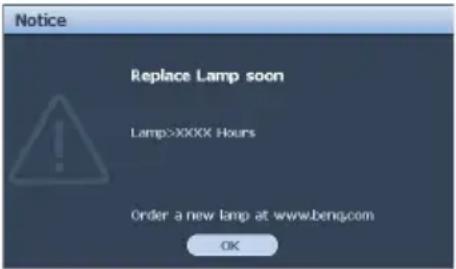 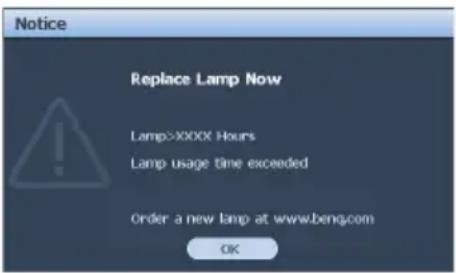 |
| The lamp MUST be replaced before the projector will operate normally.PressENTERto dismiss the message. |  |
Replacing the lamp

- If lamp replacement is performed while the projector is suspended upside-down from the ceiling, make sure that no one is underneath the lamp socket to avoid any possible injury or damage to the human eyes caused by fractured lamp.
• To reduce the risk of electrical shock, always turn the projector off and disconnect the power cord before changing the lamp.
• To reduce the risk of severe burns, allow the projector to cool for at least 45 minutes before replacing the lamp.
• To reduce the risk of injuries to fingers and damage to internal components, use caution when removing lamp glass that has shattered into sharp pieces.
• To reduce the risk of injuries to fingers and/or compromising image quality by touching the lens, do not touch the empty lamp compartment when the lamp is removed.
- This lamp contains mercury. Consult your local hazardous waste regulations to dispose of this lamp in a proper manner.
• To assure optimal performance from the projector, it is recommended that you purchase a BenQ projector lamp for lamp replacement.
- Ensure good ventilation when handling broken lamps. We recommend that you use respirators, safety glasses, goggles or face shield and wear protective clothing such as gloves.
I. Turn the power off and disconnect the projector from the wall socket. If the lamp is hot, avoid burns by waiting for approximately 45 minutes until the lamp has cooled.
-
Loosen the captive screw from the left side.
-
Remove the lamp compartment cover as shown.
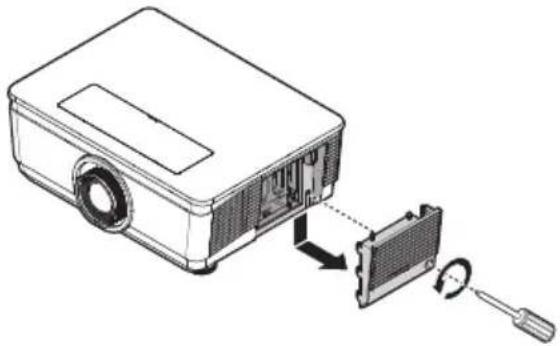
natural_image
Diagram of a projector with internal components and a screwdriver inserted, showing no text or symbols- Loosen the two captive screws that secure the lamp.

- Do not turn the power on with the lamp cover removed.
- Do not insert your fingers between the lamp and the projector. The sharp edges inside the projector may cause injuries.
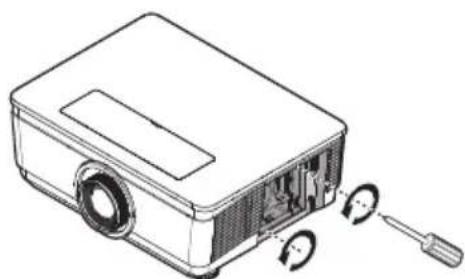
natural_image
Line drawing of a projector with screwdriver and wheels, no text or symbols present- Slowly pull the lamp out of the projector.

- Pulling it too quickly may cause the lamp to break and scatter broken glass in the projector.
- Do not place the lamp in locations where water might splash on it, children can reach it, or near flammable materials.
- Do not insert your hands into the projector after the lamp is removed. If you touch the optical components inside, it could cause color unevenness and distortion of the projected images.
- Insert the new lamp into the lamp compartment and make sure it fits in the projector.

- Ensure the connectors are aligned.
-
If you experience resistance, lift the lamp and start again.
-
Tighten the screws that secure the lamp.

- Loose screw may cause a bad connection, which could result in malfunction.
-
Do not over tighten the screw.
-
Replace the lamp compartment cover on the projector and tighten the captive screw.
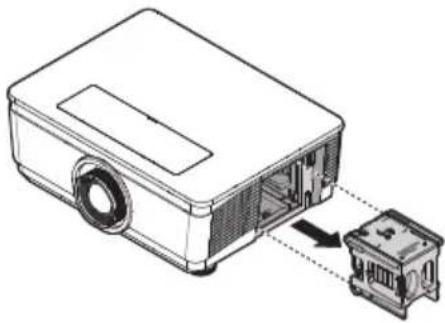
natural_image
Diagram of a projector with an internal component connected to a small electronic module (no text or symbols present)
natural_image
Diagram of a projector module with an internal component and an external connector (no text or symbols)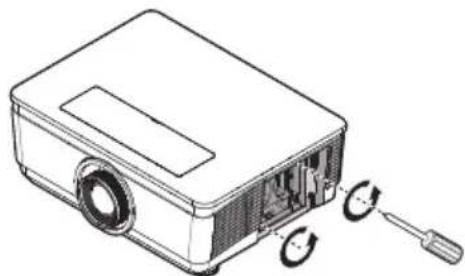
natural_image
Line drawing of a projector with screwdriver and internal components (no text or symbols)
natural_image
Diagram of a projector with internal components and a screwdriver inserted (no text or symbols)- Restart the projector.

Do not turn the power on with the lamp cover removed.
Resetting the lamp timer
- After the startup logo, open the On-Screen Display (OSD) menu. Go to the SYSTEM SETUP: Advanced > Lamp Settings menu. Press ENTER. The Lamp Settings page displays. Highlight Reset lamp timer. A warning message displays asking if you want to reset the lamp timer. Highlight Yes and press ENTER. The lamp time will be reset to '0'.

Do not reset if the lamp is not new or replaced as this could cause damage.
Cleaning the filter
The air filter prevents dust from accumulating on the surface of the optical elements inside the projector. If the filter is dirty or clogged, your projector may overheat or degrading the projected image quality.
I. Turn off the projector, and unplug the AC power cord from the AC outlet.
2. Cleaning the filter with a vacuum cleaner.

Recommend avoiding dusty or smoky environments when you operate the projector, it may cause poor image quality. If the filter is heavily clogged and unable to clean, replace a new filter.

Using a ladder is recommended to access the filter. Do not remove the projector from the wall mount.

natural_image
Line drawing of a rectangular electronic device with a circular lens and attached plug (no text or symbols)Replacing the filter
I. Turn off the projector, and unplug the AC power cord from the AC outlet. Clean up the dust on the projector and around the air vents. Pull out the filter cover and remove from the projector.

natural_image
Line drawing of a projector with an open lid and arrow indicating the component (no text or symbols)- Lift the filter from the filter cover.
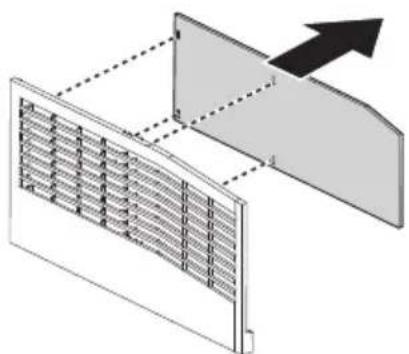
natural_image
Diagram of a ventilation system with airflow direction indicated by arrows (no text or symbols)- Replace a new filter module or replace filter into cover.

natural_image
Diagram of a ventilation grating system with airflow direction indicated by arrows (no text or symbols)- Replace the filter cover back to the projector by pushing gently in the direction shown.
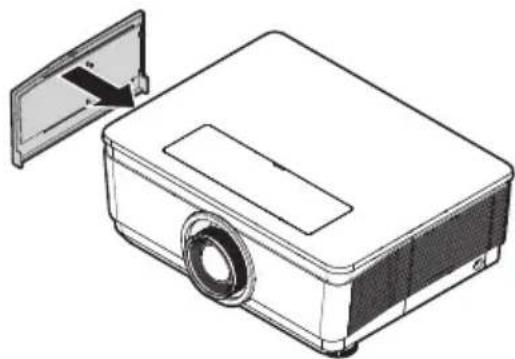
natural_image
Line drawing of a projector with a slide and front panel (no text or symbols)
- Do not wash the filter with the water or other liquid matter.
- When the lamp is replaced, the filter should also be replaced, not cleaned.
Resetting the filter timer
- After the startup logo, open the On-Screen Display (OSD) menu. Go to the SYSTEM SETUP: Basic > Operation Settings menu. Press ENTER. The Operation Settings page displays. Highlight Reset Filter Timer. A warning message displays asking if you want to reset the filter timer. Highlight Reset and press ENTER. The filter time will be reset to '0'.
Indicators
| Light | Status & Description | |||
| Power Temp Lamp | ||||
| Power events | ||||
| Orange Off Stand-by mode | ||||
| Green Flashing | Off Off | Powering up | ||
| Green Off Normal operation | ||||
| Orange Flashing | Off Off | Projector is cooling. | ||
| Lamp events | ||||
| Off Off Orange | Flashing | The lamp ignition is not lit up. | ||
| Off | Off | Red | 1. The projector needs 90 seconds to cool down. Or2. Please contact your dealer for assistance. | |
| Thermal events | ||||
| Red Red Off | The fans are not working. | The projector has shutdown automatically. If you try to re-start the projector, it will shutdown again. Please contact your dealer for assistance. | ||
| Red Red Flashing | Off | |||
| Red | Green Off | |||
| Red | Green Flashing | Off | ||
| Red Flashing | Red Off | |||
| Red Flashing | Red Flashing | Off | ||
| Green | Red | Off | Temperature I error (over limited temperature). | |
| Green | Red Flashing | Off | Thermal sensor I open error. | |
| Green Green Off Thermal sensor I short error. | ||||
| Green Green Flashing | Off | Thermal IC #1 I2C connection error. | ||
| Green | Red Red Thermal break error. | |||
| System events | |||
| Green Off Red | The projector has shutdown automatically. If you try to re-start the projector, it will shutdown again. Please contact your dealer for assistance. | ||
| Red Flashing | Off Off | ||
| Red Off Red | |||
| Off | Green | Red | Lamp door is open. Please check if the lamp door is open or not closed properly. |
| Green Off Orange | Lamp life exhausted. | ||
| Red Off Off Download. | |||
| Off Red Off LAN download fail. | |||
| Off Green Off LAN download processing. | |||
Troubleshooting
The projector does not turn on.
| Cause Remedy | |
| There is no power from the power cable. | Plug the power cord into the AC inlet on the projector, and plug the power cord into the power outlet. If the power outlet has a switch, make sure that it is switched on. |
| Attempting to turn the projector on again during the cooling process. | Wait until the cooling down process has completed. |
⑦ No picture.
| Cause Remedy | |
| The video source is not turned on or connected correctly. | Turn the video source on and check that the signal cable is connected correctly. |
| The projector is not correctly connected to the input signal device. | Check the connection. |
| The input signal has not been correctly selected. | Select the correct input signal with the SOURCE key on the projector or remote control. |
? Blurred image.
| Cause Remedy | |
| The projection lens is not correctly focused. | Adjust the focus of the lens using the focus ring. |
| The projector and the screen are not aligned properly. | Adjust the projection angle and direction as well as the height of the unit if necessary. |
| The lens cover is still closed. Open the lens | cover. |
⑦ Remote control does not work.
| Cause Remedy | |
| The battery is out of power. Replace the battery with new one. | |
| There is an obstacle between the remote control and the projector. | Remove the obstacle. |
| You are too far away from the projector. | Stand within 7 meters (23 feet) of the projector. |
? The password is incorrect.
| Cause Remedy | |
| You do not remember the password. | Please see "Entering the password recall procedure" on page 33 for details. |
Specifications
Projector specifications

All specifications are subject to change without notice.
Optical
Resolution
PX9210
1024 × 768
PU9220/PU9220+
1920 × 1200
Display system
Single-chip DLP ^TM system
Lens F/Number
STANDARD LS2SD
F=2.46 to 2.56, f=22.8 to 28.5mm
WIDE FIX LS2ST3
F=2.5, f=11.5mm
WIDE ZOOM LS2ST1
F=2.5 to 3.1, f=28.5 to 42.75mm
SEMI LONG LS2LT1
F=2.05 to 2.27, f=16.64 to
19.5mm
LONG ZOOM1 LS2LT2
F=2.2 to 2.5, f=44.5 to 74.19mm
Lamp
370W lamp
Electrical
Power supply
AC100-240V
50-60 Hz (Automatic)
5A
Power consumption
480W (Max); < 0.5W (Standby)
Mechanical
Weight
18.7 lbs (8.5 Kg)
Output terminals
Speaker
5 watt x 2
Audio signal output
PC audio jack x 1
Monitor Out
D-Sub 15-pin (female) x1
USB
TYPE-A (5V/1.5A)
3D SYNC OUT x 1
Control
USB
Type-B x1
RS-232 serial control
9 pin x 1
IR receiver x 2
12V TRIGGER
12VDC (Max. 0.2 A) x 1
LAN control
RJ45 x 1
Wired Remote
PC audio jack x 1
Input terminals
Computer input
RGB input
D-Sub 15-pin (female) x 2
BNC x 5
Digital input
DVI-D x 1
DISPLAY PORT x 1
Video signal input
COMPONENT
RCA jack X 3
S-VIDEO
Mini DIN 4-pin port x 1
VIDEO
RCA jack x 1
SD/HDTV signal input
Digital - HDMI x 1
Audio signal input
Audio in
PC audio jack x 2
RCA audio jack (L/R) x 2
Environmental Requirements
Operating temperature
0^-40^ at sea level
Operating relative humidity
10%-90% (without condensation)
Operating altitude
0–1499 m at 0°C–35°C
1500–3000 m at 0°C–30°C (with
High Altitude Mode on)
Dimensions
431.0 mm (W) × 167.0 mm (H) × 320.5 mm (D)

text_image
431.0 334.5 316.9 320.5 83.0 64.0 431.0 156.0 167.0 174.5 Unit: mm BenQCeiling Mount Installation
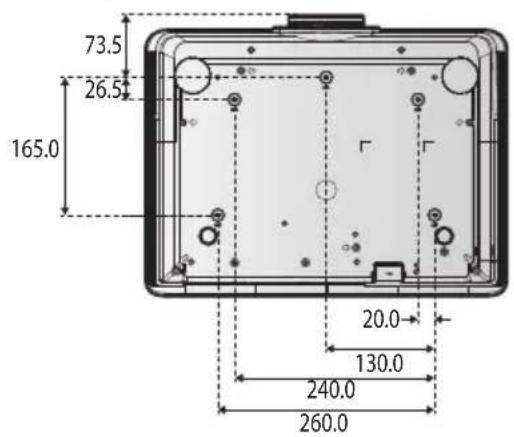
text_image
73.5 26.5 165.0 20.0 130.0 240.0 260.0*Ceiling Mount Screws: M4 (Max. L=12, Min. L=10)

text_image
614.8 547.8 530.8 216.0 431.0
text_image
334.5Timing chart
Supported timing for PC input
| Resolution | Mode | Refresh rate (Hz) | H-frequency (kHz) | Clock (MHz) | 3D Field Sequential | 3D over-under | 3D side-by-side |
| 720 x 400 | 720 x 400_70 | 70.087 | 31.469 | 28.3221 | |||
| 640 x 480 | VGA_60 | 59.940 | 31.469 | 25.175 | ◎ | ◎ | ◎ |
| VGA_72 | 72.809 | 37.861 | 31.500 | ||||
| VGA_75 | 75.000 | 37.500 | 31.500 | ||||
| VGA_85 | 85.008 | 43.269 | 36.000 | ||||
| 800 x 600 | SVGA_60 | 60.317 | 37.879 | 40.000 | ◎ | ◎ | ◎ |
| SVGA_72 | 72.188 | 48.077 | 50.000 | ||||
| SVGA_75 | 75.000 | 46.875 | 49.500 | ||||
| SVGA_85 | 85.061 | 53.674 | 56.250 | ||||
| SVGA_120 (Reduce Blanking) | 119.854 | 77.425 | 83.000 | ◎ | |||
| 1024 x 768 | XGA_60 | 60.004 | 48.363 | 65.000 | ◎ | ◎ | ◎ |
| XGA_70 | 70.069 | 56.476 | 75.000 | ||||
| XGA_75 | 75.029 | 60.023 | 78.750 | ||||
| XGA_85 | 84.997 | 68.667 | 94.500 | ||||
| XGA_120 (Reduce Blanking) | 119.989 | 97.551 | 115.500 | ◎ | |||
| 1152 x 864 | 1152 x 864_75 | 75.00 | 67.500 | 108.000 | |||
| 1024 x 576 | BenQ NB Timing | 60.00 | 35.820 | 46.996 | |||
| 1024 x 600 | BenQ NB Timing | 64.995 | 41.467 | 51.419 | |||
| 1280 x 720 | 1280 x 720_60 | 60 | 45.000 | 74.250 | ◎ | ◎ | ◎ |
| 1280 x 768 | 1280 x 768_60 | 59.870 | 47.776 | 79.5 | ◎ | ◎ | ◎ |
| 1280 x 800 | WXGA_60 | 59.810 | 49.702 | 83.500 | ◎ | ◎ | ◎ |
| WXGA_75 | 74.934 | 62.795 | 106.500 | ||||
| WXGA_85 | 84.880 | 71.554 | 122.500 | ||||
| WXGA_120 (Reduce Blanking) | 119.909 | 101.563 | 146.25 | ◎ | |||
| 1280 x 1024 | SXGA_60 | 60.020 | 63.981 | 108.000 | ◎ | ◎ | |
| SXGA_75 | 75.025 | 79.976 | 135.000 | ||||
| SXGA_85 | 85.024 | 91.146 | 157.500 | ||||
| 1280 x 960 | 1280 x 960_60 | 60.000 | 60.000 | 108 | ◎ | ◎ | |
| 1280 x 960_85 | 85.002 | 85.938 | 148.500 | ||||
| 1360 x 768 | 1360 x 768_60 | 60.015 | 47.712 | 85.500 | ◎ | ◎ | |
| 1440 x 900 | WXGA+_60 | 59.887 | 55.935 | 106.500 | ◎ | ◎ | |
| 1400 x 1050 | SXGA+_60 | 59.978 | 65.317 | 121.750 | ◎ | ◎ | |
| 1600 x 1200 | UXGA | 60.000 | 75.000 | 162.000 | ◎ | ◎ | |
| 1680 x 1050 | 1680 x 1050_60 | 59.954 65 | 290 146.250 | ◎ | ◎ | ||
| 1920 x 1080 @60Hz | 1920 x 1080_60 (Reduce Blanking) | 60.000 67 | 500 148.500 | ||||
| 1920 x 1200 | 1920 x 1200_60 (Reduce Blanking) | ◎ | ◎ | ||||
| 640 x 480 @67Hz | MAC13 | 66.667 35 | 000 30.240 | ||||
| 832 x 624 @75Hz | MAC16 | 74.546 | 49.722 | 57.280 | |||
| 1024 x 768 @75Hz | MAC19 | 74.93 60 | 241 80.000 | ||||
| 1152 x 870 @75Hz | MAC21 | 75.06 68 | 68 100.00 |

There 3D timing showing depend the EDID file and VGA display card. It is possible that user cannot choose the above 3D timings on VGA display card.
Support timing for Component - YPbPr input
| Timing | Resolution | Horizontal frequency (KHz) | Vertical Frequency (Hz) | Dot Clock Frequency (MHz) | 3D Field Sequential |
| 480i | 720 x 480 | 15.73 | 59.94 | 13.5 | ◎ |
| 480p | 720 x 480 | 31.47 | 59.94 | 27 | ◎ |
| 576i | 720 x 576 | 15.63 | 50 | 13.5 | |
| 576p | 720 x 576 | 31.25 | 50 | 27 | |
| 720/50p | 1280 x 720 | 37.5 | 50 | 74.25 | |
| 720/60p | 1280 x 720 | 45.00 | 60 | 74.25 | ◎ |
| 1080/50i | 1920 x 1080 | 28.13 | 50 | 74.25 | |
| 1080/60i | 1920 x 1080 | 33.75 | 60 | 74.25 | |
| 1080/24p | 1920 x 1080 | 27 | 24 | 74.25 | |
| 1080/25p | 1920 x 1080 | 28.13 | 25 | 74.25 | |
| 1080/30p | 1920 x 1080 | 33.75 | 30 | 74.25 | |
| 1080/50p | 1920 x 1080 | 56.25 | 50 | 148.5 | |
| 1080/60p | 1920 x 1080 | 67.5 | 60 | 148.5 |
Support timing for Video and S-Video input
| Video mode | Horizontal frequency (KHz) | Vertical Frequency (Hz) | Sub-carrier Frequency (MHz) | 3D Field Sequential |
| NTSC | 15.73 60 3.58 | ◎ | ||
| PAL | 15.63 50 4.43 | |||
| SECAM | 15.63 50 4.25 or 4.41 | |||
| PAL-M | 15.73 60 3.58 | |||
| PAL-N | 15.63 50 3.58 | |||
| PAL-60 | 15.73 60 4.43 | |||
| NTSC4.43 | 15.73 60 4.43 |
Support timing for HDMI (HDCP)/DVI-D input
| Resolution | Mode | Refresh rate (Hz) | H-frequency (kHz) | Clock (MHz) | 3D Field Sequential | 3D over-under | 3D side-by-side |
| 640 x 480 | VGA_60 | 59.940 | 31.469 | 25.175 | ◎ | ◎ | ◎ |
| VGA_72 | 72.809 | 37.861 | 31.500 | ||||
| VGA_75 | 75.000 | 37.500 | 31.500 | ||||
| VGA_85 | 85.008 | 43.269 | 36.000 | ||||
| 720 x 400 | 720 x 400_70 | 70.087 | 31.469 | 28.3221 | |||
| 800 x 600 | SVGA_60 | 60.317 | 37.879 | 40.000 | ◎ | ◎ | ◎ |
| SVGA_72 | 72.188 | 48.077 | 50.000 | ||||
| SVGA_75 | 75.000 | 46.875 | 49.500 | ||||
| SVGA_85 | 85.061 | 53.674 | 56.250 | ||||
| SVGA_120 (Reduce Blanking) | 119.854 | 77.425 | 83.000 | ◎ | |||
| 1024 x 768 | XGA_60 | 60.004 | 48.363 | 65.000 | ◎ | ◎ | ◎ |
| XGA_70 | 70.069 | 56.476 | 75.000 | ||||
| XGA_75 | 75.029 | 60.023 | 78.750 | ||||
| XGA_85 | 84.997 | 68.667 | 94.500 | ||||
| XGA_120 (Reduce Blanking) | 119.989 | 97.551 | 115.500 | ◎ | |||
| 1152 x 864 | 1152 x 864_75 | 75.00 | 67.500 | 108.000 | |||
| 1024 x 576 | BenQ Notebook Timing | 60.00 | 35.820 | 46.996 | |||
| 1024 x 600 | BenQ Notebook Timing | 64.995 | 41.467 | 51.419 | |||
| 1280 x 720 | 1280 x 720_60 | 60 | 45.000 | 74.250 | ◎ | ◎ | ◎ |
| 1280 x 768 | 1280 x 768_60 | 59.870 | 47.776 | 79.5 | ◎ | ◎ | ◎ |
| 1280 x 800 | WXGA_60 | 59.810 | 49.702 | 83.500 | ◎ | ◎ | ◎ |
| WXGA_75 | 74.934 | 62.795 | 106.500 | ||||
| WXGA_85 | 84.880 | 71.554 | 122.500 | ||||
| WXGA_120 (Reduce Blanking) | 119.909 | 101.563 | 146.25 | ◎ | |||
| 1280 x 1024 | SXGA_60 | 60.020 | 63.981 | 108.000 | ◎ | ◎ | |
| SXGA_75 | 75.025 | 79.976 | 135.000 | ||||
| SXGA_85 | 85.024 | 91.146 | 157.500 | ||||
| 1280 x 960 | 1280 x 960_60 | 60.000 | 60.000 | 108 | ◎ | ◎ | |
| 1280 x 960_85 | 85.002 | 85.938 | 148.500 | ||||
| 1360 x 768 | 1360 x 768_60 | 60.015 | 47.712 | 85.500 | ◎ | ◎ | |
| 1440 x 900 | WXGA+_60 | 59.887 | 55.935 | 106.500 | ◎ | ◎ | |
| 1400 x 1050 | SXGA+_60 | 59.978 | 65.317 | 121.750 | ◎ | ◎ | |
| 1600 x 1200 | UXGA | 60.000 | 75.000 | 162.000 | ◎ | ||
| 1680 x 1050 | 1680 x 1050_60 | 59.954 65 | 290 146.250 | ◎ | ◎ | ||
| 1920 x 1080 @60Hz | 1920 x 1080_60 (Reduce Blanking) | 60.000 67 | 500 148.500 | ||||
| 1920 x 1200 | 1920 x 1200_60 (Reduce Blanking) | 59.950 74 | 038 154.000 | ◎ | ◎ | ||
| 640 x 480 @67Hz | MAC13 | 66.667 35 | 000 30.240 | ||||
| 832 x 624 @75Hz | MAC16 | 74.546 49 | 722 57.280 | ||||
| 1024 x 768 @75Hz | MAC19 | 75.020 60 | 241 80.000 | ||||
| 1152 x 870 @75Hz | MAC21 | 75.06 68 | 68 100.00 |

There timing showing depend the EDID file and VGA graphic card limitation. It is possible that user cannot choose the above timings on VGA display card.
Supporting timing for HDMI Video input
| Timing | Resolution | Horizontal frequency (KHz) | Vertical frequency (Hz) | Dot Clock Frequency (MHz) | 3D Field Sequential | 3D frame packing | 3D over-under | 3D side-by-side |
| 480i | 720 (1440) x 480 | 15.73 | 59.94 | 27 | ◎ | |||
| 480p | 720 x 480 | 31.47 | 59.94 | 27 | ◎ | |||
| 576i | 720 (1440) x 576 | 15.63 | 50 | 27 | ||||
| 576p | 720 x 576 | 31.25 | 50 | 27 | ||||
| 720/50p | 1280 x 720 | 37.5 | 50 | 74.25 | ◎ | ◎ | ◎ | |
| 720/60p | 1280 x 720 | 45.00 | 60 | 74.25 | ◎ | ◎ | ◎ | ◎ |
| 1080/24p | 1920 x 1080 | 27 | 24 | 74.25 | ◎ | ◎ | ◎ | |
| 1080/25p | 1920 x 1080 | 28.13 | 25 | 74.25 | ||||
| 1080/30p | 1920 x 1080 | 33.75 | 30 | 74.25 | ||||
| 1080/50i | 1920 x 1080 | 28.13 | 50 | 74.25 | ◎ | |||
| 1080/60i | 1920 x 1080 | 33.75 | 60 | 74.25 | ◎ | |||
| 1080/50p | 1920 x 1080 | 56.25 | 50 | 148.5 | ◎ | ◎ | ||
| 1080/60p | 1920 x 1080 | 67.5 | 60 | 148.5 | ◎ | ◎ |
RS232 command control
| Function | Type | Operation | ASCII | ||
| Power | Write | Power | On | *pow=on# | |
| Write | Power | off | *pow=off# | ||
| Read | Power | Status | *pow=?# | ||
| Source Selection | Write | COMPUTER/YPbPr | *sour=RGB# | ||
| Write | COMPUTER | 2/YPbPr2 | *sour=RGB2# | ||
| Write | COMPUTER | 3/YPbPr3 | *sour=RGB3# | ||
| Write | Component | *sour=ypbr# | |||
| Write | DVI-D | *sour=dvid# | |||
| Write | HDMI/MHL | *sour=hdmi# | |||
| Write | Composite | *sour=vid# | |||
| Write | S-Video | *sour=svid# | CR> | ||
| Audio Control | Write | DisplayPort | *sour=dp# | ||
| Read | Current source | *sour=?# | |||
| Write | Mute On | *mute=on# | |||
| Write | Mute Off | *mute=off# | |||
| Read | Mute Status | *mute=# | # | ||
| Write | Volume + | *vol=+# | CR> | ||
| Write | Volume - | *vol=-# | |||
| Audio source select | Read | Volume Status | *vol=?# | ||
| Write | Audio pass Through off | *audiosour=off# | |||
| Write | Audio-Computer1 | *audiosour=RGB# | |||
| Write | Audio-Computer2 | *audiosour=RGB2# | |||
| Write | Audio-Video/S-Video | *audiosour=vid# | |||
| Picture Mode | Write | Audio-Component | *audiosour=ypbr# | ||
| Write | Audio-HDMI | *audiosour=hdmi# | |||
| Read | Audio pass Status | *audiosour=?# | |||
| Write | Dynamic | *appmod=dynamic# | |||
| Write | Presentation | *appmod=preset# | |||
| Write | sRGB | *appmod=srgb# | |||
| Write | Cinema | *appmod=cine# | |||
| Write | User1 | *appmod=user1# | |||
| Write | User2 | *appmod=user2# | |||
| Picture Setting | Read | Picture Mode | *appmod=?# | ||
| Write | Contrast + | *con=+# | |||
| Write | Contrast - | *con=-# | |||
| Read | Contrast value | *con=?# | |||
| Write | Brightness + | *bri=+# | |||
| Write | Brightness - | *bri=-# | |||
| Read | Brightness value | *bri=?# | |||
| Write | Color + | *color=+# | |||
| Write | Color - | *color=-# | |||
| Read | Color value | *color=# | |||
| Write | Sharpness + | *sharp=+# | |||
| Write | Sharpness - | *sharp=-# | |||
| Read | Sharpness value | *sharp=?# | |||
| Write | Color Temperature- | *ct=warm# | |||
| Write | Color Temperature-Normal | *ct=normal# | |||
| Write | Color Temperature-Cool | *ct=cool# | |||
| Read | Color Temperature Status | *ct=?# | |||
| Write | Aspect 4:3 | *asp=4:3# | |||
| Write | Aspect 16:9 | *asp=16:9# | |||
| Write | Aspect 16:10 | *asp=16:10# | |||
| Write | Aspect Auto | *asp=AUTO# | |||
| Read | Aspect Status | *asp=?# | |||
| Write | Digital Zoom In | *zooml# | |||
| Operation Settings | Write | Digital Zoom out | *zoomO# | ||
| Write | Auto | *auto# | |||
| Write | Brilliant color on | *BC=on# | |||
| Write | Brilliant color off | *BC=off# | |||
| Read | Brilliant color status | *BC=?# | |||
| Write | Projector Position-Front Table | *pp=FT# | |||
| Write | Projector Position-Rear Table | *pp=RE# | |||
| Write | Projector Position-Rear Ceiling | *pp=RC# | |||
| Write | Projector Position-Front Ceiling | *pp=FC# | |||
| Operation Settings | Write | Quick auto search | *QAS=on# | ||
| Write | Quick auto search | *QAS=off# | |||
| Read Quick auto search status*QAS=?# | |||||
| Read | Projector Position Status | *pp=?# | |||
| Write Direct Power On-on*directpower=on# | |||||
| Write Direct Power On-off*directpower=off# | |||||
| Read Direct Power On-Status*directpower=?# | |||||
| Write | Signal Power On-on | *autopower=on# | |||
| Write | Signal Power On-off | *autopower=off# | |||
| Read | Signal Power On-Status | *autopower=?# | |||
| Write Standby Settings-Network on*standbynet=on# | |||||
| Write | Standby Settings-Network off | *standbynet=off# | |||
| Read | Standby Settings-Network | Status*standbynet=?# | |||
| Write Standby Settings-Monitor Out on*standbymnt=on# | |||||
| Baud Rate | Write Standby Settings-Monitor Out off*standbymnt=off# | ||||
| Read Standby Settings-Monitor Out Status*standbymnt=?# | |||||
| Write | 2400 | *baud=2400# | |||
| Write | 4800 | *baud=4800# | |||
| Write | 9600 | *baud=9600# | |||
| Write | 14400 | *baud=14400# | |||
| Write | 19200 | *baud=19200# | |||
| Write | 38400 | *baud=38400# | |||
| Write | 57600 | *baud=57600# | |||
| Lamp Control | Write | 115200 | *baud=115200# | ||
| Read | Current Baud Rate | *baud=?# | |||
| Read | Lamp Hour | *ltim=?# | |||
| Write | Normal mode | *lampm=lnor# | |||
| Write | Eco mode | *lampm=eco# | |||
| Miscellaneous | Read Lamp Mode Status*lampm=?# | ||||
| Read | Model Name | *modelname=?# | |||
| Write | Blank On | *blank=on# | |||
| Write | Blank Off | *blank=off# | |||
| Read | Blank Status | *blank=?# | |||
| Write | Freeze On | *freeze=on# | |||
| Write | Freeze Off | *freeze=off# | |||
| Read | Freeze Status | *freeze=?# | |||
| Write | Menu On | *menu=on# | |||
| Write | Menu Off | *menu=off# | |||
| Write | Up | *up# | |||
| Write | Down | *down# | |||
| Write | Right | *right# | |||
| Write | Left | *left# | |||
| Write | Enter | *enter# | |||
| Write 3D Sync Off*3d=off# | |||||
| Write | 3D Auto | *3d=auto# | |||
| Write 3D Sync Top Bottom*3d=tb# | |||||
| Write 3D Sync Frame Sequential*3d=fs# | |||||
| Write 3D Frame packing | *3d=fp# | ||||
| Write 3D Side by side*3d=sbs# | |||||
| Write 3D inverter disable*3d=da# | |||||
| Write | 3D inverter | *3d=iv# | |||
| Read 3D Sync Status*3d=?# | |||||
| Write | Remote Receiver-front+rear | *rr=fr# | |||
| Write | Remote Receiver-front | *rr=f# | |||
| Write | Remote Receiver-rear | *rr=r# | |||
| Read | Remote Receiver Status | *rr=?# | |||
| Write | Instant On-on | *ins=on# | |||
| Write | Instant On-off | *ins=off# | |||
| Read | Instant On Status | *ins=?# | |||
Warranty and Copyright information
Limited warranty
BenQ warrants this product against any defects in material and workmanship, under normal usage and storage.
Proof of purchase date will be required with any warranty claim. In the event this product is found to be defective within the warranty period, BenQ's only obligation and your exclusive remedy shall be replacement of any defective parts (labor included). To obtain warranty service, immediately notify the dealer from which you purchased the product of any defects.
Important: The above warranty shall be void if the customer fails to operate the product in accordance with BenQ's written instructions, especially the ambient humidity must be in-between 10% and 90%, temperature in-between 0^ C and 35^ C, altitude lower than 4920 feet, and avoiding to operate the projector in a dusty environment. This warranty gives you specific legal rights, and you may have other rights which vary from country to country.
For other information, please visit www.BenQ.com.
Copyright
Copyright 2011 by BenQ Corporation. All rights reserved. No part of this publication may be reproduced, transmitted, transcribed, stored in a retrieval system or translated into any language or computer language, in any form or by any means, electronic, mechanical, magnetic, optical, chemical, manual or otherwise, without the prior written permission of BenQ Corporation.
Disclaimer
BenQ Corporation makes no representations or warranties, either expressed or implied, with respect to the contents hereof and specifically disclaims any warranties, merchantability or fitness for any particular purpose. Further, BenQ Corporation reserves the right to revise this publication and to make changes from time to time in the contents hereof without obligation to notify any person of such revision or changes.
*DLP, Digital Micromirror Device and DMD are trademarks of Texas Instruments. Others are copyrights of their respective companies or organizations.
Patents
Please go to http://patmarking.benq.com/ for the details of the BenQ projector patent.