A-101-1v - Audio module Doepfer - Free user manual and instructions
Find the device manual for free A-101-1v Doepfer in PDF.


User questions about A-101-1v Doepfer
0 question about this device. Answer the ones you know or ask your own.
Ask a new question about this device
Download the instructions for your Audio module in PDF format for free! Find your manual A-101-1v - Doepfer and take your electronic device back in hand. On this page are published all the documents necessary for the use of your device. A-101-1v by Doepfer.
USER MANUAL A-101-1v Doepfer
Module A-101-1 is a special multitype filter based on an idea by Nyle A. Steiner from the year 1974. Injecting an audio signal into different points of a standard low pass filter circuit leads to the three filter types low pass (LP), band pass (BP) and high pass (HP). For each filter type a separate input is available and the sum of the three filtered signals appears at the common output. Even a notch filter can be realized.
In contrast to the original circuit so-called vactrols are used instead of diodes as variable resistors for frequency and resonance control. A vactrol is a combination of a light depending resistor (LDR) and a light emitting diode (LED) both put into a small light-proof case. Vactrol based circuits are known for their soft low-distortion sound. For details about vactrols and the A-101-1 circuit principles please use the corresponding links in the A-101-1 info page on our web site www.doepfer.com.
The three filter audio inputs are normalled via switching sockets, i.e. the BP input is connected to the LP jack socket provided that no cable is plugged into the BP socket (same applies for HP/BP inputs). Each audio input is equipped with an attenuator. The audio inputs are very sensitive and enable distorted sounds too.
For both frequency and resonance manual control and several control voltage inputs are available.
Two LEDs display the current frequency and resonance settings.
2. Overview
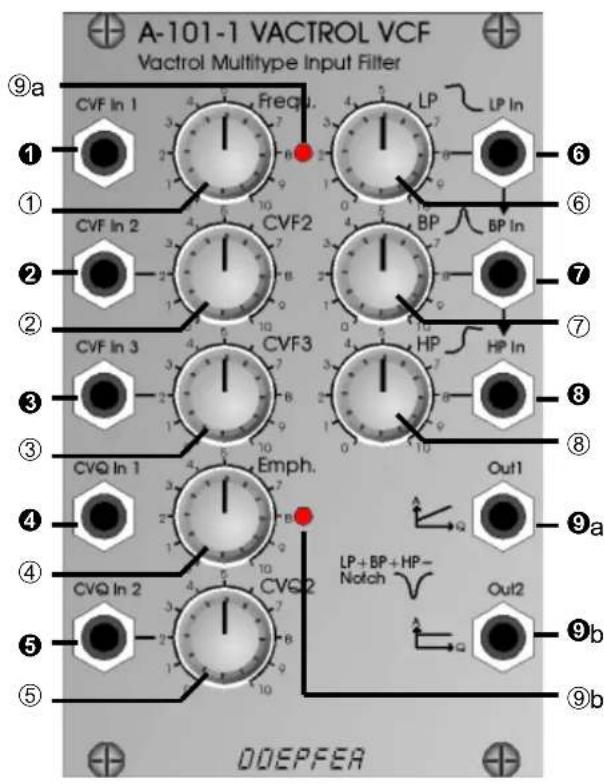
text_image
A-101-1 VACTROL VCF Vactrol Multitype Input Filter ⑨a ① CVF In 1 Freq. ① CVF In 2 CVF2 ② CVF In 3 CVF3 ③ CVQ In 1 Emph. ④ CVQ In 2 CVQ2 ⑤ ⑥ LP LP In ⑦ BP BP In ⑧ HP HP In ⑨a Out1 LP + BP + HP - Notch Out2 ⑨b DOEPFERControls:
① Frequency manual frequency control
② CVF2 attenuator for FCV input ②
③ CVF3 attenuator for FCV input ③
④ Emphasis manual resonance control
⑤ CVQ2 attenuator for QCV input ⑤
⑥ LP attenuator for LP audio input ⑥
⑦ BP attenuator for BP audio input ⑦
⑧ HP attenuator for HP audio input ⑧
⑨a/b LED controls for frequency and resonance
Inputs / Outputs:
① CVF In 1 frequency control voltage input 1
② CVF In 2 frequency control voltage input 2
③ CVF In 3 frequency control voltage input 3
④ CVQ In 1 resonance control voltage input 1
⑤ CVQ In 2 resonance control voltage input 2
⑥ LP In low pass audio input
⑦ BP In band pass audio input
⑧ HP In high pass audio input
⑨a Out 1 audio output 1
⑨b Out 2 audio output 2
3. Controls / Inputs / Outputs
① Frequency (control) / ① CVF In 1 (socket)
② CVF2 (control) / ② CVF In 2 (socket)
③ CVF3 (control) / ③ CVF In 3 (socket)
This group of elements is responsible for the filter frequency. Control ① Frequency is used to adjust the frequency manually. The control voltage inputs ① CVF In 1, ② CVF In 2 and ③ CVF In 3 enable voltage control of the filter frequency by means of external voltages (e.g. ADSR, LFO, random voltage, S&H). The inputs ② CVF In 2 and ③ CVF In 3 are equipped with the attenuators ② CVF2 and ③ CVF3. Input ① CVF In 1 has no attenuator available.
Remark: Module A-101-1 uses so-called vactrols to control frequency and resonance. The light depending resistors inside the vactrols show a considerable slowness/inertia of the resistance variation. Consequently frequency changes are not as fast as for other A-100 filters that do not use vactrols. Fast attacks or decays (CV = ADSR) or FM effects in audio range (CV = LFO or VCO) are not possible with vactrol based circuits. Please use one of the other A-100 filters for these purposes. By means of a LFO with gradually increasing frequency one can discover the maximum modulation frequency that the vactrols are able to follow.
The LED right from the frequency control ① is a rough measure of the current filter frequency. This LED is connected in series with the LEDs inside the vactrols and consequently shows the current illumination inside the vactrols.
Due to the "crooked" response of vactrols the filter has not an exact frequency control standard (like V/Oct). The inevitable tolerances and tracking errors between different vactrols will also lead to an individual sound of each module and individual frequency and resonance behaviour (see below).
④ Emphasis (control) / ④ CVQ In 1 (socket)
⑤ CVQ2 (control) / ⑤ CVQ In 2 (socket)
This group of elements is responsible for the filter resonance (emphasis, Q factor). Even the resonance control is realized with vactrols. Consequently this parameter is voltage controlled, too. Control ④ Emphasis is used to adjust the resonance manually. The control voltage inputs ④ CVQ In 1 and ⑤ CVQ In 2 enable voltage control of the resonance by means of external voltages. Input ⑤ CVQ In 2 is equipped with the attenuator ⑤ CVQ2. Input ④ CVQ In 1 has no attenuator available.
The LED right from the resonance control ④ is a rough measure of the current filter resonance. Same remarks as for the frequency LED applies (see above).
A-101-1 Vactrol Multitype Filter System A - 100
DOEPFER
Resonance can be increased up to self-oscillation. But due to the vactrol tolerances and tracking errors mentioned above resonance resp. self-oscillation deviations over the frequency range may occur.
⑥ LP (control) / ⑥ LP In (socket)
⑦ BP (control) / ⑦ BP In (socket)
⑧ HP (control) / ⑧ HP In (socket)
These are the audio inputs of the module with the corresponding level controls (attenuators) for low pass (LP), band pass (BP) and high pass (HP) function. Here the audio signal resp. audio signals are fed in.
The audio input sockets are normalled, i.e. the BP input is connected to the LP input provided that no cable is plugged into the BP socket. Same applies for the HP -> BP inputs. This simplifies the patch in case that a common signal is used for the three filter inputs. The arrow symbols at the front panel indicate the normalled sockets.
The audio inputs are very sensitive to obtain distorted sounds if desired. From about middle position ( 5) distortion appears with A-100 standard audio signals (e.g. VCO output).
The level controls are adjusted to obtain the desired filter sound.
The following table shows some examples for certain control settings in case that a common audio signal is used for all three filter inputs (i.e. the normalling feature is used and the common signal is fed into the LP socket and consequently available at the BP and HP input too).
| Control | |||
| LP BP | HP Result | ||
| ~ 5 0 0 | low pass | ||
| 0 ~ 5 | 0 band pass | ||
| 0 0 ~ 5 | high pass | ||
| ~ 5 ~ 5 | ~ 5 notch (inverse BP) | ||
| ~ 5 0 ~ | 5 band pass with offset | ||
| ~ 5 ~ 5 | 0 low pass + band pass | ||
| 0 ~ 5 | ~ 5 highpass gate | ||
The value "\~ 5" is only an example. Instead of 5 any other position (e.g. 3 or 8) can be chosen. But for combinations that include multiple "\~ 5" settings (e.g. notch) all "\~ 5" controls have to be turned to the same position. Beyond \~ 5 distortion may occur that affects the result too.
Pay attention that the notch filter does not arise from a combination of low pass and high pass only - as one would expect. Even the band pass control has to be turned up. The reason for this behaviour are the phase conditions inside the filter circuit.
Band pass with offset means that a share of all frequencies passes the circuit. High pass gate means that the filter frequency setting also affects loudness but not only the frequency.
Of course the controls can be adjusted to any values to experiment with different mixtures. The table shows only some typical examples.
If different audio signals are fed into the filter inputs the output is the sum of the input signals with each input filtered to the corresponding filter type, frequency and resonance settings. Consequently a frequency and resonance depending mix appears at the output.
Basics about the different filter types (low pass, band pass, high pass, notch) and the resonance function can be found e.g. in the manual of the A-121 Multimode Filter.
⑨a Out 1 / ⑨b Out 2 (sockets)
These are the two audio outputs of the module. Output 1 is the output of the original circuit. In the original circuit the output level distinctly depends upon the resonance (higher resonance = higher output level). Output 2 compensates this behaviour by the usage of an additional vactrol that is connected in series to the vactrol that controls the resonance. This additional vactrol forms a simple VCA that compensates the level increase for higher resonance settings to a great extent (but not perfect).
4. User Examples
not yet ready
- examples with different audio signals (e.g. 3 parallel VCOs, which have no fixed phase relation to each other)
• voltage controlled filter panning with module A-134 - examples with phase shifter between the audio inputs