A-104 - Audio module Doepfer - Free user manual and instructions
Find the device manual for free A-104 Doepfer in PDF.


User questions about A-104 Doepfer
0 question about this device. Answer the ones you know or ask your own.
Ask a new question about this device
Download the instructions for your Audio module in PDF format for free! Find your manual A-104 - Doepfer and take your electronic device back in hand. On this page are published all the documents necessary for the use of your device. A-104 by Doepfer.
USER MANUAL A-104 Doepfer
flowchart
graph TD
    A["Input Level"] --> B["Audio In"]
    B --> C["VCF 1"]
    C --> D["Level"]
    C --> E["Frequency"]
    C --> F["Resonance"]
    C --> G["Mode"]
    C --> H["VCF 2 VCF 4"]
    H --> I["Audio Out"]
    style A fill:#f9f,stroke:#333
    style B fill:#ccf,stroke:#333
    style C fill:#cfc,stroke:#333
    style D fill:#fcc,stroke:#333
    style E fill:#fcc,stroke:#333
    style F fill:#fcc,stroke:#333
    style G fill:#fcc,stroke:#333
    style H fill:#fcc,stroke:#333
    style I fill:#fcc,stroke:#333
1. Introduction
Module A-104 is a replica of the Formant Filter of the "Mixtur Trautonium" by Oskar Sala. It is made of four parallel resonance filters with common input and output (see fig. 1 on page 3). Each filter can be switched to low pass or band pass or off. Frequency, resonance, mode (band/low/off) and level are controlled for each filter separately by hand (no voltage control!). The frequency range for each filter is about 50Hz...5kHz.
The input level for all filters is controlled by an attenuator. The filter audio inputs are very sensitive so that distortion may intentionally be used to create new sounds - if desired.
The A-104 is a versatile module for sound modification. In the first place it is used for reproduction of resonances (e.g. the vocal-like effects known from the Trautonium). In combination with the subharmonic generator A-113 one obtains the complete replica of the Trautonium sound generation.
More detailed information about the Trautonium can be found on our internet site www.doepfer.com.
2. TFF - Overview

text_image
A-104 Trautonium Formant Filter Input Level Frequency Resonance Mode Level ① 0 10 0 10 0 10 Band 1 Low 0 10 Audio In ① 0 10 0 10 Band 2 Low 0 10 Band 3 Low 0 10 Audio Out ② ③ ④ ⑤ Band 4 Low 0 10Controls:
① Input Level: Attenuator for audio input signal (effective for all filters)
For each VCF:
② Frq.: Frequency control
③ Resonance : Resonance control (Q, emphasis)
④ Mode : Mode switch (band/off/low)
⑤ Level : Level control (share of the filter signal in the mix output)
In- / Outputs:
① Audio In : Common filter audio input
② Audio Out: Common filter audio output
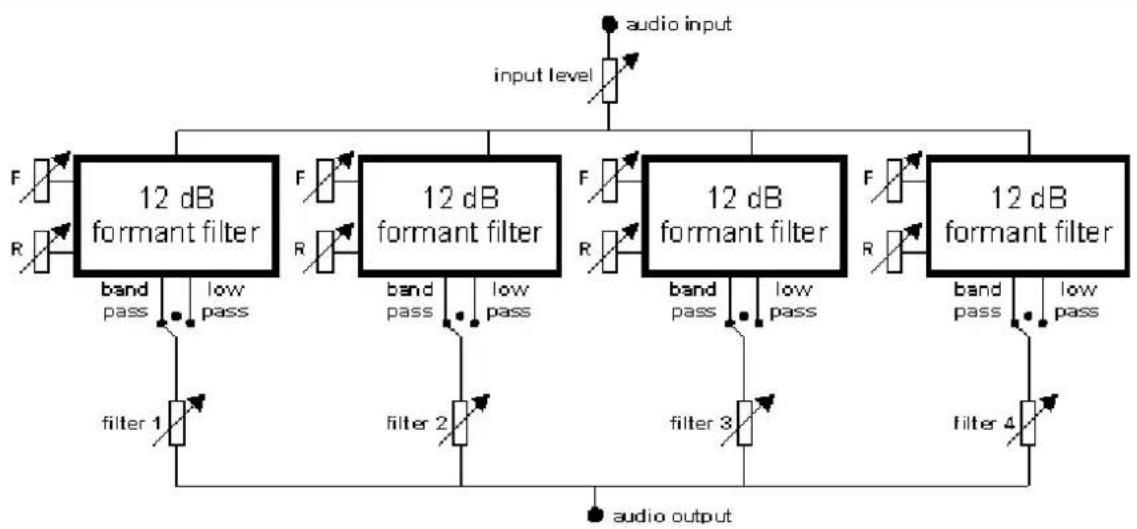
flowchart
graph TD
    A["12 dB formant filter"] --> B["band pass"]
    A --> C["low pass"]
    A --> D["filter 1"]
    E["12 dB formant filter"] --> F["band pass"]
    E --> G["low pass"]
    E --> H["filter 2"]
    I["12 dB formant filter"] --> J["band pass"]
    I --> K["low pass"]
    I --> L["filter 3"]
    M["12 dB formant filter"] --> N["band pass"]
    M --> O["low pass"]
    M --> P["filter 4"]
    Q["audio input"] --> R["output"]
    S["input level"] --> T["output"]
    U["audio output"] --> V["output"]
Fig. 1: Sketch of the A-104
3. Controls
① Input Level
Attenuator ① adjusts the level of the audio input signal applied to the audio input socket ①. The attenuated signal is fed to each of the four resonance filters.

The audio inputs of the filters are very sensitive so that distortion - even with normal A-100 audio levels (e.g. VCO A-110) - may intentionally be used to create new sounds. Distortion appears about from the middle position of the input level control ①.

text_image
Out Frq. Out Res. f_M Freq. Frq. Res. f_C Freq.Fig. 2: Frequency response of band pass and low pass
② Freq.
Control ② is used to adjust the filter frequency (see fig. 2):
• In band pass mode i.e. the middle frequency f_M
• In low pass mode i.e. the cutoff frequency f_c
The frequency range for each filter is about 50Hz ... 5kHz (same as for the Trautonium filter).
③ Resonance
Control ③ is used to adjust the filter resonance (or emphasis or Q, see fig. 2):
• In band pass mode i.e. the band width
- In low pass mode i.e. frequency emphasis around the cutoff frequency
Self-oscillation - as for some other filters of the A-100 (e.g. A-120, A-121, A-122, A-123 and so on) - is not available.
④ Mode
The three-position switch ④ is used to select the mode of the corresponding filter:
• band pass (upper position)
- off (middle position)
- low pass (lower position).
⑤ Level
Attenuator ⑤ is used to adjust the signal level of the corresponding filter (share in the mix output socket ②).
4. In- / Outputs
① Audio In
This is the filter's audio input socket. Patch in the output from the sound source (e.g. Subharmonic Generator A-113, VCO A-110/A-111, Noise Generator A-117/A-118, Mixer A-138).
② Audio Out
Filter output socket ② sends out the filtered signal, i.e. the sum signal of the four resonance filters.
5. User Examples
Module A-104 is used in the first place for the simulation of resonances.
Even vowel-like effects may be generated with this module (refer to the user's manuals of A-127 and A-128).
In combination with the Subharmonic Generator A-113 one obtains a nearly complete replica of the Trautonium sound generation (refer to the user's manual of A-113 on page 11 for the complete sketch).
More detailed information about the Trautonium and the realization with A-100 modules can be found on our internet site www.doepfer.com.
A module that's related very close to the A-104 is the A-127 Voltage Controlled Resonance Filter. In contrast to the A-104 the filter frequencies are voltage controlled and each filter has an own LFO for frequency modulation. This enables automatic filter sweeps or multiple voltage controlled filtering (e.g. with sequencer or MIDI-to-CV interface).
For filter applications with fixed frequencies the Fixed Filter Bank A-128 may be used.
6. Patch-Sheet
The following diagrams of the module can help you recall your own Patches. They're designed so that a complete 19" rack of modules will fit onto an A4 sheet of paper.
Photocopy this page, and cut out the pictures of this and your other modules. You can then stick them onto another piece of paper, and create a diagram of your own system.
Make multiple copies of your composite diagram, and use them for remembering good patches and set-ups.

- Draw in patchleads with colored pens.
- Draw or write control settings in the little white circles.
A-104 Trautonium Formant Filter
