A-101-3 - Audio module Doepfer - Free user manual and instructions
Find the device manual for free A-101-3 Doepfer in PDF.


User questions about A-101-3 Doepfer
0 question about this device. Answer the ones you know or ask your own.
Ask a new question about this device
Download the instructions for your Audio module in PDF format for free! Find your manual A-101-3 - Doepfer and take your electronic device back in hand. On this page are published all the documents necessary for the use of your device. A-101-3 by Doepfer.
USER MANUAL A-101-3 Doepfer
Module A-101-3 is a 12 stage phase shifter with vactrols as phase shifting elements. A vactrol is a combination of a light depending resistor (LDR) and LED both put into a light-proof case. They are known for their smooth sound behaviour as vactrols are distortion-free linear elements in contrast to any semiconductor (like transistors or OTA in other designs). For more general details about vactrols please look at the vactrol basics page on our web site www.doepfer.com.
In contrast to other phaser designs the A-101-3 is much more flexible and offering a lot of new features not available from other phasers on the market. The A-101-3 offers access to each of the 12 input and output stages leading to a lot of new filters that cannot be obtained in other ways. Especially the free patchable feedback loops (yes, not only one feedback loop is possible) between each of the 12 stages, the separate phase shift control for the stages 1-6 and 7-12, and the 2 polarizers intended to control the feedback loops lead to completely new filter types (a polarizer is a circuit that is able to generate positive and negative amplifications in the range -1...0...+1 with -1 = inversion, 0 = full attenuation, +1 = unchanged signal, for details concerning the polarizer function please look at the A-133 VC Polarizer or A-138c Polarizing Mixer module).
On our web site are lot of frequency response curves available that show which filter types can be realized.
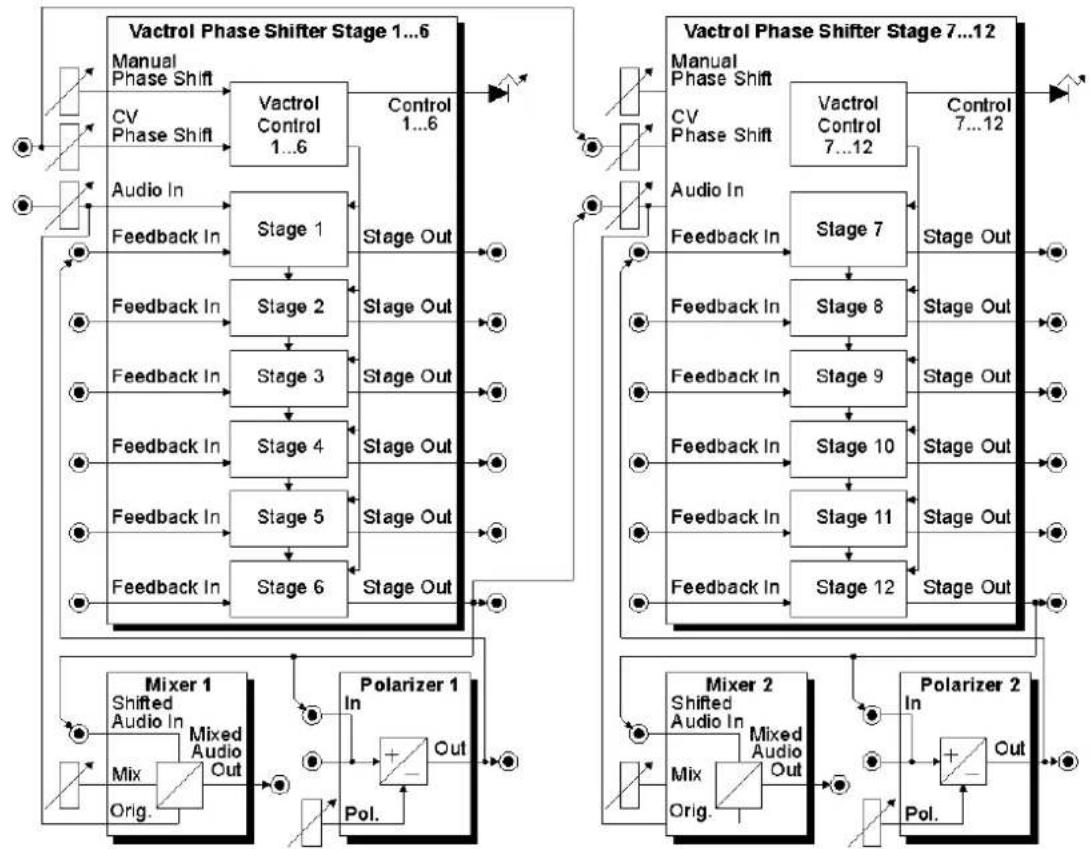
Internally the module is made of 2 independent 6 stage phase shifters (1-6 reps. 7-12) with separate audio inputs (with attenuators), audio outputs (with mix control), and phase shift control units. The phase shift control units feature both manual and voltage controlled phase shifting (e.g. from a LFO, ADSR, Random Voltage, Theremin CV, Foot Controller CV ...). For each sub-module a phase shift display (LED) is available. The LED shows the illumination state of the 6 vactrols of the sub-module in question as it is connected in series with the internal vactrol LEDs.
Each of the 12 phase shift stages is equipped with an audio output socket and feedback input socket to obtain full flexibility to create a multitude of different filters. The audio input signal and the output signals of stage 6 resp. stage 12 are mixed with 2 manual controls to obtain effects at two audio outputs (for normal phase shifting effect this is 50% input signal and 50% phase shifted signal).
The two submodules are internally connected via normalled sockets so that two 6 stage phase shifters can be obtained without external patches.
A-101-3 Modular Vactrol Phaser System A - 100
DOEPFER
flowchart
graph TD
    subgraph_Stage_1_6["Manual Phase Shift"]
        A1["Vactrol Control 1...6"] --> B1["Stage 1"]
        B1 --> C1["Stage 2"]
        C1 --> D1["Stage 3"]
        D1 --> E1["Stage 4"]
        E1 --> F1["Stage 5"]
        F1 --> G1["Stage 6"]
    end

    subgraph_Stage_7_12["Manual Phase Shift"]
        H1["Vactrol Control 7...12"] --> I1["Stage 7"]
        I1 --> J1["Stage 8"]
        J1 --> K1["Stage 9"]
        K1 --> L1["Stage 10"]
        L1 --> M1["Stage 11"]
        M1 --> N1["Stage 12"]
    end

    subgraph_Mixer_1["Mixer 1 Shifted Audio In Mix Orig."]
        O1["Mixer 1 Shifted Audio In Mixed Audio Out"] --> P1["Polarizer 1 In Pol."] --> Q1["+ - Out"]
    end

    subgraph_Mixer_2["Mixer 2 Shifted Audio In Mix Orig."]
        R["Mixer 2 Shifted Audio In Mixed Audio Out"] --> S1["Polarizer 2 In Pol."] --> T1["+ - Out"]
    end

    A1 --> B1
    B1 --> C1
    C1 --> D1
    D1 --> E1
    E1 --> F1
    F1 --> G1
    G1 --> H1
    H1 --> I1
    I1 --> J1
    J1 --> K1
    K1 --> L1
    L1 --> M1
    M1 --> N1
    N1 --> O1
    O1 --> P1
    P1 --> Q1
    Q1 --> S1
    S1 --> T1
    T1 --> U1
    U1 --> V1
    V1 --> W1
    W1 --> X1
    X1 --> Y1
    Y1 --> Z1
    Z1 --> A1
    style Stage 7_12 fill:#f9f,stroke:#333,stroke-width:2px
Fig.1: A-101-3 Overall view
2. Basic principles
The module is made of two identical units that differ only in the normaling of the sockets (i.e. how the switching contacts of some sockets are internally pre-wired). Therefore only one of the two units is described with reference to fig. 1 on the preceding page. The stages 1-6 belong to the first unit, 7-12 to the second one. Some basics concerning the function of a phaser (frequency response, comb filter) can be found in the manual of the VC phaser A-125 too.
The vactrol control unit is made of a logarithmic voltage-to-current converter that converts the sum of the manual phase shift setting and the external control voltage into a current. This current is used to drive the 6 LEDs inside the vactrols of the phase shift stages and the display LED. The 6 photo resistors inside the vactrols that work as phase shift controlling elements respond to the illumination intensity and create different phase shifts for different illuminations.
The (attenuated) audio input signal is fed into the first phase shift stage (stage 1). The 6 phase shift stages are daisy-chained. Each stage is equipped with it's own audio output (stage out) and feedback input. The sum of the feedback input and the output of the preceding stage are mixed and fed into the corresponding phase shift stage.
This modular concept allows the realization of different phasers as well as a lot of other filters too as all inputs and outputs are free patchable. For example phasers with 2 up to 12 stages, phasers with free eligible simple or multiple feedback loops or parallel working phasers are possible. On our web site a lot of frequency response curves are available that show which types of phasers and filters are possible with this modular concept.
The module contains two additional circuits: a mixer and a polarizer (one for each unit).
The mixer is used to combine the incoming original audio signal (audio In) with the phase shifted signal (shifted audio In) with adjustable ratio. The typical setting for a phaser is 50:50, i.e. both the original and the shifted signal have the same level. This creates the typical phaser jet sound that is based on the comb-like frequency response curve. But even different ratios make sense. If only the phase shifted signal is used one obtains the so-called phase vibrato effect. The socket "Shifted Audio In" is normalled to stage output 6. Consequently a 6-stage phaser is obtained at the socket "Mixed Audio Out" provided
that no plug is inserted into this socket. To obtain a phaser with more or less stages the output of the corresponding stage has to be connected to the socket "Shifted Audio In". To obtain e.g. a 12-stage phaser the output of stage 12 has to be connected to "Shifted Audio In" of mixer 1.
The polarizer is intended to control the feedback loops. In principle a polarizer is an attenuator. But in contrast to a normal attenuator it enables both positive and negative attenuations (i.e. amplifications in the range -1...0...1). Negative attenuation resp. amplifications means that the signal is inverted (look at the manuals of A-133 CV Polarizer or A-138c Polarizing Mixer for details). The middle position of the polarizer control corresponds to full attenuation (or amplification = 0). This corresponds to the fully counterclockwise position of a "normal" attenuator. The fully clockwise position corresponds to amplification +1 (i.e. the signal passes unchanged), the fully counterclockwise position corresponds to amplification -1 (i.e. the signal is inverted). The "Polarizer In" socket is normalled to stage output 6. Consequently the output of stage 6 is used as polarizer input provided that no plug is inserted into this socket. The polarizer output is normalled to "Feedback In Stage 1". Consequently the feedback loop "stage 6 → stage 1" is active without external patches and the polarizer control is used to adjust the feedback intensity and polarity (remember: zero feedback corresponds to middle position). On our web site a lot of examples of single and multipe feedback loops are published (available via A-101-3 information page).
And this is the result from all these response curves:
- The number of notches is defined by the number of stages used as output (number of notches = integer of the stage number/2)
- The number of resonance peaks is defined by the number of stages used for feedback (number of peaks = integer of number of feedback stages used/2)
- The height of the resonance peaks is determined by the amount of resonance (adjusted with the polarizer)
By means of the open modular concept of the module A-101-3 different numbers of notches and peaks are possible by using the corresponding patch for output in use and feedback loop(s) !
- Overview

text_image
view A-101-3 Modular 12 Stage Vactrol Phaser Stage 1 - 6 Feedback In Stage Out Audio In 1-6 Lev. 1 2 3 4 5 6 7 8 9 10 11 12 Polarizer 1 Out Polarizer 1 In Shifted Audio In Mixed Audio Out Mix Pol.1 ODEPFER Stage 7 - 12 Feedback In Stage Out Audio In 7-12 Stage 6 Out Lev. 1 2 3 4 5 6 7 8 9 10 11 12 Polarizer 2 Out Polarizer 2 In Mixed Audio Out Mix Pol.2 Orig. -1 -2 -3 -4 -5 -6 -7 -8 -9 10 11 12 ①②③④⑤⑥⑦⑧⑨⑩⑪⑫⑬⑭⑮⑯⑰⑱⑲⑳⑴⑵⑶⑦⑧⑨⑪⑫⑬⑭⑮⑯⑰⑱⑲⑳⑴⑵⑶⑷⑧⑨⑩⑪⑫⑬⑭⑮⑯⑰⑱⑲⑳⑴⑵⑥⑦⑧⑨⑩⑪⑫⑬⑭⑮⑯⑰⑱⑲⑳⑴⑤⑥⑦⑧⑨⑩⑪ ⑫ ⑬ ⑭ ⑮ ⑯ ⑰ ⑱ ⑲ ⑳ ㉑ ㉒ ㉓ ㉔ ㉕ ㉖ ㉗ ㉘ ㉙ ㉚ ㉛ ㉜ ㉝ ㉞ ㉟ ㉟ ㉟ ㉟ ㉟ ㉟ ㉟ ㉟ ㉟ ㉟ ㉟ ㉟ ㉟ ㉟ ㉟ ㉟ ㉟ ㉟ ㉟ ㉟ ㉟ ㉟ ㉟ ㉟ ㉟ ㉟ ㉟ ㉟ ㉟ ㉟ ㉟ ㉟ ㉟ ㉟A-101-3 Modular Vactrol Phaser System A - 100
DOEPFER
Controls:
① Level: attenuator for audio input ①
② CV: attenuator for CV input ②
③ Shift: manual phase shift
④ Mix: mixing ratio between original and phase shifted signal
⑤ Pol.: polarizer control
⑥ Shift: LED display for pase shift (= brightness of the LEDs inside the vactrols)
Inputs / Outputs:
① Audio In: Audio input
② CV In: Control voltage input
③ Shifted Audio In: Mixer input for phase shifted signal (normalled to output stage 6)
④ Mixed Audio Out: Mixer output (= phase shifter audio output)
⑤ Polarizer In: Polarizer input (two sockets, one is normalled to output stage 6)
⑥ Polarizer Out: Polarizer output
⑦ Feedback In: Feedback inputs (6x, feedback In 1 is normalled to polarizer output)
⑧ Stage Out: Phase shifter outputs (6x)
Only the elements of one of the two identical phase shift units is specified. The second unit is identical with these exceptions:
- "Audio In 7-12" is normalled to output stage 6 (i.e. all 12 stages are daisy-chained - even between stage 6 and stage 7 - provided that no plug is inserted into socket "Audio In In 7-12")
- "CV In 7-12" is normalled to socket "CV In 1-6" (i.e. same CV for both units provided that no plug is inserted into socket "CV In 7-12")
4. Controls
① Audio In / ① Level
Socket ① is the audio input with the assigned attenuator ①. Feed the audio signal that has to be provided with the phaser/filter effect into socket ①. Adjust the Level control ① so that the output signal does not distort - unless you want to obtain distortion. For normal A-100 levels (e.g. VCO A-110) distortion appears at about middle position of control ①. The input was made a bit more sensible than for other modules to be able to obtain distortion without an additional module. Distortion might be interesting with certain feedback settings.
Attention: For the right unit the audio input ① Audio In In 7-12 is normalled to stage output 6 of the left unit! This simplifies the patching of phasers with more than 6 stages as the output of stage 6 is connected to the audio input of stage 7 provided that no plug is inserted into socket Audio In In 7-12. If both units are used as separate phasers/filters each unit is supplied with it's own audio signal that is connected to socket ① (Audio In In 1-6 resp. Audio In In 7-12).
② CV In / ② CV / ③ Shift
This group of elements is responsible for the phase shift control. Knob ③ Shiftis used to adjust the phase shift manually. With an external control voltage (e.g. LFO, Random, ADSR, Theremin, Ribbon controller, foot controller, MIDI-to-CV) applied to socket ② CV In the phase shift can be modulated. Knob ② CV is used to adjust the depth of the CV modulation.
Attention: For the right unit the socket ② CV In 7-12 is normalled to socket ② CV In 1-6. This simplifies patches with identical CVs for both units (e.g. phasers with more than 6 stages) as the phase shift controls of both units are supplied with the same control voltage (applied to socket ② CV In 1-6 provided that no plug is inserted into socket socket ② CV In 7-12 If both units are operated separately even separate CVs are applied to the CV input sockets.
The voltage difference required at socket ② to take advantage of the full phase shift range is about 5V (with attenuator ② fully clockwise).
④ Mix / ③ Shifted Audio In / ④ Mixed Audio Out
Knob ④ Mix is used to adjust the ratio between the original audio signal (i.e. the signal applied to socket ①) and the signal at socket ③ Shifted Audio In. Socket ④ Mixed Audio Out is the mixer output and normally the audio output of the phaser.
Socket ③ is normalled to stage output 6. Provided that no plug is inserted into socket ③ one obtains a 6 stage phaser at output ④ Mixed Audio Out. If another stage output is connected to socket ③ phasers with 2 - 12
A-101-3 Modular Vactrol Phaser System A - 100
DOEPFER
stages can be obtained. The output of stage 1 does not lead to a phaser but a high pass or low pass according to the polarity of the signal fed into socket ③. E.g. one of the polarizers can be used to define the polarity and to fade from highpass to lowpass and vice versa. To obtain a phaser with 7-12 stages the output of stage 7-12 has to be connected to socket ③ Shifted Audio In of the left (!) unit as only here the original signal is available as the second input of the mixer (the mixer of the right unit does not have available the original that is connected to audio input ① of the left unit).
⑤ Polarizer In / ⑥ Polarizer Out / ⑤ Pol.
These elements correspond to the polarizer. The working principle of the polarizer is described in chapter 2. The two sockets ⑤ Polarizer In form a "miniature multiple" and are the input of the polarizer. Socket ⑥ Polarizer Out is the output of the polarizer.
The function of the polarizer (i.e. the amplification in the range -1...0...+1) is determined by the position of control ⑤ Pol.
The left one of the sockets ⑤ Polarizer In is normalled to stage output 6. The output of the polarizer is normalled to the feedback input of stage 1 (⑦ Feedback In 1). Provided that no plugs are inserted a feedback loop from stage 6 to stage 1 is established. In the middle position of control ⑤ Pol no feedback occurs. At fully counterclockwise position maximum negative, at fully clockwise position maximum positive feedback occurs.
To obtain different feedback loops the sockets ⑤ Polarizer In and ⑥ Polarizer Out have to be connected with the desired output stages resp. feedback inputs.
By using the second polarizer or external modules (e.g. VCA, VC polarizer A-133, filter, distortion, waveshaper) even multiple feedback loops are possible - leading to very interesting frequency responses with multiple resonance peaks.
Another special feature of the A-101-3 are "forward loops", i.e. it is possible to feed a stage output to a feedback input of a higher stage (via polarizer).
By means of multiple feedbacks and/or forward loops in combination with the positive/negative amplifications of the polarizers and different controls and patches of the stages 1-6 resp. 7-12 very complex frequency response curves can be realized that cannot be obtained in any other way.
⑦ Feedback In (6x)
These are the feedback inputs of the phase shifting stages. Applications of these inputs have been described on the preceding pages. The feedback input of stage 1 is normalled to the polarizer output, i.e. Feedback In 1 is connected to the polarizer output - provided that no plug is inserted into socket ⑦ Feedback In 1.
⑧ Stage Out (6x)
These are the outputs of the phase shifting stages. Applications of these outputs have been described on the preceding pages. The output of stage 6 is normalled to socket ③ Shifted Audio In and to the left one of the two sockets ⑤ Polarizer In.
5. User Examples
not yet ready
A-101-3 Modular Vactrol Phaser System A - 100
DOEPFER