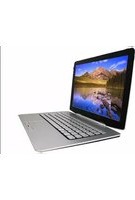
T30II - Laptop ECS - Free user manual and instructions
Find the device manual for free T30II ECS in PDF.


| Product Type | Laptop |
| Model | T30II |
| Brand | ECS |
| Processor | Intel Core2 Duo LV/SFF or CULV (up to 2.13GHz, 1066MHz FSB, 6MB L2 cache) |
| Memory | Up to 4GB DDR2 800MHz (one SODIMM slot, onboard 1GB possible) |
| Storage | 1.8" SATA HDD or SSD (64/128GB supported) |
| Display | 13.3" WXGA (1280x800 or 1366x768) |
| Graphics | Intel GS45 or GS40 integrated |
| Audio | Realtek ALC888, built-in 2 speakers, internal microphone |
| Wireless | Intel Shirley Peak 5300 (802.11abgn) or Echo Peak (802.11abgn/WiMax) |
| Bluetooth | Supported (Fn+F10 toggle) |
| Camera | 0.3M CCD (optional) |
| Ports | USB 2.0 (2), HDMI, CRT, DC-in, headphone jack, LAN via port replicator |
| Port Replicator | Provides additional ports: 2nd DC-in, Ethernet, USB |
| Battery | Lithium Polymer 3-cell 3150mAh (34.96Wh) or optional 6-cell 3200mAh |
| Second Battery | Optional lithium polymer 70Wh (installed in dedicated compartment) |
| Power Adapter | 65W, 100-240V AC, Delta ADP-65HB AD |
| Dimensions | 335.8 x 226.9 x 21.8 mm (without rubber feet) |
| Weight | 1.5 kg (with battery) |
| Operating System | Windows Vista (Starter/Home Basic/Home Premium/Ultimate) or Windows 7 Ultimate |
| Touchpad | PS/2 with 2 buttons, gesture support |
| Keyboard | 83/85/87 keys with optional LED backlight |
| BIOS | Phoenix SecureCore, settings for security, power, boot, etc. |
| G-Sensor | Optional, for HDD protection and anti-theft alarm |
| Ambient Light Sensor | Adjusts screen and keyboard backlight automatically |
| Fingerprint Reader | Optional, for secure login |
Frequently Asked Questions - T30II ECS
User questions about T30II ECS
0 question about this device. Answer the ones you know or ask your own.
Ask a new question about this device
Download the instructions for your Laptop in PDF format for free! Find your manual T30II - ECS and take your electronic device back in hand. On this page are published all the documents necessary for the use of your device. T30II by ECS.
USER MANUAL T30II ECS
natural_image
Laptop displaying a desktop wallpaper with app icons on its screen (no visible text or symbols on the device itself)
natural_image
Abstract gradient background with soft blue and white tones (no text or symbols)Preface
©Copyright 2008
All Rights Reserved.
The information in this document is subject to change without prior notice in order to improve reliability, design and function and does not represent a commitment on the part of the manufacturer.
In no event will the manufacturer be liable for direct, indirect, special, incidental, or consequential damages arising out of the use or inability to use the product or documentation, even if advised of the possibility of such damages.
This document contains proprietary information protected by copyright. All rights are reserved. No part of this manual may be reproduced by any mechanical, electronic, or other means in any form without prior written permission of the manufacturer.
Limitation of Liability
While reasonable efforts have been made to ensure the accuracy of this manual, the manufacturer and distributor assume no liability resulting from errors or omissions in this manual, or from the use of the information contained herein.
Notices
Federal Communications Commission Radio Frequency Interference Statement
NOTE.... This equipment has been tested and found to comply with the limits for a Class B digital device, pursuant to Part 15 of the FCC Rules. These limits are designed to provide reasonable protection against harmful interference in a residential installation. This equipment generates, uses, and can radiate radio frequency energy and if not installed and used in accordance with the instruction manual may cause harmful interference to radio communications. However, there is no guarantee that interference will not occur in a particular installation. If this equipment does cause harmful interference to radio or television reception, which can be determined by turning the equipment off and on, the user is encouraged to try to correct the interference by one or more of the following measures:
* Reorient or relocate the receiving antenna
Increase the separation between the equipment and receiver
* Connect the equipment into an outlet on a circuit different from that to which the receiver is connected
Consult the dealer or an experienced radio TV technician for help
This device complies with Part 15 of the FCC Rules. Operation is subject to the following two conditions: (1) This device may not cause harmful interference, and (2) this device must accept any interference received, including interference that may cause undesired operation.
FCC Caution: Any changes or modifications not expressly approved by the party responsible for compliance could void the user's authority to operate this equipment.
Notice:
Changes or modifications not expressly approved by the party responsible for compliance could void the user's authority to operate the equipment. Shielded interface cables and a non-shielded AC power cord must be used in order to comply with emission limits.
This equipment is to be used with power supply: 65W
There is no internal power supply.
Table of Content
BEFORE YOU START 2
LET YOUR COMPUTER ACCLIMATE ITSELF 10
HEAT, COLD, HUMIDITY, AND GLARE 10
SUITABLE PLACE TO WORK....10
INTRODUCTION....12
FRONT VIEW 13
REAR VIEW....15
BOTTOM VIEW....16
GETTING STARTED 20
CONNECTING THE AC ADAPTER....20
TO INSTALL THE BATTERY PACK: 22
To Remove the Battery Pack: 23
TO INSTALL THE SECOND BATTERY PACK: 25
TO REMOVE THE SECOND BATTERY PACK: 26
USING THE NOTEBOOK COMPUTER....29
LCD CARE....29
EXTERNAL CRT DISPLAY....29
POWER SAVING MODE....33
NORMAL MODE 33
HIGH PERFORMANCE MODE....34
DVD PLAY MODE....34
DYNAMIC SWITCH MODE....35
TOUCHPAD PRECAUTIONS....36
RUNNING BIOS SETUP ....49
INFO SETUP ....50
MAIN SETUP 51
ADVANCED SETUP....53
SECURITY 54
TPM STATE....54
POWER....55
BOOT SETUP....55
EXIT SETUP ....56
3G CONNECTION 67
FINGER PRINTER APPLICATION....71
G SENSOR....74
ENABLE/DISABLE AUTO ROTATE SCREEN....78
TROUBLESHOOTING 80
THE HARD DRIVE IS MAKING ABNORMAL WHINING NOISES 82
THE HARD DISK DRIVE HAS REACHED ITS CAPACITY 82
THE HARD DISK TAKES LONGER TO READ A FILE....83
THE FILES ARE CORRUPTED 83
THE DISPLAY PANEL IS BLANK WHEN THE SYSTEM IS TURNED ON ......83
THE SCREEN IS DIFFICULT TO READ 83
THE BUILT-IN KEYBOARD ACCEPTS NO INPUT 84
THE CHARACTERS ON THE SCREEN REPEAT WHILE | TYPE 84
A MESSAGE "CMOS CHECKSUM FAILURE" DISPLAYS DURING THE
BOOTING PROCESS OR THE TIME (CLOCK) RESETS WHEN BOOTING ..... 84
THE POST DOES NOT SHOW AN INCREASED MEMORY CAPACITY WHEN YOU HAVE ALREADY INSTALLED ADDITIONAL MEMORY 85
THE O/S ISSUES AN INSUFFICIENT MEMORY ERROR MESSAGE DURING OPERATION 85
PC CARDS DO NOT FUNCTION 85
THE PC CARD CANNOT BE RECOGNIZED 85
WINDOWS CRASHES OR FREEZES WHEN YOU REMOVE THE PC CARD ...86
THE COMPUTER BECOMES HOT 86
THE PROGRAM APPEARS STOPPED OR RUNS VERY SLOWLY 86
THE USB DEVICE DOES NOT WORK 87
UNABLE TO USE THE EXTERNAL USB DEVICE 87
UNABLE TO RECOGNIZE THE EXTERNAL USB DEVICE 87
SPECIFICATION 89
Chapter
1
Before you Start
Conventions of This Manual
Use this manual will help you get the most from your notebook computer.
* If you are an experienced user of computers and/or Microsoft's Windows operating systems, you might find it useful to read the Quick Start Guide that comes along with your accessories.
If you are a less experienced user, you should through the manual carefully before using your system.
Whether or not you are an experienced user, you should consult on the Troubleshooting Chapter if you encounter any problems with your notebook.
Safety Precautions
This section is designed to assist you in identifying potentially unsafe conditions while working with this product. Required safety features have been installed in the computer to protect you from injury. However, you should use good judgment to identify potential safety hazards:
- Please read these safety instructions carefully.
- Please keep this User's Manual for later reference.
- Please disconnect this equipment from AC outlet before cleaning. Don't use liquid or sprayed detergent for cleaning. Use moisture sheet or cloth for cleaning.
- For pluggable equipment, that the socket-outlet shall be installed near the equipment and shall be easily accessible.
- Please keep this equipment from humidity.
-
Lay this equipment on a reliable surface when installed. A drop or fall could cause injury.
-
Make sure to use the right voltage for the power source when connecting the equipment to the power outlet.
-
Place the power cord in such a way that people can not step on it. Do not place anything on top of the power cord.
-
All cautions and warnings on the equipment should be noted.
-
If the equipment is not use for a long time, disconnect the equipment from the main power outlet to avoid being damaged by transient overvoltage.
-
Never pour any liquid into the opening, this could cause fire or electrical shock.
-
Never open the equipment. For safety reason, the equipment should only be opened by a qualified service personnel.
-
If on the following situations arises, get the equipment checked by a service personnel:
a. The Power cord or plug is damaged.
b. Liquid has penetrated into the equipment.
c. The equipment has been exposed to moisture.
d. The equipment has not worked well or you cannot get it work according to the user's manual.
e. The equipment has dropped and damaged.
f. If the equipment has obvious sign of breakage.
- Do not leave this equipment in an environment unconditioned, storage temperature above 60^ C ( 140^ f), it may damage the equipment.
- The unit can be operated at an ambient temperature of max. 5°C to 35°C.
- The sound pressure level at the operators position according to IEC 704-1: 1982 is equal or less than 70 dB(A).
- Power Cord Requirements
The power cord set used with the AC adaptor must meet the requirements of the country where you use the AC adaptor, whether it is 100-240 Vac. The following information explains the requirements for power cord set selection.
■ The cord set must be approved for the country in which it is used.
■ The appliance coupler must have a configuration for mating with a CEE7/EN60320/IEC 320/NEMA/ JIS C 8303 appliance inlet.
A. For U.S. and Canada:
■ The cord set must be UL Listed and CSA Certified.
■ The minimum specifications for the flexible cord are No. 18 AWG, (2) Type SPT-2, and (3) 2-conductor.
B. For Japan:
All components of the cord set must bear a "PSE" mark and in accordance with the Japanese Dentori Law.
■ The minimum specifications for the flexible cord are .75m m ^2 conductors, (2) Type VCTR or VCTFK, and (3) 2-conductor.
■ The cord set must have minimum rated current capacity of 7 A.
■ The attachment plug must be a two-pole, grounded type with a Japanese Industrial Standard C8303 (15 A, 125 VAC) configuration.
C. For Other Countries:
■ The cord set fittings must bear the certification mark of the agency responsible for evaluation in a specific country.
■ The flexible cord must be of a HAR (harmonized) type H03VVH2-F.
■ The cord set must have a current capacity of a least 2.5 Amperes and voltage rating of 125 or 250 Vac.
CAUTION: MODEL T30II\*/T30IL ^* ( * = 0 9 ) IS DESIGNED TO USE WITH THE FLOWING AC ADAPTER MODEL ONLY
Manufacture: Delta Electronics, Inc.
Model: ADP-65HB AD
Manufacturer: Li Shin International Enterprise Corp.
Model: 0335C2065 (65W) (65W) (The adapter can only be connected through the port replicator)
- When using your telephone equipment, basic safety precautions should always be followed to reduce the risk of fire, electric shock and injury to persons. These precautions include the following:
Do not use this product near water, for example, near a bathtub, washbowl, kitchen sink or laundry tub, in a wet basement or near a swimming pool.
Avoid using a telephone (other than a cordless type) during an electrical storm. There may be a remote risk of electric shock from lightning.
Do not use the telephone to report a gas leak in the vicinity of the leak.
Use only the power cord and batteries indicated in this manual. Do not dispose of batteries in a fire. They may explode. Check with local codes for possible special instructions.
- Do not use the AC adapter near open water or other liquids. Never spill liquid into the AC adapter.
- Danger of explosion if battery is incorrectly replaced. Replace only with the same or equivalent type recommended by the manufacturer. Dispose of used batteries according to the manufacturer's instructions. Never remove the battery pack while the power is on as this may result in data loss when the system loses power.
- The input receptacle is used as the main disconnecting device.

CAUTION...
This part is hot. Be careful.

VORSICHT...
When you see this symbol, be careful as this spot may be very hot.
- Laser Warning: Laser Class I Product Caution - Invisible laser radiation when open avoid exposure to beam. The optical drive used with this computer is certified as a Class1 laser device according to the U.S. Department of Health and Human Services (DHHS) Radiation Performance Standard and International Standards IEC 60825-1 (EN60825-1). The device is not considered harmful, but the following precautions are recommended:
Do not open the unit.
Avoid direct exposure to the laser beam.
If the unit requires service, contact an authorized service center.
➢ Ensure proper use by reading and following the instructions carefully.
Do not attempt to make any adjustment of the unit.
Class 1 Laser Product
Appareil A Laser De Classe 1
Do not attempt to disassemble
the cabinet containing the laser. The laser beam used in this product is harmful to the eyes. The use of optical instruments, such as magnifying lenses, with this product increase the potential hazard to your eyes. For your safety, have this equipment serviced only by an authorized service provider.
Things you must remember before working on your computer
Let your computer acclimate itself
Your notebook can easily stand temperature extremes but it doesn't like rapid changes in temperature, like going from the cold outdoors to a warm office.
Rapid changes in temperature can cause water droplets to condense inside your case, threatening to damage the electronic parts inside.
After receiving your notebook when it's hot or cold outside, try not to power up the computer immediately, let the computer adjust to the room temperature gradually at least for three to four hours.

WARNING....
If your system arrives in cold weather, do not apply power to the computer or monitor until they have been allowed to come to room temperature.
Heat, Cold, Humidity, and Glare
Find a suitable place for your computer that's not too hot, too cold, too dark, or too bright. Glare can make it hard to read the screen.
* Try to avoid the computer components from being destroyed if it is over heated, so try to allow plenty of room for air to circulate around the case.
Do not block the ventilation opening.
Do not place your computer in direct sunlight.
Suitable place to work
Your computer will run well wherever you're comfortable but extremes of temperature and humidity can be challenging to your system's parts.
There are some things you can tolerate that the computer can't – things like static electricity, dust, water, steam and oil. In case you decide to pull over for roadside computing, try to choose a clean, comfortable work area for your system.
Chapter
2
Introduction
Preparing your Computer

natural_image
Two views of a device showing a black rectangular casing and its open lid, with a blue arrow indicating rotation (no text or symbols visible)1
natural_image
Close-up of a laptop connected to a black adapter cable (no visible text or symbols)2

natural_image
Laptop with abstract digital artwork on screen, showing a blue and purple abstract background (no text or symbols visible)3
4
- Install the battery pack
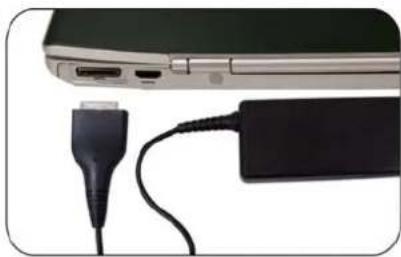
- Connecting the AC adapter
- Opening the display panel
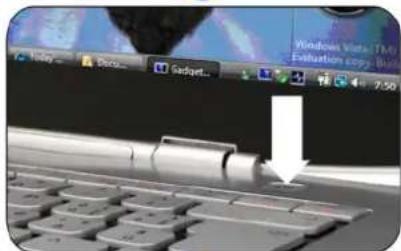
- Turning on your computer
Knowing your Computer
With the LCD screen open, you will see several features important for operating your notebook computer.

WARNING....
To avoid damage to the display
panel:
- Try not to slam the display upon closing it.
- Try not to place any object on top when it is closed or open.
- Be sure the system is turned off or in suspend mode before you close the display panel.
Front View

NOTE....
Picture is only for reference

- Camera (Optional)
- LCD Display

WARNING....
This LCD panel can only support
up to a maximum opening of 121 degree, please do not push it forcibly.


LED Status Indicator
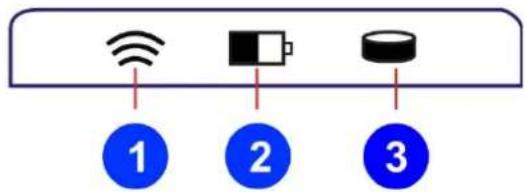
LED Graphic Symbol
Indication


Solid white indicates the WLAN is active.


Battery status
Charging – Orange light flashing
Full - Green
Low – Red light flashing


Solid white indicates the hard drive and/or optical drive is being accessed.

Light Sensor

NOTE....
The system provides a Light-to-voltage
converter module which is a sensor directly proportional to the light intensity of your surrounding working environment. It will affect the backlight intensity (bright/dark) of your screen display.
This mode will then function once the OSD (On Screen Display) application is installed in your system as described in the preceding chapter.

Keyboard

NOTE....
The keyboard differs for each territory.

Microphone

Power/Suspend Button
➢ Press for 1\~1.5 seconds to turn on the system.
➢ Press and hold for at least 4 seconds to turn off the system.
➢ Press the power / suspend button again to return from the suspend mode.
Rear View
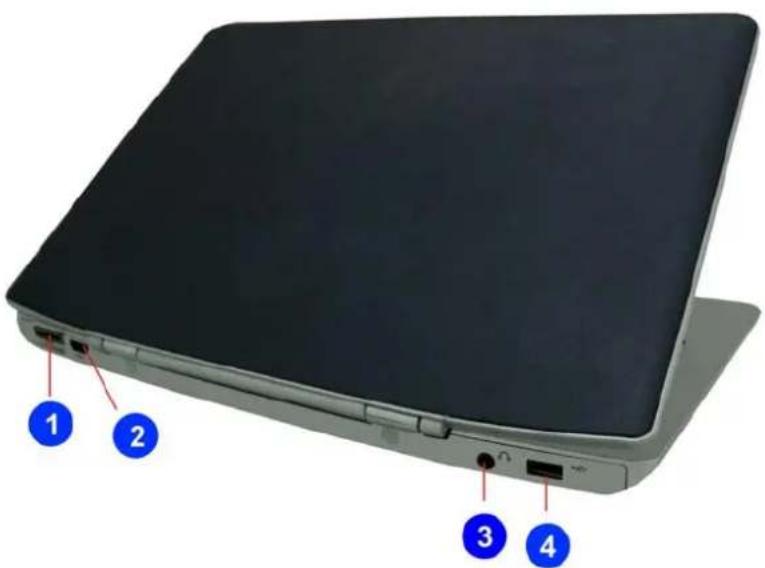
- = DC In
- HDMI HDMI Port
- Omega Stereo Headphone Jack
- USB 2.0 Port
Bottom View
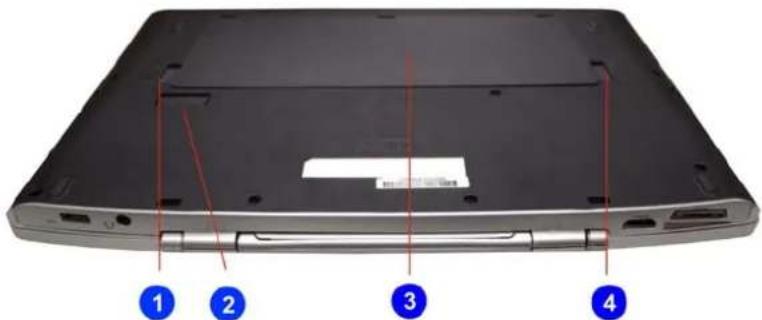
- Battery latch
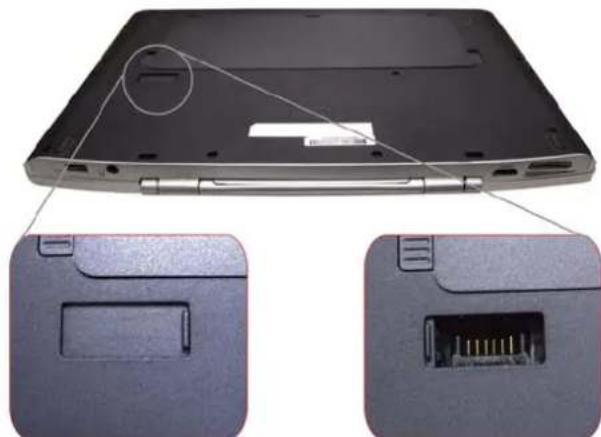
- Second Battery Connector (Optional)
NOTE....
After using, be sure to close the 2^ND
Battery connector door. When not using the 2^nd battery, please make sure the door is always close.
natural_image
Laptop rear view showing a cable with a magnified inset showing internal components (no text or symbols visible)- Battery Compartment
- Battery Lock
Port Replicator

natural_image
Black USB connector with USB port, shown in angled cable (no text or symbols visible)This system provides you with a port replicator that gives you a convenient way to attach external devices such as a monitor, a full-size keyboard, or an AC power adapter.
The port replicator lets you make all of those connections in one step. The port replicator also gives you access to additional ports not found on the notebook.


Ethernet / LAN Port

NOTE....
When using a LAN, please use an EMI
Shielding Cable to minimize an interference when transmitting


CRT Port
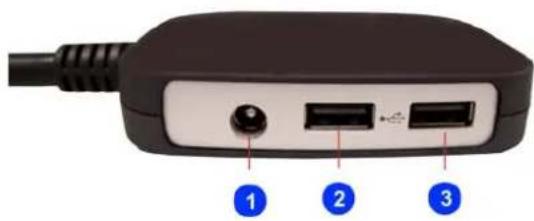
natural_image
Close-up of a black electronic device with ports and cable, labeled 1, 2, and 3 (no text or symbols on the device body)1. = 2^nd DC (65W adapter) (Optional)
2. USB 2.0 Port
3. USB 2.0 Port
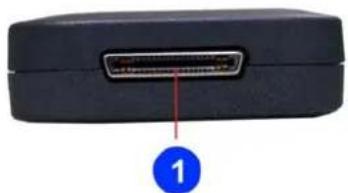
natural_image
Close-up of a black electronic device with a white connector and blue circular marker labeled '1' (no text or symbols on the device itself)- = Main DC In
Chapter
3
Getting Started
Connecting to a Power Source
Connecting the AC Adapter
A universal AC adapter is provided to supply your computer with power and also charge the computer's battery pack. The adapter's AC input voltage can range anywhere from 100 to 240 volts, covering the standard voltages available in almost every country. To connect the computer to an external power source:
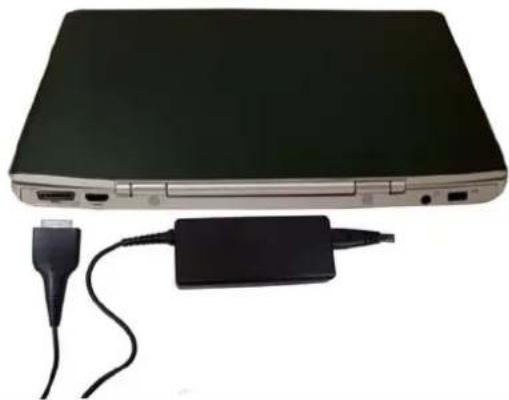
natural_image
Laptop with rear panel and connected charger (no visible text or symbols)WARNING.... Do not use inferior extension cords as this may result in damage to your notebook. The notebook comes with its own AC adapter. Do not use a different adapter to power the computer and other electrical devices.
Whenever possible, keep the AC adapter plugged into the notebook and an electrical outlet to recharge the battery.
WARNING....
Never turn off or reset your
notebook while the hard disk is in use status icon is lit; doing so can result in loss or destruction of your data. Always wait at least 5 seconds after turning off your notebook before turning it back on; turning the power on and off in rapid succession can damage the notebook's electrical circuitry.
Turning On Your Notebook Computer
Hold the button down for a second or two and release. The Power-On Self Test (POST) runs automatically.
After the POST is completed, the computer reads the operating system from the hard disk drive into computer memory (this is commonly referred to as "booting" a computer). If your OS (Operating System such as Windows Vista.... etc) is installed, it should start automatically.
To turn the notebook off, save your work and close all open applications, click on Start, then Shut Down and select Shut down the computer and click "Yes" or press the power button for 4-6 seconds.
Operating on Battery Power
Your computer comes with a rechargeable battery pack that lets you operate the computer without an external power source. When the battery pack is fully charged, you can operate the computer under the following conditions:
The battery pack initially has a full charge.
* No peripheral devices are installed.
WARNING....
Only use batteries that are
approved by an authorized dealer. All batteries are not the same and therefore should not be treated as such. Using the wrong battery could cause serious damage to your computer and yourself through toxic emissions.
Danger of explosion if battery is incorrectly replaced. Replace only with same or equivalent type recommended by the manufacturer. Discard used batteries according to the manufacturer's instructions or local laws.
Installing and Removing the Battery Pack
To Install the Battery Pack:
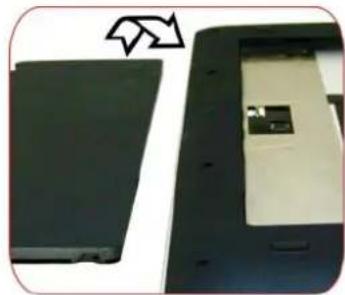
natural_image
Two views of a device showing front and back panels with a small internal component, no visible text or symbols.

natural_image
Close-up of a gray rectangular object with a white arrow pointing downward, no visible text or symbols.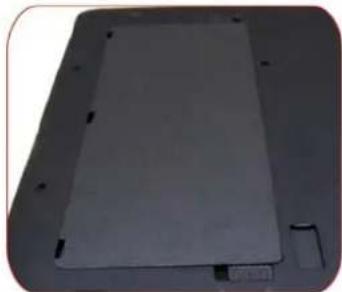
natural_image
Blank white rectangular object with black mounting holes, placed on a gray surface (no text or symbols visible)
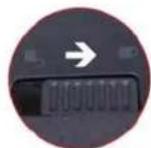
To Remove the Battery Pack:
flowchart
graph TD
    A["Device 1: Left side, Top control"] --> B["Step ①: Down arrow"]
    B --> C["Step ②: Left arrow"]
    C --> D["Step ③: Down arrow"]
    D --> E["Step ④: Right arrow"]
Installing and Removing the Second Battery Pack
NOTE....
Before installing the second battery, be
sure that the main battery is also installed on the computer.
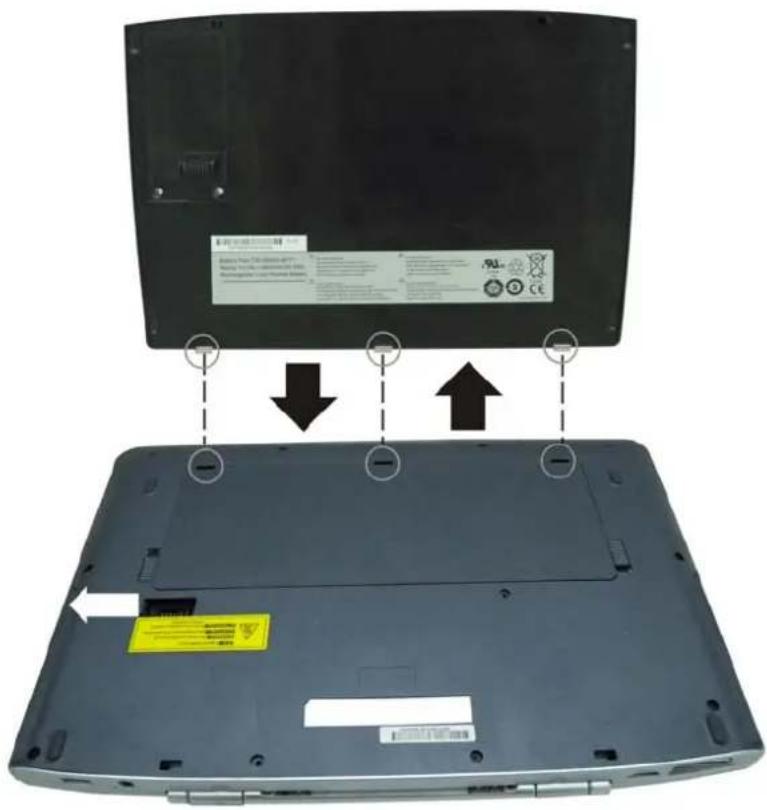
To Install the Second Battery Pack:

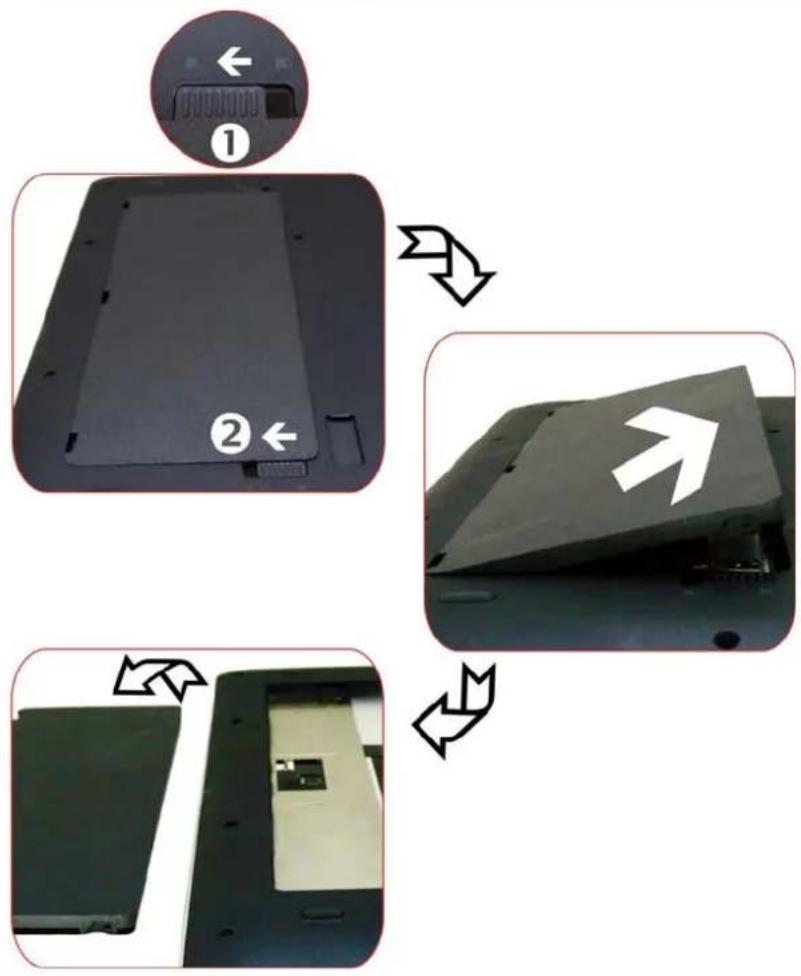
To Remove the Second Battery Pack:

Charging the Battery Pack
The installed battery pack charges automatically any time the computer is connected to the AC adapter and an external power source. It is a good idea to occasionally discharge the battery pack fully to preserve its operating performance.
Chapter
4
Using the Notebook Computer
Adjusting the LCD Screen Display
The LCD screen display can be adjusted by the following key combinations.
| Fn + F2 | Changes Display Mode: LCD only, CRT + LCD, CRT only, HDMI + LCD, HDMI only. |
| Fn + F6 | increases the brightness level. |
| Fn + F7 | Decreases the brightness level. |
LCD Care
LCD screens are delicate devices that need careful handling. Please pay attention to the following precautions:
When you are not using the computer, keep the LCD screen closed to protect it from dust.
If you need to clean your LCD screen, use a soft tissue to gently wipe the LCD surface.
Do not put your fingers or sharp objects directly on the surface and never spray cleaner directly onto the display.
Do not press on, or store any objects on the cover when it is closed. Doing so may cause the LCD to break.
External CRT Display
You can hook up an external monitor through the 15-pin CRT connector.
LCD only
CRT + LCD
* CRT only
HDMI + LCD
HDMI only
You can switch between these display configurations by pressing the key combination [Fn] + [F2] .
The Notebook's Hot Key Controls
| Action System Control | |
| Fn + F1 | Enters Suspend Mode. |
| Fn + F2 | Changes Display Mode: LCD only, CRT + LCD, CRT only, HDMI + LCD, HDMI only. |
| Fn + F3 | Mute/Unmute Audio/ PC beep to Output |
| Fn + F4 | Increases the speaker volume. |
| Fn + F5 | Decreases the speaker volume. |
| Fn + F6 | Increases the brightness level. |
| Fn + F7 | Decreases the brightness level. |
| Fn + F8 | Decrease keyboard backlight |
| Fn + F9 | Increase keyboard backlight |
| Fn + F10 | Enable/Disable the Bluetooth application |
| Fn + F11 | Enable/Disable the WLAN application |
| Fn + F12 | Enable/Disable the 3G application |
| Fn + Prt Sc | Enable/Disable the Wedcam application |
On Screen Display (OSD)
OSD (On Screen Display) provides you an easy access to the function key you normally use in executing some of the application you would like to perform.
Other alternative is by executing the hot key combination we provide which is imprinted on the upper portion of the keyboard.
After you activate the function key, the icon will be shown at the upper right hand corner of your window screen.
Screen Display Icon
| WebCam On/OffFn + [IMAGE] |  |
| Caps Locks |  |
| Num Locks |  |
| Scroll Locks |  |

NOTE....
NOTE.... This mode clearly defines the Light Sensor application as described in previous chapter to automatically adjust the backlight environment for your LCD brightness. Once you execute the hotkey combination for brightness control (Fn+F6/Fn+F7) will automatically disable this auto brightness mode.

OSD-Bar Icon
| Caps Locks On | |
| Num Locks On | |
| Scroll Locks On | |
| WLAN On |  |
| Web Cam On | |
| BlueTooth On | |
| Mobile Broadband On |
The OSD bar can be shown on the side bar or you can drag it anywhere either on top (horizontally) or on the sides (vertically) of
your screen.
Horizontally
Top or Bottom

Vertically - Right or Left
Live Power (Optional)
Live Power is a saving scheme technique that provides saving your battery consumption by disabling some devices thus extending the battery life.
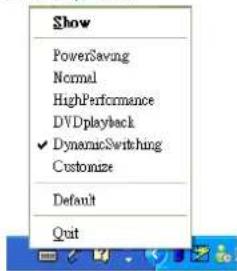
Click on the Live Power icon
from the lower right bar of your screen to open up the Live Power Display.
The Live Power provides five modes according to the application that you are executing:
Power saving mode: Provides the low consumption function, suitable for low utilization ratio and suspend mode.
Normal mode: Provides for general work status.
High Performance mode: For highest efficiency condition.
DVD player mode: Provide for watching movie playback.
Dynamic mode: For system power utilization mode, switching the CPU loading and battery life to appropriate mode.
This Live Power application provides a super saving options if the following items are selected:
Power Off LCD panel
* Enable advance power saving engine
Power off HDMI
Power Saving Mode
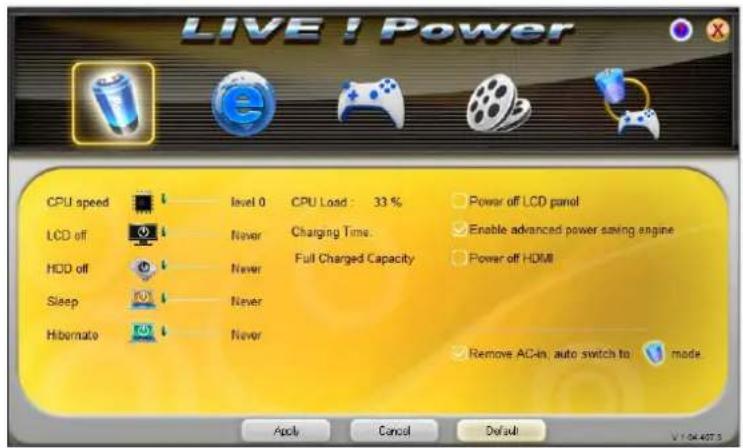
LCD Brightness: Level 1
CPU Speed: Level 0
LCD Off: Idle after 5 minutes
HDD Off: Idle after 3 minutes
Sleep: Idle after 5 minutes
Hibernate: Idle after 10 minutes
Normal Mode

LCD Brightness: Level 5
CPU Speed: Maximum level
LCD Off: Idle after 15 minutes
HDD Off: Idle after 30 minutes
Sleep: Idle after 1 hour
Hibernate: Idle after 2 hours
High Performance Mode
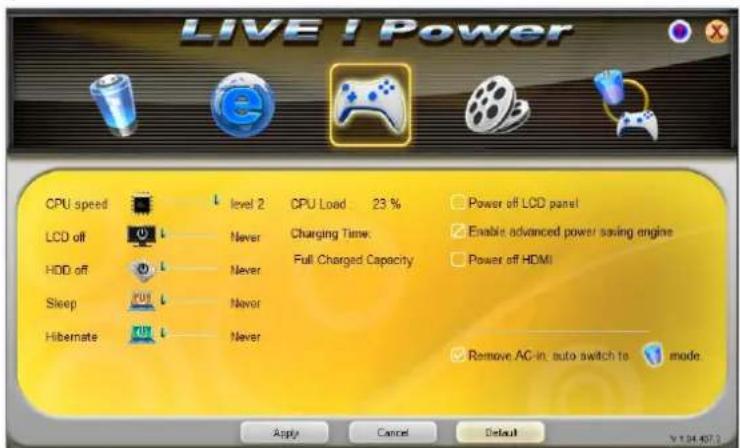
LCD Brightness: Level 5
CPU Speed: Maximum level
LCD Off: Never
HDD Off: Never
Sleep: Never
Hibernate: Never
DVD Play Mode

LCD Brightness: Level 5
CPU Speed: Maximum level
LCD Off: Idle 4 hours
HDD Off: Idle after 4 hours
Sleep: Idle after 1 hour
Hibernate: Idle after 1 hour
Dynamic Switch Mode

| Battery life% | CPU Loading | ||||
| High | Middle | plus | Middle | ||
| 50% up 30% | up 4%up <4% | ||||
| level 5 | 90% up | High Performance mode | High Performance mode | High Performance mode | Normal mode |
| level 4 | 50% up | High Performance mode | High Performance mode | Normal mode | Normal mode |
| level 3 | 30% up | High Performance mode | Normal mode Normal | normal mode | Power Saving mode |
| level 2 | 15% up | Normal mode Normal | normal mode | Power Saving mode | Power Saving mode |
| level 1 | 6% up | Normal mode | Power Saving mode | Power Saving mode | Power Saving mode |
| level 0 | less than 5% | Power Saving mode | Power Saving mode | Power Saving mode | Power Saving mode |
Low
NOTE....
The CPU load is automatically shown on ay indicating the power saving mode.

The TouchPad

natural_image
Laptop displaying a colorful abstract screen with glowing patterns and a magnified circular diagram showing internal structure (no text or symbols)TouchPad Precautions
The TouchPad is a pressure sensitive device. Please take note of the following precautions.
Make sure the TouchPad does not come into contact with dirt, liquids or grease.
Do not touch the TouchPad if your fingers are dirty.
Do not rest heavy objects on the TouchPad or the TouchPad buttons.
You can use the TouchPad with Microsoft Windows as well as non-Windows applications.
Power Saving Modes
This section contains information on the notebook's power system, including the AC Adapter, the battery system, recharging the battery, and tips for conserving battery power.
The power system is comprised of two parts, the AC Adapter and the battery system. The AC Adapter converts AC power from a wall outlet to the DC power required by the computer.
The Battery Power System
Before using the computer on battery power for the first time, check the battery status icon on the Windows Toolbar to make sure the battery is fully charged.
See Battery Status later in this section for a description and explanation of the Windows Battery icon.
Charging the battery takes about 2.5 hours to charge when the system is in off state. If possible, always charge the battery completely.
NOTE....
If you use the battery so frequently that it
exceed more than 20 times by fully discharging/charging in a single month alone, we recommend you to perform the "Battery Calibration" process every 3 months to maintain the battery life.
Please refer to the topic on “Battery Calibration” describing how to calibrate your system battery discussed on the latter part of this chapter.
If you discover the battery life is getting shorter, please perform the "Battery Calibration" process immediately.
Removing the Battery Pack
To remove the battery pack from its compartment, please refer to Chapter 3, Inserting and Removing the Battery Pack.
Preparing the Battery Pack for Use (Battery Calibration)
Before using the battery pack for the first time, battery pack should be calibrated in order to get accurate reporting of remaining battery life status..
To calibrate the battery pack follows the instructions below:
- Insert the battery into the battery compartment and turn on the notebook. If the battery is completely without power go to the next step. Otherwise, let the battery run down until the battery low-low warning beeps are heard. The system will automatically enter Suspend mode.
- Turn the notebook off. Connect the AC adapter and let the battery fully recharge. When the battery charge indicator turns off, the battery is fully charged.
- Turn On the notebook, let the battery run down until the battery is in low-low state and you hear a warning beeps. The system will automatically enter the Suspend mode. You can now connect the AC adapter.
- The battery pack is now calibrated properly.
In general, using the battery until the low-low battery-warning indicator appears and fully recharges the battery each time (full discharge/charge cycle) will ensure the accurate reporting of the battery gauge status.
Automatic Battery Pack Charging Function
To charge the battery, while the battery pack is in the notebook, plug the AC adapter into the notebook and an electrical outlet.
The charging time is approximately 2.5 hours when the notebook is turned off and approximately 3.5 hours when the notebook is turned on.
When the battery is fully charged, the battery charge indicator becomes off.
NOTE....
If system runs at heavy loading or in a
high temperature environment, the battery may not be fully charged. You need to continue to charge it with the AC adapter plugged in until the charging LED turns off.
Battery Status
Windows Vista has an applet in the Control Panel that will display an icon in the Windows taskbar indicating when the notebook is running on battery power or is attached to the AC adapter.
This applet also displays a meter that indicates how much charge is remaining in the battery.
Battery Low Warning
When the pack initially reaches the "Battery Low" state approximately 7 \~ 10 minutes of the usable battery life is left.
You will hear an audible beep signal every 15 seconds alerting you to the “Battery Low” status. When the battery power reaches the “Battery Low Low” status the beeping sound will accelerate.
Your battery now has 1 \~ 2 minutes of battery charge remaining. You must save your data or connect AC power immediately; otherwise, you may lose your data.
| Sound Meaning | |
| Continuous beeping every 5 seconds | Battery Low: Indicates that there is 7 to 10 minutes charge remaining. |
| Beeping accelerates | Battery Low Low: Indicates that there is 1 to 2 minutes of battery charge remaining. Save your work and turn off the notebook, or connect the AC adapter. |
When there is only one minute of battery charge remaining, the notebook will suspend to the HDD and power off. You should connect AC power and resume to save your work.
If the notebook is left without a power source for long period of time, this battery will be exhausted and system information will be lost.
WARNING....
Danger of explosion if battery is
incorrectly replaced. Replace only with the same or equivalent type recommended by the manufacturer.
Dispose of used batteries according to the manufacturer's instructions. Never remove the battery pack while the power is on as this may result in data loss when the system loses power.
Resetting the System
After installing a software application package, you may be prompted to reset the system to load the changed operating environment.
To reset the system, or “reboot,” press the [Ctrl]+[Alt]+[Delete] keys simultaneously. This is known as “warm boot.” This key combination acts as “software” reset switch when you encounter hardware or software problems, which lock up the notebook.
If this key combination does not shut down the notebook, you can reset the notebook by using the notebook's power button. Should the notebook lock up for some reason, pressing this button powers the notebook off.
Using the Windows
Help Windows
For Windows Vista help, click Start
→Help and Support icon will open the dialog box.

Desktop
Desktop may vary differently on the software installed in your notebook with different or additional shortcuts.

Recycle Bin
Used for storing deleted files in case you want to recover and save it in your system. The files will only be deleted from the Recycle Bin permanently only if you empty it by right clicking your mouse and select the "Empty Recycle Bin".
Start Button
Allows easy access to all Windows programs.
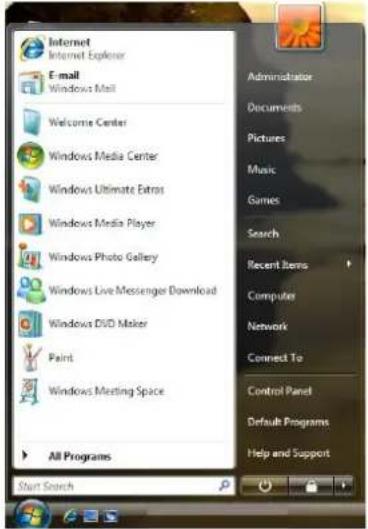
The Start menu allows you to adapt and show the programs used most frequently. If you wish to keep an item, right click the item and click Pin to Start menu.
Log Off will enable the current user to log off and allows a new user to log on.
Turn Off Computer allows you to shut down, restart, and Stand by modes for power saving purposes.
Taskbar
When you open a program, its icon is displayed at the taskbar for you to conveniently move between programs by clicking the relevant button.
To add or remove toolbars from the taskbar: right click an empty spot on the taskbar, select Toolbars → choose the toolbar you want to add.
Notification
The icons that appear here are for quick access to some programs and computer functions that you frequently used. To prevent Windows Vista from hiding icons:
From an empty spot on the Taskbar, right click your mouse and select the Properties, remove the checked mark on the Auto-hide the taskbar.
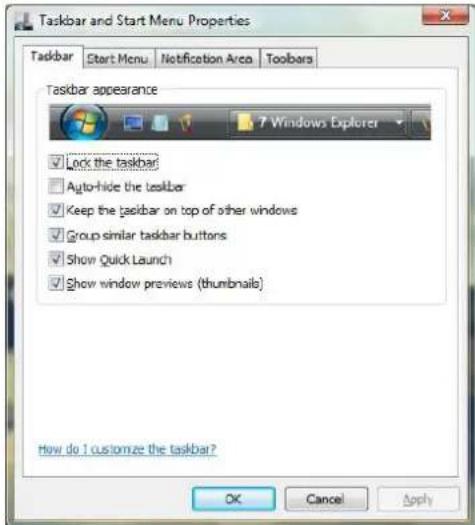
Control Panel
It is in this area that you can change how Windows looks and works. Click Start → Control Panel dialog box. There are two interfaces – Classic View.

Chapter
5
Internet Connection
Using a wired LAN for Connection to Internet
For you connect to the Internet, a wired LAN environment normally uses the company's LAN or a broadband modem.
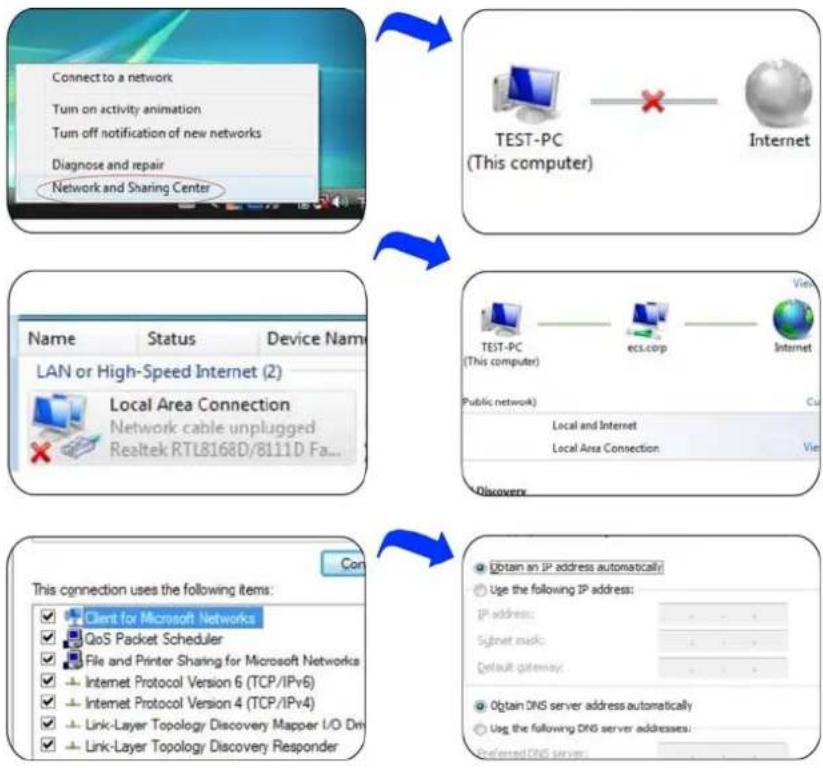
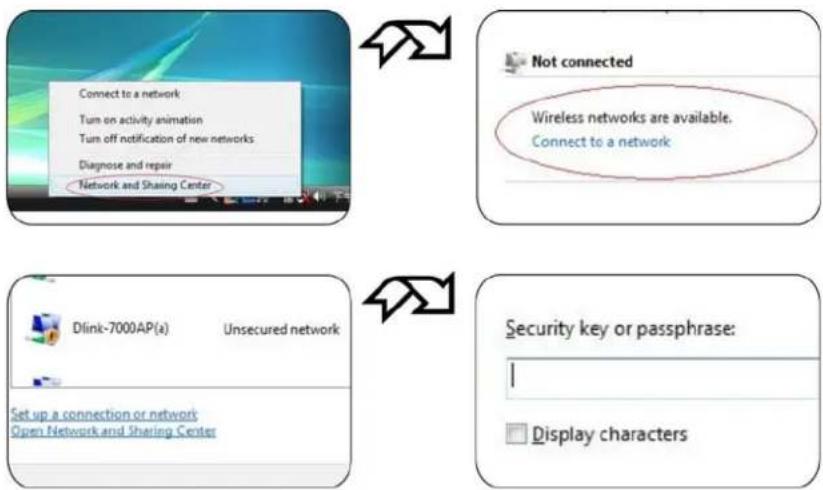
Using Wireless LAN Network for Connection to Internet
Bluetooth Connection
Bluetooth is a developing, world wide, open, short-range radio specification focused on communication between the Internet and Net devices, plus it defines communication protocols between devices and computers.
It connect wirelessly to your world: In home, at work, in motion and at play.
Access the internet or your e-mail account from anywhere, anytime.

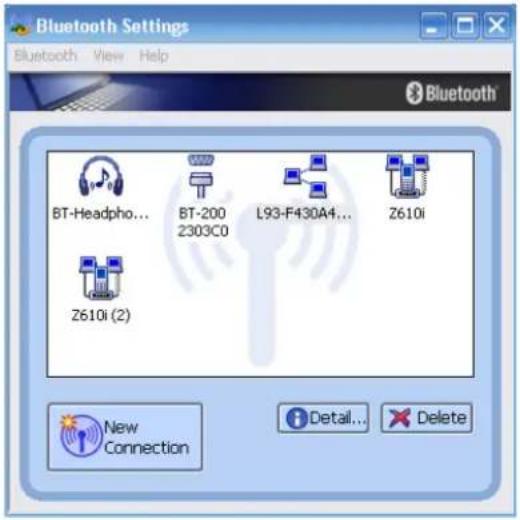
Press on the Bluetooth icon to connect other devices that have application.

This will be the display that will appear on your screen.
If the system detects any other devices, it will be shown as illustrated in the Bluetooth setting window:
Chapter
6
Running BIOS Setup
The Setup Utility is a hardware configuration program built into your computer's BIOS (Basic Input/Output System). It runs and maintains a variety of hardware functions. It is menu-driven software, which allows you to easily configure and change the settings.
The BIOS contains manufacture's default settings for the computer's standard operations. However, there are occasions when you may be required to modify the default settings in the BIOS.
The BIOS allows you to set up passwords to limit access to users. This is an important feature because a great deal of vital information is carried within the computer nowadays. Unauthorized access can be prevented. Later in this chapter, you will learn how to use this security feature.
Entering the BIOS Setup Screen
First turn on the power. When the BIOS performs the POST (Power-On Self Test), press F2 key quickly to activate the BIOS Setup Utility.
Leaving the BIOS Setup Screen
When you have finished modifying the BIOS settings, exit the BIOS. It takes a few seconds to record changes in the CMOS.
BIOS Action Keys
| Function Key | Command | Description |
| ESC | Exit | Leaves a sub-menu to return to the previous menu OR exits the BIOS setup while saving changes. |
F1 General Help Shows the Help Screen
F10 Save and Exit
Saves changes and reboots the computer.
↑ Select an item Selects the next upper item.
↓ Select an item Selects the next lower item.
- Lower value Selects the next value within a field.
+ Higher value Selects the next value within a field.
Modifying the BIOS Settings
The BIOS setup main menu is subdivided into sub-menus. Each menu item is described in this section.
Info Setup
| Phoenix SecureCore (tm) Setup Utility | |||||||
| Info | Main | Advance | Security | TPM State | Power | Boot | Exit |
| BIOS Information: | |||||||
| BIOS Version: | 0.10.04OL | ||||||
| EC Version: | 0.10.03 | ||||||
| Processor | Intel (R) Core (TM)2 Duo CPU | L9400 @ 1.86GHz | |||||
| CPU Type | Intel Centrino ® + Core (TM) | ||||||
| Processor | |||||||
| CPU Temperature: | 53C | ||||||
| F1 HelpEsc Exit | ↑↓←→ | Select ItemSelect Menu | -/+Enter | Change ValuesSelect ▶ Sub-Menu | F9F10 | Setup DefaultsSave and Exit | |
Main Setup
Under this menu, you may change time/date and view basic processor and system memory information.
| Phoenix SecureCore (tm) Setup Utility | ||||||
| Info | Main | Advance | Security | TPM State | Power | Boot Exit |
| Item Specific Help | ||||||
| System Time: [17:39:07]System Date: [03/24/2009]SATA Port 1 [SAMSUNG MMCQE28G8MUP-0VA-]SATA Port 2 [None]SATA Port 3 [None]SATA Port 4 [None]System Memory: 628 KBExtended Memory:3072 MB | ||||||
| F1 Help ↑↓ Select Item -/+ Change Values F9 Setup DefaultsEsc Exit ←→ Select Menu Enter Select ▶ Sub-Menu F10 Save and Exit | ||||||
| Phoenix SecureCore (tm) Setup Utility | |
| Main | |
| SATA Port 1 [SAMSUNG MMCQE28G8MUP-0VA-(S)] | Item Specific Help |
| Maximum Capacity: 128GB SATA 1Transfer Mode: [FPIO 4 / DMA 2]Ultra DMA Mode: [Mode 5] | Information |
| F1 Help ↑↓ Select Item -/+ Change Values F9 Setup DefaultsEsc Exit ←→ Select Menu Enter Select ▶ Sub-Menu F10 Save and Exit | |
| Phoenix SecureCore (tm) Setup Utility | |||
| Main | |||
| SATA Port 2 [None] | Item Specific Help | ||
| Transfer Mode: [Standard]Ultra DMA Mode: [Disabled] | Information | ||
| F1 Help ↑↓ Select Item -/+ Change Values F9 Setup DefaultsEsc Exit ↔→ Select Menu Enter Select ▶ Sub-Menu F10 Save and Exit | |||
| Phoenix SecureCore (tm) Setup Utility | |||
| Main | |||
| SATA Port 3 [None] | Item Specific Help | ||
| Transfer Mode: [Standard]Ultra DMA Mode: [Disabled] | Information | ||
| F1 Help ↑↓ Select Item -/+ Change Values F9 Setup DefaultsEsc Exit ↔ Select Menu Enter Select ▶ Sub-Menu F10 Save and Exit | |||
| SATA Port 4 [None] | Item Specific Help | ||
| Transfer Mode: [Standard]Ultra DMA Mode: [Disabled] | Information | ||
| F1 Help ↑↓ Select Item -/+ Change Values F9 Setup DefaultsEsc Exit ←→ Select Menu Enter Select ▶ Sub-Menu F10 Save and Exit | |||
Advanced Setup
| Phoenix SecureCore (tm) Setup Utility | ||||||
| Info | Main | Advance | Security | TPM State | Power | Boot Exit |
| Item Specific Help | ||||||
| Execute Disable Bit: | [Enabled] | This feature activates a CPU support for the No Execution Memory Protection that is available in some O/S. | ||||
| Ambient Light Sensor: | [Enabled] | |||||
| Accelerometer: | [Enabled] | |||||
| F1 HelpEsc Exit | ↑↓←→ | Select ItemSelect Menu | -/+Enter | Change ValuesSelect ▶ Sub-Menu | F9F10 | Setup DefaultsSave and Exit |
Security
| Phoenix SecureCore (tm) Setup Utility | |||||||
| Info | Main | Advance | Security | TPM State | Power | Boot | Exit |
| Supervisor Password Is:User Password Is: | Not InstalledNot Installed | Item Specific Help | |||||
| Set Supervisor PasswordSet User Password | [Enter][Enter] | Supervisor Password controls access to the setup utility. | |||||
| Password on boot: | [Enabled] | ||||||
| TPM Support | [Enabled] | ||||||
| F1 HelpEsc Exit | ↑↓←→ | Select ItemSelect Menu | -/+Enter | Change ValuesSelect ▶ Sub-Menu | F9 F10 | Setup DefaultsSave and Exit | |
TPM State
| Phoenix SecureCore (tm) Setup Utility | ||||||
| Info | Main | Advance | Security | TPM State | Power | Boot Exit |
| Current TPM State: Disabled and DeactivatedChange TPM State [No Change] | Item Specific Help | |||||
| Change TPM StateA disabled security chip prevents encrypted data from being usedA deactivated security chip prevents a user from taking ownership | ||||||
| F1 Help ↑↓ Select Item -/+ Change Values F9 Setup DefaultsEsc Exit ↔→ Select Menu Enter Select ▶ Sub-Menu F10 Save and Exit | ||||||
Power
| Phoenix SecureCore (tm) Setup Utility | ||||||
| Info | Main | Advance | Security | TPM State | Power | Boot Exit |
| Item Specific Help | ||||||
| LCD panel power saving: [Enabled] | Select display powersaving in battery mode. | |||||
| F1 Help ↑↓ Select Item -/+ Change Values F9 Setup DefaultsEsc Exit ←→ Select Menu Enter Select ▶ Sub-Menu F10 Save and Exit | ||||||
Boot Setup
| Phoenix SecureCore (tm) Setup Utility | |||||||
| Info | Main | Advance | Security | TPM State | Power | Boot | Exit |
| Item Specific Help | |||||||
| ▸ LAN Remote Boot: [Disabled]Boot Device Priority | Select with LAN-Type is used for boot | ||||||
| F1 Help ↑↓ Select Item -/+ Change Values F9 Setup DefaultsEsc Exit ↔→ Select Menu Enter Select ▶ Sub-Menu F10 Save and Exit | |||||||
Exit Setup
| Phoenix SecureCore (tm) Setup Utility | ||||||
| Info | Main | Advance | Security | TPM State | Power | Boot Exit |
| Save Changes & ExitDiscard Changes & ExitGet Default ValuesLoad Previous Values | Item Specific Help | |||||
| Exit System Setup and save your changes to CMOS. | ||||||
| F1 Help ↑↓ Select Item -/+ Change Values F9 Setup DefaultsEsc Exit ←→ Select Menu Enter Select ▶ Sub-Menu F10 Save and Exit | ||||||
Chapter
7
VGA Utilities
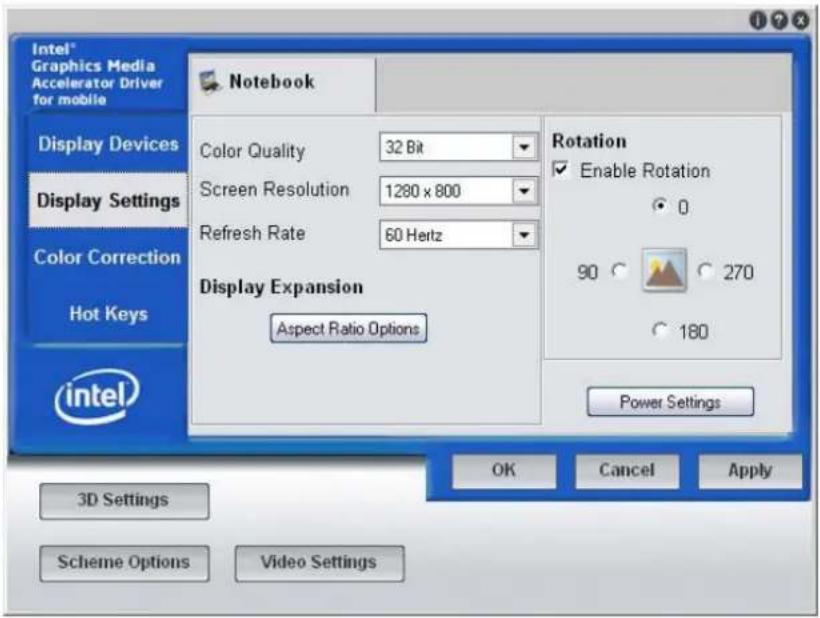
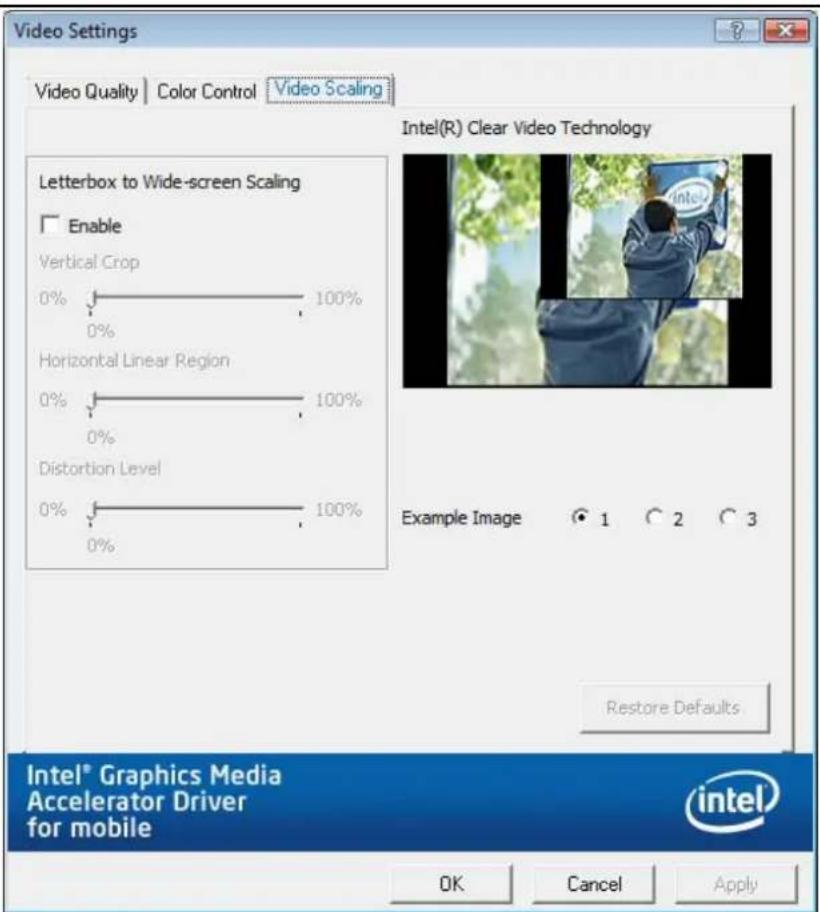
You can click the touchpad or mouse right button and select the "Properties" item.
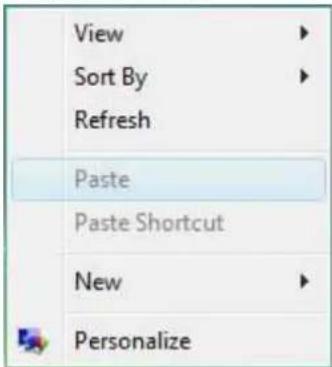
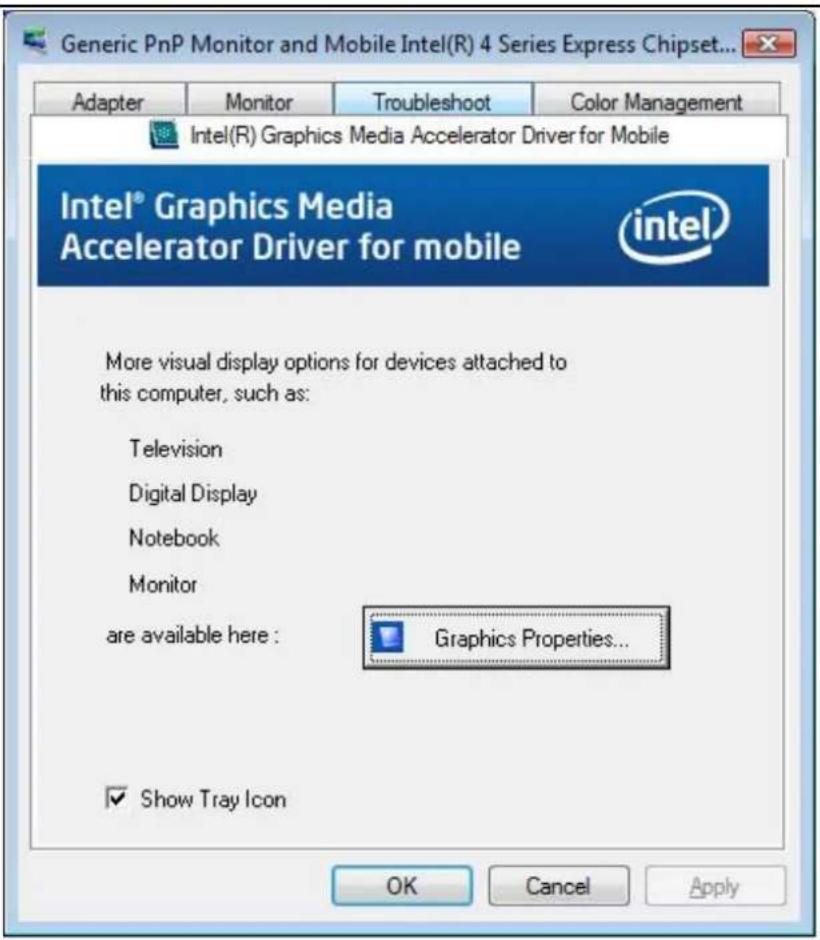
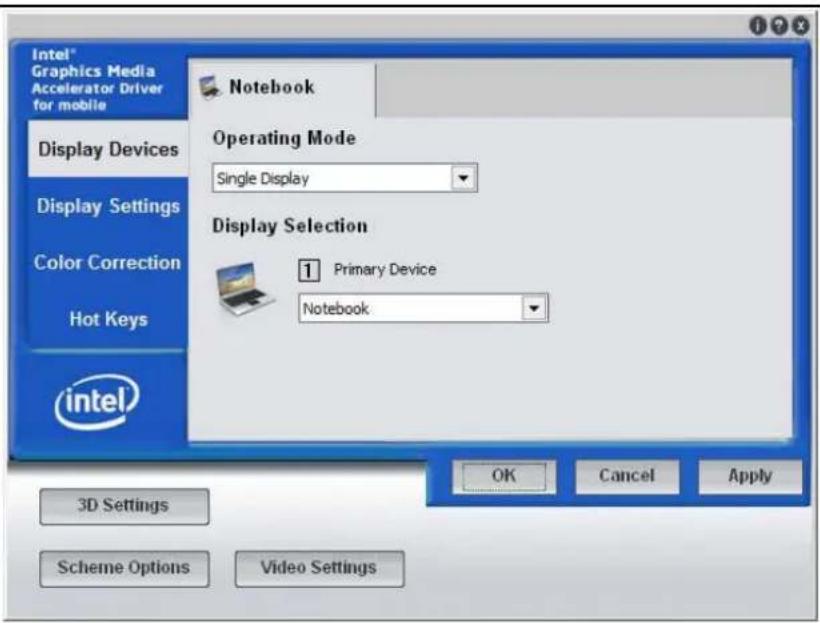
Select the "Display Settings" option to enter its window display. Click on the "Advanced Settings" tab to enter "Generic PnP Monitor on Mobile Intel ® 4 Series Express Chipset Family" window display.



Chapter
8
3G Connection
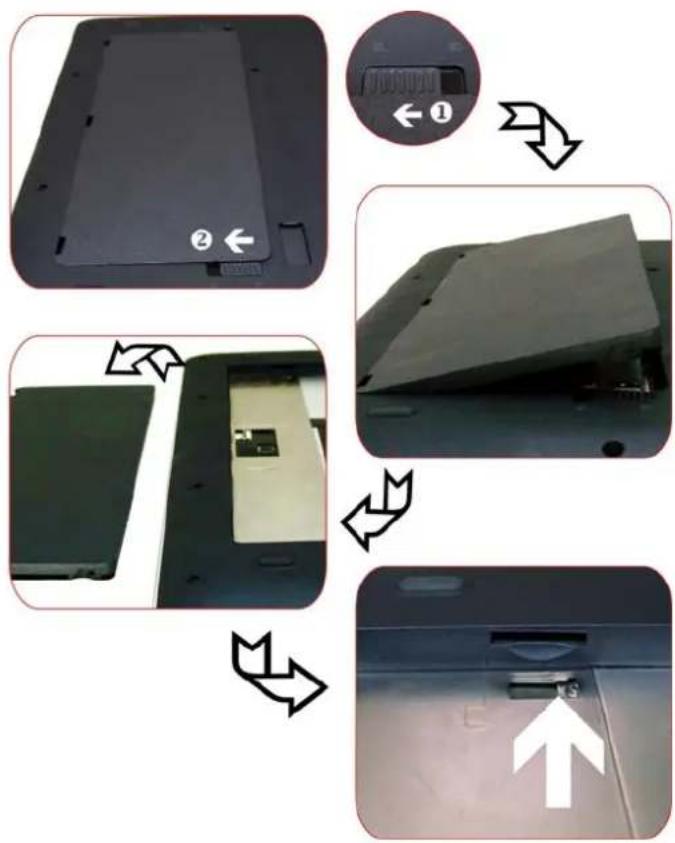
3G is the third generation of mobile phone standards and technology. 3G enable users a wide range of more advanced service while achieving greater network capacity through improved spectral efficiency.
flowchart
graph TD
    A["Opening Door"] --> B["Cut Left"]
    B --> C["Down Left"]
    C --> D["Close Down"]
    D --> E["Open Back"]
    E --> F["Shrink Down"]
    F --> G["Close Back"]
    G --> H["Shrink Up"]
    H --> I["Shrink Up"]
    I --> J["Shrink Down"]
Press the hot key combination of Fn + F12 or click the 3G application icon to start executing the application.
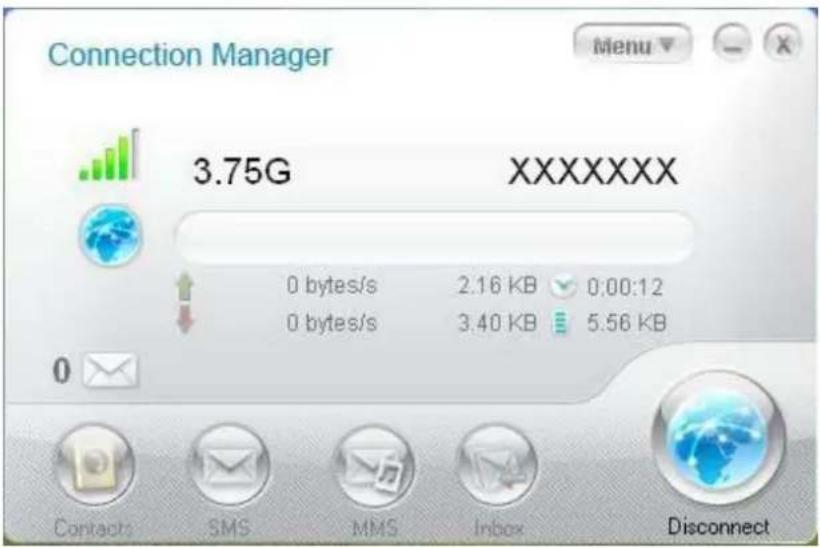
To disconnect, click on the "Disconnect" icon will exit the 3G application.
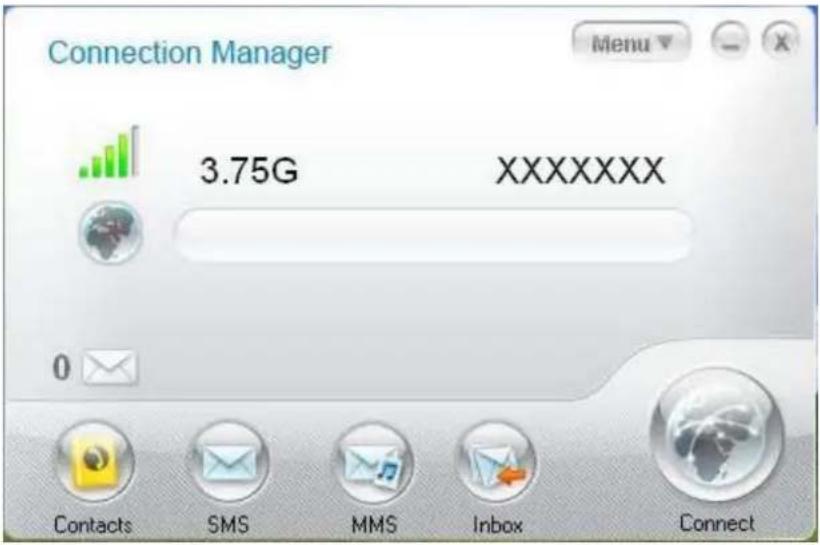
Another way for 3G connection is by clicking on the "Menu" button.
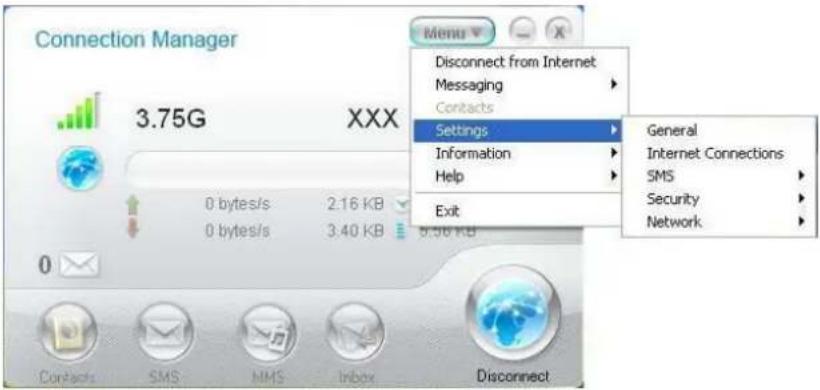
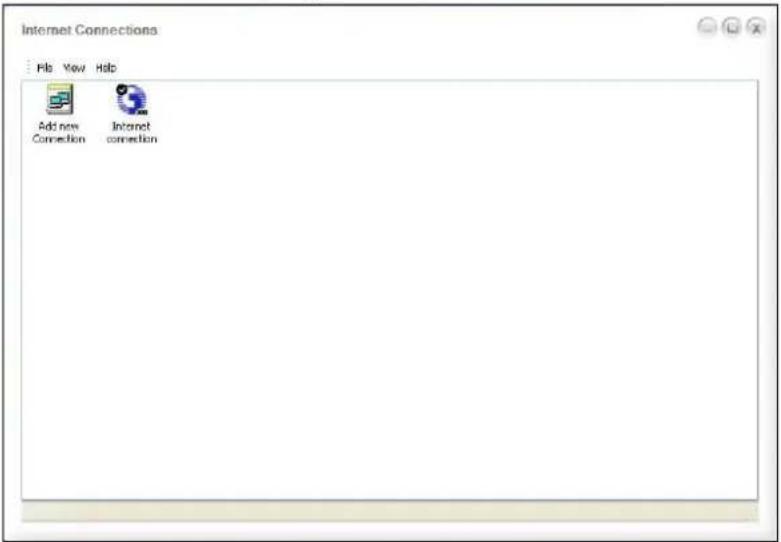
Select the "Setting" and click on the "Internet Connections" to enter the connection window display.
Click on the "Add new Connection" in case you want to connect to other telecom company.
Chapter
9
Finger printer Application
- Click on the Fingerprint icon located at the lower right end of the screen.

- It is recommended that you need to setup windows password for security reason. Click on the "Yes" button to continue.
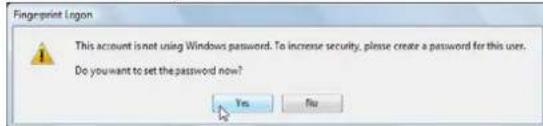
- After you had set the "Username" and "Password", click on the "OK" to continue.
- After entering on your password, click the "Next" button to continue.
To achieve the best results, quality is important

- Lay your finger flat on the sensor.
- Move your finger perpendicular to the sensor.
• Do not swing your finger at the end of the movement.

- Position your finger to the center of the sensor to achieve the best contact.
- Start swiping your finger from the bend closest to the fingertip.
√ Run interactive tutorial

NOTE....
Position your finger flat over the center
of the sensor to achieve the best contact. Start swiping your finger smoothly and slowly from top to bottom with the fingertip press firmly as it pass the sensor. This would make the sensor read your fingertip clearly. Do not lift your finger as you swipe over the sensor..
- You are given 3 times to practice in swiping on the fingerprint. Click the "Next" button to continue.
- Select on the above correct fingerprint.
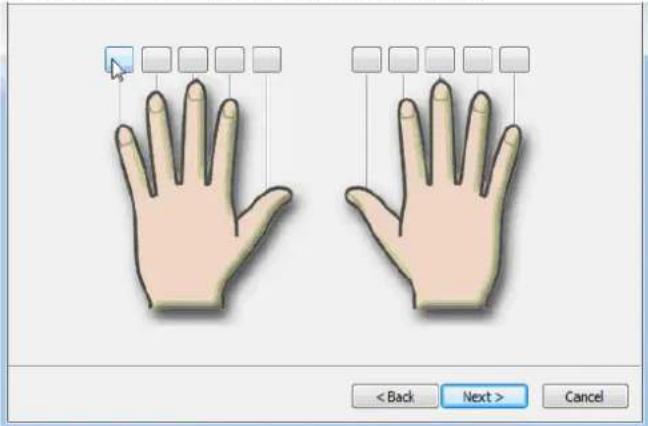
- Enter the correct fingerprint continuously for 5x to enter the correct fingerprint.
- After you finish entering a fingerprint, click on the "Next" button to continue
- Click on the "Finish" button to complete the application.
Chapter
10
G Sensor (Optional)
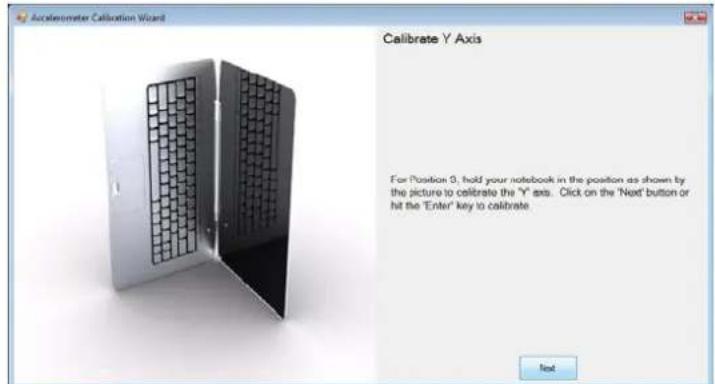
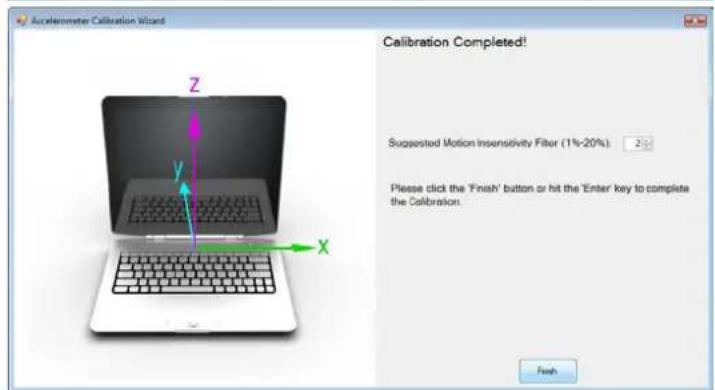
The Always-Aware applications add new capabilities to the notebook by sensing notebook motion. The applications use an accelerometer within the notebook to detect motion.
The applications include: protection of the system hard drive from harmful shocks and some limited protection of the notebook from theft.
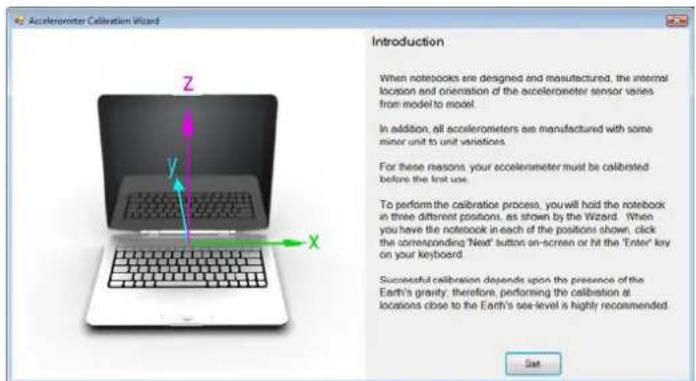
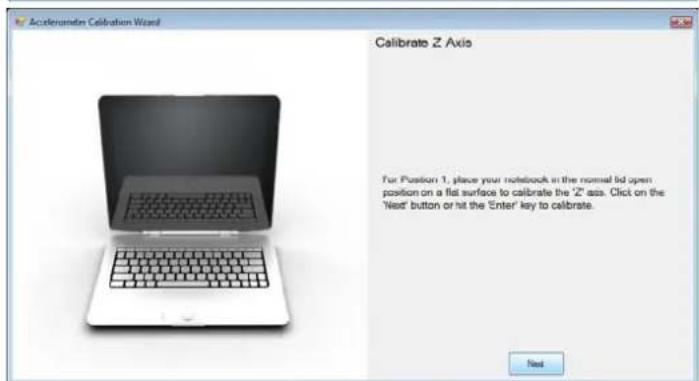
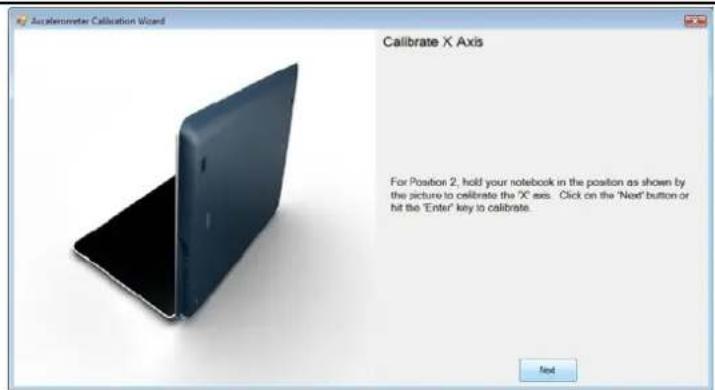
Hard-Disk Drive Protection application
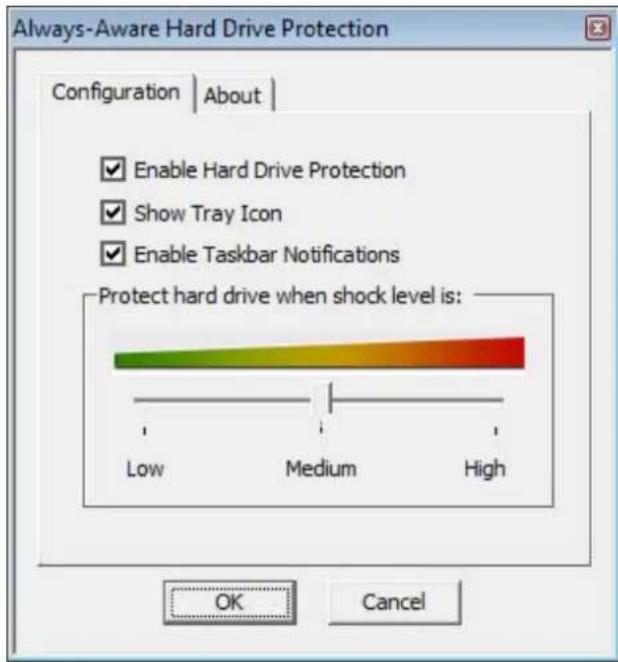
The Hard-Disk Drive (HDD) Protection application protects the notebook HDD from damage caused by sudden harmful notebook shocks.
It monitors system movements that exceed the defined shock threshold. Once a shock is detected, the application instructs the HDD to temporarily park it's heads which protects against potential damage the drive. When the notebook motion stabilizes the heads are then un-parked.
Anti-Theft
The Anti-Theft (AT) feature attempts to assist in the detection of unwanted movement of the notebook. When turned on the notebook is "armed" such that subsequent notebook movement will sound an audio alarm. A successful login or unlock of the notebook will automatically "disarm" the alarm.

NOTE....
The shortcut keys to enable this
application are: L, B, C, D, T, 1, 2, 3, 4, 5
Auto Rotate Screen
The Auto Rotate Screen feature allows display of the desktop to match the orientation of the notebook position. As the notebook is rotated the desktop orientation changes automatically.
Flip your computer to turn it vertically or maintain the original position in a horizontal view.

natural_image
Two laptops displayed side by side, one showing a bamboo forest on its screen and the other a cityscape with a church in the background (no text or symbols visible)Enable/Disable Auto Rotate Screen
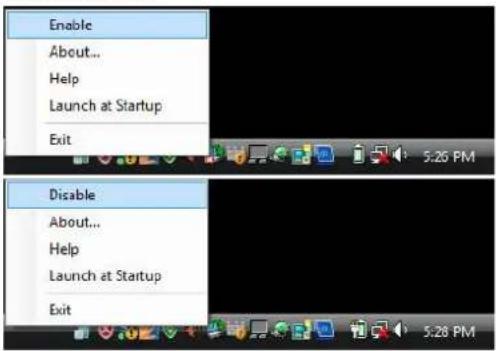
Select the context menu item labeled Enable or Disable to enable/disable the Auto Rotate Screen feature. The menu item will toggle between the Enable and Disable options depending on the current state.
Chapter
11
Troubleshooting
Your computer has been fully tested and complies with the system specifications before shipping. However, incorrect operations and/or mishandling may cause problems.
This chapter provides a reference for identifying and correcting common hardware and software problems that you may encounter.
When you encounter a problem, you should first try to go through the recommendations in this chapter. Instead of returning the computer and waiting for repair, you may easily solve the problems by considering the following scenarios and possible solutions. If the error continues, contact your reseller for service information.
Before taking further actions, consider the following suggestions:
* Check to see if the problem persists when all the external devices are removed.
* Check to see that the green light indicator on the AC adapter is lit.
* Check to see the power cord is properly plugged to the wall outlet and to the computer.
* Check to see the power indicator of the computer is on.
* Check to see if your keyboard is operational by pressing and holding any key.
* Check for any incorrect or loose cable connections. Make sure the latches on the connectors latch securely on to the receptor end.
* Be sure you have not performed an incorrect setting on the hardware devices in the BIOS Setup utility. A faulty setting may cause the system to misbehave. If you are not sure of the changes you made, try to restore all the settings to factory defaults.
* Be sure all the device drivers are installed properly. For example, without the audio driver properly installed, the speakers and microphone will not work.
If external devices such as USB camera, scanner, printer do not function correctly when connected to the system, it is usually the device's own problem. Consult the device's manufacturer first.
* Some software programs, which have not gone through rigorous coding and testing, may cause problems during your routine use. Consult the software vendor for problem solving.
Legacy peripheral are not plug-and-play capable. You need to restart the system with these devices powered up and connected first.
* Be sure to go to BIOS SETUP and load DEFAULT SETTING after BIOS re-flash.
* Be sure the Quick Key Lockout Switch on the bottom of the computer is not engaged; otherwise the quick keys will not work.
Audio Problems
No speaker output
* Software volume control is turned down in Microsoft Sound System or is muted. Double-click the speaker icon on the lower right corner of the taskbar to see if the speaker has been muted or turned down all the way.
Most audio problems are software-related. If your computer worked before, chances are software may have been set incorrectly.
Go to [Start > Settings > Control Panel] and double-click the Sounds and Audio Devices icon. In the Audio page, make sure that the audio codec mentioned in the spec is the default playback device.
Sound cannot be recorded
* You will need to plug-in an external microphone to the microphone connector to record sound.
Double-click the speaker icon on the lower right corner of the taskbar to see if the microphone has been muted.
Click Options and select Properties.
Select Recording and click the OK button.
After Click OK button, the recording volume control panel will appear.
Go to [Start > Settings > Control Panel] and double-click the Multimedia icon (or Sounds and Audio Devices icon). In the Volume or Audio page, make sure that the audio codec mentioned in the spec is the default recording device.
Hard Disk Problems
The hard disk drive does not work or is not recognizable
If you had just performed a hard disk upgrade, make sure the hard drive connector is not loose and the hard disk drive is also correctly seated. Remove it and reinsert it firmly, and restart your PC.
The new HDD may need to be partitioned and reformatted. O/S and drivers will need to be re-installed as well.
* Check the hard disk indicator LED. When you access a file, the LED lamp should light up momentarily.
The new HDD may be defective or is not compatible.
If your computer has been subjected to static electricity or physical shock, you may have damaged the disk drive.
The hard drive is making abnormal whining noises
* You should back up your files as soon as possible.
Make sure the source of noise is indeed from the hard drive and not the fan or other devices.
The hard disk drive has reached its capacity
Run Disk Cleanup utility in Windows. [Start > All Programs > Accessories > System Tools > Disk Cleanup] The system will prompt you for what to do.
Archive files or programs that you had no longer used by moving them to an alternative storage medium (floppy disk, optical record-able disk, etc.) or uninstall programs that no longer use.
* Many browsers store files in the hard drive as a cache to speed up the performance. Check the program's Online Help for instructions on decreasing the cache size or on removing temporary Internet files.
Empty the Recycle Bin to create more disk space. When you delete files, Windows saves them to the Recycle Bin.
The hard disk takes longer to read a file
If you have been using the drive for a period, the files may be fragmented. Go to [Start > Programs > Accessories > System Tools > Disk Defragmenter] to perform a disk defragmentation. This operation may take a while.
* Interrupt requests or problems with other hardware devices may have occupied the CPU and therefore slows down the system performance.
The files are corrupted
Run the Error-checking utility in Windows to check the HDD. Double-click My Computer. Right-click C: and select Properties. Click Check Now in Error-checking in Tools.
Display Problems
The display panel is blank when the system is turned on
Make sure the computer is not in the Standby or Hibernate suspend modes. The display is turned off to conserve energy in these modes.
The screen is difficult to read
The display resolution should at least be set to at least 1280 x 800/1366 x 768 for optimal viewing.
Go to [Start > Settings > Control Panel] and double-click the Display icon.
Under the Settings page, set screen resolution to at least 1280 x 800/1366 x 768.
The screen flickers
It is normal if the display flickers a few times during shutting down or powering up.
Keyboard and Mouse Problems
The built-in touch pad performs erratically
Make sure there is no excess perspiration or humidity on your hand when using the touch pad. Keep the surface of the touch pad clean and dry.
Do not rest your palm or wrist on the surface of the touchpad while typing or using the touch pad.
The built-in keyboard accepts no input
Please try to make sure the system doesn't hang up and is still working.
The characters on the screen repeat while I type
* You may be holding the keys down too long while you're typing.
* Keep the keyboard clean. Dust and dirt under the keys could cause them to stick.
Configure the keyboard to wait longer before the auto repeat feature starts. To adjust this feature, Go to [Start > Settings > Control Panel], and double-click the Keyboard icon. A dialogue box shows up with the adjustable settings for the keyboard.
CMOS Battery Problem
A message "CMOS Checksum Failure" displays during the booting process or the time (clock) resets when booting
* Try to reboot the system.
If the message "CMOS Checksum Failure" appears during the booting procedure even after rebooting, it may indicate failure of the CMOS battery. If so, you need to replace the battery. This battery normally lasts two to five years. The battery is of type CR2032 (3V). Send the battery to the dealer for replacement.
Memory Problems
The POST does not show an increased memory capacity when you have already installed additional memory
Certain brands of memory module may not be compatible with your system. You should ask your vendor for a list of compatible DIMM.
The memory module may be defective.
The O/S issues an insufficient memory error message during operation
This is often a software or Windows-related problem. A program is draining the memory resources.
* Close the application programs you're not using and restart the system.
PC Card Problems
NOTE.... Slot option.
Some system may not have the PC Card
PC Cards do not function
Make sure you have properly installed the driver for the card.
Consult the card's manual or contact the vendor for troubleshooting.
The PC card cannot be recognized
Make sure the card is fully inserted; the outer end of the card should be even with the edge of the computer.
* Remove and insert the PC card again.
* Make sure there is no IRQ conflict with the card. See Windows on-line help for solving IRQ conflicts.
* Reboot the computer and see if the problem persists.
The card may be defective. Try the card on another system, if possible.
Windows crashes or freezes when you remove the PC card
Make sure you have
Performance Problems
The computer becomes hot
In a 35 °C environment, the certain areas of the computer's back case are expected to reach 50 degrees.
Make sure the air vents are not blocked.
If the fan does not seem to be working at high temperature (50 degrees Celsius and up), contact the service center.
Certain programs that are processor-intensive may increase the computer temperature to a degree where the computer automatically slows down its CPU clock to protect itself from thermal damage.
The program appears stopped or runs very slowly
* Press CTRL+ALT+DEL to see if an application is still responding.
* Restart the computer.
This may be normal for Windows when it is processing other CPU-intensive programs in the background or when the system is accessing slow-speed devices such as floppy disk drive.
* You may be running too many applications. Try to close some applications or increase system memory for higher performance.
The processor may have been overheated due to the system's inability to regulate its internal heat. Make sure the computer's ventilation grills are not blocked.
USB2.0 Problems
The USB device does not work
* Check the settings in the Windows Control Panel.
Make sure you have installed the necessary device drivers.
* Contact the device vendor for additional support.
Unable to use the External USB Device
* Detach the external device; insert it into the Enhanced USB port. Separate the cable with the equipment; first insert the wire into the port, then connect the device with the cable that is inserted into the Enhanced USB port.
Unable to Recognize the External USB Device
Please make sure power cable is inserted into the Enhanced USB port, if it is inserted then follow the normal procedures in disconnecting the device; power cable will not be disconnect, connect back the signal cable.
Appendix
A
Specification
O.S.
* Supports Windows Vista Starter, Home Basic, Home Premium, Ultimate
* Supports Windows 7 Ultimate
CPU
Intel Cantiga GS45+ICH9M (SFF)
Supports Penryn Core2 Duo LV/SFF processor, SL9600, SL9400, SL9300 (Up to 2.13GHz), 6MB L2 Cache, 1066MHz FSB, TDP: 17 W
Supports Penryn Single Core ULV/SFF processor, SU2700, SU3500, SU3300 (Up to 1.4GHz), 3MB L2 Cache, 800MHz FSB, TDP: 5.5 W
Intel Cantiga GS40+ICH9M (SFF)
Supports Penryn CULV 723/SFF processor, 723 (1.2GHz), 1MB L2 Cache, 800MHz FSB, TDP: 10 W
Memory
* Support DDRII 800 MHz
* SODIMM RAM socket * 1, up to 4GB (depends on module's availability)
On board DDR2 1GB 128M*8 DRAM memory
Core Logic
Intel Cantiga GS45+ICH9M (SFF)
Intel Cantiga GS40+ICH9M (SFF)
VGA
Intel GS45
Intel GS40
Audio Codec
Realtek ALC888
LAN Controller
* Supports 10/100/1000 Mb/Sec.
MII interface
* Supported by Mini Port Replicator as an optional item
Wireless LAN
* Half Mini Card type
PCI-E interface
Intel Shirley Peak 5300 (802.11 abgn) 3x3
Intel Echo Peak (802.11 abgn/WiMax) 1x2
* WiMax support depends on AP's availability
3 ^rd party WLAN card BGN mode supported
Camera CCD
* Support 0.3M Camera
HDD (1.8") or SSD module
* HDD 1.8"
Support single SATA HDD for 5mm
Support SATA 2.0
* SSD 1.8"
SATA interface
64/128 GB support
Keyboard
* Support US 83KEY/UK 85 KEY/JP 87KEY
LED keyboard back light support (Optional)
Pointing Device
PS2 Touch Pad with 2 buttons
* Support gesture function
LCD
13.3" WXGA, resolution 1280 x 800 (16:10)
13.3" WXGA, resolution 1366 x 768 (16:9)
Battery Pack
Lithium Polymer Battery - 3 cell 3150mAh (3S1P), 34.96W, YOKU
* Lithium Ion Battery - 6 cell 3200 mAH (3S2P)
* 2nd Battery (Optional) - Lithium Polymer battery pack, 70W
AC-Adapter
* Automatics Voltage adjustment between 100 and 240VAC 50/60Hz, 65 Watts., 2 Pin
Delta type of ADP-65HB AD
Intel Turbo Memory (Optional)
On board 2GB Turbo Memory Technology 2.0 support
* NAND flash and the Flash Cache Logic
PCI Express interface
Ambient Light Sensor
LCD back light brightness and darkness auto adjustment (0\~7 Level)
Key Board LED back light brightness and darkness auto adjustment (0\~3 Level)
G-sensor (Optional)
System Hard disk drive protection
Intel Always Aware Application Rev 1.5 support
Speaker/MIC
Build-in 2 speakers
* Internal Microphone support
BIOS
* Supports PnP, ACPI 3.0
* Support external USB flash memory card boot up.
With Phoenix BIOS and 1MB flash ROM
Power Management (default: Silent mode)
* "Smart Power II" Power Management
Physical Outline
Dimension: (W*L*H) 335.8*226.9*21.8mm (w/o rubber foot)
Weight: 1.5 kg (W/Battery)
RF
CE, R&TTE report/document, FCC
Safety
CB
CCC/ETL
EMI
CE, FCC, CCC
Suppression Core

natural_image
Two black electronic components with cylindrical bodies and ports, shown from front and side views (no text or symbols visible)NOTE....
From your accessories, align the suppression core on the cable of your Port Replicator as shown on the illustration. Snap it on the cable and close

natural_image
Two black USB connectors with attached cable, showing port and connector details (no text or symbols visible)


- Preface
- Limitation of Liability
- Notices
- Notice:
- Table of Content
- BEFORE YOU START 2
- INTRODUCTION....12
- GETTING STARTED 20
- USING THE NOTEBOOK COMPUTER....29
- RUNNING BIOS SETUP ....49
- Chapter
- Before you Start
- Conventions of This Manual
- Safety Precautions
- For Japan:
- For Other Countries:
- CAUTION: MODEL T30II\*/T30IL * ( * = 0 9 ) IS DESIGNED TO USE WITH THE FLOWING AC ADAPTER MODEL ONLY
- CAUTION...
- VORSICHT...
- Class 1 Laser Product
- Appareil A Laser De Classe 1
- Things you must remember before working on your computer
- Let your computer acclimate itself
- WARNING....
- Heat, Cold, Humidity, and Glare
- Suitable place to work
- 2
- Introduction
- Preparing your Computer
- Knowing your Computer
- panel:
- Front View
- NOTE....
- LED Graphic Symbol
- Indication
- Light Sensor
- Keyboard
- Microphone
- Power/Suspend Button
- Bottom View
- Port Replicator
- 3
- Getting Started
- Connecting to a Power Source
- Connecting the AC Adapter
- Turning On Your Notebook Computer
- Operating on Battery Power
- Installing and Removing the Battery Pack
- To Install the Battery Pack:
- Charging the Battery Pack
- 4
- Using the Notebook Computer
- Adjusting the LCD Screen Display
- LCD Care
- External CRT Display
- HDMI only
- On Screen Display (OSD)
- Live Power (Optional)
- The TouchPad
- TouchPad Precautions
- Power Saving Modes
- The Battery Power System
- Removing the Battery Pack
- Preparing the Battery Pack for Use (Battery Calibration)
- Automatic Battery Pack Charging Function
- Battery Status
- Battery Low Warning
- Resetting the System
- Using the Windows
- Help Windows
- Desktop
- Recycle Bin
- Start Button
- Taskbar
- Notification
- Control Panel
- 5
- Internet Connection
- Using a wired LAN for Connection to Internet
- Using Wireless LAN Network for Connection to Internet
- Bluetooth Connection
- 6
- Running BIOS Setup
- Entering the BIOS Setup Screen
- Leaving the BIOS Setup Screen
- Modifying the BIOS Settings
- Info Setup
- Main Setup
- VGA Utilities
- 8
- 3G Connection
- 9
- Finger printer Application
- To achieve the best results, quality is important
- 10
- G Sensor (Optional)
- Hard-Disk Drive Protection application
- Anti-Theft
- Auto Rotate Screen
- Enable/Disable Auto Rotate Screen
- 11
- Troubleshooting
- Audio Problems
- No speaker output
- Sound cannot be recorded
- Hard Disk Problems
- The hard disk drive does not work or is not recognizable
- The hard drive is making abnormal whining noises
- The hard disk drive has reached its capacity
- The hard disk takes longer to read a file
- The files are corrupted
- Display Problems
- The display panel is blank when the system is turned on
- The screen is difficult to read
- The screen flickers
- Keyboard and Mouse Problems
- The built-in touch pad performs erratically
- The built-in keyboard accepts no input
- The characters on the screen repeat while I type
- CMOS Battery Problem
- A message "CMOS Checksum Failure" displays during the booting process or the time (clock) resets when booting
- Memory Problems
- The POST does not show an increased memory capacity when you have already installed additional memory
- The O/S issues an insufficient memory error message during operation
- PC Card Problems
- PC Cards do not function
- The PC card cannot be recognized
- Windows crashes or freezes when you remove the PC card
- Performance Problems
- The computer becomes hot
- The program appears stopped or runs very slowly
- USB2.0 Problems
- The USB device does not work
- Unable to use the External USB Device
- Unable to Recognize the External USB Device
- Appendix
- A
- Specification
- O.S.
- CPU
- Memory
- Core Logic
- VGA
- Audio Codec
- LAN Controller
- Wireless LAN
- Camera CCD
- HDD (1.8") or SSD module
- Pointing Device
- LCD
- Battery Pack
- AC-Adapter
- Intel Turbo Memory (Optional)
- Ambient Light Sensor
- G-sensor (Optional)
- Speaker/MIC
- BIOS
- Power Management (default: Silent mode)
- Physical Outline
- RF
- Safety
- EMI
- Suppression Core
Brand : ECS
Model : T30II
Category : Laptop