TBT14SABAA - Cooker GE - Free user manual and instructions
Find the device manual for free TBT14SABAA GE in PDF.


User questions about TBT14SABAA GE
0 question about this device. Answer the ones you know or ask your own.
Ask a new question about this device
Download the instructions for your Cooker in PDF format for free! Find your manual TBT14SABAA - GE and take your electronic device back in hand. On this page are published all the documents necessary for the use of your device. TBT14SABAA by GE.
USER MANUAL TBT14SABAA GE
Use and Care & Installation Guide
Refrigerator

Safety Instructions....2, 3

Operating Instructions, Tips
Anti-Condensation Switch ....3
Automatic Icemaker 6
Icemaker Accessory Kit 6
Shelves 4,5
Storage Drawers....5
Temperature Control ....3

Care and Cleaning
Behind Refrigerator 7
Cleaning, Outside and Inside ....7
Drawer and Cover Removal....8
Light Bulb Replacement 8
Under Refrigerator 7
Water Filter Accessory....6

Problem Solver 17, 18
Normal Operating Sounds....17

Preparation
Clearances....9
Dimensions 9
Location 9
Rollers and Levelling Legs....9
Vacation and Moving 9
Water Supply to Icemaker....9

Installation 10–16
Adapter Plug 10
Electrical Requirements 10
Extension Cords 10
Grounding 10
Mains Lead Replacement....3
Reversing the Door Swing 11–14
Water Line Installation 15, 16

Model and Serial Numbers ......2
Top-Mount No-Frost 14 and 16 Models, Export Line
HELP US HELP YOU...
Read this book carefully. Write down the model and serial numbers.
It is intended to help you operate and maintain your new refrigerator properly. Keep it handy for answers to your questions.
If you received a damaged refrigerator...
Immediately contact the dealer (or builder) that sold you the refrigerator.
Save time and money. Before you request service...
Check the Problem Solver. It lists minor operating problems that you can correct yourself.
You'll see them on a label on the left side of the fresh food compartment.
Model Number
Serial Number
Use these model and serial numbers in any correspondence or service calls concerning your refrigerator.

IMPORTANT SAFETY INSTRUCTIONS
Read all instructions before using this appliance.

WARNING—When using this appliance, always exercise basic safety precautions, including the following:
- Use this appliance only for its intended purpose as described in this Use and Care Guide.
- This refrigerator must be properly installed in accordance with the Installation Instructions before it is used. See the grounding instructions below and in the Installation section.
- Never unplug your refrigerator by pulling on the power cord. Always grip plug firmly and pull straight out from the outlet.
- Repair or replace immediately all electric service cords that have become frayed or otherwise damaged. Do not use a cord that shows cracks or abrasion damage along its length or at either the plug or appliance end.
- When moving your refrigerator away from the wall, be careful not to roll over or damage the power cord.
- Do not allow children to climb, stand or hang on the shelves in the refrigerator. They could damage the refrigerator and seriously injure themselves.

- If your old refrigerator is still around the house but not in use, be sure to remove the doors. This will reduce the possibility of danger to children.
• After your refrigerator is in operation, do not touch the cold surfaces in the frozen food storage compartment, particularly when hands are damp or wet. Skin may adhere to these extremely cold surfaces.
- If your refrigerator has an automatic icemaker, avoid contact with the moving parts of the ejector mechanism, or with the heating element that releases the cubes. Do not place fingers or hands on the automatic icemaking mechanism while the refrigerator is plugged in.
- Don't refreeze frozen foods which have thawed completely. Food safety experts say:
“...You may safely refreeze frozen foods that have thawed if they still contain ice crystals or if they are still cold—below 40^ F. ( 4^ C.).
“…Thawed ground meats, poultry or fish that have any off-odor or off-color should not be refrozen and should not be eaten. Thawed ice cream should be discarded. If the odor or color of any food is poor or questionable, get rid of it. The food may be dangerous to eat.
“...Even partial thawing and refreezing reduces the eating quality of foods, particularly fruits, vegetables and prepared foods. The eating quality of red meats is affected less than that of many other foods. Use refrozen foods as soon as possible to save as much of their eating quality as you can.”
- Unplug your refrigerator before cleaning and making repairs. NOTE: We strongly recommend that any servicing be performed by a qualified individual.
- Before replacing a burned-out light bulb, the refrigerator should be unplugged in order to avoid contact with a live wire filament. (A burned-out light bulb may break when being replaced.)
NOTE: Turning control to “○” position does not remove power to the light circuit.
- Do not store or use gasoline or other flammable vapors and liquids in the vicinity of this or any other appliance.
Mains lead replacement
If the mains lead on your refrigerator needs replacing at any time, it must be replaced by a special lead which is obtainable from your local dealer. A charge will be made for the replacement of the mains lead if you have damaged the lead.
SAVE THESE INSTRUCTIONS
TEMPERATURE CONTROL DIAL

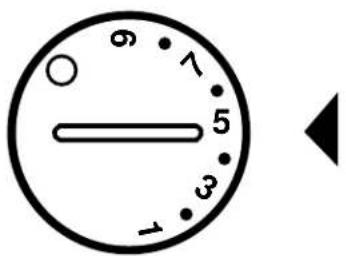
The temperature control dial has nine settings plus “○”1” is the warmest. “9” is the coldest. At first, set the dial at “4” or “5.” After using the refrigerator, adjust the dial if necessary.
Insert a coin into the slot in the middle of the dial and you can turn the dial to the setting that's best suited to your needs.
Allow 24 hours for the refrigerator to get cold.
NOTE: Turning the dial to “Ostops cooling in both compartments—fresh food and frozen food storage—but does not shut off power to the refrigerator.
text_image
6 1 5 3 1Anti-Condensation Switch No Defrosting
If moisture develops on the ceiling of the fresh food compartment, turn the anti-condensation switch to the ON position. Moisture is likely to appear when the air is humid—in the summer, in the early morning hours or in non-air conditioned rooms. Move to the OFF position in less humid conditions.

text_image
ON OFFIt is not necessary to defrost the frozen food storage compartment or fresh food compartments. Although your refrigerator is designed and equipped to defrost itself automatically, some frost on packages is normal.

FRESH FOOD COMPARTMENT SHELVES
Shelf supports at various levels allow you to custom-space shelves
Half-Width Shelves
(on some models)
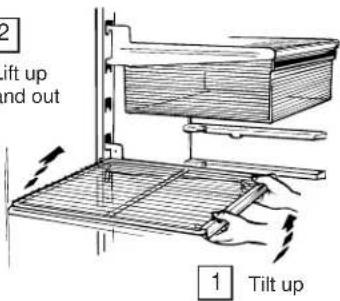
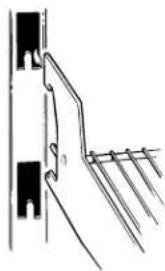
One end of the shelf rests on a molded side-wall support; a bracket on the other end hooks into a track on the rear cabinet wall.
To remove, lift the shelf up at front, then off the support and out of the track.
To replace, select desired shelf height. With shelf front raised slightly, hook the bracket's top lug into the track, then lower the shelf onto the support.
2
Lift up and out
text_image
2 lift up and out 1 Tilt upNOTE: The shelf to the right of the track is designed to hook into the right-hand slot; the shelf to the left is designed to hook into the left-hand slot.
natural_image
Pure mechanical linkage diagram without any text, numbers, or symbolsFull-Width Shelves (on some models)
Some models have a steel wire sliding shelf, a stationary tempered glass shelf or two steel wire stationary shelves. These shelves can be moved to another place in the fresh food compartment.
The full-width sliding shelf has stop-locks. When placed correctly on the shelf supports, the shelf will stop before coming completely out of the refrigerator and will not tilt when you place food on it or remove food from it.

natural_image
Simple line drawing of a metal grate with an upward arrow indicating flow or direction (no text or symbols)To remove the full-width shelves.
Lift the rear of the shelf and pull forward.
To remove a full- width shelf when the fresh food compartment door cannot be opened fully... lift the rear of the shelf, pull forward and down, tilt the shelf and take it out.

natural_image
Illustration of a hand holding a tray with a handle, lifting an upward arrow (no text or symbols)
natural_image
Hand holding a grid device with arrows indicating force or movement (no text or symbols)FROZEN FOOD STORAGE COMPARTMENT SHELVES
(on some models)
Some models have an ice-tray shelf and some have a full-width step shelf.
Ice-Tray Shelf Ice Trays (on some models)
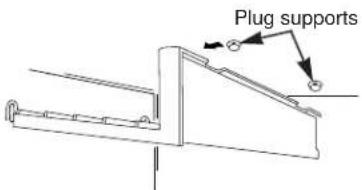
To remove the ice-tray shelf:
Lift the left side of the shelf off its supports, then pull the shelf to the left to free it of the plug supports. Pull the shelf to the right to free the pins from the holes in the cabinet wall.
text_image
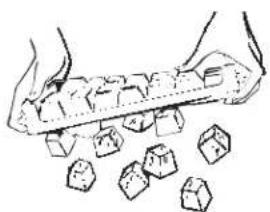
Plug supportsIce trays are designed to release ice cubes easily. Hold tray upside-down over a container and twist both ends to release cubes.
For only one or two ice cubes, leave the tray right-side up, twist both ends slightly and remove desired number of cubes. Wash ice trays and storage bin in lukewarm water only. Do not put them in an automatic dishwasher.
natural_image
Illustration of hands holding a tray with cubes and falling blocks (no text or symbols)Step Shelf
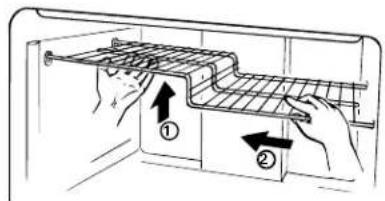
To remove the step shelf:
text_image
Diagram showing two hands installing a grid device into a rack, labeled with arrows indicating direction of movement.- Lift left side of shelf slightly.
- Move shelf to the left to free its right ends from holes in the cabinet wall.
- Lower right side of shelf, move shelf to the right and take it out.
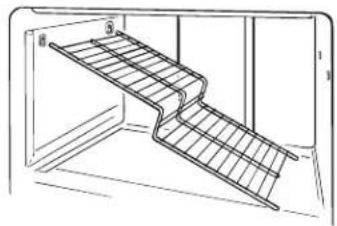
To replace the step shelf:
natural_image
Technical line drawing of a staircase with labeled components (no text or symbols)- With shelf tilted as shown, fit left ends of shelf into holes in cabinet wall.

natural_image
Diagram of a hand opening a rack with a directional arrow indicating motion (no text or symbols)- Lift left side of shelf slightly, swing shelf up, fit right ends of shelf into holes in cabinet wall, and lower shelf into place.
STORAGE DRAWERS
Fruit & Vegetable Drawers

natural_image
Simple line drawing of two rectangular containers with no text or symbolsThe storage drawers at the bottom of the fresh food compartment are designed to provide high humidity levels required by most vegetables and lower humidity levels required for most fruits.
When replacing the drawers, always push them all the way in.
Storage time will depend upon the type of food and its condition when placed in the drawers.
Excess water which may accumulate in the bottom of the drawers should be emptied and the drawers wiped dry.
High Humidity Drawer
(on some models)
This refrigerated drawer is designed to keep unwrapped foods fresh by retaining the natural moisture content of foods such as:
• Artichokes • Cherries • Peas, green
• Asparagus • Corn • Plums
- Beets, topped
- Currants • Radishes
- Greens, • Rhubarb
- Blueberries leafy
- Spinach
- Carrots • Lettuce • Tomatoes,
• Celery • Parsley ripe
As in any refrigerated storage area, it is recommended that foods with strong odors be stored wrapped—foods such as:
• Broccoli • Cabbage • Parsnips
- Brussels • Cauliflower • Turnips
Sprouts • Green Onions
Low Humidity Drawer
(on some models)
This refrigerated drawer is designed to provide lower humidity storage for items such as:
- Apples • Oranges
- Squash,
- Apricots • Peaches summer
- Grapes • Pears
- Strawberries
- Mushrooms • Raspberries • Tangerines
- Nectarines
Snacks Drawer (on some models)
The slide-out Snacks Drawer can be removed and taken to the sink or food preparation area. You may also relocate it and the shelf to which it attaches within the fresh food compartment to suit your storage needs.

natural_image
Technical line drawing of a rectangular industrial or mechanical component with internal structure (no text or symbols)AUTOMATIC ICEMAKER
(on some models)
Your icemaker will produce eight cubes per cycle—approximately 100 cubes in a 24-hour period, depending on frozen food storage compartment temperature, room temperature, number of door openings and other use conditions.
If your refrigerator is operated before the water connection is made to the icemaker, keep the feeler arm in the STOP (up) position.
When the refrigerator is first installed, allow about 24 hours for the frozen food storage compartment to cool down to icemaking temperatures.
Throw away the first few batches of ice. This flushes away impurities in the water line.
When the refrigerator has been connected to the water supply, move the feeler arm to the ON (down) position.

text_image
Icemaker Feeler arm in STOP (up) position Ice Storage Bin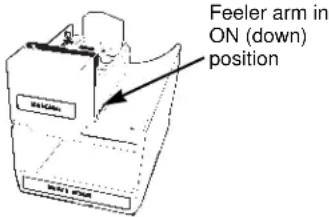
text_image
Feeler arm in ON (down) positionIcemaking will continue until the feeler arm is pushed up to the STOP (up) position by the ice cubes in the storage bin. For maximum ice storage, level the stored cubes with your hand occasionally. Be sure nothing interferes with the swing of the feeler arm.
The icemaker ejects cubes in groups of eight and it is normal for several cubes to be joined together.
Move the icemaker feeler arm to the STOP (up) position when:
• Home water supply is to be off for several hours.
- Ice storage bin is to be removed for a period of time.
- Going away on vacation, at which time you should also turn off the valve in the water supply line to your refrigerator.
- Turning the temperature control to the “Oposition.
If ice is not used frequently, old ice cubes will become cloudy and taste stale. Empty the ice storage bin periodically and wash it in lukewarm water. Be sure to allow the storage bin to dry before replacing it—otherwise ice cubes may stick to other parts of the icemaker.
If this is your first icemaker, you'll hear occasional sounds that may be unfamiliar. They are normal icemaking sounds and are not a cause for concern.
Water Filter Accessory Water Supply Kit
Your ice cubes can only be as fresh-tasting as the water that produces them. That's why it's a good idea to purify your water with a water filter.
REMOVES SEDIMENT
Rigid, porous graded density depth cellulose fiber cartridge catches dirt, rust particles, sand and silt.
REMOVES ODORS
Activated charcoal granules remove musty, stale odors.
IMPROVES TASTE
Activated charcoal granules remove oily, medicinal, plastic and metallic tastes.
REDUCES SCALE
Special crystals reduce hard scale deposit formation.
The water filter is an option at extra cost and is available from your local distributor. It has complete installation instructions and installs in minutes on 1/4" O.D. copper water line.

natural_image
Cross-sectional diagram of a vertical industrial vessel with internal granular material (no text or labels)A kit containing copper tubing, shut-off valve, fittings and instructions needed to connect the icemaker to your cold water line is available at extra cost. Contact your local distributor and order the appropriate kit depending on how much copper tubing you need.
Icemaker Accessory Kit
If your refrigerator did not come already equipped with an automatic icemaker, an Icemaker Accessory Kit is available at extra cost from your local distributor. Check the back of the refrigerator for the specific icemaker kit needed for your model.
CARE AND CLEANING

Cleaning—Outside
The door handles and trim (on some models) can be cleaned with a cloth dampened with a solution of mild liquid dishwashing detergent and water. Dry with a soft cloth. Don't use wax on the door handles or trim.
Keep the finish clean. Wipe with a clean cloth lightly dampened with kitchen appliance wax or mild liquid dishwashing detergent. Dry and polish with a clean, soft cloth.
Do not wipe the refrigerator with a soiled dishwashing cloth or wet towel. These may leave a residue that can erode the paint. Do not use scouring pads, powdered cleaners, bleach or cleaners containing bleach because these products can scratch and weaken the paint finish.
Protect the paint finish. The outside of the refrigerator has a high quality, baked-on paint finish. With proper care, it will stay new-looking and rust-free for years. Apply kitchen/appliance wax when the refrigerator is new and then at least twice a year.
Cleaning—Inside
Clean the inside of the fresh food and frozen food storage compartments at least once a year. Unplug refrigerator before cleaning. If this is not practical, wring excess moisture out of sponge or cloth when cleaning around switches, lights or controls. Apply an appliance wax/polish to the inside surface between the doors.
Use warm water and baking soda solution—about a tablespoon (15 ml) of baking soda to a quart (1 L) of water. This both cleans and neutralizes odors. Rinse thoroughly with water and wipe dry.
Other parts of the refrigerator—including door gaskets, vegetable drawers, ice trays and all plastic parts—can be cleaned the same way. After cleaning the door gaskets, apply a thin layer of petroleum jelly to the door gaskets at the hinge side. This helps keep the gaskets from sticking and bending out of shape. Do not use cleansing powders or other abrasive cleaners.
To help prevent odors, leave an open box of baking soda in the rear of the refrigerator, on the top shelf. Change the box every three months. An open box of baking soda in the frozen food storage compartment will absorb stale frozen food storage compartment odors.
Do not wash any of your refrigerator's plastic parts in your automatic dishwasher.
Under Refrigerator Behind Refrigerator
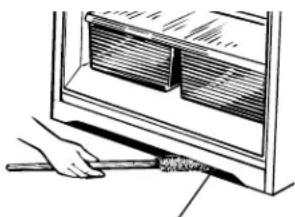
For most efficient operation, you need to keep the area under the refrigerator clean. Turn the temperature control to “☐ Sweep away or vacuum dust that is readily accessible on the condenser coils, then turn the control back on.
For best results, use a brush specially designed for this purpose, available from your local distributor. This easy cleaning operation should be done at least once a year.
natural_image
Hand cleaning a window with a brush (no text or symbols visible)Clean the condenser coils at least once a year.
Care should be taken in moving your refrigerator away from the wall. All types of floor coverings can be damaged, particularly cushioned coverings and those with embossed surfaces.
Turn the leveling legs at each front corner of the refrigerator counterclockwise until the rollers support the refrigerator; then pull the refrigerator straight out and return it to position by pushing it straight in. Moving your refrigerator in a side direction may result in damage to your floor covering or refrigerator.
After rolling the refrigerator back into place, turn the legs clockwise until the legs again bear the weight of the refrigerator. Refer to the Rollers and Leveling Legs section.
(continued next page)
CARE AND CLEANING
(continued)
Drawer and Cover Removal
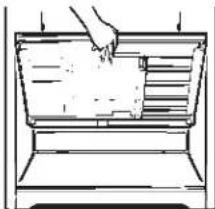
Drawers at the bottom of the fresh food compartment will stop before coming all the way out of the refrigerator, to help prevent contents from spilling onto the floor. These drawers can be removed easily by lifting the sides up slightly while pulling the drawers past the “stop” location.
Full-Width Drawer with Plastic Cover
(on some models)
To remove the cover, lift it off its supports, pull it forward, tilt it and take it out.
natural_image
Simple line drawing of a hand placing a rectangular object into a container (no text or symbols)Twin Drawers with Glass Cover (on some models)
To remove the glass cover:
- Remove the drawers.
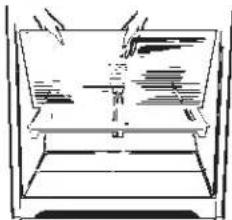
- Reach in, push the front of glass cover up and, at the same time, pull it forward as far as it will come.

natural_image
Technical line drawing of a mechanical assembly or frame structure (no text or symbols)Tilt it and take it out. Avoid cleaning the cold glass cover with hot water because the extreme temperature difference may cause it to break.
natural_image
Simple line drawing of a cabinet or rack with handles and shelves (no text or symbols)- Remove the drawer frame. (Always remove the glass cover before you take out the drawer frame.)
Lift the frame off the supports at each side and back, pull it forward, tilt it and take it out.
To replace the glass cover:
- Lower the frame until it rests on the supports at each side and back.
- Replace the glass cover, pushing its rear edge firmly into the rear frame channel and gently lowering the front into place.
- Replace the drawers.
Light Bulb Replacement (on some models)
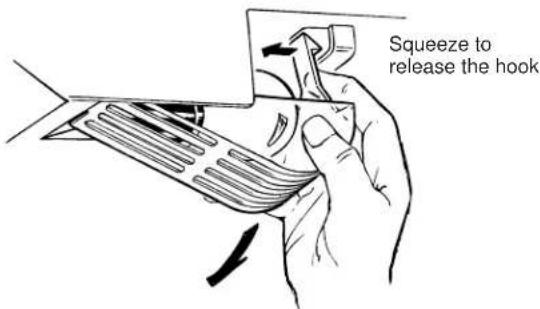
A light bulb and socket are located at the top of the fresh food compartment opposite the temperature control panel.
To replace the bulb, first unplug the refrigerator from its electrical outlet. Put your hand under the light shield and release the hook at the bulb end of the shield. (The light shield is on some models.) Unscrew the bulb when cool and replace with the same size and wattage appliance bulb.
text_image
Squeeze to release the hookPREPARATION

Clearances Refrigerator Location
Allow the following clearances for ease of installation, proper air circulation and plumbing and electrical connections:
Sides....3/4" (19 mm)
Top....1" (25 mm)
Back....1" (25 mm)
Do not install the refrigerator where the temperature will go below 60^ F. ( 16^ C.) because it will not run often enough to maintain proper temperatures.
Do install it on a floor strong enough to support it fully loaded.
To keep energy costs down, avoid locating the refrigerator next to the range or a heating vent.
Rollers and Leveling Legs
Leveling legs near each front corner of the refrigerator are adjustable. They firmly position the refrigerator and prevent it from moving when the doors are opened. Leveling legs should be set so the front of the refrigerator is raised just enough that the doors close easily when opened about halfway.

natural_image
Diagram showing a mechanical component with a rotating arrow indicating motion (no text or symbols)Turn the leveling legs clockwise to raise the refrigerator, counterclockwise to lower it.
Rollers next to the leveling legs allow you to move the refrigerator away from the wall for cleaning.
Turn the legs counterclockwise until the weight of the refrigerator is transferred from them to the rollers. After rolling the refrigerator back into place, turn the legs clockwise until the legs again bear the weight of the refrigerator.
When You go on Vacation When You Move
For shorter vacations, remove perishable foods and leave controls at regular settings. However, if room temperature is expected to drop below 60^ F. ( 16^ C.), follow the same instructions as for extended vacations.
For extended vacations or absences, shut off the power to the refrigerator, move the fresh food control to the “O” position, and clean the interior with a baking soda solution of one tablespoon (15 ml) of baking soda to one quart (1 L) of water. Wipe dry. To prevent odors, leave an open box of baking soda in the refrigerator. Leave doors open.
Move icemaker feeler arm to STOP (up) position and be sure to shut off water supply to the refrigerator.
Disconnect power cord from wall outlet, remove all food, and clean and dry the interior.
Secure all loose items such as grille, shelves, storage drawers and ice trays by taping them securely in place to prevent damage and raise leveling legs.
Be sure refrigerator stays in upright position during actual moving and in van. Refrigerator must be secured in van to prevent movement. Protect outside of refrigerator with blanket.
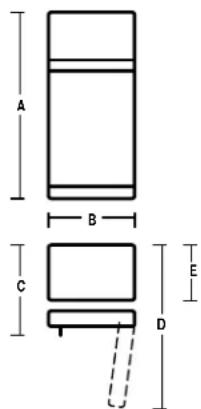
Dimensions Water Supply to Icemaker (on some models)
Model 14 16
| A* | 61" (155 cm) | 64" (163 cm) |
| B | 28" (71 cm) | 28" (71 cm) |
| C** 29 | %_16'' (75 cm) | 29 %_16'' (75 cm) |
| D | 54 12'' (138 cm) | 54 12'' (138 cm) |
| E | 24 12'' (62 cm) | 24 12'' (62 cm) |
* Height does not include hinge—Add 7/8" (22 mm) for hinge.
** Depth includes handle.
text_image
A B C D EIf your refrigerator has an icemaker, or if you plan to add an icemaker later, the icemaker will have to be connected to a cold drinking water line.
A water supply kit containing copper tubing, shutoff valve, fittings and instructions is available at extra cost from your local distributor. There should be sufficient tubing from the cold water supply to the icemaker inlet to allow moving the refrigerator out from the wall several feet (approximately 8 feet [244 cm] of 1/4" copper tubing in three 10" [25 cm] diameter coils).
Do not use kits with plastic tubing since there is water pressure in the supply line at all times.
Maximum permissible inlet water pressure—120 PSI (8.3 bars).
Minimum permissible inlet water pressure—20 PSI (1.4 bars).
Installation of icemaker must be made by a qualified service technician.
INSTALLATION REQUIREMENTS
IMPORTANT...Please Read Carefully
Electrical Requirements
WARNING: HOW TO AVOID ACCIDENTS TO CHILDREN. WHEN DISCARDING AN OLD REFRIGERATOR OR FREEZER BE CERTAIN TO MAKE THE LOCK UNUSABLE. IF POSSIBLE, REMOVE THE DOORS AND DISCARD SEPARATELY. DO NOT ATTEMPT TO STAND ON TOP OF YOUR APPLIANCE. IT IS NOT DESIGNED FOR SUCH USE AND YOU COULD INJURE YOURSELF OR DAMAGE THE APPLIANCE BY SUCH ABUSE. CHILDREN SHOULD NOT BE ALLOWED TO PLAY WITH THE APPLIANCE OR TAMPER WITH THE CONTROLS.
The refrigerator should always be plugged into its own individual electrical outlet. This is recommended for best performance and to prevent overloading house wiring circuits, which could cause a fire hazard from overheated wires. Please refer to the rating plate on the refrigerator for the correct voltage, wattage and frequency.
How to Connect Electricity
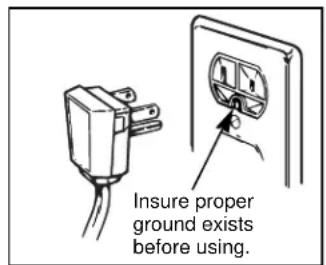
For personal safety, this appliance must be properly grounded.
The power cord of this appliance is equipped with a three-prong (grounding) plug which mates with a standard three-prong (grounding) wall outlet to minimize the possibility of electric shock hazard from this appliance.
Have the wall outlet and circuit checked by a qualified electrician to make sure the outlet is properly grounded.
Where an ungrounded wall outlet is encountered, it is your personal responsibility and obligation to have it replaced with a properly grounded three-prong wall outlet.
text_image
Insure proper ground exists before using.If the product plug does not fit your outlet, the product should be fitted with a new plug.
IMPORTANT: The refitting of electric plugs and cables should be done by a qualified technician or service agent. In some countries the refitting of electric plugs and cables is only permitted when the work is completed by a qualified technician.
If the power supply cord becomes damaged, it must be replaced by a qualified service agent in order to avoid a safety hazard.
DO NOT, UNDER ANY CIRCUMSTANCES, CUT OR REMOVE THE THIRD GROUNDING PRONG FROM THE POWER CORD.
Use of Adapter Plug (on some models) Use of Extension Cords
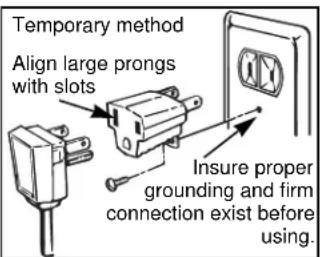
Because of potential safety hazards under certain conditions, we strongly recommend against use of an adapter plug. However, if you still elect to use an adapter, where local codes permit, a TEMPORARY CONNECTION may be made to a properly grounded two-prong wall outlet by use of an adapter.
The larger slot in the adapter must be aligned with the larger slot in the wall outlet to provide proper polarity in the connection of the power cord.
CAUTION: Attaching adapter ground terminal to wall outlet cover screw does not ground the appliance unless cover screw is metal, and not insulated, and wall outlet is grounded through house wiring. You should have the circuit checked by a qualified electrician to make sure the outlet is properly grounded.
When disconnecting the power cord from the adapter, always hold the adapter with one hand while pulling the plug with the other hand. If this is not done, the adapter ground terminal is very likely to break with repeated use.
Should the adapter ground terminal break, DO NOT USE the appliance until a proper ground has again been established.
text_image
Temporary method Align large prongs with slots Insure proper grounding and firm connection exist before using.Because of potential safety hazards under certain conditions, we strongly recommend against the use of an extension cord. However, if you still elect to use an extension cord, it is absolutely necessary that it be a UL-listed 3-wire grounding type appliance extension cord having a grounding type plug and outlet and that the electrical rating of the cord be 15 amperes (minimum) and 127 volts.
REVERSING THE DOOR SWING
These instructions are for changing the hinges from the right side to the left side.
If you ever want to change the hinges back to the right side, follow these same instructions (merely reverse all references to left and right).
BEFORE YOU BEGIN
- Read these instructions all the way through before starting.
- Unplug the refrigerator from its electrical outlet.
- Empty all door shelves, including the dairy compartment.
- Provide a non-scratching work surface for the doors.
ONCE YOU BEGIN
- Handle parts carefully to avoid scratching paint.
- Set screws down by their related parts to avoid using them in the wrong places.
- When reinstalling door hinges, be sure to use the same number of shims and washers as were originally used.
- IMPORTANT: Once you begin, do not move the cabinet until the door-swing reversal is completed.
TOOLS REQUIRED
- 5/16" hex-head socket screwdriver
- Putty knife or thin-blade screwdriver
• T20 or T25 Torxdriver • 5/16"
• Phillips screwdriver open-end wrench - Masking tape
1 REMOVE THE FROZEN FOOD STORAGE COMPARTMENT DOOR.
a. Tape the door shut with masking tape.
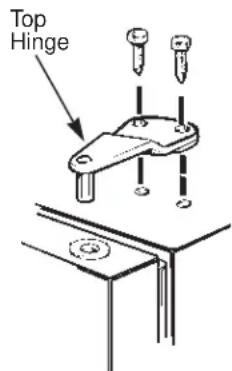
b. Use a 5/16" hex-head socket screwdriver to remove the screws that hold the top hinge to the cabinet.
c. Lift the hinge (and shim glued to it) straight up to free the hinge pin from the socket in the top of the door and set it aside, along with its screws.
d. Remove tape, tilt the door away from the cabinet, and carefully lift the door to free its bottom socket from the hinge pin on the center hinge bracket.
e. Set the door on a non-scratching surface with the outside up.
f. Using a Torxdriver, transfer the two screws from the opposite side of the cabinet to the screw holes vacated by the top hinge removal.
text_image
Top Hinge2 REMOVE THE FRESH FOOD DOOR.
a. Tape the door shut with masking tape.
b. Use a 5/16" hex-head socket screwdriver and 5/16" open-end wrench to remove the two screws holding the center hinge (and shim glued to it) to the cabinet. Lift the center hinge to free its pin from the socket in the top of the door, and set hinge and screws aside.

text_image
Center Hinge Bracket Hinge Pin Plastic Washerc. Remove tape, tilt door away from cabinet, and lift it from the pin in the bottom hinge bracket. (If the plastic washer sticks to the door bottom, put it back on the hinge.)
d. Set door outside-up on a non-scratching surface.
e. Using a Torxdriver, transfer the two screws from the opposite side of the cabinet to the screw holes vacated by the center hinge removal.
f. Take one of the screws removed in step (b) and start it in the outermost screw hole on the opposite side. Do not drive it all the way down—leave enough space under the screw head for thickness of shim and bracket.
(continued next page)
3 REVERSE CABINET HARDWARE.
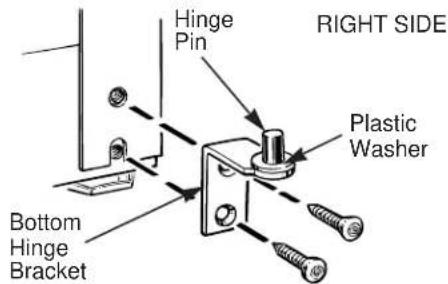
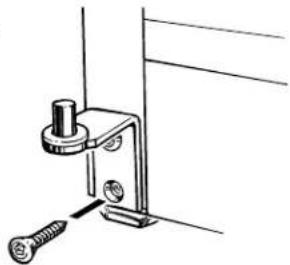
- Transfer the bottom hinge to the left.
a. Remove the base grille if your refrigerator has one. Grasp it at the bottom and pull it straight out.
text_image
Hinge Pin RIGHT SIDE Plastic Washer Bottom Hinge Bracketb. Using a Torxdriver, remove the hinge bracket (and shim glued to it), and plastic washer from the bottom right side of the cabinet.
c. Reinstall the hinge bracket (and shim glued to it) and plastic washer on the bottom left side of the cabinet.
LEFT SIDE
natural_image
Technical line drawing of a mechanical clamp or bracket assembly with screws and a cylindrical component (no text or symbols)2. Transfer the top hinge to the left.
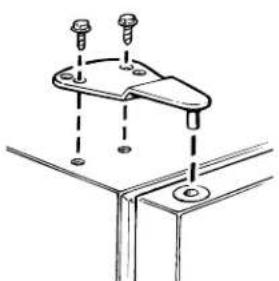
Reinstall the top hinge (and shim glued to it) on the left front corner of the cabinet, but do not tighten the screws at this time.
Some hinges have four holes. Which holes you use for installing the hinge depends on which side you install the hinge.
The outer edge of the hinge should be parallel to the edge of the case for correct installation.
natural_image
Technical line drawing of a mechanical bracket with mounting holes and dashed alignment lines (no text or symbols)Installing the hinge on the left

natural_image
Technical line drawing of a mechanical bracket assembly with mounting holes and dashed alignment lines (no text or symbols)Installing the hinge on the right
4 REVERSE THE DOOR HANDLES.
(on some models)
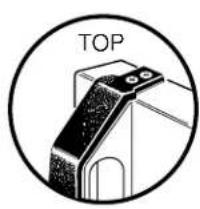
- Transfer the fresh food door handle to the right.
natural_image
Circular diagram showing a mechanical component labeled 'TOP' (no other text or symbols)
natural_image
Pure technical line drawing of a vertical mechanical component without any text, numbers, or symbols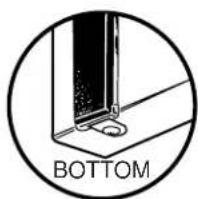
natural_image
Simple line drawing of a corner bracket with label 'BOTTOM' (no other text or symbols)To remove the handle...
a. Remove the handle plug using a tape-tipped putty knife under the edge, and remove the screw underneath.
b. Remove two screws holding the handle to the top of the door.
c. Remove the handle.
After removing the handle...
a. Remove the screws from the right edge of the door top and insert them into the handle screw holes on the opposite side.
b. With tape-tipped putty knife or thin-blade screwdriver, pry out the plug button from the hinge hole on the left side of the door and insert it into the hole on the opposite side that was vacated by removal of the top hinge.
c. Pull the plug button from the front of the door and transfer it to the opposite side.
PLUG BUTTON

text_image
SCREWS FOR HANDLE HOLES PLUG BUTTON2. Transfer the door stop.
LEFT SIDE

text_image
Door Stop- Move the metal door stop from the right end to the left end. Use a Torxdriver.
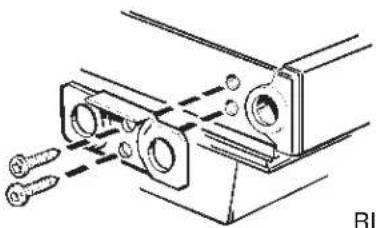
natural_image
Technical line drawing of a mechanical assembly with screws and mounting holes (no text or symbols)RIGHT SIDE
- Move any screws from the left end to the right end.
When reinstalling the fresh food door handle...
a. Attach the handle to the right side of the door with screws at the top and under the handle plug.
b. Reinstall the handle plug.
3. Transfer the frozen food storage compartment door handle to the right.
a. Remove the screw holding the handle to the top of the door and the two screws holding the handle to the bottom of the door.
b. Remove the handle.
c. Remove the screw from the right top edge of the door and insert it into the handle screw hole on the left side.
d. Transfer the door stop as shown above.
e. Attach the handle to the right edge of the door with screws at top and bottom, using bottom holes vacated by removal of the door stop screws.
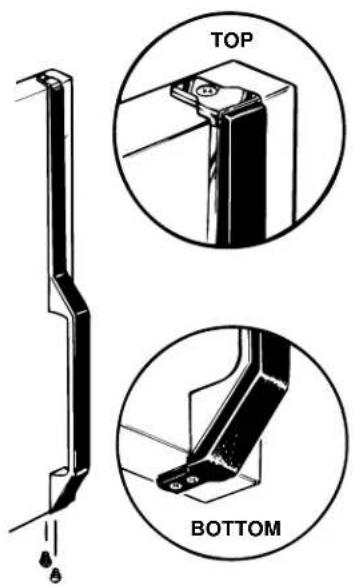
text_image
TOP BOTTOM5 REHANG THE FRESH FOOD DOOR.
a. Lower the bottom socket of the fresh food door onto the pin on the bottom hinge. Be sure the plastic washer is in place on the pin.

text_image
Hinge Pin Plastic Washerb. Insert the pin on the center hinge into the socket in the top of the door. NOTE: The center hinge must be turned over as shown when mounted on the left side.
c. Tilt the door toward the cabinet. As the door is brought into position, slide the hinge under the head of the screw which earlier had been partly driven into the outermost hole. Insert the remaining screw, then tighten both screws securely.
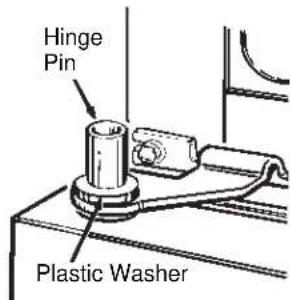
text_image
Hinge Pin Plastic Washer(continued next page)
6 REHANG THE FROZEN FOOD STORAGE COMPARTMENT DOOR.
a. Lower the bottom socket of the frozen food storage compartment door onto the center hinge pin. Be sure the washer is in place on the pin.
b. Tilt the door toward the cabinet, lifting the top hinge so

text_image
Hinge Pin Plastic Washerthe pin fits into the socket on the top of the door.
c. Before tightening the top hinge screws, make sure the top of the door is level with the cabinet top and the space between the doors is equal across the entire front. Do not overtighten these screws—tighten them until they are just snug, then turn them in another one-half turn.
7 EXAMINE THE DOOR GASKETS.
Check the door gaskets all around, making sure no gaps are visible between the gaskets and the cabinet. If a gap shows, try stretching the gasket away from the door so the magnet in the gasket will contact the cabinet surface, being careful not to dislodge the gasket.
8 RELOCATE THE PLASTIC-COVERED SNACKS DRAWER. (on some models)
For convenient access to the Snacks drawer after reversing the door swing, you can move the drawer to the other side of the cabinet.
-
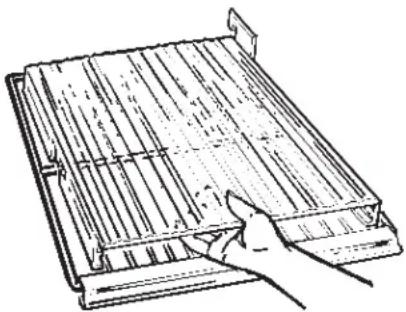
Slide the drawer out and remove the shelf to which it was attached.
-
Remove the other half-width shelf.
natural_image
Line drawing of a hand placing a grid on a rectangular object (no text or symbols)- Push the drawer cover forward and up off the shelf.

natural_image
Line drawing of a rectangular object with vertical lines and a folded corner (no text or symbols)- Put the cover on the other half-width shelf as shown, flush to the side with the shelf-locking lugs. Return both shelves to the refrigerator and slide the Snacks drawer into its relocated cover.
CAUTION:
- If you use your refrigerator before connecting the water line, make sure the icemaker feeler arm is kept in the STOP (up) position.
- Do not install the icemaker tubing in areas where temperatures fall below 32^ (0°C).
- When using any electrical device (such as a power drill) during installation, be sure the device is insulated or wired in a manner to prevent the hazard of electric shock.
- All installations must be in accordance with local plumbing code requirements.
WHAT YOU WILL NEED
- A cold water supply is required for automatic icemaker operation. The water pressure must be between 20 and 120 p.s.i. (1.4 and 8.3 bars).
- Power drill, unless you have a self-piercing valve.
- Copper tubing, 1/4" outer diameter to connect the refrigerator to the water supply. Be sure both ends of the tubing are cut square.
To determine how much copper tubing you need: measure the distance from the water valve on the back of the refrigerator to the water supply pipe. Then add 8 feet (244 cm). Be sure there is sufficient extra tubing (about 8 feet [244 cm] coiled into 3 turns of about 10 inches [25 cm] diameter) to allow the refrigerator to move out from the wall after installation. Do not use plastic tubing or plastic fittings because the water supply line is under pressure at all times. Also, certain types of plastic tubing may become brittle with age and crack, resulting in water leakage.
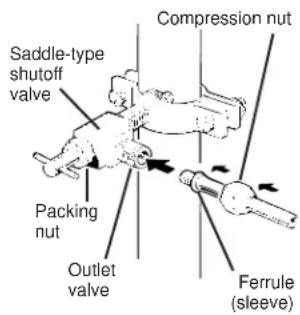
- Shutoff valve to connect to the cold water line. The shut-off valve should have a water inlet with a minimum inside diameter of 5/32" at the point of connection to the COLD WATER LINE. Saddle-type shut-off valves are included in many water supply kits. Before purchasing, make sure a saddle-type valve complies with your local plumbing codes.
- Two 1/4" outer diameter compression nuts and 2 ferrules (sleeves)—to connect the copper tubing to the shutoff valve and the refrigerator water valve.
- If your existing water line has a flared fitting at the end, you will need an adapter (available at plumbing supply stores) to connect the water line to the refrigerator OR—you can cut off the flared fitting with a tube cutter and then use a compression fitting.
WARRANTY INFORMATION
This water line installation is not warranted by the refrigerator or icemaker manufacturer. Follow these instructions carefully to minimize the risk of expensive water damage.
1 SHUT OFF THE MAIN WATER SUPPLY.
Turn on the nearest faucet long enough to clear the line of water.
2 INSTALL THE SHUTOFF VALVE ON THE NEAREST FREQUENTLY USED DRINKING WATER LINE.
Typical ways to connect to water supply
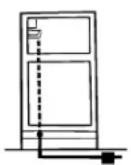
Through floor to basement cold water pipe
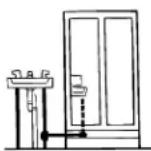
Under sink to cold water pipe

Through wall to utility room cold water pipe

In crawl space under house
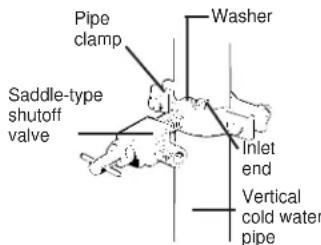
a. Choose a location for the valve that is easily accessible. It is best to connect into the side of a vertical water pipe. When it is necessary to connect into a horizontal water pipe, make the connection to the top or side, rather than at the bottom, to avoid drawing off any sediment from the water pipe.
b. Drill a 1/4" hole in the water pipe, using a sharp bit. Remove any burrs resulting from drilling the hole in the pipe. (Do not drill a hole if the valve is a self-piercing type.)
c. Fasten the shutoff valve to the cold water pipe with the pipe clamp.
d. Tighten the clamp screws until the sealing washer begins to swell. Do not overtighten or you may crush the copper tubing.
text_image
Pipe clamp Washer Saddle-type shutoff valve Inlet end Vertical cold water pipe(continued next page)
3 ROUTE THE COPPER TUBING BETWEEN THE COLD WATER LINE AND THE REFRIGERATOR.
Route the tubing through a hole drilled in the floor or wall (behind the refrigerator or adjacent base cabinet) as close to the wall as possible. Be sure there is sufficient extra tubing (about 8 feet [244 cm] coiled into 3 turns of about 10" [25 cm] diameter) to allow the refrigerator to move out from the wall after installation.
4 CONNECT THE COPPER TUBING TO THE SHUTOFF VALVE.
Place the compression nut and ferrule (sleeve) onto the end of the tubing and connect it to the shutoff valve. Make sure the tubing is fully inserted into the valve. Tighten the compression nut securely.
text_image
Saddle-type shutoff valve Packing nut Compression nut Outlet valve Ferrule (sleeve)5 TURN ON THE WATER AND FLUSH OUT THE TUBING.
a. Turn the main water supply on and flush out the tubing until the water is clear.
b. Shut the water off at the water valve after about one quart (1 L) of water has been flushed through the tubing.
Before making the connection to the refrigerator, be sure the refrigerator power cord is not plugged into the wall outlet.
We recommend installing a water filter (available from your local distributor) if your water supply has sand or particles that could clog the screen of the refrigerator's water valve. Install it in the water line near the refrigerator.
a. Remove the plastic flexible cap from the water valve.
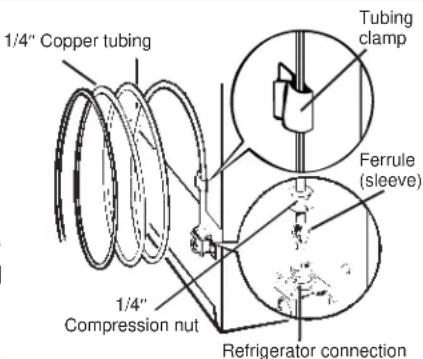
b. Place the compression nut and ferrule (sleeve) onto the end of the tubing as shown.
c. Insert the end of the copper tubing into the water valve connection as far as possible. While holding the tubing, tighten the fitting.
d. Fasten the copper tubing into the clamp provided to hold it in a vertical position. You may need to pry open the clamp.
7 TURN THE WATER ON AT THE SHUTOFF VALVE.
Tighten any connections that leak.
8 PLUG THE REFRIGERATOR POWER CORD INTO A GROUNDED ELECTRICAL OUTLET.
9 SET THE ICEMAKER FEELER ARM TO THE ON (DOWN) POSITION.
The icemaker will not begin to operate until it reaches its operating temperature of 15^ F ( -9^ C). or below. It will then begin operation automatically if the icemaker is in the ON (down) position.
NOTE: The icemaker may double-cycle when it first starts, causing some water spillage from the icemaker into the ice bucket. This is normal and should not happen again. The first few batches of cubes should be thrown away, so that remaining impurities in the water line will be flushed out.
Arrange the coil of copper tubing so that it does not vibrate against the back of the refrigerator or against the wall.
text_image
1/4" Copper tubing 1/4" Compression nut Tubing clamp Ferrule (sleeve) Refrigerator connectionQUESTIONS? USE THIS PROBLEM SOLVER

| PROBLEM POSSIBLE CAUSE | |
| REFRIGERATOR DOES • May NOT OPERATE | • May be in defrost cycle when motor does not operate for about 30 minutes.• Temperature control in “○position.• If interior light is not on, refrigerator may not be plugged in at wall outlet.• If plug is secure and the refrigerator still fails to operate, plug a lamp or a small appliance into the same outlet to determine if there is a tripped circuit breaker or burned-out fuse. |
| MOTOR OPERATES • Modern FOR LONG PERIODS compa | refrigerators with more storage space and a larger frozen food storage ment require more operating time.• Normal when refrigerator is first delivered to your home—usually requires 24 hours to completely cool down.• Large amounts of food placed in refrigerator to be cooled or frozen.• Hot weather—frequent door openings.• Door left open.• Temperature control is set too cold. Refer to Temperature Control section.• Grille and condenser need cleaning. Refer to Care and Cleaning section. |
| MOTOR STARTS AND • Temperature STOPS FREQUENTLY | • Temperature control starts and stops motor to maintain even temperatures. |
| VIBRATION OR RATTLING | • If refrigerator vibrates, more than likely it is not resting solidly on the floor. The front leveling legs need adjusting, or floor is weak or uneven. Refer to Rollers and Leveling Legs in the Preparation section.• If dishes vibrate on shelves, try moving them. Slight vibration is normal. |
These sounds are normal and do not indicate a need for service.
The fan circulating air inside the freezer which keeps the temperatures even.
Boiling water or a gurgling noise. The flow of refrigerant through the freezer cooling coils.
Sizzling, hissing or popping sound. Water dropping on the defrost heater during the defrost cycle.
Cracking or popping sound. Cooling coils expanding and contracting during the defrost cycle.
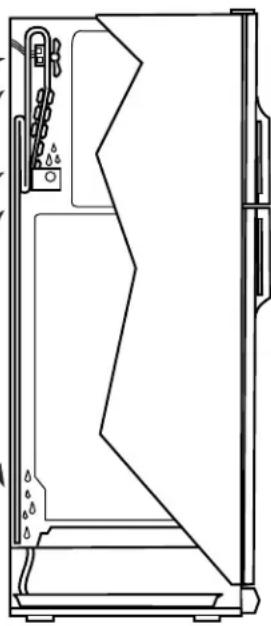
Water dripping as it melts from the evaporator and flows to the drain pan during the defrost cycle.
Icemaker (on some models): The icemaker water valve will buzz when the icemaker fills with water. If the feeler arm is in the ON (down) position it will buzz even if it has not yet been hooked up to water. Keeping the feeler arm in the ON (down) position before it is hooked up to water can damage the icemaker. To prevent this, raise the feeler arm to the STOP (up) position. This will stop the buzzing.
The sound of cubes dropping into the bin and water running in pipes as icemaker refills.
natural_image
Line drawing of a door with internal components and no visible text or symbols(continued next page)
PROBLEM SOLVER
(continued)
| PROBLEM POSSIBLE CAUSE | |
| FOODS DRY OUT • Foods not covered, wrapped or sealed properly. | |
| FRESH FOOD OR • Temperature control not set cold enough. Refer to Temperature Control section.FROZEN FOOD STORAGECOMPARTMENT• Warm weather—frequent door openings.• Door left open for too long a time.• Package holding door open or blocking air duct in frozen food storage compartment. | |
| FROST OR ICE CRYSTALS • Door may have been left ajar or package holding door open.ON FROZEN FOOD• Too frequent or too long door openings.• Frost within package is normal. | |
| AUTOMATIC ICEMAKER • Icemaker feeler arm is in STOP (up) position.DOES NOT WORK(on some models)• Water supply turned off or not connected.• Frozen food storage compartment too warm.• Piled up cubes in the storage bin may cause icemaker to shut off prematurely.Remove storage bin from freezer and level cubes by hand. | |
| CUBES TOO SMALL • Watershutoff valve connecting refrigerator to home water line may be clogged. | |
| SLOW ICE CUBE FREEZING • Door may have been left ajar.• Turn temperature control to colder setting. | |
| ICE CUBES HAVE • Ice storage bin needs to be emptied, washed and old cubes need to be discarded.ODOR/TASTE• Unsealed packages in refrigerator and/or frozen food storage compartments maybe transmitting odor/taste to ice cubes.• Interior of refrigerator needs cleaning. Refer to Care and Cleaning section. | |
| MOISTURE FORMS ON • Not unusual during periods of high humidity.CABINET SURFACE BETWEEN THE DOORS | |
| MOISTURE COLLECTS • Too Frequent or too long door openings.INSIDE• In humid weather, air carries moisture into refrigerator when doors are opened.• Move the anti-condensation switch to the ON position. | |
| REFRIGERATOR HAS ODOR• Foods with strong odors should be tightly covered.• Check for spoiled food.• Interior needs cleaning. Refer to Care and Cleaning section.• Defrost water drainage system needs cleaning.• Keep open box of baking soda in refrigerator; replace every three months. | |
| HOT AIR FROM BOTTOM OF REFRIGERATOR• Normal air flow cooling motor. In the refrigerator process, it is normal that heatbe expelled in the area under the refrigerator. Some floor coverings will discolorat these normal and safe operating temperatures. Your floor covering suppliershould be consulted if you object to this discoloration. | |
| FOOD FREEZING IN• Move the food away from the air vent (near the controls).THE REFRIGERATOR• Turn down the fresh food control. |
NOTES
NOTES
Manual del usuario
Refrigerador

natural_image
Simple line drawing of a diagonal pipe or channel with an arrow indicating direction (no text or symbols)natural_image
Illustration of hands holding a tray with a hand gesture, no text or symbols present
natural_image
Diagram of a wire fence with arrows indicating direction, no text or symbols presentnatural_image
Illustration of hands holding a tray with cubes and scattered blocks (no text or symbols)Entrepaño escalera
text_image
Diagram showing two hands installing a grid inside a refrigerator with directional arrows indicating movement or change.natural_image
Technical line drawing of a staircase with numbered components (no text or symbols)natural_image
Diagram of a hand opening a rack inside a refrigerator with an arrow indicating direction (no text or symbols)natural_image
Simple line drawing of two rectangular containers with internal compartments (no text or symbols)natural_image
Technical line drawing of a rectangular box with horizontal grooves and a vertical support (no text or symbols)MAQUINA AUTOMATICA DE HACER HIELO
text_image
Technical diagram of a vertical industrial vessel with labeled components and internal structurenatural_image
Illustration of a hand using a tool to clean or store items from a cabinet (no text or symbols visible)natural_image
Line drawing of a hand placing a paper into a container (no text or symbols)natural_image
Technical line drawing of a mechanical assembly or mounting bracket (no text or symbols)
natural_image
Simple line drawing of a container with liquid and a handle, no text or symbols presentnatural_image
Illustration of a hand inserting a card into a card slot (no text or symbols)natural_image
Diagram of a sewing machine needle stitching fabric (no text or symbols)natural_image
Technical line drawing of a mechanical bracket with bolts and mounting holes (no text or symbols)natural_image
Technical line drawing of a mechanical bracket with two bolts and mounting holes (no text or symbols)natural_image
Technical line drawing of a vertical mechanical component with labeled parts (no text or symbols)
natural_image
Simple line drawing of a bracket with a circular label 'ABAJO' below (no other text or symbols)text_image
ARRIBA ABAJOnatural_image
Line drawing of a hand holding a tray with horizontal lines, no text or symbols presentnatural_image
Line drawing of a rectangular book with vertical lines and a bookmark, no text or symbols presentPROBLEMA CAUSA POSIBLE