
PX1T - DJ Equipment KORG - Free user manual and instructions
Find the device manual for free PX1T KORG in PDF.


| Product Type | Personal Multi Effect Processor |
| Brand | Korg |
| Model | PX1T (TONEWORKS Pandora) |
| Dimensions (W x H x D) | 127.5 x 22.5 x 75 mm |
| Weight (including batteries) | 180 g |
| Power Supply | Two AA alkaline batteries (8.5 hours continuous use) or optional AC adapter DC 9V |
| Number of Programs | 20 user programs |
| Inputs | Guitar input (phone jack), AUX IN (mini stereo jack) |
| Output | Line/headphone dual-purpose output (stereo phone jack) |
| Tuner Detection Range | 27.5 Hz – 2093 Hz (A0–C7) |
| Metronome Tempo Range | ♪ 40–208 |
| Effect Types | Drive, Tone, Modulation, Ambience, Cabinet Resonator |
| Effect Variations | 60 types |
| Display | LCD with backlit luminous material |
| Battery Empty Indicator | Yes, blinking battery icon |
| Factory Preset Reload | Yes, via holding Metronome + Enter while powering on |
| Compliance | CE (EMC, Low Voltage), FCC Class B, Canada Class B |
| Operating Environment | Avoid direct sunlight, extreme temperature/humidity, dust, vibration |
| Care Instructions | Wipe with clean dry cloth; do not use liquid cleaners or flammable polishes |
| Options | Carrying case, AC adapter DC 9V |
Frequently Asked Questions - PX1T KORG
User questions about PX1T KORG
0 question about this device. Answer the ones you know or ask your own.
Ask a new question about this device
Download the instructions for your DJ Equipment in PDF format for free! Find your manual PX1T - KORG and take your electronic device back in hand. On this page are published all the documents necessary for the use of your device. PX1T by KORG.
USER MANUAL PX1T KORG
CE mark for European Harmonized Standards
CE mark which is attached to our company's products of AC mains operated apparatus until December 31, 1996 means it conforms to EMC Directive (89/336/EEC) and CE mark Directive (93/68/EEC).
And, CE mark which is attached after January 1, 1997 means it conforms to EMC Directive (89/336/EEC), CE mark Directive (93/68/EEC) and Low Voltage Directive (73/23/EEC).
Also, CE mark which is attached to our company's products of Battery operated apparatus means it conforms to EMC Directive (89/336/EEC) and CE mark Directive (93/68/EEC).
NOTICE
KORG products are manufactured under strict specifications and voltages required by each country. These products are warranted by the KORG distributor only in each country. Any KORG product not sold with a warranty card or carrying a serial number disqualifies the product from the manufacturer's/distributor's warranty and liability. This requirement is for your own protection and safety.
KORG
KORG INC.
15-12, Shimotakaido 1-chome, Suginami-ku, Tokyo, Japan
To ensure long, trouble-free operation, please read this manual carefully.
Precautions
Location
Using the unit in the following locations can result in a malfunction.
- In direct sunlight
- Locations of extreme temperature or humidity
• Excessively dusty or dirty locations - Locations of excessive vibration
Power supply
Please connect the supplied AC adaptor to an AC outlet of the correct voltage. Do not connect it to an AC outlet of voltage other than that for which your unit is intended.
Interference with other electrical devices
This product contains a microcomputer. Radios and televisions placed nearby may experience reception interference. Operate this unit at a suitable distance from radios and televisions.
Handling
To avoid breakage, do not apply excessive force to the switches or controls.
Care
If the exterior becomes dirty, wipe it with a clean, dry cloth. Do not use liquid cleaners such as benzene or thinner, or cleaning compounds or flammable polishes.
Keep this manual
After reading this manual, please keep it for later reference.
Keeping foreign matter out of your equipment
- Never set any container with liquid in it near this equipment. If liquid gets into the equipment, it could cause a breakdown, fire, or electrical shock.
- Be careful not to let metal objects get into the equipment. If something does slip into the equipment, unplug the AC adaptor from the wall outlet. Then contact your nearest Korg dealer or the store where the equipment was purchased.
THE FCC REGULATION WARINING
This equipment generates and uses radio frequency energy and if not installed and used properly, that is, in strict accordance with the manufacturer's instructions, may cause interferences to radio and television reception. It has been type tested and found to comply with the limits for a class B computing device in accordance with the specifications in Subpart J of Part 15 of FCC Rules, which are designed to provide reasonable protection against such interference in a residential installation. However, there is no guarantee that interference will not occur in a particular installation. If this equipment does cause interference to radio or television reception, which can be determined by turning the equipment off and on, the user is encouraged to try to correct the interference by one or more of the following measures:
• Reorient the receiving antenna.
- Relocate the equipment with respect to the receiver.
- Move the equipment away from the receiver.
- Plug the equipment into a different outlet so that equipment and receiver are on different branch circuits.
If necessary, the user should consult the dealer or an experienced radio/television technician for additional suggestions. The user may find the following booklet prepared by the Federal Communications Commission helpful: "How to Identify and Resolve Radio-TV Interference Problems". This booklet is available from the US Government Printing Office, Washington, D.C.20402, stock No. 004-000-00345-4.
CANADA
THIS DIGITAL APPARATUS DOES NOT EXCEED THE "CLASS B" LIMITS FOR RADIO NOISE EMISSIONS FROM DIGITAL APPARATUS SET OUT IN THE RADIO INTERFERENCE REGULATION OF THE CANADIAN DEPARTMENT OF COMMUNICATIONS.
LE PRESENT APPAREIL NUMERIQUE N'EMET PAS DE BRUITS RADIOELECTRIQUES DEPASSANT LES LIMITES APPLICABLES AUX APPAREILS NUMERIQUES DE LA "CLASSE B" PRESCRITES DANS LE REGLEMENT SUR LE BROUILLAGE RADIOELECTRIQUE EDICTE PAR LE MINISTERE DES COMMUNICATIONS DU CANADA.
Introduction
Thank you for purchasing the Korg TONEWORKS PANDORA Personal Multi Effect Processor
Main features
PANDORA is a multi-function yet compact-sized effect unit.
● IPE (Integrated Parameter Edit) system — easy to adjust effect settings
● Tuner function — quick tuning
● Metronome function — convenient for practicing
● 60 types of effect variation
● 20 user programs
● LCD backlit by new luminous material — easy viewing in dark locations without wearing down the batteries
Turning on the power
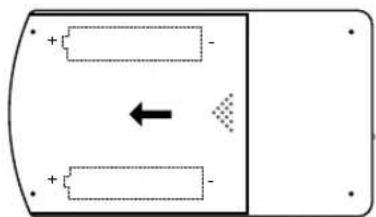
Remove the battery cover located on the bottom of the base by sliding it in the direction of the arrow. Insert two AA alkaline batteries (sold separately) as shown in the illustration. Be careful to insert the batteries in the correct orientation.
natural_image
Diagram of a battery cell with two cells, one with an arrow indicating direction, no text or symbols presentSpecifications PX1 PANDORA Personal Multi Effect Processor
Number of programs: 20
Inputs: guitar input (phone jack)
AUX IN (mini stereo jack)
Output: line/headphone dual-purpose output (stereo phone jack)
Tuner section detection range: 27.5 Hz — 2093 Hz (A0—C7)
Metronome section tempo: ♪ 40—208
Power supply: two AA alkaline batteries
battery life is 8.5 hours of continuous use (using headphones)
or
separately sold AC adapter (DC 9V)
be sure to use only the specified AC adapter.
Dimensions: 127.5 mm x 22.5 mm x 75 mm (W x H x D)
Weight: 180 g (including batteries)
Options: carrying case, AC adapter (DC 9V)
Appearance and specifications are subject to change without notice for product improvement.
Controls and connectors
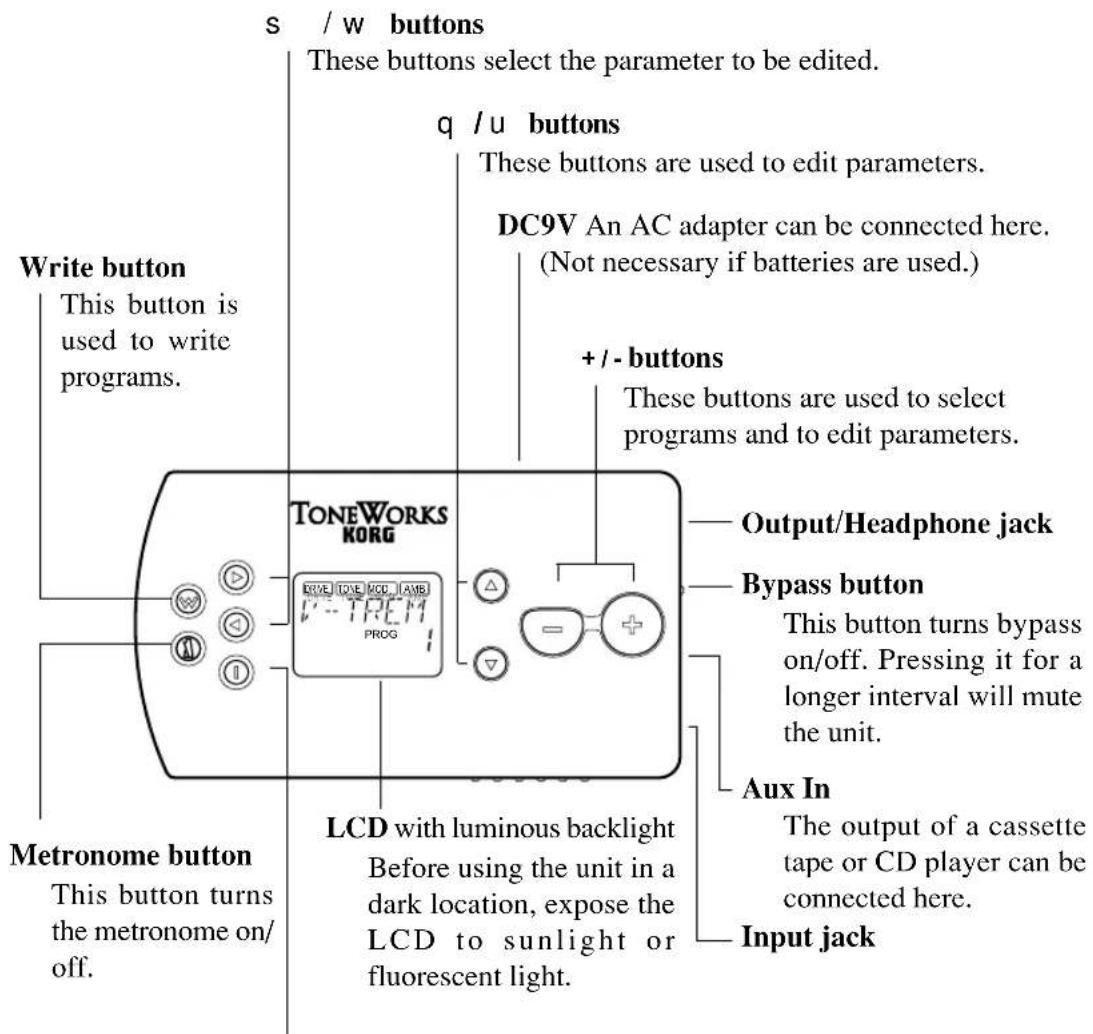
Enter button
This button is used to turn effects on/off and to write settings etc.
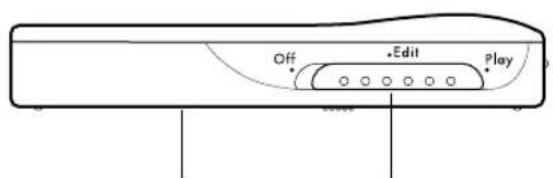
Battery cover
Power switch (mode switch)
This switch turns the power on/off and selects either Play or Edit mode.
Making connections
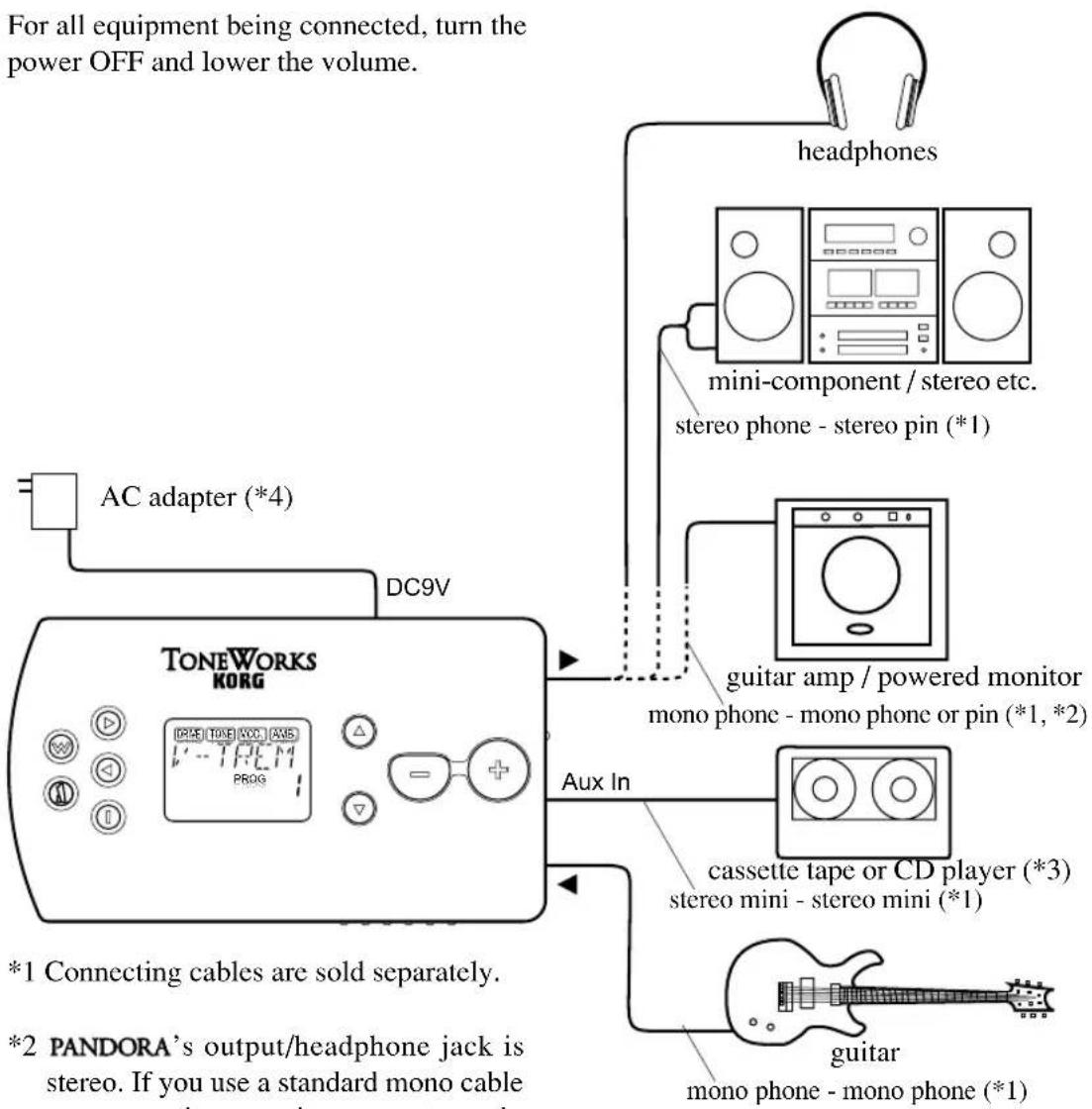
For all equipment being connected, turn the power OFF and lower the volume.
flowchart
graph TD
    A["AC adapter (*4)"] --> B["DC9V"]
    B --> C["TONEWORKS KORG"]
    C --> D["Aux In"]
    D --> E["guitar amp / powered monitor mono phone - mono phone or pin (*1, *2)"]
    D --> F["cassette tape or CD player (*3) stereo mini - stereo mini (*1)"]
    D --> G["guitar mono phone - mono phone (*1)"]
    C --> H["*1 Connecting cables are sold separately."]
    C --> I["*2 PANDORA's output/headphone jack is stereo. If you use a standard mono cable"]
    C --> J["headphones"]
    C --> K["mini-component / stereo etc. stereo phone - stereo pin (*1)"]
*1 Connecting cables are sold separately.
*2 PANDORA's output/headphone jack is stereo. If you use a standard mono cable to connect it to a guitar amp etc., only the L (left) output will be heard.
*3 If a cassette tape or CD player is connected to AUX IN you can play along on your guitar with a tape, etc. However the volume must be adjusted on the connected device.
*4 If you are using PANDORA with batteries, the AC adapter will not be necessary. Be sure to use only the specified AC adapter.
Try it out
When you finish making connections, set the power switch in the "Play" position. Use the +/ - buttons to select a program. Select a clean-type program that will be suitable for making volume settings. (As an example here, we will select Program 4 "MODERN".)
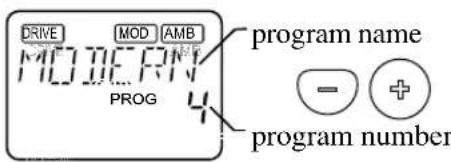
Set the volume control of the guitar to its usual position. Press the or buttons and the master level will be displayed. Continue pressing the or buttons to adjust the volume.
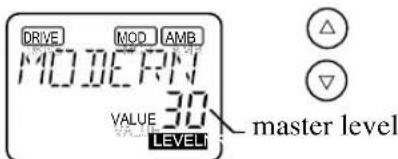
PANDORA does not have an input volume control. If the sound still distorts even when the master level is lowered, lower the volume of the guitar.
For further details refer to the explanations of Play Mode and Edit Mode.
Play mode
Set the power switch to the right position. Play mode is the mode in which you will normally use PANDORA.
1. Program change
You can select from 20 user programs. Press the + / - buttons to select programs.
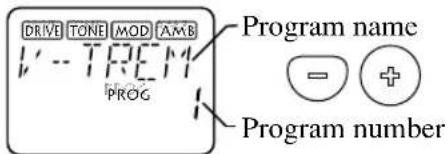
2. Master level
Press the / buttons and the current master level value will be displayed in the LCD.
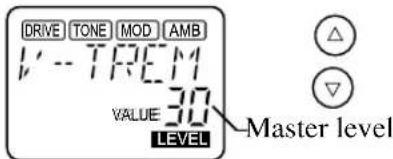
By continuing to press the / buttons you can set the master level. The master level is remembered each time it is set, and will be remembered even when the power is turned off.
3. Bypass / Mute
When the bypass button is pressed, the chain display(DRIVE | ITONE | MOD | AMR) will change to slow blinking, and the direct sound (unprocessed by the effects) will be output. If you continue pressing the bypass button, the tune indicator will change to rapid blinking after approximately one second, and the output will be muted and there will be no sound. When PANDORA is bypassed or muted, the tuner will function. Press the bypass button once again to cancel bypass / mute.

When you select a program, bypass / mute will be canceled.
4. Tuner
Select bypass or mute. The character and numeric displays will disappear, and the tuner will operate. Play a note on your guitar.
The note name is displayed in the right edge, and the tuning meter at the left. Tune your guitar so that the meter moves toward the center mark. Sharps are indicated at the upper right of the note name.
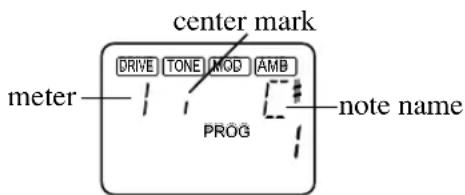
When the meter matches the center, the center mark will change to a “*”.
Pressing the / buttons will display the calibration value (the value of standard pitch A). By continuing to press the / buttons you can adjust the calibration over the range of A=438 to 445 Hz. This setting will be lost when the power is turned off, and will be reset to A=440 Hz when the power is next turned on.
Tuner calibration can be displayed and adjusted only in Play mode when the metronome is OFF.
When you select a program, bypass / mute and tuner will be defeated.
5. Metronome ( )
Pressing the metronome button will start the metronome. At this time, the tempo will be displayed for approximately 1 second. In Play mode, the metronome display will appear when the tempo display is off.
The indicator will move to left and right in time with the tempo. Press the metronome button once again and the metronome will stop.
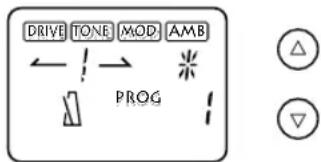
metronome display in Play mode
While the metronome is sounding, you can press the / buttons to display the current tempo. By continuing to press the / buttons you can set the tempo. The tempo will be remembered as it is set. (In Edit mode, the tempo can be set only when it is displayed.)
If you turn on the metronome while PANDORA is bypassed, the tuner function will be defeated.
When you select a program the bypass / mute and tuner functions will be defeated, but the metronome will continue to operate, and the program name will be displayed for approximately 1 second.
6. Write (same for Edit mode)
Press the Write button. Use the / buttons to select the program number into which you wish to write. Press the Enter button and the program will be written. When the data has been written, the display will indicate “COMPLT” for approximately 1 second. If you decide not to write, press the Write button once again and the operation will be canceled. (In Play mode, you can copy a program by writing it into a different program number.)
Edit mode
Set the power switch to the center “Edit” position. Here you can turn each effect on / off, and edit the type and value settings.
In Edit mode, you can turn on bypass or muting, but editing cannot be performed while these are on. You must defeat bypass or muting before you edit.
1. Selecting a parameter to edit
Use the ▷/◀ buttons to select the parameter that you wish to edit. Pressing the ▷/◀ buttons will cycle through the parameters in the following order.
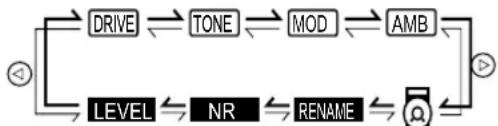
flowchart
graph LR
    A["DRIVE"] --> B["TONE"]
    B --> C["MOD"]
    C --> D["AMB"]
    D --> E[">"]
    F["LEVEL"] --> G["NR"]
    G --> H["RENAME"]
    H --> I["&"]
    I --> J[">"]
The currently selected parameter will blink. Parameters which are turned off cannot be edited. To edit an effect which is turned off, use the ▷/◀ buttons to select it and press the Enter key to turn the effect on.
2. Editing effect parameters
Use the following buttons to edit each effect; drive (DRIVE), tone (TONE), modulation (MOD), and ambience (AMB).
- Enter button: effect on / off (the display will indicate either “FX ON” or “FX OFF”)
- +/- buttons: Effect type (for TONE, the “low” value)
- / buttons: value (for TONE, the "hi" value)
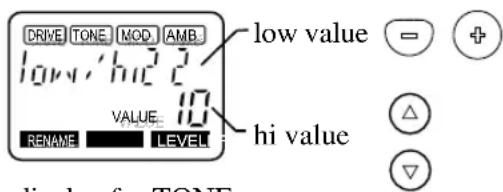
display for TONE
Drive (DRIVE): These effects are used mainly to process guitar gain; compressor, overdrive, distortion, etc.
Tone (TONE): This adjust the tone in the same way as an audio equalizer.
Modulation (MOD): This provides modulation-type effects such as chorus, flanger, and phaser.
Ambience (AMB): This provides reverberation-type effects such as delay, echo, and reverb, and pitch shifting.
TYPE is the parameter used to select variations of effects. You can select different effect variations in each of the following effect groups; DRIVE, MODULATION, AMBIENCE and CABINET RESONATOR. (For example, if you'd like to use a flanger for the modulation effect you can choose from four types ranging from shallow flanging to deep flanging.)
VALUE is the parameter that determines the character of the effect, such as effect level, effect balance, speed, drive, sensitivity, etc. The effect parameter chart lists the parameters (for each effect) that can be adjusted.
It is not possible to simultaneously use the ROOM, HALL, or PITCH effect of the ambience group (AMB) together with the modulation (MOD) group effects.
For example if ambience (AMB) ROOM, HALL, or PITCH is on, turning on a modulation (MOD) effect will turn off the ambience (AMB) effect.
Other functions
3. Cabinet resonator (
The cabinet resonator is a function which simulates the acoustical characteristics of the speaker cabinet of a guitar amp, and can even simulate the resonance of the speaker enclosure.
When you use the Enter button to turn this on/off, the display will indicate either “CR ON” or “CR OFF”.
When the cabinet resonator is on, you can use the + / - buttons to select the cabinet type.
4. Rename
You can modify the name of the program. Use the + / - buttons to move the cursor, and use the / buttons to select characters.
5. NR (noise reduction)
Use the + / - buttons to set the strength of the noise reduction.
As you raise the value, the noise-suppressing effect will increase. Normally you will adjust this to a setting where noise is not obtrusive when the guitar strings are lightly muted.
6. Level
Use the + / - buttons to adjust the level of each program.
The output sound may clip depending on the DRIVE and TONE settings, so use this level setting to adjust it to avoid clipping.

The volume of each program will change depending on the guitar that you use. Make level settings as appropriate for your guitar.
7. Write
This is the same as in Play mode. Refer to Play mode “6. Write”.
Battery empty indicator

When the battery runs down, the battery empty indicator will appear, and the area inside the battery will blink. When this appears, change the battery as soon as possible. The unit will have approximately 20 minutes of operation remaining after this display appears. Programs etc. will not be lost even if the battery is taken out.
Reloading the preset programs (factory programs)
Turn on the power while simultaneously pressing the Metronome button and the Enter button. The display will ask "LOAD?". Press the + button and the preset programs will be loaded (the display will indicate "LOAD"), and then the power-on display will appear. If you press the button loading will not take place, and PANDORA will start up as usual.

Be aware that if you load the preset programs, all previous program settings will be lost.
Troubleshooting
If you suspect that there may be some problem with operation, check the following points. If this does not resolve the problem, consult your dealer or a Korg service station.
1. Power does not turn on.
* Are batteries inserted?
Alternatively, is the AC adapter connected to an AC outlet?
2. No sound.
* Are the guitar, amp, and headphones connected respectively to the appropriate jack?
* Is the amp power turned on and is it set correctly?
* Are the connecting cables broken?
- If there is sound in the headphones, there is a problem with the connections after PANDORA.
* Is the master level set to “0” or a low value?
* Is the level (of each program) set to "0" or a low value?
* Is the unit muted (the chain display DRIVE ITONE MOD LAMB blinking
rapidly)?
●Be aware that if all effects are off, the chain display will disappear, and it will not be possible to distinguish Bypass or Mute from the LCD display.
* Is the guitar volume turned down?
3. The volume of the device connected to Aux In is too loud (or too soft).
●Adjust the output level of the connected device.
●Make connections from the headphone jack of the device that you wish to mix.
4. No effects.
* Is the unit bypassed (the chain display DRIVE ITONE IMOD IAMB | blinking slowly)?
* Are the effects used by the program turned on?
5. Tuner does not work.
* Are you in Play mode and Bypassed or Muted?
●In Play mode, select Bypass or Mute.
Effect parameters
| TYPE(+/-buttons) | VALUE(△/▼bottoms) | |||
| DAWE | COMP | compressor | sets the strength of the compressor effect | |
| CRUNCH | mild overdrive | drive effects suitable for line out or headphones | drive amount | |
| SCREAM | overdrive with an edge | |||
| TUBE | vintage-type overdrive | |||
| HOTBOX | distortion with many mid-range overtones | |||
| HIGHIN | high-gain type distortion | |||
| VALVE | high-gain distortion of a vintage amp | |||
| CRUSH | smooth and sustaining distortion | |||
| SCOOP | mid swooped-type distortion | |||
| TYPE(+/-buttons) | VALUE(△/▼buttons) | |||
| DRAME | QVD 1/h | vin lege-type overdrive | drive efferta suitable for guter amp | drive amount |
| QVD 2/h | overdrive with an edge | |||
| DS T1/h | sustaining distortion suitable for sales | |||
| DS T2/h | mid swooped-type distortion | |||
| TONE | LOW (low range) equalizer gain setting | HI [high range]equalizer gain setting | ||
| MOD | CHO1 | chones with triangle-wave LFO | sets the speed of mod uision | |
| CHO2 | chones with sine-wave LFO | |||
| CHO3 | chones with effect sound outputed left and direct sound at right | |||
| CHO4 | doubling chones | |||
| PLAN1/2/3 | flanger | |||
| PLAN 1,2,3 differ in the amount of feedback | ||||
| PLAN4 | flanger with inverted-phase feedback | |||
| VIB1 | vibroo with pyolo change in pitch | |||
| VIB2/3/4 | delayed vibrato where the effect is applied after delay for sustained notes | |||
| PIVIB2,3,4 differ in the time until the vibroto starts | ||||
| PHAS1 | vin lege-type phaser | |||
| PHAS2 | phaser with strong peak | |||
| PHAS3 | PHAS1 with inverted feedback | |||
| PHAS4 | PHAS2 with inverted feedback | |||
| TR EM1 | light tremolo [LFO= ∽] | |||
| TR EM2 | deep tremolo [LFO= ∽] | |||
| TR EM3 | fairly light tremolo [LFO= ∽] | |||
| TR EM4 | fairly deep tremolo [LFO= ∽] | |||
| PAN1 | auto-pen [LFO= ∽] | |||
| PAN2 | auto-pen [LFO= ∽] | |||
| MOD | AWAH1 | auto-reh with feet attack | sets the sensitivity of auto-veh | |
| AWAH2 | auto-reh with slow attack | |||
| AWAH3 | auto-reh with feet attack and filter moving in opposite direction | |||
| AWAH4 | auto-reh with slow attack and filter moving in opposite direction | |||
| WAH | weh-reh with fixed pedal | sets the fixed frequency | ||
| PNDM120M | random step filter with randomly moving filter※For PNDM 1,2,3,4 the filter will move in different frequency bands | sets the speed of modulation | ||
| AMB | DELAY1 | ambient delay braedening to left and right when used in stereo | sets the mix balance of the delaysound end direct sound | |
| DELAY2 | doubling delay | |||
| DELAY3 | short delay | |||
| DELAY4 | medium delay | |||
| DELAY5 | medium long delay | |||
| DELAY6 | long delay | |||
| ECHO1 | short delay with feedback | |||
| ECHO2 | medium delay with feedback | |||
| ECHO3 | medium long delay with feedback | |||
| ECHO4 | long delay with feedback | |||
| ECHO5 | ping-pong delay1 | |||
| ECHO6 | ping-pong delay2 | |||
| ROOM | rwon-type reverb | |||
| HALL | hell-type reverb | |||
| PITCH12.0 | pitch shifter※PITCH 1,2,3 differ in the level of the effect sound | sets the pitch interval | ||
| PITCH4 | pitch shifter with effect sound and dry sound split let right | |||
| PITCH5&17.0 | PITCH 1-4 with stereo delay | |||
| CABINET RESONATOR | GABNT1 | cabinet sound with resonant point in the mid-range | (not used) | |
| GABNT2 | mid stooped-type cabinet sound | |||
| GABNT3 | cabinet sound with resonant point in high mid-range | |||
| GABNT4 | cabinet sound with "Impossible" amount of resonance added | |||
- CE mark for European Harmonized Standards
- NOTICE
- KORG
- KORG INC.
- Precautions
- Location
- Power supply
- Interference with other electrical devices
- Handling
- Care
- Keep this manual
- Keeping foreign matter out of your equipment
- THE FCC REGULATION WARINING
- CANADA
- Introduction
- Main features
- Turning on the power
- Specifications PX1 PANDORA Personal Multi Effect Processor
- Controls and connectors
- Making connections
- Try it out
- Play mode
- Program change
- Master level
- Bypass / Mute
- Tuner
- Metronome ( )
- Write (same for Edit mode)
- Edit mode
- Selecting a parameter to edit
- Editing effect parameters
- Other functions
- Cabinet resonator (
- Rename
- NR (noise reduction)
- Level
- Write
- Battery empty indicator
- Reloading the preset programs (factory programs)
- Troubleshooting
- Power does not turn on.
- No sound.
- The volume of the device connected to Aux In is too loud (or too soft).
- No effects.
- Tuner does not work.
Brand : KORG
Model : PX1T
Category : DJ Equipment