L1722PF - Screen LG - Free user manual and instructions
Find the device manual for free L1722PF LG in PDF.


User questions about L1722PF LG
0 question about this device. Answer the ones you know or ask your own.
Ask a new question about this device
Download the instructions for your Screen in PDF format for free! Find your manual L1722PF - LG and take your electronic device back in hand. On this page are published all the documents necessary for the use of your device. L1722PF by LG.
USER MANUAL L1722PF LG
Make sure to read the Important Precautions before using the product.
Keep the User's Guide(CD) in an accessible place for furture reference.
See the label attached on the back cover and quote this information to your dealer when you require service.
This unit has been engineered and manufactured to ensure your personal safety, however improper use may result in potential electrical shock or fire hazards. In order to allow the proper operation of all safeguards incorporated in this display, observe the following basic rules for its installation, use, and servicing.
On Safety
Use only the power cord supplied with the unit. In case you use another power cord, make sure that it is certified by the applicable national standards if not being provided by the supplier. If the power cable is faulty in any way, please contact the manufacturer or the nearest authorized repair service provider for a replacement.
The power supply cord is used as the main disconnection device. Ensure that the socket-outlet is easily accessible after installation.
Operate the display only from a power source indicated in the specifications of this manual or listed on the display. If you are not sure what type of power supply you have in your home, consult with your dealer.
Overloaded AC outlets and extension cords are dangerous. So are frayed power cords and broken plugs. They may result in a shock or fire hazard. Call your service technician for replacement.
Do not Open the Display.
■ There are no user serviceable components inside.
■ There are Dangerous High Voltages inside, even when the power is OFF.
■ Contact your dealer if the display is not operating properly.
To Avoid Personal Injury :
■ Do not place the display on a sloping shelf unless properly secured.
■ Use only a stand recommended by the manufacturer.
To Prevent Fire or Hazards:
■ Always turn the display OFF if you leave the room for more than a short period of time. Never leave the display ON when leaving the house.
- Keep children from dropping or pushing objects into the display's cabinet openings. Some internal parts carry hazardous voltages.
- Do not add accessories that have not been designed for this display.
■ During a lightning storm or when the display is to be left unattended for an extended period of time, unplug it from the wall outlet.
On Installation
Do not allow anything to rest upon or roll over the power cord, and do not place the display where the power cord is subject to damage.
Do not use this display near water such as near a bathtub, washbowl, kitchen sink, laundry tub, in a wet basement, or near a swimming pool.
Displays are provided with ventilation openings in the cabinet to allow the release of heat generated during operation. If these openings are blocked, built-up heat can cause failures which may result in a fire hazard. Therefore, NEVER:
■ Block the bottom ventilation slots by placing the display on a bed, sofa, rug, etc.
■ Place the display in a built-in enclosure unless proper ventilation is provided.
■ Cover the openings with cloth or other material.
■ Place the display near or over a radiator or heat source.
Do not rub or strike the Active Matrix LCD with anything hard as this may scratch, mar, or damage the Active Matrix LCD permanently.
Do not press the LCD screen with your finger for a long time as this may cause some afterimages.
Some dot defects may appear as Red, Green or Blue spots on the screen. However, this will have no impact or effect on the display performance.
If possible, use the recommended resolution to obtain the best image quality for your LCD display. If used under any mode except the recommended resolution, some scaled or processed images may appear on the screen. However, this is characteristic of the fixed-resolution LCD panel.
On Cleaning
■ Unplug the display before cleaning the face of the display screen.
■ Use a slightly damp (not wet) cloth. Do not use an aerosol directly on the display screen because over-spraying may cause electrical shock.
On Repacking
- Do not throw away the carton and packing materials. They make an ideal container in which to transport the unit. When shipping the unit to another location, repack it in its original material.
On Disposal
■ The fluorescent lamp used in this product contains a small amount of mercury.
■ Do not dispose of this product with general household waste.
Disposal of this product must be carried out in accordance to the regulations of your local authority.
■ Before setting up the monitor, ensure that the power to the monitor, the computer system, and other attached devices is turned off.
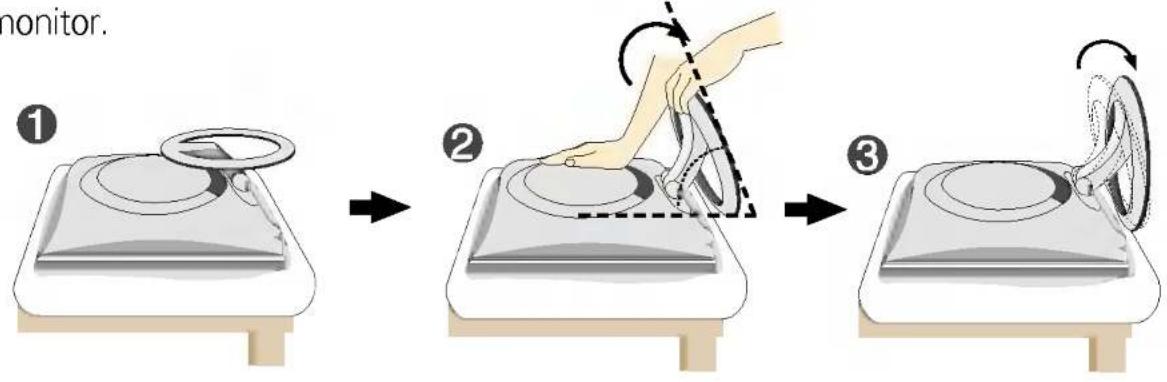
Unfolding the stand base
- Place the monitor with its front facing downward on a cushion or soft cloth.
-
Expand the stand base to its first step degree (65°) pulling it outward with two hands.
-
Further expand the stand base to 90 degrees with slightly more force. Do not apply excessive force to expand the stand base to over 90 degrees, or it may damage the monitor.
text_image
monitor. ① ② ③- Place the monitor upright and adjust the stand base angle as desired. Adjust the stand base angle holding the monitor head part with both hands.

natural_image
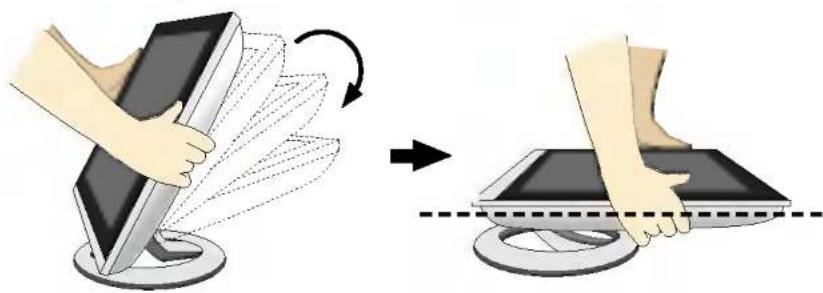
Illustration of a hand holding a tablet device with a stand (no text or symbols)folding the stand base
- Face the front of the monitor and push it backwards, following the sequence shown in the picture.
natural_image
Illustration showing a hand holding a tablet with a circular button, before and after a change in the image (no text or symbols present)Do not push it over 180 degrees. It may damage the stand base.
■ This illustration depicts the general model of connection.
Your monitor may differ from the items shown in the picture.

Do not touch or apply force to the monitor screen while expanding or folding the stand base.
Using the Computer
natural_image
Illustration of hands holding a circular object with a ring, no text or symbols present-
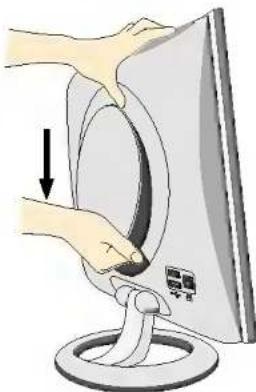
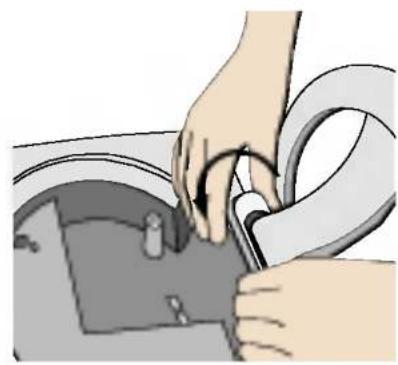
Separate the back cap by sliding its lower section downward as shown in the picture.
-
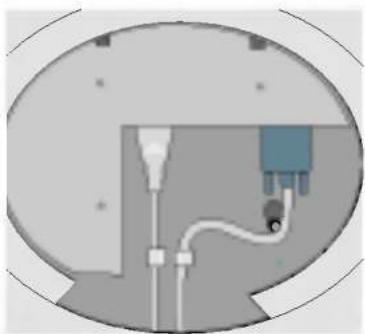
Connect the signal input cable and the power cord. (see next page)
natural_image
Diagram of a medical or laboratory setup with a central device and tubing, enclosed in an oval frame (no text or symbols visible)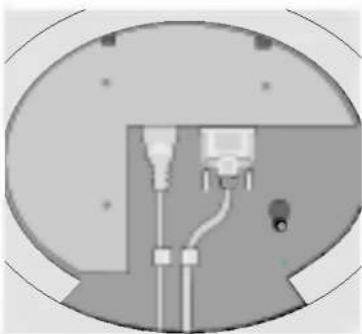
natural_image
Cross-sectional diagram of a device showing internal components and wiring (no text or symbols)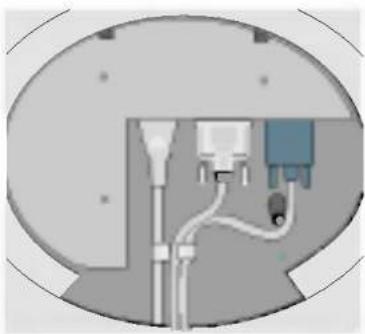
natural_image
Cross-sectional diagram of a device showing internal components and wiring (no text or symbols)
natural_image
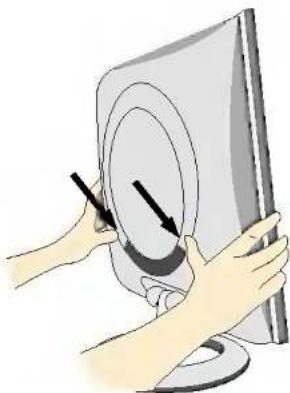
Illustration of hands performing a circular motion on a computer monitor (no text or symbols visible)- After the cables are connected, set the back cap into the groove of the upper section and reassemble by pushing upward.
natural_image
Illustration of hands using a computer to rotate or rotate a circular object (no text or symbols visible)- Insert the back cap along the bottom grooves on both sides, holding the bottom.
Using the Computer
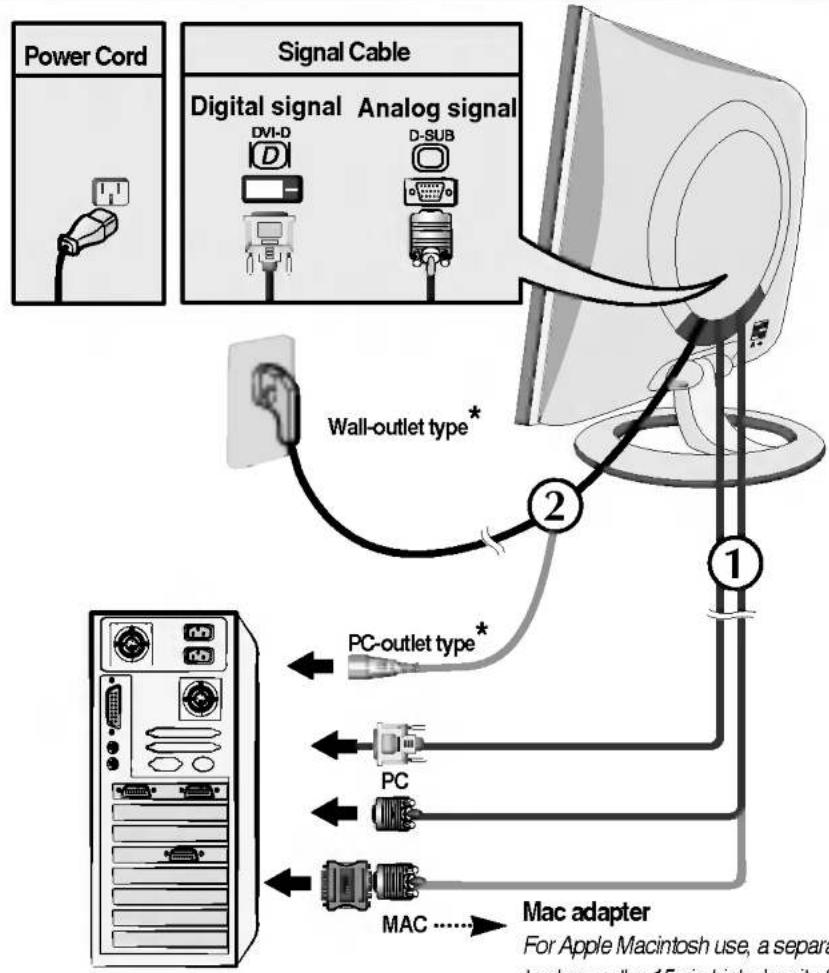
- Connect the signal cable. When attached, tighten the thumbscrews to secure the connection.
- Connect the power cord into a proper power outlet that is easily accessible and close to the display.
NOTE
■ This is a simplified representation of the rear view.
■ This rear view represents a general model; your display may differ from the view as shown.
flowchart
graph TD
    A["Power Cord"] --> B["Signal Cable"]
    B --> C["Digital signal DVI-D"]
    B --> D["Analog signal D-SUB"]
    C --> E["Wall-outlet type*"]
    D --> E
    E --> F["PC outlet type*"]
    F --> G["PC"]
    F --> H["MAC ..."]
    G --> I["Mac adapter"]
    H --> I
    style A fill:#f9f,stroke:#333
    style B fill:#ccf,stroke:#333
    style C fill:#cfc,stroke:#333
    style D fill:#fcc,stroke:#333
    style E fill:#cff,stroke:#333
    style F fill:#ffc,stroke:#333
    style G fill:#cfc,stroke:#333
    style H fill:#fcc,stroke:#333
    style I fill:#ffc,stroke:#333
Mac adapter
For Apple Macintosh use, a separate plug adapter is needed to change the 15 pin high density (3 row) D-sub VGA connector on the supplied cable to a 15 pin 2 row connector.
- Press ⏻ button on the front switch panel to turn the power on.
When monitor power is turned on, the 'Self Image Setting Function' is executed automatically.
PROCESSING SELF
IMAGE SETTING
NOTE
'Self Image Setting Function'? This function provides the user with optimal display settings. When the user connects the monitor for the first time, this function automatically adjusts the display to optimal settings for individual input signals. If you want to adjust the monitor while in use, or wish to manually run this function once again, push the 'AUTO' button on the front panel of the monitor. Otherwise, you may execute the 'Factory reset' option on the OSD adjustment menu. However, be aware that this option initializes all the menu items except 'Language'.
Front Panel Controls
text_image
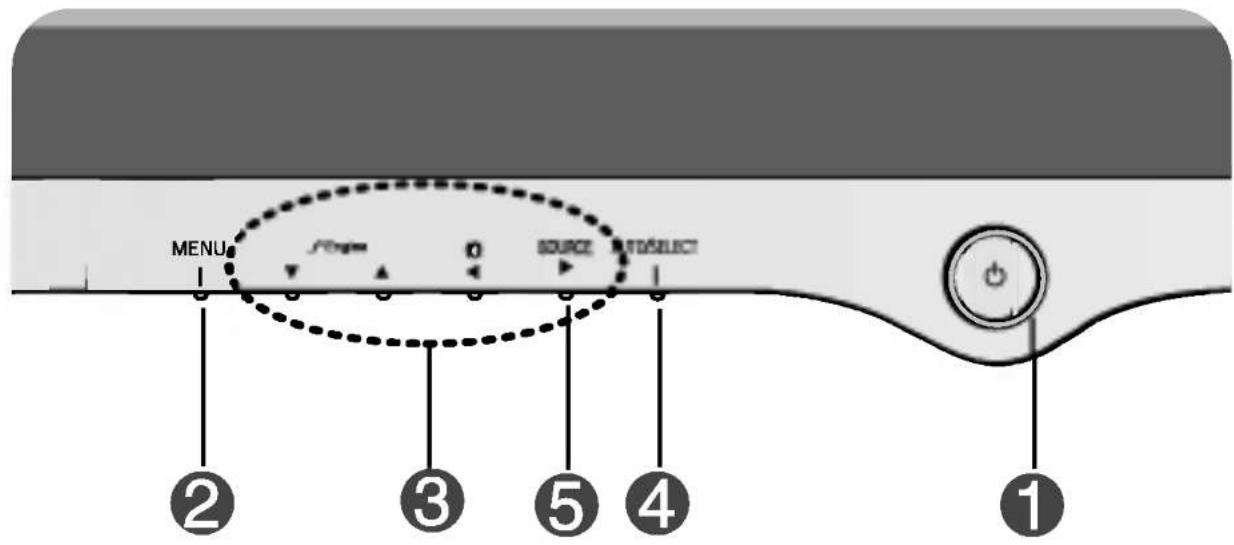
MENU f/ops 0 SOURCE I/O SELECT ② ③ ⑤ ④ ①| Control | Function | |
| 1 | Power Button | Use this button to turn the display on or off. |
| Power (DPMS) Indicator | This Indicator lights up blue when the display operates normally. If the display is in DPM (Energy Saving) mode, this indicator color changes to amber. | |
| 2 | MENU Button | Use this button to enter or exit the On Screen Display. |
| 3 | ▼▲◀▶ Buttons | Use these buttons to choose or adjust items in the On Screen Display. |
| 4 | AUTO/SELECT Button | Use this button to enter a selection in the On Screen Display. |
| Control | Direct Access Function |
 |  |
 | For more information, refer to page A13 |
 |  |
 | AUTO IMAGE ADJUSTMENTWhen adjusting your display settings, always press the AUTO/SELECT button before entering the On Screen Display(OSD).This will automatically adjust your display image to the ideal settings for the current screen resolution size (display mode).The best display mode is 1280x1024. |
 | SOURCEUse this button to make Dsub or DVI connector active.This feature is used when two computers are connected to the display. The default setting is Dsub. |
 | OSD LOCKED/UNLOCKED: MENUThis function allows you to secure the current control settings, so that they cannot be inadvertently changed. Press and hold the MENU button for 5 seconds: the message “OSD LOCKED” appears.You can unlock the OSD controls at any time by pushing the MENU button for 5 seconds:the message “OSD UNLOCKED” will appear. |
 |
AUTO IMAGE ADJUSTMENT
SOURCE
OSD LOCKED/UNLOCKED
: MENU
Screen Adjustment
Making adjustments to the image size, position and operating parameters of the display is quick and easy with the On Screen Display Control system. A short example is given below to familiarize you with the use of the controls. The following section is an outline of the available adjustments and selections you can make using the OSD.
NOTE
- Allow the display to stabilize for at least 30 minutes before making image adjustments.
To make adjustments in the On Screen Display, follow these steps:

flowchart
graph TD
    A["MENU"] --> B["▼▲"] --> C["AUTO/SELECT"] --> D["▼▲ ◀▶"]
    E["MENU ← AUTO/SELECT"] --> F["✓"]
1 Press the MENU Button, then the main menu of the OSD appears.
2 To access a control, use the ▼ or ▲ Buttons. When the icon you want becomes highlighted, press the AUTO/ SELECT Button.
③ Use the ▼▲◀▶ Buttons to adjust the item to the desired level.
4 Accept the changes by pressing the AUTO/ SELECT Button.
5 Exit the OSD by Pressing the MENU Button.
The following table indicates all the On Screen Display control, adjustment, and setting menus.
| Main menu | Sub menu | A | D | Reference |
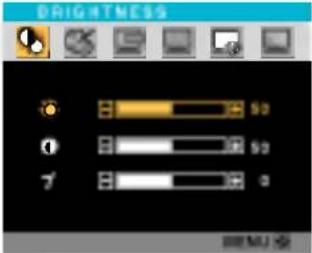
| PICTURE | BRIGHTNESS | ● | ● | To adjust the brightness, contrast and gamma of the screen |
| CONTRAST | ● | ● | ||
| GAMMA | ● | ● | ||
| COLOR | PRESET | ● | ● | To customize the color of the screen |
| RED | ● | ● | ||
| GREEN | ● | ● | ||
| BLUE | ● | ● | ||
| POSITION | H POSITION | ● | To adjust the position of the screen | |
| V POSITION | ● | |||
| TRACKING | CLOCK | ● | To improve the clarity and stability of the screen | |
| PHASE | ● | |||
| FACTORY RESET | FACTORY RESET | ● | ● | To restore the default settings |
| WHITE BALANCE | ● | |||
| SETUP | LANGUAGE | ● | ● | To customize the screen status for a user's operating environment |
| OSD H POSITION | ● | ● | ||
| OSD V POSITION | ● | ● | ||
| FLATRON F-ENGINE(-) | TEXT/MOVIE | ● | ● | To select or customize desired image settings |
| USER | ● | ● | ||
| NORMAL | ● | ● | ||
| ●: AdjustableA: Analog InputD: Digital Input | ||||
NOTE
■ The order of icons may differ depending on the model (A9\~A13).
On Screen Display(OSD) Selection and Adjustment
You were introduced to the procedure of selecting and adjusting an item using the OSD system. Listed below are the icons, icon names, and icon descriptions of the all items shown on the Menu.
Press the MENU Button, then the main menu of the OSD appears.

text_image
Menu Name Icons Sub-menus Button Tip PICTURE MENU MENU : ExitNOTE
■ OSD (On Screen Display) menu languages on the monitor may differ from the manual.
| Main menu | Sub menu | Description |
| PICTURE | ||
| BRIGHTNESS | To adjust the brightness of the screen. | |
| CONTRAST | To adjust the contrast of the screen. | |
| GAMMA | Set your own gamma value. : -50/0/50On the monitor, high gamma valuesdisplay whitish images and low gammavalues display high contrast images. | |
text_image
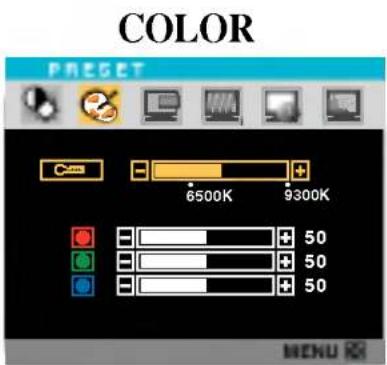
COLOR PRESET 6500K 9300K 50 50 50 MENU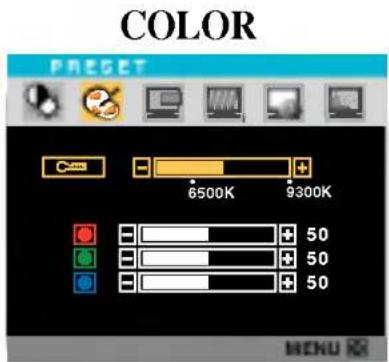
text_image
COLOR PREGET 6500K 9300K 50 50 50 MENU| PRESET | Select the screen color.6500K: Slightly reddish white.9300K: Slightly bluish white. |
| RED | Set your own red color levels. |
| GREEN | Set your own green color levels. |
| BLUE | Set your own blue color levels. |
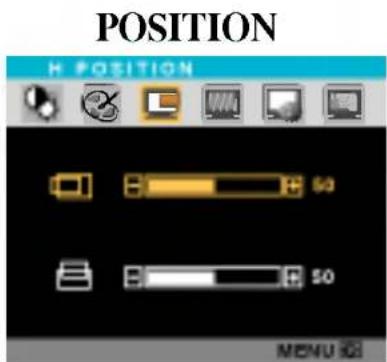
text_image
POSITION H POSITION 50 50 MENU| H POSITION | To move image left and right. |
| V POSITION | To move image up and down. |
| Main menu | Sub menu | Description |
| TRACKING | ||
| CLOCK | To minimize any vertical bars or stripes visible on the screen background. The horizontal screen size will also change. | |
| PHASE | To adjust the focus of the display. This item allows you to remove any horizontal noise and clear or sharpen the image of characters. | |
| FACTORY RESET | ||
| FACTORY RESET | Restore all factory default settings except "LANGUAGE."If you want to reset the monitor, select the YES and then press the - or + button to execute. | |
| WHITE BALANCE | If the output of the video card is different the required specifications, the color level may deteriorate due to video signal distortion. Using this function, the signal level is adjusted to fit into the standard output level of the video card in order to provide the optimal image.Activate this function when white and black colors are present in the screen. | |
| For example | ||
If this does not improve the screen image, restore the factory default settings. If necessary, perform the white balance function again. This function will be enabled only when the input signal is an analog signal.
SETUP
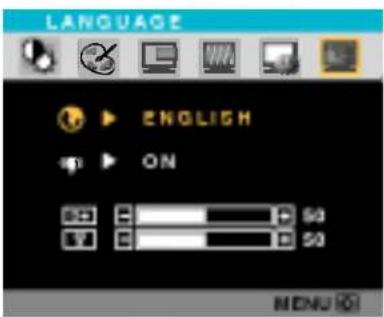
text_image
LANGUAGE ENGLISH ON 50 50 MENULANGUAGE
POWER INDICATOR
To choose the language in which the control names are displayed.
Use this function to set the power indicator on the front side of the monitor to ON or OFF. If you set OFF, it will go off. If you set ON at any time, the power indicator will automatically be turned on.
OSD H POSITION
To adjust horizontal position of the OSD window on the screen.
OSD V POSITION
To adjust vertical position of the OSD window on the screen.
On Screen Display(OSD) Selection and Adjustment
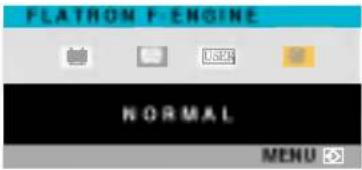
The OSD screen will appear when you press the F-ENGINE button at the front side of the monitor.
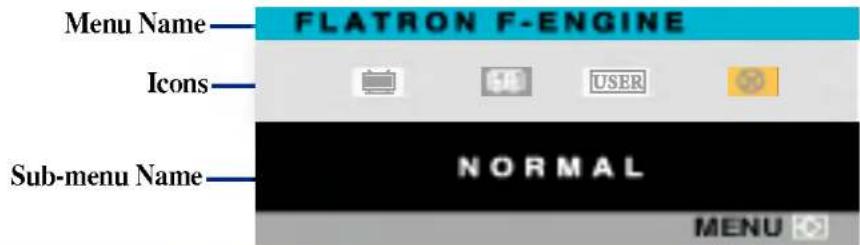
text_image
Menu Name FLATRON F-ENGINE Icons NORMAL Sub-menu Name MENUFLATRON F-ENGINE
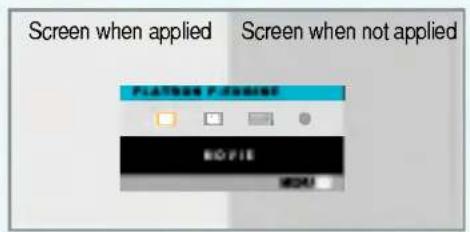
When you execute F-ENGINE, two tones will appear on the screen as shown. The applied screen will appear on the left side, whereas the non-applied screen will appear on the right side. Press the SETbutton to use the adjusted screen.
text_image
Screen when applied Screen when not applied F:\Users\数据窗 F:\测试结果\B0\FILE B0\FILE
text_image
Main menu Sub menu Description
text_image
PLATRON F-ENGINE USER MOVIE MENUMOVIE TEXT
This feature lets you easily select the best desired image condition optimized to the environment (ambient illumination, image types etc).
MOVIE: For animation images in videos or movies
TEXT: For text images (Word processing etc.)

text_image
PLATRON F-ENGINE USER MENU To adjust the USER sub-menu function, Press the SET Button BRIGHTNESS 100 ACE 1 RCM 3 NO USER MENUUser
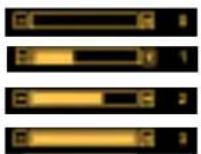
You can manually adjust brightness, ACE or RCM. You can save or restore the adjusted value even when using a different environment setting.
… ⚙ (Brightness): Adjusts screen brightness.
...ACE(Adaptive Clarity Enhancer): Selects the clarity mode.
...RCM(Real Color Management): Selects the color mode.
Not applied
Green enhance
Flesh tone
Color Enhance
Select the 📋 sub-menu using the SET button and save the YES value using the -buttons.
text_image
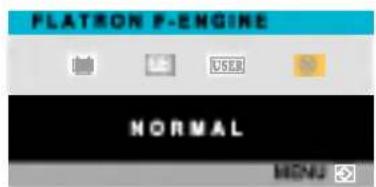
FLATRON F-ENGINE NORMAL MENUNORMAL This is under normal operating conditions.
Check the following before calling for service.
| No image appears | |
| ● Is the power cord of the display connected? | · Check and see if the power cord is connected properly to the power outlet. |
| ● Is the power indicator light on? | · Press the Power button. |
| ● Is the power on and the power indicator blue? | · Adjust the brightness and the contrast. |
| ● Is the power indicator amber? | · If the display is in power saving mode, try moving the mouse or pressing any key on the keyboard to bring up the screen.· Make sure if the power is on.· Try to turn on the PC. |
| ● Do you see an "INPUT SIGNAL OUT OF RANGE" message on the screen? | · This message appears when the signal from the PC (video card) is out of horizontal or vertical frequency range of the display. See the 'Specifications' section of this manual and configure your display again. |
| ● Do you see a "NO SIGNAL "message on the screen? | · This message appears when the signal cable between your PC and your display is not connected. Check the signal cable and try again. |
| Do you see a "OSD LOCKED" message on the screen? | |
| ●Do you see “OSD LOCKED” when you push MENU button? | ·You can secure the current control settings, so that they cannot be inadvertently changed. You can unlock the OSD controls at any time by pushing theMENUbutton for 5 seconds: the message“OSD UNLOCKED” will appear. |
| Display image is incorrect | |
| ● Display Position is incorrect. | Press the AUTO/SELECT button to automatically adjust your display image to the ideal setting.If the results are unsatisfactory, adjust the image position using the H position and V position icon in the on screen display.Check Control Panel -> Display -> Settings and see if the frequency or the resolution were changed.If yes, readjust the video card to the recommend resolution. |
| ● On the screen background, vertical bars or stripes are visible. | Press the AUTO/SELECT button to automatically adjust your display image to the ideal setting.If the results are unsatisfactory, decrease the vertical bars or stripes using the CLOCK icon in the on screen display. |
| ● Any horizontal noise appearing in any image or characters are not clearly portrayed. | Press the AUTO/SELECT button to automatically adjust your display image to the ideal setting.If the results are unsatisfactory, decrease the horizontal bars using the PHASE icon in the on screen display.Check Control Panel -> Display -> Settings and adjust the display to the recommended resolution or adjust the display image to the ideal setting. Set the color setting higher than 24 bits (true color). |
| ● The screen color is mono or abnormal. | Check if the signal cable is properly connected and use a screwdriver to fasten if necessary.Make sure the video card is properly inserted in the slot.Set the color setting higher than 24 bits (true color) at Control Panel - Settings. |
| ● The screen blinks. | Check if the screen is set to interlace mode and if yes, change it to the recommend resolution.Make sure the power voltage is high enough, It has to be higher than AC100-240V 50/60Hz. |
| Have you installed the display driver? | |
| ●Have you installed the display driver? | ·Be sure to install the display driver from the display driver CD (or diskette) that comes with your display. Or, you can also download the driver from our web site: http://www.lge.com. |
| ●Do you see an "Unrecognized monitor, Plug&Play (VESA DDC) monitor found" message? | ·Make sure to check if the video card supports Plug&Play function. |
| USB function | ||
| ● USB function cannot be setup. | · Check if the USB cable is correctly connected. · Check if the PC and OS are USB compliant. For verification of USB support, consult the manufacturer of each system. | |
| Display | 17 inches (43.2cm) Flat Panel Active matrix-TFT LCD | |
| Anti-Glare coating | ||
| 17 inches viewable | ||
| 0.264 mm pixel pitch | ||
| Sync Input | Horizontal Freq. | 30 - 83kHz (Automatic) |
| Vertical Freq. | 56 - 75Hz (Automatic) | |
| Input Form | Separate TTL, Positive/Negative SOG (Sync On Green) Digital | |
| Video Input | Signal Input | 15 pin D-Sub Connector DVI-D connector (Digital) |
| Input Form | RGB Analog (0.7Vp-p/75ohm), Digital | |
| Resolution | Max | DVI Digital: VESA 1280 x 1024@60Hz D-sub Analog: VESA 1280 x 1024@75Hz |
| Recommend | VESA 1280 x 1024@60Hz | |
| Plug&Play | DDC 2B | |
| Power Consumption | Normal : 43W Stand-by/Suspend ≤ 2W DPMS Off ≤ 2W | |
| Dimensions &Weight (with tilt stand) | Full Up Position [6x35] | |
| Width 39.40cm/15.51inches Height 37.90cm/14.92inches Depth 23.20cm/9.13inches | ||
| Net 4.5 kg (9.92 lbs) | ||
| Tilt Range | Tilt 0°~25° | |
| Power Input | AC 100-240V~ 50/60Hz 1.0A | |
| Environmental Conditions | Operating Conditions Temperature 10°C to 35 °CHumidity 10 % to 80 % non-Condensing | |
| Storage Conditions Temperature -20°C to 60 °CHumidity 5 % to 95 % non-Condensing | ||
| Tilt Stand | Attached( O ), Detached ( ) | |
| Signal cable | Attached( ), Detached ( O ) | |
| Power cord | Wall-outlet type or PC-outlet type | |
NOTE
■ Information in this document is subject to change without notice.
Preset Modes (Resolution)
| Display Modes (Resolution) | Horizontal Freq. (kHz) | Vertical Freq. (Hz) | ||
| 1 | VGA | 640 x 350 | 31.469 | 70 |
| 2 | VGA | 720 x 400 | 31.468 | 70 |
| 3 | VGA | 640 x 480 | 31.469 | 60 |
| 4 | VESA | 640 x 480 | 37.500 | 75 |
| 5 | VESA | 800 x 600 | 37.879 | 60 |
| 6 | VESA | 800 x 600 | 46.875 | 75 |
| 7 | MAC | 832 x 624 | 49.725 | 75 |
| 8 | VESA | 1024 x 768 | 48.363 | 60 |
| 9 | VESA | 1024 x 768 | 60.023 | 75 |
| 10 | MAC | 1152 x 870 | 68.681 | 75 |
| 11 | VESA | 1152 x 900 | 61.805 | 65 |
| *12 | VESA | 1280 x 1024 | 63.981 | 60 |
| 13 | VESA | 1280 x 1024 | 79.976 | 75 |
Indicator
| MODE | LED Color |
| Normal | blue |
| Stand-by/Suspend | amber |
| DPMS Off | amber |
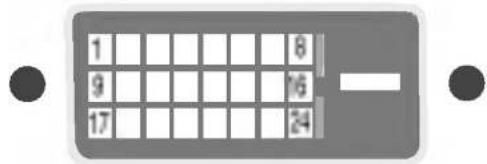
Signal Connector Pin Assignment
text_image
1 8 9 16 17 24■ DVI-D Connector
| Pin | Signal(DVI-D) |
| 1 | T. M. D. S. Data2- |
| 2 | T. M. D. S. Data2+ |
| 3 | T. M. D. S. Data2/4 Shield |
| 4 | T. M. D. S. Data4- |
| 5 | T. M. D. S. Data4+ |
| 6 | DDC Clock |
| 7 | DDC Data |
| 8 | Analog Vertical Sync. |
| 9 | T. M. D. S. Data1- |
| 10 | T. M. D. S. Data1+ |
| 11 | T. M. D. S. Data1/3 Shield |
| 12 | T. M. D. S. Data3- |
| 13 | T. M. D. S. Data3+ |
| 14 | +5V Power |
| 15 | Ground (return for +5V, H. Sync. and V. Sync.) |
| Pin | Signal(DVI-D) |
| 16 | Hot Plug Detect |
| 17 | T. M. D. S. Data0- |
| 18 | T. M. D. S. Data0+ |
| 19 | T. M. D. S. Data0/5 Shield |
| 20 | T. M. D. S. Data5- |
| 21 | T. M. D. S. Data5+ |
| 22 | T. M. D. S. Clock Shield |
| 23 | T. M. D. S. Clock+ |
| 24 | T. M. D. S. Clock- |
T. M. D. S. (Transition Minimized Differential Signaling)
This monitor meets VESA-compliant mounting interface pad specifications.
- Please the monitor on a piece of cloth or other soft surface with the front side facing downward and remove the rear cap.
natural_image
Illustration of hands operating a device with cables (no text or symbols visible)- Slide off the lower section of the cover base with two hands as shown in the picture.

natural_image
Illustration of a hand using a tool to adjust or install a device (no text or symbols visible)-
Separate the stand base using a screwdriver as shown in the picture.
-
Install the VESA standard wall mounting.

natural_image
Diagram of a computer monitor with a cable inserted, showing internal components and a close-up view of the screen (no text or symbols present)VESA wall mounting
Connected to another object (stand type and wall-mounted type. This monitor accepts a VESA-compliant mounting interface pad.-optional)
For further information, refer to the VESA Wall Mounting Instruction Guide.

natural_image
Coiled medical or electrical device with two connectors and a coiled cable (no visible text or symbols)Kensington Security Slot- optional
Connected to a locking cable that can be purchased separately at most computer stores
USB (Universal Serial Bus) is an innovation in connecting your different desktop peripherals conveniently to your computer. By using the USB, you will be able to connect your mouse, keyboard, and other peripherals to your display instead of having to connect them to your computer. This will give you greater flexibility in setting up your system. USB allows you to connect a chain of up to 120 devices on a single USB port; and you can “hot” plug (attach them while the computer is running) or unplug them while maintaining the Plug and the Plug auto detection and configuration. This display has an integrated BUS-powered USB hub, allowing up to 2 other USB devices to be attached it.
USB connection
- Connect the upstream port of the display to the downstream port of the USB compliant PC or another hub using the USB cable. (Computer must have a USB port)
- Connect the USB compliant peripherals to the downstream ports of the display.

text_image
■ This is a simplified representation of rear view. USB upstream Port To USB downstream port of the USB compliant PC or another hub cable USB downstream Port connect the cables from USB compliant peripherals-such as keyboard, mouse, etcNOTE
■ To activate the USB hub function, the display must be connected to a USB compliant PC(OS) or another hub with the USB cable(enclosed).
■ When connecting the USB cable, check that the shape of the connector at the cable side matches the shape at the connecting side.
■ Even if the display is in a power saving mode, USB compliant devices will function when they are connected the USB ports(both the upstream and downstream) of the display.
USB Specifications
| USB standard | Rev. 1.1 complied BUS-powered hub |
| Downstream power supply | 100mA for each (MAX) |
| Communication speed | 12 Mbps (full), 1.5 Mbps (low) |
| USB port | 1 Upstream port2 Downstream ports |
IMPORTANT: These USB connectors are not designed for use with high-power USB devices such as a video camera, scanner, etc. LGE recommends connecting high-power USB devices directly to the computer
Digitally yours
