AV-56P787 - Television JVC - Free user manual and instructions
Find the device manual for free AV-56P787 JVC in PDF.


User questions about AV-56P787 JVC
0 question about this device. Answer the ones you know or ask your own.
Ask a new question about this device
Download the instructions for your Television in PDF format for free! Find your manual AV-56P787 - JVC and take your electronic device back in hand. On this page are published all the documents necessary for the use of your device. AV-56P787 by JVC.
USER MANUAL AV-56P787 JVC
Color Television Users Guide

HIGH-DEFINITION TELEVISION
For Models:
AV-48P777
AV-48P787
AV-56P777
AV-56P787
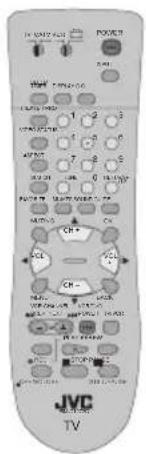
text_image
TV JVC TV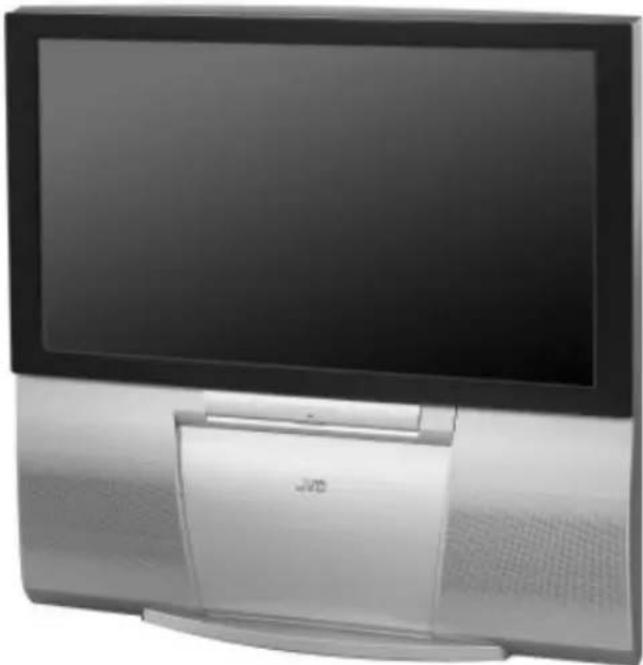
natural_image
Exterior view of a modern flat-screen TV with a black top and silver front panel (no visible text or symbols)Illustration of AV-56P777 and RM-C1272G
Important Note:
In the spaces below, enter the model and serial number of your television (located at the rear of the television cabinet). Staple your sales receipt or invoice to the inside cover of this guide. Keep this user's guide in a convenient place for future reference. Keep the carton and original packaging for future use.
Model Number:
Serial Number:
Important Safety Precautions
CAUTION:
CAUTION
RISK OF ELECTRIC SHOCK DO NOT OPEN

To reduce the risk of electric shock. Do not remove cover (or back). No user serviceable parts inside. Refer servicing to qualified service personnel.
The lightning flash with arrowhead symbol, within an equilateral triangle is intended to alert the user to the presence of uninsulated “dangerous voltage” within the product’s enclosure that may be of sufficient magnitude to constitute a risk of electric shock to persons.

The exclamation point within an equilateral triangle is intended to alert the user to the presence of important operating and maintenance (servicing) instructions in the literature accompanying the appliance.
WARNING:
TO PREVENT FIRE OR SHOCK HAZARDS, DO NOT EXPOSE THIS TV SET TO RAIN OR MOISTURE.
CAUTION:
TO INSURE PERSONAL SAFETY, OBSERVE THE FOLLOWING RULES REGARDING THE USE OF THIS UNIT.
- Operate only from the power source specified on the unit.
- Avoid damaging the AC plug and power cord.
- Avoid Improper installation and never position the unit where good ventilation is unattainable.
- Do not allow objects or liquid into the cabinet openings.
- In the event of trouble, unplug the unit and call a service technician. Do not attempt to repair it yourself or remove the rear cover.
Changes or modifications not approved by JVC could void the warranty.
* When you don't use this TV set for a long period of time, be sure to disconnect both the power plug from the AC outlet and antenna for your safety.
* To prevent electric shock do not use this polarized plug with an extension cord, receptacle or other outlet unless the blades can be fully inserted to prevent blade exposure.
IMPORTANT RECYCLING INFORMATION
This product utilizes both a Cathode Ray Tube (CRT) and other components that contain lead. Disposal of these materials may be regulated in your community due to environmental considerations. For disposal or recycling information, please contact your local authorities, or the Electronic Industries Alliance: http://www.eiae.org

text_image
energy ENERGY STAR- As an "ENERGY STAR®" partner, JVC has determined that this product or product model meets the "ENERGY STAR®" guidelines for energy efficiency.
Important Safeguards
CAUTION:
Please read and retain for your safety.
Electrical energy can perform many useful functions. This TV set has been engineered and manufactured to assure your personal safety. But improper use can result in potential electrical shock or fire hazards. In order not to defeat the safeguards incorporated in this TV set, observe the following basic rules for its installation, use and servicing. Also follow all warnings and instructions marked on your TV set.
INSTALLATION
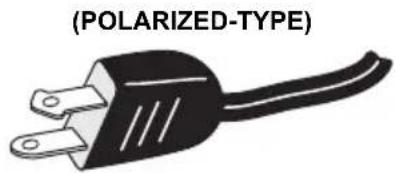
1 Your TV set is equipped with a polarized AC line plug (one blade of the plug is wider than the other). This safety feature allows the plug to fit into the power outlet only one way. Should you be unable to insert the plug fully into the outlet, try reversing the plug. Should it still fail to fit, contact your electrician.
natural_image
Illustration of a black electrical plug with two leads, labeled (POLARIZED-TYPE) at the top (no other text or symbols)2 Operate the TV set only from a power source as indicated on the TV set or refer to the operating instructions for this information. If you are not sure of the type of power supply to your home, consult your TV set dealer or local power company. For battery operation, refer to the operating instructions.
3 Overloaded AC outlets and extension cords are dangerous, and so are frayed power cords and broken plugs. They may result in a shock or fire hazard. Call your service technician for replacement.
4 Do not allow anything to rest on or roll over the power cord, and do not place the TV set where power cord is subject to traffic or abuse. This may result in a shock or fire hazard.
5 Do not use this TV set near water — for example, near a bathtub, washbowl, kitchen sink, or laundry tub, in a wet basement, or near swimming pool, etc.
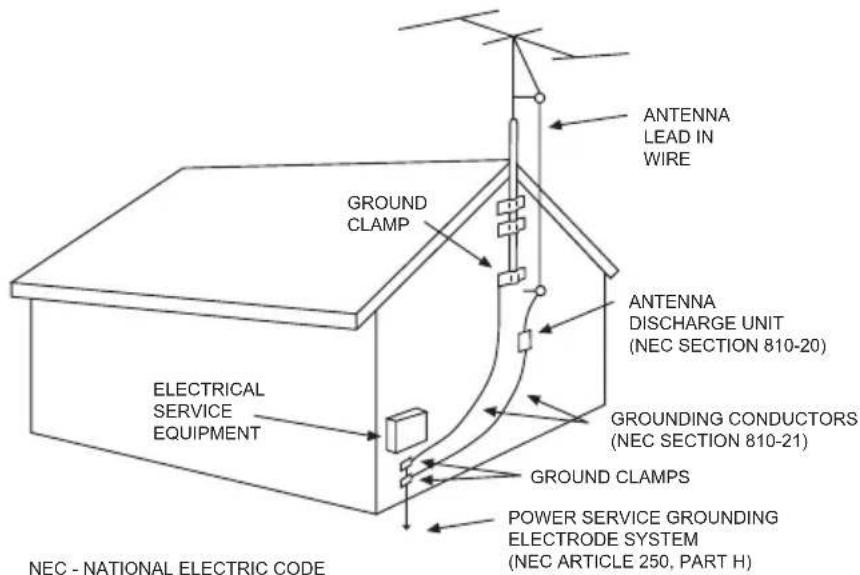
6 If an outside antenna is connected to the TV set, be sure the antenna system is grounded so as to provide some protection against voltage surges and built-up static charges. Section 810 of the National Electrical Code provides information with respect to proper grounding of the mast and supporting structure, grounding of the lead-in wire to an antenna discharge unit, size of grounding conductors, location of antenna discharge unit, connection requirements for the grounding electrode.
7 An outside antenna system should not be located in the vicinity of overhead power lines or other electric light or power circuits, or where it can fall into such power lines or circuits. When installing an outside antenna system, extreme care should be taken to keep from touching such power lines or circuits as contact with them might be fatal.
EXAMPLE OF ANTENNA GROUNDING AS PER NATIONAL ELECTRICAL CODE
text_image
ANTENNA LEAD IN WIRE GROUNDS CLAMP ANTENNA DISCHARGE UNIT (NEC SECTION 810-20) GROUNDING CONDUCTORS (NEC SECTION 810-21) GROUND CLAMPS POWER SERVICE GROUNDING ELECTRODE SYSTEM (NEC ARTICLE 250, PART H) ELECTRICAL SERVICE EQUIPMENT NEC - NATIONAL ELECTRIC CODE8 TV sets are provided with ventilation openings in the cabinet to allow heat generated during operation to be released.
Therefore:
— Never block the bottom ventilation slots of a portable TV set by placing it on a bed, sofa, rug, etc.
— Never place a TV set in a "built-in" enclosure unless proper ventilation is provided.
— Never cover the openings with a cloth or other material.
— Never place the TV set near or over a radiator or heat register.
9 To avoid personal injury:
— Do not place a TV set on a sloping shelf unless properly secured.
— Use only a cart or stand recommended by the TV set manufacturer.
— Do not try to roll a cart with small casters across thresholds or deep pile carpets.
— Wall or shelf mounting should follow the manufacturer's instructions, and should use a mounting kit approved by the manufacturer.
Use
10 Caution children about dropping or pushing objects into the TV set through cabinet openings. Some internal parts carry hazardous voltages and contact can result in a fire or electrical shock.
11 Unplug the TV set from the wall outlet before cleaning. Do not use liquid or an aerosol cleaner.
12 Never add accessories to a TV set that has not been designed for this purpose. Such additions may result in a hazard.
13 For added protection of the TV set during a lightning storm or when the TV set is to be left unattended for an extended period of time, unplug it from the wall outlet and disconnect the antenna. This will prevent damage to product due to lightning storms or power line surges.
14 A TV set and cart combination should be moved with care. Quick stops, excessive force, and uneven surfaces may cause the TV set and cart combination to overturn.
Service
15 Unplug this TV set from the wall outlet and refer servicing to qualified service personnel under the following conditions:
A. When the power cord or plug is damaged or frayed.
B. If liquid has been spilled into the TV set.
C. If the TV set has been exposed to rain or water.
D. If the TV set does not operate normally by following the operating instructions. Adjust only those controls that are covered in the operating instructions as improper adjustment of other controls may result in damage and will often require extensive work by a qualified technician to restore the TV set to normal operation.
E. If the TV set has been dropped or damaged in any way.
F. When the TV set exhibits a distinct change in performance — this indicates a need for service.
16 Do not attempt to service this TV set yourself as opening or removing covers may expose you to dangerous voltage or other hazards. Refer all servicing to qualified service personnel.
17 When replacement parts are required, have the service technician verify in writing that the replacement parts he uses have the same safety characteristics as the original parts. Use of manufacturer's specified replacement parts can prevent fire, shock, or other hazards.
18 Upon completion of any service or repairs to this TV set, please ask the service technician to perform the safety check described in the manufacturer's service literature.
19 When a TV set reaches the end of its useful life, improper disposal could result in a picture tube implosion. Ask a qualified service technician to dispose of the TV set.
20 Note to CATV system installer.
This reminder is provided to call the CATV system installer's attention to Article 820-40 of the NEC that provides guidelines for proper grounding and, in particular, specifies that the cable ground shall be connected to the grounding system of the building, as close to the point of cable entry as practical.
Warnings
Screen Burn-in
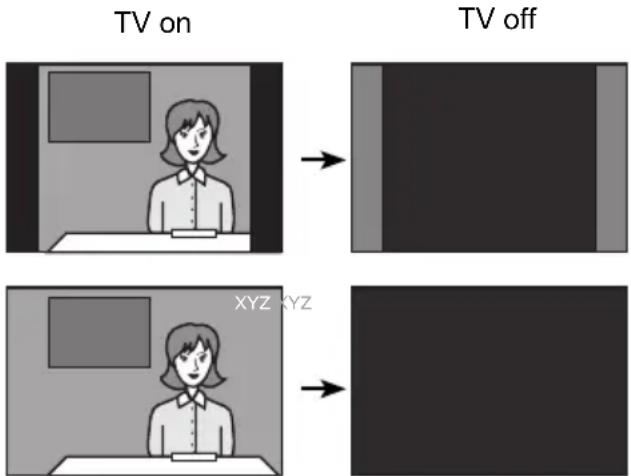
Displaying fixed images on your screen for extended periods of time can leave a subtle but permanent ghost image in your screen. This is referred to as "burn-in". To avoid this, mix your viewing patterns and aspect modes from time to time.
Examples include, but are not limited to the following:
For example...
• Stock-market report bars
• Shopping channel logos and pricing displays
• Video game patterns or scoreboards
- Bright station logos
- Internet web sites or other computer-style images.
• DVD discs, video tapes, laser discs
- Broadcast, cable, satellite channels or digital television tuners/converters.
- Aspect modes that leave solid black bars on the top and bottom, or both sides of the screen.
text_image
TV on TV off XYZ XYZNote: Warranty DOES NOT cover screen burn-in or uneven picture tube aging.
Caring for the Cabinet
Normally, light dusting with a soft, non-scratching duster will keep your TV clean.
If you wish to wipe down the television, first unplug it. Then wipe gently with a soft cloth, slightly moistened with water. You can add a few drops of mild liquid detergent to the water to help remove spots of oily dirt.
• DO NOT allow liquid to enter the TV through the ventilation slots.
• DO NOT use strong or abrasive cleaners on the TV.
- DO NOT spray liquids or cleaners directly on the TV's surface.
- DO NOT rub or scrub the TV harshly. Wipe the set gently with a soft cloth.
Caring for the Screen
The screen is treated with an electrostatic-proof coating. When it gets dirty, wipe it gently with a soft cloth. If the screen is very dirty, wipe it down with a cloth dipped in a diluted kitchen cleaner and thoroughly wrung-out. Then wipe immediately after with a clean, dry cloth.
Do not apply alcohol, organic solvents (like acetone), acidic or alkaline cleansers to the screen. These will remove the coating layer and cause discolorations.
Do not push or hit the screen. This could cause scratches on the screen surface and image distortions.
Quick Setup 8
Unpacking your TV 8
TV Models 9
TV Remote Control 11
Getting Started 12
The Remote Control ..... 12
Connecting Your Devices ..... 13
Interactive Plug In Menu ..... 21
Programming your remote ..... 24
Onscreen Menus ..... 28
Using the Guide 28
Onscreen Menu System ..... 29
Initial Setup 31
Noise Muting 31
Language 31
Front Panel Lock 31
V-Chip 32
Closed Caption 39
Auto Shut Off . . . . . . . . . . . . . . . 41
Software Version 41
Power Indicator 41
Tuner Setup 42
Auto Tuner Setup 42
Channel Summary 42
Find Channel 44
Digital Antenna Level 44
External Input ..... 45
Digital-In Size 45
Digital-In1 Audio 45
Video Input Label 46
Picture Adjust ..... 47
Picture Settings 47
Adjust Picture Settings 47
Color Temperature 47
Noise Reduction 48
Natural Cinema 48
Position Adjustment 49
Convergence 50
Reset 51
Sound Adjust ..... 52
Sound Settings 52
Adjust Sound Settings ..... 52
Optical Out 52
Turn On Volume 53
Volume Limit 53
Reset 53
Clock Timers ..... 54
Set Clock 54
On/Off Timer 55
Button Functions ..... 56
Power 56
Number Buttons 56
Tune 56
Input 56
Channel +/- 56
Volume +/- 56
Return+/TV 57
Sound 57
Muting 57
Video Status 58
TheaterPro D6500K 58
Sleep Timer 58
Display 59
C.C. 59
Aspect 60
Aspect Ratios 60
Favorite 62
ML/MTS 63
Menu 63
OK 63
Back 63
Sub Channel 64
Guide 64
TV/CATV Slide Switch 65
VCR/DVD Slide Switch 65
VCR Buttons 65
DVD Buttons 65
Troubleshooting ..... 66
OSD Information ..... 67
Specifications 68
Warranty 69
Authorized Service Centers . . 70
Notes 71
Quick Setup
Unpacking your TV
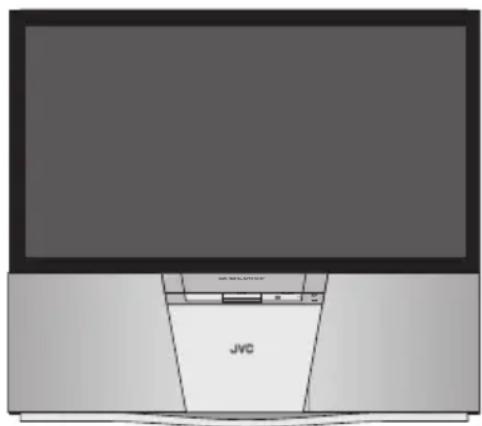
Thank you for your purchase of a JVC Color Television. Before you begin setting up your new television, please check to make sure you have all of the following items. In addition to this guide, your television box should include:
1 Television
natural_image
Top-down view of a modern TV unit with JVC branding and control panel (no readable text or symbols)1 Remote Control
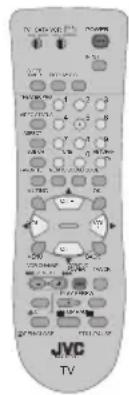
text_image
TV CONTROL Panel JVC TVTwo AA
Batteries
Note: Your television and/or remote control may differ from the examples illustrated here.
We recommend that before you start using your new television, you read your entire User's Guide so you can learn about your new television's many great features. If you're anxious to start using your television right away, a quick setup guide follows on the next few pages.
TV Models
Before you connect your television to another device, please refer to the proper diagrams for your specific TV and remote. These will help assist you in understanding how to connect your television to another device, as well as use the remote to set up your television.
Rear panel diagram
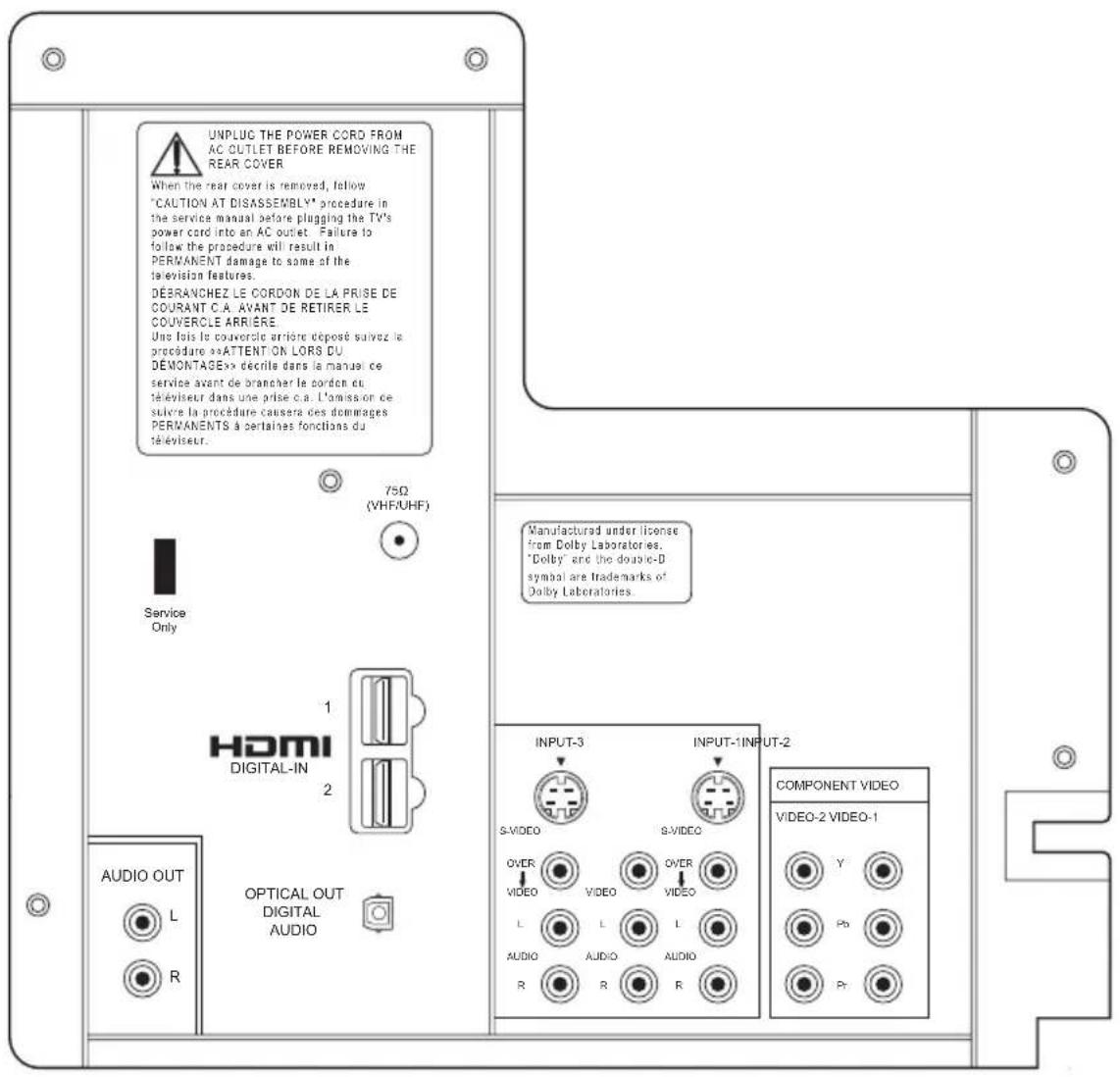
text_image
UNPLUG THE POWER CORD FROM AC OUTLET BEFORE REMOVING THE REAR COVER When the rear cover is removed, follow "CAUTION AT DISASSEMBLY" procedure in the service manual before plugging the TV's power cord into an AC outlet. Failure to follow the procedure will result in PERMANENT damage to some of the television features. DÉBRANCHEZ LE CORDON DE LA PRISE DE COURANT C.A. AVANT DE RETIRER LE COUVERCLE ARRIERE. Une fois le couvercle arrêté déposé suivez le procédure «ATTENT ON LORS DU DEMONTAGE» décrite dans la manuel ce service avant de brancher le pordon ou téléviseur dans une prise c.a. L'amisa or ce sulvre la procédure causera des domnages PERMANENTS à certaines fonctions du téléviseur. 75Ω (VHF/UHF) Service Only 1 HDMI DIGITAL-IN 2 AUDIO OUT L R OPTICAL OUT DIGITAL AUDIO Manufactured under license from Dolby Laboratories. "Dolby" and the double-D symbol are trademarks of Dolby Laboratories. S-VIDEO S-VIDEO S-VIDEO OVER VIDEO VIDEO VIDEO L L L AUDIO AUDIO AUDIO R R R COMPONENT VIDEO VIDEO-2 VIDEO-1 Y Po PrNotes:
- The terminal labeled "SERVICE ONLY", is exclusively used to update the software version.
Quick Setup
Front panel diagram
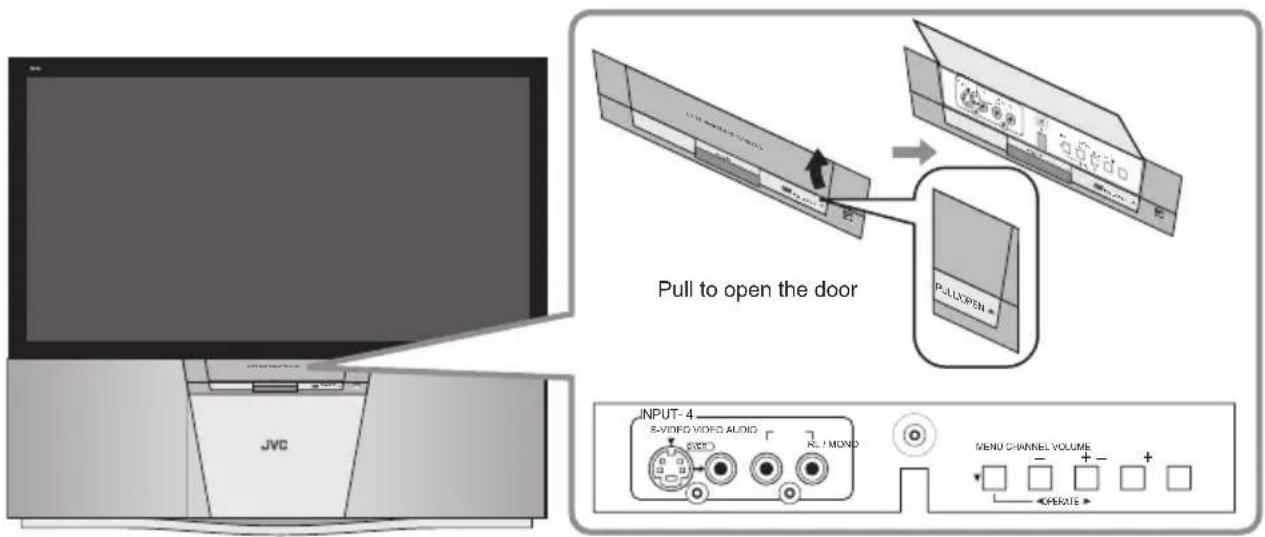
text_image
JVC Pull to open the door INPUT-4 8 VIDEO VIDEO AUDIO SET RL / MOND MENU CHANNEL VOLUME - + - + - MERATERemote Control
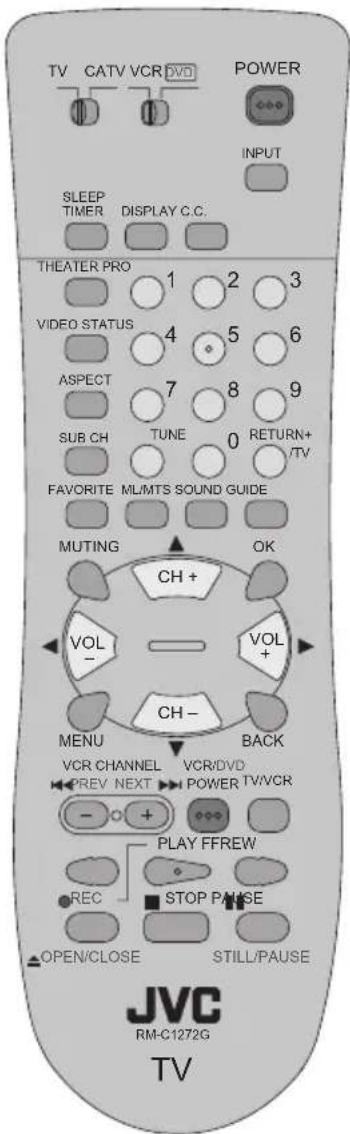
text_image
TV CATV VCR DVD POWER SLEEP DISPLAY C.C. INPUT THEATER PRO 1 2 3 VIDEO STATUS 4 5 6 ASPECT 7 8 9 SUB CH TUNE 0 RETURN+ /TV FAVORITE ML/MTS SOUND GUIDE MUTING OK CH+ VOL - VOL + CH- MENU BACK VCR CHANNEL VCR/DVD POWER TV/VCR PREV NEXT POWER - + + PLAY FFREW REC STOP PAUSE OPEN/CLOSE STILL/PAUSE JVC RM-C1272G TVRM-C1272G
• For information on remote control buttons, see pages 56 - 65.
Quick Setup
Getting Started
These quick setup pages will provide you, in three easy steps, with the basic information you need to begin using your new television right away. If you have questions, or for more detailed information on any of these steps, please consult other sections of this manual.
Step 1 – The Remote Control
Before you can operate your remote control, you first need to install the batteries (included).
Lift and pull the latch on the back of the remote control to open. Insert two batteries (included) carefully noting the “+” and “−” markings, placing the “−” end in the unit first. Snap the cover back into place.
When you change the batteries, try to complete the task within three minutes. If you take longer than three minutes, the remote control codes for your VCR, DVD, and/or cable box/satellite receiver may have to be reset. See pages 24 - 27.
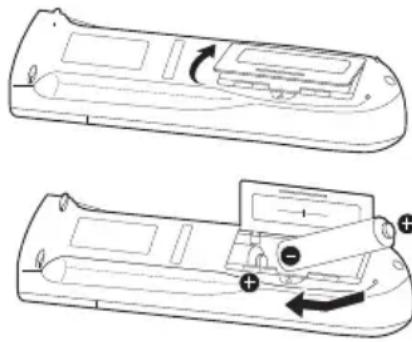
natural_image
Technical line drawing of a remote control casing with directional arrows indicating movement (no text or symbols)Key Feature Buttons
The four key feature buttons at the center of the remote can be used for basic operation of the television. The top and bottom buttons will scan forward and back through the available channels. To move rapidly through the channels using JVC's Hyperscan feature, press and hold CH+ or CH−. The channels will zip by at a rate of five channels per second. The right and left buttons will turn the volume up or down. These buttons are also marked with four arrows and are used with JVC's onscreen menu system. To use the onscreen menus, press the MENU button.
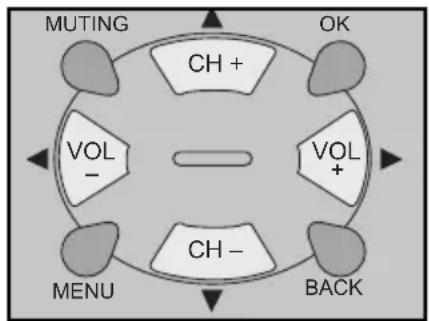
flowchart
graph TD
    A["MUTING"] --> B["CH +"]
    B --> C["VOL -"]
    C --> D["CH -"]
    D --> E["CH +"]
    E --> F["VOL +"]
    F --> G["OK"]
    G --> H["MENU"]
    H --> I["BACK"]
Basic Operation
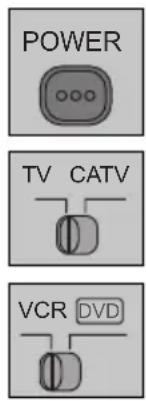
Turn the television on and off by pressing the POWER button at the top right corner of the remote. If this is the first time you are turning on the TV, the interactive plug-in menu appears.
- Make sure the TV/CATV switch is set to TV. Move the switch to CATV only if you need to operate a cable box.
- Slide the VCR/DVD selector switch to VCR to control a VCR. Slide to DVD to control a DVD player. Please see pages 24 to 27 for instructions on programming your remote control to operate a cable box, VCR or DVD player.
text_image
POWER TV CATV VCR DVDStep 2 – Connecting Your Devices
To make these connections, you will use plugs like the ones illustrated below.
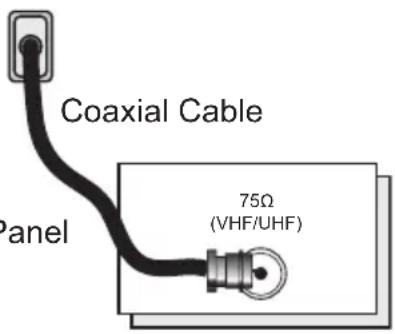
Coaxial Cables


Used to connect an external antenna or cable TV system to your TV.
S-Video Cable

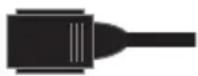
Used to make video connections with S-Video VCRs, Camcorders and DVD players.
Component Cables Composite Cables Audio Cables

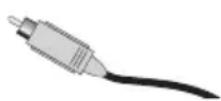
Used to connect audio/video devices like VCRs, DVD players, stereo amplifiers, game consoles, etc.
Notes:
• These connections are examples.
- After you are finished connecting your devices, plug the power cord into the nearest power outlet and turn on the TV.
- If you follow these diagrams and the television does not work properly, contact your local cable operator.
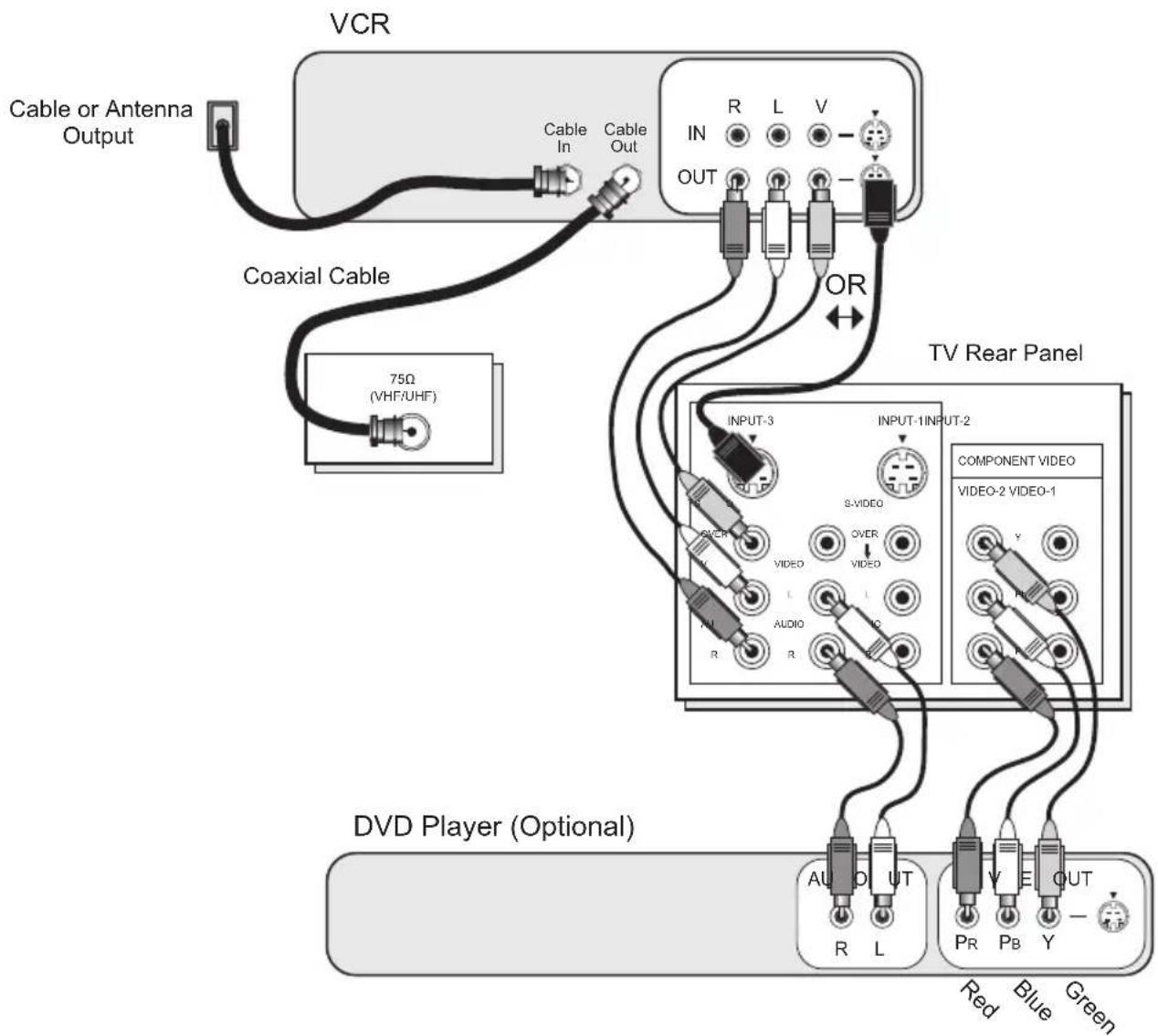
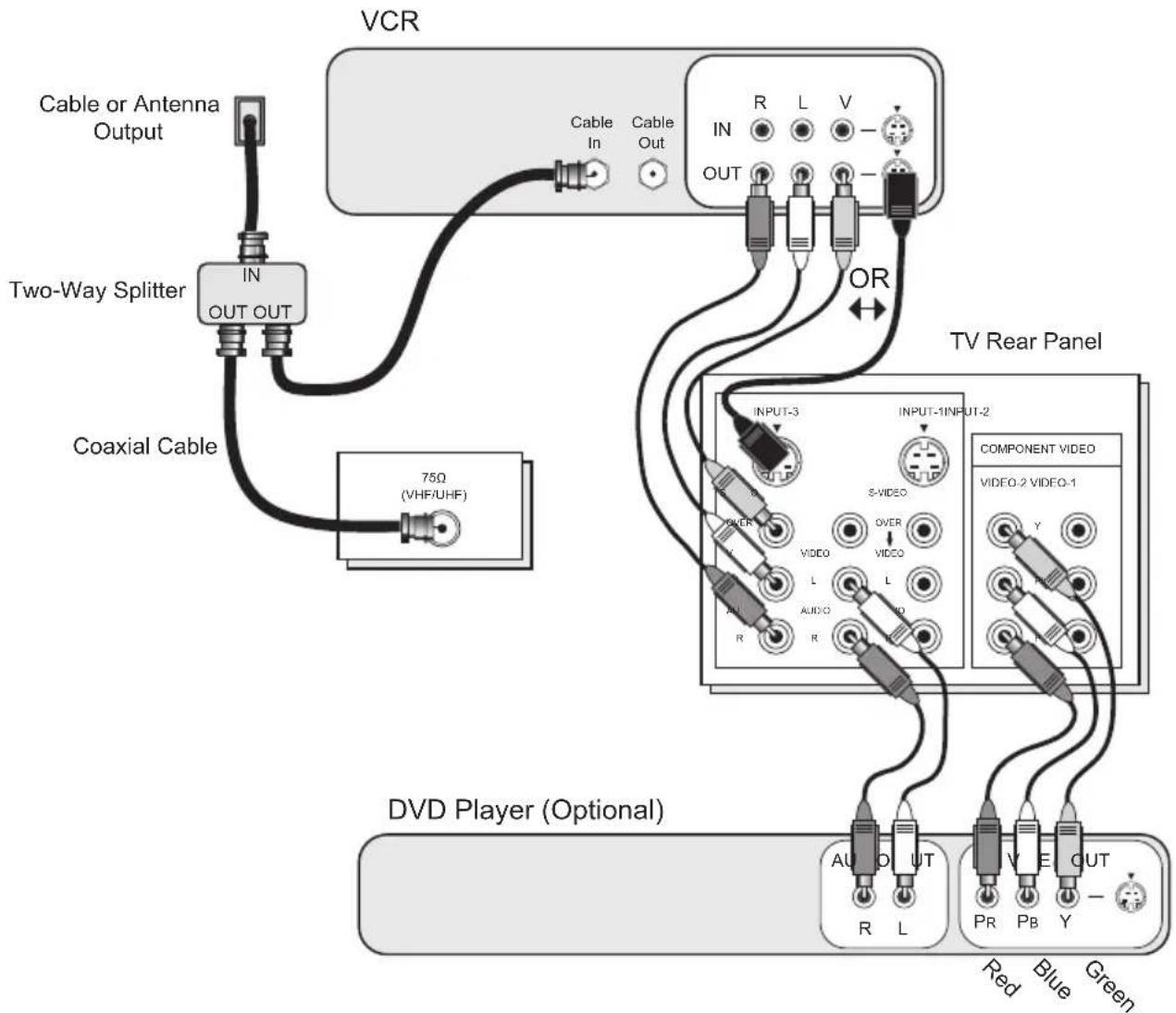
- To connect a DVD player, see VCR Connection. A DVD player is optional
- If you have a satellite television system, refer to the satellite TV manual.
No VCR Connection
Cable or Antenna Output
TV Rear Panel
text_image
Coaxial Cable Panel 75Ω (VHF/UHF)Quick Setup
VCR Connection
Notes:
- Green, blue and red are the most common colors for DVD cables. Some models may vary colors. Please consult the user's manual for your DVD player for more information.
- Be careful not to confuse the red DVD cable with the red audio cable. It is best to complete one set of connections (DVD or audio output) before starting the other to avoid accidentally switching the cables.
• You may also connect the DVD player to Input 1.
Diagram #1
flowchart
graph TD
    A["Cable or Antenna Output"] --> B["Cable In"]
    B --> C["Cable Out"]
    D["75Ω (VHF/UHF)"] --> E["Coaxial Cable"]
    E --> F["TV Rear Panel"]
    F --> G["COMPONENT VIDEO"]
    G --> H["VIDEO-2 VIDEO-1"]
    H --> I["AVU OUT"]
    I --> J["Red"]
    I --> K["Blue"]
    I --> L["Green"]
    F --> M["INPUT-3"]
    F --> N["INPUT-1 INPUT-2"]
    F --> O["S-VIDEO"]
    F --> P["OVER"]
    F --> Q["VIDEO"]
    F --> R["L"]
    F --> S["AUDIO"]
    F --> T["R"]
    style A fill:#f9f,stroke:#333
    style D fill:#ccf,stroke:#333
    style F fill:#cfc,stroke:#333
    style G fill:#fcc,stroke:#333
    style H fill:#cff,stroke:#333
    style I fill:#ffc,stroke:#333
    style J fill:#cfc,stroke:#333
    style K fill:#cfc,stroke:#333
    style L fill:#cfc,stroke:#333
    style M fill:#fcc,stroke:#333
    style N fill:#fcc,stroke:#333
    style O fill:#fcc,stroke:#333
    style P fill:#fcc,stroke:#333
    style Q fill:#fcc,stroke:#333
    style R fill:#fcc,stroke:#333
    style S fill:#fcc,stroke:#333
Note:
• If this connection setup does not work for you, try the connection setup on page 15.
Quick Setup
Diagram #2
flowchart
graph TD
    A["VCR"] -->|Cable In| B["TV Rear Panel"]
    A -->|Cable Out| C["TV Rear Panel"]
    A -->|Cable In| D["DVD Player (Optional)"]
    A -->|Cable Out| E["DVD Player (Optional)"]
    A -->|Cable In| F["Cable or Antenna Output"]
    A -->|Cable Out| G["Two-Way Splitter"]
    A -->|Cable In| H["Coaxial Cable"]
    A -->|Cable Out| I["75Ω (VHF/UHF)"]
    A -->|Cable In| J["TV Rear Panel"]
    A -->|Cable Out| K["TV Rear Panel"]
    A -->|Cable In| L["TV Rear Panel"]
    A -->|Cable Out| M["TV Rear Panel"]
    A -->|Cable In| N["TV Rear Panel"]
    A -->|Cable Out| O["TV Rear Panel"]
    A -->|Cable In| P["TV Rear Panel"]
    A -->|Cable Out| Q["TV Rear Panel"]
    A -->|Cable In| R["TV Rear Panel"]
    A -->|Cable Out| S["TV Rear Panel"]
    A -->|Cable In| T["TV Rear Panel"]
    A -->|Cable Out| U["TV Rear Panel"]
    A -->|Cable In| V["TV Rear Panel"]
    A -->|Cable Out| W["TV Rear Panel"]
Quick Setup
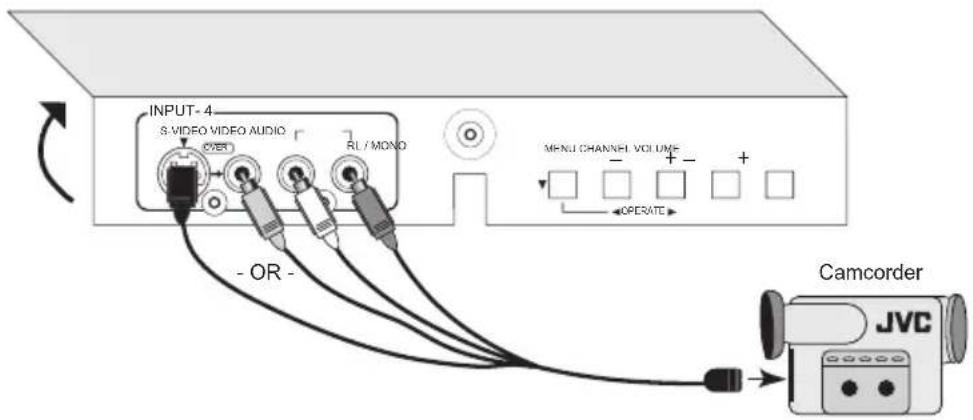
Connecting to a Camcorder
You may connect a camcorder, game console or other equipment to your television by using the side input jacks (Input 4) located on the side of the television. You can also connect these using the television's rear input jacks, using the same instructions.
text_image
INPUT- 4 S-VIDEO VIDEO AUDIO OVER RL / MONO MENU CHANNEL VOLUME- + - + OPERATE OR - Camcorder JVC1) Connect a yellow composite cable from the camcorder VIDEO OUT, into the VIDEO IN on the front of the TV, OR connect an S-Video cable from the camcorder to the back of the TV.
2) Connect a white composite cable from the camcorder LEFT AUDIO OUT, into the LEFT AUDIO IN on the front of the TV.
3) Connect a red composite cable from the camcorder RIGHT AUDIO OUT, into the RIGHT AUDIO IN on the front of the TV.
Note:
- If your camcorder is a mono sound model it will have only one AUDIO OUT. Connect it to the LEFT AUDIO IN.
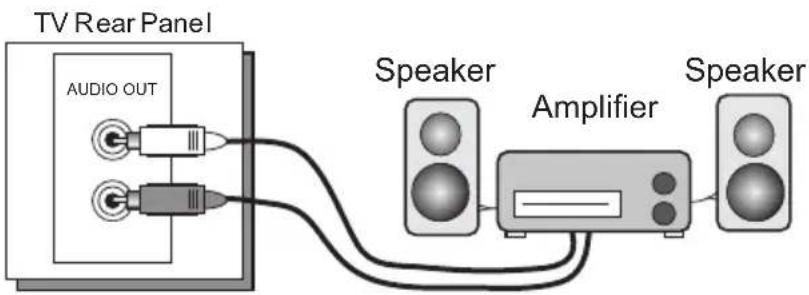
Connecting to an External Amplifier
text_image
TV Rear Panel AUDIO OUT Speaker Amplifier Speaker1) Connect a white composite cable from the LEFT AUDIO OUTPUT on the back of the TV to the LEFT AUDIO INPUT on the amplifier.
2) Connect a red composite cable from the RIGHT AUDIO OUTPUT on the back of the TV to the RIGHT AUDIO INPUT on the amplifier.
Notes:
- Refer to your amplifier's manual for more information.
- You can use AUDIO OUTPUT for your home theater system.
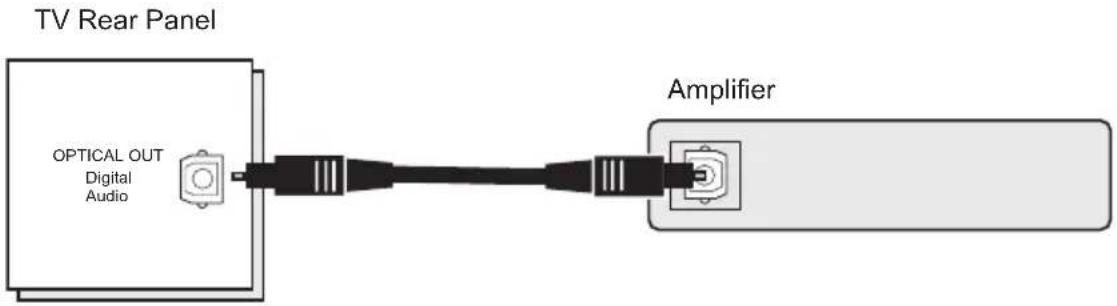
Connecting to an amplifier using your optical output
You can connect an amplifier that has an optical digital input terminal by using an optical digital cable from the optical output.
text_image
TV Rear Panel OPTICAL OUT Digital Audio Amplifier1) Connect the optical cable from the back of the TV to the back of the amplifier.
Notes:
- In order to use the optical output connection, select "PCM" or "DOLBY DIGITAL" on "Optical Out" in Sound Adjust. See page 52.
- You can not output audio using the OPTICAL OUTPUT when you have digital sound from an HDMI device connected to the HDMI 1 or HDMI 2 connection on the back of your TV. (See page 19).
• Refer to your owners manual on using your amplifier.
Quick Setup
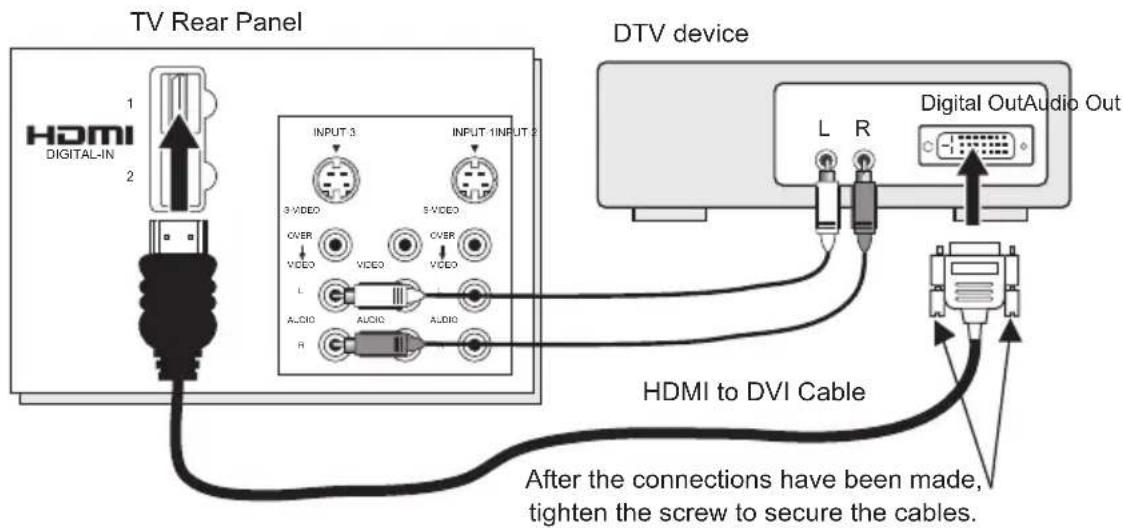
Connecting to a Digital TV Receiver
By connecting a Digital TV Receiver, high definition pictures can be displayed on your TV in their digital form.
text_image
TV Rear Panel DTV device HDMI to DVI Cable After the connections have been made, tighten the screw to secure the cables.1) Connect the HDMI to DVI Cable from the DIGITAL OUT on the back of your DTV decoder, to the DIGITAL-IN 1 on the back of your television.
2) Connect a red cable from the DTV decoder RIGHT AUDIO OUT, to the RIGHT AUDIO INPUT "INPUT-3" on the back of your television.
3) Connect a white cable from the DTV decoder LEFT AUDIO OUT, to the LEFT AUDIO INPUT "INPUT-3" on the back of your television.
- The digital-in terminal is not compatible with the picture signal of a personal computer.
- Use a HDMI to DVI cable (commercially available) in order to digitally connect the television with a DTV decoder.
Notes:
- If 480p signals (640x480 or 720x480) are displayed on the screen, the horizontal balance may be slightly shifted. Access the "Digital-In Size" in the External Input menu to adjust it. (Refer to page 45.)
- When you do the above connection, set "Digital-In1 Audio" in the External Input menu to ANALOG. See "Digital-In1 Audio", page 45.
- The Analog Audio input can only be used with the HDMI 1 input.
- When setting the "DIGITAL AUDIO – ANALOG / DIGITAL" menu setting on the TV, please note that this setting only effects the HDMI 1 jack and that if you use a DVI to HDMI adapter this connection must be made to the HDMI 1 along with analog audio cables.
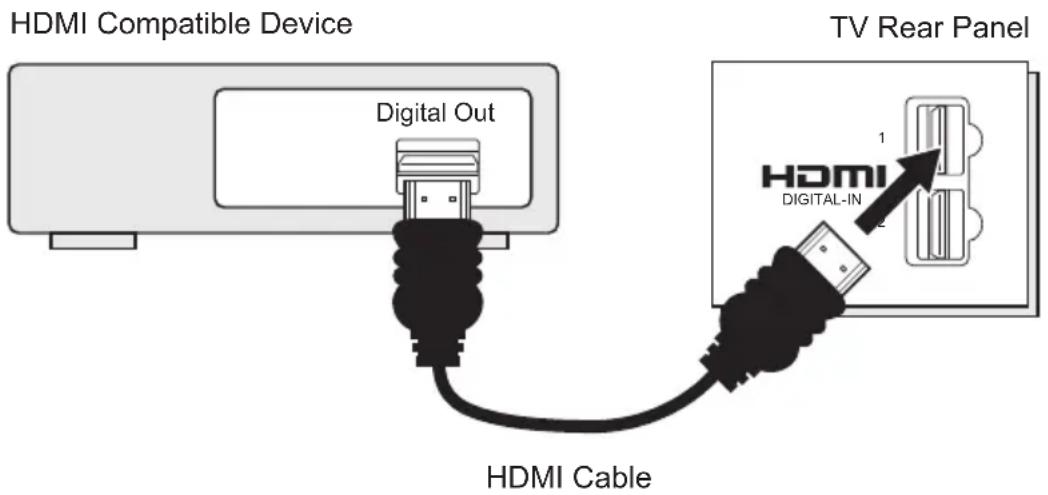
Connecting to an HDMI Compatible Device
By connecting an HDMI compatible device, high definition pictures can be displayed on your TV in their digital form. Some HDMI devices can include DVD players, D-VHS or any HDMI compatible devices.
HDMI (High Definition Multimedia Interface) is the first industry supported, uncompressed, all digital audio/video interface. HDMI provides an interface between any audio/video source, such as a set-top box, DVD player, A/V receiver or an audio and/or video monitor, such as a digital television (DTV).
text_image
HDMI Compatible Device Digital Out TV Rear Panel HDMI Cable 1 2 HDMI DIGITAL-IN1) Connect the HDMI Cable from the DIGITAL OUT on the back of your DTV or HDMI device, to the DIGITAL-IN on the back of your television.
Notes:
- When you do the above connection, set "Digital-In1 Audio" in the External Input menu to DIGITAL. See "Digital-In1 Audio", page 45.
- Some decoders may not respond depending on the equipment that you have connected when it is connected to the HDMI.
- If the HDMI output device signal is changed (for example, 480i/60Hz is changed to 480p/60Hz), the screen may turn green and there may be some distortion for a short time until the signal becomes stable.
Quick Setup
Connecting to an AV Receiver using your television's V1 Smart Input
By connecting your AV Receiver to your television's V1 Smart Input, you can watch picture sources from many different devices, without having to change or use the other input connections on your TV. This allows you to free up the other input connections so you can connect more devices to your television.

text_image
AV Receiver MONITOR OUT Y PB PR MONITOR OUT TV Rear Panel INPUT-3 S-AVIDO S-AVIDO INPUT-1 INPUT-2 COMPONENT VIDEO VIDEO-2 VIDEO-1 Y R L AUDIO R AUDIO B1) Connect an S-Video Cable from the AV Receiver's MONITOR OUT, to the S-Video INPUT-1 on the back of your television.
2) Connect a Yellow Composite Cable from the AV Receiver's MONITOR OUT, into the VIDEO INPUT-1 on the back of your television.
3) Connect a Green Component Cable from the AV Receiver's Y MONITOR OUT, into the Y VIDEO INPUT-1 on the back of your television.
4) Connect a Blue Component Cable from the AV Receiver's PB MONITOR OUT, into the Pb VIDEO INPUT-1 on the back of your television.
5) Connect a Red Component Cable from the AV Receiver's R MONITOR OUT, into the Pr VIDEO INPUT-1 on the back of your television.
Note:
- Please refer to your AV Receiver instruction manual for more information on connecting your speakers and other devices like a DVD player.
- Use your AV Receiver's remote to switch to the different devices you have connected.
• Some AV Receivers may not respond when the V1 Smart Input function is turned on. - If you have video connections for each input device connected to your AV Receiver, you should not connect them using both S-Video and Composite connection at the same time when you are using V1 Input as the V1 Smart Input. In this case we recommend using the S-Video connection.
Step 3 – The Interactive Plug In Menu
When you turn your television on for the first time the interactive plug-in menu will appear. The plug-in menu helps you to get your TV ready to use by letting you set your preferences for:
- The language in which you want the onscreen menus to appear.
- Setting the TV's clock to the correct time so your timer functions will work properly. You can choose "Auto" or "Manual" for setting the clock.
- The auto tuner setup of which channels you wish to receive.
We recommend you complete the interactive plug-in items before you start using your television.
Note:
- If you press the MENU button while setting up the interactive plug-in menu, it will skip over it.
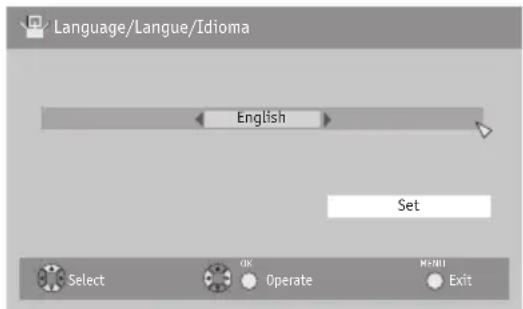
Language
After the "JVC Interactive Plug-in Menu" has been displayed, the TV automatically switches to the "Language" settings. You can choose to view your onscreen menus in three languages: English, French or Spanish.
text_image
Language/Langue/Idioma English Set Select OK Operate M=N1 Exit◀▶ To choose a language:
(English, Français or Español.)
▼ To "Set"
Press the Ok button
Once you press Ok, you will move to the "Set Clock" Plug-In Menu automatically.
(To be continued...)
Quick Setup
Auto Clock Set
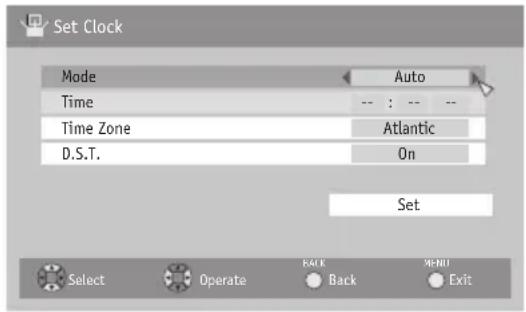
Before you use any of your TV's timer functions, you must first set the clock. You may precisely set your clock using the XDS time signal broadcast by most public analog broadcasting stations. If you do not have this in your area, you will have to set the clock manually. See manual clock set below. To set the clock using the XDS signal:
text_image
Set Clock Mode Auto Time -- : -- -- Time Zone Atlantic D.S.T. On Set Select Operate Back Next Back Exit◀▶ To choose "Auto"
▼ To "Time Zone"
To select your time zone: (Atlantic, Eastern, Central, Mountain, Pacific, Alaska or Hawaii)
▼ To move to "D.S.T." (Daylight Savings Time)
◀▶ To turn "On or Off"
▼ To "set"
Press the O k button
Once you press ⌘, you will move to the "Auto Tuner Setup" Plug-In Menu automatically.
Notes:
• D.S.T. can be used when it is set to "On" in the "Set Clock" menu.
- Only when the "Mode" is set to "Auto", the Daylight Savings Time feature automatically adjusts your TV's clock for Daylight Savings. The clock will move forward one hour at 2:00 am on the first Sunday in April. The clock will move back one hour at 2:00 am on the last Sunday in October.
- You will have to reset the clock after a power interruption. You must set the clock before operating any timer functions.
Manual Clock Set
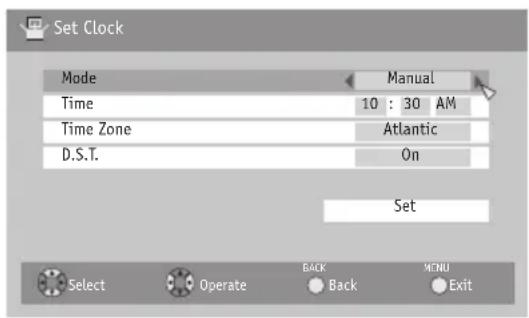
To set your clock manually (without using the XDS signal), choose "Manual". If you choose "Auto", see auto clock set above.
text_image
Set Clock Mode Manual Time 10 : 30 AM Time Zone Atlantic D.S.T. On Set Select Operate BACK MENU Back Exit◀▶ To choose "Manual"
▼ To "Time"
◀▶ To set the hour
▼ To minute
◀▶ To set the minute
▼ To "Time Zone"
To select your time zone: (Atlantic, Eastern, Central, Mountain, Pacific, Alaska or Hawaii)
▼ To move to "D.S.T." (Daylight Savings Time)
◀▶ To turn "On or Off"
▼ To "Set"
Press the O κ button
Once you press O k, you will move to the "Auto Tuner Setup" Plug-In Menu automatically.
Note:
- You will have to reset the clock after a power interruption. You must set the clock before operating any timer functions.
(To be continued...)
Auto Tuner Setup
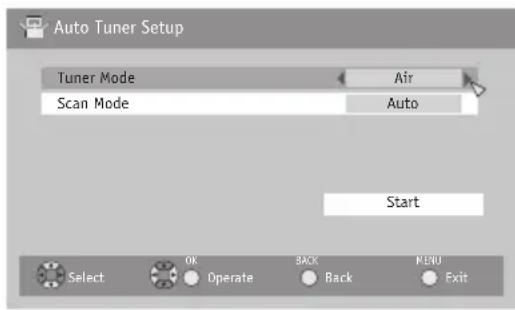
In auto tuner setup, the TV automatically scans through all available channels, memorizing the active ones and skipping over blank ones or channels with weak signals. This means when you scan (using the CHANNEL +/- buttons) you will receive only clear, active channels.
text_image
Auto Tuner Setup Tuner Mode Air Scan Mode Auto Start Select OK BACK NENU Operate Back Exit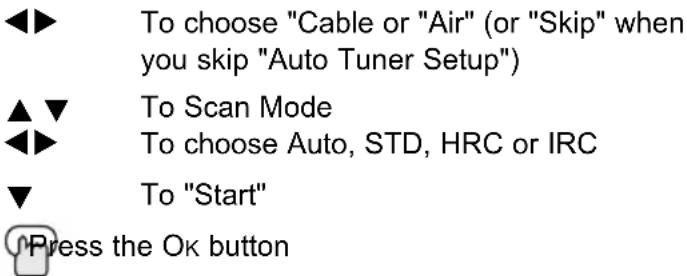
text_image
To choose "Cable or "Air" (or "Skip" when you skip "Auto Tuner Setup") To Scan Mode To choose Auto, STD, HRC or IRC To "Start" Press the Ok button
text_image
Now programming ... 20When the setup is finished, "Thank you! Setup is now complete." is displayed. Your quick setup is now complete. You can now begin watching your television, or you can continue on in this guide for more information on programming your remote control, or using the JVC onscreen menu system to customize your television viewing experience.
Notes:
- If you want to cancel the Auto Tuner Setup, press the MENU button.
- If you choose "Skip", it finished without doing the Auto Tuner Setup.
Cable Box and Satellite Users: After your auto tuner setup is complete, you may, (depending on the type of hookup), have only 1 channel, usually 3 or 4 in the auto tuner memory. This is normal.
Quick Setup
Programming your remote control
You can program your remote to operate your cable box, satellite receiver, VCR or DVD player by using the instructions and codes listed below. If the equipment does not respond to any of the codes listed below or to the code search function, use the remote control supplied by the manufacturer.
Cable Box or Satellite Codes
The remote control is programmed with cable box and satellite codes for power on/off, channel up/down, and 10 key operation.
1) Find the cable box or satellite brand from the list of codes shown below.
2) Slide the 2-way selector switch to "CATV".
3) Press and hold down the DISPLAY button, then enter the first code number listed with the 10 key pad.
4) Release the DISPLAY button, and confirm the operation of the cable box/satellite receiver.
- If your cable or satellite box does not respond to the first code, try the others listed. If it does not respond to any code, try the search codes function, on page 27.
| Cable Box CODES | Cable Box CODES | Digital Satellite Systems | CODES | ||
| ABC | 024 | Puser | 032 | ||
| Archer | 032, 025 | RCA | 061, 070 | Echostar | 100, 113, 114, 115 |
| Cableview | 051, 032 | Realistic | 032 | ||
| Citizen | 022, 051 | Regal | 058, 064, 040, 041, 042, 045, 068 | Express VU | 100, 113 |
| Curtis | 058, 059 | G.E. | 106 | ||
| Diamond | 024, 032, 025 | Regency | 034 | G.I. | 108 |
| Eagle | 029 | Rembrandt | 037, 032, 051, 038 | Gradiente | 112 |
| Eastern | 034 | ||||
| GC Brand | 032, 051 | Samsung | 051 | Hitachi | 104, 111 |
| Gemini | 022, 043 | Scientific Atlanta | 057, 058, 059 | HNS (Hughes) | 104 |
| General Instrument | 065, 024, 025, 026, 027, 020, 021, 022, 057, 023 | SLMark | 051, 047 | Panasonic | 105 |
| Sprucer | 051, 056 | Philips | 102, 103 | ||
| Stargate | 032, 051 | Primestar | 108 | ||
| Hamlin | 040, 041, 042, 045, 058, 064 | Telecaption | 067 | Proscan | 106, 109, 110 |
| Hitachi | 049, 024 | Teleview | 047, 051 | RCA | 106, 109, 110 |
| Jerrold | 065, 024, 025, 026, 027, 020, 021, 022, 057, 023 | Texscan | 044 | Sony | 107 |
| Tocom | 035, 036, 066 | Star Choice | 104, 108 | ||
| Toshiba | 050 | Toshiba | 101 | ||
| Macom | 049, 050, 051, 054 | Unika | 032, 025 | Uniden | 102, 103 |
| Magnavox | 033 | Universal | 022, 032 | ||
| Memorex | 030 | Videoway | 052 | ||
| Movietime | 032, 051 | Viewstar | 029, 030 | ||
| Oak | 039, 037, 048 | Zenith | 063, 046 | ||
| Panasonic | 055, 056, 060, 071, 073 | Zenith/Drake Satellite | 046 | ||
| Paragon | 063 | ||||
| Philips | 028, 029, 030, 052, 053, 031, 069 | ||||
| Pioneer | 047, 062 | ||||
| Pulsar | 051, 032 | ||||
VCR Codes
The remote control is programmed with VCR codes for power on/off, play, stop, fast-forward, rewind, pause, record, channel up/down operation.
1) Find the VCR brand from the list of codes shown below.
2) Slide the first 2-way selector switch to "TV" and the other 2-way selector switch to "VCR".
3) Press and hold down the DISPLAY button, then enter the first code number listed with the 10 key pad.
4) Release the DISPLAY button, and confirm the operation of the VCR.
- If your VCR does not respond to the first code, try the others listed. If it does not respond to any of the codes, try the search codes function on page 27.
- After you program your remote, some VCR buttons may not work properly. If so, use the VCR's remote.
- To record, hold down the Rec button on the remote and press PLAY.
| VCRs CODES | VCRs CODES | VCRs CODES | |||
| Admiral | 035 | Marantz | 003, 004, 005 | Samsung | 037, 060, 062, 033, 089 |
| Aiwa | 027, 032, 095 | Marta | 064 | ||
| Akai | 029, 072, 073, 074 | Memorex | 024, 067 | Samtron | 089 |
| MGA | 038, 040, 047, 048, 041, 042 | Sansui | 003, 026, 020, 052 | ||
| Audio Dynamic | 003, 005 | ||||
| Bell & Howell | 063, 071 | Minolta | 058, 045, 093 | Sanyo | 063, 067, 091, 071 |
| Broksonic | 020, 026, 094 | Mitsubishi | 038, 040, 047, 048, 041, 042, 078, 090 | Scott | 059, 060, 062, 067, 038, 040, 047, 048, 026, 020 |
| Canon | 023, 025 | ||||
| CCE | 043 | Multitech | 047, 027, 062 | ||
| Citizen | 064 | ||||
| Craig | 063, 029, 064 | NEC | 003, 004, 005, 000 | Sears | 063, 064, 065, 066, 058, 000, 001 |
| Curtis Mathes | 045, 024, 027, 093 | Olympic | 024, 023 | ||
| Daewoo | 043, 059, 024, 092 | Optimus | 028, 021, 035, 064 | Shintom | 075 |
| Sharp | 035, 036, 080, 088 | ||||
| DBX | 003, 004, 005 | Orion | 026, 020 | ||
| Dimensia | 045, 093 | Panasonic | 023, 024, 021, 022 | Signature 2000 | 027, 035 |
| Emerson | 043, 026, 077, 061, 025, 042, 020, 076 | Penney | 024, 058, 045, 063, 003, 004, 005, 093 | Singer | 075 |
| Sony | 028, 029, 030, 053, 054, 055 | ||||
| Fisher | 063, 066, 067, 065, 071, 091 | Pentax | 058, 005, 045, 093 | SV 2000 | 027 |
| Sylvania | 031, 023, 024, 027 | ||||
| Funai | 027, 026, 020, 000 | Philco | 031, 024, 027, 023, 026, 020, 043 | Symphonic | 027, 081 |
| G.E. | 033, 045, 024 | Tashiro | 064 | ||
| Go Video | 037, 051, 049, 050, 089 | Phillips | 031, 023, 024, 086 | Tatung | 003, 004, 005 |
| Teac | 003, 004, 027, 005 | ||||
| Goldstar | 064 | Pioneer | 023 | ||
| Gradiente | 083, 084, 081, 000, 001 | Proscan | 045, 058, 023, 024, 031, 046, 059, 060, 033, 087, 093 | Technics | 021, 022, 023, 024 |
| Teknika | 024, 027, 070 | ||||
| Hitachi | 023, 045, 058, 027, 081, 093 | Toshiba | 059, 046, 079 | ||
| Quasar | 021, 022, 023, 024 | Vector Research | 005 | ||
| Instant Replay | 024, 023 | ||||
| Jensen | 003 | Radio Shack | 033, 024, 063, 036, 067, 040, 027 | Wards | 035, 036, 067, 044, 064 |
| JVC | 000, 001, 002, 003, 004, 005 | Yamaha | 063, 003, 004, 005 | ||
| RCA | 033, 045, 058, 023, 024, 031, 046, 059, 060, 083, 084, 085, 087, 093 | Zenith 044, 082 | 064, 094 | ||
| Kenwood | 003, 004, 064, 005 | ||||
| LXI 027, 064, 058, 065, 066, 063, 067 | |||||
| Realistic 024, 063, 036, 067, 040, 027 | |||||
| Magnavox | 031, 023, 024, 086 | ||||
Quick Setup
DVD Codes
The remote control is programmed with DVD codes for power on/off, play, stop, fast-forward, rewind, previous/next chapter, tray open/close, and still/pause operation.
1) Find the DVD player brand from the list of codes shown below.
2) Slide the first 2-way selector switch to "TV" and the other 2-way selector switch to "DVD".
3) Press and hold down the DISPLAY button, then enter the first code number listed with the 10 key pad.
4) Release the DISPLAY button, and confirm the operation of the DVD player.
- If your DVD player does not respond to the first code, try the others listed. If it does not respond to any of the codes, try the search codes function on page 27.
- After you program your remote, some DVD buttons may not work properly. If so, use the DVD player's remote.
| DVD Player CODES | DVD Player CODES | ||
| Aiwa | 043 | RCA | 021, 026 |
| Apex | 040 | Sampo | 034 |
| Denon | 020, 037 | Samsung | 030 |
| Hitachi | 030, 031 | Sharp | 028 |
| JVC | 000 | Silvania | 038 |
| Kenwood | 035 | Sony | 024, 045, 046, 047 |
| Konka | 039 | ||
| Mitsubishi | 025 | Technics | 020 |
| Onkyo | 041 | Toshiba | 023 |
| Oritron | 044 | Vialta 050 | |
| Panasonic | 020 | Wave | 042 |
| Philips | 023, 036 | Yamaha | 020 |
| Pioneer | 022 | Zenith | 027, 032 |
| Raite | 033 | ||
Search Codes
Cable/Satellite Search Codes Function
1) Slide the first 2-Way Mode Selector switch to CATV.
2) Press the POWER and RETURN+/TV buttons. Hold for at least three seconds and release.
3) Press the POWER button on the remote, and see if the cable or satellite box responds.
4) If there was a response, press RETURN+/TV. The codes are now set. If there was no response, repeat Step 3. If you repeat Step 3 a total of 80 times without a response, use the remote control that came with your equipment.
5) Press RETURN+/TV to exit.
VCR/DVD Search Codes Function
1) Slide the first 2-way selector switch to "TV" and the other 2-way selector switch to "VCR" or "DVD".
2) Press the VCR or DVD POWER and RETURN+/TV buttons. Hold for at least three seconds and release.
3) Press the VCR or DVD POWER button, and see if the VCR or DVD responds.
4) If there was a response, press RETURN+/TV. The codes are now set. If there was no response, repeat Step 3. If you repeat Step 3 a total of 80 times for the VCR (40 times for the DVD player), and there is no response, use the remote control that came with your equipment.
5) Press RETURN+/TV to exit.
Onscreen Menus
Using the Guide
Certain symbols are used throughout this guide to help you learn about the features of your new television. The ones you will see most frequently are:
▲ ▼ Up and Down arrows mean press the CH+ or CH- buttons. Pressing the CH+ or CH- buttons let you:
- Move vertically in a main menu screen
- Move through a submenu screen
- Move to the next letter, number, or other choice in a submenu
- Back up to correct an error
- Scan through TV channels (when not in a menu screen)
Left and right arrows mean press the VOLUME+ or VOLUME- buttons to move left or right to:
- Select a highlighted menu item
- Select an item in a submenu
- Select numbers in certain menu options
- Turn the volume up or down (when not in a menu screen)


The "press button" icon means you should press the button named on your remote control. (Button names appear in SMALL CAPITAL LETTERS.)
The “helping arrow” icon points to the highlighted or selected item in a menu.
To bring up the onscreen menu, press the MENU button on the remote control. The following (left) main menu will appear. The item that appears in green is the one currently selected. If you use the MENU button on the TV's front panel instead of the remote, Front Menu screen showing "Input", "Video Status", "Aspect" and "Menu" will appear (following right screen). The "Interactive Plug-in Menu" will appear the first time the TV is plugged in.
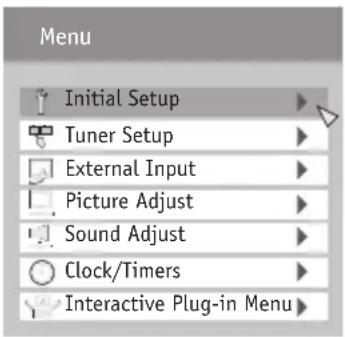
text_image
Menu Initial Setup Tuner Setup External Input Picture Adjust Sound Adjust Clock/Timers Interactive Plug-in Menu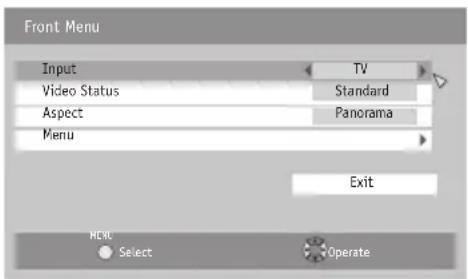
text_image
Front Menu Input Video Status Aspect Menu TV Standard Panorama Exit NEU Select OperateNote:
- Menus shown in this book are illustrations, not exact replications of the television's onscreen displays.
The Onscreen Menu System
Your television comes with JVC's onscreen menu system. The onscreen menus let you make adjustments to your television's operation simply and quickly. All menus are navigated from the Main Menu at first. Detailed explanations on using each menu follow later in this guide. For information about the interactive plug-in Menu, see pages 21 - 23.
- To open the onscreen menu system, press the MENU button on the remote control. The main menu will appear
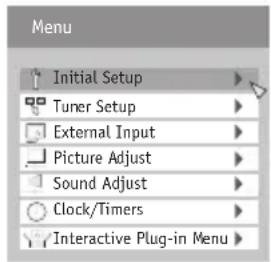
text_image
Menu Initial Setup Tuner Setup External Input Picture Adjust Sound Adjust Clock/Timers Interactive Plug-in Menu- To select a menu from the main menu, use the ▲▼arrows and enter by using the ◀▶ arrows or Ok button.
The selected feature and option on a menu screen are highlighted in a different color. To move to a different feature, use the ▲▼arrows to move up and down the list.
- There are two methods to select an option in a menu, after selecting a menu using the ▲▼ arrows.
1) Use the ◀▶ arrows to select an option from the highlighted feature. (In this guide, we discuss this method).
2) Press the Ok button. The right onscreen will appear. Use the ▲▼arrows to select an option from the box and press the Ok button.
- To go back to the previous screen, press the BACK button.
- Pressing MENU on the remote control will close the onscreen menu system and return you to normal television viewing.
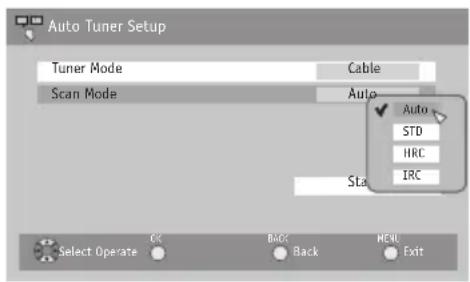
text_image
Auto Tuner Setup Tuner Mode Cable Scan Mode Auto Auto STD HRC IRC Sta Select Operate OK BACK Back NEWL ExitEach menu and its features will be discussed in the following pages of this guide.
Notes:
- If you do not press any buttons for a few seconds, the onscreen menu will automatically shut off.
- Button names in this guide are shown in SMALL CAPITAL LETTERS.
- Menus may appear in different sizes onscreen depending on the aspect ratio selected.
- Some menu items may not appear in menu screens when certain aspect ratios or inputs are selected.
Onscreen Menus
From the Main Menu...
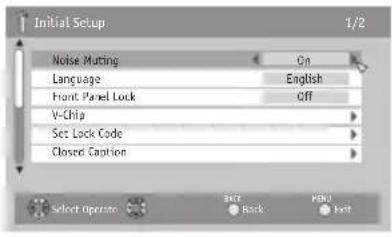
text_image
Initial Setup 1/2 Noise Muting On Language English Front Panel Lock Off V-Chip Set Lock Code Closed Caption Select Optrate Back Menu Back Help
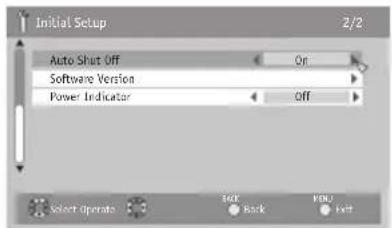
text_image
Initial Setup 2/2 Auto Shut Off On Software Version Power Indicator Off Select Operate Back FND ExitInitial Setup 2/2 Initial Setup 1
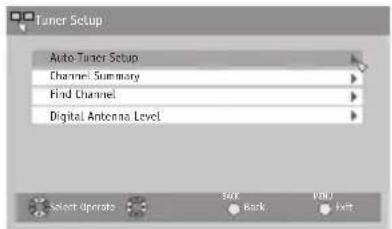
text_image
Tuner Setup Auto Tuner Setup Channel Summary Find Channel Digital Antenna Level Select operate Back ExitTuner Setup
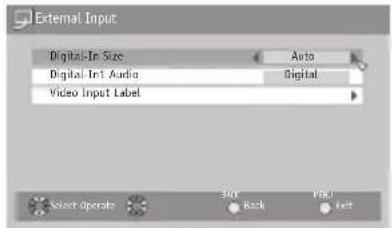
text_image
External Input Digital-In Size Auto Digital-Int Audio Digital Video Input Label Select operate 34V Back 100% ExitExternal Input
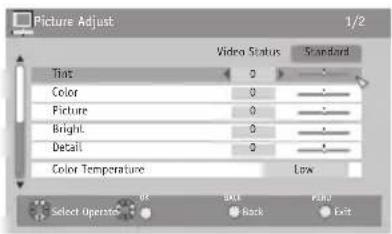
text_image
Picture Adjust 1/2 Video Status Standard Tint 0 Color 0 Picture 0 Bright 0 Detail 0 Color Temperature Low Select Operato Back Exit
Picture Adjust 1/2
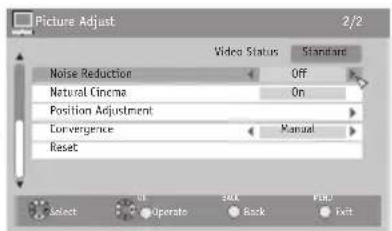
text_image
Picture Adjust 2/2 Video Status Standard Noise Reduction Off Natural Cinema On Position Adjustment Convergence Manual Reset Select Operate Back Print ExitPicture Adjust 2/2
text_image
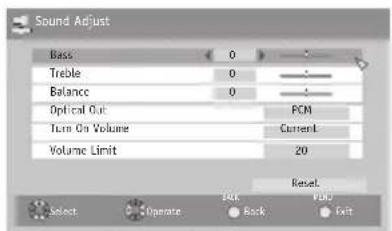
Sound Adjust Base 0 Treble 0 Balance 0 Optical Cut PCN Turn On Volume Current Volume Limit 20 Reset Select Operate Back FND ExitSound Adjust
text_image
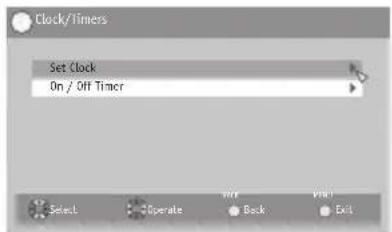
Clock/Timers Set Clock On / Off Timer Select Operate Back ExitClock/ Timers
Notes:
- The "Digital-In Size" menu can only be displayed when a 480p picture signal is input to the digital-in terminal and the picture is being displayed on the screen.
- For the Interactive Plug-In Menu, see page 21 -23.
• Digital Antenna Level appears only when a digital channel is displayed.
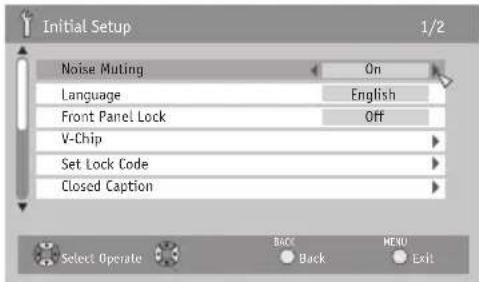
Noise Muting
This feature inserts a blank black screen over channels which are not broadcasting or are too weak to be received clearly.

Press the M
ENU button

To "Initial Setup"

To enter

To "Noise Muting"

To turn "On" or "Off"

ss the MENU button when finished
text_image
Initial Setup 1/2 Noise Muting On Language English Front Panel Lock Off V-Chip Set Lock Code Closed Caption Select Operate BACK Back MENU ExitNote:
- Noise muting will not work when you operate channel summary.
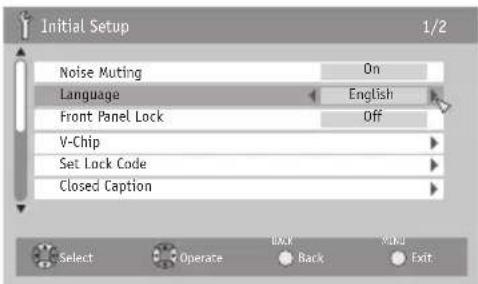
Language
The language function is described on page 21 as the interactive plug-in menu. If you need to choose the language again, follow the steps below.

ss the MENU button

To "Initial Setup"

To enter

To "Language"

To choose a language: English, French or
Spanish

ss the M
ENU button when finished
text_image
Initial Setup 1/2 Noise Muting On Language English Front Panel Lock Off V-Chip Set Lock Code Closed Caption Select Operate Back ExitFront Panel Lock
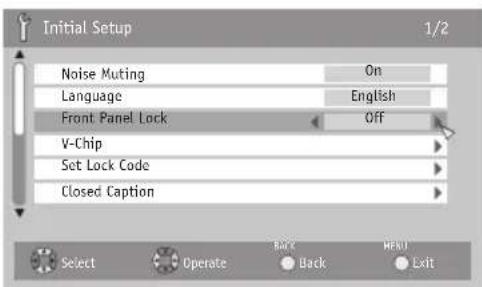
This allows you to lock the keys on the front of the TV, so that a child may not accidentally change your viewing preferences.

ess the M
ENU button

To "Initial Setup"

To enter

To "Front Panel Lock"

To turn "On" or "Off"

ess the MENU button when finished
text_image
Initial Setup 1/2 Noise Muting On Language English Front Panel Lock Off V-Chip Set Lock Code Closed Caption Select Operate Back Back MENU ExitYou can turn off this feature in the following ways:
- Unplug the power cord, and plug it back in. Do this if your batteries die, or you lose your remote control.
• Use the remote control. - Press the MENU button on the front of the TV for more than 3 seconds. In this case, the OSD for "Front Panel Lock" will appear.
Note:
- To turn ON/OFF the TV, press the BWER button for more than 3 seconds. This feature will remain ON.
Initial Setup
V-Chip
Your TV is equipped with V-Chip technology which enables you to block channels or content that you feel to be inappropriate for children, based on US and Canada rating guidelines. V-Chip has no effect on video signals from a DVD discs, VCR tapes or Camcorder connection.
Note: Some programs, and movies are broadcast without a ratings signal. Even if you set up V-CHIP ratings limits, these programs will not be blocked. See page 37 for information on how to block unrated programs.
Note (for Canadian viewers): The V-Chip function is based on specifications designed for the United States and therefore may not work properly in Canada.
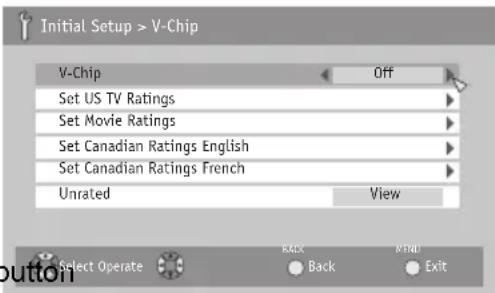
You can customize the V-Chip settings of your television to match your personal tastes. The V-Chip menu below is the starting point for your V-Chip settings
You can use US V-Chip settings (for programming broadcast from the United States), Canadian V-Chip settings (for programming broadcast from Canada), and movie ratings. You may use any or all of the settings (US V-Chip, Canada V-Chip, Movie ratings). Descriptions for setting each of the three V-Chip formats appear in the next six pages along with descriptions of the rating categories.
To access the rating categories:
Press the M
ENU button

To "Initial Setup"

To enter

To "V-Chip"

To operate (Password input screen will appear)
text_image
Initial Setup > V-Chip V-Chip Off Set US TV Ratings Set Movie Ratings Set Canadian Ratings English Set Canadian Ratings French Unrated View Back Menu Back Exit
Enter the password by using the 10 button
keypad
The V-Chip main screen will appear when the password is correct.

To turn V-Chip "On" or "Off" (V-Chip must be turned "On" for rating settings to operate)

To move to V-Chip menu (see following pages for descriptions of each item)
Notes:
- If you input the wrong password, go back to the initial Setup Menu.
- To set the password, see "Set Lock Code", page 38.
- "Advanced V-Chip Rating" and "Advanced Canadian Rating" menus may be displayed sometimes between "Set Canadian Ratings French" and "Unrated". These menus are reserved for future use, as of February 2006.
US V-Chip Ratings
U.S. PARENTAL RATING SYSTEMS
Programs with the following ratings are appropriate for children.
☐ TV Y is Appropriate for All Children
Programs are created for very young viewers and should be suitable for all ages, including children ages 2 - 6.
TV Y7 is for Older Children
Most parents would find such programs suitable for children 7 and above. These programs may contain some mild fantasy violence or comedic violence, which children should be able to discern from reality.
Programs with the following ratings are designed for the entire audience.
TV G stands for General Audience
Most parents would find these programs suitable for all age groups. They contain little or no violence, no strong language, and little or no sexual dialog or situations.
TV PG Parental Guidance Suggested
May contain some, but not much, strong language, limited violence, and some suggestive sexual dialog or situations. It is recommended that parents watch these programs first, or with their children.
☐ TV 14 Parents Strongly Cautioned
Programs contain some material that may be unsuitable for children under the age of 14 including possible intense violence, sexual situations, strong coarse language, or intensely suggestive dialog. Parents are cautioned against unattended viewing by children under 14.
☐ TV MA Mature Audiences Only
These programs are specifically for adults and may be unsuitable for anyone under 17 years of age. TV MA programs may have extensive V, S, L, or D.
Viewing Guidelines
In addition to the ratings categories explained above, information on specific kinds of content are also supplied with the V-Chip rating. These types of content may also be blocked. The content types are:
| • | V/FV is for VIOLENCE/FANTASY VIOLENCE |
| • | S stands for SEXUAL CONTENT |
| • | L stands for strong LANGUAGE |
| • | D stands for suggestive DIALOG |
Initial Setup
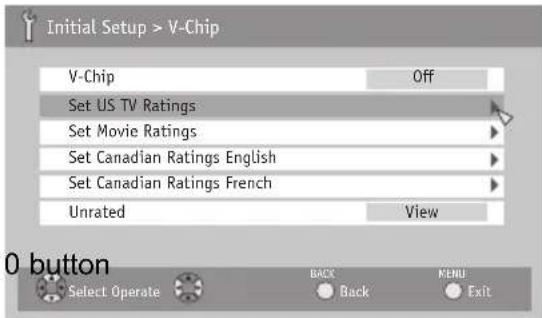
Setting US V-Chip Ratings


Press
the
MENU button
To "Initial Setup"
To enter
To "V-Chip"
To operate (Password input screen will appear)
keypad
text_image
Initial Setup > V-Chip V-Chip Off Set US TV Ratings Set Movie Ratings Set Canadian Ratings English Set Canadian Ratings French Unrated View 0 button Select Operate BACK MENU Back ExitThe V-Chip main screen will appear


To turn V-Chip "On" or "Off"
To move to "Set US TV Ratings"
To operate
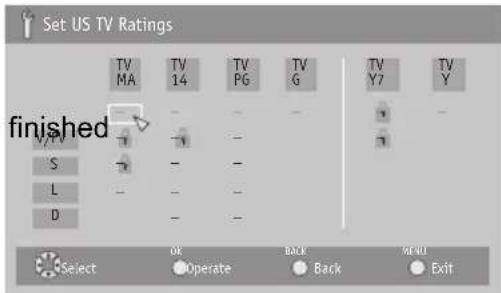
Directions to set US V-Chip Ratings
Line up the cursor in the column (TV PG, TV G, etc.) with the content row (V/FV, S, etc.) and press the ▲▼or ◀▶ to move the cursor to the correct location. Press Ok to turn the locking feature on or off. An item is locked if the 🔒 icon appears instead of a “—”.
For example. To block viewing of all TV 14 shows, move the cursor to the top row of that column and add a lock icon. Once you've put a lock on the top row, everything in that column is automatically locked.


To the TV 14 Column
Press the Ok button to lock
Press
the
MENU button when
text_image
Set US TV Ratings TV MA TV 14 TV PG TV G TV Y7 TV Y finished S - - - - - L - - - - D - - - - OK Operate Back Exit Select OK Operate Back ExitNote:
- If you want to change the setup, move the cursor to the top column and change the lock icon to “—” by pressing Ok again. You may then select individual categories to block.
Movies Ratings
□ NR – Not Rated
This is a film which has no rating. In many cases these films were imported from countries which do not use the MPAA ratings system. Other NR films may be from amateur producers who didn't intend to have their film widely released.
NR (Not Rated) Programming may contain all types of programming including children's programming, foreign programs, or adult material.
□ G – General Audience
In the opinion of the review board, these films contain nothing in the way of sexual content, violence, or language that would be unsuitable for audiences of any age.
PG – Parental Guidance
Parental Guidance means the movie may contain some contents such as mild violence, some brief nudity, and strong language. The contents are not deemed intense.
PG-13 – Parents Strongly Cautioned
Parents with children under 13 are cautioned that the content of movies with this rating may include more explicit sexual, language, and violence content than movies rated PG.
R - Restricted
These films contain material that is explicit in nature and is not recommended for unsupervised children under the age of 17.
□ NC-17 – No One Under 17
These movies contain content which most parents would feel is too adult for their children to view. Content can consist of strong language, nudity, violence, and suggestive or explicit subject matter.
☐ X - No One under 18
Inappropriate material for anyone under 18.
Directions to set Movie (MPAA) Ratings

Press the MENU button

To "Initial Setup"

To enter

To "V-Chip"

To operate (Password input screen will appear)

Enter the password by using the 10 button keypad
The V-Chip main screen will appear

To turn V-Chip "On" or "Off"

To "Set Movie Ratings"

To enter movies menu
For example:
To block viewing of X and NC-17 rated from shows:

To the X Column

Press the Ok button to lock

To the NC-17 Column

Press the Ok button to lock

Press ENutbetton to finish
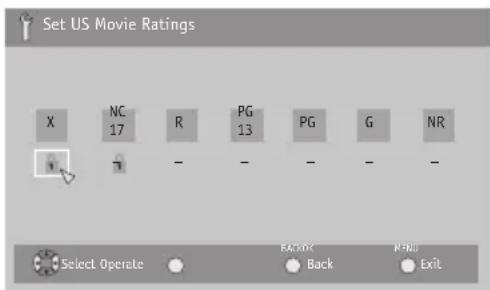
text_image
Set US Movie Ratings X NC R PG PG G NR 17 13 1 - - - - - Select Operate Back ExitInitial Setup
Canadian V-Chip Ratings
□ E - Exempt
Exempt programming includes: news, sports, documentaries and other information programming, talk shows, music videos, and variety programming.
☐ C – Programming Intended for Children
Violence Guidelines: There will be no realistic scenes of violence. Depictions of aggressive behavior will be infrequent and limited to portrayals that are clearly imaginary, comedic or unrealistic in nature.
☐ C8+ – Programming Intended for Children 8 and Over
Violence Guidelines: Any realistic depictions of violence will be infrequent, discreet, of low intensity and will show the consequences of the acts. There will be no offensive language, nudity or sexual content.
□ G – General Audience
Programming will contain little violence and will be sensitive to themes which could affect younger children.
PG – Parental Guidance
Programming intended for a general audience, but which may not be suitable for younger children. Parents may consider some content not appropriate for children aged 8-13.
☐ 14+ – 14 Years and Older
Parents are strongly cautioned to exercise discretion in permitting viewing by pre-teens and early teens. Programming may contain mature themes and scenes of intense violence.
□ 18+ - Adult
Material intended for mature audiences only.
Directions to set Canadian V-Chip Ratings

Press the MENU button

To "Initial Setup"

To enter

To "V-Chip"

To operate (Password input screen will appear)

Enter the password by using the 10 button keypad
The V-Chip main screen will appear

To turn V-Chip "On" or "Off"

To "Set Canadian Ratings English"

To enter ratings menu
For example:
To block viewing of programming rated 14+ and 18+:

To the 18+ Column

Press the Ok button to lock

To the 14+ Column

Press the Ok button to lock

ess the M
ENU button to finish
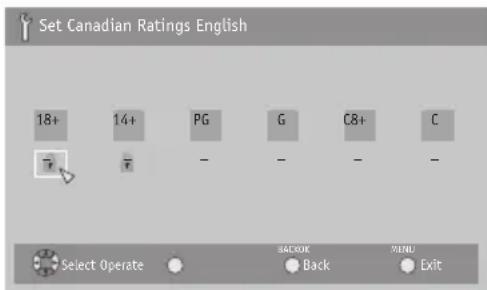
text_image
Set Canadian Ratings English 18+ 14+ PG G C8+ C - - - - - - Select Operate BACKOK MENU Back ExitNote:
- For instructions on “Set Canadian Ratings Fre (in French)”, please see page 36 in the French side of this user’s guide.
Unrated Programs
Unrated programming refers to any programming which does not contain a rating signal. Programming on television stations which do not broadcast rating signals will be placed in the “Unrated Programming” category.
Examples of Unrated programs:
- Emergency Bulletins
- Locally Originated Programming
- News
- Political Programs
- Public Service Announcements
- Religious Programs
- Sports
- Weather
- Some Commercials
Note:
- TV programs or movies that do not have rating signals will be blocked if the unrated category is set to "Block".
Directions to Block Unrated Programs
You can block programs that are not rated.

ess the M
ENU button
▲▼ To "Initial Setup"
◀▶ To enter
▲▼ To "V-Chip"
◀▶ To operate (Password input screen will appear)

Enter the password by using the 10 button
keypad
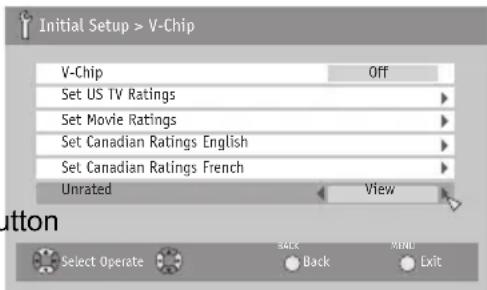
text_image
Initial Setup > V-Chip V-Chip Off Set US TV Ratings Set Movie Ratings Set Canadian Ratings English Set Canadian Ratings French Unrated View Select Operate Back Next ExitThe V-Chip main screen will appear
◀▶ To turn V-Chip "On" or "Off"
▲▼ To "Unrated"
◀▶ To "View" or "Block"

Press MENU when done
Initial Setup
Set Lock Code
Channel guard and V-Chip settings are protected by a four-digit lock code. Your TV comes pre-set with a lock code of "0000". You may change the code to any four-digit number you wish. To change the lock code, follow the steps below.


ess the M
ENU button
To "Initial Setup"
To enter
To "Set Lock Code"
To operate (Password input screen will appear)
Enter the password by using the 10 button
keypad
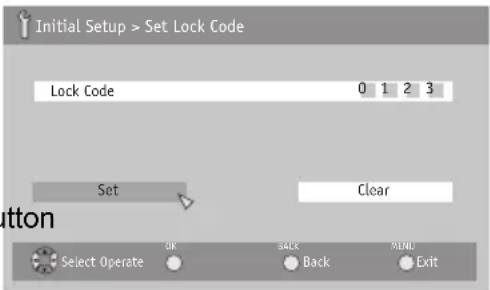
text_image
Initial Setup > Set Lock Code Lock Code 0 1 2 3 Set Clear Select Operate OK BACK END Back ExitThe Set Lock Code screen will appear


ess the O
To set the password, use the 10 button keypad
κ button to finish (your lock code is now set)
When a viewer attempts to watch a blocked channel, this message appears:
The channel will remain blocked until the correct lock code is entered (see above for information on setting your lock code).
This programming exceeds your rating limits.
Please enter lock code by 10 key pad to unlock it.
No. - - - -
Notes:
• After a power interruption you must reset the lock code.
- Write your lock code number down and keep it hidden from potential viewers.
- If you forget the lock code, a new code may be set using the steps listed above.
Channel Guard Message
When a viewer attempts to watch a guarded channel, the following message appears:
To watch a channel that you have locked, enter the Lock Code using the 10 key pad.
If the wrong code is entered, the message "invalid lock code!" will flash on the screen.
The channel cannot be accessed until the correct code is entered.
This channel is locked by channel guard.
Please enter lock code by 10 key pad to unlock it.
No. - - - -
Notes:
- Once a channel has been unlocked, it will remain unlocked until the television is turned off.
• See also "Set Lock Code", page 38.
Closed Caption
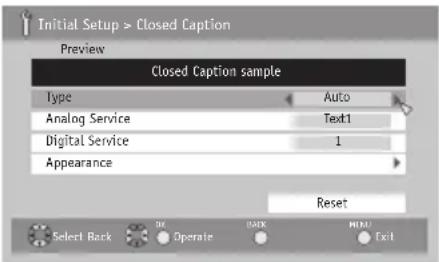
Many broadcasts now include an onscreen display of dialog called closed captions. Some broadcasts may also include displays of additional information in text form. Your television can access and display this information using the closed caption feature. To activate the closed caption feature, follow the steps below.
Auto Setting
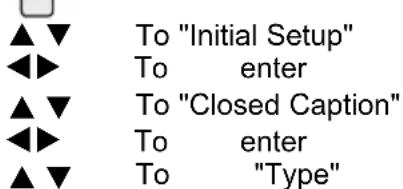
Press the MENU button
text_image
To "Initial Setup" To enter To "Closed Caption" To enter To "Type"◀▶ To select Auto, Advanced or Basic
text_image
Initial Setup > Closed Caption Preview Closed Caption sample Type Auto Analog Service(Text1) Digital Service 1 Appearance Reset Select Back OK Operate BACK MENU ExitAuto: Shows closed caption a priority for digital channels over analog channels. It is set automatically.
Advanced: Shows only the digital closed caption.
Basic: Shows only the analog closed caption.
▲ ▼To "Analog Service"
◀▶ To select a caption (CC1 to CC4) or text channel (Text1 to Text4)
▲▼To "Digital Service"
◀▶ To select 1, 2, 3, 4, 5 or 6
▲▼ To Appearance
◀▶ To enter
◀▶ To select "Auto" ("Manual", see page 40)
Press the MENU button when finished
Notes:
- If you want to reset your settings to the default settings, select "Reset".
- If you select "Advanced" for Type, you cannot select "Analog Service".
- If you select "Basic" for Type, you cannot select "Digital Service" and "Appearance".
- "Type", "Digital Service" and "Appearance" are for digital broadcasting. It has no effect for analog broadcasting.
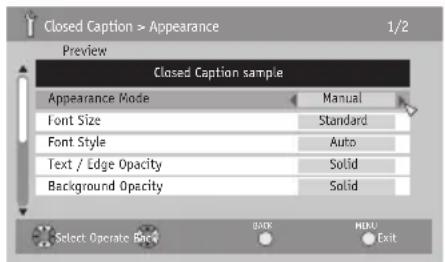
Manual Setting
◀▶ To select "Manual" for Appearance Mode
▲▼ To "Font Size", "Font Style", "Text/Edge Opacity", "Background Opacity", "Text Color", "Edge Color" or "Background Color".
◀▶ To select the setting you like
Font Size: Auto, Standard, Large or Small
Font Style: Auto, SerifMono, Serif, SanSerifMono, SanSerif, Casual, Cursive or SmallCapital
Text/Edge Opacity, Background Opacity: Auto, Transparent, Translucent, Solid, Flashing.
Text Color, Edge Color, Background Color: Auto, White, Black, Red, Green, Blue, Yellow, Magenta, or Cyan

Press the MENU button when finished
text_image
Closed Caption > Appearance Preview Closed Caption sample Appearance Mode Manual Font Size Standard Font Style Auto Text / Edge Opacity Solid Background Opacity Solid Select Operate Back BANK MENU Exit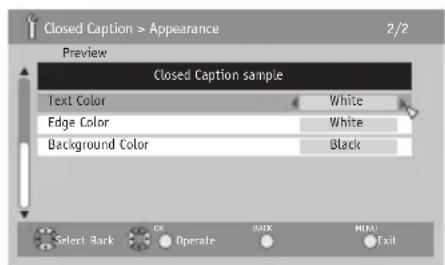
text_image
Closed Caption > Appearance 2/2 Preview Closed Caption sample Text Color White Edge Color White Background Color Black Select Back OK Operate BACK MENU EditAll fonts used for digital closed caption and digital menus are licensed from Monotype Imaging Inc.
Notes:
- Closed caption subtitles are usually found on closed caption channel CC1. Some programs may include additional text information which is usually found on text channel T1. The other channels are available for future use.
- Closed captioning may not work correctly if the signal being received is weak or if you are playing a video tape.
- Most broadcasts containing closed captioning will display a notice at the start of the program.
• To select the mode, press the C.C. button. See page 59. - When ZOOM aspects like PANORAMA or CINEMA are selected, Digital Closed Captions may be cut off or distorted.
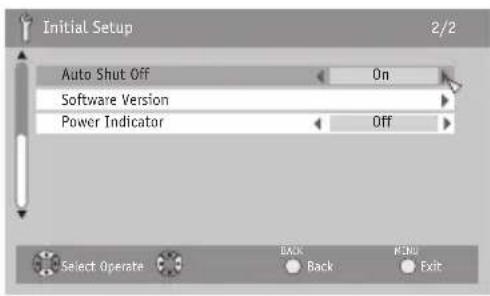
Auto Shut Off
This function automatically shuts off your TV when there is no signal from the channel the TV is on.


Press
theu button
To "Initial Setup"
To enter

To "Auto Shut Off"
To turn "On" or "Off"
Press
the
MENU button when finished
text_image
Initial Setup 2/2 Auto Shut Off On Software Version Power Indicator Off Select Operate BACK FND Back Exit- If the channel that you have on does not receive a signal for more than one minute, the blinking text "No
Program or Weak Signal Auto shut off in 9 min." appears on the screen, and starts the countdown. If no signal is being received within 10 minutes, the TV shuts itself off.
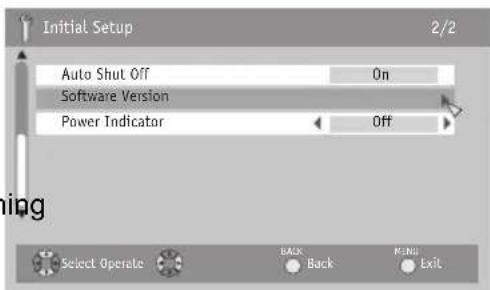
Software Version
You can confirm the Software Version.


ess the MENU button when finished
ENU button
To "Initial Setup"
To enter
Software Version"
To enter
Select close when you are finished confirming your software version
text_image
Initial Setup 2/2 Auto Shut Off On Software Version Power Indicator Off Select Operate BACK Break ExitPower Indicator
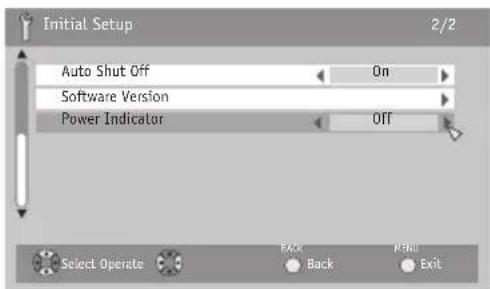
Power indicator allows you to adjust the brightness of the power indicator


Press the M
ENU button
To "Picture Adjust"
To enter
To Power Indicator
To adjust POWER INDICATOR LOW, HIGH or OFF
text_image
Initial Setup 2/2 Auto Shut Off On Software Version Power Indicator Off Select Operate Back ExitNote:
- If you set a timer on the TV, the power indicator will light even if the TV is on stand by.
Tuner Setup
Auto Tuner Setup
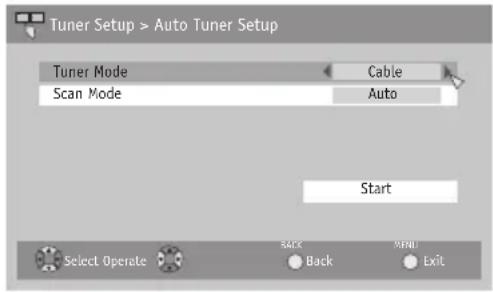
The auto tuner setup function is described on page 23 as the interactive plug-in menu. If you need to run the auto tuner setup again, follow the steps below.

ess the M
ENU button

To "Tuner Setup"
To enter

To "Auto Tuner Setup"
To enter

To choose "Cable" or "Air"

To "Scan Mode"
To choose "Auto", "STD", "HRC" or "IRC"
To "Start"
text_image
Tuner Setup > Auto Tuner Setup Tuner Mode Cable Scan Mode Auto Start Select Operate SACK MENU Back Exit
Press the OK button (Programming will take several minutes)
The auto tuner is finished when the message "Programming Over!" appears onscreen.

Press the MENU button when finished
Notes:
- When the Tuner Mode is set to "Cable", it is possible to select "Scan Mode"
- If no channels were found using Auto Tuner Setup, check your antenna cable and the settings for Tuner Mode/Scan Mode.
Channel Summary
Channel summary allows you to customize the line-up of channels received by your TV. Regarding analog channels, you can add or delete channels from the line-up or prevent any unauthorized viewers from watching any or all 191 channels. Regarding digital channels, the only channels that will appear are the ones that are broadcasting.

ess the M
ENU button

To "Tuner Setup"
To enter

To "Channel Summary"
To operate
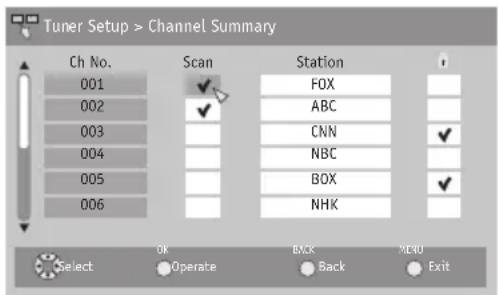
The Channel summary screen will now be displayed with the channels set to scan marked with an “√”. Regarding analog channels, you can delete channels from the scan by removing the “√”. If any channels were missed during auto tuner setup and you wish to add them, you may by placing an “√” next to the channel number.
text_image
Tuner Setup > Channel Summary Ch No. 001 002 003 004 005 006 Scan FOX ABC CNN NBC BOX NHK Station Select OK BACK CENU Operate Back Exit- Digital channels can not be added to the channel summary if the auto tuner setup did not find them.


To the "Scan" column

Press the Ok button to include or delete from scan

ess the MENU button when finished
Note:
- The number of a digital channel may change, depending on the time of some broadcastings. If this channel existed and now had disappeared, the lock channel or scanned channel by the channel summary for that channel will be cancelled.
Tuner Setup
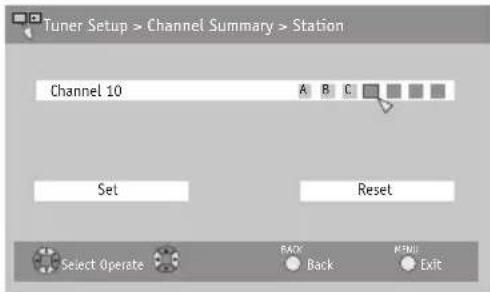
How to set the channel station.

ess the M
ENU button

To "Tuner Setup"

To enter

To "Channel Summary"

To operate

To "Station"

ess the Ok button to enter

To select the character you want

To move to the next space
text_image
Tuner Setup > Channel Summary > Station Channel 10 A B C Set Reset Select Operate PACK MENU Back Exit...continue to follow these directions for all seven spaces

To "Set"

ess the O
κ button
Your characters are now set

ess the M
ENU button when finished
If you want to reset the characters you set:

ess the M
ENU button

To "Tuner Setup"

To enter

To "Channel Summary"

To operate

To "Station"

ess the Ok button to enter

To select "Reset"

ess the O
κ button to finish
Your characters are now reset
Notes:
- You can use characters for: Alphabet, numbers, marks and spaces.
- It is possible to set the maximum of 500 channel labels.
- If you try to set more than the 500 maximum, the message "Memory Overflow" will appear.
You can block access to a channel by activating the channel lock.

ss the MENU button

To "Tuner Setup"

To enter

To "Channel Summary"

To operate

◀▶ To the Lock Column ( 🔍 )

ss the O
κ button to lock or unlock that channel

ss the MENU button when finished
Tuner Setup
Find Channel
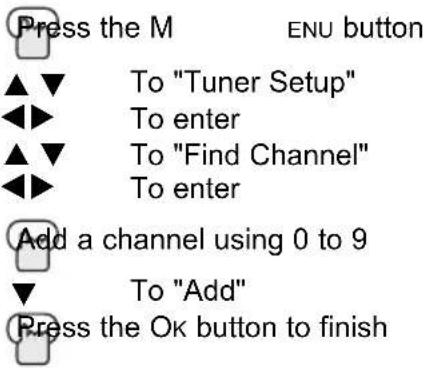
Add a channel that does not exist in the channel map.
text_image
Press the M ENU button ▲▼ To "Tuner Setup" ◀▶ To enter ▲▼ To "Find Channel" ◀▶ To enter Add a channel using 0 to 9 ▼ To "Add" Press the Ok button to finish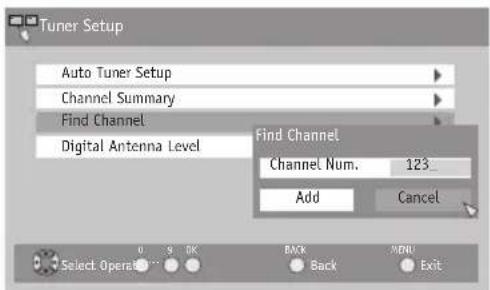
text_image
Tuner Setup Auto Tuner Setup Channel Summary Find Channel Digital Antenna Level Find Channel Channel Num. 123 Add Cancel 0 9 OK BACK END Back Exit Select Operat...Digital Antenna Level
Confirms the present antenna level.
Press the MENU button
text_image
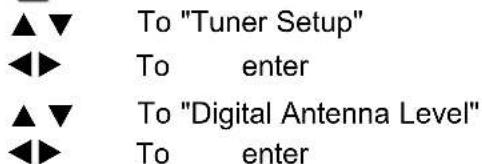
▲▼ To "Tuner Setup" ◀▶ To enter ▲▼ To "Digital Antenna Level" ◀▶ To enter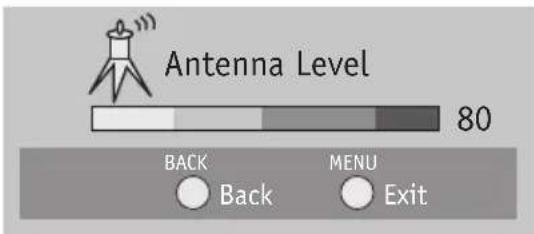
text_image
Antenna Level 80 BACK Back MENU ExitNote:
• If you are watching an analog channel, antenna level will not appear.
Digital-In Size
The DIGITAL-IN option can only be displayed in the External Input menu when an HDMI480p picture signal is being input to the DIGITAL-IN terminal. This option adjusts the position when an HDMI or DVI 480p picture signal is being displayed on the screen. There are two types of HDMI480p picture signals: 640x480 and 720x480. If the displayed picture is slightly shifted, the position can be adjusted by selecting either Auto, Size1 or Size2.

Press the M
ENU button

To "External Input"

To enter

To "Digital-In Size"

To enter

To select "Auto", "Size1" or "Size2"

Press the MENU button to finish
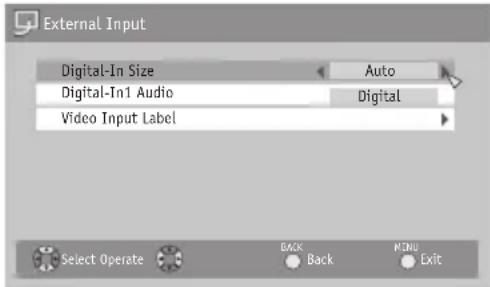
text_image
External Input Digital-In Size Auto Digital-In1 Audio Digital Video Input Label Select Operate BACK Menu Back ExitNotes:
- The Digital-In Size menu can only be displayed when a HDMI or DVI 480p picture signal is input to the Digital-In terminal and the picture is being displayed on the screen.
- You can select "Auto" only when the signal is 480p for HDMI. When you select "Auto", the television will select "Size1" or "Size2" automatically.
Digital-In1 Audio
This feature is used if you have a DTV or HDMI compatible component connected to your TV.

ss the MENU button

To "External Input"

To enter

To "Digital-In1 Audio"

To select "Analog", "Digital" or "Auto"

ss the Menu button when fi nished
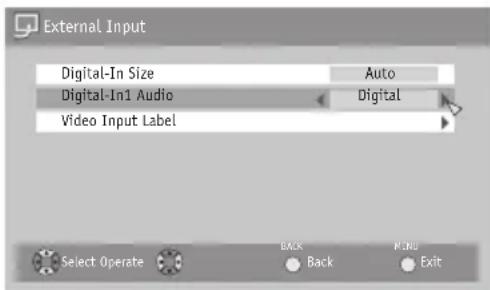
text_image
External Input Digital-In Size Auto Digital-In1 Audio Digital Video Input Label Select Operate BACK Enter ExitNotes:
- If your DTV or HDMI component is capable of digital audio and video, choose "Digital". If your DTV or HDMI
component is capable of analog audio and digital video, choose "Analog". - Refer to your DTV or HDMI component's instruction manual for more information.
- When you select "Auto", the television will select "Analog" or "Digital" automatically, depending on the audio input from the HDMI.
- When you select "Digital", select PCM on Optical Out in Sound Adjust menu. See page 52.
- When you want to use analog audio, connect audio cables into Video-3 input jacks.
External Input
Video Input Label
This function is used to label video input connections for the onscreen displays.

Press the M ENU button

To "External Input"

To enter

To "Video Input Label"

To operate

o select the desired video input

To select the desired preset input label (see chart below)

To "Set"

Press the O κ button to save

Press the M ENU button when finished
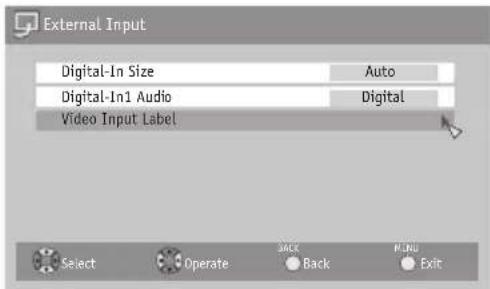
text_image
External Input Digital-In Size Auto Digital-In1 Audio Digital Video Input Label Select Operate SACK Back MENU Exit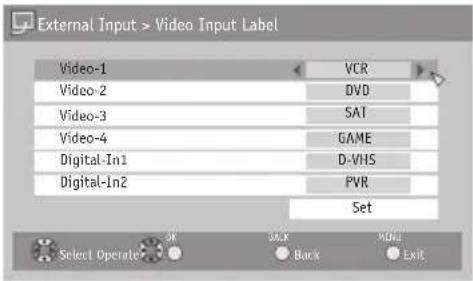
text_image
External Input > Video Input Label Video-1 VCR Video-2 DVD Video-3 SAT Video-4 GAME Digital-In1 D-VHS Digital-In2 PVR Set Select Operate OK SICK MOUT Back Exit| Preset Labels | Select when... |
| VCR | You have a VCR connected to the video input |
| DVD | You have a DVD connected to the video input |
| PVR | You have a Personal Video recorder connected to the video input |
| D-VHS | You have a Digital VCR connected to the video input |
| STB | You have a Set-top Box connected to the video input |
| SAT | You have a Satellite Receiver connected to the video input |
| AMP | You have an Amplifier connected to the video input |
| GAME | You have a Video Game connected to the video input |
| CAM | You have a Video Camera connected to the video input |
| DISC | You have a Video Disc player connected to the video input |
Picture Adjust
Picture Settings
These settings allow you to change and adjust the way the picture appears on your television.
Tint
Tint allows you to adjust the levels of red and green in your TV picture.
Color
The color function lets you make all the colors in the TV picture appear either more vivid or subtle.
Picture
Picture allows you to adjust the levels of black and white on the TV screen, giving you a darker or brighter picture overall.
Bright
You can adjust the overall brightness of the TV picture with the Bright control.
Detail
The Detail feature adjusts the level of fine detail displayed in the picture.
Adjust the Picture Settings


text_image
▲▼ To "Picture Adjust" ◀▶ To enter ▲▼ To "Tint", "Color", "Picture", "Bright" or "Detail" ◀▶ To enter
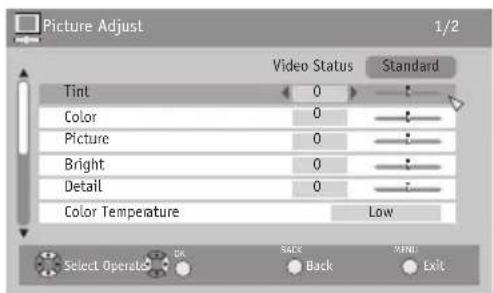
text_image
Picture Adjust 1/2 Video Status Standard Tint 0 Color 0 Picture 0 Bright 0 Detail 0 Color Temperature Low Select Operated OK BACK END Back Exit◀▶ To adjust the setting
▲ ▼To move to the next setting
Press the MENU button when finished
Color Temperature
You can decide how strong or dull the colors appear on the TV screen.
Press the M
ENU button
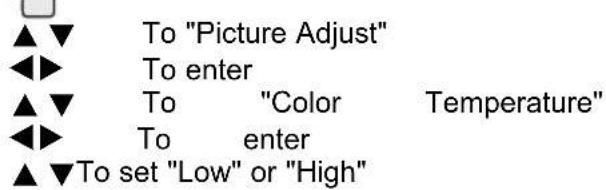
text_image
To "Picture Adjust" To enter To "Color Temperature" To enter ▲▼ To set "Low" or "High"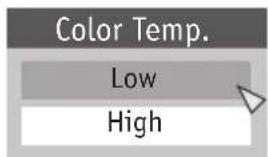
text_image
Color Temp. Low High
Note:
- If you are receiving a 1080i or 720p digital channel in its original format, you can adjust the Picture Settings and Color Temperature independently from all the other channels.
Picture Adjust
Noise Reduction
With Noise Reduction, this helps take our static or noise from a channel that may not be coming in clearly.
Press the M ENU button
▲▼ To "Picture Adjust"
◀▶ To enter
▲▼To "Noise Reduction"
◀▶ To enter
▲ ▼To select the mode "Low", "High" or "Off"
Press the M ENU button when finished
Note:
- This function only works for 480i signal only.
Noise Reduction
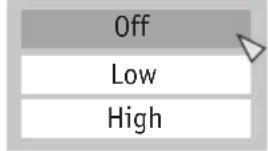
text_image
Off Low HighNatural Cinema
Natural cinema corrects the problem of blurred edges which may occur when viewing a program originally shot on film (such as motion pictures) or animation. If you notice blurring at the edges of these programs, choose "Natural Cinema" and set it to "On". Natural Cinema helps correct conversion errors that occur when film, which is shot at 24 frames-per-second, is broadcast at the television rate of 30 frames-per-second.
Press the MENU button
▲▼ To "Picture Adjust"
◀▶ To enter
▲ ▼To "Natural Cinema"
◀▶ To enter
▲ ▼To select the mode "On" or "Off"
Press the M ENU button when finished
Natural Cinema
Picture Adjust
Position Adjustment
Position adjustment allows you to adjust the position of the picture on the screen vertically when the aspect is set to panorama or cinema.
Press the M ENU button
▲▼ To "Picture Adjust"
◀▶ To enter
▲▼ To Position Adjustment
◀▶ To enter
▲▼ To adjust the position
Press the M ENU button to finish
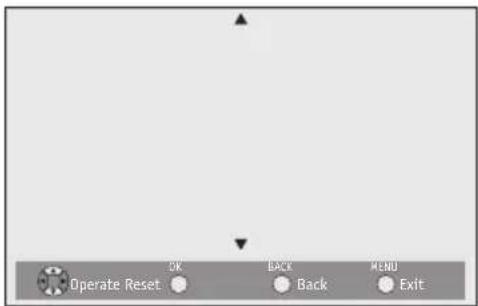
text_image
Operate Reset OK Back MEND Back ExitNotes:
• To reset the adjustment to the center, press the Ⓠ button.
- When the arrow disappears, while you are adjusting the position, the position is at it's maximum limit.
- If you select regular size or full with aspect, position adjustment option is not seen.
- When you change the screen size, perform the position adjustment again.
- Position adjustment allows you to adjust the screen position vertically when the aspect is set Panorama Zoom or Cinema Zoom for 1080i and 720p signals.
Picture Adjust
Adjusting CRT Color Convergence
This TV has three color projection tubes: one for red, green, and blue. When mixed together in the proper portions, the output of these three color tubes can produce any color. To produce these colors, however, the beams must be precisely aligned over each other so that the colors can be mixed. The produce of aligning these picture beams is called “convergence”.
Attention:
- Please have your TV on for at least 20 minutes before using this feature.
- This adjustment will be needed only when the colors of the characters/lines are separated and lack in distinction. If not, please don't perform the adjustment.
Colors may become separated after the TV has been moved, or over a long period of time if regularly subjected to low levels of vibrations. If the colors become separated, please perform the adjustments below again.
Manual

Press the MENU button

To "Picture Adjust"

To Enter

To CONVERGENCE

To Enter

To choose MANUAL

To Enter
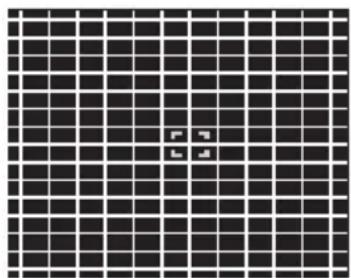
natural_image
Grid pattern with scattered small squares and a central dot, no text or symbols presentIf all the lines are white, no convergence adjustment is necessary. If not, you need to perform the manual color convergence below.

Select the location you want to adjust by using the number buttons on the remote control. You can select any of the 81 points.
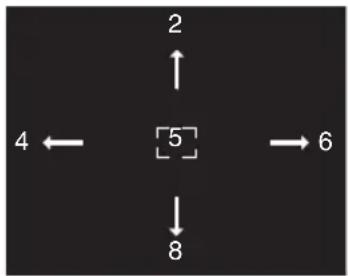
flowchart
graph TD
    A["2"] --> B["5"]
    C["4"] <--_D["←"]
    E["8"] --> F["→ 6"]

Press the SEP button to change the color of the box : to the color of the cross you wish to adjust (red or blue).

Adjust the position of the cross.
Adjust the three color crosses until they overlap and appear as a single white cross.

Press the Ok button
Notes:
- When you adjust the convergence, make sure you start with the center position (position 5), and work your way around radially for best results.
- When you make the adjustment in the center (position 5), you are making the adjustment for the whole screen. In other positions, you are making the adjustment only in that area.
- You can reset the adjustment if you do not like the results.
Picture Adjust
Reset
Reset resets all picture adjustments at once to the default settings.

ess the M
ENU button


To "Picture Adjust"
To enter
To "Reset"
Press the Ok button
The onscreen menu disappears for a moment, and then the settings are reset to the default setting for all the picture adjustments.
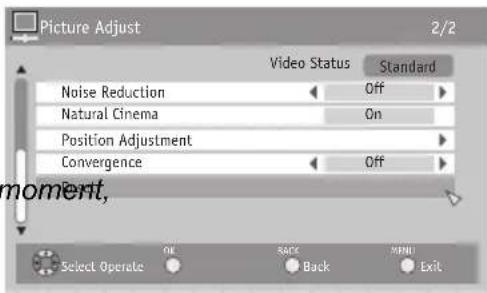
text_image
Picture Adjust 2/2 Video Status Standard Noise Reduction Off Natural Cinema On Position Adjustment Convergence Off Select Operate OK BACK MENU Exit Moment,
ess the M
ENU button when finished
Sound Adjust
Sound Settings
These settings allow you to change and adjust the sound on your television.
Bass – You can increase or decrease the level of low-frequency sound in the TV's audio with the bass adjustment.
Treble – Use treble to adjust the level of high-frequency sound in your TV's audio.
Balance – Adjust the level of sound between the TV's left and right speakers with the balance setting.
Adjust the Sound Settings
Press the MENU button

To "Sound Adjust"

To enter

To "Bass", "Treble" or "Balance"

To adjust the setting

o move to the next setting

ess the MENU button when finished
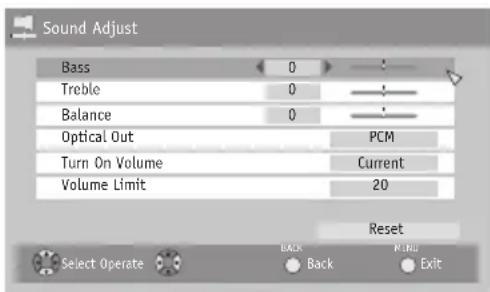
text_image
Sound Adjust Bass 0 Treble 0 Balance 0 Optical Out PCM Turn On Volume Current Volume Limit 20 Reset Select Operate BACK Return ExitNotes:
- You can reset all sound adjustments you set at once as the default setting when you select reset. See page 51.
Optical Out
You can select the optical digital sound output, either PCM or Dolby Digital when your TV is connected to an amplifier that has Dolby Digital decoder. If you select Dolby Digital, you can enjoy listening in 5.1ch sound when watching digital broadcasts.
Press the M
ENU button

To "Sound Adjust"

To enter

To "Optical Out"

To select "PCM" or "DOLBY DIGITAL"

ess the MENU button when finished
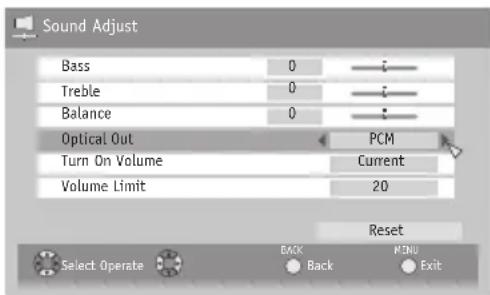
text_image
Sound Adjust Bass 0 Treble 0 Balance 0 Optical Out PCM Turn On Volume Current Volume Limit 20 Reset Select Operate BACK MENU Back ExitNotes:
- If your amplifier does not have Dolby Digital decoder, select PCM. If you don't select PCM, it cannot output the sound from the speakers.
- For connecting an amplifier using the optical output, see page 17.

DOLBY
DIG
ITAL
Manufactured under license from Dolby Laboratories. "Dolby", and the double-D symbol are trademarks of Dolby Laboratories.
Sound Adjust
Turn On Volume
Turn On Volume allows you to set the volume level when you turn the TV on.


Press the M ENU button
To "Sound Adjust"
To enter
To "Turn On Volume"
To set the volume level


Press the MENU button to finish
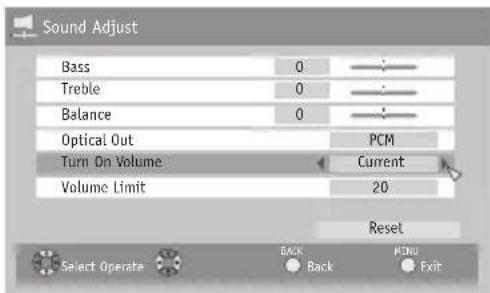
text_image
Sound Adjust Bass 0 Treble 0 Balance 0 Optical Out PCM Turn On Volume Current Volume Limit 20 Reset Select Operate BACK MENU Back ExitVolume Limit
Volume Limit allows you to set the maximum volume level.


Press the MENU button
To "Sound Adjust"
To enter
To "Volume Limit"
To set the maximum volume level


Press the M ENU button to finish
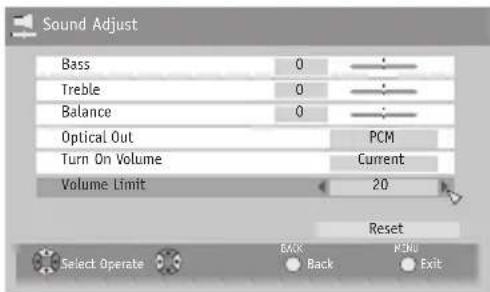
text_image
Sound Adjust Bass 0 Treble 0 Balance 0 Optical Out PCM Turn On Volume Current Volume Limit 20 Reset Select Operate BACK PCPU Back ExitReset
Reset resets all Sound Adjustments at once to the default settings. See page 51 on how to use reset.
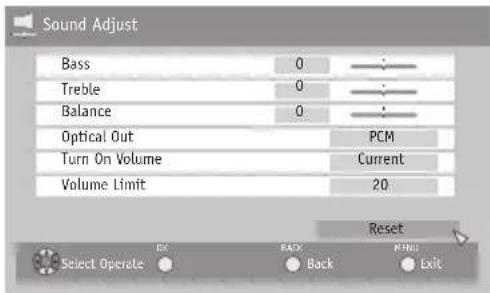
text_image
Sound Adjust Bass 0 Treble 0 Balance 0 Optical Out PCM Turn On Volume Current Volume Limit 20 Reset Select Operate Back ExitClock/ Timers
Set Clock
The set clock function is described on page 22 as the interactive plug-in menu. You can choose to set the clock automatically, or manually. If you need to set the clock again, follow the steps below.


Press
the
MENU button
To "Clock/ Timers"
To enter
To "Set Clock"
To
operate
When you set the clock automatically, choose "Auto" by pressing the ◀ or ▶ arrows.


To Time Zone
To select your time zone

flowchart
graph LR
    A["Atlantic"] <--> B["Eastern"]
    B <--> C["Central"]
    C <--> D["Mountain"]
    D <--> E["Pacific"]
    E <--> F["Alaska"]
    F <--> G["Hawaii"]
    G <--> H["Atlantic"]

To D.S.T. (daylight savings time)

To turn D.S.T. On or Off

o "Start Clock"

Press
κ buiten
O

Press
ENutbetton when Finished
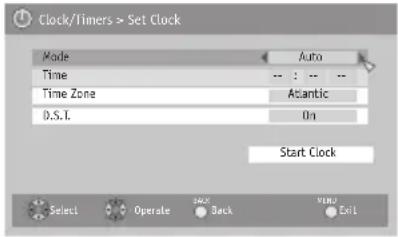
text_image
Clock/Timers > Set Clock Mode Auto Time -- : -- Time Zone Atlantic D.S.T. On Start Clock Select Operate SAM Back SEM CellWhen you set the clock manually, choose "Manual" by pressing the ◀ or ▶ arrows.

To move to the hour

To set the hour

To move to minutes

To set the minutes

To Time Zone
To select your time zone:
(Atlantic, Eastern, Central, Mountain, Pacific, Alaska or
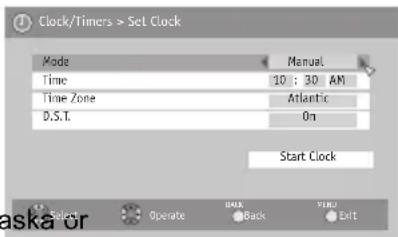
text_image
Clock/Timers > Set Clock Mode Manual Time 10 : 30 AM Time Zone Atlantic D.S.T On Start Clock aska or Operate Back ExitHawaii)

To D.S.T. (daylight savings time)

To turn D.S.T. On or Off

o "Start Clock"

Press
the
Ok button
"Thank you!" will be displayed.

Press
the
MENU button when finished
Notes:
• D.S.T. can be used only for US and Canada when it is set to "On" in the "Set Clock" menu.
- Only when the "Mode" set to "Auto", the Daylight Savings Time feature automatically adjusts your TV's clock for Daylight Savings. The clock will move forward one hour at 2:00 am on the first Sunday in April. The clock will move back one hour at 2:00 am on the last Sunday in October.
- You will have to reset the clock after a power interruption. You must set the clock before operating any timer functions.
On/Off Timer
The on/off timer lets you program your television to turn itself on or off. You can use it as an alarm to wake up, to help you remember important programs, or as a decoy when you're not home.
Press the MENU button
▲▼ To "Clock/ Timers"
◀▶ To enter
▲▼ To "On/Off Timer"
◀▶ To operate (begins with "On Time")
◀▶ To set the hour (AM/PM) you want the TV to turn on
▼o move to minutes
◀▶ To set the minutes
To accept "On Time" and move to "Off Time" (the time the TV will turn off). Set the "Off Time" the same way as "On Time"
To accept "Off Time" and move to "Channel"
◀▶ To select channel
To "On Volume"
◀▶ To set the volume level
▼o move to "Mode"
◀▶ Choose "Once" or "Everyday"
▼ To "On/Off Timer"
Choose "Yes" to accept the timer setting, choose "No" if you don't wish to accept
▼ To "Set"
Press the Ok button
Press the MENU button to exit the menu
Notes:
- The on/off time cannot be set to locked or guarded channels.
- In order for the on/off timer to work, the clock must be set.
• After a power interruption, the timer settings must be reset. - If your clock is not set, "Please set clock first!" will appear on the screen. Please see Manual Set Clock on page 54 to set the clock.
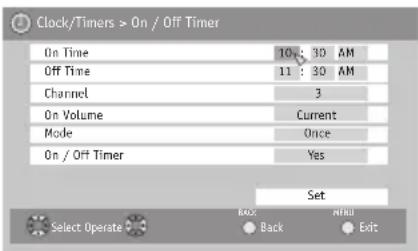
text_image
Clock/Timers > On / Off Timer On Time 10:30 AM Off Time 11:30 AM Channel 3 On Volume Current Mode Once On / Off Timer Yes Set Select Operate BOX Add Back ExitButton Functions
Power
Turns the TV on or off.

ess the P
OWER button
Number Buttons - 10Key Pad
Use the number buttons on the remote control to move directly to a specific channel. For example, to move to channel 12:

0 ERO) (Z

1 NE) (O

2 wo) (T
Tune
Lets you decide the input channel and select it. After you press the number buttons on the remote, press the TUNE button. For example, to move to channel 12:

1 (ONE)

2 (Two)

Press the TUNE button
Input
Selects the signal input source for the television: Video-1, 2, 3, 4, Digital-In1 or Digital-In2 for video devices like VCR's DVD players, or camcorders.

less the INPUT button
By every press of the I
NPUT button, you can change the input mode.
Notes:
- When you return to TV mode, press the RETURN+/TV button or direct 10 key pad.
- You can also access the "Front Menu" screen by using the MENU button on the side of the TV instead of the remote control. It has "Input", "Video Status" and "Aspect" menus. Choose "Input" by pressing Menu ▼ on the side panel and choose a mode by using the CHANNEL+/-buttons ( ◀ OPERATE ▶ ).
Channel +/-
Use these buttons to move up or down all the available channels your TV is able to receive, and navigate in the menus.
Volume +/-
Use these buttons to raise or lower the TV's volume level, and navigate in the menus. The maximum is the level you set in Volume Limit. See page 53.
Return +/TV
The Return+/TV button has two functions:
Return - Returns to the channel viewed just before the channel currently onscreen.
Return+ - Lets you program a specific channel to return to while scanning through the channels using the CH+ and CH- buttons.

RETURN+/TV and hold for three seconds
Return Channel (123-456)
Programmed!
The channel currently active has been programmed as your return+ channel. Now scan through the channels using the CHANNEL+/- buttons.

RETURN+/TV
You will return to your programmed channel.
- To cancel your return+ channel, press and hold the RETURN+/TV button for three seconds. The message "Return Channel Cancelled!" will appear.
Sound
By pressing the SOUND button, you can change the A.H.S. (Advanced Hyper Surround) and SMART SOUND on or off.
A.H.S. - Adds a more spacious surround sound. Music gives basic effect and movie for more effect.
Smart Sound - Decreases high sound levels, giving a regulated sound level.
Press the SOUND button
▲▼ To select "A.H.S." or "Smart Sound"
◀▶ To choose the setting
Press the M ENU when finished
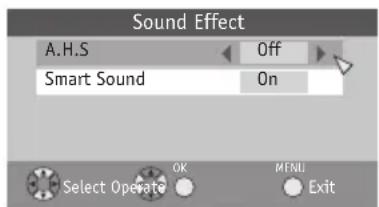
text_image
Sound Effect A.H.S Off Smart Sound On Select Operate OK MENU ExitMuting
The MUTING button instantly turns the volume down completely when you press it. Press MUTING and the volume level will instantly go to zero. To restore the volume to its previous level, press MUTING again.
Button Functions
Video Status
The Video Status button gives you a choice of four TV picture display settings, including a display of your own preferences.
Standard - Resets the picture display to the factory settings.
Dynamic - Gives a vivid picture with better contrast when viewing in a brightly lit room.
Theater - Gives a rich, film-like look to video when viewing in a dimly lit room.
Game - Used for when you are playing video games connected to your TV.
Video Status
Standard
Dynamic
Theater
Game

ess the V
IDEO STATUS button
By every press of the VIDEO STATUS button, you change the mode.
Note:
- You can also change the mode by pressing the ▲▼ buttons.
- You can also access the "Front Menu" screen by using the MENU button on the side of the TV instead of the remote control. It has "Input", "Video Status" and "Aspect" menus. Choose "Video Status" by pressing Menu ▼ on the side panel and choose a mode by using the CHANNEL+/- buttons ( ◀ OPERATE ▶ ).
TheaterPro D6500K
The TheaterPro D6500K color temperature technology function makes sure that the video you watch is set to the standard color temperature, so that what you see is as true to what the film to video editors intended it to be.

Press
the
THEATER PRO button
Sleep Timer
The Sleep Timer can turn the TV off for you after you fall asleep. Program it to work for a total time of up to 180 minutes. When you press the SLEEP TIMER button once, the rest of the time will be displayed.

Press
LEEPTimer buttonTwice
By every press of the button, you select the time for the timer to shut off
60 seconds before the automatic shut off, this message will appear:
Good Night! Push [SLEEP TIMER] button to extend.
Sleep Timer
0 min.
15 min.
30 min.
45 min.
60 min.
90 min.
120 min.
180 min.
You then have 60 seconds to press the SLEEP TIMER button to delay the shut off.
Note:
- You can also select the timer by pressing the ▲▼ buttons.
Button Functions
Display
The display screen shows the current information as follows.

ess the D
ISPLAY button

flowchart
graph LR
    A["Detailed mode Clock Mode Simple Mode Off"] --> B["Output"]
- Detailed Mode - Shows the channel, channel name, signal, rating information, current time, digital antenna level and scramble information, as well as the current time below.

text_image
HD1080i CC ((o) (S)) Dolby Digital TV PG D L S V 10BR1 11:00PM - 11:30PM Football fun meeting WEWEWEW• Clock Mode - Shows the current time.
10:15PM
- Simple Mode - Shows the current channel and channel name or AV input.
- Off - Turns the display off.
Notes:
- You may also turn off the display at any step by pressing MENU.
- If the clock is not set, "Clock Not Set" will be displayed.
- A signal being shown in Detailed Mode, will only show the kind of input and video signal you are receiving. However, the actual signal type you see will be different. This TV converts all signals to the 1080i format.
C.C. (Closed Caption)
Use the C.C. (Closed Caption) button to select the mode of closed caption.
Press the C.C. button
Notes:
- Smart Caption will appear when you press the Muting button, only on channels where the broadcast contains closed captioning.
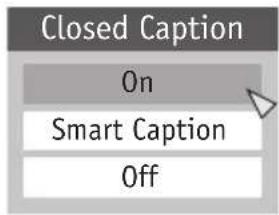
text_image
Closed Caption On Smart Caption Off- When you select "On", it will be the mode selected in the Closed Caption Menu.
• See page 39 when you set the caption/text mode.
- You can also change the mode by pressing the ▲▼buttons.
Button Functions
Aspect
This feature will help you adjust the picture you are watching to give you the best possible picture quality.
Aspect Ratios
PANORAMA - With this ratio a normal 4:3 aspect picture is stretched to fit the dimensions of the 16:9 aspect screen.
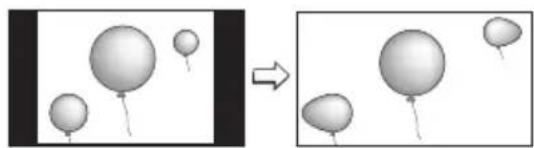
natural_image
Two-panel image showing a sequence of balloons on a surface, one before and after transformation (no text or symbols)CINEMA - This ratio "zooms in" on the center part of a 4:3 aspect picture, blowing it up to fill the 16:9 screen.
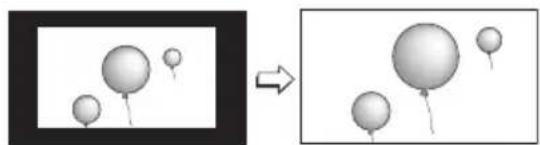
natural_image
Diagram showing two stages of balloons shifting from a blank image to an expanded view, no text or symbols present.FULL - This is the ratio to use when watching 16:9 High-Definition broadcasts.
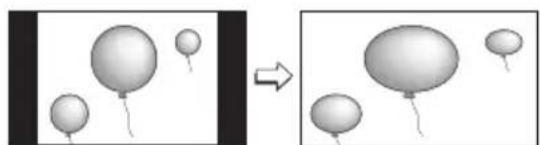
natural_image
Diagram showing two stages of balloons shifting from left to right, with no text or symbols present.PANORAMA ZOOM - This ratio stretches the High-Definition 16:9 aspect image to eliminate the black side bars.
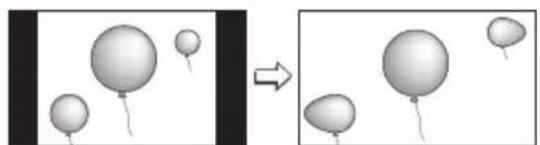
natural_image
Two-panel image showing balloons floating in a row, before and after transformation (no text or symbols)CINEMA ZOOM - This ratio stretches the High-Definition 16:9 aspect image to eliminate the black surrounding bars.

natural_image
Diagram showing a magnified view of balloons before and after transformation (no text or symbols)REGULAR - The regular ratio is used when you want to watch a 4:3 broadcast or recorded program without modifying the original picture to fit the dimensions of your 16:9 screen. The 4:3 picture will fill the screen from top to bottom, while black bars will appear to fill up the remaining space along the picture's sides. The 4:3 picture will be centered within the boundaries of the 16:9 screen.

SLIM - This aspect mode shrinks the screen of 16:9 to 4:3. There are some programming that is already stretched by mistake at broadcasting companies, so this mode corrects it. Black side bars will appear.
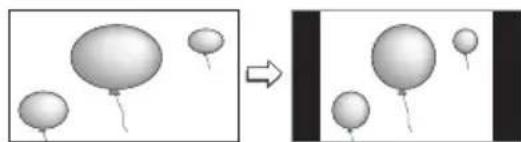
natural_image
Diagram showing two panels of balloons with one being rotated, no text or symbols presentAspect Ratios (Continued)

Press
the
ASPECT button
sBycorbsting, you can change the size.
When you change the aspect ratios, it is different from their broadcast or recorded program.
Receiving 4:3 signal
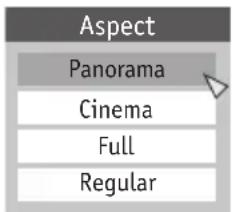
text_image
Aspect Panorama Cinema Full RegularReceiving 16:9 signal
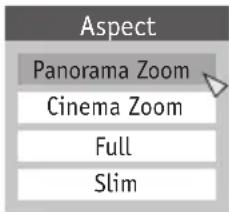
text_image
Aspect Panorama Zoom Cinema Zoom Full SlimNotes:
- You can also choose the size by pressing the ▲▼ buttons.
- When you change the aspect ratio or signal, reset the picture position to center.
- You can also access the "Front Menu" screen by using the MENU button on the side of the TV instead of the remote control. It has "Input", "Video Status" and "Aspect" menus. Choose "Aspect" by pressing MENU ▼ on the side panel and choose a mode by using the CHANNEL +/- buttons ( ◀ OPERATE ▶ ).
- If the television receives a 16:9 signal from your HDMI device, the aspect mode will turn to "Full" automatically. If the television receives a 4:3 signal from your HDMI device when you are in "Full" aspect mode, it will return to "Regular" aspect mode. If you change the aspect mode after the television changed it to "Full" automatically, the television will change to the aspect mode you chosen.
Button Functions
Favorite
The Favorite button allows you to select your favorite channels easily. First, you must register the channels that you like. See how to register below.

ss the F
AVORITE button
The favorite channel list will appear.


To select the channel you want to watch

ss the O
κ button
It will change to the channel you have selected.
Register the favorite channel

less the channel number you want to register
The channel program will change.

ss the F
AVORITE button for three seconds
The channel will be registered in the favorite channel list.
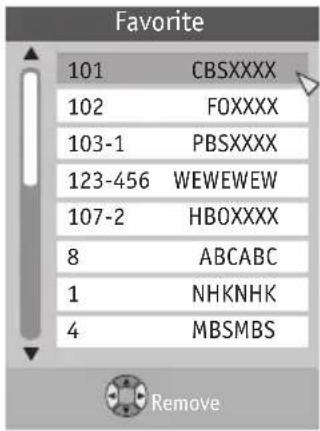
text_image
Favorite 101 CBSXXXX 102 FOXXXX 103-1 PBSXXXX 123-456 WEWEWEW 107-2 HBOXXXX 8 ABCABC 1 NHKNHK 4 MBSMBS RemoveNotes:
• The maximum number of channels you can register is 24.
- If you have registered the maximum number of channels, and try to register more channels, the oldest channel you registered will be deleted.
Delete the favorite channel

ss the F
AVORITE button
The favorite channel list will appear.


To select the channel you want to delete
To enter
The screen to the right will appear.


To "Yes"

ss the Ok
button
The channel was deleted.

ss the F
AVORITE button when finished
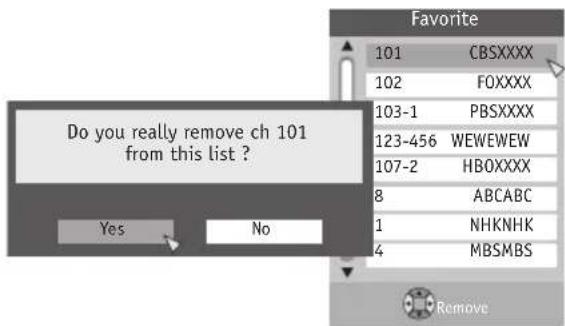
text_image
Do you really remove ch 101 from this list ? Yes No Favorite 101 CBSXXXX 102 FOXXXX 103-1 PBSXXXX 123-456 WEWEWEW 107-2 HBOXXXX 8 ABCABC 1 NHKNHK 4 MBSMBS RemoveButton Functions
ML/MTS
ML/MTS technology allows several audio signals to be broadcast in analog at once, giving you a choice in what you wish to hear with a TV program. In addition to mono or stereo sound, an MTS broadcast may also include a second audio program (SAP). When you are receiving a digital broadcast, it is possible to choose a language that you wish to receive.
When receiving ANALOG broadcast

ss the ML/M
ts button
By every press of the ML/MTS button, you change the mode
MTS

Stereo

SAP
Mono
Notes:
- Keep the TV in stereo mode to get the best sound quality. The sound will work in stereo mode even if a certain broadcast is in mono sound only.
- Choose the mono setting to reduce excessive noise on a certain channel or broadcast.
- Selecting SAP will allow you to hear an alternative soundtrack, if one is available.
- MTS unavailable if your television's Input source is in Video-1, 2, 3, 4, Digital-In1, or Digital-In2 mode, as described on page 56.
- You can also change the mode by pressing the ▲ ▼ buttons.
When receiving DIGITAL broadcast

ss the ML/M
ts button
By every press of the ML/MTS button, you change the language
Multi Language
English
Spanish
Menu
The Menu button allows you to access JVC's onscreen menu system. Press MENU to activate the onscreen menu system. When a menu is displayed, press the MENU button to exit the menu system.
- See individual topics like "Sound Adjust" for specific information on using menus.
OK
This button confirms your selection when you are in one of the onscreen menus.
Back
This button allows you to go back in the menu to change a selection or correct a mistake.
Button Functions
Sub Channel
The main channel sometimes has minor channels (Sub Channels). By using the Sub button, you can select a sub channel easily.
For example, to move to sub channel 123-45:

Press 1, 2 and 3 in order

Press the S UB CH button

Press 4 and 5 in order

Press the TUNE button
Note:
- If there are more than 2 major channels, select the digital channel by using the ▲▼buttons and then press the OK button.
Guide
You can view the program information from the GUIDE.
Notes:
- The GUIDE will not show the correct time and date if you have not performed the set clock function on your television. See page 54.
- When the program information is not being broadcasted, it will not show the correct information.
Button Functions
TV/CATV Slide Switch
Use either the television's own tuner or a cable box to select channels. Set this switch to TV to operate the television's built-in tuner. Move the switch to CATV to operate a cable box.
Note:
• See page 24 for information on programming your remote for cable box operation.
VCR/DVD Slide Switch
You can control a VCR or DVD player with the buttons on the lower part of the remote control. Move the slide switch to VCR or DVD to operate.
Notes:
- The remote is preset with the code 000 to control JVC-brand VCR's. For any other manufacturer's brand VCR, please see the code chart and instructions on page 25.
- The remote is preset with the code 000 to control JVC-brand DVD players. For any other manufacturer's brand DVD player, please see the code chart and instructions on page 26.
VCR Buttons
You can use this remote control to operate the basic functions of your VCR. These functions include: play, record, rewind, fast-forward, stop, pause, channel scan, TV/VCR, power on, and power off.
Move the selector switch to VCR to operate.
- The remote is preset with the code 000 to control JVC-brand VCR's. For any other manufacturer's brand VCR, please see the code chart and instructions on page 25.
DVD Buttons
You can also use this remote control to operate the basic functions of your DVD player. These functions include: play, rewind, fast-forward, stop, still/pause, previous/next, tray open/close, power on, and power off.
Move the selector switch to DVD to operate.
- The remote is preset with the code 000 to control JVC-brand DVD players. For any other manufacturer's brand DVD player, please see the code chart and instructions on page 26.
Troubleshooting
| PROBLEMS CHECK | |
| There is no power | • See if the power cord became unplugged.• Check for a blown fuse or circuit breaker or a power outage. |
| There is no picture or sound | • The antenna could be disconnected.• The input mode could be set improperly. See page 56.• The tuner (Auto Tuner Setup) could be set improperly. See page 42.• The TV station may be having difficulties. Check to see if other stations are working.• Use the HDMI cable with HDMI logo HDMI. See page 19.• You can not output audio using the OPTICAL OUTPUT when you have digital sound from an HDMI device connected the the HDMI 1 or HDMI 2 connection on the back of your TV. (See page 19). |
| Remote control is not operating properly or at all | • Check to see that the batteries are still working and properly installed.• Make sure the remote has a clear sight path to the TV.• Check that the TV/CATV switch is in the proper position.• You may be too far from the TV. You must be within 23 feet (7 meters). |
| You cannot select a certain channel | • Make sure the channels have been programmed. See "Channel Summary", page 42.• Check to see if the channel is locked. See "Channel Summary - Lock" page 43. |
| The power turns off by itself | • Make sure the set did not become unplugged.• Perhaps the On/Off Timer is set. See page 55.• Check to see if the Sleep Timer was set. See page 58. |
| The clock is wrong | • The power was interrupted and the clock was not reset. See page 54. |
| The color quality is poor | • Tint and Color may be improperly adjusted. See page 47.• The Video Status mode may be turned to the wrong setting. See page 58. |
| There are lines across the picture | • There could be interference from another electrical appliance, such as a computer, another TV or VCR. Move any such appliances further away from the TV. |
| The picture is spotted | • There could be interference from a high-wattage appliance, like a hairdryer or vacuum, operating nearby. Move the antenna away from the appliance or change to a coaxial cable connection which is less prone to interference. |
| There are double pictures (ghosts) | • A building or passing airplane can reflect the original signal and produce a second, slightly delayed one. Adjust your antenna position. |
| Picture is snowy (image noise) | • Your antenna may be damaged, disconnected or turned. Check the antenna connection. If the antenna is damaged, replace it. |
| Screen is 40% black | • The Closed Caption Text mode is on. Turn it off in the Closed Caption Menu, page 39. |
| Stereo or bilingual programs can't be heard | • Make sure the MTS settings are correct. See page 63. |
| Static electricity | • It is normal to feel static electricity if you brush or touch the screen. |
| You hear occasional crackling sounds | • It is normal for the TV to make crackling sounds when first turned on or off. Unless the sound or picture become abnormal, this is fine. |
OSD Information
Weak Signal
This OSD warning appears when the digital channel that you have selected is too weak to receive or no signal is being detected for that channel.
No Program or Weak Signal
Audio / Data Only Channel
This OSD appears when the selected channel is not broadcasting any picture or sound, or is only broadcasting data information.
Audio / Data Only Channel
Specifications
| Model | AV-48P777AV-48P787 | AV-56P777AV-56P787 |
| Rear Projection TelevisionType | ||
| Reception Format | NTSC, BTSC System (Multi-Channel Sound)ATSC Terrestrial, Digital Cable | |
| Reception Range | VHF 2 to 13, UHF 14 to 69 CATV 125 Sub, Mid, Super, Hyper and Ultra bands (181 channel frequency synthesizer system)• Reception of channel A-5 ("95" of the TV set's on-screen cable channel numbers) is not recommended for your TV set. | |
| Power Source | AC 120V, 60 Hz | |
| Power Consumption | 240W | |
| Screen Size | 48 inch / 122 cm measured diagonally, 16:9 ratio | 56 inch / 142 cm measured diagonally, 16:9 ratio |
| Speakers 13 cm round X 2 | ||
| Audio Output Full Range - 7W + 7W | ||
| Antenna Terminal (VHF/UHF, ATSC/DIGITAL CABLE IN) | 75 ohms (VHF/UHF)(F-type connector) | |
| External Input Jacks | Video: 1 Vp-p, 75 ohmsAudio: 500mVrms high impedance | |
| Component Input Jack | Y: 1Vp-p positive, 75 ohms (negative sync provided)Pb/Pr: 0.7 Vp-p 75 ohms | |
| S-Video Input Jacks | Y: 1Vp-p positive, 75 ohms (negative sync provided)C: 0.286 Vp-p (burst signal), 75 ohms | |
| Audio Output Jacks (FIX) | 500mVrms low impedance | |
| Optical Output Digital Audio | Digital Out (optical) x 1 | |
| Digital-In | HDMI jack x 2Note: The Digital-In terminal is not compatible with picture signals of a personal computer | |
| Dimensions (inch) W X H X D (cm) | 47 1/4 x 46 7/8 x 24 1/2120 x 118.9 x 62.2 | 53 7/8 x 51 1/8 x 26 3/8136.8 x 129.6 x 66.7 |
| Weight (lbs / kg) | 170 / 77 | 184 / 83.5 |
| Accessories | remote control unit x 1 / AA batteries X 2 | |
Specifications subject to change without notice.
Notes:
- Reception of channel A-5 ("95" of the TV set's on-screen cable channel numbers) is not recommended for your TV set.
- The open source software is embedded in this product. For more information, please go to: http://software.jvc.com/opensource/lnx/DP/06_AtscQam/download.html
For Canadian model televisions, see separate sheets for Canadian Warranty information.
JVC COMPANY OF AMERICA (JVC) warrants this product and all parts thereof, except as set forth below ONLY TO THE ORIGINAL RETAIL PURCHASER to be FREE FROM DEFECTIVE MATERIALS AND WORKMANSHIP from the date of original purchase for the period shown below. ("The Warranty Period")
FOR DIRECT-VIEW COLOR TELEVISION, PICTURE TUBE is covered for Two(2)years.
| Parts1 YEAR | Labor1 YEAR |
THIS LIMITED WARRANTY IS VALID ONLY IN THE FIFTY (50) UNITED STATES, THE DISTRICT OF COLUMBIA AND IN THE COMMONWEALTH OF PUERTO RICO.
WHAT WE WILL DO:
If this product is found to be defective within the warranty period, JVC will repair or replace defective parts with new or rebuilt equivalents at no charge to the original owner. Such repair and replacement services shall be rendered by JVC during normal business hours at JVC authorized service centers. Parts used for replacement are warranted only for the remainder of the Warranty Period. All products may be brought to a JVC authorized service center on a carry-in basis. Color televisions with a screen size of 27" or greater qualify for in-home service. In such cases, a technician will come to your home and either repair the TV there or remove and return it if it cannot be repaired in your home.
WHAT YOU MUST DO FOR WARRANTY SERVICE:
Please do not return your product to the retailer
Instead, return your product to the JVC authorized service center nearest you. If shipping the product to the service center, please be sure to package it carefully, preferably in the original packaging, and include a brief description of the problem(s). Please call 1-800-252-5722 to locate the nearest JVC authorized service center. Service locations can also be obtained from our website http://www.jvc.com. If your product qualifies for in-home service, the service representative will require clear access to the product.
If you have any questions concerning your JVC Product, please contact our Customer Care Center at 800-252-5722
WHAT IS NOT COVERED:
This limited warranty provided by JVC does not cover:
- Products which have been subject to abuse, accident, alteration, modification, tampering, negligence, misuse, faulty installation, lack of reasonable care, or if repaired or serviced by anyone other than a service facility authorized by JVC to render such service, or if affixed to any attachment not provided with the products, or if the model or serial number has been altered, tampered with, defaced or removed;
- Initial installation, installation and removal from cabinets or mounting systems.
- Operational adjustments covered in the Owner's Manual, normal maintenance, video and audio head cleaning;
- Damage that occurs in shipment, due to act of God, and cosmetic damage;
- Signal reception problems and failures due to line power surge;
- Video Pick-up Tubes/CCD Image Sensors are covered for 90 days from the date of purchase;
- Accessories;
- Batteries (except that Rechargeable Batteries are covered for 90 days from the date of purchase);
- Products used for commercial purposes, including, but not limited to rental.
There are no express warranties except as listed above.
THE DURATION OF ANY IMPLIED WARRANTIES, INCLUDING THE IMPLIED WARRANTY OF MERCHANTABILITY, IS LIMITED TO THE DURATION OF THE EXPRESS WARRANTY HEREIN.
JVC SHALL NOT BE LIABLE FOR ANY LOSS OF USE OF THE PRODUCT, INCONVIENCE, OR ANY OTHER DAMAGES, WHETHER DIRECT, INCIDENTAL OR CONSEQUENTIAL (INCLUDING, WITHOUT LIMITATION, DAMAGE TO TAPES, RECORDS OR DISCS) RESULTING FROM THE USE OF THIS PRODUCT, OR ARISING OUT OF ANY BREACH OF THIS WARRANTY. ALL EXPRESS AND IMPLIED WARRANTIES, INCLUDING THE WARRANTIES OF MERCHANTABILITY AND FITNESS FOR PARTICULAR PURPOSE, ARE LIMITED TO THE WARRANTY PERIOD SET FORTH ABOVE.
Some states do not allow the exclusion of incidental or consequential damages or limitations on how long an implied warranty lasts, so these limitations or exclusions may not apply to you. This warranty gives you specific legal rights and you may also have other rights which vary from state to state.
JVC COMPANY OF AMERICA
DIVISION OF JVC AMERICAS CORP
1700 Valley Road
Wayne, NJ 07470
http://www.jvc.com
REFURBISHED PRODUCTS CARRY A SEPARATE WARRANTY, THIS WARRANTY DOES NOT APPLY. FOR DETAIL OF REFURBISHED PRODUCT WARRANTY, PLEASE REFER TO THE REFURBISHED PRODUCT WARRANTY INFORMATION PACKAGED WITH EACH REFURBISHED PRODUCT.
For customer use:
Enter below the Model No. and Serial No. which is located either on the rear, bottom or side of the cabinet. Retain this information for future reference.
Model No.:
Serial No.:
Purchase date :
Name of dealer :
TO OUR VALUED CUSTOMER
THANK YOU FOR PURCHASING THIS JVC PRODUCT.
WE WANT TO HELP YOU ACHIEVE A PERFECT EXPERIENCE.
NEED HELP ON HOW TO HOOK UP?
NEED ASSISTANCE ON HOW TO OPERATE?
NEED TO LOCATE A JVC SERVICE CENTER?
LIKE TO PURCHASE ACCESSORIES?
JVC® IS HERE TO HELP!
TOLL FREE: 1(800)252-5722
http://www.jvc.com
Remember to retain your Bill of Sale for Warranty Service.
Do not attempt to service the product yourself
Caution
To prevent electrical shock, do not open the cabinet.
There are no user serviceable parts inside.
Please refer to qualified service personnel for repairs.
BT-51011-8
(0504)
Notes
JVC COMPANY OF AMERICA
Division of JVC Americas Corp.
1700 Valley Road
Wayne, New Jersey, 07470
JVC®
JVC CANADA, INC.
21 Finchdene Square
Scarborough, Ontario
Canada, M1X 1A7