42PD5000TA - TV HITACHI - Free user manual and instructions
Find the device manual for free 42PD5000TA HITACHI in PDF.


User questions about 42PD5000TA HITACHI
0 question about this device. Answer the ones you know or ask your own.
Ask a new question about this device
Download the instructions for your TV in PDF format for free! Find your manual 42PD5000TA - HITACHI and take your electronic device back in hand. On this page are published all the documents necessary for the use of your device. 42PD5000TA by HITACHI.
USER MANUAL 42PD5000TA HITACHI
READ THE INSTRUCTIONS INSIDE CAREFULLY. KEEP THIS USER'S MANUAL FOR FUTURE REFERENCE.
For future reference, record the serial number of your monitor.
SERIAL NO.
The serial number is located on the rear of the monitor.
This monitor is ENERGY STAR® compliant when used with a computer equipped with VESA DPMS.
The ENERGY STAR® emblem does not represent EPA endorsement of any product or service.
As an ENERGY STAR® Partner, Hitachi,Ltd. has determined that this product meets the ENERGY STAR® guidelines for energy efficiency.
text_image
energyNOTE:
The information in this manual is subject to change without notice. The manufacturer assumes no responsibility for any errors that may appear in this manual.
TRADEMARK ACKNOWLEDGEMENT
VGA and XGA are registered trademarks of International Business Machines Corporation.
APPLE and Macintosh are registered trademarks of Apple Computer, Inc.
VESA is a trademark of a nonprofit organization, Video Electronics Standard Association.
All brand or product names are trademarks or registered trademarks of their respective holders.
注:
Thank you very much for purchasing the HITACHI Plasma Display Monitor.
Before using your monitor, please carefully read the 'SAFETY INSTRUCTIONS' and this "USER'S MANUAL" so you will know how to operate the monitor properly. Keep this manual in a safe place. You will find it useful in the future.
Notes on Installation Work:
This product is marketed assuming that it is installed by qualified personnel with enough skill and competence. Always have an installation specialist or your dealer install and set up the product. HITACHI cannot assume liabilities for damage caused by mistake in installation or mounting, misuse, modification or a natural disaster.
Note for Dealers:
After installation, be sure to deliver this manual to the customer and explain to the customer how to handle the product.
Important
Please read this User's Manual thoroughly, especially the Safety Instructions on Page 4 to 7. Mis-use may cause damage to your plasma monitor, which could shorten its lifespan, or cause injury to yourself. Should you encounter any difficulty in the set-up or operation of your monitor, firstly refer to the Troubleshooting guide at the rear of this manual.
In the unlikely event of a problem occurring with your plasma monitor, switch off at the mains sockets, pull out the plugs, and contact your dealer immediately.
CAUTION
Under no circumstances remove the rear cover of your plasma monitor.
Never guess or take any chances with electrical equipment of any kind - it is better to be safe than sorry!
Software Notice
It is prohibited for the end user of this product to copy, reverse engineer or reverse compile the software included therein, save to the extent permitted by law.
Plasma Monitor
After the plasma monitor has been on for any length of time, you will notice that the screen becomes warm. Please note that this is normal. Sometimes the screen might have some tiny bright or dark spots. Please note that this is normal.
CAUTION
To prevent scratches or damages to the plasma screen, do not knock or rub the surface with sharp or hard objects. Clean the screen with a soft cloth moistened with warm water and dry with a soft cloth. A mild soap may be used if the screen is extremely dirty. Do not use harsh or abrasive cleaners!
CAUTION
Use a soft cloth to clean the cabinet and control panel of the monitor. When excessively soiled dilute a neutral detergent in water, wet and wring out the soft cloth and afterward wipe with a dry soft cloth. Never use acid/alkaline detergent, alcoholic detergent, abrasive cleaner, powder soap, OA cleaner, car wax, glass cleaner, etc. especially because they would cause discoloration, scratches or cracks.
FEATURES
Large-screen, high-definition plasma display panel
The 42-inch color plasma display panel, with a resolution of 1024 (H) x 1024(V) pixels, and the 32-inch color plasma display panel with a resolution of 852(H) X 1024(V) pixels, creates a high-definition, large-screen (aspect ratio : 16:9) and low-profile flat display. Free from electromagnetic interferences from geomagnetic sources and ambient power lines, the panel produces high-quality display images free from color misconvergence and display distortion.
High Performance Digital Processor
A wide range of personal computer signals can be handled, from 640 x 400, 640 x 480 VGA to 1600 x 1200 UXGA.
Easy-to-use remote control and on screen display system
The remote control included eases the work of setting display controls. Further, the on-screen display system, displays the status of signal reception and display control settings in an easy-to-view fashion.
Power saving system
The International ENERGY STAR® power saver feature saves power consumption automatically when input signals are not available. When connected to a VESA DPMS-compliant PC, the monitor cuts its power consumption while it is idle.
TruBass TruBass by SBS(●)
TruBass, SRS and (O) symbol are trademarks of SRS Labs, Inc. TruBass technology is incorporated under license from SRS Labs, Inc.
About the Optional Video Unit
The following functions can be obtained by connecting the optional video unit.
(1) A composite/S terminal and two component terminals have been added. A composite video output terminal is also provided as a monitoring output.
(2) A wide range of devices other than personal computers can also be connected.
(3) A component input is possible to switch to RGB signals from the Menu screen.
(4) A SCART terminal is also provided for the signal of the European standard. It operates as composite/S/RGB input terminal, or video output terminal.
Options
Ask your local retail dealer for further details.
Desktop stand:
■ CMPAD23 (for 32")
• CMPAD25 (for 42")
- Plasma monitor speaker:
- CMPAS03 (for 32") bass reflex speaker unit with 16x4.5cm
cone type speaker (color: dark gray)
- CMPAS03S (for 32") same type to CMPAS03 (color: light gray)
- CMPAS14 (for 42") 2 way speaker unit with one 2.5cm dome
type tweeter and two 8cm round type
woofers (color: dark gray)
- CMPAS14S (for 42") same type to CMPAS14 (color: light gray)
- Video unit: CMPAVW1
An expansion unit for viewing video with this device.
CONTENTS
FEATURES 2
SAFETY INSTRUCTIONS ....4
COMPONENT NAMES 8
Main Unit....8
Remote control 9
Loading Batteries 9
Handling the Remote Control 9
INSTALLATION INSTRUCTIONS ....10
Installation....10
Anti-tumble measures....10
Connecting to a PC 11
Mounting the Speaker Unit 12
Power Cord Connection 12
OPERATING INSTRUCTIONS ....13
Turning Power On and Off 13
Input Switching 14
Volume Adjustment....14
Audio Mute 14
Size Switching 15
Input Signal Screen Display 15
Automatic Adjustment of Screen Position and the Clock ..16
Independent Operation of Multiple Monitors ....16
Using the Menu Screen 16
PICTURE MENU 17
AUDIO MENU 18
TIMER MENU 18
FUNCTION MENU 19
SETUP MENU 20
LANGUAGE MENU....21
OTHER FEATURES ......21
Automatic Store 21
Signal Check 22
Power Save Mode....22
IMAGE RETENTION OF PLASMA DISPLAY .....23
NOTES 23
TROUBLESHOOTING 24
Symptoms That Seemingly Appear to be Failures .....24
Actions to Correct Abnormal Displays ....26
PRODUCT SPECIFICATIONS ......27
Signal Input 27
Recommended Signal List 28
SUPPLEMENT ....30
Optional Video Unit Function 31
Optional Tuner Unit Function 43
Notes about This Manual
- The information in this manual is subject to change without notice.
- While meticulous care has been taken in the preparation of this manual, you are requested to notify your dealer or us should you have any comments, views or questions about our product.
- Fully understand the prerequisites to using the product, such as hardware and software specifications and constraints, in using the
product. We are not held liable for damages caused by improper handling of the product. - Reproduction of this manual in whole or in part without our prior written permission is prohibited.
• The product names mentioned in this manual may be trademarks or registered trademarks of their respective owners.
SAFETY INSTRUCTIONS
This Plasma monitor has been designed and manufactured to meet international safety standards, but like any electrical equipment, care must be taken if you are to obtain the best results and safety is to be assured. Before using this product, please read and understand the Safety Instructions thoroughly to ensure correct usage, and follow all the instructions.
About the Symbols
Various symbols are used in this manual, the user's manual and on the product itself to ensure correct usage, to prevent danger to the user and others, and to prevent property damage. The meanings of these symbols are described below. It is important that you read these descriptions thoroughly and fully understand the contents;
WARNING
This symbol indicates information that, if ignored, could possibly result in personal injury or even death due to incorrect handling.
CAUTION
This symbol indicates information that, if ignored, could result possibly in personal injury or physical damage due to incorrect handling.
Typical Symbols

This symbol indicates an additional warning (including cautions). An illustration is provided to clarify the contents.

This symbol indicates a prohibited action. The contents will be clearly indicated in an illustration or nearby (the symbol to the left indicates that disassembly is prohibited).

This symbol indicates a compulsory action. The contents will be clearly indicated in an illustration or nearby (the symbol to the left indicates that the power plug should be disconnected from the power outlet).
WARNING
Never use the monitor if a problem should occur.
Abnormal operations such as smoke, strange odor, no image, no sound, excessive sound, damaged casing, elements, cables, penetration of liquids or foreign matter, etc. can cause a fire or electrical shock.
In such case, immediately turn off the power switch and then disconnect the power plug from the power outlet. After making sure that the smoke or odor has stopped, contact your dealer. Never attempt to make repairs yourself because this could be dangerous.

Disconnect the plug from the power outlet.
Do not insert liquids or foreign objects.
Penetration of liquids or foreign objects could result in fire or electrical shock. Use special caution in households where children are present.
If liquids or foreign objects should enter the projector, immediately turn off the power switch, disconnect the power plug from the power outlet and contact your dealer.
- Do not place the monitor in a bathroom.
- Do not expose the monitor to rain or moisture.
- Do not place flower vases, pots, cups, cosmetics, liquids such as water, etc on or around the monitor.
- Do not place metals, combustibles, etc on or around the monitor.


Do not disassemble.
Never disassemble or modify the monitor.
The monitor contains high voltage components. Modification could result in fire or electrical shock.
- Never remove any fixed cover.
Do not give the monitor any shock or impact.
If the monitor should be shocked and/or broken, it could result in an injury, and continued use could result in fire or electrical shock. If the glass panel is broken or damaged, immediately turn off the power switch, disconnect the power plug from the power outlet and contact your dealer.


Do not place the monitor on an unstable surface.
If the monitor should be dropped and/or broken, it could result in an injury, and continued use could result in fire or electrical shock.
- Do not place the monitor on an unstable, slant or vibrant surface such as a wobbly or inclined stand.
Do not obstruct the ventilation of the monitor.
If the ventilation is obstructed during the operation of the monitor or just after switching off the power, it could result in damage and shorten the lifespan of your monitor due to overheating. Make sure there is ample ventilation.
- Keep a space of 100mm (10cm) or more between the sides, rear and top of the monitor and other objects such as walls.
- Do not place anything around ventilation openings of the monitor.
- Never block ventilation openings.
- Do not put the plasma screen side up.
- Do not cover the monitor with a tablecloth, etc.
- Do not place the monitor on a carpet or bedding, or near a curtain.


Use only the correct power outlet.
Incorrect power supply could result in fire or electrical shock. Use only the correct power outlet depending on the indication on the monitor and the safety standard.
- The enclosed power cord must be used depending on the power outlet to be used.
WARNING
Be cautious of the power cord connection.
Incorrect connection of the power cord could result in fire or electrical shock.
- Do not touch the power cord with a wet hand.
- Check that the connecting portion of the power cord is clean (with no dust), before using. Use a soft and dry cloth to clean the power plug.
- Insert the power plug into a power outlet firmly. Avoid using a loose, unsound outlet or contact failure.
- Do not cut off the filled power plug, the removal of which could lead to impaired performance. If you wish to extend the lead.
obtain an appropriate extension lead or consult your dealer. - Should you require replacing the fuse in the molded plug with a new fuse, then please replace with new one of the same value, type and approval as the original. Ensure the fuse cover is returned to its original position.
Be sure to keep safety ground connection.
Connect the ground terminal of AC inlet of this monitor with the ground terminal provided at the power outlet using the enclosed power cord. If the provided plug does not fit your outlet, consult an electrician for replacement of the obsolete outlet.
Be careful in handling the power cord and external connection cables.
If you keep using a damaged the power cord or cables, it can cause a fire or electrical shock. Do not apply too much heat, pressure or tension to the power cord and cables.
If the power cord or cables are damaged (exposed or broken core wires, etc.), contact your dealer.
- Do not place the monitor or heavy objects on the power cord and cables. Also, do not place a spread, cover, etc, over them because this could result in the inadvertent placing of heavy objects on the concealed power cord or cables.
- Do not pull the power cord and cables. When connecting and disconnecting the power cord or cables, do it with your hand holding the plug or connector.
- Do not place the cord near the heater.
- Do not touch the power plug just after disconnecting it from the power outlet to prevent electric shock.
- Do not touch the power plug when lightening is close to you.
- Avoid coiling the power cord and bending it sharply.
- Protect the power cord from being walked on, pinched particularly at plugs, conveniences receptacles, and the point where they exit from the apparatus.
- Do not modify the power cord.
Be careful in handling the battery of the remote control.
Incorrect handling of the battery could result in fire or personal injury. The battery may explode if not handled properly.
- Keep the battery away from children and pets. If swallowed consult a physician immediately for emergency treatment.
- Do not allow the battery to be exposed to fire or water.
- Avoid fire or high-temperature environment
- Do not hold the battery with metallic tweezers.
- Keep the battery in a dark, cool and dry place.
- Do not short circuit the battery.
- Do not recharge, disassemble or solder the battery.
- Do not physically impact the battery.
- Use only the battery specified in the manual of this monitor.
- Make sure the plus and minus terminals are correctly aligned when loading the battery.
- If you observe a leakage of the battery, wipe out the liquid and then replace the battery. If the liquid adheres your body or clothes, rinse well with water.
- Obey the local laws on disposing the battery.


Surely connect the ground wire.


SAFETY INSTRUCTIONS(continued)
CAUTION
Be careful in moving the monitor.
Neglect could result in an injury or damage.
- Do not move the monitor during use. Before moving, disconnect the power plug and all external connections.
- You are advised to move the monitor with two persons.
- Avoid any impact or shock to the monitor; particularly take care of glass screen.
Do not put anything on top of the monitor.
Placing anything on the monitor could result in loss of balance or falling, and cause an injury or damage. Use special caution in households where children are present.
Avoid a humid or dusty place.
Placing the monitor in a smoke, a highly humid, dusty place, oily soot or corrosive gas could result in fire or electrical shock.
- Do not place near the kitchen, a humidifier or other place where there is oil, smoke or humidity.
Avoid a high temperature environment.
The heat could have adverse influence on the monitor and other parts, and could result in transformation, melting or fire.
- Do not place the monitor, the remote control and other parts in direct sunlight or near a hot object such as heater, etc.
- Do not put the monitor in a place where the temperature is widely changing.
Remove the power cord for complete separation.
- For safety purposes, disconnect the power cord if the monitor is not to be used for prolonged periods of time.
- Before cleaning, turn off and unplug the monitor. Neglect could result in fire or electrical shock.
PRECAUTIONS
• Installation environment
Do not obstruct a ventilation hole.
Do not put the monitor on carpet or blanket, or near a curtain which has a possibility of obstructing a ventilation hole of the monitor.
Do not put the monitor in the following places.
- Hot places such as near heater, place exposed to the direct rays of the sun.
- A place where the temperature is widely changing.
- Places with soot, dust or high humidity.
- Poor air ventilation place.
- Place near fire.
- A wet place such as bathroom, or shower room.
- Place where you can trip over it.
• Always vibrating or strongly vibrating places.
• Distorted or unstable places.
• How to view the monitor
If you use the monitor in too dark a room, your eyes may become tired.
Please use it in a reasonably bright room.
Avoid direct rays of the sun to the screen in order to prevent eye fatigue.
Your eyes will get fatigued after viewing the monitor for long period of time.
Relax your eyes by viewing away from the monitor from time to time.
Please watch the monitor in downward direction.
• Note on image retention
The plasma monitor illuminates phosphor to display images. The phosphor has a finite illumination life. After extended periods of illumination, the brightness of the phosphor will be degraded to such extent that stationary images would burn-in that part of the screen as grayed-out images.
Tips to prevent such image retention are:
- Do not display images having sharp brightness differences or high-contrast images, such as monochrome characters and graphic patterns, for long.
- Do not leave stationary images appearing for long, but try to refresh them at appropriate intervals of time, or try to move them using screen saver function.
- Turn down the contrast and brightness controls.
• How to clean the plasma screen panel of the monitor
Before cleaning the monitor, turn off the monitor and disconnect the power plug from the power outlet.
To prevent scratching or damaging the plasma screen face, do not knock or rub the surface with sharp or hard objects. Clean the screen with a soft cloth moistened with warm water and dry with a soft cloth. If it is not enough, then use a cloth with mild detergent. Do not use harsh or abrasive cleaners.
• How to clean the cabinet of the monitor
Use a soft cloth to clean the cabinet and control panel of the monitor. When excessively soiled dilute a neutral detergent in water, wet and wring out the soft cloth and afterward wipe with a dry soft cloth.
Never use acid/alkaline detergent, alcoholic detergent, abrasive cleaner, powder soap, OA cleaner, car wax, glass cleaner, etc. especially because they would cause discoloration, scratches or cracks.


Disconnect the plug from the power outlet.
• Prevention of an obstacle to Radio receivers
This monitor has been designed pursuant to the international EMI standards. This is to prevent a problem to Radio receivers.
- Keep the monitor away from Radio.
- Adjust Radio antennas in order for the monitor not to receive interference.
- The antenna cable of Radio should be kept away from the monitor.
- Use a coaxial cable for antenna.
You can check if this monitor influences Radio receivers by turning off all other equipment other than the monitor.
If you find a problem receiving Radio when using the monitor, check the instructions mentioned above.
- Precautions for the cable connection
- Do ensure that all connections, (including the power plug, extension leads and interconnections between the pieces of equipment), are properly made and in accordance with the manufacturers instructions. Switch off and withdraw the power plug before making or changing connections.
- Confirm the connector is fixed tightly when the signal cable is connected.
Also confirm the screws on the connector are tightened. - Plug the power cord of the monitor into a different socket from that for other equipment, such as Radio etc..
- Use a plug with ground terminal and make sure that it connects to the ground.
• Precaution during transportation
Please pay attention when you transport this monitor because it is heavy.
Furthermore, use the original carton box and its packaging materials when the monitor is transported.
Failure to transport the monitor in any carton except the original carton may result in damage to the monitor.
Save the original carton box and all packing material.
Do not physically impact the remote control.
A physical impact could cause damage or malfunction of the remote control.
• Take care not to drop the remote control.
- Do not place heavy objects on the remote control.
Avoid strong rays.
Any strong rays (such as direct sun rays or room lighting) onto the remote control sensors could invalidate the remote control.
Avoid radio interference.
Any interfering radiation could cause distorted images or noises.
- Avoid radio generator such as a mobile telephone, transceiver, etc. around the monitor.
Set the sound volume at a suitable level.
It is better to keep the volume level low and close the windows at night to protect the neighborhood environment.
• Precautions for the installation
- Do not use makeshift stands and NEVER fix legs with wood screws - to ensure complete safety, always fit the manufacturers approved stand or legs with the fixings provided according to the instructions.
- Use only with the cart, stand, tripod, bracket, or table specified by the manufacturer, or sold with the apparatus. When a cart is used, use caution when moving the cart/apparatus combination to avoid injury from tip-over.
- This product is designed to comply with the recommended safety standards for tilt and stability. Do not apply excessive pulling force to the front, or top, of the cabinet that could cause the product to overturn resulting in product damage and/or personal injury.
- Follow instructions for wall, shelf or ceiling mounting as recommended by the manufacturer.
- Only use the attachments/accessories specified by the manufacturer.
- Consult your dealer if you are in any doubt about installation, operation or safety of your equipment.
- Other precautions
- Do not leave equipment switched on when it is unattended unless it is specifically stated that it is designed for unattended operation or has a stand-by mode. Switch off using the switch on the equipment and show your family how to do this. Make special arrangements for infirm or handicapped people.
- Disposal of this product may require specific instructions pertaining to your resident region.
- Never guess or take any chances with electrical equipment of any kind - it is better to be safe than sorry!
COMPONENT NAMES
Main Unit
Front
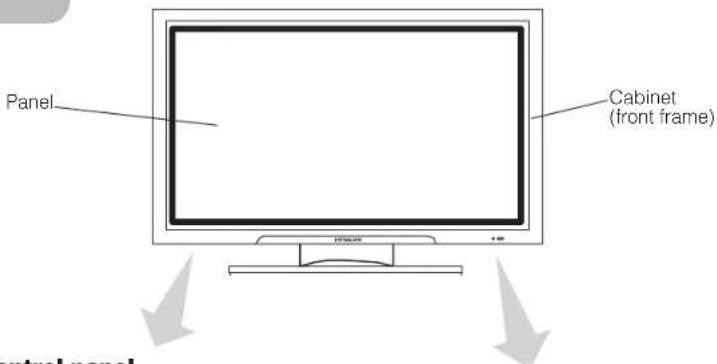
text_image
Panel Cabinet (front frame)Control panel

text_image
• Adjustment buttons are located on the bottom. • The back cover is provided with indications to distinguish the adjustment buttons. VOLUME UP/DOWN buttons (▲)JUST buttons) SUB-POWER button 13 INPUT SELECT button (OK button) RECALL button (▼)ELECT button) SIZE button (▼)ELECT button) MENU button 16 14 15 14- ( ) indicates the function while the MENU is displayed on the screen.
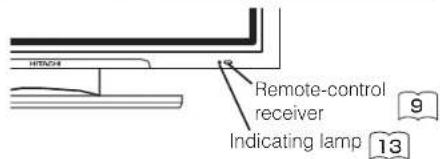
text_image
HATCH Remote-control receiver Indicating lamp 13 9- The main power switch is located at the back, on the lower surface.
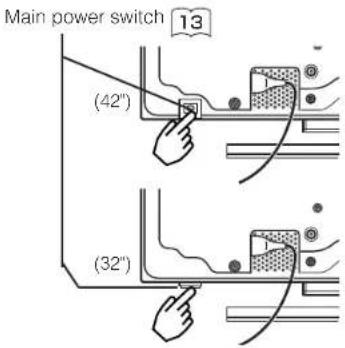
text_image
Main power switch 13 (42") (32")Caution when moving the main unit
• As this product is heavy, whenever it is moved, two
people are required to transport it safely.
- Whenever the unit is moved it should be lifted forwards using the two handgrips at the back, and the unit should then be held at the base on both sides for stability.
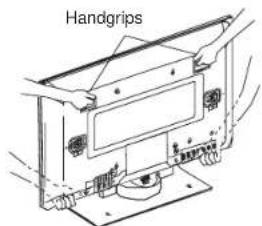
text_image
HandgripsRear

text_image
External speaker terminals 11 Handgrips External speaker terminals 11External device connection terminals

text_image
DIGITAL INPUT RGB 1 PC ⬤ ANALOG INPUT RGB 2 PC ⬤ AUDIO IN RGB 1 RGB 2 → → RGB input terminals 11Remote control

text_image
POWER OFF button 13 POWER ON button 13 MUTE button 14 RGB/VIDEO buttons 14 PinP button 34 AUTO button 16 MENU button 16 OK button 16 ID button 16 POWER ON/OFF button 13 VOLUME UP/DOWN buttons 14 SIZE button 15 RECALL button 15 RETURN button 16 SELECT/ADJUST buttons 16 ID SET button 16Loading Batteries
1. Open the battery cover.
- Slide back and remove the battery cover in the direction of the arrow.
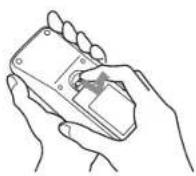
2. Load batteries.
- Load two Size AA batteries included observing the correct polarities.
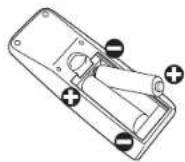
3. Close the battery cover.
- Replace the battery cover in the direction of the arrow and snap it back into place.
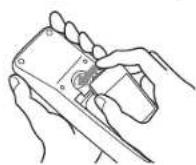
CAUTION
- Do not use new and old batteries together. The batteries could explode or leak, resulting in fires, physical injury, or stains.
- When loading batteries, observe their correct polarities as marked on the product. If loaded in the wrong direction, the batteries could explode or leak, resulting in fires, physical injury, or stains.
Handling the Remote Control
Use the remote control within about 5 m from front of the unit's remote-control sensor and within 30 degrees on both sides.

text_image
With in 30 degrees About 3m With in 30 degrees About 3m About 5mATTENTION
- Do not drop or impact the remote control.
- Do not splash the remote control with water or put it on a wet object to avoid possible failures.
- Before leaving the remote control out of use for an extended period of time, remove the batteries from it.
- If the remote control begins to lack responsiveness, replace the batteries.
- Strong light such as direct sunlight impinging on the photoreceptor of the remote control can cause operational failure. Position this unit to avoid direct contact with such light.
INSTALLATION INSTRUCTIONS
Installation
- If you have purchased the model without the stand attached: When installing the monitor, use the optional Desk-top Stand (CMPAD23/25). The Desk-top Stand has been used for the illustrations in this manual.
WARNING
Use one of the special mount units to install this product. A mount of insufficient strength or inadequate design can cause overturning or dropping and result in fire, electrical shock or injury. Please note that our company assumes absolutely no responsibility for personal injuries or property damage caused by use of other mount units or improper installation.
CAUTION
- Installation of the wall mount unit and ceiling mount unit can be dangerous, so do not attempt this work yourself. Ask your dealer to provide the name of a qualified installer.
- In order to prevent an internal temperature increase, maintain a space of 10cm (4 inches: For a desktop setup) or more between the sides and other objects such as walls, etc., so that the ventilation holes are not blocked. (*)
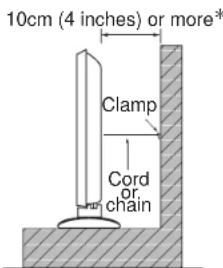
text_image
10cm (4 inches) or more* Clamp Cord or. chainAnti-tumble measures
CAUTION
Have this unit mounted in a stable place. Take measures to prevent it from tumbling down to avoid possible physical injury.
Securing to a wall or pillar
Using a commercially available cord, chain and clamp, secure the set to a firm wall or pillar.
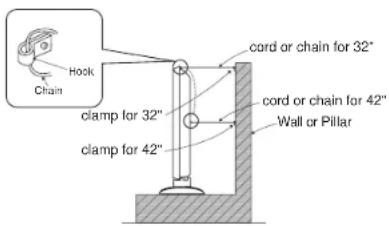
text_image
Hook Chain clamp for 32" clamp for 42" cord or chain for 32" cord or chain for 42" Wall or PillarSecuring desktop
1) Using wood screws (two), fasten the set to the clamping screw holes on the rear of the stand as shown.
2) Using commercially available wood screws, secure the set firmly in position.
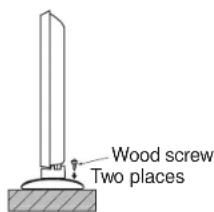
text_image
Wood screw Two placesRead SAFETY INSTRUCTIONS (4 to 7) carefully to ensure maximum safety before proceeding to these steps:
- Choose an appropriate site and install the product on a level table where the stand is secure.
• Install the monitor to have ready access to a power socket available - Make sure that the power switch of this device is turned off.
Connecting to a PC
(1) Make sure that the display signal of the personal computer to be used is compatible with the specifications of this device.
- See 'Product Specifications' concerning the specifications of this device. [27] [29]
(2) Make sure that the power switch of the personal computer is turned off.
(3) Connect the signal input terminal (RGB 1 or RGB 2) on the rear panel of this device to the display signal output terminal of the personal computer.
- Use a cable that fits the input terminal of this device and the output terminal of the personal computer.
- Depending on the type of personal computer being connected, the use of an optional conversion adapter or the adapter provided with the personal computer may be necessary in some cases. For details, refer to the instruction manual of the personal computer or ask the personal computer manufacturer or your local retail dealer.
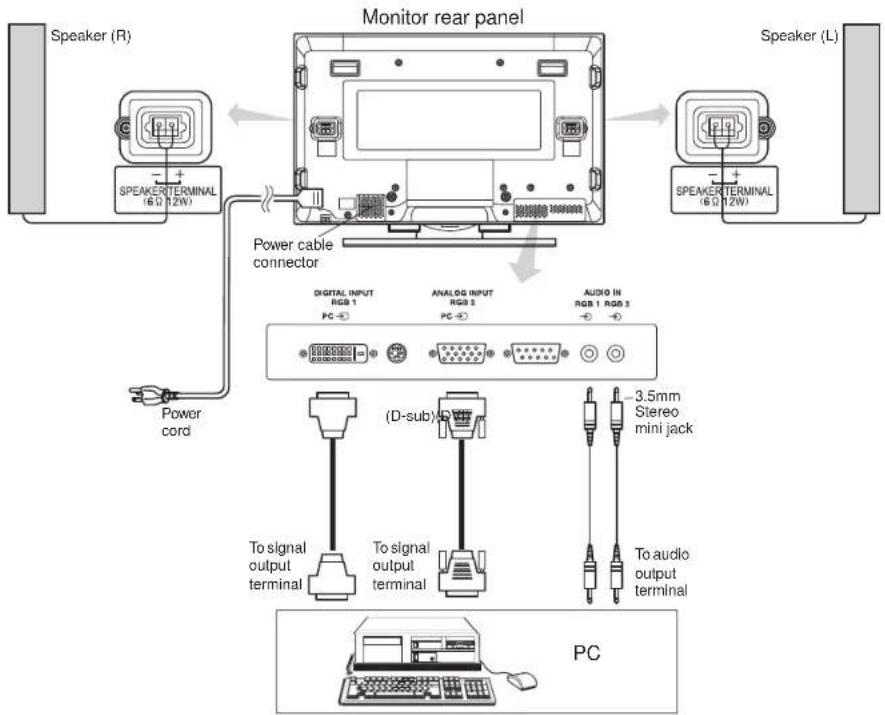
text_image
Monitor rear panel Speaker (R) Speaker (L) SPEAKER TERMINAL (6 Ω 12W) Power cable connector Digital INPUT RGB 1 PC Analog INPUT RGB 2 PC AUDIO IN RGB 1 RGB 3 - - - - - - - - - - - - - - - - - - - - - - - - - - - - - - - - - - - - - - - - - - - - - - - - - - - - - - - - - - - - - - - - - - - - - - - - - - - - - - - - - - - - - - - - - - - - - - - - - - - - -3.5mm Stereo mini jack To signal output terminal To signal output terminal To audio output terminal PCINSTALLATION INSTRUCTIONS (continued)
Mounting the Speaker Unit (option)
Refer to the instruction manual concerning mounting of the optional speaker unit.
Power Cord Connection
Connect the power cord, after completing all other connections.
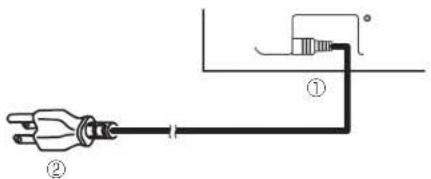
text_image
Electrical wiring diagram showing two connected components labeled ① and ②①Connect the power cord to this device.
② Connect the power cord plug to the power outlet.
(The type of plug is different from this drawing for some countries.)

CAUTION
- Use only the power cord provided.
- Do not use a power supply voltage other than that indicated (AC100-240V, 50/60Hz) as this may cause fire or electric shock.
OPERATING INSTRUCTIONS
text_image
HUCH Indicating lamp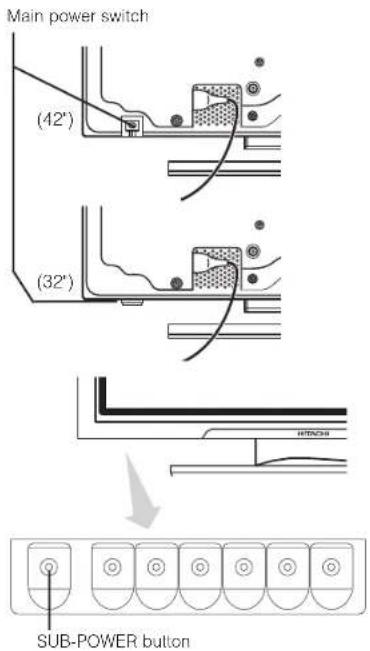
text_image
Main power switch (42°) (32°) SUB-POWER button
text_image
POWER OFF button POWER ON button POWER ON/OFF button Power Off button Power On/OFF button Power Off button Power On/OFF button Power Off button Power On/OFF button Power Off button Power On/OFF button Power Off button Power On/OFF button Power Off button Power On/OFF button Power Off button Power On/OFF buttonTurning Power On and Off
- To turn the monitor power ON, press the main power switch on the monitor main unit to ON, and then press the SUB POWER button or the ON/OFF or ON button on the remote control. - To turn the monitor power OFF, press the SUB POWER button or the ON/OFF or OFF button on the remote control, and then press the main power switch on the monitor main unit to OFF.
During normal use, the main power switch is set in the ON position, and the monitor can then be turned ON/OFF using the SUB POWER button or the ON/OFF button on the remote control.
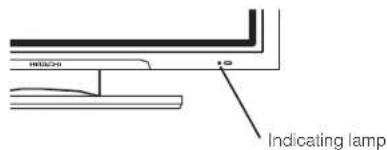
Indicating lamp
| Indicating lamp | Power status | Operating |
| Off Off | When the main power switch is set to OFF. | |
| Lights red | Off (standby) | When the main power switch is ON, and the OFF button on the remote control or the SUB POWER button on the underside of the front of the frame is OFF. |
| Lights green | On | When the main power switch is ON, and the ON button on the remote control or the SUB POWER button on the underside of the front of the frame is ON. |
| Lights orange | Off (Power Save) | When the main power switch is ON, and the ON button on the remote control or the SUB POWER button on the underside of the front of the frame is ON.However, the state in POWER SAVE mode |
When the indicating lamp lights in orange or the message "No Sync. Signal", "Power Save" or "Invalid Scan Freq." appears on the screen, there is something unusual about the status of reception. See "Power Save Mode" or "Symptoms That Seemingly Appear to be Failures." 22 24
ATTENTION
- Avoid repeatedly turning the monitor on and off at short time intervals. Failures might result from such operation.
- Turn off the main power switch before leaving the monitor out of use for an extended period of time.
- If a power failure occurs while the main unit is running, it would be powered on upon recovery from the failure. Turn off the unit main power switch before leaving the main unit.
OPERATING INSTRUCTIONS (continued)
text_image
VOLUME UP/DOWN buttons INPUT SELECT button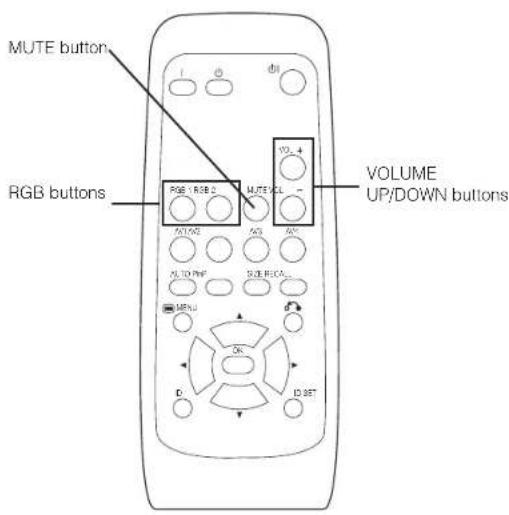
text_image
MUTE button RGB buttons RGB / RGB 2 MUTE URL VOLUME UP/DOWN buttons A1/A2 A3 A4 A5 A6 A7 A8 A9 A10 A11 A12 A13 A14 A15 A16 A17 A18 A19 A20 A21 A22 A23 A24 A25 A26 A27 A28 A29 A30 A31 A32 A33 A34 A35 A36 A37 A38 A39 A40 A41 A42 A43 A44 A45 A46 A47 A48 A49 A50 A51 A52 A53 A54 A55 A56 A57 A58 A59 A60 A61 A62 A63 A64 A65 A66 A67 A68 A69 A70 A71 A72 A73 A74 A75 A76 A77 A78 A79 A80Input Switching
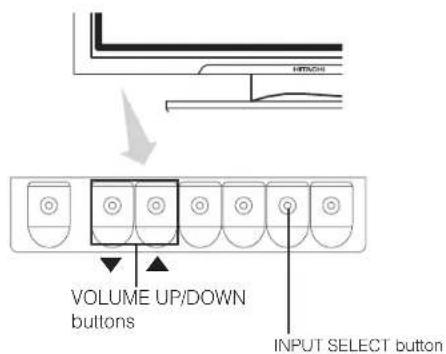
- Input can be switched by pressing the RGB1, RGB2, buttons of the remote control.
- Input can be switched in the sequence of RGB1 → RGB2 by pressing the INPUT SELECT button of the monitor.

Volume Adjustment
The volume can be adjusted by pressing the VOL+ and VOL- buttons of the remote control (or the ▲ and ▼ volume buttons of the monitor unit).
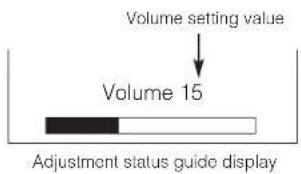
text_image
Volume setting value Volume 15 Adjustment status guide display- When a button is pressed, the volume adjustment status guide will be displayed.
- The volume will increase when the VOL+ (or ▲) button is pressed while the guide is being displayed.
- The volume will decrease when the VOL- (or ▼) button is pressed while the guide is being displayed.
Audio Mute
The audio volume can be temporarily mute by pressing the MUTE button of the remote control.
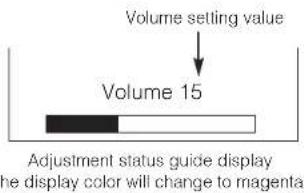
text_image
Volume setting value Volume 15 Adjustment status guide display the display color will change to magenta- When a button is pressed, the volume adjustment status guide (magenta) will be displayed.
- The volume setting can be lowered by pressing the VOL-button while the audio is mute.
- The muting can be cancelled by pressing the VOL+ button or MUTE button while the audio is mute.
When the MUTE button of the remote control is pressed again, the audio will be restored and the volume display (green) will appear.

text_image
HYSCHI RECALL button SIZE button
text_image
SIZE button RECALL buttonENSUSH
Size Switching
Each time the SIZE button of the remote control or the monitor is pressed, the screen display area will change in sequence and the status will be displayed at the bottom of the screen.

* Real mode gives the image of the same shape as it is displayed on a computer monitor. This mode is only available for VGA (640 X 480) and WVGA (864 X 480).
Display area selection diagram (RGB input)
| Resolution Full | display Circular display | |||||
| Display Full | Normal Real Zoom1 | Zoom2 | Zoom3 | |||
| 640 X 480 (VGA) | 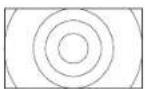 | 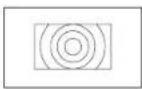 * VGA and W-VGA only * VGA and W-VGA only | 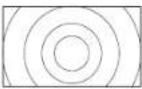 | 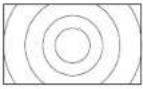 |  | |
| 800 X 600 (SVGA) | ||||||
| 1024 X 768 (XGA) | ||||||
| 1280 X 1024 (SXGA) | ||||||
| 1600 X 1200 (UXGA) | ||||||
Processes such as compression (thinning) and expansion are performed for the above signal display. Because of this, there is a possibility that flicker may become noticeable on Zoom (1 \~ 3) depending on the display contents. If this occurs, turning the Vertical Filter On can reduce the flicker.
Input Signal Screen Display
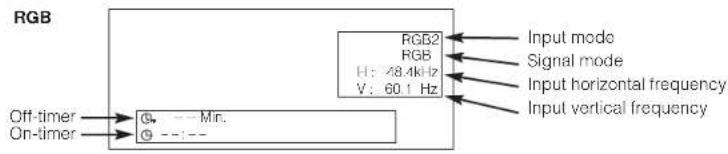
The input signal status can be displayed on the screen by pressing the RECALL button of the remote control or the monitor.
• The display will go out in approximately 6 seconds.
text_image
RGB Off-timer On-timer G: -- Min. G: --:-- RGB2 RGB H: 48.4kHz V: 60.1 Hz Input mode Signal mode Input horizontal frequency Input vertical frequencyOPERATING INSTRUCTIONS (continued)
text_image
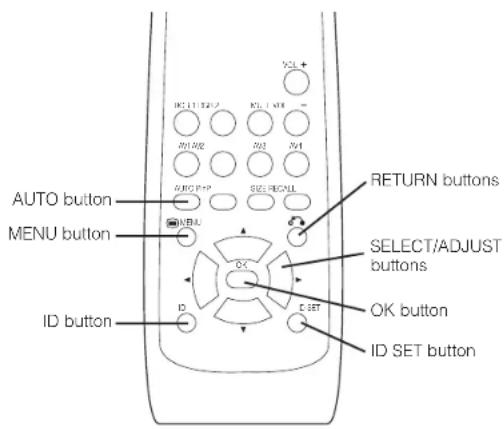
AUTO button MENU button ID button VCL+ DC LTR2 RLA R1 R2 R3 RESET RETURN buttons SELECT/ADJUST buttons OK button ID SET buttonAutomatic Adjustment of Screen Position and the Clock
Adjustment of the screen to a position suitable for the PC signal and the clock adjustment can be performed automatically by pressing the AUTO button of the remote control.
CAUTION
Perform this adjustment for each input (RGB1 or RGB2) and for each signal.
* Depending on the signal, satisfactory adjustment may not be possible in some cases. In such case, adjust by referring to the Setup Menu item.
Independent Operation of Multiple Monitors (ID No)
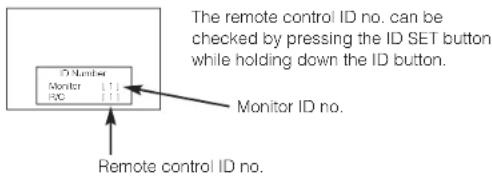
Setting the ID No. of the remote control allows separate control of up to a maximum of seven monitors. Remote control ID No. 2 (initially ID no. 1) can be set by pressing the ID SET button for 2 sec. or more while holding down the ID button. The number will be incremented (2…6→7→1→2) when this button pressed continuously.
text_image
The remote control ID no. can be checked by pressing the ID SET button while holding down the ID button. Monitor ID no. Remote control ID no.The ID remote control is operated by pressing the various buttons while holding down the ID button; Operation is possible only when the remote control and monitor ID nos. are the same.
- The remote control can be operated normally by pressing the various remote control buttons without holding down the ID button.
- Set the monitor using the ID No. of Function MENU
19
Using the Menu Screen (On-screen display system)
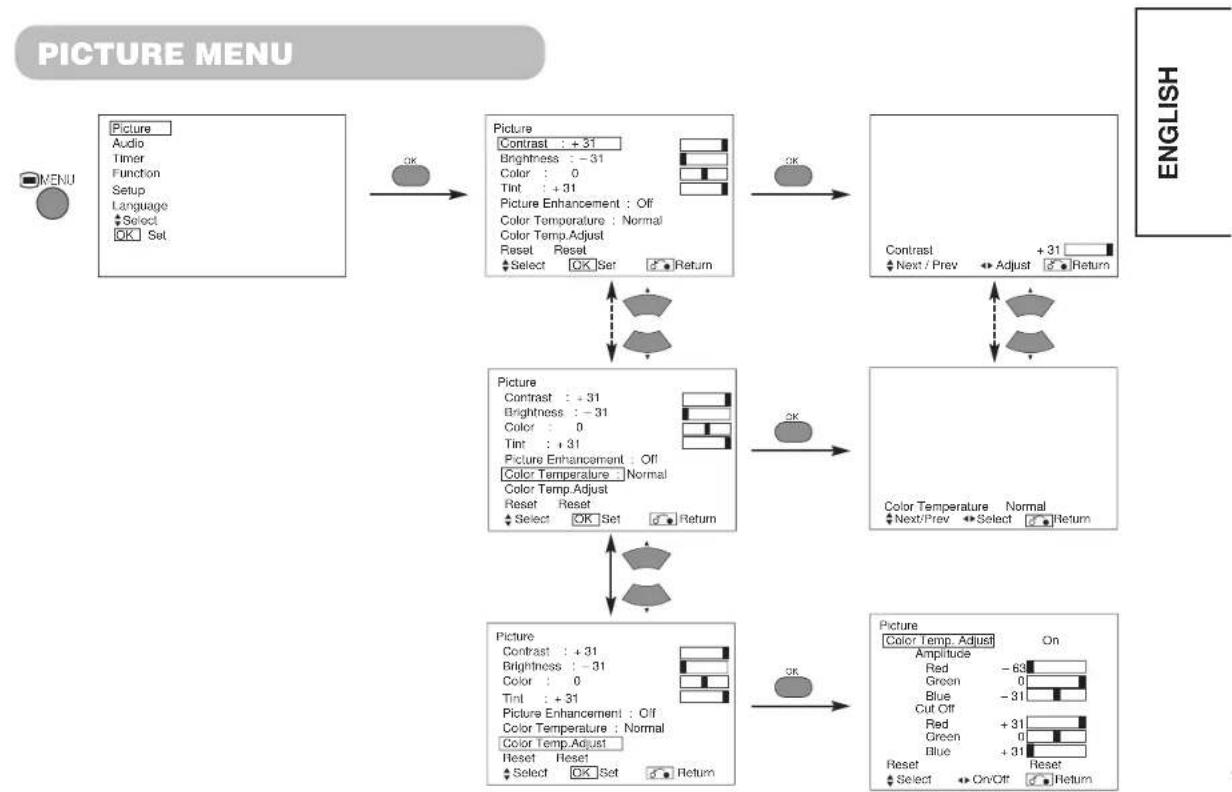
When the MENU button is pressed, the adjustment menu screen will be displayed; from there, PC signal adjustment and setting is possible by using the SELECT button, ADJUST button and OK button.
- Refer to 17 - 21 concerning the adjustment items and the settings.
Example: Selecting the Picture screen
- Press the MENU button to display the Main Menu screen.


text_image
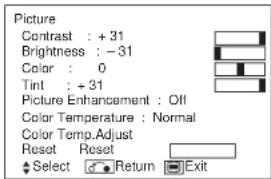
Picture Audio Timer Function Setup Language Select OK Set- Press the OK button to display the Picture Menu screen. (Use the ▲ and SELECT buttons to select other items.)

text_image
Picture Contrast : +31 Brightness : -31 Color : 0 Tint : +31 Picture Enhancement : Off Color Temperature : Normal Color Temp.Adjust Reset Reset Select Return Exit- Use the ▲nd SELECT buttons to select the item to be adjusted and then use the ▲nd ADJUST buttons to adjust (example: Contrast).
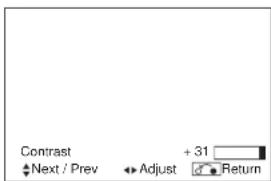
text_image
Contrast ◆ Next / Prev ← Adjust +31 Return- Press the RETURN button to return to the previous screen.
- If there is no operation for a period of one minute, the Adjustment Menu screen will be closed automatically.
flowchart
graph TD
    A["MENU"] --> B["Picture<br>Audio<br>Timer<br>Function<br>Setup<br>Language<br>Select<br>OK Set"]
    B --> C["Picture<br>Contrast : +31<br>Brightness : -31<br>Color : 0<br>Tint : +31<br>Picture Enhancement : Off<br>Color Temperature : Normal<br>Color Temp.Adjust<br>Reset Reset<br>Select OK Set Return"]
    C --> D["Picture<br>Contrast : +31<br>Brightness : -31<br>Color : 0<br>Tint : +31<br>Picture Enhancement : Off<br>Color Temperature : Normal<br>Color Temp.Adjust<br>Reset Reset<br>Select OK Set Return"]
    D --> E["Picture<br>Contrast : +31<br>Brightness : -31<br>Color : 0<br>Tint : +31<br>Picture Enhancement : Off<br>Color Temperature : Normal<br>Color Temp.Adjust<br>Reset Reset<br>Select OK Set Return"]
    E --> F["Picture<br>Contrast : +31<br>Brightness : -31<br>Color : 0<br>Tint : +31<br>Picture Enhancement : Off<br>Color Temperature : Normal<br>Color Temp.Adjust<br>Reset Reset<br>Select OK Set Return"]
    F --> G["Picture<br>Color Temp. Adjust On<br>Amplitude Red -63 Green 0 Blue -31 Cut Off Red +31 Green 0 Blue +31 Reset Select On/Off Reset"]
| Selected characters Setup hint | ▶ | |||
| Contrast | Narrows the gap between brightness and darkness. | Broadens the gap between brightness and darkness. | Adjust for maximum visibility to suit the ambient brightness.This can adjust further till [+40] by pressing and holding cursor button at [+31]. The color for [+32] to [+40] numbers will change from white to magenta. This special mode is better for dark scenes.For brighter scene some parts of the picture might not be clear. We recommend to set at [+31].'Panel Life' in the Function Menu should be set to Normal when Contrast setting is adjusted. | |
| Brightness | Black is subdued for increased overall darkness. | Black is set off for increased overall brightness. | Adjust to taste. | |
| Color | Darkens colors. Lightens colors | Adjust to taste. | ||
| Tint | Enhances red and weakens green. | Enhances green and weakens red. | This is not available to adjust when receiving PAL/SECAM signal.In this case the character will be grayed out.Adjust for most realistic skin color. | |
| Picture Enhancement | Off←→ Low←→ Middle←→ High | Sets the clarity of small details to the desired level. | ||
| Color Temperature | Cool←→ Normal←→ Warm←→ Black / White | Normally set to Normal. | ||
| Color Temp. Adjustment | → Off←→ On← | Turn On when you wish to change color temperature is required to adjust depending on the user's preference. | ||
| Amplitude | Red | Brighter scene is decreased in reddish color. | Brighter scene is increased in reddish color. | Adjust color temperature depending on the user's preference. Those settings are independently stored in each of the 4 Color Temperature modes. |
| Green | Brighter scene is decreased in greenish color. | Brighter scene is increased in greenish color. | ||
| Blue | Brighter scene is decreased in bluish color. | Brighter scene is increased in bluish color. | ||
| Cut Off | Red | Dark scene is decreased in reddish color. | Dark scene is increased in reddish color. | |
| Green | Dark scene is decreased in greenish color. | Dark scene is increased in greenish color. | ||
| Blue | Dark scene is decreased in bluish color. | Dark scene is increased in bluish color. | ||
| Reset | (off the function) (waiting to reset) | The original factory settings for the items of this Menu page can be restored by pressing the OK button. | ||
OPERATING INSTRUCTIONS (continued)
AUDIO MENU

flowchart
graph LR
    A["MCNU"] --> B["Picture"]
    B --> C["Audio Mode : Movie"]
    B --> D["Timer : +10"]
    B --> E["Function : -10"]
    B --> F["Setup : 0 L"]
    B --> G["Language : Middle"]
    B --> H["Select : Off"]
    B --> I["OK Set"]
    C --> J["Audio Mode : Movie"]
    D --> K["Treble : +10"]
    E --> L["Bass : -10"]
    F --> M["Balance : 0 L"]
    G --> N["SRS TruBass : Middle"]
    H --> O["Matrix Surround : Off"]
    I --> P["Perfect Volume : Off"]
    J --> Q["Reset Reset"]
    K --> R["Select Set Return"]
| Selected characters Setup hint | ▶ | ||
| Audio Mode | Movie←Music←Speech←Favorite | Movie: This selects the audio suitable for Movie. Music: This selects the audio suitable for Music. Speech: This selects the audio suitable for News, Talk show etc. Favorite: This mode should be adjusted depending on user's preference. | |
| Treble | Suppresses treble. Enhances treble. Adjust to taste. | ||
| Bass | Suppresses bass. Enhances bass. Adjust to taste. | ||
| Balance | Suppresses right-side sound. Suppresses left-side sound. Adjust to taste. | ||
| SRS TruBass | Off←Low←Middle←High | SRS TruBass takes advance of the ability of the human car to be able to distinguish between two different tones. By using this ability. TruBass gives enhanced bass sound that otherwise would not be heard. Adjust it depending on the user's preference. | |
| Matrix Surround | Off←On | This features the spacious sound effects of a stadium. | |
| Perfect Volume | Off←On | This will automatically adjust volume so each channel and input has the same average volume level. | |
| Reset | (all the function) (waiting to reset) | The original factory settings for the items of this Menu page can be restored by pressing the OK button. | |
TIMER MENU

flowchart
graph LR
    A["MENU"] --> B["Audio Timer"]
    B --> C["Function Setup"]
    C --> D["Language Select"]
    D --> E["OK Set"]
    E --> F["Timer Off Timer: 30Min. On Timer: - - - - - - - - - - - - - - - - - - - - - - - - - - - - - - - - - - - - - - - - - - - - - - - - - -"]
| Selected characters Setup hint | ◀ | ▶ | |
| Off Timer | -Min.←→30Min.←→60Min.↑120Min.←→90Min.←↑ | This function automatically sets the power to standby status when the indicated time period has elapsed. | |
| On Timer | --(:--)hours | (-:-)-minutes | This automatically sets the power from standby to ON when the indicated time period has elapsed. The settable time is 00:00~11:59.Input the required time by ▼▲ SELECT buttons on the remote control. |
flowchart
graph TD
    A["MENU"] --> B["Process Step"]
    B --> C["Action Function"]
    C --> D["Action Set OK"]
    D --> E["Function Screen Saver Off"]
    E --> F["Function Panel Life Normal"]
    F --> G["Output Return"]
ENSUSH
| Selected characters | Setup hint | ||
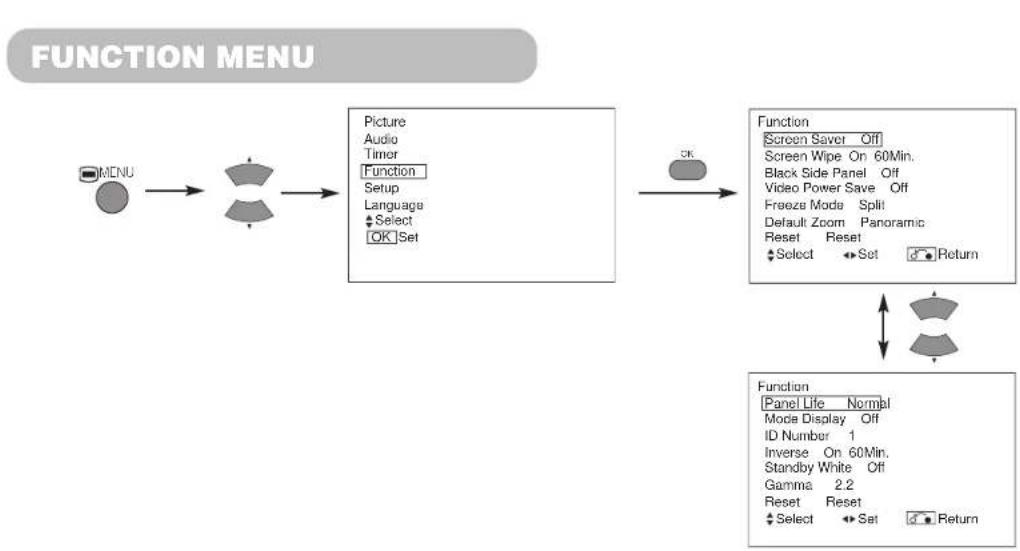
| Screen Saver |  | This moves the picture around the screen in small amounts, at set intervals. to reduce the panel image retention. This is where stationary objects, such as screen logos, leave a slight image visible after they should have disappeared. | |
| Screen Wipe | On | 60Min. | This is used to reduce the panel image retention that can occur with stationary pictures by the white field signal. Select On (continuous operation) or 60 Min. (time limit operation) and press the OK button. Press the MENU or RETURN button on the remote control to return to normal viewing. |
| Black Side Panel |  | This turns the gray sidebars On/Off when watching normal mode screen size area. It is always set to Off when the monitor powered On. It is recommended to set to Off to reduce the panel image retention. | |
| Video Power Save | Optional (grayed out) | ||
| Freeze Mode | Optional (grayed out) | ||
| Default Zoom | Optional (grayed out) | ||
| Reset | (off the function) | (waiting to rosof) | The original factory settings for the items of this Menu page can be restored by pressing the OK button. |
| Panel Life |  | This function is to suppress the contrast of the screen regardless of the Contrast setting in the Picture Menu. By this control, power consumption can be reduced or degradation of a panel can be mitigated. The order of power consumption is Extend 2 < Extend 1 < Normal.If the Contrast setting is changed when this item is set to Extend 1 or 2, it will be changed to Normal automatically. | |
| Mode Display |  | This can display the Input Signal Screen Display every time the input mode and signal mode are changed.Set to OFF if the Input Signal Screen Display is not needed when switching signals. | |
| ID Number |  | Assigns ID nos. to the monitors so that they can be controlled individually (up to 7 monitors can be controlled). | |
| Inverse | On | 60Min. | This function can change each level of RGB signal invert to reduce the panel image retention. When this function is required to use, select On (continuous operation) or 60Min. (time limit operation) and press the OK button. And press the Menu or Return button to exit. |
| Standby White |  | This function is also provided against the image retention. If time is set for this item, the screen changes into the white pattern when the monitor enters power save mode, and it will continue for the period of setting time. | |
| Gamma |  | Normally set to 2.2. | |
OPERATING INSTRUCTIONS (continued)
SETUP MENU

flowchart
graph TD
    A["MENU"] --> B["Picture Audio Timer Function Setup Language Select OK Set"]
    B --> C["Setup Auto Adjust Adjust Horizontal Position 0 Vertical Position +31 Horizontal Clock -20 Clock Phase 10 Reset Reset Select Return Exit"]
    C --> D["Setup Auto Adjust Adjust Horizontal Position 0 Vertical Position +31 Horizontal Clock -20 Clock Phase 10 Reset Reset Select Return Exit"]
    D --> E["Setup Input Level 0.7V Frequency Display Off WVGA Type Off Vertical Filter On Frequency Mode Movie RGB1 DV-PC RGB2 RGB Select Set Return"]
    E --> F["Setup Clock Phase 10 Next / Prev Adjust Return"]
| Selected characters Setup hint | ▶ | ||
| Auto Adjust* | (Menu) Adjust | Pressing the OK button here, Automatic regulation is started. | Horizontal Position, Vertical Position, Horizontal Clock and Clock Phase are adjusted automatically. |
| Horizontal Position | Moves the horizontal position to left. | Moves the horizontal position to right. | Adjust the left-side display position.(This function is only for RGB2. It's not available (grayed out) for RGB1.) |
 |  | ||
| Vertical Position | Moves down the vertical position. | Moves up the vertical position. | Adjust the vertical display position.(This function is only for RGB2. It's not available (grayed out) for RGB1.) |
 |  | ||
| Horizontal Clock | Reduces the dot clock frequency (shrinks the right side). | Increases the dot clock frequency (expands the right side). | Adjust for maximum character clarity.(This function is only for RGB2. It's not available (grayed out) for RGB1.) |
 |  | ||
| Clock Phase | Slows the dot clock phase (shifts slightly to left). | Advances the dot clock phase (shifts slightly to right). | Adjust for clear character visibility.(This function is only for RGB2. It's not available (grayed out) for RGB1.) |
| ← | → | ||
| Reset | (off the function) (waiting to reset) | The original factory settings for the items of this Menu page can be restored by pressing the OK button. (This is effective only for RGB2.) | |
| Input Level |  | Normally set to 0.7 V. If white is found to spread across the screen, set to 1.0 V. (This is effective only for RGB2.) | |
| Frequency Display |  | Set this to Off if the frequency information of the Input Signal Screen Display is not required. | |
| WVGA Type |  | This is only available for W-VGA signal.When it is set to On, the display area mode can be selected Full or Real. | |
| Vertical Filter |  | Turn On when concerned about screen flicker. | |
| Frequency Mode |  | Set to Movie when viewing moving images on a personal computer. | |
| RGB1 | Optional (grayed out) | ||
| RGB2 | Optional (grayed out) | ||
* Depending on the type of signal displayed, displays may not be optimized through automatic adjustment. Adjust manually to optimize them.
LANGUAGE MENU
flowchart
graph LR
    A["MENU"] --> B["Picture"]
    B --> C["Audio"]
    B --> D["Timer"]
    B --> E["Function"]
    B --> F["Setup"]
    F --> G["Language"]
    G --> H["Select"]
    G --> I["OK Set"]
    J["OK"] --> K["Language"]
    K --> L["English"]
    K --> M["繁體中文"]
    K --> N["整体中文"]
    K --> O["Pyrakai"]
    K --> P["日本語"]
    K --> Q["Select"]
    K --> R["Return"]
    K --> S["Exit"]
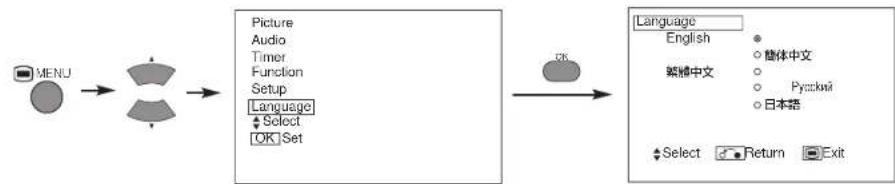
Select a language by ▼ ▲ SELECT buttons and press the OK button.
OTHER FEATURES
Automatic Store
Approximately 1 sec. after adjustment is completed, the adjustments will be recorded as shown in the table below.
| Menu Display Registration condition | ||
| Picture | Contrast | For every input function, 1 setting is registered. |
| Brightness | ||
| Color | ||
| Tint | ||
| Picture Enhancement | ||
| Color temperature | ||
| Color Temp. Adjust | ||
| R Amplitude | For every Color Temperature, 1 setting is registered. | |
| G Amplitude | ||
| B Amplitude | ||
| R Cut Off | ||
| G Cut Off | ||
| B Cut Off | ||
| Audio | Audio Mode 1 setting is registered. | |
| Treble | For every Audio Mode, 1 setting is registered. | |
| Bass | ||
| Balance 1 setting is registered. | ||
| SRS TruBass | For every Audio Mode, 1 setting is registered. | |
| Matrix Surround | ||
| Perfect Volume | ||
| Menu Display Registration condition | |
| Function | Screen Saver 1 setting is registered. |
| Screen Wipe (not registered) | |
| Black Side Panel (not registered) | |
| Panel Life 1 setting is registered. | |
| Mode Display | |
| ID Number | |
| Inverse | |
| Standby White | |
| Gamma | |
| Setup | Auto Adjust (not registered) |
| Horizontal Position For every signal Mode, 1 setting is registered. (Only for RGB2) | |
| Vertical Position | |
| Horizontal Clock | |
| Clock Phase | |
| Input Level 1 setting is registered. | |
| Frequency Display | |
| WVGA Type | |
| Vertical Filter | |
| Frequency Mode | |
| Language 1 setting is registered. | |
• The previously recorded items will be lost.
- The signal mode can be identified by the horizontal/vertical sync frequency and the sync signal polarity. Different signals with which all the elements are the same or similar will be handled as the same signal.
OTHER FEATURES (continued)
Signal Check
Changes in the signal status are displayed on the screen as they arise.
| Status Display | Action | |
| When Mode Display is set to ON, the input signal is switched or when the RECALL button is pressed. | A guide is displayed for the input terminal and the horizontal and vertical sync frequency. | ____ |
| When the sync signal is no longer detected. | A guide displays No Sync Signal, and Power Save (for approx. 5 sec.)When the condition continues where the sync signal cannot be detected, indicator lamp of power source changes in orange and the mode switches to power save mode. | Recheck the personal computer power switch status and the connection status. |
| When the input signal does not match the monitor specifications or is in an unstable status. | A guide displays Invalid Scan Freq. | Recheck the input signal specifications.[IMAGE] |
RGB

text_image
RGB2 RGB H: 48.4kHz V: 60.1 Hz G. --- Min. G --- :---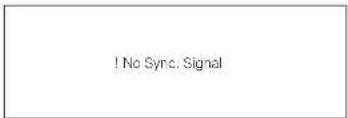
text_image
! No Sync. Signal
text_image
I Invalid Scan FreqPower Save Mode
When the RGB1, RGB2 input is selected
- When this unit is connected to a VESA DPMS computer, the Power Save (Off) mode can be set to be activated automatically when the computer is not being used to reduce power consumption by this unit.
| RGB sync signal | Horizontal Yes | No Yes No | |||
| Vertical Yes | Yes No No | ||||
| PC signal Active (normal | display) Blank (no display) | ||||
| Operation mode | On | Off | |||
| Indicating lamp | Lights green | Lights orange | |||
| Power consumption | 255W (32")365W (42") | 3W or less (RGB1)1W or less (RGB2; 100V≤AC≤120V)3W or less (RGB2; 120V<AC≤240V) | |||
Returning to operating status
- Operate the personal computer, or press either the INPUT SELECT button of the main unit or the RGB1/RGB2 buttons of the remote control.
IMAGE RETENTION OF PLASMA DISPLAY
There are different characteristics that result in panel image retention depending on how the plasma display is used. Situations and effective usage methods related to ghosting are provided below.
Image retention characteristics of a plasma display
The image retention phenomenon of a plasma panel occurs due to partial phosphor degradation arising from partial character and figure display.
For example, when the character image as shown in Fig. A at the right is continuously displayed for a long period of time, the only part of the phosphor (Red, Green, Blue) that will degrade will be the color of the applicable character display portion. Consequently, when a white image is displayed on the entire screen as shown in Fig. a, the character marks displayed up to that time will become a color difference visible to the eye, but the phosphor will never burn.

text_image
Welcome Welcome Welcome Welcome [Fig. A] → Welcome Welcome [Fig. a]■The degree of image retention is proportional to the brightness of the characters and figures displayed as well as the display time.
- The tendency of the phosphor is to degrade more the brighter the characters and figures are displayed. When images of figures with different levels of brightness, as shown in Fig. B, are continuously displayed for a long period of time, it becomes easier for image marks at locations when the brighter figures are displayed to be noticeable.

text_image
[Fig. B] [Fig. b]* The image retention images in this document are exaggerated for the purpose of explanation. The actual manner in which the image retention is seen differs depending on the operation time and brightness.
Methods to Reduce the Occurrence of Image Retention
- Lower the Contrast and Brightness settings of the plasma display as much as possible.
A function is provided in the display that controls the brightness of the screen to reduce degradation of the panel. Using this function makes it possible to reduce image retention.
(Refer to Panel Life (Extend 1. or Extend 2 shown on 19) )
- Set the plasma monitor to an "Screen Wipe" or "Inverse" display.
The occurrence of image retention when displaying images of identical patterns, such as static images, for long periods of time can be reduced by displaying a reversed color or completely white screen for about 1 \~ 2 hours after terminating the display. (Settings can be made using Screen Wipe and Inverse of Function MENU shown on [19])
• Using in combination with moving images
Since the degradation of the fluorescent material progresses comparatively uniform for moving images, the occurrence of partial image retention can be controlled. We recommend to use in combination with moving images such as a DVD.
* Please be careful since image retention will occur if display is left in a two screen display state for a long period of time.
* Television broadcasts include images displayed for long periods of time in which the left and right or top and bottom of the image are cut and broadcast station name or time are displayed for a long period of time at the same portion of the screen. Image retention in these portions can be expected to occur, so please be aware.
NOTES
About screen defects
- High precision technology is used in the making of plasma panels but there may be dark spots (points that do not illuminate) and bright spots (points that are too bright) in some cases. These do not indicate a malfunction.
About residual images
- In some cases, residual images may remain after the short-term display of still images and another image is displayed, but these will disappear and return to normalcy. This is not a malfunction.
About the panel screen
- Plasma displays display images by means of electrical discharges inside the panel. Because of this, the temperature of the panel surface may rise in some cases. Also, plasma displays are made of finely processed glass. A reinforced glass filter is installed over the panel surface but avoid strong impact because there is still danger of glass breakage.
TROUBLESHOOTING
Symptoms That Seemingly Appear to be Failures
Make the checks suggested below depending on the symptoms observed. If the symptoms remain uncorrected, contact your dealer.
WARNING
Customer servicing can be hazardous.
| Symptom Point to check See page | |||
| No picture with the power-indicating lamp off. |  | Check the way the power cable is connected.Press the power switch. | 1213 |
| The message “No Sync. Signal” or “Power Save” is displayed.No picture with the power indicating lamp lights in orange. |   | No sync signal is detected.Check the way the signal cable is connected.Make sure that the switch of the computer, imaging equipment, etc., is turned on.Make sure the computer is not in the power-save mode.Check to see if the input selection matches the connection terminal. | 11 |
| The message “Invalid Scan Freq.” is displayed. |  | An input signal is not received normally.Check to see if the input signal matches the monitor specifications.Check the way the signal cable is connected. | 112829 |
| The power indicating lamp is normally lit but no picture. |  | Check the contrast and brightness settings (adjust them for higher contrast and brightness).Check the way the signal cable is connected. | 1117 |
| The display image appears flowing slantwise.Text displayed across the screen appears vertically streaked, with the characters in vertical columns blurred. | 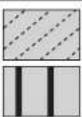 | Adjust the dot clock frequency and phase. (Adjust the dot clock frequency first, the dot clock phase next.) (RGB input) | 2026 |
| Text displayed across the screen appears blurred.A fine pattern flickers when displayed on the screen. |  | Adjust the dot clock phase for the clearest viewing.(RGB input) | 2026 |
| The remote control does not work. Check to see if the batteries are loaded in the remote control in opposite direction.Check to see if the batteries in the remote control are OK. | 9 | ||
| Symptom Point to check See page | ||
| The temperature of the display panel surface is high. The plasma display panel is lighting the phosphors by the discharge of internal radiation. In some cases, this may cause the temperature of the panel surface to increase. Please note that this is not a malfunction. | - | |
| There are locations on the screen that are different from the periphery (*).*Points that do not light, points with brightness different from that of the periphery, points with color different from that of the periphery, etc. | High-precision technology is used to manufacture the plasma display panel. However in some cases, there are minor defects in some parts of the screen. Please note that this is not a malfunction. | - |
| Vertical stripes appear, depending on the screen contents. | The plasma display panel is lighting the phosphors by the discharge of internal radiation. Depending on the screen contents, in rare cases this may cause vertical stripes to appear because of failure to light. Please note that this is not a malfunction. | - |
| Coarse horizontal stripes appear in FULL display. Adjusting the Clock Phase will reduce the horizontal stripes.(RGB input) | 20 | |
| Flickering in the form of horizontal lines oscillating up and down.(PC INPUT MODE only) | If the direct frequency from the computer is below 85Hz, try a higher frequency (upper limit 85Hz). There may be a slight attenuation of the current image.Try turning the Vertical Filter On. For this case however, the vertical resolution will drop. | 20 |
| The fan motor is noisy. (Fan application model only) Use the fan that controls the temperature in the main body to lower the temperature of this unit. If the ambient air temperature increases, the fan will start, the RPMs will increase and motor noise will grow louder. This is not a malfunction though. | - | |
| The top of the monitor heats up. When used for long periods of time, the top of the monitor may heat up. This is not a malfunction. | - | |
| Text characters are displayed with varying thicknesses. | The thicknesses of characters and lines may vary if images with a vertical resolution greater than 512 lines are displayed; however, this is not a malfunction. | - |
TROUBLESHOOTING (continued)
Actions to Correct Abnormal Displays
Depending on the kind of system equipment used, images may not be displayed normally. In this case, make the adjustments suggested below. (only for RGB2)
| Symptom 1 | Text displayed across the screen appears vertically streaked, with some characters blurred (figure 1).The display image appears flowing (figure 2) (RGB input). | |
| Example | Figure 1 | 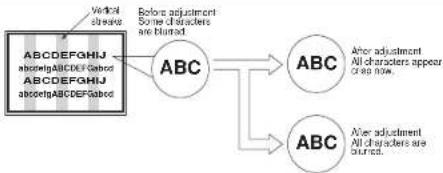 |
| Adjustment procedure | 1) Press the AUTO button on the remote control. | |
| When adjustment is not possible with Auto Adjust2) Press the MENU button. The Main Menu will be displayed.3) Press the ▼ELECT button and select Setup.4) Press the OK button. The Setup Menu will be displayed.5) Press the ▼ELECT button and select Horizontal Clock.(Display fine patterns as characters or a vertical striped pattern over the entire screen during Horizontal Clock adjustment.)6) Press the ▶ABJUST buttons and search for clear characters over the entire screen.7) Perform adjustment for symptom 2 below, when the characters are blurred on the entire screen. | ||
- The display image may be momentarily disturbed during clock adjustment but this is not a failure.
| Symptom 2 | Text displayed across the screen appears blurred in its entirety (figure 2).A fine pattern flickers when displayed on the screen (figure 3). | |
| Example | Figure 2 | Figure 3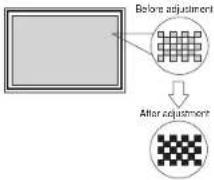 |
| Adjustment procedure | 1) Press the AUTO button on the remote control. | |
| When adjustment is not possible with Auto Adjust2) Press the MENU button. The Main Menu will be displayed.3) Press the ▼ELECT button and select Setup.4) Press the OK button. The Setup Menu will be displayed.5) Press the ▼ELECT button and select Clock Phase.(Display fine patterns as characters or a vertical striped pattern over the entire screen during Clock Phase adjustment.) | ||
| 6) Press ▷r ADJUST buttons to make the text appear clean across the screen. | 6) Press ▷r ADJUST buttons to make the text appear without flickering. | |
PRODUCT SPECIFICATIONS
Product specifications and designs are subject to change without notice.
| Panel | Display dimensions | Approx. 32 inches (716 (H) x 399 (V) mm, diagonal 820mm) Approx. 42 inches (922 (H) x 522 (V) mm, diagonal 1059mm) | |
| Resolution | 852 (H) x 1024 (V) pixels 1024 (H) x 1024 (V) pixels | ||
| Net dimensions (excluding Speakers/Stand) | 830 (W) x 506 (H) x 92 (D) mm 1030 (W) x 636 (H) x 91 (D) mm | ||
| Net weight (excluding Speakers/Stand) | 24.6kg 34.9kg | ||
| Ambient conditions | Temperature | Operating : 5°C to 35°C, Storage : 0°C to 40°C | |
| Relative humidity | Operating : 20% to 80%, Storage : 20% to 90% (non-condensing) | ||
| Power supply | AC 100 - 240V, 50/60Hz | ||
| Power consumption/at standby | 255W / <3W 365W / <3W | ||
| Audio output | 12W + 12W (6Ω) | ||
| (RGB input) | |||
| Input signals | Input terminals | RGB1 DVI input terminal (DVI-D)RGB1 audio input terminal (3.5mm Stereo Mini Jack)RGB2 analog RGB input terminal (D-sub 15-pin)RGB2 audio input terminal (3.5mm Stereo Mini Jack) | |
| Video signals | 0.7 V/1.0 Vp-p, analog RGB (Recommended Signal) | ||
| Sync signals | H/V separate, TTL level [2KΩ]H/V composite, TTL level [2KΩ]Sync on green, 0.3 Vp-p [75Ω] | ||
| Recommended signal | 43 modes 28 29 | ||
- The monitor takes at least 30 minutes to attain the status of optimal picture quality.
Signal Input
RGB terminal (D-sub 15-pin connector)
| Pin | Input signal |
| 1 | R |
| 2 G or sync on green | |
| 3 | B |
| 4 No connection | |
| 5 No connection | |
| 6 R.GND | |
| 7 | G.GND |
| 8 B.GND | |
| 9 No connection | |
| 10 | GND |
| 11 | No connection |
| 12 | [SDA] |
| 13 | H. sync or HW composite sync |
| 14 | V.sync. [V.CLK] |
| 15 | [SCL] |

text_image
12345 10 9 8 7 6 1112131415- When different kinds of input signals are simultaneously input to the monitor via a graphics board or the like, the monitor will automatically select the signals in the following priority order:
| Sync signal type Priority | |
| H/V separate sync. 1 | |
| H/V composite sync. 2 | |
| sync.on Green * 3 |
^a Even in the case of the recommended signals shown on the following page, there may be instances when correct display is not possible. In this case, use H/V separate sync. H/V composite sync.
PRODUCT SPECIFICATIONS (continued)
Signal Input (continued)
DVI terminal (DVI-D)
| Pin Input signal Pin Input signal | |||
| 1 | T.M.D.S. Data2- | 14 | +5V Power |
| 2 | T.M.D.S. Data2+ | 15 | Ground (for+5V) |
| 3 | T.M.D.S. Data2/4 Shield | 16 | Hot Plug Detect |
| 4 | T.M.D.S. Data4- | 17 | T.M.D.S. Data0- |
| 5 | T.M.D.S. Data4+ | 18 | T.M.D.S. Data0+ |
| 6 | DDC Clock | 19 | T.M.D.S. Data0/5 Shield |
| 7 | DDC Data | 20 | T.M.D.S. Data5- |
| 8 | No Connect | 21 | T.M.D.S. Data5+ |
| 9 | T.M.D.S. Data1- | 22 | T.M.D.S. Clock Shield |
| 10 | T.M.D.S. Data1+ | 23 | T.M.D.S. Clock+ |
| 11 | T.M.D.S. Data1/3 Shield | 24 | T.M.D.S. Clock- |
| 12 | T.M.D.S. Data3- | Frame | GND |
| 13 | T.M.D.S. Data3+ | ||
| 1 | 2 | 3 | 4 | 5 | 6 | 7 | 8 |
| 9 | 1 | 0 | 1 | 1 | 2 | 1 | 3 |
| 17 | 18 | 9 | 20 | 21 | 22 | 23 |
Recommended Signal List
With Digital RGB signal input (RGB1 input)
| No. | Signal mode | Horizontal frequency (kHz) | Dot clock frequency (MHz) | Remarks | ||
| Signal Name | Resolution | Vertical frequency (Hz) | ||||
| 1 | VGA | 640 X 400 | 70.08 | 31.47 | 25.18 | |
| 2 | 640 X 480 | 59.94 | 31.47 | 25.18 | ||
| 3 | W-VGA | 864 X 480 | 60.00 | 31.02 | 33.75 | |
| 4 | 864 X 480 | 59.94 | 31.47 | 34.24 | WVGA type: On | |
| 5 | VESA | 640 X 480 | 72.81 | 37.86 | 31.50 | |
| 6 | 640 X 480 | 75.00 | 37.50 | 31.50 | ||
| 7 | 640 X 480 | 85.01 | 43.27 | 36.00 | ||
| 8 | 800 X 600 | 56.25 | 35.16 | 36.00 | ||
| 9 | 800 X 600 | 60.32 | 37.88 | 40.00 | ||
| 10 | 800 X 600 | 72.19 | 48.08 | 50.00 | ||
| 11 | 800 X 600 | 75.00 | 46.88 | 49.50 | ||
| 12 | 800 X 600 | 85.06 | 53.67 | 56.25 | ||
| 13 | 1024 X 768 | 60.00 | 48.36 | 65.00 | ||
| 14 | 1024 X 768 | 70.07 | 56.48 | 75.00 | ||
| 15 | 1024 X 768 | 75.03 | 60.02 | 78.75 | ||
- Make sure that the signal of the equipment to be connected is compatible with the specifications of this list.
With Analog RGB signal input (RGB2 input)
| No. | Signal mode | Horizontal frequency (kHz) | Dot clock frequency (MHz) | Remarks | ||
| Signal Name | Resolution | Vertical frequency (Hz) | ||||
| 1 | VGA640 X 480 | 640 X 400 | 70.08 31.47 25.18 | |||
| 2 | 59.94 31.47 25.18 | |||||
| 3 | W-VGA | 864 X 480 | 59.94 | 31.47 | 34.24 | WVGA type: On |
| 4 | 640 X 480 | 72.81 37.86 31.50 | ||||
| 5 | 640 X 480 | 75.00 37.50 31.50 | ||||
| 6 | 640 X 480 | 85.01 43.27 36.00 | ||||
| 7 | 800 X 600 | 56.25 35.16 36.00 | ||||
| 8 | 800 X 600 | 60.32 37.88 40.00 | ||||
| 9 | 800 X 600 | 72.19 48.08 50.00 | ||||
| 10 | 800 X 600 | 75.00 46.88 49.50 | ||||
| 11 | 800 X 600 | 85.06 53.67 56.25 | ||||
| 12 | 1024 X 768 | 60.00 48.36 65.00 | ||||
| 13 | 1024 X 768 | 70.07 56.48 75.00 | ||||
| 14 | 1024 X 768 | 75.03 60.02 78.75 | ||||
| 15 | 1024 X 768 | 85.00 68.68 94.50 | ||||
| 16 | 1152 X 864 | 75.00 67.50 108.00 | ||||
| 17 | 1280 X 102 | 4 60.02 63.98 108.00 | ||||
| 18 | 1280 X 102 | 4 75.03 79.98 135.00 | ||||
| 19 | 1280 X 102 | 4 85.02 91.15 157.50 | ||||
| 20 | 1600 X 120 | 60.00 75.00 162.00 | ||||
| 21 | 1600 X 120 | 75.00 93.75 202.50 | ||||
| 22 | 1600 X 120 | 85.00 106.25 229.50 | ||||
| 23 | 640 X 480 | 66.67 35.00 30.24 | ||||
| 24 | 832 X 624Macintosh | 74.55 49.72 | 57.28 | |||
| 25 | 1024 X 768 | 74.93 60.24 | 80.00 | |||
| 26 | 1152 X 870 | 75.06 68.68 | 100.00 | |||
| 27 | W-XGA1280 X 768 | 1280 X 768 | 59.833 | 47.986 81.00 | ||
| 28 | 69.997 | 56.137 94.760 | ||||
- The type of video board or connecting cable used may not allow for correct displays adjustment of Horizontal Position, Vertical Position, Horizontal Clock and Clock Phase.
- The monitor may fail to display an animation image correctly when a signal having a vertical frequency of 85Hz or higher is input to it.
- The monitor differentiates the signal modes according to the horizontal and vertical frequencies and the horizontal and vertical sync signal polarities. Note that different signals having all these elements alike may be handled as the same signal.
- Displaying images with more than 512 lines of vertical resolution at Full display (compressed display) can result in the interpolation of stripes.
SUPPLEMENT
Optional Video Unit Function
Additional functions when the optional video unit is installed are as follows: (31 42)
INSTALLATION INSTRUCTIONS
Connecting to a Video Imaging Device
(1) Make sure that the power switch of the monitor is turned off.
(2) Make sure that the power switch of the imaging device is turned off.
(3) Use a commercially available cable and connector to connect the signal input terminal on the rear panel of this device and the signal output terminal of the imaging device.
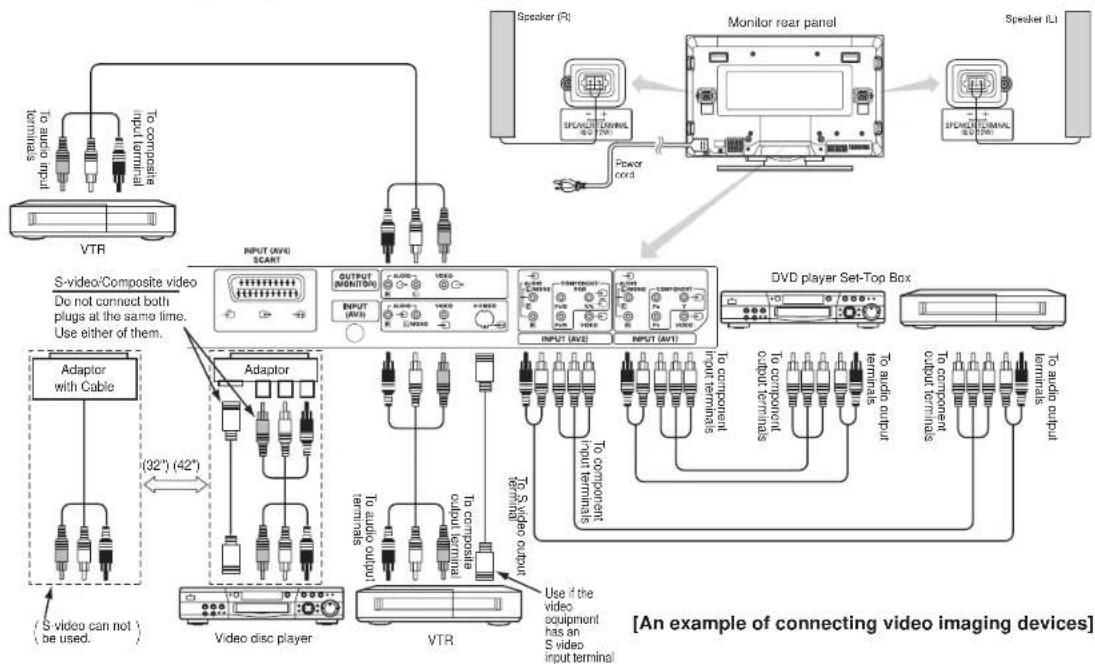
flowchart
graph TD
    A["Speaker (R)"] --> B["Monitor rear panel"]
    B --> C["Speaker (L)"]
    D["VTR"] --> E["S-video/Composite video"]
    E --> F["Adaptor with Cable"]
    F --> G["Video disc player"]
    G --> H["VTR"]
    I["DVd player Set-Top Box"] --> J["To component input terminals"]
    J --> K["To audio output terminals"]
    K --> L["To component output terminals"]
    L --> M["To audio output terminals"]
    M --> N["To audio output terminals"]
    O["Speaker (R)"] --> P["Monitor rear panel"]
    P --> Q["Speaker (L)"]
    R["DVd player Set-Top Box"] --> S["To component input terminals"]
    S --> T["To audio output terminals"]
    T --> U["To audio output terminals"]
    U --> V["To audio output terminals"]
    W["Speaker (R)"] --> X["Monitor rear panel"]
    X --> Y["Speaker (L)"]
    Z["DVd player Set-Top Box"] --> AA["To component input terminals"]
    AA --> AB["To audio output terminals"]
    AB --> AC["To audio output terminals"]
    AC --> AD["To audio output terminals"]
    AE["Speaker (R)"] --> AF["Monitor rear panel"]
    AF --> AG["Speaker (L)"]
    AH["DVd player Set-Top Box"] --> AI["To component input terminals"]
    AI --> AJ["To audio output terminals"]
    AJ --> AK["To audio output terminals"]
With RGB component setup

text_image
DIGITAL INPUT USB 1 USB 2 AUDIO II USB 3 USB 4 USB 5 USB 6 USB 7 USB 8 USB 9 USB 10 USB 11 USB 12 USB 13 USB 14 USB 15 USB 16 USB 17 USB 18 USB 19 USB 20 USB 21 USB 22 USB 23 USB 24 USB 25 USB 26 USB 27 USB 28 USB 29 USB 30 USB 31 USB 32 USB 33 USB 34 USB 35 USB 36 USB 37 USB 38 USB 39 USB 40 USB 41 USB 42 USB 43 USB 44 USB 45 USB 46 USB 47 USB 48 USB 49 USB 50 USB 51 USB 52 USB 53 USB 54 USB 55 USB 56 USB 57 USB 58 USB 59 USB 60 USB 61 USB 62 USB 63 USB 64 USB 65 USB 66 USB 67 USB 68 USB 69 USB 70 USB 71 USB 72 USB 73 USB 74 USB 75 USB 76 USB 77 USB 78 USB 79 USB 80 USB 81 USB 82 USB 83 USB 84 USB 85 USB 86 USB 87 USB 88 USB 89 USB 90 USB 91 USB 92 USB 93 USB 94 USB 95 USB 96 USB 97 USB 98 USB 99 USB100To component video equipments. Please use the connection cable suitable for the terminal form of video equipment.
- If video equipment with an S video output terminal is used, cabling by the S video cable is recommended to provide finer video quality. (If an S video input terminal and a video input terminal of AV3 connect to the monitor at the same time, S video input would govern.)
- If the OUTPUT (MONITOR) terminal is connected to an external monitor with a 75 Ohm terminal, it is possible to view the same image as on the main unit. But it is possible to monitor only the composite video signal from AV1, AV2, AV3 or AV4 input that is displayed on the screen at the time.
- If the adaptor is applied to AV4 input as shown in the drawing, it is not possible to receive RGB signal.
Applicable video signals for each input terminal (See PRODUCT SPECIFICATIONS for details. 40)
| Terminal RC | V/SCART DVI D-sub Remarks | ||||||||
| Signal | CVBS | S-video | Component | RGB | PC | STB | RGB | Component | |
| AV1 | ○ | ○ | |||||||
| AV2 | ○ | ○ | ○ | Refer to Setup Menu.38 | |||||
| AV3 | ○ | ○ | |||||||
| AV4 | ○ | ○ | ○ | Refer to Setup Menu.38 | |||||
| RGB1 | ○ | ○ | Refer to Setup Menu.39 | ||||||
| RGB2 | ○ | ○ | Refer to Setup Menu.39 | ||||||
(○ : Available)
OPERATING INSTRUCTIONS

text_image
INPUT SELECT button SIZE button
text_image
RGB/VIDEO buttons SIZE buttonInput Switching
- Input can be switched by pressing the AV1, AV2, AV3, AV4, RGB1 or RGB2 buttons of the remote control.
- Input can be switched in the sequence of AV1 → AV2 → AV3 → AV4 → RGB1 → RGB2 by pressing the INPUT SELECT button of the monitor.

Size Switching
Each time the SIZE button of the remote control or the monitor is pressed, the screen display size will change in sequence and the status will be displayed at the bottom of the screen.
- During VIDEO signal input (AV1, AV2, AV3, AV4, RGB1 (set to [DVI-STB]) and RGB2 (set to [Component]))

- The size will fix as Full mode and not change when receiving the component signal of 1080i/50, 1080i/60 or 720p/60.
Full
Display size selection diagram
| When you want to | Set the display size to | Input signal Display screen Remarks | ||
| Play a 4:3 image in a 16:9 screen faithfully. | 4 : 3 |  |  | Blanking occurs on both sides. |
| Play a 4:3 image in a 16:9 screen with the height and width of the middle of the screen enlarged on equal scales and with both sides appearing somewhat enlarged. | Panoramic |  | ||
| Play a 16:9 VISTA size image in the 4:3 image faithfully reproduced on the 16:9 screen. | Zoom |  |  | • The 4:3 image is called a letterbox image.• In some cases, some slight blanking may remain at the top and bottom. |
| Play a 21:9 Cinema size image in the 4:3 image expanded vertically on the 16:9 screen. | Cinema |  |  | In some cases, some slight blanking may remain at the top and bottom. |
| Play a 4:3 image faithfully in a 16:9 screen in the standard vortical size and horizontally squeezed.* | Full |  |  | * An image with an aspect ratio of 16:9 shrunk horizontally to 4:3 to display in a 4:3 screen |
Vertical picture position can be adjusted for [Panoramic], [Zoom] and [Cinema] mode as follows.
-
Press SIZE button and ▲▼ SELECT buttons during picture size display.
-
Position display will appear.
-
Adjustment range of each picture size are as shown below.
[Panoramic] - 12 to + 12
[Zoom] and [Cinema] - 31 to + 31
- When 1080i/50 or 1080i/60 component signal is received, vertical position can be adjusted only one step up. (The range: 0 to +1)
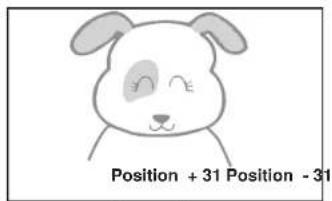
text_image
Position + 31 Position - 31Press ▲
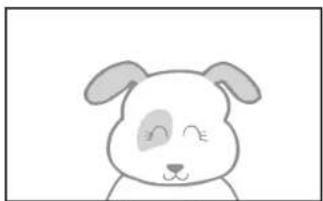
natural_image
Simple line drawing of a cartoon dog's face with closed eyes and open mouth (no text or symbols)Press ▼
ATTENTION
Using a wide-screen monitor
- This monitor has a screen mode selection feature. If an incompatible screen mode is selected to play certain software, such as a TV program, the image would appear different from the original. Take this into consideration when making screen mode choices.
- Use of this monitor in its enlarged display mode with the wide feature enabled in coffee shops, hotels and other establishments for commercial or pubic viewing purposes could infringe on the copyright holder's right protected by Copyright Law.
- When a normal 4:3 image is displayed over the entire screen in the Panoramic mode, parts of the periphery of the image may disappear and/or appear distorted in some cases. Use the 4:3 mode to view images, which were created in 4:3 mode.
This mode allows 4:3 content to be viewed without picture distortion.
OPERATING INSTRUCTIONS (continued)
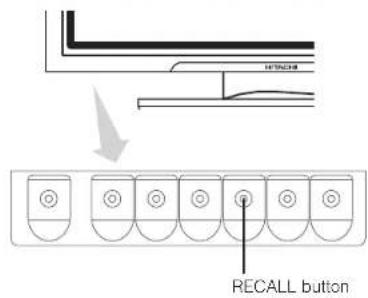
text_image
RECALL button
text_image
PinP button RECALL button RETURN buttonDisplaying MULTI PICTURE
If the PinP button on the remote control is pressed MULTI PICTURE will display.
Activating the P-in-P mode from the RGB input screen
Pressing the PinP button one time will display 2 pictures.
- This mode can be available from RGB1(DVI-PC) and RGB2(RGB) input.
- The speaker icon can be shifted left and right by pressing the ◀ and SELECT buttons; the audio of the video will be output from the side on which the speaker icon is located.
- The sub-screen position can be selected up and down by pressing ▼ ▲ SELECT buttons.
- The sub-screen can be selected with the AV1, AV2, AV3, and AV4 buttons from the status that the speaker icon appears on the left side of AV* as shown in the diagram to the right.
- Pressing the PinP button again or the RETURN button will cancel the
- "Frequency Mode" in the Setup Menu should be set to Movie when sub-screen is the component signal of 1080i/50 or 1080i/60.
AV1: Displays the VIDEO input signal of the sub-screen.
Activating the Split mode from the video input screen
Pressing the PinP button one time will display 2 pictures.
- The speaker icon can be shifted left and right by pressing the and SELECT buttons; the audio of the video will be output from the side on which the speaker icon is located.
- The same video input mode cannot be selected for both screens at the same time.
- Pressing the PinP button again or the RETURN button will cancel the 2 pictures display.
- When the Video input is set to RGB Video, this Split mode is not possible.
• Refer to the table for 2 pictures (Split) mode.
| AV1AV2 | |
2 Pictures (Split)
- Even if the input of the horizontal / vertical synchronizing signal (or video signal) stops in the MULTI PICTURE display, the mode will not change to power save mode.
- Please be careful since image retention will occur if display is left in a MULTI PICTURE display state for a long period of time.
Input Signal Screen Display
The input signal status can be displayed on the screen by pressing the RECALL button of the remote control or the monitor.
The display will go out in approximately 6 seconds.
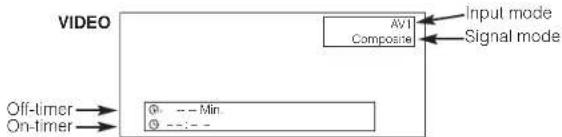
text_image
VIDEO AVI Composite Input mode Signal mode Off-timer → On-timer → ● -- Min ● --: -PICTURE MENU

flowchart
graph TD
    A["MENU"] --> B["Picture: Auto Timer Function Setup Language Select Select"]
    B --> C["OK"]
    C --> D["Picture: Picture Mode Dynamic: Contrast -31 Brightness 31 Color 0 Sharpness +15 Tint 0 Cover Temperature Normal Contrast Mode Normal Reset Reset Select OK Select Return"]
    D --> E["OK"]
    E --> F["Picture Mode Dynamic: Next/Prev Select Return"]
    F --> G["Figure: Picture Mode Dynamic: Contrast -31 Brightness 31 Color 0 Sharpness +15 Tint 0 Cover Temperature Normal Contrast Mode Normal Reset Reset Select OK Select Return"]
    G --> H["OK"]
    H --> I["Figure Mode Dynamic: Next/Prev Select Return"]
    I --> J["Figure: Picture Mode Dynamic: Next/Prev Select Return"]
    J --> K["Figure: Picture Mode Dynamic: Next/Prev Select Return"]
    K --> L["Figure: Picture Mode Dynamic: Next/Prev Select Return"]
    L --> M["Figure: Picture Mode Dynamic: Next/Prev Select Return"]
    M --> N["Figure: Picture Mode Dynamic: Next/Prev Select Return"]
    N --> O["Figure: Picture Mode Dynamic: Next/Prev Select Return"]
    O --> P["Figure: Picture Mode Dynamic: Next/Prev Select Return"]
    P --> Q["Figure: Picture Mode Dynamic: Next/Prev Select Return"]
    Q --> R["Figure: Picture Mode Dynamic: Next/Prev Select Return"]
    R --> S["Figure: Picture Mode Dynamic: Next/Prev Select Return"]
    S --> T["Figure: Picture Mode Dynamic: Next/Prev Select Return"]
    T --> U["Figure: Picture Mode Dynamic: Next/Prev Select Return"]
    U --> V["Figure: Picture Mode Dynamic: Next/Prev Select Return"]
    V --> W["Figure: Picture Mode Dynamic: Next/Prev Select Return"]
    W --> X["Figure: Picture Mode Dynamic: Next/Prev Select Return"]
    X --> Y["Figure: Picture Mode Dynamic: Next/Prev Select Return"]
    Y --> Z["Figure: Picture Mode Dynamic: Next/Prev Select Return"]
    Z --> AA["Figure: Picture Mode Dynamic: Next/Prev Select Return"]
    AA --> AB["Figure: Picture Mode Dynamic: Next/Prev Select Return"]
    AB --> AC["Figure: Picture Mode Dynamic: Next/Prev Select Return"]
    AC --> AD["Figure: Picture Mode Dynamic: Next/Prev Select Return"]
    AD --> AE["Figure: Picture Mode Dynamic: Next/Prev Select Return"]
    AE --> AF["Figure: Picture Mode Dynamic: Next/Prev Select Return"]
    AF --> AG["Figure: Picture Mode Dynamic: Next/Prev Select Return"]
    AG --> AH["Figure: Picture Mode Dynamic: Next/Prev Select Return"]
    AH --> AI["Figure: Picture Mode Dynamic: Next/Prev Select Return"]
    AI --> AJ["Figure: Picture Mode Dynamic: Next/Prev Select Return"]
    AJ --> AK["Figure: Picture Mode Dynamic: Next/Prev Select Return"]
    AK --> AL["Figure: Picture Mode Dynamic: Next/Prev Select Return"]
    AL --> AM["Figure: Picture Mode Dynamic: Next/Prev Select Return"]
    AM --> AN["Figure: Picture Mode Dynamic: Next/Prev Select Return"]
    AN --> AO["Figure: Picture Mode Dynamic: Next/Prev Select Return"]
    AO --> AP["Figure: Picture Mode Dynamic: Next/Prev Select Return"]
    AP --> AQ["Figure: Picture Mode Dynamic: Next/Prev Select Return"]
    AQ --> AR["Figure: Picture Mode Dynamic: Next/Prev Select Return"]
    AR --> AS["Figure: Picture Mode Dynamic: Next/Prev Select Return"]
    AS --> AT["Figure: Picture Mode Dynamic: Next/Prev Select Return"]
    AT --> AU["Figure: Picture Mode Dynamic: Next/Prev Select Return"]
    AU --> AV["Figure: Picture Mode Dynamic: Next/Prev Select Return"]
    AV --> AW["Figure: Picture Mode Dynamic: Next/Prev Select Return"]
    AW --> AX["Figure: Picture Mode Dynamic: Next/Prev Select Return"]
    AX --> AY["Figure: Picture Mode Dynamic: Next/Prev Select Return"]
    AY --> AZ["Figure: Picture Mode Dynamic: Next/Prev Select Return"]
    AZ --> BA["Figure: Picture Mode Dynamic: Next/Prev Select Return"]
    BA --> BB["Figure: Picture Mode Dynamic: Next/Prev Select Return"]
    BB --> BC["Figure: Picture Mode Dynamic: Next/Prev Select Return"]
    BC --> BD["Figure: Picture Mode Dynamic: Next/Prev Select Return"]
    BD --> BE["Figure: Picture Mode Dynamic: Next/Prev Select Return"]
    BE --> BF["Figure: Picture Mode Dynamic: Next/Prev Select Return"]
    BF --> BG["Figure: Picture Mode Dynamic: Next/Prev Select Return"]
    BG --> BH["Figure: Picture Mode Dynamic: Next/Prev Select Return"]
    BH --> BI["Figure: Picture Mode Dynamic: Next/Prev Select Return"]
    BI --> BJ["Figure: Picture Mode Dynamic: Next/Prev Select Return"]
    BJ --> BK["Figure: Picture Mode Dynamic: Next/Prev Select Return"]
    BK --> BL["Figure: Picture Mode Dynamic: Next/Prev Select Return"]
    BL --> BM["Figure: Picture Mode Dynamic: Next/Prev Select Return"]
    BM --> BN["Figure: Picture Mode Dynamic: Next/Prev Select Return"]
    BN --> BO["Figure: Picture Mode Dynamic: Next/Prev Select Return"]
    BO --> BP["Figure: Picture Mode Dynamic: Next/Prev Select Return"]
    BP --> BQ["Figure: Picture Mode Dynamic: Next/Prev Select Return"]
    BQ --> BR["Figure: Picture Mode Dynamic: Next/Prev Select Return"]
OPERATING INSTRUCTIONS (continued)
PICTURE MENU (continued)
| Selected characters Setup hint |  | |||
| Picture Mode | Dynamic: This setting is best for very bright ambient lighting.Natural: This setting is for normal lighting conditions. | |||
| Contrast | Narrows the gap between brightness and darkness. | Broacons the gap between brightness and darkness. | Adjust for maximum visibility to suit the ambient brightness.This can adjust further till [+40] by pressing and holding cursor button at [+31]. The color for [+32] to [+40] numbers will change from white to magenta. This special mode is better for dark scenes.For normal viewing we recommend that the Contrast is set to [+31].'Panel Life' in the Function Menu should be set to Normal when this Contrast setting is adjusted. | |
| Brightness | Black is subdued for increased overall darkness. | Black is set off for increased overall brightness. | Adjust to taste. | |
| Color | Darkens colors. Lightens colors. | Adjust to taste. | ||
| Sharpness | Soft Sharp | Normally set to Centre position Shift to the minus (-) side for a softer effect and plus (+) for sharper picture. | ||
| Tint | Enhances red and weakens green. | Enhances green and weakens red. | This is not available to adjust when receiving PAL/SECAM signal.Then the character will be grayed out.Adjust for most realistic skin color. | |
| Color Temperature | Cool← White↑ White↑ | Normally set to Cool. | ||
| Contrast Mode | 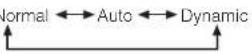 | Dynamic:Emphasizes the differences between video shadings to improve the feeling of contrast.Normal : The gradation of an image is reproduced as faithfully as possible.Auto:Detects image brightness and automatically adjusts for natural brightness. | ||
| Reset | (off the function) (waiting to reset) | The original factory settings for the items of this Menu page can be restored by pressing the OK button. | ||
| YNR | 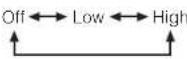 | Performs picture signal noise reduction. Turn up to reduce noise. | ||
| CNR | Performs color signal noise reduction. Turn up to reduce noise.And it will be fixed as Off only when selecting DVI-STB mode. | |||
| Film Mode |  | On:Automatically detects the movie film material and faithfully reproduces the original film image.Off:Set to OFF when switching between images does not appear natural. | ||
| PAL Comb Filter |  | This is available only when receiving a PAL composite signal. Turn On to reduce the discolorations in fine picture detail and provides puror color. | ||
| LTI |  | Adjusts the sharpness of the picture signal. | ||
| CTI | Adjusts the sharpness of the color signal. | |||
| Black Enhancement | Adjusts the black level compensation. | |||
| Auto Color |  | This is available only when receiving an NTSC composite/S.Video signal. This monitors and adjusts the color to maintain constant color levels. It also maintains natural flesh tones while preserving fidelity of background colors. | ||
| Color Temp. Adjustment |  | Turn On when you wish to change color temperature depending on the user's preference. | ||
| Amplitude | Red | Brighter scene is decreased in reddish color. | Brighter scene is increased in reddish color. | Adjust color temperature depending on the user's preference. These settings are independently stored in each of the 4 Color Temperature modes. |
| Green | Brighter scene is decreased in greenish color. | Brighter scene is increased in greenish color. | ||
| Blue | Brighter scene is decreased in bluish color. | Brighter scene is increased in bluish color. | ||
| Cut Off | Red | Dark scene is decreased in reddish color. | Dark scene is increased in reddish color. | |
| Green | Dark scene is decreased in greenish color. | Dark scene is increased in greenish color. | ||
| Blue | Dark scene is decreased in bluish color. | Dark scene is increased in bluish color. | ||
| Selected characters Setup hint | ||||
| Color Management | → Off ↔ On← | Turn On when the original balance of each color is required to adjust depending on the user's preference. | ||
| Magenta | Magenta is weakened. Magenta is strengthened. | This adjusts listed colors individually to make them either deeper or more pure. Those settings are independently stored in each of the 4 Color Temperature modes. | ||
| Red | Red is weakened. Red is strengthened. | |||
| Yellow | Yellow is weakened. Yellow is strengthened. | |||
| Green | Green is weakened. Green is strengthened. | |||
| Cyan | Cyan is weakened. Cyan is strengthened. | |||
| Blue | Blue is weakened. Blue is strengthened. | |||
| Color Decoding | →RGB ↔ R ↔ G ↔ B← | Select the single color screen when that is required to adjust R/G/B level individually depending on the user's preference. And set it back to RGB mode that indicates all color after adjusting. Press the OK button every time the setting is changed. | ||
| Red | Darkens red only. Lightens red only. | This adjusts R/G/B level or tint to make the color appear natural for the user's preference. These settings are independently stored in each of the 4 Color Temperature modes. | ||
| Green | Darkens green only. Lightens green only. | |||
| Color | Darkens colors. Lightens colors. | |||
| Tint | Enhances rod and weakens green. | Enhances green and weakens red. | ||
FUNCTION MENU
1 item is added to the Menu shown in the page 19.

flowchart
graph TD
    A["MENJ"] --> B["Function"]
    B --> C["OK"]
    C --> D["Function"]
    D --> E["Form Table"]
    E --> F["Menu: Screen Saver Off, Screen Wipe On 60Min, Black Side Panel Off, Video Power Save Off, Freeze Mode Split, Default Zoom Panoramic, Reset Reset, Select Set Return"]
    F --> G["Panel Life: Normal, Mode Display Off, ID Number 1, Inverse On 60Min, Standby White Off, Gamma 2.2, Reset Reset, Select Sat Return"]
| Selected characters | Setup hint | ||
| Video Power Save | This is used to reduce power consumption for video input when there is no video signal. Setting it On will leads the monitor to the standby mode when the AV input with no signal is selected. | ||
OPERATING INSTRUCTIONS (continued)
SETUP MENU

flowchart
graph TD
    A["MENU"] --> B["Picture Audio Timer Function Setup Language Select OK Set"]
    B --> C["Setup System System 1 Color System Video Input Audio Input Scan Output Monitor RGB1 DVI-STB RGB2 Component HDTV Select OK Set Return"]
    C --> D["Setup Color System AV1 Auto AV2 PAL AV3 SECAM AV4 PAL Select Return Exit"]
    D --> E["Setup System System 1 Color System Video Input Audio Input Scan Output Monitor RGB1 DVI-STB RGB2 Component HDTV Select OK Set Return"]
    E --> F["Setup Video Input AV1 Auto AV2 Composite/Component AV3 Auto AV4 S.Video Select Return Exit"]
    F --> G["Setup Audio Input AV1 Stereo AV2 L/Mono AV3 Stereo AV4 L/Mono Select Return Exit"]
| Selected characters Setup hint | |||
| System | →System1←→System2← | Do not change the original setting.(System1: Europe/Asia, System2: North America) | |
| Color System | |||
| AV1 | [  | This should correspond to the color system of the signal from the equipment that is connected to AV1 video input terminal.· Normally, set this to Auto. The system of the input signal will be automatically recognized.· If the input signal contains much noise or has a low level at Auto and the operation is found erratic, set this to match the input signal.· When the component signal is received, this would be not available (grayed out). | |
| AV2 | (Same to AV1) | ||
| AV3 | |||
| AV4 | |||
| Video Input | |||
| AV1 |  | This should correspond to the signal mode of the signal from the equipment that is connected to AV1 video input terminal.· Normally, set this to Auto. The signal mode of the input signal will be automatically recognized.· If the input signal contains much noise or has a low level at Auto and the operation is found erratic, set this to match the input signal. | |
| AV2 (1st step) |  | This should correspond to the signal mode of the signal from the equipment that is connected to AV2 video input terminal. | |
| AV2 (2nd step) |  | This step should be set only when [Composite/Component] is selected on the 1st step. And the procedure is same to AV1. | |
| AV4 |  | · If the signal from the equipment that is connected to AV4 Scart input terminal is S.Video or Composite, set this to correspond to that signal.· If the signal is RGB, it will be automatically recognized and this setting will have no effect. | |
| Selected characters Setup hint | ▶ | ||
| Audio Input | |||
| AV1 | →Stereo←→L/Mono← | This should correspond to the audio signal from the equipment that is connected to AV1 audio input terminal. If it is monaural audio, set this to L/Mono. | |
| AV2 | (Same to AV1) | ||
| AV3 | |||
| AV4 | |||
| Scart Output | Not Available (grayed out) | ||
| RGB1 | →DVI-PC←→DVI-STB← | This should correspond to the signal mode of the signal from the equipment that is connected to RGB1 DVI terminal. | |
| RGB2 (1st step) | →RGB←→Component← | This should correspond to the signal mode of the signal from the equipment that is connected to RGB2 D-sub terminal. | |
| RGB2 (2nd step) | →Auto←→HDTV←→SDTV/DVD← | This step should be set only when [Component] is selected on the 1st stop.This should correspond to the signal mode of the signal from the equipment that is connected to RGB2 D-sub terminal.Normally, set this to Auto. The signal mode of the input signal will be automatically recognized.If the input signal contains much noise or has a low level at Auto and the operation is found erratic, set this to match the input signal. | |
OTHER FEATURES
Automatic Store
Approximately 1 sec. after adjustment is completed, the adjustments will be recorded as shown in the table below.
| Menu Display Registration condition | ||
| Picture | Picture Mode 1 setting is registered. | |
| Contrast | For every input function and every Picture Mode, 1 setting is registered. | |
| Brightness | ||
| Color | ||
| Sharpness | ||
| Tint | ||
| Color Temperature | ||
| Contrast Mode | ||
| YNR | ||
| CNR | ||
| Film Mode | ||
| PAL Comb Filter | ||
| LTI | ||
| CTI | ||
| Black Enhancement | ||
| Auto Color | ||
| Color Temp. Adjust | ||
| R Amplitude | For every Color Temperature, 1 setting is registered. | |
| G Amplitude | ||
| B Amplitude | ||
| R Cut Off | ||
| G Cut Off | ||
| B Cut Off | ||
| Color Management | For every input function and every Picture Mode, 1 setting is registered. | |
| Magenta | 1 setting is registered. | |
| Red | ||
| Menu Display Registration condition | ||
| Picture | Yellow | 1 setting is registered. |
| Green | ||
| Cyan | ||
| Blue | ||
| Color Decoding | - | |
| Red | For every Color Temperature, 1 setting is registered. | |
| Green | ||
| Color | For every input function and every Picture Mode, 1 setting is registered. | |
| Tin1 | ||
| Function Video Power Save 1 setting is registered. | ||
| Setup | System 1 setting is registered. | |
| Color System | 1 setting is registered. | |
| AV1 | ||
| AV2 | ||
| AV3 | ||
| AV4 | ||
| Video Input - | ||
| AV1 | 1 setting is registered. | |
| AV2 | ||
| AV4 | ||
| Audio Input - | ||
| AV1 | 1 setting is registered. | |
| AV2 | ||
| AV3 | ||
| AV4 | ||
| RGB1 | ||
| RGB2 | ||
- The previously recorded items will be lost.
TROUBLESHOOTING
Symptoms That Seemingly Appear to be Failures
Make the checks suggested below depending on the symptoms observed. If the symptoms remain uncorrected, contact your dealer.
WARNING
Customer servicing can be hazardous.
| Symptom Point to check See page | ||
| • The screen becomes dark and the images cannot be seen during VTR special playback (fast forward, rewind). | • This sometimes occurs when a component output VTR such as the 480i is connected.This is not a malfunction; therefore, please take note that this may occur. When it does occur, change to composite output, or S.video output. | — |
PRODUCT SPECIFICATIONS
This table shows the specifications when the optional video unit has been inserted.
| Panel | Display dimensions | Approx. 32 inches (716 (H) x 399 (V) mm, diagonal 820mm) Approx. 42 inches (922 (H) x 522 (V) mm, diagonal 1059mm) |
| Resolution | 852 (H) x 1024 (V) pixels 1024 (H) x 1024 (V) pixels | |
| Net dimensions (excluding Speakers/Stand) | 830 (W) x 506 (H) x 92 (D) mm 1030 (W) x 636 (H) x 91 (D) mm | |
| Net weight (excluding Speakers/Stand) | 24.6kg 34.9kg | |
| Ambient conditions | Temperature | Operating: 5°C to 35°C, Storage: 0°C to 40°C |
| Relative humidity | Operating: 20% to 80%, Storage: 20% to 90% (non-condensing) | |
| Power supply | AC100 - 240V, 50/60Hz | |
| Power consumption/at standby | 255W / <3W 365W / <3W | |
| Audio output | 12W + 12W (6Ω) | |
| (RGB input) | ||
| Input signals | Input terminals | RGB1 DVI input terminal (DVI-D)RGB1 audio input terminal (3.5mm Storoc Mini Jack)RGB2 analog RGB input terminal (D-sub 15-pin)RGB2 audio input terminal (3.5mm Storoc Mini Jack) |
| Video signals | 0.7 V/1.0 Vp-p, analog RGB (Recommended Signal)480i, 576i, 480p, 576p, 1080i/50, 1080i/60, 720p/60 | |
| Sync signals | H/V separate, TTL level [2KΩ]H/V composite, TTL level [2KΩ]Sync on green, 0.3 Vp-p [75Ω] | |
| Recommended signal | 46 modos 29 42 | |
| (Video Input) | ||
| Input signals | Input terminals | AV1: composite video input terminal (RCA)AV1: Y PB PR video input terminal (RCA)AV1: L/R audio input terminal (RCA)AV2: composite video input terminal (RCA)AV2: Y/G PB/B PR/R video input terminal (RCA)AV2: L/R audio input terminal (RCA)AV3: composite video input terminal (RCA)AV3: S video input terminal (RCA)AV3: L/R audio input terminal (RCA)AV4: composite video / S video / RGB / L/R audio input terminal (Scart) |
| Video signals | AV1: PAL, SECAM, NTSC4.43, NTSC3.58AV1: 480i, 576i, 480p, 576p, 1080i/50, 1060i/60, 720p/60AV2: PAL, SECAM, NTSC4.43, NTSC3.58AV2: 480i, 576i, 480p, 576p, 1080i/50, 1060i/60, 720p/60, RGBAV3: PAL, SECAM, NTSC4.43, NTSC3.58AV4: PAL, SECAM, NTSC4.43, NTSC3.58AV4: RGB | |
| Video output Signal | OUTPUT (MONITOR): composite video monitor-output terminal (RCA)OUTPUT (MONITOR): L/R audio monitor- output terminal (RCA)AV4: composite video / L/R audio monitor-output terminal (SCART) | |
| Recommended signal | 15 modos 42 | |
- The monitor takes at least 30 minutes to attain the status of optimal picture quality.
Signal Input
RGB terminal (D-sub 15-pin connector)
| Pin | Input signal |
| 1 | R (Pa/CR) |
| 2 | G or sync on green (Y) |
| 3 | B (Pa/Ce) |
| 4 | No connection |
| 5 | No connection |
| 6 | R.GND (Pa/Cr, GND) |
| 7 | G.GND (Y, GND) |
| 8 | B.GND (Pa/Ce, GND) |
| 9 | No connection |
| 10 | GND |
| 11 | No connection |
| 12 | [SDA] |
| 13 | H. sync or H/W composite sync |
| 14 | V.sync. [V.CLK] |
| 15 | [SCL] |
( ) : With component input
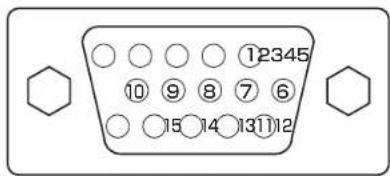
text_image
12345 10 9 8 7 6 15 14 131112- When different kinds of input signals are simultaneously input to the monitor via a graphics board or the like, the monitor will automatically select the signals in the following priority order:
| Sync signal type | Priority |
| H/V separate sync. | 1 |
| H/V composite sync. | 2 |
| sync.on Green * | 3 |
*Even in the case of the recommended signals shown on the following page, there may be instances when correct display is not possible. In this case, use H/V separate sync, H/V composite sync.
S-input connector pin specifications
| Pin Input signal | |
| 1 | Y |
| 2 Y-GND | |
| 3 | C |
| 4 C-GND | |
| Frame GND | |
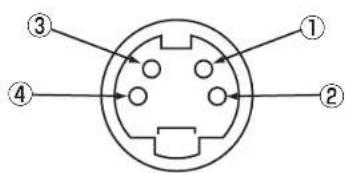
text_image
③ ① ④ ②Scart connector pin specifications
| Pin | Signal Pin Signal | ||
| 1 | AUDIO OUT (RIGHT) | 12 | Not Used |
| 2 | AUDIO IN (RIGHT) | 13 | RGB-R GND |
| 3 | AUDIO OUT (LEFT/MONO) | 14 | GND |
| 4 | AUDIO GND | 15 | RGB-R / S.VHS CHROMINANCE IN |
| 5 | RGB-B GND | 16 | BLANKING SIGNAL |
| 6 | AUDIO IN (LEFT/MONO) | 17 | COMPOSITE VIDEO GND |
| 7 | RGB-B IN | 18 | BLANKING SIGNAL GND |
| 8 | AUDIO/RGB SWITCH / 16.9 | 19 | COMPOSITE VIDEO OUT |
| 9 | RGB-G GND | 20 | COMPOSITE VIDEO / S.VHS LUMINANCE IN |
| 10 | Not Used | 21 | GND / SHIELD (CHASSIS) |
| 11 | RGB-G IN |

PRODUCT SPECIFICATIONS (continued)
Recommended Signal List
With Digital RGB signal input (RGB1 input)
| No. | Signal mode | Horizontal frequency (kHz) | Dot clock frequency (MHz) | Setup Menu Condition | Remarks | |||
| Signal Name | Resolution | Vertical frequency (Hz) | DVI-PC | DVI-STB | ||||
| 1 | VGA640 X 480 | 640 X 400 | 70.08 31.47 25. | 8 ○ | ||||
| 2 | 59.94 31.47 | 25.18 ○ ○ | ||||||
| 3 | W-VGA864 X 480 | 864 X 480 | 60.00 31.02 33.75 ○ | |||||
| 4 | 59.94 31.47 | 34.24 ○ | WVGA type : On | |||||
| 5 | 640 X 480 | 640 X 480 | 72.81 37.86 31.50 ○ | |||||
| 6 | 75.00 37.50 | 31.50 ○ | ||||||
| 7 | 640 X 480 | 85.01 43.27 | 36.00 ○ | |||||
| 8 | 800 X 600 | 56.25 35.16 | 36.00 ○ | |||||
| 9 | 800 X 600 | 60.32 37.88 | 40.00 ○ | |||||
| 10 | 800XSSA00 | 72.19 48.08 | 50.00 ○ | |||||
| 11 | 800 X 600 | 75.00 46.88 | 49.50 ○ | |||||
| 12 | 800 X 600 | 85.06 53.67 | 56.25 ○ | |||||
| 13 | 1024 X 768 | 60.00 48.36 | 65.00 ○ | |||||
| 14 | 1024 X 768 | 70.07 56.48 | 75.00 ○ | |||||
| 15 | 1024 X 768 | 75.03 60.02 | 78.75 ○ | |||||
| 16 | 480p 720 X | 480 59.94 | 31.47 27.00 ○ | EIA-861 | ||||
| 17 | 720p/60 | 1280 X 720 | 60.00 | 45.00 | 74.25 | ○ | EIA-861 | |
| 18 | 1080i/60 | 1920 X 1080 | 60.00 | 33.75 | 74.25 | ○ | EIA-861 | |
(○ : acceptable)
With Composite Input(AV1\~AV4 input) and S-video Input (AV3 input).
| No. | Signal mode | Horizontal frequency (kHz) | Dot clock frequency (MHz) | Remarks | ||
| Signal Name | Resolution | Vertical frequency (Hz) | ||||
| 1 | NTSC4.43NTSC3.58 | 525 | 59.94 | 15.73 | — | |
| 2 | PALSECAM | 625 | 50.00 | 15.63 | — | |
With R, G, B Video input (AV2 and AV4 input).
| No. | Signal mode | Horizontal frequency (kHz) | Dot clock frequency (MHz) | Remarks | ||
| Signal Name | Resolution | Vertical frequency (Hz) | ||||
| 1 | NTSC4.43/3.58 | 525 | 59.94 | 15.73 | - | |
| PAL, SECAM | 625 | 50.00 | 15.63 | |||
With component input (AV1, AV2 and RGB2-component input).
| No. | Signal mode | Horizontal frequency (kHz) | Dot clock frequency (MHz) | Remarks | ||
| Signal Name | Resolution | Vertical frequency (Hz) | ||||
| 1 | 576i | 576 | 50.00 | 15.63 | - | |
| 2 | 480i | 480 | 59.94 | 15.73 | - | |
| 3 | 576p | 576 | 50.00 | 31.26 | - | |
| 4 | 480p | 480 | 59.94 | 31.47 | - | |
| 5 | 1080i/50 | 1080 | 50.00 | 28.13 | - | |
| 6 | 1080i/60 | 1080 | 60.00 | 33.75 | - | |
| 7 | 720p/60 | 720 | 59.94 | 44.96 | - | |
- The monitor differentiates the signal modes according to the horizontal and vertical frequencies and the horizontal and vertical sync signal polarities. Note that different signals having all these elements alike may be handled as the same signal.
- Displaying images with more than 512 lines of vertical resolution at Full display (compressed display) can result in the interpolation of stripes.
Optional Tuner Unit Function
The optional tuner unit can operate when installed with the optional video unit.
Additional functions when the optional tuner unit is installed are as follows: (43 56)
COMPONENT NAMES
Remote control (provided for the optional tuner unit)
This type of remote control would be provided for the optional tuner unit as the substitute for the one shown in page 9

text_image
POWER ON / OFF button PICTURE MODE button RECALL button INPUT SELECT button MENU button PROGRAM UP / DOWN buttons OK button DVD CONTROL buttons PROGRAM SELECT buttons PROGRAM UP / DOWN buttons TIME button AUDIO MODE button SURROUND button CH I / II button MULTI PICTURE (PinP) button Buttons for MULTI PICTURE mode RETURN button SELECT / ADJUST buttons ( ▲▼◀◀ ) VOLUME UP / DOWN buttons MUTE button FREEZE button ZOOM button RGB / VIDEO buttonsLoading Batteries
1. Open the battery cover.
- Slide back and remove the battery cover in the direction of the arrow.

2. Load batteries.
- Load two Size AA batteries included observing the correct polarities.
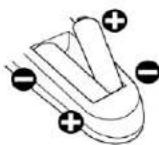
3. Close the battery cover.
- Replace the battery cover in the direction of the arrow and snap it back into place.
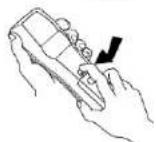
CAUTION
- Do not use new and old batteries together. The batteries could explode or leak, resulting in fires, physical injury, or stains.
- When loading batteries, observe their correct polarities as marked on the product. If loaded in the wrong direction, the batteries could explode or leak, resulting in fires, physical injury, or stains.
Handling the Remote Control
Use the remote control within about 5 m from front of the unit's remote-control sensor and within 30 degrees on both sides.

text_image
With in 30 degrees About 3m With in 30 degrees About 3m About 5mATTENTION
- Do not drop or impact the remote control.
- Do not splash the remote control with water or put it on a wet object to avoid possible failures.
- Before leaving the remote control out of use for an extended period of time, remove the batteries from it.
- If the remote control begins to lack responsiveness, replace the batteries.
- Strong light such as direct sunlight impinging on the photoreceptor of the remote control can cause operational failure. Position this unit to avoid direct contact with such light.
COMPONENT NAMES (continued)
Remote control (provided for the optional tuner unit) (continued)
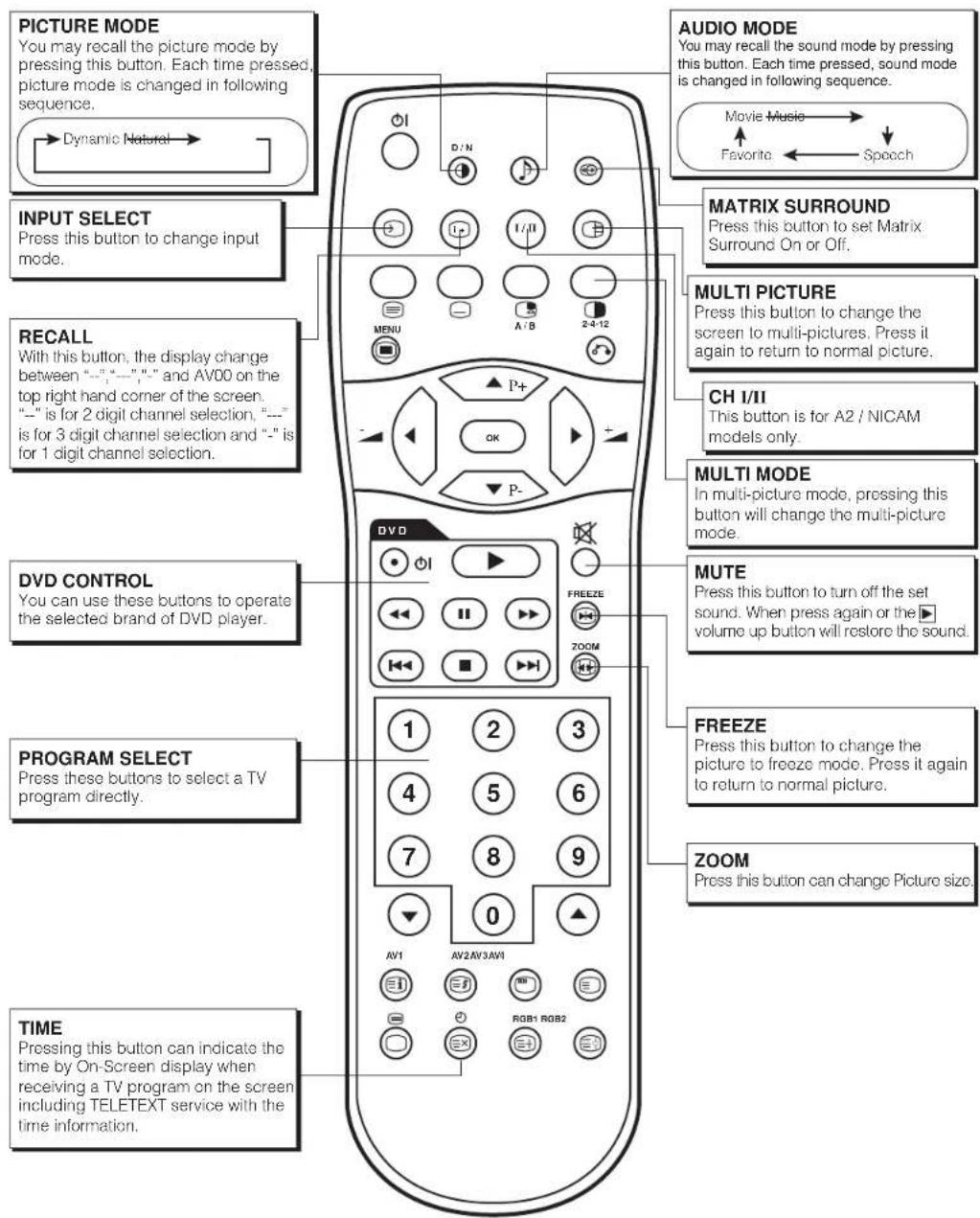
text_image
PICTURE MODE You may recall the picture mode by pressing this button. Each time pressed, picture mode is changed in following sequence. Dynamic Natural INPUT SELECT Press this button to change input mode. RECALL With this button, the display change between “--”, “--”, “-” and AV00 on the top right hand corner of the screen. “--” is for 2 digit channel selection, “--” is for 3 digit channel selection and “-” is for 1 digit channel selection. DVD CONTROL You can use these buttons to operate the selected brand of DVD player. PROGRAM SELECT Press these buttons to select a TV program directly. TIME Pressing this button can indicate the time by On-Screen display when receiving a TV program on the screen including TELETEXT service with the time information. AUDIO MODE You may recall the sound mode by pressing this button. Each time pressed, sound mode is changed in following sequence. Movie Music → Favorite ← Speech MATRIX SURROUND Press this button to set Matrix Surround On or Off. MULTI PICTURE Press this button to change the screen to multi-pictures. Press it again to return to normal picture. CH I/II This button is for A2 / NICAM models only. MULTI MODE In multi-picture mode, pressing this button will change the multi-picture mode. MUTE Press this button to turn off the set sound. When press again or the ▶ volume up button will restore the sound. FREEZE Press this button to change the picture to freeze mode. Press it again to return to normal picture. ZOOM Press this button can change Picture size.[Buttons for TELETEXT Mode]

text_image
SUBTITLE button TEXT button TV button COLOR buttons (RED, GREEN, YELLOW, BLUE) TEXT / TV+TEXT button MODE button PAGE UP / DOWN button SUB PAGE buttons INDEX button REVEAL button TV / TEXT button HOLD button CANCEL button U. N. L. buttonTELETEXT FUNCTION
| Buttons on Remote Control Function | |
| TEXT | Press this to use the TELETEXT services. |
| TV | Press this to return to the TV mode when in the TELETEXT mode. |
| TV / TEXT | This switches the receiver between the TV mode and the TELETEXT mode. |
| TEXT / TV + TEXT | In TELETEXT mode, this button switches between TV+TEXT screen (split) and TELETEXT only. |
| MODE | This selects the FASTEXT and FAVORITE modos. |
| INDEX | This selects the P100 page. |
| SUB PAGE | This allows receiving of a sub page. When the button is pressed, "S****" will be displayed at the top left of the screen. |
| SUB TITLE | Use this to access a subtitle service directly rather than through a TELETEXT service (subject to subtitle service broadcasting). |
| CANCEL | This allows the screen to return to the TV mode temporarily while searching for a required text page. When the required text page has been received, the page number will be displayed at the top left of the screen. Press the CANCEL button again to display the TELETEXT screen. |
| RED GREEN YELLOW BLUE | Each of these buttons selects a link page displayed at the lower part of the screen.A FAVORITE page can also be stored in the memory using one of the colors. It can then retrieve the page stored by pressing the appropriate color button.To store a FAVORITE page :press the MODE button;press a color button for the FAVORITE page;enter the FAVORITE page number to be stored and press the same color button again to confirm. |
| U. N. L | Each time this button is pressed, the screen display mode changes through the following:[IMAGE] |
| HOLD | This holds the page currently being displayed on the screen. Instead of the page number, a * indicator appears at the top of the screen. Press this button again to release the hold state. |
| REVEAL | This allows hidden information (found on some teletext pages) to be displayed on the screen. |
| PAGE UP / DOWN | Those buttons increase / decrease the TELETEXT page number. |
NOTE
- Certain pages do not show linked pages at the bottom of the screen. To display linked pages, press the INDEX button.
INSTALLATION INSTRUCTIONS
Connecting Antenna
Make sure that the power switch of the monitor is turned off.
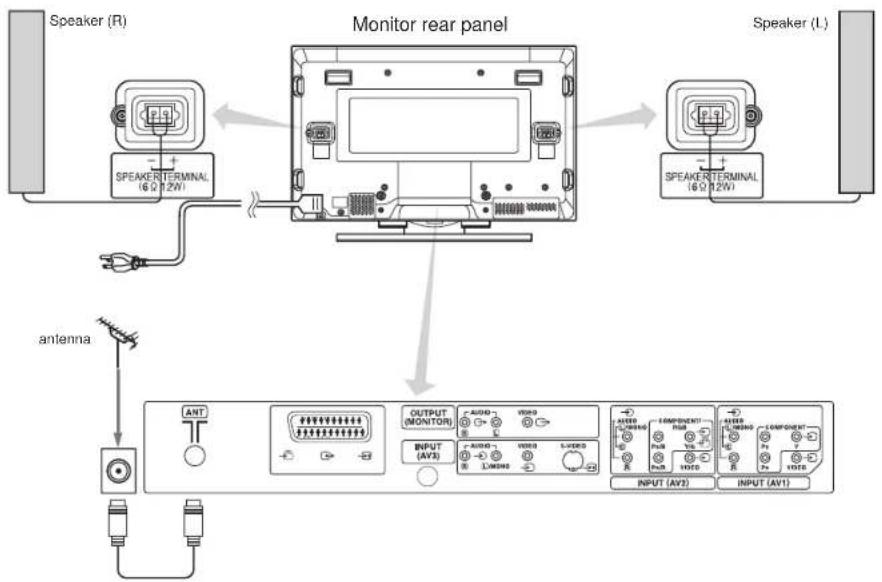
text_image
Speaker (R) Monitor rear panel Speaker (L) SPEAKER TERMINAL (6Ω 12W) SPEAKER TERMINAL (6Ω 12W) antenna OUTPUT (MONITOR) AUDIO VISO AVERAGE COMPONENT AV3 LIMINIO R R R R R R R R OUTPUT (AV2) INPUT (AV1)When the "ANT" terminal is connected to outdoor antenna instead of CATV system, please note that a good antenna adaptor is necessary. See the diagram on the right.
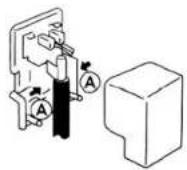
Precautions when connecting the antenna
- Clamp section Ⓐ using pliers when installing the coaxial cable. If other types of adaptors are used, be sure that the core and shielding are good.
- Please use a coaxial cable which is free from interference to connect the antenna. Avoid using a parallel flat feeder wire as interference may occur, causing reception to be unstable and stripe noise to appear on the screen.
- Avoid using indoor antenna as this may be affected by interference. Please use CATV net or outdoor antenna.
- Keep the power cord as far away from the antenna wire as possible.
- For safety, install an external antenna conforming to AS1417.1 (applicable for Australia only)
If there are noise appearance in the picture of VHF-Low band channel, please use the double-shielded cable (not provided) for RF LEADS to reduce the noise.
OPERATING INSTRUCTIONS
The functions of the buttons located on the bottom of the monitor change as shown below:
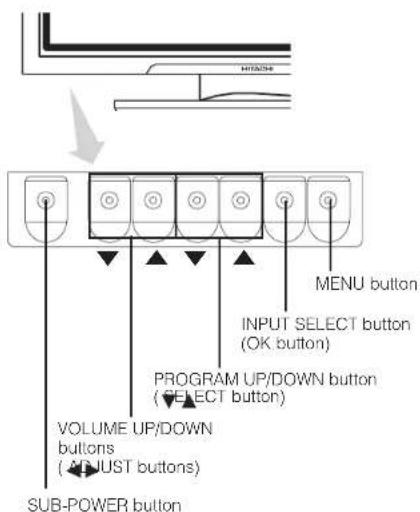
text_image
MENU button INPUT SELECT button (OK button) PROGRAM UP/DOWN button (SELECT button) VOLUME UP/DOWN buttons (ANDJUST buttons) SUB-POWER button• ( ) indicates the function while the MENU is displayed on the screen.
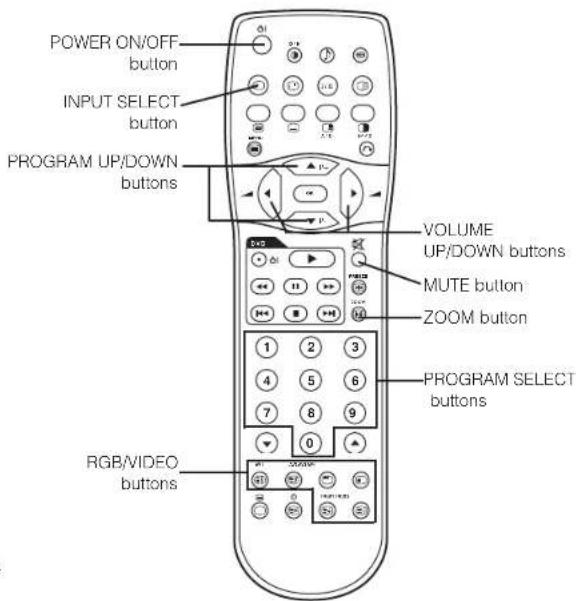
text_image
POWER ON/OFF button INPUT SELECT button PROGRAM UP/DOWN buttons VOLUME UP/DOWN buttons MUTE button ZOOM button PROGRAM SELECT buttons RGB/VIDEO buttonsInput Switching Size Switching
- Input can be switched by pressing the AV1, AV2, AV3, AV4, RGB1 or RGB2 buttons of the remote control. And the way to return to a TV channel is as follows:
- Pressing INPUT SELECT button at RGB2 input screen.
- Pressing some PROGRAM SELECT buttons and select a TV channel.
- Pressing PROGRAM UP/DOWN buttons at the screen without OSD(On-screen display).
- Input can be switched in the sequence of TV → AV1 → AV2 → AV3 → AV4 → RGB1 → RGB2 by pressing the INPUT SELECT button of the monitor or the remote control.

Each time the ZOOM button of the remote control is pressed, the screen display size will change in sequence and the status will be displayed at the bottom of the screen.
- During TV mode

OPERATING INSTRUCTIONS (continued)
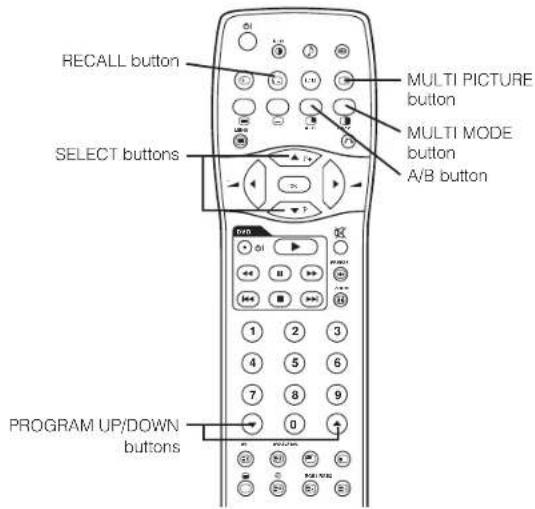
text_image
RECALL button SELECT buttons MULTI PICTURE button MULTI MODE button A/B button PROGRAM UP/DOWN buttonsDisplaying MULTI PICTURE
If the MULTI PICTURE button on the remote control is pressed, multi pictures will display. And then three types of the screen can be selected by pressing the MULTI MODE button on the remote control.
The multi picture mode will change in the following sequence each time the MULTI MODE button is pressed.

Activating the Split mode from the TV screen
Pressing the MULTI PICTURE button one time will display 2 pictures.
- The speaker icon can be shifted left and right by pressing the A/B button; the audio will be output from the side on which the speaker icon is located.
- The same signal input cannot be selected for both screens at the same time.
- The TV channel can be changed by pressing the AND PROGRAM UP/DOWN buttons on the remote control.
- The signal input mode of picture-A or picture-B (the one that the speaker icon is located on) can be selected by pressing INPUT SELECT button on the remote control.
- Pressing the MULTI PICTURE button once again will cancel the multi picture mode.
- When the Video input is set to RGB Video, multi picture mode is not possible.
• Refer to the table for 2 pictures (Split) mode. 49

Activating the 4 pictures mode from the TV screen
Pressing the MULTI MODE button one time at the 2 pictures mode will display 4 pictures.
- Press [A/B] button to select picture A or picture B indicated by a red triangle. For pictures on right, press ▲▼ SELECT buttons to select picture. The selected channel number would change green.
- The TV channel can be changed by pressing the AND PROGRAM UP/DOWN buttons on the remote control.
- The audio can only be output from picture A in 4 pictures mode.
- The same signal input mode cannot be selected for each screens at the same time.
- Pressing the MULTI PICTURE button at the 4 picture mode will cancel the multi picture mode. And then, pressing the MULTI PICTURE button again will display the 4 pictures.
- Refer to the table for 4 pictures mode. 49

Activating the 12 pictures mode from the TV screen
Pressing the MULTI MODE button one time at the 4 pictures mode will display 12 pictures.
- Starting from channel 1, preset channels will automatically display in sequence on the 12 windows.
• This function activates only in TV mode.
• After several seconds, it refreshes the picture one by one. - Pressing the MULTI PICTURE button at the 12 picture mode will cancel the multi picture mode. And then, pressing the MULTI PICTURE button again will display the 12 pictures again.
- Pressing the MULTI MODE button at the 12 picture mode will display the 2 pictures (Split) mode.

text_image
5 A B 201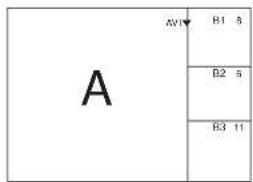
text_image
A AV1 B1 5 B2 5 B3 11| 1 | 2 | 3 | 4 |
| 5 | 6 | 7 | 8 |
| 5 | 1 | 0 | 1 |
NOTE
- Even if the input of the horizontal / vertical synchronizing signal (or video signal) stops in the multi picture display, the mode will not change to power save mode.
- Please be careful since image retention will occur if display is left in a multi picture display state for a long period of time.
2 Pictures (Split)
| Input terminal | AV1~AV4 | AV1, AV2 RGB1 RGB2 | TELE TEXT | |||||||||
| PAL SECAM | NTSC3.58 NTSC4.43 | 576i 576p | 480i 480p | 1080i/50 | 1080i/60 | 720p/60 S | TB Component | |||||
| AV1 ~AV4 | PAL, SECAM | ○ | ○ | ○ | ○ | ○ | ○ | |||||
| NTSC3.58/4.43 | ○ | ○ | ○ | ○ | ○ | |||||||
| AV1 AV2 | 576i, 576p | ○ | ○ | |||||||||
| 480i, 480p | ○ | ○ | ||||||||||
| 1080i/50 | ○ | ○ | ||||||||||
| 1080i/60 | ○ | ○ | ||||||||||
| 720p/60 | ○ | ○ | ||||||||||
| RGB1 | STB | |||||||||||
| RGB2 | Component | ○ | ○ | ○ | ○ | ○ | ||||||
| Main Sub |
(○ : Available)
4 Pictures
| Input terminal | AV1~AV4 | AV1, AV2 RGB1 RGB2 | TELE TEXT | |||||||
| PAL Main | Sub SECAM | NTSC3.58 NTSC4.43 | 576 576p | 480 480p | 1080/50 | 1080/60 720p/60 S | TB Component | |||
| AV1 ~AV4 | PAL, SECAM | ○ | ○ | |||||||
| NTSC3.58/4.43 | ○ | ○ | ||||||||
| AV1 AV2 | 576i, 576p | ○ | ○ | |||||||
| 480i, 480p | ○ | ○ | ||||||||
| 1080i/50 | ○ | ○ | ||||||||
| 1080i/60 | ○ | ○ | ||||||||
| 720p/60 | ○ | ○ | ||||||||
| RGB1 | STB | |||||||||
| RGB2 | Component | ○ | ○ | |||||||
| Main | Sub 1 |
| Sub 2 | |
| Sub 3 |
(○ : Available)
Input Signal Screen Display
The TV channel status can be displayed on the screen by pressing the RECALL button of the remote control.
- The display will go out in approximately 6 seconds.
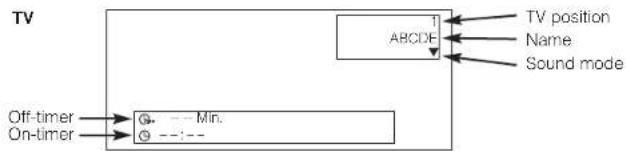
flowchart
graph LR
    A["Off-timer"] --> B["On-timer"]
    B --> C["Min."]
    C --> D["ABCDF"]
    D --> E["TV position"]
    D --> F["Name"]
    D --> G["Sound mode"]
OPERATING INSTRUCTIONS (continued)
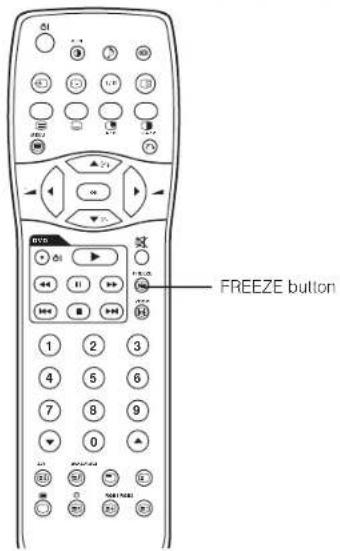
text_image
FREEZE buttonPicture Freezing
When the FREEZE button on the remote control is pressed, the screen transfers into the freeze mode.
- There are two types of freezing screen mode, Split and Strobe. These are possible to select at the "Freeze Mode" setting of the Function Menu.
- The Split mode will display 2 pictures from the same source on the screen with one active picture and the other still.
- The Strobe mode will display 12 pictures with the last picture active, while other 11 windows are still.
- Pressing the FREEZE button again changes the screen back to the normal picture.
- This function is also available from video input mode besides TV mode. Refer to the table for Freeze function as below:
Refer to the page 37 . (It is same to the Picture Menu of Optional Video Unit Function) But 2 item is added and 5 items are deleted.
| Selected characters Setup hint | ◀ | ▶ | |
| Freeze Mode | →Split←→Strobe← | This selects the display condition of the FREEZE mode between Split (2 pictures) and Strobe (12 pictures). | |
| Default Zoom | →Panoramic←→4:3← | This selects the screen display size that appears first when the power turned on. | |
| Mode Display | Not Available (grayed out) | ||
| ID Number | Not Available (grayed out) | ||
| Inverse | Not Available (grayed out) | ||
| Standby White | Not Available (grayed out) | ||
| Gamma | Not Available (grayed out) | ||
SETUP MENU
[During TV mode]
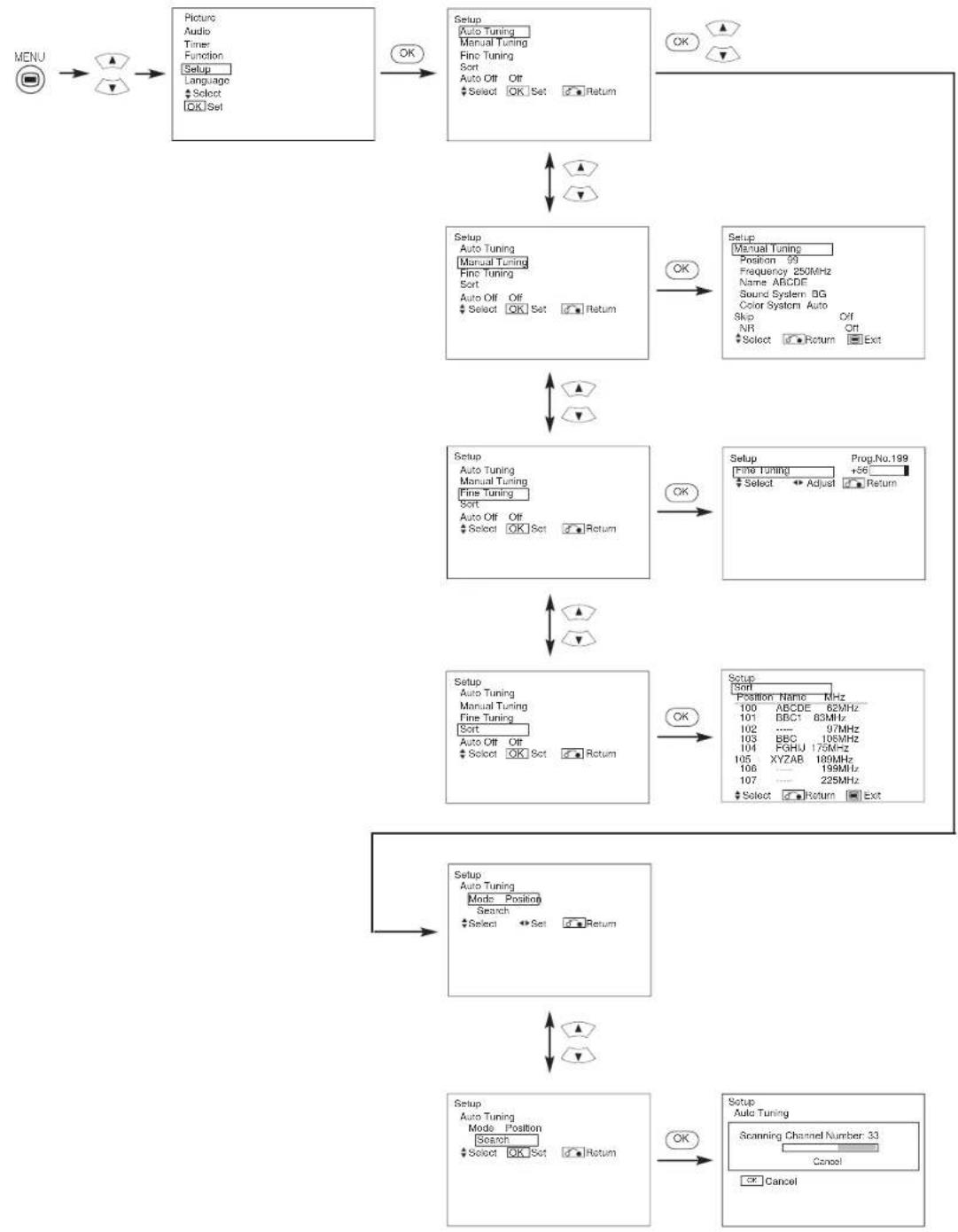
flowchart
graph TD
    A["MENU"] --> B["Picture Audio Timer Function Setup Language Select OK"]
    B --> C["Setup Auto Tuning Manual Tuning Fine Tuning Sort Auto Off Off Select OK Set Return"]
    C --> D["Setup Manual Tuning Position 09 Frequency 250MHz Name ABCDE Sound System BG Color System Auto Skip NR Select Return Ext"]
    D --> E["Setup Manual Tuning Manual Tuning Fine Tuning Sort Auto Off Off Select OK Set Return"]
    E --> F["Setup Manual Tuning Progress No.199 Select Adjust Return"]
    F --> G["Setup Auto Tuning Manual Tuning Fine Tuning Sort Auto Off Off Select OK Set Return"]
    G --> H["Setup Auto Tuning Mode Position Search Select Set Return"]
    H --> I["Setup Auto Tuning Mode Position Search Select OK Set Return"]
    I --> J["Setup Auto Tuning Scanning Channel Number: 33 Cancel Cancel"]
OPERATING INSTRUCTIONS (continued)
SETUP MENU (continued)
| Selected characters Setup hint | |||
| Auto Tuning | |||
| Mode | →Position←→Direct← | Select the channel entry method between position setting or direct setting. And press the OK button to fix it.If [Position] is selected, the screen display will be numbers (1~199 and AV00).If [Direct] is selected, the screen display will be C** at the channel 0~99 and S** at the channel 100~199. | |
| Search | - | - | Press the OK button and it starts the auto tuning. |
| Manual Tuning | |||
| Position | - | - | Set the position number(0~199) or channel number(C**, S**) by ▼▲PROGRAM UP/DOWN buttons. |
| Frequency | - | - | ·II [Position] has been selected, search the frequency here by pressing ◀▶buttons.II [Direct] has been selected, this function will be not available (grayed out). |
| Name | □↔□↔□↔□↔□(□:a letter) | This is used to input the name of the TV station within 5 letters. After fixing the cursor on the first digit, select a letter by ▼▲ SELECT buttons and move to next digit by ▶ ADJUST button. Press the OK button again after finished.Selectable letters are "0~"9", "A"~"Z", "+", "-", "(blank)", "(comma) and ", "(period). | |
| Sound System | →Auto←→M←→BG←→DK←→I← | Select the sound system through the 5 different settings. | |
| Color System | →Auto←→PAL←→SECAM←→NTSC3.58←→NTSC4.43← | Select the color system through the 5 different settings. | |
| Skip | →Off←→On← | If this is set to On, that position will be skipped while selecting positions by PROGRAM UP/DOWN buttons.This is automatically set to On for those non-broadcasting channels. | |
| NR | →Off←→On← | If this is set to On, it helps to reduce the noise interference visible on the screen, especially in the weaker signal reception areas. | |
| Fine Tuning | Decreasing the frequency data for the main tuner | Increasing the frequency data for the main tuner. | After completing the fine-tuning, press the RETURN button to exit this mode.The variable range is -56 ~ +56. |
| Sort | (When the Mode in Auto Tuning menu is set to [Direct], this function will be not available (grayed out).) | ||
| (A Line of position List) | - | - | Press OK button at the a line that is required to change order, then the characters will change to groon. And move it up or down in the list by pressing ▼▲SELECT buttons. And press OK button to complete it. Press the RETURN button to exit. |
| Auto Off | →Off←→On← | If this is set to On, the power will be turned off when there is no transmission signal and no operation for about 10 minutes in the TV mode. | |
[During VIDEO signal input]
1 item is added to the Menu shown in the page 39.
| Selected characters Setup hint | ◀ | ▶ | |
| Scart Output | →TV↔Monitor← | TV AV4 (Scart) output will be fixed as TV signal outputMonitor AV4 (Scart) output can view the image as on the main unit.But it is possible to monitor only the composite video signal fromAV1, AV2, or AV3 input that is displayed on the screen at the time. | |
OTHER FUNCTIONS
A2 / NICAM / Sound Multiplex
- The CH I / II button is only useful for NICAM and sound multiplex signals.
Otherwise pressing this button will have no effect.
BILINGUAL / DUAL sound broadcast
When bilingual program is received, sound mode display appears in yellow as shown on right.
Press the CH I / II button to select the sound to be heard.
Each time the button is pressed, I, II or ▼ (force mono) appear cyclically on the screen.
When receiving NICAM signals, NICAM display will appear as below.
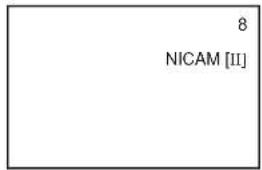
text_image
8 NICAM [II]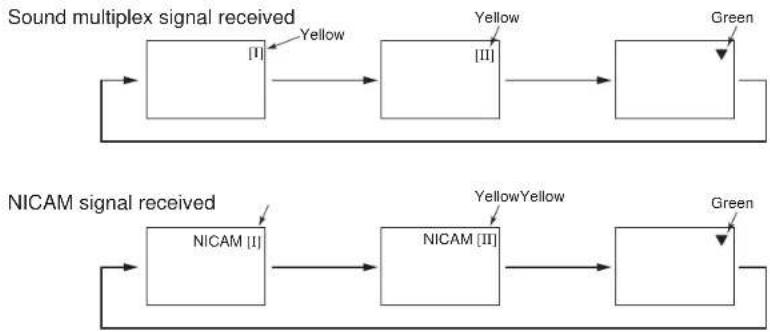
flowchart
graph LR
    A["Sound multiplex signal received"] --> B["Yellow"]
    B --> C["Yellow"]
    C --> D["Green"]
    E["NICAM signal received"] --> F["NICAM [I"]]
    F --> G["NICAM [II"]]
    G --> H["YellowYellow"]
    H --> I["Green"]
Select I, II or ▼ (force mono) to hear the CHI, CHII or MONO broadcast respectively.
STEREO sound broadcast
When a stereo program is received, sound mode display will appear in red, and you can press the CHI/II button to select between stereo and mono sound.
Each time the button is pressed, (force mono)appear cyclically on the screen. When receiving NICAM signals, NICAM display will appear as below.
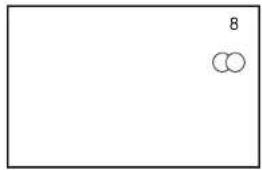
text_image
8 ○○○Sound multiplex signal received
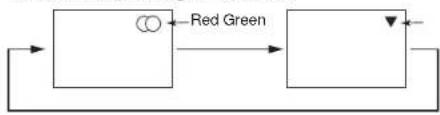
flowchart
graph LR
    A["Block 1"] -->|Red Green| B["Block 2"]
    B --> C["Downward Arrow"]
NICAM signal received
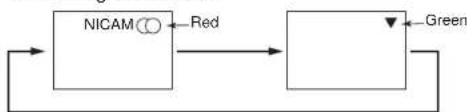
flowchart
graph LR
    A["NICAM"] -->|Red| B["Green"]
    B --> A
Select ○ or ▼ (force mono) to hear the STEREO or MONO broadcast respectively.
Monaural sound broadcast
When a monaural program is received, sound mode display will appear in green.
You can press the CH I / II button to select the sound mode between monaural and forced mono (sound is same).
Each time the button is pressed, ▽ or ▼ (force mono) appear cyclically on the screen.

natural_image
Blank white rectangle with a small black triangle symbol in the top-right corner (no text or labels)NOTE
- If sound signal is not strong enough for quality reception, press the CH I / II button until ▼ appears on the screen to receive a clear mono sound. - If sound has hiss noise or keep switching between stereo and mono mode due to signal condition, press the CH I / II button until ▼ appears on the screen to receive a clear mono sound.
OPERATING INSTRUCTIONS (continued)
OTHER FUNCTIONS (continued)
DVD Player Selection
- You can use this remote control to operate the selected brand of DVD player by pressing the following buttons on the remote control simultaneously.
| Brands of DVD Player Press | Brands of DVD Player Press | ||
| Hitachi RCA | RECALL 1 | RECALL 9 | |
| Pioneer Mitsubishi | RECALL 2 | RECALL 0 | |
| Panasonic Onkyo | RECALL 3 | RECALL INDEX | |
| Toshiba Zenith | RECALL 4 | RECALL MODE | |
| Philips Orion | RECALL 5 | RECALL SUB PAGE | |
| JVC Shinco | RECALL 6 | RECALL CANCEL | |
| Samsung Skyworth | RECALL 7 | RECALL REVEAL | |
| Sony Bubuko | RECALL 8 | RECALL TV/TEXT |
Example
To operate HITACHI DVD player, press and hold the RECALL button, followed by the 1 button.
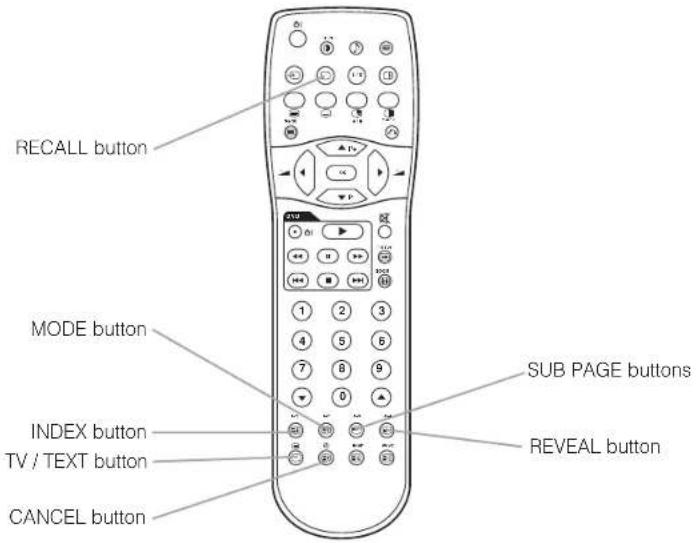
text_image
RECALL button MODE button INDEX button TV / TEXT button CANCEL button SUB PAGE buttons REVEAL buttonNOTE
- Not all models of the listed brands can be operated using this remote control.
TROUBLESHOOTING
Symptoms That Seemingly Appear to be Failures
Make the checks suggested below depending on the symptoms observed. If the symptoms remain uncorrected, contact your dealer.
WARNING
Customer servicing can be hazardous.
| Symptom Possible reason | Remedy | |
| snowy picture - poor sound | (1) Connection of antenna cable to the TV is poor.(2) Corroded or poor antenna connections.(3) Antenna has moved position.(4) Adverse weather conditions.(5) Transmitter problems. | (1) Make new connection and/or change antenna plug.(2) Make new connections or renew cable.(3) Re-align antenna.(4) None.(5) Check with local Operator. |
| multiple images - sound O.K | (1) Antenna has moved position.(2) TV not tuned correctly.(3) Adverse weather conditions.(4) Transmitter problems.(5) AV Input not set correctly. | (1) Re-align antenna.(2) Re-tune or fine tune TV.(3) None.(4) Check with local Operator.(5) Check the external equipment connected. |
| intermittent interference | (1) Interference from electrical or mechanical motors, fluorescent lights, portable radios etc. | (1) Check devices for shielding and renew if necessary or move further from TV. |
| no picture or sound | (1) TV may be in AV mode.(2) Picture/sound setting set to minimum.(3) TV in standby or power save mode. | (1) Press the INPUT SELECT button or 1to 9buttons on your remote control to return to normal TV mode.(2) Check picture / sound controls (go to MAIN MENU).(3) Press POWER ON / OFF button. |
PRODUCT SPECIFICATIONS
This table shows the specifications when the optional video unit and tuner unit have been inserted.
| Panel | Display dimensions | Approx. 32 inches (716 (H) x 399 (V) mm, diagonal 820mm) Approx. 42 inches (922 (H) x 522 (V) mm, diagonal 1059mm) |
| Resolution | 852 (H) x 1024 (V) pixels 1024 (H) x 1024 (V) pixels | |
| Net dimensions (excluding Speakers/Stand) | 830 (W) x 506 (H) x 92 (D) mm 1030 (W) x 636 (H) x 91 (D) mm | |
| Net weight (excluding Speakers/Stand) | 24.6kg 34.9kg | |
| Ambient conditions | Temperature | Operating: 5°C to 35°C, Storage: 0°C to 40°C |
| Relative humidity | Operating: 20% to 80%, Storage: 20% to 90% (non-condensing) | |
| Power supply | AC 100 - 240V, 50/60Hz | |
| Power consumption/at standby | 255W / <3W 365W / <3W | |
| Audio output 12W + 12W (6Ω) | ||
| (RGB input) | ||
| Input signals | Input terminals | RGB1 DVI input terminal (DVI-D)RGB1 audio input terminal (3.5mm Stereo Mini Jack)RGB2 analog RGB input terminal (D-sub 15-pin)RGB2 audio input terminal (3.5mm Stereo Mini Jack) |
| Video signals | 0.7 W/1.0 Vp-p, analog RGB (Recommended Signal)480i, 576i, 480p, 576p, 1080i/50, 1080i/60, 720p/60 | |
| Sync signals | H/V separate, TTL level [2KΩ]H/V composite, TTL level [2KΩ]Sync on green, 0.3 Vp-p [75Ω] | |
| Recommended signal | 46 modes 29 42 | |
| (Video Input) | ||
| Input signals | Input terminals | AV1: composite video input terminal (RCA)AV1: Y PB PR video input terminal (RCA)AV1: L/R audio input terminal (RCA)AV2: composite video input terminal (RCA)AV2: Y/G PB/B PR/R video input terminal (RCA)AV2: L/R audio input terminal (RCA)AV3: composite video input terminal (RCA)AV3: S video input terminal (RCA)AV3: L/R audio input terminal (RCA)AV4: composite video / S video / RGB / L/R audio input terminal (Scart) |
| Video signals | AV1: PAL, SECAM, NTSC3.58, NTSC4.43AV1: 480i, 576i, 480p, 576p, 1080i/50, 1080i/60, 720p/60AV2: PAL, SECAM, NTSC3.58, NTSC4.43AV2: 480i, 576i, 480p, 576p, 1080i/50, 1080i/60, 720p/60, RGBAV3: PAL, SECAM, NTSC3.58, NTSC4.43AV4: PAL, SECAM, NTSC3.58, NTSC4.43AV4: RGB | |
| Video output Signal | OUTPUT (MONITOR): composite video monitor-output terminal (RCA)OUTPUT (MONITOR): L/R audio monitor- output terminal (RCA)AV4: composite video / L/R audio output terminal (SCART) | |
| Recommended signal | 15 modes 42 | |
| (RF input) | ||
| Input signals | Input terminals | ANT: 75Ω Unbalanced |
| RF Video System | PAL B, G, H / I / D, KSECAM B, G / D, K / K1NTSC-M | |
- The monitor takes at least 30 minutes to attain the status of optimal picture quality.