
DDJ-ERGO-V - DJ Controller PIONEER - Free user manual and instructions
Find the device manual for free DDJ-ERGO-V PIONEER in PDF.


User questions about DDJ-ERGO-V PIONEER
0 question about this device. Answer the ones you know or ask your own.
Ask a new question about this device
Download the instructions for your DJ Controller in PDF format for free! Find your manual DDJ-ERGO-V - PIONEER and take your electronic device back in hand. On this page are published all the documents necessary for the use of your device. DDJ-ERGO-V by PIONEER.
USER MANUAL DDJ-ERGO-V PIONEER
The Pioneer website shown above offers FAQs, information on software and various other types of information and services to allow you to use your product in greater comfort.
Operating Instructions
Contents
How to read this manual
In this manual, names of screens and menus displayed on the computer screen, as well as names of buttons and terminals on the product, etc., are indicated within brackets. (e.g.: [RECORD] panel, [CONFIG] menu, [CUE] button, [VINYL] mode, [AUX IN] terminals)
01 Before start
Features 3
System setup example 3
What's in the box 4
Using the LAPTOP DOCK 4
Using with the feet removed....4
02 Before you start
Installing the software....5
03 Connections
Names of terminals 9
Connecting the input/output terminals.... 10
04 Part names and functions
Control panel....11
1 Browser.... 12
2 Deck 13
3 Mixer 14
4 Effect 15
5 Sampler 16
6 Video 17
05 Basic Operation
Starting the system....18
Loading tracks and playing them....19
Outputting sound 19
Mixing 19
Quitting the system 19
06 Advanced Operation
Using the CUE function.... 20
Using the LOOP function....20
Using the HOT CUE function 20
Using the EFFECT function 21
Using the SAMPLER function 21
Using the VIDEO function 21
Operating four decks....22
Inputting the sound of an external device or microphone....22
Other Functions....22
07 List of MIDI Messages
1 Browser....24
2 Deck 24
3 Mixer 25
4 Effect 27
5 Sampler 28
6 Video 29
08 Additional information
Troubleshooting....30
Using as a controller for other DJ software....31
About trademarks and registered trademarks .... 31
Cautions on copyrights 31
Specifications....31
Before start
Features
This unit, while using the same operation panel layout as Pioneer's professional DJ equipment, has a white, rounded, amiable form. It is designed to allow a wide range of users – from those at the start of their DJing experience to those who have already begun DJ performances in their home and elsewhere – to enjoy DJ performances in a variety of situations.
PULSE CONTROL
Thanks to the use of the newly developed “Pure Platter” jog dials with four blue LEDs and channel faders with built-in LEDs, the illumination changes in conjunction with DJ operations, effects, etc., adding brilliance to DJ performances.
- Mix Pulse: The offset of the tempo on the two decks is expressed by the blue illumination of the jog dials. The blue illumination is lit brightly when the tempos on the two decks are synchronized, and the more the tempos are apart, the dimmer the blue illumination.
- Beat Pulse: The illumination of the channel faders flashes according to the decks' audio levels.
- Launch Pulse: The deck's illumination changes when a track is loaded.
- FX Pulse: The jog dial's illumination changes in response to effect operations.
DESIGN
With its rounded body fitting a variety of lifestyles and its white side panel, this unit is designed to harmonize with all types of interiors. For the coloring, the top panel is in gradated black, the jog dials in black and silver half tones, and blue LEDs are added to the jog dials' illumination. The layout of the operating buttons and controls on the operation panel is the same as the layout used on Pioneer's professional DJ equipment.
LAPTOP DOCK
This unit uses a new "Laptop Dock" structure by which, when installed at an angle, the keyboard section of a notebook computer slides under the controller.
Not only can the controller be installed in small spaces, it can be set at an angle with the feet still on and operated while seated in a chair, or the feet can be removed and the controller operated while standing, allowing users to enjoy a wide range of DJ performance styles.
VIRTUAL DJ LE
The “Virtual DJ Limited Edition” DJ software offering a full range of basic functions for DJ performances is included.
Not only is this unit equipped with a wide variety of functions, including looping, effects, sampling, 4-channel mixing and video, it can also display Pioneer original design skins matching its operation panel.
Furthermore, control by a variety of DJ software programs other than VIRTUAL DJ LE is also supported.
USB BUS POWER
This product supports USB bus power. It can be used simply by connecting it to a computer with a USB cable.
HIGH SOUND QUALITY
This product inherits the sound quality technology developed over the years for Pioneer DJ hardware to achieve the top level of sound quality in its class.
System setup example
A DJ system like the one on the diagram below can be created by combining this unit with a computer and peripherals.
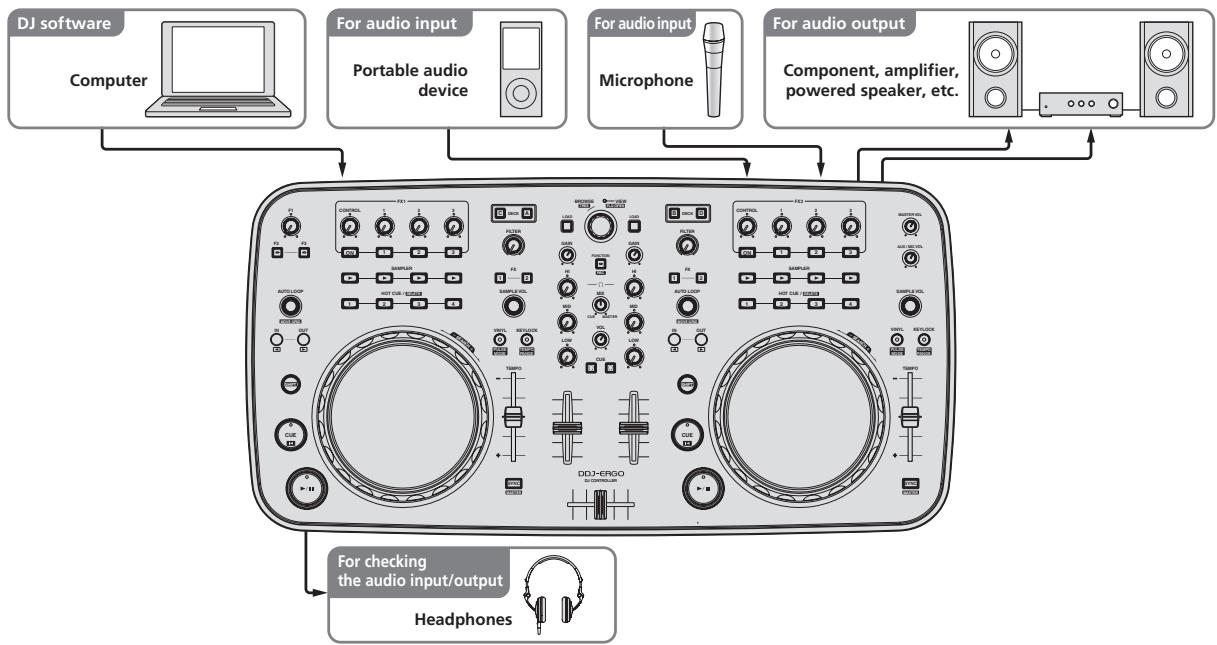
flowchart
graph TD
    A["Computer"] --> B["DJ software"]
    C["Portable audio device"] --> D["For audio input"]
    E["Microphone"] --> F["For audio input"]
    G["Component, amplifier, powered speaker, etc."] --> H["For audio output"]
    I["Headphones"] --> J["For checking the audio input/output"]
What's in the box
• VIRTUAL DJ LE software CD-ROM
• Driver software/operating instructions CD-ROM
- USB cable
- Read Before Use (Important)
- Quick Start Guide
• Hardware Diagram for Virtual DJ (Table of Supported Functions)
• Service Center Guide (for Japanese customers)
- Warranty card
Using the LAPTOP DOCK
The computer's keyboard section can be stowed under this unit.
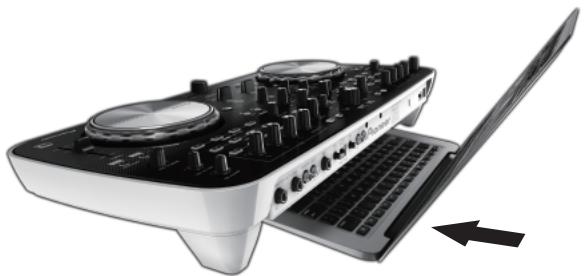
natural_image
Black and white photo of a DJDJ driver's CD/DVD app with a laptop keyboard inserted, showing control knobs and a separate blade (no text or symbols visible)- Depending on the size of your (notebook) computer, the keyboard section may not fit in the LAPTOP DOCK.
• Install in such a way that the computer unit does not touch this unit. - Install in such a way that the cables connected to the computer are not stuck under this unit.
Using with the feet removed
This unit's two feet can be removed.
Use a Phillips screwdriver to remove the screws from the left and right feet.
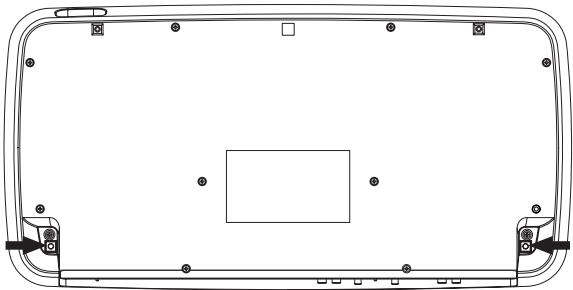
natural_image
Top-down schematic of a rectangular device with mounting points and a central rectangle (no text or symbols)- The screws you have removed will be needed when mounting the feet. Be careful not to lose them. The feet cannot be properly mounted using other screws.
Before you start
Installing the software
About the VIRTUAL DJ LE software
VIRTUAL DJ LE is a DJ software application by Atomix productions. DJ performances are possible by connecting the computer on which this software is installed to this unit.
Minimum operating environment
| Supported operating systems | CPU and required memory |
| Mac OS X 10.5.x | Intel®processor |
| 1 GB or more of RAM | |
| Windows® XP (SP3 or later) | Intel® Pentium® 4 or AMD AthlonTM XP processor |
| 512 MB or more of RAM |
| Others | |
| Hard disk | Free space of 50 MB or greater |
| Optical drive | Optical disc drive on which the CD-ROM can be read |
| USB port | A USB 2.0 port is required to connect the computer with this unit. |
| Display resolution | Resolution of 1 024 x 768 or greater |
Recommended operating environment
| Supported operating systems | CPU and required memory | |
| Mac OS X 10.6.x | Intel®processor | |
| 2 GB or more of RAM | ||
| Windows®7Professional | 32-bit version | Intel®CoreTM2 or AMD AthlonTMX2 processor |
| 1 GB or more of RAM | ||
| Others | |
| Hard disk | Free space of 200 MB or greater |
| Display resolution | Resolution of 1 280 x 1 024 or greater (Windows)Resolution of 1 440 x 900 or greater (Mac) |
The conditions below must be satisfied in order to conduct video mixing.
• Mac
— ATI ^TM or NVIDIA ^® video chipset with 256 MB of dedicated DDR3 RAM
— Video card must support dual-screen output.
- Windows — ATI ^TM or NVIDIA ^ video card with 256 MB of dedicated DDR3 RAM — Video card must support dual-screen output.
- Full functionality is not guaranteed on all computers, even those meeting the operating environment requirements described above.
- Even with the required memory indicated for the operating environment above, lack of memory due to resident programs, the number of services, etc., could prevent the software from offering optimal functionality and performance. In such cases, free up sufficient memory. We recommend installing additional memory for stable operation.
- Depending on the computer's power-saving settings, etc., the CPU and hard disk may not provide sufficient processing capabilities. For notebook computers in particular, make sure the computer is in the proper conditions to provide constant high performance (for example by keeping the AC power connected) when using VIRTUAL DJ LE.
- Note that problems may arise with the functionality of VIRTUAL DJ LE depending on other software running on your computer.
Installing the VIRTUAL DJ LE software
- Cautions when the included software involves an Internet environment
A separate contract with and payment to a provider offering Internet services is required.
◆ About the installation procedure (Windows)
1 Insert the included VIRTUAL DJ LE software CD-ROM in the computer's CD drive.
2 From the Windows [Start] menu, double-click the [Computer (or My Computer)] > [VirtualDJ_LE] icon.
The contents of the CD-ROM are displayed.
3 Double-click [install_virtualdj_le_ergo_v7.x.x.msi].
The VIRTUAL DJ LE installer is launched.
4 Once the VIRTUAL DJ LE installer is launched, click [Next].
— To return to the previous screen, click [Back].
— To cancel installation, click [Cancel].
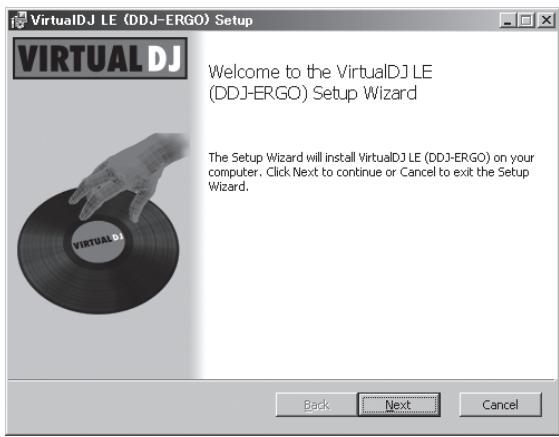
text_image
VirtualDJ LE (DDJ-ERGO) Setup VIRTUAL DJ Welcome to the VirtualDJ LE (DDJ-ERGO) Setup Wizard The Setup Wizard will install VirtualDJ LE (DDJ-ERGO) on your computer. Click Next to continue or Cancel to exit the Setup Wizard. Back Next Cancel5 Read the contents of the [End-User License Agreement] carefully, and if you agree, check [I accept the terms in the License Agreement], then click [Next].
If you do not agree to the terms of the [End-User License Agreement], click [Cancel] to cancel installation.
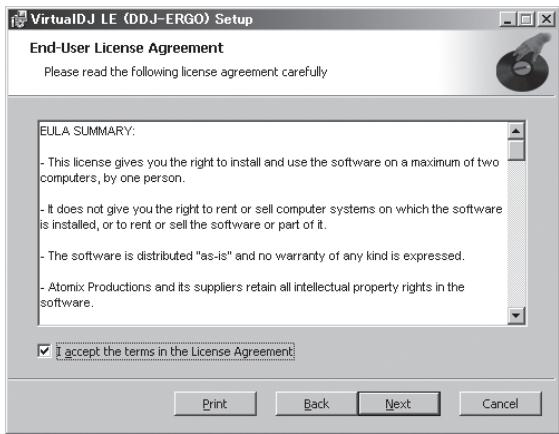
text_image
VirtualDJ LE (DDJ-ERGO) Setup End-User License Agreement Please read the following license agreement carefully EULA SUMMARY: - This license gives you the right to install and use the software on a maximum of two computers, by one person. - It does not give you the right to rent or sell computer systems on which the software is installed, or to rent or sell the software or part of it. - The software is distributed "as-is" and no warranty of any kind is expressed. - Atomix Productions and its suppliers retain all intellectual property rights in the software. ✓ I accept the terms in the License Agreement Print Back Next Cancel6 Select the type of installation for VIRTUAL DJ LE, then click [Next].
— When [Typical] is selected, plug-ins and other components are installed simultaneously. Normally select [Typical].
— When [Custom] is selected, you can select which components to install.
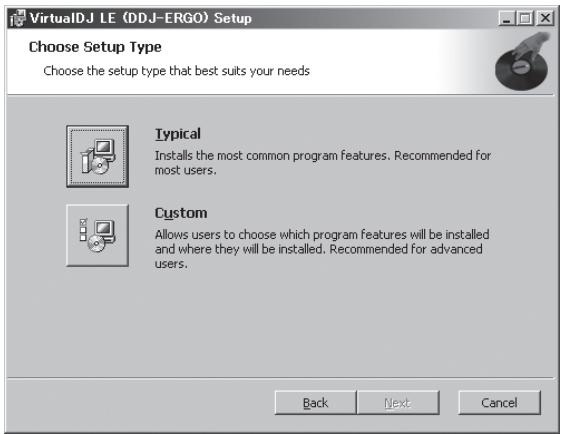
text_image
VirtualDJ LE (DDJ-ERGO) Setup Choose Setup Type Choose the setup type that best suits your needs Typical Installs the most common program features. Recommended for most users. Custom Allows users to choose which program features will be installed and where they will be installed. Recommended for advanced users. Back Next Cancel7 When the screen below is displayed, click [Install].
Installation begins.
The installation completed screen appears once installation is completed.
![PIONEER DDJ-ERGO-V - When the screen below is displayed, click [Install]. - 1](/content/2025/01/119073/images/885fae16654b9218336e4cea99a0ca83c14ce6b20afed1656c6520193249754b.jpg)
text_image
VirtualDJ LE (DDJ-ERGO) Setup Ready to install VirtualDJ LE (DDJ-ERGO) Click Install to begin the installation. Click Back to review or change any of your installation settings. Click Cancel to exit the wizard. Back Install Cancel8 Click [Finish].
This completes the installation procedure.
VIRTUAL DJ LE is launched if [Launch VirtualDJ] on the screen is checked when [Finish] is clicked.
![PIONEER DDJ-ERGO-V - Click [Finish]. - 1](/content/2025/01/119073/images/51bdf1ff5a23f265d2240e6db7c09344065a1120a974ee517fb8f8b5c3ea0721.jpg)
text_image
VirtualDJ LE (DDJ-ERGO) Setup VIRTUAL DJ Completed the VirtualDJ LE (DDJ-ERGO) Setup Wizard Click the Finish button to exit the Setup Wizard. ✓ Launch VirtualDJ Back Finish Cancel9 Input the serial number attached to the VIRTUAL DJ LE software CD-ROM's package, then click [OK].
![PIONEER DDJ-ERGO-V - Input the serial number attached to the VIRTUAL DJ LE software CD-ROM's package, then click [OK]. - 1](/content/2025/01/119073/images/62c305b39be1afb0f8a850666a2e5e29f20ab345af39f50b864f4034d3d05590.jpg)
text_image
Serial Number Welcome to VirtualDJ Please enter the Serial Number provided with your product. OK◆ About the installation procedure (Mac OS X)
1 Insert the included VIRTUAL DJ LE software CD-ROM in the computer's CD drive.
The [VirtualDJ_LE] icon appears on the screen.
2 Double-click the [VirtualDJ_LE] icon.
The contents of the CD-ROM are displayed.
3 Double-click [install_virtualdj_le_ergo_v7.x.x.pkg].
The VIRTUAL DJ LE installer is launched.
4 Once the VirtualDJ LE (DDJ-ERGO) installer is launched, click [Continue].
5 Read the contents of the license agreement carefully, click [Continue] and then click [Agree] to accept the license agreement.
If you do not agree to the license agreement, click [Disagree] to cancel installation.
6 Select the type of installation for VIRTUAL DJ LE, then click [Install].
— Normally select standard installation to install.
— To install in a different location, click [Change Install Location...] and choose the place of installation.
Installation begins.
The installation completed screen appears once installation is completed.
7 Click [Close].
This completes the installation procedure.
- Checking the latest information on the VIRTUAL DJ LE software
For the latest information on the operating environment and compatibility, and to acquire the latest operating system, please visit the following Atomix productions website:
http://www.virtualdj.com
About the driver software (Windows)
This driver software is an exclusive ASIO driver for outputting audio signals from the computer.
• There is no need to install the driver software when using Mac OS X.
❖ Software end user license agreement
This Software End User License Agreement (“Agreement”) is between you (both the individual installing the Program and any single legal entity for which the individual is acting) (“You” or “Your”) and PIONEER CORPORATION (“Pioneer”). TAKING ANY STEP TO SET UP OR INSTALL THE PROGRAM MEANS THAT YOU ACCEPT ALL OF THE TERMS OF THIS LICENSE AGREEMENT. PERMISSION TO DOWNLOAD AND/OR USE THE PROGRAM IS EXPRESSLY CONDITIONED ON YOUR FOLLOWING THESE TERMS. WRITTEN OR ELECTRONIC APPROVAL IS NOT REQUIRED TO MAKE THIS AGREEMENT VALID AND ENFORCEABLE. IF YOU DO NOT AGREE TO ALL OF THE TERMS OF THIS AGREEMENT, YOU ARE NOT AUTHORIZED TO USE THE PROGRAM AND MUST STOP INSTALLING IT OR UNINSTALL IT, AS APPLICABLE.
1 Definitions
1 "Documentation" means written documentation, specifications and help content made generally available by Pioneer to aid in installing and using the Program.
2 “Program” means all or any part of Pioneer’s software licensed to You by Pioneer under this Agreement.
2 Program license
1 Limited License. Subject to this Agreement's restrictions, Pioneer grants to You a limited, non-exclusive, nontransferable, license (without the right to sublicense):
a To install a single copy of the Program on the hard disk drive of Your computer, to use the Program only for Your personal purpose complying with this Agreement and the Documentation ("Authorized Use");
b To use the Documentation in support of Your Authorized Use; and
c To make one copy of the Program solely for backup purposes, provided that all titles and trademark, copyright and restricted rights notices are reproduced on the copy.
2 Restrictions. You will not copy or use the Program or Documentation except as expressly permitted by this Agreement. You will not transfer, sublicense, rent, lease or lend the Program, or use it for third-party training, commercial time-sharing or service bureau use. You will not Yourself or through any third party modify, reverse engineer, disassemble or decompile the Program, except to the extent expressly permitted by applicable law, and then only after You have notified Pioneer in writing of Your intended activities. You will not use the Program on multiple processors without Pioneer's prior written consent.
3 Ownership. Pioneer or its licensor retains all right, title and interest in and to all patent, copyright, trademark, trade secret and other intellectual property rights in the Program and Documentation, and any derivative works thereof. You do not acquire any other rights, express or implied, beyond the limited license set forth in this Agreement.
4 No Support. Pioneer has no obligation to provide support, maintenance, upgrades, modifications or new releases for the Program or Documentation under this Agreement.
3 Warranty disclaimer
THE PROGRAM AND DOCUMENTATION ARE PROVIDED "AS IS" WITHOUT ANY REPRESENTATIONS OR WARRANTIES, AND YOU AGREE TO USE THEM AT YOUR SOLE RISK. TO THE FULLEST EXTENT PERMISSIBLE BY LAW, PIONEER EXPRESSLY DISCLAIMS ALL WARRANTIES OF ANY KIND WITH RESPECT TO THE PROGRAM AND DOCUMENTATION, WHETHER EXPRESS, IMPLIED, STATUTORY, OR ARISING OUT OF COURSE OF PERFORMANCE, COURSE OF DEALING OR USAGE OF TRADE, INCLUDING ANY WARRANTIES OF MERCHANTABILITY, FITNESS FOR A PARTICULAR PURPOSE, SATISFACTORY QUALITY, ACCURACY, TITLE OR NON-INFRINGEMENT.
4 Damages and remedies for breach
You agree that any breach of this Agreement's restrictions would cause Pioneer irreparable harm for which money damages alone would be inadequate. In addition to damages and any other remedies to which Pioneer may be entitled, You agree that Pioneer may seek injunctive relief to prevent the actual, threatened or continued breach of this Agreement.
5 Termination
Pioneer may terminate this Agreement at any time upon Your breach of any provision. If this Agreement is terminated, You will stop using the Program, permanently delete it from the computer where it resides, and destroy all copies of the Program and Documentation in Your possession, confirming to Pioneer in writing that You have done so. Sections 2.2, 2.3, 2.4, 3, 4, 5 and 6 will continue in effect after this Agreement's termination.
6 General terms
Limitation of Liability. In no event will Pioneer or its subsidiaries be liable in connection with this Agreement or its subject matter, under any theory of liability, for any indirect, incidental, special, consequential or punitive damages, or damages for lost profits, revenue, business, savings, data, use, or cost of substitute procurement, even if advised of the possibility of such damages or if such damages are foreseeable. In no event will Pioneer's liability for all damages exceed the amounts actually paid by You to Pioneer or its subsidiaries for the Program. The parties acknowledge that the liability limits and risk allocation in this Agreement are reflected in the Program price and are essential elements of the bargain between the parties, without which Pioneer would not have provided the Program or entered into this Agreement.
2 The limitations or exclusions of warranties and liability contained in this Agreement do not affect or prejudice Your statutory rights as consumer and shall apply to You only to the extent such
limitations or exclusions are permitted under the laws of the jurisdiction where You are located.
3 Severability and Waiver. If any provision of this Agreement is held to be illegal, invalid or otherwise unenforceable, that provision will be enforced to the extent possible or, if incapable of enforcement, deemed to be severed and deleted from this Agreement, and the remainder will continue in full force and effect. The waiver by either party of any default or breach of this Agreement will not waive any other or subsequent default or breach.
4 No Assignment. You may not assign, sell, transfer, delegate or otherwise dispose of this Agreement or any rights or obligations under it, whether voluntarily or involuntarily, by operation of law or otherwise, without Pioneer's prior written consent. Any purported assignment, transfer or delegation by You will be null and void. Subject to the foregoing, this Agreement will be binding upon and will inure to the benefit of the parties and their respective successors and assigns.
5 Entire Agreement. This Agreement constitutes the entire agreement between the parties and supersedes all prior or contemporaneous agreements or representations, whether written or oral, concerning its subject matter. This Agreement may not be modified or amended without Pioneer's prior and express written consent, and no other act, document, usage or custom will be deemed to amend or modify this Agreement.
6 You agree that this Agreement shall be governed and construed by and under the laws of Japan.
◆ Installing the driver software
• There is no need to install the driver software when using Mac OS X.
Operating environment
| Supported operating systems | ||
| Windows® 7 Home Premium/Professional/Ultimate | 32-bit version | √ |
| 64-bit version | ^1 | |
| Windows Vista® Home Basic/Home Premium/Business/Ultimate | 32-bit version | √ |
| 64-bit version | ^1 | |
| Windows® XP Home Edition/Professional (SP2 or later) | 32-bit version | √ |
When using a 64-bit version of Windows, the driver software can only be used for 32-bit applications.
Before installing the driver software
- Read Software end user license agreement carefully.
- Turn off this unit's power switch, then disconnect the USB cable connecting this unit and the computer.
• If any other programs are running on the computer, quit them. - To install or uninstall the driver software, you need to be authorized by the administrator of your computer. Log on as the administrator of your computer before proceeding with the installation.
- If you connect this unit to your computer without installing the driver software first, an error may occur on your computer depending on the system environment.
- If installation of the driver software is interrupted after it has started, start the installation procedure over again from the beginning.
1 Turn on the computer's power.
2 Insert the included driver software CD-ROM into the computer's CD drive.
3 Once the CD-ROM's menu is displayed, double-click [Pioneer\_DDJ\_Driver\_XXXXX.exe].
4 Proceed with installation according to the instructions on the screen.
If [Windows Security] appears on the screen while the installation is in progress, click [Install this driver software anyway] and continue with the installation.
- When installing on Windows XP
If [Hardware Installation] appears on the screen while the installation is in progress, click [Continue Anyway] and continue with the installation.
- When the installation program is completed, a completion message appears.
◆ Connecting this unit and computer
1 Connect this unit to your computer via a USB cable.
For instructions on connections, see Connecting the input/output terminals on page 10.
2 Slide this unit's [ON/OFF] switch to the [ON] position.
Turn on the power of this unit.
- The message [Installing device driver software] may appear when this unit is first connected to the computer or when it is connected to a different USB port on the computer. Wait a while until the message [Your devices are ready for use] appears.
◆ Adjusting the buffer size
This unit functions as an audio device conforming to the ASIO standards.
- If an application using this unit as the default audio device (DJ software, etc.) is running, quit that application before adjusting the buffer size.
Click the Windows [Start] menu>[All Programs]>[Pioneer ]>[DDJ]>[Pioneer DDJ ASIO Settings Utility].
![PIONEER DDJ-ERGO-V - Click the Windows [Start] menu>[All Programs]>[Pioneer ]>[DDJ]>[Pioneer DDJ ASIO Settings Utility]. - 1](/content/2025/01/119073/images/46522435d38b16233abf253b0abe9a1c1d5cd5176ec9998c0d00c622b54b84df.jpg)
text_image
Pioneer DDJ ASIO Settings Utility Sets the size of the buffer when using ASIO. If you make the buffer smaller, then latency (Audio output delay) will be shorter. If the audio gets cut off, increase the size of the buffer so that the sound does not get cut off. 64 1920 Buffer Size 256 Sample Latency 5.8msec (44100Hz) Bit depth 16 bit 24 bit Kernel Buffers 3 Standard Setting OK Cancel Apply- If the buffer size is made large, drops in audio data (breaks in the sound) occur less easily, but the time lag due to the delay in the transfer of the audio data (latency) increases.
- If the kernel buffer number is made large, breaks in the sound occur less easily, but the time lag due to latency increases.
- Operate referring to the procedure below to adjust the buffer size and kernel buffer.
If there are no interruptions in the sound with the default settings
① Gradually decrease the buffer size, setting it to the minimum value at which there are no interruptions in the sound.
② Set the kernel buffer size to [2] and check whether there are interruptions in the sound.
— If there are interruptions in the sound, set the kernel buffer size to [3].
If there are interruptions in the sound with the default settings
① Set the kernel buffer size to [4], then set the buffer size to the minimum value at which there are no interruptions in the sound.
- Checking the version of the driver software
Click the Windows [Start] menu>[All Programs]>[Pioneer ]>[DDJ]>[Pioneer DDJ Version Display Utility].
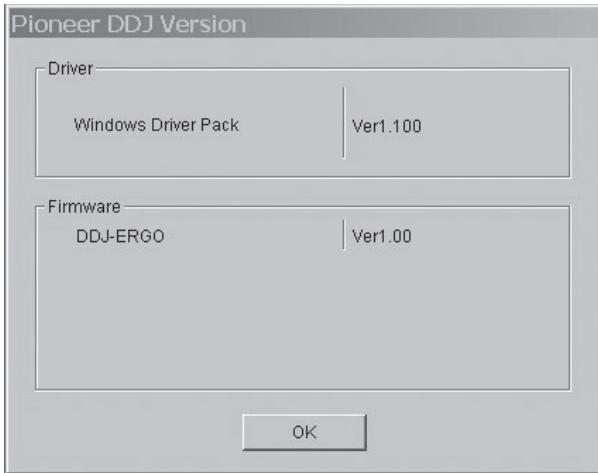
text_image
Pioneer DDJ Version Driver Windows Driver Pack Ver1.100 Firmware DDJ-ERGO Ver1.00 OK• You can check the firmware version of this unit on the screen.
- The firmware version is not displayed when this unit is not connected to the computer or when this unit and computer are not properly communicating.
- Checking the latest information on the driver software
For the latest information on the driver software for exclusive use with this unit, visit our website shown below.
http://www.prodjnet.com/support/
Connections
Be sure the power is off when connecting equipment and changing connections.
Be sure to use the USB cable included with this product.
Refer to the operating instructions for the component to be connected.
With this unit, the power is supplied by USB bus power. The unit can be used simply by connecting it to a computer using the USB cable.
- Connect this unit and the computer directly using the included USB cable.
- Connect the computer to which this unit is to be connected to an AC power supply.
• A USB hub cannot be used. - In cases like the ones below, the power may be insufficient and this unit may not operate on USB bus power.
— When the computer's USB power supply capacity is insufficient.
— When other USB devices are connected to the computer.
— When headphones with an impedance of less than 32 Ω are connected.
— When headphones are simultaneously connected to the stereo phone jack and the stereo mini-phone jack.
— When a monaural jack is connected to the [PHONES] terminal.
- If this unit cannot be operated on USB bus power, it may operate in the emergency mode (with limited functions).
The following limitations apply in the emergency mode:
— The volume of the headphones will be lower.
— The [DECK] button on the selected deck flashes.
Names of terminals
Rear panel

text_image
MASTER OUT1 (TRS) MASTER OUT2 MIC VOL INPUT SELECT VOL AUX IN ON + OFF USB R L R L R L 1 2 3 4 5 6 7 8 9 101 MASTER OUT 1 terminals
Connect powered speakers, etc., here.
This is a TRS phone jack, so both balanced and unbalanced outputs are supported.
- The sound will be distorted if the level is raised too high when using unbalanced outputs.
2 MASTER OUT 2 terminals
Connect to a power amplifier, etc.
3 MIC jack
Connect a microphone here.
4 MIC VOL control
Adjusts the audio level input to the [MIC] terminal.
5 AUX/MIC selector switch
Switches the audio input between the external device and the microphone.
— [AUX]: The external device connected to the [AUX] terminals is selected.
— [MIC]: The microphone connected to the [MIC] terminal is selected.
- The sound input to the [MIC] and [AUX] terminals is mixed to the [MASTER OUT] sound.
6 AUX IN VOL control
Adjusts the audio level input to the [AUX IN] terminals.
7 AUX IN terminal
Connect to the output terminal of an external device (sampler, portable audio device, etc.)
8 Kensington security slot
9 ON/OFF switch
Turns this unit's power on and off.
10 USB terminal
Connect to a computer.
- Connect this unit and the computer directly using the included USB cable.
• A USB hub cannot be used.
Front panel
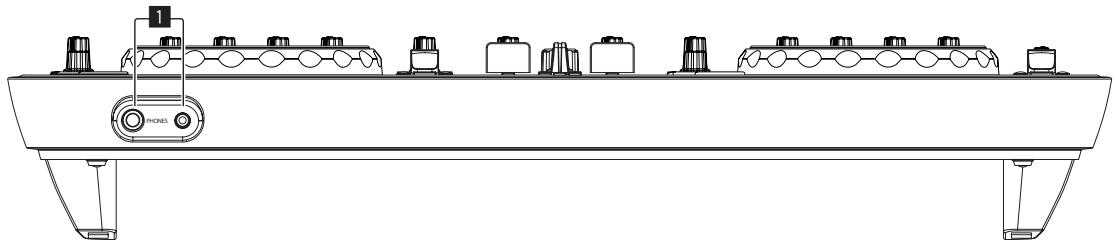
natural_image
Technical line drawing of a conveyor belt system with multiple rollers and a labeled component (no text or symbols)1 PHONES terminal
Connect headphones here.
Both stereo phone plugs ( 6.3 mm) and stereo mini phone plugs ( 3.5 mm) can be used.
- Connect headphones with an impedance of 32 Ω or more. Headphones with an impedance of less than 32 Ω are not supported.
- Do not connect headphones simultaneously to the stereo phone jack and the stereo mini-phone jack.
Connecting the input/output terminals
Rear panel

text_image
Component, amplifier, powered speaker, etc. To audio input terminals Microphone Microphone cable To microphone To audio output terminals Portable audio device Computer MASTER OUT1 (TRS) MASTER OUT2 MIC VOL INPUT SELECT VOL AUX IN ON --OFF USBFront panel
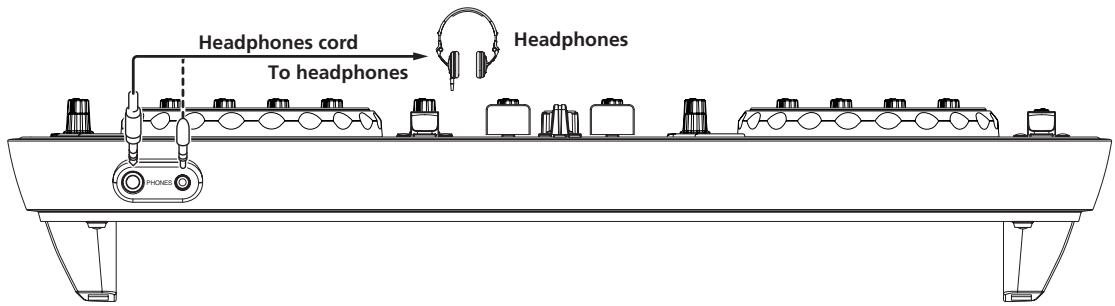
text_image
Headphones cord To headphones HeadphonesPart names and functions
Control panel
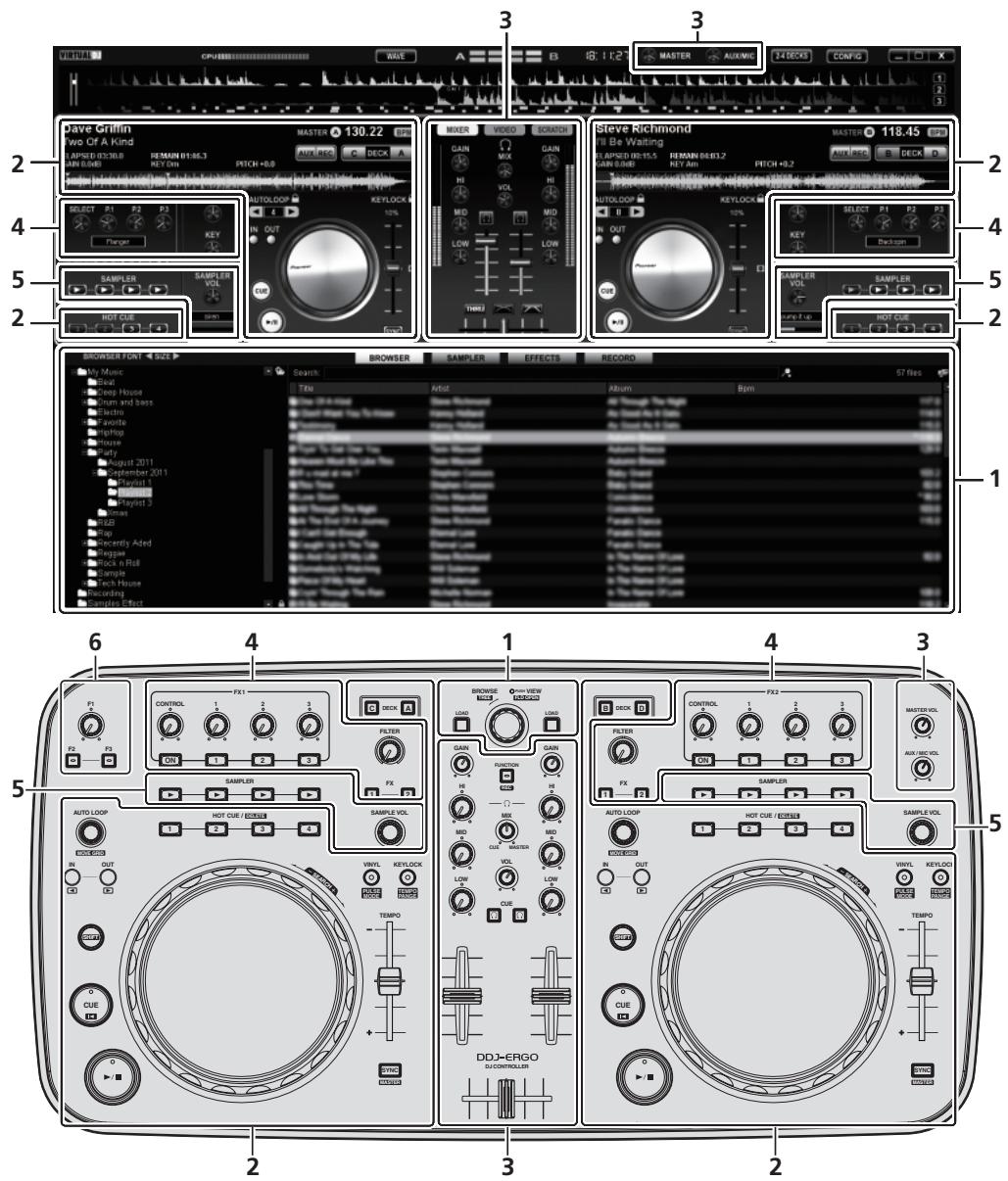
text_image
CPU ROSE B 8:14:23 MASTER AUX/MID 14/DOCK CONFIG Dave Griffin Two Of A Kind APSED 03:30.0 REMARK 01:56.3 R12.70m PIITCH +0.0 Master 130.22 AVI/RED DECK MIXER VIDEO SCRATCH GAIN MIX GAIN VOL HIV VOL MID LOW LOW AUTOLOOP KEYLOCK IN OUT CAMERA SAMPLER VOL TICK HOT CUE AVI/RED STEVE RICHMOND Be Waiting AMOUNTED DEB3.2 REMARK DEB3.2 RUTY MIN PICH +0.2 AUTOLOOP KEYLOCK OUT KEY BACKSUM SELECT P1 P2 P3 P3 KEY SELECT P1 P2 P3 P3 P3 P3 P3 P3 P3 P3 P3 P3 P3 P3 P3 P3 P3 P3 P3 P3 P3 P3 P3 P3 P3 P3 P3 P3 P3 P3 P3 P3 P3 P3 P3 P3 P4 AVI/RED BROWSER FOR SIZE Vo Music Beat Deep House Drum and bass Electro Favorite Highlop House Carly August 2011 September 2011 Playout 14 Playlist 3 Emman Real Top Recently Aided Reggae Rock n Roll Sample Tech House Recording Controls Effect Search BROWSER SAMPLER EFFECTS RECORD 57 files TENI ARES Album Bim Power (W) & Power (W) Power (W) & Power (W) Power (W) & Power (W) Power (W) & Power (W) Power (W) & Power (W) Power (W) & Power (W) Power (W) & Power (W) Power (W) & Power (W) Power (W) & Power (W) Power (W) & Power (W) Power (W) & Power (W) Power (W) & Power (W) power (W) & Power (W) power (W) & Power (W) power (W) & Power (W) power (W) & Power (W) power (W) & Power (W) power (W) & Power (W) power (W) & Power (W) power (W) & Power (W) power (W) & Power (W) power (W) & Power (W) power (W) & Power (W) power(1) power(2) power(3) power(4) power(5) power(6) power(7) power(8) power(9) power(10) power(11) power(12) power(13) power(14) power(15) power(16) power(17) power(18) power(19) power(20) power(21) power(22) power(23) power(24) power(25) power(26) power(27) power(28) power(29) power(30) power(31) power(32) power(33) power(34) power(35) power(36) power(37) power(38) power(39) power(40) power(41) power(42) power(43) power(44) power(45) power(46) power(47) power(48) power(49) power(50) power(51) power(52) power(53) power(54) power(55) power(56) power(57) power(58) power(59) power(60) power(61) power(62) power(63) power(64) power(65) power(66) power(67) power(68) power(69) power(70) power(71) power(72) power(73) power(74) power(75) power(76) power(77) power(78) power(79) power(80) power(81) power(82) power(83) power(84) power(85) power(86) power(87) power(88) power(89) power(90) power(91) power(92) power(93) power(94) power(95) power(96) power(97) power(98) power(99) power(100)1 Browser (page 12)
2 Deck (page 13)
3 Mixer (page 14)
4 Effect (page 15)
5 Sampler (page 16)
6 Video (page 17)
The diagram above shows a screen for a 2-deck layout.
- For instructions on changing the deck layout, refer to Operating four decks on page 22.
1 Browser
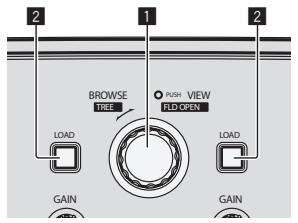
text_image
BROWSE TREE PUSH VIEW FLD OPEN LOAD LOAD GAIN GAIN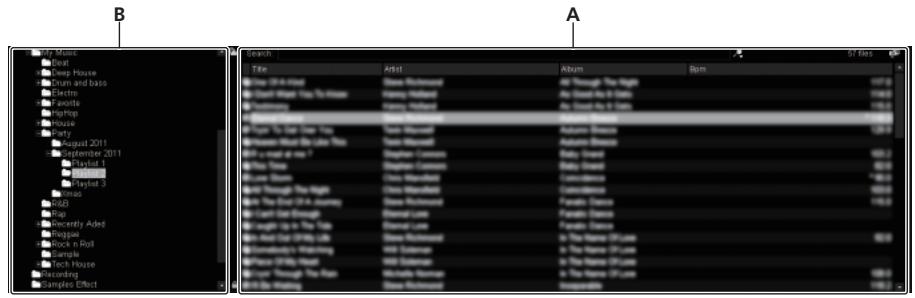
text_image
B A Search Title Arist Album Bpm B-Clash (314.00) Giant: Rockland Air Through The Right Air: Sound And You Air: Sound And You Air: Sound And You Air: Sound And You Air: Sound And You Air: Sound And You Air: Sound And You Air: Sound And You Air: Sound And You Air: Sound And You Air: Sound And You Air: Sound And You Air: Sound And You Air: Sound And You Air: Sound And You Air: Sound And You Air: Sound And You Air: Air Time to See It Air: Air Time to See It Air: Air Time to See It Air: Air Time to See It Air: Air Time to See It Air: Air Time to See It Air: Air Time to See It Air: Air Time to See It Air: Air Time to See It Air: Air Time to See It Air: Air Time to See It Air: Air Time to See It Air: Air Time to See It Air: AIR Time to See It Air: Air Time to See It Air: Air Time to See It Air: Air Time to See It Air: Air Time to See It Air: Air Time to See It Air: Air Time to See It Air: Air Time to See It Air: Air Time to See It Air: Air Time to See It Air: Air Time to See It Air: Air Time to See It Air: Air Time to SeeIt Air: Air Time to See It Air: Air Time to See It Air: Air Time to See It Air: Air Time to See It Air: Air Time to See It Air: Air Time to See It Air: Air Time to See It Air: Air Time to See It Air: Air Time to See It Air: Air Time to See It Air: Air Time to See It Air: Air Time to See It Air: Oil & Gas, 2000/1997/1998/1999/1998/1999/1998/1999/1998/1999/1998/1999/1998/1999/1998/1999/1998/1999/1998/1999/1998/1999/1998/1998/1999/1998/1999/1998/1999/1998/1999/1998/1999/1998/1999/1998/1999/1998/1999/1998/1999/1998/1996/1997/1998/1998/1998/1998/1998/1998/1998/1998/1998/1998/1998/1998/1998/1998/1998/1998/1998/1998/1998/1998/11 Rotary selector
- Turn: The cursor moves in section A of the above diagram.
- Press: The [BROWSE] area's magnified display turns on and off.
- [SHIFT] + turn: The cursor moves in section B of the above diagram.
- [SHIFT] + press:
Folders in section B of the above diagram open and close.
* If a panel other than the [BROWSE] panel is displayed, turn the rotary selector to display the [BROWSE] panel.
2 LOAD button
Loads the track selected with the cursor in each of the decks.
2 Deck
text_image
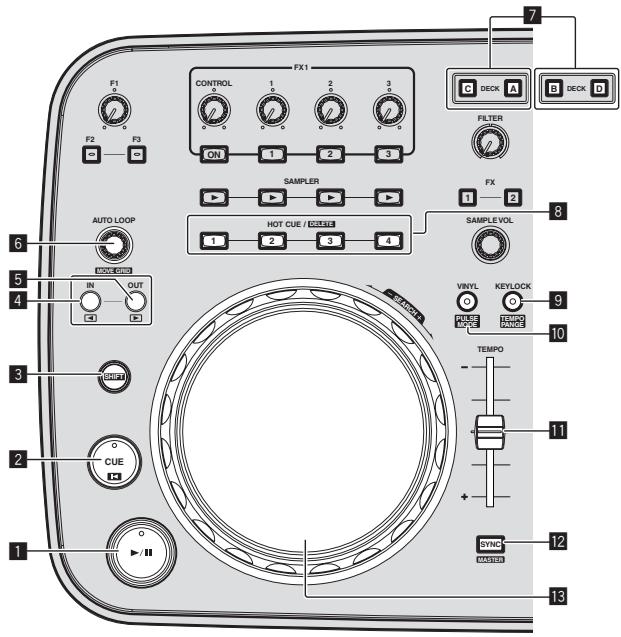
F1 F2 F3 CONTROL CN 1 2 3 FX1 1 2 3 SAMPLER HOT CUE / ECKLE 1 2 3 4 SAMPLE VOL VINYL KEYLOCK TEMP TEMPO SYNC MASTER AUTO LOOP IN OUT OUT 6 5 4 3 2 1 7 8 9 10 11 12 131 ▶/II button
Use this to play/pause tracks.
2 CUE button
- Press:
Sets a cue point or moves the cue point. - [SHIFT] + press:
The playing position moves to the beginning of the track.
3 SHIFT button
When another button is pressed while pressing the [SHIFT] button, a different function is called out.
4 IN button
- Press: Sets the position at which loop playback starts (the loop in point).
- [SHIFT] + press: Moves the loop playback section one beat towards the beginning of the track.
5 OUT button
- Press: Sets the position at which loop playback ends (the loop out point).
- [SHIFT] + press: Moves the loop playback section one beat towards the end of the track.
6 AUTO LOOP (MOVE GRID) control
- Turn: Changes the width of the loop playback section.
- Press:
Turns loop playback on and off.
• [SHIFT] + turn: Moves the beat grid position.
* This function can be used when you upgrade to VIRTUAL DJ PRO.
• [SHIFT] + press: Resumes loop playback. (Reloop)
7 DECK button
Switches the deck to be operated.
8 HOT CUE/DELETE button
- Press: Sets a hot cue point or plays the hot cue.
text_image
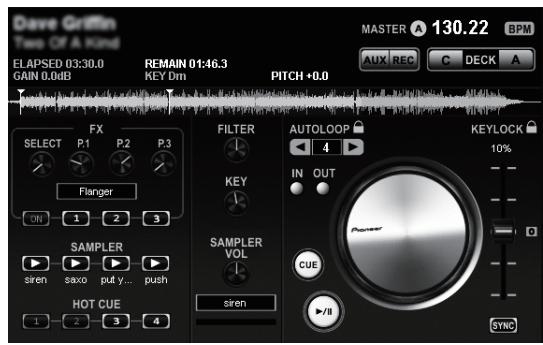
Dave Griffin Two Of A Kindle ELAPSED 03:30.0 GAIN 0.00B REMAIN 01:46.3 KEY Dm PITCH +0.0 FX SELECT P1 P2 P3 Flanger ON 1 2 3 SAMPLER siren saxo put y... push HOT CUE 1 2 3 4 FILTER KEY SAMPLER VOL siren AUTOLOOP 4 IN OUT CUE 10% KEYLOCK SYNC MASTER A 130.22 BPM AUX REC C DECK A- [SHIFT] + press:
Deletes the hot cue set for that button.
9 KEYLOCK (TEMPO RANGE) button
- Press:
Turns the key lock function on and off. - [SHIFT] + press:
The [TEMPO] slider's range of variation switches each time this is pressed.
10 VINYL (PULSE MODE) button
- Press:
This switches the [VINYL] mode on/off. - [SHIFT] + press:
Switches the jog dials' illumination mode (Pulse Mode).
11 TEMPO slider
Adjusts the playing speed.
12 SYNC (MASTER) button
- Press:
Synchronizes to the master deck's tempo. - [SHIFT] + press:
Sets the master deck for synchronization.
13 Jog dial
- Scratch
When the [VINYL] mode is turned on and the jog dial is turned while pressing on its top, the track is played according to the direction and speed at which the jog dial is turned. - Pitch bend
The playing speed can be adjusted by turning the outer part of the jog dial during playback.
The top of the jog dial has an embedded switch. Do not place objects on the jog dial or subject it to strong forces. Also note that water or other liquids getting into the set will lead to malfunction.
3 Mixer
text_image
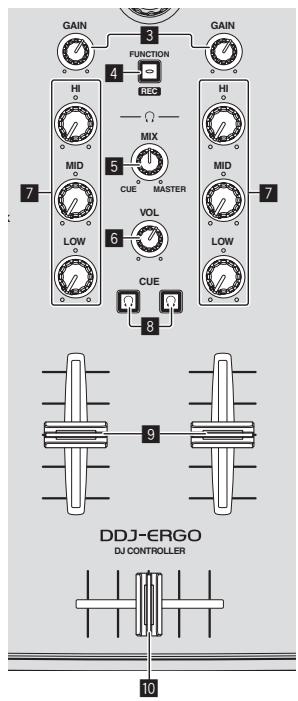
GAIN FUNCTION GAIN 4 HI REC MIX 5 MID CUE MASTER VOL 6 LOW CUE 8 7 7 9 DDJ-ERGO DJ CONTROLLER 10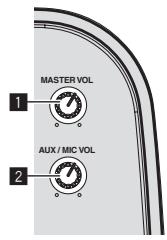
text_image
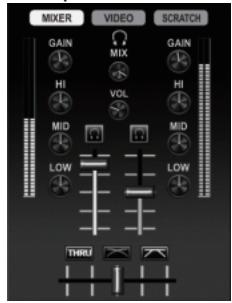
MASTER VOL 1 AUX / MIC VOL 2MIXER panel
text_image
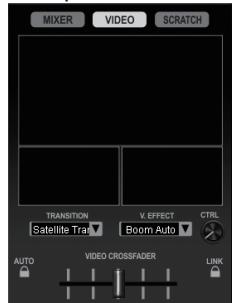
MIXER VIDEO SCRATCH GAIN HI VOL MID LOW THRU GAIN HI MID LOW THRUVIDEO panel
text_image
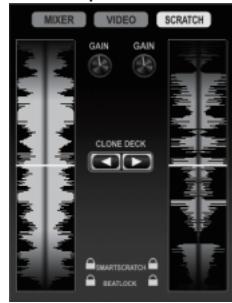
MIXER VIDEO SCRATCH TRANSITION Satellite Trace V. EFFECT Boom Auto CTRL AUTO VIDEO CROSSFADER LINKSCRATCH panel
text_image
MIXER VIDEO SCRATCH GAIN GAIN CLONE DECK SMARTSCRATCH BEATLOCK1 MASTER VOL control
Adjusts the sound level output from the master.
- Operation is not associated with the [MASTER] control on the computer's screen.
2 AUX/MIC VOL control
Adjusts the audio output level of the [AUX IN] and [MIC] terminals.
3 GAIN control
Adjusts the sound level input to the various decks.
4 FUNCTION (REC) button
- Press: Switches the display at the center of the computer's screen.
- [SHIFT] + press:
Click this to start/stop recording.

Adjusts the balance of the monitor volume between the sound of the deck whose [CUE] button is pressed and the master sound.
- The sampler sound is output regardless of the position of the [HEADPHONES MIX] control.
6 HEADPHONES VOL control
Adjusts the audio level output from the [PHONES] terminal.
- Operation is not associated with the [VOL] control (headphones volume control) on the computer's screen.
- The sound of the external device connected to the [AUX IN] terminals and the sound of the microphone connected to the [MIC] terminal are not output from the headphones. They are only output from the headphones when assigned to a deck.
7 EQ (HI, MID, LOW) controls
These adjust the sound quality input to the various decks. [HI] (treble range), [MID] (middle range), [LOW] (low range)
8 CUE (Headphones cue button)
Use this to monitor the sound of the respective decks over the headphones.
9 Channel fader
Adjusts the sound level output from the various decks.
10 Crossfader
Switches the sound of the decks assigned to the left and right sides of the crossfader for output.
Do not pull on the channel fader and crossfader knobs with excessive force. The knobs are not designed to be removed. Pulling the knobs strongly may result in damaging the unit.
4 Effect
flowchart
graph TD
    A["1"] --> B["2"]
    B --> C["3"]
    C --> D["FX1"]
    D --> E["CONTROL"]
    E --> F["1"]
    E --> G["2"]
    E --> H["3"]
    F --> I["ON"]
    G --> J["1"]
    G --> K["2"]
    G --> L["3"]
    M["SAMPLER"] --> N["+"]
    O["HOT CUE / DELE"] --> P["+"]
    Q["FX"] --> R["1"]
    Q --> S["2"]
    T["DECK"] --> U["A"]
    V["FILTER"] --> W["A"]
    X["SAMPLE VOL"] --> Y["6"]
    X --> Z["7"]
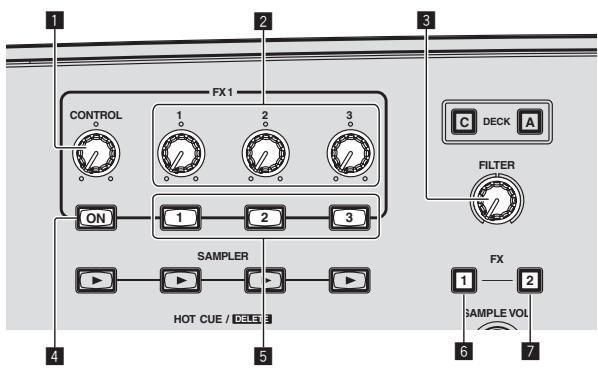
1 CONTROL dial
Selects the type of effect.
2 Effect parameter controls
- Turn:
These adjust parameters 1 - 3. - [SHIFT] + turn:
These adjust parameters 4 - 6.
* The types and numbers of parameters differ according to the effect.
* Operating the parameter controls or buttons has no effect if there is no parameter for that effect.
There are no effects on VIRTUAL DJ LE for which all parameters can be controlled.
When you upgrade to VIRTUAL DJ PRO, various effects can be downloaded from the VIRTUAL DJ website.
3 FILTER control
- Turn clockwise to apply the high pass filter.
- Turn counterclockwise to apply the low pass filter.
4 FX ON button
Turns the effect on/off.
5 Effect parameter buttons
- Press: These switch parameters 1 – 3 and turn them on and off.
- [SHIFT] + press:
These switch parameters 4 – 6 and turn them on and off.
* The types and numbers of parameters differ according to the effect.
* Operating the parameter controls or buttons has no effect if there is no parameter for that effect.
There are no effects on VIRTUAL DJ LE for which all parameters can be controlled.
When you upgrade to VIRTUAL DJ PRO, various effects can be downloaded from the VIRTUAL DJ website.
6 FX1 button
Turns the [BeatGrid] effect on and off.
7 FX2 button
Turns the [Flanger] effect on and off.
text_image
FX SELECT P.1 P.2 P.3 Flanger ON 1 2 3 FILTER KEYEFFECT panel
text_image
Auto_Paper AUTO_Paper Productions AUTO_Paper Productions on the list5 Sampler
flowchart
graph TD
    A["1"] --> B["SAMPLER"]
    B --> C["1"]
    B --> D["2"]
    B --> E["3"]
    B --> F["4"]
    G["1"] --> H["THECUE / DELETE"]
    H --> I["2"]
    H --> J["3"]
    H --> K["4"]
    L["FX"] --> M["SAMPLE VOL"]
    M --> N["2"]
text_image
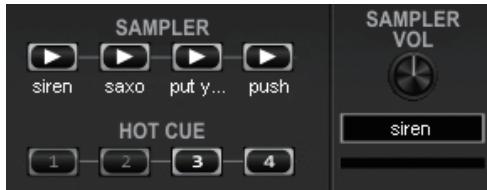
SAMPLER siren saxo put y... push HOT CUE 1 2 3 4 SAMPLER VOL sirenSAMPLER panel
text_image
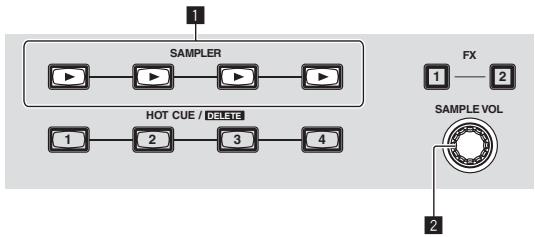
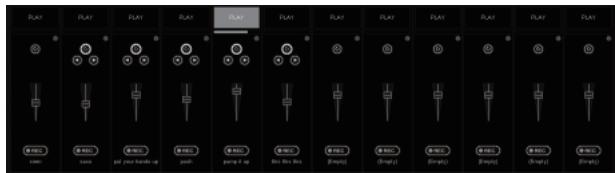
PLAY PLAY PLAY PLAY PLAY PLAY PLAY PLAY PLAY PLAY PLAY PLAY PLAY PLAY PLAY PLAY PLAY PLAY PLAY PLAY PLAY PLAY PLAY PLAY PLAY PLAY PLAY PLAY PLAY PLAY PLAY PLAY PLAY PLAY PLAY PLAY PLAY PLAY PLAY PLAY PLAY PLAY PLAY PLAY PLAY PLAY PLAY PLAY PLAY PLAY PLAY1 SAMPLER button
- Press: Starts/stops playback of the sample.
- [SHIFT] + press: When the sample is playing, playback returns to the beginning of the sample and continues.
2 SAMPLE VOL control
- Turn: Adjusts the audio level of the selected sampler slot.
- Press:
Displays the sampler panel.
• [SHIFT] + turn: Selects the sampler slot. - [SHIFT] + press: Starts/stops playback of the selected sampler slot.
6 Video
text_image
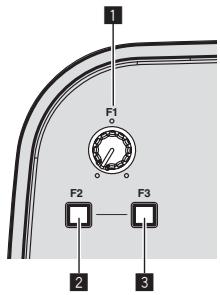
F1 F2 F3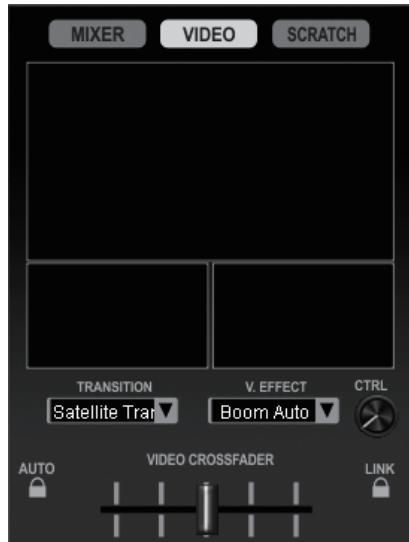
text_image
MIXER VIDEO SCRATCH TRANSITION Satellite Trat▼ V. EFFECT Boom Auto▼ CTRL AUTO VIDEO CROSSFADER LINK1 F1 control
Adjusts the video effect.
2 F2 button
- Press:
Turns the video transition on and off.
The video transition function allows you to set the way in which the pictures of the left and right decks switch.
• [SHIFT] + press: Switches the video transition type.
3 F3 button
- Press:
Turns the video effect on and off.
• [SHIFT] + press: Switches the video effect type.
Basic Operation
Starting the system
Starting this unit
1 Connect this unit to your computer via a USB cable.
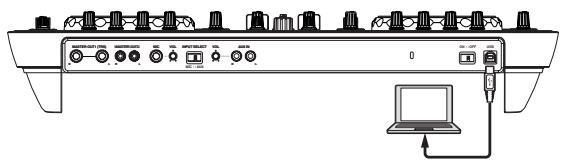
text_image
Diagram of an audio amplifier interface with labeled ports and a laptop connected to the output port.2 Boot up the connected computer.
3 Slide this unit's [ON/OFF] switch to the [ON] position.
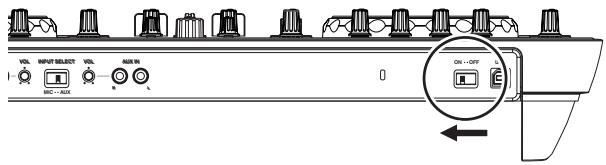
text_image
VOL INPUT SELECT VOL AUR IN NCC - AUR ON - OFFTurn on the power of this unit.
- The message [Installing device driver software] may appear when this unit is first connected to the computer or when it is connected to a different USB port on the computer. Wait a while until the message [Your devices are ready for use] appears.
4 Turn on the connected microphone and external equipment.
Launching VIRTUAL DJ LE
When this unit has just started, wait for the illumination to stop before launching VIRTUAL DJ LE.
◆ Launching VIRTUAL DJ LE (Windows)
1 From the Windows [Start] menu, click the [All Programs] > [VIRTUAL DJ LE] > [VirtualDJ_LE (DDJ-ERGO)] icon.
When VIRTUAL DJ LE is launched the first time, a screen for inputting the serial number appears.
Input the serial number attached to the VIRTUAL DJ LE software CD-ROM's package, then click [OK].
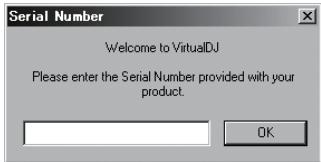
text_image
Serial Number Welcome to VirtualDJ Please enter the Serial Number provided with your product. OK2 If the [Website Identification] screen appears, select an icon and click.
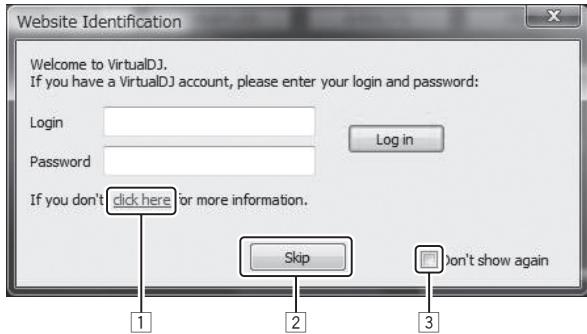
text_image
Website Identification Welcome to VirtualDJ. If you have a VirtualDJ account, please enter your login and password: Login Password Log in If you don't click here for more information. Skip Don't show againFor [VirtualDJ account], click [click here] to see the details.
2 To skip the [Website Identification] screen, click [Skip].
3 If you do not want the [Website Identification] screen to appear when VirtualDJ is launched, check [Don't show again].
VIRTUAL DJ LE is launched.
3 Click [CONFIG] in the top right of the computer's screen.
The [Settings] screen appears.
Set the various items on the [Sound Setup] tab in the following order:
① [Inputs]: Select [MICROPHONE]
② [Sound card]: Select [Pioneer DDJ ASIO].
③ [Outputs]: Select
[Master : Chan 1&2/Headphones: Chan 3&4].
![PIONEER DDJ-ERGO-V - Click [CONFIG] in the top right of the computer's screen. - 1](/content/2025/01/119073/images/bd8d4c96fe4bc6052a6573edbab3aa24eb539dd113e75eec3641807f27c08641.jpg)
text_image
Settings Sound Setup | Advanced Options | Inputs: MICROPHONE Outputs: HEADPHONES Master: Chan 1&2 / Headphones: Chan 3&4 Sound card: ASIO DRIVER ASIO Pioneer DDJ ASIO ASIO config... Ultra-latency ASIO Apply OK4 Click [Apply], then click [OK].
◆ Launching VIRTUAL DJ LE (Mac OS X)
1 In Finder, open the [Application] folder, then double-click the [VIRTUAL DJ LE] icon.
When VIRTUAL DJ LE is launched the first time, a screen for inputting the serial number appears.
Input the serial number attached to the VIRTUAL DJ LE software CD-ROM's package, then click [OK].
2 If the [Website Identification] screen appears, select an icon and click.
- For [VirtualDJ account], click [click here] to see the details.
• To skip the [Website Identification] screen, click [Skip]. - If you do not want the [Website Identification] screen to appear when VirtualDJ is launched, check [Don't show again].
VIRTUAL DJ LE is launched.
3 Click [CONFIG] in the top left of the computer's screen.
The [Settings] screen appears.
Set the various items on the [Sound Setup] tab in the following order:
① [Inputs]: Select [MICROPHONE].
② [Sound card]: Select [4-IN/4-OUT CARD] and [PIONEER DDJ-ERGO].
③ [Outputs]: Select
[Master : Chan 1&2/Headphones: Chan 3&4].
![PIONEER DDJ-ERGO-V - Click [CONFIG] in the top left of the computer's screen. - 1](/content/2025/01/119073/images/cf21b5fef0d6a0c982568b90ca0c0aaee091f2f97ff5ddd92f8394a641c91de8.jpg)
text_image
Settings Sound Setup Advanced Options Inputs : MICROPHONE Outputs : HEADphones Master : Chan 1&2 / Headphones : Chan 3&4 Sound card : 4-IN-4-OUT CARD PIONEER DDJ-ERGO Apply OK4 Click [Apply], then click [OK].
Loading tracks and playing them
The following example describes the procedure for playing tracks with a 2-deck layout.
1 Turn the rotary selector while pressing the [SHIFT] button to select a folder or item.
- When a folder or item with the [+] mark is selected and the rotary selector is pressed while pressing the [SHIFT] button, that folder or item is opened or closed.
2 Release the [SHIFT] button then turn the rotary selector to select the track.
3 Press the [LOAD] button to load the selected track onto the deck.
4 Press the [▶/Ⅲ] button to play the track.
- When this button is pressed again during playback, playback pauses.
Outputting sound
- Set the volume of the power amplifiers connected to the [MASTER OUT 1] and [MASTER OUT 2] terminals to an appropriate level. Note that if the volume is set too high, the output sound could be very loud.
1 Operate the [GAIN] control and the channel faders to adjust the audio level output from the respective decks.
2 Operate the crossfader to switch the deck whose sound is output from the speakers.
— Left edge: Sound is output from deck [A] or [C].
— Center: The sound of all the decks is mixed and output.
— Right edge: Sound is output from deck [B] or [D].
- The curve characteristics can be switched using the crossfader curve setting button on the [MIXER] panel at the center of the computer's screen.
— [THRU]: Select this when you do not want to use the crossfader.
— [图标]: Set here for a curve that rises gradually.
— [7]: Sets an abruptly rising curve.
3 Turn the [MASTER VOL] control to adjust the audio level of the speakers.
Mixing
1 Operate the [TEMPO] slider to match the playing speed on one deck to the playing speed on the other deck.
- Move towards the + (front) side: The playing speed increases.
- Move towards the – (back) side: The playing speed decreases.
2 If the beats of the two decks are off, use the jog dial's pitch bend function to correct for this offset.
The playing speed can be adjusted by turning the outer part of the jog dial during playback.
— Spin clockwise: The playing speed increases.
— Spin counterclockwise: The playing speed decreases.
Stop spinning: Playback at the normal speed resumes.
- When the [VINYL] mode is off, the playing speed can also be adjusted by turning the jog dial while pressing on its top.
- When the [SYNC (MASTER)] button is pressed, the playing speeds and beats of the two decks are synchronized instantaneously.
3 Operate the channel faders or crossfader to mix the sound of the two decks and switch between them.
Quitting the system
1 Quit VIRTUAL DJ LE.
2 Slide this unit's [ON/OFF] switch to the [OFF] position.
3 Disconnect the USB cable from your computer.
4 Turn off the connected microphone and external equipment.
Advanced Operation
Using the CUE function
1 In the pause mode, press the [CUE] button to set a cue point at the position at which playback is paused.
— If the hot cue is not being operated, the position set as the cue point is also set at [HOT CUE/DELETE] button [1].
— If hot cues have already been set, the hot cue last operated is reset at the cue point position.
2 During playback, press the [CUE] button to return to the last operated hot cue point and pause there (Back Cue).
3 After returning to the cue point, keep pressing the [CUE] button to continue playing (Cue Sampler).
Using the LOOP function
Manual looping
1 During playback, press the [IN] button to set the loop in point.
2 Press the [OUT] button to set the loop out point and start loop playback.
- When the [OUT] button is pressed during loop playback, loop playback is canceled.
- If the [IN] button is pressed while a loop is playing or paused, playback returns to the loop in point and loop playback resumes.
Auto looping
1 During playback, turn the [AUTO LOOP] control to set the length for loop playback in number of beats.
2 Press the [AUTO LOOP] control to start loop playback.
- The length of the loop can be changed by turning the [AUTO LOOP] control during loop playback.
- If manual looping is set after [icon] on the computer's screen is turned on, the loop out point is set automatically. The loop out point is set to the position closest the beat number that can be set with the auto loop function (1/8 to 32).
- If manual looping is set after [icon] on the computer's screen is turned off, [<_>] is displayed on the number of beats display in the [AUTO LOOP] window. Manual looping is enabled when [<_>] is displayed. To re-enable auto looping, turn the [AUTO LOOP] control clockwise or counterclockwise until the number of beats display appears.
Using the HOT CUE function
text_image
HOT CUE 1 2 3 4With this function, playback can be started instantaneously from the position at which a hot cue is set.
- Up to four hot cues can be set and stored per track.
1 During playback or in the pause mode, press a [HOT CUE] button to set a hot cue.
2 Press the [HOT CUE] button at which the hot cue was set to play the hot cue.
- A previously set hot cue can be deleted by pressing the [HOT CUE] button while pressing the [SHIFT] button.
Using the EFFECT function
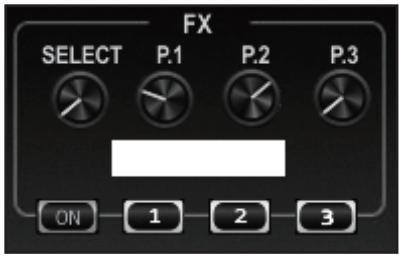
text_image
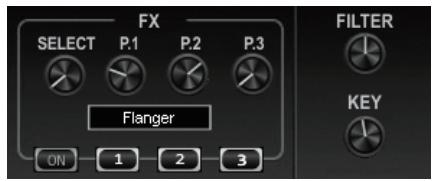
FX SELECT P.1 P.2 P.3 ON 1 2 3Separate audio effects can be applied to the respective decks.
1 Turn the [CONTROL] dial to select the type of effect.
2 Press the [FX ON] button to apply the effect.
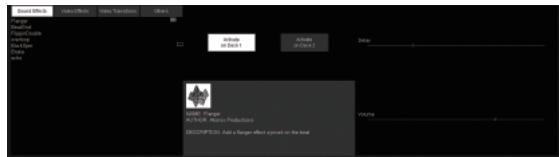
The computer's screen switches to the [EFFECT] panel.
The types of effects provided on VIRTUAL DJ LE are shown below. The types of effects that can be used differ according to the computer being used.
| Windows | Mac OS X | |
| Flanger | √ | √ |
| BeatGrid | √ | ^1 |
| FlippinDouble | √ | √ |
| overloop | √ | X |
| BackSpin | √ | √ |
| Brake | √ | √ |
| echo | √ | X |
If you are using Mac OS X, the characters on the [BeatGrid] effect panel will not display properly for certain languages (Japanese, etc.).
- Various parameters for the effects can be changed by operating the effect parameter controls and the effect parameter buttons.
- The types and numbers of parameters differ according to the effect.
- Operating the parameter controls or buttons has no effect if there is no parameter for that effect.
There are no effects on VIRTUAL DJ LE for which all parameters can be controlled.
When you upgrade to VIRTUAL DJ PRO, various effects can be downloaded from the VIRTUAL DJ website.
Using the SAMPLER function
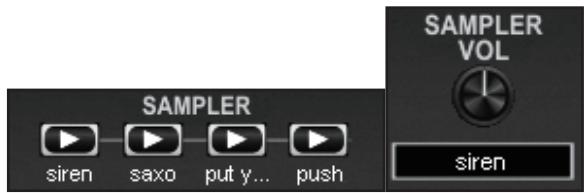
text_image
SAMPLER siren saxo put y... push SAMPLER VOL sirenIn addition to deck operations, the sound of 12 individual sampler slots can also be operated.
1 Press a [SAMPLER] button to start playback of the sampler slot.
The [SAMPLER] buttons on this unit and the sampler slots in VIRTUAL DJ LE correspond as follows:
— [SAMPLER] buttons on this unit's left deck: Sampler slots 1 to 4 — [SAMPLER] buttons on this unit's right deck: Sampler slots 5 to 8
- Playback returns to the beginning of the sample and continues by pressing the [SAMPLER] button while pressing the [SHIFT] button when the sample is playing.
2 Turn the [SAMPLE VOL] control to adjust the volume of the sampler slot.
- Playback of the selected sampler slot can be started and stopped by pressing the [SAMPLE VOL] control while pressing the [SHIFT] button.
- By default, sound sources are preloaded into six slots. Recording a sound to the sampler slot or changing the operation mode can be operated using the [SAMPLER] panel on the computer. For details of the [SAMPLER] panel operation, refer to VIRTUAL DJ LE's operating instructions.
- When recording samples, the sound of the deck selected with [A] or [B] on the computer's screen is recorded. The recorded sound can be saved when you upgrade to VIRTUAL DJ PRO.
Using the VIDEO function
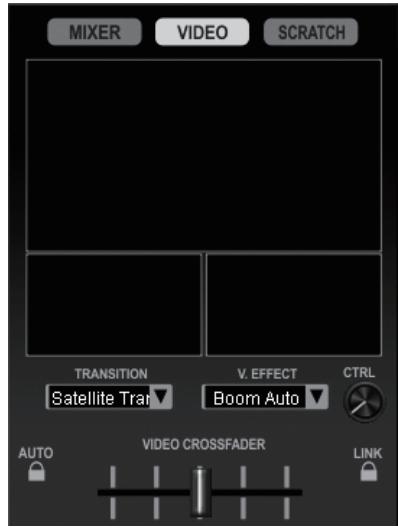
text_image
MIXER VIDEO SCRATCH TRANSITION Satellite Trap V. EFFECT Boom Auto CTRL AUTO VIDEO CROSSFADER LINKWith this function, video files can be loaded onto the respective decks and their pictures mixed.
- For details on the VIDEO function, see VIRTUAL DJ LE's operating instructions.
1 Move the channel faders to output the pictures.
— When the channel fader is set to the position nearest you, a black screen is output.
— The picture gradually appears as the channel fader is moved away from you. At the position farthest from you, the normal picture is output.
2 Move the crossfader to mix the pictures.
- When the [LINK] button at the right of the crossfader on the computer's screen is turned on, the video transition function can be controlled with this unit's crossfader.
- When the [AUTO] button at the left of the crossfader on the computer's screen is turned on, the crossfader on the computer's screen moves automatically according to the playing status of the left and right decks.
3 Press the [F2] button to turn the video transition function on and off.
The video transition function allows you to set the way in which the pictures of the left and right decks switch.
When the video transition function is turned on, the picture automatically crossfades from the picture of the currently playing deck to the picture of the opposite deck.
- The video transition type can be switched by pressing the [F2] button while pressing the [SHIFT] button.
4 Press the [F3] button to apply a video effect to the master picture.
- The video effect type can be switched by pressing the [F3] button while pressing the [SHIFT] button.
Operating four decks
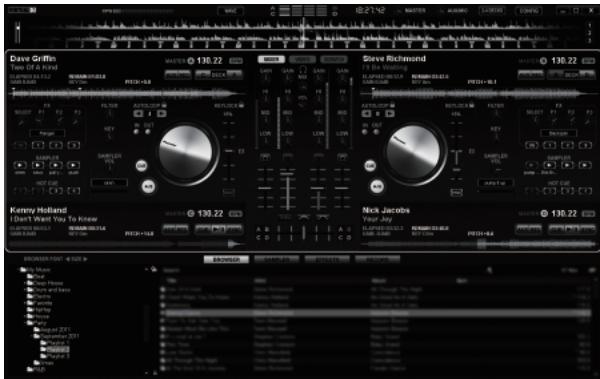
text_image
Dave Griffin Kenny Holland Don't Want You To Kneep MAYA: 139.22 Steve Richmond Nick Jacobs Rear Jay 139.22With VIRTUAL DJ LE, you can select either a 2-deck layout or a 4-deck layout.
This unit supports operation with a 4-deck layout.
1 Click the [2-4 DECKS] button on the computer's screen to switch the deck layout.
2 Press the [DECK] button to switch the deck to be operated.
The [DECK] button for the selected deck lights.
- When a 4-deck layout is set, the decks switch as follows with the [DECK A] – [DECK D] buttons:
— Deck on left side of this unit: Deck [A] or [C]
Deck on right side of this unit: Deck [B] or [D]
- When a 4-deck layout is set, the assign buttons at the sides of the crossfader on the computer's screen can be used to select whether to assign the outputs of the respective decks to the left or right sides of the crossfader.
- When the decks are switched, the positions of the controls and faders on the computer screen and on this unit may differ. In such cases, move the controls and faders on this unit to the same positions as the controls and faders on the computer's screen.
The controls and faders for which this operation is required when the decks are switched are as follows:
— TEMPO slider
— GAIN control
— EQ (HI, MID, LOW) control
— Channel fader
— FILTER control
Inputting the sound of an external device or microphone
The sound of the external device connected to the [AUX IN] terminals or the sound of the microphone connected to the [MIC] terminal can be mixed.
- It is also possible to assign the sound of an external device connected to the [AUX IN] terminals or a microphone connected to the [MIC] terminal to decks.
To assign the sound to a deck, click the [AUX] button on the computer's screen.
When the sound is assigned to a deck, some of the mixer and effect functions can be used.
Sound can also be sampled by clicking the [REC] button on the computer's screen.
1 Connect the external device to the [AUX IN] or [MIC] terminal.
2 Switch the [AUX, MIC] selector switch.
— [AUX]: Selects the external device connected to the [AUX IN] terminals.
— [MIC]: Selects the microphone connected to the [MIC] terminal.
3 Adjust the audio level input to the [AUX IN] or [MIC] terminals.
— Turn the [MIC VOL] control: Adjusts the input sound level of the [MIC] terminal.
— Turn the [AUX IN VOL] control: Adjusts the input sound level of the [AUX IN] terminals.
Pioneer DJ player: Set near the center position.
Portable audio player or other device with low volume: Set clockwise of the center position.
4 Turn the [AUX/MIC] control to adjust the output sound level.
Other Functions
Recording
1 Press the [FUNCTION(REC)] button while pressing the [SHIFT] button to start recording.
- When recording starts, the settings window is displayed. Set where to store the recorded file and the file name.
- To display the [RECORD] panel, click the [RECORD] tab. Recording can be started and stopped even when the [RECORD] panel is not displayed.
2 Press the [FUNCTION(REC)] button again while pressing the [SHIFT] button to stop recording.
Editing the beat grid
- This function is operated on the computer. It cannot be operated on this unit.
1 Load the track whose beat grid you want to edit onto a deck.
2 Select the loaded track on the browser screen and right-click.
3 Select [BPM] > [Manual Edit].
The [Adjust BPM Values] screen is displayed.
![PIONEER DDJ-ERGO-V - Select [BPM] > [Manual Edit]. - 1](/content/2025/01/119073/images/9ca74ab4526ae5131e60c1a1ac4b2c824f680803f6d9cec34154b0edfb620a79.jpg)
text_image
Adjust BPM Values Edit Bpm Edit Grid Bpm 118.21 < > /2 x2 Phase < > -1/4 +1/4 Re-Analyze Copy from Other deck1 Input the [BPM] value directly or use the [<] and [>] buttons to adjust the grid spacing.
2 Move the slider or use the [<] and [>] buttons to move the grid position.
3 Use the [-1/4] and [+1/4] buttons to move the grid position in units of beats.
Analyzing files
- This function is operated on the computer. It cannot be operated on this unit.
We recommend analyzing files before playing them with VIRTUAL DJ LE. When files are analyzed, the track's BPM and key are detected and the beat grid is attributed automatically.
1 Select the track or folder you want to analyze, then right-click the mouse.
2 From the menu, click [BPM] > [Re-Analyze] to start analyzing.
If multiple tracks or folders are selected, click [Scan for BPMs].
- When analysis is completed, the icon at the beginning of the track
item switches from 📋 to 📋.
Switching the jog dials' illumination mode
This unit is equipped with two types of illumination modes for the jog dials.
Press the [VINYL (PULSE MODE)] button while pressing the [SHIFT] button to switch the illumination mode.
— Pulse Mode Active: The offset of the beat grids is expressed by the blue illumination of the jog dials. The illumination is brightest for the master deck and decks for which the beat grid matches. The jog dials' illumination also lights in conjunction with effect operations.
— Pulse Mode Normal: The blue illumination lights when the top of a jog dial is pressed.
- The illumination mode setting is not cleared when this unit's power is turned off. When the power is next turned on, the unit starts in the mode that was set before the power was turned off.
List of MIDI Messages
On this unit, the browser, deck, mixer and effect sections are connected with the MIDI channels shown below.
- “n” is the value of the channel number minus 1.
- Deck A is 0, Deck B is 1, Deck C is 2 and Deck D is 3.
- When operated while pressing the [SHIFT] button, the MIDI message for when the [SHIFT] button is on is sent.
- MIDI messages cannot be assigned to the [SHIFT] buttons.
• We do not recommend using MIDI channels 12 and 13.
| MIDI channel | MIDI ch. Value | |
| Deck A | 1 | n=0 |
| Deck B | 2 | n=1 |
| Deck C | 3 | n=2 |
| Deck D | 4 | n=3 |
| Effect A/C | 5 | n=4 |
| Effect B/D | 6 | n=5 |
| Browser, mixer, global section | 7 | n=6 |
1 Browser
| SW Name | MIDI message (this unit to computer) | Notes | |||||
| When SHIFT button is off | When SHIFT button is on | ||||||
| Rotary selector (turn) | B6 | 64 | dd | B6 | 100 | dd | Difference count value from when previously operatedTurn clockwise: 1 – (max) 30Turn counterclockwise: 127 – (min) 98 |
| Rotary selector (press) | 96 | 65 | dd | 96 | 66 | dd | OFF=0, ON=127 |
| LOAD A button | 96 | 70 | dd | 96 | 88 | dd | OFF=0, ON=127 |
| LOAD B button | 96 | 71 | dd | 96 | 89 | dd | OFF=0, ON=127 |
| LOAD C button | 96 | 72 | dd | 96 | 90 | dd | OFF=0, ON=127 |
| LOAD D button | 96 | 73 | dd | 96 | 91 | dd | OFF=0, ON=127 |
2 Deck
| SW Name | MIDI message (this unit to computer) | Notes | |||||
| When SHIFT button is off | When SHIFT button is on | ||||||
| ▶/II button | 9n | 11 | dd | 9n | 71 | dd | OFF=0, ON=127 |
| CUE button | 9n | 12 | dd | 9n | 72 | dd | OFF=0, ON=127 |
| IN button | 9n | 16 | dd | 9n | 76 | dd | OFF=0, ON=127 |
| OUT button | 9n | 17 | dd | 9n | 77 | dd | OFF=0, ON=127 |
| AUTO LOOP (MOVE GRID) control (turn) | Bn | 19 | dd | 9n | 79 | dd | Difference count value from when previously operatedTurn clockwise: 1 – (max) 30Turn counterclockwise: 127 – (min) 98 |
| AUTO LOOP (MOVE GRID) control (press) | 9n | 20 | dd | 9n | 80 | dd | OFF=0, ON=127 |
| DECK button | 9n | 114 | dd | — | — | — | OFF=0, ON=127 |
| HOT CUE/DELETE 1button | 9n | 46 | dd | 9n | 95 | dd | OFF=0, ON=127 |
| HOT CUE/DELETE 2button | 9n | 47 | dd | 9n | 96 | dd | OFF=0, ON=127 |
| HOT CUE/DELETE 3button | 9n | 48 | dd | 9n | 97 | dd | OFF=0, ON=127 |
| HOT CUE/DELETE 4button | 9n | 49 | dd | 9n | 98 | dd | OFF=0, ON=127 |
| KEYLOCK (TEMPO RANGE) button | 9n | 26 | dd | 9n | 27 | dd | OFF=0, ON=127 |
| 9n | 28 | dd | OFF=0, ON=127 | ||||
| 9n | 29 | dd | OFF=0, ON=127 | ||||
| 9n | 30 | dd | OFF=0, ON=127 | ||||
| VINYL (PULSE MODE) button | 9n | 21 | dd | 9n | 22 | dd | OFF=0, ON=127 |
| TEMPO slider | Bn | 0 | MSB | Bn | 5 | MSB | 0–16383 |
| Bn | 32 | LSB | Bn | 37 | LSB | 0 at – side, 16383 at + side | |
| SYNC (MASTER) button | 9n | 88 | dd | 9n | 92 | dd | OFF=0, ON=127 |
| Jog dial (when outer section turned) | BnBn | 133 | MSBLSB | BnBn | 638 | MSBLSB | Difference count from previous operationWhen turned clockwise: Increases from 1When turned counterclockwise: Decreases from 16383The cumulative difference count when the jog dial is turned 1 rotation is 2430. |
| Jog dial (when top section turned: VINYL mode on) | BnBn | 234 | MSBLSB | BnBn | 397 | MSBLSB | Difference count from previous operationWhen turned clockwise: Increases from 1When turned counterclockwise: Decreases from 16383The cumulative difference count when the jog dial is turned 1 rotation is 2430. |
| Jog dial (when top section turned: VINYL mode off) | BnBn | 335 | MSBLSB | BnBn | 397 | MSBLSB | Difference count from previous operationWhen turned clockwise: Increases from 1When turned counterclockwise: Decreases from 16383The cumulative difference count when the jog dial is turned 1 rotation is 2430. |
| Jog dial (when top section pressed: VINYL mode on) | 9n | 54 | dd | 9n | 103 | dd | OFF=0, ON=127 |
| Jog dial (when top section pressed: VINYL mode off) | 9n | 55 | dd | 9n | 103 | dd | OFF=0, ON=127 |
| Indicator name | MIDI message (computer to this unit) | Notes | |||||
| When SHIFT button is off | When SHIFT button is on | ||||||
| ▶/II button | 9n | 11 | dd | — | — | — | Off = 0, lit = 127 |
| CUE button | 9n | 12 | dd | 9n | 72 | dd | Off = 0, lit = 127 |
| IN button | 9n | 16 | dd | 9n | 76 | dd | Off = 0, lit = 127 |
| OUT button | 9n | 17 | dd | 9n | 77 | dd | Off = 0, lit = 127 |
| DECK button | 9n | 114 | dd | — | — | — | Off = 0, lit = 127 |
| HOT CUE/DELETE 1button | 9n | 46 | dd | 9n | 95 | dd | Off = 0, lit = 127 |
| HOT CUE/DELETE 2button | 9n | 47 | dd | 9n | 96 | dd | Off = 0, lit = 127 |
| HOT CUE/DELETE 3button | 9n | 48 | dd | 9n | 97 | dd | Off = 0, lit = 127 |
| HOT CUE/DELETE 4button | 9n | 49 | dd | 9n | 98 | dd | Off = 0, lit = 127 |
| KEYLOCK (TEMPO RANGE) button | 9n | 26 | dd | 9n | 27 | dd | Off = 0, lit = 127 |
| VINYL (PULSE MODE) button | 9n | 21 | dd | 9n | 22 | dd | Off = 0, lit = 127 |
| SYNC (MASTER) button | 9n | 88 | dd | 9n | 92 | dd | Off = 0, lit = 127 |
When the [KEYLOCK (TEMPO RANGE)] button is pressed while pressing the [SHIFT] button, MIDI messages 27 to 30 are sent in order repeatedly.
3 Mixer
| SW Name | MIDI message (this unit to computer) | Notes | ||||||
| When SHIFT button is off | When SHIFT button is on | |||||||
| MASTER VOL control | B6 | 0 | MSB | — | — | — | 0-16383When turned fully counterclockwise: 0 / Whenturned fully clockwise: 16383 | |
| B6 | 32 | LSB | — | — | — | |||
| AUX/MIC VOL control | B6 | 20 | MSB | — | — | — | 0-16383When turned fully counterclockwise: 0 / Whenturned fully clockwise: 16383 | |
| B6 | 52 | LSB | — | — | — | |||
| GAIN control | Deck A | B6 | 3 | MSB | — | — | — | 0-16383When turned fully counterclockwise: 0 / Whenturned fully clockwise: 16383 |
| B6 | 35 | LSB | — | — | — | |||
| Deck B | B6 | 4 | MSB | — | — | — | 0-16383When turned fully counterclockwise: 0 / Whenturned fully clockwise: 16383 | |
| B6 | 36 | LSB | — | — | — | |||
| Deck C | B6 | 5 | MSB | — | — | — | 0-16383When turned fully counterclockwise: 0 / Whenturned fully clockwise: 16383 | |
| B6 | 37 | LSB | — | — | — | |||
| Deck D | B6 | 6 | MSB | — | — | — | 0-16383When turned fully counterclockwise: 0 / Whenturned fully clockwise: 16383 | |
| B6 | 38 | LSB | — | — | — | |||
| FUNCTION (REC) button | 96 | 101 | dd | 96 | 102 | dd | OFF=0, ON=127 | |
| HEADPHONES MIX control | B6 | 1 | MSB | — | — | — | 0-16383When turned fully counterclockwise: 0 / Whenturned fully clockwise: 16383 | |
| B6 | 33 | LSB | — | — | — | |||
| HEADPHONES VOL control | B6 | 2 | MSB | — | — | — | 0-16383When turned fully counterclockwise: 0 / Whenturned fully clockwise: 16383 | |
| B6 | 34 | LSB | — | — | — | |||
| EQ [HI] control | Deck A | B6B6 | 739 | MSBLSB | — | — | — | 0-16383When turned fully counterclockwise: 0 / Whenturned fully clockwise: 16383 |
| Deck B | B6B6 | 840 | MSBLSB | — | — | — | 0-16383When turned fully counterclockwise: 0 / Whenturned fully clockwise: 16383 | |
| Deck C | B6B6 | 941 | MSBLSB | — | — | — | 0-16383When turned fully counterclockwise: 0 / Whenturned fully clockwise: 16383 | |
| Deck D | B6B6 | 1042 | MSBLSB | — | — | — | 0-16383When turned fully counterclockwise: 0 / Whenturned fully clockwise: 16383 | |
| EQ [MID] control | Deck A | B6B6 | 1143 | MSBLSB | — | — | — | 0-16383When turned fully counterclockwise: 0 / Whenturned fully clockwise: 16383 |
| Deck B | B6B6 | 1244 | MSBLSB | — | — | — | 0-16383When turned fully counterclockwise: 0 / Whenturned fully clockwise: 16383 | |
| Deck C | B6B6 | 1345 | MSBLSB | — | — | — | 0-16383When turned fully counterclockwise: 0 / Whenturned fully clockwise: 16383 | |
| Deck D | B6B6 | 1446 | MSBLSB | — | — | — | 0-16383When turned fully counterclockwise: 0 / Whenturned fully clockwise: 16383 | |
| EQ [LOW] control | Deck A | B6B6 | 1547 | MSBLSB | — | — | — | 0-16383When turned fully counterclockwise: 0 / Whenturned fully clockwise: 16383 |
| Deck B | B6B6 | 1648 | MSBLSB | — | — | — | 0-16383When turned fully counterclockwise: 0 / Whenturned fully clockwise: 16383 | |
| Deck C | B6B6 | 1749 | MSBLSB | — | — | — | 0-16383When turned fully counterclockwise: 0 / Whenturned fully clockwise: 16383 | |
| Deck D | B6B6 | 1850 | MSBLSB | — | — | — | 0-16383When turned fully counterclockwise: 0 / Whenturned fully clockwise: 16383 | |
| CUE(Headphones cue button) | 96 | 84 | dd | — | — | — | OFF=0, ON=127 | |
| 96 | 85 | dd | — | — | — | OFF=0, ON=127 | ||
| 96 | 86 | dd | — | — | — | OFF=0, ON=127 | ||
| 96 | 87 | dd | — | — | — | OFF=0, ON=127 | ||
| Channel fader | Deck A | B6B6 | 1951 | MSBLSB | — | — | — | 0-16383When turned fully counterclockwise: 0 / Whenturned fully clockwise: 16383 |
| Deck B | B6B6 | 2153 | MSBLSB | — | — | — | 0-16383When turned fully counterclockwise: 0 / Whenturned fully clockwise: 16383 | |
| Deck C | B6B6 | 2355 | MSBLSB | — | — | — | 0-16383When turned fully counterclockwise: 0 / Whenturned fully clockwise: 16383 | |
| Deck D | B6B6 | 2557 | MSBLSB | — | — | — | 0-16383When turned fully counterclockwise: 0 / Whenturned fully clockwise: 16383 | |
| Crossfader | B6B6 | 3163 | MSBLSB | — | — | — | 0-163830 at left side, 16383 at right side | |
| Indicator name | MIDI message (computer to this unit) | Notes | ||||||
| When SHIFT button is off | When SHIFT button is on | |||||||
| FUNCTION (REC) button | 96 | 101 | dd | 96 | 102 | dd | Off = 0, lit = 127 | |
| CUE (Headphones cue button) | Deck A | 96 | 84 | dd | — | — | — | Off = 0, lit = 127 |
| Deck B | 96 | 85 | dd | — | — | — | Off = 0, lit = 127 | |
| Deck C | 96 | 86 | dd | — | — | — | Off = 0, lit = 127 | |
| Deck D | 96 | 87 | dd | — | — | — | Off = 0, lit = 127 | |
When using the VIRTUAL DJ LE software, the [MASTER VOL] and [HEADPHONES VOL] controls do not send MIDI messages.
4 Effect
| SW Name | MIDI message (this unit to computer) | Notes | ||||||
| When SHIFT button is off | When SHIFT button is on | |||||||
| CONTROL dial | Deck A | B4B4 | 032 | MSBLSB | B4B4 | 1648 | MSBLSB | 0-16383When turned fully counterclockwise: 0 / When turned fully clockwise: 16383 |
| Deck B | B5B5 | 032 | MSBLSB | B5B5 | 1648 | MSBLSB | 0-16383When turned fully counterclockwise: 0 / When turned fully clockwise: 16383 | |
| Deck C | B4B4 | 840 | MSBLSB | B4B4 | 2456 | MSBLSB | 0-16383When turned fully counterclockwise: 0 / When turned fully clockwise: 16383 | |
| Deck D | B5B5 | 840 | MSBLSB | B5B5 | 2456 | MSBLSB | 0-16383When turned fully counterclockwise: 0 / When turned fully clockwise: 16383 | |
| Effect parameter control 1 | Deck A | B4B4 | 234 | MSBLSB | B4B4 | 1850 | MSBLSB | 0-16383When turned fully counterclockwise: 0 / When turned fully clockwise: 16383 |
| Deck B | B5B5 | 234 | MSBLSB | B5B5 | 1850 | MSBLSB | 0-16383When turned fully counterclockwise: 0 / When turned fully clockwise: 16383 | |
| Deck C | B4B4 | 1042 | MSBLSB | B4B4 | 2658 | MSBLSB | 0-16383When turned fully counterclockwise: 0 / When turned fully clockwise: 16383 | |
| Deck D | B5B5 | 1042 | MSBLSB | B5B5 | 2658 | MSBLSB | 0-16383When turned fully counterclockwise: 0 / When turned fully clockwise: 16383 | |
| Effect parameter control 2 | Deck A | B4B4 | 436 | MSBLSB | B4B4 | 2052 | MSBLSB | 0-16383When turned fully counterclockwise: 0 / When turned fully clockwise: 16383 |
| Deck B | B5B5 | 436 | MSBLSB | B5B5 | 2052 | MSBLSB | 0-16383When turned fully counterclockwise: 0 / When turned fully clockwise: 16383 | |
| Deck C | B4B4 | 1244 | MSBLSB | B4B4 | 2860 | MSBLSB | 0-16383When turned fully counterclockwise: 0 / When turned fully clockwise: 16383 | |
| Deck D | B5B5 | 1244 | MSBLSB | B5B5 | 2860 | MSBLSB | 0-16383When turned fully counterclockwise: 0 / When turned fully clockwise: 16383 | |
| Effect parameter control 3 | Deck A | B4B4 | 638 | MSBLSB | B4B4 | 2254 | MSBLSB | 0-16383When turned fully counterclockwise: 0 / When turned fully clockwise: 16383 |
| Deck B | B5B5 | 638 | MSBLSB | B5B5 | 2254 | MSBLSB | 0-16383When turned fully counterclockwise: 0 / When turned fully clockwise: 16383 | |
| Deck C | B4B4 | 1446 | MSBLSB | B4B4 | 3062 | MSBLSB | 0-16383When turned fully counterclockwise: 0 / When turned fully clockwise: 16383 | |
| Deck D | B5B5 | 1446 | MSBLSB | B5B5 | 3062 | MSBLSB | 0-16383When turned fully counterclockwise: 0 / When turned fully clockwise: 16383 | |
| FILTER control | Deck A | B6B6 | 2759 | MSBLSB | — | — | — | 0-16383When turned fully counterclockwise: 0 / When turned fully clockwise: 16383 |
| Deck B | B6B6 | 2860 | MSBLSB | — | — | — | 0-16383When turned fully counterclockwise: 0 / When turned fully clockwise: 16383 | |
| Deck C | B6B6 | 2961 | MSBLSB | — | — | — | 0-16383When turned fully counterclockwise: 0 / When turned fully clockwise: 16383 | |
| Deck D | B6B6 | 3062 | MSBLSB | — | — | — | 0-16383When turned fully counterclockwise: 0 / When turned fully clockwise: 16383 | |
| FX ON button | Deck A | 94 | 67 | dd | 94 | 64 | dd | OFF=0, ON=127 |
| Deck B | 95 | 67 | dd | 95 | 64 | dd | OFF=0, ON=127 | |
| Deck C | 94 | 74 | dd | 94 | 102 | dd | OFF=0, ON=127 | |
| Deck D | 95 | 74 | dd | 95 | 102 | dd | OFF=0, ON=127 | |
| Effect parameter button 1 | Deck A | 94 | 71 | dd | 94 | 99 | dd | OFF=0, ON=127 |
| Deck B | 95 | 71 | dd | 95 | 99 | dd | OFF=0, ON=127 | |
| Deck C | 94 | 75 | dd | 94 | 103 | dd | OFF=0, ON=127 | |
| Deck D | 95 | 75 | dd | 95 | 103 | dd | OFF=0, ON=127 | |
| Effect parameter button 1 | Deck A | 94 | 72 | dd | 94 | 100 | dd | OFF=0, ON=127 |
| Deck B | 95 | 72 | dd | 95 | 100 | dd | OFF=0, ON=127 | |
| Deck C | 94 | 76 | dd | 94 | 104 | dd | OFF=0, ON=127 | |
| Deck D | 95 | 76 | dd | 95 | 104 | dd | OFF=0, ON=127 | |
| Effect parameter button 1 | Deck A | 94 | 73 | dd | 94 | 101 | dd | OFF=0, ON=127 |
| Deck B | 95 | 73 | dd | 95 | 101 | dd | OFF=0, ON=127 | |
| Deck C | 94 | 77 | dd | 94 | 105 | dd | OFF=0, ON=127 | |
| Deck D | 95 | 77 | dd | 95 | 105 | dd | OFF=0, ON=127 | |
| FX1 button | Deck A | 96 | 76 | dd | — | — | — | OFF=0, ON=127 |
| Deck B | 96 | 77 | dd | — | — | — | OFF=0, ON=127 | |
| Deck C | 96 | 78 | dd | — | — | — | OFF=0, ON=127 | |
| Deck D | 96 | 79 | dd | — | — | — | OFF=0, ON=127 | |
| FX2 button | Deck A | 96 | 80 | dd | — | — | — | OFF=0, ON=127 |
| Deck B | 96 | 81 | dd | — | — | — | OFF=0, ON=127 | |
| Deck C | 96 | 82 | dd | — | — | — | OFF=0, ON=127 | |
| Deck D | 96 | 83 | dd | — | — | — | OFF=0, ON=127 | |
| Indicator name | MIDI message (computer to this unit) | Notes | ||||||
| When SHIFT button is off | When SHIFT button is on | |||||||
| FX ON button | Deck A | 94 | 67 | dd | 94 | 64 | dd | Off = 0, lit = 127 |
| Deck B | 95 | 67 | dd | 95 | 64 | dd | Off = 0, lit = 127 | |
| Deck C | 94 | 74 | dd | 94 | 102 | dd | Off = 0, lit = 127 | |
| Deck D | 95 | 74 | dd | 95 | 102 | dd | Off = 0, lit = 127 | |
| Effect parameter button 1 | Deck A | 94 | 71 | dd | 94 | 99 | dd | Off = 0, lit = 127 |
| Deck B | 95 | 71 | dd | 95 | 99 | dd | Off = 0, lit = 127 | |
| Deck C | 94 | 75 | dd | 94 | 103 | dd | Off = 0, lit = 127 | |
| Deck D | 95 | 75 | dd | 95 | 103 | dd | Off = 0, lit = 127 | |
| Effect parameter button 1 | Deck A | 94 | 72 | dd | 94 | 100 | dd | Off = 0, lit = 127 |
| Deck B | 95 | 72 | dd | 95 | 100 | dd | Off = 0, lit = 127 | |
| Deck C | 94 | 76 | dd | 94 | 104 | dd | Off = 0, lit = 127 | |
| Deck D | 95 | 76 | dd | 95 | 104 | dd | Off = 0, lit = 127 | |
| Effect parameter button 1 | Deck A | 94 | 73 | dd | 94 | 101 | dd | Off = 0, lit = 127 |
| Deck B | 95 | 73 | dd | 95 | 101 | dd | Off = 0, lit = 127 | |
| Deck C | 94 | 77 | dd | 94 | 105 | dd | Off = 0, lit = 127 | |
| Deck D | 95 | 77 | dd | 95 | 105 | dd | Off = 0, lit = 127 | |
| FX1 button | Deck A | 96 | 76 | dd | — | — | — | Off = 0, lit = 127 |
| Deck B | 96 | 77 | dd | — | — | — | Off = 0, lit = 127 | |
| Deck C | 96 | 78 | dd | — | — | — | Off = 0, lit = 127 | |
| Deck D | 96 | 79 | dd | — | — | — | Off = 0, lit = 127 | |
| FX2 button | Deck A | 96 | 80 | dd | — | — | — | Off = 0, lit = 127 |
| Deck B | 96 | 81 | dd | — | — | — | Off = 0, lit = 127 | |
| Deck C | 96 | 82 | dd | — | — | — | Off = 0, lit = 127 | |
| Deck D | 96 | 83 | dd | — | — | — | Off = 0, lit = 127 | |
- When operated while pressing the [SHIFT] button, the MIDI message for when the [SHIFT] button is on is sent.
5 Sampler
| SW Name | MIDI message (this unit to computer) | Notes | |||||
| When SHIFT button is off | When SHIFT button is on | ||||||
| SAMPLER button 1 | 9n | 60 | dd | 9n | 61 | dd | OFF=0, ON=127 |
| SAMPLER button 2 | 9n | 62 | dd | 9n | 63 | dd | OFF=0, ON=127 |
| SAMPLER button 3 | 9n | 64 | dd | 9n | 65 | dd | OFF=0, ON=127 |
| SAMPLER button 4 | 9n | 66 | dd | 9n | 67 | dd | OFF=0, ON=127 |
| SAMPLE VOL control (turn) | Bn | 68 | dd | Bn | 73 | dd | Difference count value from when previously operatedTurn clockwise: 1 – (max) 30Turn counterclockwise: 127 – (min) 98 |
| SAMPLE VOL control (press) | 9n | 69 | dd | 9n | 74 | dd | OFF=0, ON=127 |
| Indicator name | MIDI message (computer to this unit) | Notes | |||||
| When SHIFT button is off | When SHIFT button is on | ||||||
| SAMPLER button 1 | 9n | 60 | dd | 9n | 61 | dd | Off = 0, lit = 127 |
| SAMPLER button 2 | 9n | 62 | dd | 9n | 63 | dd | Off = 0, lit = 127 |
| SAMPLER button 3 | 9n | 64 | dd | 9n | 65 | dd | Off = 0, lit = 127 |
| SAMPLER button 4 | 9n | 66 | dd | 9n | 67 | dd | Off = 0, lit = 127 |
6 Video
| SW Name | MIDI message (this unit to computer) | Notes | |||||
| When SHIFT button is off | When SHIFT button is on | ||||||
| F1 control | B6 | 22 | MSB | — | — | — | 0-16383When turned fully counterclockwise: 0 / Whenturned fully clockwise: 16383 |
| B6 | 54 | LSB | — | — | — | ||
| F2 button | 96 | 105 | dd | 96 | 106 | dd | OFF=0, ON=127 |
| F3 button | 96 | 107 | dd | 96 | 108 | dd | OFF=0, ON=127 |
| SW Name | MIDI message (computer to this unit) | Notes | |||||
| When SHIFT button is off | When SHIFT button is on | ||||||
| F2 button | 96 | 105 | dd | 96 | 106 | dd | Off = 0, lit = 127 |
| F3 button | 96 | 107 | dd | 96 | 108 | dd | Off = 0, lit = 127 |
Additional information
Troubleshooting
- Incorrect operation is often mistaken for trouble or malfunction. If you think that there is something wrong with this component, check the points below. Sometimes the trouble may lie in another component. Inspect the other components and electrical appliances being used. If the trouble cannot be rectified after checking the items below, ask your nearest Pioneer authorized service center or your dealer to carry out repair work.
- This unit may not operate properly due to static electricity or other external influences. In this case, proper operation may be restored by turning the power off, waiting 1 minute, then turning the power back on.
| Problem | Check | Remedy |
| This unit is not recognized. | Is the power [ON/OFF] switch set to [ON]? | Set the power [ON/OFF] switch to [ON]. |
| Is the included USB cable properly connected? | Connect the included USB cable properly. (page 10) | |
| Are you using a USB hub? | USB hubs cannot be used. Connect the computer and this unit directly using the included USB cable. (page 10) | |
| — | If you are using Windows, click the [CONFIG] button in VIRTUAL DJ LE and check that [ASIO DRIVER] and [Pioneer DDJ ASIO] are selected for the [Sound card] settings on the [Sound Setup] tab. (page 18) | |
| Positions of controls and sliders on this unit and VIRTUAL DJ LE differ. | — | When controls and sliders on this unit are moved, the controls and slides on VIRTUAL DJ LE are synchronized. |
| Music files cannot be played. | Are the music files damaged? | Play music files that are not damaged. |
| Distorted sound. | Is the [GAIN] control set to the proper position? | Adjust the [GAIN] control while watching the level meter in VIRTUAL DJ LE. |
| Is the audio level being input to the [AUX IN] and [MIC] terminals set to a suitable level? | Set the audio level input to the terminals to a suitable level for the connected devices. | |
| Are the [MASTER OUT 1] terminals set to unbalanced output with a monaural cable? | With an unbalanced output, the sound will be distorted unless the output is set to a suitable level. Use the [MASTER VOL] control to set the output to a suitable level. | |
| Sound being played is interrupted. | Is the computer connected to this unit connected to an AC power supply? | When using a notebook computer on battery power, the power management system may set the battery energy saving mode, decreasing the CPU's clock frequency. If this happens, noise may be generated and operation may become slower. Connect the computer to which this unit is to be connected to an AC power supply. |
| Is the driver software's latency value suitable? | Set the driver software's latency to a suitable value. (page 8) | |
| Sound of an external device or microphone cannot be output. | Is the [AUX, MIC] selector switch set to the proper position? | Set the [AUX, MIC] selector switch to the proper position for the device whose sound is to be output. (page 22) |
| Volume of headphones is low. | Is [DECK] button [A], [B], [C] or [D] flashing? | The unit is operating in the emergency mode (with limited functions). Check your computer or headphones. (Page 9) |
| No sound is produced. | Is the included USB cable properly connected? | Connect the computer and this unit directly using the included USB cable. USB hubs cannot be used. (page 10) |
| Are terminals or plugs dirty? | Wipe any dirt off terminals and plugs before connecting. | |
| Is the driver software properly set? | Set the driver software properly. (page 8) | |
| Are the connected components and amplifiers properly set? | Set the external input selection and volume on the components and amplifiers properly. | |
| [SYNC] function does not work properly. | Have the music files been properly analyzed? | If the results of analysis of the music files are not correct, edit the beat grid manually. (Page 22) |
| Sound is interrupted when the ASIO driver is set. | Has the ASIO driver been set with VIRTUAL DJ LE running? | Set the ASIO driver before launching VIRTUAL DJ LE. (page 8) |
| Recorded samples cannot be saved. Samples cannot be registered at sampler slots 7 or 8. | — | The functions for saving and calling out recorded samples can be used when you upgrade to VIRTUAL DJ PRO. |
| There are no effects for which the effect parameter buttons can be used. | — | If you are using Windows, effect parameter buttons 1 to 5 can be used when using [overloop]. If you are using Mac OS X, there are no effects for which the effect parameter buttons can be used. When you upgrade to VIRTUAL DJ PRO, various effects can be downloaded from the VIRTUAL DJ website. |
| There are no effects for which the effect parameter controls 3 to 6 can be used. | — | Effect parameter controls 3 to 6 can be used when you upgrade to VIRTUAL DJ PRO. When you upgrade to VIRTUAL DJ PRO, various effects can be downloaded from the VIRTUAL DJ website. |
| Computer on which Windows XP is installed freezes or CPU usage rate is 100%. | Have you turned off this unit's power while VIRTUAL DJ LE was running or disconnected the USB cable during use? | Be sure to quit VIRTUAL DJ LE before turning off this unit's power. Also, do not disconnect the USB cable during use. |
| Communications cannot be established when this unit is turned on after launching VIRTUAL DJ LE. Operations of buttons and controls are not associated, or LEDs do not light. | Have you launched the controller or VIRTUAL DJ LE in the wrong order? | If you are using Windows, click the [CONFIG] button in VIRTUAL DJ LE and check that [ASIO DRIVER] and [Pioneer DDJ ASIO] are selected for the [Sound card] settings on the [Sound Setup] tab. (page 18) |
| Recording is not possible. | Is there a 2-byte code (used in Japanese, etc.) included in the file path for where the recorded file is to be stored? | Set so that there are no 2-byte codes (used in Japanese, etc.) in the file path for where recorded files are to be stored. |
| Nothing appears on the computer's screen though VIRTUAL DJ LE was launched. | Is your computer's display resolution 1 024 x 768 or greater? | Right-click the task bar and launch the task manager. On the task manager's [Application] tab, right-click [VIRTUAL DJ LE] and select [Maximize]. |
Using as a controller for other DJ software
The DDJ-ERGO-V also outputs the operating data for the buttons and dials in MIDI format. If you connect a computer with a built-in MIDI-compatible DJ software via a USB cable, you can operate the DJ software on this unit. The sound of music files being played on the computer can also be output from the DDJ-ERGO-V.
To use as a controller for other DJ software, first make the DJ software's audio and MIDI related settings.
For details, see your DJ software's operating instructions.
About trademarks and registered trademarks
• Pioneer is a registered trademark of PIONEER CORPORATION.
- Microsoft ^® , Windows Vista ^® , Windows ^® and Internet Explorer ^® are either registered trademarks or trademarks of Microsoft Corporation in the United States and/or other countries.
- Apple, Macintosh, Mac OS, Safari, iTunes, and Finder are trademarks of Apple Inc., registered in the U.S. and other countries.
- Intel, Intel Core, and Pentium are trademarks of Intel Corporation in the U.S. and other countries.
• AMD Athlon is a trademark of Advanced Micro Devices, Inc.
• ASIO is a trademark of Steinberg Media Technologies GmbH.
• VirtualDJ is a registered trademark of Atomix Productions.
The names of companies and products mentioned herein are the trademarks of their respective owners.
This product has been licensed for nonprofit use. This product has not been licensed for commercial purposes (for profit-making use), such as broadcasting (terrestrial, satellite, cable or other types of broadcasting), streaming on the Internet, Intranet (a corporate network) or other types of networks or distributing of electronic information (online digital music distribution service). You need to acquire the corresponding licenses for such uses. For details, see http://www.mp3licensing.com.
Cautions on copyrights
Recordings you have made are for your personal enjoyment and according to copyright laws may not be used without the consent of the copyright holder.
- Music recorded from CDs, etc., is protected by the copyright laws of individual countries and by international treaties. It is the full responsibility of the person who has recorded the music to ensure that it is used legally.
- When handling music downloaded from the Internet, etc., it is the full responsibility of the person who has downloaded the music to ensure that it is used in accordance with the contract concluded with the download site.
Specifications
General – Main Unit
Power supply.....DC 5 V
Power consumption....500 mA
Main unit weight 2.9 kg (6.4 lb)
Max. dimensions.....554.8 mm (W) × 103.2 mm (H) × 279.8 mm (D)
(21.8 in. (W) × 4.1 in. (H) × 11 in. (D))
Tolerable operating temperature ..... +5 °C to +35 °C (+41 °F to +95 °F)
Tolerable operating humidity .... 5 % to 85 % (no condensation)
Audio Section
Rated output level
MASTER OUT 1....4.2 Vrms
MASTER OUT 2....2.1 Vrms
Total harmonic distortion
MASTER OUT 1....0.006%
MASTER OUT 2....0.006%
Frequency characteristic
MASTER OUT 1....20 Hz to 20 kHz
MASTER OUT 2....20 Hz to 20 kHz
S/N ratio (when playing on computer)
MASTER OUT 1....101 dB (at rated output)
MASTER OUT 2....101 dB (at rated output)
Input impedance
AUX 24 kΩ
MIC 11 kΩ
Output impedance
MASTER OUT 1....1 kΩ or less
MASTER OUT 2....1 kΩ or less
PHONES 10 Ω or less
Input / Output terminals
USB terminal B type....1 set
MASTER OUT 1 output terminal TRS phone jack (∅ 6.3 mm) .... 1 set
MASTER OUT 2 output terminal RCA pin jacks....1 set
PHONES output terminal Stereo phone jack (∅ 6.3 mm)....1 set Stereo mini phone jack (∅ 3.5 mm)....1 set
AUX input terminal RCA pin jacks....1 set
MIC input terminal Phone jack (∅ 6.3 mm)....1 set
For improvement purposes, specifications and design of this unit and the included software are subject to change without notice.
To register your product, find the nearest authorized service location, to purchase replacement parts, operating instructions, or accessories, please go to one of following URLs :
© 2011 PIONEER CORPORATION.
All rights reserved.
© 2011 PIONEER CORPORATION.
PIONEER ELECTRONICS (USA) INC.
P.O. BOX 1540, Long Beach, California 90801-1540, U.S.A. TEL: (800) 421-1404
PIONEER ELECTRONICS OF CANADA, INC.
340 Ferrier Street, Unit 2, Markham, Ontario L3R 2Z5, Canada TEL: 1-877-283-5901, 905-479-4411
PIONEER ELECTRONICS ASIACENTRE PTE. LTD.
253 Alexandra Road, #04-01, Singapore 159936 TEL: 65-6472-7555
PIONEER ELECTRONICS AUSTRALIA PTY. LTD.
5 Arco Lane, Heatherton, Victoria, 3202, Australia, TEL: (03) 9586-6300
PIONEER ELECTRONICS (THAILAND) CO., LTD.
17th Fl., KPN Tower, 719 Rama 9 Road, Bangkapi, Huaykwang, Bangkok 10310 TEL: 66-2-717-0777
PIONEER TECHNOLOGY (MALAYSIA) SDN. BHD
16th Floor, Menara Uni. Asia 1008 Jalan Sultan Ismail 50250 Kuala Lumpur TEL: 60-3-2697-2920